EP0942014A2 - Hydrophilic resin, absorbent article, and acrylic acid for polymerization - Google Patents
Hydrophilic resin, absorbent article, and acrylic acid for polymerization Download PDFInfo
- Publication number
- EP0942014A2 EP0942014A2 EP99104213A EP99104213A EP0942014A2 EP 0942014 A2 EP0942014 A2 EP 0942014A2 EP 99104213 A EP99104213 A EP 99104213A EP 99104213 A EP99104213 A EP 99104213A EP 0942014 A2 EP0942014 A2 EP 0942014A2
- Authority
- EP
- European Patent Office
- Prior art keywords
- water
- hydrophilic resin
- absorbent resin
- weight
- acrylic acid
- Prior art date
- Legal status (The legal status is an assumption and is not a legal conclusion. Google has not performed a legal analysis and makes no representation as to the accuracy of the status listed.)
- Granted
Links
- 229920005989 resin Polymers 0.000 title claims abstract description 468
- 239000011347 resin Substances 0.000 title claims abstract description 468
- 239000002250 absorbent Substances 0.000 title claims abstract description 367
- SMZOUWXMTYCWNB-UHFFFAOYSA-N 2-(2-methoxy-5-methylphenyl)ethanamine Chemical compound COC1=CC=C(C)C=C1CCN SMZOUWXMTYCWNB-UHFFFAOYSA-N 0.000 title claims abstract description 164
- NIXOWILDQLNWCW-UHFFFAOYSA-N 2-Propenoic acid Natural products OC(=O)C=C NIXOWILDQLNWCW-UHFFFAOYSA-N 0.000 title claims abstract description 162
- 230000002745 absorbent Effects 0.000 title claims abstract description 46
- 238000006116 polymerization reaction Methods 0.000 title claims description 79
- QIGBRXMKCJKVMJ-UHFFFAOYSA-N Hydroquinone Chemical compound OC1=CC=C(O)C=C1 QIGBRXMKCJKVMJ-UHFFFAOYSA-N 0.000 claims abstract description 258
- 238000004040 coloring Methods 0.000 claims abstract description 161
- AZQWKYJCGOJGHM-UHFFFAOYSA-N 1,4-benzoquinone Chemical compound O=C1C=CC(=O)C=C1 AZQWKYJCGOJGHM-UHFFFAOYSA-N 0.000 claims abstract description 79
- 238000010521 absorption reaction Methods 0.000 claims abstract description 73
- 239000000178 monomer Substances 0.000 claims abstract description 69
- 238000000034 method Methods 0.000 claims abstract description 64
- 239000003112 inhibitor Substances 0.000 claims abstract description 43
- 150000003839 salts Chemical class 0.000 claims abstract description 37
- 239000012266 salt solution Substances 0.000 claims abstract description 36
- 230000008569 process Effects 0.000 claims abstract description 33
- 150000005846 sugar alcohols Polymers 0.000 claims abstract description 26
- 229920000058 polyacrylate Polymers 0.000 claims abstract description 15
- 230000000379 polymerizing effect Effects 0.000 claims abstract description 11
- XLYOFNOQVPJJNP-UHFFFAOYSA-N water Substances O XLYOFNOQVPJJNP-UHFFFAOYSA-N 0.000 claims description 74
- 239000003431 cross linking reagent Substances 0.000 claims description 66
- 238000004132 cross linking Methods 0.000 claims description 51
- 239000002245 particle Substances 0.000 claims description 42
- 239000007864 aqueous solution Substances 0.000 claims description 37
- 239000000463 material Substances 0.000 claims description 35
- 238000001035 drying Methods 0.000 claims description 26
- ZIUHHBKFKCYYJD-UHFFFAOYSA-N n,n'-methylenebisacrylamide Chemical group C=CC(=O)NCNC(=O)C=C ZIUHHBKFKCYYJD-UHFFFAOYSA-N 0.000 claims description 24
- 229920000642 polymer Polymers 0.000 claims description 23
- 238000011156 evaluation Methods 0.000 claims description 22
- 230000008859 change Effects 0.000 claims description 17
- 238000010528 free radical solution polymerization reaction Methods 0.000 claims description 17
- 230000001788 irregular Effects 0.000 claims description 15
- 238000004519 manufacturing process Methods 0.000 claims description 15
- 238000006297 dehydration reaction Methods 0.000 claims description 9
- 230000000052 comparative effect Effects 0.000 description 70
- 239000000843 powder Substances 0.000 description 51
- QTBSBXVTEAMEQO-UHFFFAOYSA-N Acetic acid Chemical compound CC(O)=O QTBSBXVTEAMEQO-UHFFFAOYSA-N 0.000 description 48
- 239000002253 acid Substances 0.000 description 48
- 239000006096 absorbing agent Substances 0.000 description 46
- 239000000243 solution Substances 0.000 description 32
- XBDQKXXYIPTUBI-UHFFFAOYSA-N dimethylselenoniopropionate Natural products CCC(O)=O XBDQKXXYIPTUBI-UHFFFAOYSA-N 0.000 description 28
- IJGRMHOSHXDMSA-UHFFFAOYSA-N Atomic nitrogen Chemical compound N#N IJGRMHOSHXDMSA-UHFFFAOYSA-N 0.000 description 27
- PQUXFUBNSYCQAL-UHFFFAOYSA-N 1-(2,3-difluorophenyl)ethanone Chemical compound CC(=O)C1=CC=CC(F)=C1F PQUXFUBNSYCQAL-UHFFFAOYSA-N 0.000 description 24
- 150000001875 compounds Chemical class 0.000 description 24
- -1 pulp Substances 0.000 description 21
- 238000006243 chemical reaction Methods 0.000 description 20
- 238000006386 neutralization reaction Methods 0.000 description 20
- DNIAPMSPPWPWGF-UHFFFAOYSA-N Propylene glycol Chemical compound CC(O)CO DNIAPMSPPWPWGF-UHFFFAOYSA-N 0.000 description 18
- 229920002125 Sokalan® Polymers 0.000 description 17
- 239000012535 impurity Substances 0.000 description 17
- 229940047670 sodium acrylate Drugs 0.000 description 17
- 239000000017 hydrogel Substances 0.000 description 16
- 239000000047 product Substances 0.000 description 16
- 238000012360 testing method Methods 0.000 description 16
- 239000007788 liquid Substances 0.000 description 15
- 230000000903 blocking effect Effects 0.000 description 14
- 239000000203 mixture Substances 0.000 description 14
- 235000019260 propionic acid Nutrition 0.000 description 14
- 238000000746 purification Methods 0.000 description 14
- IUVKMZGDUIUOCP-BTNSXGMBSA-N quinbolone Chemical compound O([C@H]1CC[C@H]2[C@H]3[C@@H]([C@]4(C=CC(=O)C=C4CC3)C)CC[C@@]21C)C1=CCCC1 IUVKMZGDUIUOCP-BTNSXGMBSA-N 0.000 description 14
- 239000002904 solvent Substances 0.000 description 14
- 239000003505 polymerization initiator Substances 0.000 description 13
- CIWBSHSKHKDKBQ-JLAZNSOCSA-N Ascorbic acid Chemical compound OC[C@H](O)[C@H]1OC(=O)C(O)=C1O CIWBSHSKHKDKBQ-JLAZNSOCSA-N 0.000 description 12
- PEDCQBHIVMGVHV-UHFFFAOYSA-N Glycerine Chemical compound OCC(O)CO PEDCQBHIVMGVHV-UHFFFAOYSA-N 0.000 description 12
- 238000005259 measurement Methods 0.000 description 12
- 229910052757 nitrogen Inorganic materials 0.000 description 12
- KFZMGEQAYNKOFK-UHFFFAOYSA-N Isopropanol Chemical compound CC(C)O KFZMGEQAYNKOFK-UHFFFAOYSA-N 0.000 description 11
- 238000004821 distillation Methods 0.000 description 11
- 238000010438 heat treatment Methods 0.000 description 11
- HGINCPLSRVDWNT-UHFFFAOYSA-N Acrolein Chemical compound C=CC=O HGINCPLSRVDWNT-UHFFFAOYSA-N 0.000 description 10
- 239000003960 organic solvent Substances 0.000 description 10
- CSCPPACGZOOCGX-UHFFFAOYSA-N Acetone Chemical compound CC(C)=O CSCPPACGZOOCGX-UHFFFAOYSA-N 0.000 description 9
- HEMHJVSKTPXQMS-UHFFFAOYSA-M Sodium hydroxide Chemical compound [OH-].[Na+] HEMHJVSKTPXQMS-UHFFFAOYSA-M 0.000 description 9
- 230000000694 effects Effects 0.000 description 9
- 239000011521 glass Substances 0.000 description 9
- 239000011369 resultant mixture Substances 0.000 description 9
- 239000007858 starting material Substances 0.000 description 9
- 239000000126 substance Substances 0.000 description 9
- NIXOWILDQLNWCW-UHFFFAOYSA-M Acrylate Chemical compound [O-]C(=O)C=C NIXOWILDQLNWCW-UHFFFAOYSA-M 0.000 description 8
- MHAJPDPJQMAIIY-UHFFFAOYSA-N Hydrogen peroxide Chemical compound OO MHAJPDPJQMAIIY-UHFFFAOYSA-N 0.000 description 8
- 229940048053 acrylate Drugs 0.000 description 8
- 239000000654 additive Substances 0.000 description 8
- HUMNYLRZRPPJDN-UHFFFAOYSA-N benzaldehyde Chemical compound O=CC1=CC=CC=C1 HUMNYLRZRPPJDN-UHFFFAOYSA-N 0.000 description 8
- 238000002425 crystallisation Methods 0.000 description 8
- 230000007935 neutral effect Effects 0.000 description 8
- QQONPFPTGQHPMA-UHFFFAOYSA-N propylene Natural products CC=C QQONPFPTGQHPMA-UHFFFAOYSA-N 0.000 description 8
- 125000004805 propylene group Chemical group [H]C([H])([H])C([H])([*:1])C([H])([H])[*:2] 0.000 description 8
- 238000010557 suspension polymerization reaction Methods 0.000 description 8
- 239000012298 atmosphere Substances 0.000 description 7
- 239000007789 gas Substances 0.000 description 7
- 230000006872 improvement Effects 0.000 description 7
- 230000003647 oxidation Effects 0.000 description 7
- 238000007254 oxidation reaction Methods 0.000 description 7
- NWVVVBRKAWDGAB-UHFFFAOYSA-N p-methoxyphenol Chemical compound COC1=CC=C(O)C=C1 NWVVVBRKAWDGAB-UHFFFAOYSA-N 0.000 description 7
- NBIIXXVUZAFLBC-UHFFFAOYSA-N phosphoric acid Substances OP(O)(O)=O NBIIXXVUZAFLBC-UHFFFAOYSA-N 0.000 description 7
- 239000004584 polyacrylic acid Substances 0.000 description 7
- 229920001223 polyethylene glycol Polymers 0.000 description 7
- 238000004321 preservation Methods 0.000 description 7
- 229910052723 transition metal Inorganic materials 0.000 description 7
- 150000003624 transition metals Chemical class 0.000 description 7
- 210000002700 urine Anatomy 0.000 description 7
- RTZKZFJDLAIYFH-UHFFFAOYSA-N Diethyl ether Chemical compound CCOCC RTZKZFJDLAIYFH-UHFFFAOYSA-N 0.000 description 6
- LYCAIKOWRPUZTN-UHFFFAOYSA-N Ethylene glycol Chemical compound OCCO LYCAIKOWRPUZTN-UHFFFAOYSA-N 0.000 description 6
- HYBBIBNJHNGZAN-UHFFFAOYSA-N Furaldehyde Natural products O=CC1=CC=CO1 HYBBIBNJHNGZAN-UHFFFAOYSA-N 0.000 description 6
- 239000002211 L-ascorbic acid Substances 0.000 description 6
- 235000000069 L-ascorbic acid Nutrition 0.000 description 6
- 239000002202 Polyethylene glycol Substances 0.000 description 6
- 229960005070 ascorbic acid Drugs 0.000 description 6
- 238000009835 boiling Methods 0.000 description 6
- 125000003178 carboxy group Chemical group [H]OC(*)=O 0.000 description 6
- 230000008025 crystallization Effects 0.000 description 6
- 230000002209 hydrophobic effect Effects 0.000 description 6
- 238000005342 ion exchange Methods 0.000 description 6
- 229910052751 metal Inorganic materials 0.000 description 6
- 239000002184 metal Substances 0.000 description 6
- BDJXVNRFAQSMAA-UHFFFAOYSA-N quinhydrone Chemical compound OC1=CC=C(O)C=C1.O=C1C=CC(=O)C=C1 BDJXVNRFAQSMAA-UHFFFAOYSA-N 0.000 description 6
- 229940052881 quinhydrone Drugs 0.000 description 6
- 239000002699 waste material Substances 0.000 description 6
- UWFRVQVNYNPBEF-UHFFFAOYSA-N 1-(2,4-dimethylphenyl)propan-1-one Chemical compound CCC(=O)C1=CC=C(C)C=C1C UWFRVQVNYNPBEF-UHFFFAOYSA-N 0.000 description 5
- LCPVQAHEFVXVKT-UHFFFAOYSA-N 2-(2,4-difluorophenoxy)pyridin-3-amine Chemical compound NC1=CC=CN=C1OC1=CC=C(F)C=C1F LCPVQAHEFVXVKT-UHFFFAOYSA-N 0.000 description 5
- LFQSCWFLJHTTHZ-UHFFFAOYSA-N Ethanol Chemical compound CCO LFQSCWFLJHTTHZ-UHFFFAOYSA-N 0.000 description 5
- DAKWPKUUDNSNPN-UHFFFAOYSA-N Trimethylolpropane triacrylate Chemical compound C=CC(=O)OCC(CC)(COC(=O)C=C)COC(=O)C=C DAKWPKUUDNSNPN-UHFFFAOYSA-N 0.000 description 5
- 229910000147 aluminium phosphate Inorganic materials 0.000 description 5
- 239000003638 chemical reducing agent Substances 0.000 description 5
- 230000018044 dehydration Effects 0.000 description 5
- 239000008367 deionised water Substances 0.000 description 5
- 229910021641 deionized water Inorganic materials 0.000 description 5
- 230000002349 favourable effect Effects 0.000 description 5
- 239000000499 gel Substances 0.000 description 5
- 229920000768 polyamine Chemical class 0.000 description 5
- CHQMHPLRPQMAMX-UHFFFAOYSA-L sodium persulfate Substances [Na+].[Na+].[O-]S(=O)(=O)OOS([O-])(=O)=O CHQMHPLRPQMAMX-UHFFFAOYSA-L 0.000 description 5
- 239000007787 solid Substances 0.000 description 5
- VZCYOOQTPOCHFL-UHFFFAOYSA-N trans-butenedioic acid Natural products OC(=O)C=CC(O)=O VZCYOOQTPOCHFL-UHFFFAOYSA-N 0.000 description 5
- OFOBLEOULBTSOW-UHFFFAOYSA-N Propanedioic acid Natural products OC(=O)CC(O)=O OFOBLEOULBTSOW-UHFFFAOYSA-N 0.000 description 4
- DWAQJAXMDSEUJJ-UHFFFAOYSA-M Sodium bisulfite Chemical compound [Na+].OS([O-])=O DWAQJAXMDSEUJJ-UHFFFAOYSA-M 0.000 description 4
- FAPWRFPIFSIZLT-UHFFFAOYSA-M Sodium chloride Chemical compound [Na+].[Cl-] FAPWRFPIFSIZLT-UHFFFAOYSA-M 0.000 description 4
- LXEKPEMOWBOYRF-UHFFFAOYSA-N [2-[(1-azaniumyl-1-imino-2-methylpropan-2-yl)diazenyl]-2-methylpropanimidoyl]azanium;dichloride Chemical compound Cl.Cl.NC(=N)C(C)(C)N=NC(C)(C)C(N)=N LXEKPEMOWBOYRF-UHFFFAOYSA-N 0.000 description 4
- 230000008901 benefit Effects 0.000 description 4
- WERYXYBDKMZEQL-UHFFFAOYSA-N butane-1,4-diol Chemical compound OCCCCO WERYXYBDKMZEQL-UHFFFAOYSA-N 0.000 description 4
- 239000003795 chemical substances by application Substances 0.000 description 4
- 238000003795 desorption Methods 0.000 description 4
- 229910001873 dinitrogen Inorganic materials 0.000 description 4
- 239000006185 dispersion Substances 0.000 description 4
- 235000019441 ethanol Nutrition 0.000 description 4
- 239000000835 fiber Substances 0.000 description 4
- 229920001477 hydrophilic polymer Polymers 0.000 description 4
- VZCYOOQTPOCHFL-UPHRSURJSA-N maleic acid Chemical compound OC(=O)\C=C/C(O)=O VZCYOOQTPOCHFL-UPHRSURJSA-N 0.000 description 4
- 239000011976 maleic acid Substances 0.000 description 4
- QNGNSVIICDLXHT-UHFFFAOYSA-N para-ethylbenzaldehyde Natural products CCC1=CC=C(C=O)C=C1 QNGNSVIICDLXHT-UHFFFAOYSA-N 0.000 description 4
- 230000035699 permeability Effects 0.000 description 4
- 238000010298 pulverizing process Methods 0.000 description 4
- 230000009257 reactivity Effects 0.000 description 4
- 229940079827 sodium hydrogen sulfite Drugs 0.000 description 4
- 235000010267 sodium hydrogen sulphite Nutrition 0.000 description 4
- 238000003756 stirring Methods 0.000 description 4
- HRPVXLWXLXDGHG-UHFFFAOYSA-N Acrylamide Chemical compound NC(=O)C=C HRPVXLWXLXDGHG-UHFFFAOYSA-N 0.000 description 3
- 229920000742 Cotton Polymers 0.000 description 3
- 206010021639 Incontinence Diseases 0.000 description 3
- WMFOQBRAJBCJND-UHFFFAOYSA-M Lithium hydroxide Chemical compound [Li+].[OH-] WMFOQBRAJBCJND-UHFFFAOYSA-M 0.000 description 3
- OKKJLVBELUTLKV-UHFFFAOYSA-N Methanol Chemical compound OC OKKJLVBELUTLKV-UHFFFAOYSA-N 0.000 description 3
- ZMXDDKWLCZADIW-UHFFFAOYSA-N N,N-Dimethylformamide Chemical compound CN(C)C=O ZMXDDKWLCZADIW-UHFFFAOYSA-N 0.000 description 3
- LRHPLDYGYMQRHN-UHFFFAOYSA-N N-Butanol Chemical compound CCCCO LRHPLDYGYMQRHN-UHFFFAOYSA-N 0.000 description 3
- MUBZPKHOEPUJKR-UHFFFAOYSA-N Oxalic acid Chemical compound OC(=O)C(O)=O MUBZPKHOEPUJKR-UHFFFAOYSA-N 0.000 description 3
- 239000004743 Polypropylene Substances 0.000 description 3
- KWYUFKZDYYNOTN-UHFFFAOYSA-M Potassium hydroxide Chemical compound [OH-].[K+] KWYUFKZDYYNOTN-UHFFFAOYSA-M 0.000 description 3
- 230000009471 action Effects 0.000 description 3
- 239000010839 body fluid Substances 0.000 description 3
- 239000006227 byproduct Substances 0.000 description 3
- KRKNYBCHXYNGOX-UHFFFAOYSA-N citric acid Chemical compound OC(=O)CC(O)(C(O)=O)CC(O)=O KRKNYBCHXYNGOX-UHFFFAOYSA-N 0.000 description 3
- 230000006837 decompression Effects 0.000 description 3
- 230000007423 decrease Effects 0.000 description 3
- 230000003247 decreasing effect Effects 0.000 description 3
- MTHSVFCYNBDYFN-UHFFFAOYSA-N diethylene glycol Chemical compound OCCOCCO MTHSVFCYNBDYFN-UHFFFAOYSA-N 0.000 description 3
- 239000010419 fine particle Substances 0.000 description 3
- 239000011261 inert gas Substances 0.000 description 3
- 239000012442 inert solvent Substances 0.000 description 3
- 230000005764 inhibitory process Effects 0.000 description 3
- 230000000977 initiatory effect Effects 0.000 description 3
- 239000010410 layer Substances 0.000 description 3
- 229910003002 lithium salt Inorganic materials 0.000 description 3
- 159000000002 lithium salts Chemical class 0.000 description 3
- XSAOIFHNXYIRGG-UHFFFAOYSA-M lithium;prop-2-enoate Chemical compound [Li+].[O-]C(=O)C=C XSAOIFHNXYIRGG-UHFFFAOYSA-M 0.000 description 3
- 238000000691 measurement method Methods 0.000 description 3
- 238000002156 mixing Methods 0.000 description 3
- 229920001155 polypropylene Polymers 0.000 description 3
- 230000002265 prevention Effects 0.000 description 3
- 230000002829 reductive effect Effects 0.000 description 3
- 238000007789 sealing Methods 0.000 description 3
- 159000000000 sodium salts Chemical class 0.000 description 3
- 239000012086 standard solution Substances 0.000 description 3
- PUPZLCDOIYMWBV-UHFFFAOYSA-N (+/-)-1,3-Butanediol Chemical compound CC(O)CCO PUPZLCDOIYMWBV-UHFFFAOYSA-N 0.000 description 2
- AOBIOSPNXBMOAT-UHFFFAOYSA-N 2-[2-(oxiran-2-ylmethoxy)ethoxymethyl]oxirane Chemical compound C1OC1COCCOCC1CO1 AOBIOSPNXBMOAT-UHFFFAOYSA-N 0.000 description 2
- DWSMBORYMHSAEA-UHFFFAOYSA-N 3-[(4-amino-4-iminobutan-2-yl)diazenyl]butanimidamide;dihydrochloride Chemical compound Cl.Cl.NC(=N)CC(C)N=NC(C)CC(N)=N DWSMBORYMHSAEA-UHFFFAOYSA-N 0.000 description 2
- QGZKDVFQNNGYKY-UHFFFAOYSA-N Ammonia Chemical compound N QGZKDVFQNNGYKY-UHFFFAOYSA-N 0.000 description 2
- XKRFYHLGVUSROY-UHFFFAOYSA-N Argon Chemical compound [Ar] XKRFYHLGVUSROY-UHFFFAOYSA-N 0.000 description 2
- CURLTUGMZLYLDI-UHFFFAOYSA-N Carbon dioxide Chemical compound O=C=O CURLTUGMZLYLDI-UHFFFAOYSA-N 0.000 description 2
- IAZDPXIOMUYVGZ-UHFFFAOYSA-N Dimethylsulphoxide Chemical compound CS(C)=O IAZDPXIOMUYVGZ-UHFFFAOYSA-N 0.000 description 2
- 239000004593 Epoxy Substances 0.000 description 2
- DBVJJBKOTRCVKF-UHFFFAOYSA-N Etidronic acid Chemical compound OP(=O)(O)C(O)(C)P(O)(O)=O DBVJJBKOTRCVKF-UHFFFAOYSA-N 0.000 description 2
- VZCYOOQTPOCHFL-OWOJBTEDSA-N Fumaric acid Chemical compound OC(=O)\C=C\C(O)=O VZCYOOQTPOCHFL-OWOJBTEDSA-N 0.000 description 2
- VEXZGXHMUGYJMC-UHFFFAOYSA-N Hydrochloric acid Chemical compound Cl VEXZGXHMUGYJMC-UHFFFAOYSA-N 0.000 description 2
- WCUXLLCKKVVCTQ-UHFFFAOYSA-M Potassium chloride Chemical compound [Cl-].[K+] WCUXLLCKKVVCTQ-UHFFFAOYSA-M 0.000 description 2
- UIIMBOGNXHQVGW-UHFFFAOYSA-M Sodium bicarbonate Chemical compound [Na+].OC([O-])=O UIIMBOGNXHQVGW-UHFFFAOYSA-M 0.000 description 2
- QAOWNCQODCNURD-UHFFFAOYSA-N Sulfuric acid Chemical compound OS(O)(=O)=O QAOWNCQODCNURD-UHFFFAOYSA-N 0.000 description 2
- LSNNMFCWUKXFEE-UHFFFAOYSA-N Sulfurous acid Chemical compound OS(O)=O LSNNMFCWUKXFEE-UHFFFAOYSA-N 0.000 description 2
- DKGAVHZHDRPRBM-UHFFFAOYSA-N Tert-Butanol Chemical compound CC(C)(C)O DKGAVHZHDRPRBM-UHFFFAOYSA-N 0.000 description 2
- WYURNTSHIVDZCO-UHFFFAOYSA-N Tetrahydrofuran Chemical compound C1CCOC1 WYURNTSHIVDZCO-UHFFFAOYSA-N 0.000 description 2
- ZJCCRDAZUWHFQH-UHFFFAOYSA-N Trimethylolpropane Chemical compound CCC(CO)(CO)CO ZJCCRDAZUWHFQH-UHFFFAOYSA-N 0.000 description 2
- 150000001298 alcohols Chemical class 0.000 description 2
- 229910052782 aluminium Inorganic materials 0.000 description 2
- XAGFODPZIPBFFR-UHFFFAOYSA-N aluminium Chemical compound [Al] XAGFODPZIPBFFR-UHFFFAOYSA-N 0.000 description 2
- 150000001408 amides Chemical class 0.000 description 2
- ROOXNKNUYICQNP-UHFFFAOYSA-N ammonium persulfate Chemical compound [NH4+].[NH4+].[O-]S(=O)(=O)OOS([O-])(=O)=O ROOXNKNUYICQNP-UHFFFAOYSA-N 0.000 description 2
- 150000003863 ammonium salts Chemical class 0.000 description 2
- WPYMKLBDIGXBTP-UHFFFAOYSA-N benzoic acid Chemical compound OC(=O)C1=CC=CC=C1 WPYMKLBDIGXBTP-UHFFFAOYSA-N 0.000 description 2
- 239000007844 bleaching agent Substances 0.000 description 2
- 238000007664 blowing Methods 0.000 description 2
- 210000001124 body fluid Anatomy 0.000 description 2
- BVKZGUZCCUSVTD-UHFFFAOYSA-N carbonic acid Chemical compound OC(O)=O BVKZGUZCCUSVTD-UHFFFAOYSA-N 0.000 description 2
- 230000015556 catabolic process Effects 0.000 description 2
- 230000003197 catalytic effect Effects 0.000 description 2
- 239000007859 condensation product Substances 0.000 description 2
- 238000000354 decomposition reaction Methods 0.000 description 2
- 238000006731 degradation reaction Methods 0.000 description 2
- 230000006866 deterioration Effects 0.000 description 2
- 238000010894 electron beam technology Methods 0.000 description 2
- 239000000284 extract Substances 0.000 description 2
- 210000003608 fece Anatomy 0.000 description 2
- 239000000706 filtrate Substances 0.000 description 2
- 239000004088 foaming agent Substances 0.000 description 2
- 125000000524 functional group Chemical group 0.000 description 2
- ZXEKIIBDNHEJCQ-UHFFFAOYSA-N isobutanol Chemical compound CC(C)CO ZXEKIIBDNHEJCQ-UHFFFAOYSA-N 0.000 description 2
- 239000010871 livestock manure Substances 0.000 description 2
- 230000007774 longterm Effects 0.000 description 2
- 230000014759 maintenance of location Effects 0.000 description 2
- BDAGIHXWWSANSR-UHFFFAOYSA-N methanoic acid Natural products OC=O BDAGIHXWWSANSR-UHFFFAOYSA-N 0.000 description 2
- WSFSSNUMVMOOMR-NJFSPNSNSA-N methanone Chemical compound O=[14CH2] WSFSSNUMVMOOMR-NJFSPNSNSA-N 0.000 description 2
- 229920001308 poly(aminoacid) Polymers 0.000 description 2
- 229920000223 polyglycerol Polymers 0.000 description 2
- 229920001451 polypropylene glycol Polymers 0.000 description 2
- BDERNNFJNOPAEC-UHFFFAOYSA-N propan-1-ol Chemical compound CCCO BDERNNFJNOPAEC-UHFFFAOYSA-N 0.000 description 2
- 230000005855 radiation Effects 0.000 description 2
- 239000007870 radical polymerization initiator Substances 0.000 description 2
- 150000003254 radicals Chemical class 0.000 description 2
- 239000012495 reaction gas Substances 0.000 description 2
- 239000011541 reaction mixture Substances 0.000 description 2
- 230000009467 reduction Effects 0.000 description 2
- 238000009877 rendering Methods 0.000 description 2
- YGSDEFSMJLZEOE-UHFFFAOYSA-N salicylic acid Chemical compound OC(=O)C1=CC=CC=C1O YGSDEFSMJLZEOE-UHFFFAOYSA-N 0.000 description 2
- 239000000523 sample Substances 0.000 description 2
- CDBYLPFSWZWCQE-UHFFFAOYSA-L sodium carbonate Substances [Na+].[Na+].[O-]C([O-])=O CDBYLPFSWZWCQE-UHFFFAOYSA-L 0.000 description 2
- 239000011780 sodium chloride Substances 0.000 description 2
- GEHJYWRUCIMESM-UHFFFAOYSA-L sodium sulfite Chemical compound [Na+].[Na+].[O-]S([O-])=O GEHJYWRUCIMESM-UHFFFAOYSA-L 0.000 description 2
- 239000004094 surface-active agent Substances 0.000 description 2
- 238000005406 washing Methods 0.000 description 2
- DNIAPMSPPWPWGF-VKHMYHEASA-N (+)-propylene glycol Chemical compound C[C@H](O)CO DNIAPMSPPWPWGF-VKHMYHEASA-N 0.000 description 1
- ORTVZLZNOYNASJ-UPHRSURJSA-N (z)-but-2-ene-1,4-diol Chemical compound OC\C=C/CO ORTVZLZNOYNASJ-UPHRSURJSA-N 0.000 description 1
- ZZXUZKXVROWEIF-UHFFFAOYSA-N 1,2-butylene carbonate Chemical compound CCC1COC(=O)O1 ZZXUZKXVROWEIF-UHFFFAOYSA-N 0.000 description 1
- YPFDHNVEDLHUCE-UHFFFAOYSA-N 1,3-propanediol Substances OCCCO YPFDHNVEDLHUCE-UHFFFAOYSA-N 0.000 description 1
- RYHBNJHYFVUHQT-UHFFFAOYSA-N 1,4-Dioxane Chemical compound C1COCCO1 RYHBNJHYFVUHQT-UHFFFAOYSA-N 0.000 description 1
- VILCJCGEZXAXTO-UHFFFAOYSA-N 2,2,2-tetramine Chemical compound NCCNCCNCCN VILCJCGEZXAXTO-UHFFFAOYSA-N 0.000 description 1
- JCTXKRPTIMZBJT-UHFFFAOYSA-N 2,2,4-trimethylpentane-1,3-diol Chemical compound CC(C)C(O)C(C)(C)CO JCTXKRPTIMZBJT-UHFFFAOYSA-N 0.000 description 1
- JAHNSTQSQJOJLO-UHFFFAOYSA-N 2-(3-fluorophenyl)-1h-imidazole Chemical compound FC1=CC=CC(C=2NC=CN=2)=C1 JAHNSTQSQJOJLO-UHFFFAOYSA-N 0.000 description 1
- HDPLHDGYGLENEI-UHFFFAOYSA-N 2-[1-(oxiran-2-ylmethoxy)propan-2-yloxymethyl]oxirane Chemical compound C1OC1COC(C)COCC1CO1 HDPLHDGYGLENEI-UHFFFAOYSA-N 0.000 description 1
- KFNAHVKJFHDCSK-UHFFFAOYSA-N 2-[2-(4,5-dihydro-1,3-oxazol-2-yl)ethyl]-4,5-dihydro-1,3-oxazole Chemical compound N=1CCOC=1CCC1=NCCO1 KFNAHVKJFHDCSK-UHFFFAOYSA-N 0.000 description 1
- 125000000954 2-hydroxyethyl group Chemical group [H]C([*])([H])C([H])([H])O[H] 0.000 description 1
- QENRKQYUEGJNNZ-UHFFFAOYSA-N 2-methyl-1-(prop-2-enoylamino)propane-1-sulfonic acid Chemical compound CC(C)C(S(O)(=O)=O)NC(=O)C=C QENRKQYUEGJNNZ-UHFFFAOYSA-N 0.000 description 1
- WSGYTJNNHPZFKR-UHFFFAOYSA-N 3-hydroxypropanenitrile Chemical compound OCCC#N WSGYTJNNHPZFKR-UHFFFAOYSA-N 0.000 description 1
- CYUZOYPRAQASLN-UHFFFAOYSA-N 3-prop-2-enoyloxypropanoic acid Chemical compound OC(=O)CCOC(=O)C=C CYUZOYPRAQASLN-UHFFFAOYSA-N 0.000 description 1
- SJECZPVISLOESU-UHFFFAOYSA-N 3-trimethoxysilylpropan-1-amine Chemical compound CO[Si](OC)(OC)CCCN SJECZPVISLOESU-UHFFFAOYSA-N 0.000 description 1
- PUEFXLJYTSRTGI-UHFFFAOYSA-N 4,4-dimethyl-1,3-dioxolan-2-one Chemical compound CC1(C)COC(=O)O1 PUEFXLJYTSRTGI-UHFFFAOYSA-N 0.000 description 1
- LWLOKSXSAUHTJO-UHFFFAOYSA-N 4,5-dimethyl-1,3-dioxolan-2-one Chemical compound CC1OC(=O)OC1C LWLOKSXSAUHTJO-UHFFFAOYSA-N 0.000 description 1
- UHIIHYFGCONAHB-UHFFFAOYSA-N 4,6-dimethyl-1,3-dioxan-2-one Chemical compound CC1CC(C)OC(=O)O1 UHIIHYFGCONAHB-UHFFFAOYSA-N 0.000 description 1
- OSWFIVFLDKOXQC-UHFFFAOYSA-N 4-(3-methoxyphenyl)aniline Chemical compound COC1=CC=CC(C=2C=CC(N)=CC=2)=C1 OSWFIVFLDKOXQC-UHFFFAOYSA-N 0.000 description 1
- JFMGYULNQJPJCY-UHFFFAOYSA-N 4-(hydroxymethyl)-1,3-dioxolan-2-one Chemical compound OCC1COC(=O)O1 JFMGYULNQJPJCY-UHFFFAOYSA-N 0.000 description 1
- OVDQEUFSGODEBT-UHFFFAOYSA-N 4-methyl-1,3-dioxan-2-one Chemical compound CC1CCOC(=O)O1 OVDQEUFSGODEBT-UHFFFAOYSA-N 0.000 description 1
- QTBSBXVTEAMEQO-UHFFFAOYSA-M Acetate Chemical compound CC([O-])=O QTBSBXVTEAMEQO-UHFFFAOYSA-M 0.000 description 1
- NLHHRLWOUZZQLW-UHFFFAOYSA-N Acrylonitrile Chemical compound C=CC#N NLHHRLWOUZZQLW-UHFFFAOYSA-N 0.000 description 1
- 239000005711 Benzoic acid Substances 0.000 description 1
- LSNNMFCWUKXFEE-UHFFFAOYSA-M Bisulfite Chemical compound OS([O-])=O LSNNMFCWUKXFEE-UHFFFAOYSA-M 0.000 description 1
- ASTTVEMLEHKCSP-UHFFFAOYSA-N CCC(CO)(CO)CO.OC(=O)CCOC(=O)C=C.OC(=O)CCOC(=O)C=C.OC(=O)CCOC(=O)C=C Chemical compound CCC(CO)(CO)CO.OC(=O)CCOC(=O)C=C.OC(=O)CCOC(=O)C=C.OC(=O)CCOC(=O)C=C ASTTVEMLEHKCSP-UHFFFAOYSA-N 0.000 description 1
- 229920003043 Cellulose fiber Polymers 0.000 description 1
- 239000005749 Copper compound Substances 0.000 description 1
- FBPFZTCFMRRESA-FSIIMWSLSA-N D-Glucitol Natural products OC[C@H](O)[C@H](O)[C@@H](O)[C@H](O)CO FBPFZTCFMRRESA-FSIIMWSLSA-N 0.000 description 1
- FBPFZTCFMRRESA-JGWLITMVSA-N D-glucitol Chemical compound OC[C@H](O)[C@@H](O)[C@H](O)[C@H](O)CO FBPFZTCFMRRESA-JGWLITMVSA-N 0.000 description 1
- FEWJPZIEWOKRBE-JCYAYHJZSA-N Dextrotartaric acid Chemical compound OC(=O)[C@H](O)[C@@H](O)C(O)=O FEWJPZIEWOKRBE-JCYAYHJZSA-N 0.000 description 1
- RPNUMPOLZDHAAY-UHFFFAOYSA-N Diethylenetriamine Chemical compound NCCNCCN RPNUMPOLZDHAAY-UHFFFAOYSA-N 0.000 description 1
- 241000196324 Embryophyta Species 0.000 description 1
- BRLQWZUYTZBJKN-UHFFFAOYSA-N Epichlorohydrin Chemical compound ClCC1CO1 BRLQWZUYTZBJKN-UHFFFAOYSA-N 0.000 description 1
- KMTRUDSVKNLOMY-UHFFFAOYSA-N Ethylene carbonate Chemical compound O=C1OCCO1 KMTRUDSVKNLOMY-UHFFFAOYSA-N 0.000 description 1
- PIICEJLVQHRZGT-UHFFFAOYSA-N Ethylenediamine Chemical compound NCCN PIICEJLVQHRZGT-UHFFFAOYSA-N 0.000 description 1
- CWYNVVGOOAEACU-UHFFFAOYSA-N Fe2+ Chemical class [Fe+2] CWYNVVGOOAEACU-UHFFFAOYSA-N 0.000 description 1
- CTKINSOISVBQLD-UHFFFAOYSA-N Glycidol Chemical class OCC1CO1 CTKINSOISVBQLD-UHFFFAOYSA-N 0.000 description 1
- 239000005057 Hexamethylene diisocyanate Substances 0.000 description 1
- VQTUBCCKSQIDNK-UHFFFAOYSA-N Isobutene Chemical group CC(C)=C VQTUBCCKSQIDNK-UHFFFAOYSA-N 0.000 description 1
- 229910021380 Manganese Chloride Inorganic materials 0.000 description 1
- GLFNIEUTAYBVOC-UHFFFAOYSA-L Manganese chloride Chemical compound Cl[Mn]Cl GLFNIEUTAYBVOC-UHFFFAOYSA-L 0.000 description 1
- CERQOIWHTDAKMF-UHFFFAOYSA-N Methacrylic acid Chemical compound CC(=C)C(O)=O CERQOIWHTDAKMF-UHFFFAOYSA-N 0.000 description 1
- 239000011837 N,N-methylenebisacrylamide Substances 0.000 description 1
- WHNWPMSKXPGLAX-UHFFFAOYSA-N N-Vinyl-2-pyrrolidone Chemical compound C=CN1CCCC1=O WHNWPMSKXPGLAX-UHFFFAOYSA-N 0.000 description 1
- GRYLNZFGIOXLOG-UHFFFAOYSA-N Nitric acid Chemical compound O[N+]([O-])=O GRYLNZFGIOXLOG-UHFFFAOYSA-N 0.000 description 1
- IOVCWXUNBOPUCH-UHFFFAOYSA-N Nitrous acid Chemical compound ON=O IOVCWXUNBOPUCH-UHFFFAOYSA-N 0.000 description 1
- ALQSHHUCVQOPAS-UHFFFAOYSA-N Pentane-1,5-diol Chemical compound OCCCCCO ALQSHHUCVQOPAS-UHFFFAOYSA-N 0.000 description 1
- 239000004698 Polyethylene Substances 0.000 description 1
- 229920002873 Polyethylenimine Polymers 0.000 description 1
- 108010039918 Polylysine Proteins 0.000 description 1
- 239000004372 Polyvinyl alcohol Substances 0.000 description 1
- 239000004820 Pressure-sensitive adhesive Substances 0.000 description 1
- 229920001131 Pulp (paper) Polymers 0.000 description 1
- 229920000297 Rayon Polymers 0.000 description 1
- 239000006087 Silane Coupling Agent Substances 0.000 description 1
- PMZURENOXWZQFD-UHFFFAOYSA-L Sodium Sulfate Chemical compound [Na+].[Na+].[O-]S([O-])(=O)=O PMZURENOXWZQFD-UHFFFAOYSA-L 0.000 description 1
- 229920002472 Starch Polymers 0.000 description 1
- KDYFGRWQOYBRFD-UHFFFAOYSA-N Succinic acid Natural products OC(=O)CCC(O)=O KDYFGRWQOYBRFD-UHFFFAOYSA-N 0.000 description 1
- FEWJPZIEWOKRBE-UHFFFAOYSA-N Tartaric acid Natural products [H+].[H+].[O-]C(=O)C(O)C(O)C([O-])=O FEWJPZIEWOKRBE-UHFFFAOYSA-N 0.000 description 1
- UWHCKJMYHZGTIT-UHFFFAOYSA-N Tetraethylene glycol, Natural products OCCOCCOCCOCCO UWHCKJMYHZGTIT-UHFFFAOYSA-N 0.000 description 1
- 241001122767 Theaceae Species 0.000 description 1
- GSEJCLTVZPLZKY-UHFFFAOYSA-N Triethanolamine Chemical compound OCCN(CCO)CCO GSEJCLTVZPLZKY-UHFFFAOYSA-N 0.000 description 1
- 229920002978 Vinylon Polymers 0.000 description 1
- XDODWINGEHBYRT-UHFFFAOYSA-N [2-(hydroxymethyl)cyclohexyl]methanol Chemical compound OCC1CCCCC1CO XDODWINGEHBYRT-UHFFFAOYSA-N 0.000 description 1
- 238000002835 absorbance Methods 0.000 description 1
- 230000002378 acidificating effect Effects 0.000 description 1
- 150000001299 aldehydes Chemical class 0.000 description 1
- 150000001412 amines Chemical class 0.000 description 1
- 229910021529 ammonia Inorganic materials 0.000 description 1
- LFVGISIMTYGQHF-UHFFFAOYSA-N ammonium dihydrogen phosphate Chemical compound [NH4+].OP(O)([O-])=O LFVGISIMTYGQHF-UHFFFAOYSA-N 0.000 description 1
- 229910000387 ammonium dihydrogen phosphate Inorganic materials 0.000 description 1
- 229910001870 ammonium persulfate Inorganic materials 0.000 description 1
- 239000004599 antimicrobial Substances 0.000 description 1
- 229910052786 argon Inorganic materials 0.000 description 1
- QVGXLLKOCUKJST-UHFFFAOYSA-N atomic oxygen Chemical compound [O] QVGXLLKOCUKJST-UHFFFAOYSA-N 0.000 description 1
- 125000000751 azo group Chemical group [*]N=N[*] 0.000 description 1
- 235000010233 benzoic acid Nutrition 0.000 description 1
- 229920001400 block copolymer Polymers 0.000 description 1
- 210000004369 blood Anatomy 0.000 description 1
- 239000008280 blood Substances 0.000 description 1
- 210000000476 body water Anatomy 0.000 description 1
- 238000012662 bulk polymerization Methods 0.000 description 1
- HQABUPZFAYXKJW-UHFFFAOYSA-N butan-1-amine Chemical compound CCCCN HQABUPZFAYXKJW-UHFFFAOYSA-N 0.000 description 1
- CDQSJQSWAWPGKG-UHFFFAOYSA-N butane-1,1-diol Chemical compound CCCC(O)O CDQSJQSWAWPGKG-UHFFFAOYSA-N 0.000 description 1
- KDYFGRWQOYBRFD-NUQCWPJISA-N butanedioic acid Chemical compound O[14C](=O)CC[14C](O)=O KDYFGRWQOYBRFD-NUQCWPJISA-N 0.000 description 1
- LLSDKQJKOVVTOJ-UHFFFAOYSA-L calcium chloride dihydrate Chemical compound O.O.[Cl-].[Cl-].[Ca+2] LLSDKQJKOVVTOJ-UHFFFAOYSA-L 0.000 description 1
- 229940052299 calcium chloride dihydrate Drugs 0.000 description 1
- 239000001569 carbon dioxide Substances 0.000 description 1
- 229910002092 carbon dioxide Inorganic materials 0.000 description 1
- 150000004649 carbonic acid derivatives Chemical class 0.000 description 1
- 239000001913 cellulose Substances 0.000 description 1
- 229920002678 cellulose Polymers 0.000 description 1
- 239000004568 cement Substances 0.000 description 1
- 235000015165 citric acid Nutrition 0.000 description 1
- 238000003776 cleavage reaction Methods 0.000 description 1
- 239000011248 coating agent Substances 0.000 description 1
- 238000000576 coating method Methods 0.000 description 1
- 239000003086 colorant Substances 0.000 description 1
- 230000006835 compression Effects 0.000 description 1
- 238000007906 compression Methods 0.000 description 1
- 239000000470 constituent Substances 0.000 description 1
- 229920001577 copolymer Polymers 0.000 description 1
- 150000001879 copper Chemical class 0.000 description 1
- 150000001880 copper compounds Chemical class 0.000 description 1
- 238000012937 correction Methods 0.000 description 1
- 229920006037 cross link polymer Polymers 0.000 description 1
- LDHQCZJRKDOVOX-NSCUHMNNSA-N crotonic acid Chemical compound C\C=C\C(O)=O LDHQCZJRKDOVOX-NSCUHMNNSA-N 0.000 description 1
- 230000000994 depressogenic effect Effects 0.000 description 1
- 239000002274 desiccant Substances 0.000 description 1
- 239000000645 desinfectant Substances 0.000 description 1
- 238000001514 detection method Methods 0.000 description 1
- 239000003599 detergent Substances 0.000 description 1
- 125000004386 diacrylate group Chemical group 0.000 description 1
- MNNHAPBLZZVQHP-UHFFFAOYSA-N diammonium hydrogen phosphate Chemical compound [NH4+].[NH4+].OP([O-])([O-])=O MNNHAPBLZZVQHP-UHFFFAOYSA-N 0.000 description 1
- 229910000388 diammonium phosphate Inorganic materials 0.000 description 1
- 235000019838 diammonium phosphate Nutrition 0.000 description 1
- ZBCBWPMODOFKDW-UHFFFAOYSA-N diethanolamine Chemical compound OCCNCCO ZBCBWPMODOFKDW-UHFFFAOYSA-N 0.000 description 1
- 238000009792 diffusion process Methods 0.000 description 1
- GPLRAVKSCUXZTP-UHFFFAOYSA-N diglycerol Chemical compound OCC(O)COCC(O)CO GPLRAVKSCUXZTP-UHFFFAOYSA-N 0.000 description 1
- 239000003085 diluting agent Substances 0.000 description 1
- 238000010790 dilution Methods 0.000 description 1
- 239000012895 dilution Substances 0.000 description 1
- 239000000539 dimer Substances 0.000 description 1
- SZXQTJUDPRGNJN-UHFFFAOYSA-N dipropylene glycol Chemical compound OCCCOCCCO SZXQTJUDPRGNJN-UHFFFAOYSA-N 0.000 description 1
- 125000003438 dodecyl group Chemical group [H]C([H])([H])C([H])([H])C([H])([H])C([H])([H])C([H])([H])C([H])([H])C([H])([H])C([H])([H])C([H])([H])C([H])([H])C([H])([H])C([H])([H])* 0.000 description 1
- 239000000975 dye Substances 0.000 description 1
- GKIPXFAANLTWBM-UHFFFAOYSA-N epibromohydrin Chemical compound BrCC1CO1 GKIPXFAANLTWBM-UHFFFAOYSA-N 0.000 description 1
- 150000002148 esters Chemical class 0.000 description 1
- CCGKOQOJPYTBIH-UHFFFAOYSA-N ethenone Chemical compound C=C=O CCGKOQOJPYTBIH-UHFFFAOYSA-N 0.000 description 1
- 150000002170 ethers Chemical class 0.000 description 1
- ZCWSUZJGZZFSHM-UHFFFAOYSA-N ethyl 3-(3,5-ditert-butyl-4-hydroxyphenyl)propanoate Chemical compound CCOC(=O)CCC1=CC(C(C)(C)C)=C(O)C(C(C)(C)C)=C1 ZCWSUZJGZZFSHM-UHFFFAOYSA-N 0.000 description 1
- 235000019253 formic acid Nutrition 0.000 description 1
- 239000001530 fumaric acid Substances 0.000 description 1
- 230000006870 function Effects 0.000 description 1
- 238000001879 gelation Methods 0.000 description 1
- 229940093915 gynecological organic acid Drugs 0.000 description 1
- 229910001385 heavy metal Inorganic materials 0.000 description 1
- RRAMGCGOFNQTLD-UHFFFAOYSA-N hexamethylene diisocyanate Chemical compound O=C=NCCCCCCN=C=O RRAMGCGOFNQTLD-UHFFFAOYSA-N 0.000 description 1
- XXMIOPMDWAUFGU-UHFFFAOYSA-N hexane-1,6-diol Chemical compound OCCCCCCO XXMIOPMDWAUFGU-UHFFFAOYSA-N 0.000 description 1
- 238000007602 hot air drying Methods 0.000 description 1
- 230000007062 hydrolysis Effects 0.000 description 1
- 238000006460 hydrolysis reaction Methods 0.000 description 1
- GPRLSGONYQIRFK-UHFFFAOYSA-N hydron Chemical compound [H+] GPRLSGONYQIRFK-UHFFFAOYSA-N 0.000 description 1
- 125000002887 hydroxy group Chemical group [H]O* 0.000 description 1
- 239000005457 ice water Substances 0.000 description 1
- 238000009776 industrial production Methods 0.000 description 1
- 238000007603 infrared drying Methods 0.000 description 1
- XEEYBQQBJWHFJM-UHFFFAOYSA-N iron Substances [Fe] XEEYBQQBJWHFJM-UHFFFAOYSA-N 0.000 description 1
- MVFCKEFYUDZOCX-UHFFFAOYSA-N iron(2+);dinitrate Chemical compound [Fe+2].[O-][N+]([O-])=O.[O-][N+]([O-])=O MVFCKEFYUDZOCX-UHFFFAOYSA-N 0.000 description 1
- 230000001678 irradiating effect Effects 0.000 description 1
- 229940035429 isobutyl alcohol Drugs 0.000 description 1
- 238000002955 isolation Methods 0.000 description 1
- 125000001449 isopropyl group Chemical group [H]C([H])([H])C([H])(*)C([H])([H])[H] 0.000 description 1
- 150000002576 ketones Chemical class 0.000 description 1
- 230000000670 limiting effect Effects 0.000 description 1
- 238000004811 liquid chromatography Methods 0.000 description 1
- 229940050906 magnesium chloride hexahydrate Drugs 0.000 description 1
- DHRRIBDTHFBPNG-UHFFFAOYSA-L magnesium dichloride hexahydrate Chemical compound O.O.O.O.O.O.[Mg+2].[Cl-].[Cl-] DHRRIBDTHFBPNG-UHFFFAOYSA-L 0.000 description 1
- FPYJFEHAWHCUMM-UHFFFAOYSA-N maleic anhydride Chemical compound O=C1OC(=O)C=C1 FPYJFEHAWHCUMM-UHFFFAOYSA-N 0.000 description 1
- 239000011572 manganese Substances 0.000 description 1
- 239000011565 manganese chloride Substances 0.000 description 1
- 235000002867 manganese chloride Nutrition 0.000 description 1
- 229940099607 manganese chloride Drugs 0.000 description 1
- 235000013372 meat Nutrition 0.000 description 1
- 230000007246 mechanism Effects 0.000 description 1
- 238000002844 melting Methods 0.000 description 1
- 230000008018 melting Effects 0.000 description 1
- 150000002739 metals Chemical class 0.000 description 1
- CXKWCBBOMKCUKX-UHFFFAOYSA-M methylene blue Chemical compound [Cl-].C1=CC(N(C)C)=CC2=[S+]C3=CC(N(C)C)=CC=C3N=C21 CXKWCBBOMKCUKX-UHFFFAOYSA-M 0.000 description 1
- LVHBHZANLOWSRM-UHFFFAOYSA-N methylenebutanedioic acid Natural products OC(=O)CC(=C)C(O)=O LVHBHZANLOWSRM-UHFFFAOYSA-N 0.000 description 1
- 229960000907 methylthioninium chloride Drugs 0.000 description 1
- 150000007522 mineralic acids Chemical class 0.000 description 1
- 235000019837 monoammonium phosphate Nutrition 0.000 description 1
- 238000000465 moulding Methods 0.000 description 1
- LNOPIUAQISRISI-UHFFFAOYSA-N n'-hydroxy-2-propan-2-ylsulfonylethanimidamide Chemical compound CC(C)S(=O)(=O)CC(N)=NO LNOPIUAQISRISI-UHFFFAOYSA-N 0.000 description 1
- QYZFTMMPKCOTAN-UHFFFAOYSA-N n-[2-(2-hydroxyethylamino)ethyl]-2-[[1-[2-(2-hydroxyethylamino)ethylamino]-2-methyl-1-oxopropan-2-yl]diazenyl]-2-methylpropanamide Chemical compound OCCNCCNC(=O)C(C)(C)N=NC(C)(C)C(=O)NCCNCCO QYZFTMMPKCOTAN-UHFFFAOYSA-N 0.000 description 1
- RQAKESSLMFZVMC-UHFFFAOYSA-N n-ethenylacetamide Chemical compound CC(=O)NC=C RQAKESSLMFZVMC-UHFFFAOYSA-N 0.000 description 1
- PXHVJJICTQNCMI-UHFFFAOYSA-N nickel Substances [Ni] PXHVJJICTQNCMI-UHFFFAOYSA-N 0.000 description 1
- KBJMLQFLOWQJNF-UHFFFAOYSA-N nickel(ii) nitrate Chemical compound [Ni+2].[O-][N+]([O-])=O.[O-][N+]([O-])=O KBJMLQFLOWQJNF-UHFFFAOYSA-N 0.000 description 1
- 229910017604 nitric acid Inorganic materials 0.000 description 1
- QJGQUHMNIGDVPM-UHFFFAOYSA-N nitrogen group Chemical group [N] QJGQUHMNIGDVPM-UHFFFAOYSA-N 0.000 description 1
- 239000004745 nonwoven fabric Substances 0.000 description 1
- 239000013307 optical fiber Substances 0.000 description 1
- 150000007524 organic acids Chemical class 0.000 description 1
- 235000005985 organic acids Nutrition 0.000 description 1
- 125000000962 organic group Chemical group 0.000 description 1
- 235000006408 oxalic acid Nutrition 0.000 description 1
- 239000007800 oxidant agent Substances 0.000 description 1
- 239000001301 oxygen Substances 0.000 description 1
- 229910052760 oxygen Inorganic materials 0.000 description 1
- FJKROLUGYXJWQN-UHFFFAOYSA-N papa-hydroxy-benzoic acid Natural products OC(=O)C1=CC=C(O)C=C1 FJKROLUGYXJWQN-UHFFFAOYSA-N 0.000 description 1
- WXZMFSXDPGVJKK-UHFFFAOYSA-N pentaerythritol Chemical compound OCC(CO)(CO)CO WXZMFSXDPGVJKK-UHFFFAOYSA-N 0.000 description 1
- 239000002304 perfume Substances 0.000 description 1
- ACVYVLVWPXVTIT-UHFFFAOYSA-N phosphinic acid Chemical compound O[PH2]=O ACVYVLVWPXVTIT-UHFFFAOYSA-N 0.000 description 1
- 150000003016 phosphoric acids Chemical class 0.000 description 1
- 239000000049 pigment Substances 0.000 description 1
- 229920000765 poly(2-oxazolines) Polymers 0.000 description 1
- 229920001495 poly(sodium acrylate) polymer Polymers 0.000 description 1
- 229920000573 polyethylene Polymers 0.000 description 1
- 108010094020 polyglycine Proteins 0.000 description 1
- 229920000232 polyglycine polymer Polymers 0.000 description 1
- 239000005056 polyisocyanate Chemical class 0.000 description 1
- 229920001228 polyisocyanate Chemical class 0.000 description 1
- 229920000656 polylysine Polymers 0.000 description 1
- 229920000166 polytrimethylene carbonate Polymers 0.000 description 1
- 108010033356 polyvaline Proteins 0.000 description 1
- 229920002451 polyvinyl alcohol Polymers 0.000 description 1
- 239000001103 potassium chloride Substances 0.000 description 1
- 235000011164 potassium chloride Nutrition 0.000 description 1
- 229960002816 potassium chloride Drugs 0.000 description 1
- USHAGKDGDHPEEY-UHFFFAOYSA-L potassium persulfate Chemical compound [K+].[K+].[O-]S(=O)(=O)OOS([O-])(=O)=O USHAGKDGDHPEEY-UHFFFAOYSA-L 0.000 description 1
- 159000000001 potassium salts Chemical class 0.000 description 1
- 238000012673 precipitation polymerization Methods 0.000 description 1
- 230000003449 preventive effect Effects 0.000 description 1
- 125000002924 primary amino group Chemical group [H]N([H])* 0.000 description 1
- RUOJZAUFBMNUDX-UHFFFAOYSA-N propylene carbonate Chemical compound CC1COC(=O)O1 RUOJZAUFBMNUDX-UHFFFAOYSA-N 0.000 description 1
- 238000011002 quantification Methods 0.000 description 1
- 239000002964 rayon Substances 0.000 description 1
- 230000035484 reaction time Effects 0.000 description 1
- 239000012966 redox initiator Substances 0.000 description 1
- 238000010992 reflux Methods 0.000 description 1
- 229960004889 salicylic acid Drugs 0.000 description 1
- 239000012488 sample solution Substances 0.000 description 1
- 230000002000 scavenging effect Effects 0.000 description 1
- 230000007017 scission Effects 0.000 description 1
- 239000013049 sediment Substances 0.000 description 1
- 238000000926 separation method Methods 0.000 description 1
- 238000009958 sewing Methods 0.000 description 1
- 229920002050 silicone resin Polymers 0.000 description 1
- 238000001577 simple distillation Methods 0.000 description 1
- 239000000779 smoke Substances 0.000 description 1
- 235000017557 sodium bicarbonate Nutrition 0.000 description 1
- 229910000030 sodium bicarbonate Inorganic materials 0.000 description 1
- 229910000029 sodium carbonate Inorganic materials 0.000 description 1
- NNMHYFLPFNGQFZ-UHFFFAOYSA-M sodium polyacrylate Chemical compound [Na+].[O-]C(=O)C=C NNMHYFLPFNGQFZ-UHFFFAOYSA-M 0.000 description 1
- 229910052938 sodium sulfate Inorganic materials 0.000 description 1
- 229960003010 sodium sulfate Drugs 0.000 description 1
- 235000011152 sodium sulphate Nutrition 0.000 description 1
- 235000010265 sodium sulphite Nutrition 0.000 description 1
- 239000002689 soil Substances 0.000 description 1
- 238000000638 solvent extraction Methods 0.000 description 1
- 239000000600 sorbitol Substances 0.000 description 1
- 230000003595 spectral effect Effects 0.000 description 1
- 238000005507 spraying Methods 0.000 description 1
- 229910001220 stainless steel Inorganic materials 0.000 description 1
- 239000010935 stainless steel Substances 0.000 description 1
- 239000008107 starch Substances 0.000 description 1
- 235000019698 starch Nutrition 0.000 description 1
- 230000003068 static effect Effects 0.000 description 1
- 238000010025 steaming Methods 0.000 description 1
- 125000000626 sulfinic acid group Chemical group 0.000 description 1
- 125000000542 sulfonic acid group Chemical group 0.000 description 1
- 150000003462 sulfoxides Chemical class 0.000 description 1
- 239000002344 surface layer Substances 0.000 description 1
- 230000008961 swelling Effects 0.000 description 1
- 239000011975 tartaric acid Substances 0.000 description 1
- 235000002906 tartaric acid Nutrition 0.000 description 1
- CIHOLLKRGTVIJN-UHFFFAOYSA-N tert‐butyl hydroperoxide Chemical compound CC(C)(C)OO CIHOLLKRGTVIJN-UHFFFAOYSA-N 0.000 description 1
- FAGUFWYHJQFNRV-UHFFFAOYSA-N tetraethylenepentamine Chemical compound NCCNCCNCCNCCN FAGUFWYHJQFNRV-UHFFFAOYSA-N 0.000 description 1
- YLQBMQCUIZJEEH-UHFFFAOYSA-N tetrahydrofuran Natural products C=1C=COC=1 YLQBMQCUIZJEEH-UHFFFAOYSA-N 0.000 description 1
- 238000004448 titration Methods 0.000 description 1
- DVKJHBMWWAPEIU-UHFFFAOYSA-N toluene 2,4-diisocyanate Chemical compound CC1=CC=C(N=C=O)C=C1N=C=O DVKJHBMWWAPEIU-UHFFFAOYSA-N 0.000 description 1
- LDHQCZJRKDOVOX-UHFFFAOYSA-N trans-crotonic acid Natural products CC=CC(O)=O LDHQCZJRKDOVOX-UHFFFAOYSA-N 0.000 description 1
- 238000012546 transfer Methods 0.000 description 1
- ZIBGPFATKBEMQZ-UHFFFAOYSA-N triethylene glycol Chemical compound OCCOCCOCCO ZIBGPFATKBEMQZ-UHFFFAOYSA-N 0.000 description 1
- BPSIOYPQMFLKFR-UHFFFAOYSA-N trimethoxy-[3-(oxiran-2-ylmethoxy)propyl]silane Chemical compound CO[Si](OC)(OC)CCCOCC1CO1 BPSIOYPQMFLKFR-UHFFFAOYSA-N 0.000 description 1
- YFHICDDUDORKJB-UHFFFAOYSA-N trimethylene carbonate Chemical compound O=C1OCCCO1 YFHICDDUDORKJB-UHFFFAOYSA-N 0.000 description 1
- 238000009827 uniform distribution Methods 0.000 description 1
- NLVXSWCKKBEXTG-UHFFFAOYSA-N vinylsulfonic acid Chemical compound OS(=O)(=O)C=C NLVXSWCKKBEXTG-UHFFFAOYSA-N 0.000 description 1
- 229920003169 water-soluble polymer Polymers 0.000 description 1
- 230000004580 weight loss Effects 0.000 description 1
- 238000009736 wetting Methods 0.000 description 1
- 210000002268 wool Anatomy 0.000 description 1
Images

Classifications
-
- C—CHEMISTRY; METALLURGY
- C08—ORGANIC MACROMOLECULAR COMPOUNDS; THEIR PREPARATION OR CHEMICAL WORKING-UP; COMPOSITIONS BASED THEREON
- C08F—MACROMOLECULAR COMPOUNDS OBTAINED BY REACTIONS ONLY INVOLVING CARBON-TO-CARBON UNSATURATED BONDS
- C08F20/00—Homopolymers and copolymers of compounds having one or more unsaturated aliphatic radicals, each having only one carbon-to-carbon double bond, and only one being terminated by only one carboxyl radical or a salt, anhydride, ester, amide, imide or nitrile thereof
- C08F20/02—Monocarboxylic acids having less than ten carbon atoms, Derivatives thereof
- C08F20/04—Acids, Metal salts or ammonium salts thereof
- C08F20/06—Acrylic acid; Methacrylic acid; Metal salts or ammonium salts thereof
-
- C—CHEMISTRY; METALLURGY
- C08—ORGANIC MACROMOLECULAR COMPOUNDS; THEIR PREPARATION OR CHEMICAL WORKING-UP; COMPOSITIONS BASED THEREON
- C08F—MACROMOLECULAR COMPOUNDS OBTAINED BY REACTIONS ONLY INVOLVING CARBON-TO-CARBON UNSATURATED BONDS
- C08F220/00—Copolymers of compounds having one or more unsaturated aliphatic radicals, each having only one carbon-to-carbon double bond, and only one being terminated by only one carboxyl radical or a salt, anhydride ester, amide, imide or nitrile thereof
- C08F220/02—Monocarboxylic acids having less than ten carbon atoms; Derivatives thereof
- C08F220/04—Acids; Metal salts or ammonium salts thereof
- C08F220/06—Acrylic acid; Methacrylic acid; Metal salts or ammonium salts thereof
-
- A—HUMAN NECESSITIES
- A61—MEDICAL OR VETERINARY SCIENCE; HYGIENE
- A61L—METHODS OR APPARATUS FOR STERILISING MATERIALS OR OBJECTS IN GENERAL; DISINFECTION, STERILISATION OR DEODORISATION OF AIR; CHEMICAL ASPECTS OF BANDAGES, DRESSINGS, ABSORBENT PADS OR SURGICAL ARTICLES; MATERIALS FOR BANDAGES, DRESSINGS, ABSORBENT PADS OR SURGICAL ARTICLES
- A61L15/00—Chemical aspects of, or use of materials for, bandages, dressings or absorbent pads
- A61L15/16—Bandages, dressings or absorbent pads for physiological fluids such as urine or blood, e.g. sanitary towels, tampons
- A61L15/22—Bandages, dressings or absorbent pads for physiological fluids such as urine or blood, e.g. sanitary towels, tampons containing macromolecular materials
- A61L15/24—Macromolecular compounds obtained by reactions only involving carbon-to-carbon unsaturated bonds; Derivatives thereof
-
- A—HUMAN NECESSITIES
- A61—MEDICAL OR VETERINARY SCIENCE; HYGIENE
- A61L—METHODS OR APPARATUS FOR STERILISING MATERIALS OR OBJECTS IN GENERAL; DISINFECTION, STERILISATION OR DEODORISATION OF AIR; CHEMICAL ASPECTS OF BANDAGES, DRESSINGS, ABSORBENT PADS OR SURGICAL ARTICLES; MATERIALS FOR BANDAGES, DRESSINGS, ABSORBENT PADS OR SURGICAL ARTICLES
- A61L15/00—Chemical aspects of, or use of materials for, bandages, dressings or absorbent pads
- A61L15/16—Bandages, dressings or absorbent pads for physiological fluids such as urine or blood, e.g. sanitary towels, tampons
- A61L15/42—Use of materials characterised by their function or physical properties
- A61L15/60—Liquid-swellable gel-forming materials, e.g. super-absorbents
Definitions
- the present invention relates to a hydrophilic resin, an absorbent article, and acrylic acid for polymerization.
- water-absorbent resins having water-absorbency to the high degree, has been developed as some of hydrophilic resins and are practically used as absorbent articles, such as disposable diapers and sanitary napkins, in combination with fibrous base materials such as cotton, pulp, paper, and sponge.
- acrylic polymers such as crosslinked partially neutralized polyacrylic acids are industrially most commonly used because of their high water-absorbency, which acrylic polymers are obtained using either one or both of acrylic acid and its salt as the monomer (e.g. JP-A-62-054751).
- the above conventional water-absorbent resins have problems in that when preserved for a long time (4 months or longer), they color or discolor to brown or yellow even at room temperature, so the absorbent articles using such water-absorbent resins greatly lose their goods values during preservation.
- JP-A-05-086251 regards it as a factor that a very small amount of transition metal in the water-absorbent resin generates radical species to cause unpreferable reactions such as decomposition of the water-absorbent resin and the cleavage of polymer chains, and thus the above document proposed an art in which the coloring with time is prevented by scavenging the transition metal using organic phosphoric acid compounds or their salts.
- Water-absorbent resins or their products are internationally traded and, in many cases, preserved for a long time or under high humidity. Therefore, the problems of the coloring often occur.
- the above prior improving art has further problems on the coloring evaluation for the following reason. That is to say, the coloring evaluation in the prior improving art is carried out in the closed system.
- sanitary materials including water-absorbent resins are usually preserved not in an entirely sealed state, but in the at least partially open system (for example, sanitary materials have sewing machine stitches to open their packages), so the coloring evaluation needs to be carried out in the open system.
- the present inventors tried to evaluate the coloring in the open system with regard to water-absorbent resins now on the market.
- the coloring degree (YI) was 40 ⁇ 50 or more. That is to say, the conventional water-absorbent resins displayed the great coloring degree in the open system.
- the present inventors devised the below-mentioned new coloring evaluation method.
- some conventional resins as obtained by reversed-phase suspension polymerization, display the coloring degree (YI) of a little more than 20, but a large amount of hydrophobic organic solvent is used for the reversed-phase suspension polymerization, so the resultant resin has problems on the safety due to the residue of the organic solvent and is therefore not fit for sanitary materials, and further has problems on the cost for the use of the organic solvent.
- the resultant water-absorbent resin comprises spherical fine particles and is therefore difficult to mix with or bind to pulp. and further. is generally insufficient with regard to the crosslinking degree of the surface neighborhood. As a result, the absorption capacity under a load or the liquid permeability is low.
- the coloring evaluation is carried out to water-absorbent resins as obtained by polymerization, drying, and pulverization, but there are also problems in that no sufficient study is made about influences to the coloring of factors, such as surface neighborhood crosslinking (as carried out after polymerization and drying) of water-absorbent resin particles, or particle size, shape, or water content of the water-absorbent resin.
- examples of the properties which water-absorbent resins should have are as follows: upon contact with aqueous liquids such as body fluids, excellent water absorption amount or speed, the liquid permeability, the gel strength of the swollen gel, the smallness of water-soluble content or monomer residue, the suction power to suck up water from a base material containing aqueous liquids.
- aqueous liquids such as body fluids
- excellent water absorption amount or speed the liquid permeability
- the gel strength of the swollen gel the smallness of water-soluble content or monomer residue
- the suction power to suck up water from a base material containing aqueous liquids are as follows: upon contact with aqueous liquids such as body fluids, excellent water absorption amount or speed, the liquid permeability, the gel strength of the swollen gel, the smallness of water-soluble content or monomer residue, the suction power to suck up water from a base material containing aqueous liquids.
- the surface-crosslinking that involves the use of the polyhydric alcohol needs relatively high temperature or a long time. If the above property improvement or productivity is made much of, the surface-crosslinking or drying step needs heating for a long time and further at high temperature. As a result, thermal degradation or coloring of the water-absorbent resin is unavoidable. Thus, the improvement is needed.
- the water-absorbent resin as surface-crosslinked with surface-crosslinking agents such as polyhydric alcohols has a high tendency to easily become colored during the production or with time thereafter, the above improvement is strongly demanded.
- a first object of the present invention is to provide a new hydrophilic resin, such as water-absorbent resin, and a new absorbent article, both of which display still less coloring and discoloring when preserved in the open system for a long time.
- a second object of the present invention is to provide a new hydrophilic resin, such as water-absorbent resin, and a new absorbent article, both of which display little deterioration, coloring, or discoloring due to heating at high temperature for a long time in the surface-crosslinking or drying step.
- a third object of the present invention is to improve the hygroscopic fluidity (blocking resistance of the water-absorbent resin under high humidity conditions).
- the starting materials as used to produce the water-absorbent resin, usually comprise ten and several kinds of materials, such as bases for neutralization (e.g. sodium hydroxide), crosslinking agents, polymerization initiators, organic solvents, and water, in addition to one or more monomers such as acrylic acid.
- bases for neutralization e.g. sodium hydroxide
- crosslinking agents e.g. polymerization initiators
- organic solvents e.g. acrylic acid
- acrylic acid is industrially produced commonly by a propylene gas phase oxidation process.
- Acrylic acid resultant from such a process contains by-products or impurities such as acetic acid, formaldehyde, acrolein, propionic acid, maleic acid, acetone, furfural, and benzaldehyde.
- purification is carried out by methods such as solvent extraction and azeotropic dehydration for the purpose of removing those by-products or impurities.
- acrylic acid easily polymerizes, it is necessary that the purification is carried out in the presence of polymerization inhibitors.
- Effective polymerization inhibitors are, for example, hydroquinone, hydroquinone monomethyl ether, copper salts, and methylene blue, and particularly, it is common to mainly use hydroquinone, which is the cheapest of the above polymerization inhibitors, and to supplementarily use other expensive polymerization inhibitors (e.g. hydroquinone monomethyl ether).
- hydroquinone is the cheapest of the above polymerization inhibitors
- other expensive polymerization inhibitors e.g. hydroquinone monomethyl ether
- JP-A-10-017524 proposes to use a mixture of an aqueous acetic acid solution and a copper compound as a polymerization inhibitor in the above purification step, but in all the examples of preferred embodiments as set forth in this prior art document, hydroquinone is jointly used with the above mixture.
- hydroquinone has a high boiling point (boiling point: 285 °C/730 Torr, melting point: 174 °C), it is conventionally thought that even if hydroquinone is used during distillation, hydroquinone does not mingle into vapor of acrylic acid (boiling point: 141 °C/755 Torr), and therefore is not contained in the finally purified acrylic acid.
- hydroquinone monomethyl ether is contained as the polymerization inhibitor by about 200 ppm, but on none of them, it is clearly written that hydroquinone is contained.
- acrylic acid is free from hydroquinone.
- hydroquinone is contained in purified acrylic acid, although its content is extremely small.
- One of factors thereof is considered as follows. As is shown by formula (1) below, hydroquinone has an equilibrium relation with benzoquinone, and benzoquinone has subliming-property, so hydroquinone becomes benzoquinone because of being heated during distillation on the way of purification to mingle into acrylic acid, and then reverts to benzoquinone.
- the present invention provides the following constitutions:
- the quinhydronation inhibitor which is used in method 1 ⁇ above and used as one component of the present invention hydrophilic resin, is explained below.
- the ratio to form the associated matter of formula (2) can be made low by adding the quinhydronation inhibitor to a hydrophilic resin which comprises a major proportion of an acrylic polymer and a minor proportion of either one or both of hydroquinone and benzoquinone.
- the quinhydronation inhibitor is a substance having a property to inhibit semiquinone, as formed by equilibrium from either one or both of hydroquinone and benzoquinone, from associating bimolecularly to form quinhydrone.
- the quinhydronation inhibitor is not especially limited if it serves to inhibit quinhydrone from forming from either one or both of hydroquinone and benzoquinone. Specific examples thereof include compounds having 2 or more -(NH-CO)-bonds per molecule. The reason why the compounds having 2 or more -(NH-CO)-bonds per molecule are effective to inhibition of quinhydronation is indefinite, but seems to be that hydroquinone is stabilized by some action.
- those which have a molecular weight of 1,000 or less are preferable, because it is inferred that when the molecular weight is high, the compound hardly penetrates or moves into the hydrophilic resin, so the quinhydronation inhibition effect is hardly exhibited.
- Examples of the compounds having 2 or more -(NH-CO)-bonds per molecule include compounds having -(NH-CO)-R-(CO-NH)-bonding or - (CO-NH)-R-(NH-CO)-bonding in molecule (wherein: R denotes a single bond or an organic group).
- Specific examples thereof include methylenebisacrylamide of formula (3) below: and 2,2'-oxyamidobis-[ethyl-3-(3,5-di-tert-butyl-4-hydroxyphenyl) propionate of formula (4) below: Particularly, methylenebisacrylamide is preferable in view of the effects.
- the amount of the quinhydronation inhibitor, as added, needs to be the weight ratio of 10 ⁇ 1,000,000 times, preferably 50 ⁇ 500,000 times, particularly preferably 100 ⁇ 500,000 times, of the total of hydroquinone and benzoquinone in the hydrophilic resin.
- the weight ratio is smaller than 10 times, the quinhydronation inhibition effect is little.
- the weight ratio exceeds 1,000,000 times, the ratio of the hydrophilic resin substantially falls, so the water absorption properties might deteriorate when the hydrophilic resin is, for example, a water-absorbent resin.
- the reason why the above ratio is based on the total of hydroquinone and benzoquinone is that as is mentioned above, there are the equilibrium relations between hydroquinone and benzoquinone.
- N,N'-methylenebisacrylamide is used as the internal-crosslinking agent of the water-absorbent resin, and it is considered that part of N,N'-methylenebisacrylamide might not be bound into the structure of the water-absorbent resin, but be present in the free form in the water-absorbent resin.
- N,N'-methylenebisacrylamide when used as the internal-crosslinking agent, the amount of N,N'-methylenebisacrylamide, remaining in the water-absorbent resin as obtained by polymerizing a hydrophilic unsaturated monomer, is usually not more than the detection limit, so N,N'-methylenebisacrylamide cannot inhibit hydroquinone in the water-absorbent resin from becoming quinhydrone.
- Examples of publicly known industrial production processes for acrylic acid include: propylene gas phase oxidation process, ethylene cyanohydrin process, high pressure Reppe process, improved Reppe process, ketene process, and acrylonitrile hydrolysis process. Among them, the propylene gas phase oxidation process is most commonly employed.
- the propylene gas phase oxidation process is a process in which acrylic acid is obtained from propylene via acrolein by a catalytic gas phase oxidation process.
- the reaction is usually carried out by two steps using water vapor as a diluent.
- water vapor as a diluent.
- “Crude acrylic acid” is produced by purifying and removing by-products or impurities such as acetic acid, formaldehyde, acrolein, propionic acid, maleic acid, acetone, furfural, and benzaldehyde. Then, in the case where acrylic acid is used as a starting material of the hydrophilic or water-absorbent resin, the “crude acrylic acid” is further purified to remove a very small amount of polymerization-inhibitory aldehyde, thus obtaining “purified acrylic acid.” Examples of purification methods in the process of obtaining "purified acrylic acid” from “crude acrylic acid” include a distillation method and a crystallization method.
- the "purified acrylic acid” as referred to in JP-A-10-017524 is the “crude acrylic acid” in the present invention.
- the "acrylic acid for polymerization” as referred to in the present invention is acrylic acid as used when the resultant acrylic acid is polymerized in the form of acrylic acid as it stands or in the form of its salt neutralized.
- a polymerization inhibitor needs to be added, and as is mentioned above, hydroquinone that is the cheapest is mainly used in usual, and it was thought that hydroquinone as used in the above intermediate step was entirely removed because of its high boiling point.
- the extreme example of method (1) above involves using no hydroquinone as the polymerization inhibitor and, in place thereof, using other polymerization inhibitors only.
- hydroquinone has the advantage of being the cheapest polymerization inhibitor, hydroquinone may be used in such a small amount that it can be removed to decrease to 0.20 ppm or below in the purification step.
- Hydroquinone can be removed such that its content will decrease to 0.20 ppm or below even by conventional purification steps if the conventional purification steps are more carefully carried out than usual and if the total of hydroquinone and benzoquinone (deriving from the hydroquinone) in crude acrylic acid (as supplied in the step of obtaining purified acrylic acid from crude acrylic acid) with the amount of hydroquinone (as added in such a step) is generally 1,000 ppm or below, preferably 800 ppm or below, more preferably 500 ppm or below, though this depends on the total of hydroquinone and benzoquinone in crude acrylic acid.
- the above intermediate step involves addition of hydroquinone by 10 ⁇ 500 ppm.
- Preferable examples of other polymerization inhibitors, as fitly used instead of lessening hydroquinone include those which give bad influence little in the hydrophilic resin, and specifically, hydroquinone monomethyl ether can be exemplified as such.
- the phrase "the step . . . is carried out more carefully than conventional cases" in method (2) above means that the rectification degree is raised, for example, by increasing the number of columns or the reflux ratio (both in the case where the distillation method is employed as the purification method) or the number of times of the crystallization (in the case where the crystallization method is employed as the purification method).
- the total content of hydroquinone and benzoquinone can be reduced to 0.20 ppm or below by further purifying such acrylic acid for the same reason as above. More preferably, methods (1) and (2) above are jointly used.
- method 2 ⁇ above is characterized in that acrylic acid having a content of at most 0.20 ppm in total of hydroquinone and benzoquinone is intentionally produced, or selected from commercially available acrylic acid, or obtained by re-purifying commercially available acrylic acid, and that the resultant acrylic acid is used to obtain the hydrophilic resin.
- the polymerization of the monomer component including a major proportion of either one or both of acrylic acid and its salt which are obtained in the above way and merely have a content of at most 0.20 ppm, preferably at most 0.15 ppm, more preferably at most 0.10 ppm, in total of hydroquinone and benzoquinone, can give the present invention hydrophilic resin (particularly, water-absorbent resin) which has little content in total of hydroquinone and benzoquinone and displays little coloring or discoloring when preserved for a long time.
- the present invention is not limited thereto: for example, the "acrylic acid which merely has a content of at most 0.20 ppm" can be used as acrylic acid for polymerization that is a starting material of every acrylic polymer.
- Acrylic acid or its salt may be used as the monomer as it is, or its ester may be copolymerized as one component of monomers.
- the acrylic polymer include hydrophilic resins.
- the hydrophilic resin is generally a polymer having hydrophilic functional groups, such as carboxyl, hydroxyl, amide, amino, and sulfonic acid, on polymer chains.
- examples of the hydrophilic resin include: polyacrylic acids or neutralized polyacrylic acids (in which part (about 25 ⁇ about 95 mol %) or all of carboxyl groups of the polyacrylic acids are salts) as obtained by polymerizing acrylic acid or its salt; and further, copolymers as obtained by copolymerizing acrylic acid or its salt with water-soluble or hydrophobic unsaturated monomers such as methacrylic acid, maleic acid, maleic anhydride, fumaric acid, crotonic acid, itaconic acid, vinylsulfonic acid, 2-(meth)acrylamido-2-methylpropanesulfonic acid, (meth)acryloxyalkanesulfonic acid, and their alkaline metal salts and ammonium salts, and
- monomers other than acrylic acid when monomers other than acrylic acid are used, their amount is preferably 30 mol % or less, more preferably 10 mol % or less, of the total of acrylic acid and its salt.
- typical examples of the above hydrophilic resin include the below-mentioned water-absorbent resin or water-soluble resin.
- the monomer component includes a major proportion of either one or both of acrylic acid and its salt.
- the water-absorbent resin of which the coloring is a matter of grave concern, especially, partially neutralized acrylic acid polymer is optimally applied to the present invention.
- the partially neutralized acrylic acid polymer it is preferable that 50 ⁇ 95 mol %, more preferably 60 ⁇ 90 mol %, of the acrylic acid moiety is neutralized in view of the properties.
- the salt examples include alkaline metal salts, ammonium salts, and amine salts, but metal salts, particularly, alkaline metal salts such as lithium salts, sodium salts, and potassium salts, are preferable.
- alkaline metal salts sodium salts and lithium salts are preferable.
- the lithium salts which display high absorption capacity under a load, but somewhat easily become colored, can also favorable be used.
- the neutralization may be carried out for monomers before polymerization, or during or after polymerization.
- the usable comonomer other than acrylic acid and its salt also merely has a content of at most 0.20 ppm in total of hydroquinone and benzoquinone.
- the total content of hydroquinone and benzoquinone in the entire monomers being polymerized is also preferably at most 0.20 ppm, more preferably at most 0.15 ppm, particularly preferably at most 0.10 ppm.
- an acid substance is allowed to remain in the hydrophilic resin (as obtained by polymerizing a monomer component including a major proportion of either one or both of acrylic acid and its salt which have little content of hydroquinone and benzoquinone in total), then it is possible to greatly move the equilibrium between hydroquinone and benzoquinone to the hydroquinone side, thereby lowering the presence ratio of semiquinone to inhibit the quinhydronation of semiquinone.
- Examples of the above acid substance include: hydrochloric acid, sulfuric acid, sulfurous acid, nitric acid, nitrous acid, phosphoric acid, sulfamic acid, formic acid, carbonic acid, oxalic acid, citric acid, succinic acid, benzoic acid, salicylic acid, tartaric acid, and acetic acid.
- a crosslinked polyacrylic acid of which 0 ⁇ 58 mol %, furthermore, 0 ⁇ 50 mol %, still furthermore, 0 ⁇ 40 mol %, particularly, 0 ⁇ 10 mol %, is neutralized, is also favorably usable as hygro-blocking-resistant and low-coloring water-absorbent resin.
- an alkaline substance is allowed to remain in the hydrophilic resin (as obtained by polymerizing a monomer component including a major proportion of either one or both of acrylic acid and its salt which have little content of hydroquinone and benzoquinone in total), then the presence ratio of semiquinone deriving from hydroquinone decreases, so that the quinhydronation of semiquinone can be inhibited.
- the above alkaline substance include: sodium hydroxide, potassium hydroxide, lithium hydroxide, sodium hydrogencarbonate, sodium carbonate, and ammonia.
- the aforementioned quinhydronation inhibitor is added to the hydrophilic resin (as obtained by polymerizing a monomer component including a major proportion of either one or both of acrylic acid and its salt which have little content of hydroquinone and benzoquinone in total), then the coloring and discoloring in long-term preservation can further be lessened.
- the hydrophilic resin of the present invention has little possibility of the coloring or discoloring even in long-term preservation, specifically, merely has a coloring degree (YI) of at most 20, preferably at most 15, more preferably at most 10, most preferably at most 6, after being left under conditions of the open system, 70 °C, 65% RH for 1 week.
- the change of the coloring degree (YI), as seen when the hydrophilic resin of the present invention is left under such conditions for 1 week, is preferably at most 10, more preferably at most 7, most preferably at most 4.
- the hydrophilic resin When the hydrophilic resin is produced in the present invention, bulk polymerization or precipitation polymerization can be carried out. However, considering the performance or the easiness of the polymerization control, it is preferable to carry out aqueous solution polymerization or reversed-phase suspension polymerization using the above monomer component in the form of its aqueous solution.
- the reversed-phase suspension polymerization is a polymerization method in which liquid drops of an aqueous solution of the monomer component is dispersed into an inert hydrophobic solvent
- the aqueous solution polymerization is a polymerization method in which the aqueous solution of the monomer component is directly polymerized without being dispersed into the inert solvent.
- these polymerization methods are carried out preferably under an atmosphere of an inert gas such as nitrogen or argon
- an inert gas such as nitrogen or argon
- the monomer component is used for polymerization after oxygen as dissolved therein has sufficiently been displaced with the inert gas.
- the present invention is particularly favorable for the aqueous solution polymerization which is of high productivity and gives high properties, but easily undergoes problems of coloring.
- aqueous monomer solution concentration of the monomer component in this aqueous solution
- concentration of the monomer component in this aqueous solution is not especially limited, but is in the range of preferably 10 ⁇ 70 weight %, more preferably 15 ⁇ 45 weight %, still more preferably 30 ⁇ 40 weight %, in view of the resulting properties.
- a solvent other than water may be jointly used if necessary, and the kind of the solvent as jointly used is not especially limited.
- radical polymerization initiators for example, potassium persulfate, ammonium persulfate, sodium persulfate, t-butyl hydroperoxide, hydrogen peroxide, and 2,2'-azobis(2-aminodipropane) dihydrochloride.
- a redox initiator is also available by further using a reductant to promote decomposition of the above polymerization initiator and combining both with each other.
- reductant include: (bi)sulfurous acid salts such as sodium sulfite and sodium hydrogensulfite; L-ascorbic acid (or its salts); reducible metals (or their salts) such as ferrous salts; and amines.
- the reductant is not especially limited to them.
- the amount of the above polymerization initiator or reductant as used is usually in the range of 0.001 ⁇ 2 mol %, preferably 0.01 ⁇ 0.5 mol %, of the monomer component.
- the amount of the polymerization initiator is less than 0.001 mol %, there are disadvantages in that a large amount of monomer component remains unreacted, so the amount of the monomer, remaining in the resultant hydrophilic resin, increases.
- the amount of the polymerization initiator exceeds 2 mol %, there might be disadvantages in that the water-soluble content or coloring in the resultant hydrophilic resin, particularly, water-absorbent resin, increases.
- the polymerization reaction may be carried out by irradiating the reaction system with active energy rays, such as radiations, electron beam, and ultraviolet rays, instead of or in combination with the use of the polymerization initiators.
- active energy rays such as radiations, electron beam, and ultraviolet rays
- the reaction temperature in the above polymerization reaction is not especially limited, but is in the range of preferably 15 ⁇ 100 °C, more preferably 20 ⁇ 90 °C.
- the reaction time or pressure is not especially limited, either, and may fitly be determined according to factors such as the respective kinds of the monomer component and polymerization initiator and the reaction temperature.
- the following materials may be added to the reaction system: various foaming agents such as carbonates (or hydrogencarbonates), carbon dioxide, nitrogen, azo compounds, and inert organic solvents; hydrophilic polymers such as starch, cellulose, their derivatives, polyvinyl alcohol, polyacrylic acid (or its salts), and crosslinked polymers of polyacrylic acid (or its salts); various surface-active agents; and chain transfer agents such as hypophosphorous acid (or its salts).
- various foaming agents such as carbonates (or hydrogencarbonates), carbon dioxide, nitrogen, azo compounds, and inert organic solvents
- hydrophilic polymers such as starch, cellulose, their derivatives, polyvinyl alcohol, polyacrylic acid (or its salts), and crosslinked polymers of polyacrylic acid (or its salts)
- various surface-active agents such as sodium phosphorous acid (or its salts).
- the resulting gel is preferably dried (after being disintegrated into fine pieces if necessary) and, if necessary, pulverized, classified, or further granulated, thus obtaining a hydrophilic resin.
- the drying in as short a time as possible can give a hydrophilic resin which becomes still less colored.
- the water content in the hydrophilic resin is preferably at most 2 %.
- the hydrophilic resin when the hydrophilic resin is obtained in the present invention, its resin solid content as determined from the weight loss on drying (by heating 1 g of powder at 180 °C for 3 hours) is usually at least 80 weight %, preferably at least 85 weight %, more preferably at least 90 weight %, particularly preferably at least 95 weight %, further preferably at least 98 weight %, for achieving less coloring.
- the drying temperature is not especially limited, but is in the range of, for example, 100 ⁇ 300 °C, preferably 150 ⁇ 250 °C.
- the drying time is not especially limited, but leaving for a long time might bring about coloring, so the resin is dried to the above resin solid content in as short a time as possible, preferably within 5 hours, more preferably within 3 hours, particularly preferably within 1 hour, after the polymerization.
- the drying method the following various methods can be employed: heat drying; hot-air drying; drying under vacuum; infrared drying; microwave drying; drum drier drying; dehydration by azeotropy with hydrophobic organic solvents; and high-moisture drying by high temperature steaming.
- the drying method is not especially limited.
- the hot-air or high-moisture drying is preferable among the above-exemplified drying methods.
- neither inert gas nor inert solvent is especially needed, and the hydrophilic resin which becomes little colored is obtainable under any atmosphere or drying condition, so the productivity or the resulting properties are excellent.
- the hot-air or high-moisture drying at high temperature in a short time is preferably applicable.
- commercially available water-absorbent resins as obtained by the reversed-phase suspension polymerization display somewhat low coloring that might be owing to the above particular drying.
- the dehydration by azeotropy is unfavorable because of the cost for the use of organic solvents or because of the safety worsening of the product by residual organic solvents.
- the method of the present invention is favorable in respect to not only the low coloring, but also the safety or low cost.
- the shape of the hydrophilic resin as obtained in the present invention is not especially limited, and examples thereof include powdery such as irregular by pulverization or spherical, or gelatinous, sheet-shaped, bar-shaped, fibrous, or filmy.
- the hydrophilic resin may be combined with or carried on materials such as fibrous base materials.
- a hydrophilic resin, usable preferably for achieving the properties of the present invention is a powdery one, particularly, an irregular pulverized one that conventionally displays high properties, but becomes outstandingly colored.
- the weight-average particle diameter of the powder of the hydrophilic resin is in the range of usually 10 ⁇ 2,000 ⁇ m, preferably 100 ⁇ 1,000 ⁇ m, more preferably 200 ⁇ 600 ⁇ m, and further, the content therein of fine particles of 150 ⁇ m or below is preferably as low as possible, more preferably 10 weight % or lower, still more preferably 5 weight % or lower.
- the present invention is particularly applicable to powders of coarse average particle diameter (for example, powder of which 50 weight % comprises particles of 300 ⁇ m or greater) or to powders with a low content of fine particles (for example, 150 ⁇ m or below), wherein these powders conventionally have problems of great coloring in spite of their high properties such as liquid-permeability or absorption capacity under a load.
- the substantial upper limit of the particle diameter is 850 ⁇ m or below, and the content of particles with a particle diameter of 850 ⁇ 300 ⁇ m in the entire powder is preferably at least 50 weight %, more preferably at least 70 weight %, particularly preferably at least 80 weight %.
- the coloring can further be lessened by reducing the total content of hydroquinone and benzoquinone to 0.20 ppm or below and further by adjusting pH of the hydrophilic resin to a low value.
- hydrophilic resins those which have crosslinked structures can be water-absorbent resins.
- the water-absorbent resin absorbs a large quantity of, for example, water, a physiological salt solution, urine, and thereby swells to form a substantially water-insoluble hydrogel.
- the water-absorbent resin in the present invention is typically obtained by polymerizing and crosslinking the monomer component and absorbs as large a quantity of water as 10 ⁇ 3,000 times its own weight in ion-exchange water and 5 ⁇ 200 times its own weight in a physiological salt solution to thereby form a water-insoluble hydrogel.
- examples of the above water-absorbent resin include those which have a water-soluble content of 25 weight % or below, preferably 15 weight % or below, more preferably 10 weight % or below, and are substantially water-insoluble.
- the shape of the water-absorbent resin is preferably a powder, more preferably a powder of the irregular pulverized shape, and its average particle diameter is also the same as that of the aforementioned hydrophilic resin.
- the usable crosslinking process is not especially limited, and examples thereof include: (A) a process in which a hydrophilic polymer is obtained by polymerizing either one or both of acrylic acid and its salt or by copolymerizing therewith the above water-soluble unsaturated monomers, and then a crosslinking agent is added to the resultant hydrophilic polymer during or after the polymerization, thus post-crosslinking the hydrophilic polymer; (B) a process that involves radical crosslinking with radical polymerization initiators; and (C) a process that involves crosslinking by utilizing radiation such as electron beam.
- a preferable one is (D) a process in which a predetermined amount of internal-crosslinking agent is beforehand added to either one or both of acrylic acid and its salt, which might include the above water-soluble or hydrophobic unsaturated monomers as comonomers, and then polymerization is made, thus carrying out a crosslinking reaction simultaneously with or after the polymerization.
- Examples of the internal-crosslinking agent, as used in the above process (D) include: N,N-methylenebisacrylamide, (poly)ethylene glycol di(meth)acrylate, (poly)propylene glycol di(meth)acrylate, (polyoxyethylene) trimethylolpropane tri(meth)acrylate, trimethylolpropane di(meth)acrylate, polyethylene glycol di( ⁇ -acryloyloxypropionate), trimethylolpropane tri( ⁇ -acryloyloxypropionate), poly(meth)allyloxyalkanes, polyethylene glycol diglycidyl ether, ethylene glycol, polyethylene glycol, and glycerol. These internal-crosslinking agents may be used either alone respectively or in combinations with each other.
- the amount of the above internal-crosslinking agent as used is preferably in the range of 0.005 ⁇ 2 mol %, more preferably 0.01 ⁇ 1 mol %, still more preferably 0.05 ⁇ 0.2 mol %, of the above monomer component. In the case where the amount of the internal-crosslinking agent is smaller than 0.005 mol % or where the amount of the internal-crosslinking agent exceeds 2 mol %, the desired absorption properties might not be obtained.
- the water-absorbent resin of the present invention it is preferable to regulate the total content of hydroquinone and benzoquinone to 0.20 ppm or below by adjusting pH of the water-absorbent resin itself in a physiological salt solution to 5.5 or below by fitly adjusting the monomer component, because the coloring of the water-absorbent resin can thereby further be lessened.
- Such an acid water-absorbent resin that displays pH of 5.5 or less in a physiological salt solution has an acid group as a functional group of the polymer and displays the acidity of pH of 5.5 or less in a physiological salt solution.
- the acid group include carboxyl group, sulfonic acid group, sulfinic acid group, and phosphoric acid group.
- the acid water-absorbent resin that displays pH of 5.5 or less in a physiological salt solution might simply be referred to as acid water-absorbent resin.
- the acid water-absorbent resin For the production of the acid water-absorbent resin, it is necessary (although it depends on the type or molar ratio of the monomer component as used) that when the monomer component including a major proportion of the monomer containing the above acid group (acid-group-containing monomer) is polymerized to obtain the water-absorbent resin, the pH of the resultant water-absorbent resin is adjusted so as to fall in the acid region of 5.5 or below by carrying out neither neutralization of the acid-group-containing monomer before or during the polymerization nor neutralization of the resultant water-absorbent resin, or by rendering the neutralization ratio of the acid group low, that is, carrying out what is called low neutralization.
- acrylic acid When acrylic acid is used as the acid-group-containing monomer and when the acrylic acid salt is a sodium salt, it is preferable (although it depends on the type of the acrylic acid salt) to carry out the polymerization using acrylic acid of 100 ⁇ 58 mol % and the acrylic acid salt of 0 ⁇ 42 mol % (wherein the total of both is 100 mol %) as constituent units of the resultant polymer.
- acrylic acid or its polymer is neutralized if necessary, this neutralization may be carried out to the monomer before polymerization, or by neutralization in which an acid or base is further added on the way of polymerization or after polymerization, that is, what is called post-neutralization. In these neutralizations, conventional inorganic or organic acids or bases are available.
- the water-absorbent resin of the present invention may be a surface-crosslinked one.
- the surface-crosslinking of the water-absorbent resin is to make a portion of high crosslinking density in a surface layer in addition to the uniform crosslinking structure inside the water-absorbent resin, and includes coating or impregnating the surface of the water-absorbent resin with the below-mentioned surface-crosslinking agent.
- the surface-crosslinking of the water-absorbent resin (as obtained using either one or both of acrylic acid and its salt which merely have a content of at most 0.20 ppm in total of hydroquinone and benzoquinone) can give a new surface-crosslinked water-absorbent resin which displays little coloring with time as has never been obtained (hereinafter, this surface-crosslinked water-absorbent resin might be referred to as water-absorbing agent).
- the surface-crosslinking of the water-absorbent resin enhances the absorption capacity under a load.
- Water-absorbent resins of high absorption capacity under a load among conventional ones on the market are known, but any of them becomes colored with time and therefore actually cannot be used for diapers or napkins of high core concentration to which attention is paid in recent years.
- the water-absorbing agent of the present invention merely has a coloring degree (YI) of at most 20 after being left for 1 week, and thus displays little coloring, and further, has an absorption capacity of at least 20 g/g for a physiological salt solution under a load (50 g/cm 2 ).
- the absorption capacity under a load of the water-absorbing agent is usually at least 20 g/g, preferably at least 23 g/g, more preferably at least 25 g/g.
- Examples of the surface-crosslinking agent, usable in the present invention include: polyhydric alcohol compounds such as ethylene glycol, diethylene glycol, propylene glycol, triethylene glycol, tetraethylene glycol, polyethylene glycol, 1,3-propanediol, dipropylene glycol, 2,2,4-trimethyl-1,3-pentanediol, polypropylene glycol, glycerol, polyglycerol, 2-butene-1,4-diol, 1,4-butanediol, 1,3-butanediol, 1,5-pentanediol, 1,6-hexanediol, 1,2-cyclohexanedimethanol, 1,2-cyclohexanol, trimethylolpropane, diethanolamine, triethanolamine, polyoxypropylene, oxyethylene-oxypropylene block copolymer, pentaerythritol and sorbitol; epoxy compounds such as ethylene glyco
- preferable ones among the above-exemplified surface-crosslinking agents are polyhydric alcohols, epoxy compounds, polyamine compounds, condensation products from polyamine compounds and haloepoxy compounds, and alkylene carbonate compounds.
- Preferable surface-crosslinking agents are dehydratable surface-crosslinking agents (such as polyamines, polyhydric alcohols, alkylene carbonates), and particularly, polyhydric alcohols are favorably usable in view of the resulting properties or coloring in the present invention.
- the polyhydric alcohol is not reacted, but used as a solvent for other surface-crosslinking agents, thus impregnating the surface of the water-absorbent resin with the polyhydric alcohol.
- the polyhydric alcohol is not used as a solvent or surface-crosslinking agent for water-absorbent resins (particularly, acid water-absorbent resins)
- no water-absorbing agent that is particularly fit to diapers for adults or to sanitary napkins might be obtainable for the following reason: the absorption capacity under a load is not enhanced, and further, the residue of the surface-crosslinking agent is seen, or the water absorption speed greatly falls, or inferior results are provided with regard to the miscibility of the fibrous base material and the water-absorbing agent or to the core shape retention ability.
- the polyhydric alcohol (as the solvent or surface-crosslinking agent) is particularly effective to the surface-crosslinking of the acid water-absorbent resin. It is new finding by the present inventors that: because the acid water-absorbent resin displays slow water absorption speed and low Tg during the surface-crosslinking and has high tackiness, its uniform surface-crosslinking is difficult, so the polyhydric alcohol (as the solvent or surface-crosslinking agent, particularly, as the surface-crosslinking agent) is needed for improving the surface-crosslinking, water absorption speed, or core shape retention ability of the acid water-absorbent resin. In addition, the inventors further found that the polyhydric alcohol to impregnate or crosslink the surface of the water-absorbing agent with is further important for preventing the acid water-absorbent resin from directly touching skin.
- the surface-crosslinking agent (which is used for the surface-crosslinking of the water-absorbent resin and can react upon the carboxyl group) comprises a combination of a first surface-crosslinking agent and a second surface-crosslinking agent whose solubility parameters are deferent from each other, a water-absorbing agent with still more excellent absorption capacity under a load can be obtained.
- the above solubility parameter is a value as commonly used as a factor indicating the polarity of compounds.
- the solubility parameters, ⁇ (cal/cm 3 ) 1/2 , of solvents, as disclosed on pages 527-539 of Polymer Handbook, 3rd edition, published by WILEY INTERSCIENCE, are applied to the above-mentioned solubility parameter in the present invention.
- values, as applied to solubility parameters of solvents as not disclosed on the above-mentioned pages are led by substituting Hoy's cohesive energy constant, as disclosed on page 525 of the Polymer Handbook above, for Small's equation as disclosed on page 524 of the Polymer Handbook above.
- the above-mentioned first surface-crosslinking agent is preferably a compound which is reactive upon the carboxyl group and has a solubility parameter of at least 12.5 (cal/cm 3 ) 1/2 , more preferably at least 13.0 (cal/cm 3 ) 1/2 .
- the above-mentioned second surface-crosslinking agent is preferably a compound which is reactive upon the carboxyl group and has a solubility parameter less than 12.5 (cal/cm 3 ) 1/2 , more preferably in the range of 9.5 to 12.0 (cal/cm 3 ) 1/2 .
- Examples of the first surface-crosslinking agent include propylene glycol and glycerol
- examples of the second surface-crosslinking agent include ethylene glycol diglycidyl ether and butanediol.
- the amount of the surface-crosslinking agent, as used, is different according to the compounds as used as such, or to combinations thereof, but is in the range of preferably 0.001 to 10 weight parts, more preferably 0.01 to 5 weight parts, per 100 weight parts of the solid content of the water-absorbent resin.
- the surface-crosslinking agents when the surface-crosslinking agents are jointly used, it is preferable that one of them is a polyhydric alcohol.
- the amount of the polyhydric alcohol (which prevents the acid water-absorbent resin from directly touching skin and is used as the surface-crosslinking agent or solvent) is in the range of preferably 0.01 to 10 weight parts, more preferably 0.1 to 10 weight parts, still more preferably 0.2 to 5 weight parts, particularly preferably 0.5 to 4 weight parts, per 100 weight parts of the solid content of the water-absorbent resin.
- the surface-crosslinking agent in the present invention contains water as a solvent.
- the amount of water, as used, is different according to factors such as the kind, particle diameter, or water content of the water-absorbent resin, but is in the range of preferably 0 ⁇ 20 weight parts (but not including zero), more preferably 0.5 ⁇ 10 weight parts.
- the surface-crosslinking agent in the present invention may further contain a hydrophilic organic solvent (aqueous liquid) if necessary.
- a hydrophilic organic solvent aqueous liquid
- examples thereof include: lower alcohols, such as methyl alcohol, ethyl alcohol, n-propyl alcohol, isopropyl alcohol, n-butyl alcohol, isobutyl alcohol, and t-butyl alcohol, or EO adducts of these alcohols; ketones such as acetone; ethers such as dioxane and tetrahydrofuran; amides such as N,N-dimethylformamide; and sulfoxides such as dimethyl sulfoxide.
- the amount of the hydrophilic organic solvent as used is different according to factors such as the kind, particle diameter, or water content of the water-absorbent resin, but is preferably 20 weight parts or below, more preferably in the range of 0.1 ⁇ 10 weight parts, per 100 weight parts of the solid content of the water-absorbent resin for the purpose of improving its absorption capacity under a load.
- the mixing of the water-absorbent resin with the surface-crosslinking agent or its solution or dispersion may be carried out by directly spraying or dropping the surface-crosslinking agent or its solution or dispersion to the water-absorbent resin, or by dispersing the water-absorbent resin into a large quantity of dispersion solvent of about 50 ⁇ about 5,000 weight % (relative to the water-absorbent resin).
- the water-absorbent resin and the surface-crosslinking agent are mixed (if necessary, the heating treatment may further be carried out) to crosslink the neighborhood of the surface of the water-absorbent resin, thus obtaining a water-absorbing agent having an absorption capacity of 20 g/g or more for a physiological salt solution under a load of 50 g/cm 2 .
- the powder system is to carry out the reaction by directly adding the crosslinking agent to a dry water-absorbent resin using substantially no dispersion solvent for the water-absorbent resin.
- the heating temperature at which the above heating treatment is carried out is in the range of preferably 100 ⁇ 250 °C, more preferably 150 ⁇ 250 °C.
- the heating time is preferably determined in the range of 1 minute to 2 hours, and more preferably, for example, 0.1 ⁇ 1.5 hours at 180 °C, and 0.1 ⁇ 1 hour at 200 °C.
- the heating treatment can be carried out using conventional dryers or heating-furnaces. Examples of the dryers include: channel type mixing dryers, rotary dryers, desk dryers, fluidized-bed dryers, gas-stream type dryers, and infrared dryers.
- the coloring that accompanies the surface-crosslinking can be prevented, and further, the coloring with time of the resultant water-absorbent resin can also be prevented.
- the adjustment of the surface-crosslinking agent or heating treatment conditions can give an absorption capacity of 20 g/g or more under a load and a water absorption capacity of preferably 25 g/g or more under no load.
- the water-absorbing agent of the present invention as obtained in the above way is a new water-absorbing agent with properties as have never been achieved, namely, a water-absorbing agent which is crosslinked with surface-crosslinking agents such as polyhydric alcohols and has an absorption capacity of 20 g/g or more for a physiological salt solution under a load of 50 g/cm 2 .
- the water-absorbing agent of the present invention is a water-absorbing agent which has an absorption capacity of 20 g/g or more under a load and merely has a coloring degree (YI) of at most 20 after being left under conditions of the open system, 70 °C, 65% RH for 1 week.
- the shape is preferably an irregular pulverized one, and the particle diameter is as above.
- the water-absorbing agent of the present invention displays an absorption capacity of preferably at least 30 g/g for a physiological salt solution under a load of 20 g/cm 2 and further an extremely high value of an absorption capacity of preferably at least 25 g/g, more preferably at least 30 g/g, for artificial urine under a heavy load (50 g/cm 2 ).
- the absorption capacity under no load of the water-absorbing agent is preferably at least 25 g/g, more preferably at least 28 g/g.
- the shape is preferably powdery, and the average particle diameter is as above.
- the water-soluble content or preferable YI value or its change ( ⁇ YI) in the water-absorbing agent is also preferably in the aforementioned range.
- the excessive acidity might deteriorate the properties or stimulate skin even if the crosslinking agent is used, so pH of the water-absorbing agent is in the range of preferably 5.3 ⁇ 2.8, more preferably 5.3 ⁇ 4.5, particularly preferably in the weak acid region of 5.3 ⁇ 4.8.
- the water-absorbing agent of the present invention displays little coloring for a long time even under high temperature and high humidity (for example, 70 °C/65% RH), and is therefore fit for the use or preservation at a temperature of 25 °C or higher under relative humidity of 65 % or higher.
- high temperature and high humidity for example, 70 °C/65% RH
- the water-absorbing agent of the present invention when pH of the starting water-absorbent resin is adjusted to 5.5 or below, the water-absorbing agent of the present invention (particularly, that which is surface-crosslinked or surface-impregnated with the polyhydric alcohol) usually displays a blocking ratio of at most 50 weight % when left under conditions of 25 °C, relative humidity 60 % for 2 hours and is therefore excellent in the hygroscopic fluidity (blocking resistance of the water-absorbing agent under high humidity).
- the blocking ratio of the water-absorbing agent of the present invention is preferably at most 30 weight %, more preferably at most 20 weight %, particularly preferably at most 10 weight %.
- water-absorbing agents as obtained by surface-crosslinking the above acid water-absorbent resins with surface-crosslinking agents such as polyhydric alcohols, display little coloring, and involve the improved surface-crosslinking reactivity (productivity) and the decreased monomer residue, and have the improved hygroscopic fluidity (blocking resistance) or liquid diffusibility and excellent deodorizability, and is fit for absorbent articles, particularly, sanitary napkins or disposable diapers for adults.
- the change of the coloring degree ( ⁇ YI) with time can be decreased. Therefore, even only 0 ⁇ 10 mol % neutralized, furthermore, substantially unneutralized, polyacrylic acid crosslinked products are favorably usable.
- additives such as inorganic powders or surfactants to the water-absorbent resin to improve its hygroscopic fluidity
- these additives have not only problems of the safety or cost, but also problems in that they deteriorate the properties (e.g. absorption capacity under a load) of the water-absorbent resin or the water absorption actions (e.g. miscibility or bindability to pulp or the liquid desorption (wet back)) of the water-absorbent resin in absorbent articles including the water-absorbent resin.
- the water-absorbing agent of the present invention displays the surprising improvement in the hygroscopic fluidity, and involves the decreased monomer residue and the improved surface-crosslinking reactivity, and further, does not influence the properties, cost, or safety.
- water-absorbent resin or water-absorbing agent of the present invention by adding thereto the following materials: disinfectants; antimicrobial agents; perfumes; various inorganic or organic powders; foaming agents; pigments; dyes; hydrophilic short fibers; manure; oxidants; reductants; water; salts; various hydrophilic resins other than the present invention polyacrylic acids; or various hydrophobic resins.
- the amount of these additives is fitly determined according to the purpose, but is, for example, 0.001 ⁇ 400 weight % of the water-absorbent resin or water-absorbing agent of the present invention.
- the absorbent article of the present invention comprises: an absorbent layer including the present invention water-absorbent resin and a fibrous base material; a liquid-permeable surface sheet; and a liquid-impermeable back sheet; wherein the weight ratio, ⁇ , of the water-absorbent resin to the total of the water-absorbent resin and the fibrous base material is 0.3 or more.
- the weight ratio ⁇ is in the range of preferably 0.4 ⁇ 1.0, more preferably 0.5 ⁇ 0.8.
- the amount of the water-absorbent resin is small to give an absorbent article having a relatively uniform distribution of the water-absorbent resin regardless of the type of the resin, but the resultant absorbent article is generally bulky and displays much desorption (wet back).
- the use of the present invention water-absorbent resin is very preferable, because this resin displays very little coloring in the initial stage and with time after being produced, and therefore has no problem of coloring even if the water-absorbent resin is combined in a high concentration of ⁇ of 0.3 or more.
- the water-absorbent resin is blended or sandwiched with the fibrous base material to prepare an absorbent structure (absorbent core), and the resultant absorbent core is sandwiched between a liquid-permeable surface material and a liquid-impermeable base material, and the resultant product is, if necessary, provided with materials such as an elastic member, a diffusion layer, or a pressure sensitive tape, thus obtaining an absorbent article, particularly, sanitary napkin or diaper for adults.
- the above absorbent core is subjected to compression forming so as to have a density of 0.06 ⁇ 0.5 g/cc and a basis weight of 0.01 ⁇ 0.20 g/cm 2 .
- the usable fibrous base material is preferably a hydrophilic fiber, for example, pulverized wood pulp, and other examples include cotton linters, crosslinked cellulose fibers, rayon, cotton, wool, acetate, vinylon. Preferably, they may be air-laid.
- the use of the present invention water-absorbent resin enables the production with good workability of an absorbent structure in which the fiber and the resin are uniformly blended.
- the present invention water-absorbent resin can stably provide an absorbent article that has high resin concentration and displays excellent absorption properties.
- an absorbent article include sanitary materials such as disposable diapers for adults, which greatly develop in recent years, diapers for children, sanitary napkins, and so-called incontinent pads, but there is no especial limitation.
- the water-absorbent resin, as included in the absorbent article has excellent working and mixing properties and is excellent in the absorption capacities under a load (e.g.
- the hydrophilic or water-absorbent resin of the present invention is favorable for the use or preservation under high humidity, particularly, under conditions of 25 °C or higher, relative humidity of 50% or higher, and is preferably usable with no especial humidity adjustment in any factory environment. Particularly, it is more preferable to use the water-absorbent resin in a powdered state, because the powdery water-absorbent resin according to the present invention displays little blocking or coloring even under high humidity.
- the present invention further provides a coloring evaluation method of a hydrophilic resin, which comprises the step of judging the coloring degree that the hydrophilic resin displays when left under conditions of the open system, a certain temperature, and a certain humidity.
- the temperature and the humidity are preferably a temperature of 25 °C or higher and a humidity of 50% or higher, and more preferably a temperature of 40 ⁇ 100 °C and a humidity of 60 ⁇ 100 %.
- the time as needed for the evaluation is preferably 12 hours or longer, more preferably 24 ⁇ 480 hours.
- the present invention can provide a hydrophilic resin which displays little coloring or discoloring even when preserved for a long time, because acrylic acid for polymerization which has little content in total of hydroquinone and benzoquinone as a starting material.
- the present invention further provides a hydrophilic resin which contains a quinhydronation inhibitor.
- This hydrophilic resin also displays little coloring or discoloring even when preserved for a long time.
- the hydrophilic resin of the present invention merely has a coloring degree (YI) of at most 20 after being left under conditions of the open system, 70 °C, 65% RH for 1 week, so this resin displays little coloring or discoloring even when preserved for a long time.
- YI coloring degree
- the water-absorbent resin among the hydrophilic resins of the present invention, absorbs various liquids such as water, body fluids, a physiological salt solution, urine, blood, cement water, and water containing manure, and is usable for absorbent articles, if necessary, in combination with base materials such as nonwoven fabrics, films, and pulp.
- Such absorbent articles are useful for various industrial purposes, which need water-absorption, water-holding, wetting, swelling, and gelation, for example, as follows: articles contacting human bodies, such as disposable diapers, sanitary napkins, and incontinent pads; materials to separate water from oil; other dehydrating or drying agents; water-holding materials for plants or soil; solidifiers for muddy sediment; dewfall preventives; water-cutting-off materials for electric wires or optical fibers; and water-cutting-off materials for engineering works or buildings.
- articles contacting human bodies such as disposable diapers, sanitary napkins, and incontinent pads; materials to separate water from oil; other dehydrating or drying agents; water-holding materials for plants or soil; solidifiers for muddy sediment; dewfall preventives; water-cutting-off materials for electric wires or optical fibers; and water-cutting-off materials for engineering works or buildings.
- the hydrophilic resin of the present invention can be applied to all conventional uses of all hydrophilic resins (e.g. water-soluble resins) other than water-absorbent resins.
- hydrophilic resins e.g. water-soluble resins
- the coloring or discoloring degrades the goods value, so it is effective to use the hydrophilic resin of the present invention.
- the water-absorbent resin of the present invention is widely applicable to uses of various conventional water-absorbent resins, for example, absorbent articles such as diapers for children and incontinent pads.
- this water-absorbent resin is surface-crosslinked with the polyhydric alcohol and if a water-absorbent resin with pH of 5.5 or below is used as a starting material, the resultant surface-crosslinked water-absorbent resin has excellent blocking resistance and is usable even for purposes, such as sanitary napkins and diapers for adults, for which it has been assumed so far that there is no fit water-absorbent resin.
- the absorbent article comprising the water-absorbent resin of the present invention does not color or discolor, and therefore does not degrade its value as goods.
- the total content of hydroquinone and benzoquinone in purified acrylic acid was quantified by a coloring method as follows.
- water-absorbent resin dry powder: unless otherwise noted, dry powder of 600 ⁇ 300 ⁇ m in particle diameter
- a polypropylene vessel 120 cc, Pack-Ace made by Teraoka Co., Ltd.
- the water-absorbent resin powder was left at 70 °C under 65 % RH atmosphere for 1 week in a thermo-humidistat (PLATINOUS LUCIFER, model No. PL-2G made by Tabai Especk Co., Ltd.) in the open system with no cap on the vessel.
- the amount per unit area of the above water-absorbent resin as spread 0.084 g/cm 2 , is a model amount in the high concentration core.
- the entirety of the water-absorbent resin in the vessel was filled into the below-mentioned powder-paste sample cell (30 mm ⁇ ), and the surface color of the water-absorbent resin was measured in terms of the coloring degree (YI value) with a spectral color difference meter, SZ- ⁇ 80 COLOR MEASURING SYSTEM (made by Nippon Denshoku Kogyo Co., Ltd.), under the setting conditions (reflection measurement; powder-paste sample cell (30 mm ⁇ ) as the attachment; standard circular white plate No 2 for powder-paste as the standard; 30 ⁇ floodlight pipe).
- YI value coloring degree
- SZ- ⁇ 80 COLOR MEASURING SYSTEM made by Nippon Denshoku Kogyo Co., Ltd.
- water-absorbent resin or water-absorbing agent is added to 100.0 g of physiological salt solution (room temperature: 23 ⁇ 2 °C) in a glass beaker containing a stirring rod of 300 rpm, and then stirred for 20 minutes. Then, pH of the physiological salt solution, in which the resultant swollen gel is dispersed, is measured with a pH meter (glass-electrodic hydrogen ion concentration type; made by Horiba Seisakusho Co., Ltd.).
- the measurement apparatus comprises: a scale 1; a vessel 2 of a predetermined capacity as mounted on the scale 1; an air-inhaling pipe 3; an introducing tube 4; a glass filter 6; and a measurement part 5 as mounted on the glass filter 6.
- the vessel 2 has an opening part 2a on the top and an opening part 2b on the side.
- the air-inhaling pipe 3 is inserted in the opening part 2a, and the introducing tube 4 is fitted to the opening part 2b.
- the vessel 2 contains a predetermined amount of physiological salt solution 11 or artificial urine.
- the lower end part of the air-inhaling pipe 3 is submerged in the physiological salt solution 11.
- the air-inhaling pipe 3 is set to keep the internal pressure of the vessel 2 nearly atmospheric.
- the glass filter 6 is formed in a diameter of 55 mm.
- the vessel 2 and the glass filter 6 are connected to each other through the introducing tube 4 made of silicone resin.
- the position and level of the glass filter 6 are fixed relative to the vessel 2.
- the measurement part 5 comprises: a filter paper 7; a supporting cylinder 8; a wire net 9 as attached to the bottom of the supporting cylinder 8; and a weight 10; and the measurement part 5 is formed by mounting the filter paper 7 and the supporting cylinder 8 (with the wire net 9 at the bottom) in this order on the glass filter 6 and further mounting the weight 10 inside the supporting cylinder 8, namely, on the wire net 9.
- the wire net 9 is made of stainless steel and formed in 400 mesh (mesh size: 38 ⁇ m according to JIS).
- the level of the upper face of the wire net 9, namely, of the contact face of the wire net 9 with the water-absorbent resin, is set so as to be as high as the level of the lower end face of the air-inhaling pipe 3.
- An arrangement is made such that a predetermined amount of water-absorbent resin with a predetermined particle diameter can uniformly be spread on the wire net 9.
- the weight 10 is adjusted in weight such that a load of 20 g/cm 2 or 50 g/cm 2 can uniformly be applied to the water-absorbent resin on the wire net 9.
- the absorption capacity under a load was measured with the measurement apparatus having the above-mentioned constitution.
- the measurement method is hereinafter explained.
- predetermined preparatory operations are made such that a predetermined amount of 0.9 weight % physiological salt solution 11 is placed into the vessel 2, and that the air-inhaling pipe 3 is inserted into the vessel 2.
- the filter paper 7 is mounted on the glass filter 6, and in parallel with this mounting operation, 0.9 g of water-absorbent resin is uniformly spread inside the supporting cylinder 8, namely, on the wire net 9, and the weight 10 is put on this water-absorbent resin.
- the wire net 9 (on which the water-absorbent resin and the weight 10 are mounted) of the supporting cylinder 8 is mounted on the filter paper 7 such that the center line of the wire net 9 will conform with that of the glass filter 6.
- the weight of the physiological salt solution 11, as absorbed by the water-absorbent resin over a period of 60 minutes since the supporting cylinder 8 was mounted on the filter paper 7, is determined from a value as measured with the scale 1.
- the same procedure as the above is carried out using no water-absorbent resin, and the weight of the physiological salt solution, as absorbed by materials other than the water-absorbent resin, such as the filter paper 7, is determined from a value as measured with the scale 1 and regarded as the blank value.
- the weight of the physiological salt solution 11, as actually absorbed by the water-absorbent resin is determined by correction by subtracting the blank value and then divided by the weight of the water-absorbent resin (0.9 g), thus calculating the absorption capacity under a load of 20 g/cm 2 or 50 g/cm 2 .
- artificial urine was separately used as the liquid to be absorbed.
- the artificial urine as used for the measurement was prepared by dissolving sodium sulfate, potassium chloride, magnesium chloride hexahydrate, calcium chloride dihydrate, ammonium dihydrogenphosphate, and diammonium hydrogenphosphate in the concentrations of 0.2 weight %, 0.2 weight %, 0.05 weight %, 0.025 weight %, 0.085 weight %, and 0.015 weight % respectively into deionized water.
- thermo-humidistat PVATINOUS LUCIFER PL-2G made by Tabai Especk Co., Ltd.
- the water-absorbent resin was got out of the thermo-humidistat, and then the entirety of the water-absorbent resin in the aluminum cup was moved to a JIS standard sieve of 7.5 cm in diameter and of 2,000 ⁇ m in mesh size and left on the sieve without vibration.
- the weight (g) of the water-absorbent resin remaining on the 2,000- ⁇ m sieve and the weight (g) of the water-absorbent resin as passed the sieve were measured, and the ratio between these weights ((water-absorbent resin (g) on sieve) / ((water-absorbent resin (g) on sieve) + (water-absorbent resin (g) as passed sieve))) was calculated to determine the blocking ratio (%) of the water-absorbent resin.
- a water-absorbent resin displaying a lower blocking ratio is a preferable water-absorbent resin that is more excellent in the fluidity after absorbing the moisture.
- the hygroscopicity (weight % relative to the water-absorbent resin) was determined by determining the increase in the weight (0.1 mg unit) of the water-absorbent resin as displayed when 2.000 g of water absorbent resin powder was allowed to absorb the moisture for 2 hours under conditions of the thermo-humidistat (PLATINOUS LUCIFER PL-2G made by Tabai Especk Co., Ltd.) of 25 °C in temperature and 60 % in relative humidity.
- the hygroscopicity (%) is small.
- composition of this crude acrylic acid was as follows: acrylic acid 99.75 weight %, acetic acid 0.07 weight %, propionic acid 0.05 weight %, water 0.05 weight %, others 0.08 weight %, and the total content of hydroquinone and benzoquinone was 10 ppm.
- the resultant crude acrylic acid was purified by the following process using a simple distillation apparatus, thus obtaining purified acrylic acid (a).
- hydroquinone was added as the polymerization inhibitor to the crude acrylic acid such that the total content of hydroquinone and benzoquinone therein would be 500 ppm.
- distillation was carried out under decompression of 50 mmHg to continuously extract purified acrylic acid and waste oil at 985 g/hr and 15 g/hr respectively.
- composition of the resultant waste oil was as follows: acrylic acid 50.6 weight %, acetic acid 0.01 weight %, propionic acid 0.01 weight %, and others 49.3 weight %; and the composition of the resultant purified acrylic add (a) was as follows: acrylic acid 99.83 weight %, acetic acid 0.07 weight %, propionic acid 0.05 weight %, water 0.05 weight %, and the total content of hydroquinone and benzoquinone was 0.15 ppm.
- the composition of the resultant waste oil was as follows: acrylic acid 81.9 weight %, acetic acid 4.0 weight %, propionic acid 2.7 weight %, water 2.7 weight %, and others 8.7 weight %; and the composition of the resultant purified acrylic acid (c) was as follows: acrylic acid 99.97 weight %, acetic acid 0.01 weight %, propionic acid 0.01 weight %, water 0.01 weight %, and the total content of hydroquinone and benzoquinone was 0.10 ppm. Purified acrylic acid (c) was neutralized in the same way as of Example 1, thus obtaining purified sodium acrylate (d) as a 37 weight % aqueous solution.
- Purified acrylic acid (e) was obtained with the same distillation apparatus as of Example 1 in the following way as a purification process of crude acrylic acid. Hydroquinone was added as the polymerization inhibitor to crude acrylic acid, as obtained in the same way as of Example 1, such that the total content therein of hydroquinone and benzoquinone would be 1,500 ppm. Then, while the resultant mixture was continuously supplied to a column bottom of the distillation apparatus at 1,000 g/hr, distillation was carried out under decompression of 50 mmHg to continuously extract purified acrylic acid and waste oil at 985 g/hr and 15 g/hr respectively.
- the composition of the resultant waste oil was as follows: acrylic acid 49.9 weight %, acetic acid 0.01 weight %, propionic acid 0.01 weight %, and others 50.0 weight %; and the composition of the resultant purified acrylic acid (e) was as follows: acrylic acid 99.82 weight %, acetic acid 0.01 weight %, propionic acid 0.05 weight %, water 0.06 weight %, and the total content of hydroquinone and benzoquinone was 1.20 ppm. Purified acrylic acid (e) was neutralized in the same way as of Example 1, thus obtaining purified sodium acrylate (f) as a 37 weight % aqueous solution.
- Purified acrylic acid (g) was obtained with the same crystallization apparatus as of Example 2 in the following way as a purification process of crude acrylic acid. Hydroquinone was added as the polymerization inhibitor to crude acrylic acid, as obtained in the same way as of Example 1, such that the total content therein of hydroquinone and benzoquinone would be 1,500 ppm. Then, 10,000 g of the resultant mixture was introduced into the crystallization apparatus, thus obtaining 9,850 g of purified acrylic acid (g).
- the composition of the resultant waste oil was as follows: acrylic acid 75.3 weight %, acetic acid 4.0 weight %, propionic acid 2.7 weight %, water 2.7 weight %, and others 15.3 weight %; and the composition of the resultant purified acrylic acid (g) was as follows: acrylic acid 99.97 weight %, acetic acid 0.01 weight %, propionic acid 0.01 weight %, water 0.01 weight %, and the total content of hydroquinone and benzoquinone was 1.10 ppm. Purified acrylic acid (g) was neutralized in the same way as of Example 1, thus obtaining purified sodium acrylate (h) as a 37 weight % aqueous solution.
- a stainless twin-arm type kneader of 10 liters in capacity having a jacket and two sigma type vanes of 120 mm in rotation diameter was used as the reactor. This kneader further had a cover for sealing up the system. Then, 376.3 g of purified acrylic acid (a), 3,983 g of sodium acrylate (b) ((a) and (b) were both obtained in Example 1), 640.7 g of ion-exchange water, and 2.775 g of trimethylolpropane triacrylate (as the crosslinking agent) were put into the sigma type twin-arm kneader to prepare a reaction solution, and the internal atmosphere of the system was then replaced with nitrogen by blowing a nitrogen gas into the system.
- Water-absorbent resin (2) was obtained in the same way as of Example 3 except that purified acrylic acid (c) and sodium acrylate (d) were used.
- Water-absorbent resin (3) was obtained in the same way as of Example 3 except that purified acrylic acid (e) and sodium acrylate (f) were used.
- Water-absorbent resin (4) was obtained in the same way as of Example 3 except that purified acrylic acid (g) and sodium acrylate (h) were used.
- a stainless twin-arm type kneader of 10 liters in capacity having a jacket and two sigma type vanes of 120 mm in rotation diameter was used as the reactor. This kneader further had a cover for sealing up the system. Then, 376.3 g of purified acrylic acid (e), 3,983 g of sodium acrylate (f) ((e) and (f) were both obtained in Comparative Example 2), 640.7 g of ion-exchange water, and 1.617 g of N,N'-methylenebisacrylamide (as the crosslinking agent) were put into the sigma type twin-arm kneader to prepare a reaction solution, and the internal atmosphere of the system was then replaced with nitrogen by blowing a nitrogen gas into the system.
- Water-absorbent resin (14) was obtained in the same way as of Comparative Example 7 except that 16.17 g of N,N'-methylenebisacrylamide was used as the crosslinking agent.
- Transition metals (which are regarded in JP-A-05-086251 as a factor of the coloring) 2 ppm (relative to the water-absorbent resin) along with water 10 %, that is, aqueous solutions of Fe (iron nitrate 1,000 ppm standard solution, available from Wako Pure Chemical Industries, Ltd.), Ni (nickel nitrate 1,000 ppm standard solution, available from Wako Pure Chemical Industries, Ltd.), and Mn (manganese chloride standard solution, available from Kishida Kagaku), were added to 100 g of water-absorbent resin (1) (as obtained in Example 3), and then they were dried at 100 °C, thus obtaining water-absorbent resins (15) ⁇ (17). Then, the coloring with time of water-absorbent resins (15) ⁇ (17) was evaluated. The results are shown in Table 2.
- Water-absorbent resin (1) as obtained in Example 3, was classified with a JIS standard sieve to divide the resin into three portions with respective particle diameters of 850 ⁇ 600 ⁇ m (water-absorbent resin (18)), 600 ⁇ 300 ⁇ m, and 300 ⁇ 150 ⁇ m (water-absorbent resin (19)). Then, the coloring with time was evaluated for Example 20 (powder of 850 ⁇ 600 m) and Example 21 (powder of 300 ⁇ 150 ⁇ m) subsequently to Example 1 (powder of 600 ⁇ 300 ⁇ m). The results are shown in Table 2.
- Water-absorbent resin (3) as obtained in Comparative Example 3, was mixed with 1-hydroxyethylidene-1,1-diphosphonic acid 0.5 weight % (coloring inhibitor as disclosed in JP-A-05-086251) as an aqueous solution (water 10 %) and then dried, thus obtaining water-absorbent resin (20). Then, the coloring with time of water-absorbent resin (20) was evaluated. The result is shown in Table 2.
- Water-absorbent resin (3) as obtained in Comparative Example 3, was mixed with hydrogen peroxide 0.5 weight % or sodium hydrogensulfite 0.5 weight % (which were commercially available bleaching agents) as an aqueous solution (water 10 weight %) and then dried, thus obtaining water-absorbent resins (21), (22), of which the coloring with time was evaluated.
- the results are shown in Table 2.
- the arts of adding these additives to water-absorbent resins are disclosed in the following publications: EP 780424, USP 4,959,060, USP 4,972,019, USP 4,929,717, and USP 5,229,488.
- water-absorbent resin (3) was mixed with polylysine (Comparative Example 12), polyvaline (Comparative Example 13), and polyglycine (Comparative Example 14) (all these polyamino acids have a molecular weight of about 5,000), 1 weight % each, as aqueous solutions (water 10 weight %) to trap transition metals, and then dried, thus obtaining water-absorbent resins (23) ⁇ (25), of which the coloring with time was evaluated.
- Table 2 the arts of adding these polyamino acids to water-absorbent resins are disclosed in EP 668080.
- Trimethylolpropane triacrylate (internal-crosslinking agent) was dissolved by 0.02 mol % into 5,500 g of an aqueous solution of sodium acrylate with a neutralization ratio of 55 mol % (concentration of monomer in this aqueous solution: 33 weight %) as prepared using acrylic acid with a content of 0.15 ppm in total of hydroquinone and benzoquinone as obtained in Example 1, and the resultant aqueous monomer solution (1) was degassed with a nitrogen gas for 30 minutes and then supplied into a reaction vessel as prepared by capping a stainless twin-arm type kneader of 10 liters in capacity having two sigma-type vanes and a jacket.
- the minute particles of the resultant hydrogel polymer (1) were spread on a wire net of 300 ⁇ m (50 mesh) in mesh size and then dried at 150 °C with a hot air for 2 hours.
- the resultant dry product was pulverized with a roll mill and then classified with a screen of 850 ⁇ m in mesh size, thus obtaining acid water-absorbent resin powder (26) of the irregular pulverized shape.
- the nitrogen replacement was carried out in the same way as of Example 22 except that the monomer as used for the aqueous solution polymerization was aqueous monomer solution (2) as prepared by dissolving trimethylolpropane triacrylate (internal-crosslinking agent) by 0.05 mol % into 5,022 g of an aqueous solution of sodium acrylate with a neutralization ratio of 40 mol % (monomer concentration: 30 weight %) as obtained using acrylic acid with a content of 0.15 ppm in total of hydroquinone and benzoquinone, and that the temperature of the nitrogen replacement was 42 °C. Thereafter, the aqueous solution polymerization was carried out in the same way as of Example 22, so that the peak temperature was 91 °C.
- aqueous monomer solution (2) as prepared by dissolving trimethylolpropane triacrylate (internal-crosslinking agent) by 0.05 mol % into 5,022 g of an aqueous solution of sodium acrylate with
- the minute particles of the resultant hydrogel polymer (2) were spread on a wire net of 300 ⁇ m (50 mesh) in mesh size and then dried at 150 °C with a hot air for 2.5 hours.
- the resultant dry product was pulverized and classified in the same way as of Example 22, thus obtaining acid water-absorbent resin powder (27) of the irregular pulverized shape.
- the nitrogen replacement was carried out in the same way as of Example 22 except that the monomer as used for the aqueous solution polymerization was aqueous monomer solution (3) as prepared by dissolving trimethylolpropane triacrylate (internal-crosslinking agent) by 0.05 mol % into 5,295 g of an aqueous solution of sodium acrylate with a neutralization ratio of 50 mol % (monomer concentration: 37 weight %) as obtained using acrylic acid with a content of 0.15 ppm in total of hydroquinone and benzoquinone, and that the temperature of the nitrogen replacement was 27 °C. Thereafter, the aqueous solution polymerization was carried out in the same way as of Example 22, so that the peak temperature was 95 °C.
- the monomer as used for the aqueous solution polymerization was aqueous monomer solution (3) as prepared by dissolving trimethylolpropane triacrylate (internal-crosslinking agent) by 0.05 mol % into 5,295
- the minute particles of the resultant hydrogel polymer (3) were dried, pulverized, and classified in the same way as of Example 23, thus obtaining acid water-absorbent resin powder (28) of the irregular pulverized shape.
- the nitrogen replacement was carried out in the same way as of Example 22 except that the monomer as used for the aqueous solution polymerization was aqueous monomer solution (4) as prepared by dissolving trimethylolpropane triacrylate (internal-crosslinking agent) by 0.05 mol % into 5,295 g of an aqueous solution of sodium acrylate with a neutralization ratio of 58 mol % (monomer concentration: 37 weight %) as obtained using acrylic acid with a content of 0.15 ppm in total of hydroquinone and benzoquinone, and that the temperature of the nitrogen replacement was 27 °C.
- aqueous monomer solution (4) as prepared by dissolving trimethylolpropane triacrylate (internal-crosslinking agent) by 0.05 mol % into 5,295 g of an aqueous solution of sodium acrylate with a neutralization ratio of 58 mol % (monomer concentration: 37 weight %) as obtained using acrylic acid with a content of 0.
- Example 22 Thereafter, the aqueous solution polymerization was carried out in the same way as of Example 22, so that the peak temperature was 92 °C.
- the minute particles of the resultant hydrogel polymer (4) were dried, pulverized, and classified in the same way as of Example 23, thus obtaining acid water-absorbent resin powder (29) of the irregular pulverized shape.
- Nitrogen replacement was carried out for an aqueous monomer solution, comprising 151 g (0.7 mol %) of N,N'-methylenebisacrylamide, 39,609 g of ion-exchange water, and a mixture of hydroquinone 0.05 ppm and 10,088 g of acrylic acid of 0.15 ppm in total content of hydroquinone and benzoquinone, while the temperature of the aqueous monomer solution was kept at 27 °C.
- the resultant hydrogel polymer (5) was cut into the size of several mm with a meat chopper and then dried at 60 °C with a hot air and then further dried at 60 °C under decompression, and then dried, pulverized, and classified in the same way as of Example 23, thus obtaining acid water-absorbent resin powder (30) of the irregular pulverized shape.
- a crosslinking agent composition comprising 1 weight part of 1,4-butanediol, 3 weight parts of water, and 0.5 weight part of isopropanol, was added to 100 weight parts of acid water-absorbent resin powder (26) (as obtained in Example 22), and the resultant mixture was heated at 180 °C for 22 minutes, thus obtaining water-absorbing agent (1).
- the results are shown in Table 3.
- the average particle diameter was 300 ⁇ m, and the amount of residual monomer was 400 ppm.
- the reaction duration of the surface-crosslinking was about 40 minutes, and thus about twice as long a period as that in Example 28 was needed. The results are shown in Table 3.
- a crosslinking agent comprising 0.1 weight part of ethylene glycol diglycidyl ether, 1 weight part of propylene glycol, 3 weight parts of water, and 3 weight parts of isopropanol, was added to 100 weight parts of acid water-absorbent resin powder (27) (as obtained in Example 23), and the resultant mixture was heated at 150 °C for 20 minutes, thus obtaining water-absorbing agent (3) having an average particle diameter of 300 ⁇ m.
- the results are shown in Table 3.
- a crosslinking agent comprising 0.1 weight part of ethylene glycol diglycidyl ether, 1 weight part of propylene glycol, 3 weight parts of water, and 3 weight parts of isopropanol, was added to 100 weight parts of acid water-absorbent resin powder (28) (as obtained in Example 24) in the same way as of Example 30, and the resultant mixture was heated at 150 °C for 20 minutes, thus obtaining water-absorbing agent (4) having an average particle diameter of 300 ⁇ m.
- the results are shown in Table 3.
- a crosslinking agent comprising 0.1 weight part of ethylene glycol diglycidyl ether, 1 weight part of propylene glycol, 3 weight parts of water, and 3 weight parts of isopropanol, was added to 100 weight parts of acid water-absorbent resin powder (29) (as obtained in Example 25) in the same way as of Example 30, and the resultant mixture was heated at 150 °C for 20 minutes, thus obtaining water-absorbing agent (5) having an average particle diameter of 300 ⁇ m.
- Table 3 The results are shown in Table 3.
- the surface neighborhood of the resultant water-absorbent resin powder (32) was crosslinked to obtain comparative water-absorbing agent (1). The results are shown in Table 3.
- the coloring evaluation method similar to examples of preferred embodiments as set forth in JP-A-05-086251, was carried out in the below-mentioned way for water-absorbent resin (4) with a content of 1.10 ppm in total of hydroquinone and benzoquinone as obtained in Comparative Example 3.
- Water-absorbent resin (4) was placed into a polyethylene bag of 60 ⁇ m in thickness and closed by heat-sealing, and then left at 70 °C under 65 % RH for 1 week. After 1 week, the closed water-absorbent resin was opened, and the coloring degree (YI) was evaluated in the same way as above. The results are shown in Table 5.
- the measurement apparatus and conditions of the coloring are different from the conditions as set forth in JP-A-05-086251, so the present Comparative Example 18 is a comparison between the closed system (JP-A-05-086251) and the open system (the present invention).
- Water-absorbent resin (1) as obtained in Example 3, was further dried to obtain water-absorbent resin (33) with a water content of 0.2 % or below. Next, 5 g, 11, g, and 25 g of water was sprayed to and thereby absorbed by this water-absorbent resin (33), and then left, thus obtaining a water content of about 5 % (water-absorbent resin (34)), about 10 % (water-absorbent resin (35), and about 20 % (water-absorbent resin (36)) respectively. As to the resultant water-absorbent resin (34) ⁇ (36), the coloring test similar to JP-A-05-086251 was carried out in the same way as of Comparative Example 18. The results are shown in Table 5.
- An absorbent structure was produced in the following way using water-absorbent resin (1) as obtained in Example 3, and then a disposable diaper was produced as a sanitary material.
- the resultant mixture was shaped into a web of the size of 120 mm ⁇ 400 mm by pneumatically molding the mixture on a wire screen of 400 mesh (mesh size: 38 ⁇ m) (according to JIS) with a batch type pneumatic device.
- this web was pressed for 5 seconds under a pressure of 2 kg/cm 2 , thus obtaining an absorbent structure, which had a resin concentration of 50 weight % and a basis weight of about 0.047 g/cm 2 .
- the water-absorbent resin and the wood-pulverized pulp can easily and uniformly be mixed.
- a back sheet, the above absorbent structure, and a top sheet were attached to each other in this order with double coated tapes, wherein the back sheet was made of liquid-impermeable polypropylene and cut into the predetermined shape, and the top sheet was made of liquid-permeable polypropylene and cut into almost the same shape as that of the back sheet. Then, a so-called leg gather and a so-called waist gather were made at respective predetermined positions of the resultant attachment product. Furthermore, so-called tape fasteners were then provided at predetermined positions of the attachment product, thus obtaining a disposable diaper.
- thermo-hydrostat model No. PL-2G made by Tabai Especk Co., Ltd.
- a disposable diaper was produced using the water-absorbent resin (as obtained in Example 6) in the same way as of Example 36. Then, the coloring with time of this disposable diaper was evaluated in the same way as of Example 36. As a result, the appearance did not discolor when compared with what it had been before the test.
- a disposable diaper was produced using water-absorbent resin (3) (as obtained in Comparative Example 3) in the same way as of Example 36. Then, the coloring with time of this disposable diaper was evaluated in the same way as of Example 36. As a result, as to the disposable diaper after the test, the existence of dark brown spots were seen with the eye through the top sheet when compared with what it had been before the test.
- Sanitary napkin (1) was obtained by incorporating water-absorbing agent (2) (as obtained in Example 22) into pulp of commercially available sanitary napkin free from water-absorbent resin.
- Comparative sanitary napkin (1) was obtained in the same way as of Example 38 except that water-absorbing agent (2) was replaced with comparative water-absorbing agent (1). Then, the coloring evaluation was carried out in the same way as above. As a result, the existence of dark brown spots on the surface of the napkin were seen with the eye.
- 195.23 g of acrylic acid of 0.20 ppm in total content of hydroquinone and benzoquinone was prepared by adding hydroquinone 0.05 ppm to acrylic acid of 0.15 ppm in total content of hydroquinone and benzoquinone, and then neutralized to obtain lithium acrylate, of which 1,749.99 g of a 30 weight % aqueous solution was uniformly mixed with 3.91 g (0.085 mol % relative to monomer) of polyethylene glycol diacrylate (crosslinking agent) and 1,012.17 g of ion-exchange water to prepare a partially neutralized aqueous lithium acrylate solution, which was placed into a cylindrical vessel and degassed with a nitrogen gas.
- the resultant hydrogel polymer was got out of the reaction vessel and placed into a kneader with a jacket of 70 °C. The blade was rotated for 15 minutes to cut the hydrogel into the size of about 1 ⁇ about 5 mm, and the hydrogel was then dried with a hot-air dryer of 160 °C for 1 hour.
- the resultant dry product was pulverized with laboratory pulverizer and then allowed to pass a JIS standard sieve to separate a portion of 850 ⁇ 150 ⁇ m in particle diameter.
- N,N'-methylenebisacrylamide is added as the quinhydronation inhibitor to the water-absorbent resins of Comparative Examples 3 and 4 having a great content in total of hydroquinone and benzoquinone, so the extent of the change of the coloring degree is very little.
- N,N'-methylenebisacrylamide is used as the internal-crosslinking agent, but bound into the resin as the crosslinking agent, so there is no effect as the quinhydronation inhibitor, thus resulting in no effect of preventing the change of the coloring.
- an organic phosphoric acid compound (1-hydroxyethylidene-1,1-diphosphonic acid which is a coloring inhibitor, as disclosed in JP-A-05-086251, for water-absorbent resins) was used. Indeed this compound may display a coloring prevention effect, but is inferior to the present invention method in which the total content of hydroquinone and benzoquinone is reduced to 0.20 ppm or below.
- the above organic phosphoric acid compound gives a YI value of around 12 after 1 week under the evaluation conditions according to JP-A-05-086251, but gives a YI value higher than 20 after 1 week under the test conditions according to the present invention. From this result, it would be understood that the present invention evaluation is stricter than the prior art one.
- transition metals which are regarded in JP-A-05-086251 as a factor of the coloring of the water-absorbent resin, were added in a large amount of 2 ppm. From their results, it would be understood that these transition metals, however, hardly contribute to the coloring when compared with the total content of hydroquinone and benzoquinone of 0.20 ppm.
- JP-A-05-086251 discloses heavy metals of 0.1 ⁇ 0.01 ppm as impurities of water-absorbent resins.
- Water-absorbing agents (1) ⁇ (5) according to the present invention display less coloring and higher absorption capacity under a load than the commercially available product as set forth in Comparative Example 15. Furthermore, it would also be understood that the surface-crosslinking promotes the coloring. In addition, the depression of pH lessens residual monomers in water-absorbing agents or the hygroscopic amount (weight %). Particularly, as to water-absorbing agents (1) ⁇ (4), the blocking resistance under high humidity conditions is greatly improved to 15 weight % or below.
- Comparative Example 17 is a commercially available water-absorbent resin, which becomes greatly colored and displays lower absorption capacity under a load when compared with the present invention.
- Comparative Example 18 is a coloring evaluation method in the closed system similar to JP-A-05-086251. From results thereof, it would be understood that the conditions in this method are looser than the coloring evaluation (Comparative Example 3) in the present invention.
Landscapes
- Health & Medical Sciences (AREA)
- Chemical & Material Sciences (AREA)
- Chemical Kinetics & Catalysis (AREA)
- General Health & Medical Sciences (AREA)
- Veterinary Medicine (AREA)
- Public Health (AREA)
- Hematology (AREA)
- Engineering & Computer Science (AREA)
- Materials Engineering (AREA)
- Epidemiology (AREA)
- Life Sciences & Earth Sciences (AREA)
- Animal Behavior & Ethology (AREA)
- Organic Chemistry (AREA)
- Polymers & Plastics (AREA)
- Medicinal Chemistry (AREA)
- Dispersion Chemistry (AREA)
- Addition Polymer Or Copolymer, Post-Treatments, Or Chemical Modifications (AREA)
- Absorbent Articles And Supports Therefor (AREA)
- Organic Low-Molecular-Weight Compounds And Preparation Thereof (AREA)
- Compositions Of Macromolecular Compounds (AREA)
- Polymerisation Methods In General (AREA)
- Solid-Sorbent Or Filter-Aiding Compositions (AREA)
Abstract
Description
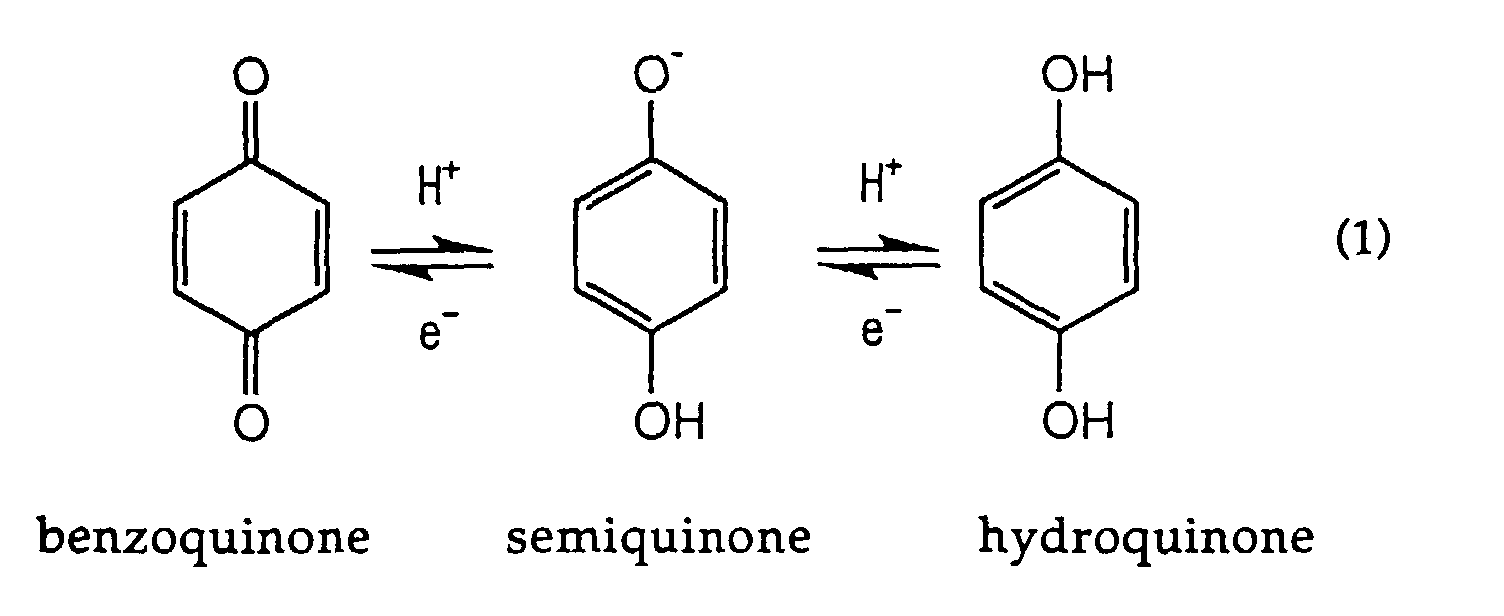

wherein the weight ratio, α, of the hydrophilic resin to the total of the hydrophilic resin and the fibrous base material is 0.3 or more.

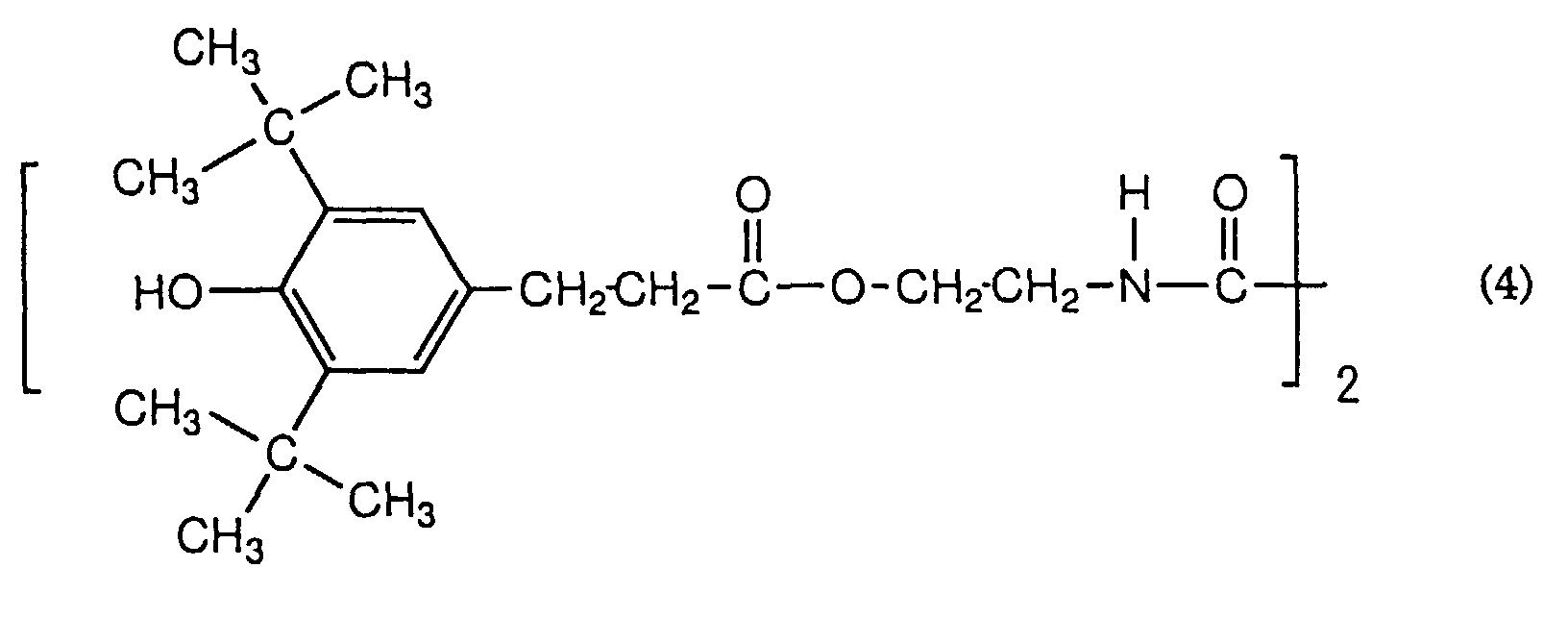
| Absorption capacity (g/g) | Coloring degree (YI value) | HQ content (ppm) | MBAA content | MBAA /HQ | |||
| Before test | After test | Change of coloring degree | |||||
| Example 3 | 46 | 3.6 | 6.8 | 3.2 | 0.15 | ---- | ---- |
| Example 4 | 46 | 3.5 | 6.6 | 3.1 | 0.10 | ---- | ---- |
| Comparative Example 3 | 45 | 3.4 | 45.1 | 41.7 | 1.20 | ---- | ---- |
| Comparative Example 4 | 46 | 3.3 | 47.6 | 44.3 | 1.10 | ---- | ---- |
| Example 5 | 45 | 3.4 | 6.9 | 3.5 | 1.20 | 5.0% | 43860 |
| Example 6 | 46 | 3.4 | 6.8 | 3.4 | 1.20 | 1.0% | 8418 |
| Example 7 | 45 | 3.3 | 7.1 | 3.8 | 1.10 | 5.0% | 47847 |
| Example 8 | 46 | 3.4 | 6.9 | 3.5 | 1.10 | 1.0% | 9183 |
| Example 9 | 44 | 3.4 | 7.0 | 3.6 | 10.1 | 1.0% | 1000 |
| Example 10 | 45 | 3.6 | 7.1 | 3.5 | 100.1 | 1.0% | 101 |
| Comparative Example 5 | 44 | 3.5 | 44.8 | 41.3 | 10.1 | ---- | ---- |
| Comparative Example 6 | 44 | 3.9 | 46.8 | 42.9 | 100.1 | ---- | ---- |
| Example 11 | 44 | 3.5 | 6.6 | 3.1 | 0.10 | ---- | ---- |
| Example 12 | 44 | 3.4 | 6.9 | 3.5 | 0.10 | ---- | ---- |
| Example 13 | 44 | 3.5 | 6.6 | 3.1 | 0.10 | ---- | ---- |
| Example 14 | 43 | 3.4 | 6.9 | 3.5 | 0.10 | ---- | ---- |
| Example 15 | 43 | 3.5 | 6.6 | 3.1 | 0.10 | ---- | ---- |
| Comparative Example 7 | 42 | 13.8 | 45.3 | 31.5 | 1.20 | N.D. | ---- |
| Comparative Example 8 | 25 | 14.5 | 45.3 | 30.8 | 1.20 | N.D. | 1.7 |
| Absorption capacity (g/g) | Coloring degree (YI value) | HQ content (ppm) | |||
| Before test | After test | Change of coloring degree | |||
| Example 16 | 43 | 3.5 | 6.8 | 3.4 | 0.10 |
| Example 17 | 46 | 8.7 | 13.3 | 5.6 | 0.10 |
| Example 18 | 46 | 7.1 | 15.1 | 7.9 | 0.10 |
| Example 19 | 46 | 6.8 | 13.4 | 7.6 | 0.10 |
| Example 20 | 46 | 4.0 | 7.8 | 3.8 | 0.10 |
| Example 21 | 46 | 3.2 | 6.0 | 2.8 | 0.10 |
| Comparative Example 9 | 45 | 4.6 | 28.3 | 23.7 | 1.10 |
| Comparative Example 10 | 45 | 3.0 | 51.5 | 48.5 | 1.10 |
| Comparative Example 11 | 45 | 3.2 | 34.4 | 31.2 | 1.10 |
| Comparative Example 12 | 45 | 3.2 | 45.2 | 42.0 | 1.20 |
| Comparative Example 13 | 45 | 3.1 | 43.9 | 40.8 | 1.20 |
| Comparative Example 14 | 45 | 3.7 | 43.7 | 40.0 | 1.20 |
| Comparative Example 15 | 45 | 3.4 | 44.4 | 41.0 | 1.20 |
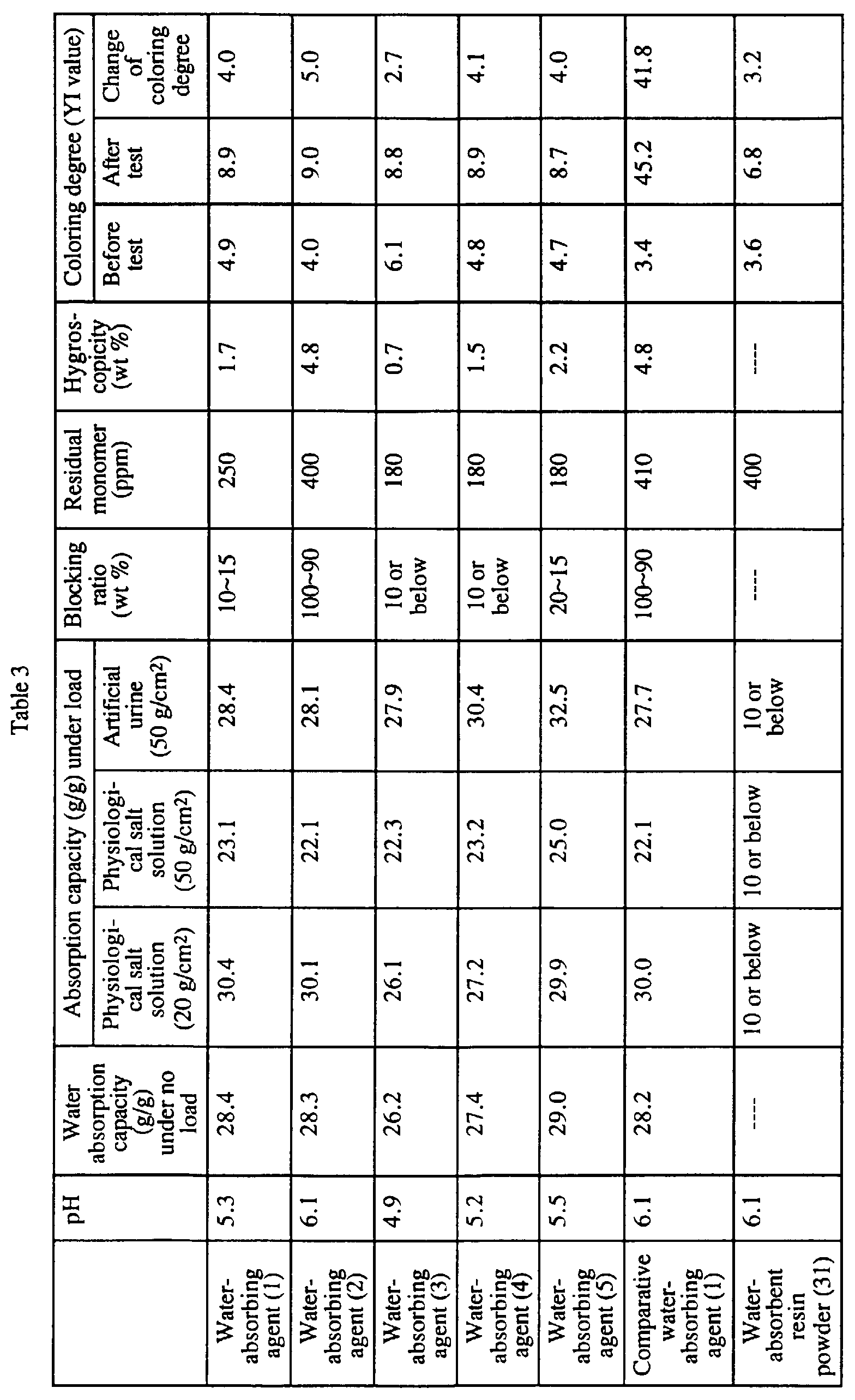

| Absorption capacity (g/g) | Coloring degree (YI value) | HQ content (ppm) | |||
| Before test | After test | Change of coloring degree | |||
| Comparative Example 18 | 46 | 3.4 | 17.0 | 16.6 | 1.10 |
| Example 33 | 46 | 3.6 | 4.2 | 0.6 | 0.15 |
| Example 34 | 44 | 3.7 | 4.5 | 0.8 | 0.15 |
| Example 35 | 39 | 3.7 | 6.8 | 3.1 | 0.15 |
Claims (27)
- A hydrophilic resin, obtained by a process including the step of polymerizing a monomer component including a major proportion of either one or both of acrylic acid and its salt which merely have a content of at most 0.20 ppm in total of hydroquinone and benzoquinone.
- A hydrophilic resin according to claim 1, wherein the polymerization is aqueous solution polymerization.
- A hydrophilic resin according to claim 1 or 2, obtained by a process further including the step of heat-drying at 100∼300 °C within 3 hours after the polymerization.
- A hydrophilic resin according to any one of claims 1∼3, comprising particles of the irregular pulverized shape, of which 50 weight % or more have a particle diameter of 300 µm or more.
- A hydrophilic resin according to any one of claims 1∼4, which merely has a water content of at most 2 weight %.
- A hydrophilic resin according to any one of claims 1∼5, which is a partially neutralized resin.
- A hydrophilic resin, comprising a major proportion of an acrylic polymer and a minor proportion of either one or both of hydroquinone and benzoquinone, with the hydrophilic resin further comprising a quinhydronation inhibitor of 10∼1,000,000 times the total weight of hydroquinone and benzoquinone.
- A hydrophilic resin according to claim 7, wherein the quinhydronation inhibitor is methylenebisacrylamide.
- A hydrophilic resin, comprising a major proportion of an acrylic polymer and merely having a coloring degree (YI) of at most 20 after being left under conditions of the open system, 70 °C, 65% RH for 1 week.
- A hydrophilic resin according to claim 9, which merely displays a change of the coloring degree (YI) by at most 4.
- A hydrophilic resin according to claim 9 or 10, wherein the acrylic polymer is a polymer as obtained by a process including the step of aqueous solution polymerization.
- A hydrophilic resin according to any one of claims 9∼11, comprising particles of the irregular pulverized shape, of which 50 weight % or more have a particle diameter of 300 µm or more.
- A hydrophilic resin according to any one of claims 1∼12, which is a water-absorbent resin.
- A hydrophilic resin according to claim 13, which displays pH of 5.5 or less in a physiological salt solution.
- A hydrophilic resin according to claim 13 or 14, of which 50 weight % or more have a particle diameter of 300 µm or more.
- A hydrophilic resin according to any one of claims 13∼15, of which the surface neighborhood of the particles are crosslinked.
- A hydrophilic resin according to claim 16, wherein the crosslinking temperature during the surface-crosslinking is in the range of 100∼250 °C, and the crosslinking time is within 3 hours.
- A hydrophilic resin according to claim 16 or 17, wherein the surface-crosslinking is carried out by a dehydration reaction.
- A hydrophilic resin according to claim 18, wherein the crosslinking agent for the dehydration reaction is a polyhydric alcohol.
- A hydrophilic resin according to any one of claims 13∼19, which has an absorption capacity of 20 g/g or more for a physiological salt solution under a load of 50 g/cm2.
- A hydrophilic resin, which is a water-absorbent resin and is surface-crosslinked or surface-impregnated with a polyhydric alcohol and displays pH of 5.5 or less in a physiological salt solution and has an absorption capacity of 20 g/g or more for a physiological salt solution under a load of 50 g/cm2.
- An absorbent article, comprising:an absorbent layer including the hydrophilic resin as recited in any one of claims 13∼21 and a fibrous base material;a liquid-permeable surface sheet; anda liquid-impermeable back sheet;
wherein the weight ratio, α, of the hydrophilic resin to the total of the hydrophilic resin and the fibrous base material is 0.3 or more. - Acrylic acid for polymerization, which is acrylic acid as obtained using hydroquinone in its production process and merely has a content of at most 0.20 ppm in total of hydroquinone and benzoquinone.
- Acrylic acid for polymerization according to claim 23, which is used for polymerization to give a hydrophilic resin.
- Acrylic acid for polymerization according to claim 24, wherein the hydrophilic resin is a water-absorbent resin.
- A use of the hydrophilic resin as recited in any one of claims 1∼21 under a relative humidity of 50 % or higher.
- A coloring evaluation method of a hydrophilic resin, comprising the step of judging the coloring degree that the hydrophilic resin displays when left under conditions of the open system, a certain temperature, and a certain humidity.
Applications Claiming Priority (2)
| Application Number | Priority Date | Filing Date | Title |
|---|---|---|---|
| JP6006098 | 1998-03-11 | ||
| JP6006098 | 1998-03-11 |
Publications (3)
| Publication Number | Publication Date |
|---|---|
| EP0942014A2 true EP0942014A2 (en) | 1999-09-15 |
| EP0942014A3 EP0942014A3 (en) | 2000-05-24 |
| EP0942014B1 EP0942014B1 (en) | 2007-01-31 |
Family
ID=13131176
Family Applications (1)
| Application Number | Title | Priority Date | Filing Date |
|---|---|---|---|
| EP99104213A Expired - Lifetime EP0942014B1 (en) | 1998-03-11 | 1999-03-02 | Powdery water-absorbent resin, absorbent article and production process for powdery water-absorbent resin |
Country Status (10)
| Country | Link |
|---|---|
| US (1) | US6444744B1 (en) |
| EP (1) | EP0942014B1 (en) |
| JP (2) | JP4334655B2 (en) |
| KR (1) | KR100363147B1 (en) |
| CN (2) | CN1137159C (en) |
| BR (1) | BR9900992A (en) |
| DE (1) | DE69935025T2 (en) |
| MY (1) | MY129553A (en) |
| SG (1) | SG75923A1 (en) |
| TW (1) | TW570933B (en) |
Cited By (34)
| Publication number | Priority date | Publication date | Assignee | Title |
|---|---|---|---|---|
| EP1191051A3 (en) * | 2000-09-20 | 2002-09-25 | Nippon Shokubai Co., Ltd. | Water-absorbent polymer particles and production process therefor |
| US6469080B2 (en) | 1999-12-15 | 2002-10-22 | Nippon Shokubai Co., Ltd. | Water-absorbent resin composition |
| US6716894B2 (en) | 2001-07-06 | 2004-04-06 | Nippon Shokubai Co., Ltd. | Water-absorbent resin powder and its production process and uses |
| WO2004084962A1 (en) * | 2003-03-26 | 2004-10-07 | Basf Aktiengesellschaft | Color-stable superabsorbent polymer composition |
| EP1086959A4 (en) * | 1999-03-30 | 2005-02-02 | NETWORKED COPOLYMER FROM UNSATURATED CARBOXYLIC ACID AND METHOD FOR THE PRODUCTION THEREOF, COPOLYMER FROM UNSATURATED CARBOXYLIC ACID, BIODEGRADABLE ADDITIVE AND DETERGENT COMPOSITION | |
| EP1507809A1 (en) * | 2002-05-13 | 2005-02-23 | Basf Aktiengesellschaft | Method for producing low-odor hydrogel-forming polymers |
| WO2005054356A1 (en) * | 2003-12-03 | 2005-06-16 | Basf Aktiengesellschaft | Superabsorber that comprises at least one sterically hindered monovalent and/or polyvalent phenol |
| US6927268B2 (en) | 2000-06-21 | 2005-08-09 | Nippon Shokubai Co., Ltd. | Production process for water-absorbent resin |
| US7009010B2 (en) | 2001-12-19 | 2006-03-07 | Nippon Shokubai Co., Ltd. | Water-absorbent resin and production process therefor |
| US7049366B2 (en) | 2001-12-19 | 2006-05-23 | Nippon Shokubai Co., Ltd. | Acrylic acid composition and its production process, and process for producing water-absorbent resin using this acrylic acid composition, and water-absorbent resin |
| WO2006119828A1 (en) * | 2005-05-07 | 2006-11-16 | Geohumus International Research & Development Gmbh & Co. Kg | Water-swellable hybrid material with inorganic additives and process for its preparation |
| US7193006B2 (en) | 2002-12-06 | 2007-03-20 | Nippon Shokubai Co., Ltd. | Process for continuous production of water-absorbent resin product |
| EP1769780A1 (en) * | 2005-09-30 | 2007-04-04 | Nippon Shokubai Co.,Ltd. | Ion-sensitive super-absorbent polymer |
| WO2007037522A1 (en) | 2005-09-30 | 2007-04-05 | Nippon Shokubai Co., Ltd. | Water-absorbent agent composition and method for manufacturing same |
| EP2074153A1 (en) | 2006-09-19 | 2009-07-01 | Basf Se | Process for preparing color-stable water-absorbing polymer particles with a low degree of neutralization |
| EP1879930A4 (en) * | 2005-04-07 | 2009-12-30 | Nippon Catalytic Chem Ind | Production process of polyacrylic acid (salt) water-absorbent resin |
| US7645457B2 (en) | 2002-03-14 | 2010-01-12 | Fuji Xerox Co., Ltd. | Emulsified cosmetics |
| US7790823B2 (en) | 2001-06-28 | 2010-09-07 | Basf Aktiengesellschaft | Acidic superabsorbent hydrogels |
| US7960485B2 (en) | 2004-11-18 | 2011-06-14 | Basf Aktiengesellschaft | Method for producing water-absorbing polymers |
| WO2012022164A1 (en) * | 2010-08-20 | 2012-02-23 | Rhodia (China) Co., Ltd. | Soil additives for promoting seed germination and prevention of evaporation and methods for using the same |
| US8481664B2 (en) | 2005-04-12 | 2013-07-09 | Nippon Shokubai Co., Ltd. | Particulate water absorbing agent including polyacrylic acid (polyacrylate) based water absorbing resin as a principal component, method for production thereof, water-absorbent core and absorbing article in which the particulate water absorbing agent is used |
| US20130281649A1 (en) * | 2010-12-28 | 2013-10-24 | Hiroshi Yoshida | Methods for producing acrylic acid and/or ester thereof and polymer of the acrylic acid and/or ester thereof |
| EP2431349A4 (en) * | 2009-05-15 | 2014-03-05 | Nippon Catalytic Chem Ind | PROCESS FOR PRODUCING (METH) ACRYLIC ACID |
| EP1466928B1 (en) * | 2002-01-16 | 2014-04-16 | Sumitomo Seika Chemicals Co., Ltd. | Process for producing water-absorbing resin |
| WO2014064176A1 (en) * | 2012-10-24 | 2014-05-01 | Evonik Degussa Gmbh | Scent- and colour-stable water-absorbing composition |
| US8952116B2 (en) | 2009-09-29 | 2015-02-10 | Nippon Shokubai Co., Ltd. | Particulate water absorbent and process for production thereof |
| US9090718B2 (en) | 2006-03-24 | 2015-07-28 | Nippon Shokubai Co., Ltd. | Water-absorbing resin and method for manufacturing the same |
| EP2993190A1 (en) | 2014-07-11 | 2016-03-09 | Sumitomo Seika Chemicals Co., Ltd. | Water-absorbent resin and absorbent article |
| EP2998325A4 (en) * | 2014-07-11 | 2016-07-20 | Sumitomo Seika Chemicals | WATER ABSORBING RESIN AND ABSORBENT ARTICLE |
| WO2017170604A1 (en) | 2016-03-28 | 2017-10-05 | 株式会社日本触媒 | Method for manufacturing water absorbing agent |
| WO2017170605A1 (en) | 2016-03-28 | 2017-10-05 | 株式会社日本触媒 | Particulate water absorbing agent |
| US9926449B2 (en) | 2005-12-22 | 2018-03-27 | Nippon Shokubai Co., Ltd. | Water-absorbent resin composition, method of manufacturing the same, and absorbent article |
| WO2018155591A1 (en) | 2017-02-22 | 2018-08-30 | 株式会社日本触媒 | Water absorbent sheet, elongated water absorbent sheet, and absorbent article |
| WO2019074094A1 (en) | 2017-10-12 | 2019-04-18 | 株式会社日本触媒 | Measurement method for properties of particulate absorbent agent, and particulate absorbent agent. |
Families Citing this family (61)
| Publication number | Priority date | Publication date | Assignee | Title |
|---|---|---|---|---|
| JP4068886B2 (en) * | 2001-05-01 | 2008-03-26 | 株式会社日本触媒 | Acrylic acid (salt) polymer, production method thereof and use thereof |
| DE10138150A1 (en) * | 2001-08-03 | 2003-02-13 | Basf Ag | Process for preparation of a water absorbing resin superabsorbers from acrylic acid useful for the production hygiene articles |
| US20040137039A1 (en) * | 2002-07-22 | 2004-07-15 | Trustees Of Stevens Institute Of Technology | Methods for controlled release of molecules from layered polymer films |
| US20050008828A1 (en) * | 2002-07-25 | 2005-01-13 | Trustees Of Stevens Institute Of Technology | Patterned polymer microgel and method of forming same |
| EP1433526A3 (en) * | 2002-12-26 | 2007-03-14 | Nippon Shokubai Co., Ltd. | Water-absorbent resin composition |
| WO2004069404A1 (en) | 2003-02-10 | 2004-08-19 | Nippon Shokubai Co., Ltd. | Particulate water absorbent containing water absorbent resin as a main component |
| MXPA05009236A (en) * | 2003-03-26 | 2005-10-19 | Basf Ag | Color-stable superabsorbent polymer composition. |
| US7169843B2 (en) * | 2003-04-25 | 2007-01-30 | Stockhausen, Inc. | Superabsorbent polymer with high permeability |
| TWI302541B (en) * | 2003-05-09 | 2008-11-01 | Nippon Catalytic Chem Ind | Water-absorbent resin and its production process |
| US20060014003A1 (en) * | 2003-07-24 | 2006-01-19 | Libera Matthew R | Functional nano-scale gels |
| JP4640923B2 (en) * | 2003-09-05 | 2011-03-02 | 株式会社日本触媒 | Method for producing particulate water-absorbing resin composition |
| EP1691791A2 (en) * | 2003-10-02 | 2006-08-23 | Trustees of Stevens Institute of Technology | Capsules of multilayered neutral polymer films associated by hydrogen bonding |
| KR100783150B1 (en) * | 2004-02-09 | 2007-12-07 | 가부시키가이샤 구라레 | Backlight device for liquid crystal display |
| JP2005225921A (en) * | 2004-02-10 | 2005-08-25 | Asahi Kasei Chemicals Corp | Water absorbent resin, water absorbent resin composition, and water absorbent |
| BRPI0509064B1 (en) | 2004-03-29 | 2021-07-27 | Nippon Shokubai Co., Ltd | PARTICULATE WATER ABSORPTION AGENT AND ABSORPTION ARTICLE |
| CN1938083B (en) * | 2004-03-31 | 2011-06-08 | 株式会社日本触媒 | An aqueous-liquid-absorbing agent and its production process |
| JPWO2006008905A1 (en) * | 2004-07-15 | 2008-05-01 | 住友精化株式会社 | Method for producing water absorbent resin |
| CN1993176A (en) * | 2004-08-06 | 2007-07-04 | 株式会社日本触媒 | Particulate water-absorbing agent mainly composed of water-absorbing resin, production method thereof, and water-absorbing article |
| AU2005285763A1 (en) * | 2004-09-24 | 2006-03-30 | Nippon Shokubai Co., Ltd. | Particulate water-absorbing agent containing water-absorbent resin as a main component |
| DE102004057874A1 (en) * | 2004-11-30 | 2006-06-01 | Basf Ag | Method for post-crosslinking of water-absorbing polymer particle comprises superimposing one/more oxidizing gas with a water absorbing polymer particle in dry atmosphere |
| US20060173432A1 (en) * | 2005-02-01 | 2006-08-03 | Laumer Jason M | Absorbent articles comprising polyamine-coated superabsorbent polymers |
| JP2006219576A (en) * | 2005-02-10 | 2006-08-24 | Asahi Glass Co Ltd | POLYMER MANUFACTURING METHOD, COATING COMPOSITION, AND COATED ARTICLE |
| TWI529181B (en) * | 2005-02-28 | 2016-04-11 | 贏創德固賽有限責任公司 | Water-absorbent polymer structure based on renewable raw materials and method for producing same |
| JP2007291041A (en) * | 2006-04-27 | 2007-11-08 | Osaka Organic Chem Ind Ltd | Method for producing adamantyl (meth) acrylate compounds |
| EP2046871B1 (en) | 2006-07-31 | 2020-07-08 | Nippon Shokubai Co., Ltd. | Production method of water absorbent resin powder and package of water absorbent resin powder |
| WO2008026772A1 (en) * | 2006-08-31 | 2008-03-06 | Nippon Shokubai Co., Ltd. | Particulate water absorbing agent and production method thereof |
| CN100443529C (en) * | 2006-10-20 | 2008-12-17 | 中国科学院长春应用化学研究所 | A multifunctional degradable liquid mulch film and its preparation method |
| CN101589066B (en) | 2007-01-24 | 2013-07-03 | 株式会社日本触媒 | Particulate water-absorbing polymer and its production method |
| JP5669354B2 (en) * | 2007-02-05 | 2015-02-12 | 株式会社日本触媒 | Particulate water-absorbing agent and method for producing the same |
| US8093039B2 (en) * | 2007-04-10 | 2012-01-10 | The Trustees Of The Stevens Institute Of Technology | Surfaces differentially adhesive to eukaryotic cells and non-eukaryotic cells |
| SA08290402B1 (en) | 2007-07-04 | 2014-05-22 | نيبون شوكوباي كو. ، ليمتد | Particulate Water Absorbing Agent and Manufacturing Method of Same |
| FR2923829B1 (en) * | 2007-11-15 | 2009-11-13 | Arkema France | PROCESS FOR THE PREPARATION OF SUPERABSOBANT POLYMERS WITH HEART-SHELL STRUCTURE |
| JP5054709B2 (en) * | 2008-02-12 | 2012-10-24 | ローム アンド ハース カンパニー | Treated cellulosic fibers and absorbent articles made therefrom |
| JP5410412B2 (en) | 2008-03-31 | 2014-02-05 | 株式会社日本触媒 | Method for producing particulate water-absorbing agent comprising water-absorbing resin as main component and production apparatus therefor |
| WO2009130915A1 (en) | 2008-04-25 | 2009-10-29 | 株式会社日本触媒 | Water-absorbable polyacrylic acid (salt) resin and process for production thereof |
| US8048942B2 (en) * | 2008-10-08 | 2011-11-01 | Evonik Stockhausen Gmbh | Process for the production of a superabsorbent polymer |
| US8063121B2 (en) * | 2008-10-08 | 2011-11-22 | Evonik Stockhausen Gmbh | Process for the production of a superabsorbent polymer |
| US8357766B2 (en) * | 2008-10-08 | 2013-01-22 | Evonik Stockhausen Gmbh | Continuous process for the production of a superabsorbent polymer |
| WO2010090324A1 (en) | 2009-02-06 | 2010-08-12 | 株式会社日本触媒 | Polyacrylic acid (salt) type water-absorbent resin and process for production of same |
| US8586787B2 (en) * | 2009-05-15 | 2013-11-19 | Nippon Shokubai Co., Ltd. | Process for producing (meth)acrylic acid |
| US8704000B2 (en) * | 2009-06-01 | 2014-04-22 | Nippon Shokubai Co., Ltd. | Method for crystallizing (meth)acrylic acid and method for regulating content of polymerization inhibitor in product (meth)acrylic acid |
| CN102597082A (en) * | 2009-09-16 | 2012-07-18 | 巴斯夫欧洲公司 | Color-stable superabsorber |
| KR101887706B1 (en) | 2009-09-30 | 2018-08-10 | 가부시키가이샤 닛폰 쇼쿠바이 | Particulate water absorbent and method for producing same |
| CN102549028B (en) | 2009-09-30 | 2016-03-02 | 株式会社日本触媒 | Polyacrylic acid (salt) is water-absorbing resin and manufacture method thereof |
| JP5764122B2 (en) | 2010-04-26 | 2015-08-12 | 株式会社日本触媒 | Polyacrylic acid (salt), polyacrylic acid (salt) water-absorbing resin, and method for producing the same |
| US20130043384A1 (en) | 2010-04-26 | 2013-02-21 | Nippon Shokubai Co., Ltd. | Polyacrylic acid (salt), polyacrylic acid (salt)-based water-absorbing resin, and process for producing same |
| US8791230B2 (en) | 2010-06-08 | 2014-07-29 | Nippon Shokubai Co., Ltd. | Method for producing particulate water absorbent resin |
| CN101864134B (en) * | 2010-06-24 | 2011-08-17 | 宜兴丹森科技有限公司 | Method for preparing super absorbent resin |
| JP2012077014A (en) * | 2010-09-30 | 2012-04-19 | Nippon Shokubai Co Ltd | Methods for producing acrylic acid and polymer thereof |
| JP6057495B2 (en) * | 2010-11-11 | 2017-01-11 | ユニ・チャーム株式会社 | Absorbent articles |
| US9321030B2 (en) | 2012-01-04 | 2016-04-26 | The Trustees Of The Stevens Institute Of Technology | Clay-containing thin films as carriers of absorbed molecules |
| KR102000808B1 (en) | 2012-02-17 | 2019-07-16 | 가부시키가이샤 닛폰 쇼쿠바이 | Polyacrylic acid (salt) water-absorbing resin and manufacturing method therefor |
| US9517446B2 (en) * | 2012-04-25 | 2016-12-13 | Lg Chem, Ltd. | Super absorbent polymer and a preparation method thereof |
| JP6173314B2 (en) * | 2012-06-27 | 2017-08-02 | 株式会社日本触媒 | (Meth) acrylic acid production method and hydrophilic resin production method |
| KR101596623B1 (en) | 2015-01-30 | 2016-02-22 | 에스케이이노베이션 주식회사 | Water-absorbing resin and preparing method thereof |
| GB2579301B (en) | 2017-07-28 | 2022-02-23 | Kimberly Clark Co | Absorbent article containing nanoporous superabsorbent particles |
| KR102489568B1 (en) * | 2017-11-07 | 2023-01-16 | 주식회사 엘지화학 | Super absorbent polymer and preparation method thereof |
| KR102555380B1 (en) | 2018-01-19 | 2023-07-12 | 주식회사 엘지화학 | Super absorbent polymer and preparation method thereof |
| JPWO2021006149A1 (en) * | 2019-07-05 | 2021-01-14 | ||
| CN114096606A (en) * | 2019-07-05 | 2022-02-25 | 住友精化株式会社 | Crosslinked polymer gel, method for producing same, monomer composition, and method for producing crosslinked polymer particles |
| WO2021187326A1 (en) * | 2020-03-18 | 2021-09-23 | 住友精化株式会社 | Method for producing water-absorbent resin particles |
Family Cites Families (19)
| Publication number | Priority date | Publication date | Assignee | Title |
|---|---|---|---|---|
| DE1642817A1 (en) | 1967-02-23 | 1971-04-29 | Dow Chemical Co | Polymeric flocculant for alkaline, aqueous solutions |
| DE2032953C3 (en) * | 1970-07-03 | 1978-08-17 | Deutsche Gold- Und Silber-Scheideanstalt Vormals Roessler, 6000 Frankfurt | Process for the production of bead-shaped polymers of acrylic acid and the use of these polyacrylic acids |
| JPS606635A (en) | 1983-06-24 | 1985-01-14 | Mitsubishi Petrochem Co Ltd | Purification of 1,2-unsaturated carboxylic acid and/or its ester |
| US4654039A (en) * | 1985-06-18 | 1987-03-31 | The Proctor & Gamble Company | Hydrogel-forming polymer compositions for use in absorbent structures |
| US4863989A (en) | 1986-06-04 | 1989-09-05 | Seitetsu Kagaku Co., Ltd. | Water-absorbent resin composition |
| DE3635367A1 (en) | 1986-08-30 | 1988-03-03 | Cassella Ag | METHOD FOR THE PRODUCTION OF A LARGE MONOMER-FREE HYDROGEL |
| CA1300866C (en) | 1986-11-17 | 1992-05-19 | Tadao Shimomura | Body fluid-absorbing article |
| DE3724709A1 (en) | 1987-07-25 | 1989-02-02 | Stockhausen Chem Fab Gmbh | METHOD FOR PRODUCING POLYMERISATES WITH LOW RESIDUAL MONOMER CONTENT |
| US4985514A (en) | 1987-08-10 | 1991-01-15 | Nippon Shokubai Kagaku Kogyo Co., Ltd. | Method for production of water absorbent resin |
| JPH07119246B2 (en) | 1989-06-29 | 1995-12-20 | 東亞合成株式会社 | Method for producing water absorbent resin |
| DE69030971T2 (en) | 1989-09-04 | 1997-12-11 | Nippon Catalytic Chem Ind | METHOD FOR PRODUCING A WATER-ABSORBING RESIN |
| JP3107873B2 (en) | 1991-09-26 | 2000-11-13 | ユニ・チャーム株式会社 | Method for preventing temporal coloring of superabsorbent polymer and agent for preventing temporal coloring |
| ES2234068T5 (en) | 1992-06-10 | 2011-01-24 | Nippon Shokubai Co., Ltd. | PRODUCTION METHOD OF A HYDROPHYLICAL RESIN. |
| JP2675729B2 (en) | 1992-12-16 | 1997-11-12 | 株式会社日本触媒 | Method for producing water absorbent resin |
| JP2995276B2 (en) | 1993-01-18 | 1999-12-27 | 三洋化成工業株式会社 | Manufacturing method of water absorbent resin |
| US5610208A (en) | 1994-02-17 | 1997-03-11 | Nippon Shokubai Co., Ltd. | Water-absorbent agent, method for production thereof, and water-absorbent composition |
| CA2187633A1 (en) | 1994-04-11 | 1995-10-19 | Douglas R. Chambers | Superabsorbent polymers and products therefrom |
| EP0780424B2 (en) | 1995-07-07 | 2012-08-01 | Nippon Shokubai Co., Ltd. | Water absorbent powder and process for the production thereof |
| ID19116A (en) | 1996-10-15 | 1998-06-18 | Nippon Catalytic Chem Ind | WATER ABSORPTION MATERIALS AND ITS PRODUCTION PROCESSES |
-
1999
- 1999-02-27 US US09/258,503 patent/US6444744B1/en not_active Expired - Lifetime
- 1999-03-01 TW TW088103083A patent/TW570933B/en not_active IP Right Cessation
- 1999-03-02 EP EP99104213A patent/EP0942014B1/en not_active Expired - Lifetime
- 1999-03-02 SG SG1999001042A patent/SG75923A1/en unknown
- 1999-03-02 DE DE69935025T patent/DE69935025T2/en not_active Expired - Lifetime
- 1999-03-02 MY MYPI99000742A patent/MY129553A/en unknown
- 1999-03-10 KR KR19990007904A patent/KR100363147B1/en not_active Expired - Fee Related
- 1999-03-10 JP JP06402699A patent/JP4334655B2/en not_active Expired - Lifetime
- 1999-03-11 CN CNB991036603A patent/CN1137159C/en not_active Expired - Lifetime
- 1999-03-11 BR BR9900992-7A patent/BR9900992A/en not_active IP Right Cessation
- 1999-03-11 CN CNB031406777A patent/CN1234738C/en not_active Expired - Lifetime
-
2009
- 2009-03-25 JP JP2009075137A patent/JP2009173942A/en active Pending
Cited By (61)
| Publication number | Priority date | Publication date | Assignee | Title |
|---|---|---|---|---|
| EP1086959A4 (en) * | 1999-03-30 | 2005-02-02 | NETWORKED COPOLYMER FROM UNSATURATED CARBOXYLIC ACID AND METHOD FOR THE PRODUCTION THEREOF, COPOLYMER FROM UNSATURATED CARBOXYLIC ACID, BIODEGRADABLE ADDITIVE AND DETERGENT COMPOSITION | |
| US6469080B2 (en) | 1999-12-15 | 2002-10-22 | Nippon Shokubai Co., Ltd. | Water-absorbent resin composition |
| US6927268B2 (en) | 2000-06-21 | 2005-08-09 | Nippon Shokubai Co., Ltd. | Production process for water-absorbent resin |
| US7238743B2 (en) | 2000-06-21 | 2007-07-03 | Nippon Shokubai Co., Ltd. | Production process for water-absorbent resin |
| US6720389B2 (en) | 2000-09-20 | 2004-04-13 | Nippon Shokubai Co., Ltd. | Water-absorbent resin and production process therefor |
| US7183456B2 (en) | 2000-09-20 | 2007-02-27 | Nippon Shokubai Co., Ltd. | Water-absorbent resin and production process therefor |
| EP1191051A3 (en) * | 2000-09-20 | 2002-09-25 | Nippon Shokubai Co., Ltd. | Water-absorbent polymer particles and production process therefor |
| US7915363B2 (en) | 2001-06-28 | 2011-03-29 | Basf Aktiengesellschaft | Acidic superabsorbent hydrogels |
| US7790823B2 (en) | 2001-06-28 | 2010-09-07 | Basf Aktiengesellschaft | Acidic superabsorbent hydrogels |
| US6716894B2 (en) | 2001-07-06 | 2004-04-06 | Nippon Shokubai Co., Ltd. | Water-absorbent resin powder and its production process and uses |
| US7009010B2 (en) | 2001-12-19 | 2006-03-07 | Nippon Shokubai Co., Ltd. | Water-absorbent resin and production process therefor |
| US7049366B2 (en) | 2001-12-19 | 2006-05-23 | Nippon Shokubai Co., Ltd. | Acrylic acid composition and its production process, and process for producing water-absorbent resin using this acrylic acid composition, and water-absorbent resin |
| EP1466928B1 (en) * | 2002-01-16 | 2014-04-16 | Sumitomo Seika Chemicals Co., Ltd. | Process for producing water-absorbing resin |
| US7645457B2 (en) | 2002-03-14 | 2010-01-12 | Fuji Xerox Co., Ltd. | Emulsified cosmetics |
| US7307132B2 (en) | 2002-05-13 | 2007-12-11 | Basf Aktiengesellschaft | Method for producing low-odor hydrogel-forming polymers |
| EP1507809A1 (en) * | 2002-05-13 | 2005-02-23 | Basf Aktiengesellschaft | Method for producing low-odor hydrogel-forming polymers |
| US9382390B2 (en) | 2002-12-06 | 2016-07-05 | Nippon Shokubai Co., Ltd. | Process for continuous production of water-absorbent resin product |
| US7193006B2 (en) | 2002-12-06 | 2007-03-20 | Nippon Shokubai Co., Ltd. | Process for continuous production of water-absorbent resin product |
| EP2138529A3 (en) * | 2002-12-06 | 2013-05-22 | Nippon Shokubai Co., Ltd. | Process for continuous production of water-absorbent resin product |
| US7504551B2 (en) | 2003-03-26 | 2009-03-17 | Basf Aktiengesellschaft | Color-stable superabsorbent polymer composition |
| WO2004084962A1 (en) * | 2003-03-26 | 2004-10-07 | Basf Aktiengesellschaft | Color-stable superabsorbent polymer composition |
| WO2005054356A1 (en) * | 2003-12-03 | 2005-06-16 | Basf Aktiengesellschaft | Superabsorber that comprises at least one sterically hindered monovalent and/or polyvalent phenol |
| US7960485B2 (en) | 2004-11-18 | 2011-06-14 | Basf Aktiengesellschaft | Method for producing water-absorbing polymers |
| EP1866349A4 (en) * | 2005-04-07 | 2009-12-30 | Nippon Catalytic Chem Ind | WATER-ABSORBING RESIN OF POLYACRYLIC ACID OR SALT THEREOF, PROCESS FOR PRODUCTION THEREOF, AND ACRYLIC ACID FOR USE IN POLYMERIZATION FOR THE PRODUCTION OF WATER-ABSORBING RESIN |
| EP1879930A4 (en) * | 2005-04-07 | 2009-12-30 | Nippon Catalytic Chem Ind | Production process of polyacrylic acid (salt) water-absorbent resin |
| US8729191B2 (en) | 2005-04-07 | 2014-05-20 | Nippon Shokubai Co., Ltd. | Production process of polyacrylic acid (salt) water-absorbent resin |
| US9062140B2 (en) | 2005-04-07 | 2015-06-23 | Nippon Shokubai Co., Ltd. | Polyacrylic acid (salt) water-absorbent resin, production process thereof, and acrylic acid used in polymerization for production of water-absorbent resin |
| US8481664B2 (en) | 2005-04-12 | 2013-07-09 | Nippon Shokubai Co., Ltd. | Particulate water absorbing agent including polyacrylic acid (polyacrylate) based water absorbing resin as a principal component, method for production thereof, water-absorbent core and absorbing article in which the particulate water absorbing agent is used |
| EP2168990A3 (en) * | 2005-05-07 | 2010-08-11 | Geohumus International Research & Development GmbH | Water-swellable hybrid material with inorganic additives and process for its preparation |
| AP2023A (en) * | 2005-05-07 | 2009-08-10 | Geohumus Internat Gmbh & Co Kg | Water-swellable hybrid material with inorganic additives and process for its preparation |
| WO2006119828A1 (en) * | 2005-05-07 | 2006-11-16 | Geohumus International Research & Development Gmbh & Co. Kg | Water-swellable hybrid material with inorganic additives and process for its preparation |
| CN1939941B (en) * | 2005-09-30 | 2011-09-14 | 株式会社日本触媒 | Ion-sensitive water-absorbent resin |
| US7838610B2 (en) | 2005-09-30 | 2010-11-23 | Nippon Shokubai Co., Ltd. | Ion-sensitive super-absorbent polymer |
| EP1769780A1 (en) * | 2005-09-30 | 2007-04-04 | Nippon Shokubai Co.,Ltd. | Ion-sensitive super-absorbent polymer |
| WO2007037522A1 (en) | 2005-09-30 | 2007-04-05 | Nippon Shokubai Co., Ltd. | Water-absorbent agent composition and method for manufacturing same |
| US10358558B2 (en) | 2005-12-22 | 2019-07-23 | Nippon Shokubai Co., Ltd. | Water-absorbent resin composition, method of manufacturing the same, and absorbent article |
| US9926449B2 (en) | 2005-12-22 | 2018-03-27 | Nippon Shokubai Co., Ltd. | Water-absorbent resin composition, method of manufacturing the same, and absorbent article |
| US9090718B2 (en) | 2006-03-24 | 2015-07-28 | Nippon Shokubai Co., Ltd. | Water-absorbing resin and method for manufacturing the same |
| EP2074153B1 (en) | 2006-09-19 | 2015-09-09 | Basf Se | Process for preparing color-stable water-absorbing polymer particles with a low degree of neutralization |
| EP2074153A1 (en) | 2006-09-19 | 2009-07-01 | Basf Se | Process for preparing color-stable water-absorbing polymer particles with a low degree of neutralization |
| EP2431349A4 (en) * | 2009-05-15 | 2014-03-05 | Nippon Catalytic Chem Ind | PROCESS FOR PRODUCING (METH) ACRYLIC ACID |
| US9775927B2 (en) | 2009-09-29 | 2017-10-03 | Nippon Shokubai Co., Ltd. | Particulate water absorbent and process for production thereof |
| US8952116B2 (en) | 2009-09-29 | 2015-02-10 | Nippon Shokubai Co., Ltd. | Particulate water absorbent and process for production thereof |
| US11111436B2 (en) | 2010-08-20 | 2021-09-07 | Rhodia Operations | Soil additives for promoting seed germination, for prevention of evaporation and methods for use |
| US9096793B2 (en) | 2010-08-20 | 2015-08-04 | Rhodia (China) Co. Ltd. | Soil additives for promoting seed germination, for prevention of evaporation and methods for use |
| WO2012022164A1 (en) * | 2010-08-20 | 2012-02-23 | Rhodia (China) Co., Ltd. | Soil additives for promoting seed germination and prevention of evaporation and methods for using the same |
| EA024542B1 (en) * | 2010-08-20 | 2016-09-30 | Родиа (Чайна) Ко., Лтд. | Soil additives for promoting seed germination and prevention of evaporation and methods for using the same |
| US9029596B2 (en) * | 2010-12-28 | 2015-05-12 | Nippon Shokubai Co., Ltd. | Methods for producing acrylic acid and/or ester thereof and polymer of the acrylic acid and/or ester thereof |
| US20130281649A1 (en) * | 2010-12-28 | 2013-10-24 | Hiroshi Yoshida | Methods for producing acrylic acid and/or ester thereof and polymer of the acrylic acid and/or ester thereof |
| WO2014064176A1 (en) * | 2012-10-24 | 2014-05-01 | Evonik Degussa Gmbh | Scent- and colour-stable water-absorbing composition |
| US10189008B2 (en) | 2012-10-24 | 2019-01-29 | Evonik Degussa Gmbh | Odor and color stable water-absorbing composition |
| EP2998325A4 (en) * | 2014-07-11 | 2016-07-20 | Sumitomo Seika Chemicals | WATER ABSORBING RESIN AND ABSORBENT ARTICLE |
| EP2993190B1 (en) | 2014-07-11 | 2018-01-31 | Sumitomo Seika Chemicals Co. Ltd. | Water-absorbent resin and absorbent article |
| US9925294B2 (en) | 2014-07-11 | 2018-03-27 | Sumitomo Seika Chemicals Co. Ltd. | Water-absorbent resin and absorbent article |
| EP2998325B2 (en) † | 2014-07-11 | 2020-11-04 | Sumitomo Seika Chemicals CO. LTD. | Water-absorbent resin and absorbent article |
| EP2993190A1 (en) | 2014-07-11 | 2016-03-09 | Sumitomo Seika Chemicals Co., Ltd. | Water-absorbent resin and absorbent article |
| WO2017170605A1 (en) | 2016-03-28 | 2017-10-05 | 株式会社日本触媒 | Particulate water absorbing agent |
| WO2017170604A1 (en) | 2016-03-28 | 2017-10-05 | 株式会社日本触媒 | Method for manufacturing water absorbing agent |
| US11224857B2 (en) | 2016-03-28 | 2022-01-18 | Nippon Shokubai Co., Ltd. | Method for manufacturing water absorbing agent |
| WO2018155591A1 (en) | 2017-02-22 | 2018-08-30 | 株式会社日本触媒 | Water absorbent sheet, elongated water absorbent sheet, and absorbent article |
| WO2019074094A1 (en) | 2017-10-12 | 2019-04-18 | 株式会社日本触媒 | Measurement method for properties of particulate absorbent agent, and particulate absorbent agent. |
Also Published As
| Publication number | Publication date |
|---|---|
| JP4334655B2 (en) | 2009-09-30 |
| MY129553A (en) | 2007-04-30 |
| CN1495206A (en) | 2004-05-12 |
| EP0942014A3 (en) | 2000-05-24 |
| CN1234738C (en) | 2006-01-04 |
| JP2009173942A (en) | 2009-08-06 |
| EP0942014B1 (en) | 2007-01-31 |
| DE69935025D1 (en) | 2007-03-22 |
| SG75923A1 (en) | 2000-10-24 |
| TW570933B (en) | 2004-01-11 |
| DE69935025T2 (en) | 2007-10-18 |
| KR100363147B1 (en) | 2002-12-11 |
| KR19990077746A (en) | 1999-10-25 |
| US6444744B1 (en) | 2002-09-03 |
| JPH11322846A (en) | 1999-11-26 |
| CN1137159C (en) | 2004-02-04 |
| BR9900992A (en) | 2000-01-11 |
| CN1234407A (en) | 1999-11-10 |
Similar Documents
| Publication | Publication Date | Title |
|---|---|---|
| US6444744B1 (en) | Hydrophilic resin, absorbent article, and acrylic acid for polymerization | |
| US8729191B2 (en) | Production process of polyacrylic acid (salt) water-absorbent resin | |
| EP1456259B1 (en) | Acrylic acid composition and its production process, and process for producing water-absorbent resin using this acrylic acid composition, and water-absorbent resin | |
| KR100374127B1 (en) | Absorbents, preparation methods and absorbent compositions | |
| JP5478897B2 (en) | Particulate water-absorbing polymer and method for producing the same | |
| US6964998B2 (en) | Water-absorbing agent and its production process and use | |
| EP1302485B1 (en) | Process for production of water-absorbent resin | |
| EP1869119A1 (en) | Particulate water absorbing agent including polyacrylic acid (polyacrylate) based water absorbing resin as a principal component, method for production thereof, water-absorbent core and absorbing article in which the particulate water absorbing agent is used | |
| US20180094131A1 (en) | Particulate water-absorbing agent | |
| JP4308382B2 (en) | Water absorbing agent and method for producing the same | |
| JPH11263850A (en) | Water absorbent, its production, and its use | |
| JP2001234087A (en) | Water absorbent resin composition |
Legal Events
| Date | Code | Title | Description |
|---|---|---|---|
| PUAI | Public reference made under article 153(3) epc to a published international application that has entered the european phase |
Free format text: ORIGINAL CODE: 0009012 |
|
| AK | Designated contracting states |
Kind code of ref document: A2 Designated state(s): BE DE FR GB |
|
| AX | Request for extension of the european patent |
Free format text: AL;LT;LV;MK;RO;SI |
|
| PUAL | Search report despatched |
Free format text: ORIGINAL CODE: 0009013 |
|
| AK | Designated contracting states |
Kind code of ref document: A3 Designated state(s): AT BE CH CY DE DK ES FI FR GB GR IE IT LI LU MC NL PT SE |
|
| AX | Request for extension of the european patent |
Free format text: AL;LT;LV;MK;RO;SI |
|
| 17P | Request for examination filed |
Effective date: 20001027 |
|
| AKX | Designation fees paid |
Free format text: BE DE FR GB |
|
| 17Q | First examination report despatched |
Effective date: 20030528 |
|
| RTI1 | Title (correction) |
Free format text: POWDERY WATER-ABSORBENT RESIN, ABSORBENT ARTICLE AND PRODUCTION PROCESS FOR POWDERY WATER-ABSORBENT RESIN |
|
| GRAP | Despatch of communication of intention to grant a patent |
Free format text: ORIGINAL CODE: EPIDOSNIGR1 |
|
| GRAS | Grant fee paid |
Free format text: ORIGINAL CODE: EPIDOSNIGR3 |
|
| GRAA | (expected) grant |
Free format text: ORIGINAL CODE: 0009210 |
|
| AK | Designated contracting states |
Kind code of ref document: B1 Designated state(s): BE DE FR GB |
|
| REG | Reference to a national code |
Ref country code: GB Ref legal event code: FG4D |
|
| REF | Corresponds to: |
Ref document number: 69935025 Country of ref document: DE Date of ref document: 20070322 Kind code of ref document: P |
|
| ET | Fr: translation filed | ||
| PLBE | No opposition filed within time limit |
Free format text: ORIGINAL CODE: 0009261 |
|
| STAA | Information on the status of an ep patent application or granted ep patent |
Free format text: STATUS: NO OPPOSITION FILED WITHIN TIME LIMIT |
|
| 26N | No opposition filed |
Effective date: 20071101 |
|
| PGFP | Annual fee paid to national office [announced via postgrant information from national office to epo] |
Ref country code: GB Payment date: 20130228 Year of fee payment: 15 |
|
| GBPC | Gb: european patent ceased through non-payment of renewal fee |
Effective date: 20140302 |
|
| PG25 | Lapsed in a contracting state [announced via postgrant information from national office to epo] |
Ref country code: GB Free format text: LAPSE BECAUSE OF NON-PAYMENT OF DUE FEES Effective date: 20140302 |
|
| REG | Reference to a national code |
Ref country code: FR Ref legal event code: PLFP Year of fee payment: 18 |
|
| REG | Reference to a national code |
Ref country code: FR Ref legal event code: PLFP Year of fee payment: 19 |
|
| REG | Reference to a national code |
Ref country code: FR Ref legal event code: PLFP Year of fee payment: 20 |
|
| PGFP | Annual fee paid to national office [announced via postgrant information from national office to epo] |
Ref country code: DE Payment date: 20180220 Year of fee payment: 20 |
|
| PGFP | Annual fee paid to national office [announced via postgrant information from national office to epo] |
Ref country code: FR Payment date: 20180223 Year of fee payment: 20 Ref country code: BE Payment date: 20180214 Year of fee payment: 20 |
|
| REG | Reference to a national code |
Ref country code: DE Ref legal event code: R071 Ref document number: 69935025 Country of ref document: DE |
|
| REG | Reference to a national code |
Ref country code: BE Ref legal event code: MK Effective date: 20190302 |