EP0940802A2 - Method and apparatus for text independent speaker recognition - Google Patents
Method and apparatus for text independent speaker recognition Download PDFInfo
- Publication number
- EP0940802A2 EP0940802A2 EP99103902A EP99103902A EP0940802A2 EP 0940802 A2 EP0940802 A2 EP 0940802A2 EP 99103902 A EP99103902 A EP 99103902A EP 99103902 A EP99103902 A EP 99103902A EP 0940802 A2 EP0940802 A2 EP 0940802A2
- Authority
- EP
- European Patent Office
- Prior art keywords
- speech
- input
- speaker
- distance
- determining
- Prior art date
- Legal status (The legal status is an assumption and is not a legal conclusion. Google has not performed a legal analysis and makes no representation as to the accuracy of the status listed.)
- Withdrawn
Links
Images


Classifications
-
- G—PHYSICS
- G10—MUSICAL INSTRUMENTS; ACOUSTICS
- G10L—SPEECH ANALYSIS TECHNIQUES OR SPEECH SYNTHESIS; SPEECH RECOGNITION; SPEECH OR VOICE PROCESSING TECHNIQUES; SPEECH OR AUDIO CODING OR DECODING
- G10L17/00—Speaker identification or verification techniques
- G10L17/06—Decision making techniques; Pattern matching strategies
- G10L17/14—Use of phonemic categorisation or speech recognition prior to speaker recognition or verification
-
- G—PHYSICS
- G10—MUSICAL INSTRUMENTS; ACOUSTICS
- G10L—SPEECH ANALYSIS TECHNIQUES OR SPEECH SYNTHESIS; SPEECH RECOGNITION; SPEECH OR VOICE PROCESSING TECHNIQUES; SPEECH OR AUDIO CODING OR DECODING
- G10L15/00—Speech recognition
- G10L15/08—Speech classification or search
- G10L15/10—Speech classification or search using distance or distortion measures between unknown speech and reference templates
Definitions
- the present invention relates to method and apparatus for speaker recognition and, more particularly, to a method of and an apparatus for recognizing or identifying a speaker.
- speaker recognition independently of speech content is usually performed on the basis of the distance between a feature parameter of an input speech and a registered parameter of a speech, which has been produced by the speaker to be recognized.
- Literature 1 Japanese Patent Application No. 2-76296
- sizes of overlap parts of an input speech and a registered speech and also inter-overlap-part distances are utilized to determine the similarity measure.
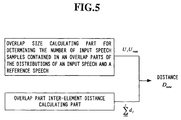
- Fig. 5 shows the system disclosed in Literature 1.
- the system comprises overlap size calculating part, which determines, as the size of overlap part, the number of input speechesamples contained in an overlap parts of the distributions of an input speech and a reference speech, and an overlap part inter-element distance calculating part.
- the distance between the input and reference speech patterns is determined from the results of calculations in these parts according to the following Formula.
- a i ⁇ k
- a coverage l k of each reference speech pattern element is previously determined, and when the distance d i between the nearest element in the reference speech pattern and the input speech pattern exceeds its coverage, a separately determined penalty distance d out is added to all input speech pattern feature vectors, and the result is normalized by the overlap part size U max .
- the overlap part size U max is determined from all reference patterns. Therefore, where registration is performed by using speeches of different contents with different speakers, the input speech content of a speaker may be close to the registered speech of a different speaker. In such a case, the U max may be unfairly significantly evaluated, giving rise to performance deterioration. For this reason, substantially the same number of different kinds of phonemes should be contained in the contents of the registered speeches.
- each reference pattern element is determined on the basis of the distance from the center of a cluster (i.e., element c k ) to the farthest distance feature parameter contained in that cluster.
- element c k the distance from the center of a cluster
- the feature parameter varies with different speakers, and this means that it is difficult to obtain stable distribution overlap estimation.
- the present invention accordingly, has an object of providing a speaker recognition system capable of stable recognition irrespective of speakers and registration by using various speeches through an identity/non-identity check of contents of an input speech and a registered speech by speech recognition.
- the contents of an input speech pattern and a reference speech pattern are estimated by using speech recognition to realize highly accurate estimation of identical speech content sections independent of the speech content and the speaker, thus realizing a speaker recognition system at highly accurate and independent of any speech content.
- each phoneme as the subject of segmentation is expressed by Hidden Markov Model (HMM) expression
- HMM Hidden Markov Model
- a word model is produced by joining together such phoneme models according to the speech content of each word as the subject of segmentation, and inter-phoneme boundaries are determined (i.e., Viterbi decoded) according to the result of production of time axis correspondence of registered speech to input speech.
- This system may be applied to speaker collation independent of speech content in such a way as to make time axis correspondence for models, which permit generation of all Japanese phoneme series, because the content of an input speech is unknown.
- garbage models obtained from an unspecified speaker's speech segmentation of speech of any speaker may be obtained without registering any speech of the input speechespeaker.
- the distance between the two speech patterns can be determined by using phoneme segments, which are contained in both the registered speech and input speech.
- a feature parameter series of the input speech by x i a feature parameter series of the registered speech by y j (I and J are the sample number)
- D ( i , p ) min ⁇ x i - y i ⁇ 2 , j s ( p
- the feature parameters x i and y i contain vocal sound data, speaker data, ambient noise data and various other data. Therefore, when verifying the identity of contents, difference of vocal sound data other than the pertinent data has adverse effects on the distance, resulting in accuracy reduction.
- the copies u j and w j obtained in this way contain unspecified speaker's acoustical data alone, and thus they can facilitate the content identity verification.
- Fig. 4 shows the relationship among logarithmic power in a case where a three-digit figure "ichi-ni-zero" in Japanese meaning (120) is the content of the registered speech of a certain speaker and "kyu-ichi-zero" in Japanse meaning (910) is the content of the input speech, distance D(i) determined directly from x i and y i and distance D(i) determined from u i and w j .
- the difference determined directly from x i and y i extremely fluctuates, so that it is difficult to determine the identity of spoken contents by comparing the distance with a threshold value.
- the difference determined from u i and w j is stable, and thus facilitates the detection identical content part of "ichi-zero" in Japanese meaning (10).
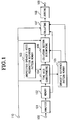
- Fig. 1 is a block diagram showing a first embodiment of the speaker recognition system according to the present invention.
- Data representing registration or collation to be performed and also a speaker number representing a speaker are inputted to a terminal 110.
- a case will first be considered, in which the data supplied to the terminal 110 represents registration.
- Speech inputted to a terminal 100 is converted in an analyzer part 101 to a feature vector series, which is tentatively stored in a memory unit 102.
- the feature vector may be used cepstrum, LPC coefficient and changes in these parameters with time, obtainable by FFT analysis, linear prediction analysis and the like, as mentioned in, for instance, Furui, "Digital Speech Processing", Publishing Association, Tokai University (hereinafter referred to as Literature 3).
- a time axis correspondence producing part 104 reads out an unspecified speaker's reference speech pattern for speech recognition from an unspecified speaker's speech recognition reference pattern memory part 103, and produces time axis correspondence of the read-out speech pattern to the input vector series stored in the memory part 102.
- the result of the time axis correspondence production with respect to the input vector series is stored and registered, as data corresponding to the speaker number inputted to the terminal 110, in a reference speech pattern memory part 105.
- the time axis correspondence producing part 104 reads out an unspecified speaker's reference speech pattern for speech recognition from an unspecified speaker's speech recognition reference speech pattern memory part 103, and produces time axis correspondence of the read-out speech pattern to the input vector series stored in the memory part 102.
- the result of the time axis correspondence production is supplied to a collation section determining part 106.
- the collation section determining part 106 receives the time axis correspondence production result with resect to the input speech, received from the time axis correspondence producing part 104, and the time axis correspondence production result with respect to the speaker number inputted to the terminal 110, received from the reference speech pattern memory part 105, and determines the collation section.
- a collating part 107 calculates the distance between the feature vector series, corresponding to the speaker number inputted to the terminal 110, and the feature vector series of the input speech read out from the memory part 102, by using the collation section read out from the collation section determining part 106.
- a judging part 108 judges the input speech to be of the identical speaker, while otherwise determining the input speech to be of a different speaker, and supplies the result data to a terminal 109.
- Fig. 2 is a block diagram showing a second embodiment for the speaker recognition system according to the present invention.
- Data representing registration or collation to be performed and also a speaker number representing a speaker are inputted to a terminal 110.
- a case will first be considered, in which the data input to the terminal 210 represents registration.
- Speech inputted to a terminal 100 is converted in an analyzer part 201 to a feature vector series, which is tentatively stored in a memory unit 102.
- the feature vector may be used cepstrum, LPC coefficient and change in these parameters with time, obtainable by FFT analysis, linear prediction analysis and the like, as mentioned in, for instance, Furui, "Digital Speech Processing", Publishing Association, Tokai University (hereinafter referred to as Literature).
- a vector copying part 204 reads out an unspecified speaker's reference speech pattern for speech recognition from an unspecified speaker's speech recognition reference speech pattern memory part 203, and produces time axis correspondence of the read-out speech pattern to the input vector series stored in the memory part 202. Based on this result, the vector copying part 204 copies the input vector series in an unspecified speaker's acoustical space to produce a copied vector series. The input vector series and the copied vector series are then stored and registered, as data corresponding to the speaker number inputted to the terminal 210, to a reference pattern memory part 205.
- speech inputted to the terminal 200 is converted in the analyzer part 201 to a feature vector series, which is tentatively stored in the memory part 200.
- the vector copying part 204 reads out the unspecified speaker's reference pattern for speech recognition from the unspecified speaker's speech recognition reference pattern memory 203, and produces time axis correspondence of the read-out speech pattern to the input vector series stored in the memory 202. Based on this result, the vector copying part 204 copies the input vector series in the unspecified speaker's acoustical space to produce the copied vector series, and supplies same an inter-vector distance calculating part 206.
- the inter-vector distance calculating part 206 calculates the inter-vector distance concerning the copied vector series supplied from the vector copying part 204 and a copied vector series corresponding to the speaker number inputted to the terminal 210.
- a collating part 207 calculates, from the inter-vector distance for the copied vector series, received from the inter-vector distance calculator 206, a distance between the feature vector series corresponding to the speaker number inputted to the input terminal 210, read out from the reference pattern memory part 205, and the feature vector series of the input speech, read out from the memory part 202.
- a judging part 208 judges the input speech to be of the identical speaker, while otherwise judging the input speech to be of a different speaker, and supplies result data to a terminal 210.
- Fig. 3 is a block diagram showing Embodiment 3 of the speaker recognition system according to the present invention.
- Data representing registration or collation to be performed and also a speaker number representing a speaker are inputted to terminal 310.
- Speech data supplied to a terminal 300 is converted in an analyzer part 301 to a feature vector series, which is tentatively stored in a memory unit 302.
- the feature vector may be used cepstrum, LPC coefficient and changes in these parameters with time, obtainable by FFT analysis, linear prediction analysis and the like, as mentioned in, for instance, Furui, "Digital Speech Processing", Publishing Association, Tokai University (hereinafter referred to as Literature 3).
- a time axis correspondence producing part 304 reads out an unspecified speaker's reference speech pattern for speech recognition from an unspecified speaker's speech recognition reference speech pattern memory part 303, and produces time axis correspondence of the read-out speech pattern and the input speecheseries stored in the memory part 302. The result of the time axis correspondence production with respect to the input vector series, is stored and registered, as data corresponding to the speaker number inputted to the terminal 310, in a reference speech pattern memory part 305.
- speech inputted to the terminal 300 is converted in the analyzer part 301 to a feature vector series, which is tentatively stored in the memory part 302.
- the time axis correspondence producing part 304 reads out the unspecified speaker's reference pattern for speech recognition from the unspecified speaker's speech recognition memory part 303, and produces time axis correspondence of the read-out speech pattern to the input vector series stored in memory part 302. In this case, the part 304 supplies the result of the time axis correspondence production to an inter-vector distance determining part 306.
- inter-vector distance memory part 311 is stored inter-feature-vector distance data stored in the unspecified speaker's speech recognition reference pattern memory 303.
- the inter-feature-vector distance memory part 306 receives the time axis correspondence data about the input speech from the time axis correspondence producing part 304 and the time axis correspondence data, corresponding to the speaker number inputted to the terminal 310, from the time axis correspondence producing part 304, and reads out the inter-vector distance data of the copied vector series from the inter-vector distance memory part 311.
- a collating part 307 calculates a distance between the feature vector series corresponding to the speaker number inputted from the terminal 310, read out from the reference pattern memory part 305, and the feature vector series of the input speech, reads out from the memory part 302, according to the inter-vector distance data out the copied vector series, received from the inter-vector distance determining part 306.
- a judging part 308 judges the input speech to be of the identical speaker, while otherwise judging the input speech to be of a different speaker, and supplies the result of judgment to a terminal 309.
Landscapes
- Engineering & Computer Science (AREA)
- Human Computer Interaction (AREA)
- Computer Vision & Pattern Recognition (AREA)
- Game Theory and Decision Science (AREA)
- Health & Medical Sciences (AREA)
- Audiology, Speech & Language Pathology (AREA)
- Business, Economics & Management (AREA)
- Physics & Mathematics (AREA)
- Acoustics & Sound (AREA)
- Multimedia (AREA)
- Image Processing (AREA)
- Machine Translation (AREA)
- Document Processing Apparatus (AREA)
- Image Analysis (AREA)
Abstract
Description

- U:
- number of samples corresponding to (1)
- Umax:
- maximum number of samples corresponding to (1) for all reference patterns
- dout:
- fixed distance for samples corresponding to (2)
- lk:
- coverage of k-th element
c k of reference pattern ∥·∥ Euclid distance
Claims (11)
- A method of recognizing a speaker of an input speech according to the distance between an input speech pattern, obtained by converting the input speech to a feature parameter series, and a reference pattern preliminarily registered as feature parameter series for each speaker, comprising steps of:obtaining contents of the input and reference speech patterns by recognition;determining an identical section, in which the contents of the input and reference speech patterns are identical;determining the distance between the input and reference speech patterns in the calculated identical content section; andrecognizing the speaker of the input speech on the basis of the determined distance.
- The speaker recognition method according to claim 1, wherein the speaker recognition is performed on the basis of the distance between the input and reference speech patterns only for identical data of phonemes of the input and reference speech patterns obtained through the time axis correspondence between the input and reference speech patterns.
- The speaker recognition method according to claim 2, wherein the time axis correspondence is obtained on the basis of a garbage model provided by an unspecified speaker.
- A method of recognizing a speaker of an input speech independently of the content thereof by converting the input speech to an input speech pattern as a feature parameter series and determining the difference of the input speech pattern from a reference speech pattern registered for each speaker, the method comprising the steps of:obtaining the contents of the input and reference patterns by speech recognition, and determining the distance by determining identical content sections of the input and reference speech patterns from the obtained pattern content data.
- A method of recognizing a speaker of an input speech comprising steps of:determining an identical section of the input speech and a reference speech;copying the input speech and reference speech in an unspecified speaker's acoustical space;determining a distance between the copied input speech and reference speech at least for the identical section; andrecognizing the speaker of the input speech.
- The speaker recognition method according to claim 5, wherein the speaker recognition is performed on the basis of the distance between the input and reference speech patterns only for identical data of phonemes of the input and reference speech patterns obtained through the time axis correspondence between the input and reference speech patterns.
- A method of recognizing a speaker of an input speech comprising steps of:copying the input speech and reference speech in an unspecified speaker's acoustical space;determining an identical section of the copied input speech and the reference speech;determining a distance between the copied input speech and reference speech at least for the identical section; andrecognizing the speaker of the input speech.
- The speaker recognition method according to claim 7, wherein the speaker recognition is performed on the basis of the distance between the input and reference speech patterns only for identical data of phonemes of the input and reference speech patterns obtained through the time axis correspondence between the input and reference speech patterns.
- An apparatus for recognizing a speaker of an input speech according to the distance between an input speech pattern, obtained by converting the input speech to a feature parameter series, and a reference pattern preliminarily registered as feature parameter series for each speaker, comprising:a first means for obtaining contents of the input and reference speech patterns by recognition;a second means for determining an identical section, in which the contents of the input and reference speech patterns are identical;a third means for determining the distance between the input and reference speech patterns in the calculated identical content section; anda fourth means for recognizing the speaker of the input speech on the basis of the determined distance.
- An apparatus for recognizing a speaker of an input speech comprising:a first means for determining an identical section of the input speech and a reference speech;a second means for copying the input speech and reference speech in an unspecified speaker's acoustical space;a third means for determining a distance between the copied input speech and reference speech at least for the identical section; anda fourth means for recognizing the speaker of the input speech.
- An apparatus for recognizing a speaker of an input speech comprising:a first means for copying the input speech and reference speech in an unspecified speaker's acoustical space;a second means for determining an identical section of the copied input speech and the reference speech;a third means for determining a distance between the copied input speech and reference speech at least for the identical section; anda fourth means for recognizing the speaker of the input speech.
Applications Claiming Priority (2)
| Application Number | Priority Date | Filing Date | Title |
|---|---|---|---|
| JP6951598 | 1998-03-04 | ||
| JP10069515A JP3075250B2 (en) | 1998-03-04 | 1998-03-04 | Speaker recognition method and apparatus |
Publications (2)
| Publication Number | Publication Date |
|---|---|
| EP0940802A2 true EP0940802A2 (en) | 1999-09-08 |
| EP0940802A3 EP0940802A3 (en) | 2000-02-23 |
Family
ID=13404955
Family Applications (1)
| Application Number | Title | Priority Date | Filing Date |
|---|---|---|---|
| EP99103902A Withdrawn EP0940802A3 (en) | 1998-03-04 | 1999-03-04 | Method and apparatus for text independent speaker recognition |
Country Status (3)
| Country | Link |
|---|---|
| US (1) | US6349280B1 (en) |
| EP (1) | EP0940802A3 (en) |
| JP (1) | JP3075250B2 (en) |
Cited By (1)
| Publication number | Priority date | Publication date | Assignee | Title |
|---|---|---|---|---|
| EP1361738A1 (en) * | 2002-05-08 | 2003-11-12 | Sap Ag | Method and system for speech signal processing using speech recognition and frequency analysis |
Families Citing this family (2)
| Publication number | Priority date | Publication date | Assignee | Title |
|---|---|---|---|---|
| CN101154380B (en) * | 2006-09-29 | 2011-01-26 | 株式会社东芝 | Method and device for registration and validation of speaker's authentication |
| JP5229124B2 (en) * | 2009-06-12 | 2013-07-03 | 日本電気株式会社 | Speaker verification device, speaker verification method and program |
Family Cites Families (15)
| Publication number | Priority date | Publication date | Assignee | Title |
|---|---|---|---|---|
| US3761547A (en) | 1970-07-17 | 1973-09-25 | Gen Electric | Process for controlling surface area of ceramic powders |
| FR2554623B1 (en) * | 1983-11-08 | 1986-08-14 | Texas Instruments France | SPEAKER-INDEPENDENT SPEECH ANALYSIS PROCESS |
| JPS63157199A (en) | 1986-12-22 | 1988-06-30 | 株式会社東芝 | Speaker collator |
| JPH02195400A (en) * | 1989-01-24 | 1990-08-01 | Canon Inc | voice recognition device |
| JPH0316038A (en) | 1989-06-13 | 1991-01-24 | Teac Corp | Information recording and reproducing device |
| JPH0345417A (en) | 1989-07-14 | 1991-02-27 | Nippon Carbureter Co Ltd | Heating system for automobile |
| JP2815667B2 (en) | 1990-03-26 | 1998-10-27 | 日本電信電話株式会社 | Speaker recognition method |
| JPH045198A (en) | 1990-04-23 | 1992-01-09 | Sanyo Electric Co Ltd | Solar cell type of electric aircraft |
| JPH0632007A (en) | 1992-07-15 | 1994-02-08 | Sony Corp | Ribbon cartridge |
| JPH0632003A (en) | 1992-07-17 | 1994-02-08 | Sharp Corp | Printer |
| EP0962913B1 (en) * | 1993-03-25 | 2003-04-23 | BRITISH TELECOMMUNICATIONS public limited company | Speech recognition |
| JP3180655B2 (en) * | 1995-06-19 | 2001-06-25 | 日本電信電話株式会社 | Word speech recognition method by pattern matching and apparatus for implementing the method |
| JP3697748B2 (en) * | 1995-08-21 | 2005-09-21 | セイコーエプソン株式会社 | Terminal, voice recognition device |
| US5946654A (en) | 1997-02-21 | 1999-08-31 | Dragon Systems, Inc. | Speaker identification using unsupervised speech models |
| JP5722120B2 (en) | 2011-05-20 | 2015-05-20 | 株式会社ブルアンドベア | Panel fixture |
-
1998
- 1998-03-04 JP JP10069515A patent/JP3075250B2/en not_active Expired - Fee Related
-
1999
- 1999-03-04 US US09/262,083 patent/US6349280B1/en not_active Expired - Fee Related
- 1999-03-04 EP EP99103902A patent/EP0940802A3/en not_active Withdrawn
Cited By (1)
| Publication number | Priority date | Publication date | Assignee | Title |
|---|---|---|---|---|
| EP1361738A1 (en) * | 2002-05-08 | 2003-11-12 | Sap Ag | Method and system for speech signal processing using speech recognition and frequency analysis |
Also Published As
| Publication number | Publication date |
|---|---|
| JPH11249685A (en) | 1999-09-17 |
| EP0940802A3 (en) | 2000-02-23 |
| US6349280B1 (en) | 2002-02-19 |
| JP3075250B2 (en) | 2000-08-14 |
Similar Documents
| Publication | Publication Date | Title |
|---|---|---|
| US5937384A (en) | Method and system for speech recognition using continuous density hidden Markov models | |
| JP4218982B2 (en) | Audio processing | |
| EP2216775B1 (en) | Speaker recognition | |
| EP0501631B1 (en) | Temporal decorrelation method for robust speaker verification | |
| US6401063B1 (en) | Method and apparatus for use in speaker verification | |
| JP3630216B2 (en) | Probabilistic matching method for speaker authentication | |
| US7072836B2 (en) | Speech processing apparatus and method employing matching and confidence scores | |
| EP0758781B1 (en) | Utterance verification using word based minimum verification error training for recognizing a keyword string | |
| US20090171660A1 (en) | Method and apparatus for verification of speaker authentification and system for speaker authentication | |
| US7318032B1 (en) | Speaker recognition method based on structured speaker modeling and a “Pickmax” scoring technique | |
| EP1184840A1 (en) | Discriminative utterance verification for connected digits recognition | |
| Junqua | Robust speech recognition in embedded systems and PC applications | |
| US20100138222A1 (en) | Method for Adapting a Codebook for Speech Recognition | |
| JPH05216490A (en) | Apparatus and method for speech coding and apparatus and method for speech recognition | |
| US6868381B1 (en) | Method and apparatus providing hypothesis driven speech modelling for use in speech recognition | |
| Yapanel et al. | A new perspective on feature extraction for robust in-vehicle speech recognition. | |
| JPH07334184A (en) | Calculating device for acoustic category mean value and adapting device therefor | |
| US7315819B2 (en) | Apparatus for performing speaker identification and speaker searching in speech or sound image data, and method thereof | |
| EP1096475B1 (en) | Frequency warping for speech recognition | |
| Chaudhari et al. | Multigrained modeling with pattern specific maximum likelihood transformations for text-independent speaker recognition | |
| JP3004023B2 (en) | Voice recognition device | |
| WO2002029785A1 (en) | Method, apparatus, and system for speaker verification based on orthogonal gaussian mixture model (gmm) | |
| EP0940802A2 (en) | Method and apparatus for text independent speaker recognition | |
| JPH06289891A (en) | Speech recognition device | |
| JP3090119B2 (en) | Speaker verification device, method and storage medium |
Legal Events
| Date | Code | Title | Description |
|---|---|---|---|
| PUAI | Public reference made under article 153(3) epc to a published international application that has entered the european phase |
Free format text: ORIGINAL CODE: 0009012 |
|
| AK | Designated contracting states |
Kind code of ref document: A2 Designated state(s): DE FR GB |
|
| AX | Request for extension of the european patent |
Free format text: AL;LT;LV;MK;RO;SI |
|
| PUAL | Search report despatched |
Free format text: ORIGINAL CODE: 0009013 |
|
| AK | Designated contracting states |
Kind code of ref document: A3 Designated state(s): AT BE CH CY DE DK ES FI FR GB GR IE IT LI LU MC NL PT SE |
|
| AX | Request for extension of the european patent |
Free format text: AL;LT;LV;MK;RO;SI |
|
| 17P | Request for examination filed |
Effective date: 20000112 |
|
| AKX | Designation fees paid |
Free format text: DE FR GB |
|
| 17Q | First examination report despatched |
Effective date: 20030331 |
|
| STAA | Information on the status of an ep patent application or granted ep patent |
Free format text: STATUS: THE APPLICATION IS DEEMED TO BE WITHDRAWN |
|
| 18D | Application deemed to be withdrawn |
Effective date: 20030811 |