EP0940249B1 - Foam insulation board faced with a tough polymeric film or composite thereof - Google Patents
Foam insulation board faced with a tough polymeric film or composite thereof Download PDFInfo
- Publication number
- EP0940249B1 EP0940249B1 EP99301358A EP99301358A EP0940249B1 EP 0940249 B1 EP0940249 B1 EP 0940249B1 EP 99301358 A EP99301358 A EP 99301358A EP 99301358 A EP99301358 A EP 99301358A EP 0940249 B1 EP0940249 B1 EP 0940249B1
- Authority
- EP
- European Patent Office
- Prior art keywords
- foam
- layer
- polymeric layer
- facing
- tough polymeric
- Prior art date
- Legal status (The legal status is an assumption and is not a legal conclusion. Google has not performed a legal analysis and makes no representation as to the accuracy of the status listed.)
- Expired - Lifetime
Links
- 239000002131 composite material Substances 0.000 title claims abstract description 38
- 238000009413 insulation Methods 0.000 title claims abstract description 30
- 239000006260 foam Substances 0.000 title claims description 95
- 239000000463 material Substances 0.000 claims abstract description 66
- 239000000203 mixture Substances 0.000 claims abstract description 52
- 239000013047 polymeric layer Substances 0.000 claims abstract description 50
- 238000000034 method Methods 0.000 claims abstract description 27
- 238000004519 manufacturing process Methods 0.000 claims abstract description 25
- 238000005187 foaming Methods 0.000 claims abstract description 5
- 239000010410 layer Substances 0.000 claims description 53
- 229920000642 polymer Polymers 0.000 claims description 25
- 229910052782 aluminium Inorganic materials 0.000 claims description 18
- XAGFODPZIPBFFR-UHFFFAOYSA-N aluminium Chemical compound [Al] XAGFODPZIPBFFR-UHFFFAOYSA-N 0.000 claims description 18
- 239000002655 kraft paper Substances 0.000 claims description 16
- 239000011888 foil Substances 0.000 claims description 14
- 229920000728 polyester Polymers 0.000 claims description 14
- 229920000582 polyisocyanurate Polymers 0.000 claims description 13
- 239000011495 polyisocyanurate Substances 0.000 claims description 13
- 239000004814 polyurethane Substances 0.000 claims description 13
- 229920002635 polyurethane Polymers 0.000 claims description 11
- 239000003365 glass fiber Substances 0.000 claims description 8
- 229910052751 metal Inorganic materials 0.000 claims description 8
- 239000002184 metal Substances 0.000 claims description 8
- 239000002984 plastic foam Substances 0.000 claims description 8
- -1 polyethylene terephthalate Polymers 0.000 claims description 7
- 239000000654 additive Substances 0.000 claims description 5
- 229920002799 BoPET Polymers 0.000 claims description 4
- 239000000945 filler Substances 0.000 claims description 4
- 239000000049 pigment Substances 0.000 claims description 4
- 229920000139 polyethylene terephthalate Polymers 0.000 claims description 4
- 239000005020 polyethylene terephthalate Substances 0.000 claims description 4
- 239000012779 reinforcing material Substances 0.000 claims description 4
- 239000006057 Non-nutritive feed additive Substances 0.000 claims description 3
- 239000003963 antioxidant agent Substances 0.000 claims description 3
- 239000003063 flame retardant Substances 0.000 claims description 3
- 239000004609 Impact Modifier Substances 0.000 claims description 2
- 239000003086 colorant Substances 0.000 claims description 2
- 239000012760 heat stabilizer Substances 0.000 claims description 2
- 239000000314 lubricant Substances 0.000 claims description 2
- 239000000326 ultraviolet stabilizing agent Substances 0.000 claims description 2
- XLYOFNOQVPJJNP-UHFFFAOYSA-N water Substances O XLYOFNOQVPJJNP-UHFFFAOYSA-N 0.000 claims description 2
- 230000000996 additive effect Effects 0.000 claims 1
- KKEYFWRCBNTPAC-UHFFFAOYSA-L terephthalate(2-) Chemical compound [O-]C(=O)C1=CC=C(C([O-])=O)C=C1 KKEYFWRCBNTPAC-UHFFFAOYSA-L 0.000 claims 1
- 239000000126 substance Substances 0.000 description 14
- 230000003014 reinforcing effect Effects 0.000 description 11
- 239000000853 adhesive Substances 0.000 description 10
- 239000011521 glass Substances 0.000 description 10
- 239000000047 product Substances 0.000 description 10
- 230000001070 adhesive effect Effects 0.000 description 9
- 238000000576 coating method Methods 0.000 description 7
- 239000005018 casein Substances 0.000 description 6
- BECPQYXYKAMYBN-UHFFFAOYSA-N casein, tech. Chemical compound NCCCCC(C(O)=O)N=C(O)C(CC(O)=O)N=C(O)C(CCC(O)=N)N=C(O)C(CC(C)C)N=C(O)C(CCC(O)=O)N=C(O)C(CC(O)=O)N=C(O)C(CCC(O)=O)N=C(O)C(C(C)O)N=C(O)C(CCC(O)=N)N=C(O)C(CCC(O)=N)N=C(O)C(CCC(O)=N)N=C(O)C(CCC(O)=O)N=C(O)C(CCC(O)=O)N=C(O)C(COP(O)(O)=O)N=C(O)C(CCC(O)=N)N=C(O)C(N)CC1=CC=CC=C1 BECPQYXYKAMYBN-UHFFFAOYSA-N 0.000 description 6
- 235000021240 caseins Nutrition 0.000 description 6
- 239000004816 latex Substances 0.000 description 6
- 229920000126 latex Polymers 0.000 description 6
- 230000008569 process Effects 0.000 description 6
- 230000004888 barrier function Effects 0.000 description 5
- 239000011248 coating agent Substances 0.000 description 5
- 238000000151 deposition Methods 0.000 description 5
- 230000002787 reinforcement Effects 0.000 description 5
- 238000011144 upstream manufacturing Methods 0.000 description 5
- 239000004593 Epoxy Substances 0.000 description 4
- 230000008021 deposition Effects 0.000 description 4
- 239000004615 ingredient Substances 0.000 description 4
- 239000000123 paper Substances 0.000 description 4
- 229920003023 plastic Polymers 0.000 description 4
- 239000004033 plastic Substances 0.000 description 4
- 229920006267 polyester film Polymers 0.000 description 4
- 229920001169 thermoplastic Polymers 0.000 description 4
- PPBRXRYQALVLMV-UHFFFAOYSA-N Styrene Natural products C=CC1=CC=CC=C1 PPBRXRYQALVLMV-UHFFFAOYSA-N 0.000 description 3
- 239000002253 acid Substances 0.000 description 3
- NIXOWILDQLNWCW-UHFFFAOYSA-N acrylic acid group Chemical group C(C=C)(=O)O NIXOWILDQLNWCW-UHFFFAOYSA-N 0.000 description 3
- 239000000835 fiber Substances 0.000 description 3
- 239000002657 fibrous material Substances 0.000 description 3
- 239000007789 gas Substances 0.000 description 3
- 238000003475 lamination Methods 0.000 description 3
- 229920005989 resin Polymers 0.000 description 3
- 239000011347 resin Substances 0.000 description 3
- 239000002356 single layer Substances 0.000 description 3
- 239000000758 substrate Substances 0.000 description 3
- 239000004416 thermosoftening plastic Substances 0.000 description 3
- 239000004604 Blowing Agent Substances 0.000 description 2
- VTYYLEPIZMXCLO-UHFFFAOYSA-L Calcium carbonate Chemical compound [Ca+2].[O-]C([O-])=O VTYYLEPIZMXCLO-UHFFFAOYSA-L 0.000 description 2
- RRHGJUQNOFWUDK-UHFFFAOYSA-N Isoprene Chemical compound CC(=C)C=C RRHGJUQNOFWUDK-UHFFFAOYSA-N 0.000 description 2
- VYPSYNLAJGMNEJ-UHFFFAOYSA-N Silicium dioxide Chemical compound O=[Si]=O VYPSYNLAJGMNEJ-UHFFFAOYSA-N 0.000 description 2
- 229910000831 Steel Inorganic materials 0.000 description 2
- GWEVSGVZZGPLCZ-UHFFFAOYSA-N Titan oxide Chemical compound O=[Ti]=O GWEVSGVZZGPLCZ-UHFFFAOYSA-N 0.000 description 2
- 150000007513 acids Chemical class 0.000 description 2
- 239000005030 aluminium foil Substances 0.000 description 2
- QVGXLLKOCUKJST-UHFFFAOYSA-N atomic oxygen Chemical compound [O] QVGXLLKOCUKJST-UHFFFAOYSA-N 0.000 description 2
- 230000008901 benefit Effects 0.000 description 2
- 239000003054 catalyst Substances 0.000 description 2
- 239000004927 clay Substances 0.000 description 2
- 229910052570 clay Inorganic materials 0.000 description 2
- 238000010276 construction Methods 0.000 description 2
- 239000011152 fibreglass Substances 0.000 description 2
- 239000012467 final product Substances 0.000 description 2
- 239000006261 foam material Substances 0.000 description 2
- 239000004088 foaming agent Substances 0.000 description 2
- 238000009472 formulation Methods 0.000 description 2
- 230000008595 infiltration Effects 0.000 description 2
- 238000001764 infiltration Methods 0.000 description 2
- ZFSLODLOARCGLH-UHFFFAOYSA-N isocyanuric acid Chemical compound OC1=NC(O)=NC(O)=N1 ZFSLODLOARCGLH-UHFFFAOYSA-N 0.000 description 2
- 239000007788 liquid Substances 0.000 description 2
- 150000002739 metals Chemical class 0.000 description 2
- 239000001301 oxygen Substances 0.000 description 2
- 229910052760 oxygen Inorganic materials 0.000 description 2
- 229920005906 polyester polyol Polymers 0.000 description 2
- 229920001228 polyisocyanate Polymers 0.000 description 2
- 239000005056 polyisocyanate Substances 0.000 description 2
- 230000004224 protection Effects 0.000 description 2
- 239000010959 steel Substances 0.000 description 2
- 239000004094 surface-active agent Substances 0.000 description 2
- 229920001187 thermosetting polymer Polymers 0.000 description 2
- 239000005995 Aluminium silicate Substances 0.000 description 1
- 229920001634 Copolyester Polymers 0.000 description 1
- 229920000742 Cotton Polymers 0.000 description 1
- VGGSQFUCUMXWEO-UHFFFAOYSA-N Ethene Chemical compound C=C VGGSQFUCUMXWEO-UHFFFAOYSA-N 0.000 description 1
- 239000005977 Ethylene Substances 0.000 description 1
- UFHFLCQGNIYNRP-UHFFFAOYSA-N Hydrogen Chemical compound [H][H] UFHFLCQGNIYNRP-UHFFFAOYSA-N 0.000 description 1
- 239000004677 Nylon Substances 0.000 description 1
- 229920000538 Poly[(phenyl isocyanate)-co-formaldehyde] Polymers 0.000 description 1
- 229920005830 Polyurethane Foam Polymers 0.000 description 1
- 229920001328 Polyvinylidene chloride Polymers 0.000 description 1
- 229920000297 Rayon Polymers 0.000 description 1
- 230000006750 UV protection Effects 0.000 description 1
- 238000010521 absorption reaction Methods 0.000 description 1
- 150000008065 acid anhydrides Chemical class 0.000 description 1
- 239000002318 adhesion promoter Substances 0.000 description 1
- 235000012211 aluminium silicate Nutrition 0.000 description 1
- 125000003118 aryl group Chemical group 0.000 description 1
- 239000010425 asbestos Substances 0.000 description 1
- 238000005452 bending Methods 0.000 description 1
- 230000005540 biological transmission Effects 0.000 description 1
- 230000015572 biosynthetic process Effects 0.000 description 1
- 229920001400 block copolymer Polymers 0.000 description 1
- 238000007664 blowing Methods 0.000 description 1
- 238000009435 building construction Methods 0.000 description 1
- MTAZNLWOLGHBHU-UHFFFAOYSA-N butadiene-styrene rubber Chemical compound C=CC=C.C=CC1=CC=CC=C1 MTAZNLWOLGHBHU-UHFFFAOYSA-N 0.000 description 1
- 229910000019 calcium carbonate Inorganic materials 0.000 description 1
- 230000001413 cellular effect Effects 0.000 description 1
- 230000008859 change Effects 0.000 description 1
- 239000003638 chemical reducing agent Substances 0.000 description 1
- 239000003795 chemical substances by application Substances 0.000 description 1
- 238000004040 coloring Methods 0.000 description 1
- 150000001875 compounds Chemical class 0.000 description 1
- 238000010924 continuous production Methods 0.000 description 1
- 229920001577 copolymer Polymers 0.000 description 1
- 238000005520 cutting process Methods 0.000 description 1
- 239000002270 dispersing agent Substances 0.000 description 1
- 238000009826 distribution Methods 0.000 description 1
- 125000003700 epoxy group Chemical group 0.000 description 1
- 150000002148 esters Chemical class 0.000 description 1
- 230000002349 favourable effect Effects 0.000 description 1
- NBVXSUQYWXRMNV-UHFFFAOYSA-N fluoromethane Chemical compound FC NBVXSUQYWXRMNV-UHFFFAOYSA-N 0.000 description 1
- 229920000578 graft copolymer Polymers 0.000 description 1
- 239000001257 hydrogen Substances 0.000 description 1
- 229910052739 hydrogen Inorganic materials 0.000 description 1
- 239000011810 insulating material Substances 0.000 description 1
- NLYAJNPCOHFWQQ-UHFFFAOYSA-N kaolin Chemical compound O.O.O=[Al]O[Si](=O)O[Si](=O)O[Al]=O NLYAJNPCOHFWQQ-UHFFFAOYSA-N 0.000 description 1
- 238000010030 laminating Methods 0.000 description 1
- 230000004048 modification Effects 0.000 description 1
- 238000012986 modification Methods 0.000 description 1
- 239000002064 nanoplatelet Substances 0.000 description 1
- 229920001778 nylon Polymers 0.000 description 1
- 230000003647 oxidation Effects 0.000 description 1
- 238000007254 oxidation reaction Methods 0.000 description 1
- 230000035515 penetration Effects 0.000 description 1
- 239000002985 plastic film Substances 0.000 description 1
- 229920006255 plastic film Polymers 0.000 description 1
- 239000004014 plasticizer Substances 0.000 description 1
- 229920000058 polyacrylate Polymers 0.000 description 1
- 229920000647 polyepoxide Polymers 0.000 description 1
- 229920000098 polyolefin Polymers 0.000 description 1
- 239000011496 polyurethane foam Substances 0.000 description 1
- 239000005033 polyvinylidene chloride Substances 0.000 description 1
- 238000002360 preparation method Methods 0.000 description 1
- 238000007639 printing Methods 0.000 description 1
- 229920005604 random copolymer Polymers 0.000 description 1
- 239000002964 rayon Substances 0.000 description 1
- 230000003763 resistance to breakage Effects 0.000 description 1
- 230000000717 retained effect Effects 0.000 description 1
- 229910052895 riebeckite Inorganic materials 0.000 description 1
- 238000005096 rolling process Methods 0.000 description 1
- 150000003839 salts Chemical class 0.000 description 1
- 229920006395 saturated elastomer Polymers 0.000 description 1
- 230000003678 scratch resistant effect Effects 0.000 description 1
- 239000000377 silicon dioxide Substances 0.000 description 1
- 239000004332 silver Substances 0.000 description 1
- 229910052709 silver Inorganic materials 0.000 description 1
- 239000007921 spray Substances 0.000 description 1
- 230000001502 supplementing effect Effects 0.000 description 1
- 229920005613 synthetic organic polymer Polymers 0.000 description 1
- 239000000454 talc Substances 0.000 description 1
- 229910052623 talc Inorganic materials 0.000 description 1
- 239000002937 thermal insulation foam Substances 0.000 description 1
- 239000004408 titanium dioxide Substances 0.000 description 1
- 238000009827 uniform distribution Methods 0.000 description 1
- 150000003673 urethanes Chemical class 0.000 description 1
- 238000005303 weighing Methods 0.000 description 1
Images

Classifications
-
- B—PERFORMING OPERATIONS; TRANSPORTING
- B32—LAYERED PRODUCTS
- B32B—LAYERED PRODUCTS, i.e. PRODUCTS BUILT-UP OF STRATA OF FLAT OR NON-FLAT, e.g. CELLULAR OR HONEYCOMB, FORM
- B32B33/00—Layered products characterised by particular properties or particular surface features, e.g. particular surface coatings; Layered products designed for particular purposes not covered by another single class
-
- B—PERFORMING OPERATIONS; TRANSPORTING
- B29—WORKING OF PLASTICS; WORKING OF SUBSTANCES IN A PLASTIC STATE IN GENERAL
- B29C—SHAPING OR JOINING OF PLASTICS; SHAPING OF MATERIAL IN A PLASTIC STATE, NOT OTHERWISE PROVIDED FOR; AFTER-TREATMENT OF THE SHAPED PRODUCTS, e.g. REPAIRING
- B29C44/00—Shaping by internal pressure generated in the material, e.g. swelling or foaming ; Producing porous or cellular expanded plastics articles
- B29C44/20—Shaping by internal pressure generated in the material, e.g. swelling or foaming ; Producing porous or cellular expanded plastics articles for articles of indefinite length
- B29C44/32—Incorporating or moulding on preformed parts, e.g. linings, inserts or reinforcements
- B29C44/321—Incorporating or moulding on preformed parts, e.g. linings, inserts or reinforcements the preformed part being a lining, e.g. a film or a support lining
-
- B—PERFORMING OPERATIONS; TRANSPORTING
- B29—WORKING OF PLASTICS; WORKING OF SUBSTANCES IN A PLASTIC STATE IN GENERAL
- B29C—SHAPING OR JOINING OF PLASTICS; SHAPING OF MATERIAL IN A PLASTIC STATE, NOT OTHERWISE PROVIDED FOR; AFTER-TREATMENT OF THE SHAPED PRODUCTS, e.g. REPAIRING
- B29C44/00—Shaping by internal pressure generated in the material, e.g. swelling or foaming ; Producing porous or cellular expanded plastics articles
- B29C44/20—Shaping by internal pressure generated in the material, e.g. swelling or foaming ; Producing porous or cellular expanded plastics articles for articles of indefinite length
- B29C44/32—Incorporating or moulding on preformed parts, e.g. linings, inserts or reinforcements
- B29C44/326—Joining the preformed parts, e.g. to make flat or profiled sandwich laminates
-
- B—PERFORMING OPERATIONS; TRANSPORTING
- B32—LAYERED PRODUCTS
- B32B—LAYERED PRODUCTS, i.e. PRODUCTS BUILT-UP OF STRATA OF FLAT OR NON-FLAT, e.g. CELLULAR OR HONEYCOMB, FORM
- B32B5/00—Layered products characterised by the non- homogeneity or physical structure, i.e. comprising a fibrous, filamentary, particulate or foam layer; Layered products characterised by having a layer differing constitutionally or physically in different parts
- B32B5/18—Layered products characterised by the non- homogeneity or physical structure, i.e. comprising a fibrous, filamentary, particulate or foam layer; Layered products characterised by having a layer differing constitutionally or physically in different parts characterised by features of a layer of foamed material
- B32B5/20—Layered products characterised by the non- homogeneity or physical structure, i.e. comprising a fibrous, filamentary, particulate or foam layer; Layered products characterised by having a layer differing constitutionally or physically in different parts characterised by features of a layer of foamed material foamed in situ
-
- Y—GENERAL TAGGING OF NEW TECHNOLOGICAL DEVELOPMENTS; GENERAL TAGGING OF CROSS-SECTIONAL TECHNOLOGIES SPANNING OVER SEVERAL SECTIONS OF THE IPC; TECHNICAL SUBJECTS COVERED BY FORMER USPC CROSS-REFERENCE ART COLLECTIONS [XRACs] AND DIGESTS
- Y10—TECHNICAL SUBJECTS COVERED BY FORMER USPC
- Y10S—TECHNICAL SUBJECTS COVERED BY FORMER USPC CROSS-REFERENCE ART COLLECTIONS [XRACs] AND DIGESTS
- Y10S428/00—Stock material or miscellaneous articles
- Y10S428/91—Product with molecular orientation
-
- Y—GENERAL TAGGING OF NEW TECHNOLOGICAL DEVELOPMENTS; GENERAL TAGGING OF CROSS-SECTIONAL TECHNOLOGIES SPANNING OVER SEVERAL SECTIONS OF THE IPC; TECHNICAL SUBJECTS COVERED BY FORMER USPC CROSS-REFERENCE ART COLLECTIONS [XRACs] AND DIGESTS
- Y10—TECHNICAL SUBJECTS COVERED BY FORMER USPC
- Y10T—TECHNICAL SUBJECTS COVERED BY FORMER US CLASSIFICATION
- Y10T428/00—Stock material or miscellaneous articles
- Y10T428/24—Structurally defined web or sheet [e.g., overall dimension, etc.]
- Y10T428/24942—Structurally defined web or sheet [e.g., overall dimension, etc.] including components having same physical characteristic in differing degree
- Y10T428/24983—Hardness
-
- Y—GENERAL TAGGING OF NEW TECHNOLOGICAL DEVELOPMENTS; GENERAL TAGGING OF CROSS-SECTIONAL TECHNOLOGIES SPANNING OVER SEVERAL SECTIONS OF THE IPC; TECHNICAL SUBJECTS COVERED BY FORMER USPC CROSS-REFERENCE ART COLLECTIONS [XRACs] AND DIGESTS
- Y10—TECHNICAL SUBJECTS COVERED BY FORMER USPC
- Y10T—TECHNICAL SUBJECTS COVERED BY FORMER US CLASSIFICATION
- Y10T428/00—Stock material or miscellaneous articles
- Y10T428/249921—Web or sheet containing structurally defined element or component
- Y10T428/249953—Composite having voids in a component [e.g., porous, cellular, etc.]
- Y10T428/249986—Void-containing component contains also a solid fiber or solid particle
-
- Y—GENERAL TAGGING OF NEW TECHNOLOGICAL DEVELOPMENTS; GENERAL TAGGING OF CROSS-SECTIONAL TECHNOLOGIES SPANNING OVER SEVERAL SECTIONS OF THE IPC; TECHNICAL SUBJECTS COVERED BY FORMER USPC CROSS-REFERENCE ART COLLECTIONS [XRACs] AND DIGESTS
- Y10—TECHNICAL SUBJECTS COVERED BY FORMER USPC
- Y10T—TECHNICAL SUBJECTS COVERED BY FORMER US CLASSIFICATION
- Y10T428/00—Stock material or miscellaneous articles
- Y10T428/249921—Web or sheet containing structurally defined element or component
- Y10T428/249953—Composite having voids in a component [e.g., porous, cellular, etc.]
- Y10T428/249987—With nonvoid component of specified composition
- Y10T428/249991—Synthetic resin or natural rubbers
- Y10T428/249992—Linear or thermoplastic
-
- Y—GENERAL TAGGING OF NEW TECHNOLOGICAL DEVELOPMENTS; GENERAL TAGGING OF CROSS-SECTIONAL TECHNOLOGIES SPANNING OVER SEVERAL SECTIONS OF THE IPC; TECHNICAL SUBJECTS COVERED BY FORMER USPC CROSS-REFERENCE ART COLLECTIONS [XRACs] AND DIGESTS
- Y10—TECHNICAL SUBJECTS COVERED BY FORMER USPC
- Y10T—TECHNICAL SUBJECTS COVERED BY FORMER US CLASSIFICATION
- Y10T428/00—Stock material or miscellaneous articles
- Y10T428/249921—Web or sheet containing structurally defined element or component
- Y10T428/249953—Composite having voids in a component [e.g., porous, cellular, etc.]
- Y10T428/249987—With nonvoid component of specified composition
- Y10T428/249991—Synthetic resin or natural rubbers
- Y10T428/249992—Linear or thermoplastic
- Y10T428/249993—Hydrocarbon polymer
-
- Y—GENERAL TAGGING OF NEW TECHNOLOGICAL DEVELOPMENTS; GENERAL TAGGING OF CROSS-SECTIONAL TECHNOLOGIES SPANNING OVER SEVERAL SECTIONS OF THE IPC; TECHNICAL SUBJECTS COVERED BY FORMER USPC CROSS-REFERENCE ART COLLECTIONS [XRACs] AND DIGESTS
- Y10—TECHNICAL SUBJECTS COVERED BY FORMER USPC
- Y10T—TECHNICAL SUBJECTS COVERED BY FORMER US CLASSIFICATION
- Y10T428/00—Stock material or miscellaneous articles
- Y10T428/8305—Miscellaneous [e.g., treated surfaces, etc.]
Definitions
- This invention relates to laminates and foam filled sheet products, both decorative and structural, and more particularly it relates to structurally rigid, optionally glass fiber reinforced, sheets of foam, which are particularly useful in thermal insulating applications. It also relates to a method for forming such a product.
- Laminated rigid foam panels are widely used in the building and construction industry as sound and thermal insulating materials and as non-load bearing structural members. These laminated articles having a core of rigid foam can be made continuously or batchwise in a mold. The process of continuous or semicontinuous lamination usually involves deposition of a foam-forming plastics mixture onto a facing sheet(s) and bringing a second sheet(s) into contact with the mixture before it sets and sometimes before it foams.
- the facing sheet(s) reduce the risk of physical damage to the foam and can aid-significantly in maintaining the insulation value of the foam. Facers commercially used to protect foam products include aluminum foil, felt, glass and kraft paper in monolayers or laminates. Conveniently, both for economy and ease of handling, the facing sheets are often made of relatively inexpensive flexible materials, such as kraft and aluminum foil, which can be fed from rolls.
- impermeable aluminum foil provides an especially high insulation value
- a disadvantage associated with its use alone as a facer stems from its fragility, which can result, e.g., in foil breakage during foamboard manufacture.
- improved facer toughness can be achieved through the use of fibrous facers, such as conventional medium or heavy kraft papers or glass mats, these facers are no match for aluminum foil at providing a barrier against gas penetration.
- the porosity of fibrous facers allows excessive exposure of the foam material to air with the consequent opportunity for air infiltration into the foam.
- the thermal conductivity (k-factor) of insulating boards containing fluorocarbon gas is substantially increased where some means is not provided to prevent such air infiltration into the cells of the foam insulation.
- US-A-5,695,870 discloses a laminated foam insulation board having enhanced strength and resistance to bending and breaking.
- the board comprises a panel of an insulating plastic foam material and a thermoplastic facer film adhered to opposite surfaces of the panel.
- US-A-3,738,895 discloses an apparatus for producing laminated structural panels from compatible organic resins having a core of foamed resin with facing layers of hard resin integrally bonded to the opposite faces of the core.
- US-A-5,352,510 discloses a method for the manufacture of paper faced foam which comprises (a) applying a foam-forming mixture to at least one advancing cellulosic sheet or composite thereof with an air- and/or moisture-impermeable material, the cellulosic sheet (i) being impregnated with cured polyisocyanate, (ii) being sufficiently flexible for unwinding from a roll for conveyance along a production line and (iii) having a moisture content which does not exceed about 10 percent and is evenly distributed throughout the cellulosic sheet, and (b) foaming and curing the faced foam-forming mixture.
- the present invention provides a method for continuously producing an insulation board comprising a rigid plastic foam core having two major surfaces and a facing material on at least one of the major surfaces, the method comprising:
- the present invention provides a thermally insulating structural laminate comprising a core of rigid plastic foam, said foam selected from polyurethane and polyisocyanurate foams having two major surfaces, at least one of the major surfaces of the foam being attached to a facing material comprising a composite facer containing a metallic sheet layer with a tough polymeric layer comprising a polymer composed of polyester groups as main or recurring units or a polymeric mixture containing a polyester group containing polymer, the tough polymeric layer of at least one composite facer being positioned on the outside surface of the composite facer.
- the present invention provides a thermally insulating structural laminate comprising a core of rigid plastic foam, said foam selected from polyurethane and polyisocyanurate foams having two major surfaces, one major surface being attached to a first facing material and the other major surface being attached to a second facing material, the first and second facing materials independently comprising of a composite facer of a metallic sheet layer with a tough polymeric layer comprising a polymer composed of polyester groups as main or recurring units or a polymeric mixture containing a polyester group-containing polymer, the tough polymeric layer of at least one composite facer being positioned on the outside surface of the composite facer and the tough polymeric layer or composite facer.
- the laminate facing sheet comprising a polymeric layer or composite thereof has an outstanding toughness in the production of the faced foam structural laminate.
- the polymeric layer or composite facer is adhered to at least one major surface of a rigid foam insulation board.
- both major surfaces of the board are faced by the same or different tough facers of the invention.
- One or both facers of the inventive board comprise an outer polymeric material characterized by exceptional toughness and resistance to puncturing during preparation and use of the board.
- the polymeric layer and especially its composites with one or more other materials contribute to the formation of a faced foam board having a combination of desirable properties, e.g., superior toughness, insulation value, impermeability, puncture resistance, durability; strength, resistance to breakage, flexibility, handling ease, ease of application, etc.
- the facing composites suitably comprise combinations of the outer polymeric layer with one or more of a large variety of conventional facing materials including fibrous materials such as glass fiber mats, kraft paper and asphalt-saturated felt, metals such as sheets of aluminum or steel, sheets or films of plastics, etc.
- the outer polymeric layer comprises a polyester film.
- the faced foam board of the invention has a hardness, as measured on the inventive faced side(s) by the Janka Ball Test (ASTM D1037), of at least 4.54 kg (10), preferably at least 7.71 kg (17) and more preferably at least 9.07 kg (20, lb.)
- the inventive facer advantageously has a puncture resistance,as measured by ASTM D4830, of at least 4.54 kg (10), preferably at least 7.71 kg (17) and more preferably at least 0.14 MPa (20, psi)
- the laminating method is suitably carried out by bringing at least one such tough facing sheet into contact or close proximity with a foam-forming mixture on a conveyor, and thereafter conveying together the composite of sheet and foamable mixture and foaming the mixture to produce the foam laminate of the invention.
- the facing sheet is supplied in continuous form from a roll.
- the sheet is sufficiently flexible so that it can be readily wound on the roll, but it still possesses marked toughness making it especially resistant to damage during foam laminate production and subsequent utilization in end use applications in the construction market. It is a particular advantage that lightweight foam laminate of the present invention can be readily produced using relatively thin, flexible facing sheets which can be fed from rolls in the same way as conventional facing sheets of the prior art.
- the facing sheet in rolled form is rotatably mounted on a stand from which it is unrolled to be brought into contact with a foam-forming composition.
- Foamable plastic materials which are used in the production of the laminated articles of the invention are foam cores selected from polyurethane and polyisocyanurate foams.
- a faced insulation board 10 of this invention having outer facing sheets 11 and 12, at least one being formed of a polymeric layer or film of the invention.
- the inventive facing sheet may be a thermoplastic polymer or polymeric mixture and possesses a combination of properties needed for protection of the rigid foam core 13 in accordance with the present invention. The properties include good chemical and physical stability, high mechanical strength, durability, heat and chemical resistance and thermal insulation properties.
- this sheet may be any conventional foam facer which supports the enhanced board properties contributed by the inventive facer.
- each of facing sheets 11 and 12 is about 0.3 - 5 mils thick.
- the polymeric layer may be cross-linked or non-cross-linked.
- the polymer may be non-oriented, uniaxially oriented, or biaxially oriented. Polymers having biaxial orientation are especially effective.
- a preferred layer comprises a polymer composed of polyester groups as main recurring units or a polymeric mixture containing such polymer.
- Polymeric layer(s) 11 and/or 12 may be modified by additives to meet particular requirements.
- additives include fillers, pigments or colorants, heat stabilizers, antioxidants, water-repellants, ultraviolet stabilizers, fire retardants, impact modifiers, processing aids and lubricants.
- Some suitable pigments and fillers are titanium dioxide, calcium carbonate, kaolin clay, silica and talc.
- a coating(s) 14 may be applied to the outside (14a) and/or inside (14b) of the polymeric layer. Coatings can provide weather resistance, e.g., protection against UV light, high humidity, salt spray, etc.
- modification by coloring or printing of the polymeric layer serves to control the passage of light through it and to distinguish it.
- a coating such as ink, which beneficially provides scuff resistance and/or UV protection, serves as an excellent coating 14a.
- Coating also can be used to increase the gas barrier properties of the layer.
- coatings are organic types, such as PVDC, and inorganic types, such as clay nanoplatelets.
- metals such as silver, steel, and aluminum, are deposited on the polymeric layer.
- Aluminum is a preferred metal.
- the deposited metal may be formed on one or both surfaces of the polymeric layer. After deposition, the surface of the deposited metal may be treated for various purposes.
- an effective oxygen barrier is a polymer layer consisting of a metallized (aluminum) polyester film coated with a UV and scratch resistant oxidation barrier.
- the attachment of facing sheets 11 and 12 to the rigid core 13 may be facilitated by any adhesive material or other fastening aid (e.g., adhesion promoter) 15 known for use in binding plastic films or other facers in laminates and foams.
- the adhesive may be a thermoplastic or curable thermoset polymer.
- adhesive material 15 are olefin polymers and random, block and graft copolymers of ethylene and an acid comonomer selected from ethylenically unsaturated mono-and polycarboxylic acids and acid anhydrides and partial esters of such polycarboxylic acids.
- urethanes include urethanes, copolyesters and copolyamides, styrene copolymers such as styrene/butadiene and styrene/isoprene polymers, epoxies, acrylic polymers, etc. Adhesion can also be effected without use of any such adhesive agents.
- the polymeric layer is used in combination with one or more inner or outer facing sheets to form a multi-layered facer.
- This multi-layered laminate can be used on one or both sides of the foam board.
- the rigidity, and other properties, e.g., impermeability, toughness, impact resistance, and insulation value, of the foam board can be significantly improved by thus facing the rigid foam with a composite laminate or laminates.
- one or more of the co-facing sheets have a lower oxygen transmission rate than that of a conventional facing sheet such as a glass fiber mat.
- the inventive foam board may be faced on one side by a monolayer and on the other side by a multi-layered facer, provided that at least one tough polymeric layer is exposed on the outside of a major surface of the board.
- the tough polymeric material may also be used as the innermost layer or a mid-layer of a multi-layered facer. More than one tough polymeric layer may be used in a composite laminate facing one or both of the major surfaces. One or both of the sides of the polymeric layer may be corona treated for enhanced adhesion of the facing sheet.
- the coating and lamination involved in the production of the mono- and multi-layered facers of the invention can be accomplished by following generally known procedures in the art.
- Inner facers 17 and 18 of the bilaminates may be the same or different and are selectable broadly from conventional facing sheets.
- Sheet 17 and/or sheet 18 beneficially comprises a fibrous layer, a metallic layer, or another polymeric layer.
- the fibers of the fibrous layer may be virtually any fibrous material, either natural or synthetic.
- the fibers may be asbestos, metal, cotton, hair, glass, or the filament forming synthetic organic polymers such as nylon, polyesters, rayon, cellulosics, or other known synthetic filamentary materials.
- the fibrous layer may be comprised of two or more fibrous materials, such as a composite of a paper and glass fiber sheet. Examples of preferred materials for use as the inner layer are a glass mat, kraft paper or a metallic sheet, especially aluminum.
- the laminated foam board 19 of FIG. 3 comprises another preferred composite faced by multi-laminates, specifically a trilaminate 20 and bilaminate 21.
- the inner layers of board 19, i.e., layers 22 and 23 of the trilaminate and layer 24 of the bilaminate can be any facing sheet previously employed to produce foam boards, such as those mentioned above in connection with foam board 16.
- layers 23 and 24 comprise aluminum foil and layer 22 comprises kraft paper.
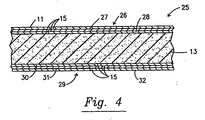
- the preferred foam board 25 of FIG. 4 is faced on each major surface by a trilaminate.
- One major surface is faced by trilaminate 26, which is composed of an outer, tough polymeric layer 11 (exposed side) and two inner layers 27 and 28.
- the trilaminate 29 on the other major surface has a tough polymeric layer 30 as its innermost layer and layers 31 and 32 to the outside of layer 30.
- mid-layers 27 and 31 are fibrous, preferably kraft paper
- layers 28 and 32 are metallic sheets, preferably aluminium foil.
- the thickness of the inner and outer layers of foam boards 16, 19 and 25 may vary widely.
- the thickness of polymeric layers 11, 12 and 30, each of which advantageously comprises a polyethylene terephthalate (PET) film may be from 7.62 ⁇ m to 127 ⁇ m (0.3 mil to 5 mils), preferably 12.7 ⁇ m to 50.8 ⁇ m (0.5 mil to 2 mils).
- PET polyethylene terephthalate
- Each of layers 17, 18, 23, 24, 28 and 32 is suitably 7.62 ⁇ m to 127 ⁇ m (0.3 mil to 5 mils), preferably 10.26 ⁇ m to 88.9 ⁇ m (0.4 mil to 3.5 mils) thick and advantageously is a highly impervious material, such as a high barrier polymer or a metallic sheet, e.g. aluminium foil.
- Each of inner layers 22, 27 and 31 is suitably a fibrous sheet, such as a paper product.
- each of layers 22, 27 and 31 is a medium or heavy kraft paper.
- Foam boards 19 and 25 are producible using for layers 22, 27 and 31 sheet stock ranging from 0.03 kg/m 2 (201bs/3000ft 2 ) paper to 0.33kg/m 2 (2001bs/3000ft 2 ) cardboard.
- the total thickness of the foam insulation boards formed in accordance with the invention may be from 0.64 to 15.2cm (0.25 to 6.0), preferably 1.27 to 10.8cm (5 to 4.25 inches), of which the thickness of the facing sheets is generally from 7.62 ⁇ m to 127 ⁇ m (0.3 mil to 5 mils), and preferably from 7.62 ⁇ m to 76.2 ⁇ m (0.3 mil to 3 mils) for the monolayer facers and 7.62 ⁇ m to 101.6 ⁇ m (0.3 mil to 4 mils) for the laminated composites.
- the boards are typically 1.22m by 2.44m (4 feet by 8 feet) and 1.27 to 2.54cm (half in. to 1 in) thick.
- the core of the faced product comprises a rigid foam.
- the invention is not limited to the nature of the foam material constituting the insulating core, provided that this insures heat insulation.
- the polymer compositions falling within the ambit of the invention may be broadly selected from any of those which can be blown into foam.
- the rigid cellular polymers of the invention desirably have a closed cell content of at least 75%, and more preferably of at least 85% of the cells.
- the polymer compositions may be thermoplastic or thermoset. Suitable polymers include polyurethane and polyisocyanurate.
- blowing or foaming agents are employed in an amount sufficient to give the resultant foam the desired bulk density which is generally betweem 8.01 and 160.19 kg/m 3 (0.5 and 10) and preferably between 16.02 and 80.09 kg/m 3 (1 and 5 pounds per cubic foot).
- foam-forming ingredients for the polyurethane and polyisocyanurate foams comprise polyisocyanates, polyfunctional, active hydrogen-containing compounds (e.g., polyester polyols), foaming agents, and catalysts, auxiliaries and additives as required (e.g., a surfactant). Included among such auxiliaries and additives are processing aids, viscosity reducers, flame retardants, dispersing agents, plasticizers, antioxidants, compatibility agents, fillers and pigments.
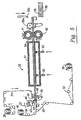
- Apparatus 33 includes means for advancing upper and lower facing materials or substrates 34 and 35, at least one of which is a tough facing sheet of the invention, and an optional reinforcing material or web 36 and means for applying a foam-forming mixture between the facing materials.
- the foam-forming ingredients are stored, pumped and metered by conventional equipment (not shown) and fed through a flexible conduit or conduits 37 for application on the production line.
- An advancing cover web having a surface nonadherent to the foam may be used in place of either facing material 34 or facing material 35.
- each of the upper and lower facing sheets 34 and 35 and the optional reinforcing web 36 are flexible materials which are in the form of continuous or semicontinuous sheets and are fed from supply rolls 38, 39 and 40, respectively.
- the apparatus 33 is also provided with pull rolls 41 and 42, and by virtue of rotation of these pull rolls sheets 34 and 35 and any reinforcing web 36 are pulled from their supply rolls and onward along the production line. Reinforcing web 36 is conveniently pulled to a position on top of lower sheet 35.
- a bowed and beneficially crowned roll, such as roll 57 of FIG. 5 may be provided in the feed path for either or both of sheets 34 and 35 to spread the inventive facing sheet where necessary and thereby prevent tension ridges.
- Roll 57 is prefereably located relatively close to the point of application of the foam-forming-composition.
- the foam-forming mixture which is composed of polyurethane or polyisocyanurate foam forming chemicals, is delivered to a mixing head 43 and agitated therein.
- the mixed chemicals are then deposited from an applicator 44 onto advancing sheet 35 or web 36, where applicable.
- the chemicals can also be dispensed on sheet 34 or on both the upper and lower materials.
- applicator 44 comprises a nozzle which is reciprocated transversely of the underlying substrate to supply a stream of a liquid foamable mixture 45 uniformly thereacross.
- the back and forth movement of the mixing head and applicator is caused by a reciprocating means 46.
- the mixing head 43 deposits the foamable chemicals through an applicator capable of laying down a wide band of froth, with the applicator being advantageously oscillated a short distance from side to side.
- the start or upstream end of the production line beneficially includes a smooth-topped platform or bed 47 which extends from upstream of the deposition point of the foamable mixture to a point upstream of and adjacent the constricting nip 48 between closely spaced parallel rollers 49 and 50.
- the lower sheet and any associated reinforcing web 36 advantageously move downstream in a horizontal plane along the upper surface of bed plate 47 positioned as illustrated FIG. 5 .
- Bed plate 47 is adjustably mounted so that it can be inclined from the horizontal to elevate its downstream transverse edge (adjacent nip 48) above its upstream transverse edge, and thereby achieve an improved control of the foam chemical bank.
- upper facing sheet 34 is brought into contact with the top surface of the chemicals. As illustrated in FIG. 5 , this contact is suitably effected by passing upper sheet 34 around roller 49 and through nip 48.
- the foamable mixture can be dispensed through applicator 44 onto the exposed surface of the sheet 34 as the latter passes around roller 49.
- the upper and lower facing sheets are brought together in surface-to-surface opposition relative to each other, with the foamable mixture and any reinforcing web 36 sandwiched in between.
- rollers 49 and 50 As the facing sheets are brought into closely spaced adjacency between rollers 49 and 50, the constriction at nip or gap 48 causes a rolling bank of foamable mixture to build up, whereby there is a surplus or backlog of material available to pass through the nip of the rolls.
- rollers 49 and 50 are advantageously vertically shiftable for control of the thickness of the facers and foamable mixture passing through the nip.
- the nip 48 formed between the metering rollers 49 and 50 is accurately adjustable so as to insure contact of the foamable mixture with the facing sheets and any reinforcing material and cause the desired uniform distribution of the mixture, as well as uniform metering of the amount retained, as the facing sheets and optional reinforcing material advance beyond this point.
- the upper roller 49 is preferably mounted on an adjustable support which permits the distance between its axis and the axis of the lower metering roller 50 to be varied so that the nip between the rollers can be adjusted from a wide gap to almost a zero setting.
- This arrangement provides a high degree of control of the final thickness in the resulting foam board, with the foamable mixture being allowed to expand thereafter substantially freely to develop its natural rise profile.
- the metering rollers thus serve as a means for bringing the facing sheets 34, 35 into spaced conjunction, and for distributing the foamable mixture 45 therebetween, as well as a means for performing a final metering operation, supplementing the initial rough metering afforded by applicator 44.
- the foam products of the invention can contain various reinforcement materials, such as the web 36 shown in FIG. 5 .
- One or more of the reinforcing webs may be used.
- the reinforcing web(s) may be introduced below the foamable chemicals, as in FIG. 5 , above the chemicals, or both below and above them.
- a fibrous reinforcement, especially fiberglass fibers, constitutes a preferred web material.
- the reinforcing web will be the type of expandable glass mat used in producing the structural laminate of U. S. Pat. No. 4,028,158 , i.e., a thin mat of long, generally straight glass fibers.
- a thin mat 36 of glass fibers is fed from roll 40 toward the nip between the two rotating metering rolls 49 and 50.
- reinforcing mat 36 is pulled from its roll, through the nip of the metering rolls and downstream to form an expanded reinforcement material in the resulting structural laminate.
- an included reinforcing web such as the thin glass mat of U.S. Pat. No. 4,028,158 , will be pushed under the influence of the expanding froth to a position adjacent and interior to its associated facing sheet.
- a reinforcing web(s) can be placed interiorly to the lower or upper facing sheet or to both, as described in U.S. Pat. No. 4,572,865 , the disclosure of which patent with respect to such reinforced structural laminates is hereby incorporated by reference.
- Another reinforcement material which may be incorporated in the foams of the invention is the penetrable fibrous web or scrim disclosed in U. S. Application Ser. No. 08/801,074, filed February 14, 1997 .
- the foam product may be reinforced by a web or webs of one type or by a combination of types.
- Oven 51 provides an expansion zone for the foam-forming mixture.
- the temperature within the oven 51 is maintained within the desired limits of 37.8 to 113.3°C (100°F. to 300°F), and preferably 79.4°C to 121.1°C (175°F. to 250°F).
- the foam under the influence of the heat added to the oven, cures to form faced foam plastic 54.
- the product 54 then leaves the oven 51, passes between the pull rolls 41 and 42, and is cut by side edge and length cutting means 55a and 55b into finite lengths, thereby forming discrete panels 56 of the product.
- Foam-Forming Ingredients Parts by Weight Polymethylene polyphenylisocyanate having an equivalent weight of 138 62.8 Aromatic polyester polyol having an equivalent weight of 135 21.7 Blowing agent 13.5 Surfactant 0.6 Catalyst 1.4
- Table I below shows for the production of each of boards A to C the composition of the top and bottom facers used and the glass weight additionally used in the case of board C.
- top and bottom facers 34 and 35 were fed from rolls 38 and 39 toward the nip of metering rolls 49 and 50. The facers were pulled along the production line by pull rolls 41, 42. Top facing sheet 34 was passed around top metering roll 49, and bottom facing sheet 35 was passed into the gap 48 between the metering rolls.
- Top facers 34 for each of boards A to C was a trilaminate whose uppermost layer in the production run was a polyester film so as to become exposed in the final product.
- Bottom facer 35 for each of boards A to C was also a trilaminate whose uppermost layer in the production run was a polyester film so as to become positioned contiguous with the foam core and unexposed in the final product.
- the reciprocating mixing head 43 deposited the foam-forming mixture on the lower facer in the case of all boards except for board C, in whose production a thin and expansible mat 36 of glass fibers arranged in layers was fed above the bottom facer, as shown in FIG. 5 and described in U.S. Pat. No. 4,028,158 .
- the above-mentioned foam-forming ingredients were discharged just upstream of the nip 48 of the metering rolls through tube 44 onto the lower facer 35 or mat 36, and the composite was then passed through the nip into oven 51.
- the distance between rolls 49 and 50 was preset to produce boards having the average thicknesses listed in Table I.
- Oven 51 was heated to provide a zone above vent 52 at a temperature of about 87.8°C (190°F), and a zone above vent 53 at about 98.9°C (210°F).
- the foam-forming mixture expanded to a substantially uniform thickness.
- the fibrous layers of mat 36 expanded with the foam. After leaving the oven, the product was cut into discrete panels.
- Coated Trilaminate black ink coated 92 gauge 2-side corona treated PET film; casein/SBR latex adhesive 13.61 kg (30 lb) natural kraft; casein/SBR latex adhesive; 0.0064-0.0076mm (.00025" - .0003") soft aluminum foil; epoxy or acrylic washcoat (materials listed in sequence from exposed side of facer inwardly to foam core). 2.
- Inverted Trilaminate epoxy or acrylic washcoat 0.0064 - 0.0076 mm (.00025" - .0003") soft aluminum foil, casein/SBR latex adhesive 13.61 kg (30 lb) natural kraft; casein/SBR latex adhesive; clear 48 gauge 1-side corona treated PET film (materials listed in sequence from exposed side of facer inwardly to foam core). 3.
- Inverted Triaminate epoxy or acrylic washcoat; 0.0064 - 0.0076 mm (.00025" - .0003") soft aluminum foil; casein/SBR latex adhesive; 11.34 kg (25 lb) natural kraft, casein/SBR latex adhesive; clear 48 gauge 1-side corona treated PET film (materials listed in sequence from exposed side of facer inwardly to foam core).
- Glass continuous strand fiberglass mat weighing 2g/ft 2 .
Landscapes
- Laminated Bodies (AREA)
- Building Environments (AREA)
- Casting Or Compression Moulding Of Plastics Or The Like (AREA)
Abstract
Description
- This invention relates to laminates and foam filled sheet products, both decorative and structural, and more particularly it relates to structurally rigid, optionally glass fiber reinforced, sheets of foam, which are particularly useful in thermal insulating applications. It also relates to a method for forming such a product.
- Laminated rigid foam panels are widely used in the building and construction industry as sound and thermal insulating materials and as non-load bearing structural members. These laminated articles having a core of rigid foam can be made continuously or batchwise in a mold. The process of continuous or semicontinuous lamination usually involves deposition of a foam-forming plastics mixture onto a facing sheet(s) and bringing a second sheet(s) into contact with the mixture before it sets and sometimes before it foams.
- The facing sheet(s) reduce the risk of physical damage to the foam and can aid-significantly in maintaining the insulation value of the foam. Facers commercially used to protect foam products include aluminum foil, felt, glass and kraft paper in monolayers or laminates. Conveniently, both for economy and ease of handling, the facing sheets are often made of relatively inexpensive flexible materials, such as kraft and aluminum foil, which can be fed from rolls.
- While use of impermeable aluminum foil provides an especially high insulation value, a disadvantage associated with its use alone as a facer stems from its fragility, which can result, e.g., in foil breakage during foamboard manufacture. While improved facer toughness can be achieved through the use of fibrous facers, such as conventional medium or heavy kraft papers or glass mats, these facers are no match for aluminum foil at providing a barrier against gas penetration. The porosity of fibrous facers allows excessive exposure of the foam material to air with the consequent opportunity for air infiltration into the foam. As is well known in the industry, the thermal conductivity (k-factor) of insulating boards containing fluorocarbon gas is substantially increased where some means is not provided to prevent such air infiltration into the cells of the foam insulation.
-
US-A-5,695,870 discloses a laminated foam insulation board having enhanced strength and resistance to bending and breaking. The board comprises a panel of an insulating plastic foam material and a thermoplastic facer film adhered to opposite surfaces of the panel. -
US-A-3,738,895 discloses an apparatus for producing laminated structural panels from compatible organic resins having a core of foamed resin with facing layers of hard resin integrally bonded to the opposite faces of the core. -
US-A-5,352,510 discloses a method for the manufacture of paper faced foam which comprises (a) applying a foam-forming mixture to at least one advancing cellulosic sheet or composite thereof with an air- and/or moisture-impermeable material, the cellulosic sheet (i) being impregnated with cured polyisocyanate, (ii) being sufficiently flexible for unwinding from a roll for conveyance along a production line and (iii) having a moisture content which does not exceed about 10 percent and is evenly distributed throughout the cellulosic sheet, and (b) foaming and curing the faced foam-forming mixture. - It would be highly desirable if a foam insulation board could be produced with facers which have outstanding toughness, surpassing conventional facing materials, and contribute overall good properties to the foam board.
- It is accordingly an object of the present invention to produce a rigid foam insulation board having facers which are tough, lightweight, and highly insulating.
- It is another object of the invention to provide a tough and flexible material which can be fed from a roll in both free and restrained rise processes to form a facing for a rigid foam insulation board.
- It is a further object of the invention to produce a rigid foam laminate whose facing contributes to a combination of advantageous properties for building constructions, particularly for the laminate's use as a foam sheathing.
- It is yet another object of the invention to provide for the high speed production in a simple and economical manner of foam laminates faced with especially tough sheets, particularly laminates of rigid polyurethane and polyisocyanurate foam, which exhibit overall good properties, including superior puncture resistance, extensibility, hardness and insulation value.
- These and other objects and advantages of the present invention will become more apparent to those skilled in the art when the instant disclosure is read in conjunction with the accompanying drawings.
- The present invention provides a method for continuously producing an insulation board comprising a rigid plastic foam core having two major surfaces and a facing material on at least one of the major surfaces, the method comprising:
- (a) conveying a first facing material along a production line for attachment to one major surface of the core,
- (b) applying a foam-forming mixture for forming a rigid polymer foam selected from the group of polyurethane and polyisocyanurate foams to the first facing material to form a single faced composite,
- (c) optionally conveying a second facing material along the line for application to the foam-forming mixture and attachment to a major surface of the core to form a doubly faced composite, wherein either or both of the first facing material and the second facing material comprise a laminate of a metallic sheet layer with a tough polymeric layer comprising a polymer composed of polyester groups as main or recurring units or a polymeric mixture comprising a polyester group-containing polymer, the first and/or second facing materials being positioned on the production line so that at least one tough polymeric layer faces to the outside of the singly or doubly face composite, and
- (d) foaming and curing the faced foam-forming mixture to produce an insulation board.
- In addition, the present invention provides a thermally insulating structural laminate comprising a core of rigid plastic foam, said foam selected from polyurethane and polyisocyanurate foams having two major surfaces, at least one of the major surfaces of the foam being attached to a facing material comprising a composite facer containing a metallic sheet layer with a tough polymeric layer comprising a polymer composed of polyester groups as main or recurring units or a polymeric mixture containing a polyester group containing polymer, the tough polymeric layer of at least one composite facer being positioned on the outside surface of the composite facer.
- Furthermore, the present invention provides a thermally insulating structural laminate comprising a core of rigid plastic foam, said foam selected from polyurethane and polyisocyanurate foams having two major surfaces, one major surface being attached to a first facing material and the other major surface being attached to a second facing material, the first and second facing materials independently comprising of a composite facer of a metallic sheet layer with a tough polymeric layer comprising a polymer composed of polyester groups as main or recurring units or a polymeric mixture containing a polyester group-containing polymer, the tough polymeric layer of at least one composite facer being positioned on the outside surface of the composite facer and the tough polymeric layer or composite facer.
- The above objects have been achieved in the method of the present invention as the laminate facing sheet comprising a polymeric layer or composite thereof has an outstanding toughness in the production of the faced foam structural laminate. As outlined above, the polymeric layer or composite facer is adhered to at least one major surface of a rigid foam insulation board. In a preferred embodiment, both major surfaces of the board are faced by the same or different tough facers of the invention.
- One or both facers of the inventive board comprise an outer polymeric material characterized by exceptional toughness and resistance to puncturing during preparation and use of the board. After lamination to a rigid foam, the polymeric layer and especially its composites with one or more other materials contribute to the formation of a faced foam board having a combination of desirable properties, e.g., superior toughness, insulation value, impermeability, puncture resistance, durability; strength, resistance to breakage, flexibility, handling ease, ease of application, etc. The facing composites suitably comprise combinations of the outer polymeric layer with one or more of a large variety of conventional facing materials including fibrous materials such as glass fiber mats, kraft paper and asphalt-saturated felt, metals such as sheets of aluminum or steel, sheets or films of plastics, etc. In a preferred embodiment, the outer polymeric layer comprises a polyester film. Advantageously, the faced foam board of the invention has a hardness, as measured on the inventive faced side(s) by the Janka Ball Test (ASTM D1037), of at least 4.54 kg (10), preferably at least 7.71 kg (17) and more preferably at least 9.07 kg (20, lb.) Also, the inventive facer advantageously has a puncture resistance,as measured by ASTM D4830, of at least 4.54 kg (10), preferably at least 7.71 kg (17) and more preferably at least 0.14 MPa (20, psi)
- The laminating method is suitably carried out by bringing at least one such tough facing sheet into contact or close proximity with a foam-forming mixture on a conveyor, and thereafter conveying together the composite of sheet and foamable mixture and foaming the mixture to produce the foam laminate of the invention.
- The facing sheet is supplied in continuous form from a roll. The sheet is sufficiently flexible so that it can be readily wound on the roll, but it still possesses marked toughness making it especially resistant to damage during foam laminate production and subsequent utilization in end use applications in the construction market. It is a particular advantage that lightweight foam laminate of the present invention can be readily produced using relatively thin, flexible facing sheets which can be fed from rolls in the same way as conventional facing sheets of the prior art.
- The facing sheet in rolled form is rotatably mounted on a stand from which it is unrolled to be brought into contact with a foam-forming composition. Foamable plastic materials which are used in the production of the laminated articles of the invention are foam cores selected from polyurethane and polyisocyanurate foams.
- The invention will now be described with reference to the accompanying drawings, which are provided by way of example:
-
FIG. 1 is an enlarged, fragmentary, cross-sectional view of a foam board of the invention faced on both major surfaces by a monolayer; -
FIG. 2 is a similar view of a second embodiment of the inventive foam board faced on each major surface by a bilaminate; -
FIG. 3 is a similar view of a third embodiment of the inventive foam board faced on one major surface by a bilaminate and on the other by a trilaminate; -
FIG. 4 is a similar view of a fourth embodiment of the inventive foam board faced on each major surface by a trilaminate; and -
FIG. 5 is a schematic elevation of an apparatus suitable for practicing the process of the invention in a free-rise mode. - Referring to
FIG. 1 , there is shown afaced insulation board 10 of this invention having outer facingsheets rigid foam core 13 in accordance with the present invention. The properties include good chemical and physical stability, high mechanical strength, durability, heat and chemical resistance and thermal insulation properties. Where one of the facing sheets is a non-inventive type, this sheet may be any conventional foam facer which supports the enhanced board properties contributed by the inventive facer. In a preferred embodiment, each of facingsheets - The polymeric layer may be cross-linked or non-cross-linked. The polymer may be non-oriented, uniaxially oriented, or biaxially oriented. Polymers having biaxial orientation are especially effective. A preferred layer comprises a polymer composed of polyester groups as main recurring units or a polymeric mixture containing such polymer.
- Polymeric layer(s) 11 and/or 12 may be modified by additives to meet particular requirements. Such additives include fillers, pigments or colorants, heat stabilizers, antioxidants, water-repellants, ultraviolet stabilizers, fire retardants, impact modifiers, processing aids and lubricants. Some suitable pigments and fillers are titanium dioxide, calcium carbonate, kaolin clay, silica and talc. A coating(s) 14 may be applied to the outside (14a) and/or inside (14b) of the polymeric layer. Coatings can provide weather resistance, e.g., protection against UV light, high humidity, salt spray, etc. Also, modification by coloring or printing of the polymeric layer serves to control the passage of light through it and to distinguish it. For example, a coating such as ink, which beneficially provides scuff resistance and/or UV protection, serves as an
excellent coating 14a. - Coating also can be used to increase the gas barrier properties of the layer. Examples of such coatings are organic types, such as PVDC, and inorganic types, such as clay nanoplatelets. In a preferred embodiment, metals, such as silver, steel, and aluminum, are deposited on the polymeric layer. Aluminum is a preferred metal. The deposited metal may be formed on one or both surfaces of the polymeric layer. After deposition, the surface of the deposited metal may be treated for various purposes. For example, an effective oxygen barrier is a polymer layer consisting of a metallized (aluminum) polyester film coated with a UV and scratch resistant oxidation barrier.
- The attachment of facing
sheets rigid core 13 may be facilitated by any adhesive material or other fastening aid (e.g., adhesion promoter) 15 known for use in binding plastic films or other facers in laminates and foams. The adhesive may be a thermoplastic or curable thermoset polymer. Examples ofadhesive material 15 are olefin polymers and random, block and graft copolymers of ethylene and an acid comonomer selected from ethylenically unsaturated mono-and polycarboxylic acids and acid anhydrides and partial esters of such polycarboxylic acids. Other useful materials include urethanes, copolyesters and copolyamides, styrene copolymers such as styrene/butadiene and styrene/isoprene polymers, epoxies, acrylic polymers, etc. Adhesion can also be effected without use of any such adhesive agents. - In a preferred embodiment of the foam board of the invention, the polymeric layer is used in combination with one or more inner or outer facing sheets to form a multi-layered facer. This multi-layered laminate can be used on one or both sides of the foam board. The rigidity, and other properties, e.g., impermeability, toughness, impact resistance, and insulation value, of the foam board can be significantly improved by thus facing the rigid foam with a composite laminate or laminates. Advantageously, one or more of the co-facing sheets have a lower oxygen transmission rate than that of a conventional facing sheet such as a glass fiber mat.
- The inventive foam board may be faced on one side by a monolayer and on the other side by a multi-layered facer, provided that at least one tough polymeric layer is exposed on the outside of a major surface of the board. The tough polymeric material may also be used as the innermost layer or a mid-layer of a multi-layered facer. More than one tough polymeric layer may be used in a composite laminate facing one or both of the major surfaces. One or both of the sides of the polymeric layer may be corona treated for enhanced adhesion of the facing sheet. The coating and lamination involved in the production of the mono- and multi-layered facers of the invention can be accomplished by following generally known procedures in the art.
- Referring now to
FIG. 2 , there is shown afoam board 16 faced on both sides with bilaminates.Inner facers Sheet 17 and/orsheet 18 beneficially comprises a fibrous layer, a metallic layer, or another polymeric layer. The fibers of the fibrous layer may be virtually any fibrous material, either natural or synthetic. For example, the fibers may be asbestos, metal, cotton, hair, glass, or the filament forming synthetic organic polymers such as nylon, polyesters, rayon, cellulosics, or other known synthetic filamentary materials. The fibrous layer may be comprised of two or more fibrous materials, such as a composite of a paper and glass fiber sheet. Examples of preferred materials for use as the inner layer are a glass mat, kraft paper or a metallic sheet, especially aluminum. - The
laminated foam board 19 ofFIG. 3 comprises another preferred composite faced by multi-laminates, specifically a trilaminate 20 andbilaminate 21. As in the case offoam board 16, the inner layers ofboard 19, i.e., layers 22 and 23 of the trilaminate andlayer 24 of the bilaminate can be any facing sheet previously employed to produce foam boards, such as those mentioned above in connection withfoam board 16. In a specific preferred embodiment, layers 23 and 24 comprise aluminum foil andlayer 22 comprises kraft paper. - The
preferred foam board 25 ofFIG. 4 is faced on each major surface by a trilaminate. One major surface is faced bytrilaminate 26, which is composed of an outer, tough polymeric layer 11 (exposed side) and twoinner layers tough polymeric layer 30 as its innermost layer and layers 31 and 32 to the outside oflayer 30. Advantageously, mid-layers 27 and 31 are fibrous, preferably kraft paper, and layers 28 and 32 are metallic sheets, preferably aluminium foil. - The thickness of the inner and outer layers of
foam boards polymeric layers layers inner layers layers Foam boards layers - The total thickness of the foam insulation boards formed in accordance with the invention may be from 0.64 to 15.2cm (0.25 to 6.0), preferably 1.27 to 10.8cm (5 to 4.25 inches), of which the thickness of the facing sheets is generally from 7.62µm to 127µm (0.3 mil to 5 mils), and preferably from 7.62µm to 76.2µm (0.3 mil to 3 mils) for the monolayer facers and 7.62µm to 101.6µm (0.3 mil to 4 mils) for the laminated composites. The boards are typically 1.22m by 2.44m (4 feet by 8 feet) and 1.27 to 2.54cm (half in. to 1 in) thick.
- The core of the faced product comprises a rigid foam. The invention is not limited to the nature of the foam material constituting the insulating core, provided that this insures heat insulation. The polymer compositions falling within the ambit of the invention may be broadly selected from any of those which can be blown into foam. The rigid cellular polymers of the invention desirably have a closed cell content of at least 75%, and more preferably of at least 85% of the cells. The polymer compositions may be thermoplastic or thermoset. Suitable polymers include polyurethane and polyisocyanurate.
- The blowing or foaming agents are employed in an amount sufficient to give the resultant foam the desired bulk density which is generally betweem 8.01 and 160.19 kg/m3 (0.5 and 10) and preferably between 16.02 and 80.09 kg/m3 (1 and 5 pounds per cubic foot).
- Especially effective foam-forming compositions for use in the invention are those conventionally employed in forming rigid polyurethane foams, such as closed-cell PIR, PUR, and mixed PUR/PIR foams. Such foam-forming ingredients for the polyurethane and polyisocyanurate foams comprise polyisocyanates, polyfunctional, active hydrogen-containing compounds (e.g., polyester polyols), foaming agents, and catalysts, auxiliaries and additives as required (e.g., a surfactant). Included among such auxiliaries and additives are processing aids, viscosity reducers, flame retardants, dispersing agents, plasticizers, antioxidants, compatibility agents, fillers and pigments.
- Referring to
FIG. 5 , there is shown schematically anapparatus 33 suitable for the continuous production of foam boards of the invention in accordance with a free rise process.Apparatus 33 includes means for advancing upper and lower facing materials orsubstrates web 36 and means for applying a foam-forming mixture between the facing materials. The foam-forming ingredients are stored, pumped and metered by conventional equipment (not shown) and fed through a flexible conduit orconduits 37 for application on the production line. An advancing cover web having a surface nonadherent to the foam may be used in place of either facingmaterial 34 or facingmaterial 35. - As shown in
FIG. 5 , each of the upper andlower facing sheets web 36 are flexible materials which are in the form of continuous or semicontinuous sheets and are fed from supply rolls 38, 39 and 40, respectively. Theapparatus 33 is also provided with pull rolls 41 and 42, and by virtue of rotation of these pull rollssheets web 36 are pulled from their supply rolls and onward along the production line. Reinforcingweb 36 is conveniently pulled to a position on top oflower sheet 35. A bowed and beneficially crowned roll, such asroll 57 ofFIG. 5 , may be provided in the feed path for either or both ofsheets Roll 57 is prefereably located relatively close to the point of application of the foam-forming-composition. - The foam-forming mixture, which is composed of polyurethane or polyisocyanurate foam forming chemicals, is delivered to a mixing
head 43 and agitated therein. The mixed chemicals are then deposited from anapplicator 44 onto advancingsheet 35 orweb 36, where applicable. The chemicals can also be dispensed onsheet 34 or on both the upper and lower materials. - Various application devices, both stationary and moving, may be employed in depositing the chemicals. Even distribution of the foamable mix over the surface of the sheet material can be achieved by dispensing the chemicals from applicators having one or more delivery heads. In one preferred embodiment,
applicator 44 comprises a nozzle which is reciprocated transversely of the underlying substrate to supply a stream of a liquidfoamable mixture 45 uniformly thereacross. The back and forth movement of the mixing head and applicator is caused by a reciprocating means 46. In another embodiment involving the deposition of froth chemicals, the mixinghead 43 deposits the foamable chemicals through an applicator capable of laying down a wide band of froth, with the applicator being advantageously oscillated a short distance from side to side. - As shown in
FIG. 5 , the start or upstream end of the production line beneficially includes a smooth-topped platform or bed 47 which extends from upstream of the deposition point of the foamable mixture to a point upstream of and adjacent the constricting nip 48 between closely spacedparallel rollers web 36 advantageously move downstream in a horizontal plane along the upper surface of bed plate 47 positioned as illustratedFIG. 5 . Bed plate 47 is adjustably mounted so that it can be inclined from the horizontal to elevate its downstream transverse edge (adjacent nip 48) above its upstream transverse edge, and thereby achieve an improved control of the foam chemical bank. - Immediately downstream of the lay down point of the foamable chemicals, upper facing
sheet 34 is brought into contact with the top surface of the chemicals. As illustrated inFIG. 5 , this contact is suitably effected by passingupper sheet 34 aroundroller 49 and through nip 48. In another favorable embodiment of the invention, the foamable mixture can be dispensed throughapplicator 44 onto the exposed surface of thesheet 34 as the latter passes aroundroller 49. In any event, betweenrollers web 36 sandwiched in between. As the facing sheets are brought into closely spaced adjacency betweenrollers gap 48 causes a rolling bank of foamable mixture to build up, whereby there is a surplus or backlog of material available to pass through the nip of the rolls. One or both ofrollers - The nip 48 formed between the
metering rollers upper roller 49 is preferably mounted on an adjustable support which permits the distance between its axis and the axis of thelower metering roller 50 to be varied so that the nip between the rollers can be adjusted from a wide gap to almost a zero setting. This arrangement provides a high degree of control of the final thickness in the resulting foam board, with the foamable mixture being allowed to expand thereafter substantially freely to develop its natural rise profile. The metering rollers thus serve as a means for bringing the facingsheets foamable mixture 45 therebetween, as well as a means for performing a final metering operation, supplementing the initial rough metering afforded byapplicator 44. - The foam products of the invention can contain various reinforcement materials, such as the
web 36 shown inFIG. 5 . One or more of the reinforcing webs may be used. The reinforcing web(s) may be introduced below the foamable chemicals, as inFIG. 5 , above the chemicals, or both below and above them. A fibrous reinforcement, especially fiberglass fibers, constitutes a preferred web material. For example, in a preferred embodiment the reinforcing web will be the type of expandable glass mat used in producing the structural laminate ofU. S. Pat. No. 4,028,158 , i.e., a thin mat of long, generally straight glass fibers. By generally following the method of foam reinforcement described in Example 1 ofU.S. Pat. No. 4,028,158 and utilizing a foam-forming mixture having the consistency of the liquid foamable mixture of this example, the glass mat becomes distributed within the foam core In accordance with this embodiment, athin mat 36 of glass fibers is fed fromroll 40 toward the nip between the two rotating metering rolls 49 and 50. By virtue of rotation of the pull rolls 41 and 42, reinforcingmat 36 is pulled from its roll, through the nip of the metering rolls and downstream to form an expanded reinforcement material in the resulting structural laminate. - When the foam-forming mixture deposited on the underlying substrate during the process is in the form of a froth, an included reinforcing web, such as the thin glass mat of
U.S. Pat. No. 4,028,158 , will be pushed under the influence of the expanding froth to a position adjacent and interior to its associated facing sheet. In this way, a reinforcing web(s) can be placed interiorly to the lower or upper facing sheet or to both, as described inU.S. Pat. No. 4,572,865 , the disclosure of which patent with respect to such reinforced structural laminates is hereby incorporated by reference. Another reinforcement material which may be incorporated in the foams of the invention is the penetrable fibrous web or scrim disclosed inU. S. Application Ser. No. 08/801,074, filed February 14, 1997 - After passing between the nip of the two
rollers oven 51 and on along the generally horizontally extending production line, as shown inFIG. 5 .Oven 51 provides an expansion zone for the foam-forming mixture. By varying the temperature of hot air fromvents oven 51 is maintained within the desired limits of 37.8 to 113.3°C (100°F. to 300°F), and preferably 79.4°C to 121.1°C (175°F. to 250°F). The foam, under the influence of the heat added to the oven, cures to form facedfoam plastic 54. Theproduct 54 then leaves theoven 51, passes between the pull rolls 41 and 42, and is cut by side edge and length cutting means 55a and 55b into finite lengths, thereby formingdiscrete panels 56 of the product. - The present invention is further illustrated by the following example in which all parts and percentages are by weight unless otherwise indicated.
- This example illustrates, by reference to
FIG. 5 of the drawings, the production of insulation foam boards faced by the free-rise process of the invention. - The following isocyanurate formulation was used in preparing the foam core of the insulation boards.
Foam-Forming Ingredients Parts by Weight Polymethylene polyphenylisocyanate having an equivalent weight of 138 62.8 Aromatic polyester polyol having an equivalent weight of 135 21.7 Blowing agent 13.5 Surfactant 0.6 Catalyst 1.4 - Table I below shows for the production of each of boards A to C the composition of the top and bottom facers used and the glass weight additionally used in the case of board C. As shown in
FIG. 5 , top andbottom facers rolls sheet 34 was passed aroundtop metering roll 49, andbottom facing sheet 35 was passed into thegap 48 between the metering rolls. -
Top facers 34 for each of boards A to C was a trilaminate whose uppermost layer in the production run was a polyester film so as to become exposed in the final product.Bottom facer 35 for each of boards A to C was also a trilaminate whose uppermost layer in the production run was a polyester film so as to become positioned contiguous with the foam core and unexposed in the final product. Thereciprocating mixing head 43 deposited the foam-forming mixture on the lower facer in the case of all boards except for board C, in whose production a thin andexpansible mat 36 of glass fibers arranged in layers was fed above the bottom facer, as shown inFIG. 5 and described inU.S. Pat. No. 4,028,158 . - After being thoroughly mixed in mixing
head 43, the above-mentioned foam-forming ingredients were discharged just upstream of thenip 48 of the metering rolls throughtube 44 onto thelower facer 35 ormat 36, and the composite was then passed through the nip intooven 51. The distance betweenrolls Table I. Oven 51 was heated to provide a zone abovevent 52 at a temperature of about 87.8°C (190°F), and a zone abovevent 53 at about 98.9°C (210°F). In the oven, the foam-forming mixture expanded to a substantially uniform thickness. In the case of foam board C, the fibrous layers ofmat 36 expanded with the foam. After leaving the oven, the product was cut into discrete panels. - Various properties of each of the resulting faced foam insulation boards A to C are reported in Table II below. The results of Table II reveal that the laminates of the invention possess a combination of desirable properties, including a superior hardness and puncture strength.
TABLE I LAMINATE FACERS OF FOAM INSULATION BOARDS FOAM INSULATION FOARD A B C Top Facer Type Coated Trilaminate1 Coated Trilaminate1 Coated Trilaminate1 Bottom Facer Type Inverted Trilaminate2 Inverted Trilaminate3 Inverted Trilaminate3 Glass Weight (g/ft2)4 ---- ---- 2.0 1. Coated Trilaminate = black ink coated 92 gauge 2-side corona treated PET film; casein/SBR latex adhesive 13.61 kg (30 lb) natural kraft; casein/SBR latex adhesive; 0.0064-0.0076mm (.00025" - .0003") soft aluminum foil; epoxy or acrylic washcoat (materials listed in sequence from exposed side of facer inwardly to foam core).
2. Inverted Trilaminate = epoxy or acrylic washcoat 0.0064 - 0.0076 mm (.00025" - .0003") soft aluminum foil, casein/SBR latex adhesive 13.61 kg (30 lb) natural kraft; casein/SBR latex adhesive; clear 48 gauge 1-side corona treated PET film (materials listed in sequence from exposed side of facer inwardly to foam core).
3. Inverted Triaminate = epoxy or acrylic washcoat; 0.0064 - 0.0076 mm (.00025" - .0003") soft aluminum foil; casein/SBR latex adhesive; 11.34 kg (25 lb) natural kraft, casein/SBR latex adhesive; clear 48 gauge 1-side corona treated PET film (materials listed in sequence from exposed side of facer inwardly to foam core).
4. Glass = continuous strand fiberglass mat weighing 2g/ft2.TABLE II PROPERTIES OF FOAM INSULATION BOARDS FOAMINSUTATIONROARD PROPERTY A B C Thickness (cm) ((in))
Core Density (kg/m3) ((1b/ft3))1.27 (½)
1.721.27 (½)
1.712.54 (1)
1.71Compressive Strength (Mpa) ((psi)) (16) 0.11 (18) 0.126 (19) 0.133 Flexural Strength,
MD/TD (mpa) ((psi))(140/130) 0.98/0.91 (83/132) 0.56/0.92 (67/65) 0.47/0.46 Impact-Janka Ball,
Top-Bottom (kg) ((lb))(22-15) 9.98-6.80 (21-15) 9.58-6.80 (21-15) 9.53-6.80 Cold Lineal Change1 % length 0.00 0.00 0.09 % width 0.00 0.03 0.07 Puncture Strength,
Top-Bottom (mPa) ((psi))(29-18) 0.2-0.13 (28-16) 0.196-0.11 (25-14) 0.18-0.098 Water Absorption,
(% Vol.)0.95 0.62 0.68 Facer Adhesion,
(28 days @ 70°C (158°F) + 95%RH)Good Good Good k-factor W/m.k ((BTU-in
hr-ft2-°F)).Initial
30 days @ 60°C (140°F)0.018 (0.127) 0.018 (0.127) 0.019 (0.133)
Claims (20)
- A method for continuously producing an insulation board comprising a rigid plastic foam core having two major surfaces and a facing material on at least one of the major surfaces, the method comprising:(a) conveying a first facing material along a production line for attachment to one major surface of the core,(b) applying a foam-forming mixture for forming a rigid polymer foam selected from the group of polyurethane and polyisocyanurate foams to the first facing material to form a singly faced composite,(c) optionally conveying a second facing material along the line for application to the foam-forming mixture and attachment to a major surface of the core to form a doubly faced composite, wherein either or both of the first facing material and the second facing material comprise a laminate of a metallic sheet layer with a tough polymeric layer comprising a polymer composed of polyester groups as main or recurring units or a polymeric mixture comprising a polyester group-containing polymer, the first and/or second facing materials being positioned on the production line so that at least one tough polymeric layer faces to the outside of the singly or doubly face composite, and(d) foaming and curing the faced foam-forming mixture to produce an insulation board.
- A method as claimed in claim 1 wherein the tough polymeric layer or layers independently contain at lest one additive selected from the group consistent of fillers, heat stabilizers, antioxidants, water repellants, ultraviolet stabilizers, fire retardants, impact modifiers, processing aids, lubricants, pigments and other colorants.
- A method as claimed in any one of the preceding claims wherein the polymeric layer or layers comprise biaxially oriented polethylene terephthalate, preferably biaxially oriented and corona treated polyethylene terephthalate.
- A method as claimed in any one of the preceding claims wherein a metal is deposited on at least one tough polymeric layer.
- A method as claimed in any one of the preceding claims wherein both the first facing material and the second facing material are conveyed along the production line, the first facing material being positioned below the deposited foam-forming mixture, and the second facing material being positioned above the mixture.
- A method as claimed in claim 5 wherein at least one web of continuously moving reinforcing material is supplied between the first and second facing materials.
- A method as claimed in claim 5 or claim 6 wherein the first and second facing materials independently comprise a bilaminate or a trilaminate.
- A method as claimed in claim 5 or claim 6 wherein each of the first and second facing materials comprise a trilaminate.
- A method as claimed in claim 5 or claim 6 wherein the first facing material comprises a trilaminate having a lowermost layer comprising the tough polymeric layer, a mid-layer of kraft paper and an uppermost layer of aluminum foil and the second facing material comprises a trilaminate having a lowermost of aluminum foil, a mid-layer of kraft paper and an uppermost layer comprising the tough polymeric layer.
- A method as claimed in claim 5 or claim 6 wherein each of the first and second facing materials comprise a trilaminate having a lowermost layer of aluminum foil, a mid-layer of kraft paper and an uppermost layer comprising the tough polymeric layer.
- A method as claimed in any one of the preceding claims wherein the tough polymeric layer or laminate thereof provides a hardness to the insulation board, as measured by the Janka Ball Test on the side or sides of the board faced by the tough polymeric layer or laminate thereof, of at least 4.54kg (10 lb).
- A thermally insulating structural laminate comprising a core of rigid plastic foam, said foam selected from polyurethane and polyisocyanurate foams having two major surfaces, at least one of the major surfaces of the foam being attached to a facing material comprising a composite facer containing a metallic sheet layer with a tough polymeric layer comprising a polymer composed of polyester groups as main or recurring units or a polymeric mixture containing a polyester group-containing polymer, the tough polymeric layer of at least one composite facer being positioned on the outside surface of the composite facer.
- A structural laminate as claimed in claim 12 wherein the rigid plastic foam is reinforced by glass fibers.
- A structural laminate as claimed in any one of claims 12 or 13 wherein a metal is deposited on the tough polymeric layer.
- A structural laminate as claimed in claim 12 or 13 wherein the tough polymeric layer comprises biaxially oriented polyethylene terephthalate, preferably biaxially oriented and corona treated polyethylene terephthalate.
- A structural laminate as claimed in any one of claims 12 to 15 wherein the tough polymeric layer or composite facer provides a hardness to the structural laminate, as measured by the Janka Ball Test on the side or sides of the structural laminate faced by the tough polymeric layer or composite facer, of at least 4.54kg (10 lb).
- A thermally insulating structural laminate comprising a core of rigid plastic foam, said foam selected from polyurethane and polyisocyanurate foams having two major surfaces, one major surface being attached to a first facing material and the other major surface being attached to a second facing material, the first and second facing materials independently comprising a composite facer of a metallic sheet layer with a tough polymeric layer comprising a polymer composed of polyester groups as main or recurring units or a polymeric mixture containing a polyester group-containing polymer, the tough polymeric layer of at least one composite facer being positioned on the outside surface of the composite facer.
- A structural laminate as claimed in claim 17 wherein each of the first and second facing materials is multi-layered.
- A structural laminate as claimed in claim 17 or claim 18 wherein each of the first and second facing materials comprises a trilaminate, each trilaminate having innermost and outermost layers and a mid-layer of kraft paper, one trilaminate having an innermost layer of aluminum foil and an outermost layer comprising the tough polymeric layer and the other trilaminate having innermost and outermost layers independently comprising either aluminum foil or tough polymeric layer.
- A structural laminate as claimed in any one of claims 17 to 19 wherein the tough polymeric layer or composite facer thereof provides a hardness to the structural laminate, as measured by the Janka Ball Test on either side of the structural laminate, of at least 4.54kg (101b).
Applications Claiming Priority (2)
| Application Number | Priority Date | Filing Date | Title |
|---|---|---|---|
| US09/035,955 US6093481A (en) | 1998-03-06 | 1998-03-06 | Insulating sheathing with tough three-ply facers |
| US35955 | 1998-03-06 |
Publications (3)
| Publication Number | Publication Date |
|---|---|
| EP0940249A2 EP0940249A2 (en) | 1999-09-08 |
| EP0940249A3 EP0940249A3 (en) | 2003-05-14 |
| EP0940249B1 true EP0940249B1 (en) | 2008-11-05 |
Family
ID=21885760
Family Applications (1)
| Application Number | Title | Priority Date | Filing Date |
|---|---|---|---|
| EP99301358A Expired - Lifetime EP0940249B1 (en) | 1998-03-06 | 1999-03-01 | Foam insulation board faced with a tough polymeric film or composite thereof |
Country Status (8)
| Country | Link |
|---|---|
| US (1) | US6093481A (en) |
| EP (1) | EP0940249B1 (en) |
| JP (1) | JPH11314297A (en) |
| AT (1) | ATE413271T1 (en) |
| CA (1) | CA2260671C (en) |
| DE (1) | DE69939849D1 (en) |
| DK (1) | DK0940249T3 (en) |
| ES (1) | ES2317685T3 (en) |
Cited By (4)
| Publication number | Priority date | Publication date | Assignee | Title |
|---|---|---|---|---|
| DE102017116564A1 (en) | 2017-07-21 | 2019-01-24 | Schmitz Cargobull Ag | Box body for a commercial vehicle |
| TWI694471B (en) * | 2018-02-28 | 2020-05-21 | 崔榮峻 | Manufacturing method of insulator film and insulator film making apparatus |
| US10801205B2 (en) | 2018-10-23 | 2020-10-13 | Carlisle Construction Materials, LLC | Insulation board with improved performance |
| US11319708B2 (en) | 2018-10-23 | 2022-05-03 | Carlisle Construction Materials, LLC | Insulation board with improved performance |
Families Citing this family (110)
| Publication number | Priority date | Publication date | Assignee | Title |
|---|---|---|---|---|
| EP0995667B1 (en) * | 1998-10-21 | 2002-11-27 | ArvinMeritor GmbH | Composite member for vehicle bodies |
| DE19915456A1 (en) * | 1999-04-01 | 2000-10-05 | Bsh Bosch Siemens Hausgeraete | Vacuum insulated wall, e.g. a refrigerator housing or door, has inner and outer thermoplastic linings with a water vapor and gas permeability reducing system |
| US7100337B1 (en) | 1999-10-20 | 2006-09-05 | Pactiv Corporation | Polymeric foam and scrim sheathings |
| US6536176B1 (en) * | 1999-10-20 | 2003-03-25 | Pactiv Corporation | Polymeric foam and scrim sheathings |
| US6955845B1 (en) * | 2000-06-30 | 2005-10-18 | Owens Corning Fiberglas Technology, Inc. | Acoustical and thermal insulator |
| ATE414608T1 (en) * | 2000-07-11 | 2008-12-15 | Pergo Europ Ab | PRODUCTION PROCESS FOR IMPROVED CORE LAYERS OF A DECORATIVE LAMINATE, AND THE LAMINATE SO PRODUCED |
| US6545729B1 (en) * | 2000-08-18 | 2003-04-08 | Mitsubishi Digital Electronics America, Inc. | Foam cabinetry for electronic devices |
| US6548157B2 (en) | 2001-01-04 | 2003-04-15 | Safas Corporation | Stone-like laminates |
| US6869901B2 (en) * | 2001-02-20 | 2005-03-22 | Pactiv Corporation | Protective drainage wraps |
| US9656445B2 (en) * | 2001-02-20 | 2017-05-23 | Kingspan Insulation Llc | Protective drainage wraps |
| US20060194495A1 (en) * | 2001-02-20 | 2006-08-31 | Lubker John W Ii | Protective drainage wraps |
| US6550212B2 (en) | 2001-02-20 | 2003-04-22 | Pactiv Corporation | Protective drainage wraps |
| US20060194494A1 (en) * | 2001-02-20 | 2006-08-31 | Lubker John W Ii | Protective drainage wraps |
| US6841023B2 (en) * | 2001-02-21 | 2005-01-11 | Pergo (Europe) Ab | Process for the manufacturing of an improved core for decorative laminates and a decorative laminate obtained by the process |
| SE520381C2 (en) * | 2001-03-14 | 2003-07-01 | Pergo Ab | Procedure for making decorative panels |
| JP2003027656A (en) * | 2001-07-12 | 2003-01-29 | Toyo Tire & Rubber Co Ltd | Insulation panel made of foam resin |
| WO2003022566A1 (en) * | 2001-09-12 | 2003-03-20 | Apache Products Company | Composite foam products and method |
| US8017531B2 (en) * | 2001-09-18 | 2011-09-13 | Elkcorp | Composite material |
| US6739088B1 (en) * | 2001-11-13 | 2004-05-25 | James E. Stoller | Protective winter turf cover |
| US8030229B2 (en) * | 2002-01-29 | 2011-10-04 | Elkcorp. | Composite material |
| US7563733B2 (en) * | 2002-01-29 | 2009-07-21 | Elkcorp | Composite material |
| US20040229052A1 (en) * | 2003-01-29 | 2004-11-18 | Elkcorp | Composite material |
| US6872673B2 (en) * | 2002-07-18 | 2005-03-29 | Edward Sider & Company | Laminate and use of such laminate as a facer in making insulation boards and other products |
| US20040016184A1 (en) * | 2002-07-26 | 2004-01-29 | Huebsch Robert J. | Acoustical ceiling tile |
| US20040128932A1 (en) * | 2003-01-07 | 2004-07-08 | Roberto Estape | Foam wall system |
| US7282252B2 (en) | 2003-03-20 | 2007-10-16 | Johns Manville | Faced insulation assembly and method |
| US20040192132A1 (en) | 2003-03-20 | 2004-09-30 | Fay Ralph Michael | Fungi resistant asphalt and asphalt sheet materials |
| US8007893B2 (en) * | 2003-03-31 | 2011-08-30 | Ocv Intellectual Capital, Llc | Reinforcement structures and processes for manufacturing same |
| US7585559B2 (en) * | 2003-06-03 | 2009-09-08 | Intellectual Property Holdings, Llc | Foam barrier heat shield |
| US20050019549A1 (en) * | 2003-07-24 | 2005-01-27 | Tai Eva F. | Recyclable reinforced polymer foam composition |
| CN102390329B (en) * | 2003-08-20 | 2015-07-22 | 格雷特.戴恩有限合伙公司 | Liner panel having barrier layer |
| US20050042433A1 (en) | 2003-08-20 | 2005-02-24 | Jones John M. | Liner panel having barrier layer |
| US7025408B2 (en) * | 2003-08-20 | 2006-04-11 | Great Dane Limited Partnership | Liner panel having barrier layer |
| US20050055931A1 (en) * | 2003-08-28 | 2005-03-17 | Michel Rochette | Stones-like laminates |
| DE10343745A1 (en) * | 2003-09-22 | 2005-04-21 | Hennecke Gmbh | Process for the production of polyurethane sandwich elements |
| US7179761B2 (en) * | 2003-12-06 | 2007-02-20 | W.R. Meadows, Inc. | Vapor barrier |
| WO2005079285A2 (en) * | 2004-02-13 | 2005-09-01 | Bbi Enterprises, L.P. | Light weight noise absorption system |
| US7585557B2 (en) * | 2004-02-17 | 2009-09-08 | Eastman Kodak Company | Foam core imaging element with gradient density core |
| US7476427B2 (en) * | 2004-03-11 | 2009-01-13 | Certainteed Corporation | Faced fiberglass board with improved surface toughness |
| US20050215152A1 (en) * | 2004-03-23 | 2005-09-29 | Elkcorp | Fire resistant composite material and fabrics therefrom |
| US20050215149A1 (en) * | 2004-03-23 | 2005-09-29 | Elkcorp | Fire resistant composite material and fabrics therefrom |
| US7361617B2 (en) * | 2004-03-23 | 2008-04-22 | Elkcorp | Fire resistant composite material and fabrics therefrom |
| US20050215150A1 (en) * | 2004-03-23 | 2005-09-29 | Elkcorp | Fire resistant composite material and fabrics therefrom |
| US8822355B2 (en) * | 2004-03-23 | 2014-09-02 | Elkcorp | Fire resistant composite material and fabrics made therefrom |
| AU2004319030A1 (en) * | 2004-05-03 | 2005-11-10 | Metecno S.P.A, | Process for manufacturing insulating panels with polimeric foam and mineral wool |
| US20050281970A1 (en) * | 2004-06-16 | 2005-12-22 | Lamarca Louis J Ii | Lateral liner substrates |
| CA2573154A1 (en) * | 2004-07-08 | 2006-02-09 | Bfs Diversified Products, Llc | Mold resistant construction boards and methods for their manufacture |
| EP1778472A1 (en) * | 2004-07-29 | 2007-05-02 | BFS Diversified Products, LLC | Construction laminates |
| US20090104407A1 (en) * | 2007-10-17 | 2009-04-23 | Walter Alexander Johnson | Prefabricated roofing panel composite |
| US20060096205A1 (en) * | 2004-11-09 | 2006-05-11 | Griffin Christopher J | Roofing cover board, roofing panel composite, and method |
| US20060165972A1 (en) * | 2005-01-27 | 2006-07-27 | Chimelak Robert R | Lightweight, high-strength load bearing floor structure |
| US7972688B2 (en) * | 2005-02-01 | 2011-07-05 | Letts John B | High density polyurethane and polyisocyanurate construction boards and composite boards |
| US20060251853A1 (en) * | 2005-05-09 | 2006-11-09 | Ingram William O Iii | Method and apparatus for making carpet |
| US7785703B2 (en) * | 2005-05-11 | 2010-08-31 | Johns Manville | Facer and faced polymeric roofing board |
| US7749598B2 (en) * | 2005-05-11 | 2010-07-06 | Johns Manville | Facer and faced polymeric roofing board |
| US20070009743A1 (en) * | 2005-07-06 | 2007-01-11 | Reinhard Kessing | Three layer composite panel from recycled polyurethanes |
| US7708350B2 (en) * | 2005-10-12 | 2010-05-04 | Bussey Jr Harry | Article employing expanded thermoplastic elements and methods for making same |
| ITMI20051959A1 (en) * | 2005-10-18 | 2007-04-19 | Giuseppe Librizzi | PANEL AND CONDUCT WITH ANTIMICROBIAL CHARACTERISTICS |
| EP1790451B1 (en) * | 2005-11-25 | 2012-06-20 | Kingspan Research and Developments Limited | Manufacturing a rigid polymeric insulating foam board |
| US20070131299A1 (en) * | 2005-12-14 | 2007-06-14 | Superior Air Ducts | Insulated duct wrap |
| AU2007209000B2 (en) * | 2006-01-30 | 2011-08-18 | Kingspan Holdings (Irl) Limited | A phenolic foam board |
| US20070250025A1 (en) * | 2006-04-25 | 2007-10-25 | Martin Marietta Materials, Inc. | Composite structural/thermal mat system |
| JP5003028B2 (en) * | 2006-06-15 | 2012-08-15 | 東洋紡績株式会社 | Urethane foam reinforcement |
| NO325564B1 (en) * | 2006-06-22 | 2008-06-23 | Litex As | Vapor-proof building panels for wet rooms |
| BRPI0807850A8 (en) | 2007-01-30 | 2018-02-06 | Firestone Building Products Llc | CONSTRUCTION PANELS AND PANELS COMPOSED OF HIGH DENSITY POLYURETHANE AND POLYISOCYANURATE |
| DE102007006822A1 (en) * | 2007-02-07 | 2008-08-28 | Hans Wilhelm Meyer | building materials |
| US8142903B2 (en) | 2007-04-20 | 2012-03-27 | Firestone Building Products Co., LLC | Construction boards with improved facers |
| ES2292368B2 (en) * | 2007-05-09 | 2008-09-16 | Universidad Politecnica De Madrid | VIERTEAGUAS WITH ADEQUACY OF ITS SPILL TO PROTECT THE HOLES OF BUILDINGS AND THEIR INTERIOR OF THE DIRECT DIRECT SOLAR RADIATION FROM THEIR SURFACE. |
| WO2008144169A2 (en) * | 2007-05-14 | 2008-11-27 | Dow Global Technologies, Inc. | Faced fiber insulation batt and method of making same |
| US20090133361A1 (en) * | 2007-11-27 | 2009-05-28 | Southern Cross Building Products, Llc | High-performance environmentally friendly building panel and related manufacturing methods |
| US20100003487A1 (en) * | 2008-07-02 | 2010-01-07 | Guardian Building Products | Reflective Insulation Products and Methods for Manufacturing the Same |
| US9216560B2 (en) * | 2008-07-02 | 2015-12-22 | Silvercote, Llc | Reflective insulation products and methods for manufacturing the same |
| US20100055430A1 (en) * | 2008-08-26 | 2010-03-04 | Timothy Wilkerson | Planar sheet vapor barrier |
| KR100926834B1 (en) * | 2009-02-06 | 2009-11-12 | 광스틸 주식회사 | Flame retardant rigid polyurethane foam composite insulation and its manufacturing method |
| US8635828B2 (en) * | 2010-01-13 | 2014-01-28 | Pacific Insulated Panel Llc | Composite insulating building panel and system and method for attaching building panels |
| EP2363337B1 (en) * | 2010-03-02 | 2015-05-06 | Ria Kaiser | Assembly for a transport vehicle and refrigerated transport vehicle with such an assembly |
| DE202010006938U1 (en) * | 2010-05-18 | 2010-08-19 | Wedi, Stephan | Steam-insulating wall cladding |
| AT12285U1 (en) | 2010-08-31 | 2012-03-15 | Senoplast Klepsch & Co Gmbh | MULTILAYER BODIES COMPRISING A SUBSTRATE AND A PLASTIC SURFACE |
| CN102529294B (en) * | 2012-01-19 | 2015-06-17 | 无锡顺达智能自动化工程股份有限公司 | Production line of fireproofing composite board with metal surface |
| EP2741899B1 (en) * | 2012-10-25 | 2014-10-15 | Kamal Mostafa | Plastic foam board and method for the production thereof |
| JP6007073B2 (en) * | 2012-11-14 | 2016-10-12 | レンゴー株式会社 | Reinforcement laminate |
| US9316430B2 (en) | 2013-01-14 | 2016-04-19 | Fairlane Industries Inc. | Thermal insulating material |
| NZ630937A (en) * | 2013-05-09 | 2017-12-22 | Acoustic Space Pty Ltd | A sound insulating sheet material with a cellular structure including gelatine and/or a process for producing the same |
| US20150082724A1 (en) * | 2013-09-24 | 2015-03-26 | Victor Amend | Reinforced insulating panel and method of manufacturing same |
| KR101636513B1 (en) * | 2014-11-14 | 2016-07-05 | 명일폼테크주식회사 | Manufacturing Method Of Multi-Layer Foamed Heat Insulating Material |
| CN106457771A (en) * | 2014-12-08 | 2017-02-22 | 施米茨货车股份有限公司 | Insulating panel for a commercial vehicle structure, and commercial vehicle comprising a commercial vehicle structure |
| CN107636199A (en) * | 2015-05-18 | 2018-01-26 | 索尔维特殊聚合物意大利有限公司 | Foam component |
| ES2795702T3 (en) * | 2016-01-17 | 2020-11-24 | Palziv Ltd | Multilayer material and manufacturing method |
| WO2017156437A1 (en) * | 2016-03-10 | 2017-09-14 | Carlisle Intangible Company | Heat compensating roofing boards |
| CN106088369B (en) * | 2016-06-08 | 2019-01-18 | 叶道林 | The insulation board and preparation method of a kind of inorganic organic material compound heat-insulation and application |
| US10533323B2 (en) * | 2016-06-21 | 2020-01-14 | MGNT Products Group, LLC | Laminated foam composite backer board for wet space construction |
| EP3281782B1 (en) * | 2016-08-09 | 2019-02-27 | Mondi AG | Fire resistant foam facer |
| IT201600095383A1 (en) * | 2016-09-22 | 2018-03-22 | Ind Termoplastica Pavese S P A | APPLIANCES REFRIGERATORS AND FREEZERS INTENDED FOR THE CONTAINMENT OF FOOD AND DRINKS EQUIPPED WITH BARRIER FILM TO PROTECT THE POLYURETHANE FROM A PREMATURE LOSS OF INSULATING CAPACITY CAUSED BY EXTERNAL GASEOUS EXCHANGES |
| KR102209670B1 (en) | 2018-02-05 | 2021-01-28 | 칼라일 컨스트럭션 머티리얼즈, 엘엘씨 | Attaching the hook film to the insulation board |
| AU2019269665B2 (en) * | 2018-05-18 | 2021-11-18 | Unifrax I Llc | Fire protective compositions and associated methods |
| CN108546152B (en) * | 2018-06-29 | 2020-08-21 | 南京红宝丽新材料有限公司 | Cryogenic heat-insulating material for low-temperature storage and transportation and application equipment and preparation method thereof |
| US12337581B2 (en) * | 2019-01-18 | 2025-06-24 | Holcim Technology Ltd | Construction boards with foil-containing facers |
| US20210261232A1 (en) * | 2020-02-20 | 2021-08-26 | The Boeing Company | System and method of fabricating sandwich panels with a foamable material |
| US20210347147A1 (en) * | 2020-05-07 | 2021-11-11 | Jaeger USA, Inc. | Laminated foam composite backer board for wet space construction, and method for making the same |
| US11773586B2 (en) * | 2020-06-05 | 2023-10-03 | Johns Manville | Non-wicking underlayment board |
| US11685140B2 (en) * | 2020-06-05 | 2023-06-27 | Johns Manville | Non-wicking underlayment board |
| US12358190B1 (en) * | 2021-01-18 | 2025-07-15 | Holcim Technology Ltd | Process to yield foam construction boards with low surface irregularities |
| TWI788017B (en) * | 2021-09-16 | 2022-12-21 | 美商帕拉萊斯集團國際有限責任公司 | Mat and method for manufacturing the same |
| IT202200003056A1 (en) * | 2022-02-18 | 2023-08-18 | Silcart S P A | SUPPORT LAYER OF AN INSULATING PANEL FOR BUILDING CONSTRUCTION AND INSULATING PANEL |
| EP4688418A1 (en) | 2023-03-27 | 2026-02-11 | Henry Company, LLC | Continuous insulation sheathing with drainage embossment |
| US20250154764A1 (en) | 2023-07-17 | 2025-05-15 | Henry Company, Llc | Insulation and Weather Resistant Barrier Systems |
| BE1031928B1 (en) * | 2023-08-31 | 2025-03-31 | Unilin Bv | INSULATION PANEL AND METHOD FOR PRODUCING AN INSULATION PANEL |
| US20250129598A1 (en) | 2023-09-11 | 2025-04-24 | Henry Company, Llc | Long-Term Insulation Wall-Sheathing And Weather-Resistant Barrier System |
| WO2026010971A2 (en) | 2024-07-01 | 2026-01-08 | Henry Company, Llc | Novel insulation and weather resistant barrier systems |
| WO2026076377A1 (en) | 2024-10-03 | 2026-04-09 | Henry Company, Llc | Insulation and sheathing panel |
Family Cites Families (33)
| Publication number | Priority date | Publication date | Assignee | Title |
|---|---|---|---|---|
| FR94327E (en) * | 1967-03-22 | 1969-08-01 | Saint Gobain | Manufacturing process of panels intended in particular for the building. |
| US3619344A (en) * | 1969-08-07 | 1971-11-09 | Du Pont | Oriented foam laminar structures |
| GB1582696A (en) * | 1977-07-20 | 1981-01-14 | Ford Motor Co | Method of producing reinforced plastic panels |
| US4438166A (en) * | 1983-02-04 | 1984-03-20 | The Celotex Corporation | Structural laminate and method for making same |
| US4496625A (en) * | 1983-10-12 | 1985-01-29 | The Celotex Corporation | Alkoxylated aromatic amine-aromatic polyester polyol blend and polyisocyanurate foam therefrom |
| US4555418A (en) * | 1983-10-12 | 1985-11-26 | The Celotex Corporation | Alkoxylated aromatic amine-aromatic polyester polyol blend and polyisocyanurate foam therefrom |
| US4572865A (en) * | 1983-12-05 | 1986-02-25 | The Celotex Corporation | Faced foam insulation board and froth-foaming method for making same |
| IE871548L (en) * | 1986-07-09 | 1988-01-09 | Booth Michael | Foam insulation board faced with polymer-fibrous sheet¹composite |
| US4764420A (en) * | 1986-07-09 | 1988-08-16 | The Celotex Corporation | Foam insulation board faced with polymer-fibrous sheet composite |
| US5254301A (en) * | 1988-03-29 | 1993-10-19 | Ferris Mfg. Corp. | Process for preparing a sheet of polymer-based foam |
| US4828897A (en) * | 1988-04-08 | 1989-05-09 | Centrite Corporation | Reinforced polymeric composites |
| US5089189A (en) * | 1988-04-08 | 1992-02-18 | Centrite Corp. | Process for reinforced polymeric composites |
| US4925719A (en) * | 1988-04-08 | 1990-05-15 | Centrite Corp. | Reinforced polymeric composites |
| US4940632A (en) * | 1989-10-06 | 1990-07-10 | Mobay Corporation | Foam laminates which include ASTM E-84 class 1 rated foams |
| DE4015739A1 (en) * | 1990-05-16 | 1991-11-21 | Hoechst Ag | METHOD FOR PRODUCING A COMPOSITE BODY FROM POLYPROPYLENE |
| US5254402A (en) * | 1990-11-30 | 1993-10-19 | Toray Industries, Inc. | Molding laminate |
| US5134014A (en) * | 1991-01-28 | 1992-07-28 | Eften, Inc. | Moldable foam composite |
| TW200505B (en) * | 1991-05-23 | 1993-02-21 | Sumitomo Chemical Co | |
| EP0524505B1 (en) * | 1991-07-26 | 1996-11-13 | Matsushita Electric Industrial Co., Ltd. | Foamed plastic and method of manufacturing the same |
| US5143768A (en) * | 1991-08-30 | 1992-09-01 | Weyerhaeuser Company | Laminated dieboard structure |
| DE4207897A1 (en) * | 1992-03-12 | 1993-09-16 | Huels Chemische Werke Ag | PLASTIC FOAM COMPOSITES |
| DE4214192A1 (en) * | 1992-04-30 | 1993-11-11 | Bayer Ag | Composite molded body |
| US5296182A (en) * | 1992-05-28 | 1994-03-22 | Creme Art Corporation | Method for making formed laminate |
| US5466317A (en) * | 1993-04-23 | 1995-11-14 | Aluminum Company Of America | Laminated building panel and method for its production |
| US5437924A (en) * | 1993-07-08 | 1995-08-01 | International Paper Company | Compostable, biodegradable foam core board |
| US5352510A (en) * | 1993-09-27 | 1994-10-04 | The Celotex Corporation | Method for continuous manufacture of foam boards with isocyanate-impregnated facers |
| TW300227B (en) * | 1993-12-20 | 1997-03-11 | Sumitomo Chemical Co | |
| GB9410460D0 (en) * | 1994-05-25 | 1994-07-13 | Arco Chem Tech | Manufacture of low density products containing recycled foam |
| EP0686494A3 (en) * | 1994-06-06 | 1996-06-05 | Owens Corning Fiberglass Corp | Polymer coated glass fiber mat |
| US5506048A (en) * | 1995-02-23 | 1996-04-09 | Insul-Stop, Inc. | Insulation barrier and a method of making a fire-retardant insulation barrier |
| US5695870A (en) * | 1995-04-06 | 1997-12-09 | The Dow Chemical Company | Laminated foam insulation board of enhanced strength |
| US5735092A (en) * | 1996-09-23 | 1998-04-07 | Bridgestone/Firestone, Inc. | Composite roofing members having improved dimensional stability and related methods |
| US5891563A (en) * | 1996-10-08 | 1999-04-06 | Bridgestone/Firestone, Inc. | Polyisocyanurate boards with reduced moisture absorbency and lower air permeability and related methods |
-
1998
- 1998-03-06 US US09/035,955 patent/US6093481A/en not_active Expired - Lifetime
-
1999
- 1999-02-05 CA CA002260671A patent/CA2260671C/en not_active Expired - Lifetime
- 1999-03-01 EP EP99301358A patent/EP0940249B1/en not_active Expired - Lifetime
- 1999-03-01 DE DE69939849T patent/DE69939849D1/en not_active Expired - Lifetime
- 1999-03-01 DK DK99301358T patent/DK0940249T3/en active
- 1999-03-01 ES ES99301358T patent/ES2317685T3/en not_active Expired - Lifetime
- 1999-03-01 AT AT99301358T patent/ATE413271T1/en not_active IP Right Cessation
- 1999-03-04 JP JP11056939A patent/JPH11314297A/en active Pending
Cited By (5)
| Publication number | Priority date | Publication date | Assignee | Title |
|---|---|---|---|---|
| DE102017116564A1 (en) | 2017-07-21 | 2019-01-24 | Schmitz Cargobull Ag | Box body for a commercial vehicle |
| TWI694471B (en) * | 2018-02-28 | 2020-05-21 | 崔榮峻 | Manufacturing method of insulator film and insulator film making apparatus |
| US10801205B2 (en) | 2018-10-23 | 2020-10-13 | Carlisle Construction Materials, LLC | Insulation board with improved performance |
| US11319708B2 (en) | 2018-10-23 | 2022-05-03 | Carlisle Construction Materials, LLC | Insulation board with improved performance |
| US11808040B2 (en) | 2018-10-23 | 2023-11-07 | Carlisle Construction Materials, LLC | Insulation board with improved performance |
Also Published As
| Publication number | Publication date |
|---|---|
| DK0940249T3 (en) | 2009-01-12 |
| ATE413271T1 (en) | 2008-11-15 |
| JPH11314297A (en) | 1999-11-16 |
| US6093481A (en) | 2000-07-25 |
| CA2260671A1 (en) | 1999-09-06 |
| ES2317685T3 (en) | 2009-04-16 |
| EP0940249A3 (en) | 2003-05-14 |
| CA2260671C (en) | 2008-09-16 |
| EP0940249A2 (en) | 1999-09-08 |
| DE69939849D1 (en) | 2008-12-18 |
Similar Documents
| Publication | Publication Date | Title |
|---|---|---|
| CA2260671C (en) | Foam insulation board faced with a tough polymeric film or composite thereof | |
| US4764420A (en) | Foam insulation board faced with polymer-fibrous sheet composite | |
| CA1205368A (en) | Structural laminate and method for making same | |
| US5352510A (en) | Method for continuous manufacture of foam boards with isocyanate-impregnated facers | |
| US6030559A (en) | Method for the continuous manufacture of plastic foam | |
| US6117375A (en) | Roofing members without auxiliary facers and related methods | |
| US4812186A (en) | Process for the manufacture of cellular core laminated elements | |
| US20070193677A1 (en) | Method for manufacturing composite foam products | |
| US3537929A (en) | Process for producing molded shape foam laminates | |
| JPS60149444A (en) | Form heat-insulating board with surface and frothing formingmanufacture thereof | |
| KR20010079853A (en) | Laminated structures with multiple denier polyester core fibers, randomly oriented reinforcement fibers, and methods of manufacture | |
| CA1273279A (en) | Foam insulation board faced with polymer-fibrous sheet composite | |
| US4346133A (en) | Structural laminate and method for making same | |
| US20240190089A1 (en) | Thermoplastic prepreg based foam product | |
| HK1021959A (en) | Foam insulation board faced with a tough polymeric film or composite thereof | |
| MXPA99001868A (en) | Insulated foam board insulated with a resistant polymeric film or composition of the mi | |
| JPH08187827A (en) | Apparatus for manufacture of composite panel | |
| US4501794A (en) | Phenolic foam composites and process for making them | |
| JPH02182440A (en) | Method for manufacturing fiber reinforced resin foam | |
| JPH0237863B2 (en) | ||
| JPH0193309A (en) | Composite plywood manufacturing device | |
| JPS62140809A (en) | Manufacture of polyurethane foam containing glass fiber |
Legal Events
| Date | Code | Title | Description |
|---|---|---|---|
| PUAI | Public reference made under article 153(3) epc to a published international application that has entered the european phase |
Free format text: ORIGINAL CODE: 0009012 |
|
| AK | Designated contracting states |
Kind code of ref document: A2 Designated state(s): AT BE CH CY DE DK ES FI FR GB GR IE IT LI LU MC NL PT SE |
|
| AX | Request for extension of the european patent |
Free format text: AL;LT;LV;MK;RO;SI |
|
| RAP1 | Party data changed (applicant data changed or rights of an application transferred) |
Owner name: THE DOW CHEMICAL COMPANY |
|
| RAP1 | Party data changed (applicant data changed or rights of an application transferred) |
Owner name: DOW GLOBAL TECHNOLOGIES, INC. |
|
| PUAL | Search report despatched |
Free format text: ORIGINAL CODE: 0009013 |
|
| RIC1 | Information provided on ipc code assigned before grant |
Ipc: 7E 04B 1/74 B Ipc: 7E 04C 2/24 B Ipc: 7E 04C 2/20 B Ipc: 7B 29C 44/32 B Ipc: 7B 29C 44/28 B Ipc: 7B 29C 44/24 B Ipc: 7B 32B 27/10 B Ipc: 7B 32B 31/00 B Ipc: 7B 32B 5/20 A |
|
| AK | Designated contracting states |
Designated state(s): AT BE CH CY DE DK ES FI FR GB GR IE IT LI LU MC NL PT SE |
|
| AX | Request for extension of the european patent |
Extension state: AL LT LV MK RO SI |
|
| 17P | Request for examination filed |
Effective date: 20031113 |
|
| AKX | Designation fees paid |
Designated state(s): AT BE CH CY DE DK ES LI |
|
| RBV | Designated contracting states (corrected) |
Designated state(s): AT BE CH CY DE DK ES LI |
|
| RBV | Designated contracting states (corrected) |
Designated state(s): AT BE CH CY DE DK ES FI FR GB GR LI |
|
| RBV | Designated contracting states (corrected) |
Designated state(s): AT BE CH CY DE DK ES FR GB LI NL SE |
|
| 17Q | First examination report despatched |
Effective date: 20050125 |
|
| RAP1 | Party data changed (applicant data changed or rights of an application transferred) |
Owner name: DOW GLOBAL TECHNOLOGIES INC. |
|
| REG | Reference to a national code |
Ref country code: HK Ref legal event code: WD Ref document number: 1021959 Country of ref document: HK |
|
| GRAP | Despatch of communication of intention to grant a patent |
Free format text: ORIGINAL CODE: EPIDOSNIGR1 |
|
| RIC1 | Information provided on ipc code assigned before grant |
Ipc: E04B 1/74 20060101ALI20080117BHEP Ipc: E04C 2/24 20060101ALI20080117BHEP Ipc: E04C 2/20 20060101ALI20080117BHEP Ipc: B29C 44/32 20060101ALI20080117BHEP Ipc: B29C 44/28 20060101ALI20080117BHEP Ipc: B32B 27/10 20060101ALI20080117BHEP Ipc: B32B 5/20 20060101AFI20080117BHEP |
|
| GRAS | Grant fee paid |
Free format text: ORIGINAL CODE: EPIDOSNIGR3 |
|
| GRAA | (expected) grant |
Free format text: ORIGINAL CODE: 0009210 |
|
| AK | Designated contracting states |
Kind code of ref document: B1 Designated state(s): AT BE CH CY DE DK ES FR GB LI NL SE |
|
| REG | Reference to a national code |
Ref country code: GB Ref legal event code: FG4D |
|
| REG | Reference to a national code |
Ref country code: CH Ref legal event code: EP |
|
| REF | Corresponds to: |
Ref document number: 69939849 Country of ref document: DE Date of ref document: 20081218 Kind code of ref document: P |
|
| REG | Reference to a national code |
Ref country code: SE Ref legal event code: TRGR |
|
| REG | Reference to a national code |
Ref country code: DK Ref legal event code: T3 |
|
| REG | Reference to a national code |
Ref country code: CH Ref legal event code: NV Representative=s name: FIAMMENGHI-FIAMMENGHI |
|
| REG | Reference to a national code |
Ref country code: ES Ref legal event code: FG2A Ref document number: 2317685 Country of ref document: ES Kind code of ref document: T3 |
|
| PG25 | Lapsed in a contracting state [announced via postgrant information from national office to epo] |
Ref country code: AT Free format text: LAPSE BECAUSE OF FAILURE TO SUBMIT A TRANSLATION OF THE DESCRIPTION OR TO PAY THE FEE WITHIN THE PRESCRIBED TIME-LIMIT Effective date: 20081105 |
|
| PG25 | Lapsed in a contracting state [announced via postgrant information from national office to epo] |
Ref country code: BE Free format text: LAPSE BECAUSE OF FAILURE TO SUBMIT A TRANSLATION OF THE DESCRIPTION OR TO PAY THE FEE WITHIN THE PRESCRIBED TIME-LIMIT Effective date: 20081105 |
|
| PLBE | No opposition filed within time limit |
Free format text: ORIGINAL CODE: 0009261 |
|
| STAA | Information on the status of an ep patent application or granted ep patent |
Free format text: STATUS: NO OPPOSITION FILED WITHIN TIME LIMIT |
|
| 26N | No opposition filed |
Effective date: 20090806 |
|
| PG25 | Lapsed in a contracting state [announced via postgrant information from national office to epo] |
Ref country code: CY Free format text: LAPSE BECAUSE OF FAILURE TO SUBMIT A TRANSLATION OF THE DESCRIPTION OR TO PAY THE FEE WITHIN THE PRESCRIBED TIME-LIMIT Effective date: 20081105 |
|
| REG | Reference to a national code |
Ref country code: DE Ref legal event code: R082 Ref document number: 69939849 Country of ref document: DE Representative=s name: FLEISCHER, ENGELS & PARTNER MBB, PATENTANWAELT, DE |
|
| REG | Reference to a national code |
Ref country code: FR Ref legal event code: PLFP Year of fee payment: 18 |
|
| REG | Reference to a national code |
Ref country code: FR Ref legal event code: PLFP Year of fee payment: 19 |
|
| REG | Reference to a national code |
Ref country code: FR Ref legal event code: PLFP Year of fee payment: 20 |
|
| PGFP | Annual fee paid to national office [announced via postgrant information from national office to epo] |
Ref country code: NL Payment date: 20180214 Year of fee payment: 20 |
|
| PGFP | Annual fee paid to national office [announced via postgrant information from national office to epo] |
Ref country code: DE Payment date: 20180214 Year of fee payment: 20 Ref country code: GB Payment date: 20180228 Year of fee payment: 20 Ref country code: CH Payment date: 20180314 Year of fee payment: 20 Ref country code: DK Payment date: 20180312 Year of fee payment: 20 |
|
| PGFP | Annual fee paid to national office [announced via postgrant information from national office to epo] |
Ref country code: SE Payment date: 20180313 Year of fee payment: 20 Ref country code: FR Payment date: 20180111 Year of fee payment: 20 |
|
| PGFP | Annual fee paid to national office [announced via postgrant information from national office to epo] |
Ref country code: ES Payment date: 20180402 Year of fee payment: 20 |
|
| REG | Reference to a national code |
Ref country code: DE Ref legal event code: R071 Ref document number: 69939849 Country of ref document: DE |
|
| REG | Reference to a national code |
Ref country code: DK Ref legal event code: EUP Effective date: 20190301 |
|
| REG | Reference to a national code |
Ref country code: NL Ref legal event code: MK Effective date: 20190228 |
|
| REG | Reference to a national code |
Ref country code: CH Ref legal event code: PL |
|
| REG | Reference to a national code |
Ref country code: GB Ref legal event code: PE20 Expiry date: 20190228 |
|
| PG25 | Lapsed in a contracting state [announced via postgrant information from national office to epo] |
Ref country code: GB Free format text: LAPSE BECAUSE OF EXPIRATION OF PROTECTION Effective date: 20190228 |
|
| REG | Reference to a national code |
Ref country code: ES Ref legal event code: FD2A Effective date: 20200805 |
|
| PG25 | Lapsed in a contracting state [announced via postgrant information from national office to epo] |
Ref country code: ES Free format text: LAPSE BECAUSE OF EXPIRATION OF PROTECTION Effective date: 20190302 |