EP0940243B1 - Biodegradable cellulose acetate foams and process for producing the same - Google Patents
Biodegradable cellulose acetate foams and process for producing the same Download PDFInfo
- Publication number
- EP0940243B1 EP0940243B1 EP98940622A EP98940622A EP0940243B1 EP 0940243 B1 EP0940243 B1 EP 0940243B1 EP 98940622 A EP98940622 A EP 98940622A EP 98940622 A EP98940622 A EP 98940622A EP 0940243 B1 EP0940243 B1 EP 0940243B1
- Authority
- EP
- European Patent Office
- Prior art keywords
- foam
- cellulose acetate
- sheet
- weight
- biodegradable
- Prior art date
- Legal status (The legal status is an assumption and is not a legal conclusion. Google has not performed a legal analysis and makes no representation as to the accuracy of the status listed.)
- Expired - Lifetime
Links
- 239000006260 foam Substances 0.000 title claims abstract description 119
- 229920002301 cellulose acetate Polymers 0.000 title claims abstract description 56
- 238000000034 method Methods 0.000 title claims description 27
- QTBSBXVTEAMEQO-UHFFFAOYSA-N Acetic acid Chemical compound CC(O)=O QTBSBXVTEAMEQO-UHFFFAOYSA-N 0.000 claims abstract description 84
- 210000000497 foam cell Anatomy 0.000 claims abstract description 14
- 230000021736 acetylation Effects 0.000 claims abstract description 9
- 238000006640 acetylation reaction Methods 0.000 claims abstract description 9
- 239000003513 alkali Substances 0.000 claims description 17
- 239000007858 starting material Substances 0.000 claims description 15
- 238000004519 manufacturing process Methods 0.000 claims description 13
- XLYOFNOQVPJJNP-UHFFFAOYSA-N water Substances O XLYOFNOQVPJJNP-UHFFFAOYSA-N 0.000 claims description 13
- 239000000203 mixture Substances 0.000 claims description 12
- 239000004088 foaming agent Substances 0.000 claims description 8
- 239000002667 nucleating agent Substances 0.000 claims description 8
- 239000004014 plasticizer Substances 0.000 claims description 7
- 239000000454 talc Substances 0.000 claims description 7
- 229910052623 talc Inorganic materials 0.000 claims description 7
- 238000002844 melting Methods 0.000 claims description 5
- 230000008018 melting Effects 0.000 claims description 5
- 229920001515 polyalkylene glycol Polymers 0.000 claims description 5
- 238000010438 heat treatment Methods 0.000 claims description 3
- 238000007493 shaping process Methods 0.000 claims description 3
- 239000012670 alkaline solution Substances 0.000 abstract 1
- 229940081735 acetylcellulose Drugs 0.000 description 48
- 239000000463 material Substances 0.000 description 15
- 238000005187 foaming Methods 0.000 description 12
- 238000000465 moulding Methods 0.000 description 12
- 239000000243 solution Substances 0.000 description 10
- 238000001125 extrusion Methods 0.000 description 9
- 239000011810 insulating material Substances 0.000 description 7
- 238000004898 kneading Methods 0.000 description 6
- 238000012545 processing Methods 0.000 description 6
- 239000000654 additive Substances 0.000 description 5
- 230000000844 anti-bacterial effect Effects 0.000 description 5
- 239000002245 particle Substances 0.000 description 5
- 229920001223 polyethylene glycol Polymers 0.000 description 5
- 229920005989 resin Polymers 0.000 description 5
- 239000011347 resin Substances 0.000 description 5
- PEDCQBHIVMGVHV-UHFFFAOYSA-N Glycerine Chemical compound OCC(O)CO PEDCQBHIVMGVHV-UHFFFAOYSA-N 0.000 description 4
- 229920003002 synthetic resin Polymers 0.000 description 4
- 239000000057 synthetic resin Substances 0.000 description 4
- QTBSBXVTEAMEQO-UHFFFAOYSA-M Acetate Chemical compound CC([O-])=O QTBSBXVTEAMEQO-UHFFFAOYSA-M 0.000 description 3
- 239000002202 Polyethylene glycol Substances 0.000 description 3
- KWYUFKZDYYNOTN-UHFFFAOYSA-M Potassium hydroxide Chemical compound [OH-].[K+] KWYUFKZDYYNOTN-UHFFFAOYSA-M 0.000 description 3
- HEMHJVSKTPXQMS-UHFFFAOYSA-M Sodium hydroxide Chemical compound [OH-].[Na+] HEMHJVSKTPXQMS-UHFFFAOYSA-M 0.000 description 3
- 210000004027 cell Anatomy 0.000 description 3
- 230000000694 effects Effects 0.000 description 3
- 239000005003 food packaging material Substances 0.000 description 3
- 239000000155 melt Substances 0.000 description 3
- 229910052751 metal Inorganic materials 0.000 description 3
- 239000002184 metal Substances 0.000 description 3
- 238000009834 vaporization Methods 0.000 description 3
- 230000008016 vaporization Effects 0.000 description 3
- 239000002023 wood Substances 0.000 description 3
- VTYYLEPIZMXCLO-UHFFFAOYSA-L Calcium carbonate Chemical compound [Ca+2].[O-]C([O-])=O VTYYLEPIZMXCLO-UHFFFAOYSA-L 0.000 description 2
- NIQCNGHVCWTJSM-UHFFFAOYSA-N Dimethyl phthalate Chemical compound COC(=O)C1=CC=CC=C1C(=O)OC NIQCNGHVCWTJSM-UHFFFAOYSA-N 0.000 description 2
- CDBYLPFSWZWCQE-UHFFFAOYSA-L Sodium Carbonate Chemical compound [Na+].[Na+].[O-]C([O-])=O CDBYLPFSWZWCQE-UHFFFAOYSA-L 0.000 description 2
- UIIMBOGNXHQVGW-UHFFFAOYSA-M Sodium bicarbonate Chemical compound [Na+].OC([O-])=O UIIMBOGNXHQVGW-UHFFFAOYSA-M 0.000 description 2
- ZFOZVQLOBQUTQQ-UHFFFAOYSA-N Tributyl citrate Chemical compound CCCCOC(=O)CC(O)(C(=O)OCCCC)CC(=O)OCCCC ZFOZVQLOBQUTQQ-UHFFFAOYSA-N 0.000 description 2
- 235000010724 Wisteria floribunda Nutrition 0.000 description 2
- 239000011358 absorbing material Substances 0.000 description 2
- 125000002777 acetyl group Chemical group [H]C([H])([H])C(*)=O 0.000 description 2
- 239000007864 aqueous solution Substances 0.000 description 2
- 229920006167 biodegradable resin Polymers 0.000 description 2
- 229920002678 cellulose Polymers 0.000 description 2
- 239000001913 cellulose Substances 0.000 description 2
- 230000000052 comparative effect Effects 0.000 description 2
- 238000001816 cooling Methods 0.000 description 2
- DOIRQSBPFJWKBE-UHFFFAOYSA-N dibutyl phthalate Chemical compound CCCCOC(=O)C1=CC=CC=C1C(=O)OCCCC DOIRQSBPFJWKBE-UHFFFAOYSA-N 0.000 description 2
- FLKPEMZONWLCSK-UHFFFAOYSA-N diethyl phthalate Chemical compound CCOC(=O)C1=CC=CC=C1C(=O)OCC FLKPEMZONWLCSK-UHFFFAOYSA-N 0.000 description 2
- MQHNKCZKNAJROC-UHFFFAOYSA-N dipropyl phthalate Chemical compound CCCOC(=O)C1=CC=CC=C1C(=O)OCCC MQHNKCZKNAJROC-UHFFFAOYSA-N 0.000 description 2
- 239000010419 fine particle Substances 0.000 description 2
- 235000011187 glycerol Nutrition 0.000 description 2
- 238000005470 impregnation Methods 0.000 description 2
- 239000005022 packaging material Substances 0.000 description 2
- 238000012856 packing Methods 0.000 description 2
- BWHMMNNQKKPAPP-UHFFFAOYSA-L potassium carbonate Chemical compound [K+].[K+].[O-]C([O-])=O BWHMMNNQKKPAPP-UHFFFAOYSA-L 0.000 description 2
- 239000000126 substance Substances 0.000 description 2
- QMMJWQMCMRUYTG-UHFFFAOYSA-N 1,2,4,5-tetrachloro-3-(trifluoromethyl)benzene Chemical compound FC(F)(F)C1=C(Cl)C(Cl)=CC(Cl)=C1Cl QMMJWQMCMRUYTG-UHFFFAOYSA-N 0.000 description 1
- DIXLLPSIGPJYOW-UHFFFAOYSA-N 1-o-butyl 6-o-octyl hexanedioate Chemical compound CCCCCCCCOC(=O)CCCCC(=O)OCCCC DIXLLPSIGPJYOW-UHFFFAOYSA-N 0.000 description 1
- NWMWIZWLHXMUGJ-UHFFFAOYSA-N 2-[2-(2-ethylhexoxy)-2-oxoethyl]-2-hydroxybutanedioic acid Chemical compound CCCCC(CC)COC(=O)CC(O)(C(O)=O)CC(O)=O NWMWIZWLHXMUGJ-UHFFFAOYSA-N 0.000 description 1
- VLIDYOLBRWZGAA-UHFFFAOYSA-N 6-oxo-6-(1-phenylpentoxy)hexanoic acid Chemical compound OC(=O)CCCCC(=O)OC(CCCC)C1=CC=CC=C1 VLIDYOLBRWZGAA-UHFFFAOYSA-N 0.000 description 1
- QZCLKYGREBVARF-UHFFFAOYSA-N Acetyl tributyl citrate Chemical compound CCCCOC(=O)CC(C(=O)OCCCC)(OC(C)=O)CC(=O)OCCCC QZCLKYGREBVARF-UHFFFAOYSA-N 0.000 description 1
- 229920002101 Chitin Polymers 0.000 description 1
- 229920001661 Chitosan Polymers 0.000 description 1
- KRKNYBCHXYNGOX-UHFFFAOYSA-K Citrate Chemical compound [O-]C(=O)CC(O)(CC([O-])=O)C([O-])=O KRKNYBCHXYNGOX-UHFFFAOYSA-K 0.000 description 1
- PYGXAGIECVVIOZ-UHFFFAOYSA-N Dibutyl decanedioate Chemical compound CCCCOC(=O)CCCCCCCCC(=O)OCCCC PYGXAGIECVVIOZ-UHFFFAOYSA-N 0.000 description 1
- UFHFLCQGNIYNRP-UHFFFAOYSA-N Hydrogen Chemical compound [H][H] UFHFLCQGNIYNRP-UHFFFAOYSA-N 0.000 description 1
- 239000004793 Polystyrene Substances 0.000 description 1
- VYPSYNLAJGMNEJ-UHFFFAOYSA-N Silicium dioxide Chemical compound O=[Si]=O VYPSYNLAJGMNEJ-UHFFFAOYSA-N 0.000 description 1
- UIIMBOGNXHQVGW-DEQYMQKBSA-M Sodium bicarbonate-14C Chemical compound [Na+].O[14C]([O-])=O UIIMBOGNXHQVGW-DEQYMQKBSA-M 0.000 description 1
- 229920002472 Starch Polymers 0.000 description 1
- 235000021355 Stearic acid Nutrition 0.000 description 1
- YSMRWXYRXBRSND-UHFFFAOYSA-N TOTP Chemical compound CC1=CC=CC=C1OP(=O)(OC=1C(=CC=CC=1)C)OC1=CC=CC=C1C YSMRWXYRXBRSND-UHFFFAOYSA-N 0.000 description 1
- GWEVSGVZZGPLCZ-UHFFFAOYSA-N Titan oxide Chemical compound O=[Ti]=O GWEVSGVZZGPLCZ-UHFFFAOYSA-N 0.000 description 1
- SMEGJBVQLJJKKX-HOTMZDKISA-N [(2R,3S,4S,5R,6R)-5-acetyloxy-3,4,6-trihydroxyoxan-2-yl]methyl acetate Chemical compound CC(=O)OC[C@@H]1[C@H]([C@@H]([C@H]([C@@H](O1)O)OC(=O)C)O)O SMEGJBVQLJJKKX-HOTMZDKISA-N 0.000 description 1
- 230000000996 additive effect Effects 0.000 description 1
- 150000001278 adipic acid derivatives Chemical class 0.000 description 1
- 238000004220 aggregation Methods 0.000 description 1
- 230000002776 aggregation Effects 0.000 description 1
- 239000011324 bead Substances 0.000 description 1
- 230000015572 biosynthetic process Effects 0.000 description 1
- HSUIVCLOAAJSRE-UHFFFAOYSA-N bis(2-methoxyethyl) benzene-1,2-dicarboxylate Chemical compound COCCOC(=O)C1=CC=CC=C1C(=O)OCCOC HSUIVCLOAAJSRE-UHFFFAOYSA-N 0.000 description 1
- ONZOGXRINCURBP-NXEZZACHSA-N bis(2-methylpropyl) (2r,3r)-2,3-dihydroxybutanedioate Chemical compound CC(C)COC(=O)[C@H](O)[C@@H](O)C(=O)OCC(C)C ONZOGXRINCURBP-NXEZZACHSA-N 0.000 description 1
- ZFMQKOWCDKKBIF-UHFFFAOYSA-N bis(3,5-difluorophenyl)phosphane Chemical compound FC1=CC(F)=CC(PC=2C=C(F)C=C(F)C=2)=C1 ZFMQKOWCDKKBIF-UHFFFAOYSA-N 0.000 description 1
- 229910000019 calcium carbonate Inorganic materials 0.000 description 1
- 235000010216 calcium carbonate Nutrition 0.000 description 1
- 239000000378 calcium silicate Substances 0.000 description 1
- 229910052918 calcium silicate Inorganic materials 0.000 description 1
- OYACROKNLOSFPA-UHFFFAOYSA-N calcium;dioxido(oxo)silane Chemical compound [Ca+2].[O-][Si]([O-])=O OYACROKNLOSFPA-UHFFFAOYSA-N 0.000 description 1
- 229960000411 camphor oil Drugs 0.000 description 1
- 239000010624 camphor oil Substances 0.000 description 1
- 238000003763 carbonization Methods 0.000 description 1
- 239000004359 castor oil Substances 0.000 description 1
- 235000019438 castor oil Nutrition 0.000 description 1
- 230000015556 catabolic process Effects 0.000 description 1
- 230000001413 cellular effect Effects 0.000 description 1
- KRKNYBCHXYNGOX-UHFFFAOYSA-N citric acid Chemical class OC(=O)CC(O)(C(O)=O)CC(O)=O KRKNYBCHXYNGOX-UHFFFAOYSA-N 0.000 description 1
- 150000001875 compounds Chemical class 0.000 description 1
- 230000006835 compression Effects 0.000 description 1
- 238000007906 compression Methods 0.000 description 1
- 238000005336 cracking Methods 0.000 description 1
- 238000005520 cutting process Methods 0.000 description 1
- 230000007850 degeneration Effects 0.000 description 1
- 238000006731 degradation reaction Methods 0.000 description 1
- 238000011161 development Methods 0.000 description 1
- -1 diamine phthalate Chemical class 0.000 description 1
- FBSAITBEAPNWJG-UHFFFAOYSA-N dimethyl phthalate Natural products CC(=O)OC1=CC=CC=C1OC(C)=O FBSAITBEAPNWJG-UHFFFAOYSA-N 0.000 description 1
- 229960001826 dimethylphthalate Drugs 0.000 description 1
- MIMDHDXOBDPUQW-UHFFFAOYSA-N dioctyl decanedioate Chemical compound CCCCCCCCOC(=O)CCCCCCCCC(=O)OCCCCCCCC MIMDHDXOBDPUQW-UHFFFAOYSA-N 0.000 description 1
- 230000007613 environmental effect Effects 0.000 description 1
- 230000032050 esterification Effects 0.000 description 1
- 238000005886 esterification reaction Methods 0.000 description 1
- 230000001747 exhibiting effect Effects 0.000 description 1
- 230000002349 favourable effect Effects 0.000 description 1
- 235000013312 flour Nutrition 0.000 description 1
- 239000007789 gas Substances 0.000 description 1
- ZEMPKEQAKRGZGQ-XOQCFJPHSA-N glycerol triricinoleate Natural products CCCCCC[C@@H](O)CC=CCCCCCCCC(=O)OC[C@@H](COC(=O)CCCCCCCC=CC[C@@H](O)CCCCCC)OC(=O)CCCCCCCC=CC[C@H](O)CCCCCC ZEMPKEQAKRGZGQ-XOQCFJPHSA-N 0.000 description 1
- 239000012760 heat stabilizer Substances 0.000 description 1
- 239000007924 injection Substances 0.000 description 1
- 238000002347 injection Methods 0.000 description 1
- JEIPFZHSYJVQDO-UHFFFAOYSA-N iron(III) oxide Inorganic materials O=[Fe]O[Fe]=O JEIPFZHSYJVQDO-UHFFFAOYSA-N 0.000 description 1
- 230000005923 long-lasting effect Effects 0.000 description 1
- 239000000395 magnesium oxide Substances 0.000 description 1
- CPLXHLVBOLITMK-UHFFFAOYSA-N magnesium oxide Inorganic materials [Mg]=O CPLXHLVBOLITMK-UHFFFAOYSA-N 0.000 description 1
- AXZKOIWUVFPNLO-UHFFFAOYSA-N magnesium;oxygen(2-) Chemical compound [O-2].[Mg+2] AXZKOIWUVFPNLO-UHFFFAOYSA-N 0.000 description 1
- 238000005259 measurement Methods 0.000 description 1
- WIBFFTLQMKKBLZ-SEYXRHQNSA-N n-butyl oleate Chemical compound CCCCCCCC\C=C/CCCCCCCC(=O)OCCCC WIBFFTLQMKKBLZ-SEYXRHQNSA-N 0.000 description 1
- 230000001473 noxious effect Effects 0.000 description 1
- QIQXTHQIDYTFRH-UHFFFAOYSA-N octadecanoic acid Chemical compound CCCCCCCCCCCCCCCCCC(O)=O QIQXTHQIDYTFRH-UHFFFAOYSA-N 0.000 description 1
- OQCDKBAXFALNLD-UHFFFAOYSA-N octadecanoic acid Natural products CCCCCCCC(C)CCCCCCCCC(O)=O OQCDKBAXFALNLD-UHFFFAOYSA-N 0.000 description 1
- KSCKTBJJRVPGKM-UHFFFAOYSA-N octan-1-olate;titanium(4+) Chemical compound [Ti+4].CCCCCCCC[O-].CCCCCCCC[O-].CCCCCCCC[O-].CCCCCCCC[O-] KSCKTBJJRVPGKM-UHFFFAOYSA-N 0.000 description 1
- 230000009965 odorless effect Effects 0.000 description 1
- TWNQGVIAIRXVLR-UHFFFAOYSA-N oxo(oxoalumanyloxy)alumane Chemical compound O=[Al]O[Al]=O TWNQGVIAIRXVLR-UHFFFAOYSA-N 0.000 description 1
- 150000003014 phosphoric acid esters Chemical class 0.000 description 1
- 150000003021 phthalic acid derivatives Chemical class 0.000 description 1
- 229920006324 polyoxymethylene Polymers 0.000 description 1
- 229920002223 polystyrene Polymers 0.000 description 1
- 239000011148 porous material Substances 0.000 description 1
- 239000011736 potassium bicarbonate Substances 0.000 description 1
- 229910000028 potassium bicarbonate Inorganic materials 0.000 description 1
- 235000015497 potassium bicarbonate Nutrition 0.000 description 1
- 229910000027 potassium carbonate Inorganic materials 0.000 description 1
- 235000011181 potassium carbonates Nutrition 0.000 description 1
- TYJJADVDDVDEDZ-UHFFFAOYSA-M potassium hydrogencarbonate Chemical compound [K+].OC([O-])=O TYJJADVDDVDEDZ-UHFFFAOYSA-M 0.000 description 1
- 235000011118 potassium hydroxide Nutrition 0.000 description 1
- 239000000843 powder Substances 0.000 description 1
- SYUHGPGVQRZVTB-UHFFFAOYSA-N radon atom Chemical compound [Rn] SYUHGPGVQRZVTB-UHFFFAOYSA-N 0.000 description 1
- 238000011160 research Methods 0.000 description 1
- 150000003839 salts Chemical class 0.000 description 1
- 150000003329 sebacic acid derivatives Chemical class 0.000 description 1
- 229910052814 silicon oxide Inorganic materials 0.000 description 1
- 229910000030 sodium bicarbonate Inorganic materials 0.000 description 1
- 235000017557 sodium bicarbonate Nutrition 0.000 description 1
- 229910000029 sodium carbonate Inorganic materials 0.000 description 1
- 235000017550 sodium carbonate Nutrition 0.000 description 1
- 235000011121 sodium hydroxide Nutrition 0.000 description 1
- 239000003549 soybean oil Substances 0.000 description 1
- 235000012424 soybean oil Nutrition 0.000 description 1
- 238000005507 spraying Methods 0.000 description 1
- 238000003892 spreading Methods 0.000 description 1
- 239000008107 starch Substances 0.000 description 1
- 235000019698 starch Nutrition 0.000 description 1
- 239000008117 stearic acid Substances 0.000 description 1
- 150000005846 sugar alcohols Polymers 0.000 description 1
- 238000012360 testing method Methods 0.000 description 1
- OGIDPMRJRNCKJF-UHFFFAOYSA-N titanium oxide Inorganic materials [Ti]=O OGIDPMRJRNCKJF-UHFFFAOYSA-N 0.000 description 1
- STCOOQWBFONSKY-UHFFFAOYSA-N tributyl phosphate Chemical compound CCCCOP(=O)(OCCCC)OCCCC STCOOQWBFONSKY-UHFFFAOYSA-N 0.000 description 1
- XZZNDPSIHUTMOC-UHFFFAOYSA-N triphenyl phosphate Chemical compound C=1C=CC=CC=1OP(OC=1C=CC=CC=1)(=O)OC1=CC=CC=C1 XZZNDPSIHUTMOC-UHFFFAOYSA-N 0.000 description 1
- 239000002699 waste material Substances 0.000 description 1
Images

Classifications
-
- C—CHEMISTRY; METALLURGY
- C08—ORGANIC MACROMOLECULAR COMPOUNDS; THEIR PREPARATION OR CHEMICAL WORKING-UP; COMPOSITIONS BASED THEREON
- C08J—WORKING-UP; GENERAL PROCESSES OF COMPOUNDING; AFTER-TREATMENT NOT COVERED BY SUBCLASSES C08B, C08C, C08F, C08G or C08H
- C08J9/00—Working-up of macromolecular substances to porous or cellular articles or materials; After-treatment thereof
-
- B—PERFORMING OPERATIONS; TRANSPORTING
- B29—WORKING OF PLASTICS; WORKING OF SUBSTANCES IN A PLASTIC STATE IN GENERAL
- B29C—SHAPING OR JOINING OF PLASTICS; SHAPING OF MATERIAL IN A PLASTIC STATE, NOT OTHERWISE PROVIDED FOR; AFTER-TREATMENT OF THE SHAPED PRODUCTS, e.g. REPAIRING
- B29C44/00—Shaping by internal pressure generated in the material, e.g. swelling or foaming ; Producing porous or cellular expanded plastics articles
- B29C44/34—Auxiliary operations
- B29C44/3402—Details of processes or apparatus for reducing environmental damage or for working-up compositions comprising inert blowing agents or biodegradable components
-
- B—PERFORMING OPERATIONS; TRANSPORTING
- B29—WORKING OF PLASTICS; WORKING OF SUBSTANCES IN A PLASTIC STATE IN GENERAL
- B29C—SHAPING OR JOINING OF PLASTICS; SHAPING OF MATERIAL IN A PLASTIC STATE, NOT OTHERWISE PROVIDED FOR; AFTER-TREATMENT OF THE SHAPED PRODUCTS, e.g. REPAIRING
- B29C48/00—Extrusion moulding, i.e. expressing the moulding material through a die or nozzle which imparts the desired form; Apparatus therefor
- B29C48/25—Component parts, details or accessories; Auxiliary operations
- B29C48/92—Measuring, controlling or regulating
-
- C—CHEMISTRY; METALLURGY
- C08—ORGANIC MACROMOLECULAR COMPOUNDS; THEIR PREPARATION OR CHEMICAL WORKING-UP; COMPOSITIONS BASED THEREON
- C08J—WORKING-UP; GENERAL PROCESSES OF COMPOUNDING; AFTER-TREATMENT NOT COVERED BY SUBCLASSES C08B, C08C, C08F, C08G or C08H
- C08J9/00—Working-up of macromolecular substances to porous or cellular articles or materials; After-treatment thereof
- C08J9/0061—Working-up of macromolecular substances to porous or cellular articles or materials; After-treatment thereof characterized by the use of several polymeric components
-
- C—CHEMISTRY; METALLURGY
- C08—ORGANIC MACROMOLECULAR COMPOUNDS; THEIR PREPARATION OR CHEMICAL WORKING-UP; COMPOSITIONS BASED THEREON
- C08J—WORKING-UP; GENERAL PROCESSES OF COMPOUNDING; AFTER-TREATMENT NOT COVERED BY SUBCLASSES C08B, C08C, C08F, C08G or C08H
- C08J9/00—Working-up of macromolecular substances to porous or cellular articles or materials; After-treatment thereof
- C08J9/04—Working-up of macromolecular substances to porous or cellular articles or materials; After-treatment thereof using blowing gases generated by a previously added blowing agent
- C08J9/12—Working-up of macromolecular substances to porous or cellular articles or materials; After-treatment thereof using blowing gases generated by a previously added blowing agent by a physical blowing agent
- C08J9/125—Water, e.g. hydrated salts
-
- B—PERFORMING OPERATIONS; TRANSPORTING
- B29—WORKING OF PLASTICS; WORKING OF SUBSTANCES IN A PLASTIC STATE IN GENERAL
- B29C—SHAPING OR JOINING OF PLASTICS; SHAPING OF MATERIAL IN A PLASTIC STATE, NOT OTHERWISE PROVIDED FOR; AFTER-TREATMENT OF THE SHAPED PRODUCTS, e.g. REPAIRING
- B29C2948/00—Indexing scheme relating to extrusion moulding
- B29C2948/92—Measuring, controlling or regulating
- B29C2948/92504—Controlled parameter
- B29C2948/92704—Temperature
-
- B—PERFORMING OPERATIONS; TRANSPORTING
- B29—WORKING OF PLASTICS; WORKING OF SUBSTANCES IN A PLASTIC STATE IN GENERAL
- B29C—SHAPING OR JOINING OF PLASTICS; SHAPING OF MATERIAL IN A PLASTIC STATE, NOT OTHERWISE PROVIDED FOR; AFTER-TREATMENT OF THE SHAPED PRODUCTS, e.g. REPAIRING
- B29C2948/00—Indexing scheme relating to extrusion moulding
- B29C2948/92—Measuring, controlling or regulating
- B29C2948/92819—Location or phase of control
- B29C2948/92857—Extrusion unit
- B29C2948/92876—Feeding, melting, plasticising or pumping zones, e.g. the melt itself
- B29C2948/92895—Barrel or housing
-
- C—CHEMISTRY; METALLURGY
- C08—ORGANIC MACROMOLECULAR COMPOUNDS; THEIR PREPARATION OR CHEMICAL WORKING-UP; COMPOSITIONS BASED THEREON
- C08J—WORKING-UP; GENERAL PROCESSES OF COMPOUNDING; AFTER-TREATMENT NOT COVERED BY SUBCLASSES C08B, C08C, C08F, C08G or C08H
- C08J2201/00—Foams characterised by the foaming process
- C08J2201/02—Foams characterised by the foaming process characterised by mechanical pre- or post-treatments
- C08J2201/03—Extrusion of the foamable blend
-
- C—CHEMISTRY; METALLURGY
- C08—ORGANIC MACROMOLECULAR COMPOUNDS; THEIR PREPARATION OR CHEMICAL WORKING-UP; COMPOSITIONS BASED THEREON
- C08J—WORKING-UP; GENERAL PROCESSES OF COMPOUNDING; AFTER-TREATMENT NOT COVERED BY SUBCLASSES C08B, C08C, C08F, C08G or C08H
- C08J2301/00—Characterised by the use of cellulose, modified cellulose or cellulose derivatives
- C08J2301/08—Cellulose derivatives
- C08J2301/10—Esters of organic acids
- C08J2301/12—Cellulose acetate
-
- C—CHEMISTRY; METALLURGY
- C08—ORGANIC MACROMOLECULAR COMPOUNDS; THEIR PREPARATION OR CHEMICAL WORKING-UP; COMPOSITIONS BASED THEREON
- C08J—WORKING-UP; GENERAL PROCESSES OF COMPOUNDING; AFTER-TREATMENT NOT COVERED BY SUBCLASSES C08B, C08C, C08F, C08G or C08H
- C08J2471/00—Characterised by the use of polyethers obtained by reactions forming an ether link in the main chain; Derivatives of such polymers
Definitions
- the present invention relates to a biodegradable cellulose acetate foam and to a process for its production. More particularly, the present invention relates to a biodegradable cellulose acetate foam which is suitable for various purposes including heat insulating materials, cushioning materials, food packaging materials, etc. and to a production process by which the foam can be stably obtained.
- Japanese Unexamined Patent Publication No. 5-320405 discloses a process using foamable woody resin particles prepared by adding a foaming agent to non-solution type chemically modified wood to obtain a molded product mainly by in-mold shaping.
- Japanese Unexamined Patent Publication No. 6-32928 discloses a process for obtaining a foam sheet from a foamable woody resin prepared by impregnating a non-solution chemically modified wood with a foaming agent, in order to prepare vessel-shaped molded products.
- 8-3357 discloses a process of loading at least a biodegradable resin comprising an acetate or a compound which contains one together with substantial moisture as the starting materials, and after heating and pressurization, suddenly releasing the pressure to make a foam and then molding it into the desired shape with a mold.
- the foam molded products obtained by these processes however, have unstable mechanical properties (tensile strength, rupture strength, compressive strength, etc.), hardness and rigidity, and are therefore not always suitable for use as heat insulating materials or cushioning materials.
- JP-A-09 059 415 discloses a water conditioner prepared from a foam which comprises cellulose acetate.
- JP-A-08 302 058 discloses the extrusion of cellular acetylcellulose products for packing materials.
- the present invention has been accomplished in light of the aforementioned problems of the prior art, and its object is to provide a biodegradable cellulose acetate foam with excellent mechanical properties, and with stable and suitable hardness and rigidity to thus facilitate shaping of various molded products for heat insulating materials, cushioning materials, food packaging materials and the like, as well as a process for its production.
- a biodegradable cellulose acetate foam with a foam cell size of 0.001-0.8 mm and an apparent density of 0.01-0.27 g/cm 3 which is in the form of a corrugated foam sheet with a thickness t of 1-50 mm, and having a corrugation height h of 2-10 mm and a corrugation width w of 2-10 mm.
- the present invention further provides a process for producing a biodegradable cellulose acetate foam, which comprises combining a mixed starting material (D) comprising (A) cellulose acetate, (B) a plasticizer and (C) a foam nucleating agent with a weight ratio of (A) : (B) : (C) of (100) : (0-80) : (2-50) with water (E) as the foaming agent at a weight ratio of 2-100 with respect to (D), and after melting the mixture (F) at a temperature of 150-250°C, dispensing it at a temperature of 120-220°C and then extruding it from a sheet production die with a discharge aperture width of 0.1 to 1mm at a shear rate of 1000-20,000 sec -1 .
- the foam of the invention employs cellulose acetate as the biodegradable material.
- the biodegradability of cellulose acetate has been verified by numerous research reports (C.M. Buchanan et al., J. Appl. Polym. Sci., 47 , 1709(1993); ibid., 50 , 1739(1993); Ji-Dong Gu et al., J. Environ. Polym. Degradation, 1 (2), 143(1993)).
- the biodegradable cellulose acetate foam of the invention regardless of its shape, must have foam properties defined by a foam cell size of 0.001-0.8 mm and an apparent density of 0.01-0.27 g/cm 3 . The foam cell size and apparent density were measured here in the manner described below.
- the resulting foam was cut with a razor blade, the cross-section was photographed under magnification with a microscope, and the cell sizes of 10 random points were measured and averaged.
- a strand-shaped foam was cut into a cylinder 1 cm in length and the diameter was measured to determine its volume, which was divided by its weight to determine its density.
- the biodegradable cellulose acetate foam of the present invention sometimes has acetic acid liberated from the cellulose acetate still residing in the foam, in which case the foam will exhibit an antibacterial effect.
- the amount of liberated acetic acid can be measured in the following manner.
- a 10 g foam sample is sealed in a 500 cc volume airtight vessel and allowed to stand for 24 hours at a temperature of 20°C, 65% relative humidity, after which the amount of acetic acid in the air of the vessel is measured through a detector tube.
- the amount of acetic acid liberated from the cellulose acetate and remaining in the foam is preferably at least 3 ppm by the aforementioned measuring method, in order to obtain an antibacterial effect.
- the acetic acid is generated in the foam but, because the foam cells are connected pores, it does not remain inside them but is released to the outside. Also, since the foam cell size is as small as 0.001-0.8 mm as mentioned above, the acetic acid does not exit all at once but is gradually released in suitable amounts for a long-lasting antibacterial effect.
- the biodegradable cellulose acetate foam of the invention is in the form of a corrugated sheet.
- the biodegradable cellulose acetate foam of the invention is a corrugated foam sheet with a thickness t of 1-50 mm, a corrugation height h of 2-10 mm and a corrugation width w of 2-10 mm.
- Fig. 1 is a longitudinal cross-sectional sketch showing a partial magnified view of a corrugated foam sheet. In this drawing, t, h and w are respectively the sheet thickness, and the corrugation height and width.
- the sheet thickness is smaller than 1 mm, greater labor and cost will be required to form the molded product from the foam, while the resulting molded product will also have inferior cushioning properties. If the sheet thickness is greater than 50 mm, it will be more difficult to handle.
- the corrugation height h is smaller than 2 mm, cracks may occur during molding because of insufficient elongation. If it is greater than 10 mm, the gaps will be too large to be absorbed in vacuum molding, and cracks will tend to occur even with press molding because the multiple corrugations will not elongate evenly but will elongate only in certain sections.
- the corrugation spacing is smaller than 2 mm, the bent sections will be weaker, tending to cause cracks during molding. When it is greater than 10 mm there will be fewer corrugations contributing to elongation, and this can also tend to cause cracks.
- the shape of the corrugations may be adjusted by appropriate setting of the amount of water added to the starting materials, the amount of resin discharged from the die and the discharge aperture width of the die, and here it is important to use water as the foaming agent. Specifically, latent heat of vaporization of the water causing rapid cooling and hardening of the foam sheet discharged from the die can inhibit spreading of the sheet in the widthwise direction which occurs by foaming, thus forming corrugations.
- the corrugations which are formed are highly useful for forming sheets. That is, although sheets obtained by extrusion foaming have by themselves insufficient flexibility for formation of deep drawn cup shapes, by forming corrugations it becomes possible to obtain deep drawn cup-shaped molded products provided with the necessary flexibility due to elongation of the corrugations during molding.
- this type of corrugated foam sheet is preferably processed with a hot roller in order to obtain a cellulose acetate foam sheet with improved appearance, dimensional stability and tensile strength.
- the sheet preferably has a thickness of 0.5-25 mm, with longitudinal and lateral tensile strengths of 110-900 g/cm and 30-220 g/cm, respectively. These preferred properties can be achieved by heat treatment of the corrugated foam sheet at a temperature of 100-150°C under a bearing of 5-40 kgf/cm 2 .
- the method of forming the corrugated sheet described above may be a common method for forming sheets, such as vacuum molding, air pressure molding, press molding or the like, but sheets with corrugations are preferably formed by press molding in consideration of their tendency for air leaks and because of the ease with which air passes through the sheets themselves.
- a production process for a cellulose acetate biodegradable foam of the invention will now be described in detail.
- a general production flow sheet for a foam of the invention is shown in Fig. 2.
- the acetic acid esterification degree in the cellulose acetate composing the foam of the invention is preferably at least 45% in terms of acetylation represented by the weight ratio of acetic acid bound to cellulose, with an acetylation of 47-60% being particularly preferred (1.9-2.8 bound acetyl groups per cellulose unit). If the acetylation is less than 45% the melting temperature will become too high, thus making it more difficult to stably accomplish melt molding of foam particles.
- the cellulose acetate may contain other substances so long as the object of the invention is not prevented, and such substances may be plasticizers, heat stabilizers, foam nucleating agents, foaming aids and so forth.
- plasticizers there may be mentioned polyhydric alcohols such as polyethylene glycol, polymethylene glycol and glycerin; phthalic acid esters such as dimethyl phthalate, diethyl phthalate, dipropyl phthalate, dibutyl phthalate, diamine phthalate and dimethoxyethyl phthalate; phosphoric acid esters such as tributyl phosphate, triphenyl phosphate and tricresyl phosphate; sebacic acid esters such as diethyl sebacate, dibutyl sebacate and dioctyl sebacate; adipic acid esters such as dioctyl adipate, butyloctyl adipate and butylbenzyl adipate; citric acid est
- plasticizers When these plasticizers are used, they are preferably added in an amount of no greater than 80 parts by weight, and preferably no greater than 50 parts by weight with respect to the weight of the cellulose acetate. An amount of greater than 80 parts by weight will lead to greater shrinkage after extrusion foaming, which can prevent foaming to the desired density.
- foam nucleating agents there may be added inorganic fine particles such as talc, silicon oxide, titanium oxide, magnesium oxide, aluminum oxide and calcium silicate, or organic fine particles such as cellulose powder, chitin, chitosan, wood flour and stearic acid metal salts.
- Talc can impart particularly favorable foamability to cellulose acetate, and thus facilitates production of foam particles with uniformity and a high degree of foaming.
- the foam nucleating agents may be used alone or in mixtures of two or more.
- the amount of the foam nucleating agent or foaming aid to be used in the cellulose acetate may be suitable in a range of 2-50 parts by weight, and preferably 5-30 parts by weight, with respect to the cellulose acetate weight. At less than 2 parts by weight the effect of the additives may not be exhibited and, for example, a low amount of the foam nucleating agent may tend to form rough, uneven foam cells; on the other hand, an amount exceeding 50 parts by weight may lead to secondary aggregation of the additives, thus also tending to form rough, uneven foam cells and resulting in reduced foamability due to the lower proportion of cellulose acetate.
- the starting materials may be used in the form of a mixture of the cellulose acetate and different additives with water as the foaming agent, or in the form of chips prepared by melt extrusion of a mixture of the cellulose acetate and different additives, for use as starting material chips.
- the cellulose acetate may be in either flake or powder form, and in the case of flakes it is preferred to set a Dulmage head on the extruder screw or to use a twin-screw extruder for improved kneadability.
- the starting material is extruded through the nozzle or die of an extruder.
- the water used as the foaming agent is added at 2-100 parts by weight, and preferably 5-50 parts by weight, to 100 parts by weight of the cellulose acetate or the cellulose acetate/additive mixture.
- the foaming ratio will not increase sufficiently, making it impossible to adequately exhibit the properties of a foam. If added at greater than 100 parts by weight, lumps may be produced during impregnation into the starting material, or bridges may be produced during supply through the hopper port of the extruder, thus making it more difficult to accomplish loading. Also, there will be no significant effect of improved foaming ratio even when the supply is through a vent zone, and instead inconveniences such as unstable discharge will tend to be experienced.
- the use of water as the foaming agent is very important for production of a foam according to the invention. Specifically, latent heat of vaporization of the water causing rapid cooling and hardening of the discharged foam can maintain the foam shape without shrinkage.
- the extruder used for the melt kneading may be any type of extruder which is capable of heated melt kneading of moisture-added cellulose acetate under high temperature and high pressure, but in most cases a single screw or twin-screw type extruder is used.
- the temperature for melt extrusion of the cellulose acetate foam is 150-250°C, and preferably 180-220°C in the compression zone. If it is lower than 150°C the cellulose acetate will fail to melt, and if it is above 250°C the cellulose acetate will tend to undergo carbonization. In the dispensing zone, the temperature is 120-220°C, and preferably 140-200°C. At lower than 120°C the viscosity of the resin in the extruder will be too high, tending to cause unstable discharge, while acetic acid will not be sufficiently freed from the resulting foam. At higher than 220°C the resin will be inadequately cooled by the latent heat of vaporization after discharge, resulting in shrinkage and a low foaming ratio of the final foam product.
- the shape of the orifice nozzle for extrusion may be triangular, square, rectangular, star-shaped, tubular, etc., and sheet foams can be obtained by extrusion from a film or sheet producing die.
- the melt kneading time will differ depending on the discharge volume per unit of time, the melt kneading temperature, etc. and therefore cannot be specified in general terms, but it should be a sufficient time for uniform melt kneading of the mixture.
- the die temperature at the discharge zone may be the same as the above-mentioned melt kneading temperature, or it may be lower than that temperature but within a range allowing discharge.
- the starting material is extruded from a sheet producing die with an extruder, and the discharge aperture width is 0.1-1 mm.
- the conditions are preferred to be a temperature of 100-150°C and a bearing of 5-40 kgf/cm 2 . If the temperature is lower than 100°C or the bearing is less than 5 kgf/cm 2 the hot roller processing will often result in no effect, and if the temperature is above 150°C or the bearing is greater than 40 kgf/cm 2 , the sheet will sometimes fuse with the roller during processing.
- a plurality of stacked sheets may be processed, contact bonded and used as a single sheet, but the maximum number of sheets that can be stacked is ten. If more than ten sheets are stacked, the heat will not be sufficiently transmitted to the interior during the processing, making contact bonding of the sheets impossible.
- the processing speed is not particularly restricted, but from the standpoint of operation and ease of handling the sheets after their heat processing, it should be 1-10 m/min, and preferably 2-5 m/min.
- the biodegradable cellulose acetate foam of the invention will sometimes have acetyl groups liberated from the molecules as acetic acid.
- This free acetic acid imparts an antibacterial property to the foam and is preferred from this viewpoint, but depending on the purpose of use the acetic acid odor may not only be unpleasant to the consumer, but can become a cause of rust when it is placed in a sealed container with metal or the like.
- the present invention therefore further provides a biodegradable cellulose acetate foam which is the aforementioned biodegradable cellulose acetate foam of the invention wherein the foam is treated with a weak alkali solution, for an acetylation degree of 45-60% and no acetic acid odor.
- the biodegradable cellulose acetate foam of the invention wherein the foam is treated with a weak alkali solution to give a foam with an acetylation degree of 45-60% while exhibiting no acetic acid odor.
- the weak alkali solution treatment serves to reduce acetic acid liberated from the cellulose acetate, which is present in the resulting foam and its molded products.
- the acetic acid odor can be determined by quantitation of the acetic acid content by the method described above.
- "odorless” was defined as an acetic acid content of less than 3 ppm liberated from the cellulose acetate and residing in the foam.
- the weak alkali treatment according to the invention is preferably at a pH of 7.5-8.5. If the pH is lower than 7.5 it will not be possible to sufficiently neutralize the liberated acetic acid, often preventing reduction of odor. If the pH is over 8.5, the cellulose acetate will be saponified by the alkali treatment, resulting in an acetylation degree of less than 45% which will sometimes cause shrinkage and hardening of the foam.
- the weak alkali may be any one with a pH of 7.5-8.5, and as examples there may be mentioned aqueous solutions of sodium bicarbonate, potassium bicarbonate, sodium carbonate, potassium carbonate, calcium carbonate, sodium hydroxide and potassium hydroxide.
- the amount of the weak alkali solution used for treatment is preferably 20-100 parts by weight with respect to the foam. If the treatment amount is less than 20 wt% it will not be possible to sufficiently neutralize the liberated acetic acid, often preventing reduction of odor. If it is over 100 wt%, the cellulose acetate will be saponified by the alkali treatment, resulting in an acetylation degree of less than 45% which will sometimes cause shrinkage and hardening of the foam.
- the method of weak alkali treatment according to the invention may be the same as a common solution treatment, examples including a method of placing the foam in a vat containing the weak alkali solution, and a method whereby the weak alkali aqueous solution is showered or sprayed onto the foam or its molded product.
- Methods involving spraying of the weak alkali solution immediately after discharge from the extruder in the foam production process are effective from the standpoint of quantitation and working efficiency.
- a strand-shaped foam was cut into a cylinder 1 cm in length and the diameter was measured to determine its volume, which was divided by its weight to determine its density.
- the resulting foam was cut with a razor blade, the cross-section was photographed, under magnification with a microscope, and the cell sizes of 10 random points were measured and averaged.
- a 10 g foam sample was sealed in a 500 cc volume airtight vessel and allowed to stand for 24 hours at a temperature of 20°C, and a relative humidity of 65%, after which the amount of acetic acid in the air of the vessel was measured through a detector tube.
- a microscope was used to determine the area of the portion of foam cells with a diameter of at least 0.1 mm which were exposed in a foam particle cut with a cutting device, and this was divided by the total surface area of the foam particle.
- the resulting sheet was cut into a 5-cm square piece, its thickness and weight were measured to calculate its density, and this was divided by the density of the starting material to obtain the foaming ratio value.
- a frame with a diameter of 5 cm and a depth of 10 cm was used for press molding of a foam sheet which had been preheated in an atmosphere at 100°C. Repeating the same test 30 times, cases with less than 20% cracking were indicated with "O” those with 20% up to 50% were indicated with " ⁇ ” and those with at least 50% were indicate with "X”.
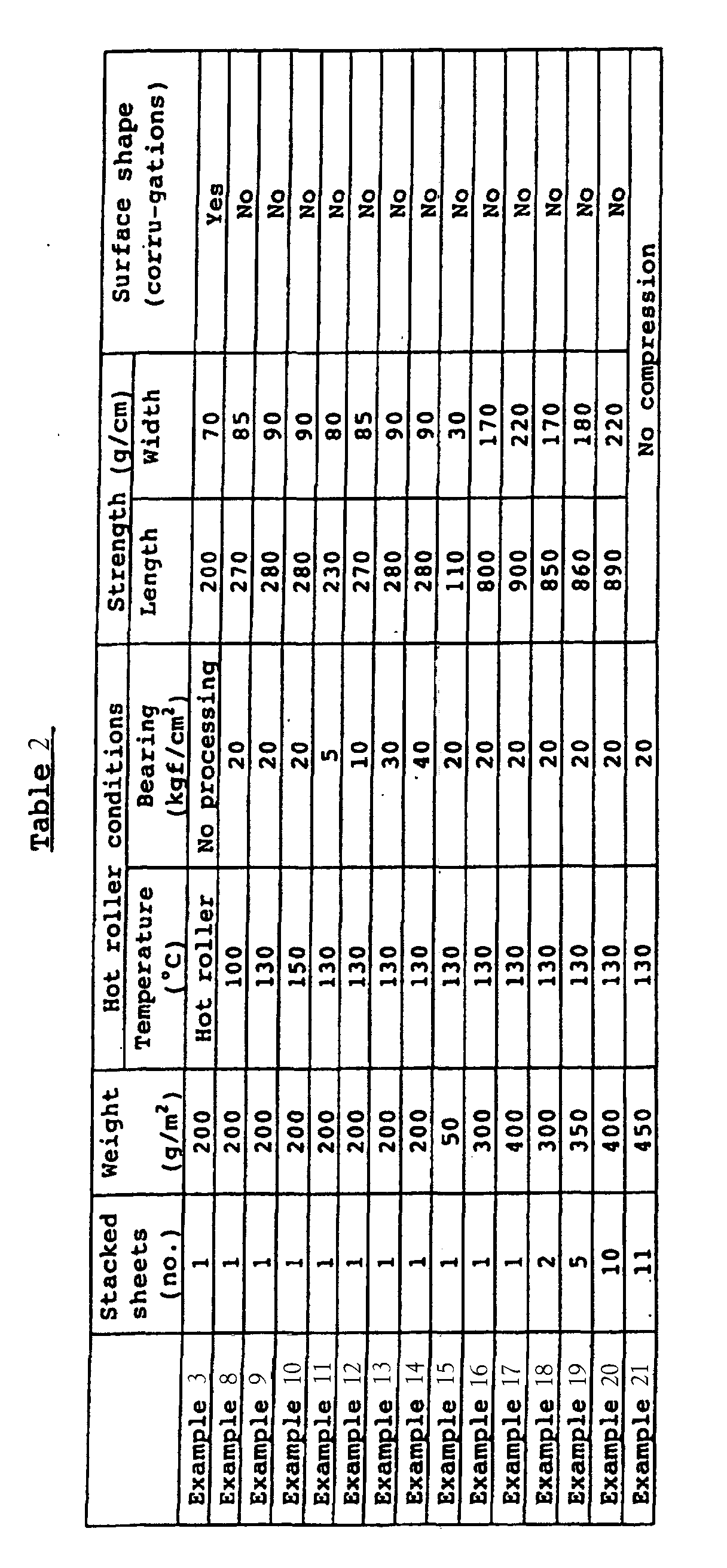
- the cellulose acetate foam sheet of Example 3 was compressed with a 150 mm ⁇ metal roller bearing a 120- ⁇ m deep 40 mesh square dot pattern and an NBR roller with a hardness of A75, to obtain a high-strength foam sheet.
- the results are summarized in Table 2.
- cellulose acetate foams with excellent biodegradability and antibacterial properties, as well as good combustibility.
- the foams therefore have very high industrial value because they provide biodegradable foams which can be used as heat insulating materials, cushioning materials, wall materials, sound absorbing materials and various packaging materials, not only alone but also in the form of molded products.
- cellulose acetate foams with excellent biodegradability and good combustibility which are also free of acetic acid odor.
- the foams therefore have very high industrial value because they provide biodegradable foams with no unpleasant acetic acid odor when used as heat insulating materials, cushioning materials, wall materials, sound absorbing materials and various packaging materials, not only alone but also in the form of molded products.
Landscapes
- Chemical & Material Sciences (AREA)
- Engineering & Computer Science (AREA)
- Health & Medical Sciences (AREA)
- Polymers & Plastics (AREA)
- Materials Engineering (AREA)
- Chemical Kinetics & Catalysis (AREA)
- Medicinal Chemistry (AREA)
- Organic Chemistry (AREA)
- Mechanical Engineering (AREA)
- Biodiversity & Conservation Biology (AREA)
- Environmental & Geological Engineering (AREA)
- Environmental Sciences (AREA)
- Toxicology (AREA)
- Life Sciences & Earth Sciences (AREA)
- Manufacture Of Porous Articles, And Recovery And Treatment Of Waste Products (AREA)
- Biological Depolymerization Polymers (AREA)
Abstract
Description
- The present invention relates to a biodegradable cellulose acetate foam and to a process for its production. More particularly, the present invention relates to a biodegradable cellulose acetate foam which is suitable for various purposes including heat insulating materials, cushioning materials, food packaging materials, etc. and to a production process by which the foam can be stably obtained.
- Many types of different foams have been produced from synthetic resins in the past, and they have been employed in a wide range of fields including heat insulating materials, cushioning materials, food packaging materials and so forth. In recent years there has been a yearly trend toward increased demand for these synthetic resin foams, which has led to an increased volume of waste year by year, adding to environmental and pollution problems that have been the focus of much attention. However, various efforts have been made toward recycled utilization of discarded synthetic resin foams on a public scale, and with the numerous mounting issues including preventing production of noxious gases by burning disposal and preventing degeneration of heat incinerators by high heat, there is a strong demand for the development of foams which can be easily discarded and disposed of.
- In order to meet this demand, various foams have been proposed wherein these synthetic resins (such as polystyrene) are replaced with biodegradable resins. For example, in Japanese Unexamined Patent Publication No. 6-136168, Japanese Examined Patent Publication No. 5-65536, Japanese Unexamined Patent Publication No. 6-335919, Japanese Unexamined Patent Publication No. 8-151469, Japanese Unexamined Patent Publication No. 8-59892, etc. there are disclosed processes for obtaining biodegradable foam molded products comprising starch as the main material. Also, Japanese Unexamined Patent Publication No. 6-15753 discloses a process whereby foam beads comprising pulp as the main material are loaded into a mold and fused together to obtain a molded product. Japanese Unexamined Patent Publication No. 5-320405 discloses a process using foamable woody resin particles prepared by adding a foaming agent to non-solution type chemically modified wood to obtain a molded product mainly by in-mold shaping. Japanese Unexamined Patent Publication No. 6-32928 discloses a process for obtaining a foam sheet from a foamable woody resin prepared by impregnating a non-solution chemically modified wood with a foaming agent, in order to prepare vessel-shaped molded products. Also, Japanese Unexamined Patent Publication No. 8-3357 discloses a process of loading at least a biodegradable resin comprising an acetate or a compound which contains one together with substantial moisture as the starting materials, and after heating and pressurization, suddenly releasing the pressure to make a foam and then molding it into the desired shape with a mold. The foam molded products obtained by these processes, however, have unstable mechanical properties (tensile strength, rupture strength, compressive strength, etc.), hardness and rigidity, and are therefore not always suitable for use as heat insulating materials or cushioning materials.
- JP-A-09 059 415 discloses a water conditioner prepared from a foam which comprises cellulose acetate. JP-A-08 302 058 discloses the extrusion of cellular acetylcellulose products for packing materials.
- The present invention has been accomplished in light of the aforementioned problems of the prior art, and its object is to provide a biodegradable cellulose acetate foam with excellent mechanical properties, and with stable and suitable hardness and rigidity to thus facilitate shaping of various molded products for heat insulating materials, cushioning materials, food packaging materials and the like, as well as a process for its production.
- By using cellulose acetate as a biodegradable material in an attempt to overcome the aforementioned problems, the present inventors have found that the object described above can be achieved by producing foams imparted with specific foam properties.
- Thus, according to the present invention there is provided a biodegradable cellulose acetate foam with a foam cell size of 0.001-0.8 mm and an apparent density of 0.01-0.27 g/cm3, which is in the form of a corrugated foam sheet with a thickness t of 1-50 mm, and having a corrugation height h of 2-10 mm and a corrugation width w of 2-10 mm.
- The present invention further provides a process for producing a biodegradable cellulose acetate foam, which comprises combining a mixed starting material (D) comprising (A) cellulose acetate, (B) a plasticizer and (C) a foam nucleating agent with a weight ratio of (A) : (B) : (C) of (100) : (0-80) : (2-50) with water (E) as the foaming agent at a weight ratio of 2-100 with respect to (D), and after melting the mixture (F) at a temperature of 150-250°C, dispensing it at a temperature of 120-220°C and then extruding it from a sheet production die with a discharge aperture width of 0.1 to 1mm at a shear rate of 1000-20,000 sec-1.
-
- Fig. 1 is a longitudinal cross-sectional sketch showing a magnified view of a portion of a foam sheet according to an embodiment of a foam of the invention.
- Fig. 2 is a general flow sheet showing the production process for a foam of the invention.
-
- The foam of the invention employs cellulose acetate as the biodegradable material. The biodegradability of cellulose acetate has been verified by numerous research reports (C.M. Buchanan et al., J. Appl. Polym. Sci., 47, 1709(1993); ibid., 50, 1739(1993); Ji-Dong Gu et al., J. Environ. Polym. Degradation, 1 (2), 143(1993)). The biodegradable cellulose acetate foam of the invention, regardless of its shape, must have foam properties defined by a foam cell size of 0.001-0.8 mm and an apparent density of 0.01-0.27 g/cm3. The foam cell size and apparent density were measured here in the manner described below.
- The resulting foam was cut with a razor blade, the cross-section was photographed under magnification with a microscope, and the cell sizes of 10 random points were measured and averaged.
- A strand-shaped foam was cut into a cylinder 1 cm in length and the diameter was measured to determine its volume, which was divided by its weight to determine its density.
- Only by satisfying the conditions of a foam cell size of 0.001-0.8 mm and an apparent density of 0.01-0.27 g/cm3, preferably 0.014-0.064 g/cm3, is it possible for the resulting foam to exhibit excellent dynamic properties (tensile strength, rupture strength, compressive strength, etc.) as a foam, as well as hardness and rigidity suitable for cushioning materials, heat insulating materials, packing materials and the like.
- The biodegradable cellulose acetate foam of the present invention sometimes has acetic acid liberated from the cellulose acetate still residing in the foam, in which case the foam will exhibit an antibacterial effect.
- The amount of liberated acetic acid can be measured in the following manner.
- A 10 g foam sample is sealed in a 500 cc volume airtight vessel and allowed to stand for 24 hours at a temperature of 20°C, 65% relative humidity, after which the amount of acetic acid in the air of the vessel is measured through a detector tube.
- The amount of acetic acid liberated from the cellulose acetate and remaining in the foam is preferably at least 3 ppm by the aforementioned measuring method, in order to obtain an antibacterial effect.
- The acetic acid is generated in the foam but, because the foam cells are connected pores, it does not remain inside them but is released to the outside. Also, since the foam cell size is as small as 0.001-0.8 mm as mentioned above, the acetic acid does not exit all at once but is gradually released in suitable amounts for a long-lasting antibacterial effect.
- The biodegradable cellulose acetate foam of the invention is in the form of a corrugated sheet.
- The biodegradable cellulose acetate foam of the invention is a corrugated foam sheet with a thickness t of 1-50 mm, a corrugation height h of 2-10 mm and a corrugation width w of 2-10 mm. Fig. 1 is a longitudinal cross-sectional sketch showing a partial magnified view of a corrugated foam sheet. In this drawing, t, h and w are respectively the sheet thickness, and the corrugation height and width.
- If the sheet thickness is smaller than 1 mm, greater labor and cost will be required to form the molded product from the foam, while the resulting molded product will also have inferior cushioning properties. If the sheet thickness is greater than 50 mm, it will be more difficult to handle.
- When the corrugation height h is smaller than 2 mm, cracks may occur during molding because of insufficient elongation. If it is greater than 10 mm, the gaps will be too large to be absorbed in vacuum molding, and cracks will tend to occur even with press molding because the multiple corrugations will not elongate evenly but will elongate only in certain sections.
- When the corrugation spacing is smaller than 2 mm, the bent sections will be weaker, tending to cause cracks during molding. When it is greater than 10 mm there will be fewer corrugations contributing to elongation, and this can also tend to cause cracks.
- The shape of the corrugations may be adjusted by appropriate setting of the amount of water added to the starting materials, the amount of resin discharged from the die and the discharge aperture width of the die, and here it is important to use water as the foaming agent. Specifically, latent heat of vaporization of the water causing rapid cooling and hardening of the foam sheet discharged from the die can inhibit spreading of the sheet in the widthwise direction which occurs by foaming, thus forming corrugations. The corrugations which are formed are highly useful for forming sheets. That is, although sheets obtained by extrusion foaming have by themselves insufficient flexibility for formation of deep drawn cup shapes, by forming corrugations it becomes possible to obtain deep drawn cup-shaped molded products provided with the necessary flexibility due to elongation of the corrugations during molding.
- Also, this type of corrugated foam sheet is preferably processed with a hot roller in order to obtain a cellulose acetate foam sheet with improved appearance, dimensional stability and tensile strength. The sheet preferably has a thickness of 0.5-25 mm, with longitudinal and lateral tensile strengths of 110-900 g/cm and 30-220 g/cm, respectively. These preferred properties can be achieved by heat treatment of the corrugated foam sheet at a temperature of 100-150°C under a bearing of 5-40 kgf/cm2.
- The method of forming the corrugated sheet described above may be a common method for forming sheets, such as vacuum molding, air pressure molding, press molding or the like, but sheets with corrugations are preferably formed by press molding in consideration of their tendency for air leaks and because of the ease with which air passes through the sheets themselves.
- A production process for a cellulose acetate biodegradable foam of the invention will now be described in detail. A general production flow sheet for a foam of the invention is shown in Fig. 2.
- The acetic acid esterification degree in the cellulose acetate composing the foam of the invention is preferably at least 45% in terms of acetylation represented by the weight ratio of acetic acid bound to cellulose, with an acetylation of 47-60% being particularly preferred (1.9-2.8 bound acetyl groups per cellulose unit). If the acetylation is less than 45% the melting temperature will become too high, thus making it more difficult to stably accomplish melt molding of foam particles.
- The cellulose acetate may contain other substances so long as the object of the invention is not prevented, and such substances may be plasticizers, heat stabilizers, foam nucleating agents, foaming aids and so forth. As plasticizers there may be mentioned polyhydric alcohols such as polyethylene glycol, polymethylene glycol and glycerin; phthalic acid esters such as dimethyl phthalate, diethyl phthalate, dipropyl phthalate, dibutyl phthalate, diamine phthalate and dimethoxyethyl phthalate; phosphoric acid esters such as tributyl phosphate, triphenyl phosphate and tricresyl phosphate; sebacic acid esters such as diethyl sebacate, dibutyl sebacate and dioctyl sebacate; adipic acid esters such as dioctyl adipate, butyloctyl adipate and butylbenzyl adipate; citric acid esters such as tributyl citrate, 2-ethylhexyl citrate, acetyltributyl citrate and acetyltrioctyl citrate; diisobutyl tartrate, butyl stearate, butyl oleate, soybean oil, castor oil, camphor oil, etc., but polyalkylene glycols of molecular weight of 20,000 or lower are particularly preferred for use. When polyalkylene glycols of molecular weight exceeding 20,000 are used it is sometimes impossible to achieve adequate plasticization. These plasticizers may be used alone, or in mixtures of two or more, such as a polyalkylene glycol with glycerin.
- When these plasticizers are used, they are preferably added in an amount of no greater than 80 parts by weight, and preferably no greater than 50 parts by weight with respect to the weight of the cellulose acetate. An amount of greater than 80 parts by weight will lead to greater shrinkage after extrusion foaming, which can prevent foaming to the desired density.
- As foam nucleating agents there may be added inorganic fine particles such as talc, silicon oxide, titanium oxide, magnesium oxide, aluminum oxide and calcium silicate, or organic fine particles such as cellulose powder, chitin, chitosan, wood flour and stearic acid metal salts. Talc can impart particularly favorable foamability to cellulose acetate, and thus facilitates production of foam particles with uniformity and a high degree of foaming. The foam nucleating agents may be used alone or in mixtures of two or more.
- The amount of the foam nucleating agent or foaming aid to be used in the cellulose acetate may be suitable in a range of 2-50 parts by weight, and preferably 5-30 parts by weight, with respect to the cellulose acetate weight. At less than 2 parts by weight the effect of the additives may not be exhibited and, for example, a low amount of the foam nucleating agent may tend to form rough, uneven foam cells; on the other hand, an amount exceeding 50 parts by weight may lead to secondary aggregation of the additives, thus also tending to form rough, uneven foam cells and resulting in reduced foamability due to the lower proportion of cellulose acetate.
- The starting materials may be used in the form of a mixture of the cellulose acetate and different additives with water as the foaming agent, or in the form of chips prepared by melt extrusion of a mixture of the cellulose acetate and different additives, for use as starting material chips. In the case of a starting material mixture, the cellulose acetate may be in either flake or powder form, and in the case of flakes it is preferred to set a Dulmage head on the extruder screw or to use a twin-screw extruder for improved kneadability.
- For production of a foam from the starting material prepared in this manner, the starting material is extruded through the nozzle or die of an extruder. Here, the water used as the foaming agent is added at 2-100 parts by weight, and preferably 5-50 parts by weight, to 100 parts by weight of the cellulose acetate or the cellulose acetate/additive mixture.
- As addition methods there may be mentioned impregnation into the starting material, and injection by a pump through a vent zone between the starting material supply port and the discharge port of the extruder.
- According to the invention, if the water is added at less than 2 parts by weight with respect to the starting material the foaming ratio will not increase sufficiently, making it impossible to adequately exhibit the properties of a foam. If added at greater than 100 parts by weight, lumps may be produced during impregnation into the starting material, or bridges may be produced during supply through the hopper port of the extruder, thus making it more difficult to accomplish loading. Also, there will be no significant effect of improved foaming ratio even when the supply is through a vent zone, and instead inconveniences such as unstable discharge will tend to be experienced.
- The use of water as the foaming agent is very important for production of a foam according to the invention. Specifically, latent heat of vaporization of the water causing rapid cooling and hardening of the discharged foam can maintain the foam shape without shrinkage.
- The extruder used for the melt kneading may be any type of extruder which is capable of heated melt kneading of moisture-added cellulose acetate under high temperature and high pressure, but in most cases a single screw or twin-screw type extruder is used.
- According to the invention, the temperature for melt extrusion of the cellulose acetate foam is 150-250°C, and preferably 180-220°C in the compression zone. If it is lower than 150°C the cellulose acetate will fail to melt, and if it is above 250°C the cellulose acetate will tend to undergo carbonization. In the dispensing zone, the temperature is 120-220°C, and preferably 140-200°C. At lower than 120°C the viscosity of the resin in the extruder will be too high, tending to cause unstable discharge, while acetic acid will not be sufficiently freed from the resulting foam. At higher than 220°C the resin will be inadequately cooled by the latent heat of vaporization after discharge, resulting in shrinkage and a low foaming ratio of the final foam product.
- The shape of the orifice nozzle for extrusion may be triangular, square, rectangular, star-shaped, tubular, etc., and sheet foams can be obtained by extrusion from a film or sheet producing die. The melt kneading time will differ depending on the discharge volume per unit of time, the melt kneading temperature, etc. and therefore cannot be specified in general terms, but it should be a sufficient time for uniform melt kneading of the mixture. The die temperature at the discharge zone may be the same as the above-mentioned melt kneading temperature, or it may be lower than that temperature but within a range allowing discharge.
- According to the invention, it is necessary to maintain a discharge shear rate of 1000-20,000 sec-1 in order to achieve a foam cell size in the range of 0.001-0.8 mm. If it is lower than 1000 sec-1 the cell size will exceed 0.8 mm, and if it is higher than 20,000 sec-1 clogging will tend to occur in the discharge port, making it impossible to stably obtain a foam.
- The starting material is extruded from a sheet producing die with an extruder, and the discharge aperture width is 0.1-1 mm.
- According to the invention, when a corrugated foam sheet is processed with a hot roller, the conditions are preferred to be a temperature of 100-150°C and a bearing of 5-40 kgf/cm2. If the temperature is lower than 100°C or the bearing is less than 5 kgf/cm2 the hot roller processing will often result in no effect, and if the temperature is above 150°C or the bearing is greater than 40 kgf/cm2, the sheet will sometimes fuse with the roller during processing.
- For hot roller processing, a plurality of stacked sheets may be processed, contact bonded and used as a single sheet, but the maximum number of sheets that can be stacked is ten. If more than ten sheets are stacked, the heat will not be sufficiently transmitted to the interior during the processing, making contact bonding of the sheets impossible. The processing speed is not particularly restricted, but from the standpoint of operation and ease of handling the sheets after their heat processing, it should be 1-10 m/min, and preferably 2-5 m/min.
- Incidentally, as already mentioned above, the biodegradable cellulose acetate foam of the invention will sometimes have acetyl groups liberated from the molecules as acetic acid. This free acetic acid imparts an antibacterial property to the foam and is preferred from this viewpoint, but depending on the purpose of use the acetic acid odor may not only be unpleasant to the consumer, but can become a cause of rust when it is placed in a sealed container with metal or the like.
- The present invention therefore further provides a biodegradable cellulose acetate foam which is the aforementioned biodegradable cellulose acetate foam of the invention wherein the foam is treated with a weak alkali solution, for an acetylation degree of 45-60% and no acetic acid odor.
- In other words, it provides the biodegradable cellulose acetate foam of the invention wherein the foam is treated with a weak alkali solution to give a foam with an acetylation degree of 45-60% while exhibiting no acetic acid odor. Here, the weak alkali solution treatment serves to reduce acetic acid liberated from the cellulose acetate, which is present in the resulting foam and its molded products.
- The acetic acid odor can be determined by quantitation of the acetic acid content by the method described above. In this measuring method, "odorless" was defined as an acetic acid content of less than 3 ppm liberated from the cellulose acetate and residing in the foam.
- The weak alkali treatment according to the invention is preferably at a pH of 7.5-8.5. If the pH is lower than 7.5 it will not be possible to sufficiently neutralize the liberated acetic acid, often preventing reduction of odor. If the pH is over 8.5, the cellulose acetate will be saponified by the alkali treatment, resulting in an acetylation degree of less than 45% which will sometimes cause shrinkage and hardening of the foam. The weak alkali may be any one with a pH of 7.5-8.5, and as examples there may be mentioned aqueous solutions of sodium bicarbonate, potassium bicarbonate, sodium carbonate, potassium carbonate, calcium carbonate, sodium hydroxide and potassium hydroxide.
- The amount of the weak alkali solution used for treatment is preferably 20-100 parts by weight with respect to the foam. If the treatment amount is less than 20 wt% it will not be possible to sufficiently neutralize the liberated acetic acid, often preventing reduction of odor. If it is over 100 wt%, the cellulose acetate will be saponified by the alkali treatment, resulting in an acetylation degree of less than 45% which will sometimes cause shrinkage and hardening of the foam.
- The method of weak alkali treatment according to the invention may be the same as a common solution treatment, examples including a method of placing the foam in a vat containing the weak alkali solution, and a method whereby the weak alkali aqueous solution is showered or sprayed onto the foam or its molded product. Methods involving spraying of the weak alkali solution immediately after discharge from the extruder in the foam production process are effective from the standpoint of quantitation and working efficiency.
- The present invention will now be further explained by way of examples. The properties evaluated in the examples were measured by the following methods.
- A strand-shaped foam was cut into a cylinder 1 cm in length and the diameter was measured to determine its volume, which was divided by its weight to determine its density.
- The resulting foam was cut with a razor blade, the cross-section was photographed, under magnification with a microscope, and the cell sizes of 10 random points were measured and averaged.
- A 10 g foam sample was sealed in a 500 cc volume airtight vessel and allowed to stand for 24 hours at a temperature of 20°C, and a relative humidity of 65%, after which the amount of acetic acid in the air of the vessel was measured through a detector tube.
- A microscope was used to determine the area of the portion of foam cells with a diameter of at least 0.1 mm which were exposed in a foam particle cut with a cutting device, and this was divided by the total surface area of the foam particle.
- The resulting sheet was cut into a 5-cm square piece, its thickness and weight were measured to calculate its density, and this was divided by the density of the starting material to obtain the foaming ratio value.
- A frame with a diameter of 5 cm and a depth of 10 cm was used for press molding of a foam sheet which had been preheated in an atmosphere at 100°C. Repeating the same test 30 times, cases with less than 20% cracking were indicated with "O" those with 20% up to 50% were indicated with "Δ" and those with at least 50% were indicate with "X".
- Cellulose acetate (Acetate Flakes, product of Teijin), polyethylene glycol (PEG, product of Nihon Yushi, molecular weight 400) and talc (LMR-200, product of Fuji Talc Kogyo) were combined with water in the proportions listed in Table 1, and a twin-screw extruder (OTE57-11, product of Osaka Seiki Kosaku) was used for melting and plasticizing at 210°C and extrusion from a 500-mm wide die at 200°C to obtain foam sheets. The moldability of each of the resulting foam sheets was evaluated. The results are summarized in Table 1.
- Note: The "x" superscripts in Table 1 indicate values outside the scope of the invention.

- The cellulose acetate foam sheet of Example 3 was compressed with a 150 mm metal roller bearing a 120-µm deep 40 mesh square dot pattern and an NBR roller with a hardness of A75, to obtain a high-strength foam sheet. The results are summarized in Table 2.
- Note: The "x" superscripts in Table 2 indicate values outside the scope of the invention.
- Cellulose acetate (Acetate Flex, product of Teijin), polyethylene glycol (PEG, product of Niton Yushi, molecular weight 400) and talc (LMR-200, product of Fuji Talc Kogyo) were combined with water in the proportions listed in Table 3, and a twin-screw extruder (OTE57-11, product of Osaka Seiki Kosaku) was used for melting and plasticizing of the mixtures at 210°C and extrusion from a 500-mm wide die at 200°C to obtain foam sheets. An aqueous sodium bicarbonate solution (pH 8.0) was added to the resulting foam sheet at 60 PHR, and the acetic acid content was measured at a temperature of 20°C. The moldability of each sheet after this weak alkali treatment was also evaluated. The results are summarized in Table 3.

- Note: The "x" superscripts in Table 3 indicate values outside the scope of the invention.
- According to the present invention there may be provided cellulose acetate foams with excellent biodegradability and antibacterial properties, as well as good combustibility. The foams therefore have very high industrial value because they provide biodegradable foams which can be used as heat insulating materials, cushioning materials, wall materials, sound absorbing materials and various packaging materials, not only alone but also in the form of molded products.
- According to the invention there may also be provided cellulose acetate foams with excellent biodegradability and good combustibility which are also free of acetic acid odor. The foams therefore have very high industrial value because they provide biodegradable foams with no unpleasant acetic acid odor when used as heat insulating materials, cushioning materials, wall materials, sound absorbing materials and various packaging materials, not only alone but also in the form of molded products.
Claims (10)
- A biodegradable cellulose acetate foam with a foam cell size of 0.001-0.8 mm and an apparent density of 0.01-0.27 g/cm3, which is in the form of a corrugated foam sheet with a thickness t of 1-50 mm, and having a corrugation height h of 2-10 mm and a corrugation width w of 2-10 mm.
- A biodegradable cellulose acetate foam prepared by heat shaping a foam sheet according to claim 1.
- A biodegradable cellulose acetate foam according to claim 1 or claim 2, wherein said foam is treated with a weak alkali solution, for an acetylation degree of 45-60 % and no acetic acid odor.
- A foam according to claim 3, wherein the treatment with a weak alkali solution comprises adding a weak alkali solution with a pH of 7.5-8.5 at 20-100 parts by weight with respect to the foam.
- A process for producing a biodegradable cellulose acetate foam, in the form of a corrugated foam sheet, which comprises combining a mixed starting material (D) comprising (A) cellulose acetate, (B) a plasticizer and (C) a foam nucleating agent with a weight ratio of (A) : (B) : (C) of (100) : (0-80) : (2-50) with water (E) as the foaming agent at a weight ratio of 2-100 with respect to (D), and after melting the resulting mixture (F) at a temperature of 150-250°C, dispensing it at a temperature of 120-220°C and then extruding it from a sheet production die with a discharge aperture width of 0.1 to 1 mm at a shear rate of 1000-20,000 sec-1.
- The process of claim 5 wherein said resulting mixture (F) is melted and extruded, and then the resulting foam is subjected to heat treatment at a temperature of 100-150°C under a bearing of 5-40 kgf/cm2.
- The process of claim 5 or 6 wherein the plasticizer is a polyalkylene glycol.
- The process of claim 7 wherein the molecular weight of the polyalkylene glycol is 200-20,000.
- The process of any one of claims 5 to 8, wherein the foam nucleating agent is talc.
- The process of any one of claims 5 to 9, wherein said mixture (F) is melted and fused, and then a weak alkali solution with a pH of 7.5-8.5 is added at 20-100 parts by weight with respect to the foam.
Applications Claiming Priority (5)
| Application Number | Priority Date | Filing Date | Title |
|---|---|---|---|
| JP24085697 | 1997-09-05 | ||
| JP24085397 | 1997-09-05 | ||
| JP24085697 | 1997-09-05 | ||
| JP24085397 | 1997-09-05 | ||
| PCT/JP1998/003860 WO1999012723A1 (en) | 1997-09-05 | 1998-08-28 | Biodegradable cellulose acetate foams and process for producing the same |
Publications (3)
| Publication Number | Publication Date |
|---|---|
| EP0940243A1 EP0940243A1 (en) | 1999-09-08 |
| EP0940243A4 EP0940243A4 (en) | 2000-04-05 |
| EP0940243B1 true EP0940243B1 (en) | 2003-04-09 |
Family
ID=26534965
Family Applications (1)
| Application Number | Title | Priority Date | Filing Date |
|---|---|---|---|
| EP98940622A Expired - Lifetime EP0940243B1 (en) | 1997-09-05 | 1998-08-28 | Biodegradable cellulose acetate foams and process for producing the same |
Country Status (5)
| Country | Link |
|---|---|
| US (1) | US6221924B1 (en) |
| EP (1) | EP0940243B1 (en) |
| KR (1) | KR20000068911A (en) |
| DE (1) | DE69813175T2 (en) |
| WO (1) | WO1999012723A1 (en) |
Cited By (2)
| Publication number | Priority date | Publication date | Assignee | Title |
|---|---|---|---|---|
| DE102013005568A1 (en) | 2012-04-02 | 2013-10-02 | Fraunhofer-Gesellschaft zur Förderung der angewandten Forschung e.V. | Process for the production of food packaging and food packaging produced by this process |
| WO2025136910A1 (en) * | 2023-12-18 | 2025-06-26 | Eastman Chemical Company | Polymer extrusion process using vented extruder |
Families Citing this family (20)
| Publication number | Priority date | Publication date | Assignee | Title |
|---|---|---|---|---|
| US7005181B2 (en) | 2000-04-06 | 2006-02-28 | American Aerogel Corporation | Organic, open cell foam materials, their carbonized derivatives, and methods for producing same |
| EP1406958A1 (en) * | 2001-03-16 | 2004-04-14 | American Aerogel Corporation | Organic, open cell foam materials |
| KR100648930B1 (en) * | 2005-09-16 | 2006-11-27 | 삼성전자주식회사 | Conductive Transfer Roller for Image Forming Device |
| US20080307592A1 (en) * | 2007-06-18 | 2008-12-18 | Daniel Joseph Cornelius | Biodegradable, chemical toliet training and cleaning system |
| AT509268A1 (en) | 2009-12-30 | 2011-07-15 | Sunpor Kunststoff Gmbh | EXPANDABLE POLYMERISES FROM CELLULOSE ACETATE BUTYRATE |
| US8691126B2 (en) * | 2011-01-18 | 2014-04-08 | Wisconsin Alumni Research Foundation | Method of fabricating an injection molded component |
| AT511509A1 (en) | 2011-04-18 | 2012-12-15 | Sunpor Kunststoff Gmbh | EXPANDABLE POLYMERISES FROM CELLULOSE ACETATE BUTYRATE AND STYRENE POLYMERISATE |
| US9630346B2 (en) | 2013-03-05 | 2017-04-25 | Wisconsin Alumni Research Foundation | Method of fabricating an injection molded component |
| DE102013005300A1 (en) | 2013-03-27 | 2014-10-02 | Frank van Lück | Use of a foamed-extruded bioplastic and bio-plastic-based insulating element |
| US9555564B2 (en) | 2013-11-11 | 2017-01-31 | Wisconsin Alumni Research Foundation | Method of fabricating a foamed, injection molded component with improved ductility and toughness |
| EP3794068A4 (en) * | 2018-05-07 | 2022-03-16 | Cruz Foam, Inc. | Biodegradable foams |
| US12162259B2 (en) | 2019-05-22 | 2024-12-10 | Cruz Foam, Inc. | Biodegradable foam with laminate layers |
| US20230075066A1 (en) * | 2020-01-20 | 2023-03-09 | Eastman Chemical Company | Biodegradable compositions and articles made from cellulose acetate |
| CN115003743B (en) * | 2020-01-20 | 2024-10-25 | 伊士曼化工公司 | Biodegradable compositions and articles made from cellulose acetate |
| EP4146729A1 (en) | 2020-05-08 | 2023-03-15 | Teknologian Tutkimuskeskus VTT OY | Cellulose-based extrusion foams |
| US20240158600A1 (en) * | 2021-06-18 | 2024-05-16 | Eastman Chemical Company | Biodegradable cellulose acetate foams |
| EP4373887B1 (en) | 2021-07-19 | 2025-04-30 | Eastman Chemical Company | Foamable cellulose acetate compositions, foams and foam articles formed therefrom |
| WO2023034473A1 (en) * | 2021-09-03 | 2023-03-09 | Eastman Chemical Company | Cellulose acetate foams |
| WO2023220007A1 (en) * | 2022-05-09 | 2023-11-16 | Cryovac, Llc | Sustainable foam |
| SE2330086A1 (en) * | 2023-02-16 | 2024-08-17 | Stora Enso Oyj | Method of hot pressing a solid cellulose foam |
Family Cites Families (10)
| Publication number | Priority date | Publication date | Assignee | Title |
|---|---|---|---|---|
| CH438712A (en) | 1963-12-14 | 1967-06-30 | Bayer Ag | Process for the production of foamed thermoplastic materials |
| US4376752A (en) * | 1975-09-02 | 1983-03-15 | The United States Of America As Represented By The United States Department Of Energy | Foam encapsulated targets |
| JP3090677B2 (en) | 1990-09-26 | 2000-09-25 | エテルナ―リヒテ ゲーエムベーハー ウント コンパニ.カーゲー. | Biologically degradable synthetic resin material and its packaging material |
| JPH06335919A (en) | 1993-05-27 | 1994-12-06 | Oji Seitai Kk | Manufacture of loose cushioning material having starch as main raw material |
| IT1274603B (en) | 1994-08-08 | 1997-07-18 | Novamont Spa | BIODEGRADABLE PLASTIC EXPANDED MATERIALS |
| JPH08151469A (en) | 1994-11-25 | 1996-06-11 | Nippon Synthetic Chem Ind Co Ltd:The | Injection foaming resin composition and molded article thereof |
| JP2965887B2 (en) * | 1995-05-12 | 1999-10-18 | 帝人株式会社 | Method for producing cellulose acetate foam |
| JP3415970B2 (en) * | 1995-08-22 | 2003-06-09 | 帝人株式会社 | Water purification material |
| JPH10100264A (en) | 1996-09-26 | 1998-04-21 | Teijin Ltd | Method for producing biodegradable foam molded article |
| JP3318216B2 (en) * | 1996-09-26 | 2002-08-26 | 帝人株式会社 | Biodegradable foam particles and method for producing the same |
-
1998
- 1998-08-28 DE DE69813175T patent/DE69813175T2/en not_active Expired - Fee Related
- 1998-08-28 US US09/297,265 patent/US6221924B1/en not_active Expired - Fee Related
- 1998-08-28 WO PCT/JP1998/003860 patent/WO1999012723A1/en not_active Ceased
- 1998-08-28 EP EP98940622A patent/EP0940243B1/en not_active Expired - Lifetime
- 1998-08-28 KR KR1019997003983A patent/KR20000068911A/en not_active Abandoned
Cited By (4)
| Publication number | Priority date | Publication date | Assignee | Title |
|---|---|---|---|---|
| DE102013005568A1 (en) | 2012-04-02 | 2013-10-02 | Fraunhofer-Gesellschaft zur Förderung der angewandten Forschung e.V. | Process for the production of food packaging and food packaging produced by this process |
| WO2013149612A2 (en) | 2012-04-02 | 2013-10-10 | Inde Plastik Betriebsgesellschaft Mbh | Method for producing food packagings and food packaging produced by this method |
| DE102013005568B4 (en) | 2012-04-02 | 2018-09-27 | Fraunhofer-Gesellschaft zur Förderung der angewandten Forschung e.V. | Process for the production of food packaging and food packaging produced by this process |
| WO2025136910A1 (en) * | 2023-12-18 | 2025-06-26 | Eastman Chemical Company | Polymer extrusion process using vented extruder |
Also Published As
| Publication number | Publication date |
|---|---|
| WO1999012723A1 (en) | 1999-03-18 |
| EP0940243A1 (en) | 1999-09-08 |
| KR20000068911A (en) | 2000-11-25 |
| US6221924B1 (en) | 2001-04-24 |
| EP0940243A4 (en) | 2000-04-05 |
| DE69813175D1 (en) | 2003-05-15 |
| DE69813175T2 (en) | 2004-03-04 |
Similar Documents
| Publication | Publication Date | Title |
|---|---|---|
| US6221924B1 (en) | Biodegradable cellulose acetate foam and process for its production | |
| JP2749918B2 (en) | Biodegradable product and method for producing the same | |
| US5035930A (en) | Biodegradable shaped products and the method of preparation thereof | |
| US5043196A (en) | Biodegradable shaped products and the method of preparation thereof | |
| US5153037A (en) | Biodegradable shaped products and the method of preparation thereof | |
| CN109312096B (en) | Foam compositions comprising polylactic acid polymers, polyvinyl acetate polymers, and plasticizers, articles, and methods of making and using the same | |
| JP2002371201A (en) | Biodegradable resin composition | |
| JP2000225638A (en) | Preparation of foamed molded article | |
| JP2001200084A (en) | Cellulose acetate resin foam which is biodegradable and has excellent mechanical properties and heat shaping properties, and cellulose acetate resin foam molded article which is biodegradable and has excellent mechanical properties and dimensional stability | |
| CA1331671C (en) | Biodegradable shaped products and the method of preparation thereof | |
| JP3921548B2 (en) | Cellulose acetate biodegradable foam and method for producing the same | |
| JP2001181429A (en) | Cellulose acetate-based resin foam excellent in biodegradability, mechanical property and thermal shape-retaining property and production method, and molded product of cellulose acetate-based resin foam excellent in biodegradability, mechanical property and dimensional stability and production method | |
| KR102871362B1 (en) | Method for manufacturing foamed pulp molded products using pulp and starch | |
| JPH11140220A (en) | Cellulose acetate biodegradable foam and method for producing the same | |
| JP2000086793A (en) | Cellulose acetate foam and method for producing the same | |
| JP3376415B2 (en) | Biodegradable polylactic acid foam board | |
| WO2000073037A1 (en) | Board having a foamed core and a high content of cellulose-based filler | |
| JPS59109532A (en) | Extrusion-expanded polystyrene sheet of improved post-formability and its production | |
| JP3376416B2 (en) | Method for producing biodegradable polylactic acid foam | |
| JPH10100264A (en) | Method for producing biodegradable foam molded article | |
| KR100769060B1 (en) | A method for producing a degradable polystyrene paper, the paper and a degradable food packaging container using the same. | |
| JPH11279311A (en) | Degradable resin foam | |
| JPH10265607A (en) | Method for producing biodegradable foam molded article | |
| JP2000190411A (en) | Extruded biodegradable resin foam having excellent secondary moldability, foamed biodegradable resin molded product using the same, and methods for producing them | |
| JPH06335919A (en) | Manufacture of loose cushioning material having starch as main raw material |
Legal Events
| Date | Code | Title | Description |
|---|---|---|---|
| PUAI | Public reference made under article 153(3) epc to a published international application that has entered the european phase |
Free format text: ORIGINAL CODE: 0009012 |
|
| 17P | Request for examination filed |
Effective date: 19990503 |
|
| AK | Designated contracting states |
Kind code of ref document: A1 Designated state(s): BE CH DE FR GB IT LI NL SE |
|
| RIC1 | Information provided on ipc code assigned before grant |
Free format text: 7B 29C 47/92 A, 7C 08J 9/22 B, 7C 08J 9/12 B |
|
| A4 | Supplementary search report drawn up and despatched |
Effective date: 20000217 |
|
| AK | Designated contracting states |
Kind code of ref document: A4 Designated state(s): BE CH DE FR GB IT LI NL SE |
|
| 17Q | First examination report despatched |
Effective date: 20011227 |
|
| GRAH | Despatch of communication of intention to grant a patent |
Free format text: ORIGINAL CODE: EPIDOS IGRA |
|
| GRAH | Despatch of communication of intention to grant a patent |
Free format text: ORIGINAL CODE: EPIDOS IGRA |
|
| GRAA | (expected) grant |
Free format text: ORIGINAL CODE: 0009210 |
|
| AK | Designated contracting states |
Designated state(s): BE CH DE FR GB IT LI NL SE |
|
| PG25 | Lapsed in a contracting state [announced via postgrant information from national office to epo] |
Ref country code: LI Free format text: LAPSE BECAUSE OF FAILURE TO SUBMIT A TRANSLATION OF THE DESCRIPTION OR TO PAY THE FEE WITHIN THE PRESCRIBED TIME-LIMIT Effective date: 20030409 Ref country code: CH Free format text: LAPSE BECAUSE OF FAILURE TO SUBMIT A TRANSLATION OF THE DESCRIPTION OR TO PAY THE FEE WITHIN THE PRESCRIBED TIME-LIMIT Effective date: 20030409 |
|
| REG | Reference to a national code |
Ref country code: GB Ref legal event code: FG4D |
|
| REG | Reference to a national code |
Ref country code: CH Ref legal event code: EP |
|
| PG25 | Lapsed in a contracting state [announced via postgrant information from national office to epo] |
Ref country code: SE Free format text: LAPSE BECAUSE OF FAILURE TO SUBMIT A TRANSLATION OF THE DESCRIPTION OR TO PAY THE FEE WITHIN THE PRESCRIBED TIME-LIMIT Effective date: 20030709 |
|
| ET | Fr: translation filed | ||
| REG | Reference to a national code |
Ref country code: CH Ref legal event code: PL |
|
| PLBE | No opposition filed within time limit |
Free format text: ORIGINAL CODE: 0009261 |
|
| STAA | Information on the status of an ep patent application or granted ep patent |
Free format text: STATUS: NO OPPOSITION FILED WITHIN TIME LIMIT |
|
| 26N | No opposition filed |
Effective date: 20040112 |
|
| PGFP | Annual fee paid to national office [announced via postgrant information from national office to epo] |
Ref country code: BE Payment date: 20060711 Year of fee payment: 9 |
|
| PGFP | Annual fee paid to national office [announced via postgrant information from national office to epo] |
Ref country code: FR Payment date: 20060713 Year of fee payment: 9 |
|
| PGFP | Annual fee paid to national office [announced via postgrant information from national office to epo] |
Ref country code: GB Payment date: 20060823 Year of fee payment: 9 |
|
| PGFP | Annual fee paid to national office [announced via postgrant information from national office to epo] |
Ref country code: NL Payment date: 20060831 Year of fee payment: 9 Ref country code: IT Payment date: 20060831 Year of fee payment: 9 |
|
| PGFP | Annual fee paid to national office [announced via postgrant information from national office to epo] |
Ref country code: DE Payment date: 20060927 Year of fee payment: 9 |
|
| BERE | Be: lapsed |
Owner name: *SUZUKI SOGYO CO. LTD Effective date: 20070831 Owner name: *TEIJIN LTD Effective date: 20070831 |
|
| GBPC | Gb: european patent ceased through non-payment of renewal fee |
Effective date: 20070828 |
|
| PG25 | Lapsed in a contracting state [announced via postgrant information from national office to epo] |
Ref country code: NL Free format text: LAPSE BECAUSE OF NON-PAYMENT OF DUE FEES Effective date: 20080301 |
|
| NLV4 | Nl: lapsed or anulled due to non-payment of the annual fee |
Effective date: 20080301 |
|
| REG | Reference to a national code |
Ref country code: FR Ref legal event code: ST Effective date: 20080430 |
|
| PG25 | Lapsed in a contracting state [announced via postgrant information from national office to epo] |
Ref country code: DE Free format text: LAPSE BECAUSE OF NON-PAYMENT OF DUE FEES Effective date: 20080301 |
|
| PG25 | Lapsed in a contracting state [announced via postgrant information from national office to epo] |
Ref country code: BE Free format text: LAPSE BECAUSE OF NON-PAYMENT OF DUE FEES Effective date: 20070831 |
|
| PG25 | Lapsed in a contracting state [announced via postgrant information from national office to epo] |
Ref country code: FR Free format text: LAPSE BECAUSE OF NON-PAYMENT OF DUE FEES Effective date: 20070831 |
|
| PG25 | Lapsed in a contracting state [announced via postgrant information from national office to epo] |
Ref country code: GB Free format text: LAPSE BECAUSE OF NON-PAYMENT OF DUE FEES Effective date: 20070828 |
|
| PG25 | Lapsed in a contracting state [announced via postgrant information from national office to epo] |
Ref country code: IT Free format text: LAPSE BECAUSE OF NON-PAYMENT OF DUE FEES Effective date: 20070828 |