EP0938792B1 - Objektorientierte digitale unterschriften - Google Patents
Objektorientierte digitale unterschriften Download PDFInfo
- Publication number
- EP0938792B1 EP0938792B1 EP97945363A EP97945363A EP0938792B1 EP 0938792 B1 EP0938792 B1 EP 0938792B1 EP 97945363 A EP97945363 A EP 97945363A EP 97945363 A EP97945363 A EP 97945363A EP 0938792 B1 EP0938792 B1 EP 0938792B1
- Authority
- EP
- European Patent Office
- Prior art keywords
- electronic signals
- digital signature
- electronically
- stored
- pluralities
- Prior art date
- Legal status (The legal status is an assumption and is not a legal conclusion. Google has not performed a legal analysis and makes no representation as to the accuracy of the status listed.)
- Expired - Lifetime
Links
- 238000000034 method Methods 0.000 claims description 25
- 238000010586 diagram Methods 0.000 description 9
- 238000013459 approach Methods 0.000 description 7
- 230000008878 coupling Effects 0.000 description 4
- 238000010168 coupling process Methods 0.000 description 4
- 238000005859 coupling reaction Methods 0.000 description 4
- 230000015654 memory Effects 0.000 description 3
- 230000002123 temporal effect Effects 0.000 description 3
- 238000012546 transfer Methods 0.000 description 3
- 238000013475 authorization Methods 0.000 description 2
- 230000008569 process Effects 0.000 description 2
- 238000012545 processing Methods 0.000 description 2
- 238000010200 validation analysis Methods 0.000 description 2
- 241000700605 Viruses Species 0.000 description 1
- 230000009471 action Effects 0.000 description 1
- 230000005540 biological transmission Effects 0.000 description 1
- 230000010365 information processing Effects 0.000 description 1
- 238000012986 modification Methods 0.000 description 1
- 230000004048 modification Effects 0.000 description 1
- 230000006855 networking Effects 0.000 description 1
- 230000008520 organization Effects 0.000 description 1
- 239000000126 substance Substances 0.000 description 1
- 238000006467 substitution reaction Methods 0.000 description 1
- 238000012795 verification Methods 0.000 description 1
Images




Classifications
-
- H—ELECTRICITY
- H04—ELECTRIC COMMUNICATION TECHNIQUE
- H04L—TRANSMISSION OF DIGITAL INFORMATION, e.g. TELEGRAPHIC COMMUNICATION
- H04L9/00—Cryptographic mechanisms or cryptographic arrangements for secret or secure communications; Network security protocols
- H04L9/32—Cryptographic mechanisms or cryptographic arrangements for secret or secure communications; Network security protocols including means for verifying the identity or authority of a user of the system or for message authentication, e.g. authorization, entity authentication, data integrity or data verification, non-repudiation, key authentication or verification of credentials
- H04L9/3247—Cryptographic mechanisms or cryptographic arrangements for secret or secure communications; Network security protocols including means for verifying the identity or authority of a user of the system or for message authentication, e.g. authorization, entity authentication, data integrity or data verification, non-repudiation, key authentication or verification of credentials involving digital signatures
-
- H—ELECTRICITY
- H04—ELECTRIC COMMUNICATION TECHNIQUE
- H04L—TRANSMISSION OF DIGITAL INFORMATION, e.g. TELEGRAPHIC COMMUNICATION
- H04L9/00—Cryptographic mechanisms or cryptographic arrangements for secret or secure communications; Network security protocols
- H04L9/32—Cryptographic mechanisms or cryptographic arrangements for secret or secure communications; Network security protocols including means for verifying the identity or authority of a user of the system or for message authentication, e.g. authorization, entity authentication, data integrity or data verification, non-repudiation, key authentication or verification of credentials
- H04L9/3263—Cryptographic mechanisms or cryptographic arrangements for secret or secure communications; Network security protocols including means for verifying the identity or authority of a user of the system or for message authentication, e.g. authorization, entity authentication, data integrity or data verification, non-repudiation, key authentication or verification of credentials involving certificates, e.g. public key certificate [PKC] or attribute certificate [AC]; Public key infrastructure [PKI] arrangements
Definitions
- the present invention relates to encryption and, more particularly, to digital signatures.
- Encryption digital signatures, and digital certificates are well known. See, for example, APPLIED CRYPTOGRAPHY, written by Bruce Schneier, available from John Wiley and Sons, Inc. (1994).
- the state of the art notion of a digital signature is as encrypted, electronic signals, physically stored with a collection of electronic signals in an electronic file.
- EP-A-0597192 discloses a process of using a digital signature to electronically reference at least one plurality of electronic signals with a digital signature remotely stored from the plurality. The digital signature provides verification or validation with respect to the collection.
- a digital signature is as encrypted, electronic signals physically appended to or stored with a collection of electronic signals, such as in an electronic file resident on a particular platform.
- a "document” refers to an electronic document in the form of a plurality of electronic signals that are stored or physically reside in substantially the same location, such as in a file on a particular platform or computer system, for example.
- Such a platform may include, for example, an execution unit, such as a microprocessor, coupled to one or more storage media, such as via a system bus.
- signaling a "document” in this context refers to appending or associating a digital signature with the plurality of stored electronic signals so that the digital signature resides in substantially the same location as the "document", such as stored in the same file on the platform.
- an electronic file comprises a related set of electronic signals stored together and electronically referenced by a name or identifier. Therefore, the digital signature is physically stored with the electronic signals to which it is associated, e.g., with the document that was signed.
- the digital signature value is the result of encrypting the cryptographic hash value of the document being signed. See, for example, Schneier, Chapter 13, "More Public-Key Algorithms".
- the digital signature value is encrypted using a private key having a corresponding public key that may be employed to reverse or undo the encryption. This approach has several disadvantages or drawbacks.
- the World-Wide Web comprises a multimedia-enabled hypertext system used for navigating the Internet.
- the WWW handles data which may be stored on a computing platform, and may be used with an Internet connection and a WWW browser.
- the WWW is made up of hundreds of thousands of interconnected pages or documents which may be displayed on a monitor coupled to the computing platform, such as via a system bus. Each page may be coupled to other pages which may be held on any computing platform coupled to the Internet. Therefore, validating or verifying documents, such as the source of a document, in this environment may prove useful.
- the WWW is based on the concept of hypertext which is very similar to ordinary text, except that for hypertext, coupling to other parts of the text or to other documents may be hidden behind words and phrases. Coupling to these hypertext are referred to as hypertext links and they allow the user to read the document in any order desired.
- the WWW also utilizes hypermedia which allows links to couple to not only words but also with pictures, sounds and any other data files which may be stored on a computing platform.
- hypermedia is a method for coupling data files together regardless of their format.
- the hypermedia links held on a given WWW page describe the location of the document which a WWW browser should display by using a Uniform Resource Locator (URL).
- URLs enable WWW browsers to go to any file held on any WWW server.
- URL is a naming system, typically consisting of three parts, the transfer format (also known as the protocol type), the host name of the machine or platform which holds the file (may also be referred to as the WWW server name) and the path name to the file.
- the transfer format for standard WWW pages is referred to as Hypertext Transfer Protocol (HTTP).
- Standard Internet naming conventions are utilized for the host name portion of the URL.
- UNIX® directory naming conventions are utilized to indicate the path name of the file.
- a WWW browser may be used to send and receive data using HTTP as well as to access all of the popular Internet resources in a manner which may be reached through the WWW. More specifically, a WWW browser exists in the form of client software which may be run on a computer able to access different resources including USENET, FTP, Archie, etc. from one common user interface. Currently there are many different WWW browsers available. The most well known WWW browsers arc Mosaic® and its progeny, such as NETSCAPE NAVIGATOR®.
- the digital signature is the result of the signer's private key having encrypted the resultant value of a cryptographic hash being applied to the stored electronic signals or message, as illustrated in FIG. 4, for example.
- Cryptographic hash's are well-known and described, for example, in the aforementioned Schneier text.
- One example of a cryptographic hash is "Proposed Federal Information Processing Standard for Secure Hash Standard," published in the Federal Register, vol. 57, no. 21, Jan. 31, 1992, pp 3747-3749.
- a cryptographic hash is applied to the message to be communicated. The result is H'.
- a private key is applied to the H' so that it is encrypted, producing H".
- B receives the message M with the digital signature H" attached, B can apply the cryptographic hash to the message M to produce H' and apply the public key corresponding with A's private key to H". If these two resulting values match, this confirms that B has received a valid message from A.
- the public key technique and the cryptographic hash technique used are specified in the digital signature string. However, the identification of the signer and the signer's public key may not be included in the signature string. Furthermore, there is no explicit reference to any additional information about the signer, such as authorization or the signer's digital certificate, included in either the digital signature string or the electronic document being signed. See, for example, Public-key Cryptography Standards (PKCS) #7, Cryptographic Message Syntax Standard, Version 1.5, available from RSA Laboratories, November, 1993.
- PKCS Public-key Cryptography Standards
- FIG. 1 is a schematic diagram illustrating one embodiment 100 of an object-based digital signature in accordance with the present invention. It will, of course, be appreciated that the invention is not limited in scope to the particular embodiment illetstrited. Embodiment 100 illustrated in FIG.
- FIG. 1 demonstrates a technique of using a digital signature, referred to in this context as an embodiment of an object-based digital signature, in which a set of associated stored electronic signals 110, (1) identify a remotely stored object being verified or validated, such as signals 130 representing a stored electronic document, (2) identify a remotely stored object that identifies the party validating the document, such as signals 120 representing a digital certificate, and (3) includes the resultant digital signature value, stored as electronic signals obtained based, at least in part, on remotely stored signals 130. That is, in this embodiment, the digital signature value is obtained by encrypting the cryptographic hash of signals 130.
- electronic signals 110 reside in substantially the same physical location, such as stored in an electronic file.
- an "object” refers to an associated collection of stored electronic signals, in which the collection physically resides in substantially the same location, such as in a file on a particular platform, for example, that may be referenced electronically and substantially unambiguously, such as, for example, stored signals 130.
- referenced electronically refers to the ability to access the object over a network electronically.
- more than one object to be verified may be electronically referenced in an embodiment in accordance with the present invention, as illustrated in FIG. 5, for example.
- the object to be verified may comprise a stored electronic file referred to by a hypertext link, such as is typically used over the Internet, for example, although the invention is not limited in scope in this respect. This type of linking is illustrated in FIG.
- the reference to an object being verified or validated may comprise an electronic pointer to the object being verified.
- a pointer for example, may comprise a URL or other naming convention employed to identify an electronic file across a network.
- the reference to object may electronically point to a set of electronic signals comprising yet another electronic pointer, as illustrated in FIG. 2 and described in more detail below.
- the use of more than one electronic pointer is referred to as "indirect electronic referencing".
- a reference to the party validating the document may comprise a stored set of electronic signals that may be used to validate or verify the party, such as a digital certificate that may be incorporated into stored signals 110. This approach is illustrated in FIG. 7, for example.
- the reference to the party validating the document may electronically reference stored electronic signals, such as digital certificate 120.
- these stored electronic digital signals may include identifying information regarding the party and the party's public key.
- public key 122 corresponds to the private key employed to produce the digital signature value by encrypting the cryptographic hash of signals 130.
- the referenced electronic digital signals may also electronically reference, such as via a hypertext link, for example, a digital certificate of the party that includes such information.
- digital certificate may be included in additional information, such as signature authorization in accordance with CCITT Recommendation X.509, "Security Architecture for Open Systems Interconnection for CCITT Applications,” International Telephone and Telephone, International Telecommunications Union, Geneva, 1991, for example.
- the digital signature value comprises a string of electronic signals that identifies the signature method and the cryptographic-method used and the value created as a reault of encrypting the cryptographic hash value of the object electronically referenced to be validated or verified with the party's private key.
- the invention is, of course, not limited in scope in this respect.
- FIG. 2 is a schematic diagram illustrating another embodiment 200 of an object-based digital signature in accordance with the present invention. This embodiment is similar to the embodiment illustrated in FIG. 1 with some additional features.
- a reference flag for the party validating the document and an object reference flag is included.
- the reference flag for the party providing validation indicates whether the reference to the party is "by value" or "by reference”.
- the flag may take any form, such as a binary signal, although the invention is not limited in scope in this respect.
- additional levels of indirect referencing may be employed. Therefore, this flag indicates whether the reference to the party is a pointer to the party's digital certificate or whether the digital certificate is incorporated in stored electronic signals 210 for this embodiment of an object-based digital signature.
- the object reference flag indicates whether the reference to an object to be validated is signed "by value” or "by reference”. Therefore, in this particular embodiment, this flag indicates whether the digital signature value corresponds to the digital signature value obtained from encrypting the cryptographic hash of reference to object 230 in FIG. 2 or encrypting the cryptographic hash of stored signals 240 in FIG. 2. In this particular example, both 230 and 240 are encrypted to produce the digital signature value.
- an embodiment of an object-based digital signature in accordance with the present invention provides a great deal of flexibility and a number of advantages over the current approach to employing digital signatures.
- An embodiment of an object-based digital signature in accordance with the invention may allow digital signatures to approve or verify portions of documents, may address issues associated with the temporal ordering of digital signatures, and may allow information dispersed over a network of computing systems, such as the WWW, for example, to be verified or approved.
- FIG. 5 illustrates yet another embodiment 500 of an object-based digital signature in accordance with the present invention.
- This particular embodiment illustrates an object-based digital signature in accordance with the present invention used to validate a typical transaction.
- document 520 comprises electronic signals that may represent a contract, for example, or some other type of legal document.
- a and B shall approve or validate the document and then N shall approve or validate the document and A's and B's approval.
- electronic signals 510 are stored as a file.
- A approves document 520 by employing a pointer to document 520 and a pointer to a digital certificate, illustrated as electronic signals 531, and providing digital signature value A, which comprises electronic signals representing the encryption of the cryptographic hash of document 520 using A's private key.
- B approves document 520 in a similar manner by pointing to document 520, pointing to a digital certificate, and providing digital signature value B in the form of electronic signals.
- N approves the document including A's approval and B's approval by pointing to the document and pointing to A's signature and B's signature.
- digital signature value N provides the encrypted value of the cryptographic hash using N's private key applied first to document 520 and then applied to A's signature and finally B's signature in this particular example.
- electronic signals 510 also point to electronic signals 533 representing N's digital certificate.
- an object-based digital signature in accordance with the invention allows digital signatures to approve or validate portions of documents, allows information dispersed over a network of computing systems to be validated or approved, and also addresses issues associated with the temporal ordering of digital signatures. For example, in this embodiment, N approved A's signature and B's signature, thereby imposing a temporal order upon the approvals.
- FIG. 6 illustrates yet another embodiment 600 of an object-based digital signature in accordance with the invention.
- the object-based digital signature is employed to approve a URL rather than an electronic document.
- information stored electronically and provided via this URL has been approved by the party whose digital certificate is referenced, in this particular embodiment. More specifically, the information pointed to by the URL is validated.
- Use of this embodiment in accordance with the present invention provides a number of advantages. For example, up-to-date information may be provided with the validity of the information approved by the party whose digital certificate is referenced. For example, businesses or companies may do this for their WWW website accessible via the Internet.
- a particular network path may be approved or validated.
- a platform coupled to a network and a directory path for that platform may be validated by this technique in accordance with the present invention.
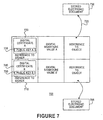
- FIG. 7 illustrates yet another embodiment 700 of an object-based digital signature in accordance with the invention.
- the digital certificate such as digital certificates 720 and 740, are included in stored electronic signals 710 instead of being referenced electronically.
- FIG. 7 illustrates public key 735 corresponding to the private key employed to produce digital signature value A.
- FIG. 7 also illustrates public key 750 corresponding to the private key employed to produce digital signature value B.
- an object-based digital signature in accordance with the invention is not limited to this particular embodiment.
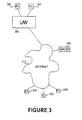
- FIG. 3 illustrates personal computers (PCs) 320, 330 and 340 coupled to the Internet 310.
- PCs Local Area Network
- LAN Local Area Network
- server 350 are coupled to the Internet and PCs 355 and 365 are coupled to LAN 360.
- a computing platform may include an electronic storage medium including machine-readable computer code resident thereon that is adapted so that during execution of the computer code electronic signals are produced that electronically reference at least one plurality of electronic signals with a digital signature stored remotely from the plurality.
- the digital signature may comprise electronic signals representing the encrypted cryptographic hash value of the electronically referenced at least one plurality of electronic signals.
- the PC's illustrated in FIG. 3 comprise such a platform, although the invention is not limited in scope in this respect.
- the electronic storage medium in this particular embodiment is coupled to an execution unit, such as a microprocessor, via a system bus.
- an execution unit such as a microprocessor
- the machine-readable computer code resident on the PC's in FIG. 3 may be further adapted to include additional aspects of an object-based digital signature in accordance with the present invention discussed in connection with previously described embodiments.
- such code would include the capability to reference other pluralities of electronic signals, perform indirect referencing, reference a digital certificate, and the capability to reference electronic signals stored in physically distributed storage media coupled at least in part via the Internet or LAN 360, to name a few examples.
- an embodiment in accordance with the invention may be applied to a document comprised entirely of hypertext links.
- the digital signature value may be obtained by encrypting all the files referenced by the document comprised of hypertext links in the order in the document comprised of hypertext links.
Landscapes
- Engineering & Computer Science (AREA)
- Computer Security & Cryptography (AREA)
- Computer Networks & Wireless Communication (AREA)
- Signal Processing (AREA)
- Storage Device Security (AREA)
- Computer And Data Communications (AREA)
Claims (10)
- Verfahren zur Verwendung einer digitalen Signatur (110), wobei das Verfahren folgendes umfasst:dadurch gekennzeichnet, dass die elektronische Bezugnahme zwischen mindestens einer Mehrzahl von elektronischen Signalen und einer entfernt von der Mehrzahl gespeicherten digitalen Signatur folgendes umfasst:elektronische Bezugnahme (125) zwischen mindestens einer Mehrzahl von elektronischen Signalen und einer entfernt von der Mehrzahl (130) gespeicherten digitalen Signatur;wobei mindestens eine der entsprechenden digitalen Signaturen eine Bezugnahme zwischen einer entfernt gespeicherten anderen Bezugnahme und der mindestens einen Mehrzahl und anderen Mehrzahl gespeicherter elektronischer Signale herstellt.die weitere elektronische Bezugnahme zwischen anderen Mehrzahlen gespeicherter elektronischer Signale mit entsprechenden anderen digitalen Signaturen, die entfernt von den anderen Mehrzahlen gespeichert sind; und wobei die entsprechenden digitalen Signaturen folgendes umfassen:elektronische Signale, die den verschlüsselten kryptografischen Hash-Wert der entsprechenden Mehrzahl elektronischer Signale mit elektronischer Bezugnahme darstellen; und
- Verfahren nach Anspruch 1, wobei eine oder mehrere Mehrzahlen elektronischer Signale ein digitales Zertifikat (120) darstellen.
- Verfahren nach Anspruch 2, wobei das digitale Zertifikat gespeicherte elektrische Signale aufweist, die mindestens einen öffentlichen Schlüssel (122) darstellen, der dem privaten Schlüssel entspricht, der zur Erzeugung der genannten digitalen Signatur verwendet wird.
- Verfahren nach Anspruch 1, wobei die Mehrzahlen in physisch verteilten Speichermedien gespeichert werden.
- Verfahren nach Anspruch 4, wobei die physisch verteilten Speichermedien zumindest teilweise über das Internet (310) verbunden sind.
- Verfahren nach Anspruch 4, wobei die physisch verteilten Speichermedien zumindest teilweise über ein Local Area Network (LAN) verbunden sind.
- Verfahren nach Anspruch 1, wobei der Schritt der elektronischen Bezugnahme zwischen mindestens einer Mehrzahl gespeicherter elektronischer Signale die elektronische Bezugnahme zwischen der mindestens einen Mehrzahl durch elektronisches Zeigen auf einen elektronischen Zeiger umfasst, der auf die mindestens eine Mehrzahl zeigt.
- Verfahren nach Anspruch 1, wobei die elektronische Bezugnahme für die mindestens eine Mehrzahl indirekt erfolgt.
- Plattform, die folgendes umfasst: ein elektronisches Speichermedium mit einem sich darin befindenden maschinenlesbaren Computercode (365), wobei der genannte maschinenlesbare Computercode während der Ausführung eine erste Mehrzahl elektronischer Signale erzeugen kann, die eine elektronische Bezugnahme zwischen mindestens einer anderen Mehrzahl elektronischer Signale und einer entfernt von der ersten Mehrzahl gespeicherten digitalen Signatur herstellen, dadurch gekennzeichnet, dass die digitale Signatur elektronische Signale umfasst, die den verschlüsselten kryptografischen Hash-Wert der mindestens einen anderen Mehrzahl elektronischer Signale mit elektronischer Bezugnahme darstellen, und wobei der maschinenlesbare Code ferner während der Ausführung elektronische Signale erzeugen kann, die eine Bezugnahme mit anderen Mehrzahlen elektronischer Signale herstellen; und wobei mindestens ein Teil der mindestens einen anderen Mehrzahl und andere Mehrzahlen mindestens eine weitere Bezugnahme auf andere entfernt gespeicherte elektronische Signale umfassen.
- Netzwerk, das folgendes umfasst: eine Mehrzahl verbundener Rechenplattformen (320-355), wobei jede der genannten Rechenplattformen ein elektronisches Speichermedium aufweist; wobei mindestens eine Plattform eine erste Mehrzahl elektronischer Signale aufweist, die eine elektronische Bezugnahme zwischen mindestens einer anderen Mehrzahl elektronischer Signale und einer entfernt von der ersten Mehrzahl gespeicherten digitalen Signatur herstellen, dadurch gekennzeichnet, dass die digitale Signatur elektronische Signale umfasst, die den verschlüsselten kryptografischen Hash-Wert der mindestens einen anderen Mehrzahl elektronischer Signale mit elektronischer Bezugnahme darstellen, die eine Bezugnahme mit anderen Mehrzahlen elektronischer Signale vorsehen; und
wobei mindestens ein Teil der mindestens einen anderen Mehrzahl und andere Mehrzahlen mindestens eine andere Bezugnahme auf andere entfernt gespeicherte elektronische Signale umfassen.
Applications Claiming Priority (3)
| Application Number | Priority Date | Filing Date | Title |
|---|---|---|---|
| US742981 | 1996-11-01 | ||
| US08/742,981 US6253323B1 (en) | 1996-11-01 | 1996-11-01 | Object-based digital signatures |
| PCT/US1997/017566 WO1998020644A1 (en) | 1996-11-01 | 1997-09-29 | Object-based digital signatures |
Publications (3)
| Publication Number | Publication Date |
|---|---|
| EP0938792A1 EP0938792A1 (de) | 1999-09-01 |
| EP0938792A4 EP0938792A4 (de) | 2001-08-29 |
| EP0938792B1 true EP0938792B1 (de) | 2004-05-06 |
Family
ID=24987032
Family Applications (1)
| Application Number | Title | Priority Date | Filing Date |
|---|---|---|---|
| EP97945363A Expired - Lifetime EP0938792B1 (de) | 1996-11-01 | 1997-09-29 | Objektorientierte digitale unterschriften |
Country Status (5)
| Country | Link |
|---|---|
| US (1) | US6253323B1 (de) |
| EP (1) | EP0938792B1 (de) |
| AU (1) | AU4658597A (de) |
| DE (1) | DE69728991T2 (de) |
| WO (1) | WO1998020644A1 (de) |
Families Citing this family (46)
| Publication number | Priority date | Publication date | Assignee | Title |
|---|---|---|---|---|
| US8079086B1 (en) | 1997-11-06 | 2011-12-13 | Finjan, Inc. | Malicious mobile code runtime monitoring system and methods |
| US7058822B2 (en) | 2000-03-30 | 2006-06-06 | Finjan Software, Ltd. | Malicious mobile code runtime monitoring system and methods |
| US9219755B2 (en) | 1996-11-08 | 2015-12-22 | Finjan, Inc. | Malicious mobile code runtime monitoring system and methods |
| US7000179B2 (en) * | 1999-03-27 | 2006-02-14 | Movaris, Inc. | Method and apparatus for programmatic learned routing in an electronic form system |
| US6704906B1 (en) * | 1999-03-27 | 2004-03-09 | Movaris, Inc. | Self-directed routable electronic form system and method |
| US6611817B1 (en) | 1999-06-17 | 2003-08-26 | International Business Machines Corporation | Automated technique for code generation of datastream mappings |
| US6981155B1 (en) * | 1999-07-14 | 2005-12-27 | Symantec Corporation | System and method for computer security |
| US7117532B1 (en) * | 1999-07-14 | 2006-10-03 | Symantec Corporation | System and method for generating fictitious content for a computer |
| US7461402B1 (en) * | 1999-07-14 | 2008-12-02 | Symantec Corporation | System and method for preventing detection of a selected process running on a computer |
| US6393025B1 (en) * | 1999-08-09 | 2002-05-21 | Lucent Technologies Inc. | Time-sensitive packet processor for an ATM switch |
| US6959382B1 (en) | 1999-08-16 | 2005-10-25 | Accela, Inc. | Digital signature service |
| US7203962B1 (en) * | 1999-08-30 | 2007-04-10 | Symantec Corporation | System and method for using timestamps to detect attacks |
| US6898707B1 (en) | 1999-11-30 | 2005-05-24 | Accela, Inc. | Integrating a digital signature service into a database |
| US20020026584A1 (en) * | 2000-06-05 | 2002-02-28 | Janez Skubic | Method for signing documents using a PC and a personal terminal device |
| US7215771B1 (en) | 2000-06-30 | 2007-05-08 | Western Digital Ventures, Inc. | Secure disk drive comprising a secure drive key and a drive ID for implementing secure communication over a public network |
| US7155616B1 (en) | 2000-07-31 | 2006-12-26 | Western Digital Ventures, Inc. | Computer network comprising network authentication facilities implemented in a disk drive |
| US7003674B1 (en) | 2000-07-31 | 2006-02-21 | Western Digital Ventures, Inc. | Disk drive employing a disk with a pristine area for storing encrypted data accessible only by trusted devices or clients to facilitate secure network communications |
| US7366896B1 (en) * | 2000-08-29 | 2008-04-29 | Microsoft Corporation | Systems and methods for limiting access to potentially dangerous code |
| US7032114B1 (en) * | 2000-08-30 | 2006-04-18 | Symantec Corporation | System and method for using signatures to detect computer intrusions |
| US7210037B2 (en) * | 2000-12-15 | 2007-04-24 | Oracle International Corp. | Method and apparatus for delegating digital signatures to a signature server |
| US20070283288A1 (en) * | 2000-12-27 | 2007-12-06 | Tractmanager, Inc. | Document management system having bookmarking functionality |
| US10114821B2 (en) * | 2000-12-27 | 2018-10-30 | Tractmanager, Inc. | Method and system to access to electronic business documents |
| US6957384B2 (en) | 2000-12-27 | 2005-10-18 | Tractmanager, Llc | Document management system |
| US20110029584A1 (en) * | 2001-02-08 | 2011-02-03 | The Boeing Company | Apparatus, method and computer program product for transferring an electronic file |
| US20020144120A1 (en) * | 2001-03-28 | 2002-10-03 | Ramanathan Ramanathan | Method and apparatus for constructing digital certificates |
| US20020144110A1 (en) * | 2001-03-28 | 2002-10-03 | Ramanathan Ramanathan | Method and apparatus for constructing digital certificates |
| US7487354B2 (en) * | 2001-05-18 | 2009-02-03 | Microsoft Corporation | Methods and systems for using digital signatures in uniform resource locators |
| US7137004B2 (en) * | 2001-11-16 | 2006-11-14 | Microsoft Corporation | Manifest-based trusted agent management in a trusted operating system environment |
| US6938014B1 (en) * | 2002-01-16 | 2005-08-30 | Sterling Commerce, Inc. | Non-repudiable translation of electronic documents |
| WO2003060637A2 (en) * | 2001-12-21 | 2003-07-24 | Aristotle International, Inc. | Identification verification system and method |
| US7698230B1 (en) * | 2002-02-15 | 2010-04-13 | ContractPal, Inc. | Transaction architecture utilizing transaction policy statements |
| US7295677B2 (en) * | 2002-03-01 | 2007-11-13 | Hewlett-Packard Development Company, L.P. | Systems and methods for adding watermarks using network-based imaging techniques |
| EP1343286A1 (de) * | 2002-03-04 | 2003-09-10 | BRITISH TELECOMMUNICATIONS public limited company | Leichtgewichtige Authentisierung von Information |
| US7103835B1 (en) | 2002-03-12 | 2006-09-05 | Movaris, Inc. | Process builder for a routable electronic document system and method for using the same |
| US20040006701A1 (en) * | 2002-04-13 | 2004-01-08 | Advanced Decisions Inc. | Method and apparatus for authentication of recorded audio |
| US20030217280A1 (en) * | 2002-05-17 | 2003-11-20 | Keaton Thomas S. | Software watermarking for anti-tamper protection |
| US7370206B1 (en) * | 2003-09-04 | 2008-05-06 | Adobe Systems Incorporated | Self-signing electronic documents |
| US7451321B2 (en) * | 2003-10-07 | 2008-11-11 | Joseph Ernest Dryer | Electronic signature management method |
| US8312509B2 (en) * | 2006-09-21 | 2012-11-13 | Intel Corporation | High integrity firmware |
| US8621222B1 (en) | 2008-05-30 | 2013-12-31 | Adobe Systems Incorporated | Archiving electronic content having digital signatures |
| US8464249B1 (en) | 2009-09-17 | 2013-06-11 | Adobe Systems Incorporated | Software installation package with digital signatures |
| US9397835B1 (en) | 2014-05-21 | 2016-07-19 | Amazon Technologies, Inc. | Web of trust management in a distributed system |
| US9866392B1 (en) * | 2014-09-15 | 2018-01-09 | Amazon Technologies, Inc. | Distributed system web of trust provisioning |
| US10469477B2 (en) | 2015-03-31 | 2019-11-05 | Amazon Technologies, Inc. | Key export techniques |
| WO2017117357A1 (en) * | 2015-12-30 | 2017-07-06 | Xiaolin Zhang | System and method for data security |
| US11888759B2 (en) | 2021-06-23 | 2024-01-30 | Bank Of America Corporation | System for executing digital resource transfer using trusted computing |
Family Cites Families (38)
| Publication number | Priority date | Publication date | Assignee | Title |
|---|---|---|---|---|
| US4200770A (en) | 1977-09-06 | 1980-04-29 | Stanford University | Cryptographic apparatus and method |
| US4218582A (en) | 1977-10-06 | 1980-08-19 | The Board Of Trustees Of The Leland Stanford Junior University | Public key cryptographic apparatus and method |
| US4405829A (en) | 1977-12-14 | 1983-09-20 | Massachusetts Institute Of Technology | Cryptographic communications system and method |
| US4424414A (en) | 1978-05-01 | 1984-01-03 | Board Of Trustees Of The Leland Stanford Junior University | Exponentiation cryptographic apparatus and method |
| US4387427A (en) | 1978-12-21 | 1983-06-07 | Intel Corporation | Hardware scheduler/dispatcher for data processing system |
| US4325120A (en) | 1978-12-21 | 1982-04-13 | Intel Corporation | Data processing system |
| US4402046A (en) | 1978-12-21 | 1983-08-30 | Intel Corporation | Interprocessor communication system |
| US4315310A (en) | 1979-09-28 | 1982-02-09 | Intel Corporation | Input/output data processing system |
| US4829425A (en) | 1986-10-21 | 1989-05-09 | Intel Corporation | Memory-based interagent communication mechanism |
| US4803622A (en) | 1987-05-07 | 1989-02-07 | Intel Corporation | Programmable I/O sequencer for use in an I/O processor |
| US5005200A (en) * | 1988-02-12 | 1991-04-02 | Fischer Addison M | Public key/signature cryptosystem with enhanced digital signature certification |
| EP0383985A1 (de) | 1989-02-24 | 1990-08-29 | Claus Peter Prof. Dr. Schnorr | Verfahren zur Identifikation von Teilnehmern sowie zur Generierung und Verifikation von elektronischen Unterschriften in einem Datenaustauschsystem |
| US5136643A (en) * | 1989-10-13 | 1992-08-04 | Fischer Addison M | Public/key date-time notary facility |
| US5136646A (en) * | 1991-03-08 | 1992-08-04 | Bell Communications Research, Inc. | Digital document time-stamping with catenate certificate |
| US5224163A (en) * | 1990-09-28 | 1993-06-29 | Digital Equipment Corporation | Method for delegating authorization from one entity to another through the use of session encryption keys |
| AU662805B2 (en) * | 1992-04-06 | 1995-09-14 | Addison M. Fischer | A method for processing information among computers which may exchange messages |
| DE4234165C1 (de) * | 1992-10-09 | 1994-03-03 | Detecon Gmbh | Verfahren zur Ermöglichung der nachträglichen Überprüfung bereits übermittelter Daten |
| US5367573A (en) * | 1993-07-02 | 1994-11-22 | Digital Equipment Corporation | Signature data object |
| US5535276A (en) * | 1994-11-09 | 1996-07-09 | Bell Atlantic Network Services, Inc. | Yaksha, an improved system and method for securing communications using split private key asymmetric cryptography |
| US5634043A (en) | 1994-08-25 | 1997-05-27 | Intel Corporation | Microprocessor point-to-point communication |
| US5663896A (en) | 1994-09-22 | 1997-09-02 | Intel Corporation | Broadcast key distribution apparatus and method using Chinese Remainder |
| US5621798A (en) | 1995-04-18 | 1997-04-15 | Intel Corporation | Method and apparatus for cooperative messaging |
| US5896533A (en) | 1995-07-06 | 1999-04-20 | Intel Corporation | Accessing internets world-wide web through object linking and embedding technology |
| US5757915A (en) | 1995-08-25 | 1998-05-26 | Intel Corporation | Parameterized hash functions for access control |
| US5701464A (en) | 1995-09-15 | 1997-12-23 | Intel Corporation | Parameterized bloom filters |
| US6134551A (en) | 1995-09-15 | 2000-10-17 | Intel Corporation | Method of caching digital certificate revocation lists |
| US5663553A (en) | 1995-09-27 | 1997-09-02 | Intel Corporation | Mass storage device adapter for smart cards |
| US5712914A (en) | 1995-09-29 | 1998-01-27 | Intel Corporation | Digital certificates containing multimedia data extensions |
| US5754658A (en) | 1996-04-19 | 1998-05-19 | Intel Corporation | Adaptive encryption to avoid processor oversaturation |
| US6178509B1 (en) | 1996-06-13 | 2001-01-23 | Intel Corporation | Tamper resistant methods and apparatus |
| US5892899A (en) | 1996-06-13 | 1999-04-06 | Intel Corporation | Tamper resistant methods and apparatus |
| US6205550B1 (en) | 1996-06-13 | 2001-03-20 | Intel Corporation | Tamper resistant methods and apparatus |
| US5915018A (en) | 1996-11-05 | 1999-06-22 | Intel Corporation | Key management system for DVD copyright management |
| US6021491A (en) * | 1996-11-27 | 2000-02-01 | Sun Microsystems, Inc. | Digital signatures for data streams and data archives |
| US5933502A (en) | 1996-12-20 | 1999-08-03 | Intel Corporation | Method and apparatus for enhancing the integrity of visual authentication |
| US5991403A (en) | 1996-12-23 | 1999-11-23 | Intel Corporation | Recoverable cryptographic transformation on YUV data suitable for compressions |
| US5949877A (en) | 1997-01-30 | 1999-09-07 | Intel Corporation | Content protection for transmission systems |
| US6041122A (en) | 1998-02-27 | 2000-03-21 | Intel Corporation | Method and apparatus for hiding crytographic keys utilizing autocorrelation timing encoding and computation |
-
1996
- 1996-11-01 US US08/742,981 patent/US6253323B1/en not_active Expired - Lifetime
-
1997
- 1997-09-29 WO PCT/US1997/017566 patent/WO1998020644A1/en not_active Ceased
- 1997-09-29 AU AU46585/97A patent/AU4658597A/en not_active Abandoned
- 1997-09-29 DE DE69728991T patent/DE69728991T2/de not_active Expired - Lifetime
- 1997-09-29 EP EP97945363A patent/EP0938792B1/de not_active Expired - Lifetime
Also Published As
| Publication number | Publication date |
|---|---|
| WO1998020644A1 (en) | 1998-05-14 |
| US6253323B1 (en) | 2001-06-26 |
| EP0938792A1 (de) | 1999-09-01 |
| AU4658597A (en) | 1998-05-29 |
| DE69728991T2 (de) | 2005-04-14 |
| EP0938792A4 (de) | 2001-08-29 |
| DE69728991D1 (de) | 2004-06-09 |
Similar Documents
| Publication | Publication Date | Title |
|---|---|---|
| EP0938792B1 (de) | Objektorientierte digitale unterschriften | |
| US5892904A (en) | Code certification for network transmission | |
| KR100268095B1 (ko) | 데이터통신시스템 | |
| US6367012B1 (en) | Embedding certifications in executable files for network transmission | |
| US6725373B2 (en) | Method and apparatus for verifying the integrity of digital objects using signed manifests | |
| US7069440B2 (en) | Technique for obtaining a single sign-on certificate from a foreign PKI system using an existing strong authentication PKI system | |
| CN100410833C (zh) | 用于将证书链接到签名文件的方法和系统 | |
| JP4681554B2 (ja) | 安全な移動体通信及び高価な取引の実行に対しランタイムパッケージ署名において信頼性の高いハードウェアベースのアイデンティティ信任状を使用する方法 | |
| US6430688B1 (en) | Architecture for web-based on-line-off-line digital certificate authority | |
| EP1307863B1 (de) | Digitale transaktionsquittung | |
| US6854056B1 (en) | Method and system for coupling an X.509 digital certificate with a host identity | |
| US7356690B2 (en) | Method and system for managing a distributed trust path locator for public key certificates relating to the trust path of an X.509 attribute certificate | |
| US20020124172A1 (en) | Method and apparatus for signing and validating web pages | |
| US20050228999A1 (en) | Audit records for digitally signed documents | |
| KR19980042805A (ko) | 자료파일내 자료가 진짜임을 검증하기 위한 방법, 장치 및 프로덕트 | |
| JP2001518269A (ja) | 電子暗号パッキング | |
| US20080270788A1 (en) | Extension of x.509 certificates to simultaneously support multiple cryptographic algorithms | |
| CN1297094C (zh) | 不可转让的匿名数字收据 | |
| WO2003003329A1 (en) | Data originality validating method and system | |
| US20040133783A1 (en) | Method for non repudiation using cryptographic signatures in small devices | |
| CN113128245B (zh) | 一种企业链码的生成与管理方法 | |
| KR20030023117A (ko) | 공개키 기반의 무선단문메시지 보안 및 인증방법 | |
| Sirisawatdiwat | Using of security protocols | |
| MXPA00006914A (en) | System and method for authenticating peer components |
Legal Events
| Date | Code | Title | Description |
|---|---|---|---|
| PUAI | Public reference made under article 153(3) epc to a published international application that has entered the european phase |
Free format text: ORIGINAL CODE: 0009012 |
|
| 17P | Request for examination filed |
Effective date: 19990527 |
|
| AK | Designated contracting states |
Kind code of ref document: A1 Designated state(s): DE FR GB IT |
|
| A4 | Supplementary search report drawn up and despatched |
Effective date: 20010712 |
|
| AK | Designated contracting states |
Kind code of ref document: A4 Designated state(s): DE FR GB IT |
|
| RIC1 | Information provided on ipc code assigned before grant |
Free format text: 7H 04L 9/30 A, 7H 04L 9/32 B |
|
| 17Q | First examination report despatched |
Effective date: 20020220 |
|
| GRAP | Despatch of communication of intention to grant a patent |
Free format text: ORIGINAL CODE: EPIDOSNIGR1 |
|
| GRAS | Grant fee paid |
Free format text: ORIGINAL CODE: EPIDOSNIGR3 |
|
| GRAA | (expected) grant |
Free format text: ORIGINAL CODE: 0009210 |
|
| AK | Designated contracting states |
Kind code of ref document: B1 Designated state(s): DE FR GB IT |
|
| PG25 | Lapsed in a contracting state [announced via postgrant information from national office to epo] |
Ref country code: IT Free format text: LAPSE BECAUSE OF FAILURE TO SUBMIT A TRANSLATION OF THE DESCRIPTION OR TO PAY THE FEE WITHIN THE PRESCRIBED TIME-LIMIT;WARNING: LAPSES OF ITALIAN PATENTS WITH EFFECTIVE DATE BEFORE 2007 MAY HAVE OCCURRED AT ANY TIME BEFORE 2007. THE CORRECT EFFECTIVE DATE MAY BE DIFFERENT FROM THE ONE RECORDED. Effective date: 20040506 |
|
| REG | Reference to a national code |
Ref country code: GB Ref legal event code: FG4D |
|
| REF | Corresponds to: |
Ref document number: 69728991 Country of ref document: DE Date of ref document: 20040609 Kind code of ref document: P |
|
| ET | Fr: translation filed | ||
| PLBE | No opposition filed within time limit |
Free format text: ORIGINAL CODE: 0009261 |
|
| STAA | Information on the status of an ep patent application or granted ep patent |
Free format text: STATUS: NO OPPOSITION FILED WITHIN TIME LIMIT |
|
| 26N | No opposition filed |
Effective date: 20050208 |
|
| PGFP | Annual fee paid to national office [announced via postgrant information from national office to epo] |
Ref country code: FR Payment date: 20070917 Year of fee payment: 11 |
|
| REG | Reference to a national code |
Ref country code: FR Ref legal event code: ST Effective date: 20090529 |
|
| PG25 | Lapsed in a contracting state [announced via postgrant information from national office to epo] |
Ref country code: FR Free format text: LAPSE BECAUSE OF NON-PAYMENT OF DUE FEES Effective date: 20080930 |
|
| PGFP | Annual fee paid to national office [announced via postgrant information from national office to epo] |
Ref country code: DE Payment date: 20090929 Year of fee payment: 13 |
|
| REG | Reference to a national code |
Ref country code: DE Ref legal event code: R119 Ref document number: 69728991 Country of ref document: DE Effective date: 20110401 |
|
| PG25 | Lapsed in a contracting state [announced via postgrant information from national office to epo] |
Ref country code: DE Free format text: LAPSE BECAUSE OF NON-PAYMENT OF DUE FEES Effective date: 20110401 |
|
| PGFP | Annual fee paid to national office [announced via postgrant information from national office to epo] |
Ref country code: GB Payment date: 20140924 Year of fee payment: 18 |
|
| GBPC | Gb: european patent ceased through non-payment of renewal fee |
Effective date: 20150929 |
|
| PG25 | Lapsed in a contracting state [announced via postgrant information from national office to epo] |
Ref country code: GB Free format text: LAPSE BECAUSE OF NON-PAYMENT OF DUE FEES Effective date: 20150929 |