EP0938572B1 - Promoter from tobacco - Google Patents
Promoter from tobacco Download PDFInfo
- Publication number
- EP0938572B1 EP0938572B1 EP97900916A EP97900916A EP0938572B1 EP 0938572 B1 EP0938572 B1 EP 0938572B1 EP 97900916 A EP97900916 A EP 97900916A EP 97900916 A EP97900916 A EP 97900916A EP 0938572 B1 EP0938572 B1 EP 0938572B1
- Authority
- EP
- European Patent Office
- Prior art keywords
- promoter
- dna
- chimeric gene
- gene construct
- plant
- Prior art date
- Legal status (The legal status is an assumption and is not a legal conclusion. Google has not performed a legal analysis and makes no representation as to the accuracy of the status listed.)
- Expired - Lifetime
Links
Images


Classifications
-
- C—CHEMISTRY; METALLURGY
- C12—BIOCHEMISTRY; BEER; SPIRITS; WINE; VINEGAR; MICROBIOLOGY; ENZYMOLOGY; MUTATION OR GENETIC ENGINEERING
- C12N—MICROORGANISMS OR ENZYMES; COMPOSITIONS THEREOF; PROPAGATING, PRESERVING, OR MAINTAINING MICROORGANISMS; MUTATION OR GENETIC ENGINEERING; CULTURE MEDIA
- C12N15/00—Mutation or genetic engineering; DNA or RNA concerning genetic engineering, vectors, e.g. plasmids, or their isolation, preparation or purification; Use of hosts therefor
- C12N15/09—Recombinant DNA-technology
- C12N15/63—Introduction of foreign genetic material using vectors; Vectors; Use of hosts therefor; Regulation of expression
- C12N15/79—Vectors or expression systems specially adapted for eukaryotic hosts
- C12N15/82—Vectors or expression systems specially adapted for eukaryotic hosts for plant cells, e.g. plant artificial chromosomes (PACs)
- C12N15/8216—Methods for controlling, regulating or enhancing expression of transgenes in plant cells
-
- C—CHEMISTRY; METALLURGY
- C07—ORGANIC CHEMISTRY
- C07K—PEPTIDES
- C07K14/00—Peptides having more than 20 amino acids; Gastrins; Somatostatins; Melanotropins; Derivatives thereof
- C07K14/415—Peptides having more than 20 amino acids; Gastrins; Somatostatins; Melanotropins; Derivatives thereof from plants
Definitions
- the present invention relates to a promoter identified from Nicotiana tabacum (tobacco). This invention further relates to the use of said promoter to control the expression of exogenous DNAs of interest in transgenic plants of diverse plant species.
- T-DNA DNA
- a reporter gene devoid of cis -acting transcriptional and translational expression signals
- T-DNA-mediated gene fusions consist of unknown and thus un-characterized plant promoters residing at their natural location within the chromosome, and the coding sequence of a marker gene located on the inserted T-DNA (Fobert et al ., 1991, Plant Mol. Biol. 17, 837-851).
- the present invention is directed to a promoter identified from Nicotiana tabacum (tobacco).
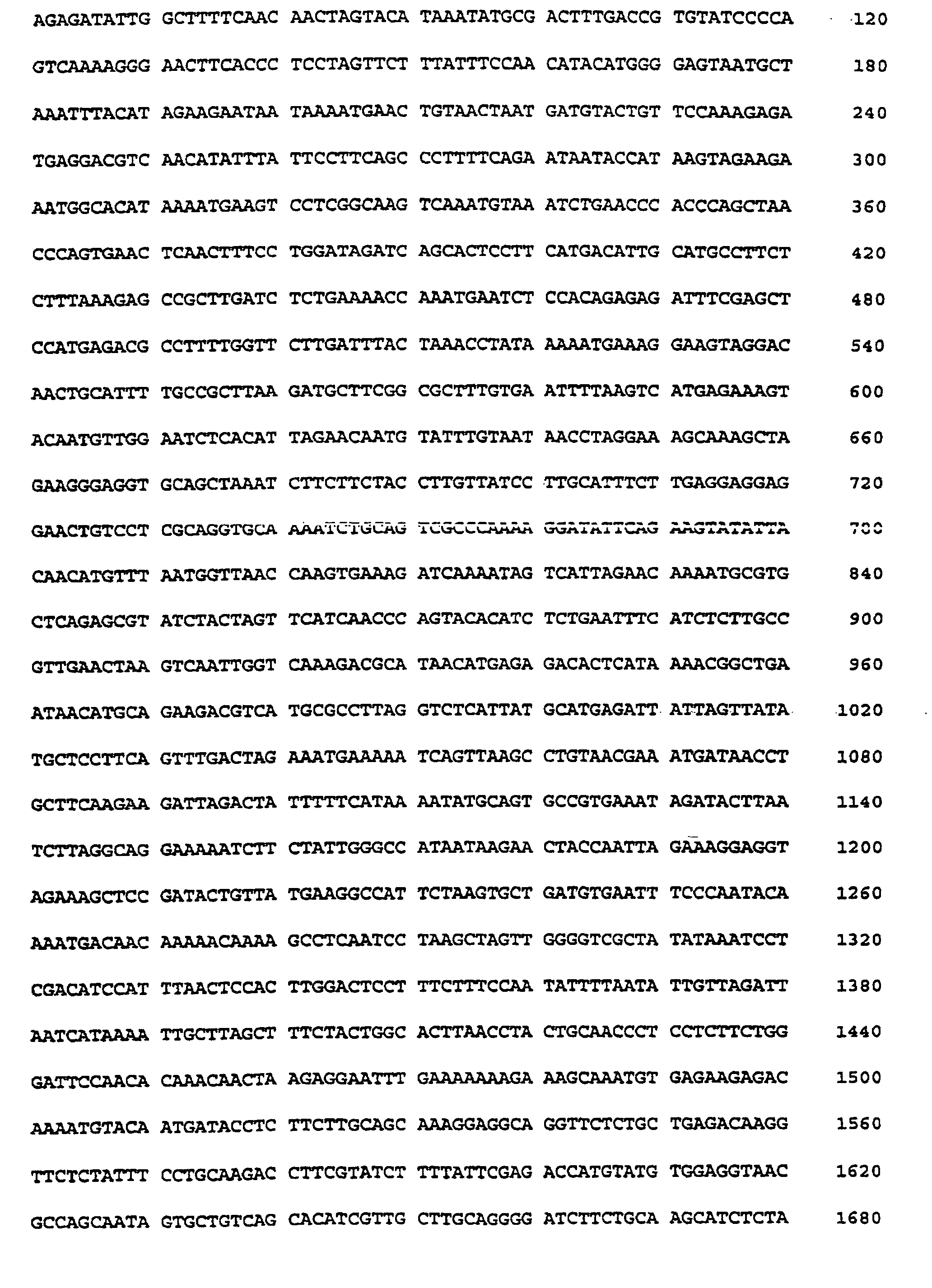
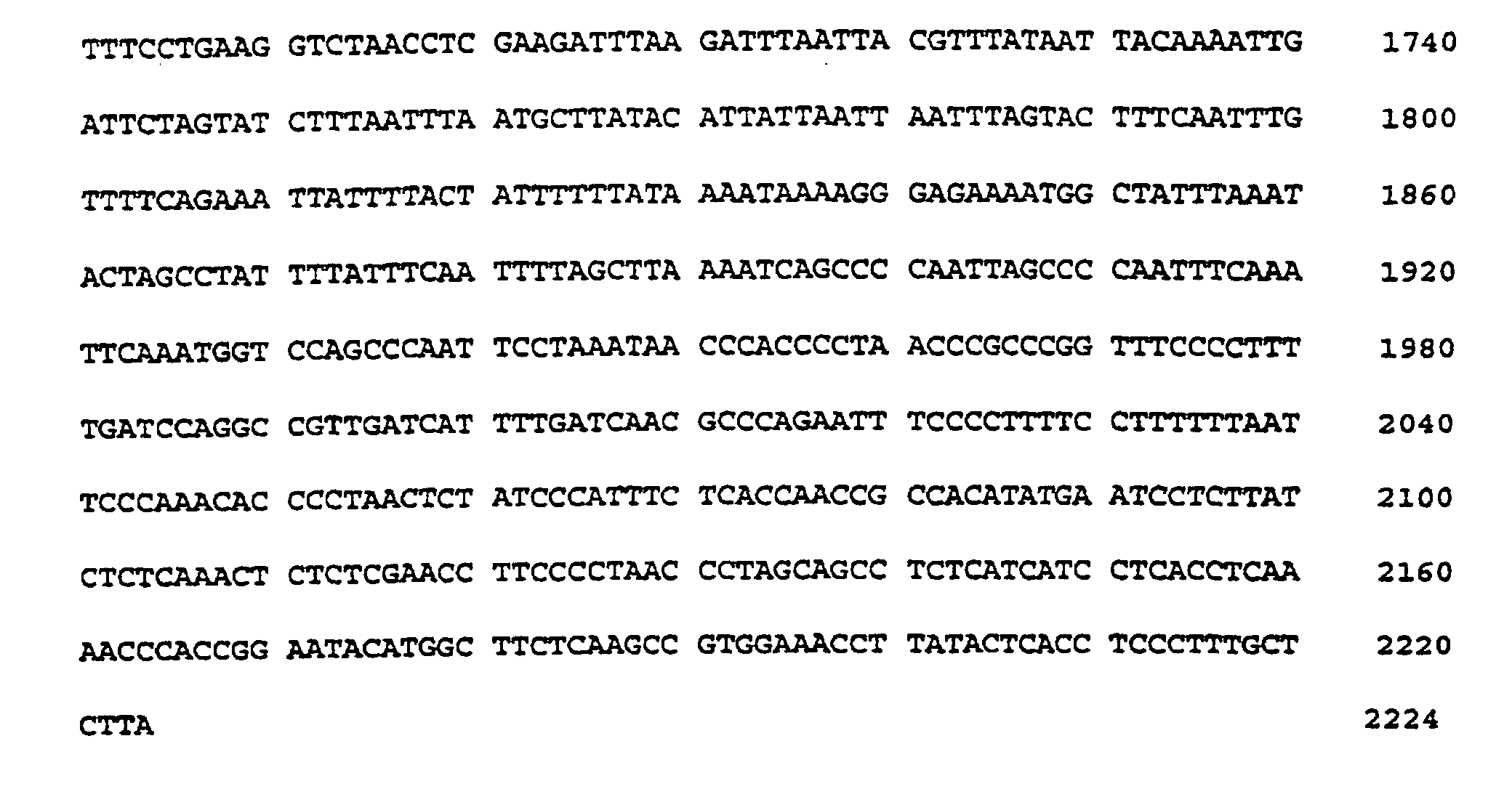
- the transgenic tobacco plant, T1275 contained a 4.38 kb Eco RI/ Xba I fragment containing the 2.15 kb promoterless GUS-nos gene and 2.23 kb of 5' flanking tobacco DNA (2225 bp). This 5' flanking DNA showed no homology to known sequences.
- this invention embraces a promoter characterized in that it comprises at least an 18 bp contiguous sequence of SEQ ID NO:1.
- the promoter could not be detected in soybean, potato, sunflower, Arabidopsis, B. napus, B. oleracea, corn, wheat or black spruce by Southern blot analysis.
- Expression of the cloned fragment in transgenic tobacco, N. tabacum c.v. Petit Havana, SRI and transgenic B. napus c.v. Westar was observed in leaf, stem, root, developing seed and flower.
- GUS activity was also observed in leaf tissue of soybean, alfalfa, Arabidopsis, tobacco, B. napus, pea and suspension cultured cells of oat, com, wheat and barley.
- this invention also provides for a promoter that is a constitutive promoter. Furthermore, this promoter functions in diverse plant species when introduced on a cloning vector.
- the present invention also embraces a constitutive promoter having a DNA sequence, substantially homologous to SEQ ID NO: 1.
- the transcription start site for the introduced GUS gene in transgenic tobacco was located in the plant DNA upstream of the insertion site. It was the same in leaf, stem, root, seeds and flower. Furthermore, the native site was silent in both untransformed and transgenic tobacco.
- a constitutive promoter from tobacco that is cryptic, and that functions in diverse plant species when introduced in a cloning vector.
- This invention also relates to a chimeric gene construct comprising a DNA of interest for which constitutive expression is desired, and a constitutive promoter, comprising at least an 18 bp contiguous sequence of SEQ ID NO: 1.
- This invention further relates to a cloning vector containing said chimeric gene construct.
- This invention also includes a plant cell which has been transformed with said chimeric gene, or said cloning vector. Furthermore, this invention embraces transgenic plants containing said chimeric gene, or said cloning vector.
- This invention further relates to any transgenic plant containing a constitutive promoter, having a DNA sequence substantially homologous to SEQ ID NO: 1, operatively linked to a DNA region that is transcribed into RNA.
- Also included in the present invention is a method of conferring constitutive expression of a gene in a plant, comprising: operatively linking an exogenous DNA of interest, for which constitutive expression is desired, with a constitutive promoter comprising at least an 18 bp contiguous sequence of SEQ ID NO:1, to produce a chimeric gene construct and introducing the chimeric gene construct into a plant capable of expressing the chimeric gene construct.
- the present invention relates to plant gene regulatory sequences. Specifically this invention relates to a promoter, identified by T-DNA tagging with a promoterless ⁇ -glucuronidase gene ( GUS ) to generate a transgenic N. tabacum plant that expresses GUS activity constitutively.
- GUS promoterless ⁇ -glucuronidase gene
- This invention is also directed to a promoter that comprises a nucleotide sequence of at least 18 contiguous base pairs of SEQ ID NO:1.
- Oligonucleotides of 18 bp or more are useful in constructing heterologous promoters that comprise fragments of the promoter as defined in SEQ ID NO:1.
- the use of such heterologous promoters is well established in the literature. For example, fragments of specific elements within the 35S CaMV promoter have been duplicated or combined with other promoter fragments to produce chimeric promoters with desired properties (e.g. U.S. 5,491,288, 5,424,200, 5,322,938, 5,196,525, 5,164,316).
- oligonucleotides of 18 bps or longer are useful as probes or PCR primers in identifying or amplifying related DNA or RNA sequences in other tissues or organisms.
- promoter or “promoter region” refers to a sequence of DNA, usually upstream (5') to the coding sequence of a structural gene, which controls the expression of the coding region by providing the recognition for RNA polymerase and/or other factors required for transcription to start at a particular site.
- An inducible promoter is a promoter that is capable of directly or indirectly activating transcription of one or more DNA sequences or genes in response to an inducer. In the absence of an inducer the DNA sequences or genes will not be transcribed.
- the protein factor that binds specifically to an inducible promoter to activate transcription, is present in an inactive form which is then directly or indirectly converted to the active form by the inducer.
- the inducer can be a chemical agent such as a protein, metabolite, growth regulator, herbicide or phenolic compound or a physiological stress imposed directly by heat, cold, salt, or toxic elements or indirectly through the action of a pathogen or disease agent such as a virus.
- a plant cell containing an inducible promoter may be exposed to an inducer by externally applying the inducer to the cell or plant such as by spraying, watering, heating or similar methods.
- a constitutive promoter directs the expression of a gene throughout the various parts of a plant and continuously throughout plant development.
- Examples of known constitutive promoters include those associated with the CaMV 35S transcript. (Odell et al., 1985, Nature, 313: 810-812), the rice actin 1 (Zhang et al, 1991, Plant Cell, 3: 1155-1165) and triosephosphate isomerase 1 (Xu et al, 1994, Plant Physiol . 106 : 459-467) genes, the maize ubiquitin 1 gene (Cornejo et al, 1993, Plant Mol. Biol.
- the present invention is directed to a DNA sequence which contains a promoter capable of directing the expression of a gene.
- the promoter is a constitutive promoter isolated from N. tabacum.
- the present invention is further directed to a chimeric gene construct containing a DNA of interest operatively linked to the promoter of the present invention.
- Any exogenous gene can be used and manipulated according to the present invention to result in the expression of said exogenous gene.
- a DNA of interest may include, but is not limited to, a gene encoding a protein, a DNA that is transcribed to produce antisense RNA, or a transcript product that functions in some manner that mediates the expression of other DNAs, for example that results in the co-suppression of other DNAs or the like.
- the chimeric gene construct of the present invention can further comprise a 3' untranslated region.
- a 3' untranslated region refers to that portion of a gene comprising a DNA segment that contains a polyadenylation signal and any other regulatory signals capable of effecting mRNA processing or gene expression.
- the polyadenylation signal is usually characterized by effecting the addition of polyadenylic acid tracks to the 3' end of the mRNA precursor.
- Polyadenylation signals are commonly recognized by the presence of homology to the canonical form 5' AATAAA-3' although variations are not uncommon.
- suitable 3' regions are the 3' transcribed non-translated regions containing a polyadenylation signal of Agrobacterium tumor inducing (Ti) plasmid genes, such as the nopaline synthase ( Nos gene) and plant genes such as the soybean storage protein genes and the small subunit of the ribulose-1, 5-bisphosphate carboxylase (ssRUBISCO) gene.
- Ti Agrobacterium tumor inducing
- plasmid genes such as the nopaline synthase ( Nos gene) and plant genes such as the soybean storage protein genes and the small subunit of the ribulose-1, 5-bisphosphate carboxylase (ssRUBISCO) gene.
- the 3' untranslated region from the structural gene of the present construct can therefore be used to construct chimeric genes for expression in plants.
- the chimeric gene construct of the present invention can also include further enhancers, either translation or transcription enhancers, as may be required.
- enhancer regions are well known to persons skilled in the art, and can include the ATG initiation codon and adjacent sequences.
- the initiation codon must be in phase with the reading frame of the coding sequence to ensure translation of the entire sequence.
- the translation control signals and initiation codons can be from a variety of origins, both natural and synthetic.
- Translational initiation regions may be provided from the source of the transcriptional initiation region, or from the structural gene.
- the sequence can also be derived from the promoter selected to express the gene, and can be specifically modified so as to increase translation of the mRNA.
- constructs of this invention may be further manipulated to include plant selectable markers.
- Useful selectable markers include enzymes which provide for resistance to an antibiotic such as gentamycin, hygromycin, kanamycin, and the like.
- enzymes providing for production of a compound identifiable by colour change such as GUS ( ⁇ -glucuronidase), or luminescence, such as luciferase are useful.
- transgenic plants containing the chimeric gene construct comprising the promoter of the present invention are also considered part of this invention.
- Methods of regenerating whole plants from plant cells are known in the art, and the method of obtaining transformed and regenerated plants is not critical to this invention.
- transformed plant cells are cultured in an appropriate medium, which may contain selective agents such as antibiotics, where selectable markers are used to facilitate identification of transformed plant cells.
- an appropriate medium which may contain selective agents such as antibiotics, where selectable markers are used to facilitate identification of transformed plant cells.
- shoot formation can be encouraged by employing the appropriate plant hormones in accordance with known methods and the shoots transferred to rooting medium for regeneration of plants.
- the plants may then be used to establish repetitive generations, either from seeds or using vegetative propagation techniques.
- the constructs of the present invention can be introduced into plant cells using Ti plasmids, Ri plasmids, plant virus vectors, direct DNA transformation, micro-injection, electroporation, etc.
- Ti plasmids Ri plasmids
- plant virus vectors direct DNA transformation, micro-injection, electroporation, etc.
- the present invention further includes a suitable vector comprising the chimeric gene construct.
- sequences include within their scope sequences that are “substantially homologous” to said specific sequences. Sequences are “substantially homologous” when at least about 70%, preferably at least about 80% and most preferably at least about 90% of the nucleotides match over a defined length of the molecule. Sequences that are “substantially homologous” include any substitution, deletion, or addition within the sequence. DNA sequences that are substantially homologous can be identified in Southern hybridization experiments, for example under stringent hybridization conditions (see Maniatis et al., in Molecular Cloning (A Laboratory Manual), Cold Spring Harbor Laboratory (1982) p 387 to 389).
- sequences which are "functionally equivalent" to said specific sequences also include sequences which are "functionally equivalent" to said specific sequences.
- functionally equivalent sequences refer to sequences which although not identical to the specific sequences provide the same or substantially the same function.
- DNA sequences that are functionally equivalent include any substitution, deletion or addition within the sequence.
- functionally equivalent sequences will direct the expression of an exogenous gene constitutively.
- T1275 From the transgenic plants produced, one of these, T1275, was chosen for detailed study because of its high level and constitutive expression of GUS.
- Floral tissues were harvested at developmental stages 8-10 (Koltunow et al ., 1990, Plant Cell 2 , 1201-1224) from the original transgenic plants. Flowers were also tagged and developing seeds were collected from capsules at 10 and 20 dpa. In all cases, tissue was weighed, immediately frozen in liquid nitrogen, and stored at -80°C.
- Tissues analyzed by histological assay were at the same developmental stages as those listed above. Different hand-cut sections were analyzed for each organ. For each plant, histological assays were performed on at least two different occasions to ensure reproducibility. Except for floral organs, all tissues were assayed in phosphate buffer according to Jefferson (1987, Plant Mol. Biol. Rep. 5, 387-405), with 1 mM X-Gluc (Sigma) as substrate. Flowers were assayed in the same buffer containing 20% (v/v) methanol (Kosugi et al ., 1990, Plant Sci. 70, 133-140).
- FIG. 1 shows the constitutive expression of GUS by histochemical staining with X-Gluc of T1275, including leaf (a), stem (b), root (c), flower (d), ovary (e), embryos (f and g), and seed (h).
- the T-DNA contains a kanamycin resistance gene. Seeds from self-pollinated transgenic plants were surface-sterilized in 70% ethanol for 1 min and in undiluted Javex bleach (6% sodium hypochloride) for 25 min. Seeds were then washed several times with sterile distilled water, dried under laminar flow, and placed in Petri dishes containing MS0 medium supplemented with 100 ⁇ g/ml kanamycin as described in Miki et al . (1993, Methods in Plant Molecular Biology and Biotechnology, Eds., B.R. Glick and J.E. Tompson, CRC Press, Boca Raton, 67-88). At least 90 plantlets were counted for each transformant. The number of green (kanamycin-resistant) and bleached (kanamycin-sensitive) plantlets were counted after 4-6 weeks, and analyzed using the Chi 2 test at a significance level of P ⁇ 0.05.
- the T-DNA in the transgenic plant T1275 was analyzed using either a GUS gene coding region probe or a nptII gene coding region probe.
- Genomic DNA was isolated from freeze-dried leaves using the protocol of Sanders et al . (1987, Nucleic Acid Res. 15, 1543-1558). Ten micrograms of T1275 DNA was digested for several hours with Eco RI using the appropriate manufacturer-supplied buffer supplemented with 2.5 mM spermidine. After electrophoresis through a 0.8% TAE agarose gel, Southern blot analysis was conducted using standard protocols. As the T-DNA from the construct containing the constitutive promoter - GUS - nos construct contains only a single Eco RI recognition site the hybridizing fragments are composed of both T-DNA and flanking tobacco DNA sequences. The length of the fragment will vary depending on the location of the nearest Eco RI site.
- Genomic DNA was isolated from leaves according to Hattori et al . (1987, Anal. Biochem. 165, 70-74). Ten ⁇ g of T1275 total DNA was digested with Eco Rl and Xba l according to the manufacturer's instructions. The digested DNA was size-fractionated on a 0.7% agarose gel. The DNA fragments of about 4 to 6 kb were isolated from the gel using the Elu-Quick kit (Schleicher and Schuell) and ligated to lambdaGEM-2 arms previously digested with Eco RI and Xba I and phosphatase-treated.
- plaques were transferred to a nylon membrane (Hybond, Amersham) and screened with the 32 P-labelled 2kb GUS insert isolated form pBI121, essentially as described in Rutledge et al . (1991, Mol . Gen Genet. 229, 31-40). The positive clones were isolated.
- the Xba I- Eco RI fragment (see restriction map of Figure 4 and Figure 5) was isolated from the lambda phage and cloned into pTZ19R previously digested with Xba l and Eco RI and treated with intestinal calf phosphatase.
- the 4.2kb fragment containing about 2.2kb of the T1275 promoter fused to the GUS gene and the nos 3' was isolated by digesting pTZ-T1275 with Hin dIII and Eco RI.
- the isolated fragment was ligated into the pRD400 vector (Datla et al ., 1992, Gene , 211 :383-384) previously digested with Hin dIII and Eco RI and treated with calf intestinal phosphatase.
- Transfer of the binary vector to Agrobacterium tumefaciens and leaf disc transformation of N. tabacum SR1 were performed as described above. GUS activity was examined in several organs of many independent transgenic lines.
- Table 3 shows the GUS specific activities in one of these plants. It is expressed in leaf, stem, root, developing seeds and the floral organs, sepals, petals, anthers, pistils and ovaries at varying levels, confirming constitutive expression.
- Introduction of the same vector into B. napus also revealed expression of GUS activity in these organs (data not shown) indicating that constitutive expression was not specific to tobacco.
- Examination of GUS mRNA in the tobacco organs showed-that the transcription start sites was the same in each and the level of mRNA was similar except in flower buds where it was lower (Table 3).
- GUS Specific Activity and Relative RNA Levels in the Organs of Progeny of Transgenic Line T64 Organ Relative GUS RNA Levels in T64 Progeny (grey scale units)
- GUS Specific Activity (picomol/MU/min/mg protein) Transformed Tobacco
Landscapes
- Health & Medical Sciences (AREA)
- Life Sciences & Earth Sciences (AREA)
- Genetics & Genomics (AREA)
- Chemical & Material Sciences (AREA)
- Organic Chemistry (AREA)
- Engineering & Computer Science (AREA)
- Bioinformatics & Cheminformatics (AREA)
- Biochemistry (AREA)
- Biotechnology (AREA)
- General Engineering & Computer Science (AREA)
- Molecular Biology (AREA)
- General Health & Medical Sciences (AREA)
- Biomedical Technology (AREA)
- Biophysics (AREA)
- Wood Science & Technology (AREA)
- Zoology (AREA)
- Physics & Mathematics (AREA)
- Microbiology (AREA)
- Plant Pathology (AREA)
- Cell Biology (AREA)
- Botany (AREA)
- Gastroenterology & Hepatology (AREA)
- Medicinal Chemistry (AREA)
- Proteomics, Peptides & Aminoacids (AREA)
- Breeding Of Plants And Reproduction By Means Of Culturing (AREA)
- Micro-Organisms Or Cultivation Processes Thereof (AREA)
- Manufacture Of Tobacco Products (AREA)
Description
| Genetic Analysis of Transgenic Plant T1275 | ||||
| No. of Progeny Kmr | No. of Progeny Kms | Observed Ratio | Expected Ratio | Chi2 |
| 262 | 88 | 3:1 | 3:1 | 0 |
| Transient Expression of GUS Activity in Tissues of Diverse Plant Species | ||
| Tissue Source | Species | GUS Activity |
| Leaf | Soybean | +++ |
| Alfalfa | ++ | |
| Arabidopsis | + | |
| Leaf disc | Tobacco | ++ |
| B. napus | + | |
| Pea | + | |
| Cell Cultures | Oat | + |
| Corn | + | |
| Wheat | + | |
| Barley | ++ |
| GUS Specific Activity and Relative RNA Levels in the Organs of Progeny of Transgenic Line T64 | |||
| Organ | Relative GUS RNA Levels in T64 Progeny (grey scale units) | GUS Specific Activity (picomol/MU/min/mg protein) | |
| Transformed Tobacco T64 | Untransformed Tobacco | ||
| Leaf | 1774 | 988.32 | 3.02 |
| Stem | 1820 | 826.48 | 7.58 |
| Root | 1636 | 4078.45 | 22.18 |
| 14 day post anthesis Seeds | 1790 | 253.21 | 10.03 |
| Flower - buds | 715 | 2.59 | ND* |
| Petals | ND | 28.24 | 1.29 |
| Anthers | ND | 4.64 | 0.35 |
| Pistils | ND | 9.76 | 1.72 |
| Sepals | ND | 110.02 | 2.48 |
| Ovary | ND | 4.42 | 2.71 |
- (A) NAME: PIERRE FOBERT
- (B) STREET: 707 Tobin Terrace
- (C) CITY: Saskatoon
- (D) STATE: Saskatchewan
- (E) COUNTRY: Canada
- (F) POSTAL CODE (ZIP) : S7N 4P4
- (A) NAME: VENKATRAN N. IYER
- (B) STREET: 2595 Maquinna Road
- (C) CITY: Kelowna
- (D) STATE: British Columbia
- (E) COUNTRY: Canada
- (F) POSTAL CODE (ZIP): V1W 2R9

Claims (22)
- An isolated promoter comprising a nucleotide sequence comprising at least an 18 bp contiguous sequence of SEQ ID NO: 1.
- The isolated promoter of claim 1 comprising a DNA fragment as characterized by the restriction map of Figure 5, from Xba I to Sal I.
- The isolated promoter of claim 1, wherein said promoter is a constitutive promoter.
- The isolated promoter of claim 1, wherein said promoter is a cryptic promoter.
- The isolated constitutive promoter of claim 3, wherein said promoter has a nucleotide sequence matching with at least 70%, preferably 80% and most preferably 90% of the nucleotides of SEQ ID NO: 1.
- The isolated constitutive promoter of claim 3, wherein said promoter has a nucleotide sequence functionally equivalent to SEQ ID NO: 1, which directs the expression of an exogenous gene constitutively.
- An isolated DNA molecule comprising the nucleotide sequence of SEQ ID NO: 1.
- A chimeric gene construct comprising a DNA of interest for which constitutive expression is desired, and said constitutive promoter according to claim 3.
- The chimeric gene construct according to claim 8, wherein said constitutive promoter has a nucleotide sequence matching with at least 70%, preferably 80% and most preferably 90% of the nucleotides of SEQ ID NO: 1.
- A chimeric gene construct comprising the isolated DNA molecule of claim 7.
- A vector comprising the chimeric gene construct of claim 9.
- A vector comprising the chimeric gene construct of claim 10.
- A method of conferring constitutive expression of a gene in a plant, comprising: operatively linking a DNA of interest, for which constitutive expression is desired, with a constitutive promoter from tobacco, said constitutive promoter comprising at least an 18 bp contiguous sequence of SEQ ID NO: 1, to produce a chimeric gene construct and introducing the chimeric gene construct into a plant capable of expressing the chimeric gene construct.
- The method according to claim 13, wherein said constitutive promoter has a nucleotide sequence matching with at least 70%, preferably 80% and most preferably 90% of the nucleotides of SEQ ID NO: 1.
- A transgenic plant cell containing the chimeric gene construct of claim 8.
- The transgenic plant cell according to claim 15, wherein said constitutive promoter has a nucleotide sequence matching with at least 70%, preferably 80% and most preferably 90% of the nucleotides of SEQ ID NO: 1.
- A transgenic plant cell containing the chimeric gene construct of claim 10.
- The transgenic plant cell according to claim 16 selected from the group consisting of tobacco, N. tabacum, B. napus, soybean, alfalfa, Arabidopsis, corn, wheat, and barley.
- A transgenic plant containing the chimeric gene construct of claim 8.
- The transgenic plant according to claim 19, wherein said constitutive promoter has a nucleotide sequence matching with at least 70%, preferably 80% and most preferably 90% of the nucleotides of SEQ ID NO: 1.
- A transgenic plant containing the chimeric gene construct of claim 10.
- The transgenic plant according to claim 21 selected from the group consisting of tobacco, B. napus, soybean, alfalfa, Arabidopsis, com, wheat, and barley.
Applications Claiming Priority (5)
| Application Number | Priority Date | Filing Date | Title |
|---|---|---|---|
| CA2168617 | 1996-02-01 | ||
| US08/593,121 US5824872A (en) | 1996-02-01 | 1996-02-01 | A constitutive promoter from tobacco |
| US593121 | 1996-02-01 | ||
| CA002168617A CA2168617C (en) | 1996-02-01 | 1996-02-01 | Constitutive promoter from tobacco |
| PCT/CA1997/000064 WO1997028268A1 (en) | 1996-02-01 | 1997-01-31 | Promoter from tobacco |
Publications (2)
| Publication Number | Publication Date |
|---|---|
| EP0938572A1 EP0938572A1 (en) | 1999-09-01 |
| EP0938572B1 true EP0938572B1 (en) | 2004-09-29 |
Family
ID=25678321
Family Applications (1)
| Application Number | Title | Priority Date | Filing Date |
|---|---|---|---|
| EP97900916A Expired - Lifetime EP0938572B1 (en) | 1996-02-01 | 1997-01-31 | Promoter from tobacco |
Country Status (11)
| Country | Link |
|---|---|
| EP (1) | EP0938572B1 (en) |
| JP (1) | JP2001501804A (en) |
| CN (1) | CN1214736A (en) |
| AR (1) | AR005688A1 (en) |
| AT (1) | ATE278027T1 (en) |
| AU (1) | AU713340B2 (en) |
| CO (1) | CO4930312A1 (en) |
| DE (1) | DE69730984T2 (en) |
| ES (1) | ES2229327T3 (en) |
| NZ (1) | NZ326284A (en) |
| WO (1) | WO1997028268A1 (en) |
Cited By (1)
| Publication number | Priority date | Publication date | Assignee | Title |
|---|---|---|---|---|
| RU2519652C2 (en) * | 2012-08-16 | 2014-06-20 | Федеральное государственное бюджетное образовательное учреждение высшего профессионального образования "Национальный исследовательский Томский государственный университет" (ТГУ) | METHOD OF PRODUCING CELLULAR SUSPENSION CULTURE OF TRANSGENIC TOBACCO Nicotiana tabacum L, CONTAINING UIDA GENE |
Families Citing this family (6)
| Publication number | Priority date | Publication date | Assignee | Title |
|---|---|---|---|---|
| US20010047091A1 (en) * | 1998-09-09 | 2001-11-29 | Brian Miki | Cryptic regulatory elements obtained from plants |
| WO1999067389A2 (en) * | 1995-05-15 | 1999-12-29 | Her Majesty The Queen In Right Of Canada As Represented By The Minister Of Agriculture And Agri-Food Canada | Cryptic regulatory elements obtained from plants |
| EP1207204A1 (en) | 2000-11-16 | 2002-05-22 | KWS Saat AG | Tissue-specific promoters from sugar beet |
| GB0312449D0 (en) * | 2003-05-30 | 2003-07-09 | Horticulture Res Internat | Novel promoters |
| CN1282773C (en) | 2005-05-30 | 2006-11-01 | 武汉大学 | Method for preparing regenerated cellulose fiber by two-step coagulation bath method |
| WO2023036691A1 (en) | 2021-09-10 | 2023-03-16 | Philip Morris Products S.A. | Modulating alkaloid profiles in nicotiana tabacum |
Family Cites Families (3)
| Publication number | Priority date | Publication date | Assignee | Title |
|---|---|---|---|---|
| ES2060765T3 (en) * | 1988-05-17 | 1994-12-01 | Lubrizol Genetics Inc | UBIQUITINE PROMOTING SYSTEM IN PLANTS. |
| HU218034B (en) * | 1992-01-09 | 2000-05-28 | Novartis Ag. | New plant promoter |
| FR2703054B1 (en) * | 1993-03-23 | 1995-06-16 | Sanofi Elf | STRESS INDUCIBLE PLANT PROMOTER AND PLANT CELLS CONTAINING A PROTEIN EXPRESSION UNIT OF INTEREST COMPRISING SAID PROMOTER. |
-
1997
- 1997-01-31 AT AT97900916T patent/ATE278027T1/en not_active IP Right Cessation
- 1997-01-31 ES ES97900916T patent/ES2229327T3/en not_active Expired - Lifetime
- 1997-01-31 NZ NZ326284A patent/NZ326284A/en not_active IP Right Cessation
- 1997-01-31 EP EP97900916A patent/EP0938572B1/en not_active Expired - Lifetime
- 1997-01-31 WO PCT/CA1997/000064 patent/WO1997028268A1/en not_active Ceased
- 1997-01-31 DE DE69730984T patent/DE69730984T2/en not_active Expired - Lifetime
- 1997-01-31 AU AU14347/97A patent/AU713340B2/en not_active Ceased
- 1997-01-31 CN CN97193391.XA patent/CN1214736A/en active Pending
- 1997-01-31 JP JP09527204A patent/JP2001501804A/en active Pending
- 1997-02-03 AR ARP970100423A patent/AR005688A1/en active IP Right Grant
- 1997-02-03 CO CO97005201A patent/CO4930312A1/en unknown
Cited By (1)
| Publication number | Priority date | Publication date | Assignee | Title |
|---|---|---|---|---|
| RU2519652C2 (en) * | 2012-08-16 | 2014-06-20 | Федеральное государственное бюджетное образовательное учреждение высшего профессионального образования "Национальный исследовательский Томский государственный университет" (ТГУ) | METHOD OF PRODUCING CELLULAR SUSPENSION CULTURE OF TRANSGENIC TOBACCO Nicotiana tabacum L, CONTAINING UIDA GENE |
Also Published As
| Publication number | Publication date |
|---|---|
| AU713340B2 (en) | 1999-12-02 |
| DE69730984T2 (en) | 2006-02-16 |
| JP2001501804A (en) | 2001-02-13 |
| WO1997028268A1 (en) | 1997-08-07 |
| NZ326284A (en) | 2000-01-28 |
| AR005688A1 (en) | 1999-07-14 |
| AU1434797A (en) | 1997-08-22 |
| ATE278027T1 (en) | 2004-10-15 |
| ES2229327T3 (en) | 2005-04-16 |
| EP0938572A1 (en) | 1999-09-01 |
| CO4930312A1 (en) | 2000-06-27 |
| DE69730984D1 (en) | 2004-11-04 |
| CN1214736A (en) | 1999-04-21 |
Similar Documents
| Publication | Publication Date | Title |
|---|---|---|
| CA2228046C (en) | Root cortex specific gene promoter | |
| US20100037346A1 (en) | Promoter, promoter control elements, and combinations, and uses thereof | |
| US20020148007A1 (en) | Seed-preferred promoter from barley | |
| KR20040057860A (en) | Stress-induced promoter derived from rice | |
| US8796507B2 (en) | MEG1 endosperm-specific promoters and genes | |
| US6921815B2 (en) | Cytokinin Oxidase Promoter from Maize | |
| US5824872A (en) | A constitutive promoter from tobacco | |
| AU713340B2 (en) | Promoter from tobacco | |
| JP4219928B2 (en) | Stress inducible promoter and method of using the same | |
| JP2001524315A (en) | Methods and compositions useful for silent transgene activation | |
| US7557264B2 (en) | Gossypium hirsutum tissue-specific promoters and their use | |
| US8044263B2 (en) | Cytokinin oxidase promoter from maize | |
| US7303873B2 (en) | Cryptic regulatory elements obtained from plants | |
| US7217864B2 (en) | Shade responsive promoter, promoter control elements, and combinations, and uses thereof | |
| US6541222B1 (en) | Plant promoter isolated from Douglas-fir 2S seed storage protein gene | |
| MXPA04008897A (en) | Early inflorescence-preferred regulatory elements and uses thereof. | |
| WO1999067389A2 (en) | Cryptic regulatory elements obtained from plants | |
| CA2168617C (en) | Constitutive promoter from tobacco | |
| US6759529B1 (en) | Plant-gene promoter and methods of using the same | |
| KR101847974B1 (en) | Constitutive promoter from Oryza sativa Os09g0553100 gene for transforming monocot plant and uses thereof | |
| US20110016580A1 (en) | Cell Division and Proliferation Preferred Regulatory Elements and Uses Thereof | |
| CA2331842C (en) | Cryptic regulatory elements obtained from plants | |
| US20050055742A1 (en) | Plant regulatory element | |
| MXPA02004307A (en) | Seed preferred promoter from barley. |
Legal Events
| Date | Code | Title | Description |
|---|---|---|---|
| PUAI | Public reference made under article 153(3) epc to a published international application that has entered the european phase |
Free format text: ORIGINAL CODE: 0009012 |
|
| 17P | Request for examination filed |
Effective date: 19980724 |
|
| AK | Designated contracting states |
Kind code of ref document: A1 Designated state(s): AT BE CH DE DK ES FI FR GB GR IE IT LI LU MC NL PT SE |
|
| RAP1 | Party data changed (applicant data changed or rights of an application transferred) |
Owner name: CARLETON UNIVERSITY Owner name: HER MAJESTY IN RIGHT OF CANADA, REPRESENTED BY THE |
|
| RIN1 | Information on inventor provided before grant (corrected) |
Inventor name: FOSTER-ATKINSON, ELIZABETH Inventor name: JAMES, ELIZABETH, EVA Inventor name: OUELLET, THERESE Inventor name: LABBE, HELENE Inventor name: HATTORI, JIRO Inventor name: MIKI, BRIAN Inventor name: IYER, VENKATRAM, N. Inventor name: FOBERT, PIERRE |
|
| 17Q | First examination report despatched |
Effective date: 20030626 |
|
| GRAP | Despatch of communication of intention to grant a patent |
Free format text: ORIGINAL CODE: EPIDOSNIGR1 |
|
| GRAS | Grant fee paid |
Free format text: ORIGINAL CODE: EPIDOSNIGR3 |
|
| GRAA | (expected) grant |
Free format text: ORIGINAL CODE: 0009210 |
|
| RAP1 | Party data changed (applicant data changed or rights of an application transferred) |
Owner name: CARLETON UNIVERSITY Owner name: HER MAJESTY THE QUEEN IN RIGHT OF CANADA, AS REPRE |
|
| AK | Designated contracting states |
Kind code of ref document: B1 Designated state(s): AT BE CH DE DK ES FI FR GB GR IE IT LI LU MC NL PT SE |
|
| PG25 | Lapsed in a contracting state [announced via postgrant information from national office to epo] |
Ref country code: LI Free format text: LAPSE BECAUSE OF FAILURE TO SUBMIT A TRANSLATION OF THE DESCRIPTION OR TO PAY THE FEE WITHIN THE PRESCRIBED TIME-LIMIT Effective date: 20040929 Ref country code: FI Free format text: LAPSE BECAUSE OF FAILURE TO SUBMIT A TRANSLATION OF THE DESCRIPTION OR TO PAY THE FEE WITHIN THE PRESCRIBED TIME-LIMIT Effective date: 20040929 Ref country code: CH Free format text: LAPSE BECAUSE OF FAILURE TO SUBMIT A TRANSLATION OF THE DESCRIPTION OR TO PAY THE FEE WITHIN THE PRESCRIBED TIME-LIMIT Effective date: 20040929 Ref country code: AT Free format text: LAPSE BECAUSE OF FAILURE TO SUBMIT A TRANSLATION OF THE DESCRIPTION OR TO PAY THE FEE WITHIN THE PRESCRIBED TIME-LIMIT Effective date: 20040929 |
|
| REG | Reference to a national code |
Ref country code: GB Ref legal event code: FG4D |
|
| REG | Reference to a national code |
Ref country code: CH Ref legal event code: EP |
|
| REG | Reference to a national code |
Ref country code: IE Ref legal event code: FG4D |
|
| REF | Corresponds to: |
Ref document number: 69730984 Country of ref document: DE Date of ref document: 20041104 Kind code of ref document: P |
|
| PG25 | Lapsed in a contracting state [announced via postgrant information from national office to epo] |
Ref country code: SE Free format text: LAPSE BECAUSE OF FAILURE TO SUBMIT A TRANSLATION OF THE DESCRIPTION OR TO PAY THE FEE WITHIN THE PRESCRIBED TIME-LIMIT Effective date: 20041229 Ref country code: GR Free format text: LAPSE BECAUSE OF FAILURE TO SUBMIT A TRANSLATION OF THE DESCRIPTION OR TO PAY THE FEE WITHIN THE PRESCRIBED TIME-LIMIT Effective date: 20041229 Ref country code: DK Free format text: LAPSE BECAUSE OF FAILURE TO SUBMIT A TRANSLATION OF THE DESCRIPTION OR TO PAY THE FEE WITHIN THE PRESCRIBED TIME-LIMIT Effective date: 20041229 |
|
| PG25 | Lapsed in a contracting state [announced via postgrant information from national office to epo] |
Ref country code: MC Free format text: LAPSE BECAUSE OF NON-PAYMENT OF DUE FEES Effective date: 20050131 Ref country code: LU Free format text: LAPSE BECAUSE OF NON-PAYMENT OF DUE FEES Effective date: 20050131 Ref country code: IE Free format text: LAPSE BECAUSE OF NON-PAYMENT OF DUE FEES Effective date: 20050131 |
|
| REG | Reference to a national code |
Ref country code: CH Ref legal event code: PL |
|
| REG | Reference to a national code |
Ref country code: ES Ref legal event code: FG2A Ref document number: 2229327 Country of ref document: ES Kind code of ref document: T3 |
|
| PLBE | No opposition filed within time limit |
Free format text: ORIGINAL CODE: 0009261 |
|
| STAA | Information on the status of an ep patent application or granted ep patent |
Free format text: STATUS: NO OPPOSITION FILED WITHIN TIME LIMIT |
|
| ET | Fr: translation filed | ||
| 26N | No opposition filed |
Effective date: 20050630 |
|
| REG | Reference to a national code |
Ref country code: IE Ref legal event code: MM4A |
|
| PG25 | Lapsed in a contracting state [announced via postgrant information from national office to epo] |
Ref country code: PT Free format text: LAPSE BECAUSE OF NON-PAYMENT OF DUE FEES Effective date: 20050228 |
|
| PGFP | Annual fee paid to national office [announced via postgrant information from national office to epo] |
Ref country code: ES Payment date: 20091228 Year of fee payment: 14 |
|
| PGFP | Annual fee paid to national office [announced via postgrant information from national office to epo] |
Ref country code: FR Payment date: 20100122 Year of fee payment: 14 |
|
| PGFP | Annual fee paid to national office [announced via postgrant information from national office to epo] |
Ref country code: GB Payment date: 20100104 Year of fee payment: 14 Ref country code: DE Payment date: 20091231 Year of fee payment: 14 Ref country code: BE Payment date: 20100202 Year of fee payment: 14 |
|
| PGFP | Annual fee paid to national office [announced via postgrant information from national office to epo] |
Ref country code: NL Payment date: 20091231 Year of fee payment: 14 |
|
| PG25 | Lapsed in a contracting state [announced via postgrant information from national office to epo] |
Ref country code: IT Free format text: LAPSE BECAUSE OF NON-PAYMENT OF DUE FEES Effective date: 20090131 |
|
| PGFP | Annual fee paid to national office [announced via postgrant information from national office to epo] |
Ref country code: IT Payment date: 20100112 Year of fee payment: 14 |
|
| PGRI | Patent reinstated in contracting state [announced from national office to epo] |
Ref country code: IT Effective date: 20110616 |
|
| BERE | Be: lapsed |
Owner name: *CARLETON UNIVERSITY Effective date: 20110131 Owner name: *HER MAJESTY THE QUEEN IN RIGHT OF CANADA AS REPRE Effective date: 20110131 |
|
| REG | Reference to a national code |
Ref country code: NL Ref legal event code: V1 Effective date: 20110801 |
|
| GBPC | Gb: european patent ceased through non-payment of renewal fee |
Effective date: 20110131 |
|
| REG | Reference to a national code |
Ref country code: FR Ref legal event code: ST Effective date: 20110930 |
|
| PG25 | Lapsed in a contracting state [announced via postgrant information from national office to epo] |
Ref country code: FR Free format text: LAPSE BECAUSE OF NON-PAYMENT OF DUE FEES Effective date: 20110131 |
|
| PG25 | Lapsed in a contracting state [announced via postgrant information from national office to epo] |
Ref country code: BE Free format text: LAPSE BECAUSE OF NON-PAYMENT OF DUE FEES Effective date: 20110131 Ref country code: GB Free format text: LAPSE BECAUSE OF NON-PAYMENT OF DUE FEES Effective date: 20110131 |
|
| PG25 | Lapsed in a contracting state [announced via postgrant information from national office to epo] |
Ref country code: NL Free format text: LAPSE BECAUSE OF NON-PAYMENT OF DUE FEES Effective date: 20110801 |
|
| PGRI | Patent reinstated in contracting state [announced from national office to epo] |
Ref country code: IT Effective date: 20110616 |
|
| REG | Reference to a national code |
Ref country code: ES Ref legal event code: FD2A Effective date: 20120220 |
|
| REG | Reference to a national code |
Ref country code: DE Ref legal event code: R119 Ref document number: 69730984 Country of ref document: DE Effective date: 20110802 |
|
| PG25 | Lapsed in a contracting state [announced via postgrant information from national office to epo] |
Ref country code: ES Free format text: LAPSE BECAUSE OF NON-PAYMENT OF DUE FEES Effective date: 20110201 |
|
| PG25 | Lapsed in a contracting state [announced via postgrant information from national office to epo] |
Ref country code: DE Free format text: LAPSE BECAUSE OF NON-PAYMENT OF DUE FEES Effective date: 20110802 |