EP0937726A1 - Intermediates for the preparation of duocarmycin sa and derivatives thereof, and process for the production of the intermediates - Google Patents
Intermediates for the preparation of duocarmycin sa and derivatives thereof, and process for the production of the intermediates Download PDFInfo
- Publication number
- EP0937726A1 EP0937726A1 EP97928473A EP97928473A EP0937726A1 EP 0937726 A1 EP0937726 A1 EP 0937726A1 EP 97928473 A EP97928473 A EP 97928473A EP 97928473 A EP97928473 A EP 97928473A EP 0937726 A1 EP0937726 A1 EP 0937726A1
- Authority
- EP
- European Patent Office
- Prior art keywords
- group
- formula
- protecting group
- protecting
- intermediates
- Prior art date
- Legal status (The legal status is an assumption and is not a legal conclusion. Google has not performed a legal analysis and makes no representation as to the accuracy of the status listed.)
- Granted
Links
- 0 *C(Nc(cc(C(CO*)CN1)c1c1)c1O)=C Chemical compound *C(Nc(cc(C(CO*)CN1)c1c1)c1O)=C 0.000 description 1
Classifications
-
- C—CHEMISTRY; METALLURGY
- C07—ORGANIC CHEMISTRY
- C07D—HETEROCYCLIC COMPOUNDS
- C07D487/00—Heterocyclic compounds containing nitrogen atoms as the only ring hetero atoms in the condensed system, not provided for by groups C07D451/00 - C07D477/00
- C07D487/02—Heterocyclic compounds containing nitrogen atoms as the only ring hetero atoms in the condensed system, not provided for by groups C07D451/00 - C07D477/00 in which the condensed system contains two hetero rings
- C07D487/04—Ortho-condensed systems
-
- A—HUMAN NECESSITIES
- A61—MEDICAL OR VETERINARY SCIENCE; HYGIENE
- A61P—SPECIFIC THERAPEUTIC ACTIVITY OF CHEMICAL COMPOUNDS OR MEDICINAL PREPARATIONS
- A61P35/00—Antineoplastic agents
-
- C—CHEMISTRY; METALLURGY
- C07—ORGANIC CHEMISTRY
- C07D—HETEROCYCLIC COMPOUNDS
- C07D209/00—Heterocyclic compounds containing five-membered rings, condensed with other rings, with one nitrogen atom as the only ring hetero atom
- C07D209/02—Heterocyclic compounds containing five-membered rings, condensed with other rings, with one nitrogen atom as the only ring hetero atom condensed with one carbocyclic ring
- C07D209/04—Indoles; Hydrogenated indoles
- C07D209/10—Indoles; Hydrogenated indoles with substituted hydrocarbon radicals attached to carbon atoms of the hetero ring
- C07D209/12—Radicals substituted by oxygen atoms
-
- Y—GENERAL TAGGING OF NEW TECHNOLOGICAL DEVELOPMENTS; GENERAL TAGGING OF CROSS-SECTIONAL TECHNOLOGIES SPANNING OVER SEVERAL SECTIONS OF THE IPC; TECHNICAL SUBJECTS COVERED BY FORMER USPC CROSS-REFERENCE ART COLLECTIONS [XRACs] AND DIGESTS
- Y02—TECHNOLOGIES OR APPLICATIONS FOR MITIGATION OR ADAPTATION AGAINST CLIMATE CHANGE
- Y02P—CLIMATE CHANGE MITIGATION TECHNOLOGIES IN THE PRODUCTION OR PROCESSING OF GOODS
- Y02P20/00—Technologies relating to chemical industry
- Y02P20/50—Improvements relating to the production of bulk chemicals
- Y02P20/55—Design of synthesis routes, e.g. reducing the use of auxiliary or protecting groups
Definitions
- the present invention relates to intermediates of duocarmycin SA and its derivatives, and methods for producing the same.
- Duocarmycin SA is a pyrroloindole derivative shown by the the formula A and expected to be used as an anticancer agent.
- duocarmycin SA which is expected to be used as an anticancer agent, and derivatives thereof, and production of these compounds have been disclosed, for example, in J. Antibiotics 43, 1037 (1990), ibid. 44, 1045 (1991), Japanese Patent Laid-open Pub. No. Hei 2-177890, Japanese Patent Laid-open Pub. No. Hei 5-208979, Japanese Patent Laid-open Pub. No. Hei 7-53558, J. Am. Chem. Soc. 114, 10056 (1992), Tetrahedron Lett. 35, 2573 (1994), and Chem. Pharm. Bull. 43, 1064 (1995).
- duocarmycin SA and its derivatives
- the method by formentation allows only a low productivity, and the chemical synthesis needs many steps for producing an optically active one or accompanies arduous optical resolution of an intermediate.
- the object of the present invention is to provide intermediates for efficiently producing duocarmycin SA, which is expected to be used as an anticancer agent, and its derivatives, and methods for producing the same.
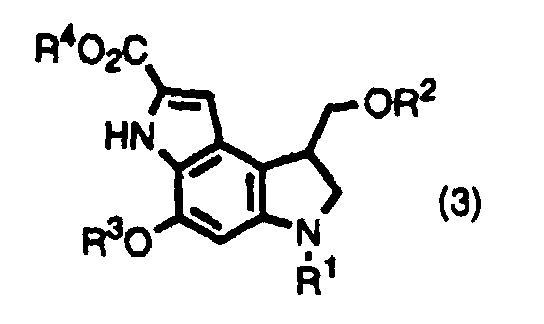
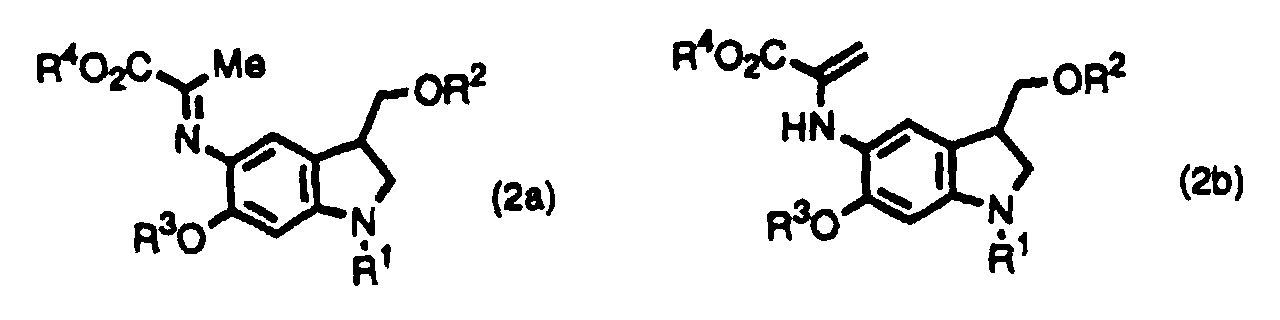
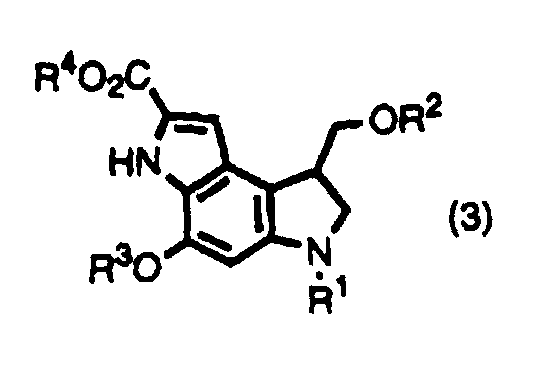
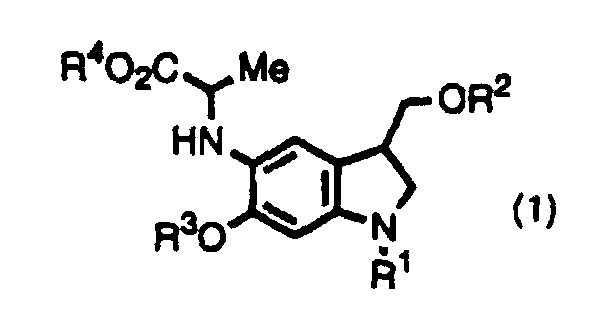
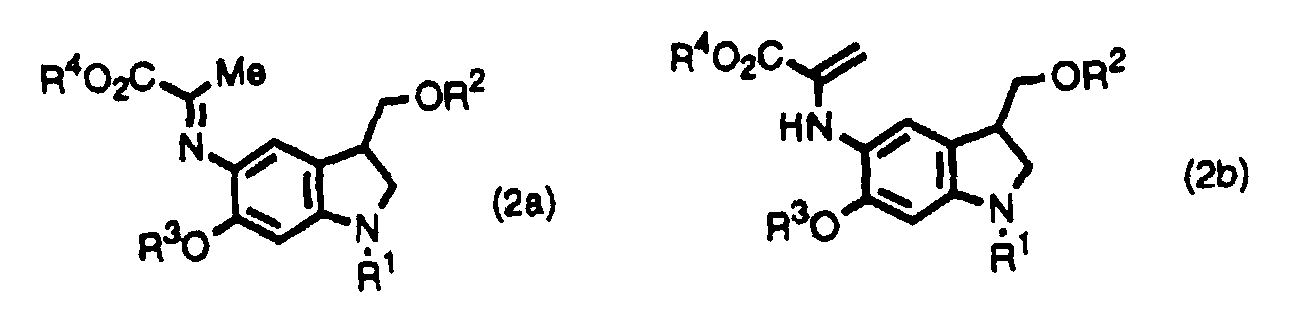
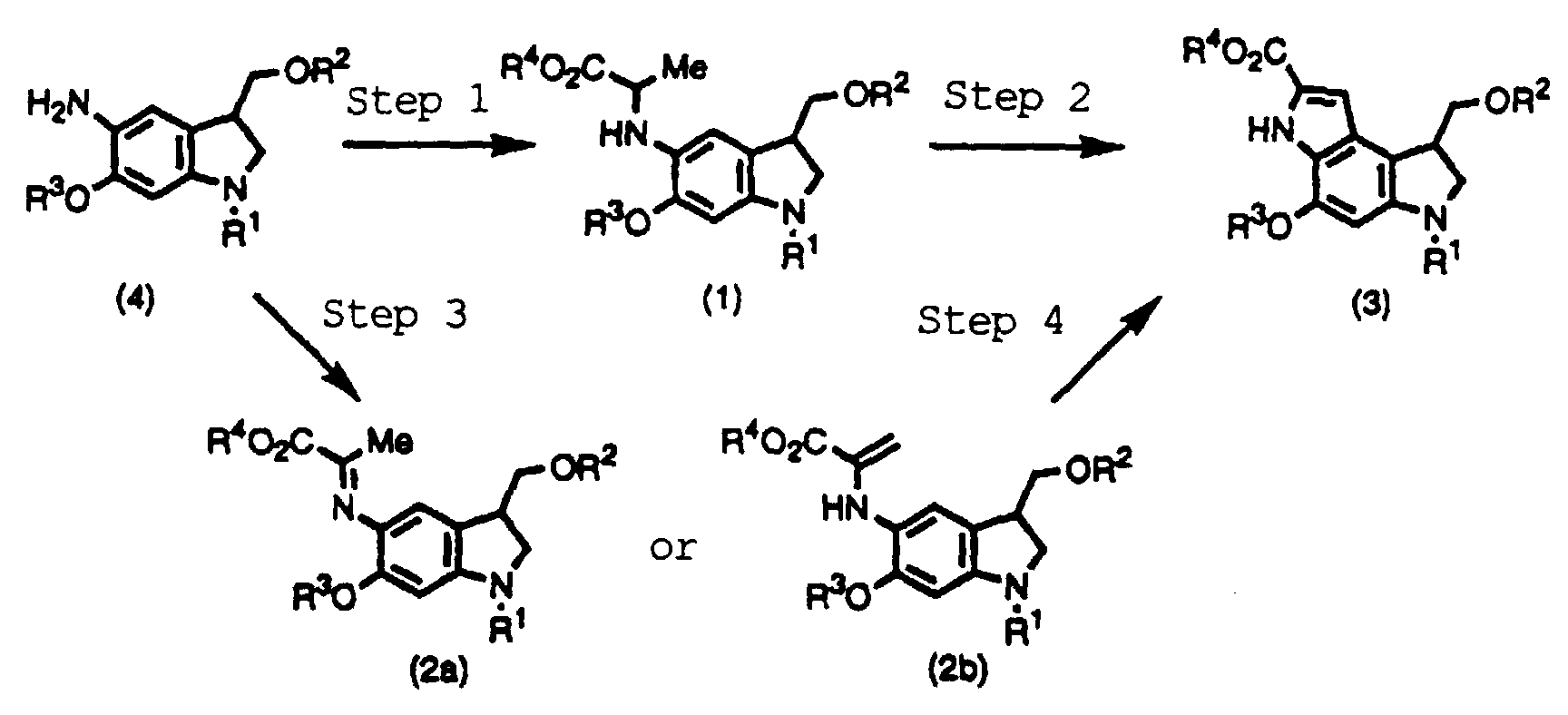
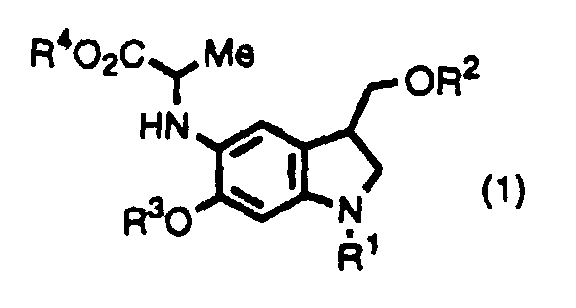
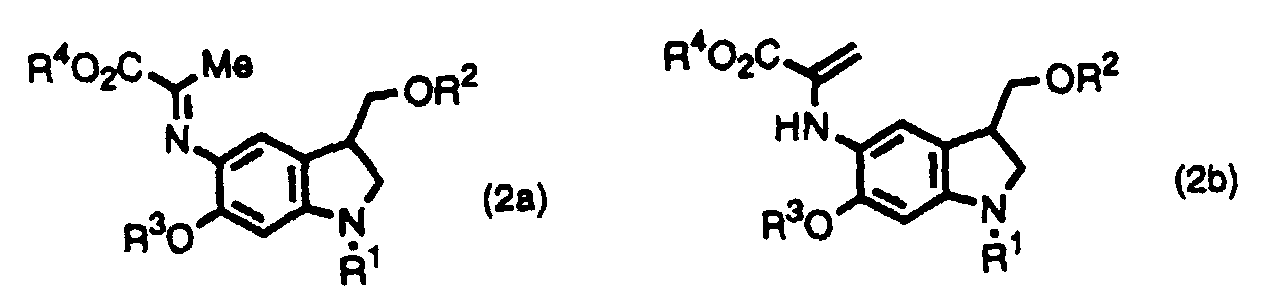
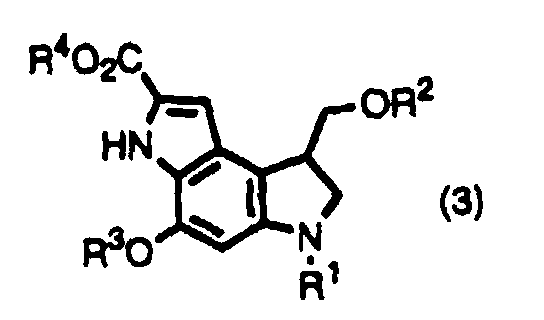
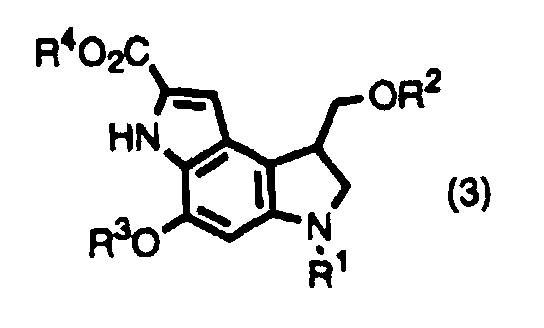
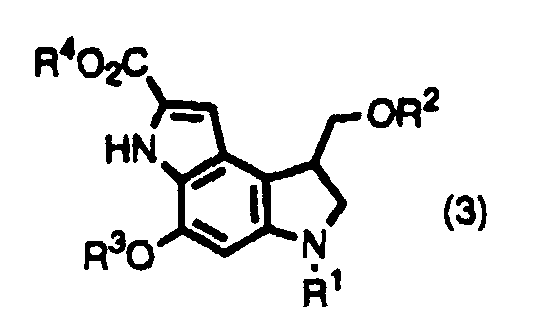
- the inventors provide indole derivatives and pyrroloindole derivatives both of which are intermediates for duocarmycin SA and derivatives thereof, shown by the formula (1) wherein, R 1 is a protecting group for amino group; R 2 is a protecting group for hydroxyl group; R 3 is a protecting group for hydroxyl group; R 4 is a C 1 -C 6 linear or branched lower alkyl group, or benzyl group, the formula (2a) or (2b) wherein, R 1 , R 2 , R 3 , and R 4 are the same as described above, and the formula (3) wherein, R 1 , R 2 , R 3 , and R 4 are the same as described above.
- the inventors also provide a method for producing a pyrroloindole derivative, which is an intermediate of duocarmycin SA and its derivatives, shown by the formula (3), comprising oxidative cyclization of an indole derivative shown by the formula (1), as well as a method for producing a pyrroloindole derivative, which is an intermediate of duocarmycin SA and its derivative, shown by the formula (3), comprising oxidative cyclization of an indole derivative shown by the formula (2a) or (2b).
- R 1 which is a protecting group for amino group, includes a C 1 -C 6 linear or branched lower alkoxycarbonyl such as methoxycarbonyl, ethoxycarbonyl, isopropoxycarbonyl, and t-butoxycarbonyl; a haloalkoxycarbonyl such as 2,2,2-trichloroethoxycarbonyl and 2,2,2-trichloro-1,1-dimethylethoxycarbonyl; and a substituted or unsubstituted aralkyloxycarbonyl such as benzyloxycarbonyl, 4-methylbenzyloxycarbonyl, 3-chlorobenzyloxycarbonyl, 4-methoxybenzyloxycarbonyl, benzhydrylcarbonyl, di-(4-methoxyphenyl)methoxycarbonyl, trityloxycarbonyl, and fluorenylmethoxycarbonyl.
- R 2 which is a protecting group for hydroxyl group, includes a C 1 -C 6 linear or branched substituted or unsubstituted lower alkanoyl such as formyl, acetyl, methoxyacetyl, phenoxyacetyl, and pivaloyl; a substituted or unsubstituted aryloyl such as benzoyl, toluoyl, 3-chlorobenzoyl, and 4-phenylbenzoyl; a substituted or unsubstituted arylmethyl such as benzyl, 4-methylbenzyl, 3-chlorobenzyl, 4-methoxylbenzyl, 2,4-dimethoxybenzyl, benzhydryl, di-(4-methoxyphenyl)methyl, and trityl; and a substituted silyl such as triethylsilyl, isopropyldimethylsilyl, t-butyldimethylsilyl
- R 3 which is a protecting group for hydroxyl group, includes a C 1 -C 6 linear or branched lower alkyl such as methyl and ethyl; and a substituted or unsubstituted arylmethyl such as benzyl, 4-methylbenzyl, 3-chlorobenzyl, 4-methoxylbenzyl, 2,4-dimethoxybenzyl, benzhydryl, di-(4-methoxyphenyl)methyl, and trityl.
- arylmethyl such as benzyl, 4-methylbenzyl, 3-chlorobenzyl, 4-methoxylbenzyl, 2,4-dimethoxybenzyl, benzhydryl, di-(4-methoxyphenyl)methyl, and trityl.
- R 4 includes a C 1 -C 6 linear or branched lower alkyl such as methyl, ethyl, propyl, butyl, isopropyl, and t-butyl.
- the compounds according to the present invention can be produced following to the steps shown below:
- This step is a step to produce a compound shown by the formula (1) from a compound shown by the formula (4).
- the step can be performed by well-known methods, for example, according to Tetrahedron 50, 2793 (1994).
- This step is a step to produce a compound shown by the formula (3) by oxidative cyclization of a compound shown by the formula (1).
- the oxidative cyclization according to the present invention is performed using a palladium salt such as palladium chloride, palladium acetate, palladium trifluoroacetate, and palladium acetylacetonate and an other transition metal salt such as nickel chloride and nickel acetate singly or preferably in combination with an oxidising agent such as potassium permanganate, manganese dioxide, nickel peroxide, cupric sulfate, and silver oxide, in the presence or absence of an acid catalyst such as acetic acid, propionic acid, dichloroacetic acid, oxalic acid, succinic acid, glutaric acid, benzoic acid, 4-nitrobenzoic acid, 2,4-dinitrobenzoic acid, and toluenesulfonic acid and/or a quaternary ammonium salt such as benzyltriethyl
- This step is a step to produce a compound shown by the formula (2a) or (2b) from a compound shown by the formula (4).
- the step can be performed according to well-known methods, for example, according to Bull. Chem. Soc. Jpn. 44, 474 (1971).
- This step is a step to produce a compound shown by the formula (3) by oxidative cyclization of a compound shown by the formula (2a) or (2b).
- the oxidative cyclization of this step is performed using a palladium salt such as palladium chloride, palladium acetate, palladium trifluoroacetate, and palladium acetylacetonate; an other transition metal salt such as nickel chloride and nickel acetate; and/or a heavy metal salt such as lead tetraacetate and cupric acetate singly or in a combination, in the presence or absence of a phosphine such as triphenylphosphine and trioctylphosphine; an organic base such as triethylamine, N-methylmorpholine, and pyridine; an alkali metal salt such as sodium bicarbonate, potassium carbonate, sodium acetate, and potassium acetate; and/or a quaternary ammmonium salt such as benzyltriethy
- a compound shown by the formula (5), (6), or (7) can be derived from the compound shown by the formula (3) produced as above, according to the following steps 5-7, all of which can be performed, for example, according to J. Am. Chem. Soc. 114, 10056 (1992) and Japanese Patent Laid-open Pub. No. Hei 6-116269.
- R 1 , R 2 , R 3 , and R 4 are the same as described above, X is a halogen.
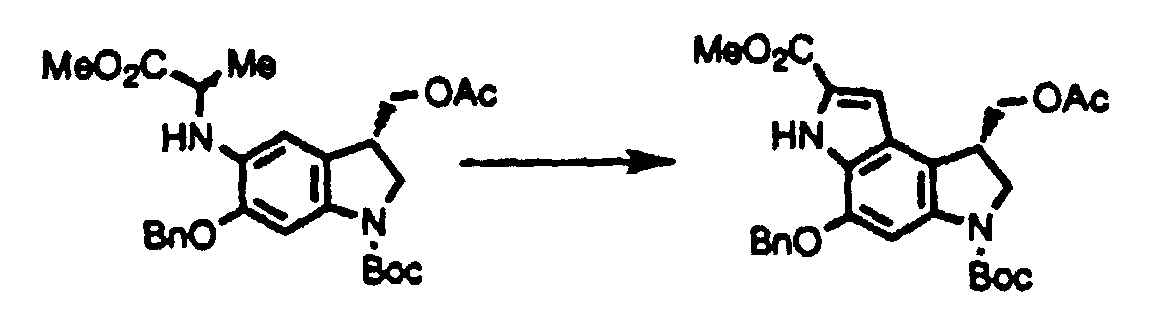
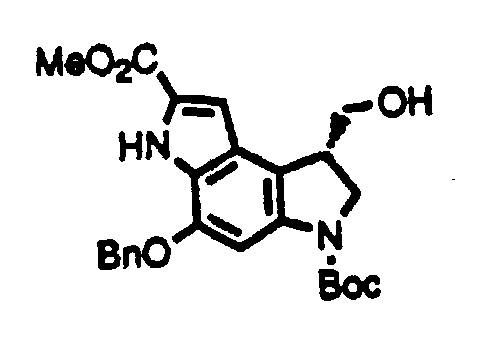
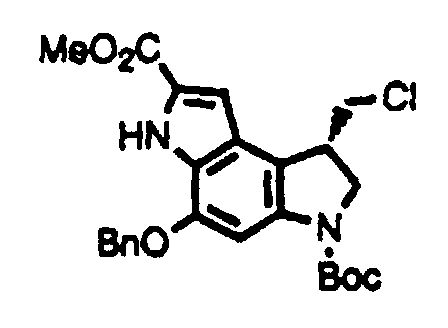
- the obtained filtrate was concentrated to give a residue, to which 1.35 g (6.0 mmole) of palladium acetate was then added, and the resulting mixture was heated in 100 ml of dimethylacetamide at 90°C for 1 hour.
- the obtained reaction mixture was poured into water, the resulting mixture was thrice extracted with toluene-hexane (5:1), the combined organic layer was dried over anhydrous sodium sulfate, and filtrated.
- a pyrroloindole derivative shown by the formula (3) which is an intermediate for a duocarmycin SA derivative which is expected to be used as an anticancer agent, can be easily produced by oxidative cyclization of an indole derivative shown by the formula(s) (1) and (2a) or (2b) which is produced according to the present invention.
- a pyrroloindole derivative shown by the formula (6) can be produced using a pyrroloindole derivative shown by the formula (3), and duocarmycin SA can be produced according to well-known methods.
- Optically active duocarmycin SA can be easily produced by using an optically active compound shown by the formula (4), for example, (3S)-3-acetoxymethyl-5-amino-6-benzyloxy-1-t-butoxycarbonylindoline (Japanese Patent Laid-open Pub. No. Hei 7-89933) according to the present invention.
Landscapes
- Organic Chemistry (AREA)
- Chemical & Material Sciences (AREA)
- Health & Medical Sciences (AREA)
- Life Sciences & Earth Sciences (AREA)
- General Health & Medical Sciences (AREA)
- Nuclear Medicine, Radiotherapy & Molecular Imaging (AREA)
- General Chemical & Material Sciences (AREA)
- Pharmacology & Pharmacy (AREA)
- Chemical Kinetics & Catalysis (AREA)
- Animal Behavior & Ethology (AREA)
- Medicinal Chemistry (AREA)
- Public Health (AREA)
- Veterinary Medicine (AREA)
- Indole Compounds (AREA)
- Pharmaceuticals Containing Other Organic And Inorganic Compounds (AREA)
- Nitrogen Condensed Heterocyclic Rings (AREA)
- Nitrogen And Oxygen Or Sulfur-Condensed Heterocyclic Ring Systems (AREA)
Abstract

Description






| Elementary analysis: | |||
| Calculated as C27H30N2O7 : | C,65.57; | H,6.11; | N,5.66 |
| Found : | C,65.40; | H,6.05; | N,5.64 |


Claims (5)
- An indole derivative shown by the formula (1),wherein R1 is a protecting group for amino group; R2 is a protecting group for hydroxyl group; R3 is a protecting group for hydroxyl group; R4 is a C1-C6 linear or branched lower alkyl group, or benzyl group.
- An indole derivative shown by the formula (2a) or (2b),wherein R1 is a protecting group for amino group; R2 is a protecting group for hydroxyl group; R3 is a protecting group for hydroxyl group; R4 is a C1-C6 linear or branched lower alkyl group, or benzyl group.
- A pyrroloindole derivative shown by the formula (3),wherein R1 is a protecting group for amino group; R2 is a protecting group for hydroxyl group; R3 is a protecting group for hydroxyl group; R4 is a C1-C6 linear or branched lower alkyl group, or benzyl group.
- A method for producing a pyrroloindole derivative shown by the formula (3)by oxidative cyclization of an indole derivative shown by the formula (1),
 wherein R1 is a protecting group for amino group; R2 is a protecting group for hydroxyl group; R3 is a protecting group for hydroxyl group; R4 is a C1-C6 linear or branched lower alkyl group, or benzyl group.
- A method for producing a pyrroloindole derivative shown by the formula (3)by oxidative cyclization of an indole derivative shown by the formula (2a) or (2b),
 wherein R1 is a protecting group for amino group; R2 is a protecting group for hydroxyl group; R3 is a protecting group for hydroxyl group; R4 is a C1-C6 linear or branched lower alkyl group, or benzyl group.
Applications Claiming Priority (3)
| Application Number | Priority Date | Filing Date | Title |
|---|---|---|---|
| JP8246097A JPH1087666A (en) | 1996-09-18 | 1996-09-18 | Intermediate and method for producing duocarmycin SA and derivatives thereof |
| JP24609796 | 1996-09-18 | ||
| PCT/JP1997/002207 WO1998012197A1 (en) | 1996-09-18 | 1997-06-26 | Intermediates for the preparation of duocarmycin sa and derivatives thereof, and process for the production of the intermediates |
Publications (3)
| Publication Number | Publication Date |
|---|---|
| EP0937726A1 true EP0937726A1 (en) | 1999-08-25 |
| EP0937726A4 EP0937726A4 (en) | 2001-04-11 |
| EP0937726B1 EP0937726B1 (en) | 2003-03-12 |
Family
ID=17143451
Family Applications (1)
| Application Number | Title | Priority Date | Filing Date |
|---|---|---|---|
| EP97928473A Expired - Lifetime EP0937726B1 (en) | 1996-09-18 | 1997-06-26 | Intermediates for the preparation of duocarmycin sa and derivatives thereof, and process for the production of the intermediates |
Country Status (10)
| Country | Link |
|---|---|
| US (1) | US6066742A (en) |
| EP (1) | EP0937726B1 (en) |
| JP (1) | JPH1087666A (en) |
| KR (1) | KR20000036211A (en) |
| CN (1) | CN1090632C (en) |
| AT (1) | ATE234304T1 (en) |
| AU (1) | AU3274997A (en) |
| CA (1) | CA2266505A1 (en) |
| DE (1) | DE69719781D1 (en) |
| WO (1) | WO1998012197A1 (en) |
Families Citing this family (23)
| Publication number | Priority date | Publication date | Assignee | Title |
|---|---|---|---|---|
| ES2260570T3 (en) | 1998-08-27 | 2006-11-01 | Spirogen Limited | PIRROLOBENZIODIAZEPINAS DIMERICAS. |
| GB9818730D0 (en) | 1998-08-27 | 1998-10-21 | Univ Portsmouth | Collections of compounds |
| US6909006B1 (en) * | 1999-08-27 | 2005-06-21 | Spirogen Limited | Cyclopropylindole derivatives |
| KR20030033007A (en) * | 2001-05-31 | 2003-04-26 | 코울터 파머수티컬, 인코포레이티드 | Cytotoxins, prodrugs, linkers and stabilizers useful therefor |
| GB0226593D0 (en) | 2002-11-14 | 2002-12-24 | Consultants Ltd | Compounds |
| GB0321295D0 (en) | 2003-09-11 | 2003-10-15 | Spirogen Ltd | Synthesis of protected pyrrolobenzodiazepines |
| US7691962B2 (en) * | 2004-05-19 | 2010-04-06 | Medarex, Inc. | Chemical linkers and conjugates thereof |
| BRPI0510909A2 (en) * | 2004-05-19 | 2008-12-16 | Medarex Inc | cytotoxic drug-binder binding compound, pharmaceutical formulation, method for killing a cell and method for retarding or stopping tumor growth |
| ES2386366T3 (en) * | 2005-02-18 | 2012-08-17 | Medarex, Inc. | Human monoclonal antibody against prostate specific membrane antigen (PSMA) |
| US7714016B2 (en) * | 2005-04-08 | 2010-05-11 | Medarex, Inc. | Cytotoxic compounds and conjugates with cleavable substrates |
| EA016577B1 (en) * | 2005-09-26 | 2012-06-29 | Медарекс, Инк. | Antibody-drug conjugates and use thereof |
| BRPI0619331A2 (en) | 2005-10-26 | 2011-09-27 | Medarex Inc | method for making a compound to prepare a cbi cc-1065 analog, method for making a cbi cc-1065 analog and compound |
| WO2007059404A2 (en) | 2005-11-10 | 2007-05-24 | Medarex, Inc. | Duocarmycin derivatives as novel cytotoxic compounds and conjugates |
| RU2320662C1 (en) * | 2006-08-24 | 2008-03-27 | Андрей Александрович Иващенко | SUBSTITUTED PYRROLO[4,3-b]INDOLES, COMBINATORY AND FOCUSED LIBRARY, PHARMACEUTICAL COMPOSITION, METHODS FOR THEIR PREPARING AND USING |
| TWI412367B (en) | 2006-12-28 | 2013-10-21 | 梅達雷克斯有限責任公司 | Chemical linker and cleavable substrate and conjugate thereof |
| JP2010519310A (en) | 2007-02-21 | 2010-06-03 | メダレックス インコーポレイテッド | Chemical linker having a single amino acid and complex thereof |
| AR080154A1 (en) | 2010-02-10 | 2012-03-14 | Immunogen Inc | CD20 ANTIBODIES AND ITS USE |
| US10131682B2 (en) | 2012-11-24 | 2018-11-20 | Hangzhou Dac Biotech Co., Ltd. | Hydrophilic linkers and their uses for conjugation of drugs to a cell binding molecules |
| JP6417421B2 (en) | 2014-02-28 | 2018-11-07 | ハンジョウ ディーエーシー バイオテック シーオー.,エルティディ.Hangzhou Dac Biotech Co.,Ltd. | Charged conjugates and their use for conjugates |
| CA2991973C (en) | 2015-07-12 | 2021-12-07 | Suzhou M-Conj Biotech Co., Ltd. | Bridge linkers for conjugation of a cell-binding molecule |
| US9839687B2 (en) | 2015-07-15 | 2017-12-12 | Suzhou M-Conj Biotech Co., Ltd. | Acetylenedicarboxyl linkers and their uses in specific conjugation of a cell-binding molecule |
| KR20220147719A (en) | 2016-11-14 | 2022-11-03 | 항저우 디에이씨 바이오테크 씨오, 엘티디 | Conjugation linkers, cell binding molecule-drug conjugates containing the likers, methods of making and uses such conjugates with the linkers |
| CN117980327A (en) | 2021-11-03 | 2024-05-03 | 杭州多禧生物科技有限公司 | Specific conjugation of antibodies |
Family Cites Families (4)
| Publication number | Priority date | Publication date | Assignee | Title |
|---|---|---|---|---|
| AU648313B2 (en) * | 1990-04-25 | 1994-04-21 | Pharmacia & Upjohn Company | Novel CC-1065 analogs |
| JP3037965B2 (en) * | 1990-06-20 | 2000-05-08 | 財団法人相模中央化学研究所 | 2-Alkoxycarbonyl-2-methyl-1-oxo-1,2,3,6,7,8-hexahydro-benzo [1,2-b; 4,3-b '] dipyrrole derivative |
| GB9213623D0 (en) * | 1992-06-26 | 1992-08-12 | Pfizer Ltd | Therapeutic agents |
| JPH06116270A (en) * | 1992-08-21 | 1994-04-26 | Kyorin Pharmaceut Co Ltd | Tetrahydropyrroloindole derivative, its production method and its intermediate |
-
1996
- 1996-09-18 JP JP8246097A patent/JPH1087666A/en active Pending
-
1997
- 1997-06-26 DE DE69719781T patent/DE69719781D1/en not_active Expired - Lifetime
- 1997-06-26 KR KR1019997002272A patent/KR20000036211A/en not_active Ceased
- 1997-06-26 EP EP97928473A patent/EP0937726B1/en not_active Expired - Lifetime
- 1997-06-26 CA CA002266505A patent/CA2266505A1/en not_active Abandoned
- 1997-06-26 AU AU32749/97A patent/AU3274997A/en not_active Abandoned
- 1997-06-26 US US09/254,515 patent/US6066742A/en not_active Expired - Fee Related
- 1997-06-26 AT AT97928473T patent/ATE234304T1/en not_active IP Right Cessation
- 1997-06-26 WO PCT/JP1997/002207 patent/WO1998012197A1/en not_active Ceased
- 1997-06-26 CN CN97198004A patent/CN1090632C/en not_active Expired - Fee Related
Also Published As
| Publication number | Publication date |
|---|---|
| WO1998012197A1 (en) | 1998-03-26 |
| DE69719781D1 (en) | 2003-04-17 |
| US6066742A (en) | 2000-05-23 |
| CN1090632C (en) | 2002-09-11 |
| AU3274997A (en) | 1998-04-14 |
| EP0937726B1 (en) | 2003-03-12 |
| JPH1087666A (en) | 1998-04-07 |
| EP0937726A4 (en) | 2001-04-11 |
| ATE234304T1 (en) | 2003-03-15 |
| KR20000036211A (en) | 2000-06-26 |
| CA2266505A1 (en) | 1998-03-26 |
| CN1230960A (en) | 1999-10-06 |
Similar Documents
| Publication | Publication Date | Title |
|---|---|---|
| EP0937726B1 (en) | Intermediates for the preparation of duocarmycin sa and derivatives thereof, and process for the production of the intermediates | |
| US4582918A (en) | Preparation of intermediates for (threo)-1-aryl-2-acylamido-3-fluoro-1-propanols | |
| JP2691442B2 (en) | Novel proline derivative | |
| EP0638586B1 (en) | Nucleoside derivatives and methods for producing them | |
| KR100309871B1 (en) | Process for Preparing (-)Pyridobenzoxazine Carboxylic Acid Derivatives | |
| KR100209105B1 (en) | Aminobutanol derivative and process for the preparation of 3-pyrrolidinol from the same | |
| Ogawa et al. | Pseudo-sugars. XVI Facile synthesis of pseudo-. ALPHA.-D and L-glucopyranoses. | |
| GB2036744A (en) | Eburnane derivatives | |
| JP3789951B2 (en) | Saccharide derivative having ON bond and production method | |
| KR0163770B1 (en) | Method for preparing 3,4-epoxybutyrate and intermediates therefor | |
| US4677214A (en) | Intermediates for preparation of (threo)-1-aryl-2-acylamido-3-fluoro-1-propanols | |
| Sakakibara et al. | Preparation of 4, 6-O-benzylidene-2-C-and-3-Cp-tolylsulfonylhex-2-enopyranoside derivatives and a 2-Cp-tolylsulfonylhex-2-enitol derivative | |
| NL8003822A (en) | PROCESS FOR THE PREPARATION OF EBURAN DERIVATIVES. | |
| US5821367A (en) | Regiospecific process for synthesis of acyclic nucleosides | |
| KR100448640B1 (en) | Method for producing phenyl propionic acid derivatives with high yield and purity | |
| EP0304684A1 (en) | Process for the preparation of benzoxazine derivatives | |
| US4889929A (en) | Preparation of 1'-ethoxycarbonyl-oxyethyl esters of penicillins | |
| Yasuda et al. | Synthesis of protected purpurosamine B and 6-epipurpurosamine B | |
| JP2735297B2 (en) | Production of intermediates | |
| Inoue et al. | A new synthesis of Wataseni preluciferin by cyclization of 2-amino-3-benzyl-5-(p-hydroxyphenyl) pyrazine with p-hydroxyphenyl) pyazine with P-hydroxpyphenylpyruvic acid. | |
| JP4589860B2 (en) | Method for producing hydantosaidin derivatives | |
| KR970004048B1 (en) | Separation method of diastereomer of asymmetric 3-methoxymethyl cephalosporin derivative | |
| KR100448642B1 (en) | Method for producing phenyl propionic acid derivatives from 2-phenylpropionic acid by simple processing steps with high yield and purity | |
| EP0430031A2 (en) | Process for benzazepine intermediates | |
| HU208954B (en) | Process for producing 1-(3-mercapto-(2s)-methyl-1-oxo-propyl)-l-prolyn |
Legal Events
| Date | Code | Title | Description |
|---|---|---|---|
| PUAI | Public reference made under article 153(3) epc to a published international application that has entered the european phase |
Free format text: ORIGINAL CODE: 0009012 |
|
| 17P | Request for examination filed |
Effective date: 19990416 |
|
| AK | Designated contracting states |
Kind code of ref document: A1 Designated state(s): AT BE CH DE DK ES FI FR GB GR IE IT LI LU MC NL PT SE |
|
| A4 | Supplementary search report drawn up and despatched |
Effective date: 20010227 |
|
| AK | Designated contracting states |
Kind code of ref document: A4 Designated state(s): AT BE CH DE DK ES FI FR GB GR IE IT LI LU MC NL PT SE |
|
| 17Q | First examination report despatched |
Effective date: 20010712 |
|
| GRAH | Despatch of communication of intention to grant a patent |
Free format text: ORIGINAL CODE: EPIDOS IGRA |
|
| GRAH | Despatch of communication of intention to grant a patent |
Free format text: ORIGINAL CODE: EPIDOS IGRA |
|
| GRAA | (expected) grant |
Free format text: ORIGINAL CODE: 0009210 |
|
| RAP1 | Party data changed (applicant data changed or rights of an application transferred) |
Owner name: SAGAMI CHEMICAL RESEARCH CENTER Owner name: KYORIN PHARMACEUTICAL CO., LTD. |
|
| AK | Designated contracting states |
Designated state(s): AT BE CH DE DK ES FI FR GB GR IE IT LI LU MC NL PT SE |
|
| PG25 | Lapsed in a contracting state [announced via postgrant information from national office to epo] |
Ref country code: NL Free format text: LAPSE BECAUSE OF FAILURE TO SUBMIT A TRANSLATION OF THE DESCRIPTION OR TO PAY THE FEE WITHIN THE PRESCRIBED TIME-LIMIT Effective date: 20030312 Ref country code: LI Free format text: LAPSE BECAUSE OF FAILURE TO SUBMIT A TRANSLATION OF THE DESCRIPTION OR TO PAY THE FEE WITHIN THE PRESCRIBED TIME-LIMIT Effective date: 20030312 Ref country code: IT Free format text: LAPSE BECAUSE OF FAILURE TO SUBMIT A TRANSLATION OF THE DESCRIPTION OR TO PAY THE FEE WITHIN THE PRE;WARNING: LAPSES OF ITALIAN PATENTS WITH EFFECTIVE DATE BEFORE 2007 MAY HAVE OCCURRED AT ANY TIME BEFORE 2007. THE CORRECT EFFECTIVE DATE MAY BE DIFFERENT FROM THE ONE RECORDED.SCRIBED TIME-LIMIT Effective date: 20030312 Ref country code: GR Free format text: LAPSE BECAUSE OF FAILURE TO SUBMIT A TRANSLATION OF THE DESCRIPTION OR TO PAY THE FEE WITHIN THE PRESCRIBED TIME-LIMIT Effective date: 20030312 Ref country code: FR Free format text: LAPSE BECAUSE OF FAILURE TO SUBMIT A TRANSLATION OF THE DESCRIPTION OR TO PAY THE FEE WITHIN THE PRESCRIBED TIME-LIMIT Effective date: 20030312 Ref country code: FI Free format text: LAPSE BECAUSE OF FAILURE TO SUBMIT A TRANSLATION OF THE DESCRIPTION OR TO PAY THE FEE WITHIN THE PRESCRIBED TIME-LIMIT Effective date: 20030312 Ref country code: CH Free format text: LAPSE BECAUSE OF FAILURE TO SUBMIT A TRANSLATION OF THE DESCRIPTION OR TO PAY THE FEE WITHIN THE PRESCRIBED TIME-LIMIT Effective date: 20030312 Ref country code: BE Free format text: LAPSE BECAUSE OF FAILURE TO SUBMIT A TRANSLATION OF THE DESCRIPTION OR TO PAY THE FEE WITHIN THE PRESCRIBED TIME-LIMIT Effective date: 20030312 Ref country code: AT Free format text: LAPSE BECAUSE OF FAILURE TO SUBMIT A TRANSLATION OF THE DESCRIPTION OR TO PAY THE FEE WITHIN THE PRESCRIBED TIME-LIMIT Effective date: 20030312 |
|
| REG | Reference to a national code |
Ref country code: GB Ref legal event code: FG4D |
|
| REG | Reference to a national code |
Ref country code: CH Ref legal event code: EP |
|
| REG | Reference to a national code |
Ref country code: IE Ref legal event code: FG4D |
|
| REF | Corresponds to: |
Ref document number: 69719781 Country of ref document: DE Date of ref document: 20030417 Kind code of ref document: P |
|
| PG25 | Lapsed in a contracting state [announced via postgrant information from national office to epo] |
Ref country code: SE Free format text: LAPSE BECAUSE OF FAILURE TO SUBMIT A TRANSLATION OF THE DESCRIPTION OR TO PAY THE FEE WITHIN THE PRESCRIBED TIME-LIMIT Effective date: 20030612 Ref country code: PT Free format text: LAPSE BECAUSE OF FAILURE TO SUBMIT A TRANSLATION OF THE DESCRIPTION OR TO PAY THE FEE WITHIN THE PRESCRIBED TIME-LIMIT Effective date: 20030612 Ref country code: DK Free format text: LAPSE BECAUSE OF FAILURE TO SUBMIT A TRANSLATION OF THE DESCRIPTION OR TO PAY THE FEE WITHIN THE PRESCRIBED TIME-LIMIT Effective date: 20030612 |
|
| PG25 | Lapsed in a contracting state [announced via postgrant information from national office to epo] |
Ref country code: DE Free format text: LAPSE BECAUSE OF FAILURE TO SUBMIT A TRANSLATION OF THE DESCRIPTION OR TO PAY THE FEE WITHIN THE PRESCRIBED TIME-LIMIT Effective date: 20030613 |
|
| PG25 | Lapsed in a contracting state [announced via postgrant information from national office to epo] |
Ref country code: LU Free format text: LAPSE BECAUSE OF NON-PAYMENT OF DUE FEES Effective date: 20030626 Ref country code: IE Free format text: LAPSE BECAUSE OF NON-PAYMENT OF DUE FEES Effective date: 20030626 Ref country code: GB Free format text: LAPSE BECAUSE OF NON-PAYMENT OF DUE FEES Effective date: 20030626 |
|
| PG25 | Lapsed in a contracting state [announced via postgrant information from national office to epo] |
Ref country code: MC Free format text: LAPSE BECAUSE OF NON-PAYMENT OF DUE FEES Effective date: 20030630 |
|
| NLV1 | Nl: lapsed or annulled due to failure to fulfill the requirements of art. 29p and 29m of the patents act | ||
| REG | Reference to a national code |
Ref country code: CH Ref legal event code: PL |
|
| PG25 | Lapsed in a contracting state [announced via postgrant information from national office to epo] |
Ref country code: ES Free format text: LAPSE BECAUSE OF FAILURE TO SUBMIT A TRANSLATION OF THE DESCRIPTION OR TO PAY THE FEE WITHIN THE PRESCRIBED TIME-LIMIT Effective date: 20030930 |
|
| PLBE | No opposition filed within time limit |
Free format text: ORIGINAL CODE: 0009261 |
|
| STAA | Information on the status of an ep patent application or granted ep patent |
Free format text: STATUS: NO OPPOSITION FILED WITHIN TIME LIMIT |
|
| EN | Fr: translation not filed | ||
| GBPC | Gb: european patent ceased through non-payment of renewal fee |
Effective date: 20030626 |
|
| 26N | No opposition filed |
Effective date: 20031215 |
|
| REG | Reference to a national code |
Ref country code: IE Ref legal event code: MM4A |