EP0937054B1 - 4-(1-piperazinyl)benzoic acid derivatives, process for preparing them and their therapeutic applications - Google Patents
4-(1-piperazinyl)benzoic acid derivatives, process for preparing them and their therapeutic applications Download PDFInfo
- Publication number
- EP0937054B1 EP0937054B1 EP97953824A EP97953824A EP0937054B1 EP 0937054 B1 EP0937054 B1 EP 0937054B1 EP 97953824 A EP97953824 A EP 97953824A EP 97953824 A EP97953824 A EP 97953824A EP 0937054 B1 EP0937054 B1 EP 0937054B1
- Authority
- EP
- European Patent Office
- Prior art keywords
- alkyl
- aryl
- group
- alkoxy
- cycloalkyl
- Prior art date
- Legal status (The legal status is an assumption and is not a legal conclusion. Google has not performed a legal analysis and makes no representation as to the accuracy of the status listed.)
- Expired - Lifetime
Links
- IAGYKSQGLCAAAD-UHFFFAOYSA-N 4-piperazin-1-ylbenzoic acid Chemical class C1=CC(C(=O)O)=CC=C1N1CCNCC1 IAGYKSQGLCAAAD-UHFFFAOYSA-N 0.000 title description 2
- 230000001225 therapeutic effect Effects 0.000 title description 2
- 238000004519 manufacturing process Methods 0.000 title 1
- 150000001875 compounds Chemical class 0.000 claims abstract description 41
- 206010012601 diabetes mellitus Diseases 0.000 claims abstract description 6
- -1 benzothiazinyl groups Chemical group 0.000 claims description 34
- 125000004169 (C1-C6) alkyl group Chemical group 0.000 claims description 30
- 125000005915 C6-C14 aryl group Chemical group 0.000 claims description 15
- 125000003545 alkoxy group Chemical group 0.000 claims description 13
- 150000003839 salts Chemical class 0.000 claims description 11
- 125000001072 heteroaryl group Chemical group 0.000 claims description 10
- 125000004209 (C1-C8) alkyl group Chemical group 0.000 claims description 9
- 125000004191 (C1-C6) alkoxy group Chemical group 0.000 claims description 8
- 125000005914 C6-C14 aryloxy group Chemical group 0.000 claims description 8
- 238000002360 preparation method Methods 0.000 claims description 8
- 125000006625 (C3-C8) cycloalkyloxy group Chemical group 0.000 claims description 7
- 229910052736 halogen Inorganic materials 0.000 claims description 7
- 150000002367 halogens Chemical class 0.000 claims description 7
- 125000006552 (C3-C8) cycloalkyl group Chemical group 0.000 claims description 6
- ZMANZCXQSJIPKH-UHFFFAOYSA-N Triethylamine Chemical compound CCN(CC)CC ZMANZCXQSJIPKH-UHFFFAOYSA-N 0.000 claims description 6
- 125000004435 hydrogen atom Chemical group [H]* 0.000 claims description 6
- 125000001424 substituent group Chemical group 0.000 claims description 6
- 125000002023 trifluoromethyl group Chemical group FC(F)(F)* 0.000 claims description 6
- 125000003118 aryl group Chemical group 0.000 claims description 5
- 125000004454 (C1-C6) alkoxycarbonyl group Chemical group 0.000 claims description 4
- 125000003806 alkyl carbonyl amino group Chemical group 0.000 claims description 4
- 125000004644 alkyl sulfinyl group Chemical group 0.000 claims description 4
- 125000004390 alkyl sulfonyl group Chemical group 0.000 claims description 4
- 125000004656 alkyl sulfonylamino group Chemical group 0.000 claims description 4
- 125000004414 alkyl thio group Chemical group 0.000 claims description 4
- 125000003917 carbamoyl group Chemical group [H]N([H])C(*)=O 0.000 claims description 4
- 125000004432 carbon atom Chemical group C* 0.000 claims description 4
- 125000001041 indolyl group Chemical group 0.000 claims description 4
- 238000000034 method Methods 0.000 claims description 4
- 125000005493 quinolyl group Chemical group 0.000 claims description 4
- 125000000876 trifluoromethoxy group Chemical group FC(F)(F)O* 0.000 claims description 4
- 208000001072 type 2 diabetes mellitus Diseases 0.000 claims description 4
- WKBOTKDWSSQWDR-UHFFFAOYSA-N Bromine atom Chemical group [Br] WKBOTKDWSSQWDR-UHFFFAOYSA-N 0.000 claims description 3
- 125000000217 alkyl group Chemical group 0.000 claims description 3
- 239000003795 chemical substances by application Substances 0.000 claims description 3
- 239000000460 chlorine Substances 0.000 claims description 3
- 229910052801 chlorine Inorganic materials 0.000 claims description 3
- 125000000753 cycloalkyl group Chemical group 0.000 claims description 3
- 125000004433 nitrogen atom Chemical group N* 0.000 claims description 3
- 239000008194 pharmaceutical composition Substances 0.000 claims description 3
- WQRHBWPFLIMKBV-UHFFFAOYSA-N 4-[4-[2-(2,6-dimethylanilino)-2-oxoethyl]piperazin-1-yl]benzoic acid Chemical compound CC1=CC=CC(C)=C1NC(=O)CN1CCN(C=2C=CC(=CC=2)C(O)=O)CC1 WQRHBWPFLIMKBV-UHFFFAOYSA-N 0.000 claims description 2
- DCIMQUKHQAATIV-UHFFFAOYSA-N 4-[4-[2-[2,6-di(propan-2-yl)anilino]-2-oxoethyl]piperazin-1-yl]benzoic acid Chemical compound CC(C)C1=CC=CC(C(C)C)=C1NC(=O)CN1CCN(C=2C=CC(=CC=2)C(O)=O)CC1 DCIMQUKHQAATIV-UHFFFAOYSA-N 0.000 claims description 2
- KXTCDVCBTFRBNJ-UHFFFAOYSA-N 4-[4-[2-oxo-2-(n-propan-2-ylanilino)ethyl]piperazin-1-yl]benzoic acid Chemical compound C=1C=CC=CC=1N(C(C)C)C(=O)CN(CC1)CCN1C1=CC=C(C(O)=O)C=C1 KXTCDVCBTFRBNJ-UHFFFAOYSA-N 0.000 claims description 2
- KZBUYRJDOAKODT-UHFFFAOYSA-N Chlorine Chemical compound ClCl KZBUYRJDOAKODT-UHFFFAOYSA-N 0.000 claims description 2
- 239000004480 active ingredient Substances 0.000 claims description 2
- 125000003277 amino group Chemical group 0.000 claims description 2
- 150000004982 aromatic amines Chemical class 0.000 claims description 2
- 125000004618 benzofuryl group Chemical group O1C(=CC2=C1C=CC=C2)* 0.000 claims description 2
- 125000004196 benzothienyl group Chemical group S1C(=CC2=C1C=CC=C2)* 0.000 claims description 2
- 125000000609 carbazolyl group Chemical group C1(=CC=CC=2C3=CC=CC=C3NC12)* 0.000 claims description 2
- 125000004987 dibenzofuryl group Chemical group C1(=CC=CC=2OC3=C(C21)C=CC=C3)* 0.000 claims description 2
- 125000002541 furyl group Chemical group 0.000 claims description 2
- 125000002887 hydroxy group Chemical group [H]O* 0.000 claims description 2
- 125000003387 indolinyl group Chemical group N1(CCC2=CC=CC=C12)* 0.000 claims description 2
- 125000000449 nitro group Chemical group [O-][N+](*)=O 0.000 claims description 2
- 229910052757 nitrogen Inorganic materials 0.000 claims description 2
- 125000004076 pyridyl group Chemical group 0.000 claims description 2
- 125000000714 pyrimidinyl group Chemical group 0.000 claims description 2
- 125000000168 pyrrolyl group Chemical group 0.000 claims description 2
- 239000012453 solvate Substances 0.000 claims description 2
- 125000001544 thienyl group Chemical group 0.000 claims description 2
- 239000003814 drug Substances 0.000 claims 1
- 230000003301 hydrolyzing effect Effects 0.000 claims 1
- 239000007787 solid Substances 0.000 description 10
- 125000001997 phenyl group Chemical group [H]C1=C([H])C([H])=C(*)C([H])=C1[H] 0.000 description 9
- IAZDPXIOMUYVGZ-WFGJKAKNSA-N Dimethyl sulfoxide Chemical compound [2H]C([2H])([2H])S(=O)C([2H])([2H])[2H] IAZDPXIOMUYVGZ-WFGJKAKNSA-N 0.000 description 6
- LFQSCWFLJHTTHZ-UHFFFAOYSA-N Ethanol Chemical compound CCO LFQSCWFLJHTTHZ-UHFFFAOYSA-N 0.000 description 6
- HEMHJVSKTPXQMS-UHFFFAOYSA-M Sodium hydroxide Chemical compound [OH-].[Na+] HEMHJVSKTPXQMS-UHFFFAOYSA-M 0.000 description 6
- XLYOFNOQVPJJNP-UHFFFAOYSA-N water Substances O XLYOFNOQVPJJNP-UHFFFAOYSA-N 0.000 description 6
- ZFDXBBFPJMOXLX-UHFFFAOYSA-N 4-[4-[2-(4-chloroanilino)-2-oxoethyl]piperazin-1-yl]benzoic acid Chemical compound C1=CC(C(=O)O)=CC=C1N1CCN(CC(=O)NC=2C=CC(Cl)=CC=2)CC1 ZFDXBBFPJMOXLX-UHFFFAOYSA-N 0.000 description 5
- 241000700159 Rattus Species 0.000 description 5
- 241001465754 Metazoa Species 0.000 description 4
- 239000002253 acid Substances 0.000 description 4
- BWHMMNNQKKPAPP-UHFFFAOYSA-L potassium carbonate Chemical compound [K+].[K+].[O-]C([O-])=O BWHMMNNQKKPAPP-UHFFFAOYSA-L 0.000 description 4
- 238000005160 1H NMR spectroscopy Methods 0.000 description 3
- UDRCRMHFHHTVSN-UHFFFAOYSA-N 2-chloro-n-(4-chlorophenyl)acetamide Chemical compound ClCC(=O)NC1=CC=C(Cl)C=C1 UDRCRMHFHHTVSN-UHFFFAOYSA-N 0.000 description 3
- CSCPPACGZOOCGX-UHFFFAOYSA-N Acetone Chemical compound CC(C)=O CSCPPACGZOOCGX-UHFFFAOYSA-N 0.000 description 3
- WEVYAHXRMPXWCK-UHFFFAOYSA-N Acetonitrile Chemical compound CC#N WEVYAHXRMPXWCK-UHFFFAOYSA-N 0.000 description 3
- XEKOWRVHYACXOJ-UHFFFAOYSA-N Ethyl acetate Chemical compound CCOC(C)=O XEKOWRVHYACXOJ-UHFFFAOYSA-N 0.000 description 3
- VEXZGXHMUGYJMC-UHFFFAOYSA-N Hydrochloric acid Chemical compound Cl VEXZGXHMUGYJMC-UHFFFAOYSA-N 0.000 description 3
- SJRJJKPEHAURKC-UHFFFAOYSA-N N-Methylmorpholine Chemical compound CN1CCOCC1 SJRJJKPEHAURKC-UHFFFAOYSA-N 0.000 description 3
- 125000004494 ethyl ester group Chemical group 0.000 description 3
- 235000013305 food Nutrition 0.000 description 3
- 239000000243 solution Substances 0.000 description 3
- 238000003756 stirring Methods 0.000 description 3
- 239000000725 suspension Substances 0.000 description 3
- HZAXFHJVJLSVMW-UHFFFAOYSA-N 2-Aminoethan-1-ol Chemical compound NCCO HZAXFHJVJLSVMW-UHFFFAOYSA-N 0.000 description 2
- HEDRZPFGACZZDS-UHFFFAOYSA-N Chloroform Chemical compound ClC(Cl)Cl HEDRZPFGACZZDS-UHFFFAOYSA-N 0.000 description 2
- KFZMGEQAYNKOFK-UHFFFAOYSA-N Isopropanol Chemical compound CC(C)O KFZMGEQAYNKOFK-UHFFFAOYSA-N 0.000 description 2
- YNAVUWVOSKDBBP-UHFFFAOYSA-N Morpholine Chemical compound C1COCCN1 YNAVUWVOSKDBBP-UHFFFAOYSA-N 0.000 description 2
- 230000002378 acidificating effect Effects 0.000 description 2
- 230000003178 anti-diabetic effect Effects 0.000 description 2
- 239000002775 capsule Substances 0.000 description 2
- OQEHTFFLOHTFSB-UHFFFAOYSA-N ethyl 4-piperazin-1-ylbenzoate Chemical compound C1=CC(C(=O)OCC)=CC=C1N1CCNCC1 OQEHTFFLOHTFSB-UHFFFAOYSA-N 0.000 description 2
- 238000002844 melting Methods 0.000 description 2
- 230000008018 melting Effects 0.000 description 2
- 125000002496 methyl group Chemical group [H]C([H])([H])* 0.000 description 2
- 150000007522 mineralic acids Chemical class 0.000 description 2
- 239000000203 mixture Substances 0.000 description 2
- 150000007524 organic acids Chemical class 0.000 description 2
- 239000000546 pharmaceutical excipient Substances 0.000 description 2
- 229910000027 potassium carbonate Inorganic materials 0.000 description 2
- 239000000047 product Substances 0.000 description 2
- 239000012429 reaction media Substances 0.000 description 2
- 238000001953 recrystallisation Methods 0.000 description 2
- VZCYOOQTPOCHFL-UHFFFAOYSA-N trans-butenedioic acid Natural products OC(=O)C=CC(O)=O VZCYOOQTPOCHFL-UHFFFAOYSA-N 0.000 description 2
- CUGDYSSBTWBKII-LXGUWJNJSA-N (2r,3r,4r,5s)-6-(dimethylamino)hexane-1,2,3,4,5-pentol Chemical compound CN(C)C[C@H](O)[C@@H](O)[C@H](O)[C@H](O)CO CUGDYSSBTWBKII-LXGUWJNJSA-N 0.000 description 1
- QSNSCYSYFYORTR-UHFFFAOYSA-N 4-chloroaniline Chemical compound NC1=CC=C(Cl)C=C1 QSNSCYSYFYORTR-UHFFFAOYSA-N 0.000 description 1
- ZCYVEMRRCGMTRW-UHFFFAOYSA-N 7553-56-2 Chemical compound [I] ZCYVEMRRCGMTRW-UHFFFAOYSA-N 0.000 description 1
- HBAQYPYDRFILMT-UHFFFAOYSA-N 8-[3-(1-cyclopropylpyrazol-4-yl)-1H-pyrazolo[4,3-d]pyrimidin-5-yl]-3-methyl-3,8-diazabicyclo[3.2.1]octan-2-one Chemical class C1(CC1)N1N=CC(=C1)C1=NNC2=C1N=C(N=C2)N1C2C(N(CC1CC2)C)=O HBAQYPYDRFILMT-UHFFFAOYSA-N 0.000 description 1
- WPYMKLBDIGXBTP-UHFFFAOYSA-N Benzoic acid Natural products OC(=O)C1=CC=CC=C1 WPYMKLBDIGXBTP-UHFFFAOYSA-N 0.000 description 1
- 239000005711 Benzoic acid Substances 0.000 description 1
- 0 C*1/C(/N(CC2)CCN2C(*)(*)C(N(*)[Al])=O)=C\C(C)(*)/C=C(\*)/C(/*=C)=C1 Chemical compound C*1/C(/N(CC2)CCN2C(*)(*)C(N(*)[Al])=O)=C\C(C)(*)/C=C(\*)/C(/*=C)=C1 0.000 description 1
- ZAMOUSCENKQFHK-UHFFFAOYSA-N Chlorine atom Chemical compound [Cl] ZAMOUSCENKQFHK-UHFFFAOYSA-N 0.000 description 1
- VGCXGMAHQTYDJK-UHFFFAOYSA-N Chloroacetyl chloride Chemical compound ClCC(Cl)=O VGCXGMAHQTYDJK-UHFFFAOYSA-N 0.000 description 1
- FEWJPZIEWOKRBE-JCYAYHJZSA-N Dextrotartaric acid Chemical compound OC(=O)[C@H](O)[C@@H](O)C(O)=O FEWJPZIEWOKRBE-JCYAYHJZSA-N 0.000 description 1
- PXGOKWXKJXAPGV-UHFFFAOYSA-N Fluorine Chemical compound FF PXGOKWXKJXAPGV-UHFFFAOYSA-N 0.000 description 1
- VZCYOOQTPOCHFL-OWOJBTEDSA-N Fumaric acid Chemical compound OC(=O)\C=C\C(O)=O VZCYOOQTPOCHFL-OWOJBTEDSA-N 0.000 description 1
- CPELXLSAUQHCOX-UHFFFAOYSA-N Hydrogen bromide Chemical compound Br CPELXLSAUQHCOX-UHFFFAOYSA-N 0.000 description 1
- KDXKERNSBIXSRK-YFKPBYRVSA-N L-lysine Chemical compound NCCCC[C@H](N)C(O)=O KDXKERNSBIXSRK-YFKPBYRVSA-N 0.000 description 1
- GUBGYTABKSRVRQ-QKKXKWKRSA-N Lactose Natural products OC[C@H]1O[C@@H](O[C@H]2[C@H](O)[C@@H](O)C(O)O[C@@H]2CO)[C@H](O)[C@@H](O)[C@H]1O GUBGYTABKSRVRQ-QKKXKWKRSA-N 0.000 description 1
- 239000004472 Lysine Substances 0.000 description 1
- KDXKERNSBIXSRK-UHFFFAOYSA-N Lysine Natural products NCCCCC(N)C(O)=O KDXKERNSBIXSRK-UHFFFAOYSA-N 0.000 description 1
- AFVFQIVMOAPDHO-UHFFFAOYSA-M Methanesulfonate Chemical compound CS([O-])(=O)=O AFVFQIVMOAPDHO-UHFFFAOYSA-M 0.000 description 1
- 229920000168 Microcrystalline cellulose Polymers 0.000 description 1
- 229920000881 Modified starch Polymers 0.000 description 1
- MBBZMMPHUWSWHV-BDVNFPICSA-N N-methylglucamine Chemical compound CNC[C@H](O)[C@@H](O)[C@H](O)[C@H](O)CO MBBZMMPHUWSWHV-BDVNFPICSA-N 0.000 description 1
- QGMRQYFBGABWDR-UHFFFAOYSA-M Pentobarbital sodium Chemical compound [Na+].CCCC(C)C1(CC)C(=O)NC(=O)[N-]C1=O QGMRQYFBGABWDR-UHFFFAOYSA-M 0.000 description 1
- 239000002202 Polyethylene glycol Substances 0.000 description 1
- 229920002472 Starch Polymers 0.000 description 1
- ZSJLQEPLLKMAKR-UHFFFAOYSA-N Streptozotocin Natural products O=NN(C)C(=O)NC1C(O)OC(CO)C(O)C1O ZSJLQEPLLKMAKR-UHFFFAOYSA-N 0.000 description 1
- QAOWNCQODCNURD-UHFFFAOYSA-L Sulfate Chemical compound [O-]S([O-])(=O)=O QAOWNCQODCNURD-UHFFFAOYSA-L 0.000 description 1
- 150000007513 acids Chemical class 0.000 description 1
- 229910052784 alkaline earth metal Inorganic materials 0.000 description 1
- 150000001408 amides Chemical class 0.000 description 1
- 150000001412 amines Chemical class 0.000 description 1
- 239000007864 aqueous solution Substances 0.000 description 1
- SRSXLGNVWSONIS-UHFFFAOYSA-M benzenesulfonate Chemical compound [O-]S(=O)(=O)C1=CC=CC=C1 SRSXLGNVWSONIS-UHFFFAOYSA-M 0.000 description 1
- 235000010233 benzoic acid Nutrition 0.000 description 1
- 239000008280 blood Substances 0.000 description 1
- 210000004369 blood Anatomy 0.000 description 1
- GDTBXPJZTBHREO-UHFFFAOYSA-N bromine Substances BrBr GDTBXPJZTBHREO-UHFFFAOYSA-N 0.000 description 1
- 229910052794 bromium Inorganic materials 0.000 description 1
- 125000000484 butyl group Chemical group [H]C([*])([H])C([H])([H])C([H])([H])C([H])([H])[H] 0.000 description 1
- 159000000007 calcium salts Chemical class 0.000 description 1
- 150000001732 carboxylic acid derivatives Chemical group 0.000 description 1
- 239000001913 cellulose Substances 0.000 description 1
- 235000010980 cellulose Nutrition 0.000 description 1
- 229920002678 cellulose Polymers 0.000 description 1
- 229940110456 cocoa butter Drugs 0.000 description 1
- 235000019868 cocoa butter Nutrition 0.000 description 1
- 229940125810 compound 20 Drugs 0.000 description 1
- 238000007796 conventional method Methods 0.000 description 1
- 239000012043 crude product Substances 0.000 description 1
- 235000005911 diet Nutrition 0.000 description 1
- 230000037213 diet Effects 0.000 description 1
- 238000006073 displacement reaction Methods 0.000 description 1
- 239000008298 dragée Substances 0.000 description 1
- 150000002148 esters Chemical class 0.000 description 1
- 125000001495 ethyl group Chemical group [H]C([H])([H])C([H])([H])* 0.000 description 1
- 238000002474 experimental method Methods 0.000 description 1
- 239000000706 filtrate Substances 0.000 description 1
- 125000003983 fluorenyl group Chemical group C1(=CC=CC=2C3=CC=CC=C3CC12)* 0.000 description 1
- 229910052731 fluorine Inorganic materials 0.000 description 1
- 239000011737 fluorine Substances 0.000 description 1
- 229940050411 fumarate Drugs 0.000 description 1
- 239000007903 gelatin capsule Substances 0.000 description 1
- JAXFJECJQZDFJS-XHEPKHHKSA-N gtpl8555 Chemical compound OC(=O)C[C@H](N)C(=O)N[C@@H](CCC(O)=O)C(=O)N[C@@H](C(C)C)C(=O)N[C@@H](C(C)C)C(=O)N1CCC[C@@H]1C(=O)N[C@H](B1O[C@@]2(C)[C@H]3C[C@H](C3(C)C)C[C@H]2O1)CCC1=CC=C(F)C=C1 JAXFJECJQZDFJS-XHEPKHHKSA-N 0.000 description 1
- 230000002218 hypoglycaemic effect Effects 0.000 description 1
- 239000007924 injection Substances 0.000 description 1
- 238000002347 injection Methods 0.000 description 1
- 239000011630 iodine Substances 0.000 description 1
- 229910052740 iodine Inorganic materials 0.000 description 1
- 125000002510 isobutoxy group Chemical group [H]C([H])([H])C([H])(C([H])([H])[H])C([H])([H])O* 0.000 description 1
- 125000000959 isobutyl group Chemical group [H]C([H])([H])C([H])(C([H])([H])[H])C([H])([H])* 0.000 description 1
- 125000001449 isopropyl group Chemical group [H]C([H])([H])C([H])(*)C([H])([H])[H] 0.000 description 1
- 239000000644 isotonic solution Substances 0.000 description 1
- 239000008101 lactose Substances 0.000 description 1
- GVALZJMUIHGIMD-UHFFFAOYSA-H magnesium phosphate Chemical compound [Mg+2].[Mg+2].[Mg+2].[O-]P([O-])([O-])=O.[O-]P([O-])([O-])=O GVALZJMUIHGIMD-UHFFFAOYSA-H 0.000 description 1
- 239000004137 magnesium phosphate Substances 0.000 description 1
- 229960002261 magnesium phosphate Drugs 0.000 description 1
- 229910000157 magnesium phosphate Inorganic materials 0.000 description 1
- 235000010994 magnesium phosphates Nutrition 0.000 description 1
- 238000012423 maintenance Methods 0.000 description 1
- 229940049920 malate Drugs 0.000 description 1
- VZCYOOQTPOCHFL-UPHRSURJSA-N maleic acid Chemical compound OC(=O)\C=C/C(O)=O VZCYOOQTPOCHFL-UPHRSURJSA-N 0.000 description 1
- BJEPYKJPYRNKOW-UHFFFAOYSA-N malic acid Chemical compound OC(=O)C(O)CC(O)=O BJEPYKJPYRNKOW-UHFFFAOYSA-N 0.000 description 1
- 239000000155 melt Substances 0.000 description 1
- 235000019813 microcrystalline cellulose Nutrition 0.000 description 1
- 239000008108 microcrystalline cellulose Substances 0.000 description 1
- 229940016286 microcrystalline cellulose Drugs 0.000 description 1
- 235000019426 modified starch Nutrition 0.000 description 1
- 229940105631 nembutal Drugs 0.000 description 1
- 210000002445 nipple Anatomy 0.000 description 1
- 235000005985 organic acids Nutrition 0.000 description 1
- 229960001412 pentobarbital Drugs 0.000 description 1
- 125000001147 pentyl group Chemical group C(CCCC)* 0.000 description 1
- 229940021222 peritoneal dialysis isotonic solution Drugs 0.000 description 1
- 230000000144 pharmacologic effect Effects 0.000 description 1
- 239000002504 physiological saline solution Substances 0.000 description 1
- 239000006187 pill Substances 0.000 description 1
- 239000002798 polar solvent Substances 0.000 description 1
- 229920001223 polyethylene glycol Polymers 0.000 description 1
- 159000000001 potassium salts Chemical class 0.000 description 1
- 239000000843 powder Substances 0.000 description 1
- 125000001436 propyl group Chemical group [H]C([*])([H])C([H])([H])C([H])([H])[H] 0.000 description 1
- 238000010992 reflux Methods 0.000 description 1
- 230000001105 regulatory effect Effects 0.000 description 1
- RYYKJJJTJZKILX-UHFFFAOYSA-M sodium octadecanoate Chemical class [Na+].CCCCCCCCCCCCCCCCCC([O-])=O RYYKJJJTJZKILX-UHFFFAOYSA-M 0.000 description 1
- 159000000000 sodium salts Chemical class 0.000 description 1
- 239000002904 solvent Substances 0.000 description 1
- 235000019698 starch Nutrition 0.000 description 1
- ZSJLQEPLLKMAKR-GKHCUFPYSA-N streptozocin Chemical compound O=NN(C)C(=O)N[C@H]1[C@@H](O)O[C@H](CO)[C@@H](O)[C@@H]1O ZSJLQEPLLKMAKR-GKHCUFPYSA-N 0.000 description 1
- 229960001052 streptozocin Drugs 0.000 description 1
- KDYFGRWQOYBRFD-UHFFFAOYSA-L succinate(2-) Chemical compound [O-]C(=O)CCC([O-])=O KDYFGRWQOYBRFD-UHFFFAOYSA-L 0.000 description 1
- 239000007940 sugar coated tablet Substances 0.000 description 1
- 125000001273 sulfonato group Chemical group [O-]S(*)(=O)=O 0.000 description 1
- 229910021653 sulphate ion Inorganic materials 0.000 description 1
- 239000000829 suppository Substances 0.000 description 1
- 239000003826 tablet Substances 0.000 description 1
- 229940095064 tartrate Drugs 0.000 description 1
- 125000000999 tert-butyl group Chemical group [H]C([H])([H])C(*)(C([H])([H])[H])C([H])([H])[H] 0.000 description 1
- 238000012360 testing method Methods 0.000 description 1
- 230000001988 toxicity Effects 0.000 description 1
- 231100000419 toxicity Toxicity 0.000 description 1
Classifications
-
- C—CHEMISTRY; METALLURGY
- C07—ORGANIC CHEMISTRY
- C07D—HETEROCYCLIC COMPOUNDS
- C07D295/00—Heterocyclic compounds containing polymethylene-imine rings with at least five ring members, 3-azabicyclo [3.2.2] nonane, piperazine, morpholine or thiomorpholine rings, having only hydrogen atoms directly attached to the ring carbon atoms
- C07D295/04—Heterocyclic compounds containing polymethylene-imine rings with at least five ring members, 3-azabicyclo [3.2.2] nonane, piperazine, morpholine or thiomorpholine rings, having only hydrogen atoms directly attached to the ring carbon atoms with substituted hydrocarbon radicals attached to ring nitrogen atoms
- C07D295/14—Heterocyclic compounds containing polymethylene-imine rings with at least five ring members, 3-azabicyclo [3.2.2] nonane, piperazine, morpholine or thiomorpholine rings, having only hydrogen atoms directly attached to the ring carbon atoms with substituted hydrocarbon radicals attached to ring nitrogen atoms substituted by carbon atoms having three bonds to hetero atoms with at the most one bond to halogen, e.g. ester or nitrile radicals
- C07D295/145—Heterocyclic compounds containing polymethylene-imine rings with at least five ring members, 3-azabicyclo [3.2.2] nonane, piperazine, morpholine or thiomorpholine rings, having only hydrogen atoms directly attached to the ring carbon atoms with substituted hydrocarbon radicals attached to ring nitrogen atoms substituted by carbon atoms having three bonds to hetero atoms with at the most one bond to halogen, e.g. ester or nitrile radicals with the ring nitrogen atoms and the carbon atoms with three bonds to hetero atoms attached to the same carbon chain, which is not interrupted by carbocyclic rings
- C07D295/15—Heterocyclic compounds containing polymethylene-imine rings with at least five ring members, 3-azabicyclo [3.2.2] nonane, piperazine, morpholine or thiomorpholine rings, having only hydrogen atoms directly attached to the ring carbon atoms with substituted hydrocarbon radicals attached to ring nitrogen atoms substituted by carbon atoms having three bonds to hetero atoms with at the most one bond to halogen, e.g. ester or nitrile radicals with the ring nitrogen atoms and the carbon atoms with three bonds to hetero atoms attached to the same carbon chain, which is not interrupted by carbocyclic rings to an acyclic saturated chain
-
- A—HUMAN NECESSITIES
- A61—MEDICAL OR VETERINARY SCIENCE; HYGIENE
- A61P—SPECIFIC THERAPEUTIC ACTIVITY OF CHEMICAL COMPOUNDS OR MEDICINAL PREPARATIONS
- A61P3/00—Drugs for disorders of the metabolism
- A61P3/08—Drugs for disorders of the metabolism for glucose homeostasis
- A61P3/10—Drugs for disorders of the metabolism for glucose homeostasis for hyperglycaemia, e.g. antidiabetics
-
- C—CHEMISTRY; METALLURGY
- C07—ORGANIC CHEMISTRY
- C07D—HETEROCYCLIC COMPOUNDS
- C07D215/00—Heterocyclic compounds containing quinoline or hydrogenated quinoline ring systems
- C07D215/02—Heterocyclic compounds containing quinoline or hydrogenated quinoline ring systems having no bond between the ring nitrogen atom and a non-ring member or having only hydrogen atoms or carbon atoms directly attached to the ring nitrogen atom
- C07D215/04—Heterocyclic compounds containing quinoline or hydrogenated quinoline ring systems having no bond between the ring nitrogen atom and a non-ring member or having only hydrogen atoms or carbon atoms directly attached to the ring nitrogen atom with only hydrogen atoms or radicals containing only hydrogen and carbon atoms, directly attached to the ring carbon atoms
- C07D215/08—Heterocyclic compounds containing quinoline or hydrogenated quinoline ring systems having no bond between the ring nitrogen atom and a non-ring member or having only hydrogen atoms or carbon atoms directly attached to the ring nitrogen atom with only hydrogen atoms or radicals containing only hydrogen and carbon atoms, directly attached to the ring carbon atoms with acylated ring nitrogen atom
-
- C—CHEMISTRY; METALLURGY
- C07—ORGANIC CHEMISTRY
- C07D—HETEROCYCLIC COMPOUNDS
- C07D307/00—Heterocyclic compounds containing five-membered rings having one oxygen atom as the only ring hetero atom
- C07D307/02—Heterocyclic compounds containing five-membered rings having one oxygen atom as the only ring hetero atom not condensed with other rings
- C07D307/34—Heterocyclic compounds containing five-membered rings having one oxygen atom as the only ring hetero atom not condensed with other rings having two or three double bonds between ring members or between ring members and non-ring members
- C07D307/38—Heterocyclic compounds containing five-membered rings having one oxygen atom as the only ring hetero atom not condensed with other rings having two or three double bonds between ring members or between ring members and non-ring members with substituted hydrocarbon radicals attached to ring carbon atoms
- C07D307/52—Radicals substituted by nitrogen atoms not forming part of a nitro radical
Definitions
- the present invention relates to new 4- (1-piperazinyl)benzoic acid derivatives which are useful in the treatment of diabetes.
- an aryl group there may be mentioned the phenyl, ⁇ -naphthyl, ⁇ -naphthyl and fluorenyl groups.
- the C 1 -C 8 alkyl groups may be linear or branched. As examples, there may be mentioned the methyl, ethyl, propyl, isopropyl, butyl, isobutyl, tert-butyl and pentyl groups.
- the C 1 -C 8 alkoxy groups may likewise be linear or branched. As examples, there may be mentioned the methoxy, ethoxy, propoxy, isopropoxy, butoxy and isobutoxy groups.
- the halogens may be selected from fluorine, chlorine, bromine and iodine.
- the invention also relates to the tautomeric, enantiomeric, diastereoisomeric and epimeric forms of the compounds of general formula (I).
- the compounds of general formula (I) have a carboxylic acid functional group and may be salified, they then being in the form of salts with bases.
- salts with bases of the compounds of general formula (I) include the pharmaceutically acceptable salts such as the sodium salts, potassium salts, calcium salts and other salts of the same type.
- the compounds of general formula (I) can also be salified with amines in order to form pharmaceutically acceptable salts.
- amines in order to form pharmaceutically acceptable salts.
- the compounds of general formula (I) can be salified with glucamine, N-methylglucamine, N,N-dimethylglucamine, ethanolamine, morpholine, N-methylmorpholine or lysine.
- the compounds of general formula (I) possess basic nitrogen atoms and can be monosalified or disalified with inorganic or organic acids.
- salts with acids of the compounds of general formula (I) include the pharmaceutically acceptable salts such as, and non-exhaustively, hydrochloride, hydrobromide, sulphate, succinate, maleate, fumarate, malate, tartrate and sulphonates such as methanesulphonate, benzenesulphonate and toluenesulphonate.
- the invention also relates to a process for the preparation of the compounds of general formula (I).
- a process of preparation according to the invention comprises reacting an aromatic amine of general formula (II):
- the compound of general formula (VI) can be hydrolyzed by conventional acidic or basic means in order to give the compound of general formula (I) : in which Ar, R 1 , R 2 , R 3 , R 4 , R 5 and R 6 are as defined above.
- the compounds of formula (V) are known compounds. They can be synthesized according to the procedure described by V. Prelog and Z. Blazek in Collection Czechloslov. Chem. Communications 6, 211-24 (1934) for ethyl 4-(1-piperazinyl)benzoate.
- the compound (VI), in which R 7 is an alkyl group can be hydrolyzed in the presence of a basic agent such as dilute sodium hydroxide.
- the enantiomers of the compounds of formula (I) can be separated by successive recrystallization of the salt of the acid (I) with an optically active base from solvents such as acetone, ethyl acetate or isopropanol, followed by displacement from the salt into an optically active acid by an inorganic or organic acid, according to a conventional method.
- the compounds according to the present invention can be used in the treatment of diabetes, in particular of non-insulin-dependent diabetes because of their hypoglycaemic effect and of their lack of toxicity at the active doses.
- compositions comprising, as active ingredient, a compound according to the invention.
- compositions according to the invention can be provided in forms intended for administration by the parenteral, oral, rectal, permucosal or percutaneous route.
- injectable solutions or suspensions or in multidose vials in the form of plain or coated tablets, sugar-coated tablets, capsules, gelatin capsules, pills, cachets, powders, suppositories or rectal capsules, of solutions or suspensions, for percutaneous use in a polar solvent, for permucosal use.
- excipients which are suitable for such administrations are cellulose derivatives or microcrystalline cellulose, alkaline-earth metal carbonates, magnesium phosphate, starches, modified starches, and lactose for the solid forms.
- cocoa butter or polyethylene glycol stearates are the preferred excipients.
- water, aqueous solutions, physiological saline or isotonic solutions are the vehicles most conveniently used.
- the dosage may vary within wide limits depending on the therapeutic indication and the route of administration, as well as the age and weight of the subject.
- reaction medium is then filtered and the solid obtained is taken up in 1500 ml of water. After stirring for 1 h, the solid in suspension is filtered and thoroughly washed with water.
- reaction medium is filtered in order to separate the insoluble matter and the filtrate thus obtained is poured over 1000 ml of water. A solid crystallizes. This solid is filtered and washed with water in order to give 39 g of the ethyl ester of 4- ⁇ 4-[2chlorophenylamino)-2-oxoethyl]-1-piperazinyl ⁇ benzoic acid in the form of a solid whose melting point is 172-174°C.
- the antidiabetic activity of the compounds of formula I is determined by the oral route on an experimental model of non-insulin-dependent diabetes, induced in rats by streptozotocin.
- the non-insulin-dependent diabetes model is obtained in rats by neonatal injection (on the day of birth) of streptozotozin.
- the diabetic rats used are 8 weeks old.
- the animals are housed, from the day they are born to the day of the experiment, in an animal house at a regulated temperature of 21 to 22°C, and it is subjected to a fixed light (from 7 a.m. to 7 p.m.) and dark (from 7 p.m. to 7 a.m.) cycle.
- Their food consisted of a maintenance diet, water and food were provided "ad libitum", with the exception of the 2 hours fasting preceding the teats during which food is withdrawn (postabsorptive state).
- the rats are treated by the oral route during the day with the test product. Two hours after the last administration of the product and 30 minutes after anaesthetizing the animals with sodium pentobarbital (Nembutal@), a 300 ⁇ l blood sample is collected at the end of the tail.
- Table II assembles the principal results obtained. These results show the efficacy of the compounds of formula I in causing a decrease in glycaemia in the diabetic animals.
Landscapes
- Chemical & Material Sciences (AREA)
- Organic Chemistry (AREA)
- Health & Medical Sciences (AREA)
- Diabetes (AREA)
- General Chemical & Material Sciences (AREA)
- Emergency Medicine (AREA)
- Hematology (AREA)
- Obesity (AREA)
- Engineering & Computer Science (AREA)
- Chemical Kinetics & Catalysis (AREA)
- Endocrinology (AREA)
- Medicinal Chemistry (AREA)
- Nuclear Medicine, Radiotherapy & Molecular Imaging (AREA)
- Bioinformatics & Cheminformatics (AREA)
- Pharmacology & Pharmacy (AREA)
- Life Sciences & Earth Sciences (AREA)
- Animal Behavior & Ethology (AREA)
- General Health & Medical Sciences (AREA)
- Public Health (AREA)
- Veterinary Medicine (AREA)
- Pharmaceuticals Containing Other Organic And Inorganic Compounds (AREA)
- Furan Compounds (AREA)
Abstract
Description
- The present invention relates to new 4- (1-piperazinyl)benzoic acid derivatives which are useful in the treatment of diabetes.
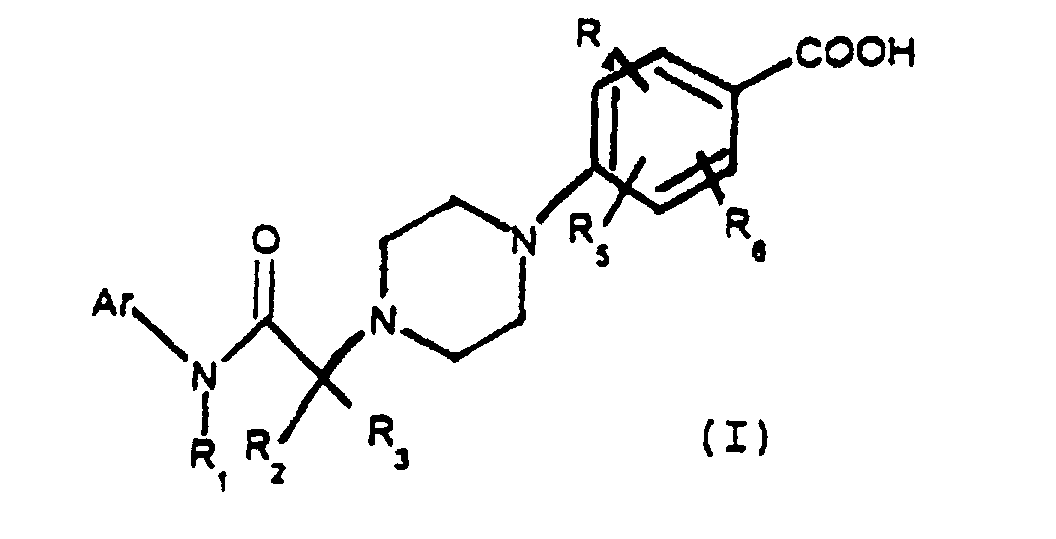
- The subject of the present invention is thus compounds of general formula (I):in which:

- Ar is selected from
- a mono-, bi- or tricyclic aryl group having from 6 to 14 carbon atoms,
- a heteroaromatic group selected from the pyridyl, pyrimidyl, pyrrolyl, furyl, thienyl, quinolyl, indolyl, benzothienyl, benzofuryl, benzopyrranyl, benzothiopyrannyl, dibenzofuryl, carbazolyl and benzothiazinyl groups,
- it being possible for the Ar group to carry 1 to 3 substituents selected from a C1-C8 alkyl, (C3-C8)cycloalkyl(C1-C6)alkyl, C1-C8 alkoxy, (C3-C8)cycloalkyloxy(C1-C6)alkyl, (C3-C8)cycloalkyl(C1-C6)alkoxy(C1-C6)alkyl, (C3-C8) cycloalkyloxy, (C3-C8)cycloalkyl(C1-C6)alkoxy, (C1-C6)alkoxy(C1-C6)alkyl, C6-C14 aryl, C6-C14 heteroaryl, (C6-C14)heteroaryl(C1-C6)alkyl, (C6-C14) aryl (C1-C6) alkyl, (C6-C14) aryl (C1-C6) alkyl(C6-C14)aryl, (C6-C14) aryloxy, (C6-C14)aryloxy(C1-C6)alkyl, (C6-C14)aryl(C1-C6)alkyloxy or (C6-C14)aryl(C1-C6)alkyloxy(C1-C6)alkyl group, a halogen, a trifluoromethyl, trifluoromethoxy, cyano, hydroxyl, nitro, amino, carboxyl, (C1-C6)alkoxycarbonyl, carbamoyl, (C1-C8)alkylthio, (C1-C8)alkylsulphinyl, (C1-C8)alkylsulphonyl, sulphoamino, (C1-C8)alkylsulphonylamino, sulphamoyl or (C1-C8)alkylcarbonylamino group, or two of these substituents forming a methylenedioxy group.
- R1, R2 and R3 are selected, independently of each
other, from:
- a hydrogen atom,
- a C1-C8 alkyl or (C1-C6)alkoxy(C1-C6)alkyl group,
- a cycloalkyl group containing from 3 to 8 carbon atoms, a (C3-C8)cycloalkyl(C1-C6)alkyl group, a (C3-C8)cycloalkyloxy(C1-C6) alkyl or (C3-C8) cycloalkyl (C1-C6)-alkoxy(C1-C6)alkyl group,
- a C6-C14 aryl, C6-C14 heteroaryl, (C6-C14)heteroaryl(C1-C6) alkyl, (C6-C14)aryl (C1-C6) alkyl, (C6-C14)aryl(C1-C6) alkyl (C6-C14) aryl, (C6-C14) aryl (C1-C6) alkoxy (C1-C6) alkyl or (C6-C14)aryloxy(C1-C6) alkyl group,
- R4, R5, R6 are selected, independently of each
other, from:
- a hydrogen atom,
- a C1-C8 alkyl, (C3-C8)cycloalkyl (C1-C6)alkyl, C1-C8 alkoxy, (C3-C8) cycloalkyloxy (C1-C6) alkyl, (C3-C8) cycloalkyloxy, (C3-C8) cycloalkyl (C1-C6) alkoxy, (C3-C8) cycloalkyl (C1-C6)alkoxy(C1-C6) alkyl, (C1-C6) alkoxy(C1-C6) alkyl, C6-C14 aryl, (C6-C14) aryl (C1-C6)alkyl, (C6-C14) aryl (C1-C6) alkyl (C6-C14) aryl, (C6-C14) aryloxy, (C6-C14)aryloxy(C1-C6) alkyl, (C1-C14)aryl (C1-C6) alkoxy or (C6-C14) aryl (C1-C6)alkyloxy(C1-C6)alkyl group, a halogen, a trifluoromethyl, trifluoromethoxy, cyano, carboxyl. hydroxyl, nitro, amino, (C1-C6)alkoxycarbonyl, carbamoyl, (C1-C8)alkylthio, (C1-C8)alkylsulphinyl, (C1-C8)alkylsulphonyl, sulphoamino, (C1-C8)alkylsulphonylamino, sulphamoyl or (C1-C8)alkylcarbonylamino group, it being possible for two of these groups to form a methylenedioxy group, it being possible for the various aryl groups themselves to be substituted with 1 to 3 substituents selected from a C1-C8 alkyl or C1-C8 alkoxy group, a halogen, a trifluoromethyl, trifluoromethoxy, hydroxyl, nitro and amino group, their solvates and their pharmaceutically acceptable salts.
-
- As an example of an aryl group, there may be mentioned the phenyl, α-naphthyl, β-naphthyl and fluorenyl groups.
- The C1-C8 alkyl groups may be linear or branched. As examples, there may be mentioned the methyl, ethyl, propyl, isopropyl, butyl, isobutyl, tert-butyl and pentyl groups.
- The C1-C8 alkoxy groups may likewise be linear or branched. As examples, there may be mentioned the methoxy, ethoxy, propoxy, isopropoxy, butoxy and isobutoxy groups.
- The halogens may be selected from fluorine, chlorine, bromine and iodine.
- The invention also relates to the tautomeric, enantiomeric, diastereoisomeric and epimeric forms of the compounds of general formula (I).
- The compounds of general formula (I) have a carboxylic acid functional group and may be salified, they then being in the form of salts with bases.
- Examples of salts with bases of the compounds of general formula (I) include the pharmaceutically acceptable salts such as the sodium salts, potassium salts, calcium salts and other salts of the same type.
- The compounds of general formula (I) can also be salified with amines in order to form pharmaceutically acceptable salts. By way of example, it will be possible for the compounds of general formula (I) to be salified with glucamine, N-methylglucamine, N,N-dimethylglucamine, ethanolamine, morpholine, N-methylmorpholine or lysine.
- The compounds of general formula (I) possess basic nitrogen atoms and can be monosalified or disalified with inorganic or organic acids. Examples of salts with acids of the compounds of general formula (I) include the pharmaceutically acceptable salts such as, and non-exhaustively, hydrochloride, hydrobromide, sulphate, succinate, maleate, fumarate, malate, tartrate and sulphonates such as methanesulphonate, benzenesulphonate and toluenesulphonate.
- Among the compounds of general formula (I) according to the invention, there may be mentioned more particularly, as preferred compound, 4-{4-[2-(N-isopropyl-N-phenylamino)-2-oxoethyl]-1-piperazinyl}benzoic acid, 4-{4-[2-(N- [2,6-dimethylphenyl]amino)-2-oxoethyl]-1-piperazinyl}benzoic acid and 4-{4-[2-(N-[2,6-diisopropylphenyl]amino)-2-oxoethyl]-1-piperazinyl)benzoic acid.
- The invention also relates to a process for the preparation of the compounds of general formula (I). A process of preparation according to the invention comprises reacting an aromatic amine of general formula (II):

- in which Ar and R1 are as defined above,
with a haloacyl halide of general formula (III):

- in which Hal represents a chlorine or bromine atom,
- R2 and R3 are as defined above,
in order to form a compound of general formula (IV):
 in which Ar, R1, R2, R3 and Hal are as defined above, and
reacting the compound of general formula (IV) with a
compound of general formula (V):
in which Ar, R1, R2, R3 and Hal are as defined above, and
reacting the compound of general formula (IV) with a
compound of general formula (V):
-
- In the case where R7 is an alkyl group, the compound of general formula (VI) can be hydrolyzed by conventional acidic or basic means in order to give the compound of general formula (I) :in which Ar, R1, R2, R3, R4, R5 and R6 are as defined above.
- The compounds of formula (V) are known compounds. They can be synthesized according to the procedure described by V. Prelog and Z. Blazek in Collection Czechloslov. Chem. Communications 6, 211-24 (1934) for ethyl 4-(1-piperazinyl)benzoate.
- By way of example, the compound (VI), in which R7 is an alkyl group, can be hydrolyzed in the presence of a basic agent such as dilute sodium hydroxide.
- The enantiomers of the compounds of formula (I) can be separated by successive recrystallization of the salt of the acid (I) with an optically active base from solvents such as acetone, ethyl acetate or isopropanol, followed by displacement from the salt into an optically active acid by an inorganic or organic acid, according to a conventional method.
- The compounds according to the present invention can be used in the treatment of diabetes, in particular of non-insulin-dependent diabetes because of their hypoglycaemic effect and of their lack of toxicity at the active doses.
- The subject of the present invention is therefore also pharmaceutical compositions comprising, as active ingredient, a compound according to the invention.
- The pharmaceutical compositions according to the invention can be provided in forms intended for administration by the parenteral, oral, rectal, permucosal or percutaneous route.
- They can therefore be provided in the form of injectable solutions or suspensions or in multidose vials, in the form of plain or coated tablets, sugar-coated tablets, capsules, gelatin capsules, pills, cachets, powders, suppositories or rectal capsules, of solutions or suspensions, for percutaneous use in a polar solvent, for permucosal use.
- The excipients which are suitable for such administrations are cellulose derivatives or microcrystalline cellulose, alkaline-earth metal carbonates, magnesium phosphate, starches, modified starches, and lactose for the solid forms.
- For rectal use, cocoa butter or polyethylene glycol stearates are the preferred excipients.
- For parenteral use, water, aqueous solutions, physiological saline or isotonic solutions are the vehicles most conveniently used.
- The dosage may vary within wide limits depending on the therapeutic indication and the route of administration, as well as the age and weight of the subject.
- The following examples illustrate the preparation of the compounds of formula I.
- 34.5 ml of chloroacetyl chloride are added dropwise to 50 g of 4-chloroaniline and 108 g of potassium carbonate in 400 ml of chloroform.
- The reaction medium is then filtered and the solid obtained is taken up in 1500 ml of water. After stirring for 1 h, the solid in suspension is filtered and thoroughly washed with water.
- 70.5 g of 2-chloro-N-(4-chlorophenyl)acetamide are thus obtained in the form of a white solid whose melting point is 169-170°C.
IR (KBr): 1669 cm-1 (C = O amide)
1H NMR: (DMSO-d6, 200 MHz) δ ppm 4.25 (2H, s, CH2), 7.30 (2H, d, phenyl protons), 7.60 (2H, d, phenyl protons), 10.40 (1H, s, NH). - 25 g of 2-chloro-N-(4-chlorophenyl) acetamide, 35.2 g of ethyl 4-(1-piperazinyl)benzoate and 80 g of potassium carbonate in 300 ml of DMF are reacted overnight at room temperature, with stirring.
- The reaction medium is filtered in order to separate the insoluble matter and the filtrate thus obtained is poured over 1000 ml of water. A solid crystallizes. This solid is filtered and washed with water in order to give 39 g of the ethyl ester of 4-{4-[2chlorophenylamino)-2-oxoethyl]-1-piperazinyl}benzoic acid in the form of a solid whose melting point is 172-174°C.
IR (KBr): 1686 cm-1 (C = O ester)
1H NMR: (DMSO-d6, 200 MHz) δ ppm 1.20 (3H, t, CH3), 2.50 (4H, s, 2CH2), 3.05 (2H, s, CH2), 3.20 δ 54H, s, 2CH2), 4.05 (2H, q, CH2), 6.80 (2H, d, phenyl protons), 7.20 (2H, d, phenyl protons), 7.60 (4H, m, phenyl protons), 9.80 (1H, s, NH). - 20 g of the ethyl ester of 4-{4-[2-(4-chlorophenylamino) -2-oxoethyl]-1-piperazinyl}benzoic acid, 165 ml of a 1 N aqueous sodium hydroxide solution and 150 ml of ethanol are heated under reflux, with stirring, for 1 h.
- The mixture is acidified with concentrated hydrochloric acid to pH 5. A solid crystallizes. This solid is filtered and washed with ethanol in order to give 16.4 g of the desired crude product. Recrystallization, in a DMF/acetonitrile (1/1) mixture, gives 13.6 g of 4-{4-[2-(4-chlorophenylamino)-2-oxo-ethyl]-1-piperazinyl}benzoic acid in the form of a white solid which melts at 263-265°C.
IR (KBr): 1676 cm-1 (C = O acid)
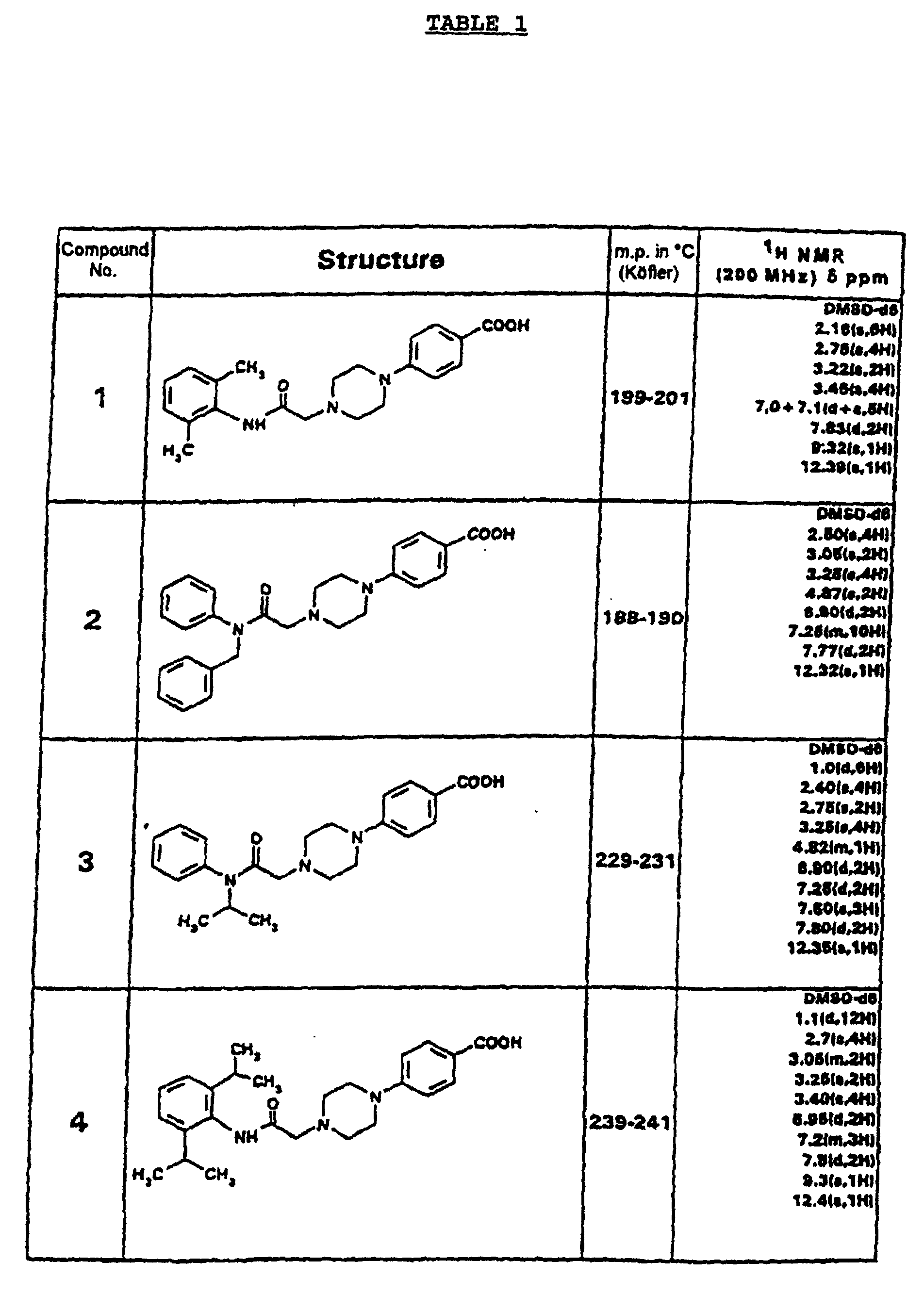
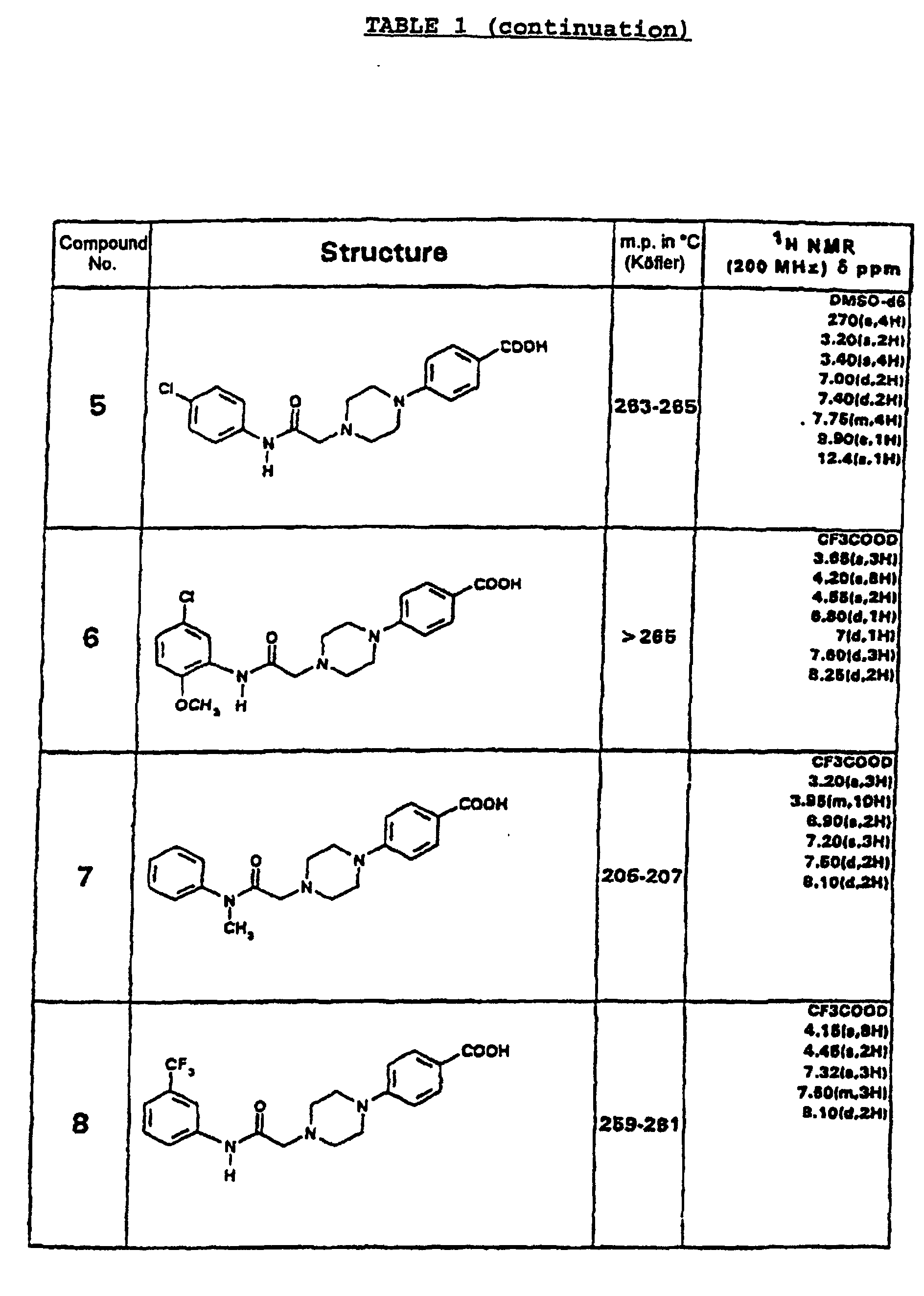
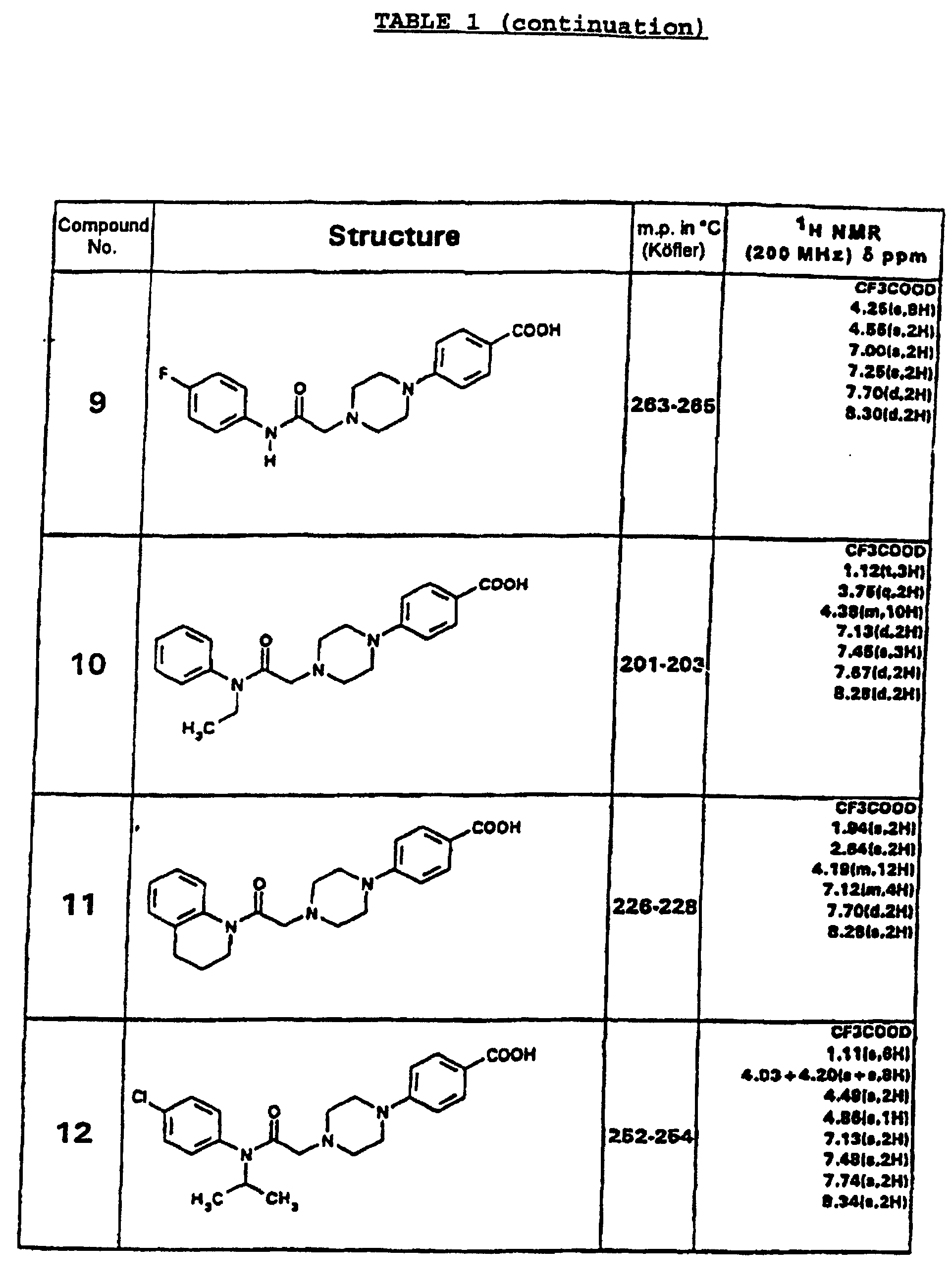
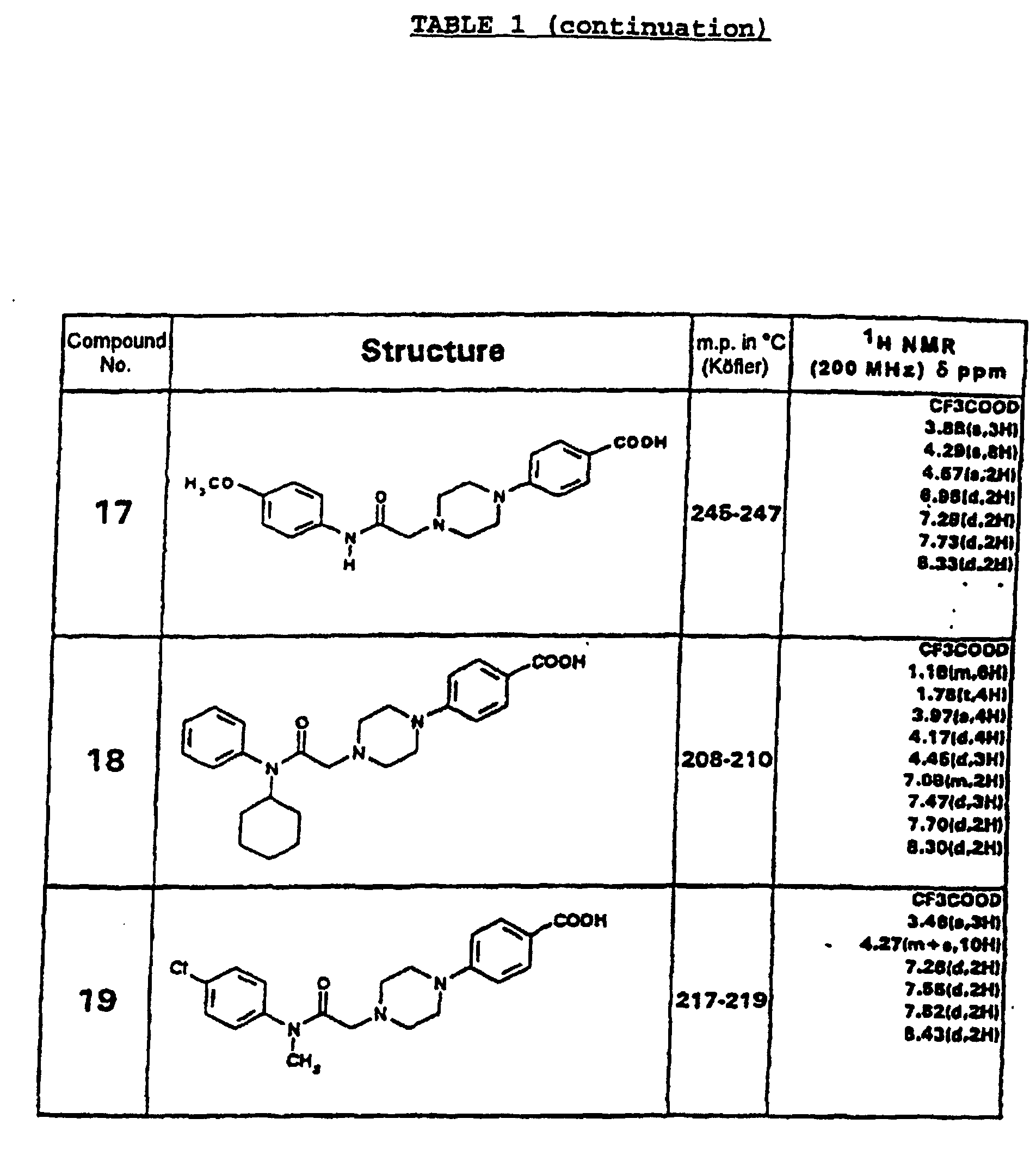
1H NMR: (DMSO-d6, 200 MHz) δ ppm 2.7 (4H, s, 2CH2), 3.20 (2H, s, CH2) 3.40 (4H, s, 2CH2) 7.0 (2H, d, phenyl protons), 7.40 (2H, d, phenyl protons) 7.75 (4H, m, phenyl protons), 9.90 (1H, s, NH), 12.40 (1H, broad s, acidic OH). - The formulae and characteristics of the compounds according to the invention are assembled in Table 1 below.

- Results of pharmacological studies will be given below.
- The antidiabetic activity of the compounds of formula I is determined by the oral route on an experimental model of non-insulin-dependent diabetes, induced in rats by streptozotocin.
- The non-insulin-dependent diabetes model is obtained in rats by neonatal injection (on the day of birth) of streptozotozin.
- The diabetic rats used are 8 weeks old. The animals are housed, from the day they are born to the day of the experiment, in an animal house at a regulated temperature of 21 to 22°C, and it is subjected to a fixed light (from 7 a.m. to 7 p.m.) and dark (from 7 p.m. to 7 a.m.) cycle. Their food consisted of a maintenance diet, water and food were provided "ad libitum", with the exception of the 2 hours fasting preceding the teats during which food is withdrawn (postabsorptive state).
- The rats are treated by the oral route during the day with the test product. Two hours after the last administration of the product and 30 minutes after anaesthetizing the animals with sodium pentobarbital (Nembutal@), a 300 µl blood sample is collected at the end of the tail.
- Table II assembles the principal results obtained. These results show the efficacy of the compounds of formula I in causing a decrease in glycaemia in the diabetic animals.
- These results are expressed as a percentage variation in the glycaemia at D4 (4 days of treatment) compared with D0 (before treatment).
Compound 20 mg/kg/d 20 mg/kg/d % Glycaemia at D4 % Glycaemia at D4 1 -6 -16 2 -2 -10 3 -13 -22 4 -8 -16 5 -9 -12

in the presence of a basic agent such as triethylamine in order to form the compound of general formula (VI):

Claims (6)
- Compounds of general formula (I):in which:
 it being possible for the various aryl groups themselves to be substituted with 1 to 3 substituents selected from a C1-C8 alkyl or C1-C8 alkoxy group, a halogen, a trifluoromethyl, trifluoromethoxy, hydroxyl, nitro and amino group,Ar is selected froma mono-, bi- or tricyclic aryl group having from 6 to 14 carbon atoms,a heteroaromatic group selected from the pyridyl, pyrimidyl, pyrrolyl, furyl, thienyl, quinolyl, indolyl, benzothienyl, benzofuryl, benzopyrranyl, benzothiopyrannyl, dibenzofuryl, carbazolyl and benzothiazinyl groups,it being possible for the Ar group to carry 1 to 3 substituents selected from a C1-C8 alkyl, (C3-C8)cycloalkyl (C1-C6)alkyl, C1-C8 alkoxy, (C3-C8) cycloalkyloxy(C1-C6)alkyl, (C3-C8)cycloalkyl(C1-C6)alkoxy (C1-C6) alkyl, (C3-C8)cycloalkyloxy, (C3-C8) cycloalkyl (C1-C6)alkoxy, (C1-C6)alkoxy(C1-C6)alkyl, C6-C14 aryl, C6-C14 heteroaryl, (C6-C14)heteroaryl(C1-C6)alkyl, (C6-C14) aryl (C1-C6) alkyl, (C6-C14) aryl(C1-C6)alkyl (C6-C14) aryl, (C6-C14) aryloxy, (C6-C14)aryloxy (C1-C6)alkyl, (C6-C14)aryl (C1-C6)alkyloxy or (C6-C14)aryl(C1-C6)alkyloxy(C1-C6)alkyl group, a halogen, a trifluoromethyl, trifluoromethoxy, cyano, hydroxyl, nitro, amino, carboxyl, (C1-C6)alkoxycarbonyl, carbamoyl, (C1-C8) alkylthio, (C1-C8) alkylsulphinyl, (C1-C8) alkylsulphonyl, sulphoamino, (C1-C8)alkylsulphonylamino, sulphamoyl or (C1-C8)alkylcarbonylamino group, or two of these substituents forming a methylenedioxy group.R1, R2 and R3 are selected, independently of each other, from:or alternatively R1 forms with the nitrogen atom to which R1 is attached and the Ar group a ring selected from indolinyl, quinolyl, indolyl and tetrahydroquinolyl,a hydrogen atom,a C1-C8 alkyl or (C1-C6) alkoxy (C1-C6) alkyl group, - a cycloalkyl group containing from 3 to 8 carbon atoms, a (C3-C8)cycloalkyl(C1-C6)alkyl group, a (C3-C8) cycloalkyloxy (C1-C6)alkyl or (C3-C8) cycloalkyl (C1-C6)alkoxy(C1-C6)alkyl group,a C6-C14 aryl, C6-C14 heteroaryl, (C6-C14)heteroaryl(C1-C6)alkyl, (C6-C14) aryl (C1-C6)alkyl, (C6-C14) aryl (C1-C6) alkyl (C6-C14)aryl, (C6-C14) aryl (C1-C6)alkoxy (C1-C6) alkyl or (C6-C14)aryloxy (C1-C6) alkyl group,R4, R5, R6 are selected, independently of each other, from:a hydrogen atom,a C1-C8 alkyl, (C3-C8)cycloalkyl (C1-C6)alkyl, C1-C8 alkoxy, (C3-C8) cycloalkyloxy (C1-C6) alkyl, (C3-C8) cycloalkyloxy, (C3-C8) cycloalkyl (C1-C6)alkoxy, (C3-C8) cycloalkyl (C1-C6)alkoxy (C1-C6)alkyl, (C1-C6)alkoxy(C1-C6)alkyl, C6-C14 aryl, (C6-C14) aryl (C1-C6) alkyl, (C6-C14) aryl (C1-C6) alkyl (C6-C14)aryl, (C6-C14) aryloxy, (C6-C14) aryloxy (C1-C6)alkyl, (C1-C14) aryl (C1-C6)alkoxy or (C6-C14)aryl(C1-C6)alkyloxy(C1-C6)alkyl group, a halogen, a trifluoromethyl, trifluoromethoxy, cyano, carboxyl, hydroxyl, nitro, amino, (C1-C6)alkoxycarbonyl, carbamoyl, (C1-C8) alkylthio, (C1-C8) alkylsulphinyl, (C1-C8) alkylsulphonyl, sulphoamino, (C1-C8)alkylsulphonylamino, sulphamoyl or (C1-C8)alkylcarbonylamino group, it being possible for two of these groups to form a methylenedioxy group,
their solvates and their pharmaceutically acceptable salts. - Compound according to Claim 1, which is 4-{4-[2(N-isopropyl-N-phenylamino)-2-oxoethyl]-1-piperazinyl}benzoic acid, 4-{4-[2-(N-[2,6-dimethylphenyl]amino)-2-oxoethyl]-1-piperazinyl}benzoic acid and 4-{4-[2-(N-[2,6-diisopropylphenyl]amino)-2-oxoethyl]-1-piperazinyl}benzoic acid.
- Process for the preparation of compounds according to Claim 1, comprising reacting an aromatic amine of general formula (II):
 in order to form a compound of general formula (IV):in which Ar and R1 are as defined above, with a haloacyl halide of general formula (III):
 in which Hal represents a chlorine or bromine atom,R2 and R3 are as defined above,in which Ar, R1, R2, R3 and Hal are as defined above, and reacting the compound of general formula (IV) with a compound of general formula (V):
 in the presence of a basic agent such as triethylamine in order to form the compound of general formula (VI):in which R4, R5 and R6 are as defined above and R7 is a hydrogen atom or a C1-C6 alkyl group,in which Ar, R1, R2, R3, R4, R5, R6 and R7 are as defined above,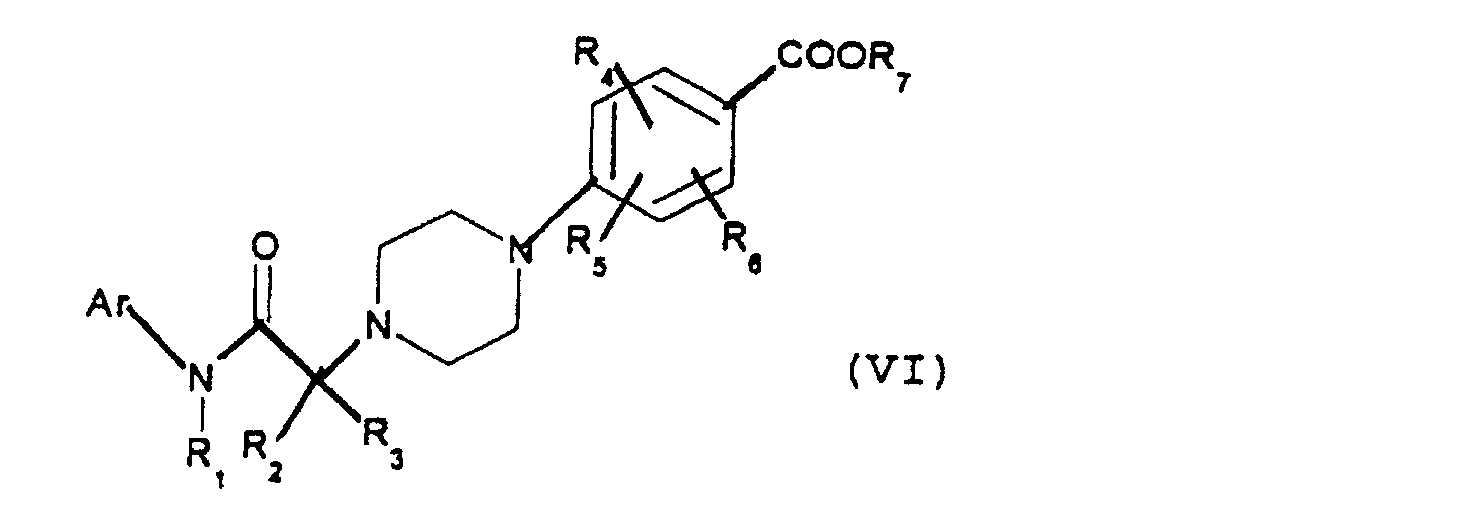
and in the case where R7 is an alkyl group, hydrolyzing this compound in order to form a compound of general formula (I). - Pharmaceutical composition comprising, as active ingredient, a compound according to Claim 1 or Claim 2.
- Use of compounds as defined in Claim 1 or 2 for preparing a medicament for the treatment of diabetes.
- Use according to claim 5 for the treatment of non-insulin-dependent diabetes.
Priority Applications (1)
| Application Number | Priority Date | Filing Date | Title |
|---|---|---|---|
| SI9730383T SI0937054T1 (en) | 1996-12-18 | 1997-12-15 | 4-(1-piperazinyl)benzoic acid derivatives, process for preparing them and their therapeutic applications |
Applications Claiming Priority (3)
| Application Number | Priority Date | Filing Date | Title |
|---|---|---|---|
| FR9615588A FR2757158B1 (en) | 1996-12-18 | 1996-12-18 | NOVEL 4- (1-PIPERAZINYL) BENZOIC ACID DERIVATIVES, PROCESS FOR THEIR PREPARATION AND THERAPEUTIC APPLICATIONS |
| FR9615588 | 1996-12-18 | ||
| PCT/EP1997/007046 WO1998027078A1 (en) | 1996-12-18 | 1997-12-15 | New 4-(1-piperazinyl)benzoic acid derivatives, process for preparing them and their therapeutic applications |
Publications (2)
| Publication Number | Publication Date |
|---|---|
| EP0937054A1 EP0937054A1 (en) | 1999-08-25 |
| EP0937054B1 true EP0937054B1 (en) | 2002-06-05 |
Family
ID=9498818
Family Applications (1)
| Application Number | Title | Priority Date | Filing Date |
|---|---|---|---|
| EP97953824A Expired - Lifetime EP0937054B1 (en) | 1996-12-18 | 1997-12-15 | 4-(1-piperazinyl)benzoic acid derivatives, process for preparing them and their therapeutic applications |
Country Status (26)
| Country | Link |
|---|---|
| US (1) | US6281215B1 (en) |
| EP (1) | EP0937054B1 (en) |
| JP (1) | JP2001506645A (en) |
| KR (1) | KR20000069544A (en) |
| CN (1) | CN1073102C (en) |
| AR (1) | AR013889A1 (en) |
| AT (1) | ATE218558T1 (en) |
| AU (1) | AU726640B2 (en) |
| BR (1) | BR9713587A (en) |
| CA (1) | CA2275346A1 (en) |
| CZ (1) | CZ218999A3 (en) |
| DE (1) | DE69713128T2 (en) |
| DK (1) | DK0937054T3 (en) |
| ES (1) | ES2178039T3 (en) |
| FR (1) | FR2757158B1 (en) |
| HU (1) | HUP0000586A3 (en) |
| ID (1) | ID23671A (en) |
| NO (1) | NO312896B1 (en) |
| PL (1) | PL334187A1 (en) |
| PT (1) | PT937054E (en) |
| RU (1) | RU2178786C2 (en) |
| SK (1) | SK282841B6 (en) |
| TR (1) | TR199901367T2 (en) |
| UA (1) | UA56206C2 (en) |
| WO (1) | WO1998027078A1 (en) |
| ZA (1) | ZA9711329B (en) |
Families Citing this family (5)
| Publication number | Priority date | Publication date | Assignee | Title |
|---|---|---|---|---|
| FR2763334A1 (en) * | 1997-05-13 | 1998-11-20 | Lipha | Piperazino alkyl anthranilic acid amide |
| GB0013346D0 (en) * | 2000-06-01 | 2000-07-26 | Glaxo Group Ltd | Therapeutic benzamide derivatives |
| US6476046B1 (en) | 2000-12-04 | 2002-11-05 | Sepracor, Inc. | Diazabicyclo[4.3.0]nonanes, and methods of use thereof |
| CN101417988B (en) * | 2007-10-24 | 2011-04-27 | 山东轩竹医药科技有限公司 | Biguanide piperazines dipeptidyl peptidase IV inhibitor |
| CN101781273B (en) * | 2009-01-21 | 2012-07-04 | 山东轩竹医药科技有限公司 | Dipeptidylpeptidase IV inhibitor containing guanidyl |
Family Cites Families (9)
| Publication number | Priority date | Publication date | Assignee | Title |
|---|---|---|---|---|
| FR2346011A1 (en) * | 1976-02-02 | 1977-10-28 | Orsymonde | (4)-Phenyl-(1)-dimethylacetanilido-piperazine and salts - esp. for treating cardiovascular circulatory disorders |
| DE3139970A1 (en) * | 1981-10-08 | 1983-04-28 | Boehringer Mannheim Gmbh, 6800 Mannheim | NEW CARBONIC ACID DERIVATIVES, METHOD FOR THE PRODUCTION THEREOF AND MEDICINAL PRODUCTS CONTAINING THESE COMPOUNDS |
| US5364849A (en) * | 1989-04-22 | 1994-11-15 | John Wyeth & Brother, Limited | 1-[3 or 4-[1-[4-piperazinyl]]-2 arylpropionyl or butryl]-heterocyclic derivatives |
| FR2693722B1 (en) | 1992-07-16 | 1994-10-14 | Meram Lab | N-cycloalkylpiperazine derivatives, process for obtaining them and pharmaceutical compositions containing them. |
| GB9221931D0 (en) * | 1992-10-17 | 1992-12-02 | Wyeth John & Brother Ltd | Piperazine derivatives |
| FR2707984B1 (en) * | 1993-07-23 | 1995-09-01 | Adir | New substituted piperazines, process for their preparation and compositions containing them |
| US5607936A (en) * | 1994-09-30 | 1997-03-04 | Merck & Co., Inc. | Substituted aryl piperazines as neurokinin antagonists |
| IT1278960B1 (en) * | 1995-02-24 | 1997-12-02 | Elitas S N C Di Belluzzi Lino | MOLDING MACHINE FOR SURFACE IMPREGNATION OF LEATHER OR SIMILAR. |
| US5723475A (en) * | 1995-02-28 | 1998-03-03 | Suntory Limited | Arylpiperidine and arylpiperazine derivatives and medicament containing the same |
-
1996
- 1996-12-18 FR FR9615588A patent/FR2757158B1/en not_active Expired - Fee Related
-
1997
- 1997-12-15 WO PCT/EP1997/007046 patent/WO1998027078A1/en not_active Ceased
- 1997-12-15 ID IDW990539A patent/ID23671A/en unknown
- 1997-12-15 JP JP52730398A patent/JP2001506645A/en active Pending
- 1997-12-15 KR KR1019997005478A patent/KR20000069544A/en not_active Ceased
- 1997-12-15 HU HU0000586A patent/HUP0000586A3/en unknown
- 1997-12-15 TR TR1999/01367T patent/TR199901367T2/en unknown
- 1997-12-15 AT AT97953824T patent/ATE218558T1/en not_active IP Right Cessation
- 1997-12-15 US US09/331,155 patent/US6281215B1/en not_active Expired - Fee Related
- 1997-12-15 UA UA99074128A patent/UA56206C2/en unknown
- 1997-12-15 CA CA002275346A patent/CA2275346A1/en not_active Abandoned
- 1997-12-15 SK SK785-99A patent/SK282841B6/en unknown
- 1997-12-15 PL PL97334187A patent/PL334187A1/en unknown
- 1997-12-15 EP EP97953824A patent/EP0937054B1/en not_active Expired - Lifetime
- 1997-12-15 PT PT97953824T patent/PT937054E/en unknown
- 1997-12-15 CN CN97181700A patent/CN1073102C/en not_active Expired - Fee Related
- 1997-12-15 CZ CZ992189A patent/CZ218999A3/en unknown
- 1997-12-15 DE DE69713128T patent/DE69713128T2/en not_active Expired - Fee Related
- 1997-12-15 BR BR9713587-9A patent/BR9713587A/en unknown
- 1997-12-15 ES ES97953824T patent/ES2178039T3/en not_active Expired - Lifetime
- 1997-12-15 AU AU57582/98A patent/AU726640B2/en not_active Ceased
- 1997-12-15 RU RU99115481/04A patent/RU2178786C2/en not_active IP Right Cessation
- 1997-12-15 DK DK97953824T patent/DK0937054T3/en active
- 1997-12-17 ZA ZA9711329A patent/ZA9711329B/en unknown
- 1997-12-18 AR ARP970105971A patent/AR013889A1/en unknown
-
1999
- 1999-06-17 NO NO19992968A patent/NO312896B1/en unknown
Also Published As
| Publication number | Publication date |
|---|---|
| HUP0000586A2 (en) | 2001-04-28 |
| AU726640B2 (en) | 2000-11-16 |
| CN1245494A (en) | 2000-02-23 |
| JP2001506645A (en) | 2001-05-22 |
| ATE218558T1 (en) | 2002-06-15 |
| SK78599A3 (en) | 2000-03-13 |
| NO992968L (en) | 1999-08-17 |
| DE69713128T2 (en) | 2003-03-20 |
| TR199901367T2 (en) | 1999-10-21 |
| DE69713128D1 (en) | 2002-07-11 |
| WO1998027078A1 (en) | 1998-06-25 |
| SK282841B6 (en) | 2002-12-03 |
| FR2757158B1 (en) | 1999-04-02 |
| NO312896B1 (en) | 2002-07-15 |
| NO992968D0 (en) | 1999-06-17 |
| AR013889A1 (en) | 2001-01-31 |
| CA2275346A1 (en) | 1998-06-25 |
| UA56206C2 (en) | 2003-05-15 |
| BR9713587A (en) | 2000-04-04 |
| PT937054E (en) | 2002-11-29 |
| FR2757158A1 (en) | 1998-06-19 |
| KR20000069544A (en) | 2000-11-25 |
| EP0937054A1 (en) | 1999-08-25 |
| ID23671A (en) | 2000-05-11 |
| DK0937054T3 (en) | 2002-09-16 |
| CN1073102C (en) | 2001-10-17 |
| CZ218999A3 (en) | 1999-09-15 |
| AU5758298A (en) | 1998-07-15 |
| ZA9711329B (en) | 1998-06-24 |
| US6281215B1 (en) | 2001-08-28 |
| RU2178786C2 (en) | 2002-01-27 |
| ES2178039T3 (en) | 2002-12-16 |
| HUP0000586A3 (en) | 2002-10-28 |
| PL334187A1 (en) | 2000-02-14 |
Similar Documents
| Publication | Publication Date | Title |
|---|---|---|
| IE852118L (en) | Ethylenediamine monoamide derivatives. | |
| JP5247814B2 (en) | Novel diazeniumdiolate derivative, process for producing the same, and pharmaceutical composition containing the same | |
| DK157008B (en) | ANALOGY PROCEDURE FOR THE PREPARATION OF N-PYRROLIDINYL OR N-PYRROLIDINYLMETHYL-SUBSTITUTED BENZAMIDES AND INTERMEDIATES FOR USE IN THE PREPARATION | |
| JP2767321B2 (en) | Piperazine derivative and drug containing the same | |
| WO1999064407A1 (en) | α-(1-PIPERAZINYL)ACETAMIDO ARENECARBOXYLIC ACID DERIVATIVES AS ANTIDIABETIC AGENTS | |
| HU176533B (en) | Process for preparing o-alkylated hydroxylamines | |
| US6281215B1 (en) | 4-(1-piperazinyl) benzoic acid derivatives, process for preparing them and their therapeutic applications | |
| US4840967A (en) | Carbamate or urea derivatives, their preparation and pharmaceutical compositions comprising them | |
| US4221793A (en) | N,N'-Disubstituted piperazine derivative | |
| IE44211B1 (en) | Acylamino(alkyl)benzene derivatives and process for preparing them | |
| US4268511A (en) | 3-Amino(1H,3H)quinazoline-2,4-dione derivatives and their therapeutic applications | |
| US4166852A (en) | Piperazino-pyrimidines and their use as spasmolytic agents | |
| IE45782B1 (en) | 1-(n-acylcarbamoyl)-2-cyanoziridines | |
| US4968680A (en) | 1-acyl-2,3-dihydro-4(1H)-quinolinone-4-oxime derivatives, process for producing them and use thereof | |
| US20080070946A1 (en) | Hydroxymethylbenzothiazoles Amides | |
| MXPA99005777A (en) | New 4-(1-piperazinyl)benzoic acid derivatives, process for preparing them and their therapeutic applications | |
| HU193556B (en) | Process for preparing benzamide derivatives | |
| RU2198881C2 (en) | α-(1-PIPERAZINYL)-ACETAMIDO-DERIVATIVES OF ARENE CARBOXYLIC ACID, METHOD OF THEIR SYNTHESIS, PHARMACEUTICAL COMPOSITIONS, METHODS OF TREATMENT | |
| MXPA00012156A (en) | &agr;-(1-PIPERAZINYL)ACETAMIDO ARENECARBOXYLIC ACID DERIVATIVES AS ANTIDIABETIC AGENTS | |
| US4281006A (en) | 2-(Diphenylalkylimino)piperidine-3-carboxanilides as inhibitors of gastrointestinal hypersecretion | |
| JPH0576471B2 (en) | ||
| US3987036A (en) | Basically substituted heterocyclic compounds | |
| JP2003507463A (en) | Substituted piperazine derivatives, their preparation and their use as drugs | |
| HK1036626A (en) | α-(1-PIPERAZINYL)ACETAMIDO ARENECARBOXYLIC ACID DERIVATIVES AS ANTIDIABETIC AGENTS | |
| EP0375557A1 (en) | Glycine derivative process for preparation thereof, and pharmaceutical composition containing it |
Legal Events
| Date | Code | Title | Description |
|---|---|---|---|
| PUAI | Public reference made under article 153(3) epc to a published international application that has entered the european phase |
Free format text: ORIGINAL CODE: 0009012 |
|
| 17P | Request for examination filed |
Effective date: 19990604 |
|
| AK | Designated contracting states |
Kind code of ref document: A1 Designated state(s): AT BE CH DE DK ES FI FR GB GR IE IT LI LU NL PT SE |
|
| AX | Request for extension of the european patent |
Free format text: LT PAYMENT 19990617;LV PAYMENT 19990617;SI PAYMENT 19990604 |
|
| GRAG | Despatch of communication of intention to grant |
Free format text: ORIGINAL CODE: EPIDOS AGRA |
|
| 17Q | First examination report despatched |
Effective date: 20010912 |
|
| GRAG | Despatch of communication of intention to grant |
Free format text: ORIGINAL CODE: EPIDOS AGRA |
|
| GRAG | Despatch of communication of intention to grant |
Free format text: ORIGINAL CODE: EPIDOS AGRA |
|
| GRAH | Despatch of communication of intention to grant a patent |
Free format text: ORIGINAL CODE: EPIDOS IGRA |
|
| GRAH | Despatch of communication of intention to grant a patent |
Free format text: ORIGINAL CODE: EPIDOS IGRA |
|
| GRAA | (expected) grant |
Free format text: ORIGINAL CODE: 0009210 |
|
| AK | Designated contracting states |
Kind code of ref document: B1 Designated state(s): AT BE CH DE DK ES FI FR GB GR IE IT LI LU NL PT SE |
|
| AX | Request for extension of the european patent |
Free format text: LT PAYMENT 19990617;LV PAYMENT 19990617;SI PAYMENT 19990604 |
|
| REF | Corresponds to: |
Ref document number: 218558 Country of ref document: AT Date of ref document: 20020615 Kind code of ref document: T |
|
| REG | Reference to a national code |
Ref country code: GB Ref legal event code: FG4D |
|
| REG | Reference to a national code |
Ref country code: CH Ref legal event code: EP |
|
| REG | Reference to a national code |
Ref country code: IE Ref legal event code: FG4D |
|
| REF | Corresponds to: |
Ref document number: 69713128 Country of ref document: DE Date of ref document: 20020711 |
|
| REG | Reference to a national code |
Ref country code: CH Ref legal event code: NV Representative=s name: BOVARD AG PATENTANWAELTE |
|
| REG | Reference to a national code |
Ref country code: DK Ref legal event code: T3 |
|
| REG | Reference to a national code |
Ref country code: GR Ref legal event code: EP Ref document number: 20020402919 Country of ref document: GR |
|
| ET | Fr: translation filed | ||
| REG | Reference to a national code |
Ref country code: PT Ref legal event code: SC4A Free format text: AVAILABILITY OF NATIONAL TRANSLATION Effective date: 20020830 |
|
| PGFP | Annual fee paid to national office [announced via postgrant information from national office to epo] |
Ref country code: PT Payment date: 20021203 Year of fee payment: 6 |
|
| PGFP | Annual fee paid to national office [announced via postgrant information from national office to epo] |
Ref country code: SE Payment date: 20021204 Year of fee payment: 6 |
|
| PGFP | Annual fee paid to national office [announced via postgrant information from national office to epo] |
Ref country code: GB Payment date: 20021211 Year of fee payment: 6 Ref country code: AT Payment date: 20021211 Year of fee payment: 6 |
|
| PGFP | Annual fee paid to national office [announced via postgrant information from national office to epo] |
Ref country code: DK Payment date: 20021212 Year of fee payment: 6 Ref country code: FI Payment date: 20021212 Year of fee payment: 6 |
|
| PGFP | Annual fee paid to national office [announced via postgrant information from national office to epo] |
Ref country code: LU Payment date: 20021216 Year of fee payment: 6 |
|
| REG | Reference to a national code |
Ref country code: ES Ref legal event code: FG2A Ref document number: 2178039 Country of ref document: ES Kind code of ref document: T3 |
|
| PGFP | Annual fee paid to national office [announced via postgrant information from national office to epo] |
Ref country code: CH Payment date: 20021217 Year of fee payment: 6 |
|
| PGFP | Annual fee paid to national office [announced via postgrant information from national office to epo] |
Ref country code: GR Payment date: 20021220 Year of fee payment: 6 |
|
| PGFP | Annual fee paid to national office [announced via postgrant information from national office to epo] |
Ref country code: IE Payment date: 20021223 Year of fee payment: 6 |
|
| PGFP | Annual fee paid to national office [announced via postgrant information from national office to epo] |
Ref country code: NL Payment date: 20021227 Year of fee payment: 6 |
|
| PGFP | Annual fee paid to national office [announced via postgrant information from national office to epo] |
Ref country code: ES Payment date: 20030121 Year of fee payment: 6 |
|
| PGFP | Annual fee paid to national office [announced via postgrant information from national office to epo] |
Ref country code: BE Payment date: 20030214 Year of fee payment: 6 |
|
| PLBE | No opposition filed within time limit |
Free format text: ORIGINAL CODE: 0009261 |
|
| STAA | Information on the status of an ep patent application or granted ep patent |
Free format text: STATUS: NO OPPOSITION FILED WITHIN TIME LIMIT |
|
| 26N | No opposition filed |
Effective date: 20030306 |
|
| PGFP | Annual fee paid to national office [announced via postgrant information from national office to epo] |
Ref country code: FR Payment date: 20031210 Year of fee payment: 7 |
|
| PG25 | Lapsed in a contracting state [announced via postgrant information from national office to epo] |
Ref country code: LU Free format text: LAPSE BECAUSE OF NON-PAYMENT OF DUE FEES Effective date: 20031215 Ref country code: IE Free format text: LAPSE BECAUSE OF NON-PAYMENT OF DUE FEES Effective date: 20031215 Ref country code: GB Free format text: LAPSE BECAUSE OF NON-PAYMENT OF DUE FEES Effective date: 20031215 Ref country code: FI Free format text: LAPSE BECAUSE OF NON-PAYMENT OF DUE FEES Effective date: 20031215 Ref country code: AT Free format text: LAPSE BECAUSE OF NON-PAYMENT OF DUE FEES Effective date: 20031215 |
|
| PG25 | Lapsed in a contracting state [announced via postgrant information from national office to epo] |
Ref country code: SE Free format text: LAPSE BECAUSE OF NON-PAYMENT OF DUE FEES Effective date: 20031216 Ref country code: ES Free format text: LAPSE BECAUSE OF NON-PAYMENT OF DUE FEES Effective date: 20031216 |
|
| PGFP | Annual fee paid to national office [announced via postgrant information from national office to epo] |
Ref country code: DE Payment date: 20031229 Year of fee payment: 7 |
|
| PG25 | Lapsed in a contracting state [announced via postgrant information from national office to epo] |
Ref country code: LI Free format text: LAPSE BECAUSE OF NON-PAYMENT OF DUE FEES Effective date: 20031231 Ref country code: CH Free format text: LAPSE BECAUSE OF NON-PAYMENT OF DUE FEES Effective date: 20031231 Ref country code: BE Free format text: LAPSE BECAUSE OF NON-PAYMENT OF DUE FEES Effective date: 20031231 |
|
| PG25 | Lapsed in a contracting state [announced via postgrant information from national office to epo] |
Ref country code: DK Free format text: LAPSE BECAUSE OF NON-PAYMENT OF DUE FEES Effective date: 20040102 |
|
| BERE | Be: lapsed |
Owner name: *MERCK PATENT G.M.B.H. Effective date: 20031231 |
|
| PG25 | Lapsed in a contracting state [announced via postgrant information from national office to epo] |
Ref country code: PT Free format text: LAPSE BECAUSE OF NON-PAYMENT OF DUE FEES Effective date: 20040630 |
|
| PG25 | Lapsed in a contracting state [announced via postgrant information from national office to epo] |
Ref country code: NL Free format text: LAPSE BECAUSE OF NON-PAYMENT OF DUE FEES Effective date: 20040701 |
|
| PG25 | Lapsed in a contracting state [announced via postgrant information from national office to epo] |
Ref country code: GR Free format text: LAPSE BECAUSE OF NON-PAYMENT OF DUE FEES Effective date: 20040705 |
|
| EUG | Se: european patent has lapsed | ||
| GBPC | Gb: european patent ceased through non-payment of renewal fee |
Effective date: 20031215 |
|
| REG | Reference to a national code |
Ref country code: CH Ref legal event code: PL |
|
| REG | Reference to a national code |
Ref country code: DK Ref legal event code: EBP |
|
| LTLA | Lt: lapse of european patent or patent extension |
Effective date: 20031215 |
|
| NLV4 | Nl: lapsed or anulled due to non-payment of the annual fee |
Effective date: 20040701 |
|
| REG | Reference to a national code |
Ref country code: IE Ref legal event code: MM4A |
|
| REG | Reference to a national code |
Ref country code: PT Ref legal event code: MM4A Free format text: LAPSE DUE TO NON-PAYMENT OF FEES Effective date: 20040630 |
|
| REG | Reference to a national code |
Ref country code: ES Ref legal event code: FD2A Effective date: 20031216 |
|
| PG25 | Lapsed in a contracting state [announced via postgrant information from national office to epo] |
Ref country code: DE Free format text: LAPSE BECAUSE OF NON-PAYMENT OF DUE FEES Effective date: 20050701 |
|
| PG25 | Lapsed in a contracting state [announced via postgrant information from national office to epo] |
Ref country code: FR Free format text: LAPSE BECAUSE OF NON-PAYMENT OF DUE FEES Effective date: 20050831 |
|
| REG | Reference to a national code |
Ref country code: FR Ref legal event code: ST |
|
| PG25 | Lapsed in a contracting state [announced via postgrant information from national office to epo] |
Ref country code: IT Free format text: LAPSE BECAUSE OF NON-PAYMENT OF DUE FEES;WARNING: LAPSES OF ITALIAN PATENTS WITH EFFECTIVE DATE BEFORE 2007 MAY HAVE OCCURRED AT ANY TIME BEFORE 2007. THE CORRECT EFFECTIVE DATE MAY BE DIFFERENT FROM THE ONE RECORDED. Effective date: 20051215 |