EP0936996B1 - A multi-wall sack - Google Patents
A multi-wall sack Download PDFInfo
- Publication number
- EP0936996B1 EP0936996B1 EP97909072A EP97909072A EP0936996B1 EP 0936996 B1 EP0936996 B1 EP 0936996B1 EP 97909072 A EP97909072 A EP 97909072A EP 97909072 A EP97909072 A EP 97909072A EP 0936996 B1 EP0936996 B1 EP 0936996B1
- Authority
- EP
- European Patent Office
- Prior art keywords
- sack
- inner bag
- bag
- flap
- section
- Prior art date
- Legal status (The legal status is an assumption and is not a legal conclusion. Google has not performed a legal analysis and makes no representation as to the accuracy of the status listed.)
- Expired - Lifetime
Links
- 238000007789 sealing Methods 0.000 claims description 11
- 238000000034 method Methods 0.000 claims description 8
- 238000003825 pressing Methods 0.000 claims description 4
- 238000009966 trimming Methods 0.000 claims description 4
- 239000000463 material Substances 0.000 description 7
- 239000004698 Polyethylene Substances 0.000 description 6
- 239000003292 glue Substances 0.000 description 6
- -1 polyethylene Polymers 0.000 description 6
- 229920000573 polyethylene Polymers 0.000 description 6
- 235000013305 food Nutrition 0.000 description 4
- 230000015572 biosynthetic process Effects 0.000 description 1
- 238000005520 cutting process Methods 0.000 description 1
- 238000010586 diagram Methods 0.000 description 1
- 230000007774 longterm Effects 0.000 description 1
- 238000004519 manufacturing process Methods 0.000 description 1
- 238000012986 modification Methods 0.000 description 1
- 230000004048 modification Effects 0.000 description 1
- 229920003023 plastic Polymers 0.000 description 1
- 239000004033 plastic Substances 0.000 description 1
- 235000008476 powdered milk Nutrition 0.000 description 1
- 230000032258 transport Effects 0.000 description 1
Images

Classifications
-
- B—PERFORMING OPERATIONS; TRANSPORTING
- B65—CONVEYING; PACKING; STORING; HANDLING THIN OR FILAMENTARY MATERIAL
- B65B—MACHINES, APPARATUS OR DEVICES FOR, OR METHODS OF, PACKAGING ARTICLES OR MATERIALS; UNPACKING
- B65B61/00—Auxiliary devices, not otherwise provided for, for operating on sheets, blanks, webs, binding material, containers or packages
- B65B61/005—Auxiliary devices, not otherwise provided for, for operating on sheets, blanks, webs, binding material, containers or packages for removing material by cutting
-
- B—PERFORMING OPERATIONS; TRANSPORTING
- B65—CONVEYING; PACKING; STORING; HANDLING THIN OR FILAMENTARY MATERIAL
- B65D—CONTAINERS FOR STORAGE OR TRANSPORT OF ARTICLES OR MATERIALS, e.g. BAGS, BARRELS, BOTTLES, BOXES, CANS, CARTONS, CRATES, DRUMS, JARS, TANKS, HOPPERS, FORWARDING CONTAINERS; ACCESSORIES, CLOSURES, OR FITTINGS THEREFOR; PACKAGING ELEMENTS; PACKAGES
- B65D75/00—Packages comprising articles or materials partially or wholly enclosed in strips, sheets, blanks, tubes or webs of flexible sheet material, e.g. in folded wrappers
- B65D75/38—Articles or materials enclosed in two or more wrappers disposed one inside the other
Definitions
- the present invention relates to a multi-wall sack.
- the present invention relates particularly to a multi-wall sack which comprises an outer bag, typically formed from paper, and an inner pouch, typically formed from a polymeric material.
- the present invention relates more particularly, although by no means exclusively, to a multi-wall sack of the type described in the preceding paragraph which is suitable for storing dry food products, such as powdered milk products.
- a known multi-wall paper/polymeric material sack for dry food products comprises an inner polyethylene pouch and an outer paper bag having a block (ie rectangular) bottom end.
- the block bottom end provides a flat closed base for the sack and is formed by folding the outer paper bag (and not the inner polyethylene bag) in a specific manner during manufacture of the sack.
- the arrangement is such that when the sack is filled through the opposite open end, the dry food products in the inner polyethylene pouch push against the folded closed end and cause it to flatten out to create the block bottom end.
- the open end of the polyethylene pouch is closed by pressing together the polyethylene material along a line spaced a short distance from the end of the sack and heat sealing together the polyethylene material along the line.
- the above-described known sack is wedged-shaped, with the front and rear sides converging from the block bottom end to the pinched top end.
- a disadvantage of the sack is that the wedge-shape is not ideal for stacking on pallets. This is a disadvantage because it affects the transportation of filled sacks to an end location. In many situations, particularly export oriented industries, this can be a serious disadvantage.
- a known sack is described in WO-A-9222479 and this again has an inner pouch formed of plastics material and an outer paper bag with a block end at both top and bottom.
- This sack is manufactured as a closed sack and is transported to its filling location in this form. It is filled by partially opening the top block end of the bag and cutting a corner away from the pouch and then inserting a filling nozzle into the opening left by the cut away corner. The filled sack is then reclosed by heat sealing the inner pouch and reclosing and sealing the block end of the bag by hand.
- a method of forming a closed multi-wall sack having an inner bag and an outer bag which encloses the inner bag and has block ends comprises supporting and transporting on a conveyor assembly the sack that has been filled with product through an open end of the sack and carrying out the following steps while the filled sack is supported and transported by the conveyor assembly:
- step (i) comprises sealing the product in the inner bag by pressing together the inner bag along a line extending across a section of the inner bag in the region of the open end of the sack and heat sealing the inner bag along the line.
- the method comprises trimming the length of the sack above the seal line.
- step (v) comprises adhering a cover label over the folded block end.
- the label may or may not contain an easy-open device.
- the preferred embodiment of a multi-walled sack in accordance with the present invention is formed from an inner pouch of polymeric material and an outer multi-layer bag formed from paper. It is noted that the sack may be formed from any other suitable materials.
- the sack 3 when filled with product and closed, the sack 3 has a substantially uniform depth along the length of the sack and the outer bag has block ends 5a, 5b.
- the closed sack is therefore suitable to be stacked efficiently and effectively on a pallet.
- the closed sack 3 is formed by a sequence of steps which includes:
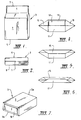
- Figures 1 and 2 are, respectively, a side view and a top plan view of the sack 3 after it has been filled with product and before it has been sealed.
- the reference numeral 7 indicates the edge of the outer bag at the open end of the sack 3 and the reference numerals 9 indicate the bulging opposed side walls of the filled sack 3.
- the sack may be filled with product by any suitable means.
- Figures 3 to 6 illustrate a preferred sequence of steps to seal the open top end of the sack 3 shown in Figures 1 and 2.
- the filled sack 3 is transferred from a filling station to an entry end 21 of a conveyor assembly 23 that thereafter supports and transports the sack 3 while the sequence of steps to seal the sack 3 are carried out.
- the conveyor assembly 23 comprises a pair of parallel continuous belts that are positioned to clamp together opposed sides of the open top end of the sack 3.
- the reference numeral 31 indicates the clamp line.
- the first step in the sequence comprises adjusting to a pre-determined length the spacing between the upper edge 33 of the sack 3 and the clamp line 31 of the conveyor assembly 23.
- the next step in the sequence comprises pressing together the inner pouch along a line extending across a section of the inner pouch and thereafter heat sealing the inner pouch along the line.
- the reference numeral 35 indicates the heat seal.
- the position of the heat seal line 35 is selected to be:
- the next step in the sequence comprises trimming off the top end of the sack 3 to remove the upper glue lines 51 - while leaving the lower glue line 53 - and to reduce the length of the outer bag above the seal line 31 to a preferred length for forming a block end.
- the next step in the sequence comprises opening out the upper sides of the outer bag in the region of the open end of the sack 3 to form outwardly turned side flaps 11 and, as a consequence of the outward folding of the upper sides, inwardly turned triangular wings 13.
- the inner pouch folds with the side of the outer bag to which it is adhered. It is also noted that this glue line does not permanently retain the inner pouch to the outer bag and that once the outer bag has been closed with a block end, the inner pouch can (and does) separate from the outer bag.
- next step in the sequence comprises folding inwardly an outer section of one of the flaps 11 onto itself to form an inturned fold 15.
- the next step in the sequence comprises folding inwardly an outer section of the other flap 11 onto itself and to partially overlap the fold 15 to form an inturned fold 17. This step completes the formation of a block end of the sack.
- the final step in the sequence comprises adhering a cover label 18 to the folded block end 5b shown in Figure 7.
Landscapes
- Engineering & Computer Science (AREA)
- Mechanical Engineering (AREA)
- Packages (AREA)
- Making Paper Articles (AREA)
- Closing Of Containers (AREA)
- Bag Frames (AREA)
Description
- The present invention relates to a multi-wall sack.
- The present invention relates particularly to a multi-wall sack which comprises an outer bag, typically formed from paper, and an inner pouch, typically formed from a polymeric material.
- The present invention relates more particularly, although by no means exclusively, to a multi-wall sack of the type described in the preceding paragraph which is suitable for storing dry food products, such as powdered milk products.
- A known multi-wall paper/polymeric material sack for dry food products comprises an inner polyethylene pouch and an outer paper bag having a block (ie rectangular) bottom end.
- The block bottom end provides a flat closed base for the sack and is formed by folding the outer paper bag (and not the inner polyethylene bag) in a specific manner during manufacture of the sack. The arrangement is such that when the sack is filled through the opposite open end, the dry food products in the inner polyethylene pouch push against the folded closed end and cause it to flatten out to create the block bottom end.
- After the sack has been filled, the open end of the polyethylene pouch is closed by pressing together the polyethylene material along a line spaced a short distance from the end of the sack and heat sealing together the polyethylene material along the line.
- Thereafter, the open end sections of the paper outer bag that are on opposite sides of the heat seal line are pressed together and then folded back and adhered together to form a pinched top end of the sack.
- In terms of overall shape, the above-described known sack is wedged-shaped, with the front and rear sides converging from the block bottom end to the pinched top end.
- Whilst the known sack has acceptable properties from the viewpoint of long-term storing dry food products, a disadvantage of the sack is that the wedge-shape is not ideal for stacking on pallets. This is a disadvantage because it affects the transportation of filled sacks to an end location. In many situations, particularly export oriented industries, this can be a serious disadvantage.
- Another known sack is described in WO-A-9222479 and this again has an inner pouch formed of plastics material and an outer paper bag with a block end at both top and bottom. This sack is manufactured as a closed sack and is transported to its filling location in this form. It is filled by partially opening the top block end of the bag and cutting a corner away from the pouch and then inserting a filling nozzle into the opening left by the cut away corner. The filled sack is then reclosed by heat sealing the inner pouch and reclosing and sealing the block end of the bag by hand.
- According to the present invention, a method of forming a closed multi-wall sack having an inner bag and an outer bag which encloses the inner bag and has block ends, comprises supporting and transporting on a conveyor assembly the sack that has been filled with product through an open end of the sack and carrying out the following steps while the filled sack is supported and transported by the conveyor assembly:
- (i) sealing the product in the inner bag;
- (ii) opening out the sides of the outer bag at the open end of the sack to form outturned side flaps and inturned triangular wings;
- (iii) folding inwardly an outer section of one of the flaps onto the inner section of the flap;
- (iv) folding inwardly an outer section of the other flap onto the inner section of the flap and to overlap partially the folded flap so that the outer bag forms a block end; and
- (v) adhering or otherwise holding together the block end,
- (vi) clamping together opposed sides of the open top end of the sack by means of a pair of parallel continuous belts.
- It is preferred that step (i) comprises sealing the product in the inner bag by pressing together the inner bag along a line extending across a section of the inner bag in the region of the open end of the sack and heat sealing the inner bag along the line.
- It is preferred particularly that, after step (i) and before step (ii), the method comprises trimming the length of the sack above the seal line.
- It is preferred that step (v) comprises adhering a cover label over the folded block end.
- The label may or may not contain an easy-open device.
- The present invention is described further by way of example with reference to the accompanying drawings, of which:
- Figure 1 is side elevation of a multi-layer sack in accordance with a preferred embodiment of the present invention;
- Figure 2 is a top plan view of the open end of the sack shown in Figure 1 after the sack has been filled with product and before the sack is sealed;
- Figure 3 is a schematic diagram which illustrates a preferred embodiment of a sequence of steps to seal the sack shown in Figures 1 and 2;
- Figures 4 to 6 are top plan views of the open end of the sack shown in Figures 1 and 2 which illustrate the sequence of folds made to close the open end into a block end configuration in accordance with a preferred embodiment of the present invention; and
- Figure 7 is a perspective view of the top end of the sack shown in Figure 1 after the open end of the sack has been closed.
- The preferred embodiment of a multi-walled sack in accordance with the present invention is formed from an inner pouch of polymeric material and an outer multi-layer bag formed from paper. It is noted that the sack may be formed from any other suitable materials.
- As illustrated in Figure 7, when filled with product and closed, the
sack 3 has a substantially uniform depth along the length of the sack and the outer bag hasblock ends - As is discussed in more detail in relation to Figures 3 to 6, in accordance with the preferred embodiment of the present invention the closed
sack 3 is formed by a sequence of steps which includes: - (i) filling with product an as-manufactured form of the
sack 3 which has an open top end to allow product into the inner pouch and an outer bag with ablock bottom end 5a; - (ii) sealing the inner pouch of the sack;
- (iii)trimming the closed end of the sack; and
- (iv) folding the outer bag at the open top end to form a block top end.
- Figures 1 and 2 are, respectively, a side view and a top plan view of the
sack 3 after it has been filled with product and before it has been sealed. With reference to Figures 1 and 2, thereference numeral 7 indicates the edge of the outer bag at the open end of thesack 3 and thereference numerals 9 indicate the bulging opposed side walls of the filledsack 3. - The sack may be filled with product by any suitable means.
- Figures 3 to 6 illustrate a preferred sequence of steps to seal the open top end of the
sack 3 shown in Figures 1 and 2. - With reference to Figure 3, the filled
sack 3 is transferred from a filling station to anentry end 21 of aconveyor assembly 23 that thereafter supports and transports thesack 3 while the sequence of steps to seal thesack 3 are carried out. - The
conveyor assembly 23 comprises a pair of parallel continuous belts that are positioned to clamp together opposed sides of the open top end of thesack 3. Thereference numeral 31 indicates the clamp line. - With reference to Figure 3, the first step in the sequence comprises adjusting to a pre-determined length the spacing between the
upper edge 33 of thesack 3 and theclamp line 31 of theconveyor assembly 23. - The next step in the sequence comprises pressing together the inner pouch along a line extending across a section of the inner pouch and thereafter heat sealing the inner pouch along the line. The
reference numeral 35 indicates the heat seal. The position of theheat seal line 35 is selected to be: - (i) between the
upper edge 33 of thesack 3 and theclamp line 31; - (ii) between upper and lower continuous or
discontinuous glue lines 51, 53 that adhere together the inner pouch and the outer bag on one side of thesack 3; and - (iii)below one upper continuous or discontinuous glue line 51 that adheres together the inner pouch and the outer bag on the other side of the
sack 3. - The next step in the sequence comprises trimming off the top end of the
sack 3 to remove the upper glue lines 51 - while leaving the lower glue line 53 - and to reduce the length of the outer bag above theseal line 31 to a preferred length for forming a block end. - With reference to Figure 4, the next step in the sequence comprises opening out the upper sides of the outer bag in the region of the open end of the
sack 3 to form outwardly turnedside flaps 11 and, as a consequence of the outward folding of the upper sides, inwardly turnedtriangular wings 13. - It is noted that, in view of the
glue line 53, the inner pouch folds with the side of the outer bag to which it is adhered. It is also noted that this glue line does not permanently retain the inner pouch to the outer bag and that once the outer bag has been closed with a block end, the inner pouch can (and does) separate from the outer bag. - With reference to Figure 5, the next step in the sequence comprises folding inwardly an outer section of one of the
flaps 11 onto itself to form an inturnedfold 15. - With reference to Figure 6, the next step in the sequence comprises folding inwardly an outer section of the
other flap 11 onto itself and to partially overlap thefold 15 to form an inturnedfold 17. This step completes the formation of a block end of the sack. - The final step in the sequence comprises adhering a
cover label 18 to the foldedblock end 5b shown in Figure 7. - The above described method steps can be carried out automatically.
- Many modifications may be made to the preferred embodiments described above with reference to the drawings without departing from the spirit and scope of the invention.
- In the claims which follow and in the preceding description of the invention, the words "comprising" and "comprises" are used in the sense of the word "including", ie the features referred to in connection with these words may be associated with other features that are not expressly described.
Claims (4)
- A method of forming a closed multi-wall sack (3) having an inner bag and an outer bag which encloses the inner bag and has block ends (5a, 5b), the method comprising supporting and transporting on a conveyor assembly (23) the sack (3) that has been filled with product through an open end of the sack and carrying out the following steps while the filled sack is supported and transported by the conveyor assembly:(i) sealing the product in the inner bag;(ii) opening out the sides of the outer bag at the open end of the sack to form outturned side flaps (11) and inturned triangular wings (13);(iii) folding inwardly an outer section of one of the flaps (11) onto the inner section of the flap;(iv) folding inwardly an outer section of the other flap (11) onto the inner section of the flap and to overlap partially the folded flap (15) so that the outer bag forms a block end (5b);(v) adhering or otherwise holding together the block end (5b),(vi) clamping together opposed sides of the open top end of the sack by means of a pair of parallel continuous belts.
- The method defined in claim 1, wherein step (i) comprises sealing the product in the inner bag by pressing together the inner bag along a line (35) extending across a section of the inner bag in the region of the open end of the sack (3) and heat sealing the inner bag along the line (35).
- The method defined in claim 2, further comprises, after step (i) and before step (ii), a step of trimming the length of the sack (3) above the seal line (35).
- The method defined in claim 1 or claim 2, wherein step (v) comprises adhering a cover label (18) over the folded block end.
Applications Claiming Priority (3)
| Application Number | Priority Date | Filing Date | Title |
|---|---|---|---|
| AUPO3355A AUPO335596A0 (en) | 1996-10-31 | 1996-10-31 | A multi-wall sack |
| AUPO335596 | 1996-10-31 | ||
| PCT/AU1997/000731 WO1998018691A1 (en) | 1996-10-31 | 1997-10-31 | A multi-wall sack |
Publications (3)
| Publication Number | Publication Date |
|---|---|
| EP0936996A1 EP0936996A1 (en) | 1999-08-25 |
| EP0936996A4 EP0936996A4 (en) | 2000-05-10 |
| EP0936996B1 true EP0936996B1 (en) | 2007-01-17 |
Family
ID=3797665
Family Applications (1)
| Application Number | Title | Priority Date | Filing Date |
|---|---|---|---|
| EP97909072A Expired - Lifetime EP0936996B1 (en) | 1996-10-31 | 1997-10-31 | A multi-wall sack |
Country Status (9)
| Country | Link |
|---|---|
| US (1) | US6536190B1 (en) |
| EP (1) | EP0936996B1 (en) |
| JP (1) | JP4213220B2 (en) |
| AU (1) | AUPO335596A0 (en) |
| BR (1) | BR9712462A (en) |
| DE (1) | DE69737263T2 (en) |
| DK (1) | DK0936996T3 (en) |
| NZ (1) | NZ335517A (en) |
| WO (1) | WO1998018691A1 (en) |
Families Citing this family (10)
| Publication number | Priority date | Publication date | Assignee | Title |
|---|---|---|---|---|
| NZ514701A (en) * | 2001-10-10 | 2004-07-30 | Carter Holt Harvey Ltd | Bag with inner pouch and outer bag having tear strip with sufficiently high tack temperature |
| NZ514808A (en) * | 2001-10-16 | 2004-07-30 | Carter Holt Harvey Ltd | Bag with inner sealable pouch and outer covering of composite layer of paper and polymer bonded together |
| CA2437290A1 (en) * | 2003-08-13 | 2005-02-13 | Sylvain Beaulieu | Pom pt one step with a cross directional ripping-strip |
| US8646974B2 (en) * | 2003-12-09 | 2014-02-11 | Amcor Limited | Bulk packaging multi-wall sack and apparatus for manufacturing the sack |
| US7581371B2 (en) * | 2006-04-25 | 2009-09-01 | Cryovac, Inc. | Retail package for flowable products |
| US20100266223A1 (en) * | 2006-06-15 | 2010-10-21 | Standard Multiwall Bag Manufacturing Co. | Pinch bottom open mouth bag |
| AT10573U3 (en) * | 2008-08-07 | 2010-01-15 | Jodl Verpackungen Gmbh | BAG |
| US9168101B2 (en) | 2012-09-28 | 2015-10-27 | Morris Azad | Apparatus and method for sterilization and organization of a tamper resistant lock and receptacle |
| CN112520213A (en) * | 2020-11-26 | 2021-03-19 | 江西捷美软包装有限公司 | Aluminum foil packaging bag |
| CN115009630B (en) * | 2022-05-13 | 2025-11-14 | 格力电器(重庆)有限公司 | An automatic sleeve device |
Family Cites Families (17)
| Publication number | Priority date | Publication date | Assignee | Title |
|---|---|---|---|---|
| GB1273350A (en) * | 1968-09-17 | 1972-05-10 | Keyolok Company Inc | Improvements in a method of packaging |
| DE2046909A1 (en) | 1970-09-23 | 1972-03-30 | Fr. Hesser Maschinenfabrik Ag, 7000 Stuttgart-Bad Cannstatt | Sealed tear-open pouch packaging |
| DE2550942C2 (en) * | 1975-11-13 | 1983-05-26 | Wilhelmstal-Werke Gmbh Papiersackfabriken, 7590 Achern | Multi-layer valve bag |
| NL7611388A (en) * | 1976-10-14 | 1978-04-18 | Wavin Bv | PLASTIC BAG WITH TWO BLOCK BOTTOMS. |
| US4236368A (en) * | 1979-01-02 | 1980-12-02 | The Interstate Folding Box Company | Carton closing and sealing apparatus for lined cartons and method of closing same |
| DE3070186D1 (en) * | 1979-12-21 | 1985-03-28 | Icoma Packtechnik Gmbh | Method of welding the internal layers of multi-layer paper sacks |
| GB2090577B (en) * | 1980-11-29 | 1984-07-18 | Schroeder & Wagner | Double layer bag |
| JPS5882837A (en) * | 1981-11-06 | 1983-05-18 | 平田 勲 | Simple square bottom vessel |
| DE3202032C2 (en) * | 1982-01-22 | 1985-10-10 | Reuther Verpackung GmbH, 5450 Neuwied | Multi-layer bag open on one side for holding powdery products |
| GB2171390B (en) * | 1985-02-02 | 1989-03-01 | Bischof & Klein | Flexible packaging container for loose filling material |
| US5007233A (en) * | 1989-08-31 | 1991-04-16 | Union Camp Corporation | Multiwall bag and method of packaging utilizing multiwall bags |
| US5152735A (en) * | 1990-02-15 | 1992-10-06 | Podd Jr Victor I | Bracing system for a liner for a cargo container |
| CA2049550C (en) * | 1991-05-30 | 2000-01-11 | Joseph Bunch | Method of making window bag assembly with content indicia |
| GB9112580D0 (en) | 1991-06-11 | 1991-07-31 | Premier Brands Uk | Improvements relating to the packaging of tea |
| DE4213772A1 (en) * | 1992-04-27 | 1993-10-28 | Icoma Packtechnik Gmbh | Method and device for filling packaging, in particular paper sacks or paper bags |
| US5644900A (en) * | 1994-02-07 | 1997-07-08 | Stone Container Corporation | Multiwall bag |
| US5727364A (en) * | 1995-09-14 | 1998-03-17 | Viscofan, Industria Navarra De Envoltras Celulosicas S.A. | Perfected packaging for the wrapping of mainly cylindrical and long shaped bodies, such as artificial tripe |
-
1996
- 1996-10-31 AU AUPO3355A patent/AUPO335596A0/en not_active Abandoned
-
1997
- 1997-10-31 JP JP51982398A patent/JP4213220B2/en not_active Expired - Fee Related
- 1997-10-31 BR BR9712462-1A patent/BR9712462A/en not_active Application Discontinuation
- 1997-10-31 DE DE69737263T patent/DE69737263T2/en not_active Expired - Lifetime
- 1997-10-31 WO PCT/AU1997/000731 patent/WO1998018691A1/en not_active Ceased
- 1997-10-31 NZ NZ335517A patent/NZ335517A/en not_active IP Right Cessation
- 1997-10-31 EP EP97909072A patent/EP0936996B1/en not_active Expired - Lifetime
- 1997-10-31 US US09/297,065 patent/US6536190B1/en not_active Expired - Fee Related
- 1997-10-31 DK DK97909072T patent/DK0936996T3/en active
Also Published As
| Publication number | Publication date |
|---|---|
| AUPO335596A0 (en) | 1996-11-28 |
| JP2001502644A (en) | 2001-02-27 |
| EP0936996A1 (en) | 1999-08-25 |
| DE69737263T2 (en) | 2007-05-31 |
| EP0936996A4 (en) | 2000-05-10 |
| NZ335517A (en) | 2001-01-26 |
| BR9712462A (en) | 1999-12-21 |
| US6536190B1 (en) | 2003-03-25 |
| JP4213220B2 (en) | 2009-01-21 |
| WO1998018691A1 (en) | 1998-05-07 |
| DK0936996T3 (en) | 2007-05-21 |
| DE69737263D1 (en) | 2007-03-08 |
Similar Documents
| Publication | Publication Date | Title |
|---|---|---|
| EP0936993B1 (en) | Process for the production of a hermetic recloseable package of flexible material | |
| US6231237B1 (en) | Container having rectangular base and its manufacturing | |
| US5772332A (en) | Container having a rectangular base and its manufacturing | |
| EP1094972B1 (en) | Easy open bag | |
| US9162786B2 (en) | Flexible, stackable container and method and system for manufacturing the same | |
| US7300207B2 (en) | Closure for containers and reclosable containers including the same | |
| US6988828B2 (en) | Closure for containers and reclosable containers including the same | |
| US20050147329A1 (en) | Beverage container | |
| US10737812B2 (en) | Flexible packaging having a lid fitment and method for making the same | |
| US20110127319A1 (en) | Resealable flexible film packaging products and methods of manufacture | |
| US20090095801A1 (en) | Methods and Apparatus for Manufacture of a Reclosable Plastic Carton | |
| US5878554A (en) | Efficient sheet stack packaging technique | |
| WO2009153558A1 (en) | Container | |
| WO2009133359A1 (en) | Container | |
| US6536190B1 (en) | Multi-wall sack | |
| MXPA02000325A (en) | Box for packaging and method and equipment for producing and employing same. | |
| EP0417252A1 (en) | RECTANGULAR CARTON PACKING AND METHOD FOR PRODUCING IT. | |
| US20040206052A1 (en) | Food packaging system | |
| US3834607A (en) | Rigid paperboard container | |
| JP7589519B2 (en) | Carton for bag-in-carton | |
| AU729303B2 (en) | A multi-wall sack | |
| US20050111765A1 (en) | POM PT one step with a cross directional ripping-strip | |
| US10661961B2 (en) | Vacuum package with reclosable pour spout and handle, and methods of making the same | |
| US20230348132A1 (en) | Recyclable shipping pack and method of and apparatus for forming a shipping pack for loose-fill produce | |
| KR20030007574A (en) | Plastics packaging |
Legal Events
| Date | Code | Title | Description |
|---|---|---|---|
| PUAI | Public reference made under article 153(3) epc to a published international application that has entered the european phase |
Free format text: ORIGINAL CODE: 0009012 |
|
| 17P | Request for examination filed |
Effective date: 19990517 |
|
| AK | Designated contracting states |
Kind code of ref document: A1 Designated state(s): AT BE CH DE DK ES FI FR GB GR IE IT LI LU MC NL PT SE |
|
| A4 | Supplementary search report drawn up and despatched |
Effective date: 20000329 |
|
| AK | Designated contracting states |
Kind code of ref document: A4 Designated state(s): AT BE CH DE DK ES FI FR GB GR IE IT LI LU MC NL PT SE |
|
| RIC1 | Information provided on ipc code assigned before grant |
Free format text: 7B 65D 30/08 A, 7B 65D 30/18 B, 7B 65D 75/38 B, 7B 65B 61/00 B |
|
| 17Q | First examination report despatched |
Effective date: 20040419 |
|
| GRAP | Despatch of communication of intention to grant a patent |
Free format text: ORIGINAL CODE: EPIDOSNIGR1 |
|
| GRAS | Grant fee paid |
Free format text: ORIGINAL CODE: EPIDOSNIGR3 |
|
| GRAA | (expected) grant |
Free format text: ORIGINAL CODE: 0009210 |
|
| AK | Designated contracting states |
Kind code of ref document: B1 Designated state(s): AT BE CH DE DK ES FI FR GB GR IE IT LI LU MC NL PT SE |
|
| PG25 | Lapsed in a contracting state [announced via postgrant information from national office to epo] |
Ref country code: FI Free format text: LAPSE BECAUSE OF FAILURE TO SUBMIT A TRANSLATION OF THE DESCRIPTION OR TO PAY THE FEE WITHIN THE PRESCRIBED TIME-LIMIT Effective date: 20070117 Ref country code: AT Free format text: LAPSE BECAUSE OF FAILURE TO SUBMIT A TRANSLATION OF THE DESCRIPTION OR TO PAY THE FEE WITHIN THE PRESCRIBED TIME-LIMIT Effective date: 20070117 |
|
| REG | Reference to a national code |
Ref country code: GB Ref legal event code: FG4D |
|
| REG | Reference to a national code |
Ref country code: CH Ref legal event code: EP |
|
| REG | Reference to a national code |
Ref country code: IE Ref legal event code: FG4D |
|
| REF | Corresponds to: |
Ref document number: 69737263 Country of ref document: DE Date of ref document: 20070308 Kind code of ref document: P |
|
| REG | Reference to a national code |
Ref country code: SE Ref legal event code: TRGR |
|
| PG25 | Lapsed in a contracting state [announced via postgrant information from national office to epo] |
Ref country code: ES Free format text: LAPSE BECAUSE OF FAILURE TO SUBMIT A TRANSLATION OF THE DESCRIPTION OR TO PAY THE FEE WITHIN THE PRESCRIBED TIME-LIMIT Effective date: 20070428 |
|
| REG | Reference to a national code |
Ref country code: DK Ref legal event code: T3 |
|
| PG25 | Lapsed in a contracting state [announced via postgrant information from national office to epo] |
Ref country code: PT Free format text: LAPSE BECAUSE OF FAILURE TO SUBMIT A TRANSLATION OF THE DESCRIPTION OR TO PAY THE FEE WITHIN THE PRESCRIBED TIME-LIMIT Effective date: 20070618 |
|
| REG | Reference to a national code |
Ref country code: CH Ref legal event code: NV Representative=s name: KELLER & PARTNER PATENTANWAELTE AG |
|
| ET | Fr: translation filed | ||
| PLBE | No opposition filed within time limit |
Free format text: ORIGINAL CODE: 0009261 |
|
| STAA | Information on the status of an ep patent application or granted ep patent |
Free format text: STATUS: NO OPPOSITION FILED WITHIN TIME LIMIT |
|
| 26N | No opposition filed |
Effective date: 20071018 |
|
| PG25 | Lapsed in a contracting state [announced via postgrant information from national office to epo] |
Ref country code: IT Free format text: LAPSE BECAUSE OF FAILURE TO SUBMIT A TRANSLATION OF THE DESCRIPTION OR TO PAY THE FEE WITHIN THE PRESCRIBED TIME-LIMIT Effective date: 20070117 Ref country code: GR Free format text: LAPSE BECAUSE OF FAILURE TO SUBMIT A TRANSLATION OF THE DESCRIPTION OR TO PAY THE FEE WITHIN THE PRESCRIBED TIME-LIMIT Effective date: 20070418 |
|
| PG25 | Lapsed in a contracting state [announced via postgrant information from national office to epo] |
Ref country code: MC Free format text: LAPSE BECAUSE OF NON-PAYMENT OF DUE FEES Effective date: 20071031 |
|
| PG25 | Lapsed in a contracting state [announced via postgrant information from national office to epo] |
Ref country code: LU Free format text: LAPSE BECAUSE OF NON-PAYMENT OF DUE FEES Effective date: 20071031 |
|
| PGFP | Annual fee paid to national office [announced via postgrant information from national office to epo] |
Ref country code: NL Payment date: 20101009 Year of fee payment: 14 Ref country code: IE Payment date: 20101015 Year of fee payment: 14 Ref country code: FR Payment date: 20101020 Year of fee payment: 14 Ref country code: DK Payment date: 20101014 Year of fee payment: 14 |
|
| PGFP | Annual fee paid to national office [announced via postgrant information from national office to epo] |
Ref country code: DE Payment date: 20101027 Year of fee payment: 14 Ref country code: CH Payment date: 20101012 Year of fee payment: 14 |
|
| PGFP | Annual fee paid to national office [announced via postgrant information from national office to epo] |
Ref country code: GB Payment date: 20101027 Year of fee payment: 14 Ref country code: SE Payment date: 20101012 Year of fee payment: 14 Ref country code: BE Payment date: 20101020 Year of fee payment: 14 |
|
| BERE | Be: lapsed |
Owner name: AMCOR PACKAGING (AUSTRALIA) PTY, LTD Effective date: 20111031 |
|
| REG | Reference to a national code |
Ref country code: NL Ref legal event code: V1 Effective date: 20120501 |
|
| REG | Reference to a national code |
Ref country code: CH Ref legal event code: PL |
|
| GBPC | Gb: european patent ceased through non-payment of renewal fee |
Effective date: 20111031 |
|
| REG | Reference to a national code |
Ref country code: DK Ref legal event code: EBP |
|
| REG | Reference to a national code |
Ref country code: SE Ref legal event code: EUG |
|
| REG | Reference to a national code |
Ref country code: FR Ref legal event code: ST Effective date: 20120629 |
|
| PG25 | Lapsed in a contracting state [announced via postgrant information from national office to epo] |
Ref country code: DE Free format text: LAPSE BECAUSE OF NON-PAYMENT OF DUE FEES Effective date: 20120501 Ref country code: LI Free format text: LAPSE BECAUSE OF NON-PAYMENT OF DUE FEES Effective date: 20111031 Ref country code: NL Free format text: LAPSE BECAUSE OF NON-PAYMENT OF DUE FEES Effective date: 20120501 Ref country code: CH Free format text: LAPSE BECAUSE OF NON-PAYMENT OF DUE FEES Effective date: 20111031 Ref country code: BE Free format text: LAPSE BECAUSE OF NON-PAYMENT OF DUE FEES Effective date: 20111031 |
|
| REG | Reference to a national code |
Ref country code: IE Ref legal event code: MM4A |
|
| REG | Reference to a national code |
Ref country code: DE Ref legal event code: R119 Ref document number: 69737263 Country of ref document: DE Effective date: 20120501 |
|
| PG25 | Lapsed in a contracting state [announced via postgrant information from national office to epo] |
Ref country code: GB Free format text: LAPSE BECAUSE OF NON-PAYMENT OF DUE FEES Effective date: 20111031 Ref country code: FR Free format text: LAPSE BECAUSE OF NON-PAYMENT OF DUE FEES Effective date: 20111102 |
|
| PG25 | Lapsed in a contracting state [announced via postgrant information from national office to epo] |
Ref country code: IE Free format text: LAPSE BECAUSE OF NON-PAYMENT OF DUE FEES Effective date: 20111031 Ref country code: SE Free format text: LAPSE BECAUSE OF NON-PAYMENT OF DUE FEES Effective date: 20111101 Ref country code: DK Free format text: LAPSE BECAUSE OF NON-PAYMENT OF DUE FEES Effective date: 20111031 |