EP0934943B1 - Verfahren zur herstellung acylierter hexaazaisowurtzitan-derivate - Google Patents
Verfahren zur herstellung acylierter hexaazaisowurtzitan-derivate Download PDFInfo
- Publication number
- EP0934943B1 EP0934943B1 EP97943202A EP97943202A EP0934943B1 EP 0934943 B1 EP0934943 B1 EP 0934943B1 EP 97943202 A EP97943202 A EP 97943202A EP 97943202 A EP97943202 A EP 97943202A EP 0934943 B1 EP0934943 B1 EP 0934943B1
- Authority
- EP
- European Patent Office
- Prior art keywords
- solvent
- group
- reaction
- formula
- hexaazaisowurtzitane
- Prior art date
- Legal status (The legal status is an assumption and is not a legal conclusion. Google has not performed a legal analysis and makes no representation as to the accuracy of the status listed.)
- Expired - Lifetime
Links
- 238000000034 method Methods 0.000 title claims description 231
- 230000008569 process Effects 0.000 title claims description 58
- 239000002904 solvent Substances 0.000 claims abstract description 332
- 239000000203 mixture Substances 0.000 claims abstract description 122
- 239000013078 crystal Substances 0.000 claims abstract description 120
- 125000002252 acyl group Chemical group 0.000 claims abstract description 88
- 239000012046 mixed solvent Substances 0.000 claims abstract description 36
- 125000004432 carbon atom Chemical group C* 0.000 claims abstract description 17
- 238000004519 manufacturing process Methods 0.000 claims abstract description 16
- 125000004435 hydrogen atom Chemical group [H]* 0.000 claims abstract description 13
- QTBSBXVTEAMEQO-UHFFFAOYSA-N Acetic acid Chemical compound CC(O)=O QTBSBXVTEAMEQO-UHFFFAOYSA-N 0.000 claims description 161
- XLYOFNOQVPJJNP-UHFFFAOYSA-N water Substances O XLYOFNOQVPJJNP-UHFFFAOYSA-N 0.000 claims description 114
- 239000007810 chemical reaction solvent Substances 0.000 claims description 95
- 239000003960 organic solvent Substances 0.000 claims description 80
- 239000011541 reaction mixture Substances 0.000 claims description 73
- BDAGIHXWWSANSR-UHFFFAOYSA-N methanoic acid Natural products OC=O BDAGIHXWWSANSR-UHFFFAOYSA-N 0.000 claims description 60
- 230000002829 reductive effect Effects 0.000 claims description 58
- ZMXDDKWLCZADIW-UHFFFAOYSA-N N,N-Dimethylformamide Chemical compound CN(C)C=O ZMXDDKWLCZADIW-UHFFFAOYSA-N 0.000 claims description 54
- 125000003368 amide group Chemical group 0.000 claims description 52
- 239000003795 chemical substances by application Substances 0.000 claims description 52
- 238000009835 boiling Methods 0.000 claims description 50
- FXHOOIRPVKKKFG-UHFFFAOYSA-N N,N-Dimethylacetamide Chemical compound CN(C)C(C)=O FXHOOIRPVKKKFG-UHFFFAOYSA-N 0.000 claims description 48
- YXFVVABEGXRONW-UHFFFAOYSA-N Toluene Chemical compound CC1=CC=CC=C1 YXFVVABEGXRONW-UHFFFAOYSA-N 0.000 claims description 47
- 238000004821 distillation Methods 0.000 claims description 43
- 238000003786 synthesis reaction Methods 0.000 claims description 40
- 230000015572 biosynthetic process Effects 0.000 claims description 39
- SECXISVLQFMRJM-UHFFFAOYSA-N N-Methylpyrrolidone Chemical compound CN1CCCC1=O SECXISVLQFMRJM-UHFFFAOYSA-N 0.000 claims description 33
- 150000001732 carboxylic acid derivatives Chemical class 0.000 claims description 31
- OSWFIVFLDKOXQC-UHFFFAOYSA-N 4-(3-methoxyphenyl)aniline Chemical group COC1=CC=CC(C=2C=CC(N)=CC=2)=C1 OSWFIVFLDKOXQC-UHFFFAOYSA-N 0.000 claims description 30
- 235000019253 formic acid Nutrition 0.000 claims description 30
- 125000001797 benzyl group Chemical group [H]C1=C([H])C([H])=C(C([H])=C1[H])C([H])([H])* 0.000 claims description 25
- 238000010533 azeotropic distillation Methods 0.000 claims description 24
- 150000001735 carboxylic acids Chemical class 0.000 claims description 22
- RRQYJINTUHWNHW-UHFFFAOYSA-N 1-ethoxy-2-(2-ethoxyethoxy)ethane Chemical compound CCOCCOCCOCC RRQYJINTUHWNHW-UHFFFAOYSA-N 0.000 claims description 20
- 229940019778 diethylene glycol diethyl ether Drugs 0.000 claims description 20
- 125000001033 ether group Chemical group 0.000 claims description 18
- CYSGHNMQYZDMIA-UHFFFAOYSA-N 1,3-Dimethyl-2-imidazolidinon Chemical compound CN1CCN(C)C1=O CYSGHNMQYZDMIA-UHFFFAOYSA-N 0.000 claims description 17
- SBZXBUIDTXKZTM-UHFFFAOYSA-N diglyme Chemical compound COCCOCCOC SBZXBUIDTXKZTM-UHFFFAOYSA-N 0.000 claims description 17
- HOXINJBQVZWYGZ-UHFFFAOYSA-N fenbutatin oxide Chemical compound C=1C=CC=CC=1C(C)(C)C[Sn](O[Sn](CC(C)(C)C=1C=CC=CC=1)(CC(C)(C)C=1C=CC=CC=1)CC(C)(C)C=1C=CC=CC=1)(CC(C)(C)C=1C=CC=CC=1)CC(C)(C)C1=CC=CC=C1 HOXINJBQVZWYGZ-UHFFFAOYSA-N 0.000 claims description 16
- 239000008346 aqueous phase Substances 0.000 claims description 15
- 125000002485 formyl group Chemical group [H]C(*)=O 0.000 claims description 15
- LZDKZFUFMNSQCJ-UHFFFAOYSA-N 1,2-diethoxyethane Chemical compound CCOCCOCC LZDKZFUFMNSQCJ-UHFFFAOYSA-N 0.000 claims description 14
- GDXHBFHOEYVPED-UHFFFAOYSA-N 1-(2-butoxyethoxy)butane Chemical compound CCCCOCCOCCCC GDXHBFHOEYVPED-UHFFFAOYSA-N 0.000 claims description 13
- 238000006264 debenzylation reaction Methods 0.000 claims description 10
- 238000001704 evaporation Methods 0.000 claims description 9
- 229910052739 hydrogen Inorganic materials 0.000 claims description 9
- 239000006227 byproduct Substances 0.000 claims description 4
- 239000012074 organic phase Substances 0.000 claims description 4
- 239000000047 product Substances 0.000 claims description 4
- 125000000218 acetic acid group Chemical group C(C)(=O)* 0.000 claims description 3
- 150000001875 compounds Chemical class 0.000 abstract description 68
- 239000002360 explosive Substances 0.000 abstract description 3
- 239000002243 precursor Substances 0.000 abstract description 3
- NDYLCHGXSQOGMS-UHFFFAOYSA-N CL-20 Chemical compound [O-][N+](=O)N1C2N([N+]([O-])=O)C3N([N+](=O)[O-])C2N([N+]([O-])=O)C2N([N+]([O-])=O)C3N([N+]([O-])=O)C21 NDYLCHGXSQOGMS-UHFFFAOYSA-N 0.000 abstract description 2
- 239000000654 additive Substances 0.000 abstract 1
- 230000000996 additive effect Effects 0.000 abstract 1
- 238000006243 chemical reaction Methods 0.000 description 237
- 238000000151 deposition Methods 0.000 description 86
- 230000008021 deposition Effects 0.000 description 73
- 235000011054 acetic acid Nutrition 0.000 description 43
- 239000003054 catalyst Substances 0.000 description 39
- 239000000243 solution Substances 0.000 description 39
- 239000012528 membrane Substances 0.000 description 33
- 238000004128 high performance liquid chromatography Methods 0.000 description 28
- HVYHGOIMTRVUCH-UHFFFAOYSA-N molport-002-842-999 Chemical compound CC(=O)N1C2NC3N(C(C)=O)C4C1N(C(C)=O)C2NC3N4C(C)=O HVYHGOIMTRVUCH-UHFFFAOYSA-N 0.000 description 26
- UFHFLCQGNIYNRP-UHFFFAOYSA-N Hydrogen Chemical compound [H][H] UFHFLCQGNIYNRP-UHFFFAOYSA-N 0.000 description 25
- WFDIJRYMOXRFFG-UHFFFAOYSA-N Acetic anhydride Chemical compound CC(=O)OC(C)=O WFDIJRYMOXRFFG-UHFFFAOYSA-N 0.000 description 24
- 238000000926 separation method Methods 0.000 description 24
- 239000000706 filtrate Substances 0.000 description 18
- XBDQKXXYIPTUBI-UHFFFAOYSA-N dimethylselenoniopropionate Natural products CCC(O)=O XBDQKXXYIPTUBI-UHFFFAOYSA-N 0.000 description 16
- KDLHZDBZIXYQEI-UHFFFAOYSA-N palladium Substances [Pd] KDLHZDBZIXYQEI-UHFFFAOYSA-N 0.000 description 16
- 230000009467 reduction Effects 0.000 description 16
- 239000003638 chemical reducing agent Substances 0.000 description 15
- IUKZSMGVHPBEHK-UHFFFAOYSA-N hexabenzilisovyurtsitan Chemical compound C=1C=CC=CC=1CN(C1C(N(CC=2C=CC=CC=2)C(N2CC=3C=CC=CC=3)C3N1CC=1C=CC=CC=1)N1CC=4C=CC=CC=4)C1C2N3CC1=CC=CC=C1 IUKZSMGVHPBEHK-UHFFFAOYSA-N 0.000 description 15
- 239000007787 solid Substances 0.000 description 14
- SQDRIYSMLYEMBN-UHFFFAOYSA-N ac1nlu7h Chemical compound O=CN1C2N(C(C)=O)C3N(C(=O)C)C2N(C=O)C2N(C(C)=O)C3N(C(C)=O)C21 SQDRIYSMLYEMBN-UHFFFAOYSA-N 0.000 description 13
- 239000012071 phase Substances 0.000 description 13
- NINQAYBICGTGQD-UHFFFAOYSA-N 1-(6,8,12-triacetyl-4,10-dibenzyl-2,4,6,8,10,12-hexazatetracyclo[5.5.0.03,11.05,9]dodecan-2-yl)ethanone Chemical compound CC(=O)N1C2C(N3CC=4C=CC=CC=4)N(C(=O)C)C1C(N1C(C)=O)N(C(C)=O)C3C1N2CC1=CC=CC=C1 NINQAYBICGTGQD-UHFFFAOYSA-N 0.000 description 12
- IJGRMHOSHXDMSA-UHFFFAOYSA-N Atomic nitrogen Chemical compound N#N IJGRMHOSHXDMSA-UHFFFAOYSA-N 0.000 description 12
- 238000003756 stirring Methods 0.000 description 12
- 239000000126 substance Substances 0.000 description 12
- 125000005002 aryl methyl group Chemical group 0.000 description 11
- 238000000354 decomposition reaction Methods 0.000 description 11
- HEDRZPFGACZZDS-UHFFFAOYSA-N Chloroform Chemical compound ClC(Cl)Cl HEDRZPFGACZZDS-UHFFFAOYSA-N 0.000 description 10
- 125000002777 acetyl group Chemical group [H]C([H])([H])C(*)=O 0.000 description 10
- 230000035484 reaction time Effects 0.000 description 10
- 238000001914 filtration Methods 0.000 description 9
- OAKJQQAXSVQMHS-UHFFFAOYSA-N Hydrazine Chemical compound NN OAKJQQAXSVQMHS-UHFFFAOYSA-N 0.000 description 8
- 229910001873 dinitrogen Inorganic materials 0.000 description 8
- 238000002474 experimental method Methods 0.000 description 8
- 238000004817 gas chromatography Methods 0.000 description 8
- 235000019260 propionic acid Nutrition 0.000 description 8
- IUVKMZGDUIUOCP-BTNSXGMBSA-N quinbolone Chemical compound O([C@H]1CC[C@H]2[C@H]3[C@@H]([C@]4(C=CC(=O)C=C4CC3)C)CC[C@@]21C)C1=CCCC1 IUVKMZGDUIUOCP-BTNSXGMBSA-N 0.000 description 8
- NAWXUBYGYWOOIX-SFHVURJKSA-N (2s)-2-[[4-[2-(2,4-diaminoquinazolin-6-yl)ethyl]benzoyl]amino]-4-methylidenepentanedioic acid Chemical compound C1=CC2=NC(N)=NC(N)=C2C=C1CCC1=CC=C(C(=O)N[C@@H](CC(=C)C(O)=O)C(O)=O)C=C1 NAWXUBYGYWOOIX-SFHVURJKSA-N 0.000 description 7
- 230000010933 acylation Effects 0.000 description 7
- 238000005917 acylation reaction Methods 0.000 description 7
- 238000004458 analytical method Methods 0.000 description 7
- 230000000694 effects Effects 0.000 description 7
- 238000005374 membrane filtration Methods 0.000 description 7
- VYPSYNLAJGMNEJ-UHFFFAOYSA-N Silicium dioxide Chemical compound O=[Si]=O VYPSYNLAJGMNEJ-UHFFFAOYSA-N 0.000 description 6
- HEMHJVSKTPXQMS-UHFFFAOYSA-M Sodium hydroxide Chemical compound [OH-].[Na+] HEMHJVSKTPXQMS-UHFFFAOYSA-M 0.000 description 6
- 235000002597 Solanum melongena Nutrition 0.000 description 6
- 244000061458 Solanum melongena Species 0.000 description 6
- -1 isobutyryl group Chemical group 0.000 description 6
- 239000002002 slurry Substances 0.000 description 6
- 238000001179 sorption measurement Methods 0.000 description 6
- CRWNQZTZTZWPOF-UHFFFAOYSA-N 2-methyl-4-phenylpyridine Chemical compound C1=NC(C)=CC(C=2C=CC=CC=2)=C1 CRWNQZTZTZWPOF-UHFFFAOYSA-N 0.000 description 5
- 230000002378 acidificating effect Effects 0.000 description 5
- 150000001244 carboxylic acid anhydrides Chemical class 0.000 description 5
- 239000007788 liquid Substances 0.000 description 5
- 239000011369 resultant mixture Substances 0.000 description 5
- XKRFYHLGVUSROY-UHFFFAOYSA-N Argon Chemical compound [Ar] XKRFYHLGVUSROY-UHFFFAOYSA-N 0.000 description 4
- LFQSCWFLJHTTHZ-UHFFFAOYSA-N Ethanol Chemical compound CCO LFQSCWFLJHTTHZ-UHFFFAOYSA-N 0.000 description 4
- PNEYBMLMFCGWSK-UHFFFAOYSA-N aluminium oxide Inorganic materials [O-2].[O-2].[O-2].[Al+3].[Al+3] PNEYBMLMFCGWSK-UHFFFAOYSA-N 0.000 description 4
- 230000008901 benefit Effects 0.000 description 4
- 238000005137 deposition process Methods 0.000 description 4
- 230000008020 evaporation Effects 0.000 description 4
- 238000005259 measurement Methods 0.000 description 4
- FIGVVZUWCLSUEI-UHFFFAOYSA-N tricosane Chemical compound CCCCCCCCCCCCCCCCCCCCCCC FIGVVZUWCLSUEI-UHFFFAOYSA-N 0.000 description 4
- WEVYAHXRMPXWCK-UHFFFAOYSA-N Acetonitrile Chemical compound CC#N WEVYAHXRMPXWCK-UHFFFAOYSA-N 0.000 description 3
- UHOVQNZJYSORNB-UHFFFAOYSA-N Benzene Chemical compound C1=CC=CC=C1 UHOVQNZJYSORNB-UHFFFAOYSA-N 0.000 description 3
- YMWUJEATGCHHMB-UHFFFAOYSA-N Dichloromethane Chemical compound ClCCl YMWUJEATGCHHMB-UHFFFAOYSA-N 0.000 description 3
- RTZKZFJDLAIYFH-UHFFFAOYSA-N Diethyl ether Chemical compound CCOCC RTZKZFJDLAIYFH-UHFFFAOYSA-N 0.000 description 3
- XEKOWRVHYACXOJ-UHFFFAOYSA-N Ethyl acetate Chemical compound CCOC(C)=O XEKOWRVHYACXOJ-UHFFFAOYSA-N 0.000 description 3
- WETWJCDKMRHUPV-UHFFFAOYSA-N acetyl chloride Chemical compound CC(Cl)=O WETWJCDKMRHUPV-UHFFFAOYSA-N 0.000 description 3
- 239000012346 acetyl chloride Substances 0.000 description 3
- 239000003463 adsorbent Substances 0.000 description 3
- 125000000217 alkyl group Chemical group 0.000 description 3
- 150000001412 amines Chemical class 0.000 description 3
- 150000008064 anhydrides Chemical class 0.000 description 3
- 239000012298 atmosphere Substances 0.000 description 3
- 238000006297 dehydration reaction Methods 0.000 description 3
- 238000001514 detection method Methods 0.000 description 3
- 230000022244 formylation Effects 0.000 description 3
- 238000006170 formylation reaction Methods 0.000 description 3
- 238000002347 injection Methods 0.000 description 3
- 239000007924 injection Substances 0.000 description 3
- 238000004445 quantitative analysis Methods 0.000 description 3
- 150000003839 salts Chemical class 0.000 description 3
- 239000000377 silicon dioxide Substances 0.000 description 3
- FERIUCNNQQJTOY-UHFFFAOYSA-N Butyric acid Chemical compound CCCC(O)=O FERIUCNNQQJTOY-UHFFFAOYSA-N 0.000 description 2
- OKTJSMMVPCPJKN-UHFFFAOYSA-N Carbon Chemical compound [C] OKTJSMMVPCPJKN-UHFFFAOYSA-N 0.000 description 2
- YNQLUTRBYVCPMQ-UHFFFAOYSA-N Ethylbenzene Chemical compound CCC1=CC=CC=C1 YNQLUTRBYVCPMQ-UHFFFAOYSA-N 0.000 description 2
- CSNNHWWHGAXBCP-UHFFFAOYSA-L Magnesium sulfate Chemical compound [Mg+2].[O-][S+2]([O-])([O-])[O-] CSNNHWWHGAXBCP-UHFFFAOYSA-L 0.000 description 2
- JLTDJTHDQAWBAV-UHFFFAOYSA-N N,N-dimethylaniline Chemical compound CN(C)C1=CC=CC=C1 JLTDJTHDQAWBAV-UHFFFAOYSA-N 0.000 description 2
- KKCBUQHMOMHUOY-UHFFFAOYSA-N Na2O Inorganic materials [O-2].[Na+].[Na+] KKCBUQHMOMHUOY-UHFFFAOYSA-N 0.000 description 2
- CTQNGGLPUBDAKN-UHFFFAOYSA-N O-Xylene Chemical compound CC1=CC=CC=C1C CTQNGGLPUBDAKN-UHFFFAOYSA-N 0.000 description 2
- 229910001252 Pd alloy Inorganic materials 0.000 description 2
- 229910002666 PdCl2 Inorganic materials 0.000 description 2
- WYURNTSHIVDZCO-UHFFFAOYSA-N Tetrahydrofuran Chemical compound C1CCOC1 WYURNTSHIVDZCO-UHFFFAOYSA-N 0.000 description 2
- GWEVSGVZZGPLCZ-UHFFFAOYSA-N Titan oxide Chemical compound O=[Ti]=O GWEVSGVZZGPLCZ-UHFFFAOYSA-N 0.000 description 2
- 229910021536 Zeolite Inorganic materials 0.000 description 2
- MCMNRKCIXSYSNV-UHFFFAOYSA-N Zirconium dioxide Chemical compound O=[Zr]=O MCMNRKCIXSYSNV-UHFFFAOYSA-N 0.000 description 2
- 239000002253 acid Substances 0.000 description 2
- 230000002411 adverse Effects 0.000 description 2
- 229910045601 alloy Inorganic materials 0.000 description 2
- 239000000956 alloy Substances 0.000 description 2
- 150000001408 amides Chemical group 0.000 description 2
- 229910052786 argon Inorganic materials 0.000 description 2
- 238000003889 chemical engineering Methods 0.000 description 2
- 238000005345 coagulation Methods 0.000 description 2
- 230000015271 coagulation Effects 0.000 description 2
- 229910052681 coesite Inorganic materials 0.000 description 2
- 229910052906 cristobalite Inorganic materials 0.000 description 2
- 238000001035 drying Methods 0.000 description 2
- 150000002148 esters Chemical class 0.000 description 2
- VGGRCVDNFAQIKO-UHFFFAOYSA-N formic anhydride Chemical compound O=COC=O VGGRCVDNFAQIKO-UHFFFAOYSA-N 0.000 description 2
- 239000007789 gas Substances 0.000 description 2
- 229910052734 helium Inorganic materials 0.000 description 2
- 239000001307 helium Substances 0.000 description 2
- SWQJXJOGLNCZEY-UHFFFAOYSA-N helium atom Chemical compound [He] SWQJXJOGLNCZEY-UHFFFAOYSA-N 0.000 description 2
- 239000012456 homogeneous solution Substances 0.000 description 2
- 239000001257 hydrogen Substances 0.000 description 2
- 230000007062 hydrolysis Effects 0.000 description 2
- 238000006460 hydrolysis reaction Methods 0.000 description 2
- 238000001027 hydrothermal synthesis Methods 0.000 description 2
- 239000012535 impurity Substances 0.000 description 2
- 239000011261 inert gas Substances 0.000 description 2
- KQNPFQTWMSNSAP-UHFFFAOYSA-N isobutyric acid Chemical compound CC(C)C(O)=O KQNPFQTWMSNSAP-UHFFFAOYSA-N 0.000 description 2
- 238000002955 isolation Methods 0.000 description 2
- 239000000463 material Substances 0.000 description 2
- TZIHFWKZFHZASV-UHFFFAOYSA-N methyl formate Chemical compound COC=O TZIHFWKZFHZASV-UHFFFAOYSA-N 0.000 description 2
- 239000011259 mixed solution Substances 0.000 description 2
- JXTPJDDICSTXJX-UHFFFAOYSA-N n-Triacontane Natural products CCCCCCCCCCCCCCCCCCCCCCCCCCCCCC JXTPJDDICSTXJX-UHFFFAOYSA-N 0.000 description 2
- 230000007935 neutral effect Effects 0.000 description 2
- 229910052757 nitrogen Inorganic materials 0.000 description 2
- PIBWKRNGBLPSSY-UHFFFAOYSA-L palladium(II) chloride Chemical compound Cl[Pd]Cl PIBWKRNGBLPSSY-UHFFFAOYSA-L 0.000 description 2
- YJVFFLUZDVXJQI-UHFFFAOYSA-L palladium(ii) acetate Chemical compound [Pd+2].CC([O-])=O.CC([O-])=O YJVFFLUZDVXJQI-UHFFFAOYSA-L 0.000 description 2
- 230000035699 permeability Effects 0.000 description 2
- 238000005191 phase separation Methods 0.000 description 2
- BASFCYQUMIYNBI-UHFFFAOYSA-N platinum Chemical compound [Pt] BASFCYQUMIYNBI-UHFFFAOYSA-N 0.000 description 2
- 239000011148 porous material Substances 0.000 description 2
- WYVAMUWZEOHJOQ-UHFFFAOYSA-N propionic anhydride Chemical compound CCC(=O)OC(=O)CC WYVAMUWZEOHJOQ-UHFFFAOYSA-N 0.000 description 2
- 125000001501 propionyl group Chemical group O=C([*])C([H])([H])C([H])([H])[H] 0.000 description 2
- 239000010935 stainless steel Substances 0.000 description 2
- 229910001220 stainless steel Inorganic materials 0.000 description 2
- 239000007858 starting material Substances 0.000 description 2
- 229910052682 stishovite Inorganic materials 0.000 description 2
- 239000000758 substrate Substances 0.000 description 2
- 238000000967 suction filtration Methods 0.000 description 2
- 230000001629 suppression Effects 0.000 description 2
- 229910052905 tridymite Inorganic materials 0.000 description 2
- 239000008096 xylene Substances 0.000 description 2
- 239000010457 zeolite Substances 0.000 description 2
- GGAVHCUOCBTTDM-UHFFFAOYSA-N (2,5-dioxopyrrolidin-1-yl) 2-phenylacetate Chemical compound O=C1CCC(=O)N1OC(=O)CC1=CC=CC=C1 GGAVHCUOCBTTDM-UHFFFAOYSA-N 0.000 description 1
- SIFCHNIAAPMMKG-UHFFFAOYSA-N (2,5-dioxopyrrolidin-1-yl) acetate Chemical compound CC(=O)ON1C(=O)CCC1=O SIFCHNIAAPMMKG-UHFFFAOYSA-N 0.000 description 1
- AASBXERNXVFUEJ-UHFFFAOYSA-N (2,5-dioxopyrrolidin-1-yl) propanoate Chemical compound CCC(=O)ON1C(=O)CCC1=O AASBXERNXVFUEJ-UHFFFAOYSA-N 0.000 description 1
- PYIYWQWLNZXQHU-UHFFFAOYSA-N 1-(1h-imidazol-2-yl)propan-1-one Chemical compound CCC(=O)C1=NC=CN1 PYIYWQWLNZXQHU-UHFFFAOYSA-N 0.000 description 1
- AURKDQJEOYBJSQ-UHFFFAOYSA-N 2-hydroxypropanoyl 2-hydroxypropanoate Chemical compound CC(O)C(=O)OC(=O)C(C)O AURKDQJEOYBJSQ-UHFFFAOYSA-N 0.000 description 1
- DKPFZGUDAPQIHT-UHFFFAOYSA-N Butyl acetate Natural products CCCCOC(C)=O DKPFZGUDAPQIHT-UHFFFAOYSA-N 0.000 description 1
- OYPRJOBELJOOCE-UHFFFAOYSA-N Calcium Chemical compound [Ca] OYPRJOBELJOOCE-UHFFFAOYSA-N 0.000 description 1
- UXVMQQNJUSDDNG-UHFFFAOYSA-L Calcium chloride Chemical compound [Cl-].[Cl-].[Ca+2] UXVMQQNJUSDDNG-UHFFFAOYSA-L 0.000 description 1
- 229920001661 Chitosan Polymers 0.000 description 1
- ZAFNJMIOTHYJRJ-UHFFFAOYSA-N Diisopropyl ether Chemical compound CC(C)OC(C)C ZAFNJMIOTHYJRJ-UHFFFAOYSA-N 0.000 description 1
- BDAGIHXWWSANSR-UHFFFAOYSA-M Formate Chemical compound [O-]C=O BDAGIHXWWSANSR-UHFFFAOYSA-M 0.000 description 1
- DGAQECJNVWCQMB-PUAWFVPOSA-M Ilexoside XXIX Chemical compound C[C@@H]1CC[C@@]2(CC[C@@]3(C(=CC[C@H]4[C@]3(CC[C@@H]5[C@@]4(CC[C@@H](C5(C)C)OS(=O)(=O)[O-])C)C)[C@@H]2[C@]1(C)O)C)C(=O)O[C@H]6[C@@H]([C@H]([C@@H]([C@H](O6)CO)O)O)O.[Na+] DGAQECJNVWCQMB-PUAWFVPOSA-M 0.000 description 1
- NQTADLQHYWFPDB-UHFFFAOYSA-N N-Hydroxysuccinimide Chemical compound ON1C(=O)CCC1=O NQTADLQHYWFPDB-UHFFFAOYSA-N 0.000 description 1
- VIHYIVKEECZGOU-UHFFFAOYSA-N N-acetylimidazole Chemical compound CC(=O)N1C=CN=C1 VIHYIVKEECZGOU-UHFFFAOYSA-N 0.000 description 1
- 229910002674 PdO Inorganic materials 0.000 description 1
- ZLMJMSJWJFRBEC-UHFFFAOYSA-N Potassium Chemical compound [K] ZLMJMSJWJFRBEC-UHFFFAOYSA-N 0.000 description 1
- 229910000929 Ru alloy Inorganic materials 0.000 description 1
- 229910019891 RuCl3 Inorganic materials 0.000 description 1
- 239000004115 Sodium Silicate Substances 0.000 description 1
- FXXACINHVKSMDR-UHFFFAOYSA-N acetyl bromide Chemical compound CC(Br)=O FXXACINHVKSMDR-UHFFFAOYSA-N 0.000 description 1
- 230000021736 acetylation Effects 0.000 description 1
- 238000006640 acetylation reaction Methods 0.000 description 1
- 230000004913 activation Effects 0.000 description 1
- 150000001266 acyl halides Chemical class 0.000 description 1
- WNROFYMDJYEPJX-UHFFFAOYSA-K aluminium hydroxide Chemical compound [OH-].[OH-].[OH-].[Al+3] WNROFYMDJYEPJX-UHFFFAOYSA-K 0.000 description 1
- ANBBXQWFNXMHLD-UHFFFAOYSA-N aluminum;sodium;oxygen(2-) Chemical compound [O-2].[O-2].[Na+].[Al+3] ANBBXQWFNXMHLD-UHFFFAOYSA-N 0.000 description 1
- 125000003277 amino group Chemical group 0.000 description 1
- 239000003957 anion exchange resin Substances 0.000 description 1
- 150000001450 anions Chemical class 0.000 description 1
- 239000003849 aromatic solvent Substances 0.000 description 1
- 125000004429 atom Chemical group 0.000 description 1
- 150000007514 bases Chemical class 0.000 description 1
- 125000004063 butyryl group Chemical group O=C([*])C([H])([H])C([H])([H])C([H])([H])[H] 0.000 description 1
- 239000011575 calcium Substances 0.000 description 1
- 229910052791 calcium Inorganic materials 0.000 description 1
- 239000001110 calcium chloride Substances 0.000 description 1
- 229910001628 calcium chloride Inorganic materials 0.000 description 1
- 150000001733 carboxylic acid esters Chemical class 0.000 description 1
- 239000000969 carrier Substances 0.000 description 1
- 239000012159 carrier gas Substances 0.000 description 1
- 239000007795 chemical reaction product Substances 0.000 description 1
- FZFAMSAMCHXGEF-UHFFFAOYSA-N chloro formate Chemical compound ClOC=O FZFAMSAMCHXGEF-UHFFFAOYSA-N 0.000 description 1
- 229910052570 clay Inorganic materials 0.000 description 1
- 239000004927 clay Substances 0.000 description 1
- 230000000052 comparative effect Effects 0.000 description 1
- 239000002131 composite material Substances 0.000 description 1
- 238000010276 construction Methods 0.000 description 1
- 238000007796 conventional method Methods 0.000 description 1
- 229920001577 copolymer Polymers 0.000 description 1
- 229910052593 corundum Inorganic materials 0.000 description 1
- 238000006114 decarboxylation reaction Methods 0.000 description 1
- HNPSIPDUKPIQMN-UHFFFAOYSA-N dioxosilane;oxo(oxoalumanyloxy)alumane Chemical compound O=[Si]=O.O=[Al]O[Al]=O HNPSIPDUKPIQMN-UHFFFAOYSA-N 0.000 description 1
- 239000003759 ester based solvent Substances 0.000 description 1
- 239000004210 ether based solvent Substances 0.000 description 1
- 229910052736 halogen Inorganic materials 0.000 description 1
- 150000002367 halogens Chemical class 0.000 description 1
- FUZZWVXGSFPDMH-UHFFFAOYSA-N hexanoic acid Chemical compound CCCCCC(O)=O FUZZWVXGSFPDMH-UHFFFAOYSA-N 0.000 description 1
- 125000003104 hexanoyl group Chemical group O=C([*])C([H])([H])C([H])([H])C([H])([H])C([H])([H])C([H])([H])[H] 0.000 description 1
- 150000004677 hydrates Chemical class 0.000 description 1
- 238000007654 immersion Methods 0.000 description 1
- 238000007689 inspection Methods 0.000 description 1
- 239000012280 lithium aluminium hydride Substances 0.000 description 1
- 229910052943 magnesium sulfate Inorganic materials 0.000 description 1
- 235000019341 magnesium sulphate Nutrition 0.000 description 1
- 229910052751 metal Inorganic materials 0.000 description 1
- 239000002184 metal Substances 0.000 description 1
- 229910052987 metal hydride Inorganic materials 0.000 description 1
- 150000004681 metal hydrides Chemical class 0.000 description 1
- 229910000000 metal hydroxide Inorganic materials 0.000 description 1
- 150000004692 metal hydroxides Chemical class 0.000 description 1
- 239000002808 molecular sieve Substances 0.000 description 1
- 230000003287 optical effect Effects 0.000 description 1
- 239000007800 oxidant agent Substances 0.000 description 1
- 230000003647 oxidation Effects 0.000 description 1
- 238000007254 oxidation reaction Methods 0.000 description 1
- GPNDARIEYHPYAY-UHFFFAOYSA-N palladium(II) nitrate Inorganic materials [Pd+2].[O-][N+]([O-])=O.[O-][N+]([O-])=O GPNDARIEYHPYAY-UHFFFAOYSA-N 0.000 description 1
- 150000002978 peroxides Chemical class 0.000 description 1
- 125000001997 phenyl group Chemical group [H]C1=C([H])C([H])=C(*)C([H])=C1[H] 0.000 description 1
- 229910052697 platinum Inorganic materials 0.000 description 1
- 239000002798 polar solvent Substances 0.000 description 1
- 229920000642 polymer Polymers 0.000 description 1
- 229910052700 potassium Inorganic materials 0.000 description 1
- 239000011591 potassium Substances 0.000 description 1
- 238000000746 purification Methods 0.000 description 1
- 230000009257 reactivity Effects 0.000 description 1
- 238000001953 recrystallisation Methods 0.000 description 1
- 238000004064 recycling Methods 0.000 description 1
- 229910001925 ruthenium oxide Inorganic materials 0.000 description 1
- YBCAZPLXEGKKFM-UHFFFAOYSA-K ruthenium(iii) chloride Chemical compound [Cl-].[Cl-].[Cl-].[Ru+3] YBCAZPLXEGKKFM-UHFFFAOYSA-K 0.000 description 1
- WOCIAKWEIIZHES-UHFFFAOYSA-N ruthenium(iv) oxide Chemical compound O=[Ru]=O WOCIAKWEIIZHES-UHFFFAOYSA-N 0.000 description 1
- 150000003335 secondary amines Chemical class 0.000 description 1
- 125000000467 secondary amino group Chemical group [H]N([*:1])[*:2] 0.000 description 1
- 238000007086 side reaction Methods 0.000 description 1
- 238000006884 silylation reaction Methods 0.000 description 1
- 239000011734 sodium Substances 0.000 description 1
- 229910052708 sodium Inorganic materials 0.000 description 1
- 229910001388 sodium aluminate Inorganic materials 0.000 description 1
- URGAHOPLAPQHLN-UHFFFAOYSA-N sodium aluminosilicate Chemical compound [Na+].[Al+3].[O-][Si]([O-])=O.[O-][Si]([O-])=O URGAHOPLAPQHLN-UHFFFAOYSA-N 0.000 description 1
- 239000012279 sodium borohydride Substances 0.000 description 1
- 229910000033 sodium borohydride Inorganic materials 0.000 description 1
- NTHWMYGWWRZVTN-UHFFFAOYSA-N sodium silicate Chemical compound [Na+].[Na+].[O-][Si]([O-])=O NTHWMYGWWRZVTN-UHFFFAOYSA-N 0.000 description 1
- 229910052911 sodium silicate Inorganic materials 0.000 description 1
- 239000011949 solid catalyst Substances 0.000 description 1
- 230000002194 synthesizing effect Effects 0.000 description 1
- 238000012360 testing method Methods 0.000 description 1
- YLQBMQCUIZJEEH-UHFFFAOYSA-N tetrahydrofuran Natural products C=1C=COC=1 YLQBMQCUIZJEEH-UHFFFAOYSA-N 0.000 description 1
- 238000005979 thermal decomposition reaction Methods 0.000 description 1
- 125000003944 tolyl group Chemical group 0.000 description 1
- 238000007039 two-step reaction Methods 0.000 description 1
- 125000003774 valeryl group Chemical group O=C([*])C([H])([H])C([H])([H])C([H])([H])C([H])([H])[H] 0.000 description 1
- 229910001845 yogo sapphire Inorganic materials 0.000 description 1
Classifications
-
- C—CHEMISTRY; METALLURGY
- C07—ORGANIC CHEMISTRY
- C07D—HETEROCYCLIC COMPOUNDS
- C07D487/00—Heterocyclic compounds containing nitrogen atoms as the only ring hetero atoms in the condensed system, not provided for by groups C07D451/00 - C07D477/00
- C07D487/22—Heterocyclic compounds containing nitrogen atoms as the only ring hetero atoms in the condensed system, not provided for by groups C07D451/00 - C07D477/00 in which the condensed system contains four or more hetero rings
Definitions
- the present invention relates to a method for producing an acyl group-containing hexaazaisowurtzitane derivative which is useful as a precursor of a hexanitrohexaazaisowurtzitane derivative which can be used for improving the performance of conventional explosives.
- the present invention is concerned with a method for producing an acyl group-containing hexaazaisowurtzitane derivative, which comprises: providing a composition system comprising a mixed solvent of a first solvent and a second solvent respectively having high and low dissolving abilities for the desired compound, wherein the mixed solvent has the desired compound dissolved therein; and ( ⁇ ) removing the first solvent having a high dissolving ability from the composition system to thereby deposit crystals of the desired compound, or ( ⁇ ') causing the above-mentioned composition system to undergo a phase separation into a first solvent phase containing the desired compound dissolved therein and a second solvent phase containing no desired compound or containing only a small amount of the desired compound dissolved therein, followed by removal of the first solvent from the first aolvent phase to thereby deposit crystals of the desired compound.
- the method of the present invention is commercially advantageous in that it can be used for producing an acyl group-containing high-purity hexaazaisowurtzitane derivative in high yield and at low cost.
- a method for producing an acyl group-containing hexaazaisowurtzitane derivative a method is known in which a hexakis(arylmethyl)hexaazaisowurtzitane is subjected to reductive dearylmethylation in the presence of an acylating agent to thereby obtain a hexaazaisowurtzitane derivative, which has an acyl group and having at least one type group or atom selected from the group consisting of an arylmethyl group, an alkyl group and a hydrogen atom, such as a tetraacylbis(arylmethyl)hexaazaisowurtzitane, a pentaacylarylmethylhexaazaisowurtzitane, a hexaacylhexaazaisowurtzitane, a tetraacyldialkylhexaazaisowurtzitane or a tetraacylhexaazaisowurtzitane
- hexaazaisowurtzitane derivatives which have an acetyl group, and a formyl group and/or an amino group (NH group) on a hexaazaisowurtzitane skeleton.
- hexaazaisowurtzitane derivatives include a tetraacetyldiformylhexaazaisowurtzitane, a tetraacetylmonoformylmonoaminohexaazaisowurtzitane and a tetraacetyldiaminohexaazaisowurtzitane (International Patent Application Publication No. WO 97/20785).
- a method for producing an acyl group-containing hexaazaisowurtzitane derivative which comprises:
- a method for producing an acyl group-containing hexaazaisowurtzitane derivative which comprises:
- the method according to one aspect (first aspect) of the present invention comprises the above-mentioned steps (I) to (III), and the method according to another aspect (second aspect) of the present invention comprises the above-mentioned steps (A) to (C).
- step (I) of the method of the first aspect of the present invention there is provided a composition system comprising:
- Examples of acyl group-containing hexaazaisowurtzitane derivatives of the formula (1) include the compounds which respectively have the structures represented by the following formulae (1-1) to (1-3): and wherein each A 1 independently represents an acyl group having 1 to 10 carbon atoms, each A 2 independently represents an acyl group having 1 to 10 carbon atoms, and H represents a hydrogen atom, wherein A 1 and A 2 are different from each other.
- acyl group A in the formula (1) there is no particular limitation as long as it is an acyl group having 1 to 10 carbon atoms.
- Specific examples of acyl groups A include a formyl group, an acetyl group, a propionyl group, a butyryl group, an isobutyryl group, a valeryl group, a hexanoyl group and a 2-phenylacetyl group.
- acyl groups having 1 to 3 carbon atoms such as a formyl group, an acetyl group and a propionyl group, are preferred, and a formyl group and an acetyl group are especially preferred.
- the above-mentioned first solvent is at least one solvent selected from the group consisting of water and carboxylic acids.
- carboxylic acids there is no particular limitation as long as they are liquid under atmospheric pressure and at a temperature of 40 °C or more.
- carboxylic acids include straight chain carboxylic acids, such as formic acid, acetic acid, propionic acid, butyric acid, and isobutyric acid.
- carboxylic acids when it is intended to remove the first-solvent by distillation, low molecular weight carboxylic acids, such as formic acid, acetic acid and propionic acid, are preferred because each of these low molecular weight carboxylic acids has a low boiling point. Of these low molecular weight carboxylic acids, formic acid and acetic acid are especially preferred.
- the second solvent there is no particular limitation as long as it is an organic solvent other than carboxylic acids.
- the hexaazaisowurtzitane derivative (b) of the formula (1) contained in the above-mentioned composition system which is subjected to the crystal deposition process of step (II) it is preferred to use a product obtained by a synthesis process using at least one reaction solvent.
- the above-mentioned at least one reaction solvent used in the synthesis process is the same as at least one solvent selected from the group consisting of the first solvent and the second solvent. The reason for this resides in that, since the reaction solvent (used in the synthesis process) as such is used in the mixed solvent (a) contained in the above-mentioned composition system, the production process becomes simple.
- the hexaazaisowurtzitane derivative (b) of the formula (1) need not be completely dissolved in the mixed solvent (a) and the hexaazaisowurtzitane derivative (b) may be present in the composition system in the form of a slurry, in which a part of the hexaazaisowurtzitane derivative (b) is not dissolved in the mixed solvent (a).
- the composition system contains no solids.
- step (II)] of the method of the present invention it is required that at least a part of the first solvent (at least one solvent selected from the group consisting of water and carboxylic acids) is removed from the composition system to deposit crystals of the hexaazaisowurtzitane derivative (b).
- the first solvent at least one solvent selected from the group consisting of water and carboxylic acids
- the method for conducting the deposition of crystals there is no particular limitation. However, as specific examples of such a method, there can be mentioned the following four methods:
- Distillative crystal deposition method can be employed when the second solvent has a boiling point which is higher than that of the first solvent.
- the composition system is subjected to distillation to thereby remove at least a part of the first solvent to deposit crystals of the hexaazaisowurtzitane derivative (b).
- Membrane filtration separation method comprises subjecting the composition system to filtration by using a filter membrane to thereby selectively remove the first solvent and deposit crystals of the hexaazaisowurtzitane derivative (b).
- Adsorption method is a method in which the removal of the first solvent is conducted by using an adsorber which is capable of selectively adsorbing the first solvent, to thereby deposit crystals of the hexaazaisowurtzitane derivative (b).
- Chemical reaction method comprises converting the first solvent to other compounds by a chemical reaction to thereby deposit crystals of the hexaazaisowurtzitane derivative (b).
- the distillative crystal deposition method is preferred because this method is most suitable for obtaining an acyl group-containing hexaazaisowurtzitane derivative in especially high purity form.
- step (II) when it is intended to conduct the crystal deposition process of step (II) by the distillative crystal deposition method, there is no particular limitation with respect to the combination of the first solvent and the second solvent as long as the second solvent has a boiling point which is higher than that of the first solvent.
- first solvents examples include water (boiling point: 100 °C), formic acid (boiling point: 100 to 101 °C), acetic acid (boiling point: 118 °C), propionic acid (boiling point: 141 °C).
- second solvents include amide group-containing organic solvents, such N,N-dimethylformamide (boiling point: 153 °C), N,N-dimethylacetamide (boiling point: 165 to 166 °C), 1,3-dimethyl-2-imidazolidone (boiling point: 220 °C/754 mmHg) and N-methyl-2-pyrolidone (boiling point: 202 °C); and ether group-containing organic solvents, such as ethylene glycol diethyl ether (boiling point: 121 °C), ethylene glycol di-n-butyl ether (boiling point: 203 °C), diethylene glycol dimethyl ether (boiling point: 162 °C), diethylene glycol diethyl ether (boiling point: 188 °C) and diethylene glycol dibutyl ether (boiling point: 256 °C).
- the above-mentioned second solvents are polar solvents having particularly high compatibility with the above-mentioned first solvents and, therefore, can be used to obtain a uniform mixture of the first solvent and the second solvent.
- the mixed solvent (a) need not be a uniform mixture of the first solvent and the second solvent, and the mixed solvent (a) may be a two-phase mixture comprising the first solvent and the second solvent. Even when the mixed solvent (a) is a two-phase mixture, the distillative deposition method can be employed as long as the above-mentioned relationship between the boiling point of the first solvent and the boiling point of the second solvent is satisfied.
- the weight ratio of the first solvent to the second solvent in the mixed solvent (a) is generally from 0.01 to 10, preferably from 0.02 to 5, more preferably from 0.05 to 2.
- distillation pressure either the atmospheric pressure or the reduced pressure may be employed.
- distillation temperature there is no particular limitation as long as the first solvent can be distilled under the pressure conditions employed for the distillation. However, for completing the distillation within a short period of time, it is preferred to perform the distillation under reduced pressure and at a temperature which is equal to or higher than the boiling point of the first solvent as measured under the reduced pressure employed. It is more preferred to perform the distillation under reduced pressure and at a temperature which is equal to or higher than the boiling point of the first solvent and which is equal to or lower than the boiling point of the second solvent, wherein each of the boiling points of the first and second solvents is as measured under the reduced pressure employed.
- the pressure is selected within the range of from 0.0000001 mmHg to 760 mmHg. In this case, the smaller the pressure, the less the time required for the distillation and the lower the temperature required for carrying out the distillation, so that it becomes advantageously possible to suppress the occurrence of the thermal decomposition of the an acyl group-containing hexaazaisowurtzitane derivative (b) of the formula (1). It is preferred to perform the distillation under a reduced pressure of 200 mmHg or less.
- distillation when the distillative crystal deposition method is employed, and some of the second solvent may also be distilled when the first solvent is removed by distillation, as long as about 10 % by weight or more of the second solvent present in the original composition system is left unremoved. Further, complete removal of the first solvent from the composition system is not necessary. In fact, depending on the type of the first solvent and the type of the second solvent, it is very difficult to completely remove the first solvent from the composition system in a commercial scale practice of the distillation. Therefore, in the distillative crystal deposition method, distillation may be conducted until the amount of the first solvent remaining in the resultant distillation residue becomes 0.2 or less in terms of the weight ratio of the first solvent remaining in the composition system to the second solvent. For obtaining the desired compound in high yield, it is preferred to conduct the distillation until the amount of the first solvent remaining in the composition system becomes 0.02 or less in terms of the weight ratio of the first solvent to the second solvent.
- the compound subjected to the crystal deposition process is a tetraacylhexaazaisowurtzitane represented by the following formula (3), which is a compound of the formula (1) in which n is 4: WA 4 H 2 wherein each of A, H and W is as defined above for the formula (1).
- the tetraacylhexaazaisowurtzitane of the formula (3) is advantageous in that this compound is highly hydrophilic, so that it exhibits low solubility in almost all organic solvents exclusive of carboxylic acids.
- first solvents which can be used in the composition system in order to deposit crystals of the tetraacylhexaazaisowurtzitane include water, acetic acid and propionic acid. Of these, water and acetic acid are preferred, and water is more preferred.
- second solvent there is no particular limitation as long as it is an organic solvent exclusive of carboxylic acids. However, it is preferred to use organic solvents in which the tetraacylhexaazaisowurtzitane represented by the formula (3) above exhibits a solubility of 0.5 % by weight or less.
- Preferred examples of such second solvents include an amide group-containing solvent and an ether group-containing solvent.
- an amide group containing solvent is more preferred, because it can be advantageously used for obtaining an acyl group-containing hexaazaisowurtzitane in especially high purity form.
- N,N-dimethylacetamide, N,N-dimethylformamide, and N-methyl-2-pyrrolidone are preferred, and N,N-dimethylacetamide is more preferred.
- reaction methods include a reductive dearylmethylation method; an oxidation dearylmethylation method using an oxidizing agent, such as peroxide, ruthenium oxide or (NH 4 )[Ce(IV)(NO 3 ) 6 ]; a reaction method in which, after effecting carbamation using chloroformate, a decarboxylation is conducted to thereby form N-H groups.
- an oxidizing agent such as peroxide, ruthenium oxide or (NH 4 )[Ce(IV)(NO 3 ) 6 ]
- a reaction method in which, after effecting carbamation using chloroformate, a decarboxylation is conducted to thereby form N-H groups.
- the reductive dearylmethylation method is especially preferred from the viewpoint of high selectivity.
- reaction solvents include amide group-containing solvents, such as N,N-dimethylacetamide, N,N-dimethylformamide, 1,3-dimethyl-2-imidazolidone and N-methyl-2-pyrrolidone; and carboxylic acids, such as acetic acid and propionic acid.
- solvents have a relatively high ability to dissolve a tetraacylbis-(arylmethyl)hexaazaisowurtzitane, so that, when these solvents are used as a first component reaction solvent, any other solvents can be used as a second component reaction solvent, wherein the first and second component reaction solvents constitute a whole reaction solvent system.
- solvents which can be advantageously used as the second component reaction solvent when an amide group-containing solvent or a carboxylic acid is used as the first component reaction solvent.
- the second component reaction solvent use is made of water or a carboxylic acid, such as acetic acid, propionic acid or the like, which is capable of dissolving a tetraacylhexaazaisowurtzitane of the formula (3).
- the reason for this resides not only- in that, when water or a carboxylic acid is used as the second component reaction solvent, the reaction can be conducted in a homogeneous reaction system, but also in that the water or carboxylic acid and the amide group-containing solvent can, respectively, serve as the first solvent and the second solvent in the composition system to be subjected to a distillative crystal deposition by removing the first solvent, so that an obtained reaction mixture containing the tetraacylhexaazaisowurtzitane of the formula (3) can be used as such in the distillative crystal deposition without a need for removal of the reaction solvent.
- the type of the carboxylic acid as the second component reaction solvent is not particularly limited. A plurality of types of carboxylic acids can be used individually or in combination.
- water is particularly preferred, since water has a lower boiling point than that of a carboxylic acid.
- Carboxylic acids are capable of dissolving both a tetraacylbis(arylmethyl)hexaazaisowurtzitane and a tetraacylhexaazaisowurtzitane. Therefore, when a carboxylic acid is used as the first component reaction solvent, even if any organic solvent, without any limitation, is used as the second component reaction solvent, the reaction proceeds in a homogeneous system.
- a carboxylic acid used as the first component reaction solvent also functions as the first solvent in the composition system to be subjected to distillative crystal deposition.
- an organic solvent which has a boiling point higher than that of a carboxylic acid used as the first component reaction solvent and which, hence, can serve as the second solvent in the composition system to be subjected to distillative crystal deposition
- an obtained reaction mixture containing the tetraacylhexaazaisowurtzitane of the formula (3), as such, can be used as the composition system to be subjected to distillative crystal deposition.
- the addition of the second component reaction solvent may be made after completion of the reaction for the synthesis of the tetraacylhexaazaisowurtzitane of the formula (3) and just before subjecting the resultant synthesis reaction mixture to distillative crystal deposition.
- the first component reaction solvent When a carboxylic acid is used as the first component reaction solvent, there is no particular limitation with respect to the second component reaction solvent.
- ether group-containing solvents such as ethylene glycol diethyl ether, ethylene glycol di-n-butyl ether, diethylene glycol dimethyl ether, diethylene glycol diethyl ether, diethylene glycol dibutyl ether and the like
- amide group-containing solvents such as N,N-dimethylacetamide, N,N-dimethylformamide, 1,3- dimethyl-2-imidazolidone, N-methyl-2-pyrrolidone and the like.
- the above-mentioned solvents can be used individually or in combination.
- the amount of the tetraacylbis(arylmethyl)hexaazaisowurtzitane used in the reaction of the formula (5) is generally in the range of from 0.001 to 1, preferably from 0.005 to 0.5, more preferably from 0.01 to 0.4, in terms of the weight ratio thereof to the reaction solvent.
- hydrogen gas As a reducing agent optionally used for the dearylmethylation reaction, hydrogen gas, hydrazine or the like can be mentioned, and hydrogen gas is preferred.
- the reducing agent is used generally in an amount of from 1 to 10000, preferably from 1 to 1000, more preferably from 2 to 50, in terms of the molar ratio of the reducing agent to the arylmethyl groups (i.e. benzyl groups) of the tetraacylbis(arylmethyl)hexaazaisowurtzitane.
- the reaction pressure is generally in the range of from 0.001 to 10 (0.01 to 100), preferably from 0.01 to 3 (0.1 to 30), more preferably from 0.01 to 2 MPa (0.1 to 20 kgf/cm 2 ), in terms of the hydrogen partial pressure.
- inert gases such as nitrogen, argon and helium gases may be present in the reaction system.
- the reduction catalyst which is optionally employable, there is no particular limitation as long as it is capable of advancing the dearylmethylation of tetraacylbis(arylmethyl)hexaazaisowurtzitane.
- a catalyst containing a metal belonging to the platinum family or containing a derivative thereof is generally used.
- Preferred examples of reduction catalysts include Pd compounds [such as Pd(OAc) 2 , PdCl 2 , Pd(NO 3 ) 2 , PdO, Pd(OH) 2 , Pd 3 Pb 1 and Pd 3 Te 1 ], Pd alloys and metallic Pd; and Ru compounds (such as RuCl 3 ), Ru alloys and metallic Ru.
- Pd compounds such as Pd(OAc) 2 , PdCl 2 and the like
- Pd alloys and metallic Pd are more preferred.
- These reduction catalysts as such can be used.
- these reduction catalysts can be used in such a form as carried on various types of carriers, such as activated carbon, silica, alumina, silica-alumina, zeolite, activated clay, zirconia and titania.
- the catalyst is subjected to reduction treatment prior to use in the above-mentioned reductive dearylmethylation reaction.
- hydrogen gas or hydrazine is preferred.
- the surface of the carrier may be treated so as to inactivate acid sites present on the surface of the carrier by silylation, acylation or the like, or so as to adsorb an alkaline substance (e.g., NaOH) on the surface of the carrier, or so as to effect an activation of the carrier to thereby increase acid sites on the surface of the carrier.
- an alkaline substance e.g., NaOH
- a heterogenous reduction catalyst When a heterogenous reduction catalyst is used, it can be used in the form of either a fixed bed or a fluidized bed.
- the reaction temperature for the reductive dearylmethylation is generally in the range of from the coagulation temperature of the solvent to 200 °C, preferably from 30 to 180 °C, more preferably from 40 to 165 °C.
- reaction solvent used in the reductive dearylmethylation represented by the above reaction formula (6)
- the solvent is capable of dissolving the WB 6 and the solvent does not adversely affect the reaction.
- solvents include amide group-containing solvents, such as N,N-dimethylacetamide, N,N-dimethylformamide, 1,3-dimethyl-2-imidazolidone and N-methyl-2-pyrrolidone, and ether group-containing solvents, such as ethylene glycol diethyl ether, ethylene glycol di-n-butyl ether, diethylene glycol dimethyl ether, diethylene glycol diethyl ether and diethylene glycol dibutyl ether.
- amide group-containing solvents such as N,N-dimethylacetamide, N,N-dimethylformamide, 1,3-dimethyl-2-imidazolidone and N-methyl-2-pyrrolidone
- ether group-containing solvents such as ethylene glycol diethyl ether, ethylene glycol di-n-butyl ether, diethylene glycol dimethyl ether, diethylene glycol diethyl ether and diethylene glycol dibutyl ether.
- the solvents mentioned above as being useful for the reaction of the reaction formula (6) have advantages in that they can also be used as a second solvent in the composition system to be subjected to distillative crystal deposition. Therefore, when a tetraacylbis(arylmethyl)hexaazaisowurtzitane is produced by the reaction of the above reaction formula (6) by using the above-mentioned solvents (usable as a second solvent), it is not necessary to isolate the produced tetraacylbis(arylmethyl)hexaazaisowurtzitane from a reaction mixture obtained by the reaction of the reaction formula (6).
- the subsequent operations can be easily performed by a method in which a solvent usable as a first solvent in the composition system to be subjected to distillative crystal deposition is added to the reaction mixture obtained by the reaction of the reaction formula (6), and the resultant mixture containing the tetraacylbis(arylmethyl)hexaazaisowurtzitane and the first and second solvents is subjected to dearylmethylation or both dearylmethylation and acylation to obtain a reaction mixture (composition system) containing the desired tetraacylhexaazaisowurtzitane of the formula (3), and the obtained composition system is subjected to distillative crystal deposition by removing at least a part of the first solvent from the composition system to deposit crystals of the desired compound, and the deposited crystals are isolated from the composition system.
- a solvent usable as a first solvent in the composition system to be subjected to distillative crystal deposition is added to the reaction mixture obtained by the reaction of the reaction formula (6), and the resultant mixture
- the amount of WB 6 used in the reaction of the reaction formula (6) is generally in the range of from 0.001 to 1, preferably from 0.005 to 0.5, more preferably from 0.01 to 0.4, in terms of the weight ratio of the WB 6 to the reaction solvent.
- the amount of the reducing agent is generally in the range of from 0.1 to 10000, preferably from 0.67 to 1000, more preferably from 2 to 50, in terms of the molar ratio of the reducing agent to the benzyl groups contained in the WB 6 .
- the reaction pressure is generally in the range of from 0.001 to 10 (0.01 to 100), preferably 0.01 to 3 from (0.1 to 30), more preferably from 0.01 to 1.5 MPa (0.1 to 15 kgf/cm 2 ), in terms of hydrogen partial pressure.
- inert gases such as nitrogen, argon and helium gases, may be present in the reaction system.
- acylating agent used in the process of the formula (6) for the reductive dearylmethylation accompanied by acylation there is no particular limitation as long as it is capable of acylating a secondary amino group to form an N-acyl bond.
- acylating agents include carboxylic anhydrides, such as acetic anhydride, propionic anhydride, formic anhydride, lactic anhydride and an anhydride of a mixture of acetic acid and formic acid; carboxylic esters of N-hydroxysuccinimide, such as N-acetoxysuccinimide, N-propionyloxysuccinimide and N-(2-phenylacetoxy)succinimide; and acylimidazoles, such as acetylimidazole and propionylimidazole.
- carboxylic anhydrides such as acetic anhydride, propionic anhydride and an anhydride of a mixture of acetic acid and formic acid are preferred, and acetic anhydride is more preferred.
- the amount of the acylating agent varies depending on the reactivity of the acylating agent, the reaction mode and the reaction conditions.
- the acylating agent is used generally in an amount of from 0.67 to 100, preferably from 0.67 to 10, more preferably from 0.67 to 3, in terms of the molar ratio of the acylating agent to the benzyl groups of the WB 6 .
- the reaction temperature for the reductive dearylmethylation in the presence of an acylating agent in the process of the formula (6) above is generally within the range of from the coagulation temperature of the reaction solvent to 200 °C, preferably from 30 to 180 °C, more preferably from 40 to 165 °C.
- the process of the formula (6) is conducted at a relatively low temperature, namely 40 to 80 °C.
- the reaction may also be conducted at a relatively high temperature, namely 100 to 200 °C, since, at 100 to 200 °C, not only can the solubility of WB 6 be increased, thereby enabling the reaction to be performed at a high concentration of WB 6 , but also the produced WA 4 B 2 can remain dissolved in the reaction solvent and hence can be easily separated from a solid catalyst.
- ether group-containing solvents such as ethylene glycol diethyl ether, ethylene glycol di-n-butyl ether, diethylene glycol dimethyl ether, diethylene glycol diethyl ether and diethylene glycol dibutyl ether.
- reaction method in which a reduction catalyst and a reducing agent are first placed in a reaction vessel and kept at a predetermined temperature, and then a solution obtained by dissolving WB 6 and an acylating agent in a reaction solvent is added to the reaction vessel.
- the reaction solvent used for the reductive dearylmethylation (which is conducted in the presence of an acylating agent) in the process of the formula (6) is an amide group-containing solvent.
- An amide group-containing solvent has the high ability to dissolve a tetraacylbis(arylmethyl)-hexaazaisowurtzitane.
- the reactions of the formulae (6) and (5) can be consecutively smoothly performed by allowing all hexaazaisowurtzitane compounds [namely, hexakis(benzyl) hexaazaisowurtzitane, tetraacylbis(benzyl)-hexaazaisowurtzitane and tetraacylhexaazaisowurtzitane] to remain dissolved in a reaction solvent.
- the reaction mixture obtained by the dearylmethylation of the formula (5) already contains first and second solvents, the reaction mixture as such can be used as a composition system to be subjected to the distillative crystal deposition.
- the acylating agent to be used in the reductive dearylmethylation of the formula (6) is a carboxylic anhydride, more preferably acetic anhydride.
- a carboxylic acid which has a boiling point which is higher than that of water, is by-produced.
- it is intended to recycle and reuse the reaction solvent used it is necessary to remove the by-produced carboxylic acid.
- a tetraacylhexaazaisowurtzitane which is obtained by the synthesis process using.at least one reaction solvent which is the same as at least one solvent selected from the group consisting of the first solvent and the second solvent
- the synthesis process for obtaining the tetraacylhexaazaisowurtzitane comprises subjecting a hexakis(arylmethyl)hexaazaisowurtzitane to the reductive dearylmethylation represented by the following reaction formula (7) in the presence of an acylating agent, to thereby obtain a reaction mixture containing the tetraacylhexaazaisowurtzitane and the at least one reaction solvent;
- B represents a benzyl group having 7 to 21 carbon atoms, and each of W, A and H is as defined above for the formula (1).
- reaction of the formula (7) can be performed by appropriately modifying the conditions which are mentioned in connection with the reaction of the formula (6).
- reaction solvent for obtaining the tetraacylhexaazaisowurtzitane in high yield by the reaction of the reaction formula (7), it is preferred to use as the reaction solvent the above-mentioned amide group-containing organic solvent.
- the reaction of the reaction formula (7) is performed using at least two reaction solvents which are the same as the first solvent and the second solvent to thereby obtain a reaction mixture containing the tetraacylhexaazaisowurtzitane, the first solvent and the second solvent, because such a reaction mixture as such can be used as the composition mixture to be subjected to distillative crystal deposition.
- the reaction mixture obtained after completion of the reaction of the reaction formula (7) contains the first solvent, such a reaction mixture as such can be used as the above-mentioned composition system which is subjected to distillative crystal deposition.
- a solvent which is the same as the first solvent when a solvent which is the same as the first solvent is not used as a reaction solvent for the reaction of the reaction formula (7), it is preferred to add a solvent which is the same as the first solvent to 1 ⁇ the reaction system during the reaction of the reaction formula (7) or 2 ⁇ the reaction mixture obtained by the reaction of the reaction formula (7), to thereby obtain a mixture which can be used as the composition system to be subjected to distillative crystal deposition.
- the amount of the solvent (which is the same as the first solvent) to be contained in the reaction mixture obtained by the reaction formula (7) which can be used as the composition system to be subjected to distillative crystal deposition there is no particular limitation as long as the reaction mixture contains the solvent (which is the same as the first solvent) in an amount sufficient to dissolve the produced tetraacylhexaazaisowurtzitane. Therefore, the amount of the solvent (which is the same as the first solvent) varies depending on the amount of the compound of WA 6 as a starting material and the yield of the tetraacylhexaazaisowurtzitane.
- the weight ratio of the solvent (which is the same as the first solvent) to the solvent (which is the same as the second solvent) in the above-mentioned reaction mixture to be used as the composition mixture to be subjected to distillative crystal deposition is generally in the range of from 0.1 to 10, preferably 0.2 to 5, more preferably 0.5 to 2.
- tetraacylhexaazaisowurtzitanes (b) of the formula (1) include those in which n in the formula (1) is 6.
- Specific examples of these tetraacylhexaazaisowurtzitanes (b) include a hexaacylhexaazaisowurtzitane respectively represented by the following formula (8) and a tetraacyldiformylhexaazaisowurtzitanes represented by the following formula (9); WA 6 and WA 4 F r 2 wherein each F r represents a formyl group, and each of W and A is as defined above for the formula (1).
- hexaacetylhexaazaisowurtzitane compound of the formula (8)
- tetraacetyldiformylhexaazaisowurtzitane compound of the formula (9)
- the distillative crystal deposition when tetraacetyldiformylhexaazaisowurtzitane is used as compound (b) in the composition system, it is more preferred that formic acid is used as the first solvent because formic acid used as a formylating agent in the production of tetraacetyldiformylhexaazaisowurtzitane can be utilized as the first solvent.
- the desired compound in the method of the present invention is a hexaacylhexaazaisowurtzitane
- compound (b) of the composition system a hexaacylhexaazaisowurtzitane which is obtained by subjecting a tetraacylbis(arylmethyl)hexaazaisowurtzitane to dearylmethylation and acylation as shown in the following reaction formula (10): wherein B represents a benzyl group having 7 to 21 carbon atoms, and each of W and A is as defined above for the formula (1).
- reaction methods include a method in which the tetraacylbis(benzyl)hexaazaisowurtzitane of the formula (4) is subjected to dearylmethylation, to thereby synthesize a tetraacylhexaazaisowurtzitane, and the obtained tetraacylhexaazaisowurtzitane is then subjected to formylation, to thereby synthesize a tetraacyldiformylhexaazaisowurtzitane, and a method in which the tetraacylbis(benzyl)hexaazaisowurtzitane of the formula (4) is subjected to dearylmethylation and formylation simultaneously by adding formic acid to a reaction system for the dearylmethylation, thereby synthesizing a te
- each of the acyl groups of the desired compound is an acetyl group.
- acylating agents include acyl halides, such as acetyl chloride, acetyl bromide and the like.
- Examples of formylating agents usable for the synthesis of a tetraacyldiformylhexaazaisowurtzitane include formic acid; carboxylic anhydrides, such as formic anhydride and an anhydride of a mixture of acetic acid and formic acid; and formic esters, such as methyl formate.
- formic acid is preferred because formic acid also functions as a reducing agent.
- formic acid advantageously performs the following functions (a) to (c):
- the second component of the reaction solvent to be used for the synthesis of tetraacyldiformylhexaazaisowurtzitane is an organic solvent capable of functioning as a second solvent in the distillative crystal deposition.
- the second solvent there can be mentioned an organic solvent in which a tetraacyldiformylhexaazaisowurtzitane exhibits a solubility of 1 % or less and which has a boiling point which is higher than that of the first solvent employed.
- organic solvents examples include ether group-containing solvents, such as ethylene glycol diethyl ether, ethylene glycol di-n-butyl ether, diethylene glycol dimethyl ether, diethylene glycol diethyl ether and diethylene glycol dibutyl ether.
- ether group-containing solvents such as ethylene glycol diethyl ether, ethylene glycol di-n-butyl ether, diethylene glycol dimethyl ether, diethylene glycol diethyl ether and diethylene glycol dibutyl ether.
- a tetraacyldiformylhexaazaisowurtzitane to be subjected to distillative crystal deposition is obtained by the process of the following formula (11): wherein F r represents a formyl group, each B independently represents an arylmethyl group having 7 to 21 carbon atoms, and each of W and A is as defined above for the formula (1) above.
- a hexakis(arylmethyl)hexaazaisowurtzitane is subjected to reductive dearylmethylation in the presence of an acylating agent to thereby synthesize a tetraacylbis(arylmethyl)hexaazaisowurtzitane
- the tetraacylbis(arylmethyl)hexaazaisowurtzitane is subjected to dearylmethylation and formylation, either simultaneously or in this order, to thereby synthesize a tetraacyldiformylhexaazaisowurtzitane through a tetraacylhexaazaisowurtzitane.
- each of the acyl groups of the desired compound is an acetyl group.
- reaction solvents mentioned in connection with the process of the formula (6) preferred in the first step of the process of the formula (11) is an amide group- or ether group-containing organic solvent which has a boiling point higher than that of formic acid and which serves as a second solvent in the composition system to be subjected to distillative crystal deposition.
- the distillative crystal deposition method can be advantageously used in the first aspect of the method of the present invention.
- other crystal deposition methods namely, membrane filtration separation method, adsorption method and chemical reaction method, can also be used. These other methods are explained below in more detail.
- the membrane filtration separation method which is a method for removing the first solvent from the composition system to deposit crystals of the desired compound, employs a separation membrane having a selective permeability for the first solvent.
- the first solvent is water.
- the type of the separation membrane to be used for separating water from the composition system can be selected in accordance with various factors, such as the shape of the reactor and the like.
- separation membranes there can be mentioned conventional separation membranes for separating water from ethanol.
- separation membranes include a polyhydroxymethylene membrane; an acrylic acid-acrylonitrile copolymer membrane; an ionized chitosan membrane; organic membranes, such as a composite membrane having an active layer of maleic acid-crosslinked PVA, and a polymer alloy membrane (see Unexamined Japanese Patent Application Laid-Open Specification Nos. 59-109204 and 60-129104); and an inorganic membrane, such as an Azeolite membrane described in "Kagakukougaku Sinpojyumu Siriizu (Chemical Engineering Symposium Series)" 41, p. 102-105 (1994).
- A-zeolite membrane can be prepared in accordance with a method described in "Kagakukougaku Sinpojyumu Siriizu (Chemical Engineering Symposium Series)" 41, p.
- the properties of the membrane can be controlled by repeating the above-mentioned immersion and hydrothermal reaction.
- the morphology of the separation membrane is not particularly limited, and a separation membrane having a desired morphology can be obtained by using a substrate having the desired morphology.
- the morphology of the separation membrane can be selected in accordance with the construction of the reactor to be used. For example, a sheet type membrane, a module produced using a sheet type membrane, a tubular membrane and a module produced using a tubular membrane are generally used.
- a high temperature is advantageous for increasing the water permeability of the separation membrane, and a low temperature is advantageous for increasing the water-separation precision of the separation membrane.
- the temperature for performing the removal of water can be selected within the range of from room temperature to 200 °C.
- the temperature for the membrane separation is selected within the reaction temperature, which is usually within the range of from 40 to 165 °C, preferably from 40 to 100 °C.
- the separation of water from the composition system is theoretically possible as long as a transmembrane pressure difference is present in the membrane, and the separation pressure is generally in the range of from 0.05 to 2 MPa (0.5 to 20 kg/cm 2 ).
- water is effectively removed from the composition system by evacuating the downstream side of the separation membrane, as viewed in the flow direction of water.
- the adsorption method which is a method for removing the first solvent from the composition system to deposit crystals of the desired compound, comprises adsorbing the first solvent on an adsorbent.
- the chemical method which is a method for removing the first solvent from the composition system to deposit crystals of the desired compound, comprises converting the first solvent into a different substance by a chemical reaction.
- step (III) With respect to the method for isolating the deposited crystals from the composition system in step (III), there is no particular limitation.
- step (A) of the method of the second aspect of the present invention there is provided a composition system comprising;
- step (B) of the method of the second aspect of the present invention the aqueous phase is separated from the composition system.
- step (C) of the method of the second aspect of the present invention the water of the aqueous phase is evaporated to obtain the hexaazaisowurtzitane derivative (b') in isolated form.
- the method of the second aspect of the present invention is substantially the same as the above-mentioned method of the first aspect of the present invention, except that a mixed solvent (a') of water and at least one organic solvent which is phase-separable from water is necessarily used, and that the desired compound [the acyl group-containing hexaazaisowurtzitane derivative (b')] is obtained by evaporating the water of the separated aqueous phase.
- the acyl group-containing hexaazaisowurtzitane derivative (b') of the formula (12) is the same as the acyl group-containing hexaazaisowurtzitane derivative (b) of the formula (1) used in the method of the first aspect, and the hexavalent hexaazaisowurtzitane residue of the formula (13) is the same as the hexavalent hexaazaisowurtzitane residue of the formula (2) mentioned in connection with the method of the first aspect.
- the mixed solvent (a') used in the method of the second aspect there is no particular limitation, as long as the above-mentioned organic solvent is phase-separable from water.
- organic solvent used in the mixed solvent (a') which is phase-separable from water
- organic solvents used in the mixed solvent (a') include ester solvents, such as ethyl acetate and butyl acetate; ether solvents, such as diethyl ether and diisopropylether; halogen-containing solvents, such as chloroform and dichloromethane; and aromatic solvents, such as benzene, toluene and xylene.
- the arylmethyl group represented by B in each of the reaction formulae (5), (6), (7), (10)-and (11) means a benzyl group, having a structure represented by the following formula (14): -CH 2 Ar wherein Ar represents a phenyl group.
- the compound represented by the formula WA 4 B 2 in the reaction formulae (5), (6), (10) and (11) above it can assume a plurality of stereoisomeric configurations which are different in the positions of the acyl groups and the arylmethyl groups
- the compound represented by the formula WA 4 B 2 to be used in the present invention may be any of the stereo isomers represented by the following formulae (15-1) to (15-6): wherein each of A and W is as defined above for the formula (12) above and B is as defined above, and the optical isomers thereof. Of these compounds, most preferred is the compound of the formula (15-1) above since it can provide a most hydrophilic structure when each of the two benzyl groups (each represented by B) is replaced by a hydrogen atom.
- the hexaazaisowurtzitane derivative represented by WA 4 H 2 in the formulae (3), (5) and (7) above can assume a plurality of stereoisomeric configurations which are different in the positions of the acyl groups and the hydrogen atoms.
- the hexaazaisowurtzitane derivative represented by WA 4 B 2 which is produced by the synthesis process used in the present invention may be any of the stereoisomers. Specifically, these stereoisomers are the hexaazaisowurtzitane derivatives represented by the formulae (15-1) to (15-6) above wherein each of the arylmethyl groups is replaced by a hydrogen atom. Of these, most preferred is the hexaazaisowurtzitane derivative represented by the formula (15-1) above wherein each of the arylmethyl groups is replaced by a hydrogen atom, since it has very high hydrophilicity.
- tetraacetyldiformylhexaazaisowurtzitane represented by the formula (9) above (wherein A represents an acetyl group), which is a desired compound for the distillative crystal deposi tion, it can assume a plurality of stereoisomeric configurations which are different in the positions of the acetyl groups and the formyl groups.
- the tetraacetyldiformylhexaazaisowurtzitane produced by the synthesis process used in the present invention may be any of the stereoisomers.
- these stereoisomers are the hexaazaisowurtzitane derivatives represented by the formulae (15-1) to (15-6) above wherein each of the arylmethyl groups is replaced by a formyl group and each of the acyl groups is an acetyl group.
- Each of the above-mentioned reactions comprises steps of: 1) subjecting WB 6 to reductive dearylmethylation in the presence of an acylating agent so as to convert the N-arylmethyl group contained therein to an N-H group; and 2) subsequently subjecting the resultant to acylation so as to convert the N-H group to an N-acyl group.
- an N-alkyl group may be formed by the reduction (as a side reaction) of an N-acyl group, which reduction may occur depending on the reaction conditions, a by-produced, N-alkyl group-containing hexaazaisowurtzitane derivative is produced.
- reaction routes of the formulae (6), (7) and (11) above have been presumed from the reaction products, and the presumed routes are shown in the chart of the following formula (16): wherein, B represents a benzyl group; each R independently represents an alkyl group having 1 to 10 carbon atoms; and each of W, A and H is as defined above for the formula (1) above.
- any of the compounds shown in the chart of the formula (16) above may be contained in the compound of the formula (1) above and in the products obtained by the reactions of the formulae (5), (6), (7), (10) and (11) above.
- the method of the present invention for producing an acyl group-containing hexaazaisowurtzitane derivative is commercially advantageous in that an acyl group-containing hexaazaisowurtzitane derivative can be easily obtained in high purity form in high yield and at low cost, by the removal of the first solvent (water or a carboxylic acid) from the composition system or by the removal of the first solvent by evaporation from the first solvent phase (which has been phase separated from the second solvent phase) in which at least a part of the acyl group-containing hexaazaisowurtzitane derivative is dissolved.
- the first solvent water or a carboxylic acid
- the samples to be subjected to HPLC analysis were prepared by the following methods.
- the samples to be subjected to HPLC analysis were prepared by the following method.
- a reaction mixture containing tetracetyldiformylhexaazaisowurtzitane was subjected to filtration to remove the catalyst to thereby obtain a filtrate.
- 0.5 ml of the filtrate was subjected to evaporation under . reduced pressure to thereby remove the liquid component to obtain a residue.
- 9.5 ml of water was added to the residue, and stirred vigorously and subjected to filtration to remove the insolubles to thereby obtain a filtrate.
- the filtrate was used as a sample for HPLC.
- the samples to be subjected to GC analysis were prepared by the following method.
- Example 1 Distillative crystal deposition of various types of acyl group-containing hexaazaisowurtzitane derivatives from various types of mixed solvents of a first solvent and a second solvent]
- Each of various types of acyl group-containing hexaazaisowurtzitane derivatives was individually dissolved in a mixed solvent of first and second solvents to obtain a composition system. Then, the first solvent was distilled off from the composition system deposit crystals of the hexaazaisowurtzitane derivative.
- the respective amounts (g) of the first and second solvents employed and the results of the distillative crystal deposition are shown in Table 2. In Example 1, the distillation for crystal deposition was performed to an extent such that the content of the first solvent became 1 % by weight or less, based on the total weight of the first and second solvents.
- Example 2 [Distillative crystal deposition of WA 4 H 2 obtained by the reactions of the reaction scheme: WB 6 ⁇ WA 4 B 2 ⁇ WA 4 H 2 ] [first solvent: water; second solvent: N,N-dimethylacetamide (DMAc)]
- the stirring of the content of the autoclave was started at a stirring rate of 700 rpm or more and the internal temperature of the autoclave was elevated to 60 °C to perform a reaction.
- hydrogen gas was continuously introduced into the autoclave so that the internal pressure of the autoclave was kept at 0.11 MPa (1.1 kgf/cm 2 ).
- the analysis of the reaction system by GC showed that the yield of tetraacetyldibenzylhexaazaisowurtzitane reached about 60 %, based on the hexabenzylhexaazaisowurtzitane.
- the reaction was terminated and the obtained reaction mixture was taken out from the autoclave and the catalyst contained in the reaction mixture was filtered off to thereby obtain a solution.
- the stirring of the content of the autoclave was started at a stirring rate of 700 rpm or more and the internal temperature of the autoclave was elevated to 130 °C to perform a reaction.
- hydrogen gas was continuously introduced into the autoclave so that the internal pressure of the autoclave was kept at 0.33 MPa (3.3 kgf/cm 2 ).
- the analysis of the reaction system by HPLC showed that the yield of tetraacetylhexaazaisowurtzitane reached about 60 %, based on the hexabenzylhexaazaisowurtzitane (the yield of this reaction varied in the range of from 58 to 68 %).
- the reaction was terminated and the obtained reaction mixture was taken out from the autoclave and the catalyst contained in the reaction mixture was filtered off to thereby obtain a solution.
- the mixed solution was subjected to distillation (70 °C, 1.333 x 10 2 Pa (1 mmHg)) using a rotary evaporator equipped with a constant temperature bath, a vacuum pump and a vacuum controller, to remove the solvent, thereby obtaining 17.0 g of a viscous slurry (the content of tetraacetylhexaazaisowurtzitane: 56.8 % by weight).
- the deposited solids were collected by suction filtration and then washed with 10 ml of DMAc to thereby obtain a wet solid substance.
- the wet solid substance was subjected to drying by means of a vacuum dryer (70 °C, 133,3 Pa (1 mmHg)) to thereby obtain 2.51 g of tetraacetylhexaazaisowurtzitane as a white solid [crystal deposition yield: 88 %; purity: 98 % (determined by HPLC)].
- Example 3 [High yield isolation of WA 4 H 2 by distillative crystal deposition of WA 4 H 2 obtained by the reactions of the reaction scheme: WB 6 ⁇ WA 4 B 2 ⁇ WA 4 H 2 ]
- tetraacetyldibenzylhexaazaisowurtzitane (containing tetraacetylhexaazaisowurtzitane) was produced.
- this reaction is referred to as the "first-stage reaction”.
- 30 ml of water was charged into the autoclave by means of a syringe, and hydrogen gas was introduced into the autoclave so that the internal pressure of the autoclave was kept at 0.9 MPa (9 kgf/cm 2 ), and the reaction temperature was elevated to 90 °C, and the stirring at 700 rpm was further continued for 1 hour to perform a reaction for 1 hour to effect debenzylation.
- the solution was charged into an egg plant flask and subjected to distillation (50 °C, 1.333 x 10 3 Pa (10 mmHg)) using a rotary evaporator equipped with a constant temperature bath, a vacuum pump and a vacuum controller, to thereby remove about 32 ml of low boiling point fractions (such as water and toluene) having a boiling point which is lower than that of DMAc.
- distillation 50 °C, 1.333 x 10 3 Pa (10 mmHg)
- a rotary evaporator equipped with a constant temperature bath, a vacuum pump and a vacuum controller, to thereby remove about 32 ml of low boiling point fractions (such as water and toluene) having a boiling point which is lower than that of DMAc.
- the egg plant flask was disconnected from the rotary evaporator, and the resultant distillation residue in the egg plant flask was allowed to cool to room temperature, thereby depositing solids.
- the deposited solids were collected by suction filtration and then washed with about 1 ml of DMAc to thereby obtain a wet solid substance.
- the wet solid substance was subjected to drying by means of a vacuum dryer (70 °C, 1.333 x 10 2 Pa (1 mmHg) or less) to thereby obtain 0.775 g of tetraacetylhexaazaisowurtzitane as a white solid [crystal deposition yield: 97 %; purity: 98 % (determined by HPLC)].
- Example 4 [Distillative crystal deposition of WA 4 H 2 obtained by the reactions of the reaction scheme: WB 6 ⁇ WA 4 B 2 ⁇ WA 4 H 2 ] [first solvent: acetic acid; second solvent: diethyleneglycol diethyl ether]
- Example 3 Substantially the same procedure as described in Example 3 was repeated except that, as the reaction solvent for the first-stage reaction, diethyleneglycol diethyl ether was used instead of DMAc, that the reaction time for the first-stage reaction was changed from 1 hour to 10 hours, and that, as a first solvent which was added to the reaction system at a point in time between the first-stage reaction and the second-stage reaction, acetic acid was used instead of water.
- the yield of tetraacetylhexaazaisowurtzitane was 72 %, based on the hexabenzylhexaazaisowurtzitane [crystal deposition yield: 96 %; purity: 97 % (determined by HPLC)].
- Example 5 [Distillative crystal deposition of WA 4 H 2 obtained by the reaction of the reaction scheme: WA 4 B 2 ⁇ WA 4 H 2 ] [first solvent: acetic acid; second solvent: diethylene glycol dimethyl ether]
- the stirring of the content of the autoclave was started at a stirring rate of 700 rpm and the internal temperature of the autoclave was elevated to 90 °C to perform a reaction for 1 hour.
- the analysis of the reaction system by HPLC showed that the yield of tetraacetylhexaazaisowurtzitane was 95 %, based on the tetraacetyldibenzylhexaazaisowurtzitane.
- Example 6 [Distillative crystal deposition of WA 4 H 2 obtained by the reaction of the reaction scheme: WA 4 B 2 ⁇ WA 4 H 2 ] [first solvent: acetic acid; second solvent: ethylene glycol di-n-butyl ether (added after the reaction)]
- Example 5 Substantially the same reaction as described in Example 5 was repeated except that 30 ml of acetic acid was solely used as the reaction solvent. After the reaction, the resultant reaction mixture was taken out from the autoclave and the catalyst contained in the reaction mixture was filtered off to thereby obtain a solution as a filtrate. 30 ml of ethylene glycol di-n-butyl ether was added to the solution, and then stirred to obtain a homogeneous solution. The homogeneous solution was subjected to distillative crystal deposition in substantially the same manner as described in Example 3, to thereby obtain crystals of tetraacetylhexaazaisowurtzitane.
- the yield of tetraacetylhexaazaisowurtzitane was 87 %, based on the tetraacetyldibenzylhexaazaisowurtzitane [crystal deposition yield: 94 %; purity: 99 % (determined by HPLC)].
- Example 7 [Distillative crystal deposition of WA 4 H 2 obtained by the reaction of the reaction scheme: WA 4 B 2 ⁇ WA 4 H 2 ] [first solvent: acetic acid + water; second solvent: diethylene glycol diethyl ether]
- Example 8 [Distillative crystal deposition of WA 4 H 2 obtained by the reactions of the reaction scheme: WB 6 ⁇ WA 4 B 2 ⁇ WA 4 H 2 ] [first solvent: acetic acid; second solvent: diethylene glycol diethyl ether + diethylene glycol dimethyl ether]
- Example 3 Substantially the same procedure as described in Example 3 was repeated except that a mixed solvent of 15 ml of diethylene glycol diethyl ether and 15 ml of diethylene glycol dimethyl ether was used as the reaction solvent for the first-stage reaction, that the reaction time for the first-stage reaction was changed from 1 hour to 10 hours, and that, as a first solvent which was added to the reaction system at a point in time between the first-stage reaction and the second-stage reaction, acetic acid was used instead of water.
- the yield of tetraacetylhexaazaisowurtzitane was 69 %, based on the hexabenzylhexaazaisowurtzitane [crystal deposition yield: 95 %; purity: 98 % (determined by HPLC)].
- Example 9 [Distillative crystal deposition of WA 4 H 2 obtained by the reaction of the reaction scheme: WB 6 ⁇ WA 4 H 2 ] [first solvent: water (added after the reaction); second solvent: DMAc]
- Example 10 distillative crystal deposition of WA 6 obtained by the reactions of the reaction scheme: WA 4 B 2 ⁇ WA 4 H 2 ⁇ WA 6 ] [first solvent: acetic acid; second solvent: diethylene glycol diethyl ether]
- the resultant reaction mixture was subjected to distillative crystal deposition in substantially the same manner as described in Example 3, to thereby obtain crystals of hexaacetylhexaazaisowurtzitane in a yield of 90 %, based on the tetraacetyldibenzylhexaazaisowurtzitane [crystal deposition yield: 85 %, purity: 97 % (determined by HPLC)].
- Example 11 [Distillative crystal deposition of WA 6 obtained by the reactions of the reaction scheme: WB 6 ⁇ WA 4 B 2 ⁇ WA 4 H 2 ⁇ WA 6 ] [first solvent: acetic acid; second solvent: diethylene glycol dimethyl ether]
- Example 3 Substantially the same procedure as described in Example 3 was repeated except that, as the reaction solvent for the first-stage reaction, diethylene glycol dimethyl ether was used, that the reaction time for the first-stage reaction was changed to 10 hours, and that, as a first solvent which was added to the reaction system at a point in time between the first-stage reaction and the second-stage reaction, acetic acid was used.
- the resultant reaction mixture was taken out from the autoclave and the catalyst contained in the reaction mixture was filtered off to thereby obtain a solution as a filtrate. 2.0 g of acetyl chloride was added to the solution and stirred at 40 °C for 1 hour.
- the resultant reaction mixture was subjected to distillative crystal deposition in substantially the same manner as described in Example 3, to thereby obtain crystals of hexaacetylhexaazaisowurtzitane in a yield of 64 %, based on the hexabenzylhexaazaisowurtzitane [crystal deposition yield: 85 %; purity: 98 % (determined by HPLC)].
- Example 12 [Distillative crystal deposition of WA 4 F r 2 obtained by the reactions of the reaction scheme: WB 6 ⁇ WA 4 B 2 ⁇ WA 4 F r 2 ] (first solvent: formic acid; second solvent: diethylene glycol diethyl ether)
- Example 3 Substantially the same procedure as in Example 3 was repeated except that, as the reaction solvent for the first-stage reaction, diethylene glycol diethyl ether was used instead of DMAc; that the reaction time for the first-stage reaction was changed from 1 hour to 10 hours; that, as a first solvent which was added to the reaction system at a point in time between the first-stage reaction and the second stage reaction, formic acid was used instead of water; that the second-stage reaction was performed in an atmosphere of nitrogen gas instead of hydrogen gas; and that the reaction time for the second-stage reaction was changed from 1 hour to 5 hours.
- the formic acid added to the reaction system at a point in time between the first-stage reaction and the second stage reaction has the following 4 functions:
- the reaction mixture obtained by the second-stage reaction was taken out from the autoclave and the catalyst contained in the reaction mixture was filtered off to thereby obtain a solution as a filtrate.
- the solution was subjected to distillative crystal deposition in substantially the same as in Example 3 to thereby obtain tetraacetyldiformylhexaazaisowurtzitane in a yield of 68 %, based on the hexabenzylhexaazaisowurtzitane [crystal deposition yield: 97 %; purity: 98 % (determined by HPLC)].
- Example 13 [Distillative crystal deposition of WA 4 F r 2 obtained by the reactions of the reaction scheme: WA 4 B 2 ⁇ WA 4 F r 2 ] (first solvent: formic acid; second solvent: ethylene glycol diethyl ether)
- Example 5 Substantially the same procedure as in Example 5 was repeated except that, as the reaction solvents, 30 ml of formic acid and 30 ml of ethylene glycol diethyl ether were used; that the reaction was performed in an atmosphere of nitrogen gas instead of hydrogen gas; that the reaction time was changed from 1 hour to 3 hours; and that the reaction temperature was changed from 90 °C to 80 °C.
- tetraacetyldiformylhexaazaisowurtzitane was obtained in a yield of 95 %, based on the tetraacetyldibenzylhexaazaisowurtzitane [crystal deposition yield: 98 %; purity: 98 % (determined by HPLC)].
- the first-stage reaction was performed in the same manner as in Example 3 to thereby obtain a reaction mixture containing tetraacetyldibenzylhexaazaisowurtzitane.
- the obtained reaction mixture was taken out from the autoclave and then subjected to filtration to remove the catalyst.
- To the resultant filtrate was added 60 ml of toluene to obtain a mixture.
- a distillation column having its bottom connected to a still, the obtained mixture was subjected to distillation to remove acetic acid together with the toluene by azeotropic distillation.
- a DMAc solution containing approximately 30 ml of toluene was obtained in the still.
- the DMAc solution was subjected to distillation to distill off the toluene.
- the resultant DMAc solution had an acetic acid concentration of 2 % or less.
- the first-stage and second-stage reactions were performed in substantially the same manner as in Example 3 to obtain a reaction mixture.
- the obtained reaction mixture was taken out from the autoclave and then subjected to filtration to remove the catalyst.
- the resultant mixture was subjected to distillative crystal deposition in substantially the same manner as in Example 3 to thereby obtain a mixture containing tetraacetylhexaazaisowurtzitane [yield: 79 %; purity: 97 % (determined by HPLC); crystal deposition yield: 94 %].
- the first-stage reaction was performed in substantially the same manner as in Example 3, except that 1.5 ml of acetic acid was added to the DMAc (reaction solvent), and that the reaction time was changed to 2 hours.
- the first-stage reaction was performed in substantially the same manner as in Example 3, except that the amounts of hexabenzylhexaazaisowurtzitane and 10 % Pd-C was were changed to 4.2 g and 2.1 g, respectively, and that the reaction time was changed to 40 minutes.
- the method of the present invention is commercially advantageous in that it can be used for producing an acyl group-containing hexaazaisowurtzitane derivative in high purity form in high yield and at low cost, wherein the hexaazaisowurtzitane derivative is useful as a precursor of a hexanitroisowurtzitane derivative which can be used for improving the performance of conventional explosives.
Landscapes
- Chemical & Material Sciences (AREA)
- Organic Chemistry (AREA)
- Nitrogen Condensed Heterocyclic Rings (AREA)
- Organic Low-Molecular-Weight Compounds And Preparation Thereof (AREA)
- Pharmaceuticals Containing Other Organic And Inorganic Compounds (AREA)
- Pyrane Compounds (AREA)
- Heating, Cooling, Or Curing Plastics Or The Like In General (AREA)
- Heterocyclic Carbon Compounds Containing A Hetero Ring Having Nitrogen And Oxygen As The Only Ring Hetero Atoms (AREA)
- Heterocyclic Carbon Compounds Containing A Hetero Ring Having Oxygen Or Sulfur (AREA)
- Moulds For Moulding Plastics Or The Like (AREA)
Claims (33)
- Verfahren zur Herstellung eines Acylgruppen enthaltenden Hexaazaisowurtzitanderivats, welches umfasst:(I) das Bereitstellen eines zusammengesetzten Systems enthaltend:worin n eine ganze Zahl von 4 oder 6 darstellt, jedes A unabhängig eine Acylgruppe mit 1 bis 10 Kohlenstoffatomen darstellt, H ein Wasserstoffatom darstellt und W einen sechswertigen Hexaazaisowurtzitanrest der folgenden Formel (2) darstellt:(a) ein Mischlösungsmittel aus mindestens einem aus der aus Wasser und Carbonsäuren bestehenden Gruppe ausgewählten ersten Lösungsmittel und einem aus der aus organischen Lösungsmitteln, ausgenommen Carbonsäuren, bestehenden Gruppe ausgewählten zweiten Lösungsmittel, und(b) ein Acylgruppen enthaltendes Hexaazaisowurtzitanderivat, das durch die folgende Formel (1) dargestellt istwobei mindestens ein Teil dieses Acylgruppen enthaltenden Hexaazaisowurtzitanderivats (b) in dem Mischlösungsmittel (a) gelöst ist;
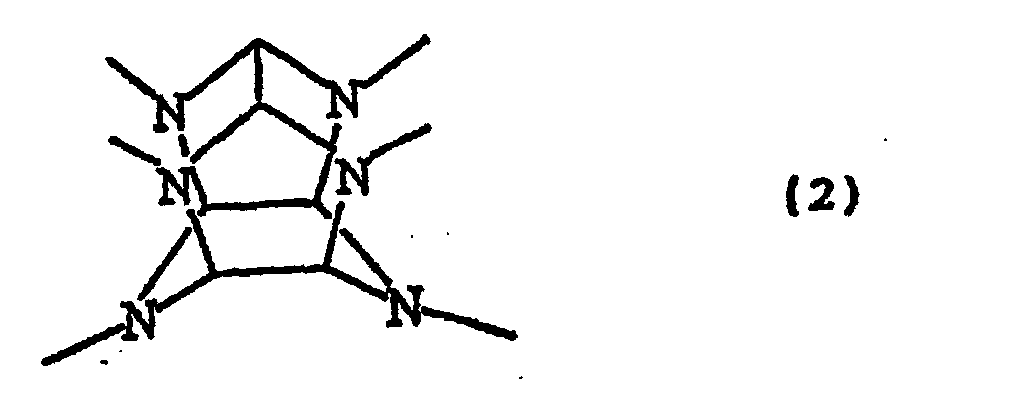 (II) Entfernen mindestens eines Teils des ersten Lösungsmittels aus dem zusammengesetzten System, um Kristalle des Acylgruppen enthaltenden Hexaazaisowurtzitanderivats (b) abzuscheiden; und(III) Isolieren der abgeschiedenen Kristalle aus dem zusammengesetzten System.
 - Verfahren nach Anspruch 1, wobei das Acylgruppen enthaltende Hexaazaisowurtzitanderivat (b), das durch die Formel (1) dargestellt ist, ein Produkt ist, das mit Hilfe eines Syntheseverfahrens unter Verwendung von mindestens einem Reaktionslösungsmittel erhalten wurde.
- Verfahren nach Anspruch 2, wobei das mindestens eine Reaktionslösungsmittel das gleiche ist wie das mindestens eine aus der aus dem ersten Lösungsmittel und dem zweiten Lösungsmittel bestehenden Gruppe ausgewählte Lösungsmittel.
- Verfahren nach Anspruch 1, wobei das zweite Lösungsmittel einen höheren Siedepunkt als das erste Lösungsmittel hat und die Entfernung mindestens eines Teils des ersten Lösungsmittels aus dem zusammengesetzten System durch Destillation erfolgt.
- Verfahren nach Anspruch 3, wobei das zweite Lösungsmittel einen höheren Siedepunkt als das erste Lösungsmittel hat und die Entfernung mindestens eines Teils des ersten Lösungsmittels aus dem zusammengesetzten System durch Destillation erfolgt.
- Verfahren nach Anspruch 5, wobei das Acylgruppen enthaltende Hexaazaisowurtzitanderivat (b) ein Tetraacylhexaazaisowurtzitan ist, das durch die folgende Formel (3) dargestellt ist
und welches mit Hilfe eines Syntheseverfahrens unter Verwendung von mindestens zwei Reaktionslösungsmitteln erhalten wurde,
wobei die mindestens zwei Reaktionslösungsmittel die gleichen wie das mindestens eine erste Lösungsmittel und das mindestens eine zweite Lösungsmittel sind und
wobei das mindestens eine erste Lösungsmittel aus der aus Wasser und Essigsäure bestehenden Gruppe ausgewählt ist und das mindestens eine zweite Lösungsmittel aus der Gruppe ausgewählt ist, die aus organischen Lösungsmitteln mit einem höheren Siedepunkt als Wasser besteht, wenn das erste Lösungsmittel Wasser ist oder mit einem höheren Siedepunkt als Essigsäure besteht, wenn das erste Lösungsmittel Essigsäure oder ein Gemisch aus Wasser und Essigsäure ist. - Verfahren nach Anspruch 5, wobei das Acylgruppen enthaltende Hexaazaisowurtzitanderivat (b) ein durch die folgende Formel (3) dargestelltes Tetraazaisowurtzitan ist:
und welches durch ein unter Verwendung von mindestens zwei Reaktionslösungsmitteln durchgeführtes Syntheseverfahrens erhalten wurde,
wobei die mindestens zwei Reaktionslösungsmittel die gleichen sind wie das mindestens eine erste Lösungsmittel und das mindestens eine zweite Lösungsmittel, und
wobei das erste Lösungsmittel Wasser ist und das mindestens eine zweite Lösungsmittel aus der Gruppe ausgewählt ist, die aus Amidgruppen enthaltenden organischen Lösungsmitteln, die mit Wasser verträglich sind und einen höheren Siedpunkt als Wasser haben, besteht. - Verfahren nach Anspruch 6, wobei das Syntheseverfahren zur Herstellung des durch Formel (3) dargestellten Tetraacylhexaazaisowurtzitans darin besteht, dass ein Tetraacylbis(benzyl)hexaazaisowurtzitan, das durch folgende Formal (4) dargestellt ist:
wie vorstehend für Formel (1) definiert ist, der Debenzylierung in Gegenwart der mindestens zwei Reaktionslösungsmittel unterworfen wird. - Verfahren nach Anspruch 7, wobei das Syntheseverfahren zur Herstellung des durch Formel (3) dargestellten Tetraacylhexaazaisowurtzitans darin besteht, dass ein durch die folgende Formel (4) dargestelltes Tetraacylbis(benzyl)hexaazaisowurtzitan
A wie vorstehend für Formel (1) definiert ist, der Debenzylierung in Gegenwart der mindestens zwei Reaktionslösungsmittel unterworfen wird. - Verfahren nach Anspruch 5, wobei das Acylgruppen enthaltende Hexaazaisowurtzitanderivat (b) ein durch die folgende Formel (3) dargestelltes Tetraacylhexaazaisowurtzitan ist
und welches mit Hilfe eines unter Verwendung von mindestens zwei Reaktionslösungsmitteln durchgeführten Syntheseverfahrens erhalten wurde,
wobei die mindestens zwei Reaktionslösungsmittel die gleichen sind, wie das mindestens eine erste Lösungsmittel und das mindestens eine zweite Lösungsmittel,
wobei das erste Lösungsmittel Wasser ist und das mindestens eine zweite Lösungsmittel aus der Gruppe ausgewählt ist, die aus Amidgruppen enthaltenden organischen Lösungsmitteln, die mit Wasser verträglich sind und einen höheren Siedepunkt als Wasser haben, besteht, und
wobei das Syntheseverfahren zur Herstellung des durch Formel (3) dargestellten Tetraacylhexaazaisowurtzitans folgende Stufen umfasst:(i) reduktive Debenzylierung eines Hexakis(benzyl)hexaazaisowurtzitans in Gegenwart eines Acylierungsmittels, wobei ein Reaktionsgemisch (i) erhalten wird, das ein durch die folgende Formel (4) dargestelltes Tetraacylbis(benzyl)hexaazaisowurtzitan enthält
vorstehend für Formel (1) definiert ist, und das eine Carbonsäure und ein Arylmethan als Nebenprodukte enthält,(ii) Zugabe von Wasser zu dem Reaktionsgemisch und(iii) anschließende Debenzylierung des erhaltenen Produkts unter Bildung einer Reaktionsgemisches (iii), welches ein Tetraacylhexaazaisowurtzitan der Formel (3) enthält, während Toluol als Nebenprodukt gebildet wird. - Verfahren nach Anspruch 10, wobei die in Stufe (i) als Nebenprodukt gebildete Carbonsäure aus dem in Stufe (i) erhaltenen Reaktionsgemisch (i) durch azeotrope Destillation zusammen mit einem Arylmethan, das Toluol ist, und als Nebenprodukt in Stufe (i) gebildet wurde, entfernt wird.
- Verfahren nach Anspruch 10, wobei die in Stufe (i) als Nebenprodukt gebildete Carbonsäure während der Entfernung des ersten Lösungsmittels durch Destillation in Stufe (II) oder aus dem Anteil des zusammengesetzten Systems, der verbleibt, nachdem die abgeschiedenen Kristalle aus dem zusammengesetzten System in Stufe (III) isoliert worden sind, durch azeotrope Destillation zusammen mit dem Arylmethan Toluol, das als Nebenprodukt in jeder der Stufen (i) und (iii) gebildet wurde, aus dem zusammengesetzten Reaktionssystem entfernt wird.
- Verfahren nach Anspruch 10, wobei das zweite Lösungsmittel mindestens ein Amidgruppen enthaltendes organisches Lösungsmittel ist, das aus der aus N,N-Dimethylacetamid, N,N-Dimethylformamid, 1,3-Dimethyl-2-imidazolidon und N-Methyl-2-pyrrolidon bestehenden Gruppe ausgewählt ist.
- Verfahren nach Anspruch 11, wobei das zweite Lösungsmittel mindestens ein Amidgruppen enthaltendes organisches Lösungsmittel ist, das aus der aus N,N-Dimethylacetamid, N,N-Dimethylformamid, 1,3-Dimethyl-2-imidazolidon and N-Methyl-2-pyrrolidon bestehenden Gruppe ausgewählt ist.
- Verfahren nach Anspruch 12, wobei das zweite Lösungsmittel mindestens ein Amidgruppen enthaltendes organisches Lösungsmittel ist, das aus der aus N,N-Dimethylacetamid, N,N-Dimethylformamid, 1,3-Dimethyl-2-imidazolidon und N-Methyl-2-pyrrolidon bestehenden Gruppe ausgewählt ist.
- Verfahren nach Ansprüchen 11 bis 15, wobei die als Nebenprodukt gebildete Carbonsäure Essigsäure ist.
- Verfahren nach Anspruch 4, wobei das Acylgruppen enthaltende Hexaazaisowurtzitanderivat (b) ein durch die folgende Formel (8) dargestelltes Hexaacylhexaazaisowurtzitan ist:
wobei das mindestens eine erste Lösungsmittel aus der aus Wasser und Essigsäure bestehenden Gruppe ausgewählt ist und das mindestens eine zweite Lösungsmittel aus der Gruppe ausgewählt ist, die aus Ethergruppen enthaltenden organischen Lösungsmitteln mit einem Siedepunkt, der höher als der von Wasser ist, wenn das erste Lösungsmittel Wasser ist, oder mit einem Siedepunkt, der höher als der von Essigsäure ist, wenn das erste Lösungsmittel Essigsäure oder ein Gemisch aus Wasser und Essigsäure ist, besteht. - Verfahren nach Anspruch 5, wobei das Acylgruppen enthaltende Hexaazaisowurtzitanderivat (b) ein durch die folgende Formel (9) dargestelltes Tetraacyldiformylhexaazaisowurtzitan ist:
von W und A wie vorstehend für Formel (1) definiert ist, und welches mit Hilfe eines Syntheseverfahrens unter Verwendung von mindestens zwei Reaktionslösungsmitteln erhalten wurde,
wobei die mindestens zwei Reaktionslösungsmittel die gleichen sind, wie das mindestens eine erste Lösungsmittel und das mindestens eine zweite Lösungsmittel,
wobei in dem in Stufe (I) bereitgestellten zusammengesetzten System das mindestens eine erste Lösungsmittel und das mindestens eine zweite Lösungsmittel von diesen mindestens zwei Reaktionslösungsmitteln abgeleitet sind, und
wobei das erste Lösungsmittel Ameisensäure ist und das mindestens eine zweite Lösungsmittel aus der Gruppe ausgewählt ist, die aus Ethergruppen enthaltenden organischen Lösungsmitteln mit einem höheren Siedepunkt als Ameisensäure besteht. - Verfahren nach Anspruch 18, wobei das Syntheseverfahren zur Herstellung des durch Formel (9) dargestellten Tetraacyldiformylhexaazaisowurtzitans darin besteht, dass ein Tetraacylbis(benzyl)hexaazaisowurtzitan, das durch die folgende Formel (4) dargestellt ist
der Debenzylierung in Gegenwart dieses Reaktionslösungsmittels unterworfen wird. - Verfahren nach Anspruch 18 oder 19,
wobei das Syntheseverfahren zur Herstellung des durch Formel (9) dargestellten Tetraacyldiformylhexaazaisowurtzitans folgende Stufen umfasst:(iii) reduktive Debenzylierung eines Hexakis(benzyl)hexaazaisowurtzitans in Gegenwart eines Acylierungsmittels unter Bildung eines Reaktionsgemisches, das ein Tetraacylbis(benzyl)hexaazaisowurtzitan der folgenden Formel (4) enthält(iv) Zugabe von Ameisensäure zu dem Reaktionsgemisch und(v) anschließende Dearylmethylierung des resultierenden Produkts. - Verfahren nach Anspruch 18, wobei das zweite Lösungsmittel mindestens ein Ethergruppen enthaltendes organisches Lösungsmittel ist, das aus der aus Ethylenglycoldiethylether, Ethylenglycol-di-n-butylether, Diethylenglycoldimethylether und Diethylenglycol-diethylether bestehenden Gruppe ausgewählt ist.
- Verfahren nach Anspruch 19, wobei das zweite Lösungsmittel mindestens ein Ethergruppen enthaltendes organisches Lösungsmittel ist, das aus der aus Ethylenglycol-diethylether, Ethylenglycol-di-n-butylether, Diethylenglycoldimethylether und Diethylenglycol-diethylether bestehenden Gruppe ausgewählt ist.
- Verfahren nach Anspruch 20, wobei das zweite Lösungsmittel mindestens ein Ethergruppen enthaltendes organisches Lösungsmittel ist, das aus der aus Ethylenglycol-diethylether, Ethylenglycol-di-n-butylether, Diethylenglycol-dimethylether und Diethylenglycol-diethylether bestehenden Gruppe ausgewählt ist.
- Verfahren nach Anspruch 1, wobei das erste Lösungsmittel Wasser ist und das zweite Lösungsmittel ein organisches Lösungsmittel ist, das eine von Wasser gesonderte Phase bilden kann,
wobei das zusammengesetzte System eine organische Phase und eine wässerige Phase, in der mindestens ein Teil des Acylgruppen enthaltenden Hexaazaisowurtzitanderivats (b) gelöst ist, umfasst, und
wobei die Entfernung mindestens eines Teils des ersten Lösungsmittels aus dem zusammengesetzten System in Stufe (II) durch Abtrennen der wässerigen Phase von dem zusammengesetzten System und Verdampfen des Wassers aus der wässerigen Phase durchgeführt wird. - Verfahren nach Anspruch 24, wobei n in Formel (1) 4 ist.
- Verfahren nach Anspruch 24, wobei n in Formel (1) 6 ist und wobei zwei Gruppen A in Formel (1) Formylgruppen sind und die restlichen vier Gruppen A andere Acylgruppen als Formylgruppen sind.
- Verfahren nach Anspruch 8 oder 9, wobei das durch Formel (4) dargestellte Tetraacylbis(benzyl)hexaazaisowurtzitan mit Hilfe eines Verfahrens erhalten wird, bei dem Hexakis(benzyl)hexaazaisowurtzitan der reduktiven Dearylmethylierung in Gegenwart eines Acylierungsmittels und eines Amidgruppen enthaltenden organischen Lösungsmittels unterworfen wird.
- Verfahren nach Anspruch 27, wobei das Amidgruppen enthaltende organische Lösungsmittel mindestens ein aus der aus N,N-Dimethylacetamid, N,N-Dimethylformamid, 1,3-Dimethyl-2-imidazolidon und N-Methyl-2-pyrrolidon bestehenden Gruppe ausgewähltes Mitglied ist.
- Verfahren nach Anspruch 7, wobei das durch Formel (3) dargestellte Acylgruppen enthaltende Hexaazaisowurtzitanderivat (b) mit Hilfe eines Verfahrens hergestellt wird, welches darin besteht, dass ein Tetraacylbis(benzyl)hexaazaisowurtzitan der folgenden Formel (4)der reduktiven Debenzylierung in Gegenwart eines Acylierungsmittels und dieses Mischlösungsmittels unterworfen wird,

wobei das Mischlösungsmittel ein Gemisch aus Wasser als erstes Lösungsmittel und ein Amidgruppen enthaltendes organisches Lösungsmittel als zweites Lösungsmittel umfasst. - Verfahren nach Anspruch 29, wobei das Tetraacylbis(benzyl)hexaazaisowurtzitan erhalten wird, indem ein Hexakis(benzyl)hexaazaisowurtzitan der folgenden Formel
der reduktiven Debenzylierung in Gegenwart eines Acylierungsmittels und eines Amidgruppen enthaltenden organischen Lösungsmittels unterworfen wird. - Verfahren nach Anspruch 29 oder 30, wobei das Amidgruppen enthaltende organische Lösungsmittel mindestens ein aus der aus N,N-Dimethylacetamid, N,N-Dimethylformamid, 1,3-Dimethyl-2-imidazolidon und N-Methyl-2-pyrrolidon bestehenden Gruppe ausgewähltes Mitglied ist.
- Verfahren nach Anspruch 29, wobei das durch Formel (4) dargestellte Tetraacylbis(benzyl)hexaazaisowurtzitan mit Hilfe eines Verfahrens hergestellt wird, das darin besteht, dass ein Hexakis(benzyl)hexaazaisowurtzitan der reduktiven Dearylmethylierung in Gegenwart eines Acylierungsmittels und eines Amidgruppen enthaltenden organischen Lösungsmittels unterworfen wird, wobei ein Tetraacylbis(benzyl)hexaazaisowurtzitan in Form eines Gemisches mit dem Amidgruppen enthaltenden organischen Lösungsmittel erhalten wird.
- Verfahren nach Anspruch 32, wobei das Amidgruppen enthaltende organische Lösungsmittel mindestens ein aus der aus N,N-Dimethylacetamid, N,N-Dimethylformamid, 1,3-Dimethyl-2-imidazolidon und N-Methyl-2-pyrrolidon bestehenden Gruppe ausgewähltes Mitglied ist.
Applications Claiming Priority (5)
| Application Number | Priority Date | Filing Date | Title |
|---|---|---|---|
| JP27073996 | 1996-10-14 | ||
| JP27073996 | 1996-10-14 | ||
| JP11421397 | 1997-04-17 | ||
| JP11421397 | 1997-04-17 | ||
| PCT/JP1997/003695 WO1998016529A1 (en) | 1996-10-14 | 1997-10-14 | Process for the preparation of acylated hexaazaisowurtzitane derivatives |
Publications (3)
| Publication Number | Publication Date |
|---|---|
| EP0934943A1 EP0934943A1 (de) | 1999-08-11 |
| EP0934943A4 EP0934943A4 (de) | 2001-04-11 |
| EP0934943B1 true EP0934943B1 (de) | 2003-06-18 |
Family
ID=26453024
Family Applications (1)
| Application Number | Title | Priority Date | Filing Date |
|---|---|---|---|
| EP97943202A Expired - Lifetime EP0934943B1 (de) | 1996-10-14 | 1997-10-14 | Verfahren zur herstellung acylierter hexaazaisowurtzitan-derivate |
Country Status (14)
| Country | Link |
|---|---|
| US (1) | US6153749A (de) |
| EP (1) | EP0934943B1 (de) |
| JP (1) | JP3199753B2 (de) |
| KR (1) | KR100314108B1 (de) |
| CN (1) | CN1063750C (de) |
| AT (1) | ATE243212T1 (de) |
| AU (1) | AU4473197A (de) |
| CA (1) | CA2260092A1 (de) |
| DE (1) | DE69722949T2 (de) |
| IL (3) | IL123540A0 (de) |
| NO (1) | NO985619D0 (de) |
| RU (1) | RU2146676C1 (de) |
| TW (1) | TW442486B (de) |
| WO (1) | WO1998016529A1 (de) |
Families Citing this family (8)
| Publication number | Priority date | Publication date | Assignee | Title |
|---|---|---|---|---|
| EP0753519B1 (de) * | 1995-02-01 | 2000-05-17 | Asahi Kasei Kogyo Kabushiki Kaisha | Hexaazaisowurtzitan-derivate und verfahren zu deren herstellung |
| KR20010011940A (ko) * | 1999-07-31 | 2001-02-15 | 최동환 | 폴리아실헥사아자이소부르치탄, 그의 제조 방법 및 이를 이용한 헥사니트로 헥사아자이소부르치탄의 제조 방법 |
| RU2266907C9 (ru) * | 2003-08-25 | 2006-04-27 | Федеральное государственное унитарное предприятие Федеральный научно-производственный центр "Алтай" | Способ получения тетраацетилдиформилгексаазаизовюрцитана |
| WO2015003045A1 (en) * | 2013-07-02 | 2015-01-08 | Momentive Performance Materials Inc | Moisture curable compositions |
| RU2610695C2 (ru) * | 2015-07-23 | 2017-02-14 | Акционерное общество "Федеральный научно-производственный центр "Алтай" | Способ получения 2,6,8,12-тетраацетил-2,4,6,8,10,12-гексаазатетрацикло[5,5,0,03,11 ,05,9]додекана |
| CN107501293A (zh) * | 2017-10-11 | 2017-12-22 | 中国工程物理研究院化工材料研究所 | 二呋咱并哌嗪硝胺类高能离子盐及其合成方法 |
| CN114634513B (zh) * | 2022-03-15 | 2023-09-12 | 西安近代化学研究所 | 一种声共振强化hbiw连续氢解脱苄合成tadb的方法 |
| CN115160324A (zh) * | 2022-07-13 | 2022-10-11 | 西安近代化学研究所 | 一种单原子钯催化hbiw氢解脱苄合成tadb的方法 |
Family Cites Families (7)
| Publication number | Priority date | Publication date | Assignee | Title |
|---|---|---|---|---|
| DE3643887A1 (de) * | 1986-12-22 | 1988-06-30 | Basf Ag | Acetylendiharnstoffderivate und ihre verwendung zum stabilisieren von kunststoffen |
| US4920107A (en) * | 1988-03-29 | 1990-04-24 | Buckman Laboratories International, Inc. | 1-methyl-3,5,7-triaza-1-azoniatricyclodecane compounds, a method for preparing these compounds, and their use in the control of microorganisms in aqueous systems |
| US5693794A (en) * | 1988-09-30 | 1997-12-02 | The United States Of America As Represented By The Secretary Of The Navy | Caged polynitramine compound |
| RU2055077C1 (ru) * | 1992-04-06 | 1996-02-27 | Ньюроджен Корпорейшн | Циклоалкил- или азациклоалкилпирролопиримидины или их фармацевтически приемлемые соли |
| JPH08208655A (ja) * | 1995-02-01 | 1996-08-13 | Asahi Chem Ind Co Ltd | ヘキサアザイソウルチタン誘導体の製造方法 |
| EP0753519B1 (de) * | 1995-02-01 | 2000-05-17 | Asahi Kasei Kogyo Kabushiki Kaisha | Hexaazaisowurtzitan-derivate und verfahren zu deren herstellung |
| US5739325A (en) * | 1995-12-07 | 1998-04-14 | Thiokol Corporation | Hydrogenolysis of 2,4,6,8,10,12-Hexabenzyl-2,4,6,8,10,12-Hexaazatetracyclo 5.5.0.05,9.03,11 !dodecane |
-
1997
- 1997-10-14 WO PCT/JP1997/003695 patent/WO1998016529A1/ja not_active Ceased
- 1997-10-14 RU RU98104124/04A patent/RU2146676C1/ru not_active IP Right Cessation
- 1997-10-14 CN CN97190900A patent/CN1063750C/zh not_active Expired - Fee Related
- 1997-10-14 EP EP97943202A patent/EP0934943B1/de not_active Expired - Lifetime
- 1997-10-14 US US09/214,439 patent/US6153749A/en not_active Expired - Fee Related
- 1997-10-14 TW TW086115275A patent/TW442486B/zh not_active IP Right Cessation
- 1997-10-14 CA CA002260092A patent/CA2260092A1/en not_active Abandoned
- 1997-10-14 IL IL12354097A patent/IL123540A0/xx active IP Right Grant
- 1997-10-14 DE DE69722949T patent/DE69722949T2/de not_active Expired - Fee Related
- 1997-10-14 AT AT97943202T patent/ATE243212T1/de not_active IP Right Cessation
- 1997-10-14 JP JP50506898A patent/JP3199753B2/ja not_active Expired - Fee Related
- 1997-10-14 AU AU44731/97A patent/AU4473197A/en not_active Abandoned
-
1998
- 1998-03-04 IL IL123540A patent/IL123540A/en not_active IP Right Cessation
- 1998-12-02 NO NO985619A patent/NO985619D0/no unknown
-
1999
- 1999-02-06 KR KR1019997001026A patent/KR100314108B1/ko not_active Expired - Fee Related
-
2001
- 2001-01-02 IL IL140703A patent/IL140703A/en not_active IP Right Cessation
Also Published As
| Publication number | Publication date |
|---|---|
| WO1998016529A1 (en) | 1998-04-23 |
| CA2260092A1 (en) | 1998-04-23 |
| NO985619D0 (no) | 1998-12-02 |
| EP0934943A4 (de) | 2001-04-11 |
| KR100314108B1 (ko) | 2001-11-23 |
| JP3199753B2 (ja) | 2001-08-20 |
| TW442486B (en) | 2001-06-23 |
| US6153749A (en) | 2000-11-28 |
| RU2146676C1 (ru) | 2000-03-20 |
| IL140703A (en) | 2006-04-10 |
| ATE243212T1 (de) | 2003-07-15 |
| EP0934943A1 (de) | 1999-08-11 |
| IL123540A (en) | 2007-03-08 |
| KR20000035788A (ko) | 2000-06-26 |
| DE69722949D1 (de) | 2003-07-24 |
| DE69722949T2 (de) | 2004-05-13 |
| CN1197459A (zh) | 1998-10-28 |
| AU4473197A (en) | 1998-05-11 |
| CN1063750C (zh) | 2001-03-28 |
| IL123540A0 (en) | 2000-02-17 |
Similar Documents
| Publication | Publication Date | Title |
|---|---|---|
| EP0753519B1 (de) | Hexaazaisowurtzitan-derivate und verfahren zu deren herstellung | |
| EP0934943B1 (de) | Verfahren zur herstellung acylierter hexaazaisowurtzitan-derivate | |
| US20240190898A1 (en) | Synthesis method of zinc metal organic framework materials | |
| EP3393499B1 (de) | System und verfahren zur synthese von gap-peptiden in der lösungsphase | |
| JPWO1998016529A1 (ja) | アシル基を有するヘキサアザイソウルチタン誘導体の製造方法 | |
| TW200948753A (en) | Method of preparation of combretastatin | |
| AU2005320525B2 (en) | Method for producing L-biopterin | |
| EP0919556B1 (de) | Verfahren zur herstellung von hexanitrohexaazawurtzitaneen | |
| US6297373B1 (en) | Method for acylating hexakis (arylmethyl) hexaazaisowurtzitane | |
| EP1024141B1 (de) | Verfahren zur herstellung von hexakis(arylmethyl)hexaazaisowurtzitan | |
| AU2023307165A1 (en) | Methods of preparation of heterocyclic compounds | |
| JPH08208655A (ja) | ヘキサアザイソウルチタン誘導体の製造方法 | |
| JP2926482B2 (ja) | アシル基を有するヘキサアザイソウルチタンの製造方法 | |
| TWI895854B (zh) | 具有二羧酸衍生物構造之化合物的製造方法 | |
| Clemens et al. | Unexpected behaviour of tosylated and acetylated imidazolinium salts | |
| JP2844125B2 (ja) | ヘキサアザイソウルチタン誘導体およびその製造方法 | |
| JP2976018B2 (ja) | アシル基を有するヘキサアザイソウルチタンの製造方法 | |
| CN120532315A (zh) | 一种新型Zr-MOF膜的制备方法及有机物分离应用 | |
| JP4825969B2 (ja) | 第3級アルコールの製造方法 | |
| JP2024072016A (ja) | ジカルボン酸誘導体構造を有する化合物の製造方法 | |
| WO2023007712A1 (ja) | (r,s)-ニコチンの製造方法 | |
| JPWO1996023792A1 (ja) | ヘキサアザイソウルチタン誘導体およびその製造方法 | |
| EP3814362A1 (de) | Immobilisierte ruthenium-triphos-katalysatoren zur selektiven hydrogenolyse von amiden | |
| JPWO1990015791A1 (ja) | 炭酸エステルの製造法及び製造用触媒 | |
| HK1263174A1 (en) | System and method for solution phase gap peptide synthesis |
Legal Events
| Date | Code | Title | Description |
|---|---|---|---|
| PUAI | Public reference made under article 153(3) epc to a published international application that has entered the european phase |
Free format text: ORIGINAL CODE: 0009012 |
|
| 17P | Request for examination filed |
Effective date: 19990416 |
|
| AK | Designated contracting states |
Kind code of ref document: A1 Designated state(s): AT CH DE DK ES FI FR GB LI SE |
|
| A4 | Supplementary search report drawn up and despatched |
Effective date: 20010227 |
|
| AK | Designated contracting states |
Kind code of ref document: A4 Designated state(s): AT CH DE DK ES FI FR GB LI SE |
|
| RAP1 | Party data changed (applicant data changed or rights of an application transferred) |
Owner name: ASAHI KASEI KABUSHIKI KAISHA |
|
| 17Q | First examination report despatched |
Effective date: 20010710 |
|
| GRAH | Despatch of communication of intention to grant a patent |
Free format text: ORIGINAL CODE: EPIDOS IGRA |
|
| GRAH | Despatch of communication of intention to grant a patent |
Free format text: ORIGINAL CODE: EPIDOS IGRA |
|
| GRAA | (expected) grant |
Free format text: ORIGINAL CODE: 0009210 |
|
| AK | Designated contracting states |
Designated state(s): AT CH DE DK ES FI FR GB LI SE |
|
| PG25 | Lapsed in a contracting state [announced via postgrant information from national office to epo] |
Ref country code: FI Free format text: LAPSE BECAUSE OF FAILURE TO SUBMIT A TRANSLATION OF THE DESCRIPTION OR TO PAY THE FEE WITHIN THE PRESCRIBED TIME-LIMIT Effective date: 20030618 Ref country code: AT Free format text: LAPSE BECAUSE OF FAILURE TO SUBMIT A TRANSLATION OF THE DESCRIPTION OR TO PAY THE FEE WITHIN THE PRESCRIBED TIME-LIMIT Effective date: 20030618 |
|
| REG | Reference to a national code |
Ref country code: GB Ref legal event code: FG4D |
|
| REG | Reference to a national code |
Ref country code: CH Ref legal event code: EP |
|
| REF | Corresponds to: |
Ref document number: 69722949 Country of ref document: DE Date of ref document: 20030724 Kind code of ref document: P |
|
| PG25 | Lapsed in a contracting state [announced via postgrant information from national office to epo] |
Ref country code: DK Free format text: LAPSE BECAUSE OF FAILURE TO SUBMIT A TRANSLATION OF THE DESCRIPTION OR TO PAY THE FEE WITHIN THE PRESCRIBED TIME-LIMIT Effective date: 20030918 |
|
| PG25 | Lapsed in a contracting state [announced via postgrant information from national office to epo] |
Ref country code: ES Free format text: LAPSE BECAUSE OF FAILURE TO SUBMIT A TRANSLATION OF THE DESCRIPTION OR TO PAY THE FEE WITHIN THE PRESCRIBED TIME-LIMIT Effective date: 20030929 |
|
| REG | Reference to a national code |
Ref country code: SE Ref legal event code: TRGR |
|
| REG | Reference to a national code |
Ref country code: CH Ref legal event code: NV Representative=s name: AMMANN PATENTANWAELTE AG BERN |
|
| ET | Fr: translation filed | ||
| PLBE | No opposition filed within time limit |
Free format text: ORIGINAL CODE: 0009261 |
|
| STAA | Information on the status of an ep patent application or granted ep patent |
Free format text: STATUS: NO OPPOSITION FILED WITHIN TIME LIMIT |
|
| 26N | No opposition filed |
Effective date: 20040319 |
|
| PGFP | Annual fee paid to national office [announced via postgrant information from national office to epo] |
Ref country code: DE Payment date: 20081014 Year of fee payment: 12 Ref country code: CH Payment date: 20081016 Year of fee payment: 12 |
|
| PGFP | Annual fee paid to national office [announced via postgrant information from national office to epo] |
Ref country code: SE Payment date: 20081022 Year of fee payment: 12 |
|
| PGFP | Annual fee paid to national office [announced via postgrant information from national office to epo] |
Ref country code: FR Payment date: 20081014 Year of fee payment: 12 |
|
| PGFP | Annual fee paid to national office [announced via postgrant information from national office to epo] |
Ref country code: GB Payment date: 20081008 Year of fee payment: 12 |
|
| REG | Reference to a national code |
Ref country code: CH Ref legal event code: PL |
|
| EUG | Se: european patent has lapsed | ||
| REG | Reference to a national code |
Ref country code: FR Ref legal event code: ST Effective date: 20100630 |
|
| PG25 | Lapsed in a contracting state [announced via postgrant information from national office to epo] |
Ref country code: FR Free format text: LAPSE BECAUSE OF NON-PAYMENT OF DUE FEES Effective date: 20091102 Ref country code: DE Free format text: LAPSE BECAUSE OF NON-PAYMENT OF DUE FEES Effective date: 20100501 |
|
| PG25 | Lapsed in a contracting state [announced via postgrant information from national office to epo] |
Ref country code: LI Free format text: LAPSE BECAUSE OF NON-PAYMENT OF DUE FEES Effective date: 20091031 Ref country code: CH Free format text: LAPSE BECAUSE OF NON-PAYMENT OF DUE FEES Effective date: 20091031 |
|
| PG25 | Lapsed in a contracting state [announced via postgrant information from national office to epo] |
Ref country code: GB Free format text: LAPSE BECAUSE OF NON-PAYMENT OF DUE FEES Effective date: 20091014 |
|
| PG25 | Lapsed in a contracting state [announced via postgrant information from national office to epo] |
Ref country code: SE Free format text: LAPSE BECAUSE OF NON-PAYMENT OF DUE FEES Effective date: 20091015 |