EP0934936B1 - Oxazolidinone compounds and process for the preparation thereof - Google Patents
Oxazolidinone compounds and process for the preparation thereof Download PDFInfo
- Publication number
- EP0934936B1 EP0934936B1 EP97929541A EP97929541A EP0934936B1 EP 0934936 B1 EP0934936 B1 EP 0934936B1 EP 97929541 A EP97929541 A EP 97929541A EP 97929541 A EP97929541 A EP 97929541A EP 0934936 B1 EP0934936 B1 EP 0934936B1
- Authority
- EP
- European Patent Office
- Prior art keywords
- group
- cis
- halogen atom
- substituted
- compound
- Prior art date
- Legal status (The legal status is an assumption and is not a legal conclusion. Google has not performed a legal analysis and makes no representation as to the accuracy of the status listed.)
- Expired - Lifetime
Links
- IZXIZTKNFFYFOF-UHFFFAOYSA-N 2-Oxazolidone Chemical class O=C1NCCO1 IZXIZTKNFFYFOF-UHFFFAOYSA-N 0.000 title claims abstract description 27
- 238000000034 method Methods 0.000 title claims description 24
- 238000002360 preparation method Methods 0.000 title description 3
- -1 sulfonyl isocyanate compound Chemical class 0.000 claims abstract description 62
- 125000004169 (C1-C6) alkyl group Chemical group 0.000 claims abstract description 32
- 125000005843 halogen group Chemical group 0.000 claims abstract description 32
- 150000001875 compounds Chemical class 0.000 claims abstract description 19
- LOPKSXMQWBYUOI-DTWKUNHWSA-N (1r,2s)-1-amino-2,3-dihydro-1h-inden-2-ol Chemical compound C1=CC=C2[C@@H](N)[C@@H](O)CC2=C1 LOPKSXMQWBYUOI-DTWKUNHWSA-N 0.000 claims abstract description 14
- 125000004890 (C1-C6) alkylamino group Chemical group 0.000 claims abstract description 8
- 125000000882 C2-C6 alkenyl group Chemical group 0.000 claims abstract description 7
- 125000003118 aryl group Chemical group 0.000 claims abstract description 7
- 125000003545 alkoxy group Chemical group 0.000 claims abstract description 5
- 229910001507 metal halide Inorganic materials 0.000 claims abstract description 5
- 239000003054 catalyst Substances 0.000 claims abstract description 4
- 230000003301 hydrolyzing effect Effects 0.000 claims abstract description 4
- 150000005309 metal halides Chemical class 0.000 claims abstract 2
- 125000004191 (C1-C6) alkoxy group Chemical group 0.000 claims description 27
- FVAUCKIRQBBSSJ-UHFFFAOYSA-M sodium iodide Chemical compound [Na+].[I-] FVAUCKIRQBBSSJ-UHFFFAOYSA-M 0.000 claims description 27
- 125000001424 substituent group Chemical group 0.000 claims description 27
- 125000006828 (C2-C7) alkoxycarbonyl group Chemical group 0.000 claims description 26
- 125000006826 (C2-C7) alkylcarbonyloxy group Chemical group 0.000 claims description 26
- 125000002252 acyl group Chemical group 0.000 claims description 26
- 125000001997 phenyl group Chemical group [H]C1=C([H])C([H])=C(*)C([H])=C1[H] 0.000 claims description 26
- 238000006460 hydrolysis reaction Methods 0.000 claims description 11
- 235000009518 sodium iodide Nutrition 0.000 claims description 9
- 239000003513 alkali Substances 0.000 claims description 7
- 230000007062 hydrolysis Effects 0.000 claims description 7
- 239000002253 acid Substances 0.000 claims description 6
- 239000004593 Epoxy Substances 0.000 claims description 5
- 229910052799 carbon Inorganic materials 0.000 claims description 4
- 125000004432 carbon atom Chemical group C* 0.000 claims description 4
- 125000002887 hydroxy group Chemical group [H]O* 0.000 claims description 3
- 229910001508 alkali metal halide Inorganic materials 0.000 claims 1
- 229910052725 zinc Inorganic materials 0.000 claims 1
- 239000011701 zinc Substances 0.000 claims 1
- 239000003814 drug Substances 0.000 abstract description 5
- 229940079593 drug Drugs 0.000 abstract description 5
- WEVYAHXRMPXWCK-UHFFFAOYSA-N Acetonitrile Chemical compound CC#N WEVYAHXRMPXWCK-UHFFFAOYSA-N 0.000 description 27
- 238000006243 chemical reaction Methods 0.000 description 20
- YXFVVABEGXRONW-UHFFFAOYSA-N Toluene Chemical compound CC1=CC=CC=C1 YXFVVABEGXRONW-UHFFFAOYSA-N 0.000 description 15
- HEDRZPFGACZZDS-UHFFFAOYSA-N Chloroform Chemical compound ClC(Cl)Cl HEDRZPFGACZZDS-UHFFFAOYSA-N 0.000 description 14
- GNOIPBMMFNIUFM-UHFFFAOYSA-N hexamethylphosphoric triamide Chemical compound CN(C)P(=O)(N(C)C)N(C)C GNOIPBMMFNIUFM-UHFFFAOYSA-N 0.000 description 14
- 239000000203 mixture Substances 0.000 description 14
- 238000003786 synthesis reaction Methods 0.000 description 14
- 230000015572 biosynthetic process Effects 0.000 description 13
- 150000002924 oxiranes Chemical class 0.000 description 13
- OKKJLVBELUTLKV-UHFFFAOYSA-N Methanol Chemical compound OC OKKJLVBELUTLKV-UHFFFAOYSA-N 0.000 description 12
- HEMHJVSKTPXQMS-UHFFFAOYSA-M Sodium hydroxide Chemical compound [OH-].[Na+] HEMHJVSKTPXQMS-UHFFFAOYSA-M 0.000 description 12
- 239000012948 isocyanate Substances 0.000 description 11
- 150000002513 isocyanates Chemical class 0.000 description 11
- 239000002904 solvent Substances 0.000 description 11
- 230000003287 optical effect Effects 0.000 description 10
- CSCPPACGZOOCGX-UHFFFAOYSA-N Acetone Chemical compound CC(C)=O CSCPPACGZOOCGX-UHFFFAOYSA-N 0.000 description 9
- UHOVQNZJYSORNB-UHFFFAOYSA-N Benzene Chemical compound C1=CC=CC=C1 UHOVQNZJYSORNB-UHFFFAOYSA-N 0.000 description 9
- LFQSCWFLJHTTHZ-UHFFFAOYSA-N Ethanol Chemical compound CCO LFQSCWFLJHTTHZ-UHFFFAOYSA-N 0.000 description 9
- XEKOWRVHYACXOJ-UHFFFAOYSA-N Ethyl acetate Chemical compound CCOC(C)=O XEKOWRVHYACXOJ-UHFFFAOYSA-N 0.000 description 9
- 239000000047 product Substances 0.000 description 9
- XLYOFNOQVPJJNP-UHFFFAOYSA-N water Substances O XLYOFNOQVPJJNP-UHFFFAOYSA-N 0.000 description 9
- AMXOYNBUYSYVKV-UHFFFAOYSA-M lithium bromide Chemical compound [Li+].[Br-] AMXOYNBUYSYVKV-UHFFFAOYSA-M 0.000 description 8
- SNDGLCYYBKJSOT-UHFFFAOYSA-N 1,1,3,3-tetrabutylurea Chemical compound CCCCN(CCCC)C(=O)N(CCCC)CCCC SNDGLCYYBKJSOT-UHFFFAOYSA-N 0.000 description 7
- ZWEHNKRNPOVVGH-UHFFFAOYSA-N 2-Butanone Chemical compound CCC(C)=O ZWEHNKRNPOVVGH-UHFFFAOYSA-N 0.000 description 6
- VLJQDHDVZJXNQL-UHFFFAOYSA-N 4-methyl-n-(oxomethylidene)benzenesulfonamide Chemical compound CC1=CC=C(S(=O)(=O)N=C=O)C=C1 VLJQDHDVZJXNQL-UHFFFAOYSA-N 0.000 description 6
- QTBSBXVTEAMEQO-UHFFFAOYSA-N Acetic acid Chemical compound CC(O)=O QTBSBXVTEAMEQO-UHFFFAOYSA-N 0.000 description 6
- YMWUJEATGCHHMB-UHFFFAOYSA-N Dichloromethane Chemical compound ClCCl YMWUJEATGCHHMB-UHFFFAOYSA-N 0.000 description 6
- RTZKZFJDLAIYFH-UHFFFAOYSA-N Diethyl ether Chemical compound CCOCC RTZKZFJDLAIYFH-UHFFFAOYSA-N 0.000 description 6
- KFZMGEQAYNKOFK-UHFFFAOYSA-N Isopropanol Chemical compound CC(C)O KFZMGEQAYNKOFK-UHFFFAOYSA-N 0.000 description 6
- 239000002879 Lewis base Substances 0.000 description 6
- LRHPLDYGYMQRHN-UHFFFAOYSA-N N-Butanol Chemical compound CCCCO LRHPLDYGYMQRHN-UHFFFAOYSA-N 0.000 description 6
- WYURNTSHIVDZCO-UHFFFAOYSA-N Tetrahydrofuran Chemical compound C1CCOC1 WYURNTSHIVDZCO-UHFFFAOYSA-N 0.000 description 6
- ZMANZCXQSJIPKH-UHFFFAOYSA-N Triethylamine Chemical compound CCN(CC)CC ZMANZCXQSJIPKH-UHFFFAOYSA-N 0.000 description 6
- BTANRVKWQNVYAZ-UHFFFAOYSA-N butan-2-ol Chemical compound CCC(C)O BTANRVKWQNVYAZ-UHFFFAOYSA-N 0.000 description 6
- 239000013078 crystal Substances 0.000 description 6
- BDERNNFJNOPAEC-UHFFFAOYSA-N propan-1-ol Chemical compound CCCO BDERNNFJNOPAEC-UHFFFAOYSA-N 0.000 description 6
- 239000000243 solution Substances 0.000 description 6
- LOPKSXMQWBYUOI-BDAKNGLRSA-N (1s,2r)-1-amino-2,3-dihydro-1h-inden-2-ol Chemical compound C1=CC=C2[C@H](N)[C@H](O)CC2=C1 LOPKSXMQWBYUOI-BDAKNGLRSA-N 0.000 description 5
- 239000012300 argon atmosphere Substances 0.000 description 5
- AVQQQNCBBIEMEU-UHFFFAOYSA-N 1,1,3,3-tetramethylurea Chemical compound CN(C)C(=O)N(C)C AVQQQNCBBIEMEU-UHFFFAOYSA-N 0.000 description 4
- RFFLAFLAYFXFSW-UHFFFAOYSA-N 1,2-dichlorobenzene Chemical compound ClC1=CC=CC=C1Cl RFFLAFLAYFXFSW-UHFFFAOYSA-N 0.000 description 4
- MNZAKDODWSQONA-UHFFFAOYSA-N 1-dibutylphosphorylbutane Chemical compound CCCCP(=O)(CCCC)CCCC MNZAKDODWSQONA-UHFFFAOYSA-N 0.000 description 4
- XDTMQSROBMDMFD-UHFFFAOYSA-N Cyclohexane Chemical compound C1CCCCC1 XDTMQSROBMDMFD-UHFFFAOYSA-N 0.000 description 4
- QAOWNCQODCNURD-UHFFFAOYSA-N Sulfuric acid Chemical compound OS(O)(=O)=O QAOWNCQODCNURD-UHFFFAOYSA-N 0.000 description 4
- JTDNNCYXCFHBGG-UHFFFAOYSA-L Tin(II) iodide Inorganic materials I[Sn]I JTDNNCYXCFHBGG-UHFFFAOYSA-L 0.000 description 4
- HEDRZPFGACZZDS-MICDWDOJSA-N Trichloro(2H)methane Chemical compound [2H]C(Cl)(Cl)Cl HEDRZPFGACZZDS-MICDWDOJSA-N 0.000 description 4
- 239000007864 aqueous solution Substances 0.000 description 4
- MVPPADPHJFYWMZ-UHFFFAOYSA-N chlorobenzene Chemical compound ClC1=CC=CC=C1 MVPPADPHJFYWMZ-UHFFFAOYSA-N 0.000 description 4
- 239000012043 crude product Substances 0.000 description 4
- DIOQZVSQGTUSAI-UHFFFAOYSA-N decane Chemical compound CCCCCCCCCC DIOQZVSQGTUSAI-UHFFFAOYSA-N 0.000 description 4
- 238000001514 detection method Methods 0.000 description 4
- 239000003480 eluent Substances 0.000 description 4
- ZXEKIIBDNHEJCQ-UHFFFAOYSA-N isobutanol Chemical compound CC(C)CO ZXEKIIBDNHEJCQ-UHFFFAOYSA-N 0.000 description 4
- 150000007527 lewis bases Chemical class 0.000 description 4
- 239000007788 liquid Substances 0.000 description 4
- VLKZOEOYAKHREP-UHFFFAOYSA-N n-Hexane Chemical compound CCCCCC VLKZOEOYAKHREP-UHFFFAOYSA-N 0.000 description 4
- TVMXDCGIABBOFY-UHFFFAOYSA-N octane Chemical compound CCCCCCCC TVMXDCGIABBOFY-UHFFFAOYSA-N 0.000 description 4
- VZGDMQKNWNREIO-UHFFFAOYSA-N tetrachloromethane Chemical compound ClC(Cl)(Cl)Cl VZGDMQKNWNREIO-UHFFFAOYSA-N 0.000 description 4
- RIOQSEWOXXDEQQ-UHFFFAOYSA-N triphenylphosphine Chemical compound C1=CC=CC=C1P(C=1C=CC=CC=1)C1=CC=CC=C1 RIOQSEWOXXDEQQ-UHFFFAOYSA-N 0.000 description 4
- GQHTUMJGOHRCHB-UHFFFAOYSA-N 2,3,4,6,7,8,9,10-octahydropyrimido[1,2-a]azepine Chemical compound C1CCCCN2CCCN=C21 GQHTUMJGOHRCHB-UHFFFAOYSA-N 0.000 description 3
- WMFOQBRAJBCJND-UHFFFAOYSA-M Lithium hydroxide Chemical compound [Li+].[OH-] WMFOQBRAJBCJND-UHFFFAOYSA-M 0.000 description 3
- ZMXDDKWLCZADIW-UHFFFAOYSA-N N,N-Dimethylformamide Chemical compound CN(C)C=O ZMXDDKWLCZADIW-UHFFFAOYSA-N 0.000 description 3
- KWYUFKZDYYNOTN-UHFFFAOYSA-M Potassium hydroxide Chemical compound [OH-].[K+] KWYUFKZDYYNOTN-UHFFFAOYSA-M 0.000 description 3
- 229910052783 alkali metal Inorganic materials 0.000 description 3
- 150000001340 alkali metals Chemical class 0.000 description 3
- 239000007810 chemical reaction solvent Substances 0.000 description 3
- 238000006352 cycloaddition reaction Methods 0.000 description 3
- 238000000605 extraction Methods 0.000 description 3
- CBVCZFGXHXORBI-PXQQMZJSSA-N indinavir Chemical compound C([C@H](N(CC1)C[C@@H](O)C[C@@H](CC=2C=CC=CC=2)C(=O)N[C@H]2C3=CC=CC=C3C[C@H]2O)C(=O)NC(C)(C)C)N1CC1=CC=CN=C1 CBVCZFGXHXORBI-PXQQMZJSSA-N 0.000 description 3
- 229960001936 indinavir Drugs 0.000 description 3
- OUPLTJDZPQZRBW-UHFFFAOYSA-N n-(oxomethylidene)methanesulfonamide Chemical compound CS(=O)(=O)N=C=O OUPLTJDZPQZRBW-UHFFFAOYSA-N 0.000 description 3
- 239000003960 organic solvent Substances 0.000 description 3
- YLQBMQCUIZJEEH-UHFFFAOYSA-N tetrahydrofuran Natural products C=1C=COC=1 YLQBMQCUIZJEEH-UHFFFAOYSA-N 0.000 description 3
- 0 *S(N(C1c2ccccc2CC1O1)C1=O)(=O)=O Chemical compound *S(N(C1c2ccccc2CC1O1)C1=O)(=O)=O 0.000 description 2
- SCYULBFZEHDVBN-UHFFFAOYSA-N 1,1-Dichloroethane Chemical compound CC(Cl)Cl SCYULBFZEHDVBN-UHFFFAOYSA-N 0.000 description 2
- RYHBNJHYFVUHQT-UHFFFAOYSA-N 1,4-Dioxane Chemical compound C1COCCO1 RYHBNJHYFVUHQT-UHFFFAOYSA-N 0.000 description 2
- VZOPVKZLLGMDDG-UHFFFAOYSA-N 1-oxido-4-phenylpyridin-1-ium Chemical compound C1=C[N+]([O-])=CC=C1C1=CC=CC=C1 VZOPVKZLLGMDDG-UHFFFAOYSA-N 0.000 description 2
- 238000005160 1H NMR spectroscopy Methods 0.000 description 2
- YBYIRNPNPLQARY-UHFFFAOYSA-N 1H-indene Chemical compound C1=CC=C2CC=CC2=C1 YBYIRNPNPLQARY-UHFFFAOYSA-N 0.000 description 2
- OISVCGZHLKNMSJ-UHFFFAOYSA-N 2,6-dimethylpyridine Chemical compound CC1=CC=CC(C)=N1 OISVCGZHLKNMSJ-UHFFFAOYSA-N 0.000 description 2
- LSNNMFCWUKXFEE-UHFFFAOYSA-M Bisulfite Chemical compound OS([O-])=O LSNNMFCWUKXFEE-UHFFFAOYSA-M 0.000 description 2
- VTYYLEPIZMXCLO-UHFFFAOYSA-L Calcium carbonate Chemical compound [Ca+2].[O-]C([O-])=O VTYYLEPIZMXCLO-UHFFFAOYSA-L 0.000 description 2
- XTHFKEDIFFGKHM-UHFFFAOYSA-N Dimethoxyethane Chemical compound COCCOC XTHFKEDIFFGKHM-UHFFFAOYSA-N 0.000 description 2
- IAZDPXIOMUYVGZ-UHFFFAOYSA-N Dimethylsulphoxide Chemical compound CS(C)=O IAZDPXIOMUYVGZ-UHFFFAOYSA-N 0.000 description 2
- IAYPIBMASNFSPL-UHFFFAOYSA-N Ethylene oxide Chemical compound C1CO1 IAYPIBMASNFSPL-UHFFFAOYSA-N 0.000 description 2
- KRHYYFGTRYWZRS-UHFFFAOYSA-N Fluorane Chemical compound F KRHYYFGTRYWZRS-UHFFFAOYSA-N 0.000 description 2
- VEXZGXHMUGYJMC-UHFFFAOYSA-N Hydrochloric acid Chemical compound Cl VEXZGXHMUGYJMC-UHFFFAOYSA-N 0.000 description 2
- AFVFQIVMOAPDHO-UHFFFAOYSA-N Methanesulfonic acid Chemical compound CS(O)(=O)=O AFVFQIVMOAPDHO-UHFFFAOYSA-N 0.000 description 2
- NTIZESTWPVYFNL-UHFFFAOYSA-N Methyl isobutyl ketone Chemical compound CC(C)CC(C)=O NTIZESTWPVYFNL-UHFFFAOYSA-N 0.000 description 2
- UIHCLUNTQKBZGK-UHFFFAOYSA-N Methyl isobutyl ketone Natural products CCC(C)C(C)=O UIHCLUNTQKBZGK-UHFFFAOYSA-N 0.000 description 2
- BZLVMXJERCGZMT-UHFFFAOYSA-N Methyl tert-butyl ether Chemical compound COC(C)(C)C BZLVMXJERCGZMT-UHFFFAOYSA-N 0.000 description 2
- CTQNGGLPUBDAKN-UHFFFAOYSA-N O-Xylene Chemical compound CC1=CC=CC=C1C CTQNGGLPUBDAKN-UHFFFAOYSA-N 0.000 description 2
- NBIIXXVUZAFLBC-UHFFFAOYSA-N Phosphoric acid Chemical compound OP(O)(O)=O NBIIXXVUZAFLBC-UHFFFAOYSA-N 0.000 description 2
- JUJWROOIHBZHMG-UHFFFAOYSA-N Pyridine Chemical compound C1=CC=NC=C1 JUJWROOIHBZHMG-UHFFFAOYSA-N 0.000 description 2
- CDBYLPFSWZWCQE-UHFFFAOYSA-L Sodium Carbonate Chemical compound [Na+].[Na+].[O-]C([O-])=O CDBYLPFSWZWCQE-UHFFFAOYSA-L 0.000 description 2
- DTQVDTLACAAQTR-UHFFFAOYSA-N Trifluoroacetic acid Chemical compound OC(=O)C(F)(F)F DTQVDTLACAAQTR-UHFFFAOYSA-N 0.000 description 2
- 238000007259 addition reaction Methods 0.000 description 2
- 150000001298 alcohols Chemical class 0.000 description 2
- 150000001338 aliphatic hydrocarbons Chemical class 0.000 description 2
- 229910052784 alkaline earth metal Inorganic materials 0.000 description 2
- 150000001342 alkaline earth metals Chemical class 0.000 description 2
- 150000004945 aromatic hydrocarbons Chemical class 0.000 description 2
- AYJRCSIUFZENHW-UHFFFAOYSA-L barium carbonate Chemical compound [Ba+2].[O-]C([O-])=O AYJRCSIUFZENHW-UHFFFAOYSA-L 0.000 description 2
- 238000009835 boiling Methods 0.000 description 2
- 235000013877 carbamide Nutrition 0.000 description 2
- 238000006555 catalytic reaction Methods 0.000 description 2
- HPXRVTGHNJAIIH-UHFFFAOYSA-N cyclohexanol Chemical compound OC1CCCCC1 HPXRVTGHNJAIIH-UHFFFAOYSA-N 0.000 description 2
- HLATYLIVBMECMN-UHFFFAOYSA-L dibutyltin(2+);diiodide Chemical compound CCCC[Sn](I)(I)CCCC HLATYLIVBMECMN-UHFFFAOYSA-L 0.000 description 2
- 150000002170 ethers Chemical class 0.000 description 2
- 150000008282 halocarbons Chemical class 0.000 description 2
- 238000004128 high performance liquid chromatography Methods 0.000 description 2
- 150000002576 ketones Chemical class 0.000 description 2
- 238000004811 liquid chromatography Methods 0.000 description 2
- KWGKDLIKAYFUFQ-UHFFFAOYSA-M lithium chloride Chemical compound [Li+].[Cl-] KWGKDLIKAYFUFQ-UHFFFAOYSA-M 0.000 description 2
- 238000002844 melting Methods 0.000 description 2
- 230000008018 melting Effects 0.000 description 2
- AUHZEENZYGFFBQ-UHFFFAOYSA-N mesitylene Substances CC1=CC(C)=CC(C)=C1 AUHZEENZYGFFBQ-UHFFFAOYSA-N 0.000 description 2
- 125000001827 mesitylenyl group Chemical group [H]C1=C(C(*)=C(C([H])=C1C([H])([H])[H])C([H])([H])[H])C([H])([H])[H] 0.000 description 2
- BDAGIHXWWSANSR-UHFFFAOYSA-N methanoic acid Natural products OC=O BDAGIHXWWSANSR-UHFFFAOYSA-N 0.000 description 2
- BWHMMNNQKKPAPP-UHFFFAOYSA-L potassium carbonate Chemical compound [K+].[K+].[O-]C([O-])=O BWHMMNNQKKPAPP-UHFFFAOYSA-L 0.000 description 2
- 238000000746 purification Methods 0.000 description 2
- 239000012264 purified product Substances 0.000 description 2
- ILVXOBCQQYKLDS-UHFFFAOYSA-N pyridine N-oxide Chemical class [O-][N+]1=CC=CC=C1 ILVXOBCQQYKLDS-UHFFFAOYSA-N 0.000 description 2
- 230000035484 reaction time Effects 0.000 description 2
- 238000001953 recrystallisation Methods 0.000 description 2
- 238000010992 reflux Methods 0.000 description 2
- 238000010898 silica gel chromatography Methods 0.000 description 2
- 239000007787 solid Substances 0.000 description 2
- 239000000725 suspension Substances 0.000 description 2
- JOXIMZWYDAKGHI-UHFFFAOYSA-N toluene-4-sulfonic acid Chemical compound CC1=CC=C(S(O)(=O)=O)C=C1 JOXIMZWYDAKGHI-UHFFFAOYSA-N 0.000 description 2
- 150000003672 ureas Chemical class 0.000 description 2
- 239000008096 xylene Substances 0.000 description 2
- UAYWVJHJZHQCIE-UHFFFAOYSA-L zinc iodide Chemical compound I[Zn]I UAYWVJHJZHQCIE-UHFFFAOYSA-L 0.000 description 2
- LOPKSXMQWBYUOI-RKDXNWHRSA-N (1r,2r)-1-amino-2,3-dihydro-1h-inden-2-ol Chemical compound C1=CC=C2[C@@H](N)[C@H](O)CC2=C1 LOPKSXMQWBYUOI-RKDXNWHRSA-N 0.000 description 1
- KDAMMLMNJOOSEG-UHFFFAOYSA-N 1,1,1-trifluoro-n-(oxomethylidene)methanesulfonamide Chemical compound FC(F)(F)S(=O)(=O)N=C=O KDAMMLMNJOOSEG-UHFFFAOYSA-N 0.000 description 1
- LZJHACNNMBYMSO-UHFFFAOYSA-N 1,1-dimethyl-3-propylurea Chemical compound CCCNC(=O)N(C)C LZJHACNNMBYMSO-UHFFFAOYSA-N 0.000 description 1
- CYSGHNMQYZDMIA-UHFFFAOYSA-N 1,3-Dimethyl-2-imidazolidinon Chemical compound CN1CCN(C)C1=O CYSGHNMQYZDMIA-UHFFFAOYSA-N 0.000 description 1
- SGUVLZREKBPKCE-UHFFFAOYSA-N 1,5-diazabicyclo[4.3.0]-non-5-ene Chemical compound C1CCN=C2CCCN21 SGUVLZREKBPKCE-UHFFFAOYSA-N 0.000 description 1
- HDXFCPZKMFTOLH-UHFFFAOYSA-N 1-amino-2,3-dihydroinden-1-ol Chemical compound C1=CC=C2C(N)(O)CCC2=C1 HDXFCPZKMFTOLH-UHFFFAOYSA-N 0.000 description 1
- MWANRFVNTJRGJN-UHFFFAOYSA-N 1-bromo-2,3-dihydroinden-1-ol Chemical compound C1=CC=C2C(O)(Br)CCC2=C1 MWANRFVNTJRGJN-UHFFFAOYSA-N 0.000 description 1
- 125000004973 1-butenyl group Chemical group C(=CCC)* 0.000 description 1
- 125000001637 1-naphthyl group Chemical group [H]C1=C([H])C([H])=C2C(*)=C([H])C([H])=C([H])C2=C1[H] 0.000 description 1
- BQCCJWMQESHLIT-UHFFFAOYSA-N 1-propylsulfinylpropane Chemical compound CCCS(=O)CCC BQCCJWMQESHLIT-UHFFFAOYSA-N 0.000 description 1
- 125000004201 2,4-dichlorophenyl group Chemical group [H]C1=C([H])C(*)=C(Cl)C([H])=C1Cl 0.000 description 1
- LIDGFHXPUOJZMK-UHFFFAOYSA-N 2,6-dimethyl-1-oxidopyridin-1-ium Chemical compound CC1=CC=CC(C)=[N+]1[O-] LIDGFHXPUOJZMK-UHFFFAOYSA-N 0.000 description 1
- OZAIFHULBGXAKX-UHFFFAOYSA-N 2-(2-cyanopropan-2-yldiazenyl)-2-methylpropanenitrile Chemical compound N#CC(C)(C)N=NC(C)(C)C#N OZAIFHULBGXAKX-UHFFFAOYSA-N 0.000 description 1
- 125000006276 2-bromophenyl group Chemical group [H]C1=C([H])C(Br)=C(*)C([H])=C1[H] 0.000 description 1
- 125000004182 2-chlorophenyl group Chemical group [H]C1=C([H])C(Cl)=C(*)C([H])=C1[H] 0.000 description 1
- 125000004198 2-fluorophenyl group Chemical group [H]C1=C([H])C(F)=C(*)C([H])=C1[H] 0.000 description 1
- BSKHPKMHTQYZBB-UHFFFAOYSA-N 2-methylpyridine Chemical compound CC1=CC=CC=N1 BSKHPKMHTQYZBB-UHFFFAOYSA-N 0.000 description 1
- 125000001622 2-naphthyl group Chemical group [H]C1=C([H])C([H])=C2C([H])=C(*)C([H])=C([H])C2=C1[H] 0.000 description 1
- 125000003903 2-propenyl group Chemical group [H]C([*])([H])C([H])=C([H])[H] 0.000 description 1
- 125000004105 2-pyridyl group Chemical group N1=C([*])C([H])=C([H])C([H])=C1[H] 0.000 description 1
- BMYNFMYTOJXKLE-UHFFFAOYSA-N 3-azaniumyl-2-hydroxypropanoate Chemical compound NCC(O)C(O)=O BMYNFMYTOJXKLE-UHFFFAOYSA-N 0.000 description 1
- 125000006275 3-bromophenyl group Chemical group [H]C1=C([H])C(Br)=C([H])C(*)=C1[H] 0.000 description 1
- 125000004179 3-chlorophenyl group Chemical group [H]C1=C([H])C(*)=C([H])C(Cl)=C1[H] 0.000 description 1
- ZZKDGABMFBCSRP-UHFFFAOYSA-N 3-ethyl-2-methylpyridine Chemical compound CCC1=CC=CN=C1C ZZKDGABMFBCSRP-UHFFFAOYSA-N 0.000 description 1
- 125000004180 3-fluorophenyl group Chemical group [H]C1=C([H])C(*)=C([H])C(F)=C1[H] 0.000 description 1
- 125000006041 3-hexenyl group Chemical group 0.000 description 1
- NCTCGHLIHJJIBK-UHFFFAOYSA-N 3-phenyl-1,3-oxazolidin-2-one Chemical class O=C1OCCN1C1=CC=CC=C1 NCTCGHLIHJJIBK-UHFFFAOYSA-N 0.000 description 1
- 125000003349 3-pyridyl group Chemical group N1=C([H])C([*])=C([H])C([H])=C1[H] 0.000 description 1
- OSWFIVFLDKOXQC-UHFFFAOYSA-N 4-(3-methoxyphenyl)aniline Chemical compound COC1=CC=CC(C=2C=CC(N)=CC=2)=C1 OSWFIVFLDKOXQC-UHFFFAOYSA-N 0.000 description 1
- 125000004800 4-bromophenyl group Chemical group [H]C1=C([H])C(*)=C([H])C([H])=C1Br 0.000 description 1
- 125000001255 4-fluorophenyl group Chemical group [H]C1=C([H])C(*)=C([H])C([H])=C1F 0.000 description 1
- 125000004172 4-methoxyphenyl group Chemical group [H]C1=C([H])C(OC([H])([H])[H])=C([H])C([H])=C1* 0.000 description 1
- 125000000339 4-pyridyl group Chemical group N1=C([H])C([H])=C([*])C([H])=C1[H] 0.000 description 1
- ZCYVEMRRCGMTRW-UHFFFAOYSA-N 7553-56-2 Chemical group [I] ZCYVEMRRCGMTRW-UHFFFAOYSA-N 0.000 description 1
- OZAIFHULBGXAKX-VAWYXSNFSA-N AIBN Substances N#CC(C)(C)\N=N\C(C)(C)C#N OZAIFHULBGXAKX-VAWYXSNFSA-N 0.000 description 1
- WKBOTKDWSSQWDR-UHFFFAOYSA-N Bromine atom Chemical group [Br] WKBOTKDWSSQWDR-UHFFFAOYSA-N 0.000 description 1
- DKPFZGUDAPQIHT-UHFFFAOYSA-N Butyl acetate Natural products CCCCOC(C)=O DKPFZGUDAPQIHT-UHFFFAOYSA-N 0.000 description 1
- 240000001546 Byrsonima crassifolia Species 0.000 description 1
- 238000005698 Diels-Alder reaction Methods 0.000 description 1
- JJHHIJFTHRNPIK-UHFFFAOYSA-N Diphenyl sulfoxide Chemical compound C=1C=CC=CC=1S(=O)C1=CC=CC=C1 JJHHIJFTHRNPIK-UHFFFAOYSA-N 0.000 description 1
- 229940122440 HIV protease inhibitor Drugs 0.000 description 1
- AVXURJPOCDRRFD-UHFFFAOYSA-N Hydroxylamine Chemical compound ON AVXURJPOCDRRFD-UHFFFAOYSA-N 0.000 description 1
- FXHOOIRPVKKKFG-UHFFFAOYSA-N N,N-Dimethylacetamide Chemical compound CN(C)C(C)=O FXHOOIRPVKKKFG-UHFFFAOYSA-N 0.000 description 1
- SECXISVLQFMRJM-UHFFFAOYSA-N N-Methylpyrrolidone Chemical compound CN1CCCC1=O SECXISVLQFMRJM-UHFFFAOYSA-N 0.000 description 1
- GRYLNZFGIOXLOG-UHFFFAOYSA-N Nitric acid Chemical compound O[N+]([O-])=O GRYLNZFGIOXLOG-UHFFFAOYSA-N 0.000 description 1
- XBDQKXXYIPTUBI-UHFFFAOYSA-M Propionate Chemical compound CCC([O-])=O XBDQKXXYIPTUBI-UHFFFAOYSA-M 0.000 description 1
- 238000006434 Ritter amidation reaction Methods 0.000 description 1
- PMZURENOXWZQFD-UHFFFAOYSA-L Sodium Sulfate Chemical compound [Na+].[Na+].[O-]S([O-])(=O)=O PMZURENOXWZQFD-UHFFFAOYSA-L 0.000 description 1
- DXXIPZFNSDNXAV-UHFFFAOYSA-M [PH3]=O.[Br-].[Li+] Chemical compound [PH3]=O.[Br-].[Li+] DXXIPZFNSDNXAV-UHFFFAOYSA-M 0.000 description 1
- KXKVLQRXCPHEJC-UHFFFAOYSA-N acetic acid trimethyl ester Natural products COC(C)=O KXKVLQRXCPHEJC-UHFFFAOYSA-N 0.000 description 1
- 125000002777 acetyl group Chemical group [H]C([H])([H])C(*)=O 0.000 description 1
- 239000003905 agrochemical Substances 0.000 description 1
- 229910000147 aluminium phosphate Inorganic materials 0.000 description 1
- 150000001408 amides Chemical class 0.000 description 1
- 150000001412 amines Chemical class 0.000 description 1
- 239000003242 anti bacterial agent Substances 0.000 description 1
- 239000002259 anti human immunodeficiency virus agent Substances 0.000 description 1
- 230000000844 anti-bacterial effect Effects 0.000 description 1
- RQPZNWPYLFFXCP-UHFFFAOYSA-L barium dihydroxide Chemical compound [OH-].[OH-].[Ba+2] RQPZNWPYLFFXCP-UHFFFAOYSA-L 0.000 description 1
- 229910001863 barium hydroxide Inorganic materials 0.000 description 1
- 239000002585 base Substances 0.000 description 1
- 244000309464 bull Species 0.000 description 1
- KVNRLNFWIYMESJ-UHFFFAOYSA-N butyronitrile Chemical compound CCCC#N KVNRLNFWIYMESJ-UHFFFAOYSA-N 0.000 description 1
- 229910000019 calcium carbonate Inorganic materials 0.000 description 1
- AXCZMVOFGPJBDE-UHFFFAOYSA-L calcium dihydroxide Chemical compound [OH-].[OH-].[Ca+2] AXCZMVOFGPJBDE-UHFFFAOYSA-L 0.000 description 1
- 239000000920 calcium hydroxide Substances 0.000 description 1
- 229910001861 calcium hydroxide Inorganic materials 0.000 description 1
- 150000004649 carbonic acid derivatives Chemical class 0.000 description 1
- 150000001735 carboxylic acids Chemical class 0.000 description 1
- 239000012295 chemical reaction liquid Substances 0.000 description 1
- 229910052801 chlorine Inorganic materials 0.000 description 1
- 125000001309 chloro group Chemical group Cl* 0.000 description 1
- 125000006639 cyclohexyl carbonyl group Chemical group 0.000 description 1
- 125000000113 cyclohexyl group Chemical group [H]C1([H])C([H])([H])C([H])([H])C([H])(*)C([H])([H])C1([H])[H] 0.000 description 1
- 125000002933 cyclohexyloxy group Chemical group C1(CCCCC1)O* 0.000 description 1
- 230000007547 defect Effects 0.000 description 1
- 125000004663 dialkyl amino group Chemical group 0.000 description 1
- CCAFPWNGIUBUSD-UHFFFAOYSA-N diethyl sulfoxide Chemical compound CCS(=O)CC CCAFPWNGIUBUSD-UHFFFAOYSA-N 0.000 description 1
- 125000001664 diethylamino group Chemical group [H]C([H])([H])C([H])([H])N(*)C([H])([H])C([H])([H])[H] 0.000 description 1
- 125000002147 dimethylamino group Chemical group [H]C([H])([H])N(*)C([H])([H])[H] 0.000 description 1
- HPYNZHMRTTWQTB-UHFFFAOYSA-N dimethylpyridine Natural products CC1=CC=CN=C1C HPYNZHMRTTWQTB-UHFFFAOYSA-N 0.000 description 1
- 150000002148 esters Chemical class 0.000 description 1
- 125000001301 ethoxy group Chemical group [H]C([H])([H])C([H])([H])O* 0.000 description 1
- 125000003754 ethoxycarbonyl group Chemical group C(=O)(OCC)* 0.000 description 1
- 125000001495 ethyl group Chemical group [H]C([H])([H])C([H])([H])* 0.000 description 1
- 125000000031 ethylamino group Chemical group [H]C([H])([H])C([H])([H])N([H])[*] 0.000 description 1
- 125000004672 ethylcarbonyl group Chemical group [H]C([H])([H])C([H])([H])C(*)=O 0.000 description 1
- 229910052731 fluorine Inorganic materials 0.000 description 1
- 125000001153 fluoro group Chemical group F* 0.000 description 1
- 235000019253 formic acid Nutrition 0.000 description 1
- 229910052736 halogen Inorganic materials 0.000 description 1
- 125000000623 heterocyclic group Chemical group 0.000 description 1
- FUZZWVXGSFPDMH-UHFFFAOYSA-N hexanoic acid Chemical compound CCCCCC(O)=O FUZZWVXGSFPDMH-UHFFFAOYSA-N 0.000 description 1
- 239000004030 hiv protease inhibitor Substances 0.000 description 1
- XMBWDFGMSWQBCA-UHFFFAOYSA-N hydrogen iodide Chemical compound I XMBWDFGMSWQBCA-UHFFFAOYSA-N 0.000 description 1
- 229940071870 hydroiodic acid Drugs 0.000 description 1
- 150000004679 hydroxides Chemical class 0.000 description 1
- 238000006184 hydroxyamination reaction Methods 0.000 description 1
- 238000011835 investigation Methods 0.000 description 1
- 229910052740 iodine Inorganic materials 0.000 description 1
- NPURPEXKKDAKIH-UHFFFAOYSA-N iodoimino(oxo)methane Chemical compound IN=C=O NPURPEXKKDAKIH-UHFFFAOYSA-N 0.000 description 1
- 125000000959 isobutyl group Chemical group [H]C([H])([H])C([H])(C([H])([H])[H])C([H])([H])* 0.000 description 1
- 125000000555 isopropenyl group Chemical group [H]\C([H])=C(\*)C([H])([H])[H] 0.000 description 1
- 125000001449 isopropyl group Chemical group [H]C([H])([H])C([H])(*)C([H])([H])[H] 0.000 description 1
- 229910052747 lanthanoid Inorganic materials 0.000 description 1
- 150000002602 lanthanoids Chemical class 0.000 description 1
- 229910052744 lithium Inorganic materials 0.000 description 1
- XGZVUEUWXADBQD-UHFFFAOYSA-L lithium carbonate Chemical compound [Li+].[Li+].[O-]C([O-])=O XGZVUEUWXADBQD-UHFFFAOYSA-L 0.000 description 1
- 229910052808 lithium carbonate Inorganic materials 0.000 description 1
- 125000000040 m-tolyl group Chemical group [H]C1=C([H])C(*)=C([H])C(=C1[H])C([H])([H])[H] 0.000 description 1
- ZLNQQNXFFQJAID-UHFFFAOYSA-L magnesium carbonate Chemical compound [Mg+2].[O-]C([O-])=O ZLNQQNXFFQJAID-UHFFFAOYSA-L 0.000 description 1
- 239000001095 magnesium carbonate Substances 0.000 description 1
- 229910000021 magnesium carbonate Inorganic materials 0.000 description 1
- VTHJTEIRLNZDEV-UHFFFAOYSA-L magnesium dihydroxide Chemical compound [OH-].[OH-].[Mg+2] VTHJTEIRLNZDEV-UHFFFAOYSA-L 0.000 description 1
- 239000000347 magnesium hydroxide Substances 0.000 description 1
- 229910001862 magnesium hydroxide Inorganic materials 0.000 description 1
- 239000003863 metallic catalyst Substances 0.000 description 1
- 125000005394 methallyl group Chemical group 0.000 description 1
- 229940098779 methanesulfonic acid Drugs 0.000 description 1
- 125000000956 methoxy group Chemical group [H]C([H])([H])O* 0.000 description 1
- 125000001160 methoxycarbonyl group Chemical group [H]C([H])([H])OC(*)=O 0.000 description 1
- 125000002496 methyl group Chemical group [H]C([H])([H])* 0.000 description 1
- 125000000250 methylamino group Chemical group [H]N(*)C([H])([H])[H] 0.000 description 1
- 150000007522 mineralic acids Chemical class 0.000 description 1
- UJYAZVSPFMJCLW-UHFFFAOYSA-N n-(oxomethylidene)benzenesulfonamide Chemical compound O=C=NS(=O)(=O)C1=CC=CC=C1 UJYAZVSPFMJCLW-UHFFFAOYSA-N 0.000 description 1
- WAVUSALOADVQTJ-UHFFFAOYSA-N n-(oxomethylidene)butane-1-sulfonamide Chemical compound CCCCS(=O)(=O)N=C=O WAVUSALOADVQTJ-UHFFFAOYSA-N 0.000 description 1
- SFWQPYSIXMKRKF-UHFFFAOYSA-N n-(oxomethylidene)ethanesulfonamide Chemical compound CCS(=O)(=O)N=C=O SFWQPYSIXMKRKF-UHFFFAOYSA-N 0.000 description 1
- VIZRPNHLISQEMN-UHFFFAOYSA-N n-(oxomethylidene)propane-1-sulfonamide Chemical compound CCCS(=O)(=O)N=C=O VIZRPNHLISQEMN-UHFFFAOYSA-N 0.000 description 1
- 125000006606 n-butoxy group Chemical group 0.000 description 1
- 125000004108 n-butyl group Chemical group [H]C([H])([H])C([H])([H])C([H])([H])C([H])([H])* 0.000 description 1
- 125000002004 n-butylamino group Chemical group [H]N(*)C([H])([H])C([H])([H])C([H])([H])C([H])([H])[H] 0.000 description 1
- 125000004676 n-butylcarbonyl group Chemical group [H]C([H])([H])C([H])([H])C([H])([H])C([H])([H])C(*)=O 0.000 description 1
- 125000001298 n-hexoxy group Chemical group [H]C([H])([H])C([H])([H])C([H])([H])C([H])([H])C([H])([H])C([H])([H])O* 0.000 description 1
- 125000001280 n-hexyl group Chemical group C(CCCCC)* 0.000 description 1
- 125000003506 n-propoxy group Chemical group [H]C([H])([H])C([H])([H])C([H])([H])O* 0.000 description 1
- 125000004888 n-propyl amino group Chemical group [H]N(*)C([H])([H])C([H])([H])C([H])([H])[H] 0.000 description 1
- 125000004123 n-propyl group Chemical group [H]C([H])([H])C([H])([H])C([H])([H])* 0.000 description 1
- 125000006252 n-propylcarbonyl group Chemical group [H]C([H])([H])C([H])([H])C([H])([H])C(*)=O 0.000 description 1
- 125000005484 neopentoxy group Chemical group 0.000 description 1
- 125000001971 neopentyl group Chemical group [H]C([*])([H])C(C([H])([H])[H])(C([H])([H])[H])C([H])([H])[H] 0.000 description 1
- 125000005933 neopentyloxycarbonyl group Chemical group 0.000 description 1
- 229910017604 nitric acid Inorganic materials 0.000 description 1
- 150000002825 nitriles Chemical class 0.000 description 1
- 125000003261 o-tolyl group Chemical group [H]C1=C([H])C(*)=C(C([H])=C1[H])C([H])([H])[H] 0.000 description 1
- MPQXHAGKBWFSNV-UHFFFAOYSA-N oxidophosphanium Chemical class [PH3]=O MPQXHAGKBWFSNV-UHFFFAOYSA-N 0.000 description 1
- 125000003854 p-chlorophenyl group Chemical group [H]C1=C([H])C(*)=C([H])C([H])=C1Cl 0.000 description 1
- 125000001037 p-tolyl group Chemical group [H]C1=C([H])C(=C([H])C([H])=C1*)C([H])([H])[H] 0.000 description 1
- 150000003003 phosphines Chemical class 0.000 description 1
- 150000004714 phosphonium salts Chemical class 0.000 description 1
- CFZKDDTWZYUZKS-UHFFFAOYSA-N picoline N-oxide Chemical compound CC1=CC=CC=[N+]1[O-] CFZKDDTWZYUZKS-UHFFFAOYSA-N 0.000 description 1
- 229910000027 potassium carbonate Inorganic materials 0.000 description 1
- 239000002244 precipitate Substances 0.000 description 1
- FVSKHRXBFJPNKK-UHFFFAOYSA-N propionitrile Chemical compound CCC#N FVSKHRXBFJPNKK-UHFFFAOYSA-N 0.000 description 1
- UMJSCPRVCHMLSP-UHFFFAOYSA-N pyridine Natural products COC1=CC=CN=C1 UMJSCPRVCHMLSP-UHFFFAOYSA-N 0.000 description 1
- 150000003222 pyridines Chemical class 0.000 description 1
- 230000009257 reactivity Effects 0.000 description 1
- 125000005920 sec-butoxy group Chemical group 0.000 description 1
- 125000002914 sec-butyl group Chemical group [H]C([H])([H])C([H])([H])C([H])(*)C([H])([H])[H] 0.000 description 1
- 125000005930 sec-butyloxycarbonyl group Chemical group [H]C([H])([H])C([H])([H])C([H])(OC(*)=O)C([H])([H])[H] 0.000 description 1
- 229910000029 sodium carbonate Inorganic materials 0.000 description 1
- 229910052938 sodium sulfate Inorganic materials 0.000 description 1
- 235000011152 sodium sulphate Nutrition 0.000 description 1
- 238000003756 stirring Methods 0.000 description 1
- 150000003460 sulfonic acids Chemical class 0.000 description 1
- 150000003462 sulfoxides Chemical class 0.000 description 1
- 125000004213 tert-butoxy group Chemical group [H]C([H])([H])C(O*)(C([H])([H])[H])C([H])([H])[H] 0.000 description 1
- 125000006318 tert-butyl amino group Chemical group [H]N(*)C(C([H])([H])[H])(C([H])([H])[H])C([H])([H])[H] 0.000 description 1
- 125000000999 tert-butyl group Chemical group [H]C([H])([H])C(*)(C([H])([H])[H])C([H])([H])[H] 0.000 description 1
- RKHXQBLJXBGEKF-UHFFFAOYSA-M tetrabutylphosphanium;bromide Chemical compound [Br-].CCCC[P+](CCCC)(CCCC)CCCC RKHXQBLJXBGEKF-UHFFFAOYSA-M 0.000 description 1
- CCIYPTIBRAUPLQ-UHFFFAOYSA-M tetrabutylphosphanium;iodide Chemical compound [I-].CCCC[P+](CCCC)(CCCC)CCCC CCIYPTIBRAUPLQ-UHFFFAOYSA-M 0.000 description 1
- BRKFQVAOMSWFDU-UHFFFAOYSA-M tetraphenylphosphanium;bromide Chemical compound [Br-].C1=CC=CC=C1[P+](C=1C=CC=CC=1)(C=1C=CC=CC=1)C1=CC=CC=C1 BRKFQVAOMSWFDU-UHFFFAOYSA-M 0.000 description 1
- AEFPPQGZJFTXDR-UHFFFAOYSA-M tetraphenylphosphanium;iodide Chemical compound [I-].C1=CC=CC=C1[P+](C=1C=CC=CC=1)(C=1C=CC=CC=1)C1=CC=CC=C1 AEFPPQGZJFTXDR-UHFFFAOYSA-M 0.000 description 1
- IMFACGCPASFAPR-UHFFFAOYSA-N tributylamine Chemical compound CCCCN(CCCC)CCCC IMFACGCPASFAPR-UHFFFAOYSA-N 0.000 description 1
- TUQOTMZNTHZOKS-UHFFFAOYSA-N tributylphosphine Chemical compound CCCCP(CCCC)CCCC TUQOTMZNTHZOKS-UHFFFAOYSA-N 0.000 description 1
- YNJBWRMUSHSURL-UHFFFAOYSA-N trichloroacetic acid Chemical compound OC(=O)C(Cl)(Cl)Cl YNJBWRMUSHSURL-UHFFFAOYSA-N 0.000 description 1
- ITMCEJHCFYSIIV-UHFFFAOYSA-N triflic acid Chemical compound OS(=O)(=O)C(F)(F)F ITMCEJHCFYSIIV-UHFFFAOYSA-N 0.000 description 1
- FIQMHBFVRAXMOP-UHFFFAOYSA-N triphenylphosphane oxide Chemical compound C=1C=CC=CC=1P(C=1C=CC=CC=1)(=O)C1=CC=CC=C1 FIQMHBFVRAXMOP-UHFFFAOYSA-N 0.000 description 1
- 125000000391 vinyl group Chemical group [H]C([*])=C([H])[H] 0.000 description 1
Classifications
-
- C—CHEMISTRY; METALLURGY
- C07—ORGANIC CHEMISTRY
- C07D—HETEROCYCLIC COMPOUNDS
- C07D263/00—Heterocyclic compounds containing 1,3-oxazole or hydrogenated 1,3-oxazole rings
- C07D263/52—Heterocyclic compounds containing 1,3-oxazole or hydrogenated 1,3-oxazole rings condensed with carbocyclic rings or ring systems
Definitions
- the present invention relates to a process for producing a cis-1-amino-2-indanol which is useful as an intermediate for drugs and agricultural chemicals, a novel cis-oxazolidinone compound which is an intermediate of the cis-1-amino-2-indanol, and a process for producing the compound.
- Cis-1-amino-2-indanol is important as an intermediate of drugs.
- J. Med. Chem., 35 , 2525 (1992), J. Med. Chem. 35 , 1702 (1992) and J. Med. Chem., 35 , 1685,(1992) discloses that this compound is an intermediate of anti-HIV drugs.
- trans-phenyloxazoline compound is formed from bromoindanol via trans-1-amino-2-indanol, and the compound is inverted to cis-form, thereby obtaining cis-1-amino-2-indanol.
- Japanese Patent Application Laid-open No. Hei 7-316106 discloses a synthesis of cis-oxazoline compound from 1,2-di-substituted indans or cis-1,2-indene epoxide by utilizing Ritter reaction and a process for producing cis-1-amino-2-indanol by hydrolysis of the cis-oxazoline compound.
- epoxy compound provides addition products by reacting with heterocumulene compound under the presence of metallic catalyst.
- Synthesis 541 (1997) relates to the synthesis of enantiomerically pure (1 S , 2 R ) - 1-aminoindan-2-ol which is useful in the synthesis of Indinavir, an HIV-protease inhibitor.
- This intermediate is produced by base catalysed hydrolysis of (4 S , 5 R )-indano[1,2- d ]oxazolidin-2-one.
- J. Org. Chem., 51 , 2177 (1986) discloses a cycloaddition reaction of heterocumulenes with oxiranes which is catalysed by an organotin iodide-Lewis base complex.
- an isocyanate may be reacted with an oxirane to yield a 2-oxazolidinone.
- Tetrahedron Lett., 36, 7619 (1995) relates to the synthesis of an oxazolidinone (3) from an amino indanol (1).
- the use of this oxazolidinone in the synthesis of Indinavir through a Diels-Alder reaction provides improved stereocontrol of the Indinavir synthesis.
- Tetrahedron, 47 , 4941 (1991) relates to the synthesis of ammo-alcohols. It is taught that hydrolysis of oxazolidin-2-ones by an alkali yields the corresponding 1-arnino-indan-2-ols (compounds 23 and 24 ).
- JP-356073077-A relates to the preparation of a 2-oxazolidone-3,5-disubstituted compound by reacting a substituted isocyanate with a substituted oxirane in the presence of a lithium halide compound.
- Synlett, 129 (1994) relates to the synthesis of oxazolidinones via lanthanide-catalysed cycloaddition of epoxides with isocyanates.
- the lanthanide trichloride catalysts were found to be especially useful in the catalysis of the above reaction, providing oxazolidinones in high yields.
- EP-0 518 153-A1 discloses the reaction of a substituted isocyanate and a substituted oxirane to yield a substituted oxazolidinone. It is taught that for the catalysis of this reaction, a halogen salt of an alkali metal, preferably lithium chloride or lithium bromide, should be used.
- Bioinorganic and medicinal chemistry letters, vol.6, No.9, pp.1009-1014 (1996) relates to the synthesis and antibacterial activity of new tropone-substituted phenyloxazolidinone antibacterial agents. It discloses that a substituted isocyanate may be reacted with an oxirane in the presence of a lithium bromide catalyst to produce a substituted oxazolidinone compound.
- J. Heterocyclic Chem., 25 , 1431 (1988) discloses the cycloaddition reaction of an isocyanate with an epoxide to form an oxazolidone compound.
- J. Am. Chem. Soc. 109 , 3792 (1987) relates to a method for bringing about cis-hydroxyamination. It describes how this can be done by forming a cis-oxazolidone through the reaction of an isocyanate with an epoxide under appropriate conditions and subsequently hydrolysing the oxazolidone compound thus produced in order to form a cis-hydroxyaminated compound.
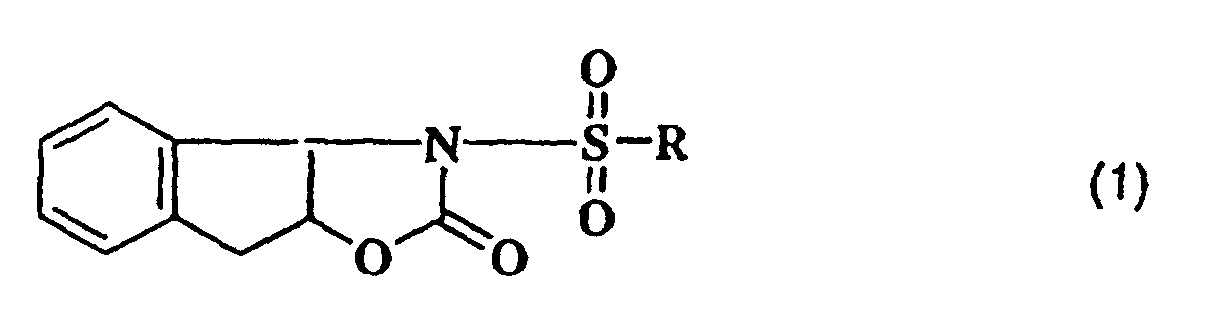
- the present invention relates to cis-oxazolidinone compound which is racemic form or optically active form, of a formula (1) wherein R represents substituted or unsubstituted C 1 -C 6 alkyl group (the substituent represents C 1 -C 6 alkyl group, C 1 -C 6 alkoxy group, C 2 -C 7 alkoxycarbonyl group, C 2 -C 7 alkylcarbonyloxy group, C 2 -C 7 alkanoyl group, phenyl group or halogen atom), substituted or unsubstituted C 2 -C 6 alkenyl group (the substituent represents C 1 -C 6 alkyl group, C 1 -C 6 alkoxy group, C 2 -C 7 alkoxycarbonyl group, C 2 -C 7 alkylcarbonyloxy group, C 2 -C 7 alkanoyl group, phenyl group or halogen atom), substituted or unsubstituted C 1 -C 6 al
- the present invention relates to a process for producing cis-oxazolidinone compound of the formula (1) comprising reacting cis-1,2-indene epoxide which is racemic form or optically active form, of a formula (3) wherein epoxy ring is at cis-configuration, with sulfonyl isocyanate compound of a formula (4) wherein R has the same meaning as defined in the formula (1), in the presence of sodium iodide.
- the present invention relates to a process for producing cis-1-amino-2-indanol which is racemic form of optically active form of the formula (5) wherein NH 2 group and OH group are at cis-configuration, by acid or alkali hydrolysis of the cis-oxazolidinone compound of the formula (1).
- the C 1 -C 6 alkyl group includes methyl group, ethyl group, n-propyl group, i-propyl group, n-butyl group, i-butyl group, sec-butyl group, tert-butyl group, n-amyl group, i-amyl group, neopentyl group, n-hexyl group and cyclohexyl group.
- the C 1 -C 6 alkoxy group includes methoxy group, ethoxy group, n-propoxy group, i-propoxy group, n-butoxy group, i-butoxy group, sec-butoxy group, tert-butoxy group, n-amyloxy group, i-amyloxy group, neopentyloxy group, n-hexyloxy group and cyclohexyloxy group.
- the C 2 -C 7 alkoxycarbonyl group includes methoxycarbonyl group, ethoxycarbonyl group, n-propoxycarbonyl group, i-propoxycarbonyl group, n-butoxycarbonyl group, i-butoxycarbonyl group, sec-butoxycarbonyl group, n-amyloxycarbonyl group, i-amyloxycarbonyl group, neopentyloxycarbonyl group, n-hexyloxycarbonyl group and cyclohexyloxycarbonyl group.
- the C 2 -C 7 alkylcarbonyloxy groups includes methylcarbonyloxy group, ethylcarbonyloxy group, n-propylcarbonyloxy group, i-propylcarbonyloxy group, n-butylcarbonyloxy group, i-butylcarbonyloxy group, sec-butylcarbonyloxy group, tert-butylcarbonyloxy group, n-amylcarbonyloxy group, i-amylcarbonyloxy group, neopentylcarbonyloxy group, n-hexylcarbonyloxy group and cyclohexylcarbonyloxy group.
- the C 2 -C 7 alkanoyl groups includes acetyl group, ethylcarbonyl group, n-propylcarbonyl group, i-propylcarbonyl group, n-butylcarbonyl group, i-butylcarbonyl group, sec-butylcarbonyl group, n-amylcarbonyl group, i-amylcarbonyl group, neopentylcarbonyl group, n-hexylcarbonyl group and cyclohexylcarbonyl group.
- the C 2 -C 6 alkenyl groups includes vinyl group, isopropenyl group, allyl group, methallyl group, 1-butenyl group, 3-hexenyl group, 1-cyclopentenyl group, 1-cyclohexenyl group, methoxyvinyl group and ethoxyvinyl group.
- the C 1 -C 6 alkylamino group includes monoalkylamino group and dialkylamino group.
- C 1 -C 6 alkylamino group examples are methylamino group, ethylamino group, n-propylamino group, i-propylamino group, n-butylamino group, i-butylamino group, sec-butylamino group, tert-butylamino group, n-amylamino group, i-amylamino group, neopentylamino group, n-hexylamino group, cyclohexylamino group, dimethylamino group and diethylamino group.
- the aryl group includes phenyl group, o-tolyl group, m-tolyl group, p-tolyl group, 3,5-dimethylphenyl group, 2,4,6-trimethylphenyl group, 2,4,6-tri-i-propylphenyl group, 4-i-propylphenyl group, 4-tert-butylphenyl group, 4-methoxyphenyl group, 3,5-dimethoxyphenyl group, 2-fluorophenyl group, 3-fluorophenyl group, 4-fluorophenyl group, 2-chlorophenyl group, 3-chlorophenyl group, 4-chlorophenyl group, 2-bromophenyl group, 3-bromophenyl group, 4-bromophenyl group, 2,4-dichlorophenyl group, 4-phenylphenyl group, 1-naphthyl group, 2-naphthyl group, 1-anthracenyl group, 2-anthracenyl
- the halogen atom includes fluorine atom, chlorine atom, bromine atom and iodine atom.
- the cis-1,2-indene epoxide of the formula (3) includes racemic form and optically active form of (+)-cis-1,2-indene epoxide and (-)-cis-1,2-indene epoxide.
- the sulfonyl isocyanate compound of the formula (4) includes methanesulfonyl isocyanate, ethanesulfonyl isocyanate, n-propanesulfonyl isocyanate, n-butanesulfonyl isocyanate, trifluoromethanesulfonyl isocyanate, benzenesulfonyl isocyanate, p-toluenesulfonyl isocyanate and chlorosuflonyl isocyanate.
- Preferred are methanesulfonyl isocyanate and p-toluenesulfonyl isocyanate.
- the amount of the sulfonyl isocyanate compound usded of the formula (4) is in the range of 0.1 to 10 times molar quantity, preferably, 0.5 to 5 times molar quantity, to the cis-1,2-indene epoxide of the formula (3).
- the reaction can be conducted in the co-existence with Lewis base so as to facilitate the reaction.
- the Lewis base includes amines such as triethylamine, tri-n-butylamine, 1,8-diazabicyclo [ 5,4,0 ] -7-undecene (DBU) and 1,5-diazabicyclo [ 4,3,0 ] -5-nonene (DBN), pyridines such as pyridine, picoline, lutidine and methyl ethyl pyridine, pyridine-N-oxides such as pyridine-N-oxide, picoline-N-oxide, lutidine-N-oxide and 4-phenylpyridine-N-oxide, phosphines such as triphenyl phosphine and tri-n-butylphosphine, phosphine oxides such as triphenylphosphineoxide and tri-n-butylphosphine oxide, phosphonium salts such as tetra-n-butylphosphonium bromide, tetraphenyl
- the amount of sodium iodide used is in the range of from 0.1 to 50 mol%, preferably, from 1 to 20 mol%, to the cis-1,2-indene epoxide of the formula (3).
- the amount of Lewis base used is in the range of from equimolar amount to 5 mole times, preferably, from equimolar to 3 mole times, to the metal halide compound.
- the reaction solvent is not particlarly limited so long as it does not participate in the reaction.
- reaction solvent examples include nitriles such as acetonitrile, propionitrile and butyronitrile, ketones such as acetone, methyl ethyl ketone and methyl isobutyl ketone, aromatic hydrocarbons such as benzene, toluene, xylene, mesitylene, chlorobenzene and o-dichlorobenzene, aliphatic hydrocarbons such as n-hexane, cyclohexane, n-octane and n-decane, esters such as methyl acetate, ethyl acetate and butyl acetate, halogenated hydrocarbons such as dichloromethane, dichloroethane, chloroform and carbon tetrachloride, ethers such as tetrahydrofuran, diethyl ether, t-butyl methyl ether and dimethoxyethane, alcohols such as methanol,
- the reaction temperature is not particularly limited, and can employ from -20 °C to a boiling point of a solvent to be used. However, the reaction is preferably conducted in the range of from 20°C to 100°C .
- the reaction time is normally from 0.1 to 1000 hours, although varying depending on the reactivity of the sulfonyl isocyanate compound of the formula (4).
- a pure cis-oxazolidinone compound of the formula (1) can be obtained by conducting purification by usual process such as recrystallization or silica gel column chromatography and so on.
- an acid or an alkali is used.
- the acid includes inorganic acids such as hydrochloric acid, sulfuric acid, phosphoric acid, nitric acid, hydrobromic acid, hydroiodic acid and hydrofluoric acid, carboxylic acids such as formic acid, acetic acid, trichloroacetic acid and trifluoroacetic acid, sulfonic acids such as p-toluenesulfonic acid, methanesulfonic acid and trifluoromethanesulfonic acid.
- inorganic acids such as hydrochloric acid, sulfuric acid, phosphoric acid, nitric acid, hydrobromic acid, hydroiodic acid and hydrofluoric acid
- carboxylic acids such as formic acid, acetic acid, trichloroacetic acid and trifluoroacetic acid
- sulfonic acids such as p-toluenesulfonic acid, methanesulfonic acid and trifluoromethanesulfonic acid.
- the alkali includes hydroxides of alkali metals or alkaline earth metals such as sodium hydroxide, potassium hydroxide, lithium hydroxide, magnesium hydroxide, calcium hydroxide and barium hydroxide, carbonates of alkali metals or alkaline earth metals such as sodium carbonate, potassium carbonate, lithium carbonate, magnesium carbonate, calcium carbonate and barium carbonate. These alkalis can be used in aqueous solution.
- the amount of acid or alkali used is normally equimolar amount or more to the cis-oxazolidinone compound of the formula (1). In order to complete the hydrolysis reaction in a short time, large excess amount up to about 20 times molar quantity may be used.
- the reaction can be conducted in an acid or alkali aqueous solution, but can be conducted in an organic solvent.
- the organic solvent is not particularly limited so long as it does not participate in the reaction.
- the organic solvent includes ketones such as acetone, methyl ethyl ketone, methyl isobutyl ketone, aromatic hydrocarbons such as benzene, toluene, xylene, mesitylene, chlorobenzene and o-dichlorobenzene, aliphatic hydrocarbons such as n-hexane, cyclohexane, n-octane and n-decane, halogenated hydrocarbons such as dichloromethane, dichloroethane, chloroform and carbon tetrachloride, ethers such as tetrahydrofuran, diethyl ether, t-butyl methyl ether, dimethoxyethane and dioxane, alcohols such as methanol, ethanol, 1-propanol, 2-propanol, 1-butanol, 2-butanol
- the hydrolysis temperature is not particularly limited, but it is normally possible from 0°C to a boiling point of a solvent to be used, preferably, from 20°C to 100°C .
- reaction times are normally from 0.1 to 1000 hours.
- extraction is conducted in the usual method by adding water and a suitable solvent, and the solvent is concentrated under reduced pressure to obtain a crude product, or a solid is precipitated from a suitable solvent to obtain a crude product.
- a pure cis-1-amino-2-indanol compound of the formula (5) can be obtained by conducting purification in usual process such as recrystallization or silica gel column chromatography and so on.
- (+)-cis-1,2-indene epoxide 34 mmole, 89.4% in purity, 90.2% ee in optical purity
- HMPA hexamethylphosphoric triamide
- the content of the intended product was 9.99 g (yield: 90%).
- Example Solvent Yield (%) 3 tetrahydrofuran 70 4 benzene 88 5 cyclohexane 54 6 ethyl acetate 48 7 chloroform 23 8 acetonitrile 18
- Reaction and post-treatment were conducted in the same manner as in the Example 1 except that various kinds of metal halide compounds (10 mol% of the above-mentioned epoxide) were used in place of di-n-butyltin iodide and various kinds of Lewis bases (20 mol% of the above-mentioned epoxide, but only tetramethyl urea 10 mol%) were used in place of hexamethylphosphoric triamide (HMPA) to obtain cis-N-p-toluenesulfonylindano[1,2-d]-oxazolidin-2-one (6).
- HMPA hexamethylphosphoric triamide
- the chloroform layer was dried by sodium sulfate and then concentrated to obtain 0.41 g of the intended product (yield: 91%). Optical purity was 100% ee.
- novel cis-oxazolidinone compound of the formula (1) can be readily produced from cis-1,2-indene epoxide of the formula (3) and sulfonyl isocyanate compound of the formula (4) and further, cis-1-amino-2-indanol of the formula (5) can be produced by hydrolyzing the cis-oxazolidinone compound.
- the cis-1-amino-2-indanol of the formula (5) is useful for an intermediate of drugs, e.g., HIV-drug.
Landscapes
- Chemical & Material Sciences (AREA)
- Organic Chemistry (AREA)
- Heterocyclic Carbon Compounds Containing A Hetero Ring Having Nitrogen And Oxygen As The Only Ring Hetero Atoms (AREA)
Abstract
Description
- The present invention relates to a process for producing a cis-1-amino-2-indanol which is useful as an intermediate for drugs and agricultural chemicals, a novel cis-oxazolidinone compound which is an intermediate of the cis-1-amino-2-indanol, and a process for producing the compound.
- Cis-1-amino-2-indanol is important as an intermediate of drugs.
- For example, J. Med. Chem., 35, 2525 (1992), J. Med. Chem. 35, 1702 (1992) and J. Med. Chem., 35, 1685,(1992) discloses that this compound is an intermediate of anti-HIV drugs.
- There are several conventional processes for producing cis-1-amino-2-indanol.
- For example, in J. Am. Chem. Soc., 73, 1639 (1951), trans-phenyloxazoline compound is formed from bromoindanol via trans-1-amino-2-indanol, and the compound is inverted to cis-form, thereby obtaining cis-1-amino-2-indanol.
- In J. Org. Chem., 32, 540 (1967), iodoisocyanate is added to indene to prepare trans-oxazolidinone compound via trans-iodocarbamate, and the compound is inverted to cis-form, whereby obtaining cis-1-amino-2-indanol.
- Japanese Patent Application Laid-open No. Hei 7-316106 discloses a synthesis of cis-oxazoline compound from 1,2-di-substituted indans or cis-1,2-indene epoxide by utilizing Ritter reaction and a process for producing cis-1-amino-2-indanol by hydrolysis of the cis-oxazoline compound.
- It is known that epoxy compound provides addition products by reacting with heterocumulene compound under the presence of metallic catalyst.
- For example, J. Org. Chem., 51, 2177 (1986), Chem. Lett., 1986, 1963 and Bull. Chem. Soc. Jpn., 63, 1069 (1990) disclose syntheses of oxazolidinone compounds by addition reaction of various kinds of epoxy compounds with isocyanate which is heterocumulene compound.
- The above-mentioned process via trans-oxazolidinone derivative has such defects that many preparation steps are required due to the necessity of inversion to cis-form, high temperature is needed, volume efficiency and yield are low, and a great quantity of wastes generate.
- Synthesis 541 (1997) relates to the synthesis of enantiomerically pure (1S, 2R)-1-aminoindan-2-ol which is useful in the synthesis of Indinavir, an HIV-protease inhibitor. This intermediate is produced by base catalysed hydrolysis of (4S, 5R)-indano[1,2-d]oxazolidin-2-one.
- J. Org. Chem., 51 , 2177 (1986) discloses a cycloaddition reaction of heterocumulenes with oxiranes which is catalysed by an organotin iodide-Lewis base complex. In particular, it is taught that an isocyanate may be reacted with an oxirane to yield a 2-oxazolidinone.
- Tetrahedron Lett., 36, 7619 (1995) relates to the synthesis of an oxazolidinone (3) from an amino indanol (1). The use of this oxazolidinone in the synthesis of Indinavir through a Diels-Alder reaction provides improved stereocontrol of the Indinavir synthesis.
- Tetrahedron, 47 , 4941 (1991) relates to the synthesis of ammo-alcohols. It is taught that hydrolysis of oxazolidin-2-ones by an alkali yields the corresponding 1-arnino-indan-2-ols (compounds 23 and 24).
- JP-356073077-A relates to the preparation of a 2-oxazolidone-3,5-disubstituted compound by reacting a substituted isocyanate with a substituted oxirane in the presence of a lithium halide compound.
- Synlett, 129 (1994) relates to the synthesis of oxazolidinones via lanthanide-catalysed cycloaddition of epoxides with isocyanates. The lanthanide trichloride catalysts were found to be especially useful in the catalysis of the above reaction, providing oxazolidinones in high yields.
- EP-0 518 153-A1 discloses the reaction of a substituted isocyanate and a substituted oxirane to yield a substituted oxazolidinone. It is taught that for the catalysis of this reaction, a halogen salt of an alkali metal, preferably lithium chloride or lithium bromide, should be used.
- Bioinorganic and medicinal chemistry letters, vol.6, No.9, pp.1009-1014 (1996) relates to the synthesis and antibacterial activity of new tropone-substituted phenyloxazolidinone antibacterial agents. It discloses that a substituted isocyanate may be reacted with an oxirane in the presence of a lithium bromide catalyst to produce a substituted oxazolidinone compound.
- J. Heterocyclic Chem., 25 , 1431 (1988) discloses the cycloaddition reaction of an isocyanate with an epoxide to form an oxazolidone compound.
- J. Am. Chem. Soc. 109 , 3792 (1987) relates to a method for bringing about cis-hydroxyamination. It describes how this can be done by forming a cis-oxazolidone through the reaction of an isocyanate with an epoxide under appropriate conditions and subsequently hydrolysing the oxazolidone compound thus produced in order to form a cis-hydroxyaminated compound.
- Chem. Rev., 72 , 457 (1972) relates to advances in isocyanate chemistry. On page 481, Section 16, it is disclosed that a 2-oxazolidone may be prepared from an isocyanate and an epoxide. It is stated that this reaction proceeds rapidly and in high yield when carried out in the presence of a soluble lithium bromide-phosphine oxide adduct.
- As a result that the present inventors made extensive investigation on processes of producing cis-1-amino-2-indanol more efficiently, they found new cis-oxazolidinone compound, a process of producing it and a process for producing amino-alcohol by hydrolysis reaction of said compound, and completed the present invention.
- Namely, the present invention relates to cis-oxazolidinone compound which is racemic form or optically active form, of a formula (1)wherein R represents substituted or unsubstituted C1-C6 alkyl group (the substituent represents C1-C6 alkyl group, C1-C6 alkoxy group, C2-C7 alkoxycarbonyl group, C2-C7 alkylcarbonyloxy group, C2-C7 alkanoyl group, phenyl group or halogen atom), substituted or unsubstituted C2-C6 alkenyl group (the substituent represents C1-C6 alkyl group, C1-C6 alkoxy group, C2-C7 alkoxycarbonyl group, C2-C7 alkylcarbonyloxy group, C2-C7 alkanoyl group, phenyl group or halogen atom), substituted or unsubstituted C1-C6 alkoxyl group (the substituent represents C1-C6 alkyl group, C1-C6 alkoxy group, C2-C7 alkoxycarbonyl group, C2-C7 alkylcarbonyloxy group, C2-C7 alkanoyl group, phenyl group or halogen atom), substituted or unsubstituted C1-C6 alkylamino group (the substituent represents C1-C6 alkyl group, C1-C6 alkoxy group, C2-C7 alkoxycarbonyl group, C2-C7 alkylcarbonyloxy group, C2-C7 alkanoyl group, phenyl group or halogen atom), substituted or unsubstituted aryl group (the substituent represents C1-C6 alkyl group, C1-C6 alkoxy group, C2-C7 alkoxycarbonyl group, C2-C7 alkylcarbonyloxy group, C2-C7 alkanoyl group, phenyl group or halogen atom) or halogen atom, and oxazolidinone ring is at cis-configuration, especially, cis-oxazolidinone compound being an optically active oxazolidionone compound of a formula (2)
 wherein * means asymmetric carbon atom and the absolute configuration of the carbon atom means R or S, and substituent R has the same meaning as defined in the formula (1).
- Moreover, the present invention relates to a process for producing cis-oxazolidinone compound of the formula (1) comprising reacting cis-1,2-indene epoxide which is racemic form or optically active form, of a formula (3)wherein epoxy ring is at cis-configuration, with sulfonyl isocyanate compound of a formula (4)
 wherein R has the same meaning as defined in the formula (1), in the presence of sodium iodide.
- Furthermore, the present invention relates to a process for producing cis-1-amino-2-indanol which is racemic form of optically active form of the formula (5)wherein NH2 group and OH group are at cis-configuration, by acid or alkali hydrolysis of the cis-oxazolidinone compound of the formula (1).

- The present invention is explained in detail below.
- The substituent R is first explained.
- The C1-C6 alkyl group includes methyl group, ethyl group, n-propyl group, i-propyl group, n-butyl group, i-butyl group, sec-butyl group, tert-butyl group, n-amyl group, i-amyl group, neopentyl group, n-hexyl group and cyclohexyl group.
- The C1-C6 alkoxy group includes methoxy group, ethoxy group, n-propoxy group, i-propoxy group, n-butoxy group, i-butoxy group, sec-butoxy group, tert-butoxy group, n-amyloxy group, i-amyloxy group, neopentyloxy group, n-hexyloxy group and cyclohexyloxy group.
- The C2-C7 alkoxycarbonyl group includes methoxycarbonyl group, ethoxycarbonyl group, n-propoxycarbonyl group, i-propoxycarbonyl group, n-butoxycarbonyl group, i-butoxycarbonyl group, sec-butoxycarbonyl group, n-amyloxycarbonyl group, i-amyloxycarbonyl group, neopentyloxycarbonyl group, n-hexyloxycarbonyl group and cyclohexyloxycarbonyl group.
- The C2-C7 alkylcarbonyloxy groups includes methylcarbonyloxy group, ethylcarbonyloxy group, n-propylcarbonyloxy group, i-propylcarbonyloxy group, n-butylcarbonyloxy group, i-butylcarbonyloxy group, sec-butylcarbonyloxy group, tert-butylcarbonyloxy group, n-amylcarbonyloxy group, i-amylcarbonyloxy group, neopentylcarbonyloxy group, n-hexylcarbonyloxy group and cyclohexylcarbonyloxy group.
- The C2-C7 alkanoyl groups includes acetyl group, ethylcarbonyl group, n-propylcarbonyl group, i-propylcarbonyl group, n-butylcarbonyl group, i-butylcarbonyl group, sec-butylcarbonyl group, n-amylcarbonyl group, i-amylcarbonyl group, neopentylcarbonyl group, n-hexylcarbonyl group and cyclohexylcarbonyl group.
- The C2-C6 alkenyl groups includes vinyl group, isopropenyl group, allyl group, methallyl group, 1-butenyl group, 3-hexenyl group, 1-cyclopentenyl group, 1-cyclohexenyl group, methoxyvinyl group and ethoxyvinyl group.
- The C1-C6 alkylamino group includes monoalkylamino group and dialkylamino group.
- Concrete examples of the C1-C6 alkylamino group are methylamino group, ethylamino group, n-propylamino group, i-propylamino group, n-butylamino group, i-butylamino group, sec-butylamino group, tert-butylamino group, n-amylamino group, i-amylamino group, neopentylamino group, n-hexylamino group, cyclohexylamino group, dimethylamino group and diethylamino group.
- The aryl group includes phenyl group, o-tolyl group, m-tolyl group, p-tolyl group, 3,5-dimethylphenyl group, 2,4,6-trimethylphenyl group, 2,4,6-tri-i-propylphenyl group, 4-i-propylphenyl group, 4-tert-butylphenyl group, 4-methoxyphenyl group, 3,5-dimethoxyphenyl group, 2-fluorophenyl group, 3-fluorophenyl group, 4-fluorophenyl group, 2-chlorophenyl group, 3-chlorophenyl group, 4-chlorophenyl group, 2-bromophenyl group, 3-bromophenyl group, 4-bromophenyl group, 2,4-dichlorophenyl group, 4-phenylphenyl group, 1-naphthyl group, 2-naphthyl group, 1-anthracenyl group, 2-anthracenyl group, 5-anthracenyl group, 2-pyridyl group, 3-pyridyl group and 4-pyridyl group.
- The halogen atom includes fluorine atom, chlorine atom, bromine atom and iodine atom.
- The following is an explanation of the addition reaction of the cis-1,2-indene epoxide of the formula (3) with sulfonyl isocyanate compound of the formula (4).
- The cis-1,2-indene epoxide of the formula (3) includes racemic form and optically active form of (+)-cis-1,2-indene epoxide and (-)-cis-1,2-indene epoxide.
- The sulfonyl isocyanate compound of the formula (4) includes methanesulfonyl isocyanate, ethanesulfonyl isocyanate, n-propanesulfonyl isocyanate, n-butanesulfonyl isocyanate, trifluoromethanesulfonyl isocyanate, benzenesulfonyl isocyanate, p-toluenesulfonyl isocyanate and chlorosuflonyl isocyanate. Preferred are methanesulfonyl isocyanate and p-toluenesulfonyl isocyanate.
- The amount of the sulfonyl isocyanate compound usded of the formula (4) is in the range of 0.1 to 10 times molar quantity, preferably, 0.5 to 5 times molar quantity, to the cis-1,2-indene epoxide of the formula (3).
- In the present invention, the reaction can be conducted in the co-existence with Lewis base so as to facilitate the reaction.
- The Lewis base includes amines such as triethylamine, tri-n-butylamine, 1,8-diazabicyclo [ 5,4,0 ] -7-undecene (DBU) and 1,5-diazabicyclo [ 4,3,0 ] -5-nonene (DBN), pyridines such as pyridine, picoline, lutidine and methyl ethyl pyridine, pyridine-N-oxides such as pyridine-N-oxide, picoline-N-oxide, lutidine-N-oxide and 4-phenylpyridine-N-oxide, phosphines such as triphenyl phosphine and tri-n-butylphosphine, phosphine oxides such as triphenylphosphineoxide and tri-n-butylphosphine oxide, phosphonium salts such as tetra-n-butylphosphonium bromide, tetraphenylphosphonium bromide, tetra n-butylphosphonium iodide and tetraphenylphosphonium iodide, sulfoxides such as dimethyl sulfoxide, diethyl sulfoxide, di-n-propyl sulfoxide and diphenyl sulfoxide, ureas such as tetramethyl urea, tetrabutyl urea and dimethylpropyl urea, hexamethylphosphoric triamide (HMPA), 2,2'-azobisisobutylnitrile (AIBN). Preferred are tri-n-butylphosphine oxide, tetrabutyl urea and hexamethylphosphoric triamide (HMPA).
- The amount of sodium iodide used is in the range of from 0.1 to 50 mol%, preferably, from 1 to 20 mol%, to the cis-1,2-indene epoxide of the formula (3).
- The amount of Lewis base used is in the range of from equimolar amount to 5 mole times, preferably, from equimolar to 3 mole times, to the metal halide compound.
- The reaction solvent is not particlarly limited so long as it does not participate in the reaction.
- Examples of the reaction solvent are nitriles such as acetonitrile, propionitrile and butyronitrile, ketones such as acetone, methyl ethyl ketone and methyl isobutyl ketone, aromatic hydrocarbons such as benzene, toluene, xylene, mesitylene, chlorobenzene and o-dichlorobenzene, aliphatic hydrocarbons such as n-hexane, cyclohexane, n-octane and n-decane, esters such as methyl acetate, ethyl acetate and butyl acetate, halogenated hydrocarbons such as dichloromethane, dichloroethane, chloroform and carbon tetrachloride, ethers such as tetrahydrofuran, diethyl ether, t-butyl methyl ether and dimethoxyethane, alcohols such as methanol, ethanol, 1-propanol, 2-propanol, 1-butanol, 2-butanol, isobutanol and cyclohexanol, amides such as N,N-dimethylformamide, N,N-dimethylacetamide and N-methyl pyrrolidone, and ureas such as 1,3-dimethyl imidazolidinone, tetramethyl urea and tetrabutyl urea. Preferred are toluene, cyclohexane, ethyl acetate and tetrabutyl urea.
- These solvents can be used singly or in combination.
- The reaction temperature is not particularly limited, and can employ from -20 °C to a boiling point of a solvent to be used. However, the reaction is preferably conducted in the range of from 20°C to 100°C .
- The reaction time is normally from 0.1 to 1000 hours, although varying depending on the reactivity of the sulfonyl isocyanate compound of the formula (4).
- After completion of the reaction, water is added and extraction is conducted by a suitable solvent, and the solvent is concentrated under reduced pressure to obtain a crude product, or a solid is precipitated from a suitable solvent to obtain a crude product.
- Further, a pure cis-oxazolidinone compound of the formula (1) can be obtained by conducting purification by usual process such as recrystallization or silica gel column chromatography and so on.
- Hydrolysis reaction of the cis-oxazolidinone compound of the formula (1) is then explained.
- In the hydrolysis reaction, an acid or an alkali is used.
- The acid includes inorganic acids such as hydrochloric acid, sulfuric acid, phosphoric acid, nitric acid, hydrobromic acid, hydroiodic acid and hydrofluoric acid, carboxylic acids such as formic acid, acetic acid, trichloroacetic acid and trifluoroacetic acid, sulfonic acids such as p-toluenesulfonic acid, methanesulfonic acid and trifluoromethanesulfonic acid.
- The alkali includes hydroxides of alkali metals or alkaline earth metals such as sodium hydroxide, potassium hydroxide, lithium hydroxide, magnesium hydroxide, calcium hydroxide and barium hydroxide, carbonates of alkali metals or alkaline earth metals such as sodium carbonate, potassium carbonate, lithium carbonate, magnesium carbonate, calcium carbonate and barium carbonate. These alkalis can be used in aqueous solution.
- The amount of acid or alkali used is normally equimolar amount or more to the cis-oxazolidinone compound of the formula (1). In order to complete the hydrolysis reaction in a short time, large excess amount up to about 20 times molar quantity may be used.
- The reaction can be conducted in an acid or alkali aqueous solution, but can be conducted in an organic solvent.
- The organic solvent is not particularly limited so long as it does not participate in the reaction. The organic solvent includes ketones such as acetone, methyl ethyl ketone, methyl isobutyl ketone, aromatic hydrocarbons such as benzene, toluene, xylene, mesitylene, chlorobenzene and o-dichlorobenzene, aliphatic hydrocarbons such as n-hexane, cyclohexane, n-octane and n-decane, halogenated hydrocarbons such as dichloromethane, dichloroethane, chloroform and carbon tetrachloride, ethers such as tetrahydrofuran, diethyl ether, t-butyl methyl ether, dimethoxyethane and dioxane, alcohols such as methanol, ethanol, 1-propanol, 2-propanol, 1-butanol, 2-butanol, isobutanol and cyclohexanol. Preferred are acetone, ethanol and dioxane.
- These solvents can be used singly or in combination.
- The hydrolysis temperature is not particularly limited, but it is normally possible from 0°C to a boiling point of a solvent to be used, preferably, from 20°C to 100°C .
- The reaction times are normally from 0.1 to 1000 hours.
- After completion of the hydrolysis, extraction is conducted in the usual method by adding water and a suitable solvent, and the solvent is concentrated under reduced pressure to obtain a crude product, or a solid is precipitated from a suitable solvent to obtain a crude product.
- Further, a pure cis-1-amino-2-indanol compound of the formula (5) can be obtained by conducting purification in usual process such as recrystallization or silica gel column chromatography and so on.
- The present invention will be hereinbelow explained in more detail by referring to examples.
-

- To 50 ml of toluene were added 5.00 g of (+)-cis-1,2-indene epoxide (34 mmole, 89.4% in purity, 90.2% ee in optical purity), 1.65 g (10 mol% to the above-mentioned epoxide) of di-n-butyltin iodide (n-Bu2SnI2) and 0.606 g (10 mol% to the above-mentioned epoxide) of hexamethylphosphoric triamide (HMPA) under an argon atmosphere. The resulting mixture was heated to 50 to 60°C, and 25 ml of toluene solution of 6.67 g (34 mmole) of p-toluenesulphonyl isocyanate were dropwise added to the mixture over one hour.
- After the mixture was stirred at 60°C for three hours, the mixture was further stirred under reflux for one hour.
- After the reaction liquid was concentrated under reduced pressure and acetonitrile was added thereto to be completely dissolved therein, the intended product in the solution was determined with a liquid chromatography (column: Inertsil ODS-2 4.6 x 250 mm, column temperature: 40°C, eluent: acetonitrile/water = 50/50, flow rate: 1.0 ml/min., detection: UV254nm). The content of the intended product was 9.99 g (yield: 90%).
- The solution was concentrated and then recrystallized from acetonitrile to obtain 6.0 g of purified product.
- The optical purity of the purified product was 98.4% ee. (HPLC, column: Chiralcel OJ-R 4.6 x 250 mm, column temperature: 35°C, eluent: acetonitrile/water = 50/50, flow rate: 0.5 ml/min., detection: UV254nm).
Melting point: 183.0-185.0 °C
1H NMR(CDCl3 400MHz): 7.96-7.93(3H,m), 7.40-7.26(5H,m), 5.88(1H,d,J=7.3Hz), 5.31(1H,ddd,J=7.3, 5.8, 1.3Hz), 3.39(1H, dd, J=5.8, 17.9Hz), 3.31(1H,dd,J=1.3, 17.9Hz), 2.42(3H,s)
IR(KBr): 2991, 1781, 1595, 1351, 1171, 1140, 1023, 815, 758, 666 cm-1
MS m/z(rel. Int.) 329(M+, 5), 174(25), 146(100) -

- Reaction and post-treatment were conducted in the same manner as in the Example 1 except that 4.12 g (34 mmole) of methanesulfonyl isocyanate was used in place of p-toluenesulfonyl isocyanate to obtain 6.00 g of the intended product (yield: 70%).
Melting point: 168.2-168.9 °C
1H NMR(CDCl3 400MHz): 7.78(1H,d,J=8.0Hz), 7.45-7.25(3H,m), 5.88(1H,d,J=7.2Hz), 5.45-5.40(1H,m), 3.41(2H,d,J=3.2Hz), 3.32(3H,s)
IR(KBr):1777, 1358, 1162, 1037, 983, 762, 564, 520 cm-1
MS m/z(rel. Int.) 253(M+, 15), 174(30), 146(15), 130(100), 104(70) - Reaction and post-treatment were conducted in the same manner as in the Example 1 except that reaction solvents were varied to obtain cis-N-p-toluenesulfonylindano[1,2-d]-oxazolidin-2-one (6). The results are shown in the following table.
Example Solvent Yield (%) 3 tetrahydrofuran 70 4 benzene 88 5 cyclohexane 54 6 ethyl acetate 48 7 chloroform 23 8 acetonitrile 18 - Reaction and post-treatment were conducted in the same manner as in the Example 1 except that various kinds of metal halide compounds (10 mol% of the above-mentioned epoxide) were used in place of di-n-butyltin iodide and various kinds of Lewis bases (20 mol% of the above-mentioned epoxide, but only tetramethyl urea 10 mol%) were used in place of hexamethylphosphoric triamide (HMPA) to obtain cis-N-p-toluenesulfonylindano[1,2-d]-oxazolidin-2-one (6). The results are shown in the following table.
Example Metal halide Lewis base Yield (g) Yield (%) 9 SnI2 triphenylphosphine 4.5 40 10 n-Bu2SnI2 triethylamine 2.9 26 11 LiBr HMPA 8.7 78 12 LiBr tri-n-butyl-phosphine oxide 8.4 75 13 LiI HMPA 7.9 71 14 ZnI2 HMPA 7.1 63 15 NaI HMPA 10.1 90 16 KI HMPA 7.1 64 17 NaI tetramethyl urea 2.2 20 18 NaI 4-phenylpyridine-N-oxide 5.3 47 19 NaI tri-n-butyl-phosphine oxide 9.2 82 - To 30 ml of tetrabutyl urea suspension containing 324 mg (10 mol% to the below-mentioned epoxide) of sodium iodide were added 3.00 g of (+)-cis-1,2-indene epoxide (22 mmol, 96% in purity, 90% ee in optical purity) under an argon atmosphere at 25°C. After the mixture was stirred at 25°C for thirty minutes, it was heated to 45 °C .
- To the mixed liquid were dropwise added 15 ml of tetrabutyl urea solution containing 4.56 g (23 mmole) of p-toluenesulfonyl isocyanate at 45 to 50°C over one hour. Thereafter, the resulting mixture was further stirred at this temperature for three hours.
- The reaction mixed liquid was added with hexamethylphosphoric triamide and acetonitrile and completely dissolved therein. Thereafter, the intended product in the solution was determined with a liquid chromatography (column: Inertsil ODS-2 4.6 x 250mm, column temperature: 40°C , eluent: acetonitrile/water= 60/40 (0.2% acetic acid), flow rate: 1.0 ml/min., detection: UV254nm). As a result, the content of the intended product was 7.10 g (yield: 99%).
- To 125 ml of tetrabutyl urea suspension containing 2.89 g (10 mol% to the below-mentioned epoxide) of sodium iodide were added 25.0 g of (+)-cis-1,2-indene epoxide (0.153 mole, 81% in purity, 93% ee in optical purity) at 25°C under an argon atmosphere. After the mixture was stirred at 25°C for thirty minutes, it was heated to 45°C .
- To the mixed liquid were added 31.7 g (0.161 mole) of p-toluenesulfonyl isocyanate at 45 to 50°C over one hour. Thereafter, the mixture was further stirred at this temperature for three hours.
- After the reaction mixed liquid was cooled to 4°C , precipitates were filtered off, and crystals were washed with methanol.
- The crystals obtained were dried to obtain 46.2 g of the intended product (purity: 98%, yield: 90%).
- The optical purity of the crystals obtained was 98% ee. (HPLC, column: Chiralcel OJ-R 4.6 x 250 mm, column temperature: 35 °C , eluent: acetonitrile/methanol/water = 3/2/5, flow rate: 0.9 ml/min., detection: UV254nm).
-

- 1 ml of 97% sulfuric acid was added to 1.00 g (3.0 mmole, 99% in purity, 100% ee in optical purity) of cis-N-p-toluenesulfonylindano[1,2-d]oxazolidine-2-one (6) and stirred at 60°C for one hour.
- Then, an aqueous sodium hydroxide solution was added to the mixture and pH was adjusted to 10 to 11. After the mixture was stirred at 80°C for thirty minutes, extraction was conducted by adding chloroform.
- The chloroform layer was dried by sodium sulfate and then concentrated to obtain 0.41 g of the intended product (yield: 91%). Optical purity was 100% ee.
- Reaction and post-treatment were conducted in the same manner as in the Example 17 except that 3 ml of an aqueous solution of 40% sodium hydroxide were used in place of sulfonic acid and stirring was conducted under reflux for three days to obtain 0.16 g of (-)-cis-1-amino-2-indanol (8) (yield: 35%). Optical purity was 100% ee.
- 28 g of 85% sulfonic acid were added to 9.9 g (29 mmole, 96.7% in purity, 100% ee in optical purity) of cis-N-p-toluenesulfonylindano[1,2-d]oxazolidin-2-one (6) under an argon atmosphere and stirred at 72°C for three hours.
- After the mixture was cooled to 20°C , 51 g of water was added to the mixture and precipitated crystals were filtered.
- The crystals obtained were washed with water and then, the crystals were dried under reduced pressure to obtain 5.16 g (92% in purity, yield: 94%) of oxazolidinone intermediate (cis[1,2-d]oxazolidin-2-one).
- 3.26 g (17.1 mmole) of the oxazolidinone intermediate were added to an aqueous solution of 1.44 g of sodium hydroxide dissoved in 15.0 g of water under an argon atmosphere, and the mixture was stirred at 85°C for six hours.
- After completion of the reaction, the mixture was added with chloroform and extracted, and the chloroform layer was concentrated to obtain 2.54 g of the intended product (yield: 99%).
- Optical purity was 100% ee.
- According to the present invention, novel cis-oxazolidinone compound of the formula (1) can be readily produced from cis-1,2-indene epoxide of the formula (3) and sulfonyl isocyanate compound of the formula (4) and further, cis-1-amino-2-indanol of the formula (5) can be produced by hydrolyzing the cis-oxazolidinone compound. The cis-1-amino-2-indanol of the formula (5) is useful for an intermediate of drugs, e.g., HIV-drug.
Claims (10)
- Cis-oxazolidinone compound which is racemic form or optically active form, of a formula (1)wherein R represents substituted or unsubstituted C1-C6 alkyl group (the substituent represents C1-C6 alkyl group, C1-C6 alkoxy group, C2-C7 alkoxycarbonyl group, C2-C7 alkylcarbonyloxy group, C2-C7 alkanoyl group, phenyl group or halogen atom), substituted or unsubstituted C2-C6 alkenyl group (the substituent represents C1-C6 alkyl group, C1-C6 alkoxy group, C2-C7 alkoxycarbonyl group, C2-C7 alkylcarbonyloxy group, C2-C7 alkanoyl group, phenyl group or halogen atom), substituted or unsubstituted C1-C6 alkoxyl group (the substituent represents C1-C6 alkyl group, C1-C6 alkoxy group, C2-C7 alkoxycarbonyl group, C2-C7 alkylcarbonyloxy group, C2-C7 alkanoyl group, phenyl group or halogen atom), substituted or unsubstituted C1-C6 alkylamino group (the substituent represents C1-C6 alkyl group, C1-C6 alkoxy group, C2-C7 alkoxycarbonyl group, C2-C7 alkylcarbonyloxy group, C2-C7 alkanoyl group, phenyl group or halogen atom), substituted or unsubstituted aryl group (the substituent represents C1-C6 alkyl group, C1-C6 alkoxy group, C2-C7 alkoxycarbonyl group, C2-C7 alkylcarbonyloxy group, C2-C7 alkanoyl group, phenyl group or halogen atom) or halogen atom, and oxazolidinone ring is at cis-configuration.

- A compound as claimed in claim 1, wherein the cis-oxazolidinone compound is an optically active oxazolidionone compound of a formula (2)wherein * means asymmetric carbon atom and the absolute configuration of the carbon atom means R or S, and substituent R has the same meaning as defined in the formula (1).

- An optically active oxazolidionone compound as claimed in claim 2, wherein R represents p-tollyl group.
- A process for producing cis-oxazolidinone compound of the formula (1)wherein R represents substituted or unsubstituted C1-C6 alkyl group (the substituent represents C1-C6 alkyl group, C1-C6 alkoxy group, C2-C7 alkoxycarbonyl group, C2-C7 alkylcarbonyloxy group, C2-C7 alkanoyl group, phenyl group or halogen atom), substituted or unsubstituted C2-C6 alkenyl group (the substituent represents C1-C6 alkyl group, C1-C6 alkoxy group, C2-C7 alkoxycarbonyl group, C2-C7 alkylcarbonyloxy group, C2-C7 alkanoyl group, phenyl group or halogen atom), substituted or unsubstituted C1-C6 alkoxyl group (the substituent represents C1-C6 alkyl group, C1-C6 alkoxy group, C2-C7 alkoxycarbonyl group, C2-C7 alkylcarbonyloxy group, C2-C7 alkanoyl group, phenyl group or halogen atom), substituted or unsubstituted C1-C6 alkylamino group (the substituent represents C1-C6 alkyl group, C1-C6 alkoxy group, C2-C7 alkoxycarbonyl group, C2-C7 alkylcarbonyloxy group, C2-C7 alkanoyl group, phenyl group or halogen atom), substituted or unsubstituted aryl group (the substituent represents C1-C6 alkyl group, C1-C6 alkoxy group, C2-C7 alkoxycarbonyl group, C2-C7 alkylcarbonyloxy group, C2-C7 alkanoyl group, phenyl group or halogen atom) or halogen atom, and oxazolidinone ring is at cis-configuration, comprising reacting cis-1,2-indene epoxide which is racemic form or optically active form, of a formula (3)
 wherein epoxy ring is at cis-configuration, with sulfonyl isocyanate compound of a formula (4)
 wherein R has the same meaning as defined in the formula (1), in the presence of sodium iodide.
- A process for producing cis-1-amino-2-indanol which is racemic form or optically active form of the formula (5)wherein NH2 group and OH group are at cis-configuration, by acid or alkali hydrolysis of the cis-oxazolidinone compound of the formula (1)
 wherein R represents substituted or unsubstituted C1-C6 alkyl group (the substitutent represents C1-C6 alkyl group, C1-C6 alkoxy group, C2-C7 alkoxycarbonyl group, C2-C7 alkylcarbonyloxy group, C2-C7 alkanoyl group, phenyl group or halogen atom), substituted or unsubstituted C2-C6 alkenyl group (the substituent represents C1-C6 alkyl group, C1-C6 alkoxy group, C2-C7 alkoxycarbonyl group, C2-C7 alkylcarbonyloxy group, C2-C7 alkanoyl group, phenyl group or halogen atom), substituted or unsubstituted C1-C6 alkoxyl group (the substituent represents C1-C6 alkyl group, C1-C6 alkoxy group, C2-C7 alkoxycarbonyl group, C2-C7 alkylcarbonyloxy group, C2-C7 alkanoyl group, phenyl group or halogen atom), substituted or unsubstituted C1-C6 alkylamino group (the substituent represents C1-C6 alkyl group, C1-C6 alkoxy group, C2-C7 alkoxycarbonyl group, C2-C7 alkylcarbonyloxy group, C2-C7 alkanoyl group, phenyl group or halogen atom), substituted or unsubstituted aryl group (the substituent represents C1-C6 alkyl group, C1-C6 alkoxy group, C2-C7 alkoxycarbonyl group, C2-C7 alkylcarbonyloxy group, C2-C7 alkanoyl group, phenyl group or halogen atom) or halogen atom, and oxazolidinone ring is at cis-configuration.
- A process for producing cis-oxazolidinone compound as claimed in claim 4, wherein cis-1,2-indene epoxide is an optically active (+)-cis-1,2-indene epoxide.
- A process for producing cis-oxazolidinone compound as claimed in claim 4, wherein cis-1,2-indene epoxide is an optically active (-)-cis-1,2-indene epoxide.
- A process for producing cis-oxazolidinone compound as claimed in claim 4, wherein R represents p-tollyl group.
- A process for producing cis-oxazolidinone compound as claimed in claim 5, wherein the compound of the formula (1) is optically active.
- A process for producing cis-1-amino-2-indanol, which is in a racemic form or optically active form, of the formula (5)wherein NH2 group and OH group are at cis-configuration, said process comprising:
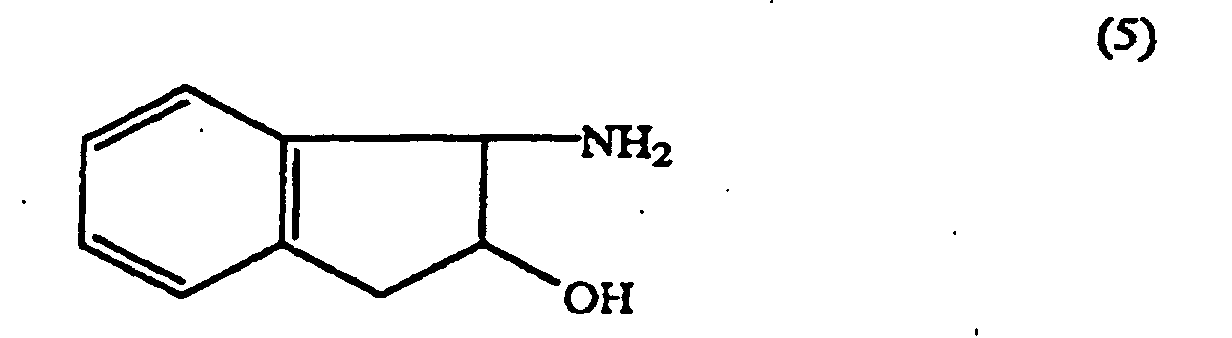 hydrolyzing said oxazolidinone compound.obtaining a cis-oxazolidinone compound of the formula (1)wherein R is selected from the group consisting of substituted or unsubstituted C1-C6 alkyl group (the substituent is selected from the group consisting of C1-C6 alkyl group, C1-C6 alkoxy group, C2-C7 alkoxycarbonyl group, C2-C7 alkylcarbonyloxy group, C2-C7 alkanoyl group, phenyl group and halogen atom), substituted or unsubstituted C2-C6 alkenyl group (the substituent is selected from the group consisting of C1-C6 alkyl group, C1-C6 alkoxy group, C2-C7 alkoxycarbonyl group, C2-C7 alkylcarbonyloxy group, C2-C7 alkanoyl group, phenyl group, and halogen atom), substituted or unsubstituted C1-C6 alkoxy group (the substituent is selected from the group consisting of C1-C6 alkyl group, C1-C6 alkoxy group, C2-C7 alkoxycarbonyl group, C2-C7 alkylcarbonyloxy group, C2-C7 alkanoyl group, phenyl group and halogen atom), substituted or unsubstituted C1-C6 alkylamino group (the substituent is selected from the group consisting of C1-C6 alkyl group, C1-C6 alkoxy group, C2-C7 alkoxycarbonyl group, C2-C7 alkylcarbonyloxy group, C2-C7 alkanoyl group, phenyl group and halogen atom), substituted or unsubstituted aryl group (the substituent is selected from the group consisting of C1-C6 alkyl group, C1-C6 alkoxy group, C2-C7 alkoxycarbonyl group, C2-C7 alkylcarbonyloxy group, C2-C7 alkanoyl group, phenyl group and halogen atom) and halogen atom, and wherein the oxazolidinone ring is at cis-configuration,
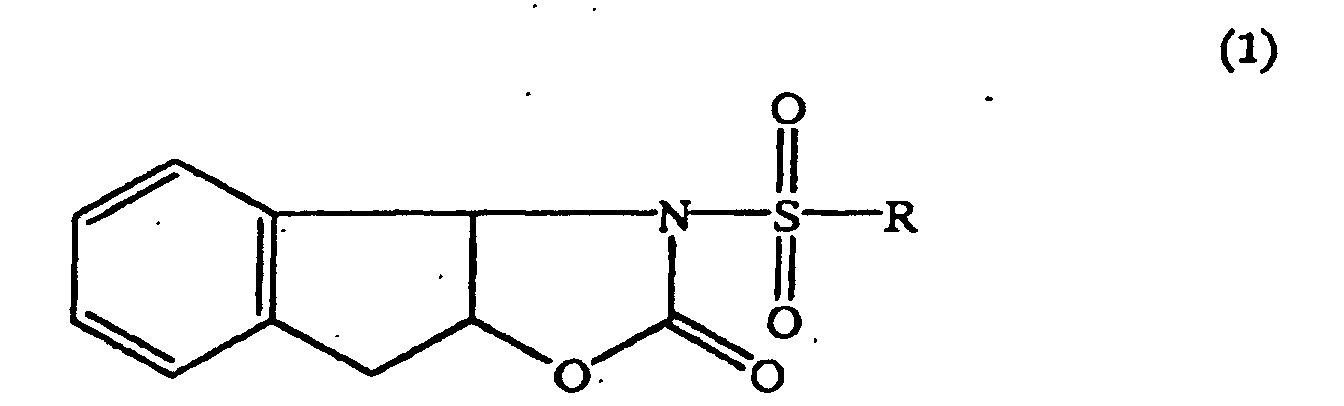 by reacting cis-1,2-indene epoxide, which is in racemic form or optically active form, of a formula (3)wherein the epoxy ring is at a cis-configuration, with a sulfonyl isocyanate compound of a formula (4)
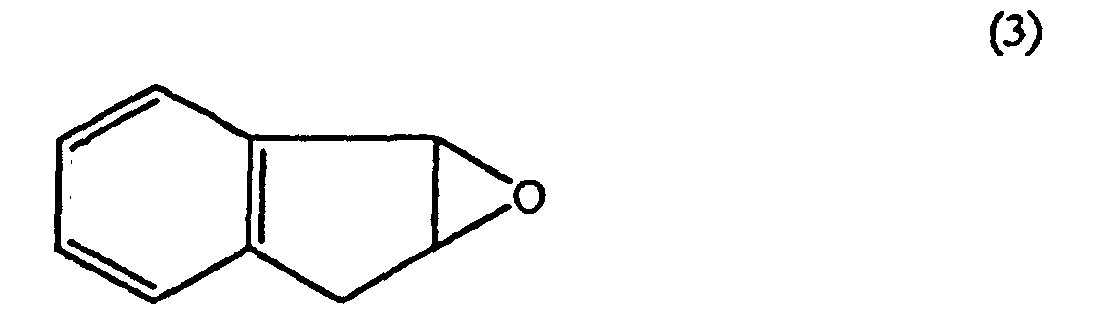 wherein R has the same meaning as defined in the formula (1), in the presence of metal halide catalyst selected from the group consisting of alkali metal halide compound, tin halide compound and zinc halide compound, and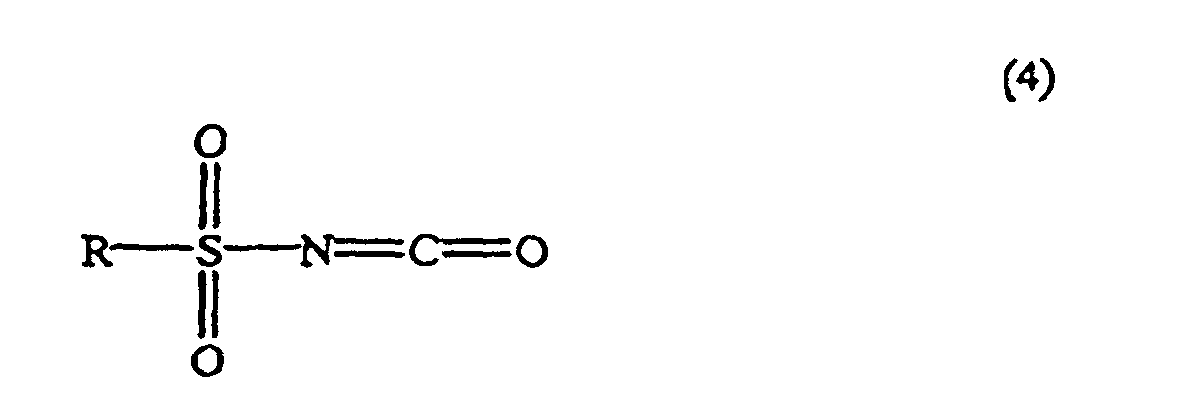
Applications Claiming Priority (3)
| Application Number | Priority Date | Filing Date | Title |
|---|---|---|---|
| JP17777496 | 1996-07-08 | ||
| JP17777496 | 1996-07-08 | ||
| PCT/JP1997/002342 WO1998001432A1 (en) | 1996-07-08 | 1997-07-07 | Oxazolidinone compounds and process for the preparation thereof |
Publications (3)
| Publication Number | Publication Date |
|---|---|
| EP0934936A1 EP0934936A1 (en) | 1999-08-11 |
| EP0934936A4 EP0934936A4 (en) | 2001-02-28 |
| EP0934936B1 true EP0934936B1 (en) | 2004-05-19 |
Family
ID=16036888
Family Applications (1)
| Application Number | Title | Priority Date | Filing Date |
|---|---|---|---|
| EP97929541A Expired - Lifetime EP0934936B1 (en) | 1996-07-08 | 1997-07-07 | Oxazolidinone compounds and process for the preparation thereof |
Country Status (7)
| Country | Link |
|---|---|
| US (1) | US6140506A (en) |
| EP (1) | EP0934936B1 (en) |
| JP (1) | JP4061659B2 (en) |
| AT (1) | ATE267182T1 (en) |
| DE (1) | DE69729206T2 (en) |
| HU (1) | HU224963B1 (en) |
| WO (1) | WO1998001432A1 (en) |
Families Citing this family (1)
| Publication number | Priority date | Publication date | Assignee | Title |
|---|---|---|---|---|
| EP1403257A4 (en) * | 2001-05-23 | 2004-10-13 | Kaneka Corp | Processes for producing oxazolidinone derivative of beta-hydroxyethylamine compound and for producing beta-hydroxyethylamine compound |
Family Cites Families (3)
| Publication number | Priority date | Publication date | Assignee | Title |
|---|---|---|---|---|
| JPS6040427B2 (en) * | 1979-11-16 | 1985-09-11 | 製鉄化学工業株式会社 | Method for producing 2-oxazolidone-3,5-disubstituted product |
| DE4119611A1 (en) * | 1991-06-14 | 1992-12-17 | Bayer Ag | AGENTS FOR CONTROLLING PESTS BASED ON SUBSTITUTED OXAZOLIDINONE, NEW SUBSTITUTED OXAZOLIDINONE, THEIR PRODUCTION AND USE |
| JP3731913B2 (en) * | 1993-12-01 | 2006-01-05 | 株式会社ケミクレア | Process for producing cis-1-aminoindan-2-ol |
-
1997
- 1997-07-07 HU HU9903272A patent/HU224963B1/en not_active IP Right Cessation
- 1997-07-07 WO PCT/JP1997/002342 patent/WO1998001432A1/en not_active Ceased
- 1997-07-07 AT AT97929541T patent/ATE267182T1/en not_active IP Right Cessation
- 1997-07-07 JP JP50505598A patent/JP4061659B2/en not_active Expired - Fee Related
- 1997-07-07 EP EP97929541A patent/EP0934936B1/en not_active Expired - Lifetime
- 1997-07-07 DE DE69729206T patent/DE69729206T2/en not_active Expired - Fee Related
-
1998
- 1998-12-30 US US09/222,918 patent/US6140506A/en not_active Expired - Fee Related
Also Published As
| Publication number | Publication date |
|---|---|
| EP0934936A4 (en) | 2001-02-28 |
| US6140506A (en) | 2000-10-31 |
| HUP9903272A3 (en) | 2000-12-28 |
| JP4061659B2 (en) | 2008-03-19 |
| ATE267182T1 (en) | 2004-06-15 |
| EP0934936A1 (en) | 1999-08-11 |
| WO1998001432A1 (en) | 1998-01-15 |
| HUP9903272A2 (en) | 2000-07-28 |
| DE69729206T2 (en) | 2005-05-04 |
| DE69729206D1 (en) | 2004-06-24 |
| HU224963B1 (en) | 2006-04-28 |
Similar Documents
| Publication | Publication Date | Title |
|---|---|---|
| US5352832A (en) | Asymmetric process for preparing florfenicol, thiamphenicol chloramphenicol and oxazoline intermediates | |
| JP2009185047A (en) | Method for producing glycidylphthalimide | |
| KR19980018089A (en) | Stereoselective Preparation of Transazetidinone | |
| EP4230634A1 (en) | Preparation method for glufosinate-ammonium | |
| US6140506A (en) | Oxazolidinone compounds and process for the preparation thereof | |
| FR2504927A1 (en) | THIAZOLINOAZETIDINONE DERIVATIVES, PROCESSES FOR THEIR PREPARATION AND THEIR USE IN THE PREPARATION OF CEPHALOSPORINS | |
| CN1105996A (en) | Preparation of imidazopyridine derivative | |
| WO2002012230A1 (en) | Intermediate of carbapenem antibiotics and process for the preparation thereof | |
| EP0273316B1 (en) | Stereoconvergent process for preparing optically active carboxylic acids | |
| US6372915B1 (en) | Process for producing oxazole compound | |
| JPWO1998001432A1 (en) | Oxazolidinone compounds and methods for producing the same | |
| KR19990008411A (en) | Improvement method of 4-hydroxy-2-pyrrolidone | |
| JP2022535112A (en) | 4-phenyl-5-alkoxycarbonyl-2-thiazol-2-yl-1,4-dihydropyrimidin-6-yl]methyl]-3-oxo-5,6,8,8a-tetrahydro-1H-imidazo [1 ,5-a]pyrazin-2-yl]-carboxylic acids | |
| JP2771257B2 (en) | Preparation of imidazole derivatives | |
| JPS60237061A (en) | Preparation of azetidinone derivative | |
| US20040019218A1 (en) | Process for preparing heteroaryl and unsaturated heterocycloalkylmagnesium reagents and uses thereof | |
| Tiecco et al. | 1, 4, 2-Dioxazines or N-acyl isoxazolidines from organoselenium-induced cyclisation of O-allyl hydroxamic acids | |
| JPH0597823A (en) | Preparation of trans-(5r)-2,4,5-trisubsti- tuted-2-oxazoline | |
| KR100230900B1 (en) | Pyrrolidine derivatives and preparation methods thereof | |
| KR0182192B1 (en) | Selective preparation of optically active (3R, 4S) -3-alkoxy-4-phenyl-2-azetidinone | |
| JP4032190B2 (en) | Method for producing optically active compound | |
| KR100329808B1 (en) | An efficient method for preparing 2-phenacylidene-3,5-dialkylsubstituted-1,3-thiazolidine-4-ones | |
| HK1037366A (en) | Process for producing oxazole compound | |
| JPH01313471A (en) | Production of n-sulfamoylamidine compound | |
| JP2002371054A (en) | New method for introducing sulfonyloxy group |
Legal Events
| Date | Code | Title | Description |
|---|---|---|---|
| PUAI | Public reference made under article 153(3) epc to a published international application that has entered the european phase |
Free format text: ORIGINAL CODE: 0009012 |
|
| 17P | Request for examination filed |
Effective date: 19990118 |
|
| AK | Designated contracting states |
Kind code of ref document: A1 Designated state(s): AT BE CH DE DK ES FI FR GB GR IE IT LI LU MC NL PT SE |
|
| A4 | Supplementary search report drawn up and despatched |
Effective date: 20010116 |
|
| AK | Designated contracting states |
Kind code of ref document: A4 Designated state(s): AT BE CH DE DK ES FI FR GB GR IE IT LI LU MC NL PT SE |
|
| 17Q | First examination report despatched |
Effective date: 20030211 |
|
| GRAP | Despatch of communication of intention to grant a patent |
Free format text: ORIGINAL CODE: EPIDOSNIGR1 |
|
| GRAS | Grant fee paid |
Free format text: ORIGINAL CODE: EPIDOSNIGR3 |
|
| GRAA | (expected) grant |
Free format text: ORIGINAL CODE: 0009210 |
|
| AK | Designated contracting states |
Kind code of ref document: B1 Designated state(s): AT BE CH DE DK ES FI FR GB GR IE IT LI LU MC NL PT SE |
|
| PG25 | Lapsed in a contracting state [announced via postgrant information from national office to epo] |
Ref country code: NL Free format text: LAPSE BECAUSE OF FAILURE TO SUBMIT A TRANSLATION OF THE DESCRIPTION OR TO PAY THE FEE WITHIN THE PRESCRIBED TIME-LIMIT Effective date: 20040519 Ref country code: LI Free format text: LAPSE BECAUSE OF FAILURE TO SUBMIT A TRANSLATION OF THE DESCRIPTION OR TO PAY THE FEE WITHIN THE PRESCRIBED TIME-LIMIT Effective date: 20040519 Ref country code: IT Free format text: LAPSE BECAUSE OF FAILURE TO SUBMIT A TRANSLATION OF THE DESCRIPTION OR TO PAY THE FEE WITHIN THE PRESCRIBED TIME-LIMIT;WARNING: LAPSES OF ITALIAN PATENTS WITH EFFECTIVE DATE BEFORE 2007 MAY HAVE OCCURRED AT ANY TIME BEFORE 2007. THE CORRECT EFFECTIVE DATE MAY BE DIFFERENT FROM THE ONE RECORDED. Effective date: 20040519 Ref country code: FI Free format text: LAPSE BECAUSE OF FAILURE TO SUBMIT A TRANSLATION OF THE DESCRIPTION OR TO PAY THE FEE WITHIN THE PRESCRIBED TIME-LIMIT Effective date: 20040519 Ref country code: CH Free format text: LAPSE BECAUSE OF FAILURE TO SUBMIT A TRANSLATION OF THE DESCRIPTION OR TO PAY THE FEE WITHIN THE PRESCRIBED TIME-LIMIT Effective date: 20040519 Ref country code: BE Free format text: LAPSE BECAUSE OF FAILURE TO SUBMIT A TRANSLATION OF THE DESCRIPTION OR TO PAY THE FEE WITHIN THE PRESCRIBED TIME-LIMIT Effective date: 20040519 Ref country code: AT Free format text: LAPSE BECAUSE OF FAILURE TO SUBMIT A TRANSLATION OF THE DESCRIPTION OR TO PAY THE FEE WITHIN THE PRESCRIBED TIME-LIMIT Effective date: 20040519 |
|
| REG | Reference to a national code |
Ref country code: GB Ref legal event code: FG4D |
|
| REG | Reference to a national code |
Ref country code: CH Ref legal event code: EP |
|
| REG | Reference to a national code |
Ref country code: IE Ref legal event code: FG4D |
|
| REF | Corresponds to: |
Ref document number: 69729206 Country of ref document: DE Date of ref document: 20040624 Kind code of ref document: P |
|
| PG25 | Lapsed in a contracting state [announced via postgrant information from national office to epo] |
Ref country code: LU Free format text: LAPSE BECAUSE OF NON-PAYMENT OF DUE FEES Effective date: 20040707 Ref country code: IE Free format text: LAPSE BECAUSE OF NON-PAYMENT OF DUE FEES Effective date: 20040707 |
|
| PG25 | Lapsed in a contracting state [announced via postgrant information from national office to epo] |
Ref country code: MC Free format text: LAPSE BECAUSE OF NON-PAYMENT OF DUE FEES Effective date: 20040731 |
|
| PG25 | Lapsed in a contracting state [announced via postgrant information from national office to epo] |
Ref country code: SE Free format text: LAPSE BECAUSE OF FAILURE TO SUBMIT A TRANSLATION OF THE DESCRIPTION OR TO PAY THE FEE WITHIN THE PRESCRIBED TIME-LIMIT Effective date: 20040819 Ref country code: GR Free format text: LAPSE BECAUSE OF FAILURE TO SUBMIT A TRANSLATION OF THE DESCRIPTION OR TO PAY THE FEE WITHIN THE PRESCRIBED TIME-LIMIT Effective date: 20040819 Ref country code: DK Free format text: LAPSE BECAUSE OF FAILURE TO SUBMIT A TRANSLATION OF THE DESCRIPTION OR TO PAY THE FEE WITHIN THE PRESCRIBED TIME-LIMIT Effective date: 20040819 |
|
| PG25 | Lapsed in a contracting state [announced via postgrant information from national office to epo] |
Ref country code: ES Free format text: LAPSE BECAUSE OF FAILURE TO SUBMIT A TRANSLATION OF THE DESCRIPTION OR TO PAY THE FEE WITHIN THE PRESCRIBED TIME-LIMIT Effective date: 20040830 |
|
| NLV1 | Nl: lapsed or annulled due to failure to fulfill the requirements of art. 29p and 29m of the patents act | ||
| REG | Reference to a national code |
Ref country code: CH Ref legal event code: PL |
|
| ET | Fr: translation filed | ||
| PLBE | No opposition filed within time limit |
Free format text: ORIGINAL CODE: 0009261 |
|
| STAA | Information on the status of an ep patent application or granted ep patent |
Free format text: STATUS: NO OPPOSITION FILED WITHIN TIME LIMIT |
|
| REG | Reference to a national code |
Ref country code: IE Ref legal event code: MM4A |
|
| 26N | No opposition filed |
Effective date: 20050222 |
|
| PGFP | Annual fee paid to national office [announced via postgrant information from national office to epo] |
Ref country code: DE Payment date: 20050630 Year of fee payment: 9 |
|
| PGFP | Annual fee paid to national office [announced via postgrant information from national office to epo] |
Ref country code: GB Payment date: 20050706 Year of fee payment: 9 |
|
| PGFP | Annual fee paid to national office [announced via postgrant information from national office to epo] |
Ref country code: FR Payment date: 20050708 Year of fee payment: 9 |
|
| PG25 | Lapsed in a contracting state [announced via postgrant information from national office to epo] |
Ref country code: GB Free format text: LAPSE BECAUSE OF NON-PAYMENT OF DUE FEES Effective date: 20060707 |
|
| PG25 | Lapsed in a contracting state [announced via postgrant information from national office to epo] |
Ref country code: DE Free format text: LAPSE BECAUSE OF NON-PAYMENT OF DUE FEES Effective date: 20070201 |
|
| GBPC | Gb: european patent ceased through non-payment of renewal fee |
Effective date: 20060707 |
|
| REG | Reference to a national code |
Ref country code: FR Ref legal event code: ST Effective date: 20070330 |
|
| PG25 | Lapsed in a contracting state [announced via postgrant information from national office to epo] |
Ref country code: PT Free format text: LAPSE BECAUSE OF NON-PAYMENT OF DUE FEES Effective date: 20041019 |
|
| PG25 | Lapsed in a contracting state [announced via postgrant information from national office to epo] |
Ref country code: FR Free format text: LAPSE BECAUSE OF NON-PAYMENT OF DUE FEES Effective date: 20060731 |