EP0934928A1 - Cyclic amine derivatives - Google Patents
Cyclic amine derivatives Download PDFInfo
- Publication number
- EP0934928A1 EP0934928A1 EP97937814A EP97937814A EP0934928A1 EP 0934928 A1 EP0934928 A1 EP 0934928A1 EP 97937814 A EP97937814 A EP 97937814A EP 97937814 A EP97937814 A EP 97937814A EP 0934928 A1 EP0934928 A1 EP 0934928A1
- Authority
- EP
- European Patent Office
- Prior art keywords
- group
- protected
- mercapto
- substituted
- unprotected
- Prior art date
- Legal status (The legal status is an assumption and is not a legal conclusion. Google has not performed a legal analysis and makes no representation as to the accuracy of the status listed.)
- Granted
Links
Classifications
-
- C—CHEMISTRY; METALLURGY
- C07—ORGANIC CHEMISTRY
- C07D—HETEROCYCLIC COMPOUNDS
- C07D213/00—Heterocyclic compounds containing six-membered rings, not condensed with other rings, with one nitrogen atom as the only ring hetero atom and three or more double bonds between ring members or between ring members and non-ring members
- C07D213/02—Heterocyclic compounds containing six-membered rings, not condensed with other rings, with one nitrogen atom as the only ring hetero atom and three or more double bonds between ring members or between ring members and non-ring members having three double bonds between ring members or between ring members and non-ring members
- C07D213/04—Heterocyclic compounds containing six-membered rings, not condensed with other rings, with one nitrogen atom as the only ring hetero atom and three or more double bonds between ring members or between ring members and non-ring members having three double bonds between ring members or between ring members and non-ring members having no bond between the ring nitrogen atom and a non-ring member or having only hydrogen or carbon atoms directly attached to the ring nitrogen atom
- C07D213/60—Heterocyclic compounds containing six-membered rings, not condensed with other rings, with one nitrogen atom as the only ring hetero atom and three or more double bonds between ring members or between ring members and non-ring members having three double bonds between ring members or between ring members and non-ring members having no bond between the ring nitrogen atom and a non-ring member or having only hydrogen or carbon atoms directly attached to the ring nitrogen atom with hetero atoms or with carbon atoms having three bonds to hetero atoms with at the most one bond to halogen, e.g. ester or nitrile radicals, directly attached to ring carbon atoms
- C07D213/62—Oxygen or sulfur atoms
- C07D213/70—Sulfur atoms
-
- A—HUMAN NECESSITIES
- A61—MEDICAL OR VETERINARY SCIENCE; HYGIENE
- A61P—SPECIFIC THERAPEUTIC ACTIVITY OF CHEMICAL COMPOUNDS OR MEDICINAL PREPARATIONS
- A61P43/00—Drugs for specific purposes, not provided for in groups A61P1/00-A61P41/00
-
- A—HUMAN NECESSITIES
- A61—MEDICAL OR VETERINARY SCIENCE; HYGIENE
- A61P—SPECIFIC THERAPEUTIC ACTIVITY OF CHEMICAL COMPOUNDS OR MEDICINAL PREPARATIONS
- A61P7/00—Drugs for disorders of the blood or the extracellular fluid
- A61P7/02—Antithrombotic agents; Anticoagulants; Platelet aggregation inhibitors
-
- A—HUMAN NECESSITIES
- A61—MEDICAL OR VETERINARY SCIENCE; HYGIENE
- A61P—SPECIFIC THERAPEUTIC ACTIVITY OF CHEMICAL COMPOUNDS OR MEDICINAL PREPARATIONS
- A61P9/00—Drugs for disorders of the cardiovascular system
- A61P9/10—Drugs for disorders of the cardiovascular system for treating ischaemic or atherosclerotic diseases, e.g. antianginal drugs, coronary vasodilators, drugs for myocardial infarction, retinopathy, cerebrovascula insufficiency, renal arteriosclerosis
-
- C—CHEMISTRY; METALLURGY
- C07—ORGANIC CHEMISTRY
- C07D—HETEROCYCLIC COMPOUNDS
- C07D205/00—Heterocyclic compounds containing four-membered rings with one nitrogen atom as the only ring hetero atom
- C07D205/02—Heterocyclic compounds containing four-membered rings with one nitrogen atom as the only ring hetero atom not condensed with other rings
- C07D205/04—Heterocyclic compounds containing four-membered rings with one nitrogen atom as the only ring hetero atom not condensed with other rings having no double bonds between ring members or between ring members and non-ring members
-
- C—CHEMISTRY; METALLURGY
- C07—ORGANIC CHEMISTRY
- C07D—HETEROCYCLIC COMPOUNDS
- C07D205/00—Heterocyclic compounds containing four-membered rings with one nitrogen atom as the only ring hetero atom
- C07D205/02—Heterocyclic compounds containing four-membered rings with one nitrogen atom as the only ring hetero atom not condensed with other rings
- C07D205/06—Heterocyclic compounds containing four-membered rings with one nitrogen atom as the only ring hetero atom not condensed with other rings having one double bond between ring members or between a ring member and a non-ring member
- C07D205/08—Heterocyclic compounds containing four-membered rings with one nitrogen atom as the only ring hetero atom not condensed with other rings having one double bond between ring members or between a ring member and a non-ring member with one oxygen atom directly attached in position 2, e.g. beta-lactams
-
- C—CHEMISTRY; METALLURGY
- C07—ORGANIC CHEMISTRY
- C07D—HETEROCYCLIC COMPOUNDS
- C07D207/00—Heterocyclic compounds containing five-membered rings not condensed with other rings, with one nitrogen atom as the only ring hetero atom
- C07D207/02—Heterocyclic compounds containing five-membered rings not condensed with other rings, with one nitrogen atom as the only ring hetero atom with only hydrogen or carbon atoms directly attached to the ring nitrogen atom
- C07D207/04—Heterocyclic compounds containing five-membered rings not condensed with other rings, with one nitrogen atom as the only ring hetero atom with only hydrogen or carbon atoms directly attached to the ring nitrogen atom having no double bonds between ring members or between ring members and non-ring members
- C07D207/08—Heterocyclic compounds containing five-membered rings not condensed with other rings, with one nitrogen atom as the only ring hetero atom with only hydrogen or carbon atoms directly attached to the ring nitrogen atom having no double bonds between ring members or between ring members and non-ring members with hydrocarbon radicals, substituted by hetero atoms, attached to ring carbon atoms
-
- C—CHEMISTRY; METALLURGY
- C07—ORGANIC CHEMISTRY
- C07D—HETEROCYCLIC COMPOUNDS
- C07D207/00—Heterocyclic compounds containing five-membered rings not condensed with other rings, with one nitrogen atom as the only ring hetero atom
- C07D207/02—Heterocyclic compounds containing five-membered rings not condensed with other rings, with one nitrogen atom as the only ring hetero atom with only hydrogen or carbon atoms directly attached to the ring nitrogen atom
- C07D207/04—Heterocyclic compounds containing five-membered rings not condensed with other rings, with one nitrogen atom as the only ring hetero atom with only hydrogen or carbon atoms directly attached to the ring nitrogen atom having no double bonds between ring members or between ring members and non-ring members
- C07D207/10—Heterocyclic compounds containing five-membered rings not condensed with other rings, with one nitrogen atom as the only ring hetero atom with only hydrogen or carbon atoms directly attached to the ring nitrogen atom having no double bonds between ring members or between ring members and non-ring members with hetero atoms or with carbon atoms having three bonds to hetero atoms with at the most one bond to halogen, e.g. ester or nitrile radicals, directly attached to ring carbon atoms
- C07D207/12—Oxygen or sulfur atoms
-
- C—CHEMISTRY; METALLURGY
- C07—ORGANIC CHEMISTRY
- C07D—HETEROCYCLIC COMPOUNDS
- C07D211/00—Heterocyclic compounds containing hydrogenated pyridine rings, not condensed with other rings
- C07D211/04—Heterocyclic compounds containing hydrogenated pyridine rings, not condensed with other rings with only hydrogen or carbon atoms directly attached to the ring nitrogen atom
- C07D211/06—Heterocyclic compounds containing hydrogenated pyridine rings, not condensed with other rings with only hydrogen or carbon atoms directly attached to the ring nitrogen atom having no double bonds between ring members or between ring members and non-ring members
- C07D211/08—Heterocyclic compounds containing hydrogenated pyridine rings, not condensed with other rings with only hydrogen or carbon atoms directly attached to the ring nitrogen atom having no double bonds between ring members or between ring members and non-ring members with hydrocarbon or substituted hydrocarbon radicals directly attached to ring carbon atoms
- C07D211/18—Heterocyclic compounds containing hydrogenated pyridine rings, not condensed with other rings with only hydrogen or carbon atoms directly attached to the ring nitrogen atom having no double bonds between ring members or between ring members and non-ring members with hydrocarbon or substituted hydrocarbon radicals directly attached to ring carbon atoms with substituted hydrocarbon radicals attached to ring carbon atoms
- C07D211/20—Heterocyclic compounds containing hydrogenated pyridine rings, not condensed with other rings with only hydrogen or carbon atoms directly attached to the ring nitrogen atom having no double bonds between ring members or between ring members and non-ring members with hydrocarbon or substituted hydrocarbon radicals directly attached to ring carbon atoms with substituted hydrocarbon radicals attached to ring carbon atoms with hydrocarbon radicals, substituted by singly bound oxygen or sulphur atoms
-
- C—CHEMISTRY; METALLURGY
- C07—ORGANIC CHEMISTRY
- C07D—HETEROCYCLIC COMPOUNDS
- C07D211/00—Heterocyclic compounds containing hydrogenated pyridine rings, not condensed with other rings
- C07D211/04—Heterocyclic compounds containing hydrogenated pyridine rings, not condensed with other rings with only hydrogen or carbon atoms directly attached to the ring nitrogen atom
- C07D211/06—Heterocyclic compounds containing hydrogenated pyridine rings, not condensed with other rings with only hydrogen or carbon atoms directly attached to the ring nitrogen atom having no double bonds between ring members or between ring members and non-ring members
- C07D211/36—Heterocyclic compounds containing hydrogenated pyridine rings, not condensed with other rings with only hydrogen or carbon atoms directly attached to the ring nitrogen atom having no double bonds between ring members or between ring members and non-ring members with hetero atoms or with carbon atoms having three bonds to hetero atoms with at the most one bond to halogen, e.g. ester or nitrile radicals, directly attached to ring carbon atoms
- C07D211/54—Sulfur atoms
-
- C—CHEMISTRY; METALLURGY
- C07—ORGANIC CHEMISTRY
- C07D—HETEROCYCLIC COMPOUNDS
- C07D451/00—Heterocyclic compounds containing 8-azabicyclo [3.2.1] octane, 9-azabicyclo [3.3.1] nonane, or 3-oxa-9-azatricyclo [3.3.1.0<2,4>] nonane ring systems, e.g. tropane or granatane alkaloids, scopolamine; Cyclic acetals thereof
- C07D451/02—Heterocyclic compounds containing 8-azabicyclo [3.2.1] octane, 9-azabicyclo [3.3.1] nonane, or 3-oxa-9-azatricyclo [3.3.1.0<2,4>] nonane ring systems, e.g. tropane or granatane alkaloids, scopolamine; Cyclic acetals thereof containing not further condensed 8-azabicyclo [3.2.1] octane or 3-oxa-9-azatricyclo [3.3.1.0<2,4>] nonane ring systems, e.g. tropane; Cyclic acetals thereof
-
- C—CHEMISTRY; METALLURGY
- C07—ORGANIC CHEMISTRY
- C07D—HETEROCYCLIC COMPOUNDS
- C07D451/00—Heterocyclic compounds containing 8-azabicyclo [3.2.1] octane, 9-azabicyclo [3.3.1] nonane, or 3-oxa-9-azatricyclo [3.3.1.0<2,4>] nonane ring systems, e.g. tropane or granatane alkaloids, scopolamine; Cyclic acetals thereof
- C07D451/02—Heterocyclic compounds containing 8-azabicyclo [3.2.1] octane, 9-azabicyclo [3.3.1] nonane, or 3-oxa-9-azatricyclo [3.3.1.0<2,4>] nonane ring systems, e.g. tropane or granatane alkaloids, scopolamine; Cyclic acetals thereof containing not further condensed 8-azabicyclo [3.2.1] octane or 3-oxa-9-azatricyclo [3.3.1.0<2,4>] nonane ring systems, e.g. tropane; Cyclic acetals thereof
- C07D451/04—Heterocyclic compounds containing 8-azabicyclo [3.2.1] octane, 9-azabicyclo [3.3.1] nonane, or 3-oxa-9-azatricyclo [3.3.1.0<2,4>] nonane ring systems, e.g. tropane or granatane alkaloids, scopolamine; Cyclic acetals thereof containing not further condensed 8-azabicyclo [3.2.1] octane or 3-oxa-9-azatricyclo [3.3.1.0<2,4>] nonane ring systems, e.g. tropane; Cyclic acetals thereof with hetero atoms directly attached in position 3 of the 8-azabicyclo [3.2.1] octane or in position 7 of the 3-oxa-9-azatricyclo [3.3.1.0<2,4>] nonane ring system
-
- Y—GENERAL TAGGING OF NEW TECHNOLOGICAL DEVELOPMENTS; GENERAL TAGGING OF CROSS-SECTIONAL TECHNOLOGIES SPANNING OVER SEVERAL SECTIONS OF THE IPC; TECHNICAL SUBJECTS COVERED BY FORMER USPC CROSS-REFERENCE ART COLLECTIONS [XRACs] AND DIGESTS
- Y02—TECHNOLOGIES OR APPLICATIONS FOR MITIGATION OR ADAPTATION AGAINST CLIMATE CHANGE
- Y02P—CLIMATE CHANGE MITIGATION TECHNOLOGIES IN THE PRODUCTION OR PROCESSING OF GOODS
- Y02P20/00—Technologies relating to chemical industry
- Y02P20/50—Improvements relating to the production of bulk chemicals
- Y02P20/55—Design of synthesis routes, e.g. reducing the use of auxiliary or protecting groups
Definitions
- the present invention relates to a cyclic amine derivative or pharmaceutically acceptable salt thereof which has excellent platelet aggregation inhibitory action, arteriosclerosis progress inhibitory action or the like and is useful as a therapeutic agent or a preventive agent against embolism, thrombosis or arteriosclerosis; a composition for the prevention or treatment of embolism, thrombosis or arteriosclerosis which comprises the above-described compound as an effective ingredient; use of it for the preparation of a pharmaceutical for the prevention or treatment of the above-described disease; or a method for the treatment or prevention of the above-described disease, which comprises administering a pharmacologically effective amount of the above-described compound to a warm-blooded animal.
- a hydropyridine derivative is known [ex. U.S. Patent No. 4,051,141, Japanese Patent Application Kokai No. Sho 59-27895 (EP99802) and Japanese Patent Application Kokai No. Hei 6-411139 (EP542411)].
- the present inventors have investigated the pharmacological action of cyclic amine derivatives over long years. As a result, it has been found that specific cyclic amine derivatives have excellent platelet aggregation inhibitory action, arteriosclerosis progress inhibitory action or the like (particularly, platelet aggregation inhibitory action) and is therefore useful as a therapeutic agent or a preventive agent (particularly, therapeutic agent) against embolism, thrombosis or arteriosclerosis (particularly, embolism or thrombosis), leading to the completion of the present invention.
- the present invention provides a cyclic amine derivative or a pharmaceutically acceptable salt which has excellent platelet aggregation inhibitory action, arteriosclerosis progress inhibitory action or the like and is useful as a therapeutic agent or a preventive agent against embolism, thrombosis or arteriosclerosis; a composition for the prevention or treatment of embolism, thrombosis or arteriosclerosis which comprises the above-described compound as an effective ingredient; use of the above-described compound for the preparation of a pharmaceutical for the prevention or treatment of the above-described disease; or a method for the prevention or treatment of the above-described disease, which comprises administering a pharmacologically effective amount of the above-described compound to a warm-blooded animal.
- the cyclic amine derivative according to the present invention is represented by the following formula:
- R 1 represents a substituted or unsubstituted phenyl group (the substituent of said phenyl group being a C 1 -C 4 alkyl group, a halogen atom, a fluoro-substituted-(C 1 -C 4 alkyl) group, a C 1 -C 4 alkoxy group, a fluoro-substituted-(C 1 -C 4 alkoxy) group, a cyano group or a nitro group),
- R 2 represents a substituted or unsubstituted, C 1 -C 8 aliphatic acyl group (the substituent of said group being a halogen atom, a hydroxyl group, a C 1 -C 4 alkoxy group or a cyano group), a substituted or unsubstituted benzoyl group (the substituent of said group being a C 1 -C 4 alkyl group, a halogen atom or a C 1
- the C 1 -C 4 alkyl group in the definition of substituents for the substituted or unsubstituted phenyl group of R 1 is a straight or branched C 1 -C 4 alkyl group, and may be for example, a methyl, ethyl, propyl, isopropyl, butyl, sec-butyl, t-butyl or isobutyl group, of which a methyl or ethyl group is preferred and a methyl group is particularly preferred.
- the halogen atom in the definition of substituents for the substituted or unsubstituted phenyl group of R 1 may be, for example, a fluorine, chlorine, bromine or iodine atom, of which a fluorine, chlorine or bromine atom is preferred and a fluorine or chlorine atom is particularly preferred.
- the fluoro-substituted-(C 1 -C 4 alkyl) group in the definition of the substituents for the substituted or unsubstituted phenyl group of R 1 is a straight or branched fluoro-substituted C 1 -C 4 alkyl group, and may be, for example, a fluoromethyl, difluoromethyl, trifluoromethyl, 2-fluoroethyl, 2-fluoropropyl, 3-fluoropropyl, 2-fluorobutyl, 3-fluorobutyl or 4-fluorobutyl group, of which a difluoromethyl or trifluoromethyl group is preferred and a trifluoromethyl group is particularly preferred.
- the C 1 -C 4 alkoxy group in the definition of the substituents for the substituted or unsubstituted phenyl group of R 1 is a straight or branched C 1 -C 4 alkoxy group, and may be, for example, a methoxy, ethoxy, propoxy, isopropoxy, butoxy, sec-butoxy, t-butoxy or isobutoxy group, of which a methoxy or ethoxy group is preferred and a methoxy group is particularly preferred.
- the fluoro-substituted-(C 1 -C 4 alkoxy) group in the definition of the substituents for the substituted or unsubstituted phenyl group of R 1 is a straight or branched fluoro-substituted-(C 1 -C 4 alkoxy) group, and may be, for example, fluoromethoxy, difluoromethoxy, trifluoromethoxy, 2-fluoroethoxy, 2-fluoropropoxy, 3-fluoropropoxy, 2-fluoroisopropoxy or 4-fluorobutoxy group, of which a difluoromethoxy or trifluoromethoxy group is preferred and a trifluoromethoxy group is particularly preferred.
- a methyl group, ethyl group, halogen atom, fluoro-substituted methyl group, methoxy group, ethoxy group, fluoro-substituted methoxy group, cyano group or nitro group is preferred, of which a fluorine atom, chlorine atom, bromine atom, trifluoromethyl group, difluoromethoxy group, trifluoromethoxy group, cyano group or nitro group is more preferred and a fluorine or chlorine atom is particularly preferred.
- the number of said substituents preferably ranges from 1 to 3, of which 1 or 2 is more preferred.
- the substituent position is preferably at the 2- or 4-position, of which the 2-position is particularly preferred.
- the aliphatic acyl group of the substituted or unsubstituted C 1 -C 8 aliphatic acyl group of R 2 is a straight or branched C 1 -C 8 alkanoyl group, and may be, for example, a formyl, acetyl, propionyl, butyryl, isobutyryl, valeryl, isovaleryl, pivaloyl, hexanoyl, heptanoyl or octanoyl group; or a (C 3 -C 7 cycloalkyl)carbonyl group such as a cyclopropylcarbonyl, cyclobutylcarbonyl, cyclopentylcarbonyl, cyclohexylcarbonyl or cycloheptylcarbonyl group, of which a C 2 -C 4 alkanoyl or (C 3 -C 6 cycloalkyl)carbonyl group is preferred and an acetyl
- the halogen atom and the C 1 -C 4 alkoxy group each of which is a substituent for the aliphatic acyl group have the same meanings as defined for the substituents of said phenyl group, while the substituent for the aliphatic acyl group is preferably a fluorine atom, chlorine atom, hydroxyl group, methoxy group, ethoxy group or cyano group, of which a fluorine or chlorine atom is more preferred and a fluorine atom is particularly preferred.
- substituted aliphatic acyl group may be, for example, fluoroacetyl, difluoroacetyl, trifluoroacetyl, chloroacetyl, trichloroacetyl, bromoacetyl, iodoacetyl, 3-fluoropropionyl, 3-chloropropionyl, 3-bromopropionyl, 3-iodopropionyl, 4-fluorobutyryl, 4-chlorobutyryl, 5-fluorovaleryl, hydroxyacetyl, 3-hydroxypropionyl, 4-hydroxybutyryl, 5-hydroxyvaleryl, methoxyacetyl, 3-methoxypropionyl, 4-methoxybutyryl, 5-methoxyvaleryl, ethoxyacetyl, 3-ethoxypropionyl, 4-ethoxybutyryl, 5-ethoxyvaleryl, cyanoacetyl, 3-cyanopropionyl, 4-cyanobutyl, 4-
- the C 1 -C 4 alkyl group, halogen atom and C 1 -C 4 alkoxy group in the definition of the substituent for the substituted or unsubstituted benzoyl group of R 2 have the same meanings as defined for the substituents of said phenyl group.
- a substituent for the benzoyl group a methyl group, ethyl group, fluorine atom, chlorine atom, methoxy group or ethoxy group is preferred, of which a fluorine or chlorine atom is more preferred and a fluorine atom is particularly preferred.
- the C 1 -C 4 alkoxy part of the (C 1 -C 4 alkoxy)carbonyl group of R 2 has the same meaning as defined for the substituents of said phenyl group.
- a methoxycarbonyl or ethoxycarbonyl group is preferred, of which a methoxycarbonyl group is particularly preferred.
- Examples of the amino part of the substituted 3 to 7 membered saturated cyclic amino group which may form a fused ring are C 2 -C 8 cyclic amino groups which may have an oxygen, nitrogen or sulfur atom, and may be, for example, 1-aziridinyl, 1-azetidinyl, 1-pyrrolidinyl, 1-piperidinyl, 2H-hexahydroazepin-1-yl, 7-azabicyclo[3.1.1]heptan-7-yl, 8-azabicyclo[3.2.1]octan-8-yl, 9-azabicyclo[3.3.1]nonan-9-yl, 4-morpholinyl, 4-thiomorpholinyl or 4-piperazinyl groups, of which a 1-azetidinyl, 1-pyrrolidinyl, 1-piperidinyl, 7-azabicyclo[3.1.1]heptan-7-yl, 8-azabicyclo[3.2.1]octan-8-yl, 9-aza
- the C 1 -C 20 alkanoyl group which is a protecting group for the mercapto group is a straight or branched C 1 -C 20 alkanoyl group, and may be, for example, a C 1 -C 8 alkanoyl group as exemplified above in R 2 , or a nonanoyl, decanoyl, lauroyl, myristoyl, palmitoyl, stearoyl or icosanoyl group, of which a C 1 -C 12 alkanoyl group is preferred and a C 1 -C 6 alkanoyl group is more preferred and a C 2 -C 5 alkanoyl group is particularly preferred.
- Examples of the C 3 -C 20 alkenoyl group which is a protecting group for the mercapto group are straight or branched C 3 -C 20 alkenoyl groups, and may be, for example, acroyl, methacroyl, 2-butenoyl, 3-butenoyl, 2-pentenoyl, 3-pentenoyl, 2-hexenoyl, 3-hexenoyl, 2-octenoyl, 3-octenoyl, 5-dodecenoyl (particularly, cis-form), palmitoleoyl, oleoyl or 11-icosenoyl (particularly, cis-form), of which C 8 -C 20 alkenoyl groups are preferred, C 12 -C 20 alkenoyl groups are more preferred, C 15 -C 20 alkenoyl groups are still more preferred and a palmitoleoyl or oleoyl group is particularly preferred.
- the substituted or unsubstituted benzoyl group and (C 1 -C 4 alkoxy)carbonyl group each being a protecting group for the mercapto group have the same meanings as defined above in R 2 .
- substituted 3 to 7 membered saturated cyclic amino group which may form a fused ring
- a carbon atom to which R 1 is bonded may be an asymmetric carbon atom and if so, there exist optical isomers based thereon. These isomers and mixtures thereof are also embraced in the compound of the present invention.
- a double bond is contained in the molecule thereof and/or two substituents are included in the cycloalkyl group or cyclic amino group, there exist cis/trans geometrical isomers based on them. These isomers and mixtures thereof are also embraced in the compound of the present invention.
- the compound (I) of the present invention can be converted easily into a pharmaceutically acceptable salt thereof by treatment with a base when R 4 or R 5 represents a carboxy group.
- a salt may be inorganic salts, for example, alkali metal salts such as a sodium salt, potassium salt or lithium salt, alkaline earth metal salts such as a calcium salt or magnesium salt, metal salts such as an aluminum salt, iron salt, zinc salt, copper salt, nickel salt or cobalt salt, or an ammonium salt; or amine salts, for example, organic salts such as a t-octylamine salt, dibenzylamine salt, morpholine salt, glucosamine salt, phenylglycine alkyl ester salt, ethylenediamine salt, N-methylglucamine salt, guanidine salt, diethylamine salt, triethylamine salt, dicyclohexylamine salt, N,N'-dibenzylethylenediamine salt, chloroprocaine salt
- the compound (I) can be converted easily into a pharmaceutically acceptable salt thereof by the treatment with an acid.
- a salt may be, for example, inorganic acid salts such as hydrochloride, sulfate, nitrate or phosphate, or organic acid salts such as acetate, propionate, butyrate, benzoate, oxalate, malonate, succinate, maleate, fumarate, tartrate, citrate, methanesulfonate, ethanesulfonate, benzenesulfonate or p-toluenesulfonate, of which the hydrochloride, sulfate, nitrate, oxalate, succinate, fumarate or methanesulfonate is preferred.
- the compound of the formula (I) according to the present invention can be prepared easily by the following method:
- Examples of the protecting group for a hydroxyl group may be, for example, cyclic ether groups such as tetrahydrofuranyl or tetrahydropyranyl, a methoxymethyl group, a methoxymethoxymethyl group, a substituted or unsubstituted benzyl group (the substituent of said group being C 1 -C 4 alkyl, halogen, C 1 -C 4 alkoxy or nitro, of which methyl, chloro, methoxy or nitro is preferred and p-chloro or p-methoxy is particularly preferred), or a substituted or unsubstituted benzyloxycarbonyl group (the substituent of said group being C 1 -C 4 alkyl, halogen, C 1 -C 4 alkoxy or nitro, of which methyl, chloro, methoxy or nitro is preferred and p-chloro or p-methoxy is particularly preferred), of which a tetrahydropyranyl,
- Method A is a method for synthesizing the Compound (I).
- Step A1 is a step for synthesizing the compound of the formula (III) and is accomplished by reacting the compound of the formula (II) with a halogenating agent or sulfonylating agent.
- halogenating agent to be used in this step may be, for example, thionyl halides such as thionyl chloride or thionyl bromide, phosphorus trihalides such as phosphorus trichloride or phosphorus tribromide, phosphorus pentahalides such as phosphorus pentachloride or phosphorus pentabromide, phosphorus oxyhalides such as phosphorus oxychloride or phosphorus oxybromide, or tri(phenyl, unsubstituted or substituted with C 1 -C 4 alkyl)arylphosphine - carbon tetrahalides such as triphenylphosphine - carbon tetrachloride, tritolylphosphine - carbon tetrachloride or triphenylphosphine - carbon tetrabromide, of which thionyl chloride, phosphorus trichloride, phosphorus tribromide, of which
- Examples of the sulfonylating agent to be used in this step may be, for example, C 1 -C 4 alkanesulfonyl halides which may be substituted with halogen, C 1 -C 4 alkanesulfonic anhydrides which may be substituted with halogen and benzenesulfonyl halides which may be substituted, of which preferred are C 1 -C 4 alkanesulfonyl chlorides which may be substituted with fluorine, C 1 -C 4 alkanesulfonyl bromides, C 1 -C 4 alkanesulfonic anhydrides which may be substituted with fluorine, benzenesulfonyl chloride which may be substituted or benzenesulfonyl bromide which may be substituted, more preferred are C 1 -C 2 alkanesulfonyl chlorides, trifluoromethanesulfonyl chloride, C 1 -C 2 alkan
- Compound (II) and the halogenating agent are reacted in the presence or absence (preferably, in the presence) of an inert solvent.
- an inert solvent there is no particular limitation on the nature of the inert solvent to be used in this step insofar as it has no adverse effects on the reaction, and may be, for example, a hydrocarbon such as hexane, benzene or toluene; a halogenated hydrocarbon such as dichloromethane, chloroform, carbon tetrachloride or 1,2-dichloroethane; an ether such as diethylether, tetrahydrofuran or dioxane; a ketone such as acetone or methyl ethyl ketone; a nitrile such as acetonitrile; an amide such as N,N-dimethylformamide, N,N-dimethylacetamide, N-methyl-2-pyrrolidone or hexamethylphosphoramide
- reaction temperature depends on the nature of the starting material (II), halogenating agent and solvent, it is usually -10°C to 200°C (preferably 0°C to 100°C).
- reaction time depends on the reaction temperature or the like but usually ranges from 30 minutes to 24 hours (preferably ranges from 1 hour to 12 hours).
- Compound (II) and the sulfonylating agent are reacted in an inert solvent in the presence or absence (preferably in the presence) of a base.
- inert solvents similar to those used for the reaction between Compound (II) and the halogenating agent can be used.
- Preferred examples of the base to be employed in this step may be, for example, an alkali metal hydroxide such as lithium hydroxide, sodium hydroxide or potassium hydroxide; an alkali metal carbonate such as lithium carbonate, sodium carbonate or potassium carbonate; an alkali metal bicarbonate such as sodium bicarbonate or potassium bicarbonate; an alkali metal alkoxide such as lithium methoxide, sodium methoxide, sodium ethoxide or potassium t-butoxide; or an organic amine such as triethylamine, tributylamine, N-methylmorpholine, pyridine, 4-dimethylaminopyridine, picoline, lutidine, collidine, 1,5-diazabicyclo[4.3.0]-5-nonene or 1,8-diazabicyclo[5.4.0]-7-undecene, of which more preferred are the alkali metal carbonates or organic amines and particularly preferred is sodium carbonate, potassium carbonate, triethylamine,
- the reaction temperature depends on the nature of the starting material (II), sulfonylating agent and solvent, however, it usually ranges from -10°C to 100°C (preferably from 0°C to 50°C).
- the reaction time depends on the reaction temperature or the like, however, it usually ranges from 30 minutes to 24 hours (preferably from 1 hour to 10 hours).
- the target compound in each reaction is obtained from the reaction mixture in a conventional manner.
- the target compound can be obtained by filtering off insoluble matter, if any, as desired and distilling off the solvent under reduced pressure, or distilling off the solvent under reduced pressure, adding water to the residue, extracting with a water immiscible organic solvent such as ethyl acetate, drying over anhydrous magnesium sulfate or the like and then distilling off the solvent. If necessary, purification can be carried out further in a conventional manner such as recrystallization or column chromatography.
- Step A2 is a step for synthesising the compound of the formula (Ia) and is accomplished by reacting Compound (III) with the compound of the formula (IV) in an inert solvent.
- the inert solvent to be used in this step may be, for example, an ether such as diethylether, tetrahydrofuran or dioxane; a ketone such as acetone or methyl ethyl ketone; an ester such as ethyl acetate or butyl acetate; an alcohol such as methanol, ethanol, propyl alcohol, isopropyl alcohol or butyl alcohol; a nitrile such as acetonitrile; an amide such as N,N-dimethylformamide, N,N-dimethylacetamide, N-methyl-2-pyrrolidone or hexamethylphosphoramide; a sulfoxide such as dimethylsulfoxide, or a mixture thereof, of which the amides or sulfoxides are preferred.
- an ether such as diethylether, tetrahydrofuran or dioxane
- a ketone such as acetone or methyl
- the reaction temperature depends on the nature of the starting material (III), starting material (IV) and solvent, however, it usually ranges from 0°C to 200°C (preferably from 20°C to 150°C).
- the reaction time depends on the reaction temperature or the like, however, it usually ranges from 30 minutes to 24 hours (preferably from 1 hour to 12 hours).
- the target compound in this reaction is obtained from the reaction mixture in a conventional manner.
- the target compound can be obtained by filtering off insoluble matter, if any, as desired and distilling off the solvent under reduced pressure, or distilling off the solvent under reduced pressure, adding water to the residue, extracting with a water immiscible organic solvent such as ethyl acetate, drying over anhydrous magnesium sulfate or the like and then distilling off the solvent. If necessary, purification can be carried out further in a conventional manner such as recrystallization or column chromatography.
- Step A3 is a step conducted if necessary and it comprises:
- reaction to convert the group of -S-COR 6 (in which R 6 has the same meaning as described above) into a mercapto group in Reaction (a) is accomplished by hydrolyzing the corresponding compound with an acid or alkali (preferably, acid) or decomposing it by the addition of an alcohol. This reaction is carried out in accordance with a manner well known in organic synthetic chemistry.
- Examples of the acid to be used in this reaction may be, for example, inorganic acids such as hydrogen chloride, nitric acid, hydrochloric acid or sulfuric acid, or organic acids such as acetic acid, trifluoroacetic acid, methanesulfonic acid or p-toluenesulfonic acid, of which hydrogen chloride, hydrochloric acid, sulfuric acid or trifluoroacetic acid is preferred and hydrogen chloride or hydrochloric acid is particularly preferred.
- inorganic acids such as hydrogen chloride, nitric acid, hydrochloric acid or sulfuric acid
- organic acids such as acetic acid, trifluoroacetic acid, methanesulfonic acid or p-toluenesulfonic acid, of which hydrogen chloride, hydrochloric acid, sulfuric acid or trifluoroacetic acid is preferred and hydrogen chloride or hydrochloric acid is particularly preferred.
- alkali to be used in this reaction may be, for example, an alkali metal hydroxide such as sodium hydroxide or potassium hydroxide; alkali metal carbonate such as sodium carbonate or potassium carbonate; or alkali metal bicarbonate such as sodium bicarbonate or potassium bicarbonate, of which alkali metal hydroxides (particularly, sodium hydroxide) are preferred.
- alkali metal hydroxide such as sodium hydroxide or potassium hydroxide
- alkali metal carbonate such as sodium carbonate or potassium carbonate
- alkali metal bicarbonate such as sodium bicarbonate or potassium bicarbonate
- the inert solvent to be used in this reaction may be, for example, a hydrocarbon such as hexane, benzene or toluene; a halogenated hydrocarbon such as dichloromethane, chloroform, carbon tetrachloride or 1,2-dichloroethane; an ether such as diethylether, tetrahydrofuran or dioxane; a ketone such as acetone or methyl ethyl ketone; an alcohol such as methanol, ethanol, propyl alcohol, isopropyl alcohol or butyl alcohol; a carboxylic acid such as formic acid, acetic acid, propionic acid or butanoic acid; water, or a mixture thereof, of which an alcohol, a carboxylic acid, water, or a mixture thereof is preferred in the case of hydrolysis with an acid and an alcohol or water is preferred in the case
- the reaction temperature depends on the nature of the starting material (Ia), acid, base and solvent, however, it usually ranges from -10°C to 70°C (preferably from 0°C to 50°C).
- the reaction time depends on the reaction temperature or the like, however, it usually ranges from 30 minutes to 48 hours (preferably from 1 hour to 20 hours).
- the target compound in this reaction is obtained from the reaction mixture in a conventional manner.
- the target compound can be obtained by filtering off insoluble matter, if any, as desired and neutralizing the reaction mixture as desired if the reaction mixture is acidic or basic and distilling off the solvent under reduced pressure, or distilling off the solvent under reduced pressure, adding water to the residue, extracting with a water immiscible organic solvent such as ethyl acetate, drying over anhydrous magnesium sulfate or the like and then distilling off the solvent. If necessary, purification can be carried out further in a conventional manner such as recrystallization or column chromatography.
- reaction to acylate the mercapto group in Reaction (b) is carried out by reacting the corresponding compound with an acylating agent in an inert solvent in the presence or absence (preferably, in the presence) of a base.
- This reaction is conducted in a similar manner to that described in the sulfonylating reaction in Step A1 except for the use of the below-described acylating agent instead of the sulfonylating agent.
- Examples of the acylating agent to be used in this reaction may be, for example, C 2 -C 20 alkanoyl halides, mixed acid anhydrides of formic acid and acetic acid, C 2 -C 20 alkanecarboxylic anhydrides, C 3 -C 20 alkenoyl halides, C 3 -C 20 alkenecarboxylic ahydrides, substituted or unsubstituted benzoyl halides, substituted or unsubstituted benzoic ahydrides or C 1 -C 4 alkyl halogenocarbonates, of which preferred are C 2 -C 20 alkanoyl chlorides or bromides, mixed acid anhydrides of formic acid and acetic acid, C 2 -C 20 alkanecarboxylic anhydrides, C 3 -C 20 alkenoyl chloride or bromide, C 3 -C 20 alkenecarboxylic anhydrides, substituted or unsubstituted benzoyl chloride
- reaction to remove the protecting group of the hydroxyl group contained in R 2 a in Reaction (c) depends on the nature of the protecting group and is carried out in a manner well known in organic synthetic chemistry.
- the removal is carried out by reacting the corresponding compound with hydrogen (usually at 1 to 10 atmospheric pressure, preferably 1 to 3 atmospheric pressure) in an inert solvent (preferably, an alcohol such as methanol, ethanol or isopropanol, an ether such as diethyl ether, tetrahydrofuran or dioxane, an aromatic hydrocarbon such as toluene, benzene or xylene, an aliphatic hydrocarbon such as hexane or cyclohexane, an ester such as ethyl acetate or butyl acetate, a fatty acid such as acetic acid, or a mixture of the above exemplified organic solvent and water) in the presence of a catalytic hydrogenating catalyst (preferably, palladium-carbon, platinum oxide, platinum black,
- the reaction temperature usually ranges from 0°C to 100°C (preferably from 20°C to 80°C).
- the reaction time depends on the reaction temperature or the like, however, it usually ranges from 30 minutes to 48 hours (preferably from 1 hour to 24 hours).
- the removal is carried out, for example, by reacting the corresponding compound with an acid (for example, an inorganic acid such as hydrogen chloride, nitric acid, hydrochloric acid or sulfuric acid, an organic acid such as acetic acid, trifluoroacetic acid, methanesulfonic acid or p-toluenesulfonic acid, or a Lewis acid such as boron trifluoride, of which an inorganic acid or organic acid is preferred and hydrochloric acid, sulfuric acid or trifluoroacetic acid is more preferred) in an inert solvent (a hydrocarbon such as hexane or benzene, a halogenated hydrocarbon such as methylene chloride, chloroform or carbon tetrachloride, an ester such as ethyl acetate, a ketone such as acetone or methyl
- an inert solvent a hydrocarbon such as hexane or benzene, a halogenated hydrocarbon such as
- the reaction temperature usually ranges from -10°C to 100°C (preferably from -5°C to 50°C).
- the reaction time depends on the reaction temperature or the like, however, it usually ranges from 5 minutes to 48 hours (preferably from 30 minutes to 10 hours).
- the protecting group of the hydroxyl group can be removed selectively by changing the nature of the protecting group of the hydroxyl group and selecting the reaction conditions, thereby distinguishing this reaction from the reaction for converting the group of the formula -S-COR 6 (in which R 6 has the same meaning as described above) contained in R 3 c into a mercapto group or the reaction for converting the alkoxycarbonyl group contained in R 3 c into a carboxyl group.
- the target compound in this reaction is obtained from the reaction mixture in a conventional manner.
- the target compound can be obtained by neutralizing the reaction mixture as desired, filtering off insoluble matter, if any, adding a water immiscible organic solvent such as ethyl acetate, washing with water and then distilling off the solvent. If necessary, the target compound so obtained can be purified further in a conventional manner such as recrystallization, reprecipitation or column chromatography.
- the reaction to convert the alkoxycarbonyl group contained in R 3 c into a carboxy group in Reaction (d) is carried out in similar manner to that described in the reaction of converting the group of the formula -S-COR 6 (in which R 6 has the same meaning as described above) into a mercapto group in Reaction (a).
- the alkoxycarbonyl group of R 3 c can be hydrolyzed, distinguished from that of R 2 a, by reacting with a strong acid (ex. concentrated hydrochloric acid, concentrated sulfuric acid, concentrated nitric acid or the like) in an inert solvent (ex. an aliphatic carboxylic acid such as acetic acid).
- reaction to isomerize the double-bond-based cis/trans form contained in R 3 c in Reaction (e) is carried out by exposing the corresponding compound to light in an inert solvent in the presence or absence (preferably in the absence) of a sensitizer.
- the light source to be used for the exposure to light is a low pressure mercury lamp (20 W to 100 W, preferably 32W) and as the sensitizer, benzophenone, fluorenone or anthraquinone is employed.
- This reaction can also be effected by adding an organic sulfur compound such as dimethyl disulfide, diethyl disulfide or diphenyl disulfide with a view to promoting the reaction and/or suppressing the side reaction.
- organic sulfur compound such as dimethyl disulfide, diethyl disulfide or diphenyl disulfide
- the inert solvent to be used in this reaction may, for example, include an ether such as diethylether, tetrahydrofuran or dioxane; an ester such as ethyl acetate or butyl acetate; an alcohol such as methanol, ethanol, propyl alcohol, isopropyl alcohol or butyl alcohol; a nitrile such as acetonitrile; an amide such as N,N-dimethylformamide, N,N-dimethylacetamide, N-methyl-2-pyrrolidone or hexamethylphosphoramide; a sulfoxide such as dimethylsulfoxide; or a mixture thereof, of which alcohols or nitriles are preferred.
- an ether such as diethylether, tetrahydrofuran or dioxane
- an ester such as ethyl acetate or butyl acetate
- an alcohol such as methanol, ethanol, propyl alcohol
- the reaction temperature depends on the nature of the starting material, light source and the solvent, however, it usually ranges from -20°C to 100°C (preferably from 0°C to 50°C).
- the reaction time depends on the reaction temperature or the like, however, it usually ranges from 5 minutes to 8 hours (preferably from 10 minutes to 3 hours).
- the target compound in this reaction can be obtained from the reaction mixture in a conventional manner.
- the target compound can be obtained by filtering off insoluble matter, if any, as desired and distilling off the solvent under reduced pressure, or distilling off the solvent under reduced pressure, adding water to the residue, extracting with a water immiscible organic solvent such as ethyl acetate, drying over anhydrous magnesium sulfate or the like and then distilling off the solvent. If necessary, purification can be carried out further in a conventional manner such as recrystallization or column chromatography.
- Compound (I) can be converted into a pharmaceutically acceptable salt thereof by treating with an acid in a conventional manner.
- an acid in a conventional manner.
- it can be obtained by reacting with a corresponding acid at room temperature for 5 minutes to 1 hour in an inert solvent (preferably, an ether such as diethylether, tetrahydrofuran or dioxane, an alcohol such as methanol or ethanol or a halogenated hydrocarbon such as methylene chloride or chloroform) and then distilling off the solvent under reduced pressure.
- an inert solvent preferably, an ether such as diethylether, tetrahydrofuran or dioxane, an alcohol such as methanol or ethanol or a halogenated hydrocarbon such as methylene chloride or chloroform
- the starting material (II) of the present invention can be prepared easily in accordance with the below-described methods:
- R 1 , R 2 a, R 3 a, R 4 a and R 5 a have the same meanings as described above, R 7 represents a protecting group for the amino group removable under acid conditions, R 8 represents a protecting group for the amino group removable under reducing conditions, Y represents a halogen atom (preferably, a chlorine or bromine atom), m stands for 0 to 3 and n stands for 1 or 2.
- the protecting group for the amino group removable under acid conditions of R 7 may be, for example, a trityl group or a t-butoxycarbonyl group
- the protecting group for the amino group removable under reducing conditions of R 8 may be, for example, a substituted or unsubstituted benzyl group or a substituted or unsubstituted benzyloxycarbonyl group similar to the above-described protecting group of the hydroxyl group, of which benzyl, p-methoxybenzyl, p-chlorobenzyl, benzyloxycarbonyl, p-methoxybenzyloxycarbonyl or p-chlorobenzyloxycarbonyl group is preferred and benzyl or p-methoxybenzyl group is particularly preferred.
- Method B is a method for synthesizing the Compound (II).
- Step B1 is a step for synthesizing the Compound (II) and it comprises reacting a compound of the formula (V) with a compound of the formula (VI) at 0°C to 200°C (preferably, 20°C to 150°C) for 1 to 24 hours (preferably, 2 to 15 hours) in an inert solvent (preferably, an amide such as N,N-dimethylacetamide, N,N-dimethylformamide, N-methylpyrrolidone or hexamethylphosphoramide or a sulfoxide such as dimethylsulfoxide) in the presence or absence of a base (preferably in the presence of an alkali metal carbonate such as sodium carbonate or potassium carbonate).
- an inert solvent preferably, an amide such as N,N-dimethylacetamide, N,N-dimethylformamide, N-methylpyrrolidone or hexamethylphosphoramide or a sulfoxide such as dimethylsulfoxide
- a base preferably in
- a corresponding amide derivative can be prepared by hydrolyzing Compound (II) having as R 3 a an alkoxycarbonyl group in a similar manner to that described in Reaction (d) in the above-described Step A3 of Method A to prepare the corresponding carboxy derivative, reacting the resulting carboxy derivative with a C 1 -C 4 alkyl halogenocarbonate such as methyl chlorocarbonate, ethyl chlorocarbonate, ethyl bromocarbonate, propyl chlorocarbonate, butyl chlorocarbonate or isobutyl chlorocarbonate in a similar manner to that described in Reaction (b) of Step A3 of Method A to prepare the corresponding active ester derivative, and then reacting the resulting active ester derivative with ammonia or a mono- or di-(C 1 -C 4 alkyl)amine at -10°C to 100°C (preferably, 10°C to 50°C) for 1 to 24 hours (preferably, 2 to 10 hours) in an inert solvent
- Step C1 is a step for synthesizing the compound represented by the formula (VIII) and it comprises reacting a compound represented by the formula (VII) with a triryl halide such as trityl chloride or trityl bromide, a t-butoxycarbonyl halide such as t-butoxycarbonyl chloride or t-butoxycarbonyl bromide or di-t-butyl dicarbonate at 0°C to 150°C (preferably, 20°C to 100°C) for 1 to 24 hours (preferably 2 to 10 hours) in an inert solvent (preferably, a halogenated hydrocarbon such as dichloromethane, chloroform, carbon tetrachloride or 1,2-dichloroethane, an amide such as N,N-dimethylacetamide, N,N-dimethylformamide, N-methylpyrrolidone or hexamethylphosphoramide or a sulfoxide such as dimethylsulfoxide) in
- Step C2 is a step for synthesizing the compound represented by the formula (X) and it comprises reacting Compound (VIII) with a di-(C 1 -C 4 alkyl)amine or 3 to 6 membered cyclic amine (preferably, dimethylamine, diethylamine, pyrrolidine, piperidine or morpholine and particularly preferably, pyrrolidine, piperidine or morpholine) at 60°C to 200°C (preferably 80°C to 150°C) for 30 minutes to 15 hours (preferably 1 hour to 10 hours) in an inert solvent (preferably, an aromatic hydrocarbon such as benzene, toluene or xylene) while carrying out azeotropic dehydration, thereby preparing the corresponding enamine derivative; and then reacting the resulting enamine derivative with a compound of the formula (IX) at 60°C to 200°C (preferably 80°C to 150°C) for 30 minutes to 10 hours (preferably 1 hour to 5 hours) in an inert solvent (
- Step C3 is a step for synthesizing the compound of the formula (XI) and it comprises reacting Compound (X) with a reducing agent (preferably, a borohydride compound such as sodium borohydride or sodium cyanoborohydride) at 0°C to 100°C (preferably, 5°C to 50°C) for 10 minutes to 6 hours (preferably, for 30 minutes to 3 hours) in an inert solvent (preferably, an alcohol such as methanol or ethanol).
- a reducing agent preferably, a borohydride compound such as sodium borohydride or sodium cyanoborohydride
- Step C4 is a step for synthesizing Compound (Va) and it is accomplished by the removal of the protecting group from the amino group of Compound (XI). This step is carried out in a similar manner to that described in Reaction (c) of Step A3 of Method A for the removal of the protecting group of the hydroxyl group under acid conditions.
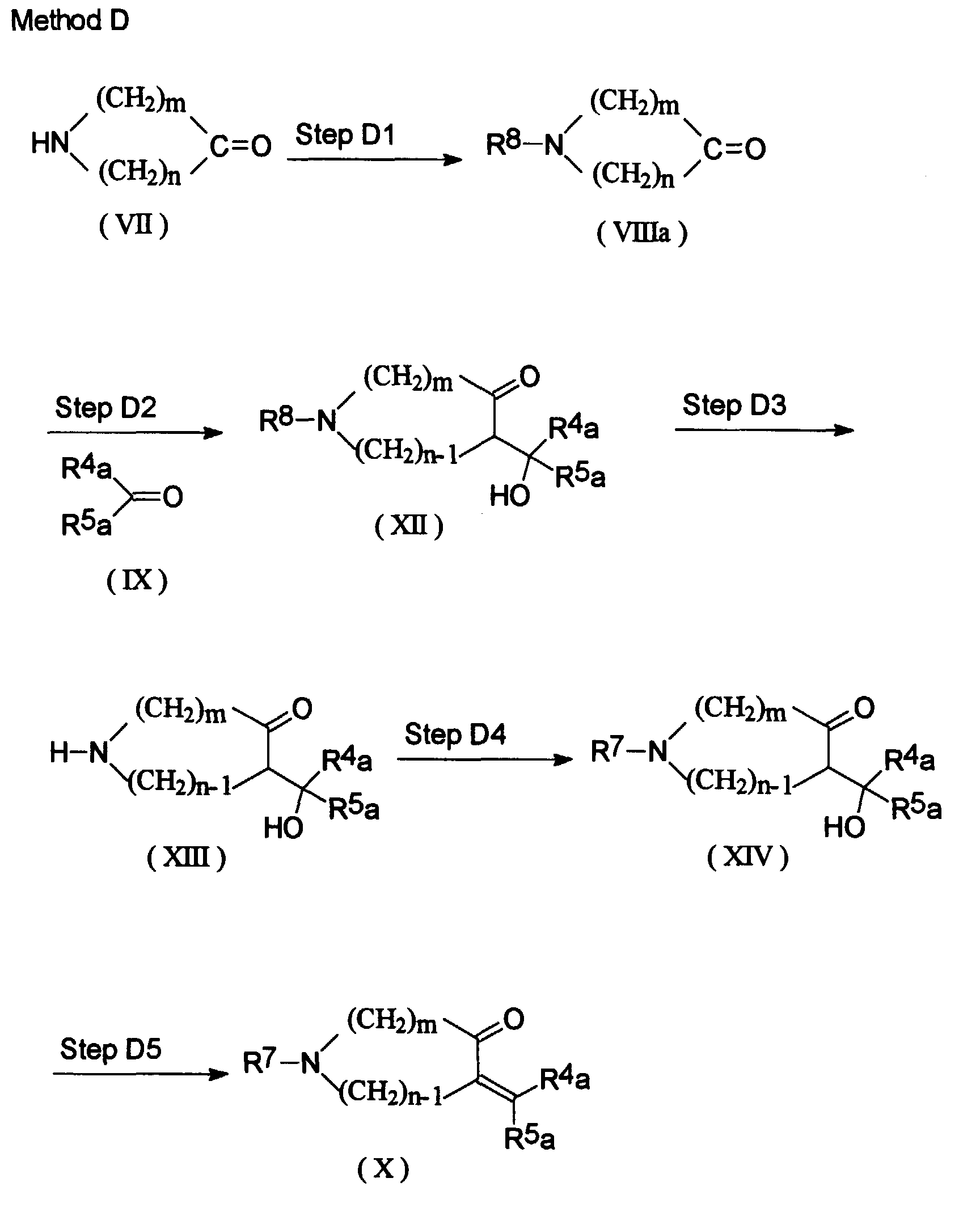
- Method D is an alternative method for synthesizing Intermediate (X) of Method C.
- Step D1 is a step for synthesizing the compound of the formula (VIIIa).
- Compound (VII) and a substituted or unsubstituted benzyl halide or a substituted or unsubstituted benzyloxycarbony halide (preferably, chloride) are treated in a similar manner to that described in Step C1 of Method C.
- Step D2 is a step for synthesizing the compound of the formula (XII) and it comprises reacting Compound (VIIIa) with a di-(C 1 -C 4 alkyl)amine or 3 to 6 membered cyclic amine (preferably, dimethylamine, diethylamine, pyrrolidine, piperidine or morpholine and particularly preferably, pyrrolidine, piperidine or morpholine) in a similar manner to that described in the former stage of Step C2 of Method C, thereby preparing the corresponding enamine derivative; and reacting the resulting enamine derivative with the compound of the formula (IX) at -10°C to 100°C (preferably, 10°C to 50°C) for 1 to 24 hours (preferably, 2 to 20 hours) in an inert solvent (preferably, a halogenated hydrocarbon such as dichloromethane, chloroform, carbon tetrachloride or 1,2-dichloroethane) in the presence of an acid catalyst (preferably, a Lewis
- Step D3 is a step for synthesizing the compound of the formula (XIII) and is accomplished by the removal of the protecting group from the amino group of Compound (XII). This step is carried out in a similar manner to that described in Reaction (C) of Step A3 of Method A for the removal of the protecting group from the hydroxyl group under reducing conditions.
- Step D4 is a step for synthesizing the compound of the formula (XIV) and is accomplished by the protection of the amino group of Compound (XIII). This step is carried out in a similar manner to that described in Step C1 of Method C.
- Step D5 is a step for synthesizing Compound (X) and it comprises sulfonylating of Compound (XIV) in a similar manner to that described in Step A1 of Method A and reacting the resulting sulfonyloxy derivative with a base (preferably, an organic amine such as triethylamine, N-methylmorpholine, pyridine, 4-dimethylaminopyridine, 1,5-diazabicyclo[4.3.0]-5-nonene or 1,8-diazabicyclo[5.4.0]-7-undecene) at -10°C to 100°C (preferably 10°C to 50°C) for 30 minutes to 10 hours (preferably, for 1 hour to 5 hours) in an inert solvent (preferably, a halogenated hydrocarbon such as dichloromethane, chloroform, carbon tetrachloride or 1,2-dichloroethane).
- a base preferably, an organic amine such as triethylamine, N-methyl
- the target compound in each reaction is obtained from the reaction mixture in a conventional manner.
- the target compound can be obtained by filtering off insoluble matter, if any, as desired, neutralizing the reaction mixture when it is acidic or alkaline and distilling off the solvent under reduced pressure, or distilling off the solvent under reduced pressure, adding water to the residue, extracting with a water immiscible organic solvent such as ethyl acetate, drying over anhydrous magnesium sulfate or the like and then distilling off the solvent. If necessary, purification can be carried out further in a conventional manner such as recrystallization or column chromatography.
- Starting material (VI) is known or prepared by a known method [for example, Japanese Patent Application Kokai No. Sho 59-27895 (EP 99802) or Japanese Patent Application Kokai No. Hei 6-41139 (EP542411)].
- Starting material compound (V) is known or prepared by a known method [for example, J. Org. Chem. , 37 , 3953 (1972).].
- the compound of the formula (I) according to the present invention has excellent platelet aggregation inhibitory action or arteriosclerosis progress inhibitory action and has low toxicity so that it is useful as a therapeutic agent or a preventive agent for thrombosis, embolism or arteriosclerosis.
- Example 1(b) In a similar manner to that described in Example 1(b) except for the use of 4-acetylthio-1-(2-fluoro- ⁇ -methoxycarbonylbenzyl)piperidine instead of 4-acetylthio-1-( ⁇ -cyclopropylcarbonyl-2-fluorobenzyl)piperidine, the title compound was obtained as a light yellow solid (amorphous) in a yield of 97.1%.
- Example 1(a) In a similar manner to Example 1(a) except for the use of 1-( ⁇ -cyclopropylcarbonyl-2-fluorobenzyl)-3-hydroxymethylpiperidine instead of 1-( ⁇ -cyclopropylcarbonyl-2-fluorobenzyl)-4-hydroxypiperidine, the reaction was effected, whereby the title compound was obtained as a brown oil in a yield of 75%.
- Example 9(a) In a similar manner to that described in Example 1(b) except for the use of Isomers A-2 and B-2 of 3-acetylthio-8-( ⁇ -cyclopropylcarbonyl-2-fluorobenzyl)-8-azabicyclo[3.2.1]octane in Example 9(a) instead of 4-acetylthio-1-( ⁇ -cyclopropylcarbonyl-2-fluorobenzyl)piperidine, the reaction was effected, whereby Isomers A-3 and B-3 of the title compound were obtained in yields of 61.1% and 99.2%, respectively. Isomers A-3 and B-3 exhibited the retention time of 10.0 minutes and 9.3 minutes, respectively, as a result of high-performance liquid chromatography (as measured under the conditions similar to those of Example 9(a)).
- Example 1(b) In a similar manner to Example 1(b) except for the use of 3-acetylthio-1-( ⁇ -cyclopropylcarbonyl-2-fluorobenzyl)-3-ethylidenepiperidine instead of 4-acetylthio-1-( ⁇ -cyclopropylcarbonyl-2-fluorobenzyl)piperidine, the reaction was effected, whereby the title compound was obtained as a light brown solid (amorphous) in a yield of 85.0%.
- mice Male ICR mice (Charles River Japan Inc.) were used in the experiment. Test compound suspended in 5% gum arabic solution was orally administered for 3 days (48, 24 and 4 hours before the experiment). Each mouse was placed in a retainer, and the tail was transected at 5 mm from the tip, and then the tail (2 cm) was immersed in saline solution warmed at 37°C. Bleeding time was defined as the interval between the time of transection until bleeding stopped over a 15 seconds period. Bleeding times beyond 5 minutes were recorded as 5 minutes (300 seconds). Results were expressed as ratios of bleeding times of test compound-treated to non-treated (control) groups in which mice received 5% gum arabic solution. Results are shown in Table 2.
- Test compound Test 1 (bleeding time extending ratio) 10 mg/kg 30 mg/kg Example 1(a) 1.06 2.06 Example 1(b) - 1.46 Example 10(a) > 2.75 > 2.75 Example 13 > 2.75 > 2.75 Example 15(a) 2.53 > 2.75 Example 18 1.45 2.57 Example 28 1.24 2.16
- Test compound Test 2 (inhibition %) 10 mg/kg 30 mg/kg
- Platelet aggregation was measured using an automatic platelet aggregometer (PAM-8C, Mebanix) by the method of G.V.R. Born ( Nature , 194 , 927-929 (1962)) with a slight modification.
- Plasma was collected from the antecubital vein of healthy volunteers who had not taken any medications for 2 weeks using 3.8% sodium citrate as an anticoagulant (1/9 volume of blood).
- Platelet-rich plasma (PRP) was obtained by centrifugation (CR5DL, Hitachi) at 200 x g for 15 minutes at room temperature.
- Platelet-poor plasma (PPP) was obtained by further centrifugation of the remained blood at 2000 x g for 10 minutes at room temperature.
- the number of platelets in PRP was measured by an automatic hematology analyzer (K-1000, Toa Iyo Denshi), and adjusted to 3 x 10 8 /ml using PPP.
- PRP prepared as described above was used for the platelet aggregation experiment.
- PRP (0.24 ml) was added to the cuvette and set in the platelet aggregometer. After pre-incubation for 1.5 minutes at 37°C, 0.01 ml of 0.25 mM ADP were added to the cuvette to initiate platelet aggregation. Platelet aggregation was monitored for 10 minutes.
- Test compound Test 3 (inhibition %) 10 ⁇ g/ml 30 ⁇ g/ml
- Example 1(b) 48.6 70.6
- Example 12 41.2 68.9
- Example 12 The compound (50 mg) of Example 12 in the powdery form, 128.7 mg of lactose, 70 mg of cellulose and 1.3 mg of magnesium stearate were mixed, followed by sifting through a 60-mesh sieve. The resulting powder was filled in 250-mg No.3 gelatin capsules, whereby capsules were obtained.
- Example 12 The compound (50 mg) of Example 12 in the powdery form, 124 mg of lactose, 25 mg of cellulose and 1 mg of magnesium stearate were mixed, followed by tableting in a tableting machine, whereby tablets, each 200 mg, were obtained. These tablets can be coated with sugar if necessary.
- the compound of the formula (I) according to the present invention has excellent platelet aggregation inhibitory action or arteriosclerosis progress inhibitory action (particularly, platelet aggregation inhibitory action) and has low toxicity so that it is useful as a therapeutic agent or a preventive agent (particularly, therapeutic agent) for embolism, thrombosis or arteriosclerosis (particularly, embolism or thrombosis).
- the compound (I) or pharmaceutically acceptable salt thereof according to the present invention when used as a therapeutic agent or preventive agent for the above-described disease, it can be administered orally in the form of tablets, capsules, granules, powders or syrups, non-rally by injection or suppository by itself or mixed with a proper pharmaceutically acceptable additive such as an excipient or diluent.
- the above formulations can be prepared in a well known manner by using additives.
- the additives may be excipients (for example, organic excipients such as sugar derivatives, e.g., lactose, sucrose, glucose, mannitol or sorbitol; starch derivatives, e.g., corn starch, potato starch, ⁇ -starch or dextrin; cellulose derivatives, e.g., crystalline cellulose; acacia; dextran; or pullulan; or inorganic excipients such as silicate derivatives, e.g., light anhydrous silicic acid, synthetic aluminum silicate, calcium silicate or magnesium aluminometasilicate; phosphate salts, e.g., calcium hydrogenphosphate; carbonates, e.g., calcium carbonate; or sulfate salts, e.g., calcium sulfate), lubricants (for example, stearic acid and metal stearate
- the dose of the invention compound will vary depending on the symptoms and age of the patient. It is administered to an adult in an amount of 1 mg (preferably 10 mg) at the minimum and 1000 mg (preferably 500 mg) at the maximum in a single dose while in the case of oral administration, it is administered in an amount of 0.5 mg (preferably 5 mg) at the minimum and 500 mg (preferably 250 mg) at the maximum in a single dose in the case of intravenous administration. It is administered one to six times a day according to the symptom.
Landscapes
- Chemical & Material Sciences (AREA)
- Organic Chemistry (AREA)
- Health & Medical Sciences (AREA)
- Engineering & Computer Science (AREA)
- Bioinformatics & Cheminformatics (AREA)
- Life Sciences & Earth Sciences (AREA)
- Public Health (AREA)
- General Chemical & Material Sciences (AREA)
- Medicinal Chemistry (AREA)
- Nuclear Medicine, Radiotherapy & Molecular Imaging (AREA)
- Chemical Kinetics & Catalysis (AREA)
- Pharmacology & Pharmacy (AREA)
- Veterinary Medicine (AREA)
- Animal Behavior & Ethology (AREA)
- General Health & Medical Sciences (AREA)
- Hematology (AREA)
- Diabetes (AREA)
- Urology & Nephrology (AREA)
- Vascular Medicine (AREA)
- Cardiology (AREA)
- Heart & Thoracic Surgery (AREA)
- Pharmaceuticals Containing Other Organic And Inorganic Compounds (AREA)
- Hydrogenated Pyridines (AREA)
- Organic Low-Molecular-Weight Compounds And Preparation Thereof (AREA)
- Acyclic And Carbocyclic Compounds In Medicinal Compositions (AREA)
Abstract
Description

R2 represents a substituted or unsubstituted, C1-C8 aliphatic acyl group (the substituent of said group being a halogen atom, a hydroxyl group, a C1-C4 alkoxy group or a cyano group), a substituted or unsubstituted benzoyl group (the substituent of said group being a C1-C4 alkyl group, a halogen atom or a C1-C4 alkoxy group) or a (C1-C4 alkoxy)carbonyl group, and
R3 represents a substituted, 3 to 7 membered, saturated cyclic amino group which may form a fused ring [the non-optional substituent of said group being a protected or unprotected mercapto group or a C1-C4 alkyl group substituted with a protected or unprotected mercapto group, said cyclic amino group being preferably further substituted with a group of the formula =CR4R5 (in which R4 and R5 are the same or different and each independently represents a hydrogen atom, a C1-C4 alkyl group, a carboxy group, a (C1-C4 alkoxy)carbonyl group, a carbamoyl group or a mono- or di-(C1-C4 alkyl)carbamoyl group); and the protecting group of said mercapto group being a C1-C20 alkanoyl group, a C3-C20 alkenoyl group, a substituted or unsubstituted benzoyl group (the substituent of said group being a C1-C4 alkyl group, a halogen atom or a C1-C4 alkoxy group) or a (C1-C4 alkoxy)carbonyl group].
of which fluoroacetyl, difluoroacetyl, trifluoroacetyl, chloroacetyl, 3-fluoropropionyl, 3-chloropropionyl, hydroxyacetyl, 3-hydroxypropionyl, methoxyacetyl, 3-methoxypropionyl, ethoxyacetyl, cyanoacetyl, 3-cyanopropionyl, 2-fluorocyclopropylcarbonyl, 2,2-difluorocyclopropylcarbonyl, 2-chlorocyclopropylcarbonyl, 2-fluorocyclobutylcarbonyl, 2-chlorocyclobutylcarbonyl, 2-fluorocyclopentylcarbonyl, 2-fluorocyclohexylcarbonyl, 2-hydroxycyclopropylcarbonyl, 2-methoxycyclopropylcarbonyl, 2-ethoxycyclopropylcarbonyl and 2-cyanocyclopropylcarbonyl groups are preferred,
fluoroacetyl, difluoroacetyl, trifluoroacetyl, chloroacetyl, 3-fluoropropionyl, 2-fluorocyclopropylcarbonyl, 2-chlorocyclopropylcarbonyl and 2-fluorocyclobutylcarbonyl groups are more preferred, and
fluoroacetyl, difluoroacetyl, trifluoroacetyl, 3-fluoropropionyl and 2-fluorocyclopropylcarbonyl groups are particularly preferred.
more preferred are 3-(protected or unprotected mercapto, or protected or unprotected mercaptomethyl)-1-azetidinyl groups, 3-(protected or unprotected mercapto, or protected or unprotected mercaptomethyl)-1-pyrrolidinyl groups, 3- or 4-(protected or unprotected mercapto, or protected or unprotected mercaptomethyl)-1-piperidinyl groups, 4-(protected or unprotected mercapto)-3-(=CR4R5)-1-piperidinyl groups (in which R4 and R5 are the same or different and each independently represents a hydrogen atom, a methyl group, an ethyl group, a carboxy group, a methoxycarbonyl group, an ethoxycarbonyl group, a carbamoyl group, a methylcarbamoyl group, an ethylcarbamoyl group, a dimethylcarbamoyl group or a diethylcarbamoyl group) or 8-aza-3-(protected or unprotected mercapto, or protected or unprotected mercaptomethyl)-bicyclo[3.2.1]octan-8-yl groups,
still more preferred are 3-(protected or unprotected mercapto)-1-azetidinyl groups, 3-(protected or unprotected mercapto)-1-pyrrolidinyl groups, 3- or 4-(protected or unprotected mercapto)-1-piperidinyl groups, 4-(protected or unprotected mercapto)-3-(=CR4R5)-1-piperidinyl groups (in which R4 represents a hydrogen atom and R5 represents a hydrogen atom, a methyl group, a carboxy group, a methoxycarbonyl group, an ethoxycarbonyl group, a carbamoyl group, a methylcarbamoyl group or a dimethylcarbamoyl group) or 8-aza-3-(protected or unprotected mercapto)bicyclo[3.2.1]octan-8-yl groups,
and particularly preferred are 3-(protected or unprotected mercapto)-1-azetidinyl groups, 4-(protected or unprotected mercapto)-1-piperidinyl groups, 4-(protected or unprotected mercapto)-3-(=CR4R5)-1-piperidinyl groups (in which R4 represents a hydrogen atom and R5 represents a carboxy group, a methoxycarbonyl group, an ethoxycarbonyl group, a carbamoyl group, a methylcarbamoyl group or a dimethylcarbamoyl group) or 8-aza-3-(protected or unprotected mercapto)bicyclo[3.2.1]octan-8-yl groups.
R4 and R5 are the same or different and each independently represents a hydrogen atom, C1-C4 alkyl group, carboxy group, (C1-C4 alkoxy)carbonyl group, carbamoyl group, or mono- or di-(C1-C4 alkyl)carbamoyl group, and
the protecting group for the mercapto group is a C1-C20 alkanoyl, C3-C20 alkenoyl, substituted or unsubstituted benzoyl (the substituent of said group being a C1-C4 alkyl group, a halogen atom or a C1-C4 alkoxy group) or (C1-C4 alkoxy)carbonyl group,
R4 and R5 are the same or different and each independently represents a hydrogen atom or a methyl, ethyl, carboxy, methoxycarbonyl, ethoxycarbonyl, carbamoyl, methylcarbamoyl, ethylcarbamoyl, dimethylcarbamoyl or diethylearbamoyl group, and
the protecting group for the mercapto group is a C1-C20 alkanoyl, C8-C20 alkenoyl, substituted or unsubstituted benzoyl (the substituent of said group being methyl, ethyl, fluorine, chlorine, methoxy or ethoxy) or (C1-C4 alkoxy)carbonyl group,
R4 represents a hydrogen atom, R5 represents a hydrogen atom or a methyl, carboxy, methoxycarbonyl, ethoxycarbonyl, carbamoyl, methylcarbamoyl, or dimethylcarbamoyl group, and
the protecting group for the mercapto group is a C2-C6 alkanoyl, palmitoleoyl, oleoyl, benzoyl, methoxycarbonyl or ethoxycarbonyl group, and
R4 represents a hydrogen atom, R5 represents a carboxy, methoxycarbonyl, ethoxycarbonyl, carbamoyl, methylcarbamoyl or dimethylcarbamoyl group, and
the protecting group for the mercapto group is a C2-C5 alkanoyl, benzoyl, methoxycarbonyl or ethoxycarbonyl group. R1 is preferred in the order of (1) to (3) and (4) to (6), R2 is preferred in the order of (7) to (10) and R3 is preferred in the order of (11) to (14).As the compound represented by the formula (I), any combination of 2 to 4 groups selected from the class consisting of a group of (1) to (3), a group of (4) to (6), a group of (7) to (10) and a group of (11) to (14) can be employed. Preferred examples in such a combination include:
the number of substituents on the substituted phenyl group represented by R1 ranges from 1 to 3,
R2 represents a substituted or unsubstituted C2-C4 alkanoyl or (C3-C6 cycloalkyl)carbonyl group (the substituent of said group being fluorine, chlorine, hydroxyl, methoxy, ethoxy or cyano), a substituted or unsubstituted benzoyl group (the substituent of said group being methyl, ethyl, fluorine, chlorine, methoxy or ethoxy) or a (C1-C4 alkoxy)carbonyl group,
the number of substituents on the substituted phenyl group represented by R1 is 1 or 2, and
R2 represents a C2-C4 alkanoyl or (C3-C6 cycloalkyl)carbonyl group which is unsubstituted or is substituted by fluorine or chlorine, a benzoyl group or a (C1-C4 alkoxy)carbonyl group,
the position of the substituent on the substituted phenyl group represented by R1 is 2 or 4,
R2 represents a C2-C4 alkanoyl or (C3-C6 cycloalkyl)carbonyl group which is unsubstituted or is substituted by fluorine or chlorine, a benzoyl group or a (C1-C4 alkoxy)carbonyl group,
R3 represents a 3-(protected or unprotected mercapto, or protected or unprotected mercapto C1-C4 alkyl)-1-azetidinyl group, 3-(protected or unprotected mercapto, or protected or unprotected mercapto C1-C4 alkyl)-1-pyrrolidinyl group, 3-or 4-(protected or unprotected mercapto, or protected or unprotected mercapto C1-C4 alkyl)-1-piperidinyl group, 4-(protected or unprotected mercapto, or protected or unprotected mercapto C1-C4 alkyl-3-(=CR4R5)-1-piperidinyl group or 8-aza-3-(protected or unprotected mercapto, or protected or unprotected mercapto C1-C4 alkyl)bicyclo[3.2.1]octan-8-yl group,
R4 and R5 are the same or different and each independently represents a hydrogen atom, C1-C4 alkyl group, carboxy group, (C1-C4 alkoxy)carbonyl group, carbamoyl group, or mono- or di-(C1-C4 alkyl)carbamoyl group, and
the protecting group for the mercapto group is a C1-C20 alkanoyl, C3-C20 alkenoyl, substituted or unsubstituted benzoyl (the substituent of said group being a C1-C4 alkyl group, a halogen atom or a C1-C4 alkoxy group) or (C1-C4 alkoxy)carbonyl group,
the position of the substituent on the substituted phenyl group represented by R1 is 2 or 4,
R2 represents an acetyl, propionyl, isobutyryl, cyclopropylcarbonyl, cyclobutylcarbonyl, methoxycarbonyl or ethoxycarbonyl group, said groups being unsubstituted or being substituted by fluorine,
R3 represents a 3-(protected or unprotected mercapto, or protected or unprotected mercaptomethyl)-1-azetidinyl group, 3-(protected or unprotected mercapto, or protected or unprotected mercaptomethyl)-1-pyrrolidinyl group, 3- or 4-(protected or unprotected mercapto, or protected or unprotected mercaptomethyl)-1-piperidinyl group, 4-(protected or unprotected mercapto)-3(=CR4R5)-1-piperidinyl group or 8-aza-3-(protected or unprotected mercapto, or protected or unprotected mercaptomethyl)bicyclo[3.2.1]octan-8-yl group,
R4 and R5 are the same or different and each independently represents a hydrogen atom, or a methyl, ethyl, carboxy, methoxycarbonyl, ethoxycarbonyl, carbamoyl, methylcarbamoyl, ethylcarbamoyl, dimethylcarbamoyl or diethylcarbamoyl group, and
the protecting group for the mercapto group is a C1-C20 alkanoyl, C8-C20 alkenoyl, substituted or unsubstituted benzoyl (the substituent of said group being methyl, ethyl, fluorine, chlorine, methoxy or ethoxy) or (C1-C4 alkoxy)carbonyl group,
the position of the substituent on the substituted phenyl group represented by R1 is 2 or 4,
R2 represents a propionyl, cyclopropylcarbonyl, methoxycarbonyl or ethoxycarbonyl group,
R3 represents a 3-(protected or unprotected mercapto)-1-azetidinyl group, 3-(protected or unprotected mercapto)-1-pyrrolidinyl group, 3- or 4-(protected or unprotected mercapto)-1-piperidinyl group, 4-(protected or unprotected mercapto)-3-(=CR4R5)-1-piperidinyl group or 8-aza-3-(protected or unprotected mercapto)bicyclo[3.2.1]octan-8-yl group,
R4 represents a hydrogen atom, R5 represents a hydrogen atom, or a methyl, carboxy, methoxycarbonyl, ethoxycarbonyl, carbamoyl, methylcarbamoyl or dimethylcarbamoyl group, and
the protecting group for the mercapto group is a C2-C6 alkanoyl, palmitoleoyl, oleoyl, benzoyl, methoxycarbonyl or ethoxycarbonyl group, and
the position of the substituent on the substituted phenyl group represented by R1 is 2 or 4,
R2 represents a propionyl, cyclopropylcarbonyl, methoxycarbonyl or ethoxycarbonyl group,
R3 represents a 3-(protected or unprotected mercapto)-1-azetidinyl group, 4-(protected or unprotected mercapto)-1-piperidinyl group, 4-(protected or unprotected mereapto)-3-(=CR4R5)-1-piperidinyl group or 8-aza-3-(protected or unprotected mercapto)bicyclo[3.2.1]octan-8-yl group,
R4 represents a hydrogen atom, R5 represents a carboxy, methoxycarbonyl, ethoxycarbonyl, carbamoyl, methylcarbamoyl or dimethylcarbamoyl group, and
the protecting group of the mercapto group is a C2-C5 alkanoyl, benzoyl, methoxycarbonyl or ethoxycarbonyl group.


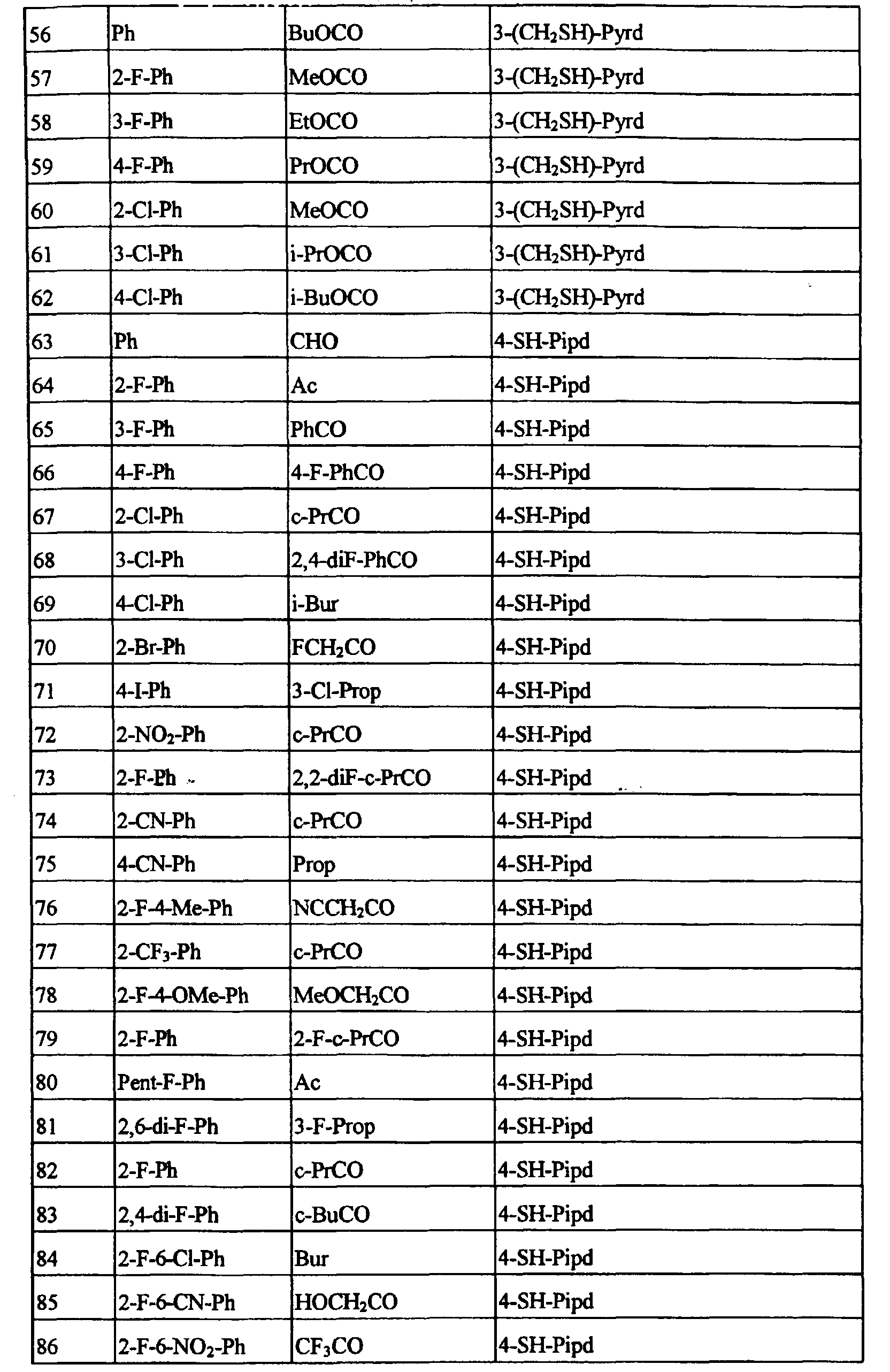


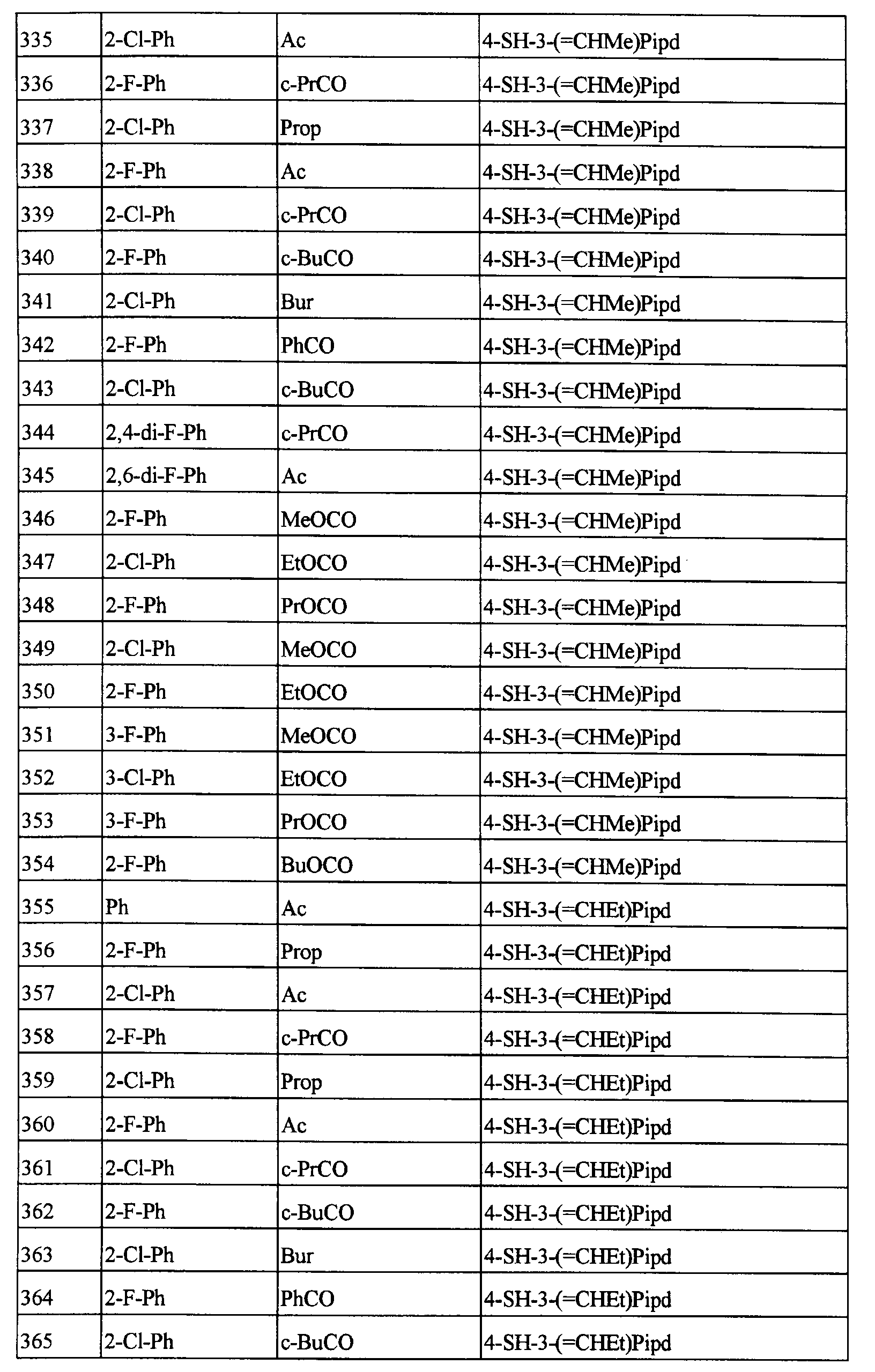

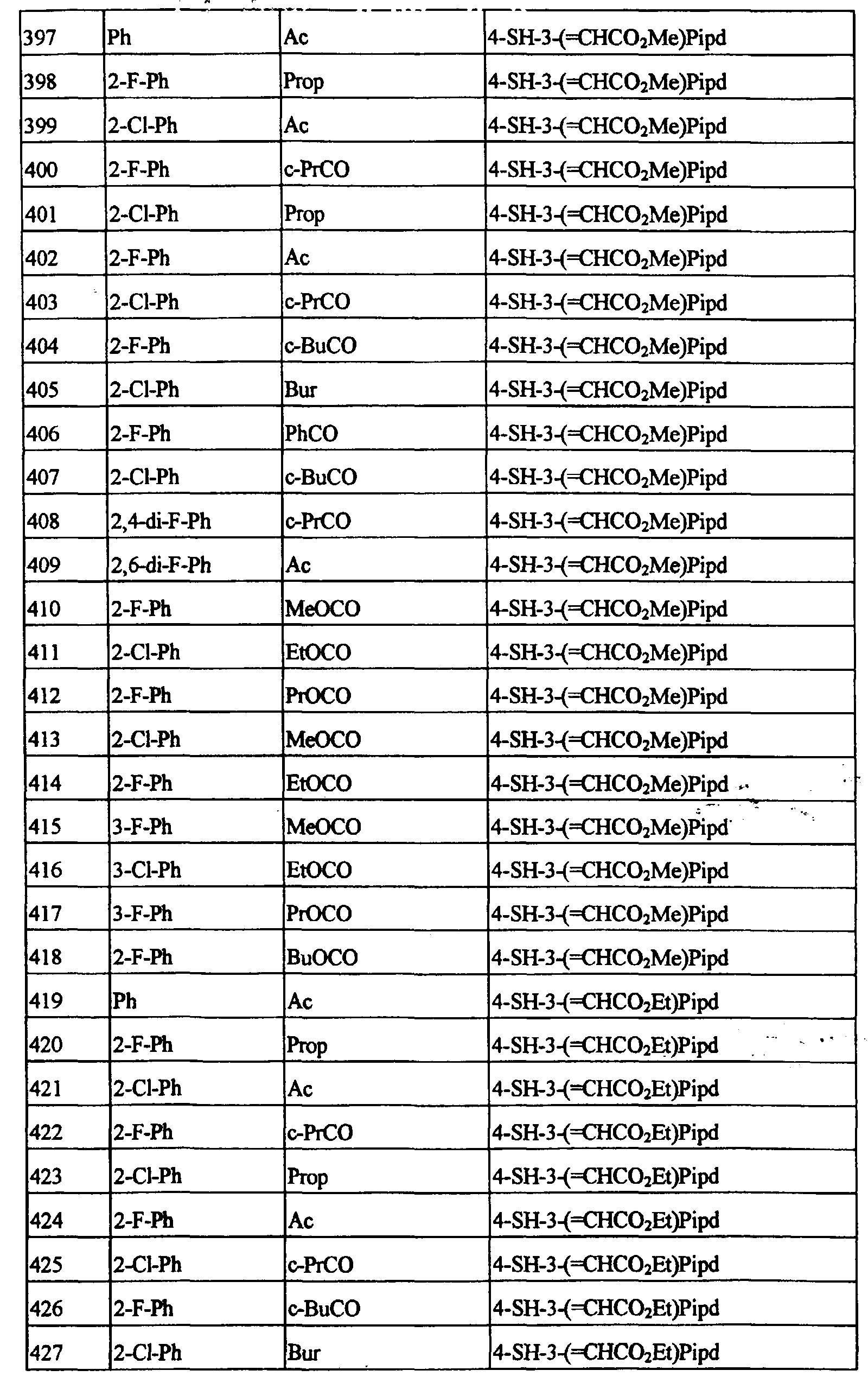
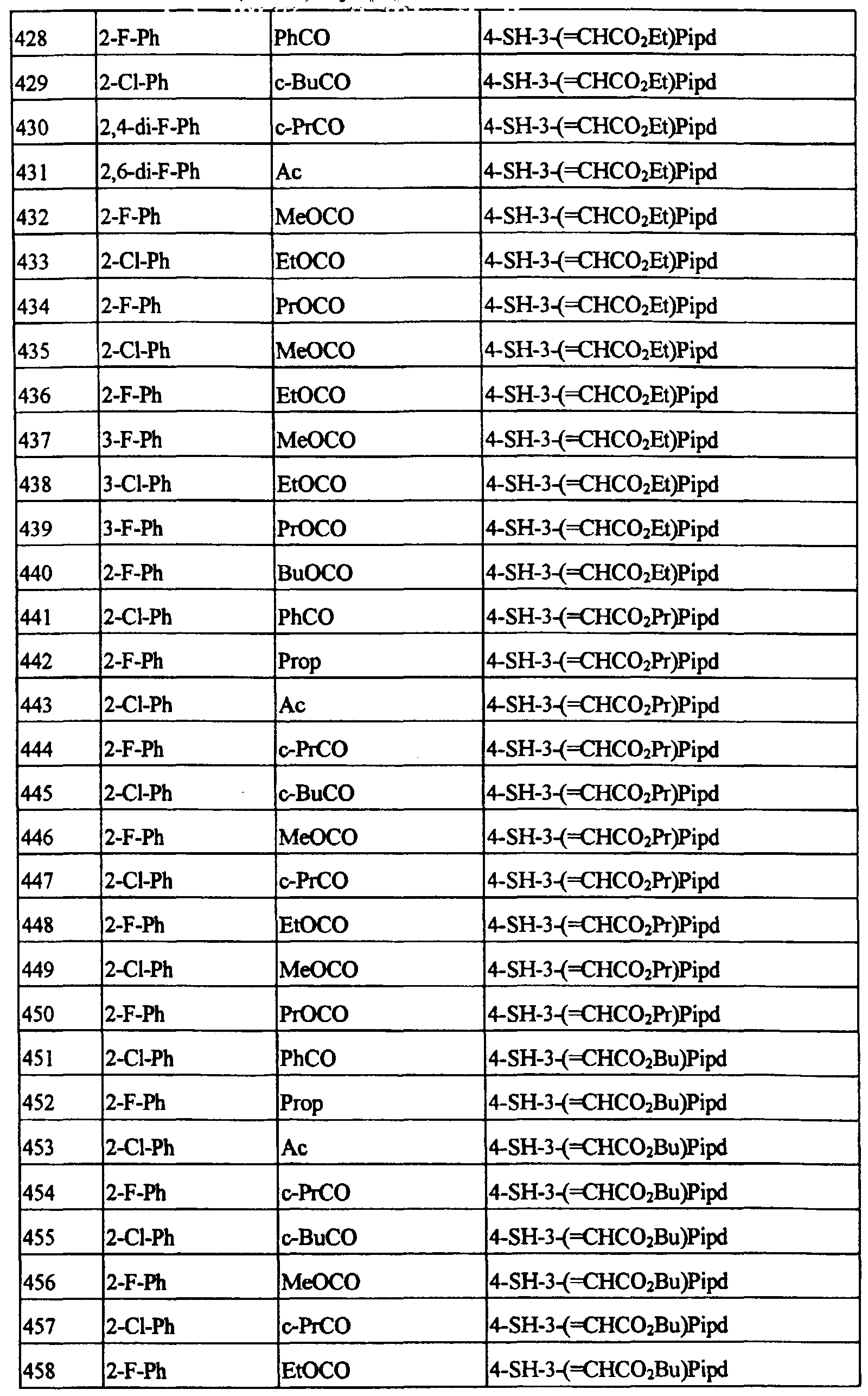
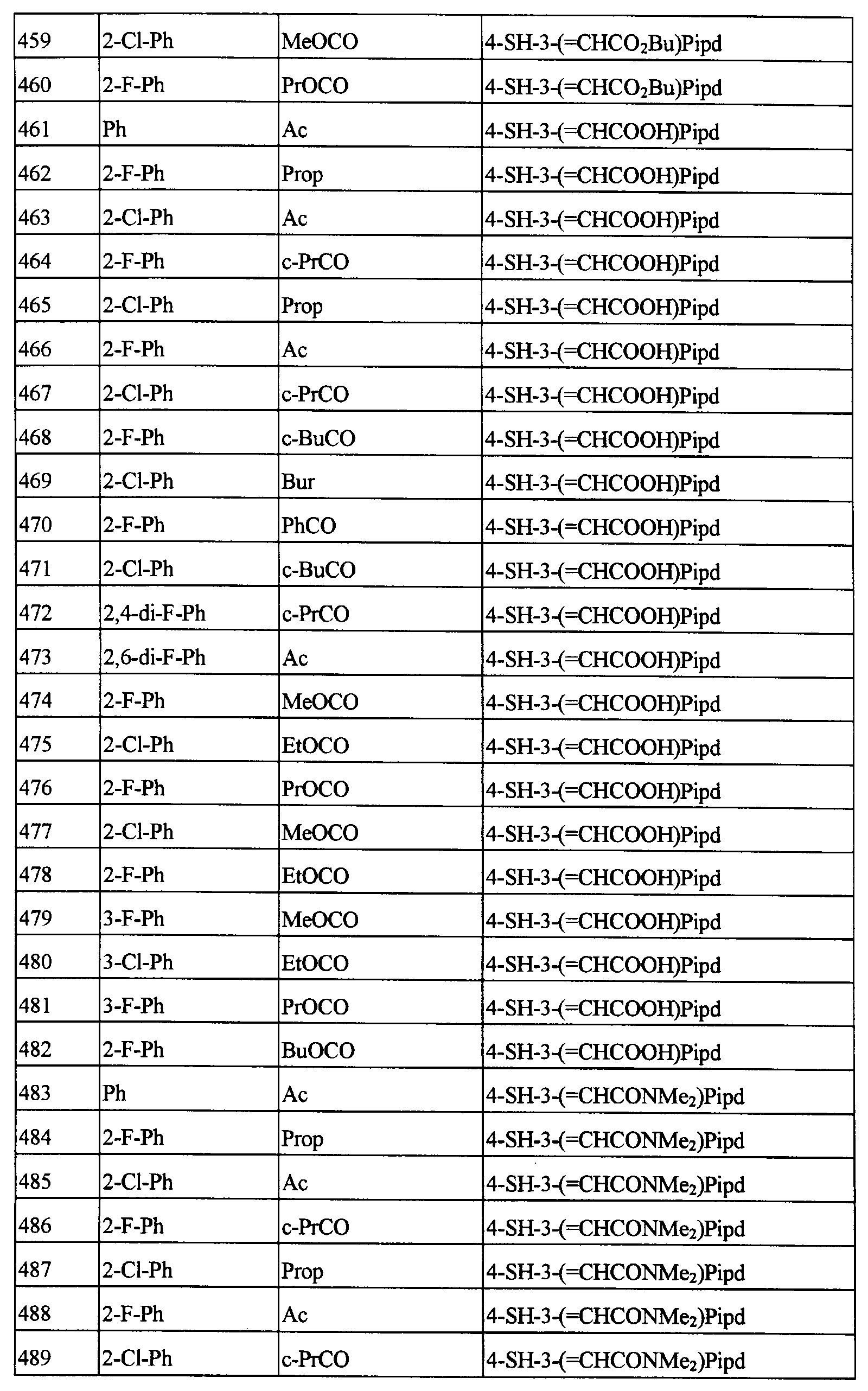

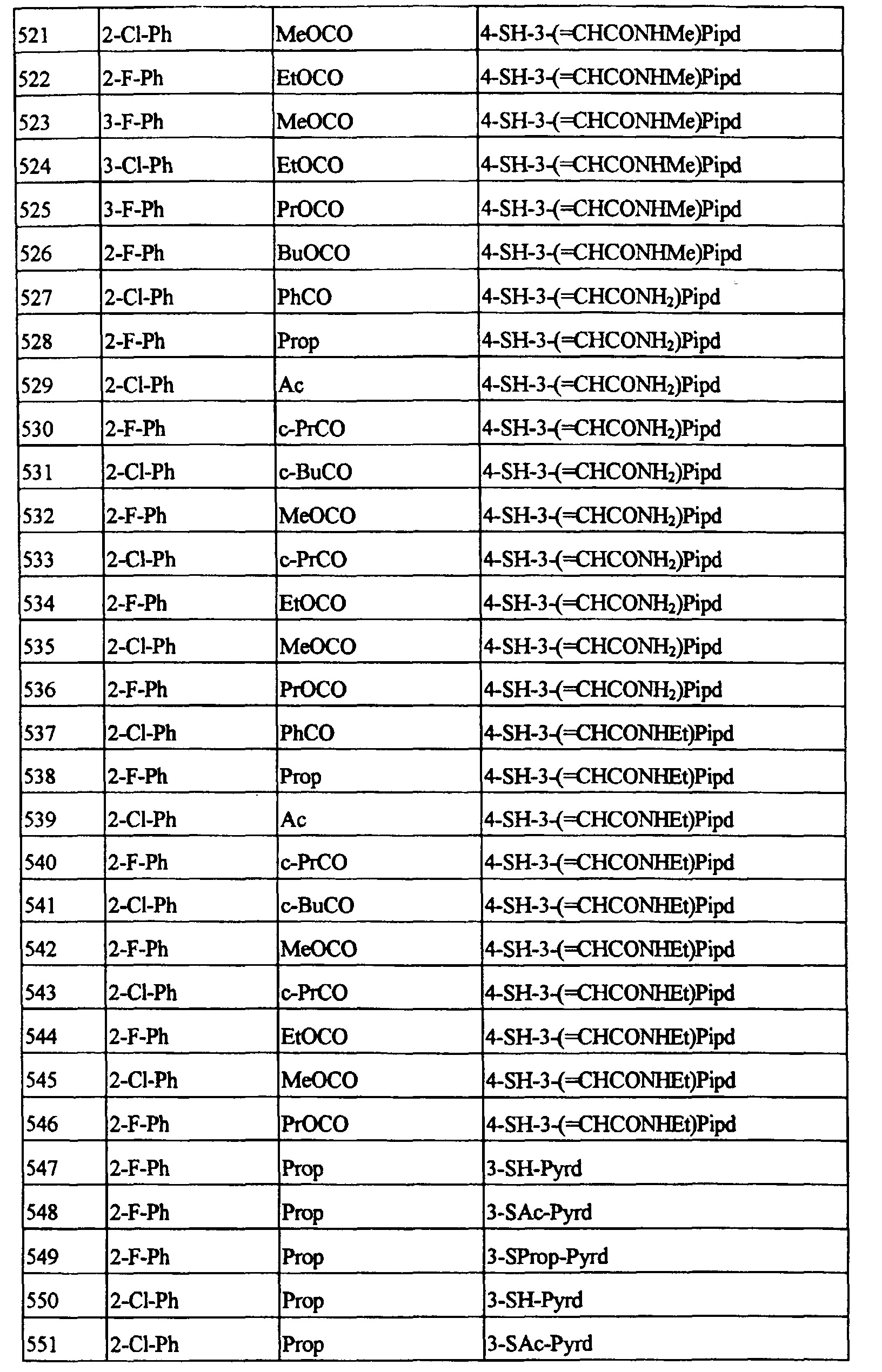
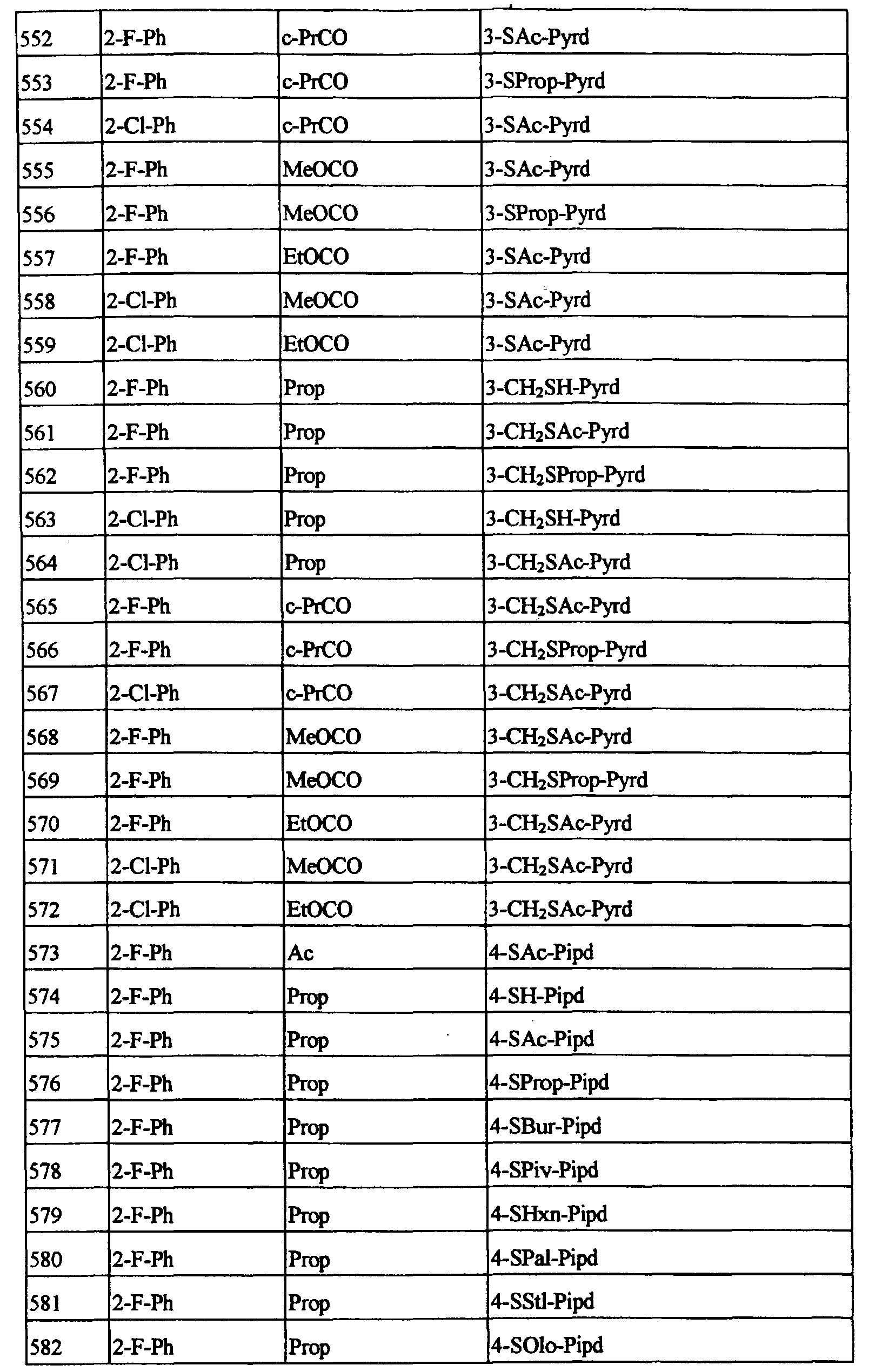
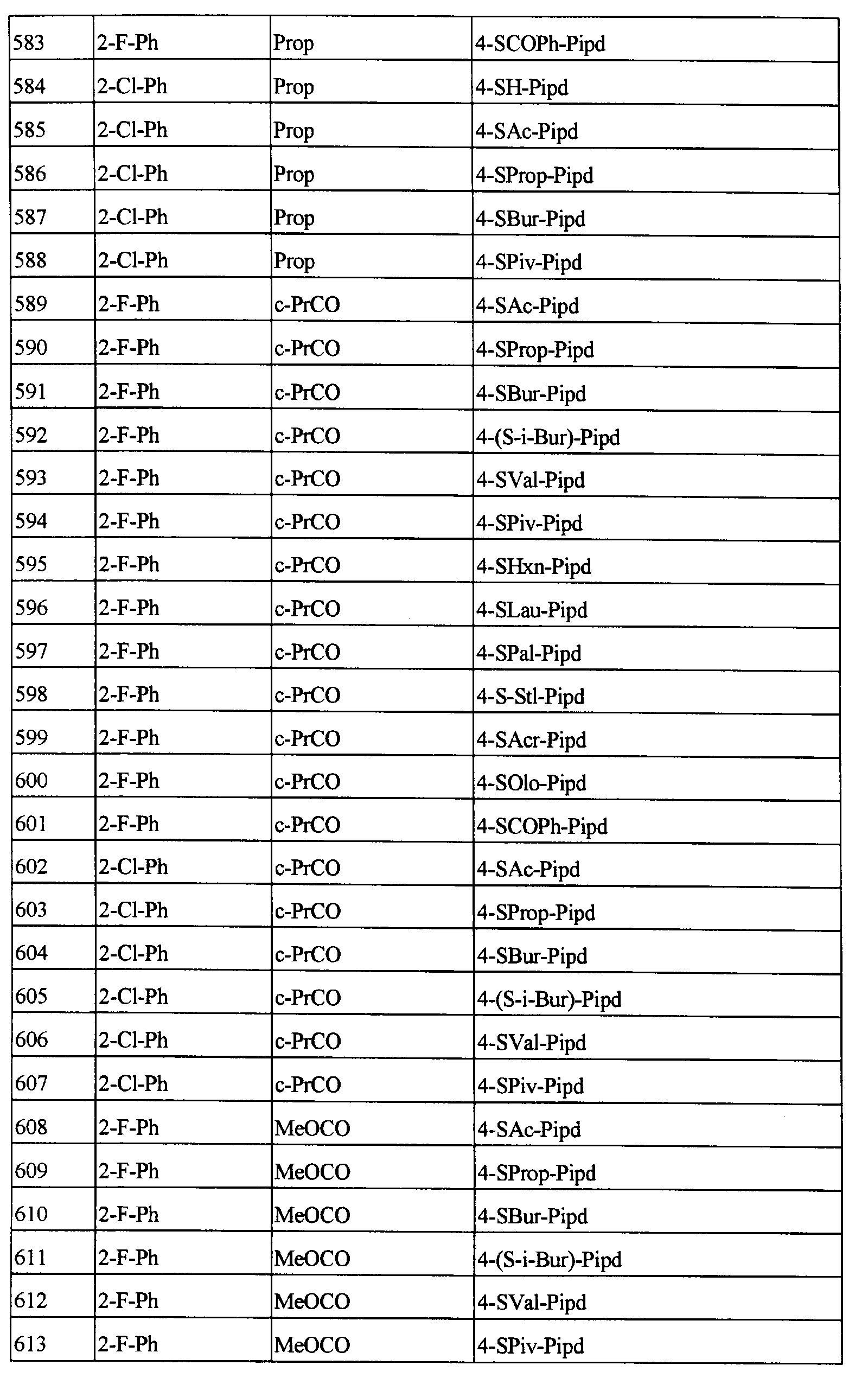
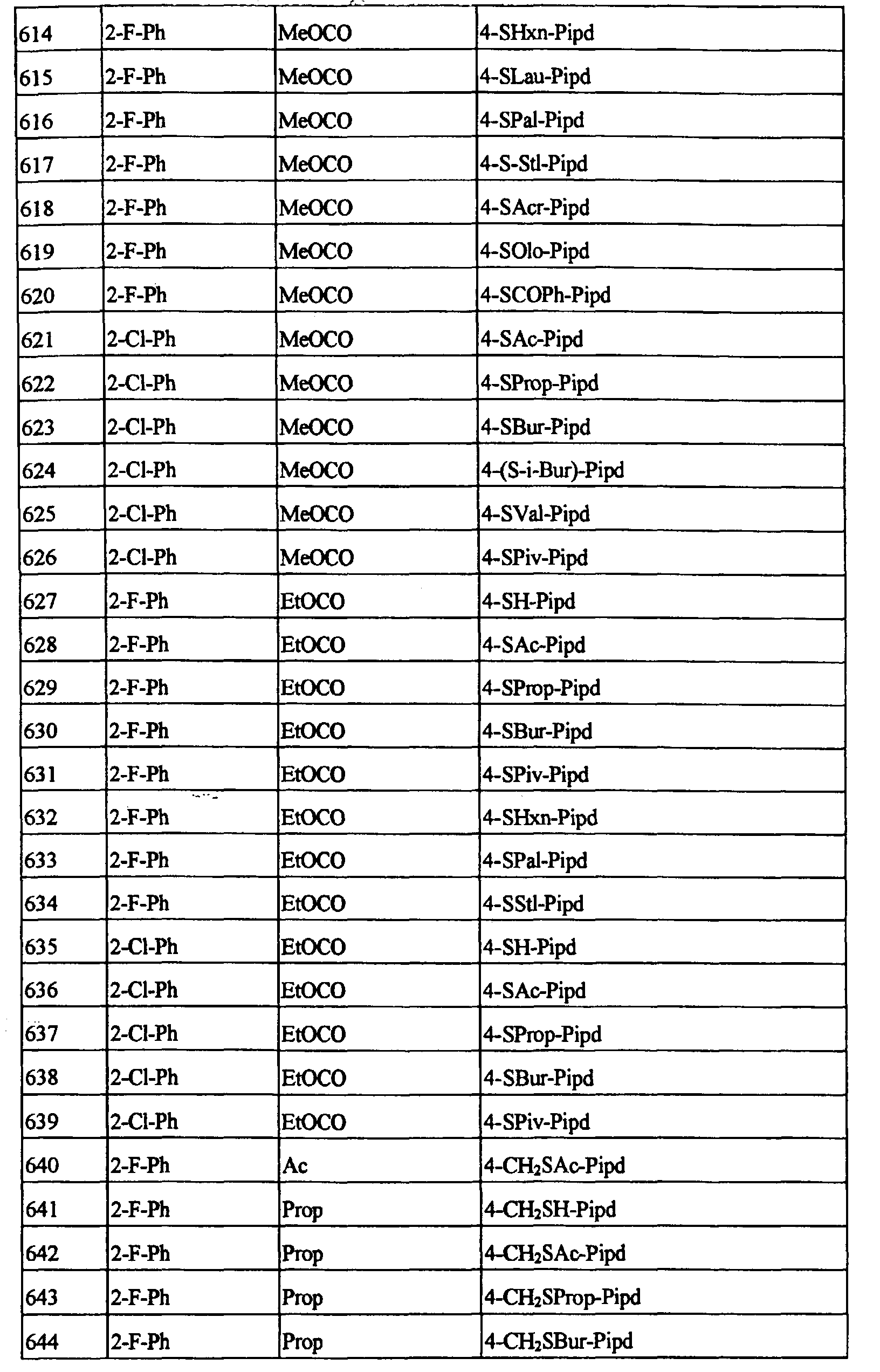
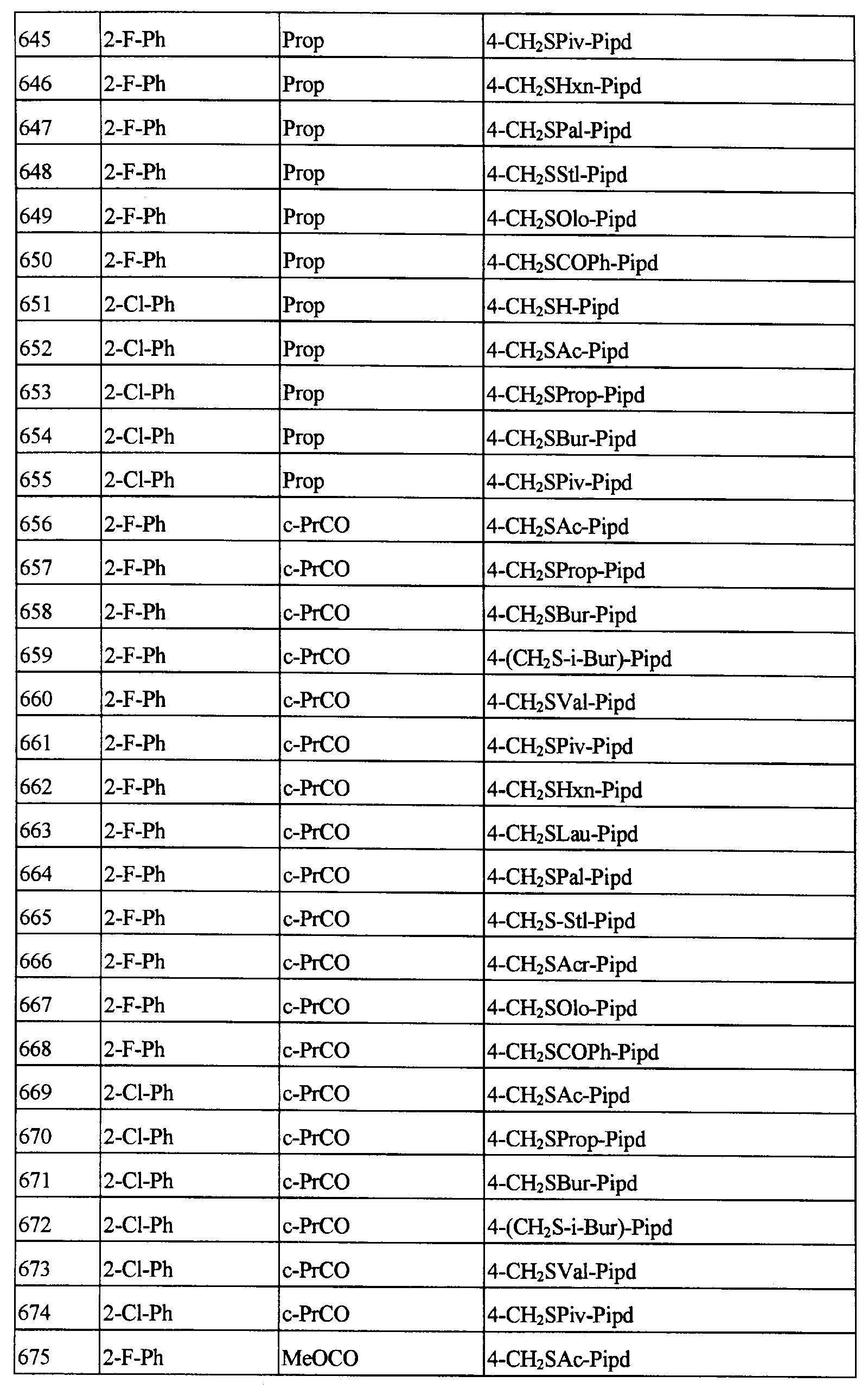
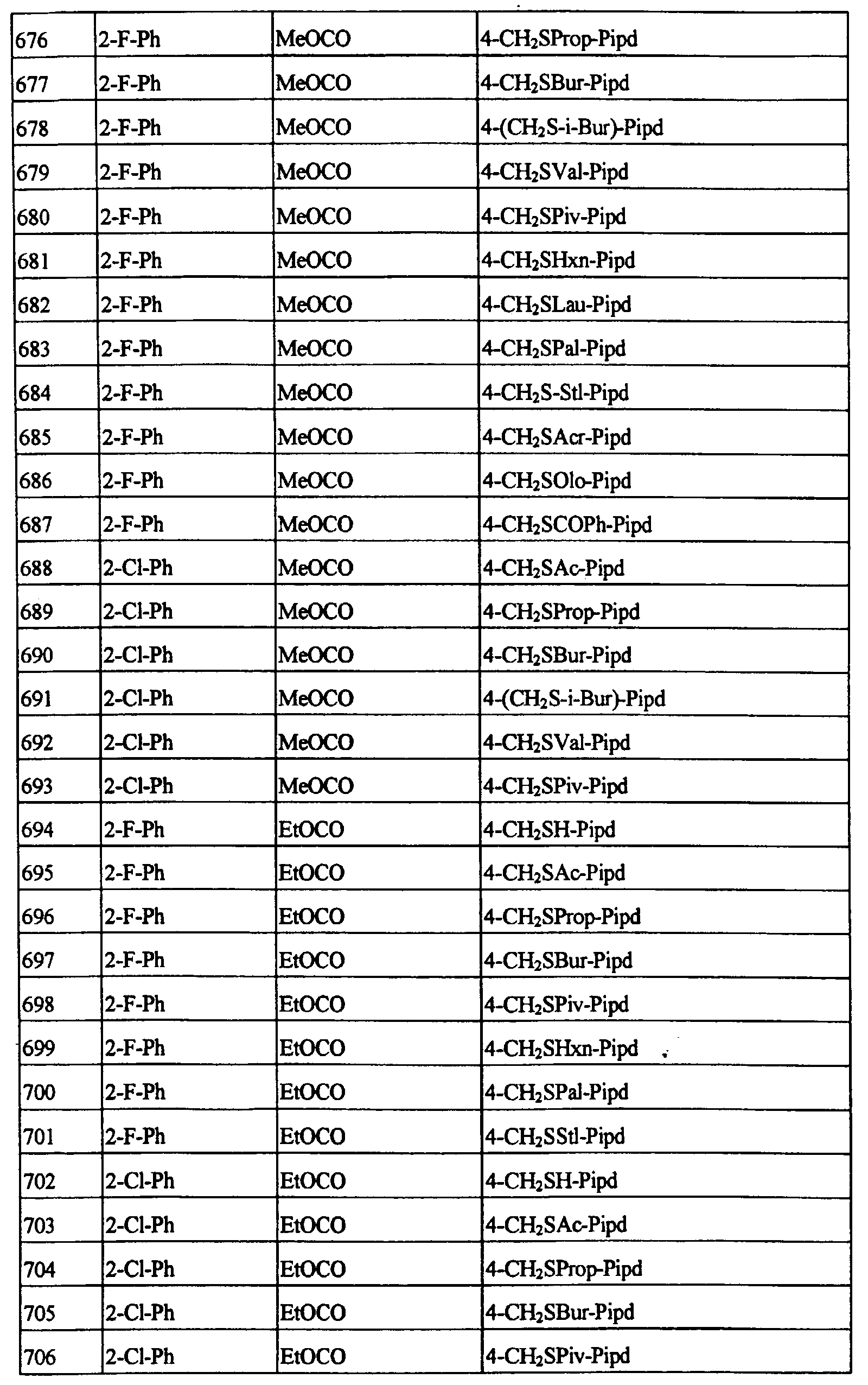
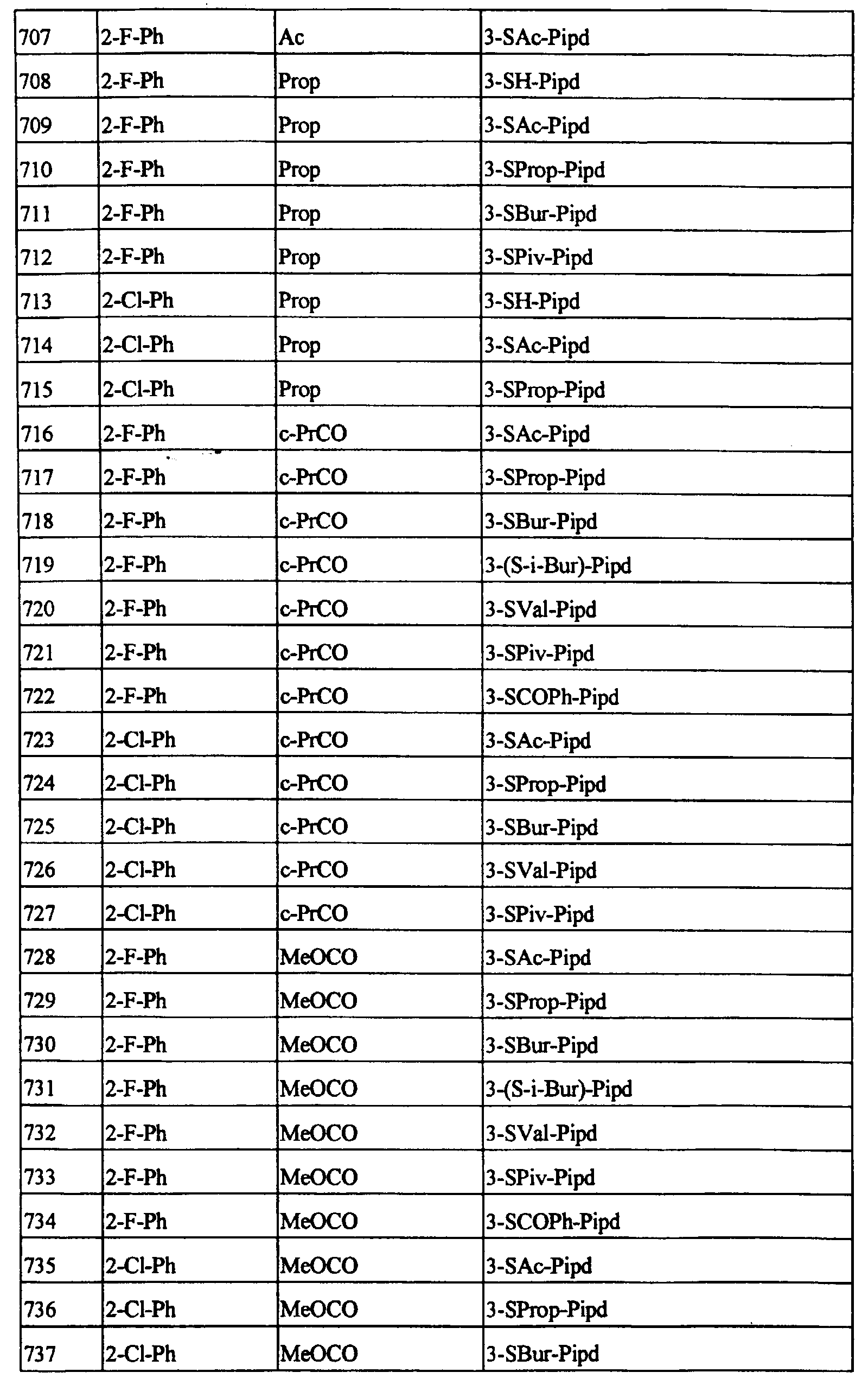
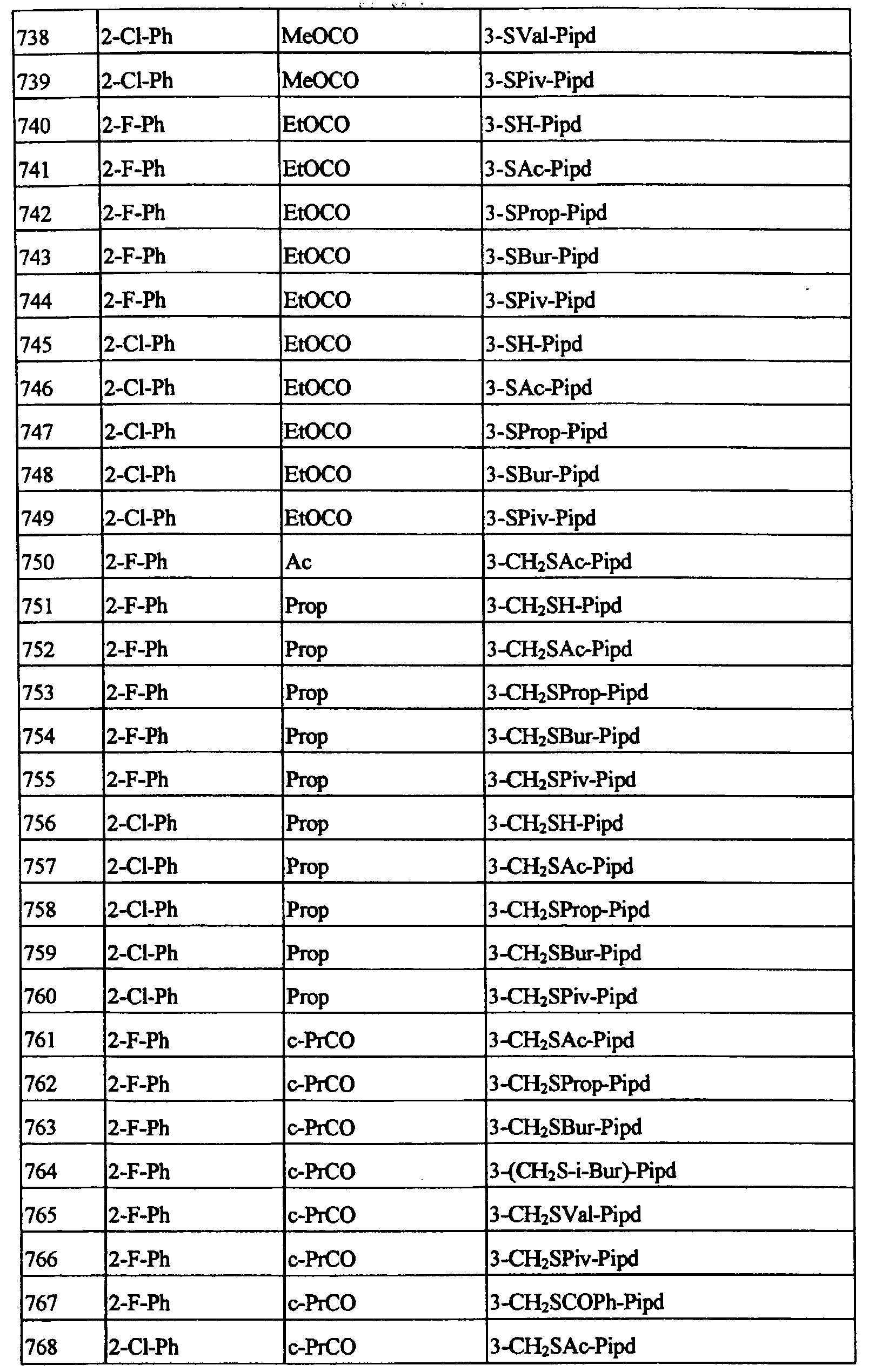

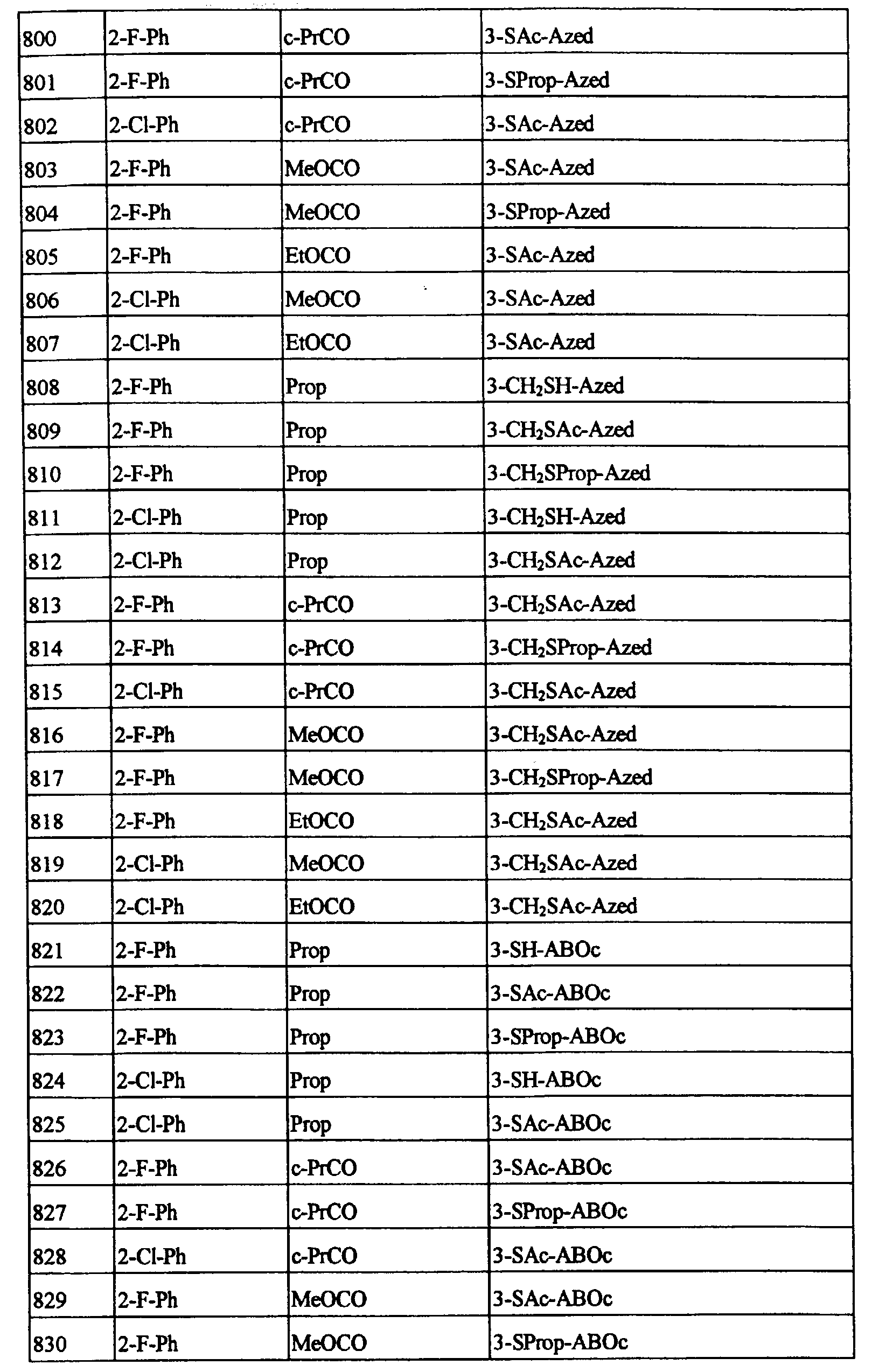
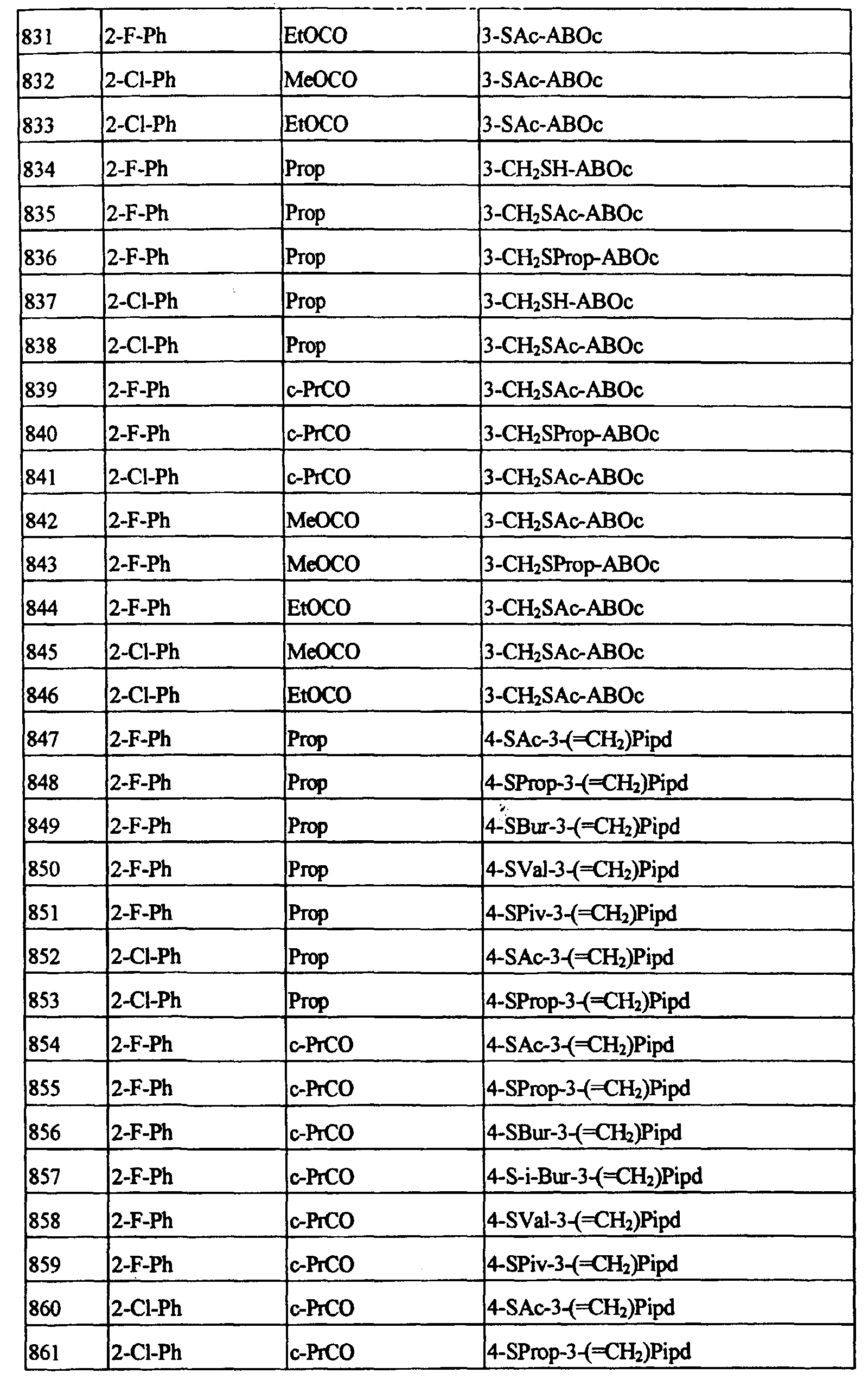


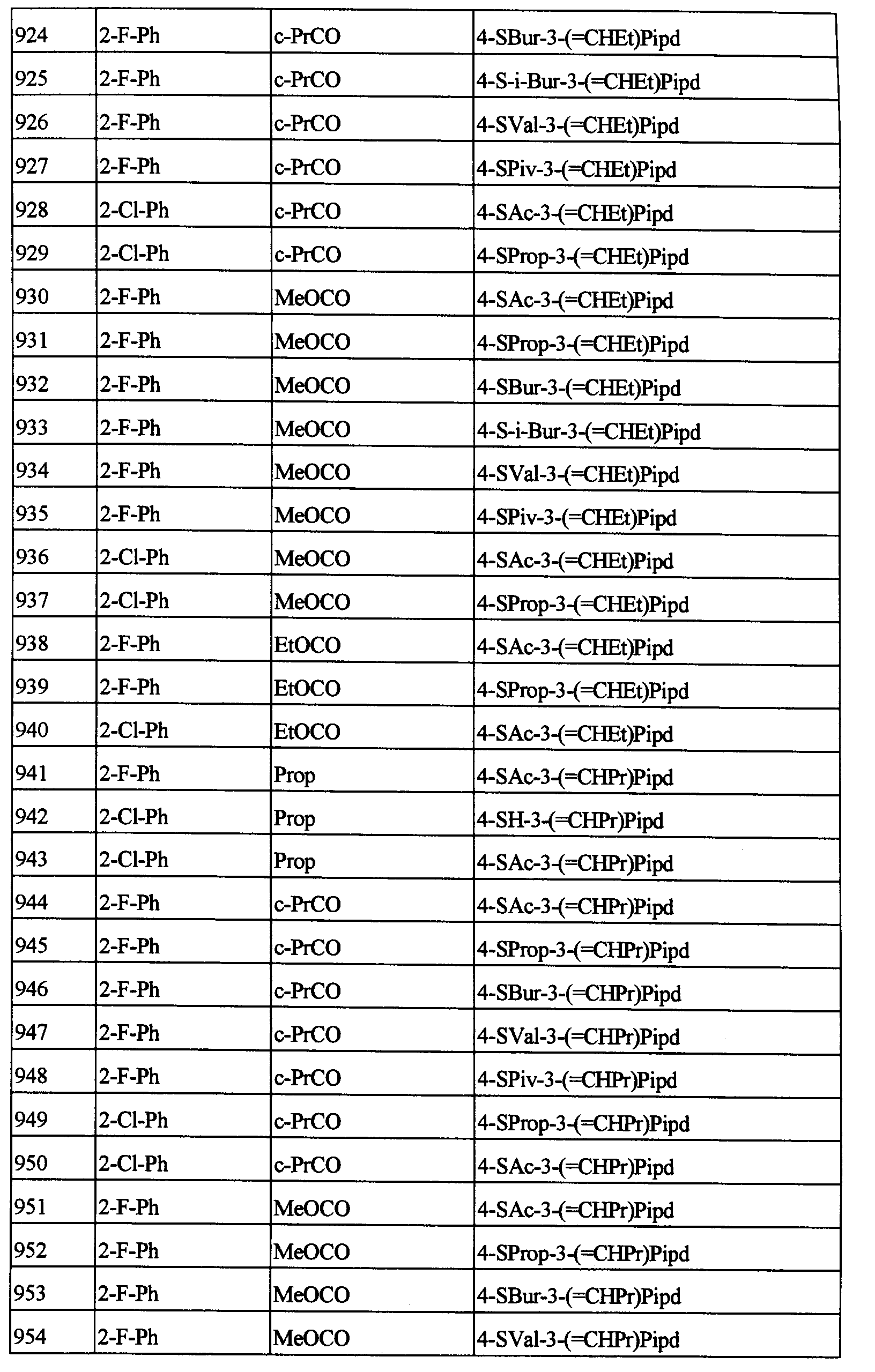


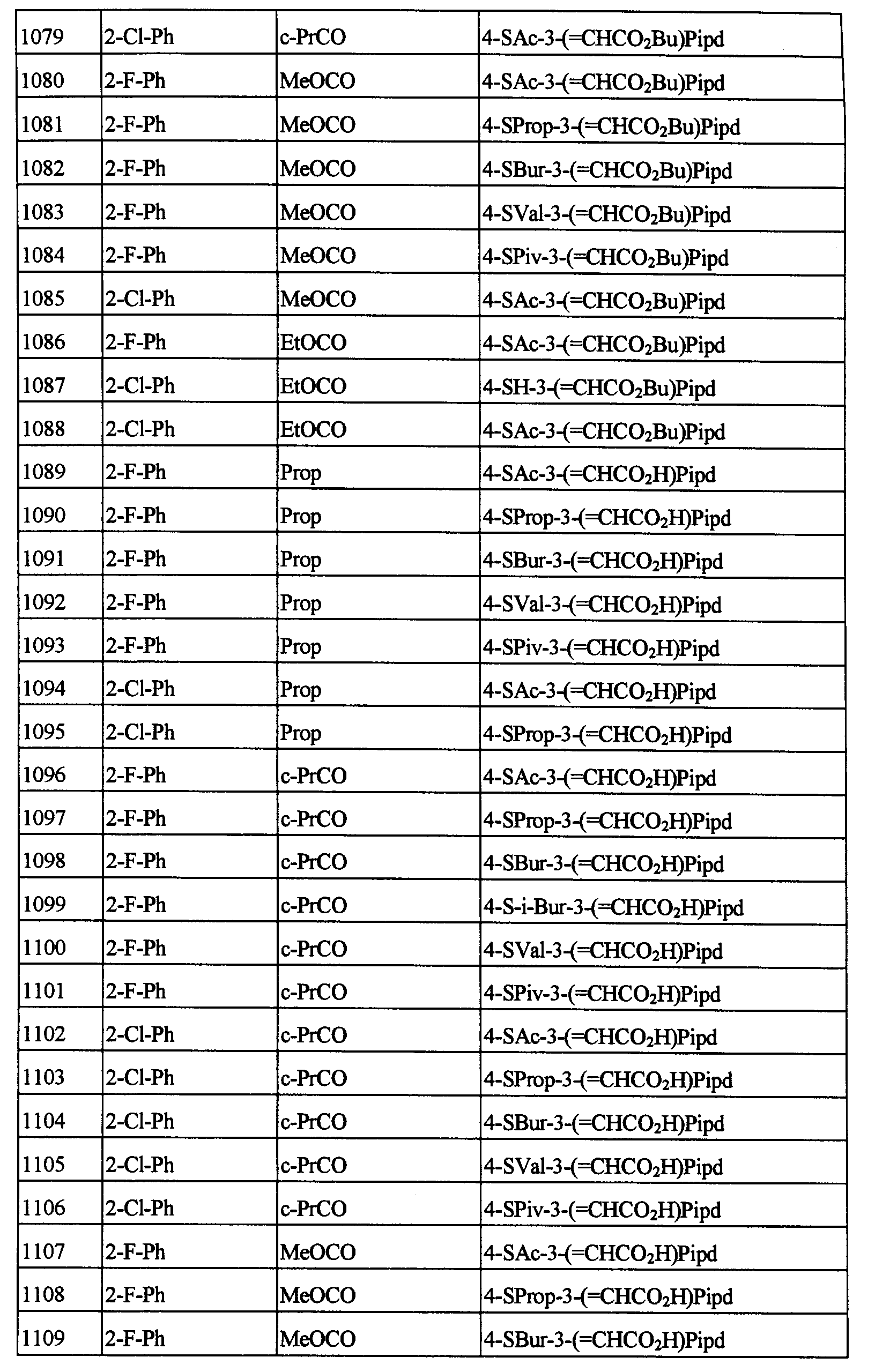
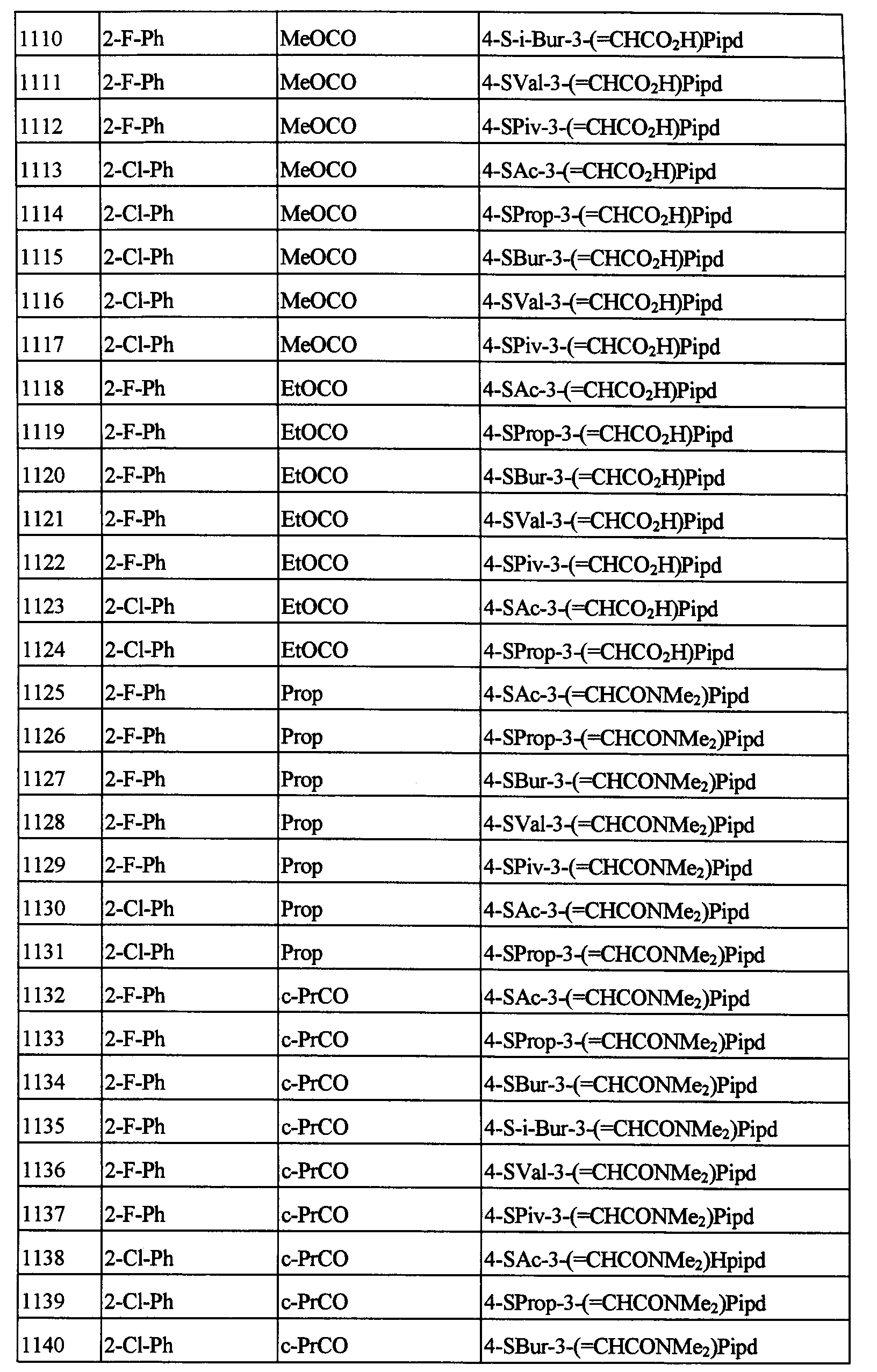
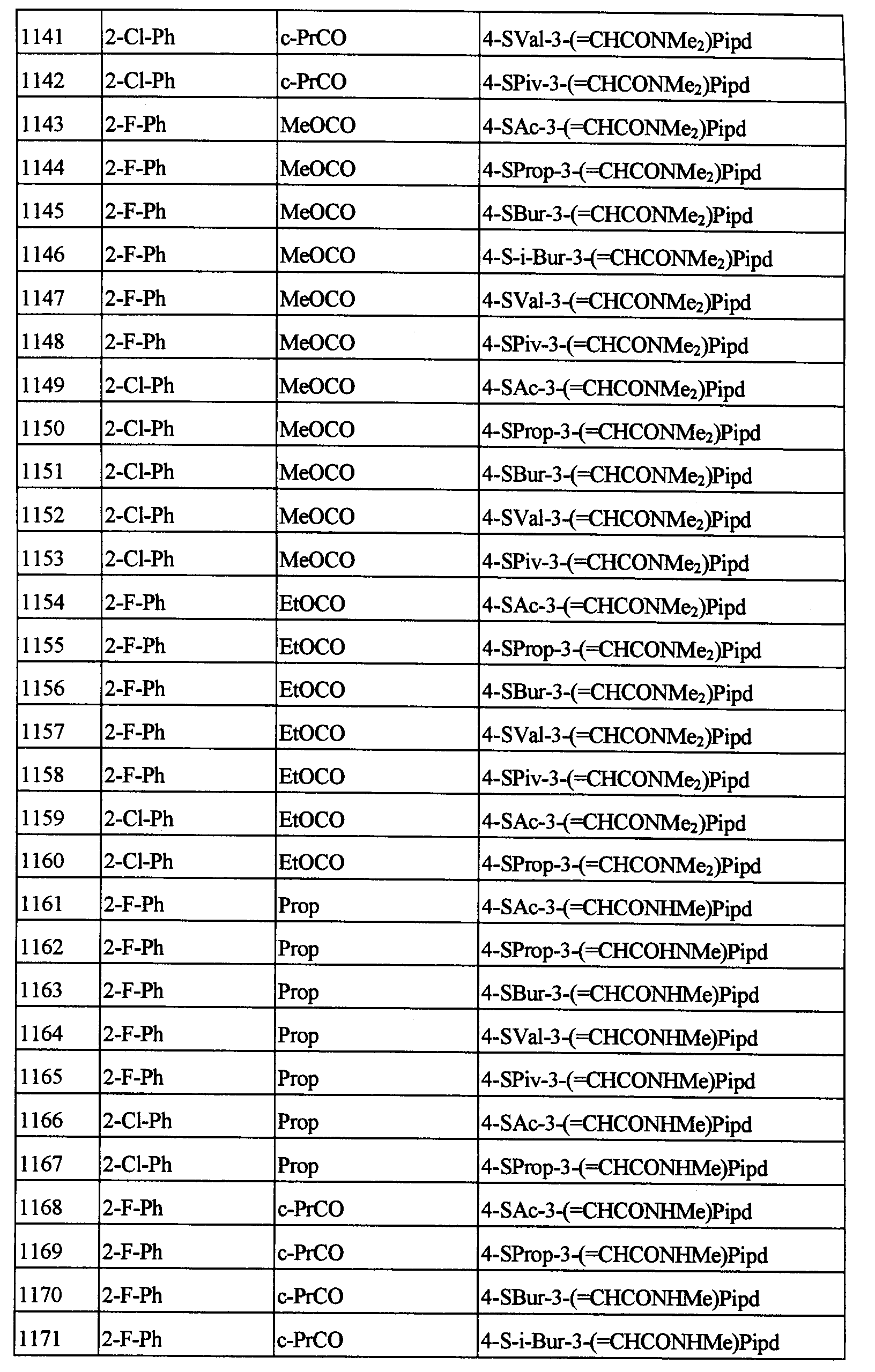


more preferred are the compounds of Compound Nos. 5, 10, 20, 26, 29, 36, 41, 51, 57, 60, 67, 74, 82, 88, 91, 98, 113, 119, 122, 129, 134, 141, 144, 150, 153, 160, 175, 181, 184, 191, 198, 203, 206, 212, 215, 222, 237, 243, 246, 253, 258, 268, 274, 277, 284, 299, 305, 308, 314, 317, 324, 336, 339, 346, 349, 358, 361, 368, 371, 380, 382, 383, 390, 392, 400, 403, 410, 413, 422, 425, 432, 435, 444, 446, 447, 449, 454, 456, 462, 464, 467, 471, 474, 477, 486, 489, 496, 499, 508, 511, 518, 521, 530, 532, 533, 540, 542, 543, 552, 553, 554, 555, 558, 565, 568, 574, 589, 590, 591, 594, 595, 597, 598, 600, 601, 602, 603, 608, 609, 610, 613, 616, 617, 619, 620, 621, 651, 656, 658, 668, 669, 675, 688, 716, 717, 723, 728, 735, 761, 768, 773, 780, 800, 802, 803, 806, 813, 816, 826, 828, 829, 832, 839, 841, 854, 860, 865, 890, 896, 901, 922, 930, 944, 951, 963, 986, 987, 992, 997, 1003, 1022, 1023, 1028, 1033, 1039, 1054, 1060, 1061, 1073, 1079, 1089, 1094, 1096, 1098, 1102, 1107, 1109, 1113, 1114, 1132, 1138, 1143, 1149, 1168, 1174, 1179, 1185, 1200, 1207, 1219, 1226, 1236, 1242, 1248, 1250, 1256, 1279, 1281, 1296, 1300, 1302, 1304, 1308, 1309, 1310, 1312 and 1316,
still more preferred are the compounds of Compound Nos. 5, 20, 26, 29, 36, 67, 82, 88, 91, 113, 119, 129, 144, 150, 175, 191, 206, 212, 253, 268, 274, 277, 336, 358, 400, 403, 410, 422, 425, 432, 435, 464, 467, 474, 477, 486, 496, 508, 518, 530, 540, 552, 554, 589, 590, 591, 594, 595, 600, 601, 602, 608, 610, 616, 617, 619, 620, 621, 656, 658, 716, 717, 728, 761, 773, 800, 803, 826, 890, 1022, 1023, 1039, 1096, 1098, 1102, 1107, 1109, 1132, 1143, 1168, 1179, 1200, 1236, 1242, 1248, 1296, 1302, 1308, 1312 and 1316, and
particularly preferred are the compounds of:


| Test compound | Test 1 (bleeding time extending ratio) | |
| 10 mg/kg | 30 mg/kg | |
| Example 1(a) | 1.06 | 2.06 |
| Example 1(b) | - | 1.46 |
| Example 10(a) | > 2.75 | > 2.75 |
| Example 13 | > 2.75 | > 2.75 |
| Example 15(a) | 2.53 | > 2.75 |
| Example 18 | 1.45 | 2.57 |
| Example 28 | 1.24 | 2.16 |
| Test compound | Test 2 (inhibition %) | |
| 10 mg/kg | 30 mg/kg | |
| Example 1(a) | 5.7 | 23.3 |
| Example 10(a) | 88.6 | 97.2 |
| Example 15(a) | 18.6 | 95.9 |
| Example 18 | - | 18.3 |
| Example 28 | - | 39.6 |
| Test compound | Test 3 (inhibition %) | |
| 10 µg/ml | 30 µg/ml | |
| Example 1(b) | 48.6 | 70.6 |
| Example 12 | 41.2 | 68.9 |
Claims (31)
- A cyclic amine derivative having the following formula:[wherein R1 represents a substituted or unsubstituted phenyl group (the substituent of said phenyl group being a C1-C4 alkyl group, a halogen atom, a fluoro-substituted-(C1-C4 alkyl) group, a C1-C4 alkoxy group, a fluoro-substituted-(C1-C4 alkoxy) group, a cyano group or a nitro group),
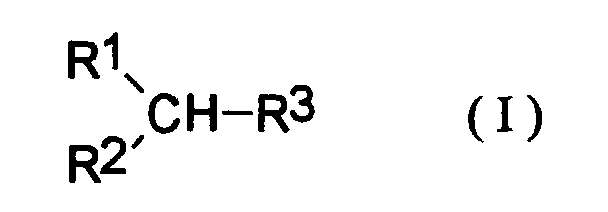
R2 represents a substituted or unsubstituted, C1-C8 aliphatic acyl group (the substituent of said group being a halogen atom, a hydroxyl group, a C1-C4 alkoxy group or a cyano group), a substituted or unsubstituted benzoyl group (the substituent of said group being a C1-C4 alkyl group, a halogen atom or a C1-C4 alkoxy group) or a (C1-C4 alkoxy)carbonyl group,
R3 represents a substituted, 3 to 7 membered saturated cyclic amino group which may form a fused ring [the non-optional substituent of said group being a protected or unprotected mercapto group or a C1-C4 alkyl group substituted with a protected or unprotected mercapto group, said cyclic amino group being preferably further substituted with a group of the formula =CR4R5 (in which R4 and R5 are the same or different and each independently represents a hydrogen atom, a C1-C4 alkyl group, a carboxy group, a (C1-C4 alkoxy)carbonyl group, a carbamoyl group or a mono- or di-(C1-C4 alkyl)carbamoyl group); the protecting group for said mercapto group being a C1-C20 alkanoyl group, a C3-C20 alkenoyl group, a substituted or unsubstituted benzoyl group (the substituent of said group being a C1-C4 alkyl group, a halogen atom or a C1-C4 alkoxy group) or a (C1-C4 alkoxy)carbonyl group]; or pharmaceutically acceptable salts thereof. - The cyclic amine derivative or pharmaceutically acceptable salts of claim 1, wherein R1 represents a substituted phenyl group (the substituent of said group being methyl, ethyl, halogen, fluoro-substituted-methyl, methoxy, ethoxy, fluoro-substituted-methoxy, cyano or nitro).
- The cyclic amine derivative or pharmaceutically acceptable salts of claim 1, wherein R1 represents a substituted phenyl group (the substituent of said group being fluorine, chlorine, bromine, trifluoromethyl, difluoromethoxy, trifluoromethoxy, cyano or nitro).
- The cyclic amine derivative or pharmaceutically acceptable salts of claim 1, wherein R1 represents a substituted phenyl group (the substituent of said group being fluorine or chlorine).
- The cyclic amine derivative or pharmaceutically acceptable salts of claim 1, wherein the number of substituents on the substituted phenyl group represented by R1 ranges from 1 to 3.
- The cyclic amine derivative or pharmaceutically acceptable salts of claim 1, wherein the number of substituents on the substituted phenyl group represented by R1 is 1 or 2.
- The cyclic amine derivative or pharmaceutically acceptable salts of claim 1, wherein the position of the substituents on the substituted phenyl group represented by R1 is 2 or 4.
- The cyclic amine derivative or pharmaceutically acceptable salts of claim 1, wherein R2 represents a substituted or unsubstituted C2-C4 alkanoyl or (C3-C6 cycloalkyl)carbonyl group (the substituent of said group being fluorine, chlorine, hydroxyl, methoxy, ethoxy or cyano), a substituted or unsubstituted benzoyl group (the substituent of said group being methyl, ethyl, fluorine, chlorine, methoxy or ethoxy) or a (C1-C4 alkoxy)carbonyl group.
- The cyclic amine derivative or pharmaceutically acceptable salts of claim 1, wherein R2 represents a C2-C4 alkanoyl or (C3-C6 cycloalkyl)carbonyl group which is unsubstituted or substituted by fluorine or chlorine, a benzoyl group or a (C1-C4 alkoxy)carbonyl group.
- The cyclic amine derivative or pharmaceutically acceptable salts of claim 1, wherein R2 represents an acetyl, propionyl, isobutyryl, cyclopropylcarbonyl, cyclobutylcarbonyl, methoxycarbonyl or ethoxycarbonyl group, said groups being unsubstituted or substituted by fluorine or chlorine.
- The cyclic amine derivative or pharmaceutically acceptable salts of claim 1, wherein R2 represents a propionyl, cyclopropylcarbonyl, methoxycarbonyl or ethoxycarbonyl group.
- The cyclic amine derivative or pharmaceutically acceptable salts of claim 1, wherein R3 represents a 3-(protected or unprotected mercapto, or protected or unprotected mercapto C1-C4 alkyl)-1-azetidinyl group, 3-(protected or unprotected mercapto, or protected or unprotected mercapto C1-C4 alkyl)-1-pyrrolidinyl group, 3-or 4-(protected or unprotected mercapto, or protected or unprotected mercapto C1-C4 alkyl)-1-piperidinyl group, 4-(protected or unprotected mercapto, or protected or unprotected mercapto C1-C4 alkyl)-3-(=CR4R5)-1-piperidinyl group or 8-aza-3-(protected or unprotected mercapto, or protected or unprotected mercapto C1-C4 alkyl)bicyclo[3.2.1]octan-8-yl group,
R4 and R5 are the same or different and each independently represents a hydrogen atom, C1-C4 alkyl group, carboxy group, (C1-C4 alkoxy)carbonyl group, carbamoyl group, or mono- or di-(C1-C4 alkyl)carbamoyl group, and
the protecting group for the mercapto group is a C1-C20 alkanoyl, C3-C20 alkenoyl, substituted or unsubstituted benzoyl (the substituent of said group being C1-C4 alkyl, halogen or C1-C4 alkoxy) or (C1-C4 alkoxy)carbonyl group. - The cyclic amine derivative or pharmaceutically acceptable salts of claim 1, wherein R3 represents a 3-(protected or unprotected mercapto, or protected or unprotected mercaptomethyl)-1-azetidinyl group, 3-(protected or unprotected mercapto, or protected or unprotected mercaptomethyl)-1-pyrrolidinyl group, 3-or 4-(protected or unprotected mercapto, or protected or unprotected mercaptomethyl)-1-piperidinyl group, 4-(protected or unprotected mercapto)-3-(=CR4R5)-1-piperidinyl group or 8-aza-3-(protected or unprotected mercapto, or protected or unprotected mercaptomethyl)bicyclo[3.2.1]octan-8-yl group,
R4 and R5 are the same or different and each independently represents a hydrogen atom or a methyl, ethyl, carboxy, methoxycarbonyl, ethoxycarbonyl, carbamoyl, methylcarbamoyl, ethylcarbamoyl, dimethylcarbamoyl or diethylcarbamoyl group, and
the protecting group for the mercapto group is a C1-C20 alkanoyl, C8-C20 alkenoyl, substituted or unsubstituted benzoyl (the substituent of said group being methyl, ethyl, fluorine, chlorine, methoxy or ethoxy), methoxycarbonyl or ethoxycarbonyl group. - The cyclic amine derivative or pharmaceutically acceptable salts of claim 1, wherein R3 represents the 3-(protected or unprotected mercapto)-1-azetidinyl group, 3-(protected or unprotected mercapto)-1-pyrrolidinyl group, 3- or 4-(protected or unprotected mercapto)-1-piperidinyl group, 4-(protected or unprotected mercapto)-3-(=CR4R5)-1-piperidinyl group or 8-aza-3-(protected or unprotected mercapto)bicyclo[3.2.1]octan-8-yl group,
R4 represents a hydrogen atom, R5 represents a hydrogen atom or a methyl, carboxy, methoxycarbonyl, ethoxycarbonyl, carbamoyl, methylcarbamoyl or dimethylcarbamoyl group, and
the protecting group for the mercapto group is a C2-C6 alkanoyl, palmitoleoyl, oleoyl, benzoyl, methoxycarbonyl or ethoxycarbonyl group. - The cyclic amine derivative or pharmaceutically acceptable salts of claim 1, wherein R3 represents a 3-(protected or unprotected mercapto)-1-azetidinyl group, 4-(protected or unprotected mercapto)-1-piperidinyl group, 4-(protected or unprotected mercapto)-3-(=CR4R5)-1-piperidinyl group or 8-aza-3-(protected or unprotected mercapto)bicyclo[3.2.1]octan-8-yl group,
R4 represents a hydrogen atom, R5 represents a carboxy, methoxycarbonyl, ethoxycarbonyl, carbamoyl, methylcarbamoyl or dimethylcarbamoyl group, and
the protecting group for the mercapto group is a C2-C5 alkanoyl, benzoyl, methoxycarbonyl or ethoxycarbonyl group. - The cyclic amine derivative or pharmaceutically acceptable salts of claim 1, wherein R1 represents a substituted phenyl group (the substituent of said group being methyl, ethyl, halogen, fluoro-substituted-methyl, methoxy, ethoxy, fluoro-substituted-methoxy, cyano or nitro),
the number of substituents of the substituted phenyl group represented by R1 ranges from 1 to 3,
R2 represents a substituted or unsubstituted C2-C4 alkanoyl or (C3-C6 cycloalkyl)carbonyl group (the substituent of said group being fluorine, chlorine, hydroxyl, methoxy, ethoxy or cyano), a substituted or unsubstituted benzoyl group (the substituent of said group being methyl, ethyl, fluorine, chlorine, methoxy or ethoxy) or a (C1-C4 alkoxy)carbonyl group. - The cyclic amine derivative or pharmaceutically acceptable salts of claim 1, wherein R1 represents a substituted phenyl group (the substituent of said group being fluorine, chlorine, bromine, trifluoromethyl, difluoromethoxy, trifluoromethoxy, cyano or nitro),
the number of substituents on the substituted phenyl group represented by R1 is 1 or 2, and
R2 represents a C2-C4 alkanoyl or (C3-C6 cycloalkyl)carbonyl group which is unsubstituted or is substituted by fluorine or chlorine, a benzoyl group or a (C1-C4 alkoxy)carbonyl group. - The cyclic amine derivative or pharmaceutically acceptable salts of claim 1, wherein R1 represents a substituted phenyl group (the substituent of said group being fluorine, chlorine, bromine, trifluoromethyl, difluoromethoxy, trifluoromethoxy, cyano or nitro),
the position of the substituent on the substituted phenyl group represented by R1 is 2 or 4,
R2 represents a C2-C4 alkanoyl or (C3-C6 cycloalkyl)carbonyl group which is unsubstituted or is substituted by fluorine or chlorine, a benzoyl group or a (C1-C4 alkoxy)carbonyl group,
R3 represents a 3-(protected or unprotected mercapto, or protected or unprotected mercapto C1-C4 alkyl)-1-azetidinyl group, 3-(protected or unprotected mercapto, or protected or unprotected mercapto C1-C4 alkyl)-1-pyrrolidinyl group, 3-or 4-(protected or unprotected mercapto, or protected or unprotected mercapto C1-C4 alkyl)-1-piperidinyl group, 4-(protected or unprotected mercapto, or protected or unprotected mercapto C1-C4 alkyl)-3-(=CR4R5)-1-piperidinyl group or 8-aza-3-(protected or unprotected mercapto, or protected or unprotected mercapto C1-C4 alkyl)bicyclo[3.2.1]octan-8-yl group,
R4 and R5 are the same or different and each independently represents a hydrogen atom, C1-C4 alkyl group, carboxy group, (C1-C4 alkoxy)carbonyl group, carbamoyl group, or mono- or di-(C1-C4 alkyl)carbamoyl group, and
the protecting group for the mercapto group is a C1-C20 alkanoyl, C3-C20 alkenoyl, substituted or unsubstituted benzoyl (the substituent of said group being C1-C4 alkyl, halogen or C1-C4 alkoxy) or (C1-C4 alkoxy)carbonyl group. - The cyclic amine derivative or pharmaceutically acceptable salts of claim 1, wherein R1 represents a substituted phenyl group (the substituent of said group being fluorine or chlorine),
the position of the substituent on the substituted phenyl group represented by R1 is 2 or 4,
R2 represents an acetyl, propionyl, isobutyryl, cyclopropylcarbonyl, cyclobutylcarbonyl, methoxycarbonyl or ethoxycarbonyl group, said groups being unsubstituted or being substituted by fluorine,
R3 represents a 3-(protected or unprotected mercapto, or protected or unprotected mercaptomethyl)-1-azetidinyl group, 3-(protected or unprotected mercapto, or protected or unprotected mercaptomethyl)-1-pyrrolidinyl group, 3- or 4-(protected or unprotected mercapto, or protected or unprotected mercaptomethyl)-1-piperidinyl group, 4-(protected or unprotected mercapto-3-(=CR4R5)-1-piperidinyl group or 8-aza-3-(protected or unprotected mercapto, or protected or unprotected mercaptomethyl)bicyclo[3.2.1]octan-8-yl group,
R4 and R5 are the same or different and each independently represents a hydrogen atom or a methyl, ethyl, carboxy, methoxycarbonyl, ethoxycarbonyl, carbamoyl, methylcarbamoyl, ethylcarbamoyl, dimethylcarbamoyl or diethylcarbamoyl group, and
the protecting group for the mercapto group is a C1-C20 alkanoyl, C8-C20 alkenoyl, substituted or unsubstituted benzoyl (the substituent of said group being methyl, ethyl, fluorine, chlorine, methoxy or ethoxy) or (C1-C4 alkoxy)carbonyl group. - The cyclic amine derivative or pharmaceutically acceptable salts of claim 1, wherein R1 represents a substituted phenyl group (the substituent of said group being fluorine or chlorine),
the position of the substituent on the substituted phenyl group represented by R1 is 2 or 4,
R2 represents a propionyl, cyclopropylcarbonyl, methoxycarbonyl or ethoxycarbonyl group,
R3 represents a 3-(protected or unprotected mercapto)-1-azetidinyl group, 3-(protected or unprotected mercapto)-1-pyrrolidinyl group, 3- or 4-(protected or unprotected mercapto)-1-piperidinyl group, 4-(protected or unprotected mercapto)-3-(=CR4R5)-1-piperidinyl group or 8-aza-3-(protected or unprotected mercapto)bicyclo[3.2.1]octan-8-yl group,
R4 represents a hydrogen atom, R5 represents a hydrogen atom or a methyl, carboxy, methoxycarbonyl, ethoxycarbonyl, carbamoyl, methylcarbamoyl, or dimethylcarbamoyl group, and
the protecting group for the mercapto group is a C2-C6 alkanoyl, palmitoleoyl, oleoyl, benzoyl, methoxycarbonyl or ethoxycarbonyl group. - The cyclic amine derivative or pharmaceutically acceptable salts of claim 1, wherein R1 represents a substituted phenyl group (the substituent of said group being fluorine or chlorine),
the position of the substituent on the substituted phenyl group represented by R1 is 2 or 4,
R2 represents a propionyl, cyclopropylcarbonyl, methoxycarbonyl or ethoxycarbonyl group,
R3 represents a 3-(protected or unprotected mercapto)-1-azetidinyl group, 4-(protected or unprotected mercapto)-1-piperidinyl group, 4-(protected or unprotected mercapto)-3-(=CR4R5)-1-piperidinyl group or 8-aza-3-(protected or unprotected mercapto)bicyclo[3.2.1]octan-8-yl group,
R4 represents a hydrogen atom, R5 represents a carboxy, methoxycarbonyl, ethoxycarbonyl, carbamoyl, methylcarbamoyl or dimethylcarbamoyl group, and
the protecting group for the mercapto group is a C2-C5 alkanoyl, benzoyl, methoxycarbonyl or ethoxycarbonyl group. - The cyclic amine derivative of claim 1, selected from the group consisting of:1-(α-cyclopropylcarbonyl-2-fluorobenzyl)-4-mercaptopiperidine,1-(2-fluoro-α-methoxycarbonylbenzyl)-4-mercaptopiperidine,1-(2-chloro-α-methoxycarbonylbenzyl)-4-mercaptopiperidine,1-(α-cyclopropylcarbonyl-2-fluorobenzyl)-3-ethoxycarbonylmethylidene-4-mercaptopiperidine,1-(2-chloro-α-methoxycarbonylbenzyl)-3-ethoxycarbonylmethylidene-4-mercaptopiperidine,1-(α-cyclopropylcarbonyl-2-fluorobenzyl)-3-carboxymethylidene-4-mercaptopiperidine,1-(2-chloro-α-methoxycarbonylbenzyl)-3-carboxymethylidene-4-mercaptopiperidine1-(α-cyclopropylcarbonyl-2-fluorobenzyl)-3-(N,N-dimethylcarbamoyl)methylidene-4-mercaptopiperidine,1-(α-cyclopropylcarbonyl-2-fluorobenzyl-3-(N-methylcarbamoyl)methylidene-4-mercaptopiperidine,4-acetylthio-1-(α-cyclopropylcarbonyl-2-fluorobenzyl)piperidine4-butyrylthio-1-(α-cyclopropylcarbonyl-2-fluorobenzyl)piperidine1-(α-cyclopropylcarbonyl-2-fluorobenzyl)-4-pivaloylthiopiperidine4-benzoylthio-1-(α-cyclopropylcarbonyl-2-fluorobenzyl)piperidine4-acetylthio-1-(2-fluoro-α-methoxycarbonylbenzyl)piperidine4-benzoylthio-1-(2-fluoro-α-methoxycarbonylbenzyl)piperidine4-acetylthio-1-(2-chloro-α-methoxycarbonylbenzyl)piperidine,3-acetylthio-1-(α-cyclopropylcarbonyl-2-fluorobenzyl)azetidine,4-acetylthio-1-(α-cyclopropylcarbonyl-2-fluorobenzyl)-3-ethoxycarbonylmethylidenepiperidine,4-acetylthio-1-(2-chloro-α-methoxycarbonylbenzyl)-3-ethoxycarbonylmethylidenepiperidine,4-acetylthio-1-(α-cyclopropylcarbonyl-2-fluorobenzyl)-3-(N,N-dimethylcarbamoyl)methylidenepiperidine and4-acetylthio-1-(α-cyclopropylcarbonyl-2-fluorobenzyl)-3-(N-methylcarbamoyl)methylidenepiperidine, or pharmaceutically acceptable salts thereof.
- A composition for the prevention or treatment of embolism, which comprises as an effective ingredient a cyclic amine derivative or pharmaceutically acceptable salts thereof as claimed in any one of claims 1 to 22.
- A composition for the prevention or treatment of thrombosis, which comprises as an effective ingredient a cyclic amine derivative or pharmaceutically acceptable salts thereof as claimed in any one of claims 1 to 22.
- A composition for the prevention or treatment of arteriosclerosis, which comprises as a effective ingredient a cyclic amine derivative or pharmaceutically acceptable salts thereof as claimed in any one of claims 1 to 22.
- Use of a cyclic amine derivative or pharmaceutically acceptable salts thereof as claimed in any one of claims 1 to 22 for the preparation of a pharmaceutical for the prevention and treatment of embolism.
- Use of a cyclic amine derivative or pharmaceutically acceptable salts thereof as claimed in any one of claims 1 to 22 for the preparation of a pharmaceutical for the prevention and treatment of thrombosis.
- Use of a cyclic amine derivative or pharmaceutically acceptable salts thereof as claimed in any one of claims 1 to 22 for the preparation of a pharmaceutical for the prevention and treatment of arteriosclerosis.
- A method for the prevention or treatment of embolism, which comprises administering a pharmacologically effective amount of a cyclic amine derivative or pharmaceutically acceptable salts thereof as claimed in any one of claims 1 to 22 to a warm-blooded animal.
- A method for the prevention or treatment of thrombosis, which comprises administering a pharmacologically effective amount of a cyclic amine derivative or pharmaceutically acceptable salts thereof as claimed in any one of claims 1 to 22 to a warm-blooded animal.
- A method for the prevention or treatment of arteriosclerosis, which comprises administering a pharmacologically effective amount of a cyclic amine derivative or pharmaceutically acceptable salts thereof as claimed in any one of claims 1 to 22 to a warm-blooded animal.
Priority Applications (1)
| Application Number | Priority Date | Filing Date | Title |
|---|---|---|---|
| DK97937814T DK0934928T3 (en) | 1997-08-28 | 1997-08-28 | Cyclic amine derivatives |
Applications Claiming Priority (3)
| Application Number | Priority Date | Filing Date | Title |
|---|---|---|---|
| JP22650796 | 1996-08-28 | ||
| JP22650796 | 1996-08-28 | ||
| PCT/JP1997/002990 WO1998008811A1 (en) | 1996-08-28 | 1997-08-28 | Cyclic amine derivatives |
Publications (3)
| Publication Number | Publication Date |
|---|---|
| EP0934928A1 true EP0934928A1 (en) | 1999-08-11 |
| EP0934928A4 EP0934928A4 (en) | 2001-05-09 |
| EP0934928B1 EP0934928B1 (en) | 2004-10-13 |
Family
ID=16846212
Family Applications (1)
| Application Number | Title | Priority Date | Filing Date |
|---|---|---|---|
| EP97937814A Expired - Lifetime EP0934928B1 (en) | 1996-08-28 | 1997-08-28 | Cyclic amine derivatives |
Country Status (17)
| Country | Link |
|---|---|
| US (1) | US6087379A (en) |
| EP (1) | EP0934928B1 (en) |
| KR (1) | KR100417887B1 (en) |
| CN (1) | CN1192019C (en) |
| AT (1) | ATE279389T1 (en) |
| AU (1) | AU715531B2 (en) |
| CA (1) | CA2263983C (en) |
| CZ (1) | CZ300295B6 (en) |
| DE (1) | DE69731218T2 (en) |
| ES (1) | ES2229382T3 (en) |
| HU (1) | HU228082B1 (en) |
| IL (1) | IL128690A (en) |
| NO (1) | NO312955B1 (en) |
| NZ (1) | NZ334389A (en) |
| PT (1) | PT934928E (en) |
| RU (1) | RU2163596C2 (en) |
| WO (1) | WO1998008811A1 (en) |
Cited By (54)
| Publication number | Priority date | Publication date | Assignee | Title |
|---|---|---|---|---|
| WO2007024472A3 (en) * | 2005-08-19 | 2007-06-07 | Lilly Co Eli | USE OF PAR- l/PAR- 4 INHIBITORS FOR TREATING OR PREVENTING VASCULAR DISEASES |
| WO2010114181A1 (en) * | 2009-04-02 | 2010-10-07 | Shionogi & Co., Ltd. | Acrylamide compounds and the use thereof |
| KR101044559B1 (en) * | 2007-09-20 | 2011-06-28 | 국제약품공업주식회사 | Acid addition salts of thiol compounds and preparation methods thereof |
| WO2013024376A1 (en) * | 2011-08-16 | 2013-02-21 | Mahesh Kandula | Compositions and methods for the treatment of atherothrombosis |
| US9096537B1 (en) | 2014-12-31 | 2015-08-04 | Mahesh Kandula | Compositions and methods for the treatment of mucositis |
| US9102649B1 (en) | 2014-09-29 | 2015-08-11 | Mahesh Kandula | Compositions and methods for the treatment of multiple sclerosis |
| US9108942B1 (en) | 2014-11-05 | 2015-08-18 | Mahesh Kandula | Compositions and methods for the treatment of moderate to severe pain |
| US9150557B1 (en) | 2014-11-05 | 2015-10-06 | Cellix Bio Private Limited | Compositions and methods for the treatment of hyperglycemia |
| US9175008B1 (en) | 2014-11-05 | 2015-11-03 | Cellix Bio Private Limited | Prodrugs of anti-platelet agents |
| US9174931B2 (en) | 2013-06-04 | 2015-11-03 | Cellix Bio Private Limited | Compositions for the treatment of diabetes and pre-diabetes |
| US9173877B1 (en) | 2014-11-05 | 2015-11-03 | Cellix Bio Private Limited | Compositions and methods for the treatment of local pain |
| US9187427B2 (en) | 2012-08-03 | 2015-11-17 | Cellix Bio Private Limited | N-substituted nicotinamide compounds and compositions for the treatment migraine and neurologic diseases |
| US9206111B1 (en) | 2014-12-17 | 2015-12-08 | Cellix Bio Private Limited | Compositions and methods for the treatment of neurological diseases |
| US9227974B2 (en) | 2012-05-23 | 2016-01-05 | Cellex Bio Private Limited | Compositions and methods for the treatment of respiratory disorders |
| US9233161B2 (en) | 2012-05-10 | 2016-01-12 | Cellix Bio Private Limited | Compositions and methods for the treatment of neurological conditions |
| US9242939B2 (en) | 2012-05-10 | 2016-01-26 | Cellix Bio Private Limited | Compositions and methods for the treatment of respiratory disorders |
| US9266823B2 (en) | 2012-05-08 | 2016-02-23 | Cellix Bio Private Limited | Compositions and methods for the treatment of parkinson's disease |
| US9273061B2 (en) | 2012-05-10 | 2016-03-01 | Cellix Bio Private Limited | Compositions and methods for the treatment of chronic pain |
| US9284287B1 (en) | 2014-11-05 | 2016-03-15 | Cellix Bio Private Limited | Compositions and methods for the suppression of carbonic anhydrase activity |
| US9290486B1 (en) | 2014-11-05 | 2016-03-22 | Cellix Bio Private Limited | Compositions and methods for the treatment of epilepsy |
| US9303038B2 (en) | 2011-09-06 | 2016-04-05 | Cellix Bio Private Limited | Compositions and methods for the treatment of epilepsy and neurological diseases |
| US9309233B2 (en) | 2012-05-08 | 2016-04-12 | Cellix Bio Private Limited | Compositions and methods for the treatment of blood clotting disorders |
| US9315461B2 (en) | 2012-05-10 | 2016-04-19 | Cellix Bio Private Limited | Compositions and methods for the treatment of neurologic diseases |
| US9315478B2 (en) | 2012-05-10 | 2016-04-19 | Cellix Bio Private Limited | Compositions and methods for the treatment of metabolic syndrome |
| US9321716B1 (en) | 2014-11-05 | 2016-04-26 | Cellix Bio Private Limited | Compositions and methods for the treatment of metabolic syndrome |
| US9321775B2 (en) | 2012-05-10 | 2016-04-26 | Cellix Bio Private Limited | Compositions and methods for the treatment of moderate to severe pain |
| US9333187B1 (en) | 2013-05-15 | 2016-05-10 | Cellix Bio Private Limited | Compositions and methods for the treatment of inflammatory bowel disease |
| US9339484B2 (en) | 2012-05-10 | 2016-05-17 | Cellix Bio Private Limited | Compositions and methods for the treatment of restless leg syndrome and fibromyalgia |
| US9346742B2 (en) | 2012-05-10 | 2016-05-24 | Cellix Bio Private Limited | Compositions and methods for the treatment of fibromyalgia pain |
| US9394288B2 (en) | 2012-05-10 | 2016-07-19 | Cellix Bio Private Limited | Compositions and methods for the treatment of asthma and allergy |
| US9399634B2 (en) | 2012-05-07 | 2016-07-26 | Cellix Bio Private Limited | Compositions and methods for the treatment of depression |
| US9403857B2 (en) | 2012-05-10 | 2016-08-02 | Cellix Bio Private Limited | Compositions and methods for the treatment of metabolic syndrome |
| US9403826B2 (en) | 2012-05-08 | 2016-08-02 | Cellix Bio Private Limited | Compositions and methods for the treatment of inflammatory disorders |
| US9434729B2 (en) | 2012-05-23 | 2016-09-06 | Cellix Bio Private Limited | Compositions and methods for the treatment of periodontitis and rheumatoid arthritis |
| US9434704B2 (en) | 2012-05-08 | 2016-09-06 | Cellix Bio Private Limited | Compositions and methods for the treatment of neurological degenerative disorders |
| US9492409B2 (en) | 2012-05-23 | 2016-11-15 | Cellix Bio Private Limited | Compositions and methods for the treatment of local pain |
| US9499527B2 (en) | 2012-05-10 | 2016-11-22 | Cellix Bio Private Limited | Compositions and methods for the treatment of familial amyloid polyneuropathy |
| US9499526B2 (en) | 2012-05-10 | 2016-11-22 | Cellix Bio Private Limited | Compositions and methods for the treatment of neurologic diseases |
| US9498461B2 (en) | 2012-05-23 | 2016-11-22 | Cellix Bio Private Limited | Compositions and methods for the treatment of inflammatory bowel disease |
| US9522884B2 (en) | 2012-05-08 | 2016-12-20 | Cellix Bio Private Limited | Compositions and methods for the treatment of metabolic disorders |
| US9573927B2 (en) | 2012-05-10 | 2017-02-21 | Cellix Bio Private Limited | Compositions and methods for the treatment of severe pain |
| US9580383B2 (en) | 2012-05-23 | 2017-02-28 | Cellix Bio Private Limited | Compositions and methods for the treatment of multiple sclerosis |
| WO2014118649A3 (en) * | 2013-01-19 | 2017-03-23 | Cellixbio Private Limited | Compositions and methods for the treatment of cardiovascular diseases |
| US9624168B2 (en) | 2012-09-06 | 2017-04-18 | Cellix Bio Private Limited | Compositions and methods for the treatment inflammation and lipid disorders |
| US9642915B2 (en) | 2012-05-07 | 2017-05-09 | Cellix Bio Private Limited | Compositions and methods for the treatment of neuromuscular disorders and neurodegenerative diseases |
| US9670153B2 (en) | 2012-09-08 | 2017-06-06 | Cellix Bio Private Limited | Compositions and methods for the treatment of inflammation and lipid disorders |
| US9725404B2 (en) | 2014-10-27 | 2017-08-08 | Cellix Bio Private Limited | Compositions and methods for the treatment of multiple sclerosis |
| US9738631B2 (en) | 2012-05-07 | 2017-08-22 | Cellix Bio Private Limited | Compositions and methods for the treatment of neurological disorders |
| US9765020B2 (en) | 2012-05-23 | 2017-09-19 | Cellix Bio Private Limited | Dichlorophenyl-imino compounds and compositions, and methods for the treatment of mucositis |
| US9771355B2 (en) | 2014-09-26 | 2017-09-26 | Cellix Bio Private Limited | Compositions and methods for the treatment of epilepsy and neurological disorders |
| US9932294B2 (en) | 2014-12-01 | 2018-04-03 | Cellix Bio Private Limited | Compositions and methods for the treatment of multiple sclerosis |
| US10208014B2 (en) | 2014-11-05 | 2019-02-19 | Cellix Bio Private Limited | Compositions and methods for the treatment of neurological disorders |
| US10227301B2 (en) | 2015-01-06 | 2019-03-12 | Cellix Bio Private Limited | Compositions and methods for the treatment of inflammation and pain |
| EP4188935A4 (en) * | 2020-07-29 | 2024-07-17 | Shanghai Curegene Pharmaceutical Co., Ltd. | ANTI-PLATELET MEDICINES AND USES THEREOF |
Families Citing this family (15)
| Publication number | Priority date | Publication date | Assignee | Title |
|---|---|---|---|---|
| ID25589A (en) | 1998-02-27 | 2000-10-19 | Sankyo Company Ltd Cs | AMINO CYCLE COMPOUNDS |
| JP4750337B2 (en) * | 2000-06-08 | 2011-08-17 | 株式会社カネカ | Method for producing sulfonate ester |
| RU2300521C2 (en) * | 2000-12-01 | 2007-06-10 | Астразенека Аб | Novel derivatives of mandelic acid and their using as thrombin inhibitors |
| BRPI0416960A (en) * | 2003-11-28 | 2007-02-21 | Sankyo Co | cyclically amine derivative having heteroaryl ring |
| EA200700117A1 (en) | 2004-06-24 | 2007-06-29 | Инсайт Корпорейшн | N-SUBSTITUTED PIPERIDINES AND THEIR APPLICATION AS PHARMACEUTICAL PREPARATIONS |
| US20060009491A1 (en) * | 2004-06-24 | 2006-01-12 | Incyte Corporation | Amido compounds and their use as pharmaceuticals |
| US20090306059A1 (en) * | 2005-05-13 | 2009-12-10 | Tomio Kimura | Cyclic amine derivative having substituted alkyl group |
| BRPI0610311A2 (en) * | 2005-05-27 | 2010-06-15 | Daiichi Sankyo Co Ltd | cyclically amine derivative having substituted alkyl group |
| DE202009018503U1 (en) | 2009-04-30 | 2011-11-16 | Saint-Gobain Sekurit Deutschland Gmbh & Co. Kg | Infrared radiation shielding visible light transparent laminate with an infrared ray transparent optical window |
| CN106554303A (en) * | 2015-09-25 | 2017-04-05 | 陕西合成药业股份有限公司 | Thienopyridine analog derivative and its production and use |
| CN106554302A (en) * | 2015-09-25 | 2017-04-05 | 陕西合成药业股份有限公司 | Thienopyridine analog derivative and its production and use |
| CN106554368A (en) * | 2015-09-25 | 2017-04-05 | 陕西合成药业股份有限公司 | Thienopyridine analog derivative and its production and use |
| CN105481760A (en) * | 2016-01-20 | 2016-04-13 | 天津药物研究院有限公司 | Preparation method of derivative tipidogrel active metabolite |
| CN111484446A (en) * | 2020-04-02 | 2020-08-04 | 北京翼方生物科技有限责任公司 | Clopidogrel metabolic active body disulfide derivative, preparation method and medical application thereof |
| WO2025108300A1 (en) * | 2023-11-24 | 2025-05-30 | 上海柯君医药科技有限公司 | Crystal form of benzene sulfonate containing piperidine ring compound, and preparation method therefor and use thereof |
Family Cites Families (11)
| Publication number | Priority date | Publication date | Assignee | Title |
|---|---|---|---|---|
| FR2215948B1 (en) * | 1973-02-01 | 1976-05-14 | Centre Etd Ind Pharma | |
| FR2495156A1 (en) * | 1980-11-28 | 1982-06-04 | Sanofi Sa | THIENO-PYRIDINONE DERIVATIVES, PROCESS FOR THEIR PREPARATION AND THEIR THERAPEUTIC APPLICATION |
| FR2530247B1 (en) * | 1982-07-13 | 1986-05-16 | Sanofi Sa | NOVEL THIENO (3, 2-C) PYRIDINE DERIVATIVES, PROCESS FOR THEIR PREPARATION AND THERAPEUTIC APPLICATION |
| FR2576901B1 (en) * | 1985-01-31 | 1987-03-20 | Sanofi Sa | NOVEL DERIVATIVES OF A- (OXO-2 HEXAHYDRO-2,4,5,6,7,7A THIENO (3,2-C) PYRIDYL-5) ACETIC PHENYL, THEIR PREPARATION PROCESS AND THEIR THERAPEUTIC APPLICATION |
| FR2623810B2 (en) * | 1987-02-17 | 1992-01-24 | Sanofi Sa | ALPHA SALTS- (TETRAHYDRO-4,5,6,7 THIENO (3,2-C) PYRIDYL-5) (2-CHLORO-PHENYL) -THETHYL ACETATE DEXTROGYRE AND PHARMACEUTICAL COMPOSITIONS CONTAINING THE SAME |
| IT1245712B (en) * | 1991-04-09 | 1994-10-14 | Boehringer Mannheim Italia | USEFUL HETEROCYCLIC AMINES THERAPY OF ASTHMA AND AIRWAY INFLAMMATION |
| JPH04334358A (en) * | 1991-05-02 | 1992-11-20 | Ono Pharmaceut Co Ltd | Condensed benzeneoxy acetic acid derivative |
| FI101150B (en) * | 1991-09-09 | 1998-04-30 | Sankyo Co | Process for the preparation of tetrahydrothione nopyridine derivatives useful as a drug |
| WO1993014077A1 (en) * | 1992-01-21 | 1993-07-22 | Glaxo Group Limited | Piperidineacetic acid derivatives as inhibitors of fibrinogen-dependent blood platelet aggregation |
| ES2134284T3 (en) * | 1993-04-23 | 1999-10-01 | Hoechst Ag | PIRIDO-PIRIMIDINDIONAS, PROCEDURE FOR ITS PREPARATION AND ITS USE AS MEDICINES. |
| JPH09504274A (en) * | 1993-09-17 | 1997-04-28 | ブリガム アンド ウィメンズ ホスピタル | Use of nitric oxide adducts to prevent thrombosis on artificial and vascular surfaces |
-
1997
- 1997-07-28 NZ NZ334389A patent/NZ334389A/en not_active IP Right Cessation
- 1997-08-28 IL IL12869097A patent/IL128690A/en not_active IP Right Cessation
- 1997-08-28 AU AU40312/97A patent/AU715531B2/en not_active Expired
- 1997-08-28 HU HU9903762A patent/HU228082B1/en not_active IP Right Cessation
- 1997-08-28 EP EP97937814A patent/EP0934928B1/en not_active Expired - Lifetime
- 1997-08-28 CA CA002263983A patent/CA2263983C/en not_active Expired - Lifetime
- 1997-08-28 KR KR10-1999-7001526A patent/KR100417887B1/en not_active Expired - Lifetime
- 1997-08-28 CN CNB971992452A patent/CN1192019C/en not_active Expired - Lifetime
- 1997-08-28 ES ES97937814T patent/ES2229382T3/en not_active Expired - Lifetime
- 1997-08-28 DE DE69731218T patent/DE69731218T2/en not_active Expired - Lifetime
- 1997-08-28 AT AT97937814T patent/ATE279389T1/en active
- 1997-08-28 CZ CZ0063099A patent/CZ300295B6/en not_active IP Right Cessation
- 1997-08-28 PT PT97937814T patent/PT934928E/en unknown
- 1997-08-28 WO PCT/JP1997/002990 patent/WO1998008811A1/en not_active Ceased
- 1997-08-28 RU RU99104152/04A patent/RU2163596C2/en active
-
1999
- 1999-02-25 US US09/257,818 patent/US6087379A/en not_active Expired - Lifetime
- 1999-02-26 NO NO19990951A patent/NO312955B1/en not_active IP Right Cessation
Cited By (60)
| Publication number | Priority date | Publication date | Assignee | Title |
|---|---|---|---|---|
| WO2007024472A3 (en) * | 2005-08-19 | 2007-06-07 | Lilly Co Eli | USE OF PAR- l/PAR- 4 INHIBITORS FOR TREATING OR PREVENTING VASCULAR DISEASES |
| KR101044559B1 (en) * | 2007-09-20 | 2011-06-28 | 국제약품공업주식회사 | Acid addition salts of thiol compounds and preparation methods thereof |
| WO2010114181A1 (en) * | 2009-04-02 | 2010-10-07 | Shionogi & Co., Ltd. | Acrylamide compounds and the use thereof |
| US8895551B2 (en) | 2009-04-02 | 2014-11-25 | Shionogi & Co., Ltd. | Acrylamide compounds and the use thereof |
| WO2013024376A1 (en) * | 2011-08-16 | 2013-02-21 | Mahesh Kandula | Compositions and methods for the treatment of atherothrombosis |
| US9303038B2 (en) | 2011-09-06 | 2016-04-05 | Cellix Bio Private Limited | Compositions and methods for the treatment of epilepsy and neurological diseases |
| US9642915B2 (en) | 2012-05-07 | 2017-05-09 | Cellix Bio Private Limited | Compositions and methods for the treatment of neuromuscular disorders and neurodegenerative diseases |
| US9399634B2 (en) | 2012-05-07 | 2016-07-26 | Cellix Bio Private Limited | Compositions and methods for the treatment of depression |
| US9738631B2 (en) | 2012-05-07 | 2017-08-22 | Cellix Bio Private Limited | Compositions and methods for the treatment of neurological disorders |
| US9522884B2 (en) | 2012-05-08 | 2016-12-20 | Cellix Bio Private Limited | Compositions and methods for the treatment of metabolic disorders |
| US9434704B2 (en) | 2012-05-08 | 2016-09-06 | Cellix Bio Private Limited | Compositions and methods for the treatment of neurological degenerative disorders |
| US9403826B2 (en) | 2012-05-08 | 2016-08-02 | Cellix Bio Private Limited | Compositions and methods for the treatment of inflammatory disorders |
| US9266823B2 (en) | 2012-05-08 | 2016-02-23 | Cellix Bio Private Limited | Compositions and methods for the treatment of parkinson's disease |
| US9309233B2 (en) | 2012-05-08 | 2016-04-12 | Cellix Bio Private Limited | Compositions and methods for the treatment of blood clotting disorders |
| US9346742B2 (en) | 2012-05-10 | 2016-05-24 | Cellix Bio Private Limited | Compositions and methods for the treatment of fibromyalgia pain |
| US9339484B2 (en) | 2012-05-10 | 2016-05-17 | Cellix Bio Private Limited | Compositions and methods for the treatment of restless leg syndrome and fibromyalgia |
| US9242939B2 (en) | 2012-05-10 | 2016-01-26 | Cellix Bio Private Limited | Compositions and methods for the treatment of respiratory disorders |
| US9573927B2 (en) | 2012-05-10 | 2017-02-21 | Cellix Bio Private Limited | Compositions and methods for the treatment of severe pain |
| US9273061B2 (en) | 2012-05-10 | 2016-03-01 | Cellix Bio Private Limited | Compositions and methods for the treatment of chronic pain |
| US9499526B2 (en) | 2012-05-10 | 2016-11-22 | Cellix Bio Private Limited | Compositions and methods for the treatment of neurologic diseases |
| US9499527B2 (en) | 2012-05-10 | 2016-11-22 | Cellix Bio Private Limited | Compositions and methods for the treatment of familial amyloid polyneuropathy |
| US9233161B2 (en) | 2012-05-10 | 2016-01-12 | Cellix Bio Private Limited | Compositions and methods for the treatment of neurological conditions |
| US9403857B2 (en) | 2012-05-10 | 2016-08-02 | Cellix Bio Private Limited | Compositions and methods for the treatment of metabolic syndrome |
| US9315461B2 (en) | 2012-05-10 | 2016-04-19 | Cellix Bio Private Limited | Compositions and methods for the treatment of neurologic diseases |
| US9315478B2 (en) | 2012-05-10 | 2016-04-19 | Cellix Bio Private Limited | Compositions and methods for the treatment of metabolic syndrome |
| US9394288B2 (en) | 2012-05-10 | 2016-07-19 | Cellix Bio Private Limited | Compositions and methods for the treatment of asthma and allergy |
| US9321775B2 (en) | 2012-05-10 | 2016-04-26 | Cellix Bio Private Limited | Compositions and methods for the treatment of moderate to severe pain |
| US9492409B2 (en) | 2012-05-23 | 2016-11-15 | Cellix Bio Private Limited | Compositions and methods for the treatment of local pain |
| US9498461B2 (en) | 2012-05-23 | 2016-11-22 | Cellix Bio Private Limited | Compositions and methods for the treatment of inflammatory bowel disease |
| US9765020B2 (en) | 2012-05-23 | 2017-09-19 | Cellix Bio Private Limited | Dichlorophenyl-imino compounds and compositions, and methods for the treatment of mucositis |
| US9434729B2 (en) | 2012-05-23 | 2016-09-06 | Cellix Bio Private Limited | Compositions and methods for the treatment of periodontitis and rheumatoid arthritis |
| US9580383B2 (en) | 2012-05-23 | 2017-02-28 | Cellix Bio Private Limited | Compositions and methods for the treatment of multiple sclerosis |
| US9227974B2 (en) | 2012-05-23 | 2016-01-05 | Cellex Bio Private Limited | Compositions and methods for the treatment of respiratory disorders |
| US9403793B2 (en) | 2012-07-03 | 2016-08-02 | Cellix Bio Private Limited | Compositions and methods for the treatment of moderate to severe pain |
| US9187427B2 (en) | 2012-08-03 | 2015-11-17 | Cellix Bio Private Limited | N-substituted nicotinamide compounds and compositions for the treatment migraine and neurologic diseases |
| US9624168B2 (en) | 2012-09-06 | 2017-04-18 | Cellix Bio Private Limited | Compositions and methods for the treatment inflammation and lipid disorders |
| US9670153B2 (en) | 2012-09-08 | 2017-06-06 | Cellix Bio Private Limited | Compositions and methods for the treatment of inflammation and lipid disorders |
| WO2014118649A3 (en) * | 2013-01-19 | 2017-03-23 | Cellixbio Private Limited | Compositions and methods for the treatment of cardiovascular diseases |
| US9333187B1 (en) | 2013-05-15 | 2016-05-10 | Cellix Bio Private Limited | Compositions and methods for the treatment of inflammatory bowel disease |
| US9174931B2 (en) | 2013-06-04 | 2015-11-03 | Cellix Bio Private Limited | Compositions for the treatment of diabetes and pre-diabetes |
| US9840472B2 (en) | 2013-12-07 | 2017-12-12 | Cellix Bio Private Limited | Compositions and methods for the treatment of mucositis |
| US9771355B2 (en) | 2014-09-26 | 2017-09-26 | Cellix Bio Private Limited | Compositions and methods for the treatment of epilepsy and neurological disorders |
| US9102649B1 (en) | 2014-09-29 | 2015-08-11 | Mahesh Kandula | Compositions and methods for the treatment of multiple sclerosis |
| US9988340B2 (en) | 2014-09-29 | 2018-06-05 | Cellix Bio Private Limited | Compositions and methods for the treatment of multiple sclerosis |
| US9725404B2 (en) | 2014-10-27 | 2017-08-08 | Cellix Bio Private Limited | Compositions and methods for the treatment of multiple sclerosis |
| US9108942B1 (en) | 2014-11-05 | 2015-08-18 | Mahesh Kandula | Compositions and methods for the treatment of moderate to severe pain |
| US9284287B1 (en) | 2014-11-05 | 2016-03-15 | Cellix Bio Private Limited | Compositions and methods for the suppression of carbonic anhydrase activity |
| US9290486B1 (en) | 2014-11-05 | 2016-03-22 | Cellix Bio Private Limited | Compositions and methods for the treatment of epilepsy |
| US10208014B2 (en) | 2014-11-05 | 2019-02-19 | Cellix Bio Private Limited | Compositions and methods for the treatment of neurological disorders |
| US9150557B1 (en) | 2014-11-05 | 2015-10-06 | Cellix Bio Private Limited | Compositions and methods for the treatment of hyperglycemia |
| US9175008B1 (en) | 2014-11-05 | 2015-11-03 | Cellix Bio Private Limited | Prodrugs of anti-platelet agents |
| US9321716B1 (en) | 2014-11-05 | 2016-04-26 | Cellix Bio Private Limited | Compositions and methods for the treatment of metabolic syndrome |
| US9173877B1 (en) | 2014-11-05 | 2015-11-03 | Cellix Bio Private Limited | Compositions and methods for the treatment of local pain |
| US9932294B2 (en) | 2014-12-01 | 2018-04-03 | Cellix Bio Private Limited | Compositions and methods for the treatment of multiple sclerosis |
| US9206111B1 (en) | 2014-12-17 | 2015-12-08 | Cellix Bio Private Limited | Compositions and methods for the treatment of neurological diseases |
| US9096537B1 (en) | 2014-12-31 | 2015-08-04 | Mahesh Kandula | Compositions and methods for the treatment of mucositis |
| US10227301B2 (en) | 2015-01-06 | 2019-03-12 | Cellix Bio Private Limited | Compositions and methods for the treatment of inflammation and pain |
| US10343994B2 (en) | 2015-01-06 | 2019-07-09 | Mahesh Kandula | Compositions and methods for the treatment of inflammation and pain |
| EP4188935A4 (en) * | 2020-07-29 | 2024-07-17 | Shanghai Curegene Pharmaceutical Co., Ltd. | ANTI-PLATELET MEDICINES AND USES THEREOF |
| US12410132B2 (en) | 2020-07-29 | 2025-09-09 | Shanghai Curegene Pharmaceutical Co., Ltd. | Antiplatelet drugs and uses thereof |
Also Published As
| Publication number | Publication date |
|---|---|
| EP0934928B1 (en) | 2004-10-13 |
| US6087379A (en) | 2000-07-11 |
| PT934928E (en) | 2004-12-31 |
| DE69731218T2 (en) | 2005-06-30 |
| CZ300295B6 (en) | 2009-04-15 |
| IL128690A0 (en) | 2000-01-31 |
| NO990951L (en) | 1999-04-27 |
| NO312955B1 (en) | 2002-07-22 |
| AU4031297A (en) | 1998-03-19 |
| IL128690A (en) | 2003-03-12 |
| HUP9903762A3 (en) | 2001-02-28 |
| WO1998008811A1 (en) | 1998-03-05 |
| CA2263983A1 (en) | 1998-03-05 |
| HU228082B1 (en) | 2012-10-29 |
| CA2263983C (en) | 2006-03-21 |
| AU715531B2 (en) | 2000-02-03 |
| EP0934928A4 (en) | 2001-05-09 |
| KR100417887B1 (en) | 2004-02-11 |
| CN1235596A (en) | 1999-11-17 |
| NZ334389A (en) | 2001-05-25 |
| ATE279389T1 (en) | 2004-10-15 |
| NO990951D0 (en) | 1999-02-26 |
| RU2163596C2 (en) | 2001-02-27 |
| KR20000035839A (en) | 2000-06-26 |
| CZ63099A3 (en) | 1999-07-14 |
| ES2229382T3 (en) | 2005-04-16 |
| HUP9903762A2 (en) | 2000-02-28 |
| CN1192019C (en) | 2005-03-09 |
| DE69731218D1 (en) | 2004-11-18 |
Similar Documents
| Publication | Publication Date | Title |
|---|---|---|
| EP0934928B1 (en) | Cyclic amine derivatives | |
| EP1063230B1 (en) | Cyclic amino compounds | |
| JP7443425B2 (en) | αvβ6 integrin inhibitor | |
| KR19980702735A (en) | Indole derivatives as EAA antagonists | |
| US6303602B1 (en) | Pyrrolidinyl and pyrrolinyl ethylamine compounds as kappa agonists | |
| JP3907029B2 (en) | Pharmaceutical containing cyclic amine derivative | |
| JP3274088B2 (en) | Cyclic amine derivative | |
| US20040171642A1 (en) | Gem-disubstituted cyclohexane derivatives and their use as therapeutic agents | |
| EP4146625B1 (en) | Luminally-acting n-(piperidin-4-yl)benzamide derivatives | |
| AU641955B2 (en) | N-acyl-substituted azacyclic compounds, processes for their preparation, and their use as pharmaceuticals | |
| JP3856185B2 (en) | Cyclic amino compound | |
| US6809108B1 (en) | Amide derivatives | |
| JPWO2005066124A1 (en) | Method for producing pyrrolidine derivatives | |
| JPH0788356B2 (en) | Azanorbornane derivative | |
| JPWO2001007406A1 (en) | Novel amide derivatives |
Legal Events
| Date | Code | Title | Description |
|---|---|---|---|
| PUAI | Public reference made under article 153(3) epc to a published international application that has entered the european phase |
Free format text: ORIGINAL CODE: 0009012 |
|
| 17P | Request for examination filed |
Effective date: 19990303 |
|
| AK | Designated contracting states |
Kind code of ref document: A1 Designated state(s): AT BE CH DE DK ES FI FR GB GR IE IT LI LU MC NL PT SE |
|
| A4 | Supplementary search report drawn up and despatched |
Effective date: 20010328 |
|
| AK | Designated contracting states |
Kind code of ref document: A4 Designated state(s): AT BE CH DE DK ES FI FR GB GR IE IT LI LU MC NL PT SE |
|
| 17Q | First examination report despatched |
Effective date: 20030506 |
|
| GRAP | Despatch of communication of intention to grant a patent |
Free format text: ORIGINAL CODE: EPIDOSNIGR1 |
|
| GRAS | Grant fee paid |
Free format text: ORIGINAL CODE: EPIDOSNIGR3 |
|
| GRAA | (expected) grant |
Free format text: ORIGINAL CODE: 0009210 |
|
| AK | Designated contracting states |
Kind code of ref document: B1 Designated state(s): AT BE CH DE DK ES FI FR GB GR IE IT LI LU MC NL PT SE |
|
| REG | Reference to a national code |
Ref country code: GB Ref legal event code: FG4D |
|
| REG | Reference to a national code |
Ref country code: CH Ref legal event code: EP |
|
| REG | Reference to a national code |
Ref country code: SE Ref legal event code: TRGR |
|
| REG | Reference to a national code |
Ref country code: DK Ref legal event code: T3 |
|
| REG | Reference to a national code |
Ref country code: CH Ref legal event code: NV Representative=s name: A. BRAUN, BRAUN, HERITIER, ESCHMANN AG PATENTANWAE |
|
| REG | Reference to a national code |
Ref country code: IE Ref legal event code: FG4D |
|
| REF | Corresponds to: |
Ref document number: 69731218 Country of ref document: DE Date of ref document: 20041118 Kind code of ref document: P |
|
| REG | Reference to a national code |
Ref country code: GR Ref legal event code: EP Ref document number: 20040403578 Country of ref document: GR |
|
| REG | Reference to a national code |
Ref country code: PT Ref legal event code: SC4A Free format text: AVAILABILITY OF NATIONAL TRANSLATION Effective date: 20041022 |
|
| REG | Reference to a national code |
Ref country code: ES Ref legal event code: FG2A Ref document number: 2229382 Country of ref document: ES Kind code of ref document: T3 |
|
| ET | Fr: translation filed | ||
| PLBE | No opposition filed within time limit |
Free format text: ORIGINAL CODE: 0009261 |
|
| STAA | Information on the status of an ep patent application or granted ep patent |
Free format text: STATUS: NO OPPOSITION FILED WITHIN TIME LIMIT |
|
| 26N | No opposition filed |
Effective date: 20050714 |
|
| REG | Reference to a national code |
Ref country code: CH Ref legal event code: PFA Owner name: UBE INDUSTRIES, LTD. Free format text: UBE INDUSTRIES, LTD.#12-32, NISHIHONMACHI 1-CHOME#UBE-SHI, YAMAGUCHI-KEN 755-0052 (JP) $ SANKYO COMPANY LIMITED#5-1 NIHONBASHI HONCHO 3-CHOME#CHUO-KU, TOKYO 103-0023 (JP) -TRANSFER TO- UBE INDUSTRIES, LTD.#12-32, NISHIHONMACHI 1-CHOME#UBE-SHI, YAMAGUCHI-KEN 755-0052 (JP) $ SANKYO COMPANY LIMITED#5-1 NIHONBASHI HONCHO 3-CHOME#CHUO-KU, TOKYO 103-0023 (JP) |
|
| REG | Reference to a national code |
Ref country code: CH Ref legal event code: PCAR Free format text: NEW ADDRESS: HOLBEINSTRASSE 36-38, 4051 BASEL (CH) |
|
| REG | Reference to a national code |
Ref country code: FR Ref legal event code: PLFP Year of fee payment: 20 |
|
| PGFP | Annual fee paid to national office [announced via postgrant information from national office to epo] |
Ref country code: MC Payment date: 20160630 Year of fee payment: 20 |
|
| PGFP | Annual fee paid to national office [announced via postgrant information from national office to epo] |
Ref country code: LU Payment date: 20160823 Year of fee payment: 20 Ref country code: NL Payment date: 20160711 Year of fee payment: 20 |
|
| PGFP | Annual fee paid to national office [announced via postgrant information from national office to epo] |
Ref country code: GB Payment date: 20160824 Year of fee payment: 20 Ref country code: DE Payment date: 20160823 Year of fee payment: 20 Ref country code: FI Payment date: 20160809 Year of fee payment: 20 Ref country code: DK Payment date: 20160810 Year of fee payment: 20 Ref country code: IT Payment date: 20160822 Year of fee payment: 20 Ref country code: CH Payment date: 20160812 Year of fee payment: 20 Ref country code: IE Payment date: 20160809 Year of fee payment: 20 |
|
| PGFP | Annual fee paid to national office [announced via postgrant information from national office to epo] |
Ref country code: SE Payment date: 20160811 Year of fee payment: 20 Ref country code: GR Payment date: 20160722 Year of fee payment: 20 Ref country code: AT Payment date: 20160725 Year of fee payment: 20 Ref country code: FR Payment date: 20160712 Year of fee payment: 20 Ref country code: PT Payment date: 20160824 Year of fee payment: 20 |
|
| PGFP | Annual fee paid to national office [announced via postgrant information from national office to epo] |
Ref country code: BE Payment date: 20160713 Year of fee payment: 20 Ref country code: ES Payment date: 20160712 Year of fee payment: 20 |
|
| REG | Reference to a national code |
Ref country code: DE Ref legal event code: R071 Ref document number: 69731218 Country of ref document: DE |
|
| REG | Reference to a national code |
Ref country code: NL Ref legal event code: MK Effective date: 20170827 |
|
| REG | Reference to a national code |
Ref country code: DK Ref legal event code: EUP Effective date: 20170828 |
|
| REG | Reference to a national code |
Ref country code: CH Ref legal event code: PL |
|
| REG | Reference to a national code |
Ref country code: GB Ref legal event code: PE20 Expiry date: 20170827 |
|
| REG | Reference to a national code |
Ref country code: SE Ref legal event code: EUG |
|
| REG | Reference to a national code |
Ref country code: AT Ref legal event code: MK07 Ref document number: 279389 Country of ref document: AT Kind code of ref document: T Effective date: 20170828 |
|
| REG | Reference to a national code |
Ref country code: IE Ref legal event code: MK9A |
|
| PG25 | Lapsed in a contracting state [announced via postgrant information from national office to epo] |
Ref country code: GB Free format text: LAPSE BECAUSE OF EXPIRATION OF PROTECTION Effective date: 20170827 Ref country code: PT Free format text: LAPSE BECAUSE OF EXPIRATION OF PROTECTION Effective date: 20170905 Ref country code: IE Free format text: LAPSE BECAUSE OF EXPIRATION OF PROTECTION Effective date: 20170828 |
|
| REG | Reference to a national code |
Ref country code: BE Ref legal event code: MK Effective date: 20170828 |
|
| REG | Reference to a national code |
Ref country code: ES Ref legal event code: FD2A Effective date: 20180508 |
|
| PG25 | Lapsed in a contracting state [announced via postgrant information from national office to epo] |
Ref country code: ES Free format text: LAPSE BECAUSE OF EXPIRATION OF PROTECTION Effective date: 20170829 |