EP0934098B1 - User activated iontophoretic device and method for activating same - Google Patents
User activated iontophoretic device and method for activating same Download PDFInfo
- Publication number
- EP0934098B1 EP0934098B1 EP97943526A EP97943526A EP0934098B1 EP 0934098 B1 EP0934098 B1 EP 0934098B1 EP 97943526 A EP97943526 A EP 97943526A EP 97943526 A EP97943526 A EP 97943526A EP 0934098 B1 EP0934098 B1 EP 0934098B1
- Authority
- EP
- European Patent Office
- Prior art keywords
- reservoir
- drug
- electrode
- patch
- patient
- Prior art date
- Legal status (The legal status is an assumption and is not a legal conclusion. Google has not performed a legal analysis and makes no representation as to the accuracy of the status listed.)
- Expired - Lifetime
Links
- 238000000034 method Methods 0.000 title claims description 13
- 230000003213 activating effect Effects 0.000 title 1
- 239000003814 drug Substances 0.000 claims description 120
- 229940079593 drug Drugs 0.000 claims description 113
- 230000004888 barrier function Effects 0.000 claims description 27
- 150000001875 compounds Chemical class 0.000 claims description 17
- 239000007864 aqueous solution Substances 0.000 claims description 11
- 239000012530 fluid Substances 0.000 claims description 8
- 230000004913 activation Effects 0.000 claims description 7
- 239000003792 electrolyte Substances 0.000 claims description 6
- 238000003860 storage Methods 0.000 claims description 6
- 102100025306 Integrin alpha-IIb Human genes 0.000 claims description 5
- 101710149643 Integrin alpha-IIb Proteins 0.000 claims description 5
- 239000012528 membrane Substances 0.000 claims description 4
- 210000003097 mucus Anatomy 0.000 claims description 4
- 239000002464 receptor antagonist Substances 0.000 claims description 4
- 229940044551 receptor antagonist Drugs 0.000 claims description 4
- 239000012876 carrier material Substances 0.000 claims description 3
- 230000009424 thromboembolic effect Effects 0.000 claims description 3
- 102000016289 Cell Adhesion Molecules Human genes 0.000 claims description 2
- 108010067225 Cell Adhesion Molecules Proteins 0.000 claims description 2
- 230000000887 hydrating effect Effects 0.000 claims description 2
- 230000036571 hydration Effects 0.000 claims description 2
- 238000006703 hydration reaction Methods 0.000 claims description 2
- 210000004400 mucous membrane Anatomy 0.000 claims 2
- 239000012736 aqueous medium Substances 0.000 claims 1
- 238000004090 dissolution Methods 0.000 claims 1
- 210000004379 membrane Anatomy 0.000 claims 1
- 238000000926 separation method Methods 0.000 claims 1
- 239000000853 adhesive Substances 0.000 description 6
- 230000001070 adhesive effect Effects 0.000 description 6
- 239000000126 substance Substances 0.000 description 4
- 230000008901 benefit Effects 0.000 description 3
- 208000037265 diseases, disorders, signs and symptoms Diseases 0.000 description 3
- 239000011159 matrix material Substances 0.000 description 3
- 238000007789 sealing Methods 0.000 description 3
- 229920000742 Cotton Polymers 0.000 description 2
- PEDCQBHIVMGVHV-UHFFFAOYSA-N Glycerine Chemical compound OCC(O)CO PEDCQBHIVMGVHV-UHFFFAOYSA-N 0.000 description 2
- FAPWRFPIFSIZLT-UHFFFAOYSA-M Sodium chloride Chemical compound [Na+].[Cl-] FAPWRFPIFSIZLT-UHFFFAOYSA-M 0.000 description 2
- 230000009471 action Effects 0.000 description 2
- 239000003125 aqueous solvent Substances 0.000 description 2
- 230000003247 decreasing effect Effects 0.000 description 2
- 239000000032 diagnostic agent Substances 0.000 description 2
- 229940039227 diagnostic agent Drugs 0.000 description 2
- 208000035475 disorder Diseases 0.000 description 2
- 238000012377 drug delivery Methods 0.000 description 2
- 239000013583 drug formulation Substances 0.000 description 2
- 238000009472 formulation Methods 0.000 description 2
- 239000007788 liquid Substances 0.000 description 2
- 239000000463 material Substances 0.000 description 2
- 239000000203 mixture Substances 0.000 description 2
- 239000008177 pharmaceutical agent Substances 0.000 description 2
- 239000004033 plastic Substances 0.000 description 2
- 229920003023 plastic Polymers 0.000 description 2
- -1 polyethylene Polymers 0.000 description 2
- 108020003175 receptors Proteins 0.000 description 2
- 102000005962 receptors Human genes 0.000 description 2
- 239000000243 solution Substances 0.000 description 2
- 229940124597 therapeutic agent Drugs 0.000 description 2
- 230000001225 therapeutic effect Effects 0.000 description 2
- 238000013271 transdermal drug delivery Methods 0.000 description 2
- XLYOFNOQVPJJNP-UHFFFAOYSA-N water Substances O XLYOFNOQVPJJNP-UHFFFAOYSA-N 0.000 description 2
- 229920003169 water-soluble polymer Polymers 0.000 description 2
- WEQPBCSPRXFQQS-UHFFFAOYSA-N 4,5-dihydro-1,2-oxazole Chemical compound C1CC=NO1 WEQPBCSPRXFQQS-UHFFFAOYSA-N 0.000 description 1
- 206010002388 Angina unstable Diseases 0.000 description 1
- 102000008946 Fibrinogen Human genes 0.000 description 1
- 108010049003 Fibrinogen Proteins 0.000 description 1
- 108090000288 Glycoproteins Proteins 0.000 description 1
- 102000003886 Glycoproteins Human genes 0.000 description 1
- 229940127449 Integrin Receptor Antagonists Drugs 0.000 description 1
- 239000004677 Nylon Substances 0.000 description 1
- 108010010336 Platelet Membrane Glycoproteins Proteins 0.000 description 1
- 102000015795 Platelet Membrane Glycoproteins Human genes 0.000 description 1
- 239000004698 Polyethylene Substances 0.000 description 1
- 239000002202 Polyethylene glycol Substances 0.000 description 1
- 239000004743 Polypropylene Substances 0.000 description 1
- 208000006011 Stroke Diseases 0.000 description 1
- 208000007814 Unstable Angina Diseases 0.000 description 1
- 239000013543 active substance Substances 0.000 description 1
- 230000003444 anaesthetic effect Effects 0.000 description 1
- 230000015556 catabolic process Effects 0.000 description 1
- 230000004956 cell adhesive effect Effects 0.000 description 1
- 239000003795 chemical substances by application Substances 0.000 description 1
- 238000006731 degradation reaction Methods 0.000 description 1
- 201000010099 disease Diseases 0.000 description 1
- 239000002270 dispersing agent Substances 0.000 description 1
- 230000002526 effect on cardiovascular system Effects 0.000 description 1
- 230000000694 effects Effects 0.000 description 1
- 230000005684 electric field Effects 0.000 description 1
- 239000008151 electrolyte solution Substances 0.000 description 1
- 238000011067 equilibration Methods 0.000 description 1
- 229940012952 fibrinogen Drugs 0.000 description 1
- 239000002319 fibrinogen receptor antagonist Substances 0.000 description 1
- 210000001035 gastrointestinal tract Anatomy 0.000 description 1
- 239000003193 general anesthetic agent Substances 0.000 description 1
- 235000011187 glycerol Nutrition 0.000 description 1
- 239000000122 growth hormone Substances 0.000 description 1
- 239000003906 humectant Substances 0.000 description 1
- 201000004332 intermediate coronary syndrome Diseases 0.000 description 1
- 150000002500 ions Chemical class 0.000 description 1
- CTAPFRYPJLPFDF-UHFFFAOYSA-N isoxazole Chemical compound C=1C=NOC=1 CTAPFRYPJLPFDF-UHFFFAOYSA-N 0.000 description 1
- 238000004519 manufacturing process Methods 0.000 description 1
- 230000004048 modification Effects 0.000 description 1
- 238000012986 modification Methods 0.000 description 1
- 208000010125 myocardial infarction Diseases 0.000 description 1
- 229920001778 nylon Polymers 0.000 description 1
- 239000002674 ointment Substances 0.000 description 1
- 239000008188 pellet Substances 0.000 description 1
- 239000000816 peptidomimetic Substances 0.000 description 1
- 230000002093 peripheral effect Effects 0.000 description 1
- 229920000573 polyethylene Polymers 0.000 description 1
- 229920001223 polyethylene glycol Polymers 0.000 description 1
- 229920001155 polypropylene Polymers 0.000 description 1
- 230000003389 potentiating effect Effects 0.000 description 1
- 230000002265 prevention Effects 0.000 description 1
- 230000008569 process Effects 0.000 description 1
- 102000004196 processed proteins & peptides Human genes 0.000 description 1
- 108090000765 processed proteins & peptides Proteins 0.000 description 1
- 208000037803 restenosis Diseases 0.000 description 1
- 239000011780 sodium chloride Substances 0.000 description 1
- 239000002904 solvent Substances 0.000 description 1
- 208000010110 spontaneous platelet aggregation Diseases 0.000 description 1
- 239000000758 substrate Substances 0.000 description 1
- 238000002560 therapeutic procedure Methods 0.000 description 1
- 230000000699 topical effect Effects 0.000 description 1
Images




Classifications
-
- A—HUMAN NECESSITIES
- A61—MEDICAL OR VETERINARY SCIENCE; HYGIENE
- A61N—ELECTROTHERAPY; MAGNETOTHERAPY; RADIATION THERAPY; ULTRASOUND THERAPY
- A61N1/00—Electrotherapy; Circuits therefor
- A61N1/02—Details
- A61N1/04—Electrodes
- A61N1/0404—Electrodes for external use
- A61N1/0408—Use-related aspects
- A61N1/0428—Specially adapted for iontophoresis, e.g. AC, DC or including drug reservoirs
- A61N1/0448—Drug reservoir
Definitions
- the present invention generally relates to iontophoretic drug delivery systems for delivering drugs, medicines, medicaments and the like to patients transdermally, i.e., through the skin, and more specifically relates to an iontophoretic device and method capable of being activated by the user.
- Transdermal drug delivery systems have, in recent years, become an increasingly important means of administering drugs and like therapeutic agents.
- Passive transdermal drug delivery systems
- Active transdermal drug delivery systems
- Passive systems deliver drug through the skin of the user unaided, an example of which would involve the application of a topical anesthetic to provide localized relief, as disclosed in U.S. Patent No. 3,814,095 (Lubens).
- Active systems deliver drug through the skin of the user using, for example, iontophoresis, which according to Stedman's Medical Dictionary, is defined as "the introduction into the tissues, by means of an electric current, of the ions of a chosen medicament.”
- iontophoresis which according to Stedman's Medical Dictionary, is defined as "the introduction into the tissues, by means of an electric current, of the ions of a chosen medicament.”
- Such systems offer advantages clearly not achievable by any other methods of administration, such as avoiding introduction of the drug through the gastro-intestinal tract or punctures in the skin to name a few.
- Conventional iontophoretic devices for delivering a drug or medicine transdermally through iontophoresis, basically consist of two electrodes, which are in contact with a portion of a patient's body.
- a first electrode generally called the active electrode, delivers the ionic substance or drug into the body by iontophoresis.
- the second electrode generally called the counter electrode, closes an electrical circuit that includes the first electrode and the patient's body.
- the circuit includes a source of electrical energy, such as a battery.
- the ionic substance to be driven into the body may be either positively charged or negatively charged.
- the anode of the iontophoretic device becomes the active electrode and the cathode serves as the counter electrode to complete the circuit.
- the cathode will be the active electrode and the anode will be the counter electrode.
- this process is typically achieved by placing the ionic drug either in solution or in gel form on a carrier and placing the drug-containing carrier, for example, in the form of a drug-filled adhesive patch, into contact with the skin.
- the pair of electrodes is placed in contact with the skin and with the carrier.
- Current is applied between the two electrodes. Under the influence of the electric field present, the drug molecules migrate through the skin. As current flows between the two electrodes placed at spaced apart locations on the skin, the current path carries the drug with it.
- WO 96/05884 which shows the features defined in the preamble of claim 1.
- limitations remain with respect to the use of such devices, particularly ease of activation. Also, slow transport and equalization between the compartments can dilute the drug formulation, thus decreasing the dose efficiency of the device.
- an iontophoretic device particularly suited for use to deliver drugs having limited stability in an aqueous environment, while being easily activated by the user to administer the drug, can be constructed in accordance with the present invention.
- Such users may include the patient as well as doctors, nurses and the like.
- the user activated iontophoretic device of the present invention for use in delivering at least one medication through an applied area of a patient, such as the skin, mucus membrane and the like, includes a first portion and a second portion, the first portion including an electrode assembly and an electrode reservoir and the second portion including a drug reservoir.
- the electrode assembly includes electrode means for driving a medication into the patient to be absorbed by the body of the patient, and the drug reservoir containing an active compound to be delivered to the applied area of the patient.
- the device also includes barrier means for sealingly separating the first portion and the second portion separate from one another, with the electrode assembly maintained in electrically communicating relation with the electrode reservoir, and with the active compound contained by the drug reservoir maintained separate in relation to the first portion prior to activation so that upon removal of the barrier means, the electrode reservoir and the drug reservoir are brought into fluid conducting contact with one another so that the drug is dissolved in an aqueous solution contained in the electrode reservoir.
- the active compound upon activation, may be dissolved at an interface of the two reservoirs.
- the active compound is initially in a dry form, separated from the electrode reservoir with the barrier means sealing the electrode reservoir in the first portion and sealing the drug reservoir contained in the second portion.
- the active compound in a dry form is homogeneously distributed in a carrier material so that the active compound may be kept in a dry form, separated from the electrode reservoir with the barrier means maintaining an aqueous solution in the electrode reservoir intact during storage.
- the active compound may be selected from the group including cell adhesion molecules, GPIIb/IIIa receptor antagonists for the treatment of various thromboembolic disorders.
- the electrode reservoir includes an electrolyte such as an electrically conductive gel.
- the barrier means includes an upper release member and a lower release member so that manipulation of the barrier means brings the electrode reservoir and the drug reservoir into fluid conducting contact with one another, with the upper release member and the lower release member interconnected by a pull tab member extending from the first portion and the second portion so that upon pulling the tab member to at least partially remove the barrier from therebetween, the electrode reservoir and the drug reservoir are brought into contact with one another.
- the first portion includes a compartment for at least containing the electrode reservoir and the second portion includes a compartment for containing the drug reservoir with the compartments separated by the barrier means so that the active compound is otherwise isolated from the electrode reservoir and the device may be activated by removing the barrier means to bring the electrode reservoir and the drug reservoir into fluid conducting contact with one another.
- the method of the present invention for preparing an iontophoretic patch for iontophoretically delivering at least one medication through an applied area of a patient includes the steps of exposing a first portion of a device including an electrode assembly and an electrode reservoir by manipulating a first release member, exposing a second portion of the device including a drug reservoir containing an active compound to be delivered to the patient by manipulating a second release member, bringing the electrode reservoir of the first portion of the device into fluid conducting contact with the drug reservoir of the second portion of the device to at least partially hydrate one of the reservoirs and to form a combined reservoir, wherein the patch comprises the electrode assembly and the combined reservoir, and the combined reservoir is suitable to be applied to an area of the patient to be treated, whereby causing current to flow through the device into the applied area would drive the medication into the body of the patient.
- the step of bringing the two portions into contact with one another includes pulling a tab member to simultaneously remove the upper and lower release members from the device separating the first portion from the second portion to bring the electrode reservoir and the drug reservoir into contact with one another. Also, the method also includes the step of removing a patch from the first portion for application to the skin of the patient. In addition, the step of bringing the electrode reservoir and the drug reservoir into contact with one another includes hydrating the drug reservoir or dissolving the drug contained in the drug reservoir into the electrode reservoir.
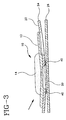
- the user activated iontophoretic system of the present invention is illustrated in Figures 1-5 and generally includes the designation 10.
- the device or system 10 of the present invention includes a patch 12 and a controller 14, which in the preferred embodiment is reusable and releasably attachable to the patch (See Figures 1 and 2).
- the patch 12 includes an electrode assembly 16, having at least one electrode, an electrode reservoir 18 and at least one drug reservoir 20, which are held together by a suitable supporting structure 22.
- the electrode is adhered to the electrode reservoir.
- a return electrode may be combined in the electrode assembly 16 or separately provided as is well known in the art and disclosed for example, in US-A-5540669 and US-A-5954684.
- the supporting structure 22 is divided or otherwise separated into two portions 24, 26, one portion 24 (first) includes a compartment 24A for at least containing or otherwise accommodating the electrode assembly 16 and the electrode reservoir 18 with the electrode reservoir being situated adjacent to the electrode assembly and holding an electrolyte.
- the particular electrolyte is not essential to the present invention and is merely a matter of choice. However, in this embodiment the electrolyte may include sodium chloride in an aqueous solution or an aqueous swollen cross linked water soluble polymer
- the barrier 32 includes an upper release member 34 and a lower release member 36 connected to one another by a pull tab member 38 extending from the structure 22.
- the release members 34, 36 are both folded about their adjacent compartments.
- the release surfaces are provided to prevent the barrier from adhering to the adjacent portions of the reservoirs 18, 20 and to seal the peripheral area surrounding each reservoir 18, 20.
- the drug 30 contained in the drug reservoir 20 can be stored or otherwise sealingly isolated from the electrode reservoir 18 in the first portion 24, in a dry state or formulation in a matrix or on a supporting substrate for hydration prior to use.
- the drug can be stored in a non-aqueous solvent such as low molecular weight polyethylene glycol or glycerine.
- a non-aqueous solvent such as low molecular weight polyethylene glycol or glycerine.
- the drug may be stable in such non-aqueous solvents, and the solution (with the ionized or ionizable drug) may be an adequate electrolyte depending upon the particular drug or combination of drugs.
- These solvents might also be used as humectants in a gel matrix.
- first portion 24 and the second portion 26 preferably includes a layer of adhesive 40 surrounding the electrode reservoir 18 for sealing the two portions together upon removal of the barrier 32.
- the barrier 32 is removed or otherwise manipulated by pulling the tab member 38 to at least partially remove the barrier 32, particularly the release members 34, 36 from between the first and second portions 24, 26.
- the pull tab member may simply be attached to a suitable package (not shown) so as to be manipulated upon opening the package.
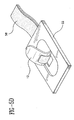
- the controller 14 is preferably attached to the patch 12 ( Figure 3), and after a sufficient period of time, the patch 12 is removed from the structure, by for example peeling it away from the upper surface of the first portion of the structure ( Figure 4).
- the surface may include a layer of adhesive 42 therebetween, or the gel contained in the electrode reservoir 18 may act as an adhesive, with the adhesive 42 remaining on the first portion.
- This layer of adhesive may also be used to adhere the patch to the skin of the patient.
- the way in which the controller 14 is attached to the patch 12 can preferably be utilized to provide additional force to bring the electrode reservoir 18 and the drug reservoir 20 into contract with one another.
- the electrode reservoir 18 and the drug reservoir 20 are brought into contact with one another and the drug may be dissolved at the interface of the reservoirs, due to its solubility in an aqueous fluid and/or the drug reservoir 18 is hydrated and adhered to the interface of the electrode reservoir.
- the patch 12 is preferably releasably attached to the controller 14 by attaching or snapping the controller into the fastener 44.
- the particular controller is not essential to the present invention. Examples are disclosed in US-A-5688231 and US-A-5498235. It should be appreciated that the particular means for releasably attaching the controller 14 to the patch 12 is not essential to the present invention and is simply a matter of choice.
- the device can be attached to a suitable area of the skin of the patient, with the drug containing patch in electrical conducting contact with the skin, and a voltage impressed across the electrodes of the electrode assembly 16 to cause current to flow through the skin of the patient to drive the drug into the skin and the tissue to be absorbed by the body of the patient for the desired period of time. It should also be appreciated that the device of the present invention can be applied to other areas of the body such as mucus membranes depending upon the desired therapy and drugs to be delivered.
- the barrier is a vapor/liquid impermeable barrier which may be manipulated by being removed or at least moved to activate the device.
- the drug can be kept in a dry form (active compound), sealingly separated from the electrode reservoir 18, to keep the aqueous solution intact during storage and where the drug is kept in a dry form, separated during storage from the electrolytic solution contained in the electrode reservoir.
- the Drug is preferably kept in its dry form homogeneously distributed in a carrier material, e.g., cotton fiber, woven plastic thread, drug film, hydrozy methylpropylcellulose and the like, with the same surface area as the electrode reservoir 18 containing the drug.
- Drug 30 may include cell adhesive molecules, such as by way of example and not limitation, Glycoprotein IIb/IIIa receptor antagonists (GPIIb/IIIa) and other integrin receptor antagonists, such as, GPIc/IIa, v B 3 (Lefkovitz J., et al., "Platelet glycoprotein IIb/IIIa receptors in cardiovascular medicine.” New Eng. J. Med. 332 (1995) 1553-9) which may be effective in the treatment of various disease states, e.g. restenosis, unstable angina, stroke, prevention of secondary myocardial infarction, etc.
- GPIc/IIa receptor antagonists GPIc/IIa receptor antagonists
- v B 3 Lefkovitz J., et al., "Platelet glycoprotein IIb/IIIa receptors in cardiovascular medicine.” New Eng. J. Med. 332 (1995) 1553-9
- various disease states e.g. restenosis, unstable angina, stroke, prevention of secondary myocardial infarction
- GPIIb/IIIa receptor antagonists bind to GPIIb/IIIa receptors on platelets to block fibrinogen binding and consequently inhibit platelet aggregation, as well as those disclosed in PCT Application No. WO 95/14683, entitled “NOVEL ISOXAZOLINE AND ISOXAZOLE FIBRINOGEN RECEPTOR ANTAGONISTS.” These agents, therefore, have enormous potential for the treatment of various disorders, including thromboembolics. Also, growth hormones in dry form, i.e., cotton or woven plastic thread, impregnated with the drug in a pre-determined amount per unit length. In addition, multiple layers of the Drug or various may be used.
- the present invention can be used wherein an active compound or drug needs to be isolated.
- the electrode reservoir may contain one or more drugs which are stable in aqueous solutions and are to be co-delivered with the drug 30.
- Drug, medication and active compound have been used herein to mean any pharmaceutical agent, such as therapeutic compounds, diagnostic agents and the like.
- the pull tab member 38 is pulled from the supporting structure to expose the reservoirs. Specifically, the pulling action causes the upper release member 34 and the lower release member 36 to be drawn forward exposing electrode reservoir 18 and the drug reservoir 20 containing the active compound to be delivered to the patient. This allows the reservoirs to be brought into contact with one another at an interface.
- the controller 14 is fastened to the patch 10 ( Figure 5C), which may also cause the electrode reservoir into fluid conducting contact with the drug reservoir to at least partially hydrate one of the reservoirs and to form a combined reservoir portion.
- the combined portion of the device including the patch 12 with the controller 14 fastened thereto, can be removed from the supporting structure 22 ( Figure 5D), and applied to an area of the patient to be treated by causing current to flow through the device into the applied area to drive the medication into the body of the patient.
- Active agent drug, formulation, medication, medicament and active compound have been used herein to mean at least one pharmaceutical agent, such as therapeutic compounds, diagnostic agents, anesthetic agents and the like.
- the drug can be spray-dried onto an inert support such as a non-woven material, a screen or scrim, or a variety of micro-porous supports such as nylon, polyethylene, and polypropylene.
- the drug can be dispersed in an ointment or liquid and cast and dried onto a support.
- the drug can be mixed with dispersing agents or water-soluble polymers and pressed or evaporated into a dry wafer or pellets that dissolve rapidly in water.
- the drug can be uniformly dispersed in a de-hydrated gel that can be hydrated rapidly from an added source of water.
Landscapes
- Health & Medical Sciences (AREA)
- Engineering & Computer Science (AREA)
- Bioinformatics & Cheminformatics (AREA)
- Pharmacology & Pharmacy (AREA)
- Biomedical Technology (AREA)
- Nuclear Medicine, Radiotherapy & Molecular Imaging (AREA)
- Radiology & Medical Imaging (AREA)
- Life Sciences & Earth Sciences (AREA)
- Animal Behavior & Ethology (AREA)
- General Health & Medical Sciences (AREA)
- Public Health (AREA)
- Veterinary Medicine (AREA)
- Electrotherapy Devices (AREA)
- Medicinal Preparation (AREA)
Description
Claims (14)
- A user-activated iontophoretic device (10) for use in delivering at least one drug (30) through an applied area of a patient, such as the skin, mucus membrane and the like, comprising barrier means (32) for sealingly separating an electrode reservoir (18) from a drug reservoir (20) which contains a drug (30) to be delivered to the applied area of the patient, wherein said device (10) is characterised bya first portion (24) and a second portion (26), said first portion (24) including an electrode assembly (16) and said electrode reservoir (18) and said second portion (26) including said drug reservoir (20),said electrode assembly (16) including electrode means which are for driving the drug (30) into the patient to be absorbed by the body of the patient and which are maintained in electrically communicating relation with the electrode reservoir (18),and wherein the drug (30) contained in the drug reservoir (20) is maintained separate in relation to the first portion (24) prior to activation by removal of the barrier means (32) so that, upon removal of said barrier means (32), the electrode reservoir (18) and the drug reservoir (20) are brought into fluid conducting contact with one another so that said drug (30) is hydrated or dissolved in an aqueous solution contained in said electrode reservoir (18).
- A device according to claim 1 which is separable to allow separation from the device, after said removal of the barrier means (32) from the device and said dissolution or hydration of the drug (30) in the aqueous medium, of a patch comprising the electrode assembly (16) and a combined reservoir comprising the electrode reservoir (18) and the hydrated or dissolved drug (30) and wherein the combined reservoir of the patch can be positioned in electrically conducting contact with the skin or mucous membrane of the patient.
- A device according to claim 2 in which said patch comprising the electrode assembly and the combined reservoir is separable from the device as a result of being peelable from the surface of the first portion (24) which is distant from the second portion (26).
- A device according to any preceding claim in which the drug is initially in a dry form separated from the electrode reservoir (18) and the barrier means (32) seal said electrode reservoir (18) in said first portion (24) and seal said drug reservoir (20) contained in said second portion (26).
- A device according to any preceding claim in which the drug is in a dry form and is homogeneously distributed in a carrier material so that the active compound may be kept in a dry form separated from the electrode reservoir (18), and the barrier means (32) maintain an aqueous solution in the electrode reservoir (18) intact during storage.
- A device according to any preceding claim in which the electrode reservoir includes an electrolyte.
- A device according to any preceding claim in which the electrode reservoir includes an electrically conductive gel.
- A device according to any preceding claim in which the drug is selected from the group including cell adhesion molecules, and GPIIb/IIIa receptor antagonists for the treatment of thromboembolic disorders.
- A device according to any preceding claim in which said barrier means (32) includes an upper release member (34) and a lower release member (36) and is constructed so that partial or complete removal of the upper and lower release members (34, 36) brings the electrode reservoir (18) and the drug reservoir (20) into fluid conducting contact with one another.
- A device according to claim 9 in which the upper release member (34) and lower release member (36) are interconnected by a pull tab member (38) extending from the first portion (24) and the second portion (26) so that upon pulling the tab member (38) to at least partially remove the barrier (32) from therebetween, the electrode reservoir (18) and the drug reservoir (20) are brought into contact with one another.
- A method of preparing an iontophoretic patch which comprises an electrode assembly (16) and a combined electrode and drug reservoir and which is suitable for subsequent use for iontophoretic delivery of a drug (30) to an applied area of skin or mucous membrane of a patient, wherein the method of preparing the patch comprisesproviding a device (10) comprisinga first portion (24) including the electrode assembly (16) and an electrode reservoir (18) which contains an aqueous solution and is covered by a first release member (34) anda second portion (26) including a drug reservoir (20) containing the drug (30) and covered by a second release member (36), andexposing the electrode reservoir (18) by at least partially removing the release member (34),exposing the drug reservoir (20) by at least partialy removing the second release member (36), andbringing the electrode reservoir (18) of the first portion (24) which includes the electrode assembly (16) into fluid-conducting contact with the drug reservoir (20) of the second portion (26) and thereby at least partially hydrating the drug (30) in the drug reservoir (20) by the aqueous solution in the electrode reservoir (18) to form the patch comprising the electrode assembly and the combined electrode and drug reservoir.
- A method according to claim 11 in which the electrode reservoir (18) and the drug reservoir (20) are brought into fluid-conducting contact by the at least partial removal of the release members (34, 36).
- A method according to claim 11 or claim 12 in which the at least partial removal of the release members (34, 36) comprises pulling a tab member (38) to simultaneously remove the release members (34, 36).
- A method according to any of claims 11 to 13 comprising, after forming the combined reservoir, removing the patch comprising the electrode assembly (16) and the combined reservoir from the first portion (24).
Applications Claiming Priority (3)
| Application Number | Priority Date | Filing Date | Title |
|---|---|---|---|
| US08/722,813 US5738647A (en) | 1996-09-27 | 1996-09-27 | User activated iontophoretic device and method for activating same |
| US722813 | 1996-09-27 | ||
| PCT/US1997/017075 WO1998013099A1 (en) | 1996-09-27 | 1997-09-22 | User activated iontophoretic device and method for activating same |
Publications (2)
| Publication Number | Publication Date |
|---|---|
| EP0934098A1 EP0934098A1 (en) | 1999-08-11 |
| EP0934098B1 true EP0934098B1 (en) | 2003-07-09 |
Family
ID=24903496
Family Applications (1)
| Application Number | Title | Priority Date | Filing Date |
|---|---|---|---|
| EP97943526A Expired - Lifetime EP0934098B1 (en) | 1996-09-27 | 1997-09-22 | User activated iontophoretic device and method for activating same |
Country Status (6)
| Country | Link |
|---|---|
| US (1) | US5738647A (en) |
| EP (1) | EP0934098B1 (en) |
| JP (1) | JP4484250B2 (en) |
| AU (1) | AU4497797A (en) |
| DE (1) | DE69723453T2 (en) |
| WO (1) | WO1998013099A1 (en) |
Families Citing this family (84)
| Publication number | Priority date | Publication date | Assignee | Title |
|---|---|---|---|---|
| JP3523334B2 (en) * | 1994-07-02 | 2004-04-26 | 久光製薬株式会社 | Plaster structure for iontophoresis |
| US6185453B1 (en) * | 1996-06-19 | 2001-02-06 | Dupont Pharmaceuticals Company | Iontophoretic delivery of integrin inhibitors |
| US20060002959A1 (en) * | 1996-11-14 | 2006-01-05 | Government Of The United States | Skin-sctive adjuvants for transcutaneous immuization |
| US20060002949A1 (en) * | 1996-11-14 | 2006-01-05 | Army Govt. Of The Usa, As Rep. By Secretary Of The Office Of The Command Judge Advocate, Hq Usamrmc. | Transcutaneous immunization without heterologous adjuvant |
| US5980898A (en) * | 1996-11-14 | 1999-11-09 | The United States Of America As Represented By The U.S. Army Medical Research & Material Command | Adjuvant for transcutaneous immunization |
| US6797276B1 (en) | 1996-11-14 | 2004-09-28 | The United States Of America As Represented By The Secretary Of The Army | Use of penetration enhancers and barrier disruption agents to enhance the transcutaneous immune response |
| US5848966A (en) * | 1997-03-04 | 1998-12-15 | Graphic Controls Corporation | Medical device easily removed from skin and a method of removal therefrom |
| US20040258703A1 (en) * | 1997-11-14 | 2004-12-23 | The Government Of The Us, As Represented By The Secretary Of The Army | Skin-active adjuvants for transcutaneous immunization |
| US6858018B1 (en) | 1998-09-28 | 2005-02-22 | Vyteris, Inc. | Iontophoretic devices |
| US6424862B1 (en) | 1999-02-10 | 2002-07-23 | Gmp Drug Delivery, Inc. | Iontophoresis electroporation and combination patches for local drug delivery to body tissues |
| WO2000061184A2 (en) * | 1999-04-08 | 2000-10-19 | Glenn Gregory M | Dry formulation for transcutaneous immunization |
| DE60106601D1 (en) * | 2000-05-29 | 2004-11-25 | Medicotest As Olstykke | ELECTRODE FOR MAKING AN ELECTRICAL CONTACT WITH THE SKIN |
| EP1372708B1 (en) * | 2001-02-13 | 2008-06-18 | GOVERNMENT OF THE UNITED STATES OF AMERICA, as represented by THE SECRETARY OF THE ARMY | Vaccine for transcutaneous immunization against travellers' diarrhoea |
| US6745071B1 (en) | 2003-02-21 | 2004-06-01 | Birch Point Medical, Inc. | Iontophoretic drug delivery system |
| US8524272B2 (en) | 2003-08-15 | 2013-09-03 | Mylan Technologies, Inc. | Transdermal patch incorporating active agent migration barrier layer |
| US20060095001A1 (en) * | 2004-10-29 | 2006-05-04 | Transcutaneous Technologies Inc. | Electrode and iontophoresis device |
| US20060135906A1 (en) * | 2004-11-16 | 2006-06-22 | Akihiko Matsumura | Iontophoretic device and method for administering immune response-enhancing agents and compositions |
| FR2883286B1 (en) * | 2005-03-16 | 2008-10-03 | Sanofi Aventis Sa | NOVEL IMIDAZO [1,5-a] PYRIDINE DERIVATIVES, INHIBITORS OF FGFs, PROCESS FOR THEIR PREPARATION AND PHARMACEUTICAL COMPOSITIONS CONTAINING SAME |
| JP2006296511A (en) * | 2005-04-15 | 2006-11-02 | Transcutaneous Technologies Inc | External preparation, method for applying external preparation, iontophoresis device, and transdermal patch |
| US7856263B2 (en) * | 2005-04-22 | 2010-12-21 | Travanti Pharma Inc. | Transdermal systems for the delivery of therapeutic agents including granisetron using iontophoresis |
| JP2006334164A (en) * | 2005-06-02 | 2006-12-14 | Transcutaneous Technologies Inc | Iontophoresis apparatus and method for controlling the same |
| JP2006346368A (en) * | 2005-06-20 | 2006-12-28 | Transcutaneous Technologies Inc | Iontophoresis apparatus and manufacturing method |
| EP1905433A1 (en) * | 2005-07-15 | 2008-04-02 | Transcu Ltd. | Percutaneous absorption patch with application position indicating function, and iontophoresis device |
| US8295922B2 (en) * | 2005-08-08 | 2012-10-23 | Tti Ellebeau, Inc. | Iontophoresis device |
| US8386030B2 (en) * | 2005-08-08 | 2013-02-26 | Tti Ellebeau, Inc. | Iontophoresis device |
| US20070060860A1 (en) * | 2005-08-18 | 2007-03-15 | Transcutaneous Technologies Inc. | Iontophoresis device |
| JPWO2007026672A1 (en) * | 2005-08-29 | 2009-03-05 | Tti・エルビュー株式会社 | Versatile electrolyte composition for iontophoresis |
| JPWO2007026671A1 (en) * | 2005-08-29 | 2009-03-05 | Tti・エルビュー株式会社 | An iontophoresis device that selects a drug to be administered based on information from a sensor |
| US20100030128A1 (en) * | 2005-09-06 | 2010-02-04 | Kazuma Mitsuguchi | Iontophoresis device |
| US20070112294A1 (en) * | 2005-09-14 | 2007-05-17 | Transcutaneous Technologies Inc. | Iontophoresis device |
| KR20080047600A (en) | 2005-09-15 | 2008-05-29 | 티티아이 엘뷰 가부시키가이샤 | Rod type iontophoresis device |
| BRPI0616166A2 (en) * | 2005-09-16 | 2011-06-07 | Tti Ellebeau Inc | catheter type iontophoresis device |
| US20070073212A1 (en) * | 2005-09-28 | 2007-03-29 | Takehiko Matsumura | Iontophoresis apparatus and method to deliver active agents to biological interfaces |
| US20070071807A1 (en) * | 2005-09-28 | 2007-03-29 | Hidero Akiyama | Capsule-type drug-releasing device and capsule-type drug-releasing device system |
| US20070232983A1 (en) * | 2005-09-30 | 2007-10-04 | Smith Gregory A | Handheld apparatus to deliver active agents to biological interfaces |
| WO2007038555A1 (en) * | 2005-09-30 | 2007-04-05 | Tti Ellebeau, Inc. | Iontophoretic device and method of delivery of active agents to biological interface |
| US20070135754A1 (en) * | 2005-09-30 | 2007-06-14 | Hidero Akiyama | Electrode assembly for iontophoresis for administering active agent enclosed in nanoparticle and iontophoresis device using the same |
| KR20080066712A (en) * | 2005-09-30 | 2008-07-16 | 티티아이 엘뷰 가부시키가이샤 | Functionalized Microneedle Transdermal Drug Delivery System, Apparatus and Method |
| US20070078445A1 (en) * | 2005-09-30 | 2007-04-05 | Curt Malloy | Synchronization apparatus and method for iontophoresis device to deliver active agents to biological interfaces |
| WO2007041322A2 (en) * | 2005-09-30 | 2007-04-12 | Tti Ellebeau, Inc. | Iontophoretic delivery of active agents conjugated to nanoparticles |
| JP2009509657A (en) * | 2005-09-30 | 2009-03-12 | Tti・エルビュー株式会社 | Iontophoresis device and method for delivery of active agents to biological interfaces |
| US20070078376A1 (en) * | 2005-09-30 | 2007-04-05 | Smith Gregory A | Functionalized microneedles transdermal drug delivery systems, devices, and methods |
| US20070093787A1 (en) * | 2005-09-30 | 2007-04-26 | Transcutaneous Technologies Inc. | Iontophoresis device to deliver multiple active agents to biological interfaces |
| AU2006297156A1 (en) * | 2005-09-30 | 2007-04-12 | Tti Ellebeau, Inc. | Iontophoresis method and apparatus for systemic delivery of active agents |
| US20070197955A1 (en) * | 2005-10-12 | 2007-08-23 | Transcutaneous Technologies Inc. | Mucous membrane adhesion-type iontophoresis device |
| JP5116482B2 (en) | 2005-11-14 | 2013-01-09 | 帝國製薬株式会社 | Formulation for iontophoresis |
| WO2007079116A1 (en) * | 2005-12-28 | 2007-07-12 | Tti Ellebeau, Inc. | Electroosmotic pump apparatus and method to deliver active agents to biological interfaces |
| WO2007079190A2 (en) * | 2005-12-29 | 2007-07-12 | Tti Ellebeau, Inc. | Device and method for enhancing immune response by electrical stimulation |
| EP1965856A2 (en) * | 2005-12-30 | 2008-09-10 | Tti Ellebeau, Inc. | Iontophoretic systems, devices, and methods of delivery of active agents to biological interface |
| EP1965858A2 (en) * | 2005-12-30 | 2008-09-10 | Tti Ellebeau, Inc. | System and method for remote based control of an iontophoresis device |
| WO2007123707A1 (en) * | 2006-03-30 | 2007-11-01 | Tti Ellebeau, Inc. | Controlled release membrane and methods of use |
| US20080058701A1 (en) * | 2006-07-05 | 2008-03-06 | Transcutaneous Technologies Inc. | Delivery device having self-assembling dendritic polymers and method of use thereof |
| EP2058026A1 (en) * | 2006-08-30 | 2009-05-13 | Tti Ellebeau, Inc. | Iontophoresis device |
| WO2008030497A2 (en) * | 2006-09-05 | 2008-03-13 | Tti Ellebeau, Inc. | Transdermal drug delivery systems, devices, and methods using inductive power supplies |
| TW200838576A (en) | 2006-12-01 | 2008-10-01 | Transcu Ltd | Systems, devices and methods for powering and/or controlling transdermal delivery devices |
| US20080188791A1 (en) * | 2007-02-02 | 2008-08-07 | Difiore Attilio E | Active iontophoresis delivery system |
| NZ582049A (en) * | 2007-05-18 | 2012-12-21 | Tti Ellebeau Inc | Transdermal delivery devices assuring an improved release of an active principle through a biological interface |
| US8197844B2 (en) * | 2007-06-08 | 2012-06-12 | Activatek, Inc. | Active electrode for transdermal medicament administration |
| US8862223B2 (en) | 2008-01-18 | 2014-10-14 | Activatek, Inc. | Active transdermal medicament patch and circuit board for same |
| KR101267728B1 (en) * | 2008-09-05 | 2013-05-24 | 테이코쿠 팔마 유에스에이, 인코포레이티드 | An iontophoretic drug delivery system |
| JP2012501801A (en) * | 2008-09-10 | 2012-01-26 | トランスキュー リミテッド | Apparatus and method for drug delivery of a viscous liquid based on hydroxypropylcellulose (HPC) to a porous substrate, eg a process based on a continuous web |
| US8534947B2 (en) * | 2008-09-25 | 2013-09-17 | Ralf Prax | Disposable fluid applicator |
| BRPI0923808A2 (en) * | 2008-12-30 | 2015-07-14 | Nupathe Inc | Electronic control of drug delivery system |
| EP2440694A4 (en) * | 2009-06-09 | 2012-12-19 | Tti Ellebeau Inc | Long life high capacity electrode, device, and method of manufacture |
| WO2011002776A1 (en) * | 2009-06-29 | 2011-01-06 | Nitric Biotherapeutics, Inc. | Pharmaceutical formulations for iontophoretic delivery of an immunomodulator |
| EP2643048A1 (en) | 2010-11-23 | 2013-10-02 | Nupathe Inc. | User-activated self-contained co-packaged iontophoretic drug delivery system |
| US9144671B2 (en) * | 2011-12-21 | 2015-09-29 | 3M Innovative Properties Company | Transdermal adhesive patch assembly with removable microneedle array and method of using same |
| US10537703B2 (en) | 2012-11-26 | 2020-01-21 | Thync Global, Inc. | Systems and methods for transdermal electrical stimulation to improve sleep |
| US10814131B2 (en) | 2012-11-26 | 2020-10-27 | Thync Global, Inc. | Apparatuses and methods for neuromodulation |
| EP2934243B1 (en) | 2012-12-19 | 2020-03-25 | Société des Produits Nestlé S.A. | Self-locking multi-size cartridge extraction unit |
| US10293161B2 (en) | 2013-06-29 | 2019-05-21 | Thync Global, Inc. | Apparatuses and methods for transdermal electrical stimulation of nerves to modify or induce a cognitive state |
| CN106573138A (en) | 2014-02-27 | 2017-04-19 | 赛威医疗公司 | Methods and apparatuses for user control of neurostimulation |
| US11534608B2 (en) | 2015-01-04 | 2022-12-27 | Ist, Llc | Methods and apparatuses for transdermal stimulation of the outer ear |
| WO2016109851A1 (en) | 2015-01-04 | 2016-07-07 | Thync, Inc. | Methods and apparatuses for transdermal stimulation of the outer ear |
| CN107847732A (en) | 2015-05-29 | 2018-03-27 | 赛威医疗公司 | Methods and devices for transcutaneous electrical stimulation |
| HK1246714A1 (en) | 2015-06-01 | 2018-09-14 | 赛威医疗公司 | Apparatuses and methods for neuromodulation |
| WO2017106411A1 (en) | 2015-12-15 | 2017-06-22 | Cerevast Medical, Inc. | Electrodes having surface exclusions |
| US9956405B2 (en) | 2015-12-18 | 2018-05-01 | Thyne Global, Inc. | Transdermal electrical stimulation at the neck to induce neuromodulation |
| WO2017106878A1 (en) | 2015-12-18 | 2017-06-22 | Thync Global, Inc. | Apparatuses and methods for transdermal electrical stimulation of nerves to modify or induce a cognitive state |
| US10646708B2 (en) | 2016-05-20 | 2020-05-12 | Thync Global, Inc. | Transdermal electrical stimulation at the neck |
| WO2017201525A1 (en) * | 2016-05-20 | 2017-11-23 | Thync Global, Inc. | Transdermal electrical stimulation at the neck to induce neuromodulation |
| WO2019209969A1 (en) | 2018-04-24 | 2019-10-31 | Thync Global, Inc. | Streamlined and pre-set neuromodulators |
| WO2020150737A1 (en) | 2019-01-18 | 2020-07-23 | Ist, Llc | Methods and devices for modulation of integrated neural networks to influence composite sensory processes |
| WO2021067370A1 (en) | 2019-09-30 | 2021-04-08 | Thync Global, Inc. | Neuromodulator apparatuses comprising led driver integrated circuits |
Family Cites Families (20)
| Publication number | Priority date | Publication date | Assignee | Title |
|---|---|---|---|---|
| US3814095A (en) | 1972-03-24 | 1974-06-04 | H Lubens | Occlusively applied anesthetic patch |
| US4820263A (en) | 1981-03-06 | 1989-04-11 | Medtronic, Inc. | Apparatus and method for iontophoretic drug delivery |
| US4722726A (en) | 1986-02-12 | 1988-02-02 | Key Pharmaceuticals, Inc. | Method and apparatus for iontophoretic drug delivery |
| JPS63102768A (en) | 1986-10-20 | 1988-05-07 | 山之内製薬株式会社 | Novel plaster structure for iontophoresis |
| US4917676A (en) * | 1986-11-20 | 1990-04-17 | Ciba-Geigy Corporation | User-activated transdermal therapeutic system |
| US4911707A (en) * | 1987-02-13 | 1990-03-27 | Ciba-Geigy Corporation | Monolithic user-activated transdermal therapeutic system |
| US4927408A (en) | 1988-10-03 | 1990-05-22 | Alza Corporation | Electrotransport transdermal system |
| DE3903794A1 (en) * | 1989-02-09 | 1990-08-16 | Lohmann Therapie Syst Lts | THERAPEUTIC SYSTEM FOR THE TRANSDERMAL OR TRANSMUCOSAL ADMINISTRATION OF ACTIVE SUBSTANCES AND ITS USE |
| US5087242A (en) | 1989-07-21 | 1992-02-11 | Iomed, Inc. | Hydratable bioelectrode |
| US5374241A (en) * | 1989-07-21 | 1994-12-20 | Iomed, Inc. | Electrodes for iontophoresis |
| US5084008A (en) | 1989-12-22 | 1992-01-28 | Medtronic, Inc. | Iontophoresis electrode |
| WO1992007618A1 (en) | 1990-10-29 | 1992-05-14 | Alza Corporation | Iontophoretic drug delivery electrode and method of hydrating the same |
| US5158537A (en) | 1990-10-29 | 1992-10-27 | Alza Corporation | Iontophoretic delivery device and method of hydrating same |
| US5310404A (en) * | 1992-06-01 | 1994-05-10 | Alza Corporation | Iontophoretic delivery device and method of hydrating same |
| US5445609A (en) * | 1993-05-28 | 1995-08-29 | Alza Corporation | Electrotransport agent delivery device having a disposable component and a removable liner |
| US5540669A (en) | 1993-09-30 | 1996-07-30 | Becton, Dickinson And Company | Iontophoretic drug delivery system and method for using same |
| CA2174838A1 (en) | 1993-11-24 | 1995-06-01 | John Wityak | Novel isoxazoline and isoxazole fibrinogen receptor antagonists |
| JPH09511671A (en) * | 1994-08-22 | 1997-11-25 | イオメド インコーポレイテッド | Iontophoretic delivery device incorporating hydration water stage |
| US5498235A (en) | 1994-09-30 | 1996-03-12 | Becton Dickinson And Company | Iontophoresis assembly including patch/controller attachment |
| CA2208132A1 (en) * | 1994-12-21 | 1996-06-27 | Theratech, Inc. | Transdermal delivery system with adhesive overlay and peel seal disc |
-
1996
- 1996-09-27 US US08/722,813 patent/US5738647A/en not_active Expired - Lifetime
-
1997
- 1997-09-22 WO PCT/US1997/017075 patent/WO1998013099A1/en not_active Ceased
- 1997-09-22 AU AU44977/97A patent/AU4497797A/en not_active Abandoned
- 1997-09-22 EP EP97943526A patent/EP0934098B1/en not_active Expired - Lifetime
- 1997-09-22 DE DE69723453T patent/DE69723453T2/en not_active Expired - Lifetime
- 1997-09-22 JP JP51585898A patent/JP4484250B2/en not_active Expired - Fee Related
Also Published As
| Publication number | Publication date |
|---|---|
| AU4497797A (en) | 1998-04-17 |
| US5738647A (en) | 1998-04-14 |
| EP0934098A1 (en) | 1999-08-11 |
| JP2001501508A (en) | 2001-02-06 |
| WO1998013099A1 (en) | 1998-04-02 |
| DE69723453T2 (en) | 2004-04-15 |
| JP4484250B2 (en) | 2010-06-16 |
| DE69723453D1 (en) | 2003-08-14 |
Similar Documents
| Publication | Publication Date | Title |
|---|---|---|
| US5738647A (en) | User activated iontophoretic device and method for activating same | |
| US5797867A (en) | Iontophoretic drug delivery system, including method for activating same for attachment to patient | |
| US5817044A (en) | User activated iontophoertic device | |
| JP4154017B2 (en) | Iontophoresis device and drug unit | |
| KR100601776B1 (en) | Anhydrous Medication Reservoir For Electrolytic Transdermal Delivery Device | |
| US6104950A (en) | Plaster structure for iontophoresis | |
| JPH03151982A (en) | Method and device for percutaneous administration of protain and peptide drug | |
| PT99343A (en) | DEVICE FOR IONTOFORETIC APPLICATION AND METHOD FOR HYDRATING | |
| JP4033382B2 (en) | Insulin administration device | |
| JPH09511671A (en) | Iontophoretic delivery device incorporating hydration water stage | |
| JPH11239621A (en) | Iontophoresis device | |
| EP0934097B1 (en) | Iontophoretic drug delivery system, including method for activating same | |
| US5919156A (en) | Iontophoretic drug delivery system, including unit for dispensing patches | |
| US20070078373A1 (en) | Pulsatile delivery of gonadotropin-releasing hormone from a pre-loaded integrated electrotransport patch | |
| EP0586666B2 (en) | User activated iontophoretic device | |
| JP4154016B2 (en) | Iontophoresis device and assembly method thereof | |
| JPH09201420A (en) | In-use iontophoresis device | |
| CA2201378A1 (en) | Iontophoretic drug delivery system, including disposable patch and reusable, removable controller | |
| JP3119488B2 (en) | Iontophoresis device for water-soluble steroids | |
| JP2542792C (en) |
Legal Events
| Date | Code | Title | Description |
|---|---|---|---|
| PUAI | Public reference made under article 153(3) epc to a published international application that has entered the european phase |
Free format text: ORIGINAL CODE: 0009012 |
|
| 17P | Request for examination filed |
Effective date: 19990401 |
|
| AK | Designated contracting states |
Kind code of ref document: A1 Designated state(s): DE FR GB IT |
|
| 17Q | First examination report despatched |
Effective date: 20011023 |
|
| GRAH | Despatch of communication of intention to grant a patent |
Free format text: ORIGINAL CODE: EPIDOS IGRA |
|
| GRAH | Despatch of communication of intention to grant a patent |
Free format text: ORIGINAL CODE: EPIDOS IGRA |
|
| RAP1 | Party data changed (applicant data changed or rights of an application transferred) |
Owner name: VYTERIS, INC. |
|
| GRAA | (expected) grant |
Free format text: ORIGINAL CODE: 0009210 |
|
| AK | Designated contracting states |
Designated state(s): DE FR GB IT |
|
| REG | Reference to a national code |
Ref country code: GB Ref legal event code: FG4D |
|
| REF | Corresponds to: |
Ref document number: 69723453 Country of ref document: DE Date of ref document: 20030814 Kind code of ref document: P |
|
| ET | Fr: translation filed | ||
| PLBE | No opposition filed within time limit |
Free format text: ORIGINAL CODE: 0009261 |
|
| STAA | Information on the status of an ep patent application or granted ep patent |
Free format text: STATUS: NO OPPOSITION FILED WITHIN TIME LIMIT |
|
| 26N | No opposition filed |
Effective date: 20040414 |
|
| PGFP | Annual fee paid to national office [announced via postgrant information from national office to epo] |
Ref country code: IT Payment date: 20100326 Year of fee payment: 13 |
|
| PGFP | Annual fee paid to national office [announced via postgrant information from national office to epo] |
Ref country code: GB Payment date: 20100325 Year of fee payment: 13 |
|
| PGFP | Annual fee paid to national office [announced via postgrant information from national office to epo] |
Ref country code: FR Payment date: 20100416 Year of fee payment: 13 |
|
| PGFP | Annual fee paid to national office [announced via postgrant information from national office to epo] |
Ref country code: DE Payment date: 20100331 Year of fee payment: 13 |
|
| GBPC | Gb: european patent ceased through non-payment of renewal fee |
Effective date: 20100922 |
|
| PG25 | Lapsed in a contracting state [announced via postgrant information from national office to epo] |
Ref country code: IT Free format text: LAPSE BECAUSE OF NON-PAYMENT OF DUE FEES Effective date: 20100922 |
|
| REG | Reference to a national code |
Ref country code: FR Ref legal event code: ST Effective date: 20110531 |
|
| REG | Reference to a national code |
Ref country code: DE Ref legal event code: R119 Ref document number: 69723453 Country of ref document: DE Effective date: 20110401 |
|
| PG25 | Lapsed in a contracting state [announced via postgrant information from national office to epo] |
Ref country code: DE Free format text: LAPSE BECAUSE OF NON-PAYMENT OF DUE FEES Effective date: 20110401 Ref country code: FR Free format text: LAPSE BECAUSE OF NON-PAYMENT OF DUE FEES Effective date: 20100930 |
|
| PG25 | Lapsed in a contracting state [announced via postgrant information from national office to epo] |
Ref country code: GB Free format text: LAPSE BECAUSE OF NON-PAYMENT OF DUE FEES Effective date: 20100922 |