EP0933372B1 - Sulphonamide derivatives as prodrugs of aspartyl protease inhibitors - Google Patents
Sulphonamide derivatives as prodrugs of aspartyl protease inhibitors Download PDFInfo
- Publication number
- EP0933372B1 EP0933372B1 EP98104292A EP98104292A EP0933372B1 EP 0933372 B1 EP0933372 B1 EP 0933372B1 EP 98104292 A EP98104292 A EP 98104292A EP 98104292 A EP98104292 A EP 98104292A EP 0933372 B1 EP0933372 B1 EP 0933372B1
- Authority
- EP
- European Patent Office
- Prior art keywords
- alkyl
- optionally substituted
- compound according
- compound
- independently selected
- Prior art date
- Legal status (The legal status is an assumption and is not a legal conclusion. Google has not performed a legal analysis and makes no representation as to the accuracy of the status listed.)
- Expired - Lifetime
Links
- 0 CC(C)CN(C[C@]([C@](Cc1ccccc1)NC(O[C@@]1COCC1)=O)O)S(c1ccc(*)cc1)(=O)=O Chemical compound CC(C)CN(C[C@]([C@](Cc1ccccc1)NC(O[C@@]1COCC1)=O)O)S(c1ccc(*)cc1)(=O)=O 0.000 description 13
- BEQNQQMUNXSRBI-UHFFFAOYSA-N CC(C(CCC(O)=O)N)=O Chemical compound CC(C(CCC(O)=O)N)=O BEQNQQMUNXSRBI-UHFFFAOYSA-N 0.000 description 1
- VQZMKVGGONXWDK-JYJNAYRXSA-N CC(C)N[C@H]([C@H](Cc1ccccc1)NC(O[C@@H]1COCC1)=O)OP(O)=O Chemical compound CC(C)N[C@H]([C@H](Cc1ccccc1)NC(O[C@@H]1COCC1)=O)OP(O)=O VQZMKVGGONXWDK-JYJNAYRXSA-N 0.000 description 1
- YSDBJKNOEWSFGA-UHFFFAOYSA-N CC(N1CCN(C)CC1)=O Chemical compound CC(N1CCN(C)CC1)=O YSDBJKNOEWSFGA-UHFFFAOYSA-N 0.000 description 1
- DIRLDPKYOATBIA-UHFFFAOYSA-N CC(OC1COCC1)=O Chemical compound CC(OC1COCC1)=O DIRLDPKYOATBIA-UHFFFAOYSA-N 0.000 description 1
- DIRLDPKYOATBIA-ZCFIWIBFSA-N CC(O[C@H]1COCC1)=O Chemical compound CC(O[C@H]1COCC1)=O DIRLDPKYOATBIA-ZCFIWIBFSA-N 0.000 description 1
- GZKMJHFMJZLQHG-SNVBAGLBSA-N CC([C@@H](Cc(cc1)ccc1O)N)=O Chemical compound CC([C@@H](Cc(cc1)ccc1O)N)=O GZKMJHFMJZLQHG-SNVBAGLBSA-N 0.000 description 1
- XKEKKGKDCHCOSA-UHFFFAOYSA-N CCCCC(NC)=O Chemical compound CCCCC(NC)=O XKEKKGKDCHCOSA-UHFFFAOYSA-N 0.000 description 1
- CDYPEXJFPUHKFD-MRVPVSSYSA-N CNC([C@@H](Cc1cccnc1)N)=O Chemical compound CNC([C@@H](Cc1cccnc1)N)=O CDYPEXJFPUHKFD-MRVPVSSYSA-N 0.000 description 1
- NEIKKZFRENAOCH-UHFFFAOYSA-N CNCCOC(O)P(C)=O Chemical compound CNCCOC(O)P(C)=O NEIKKZFRENAOCH-UHFFFAOYSA-N 0.000 description 1
- PPOMDSKQGIUUTA-UHFFFAOYSA-N C[NH+](c(cc1)ccc1S(=O)=O)[O-] Chemical compound C[NH+](c(cc1)ccc1S(=O)=O)[O-] PPOMDSKQGIUUTA-UHFFFAOYSA-N 0.000 description 1
- QNOQRKLQGCSOIS-SCSAIBSYSA-N OO[C@H]1COCC1 Chemical compound OO[C@H]1COCC1 QNOQRKLQGCSOIS-SCSAIBSYSA-N 0.000 description 1
Classifications
-
- C—CHEMISTRY; METALLURGY
- C07—ORGANIC CHEMISTRY
- C07D—HETEROCYCLIC COMPOUNDS
- C07D405/00—Heterocyclic compounds containing both one or more hetero rings having oxygen atoms as the only ring hetero atoms, and one or more rings having nitrogen as the only ring hetero atom
- C07D405/02—Heterocyclic compounds containing both one or more hetero rings having oxygen atoms as the only ring hetero atoms, and one or more rings having nitrogen as the only ring hetero atom containing two hetero rings
- C07D405/12—Heterocyclic compounds containing both one or more hetero rings having oxygen atoms as the only ring hetero atoms, and one or more rings having nitrogen as the only ring hetero atom containing two hetero rings linked by a chain containing hetero atoms as chain links
-
- A—HUMAN NECESSITIES
- A61—MEDICAL OR VETERINARY SCIENCE; HYGIENE
- A61P—SPECIFIC THERAPEUTIC ACTIVITY OF CHEMICAL COMPOUNDS OR MEDICINAL PREPARATIONS
- A61P31/00—Antiinfectives, i.e. antibiotics, antiseptics, chemotherapeutics
- A61P31/12—Antivirals
-
- A—HUMAN NECESSITIES
- A61—MEDICAL OR VETERINARY SCIENCE; HYGIENE
- A61P—SPECIFIC THERAPEUTIC ACTIVITY OF CHEMICAL COMPOUNDS OR MEDICINAL PREPARATIONS
- A61P31/00—Antiinfectives, i.e. antibiotics, antiseptics, chemotherapeutics
- A61P31/12—Antivirals
- A61P31/14—Antivirals for RNA viruses
- A61P31/18—Antivirals for RNA viruses for HIV
-
- A—HUMAN NECESSITIES
- A61—MEDICAL OR VETERINARY SCIENCE; HYGIENE
- A61P—SPECIFIC THERAPEUTIC ACTIVITY OF CHEMICAL COMPOUNDS OR MEDICINAL PREPARATIONS
- A61P43/00—Drugs for specific purposes, not provided for in groups A61P1/00-A61P41/00
-
- C—CHEMISTRY; METALLURGY
- C07—ORGANIC CHEMISTRY
- C07C—ACYCLIC OR CARBOCYCLIC COMPOUNDS
- C07C311/00—Amides of sulfonic acids, i.e. compounds having singly-bound oxygen atoms of sulfo groups replaced by nitrogen atoms, not being part of nitro or nitroso groups
- C07C311/15—Sulfonamides having sulfur atoms of sulfonamide groups bound to carbon atoms of six-membered aromatic rings
- C07C311/16—Sulfonamides having sulfur atoms of sulfonamide groups bound to carbon atoms of six-membered aromatic rings having the nitrogen atom of at least one of the sulfonamide groups bound to hydrogen atoms or to an acyclic carbon atom
- C07C311/18—Sulfonamides having sulfur atoms of sulfonamide groups bound to carbon atoms of six-membered aromatic rings having the nitrogen atom of at least one of the sulfonamide groups bound to hydrogen atoms or to an acyclic carbon atom to an acyclic carbon atom of a hydrocarbon radical substituted by nitrogen atoms, not being part of nitro or nitroso groups
-
- C—CHEMISTRY; METALLURGY
- C07—ORGANIC CHEMISTRY
- C07D—HETEROCYCLIC COMPOUNDS
- C07D307/00—Heterocyclic compounds containing five-membered rings having one oxygen atom as the only ring hetero atom
- C07D307/02—Heterocyclic compounds containing five-membered rings having one oxygen atom as the only ring hetero atom not condensed with other rings
- C07D307/04—Heterocyclic compounds containing five-membered rings having one oxygen atom as the only ring hetero atom not condensed with other rings having no double bonds between ring members or between ring members and non-ring members
- C07D307/18—Heterocyclic compounds containing five-membered rings having one oxygen atom as the only ring hetero atom not condensed with other rings having no double bonds between ring members or between ring members and non-ring members with hetero atoms or with carbon atoms having three bonds to hetero atoms with at the most one bond to halogen, e.g. ester or nitrile radicals, directly attached to ring carbon atoms
- C07D307/20—Oxygen atoms
-
- C—CHEMISTRY; METALLURGY
- C07—ORGANIC CHEMISTRY
- C07F—ACYCLIC, CARBOCYCLIC OR HETEROCYCLIC COMPOUNDS CONTAINING ELEMENTS OTHER THAN CARBON, HYDROGEN, HALOGEN, OXYGEN, NITROGEN, SULFUR, SELENIUM OR TELLURIUM
- C07F9/00—Compounds containing elements of Groups 5 or 15 of the Periodic Table
- C07F9/02—Phosphorus compounds
- C07F9/547—Heterocyclic compounds, e.g. containing phosphorus as a ring hetero atom
- C07F9/655—Heterocyclic compounds, e.g. containing phosphorus as a ring hetero atom having oxygen atoms, with or without sulfur, selenium, or tellurium atoms, as the only ring hetero atoms
- C07F9/65515—Heterocyclic compounds, e.g. containing phosphorus as a ring hetero atom having oxygen atoms, with or without sulfur, selenium, or tellurium atoms, as the only ring hetero atoms the oxygen atom being part of a five-membered ring
-
- C—CHEMISTRY; METALLURGY
- C07—ORGANIC CHEMISTRY
- C07F—ACYCLIC, CARBOCYCLIC OR HETEROCYCLIC COMPOUNDS CONTAINING ELEMENTS OTHER THAN CARBON, HYDROGEN, HALOGEN, OXYGEN, NITROGEN, SULFUR, SELENIUM OR TELLURIUM
- C07F9/00—Compounds containing elements of Groups 5 or 15 of the Periodic Table
- C07F9/02—Phosphorus compounds
- C07F9/547—Heterocyclic compounds, e.g. containing phosphorus as a ring hetero atom
- C07F9/6564—Heterocyclic compounds, e.g. containing phosphorus as a ring hetero atom having phosphorus atoms, with or without nitrogen, oxygen, sulfur, selenium or tellurium atoms, as ring hetero atoms
- C07F9/6581—Heterocyclic compounds, e.g. containing phosphorus as a ring hetero atom having phosphorus atoms, with or without nitrogen, oxygen, sulfur, selenium or tellurium atoms, as ring hetero atoms having phosphorus and nitrogen atoms with or without oxygen or sulfur atoms, as ring hetero atoms
- C07F9/6584—Heterocyclic compounds, e.g. containing phosphorus as a ring hetero atom having phosphorus atoms, with or without nitrogen, oxygen, sulfur, selenium or tellurium atoms, as ring hetero atoms having phosphorus and nitrogen atoms with or without oxygen or sulfur atoms, as ring hetero atoms having one phosphorus atom as ring hetero atom
- C07F9/65842—Cyclic amide derivatives of acids of phosphorus, in which one nitrogen atom belongs to the ring
- C07F9/65844—Cyclic amide derivatives of acids of phosphorus, in which one nitrogen atom belongs to the ring the phosphorus atom being part of a five-membered ring which may be condensed with another ring system
-
- C—CHEMISTRY; METALLURGY
- C07—ORGANIC CHEMISTRY
- C07H—SUGARS; DERIVATIVES THEREOF; NUCLEOSIDES; NUCLEOTIDES; NUCLEIC ACIDS
- C07H15/00—Compounds containing hydrocarbon or substituted hydrocarbon radicals directly attached to hetero atoms of saccharide radicals
- C07H15/02—Acyclic radicals, not substituted by cyclic structures
- C07H15/04—Acyclic radicals, not substituted by cyclic structures attached to an oxygen atom of the saccharide radical
Definitions
- the present invention relates to prodrugs of a class of sulfonamides which are aspartyl protease inhibitors.
- this invention relates to a novel class of prodrugs of HIV aspartyl protease inhibitors characterized by favorable aqueous solubility, high oral bioavailability and facile in vivo generation of the active ingredient.
- This invention also relates to pharmaceutical compositions comprising these prodrugs.
- the prodrugs and pharmaceutical compositions of this invention are particularly well suited for decreasing the pill burden and increasing patient compliance. This invention also relates to methods of treating mammals with these prodrugs and pharmaceutical compositions.
- Aspartyl protease inhibitors are considered the most effective current drug in the fight against HIV infection. These inhibitors, however, require certain physicochemical properties in order to achieve good potency against the enzyme. One of these properties is high hydrophobicity. Unfortunately, this property results in poor aqueous solubility and low oral bioavailability.
- United States Patent 5,585,397 describes a class of sulfonamide compounds that are inhibitors of the aspartyl protease enzyme. These compounds illustrate the drawbacks concomitant to pharmaceutical compositions comprising hydrophobic aspartyl protease inhibitors.
- VX-478 (4-amino-N-((2-syn,3S)-2-hydroxy-4-phenyl-3-((S)-tetrahydrofuran-3-yl-oxy-carbonylamino)-butyl)-N-isobutyl-benzenesulfonamide) is an aspartyl protease inhibitor disclosed in the '397 patent. It has a relatively low aqueous solubility.
- VX-478 produces an upper limit of 150 mg of VX-478 in each capsule. Given a therapeutic dose of 2400 mg/day of VX-478, this formulation would require a patient to consume 16 capsules per day. Such a high pill burden would likely result in poor patient compliance, thus producing sub-optimal therapeutic benefit of the drug. The high pill burden is also a deterrent to increasing the amount of the drug administered per day to a patient. Another drawback of the pill burden and the concomitant patient compliance problem is in the treatment of children infected with HIV.
- the present invention provides novel prodrugs of a class of sulfonamide compounds that are inhibitors of aspartyl protease, in particular, HIV aspartyl protease. These prodrugs are characterized by excellent aqueous solubility, increased bioavailability and are readily metabolized into the active inhibitors in vivo .
- the present invention also provides pharmaceutical compositions comprising these prodrugs and the use of these prodrugs for the preparation of a pharmaceutical composition for inhibiting aspartyl protease activity in mammals or for treating HIV infection in mammals.
- prodrugs can be used alone or in combination with other therapeutic or prophylactic agents, such as anti-virals, antibiotics, immunomodulators or vaccines, for the preparation of a pharmaceutical composition for treatment or prophylaxis of viral infection.
- This novel class of sulfonamides is represented by formula I: wherein:
- It is also an object of this invention to x provide pharmaceutical compositions comprising the sulfonamide prodrugs of formula I and methods for their use as prodrugs of HIV aspartyl protease inhibitors.
- -SO 2 - and “-S(O) 2 -” as used herein refer to a sulfone or sulfone derivative (i.e., both appended groups linked to the S), and not a sulfinate ester.
- the stereochemistry of OR 7 is defined relative to D on the adjacent carbon atom, when the molecule is drawn in an extended zig-zag representation (such as that drawn for compounds of formula XI, XV, XXII, XXIII and XXXI). If both OR 7 and D reside on the same side of the plane defined by the extended backbone of the compound, the stereochemistry of OR 7 will be referred to as "syn”. If OR 7 and D reside on opposite sides of that plane, the stereochemistry of OR 7 will be referred to as "anti”.
- aryl alone or in combination with any other term, refers to a carbocyclic aromatic radical containing the specified number of carbon atoms.
- heterocyclic refers to a stable 5-7 membered monocycle or 8-11 membered bicyclic heterocycle which is either saturated or unsaturated, and which may be optionally benzofused if monocyclic.
- Each heterocycle consists of carbon atoms and from one to four heteroatoms selected from the group consisting of nitrogen, oxygen and sulfur.
- nitrogen and sulfur heteroatoms include any oxidized form of nitrogen and sulfur, and the quaternized form of any basic nitrogen.
- the heterocyclic ring may be attached by any heteroatom of the cycle which results in the creation of a stable structure.
- Preferred heterocycles defined above include, for example, benzimidazolyl, imidazolyl, imidazolinoyl, imidazolidinyl, quinolyl, isoquinolyl, indolyl, pyridyl, pyrrolyl, pyrrolinyl, pyrazolyl, pyrazinyl, quinoxolyl, piperidinyl, morpholinyl, thiamorpholinyl, furyl, thienyl, triazolyl, thiazolyl, ⁇ -carbolinyl, tetrazolyl, thiazolidinyl, benzofuranoyl, thiamorpholinyl sulfone, benzoxazolyl, oxopiperidinyl, oxopyrroldinyl, oxoazepinyl, azepinyl, isoxazolyl, tetrahydropyranyl, tetrahydrofuranyl
- HIV protease and “HIV aspartyl protease” are used interchangeably and refer to the aspartyl protease encoded by the human immunodeficiency virus type 1 or 2. In a preferred embodiment of this invention, these terms refer to the human immunodeficiency virus type 1 aspartyl protease.
- pharmaceutically effective amount refers to an amount effective in treating HIV infection in a patient.
- prophylactically effective amount refers to an amount effective in preventing HIV infection in a patient.
- patient refers to a mammal, including a human.
- pharmaceutically acceptable carrier or adjuvant refers to a non-toxic carrier or adjuvant that may be administered to a patient, together with a compound of this invention, and which does not destroy the pharmacological activity thereof.
- Pharmaceutically acceptable salts of the compounds of this invention include those derived from pharmaceutically acceptable inorganic and organic acids and bases.
- suitable acids include hydrochloric, hydrobromic, sulfuric, nitric, perchloric, fumaric, maleic, phosphoric, glycollic, lactic, salicylic, succinic, toluene-p-sulfonic, tartaric, acetic, citric, methanesulfonic, formic, benzoic, malonic, naphthalene-2-sulfonic and benzenesulfonic acids.
- Other acids, such as oxalic while not in themselves pharmaceutically acceptable, may be employed in the preparation of salts useful as intermediates in obtaining the compounds of the invention and their pharmaceutically acceptable acid addition salts.
- Salts derived from appropriate bases include alkali metal (e.g., sodium), alkaline earth metal (e.g., magnesium), ammonium and N-(C 1-4 alkyl) 4+ salts.
- thiocarbamates refers to compounds containing the functional group N-SO 2 -O.
- the compounds of this invention contain one or more asymmetric carbon atoms and thus occur as racemates and racemic mixtures, single enantiomers, diastereomeric mixtures and individual diastereomers. All such isomeric forms of these compounds are expressly included in the present invention.
- Each stereogenic carbon may be of the R or S configuration.
- the explicitly shown hydroxyl is also preferred to be syn to D, in the extended zigzag conformation between the nitrogens shown in compounds of formula I.
- stable refers to compounds which possess stability sufficient to allow manufacture and administration to a mammal by methods known in the art. Typically, such compounds are stable at a temperature of 40°C or less, in the absence of moisture or other chemically reactive conditions, for at least a week.
- the compounds of the present invention may be used in the form of salts derived from inorganic or organic acids. Included among such acid salts, for example, are the following: acetate, adipate, alginate, aspartate, benzoate, benzenesulfonate, bisulfate, butyrate, citrate, camphorate, camphorsulfonate, cyclopentanepropionate, digluconate, dodecylsulfate, ethanesulfonate, fumarate, glucoheptanoate, glycerophosphate, hemisulfate, heptanoate, hexanoate, hydrochloride, hydrobromide, hydroiodide, 2-hydroxy ethanesulfonate, lactate, maleate, methanesulfonate, 2-naphthalenesulfonate, nicotinate, oxalate, pamoate, pectinate, persulfate
- This invention also envisions the quaternization of any basic nitrogen-containing groups of the compounds disclosed herein.
- the basic nitrogen can be quaternized with any agents known to those of ordinary skill in the art including, for example, lower alkyl halides, such as methyl, ethyl, propyl and butyl chlorides, bromides and iodides; dialkyl sulfates including dimethyl, diethyl, dibutyl and diamyl sulfates; long chain halides such as decyl, lauryl, myristyl and stearyl chlorides, bromides and iodides; and aralkyl halides including benzyl and phenethyl bromides. Water or oil-soluble or dispersible products may be obtained by such quaternization.
- novel sulfonamides of this invention are those of formula I: wherein:
- At least one R 7 is selected from: - (L) -lysine, -PO 3 Na 2 , -(L)-tyrosine, - PO 3 Mg, -PO 3 (NH 4 ) 2 , -CH 2 -OPO 3 Na 2 , - (L) -serine, -SO 3 Na 2 , -SO 3 Mg, -SO 3 (NH 4 ) 2 , -CH 2 -OSO 3 Na 2 , -CH 2 -OSO 3 (NH 4 ) 2 , acetyl, -(L)-valine, -(L)-glutamic acid, -(L)-aspartic acid, -(L)- ⁇ -t-butyl-aspartic acid, -(L)-(L)-3-pyridylalanine, -(L)-histidine, -CHO, PO 3 K 2 , PO 3 Ca, PO 3 -spermine, PO 3 -
- component M or M' in the formulae set forth herein will have either a covalent, a covalent/ zwitterionic, or an ionic association with either Z or R 9 depending upon the actual choice for M or M'.
- M or M' is hydrogen, alkyl, alkenyl, or R 6
- M or M' is covalently bound to R 9 or Z.
- M is a mono- or bivalent metal or other charged species (i.e., NH 4 + )
- Z When x is 0 in (M) x , Z may be a charged species. When that occurs, the other M may be oppositely charged to produce a 0 net charge on the molecule. Alternatively, the counter ion may be located elsewhere in the molecule.
- variables A, R 1 -R 4 , R 6 -R 9 , Ht, B, x, n, D, D', M, M', Q, X, Y, Z and E are to be taken as they are defined above for the compounds of formula I.
- the compounds of this invention are those represented by formulas XXII, XXIII or XXXI: wherein A, R 3 , R 7 , Ht, D, D', x, E are as defined above for compounds of formula I.
- R 3 and R 3' the two R 3 moieties present in formula XXXI have been labeled R 3 and R 3' .
- Ht insofar as it is defined as part of R 3 , is defined as above except for the exclusion of heterocycles; and all other variables are as defined for formula I.
- each M is independently selected from H, Li, Na, K, Mg, Ca, Ba, C 1 -C 4 alkyl or -N(R 2 ) 4 ; and each M' is H or C 1 -C 4 alkyl.
- R 7 in -OR 7 is -PO(OM) 2 or C(O)CH 2 OCH 2 CH 2 OCH 2 CH 2 OCH 3 and both R 7 in -N(R 7 ) 2 are H, wherein M is H, Li, Na, K or C 1 -C 4 alkyl; or wherein R 7 in -OR 7 is C(O)CH 2 OCH 2 CH 2 OCH 3 , one R 7 in -N(R 7 ) 2 is C(O)CH 2 OCH 2 CH 2 OCH 3 and the other is H.
- each R 3 is independently C 1 -C 6 alkyl which may be optionally substituted with a substituent selected from the group consisting of -OR 2 , -C(O)-NH-R 2 , -S(O) n N(R 2 )(R 2 ), Ht, -CN, -SR 2 , -CO 2 R 2 or -NR 2 -C(O)-R 2 and D' is C 1 -C 4 alkyl, which may be optionally substituted with a group selected from the group consisting of C 3 -C 6 cycloalkyl, -OR 2 , -O-Q; and E is Ht, Ht-Ht and -NR 2 R 3 .
- the invention provides compounds of the following formulae whereby however, compounds of formulae 1001 and 1003 to 1010 do not fall within the scope of the present invention and thus, constitute reference compounds.
- compounds of formulae 1001 and 1003 to 1010 do not fall within the scope of the present invention and thus, constitute reference compounds.
- R 7 when R 7 is PO 3 M, (G) x is not H; and wherein R 10 is selected from isopropyl or cyclopentyl; R 11 is selected from NHR 7 or OR 7 ; and x, R 7 and G are as defined above.
- the prodrugs of the present invention may be synthesized using conventional synthetic techniques.
- United States patent 5,585,397 discloses the synthesis of compounds of formula: wherein A, B, x, D, D', and E are as defined above.
- Prodrugs of formula (I) of the present invention can be readily synthesized from the '397 compounds using conventional techniques.
- One of skill in the art would be well aware of conventional synthetic reagents to convert the -OH group of the '397 compounds to a desired -OR 7 functionality of the present invention, wherein R 7 is as defined above.
- the relative ease with which the compounds of this invention can be synthesized represents an enormous advantage in the large scale production of these compounds.
- VX-478 a compound disclosed in the '397 patent, can be readily converted to the corresponding bis-phosphate ester derivative, as shown below:
- compositions of the present invention may be readily prepared using known techniques.
- disodium salt of the mono-phosphate ester shown above can be prepared as shown below:
- the compounds of this invention may be modified by appending appropriate functionalities to enhance selective biological properties.
- modifications are known in the art and include those which increase biological penetration into a given biological system (e.g., blood, lymphatic system, central nervous system), increase oral availability, increase solubility to allow administration by injection, alter metabolism and alter rate of excretion.
- the first mechanism involves the enzymatic or chemical transformation of the prodrug species into the active form.
- the second mechanism involves the enzymatic or chemical cleavage of a functionality on the prodrug to produce the active compound.
- the chemical or enzymatic transformation can involve transfer of a functional group (i.e., R 7 ) from one heteroatom within the molecule to another heteroatom. This transfer is demonstrated in the chemical reactions shown below: and
- the cleavage mechanism is demonstrated by the reaction below where a phosphate ester-containing prodrug is converted into the active form of the drug by removal of the phosphate group.
- protease inhibitors and their utility as inhibitors of aspartyl proteases are described in United States Patent 5,585,397 , the disclosure of which is incorporated herein by reference.
- the prodrugs of the present invention are characterized by unexpectedly high aqueous solubility. This solubility facilitates administration of higher doses of the prodrug, resulting in a greater drug load per unit dosage.
- the prodrugs of the present invention are also characterized by facile hydrolytic cleavage to release the active aspartyl protease inhibitor in vivo .
- the high aqueous solubility and the facile in vivo metabolism result in a greater bioavailability of the drug. As a result, the pill burden on a patient is significantly reduced.
- the prodrugs of this invention may be used for the preparation of a pharmaceutical composition for the treatment of infections with viruses, such as HIV and HTLV, which depend on aspartyl proteases for obligatory events in their life cycle, in a conventional manner.
- viruses such as HIV and HTLV
- Such treatments, their dosage levels and requirements may be selected by those of ordinary skill in the art from available treatments and techniques.
- a prodrug of this invention may be combined with a pharmaceutically acceptable adjuvant for administration to a virally-infected patient in a pharmaceutically acceptable manner and in an amount effective to lessen the severity of the viral infection.
- the prodrugs of this invention may be used in vaccines and uses for the preparation of a pharmaceutical composition for protecting individuals against viral infection over an extended period of time.
- the prodrugs may be employed in such vaccines either alone or together with other compounds of this invention in a manner consistent with the conventional utilization of protease inhibitors in vaccines.
- a prodrug of this invention may be combined with pharmaceutically acceptable adjuvants conventionally employed in vaccines and administered in prophylactically effective amounts to protect individuals over an extended period time against HIV infection.
- the novel protease inhibitors of this invention can be administered as agents for treating or preventing HIV infection in a mammal.
- the prodrugs of this invention may be administered to a healthy or HIV-infected patient either as a single agent or in combination with other anti-viral agents which interfere with the replication cycle of HIV.
- the compounds of this invention may be administered with other anti-viral agents which target different events in the viral life cycle, the therapeutic effect of these compounds is potentiated.
- the co-administered anti-viral agent can be one which targets early events in the life cycle of the virus, such as cell entry, reverse transcription and viral DNA integration into cellular DNA.
- Anti-HIV agents targeting such early life cycle events include, didanosine (ddI), alcitabine (ddC), d4T, zidovudine (AZT), polysulfated polysaccharides, sT4 (soluble CD4), ganciclovir, dideoxycytidine, trisodium phosphonoformate, eflornithine, ribavirin, acyclovir, alpha interferon and trimetrexate.
- non-nucleoside inhibitors of reverse transcriptase such as TIBO or nevirapine may be used to potentiate the effect of the compounds of this invention, as may viral uncoating inhibitors, inhibitors of trans-activating proteins such as tat or rev, or inhibitors of the viral integrase.
- Combination therapies according to this invention exert a synergistic effect in inhibiting HIV replication because each component agent of the combination acts on a different site of HIV replication.
- the use of such combinations also advantageously reduces the dosage of a given conventional anti-retroviral agent which would be required for a desired therapeutic or prophylactic effect as compared to when that agent is administered as a monotherapy.
- These combinations may reduce or eliminate the side effects of conventional single anti-retroviral agent therapies while not interfering with the anti-retroviral activity of those agents.
- These combinations reduce potential of resistance to single agent therapies, while minimizing any associated toxicity.
- These combinations may also increase the efficacy of the conventional agent without increasing the associated toxicity.
- prodrugs act synergistically in preventing the replication of HIV in human T cells.
- Preferred combination therapies include the administration of a prodrug of this invention with AZT, ddI, ddC or d4T.
- the prodrugs of this invention may also be co-administered with other HIV protease inhibitors such as Ro 31-8959 (Roche), L-735,524 (Merck), XM 323 (Du-Pont Merck) and A-80,987 (Abbott) to increase the effect of therapy or prophylaxis against various viral mutants or members of other HIV quasi species.
- HIV protease inhibitors such as Ro 31-8959 (Roche), L-735,524 (Merck), XM 323 (Du-Pont Merck) and A-80,987 (Abbott) to increase the effect of therapy or prophylaxis against various viral mutants or members of other HIV quasi species.
- prodrugs of this invention we prefer administering the prodrugs of this invention as single agents or in combination with retroviral reverse transcriptase inhibitors, such as derivatives of AZT, or other HIV aspartyl protease inhibitors.
- retroviral reverse transcriptase inhibitors such as derivatives of AZT, or other HIV aspartyl protease inhibitors.
- retroviral reverse transcriptase inhibitors such as derivatives of AZT, or other HIV aspartyl protease inhibitors.
- the prodrugs of this invention can also be administered in combination with immunomodulators (e.g., bropirimine, anti-human alpha interferon antibody, IL-2, GM-CSF, methionine enkephalin, interferon alpha, diethyldithiocarbamate, tumor necrosis factor, naltrexone and rEPO); and antibiotics (e.g., pentamidine isethionate) to prevent or combat infection and disease associated with HIV infections, such as AIDS and ARC.
- immunomodulators e.g., bropirimine, anti-human alpha interferon antibody, IL-2, GM-CSF, methionine enkephalin, interferon alpha, diethyldithiocarbamate, tumor necrosis factor, naltrexone and rEPO
- antibiotics e.g., pentamidine isethionate
- prodrugs of this invention When the prodrugs of this invention are administered in combination therapies with other agents, they may be administered sequentially or concurrently to the patient.
- pharmaceutical or prophylactic compositions according to this invention may be comprised of a combination of a prodrug of this invention and another therapeutic or prophylactic agent.
- the compounds of this invention can also be used as inhibitory agents for other viruses which depend on similar aspartyl proteases for obligatory events in their life cycle. These viruses include, as well as other AIDS-like diseases caused by retroviruses, such as simian immunodeficiency viruses, but are not limited to, HTLV-I and HTLV-II.
- viruses include, as well as other AIDS-like diseases caused by retroviruses, such as simian immunodeficiency viruses, but are not limited to, HTLV-I and HTLV-II.
- the compounds of this invention may also be used to inhibit other aspartyl proteases, and in particular, other human aspartyl proteases, including renin and aspartyl proteases that process endothelin precursors.
- compositions of this invention comprise any of the compounds of the present invention, and pharmaceutically acceptable salts thereof, with any pharmaceutically acceptable carrier, adjuvant or vehicle.
- Pharmaceutically acceptable carriers, adjuvants and vehicles that may be used in the pharmaceutical compositions of this invention include, but are not limited to, ion exchangers, alumina, aluminum stearate, lecithin, serum proteins, such as human serum albumin, buffer substances such as phosphates, glycine, sorbic acid, potassium sorbate, partial glyceride mixtures of saturated vegetable fatty acids, water, salts or electrolytes, such as protamine sulfate, disodium hydrogen phosphate, potassium hydrogen phosphate, sodium chloride, zinc salts, colloidal silica, magnesium trisilicate, polyvinyl pyrrolidone, cellulose-based substances, polyethylene glycol, sodium carboxymethylcellulose, polyacrylates, waxes, polyethylene-polyoxypropylene-block polymers, polyethylene glycol and wool fat.
- compositions of this invention may be administered orally, parenterally, by inhalation spray, topically, rectally, nasally, buccally, vaginally or via an implanted reservoir. We prefer oral administration or administration by injection.
- the pharmaceutical compositions of this invention may contain any conventional non-toxic pharmaceutically-acceptable carriers, adjuvants or vehicles.
- parenteral as used herein includes subcutaneous, intracutaneous, intravenous, intramuscular, intra-articular, intrasynovial, intrasternal, intrathecal, intralesional and intracranial injection or infusion techniques.
- the pharmaceutical compositions may be in the form of a sterile injectable preparation, for example, as a sterile injectable aqueous or oleaginous suspension.
- This suspension may be formulated according to techniques known in the art using suitable dispersing or wetting agents (such as, for example, Tween 80) and suspending agents.
- the sterile injectable preparation may also be a sterile injectable solution or suspension in a non-toxic parenterally-acceptable diluent or solvent, for example, as a solution in 1,3-butanediol.
- suitable vehicles and solvents that may be employed are mannitol, water, Ringer's solution and isotonic sodium chloride solution.
- sterile, fixed oils are conventionally employed as a solvent or suspending medium.
- any bland fixed oil may be employed including synthetic mono- or diglycerides.
- Fatty acids, such as oleic acid and its glyceride derivatives are useful in the preparation of injectables, as are natural pharmaceutically-acceptable oils, such as olive oil or castor oil, especially in their polyoxyethylated versions.
- These oil solutions or suspensions may also contain a long-chain alcohol diluent or dispersant such as Ph. Helv or a similar alcohol.
- compositions of this invention may be orally administered in any orally acceptable dosage form including, but not limited to, capsules, tablets, and aqueous suspensions and solutions.
- carriers which are commonly used include lactose and corn starch.
- Lubricating agents such as magnesium stearate, are also typically added.
- useful diluents include lactose and dried corn starch.
- aqueous suspensions are administered orally, the active ingredient is combined with emulsifying and suspending agents. If desired, certain sweetening and/or flavoring and/or coloring agents may be added.
- compositions of this invention may also be administered in the form of suppositories for rectal administration.
- These compositions can be prepared by mixing a compound of this invention with a suitable non-irritating excipient which is solid at room temperature but liquid at the rectal temperature and therefore will melt in the rectum to release the active components.
- suitable non-irritating excipient include, but are not limited to, cocoa butter, beeswax and polyethylene glycols.
- Topical administration of the pharmaceutical compositions of this invention is especially useful when the desired treatment involves areas or organs readily accessible by topical application.
- the pharmaceutical composition should be formulated with a suitable ointment containing the active components suspended or dissolved in a carrier.
- Carriers for topical administration of the compounds of this invention include, but are not limited to, mineral oil, liquid petroleum, white petroleum, propylene glycol, polyoxyethylene polyoxypropylene compound, emulsifying wax and water.
- the pharmaceutical composition can be formulated with a suitable lotion or cream containing the active compound suspended or dissolved in a carrier.
- Suitable carriers include, but are not limited to, mineral oil, sorbitan monostearate, polysorbate 60, cetyl esters wax, cetearyl alcohol, 2-octyldodecanol, benzyl alcohol and water.
- the pharmaceutical compositions of this invention may also be topically applied to the lower intestinal tract by rectal suppository formulation or in a suitable enema formulation. Topically-transdermal patches are also included in this invention.
- compositions of this invention may be administered by nasal aerosol or inhalation.
- Such compositions are prepared according to techniques well-known in the art of pharmaceutical formulation and may be prepared as solutions in saline, employing benzyl alcohol or other suitable preservatives, absorption promoters to enhance bioavailability, fluorocarbons, and/or other solubilizing or dispersing agents known in the art.
- Dosage levels of between about .01 and about 100 mg/kg body weight per day, preferably between about 0.5 and about 50 mg/kg body weight per day of the active ingredient compound are useful in the prevention and treatment of viral infection, including HIV infection.
- the pharmaceutical compositions of this invention will be administered from about 1 to about 5 times per day or alternatively, as a continuous infusion. Such administration can be used as a chronic or acute therapy.
- the amount of active ingredient that may be combined with the carrier materials to produce a single dosage form will vary depending upon the host treated and the particular mode of administration.
- a typical preparation will contain from about 5% to about 95% active compound (w/w).
- such preparations contain from about 20% to about 80% active compound.
- a maintenance dose of a compound, composition or combination of this invention may be administered, if necessary. Subsequently, the dosage or frequency of administration, or both, may be reduced, as a function of the symptoms, to a level at which the improved condition is retained when the symptoms have been alleviated to the desired level, treatment should cease. Patients may, however, require intermittent treatment on a long-term basis upon any recurrence of disease symptoms.
- 227 can be synthesized directly from 197 .
- 197 was dissolved in pyridine (300mL).
- the resulting solution was concentrated in vacuo to about 150 ml at 50-55°C.
- the solution was then cooled under N 2 to 5°C, and treated with POCl 3 (6.5 ml, 1.24 equiv.) over 2 minutes.
- the cooling bath was removed and the reaction stirred at ambient temperature for 2.5 hrs.
- the solution was then cooled to 5°C and water (300 ml) was added over 30 minutes.
- the resulting mixture was extracted with 4-methylpentan-2-one (MIBK, 2 x 150 ml).
- the combined extracts were washed with 2N HCl (2 x 250 ml).
- the acid washes were back extracted with MIBK (60 ml), then the combined MIBK solutions were treated with 2N HCl (150 ml).
- the two phase mixture was stirred rapidly and heated to 50°C for 2 hours.
- the reaction mixture was cooled to 20°C, the phases were separated and the MIBK solution was washed with brine (150 ml).
- the product, 227 was isolated by drying the solution with magnesium sulfate, filtering of the drying agent and concentrating in vacuo at 40°C to give the product as a pale yellow foam (31 g, 90% yield).
- Solid 228 (2.66 g, 4.54 mmol) was treated with 10 ml aqueous sodium bicarbonate (Baker, 3.0 equiv., 13.63 mmol, 1.14 g) and loaded onto a resin column (Mitsubishi Kasei Corp., MCI-gel, CHP-20). Distilled water was run through until the eluent was neutral followed by product elution with 1% acetonitrile in water. Pure fractions were pooled and lyophilized to give 918 mg of pure bis-sodium salt 229 .
- the solution was evaporated in vacuo to 100 ml then lyophilized to yield the TEA salt (1.5 TEA equivalents).
- the TEA salt (5.8 g) was dissolved in 200 ml water, 300 ml of 1 N HCl was added and the mixture was extracted with EtOAc (3 x 200 ml).
- the ethyl acetate solution was dried with MgSO 4 then evaporated in vacuo to yield 4 g of the free acid.
- Two grams of the free acid was dissolved in 50 ml of acetonitrile and a solution of 573 mg NaHCO 3 in 200 ml water was added. The mixture was lyophilized yielding 2.1 g of the bis sodium salt (compound 229 ).
- Separate groups of male and female Sprague-Dawley rats received oral doses of compound 229 by oral gavage, in different vehicles at the same dose equivalent (40 mg/kg molar equivalent of VX-478).
- the different vehicles for compound 229 were: 1) water; 2) H 2 O PG:EtOH 5/4/1; 3) PEG 400; 4) TPGS/PEG 400; and 5) PEG.
- the vehicles for VX-478 were: 1) 33% TPGS/PEG400/PEG; and 2) 12.5 % TPGS/PEG 400/PEG.
- Compounds 350A , 350B and 350C were converted to Compounds 402 , 403 , and 404 , respectively, using the standard hydrogenation method set forth above: H /PdC (10%), atmospheric pressure, 4 hours, room temperature, solvent: EtOH, Yield: 81 %.
Landscapes
- Chemical & Material Sciences (AREA)
- Organic Chemistry (AREA)
- Health & Medical Sciences (AREA)
- Life Sciences & Earth Sciences (AREA)
- General Health & Medical Sciences (AREA)
- Molecular Biology (AREA)
- Biochemistry (AREA)
- General Chemical & Material Sciences (AREA)
- Medicinal Chemistry (AREA)
- Nuclear Medicine, Radiotherapy & Molecular Imaging (AREA)
- Chemical Kinetics & Catalysis (AREA)
- Pharmacology & Pharmacy (AREA)
- Animal Behavior & Ethology (AREA)
- Public Health (AREA)
- Veterinary Medicine (AREA)
- Virology (AREA)
- Engineering & Computer Science (AREA)
- Communicable Diseases (AREA)
- Genetics & Genomics (AREA)
- Biotechnology (AREA)
- Oncology (AREA)
- Crystallography & Structural Chemistry (AREA)
- Bioinformatics & Cheminformatics (AREA)
- Tropical Medicine & Parasitology (AREA)
- AIDS & HIV (AREA)
- Pharmaceuticals Containing Other Organic And Inorganic Compounds (AREA)
- Medicines That Contain Protein Lipid Enzymes And Other Medicines (AREA)
- Acyclic And Carbocyclic Compounds In Medicinal Compositions (AREA)
- Furan Compounds (AREA)
- Saccharide Compounds (AREA)
- Plural Heterocyclic Compounds (AREA)
- Organic Low-Molecular-Weight Compounds And Preparation Thereof (AREA)
- Peptides Or Proteins (AREA)
Description
- The present invention relates to prodrugs of a class of sulfonamides which are aspartyl protease inhibitors. In one embodiment, this invention relates to a novel class of prodrugs of HIV aspartyl protease inhibitors characterized by favorable aqueous solubility, high oral bioavailability and facile in vivo generation of the active ingredient. This invention also relates to pharmaceutical compositions comprising these prodrugs. The prodrugs and pharmaceutical compositions of this invention are particularly well suited for decreasing the pill burden and increasing patient compliance. This invention also relates to methods of treating mammals with these prodrugs and pharmaceutical compositions.
- Aspartyl protease inhibitors are considered the most effective current drug in the fight against HIV infection. These inhibitors, however, require certain physicochemical properties in order to achieve good potency against the enzyme. One of these properties is high hydrophobicity. Unfortunately, this property results in poor aqueous solubility and low oral bioavailability.
-
United States Patent 5,585,397 describes a class of sulfonamide compounds that are inhibitors of the aspartyl protease enzyme. These compounds illustrate the drawbacks concomitant to pharmaceutical compositions comprising hydrophobic aspartyl protease inhibitors. For example, VX-478 (4-amino-N-((2-syn,3S)-2-hydroxy-4-phenyl-3-((S)-tetrahydrofuran-3-yl-oxy-carbonylamino)-butyl)-N-isobutyl-benzenesulfonamide) is an aspartyl protease inhibitor disclosed in the '397 patent. It has a relatively low aqueous solubility. While the oral bioavailability of this inhibitor in a "solution" formulation is excellent, the dosage of VX-478 in this form is severely limited by the amount of liquid present in the particular liquid dosage form, e.g., encapsulated into a soft gelatin capsule. A higher aqueous solubility would increase drug load per unit dosage of VX-478. - Currently, the solution formulation of VX-478 produces an upper limit of 150 mg of VX-478 in each capsule. Given a therapeutic dose of 2400 mg/day of VX-478, this formulation would require a patient to consume 16 capsules per day. Such a high pill burden would likely result in poor patient compliance, thus producing sub-optimal therapeutic benefit of the drug. The high pill burden is also a deterrent to increasing the amount of the drug administered per day to a patient. Another drawback of the pill burden and the concomitant patient compliance problem is in the treatment of children infected with HIV.
- Furthermore, these "solution" formulations, such as the mesylate formulation, are at a saturation solubility of VX-478. This creates the real potential of having the drug crystallize out of solution under various storage and/or shipping conditions. This, in turn, would likely result in a loss of some of the oral bioavailability achieved with VX-478.
- One way of overcoming these problems is to develop a standard solid dosage form, such as a tablet or a capsule or a suspension form. Unfortunately, such solid dosage forms have much lower oral bioavailability of the drug.
- Thus, there is a need to improve the drug load per unit dosage form for aspartyl protease inhibitors. Such an improved dosage form would reduce the pill burden and increase patient compliance. It would also provide for the possibility of increasing the amounts of the drug administered per day to a patient.
- The present invention provides novel prodrugs of a class of sulfonamide compounds that are inhibitors of aspartyl protease, in particular, HIV aspartyl protease. These prodrugs are characterized by excellent aqueous solubility, increased bioavailability and are readily metabolized into the active inhibitors in vivo. The present invention also provides pharmaceutical compositions comprising these prodrugs and the use of these prodrugs for the preparation of a pharmaceutical composition for inhibiting aspartyl protease activity in mammals or for treating HIV infection in mammals.
- These prodrugs can be used alone or in combination with other therapeutic or prophylactic agents, such as anti-virals, antibiotics, immunomodulators or vaccines, for the preparation of a pharmaceutical composition for treatment or prophylaxis of viral infection.
- It is a principal object of this invention to provide a novel class of prodrugs of sulfonamide compounds that are aspartyl protease inhibitors, and particularly, HIV aspartyl protease inhibitors. This novel class of sulfonamides is represented by formula I:
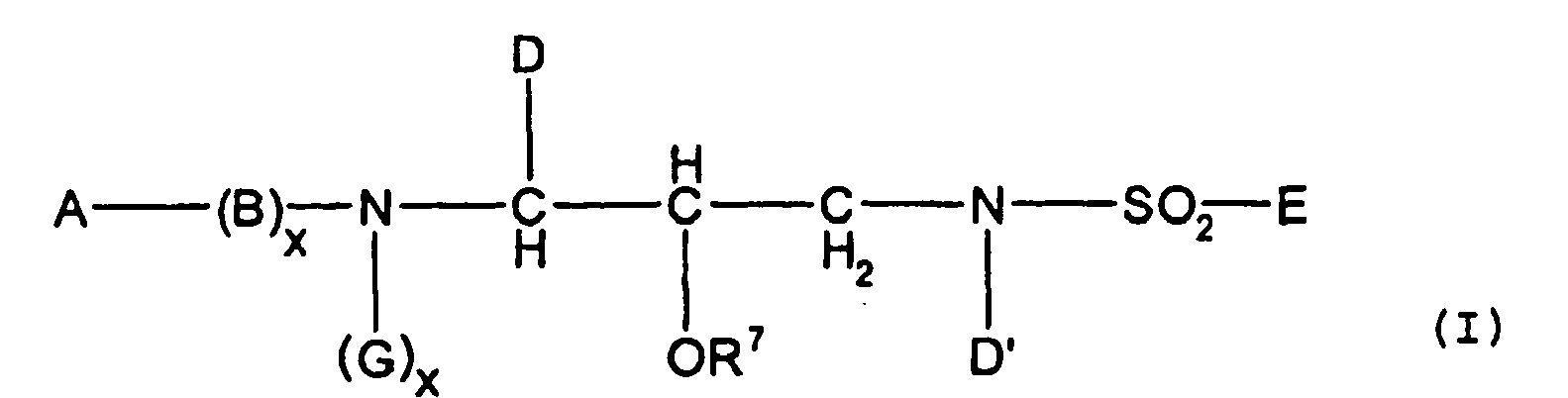
- A is selected from H; Ht; -R1-Ht; -R1-C1-C6 alkyl, which is optionally substituted with one or more groups independently selected from hydroxy, C1-C4 alkoxy, Ht, -O-Ht, -NR2-CO-N(R2)2 or -CO-N(R2)2; -R1-C2-C6 alkenyl, which is optionally substituted with one or more groups independently selected from hydroxy, C1-C4 alkoxy, Ht, -O-Ht, -NR2-CO-N(R2)2 or -CO-N(R2)2;or R7
- each R1 is independently selected from -C(O)-, - S(O)2-, -C(O)-C(O)-, -O-C(O)-, -O-S(O)2, -NR2-S(O)2- -NR2-C(O)- or -NR2-C(O)-C(O)-;
- each Ht is independently selected from C3-C7 cycloalkyl; C5-C7 cycloalkenyl; C6-C10 aryl; or a 5-7 membered saturated or unsaturated heterocycle, containing one or more heteroatoms selected from N, N(R2), O, S and S(O)n; wherein said aryl or said heterocycle is optionally fused to Q; and wherein any member of said Ht is optionally substituted with one or more substituents independently selected from oxo, -OR2, SR2,-R2, - N(R2)(R2), -R2-OH, -CN, -CO2R2, -C(O)-N(R2)2, -S(O)2-N(R2)2, -N(R2)-C(O)-R2, -C(O)-R2, -S(O)n-R2, -OCF3, - S(O)n-Q, methylenedioxy, -N(R2)-S(O)2(R2), halo, -CF3, -NO2, Q, -OQ, -OR7, -SR7, -R7, -N (R2)(R7) or -N(R7)2;
- each R2 is independently selected from H, or C1-C4 alkyl optionally substituted with Q;
- B, when present, is -N(R2)-C(R3)2-C(O)-;
- each x is independently 0 or 1;
- each R3 is independently selected from H, Ht, C1-C6 alkyl, C2-C6 alkenyl, C3-C6 cycloalkyl or C5-C6 cycloalkenyl; wherein any member of said R3, except H, is optionally substituted with one or more substituents selected from -OR2, -C(O)-NH-R2, -S(O)n-N(R2)(R2), Ht, -CN, -SR2, -CO2R2, NR2-C(O)-R2;
- each n is independently 1 or 2;
- G, when present, is selected from H, R7 or C1-C4 alkyl, or, when G is C1-C4 alkyl, G and R7 are bound to one another either directly or through a C1-C3 linker to form a heterocyclic ring; or
- when G is not present (i.e., when x in (G)x is 0), then the nitrogen to which G is attached is bound directly to the R7 group on -OR7;
- D and D' are independently selected from Q; C1-C6 alkyl, which is optionally substituted with one or more groups selected from C3-C6 cycloalkyl, -OR2 , -R3, -O-Q or Q; C2-C4 alkenyl, which is optionally substituted with one or more groups selected from C3-C6 cycloalkyl, - OR2, -R3, -O-Q or Q; C3-C6 cycloalkyl, which is optionally substituted with or fused to Q; or C5-C6 cycloalkenyl, which is optionally substituted with or fused to Q;
- each Q is independently selected from a 3-7 membered saturated, partially saturated or unsaturated carbocyclic ring system; or a 5-7 membered saturated, partially saturated or unsaturated heterocyclic ring containing one or more heteroatoms selected from O, N, S, S(O)n or N(R2); wherein Q is optionally substituted with one or more groups selected from oxo, -OR2, -R2, -N(R2)2, -N(R2)-C(O)-R2, -R2-OH, -CN, -CO2R2, -C(O)-N(R2)2, halo or -CF3;
- E is selected from Ht; O-Ht; Ht-Ht; -O-R3; -N(R2)(R3); C1-C6 alkyl, which is optionally substituted with one or more groups selected from R4 or Ht; C2-C6 alkenyl, which is optionally substituted with one or more groups selected from R4 or Ht; C3-C6 saturated carbocycle, which is optionally substituted with one or more groups selected from R4 or Ht; or C5-C6 unsaturated carbocycle, which is optionally substituted with one or more groups selected from R4 or Ht;
- each R4 is independently selected from -OR2, -SR2, -C(O)-NHR2, -S(O)2-NHR2, halo, -NR2-C(O)-R2, -N(R2)3 or -CN;
- each R7 is independently selected from

- wherein each M is independently selected from H, Li, Na, K, Mg, Ca, Ba, -N(R2)4, C1-C12-alkyl, C2-C12-alkenyl, or -R6; wherein 1 to 4 -CH2 radicals of the alkyl or alkenyl group, other than the -CH2 that is bound to Z, is optionally replaced by a heteroatom group selected from O, S, S(O), S(O2), or N(R2); and wherein any hydrogen in said alkyl, alkenyl or R6 is optionally replaced with a substituent selected from oxo, -OR2, -R2, N(R2)2, N(R2)3, R2OH, -CN, -CO2R2, -C(O)-N(R2)2, S(O)2-N(R2)2, N(R2)-C(O)-R2 C(O)R2, -S(O)n-R2, OCF3, -S(O)n-R6, N(R2)-S(O)2(R2), halo, -CF3, or -NO2;
- M' is H, C1-C12-alkyl, C2-C12-alkenyl, or -R6; wherein 1 to 4 -CH2 radicals of the alkyl or alkenyl group is optionally replaced by a heteroatom group selected from O, S, S(O), S(O2), or N(R2); and wherein any hydrogen in said alkyl, alkenyl or R6 is optionally replaced with a substituent selected from oxo, -OR2, -R2, -N(R2)2, N(R2)3, -R2OH, -CN, -CO2R2, -C(O)-N(R2)2, -S(O)2-N(R2)2, -N(R2)-C(O)-R2, -C(O)R2, -S(O)n-R2, -OCF3, -S(O)n-R6, -N(R2)-S(O)2(R2), halo, -CF3, or -NO2;
- Z is CH2, O, S, N(R2)2, or, when M is absent, H;
- Y is P or S;
- X is O or S; and
- R9 is C(R2)2, O or N(R2); and wherein when Y is S, Z is not S; and
- R6 is a 5-6 membered saturated, partially saturated or unsaturated carbocyclic or heterocyclic ring system, or an 8-10 membered saturated, partially saturated or unsaturated bicyclic ring system; wherein any of said heterocyclic ring systems contains one or more heteroatoms selected from O, N, S, S(O)n or N(R2); and wherein any of said ring systems optionally contains 1 to 4 substituents independently selected from OH, C1-C4 alkyl, O-C1-C4 alkyl or OC(O)C1-C4 alkyl.
- It is also an object of this invention to x provide pharmaceutical compositions comprising the sulfonamide prodrugs of formula I and methods for their use as prodrugs of HIV aspartyl protease inhibitors.
- In order that the invention herein described may be more fully understood, the following detailed description is set forth. In the description, the following abbreviations are used:
Designation Reagent or Fragment Ac acetyl Me methyl Et ethyl Bzl benzyl Trityl triphenylmethyl Asn D- or L-asparagine Ile D- or L-isoleucine Phe D- or L-phenylalanine Val D- or L-valine Boc tert-butoxycarbonyl Cbz benzyloxycarbonyl (carbobenzyloxy) Fmoc 9-fluorenylmethoxycarbonyl DCC dicyclohexylcarbodiimide DIC diisopropylcarbodiimide EDC 1-(3-dimethylaminopropyl)-3-ethylcarbodiimide hydrochloride HOBt 1-hydroxybenzotriazole HOSu 1-hydroxysuccinimide TFA trifluoroacetic acid DIEA diisopropylethylamine DBU 1,8-diazabicyclo(5.4.0)undec-7-ene EtOAc ethyl acetate - The following terms are employed herein:
- Unless expressly stated to the contrary, the terms "-SO2-" and "-S(O)2-" as used herein refer to a sulfone or sulfone derivative (i.e., both appended groups linked to the S), and not a sulfinate ester.
- For the compounds of formula I, and intermediates thereof, the stereochemistry of OR7 is defined relative to D on the adjacent carbon atom, when the molecule is drawn in an extended zig-zag representation (such as that drawn for compounds of formula XI, XV, XXII, XXIII and XXXI). If both OR7 and D reside on the same side of the plane defined by the extended backbone of the compound, the stereochemistry of OR7 will be referred to as "syn". If OR7 and D reside on opposite sides of that plane, the stereochemistry of OR7 will be referred to as "anti".
- The term "aryl", alone or in combination with any other term, refers to a carbocyclic aromatic radical containing the specified number of carbon atoms.
- The term "heterocyclic" refers to a stable 5-7 membered monocycle or 8-11 membered bicyclic heterocycle which is either saturated or unsaturated, and which may be optionally benzofused if monocyclic. Each heterocycle consists of carbon atoms and from one to four heteroatoms selected from the group consisting of nitrogen, oxygen and sulfur. As used herein, the terms "nitrogen and sulfur heteroatoms" include any oxidized form of nitrogen and sulfur, and the quaternized form of any basic nitrogen. The heterocyclic ring may be attached by any heteroatom of the cycle which results in the creation of a stable structure. Preferred heterocycles defined above include, for example, benzimidazolyl, imidazolyl, imidazolinoyl, imidazolidinyl, quinolyl, isoquinolyl, indolyl, pyridyl, pyrrolyl, pyrrolinyl, pyrazolyl, pyrazinyl, quinoxolyl, piperidinyl, morpholinyl, thiamorpholinyl, furyl, thienyl, triazolyl, thiazolyl, β-carbolinyl, tetrazolyl, thiazolidinyl, benzofuranoyl, thiamorpholinyl sulfone, benzoxazolyl, oxopiperidinyl, oxopyrroldinyl, oxoazepinyl, azepinyl, isoxazolyl, tetrahydropyranyl, tetrahydrofuranyl, thiadiazolyl, benzodioxolyl, thiophenyl, tetrahydrothiophenyl and sulfolanyl.
- The terms "HIV protease" and "HIV aspartyl protease" are used interchangeably and refer to the aspartyl protease encoded by the human immunodeficiency virus type 1 or 2. In a preferred embodiment of this invention, these terms refer to the human immunodeficiency virus type 1 aspartyl protease.
- The term "pharmaceutically effective amount" refers to an amount effective in treating HIV infection in a patient. The term "prophylactically effective amount" refers to an amount effective in preventing HIV infection in a patient. As used herein, the term "patient" refers to a mammal, including a human.
- The term "pharmaceutically acceptable carrier or adjuvant" refers to a non-toxic carrier or adjuvant that may be administered to a patient, together with a compound of this invention, and which does not destroy the pharmacological activity thereof.
- Pharmaceutically acceptable salts of the compounds of this invention include those derived from pharmaceutically acceptable inorganic and organic acids and bases. Examples of suitable acids include hydrochloric, hydrobromic, sulfuric, nitric, perchloric, fumaric, maleic, phosphoric, glycollic, lactic, salicylic, succinic, toluene-p-sulfonic, tartaric, acetic, citric, methanesulfonic, formic, benzoic, malonic, naphthalene-2-sulfonic and benzenesulfonic acids. Other acids, such as oxalic, while not in themselves pharmaceutically acceptable, may be employed in the preparation of salts useful as intermediates in obtaining the compounds of the invention and their pharmaceutically acceptable acid addition salts.
- Salts derived from appropriate bases include alkali metal (e.g., sodium), alkaline earth metal (e.g., magnesium), ammonium and N-(C1-4 alkyl)4+ salts.
- The term "thiocarbamates" refers to compounds containing the functional group N-SO2-O.
- The compounds of this invention contain one or more asymmetric carbon atoms and thus occur as racemates and racemic mixtures, single enantiomers, diastereomeric mixtures and individual diastereomers. All such isomeric forms of these compounds are expressly included in the present invention. Each stereogenic carbon may be of the R or S configuration. The explicitly shown hydroxyl is also preferred to be syn to D, in the extended zigzag conformation between the nitrogens shown in compounds of formula I.
- Combinations of substituents and variables envisioned by this invention are only those that result in the formation of stable compounds. The term "stable", as used herein, refers to compounds which possess stability sufficient to allow manufacture and administration to a mammal by methods known in the art. Typically, such compounds are stable at a temperature of 40°C or less, in the absence of moisture or other chemically reactive conditions, for at least a week.
- The compounds of the present invention may be used in the form of salts derived from inorganic or organic acids. Included among such acid salts, for example, are the following: acetate, adipate, alginate, aspartate, benzoate, benzenesulfonate, bisulfate, butyrate, citrate, camphorate, camphorsulfonate, cyclopentanepropionate, digluconate, dodecylsulfate, ethanesulfonate, fumarate, glucoheptanoate, glycerophosphate, hemisulfate, heptanoate, hexanoate, hydrochloride, hydrobromide, hydroiodide, 2-hydroxy ethanesulfonate, lactate, maleate, methanesulfonate, 2-naphthalenesulfonate, nicotinate, oxalate, pamoate, pectinate, persulfate, 3-phenylpropionate, picrate, pivalate, propionate, succinate, tartrate, thiocyanate, tosylate and undecanoate.
- This invention also envisions the quaternization of any basic nitrogen-containing groups of the compounds disclosed herein. The basic nitrogen can be quaternized with any agents known to those of ordinary skill in the art including, for example, lower alkyl halides, such as methyl, ethyl, propyl and butyl chlorides, bromides and iodides; dialkyl sulfates including dimethyl, diethyl, dibutyl and diamyl sulfates; long chain halides such as decyl, lauryl, myristyl and stearyl chlorides, bromides and iodides; and aralkyl halides including benzyl and phenethyl bromides. Water or oil-soluble or dispersible products may be obtained by such quaternization.
- The novel sulfonamides of this invention are those of formula I:

- A is selected from H; Ht; -R1-Ht; -R1-C1-C6 alkyl, which is optionally substituted with one or more groups independently selected from hydroxy, C1-C4 alkoxy, Ht, -O-Ht, -NR2-CO-N(R2)2 or -CO-N(R2)2; -R1-C2-C6 alkenyl, which is optionally substituted with one or more groups independently selected from hydroxy, C1-C4 alkoxy, Ht, -O-Ht, -NR2-CO-N(R2)2 or -CO-N(R2)2; or R7;
- each R1 is independently selected from -C(O)-, - S(O)2-, -C(O)-C(O)-, -O-C(O)-, -O-S(O)2, -NR2-S(O)2-, -NR2-C(O)- or -NR2-C(O)-C(O)-;
- each Ht is independently selected from C3-C7 cycloalkyl; C5-C7 cycloalkenyl; C6-C10 aryl; or a 5-7 membered saturated or unsaturated heterocycle, containing one or more heteroatoms selected from N, N(R2), O, S and S(O)n; wherein said aryl or said heterocycle is optionally fused to Q; and wherein any member of said Ht is optionally substituted with one or more substituents independently selected from oxo, -OR2, SR2, -R2, - N(R2)(R2), -R2-OH, -CN, -CO2R2, -C(O)-N(R2)2, -S(O)2-N(R2)2, -N(R2)-C(O)-R2, -C(O)-R2, -S(O)n-R2, -OCF3, - S(O)n-Q, methylenedioxy, -N(R2)-S(O)2(R2), halo, -CF3, -NO2, Q, -OQ, -OR7, -SR7, -R7, -N(R2) (R7) or -N(R7)2;
- each R2 is independently selected from H, or C1-C4 alkyl optionally substituted with Q;
- B, when present, is -N(R2)-C(R3)2-C(O)-;
- each x is independently 0 or 1;
- each R3 is independently selected from H, Ht, C1-C6 alkyl, C2-C6 alkenyl, C3-C6 cycloalkyl or C5-C6 cycloalkenyl; wherein any member of said R3, except H, is optionally substituted with one or more substituents selected from -OR2, -C(O)-NH-R2, -S(O)n-N(R2)(R2), Ht, -CN, -SR2, -CO2R2, NR2-C(O)-R2;
- each n is independently 1 or 2;
- G, when present, is selected from H, R7 or C1-C4 alkyl, or, when G is C1-C4 alkyl, G and R7 are bound to one another either directly or through a C1-C3 linker to form a heterocyclic ring; or
- when G is not present (i.e., when x in (G)x is 0), then the nitrogen to which G is attached is bound directly to the R7 group in -OR7 with the concomitant displacement of one -ZM group from R7;
- D and D' are independently selected from Q; C1-C6 alkyl, which is optionally substituted with one or more groups selected from C3-C6 cycloalkyl, -OR2, -R3, -O-Q or Q; C2-C4 alkenyl, which is optionally substituted with one or more groups selected from C3-C6 cycloalkyl, - OR2, -R3, -O-Q or Q; C3-C6 cycloalkyl, which is optionally substituted with or fused to Q; or C5-C6 cycloalkenyl, which is optionally substituted with or fused to Q;
- each Q is independently selected from a 3-7 membered saturated, partially saturated or unsaturated carbocyclic ring system; or a 5-7 membered saturated, partially saturated or unsaturated heterocyclic ring containing one or more heteroatoms selected from O, N, S, S(O)n or N(R2); wherein Q is optionally substituted with one or more groups selected from oxo, -OR2, -R2, -N(R2)2, -N(R2)-C(O)-R2, -R2-OH, -CN, -CO2R2, -C(O)-N(R2)2, halo or -CF3;
- E is selected from Ht; O-Ht; Ht-Ht; -O-R3; -N(R2)(R3); C1-C6 alkyl, which is optionally substituted with one or more groups selected from R4 or Ht; C2-C6 alkenyl, which is optionally substituted with one or more groups selected from R4 or Ht; C3-C6 saturated carbocycle, which is optionally substituted with one or more groups selected from R4 or Ht; or C5-C6 unsaturated carbocycle, which is optionally substituted with one or more groups selected from R4 or Ht;
- each R4 is independently selected from -OR2, -SR2, -C(O)-NHR2, -S(O)2-NHR2, halo, -NR2-C(O)-R2, -N(R2)2 or -CN;
- each R7 is independently selected from

- wherein each M is independently selected from H, Li, Na, K, Mg, Ca, Ba, -N(R2)4, C1-C12-alkyl, C2-C12-alkenyl, or -R6; wherein 1 to 4 -CH2 radicals of the alkyl or alkenyl group, other than the -CH2 that is bound to Z, is optionally replaced by a heteroatom group selected from O, S, S(O),S(O2), or N(R2); and wherein any hydrogen in said alkyl, alkenyl or R6 is optionally replaced with a substituent selected from oxo, -OR2, -R2, N(R2)2, N(R2)3, R2OH, -CN, -CO2R2, -C(O)-N(R2)2, S(O)2-N(R2)2, N(R2)-C(O)-R2, C(O)R2, -S(O)n-R2, OCF3, -S(O)n-R6, N(R2)-S(O)2(R2), halo, -CF3, or -NO2;
- M' is H, C1-C12-alkyl, C2-C12-alkenyl, or -R6; wherein 1 to 4 -CH2 radicals of the alkyl or alkenyl group is optionally replaced by a heteroatom group selected from O, S, S(O), S(O2), or N(R2); and wherein any hydrogen in said alkyl, alkenyl or R6 is optionally replaced with a substituent selected from oxo, -OR2, -R2, -N(R2)2, N(R2)3, -R2OH, -CN, -CO2R2, -C(O)-N(R2)2, -S(O)2-N(R2)2, -N(R2)-C(O)-R1, -C(O)R2, -S(O)n-R2, -OCF3, -S(O)n-R6, -N(R2)-S(O)2(R2), halo, -CF3, or -NO2;
- Z is CH2, O, S, N(R2)2, or, when M is not present, H.
- Y is P or S;
- X is O or S; and
- R9 is C(R2)2, O or N(R2); and wherein when Y is S, Z is not S; and
- R6 is a 5-6 membered saturated, partially saturated or unsaturated carbocyclic or heterocyclic ring system, or an 8-10 membered saturated, partially saturated or unsaturated bicyclic ring system; wherein any of said heterocyclic ring systems contains one or more heteroatoms selected from O, N, S, S(O)n or N(R2); and wherein any of said ring systems optionally contains 1 to 4 substituents independently selected from OH, C1-C4 alkyl, O-C1-C4 alkyl or O-C(O)-C1-C4 alkyl.
- Preferably, at least one R7 is selected from:


- It will be understood by those of skill in the art that component M or M' in the formulae set forth herein will have either a covalent, a covalent/ zwitterionic, or an ionic association with either Z or R9 depending upon the actual choice for M or M'. When M or M' is hydrogen, alkyl, alkenyl, or R6, M or M' is covalently bound to R9 or Z. If M is a mono- or bivalent metal or other charged species (i.e., NH4 +), there is an ionic interaction between M and Z and the resulting compound is a salt.
- When x is 0 in (M)x, Z may be a charged species. When that occurs, the other M may be oppositely charged to produce a 0 net charge on the molecule. Alternatively, the counter ion may be located elsewhere in the molecule.
- Except where expressly provided to the contrary, as used herein, the definitions of variables A, R1-R4, R6-R9, Ht, B, x, n, D, D', M, M', Q, X, Y, Z and E are to be taken as they are defined above for the compounds of formula I.
- According to a preferred embodiment, the compounds of this invention are those represented by formulas XXII, XXIII or XXXI:


- For compounds of formula XXII, more preferred compounds are those wherein:
- A is selected from 3-tetrahydrofuryl-O-C(O)-, 3-(1,5-dioxane)-O-C(O)-, or 3-hydroxy-hexahydrofura[2,3-b]-furanyl-O-C(O)-;
- D' is C1-C4 alkyl which is optionally substituted with one or more groups selected from the group consisting of C3-C6 cycloalkyl, -OR2, -R3, -O-Q and Q;
- E is C6-C10 aryl optionally substituted with one or more substituents selected from oxo, -OR2, SR2, -R2, - N(R2)2, -R2-OH, -CN, -CO2R2, -C(O)-N(R2)2, -S(O)2-N(R2)2, -N(R2)-C(O)-R2, -C(O)-R2, -S(O)n-R2, -OCF3, -S(O)n-Q, methylenedioxy, -N(R2)-S(O)2(R2), halo, -CF3, -NO2, Q, -OQ, -OR7, -SR7, -R7, -N(R2)(R7) or -N(R7)2; or a 5-membered heterocyclic ring containing one S and optionally containing N as an additional heteroatom, wherein said heterocyclic ring is optionally substituted with one to two groups independently selected from -CH3, R4, or Ht.
- Ht, insofar as it is defined as part of R3, is defined as above except for the exclusion of heterocycles; and all other variables are as defined for formula I.
- Even more preferred are compounds of formula XXII, wherein A is 3-tetrahydrofuryl-O-C(O)-; G is hydrogen; D' is isobutyl; E is phenyl substituted with N(R7)2; each M is independently selected from H, Li, Na, K, Mg, Ca, Ba, C1-C4 alkyl or -N(R2)4; and each M' is H or C1-C4 alkyl.
- Another preferred embodiment for the formula XXII compounds are those wherein:
- E is a 5-membered heterocyclic ring containing one S and optionally containing N as an additional heteroatom, wherein said heterocyclic ring is optionally substituted with one to two groups independently selected from -CH3, R4, or Ht; and
- all other variables are as defined for formula I.
- Even more preferred are any of the formula XXII compounds set forth above, wherein R7 in -OR7 is -PO(OM)2 or C(O)CH2OCH2CH2OCH2CH2OCH3 and both R7 in -N(R7) 2 are H, wherein M is H, Li, Na, K or C1-C4 alkyl; or wherein R7 in -OR7 is C(O)CH2OCH2CH2OCH3, one R7 in -N(R7)2 is C(O)CH2OCH2CH2OCH3 and the other is H.
- The most preferred compound of formula XXII has the structure:

- For compounds of formula XXIII, most preferred compounds are those wherein:
- R3 is C1-C6 alkyl, C2-C6 alkenyl, C5-C6 cycloalkyl, C5-C6 cycloalkenyl or a 5-6 membered saturated or unsaturated heterocycle, wherein any member of said R3 may be optionally substituted with one or more substituents selected from the group consisting of -OR2, -C(O)-NH-R2, -S(O)nN(R2)(R2), Ht, -CN, -SR2, -C(O)2R2 and NR2-C(O)-R2; and
- D' is C1-C3 alkyl or C3 alkenyl, wherein said alkyl or alkenyl may optionally be substituted with one or more groups selected from the group consisting of C3-C6 cycloalkyl, -OR2, -O-Q and Q (with all other variables being defined as above for compounds of formula I).
- Even more preferred are compounds of formula XXIII described above, wherein R7 is -PO(OM)2 or -C(O)-M'.
- For compounds of formula XXXI, most preferred compounds are those wherein A is R1-Ht, each R3 is independently C1-C6 alkyl which may be optionally substituted with a substituent selected from the group consisting of -OR2, -C(O)-NH-R2, -S(O)nN(R2)(R2), Ht, -CN, -SR2, -CO2R2 or -NR2-C(O)-R2 and D' is C1-C4 alkyl, which may be optionally substituted with a group selected from the group consisting of C3-C6 cycloalkyl, -OR2, -O-Q; and E is Ht, Ht-Ht and -NR2R3.
- Even more preferred are those compounds of formula XXXI described above wherein R7 is -PO(OM)2 or -C(O)-M'.
TABLE I 
CMPD R7 W 198 
-NO2 199 
-NH2 200 
-NH2 201 
-NH2 202 
-NH2 203 
-NH2 204 
-NH2 205 
-NH2 206 
-NH2 207 
-NH2 208 
-NO2 209 
-NO2 210 
-NH2 211 
-NH2 212 
-NH2 213 
-NH2 214 
-NH2 215 
-NH2 216 
-NH2 217 
-NH2 219 H 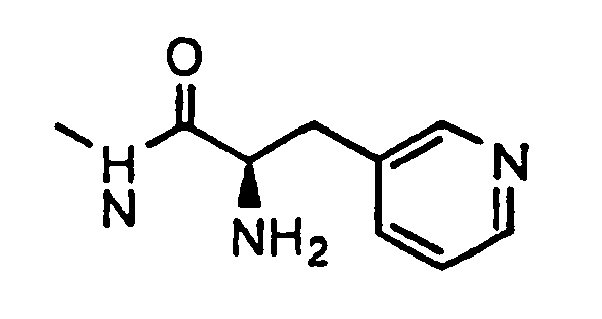
220 H 
221 H 
222 H 
223 H 
224 H 
225 

226 
-NO2 227 
-NO2 228 
-NH2 229 
-NE2 230 H 
231 

237 
-NO2 238 
-NO2 239 - SO3H -NO2 240 -SO3H -NH2 241 
-NO2 242 
-NH2 245 -NH2 246 
-NH2 247 
-NH2 248 
-NH2 249 
-NH2 250 
-NH2 251 
-NH2 252 
-NH2 253 
-NH2 254 
-NH2 255 H -NH-CHO 256 H 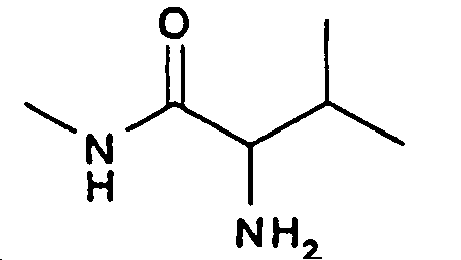
257 H 
258 H 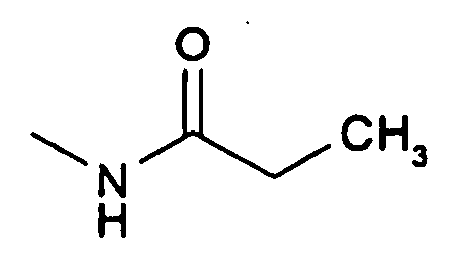
259 H 
260 H 
261 

262 

263 

264 PO3K2 -NH2 265 PO3Ca -NH2 266 PO3Mg -NH2 267 
-NH2 308 
-NH2 402 H 
403 H 
404 H 
405 H 
406 H 
407 H 
408 
-NH2 TABLE II 
COMPOUND A R7 232 

233 H 
234 
H 235 

236 

TABLE III 
COMPOUND R7 W 243 
-NO2 244 
-NH2 400 
-NO2 401 
-NH2 - According to another embodiment, the invention provides compounds of the following formulae whereby however, compounds of formulae 1001 and 1003 to 1010 do not fall within the scope of the present invention and thus, constitute reference compounds.


- The prodrugs of the present invention may be synthesized using conventional synthetic techniques.
United States patent 5,585,397 discloses the synthesis of compounds of formula:
- For example, VX-478, a compound disclosed in the '397 patent, can be readily converted to the corresponding bis-phosphate ester derivative, as shown below:

- Alternatively, if the monophosphate ester of VX-478 is desired, then the synthetic scheme can be readily adapted by beginning with the 4-nitrophenyl derivative of VX-478, as shown below:

- Examples of specific compounds in addition to VX-478 which may be converted to the prodrugs of this invention by similar techniques (and the syntheses of those intermediates to the compounds of the present invention) are disclosed in
WO 94/05639 WO 96/33184 - Pharmaceutically acceptable salts of the compounds of the present invention may be readily prepared using known techniques. For example, the disodium salt of the mono-phosphate ester shown above can be prepared as shown below:

- The compounds of this invention may be modified by appending appropriate functionalities to enhance selective biological properties. Such modifications are known in the art and include those which increase biological penetration into a given biological system (e.g., blood, lymphatic system, central nervous system), increase oral availability, increase solubility to allow administration by injection, alter metabolism and alter rate of excretion.
- Without being bound by theory, we believe that two different mechanisms are involved in converting the prodrugs of this invention into the active drug, depending upon the structure of the prodrug. The first mechanism involves the enzymatic or chemical transformation of the prodrug species into the active form. The second mechanism involves the enzymatic or chemical cleavage of a functionality on the prodrug to produce the active compound.
- The chemical or enzymatic transformation can involve transfer of a functional group (i.e., R7) from one heteroatom within the molecule to another heteroatom. This transfer is demonstrated in the chemical reactions shown below:


- The cleavage mechanism is demonstrated by the reaction below where a phosphate ester-containing prodrug is converted into the active form of the drug by removal of the phosphate group.

- These protease inhibitors and their utility as inhibitors of aspartyl proteases are described in
United States Patent 5,585,397 , the disclosure of which is incorporated herein by reference. - The prodrugs of the present invention are characterized by unexpectedly high aqueous solubility. This solubility facilitates administration of higher doses of the prodrug, resulting in a greater drug load per unit dosage. The prodrugs of the present invention are also characterized by facile hydrolytic cleavage to release the active aspartyl protease inhibitor in vivo. The high aqueous solubility and the facile in vivo metabolism result in a greater bioavailability of the drug. As a result, the pill burden on a patient is significantly reduced.
- The prodrugs of this invention may be used for the preparation of a pharmaceutical composition for the treatment of infections with viruses, such as HIV and HTLV, which depend on aspartyl proteases for obligatory events in their life cycle, in a conventional manner. Such treatments, their dosage levels and requirements may be selected by those of ordinary skill in the art from available treatments and techniques. For example, a prodrug of this invention may be combined with a pharmaceutically acceptable adjuvant for administration to a virally-infected patient in a pharmaceutically acceptable manner and in an amount effective to lessen the severity of the viral infection.
- Alternatively, the prodrugs of this invention may be used in vaccines and uses for the preparation of a pharmaceutical composition for protecting individuals against viral infection over an extended period of time. The prodrugs may be employed in such vaccines either alone or together with other compounds of this invention in a manner consistent with the conventional utilization of protease inhibitors in vaccines. For example, a prodrug of this invention may be combined with pharmaceutically acceptable adjuvants conventionally employed in vaccines and administered in prophylactically effective amounts to protect individuals over an extended period time against HIV infection. As such, the novel protease inhibitors of this invention can be administered as agents for treating or preventing HIV infection in a mammal.
- The prodrugs of this invention may be administered to a healthy or HIV-infected patient either as a single agent or in combination with other anti-viral agents which interfere with the replication cycle of HIV. By administering the compounds of this invention with other anti-viral agents which target different events in the viral life cycle, the therapeutic effect of these compounds is potentiated. For instance, the co-administered anti-viral agent can be one which targets early events in the life cycle of the virus, such as cell entry, reverse transcription and viral DNA integration into cellular DNA. Anti-HIV agents targeting such early life cycle events include, didanosine (ddI), alcitabine (ddC), d4T, zidovudine (AZT), polysulfated polysaccharides, sT4 (soluble CD4), ganciclovir, dideoxycytidine, trisodium phosphonoformate, eflornithine, ribavirin, acyclovir, alpha interferon and trimetrexate. Additionally, non-nucleoside inhibitors of reverse transcriptase, such as TIBO or nevirapine, may be used to potentiate the effect of the compounds of this invention, as may viral uncoating inhibitors, inhibitors of trans-activating proteins such as tat or rev, or inhibitors of the viral integrase.
- Combination therapies according to this invention exert a synergistic effect in inhibiting HIV replication because each component agent of the combination acts on a different site of HIV replication. The use of such combinations also advantageously reduces the dosage of a given conventional anti-retroviral agent which would be required for a desired therapeutic or prophylactic effect as compared to when that agent is administered as a monotherapy. These combinations may reduce or eliminate the side effects of conventional single anti-retroviral agent therapies while not interfering with the anti-retroviral activity of those agents. These combinations reduce potential of resistance to single agent therapies, while minimizing any associated toxicity. These combinations may also increase the efficacy of the conventional agent without increasing the associated toxicity. In particular, we have discovered that these prodrugs act synergistically in preventing the replication of HIV in human T cells. Preferred combination therapies include the administration of a prodrug of this invention with AZT, ddI, ddC or d4T.
- Alternatively, the prodrugs of this invention may also be co-administered with other HIV protease inhibitors such as Ro 31-8959 (Roche), L-735,524 (Merck), XM 323 (Du-Pont Merck) and A-80,987 (Abbott) to increase the effect of therapy or prophylaxis against various viral mutants or members of other HIV quasi species.
- We prefer administering the prodrugs of this invention as single agents or in combination with retroviral reverse transcriptase inhibitors, such as derivatives of AZT, or other HIV aspartyl protease inhibitors. We believe that the co-administration of the compounds of this invention with retroviral reverse transcriptase inhibitors or HIV aspartyl protease inhibitors may exert a substantial synergistic effect, thereby preventing, substantially reducing, or completely eliminating viral infectivity and its associated symptoms.
- The prodrugs of this invention can also be administered in combination with immunomodulators (e.g., bropirimine, anti-human alpha interferon antibody, IL-2, GM-CSF, methionine enkephalin, interferon alpha, diethyldithiocarbamate, tumor necrosis factor, naltrexone and rEPO); and antibiotics (e.g., pentamidine isethionate) to prevent or combat infection and disease associated with HIV infections, such as AIDS and ARC.
- When the prodrugs of this invention are administered in combination therapies with other agents, they may be administered sequentially or concurrently to the patient. Alternatively, pharmaceutical or prophylactic compositions according to this invention may be comprised of a combination of a prodrug of this invention and another therapeutic or prophylactic agent.
- Although this invention focuses on the use of the prodrugs disclosed herein for preventing and treating HIV infection, the compounds of this invention can also be used as inhibitory agents for other viruses which depend on similar aspartyl proteases for obligatory events in their life cycle. These viruses include, as well as other AIDS-like diseases caused by retroviruses, such as simian immunodeficiency viruses, but are not limited to, HTLV-I and HTLV-II. In addition, the compounds of this invention may also be used to inhibit other aspartyl proteases, and in particular, other human aspartyl proteases, including renin and aspartyl proteases that process endothelin precursors.
- Pharmaceutical compositions of this invention comprise any of the compounds of the present invention, and pharmaceutically acceptable salts thereof, with any pharmaceutically acceptable carrier, adjuvant or vehicle. Pharmaceutically acceptable carriers, adjuvants and vehicles that may be used in the pharmaceutical compositions of this invention include, but are not limited to, ion exchangers, alumina, aluminum stearate, lecithin, serum proteins, such as human serum albumin, buffer substances such as phosphates, glycine, sorbic acid, potassium sorbate, partial glyceride mixtures of saturated vegetable fatty acids, water, salts or electrolytes, such as protamine sulfate, disodium hydrogen phosphate, potassium hydrogen phosphate, sodium chloride, zinc salts, colloidal silica, magnesium trisilicate, polyvinyl pyrrolidone, cellulose-based substances, polyethylene glycol, sodium carboxymethylcellulose, polyacrylates, waxes, polyethylene-polyoxypropylene-block polymers, polyethylene glycol and wool fat.
- The pharmaceutical compositions of this invention may be administered orally, parenterally, by inhalation spray, topically, rectally, nasally, buccally, vaginally or via an implanted reservoir. We prefer oral administration or administration by injection. The pharmaceutical compositions of this invention may contain any conventional non-toxic pharmaceutically-acceptable carriers, adjuvants or vehicles. The term parenteral as used herein includes subcutaneous, intracutaneous, intravenous, intramuscular, intra-articular, intrasynovial, intrasternal, intrathecal, intralesional and intracranial injection or infusion techniques.
- The pharmaceutical compositions may be in the form of a sterile injectable preparation, for example, as a sterile injectable aqueous or oleaginous suspension. This suspension may be formulated according to techniques known in the art using suitable dispersing or wetting agents (such as, for example, Tween 80) and suspending agents. The sterile injectable preparation may also be a sterile injectable solution or suspension in a non-toxic parenterally-acceptable diluent or solvent, for example, as a solution in 1,3-butanediol. Among the acceptable vehicles and solvents that may be employed are mannitol, water, Ringer's solution and isotonic sodium chloride solution. In addition, sterile, fixed oils are conventionally employed as a solvent or suspending medium. For this purpose, any bland fixed oil may be employed including synthetic mono- or diglycerides. Fatty acids, such as oleic acid and its glyceride derivatives are useful in the preparation of injectables, as are natural pharmaceutically-acceptable oils, such as olive oil or castor oil, especially in their polyoxyethylated versions. These oil solutions or suspensions may also contain a long-chain alcohol diluent or dispersant such as Ph. Helv or a similar alcohol.
- The pharmaceutical compositions of this invention may be orally administered in any orally acceptable dosage form including, but not limited to, capsules, tablets, and aqueous suspensions and solutions. In the case of tablets for oral use, carriers which are commonly used include lactose and corn starch. Lubricating agents, such as magnesium stearate, are also typically added. For oral administration in a capsule form, useful diluents include lactose and dried corn starch. When aqueous suspensions are administered orally, the active ingredient is combined with emulsifying and suspending agents. If desired, certain sweetening and/or flavoring and/or coloring agents may be added.
- The pharmaceutical compositions of this invention may also be administered in the form of suppositories for rectal administration. These compositions can be prepared by mixing a compound of this invention with a suitable non-irritating excipient which is solid at room temperature but liquid at the rectal temperature and therefore will melt in the rectum to release the active components. Such materials include, but are not limited to, cocoa butter, beeswax and polyethylene glycols.
- Topical administration of the pharmaceutical compositions of this invention is especially useful when the desired treatment involves areas or organs readily accessible by topical application. For application topically to the skin, the pharmaceutical composition should be formulated with a suitable ointment containing the active components suspended or dissolved in a carrier. Carriers for topical administration of the compounds of this invention include, but are not limited to, mineral oil, liquid petroleum, white petroleum, propylene glycol, polyoxyethylene polyoxypropylene compound, emulsifying wax and water. Alternatively, the pharmaceutical composition can be formulated with a suitable lotion or cream containing the active compound suspended or dissolved in a carrier. Suitable carriers include, but are not limited to, mineral oil, sorbitan monostearate, polysorbate 60, cetyl esters wax, cetearyl alcohol, 2-octyldodecanol, benzyl alcohol and water. The pharmaceutical compositions of this invention may also be topically applied to the lower intestinal tract by rectal suppository formulation or in a suitable enema formulation. Topically-transdermal patches are also included in this invention.
- The pharmaceutical compositions of this invention may be administered by nasal aerosol or inhalation. Such compositions are prepared according to techniques well-known in the art of pharmaceutical formulation and may be prepared as solutions in saline, employing benzyl alcohol or other suitable preservatives, absorption promoters to enhance bioavailability, fluorocarbons, and/or other solubilizing or dispersing agents known in the art.
- Dosage levels of between about .01 and about 100 mg/kg body weight per day, preferably between about 0.5 and about 50 mg/kg body weight per day of the active ingredient compound are useful in the prevention and treatment of viral infection, including HIV infection. Typically, the pharmaceutical compositions of this invention will be administered from about 1 to about 5 times per day or alternatively, as a continuous infusion. Such administration can be used as a chronic or acute therapy. The amount of active ingredient that may be combined with the carrier materials to produce a single dosage form will vary depending upon the host treated and the particular mode of administration. A typical preparation will contain from about 5% to about 95% active compound (w/w). Preferably, such preparations contain from about 20% to about 80% active compound.
- Upon improvement of a patient's condition, a maintenance dose of a compound, composition or combination of this invention may be administered, if necessary. Subsequently, the dosage or frequency of administration, or both, may be reduced, as a function of the symptoms, to a level at which the improved condition is retained when the symptoms have been alleviated to the desired level, treatment should cease. Patients may, however, require intermittent treatment on a long-term basis upon any recurrence of disease symptoms.
- As the skilled artisan will appreciate, lower or higher doses than those recited above may be required. Specific dosage and treatment regimens for any particular patient will depend upon a variety of factors, including the activity of the specific compound employed, the age, body weight, general health status, sex, diet, time of administration, rate of excretion, drug combination, the severity and course of the infection, the patient's disposition to the infection and the judgement of the treating physician.
- In order that this invention be more fully understood, the following examples are set forth. These examples are for the purpose of illustration only and are not to be construed as limiting the scope of the invention in any way.
-
- (A) Analytical HPLC 0-100%B/30 min, 1.5 mL/min, A=0.1% TFA in water, B=0.1% TFA in acetonitrile. Detection at 254 and 220 nm, C18 reverse phase Vydac, t0=2.4 min.
- (B) 1/3 v/v EtOAc/hexane
- (C) 1/2 v/v EtOAc/hexane
- (D) Analytical HPLC 0-100%B/10 min, 1.5 mL/min, A=0.1% TFA in water, B=0.1% TFA in acetonitrile. Detection at 254 and 220 nm, C18 reverse phase Vydac, t0=2.4 min.

- A mixture of 2.0g (3.7 mMol) of 197 and 3.0g (16 mMol) of di-p-nitrophenyl carbonate in 10 ml of dimethylformamide was treated at 25° C with 4 ml (4 mMol) of P4-phosphazene base (Fluka, 1M in hexane). The mixture was stirred for 6h at 25°C until all of the starting alcohol was consumed. The reaction mixture was partitioned between ethyl acetate and 1N hydrochloric acid. The organic layer was washed with 1N sodium hydroxide and brine, dried over magnesium sulfate and concentrated in vacuo. Titration with dichloromethane gave the desired mixed carbonate (1.2g crop 1 and 0.6g crop 2) as a fine powder. Combined yield: 69%. Rf=0.13 (1/3 EtOAc/hexane, conditions B), Rf=0.40 (1/2 EtOAc/hexane, conditions C), tHPLC=23.83 min (A), MS(ES+) 701 (M+1).
1H-NMR (CDCl3) : 0.82 (6H,dd), 1.9 (2H,m), 2.15 (1H, m), 2.8 (1H,m), 3.0 (4H,m), 3.5 (2H,m), 3.6 (1H,m), 3.8 (4H,m), 4.3 (1H,bs), 4.8 (1H,m), 5.17 (2H,m), 7.7 (7H,m), 7.95 (2H,d), 8.35 (4H,m).
13C NMR (CDCl3) 155.2 152.2, 149.9, 145.6, 135.9, +129.0, +128.8, +128.5, +127.2, +125.4, +124.4, +121.8, +78.1, +75.8, -73.1, -66.9, -56.5, +52.7, -48.2, -35.9, -35.9, 32.6, -+26.4, +19.9, +19.8. -

- To 0.20g (0.286 mM) of 198 dissolved in 3 ml of THF was added 0.11 g (1.14 mM) of 1-Methyl-piperidine and the mixture was stirred overnight at room temperature ("rt"). All the solvents were then evaporated and the solid residue partitioned between EtOAc and water. The volatiles were removed and, where appropriate, the residue was treated with 1:1 TFA/DCM over 30 min at rt to remove the Boc protecting group. The product was dissolved in 0.25 ml TFA and 1.5 ml THF. Hydrogenolysis for 10 hours in presence of 30 mg of 10% Pd/C gave the desired compound. The final purification was on preparative reversed phase C18 using conditions of Example 1, except that the flow rate was 18 ml/min.
C,H,N: calc: 49.27, 5.57, 8.25, found 49.15, 5.76, 8.29, C31H45N5O7S1. 1. 9CF3COOH
LC/MS (ES+) 632 (M+1) 1 peak at 4.71 min Analytical HPLC(A) t=N/A min
1H : 0.71 (3H, d), 0.74 (3H, d), 1.80. (2H,m), 2.03 (1H,m), 2.63 (2H,m), 2.74 (1H,m), 2.82 (3H,s), 2.92 (2H,m), 3.20 (4H,m), 3.42 (3H,m), 3.62 (2H,m), 3.75 (1H,m), 4.05 (3H, m), 4.97 (2H, m), 6.2 (1H, bs), 6.60 (2H, m), 7.22 (5H,m), 7.40 (3H,m),
13C NMR (DMSO): 156.4, 154.0, 153.8, 138.8, 129.6, 129.5, 128.3, 126.5, 123.7, 112.7, 74.8, 72.9, 66.7, 58.2, 54.0, 53.1, 49.3, 42.3, 40.8, 36.0, 33.3, 25.8, 20.4, 20.3, -

- The synthesis of compound 200 from compound 198 was carried out as described in Example 1, except that N,N-dimethyl-aminoethanol was used in place of di-p-nitrophenyl carbonate.
1H NMR (acetone-d6) : 0.82 (6H,dd), 1.83 (2H,m), 2.07 (1H,m), 2.64 (2H,m), 2.82 (6H,s), 2.90 (2H,m), 3.19 (1H,m), 3.38 (4H,m), 3.63 (2H,m), 3.76 (1H,m), 4.17 (2YH,m), 4.40 (1H,m), 4.56 (1H,m), 4.96 (1H,m), 5.06 (1H,m), 6.06 (1H,d), 6.68 (2H,d), 7.23 (5H,m), 7.47 (2H,d).
13C NMR (acetone-d6) : 20.2, 20.3, 27.5, 33.4, 35.6, 43.8, 50.1, 54.2, 56.4, 58.5, 63.1, 67.4, 73.6, 76.2, 79.9, 114.2, 118.3, 127.4, 129,2, 130.1, 130.3, 139.3, 153.4, 157.0.
LC/MS: 1 peak, 621 (MH+). -

- The synthesis of compound 201 from compound 198 was carried out as described in Example 1, except that N-acetyl-ethylenediamine was used in place of di-p-nitrophenyl carbonate.
C,H,N: calc: 49.66, 5.64, 8.83, found 49.76, 5.98, 8.93 C30H43N5O8S1 . 1.4CF3COOH.
LC/MS (ES+) 634 (M+1) 1 peak at 5.08 min. Analytical HPLC(A) t=15.92 min.
1H NMR: d-3 acetonitrile: 0.88 (6H,dd), 1.92 (3H,s), 1.94 (2H,m), 2.17 (1H,m), 2.72 (2H,m), 2.96 (2H,m), 3.07 (3H,m), 3.29 (1H,m), 3.42 (3H,m), 3.69 (1H,m), 3.77 (1H,m), 3.82 (1H,m), 4.133 (1H,m), 4.40 (1H, bs), 5.05 (2H,m), 5.80 (1H,m), 6.10 (1H,d), 6.78 (2H,d), 6.83 (1H, bs), 7.28 (5H, m), 7.58 (2H,d).
13C NMR (d3-acetonitrile) : 157.1, 157.0, 153.2, 139.6,+130.3, +130.2, +129.2, +127.2, 126.2, +114.2, +76.0, +75.4, - 73.6, -67.4, -58.2, +54.9, -50.2, -41.6, -39.8, -35.9, - 33.4, +27.3, +23.1, +20.4, +20.2. -

- The synthesis of compound 202 from compound 198 was carried out as described in Example 1, except that mono N-Boc-piperazine was used in place of di-p-nitrophenyl carbonate.
C,H,N: calc: 48.28, 5.68, 8.41, found 48.28, 5.36, 8.28, C30H43N5O7S1 x 2 CF3COOH
LC/MS (ES+) 618 (M+1) 1 peak at 4.36 min. Analytical HPLC(A) t=14.84 min.
1H NMR: d-DMSO: 0.72 (3H,d), 0.77 (3H,d), 1.78 (2H,m), 2.09 (1H,m), 2.64 (2H,m), 2.73 (1H,m), 2.80 (1H,m), 3.08 (4H,m), 3.32 (2H,m), 3.41 (1H,m), 3.50 (4H,m), 3.54 (1H,m), 3.63 (1H,m), 3.70 (1H,m), 3.98 (1H,m), 4.89 (1H,m), 4.97 (1H,m), 6.61 (2H,d), 7.23 (5H,m), 7.42 (3H,m), 8.88 (2H,bs).
13C NMR: (DMSO) : 155.7, 153.6, 153.0, 138.4, +129.1., +129.0, +128.1, +126.1, 123.2, +112.7, +75.2, +74.4, -72.5, -66.2, -56.9, +53.1, -48.8, -42.5, -40.8, -35.0, -32.2, +26.2, +20.0, +19.8. -

- The synthesis of compound 203 from compound 198 was carried out as described in Example 1, except that mono-N-Boc-ethylenediamine was used in place of di-p-nitrophenyl carbonate.
C,H,N: calc: 46.89, 5.29, 8.54, found 46.50, 5.51, 8.54 C28H41N5O7S1 x 2 CF3COOH.
LC/MS (ES+) 592 (M+1) 1 peak at 4.32 min.
Analytical HPLC(A) t=14.69 min.
1H NMR: DMSO: 0.77 (6H, d), 1.82 (2H,m), 2.06 (1H,m), 2.57 (2H,m), 2.82 (4H,m), 2.97 (1H,m), 3.30 (5H,m), 3.55 (1H,m), 3.65 (1H,m), 3.70 (1H,m), 3.95 (1H,m), 4.88 (1H,m), 4.95 (1H,m), 6.62 (2H,d), 7.20 (6H,m), 7.39 (3H,m), 7.78 (3H,bs).
13C NMR (dmso): 155.9, 152.9, 138.5, 129.2, 128.9, 128.1, 126.1, 122.9, 112.7, 74.7, 74.5, 72.6, 66.2, 57.2, 53.2, 49.4, 38.8, 37.94, 35.1, 32.1, 26.3, 20.0, 19.8. -
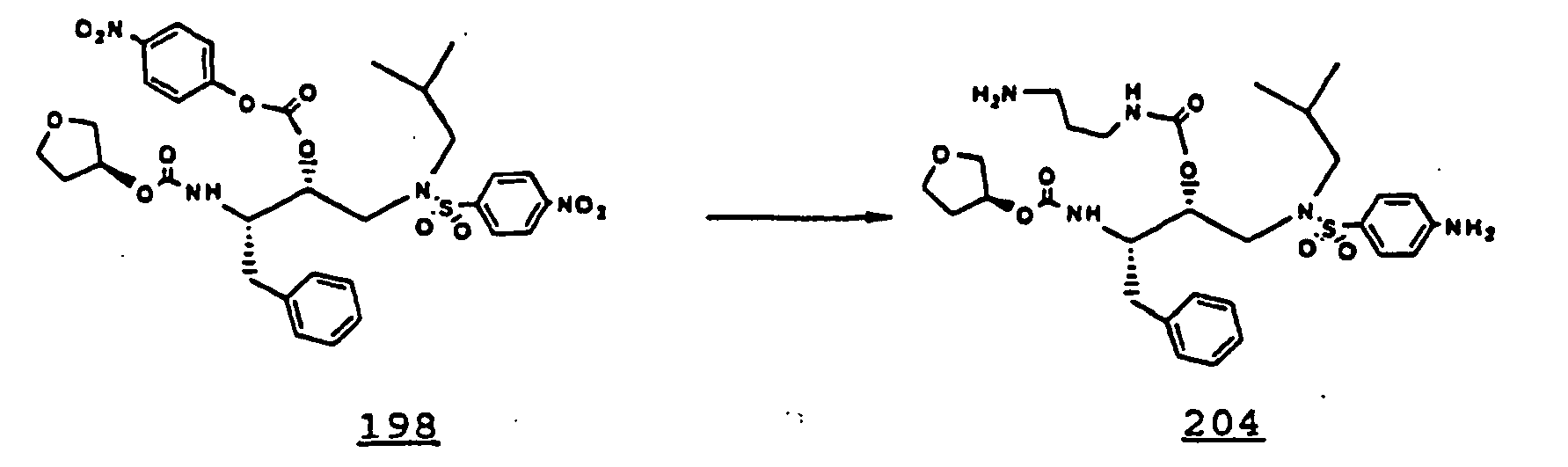
- The synthesis of compound 204 from compound 198 was carried out as described in Example 1, except that mono-1,3-diamino-3-N-Boc-propane was used in place of di-p-nitrophenyl carbonate.
C,H,N: calc: 49.07, 5.64, 8.89, found 48.95, 6.00, 8.92, C29H43N5O7S1 x 1.6 CF3COOH.
LC/MS (ES+) 605 (M+1) 1 peak at 4.27 min.
Analytical HPLC(A) t=14.72 min.
1H NMR: d6 DMSO: 0.78 (6H,dd), 1.64 (2H,m), 1.83 (2H,m), 2.03 (1H,m), 2.57 (1H,m), 2.78 (4H,m), 2.94 (1H,m), 3.03 (2H,m), 3.32 (2H,m), 3.58 (1H,m), 3.63 (1H,m), 3.73 (1H,m), 3.87 (1H,m), 4.84 (1H,m), 4.92 (1H,m), 6.61 (2H,d), 7.22 (6H,m), 7.36 (1H,d), 7.28 (2H,d), 7.76 (3H,ns).
13C NMR (dmso): 155.8, 155.7, 138.5, +129.1, +129.0, +128.0, +126.1, 122.9, +112.7, +74.6, +74.3, -72.7, -66.2, -57.2, +53.6, -49.5, -37.4, -36.7, -35.5, -32.1, -27.6, +26.2, +20.0, +19.8.. -

- The synthesis of compound 205 from compound 198 was carried out as described in Example 1, except that 1,4-diamino-4-N-Boc-butane was used in place of di-p-nitrophenyl carbonate.
C,H,N: calc: 48.17, 5.59, 8.26, found 48.02, 5.96, 8.24 C30H45N5O7S1 .2 CF3COOH
LC/MS (ES+) 620 (M+1) 1 peak at 4.36 min.
Analytical HPLC(A) t=14.93 min.
1H NMR: DMSO: 0.77 (6H,dd), 1.43 (4H,m), 1.82 (2H,m), 2.03 (1H,m), 2.77 (4H,m), 2.95 (3H,m), 3.31 (2H,m), 3.56 (1H,m), 3.63 (1H,m), 3.70 (1H,bq), 3.82 (1H,m), 4.85 (1H,m), 4.92 (1H,m), 6.62 (2H,d), 7.2 (7H,m), 7.38 (2H, d), 7.72 (3H, bs).
13C NMR: 155.7, 152.9, +138.6, +129.1, +129.0, +128.0, +126.1, +123.0, +112.7, +74.4, +74.3, -72.7, -66.2,-57.2, +53.7, -49.7, -38.6, -38.5, -35.4, -32.1, -26.3, +26.2, -24.4, +20.1, +19.9. -

- The synthesis of compound 206 from compound 198 was carried out as described in Example 1, except that (3R)-(+)-3-Boc-aminopyrrolidine was used in place of di-p-nitrophenyl carbonate.
C,H,N: calc: 48.28, 5.36, 8.28, found 47.89, 5.53, 8.57 C30H43N5O7S1 x 2 TFA
LC/MS (ES+) 618 (M+1) peak at 4.32 min.
Analytical HPLC(A) t=14.31 min.
1H and 13C NMR: complex and overlapping mixtures of rotamers. -

- The synthesis of compound 207 from compound 198 was carried out as described in Example 1, except that (3S)-(-)-3-Boc-aminopyrrolidine was used in place of di-p-nitrophenyl carbonate.
LC/MS (ES+) 618 (M+1) 1 peak at 4.19 min.
Analytical HPLC(A) t=14.75 min.
1H and 13C NMR: complex and overlapping mixtures of rotamers. -

- The synthesis of compound 308 from compound 198 was carried out as described in Example 1, except that N-triphenylmethyl-N,N'-dimethylethanediamine was used in place of di-p-nitrophenyl carbonate.
1H-NMR: 0.76 (6H,dd), 1.65 (2H,m), 1.95 (1H,m), 2.07 (1H,m), 2.7 (2H,m), 2.75 (3H,s), 2.95 (3H,m), 3.45 (2H,m), 3.7 (4H,m), 4.2 (2H,bm), 5.05 (2H,bd), 6.62 (2H,d), 7.2 (5H,m), 7.5 (2H,d).
LC/MS: 1 peak, 620 (MH+). -
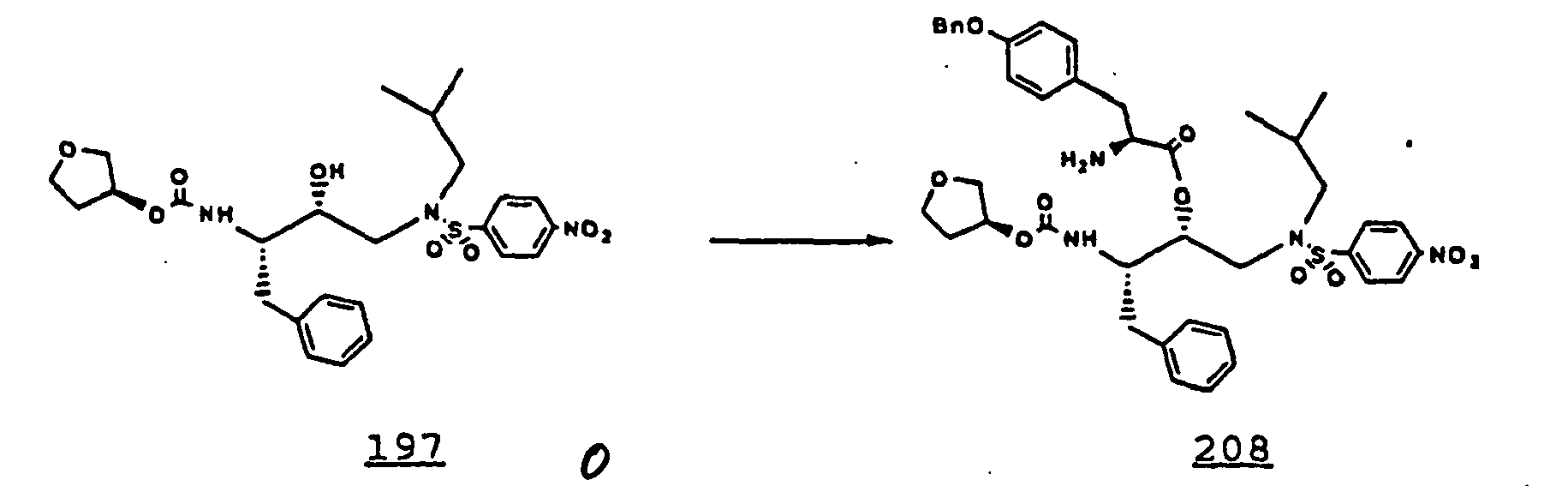
- To 200mg (0.37mM) of 197 dissolved in 5ml CH2Cl2 was added N-CBz-L-Benzyl tyrosine 183mg (0.41mM) followed by 231 mg (1.12mM) DCC, followed by 29mg (0.23mM) DMAP. The reaction was stirred at rt for 24hr. The precipitates present were removed by filtration. The filtrate was then concentrated in vacuo. The final compound was purified on preparative reversed phase C18 using purification by HPLC C18 Waters Delta Prep 3000 Column: YMC-Pack ODS AA 12S05-252OWT 250X20 mm I.D. S-5mm, 120Å, 0-100% B over 1/2h, flow=18 ml/min, monitored at 220 nm, B=0.1% trifluoroacetic acid in acetonitrile, A=0.1% trifluoroacetic acid in water. Analytical Column: YMC-Pack ODS AA1 2S05-2520WT 250X4.6 mm. I.D. S-5mm, 120Å, 0-100% B at 1.5 ml/min. over 1/2 h, monitored at 220 nm, B=0.1% trifluoroacetic acid in acetonitrile, A=0.1% trifluoroacetic acid in water.
- The aqueous phase was lyophilized to give 59 mg, (16.3%) GW431896X, (U11484-72-10), tHPLC=11.71 min., MW=966.04, LC/MS=MH+967.
-

- A slurry of 209 (170 mg) and 10 mg of 10% PdC in 95% EtOH was flushed with hydrogen in a scintillation vial equipped with septum and a stir bar. Continuous overnight hydrogenolysis under a hydrogen balloon resulted in a complete conversion. The crude preparation was then filtered off the catalyst, and purified on RP C18 HPLC (Prep Nova-Pack C186 µm, 60 A gradient 0-100% B over 30 min. The desired product was collected and lyophilized affording a white fluffy solid (50 mg, 30.8 %).
-

- Compound 211 was obtained following the acylation and reduction procedures of Example 12. ES+ 967 (M+1) , tHpLC=8.06 min (D), 13C NMR (DMSO)168.9, 156.9, 155.7, 153.1, 138.1, 130.5, 129.2, 129.1, 128.1, 126.2, 124.7, 122.5, 112.8, 76.2, 74.5, 72.5, 66.1, 58.0, 53.6, 52.6, 49.2, 33.6, 32.1, 26.6, 25.3, 20.0.
tHpLC=11.71 min (D), ES+ 669.2 (M+1). -

- 212 was obtained following the procedures of Example 12.
tHPLC= 9.45 min (D), ES+ 592.2 (M+1).
13C NMR (DMSO) 171.5, 155.8, 148.9, 137.8, 129.5, 129.3, 128.5, 126.7, 115.2, 75.2, 73.8, 73.1, 68.3, 67.0, 58.7, 57.1, 53.3, 49.2, 35.4, 32.4, 26.7, 20.1, 19.8.
1HNMR (CDCl3, 399.42 KHz): 8.33 (2H, d, J=8.8), 7.95 (2H, d, J=8.8), 7.23 (5H, m) 5.22 (m, 2H), 5.08 (m, 1H), 4.08 (m, 1H), 3.80-3.45 (7H, m), 3.41 (3H, s), 2.98 (m, 3H), 2.66 (m, 1H), 2.57 (m, 2H), 2.10 (s, 1H), 1.93 (2H, m), 0.82 (3H, d), 0.78 (3H, d).
ES+ 622 (M+1), 644 (M+Na).
tHpLC =10.29 min (D).
13C NMR (CDCl3) : 171.3, 155.5, 149.9, 145.6, 136.9, 129.2, 128.6, 128.5, 126.8, 124.4, 76.7, 75.3, 73.2, 72.9, 68.2, 66.9, 58.7, 55.9, 53.1, 48.3, 35.3, 32.7, 26.3, 19.9, 19.8. -

- Compound 213 was obtained following the procedure of Example 12. tHpLC = 9.21 min (D); ES+ 622 (M+1).
13C NMR (CDCl3): 170.54, 156.2, 148.6, 136.8, 129.4, 129.2, 128.6, 126.6, 115.7, 76.7, 74.6, 73.2, 71.8, 70.6, 68.2, 66.9, 58.9, 57.3, 53.8, 49.4, 36.2, 33.1, 26.8, 19.8, 19.5.
Intermediate: t HpLC = 10.05 min (D); ES+= 652 (M+H) 674 (M+Na). -

- 214 was obtained following the procedure of Example 12.
ES+ 634.4 (M+1); t HPlC = 7.17 min (D)
13C NMR (DMSO) : 169.3, 155.8, 153.1, 138.0, 129.1, 129.0, 128.1, 126.3, 122.6, 112.8, 94.3, 75.6, 74.6, 72.4, 66.1, 57.8, 52.7, 52.0, 49.3, 38.4, 34.7, 32.2, 29.1, 26.6, 21.4, 20.1, 20.0. -

- 215 was obtained following the procedure of Example 12.
t HpLC = 9.12 min (D)
1H NMR (DMSO) all signals broad: 7.38 (3H, br m), 7.20 (5H, br m), 6.62 (2H, br m), 5.15 (1H, br m), 4.92 (1H, br m), 4.00 (3H, m), 3.7-3.0 (16H, m), 2.78 (2H, m), 2.57 (3H, m), 2.04 (m, 1H), 1.78 (m, 2H), 0.77 (6H, m),
13C NMR (DMSO):170.6, 156.3, 153.7, 139.1, 129.8, 128.4, 126.7, 123.7, 113.3, 79.8, 79.2, 77.3, 76.1, 75.4, 75.2, 73.0, 71.9, 52.3, 51.8, 48.2, 46.7, 39.9, 38.7, 25.8, 22.6.
Intermediate:
tHpLC = 10.18 min (D) ; ES+ 696.3 (M+1) -

- 216 was obtained following the procedure of Example 12.
1H-NMR: 0.97 (6H,t), 1.95 (2H,m), 2.20 (1H,m), 2.9 (2H,m), 2.96 (6H,s), 3.00 (3H,s), 3.38 (1H,m), 3.42 (3H,m), 3.36 (1H,m), 3.6 (2H,m), 3.7 (6H,m), 3.98 (2H,m), 4.2 (2H,dd), 5.1 (1H,bs), 5.4 (1H,m), 6.8 (2H,d), 7.4 (5H,m), 7.6 (2H,d).
LC-MS: 1 peak, 692 (MH+). -

- 217 was obtained following the procedure of Example 12.
1H-NMR (CDCl3) : 0.78 (6H,dd), 1.9 (2H,m), 2.1 (1H,m), 2.3 (3H,s), 2.9 (8H,m), 2.9 (2H,m), 3.15 (1H,m), 3.35 (1H,m), 3.5 (1H,m), 3.75 (4H,m), 4.06 (2H,s), 4.15 (2H,m), 4.9 (1H,dd), 5.05 (1H,bs), 5.2 (1H,bs), 6.63 (2H,d), 7.2 (5H,m), 7.55 (2H,d), 8.0 (2H,m).
ESMSP: 676 (MH+). -

- A mixture of 0.5g (1 mMol) of (3S)-Tetrahydro-3-furfuryl-N-((1S,2R)-1-benzyl-2-hydroxy-3-(N-isobutyl-4-aminobenzenesulfonamido)propyl) carbamate, 0.4g (1.5 mMol) of Boc-(S)-3-pyridyl alanine, 0.29g (1.5 mMol) EDCI and 0.1g 4-dimethylamino pyridine in 10 ml of N,N-dimethylformamide was stirred at 25°C for 12 hours. The volatiles were removed in vacuo and the residue was partitioned between ethyl acetate and 1N hydrochloric acid. The organic layer was washed with 1N sodium hydroxide and brine, dried over magnesium sulfate and concentrated in vacuo. The residue was chromatographed on a 2 inch plug of silica gel (1:1 ethyl acetate: hexane) to give the desired N-acylated material. Deprotection by treatment with 50 ml of trifluoroacetic acid, followed by co-evaporation of residual acid with methanol gave the desired prodrug as a white foam (0.2g, 26%).
1H NMR (acetonitrile-d): 0.95 (6H,dd), 2.0 (2H,m), 2.25 (1H, m) , 2.8-3.1 (5H,m), 3.6-4.0 (7H,m), 4.25 (1H,m), 4.75 (1H,m), 5.18 (1H,m), 5.45 (1H,m), 7.0 (2H,d), 7.4 (5H,m), 7.75 (2H,d), 8.2 (1H,m), 8.8 (1H,d), 8.85 (1H,d), 9.15 (1H,s).
LC/MS: 1 peak, 654 (MH+). -

- 220 was obtained using the general procedure in Example 20.
1H-NMR (acetone-d / methanol-d): 0.95 (6H,t), 2.0 (2H,m), 2.2 (1H,m), 2.90 (1H,dd), 2.95 (2H,d), 3.12 (1H,dd), 3.4 (2H,m), 6 (1H,d), 3.8 (5H,m), 4.4 (2H,bm), 6.82 (2H,d), 7.20 (1H,s), 7.4 (5H,m), 7.65 (2H,d), 8.0 (1H,s)
LC/MS: 1 peak, 643 (MH+) -

- 221 was obtained using the general procedure in Example 20.
1H-NMR (DMSO-d) : 0.76 (6H,t), 1.80 (2H,m), 2.10 (1H,m), 3.7 (4H,m), 3.75 (3H,s), 3.2 (5H,m), 3.58 (2H,s), 3.7 (4H,m), 4.97 (1H,bm), 5.18 (1H,bs), 6.7 (2H,d), 7.22 (5H,m), 7,45 (2H,d).
LC/MS: 1 peak, 646 (MH+). -

- 222 was obtained using the general procedure in Example 20.
1HNMR (acetonitrile-d3): 1.0 (6H,t), 2.0 (2H,m), 2.2 (1H,m), 3.00 (6H,s), 3.02 (3H,s), 3.1 (4H,m), 3.5 (3H,m), 3.8 (8H,m), 4.4 (2H,s), 5.15 (1H,bs), 7.4 (5H,m), 7.97 (2H, d), 8.04 (2H, d)
LC/MS: 1 peak, 692 (MH+). -
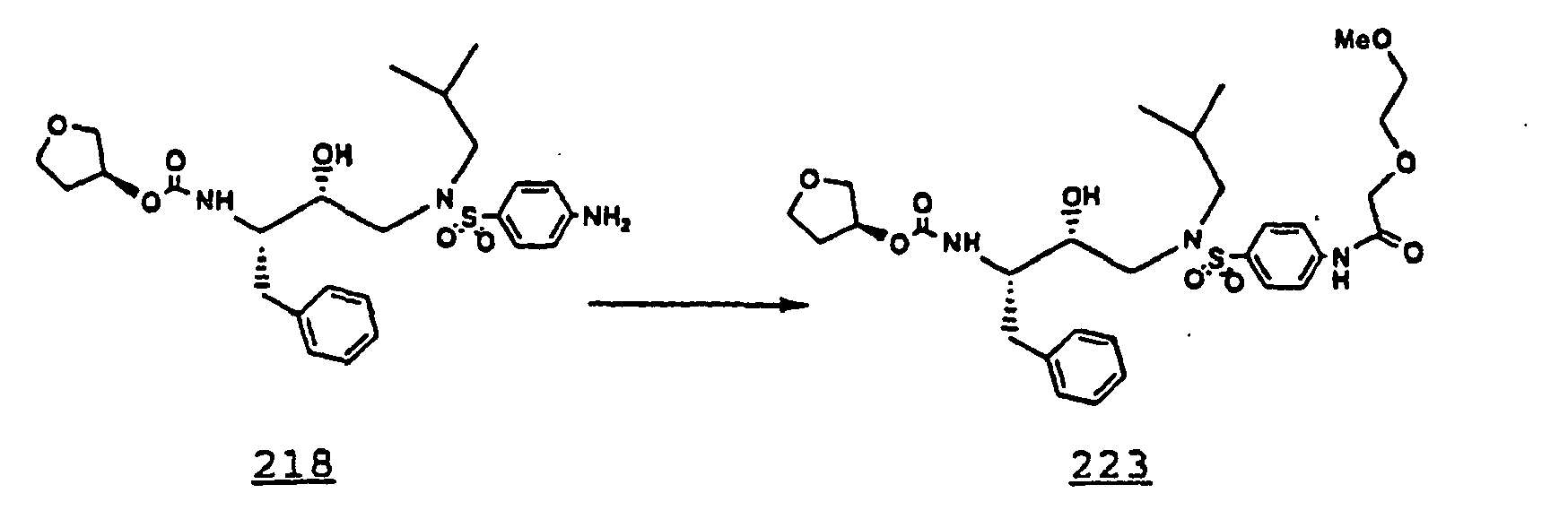
- 223 was obtained using the general procedure in Example 20.
tHPLC = 9.22 min (D); ES+ 622 (M+1).
1H NMR (d6-DMSO): 0.76 (6H,dd), 1.0-1.8 (15H,m), 2.03 (1H,m), 2.58 (2H,m), 2.79 (2H,m), 3.11 (1H,m), 3.28 (3H,s), 3.3-3.5 (12H,m), 3.94 (1H,m), 4.08 (1H,m), 4.94 (1H,m), 5.14 (1H,m), 6.61 (2H,d), 7.22 (5H,m), 7.40 (3H,m)
13C NMR (DMSO) 169.7, 165.9, 152.9, 138.4, 129.2, 129.1, 128.1, 126.2, 123.1, 112.8, 74.4, 74.1, 72.5, 71.2, 69.8, 66.1, 58.1, 57.1, 52.9, 47.5, 33.4, 33.2, 26.3, 24.5, 18.9, 18.8. -

- 224 was obtained using the general procedure in Example 20.
- The general procedure for N,O-diacylated compounds followed the protocol outlined in Example 20, above, except that a five fold excess of reagents was used relative to the starting material.

13C NMR (DMSO): 170.2, 169.8, 156.4, 143.4, 138.8, 129.5, 128.8, 128.5, 126.8, 119.7, 74.9, 74.2, 73.7, 71.6, 70.7, 70.3, 68.0, 67.2, 59.3, 57.6, 53.8, 49.6, 35.7, 33.8, 27.1, 20.4.
1H NMR (DMSO): 10.1 (1H, s), 7.84 (d, 2H, J=8.5), 7.76 (d, J=8.7, 2H), 7.40 (1H, d, J=9.2), 7.22 (m, 5H), 5.14 (1H, m), 4.95 (1H, m), 4.1 (m, 8H), 3.7-3.3 (m, 13H), 3.28 (s, 3H), 3.26 (s, 3H), 2.86 (m, 2H), 2.73 (m, 1H), 2.59 (m, 1H), 2.04 (m, 1H), 1.83 (m, 2H), 0.78 (m, 6H). -

- To a mixture of 197 (2.93 g, 5.47 mmol) and phosphorous acid (Aldrich, 2.2 equiv., 12.03 mmol, 987 mg) in 20 ml pyridine was added 1,3-dicyclohexylcarbodiimide (Aldrich, 2.1 equiv., 11.49 mmol, 2.37 g) and the reaction heated to 60 °C under nitrogen for 3h. Solvent was removed in vacuo, the residue treated with 200 ml 0.1N aqueous sodium bicarbonate and stirred 1h at ambient temperature. The mixture was filtered, the filtrate acidified to pH 1.5 by addition of conc. HCl and extracted with ethyl acetate (3 x 100 ml). The combined orgnic layers were dried over magnesium sulfate, filtered and concentrated in vacuo to give 3.15g (96%) of desired product 226 which was used directly in the next reaction. HPLC: Rt = 8.91 min (96%), MS (AP+) 600.5 (M+1).
-

- A suspension of 226 (-5.47 mmol) in 18 ml hexamethyldisilazane was stirred at 120°C until homogeneous followed by addition of bis(trimethylsilyl) peroxide (Gelest, Inc., 2.3 equiv., 12.58 mmol, 2.24 g, 2.71 ml). After 1h the mixture was cooled to ambient temperature, solvent removed in vacuo, the residue stirred with 100 ml methanol, solvent removed in vacuo, the residue stirred with 100 ml 0.1N aqueous sodium bicarbonate, acidified to pH 1.5 by addition of conc. HCl, saturated with brine and extracted with ethyl acetate (3 x 100 ml). The combined organic layers were dried over magnesium sulfate, filtered and concentrated in vacuo to give 2.98 g (88%) of desired product 227, which was used directly in the next reaction. HPLC: Rt = 9.28 min (90%), MS (AP+) 616.5 (M+1).
- Alternatively, 227 can be synthesized directly from 197. In this method, 197 was dissolved in pyridine (300mL). The resulting solution was concentrated in vacuo to about 150 ml at 50-55°C. The solution was then cooled under N2 to 5°C, and treated with POCl3 (6.5 ml, 1.24 equiv.) over 2 minutes. The cooling bath was removed and the reaction stirred at ambient temperature for 2.5 hrs. The solution was then cooled to 5°C and water (300 ml) was added over 30 minutes.
- The resulting mixture was extracted with 4-methylpentan-2-one (MIBK, 2 x 150 ml). The combined extracts were washed with 2N HCl (2 x 250 ml). The acid washes were back extracted with MIBK (60 ml), then the combined MIBK solutions were treated with 2N HCl (150 ml). The two phase mixture was stirred rapidly and heated to 50°C for 2 hours. The reaction mixture was cooled to 20°C, the phases were separated and the MIBK solution was washed with brine (150 ml). The product, 227, was isolated by drying the solution with magnesium sulfate, filtering of the drying agent and concentrating in vacuo at 40°C to give the product as a pale yellow foam (31 g, 90% yield).
-

- A solution of 227 (2.98 g, 4.84 mmol) in 50 ml ethyl acetate was treated with 10% palladium on carbon (Aldrich, 300 mg) and put under 35 psi of hydrogen on a Parr shaker for 15h. Catalyst was removed by filtration and solvent removed in vacuo to give 2.66 g (94%) of desired product 228. HPLC: Rt = 7.23 min (92%), MS (ES+) 586.3 (M+1)
-

- Solid 228 (2.66 g, 4.54 mmol) was treated with 10 ml aqueous sodium bicarbonate (Baker, 3.0 equiv., 13.63 mmol, 1.14 g) and loaded onto a resin column (Mitsubishi Kasei Corp., MCI-gel, CHP-20). Distilled water was run through until the eluent was neutral followed by product elution with 1% acetonitrile in water. Pure fractions were pooled and lyophilized to give 918 mg of pure bis-sodium salt 229.
- Alternatively, 7 g of 228 was dissolved in 100 ml of EtOAc with warming and the solution was extracted with 100 ml of aqueous 250 mM triethylammonium bicarbonate (TEABC) (2X). The aqueous extracts were combined and diluted to 1500 ml with water. This solution was applied to a 300 ml DEAE-52 column (Whatman) which was equilibrated with 50 mM TEABC. The column was washed with 8 L of 50 mM TEABC and the TEA salt was eluted with 2 L of 250 mM TEABC. The solution was evaporated in vacuo to 100 ml then lyophilized to yield the TEA salt (1.5 TEA equivalents). The TEA salt (5.8 g) was dissolved in 200 ml water, 300 ml of 1 N HCl was added and the mixture was extracted with EtOAc (3 x 200 ml). The ethyl acetate solution was dried with MgSO4 then evaporated in vacuo to yield 4 g of the free acid. Two grams of the free acid was dissolved in 50 ml of acetonitrile and a solution of 573 mg NaHCO3 in 200 ml water was added. The mixture was lyophilized yielding 2.1 g of the bis sodium salt (compound 229).
-

- 0.53 g (3.0 mmol) 2-[2-(2-Methoxyethoxy)ethoxy] acetic acid was added to a stirred solution of 1.2 g (3.15 mmol) HATU, 0.2 g (1.47 mmol) HOAt 0.4 g (4.0 mmol) NMM in 10 ml anhydrous N,N-dimethylformamide. The mixture was stirred at room temperature for 30 minutes, then 0.5 g (1 mmol) of (3S)-Tetrahydro-3-furfuryl-N-((1S,2R)-1-benzyl-2hydroxy-3-(N-isobutyl-4-aminobenzenesulfonamido)-propyl) carbamate was added to the solution in one portion. The mixture was stirred at 20°C for an hour then at 50°C for an additional 12 hours. It was then cooled to 20°C, 50 ml of ether was added, and the solution was washed with water three times. The aqueous phase was washed with ether, and then the combined organic phases were dried with anhydrous magnesium sulfate and filtered. The filtrate was concentrated under reduced pressure and the residue was purified by silica gel chromatography to obtain the desired Mono-(N)acylated (102 mg, 15 %) and Bis-(O,N) acylated (262 mg, 32%) compounds.
Mono-(N)-acylated: 1H-NMR (CDCl3) : 0.85 (dd, 6H), 1.85 (m, 2H), 2.08 (m,1H), 2.8-3.1 (m, 7H), 3.33 (s, 3H), 3.55 (m, 3H), 3.70-3.90 (m, 8H), 4.1 (s, 2H), 5.0 (d, 1H), 5.08 (s(br), 1H), 7.2 (m, 5H), 7.70 (d, 2H), 7.80 (d, 2H), 9.09 (s, 1H).
MS (FAB+): 666 (M+1).
Bis-(O,N)-acylated: 1H-NMR(CDCl3): 0.77 (m, 6H), 1.81 (m, 1H), 1.95 (m, 1H), 2.05 (m, 1H), 2.6-3.0 (m, 6H), 3.2 (m,1H), 3.332 (s, 3H), 3.338 (s, 3H), 3.5-3.8 (m, 18H), 4.1 (s, 2H), 4.14 (s, 2H), 4.17 (m, 1H), 5.05 (m, 2H), 5.25 (s(br), 1H), 7.2 (m, 5H), 7.69 (d, 2H), 7.78 (d 2H), 9.06 (s, 1H).
MS (FAB+) : 826 (M+1), 848 (M+Na). -

- We dissolved 0.521g (1 mM) of 1273W94 in 5 ml THF, then cooled to -78°C under nitrogen, and added 1.56 ml (2.5 mM) of a 1.6 M solution of nBuLi in hexane. After 20 min at -78°C, we added 105 µL (1.1 mM) of ethyl chlorocarbamate and warmed up the reaction to room temperature, followed by addition of another 105 µL of ethyl chlorocarbamate.
- After stirring for additional 4 hrs, the reaction was quenched with water and the organic solvent evaporated. Part of the crude product was purified on a silica gel (Rf=0.69 (1:2 ethyl acetate:hexane)), yielding 0.131g of the product.
C,H,N: calc: 46.06, 4.97, 5.88, found 45.90, 4.97, 5.88, C23H33N5O5S1. 2.2 TFA
LC/MS (ES+ 594 (M+1) 1 peak at 6.96 min.
Analytical HPLC(A) t=24.57 min.
13C NMR (CDCl3): 155.8, 154.4, 149.9, 145.7, 136.8, +129.2, +128.7, +126.8, +124.2, 80.1, +76.9, -64.3, -56.2, -52.5, -48.7, -36.2, +28.1, +26.4, +20.0, +19.8, +14.3. -

- We dissolved 0.131g of the above ethyl carbonate in 4 ml DCM, followed by 4 ml of TFA. Solvents were then removed after 45 min at room temperature, resulting in the title compound.
1H NMR (DMSO): 8.37 (2H, d, J=7.2), 8.15 (2H, m), 8.00 (2H, d, J=7.0), 7.37 (5H, m), 5.04 (1H, d, J=6.9), 4.06 (2H, q, J=7.0), 3.82 ((1H, m), 3.35 (2H, m), 2.95 (4H, m), 1.82 (1H, m), 1.20 (3H, t, J=7.0), 0.72 (overlapping doublets, 6H, J=6.2).
LC/MS 1 peak at 4.76 min.
ES+ 497.3 (M+1) -

LC/MS (ES+) 594 (M+1) 1 peak at 6.96 min.
Analytical HPLC(A) t=24.57 min.
1H NMR (DMSO): 8.34 (2H, d, J=8.7), 8.02 (2H, d, J=8.0), 7.19 (5H, m), 6.98 (1H, d, J=7.2), 5.00 (1H, m), 3.83 (2H, q), 3.50 (2H, m), 3.06 (m, 2H), 2.96 (2H, m), 2.43 (1H, m), 1.97 (1H, m), 1.02 (3H, t), 0.84 (3H, d), 0.82 (3H, d).
13C NMR (DMSO): 156.2, 150.1, 145.7, 140.0, +129.7, +129.2, +128.5, +126.3, +125.0, +71.8, -60.0, +56.2, -56.0, -51.8, -36.0, +26.3, +20.3, +20.1, +14.6. -

- Synthesis of 235 was accomplished analogous to that set forth in Example 1.
Yield 15.2%; tHpLC=25.2 min (A).
Rf =0.54 (B); ES+1687.3 (M+1).
1H NMR (CDCl3) : 8.34 (overlapping d+d, 4H), 7.97 (d, 2H, J=8.9), 7.35 (7H, m), 5.09 (1H, m), 4.56 (1H, d, J=8.4), 4.20 (1H, m), 3.54 (1H, m), 3.00 (3H, m), 2.82 (1H, m), 1,84 (1H, m), 1.37 (9H, s), 0.84 (3H, d), 0.82 (3H, d). -

- We dissolved 150 mg of 235 in 3 ml of anhydrous dioxane, added 0.35 ml of S(+)-3-OH-THF and 0.14 ml triethyl amine. The mixture was refluxed gently under nitrogen for 2 days. Conversion to 236 was quantitative. Solvents were removed and the compound purified on silica (B)
tHpC=22. 98 min (A); ES+:636.2 (M+1).
1H NMR (CDCl3) : 8.29 (2H, d), 7.91 (2H, d), 7.22 (5H, m), 5.13 (1H, m), 4.96 (1H, m), 4.52 (1H, d), 4.02 (1H, m), 3.84 (2H, m), 3.44 (1H, m), 3.36 (1H, m), 3.10 (3H, m, overlap), 2.88 (2H, m), 2.64 (1H, m), 2.14 (1H, m), 2.05 (1H, m), 1.84 (1H, m), 1.27 (9H, s), 0.78 (6H, two overl. d). -
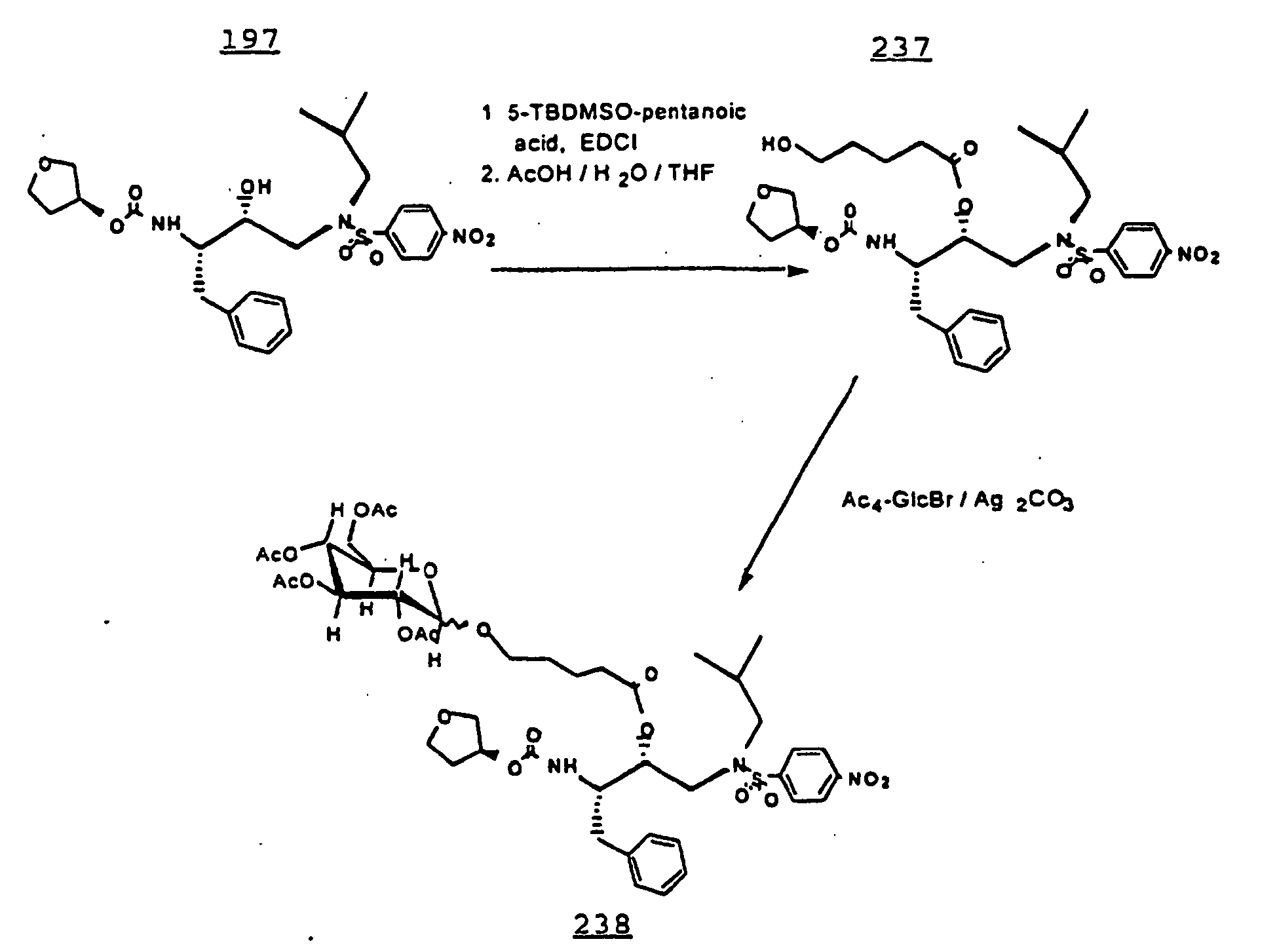
- A mixture of 0.54g (1 mMol) of (3S)-Tetrahydro-3-furfuryl-N-((1S,2R)-1-benzyl-2-hydroxy-3-(N-isobutyl-4-aminobenzenesulfonamido)propyl) carbamate, 0.46g (2 mMol) of 5-dimethyl-tert-butylsilyloxypentanoic acid, 0.346g (1.8mMol) of EDCI and 0.556mL (4 mMol) of triethylamine in 10 ml of dimethyl formamide was stirred at rt for 24h. Another 3 mMol each of acid, EDCI and triethylamine were added and stirring was continued for an additional 96h. A third batch of acid and EDCI was added (3 mMol each) and the mixture was stirred 72h to complete the reaction.
- The reaction mixture was then diluted with ethyl acetate and extracted with 1N hydrochloric acid, saturated sodium bicarbonate and water. Evaporation of the solvent and purification on silica gel (30% ethyl acetate-hexane) gave the desired product (500mg) as a waxy solid.
LCMS: 1 peak, 772.5 (M+Na).
1H NMR (CDCl3): 0.01 (6H,s), 0.78 (6H,dd), 0.95 (9H,s) 1.4-1.8 (6H,m), 1.9 (2H,m), 2.05 (1H,m), 2.3 (2H,m), 2.65 (1H,m), 2.95 (2H,m), 3.22 (1H,m), 3.4 (1H,m), 3.6 (2H,m), 3.75 (3H,m), 4.8 (1H,d), 5.1 (1H,bs), 5.2 (1H,bs), 7.2 (5H,m), 7.95 (2H,d), 8.36 (2H,d). - 450mg of the 238 was dissolved in 30 ml of tetrahydrofuran and treated with 20 ml of water and 50 ml of acetic acid. The mixture was stirred at rt for 2h and evaporated. Trituration with hexane gave the desired alcohol (290mg) as a white solid.
- A mixture of 0.15g (0.24 mMol) of the alcohol produced above from the previous reaction, 0.205g (0.5 mMol) of tetraacetylglucosylbromide and 0.191g (0.7 mMol) of silver carbonate in 3 ml of dichloromethane was stirred at rt for 6h. 150mg of additional glucosyl bromide and 150 mg of silver carbonate were added and the mixture was stirred at rt overnight. The mixture was loaded onto a pad of silica gel and eluted with 30% ethylacetate-hexane to afford the desired protected carbohydrate pro-drug as a white foam (200mg).
LCMS: 1 peak, 966 (M+H).
1H-NMR (CDCl3): 0.78 (6H,dd), 1.9 (2H,m), 2.00 (3H,s), 2.02 (3H,s), 2.05 (3H,s), 2.06 (3H,s), 2.1 (2H,m), 2.3 (2H,m), 2.7 (1H,m), 2.94 (3H,bd), 3.35 (2H,m), 3.45 (2H,m), 3.8 (5H,m), 4.1 (3H,m), 4.5 (1H,d), 4.9 (1H,bs), 4.95 (1H, t) , 5.08 (4H,m), 2H,d), 8.35 (2H,d). -

- 1.5 g (9.4 mmol) SO3.py complex was added to a stirred solution of 1 g (1.87 mmol) of 197 in 25 mL anhydrous tetrahydrofurane. The mixture was stirred at 20°C for 12 hours, then filtered. The filtrate was concentrated at reduced pressure, and the residue was transferred to a silica gel column and eluted with EtOAc (neat), followed by EtOAc:EtOH (4:1) to obtain 471 mg (47 %) 239 as a colorless foam.
1H-NMR(CDCl3): 0.80 (m, 6H), 1.8-2.1 (m, 3H), 4.15 (s(br), 1H), 4.8 (t, 1H), 5.04 (s (br), 1H).
MS(ES+) : 614 (M-1)
- 100 mg (0.162 mmol) 239 dissolved in 15 ml anhydrous tetrahydrofuran and 200 mg Pd/BaSO (5%) was added to the solution. The mixture was stirred under atmospheric pressure of hydrogen for 8 hours, and then the catalyst was filtered. The filtrate was concentrated under reduced pressure then dried under vacuum (-1 mm Hg, 48 hrs.) to produce 80 mg (81 %) 240 as a colorless foam. 1H-NMR (DMSO-d6): 0.85 (dd, 6H), 0.90 (m, 1H), 2.05 (m, 2H), 2.58 (m, 3H), 2.84 (dd, 1H), 3.05 (m, 2H), 3.55-3.80 (m, 6H), 4.20 (t, 1H), 4.42 (m, 1H), 4.93 (s(br), 1H), 6.09 (s, 2H), 6.70 (d, 2H), 6.80 (d, 1H), 7.15-7.40 (m, 4H), 7.51 (d, 2H).
MS (ES-) : 584 (M-1) -

- 780 mg (3 mmol) 2-Chloro-1,3,2-dioxaphospholane was added to a stirred solution of 1.07 g (2 mmol) 197 and 0.7 ml (4 mmol) N,N-Diisopropylethylamine in 25 ml dichloromethane at 0°C. The mixture was allowed to warm up to room temperature and it was stirred for 2 hours. The mixture was then cooled to 0°C and 1.5 g (9.3 mmol) bromine was added in 5 ml dichloromethane. The mixture was stirred for 1 hour at 20°C, followed by evaporation under reduced pressure. An aqueous solution (50%) of 15 ml trimethylamine was added to the residue, and the mixture was stirred at 20 °C for 12 hours.
- Solvents were removed under reduced pressure and 50 ml EtOAc:EtOH (9:1) was added to the residue. The solid was filtered, washed with EtOAc:EtOH (9:1) then the filtrate was concentrated under reduced pressure. The residue was chromatographed on a 3 inch plug of silica gel using ethyl acetate (neat), then methanol (neat), as eluents to obtain 1.15 g (82 %) 241 as an off-white solid.
1H-NMR (CDCl3) : 0.60 (dd, 6H), 1.70 (m, 1H), 1.95 (m, 1H), 2.10 (m, 1H), 2.8-3.2 (m, 6H), 3.4 (s (br), 9H), 5.09 (s(br), 1H), 7.25 (m, 5H), 7.83 (d, 2H), 8.28 (d, 2H).
MS(ES 1): 701 (M+1), 184 (phosphatidyl choline 1). -

- 250 mg Pd/C (10 %) was added to a solution of 250 mg (0.35 mmol) 241 in 10 ml methanol, and the mixture was stirred under atmospheric pressure of hydrogen for 4 hours at 20°C. The mixture was filtered, and the filtrate was concentrated under reduced pressure. The residue was then dissolved in 10 ml water and lyophilized to obtain 174 mg (74 %) 242 as a white solid.
1H-NMR (DMSO-d6) : 0.82 (dd, 6H), 1.80-2.00 (m, 2H), 2.10 (m, 1H), 2.80 (m, 3H), 3.00 (m, 2H), 3.2 (s (br), 9H), 4.0-4.3 (m, 4H), 4.91 (s(br), 1H), 6.08 (s(br), 2H), 6.67(d, 2H), 7.30 (m, 5H), 7.48 (d, 2H), 8.12 (d, 1H).
MS(ES+): 671 (M+1), 184 (phosphatidyl choline+). -

- 0.175 ml (2 mmol) phosphorus trichloride was added to a stirred solution of 1.07 g (2 mmol) 197 and 0.35 ml (2 mmol) N,N-Diisopropylethylamine in 25 ml dichloromethane at 20°C. The mixture was stirred for 4 hours at 20°C, then 1 ml water was added and stirred for an additional 12 hours at 20°C. 3 g anhydrous magnesium sulfate was added to the mixture and it was stirred for 30 minutes, then filtered. The filtrate was concentrated under reduced pressure and purified by silica gel chromatography using EtOAc:Hexane (4:1), then EtOAc:EtOH (1:1), to obtain 402 mg (48%) 226 and 427 mg (36%) 243. 226:
1H-NMR (DMSO-d6): 0.82 (dd, 6H), 1.84 (m, 1H), 1.98 (m, 1H), 2.10 (m, 1H), 2.68 (dd, 1H), 2.9-3.2 (m, 4H), 3.6-3.8 (m, 3H), 3.94 (t, 1H), 4.30 (s(br), 1H), 4.97 (s(br), 1H), 7.30 (m, 5H), 8.14 (d, 2H), 8.43 (d, 2H).
MS(ES+) : 598 (M-1).
243: (1:1 mix of diastereomers):
1H-NMR(CDCl3) : 0.80 (m, 6H), 1.8-2.1 (m, 4H), 2.8-3.2 (m, 6H), 3.7-3.9 (m, 4H), 4.15 (m, 1H), 4.8-5.15 (m, 2H), 5.57, 5.72 ((d,d), 1H), 7.25 (m, 5H), 7.95 (dd, 2H), 8.35 (m, 2H).
MS (ES+) : 580 (M-1), 598 ((M+H2O)-1). -

- The reduction was carried out as described in Example 40; (Yield: 79%). 1H-NMR(DMSO-d): 0.81 (dd, 6H), 1.82 (m, 1H), 1.95 (m, 1H), 2.08 (m, 1H), 2.6-3.15 (m, 6H), 3.6-3.75 (m, 3H), 4.03 (t, 1H), 4.28, (m, 1H), 4.96 (s(br), 1H), 6.07 (s, 2H), 6.65 (d, 2H), 7.25 (m, 5H), 7.42 (d, 2H).
MS(ES+): 568 (M-1). -
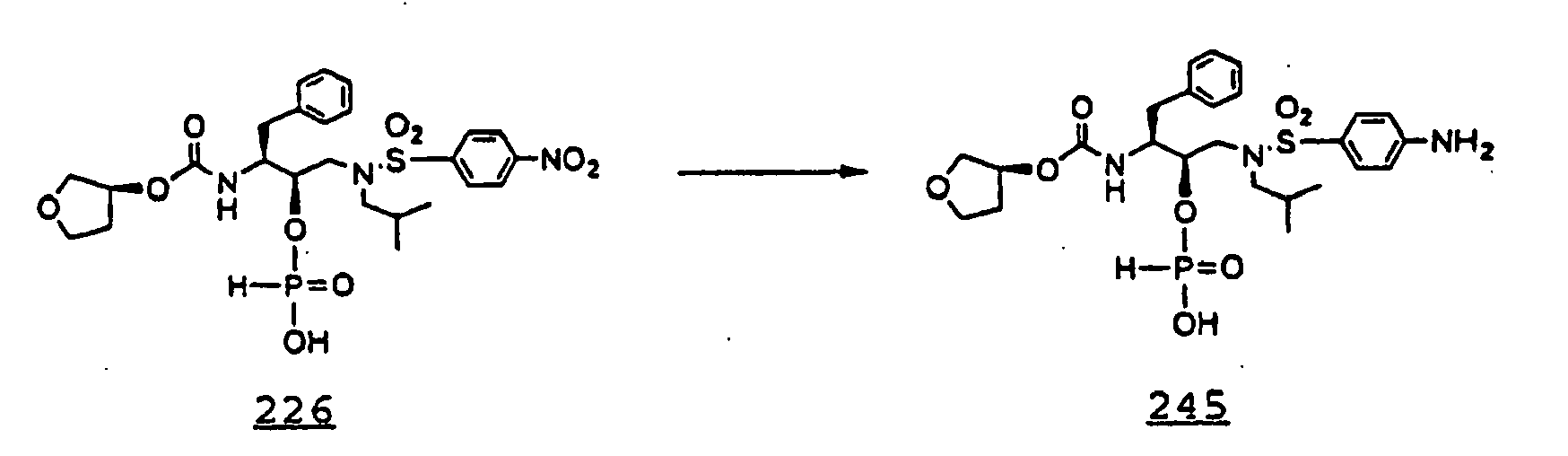
- The reduction was carried out as described in Example 40; (Yield: 98 %).
(1:1 mix of diastereomers):
1H-NMR (DMSO-d6) : 0.82 (m, 6H), 1.75-2.0 (m, 2H), 2.05 (m, 1H), 2.6-3.2 (m, 6H), 3.55-3.8 (m, 4H), 4.02, 4.22 (m, t, 1H), 4.75 (m, 1H), 4.90, 5.01 ((d,d), 1H), 6.12 (s, 1H), 6.68 (d, 2H), 7.30 (m, 5H), 7.49 (d, 2H).
MS (ES+): 550 (M-1), 568 ( (M+H2O)-1). - In order to study the pharmacokinetics of the prodrugs of this invention, we administered single oral doses of a series of prodrugs of this invention, as well as VX-478, to male and female Sprague-Dawley rats. Administration of molar equivalents of a series of prodrugs of this invention in a variety of pharmaceutical vehicles was tested.
- Separate groups of male and female Sprague-Dawley rats (3/sex/group) received oral doses of compound 229 by oral gavage, in different vehicles at the same dose equivalent (40 mg/kg molar equivalent of VX-478). The different vehicles for compound 229 were: 1) water; 2) H2O PG:EtOH 5/4/1; 3) PEG 400; 4) TPGS/PEG 400; and 5) PEG. The vehicles for VX-478 were: 1) 33% TPGS/PEG400/PEG; and 2)
12.5 % TPGS/PEG 400/PEG. - Blood samples were collected following administration at various time intervals and analyzed for the presence of both compound 229 and its metabolite, VX-478, by HPLC and MS methods. The results of this study are tabulated below (Table IV).
TABLE IV Compound 229 229 229 229 VX.478 VX-478 vehicle H2O H2O:PG:EtOH 5:4:1 PEG 400 TPGS/PEG 400/PG 33% TPGS/ PEG 400/ PG 12.5% TPGSI PEG 400/PG number of rats 3 3 3 3 6 03 Molar equiv. dose/ 478 Dose (mg/kg) 40 PO 40 PO 40 PO 40 PO 41 PO 50 PO AUC (ug*hr/ml) 11.7 ± 4.8 10.6 ± 7.4 7.4 ± 1.8 8.2 ± 1.6 29.6 ± 5.8 16.2 ± 1.8 Cmax (µM) 7.1 ± 1.7 3.3 ± 0.6 3.1 ± 0.3 3.0 ± 0.7 14.0 ± 2.2 6.0 ± 1.0 half life (hr) 1.7* 3.4* 2.8* 2.8* 2.5 ± 0.9 2.2 ± 1.0 Relative Avail. of VX-478 39.5†
90.2††35.8†
81.8††25.0†
57.1††27.7†
63.3tt††reference reference - a dose of 50 mg /Kg of compound 229 is equal to 40 mg/ Kg of VX-478.
- no compound 229 was detected in plasma at 15 min. (first data point ).
* Represents the harmonic mean
† Relative availability of VX-478 when compared to a prototype clinical formulation
†† Relative availability of VX-478 when compared to a prototype toxicology formulation - We performed a similar study on dogs using both a solid capsule formulation of compound 229 and an ethanolic/methyl cellulose solution formulation, as compared to a TPGS-containing solution formulation of VX-478. The results from this study are presented below in Table V.
TABLE V Compound 229 229 VX-478 vehicle solid capsule methyl cellulose in 5% EtOH/water 22% TPGS/PEG 400/PG number of dogs 2 2 >2 Molar equiv. dose/ 478 Dose (mg/Kg) 17 PO 17 PO 17 PO AUC (ug*hr/ml) 16.7 ± 2.7 14.2 ± 3.2 23.5 ± 7.4 Cmax (µg/ml) 6.1 ± 1.7 6.3 ± 0.3 6.8 ± 1.1 Tmax (hr) 2.3 ± 0.6 0.5 ± 0.5 1.0 ± 0.8 Relative Avail. of VX-478 (%) 71.1 60.4 reference - The results demonstrate that oral administration of compound 229 as an aqueous solution resulted in improved bioavailability in comparison to the other vehicles studied. Also, following administration of compound 229, none of that compound was detected in the first time point blood sample (or later samples), suggesting first pass metabolism to VX-478. Comparison of the aqueous dose of compound 229 with the two nonaqueous formulations used for VX-478 indicated equivalence in delivery as illustrated by the range found for the bioavailability.
-
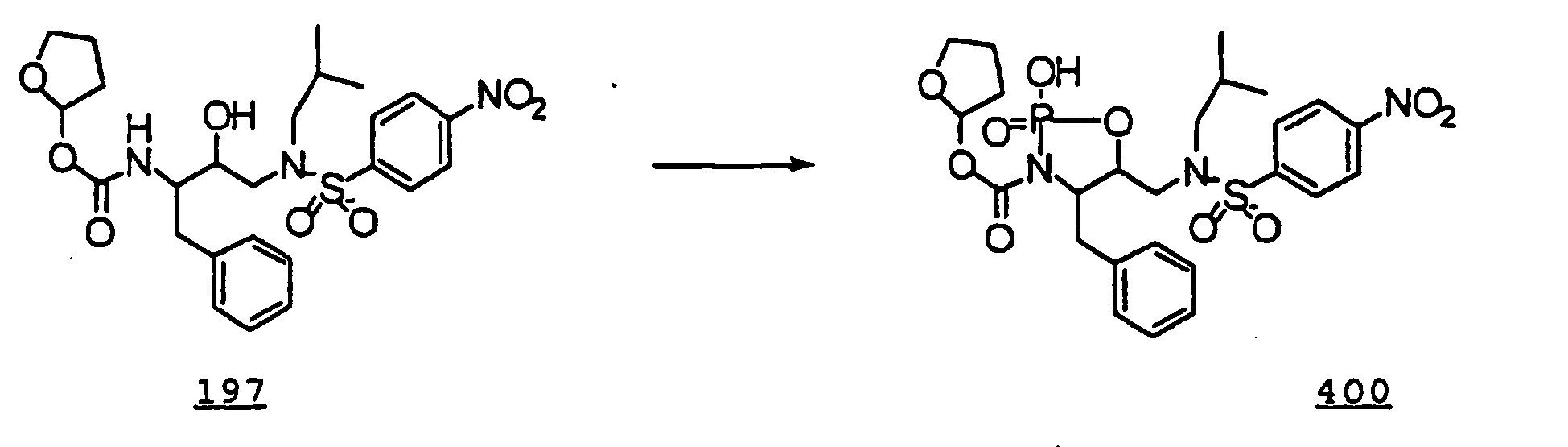
- We added 0.28 ml (3.0 mmol) POCl3 to a stirred solution of 1.07 g (2.0 mmol) of compound 197 in 10 ml anhydrous pyridine at 5°C. The mixture was allowed to warm up to room temperature and stirred at 20°C for 3 hours. The mixture was cooled to 0°C, and quenched with 10 ml water. The solvents were removed under reduced pressure, the residue was dissolved in 100 ml ethyl acetate and washed with 20 ml 1M sodium bicarbonate solution. The organic phase was dried with anhydrous magnesium sulfate, filtered, then concentrated. Chromatographic purification (SiO2, EtOAc) produced 280 mg of compound 400 (Yield = 23%).
1H-NMR(DMSO-d6): 0.86 (dd, 6H), 2.05 (m, 2H), 2.84 (d, 2H), 2.95 (dd, 1H),3.06 (m, 1H), 3.25 (dd, 1H), 3.50-3.70 (m, 4H), 4.20 (m, 1H), 4.35 (m, 1H),7.2-7.4 (m, 5H), 7.9-8.1 (m, 2H), 8.40 (m, 2H).
MS (ES+) : 596 (M-1).
- Compound 400 was converted to compound 401 using the standard hydrogenation method described above employing H2/PdC (10%), atmospheric pressure, 4 hours at room temperature, solvent: MeOH-H2O(5:1). Yield of 401 = 68%.
1H-NMR (DMSO-d6) : 0.85 (dd, 6H), 2.0 (m, 2H), 2.6-3.1 (m, 4H), 4.15 (m, 1H),4.40 (m, 1H), 6.1 (s (br), 1H), 6.61 (m, 2H)., 7.2-7.5 (m, 7H).
MS (ES+) : 566 (M-1). -

- We added 1.0 g (2.8) mmol Na-t-Boc-nd-Cbz-L-ornithine to a stirred solution of 1.2 g (3.15 mmol) HATU, 0.2 g (1.47 mmol) HOAt, 0.4 g (4.0 mmol) NMM in 10 ml DMF. The mixture was stirred at room temperature for 2 hrs, then 0.5 g (1.0 mmol) of compound 218 was added and the solution was stirred at 50°C for 12 hours. The mixture was cooled to room temperature, 100 ml ether was added and extracted with 5x 50 ml water. The organic phase was dried with anhydrous magnesium sulfate, filtered and concentrated under reduced pressure. The residue was purified by silica gel chromatography (Hexane-EtOAc (1:1), then EtOAc (neat)) to yield 410 mg (48%) of compound 350.
- 1H-NMR(CDCl3) : 0.85 (dd, 6H), 1.41 (s, 3H), 1.45 (s, 6H), 1.60 (m, 4H), 1.90 (m, 2H), 2.1 (m, 1H), 2.75-3.25 (m, 6H), 3.60-3.90 (m, 6H), 5.15 (dd, 2H),7.2-7.4 (m, 10H), 7.68 (dd, 4H).
MS (ES+): 852 (M-1)
MS (ES+) : 854 (M+1). - 1H-NMR(CDCl3): 0.81 (dd, 6H), 1.39 (s, 9H), 1.40-2.10 (m, 9H), 2.70-3.20 (m, 8H), 3.60-3.90 (m, 6H), 4.10 (m, 1H), 4.80 (d, 1H), 5.04 (s(br), 2H), 7.1-7.3 (m, 10H), 7.61 (s, 4H).
MS (ES+): 866 (M-1).
MS (ES+): 868 (M+1). - 1H-NMR(CDCl3): 0.86 (dd, 6H), 1.40 (s, 3H), 1.46 (s, 6H), 1.60-2.10 (m, 7H), 2.70-3.15 (m, 6H), 3.60 (d, 1H), 3.70-4.10 (m, 6H), 4.81 (d, 1H), 5.05-5.30(m, 7H), 7.18-7.4 (m, 17H), 7.55 (d, 2H).
MS (FAB+): 1030 (M+1), 1052 (M+Na).
- Compounds 350A, 350B and 350C were converted to Compounds 402, 403, and 404, respectively, using the standard hydrogenation method set forth above:
H /PdC (10%), atmospheric pressure, 4 hours, room temperature, solvent: EtOH, Yield: 81 %. - 1H-NMR(CDCl3) : 0.80 (dd, 6H), 1.38 (s, 9H), 1.8 (m, 6H), 2.10 (m, 2H), 2.75-3.30 (m, 8H), 3.50-4.00 (m, 7H), 4.55
(s(br), 1H), 7.2 (m, 5H), 7.60 (d, 2H), 7.81 (d, 2H).
MS (ES+) : 720 (M+1). - 1H-NMR(CDCl3): 0.87 (dd, 6H), 1.45 (s, 9H), 1.50-2.00 (m, 8H), 2.08 (m, 1H), 2.75-3.15 (m, 8H), 3.60 (d, 1H), 3.75-3.90 (m, 5H), 4.28 (s(br), 1H), 4.92 (d, 1H), 5.11 (m, 1H), 5.27 (s(br), 1H), 7.28-7.35 (m, 5H), 7.70 (s, 4H).
MS (ES+): 734 (M+1) - 1H-NMR(CDCl3): 0.80 (dd, 6H), 1.32 (s, 9H), 1.50-2.10 (m, 7H), 2.60-3.20 (m, 8H), 3.40-3.80 (m, 5H), 5.0(s(br), 1H), 7.05-7.2 (m, 5H), 7.50-7.80 (m,4H).
MS (ES+): 762 (M+1). -

- We added 5 ml TFA to a stirred solution of 260 mg (0.3 mmol) Compound 350A, 350B, or 350C in 20 ml chloroform. The mixture was stirred for 5 hours at room temperature, and then the solvents were removed under reduced pressure. The residue was dissolved in 20 ml dichloromethane, 2 ml (11 mmol) N,N-diisopropylethylamine and 1 ml (10 mmol) acetic anhydride was added to the reaction mixture. The solution was stirred for 1 hour, then the solvents were removed. The residue was purified by silica gel chromatography (eluant: EtOAc-EtOH(9:1)) to obtain 170 mg (71 %) of compound 351A, 351B, or 351C, respectively.
- 1H-NMR (CDCl3) : 0.85 (dd, 6H), 1.60 (m, 3H), 1.80-2.00 (m, 3H), 2.06 (2, 3H), 2.75 (dd, 1H), 2.80-3.20 (m, 5H), 3.60-3.90 (m, 7H), 4.85 (d, 2H), 5.10 (m, 3H), 6.46 (d, 1H), 7.25 (m, 10H), 7.67 (s, 4H), 9.30 (s, 1H).
MS (Es+): 796 (M+1), 818 (M+Na). - 1H-NMR(CDCl3): 0.80 (dd, 6H), 1.38 (m, 2H), 1.50 (m, 2H), 1.70 (m, 2H), 1.85 (m, 2H), 2.00 (s, 3H), 2.70 (dd, 1H), 2.75-3.20 (m, 7H), 3.55 (d, 1H), 3.75 (m, 6H), 4.45 (q, 1H), 4.83 (d, 1H), 4.95 (t, 1H), 5.03 (s(br), 3H), 6.46 (d, 1H), 7.20 (m, 10H), 7.61 (s, 4H), 9.29 (s, 1H).
MS (ES+): 810 (M+1), 832 (M+Na). - 1H-NMR(CDCl3) : 0.85 (dd, 6H), 1.70-2.00 (m, 6H), 2.07 (s, 3H, 2.70 (dd, 1H), 2.80-3.00 (m, 3H), 3.10 (dd, 1H), 3.60 (d, 1H), 3.65-4.00 (m, 6H), 4.1(m, 1H), 4.62 (q, 1H), 4.82 (d, 1H), 5.00-5.30 (m, 5H), 7.10-7.40 (m, 15H), 7.55 (d, 2H), 7.65 (m, 3H), 9.18 (s(br), 1H), 9.45 (s(br), 1H), 9.56(s(br),1H).
MS (FAB+) 972 (M+1), 994 (M+Na).
- The conversion of compounds 351A, 351B and 351C to 405, 406, and 407, respectively, was achieved by standard hydrogenation using H2/PdC(10%), atmospheric pressure, 4 hours at room temperature, solvent: EtOH,
Yield = 46%. - 1H-NMR (DMSO-d6) : 0.85 (dd, 6H), 1.62 (m, 3H), 1.81 (m, 2H), 1.94 (s, 3H), 2.00-2.2 (m, 2H), 2.75-3.00 (m, 5H), 3.10 (m, 2H), 3.50-3.80 (m, 5H), 4.54 (m, 1H),5.00 (m, 1H), 5.11 (d, 1H), 7.2-7.4 (m, 5H), 7.80-8.00 (m, 5H), 10,72 (s, 1H).
MS (ES+): 662 (M+1). - H-NMR(DMSO-d): 0.80 (dd, 6H), 1.30-1.80 (m, 7H), 1.85 (s, 3H), 1.95-2.10 (m, 2H), 2.70 (m, 4H), 2.99 (m, 2H), 3.30 (m, 5H), 3.40-3.80 (m, 4H), 4.35 (m, 1H), 4.90. (s, 1H), 5.00 (d, 1H), 7.08-7.25 (m, 5H), 7.50 (s(br), 1H), 7.71 (d, 2H), 7.79 (d, 2H), 10.54 (s, 1H).
MS (ES+) : 676 (M+1). - 1H-NMR(DMSO-d6) : 0.80 (dd, 6H), 1.40-1.60 (m, 4H), 1.75 (m, 2H), 1.86 (s, 3H), 2.00 (m, 2H), 2.75 (dt, 2H), 3.00 (m, 2H), 3.10 (q, 2H), 3.40-3.70 (m, 5H), 4.39 (q, 1H), 4.92 (s (br), 1H), 5.01 (d, 1H), 7.20 (m, 5H), 7.70 (d+m, 3H), 7.81 (d, 2H), 8.30 (d, 1H), 10.60 (s, 1H).
MS (ES+) : 704 (M+1). -

- We added 1.0 g (7.5 mmol) methanephosphonyl dichloride to a stirred solution of 2.14 g (4.00 mmol) of compound 197 in 20 ml toluene, containing 10% pyridine. The mixture was stirred at 100°C for 5 hours, then cooled to 40°C, 2 g (18.5 mmol) benzyl alcohol was added to the reaction, and the mixture was stirred at 20°C for 12 hours. The solid was filtered, washed with 2 x 10 ml toluene and the filtrate was concentrated under reduced pressure. The residue was purified using silica gel chromatography (eluants: Hexane-EtOAc (1:1), then EtOAc (neat)) to yield 550 mg (20 %) of compound 352.
1H-NMR(CDCl3): 0.67 (dd, 6H), 1.53 (d, 3H), 1.70 (m, 1H), 1.90-2.10 (m, 2H), 2.65-3.20 (m, 6H), 3.55 (d, 1H), 3.80 (m, 3H), 4.10 (m, 1H), 4.70 (q, 1H), 4.90-5.20 (m, 4H), 6.37 (d, 1H), 7.2-7.4 (m, 10H), 7.90 (d, 2H), 8,30 (d, 2H).
MS (ES+): 704 (M+1), 726 (M+Na).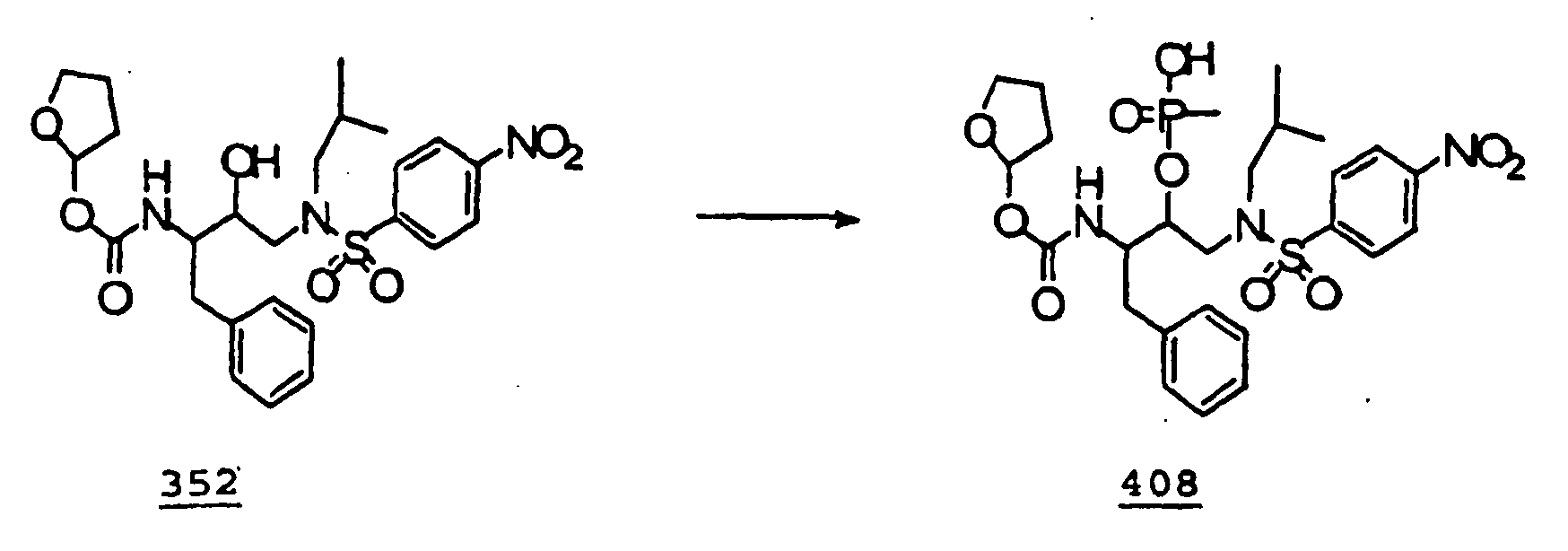
- Compound 352 was converted to compound 408 using the standard hydrogenation method: H2/Pd C (10%), atmospheric pressure, 2 hours, room temperature, solvent:
MeOH; Yield: 78%.
1H-NMR(DMSO-d6): 0.84 (dd, 6H), 1.44 (d, 3H), 1.82 (m 1H), 1.90-2.10 (m, 2H), 2.62 (m, 2H), 2.95 (m, 2H), 3.10 (d, 1H), 3.39 (d, 1H), 3.45-3.80 (m, 4H), 4.14 (t, 1H), 4.53 (m, 1H), 5.00 (s (br), 1H), 6.68 (d, 2H), 7.2-7.4 (m, 5H), 7.50 (d, 2H).
MS (ES+): 582 (M-1) - While we have described a number of embodiments of this invention, it is apparent that our basic constructions may be altered to provide other embodiments which utilize the products and processes of this invention within the scope of the attached claims.
Claims (29)
- A compound of formula I:
 A is selected from H; Ht; -R1-Ht; -R1-(C1-C6)-alkyl, which is optionally substituted with one or more groups independently selected from hydroxy, C1-C4 alkoxy, Ht, -O-Ht, -NR2-CO-N(R2)2 or -CO-N(R2)2; -R1-(C2-C6)-alkenyl, which is optionally substituted with one or more groups independently selected from hydroxy, C1-C4 alkoxy, Ht, -O-Ht, -N(R2)-C(O)-N(R2)2 or -CO-N(R2)2; or R7;each R1 is independently selected from -C(O)-, -S(O)2-, -C(O)-C(O)-, -O-C(O)-, -O-S(O)2, -N(R2)-S(O)2-, -N(R2)-(O)- or -N(R2)-C(O)-C(O)-,each Ht is independently selected from C3-C7 cycloalkyl; C5-C7 cycloalkenyl; C6-C10 aryl; or a 5-7 membered saturated or unsaturated heterocycle, containing one or more heteroatoms selected from N, N(R2), O, S and S(O)n; wherein said aryl or said heterocycle is optionally fused to Q; and wherein any member of said Ht is optionally substituted with one or more substituents independently selected from oxo, -OR2, SR2, -R2, -N(R2)2, -R2-OH, -CN, -C(O)O-R2, -C(O)-N(R2)2, -S(O)2-N(R2)2, -N(R2)-C(O)-R2, -C(O)-R2, -S(O)n-R2, -OCF3, -S(O)n-Q, methylenedioxy, -N(R2)-S(O)2-R2, halo, -CF3, -NO2, Q, -OQ, -OR7, -SR7, -R7, -N(R2)(R7) or -N(R7)2;each R2 is independently selected from H, or (C1-C4)-alkyl optionally substituted with Q;B, when present, is -N(R2)-C(R3)2-C(O)-;each x is independently 0 or 1;each R3 is independently selected from H, Ht, (C1-C6)-alkyl, (C2-C6)-alkenyl, (C3-C6)-cycloalkyl or (C5-C6)-cycloalkenyl; wherein any member of said R3, except H, is optionally substituted with one or more substituents selected from -OR2, -C(O)-NH-R2, -S(O)n-N(R2)2, Ht, -CN, -SR2, -CO2R2, N(R2)-C(O)-R2;each n is independently 1 or 2;G, when present, is selected from H, R7 or (C1-C4)-alkyl, or, when G is (C1-C4)-alkyl, G and R7 are bound to one another either directly or through a C1-C3 linker to form a heterocyclic ring; or when G is absent, the atom to which G is attached is bound directly to the R7 group in -OR7 with the concomitant displacement of one -ZM group from R7;D and D' are independently selected from Q; (C1-C6)-alkyl, which is optionally substituted with one or more groups selected from (C3-C6)-cycloalkyl, -OR2, -R3, -O-Q or Q; (C2-C4)-alkenyl, which is optionally substituted with one or more groups selected from (C3-C6)-cycloalkyl, -OR2, -R3, -O-Q or Q; (C3-C6)-cycloalkyl, which is optionally substituted with or fused to Q; or (C5-C6)-cycloalkenyl, which is optionally substituted with or fused to Q;each Q is independently selected from a 3-7 membered saturated, partially saturated or unsaturated carbocyclic ring system; or a 5-7 membered saturated, partially saturated or unsaturated heterocyclic ring containing one or more heteroatoms selected from O, N, S, S(O)n or N(R2); wherein any ring in Q is optionally substituted with one or more groups selected from oxo, -OR 2, -R2, -N(R2)2, -N(R2)-C(O)-R2, -R2-OH, -CN, -C(O)OR2, -C(O)-N(R2)2, halo or -CF3;E is selected from Ht; O-Ht; Ht-Ht; -O-R3; -N(R2)(R3); (C1-C6)-alkyl, which is optionally substituted with one or more groups selected from R4 or Ht; (C2-C6)-alkenyl, which is optionally substituted with one or more groups selected from R4 or Ht; (C3-C6)-saturated carbocycle, which is optionally substituted with one or more groups selected from R4 or Ht; or (C5-C6)-unsaturated carbocycle, which is optionally substituted with one or more groups selected from R4 or Ht;each R4 is independently selected from -OR2, -SR2, -C(O)-NHR2, -S(O)2-NHR2, halo, -N(R2)-C(O)-R2, -N(R2)2 or -CN;each R7 is independently selected from
 wherein each M is independently selected from H, Li, Na, K, Mg, Ca, Ba, -N(R2)4, (C1-C12)-alkyl, (C2-C12)-alkenyl, or -R6; wherein 1 to 4 -CH2 radicals of the alkyl or alkenyl group, other than the -CH2 that is bound to Z, is optionally replaced by a heteroatom group selected from O, S, S(O), S(O)2, or N(R2); and wherein any hydrogen in said alkyl, alkenyl or R6 is optionally replaced with a substituent selected from oxo, -OR2, -R2, N(R2)2, N(R2)3, R2OH,-CN,-C(O)OR2, -C(O)-N(R2)2, S(O)2-N(R2)2, N(R2)-C(O)-R2C(O)R2, -S(O)n-R2, OCF3, -S(O)n-R6, N(R2)-S(O)2-R2, halo, -CF3, or -NO2;M' is H, (C1-C12)-alkyl, (C2-C12)-alkenyl, or -R6; wherein 1 to 4 -CH2 radicals of the alkyl or alkenyl group is optionally replaced by a heteroatom group selected from O, S, S(O), S(O)2, or N(R2); and wherein any hydrogen in said alkyl, alkenyl or R6 is optionally replaced with a substituent selected from oxo, -OR2, -R2, -N(R2)2, N(R2)3, -R2OH, -CN, -CO2R2, -C(O)-N(R2)2, -S(O)2-N(R2)2, -N(R2)-C(O)-R2-C(O)R2, -S(O)n-R2, -OCF3, -S(O)n-R6, -N(R2)-S(O)2-R2, halo, -CF3, or -NO2;Z is CH3, O, S, N(R2)2, or, when M is not present, H.Y is P or S;X is O or S; andR9 is C(R2)2, O or N(R2); and wherein when Y is S, Z is not S; andR6 is a 5-6 membered saturated, partially saturated or unsaturated carbocyclic or heterocyclic ring system, or an 8-10 membered saturated, partially saturated or unsaturated bicyclic ring system; wherein any of said heterocyclic ring systems contains one or more heteroatoms selected from O, N, S, S(O)n or N(R2); and wherein any of said ring systems optionally contains 1 to 4 substituents independently selected from OH, C1-C4 alkyl, O-(C1-C4)-alkyl or O-C(O)-(C1-C4)-alkyl .
 - The compound according to claim 1, wherein at least one R7 is selected from:


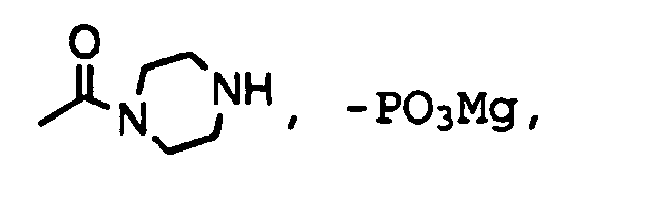


- The compound according to claim 2, wherein said compound has formula XXII:

- The compound according to claim 3, whereinA is selected from 3-tetrahydrofuryl-O-C(O)-, 3-(1,5-dioxane)-O-C(O)-, or 3-hydroxy-hexahydrofura[2,3-b]-furanyl-O-C(O)-;D' is (C1-C4)-alkyl which is optionally substituted with one or more groups selected from the group consisting of (C3-C6)-cycloalkyl, -OR2, -R3, -O-Q and Q;E is (C6-C10)-aryl optionally substituted with one or more substituents selected from oxo, -OR2, SR2, -R2, - N(R2)2, -R2-OH, -CN, -C(O)O-R2, -C(O)-N(R2)2, -S(O)2-N(R2)2, -N(R2)-C(O)-R2, -C(O)-R2, -S(O)n-R2, -OCF3, -S(O)n-Q, methylenedioxy, -N(R2)-S(O)2-R2, halo, -CF3, -NO2, Q, -OQ, -OR7, -SR7, -R7, -N(R2)(R7) or -N(R7)2; or a 5-membered heterocyclic ring containing one S and optionally containing N as an additional heteroatom, wherein said heterocyclic ring is optionally substituted with one to two groups independently selected from -CH3, R4, or Ht; andHt, insofar as it is defined as part of R3, is defined as in claim 1 except for the exclusion of heterocycles.
- The compound according to claim 4, wherein:A is 3-tetrahydrofuryl-O-C(O)-;G is hydrogen;D' is isobutyl;E is phenyl substituted with N(R7)2;each M is independently selected from H, Li, Na, K, Mg, Ca, Ba, C1-C4 alkyl or -N(R2)4; andeach M' is H or C1-C4 alkyl.
- The compound according to claim 3, wherein:E is a 5-membered heterocyclic ring containing one S and optionally containing N as an additional heteroatom, wherein said heterocyclic ring is optionally substituted with one to two groups independently selected from -CH3, R4, or Ht.
- The compound according to claim 3, wherein:E is Ht substituted with N(R7)2;R7 in the -OR7 group shown in formula XXII is -PO(OM)2 or C(O)CH2OCH2CH2OCH2CH2OCH3 and both R7 in the -N(R7)2 substituent of Ht are H; or R7 in -OR7 group shown in formula XXII is C(O)CH2OCH2CH2OCH3, one R7 in the -N(R7)2 substituent of Ht is C(O)CH2OCH2CH2OCH3 and the other R7 in the -N(R7)2 substituent of Ht is H; andwherein M is H, Li, Na, K or C1-C4 alkyl.
- The compound according to claim 3, having the structure:

- The compound according to claim 8, wherein each M is Na.
- The compound according to claim 2, wherein said compound has formula XXIII:
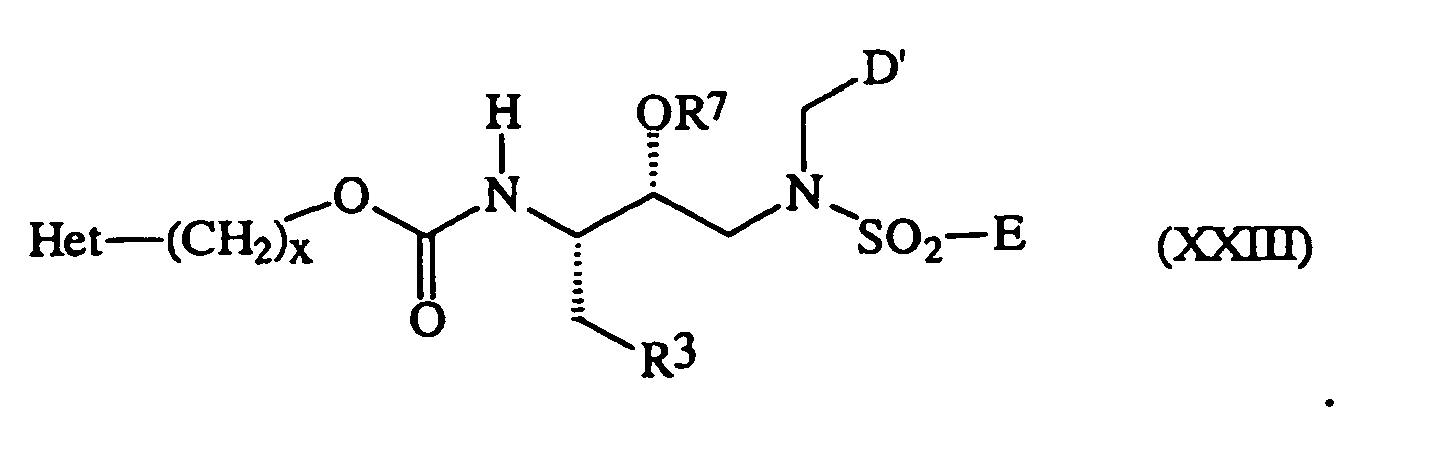
- The compound according to claim 10, wherein:R3 is (C1-C6)-alkyl, (C2-C6)-alkenyl, (C5-C6)-cycloalkyl, (C5-C6)-cycloalkenyl, or a 5-6 membered saturated or unsaturated heterocycle; wherein any member of R3 is optionally substituted with one or more substituents selected from the group consisting of -OR2, - C(O)-NH-R2, -S(O)nN(R2)2, -Ht, -CN, -SR2, -C(O)O-R2 and N(R2)-C(O)-R2; andD' is (C1-C3)-alkyl or C3 alkenyl; wherein D' is optionally substituted with one or more groups selected from (C3-C6)-cycloalkyl, -OR2, -O-Q or Q.
- The compound according to claim 11, wherein R7 in the -OR7 group depicted in formula XXIII is -PO(OM)2 or -C(O)-M'.
- The compound according to claim 2, wherein said compound has formula XXXI:

- The compound according to claim 13, wherein:A is R1-Ht;each R3 is independently (C1-C6)-alkyl which is optionally substituted with -OR2, -C(O)-NH-R2, -S(O)nN(R2)2, -Ht, -CN, -SR2, -CO2R2 or -N(R2)-C(O)-R2; andD' is (C1-C4)-alkyl, which is optionally substituted with (C3-C6)-cycloalkyl, -OR2, -O-Q; and E is Ht, Ht-Ht and -N(R2)(R3).
- The compound according to claim 14, wherein R7 in the -OR7 group depicted in formula XXXI is -PO(OM)2 or -C(O)-M'.
- The compound according to claim 1, wherein said compound is selected from any one of compound numbers 198 to 231, 237 to 242, 245 to 267, or 308, depicted in Table 1; any one of compound numbers 232 to 236 depicted in Table II; or any one of compound numbers 243 to 244 depicted in Table III.
- The compound according to claim 1 having the following formula:

- The compound according to claim 1 or 3, having the structure:

- A pharmaceutical composition, comprising a compound according to any one of claims 1 to 18 and optionally a pharmaceutically acceptable carrier, adjuvant or vehicle.
- A pharmaceutical composition, comprising a compound according to any one of claims 1 to 18 in an amount effective to treat infection by a virus that is
characterized by an aspartyl protease; and a pharmaceutically acceptable carrier, adjuvant or vehicle. - A pharmaceutical composition according to claim 20, wherein said virus is HIV.
- The pharmaceutical composition according to any one of claims 19 to 21, wherein said pharmaceutical composition is formulated for oral administration.
- The pharmaceutical composition according to any one of claims 19 to 22 further comprising one or more agents selected from an anti-viral agent, an HIV protease inhibitor other than a compound according to claim 1, and an immunostimulator.
- The pharmaceutical composition according to claim 23, further comprising one or more agents selected from zidovudine (AZT), zalcitabine (ddC), didanosine (ddI), stavudine (d4T), lamivudine (3TC), 935U83, abacavir (1592U89), 524W91, saquinavir (Ro 31-8959), indinavir (MK-639, L-735,524), SC-52151,ritonavir (ABT 538, A84538), nelfinavir (AG 1343), XM 412, XM 450, CGP 53,437, tuscarasol, polysulfated polysaccharides, ganciclovir, ribavirin, acyclovir, TIBO, nevirapine, IL-2, GM-CSF, interferon alpha, and erythropoietin (EPO).
- Use of a compound according to any one of claims 1 to 18 for the preparation of a pharmaceutical composition for inhibiting aspartyl protease activity in a mammal.
- Use of a compound according to any one of claims 1 to 18 for the preparation of a pharmaceutical composition for treating HIV infection in a mammal.
- The use according to claim 26, wherein said mammal is additionally administered one or more additional agents selected from an anti-viral agent, an HIV protease inhibitor other than a compound according to claim 1, and an immunostimulator either as a part of a single dosage form with said pharmaceutical composition or as a separate dosage form.
- The use according to claim 27, wherein said additional agent is selected from zidovudine (AZT), zalcitabine (ddC), didanosine (ddI), stavudine (d4T), lamivudine (3TC), 935U83, abacavir (1592U89), 524W91, saquinavir (Ro 31-8959), indinavir (MK-639, L-735,524), SC-52151, ritonavir (ABT 538, A84538), nelfinavir (AG 1343), XM 412, XM 450, CGP 53,437, tuscarasol, polysulfated polysaccharides, ganciclovir, ribavirin, acyclovir, TIBO, nevirapine, IL-2, GM-CSF, interferon alpha, and erythropoietin (EPO).
- The use according to any one of claims 26 to 28 wherein said pharmaceutical composition is to be administered by oral administration.
Priority Applications (2)
| Application Number | Priority Date | Filing Date | Title |
|---|---|---|---|
| EP07024817A EP1944300A3 (en) | 1997-12-24 | 1998-03-10 | Sulphonamide derivatives as prodrugs of aspartyl protease inhibitors |
| SI9830903T SI0933372T1 (en) | 1997-12-24 | 1998-03-10 | Sulphonamide derivatives as prodrugs of aspartyl protease inhibitors |
Applications Claiming Priority (2)
| Application Number | Priority Date | Filing Date | Title |
|---|---|---|---|
| US998050 | 1997-12-24 | ||
| US08/998,050 US6436989B1 (en) | 1997-12-24 | 1997-12-24 | Prodrugs of aspartyl protease inhibitors |
Related Child Applications (1)
| Application Number | Title | Priority Date | Filing Date |
|---|---|---|---|
| EP07024817A Division EP1944300A3 (en) | 1997-12-24 | 1998-03-10 | Sulphonamide derivatives as prodrugs of aspartyl protease inhibitors |
Publications (2)
| Publication Number | Publication Date |
|---|---|
| EP0933372A1 EP0933372A1 (en) | 1999-08-04 |
| EP0933372B1 true EP0933372B1 (en) | 2007-12-26 |
Family
ID=25544691
Family Applications (2)
| Application Number | Title | Priority Date | Filing Date |
|---|---|---|---|
| EP98104292A Expired - Lifetime EP0933372B1 (en) | 1997-12-24 | 1998-03-10 | Sulphonamide derivatives as prodrugs of aspartyl protease inhibitors |
| EP07024817A Withdrawn EP1944300A3 (en) | 1997-12-24 | 1998-03-10 | Sulphonamide derivatives as prodrugs of aspartyl protease inhibitors |
Family Applications After (1)
| Application Number | Title | Priority Date | Filing Date |
|---|---|---|---|
| EP07024817A Withdrawn EP1944300A3 (en) | 1997-12-24 | 1998-03-10 | Sulphonamide derivatives as prodrugs of aspartyl protease inhibitors |
Country Status (42)
| Country | Link |
|---|---|
| US (5) | US6436989B1 (en) |
| EP (2) | EP0933372B1 (en) |
| JP (3) | JP3736964B2 (en) |
| KR (1) | KR100520737B1 (en) |
| CN (2) | CN101565412A (en) |
| AP (1) | AP1172A (en) |
| AR (1) | AR017965A1 (en) |
| AT (1) | ATE382042T1 (en) |
| AU (1) | AU755087B2 (en) |
| BG (1) | BG64869B1 (en) |
| BR (1) | BR9814480A (en) |
| CA (1) | CA2231700C (en) |
| CO (1) | CO4990992A1 (en) |
| CZ (1) | CZ301653B6 (en) |
| DE (2) | DE122008000021I2 (en) |
| DK (1) | DK0933372T3 (en) |
| EA (1) | EA003509B1 (en) |
| EE (1) | EE04466B1 (en) |
| ES (1) | ES2299193T3 (en) |
| FR (1) | FR08C0015I2 (en) |
| HU (2) | HU229596B1 (en) |
| ID (1) | ID24962A (en) |
| IL (2) | IL136941A0 (en) |
| IS (1) | IS2817B (en) |
| LU (1) | LU91426I2 (en) |
| ME (1) | MEP82008A (en) |
| MY (1) | MY131525A (en) |
| NL (1) | NL300339I2 (en) |
| NO (2) | NO326265B1 (en) |
| NZ (1) | NZ505776A (en) |
| OA (1) | OA11468A (en) |
| PE (1) | PE20000048A1 (en) |
| PL (1) | PL202845B1 (en) |
| PT (1) | PT933372E (en) |
| RS (1) | RS52483B (en) |
| SI (1) | SI0933372T1 (en) |
| SK (1) | SK287123B6 (en) |
| TR (1) | TR200002615T2 (en) |
| TW (1) | TW486474B (en) |
| UA (1) | UA72733C2 (en) |
| WO (1) | WO1999033815A1 (en) |
| ZA (1) | ZA9811830B (en) |
Families Citing this family (168)
| Publication number | Priority date | Publication date | Assignee | Title |
|---|---|---|---|---|
| US20040122000A1 (en) * | 1981-01-07 | 2004-06-24 | Vertex Pharmaceuticals Incorporated. | Inhibitors of aspartyl protease |
| UA59384C2 (en) * | 1996-12-20 | 2003-09-15 | Пфайзер, Інк. | Preventing bone mass loss and recovery thereof by means of prostaglandin agonists |
| US6436989B1 (en) * | 1997-12-24 | 2002-08-20 | Vertex Pharmaceuticals, Incorporated | Prodrugs of aspartyl protease inhibitors |
| US6686366B1 (en) | 1998-06-02 | 2004-02-03 | Osi Pharmaceuticals, Inc. | Compounds specific to adenosine A3 receptor and uses thereof |
| US6878716B1 (en) | 1998-06-02 | 2005-04-12 | Osi Pharmaceuticals, Inc. | Compounds specific to adenosine A1 receptor and uses thereof |
| IL139787A0 (en) | 1998-06-02 | 2002-02-10 | Osi Pharm Inc | PYRROLO [2, 3d] PYRIMIDINE COMPOSITIONS AND THEIR USE |
| GB9815567D0 (en) * | 1998-07-18 | 1998-09-16 | Glaxo Group Ltd | Antiviral compound |
| WO2000018384A2 (en) * | 1998-09-28 | 2000-04-06 | Glaxo Group Limited | Antiviral combinations comprising (s)-2-ethyl-7-fluoro-3-oxo-3,4-dihydro-2h-quinoxaline-1-carboxylic acid isopropyl ester and amprenavir |
| GB9914821D0 (en) * | 1999-06-24 | 1999-08-25 | Glaxo Group Ltd | Compounds |
| US6664252B2 (en) | 1999-12-02 | 2003-12-16 | Osi Pharmaceuticals, Inc. | 4-aminopyrrolo[2,3-d]pyrimidine compounds specific to adenosine A2a receptor and uses thereof |
| US7160890B2 (en) | 1999-12-02 | 2007-01-09 | Osi Pharmaceuticals, Inc. | Compounds specific to adenosine A3 receptor and uses thereof |
| US6680322B2 (en) | 1999-12-02 | 2004-01-20 | Osi Pharmaceuticals, Inc. | Compounds specific to adenosine A1 receptors and uses thereof |
| US6673802B2 (en) | 2000-12-01 | 2004-01-06 | Osi Pharmaceuticals, Inc. | Compounds specific to adenosine A3 receptor and uses thereof |
| US6680324B2 (en) | 2000-12-01 | 2004-01-20 | Osi Pharmaceuticals, Inc. | Compounds specific to adenosine A1 receptors and uses thereof |
| BR0207862A (en) | 2001-02-14 | 2004-06-22 | Tibotec Pharm Ltd | Broad spectrum 2- (amino-substituted) -benzothiazole sulfonamide hiv protease inhibitors |
| OA12464A (en) | 2001-04-09 | 2006-05-24 | Tibotec Pharm Ltd | Broadspectrum 2-(substituted-amino)-benzoxazole sulfonamide HIV protease inhibitors. |
| EE05307B1 (en) | 2001-05-11 | 2010-06-15 | Tibotec Pharmaceuticals Ltd. | Broad-spectrum 2-aminobenzoxazole sulfonamides as HIV protease inhibitors, their use, pharmaceutical composition and method for inhibiting retroviral replication |
| US7576084B2 (en) * | 2001-10-12 | 2009-08-18 | Choongwae Pharma Corporation | Reverse-turn mimetics and method relating thereto |
| DE60234118D1 (en) | 2001-11-30 | 2009-12-03 | Osi Pharm Inc | Compounds specific for adenosine A1 and A3 receptors and their applications |
| AR037797A1 (en) * | 2001-12-12 | 2004-12-01 | Tibotec Pharm Ltd | COMBINATION OF PROTEASA INHIBITORS DEPENDENTS OF CITOCROMO P450 |
| BR0215202A (en) | 2001-12-20 | 2004-10-13 | Osi Pharm Inc | A2b selective pyrimidine antagonist compounds, their synthesis and use |
| US20030229067A1 (en) | 2001-12-20 | 2003-12-11 | Arlindo Castelhano | Pyrrolopyrimidine A2b selective antagonist compounds, their synthesis and use |
| CN100448444C (en) | 2001-12-21 | 2009-01-07 | 泰博特克药品有限公司 | Sulfonamide Broad-spectrum HIV Protease Inhibitors Containing Heterocyclic Substituted Phenyl |
| MY142238A (en) | 2002-03-12 | 2010-11-15 | Tibotec Pharm Ltd | Broadspectrum substituted benzimidazole sulfonamide hiv protease inhibitors |
| US7157489B2 (en) * | 2002-03-12 | 2007-01-02 | The Board Of Trustees Of The University Of Illinois | HIV protease inhibitors |
| AU2003231765B9 (en) * | 2002-04-26 | 2010-01-28 | Gilead Sciences, Inc. | Cellular accumulation of phosphonate analogs of HIV protease inhibitor compounds and the compounds as such |
| ATE371652T1 (en) | 2002-05-17 | 2007-09-15 | Tibotec Pharm Ltd | SUBSTITUTED BENZISOXAZOLE SULFONAMIDE WITH BROAD-BAND HIV PROTEASE INHIBITING EFFECT |
| AU2003262574B2 (en) | 2002-08-14 | 2009-07-09 | Tibotec Pharmaceuticals Ltd. | Broadspectrum substituted oxindole sulfonamide HIV protease inhibitors |
| DE10303974A1 (en) | 2003-01-31 | 2004-08-05 | Abbott Gmbh & Co. Kg | Amyloid β (1-42) oligomers, process for their preparation and their use |
| CA2425031A1 (en) * | 2003-04-01 | 2004-10-01 | Smithkline Beecham Corporation | Pharmaceutical compositions |
| US7452901B2 (en) | 2003-04-25 | 2008-11-18 | Gilead Sciences, Inc. | Anti-cancer phosphonate analogs |
| WO2004096287A2 (en) | 2003-04-25 | 2004-11-11 | Gilead Sciences, Inc. | Inosine monophosphate dehydrogenase inhibitory phosphonate compounds |
| WO2005002626A2 (en) | 2003-04-25 | 2005-01-13 | Gilead Sciences, Inc. | Therapeutic phosphonate compounds |
| JP2006524710A (en) | 2003-04-25 | 2006-11-02 | ギリアード サイエンシーズ, インコーポレイテッド | Kinase inhibitor phosphonate conjugates |
| PL1628685T3 (en) | 2003-04-25 | 2011-05-31 | Gilead Sciences Inc | Antiviral phosphonate analogs |
| US7432261B2 (en) | 2003-04-25 | 2008-10-07 | Gilead Sciences, Inc. | Anti-inflammatory phosphonate compounds |
| US7470724B2 (en) | 2003-04-25 | 2008-12-30 | Gilead Sciences, Inc. | Phosphonate compounds having immuno-modulatory activity |
| US7300924B2 (en) | 2003-04-25 | 2007-11-27 | Gilead Sciences, Inc. | Anti-infective phosphonate analogs |
| US7407965B2 (en) | 2003-04-25 | 2008-08-05 | Gilead Sciences, Inc. | Phosphonate analogs for treating metabolic diseases |
| EP1648859B1 (en) | 2003-07-09 | 2013-02-27 | Paratek Pharmaceuticals, Inc. | Substituted tetracycline compounds |
| JP4738333B2 (en) * | 2003-07-09 | 2011-08-03 | パラテック ファーマシューティカルズ インコーポレイテッド | Prodrugs of 9-aminomethyltetracycline compounds |
| US20050119163A1 (en) | 2003-09-18 | 2005-06-02 | The Government Of The United States Of America, As Represented By The Secretary, | SH2 domain binding inhibitors |
| US7427624B2 (en) | 2003-10-24 | 2008-09-23 | Gilead Sciences, Inc. | Purine nucleoside phosphorylase inhibitory phosphonate compounds |
| WO2005044308A1 (en) | 2003-10-24 | 2005-05-19 | Gilead Sciences, Inc. | Phosphonate analogs of antimetabolites |
| US20050131042A1 (en) * | 2003-12-11 | 2005-06-16 | Flentge Charles A. | HIV protease inhibiting compounds |
| US7834043B2 (en) * | 2003-12-11 | 2010-11-16 | Abbott Laboratories | HIV protease inhibiting compounds |
| US8193227B2 (en) | 2003-12-11 | 2012-06-05 | Abbott Laboratories | HIV protease inhibiting compounds |
| EP2335701B1 (en) * | 2003-12-15 | 2012-07-11 | Schering Corporation | Heterocyclic aspartyl protease inhibitors |
| DE602004012891T2 (en) | 2003-12-18 | 2009-04-09 | Janssen Pharmaceutica N.V. | PYRIDO AND PYRIMIDOPYRIMIDIN DERIVATIVES AS ANTI-PROLIFERATIVE AGENTS |
| DE602004019815D1 (en) | 2003-12-22 | 2009-04-16 | Gilead Sciences Inc | 4'-SUBSTITUTED CARBOVIR AND ABACAVIR DERIVATIVES AND RELATED COMPOUNDS WITH HIV AND HCV ANTIVIRAL EFFECT |
| ES2402552T3 (en) * | 2004-07-06 | 2013-05-06 | Abbott Laboratories | HIV protease inhibitor prodrugs |
| EP1778251B1 (en) | 2004-07-27 | 2011-04-13 | Gilead Sciences, Inc. | Nucleoside phosphonate conjugates as anti hiv agents |
| RU2379312C2 (en) * | 2004-08-02 | 2010-01-20 | Амбрилиа Байофарма Инк. | Lysine compounds, pharmaceutical composition containing these compounds, application of said compounds for treatment or prevention of hiv-infection |
| AU2004322123B2 (en) * | 2004-08-02 | 2009-08-13 | Ambrilia Biopharma Inc. | Lysine based compounds |
| US7388008B2 (en) * | 2004-08-02 | 2008-06-17 | Ambrilia Biopharma Inc. | Lysine based compounds |
| WO2006024491A1 (en) | 2004-08-30 | 2006-03-09 | Interstitial Therapeutics | Methods and compositions for the treatment of cell proliferation |
| CA2588517A1 (en) | 2004-12-01 | 2006-06-08 | Devgen N.V. | 5-carboxamido substituted thiazole derivatives that interact with ion channels, in particular with ion channels from the kv family |
| NI200700147A (en) | 2004-12-08 | 2019-05-10 | Janssen Pharmaceutica Nv | QUINAZOLINE DERIVATIVES KINE INHIBITORS TARGETING MULTIP |
| MX2007006534A (en) | 2004-12-17 | 2007-07-25 | Devgen Nv | Nematicidal compositions. |
| JP4801096B2 (en) * | 2005-01-19 | 2011-10-26 | ライジェル ファーマシューティカルズ, インコーポレイテッド | Prodrugs of 2,4-pyrimidinediamine compounds and their use |
| JP2008533017A (en) * | 2005-03-11 | 2008-08-21 | スミスクライン ビーチャム コーポレーション | HIV protease inhibitor |
| AR053845A1 (en) | 2005-04-15 | 2007-05-23 | Tibotec Pharm Ltd | 5-TIAZOLILMETIL [(1S, 2R) -3 - [[(2-AMINO-6-BENZOXAZOLIL) SULFONIL)] (2-METHYLPROPIL) AMINO] -2-HYDROXY-1- (PHENYLMETIL) PROPIL] CARBAMATE AS A PHARMACY IMPROVER METABOLIZED BY THE CYCROCHROME P450 |
| CA2606025A1 (en) | 2005-04-27 | 2006-11-02 | Ambrilia Biopharma Inc. | Method for improving pharmacokinetics of protease inhibitors and protease inhibitor precursors |
| WO2007045496A1 (en) | 2005-10-21 | 2007-04-26 | Universiteit Antwerpen | Novel urokinase inhibitors |
| TWI385173B (en) | 2005-11-28 | 2013-02-11 | Tibotec Pharm Ltd | Substituted aminophenylsulfonamide compounds as hiv protease inhibitor |
| AR058238A1 (en) | 2005-11-28 | 2008-01-23 | Tibotec Pharm Ltd | COMPOUNDS AND DERIVATIVES OF AMINOPHENYL SULFONAMIDE REPLACED AS HIV PROTEASE INHIBITORS |
| US8227450B2 (en) * | 2005-11-30 | 2012-07-24 | Ambrilia Biopharma Inc. | Lysine-based prodrugs of aspartyl protease inhibitors and processes for their preparation |
| PT1976877E (en) | 2005-11-30 | 2014-04-29 | Abbvie Inc | Monoclonal antibodies against amyloid beta protein and uses thereof |
| BRPI0619249A2 (en) | 2005-11-30 | 2011-09-20 | Abbott Lab | anti-globulin-ß antibodies, antigen-binding fractions thereof, corresponding hybridomas, nucleic acids, vectors, host cells, methods of making said antibodies, compositions comprising said antibodies, uses of said antibodies and methods of using said antibodies |
| PL1968990T3 (en) * | 2005-12-27 | 2015-06-30 | Otsuka Pharma Co Ltd | Water-soluble benzoazepine compound and its pharmaceutical composition |
| DK2044084T3 (en) | 2006-07-13 | 2016-05-09 | Janssen Pharmaceutica Nv | MTKI-quinazoline derivatives |
| AU2007294124A1 (en) | 2006-09-08 | 2008-03-13 | Bayer Schering Pharma Aktiengesellschaft | Compounds and methods for 18F labeled agents |
| AU2007337830A1 (en) | 2006-09-21 | 2008-07-03 | Ambrilia Biopharma Inc. | Benzenesulfonamide derivatives as HIV protease inhibitors |
| US8455626B2 (en) | 2006-11-30 | 2013-06-04 | Abbott Laboratories | Aβ conformer selective anti-aβ globulomer monoclonal antibodies |
| EP2124952A2 (en) | 2007-02-27 | 2009-12-02 | Abbott GmbH & Co. KG | Method for the treatment of amyloidoses |
| US8598364B2 (en) | 2007-03-12 | 2013-12-03 | Nektar Therapeutics | Oligomer-protease inhibitor conjugates |
| DK2185562T3 (en) | 2007-07-27 | 2016-02-22 | Janssen Pharmaceutica Nv | PYRROLOPYRIMIDINES SUITABLE FOR TREATING PROLIFERATIVE DISEASES |
| EP2053033A1 (en) | 2007-10-26 | 2009-04-29 | Bayer Schering Pharma AG | Compounds for use in imaging, diagnosing and/or treatment of diseases of the central nervous system or of tumors |
| EP2100900A1 (en) | 2008-03-07 | 2009-09-16 | Universitätsspital Basel | Bombesin analog peptide antagonist conjugates |
| DK2283024T3 (en) | 2008-03-10 | 2013-08-05 | Janssen Pharmaceutica Nv | 4-aryl-2-aniline pyrimidines as PLK kinase inhibitors |
| EP2262538B1 (en) * | 2008-03-12 | 2014-12-10 | Nektar Therapeutics | Oligomer-amino acid conjugate |
| EP2116236A1 (en) | 2008-04-21 | 2009-11-11 | Université de Mons-Hainaut | Bisbenzamidine derivatives for use as antioxidant |
| AU2009268681B2 (en) | 2008-07-08 | 2014-10-02 | Gilead Sciences, Inc. | Salts of HIV inhibitor compounds |
| AU2009333559B2 (en) | 2008-12-09 | 2015-03-12 | Gilead Sciences, Inc. | Modulators of toll-like receptors |
| US20120135965A1 (en) * | 2009-05-20 | 2012-05-31 | Ranbaxy Laboratories Limited | Amorphous fosamprenavir calcium |
| US20120108501A1 (en) | 2009-06-12 | 2012-05-03 | Nektar Therapeutics | Protease Inhibitors |
| CA2774483C (en) | 2009-09-16 | 2014-11-18 | Ranbaxy Laboratories Limited | Process for the preparation of fosamprenavir calcium |
| WO2011061590A1 (en) | 2009-11-17 | 2011-05-26 | Hetero Research Foundation | Novel carboxamide derivatives as hiv inhibitors |
| EP2501431B1 (en) | 2009-11-19 | 2020-01-08 | Wellinq Medical B.V. | Narrow profile composition-releasing expandable medical balloon catheter |
| EP2507250A1 (en) * | 2010-01-07 | 2012-10-10 | Pliva Hrvastka D.O.O. | Solid state forms of fosamprenavir calcium salt and process for preparation thereof |
| UA105556C2 (en) | 2010-01-27 | 2014-05-26 | Віів Гелскер Компані | Combination of compounds comprising hiv integrase inhibitors with other therapeutical agents |
| US20110223131A1 (en) | 2010-02-24 | 2011-09-15 | Gilead Sciences, Inc. | Antiviral compounds |
| US20110224443A1 (en) * | 2010-03-15 | 2011-09-15 | Venkata Naga Brahmeshwara Rao Mandava | Preparation of fosamprenavir calcium |
| WO2011114212A1 (en) | 2010-03-19 | 2011-09-22 | Lupin Limited | Ammonium, calcium and tris salts of fosamprenavir |
| EP2558494B1 (en) | 2010-04-15 | 2018-05-23 | AbbVie Inc. | Amyloid-beta binding proteins |
| WO2011141515A1 (en) | 2010-05-14 | 2011-11-17 | Bayer Pharma Aktiengesellschaft | Diagnostic agents for amyloid beta imaging |
| US20130211108A1 (en) | 2010-06-18 | 2013-08-15 | Mylan Laboratories Ltd | Novel process for the preparation of (3s)-tetrahydrofuran-3-yl (is, 2r)-3-[[(4-aminophenyl) sulfonyl] (isobutyl) amino]-1-benzyl-2-(phosphonooxy) propylcarbamate and its pharmaceutically acceptable salts |
| US8785648B1 (en) | 2010-08-10 | 2014-07-22 | The Regents Of The University Of California | PKC-epsilon inhibitors |
| CN105348387B (en) | 2010-08-14 | 2020-08-25 | Abbvie 公司 | Amyloid beta binding proteins |
| US8877947B2 (en) * | 2010-09-10 | 2014-11-04 | Lupin Limited | Process for preparation of substantially pure fosamprenavir calcium and its intermediates |
| GB201019043D0 (en) | 2010-11-10 | 2010-12-22 | Protea Biopharma N V | Use of 2',5'-oligoadenylate derivative compounds |
| WO2012085625A1 (en) | 2010-12-21 | 2012-06-28 | Lupin Limited | Process for the preparation of fosamprenavir calcium and intermediate used in its preparation |
| US8993786B2 (en) * | 2011-02-10 | 2015-03-31 | Mylan Laboratories Ltd. | Crystalline fosamprenavir calcium and process for the preparation thereof |
| EP3444348A1 (en) | 2011-06-21 | 2019-02-20 | Alnylam Pharmaceuticals, Inc. | Angiopoietin-like 3 (angptl3) irna compositions and methods of use thereof |
| WO2012178033A2 (en) | 2011-06-23 | 2012-12-27 | Alnylam Pharmaceuticals, Inc. | Serpina1 sirnas: compositions of matter and methods of treatment |
| WO2013009844A2 (en) * | 2011-07-11 | 2013-01-17 | Purdue Research Foundation | C-3 substituted bicyclooctane based hiv protease inhibitors |
| WO2013011485A1 (en) | 2011-07-20 | 2013-01-24 | Ranbaxy Laboratories Limited | Process for the preparation of sulfonamides useful as retroviral protease inhibitors |
| IN2012DE00082A (en) | 2012-01-10 | 2015-05-01 | Council Scient Ind Res | |
| US9127274B2 (en) | 2012-04-26 | 2015-09-08 | Alnylam Pharmaceuticals, Inc. | Serpinc1 iRNA compositions and methods of use thereof |
| EP2700396A3 (en) | 2012-06-20 | 2015-04-29 | Sylphar Nv | Strip for the delivery of oral care compositions |
| WO2014059034A2 (en) | 2012-10-09 | 2014-04-17 | President And Fellows Of Harvard College | Nad biosynthesis and precursors for the treatment and prevention of cancer and proliferation |
| WO2014068265A1 (en) | 2012-10-29 | 2014-05-08 | Cipla Limited | Antiviral phosphonate analogues and process for preparation thereof |
| KR102096014B1 (en) | 2012-12-05 | 2020-04-03 | 알닐람 파마슈티칼스 인코포레이티드 | PCSK9 iRNA COMPOSITIONS AND METHODS OF USE THEREOF |
| ME03043B (en) | 2013-03-14 | 2018-10-20 | Alnylam Pharmaceuticals Inc | IRNK ASSEMBLES C5 COMPLEMENT COMPONENTS AND METHODS FOR THEIR USE |
| EA201592225A1 (en) | 2013-05-22 | 2016-04-29 | Элнилэм Фармасьютикалз, Инк. | COMPOSITIONS BASED ON iRNA TMPRSS6 AND METHODS OF THEIR APPLICATION |
| KR102463973B1 (en) | 2013-05-22 | 2022-11-07 | 알닐람 파마슈티칼스 인코포레이티드 | SERPINA1 iRNA COMPOSITIONS AND METHODS OF USE THEREOF |
| CA2931090A1 (en) | 2013-12-12 | 2015-06-18 | Alnylam Pharmaceuticals, Inc. | Complement component irna compositions and methods of use thereof |
| AU2015217301A1 (en) | 2014-02-11 | 2016-08-25 | Alnylam Pharmaceuticals, Inc. | Ketohexokinase (KHK) iRNA compositions and methods of use thereof |
| WO2015175510A1 (en) | 2014-05-12 | 2015-11-19 | Alnylam Pharmaceuticals, Inc. | Methods and compositions for treating a serpinc1-associated disorder |
| BR122020023687B1 (en) | 2014-05-22 | 2023-03-07 | Alnylam Pharmaceuticals, Inc | DOUBLE-STRANDED RIBONUCLEIC ACID (RNAI) AGENT, ITS USES AND PHARMACEUTICAL COMPOSITION |
| EP3180003B1 (en) | 2014-07-01 | 2022-01-12 | The Regents of the University of California | Pkc-epsilon inhibitors |
| WO2016001907A1 (en) | 2014-07-02 | 2016-01-07 | Prendergast Patrick T | Mogroside iv and mogroside v as agonist/stimulator/un-blocking agent for toll-like receptor 4 and adjuvant for use in human/animal vaccine and to stimulate immunity against disease agents. |
| TWI733652B (en) | 2014-07-11 | 2021-07-21 | 美商基利科學股份有限公司 | Modulators of toll-like receptors for the treatment of hiv |
| EP3191591A1 (en) | 2014-09-12 | 2017-07-19 | Alnylam Pharmaceuticals, Inc. | Polynucleotide agents targeting complement component c5 and methods of use thereof |
| EP3207138B1 (en) | 2014-10-17 | 2020-07-15 | Alnylam Pharmaceuticals, Inc. | Polynucleotide agents targeting aminolevulinic acid synthase-1 (alas1) and uses thereof |
| US9738664B2 (en) | 2014-10-29 | 2017-08-22 | Wisconsin Alumni Research Foundation | Boronic acid inhibitors of HIV protease |
| EP3904519A1 (en) | 2014-10-30 | 2021-11-03 | Genzyme Corporation | Polynucleotide agents targeting serpinc1 (at3) and methods of use thereof |
| CA2968114A1 (en) | 2014-11-17 | 2016-05-26 | Alnylam Pharmaceuticals, Inc. | Apolipoprotein c3 (apoc3) irna compositions and methods of use thereof |
| WO2016083490A1 (en) | 2014-11-27 | 2016-06-02 | Remynd Nv | Compounds for the treatment of amyloid-associated diseases |
| WO2016130806A2 (en) | 2015-02-13 | 2016-08-18 | Alnylam Pharmaceuticals, Inc. | Patatin-like phospholipase domain containing 3 (pnpla3) irna compositions and methods of use thereof |
| KR20250005546A (en) | 2015-04-13 | 2025-01-09 | 알닐람 파마슈티칼스 인코포레이티드 | Angiopoietin-like 3 (angptl3) irna compositions and methods of use thereof |
| JP7193232B2 (en) | 2015-04-28 | 2022-12-20 | ニューサウス イノベーションズ ピーティーワイ リミテッド | Targeting NAD+ to Treat Chemo- and Radiation-Induced Cognitive Dysfunction, Neuropathy and Inactivity |
| KR20250107273A (en) | 2015-05-06 | 2025-07-11 | 알닐람 파마슈티칼스 인코포레이티드 | Factor XII (Hageman Factor) (F12), KALLIKREIN B, PLASMA (FLETCHER FACTOR) 1 (KLKB1), and Kininogen 1 (KNG1) iRNA COMPOSITIONS AND METHODS OF USE THEREOF |
| EP3310918B1 (en) | 2015-06-18 | 2020-08-05 | Alnylam Pharmaceuticals, Inc. | Polynucleotide agents targeting hydroxyacid oxidase (glycolate oxidase, hao1) and methods of use thereof |
| WO2017048620A1 (en) | 2015-09-14 | 2017-03-23 | Alnylam Pharmaceuticals, Inc. | Polynucleotide agents targeting patatin-like phospholipase domain containing 3 (pnpla3) and methods of use thereof |
| JP2018527366A (en) | 2015-09-15 | 2018-09-20 | ギリアード サイエンシーズ, インコーポレイテッド | Toll-like receptor modulators for treating HIV |
| SG11201804729RA (en) | 2015-12-07 | 2018-07-30 | Genzyme Corp | Methods and compositions for treating a serpinc1-associated disorder |
| JP2018536689A (en) | 2015-12-10 | 2018-12-13 | アルナイラム ファーマシューティカルズ, インコーポレイテッドAlnylam Pharmaceuticals, Inc. | Sterol regulatory element binding protein (SREBP) chaperone (SCAP) iRNA compositions and methods of use thereof |
| WO2017214518A1 (en) | 2016-06-10 | 2017-12-14 | Alnylam Pharmaceuticals, Inc. | COMPLETMENT COMPONENT C5 iRNA COMPOSTIONS AND METHODS OF USE THEREOF FOR TREATING PAROXYSMAL NOCTURNAL HEMOGLOBINURIA (PNH) |
| TW202313978A (en) | 2016-11-23 | 2023-04-01 | 美商阿尼拉製藥公司 | Serpina1 irna compositions and methods of use thereof |
| AU2017376950B2 (en) | 2016-12-16 | 2024-02-22 | Alnylam Pharmaceuticals, Inc. | Methods for treating or preventing TTR-associated diseases using transthyretin (TTR) iRNA compositions |
| DK3621963T3 (en) | 2017-05-11 | 2024-04-15 | Remynd N V | Compounds for the treatment of epilepsy, neurodegenerative disorders and other CNS disorders |
| EP3634407A1 (en) | 2017-05-11 | 2020-04-15 | Remynd N.V. | Inhibitors of pde6delta for use in the prevention and/or treatment of epilepsy and/or neurodegenerative disorders |
| JP2020530442A (en) | 2017-07-10 | 2020-10-22 | ジェンザイム・コーポレーション | Methods and Compositions for Treating Bleeding Events in Subjects with Hemophilia |
| KR20260015342A (en) | 2017-07-21 | 2026-02-02 | 비이브 헬쓰케어 컴퍼니 | Regimens for treating hib infections and aids |
| EP3661937B1 (en) | 2017-08-01 | 2021-07-28 | Gilead Sciences, Inc. | Crystalline forms of ethyl ((s)-((((2r,5r)-5-(6-amino-9h-purin-9-yl)-4-fluoro-2,5-dihydrofuran-2-yl)oxy)methyl)(phenoxy)phosphoryl)-l-alaninate (gs-9131) for treating viral infections |
| US11866701B2 (en) | 2017-11-01 | 2024-01-09 | Alnylam Pharmaceuticals, Inc. | Complement component C3 iRNA compositions and methods of use thereof |
| MA70658B1 (en) | 2018-08-13 | 2026-04-30 | Alnylam Pharmaceuticals, Inc. | Compositions of hepatitis B virus (HBV) RNA/DB agents and their methods of use |
| CN113557023A (en) | 2019-01-16 | 2021-10-26 | 建新公司 | Serpinc1 iRNA compositions and methods of use |
| WO2021154941A1 (en) | 2020-01-31 | 2021-08-05 | Alnylam Pharmaceuticals, Inc. | Complement component c5 irna compositions for use in the treatment of amyotrophic lateral sclerosis (als) |
| AU2021225333A1 (en) | 2020-02-24 | 2022-08-11 | Katholieke Universiteit Leuven | Pyrrolopyridine and imidazopyridine antiviral compounds |
| US20230218644A1 (en) | 2020-04-16 | 2023-07-13 | Som Innovation Biotech, S.A. | Compounds for use in the treatment of viral infections by respiratory syndrome-related coronavirus |
| US12083099B2 (en) | 2020-10-28 | 2024-09-10 | Accencio LLC | Methods of treating symptoms of coronavirus infection with viral protease inhibitors |
| EP4267579A1 (en) | 2020-12-22 | 2023-11-01 | Luxembourg Institute of Health (LIH) | Conolidine analogues as selective ackr3 modulators for the treatment of cancer and cardiovascular diseases |
| EP4293032A4 (en) * | 2021-02-10 | 2024-10-23 | Shanghai Senhui Medicine Co., Ltd. | BENZAZEPINE COMPOUNDS, MANUFACTURING PROCESSES THEREOF AND PHARMACEUTICAL USE THEREOF |
| EP4301369A1 (en) | 2021-03-04 | 2024-01-10 | Universiteit Antwerpen | Quinazolin-4-one and thieno[2,3-d]pyrimidin-4-one inhibitors of erbb4 (her4) for use in the treatment of cancer |
| CN117500772A (en) | 2021-05-31 | 2024-02-02 | 泰利克斯制药(创新)私人有限公司 | Improved prostate specific membrane antigen targeted radiopharmaceuticals and uses thereof |
| EP4387629A1 (en) | 2021-08-18 | 2024-06-26 | Katholieke Universiteit Leuven KU Leuven Research & Development | 6-substituted- and 6,7-disubstituted-7-deazapurine ribonucleoside analogues |
| EP4405357A1 (en) | 2021-09-23 | 2024-07-31 | Katholieke Universiteit Leuven KU Leuven Research & Development | Ribonucleoside analogues against -sars-cov-2 |
| WO2023241799A1 (en) | 2022-06-15 | 2023-12-21 | Université Libre de Bruxelles | Flavanols for use in the treatment of retroviral infections |
| WO2024062043A1 (en) | 2022-09-21 | 2024-03-28 | Universiteit Antwerpen | Substituted phenothiazines as ferroptosis inhibitors |
| CN121001993A (en) | 2023-02-24 | 2025-11-21 | 鲁汶天主教大学 | Nuclear transport modulator |
| WO2025104221A1 (en) | 2023-11-15 | 2025-05-22 | Université Libre de Bruxelles | Uses of protein tyrosine phosphatase receptor kappa inhibitors |
| WO2025157901A1 (en) | 2024-01-26 | 2025-07-31 | Aneurotech Bv | Piperidine carboxamide fatty acid prodrugs |
| EP4678633A1 (en) | 2024-07-10 | 2026-01-14 | Universiteit Antwerpen | Novel ferroptosis inhibitors |
| WO2026013165A1 (en) | 2024-07-10 | 2026-01-15 | Université Libre de Bruxelles | Combination of ship2 inhibitor and plk1 inhibitor for use in the treatment of cancer |
| WO2026013198A1 (en) | 2024-07-10 | 2026-01-15 | Universiteit Antwerpen | Oxazole derivatives for oral administration |
| EP4678627A1 (en) | 2024-07-10 | 2026-01-14 | Universiteit Antwerpen | Novel ferroptosis inhibitors |
Citations (1)
| Publication number | Priority date | Publication date | Assignee | Title |
|---|---|---|---|---|
| WO1999033793A2 (en) * | 1997-12-24 | 1999-07-08 | Vertex Pharmaceuticals Incorporated | Prodrugs of aspartyl protease inhibitors |
Family Cites Families (50)
| Publication number | Priority date | Publication date | Assignee | Title |
|---|---|---|---|---|
| US3743722A (en) | 1971-07-14 | 1973-07-03 | Abbott Lab | Anti-coagulant isolation |
| FR2459235A1 (en) | 1979-06-14 | 1981-01-09 | Sanofi Sa | NOVEL SULFONYL-ANILINE DERIVATIVES, PROCESS FOR THEIR PREPARATION AND THEIR THERAPEUTIC APPLICATION |
| JPS5946252A (en) | 1982-09-09 | 1984-03-15 | Dainippon Ink & Chem Inc | Fluorine-containing aminocarboxylate and its preparation |
| JPS5948449A (en) | 1982-09-13 | 1984-03-19 | Dainippon Ink & Chem Inc | Straight-chain fluorine-containing anionic compound and its preparation |
| JPS6171830A (en) | 1984-09-17 | 1986-04-12 | Dainippon Ink & Chem Inc | Cationic surfactant |
| US4616088A (en) | 1984-10-29 | 1986-10-07 | E. R. Squibb & Sons, Inc. | Amino acid ester and amide renin inhibitor |
| US4629724A (en) | 1984-12-03 | 1986-12-16 | E. R. Squibb & Sons, Inc. | Amino acid ester and amide renin inhibitors |
| DE3635907A1 (en) | 1986-10-22 | 1988-04-28 | Merck Patent Gmbh | HYDROXY AMINO ACID DERIVATIVES |
| GB2200115B (en) | 1987-01-21 | 1990-11-14 | Sandoz Ltd | Novel peptide derivatives, their production and use |
| CA1340588C (en) | 1988-06-13 | 1999-06-08 | Balraj Krishan Handa | Amino acid derivatives |
| IL91780A (en) | 1988-10-04 | 1995-08-31 | Abbott Lab | Renin inhibiting hexanoic acid amide derivatives, process for their preparation and pharmaceutical compositions containing them |
| WO1990007329A1 (en) | 1989-01-06 | 1990-07-12 | The Regents Of The University Of California | Selection method for pharmacologically active compounds |
| US5151438A (en) | 1989-05-23 | 1992-09-29 | Abbott Laboratories | Retroviral protease inhibiting compounds |
| US5354866A (en) * | 1989-05-23 | 1994-10-11 | Abbott Laboratories | Retroviral protease inhibiting compounds |
| IE902295A1 (en) | 1989-07-07 | 1991-01-16 | Abbott Lab | Amino acid analog cck antagonists |
| GB8927913D0 (en) * | 1989-12-11 | 1990-02-14 | Hoffmann La Roche | Amino acid derivatives |
| EP0665215A1 (en) | 1990-06-01 | 1995-08-02 | The Du Pont Merck Pharmaceutical Company | 1,4-Diamino-2,3-dihydroxybutanes |
| TW225540B (en) | 1990-06-28 | 1994-06-21 | Shionogi & Co | |
| DK0558673T3 (en) | 1990-11-19 | 1996-07-29 | Monsanto Co | Retroviral protease inhibitors |
| EP0554400B1 (en) | 1990-11-19 | 1997-07-23 | Monsanto Company | Retroviral protease inhibitors |
| ATE296624T1 (en) | 1990-11-19 | 2005-06-15 | Monsanto Co | RETROVIRUS PROTEASE INHIBITORS |
| EP0731088B1 (en) | 1990-11-19 | 2000-10-04 | Monsanto Company | Retroviral protease inhibitors |
| IE20010533A1 (en) | 1990-11-20 | 2003-03-05 | Abbott Lab | Intermediates for preparing retroviral protease inhibiting compounds |
| CA2081970C (en) | 1991-11-08 | 1997-07-08 | Joseph P. Vacca | Hiv protease inhibitors useful for the treatment of aids |
| AU4253193A (en) | 1992-05-20 | 1993-12-13 | G.D. Searle & Co. | Urea-containing hydroxyethylamine compounds as retroviral protease inhibitors |
| JPH07508020A (en) | 1992-05-21 | 1995-09-07 | ジー.ディー.サール アンド カンパニー | Retroviral protease inhibitor |
| US5521219A (en) | 1992-08-25 | 1996-05-28 | G. D. Searle & Co. | Sulfonylalkanoylamino hydroxyethylamino sulfonamides useful as retroviral protease inhibitors |
| ATE154800T1 (en) | 1992-08-25 | 1997-07-15 | Searle & Co | N-(ALKANOYLAMINO-2-HYDROXYPROPYL)-SULFONAMIDES USABLE AS RETROVIRAL PROTEASE INHIBITORS |
| JP3657002B2 (en) | 1992-08-25 | 2005-06-08 | ジー.ディー.サール アンド カンパニー | Alpha- and beta-amino acid hydroxyethylaminosulfonamides useful as retroviral protease inhibitors |
| DE59309867D1 (en) * | 1992-09-03 | 1999-12-16 | Boehringer Ingelheim Pharma | NEW AMINO ACID DERIVATIVES, METHOD FOR THE PRODUCTION THEREOF AND PHARMACEUTICAL COMPOSITIONS CONTAINING THESE COMPOUNDS |
| US5723490A (en) * | 1992-09-08 | 1998-03-03 | Vertex Pharmaceuticals Incorporated | THF-containing sulfonamide inhibitors of aspartyl protease |
| US5783701A (en) | 1992-09-08 | 1998-07-21 | Vertex Pharmaceuticals, Incorporated | Sulfonamide inhibitors of aspartyl protease |
| IS2334B (en) | 1992-09-08 | 2008-02-15 | Vertex Pharmaceuticals Inc., (A Massachusetts Corporation) | Aspartyl protease inhibitor of a new class of sulfonamides |
| TW372972B (en) | 1992-10-23 | 1999-11-01 | Novartis Ag | Antiretroviral acyl compounds |
| DK0666843T3 (en) | 1992-10-30 | 2000-03-20 | Searle & Co | Sulfonylalkanoylaminohydroxyethylaminosulfamic acids which can be used as inhibitors of retroviral proteases |
| US6156768A (en) | 1992-10-30 | 2000-12-05 | G. D. Searle & Co. | Alpha- and beta-amino acid hydroxyethylamino sulfamic acid derivatives useful as retroviral protease inhibitors |
| US5484926A (en) | 1993-10-07 | 1996-01-16 | Agouron Pharmaceuticals, Inc. | HIV protease inhibitors |
| WO1994018192A1 (en) | 1993-02-12 | 1994-08-18 | Merck & Co., Inc. | Piperazine derivatives as hiv protease inhibitors |
| TW281669B (en) | 1993-02-17 | 1996-07-21 | Chugai Pharmaceutical Co Ltd | |
| AU7669794A (en) | 1993-08-24 | 1995-03-21 | G.D. Searle & Co. | Hydroxyethylamino sulphonamides useful as retroviral protease inhibitors |
| IL110898A0 (en) | 1993-09-10 | 1994-11-28 | Narhex Australia Pty Ltd | Polar-substituted hydrocarbons |
| IL111584A0 (en) | 1993-11-18 | 1995-01-24 | Merck & Co Inc | Prodrugs of an inhibitor of hiv protease and pharmaceutical compositions containing them |
| US5527829A (en) | 1994-05-23 | 1996-06-18 | Agouron Pharmaceuticals, Inc. | HIV protease inhibitors |
| DE19506742A1 (en) | 1995-02-27 | 1996-08-29 | Bayer Ag | Use of quinoxalines in combination with protease inhibitors as medicaments for the treatment of AIDS and / or HIV infections |
| US5691372A (en) | 1995-04-19 | 1997-11-25 | Vertex Pharmaceuticals Incorporated | Oxygenated-Heterocycle containing sulfonamide inhibitors of aspartyl protease |
| US5750493A (en) | 1995-08-30 | 1998-05-12 | Raymond F. Schinazi | Method to improve the biological and antiviral activity of protease inhibitors |
| US5646180A (en) | 1995-12-05 | 1997-07-08 | Vertex Pharmaceuticals Incorporated | Treatment of the CNS effects of HIV |
| US6180634B1 (en) | 1997-11-13 | 2001-01-30 | Merck & Co., Inc. | Combination therapy for the treatment of AIDS |
| US6436989B1 (en) * | 1997-12-24 | 2002-08-20 | Vertex Pharmaceuticals, Incorporated | Prodrugs of aspartyl protease inhibitors |
| TWI260322B (en) * | 1999-02-12 | 2006-08-21 | Vertex Pharma | Inhibitors of aspartyl protease |
-
1997
- 1997-12-24 US US08/998,050 patent/US6436989B1/en not_active Expired - Lifetime
-
1998
- 1998-03-09 ME MEP-820/08A patent/MEP82008A/en unknown
- 1998-03-09 WO PCT/US1998/004595 patent/WO1999033815A1/en not_active Ceased
- 1998-03-09 CZ CZ20002363A patent/CZ301653B6/en not_active IP Right Cessation
- 1998-03-09 CN CNA2009101453192A patent/CN101565412A/en active Pending
- 1998-03-09 SK SK966-2000A patent/SK287123B6/en not_active IP Right Cessation
- 1998-03-09 RS YU39800A patent/RS52483B/en unknown
- 1998-03-09 ID IDW20001413A patent/ID24962A/en unknown
- 1998-03-09 EE EEP200000385A patent/EE04466B1/en unknown
- 1998-03-09 NZ NZ505776A patent/NZ505776A/en not_active IP Right Cessation
- 1998-03-09 IL IL13694198A patent/IL136941A0/en active IP Right Review Request
- 1998-03-09 AU AU65466/98A patent/AU755087B2/en not_active Expired
- 1998-03-09 EA EA200000703A patent/EA003509B1/en not_active IP Right Cessation
- 1998-03-09 KR KR10-2000-7007113A patent/KR100520737B1/en not_active Expired - Lifetime
- 1998-03-09 TR TR2000/02615T patent/TR200002615T2/en unknown
- 1998-03-09 BR BR9814480-4A patent/BR9814480A/en not_active Application Discontinuation
- 1998-03-09 HU HU0101831A patent/HU229596B1/en active Protection Beyond IP Right Term
- 1998-03-09 PL PL342113A patent/PL202845B1/en unknown
- 1998-03-09 CN CNB988132338A patent/CN100503589C/en not_active Expired - Lifetime
- 1998-03-09 AP APAP/P/2000/001850A patent/AP1172A/en active
- 1998-03-10 CA CA002231700A patent/CA2231700C/en not_active Expired - Lifetime
- 1998-03-10 PT PT98104292T patent/PT933372E/en unknown
- 1998-03-10 DK DK98104292T patent/DK0933372T3/en active
- 1998-03-10 AT AT98104292T patent/ATE382042T1/en active
- 1998-03-10 EP EP98104292A patent/EP0933372B1/en not_active Expired - Lifetime
- 1998-03-10 SI SI9830903T patent/SI0933372T1/en unknown
- 1998-03-10 DE DE122008000021C patent/DE122008000021I2/en active Active
- 1998-03-10 DE DE69838903T patent/DE69838903T2/en not_active Expired - Lifetime
- 1998-03-10 JP JP05870598A patent/JP3736964B2/en not_active Expired - Lifetime
- 1998-03-10 ES ES98104292T patent/ES2299193T3/en not_active Expired - Lifetime
- 1998-03-10 EP EP07024817A patent/EP1944300A3/en not_active Withdrawn
- 1998-09-03 UA UA2000074456A patent/UA72733C2/en unknown
- 1998-12-22 TW TW087121460A patent/TW486474B/en not_active IP Right Cessation
- 1998-12-22 MY MYPI98005827A patent/MY131525A/en unknown
- 1998-12-23 AR ARP980106679A patent/AR017965A1/en active IP Right Grant
- 1998-12-23 ZA ZA9811830A patent/ZA9811830B/en unknown
- 1998-12-23 PE PE1998001275A patent/PE20000048A1/en not_active IP Right Cessation
- 1998-12-23 CO CO98076458A patent/CO4990992A1/en unknown
-
2000
- 2000-06-22 IS IS5546A patent/IS2817B/en unknown
- 2000-06-22 IL IL136941A patent/IL136941A/en not_active IP Right Cessation
- 2000-06-23 OA OA1200000187A patent/OA11468A/en unknown
- 2000-06-23 US US09/602,494 patent/US6559137B1/en not_active Expired - Lifetime
- 2000-06-23 NO NO20003304A patent/NO326265B1/en not_active IP Right Cessation
- 2000-07-24 BG BG104631A patent/BG64869B1/en unknown
-
2003
- 2003-02-19 US US10/370,171 patent/US6838474B2/en not_active Expired - Lifetime
-
2004
- 2004-10-04 US US10/958,223 patent/US7592368B2/en not_active Expired - Fee Related
-
2005
- 2005-07-13 JP JP2005205007A patent/JP4282639B2/en not_active Expired - Lifetime
-
2008
- 2008-03-26 NL NL300339C patent/NL300339I2/en unknown
- 2008-04-02 LU LU91426C patent/LU91426I2/en unknown
- 2008-04-17 FR FR08C0015C patent/FR08C0015I2/en active Active
-
2009
- 2009-01-27 JP JP2009016033A patent/JP2009102400A/en not_active Withdrawn
- 2009-04-22 NO NO2009008C patent/NO2009008I2/no not_active IP Right Cessation
- 2009-07-16 US US12/504,243 patent/US20100124543A1/en not_active Abandoned
-
2014
- 2014-07-18 HU HUS1400042C patent/HUS1400042I1/en unknown
Patent Citations (1)
| Publication number | Priority date | Publication date | Assignee | Title |
|---|---|---|---|---|
| WO1999033793A2 (en) * | 1997-12-24 | 1999-07-08 | Vertex Pharmaceuticals Incorporated | Prodrugs of aspartyl protease inhibitors |
Also Published As
Similar Documents
| Publication | Publication Date | Title |
|---|---|---|
| US6559137B1 (en) | Sulphonamide derivatives as prodrugs of aspartyl protease inhibitors | |
| US20030144217A1 (en) | Prodrugs of aspartyl protease inhibitors | |
| WO1999033792A2 (en) | Prodrugs os aspartyl protease inhibitors | |
| HK1021737B (en) | Sulphonamide derivatives as prodrugs of aspartyl protease inhibitors | |
| HK1121143A (en) | Sulphonamide derivatives as prodrugs of aspartyl protease inhibitors | |
| MXPA00006315A (en) | Sulphonamide derivatives as prodrugs of aspartyl protease inhibitors | |
| MXPA00006316A (en) | Prodrugs of aspartyl protease inhibitors | |
| CZ20002364A3 (en) | Sulfonamide derivatives and pharmaceutical compositions containing them |
Legal Events
| Date | Code | Title | Description |
|---|---|---|---|
| PUAI | Public reference made under article 153(3) epc to a published international application that has entered the european phase |
Free format text: ORIGINAL CODE: 0009012 |
|
| AK | Designated contracting states |
Kind code of ref document: A1 Designated state(s): AT BE CH DE DK ES FI FR GB GR IE IT LI LU MC NL PT SE |
|
| AX | Request for extension of the european patent |
Free format text: AL;LT;LV;MK;RO;SI |
|
| 17P | Request for examination filed |
Effective date: 20000111 |
|
| AKX | Designation fees paid |
Free format text: AT BE CH DE DK ES FI FR GB GR IE IT LI LU MC NL PT SE |
|
| AXX | Extension fees paid |
Free format text: AL PAYMENT 20000111;LT PAYMENT 20000111;LV PAYMENT 20000111;MK PAYMENT 20000111;RO PAYMENT 20000111;SI PAYMENT 20000111 |
|
| 17Q | First examination report despatched |
Effective date: 20030203 |
|
| 17Q | First examination report despatched |
Effective date: 20030203 |
|
| R17C | First examination report despatched (corrected) |
Effective date: 20030203 |
|
| GRAP | Despatch of communication of intention to grant a patent |
Free format text: ORIGINAL CODE: EPIDOSNIGR1 |
|
| RIN1 | Information on inventor provided before grant (corrected) |
Inventor name: SPALTENSTEIN, ANDREW Inventor name: KAZMIERSKI, WIESLAW MIECZYSLAW Inventor name: KALDOR, ISTVAN Inventor name: FURFINE, ERIC STEVEN Inventor name: BAKER, CHRISTOPHER T. Inventor name: HALE, MICHAEL R. Inventor name: TUNG, ROBERT D. |
|
| GRAS | Grant fee paid |
Free format text: ORIGINAL CODE: EPIDOSNIGR3 |
|
| GRAA | (expected) grant |
Free format text: ORIGINAL CODE: 0009210 |
|
| AK | Designated contracting states |
Kind code of ref document: B1 Designated state(s): AT BE CH DE DK ES FI FR GB GR IE IT LI LU MC NL PT SE |
|
| AX | Request for extension of the european patent |
Extension state: AL LT LV MK RO SI |
|
| REG | Reference to a national code |
Ref country code: GB Ref legal event code: FG4D |
|
| REG | Reference to a national code |
Ref country code: IE Ref legal event code: FG4D |
|
| REG | Reference to a national code |
Ref country code: CH Ref legal event code: EP |
|
| REF | Corresponds to: |
Ref document number: 69838903 Country of ref document: DE Date of ref document: 20080207 Kind code of ref document: P |
|
| REG | Reference to a national code |
Ref country code: GR Ref legal event code: EP Ref document number: 20080400492 Country of ref document: GR |
|
| REG | Reference to a national code |
Ref country code: PT Ref legal event code: SC4A Free format text: AVAILABILITY OF NATIONAL TRANSLATION Effective date: 20080319 |
|
| REG | Reference to a national code |
Ref country code: FI Ref legal event code: SPCF Spc suppl protection certif: C20080011 |
|
| REG | Reference to a national code |
Ref country code: SE Ref legal event code: TRGR Ref country code: CH Ref legal event code: NV Representative=s name: BOVARD AG PATENTANWAELTE |
|
| REG | Reference to a national code |
Ref country code: FR Ref legal event code: CP Free format text: PRODUCT NAME: FOSAMPRENAVIR CALCIQUE; REGISTRATION NO/DATE: EU/1/04/282/001-002 20040714 Spc suppl protection certif: 08C0015 Filing date: 20080417 Ref country code: FR Ref legal event code: CP Free format text: PRODUCT NAME: FOSAMPRENAVIR CALCIQUE; REGISTRATION NO/DATE: EU/1/04/282/001-002 20040712 Spc suppl protection certif: 08C0015 Filing date: 20080417 |
|
| REG | Reference to a national code |
Ref country code: GB Ref legal event code: CTFF Spc suppl protection certif: SPC/GB08/018 Filing date: 20080320 |
|
| REG | Reference to a national code |
Ref country code: DK Ref legal event code: T3 |
|
| REG | Reference to a national code |
Ref country code: IT Ref legal event code: SPCF Ref document number: 502008901611909 Country of ref document: IT Free format text: PRODUCT NAME: FOSAMPRENAVIR SALE DI CALCIO(TELZIR); AUTHORISATION NUMBER(S) AND DATE(S): EU/1/04/282/001-002, 20040712 Spc suppl protection certif: 132008901624134 |
|
| REG | Reference to a national code |
Ref country code: DE Ref legal event code: V448 Ref document number: 69838903 Country of ref document: DE Free format text: PRODUCT NAME: FOSAMPRENAVIR-CALCIUM; REGISTRATION NO/DATE: EU/1/04/282/001, EU/1/04/282/002; 20040712 Spc suppl protection certif: 12 2008 000 021 Filing date: 20080509 |
|
| REG | Reference to a national code |
Ref country code: IE Ref legal event code: SPCF Free format text: SPC012/2008: 20080418 Spc suppl protection certif: SPC012/2008 Filing date: 20080418 |
|
| REG | Reference to a national code |
Ref country code: ES Ref legal event code: FG2A Ref document number: 2299193 Country of ref document: ES Kind code of ref document: T3 |
|
| REG | Reference to a national code |
Ref country code: LT Ref legal event code: SPCF Free format text: PRODUCT NAME: FOSAMPRENAVIR CALCIUM; REGISTRATION NO/DATE: EU/1/04/282/001-002 20040712 Spc suppl protection certif: PA2008006 Filing date: 20080408 Expiry date: 20180310 |
|
| REG | Reference to a national code |
Ref country code: SE Ref legal event code: SPCF Free format text: PRODUCT NAME: FOSAMPRENAVIRKALCIUM; NAT REG. NO/DATE: EG EU/1/04/282/001 20040712; FIRST REG.: EG EU/1/04/282/001 20040712 Spc suppl protection certif: 0890017-7 |
|
| REG | Reference to a national code |
Ref country code: FR Ref legal event code: CR Free format text: PRODUCT NAME: FOSAMPRENAVIR CALCIQUE; REGISTRATION NO/DATE IN FRANCE: EU/1/04/282/001 DU 20040712; REGISTRATION NO/DATE AT EEC: EU/1/04/282/001-002 DU 20040712 Spc suppl protection certif: 08C0015 Filing date: 20080417 |
|
| REG | Reference to a national code |
Ref country code: LU Ref legal event code: CCP Free format text: 91426, EXPIRES: 20190712 Spc suppl protection certif: 91426 Expiry date: 20190712 Ref country code: NL Ref legal event code: AC1 Spc suppl protection certif: 300339 Filing date: 20080326 |
|
| REG | Reference to a national code |
Ref country code: AT Ref legal event code: UEP Ref document number: 382042 Country of ref document: AT Kind code of ref document: T |
|
| REG | Reference to a national code |
Ref country code: DK Ref legal event code: CTFF Spc suppl protection certif: CA 2008 00027 Filing date: 20080516 Expiry date: 20190712 |
|
| REG | Reference to a national code |
Ref country code: SI Ref legal event code: SPCF Ref document number: 0933372 Country of ref document: SI Kind code of ref document: T1 Free format text: PRODUCT NAME: FOSAMPRENAVIR CALCIUM; NATIONAL AUTHORISATION NUMBER: EU/1/04/282/001-002; DATE OF NATIONAL AUTHORISATION: 20040712; AUTHORITY FOR NATIONAL AUTHORISATION: EU Spc suppl protection certif: 200840009 Filing date: 20080414 |
|
| REG | Reference to a national code |
Ref country code: HK Ref legal event code: GR Ref document number: 1021737 Country of ref document: HK |
|
| REG | Reference to a national code |
Ref country code: CH Ref legal event code: SPCF Free format text: PRODUCT NAME: FOSAMPRENAVIR; REGISTRATION NUMBER/DATE: SWISSMEDIC 56706 17.03.2005 Filing date: 20080617 |
|
| REG | Reference to a national code |
Ref country code: IT Ref legal event code: SPCG Ref document number: 502008901611909 Country of ref document: IT Free format text: PRODUCT NAME: FOSAMPRENAVIR SALE DI CALCIO(TELZIR); AUTHORISATION NUMBER(S) AND DATE(S): EU/1/04/282/001-002, 20040712 Spc suppl protection certif: 132008901624134 Extension date: 20190711 |
|
| REG | Reference to a national code |
Ref country code: SI Ref legal event code: SPCG Ref document number: 0933372 Country of ref document: SI Kind code of ref document: T1 Free format text: PRODUCT NAME: FOSAMPRENAVIR CALCIUM; NATIONAL AUTHORISATION NUMBER: EU/1/04/282/001-002; DATE OF NATIONAL AUTHORISATION: 20040712; AUTHORITY FOR NATIONAL AUTHORISATION: EU Spc suppl protection certif: 200840009 Filing date: 20080414 Expiry date: 20180310 Extension date: 20190712 |
|
| REG | Reference to a national code |
Ref country code: AT Ref legal event code: ESZA Free format text: PRODUCT NAME: FOSAMPRENAVIR ALS FOSAMPRENAVIR-CALCIUM Spc suppl protection certif: SZ 13/2008 Filing date: 20080416 |
|
| PLBI | Opposition filed |
Free format text: ORIGINAL CODE: 0009260 |
|
| PLAB | Opposition data, opponent's data or that of the opponent's representative modified |
Free format text: ORIGINAL CODE: 0009299OPPO |
|
| 26 | Opposition filed |
Opponent name: TEVA PHARMACEUTICAL INDUSTRIES LTD. Effective date: 20080919 |
|
| PLAX | Notice of opposition and request to file observation + time limit sent |
Free format text: ORIGINAL CODE: EPIDOSNOBS2 |
|
| REG | Reference to a national code |
Ref country code: LT Ref legal event code: SPCG Free format text: PRODUCT NAME: FOSAMPRENAVIR CALCIUM; REGISTRATION NO/DATE: EU/1/04/282/001-002 20040712 Spc suppl protection certif: PA2008006,C0933372 Filing date: 20080408 Expiry date: 20180310 Extension date: 20190712 Ref country code: LT Ref legal event code: ND9D Free format text: PRODUCT NAME: FOSAMPRENAVIR CALCIUM; REGISTRATION NO/DATE: EU/1/04/282/001-002 20040712 Spc suppl protection certif: PA2008006 Filing date: 20080408 |
|
| REG | Reference to a national code |
Ref country code: DE Ref legal event code: 8363 Ref document number: 69838903 Country of ref document: DE |
|
| REG | Reference to a national code |
Ref country code: SE Ref legal event code: SPCG Free format text: 0890017-7 Spc suppl protection certif: 0890017-7 |
|
| NLR1 | Nl: opposition has been filed with the epo |
Opponent name: TEVA PHARMACEUTICAL INDUSTRIES LTD. |
|
| PLAF | Information modified related to communication of a notice of opposition and request to file observations + time limit |
Free format text: ORIGINAL CODE: EPIDOSCOBS2 |
|
| PLBB | Reply of patent proprietor to notice(s) of opposition received |
Free format text: ORIGINAL CODE: EPIDOSNOBS3 |
|
| REG | Reference to a national code |
Ref country code: DE Ref legal event code: V484 Ref document number: 69838903 Country of ref document: DE Free format text: PRODUCT NAME: FOSAMPRENAVIR-CALCIUM; REGISTRATION NO/DATE: EU/1/04/282/001, EU/1/04/282/002; 20040712 Spc suppl protection certif: 12 2008 000 021 Filing date: 20080509 Ref country code: FR Ref legal event code: CT Free format text: PRODUCT NAME: FOSAMPRENAVIR CALCIQUE; REG. NO/DATE: EU/1/07/282/001-002 20040712 Spc suppl protection certif: 08C0015 Filing date: 20080417 Extension date: 20190712 Ref legal event code: AV Ref country code: FR Spc suppl protection certif: 08C0015 |
|
| REG | Reference to a national code |
Ref country code: NL Ref legal event code: KC1 Free format text: 300339, 20180310, EXPIRES: 20190711 Spc suppl protection certif: 300339 Expiry date: 20190711 |
|
| REG | Reference to a national code |
Ref country code: DE Ref legal event code: V457 Ref document number: 69838903 Country of ref document: DE Free format text: PRODUCT NAME: FOSAMPRENAVIR-CALCIUM; REGISTRATION NO/DATE: EU/1/04/282/001, EU/1/04/282/002; 20040712 Spc suppl protection certif: 12 2008 000 021 Filing date: 20080509 Ref country code: CH Ref legal event code: SPCG Free format text: PRODUCT NAME: FOSAMPRENAVIR; REGISTRATION NUMBER/DATE: SWISSMEDIC 56706 17.03.2005 Spc suppl protection certif: C00933372/01 Filing date: 20080617 Extension date: 20200316 |
|
| REG | Reference to a national code |
Ref country code: IE Ref legal event code: SPCG Free format text: SPC012/2008: 20091119, EXPIRES: 20190711 Spc suppl protection certif: SPC012/2008 Filing date: 20091119 Expiry date: 20190711 |
|
| REG | Reference to a national code |
Ref country code: GB Ref legal event code: CTFG Free format text: PRODUCT NAME: FOSAMPRENAVIR CALCIUM: ((1S,2R)-3-(((4-AMINOPHENYL)SULFONYL)(2-METHYLPROPYL)AMINO)-1-(PHENYLMETHYL)-2(PHOSPHONOOXY)PROPYL)-CARBABAMIC ACID C-((3S)-TETRAHYDRO-3-FURANYL) ESTER CALCIUM SALT; REGISTERED: UK EU/1/04/282/001 20040712; UK EU/1/04/282/002 20040712 Spc suppl protection certif: SPC/GB08/018 Filing date: 20080320 Extension date: 20190711 Effective date: 20100817 |
|
| REG | Reference to a national code |
Ref country code: CH Ref legal event code: PFA Owner name: VERTEX PHARMACEUTICALS INCORPORATED Free format text: VERTEX PHARMACEUTICALS INCORPORATED#130 WAVERLY STREET#CAMBRIDGE, MA 02139-4242 (US) -TRANSFER TO- VERTEX PHARMACEUTICALS INCORPORATED#130 WAVERLY STREET#CAMBRIDGE, MA 02139-4242 (US) |
|
| PLBP | Opposition withdrawn |
Free format text: ORIGINAL CODE: 0009264 |
|
| PLBD | Termination of opposition procedure: decision despatched |
Free format text: ORIGINAL CODE: EPIDOSNOPC1 |
|
| REG | Reference to a national code |
Ref country code: FI Ref legal event code: SPCG Spc suppl protection certif: 324 Extension date: 20190712 |
|
| PLBM | Termination of opposition procedure: date of legal effect published |
Free format text: ORIGINAL CODE: 0009276 |
|
| STAA | Information on the status of an ep patent application or granted ep patent |
Free format text: STATUS: OPPOSITION PROCEDURE CLOSED |
|
| 27C | Opposition proceedings terminated |
Effective date: 20111117 |
|
| REG | Reference to a national code |
Ref country code: GB Ref legal event code: 732E Free format text: REGISTERED BETWEEN 20141016 AND 20141022 |
|
| REG | Reference to a national code |
Ref country code: FR Ref legal event code: GC Effective date: 20141205 |
|
| REG | Reference to a national code |
Ref country code: FR Ref legal event code: PLFP Year of fee payment: 19 |
|
| REG | Reference to a national code |
Ref country code: AT Ref legal event code: SPCG Ref document number: 382042 Country of ref document: AT Kind code of ref document: T Free format text: PRODUCT NAME: FOSAMPRENAVIR ALS FOSAMPRENAVIR-CALCIUM; REGISTRATION NO/DATE: EU/1/04/282/001 - EU/1/04/282/002 (MITTEILUNG VOM 14.07.2004) 20040713 Spc suppl protection certif: 13/2008 Filing date: 20080416 Expiry date: 20180310 Extension date: 20190714 Effective date: 20160415 |
|
| REG | Reference to a national code |
Ref country code: LT Ref legal event code: SPCD Free format text: PRODUCT NAME: FOSAMPRENAVIR CALCIUM; REGISTRATION NO/DATE: EU/1/04/282/001-002 20040712 Spc suppl protection certif: PA2008006,C0933372 Filing date: 20080408 Expiry date: 20180310 Extension date: 20190714 Effective date: 20161125 |
|
| REG | Reference to a national code |
Ref country code: FR Ref legal event code: PLFP Year of fee payment: 20 |
|
| PGFP | Annual fee paid to national office [announced via postgrant information from national office to epo] |
Ref country code: NL Payment date: 20170326 Year of fee payment: 20 Ref country code: GR Payment date: 20170330 Year of fee payment: 20 Ref country code: FI Payment date: 20170329 Year of fee payment: 20 Ref country code: SE Payment date: 20170329 Year of fee payment: 20 Ref country code: FR Payment date: 20170327 Year of fee payment: 20 Ref country code: MC Payment date: 20170222 Year of fee payment: 20 Ref country code: CH Payment date: 20170327 Year of fee payment: 20 |
|
| PGFP | Annual fee paid to national office [announced via postgrant information from national office to epo] |
Ref country code: IE Payment date: 20170329 Year of fee payment: 20 Ref country code: PT Payment date: 20170223 Year of fee payment: 20 Ref country code: DK Payment date: 20170327 Year of fee payment: 20 Ref country code: AT Payment date: 20170221 Year of fee payment: 20 Ref country code: LU Payment date: 20170328 Year of fee payment: 20 Ref country code: BE Payment date: 20170327 Year of fee payment: 20 Ref country code: GB Payment date: 20170327 Year of fee payment: 20 |
|
| PGFP | Annual fee paid to national office [announced via postgrant information from national office to epo] |
Ref country code: IT Payment date: 20170324 Year of fee payment: 20 |
|
| PGFP | Annual fee paid to national office [announced via postgrant information from national office to epo] |
Ref country code: DE Payment date: 20170329 Year of fee payment: 20 |
|
| PGFP | Annual fee paid to national office [announced via postgrant information from national office to epo] |
Ref country code: ES Payment date: 20170328 Year of fee payment: 20 |
|
| REG | Reference to a national code |
Ref country code: FR Ref legal event code: RG Effective date: 20170913 |
|
| REG | Reference to a national code |
Ref country code: FR Ref legal event code: SPAY Free format text: PRODUCT NAME: FOSAMPRENAVIR CALCIQUE; REGISTRATION NO/DATE: EU/1/04/282/001-002 20040714 Spc suppl protection certif: 08C0015 Filing date: 20080417 Year of fee payment: 1 Extension date: 20190714 Ref country code: FR Ref legal event code: SPAY Free format text: PRODUCT NAME: FOSAMPRENAVIR CALCIQUE; REGISTRATION NO/DATE: EU/1/04/282/001-002 20040712 Spc suppl protection certif: 08C0015 Filing date: 20080417 Year of fee payment: 1 Extension date: 20190712 |
|
| REG | Reference to a national code |
Ref country code: DE Ref legal event code: R071 Ref document number: 69838903 Country of ref document: DE |
|
| REG | Reference to a national code |
Ref country code: DK Ref legal event code: EUP Effective date: 20180310 |
|
| REG | Reference to a national code |
Ref country code: NL Ref legal event code: MK Effective date: 20180309 |
|
| REG | Reference to a national code |
Ref country code: CH Ref legal event code: PL |
|
| REG | Reference to a national code |
Ref country code: BE Ref legal event code: MK Effective date: 20180310 |
|
| REG | Reference to a national code |
Ref country code: GB Ref legal event code: PE20 Expiry date: 20180309 Ref country code: GB Ref legal event code: CTFE Free format text: PRODUCT NAME: FOSAMPRENAVIR CALCIUM: ((1S,2R)-3-(((4-AMINOPHENYL)SULFONYL)(2-METHYLPROPYL)AMINO)-1-(PHENYLMETHYL)-2(PHOSPHONOOXY)PROPYL)-CARBABAMIC ACID C-((3S)-TETRAHYDRO-3-FURANYL) ESTER CALCIUM SALT; REGISTERED: UK EU/1/04/282/001 20040714; UK EU/1/04/282/002 20040714 Spc suppl protection certif: SPC/GB08/018 Filing date: 20080320 Expiry date: 20180310 Extension date: 20190713 |
|
| REG | Reference to a national code |
Ref country code: FI Ref legal event code: SPCX Spc suppl protection certif: 324 Extension date: 20190714 |
|
| REG | Reference to a national code |
Ref country code: AT Ref legal event code: MK07 Ref document number: 382042 Country of ref document: AT Kind code of ref document: T Effective date: 20180310 |
|
| PG25 | Lapsed in a contracting state [announced via postgrant information from national office to epo] |
Ref country code: GB Free format text: LAPSE BECAUSE OF EXPIRATION OF PROTECTION Effective date: 20180309 |
|
| REG | Reference to a national code |
Ref country code: IE Ref legal event code: MK9A Ref country code: SE Ref legal event code: EUG |
|
| REG | Reference to a national code |
Ref country code: FR Ref legal event code: AV Effective date: 20180405 |
|
| PG25 | Lapsed in a contracting state [announced via postgrant information from national office to epo] |
Ref country code: PT Free format text: LAPSE BECAUSE OF EXPIRATION OF PROTECTION Effective date: 20180320 |
|
| REG | Reference to a national code |
Ref country code: DE Ref legal event code: R456 Ref document number: 69838903 Country of ref document: DE Free format text: PRODUCT NAME: FOSAMPRENAVIR IN ALLEN VOM GRUNDPATENT UMFASSTEN FORMEN; REGISTRATION NO/DATE: EU/1/04/282/001-002 20040712 Spc suppl protection certif: 122008000021 Filing date: 20080509 Expiry date: 20180311 Extension date: 20190714 |
|
| PG25 | Lapsed in a contracting state [announced via postgrant information from national office to epo] |
Ref country code: IE Free format text: LAPSE BECAUSE OF EXPIRATION OF PROTECTION Effective date: 20180310 |
|
| REG | Reference to a national code |
Ref country code: DE Ref legal event code: R432 Ref document number: 69838903 Country of ref document: DE Free format text: PRODUCT NAME: FOSAMPRENAVIR IN ALLEN VOM GRUNDPATENT UMFASSTEN FORMEN; REGISTRATION NO/DATE: EU/1/04/282/001-002 20040712 Spc suppl protection certif: 122008000021 Filing date: 20080509 Expiry date: 20180311 Extension date: 20190714 |
|
| REG | Reference to a national code |
Ref country code: SI Ref legal event code: SPCD Ref document number: 0933372 Country of ref document: SI Kind code of ref document: T1 Free format text: PRODUCT NAME: FOSAMPRENAVIR CALCIUM; NATIONAL AUTHORISATION NUMBER: EU/1/04/282/001-002; DATE OF NATIONAL AUTHORISATION: 20040712; AUTHORITY FOR NATIONAL AUTHORISATION: EU Spc suppl protection certif: 200840009 Filing date: 20080414 Expiry date: 20180310 Extension date: 20190714 |
|
| REG | Reference to a national code |
Ref country code: FR Ref legal event code: SPAY Free format text: PRODUCT NAME: FOSAMPRENAVIR CALCIQUE; REGISTRATION NO/DATE: EU/1/04/282/001-002 20040714 Spc suppl protection certif: 08C0015 Filing date: 20080417 Year of fee payment: 2 Extension date: 20190714 |
|
| REG | Reference to a national code |
Ref country code: DE Ref legal event code: R071 Ref document number: 69838903 Country of ref document: DE Free format text: PRODUCT NAME: FOSAMPRENAVIR IN ALLEN VOM GRUNDPATENT UMFASSTEN FORMEN; REGISTRATION NO/DATE: EU/1/04/282/001-002 20040712 Spc suppl protection certif: 122008000021 Filing date: 20080509 Expiry date: 20180311 Extension date: 20190714 |
|
| REG | Reference to a national code |
Ref country code: NL Ref legal event code: SPCX Free format text: PRODUCT NAME: FOSAMPRENAVIR DESGEWENST IN DE VORM VAN EEN FARMACEUTISCH AANVAARDBAAR ZOUT DAARVAN, BIJ VOORKEUR FOSAMPRENAVIR CALCIUM; REGISTRATION NO/DATE: EU/1/04/282/001-002 20040714 Spc suppl protection certif: 300339 Filing date: 20080326 Expiry date: 20180309 Extension date: 20190713 |
|
| REG | Reference to a national code |
Ref country code: GB Ref legal event code: SPCE Free format text: PRODUCT NAME: FOSAMPRENAVIR CALCIUM: ((1S,2R)-3-(((4-AMINOPHENYL)SULFONYL)(2-METHYLPROPYL)AMINO)-1-(PHENYLMETHYL)-2(PHOSPHONOOXY)PROPYL)-CARBABAMIC ACID C-((3S)-TETRAHYDRO-3-FURANYL) ESTER CALCIUM SALT; REGISTERED: UK EU/1/04/282/001 20040714; UK EU/1/04/282/002 20040714 Spc suppl protection certif: SPC/GB08/018 Filing date: 20080320 Expiry date: 20180310 Extension date: 20190713 |
|
| REG | Reference to a national code |
Ref country code: BE Ref legal event code: SPCX Free format text: PRODUCT NAME: FOSAMPRENAVIR; AUTHORISATION NUMBER AND DATE: EU/1/04/282/001 20040714 Spc suppl protection certif: 2008C/020 Extension date: 20190714 |
|
| REG | Reference to a national code |
Ref country code: AT Ref legal event code: SPCX Ref document number: 382042 Country of ref document: AT Kind code of ref document: T Free format text: PRODUCT NAME: FOSAMPRENAVIR ALS FOSAMPRENAVIR-CALCIUM; REGISTRATION NO/DATE: EU/1/04/282/001 - EU/1/04/282/002 (MITTEILUNG VOM 14.07.2004) 20040713 Spc suppl protection certif: 13/2008 Filing date: 20080416 Expiry date: 20180310 Extension date: 20190714 Effective date: 20190714 |
|
| REG | Reference to a national code |
Ref country code: ES Ref legal event code: FD2A Effective date: 20200724 |
|
| PG25 | Lapsed in a contracting state [announced via postgrant information from national office to epo] |
Ref country code: ES Free format text: LAPSE BECAUSE OF EXPIRATION OF PROTECTION Effective date: 20180311 |