EP0930370A1 - Labeled primer for use in detection of target nucleic acids - Google Patents
Labeled primer for use in detection of target nucleic acids Download PDFInfo
- Publication number
- EP0930370A1 EP0930370A1 EP98123569A EP98123569A EP0930370A1 EP 0930370 A1 EP0930370 A1 EP 0930370A1 EP 98123569 A EP98123569 A EP 98123569A EP 98123569 A EP98123569 A EP 98123569A EP 0930370 A1 EP0930370 A1 EP 0930370A1
- Authority
- EP
- European Patent Office
- Prior art keywords
- primer
- nucleic acid
- label
- target nucleic
- process according
- Prior art date
- Legal status (The legal status is an assumption and is not a legal conclusion. Google has not performed a legal analysis and makes no representation as to the accuracy of the status listed.)
- Granted
Links
- 150000007523 nucleic acids Chemical class 0.000 title claims description 30
- 108020004707 nucleic acids Proteins 0.000 title claims description 29
- 102000039446 nucleic acids Human genes 0.000 title claims description 29
- 238000001514 detection method Methods 0.000 title claims description 9
- 238000000034 method Methods 0.000 claims abstract description 48
- 238000003199 nucleic acid amplification method Methods 0.000 claims abstract description 26
- 230000003321 amplification Effects 0.000 claims abstract description 25
- 230000001915 proofreading effect Effects 0.000 claims abstract description 11
- 108020004414 DNA Proteins 0.000 claims description 22
- 102000004190 Enzymes Human genes 0.000 claims description 12
- 108090000790 Enzymes Proteins 0.000 claims description 12
- 239000000203 mixture Substances 0.000 claims description 11
- 230000000694 effects Effects 0.000 claims description 8
- 230000002441 reversible effect Effects 0.000 claims description 8
- 102000053602 DNA Human genes 0.000 claims description 4
- 101710163270 Nuclease Proteins 0.000 claims description 4
- 239000002773 nucleotide Substances 0.000 claims description 3
- 125000003729 nucleotide group Chemical group 0.000 claims description 3
- 239000011541 reaction mixture Substances 0.000 claims description 3
- 238000003757 reverse transcription PCR Methods 0.000 claims description 3
- 241001465754 Metazoa Species 0.000 claims description 2
- 210000001124 body fluid Anatomy 0.000 claims description 2
- 239000010839 body fluid Substances 0.000 claims description 2
- 230000001419 dependent effect Effects 0.000 claims description 2
- 230000003612 virological effect Effects 0.000 claims description 2
- 108020004635 Complementary DNA Proteins 0.000 claims 1
- 108020004682 Single-Stranded DNA Proteins 0.000 claims 1
- 238000010804 cDNA synthesis Methods 0.000 claims 1
- 239000002299 complementary DNA Substances 0.000 claims 1
- 238000009396 hybridization Methods 0.000 claims 1
- 239000000975 dye Substances 0.000 abstract description 20
- 238000003752 polymerase chain reaction Methods 0.000 abstract description 20
- 108010014303 DNA-directed DNA polymerase Proteins 0.000 abstract description 9
- 102000016928 DNA-directed DNA polymerase Human genes 0.000 abstract description 9
- 108091028043 Nucleic acid sequence Proteins 0.000 abstract description 9
- 239000007850 fluorescent dye Substances 0.000 abstract description 9
- 108091034117 Oligonucleotide Proteins 0.000 abstract description 4
- 230000000295 complement effect Effects 0.000 abstract description 4
- 230000015572 biosynthetic process Effects 0.000 abstract 1
- 239000000523 sample Substances 0.000 description 16
- 238000006243 chemical reaction Methods 0.000 description 12
- 238000003556 assay Methods 0.000 description 5
- YBJHBAHKTGYVGT-ZKWXMUAHSA-N (+)-Biotin Chemical compound N1C(=O)N[C@@H]2[C@H](CCCCC(=O)O)SC[C@@H]21 YBJHBAHKTGYVGT-ZKWXMUAHSA-N 0.000 description 4
- TWRXJAOTZQYOKJ-UHFFFAOYSA-L Magnesium chloride Chemical compound [Mg+2].[Cl-].[Cl-] TWRXJAOTZQYOKJ-UHFFFAOYSA-L 0.000 description 4
- 239000003153 chemical reaction reagent Substances 0.000 description 4
- 238000004925 denaturation Methods 0.000 description 4
- 230000036425 denaturation Effects 0.000 description 4
- ABZLKHKQJHEPAX-UHFFFAOYSA-N tetramethylrhodamine Chemical compound C=12C=CC(N(C)C)=CC2=[O+]C2=CC(N(C)C)=CC=C2C=1C1=CC=CC=C1C([O-])=O ABZLKHKQJHEPAX-UHFFFAOYSA-N 0.000 description 4
- WCKQPPQRFNHPRJ-UHFFFAOYSA-N 4-[[4-(dimethylamino)phenyl]diazenyl]benzoic acid Chemical compound C1=CC(N(C)C)=CC=C1N=NC1=CC=C(C(O)=O)C=C1 WCKQPPQRFNHPRJ-UHFFFAOYSA-N 0.000 description 3
- 108020005202 Viral DNA Proteins 0.000 description 3
- JLCPHMBAVCMARE-UHFFFAOYSA-N [3-[[3-[[3-[[3-[[3-[[3-[[3-[[3-[[3-[[3-[[3-[[5-(2-amino-6-oxo-1H-purin-9-yl)-3-[[3-[[3-[[3-[[3-[[3-[[5-(2-amino-6-oxo-1H-purin-9-yl)-3-[[5-(2-amino-6-oxo-1H-purin-9-yl)-3-hydroxyoxolan-2-yl]methoxy-hydroxyphosphoryl]oxyoxolan-2-yl]methoxy-hydroxyphosphoryl]oxy-5-(5-methyl-2,4-dioxopyrimidin-1-yl)oxolan-2-yl]methoxy-hydroxyphosphoryl]oxy-5-(6-aminopurin-9-yl)oxolan-2-yl]methoxy-hydroxyphosphoryl]oxy-5-(6-aminopurin-9-yl)oxolan-2-yl]methoxy-hydroxyphosphoryl]oxy-5-(6-aminopurin-9-yl)oxolan-2-yl]methoxy-hydroxyphosphoryl]oxy-5-(6-aminopurin-9-yl)oxolan-2-yl]methoxy-hydroxyphosphoryl]oxyoxolan-2-yl]methoxy-hydroxyphosphoryl]oxy-5-(5-methyl-2,4-dioxopyrimidin-1-yl)oxolan-2-yl]methoxy-hydroxyphosphoryl]oxy-5-(4-amino-2-oxopyrimidin-1-yl)oxolan-2-yl]methoxy-hydroxyphosphoryl]oxy-5-(5-methyl-2,4-dioxopyrimidin-1-yl)oxolan-2-yl]methoxy-hydroxyphosphoryl]oxy-5-(5-methyl-2,4-dioxopyrimidin-1-yl)oxolan-2-yl]methoxy-hydroxyphosphoryl]oxy-5-(6-aminopurin-9-yl)oxolan-2-yl]methoxy-hydroxyphosphoryl]oxy-5-(6-aminopurin-9-yl)oxolan-2-yl]methoxy-hydroxyphosphoryl]oxy-5-(4-amino-2-oxopyrimidin-1-yl)oxolan-2-yl]methoxy-hydroxyphosphoryl]oxy-5-(4-amino-2-oxopyrimidin-1-yl)oxolan-2-yl]methoxy-hydroxyphosphoryl]oxy-5-(4-amino-2-oxopyrimidin-1-yl)oxolan-2-yl]methoxy-hydroxyphosphoryl]oxy-5-(6-aminopurin-9-yl)oxolan-2-yl]methoxy-hydroxyphosphoryl]oxy-5-(4-amino-2-oxopyrimidin-1-yl)oxolan-2-yl]methyl [5-(6-aminopurin-9-yl)-2-(hydroxymethyl)oxolan-3-yl] hydrogen phosphate Polymers Cc1cn(C2CC(OP(O)(=O)OCC3OC(CC3OP(O)(=O)OCC3OC(CC3O)n3cnc4c3nc(N)[nH]c4=O)n3cnc4c3nc(N)[nH]c4=O)C(COP(O)(=O)OC3CC(OC3COP(O)(=O)OC3CC(OC3COP(O)(=O)OC3CC(OC3COP(O)(=O)OC3CC(OC3COP(O)(=O)OC3CC(OC3COP(O)(=O)OC3CC(OC3COP(O)(=O)OC3CC(OC3COP(O)(=O)OC3CC(OC3COP(O)(=O)OC3CC(OC3COP(O)(=O)OC3CC(OC3COP(O)(=O)OC3CC(OC3COP(O)(=O)OC3CC(OC3COP(O)(=O)OC3CC(OC3COP(O)(=O)OC3CC(OC3COP(O)(=O)OC3CC(OC3COP(O)(=O)OC3CC(OC3COP(O)(=O)OC3CC(OC3CO)n3cnc4c(N)ncnc34)n3ccc(N)nc3=O)n3cnc4c(N)ncnc34)n3ccc(N)nc3=O)n3ccc(N)nc3=O)n3ccc(N)nc3=O)n3cnc4c(N)ncnc34)n3cnc4c(N)ncnc34)n3cc(C)c(=O)[nH]c3=O)n3cc(C)c(=O)[nH]c3=O)n3ccc(N)nc3=O)n3cc(C)c(=O)[nH]c3=O)n3cnc4c3nc(N)[nH]c4=O)n3cnc4c(N)ncnc34)n3cnc4c(N)ncnc34)n3cnc4c(N)ncnc34)n3cnc4c(N)ncnc34)O2)c(=O)[nH]c1=O JLCPHMBAVCMARE-UHFFFAOYSA-N 0.000 description 3
- 238000000137 annealing Methods 0.000 description 3
- 239000000872 buffer Substances 0.000 description 3
- 238000002372 labelling Methods 0.000 description 3
- 239000003446 ligand Substances 0.000 description 3
- 238000007857 nested PCR Methods 0.000 description 3
- 230000002285 radioactive effect Effects 0.000 description 3
- 230000035945 sensitivity Effects 0.000 description 3
- 230000009870 specific binding Effects 0.000 description 3
- 238000010561 standard procedure Methods 0.000 description 3
- QKNYBSVHEMOAJP-UHFFFAOYSA-N 2-amino-2-(hydroxymethyl)propane-1,3-diol;hydron;chloride Chemical compound Cl.OCC(N)(CO)CO QKNYBSVHEMOAJP-UHFFFAOYSA-N 0.000 description 2
- 108090001008 Avidin Proteins 0.000 description 2
- 238000007399 DNA isolation Methods 0.000 description 2
- 238000009007 Diagnostic Kit Methods 0.000 description 2
- 229920001213 Polysorbate 20 Polymers 0.000 description 2
- 108010006785 Taq Polymerase Proteins 0.000 description 2
- 108010018161 UlTma DNA polymerase Proteins 0.000 description 2
- 239000002253 acid Substances 0.000 description 2
- 150000007513 acids Chemical class 0.000 description 2
- 229960002685 biotin Drugs 0.000 description 2
- 235000020958 biotin Nutrition 0.000 description 2
- 239000011616 biotin Substances 0.000 description 2
- 238000001816 cooling Methods 0.000 description 2
- 230000002452 interceptive effect Effects 0.000 description 2
- 229910001629 magnesium chloride Inorganic materials 0.000 description 2
- 239000012071 phase Substances 0.000 description 2
- 235000010486 polyoxyethylene sorbitan monolaurate Nutrition 0.000 description 2
- 239000000256 polyoxyethylene sorbitan monolaurate Substances 0.000 description 2
- 102000004169 proteins and genes Human genes 0.000 description 2
- 108090000623 proteins and genes Proteins 0.000 description 2
- 210000002966 serum Anatomy 0.000 description 2
- XLYOFNOQVPJJNP-UHFFFAOYSA-N water Substances O XLYOFNOQVPJJNP-UHFFFAOYSA-N 0.000 description 2
- 108010037497 3'-nucleotidase Proteins 0.000 description 1
- ZMERMCRYYFRELX-UHFFFAOYSA-N 5-{[2-(iodoacetamido)ethyl]amino}naphthalene-1-sulfonic acid Chemical compound C1=CC=C2C(S(=O)(=O)O)=CC=CC2=C1NCCNC(=O)CI ZMERMCRYYFRELX-UHFFFAOYSA-N 0.000 description 1
- OQHKPJAZGYJYTB-UHFFFAOYSA-N 6-(bromomethyl)-3',6'-dihydroxyspiro[2-benzofuran-3,9'-xanthene]-1-one Chemical compound O1C(=O)C2=CC(CBr)=CC=C2C21C1=CC=C(O)C=C1OC1=CC(O)=CC=C21 OQHKPJAZGYJYTB-UHFFFAOYSA-N 0.000 description 1
- BZTDTCNHAFUJOG-UHFFFAOYSA-N 6-carboxyfluorescein Chemical compound C12=CC=C(O)C=C2OC2=CC(O)=CC=C2C11OC(=O)C2=CC=C(C(=O)O)C=C21 BZTDTCNHAFUJOG-UHFFFAOYSA-N 0.000 description 1
- 102000002260 Alkaline Phosphatase Human genes 0.000 description 1
- 108020004774 Alkaline Phosphatase Proteins 0.000 description 1
- -1 Cascade Blue Chemical compound 0.000 description 1
- 241000711549 Hepacivirus C Species 0.000 description 1
- 241000700721 Hepatitis B virus Species 0.000 description 1
- 108010001336 Horseradish Peroxidase Proteins 0.000 description 1
- 108020005187 Oligonucleotide Probes Proteins 0.000 description 1
- 238000012408 PCR amplification Methods 0.000 description 1
- 108010010677 Phosphodiesterase I Proteins 0.000 description 1
- 102000001253 Protein Kinase Human genes 0.000 description 1
- 108010090804 Streptavidin Proteins 0.000 description 1
- 101000865057 Thermococcus litoralis DNA polymerase Proteins 0.000 description 1
- GYDJEQRTZSCIOI-UHFFFAOYSA-N Tranexamic acid Chemical compound NCC1CCC(C(O)=O)CC1 GYDJEQRTZSCIOI-UHFFFAOYSA-N 0.000 description 1
- 241000700605 Viruses Species 0.000 description 1
- FGIBLIQLKYAGPD-UHFFFAOYSA-N [7-(bromomethyl)-2,6-dimethyl-3,5-dioxopyrazolo[1,2-a]pyrazol-1-yl]methyl-trimethylazanium Chemical compound C[N+](C)(C)CC1=C(C)C(=O)N2C(=O)C(C)=C(CBr)N21 FGIBLIQLKYAGPD-UHFFFAOYSA-N 0.000 description 1
- 238000004458 analytical method Methods 0.000 description 1
- 230000001745 anti-biotin effect Effects 0.000 description 1
- 239000000427 antigen Substances 0.000 description 1
- 102000036639 antigens Human genes 0.000 description 1
- 108091007433 antigens Proteins 0.000 description 1
- 230000027455 binding Effects 0.000 description 1
- 210000004369 blood Anatomy 0.000 description 1
- 239000008280 blood Substances 0.000 description 1
- 230000001268 conjugating effect Effects 0.000 description 1
- 230000001351 cycling effect Effects 0.000 description 1
- 230000003247 decreasing effect Effects 0.000 description 1
- 238000011156 evaluation Methods 0.000 description 1
- 239000000284 extract Substances 0.000 description 1
- 238000000605 extraction Methods 0.000 description 1
- GNBHRKFJIUUOQI-UHFFFAOYSA-N fluorescein Chemical compound O1C(=O)C2=CC=CC=C2C21C1=CC=C(O)C=C1OC1=CC(O)=CC=C21 GNBHRKFJIUUOQI-UHFFFAOYSA-N 0.000 description 1
- 238000002866 fluorescence resonance energy transfer Methods 0.000 description 1
- 239000012634 fragment Substances 0.000 description 1
- 230000000984 immunochemical effect Effects 0.000 description 1
- 238000000338 in vitro Methods 0.000 description 1
- 238000003780 insertion Methods 0.000 description 1
- 230000037431 insertion Effects 0.000 description 1
- DLBFLQKQABVKGT-UHFFFAOYSA-L lucifer yellow dye Chemical compound [Li+].[Li+].[O-]S(=O)(=O)C1=CC(C(N(C(=O)NN)C2=O)=O)=C3C2=CC(S([O-])(=O)=O)=CC3=C1N DLBFLQKQABVKGT-UHFFFAOYSA-L 0.000 description 1
- 239000000463 material Substances 0.000 description 1
- AHEWZZJEDQVLOP-UHFFFAOYSA-N monobromobimane Chemical compound BrCC1=C(C)C(=O)N2N1C(C)=C(C)C2=O AHEWZZJEDQVLOP-UHFFFAOYSA-N 0.000 description 1
- 239000013642 negative control Substances 0.000 description 1
- 238000007899 nucleic acid hybridization Methods 0.000 description 1
- 230000001293 nucleolytic effect Effects 0.000 description 1
- 239000002751 oligonucleotide probe Substances 0.000 description 1
- 230000000379 polymerizing effect Effects 0.000 description 1
- 238000002360 preparation method Methods 0.000 description 1
- 108060006633 protein kinase Proteins 0.000 description 1
- ORUDTFXLZCCWNY-UHFFFAOYSA-N pyrene-1,2,3-trisulfonic acid Chemical class C1=CC=C2C=CC3=C(S(O)(=O)=O)C(S(=O)(=O)O)=C(S(O)(=O)=O)C4=CC=C1C2=C43 ORUDTFXLZCCWNY-UHFFFAOYSA-N 0.000 description 1
- 238000010839 reverse transcription Methods 0.000 description 1
- PYWVYCXTNDRMGF-UHFFFAOYSA-N rhodamine B Chemical compound [Cl-].C=12C=CC(=[N+](CC)CC)C=C2OC2=CC(N(CC)CC)=CC=C2C=1C1=CC=CC=C1C(O)=O PYWVYCXTNDRMGF-UHFFFAOYSA-N 0.000 description 1
- 239000007790 solid phase Substances 0.000 description 1
- 239000000126 substance Substances 0.000 description 1
- 239000000758 substrate Substances 0.000 description 1
- MPLHNVLQVRSVEE-UHFFFAOYSA-N texas red Chemical compound [O-]S(=O)(=O)C1=CC(S(Cl)(=O)=O)=CC=C1C(C1=CC=2CCCN3CCCC(C=23)=C1O1)=C2C1=C(CCC1)C3=[N+]1CCCC3=C2 MPLHNVLQVRSVEE-UHFFFAOYSA-N 0.000 description 1
- 238000012546 transfer Methods 0.000 description 1
- 238000013519 translation Methods 0.000 description 1
- 238000012795 verification Methods 0.000 description 1
Images
Classifications
-
- C—CHEMISTRY; METALLURGY
- C12—BIOCHEMISTRY; BEER; SPIRITS; WINE; VINEGAR; MICROBIOLOGY; ENZYMOLOGY; MUTATION OR GENETIC ENGINEERING
- C12Q—MEASURING OR TESTING PROCESSES INVOLVING ENZYMES, NUCLEIC ACIDS OR MICROORGANISMS; COMPOSITIONS OR TEST PAPERS THEREFOR; PROCESSES OF PREPARING SUCH COMPOSITIONS; CONDITION-RESPONSIVE CONTROL IN MICROBIOLOGICAL OR ENZYMOLOGICAL PROCESSES
- C12Q1/00—Measuring or testing processes involving enzymes, nucleic acids or microorganisms; Compositions therefor; Processes of preparing such compositions
- C12Q1/68—Measuring or testing processes involving enzymes, nucleic acids or microorganisms; Compositions therefor; Processes of preparing such compositions involving nucleic acids
- C12Q1/6844—Nucleic acid amplification reactions
- C12Q1/6846—Common amplification features
-
- C—CHEMISTRY; METALLURGY
- C12—BIOCHEMISTRY; BEER; SPIRITS; WINE; VINEGAR; MICROBIOLOGY; ENZYMOLOGY; MUTATION OR GENETIC ENGINEERING
- C12Q—MEASURING OR TESTING PROCESSES INVOLVING ENZYMES, NUCLEIC ACIDS OR MICROORGANISMS; COMPOSITIONS OR TEST PAPERS THEREFOR; PROCESSES OF PREPARING SUCH COMPOSITIONS; CONDITION-RESPONSIVE CONTROL IN MICROBIOLOGICAL OR ENZYMOLOGICAL PROCESSES
- C12Q1/00—Measuring or testing processes involving enzymes, nucleic acids or microorganisms; Compositions therefor; Processes of preparing such compositions
- C12Q1/68—Measuring or testing processes involving enzymes, nucleic acids or microorganisms; Compositions therefor; Processes of preparing such compositions involving nucleic acids
- C12Q1/6813—Hybridisation assays
- C12Q1/6816—Hybridisation assays characterised by the detection means
- C12Q1/6823—Release of bound markers
-
- Y—GENERAL TAGGING OF NEW TECHNOLOGICAL DEVELOPMENTS; GENERAL TAGGING OF CROSS-SECTIONAL TECHNOLOGIES SPANNING OVER SEVERAL SECTIONS OF THE IPC; TECHNICAL SUBJECTS COVERED BY FORMER USPC CROSS-REFERENCE ART COLLECTIONS [XRACs] AND DIGESTS
- Y10—TECHNICAL SUBJECTS COVERED BY FORMER USPC
- Y10S—TECHNICAL SUBJECTS COVERED BY FORMER USPC CROSS-REFERENCE ART COLLECTIONS [XRACs] AND DIGESTS
- Y10S435/00—Chemistry: molecular biology and microbiology
- Y10S435/81—Packaged device or kit
Definitions
- the invention relates to a labeled primer for nucleic acid amplification reactions (for example the polymerase chain reaction) and to a process for detecting a DNA sequence by means of a nucleic acid amplification process in which a labeled primer is used.
- PCR polymerase chain reaction
- PCR cycles Under PCR conditions, which are known per se, a sequence of normally more than 30 reaction cycles can then be used to amplify large quantities of a specific DNA in vitro.
- the PCR cycles amplify a DNA fragment, which is of a specific size and which is composed of the lengths of the two primers plus the length of the e.g. viral DNA between them, when the sought-after e.g. viral DNA is present in the sample.
- the PCR technique is so sensitive that it can be used to detect extraordinarily small quantities of a DNA with a high degree of reliability.
- This labeled probe is selected such that it hybridizes between the two primers within the DNA segment to be amplified i.e. within the target DNA.
- the two fluorescent dyes which are attached to the probe as preferred label have the characteristic feature that the fluorescence of one of the dyes, the reporter dye, is decreased ("quenched") by the proximity of the second molecule, i.e. the quencher by a process known as fluorescence resonance energy transfer (Stryer, L. 1978; Fluorescence energy transfer as a spectroscopic ruler. Ann. Rev. Biochem. 47: 819-846, which is incorporated herein by reference).
- This labeled probe which binds to the DNA between the two primers, which are characterized by the abovementioned sequences, has, as an example, the following sequence:
- a sequence of this nature can be ordered and obtained from a number of companies and is intended for use in a 5'-nuclease assay, i.e. the TaqMan® assay.
- the method above is described in detail by Livak K.J., Flood S.J.A., Marmaro J., Giusti W., Deetz K., Oligonucleotides with fluorescent dyes at opposite ends provide a quenched probe system useful for detecting PCR product and nucleic acid hybridization. PCR Method and Appl. 1995; 4:357-362 which publication is incorporated herein by reference.
- the special feature of this probe is that the fluorescence of the dye (FAM), i.e. the reporter dye, which is attached to the 5' end of the probe is reduced by the proximity of the second fluorescent dye (TAMRA), i.e. the quencher dye, which is arranged at the 3' end of the probe, see above.
- FAM dye
- TAMRA second fluorescent dye
- thermostable DNA polymerase e.g. the TaqDNA polymerase not only displaces the labeled probe from the single strand but also, by means of its 5' ⁇ 3' nuclease activity, degrades the probe and thereby releases the two fluorescent dyes.
- the fluorescence of the reporter dye is now no longer suppressed by the quencher dye and increases. If a fluorescence spectrometer is now used to measure the fluorescence at the wavelength of the reporter dye, it is then possible to observe an increase in fluorescence which corresponds to the quantity of newly formed DNA.
- the invention therefore relates to a labeled primer for nucleic acid amplification reactions (for example the polymerase chain reaction), which primer is labeled, in a preferred embodiment with a label system at or near the 3' end of the primer, with in the preferred embodiment a reporter dye molecule and a quencher molecule, and at least one, preferably at least the last two to five, or more, bases at the 3' end of the primer (i.e. a 3' terminal deliberately mismatched portion) which is labeled in this way are not complementary to the DNA sequence to be amplified.
- the label or part of a label system is attached to the 3' terminal mismatched portion, preferably to the 3' end nucleotide.
- the length of the unpaired region is selected and/or optimized known to the man of the art so as to the particular label and particular polymerase used.
- a labeled primer is not able to undergo complete base pairing at its 3'-end with the DNA sequence to be amplified.
- the unpaired bases of the labeled primer together with the label used, e.g. the reporter dye molecule or quencher molecule as may be the case, are released by the 3' ⁇ 5' nucleolytic activity of the polymerase before the actual elongation reaction takes place. This, however, results in the examplified case that the quencher is no longer being in spatial proximity to the reporter dye, whose fluorescence therefore increases, thus indicating presence of a target nucleic acid and/or target nucleic acid amplification.
- the invention therefore also relates to a process for detecting a DNA target nucleic acid by means of nucleic acid amplification, in which process one of the primers possesses the abovementioned features.
- the amplification for which it is possible to use one or more thermostable DNA polymerases, at least one of which must also have proof-reading properties, the unpaired bases of the labeled primer, together with the label or part of a label system e.g. reporter dye which is attached to it, are then released, resulting in a signal increase, e.g. fluorescence increasing at the wavelength of the reporter dye.
- the forward primer or the reverse primer or both can be labeled with the reporter and quencher molecules each as described above. While the quencher dye is liberated into the reaction solution, the newly formed DNA segment also carries the fluorescent reporter dye in addition to the remainder of the primer. This is the preferred procedure for quantitative applications.
- the labeling with quencher and reporter dye can also be effected equally well in the converse manner, so that the reporter dye is liberated into the solution and the newly formed DNA segment carries the quencher. If several parameters are to be simultaneously detected in parallel (multiplexing), it is then expedient to select reporter dyes which can be detected in parallel. It is disclosed here that the method of the invention is very well suited for multiplexing.
- the 3'-end of a primer is labeled or attached to the part of a label system, as described below, by incorporating moieties detectable by spectroscopic, photochemical, immunochemical, or chemical means.
- the method of linking or conjugating the label to the primer depends, of course, on the type of label(s) used and the position of the label on the primer.
- labels that would be appropriate for use in the invention, as well as methods for their inclusion in the primer, are known in the art and include, but are not limited to, enzymes (e.g., alkaline phosphatase and horseradish peroxidase) and enzyme substrates, radioactive atoms, fluorescent dyes, chromophores, chemiluminescent labels, electro-chemiluminescent labels, such as OrigenTM (Igen), ligands having specific binding partners, or any other labels that may interact with each other to enhance, alter, or diminish a signal.
- enzymes e.g., alkaline phosphatase and horseradish peroxidase
- enzyme substrates e.g., radioactive atoms, fluorescent dyes, chromophores, chemiluminescent labels, electro-chemiluminescent labels, such as OrigenTM (Igen), ligands having specific binding partners, or any other labels that may interact with each other to enhance, alter, or diminish a signal.
- Igen Or
- 32 P is preferred.
- Methods for introducing 32 P into nucleic acids are known in the art, and include, for example, 5' labeling with a kinase, or random insertion by nick translation. Enzymes are typically detected by their activity.
- Specific binding partner refers to a protein capable of binding a ligand monoclonal antibody specific therefor. Other specific binding partners include biotin and avidin or streptavidin, IgG and protein A, and the numerous receptor-ligand couples known in the art.
- 125 I may serve as a radioactive label or as an electron-dense reagent.
- HRP may serve as enzyme or as antigen for a monoclonal antibody.
- one may combine various labels for desired effect. For example, one might label a primer with biotin, and detect the presence of the primer with avidin label with 125 I, or with an anti-biotin monoclonal antibody labeld with HRP.
- Other permutations and possibilities will be readily apparent to those of ordinary skill in the art and are considered as equivalents within the scope of the instant invention.
- Fluorophores for use as labels in constructing labeled primers of the invention include rhodamine and derivatives, such as Texas Red, fluorescein and derivatives, such as 5-bromomethyl fluorescein, Lucifer Yellow, IAEDANS, 7-Me 2 N-coumarin-4-acetate, 7-OH-4-CH 3 -coumarin-3-acetate, 7-NH 2 -4-CH 3 -coumarin-3-acetate (AMCA), monobromobimane, pyrene trisulfonates, such as Cascade Blue, and monobromotrimethylammoniobimane.
- rhodamine and derivatives such as Texas Red
- fluorescein and derivatives such as 5-bromomethyl fluorescein, Lucifer Yellow
- IAEDANS 7-Me 2 N-coumarin-4-acetate
- 7-OH-4-CH 3 -coumarin-3-acetate 7-NH 2 -4-CH 3 -coumarin-3-acetate
- monobromobimane
- fluorophores with wide Stokes shifts are preferred, to allow using fluorimeters with filters rather than a monochromometer an to increase the efficiency of detection.
- the particular label(s) chosen preferably has (have) some quality (e.g. the reporter-quencher relationship) to allow detection in a homogeneous assay system.
- Detection or verification of the label in the processes disclosed is accomplished by a variety of methods and is dependent on the source of the label(s) employed.
- the increase of fluorescence is measured in a suitable fluorometer.
- two interactive labels on a single primer are used as a reporter-quencher label system, see above and the examples.
- reporter molecules are 6-carboxy-Fluorescein (FAM), Tetrachloro-6-carboxy-fluorescein (TET), 6-Carboxy-X-Carboxy-Tetramethyl-Rhodamin (ROX).
- quencher molecules are 6-Carboxy-Tetramethyl-Rhodamin (TAMRA) or 4-(4'-Dimethylamino-phenylazo) benzoic acid (DABCYL). Whereas TAMRA is a fluorescent dye, DABCYL is not.
- DNA polymerases can be employed for the novel amplification reaction. If the DNA polymerase which is used has the proof-reading property, it is then possible to carry out the reaction using one single polymerase (e.g. ULTma® DNA polymerase, which is produced for Perkin Elmer by Roche Molecular Systems, Branchburg, New Jersey, USA). Otherwise, it is necessary to use a mixture of several polymerases, with other polymerases having 3' ⁇ 5' nuclease activity also being used in addition to, for example, Taq DNA polymerase.
- ULTma® DNA polymerase which is produced for Perkin Elmer by Roche Molecular Systems, Branchburg, New Jersey, USA.
- thermostable polymerases possessing 3'-5' nuclease activity.
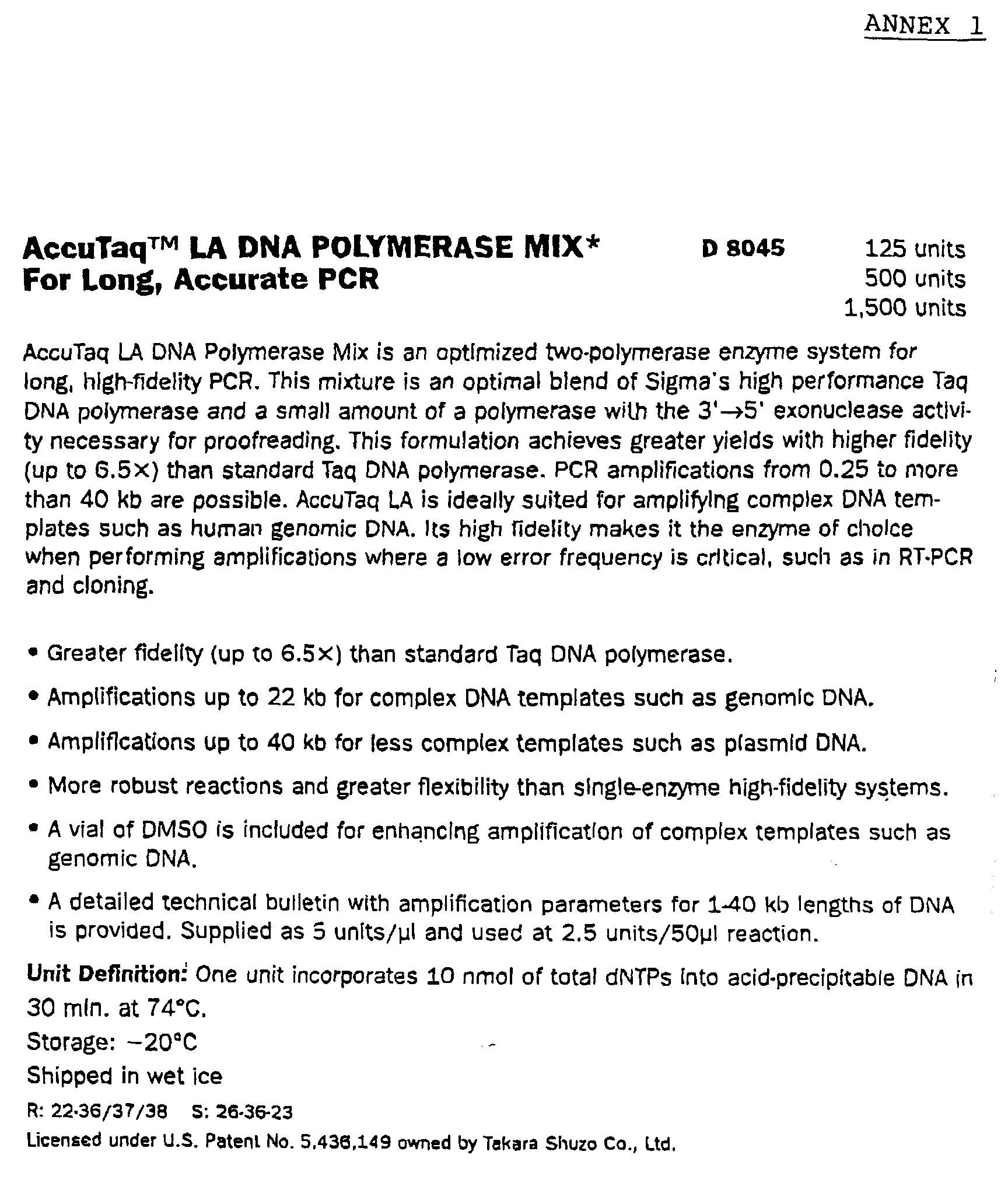
- Very well suited for the instant invention is the AccuTaqTM LA DNA Polymerase Mix sold by SIGMA Corp. (Annex 1).
- Such Mix and related enzyme compositions are described in U.S. Patent No. 5,436,149 in example 6 ibidem, which patent disclosure is herewith incorporated by reference in its entirety.
- thermostable DNA polymerases which are employed possess a 3' ⁇ 5' nuclease activity, preferably 3' ⁇ 5' exonuclease activity, which results in the nonhybridized bases, together with as the case may be, the quencher or reporter molecule, being released.
- the primers used in the novel processes comprise preferably oligonucleotides of 18 to 25 bases in the paired or matching region as related to the target nucleic acid for average G/C and A/T ratios, but are somewhat longer in case of more A/T base pairings and conform to the general methodology disclosed above for PCR.
- the processes disclosed are valuable, in particular, for their simplicity in comparison to e.g. WO 92/02638, because only two oligonucleotides (primers) are required for implementing the nucleic acid amplification, for example the PCR. This is advantageous when, for example, conserved nucleic acid segments have to be amplified for detecting variable target sequences, such as those of viruses, or several, e.g. viral, parameters are to be detected simultaneously.
- the most preferred embodiments of the invention are processes using PCR as the nucleic acid amplification method and wherein the 3' mismatched primer is labeled by a quenchable fluorescent dye molecule and a quencher molecule where at least one of said molecules is at or within the mismatched 3' end of said primer.
- a RNA target is to be detected a reverse transcription of the target RNA into DNA is perfomed preceding amplification via PCR.
- a single normal PCR along protocols known to the man of the art but using labeled primer is preferable (Example 2).
- a first PCR amplification amplifying the target using non-labeled, perfectly matching primers may precede a second amplification of the target nucleic acid via nested PCR using the labeled primers of the invention.
- the second amplification nested PCR
- the addition of unlabeled primer with or without the 3' mismatching portion or tail can be of advantage in that it may render the amplification more efficient and allows for reduction of the labeled primer.
- Reagents employed in the methods of the invention can be packaged into diagnostic kits. Diagnostic kits include the labeled primers in separate containers. If the primer(s) is (are) unlabeled, the specific labeling reagents may also be included in the kit.
- the kit may also contain other suitably packaged reagents and materials needed for sample preparation and amplification, for example, extraction solutions for the target nucleic acid, buffers, dNTPs, and/or polymerizing means and for detection analysis, for example, enzymes and solid phase extractants, as well as instructions for conducting the assay.
- Another object of the invention is the various reaction mixtures for detecting a target nucleic acid in a sample useful for the processes disclosed. Samples may be body fluids of human or animal origin, or extracts of any body component of interest. Preferred samples are blood, plasma or any products resulting from same.
- This example is for applications which require highest sensitivity.
- a first round of amplification precedes the nested PCR which contains the labeled primer.
- hepatitis C virus RNA In order to detect hepatitis C virus RNA, it is first of all extracted using standard methods (for example Ishizawa M., Kobayashi Y., Miyamura T., Matsuma, S: Simple procedure of DNA isolation from human serum. Nucl. Acids Res. 1991; 19:5792 which publication is incorporated herein by reference.) and isolated RNA is subsequently reverse transcribed and amplified using standard methods (RT-PCR). The nested amplification and detection reaction is set up as follows:
- the PCR reaction is evaluated in a fluorescence spectrometer. For this, the fluorescence is measured at the reporter wavelength (518 nm for FAM). A threshold value based on the fluorescence of negative controls which do not contain any target sequence is calculated, and used to evaluate unknown values.
- the single amplification reaction contains the labeled primer.
- hepatitis B virus DNA In order to amplify hepatitis B virus DNA from seropositive patients, it is first of all extracted using standard methods (for example Ishizawa M., Kobayashi Y., Miyamura T., Matsuma, S: Simple procedure of DNA isolation from human serum. Nucl. Acids Res. 1991; 19:5792).
- the amplification is set up as follows:
Landscapes
- Chemical & Material Sciences (AREA)
- Life Sciences & Earth Sciences (AREA)
- Organic Chemistry (AREA)
- Engineering & Computer Science (AREA)
- Zoology (AREA)
- Wood Science & Technology (AREA)
- Proteomics, Peptides & Aminoacids (AREA)
- Health & Medical Sciences (AREA)
- Biophysics (AREA)
- Chemical Kinetics & Catalysis (AREA)
- Immunology (AREA)
- Microbiology (AREA)
- Molecular Biology (AREA)
- Analytical Chemistry (AREA)
- Physics & Mathematics (AREA)
- Biotechnology (AREA)
- Biochemistry (AREA)
- Bioinformatics & Cheminformatics (AREA)
- General Engineering & Computer Science (AREA)
- General Health & Medical Sciences (AREA)
- Genetics & Genomics (AREA)
- Measuring Or Testing Involving Enzymes Or Micro-Organisms (AREA)
Abstract
Description
- The invention relates to a labeled primer for nucleic acid amplification reactions (for example the polymerase chain reaction) and to a process for detecting a DNA sequence by means of a nucleic acid amplification process in which a labeled primer is used.
- As is known, the polymerase chain reaction (PCR) is a very effective method for detecting small quantities of a known nucleic acid sequence in a sample (Erlich H.A., Gelfand, D. Sninsky J.J. (1991), Science, 252, pp. 1643-1651 which publication is incorporated herein by reference; PCR Protocols. Current methods and applications (1993) edited by B.A. White, Humana Press, Totowa, New Jersey, ISBN 0-89603-244-2 which publication is incorporated herein by reference). If the sequence of, for example, a viral DNA is already known, it is possible to synthesize a pair of primers which are complementary to regions on opposite single strands and which flank the sought-after DNA sequence. Under PCR conditions, which are known per se, a sequence of normally more than 30 reaction cycles can then be used to amplify large quantities of a specific DNA in vitro. The PCR cycles amplify a DNA fragment, which is of a specific size and which is composed of the lengths of the two primers plus the length of the e.g. viral DNA between them, when the sought-after e.g. viral DNA is present in the sample. The PCR technique is so sensitive that it can be used to detect extraordinarily small quantities of a DNA with a high degree of reliability.
- International Patent Application WO 92/02638 herein incorporated by reference discloses a process for detecting a DNA sequence, in which process a sample, which contains or is suspected to contain the DNA to be detected (as a single strand) i.e. the target DNA, is hybridized with two different primers, i.e. the forward primer and the reverse primer, which flank the DNA strand to be amplified i.e. the target DNA. A labeled oligonucleotide probe, which is provided in a preferred embodiment of WO 92/02638 with a fluorescent dye system as label both at its 5' end and at its 3' end, is also employed in the reaction. This labeled probe is selected such that it hybridizes between the two primers within the DNA segment to be amplified i.e. within the target DNA. The two fluorescent dyes which are attached to the probe as preferred label have the characteristic feature that the fluorescence of one of the dyes, the reporter dye, is decreased ("quenched") by the proximity of the second molecule, i.e. the quencher by a process known as fluorescence resonance energy transfer (Stryer, L. 1978; Fluorescence energy transfer as a spectroscopic ruler. Ann. Rev. Biochem. 47: 819-846, which is incorporated herein by reference). This labeled probe, which binds to the DNA between the two primers, which are characterized by the abovementioned sequences, has, as an example, the following sequence:
- 5'FAM-TGG TGG TCT GGG ATG AAG GTA TTA TT-TAMRA3'
-
- A sequence of this nature can be ordered and obtained from a number of companies and is intended for use in a 5'-nuclease assay, i.e. the TaqMan® assay. The method above is described in detail by Livak K.J., Flood S.J.A., Marmaro J., Giusti W., Deetz K., Oligonucleotides with fluorescent dyes at opposite ends provide a quenched probe system useful for detecting PCR product and nucleic acid hybridization. PCR Method and Appl. 1995; 4:357-362 which publication is incorporated herein by reference.
- The special feature of this probe is that the fluorescence of the dye (FAM), i.e. the reporter dye, which is attached to the 5' end of the probe is reduced by the proximity of the second fluorescent dye (TAMRA), i.e. the quencher dye, which is arranged at the 3' end of the probe, see above.
- If the new DNA strand is now formed, during the course of the amplification and under the influence of a suitable, preferably thermostable DNA polymerase, e.g. the TaqDNA polymerase not only displaces the labeled probe from the single strand but also, by means of its 5'→3' nuclease activity, degrades the probe and thereby releases the two fluorescent dyes. The fluorescence of the reporter dye is now no longer suppressed by the quencher dye and increases. If a fluorescence spectrometer is now used to measure the fluorescence at the wavelength of the reporter dye, it is then possible to observe an increase in fluorescence which corresponds to the quantity of newly formed DNA.
- The fact that a labeled probe is required, in addition to the forward primer and the reverse primer, in order to be able to observe or measure the amplification of the DNA segment to be detected has to be regarded as a disadvantage of this method. The object of simplifying this known process therefore arose.
- It has now been found that there is no need to use an additional labeled probe in the polymerase chain reaction if at least one of the two primers is labeled with e.g. in a preferred embodiment of the invention a reporter molecule and a quencher molecule (in generalized terms: an interactive label system) and, at the same time, care is taken to ensure that the primer which is labeled does not hybridize completely with the DNA strand to be amplified.
- The invention therefore relates to a labeled primer for nucleic acid amplification reactions (for example the polymerase chain reaction), which primer is labeled, in a preferred embodiment with a label system at or near the 3' end of the primer, with in the preferred embodiment a reporter dye molecule and a quencher molecule, and at least one, preferably at least the last two to five, or more, bases at the 3' end of the primer (i.e. a 3' terminal deliberately mismatched portion) which is labeled in this way are not complementary to the DNA sequence to be amplified. The label or part of a label system is attached to the 3' terminal mismatched portion, preferably to the 3' end nucleotide. The length of the unpaired region is selected and/or optimized known to the man of the art so as to the particular label and particular polymerase used. Such a labeled primer is not able to undergo complete base pairing at its 3'-end with the DNA sequence to be amplified. Under the influence of the polymerase employed for the amplification, which polymerase must possess proof-reading properties, the unpaired bases of the labeled primer, together with the label used, e.g. the reporter dye molecule or quencher molecule as may be the case, are released by the 3'→5' nucleolytic activity of the polymerase before the actual elongation reaction takes place. This, however, results in the examplified case that the quencher is no longer being in spatial proximity to the reporter dye, whose fluorescence therefore increases, thus indicating presence of a target nucleic acid and/or target nucleic acid amplification.
- The invention therefore also relates to a process for detecting a DNA target nucleic acid by means of nucleic acid amplification, in which process one of the primers possesses the abovementioned features. In the amplification, for which it is possible to use one or more thermostable DNA polymerases, at least one of which must also have proof-reading properties, the unpaired bases of the labeled primer, together with the label or part of a label system e.g. reporter dye which is attached to it, are then released, resulting in a signal increase, e.g. fluorescence increasing at the wavelength of the reporter dye.
- In the novel process, the forward primer or the reverse primer or both can be labeled with the reporter and quencher molecules each as described above. While the quencher dye is liberated into the reaction solution, the newly formed DNA segment also carries the fluorescent reporter dye in addition to the remainder of the primer. This is the preferred procedure for quantitative applications. However, the labeling with quencher and reporter dye can also be effected equally well in the converse manner, so that the reporter dye is liberated into the solution and the newly formed DNA segment carries the quencher. If several parameters are to be simultaneously detected in parallel (multiplexing), it is then expedient to select reporter dyes which can be detected in parallel. It is disclosed here that the method of the invention is very well suited for multiplexing.
- In a generalized way the 3'-end of a primer is labeled or attached to the part of a label system, as described below, by incorporating moieties detectable by spectroscopic, photochemical, immunochemical, or chemical means. The method of linking or conjugating the label to the primer depends, of course, on the type of label(s) used and the position of the label on the primer.
- A variety of labels that would be appropriate for use in the invention, as well as methods for their inclusion in the primer, are known in the art and include, but are not limited to, enzymes (e.g., alkaline phosphatase and horseradish peroxidase) and enzyme substrates, radioactive atoms, fluorescent dyes, chromophores, chemiluminescent labels, electro-chemiluminescent labels, such as Origen™ (Igen), ligands having specific binding partners, or any other labels that may interact with each other to enhance, alter, or diminish a signal. Of course, should the amplification be made via PCR and be practiced using a thermal cycler instrument, the label must be able to survive the temperature cycling required in this automated process.
- Among radioactive atoms, 32P is preferred. Methods for introducing 32P into nucleic acids are known in the art, and include, for example, 5' labeling with a kinase, or random insertion by nick translation. Enzymes are typically detected by their activity. "Specific binding partner" refers to a protein capable of binding a ligand monoclonal antibody specific therefor. Other specific binding partners include biotin and avidin or streptavidin, IgG and protein A, and the numerous receptor-ligand couples known in the art.
- The above description is not meant to categorize the various labels into distinct classes, as the same label may serve in several different modes. For example, 125I may serve as a radioactive label or as an electron-dense reagent. HRP may serve as enzyme or as antigen for a monoclonal antibody. Further, one may combine various labels for desired effect. For example, one might label a primer with biotin, and detect the presence of the primer with avidin label with 125I, or with an anti-biotin monoclonal antibody labeld with HRP. Other permutations and possibilities will be readily apparent to those of ordinary skill in the art and are considered as equivalents within the scope of the instant invention.
- Fluorophores for use as labels in constructing labeled primers of the invention include rhodamine and derivatives, such as Texas Red, fluorescein and derivatives, such as 5-bromomethyl fluorescein, Lucifer Yellow, IAEDANS, 7-Me2N-coumarin-4-acetate, 7-OH-4-CH3-coumarin-3-acetate, 7-NH2-4-CH3-coumarin-3-acetate (AMCA), monobromobimane, pyrene trisulfonates, such as Cascade Blue, and monobromotrimethylammoniobimane. In general, fluorophores with wide Stokes shifts are preferred, to allow using fluorimeters with filters rather than a monochromometer an to increase the efficiency of detection. However, the particular label(s) chosen preferably has (have) some quality (e.g. the reporter-quencher relationship) to allow detection in a homogeneous assay system.
- Detection or verification of the label in the processes disclosed is accomplished by a variety of methods and is dependent on the source of the label(s) employed. In the preferred embodiment of the invention, the increase of fluorescence is measured in a suitable fluorometer.
- In a preferred embodiment of the instant invention two interactive labels on a single primer are used as a reporter-quencher label system, see above and the examples.
- Examples for reporter molecules are 6-carboxy-Fluorescein (FAM), Tetrachloro-6-carboxy-fluorescein (TET), 6-Carboxy-X-Carboxy-Tetramethyl-Rhodamin (ROX). Examples of quencher molecules are 6-Carboxy-Tetramethyl-Rhodamin (TAMRA) or 4-(4'-Dimethylamino-phenylazo) benzoic acid (DABCYL). Whereas TAMRA is a fluorescent dye, DABCYL is not.
- Different DNA polymerases can be employed for the novel amplification reaction. If the DNA polymerase which is used has the proof-reading property, it is then possible to carry out the reaction using one single polymerase (e.g. ULTma® DNA polymerase, which is produced for Perkin Elmer by Roche Molecular Systems, Branchburg, New Jersey, USA). Otherwise, it is necessary to use a mixture of several polymerases, with other polymerases having 3'→5' nuclease activity also being used in addition to, for example, Taq DNA polymerase. Tli DNA polymerase (Promega Corporation, Madison, WI, USA) or Vent DNA polymerase (New England Biolabs, Beverly, MA, USA) are suitable thermostable polymerases possessing 3'-5' nuclease activity. Very well suited for the instant invention is the AccuTaq™ LA DNA Polymerase Mix sold by SIGMA Corp. (Annex 1). Such Mix and related enzyme compositions are described in U.S. Patent No. 5,436,149 in example 6 ibidem, which patent disclosure is herewith incorporated by reference in its entirety.
- The novel processes are based on recognition of the fact that the unpaired bases of the primer are a point of attack for the polymerase which possesses a proof-reading function. The thermostable DNA polymerases which are employed possess a 3'→5' nuclease activity, preferably 3'→5' exonuclease activity, which results in the nonhybridized bases, together with as the case may be, the quencher or reporter molecule, being released.
- The primers used in the novel processes comprise preferably oligonucleotides of 18 to 25 bases in the paired or matching region as related to the target nucleic acid for average G/C and A/T ratios, but are somewhat longer in case of more A/T base pairings and conform to the general methodology disclosed above for PCR.
- The processes disclosed are valuable, in particular, for their simplicity in comparison to e.g. WO 92/02638, because only two oligonucleotides (primers) are required for implementing the nucleic acid amplification, for example the PCR. This is advantageous when, for example, conserved nucleic acid segments have to be amplified for detecting variable target sequences, such as those of viruses, or several, e.g. viral, parameters are to be detected simultaneously.
- In addition to this, the method which is described here is very well suited for quantitative amplification, since the increase in fluorescence is directly proportional to the quantity of amplified DNA.
- The most preferred embodiments of the invention are processes using PCR as the nucleic acid amplification method and wherein the 3' mismatched primer is labeled by a quenchable fluorescent dye molecule and a quencher molecule where at least one of said molecules is at or within the mismatched 3' end of said primer. In case a RNA target is to be detected a reverse transcription of the target RNA into DNA is perfomed preceding amplification via PCR. In case the target nucleic acid is abundant, a single normal PCR along protocols known to the man of the art but using labeled primer is preferable (Example 2). In case high sensitivity of target detection is desired, a first PCR amplification amplifying the target using non-labeled, perfectly matching primers may precede a second amplification of the target nucleic acid via nested PCR using the labeled primers of the invention. In especially the second amplification (nested PCR) it has been found that the addition of unlabeled primer with or without the 3' mismatching portion or tail can be of advantage in that it may render the amplification more efficient and allows for reduction of the labeled primer.
- Reagents employed in the methods of the invention can be packaged into diagnostic kits. Diagnostic kits include the labeled primers in separate containers. If the primer(s) is (are) unlabeled, the specific labeling reagents may also be included in the kit. The kit may also contain other suitably packaged reagents and materials needed for sample preparation and amplification, for example, extraction solutions for the target nucleic acid, buffers, dNTPs, and/or polymerizing means and for detection analysis, for example, enzymes and solid phase extractants, as well as instructions for conducting the assay. Another object of the invention is the various reaction mixtures for detecting a target nucleic acid in a sample useful for the processes disclosed. Samples may be body fluids of human or animal origin, or extracts of any body component of interest. Preferred samples are blood, plasma or any products resulting from same.
- The invention is illustrated but not limited by the examples that follow:
- This example is for applications which require highest sensitivity. In this case, a first round of amplification precedes the nested PCR which contains the labeled primer.
- In order to detect hepatitis C virus RNA, it is first of all extracted using standard methods (for example Ishizawa M., Kobayashi Y., Miyamura T., Matsuma, S: Simple procedure of DNA isolation from human serum. Nucl. Acids Res. 1991; 19:5792 which publication is incorporated herein by reference.) and isolated RNA is subsequently reverse transcribed and amplified using standard methods (RT-PCR). The nested amplification and detection reaction is set up as follows:
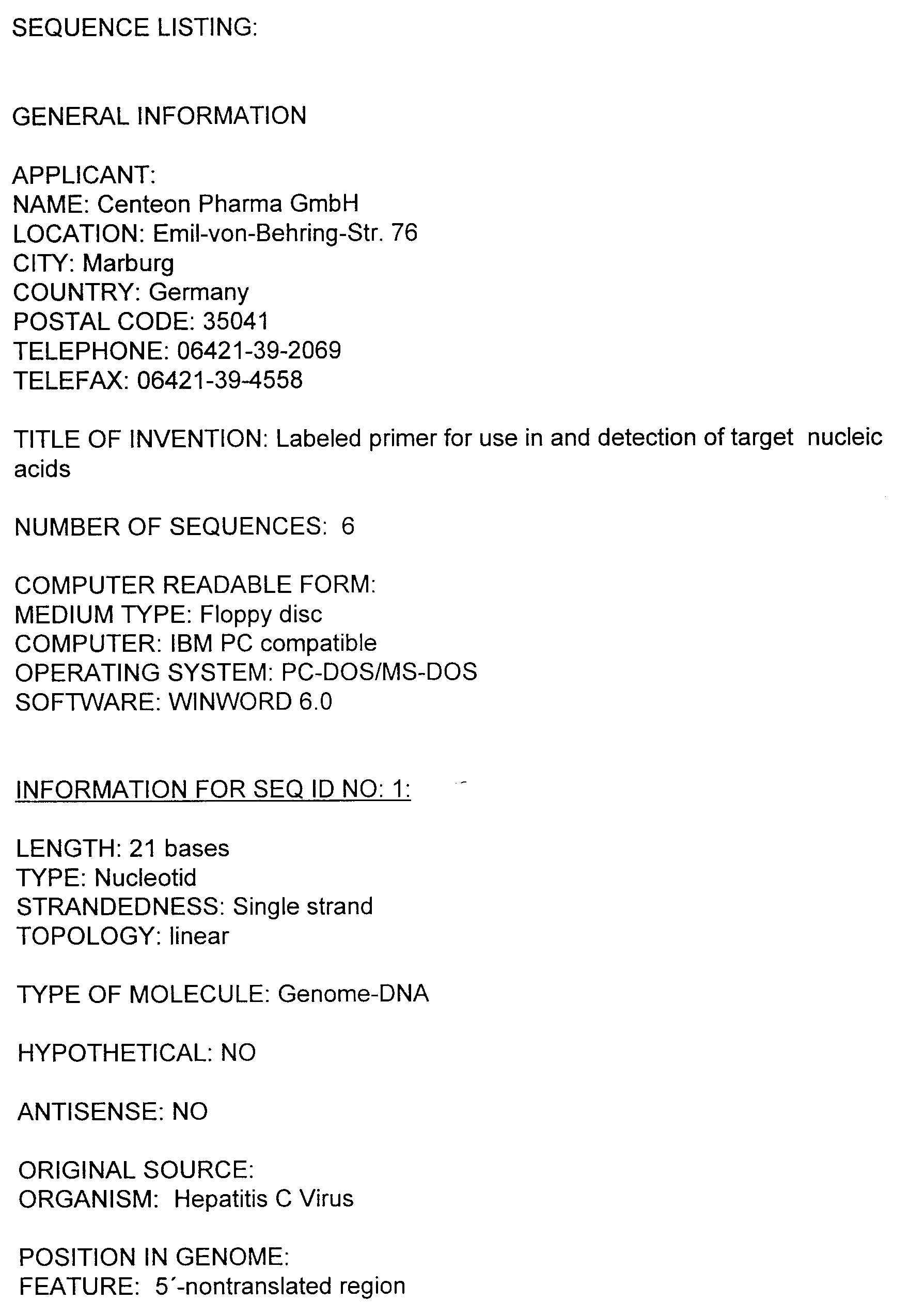
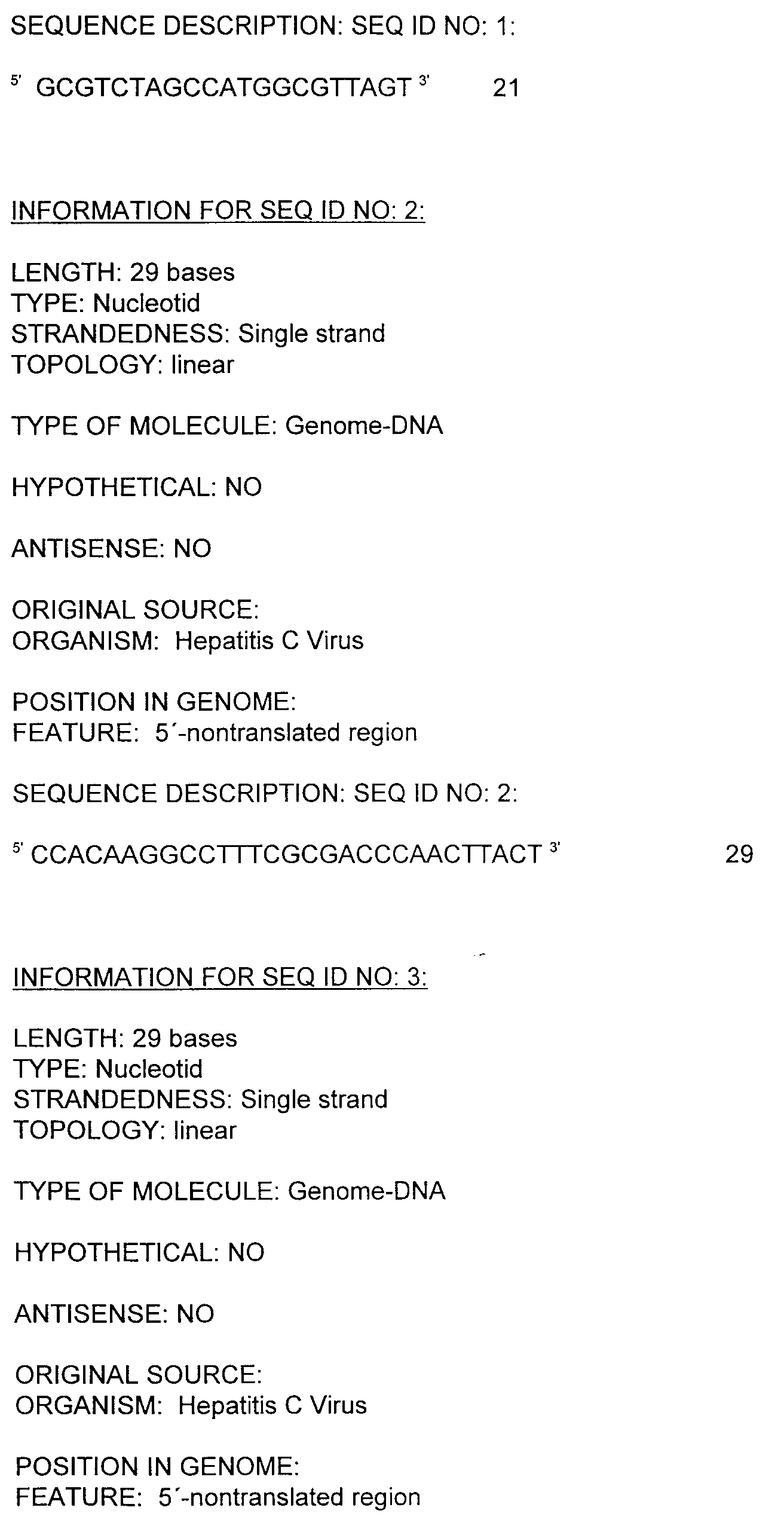
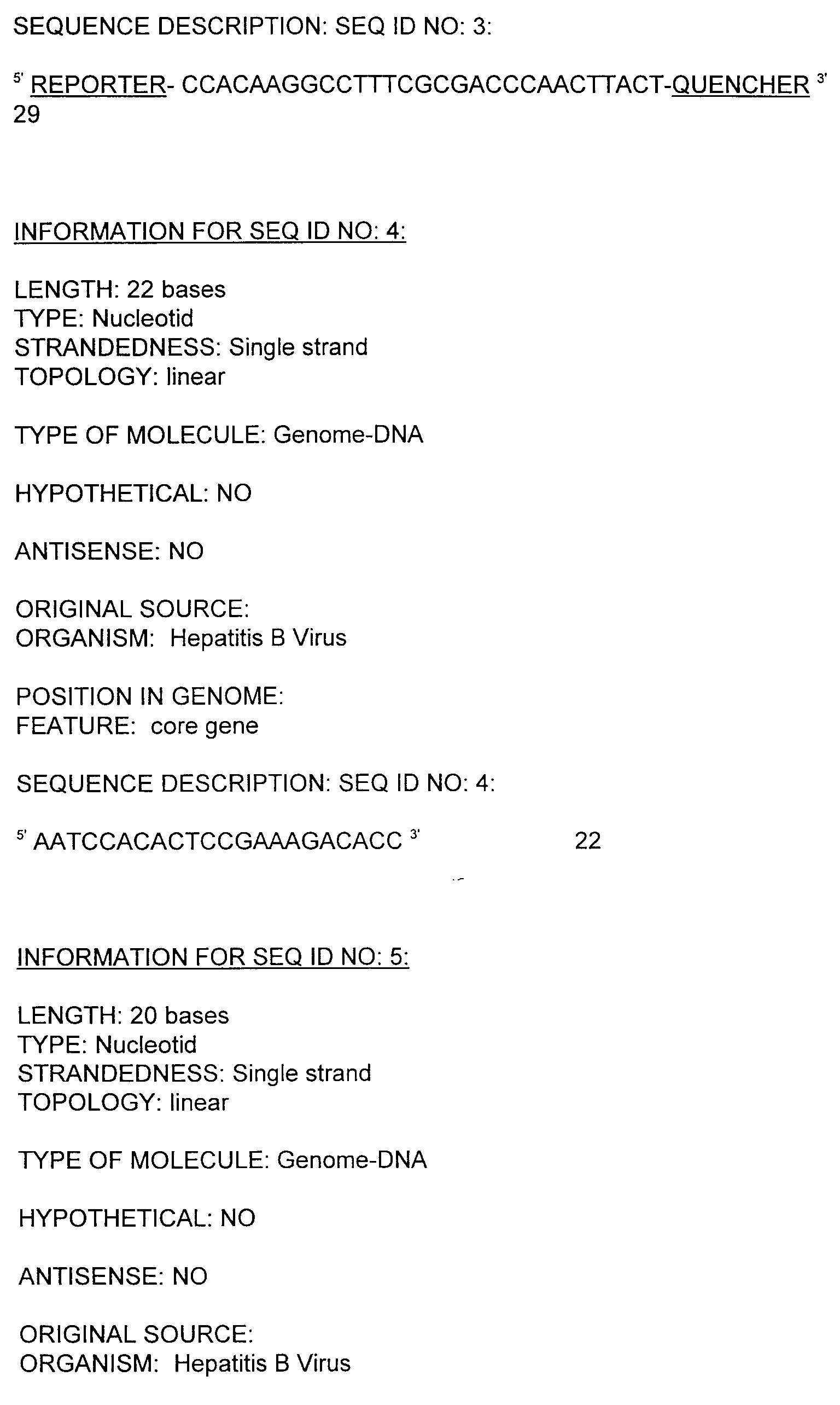
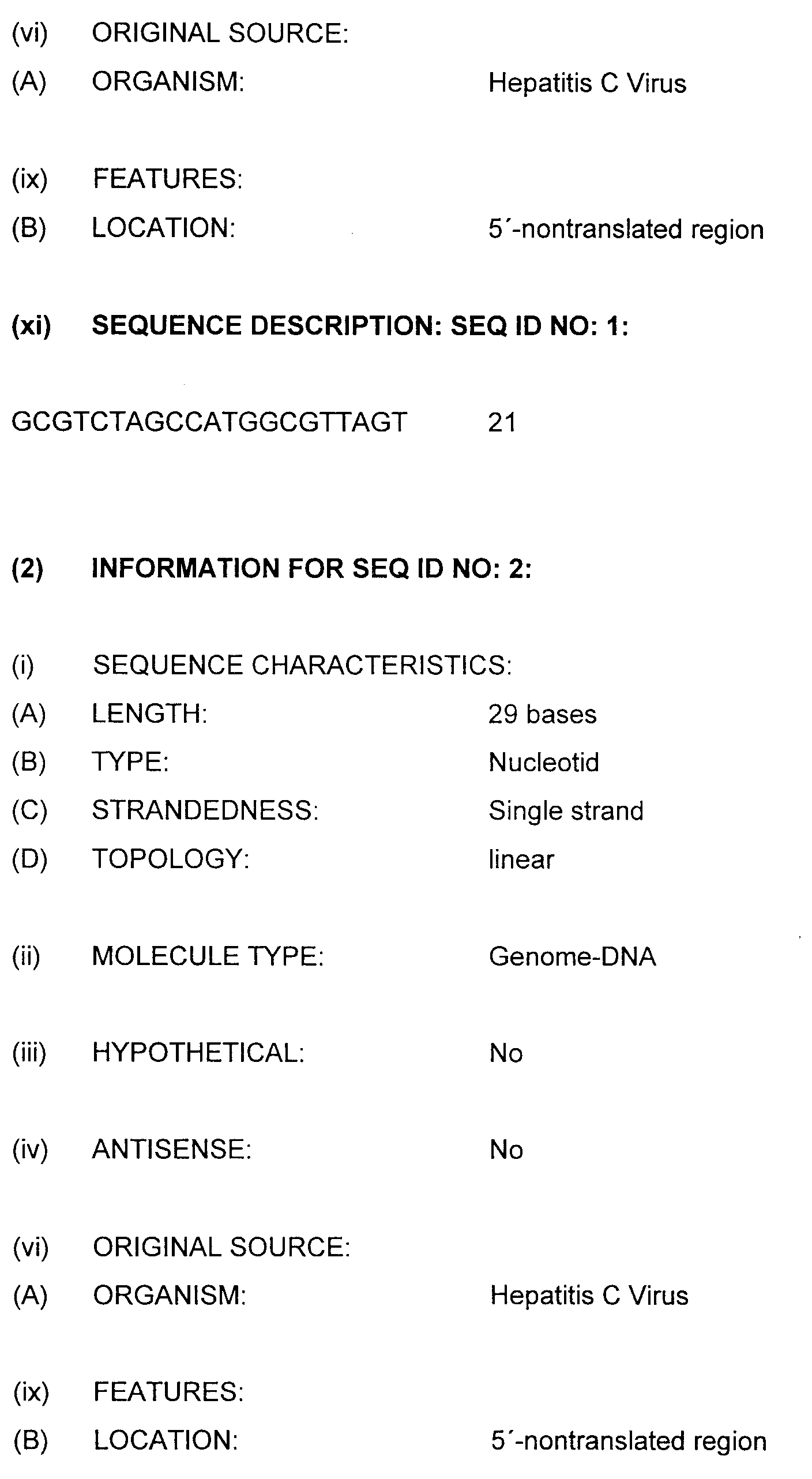
- 5 µl of 10 x ULTma buffer (100 mM Tris-HCl, pH 8.8, 100 mM KCl, 0.02% Tween 20, from Perkin-Elmer), 7 µl of 25 mM MgCl2, 8 µl of primer 1 (see SEQ ID No. 1 of the sequence listing) (10 pmol/µl), 4 µl of primer 2 (see SEQ ID No. 2 of the sequence listing) (10 pmol/µl), 0.25 µl of primer 3 (see SEQ ID No. 3 of the sequence listing) (10 pmol/µl), 2 µl of dNTPs (10 mM) and 0.5 µl of ULTma DNA polymerase possessing a proof-reading function (Perkin-Elmer, 6 units / µl) are added to 5 µl of the RT-PCR reaction, after which the whole is mixed with 18.25 µl of water and subjected to the following thermocycles:
- 1. initial denaturation for 1 minute at 90°
- 2. 35 cycles, of, in each case, 28 seconds at 94°C, for denaturation, and 1 minute at 56 °C, for annealing and extension
- 3. cooling at 4°C until evaluated.
-
- The PCR reaction is evaluated in a fluorescence spectrometer. For this, the fluorescence is measured at the reporter wavelength (518 nm for FAM). A threshold value based on the fluorescence of negative controls which do not contain any target sequence is calculated, and used to evaluate unknown values.
- This example is for applications which do not require highest sensitivity. In this case the single amplification reaction contains the labeled primer.
- In order to amplify hepatitis B virus DNA from seropositive patients, it is first of all extracted using standard methods (for example Ishizawa M., Kobayashi Y., Miyamura T., Matsuma, S: Simple procedure of DNA isolation from human serum. Nucl. Acids Res. 1991; 19:5792). The amplification is set up as follows:
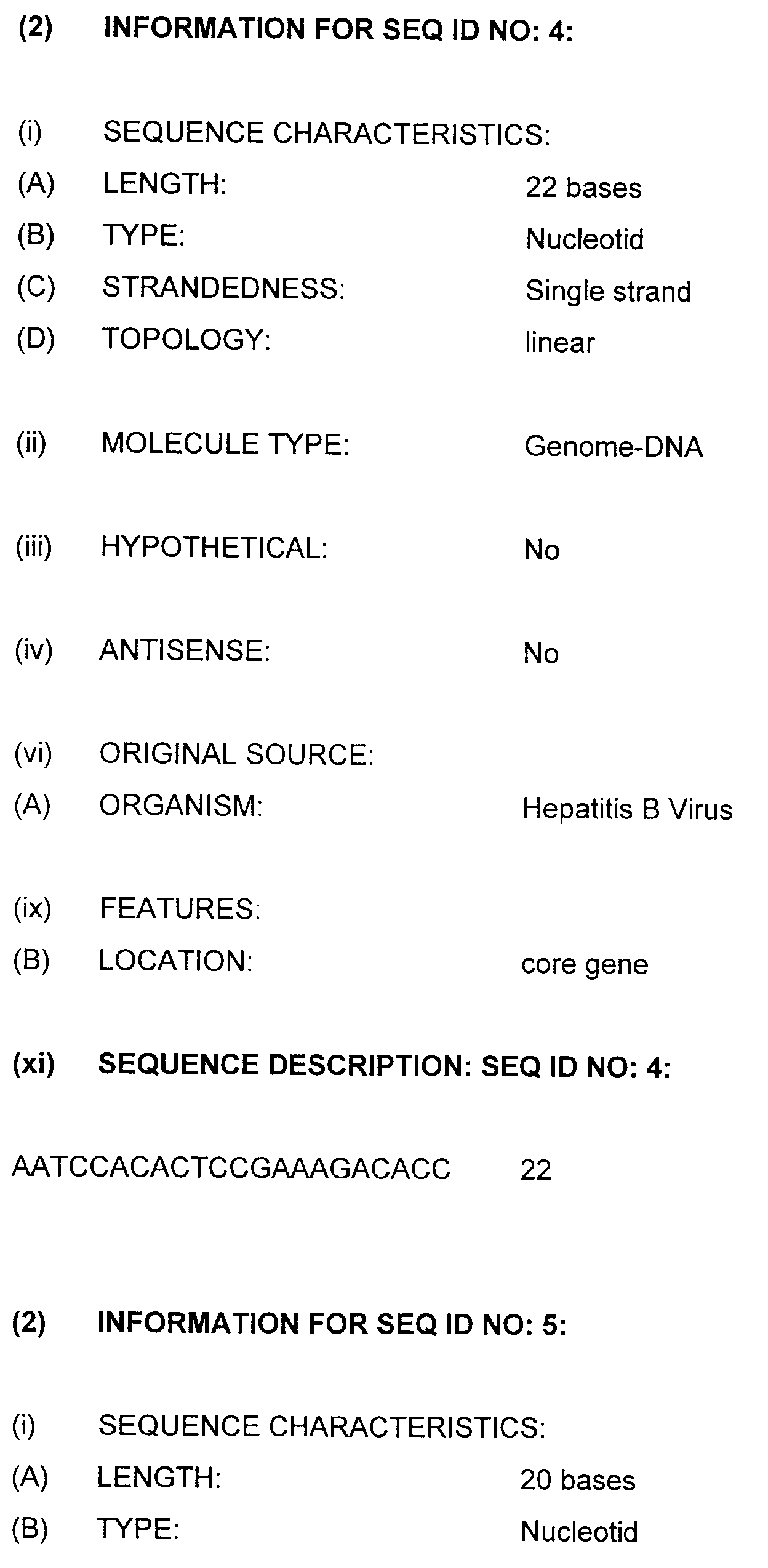
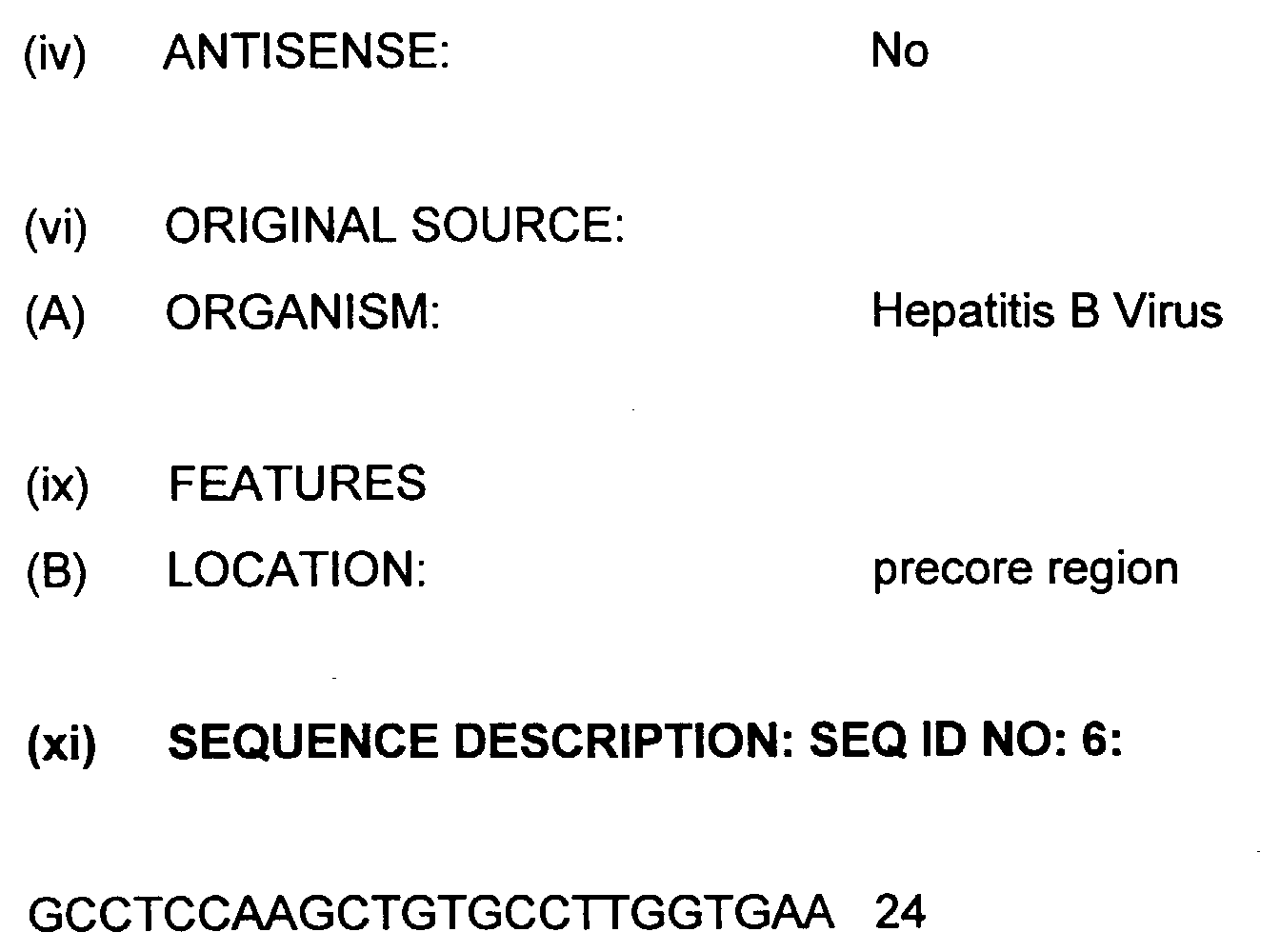
- 5 µl of 10 x ULTma buffer (100 mM Tris-HCl, pH 8.8, 100 mM KCl, 0.02% Tween 20, from Perkin-Elmer), 7 µl of 25 mM MgCl2, 8 µl of primer 4 (see SEQ ID No. 4 of the sequence listing) (10 pmol/µl), 4 µl of primer 5 (see SEQ ID No. 5 of the sequence listing) (10 pmol/µl), 0.25 µl of primer 6 (see SEQ ID No. 6 of the sequence listing) (10 pmol/µl), 2 µl of dNTPs (10 mM) and 0.5 µl of ULTma DNA polymerase possessing a proof-reading function (Perkin-Elmer, 6 units / µl ) are added to 5 µl of the extracted DNA (i.e. target nucleic acid) , after which the whole is mixed with 18.25 µl of water and subjected to the following thermocycles:
- 1. initial denaturation for 1 minute at 90°
- 2. 35 cycles, of, in each case, 28 seconds at 94°C, for denaturation, and 1 minute at 58 °C, for annealing and extension
- 3. cooling at 4°C until evaluated.
-
- Evaluation of results is done as described in example 1.
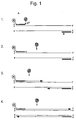
In both examples 1 and 2 the Reporter was FAM and the Quencher TAMRA. - The figure depicts a cycle of a claimed process ("TaqWoman Assay")
- A
- denotes the forward primer with its unpaired 3' end
- B
- denotes the reverse primer
- R
- denotes the reporter molecule
- Q
- denotes the quencher molecule
- The so-called annealing takes place in 1., with the 3' end remaining unpaired since it is not complementary.
- The so-called proof reading takes place in 2., with the enzyme possessing a proof-reading property correcting, i.e. removing, the unpaired 3' end.
- The so-called strand elongation (elongation phase) takes place in 3., which phase has then finished in 4.






Claims (12)
- A process for the detection of a target nucleic acid in a sample comprising single-stranded DNA said process comprising(a) contacting said sample with a forward and/or reverse primer, wherein at least one primer carries a label or part of a label system in a 3' terminal deliberately mismatched portion of said primer relative to the target nucleic acid, said mismatched portion amounting to at least one nucleotide, preferably 2 to 5 or more nucleotides, to create a mixture of duplexes during hybridization conditions with said forward and/or said reverse primer annealed to complementary DNA sequences each of said target nucleic acid in case of its presence;(b) maintaining the mixture of step (a) with a template-dependent nucleic acid polymerase having a 3' to 5' proofreading activity or a mixture of enzymes having such proofreading activity under conditions sufficient to permit the 3' to 5' nuclease activity of said polymerase or mixture of enzymes to cleave the annealed primer in its 3' mismatched portion thereby releasing label or part of a label system;(c) detecting and/or measuring the release of label or part of a label system.
- A process according to claim 1 wherein the target nucleic acid is amplified and thereby more label or part of a label system is released.
- A process according to claim 1 or claim 2 wherein the amplification is performed by PCR, optionally by RT-PCR in case the target nucleic acid is RNA.
- A process according to one of the preceding claims, wherein the label is a reporter-quencher molecule pair linked to the 3' and 5' terminal regions of the forward and/or the reverse primer.
- A process according to one of the preceding claims wherein the reporter molecule is on the mismatched 3' part of the primer and the quencher molecule on the matched part of said primer in suitable distance of the reporter molecule.
- A process according to claim 4 wherein the quencher molecule is on the mismatched 3' part of the primer and the reporter molecule on the matched part of said primer in suitable distance of the reporter molecule, preferably at the 5' end.
- A process according to one of the preceding claims wherein the said nucleic acid polymerase or said mixture of enzymes are thermostable.
- A process according to one of the preceding claims wherein a multiplicity of targets are detected simultaneously by suitable selection of primers and labels respective label systems.
- A process according to one of the preceding claims wherein the sample is animal or human body fluid, preferably plasma.
- A kit for the detection of a target nucleic acid in a sample comprising labeled primers used in the processes of claims 1, 2, 3, 4, 5, 6, 7 or 8 and a suitable nucleic acid polymerase or mixture of enzymes.
- A kit as claimed in claim 10 wherein the primers detect target viral nucleic acids.
- A reaction mixture for detecting a target nucleic acid which reaction mixture comprises prior to amplification labeled primers used in the processes of claims 1, 2, 3, 4, 5, 6, 7 or 8 and a suitable nucleic acid polymerase or mixture of enzymes.
Applications Claiming Priority (6)
| Application Number | Priority Date | Filing Date | Title |
|---|---|---|---|
| DE19755642 | 1997-12-15 | ||
| DE19755642A DE19755642B4 (en) | 1997-12-15 | 1997-12-15 | Labeled primer for the polymerase chain reaction |
| DE19806850 | 1998-02-19 | ||
| DE19806850A DE19806850A1 (en) | 1998-02-19 | 1998-02-19 | Detecting target nucleic acids, especially single-stranded DNAs, using a labeled primer system |
| DE19834913 | 1998-08-03 | ||
| DE19834913A DE19834913A1 (en) | 1998-08-03 | 1998-08-03 | Detecting target nucleic acids, especially single-stranded DNAs, using a labeled primer system |
Related Child Applications (1)
| Application Number | Title | Priority Date | Filing Date |
|---|---|---|---|
| EP06000965 Division | 2006-01-18 |
Publications (2)
| Publication Number | Publication Date |
|---|---|
| EP0930370A1 true EP0930370A1 (en) | 1999-07-21 |
| EP0930370B1 EP0930370B1 (en) | 2007-08-08 |
Family
ID=27218019
Family Applications (1)
| Application Number | Title | Priority Date | Filing Date |
|---|---|---|---|
| EP98123569A Expired - Lifetime EP0930370B1 (en) | 1997-12-15 | 1998-12-10 | Labeled primer for use in detection of target nucleic acids |
Country Status (9)
| Country | Link |
|---|---|
| US (1) | US6248526B1 (en) |
| EP (1) | EP0930370B1 (en) |
| JP (1) | JP4331812B2 (en) |
| KR (1) | KR100702338B1 (en) |
| AT (1) | ATE369439T1 (en) |
| AU (1) | AU741053B2 (en) |
| CA (1) | CA2255531C (en) |
| DE (1) | DE69838210T2 (en) |
| ES (1) | ES2290979T3 (en) |
Cited By (6)
| Publication number | Priority date | Publication date | Assignee | Title |
|---|---|---|---|---|
| WO2003008643A3 (en) * | 2001-07-20 | 2003-08-21 | Cancer Rec Tech Ltd | Methods and polynukleotides for assaying the activity of a dna modifying enzyme |
| US7371544B2 (en) | 2000-02-16 | 2008-05-13 | Jussi Nurmi | Homogenous method for the detection of a polynucleotide, with e.g. cleavable lanthanide chelate label |
| US7781165B2 (en) | 2005-10-19 | 2010-08-24 | Roche Diagnostics Operations, Inc. | Benzimidazolium compounds and salts of benzimidazolium compounds for nucleic acid amplification |
| WO2011078441A1 (en) | 2009-12-21 | 2011-06-30 | Seegene, Inc. | Tsg primer target detection |
| US8026058B2 (en) | 2006-02-27 | 2011-09-27 | Roche Diagnostics Operations, Inc. | PCR hot start by magnesium sequestration |
| WO2016107833A1 (en) * | 2014-12-31 | 2016-07-07 | F. Hoffmann-La Roche Ag | A novel high-throughput method for quantification of hbv cccdna from cell lysate by real-time pcr |
Families Citing this family (59)
| Publication number | Priority date | Publication date | Assignee | Title |
|---|---|---|---|---|
| US20020188268A1 (en) | 1999-06-30 | 2002-12-12 | Mark James Kline | Elastomeric side panel for use with convertible absorbent articles |
| US7537886B1 (en) | 1999-06-22 | 2009-05-26 | Life Technologies Corporation | Primers and methods for the detection and discrimination of nucleic acids |
| US20070134686A1 (en) * | 1999-10-29 | 2007-06-14 | Stratagene California | Methods and compositions for detection of a target nucleic acid sequence utilizing a probe with a 3' flap |
| WO2001048246A1 (en) * | 1999-12-29 | 2001-07-05 | Vanderbilt University | Genetic mutation underlying orthostatic intolerance and diagnostic and therapeutic methods relating thereto |
| US7198924B2 (en) | 2000-12-11 | 2007-04-03 | Invitrogen Corporation | Methods and compositions for synthesis of nucleic acid molecules using multiple recognition sites |
| EP1353936A4 (en) * | 2000-12-27 | 2005-05-18 | Invitrogen Corp | Primers and methods for the detection and discrimination of nucleic acids |
| KR20020089746A (en) * | 2001-05-24 | 2002-11-30 | 주식회사 커벡스 | A size-modifying-anchor primer, method for rt-pcr using the size-modifying-anchor primer and method for diagnosis using the same method |
| FR2829148B1 (en) * | 2001-09-06 | 2004-10-15 | Univ Aix Marseille Ii | MOLECULAR IDENTIFICATION OF STAPHYLOCOCCUS BACTERIA |
| US20030165859A1 (en) * | 2001-10-23 | 2003-09-04 | Invitrogen Corporation | Primers and methods for the detection and discrimination of nucleic acids |
| US7163790B2 (en) * | 2001-11-28 | 2007-01-16 | Bio-Rad Laboratories, Inc. | Parallel polymorphism scoring by amplification and error correction |
| GB0200526D0 (en) * | 2002-01-11 | 2002-02-27 | Science And Technology The | Methods |
| JP4481656B2 (en) * | 2002-02-27 | 2010-06-16 | ライフ テクノロジーズ コーポレーション | Methods of using FET labeled oligonucleotides comprising a 3 'to 5' exonuclease resistant quencher domain and compositions for performing the same |
| US6818420B2 (en) * | 2002-02-27 | 2004-11-16 | Biosource International, Inc. | Methods of using FET labeled oligonucleotides that include a 3′-5′ exonuclease resistant quencher domain and compositions for practicing the same |
| CN1414110A (en) * | 2002-08-19 | 2003-04-30 | 张旭 | Using polymerase possessing 3 prime to 5 prime excision enzyme activity to proceed gene sequence analysis |
| AU2004230569B2 (en) | 2003-03-31 | 2007-12-06 | F. Hoffmann-La Roche Ag | Compositions and methods for detecting certain flaviviruses, including members of the Japanese encephalitis virus serogroup |
| EP1502958A1 (en) * | 2003-08-01 | 2005-02-02 | Roche Diagnostics GmbH | New detection format for hot start real time polymerase chain reaction |
| DE602004027538D1 (en) | 2003-12-01 | 2010-07-15 | Life Technologies Corp | NUCLEIC ACID MOLECULES AND RECOMBINATION AGENTS CONTAINED THEREOF |
| GB0406015D0 (en) * | 2004-03-17 | 2004-04-21 | Dynal Biotech Asa | Improvements in magnetic polymer particles |
| EP1740711A2 (en) | 2004-04-01 | 2007-01-10 | Bio-Rad Laboratories, Inc. | Quantitative amplification with a labeled probe and 3' to 5' exonuclease activity |
| CA2502549C (en) * | 2004-04-23 | 2016-02-16 | Becton, Dickinson And Company | Use of an extraction control in a method of extracting nucleic acids |
| US20060105348A1 (en) * | 2004-11-15 | 2006-05-18 | Lee Jun E | Compositions and methods for the detection and discrimination of nucleic acids |
| US20060275792A1 (en) * | 2004-11-15 | 2006-12-07 | Lee Jun E | Enhancement of nucleic acid amplification using double-stranded DNA binding proteins |
| US7919244B2 (en) * | 2005-06-16 | 2011-04-05 | Biotools Biotechnological & Medical Laboratories, S.A. | Nucleic acid detection method involving the direct generation of a measurable signal |
| US8785353B2 (en) | 2005-06-23 | 2014-07-22 | Keygene N.V. | Strategies for high throughput identification and detection of polymorphisms |
| CA2910861C (en) * | 2005-09-29 | 2018-08-07 | Michael Josephus Theresia Van Eijk | High throughput screening of mutagenized populations |
| US10316364B2 (en) | 2005-09-29 | 2019-06-11 | Keygene N.V. | Method for identifying the source of an amplicon |
| ES2882401T3 (en) | 2005-12-22 | 2021-12-01 | Keygene Nv | High-throughput AFLP-based polymorphism detection method |
| GB0605584D0 (en) * | 2006-03-20 | 2006-04-26 | Olink Ab | Method for analyte detection using proximity probes |
| EP2002017B1 (en) | 2006-04-04 | 2015-06-10 | Keygene N.V. | High throughput detection of molecular markers based on restriction fragments |
| CN102046788B (en) * | 2008-05-28 | 2013-07-10 | 和光纯药工业株式会社 | Primer and probe for detecting mycobacterium intracellulare, and method for detecting mycobacterium intracellulare using same |
| KR101590175B1 (en) * | 2009-09-24 | 2016-01-29 | 주식회사 씨젠 | Detection of Target Nucleic Acid Sequences by Cyclic Exonucleolytic Reactions |
| WO2011056687A2 (en) * | 2009-10-27 | 2011-05-12 | Swift Biosciences, Inc. | Polynucleotide primers and probes |
| KR20110050327A (en) * | 2009-11-07 | 2011-05-13 | 주식회사 씨젠 | THD primer target detection |
| GB201004292D0 (en) * | 2010-03-15 | 2010-04-28 | Olink Ab | Assay for localised detection of analytes |
| GB201011971D0 (en) | 2010-07-15 | 2010-09-01 | Olink Ab | Methods and product |
| WO2012049316A1 (en) | 2010-10-15 | 2012-04-19 | Olink Ab | Dynamic range methods |
| GB201101621D0 (en) | 2011-01-31 | 2011-03-16 | Olink Ab | Method and product |
| GB201107863D0 (en) | 2011-05-11 | 2011-06-22 | Olink Ab | Method and product |
| EP2559774A1 (en) | 2011-08-17 | 2013-02-20 | Roche Diagniostics GmbH | Improved method for amplification of target nucleic acids using a multi-primer approach |
| GB201201547D0 (en) | 2012-01-30 | 2012-03-14 | Olink Ab | Method and product |
| WO2013134693A1 (en) * | 2012-03-09 | 2013-09-12 | Insight Genetics, Inc. | Methods and compositions relating to diagnosing and treating receptor tyrosine kinase related cancers |
| US10174366B2 (en) | 2012-11-14 | 2019-01-08 | Olink Bioscience Ab | Localised RCA-based amplification method |
| US20160369321A1 (en) | 2012-11-14 | 2016-12-22 | Olink Ab | RCA Reporter Probes and Their Use in Detecting Nucleic Acid Molecules |
| US20140341884A1 (en) * | 2012-12-04 | 2014-11-20 | Roche Molecular Systems, Inc. | Novel Complex Mutations in the Epidermal Growth Factor Receptor Kinase Domain |
| EP2948566B1 (en) | 2013-01-24 | 2025-03-26 | California Institute of Technology | Chromophore-based characterization and detection methods |
| WO2014165753A1 (en) * | 2013-04-05 | 2014-10-09 | The Wistar Institute Of Anatomy And Biology | Methods and compositions for diagnosis of glioblastoma or a subtype thereof |
| GB201320145D0 (en) | 2013-11-14 | 2014-01-01 | Olink Ab | Localised RCA-based amplification method using a padlock-probe |
| US20150153346A1 (en) * | 2013-11-15 | 2015-06-04 | The Regents Of The University Of Michigan | Lung cancer signature |
| GB201401885D0 (en) | 2014-02-04 | 2014-03-19 | Olink Ab | Proximity assay with detection based on hybridisation chain reaction (HCR) |
| GB201518655D0 (en) | 2015-10-21 | 2015-12-02 | Olink Ab | Method for generating proximity probes |
| WO2017132139A1 (en) * | 2016-01-25 | 2017-08-03 | University Of Utah Research Foundation | Methods and compositions for predicting a colon cancer subtype |
| GB201621514D0 (en) | 2016-12-16 | 2017-02-01 | Q-Linea Ab | Padlock probe detection method |
| WO2019068880A1 (en) | 2017-10-06 | 2019-04-11 | Cartana Ab | Rna templated ligation |
| US20190112636A1 (en) * | 2017-10-16 | 2019-04-18 | ChromaCode, Inc. | Methods and compositions for nucleic acid detection |
| EP3781710A4 (en) | 2018-04-17 | 2022-01-05 | Chromacode, Inc. | MULTIPLEX ANALYSIS METHODS AND SYSTEMS |
| US12203129B2 (en) | 2018-07-03 | 2025-01-21 | ChromaCode, Inc. | Formulations and signal encoding and decoding methods for massively multiplexed biochemical assays |
| CN109694905A (en) * | 2019-01-29 | 2019-04-30 | 深圳市亚辉龙生物科技股份有限公司 | Detect the nucleic acid compositions of testing gene methylation and its detection method of kit and testing gene methylation |
| GB201919032D0 (en) | 2019-12-20 | 2020-02-05 | Cartana Ab | Method of detecting an analyte |
| GB201919029D0 (en) | 2019-12-20 | 2020-02-05 | Cartana Ab | Method of detecting an analyte |
Citations (3)
| Publication number | Priority date | Publication date | Assignee | Title |
|---|---|---|---|---|
| WO1990012115A1 (en) * | 1989-03-21 | 1990-10-18 | Collaborative Research, Inc. | A dna diagnostic test using an exonuclease activity |
| WO1997029210A2 (en) * | 1996-02-05 | 1997-08-14 | The Perkin-Elmer Corporation | Fluorescence detection assay for homogeneous pcr hybridization systems |
| US5804375A (en) * | 1990-08-06 | 1998-09-08 | Roche Molecular Systems, Inc. | Reaction mixtures for detection of target nucleic acids |
Family Cites Families (1)
| Publication number | Priority date | Publication date | Assignee | Title |
|---|---|---|---|---|
| US5804380A (en) * | 1993-11-12 | 1998-09-08 | Geron Corporation | Telomerase activity assays |
-
1998
- 1998-12-10 ES ES98123569T patent/ES2290979T3/en not_active Expired - Lifetime
- 1998-12-10 DE DE69838210T patent/DE69838210T2/en not_active Expired - Lifetime
- 1998-12-10 EP EP98123569A patent/EP0930370B1/en not_active Expired - Lifetime
- 1998-12-10 AT AT98123569T patent/ATE369439T1/en active
- 1998-12-14 AU AU97088/98A patent/AU741053B2/en not_active Ceased
- 1998-12-14 US US09/210,657 patent/US6248526B1/en not_active Expired - Lifetime
- 1998-12-14 CA CA002255531A patent/CA2255531C/en not_active Expired - Fee Related
- 1998-12-15 KR KR1019980054960A patent/KR100702338B1/en not_active Expired - Fee Related
- 1998-12-15 JP JP35573398A patent/JP4331812B2/en not_active Expired - Fee Related
Patent Citations (3)
| Publication number | Priority date | Publication date | Assignee | Title |
|---|---|---|---|---|
| WO1990012115A1 (en) * | 1989-03-21 | 1990-10-18 | Collaborative Research, Inc. | A dna diagnostic test using an exonuclease activity |
| US5804375A (en) * | 1990-08-06 | 1998-09-08 | Roche Molecular Systems, Inc. | Reaction mixtures for detection of target nucleic acids |
| WO1997029210A2 (en) * | 1996-02-05 | 1997-08-14 | The Perkin-Elmer Corporation | Fluorescence detection assay for homogeneous pcr hybridization systems |
Cited By (9)
| Publication number | Priority date | Publication date | Assignee | Title |
|---|---|---|---|---|
| US7371544B2 (en) | 2000-02-16 | 2008-05-13 | Jussi Nurmi | Homogenous method for the detection of a polynucleotide, with e.g. cleavable lanthanide chelate label |
| WO2003008643A3 (en) * | 2001-07-20 | 2003-08-21 | Cancer Rec Tech Ltd | Methods and polynukleotides for assaying the activity of a dna modifying enzyme |
| US7781165B2 (en) | 2005-10-19 | 2010-08-24 | Roche Diagnostics Operations, Inc. | Benzimidazolium compounds and salts of benzimidazolium compounds for nucleic acid amplification |
| US8026058B2 (en) | 2006-02-27 | 2011-09-27 | Roche Diagnostics Operations, Inc. | PCR hot start by magnesium sequestration |
| WO2011078441A1 (en) | 2009-12-21 | 2011-06-30 | Seegene, Inc. | Tsg primer target detection |
| AU2010336137B2 (en) * | 2009-12-21 | 2015-08-06 | Seegene, Inc. | TSG primer target detection |
| EP2516679B1 (en) * | 2009-12-21 | 2017-08-23 | Seegene, Inc. | Tsg primer target detection |
| WO2016107833A1 (en) * | 2014-12-31 | 2016-07-07 | F. Hoffmann-La Roche Ag | A novel high-throughput method for quantification of hbv cccdna from cell lysate by real-time pcr |
| CN107109497A (en) * | 2014-12-31 | 2017-08-29 | 豪夫迈·罗氏有限公司 | HBV cccDNA high flux new method is quantified from cell lysate by real-time PCR |
Also Published As
| Publication number | Publication date |
|---|---|
| CA2255531C (en) | 2007-11-13 |
| DE69838210T2 (en) | 2008-05-15 |
| AU9708898A (en) | 1999-07-01 |
| ES2290979T3 (en) | 2008-02-16 |
| CA2255531A1 (en) | 1999-06-15 |
| EP0930370B1 (en) | 2007-08-08 |
| KR19990063053A (en) | 1999-07-26 |
| JPH11313685A (en) | 1999-11-16 |
| ATE369439T1 (en) | 2007-08-15 |
| DE69838210D1 (en) | 2007-09-20 |
| US6248526B1 (en) | 2001-06-19 |
| KR100702338B1 (en) | 2008-03-19 |
| JP4331812B2 (en) | 2009-09-16 |
| AU741053B2 (en) | 2001-11-22 |
Similar Documents
| Publication | Publication Date | Title |
|---|---|---|
| US6248526B1 (en) | Labeled primer for use in and detection of target nucleic acids | |
| AU769219B2 (en) | High specificity primers, amplification methods and kits | |
| US6251600B1 (en) | Homogeneous nucleotide amplification and assay | |
| CA2163388C (en) | Methods for in-solution quenching of fluorescently labeled oligonucleotide probes | |
| EP2789689B1 (en) | Chimeric primers with hairpin conformations and methods of using same | |
| EP0876510B1 (en) | Homogeneous amplification and detection of nucleic acids | |
| US5487972A (en) | Nucleic acid detection by the 5'-3'exonuclease activity of polymerases acting on adjacently hybridized oligonucleotides | |
| EP0870063B1 (en) | Fluorescence detection assay for homogeneous pcr hybridization systems | |
| AU2007333040B2 (en) | Systems and methods for multiplex analysis of PCR in real time | |
| CA2008096A1 (en) | Nucleic acid amplification using single primer | |
| JP2004511227A (en) | Specific double-stranded probe for detection of nucleic acid in the same species and its application method | |
| JPH1118785A (en) | Neisseria conorphoea-specific oligonucleotides | |
| US20060078914A1 (en) | Homogeneous assay system | |
| JPH03119999A (en) | Method of detecting nucleic acid using various primer concentrations in polymerase chain reaction | |
| WO1999042615A1 (en) | Methods for determining amounts of nucleic acids |
Legal Events
| Date | Code | Title | Description |
|---|---|---|---|
| PUAI | Public reference made under article 153(3) epc to a published international application that has entered the european phase |
Free format text: ORIGINAL CODE: 0009012 |
|
| AK | Designated contracting states |
Kind code of ref document: A1 Designated state(s): AT BE CH DE DK ES FR GB GR IE IT LI LU NL PT SE |
|
| AX | Request for extension of the european patent |
Free format text: AL;LT;LV;MK;RO;SI |
|
| 17P | Request for examination filed |
Effective date: 20000121 |
|
| AKX | Designation fees paid |
Free format text: AT BE CH DE DK ES FR GB GR IE IT LI LU NL PT SE |
|
| RAP1 | Party data changed (applicant data changed or rights of an application transferred) |
Owner name: AVENTIS BEHRING GESELLSCHAFT MIT BESCHRAENKTER HAF |
|
| 17Q | First examination report despatched |
Effective date: 20020131 |
|
| RAP1 | Party data changed (applicant data changed or rights of an application transferred) |
Owner name: ZLB BEHRING GMBH |
|
| APAF | Appeal reference modified |
Free format text: ORIGINAL CODE: EPIDOSCREFNE |
|
| APBT | Appeal procedure closed |
Free format text: ORIGINAL CODE: EPIDOSNNOA9E |
|
| GRAP | Despatch of communication of intention to grant a patent |
Free format text: ORIGINAL CODE: EPIDOSNIGR1 |
|
| GRAS | Grant fee paid |
Free format text: ORIGINAL CODE: EPIDOSNIGR3 |
|
| RAP1 | Party data changed (applicant data changed or rights of an application transferred) |
Owner name: CSL BEHRING GMBH |
|
| GRAA | (expected) grant |
Free format text: ORIGINAL CODE: 0009210 |
|
| AK | Designated contracting states |
Kind code of ref document: B1 Designated state(s): AT BE CH DE DK ES FR GB GR IE IT LI LU NL PT SE |
|
| REG | Reference to a national code |
Ref country code: GB Ref legal event code: FG4D |
|
| REG | Reference to a national code |
Ref country code: CH Ref legal event code: EP |
|
| REG | Reference to a national code |
Ref country code: IE Ref legal event code: FG4D |
|
| REF | Corresponds to: |
Ref document number: 69838210 Country of ref document: DE Date of ref document: 20070920 Kind code of ref document: P |
|
| REG | Reference to a national code |
Ref country code: CH Ref legal event code: NV Representative=s name: PATENTANWAELTE SCHAAD, BALASS, MENZL & PARTNER AG |
|
| ET | Fr: translation filed | ||
| PG25 | Lapsed in a contracting state [announced via postgrant information from national office to epo] |
Ref country code: NL Free format text: LAPSE BECAUSE OF FAILURE TO SUBMIT A TRANSLATION OF THE DESCRIPTION OR TO PAY THE FEE WITHIN THE PRESCRIBED TIME-LIMIT Effective date: 20070808 |
|
| NLV1 | Nl: lapsed or annulled due to failure to fulfill the requirements of art. 29p and 29m of the patents act | ||
| REG | Reference to a national code |
Ref country code: ES Ref legal event code: FG2A Ref document number: 2290979 Country of ref document: ES Kind code of ref document: T3 |
|
| PG25 | Lapsed in a contracting state [announced via postgrant information from national office to epo] |
Ref country code: GR Free format text: LAPSE BECAUSE OF FAILURE TO SUBMIT A TRANSLATION OF THE DESCRIPTION OR TO PAY THE FEE WITHIN THE PRESCRIBED TIME-LIMIT Effective date: 20071109 Ref country code: DK Free format text: LAPSE BECAUSE OF FAILURE TO SUBMIT A TRANSLATION OF THE DESCRIPTION OR TO PAY THE FEE WITHIN THE PRESCRIBED TIME-LIMIT Effective date: 20070808 |
|
| PG25 | Lapsed in a contracting state [announced via postgrant information from national office to epo] |
Ref country code: PT Free format text: LAPSE BECAUSE OF FAILURE TO SUBMIT A TRANSLATION OF THE DESCRIPTION OR TO PAY THE FEE WITHIN THE PRESCRIBED TIME-LIMIT Effective date: 20080108 |
|
| PLBE | No opposition filed within time limit |
Free format text: ORIGINAL CODE: 0009261 |
|
| STAA | Information on the status of an ep patent application or granted ep patent |
Free format text: STATUS: NO OPPOSITION FILED WITHIN TIME LIMIT |
|
| PG25 | Lapsed in a contracting state [announced via postgrant information from national office to epo] |
Ref country code: SE Free format text: LAPSE BECAUSE OF FAILURE TO SUBMIT A TRANSLATION OF THE DESCRIPTION OR TO PAY THE FEE WITHIN THE PRESCRIBED TIME-LIMIT Effective date: 20071108 |
|
| 26N | No opposition filed |
Effective date: 20080509 |
|
| REG | Reference to a national code |
Ref country code: FR Ref legal event code: PLFP Year of fee payment: 18 |
|
| PGFP | Annual fee paid to national office [announced via postgrant information from national office to epo] |
Ref country code: IE Payment date: 20151209 Year of fee payment: 18 Ref country code: CH Payment date: 20151105 Year of fee payment: 18 |
|
| PGFP | Annual fee paid to national office [announced via postgrant information from national office to epo] |
Ref country code: BE Payment date: 20151207 Year of fee payment: 18 Ref country code: AT Payment date: 20151104 Year of fee payment: 18 |
|
| PGFP | Annual fee paid to national office [announced via postgrant information from national office to epo] |
Ref country code: LU Payment date: 20160106 Year of fee payment: 18 |
|
| PGFP | Annual fee paid to national office [announced via postgrant information from national office to epo] |
Ref country code: IT Payment date: 20151221 Year of fee payment: 18 |
|
| REG | Reference to a national code |
Ref country code: FR Ref legal event code: PLFP Year of fee payment: 19 |
|
| PGFP | Annual fee paid to national office [announced via postgrant information from national office to epo] |
Ref country code: FR Payment date: 20161111 Year of fee payment: 19 Ref country code: GB Payment date: 20161207 Year of fee payment: 19 |
|
| PGFP | Annual fee paid to national office [announced via postgrant information from national office to epo] |
Ref country code: ES Payment date: 20161111 Year of fee payment: 19 |
|
| PGFP | Annual fee paid to national office [announced via postgrant information from national office to epo] |
Ref country code: DE Payment date: 20161231 Year of fee payment: 19 |
|
| PG25 | Lapsed in a contracting state [announced via postgrant information from national office to epo] |
Ref country code: BE Free format text: LAPSE BECAUSE OF NON-PAYMENT OF DUE FEES Effective date: 20161231 |
|
| REG | Reference to a national code |
Ref country code: CH Ref legal event code: PL |
|
| REG | Reference to a national code |
Ref country code: AT Ref legal event code: MM01 Ref document number: 369439 Country of ref document: AT Kind code of ref document: T Effective date: 20161210 |
|
| REG | Reference to a national code |
Ref country code: IE Ref legal event code: MM4A |
|
| PG25 | Lapsed in a contracting state [announced via postgrant information from national office to epo] |
Ref country code: IT Free format text: LAPSE BECAUSE OF NON-PAYMENT OF DUE FEES Effective date: 20161210 Ref country code: CH Free format text: LAPSE BECAUSE OF NON-PAYMENT OF DUE FEES Effective date: 20161231 Ref country code: LI Free format text: LAPSE BECAUSE OF NON-PAYMENT OF DUE FEES Effective date: 20161231 Ref country code: LU Free format text: LAPSE BECAUSE OF NON-PAYMENT OF DUE FEES Effective date: 20161210 Ref country code: AT Free format text: LAPSE BECAUSE OF NON-PAYMENT OF DUE FEES Effective date: 20161210 |
|
| PG25 | Lapsed in a contracting state [announced via postgrant information from national office to epo] |
Ref country code: IE Free format text: LAPSE BECAUSE OF NON-PAYMENT OF DUE FEES Effective date: 20161210 |
|
| REG | Reference to a national code |
Ref country code: BE Ref legal event code: MM Effective date: 20161231 |
|
| REG | Reference to a national code |
Ref country code: DE Ref legal event code: R119 Ref document number: 69838210 Country of ref document: DE |
|
| GBPC | Gb: european patent ceased through non-payment of renewal fee |
Effective date: 20171210 |
|
| REG | Reference to a national code |
Ref country code: FR Ref legal event code: ST Effective date: 20180831 |
|
| PG25 | Lapsed in a contracting state [announced via postgrant information from national office to epo] |
Ref country code: FR Free format text: LAPSE BECAUSE OF NON-PAYMENT OF DUE FEES Effective date: 20180102 Ref country code: DE Free format text: LAPSE BECAUSE OF NON-PAYMENT OF DUE FEES Effective date: 20180703 |
|
| PG25 | Lapsed in a contracting state [announced via postgrant information from national office to epo] |
Ref country code: GB Free format text: LAPSE BECAUSE OF NON-PAYMENT OF DUE FEES Effective date: 20171210 |
|
| REG | Reference to a national code |
Ref country code: ES Ref legal event code: FD2A Effective date: 20190702 |
|
| PG25 | Lapsed in a contracting state [announced via postgrant information from national office to epo] |
Ref country code: ES Free format text: LAPSE BECAUSE OF NON-PAYMENT OF DUE FEES Effective date: 20171211 |