EP0928319B1 - Coarse particle size kaolin clay and method - Google Patents
Coarse particle size kaolin clay and method Download PDFInfo
- Publication number
- EP0928319B1 EP0928319B1 EP98906578A EP98906578A EP0928319B1 EP 0928319 B1 EP0928319 B1 EP 0928319B1 EP 98906578 A EP98906578 A EP 98906578A EP 98906578 A EP98906578 A EP 98906578A EP 0928319 B1 EP0928319 B1 EP 0928319B1
- Authority
- EP
- European Patent Office
- Prior art keywords
- clay
- kaolin clay
- particle size
- centrifuged
- microns
- Prior art date
- Legal status (The legal status is an assumption and is not a legal conclusion. Google has not performed a legal analysis and makes no representation as to the accuracy of the status listed.)
- Expired - Lifetime
Links
Images

Classifications
-
- C—CHEMISTRY; METALLURGY
- C09—DYES; PAINTS; POLISHES; NATURAL RESINS; ADHESIVES; COMPOSITIONS NOT OTHERWISE PROVIDED FOR; APPLICATIONS OF MATERIALS NOT OTHERWISE PROVIDED FOR
- C09C—TREATMENT OF INORGANIC MATERIALS, OTHER THAN FIBROUS FILLERS, TO ENHANCE THEIR PIGMENTING OR FILLING PROPERTIES ; PREPARATION OF CARBON BLACK ; PREPARATION OF INORGANIC MATERIALS WHICH ARE NO SINGLE CHEMICAL COMPOUNDS AND WHICH ARE MAINLY USED AS PIGMENTS OR FILLERS
- C09C1/00—Treatment of specific inorganic materials other than fibrous fillers; Preparation of carbon black
- C09C1/40—Compounds of aluminium
- C09C1/42—Clays
-
- C—CHEMISTRY; METALLURGY
- C08—ORGANIC MACROMOLECULAR COMPOUNDS; THEIR PREPARATION OR CHEMICAL WORKING-UP; COMPOSITIONS BASED THEREON
- C08K—Use of inorganic or non-macromolecular organic substances as compounding ingredients
- C08K3/00—Use of inorganic substances as compounding ingredients
- C08K3/34—Silicon-containing compounds
- C08K3/346—Clay
-
- C—CHEMISTRY; METALLURGY
- C09—DYES; PAINTS; POLISHES; NATURAL RESINS; ADHESIVES; COMPOSITIONS NOT OTHERWISE PROVIDED FOR; APPLICATIONS OF MATERIALS NOT OTHERWISE PROVIDED FOR
- C09C—TREATMENT OF INORGANIC MATERIALS, OTHER THAN FIBROUS FILLERS, TO ENHANCE THEIR PIGMENTING OR FILLING PROPERTIES ; PREPARATION OF CARBON BLACK ; PREPARATION OF INORGANIC MATERIALS WHICH ARE NO SINGLE CHEMICAL COMPOUNDS AND WHICH ARE MAINLY USED AS PIGMENTS OR FILLERS
- C09C1/00—Treatment of specific inorganic materials other than fibrous fillers; Preparation of carbon black
- C09C1/0081—Composite particulate pigments or fillers, i.e. containing at least two solid phases, except those consisting of coated particles of one compound
-
- C—CHEMISTRY; METALLURGY
- C01—INORGANIC CHEMISTRY
- C01P—INDEXING SCHEME RELATING TO STRUCTURAL AND PHYSICAL ASPECTS OF SOLID INORGANIC COMPOUNDS
- C01P2004/00—Particle morphology
- C01P2004/20—Particle morphology extending in two dimensions, e.g. plate-like
-
- C—CHEMISTRY; METALLURGY
- C01—INORGANIC CHEMISTRY
- C01P—INDEXING SCHEME RELATING TO STRUCTURAL AND PHYSICAL ASPECTS OF SOLID INORGANIC COMPOUNDS
- C01P2004/00—Particle morphology
- C01P2004/51—Particles with a specific particle size distribution
-
- C—CHEMISTRY; METALLURGY
- C01—INORGANIC CHEMISTRY
- C01P—INDEXING SCHEME RELATING TO STRUCTURAL AND PHYSICAL ASPECTS OF SOLID INORGANIC COMPOUNDS
- C01P2004/00—Particle morphology
- C01P2004/54—Particles characterised by their aspect ratio, i.e. the ratio of sizes in the longest to the shortest dimension
-
- C—CHEMISTRY; METALLURGY
- C01—INORGANIC CHEMISTRY
- C01P—INDEXING SCHEME RELATING TO STRUCTURAL AND PHYSICAL ASPECTS OF SOLID INORGANIC COMPOUNDS
- C01P2004/00—Particle morphology
- C01P2004/60—Particles characterised by their size
- C01P2004/61—Micrometer sized, i.e. from 1-100 micrometer
-
- C—CHEMISTRY; METALLURGY
- C01—INORGANIC CHEMISTRY
- C01P—INDEXING SCHEME RELATING TO STRUCTURAL AND PHYSICAL ASPECTS OF SOLID INORGANIC COMPOUNDS
- C01P2006/00—Physical properties of inorganic compounds
- C01P2006/12—Surface area
-
- C—CHEMISTRY; METALLURGY
- C01—INORGANIC CHEMISTRY
- C01P—INDEXING SCHEME RELATING TO STRUCTURAL AND PHYSICAL ASPECTS OF SOLID INORGANIC COMPOUNDS
- C01P2006/00—Physical properties of inorganic compounds
- C01P2006/22—Rheological behaviour as dispersion, e.g. viscosity, sedimentation stability
-
- C—CHEMISTRY; METALLURGY
- C01—INORGANIC CHEMISTRY
- C01P—INDEXING SCHEME RELATING TO STRUCTURAL AND PHYSICAL ASPECTS OF SOLID INORGANIC COMPOUNDS
- C01P2006/00—Physical properties of inorganic compounds
- C01P2006/60—Optical properties, e.g. expressed in CIELAB-values
-
- C—CHEMISTRY; METALLURGY
- C01—INORGANIC CHEMISTRY
- C01P—INDEXING SCHEME RELATING TO STRUCTURAL AND PHYSICAL ASPECTS OF SOLID INORGANIC COMPOUNDS
- C01P2006/00—Physical properties of inorganic compounds
- C01P2006/80—Compositional purity
-
- C—CHEMISTRY; METALLURGY
- C08—ORGANIC MACROMOLECULAR COMPOUNDS; THEIR PREPARATION OR CHEMICAL WORKING-UP; COMPOSITIONS BASED THEREON
- C08K—Use of inorganic or non-macromolecular organic substances as compounding ingredients
- C08K2201/00—Specific properties of additives
- C08K2201/016—Additives defined by their aspect ratio
Definitions
- the present invention relates to a kaolin clay and a method for its production. More particularly, the invention relates to a kaolin clay product having a very coarse particle size, a higher than expected BET surface area, a high particle aspect ratio, and a waterwash process for making the same.
- Kaolin clay (kaolinite) is a naturally occurring, crystalline aluminosilicate material having the chemical formula Al 2 Si 2 O 5 (OH) 4 and structurally consisting of linked, alternating layers of tetrahedral silicon and octahedral aluminum. Mined crude kaolin clay is typically refined for use as fillers in rubber, plastics, and other polymers, as well as for use as pigments or pigment extenders in paints and other industrial coatings.
- Kaolin clay crudes are generally processed in one of two ways: 1) via an airfloat process wherein the crude clay is crushed, dried, pulverized, and then air-classified to the desired particle size and to remove unwanted impurities; or 2) via a waterwashed process wherein the crude clay is dispersed in water, degritted, fractionated and then subjected to various chemical beneficiation steps to improve its brightness properties.
- mineral additives like kaolin clay have historically been viewed as merely low cost fillers, they are often a critical factor in the processing of polymeric composites. These processing aspects are particularly important in unsaturated polyester compounds since filler loadings are typically high (e.g., on. the order of 100 phr). For example, minor variations in filler properties are well known to cause significant variations in the paste viscosity profile or thermoset compounds. Hence, the physical properties of the fillers must be maintained within certain tightly controlled limits to produce thermoset composites of consistent quality. Furthermore, having a lower viscosity clay can be important in thermoset applications in terms of improving the processability of the compound and/or for facilitating the dispersion of the clay filler.
- Polyester molding compound is conventionally produced in the form of sheet molding compound (SMC) or bulk molding compound (BMC). SMC and BMC compounds which are formulated from polyester resins, reinforcements (typically glass) and mineral filler additives like clays, calcium carbonate or alumina trihydrate (ATH) are match metal die molded under high heat and pressure to form the plastic parts.
- Sheet molding compound is made by dropping glass fibers onto the surface of a polyethylene film which has first been coated with a non-polymerized polyester resin paste.
- coarse particle size clays include various specialty SMC/BMC molding compounds, pultrusion (specialty pultruded products) and CIPP (cured-in-place pipe).
- specialty SMC/BMC molding compounds pultrusion (specialty pultruded products) and CIPP (cured-in-place pipe).
- coarse particle clays can be used in specialty SMC/BMC compounds to good advantage include sewage treatment weirs and baffles and deck grating used in corrosive environments.
- this thermoset technology often involves the replacement of CaCO 3 with lower density fillers (like clays) to achieve low weight per volume and a Class I surface in exterior automotive body panels. In many cases, these low density compounds are molded under low pressure.
- Pultrusion is a molding technique that involves pulling fiberglass reinforcement through polyester resin baths filled with a coarse clay (and other ingredients) and then through heating it dries to form profiles. This is an application where coarse particle clays having low viscosity properties would provide a significant processing advantage.
- CIPP is a relatively new thermoset application emerging for coarse particle size clay wherein existing potable water and natural gas pipes are rehabilitated without digging by inverting an epoxy resin saturated, clay filled liner into the old pipe and then curing it with hot water or by other mechanisms. In CIPP, a low viscosity, coarse particle clay would again be very advantageous.
- a low viscosity, coarse particle size clay would provide as the principal or sole mineral additive of choice in the above mentioned thermoset applications, including: (1) pH stability or good resistance to corrosion, (2) lower specific gravity than calcium carbonate (2.6 g/ml versus 2.71 g/ml, respectively), (3) molded part surface profile or smoothness, and (4) cost/performance advantages versus ATH-only fillers.
- Replacing a portion of an ATH filler with a low viscosity-coarse particle size clay would reduce filler cost with a minimal increase in viscosity build, while improving the physical strength and surface properties of the thermoset material to which the filler is added.
- a further object of the invention is to provide a unique filler package for use in thermoset composites providing a balance of performance properties that include very low viscosity build, reduced specific gravity, and flame retardancy benefits at a reasonable cost.
- the kaolin clay of the invention has an average Stokes equivalent particle diameter of 4.5-6.0 microns and a BET surface area of 8-11 m 2 /g as well as an average particle aspect ratio of 12:1 to 14:1 as determined by Spericity Model calculation.
- the invention preferably has a median particle size of 9.0-10.5 microns as determined by a laser light scattering/Fraunhofer diffraction method, a +325 mesh residue content of less than 0.1 wt%, and an anatase TiO 2 content of no more than 0.65 wt%.
- the invention can be used in resin composites, and is particularly effective in thermoset compositions such as unsaturated polyester and epoxy compositions.
- thermoset materials preferably ranges from 10-150 phr (parts, by weight, per hundred resin), and more preferably from 50-120 phr.
- the invention may also be used as a pigment (including pigment extender applications) in paints and coatings.
- the invention can be used alone as a filler or in combination with one or more inorganic fillers.
- inorganic fillers with which the invention may be combined include alumina trihydrate (ATH), calcium carbonate (CaCO 3 ), talc, mica, glass, and other clays.
- ATH is particularly preferred as a combination filler material, with the weight ratio of the invention to ATH preferably being 95/5 to 50/50, and more preferably 95/5 to 70/30.
- the ATH with which the invention is combined preferably has a BET surface area of less than 5 m 2 /g, more preferably less than 3 m 2 /g.
- the method of the invention involves blunging and degritting a crude kaolin clay, centrifuging the partially-degritted clay to remove fine particle overflow. subjecting the once-centrifuged clay to a secondary centrifugation to remove additional fine particle overflow, subjecting the twice-centrifuged clay to a tertiary centrifugation to remove ultra-coarse particle underflow, magnetically removing impurities from the thrice-centrifuged clay, then screening, leaching, filtering, drying and milling the clay to a finished product Particles less than 2 microns preferably comprise 62-78% of the partially-degritted clay, 20-35% of the once-centrifuged clay, and 8-15% of the twice-centrifuged clay, all determined in accordance with x-ray Sedigraph particle size measurement.
- the thrice-centrifuged clay preferably has a median particle size of 9.5-11.5 microns determined in accordance with laser light scatterig/Fraunhofer diffraction measurement. Impurities are removed by subjecting the thrice-centrifuged clay to a magnetic field preferably having a strength of at least 2 Tesla. Screening is preferably performed using a 325 mesh or finer screen. Drying is preferably preformed by redispersing the filtered kaolin clay (acid filter cake) to form a slurry, then spray-drying the slurry.
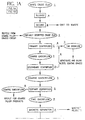
- Fig. 1 is a schematic flow diagram of a multiple centrifuge, waterwash method in accordance with the invention.
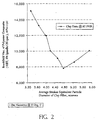
- Fig. 2 is a graph of Brookfield viscosity in mPas (in cps) for a particular clay filled polyester compound plotted as a function of the clay's particle diameter (in microns).
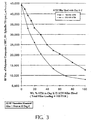
- Fig. 3 is a graph of Brookfield viscosity in mPas (in cps) for a polyester compound containing a clay/ATH filler combination plotted as a function of the weight % of ATH in the filler blend.
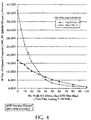
- Fig. 4 is a graph of Brookfield viscosity in mPas (in cps) for a polyester compound containing clay/ATH filler combinations plotted as a function of the weight % of ATH in the filler blend.
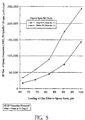
- Fig. 5 is a graph of Brookfield viscosity for an epoxy compound containing coarse particle clay fillers, plotted as a function of clay filler loading.
- polyester thermosets having very low surface area properties have generally been preferred for use in polyester thermosets because of the lower viscosity build normally associated with their use. Consequently, conventional coarse particle size clays like Huber 35® (manufactured by J.M. Huber Corporation) and ASP-400® (manufactured by Engelhard Corporation) have been employed in clay-filled composites because their coarse particle size translates into a product of low surface area. This common practice has arisen out of conventional thinking that polyester compound viscosity will decrease as the surface area of the kaolin clay filler is decreased. Since coarser particle size clays typically have lower BET surface areas than finer clays, they accordingly yield lower viscosity values at a given filler loading.
- the coarse particle clays of the present invention are unique in that they are considerably coarser in median particle size than a Huber 35® or ASP-400® (as measured by either laser light-scattering or by a x-ray Sedigraph) yet they have a BET surface area value essentially equal to or greater than these competitive clays.
- This seeming anomaly can be explained by the fact that the clay of the present invention has a higher particle aspect ratio than either of the current commercial clay products.
- the coarse particle size clay of the invention has an aspect ratio of 12:1 to 14:1, versus 11.5:1 for Huber 35® or for ASP-400® (by Sphericity Model based calculations).
- the specific surface area is known to increase as clay particle aspect ratio is increased (i.e., as more thinner, clay platelets are produced). It is thus believed that the larger clay particle aspect ratio of the invention provides a higher surface area than expected from its coarser particle size.
- thermoset materials preferably ranges from 10-150 phr (parts per hundred resin), and more preferably from 50-120 phr.
- the invention can be used alone as a filler or in combination with one or more inorganic fillers.
- inorganic fillers with which the invention may be combined include alumina trihydrate (ATH), calcium carbonate (CaCO 3 ), talc, mica, glass, and other clays.
- ATH is particularly preferred as a combination filler material, with the weight ratio of the invention to ATH preferably being 95/5 to 50/50, and more preferably 95/5 to 70/30.
- the high aspect ratio of the invention provides good reinforcement properties to plastic composites, particularly in the area of flexural strength, and can greatly improve a composite's surface finish quality.
- Surface finish is particularly important for thermoset composites (such as in SMC) used in automotive body panels and fascia or other aesthetically-demanding applications.
- thermoset composites such as in SMC
- thermoset composites such as in SMC
- the dual performance benefits of using a high aspect ratio mica (a layered silicate mineral related to kaolin) in a RIM polyurethane composite are disclosed in U.S. Patent No. 5,036,118.
- the coarse particle clay of the invention which possesses a high aspect ratio, provides better physical reinforcement properties and improved composite surface quality than kaolin clay fillers of significantly lower aspect ratio.
- thermoset composite having a Class I surface finish
- fillers for polyester molding compounds are classified within the industry as Class I or Class II fillers depending on the surface finish they impart to the composite, with Class I being a finish of higher quality.
- No known coarse kaolin clay filler can provide this truly remarkable combination of low viscosity build, excellent reinforcement and high quality surface finish for polyester thermosets and other composites.
- the coarse particle size, high aspect ratio clay of the invention functions well as a pigment for paint and coating applications.
- the invention advantageously provides improved UV resistance versus conventional coarse particle clay pigments used in paint and coatings applications while maintaining essentially equivalent optical. sheen and gloss properties.
- the ability to provide improved UV resistance is particularly advantageous for extender pigment applications in exterior paints
- Conventional coarse particle clays currently used as pigment extenders in paints and industrial coatings have also been hindered by low brightness values.
- the clay of the present invention has improved brightness properties versus products like Huber 35® or ASP-400® that increases its utility in many paint related applications.
- Another novel aspect of the present invention involves the use of a very low surface area ATH (i.e., Alumina Trihydrate) in combination with a coarse particle size clay filler for use in polyester thermoset compounds.
- ATH i.e., Alumina Trihydrate
- Significant reductions in paste viscosity are generally observed for ATH additions up to a clay/ATH weight ratio of about 50/50, whereafter the relative amount of viscosity improvement gained from replacing more coarse particle clay with ATH begins to proportionally diminish.
- clay/ATH blend ratio combinations ranging from 95/5 to 70/30 by weight are very useful for polyester composites, especially when employing the coarse particle clays of this invention as the clay blending component, in that the blends offer very low viscosity build and reduced specific gravity at a reasonable cost Very low paste viscosities can be achieved with these clay/ATH blends because coarse particle ATH builds far less viscosity than the coarse particle clays. This ATH characteristic is likely the result of their very low BET surface area. In regard to achieving notable viscosity reductions, ATH addition levels of 10 - 20% are generally sufficient to affect a significant reduction in paste viscosity.
- ATH also has a lower specific gravity than kaolin clay (2.42 g/ml versus 2.6 g/ml), hence the partial replacement of clay with ATH helps to further reduce the weight of polyester composites relative to traditional calcium carbonate filled SMC or BMC compounds.
- ATH fillers are also known to provide desirable flame retardancy properties to composites. The total replacement of clay with ATH is however not attractive for both economic and performance reasons. ATH is considerably more expensive than clay; therefore, the use of high replacement levels will increase cost significantly.
- ATH fillers have less particle aspect ratio than coarse particle clays and can accordingly detract from the surface finish properties of the plastic composite relative to having used all coarse particle clay.
- the preferred ATH fillers to use with coarse particle clays are those having a BET surface area ⁇ 5 m 2 /g, but more preferably ⁇ 3 m 2 /g.
- a highly preferred ATH candidate for use would be J. M. Huber's SB-432® product, which is a 9 micron (Stokes equivalent diameter) dry ground ATH having a BET surface area value of about 2 m 2 /g.
- a very coarse particle size kaolin clay is produced from a novel waterwash process involving multiple centrifuge passes that effectively remove ultra-fine clay and then ultra-coarse clay plus grit from a standard clay process underflow stream.
- the clay produced from this new process is, of course, in accordance with the invention; i.e., the clay has an average Stokes equivalent particle diameter of 4.5 - 6.0 microns, preferably 4.8-5.5 microns, a BET surface area of 8-11 m 2 /g, and preferably a Malvern median particle size of 9.0 - 10.5 microns which is based on a laser light-scattering method.
- the clays of this invention are significantly coarser in particle size than the currently available coarse particle, waterwashed clays like Huber 35® or ASP-400®.
- the multiple (3 pass) centrifugation process described herein is not only important in terms of producing a coarse particle clay of high aspect ratio, but in producing one that is very consistent in terms of its range of particle size and surface area properties.
- the coarse particle clays of this invention have a particle aspect ratio of 12 - 14 (by Sphericity Model), while in addition they preferably have a +325 mesh residue content of less than about 0.1 % by weight, and preferably have an "iron stained" anatase TiO 2 content of no more than about 0.65% by weight
- the latter two properties are particularly important with respect to the coarse particle clay's utility as an extender pigment for paint and industrial coatings, since high +325 mesh residue levels tend to negatively impact Hegman grind properties while high "iron stained" anatase TiO 2 contents are generally associated with clays having lower brightness properties.
- the multiple (3 pass) centrifugation process used herein to produce the desired coarse particle clays of this invention is unique.
- One of the novel aspects of this three step centrifugation process is that the control on the secondary centrifuge is based on directly controlling the particle size of the clay underflow stream (not the overflow) so that the secondary underflow product is carefully controlled to provide an x-ray Sedigraph particle size including only 8 - 15 wt% ⁇ 2 microns.
- these additional processing steps include magnetic separation for removal of colored magnetic impurities, mechanical screening to remove +325 mesh grit and coarse mica content, chemical leaching with sodium dithionite at low pH for improving clay brightness, dewatering via rotary vacuum filtration, redispersion of the clay filter cake at about pH 6.5 via the use of soda ash and an anionic dispersant like sodium polyacrylate, spray-drying the dispersed filter cake product and then milling the dry product into a finely pulverized powder.
- the acid filter cake product obtained off the rotary vacuum filter can be dried directly via a tunnel drier, a flash drier or the like for feeding a grinding mill to yield the pulverized dry product in acid dried form.
- the clay milling step is conducted to deagglomerate the coarse particle clay product which can be accomplished through the use of conventional hammer mills, impact mills, jet mills or the like.
- conventional magnetic separation and chemical leaching steps have been used to produce a finished coarse particle clay product of higher pigment brightness (on the order of about 3 points) over current products like ASP-400®. Improved pigment brightness can be of added value in various paint and industrial coating applications.
- coarse particle clays having a median particle size larger or smaller than those of the present invention can be produced by the waterwash process described herein; however, such clay products have several performance drawbacks.
- Paste viscosity studies on various polyester compounds indicate that coarse particle clays having an average Stokes equivalent particle diameter of 4.5- 6.0 microns generally provide the lowest viscosity build. Clays outside this particle size range (finer or coarser) were found to yield higher compound viscosities when used at high filler loadings.
- the coarse particle clay of this invention has very good utility as a pigment extender in flat, exterior latex paints.
- a coarse particle kaolin clay in accordance with the present invention can be produced in accordance with the kaolin clay processing scheme outlined in Fig. 1.
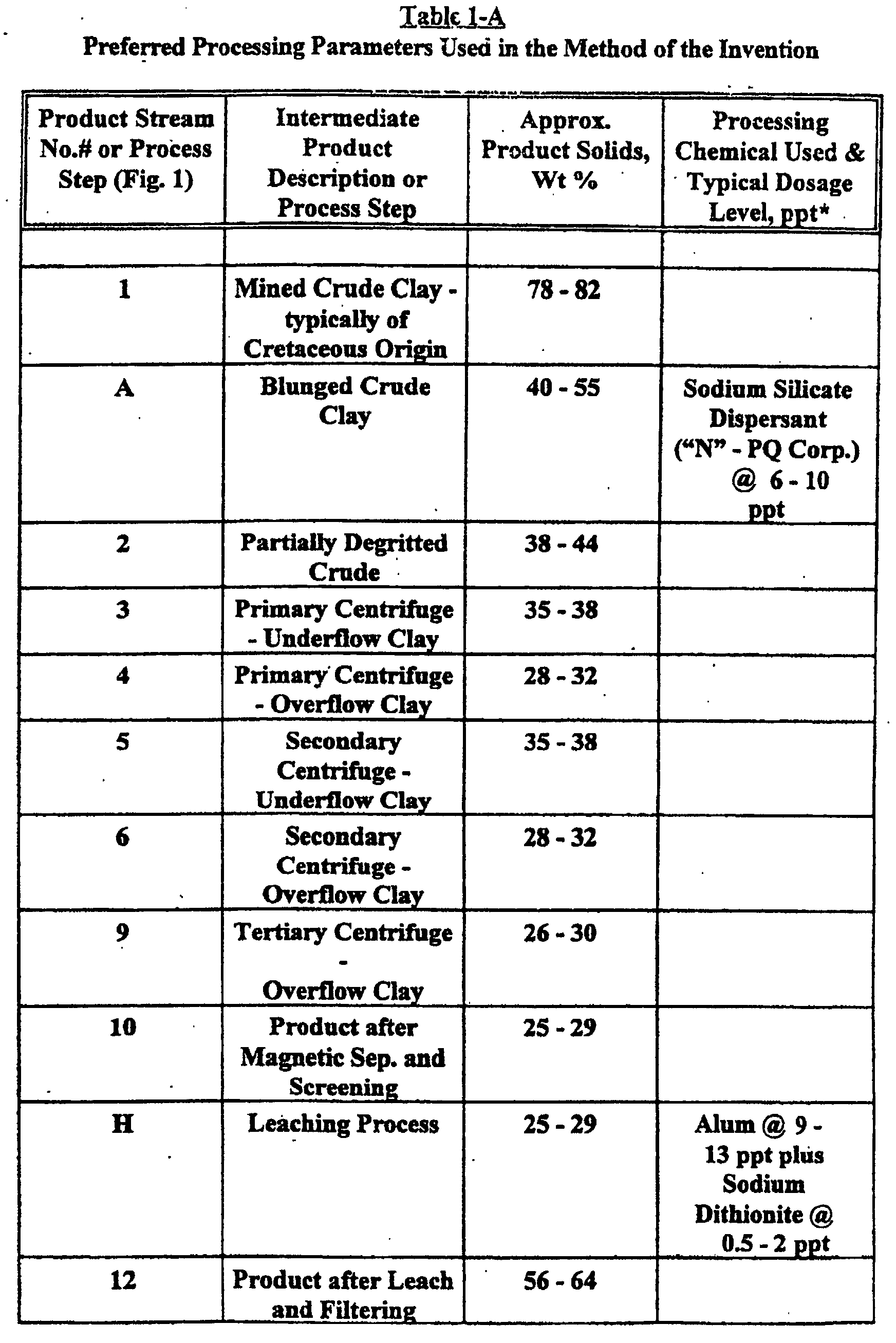
- a mined crude clay having a preferable solids content of 78-82%, preferably of sedimentary origin and more preferably derived from a middle Georgia Cretaceous kaolin clay crude is blunged under high shear into a crude slurry of 40-55% solids content using 6-10 ppt (453,6g (pounds) per ton of dry clay) of an anionic, inorganic dispersant such as a liquid sodium silicate reagent.
- a liquid sodium silicate having an active reagent content of 37.6% and a SiO 2 /Na 2 O weight ratio of about 3.22 is used, such as "N" sodium silicate as produced by the PQ Corporation - Philadelphia, PA.
- the coarse particle sand and other mineral impurities are then removed from this crude clay slurry by using a drag box (or through another equivalent separation method such as screening) to generate a partially degritted crude clay which is then fed to a high speed centrifuge.
- a typical partially degritted clay crude produced during the method of the invention has a brightness of about 80% and an x-ray Sedigraph particle size of 62-78 wt% ⁇ 2 microns.
- the partially degritted crude clay of 38-44% solids would then be fractionated via the high speed centrifuge into coarse underflow and fine overflow streams.
- the primary centrifuge conditions (which include well known parameters such as % solids, throughput rate and number of G's) are typically controlled so as to obtain a particular fine overflow clay product of controlled particle size (such as a #1 or #2 type coating clay) and the underflow becomes a by-product process stream.
- the coarse underflow clay produced by the primary centrifuge step represents the product process stream, while the fine overflow clay represents a by-product process stream.
- the primary centrifuge step of the invention yields a coarse particle size clay product having a preferred x-ray Sedigraph particle size of 20-35 wt% ⁇ 2 microns.
- the coarse underflow clay produced from the primary centrifuge step (product 3 of Figure 1) is then utilized as the feed material for a second centrifugation step designed to remove additional clay fines.
- the second centrifuge step is controlled on the basis of the underflow product being produced rather than the overflow product. On that basis, it is preferred that a coarse underflow clay having an x-ray Sedigraph particle size of 8-15 wt% ⁇ 2 microns be produced from the second centrifugation step.
- the overflow clay by-product generated from this secondary centrifuge step can be recovered and subsequently combined with other like overflow products in order to maintain high overall plant yields, which is important in keeping overall processing costs low. Many overflow by-product clays can be processed into high-margin coatings clays which is good for overall plant profitability.
- the coarse underflow clay produced from the secondary centrifuge step (product 5 of Fig. 1) is then centrifuged a third time in order to remove additional +325 mesh grit as well as extremely coarse clay and micaceous particles.
- the third centrifugation process also preferably differs from the first two in that the overflow clay product is controlled on the basis of its Malvern median particle size rather than by the wt% of particles ⁇ 2 microns as measured by x-ray Sedigraph.
- the preferred Malvern median particle size of this overflow clay (products 9 of Fig. 1) is 9.5 - 11.5 microns.
- the third centrifugation step be conducted such that the +325 mesh residue content of the overflow clay be reduced below about 1.0 wt%, and more preferably below about 0.5 wt%. Higher residue levels can often inhibit the efficiency and/or effectiveness of the subsequent magnetic separation and product screening steps shown in Fig. 1.
- Magnetic separation and screening are conducted after the third centrifugation step, and may be performed in accordance with conventional methods.
- the thrice-centrifuged clay is preferably subjected to magnetic field strengths of at least 2 Tesla and subsequently screened using Derrick type screens of 325 mesh or finer.
- the clay process stream of 25-29% solids content is chemically leached and filtered.
- Brightness and +325 mesh residue properties prior to leaching and filtering are preferably about 81% and about 0.03 wt%, respectively, while the Malvern median particle size range of the clay is preferably reduced from 9.5 - 11.5 microns down to 9.0 - 10.5 microns.
- the clay leaching process may be conventionally conducted at low pH and at elevated temperatures by adding alum (aluminum sulfate) at 9 - 13 ppt and sodium dithionite at 0.5 - 2.0 ppt. After leaching, the preferred product brightness value is about 83.5%.
- An acid filter cake product of 56-64% solids (product 12 of Figure 1) may then obtained after the leaching step by standard rotary vacuum filtration.
- This acid filter cake clay product is redispersed at essentially neutral pH using a combination of Na 2 CO 3 (at 3 - 6 ppt) and a sodium polyacrylate dispersant (at 2 - 4 ppt) to yield a clay slurry product which is suitable for spray-drying.
- Spray-drying of this slurry may be carried out under typical commercial drying conditions, wherein inlet air temperatures between 400 - 650°C are routinely employed, so as to yield a dry clay product having a moisture content of less than about 1.0 wt%.
- the dry clay is then subsequently milled to deagglomerate the dry clay, preferably into a finely-divided powder.
- the above acid filter cake product (product 12 ) can be dried directly through the use of a flash drier, tunnel drier or similar drying device and then post-milled into a finished product having a pH of about 4 as opposed to having an essentially neutral pH.
- the final pH value (about pH 4 versus about pH 7) preferred for the coarse particle size clays of this invention will largely depend on the end-use application being targeted for them.
- the clay milling step can be readily accomplished through the use of conventional hammer mills, impact mills, jet mills or the like.
- Tables 1-A and 1-B shown below provide additional preferred processing details and summarize the preferred properties for the various clay product intermediates associated with the method of the invention.
- the % brightness values are standard TAPPI brightness numbers as determined with a Technidyne Micro TB-1C brightness meter in accordance with the TAPPI Method T646 om-86 procedure. All x-ray Sedigraph particle size measurements, whether determining the wt% of particles ⁇ 2 microns or determining the average Stokes equivalent particle diameter in microns, were made via an x-ray sedimentation method based on Stokes Law using a Micromeritics 5100 Sedigraph unit. The average Stokes equivalent particle diameter is the median particle size value determined by the x-ray Sedigraph.
- a coarse particle kaolin clay in accordance with the present invention was produced by means of the clay processing scheme outlined in Fig. 1. Specifically, a mined crude clay having a solids content of 80% and a brightness of 78.5%, derived from a middle Georgia Cretaceous kaolin clay crude, was blunged under high shear mixing into a crude clay slurry of 48% solids content using 8 ppt (453,6 g (pounds) on as received basis per ton of dry clay) of "N" sodium silicate reagent as a dispersant.
- N is a liquid sodium silicate produced by the PQ Corporation having an active reagent content of 37.6% and a SiO 2 /Na 2 O weight ratio of about 3.22.
- the coarse particle sand and other mineral impurities were then removed from this crude clay slurry by using a drag box to generate a partially degritted crude clay of 40% solids which was then subsequently fed to a high speed centrifuge for fractionation into coarse underflow and fine overflow clay shams.
- the degritted clay crude feed had a brightness of 80% and an x-ray Sedigraph particle size of 68 wt% ⁇ 2 microns.
- the coarse underflow clay produced from this degritted clay crude by the primary centrifuge had an x-ray Sedigraph particle size of 30 wt% ⁇ 2 microns, while the corresponding overflow fraction had an x-ray Sedigraph particle size of 85 wt% ⁇ 2 microns.
- the coarse underflow clay produced from the primary centrifuge step was then subjected to a second centrifugation wherein a very coarse particle clay having an x-ray Sedigraph particle size of 13 wt% ⁇ 2 microns was collected from the new underflow stream.
- the coarse underflow clay produced from the secondary centrifuge step was then centrifuged a third time in order to remove +325 mesh grit as well as extremely coarse clay and micaceous particles. An overflow clay stream of 28% solids was thus produced. from this third centrifuge step, which was controlled so as to provide a clay product having a Malvern median particle size of 11.1 microns and a +325 mesh residue content of 0.41 wt%.
- the brightness of this coarse particle clay product was 77.0%.
- An acid filter cake product of 60% solids was obtained after the leaching step by using a rotary vacuum filtration.
- This acid filter cake clay product was then redispersed at essentially neutral pH using a combination of Na 2 CO 3 (at 4.5 ppt) and a sodium polyacrylate dispersant (at 3 ppt) to yield a dispersed clay slurry suitable for spray-drying.
- Spray-drying of this slurry was carried out under typical commercial drying conditions to yield a dry clay product having a moisture content of 0.6 wt%.
- the dry clay was then subsequently imp milled into a finely divided powder to produce the finished product Clay X-T.
- Clay X-T The physical and compositional properties of Clay X-T as produced by the process described above are summarized in Table 1-C. Physical and compositional properties within the scope of the invention are summarized as "Clay X-R" , and properties of two comparative coarse particle clays are likewise summarized in Table 1-C.
- Clay X-T is significantly coarser in particle size than either ASP-400® or Huber 35®, whether comparing average Stokes equivalent particle diameters (as measured by x-ray Sedigraph) or comparing Malvern median particle size values.
- the average Stokes equivalent particle diameter of Clay X-T is 5.25 microns as compared to 4.35 microns for ASP-400® and 4.03 microns for Huber 35®.
- Clay X-T has median particle size of 10.0 microns as compared to 8.7 and 7.8 microns for the two competitive clays.
- Clay X-T is also unique in that it is considerably coarser in particle size than ASP-400®, while still having a higher BET surface area value. This feature can be explained by the fact that Clay X-T has a higher particle aspect ratio than ASP-400® (13.1:1 versus 11.4:1, as determined by Sphericity Model calculations). Similar arguments can be made when comparing Clay X-T® to Huber 35®.
- Clay X-T provides a brightness advantage on the order of 3 points relative to ASP-400®, which can largely be attributed to the significantly lower, natural "iron stained" anatase TiO 2 content in Clay X-T.
- the total TiO 2 content in Clay X-T is 0.55% by weight as compared to a value of 1.38% in ASP-400.
- Example 2 (and in Example 3 below), the lower paste viscosity benefits provided by the invention versus the comparative coarse particle clay ASP-400® are clearly demonstrated in two different polyester thermoset applications.
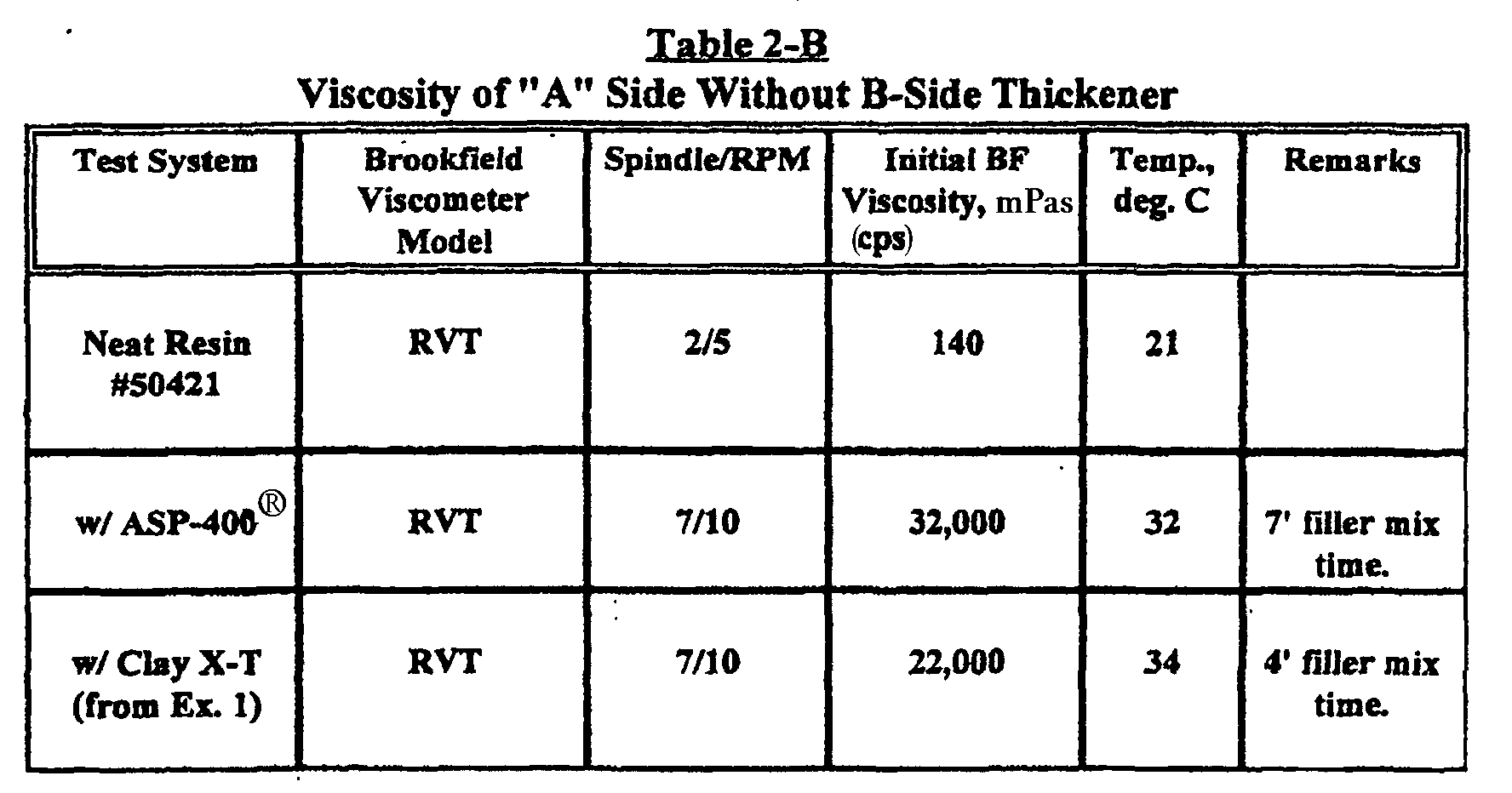
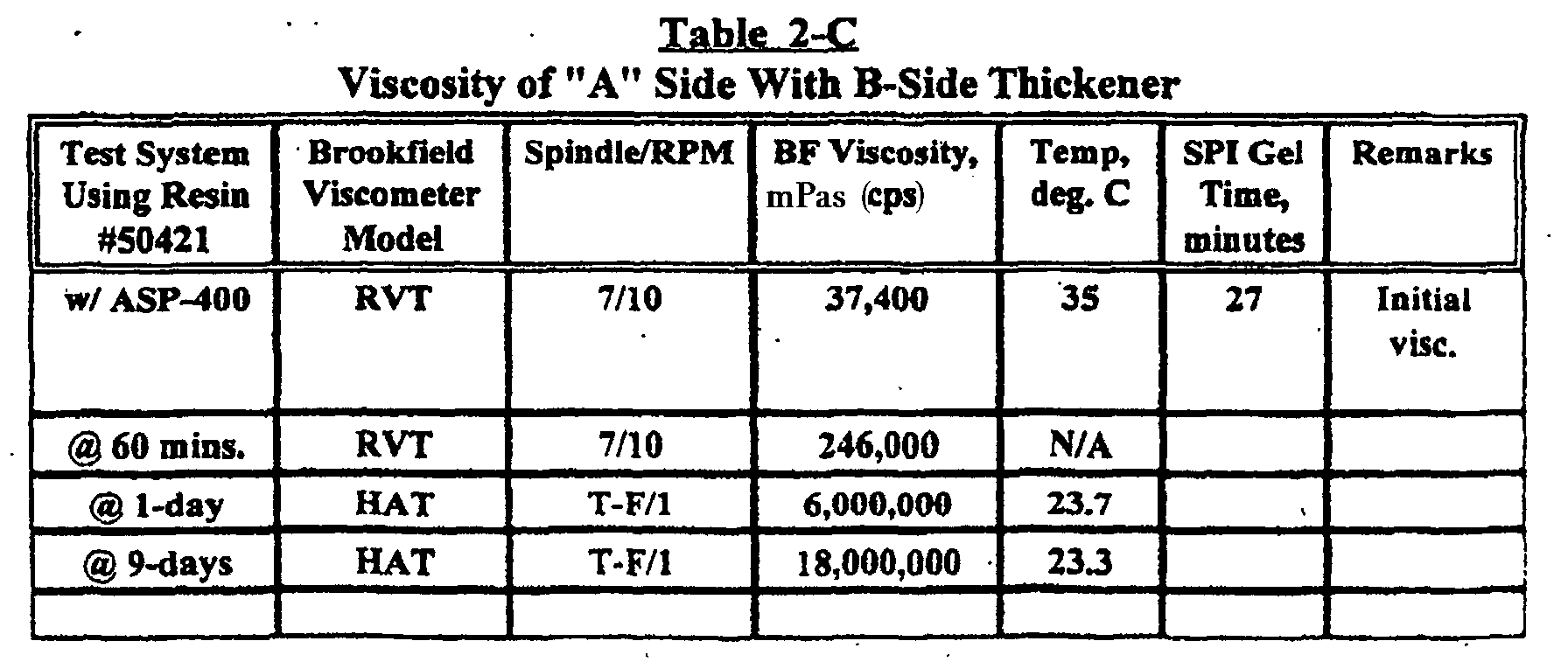
- a clay in accordance with the invention (specifically Clay X-T of Example 1) is compared to ASP-400® clay as a filler in a SMC type formulation using Ashland Chemical's Phase Beta Resin, Aropol 50421®.
- Table 2-B The initial paste viscosities without thickener are compared in Table 2-B, which clearly shows that Clay X-T yields a significantly lower Brookfield viscosity value than ASP-400 (22,000 mPas (cps) versus 32,000 mPas (cps)).
- Table 2-C shows the aged viscosities of the clays after addition of the B-Side thickener, and indicates essentially equivalent viscosity results.
- Example 3 ASP-400® and a clay in accordance with the invention (Clay X-T of Example 1) were once again compared as coarse particle clay fillers but in a Pultrusion type formulation using Reichold's Dion 31038-00® resin.
- the clay filler loadings examined in this study were 50 and 100 phr in order to determine comparative viscosity effects as a function of filler content. Both clays were high speed dispersed into the pultrusion resin using a Cowles dissolver unit.
- the initial paste viscosities are compared in Table 3, which clearly shows that Clay X-T of the present invention yields a much lower Brookfield viscosity at the high filler loading of 100 phr.
- the viscosities provided by the ASP-400® and Clay X-T are essentially equivalent at the lower filler loading.
- This feature suggests that the clay's specific surface area may be the predominant viscosity building factor at low to intermediate filler loadings, hence the observed equivalency between ASP-400® and Clay X-T at 50 phr.
- other physical factors like particle shape, particle size distribution, particle packing, etc. may possibly take over at high filler loadings where particle to particle interactions from crowding considerations become important.
- these points serve to further illustrate the unique properties and unexpected performance benefits of the invention (embodied in Clay X-T) as a filler for polyester thermoset composites.
- various fine particle and coarse particle size clays are compared as fillers in a SMC type polyester resin formulation wherein clays having BET surface areas spanning the range from 8 to 22 m 2 /g are evaluated for their effects on paste viscosity.
- This example illustrates the relationship between clay surface area and initial paste viscosity.
- the clay filler loadings employed were 100 phr and 82 phr.
- the SMC type resin employed was Alpha Owens-Corning's AOC E-4297-9® resin.
- the clays were high speed dispersed into the resin using a Cowles dissolver unit and the paste viscosities were subsequently read after 1 hour at 32 deg. C using a HBT Model Brookfield Viscometer.
- Polygloss 90® is a very fine particle size, dry pulverized clay product manufactured by J. M. Huber Corporation - Wrens, GA that is derived from a fine particle, east Georgia Tertiary clay crude.
- Huber 80® is a fine particle size, dry pulverized clay product manufactured by J. M. Huber Corporation - Macon, GA that is derived from an overflow stream produced by centrifugal fractionation of a middle Georgia, Cretaceous clay crude.
- Huber 35® (from J. M. Huber Corporation - Macon, GA) is a dry pulverized, coarse particle size underflow clay derived from a middle Georgia.
- Cretaceous clay crude (essentially product 3 of Figure 1). Also included in the study are ASP-400® and a clay in accordance with the invention (Clay X-T of Example 1). The important physical properties of each test clay (i.e., Stokes equivalent particle diameter, BET surface area and particle aspect ratio) are summarized in Table 4 along with their respective paste viscosity values.
- Table 4 reveals that the clays Polygloss 90®, Huber 80®, Huber 35® and ASP-400® define a clay series wherein the corresponding BET surface area systematically decreases from 21.6 to 7.9 m 2 /g, respectively.
- initial paste viscosities in the SMC resin are seen to decrease.
- direct head-to-head comparisons of initial paste viscosity can not be made across the entire clay series because the two formulations containing the fine particle size clays were so viscous that measurements could not be made with a HBT Model Viscometer without reducing the clay filler loading from 100 to 82 phr; however, the general viscosity trend is nonetheless very clear.
- a series of coarse particle size clays were produced for viscosity evaluation in a tub and shower polyester thermoset resin formulation.
- Several different coarse particle size clays were produced from various underflow product streams that yielded clays having a wide range of particle sizes.
- coarse particle size clays ranging in particle diameter from 3.4 to 5.9 microns were produced and studied.
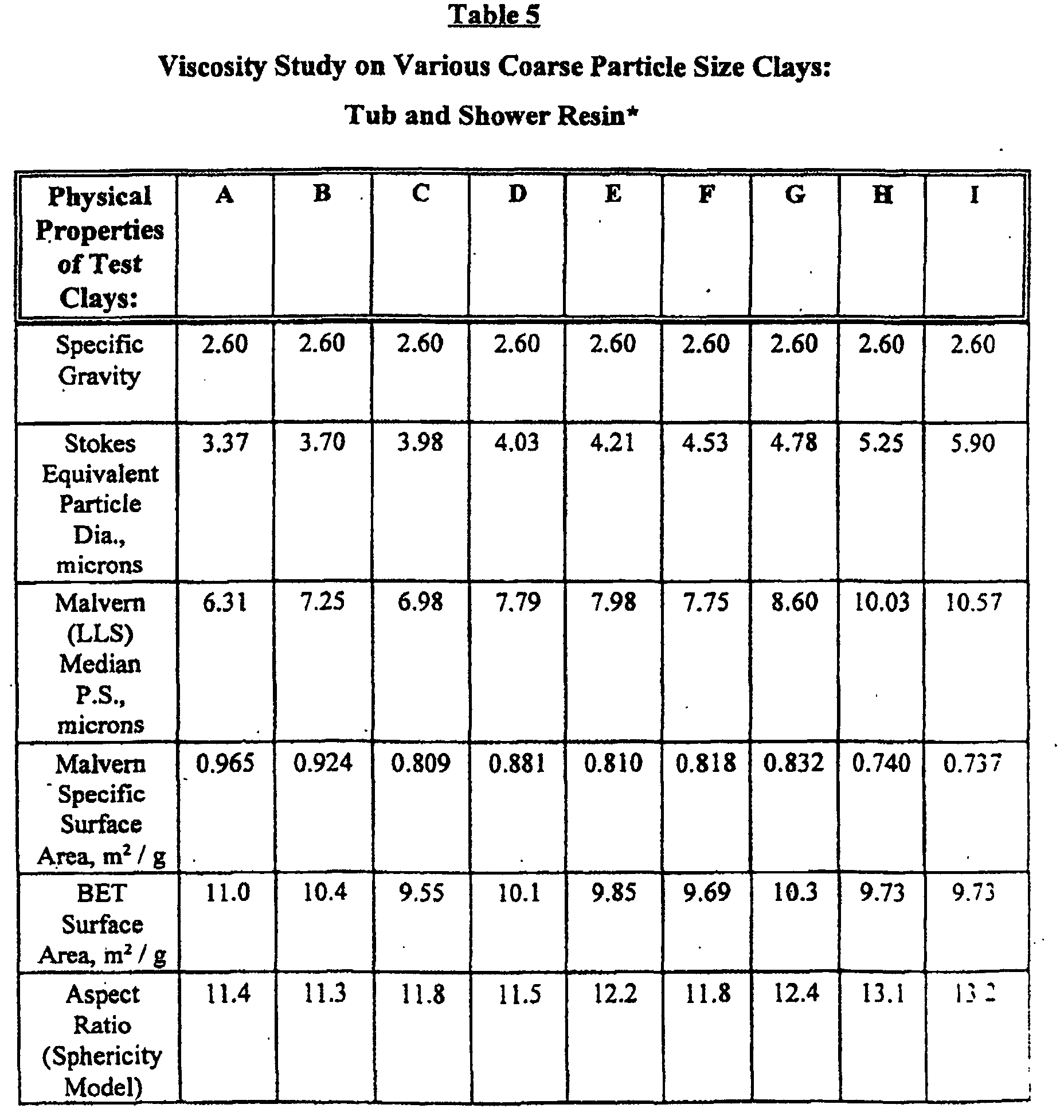
- These clays (labeled as test clays A - I in Table 5) were produced by collecting representative test products after either the first, second or third centrifuge passes (as outlined in the process scheme of Figure 1) and by varying the relative particle size cuts made at these various centrifuge steps. Comparative physical properties for these coarse particle size clays are summarized in Table 5.
- the purpose of this example is to illustrate the relationship between clay particle size and initial paste viscosity.
- the clay filler loading employed was 82 phr.
- the polyester resin employed was Alpha Owens-Corning's AOC 85-35G® resin.
- the coarse particle size clays were high speed dispersed into this resin using a Cowles dissolver unit and the paste viscosities were subsequently read after 1 day at 32 deg. C using a HBT Model Brookfield Viscometer.
- the resultant paste viscosities are presented in Table 5 and also shown graphically in Fig. 2.
- a viscosity profile curve is shown wherein the average Stokes equivalent clay particle diameter (in microns) is plotted against Brookfield viscosity (in mPas (cps)). Surprisingly, this plot clearly shows that the resultant viscosity does not continue to decrease in a linear fashion with clay particle diameter over the entire particle size range explored. In fact, the test data indicate that a minimum viscosity well is obtained at clay particle diameters of 4.5 - 5.5 microns. In this resin system, clays falling outside the particle diameter range of 4.5 - 5.5 microns yielded a higher viscosity value, which serves to further illustrate the unique properties and unexpected performance benefits of the coarse particle clays of this invention.
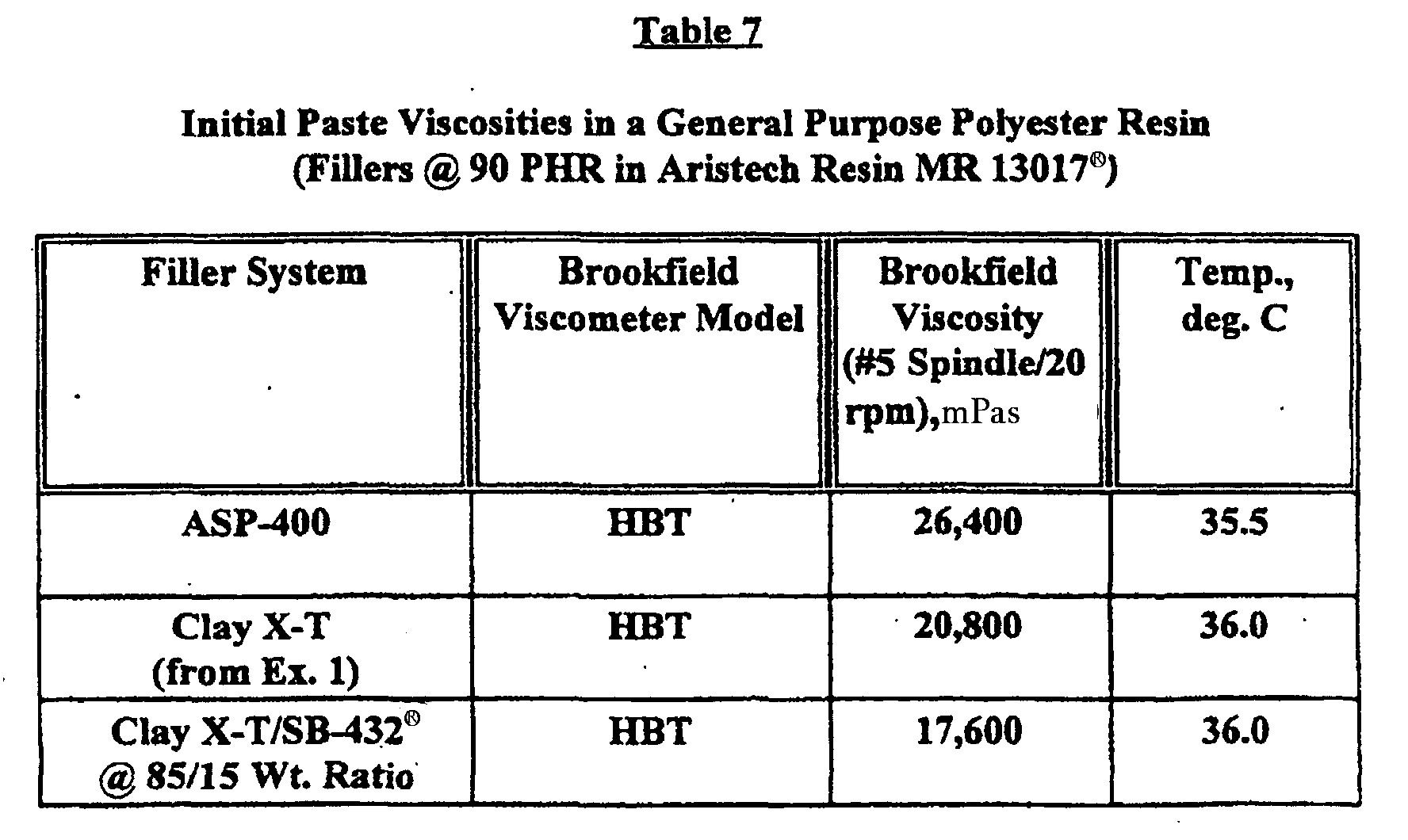
- the relative viscosity properties of ASP-400®, a clay in accordance with the invention (Clay X-T from Example 1), and a clay/ATH combination are compared in a general purpose, unsaturated Polyester resin (namely Aristech Resin MR 13017®, which has a styrene content of about 33%).
- the total filler loading of clay (or clay/ATH blend) employed in this study was 90 phr, wherein each filler was high speed dispersed into the polyester resin using a Cowles dissolver unit.
- the clay/ATH blend consisted of a 85/15 weight ratio combination of Clay X-T to SB-432®, respectively.
- ATH Alumina Trihydrate
- the physical properties of the SB-432 ATH® are compared to those of Clay X-T in Table 6.
- Important physical properties with regard to viscosity characteristics include BET surface area and average Stokes equivalent particle diameter.
- the SB-432 ATH® is significantly coarser in particle diameter (by x-ray Sedigraph measurement) and significantly lower in BET surface area versus the coarse particle size clay.
- OE-100® is a very coarse particle size, very low surface area, unground white ATH® product manufactured by J. M. Huber Corporation.
- the physical properties of the OE-100 ATH® are compared to those of SB-432 ATH® and Clay X-T in Table 6. As before, the weight ratio combinations of Clay X-T and ATH® were examined at a total filler loading of 100 phr.
- the Clay X-T/OE-100® viscosity curve clearly shows that greater reductions in paste viscosity can be obtained by using the lower surface area ATH filler, OE-100®, if the resulting physical properties of the thermoset composite can accommodate the significantly larger Stokes equivalent particle diameter of OE-100® versus SB-432® (35 versus 8.8 microns, respectively).
- the viscosity data presented in Examples 6 and 7 serve to illustrate the novel benefits associated with using very low surface area ATH® fillers in combination with the invention for use in polyester molding compounds.
- the preferred ATH® fillers to use with the coarse particle size clays of this invention are those having a BET surface area ⁇ 5 m 2 /g, and more preferably ⁇ 3 m 2 /g.
- clay/ATH® blend ratio combinations ranging from 95/5 to about 70/30 by weight are thought to be particularly useful as a filler package for polyester composites in that they offer very low viscosity build and low specific gravity.
- the partial replacement of clay with ATH® helps to further reduce the weight of polyester composites relative to traditional calcium carbonate filled SMC or BMC compounds.
- the ATH® fillers provide desirable flame retardancy properties to the composite. Total replacement of coarse particle clay with ATH® is however not attractive for both economic and performance reasons. ATH® is considerably more expensive than clay; therefore, the use of high replacement levels will increase cost.
- the ATH® fillers have less particle aspect ratio than the invention and accordingly will detract from the surface finish properties of the plastic composite relative to having used all coarse particle clay in accordance with the invention. Therefore, one must carefully balance the flame retardancy plus the viscosity reduction and specific gravity reduction benefits of ATH® use with clay against the increased cost and reduced surface finish disadvantages in a given application to achieve the best cost versus performance properties.
- Phase Alpha Resin (Aropol 50405® from Ashland Chemical) was used in place of the Phase Beta Resin.
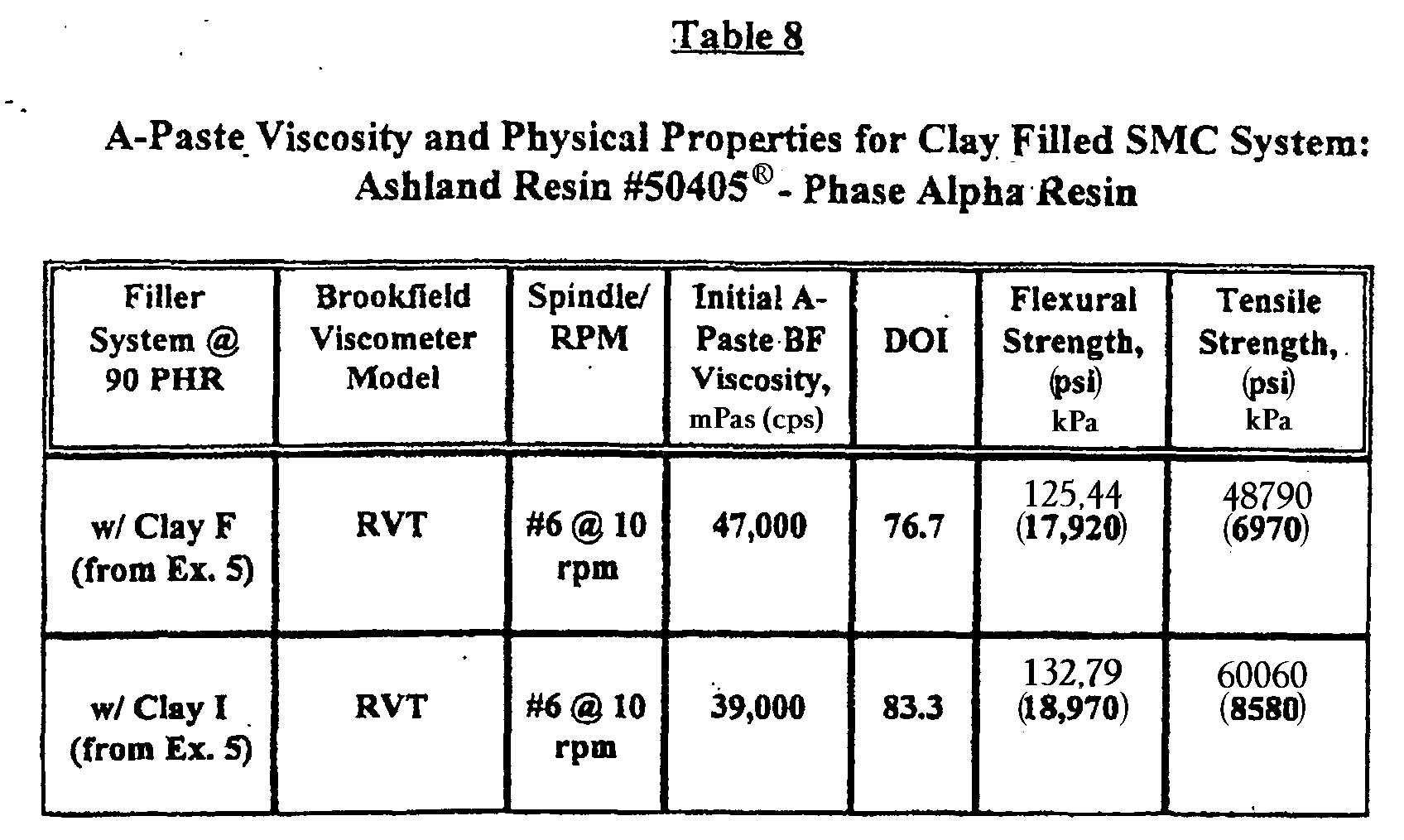
- Two different coarse particle size clays (Clays F and I of Example 5) were tested in this resin at a clay filler loading of 90 phr. Each clay was high speed dispersed into the Phase Alpha Resin using a Cowles dissolver unit. Initial paste viscosities were measured and then final physical properties were determined on molded specimens (see Table 8 for test data). Conditions for molding were 400 psi pressure, 2 minute cure, 50% tool coverage, 2 ply, 390 grams and the press was set to fast close (7 seconds). The Phase Alpha formulations were molded at 300 deg. F. Physical properties determined included DOI (Distinctness Of reflected Image), as well as flexural strength and tensile strength (both measured in the vertical direction). Physical properties for the two test clays (F and I) are summarized in Table 5.
- Clays F and I in this study are close to the far extremes with respect to the Stokes equivalent particle diameter range for the coarse particle clays of the invention.
- the viscosity data of Table 8 show that the coarser particle size clay (Clay I) yields the lower viscosity value. Reduced paste viscosity allows for better wetting of individual glass fibers in the SMC as well as permitting the compounding of SMC with higher glass loadings.
- the particle aspect ratio correspondingly increases from 11.8:1 to 13.2:1. Although this change represents a relatively small increase in average particle aspect ratio, it is nevertheless reflected in the final physical properties obtained.
- the pigment performance properties of Clay X-T of this invention are compared to those of an industry standard (Huber 35®) in a brick red, exterior latex house paint.
- Formulation specifics associated with this brick red exterior paint are provided in Table 9-A wherein the various grind ingredients were high speed dispersed for 10 minutes and then subsequently combined with the letdown portion using low speed mixing for 15 minutes. All ingredient amounts are expressed in 453.6 g 1380 l (lbs./100 gallons) of paint. Paint formulations A and B in Table 9-A are exactly identical except for the coarse particle size clay employed.
- the associated manufacturer is indicated to the right in parenthesis.
- the improved UV resistance of Paint B (containing Clay X-T) is demonstrated by its lower Delta E value as well as by the improved stability of its "a" color value upon exposure.
- the "a” Value is the red/green color scale in the Hunter L,a,b Color Space measurement system.
- Paint A containing Huber 35®
- This data illustrate the excellent utility of the coarse particle size clays of this invention as pigment extenders in various paint applications. Although not apparent in this red pigmented paint formulation, the higher brightness properties of the invention (about 83.5%) will also be beneficial in many paint formulations versus the prior art coarse particle clays.
- the relative viscosity characteristics of a coarse particle clay in accordance with the invention are compared to those of a conventional coarse particle clay (Huber 35®) in an epoxy thermoset system using Shell Chemical's Epon 862® epoxy resin.
- This epoxy resin system is of particular interest for use in CIPP (cured-in-place pipe) applications.
- Clay filler loadings ranging from 67 to 100 phr were examined in this viscosity study wherein the coarse particle clays were high speed dispersed into the epoxy resin using a Cowles dissolver unit.
- the paste viscosities were subsequently read after 1 hour at 32 deg. C using a HBT Model Brookfield Viscometer equipped with a No. 6 spindle.
- the viscosity results for Clay X-T and Huber 35® are compared in Fig. 5.
Landscapes
- Chemical & Material Sciences (AREA)
- Organic Chemistry (AREA)
- Dispersion Chemistry (AREA)
- Health & Medical Sciences (AREA)
- Chemical Kinetics & Catalysis (AREA)
- Medicinal Chemistry (AREA)
- Polymers & Plastics (AREA)
- Composite Materials (AREA)
- Pigments, Carbon Blacks, Or Wood Stains (AREA)
- Paints Or Removers (AREA)
- Compositions Of Macromolecular Compounds (AREA)
- Artificial Filaments (AREA)
Description
The ATH with which the invention is combined preferably has a BET surface area of less than 5 m2/g, more preferably less than 3 m2/g.






| Evaluation of Coarse Clays in a Brick Red Exterior Latex House Paint | ||
| PRIMARY PIGMENT: EXTENDER PIGMENT: RESIN: | Kroma 8097 Ucar 6379 | Kroma 8097 Clay X-T Ucar 6379 |
| Paint Identification; | A | B |
| INGREDIENTS | (Pounds / 100 Gallons) 453.6 | |
| GRIND: | ||
| Water | 250.05 | 250.05 |
| Natrosol 250 MBR® (Aqualon Co.) | 4.00 | 4.00 |
| Propylene Glycol | 25.92 | 25.92 |
| Troysan Polyphase AF-1® (Troy Chemical) | 6.00 | 6.00 |
| Colloid 643® (Rhone-Poulenc, Inc.) | 2.00 | 2.00 |
| Tamol 850-30® (Rohm & Haas Co.) | 8.00 | 8.00 |
| AMP-95® (Angus Chemical Co.) | 1.00 | 1.00 |
| Nuosept 95® (Huls America, Inc.) | 1.50 | 1.50 |
| Igepal CO-630® (Rhone-Poulenc, Inc.) | 2.00 | 2.00 |
| KTPP | 1.00 | 100 |
| Kroma 809® (Harcros Pigments) . | 100.00 | 100.00 |
| | 243.44 | |
| Clay X-T (from Example 1) | 243.44 | |
| Disperse the above at high speed for 10 minutes. Add the ingredients below. Mix at low speed for 15 minutes. | ||
| LETDOWN: | ||
| Water | 24.84 | 24.84 |
| Natrosol 250 MBR® (Aqualon Co.) | 1.00 | 1.00 |
| AMP-95® (Angus Chemical Co.) | 1.00 | 1.00 |
| Colloid 643® (Rhone-Poulenc, Inc.) | 2.00 | 2.00 |
| Texano® (Eastman Chemical Co.) | 11.85 | 11.85 |
| Ucar 6379® (Union Carbide Corp.) | 416.75 | 416.75 |
| TOTALS: | 1102.35 | 1102.35 |
| Performance Data for Coarse Clays in a Brick Red Exterior Latex House Paint | |||
| PAINT IDENTIFICATION | A | B | |
| | Huber | 35 | Clay X-T |
| CALCULATED VALUES: | |||
| Solids by weight, % | 53.59 | 53.59 | |
| Solids by volume, % | 38.64 | 38.64 | |
| P.V.C., % | 37.00 | 37.00 | |
| PERFORMANCE DATA: | |||
| Solids by Evaporation, % | 53.23 | 53.32 | |
| Consistency, Krebs Units | 93 | 92 | |
| pH | 9.07 | 9.02 | |
| Hegman Grind | 5.0 | 5.0 | |
| Directional Reflectance, Y Value | 7.70 | 7.62 | |
| Contrast Ratio | 0.996 | 1.000 | |
| Sheen, 85 degree | 4.4 | 4.6 | |
| Gloss, 60 degree | 3.0 | 3.1 | |
| | 6 | 7 | |
| QUV Exposure* (@ 442 hours): | |||
| Y Value: (Before Exposure) | 6.56 | 6.55 | |
| Y. Value: (After Exposure) | 7.13 | 6.98 | |
| Brightness: (Before Exposure) | 4.26 | 4.24 | |
| Brightness: (After Exposure) | 4.87 | 4.75 | |
| a Value: (Before Exposure) | 16.47 | 16.50 | |
| a Value: (After Exposure) | 15.95 | 16.53 | |
| Delta E: | 1.28 | 0.88 |
Claims (29)
- A kaolin clay comprising:a Stokes equivalent particle diameter of 4.5-6.0 microns;a BET surface area of 8-11 m2/g; andan average particle aspect ratio of 12:1 to 14:1 as determined by Sphericity Model calculation.
- The kaolin clay according to claim 1, further comprising a median particle size of 9.0-10.5 microns as determined by laser light scattering/Fraunhofer diffraction measurement.
- The kaolin clay according to claim 1 or 2, further comprising an anatase TiO2 content of no greater than 0.65 wt%.
- The kaolin clay according to claim 1, further comprising a +325 mesh residue content of no greater than 0.1 wt%.
- The kaolin clay according to claim 1, wherein said Stokes equivalent particle diameter is 4.8-5.5 microns.
- The kaolin clay according to claim 1, further comprising a brightness (determined by TAPPI Method T646 om-86 procedure) of no less than 82.5%.
- A pigment for coatings, said pigment comprising a kaolin clay according to claim 1, 2, 3 or 6.
- A resin composite comprising a thermoset polymer resin and a kaolin clay according to claim 1 or 2.
- The resin composite according to claim 8, wherein said thermoset polymer is selected from the group consisting of an unsaturated polyester compound and an epoxy compound.
- The resin composite according to claim 8 or 9, wherein said kaolin clay comprises 10-150 phr of said composite.
- The resin composite according to claim 8, 9 or 10, wherein said kaolin clay comprises 50-120 phr of said composite.
- A filler for a polymeric composition comprising a kaolin clay according to claim 1 or 2.
- The filler according to claim 12, further comprising at least one inorganic material selected from the group consisting of alumina trihydrate, CaCO3', talc, mica, glass, and another clay.
- The filler according to claim 13, wherein said inorganic material is alumina trihydrate, and wherein the weight ratio of said kaolin clay to said alumina trihydrate is 95/5 to 50/50.
- The filler according to claim 13, wherein said inorganic material is alumina trihydrate having a BET surface area of less than about 5 m2/g.
- The filler according to claim 15, wherein the weight ratio of said kaolin clay to said alumina trihydrate is 95/5 to 50/50.
- The filler according to claim 14 or 16, wherein said weight ratio is 95/5 to 70/30.
- The filler according to claim 17, wherein said alumina trihydrate has a BET surface of less than 3 m2/g.
- A method of beneficiating a crude kaolin clay, comprising the steps of:blunging said crude kaolin clay to form a clay slurry;degritting said clay slurry to form a partially-degritted clay;centrifuging said partially-degritted clay to remove fine particle overflow and recover centrifuged coarse particle underflow;centrifuging said centrifuged coarse particle underflow to remove additional fine particle overflow and recover twice-centrifuged coarse particle underflow;centrifuging said twice-centrifuged coarse particle underflow to remove ultra-coarse underflow and recover thrice-centrifuged overflow clay;subjecting said thrice-centrifuged overflow clay to a magnetic field to remove magnetic impurities;screening said thrice-centrifuged overflow clay to remove ultra-coarse particles and grit;leaching said thrice-centrifuged overflow clay to form a leached clay;filtering said leached clay to form an acid filter cake clay;drying said acid filter cake clay to form a dried clay;milling said dried clay to form a finished kaolin clay product.
- The method according to claim 19, wherein said crude kaolin clay is of Cretaceous origin.
- The method according to claim 19, wherein particles less than 2 microns comprise 62-78 wt% of said partially-degritted clay, as determined by x-ray Sedigraph measurement.
- The method according to claim 19, wherein particles less than 2 microns comprise 20-35 wt% of said centrifuged coarse particle underflow, as determined by x-ray Sedigraph measurement.
- The method according to claim 19, wherein particles less than 2 microns comprise 8-15 wt% of said twice-centrifuged coarse particle underflow, as determined by x-ray Sedigraph measurement.
- The method according to claim 19, wherein said thrice-centrifuged overflow clay has a median particle size of 9.5-11.5 microns as determined by laser light scattering/Fraunhofer diffraction measurement.
- The method according to claim 19, wherein said finished kaolin clay product has a median particle size of 9.0-10.5 microns as determined by laser light scattering/Fraunhofer diffraction measurement.
- The method according to claim 19, wherein said magnetic field has a strength of at least 2 Tesla.
- The method according to claim 19, wherein the finished kaolin clay product has a brightness (determined by TAPPI Method T646 om-86 procedure) of no less than 82.5%.
- The method according to claim 19, wherein said screening is performed using a screen no less fine than 325 mesh, such that said thrice-centrifuged overflow clay after said screening has a +325 mesh residue content of no greater than 0.1 wt%.
- The method according to claim 19, wherein said drying comprises redispersing said acid filter cake clay to form a clay slurry, then spray-drying said clay slurry.
Applications Claiming Priority (3)
| Application Number | Priority Date | Filing Date | Title |
|---|---|---|---|
| US803349 | 1991-12-04 | ||
| US08/803,349 US5846309A (en) | 1997-02-20 | 1997-02-20 | Coarse particle size kaolin clay and method |
| PCT/US1998/003233 WO1998037152A1 (en) | 1997-02-20 | 1998-02-19 | Coarse particle size kaolin clay and method |
Publications (2)
| Publication Number | Publication Date |
|---|---|
| EP0928319A1 EP0928319A1 (en) | 1999-07-14 |
| EP0928319B1 true EP0928319B1 (en) | 2002-07-31 |
Family
ID=25186309
Family Applications (1)
| Application Number | Title | Priority Date | Filing Date |
|---|---|---|---|
| EP98906578A Expired - Lifetime EP0928319B1 (en) | 1997-02-20 | 1998-02-19 | Coarse particle size kaolin clay and method |
Country Status (6)
| Country | Link |
|---|---|
| US (1) | US5846309A (en) |
| EP (1) | EP0928319B1 (en) |
| CA (1) | CA2246154C (en) |
| DE (1) | DE69806891T2 (en) |
| ES (1) | ES2181174T3 (en) |
| WO (1) | WO1998037152A1 (en) |
Families Citing this family (24)
| Publication number | Priority date | Publication date | Assignee | Title |
|---|---|---|---|---|
| GB9807180D0 (en) | 1998-04-04 | 1998-06-03 | Ecc Int Ltd | Pigment products |
| US6074474A (en) * | 1998-04-17 | 2000-06-13 | J.M. Huber Corporation | Multi-component pigment slurry and method of making the same |
| DE10084442T1 (en) | 1999-04-01 | 2002-05-02 | Imerys Pigments Inc | Kaolin pigments, their production and use |
| US6564199B1 (en) | 1999-04-01 | 2003-05-13 | Imerys Pigments, Inc. | Kaolin clay pigments, their preparation and use |
| US6156284A (en) * | 1999-05-07 | 2000-12-05 | Hurst; Vernon J. | Processing procedure for transforming previously unusable clays and kaolin clays to low viscosity pigment |
| US6554892B1 (en) | 1999-07-02 | 2003-04-29 | Imerys Kaolin, Inc. | Compositions and methods for making a coarse platey, high brightness kaolin product |
| TW539614B (en) * | 2000-06-06 | 2003-07-01 | Matsushita Electric Works Ltd | Laminate |
| GB0020180D0 (en) | 2000-08-17 | 2000-10-04 | Imerys Minerals Ltd | Kaolin products and their production |
| GB0020179D0 (en) | 2000-08-17 | 2000-10-04 | Imerys Minerals Ltd | Kaolin products and their use |
| EP1247829A1 (en) * | 2001-04-06 | 2002-10-09 | University of Liege | Process for the production of nanocomposite polyester |
| US20040249045A1 (en) * | 2001-07-18 | 2004-12-09 | Howard Goodman | Clay mineral products and their use in a rubber compositions |
| US20030085012A1 (en) | 2001-09-07 | 2003-05-08 | Jones J Philip E | Hyperplaty clays and their use in paper coating and filling, methods for making same, and paper products having improved brightness |
| US6808559B2 (en) | 2002-02-26 | 2004-10-26 | Imerys Pigments, Inc. | Kaolin clay pigments suited to rotogravure printing applications and method for preparing the same |
| AU2003214460A1 (en) * | 2002-03-28 | 2003-10-13 | Imerys Minerals Limited | Flame retardant polymer compositions comprising a particulate clay mineral |
| US6808808B2 (en) * | 2003-01-14 | 2004-10-26 | Freeman Gary M | Coating composition containing surface treated clay mixture, the surface treated clay mixture used therefor, and methods of their use |
| US20050197424A1 (en) * | 2004-03-05 | 2005-09-08 | Canon Kabushiki Kaisha | Ink composition, method of producing ink composition, method of applying liquid using the ink composition and apparatus therefor |
| DE602005011143D1 (en) * | 2004-06-10 | 2009-01-02 | Imerys Kaolin Inc | ULTRARIC RESISTANT SOLIDS HIGH-WET CAKE PRODUCTS AND RELATED MANUFACTURING PROCESSES |
| BRPI0506222A (en) * | 2005-12-27 | 2007-10-02 | Vale Do Rio Doce Co | improvement in the production process of high brightness, low viscosity coarse kaolin for use as a coating |
| US20080051502A1 (en) * | 2006-08-22 | 2008-02-28 | Derosa Gregory | Soil amendment composition for athletic fields and method of making the same |
| US8663506B2 (en) | 2009-05-04 | 2014-03-04 | Laird Technologies, Inc. | Process for uniform and higher loading of metallic fillers into a polymer matrix using a highly porous host material |
| GB0912201D0 (en) | 2009-07-14 | 2009-08-26 | Imerys Minerals Ltd | Coating compositions |
| US20190168145A1 (en) | 2016-08-11 | 2019-06-06 | Imerys Filtration Minerals, Inc. | Antimicrobial compositions and related methods of use |
| US20190010333A1 (en) * | 2017-07-07 | 2019-01-10 | Basf Corporation | Coarse calcined kaolin and uses thereof |
| CN113149537B (en) * | 2021-05-28 | 2022-05-17 | 浙江大学 | Preparation method of artificial urban solid waste with quantitatively controllable characteristics under hypergravity conditions |
Family Cites Families (13)
| Publication number | Priority date | Publication date | Assignee | Title |
|---|---|---|---|---|
| GB1053270A (en) * | 1965-02-18 | |||
| US3635662A (en) * | 1969-12-05 | 1972-01-18 | Georgia Kaolin Co | Kaolin product and method of producing the same |
| US4183843A (en) * | 1978-09-20 | 1980-01-15 | Aluminum Company Of America | Phosphate ester coating on inorganic fillers for polyester resins |
| US4241142A (en) * | 1978-12-20 | 1980-12-23 | Engelhard Minerals & Chemicals Corporation | Clay pigment for coating paper |
| CA1171585A (en) * | 1979-11-13 | 1984-07-24 | Kenneth E. Atkins | Composition containing an unsaturated polyester, a low profile thermoplastic polymer additive, a polymerizable monomer and an epoxy compound |
| US4427450A (en) * | 1980-08-04 | 1984-01-24 | Engelhard Corporation | Chalking-resistant, calcined kaolin clay pigment and method of making |
| IT1150326B (en) * | 1981-03-17 | 1986-12-10 | Michael John Hewitt | METHOD FOR THE MANUFACTURE OF STRUCTURAL ELEMENTS, COMPOSITIONS TO BE USED IN IT AND STRUCTURAL ELEMENTS SO OBTAINED |
| US5036118A (en) * | 1988-10-17 | 1991-07-30 | The Dow Chemical Company | Reinforced polymer compositions having improved distinctness of image |
| US5167707A (en) * | 1991-03-29 | 1992-12-01 | J. M. Huber Corporation | High performance coarse particle size sams pigments for paint and plastics applications |
| US5169443A (en) * | 1991-11-13 | 1992-12-08 | Engelhard Corporation | Paper coating kaolin pigments there preparation and use |
| WO1994022782A1 (en) * | 1993-04-02 | 1994-10-13 | Shi Joseph C S | Stable high solids slurries of structured clay materials and process for the manufacture thereof |
| US5545599A (en) * | 1994-09-23 | 1996-08-13 | U.S. Borax, Inc. | Process for whitening kaolin |
| US5522924A (en) * | 1995-03-17 | 1996-06-04 | Ecc International Inc. | Method for producing high brightness low abrasion calcined kaolin pigment |
-
1997
- 1997-02-20 US US08/803,349 patent/US5846309A/en not_active Expired - Fee Related
-
1998
- 1998-02-19 WO PCT/US1998/003233 patent/WO1998037152A1/en not_active Ceased
- 1998-02-19 ES ES98906578T patent/ES2181174T3/en not_active Expired - Lifetime
- 1998-02-19 CA CA002246154A patent/CA2246154C/en not_active Expired - Fee Related
- 1998-02-19 EP EP98906578A patent/EP0928319B1/en not_active Expired - Lifetime
- 1998-02-19 DE DE69806891T patent/DE69806891T2/en not_active Expired - Fee Related
Non-Patent Citations (1)
| Title |
|---|
| "Handbook of Fillers for Plastics", ed. H.S. Katz and J.V.Milewski, Van Nostrand Reinhold Company Inc. (1987), New York, p. 143-155 * |
Also Published As
| Publication number | Publication date |
|---|---|
| WO1998037152A1 (en) | 1998-08-27 |
| CA2246154A1 (en) | 1998-08-27 |
| US5846309A (en) | 1998-12-08 |
| CA2246154C (en) | 2004-04-13 |
| DE69806891D1 (en) | 2002-09-05 |
| EP0928319A1 (en) | 1999-07-14 |
| DE69806891T2 (en) | 2003-03-27 |
| ES2181174T3 (en) | 2003-02-16 |
Similar Documents
| Publication | Publication Date | Title |
|---|---|---|
| US5846309A (en) | Coarse particle size kaolin clay and method | |
| US4427450A (en) | Chalking-resistant, calcined kaolin clay pigment and method of making | |
| US6348536B1 (en) | Lamellar filler process for the treatment of polymers | |
| EP2906638B1 (en) | Particulate phyllosilicate material | |
| EP1756234B1 (en) | Aqueous coating composition with corrosion resistant thin-coat aluminium pigments method for production and use therof | |
| US20090025612A1 (en) | Ultrafine Hydrous Kaolin Pigments, Methods of Making the Pigments, and Methods of Using the Pigments in Gloss Paint Formulations | |
| US20100035076A1 (en) | Method for Producing Particulate Inorganic Material | |
| CA2315165A1 (en) | Modified mineral filler for thermosets | |
| CA2588204A1 (en) | Compositions and methods comprising pigments and polyprotic dispersing agents | |
| US20190225545A1 (en) | Calcined kaolin as extender for coatings | |
| US20090129994A1 (en) | Large Particle, High Mineral Purity Delaminated Kaolins and Methods of Preparing and Using Same | |
| US20080255291A1 (en) | Large Particle, High Mineral Purity Calcined Kaolins And Methods Of Preparing And Using Same | |
| US4014709A (en) | Opacifying pigments and methods for making same | |
| WO2006060368A2 (en) | Compositions comprising high surface area ground calcium carbonate | |
| US7727324B2 (en) | Compositions comprising kaolin having nanosize dimensions | |
| US4525518A (en) | Chalking-resistant, calcined kaolin clay pigment and method of making | |
| US20190010333A1 (en) | Coarse calcined kaolin and uses thereof | |
| EP3443038B1 (en) | Methods of making hydrous kaolin clay and products made thereof | |
| CA1165512A (en) | Chalking-resistant, calcined kaolin clay pigment and method of making | |
| JP3387496B2 (en) | Low oil-absorbing high-performance pigment, its production method, and its use | |
| USRE27752E (en) | Hickernell friction bearing | |
| AU2011253818B2 (en) | Ultrafine hydrous kaolin pigments, methods of making the pigments, and methods of using the pigments in gloss paint formulations | |
| HK40032605A (en) | Flaky titanate compound and method for production thereof, and use thereof |
Legal Events
| Date | Code | Title | Description |
|---|---|---|---|
| PUAI | Public reference made under article 153(3) epc to a published international application that has entered the european phase |
Free format text: ORIGINAL CODE: 0009012 |
|
| 17P | Request for examination filed |
Effective date: 19981202 |
|
| AK | Designated contracting states |
Kind code of ref document: A1 Designated state(s): BE DE ES FR GB |
|
| 17Q | First examination report despatched |
Effective date: 20000418 |
|
| GRAG | Despatch of communication of intention to grant |
Free format text: ORIGINAL CODE: EPIDOS AGRA |
|
| GRAG | Despatch of communication of intention to grant |
Free format text: ORIGINAL CODE: EPIDOS AGRA |
|
| GRAH | Despatch of communication of intention to grant a patent |
Free format text: ORIGINAL CODE: EPIDOS IGRA |
|
| GRAH | Despatch of communication of intention to grant a patent |
Free format text: ORIGINAL CODE: EPIDOS IGRA |
|
| GRAA | (expected) grant |
Free format text: ORIGINAL CODE: 0009210 |
|
| AK | Designated contracting states |
Kind code of ref document: B1 Designated state(s): BE DE ES FR GB |
|
| REG | Reference to a national code |
Ref country code: GB Ref legal event code: FG4D |
|
| REF | Corresponds to: |
Ref document number: 69806891 Country of ref document: DE Date of ref document: 20020905 |
|
| ET | Fr: translation filed | ||
| REG | Reference to a national code |
Ref country code: ES Ref legal event code: FG2A Ref document number: 2181174 Country of ref document: ES Kind code of ref document: T3 |
|
| PG25 | Lapsed in a contracting state [announced via postgrant information from national office to epo] |
Ref country code: GB Free format text: LAPSE BECAUSE OF NON-PAYMENT OF DUE FEES Effective date: 20030219 |
|
| PG25 | Lapsed in a contracting state [announced via postgrant information from national office to epo] |
Ref country code: ES Free format text: LAPSE BECAUSE OF NON-PAYMENT OF DUE FEES Effective date: 20030220 |
|
| PG25 | Lapsed in a contracting state [announced via postgrant information from national office to epo] |
Ref country code: BE Free format text: LAPSE BECAUSE OF NON-PAYMENT OF DUE FEES Effective date: 20030228 |
|
| PLBE | No opposition filed within time limit |
Free format text: ORIGINAL CODE: 0009261 |
|
| STAA | Information on the status of an ep patent application or granted ep patent |
Free format text: STATUS: NO OPPOSITION FILED WITHIN TIME LIMIT |
|
| 26N | No opposition filed |
Effective date: 20030506 |
|
| PG25 | Lapsed in a contracting state [announced via postgrant information from national office to epo] |
Ref country code: DE Free format text: LAPSE BECAUSE OF NON-PAYMENT OF DUE FEES Effective date: 20030902 |
|
| GBPC | Gb: european patent ceased through non-payment of renewal fee | ||
| PG25 | Lapsed in a contracting state [announced via postgrant information from national office to epo] |
Ref country code: FR Free format text: LAPSE BECAUSE OF NON-PAYMENT OF DUE FEES Effective date: 20031031 |
|
| REG | Reference to a national code |
Ref country code: FR Ref legal event code: ST |
|
| REG | Reference to a national code |
Ref country code: ES Ref legal event code: FD2A Effective date: 20030220 |