EP0927217B1 - Angiogenic inhibitory compounds - Google Patents
Angiogenic inhibitory compounds Download PDFInfo
- Publication number
- EP0927217B1 EP0927217B1 EP97929038A EP97929038A EP0927217B1 EP 0927217 B1 EP0927217 B1 EP 0927217B1 EP 97929038 A EP97929038 A EP 97929038A EP 97929038 A EP97929038 A EP 97929038A EP 0927217 B1 EP0927217 B1 EP 0927217B1
- Authority
- EP
- European Patent Office
- Prior art keywords
- terminated dendrimers
- acid
- dendrimer
- dendrimers
- solution
- Prior art date
- Legal status (The legal status is an assumption and is not a legal conclusion. Google has not performed a legal analysis and makes no representation as to the accuracy of the status listed.)
- Expired - Lifetime
Links
- 150000001875 compounds Chemical class 0.000 title claims abstract description 22
- 230000002401 inhibitory effect Effects 0.000 title description 3
- 230000002491 angiogenic effect Effects 0.000 title 1
- 239000000412 dendrimer Substances 0.000 claims abstract description 194
- 229920000736 dendritic polymer Polymers 0.000 claims abstract description 194
- 125000002091 cationic group Chemical group 0.000 claims abstract description 13
- 230000000069 prophylactic effect Effects 0.000 claims abstract description 5
- 229920000962 poly(amidoamine) Polymers 0.000 claims description 162
- 229910052757 nitrogen Inorganic materials 0.000 claims description 38
- 239000002253 acid Substances 0.000 claims description 30
- 125000002496 methyl group Chemical group [H]C([H])([H])* 0.000 claims description 19
- KXDAEFPNCMNJSK-UHFFFAOYSA-N Benzamide Chemical compound NC(=O)C1=CC=CC=C1 KXDAEFPNCMNJSK-UHFFFAOYSA-N 0.000 claims description 13
- 125000000129 anionic group Chemical group 0.000 claims description 13
- 230000005764 inhibitory process Effects 0.000 claims description 12
- BQINXKOTJQCISL-GRCPKETISA-N keto-neuraminic acid Chemical compound OC(=O)C(=O)C[C@H](O)[C@@H](N)[C@@H](O)[C@H](O)[C@H](O)CO BQINXKOTJQCISL-GRCPKETISA-N 0.000 claims description 12
- 229910052708 sodium Inorganic materials 0.000 claims description 12
- SQVRNKJHWKZAKO-OQPLDHBCSA-N sialic acid Chemical compound CC(=O)N[C@@H]1[C@@H](O)C[C@@](O)(C(O)=O)OC1[C@H](O)[C@H](O)CO SQVRNKJHWKZAKO-OQPLDHBCSA-N 0.000 claims description 10
- SQVRNKJHWKZAKO-UHFFFAOYSA-N beta-N-Acetyl-D-neuraminic acid Natural products CC(=O)NC1C(O)CC(O)(C(O)=O)OC1C(O)C(O)CO SQVRNKJHWKZAKO-UHFFFAOYSA-N 0.000 claims description 9
- 125000000217 alkyl group Chemical group 0.000 claims description 8
- 230000014399 negative regulation of angiogenesis Effects 0.000 claims description 8
- 230000001225 therapeutic effect Effects 0.000 claims description 8
- NBIIXXVUZAFLBC-UHFFFAOYSA-N Phosphoric acid Chemical compound OP(O)(O)=O NBIIXXVUZAFLBC-UHFFFAOYSA-N 0.000 claims description 7
- ABLZXFCXXLZCGV-UHFFFAOYSA-N Phosphorous acid Chemical compound OP(O)=O ABLZXFCXXLZCGV-UHFFFAOYSA-N 0.000 claims description 7
- 108010039918 Polylysine Proteins 0.000 claims description 7
- 125000003118 aryl group Chemical group 0.000 claims description 7
- 229920000656 polylysine Polymers 0.000 claims description 7
- 229910052739 hydrogen Inorganic materials 0.000 claims description 6
- CERZMXAJYMMUDR-UHFFFAOYSA-N neuraminic acid Natural products NC1C(O)CC(O)(C(O)=O)OC1C(O)C(O)CO CERZMXAJYMMUDR-UHFFFAOYSA-N 0.000 claims description 6
- UMGDCJDMYOKAJW-UHFFFAOYSA-N thiourea Chemical compound NC(N)=S UMGDCJDMYOKAJW-UHFFFAOYSA-N 0.000 claims description 6
- LSNNMFCWUKXFEE-UHFFFAOYSA-M Bisulfite Chemical compound OS([O-])=O LSNNMFCWUKXFEE-UHFFFAOYSA-M 0.000 claims description 5
- ZADPBFCGQRWHPN-UHFFFAOYSA-N boronic acid Chemical compound OBO ZADPBFCGQRWHPN-UHFFFAOYSA-N 0.000 claims description 5
- 125000002795 guanidino group Chemical group C(N)(=N)N* 0.000 claims description 5
- 125000005647 linker group Chemical group 0.000 claims description 5
- 206010027476 Metastases Diseases 0.000 claims description 4
- 150000001408 amides Chemical class 0.000 claims description 4
- 150000001732 carboxylic acid derivatives Chemical class 0.000 claims description 4
- 239000003814 drug Substances 0.000 claims description 4
- 229920000831 ionic polymer Polymers 0.000 claims description 4
- 238000004519 manufacturing process Methods 0.000 claims description 4
- 230000009401 metastasis Effects 0.000 claims description 4
- 208000037803 restenosis Diseases 0.000 claims description 4
- 210000004881 tumor cell Anatomy 0.000 claims description 4
- 230000029663 wound healing Effects 0.000 claims description 4
- MDAXKAUIABOHTD-UHFFFAOYSA-N 1,4,8,11-tetraazacyclotetradecane Chemical compound C1CNCCNCCCNCCNC1 MDAXKAUIABOHTD-UHFFFAOYSA-N 0.000 claims description 3
- AAUJGTSNOHLCRY-UHFFFAOYSA-N 4-(aminomethyl)-2-hydroxybenzoic acid Chemical compound NCC1=CC=C(C(O)=O)C(O)=C1 AAUJGTSNOHLCRY-UHFFFAOYSA-N 0.000 claims description 3
- QGZKDVFQNNGYKY-UHFFFAOYSA-N Ammonia Chemical group N QGZKDVFQNNGYKY-UHFFFAOYSA-N 0.000 claims description 3
- 102000010834 Extracellular Matrix Proteins Human genes 0.000 claims description 3
- 108010037362 Extracellular Matrix Proteins Proteins 0.000 claims description 3
- XSQUKJJJFZCRTK-UHFFFAOYSA-N Urea Natural products NC(N)=O XSQUKJJJFZCRTK-UHFFFAOYSA-N 0.000 claims description 3
- 150000001412 amines Chemical group 0.000 claims description 3
- 210000004204 blood vessel Anatomy 0.000 claims description 3
- 230000004663 cell proliferation Effects 0.000 claims description 3
- 125000003916 ethylene diamine group Chemical group 0.000 claims description 3
- 210000002744 extracellular matrix Anatomy 0.000 claims description 3
- 239000003102 growth factor Substances 0.000 claims description 3
- 239000003999 initiator Substances 0.000 claims description 3
- 125000000896 monocarboxylic acid group Chemical group 0.000 claims description 3
- 125000002924 primary amino group Chemical group [H]N([H])* 0.000 claims description 3
- 210000004509 vascular smooth muscle cell Anatomy 0.000 claims description 3
- BCFOOQRXUXKJCL-UHFFFAOYSA-N 4-amino-4-oxo-2-sulfobutanoic acid Chemical compound NC(=O)CC(C(O)=O)S(O)(=O)=O BCFOOQRXUXKJCL-UHFFFAOYSA-N 0.000 claims description 2
- ALYNCZNDIQEVRV-UHFFFAOYSA-N 4-aminobenzoic acid Chemical compound NC1=CC=C(C(O)=O)C=C1 ALYNCZNDIQEVRV-UHFFFAOYSA-N 0.000 claims description 2
- FNMPWSYBWQWZSF-UHFFFAOYSA-N 4-carbamoylbenzenesulfonic acid Chemical compound NC(=O)C1=CC=C(S(O)(=O)=O)C=C1 FNMPWSYBWQWZSF-UHFFFAOYSA-N 0.000 claims description 2
- KBZFDRWPMZESDI-UHFFFAOYSA-N 5-aminobenzene-1,3-dicarboxylic acid Chemical compound NC1=CC(C(O)=O)=CC(C(O)=O)=C1 KBZFDRWPMZESDI-UHFFFAOYSA-N 0.000 claims description 2
- 206010012689 Diabetic retinopathy Diseases 0.000 claims description 2
- 201000004681 Psoriasis Diseases 0.000 claims description 2
- 230000001133 acceleration Effects 0.000 claims description 2
- 230000004913 activation Effects 0.000 claims description 2
- 208000037976 chronic inflammation Diseases 0.000 claims description 2
- 230000006020 chronic inflammation Effects 0.000 claims description 2
- ZHXTWWCDMUWMDI-UHFFFAOYSA-N dihydroxyboron Chemical compound O[B]O ZHXTWWCDMUWMDI-UHFFFAOYSA-N 0.000 claims description 2
- 229910052760 oxygen Inorganic materials 0.000 claims description 2
- 230000002265 prevention Effects 0.000 claims description 2
- 206010039073 rheumatoid arthritis Diseases 0.000 claims description 2
- 229910052717 sulfur Inorganic materials 0.000 claims description 2
- MSMXAJVUGSDTNQ-UHFFFAOYSA-N [4-(carbamothioylamino)-7-phosphononaphthalen-1-yl]phosphonic acid Chemical compound OP(=O)(O)C1=CC=C2C(NC(=S)N)=CC=C(P(O)(O)=O)C2=C1 MSMXAJVUGSDTNQ-UHFFFAOYSA-N 0.000 claims 2
- OOEZTTCJYIGGPQ-UHFFFAOYSA-N [4-(carbamothioylamino)phenyl] dihydrogen phosphate Chemical compound NC(=S)NC1=CC=C(OP(O)(O)=O)C=C1 OOEZTTCJYIGGPQ-UHFFFAOYSA-N 0.000 claims 2
- JDFHYYZTUNBHCA-UHFFFAOYSA-N [4-(carbamothioylamino)phenyl]methylphosphonic acid Chemical compound NC(=S)NC1=CC=C(CP(O)(O)=O)C=C1 JDFHYYZTUNBHCA-UHFFFAOYSA-N 0.000 claims 2
- GDBQRUMLUQFAPB-UHFFFAOYSA-N [4-(carbamothioylamino)phenyl]phosphonic acid Chemical compound NC(=S)NC1=CC=C(P(O)(O)=O)C=C1 GDBQRUMLUQFAPB-UHFFFAOYSA-N 0.000 claims 2
- JRROFPKPQONCSD-UHFFFAOYSA-N [4-[carbamothioyl(ethyl)amino]phenyl]methylphosphonic acid Chemical compound CCN(C(N)=S)C1=CC=C(CP(O)(O)=O)C=C1 JRROFPKPQONCSD-UHFFFAOYSA-N 0.000 claims 2
- 125000002887 hydroxy group Chemical group [H]O* 0.000 claims 2
- 150000004702 methyl esters Chemical class 0.000 claims 2
- 125000003396 thiol group Chemical group [H]S* 0.000 claims 2
- DVZWMDIRFMBWSC-UHFFFAOYSA-N 2-[(4-amino-4-oxobutanoyl)amino]ethanesulfonic acid Chemical compound NC(=O)CCC(=O)NCCS(O)(=O)=O DVZWMDIRFMBWSC-UHFFFAOYSA-N 0.000 claims 1
- QPVSSARHYZXAPM-UHFFFAOYSA-N 2-amino-2-oxoethanesulfonic acid Chemical compound NC(=O)CS(O)(=O)=O QPVSSARHYZXAPM-UHFFFAOYSA-N 0.000 claims 1
- KHMVPPUPOGJSFK-UHFFFAOYSA-N 4-(carbamothioylamino)benzenesulfonic acid Chemical compound NC(=S)NC1=CC=C(S(O)(=O)=O)C=C1 KHMVPPUPOGJSFK-UHFFFAOYSA-N 0.000 claims 1
- DZQZJJXVAMIPNR-UHFFFAOYSA-N 4-(carbamothioylamino)naphthalene-1-sulfonic acid Chemical compound C1=CC=C2C(NC(=S)N)=CC=C(S(O)(=O)=O)C2=C1 DZQZJJXVAMIPNR-UHFFFAOYSA-N 0.000 claims 1
- MFBPZROATHHERV-UHFFFAOYSA-N 4-(carbamothioylamino)naphthalene-2,7-disulfonic acid Chemical compound OS(=O)(=O)C1=CC=C2C(NC(=S)N)=CC(S(O)(=O)=O)=CC2=C1 MFBPZROATHHERV-UHFFFAOYSA-N 0.000 claims 1
- XJJDJRSMXUUIKJ-UHFFFAOYSA-N 4-(carbamoylamino)benzenesulfonic acid Chemical compound NC(=O)NC1=CC=C(S(O)(=O)=O)C=C1 XJJDJRSMXUUIKJ-UHFFFAOYSA-N 0.000 claims 1
- NILHACLJODBATD-UHFFFAOYSA-N 4-(propanoylamino)benzenesulfonic acid Chemical compound CCC(=O)NC1=CC=C(S(O)(=O)=O)C=C1 NILHACLJODBATD-UHFFFAOYSA-N 0.000 claims 1
- VHHHYFRIANJFAT-UHFFFAOYSA-N 5-(carbamothioylamino)benzene-1,3-dicarboxylic acid Chemical compound NC(=S)NC1=CC(C(O)=O)=CC(C(O)=O)=C1 VHHHYFRIANJFAT-UHFFFAOYSA-N 0.000 claims 1
- KIQNQOQMGFSEMM-UHFFFAOYSA-N 5-(carbamothioylamino)benzene-1,3-disulfonic acid Chemical compound NC(=S)NC1=CC(S(O)(=O)=O)=CC(S(O)(=O)=O)=C1 KIQNQOQMGFSEMM-UHFFFAOYSA-N 0.000 claims 1
- NDWQMRYDEZSGEF-UHFFFAOYSA-N 8-(carbamothioylamino)naphthalene-1,3,6-trisulfonic acid Chemical compound OS(=O)(=O)C1=CC(S(O)(=O)=O)=C2C(NC(=S)N)=CC(S(O)(=O)=O)=CC2=C1 NDWQMRYDEZSGEF-UHFFFAOYSA-N 0.000 claims 1
- 230000033115 angiogenesis Effects 0.000 abstract description 7
- 229920001282 polysaccharide Polymers 0.000 abstract description 6
- 208000037265 diseases, disorders, signs and symptoms Diseases 0.000 abstract description 5
- 201000010099 disease Diseases 0.000 abstract 1
- 239000000243 solution Substances 0.000 description 189
- XLYOFNOQVPJJNP-UHFFFAOYSA-N water Substances O XLYOFNOQVPJJNP-UHFFFAOYSA-N 0.000 description 108
- 239000007787 solid Substances 0.000 description 94
- IJGRMHOSHXDMSA-UHFFFAOYSA-N Atomic nitrogen Chemical compound N#N IJGRMHOSHXDMSA-UHFFFAOYSA-N 0.000 description 68
- 239000000203 mixture Substances 0.000 description 65
- YMWUJEATGCHHMB-UHFFFAOYSA-N Dichloromethane Chemical compound ClCCl YMWUJEATGCHHMB-UHFFFAOYSA-N 0.000 description 60
- 238000002360 preparation method Methods 0.000 description 46
- 238000002523 gelfiltration Methods 0.000 description 41
- XEKOWRVHYACXOJ-UHFFFAOYSA-N Ethyl acetate Chemical compound CCOC(C)=O XEKOWRVHYACXOJ-UHFFFAOYSA-N 0.000 description 39
- ZMXDDKWLCZADIW-UHFFFAOYSA-N N,N-Dimethylformamide Chemical compound CN(C)C=O ZMXDDKWLCZADIW-UHFFFAOYSA-N 0.000 description 37
- XELZGAJCZANUQH-UHFFFAOYSA-N methyl 1-acetylthieno[3,2-c]pyrazole-5-carboxylate Chemical compound CC(=O)N1N=CC2=C1C=C(C(=O)OC)S2 XELZGAJCZANUQH-UHFFFAOYSA-N 0.000 description 36
- IAZDPXIOMUYVGZ-UHFFFAOYSA-N Dimethylsulphoxide Chemical compound CS(C)=O IAZDPXIOMUYVGZ-UHFFFAOYSA-N 0.000 description 34
- OKKJLVBELUTLKV-UHFFFAOYSA-N Methanol Chemical compound OC OKKJLVBELUTLKV-UHFFFAOYSA-N 0.000 description 27
- 239000003921 oil Substances 0.000 description 27
- DTQVDTLACAAQTR-UHFFFAOYSA-N Trifluoroacetic acid Chemical compound OC(=O)C(F)(F)F DTQVDTLACAAQTR-UHFFFAOYSA-N 0.000 description 20
- 239000012043 crude product Substances 0.000 description 19
- 238000000034 method Methods 0.000 description 19
- CDBYLPFSWZWCQE-UHFFFAOYSA-L Sodium Carbonate Chemical compound [Na+].[Na+].[O-]C([O-])=O CDBYLPFSWZWCQE-UHFFFAOYSA-L 0.000 description 18
- 239000011734 sodium Substances 0.000 description 18
- 239000002904 solvent Substances 0.000 description 18
- 0 CC(NC1=CC=C(*)CC1)=S Chemical compound CC(NC1=CC=C(*)CC1)=S 0.000 description 17
- 239000000706 filtrate Substances 0.000 description 17
- 239000000047 product Substances 0.000 description 17
- 239000000725 suspension Substances 0.000 description 17
- HEDRZPFGACZZDS-UHFFFAOYSA-N Chloroform Chemical compound ClC(Cl)Cl HEDRZPFGACZZDS-UHFFFAOYSA-N 0.000 description 16
- 229920001429 chelating resin Polymers 0.000 description 14
- GEHJYWRUCIMESM-UHFFFAOYSA-L sodium sulfite Chemical compound [Na+].[Na+].[O-]S([O-])=O GEHJYWRUCIMESM-UHFFFAOYSA-L 0.000 description 12
- 239000000463 material Substances 0.000 description 11
- QTBSBXVTEAMEQO-UHFFFAOYSA-N Acetic acid Chemical compound CC(O)=O QTBSBXVTEAMEQO-UHFFFAOYSA-N 0.000 description 10
- XKRFYHLGVUSROY-UHFFFAOYSA-N Argon Chemical compound [Ar] XKRFYHLGVUSROY-UHFFFAOYSA-N 0.000 description 10
- UIIMBOGNXHQVGW-UHFFFAOYSA-M Sodium bicarbonate Chemical compound [Na+].OC([O-])=O UIIMBOGNXHQVGW-UHFFFAOYSA-M 0.000 description 10
- WEVYAHXRMPXWCK-UHFFFAOYSA-N Acetonitrile Chemical compound CC#N WEVYAHXRMPXWCK-UHFFFAOYSA-N 0.000 description 9
- 229910000029 sodium carbonate Inorganic materials 0.000 description 9
- WFIYPADYPQQLNN-UHFFFAOYSA-N 2-[2-(4-bromopyrazol-1-yl)ethyl]isoindole-1,3-dione Chemical compound C1=C(Br)C=NN1CCN1C(=O)C2=CC=CC=C2C1=O WFIYPADYPQQLNN-UHFFFAOYSA-N 0.000 description 8
- DGAQECJNVWCQMB-PUAWFVPOSA-M Ilexoside XXIX Chemical compound C[C@@H]1CC[C@@]2(CC[C@@]3(C(=CC[C@H]4[C@]3(CC[C@@H]5[C@@]4(CC[C@@H](C5(C)C)OS(=O)(=O)[O-])C)C)[C@@H]2[C@]1(C)O)C)C(=O)O[C@H]6[C@@H]([C@H]([C@@H]([C@H](O6)CO)O)O)O.[Na+] DGAQECJNVWCQMB-PUAWFVPOSA-M 0.000 description 8
- -1 alkaline earth metal salts Chemical class 0.000 description 8
- 238000006243 chemical reaction Methods 0.000 description 8
- 235000013601 eggs Nutrition 0.000 description 8
- 238000004108 freeze drying Methods 0.000 description 8
- 239000010410 layer Substances 0.000 description 8
- 229920000936 Agarose Polymers 0.000 description 7
- 239000000872 buffer Substances 0.000 description 7
- 239000006260 foam Substances 0.000 description 7
- 210000004088 microvessel Anatomy 0.000 description 7
- 239000000843 powder Substances 0.000 description 7
- DMXCRDDZLQVVPL-UHFFFAOYSA-N 2-[(4-amino-4-oxobutanoyl)amino]ethanesulfonic acid;sodium Chemical compound [Na].NC(=O)CCC(=O)NCCS(O)(=O)=O DMXCRDDZLQVVPL-UHFFFAOYSA-N 0.000 description 6
- FWFOGSAFCVEOFH-UHFFFAOYSA-N 4-(carbamothioylamino)benzenesulfonic acid;sodium Chemical compound [Na].NC(=S)NC1=CC=C(S(O)(=O)=O)C=C1 FWFOGSAFCVEOFH-UHFFFAOYSA-N 0.000 description 6
- BCYXJQPCUFSMMK-UHFFFAOYSA-N 4-(carbamothioylamino)naphthalene-2,7-disulfonic acid;sodium Chemical compound [Na].OS(=O)(=O)C1=CC=C2C(NC(=S)N)=CC(S(O)(=O)=O)=CC2=C1 BCYXJQPCUFSMMK-UHFFFAOYSA-N 0.000 description 6
- FPCFPKWXJQIBQB-UHFFFAOYSA-N 4-amino-4-oxo-2-sulfobutanoic acid;sodium Chemical compound [Na].NC(=O)CC(C(O)=O)S(O)(=O)=O FPCFPKWXJQIBQB-UHFFFAOYSA-N 0.000 description 6
- JUJWROOIHBZHMG-UHFFFAOYSA-N Pyridine Chemical compound C1=CC=NC=C1 JUJWROOIHBZHMG-UHFFFAOYSA-N 0.000 description 6
- PMZURENOXWZQFD-UHFFFAOYSA-L Sodium Sulfate Chemical compound [Na+].[Na+].[O-]S([O-])(=O)=O PMZURENOXWZQFD-UHFFFAOYSA-L 0.000 description 6
- WQDUMFSSJAZKTM-UHFFFAOYSA-N Sodium methoxide Chemical compound [Na+].[O-]C WQDUMFSSJAZKTM-UHFFFAOYSA-N 0.000 description 6
- ZMANZCXQSJIPKH-UHFFFAOYSA-N Triethylamine Chemical compound CCN(CC)CC ZMANZCXQSJIPKH-UHFFFAOYSA-N 0.000 description 6
- 238000003556 assay Methods 0.000 description 6
- 239000002609 medium Substances 0.000 description 6
- GBCKRQRXNXQQPW-UHFFFAOYSA-N n,n-dimethylprop-2-en-1-amine Chemical compound CN(C)CC=C GBCKRQRXNXQQPW-UHFFFAOYSA-N 0.000 description 6
- 239000011541 reaction mixture Substances 0.000 description 6
- 238000001542 size-exclusion chromatography Methods 0.000 description 6
- 235000010265 sodium sulphite Nutrition 0.000 description 6
- JKERPIAGYYBORB-UHFFFAOYSA-N 1-hydroxypyrrolidine-2,5-dione;octanoic acid Chemical compound ON1C(=O)CCC1=O.CCCCCCCC(O)=O JKERPIAGYYBORB-UHFFFAOYSA-N 0.000 description 5
- RTZKZFJDLAIYFH-UHFFFAOYSA-N Diethyl ether Chemical compound CCOCC RTZKZFJDLAIYFH-UHFFFAOYSA-N 0.000 description 5
- VEXZGXHMUGYJMC-UHFFFAOYSA-N Hydrochloric acid Chemical compound Cl VEXZGXHMUGYJMC-UHFFFAOYSA-N 0.000 description 5
- NQTADLQHYWFPDB-UHFFFAOYSA-N N-Hydroxysuccinimide Chemical compound ON1C(=O)CCC1=O NQTADLQHYWFPDB-UHFFFAOYSA-N 0.000 description 5
- 239000004480 active ingredient Substances 0.000 description 5
- 125000003277 amino group Chemical group 0.000 description 5
- 210000000709 aorta Anatomy 0.000 description 5
- 229910052786 argon Inorganic materials 0.000 description 5
- 239000003795 chemical substances by application Substances 0.000 description 5
- 239000002244 precipitate Substances 0.000 description 5
- 229920000536 2-Acrylamido-2-methylpropane sulfonic acid Polymers 0.000 description 4
- XHZPRMZZQOIPDS-UHFFFAOYSA-N 2-Methyl-2-[(1-oxo-2-propenyl)amino]-1-propanesulfonic acid Chemical compound OS(=O)(=O)CC(C)(C)NC(=O)C=C XHZPRMZZQOIPDS-UHFFFAOYSA-N 0.000 description 4
- QOSSAOTZNIDXMA-UHFFFAOYSA-N Dicylcohexylcarbodiimide Chemical compound C1CCCCC1N=C=NC1CCCCC1 QOSSAOTZNIDXMA-UHFFFAOYSA-N 0.000 description 4
- 108010049003 Fibrinogen Proteins 0.000 description 4
- 102000008946 Fibrinogen Human genes 0.000 description 4
- 229920005654 Sephadex Polymers 0.000 description 4
- 239000012507 Sephadex™ Substances 0.000 description 4
- HEDRZPFGACZZDS-MICDWDOJSA-N Trichloro(2H)methane Chemical compound [2H]C(Cl)(Cl)Cl HEDRZPFGACZZDS-MICDWDOJSA-N 0.000 description 4
- 230000015572 biosynthetic process Effects 0.000 description 4
- 238000001460 carbon-13 nuclear magnetic resonance spectrum Methods 0.000 description 4
- PFKFTWBEEFSNDU-UHFFFAOYSA-N carbonyldiimidazole Chemical compound C1=CN=CN1C(=O)N1C=CN=C1 PFKFTWBEEFSNDU-UHFFFAOYSA-N 0.000 description 4
- 229960001760 dimethyl sulfoxide Drugs 0.000 description 4
- 208000035475 disorder Diseases 0.000 description 4
- 230000000694 effects Effects 0.000 description 4
- 229940012952 fibrinogen Drugs 0.000 description 4
- 239000007789 gas Substances 0.000 description 4
- 150000004676 glycans Chemical class 0.000 description 4
- BDAGIHXWWSANSR-UHFFFAOYSA-N methanoic acid Natural products OC=O BDAGIHXWWSANSR-UHFFFAOYSA-N 0.000 description 4
- FEMOMIGRRWSMCU-UHFFFAOYSA-N ninhydrin Chemical compound C1=CC=C2C(=O)C(O)(O)C(=O)C2=C1 FEMOMIGRRWSMCU-UHFFFAOYSA-N 0.000 description 4
- 239000005017 polysaccharide Substances 0.000 description 4
- 238000000425 proton nuclear magnetic resonance spectrum Methods 0.000 description 4
- 238000013268 sustained release Methods 0.000 description 4
- 239000012730 sustained-release form Substances 0.000 description 4
- GETQZCLCWQTVFV-UHFFFAOYSA-N trimethylamine Chemical compound CN(C)C GETQZCLCWQTVFV-UHFFFAOYSA-N 0.000 description 4
- 230000002792 vascular Effects 0.000 description 4
- NCHUMJFHIHGJQD-UHFFFAOYSA-N 4-isothiocyanatobenzenesulfonic acid;sodium;hydrate Chemical compound O.[Na].OS(=O)(=O)C1=CC=C(N=C=S)C=C1 NCHUMJFHIHGJQD-UHFFFAOYSA-N 0.000 description 3
- GUMVGMHNKVWUOK-UHFFFAOYSA-N 4-isothiocyanatonaphthalene-2,7-disulfonic acid;sodium Chemical compound [Na].S=C=NC1=CC(S(O)(=O)=O)=CC2=CC(S(=O)(=O)O)=CC=C21 GUMVGMHNKVWUOK-UHFFFAOYSA-N 0.000 description 3
- GWJGPQHULWCBNX-UHFFFAOYSA-M 4-oxo-4-(2-sulfoethylamino)butanoate tetrabutylazanium Chemical compound OS(=O)(=O)CCNC(=O)CCC([O-])=O.CCCC[N+](CCCC)(CCCC)CCCC GWJGPQHULWCBNX-UHFFFAOYSA-M 0.000 description 3
- NIVXZLFSLZKZMK-UHFFFAOYSA-N 5-(carbamothioylamino)benzene-1,3-disulfonic acid;sodium Chemical compound [Na].NC(=S)NC1=CC(S(O)(=O)=O)=CC(S(O)(=O)=O)=C1 NIVXZLFSLZKZMK-UHFFFAOYSA-N 0.000 description 3
- 206010053567 Coagulopathies Diseases 0.000 description 3
- LFQSCWFLJHTTHZ-UHFFFAOYSA-N Ethanol Chemical compound CCO LFQSCWFLJHTTHZ-UHFFFAOYSA-N 0.000 description 3
- 102000009123 Fibrin Human genes 0.000 description 3
- 108010073385 Fibrin Proteins 0.000 description 3
- BWGVNKXGVNDBDI-UHFFFAOYSA-N Fibrin monomer Chemical compound CNC(=O)CNC(=O)CN BWGVNKXGVNDBDI-UHFFFAOYSA-N 0.000 description 3
- HTTJABKRGRZYRN-UHFFFAOYSA-N Heparin Chemical compound OC1C(NC(=O)C)C(O)OC(COS(O)(=O)=O)C1OC1C(OS(O)(=O)=O)C(O)C(OC2C(C(OS(O)(=O)=O)C(OC3C(C(O)C(O)C(O3)C(O)=O)OS(O)(=O)=O)C(CO)O2)NS(O)(=O)=O)C(C(O)=O)O1 HTTJABKRGRZYRN-UHFFFAOYSA-N 0.000 description 3
- 241000700159 Rattus Species 0.000 description 3
- 239000007864 aqueous solution Substances 0.000 description 3
- 239000012298 atmosphere Substances 0.000 description 3
- NDKBVBUGCNGSJJ-UHFFFAOYSA-M benzyltrimethylammonium hydroxide Chemical compound [OH-].C[N+](C)(C)CC1=CC=CC=C1 NDKBVBUGCNGSJJ-UHFFFAOYSA-M 0.000 description 3
- 239000002775 capsule Substances 0.000 description 3
- 230000035602 clotting Effects 0.000 description 3
- 239000003085 diluting agent Substances 0.000 description 3
- 238000001704 evaporation Methods 0.000 description 3
- 230000008020 evaporation Effects 0.000 description 3
- 229950003499 fibrin Drugs 0.000 description 3
- 238000001914 filtration Methods 0.000 description 3
- 239000000499 gel Substances 0.000 description 3
- 229920000669 heparin Polymers 0.000 description 3
- 229960002897 heparin Drugs 0.000 description 3
- UMJSCPRVCHMLSP-UHFFFAOYSA-N pyridine Natural products COC1=CC=CN=C1 UMJSCPRVCHMLSP-UHFFFAOYSA-N 0.000 description 3
- 229910052938 sodium sulfate Inorganic materials 0.000 description 3
- 235000011152 sodium sulphate Nutrition 0.000 description 3
- 239000006188 syrup Substances 0.000 description 3
- 235000020357 syrup Nutrition 0.000 description 3
- 239000003826 tablet Substances 0.000 description 3
- DXBSSZZSUDLTBY-UHFFFAOYSA-N (4-carbamoylphenyl)methanesulfonic acid;sodium Chemical compound [Na].NC(=O)C1=CC=C(CS(O)(=O)=O)C=C1 DXBSSZZSUDLTBY-UHFFFAOYSA-N 0.000 description 2
- HVNXGOPARVAZNX-UHFFFAOYSA-N (4-nitrophenyl) 2-bromoacetate Chemical compound [O-][N+](=O)C1=CC=C(OC(=O)CBr)C=C1 HVNXGOPARVAZNX-UHFFFAOYSA-N 0.000 description 2
- PZYASZYBNYYMGH-UHFFFAOYSA-N (4-nitrophenyl) 4-(chloromethyl)benzoate Chemical compound C1=CC([N+](=O)[O-])=CC=C1OC(=O)C1=CC=C(CCl)C=C1 PZYASZYBNYYMGH-UHFFFAOYSA-N 0.000 description 2
- FALRKNHUBBKYCC-UHFFFAOYSA-N 2-(chloromethyl)pyridine-3-carbonitrile Chemical compound ClCC1=NC=CC=C1C#N FALRKNHUBBKYCC-UHFFFAOYSA-N 0.000 description 2
- ANKMOVBHANYOJM-UHFFFAOYSA-N 2-amino-2-oxoethanesulfonic acid;sodium Chemical compound [Na].NC(=O)CS(O)(=O)=O ANKMOVBHANYOJM-UHFFFAOYSA-N 0.000 description 2
- OSWFIVFLDKOXQC-UHFFFAOYSA-N 4-(3-methoxyphenyl)aniline Chemical compound COC1=CC=CC(C=2C=CC(N)=CC=2)=C1 OSWFIVFLDKOXQC-UHFFFAOYSA-N 0.000 description 2
- WGYUENQKWFVWMD-UHFFFAOYSA-N 4-(carbamoylamino)benzenesulfonic acid;sodium Chemical compound [Na].NC(=O)NC1=CC=C(S(O)(=O)=O)C=C1 WGYUENQKWFVWMD-UHFFFAOYSA-N 0.000 description 2
- NCUSXFZBMSIFQJ-UHFFFAOYSA-N 4-(propanoylamino)benzenesulfonic acid;sodium Chemical compound [Na].CCC(=O)NC1=CC=C(S(O)(=O)=O)C=C1 NCUSXFZBMSIFQJ-UHFFFAOYSA-N 0.000 description 2
- WAFTXRPMYZLDCL-UHFFFAOYSA-N 5-isothiocyanatobenzene-1,3-disulfonic acid;sodium Chemical compound [Na].OS(=O)(=O)C1=CC(N=C=S)=CC(S(O)(=O)=O)=C1 WAFTXRPMYZLDCL-UHFFFAOYSA-N 0.000 description 2
- YLSFGWKHQBFESU-UHFFFAOYSA-N 8-(carbamothioylamino)naphthalene-1,3,6-trisulfonic acid;sodium Chemical compound [Na].OS(=O)(=O)C1=CC(S(O)(=O)=O)=C2C(NC(=S)N)=CC(S(O)(=O)=O)=CC2=C1 YLSFGWKHQBFESU-UHFFFAOYSA-N 0.000 description 2
- BKJFDZSBZWHRNH-UHFFFAOYSA-N 8-bromooctanoic acid Chemical compound OC(=O)CCCCCCCBr BKJFDZSBZWHRNH-UHFFFAOYSA-N 0.000 description 2
- NLXLAEXVIDQMFP-UHFFFAOYSA-N Ammonium chloride Substances [NH4+].[Cl-] NLXLAEXVIDQMFP-UHFFFAOYSA-N 0.000 description 2
- VHUUQVKOLVNVRT-UHFFFAOYSA-N Ammonium hydroxide Chemical compound [NH4+].[OH-] VHUUQVKOLVNVRT-UHFFFAOYSA-N 0.000 description 2
- 108010026799 BRI 2999 Proteins 0.000 description 2
- 241000283690 Bos taurus Species 0.000 description 2
- ROQFOMSXHJEUAI-UHFFFAOYSA-M CCCC[N+](CCCC)(CCCC)CCCC.[O-][N+](=O)C1=CC=C(OC(=O)CCC(=O)NCCS([O-])(=O)=O)C=C1 Chemical compound CCCC[N+](CCCC)(CCCC)CCCC.[O-][N+](=O)C1=CC=C(OC(=O)CCC(=O)NCCS([O-])(=O)=O)C=C1 ROQFOMSXHJEUAI-UHFFFAOYSA-M 0.000 description 2
- OKTJSMMVPCPJKN-UHFFFAOYSA-N Carbon Chemical compound [C] OKTJSMMVPCPJKN-UHFFFAOYSA-N 0.000 description 2
- VEXZGXHMUGYJMC-UHFFFAOYSA-M Chloride anion Chemical compound [Cl-] VEXZGXHMUGYJMC-UHFFFAOYSA-M 0.000 description 2
- RWSOTUBLDIXVET-UHFFFAOYSA-N Dihydrogen sulfide Chemical compound S RWSOTUBLDIXVET-UHFFFAOYSA-N 0.000 description 2
- 208000009701 Embryo Loss Diseases 0.000 description 2
- WSFSSNUMVMOOMR-UHFFFAOYSA-N Formaldehyde Chemical compound O=C WSFSSNUMVMOOMR-UHFFFAOYSA-N 0.000 description 2
- KDXKERNSBIXSRK-UHFFFAOYSA-N Lysine Natural products NCCCCC(N)C(O)=O KDXKERNSBIXSRK-UHFFFAOYSA-N 0.000 description 2
- 239000004472 Lysine Substances 0.000 description 2
- OCBQMGPZOQQHPY-UHFFFAOYSA-N ON1C(=O)CCC1=O.OB(O)C1=CC=C(C(O)=O)C=C1 Chemical compound ON1C(=O)CCC1=O.OB(O)C1=CC=C(C(O)=O)C=C1 OCBQMGPZOQQHPY-UHFFFAOYSA-N 0.000 description 2
- 239000004952 Polyamide Substances 0.000 description 2
- ZLMJMSJWJFRBEC-UHFFFAOYSA-N Potassium Chemical compound [K] ZLMJMSJWJFRBEC-UHFFFAOYSA-N 0.000 description 2
- OFOBLEOULBTSOW-UHFFFAOYSA-N Propanedioic acid Natural products OC(=O)CC(O)=O OFOBLEOULBTSOW-UHFFFAOYSA-N 0.000 description 2
- ULUAUXLGCMPNKK-UHFFFAOYSA-N Sulfobutanedioic acid Chemical compound OC(=O)CC(C(O)=O)S(O)(=O)=O ULUAUXLGCMPNKK-UHFFFAOYSA-N 0.000 description 2
- BLGQGEYKPJMTME-UHFFFAOYSA-N [4-(carbamothioylamino)-7-phosphononaphthalen-1-yl]phosphonic acid;sodium Chemical compound [Na].OP(=O)(O)C1=CC=C2C(NC(=S)N)=CC=C(P(O)(O)=O)C2=C1 BLGQGEYKPJMTME-UHFFFAOYSA-N 0.000 description 2
- GCGPPMITJASYAT-UHFFFAOYSA-N [4-(carbamothioylamino)phenyl] dihydrogen phosphate;sodium Chemical compound [Na].NC(=S)NC1=CC=C(OP(O)(O)=O)C=C1 GCGPPMITJASYAT-UHFFFAOYSA-N 0.000 description 2
- 125000003342 alkenyl group Chemical group 0.000 description 2
- 125000000304 alkynyl group Chemical group 0.000 description 2
- 235000011114 ammonium hydroxide Nutrition 0.000 description 2
- 239000006071 cream Substances 0.000 description 2
- HPNMFZURTQLUMO-UHFFFAOYSA-N diethylamine Chemical compound CCNCC HPNMFZURTQLUMO-UHFFFAOYSA-N 0.000 description 2
- 239000003937 drug carrier Substances 0.000 description 2
- 239000000839 emulsion Substances 0.000 description 2
- 150000002148 esters Chemical class 0.000 description 2
- 238000011156 evaluation Methods 0.000 description 2
- 235000019253 formic acid Nutrition 0.000 description 2
- 238000009472 formulation Methods 0.000 description 2
- 238000002347 injection Methods 0.000 description 2
- 239000007924 injection Substances 0.000 description 2
- 150000002540 isothiocyanates Chemical class 0.000 description 2
- 239000007788 liquid Substances 0.000 description 2
- 239000007937 lozenge Substances 0.000 description 2
- VZCYOOQTPOCHFL-UPHRSURJSA-N maleic acid Chemical compound OC(=O)\C=C/C(O)=O VZCYOOQTPOCHFL-UPHRSURJSA-N 0.000 description 2
- 239000011976 maleic acid Substances 0.000 description 2
- FPYJFEHAWHCUMM-UHFFFAOYSA-N maleic anhydride Chemical compound O=C1OC(=O)C=C1 FPYJFEHAWHCUMM-UHFFFAOYSA-N 0.000 description 2
- 239000012528 membrane Substances 0.000 description 2
- 229910052751 metal Inorganic materials 0.000 description 2
- 239000002184 metal Substances 0.000 description 2
- 230000000877 morphologic effect Effects 0.000 description 2
- 239000000346 nonvolatile oil Substances 0.000 description 2
- 239000012044 organic layer Substances 0.000 description 2
- 238000007911 parenteral administration Methods 0.000 description 2
- 239000008188 pellet Substances 0.000 description 2
- 230000000737 periodic effect Effects 0.000 description 2
- QKFJKGMPGYROCL-UHFFFAOYSA-N phenyl isothiocyanate Chemical compound S=C=NC1=CC=CC=C1 QKFJKGMPGYROCL-UHFFFAOYSA-N 0.000 description 2
- 239000008363 phosphate buffer Substances 0.000 description 2
- 239000004033 plastic Substances 0.000 description 2
- 229920003023 plastic Polymers 0.000 description 2
- 229920002647 polyamide Polymers 0.000 description 2
- 229920000642 polymer Polymers 0.000 description 2
- 229910052700 potassium Inorganic materials 0.000 description 2
- 239000011591 potassium Substances 0.000 description 2
- 238000004007 reversed phase HPLC Methods 0.000 description 2
- 239000012679 serum free medium Substances 0.000 description 2
- 229910000030 sodium bicarbonate Inorganic materials 0.000 description 2
- 235000017557 sodium bicarbonate Nutrition 0.000 description 2
- 159000000000 sodium salts Chemical class 0.000 description 2
- 125000006850 spacer group Chemical group 0.000 description 2
- 239000007921 spray Substances 0.000 description 2
- 239000008174 sterile solution Substances 0.000 description 2
- KDYFGRWQOYBRFD-UHFFFAOYSA-N succinic acid Chemical compound OC(=O)CCC(O)=O KDYFGRWQOYBRFD-UHFFFAOYSA-N 0.000 description 2
- 229940014800 succinic anhydride Drugs 0.000 description 2
- 230000000699 topical effect Effects 0.000 description 2
- VZCYOOQTPOCHFL-UHFFFAOYSA-N trans-butenedioic acid Natural products OC(=O)C=CC(O)=O VZCYOOQTPOCHFL-UHFFFAOYSA-N 0.000 description 2
- SIFCHNIAAPMMKG-UHFFFAOYSA-N (2,5-dioxopyrrolidin-1-yl) acetate Chemical compound CC(=O)ON1C(=O)CCC1=O SIFCHNIAAPMMKG-UHFFFAOYSA-N 0.000 description 1
- DBTMGCOVALSLOR-DEVYUCJPSA-N (2s,3r,4s,5r,6r)-4-[(2s,3r,4s,5r,6r)-3,5-dihydroxy-6-(hydroxymethyl)-4-[(2s,3r,4s,5s,6r)-3,4,5-trihydroxy-6-(hydroxymethyl)oxan-2-yl]oxyoxan-2-yl]oxy-6-(hydroxymethyl)oxane-2,3,5-triol Chemical compound O[C@@H]1[C@@H](O)[C@H](O)[C@@H](CO)O[C@H]1O[C@@H]1[C@@H](O)[C@H](O[C@H]2[C@@H]([C@@H](CO)O[C@H](O)[C@@H]2O)O)O[C@H](CO)[C@H]1O DBTMGCOVALSLOR-DEVYUCJPSA-N 0.000 description 1
- FBHZJVVONCHGGJ-UHFFFAOYSA-N (4-isothiocyanato-7-phosphononaphthalen-1-yl)phosphonic acid;sodium Chemical compound [Na].S=C=NC1=CC=C(P(O)(O)=O)C2=CC(P(O)(=O)O)=CC=C21 FBHZJVVONCHGGJ-UHFFFAOYSA-N 0.000 description 1
- OADDKJSTWDXVHX-UHFFFAOYSA-N (4-isothiocyanatophenyl) dihydrogen phosphate Chemical compound OP(O)(=O)OC1=CC=C(N=C=S)C=C1 OADDKJSTWDXVHX-UHFFFAOYSA-N 0.000 description 1
- PAOSCWLVMPQMQI-UHFFFAOYSA-N (4-isothiocyanatophenyl) dihydrogen phosphate;sodium Chemical compound [Na].OP(O)(=O)OC1=CC=C(N=C=S)C=C1 PAOSCWLVMPQMQI-UHFFFAOYSA-N 0.000 description 1
- LFUDYUUKPGOQLD-UHFFFAOYSA-N (4-isothiocyanatophenyl)phosphonic acid Chemical compound OP(O)(=O)C1=CC=C(N=C=S)C=C1 LFUDYUUKPGOQLD-UHFFFAOYSA-N 0.000 description 1
- WRIDQFICGBMAFQ-UHFFFAOYSA-N (E)-8-Octadecenoic acid Natural products CCCCCCCCCC=CCCCCCCC(O)=O WRIDQFICGBMAFQ-UHFFFAOYSA-N 0.000 description 1
- ZBUAVZSZARDXGN-UHFFFAOYSA-N 2-(carbamoylamino)benzene-1,4-disulfonic acid;sodium Chemical group [Na].NC(=O)NC1=CC(S(O)(=O)=O)=CC=C1S(O)(=O)=O ZBUAVZSZARDXGN-UHFFFAOYSA-N 0.000 description 1
- UNIUWDMDEAWCGT-UHFFFAOYSA-N 2-(carbamoylamino)terephthalic acid;sodium Chemical group [Na].NC(=O)NC1=CC(C(O)=O)=CC=C1C(O)=O UNIUWDMDEAWCGT-UHFFFAOYSA-N 0.000 description 1
- JKMHFZQWWAIEOD-UHFFFAOYSA-N 2-[4-(2-hydroxyethyl)piperazin-1-yl]ethanesulfonic acid Chemical compound OCC[NH+]1CCN(CCS([O-])(=O)=O)CC1 JKMHFZQWWAIEOD-UHFFFAOYSA-N 0.000 description 1
- YWLHQBNWPCKZSB-UHFFFAOYSA-M 2-aminoethanesulfonate;tetrabutylazanium Chemical compound NCCS([O-])(=O)=O.CCCC[N+](CCCC)(CCCC)CCCC YWLHQBNWPCKZSB-UHFFFAOYSA-M 0.000 description 1
- LQJBNNIYVWPHFW-UHFFFAOYSA-N 20:1omega9c fatty acid Natural products CCCCCCCCCCC=CCCCCCCCC(O)=O LQJBNNIYVWPHFW-UHFFFAOYSA-N 0.000 description 1
- LJGHYPLBDBRCRZ-UHFFFAOYSA-N 3-(3-aminophenyl)sulfonylaniline Chemical compound NC1=CC=CC(S(=O)(=O)C=2C=C(N)C=CC=2)=C1 LJGHYPLBDBRCRZ-UHFFFAOYSA-N 0.000 description 1
- FPQQSJJWHUJYPU-UHFFFAOYSA-N 3-(dimethylamino)propyliminomethylidene-ethylazanium;chloride Chemical compound Cl.CCN=C=NCCCN(C)C FPQQSJJWHUJYPU-UHFFFAOYSA-N 0.000 description 1
- NYFXWPJMCHFCNX-UHFFFAOYSA-N 3-oxobutanethioamide Chemical compound CC(=O)CC(N)=S NYFXWPJMCHFCNX-UHFFFAOYSA-N 0.000 description 1
- BUJKPCCFTULZBO-UHFFFAOYSA-N 4-(1,4,8,11-tetrazacyclotetradec-1-ylmethyl)benzoic acid;tetrahydrochloride Chemical compound Cl.Cl.Cl.Cl.C1=CC(C(=O)O)=CC=C1CN1CCNCCCNCCNCCC1 BUJKPCCFTULZBO-UHFFFAOYSA-N 0.000 description 1
- NSYNVMOSTKJELU-UHFFFAOYSA-N 4-(carbamoylamino)naphthalene-2,7-disulfonic acid;sodium Chemical group [Na].OS(=O)(=O)C1=CC=C2C(NC(=O)N)=CC(S(O)(=O)=O)=CC2=C1 NSYNVMOSTKJELU-UHFFFAOYSA-N 0.000 description 1
- OVILZFVTUVWJTO-UHFFFAOYSA-N 4-(chloromethyl)benzamide Chemical compound NC(=O)C1=CC=C(CCl)C=C1 OVILZFVTUVWJTO-UHFFFAOYSA-N 0.000 description 1
- YPMURTAHTVMZGN-UHFFFAOYSA-N 4-(prop-2-enoylamino)benzenesulfonic acid;sodium Chemical compound [Na].OS(=O)(=O)C1=CC=C(NC(=O)C=C)C=C1 YPMURTAHTVMZGN-UHFFFAOYSA-N 0.000 description 1
- IGWIEYXEWVUGCK-UHFFFAOYSA-N 4-aminobenzenesulfonic acid;sodium Chemical compound [Na].NC1=CC=C(S(O)(=O)=O)C=C1 IGWIEYXEWVUGCK-UHFFFAOYSA-N 0.000 description 1
- DCZPINHIVRYHAB-UHFFFAOYSA-N 4-carbamoylbenzenesulfonic acid;sodium Chemical group [Na].NC(=O)C1=CC=C(S(O)(=O)=O)C=C1 DCZPINHIVRYHAB-UHFFFAOYSA-N 0.000 description 1
- SIAVMDKGVRXFAX-UHFFFAOYSA-N 4-carboxyphenylboronic acid Chemical compound OB(O)C1=CC=C(C(O)=O)C=C1 SIAVMDKGVRXFAX-UHFFFAOYSA-N 0.000 description 1
- JQSSYLDZHAPSJO-UHFFFAOYSA-N 4-formylsalicylic acid Chemical compound OC(=O)C1=CC=C(C=O)C=C1O JQSSYLDZHAPSJO-UHFFFAOYSA-N 0.000 description 1
- RBEFRYQKJYMLCC-UHFFFAOYSA-N 4-isothiocyanatobenzoic acid Chemical compound OC(=O)C1=CC=C(N=C=S)C=C1 RBEFRYQKJYMLCC-UHFFFAOYSA-N 0.000 description 1
- UPPMBIZNESALIJ-UHFFFAOYSA-N 4-isothiocyanatonaphthalene-2,7-disulfonic acid Chemical compound S=C=NC1=CC(S(O)(=O)=O)=CC2=CC(S(=O)(=O)O)=CC=C21 UPPMBIZNESALIJ-UHFFFAOYSA-N 0.000 description 1
- HWAQOZGATRIYQG-UHFFFAOYSA-N 4-sulfobenzoic acid Chemical compound OC(=O)C1=CC=C(S(O)(=O)=O)C=C1 HWAQOZGATRIYQG-UHFFFAOYSA-N 0.000 description 1
- IVAGVEGCJPHTDR-UHFFFAOYSA-N 5-(carbamothioylamino)benzene-1,3-dicarboxylic acid;sodium Chemical compound [Na].NC(=S)NC1=CC(C(O)=O)=CC(C(O)=O)=C1 IVAGVEGCJPHTDR-UHFFFAOYSA-N 0.000 description 1
- VKXNSANQAPEDDG-UHFFFAOYSA-N 5-isothiocyanatobenzene-1,3-dicarboxylic acid Chemical compound OC(=O)C1=CC(N=C=S)=CC(C(O)=O)=C1 VKXNSANQAPEDDG-UHFFFAOYSA-N 0.000 description 1
- QRHOOEWHBMPINR-UHFFFAOYSA-N 5-isothiocyanatobenzene-1,3-dicarboxylic acid;sodium Chemical compound [Na].OC(=O)C1=CC(N=C=S)=CC(C(O)=O)=C1 QRHOOEWHBMPINR-UHFFFAOYSA-N 0.000 description 1
- QSBYPNXLFMSGKH-UHFFFAOYSA-N 9-Heptadecensaeure Natural products CCCCCCCC=CCCCCCCCC(O)=O QSBYPNXLFMSGKH-UHFFFAOYSA-N 0.000 description 1
- BTBUEUYNUDRHOZ-UHFFFAOYSA-N Borate Chemical compound [O-]B([O-])[O-] BTBUEUYNUDRHOZ-UHFFFAOYSA-N 0.000 description 1
- CPELXLSAUQHCOX-UHFFFAOYSA-M Bromide Chemical compound [Br-] CPELXLSAUQHCOX-UHFFFAOYSA-M 0.000 description 1
- RMJGOECMWYERJN-UHFFFAOYSA-N CC(Nc1cccc(OC(c2ccccc2)=O)c1)=S Chemical compound CC(Nc1cccc(OC(c2ccccc2)=O)c1)=S RMJGOECMWYERJN-UHFFFAOYSA-N 0.000 description 1
- 229920000298 Cellophane Polymers 0.000 description 1
- 244000248349 Citrus limon Species 0.000 description 1
- 235000005979 Citrus limon Nutrition 0.000 description 1
- ITRJWOMZKQRYTA-RFZYENFJSA-N Cortisone acetate Chemical compound C1CC2=CC(=O)CC[C@]2(C)[C@@H]2[C@@H]1[C@@H]1CC[C@@](C(=O)COC(=O)C)(O)[C@@]1(C)CC2=O ITRJWOMZKQRYTA-RFZYENFJSA-N 0.000 description 1
- 102000002322 Egg Proteins Human genes 0.000 description 1
- 108010000912 Egg Proteins Proteins 0.000 description 1
- 102100024025 Heparanase Human genes 0.000 description 1
- ZDXPYRJPNDTMRX-VKHMYHEASA-N L-glutamine Chemical compound OC(=O)[C@@H](N)CCC(N)=O ZDXPYRJPNDTMRX-VKHMYHEASA-N 0.000 description 1
- 229930182816 L-glutamine Natural products 0.000 description 1
- 229920001543 Laminarin Polymers 0.000 description 1
- 239000005717 Laminarin Substances 0.000 description 1
- JGFZNNIVVJXRND-UHFFFAOYSA-N N,N-Diisopropylethylamine (DIPEA) Chemical compound CCN(C(C)C)C(C)C JGFZNNIVVJXRND-UHFFFAOYSA-N 0.000 description 1
- 125000003047 N-acetyl group Chemical group 0.000 description 1
- MSHZHSPISPJWHW-UHFFFAOYSA-N O-(chloroacetylcarbamoyl)fumagillol Chemical compound O1C(CC=C(C)C)C1(C)C1C(OC)C(OC(=O)NC(=O)CCl)CCC21CO2 MSHZHSPISPJWHW-UHFFFAOYSA-N 0.000 description 1
- MDKCWWBFKHOJAT-UHFFFAOYSA-N ON1C(CCC1=O)=O.C1(=CC=C(C=C1)C(=O)O)C Chemical compound ON1C(CCC1=O)=O.C1(=CC=C(C=C1)C(=O)O)C MDKCWWBFKHOJAT-UHFFFAOYSA-N 0.000 description 1
- LWQDPFRVOFVJNB-UHFFFAOYSA-N ON1C(CCC1=O)=O.CCCCCCCCCCC(=O)O Chemical compound ON1C(CCC1=O)=O.CCCCCCCCCCC(=O)O LWQDPFRVOFVJNB-UHFFFAOYSA-N 0.000 description 1
- 239000005642 Oleic acid Substances 0.000 description 1
- ZQPPMHVWECSIRJ-UHFFFAOYSA-N Oleic acid Natural products CCCCCCCCC=CCCCCCCCC(O)=O ZQPPMHVWECSIRJ-UHFFFAOYSA-N 0.000 description 1
- 239000002202 Polyethylene glycol Substances 0.000 description 1
- 241000700157 Rattus norvegicus Species 0.000 description 1
- VYPSYNLAJGMNEJ-UHFFFAOYSA-N Silicium dioxide Chemical compound O=[Si]=O VYPSYNLAJGMNEJ-UHFFFAOYSA-N 0.000 description 1
- FAPWRFPIFSIZLT-UHFFFAOYSA-M Sodium chloride Chemical compound [Na+].[Cl-] FAPWRFPIFSIZLT-UHFFFAOYSA-M 0.000 description 1
- QAOWNCQODCNURD-UHFFFAOYSA-L Sulfate Chemical compound [O-]S([O-])(=O)=O QAOWNCQODCNURD-UHFFFAOYSA-L 0.000 description 1
- NINIDFKCEFEMDL-UHFFFAOYSA-N Sulfur Chemical compound [S] NINIDFKCEFEMDL-UHFFFAOYSA-N 0.000 description 1
- 239000005864 Sulphur Substances 0.000 description 1
- 108090000190 Thrombin Proteins 0.000 description 1
- XRICQUGWKQNRNJ-UHFFFAOYSA-N [2-(2,5-dioxopyrrolidin-1-yl)acetyl]sulfanyl acetate Chemical compound CC(=O)OSC(=O)CN1C(=O)CCC1=O XRICQUGWKQNRNJ-UHFFFAOYSA-N 0.000 description 1
- IURSEHNPPMRYFP-UHFFFAOYSA-N [4-(carbamothioylamino)phenyl]methylphosphonic acid;sodium Chemical compound [Na].NC(=S)NC1=CC=C(CP(O)(O)=O)C=C1 IURSEHNPPMRYFP-UHFFFAOYSA-N 0.000 description 1
- YLOCTQLBEOXFNG-UHFFFAOYSA-N [4-(carbamothioylamino)phenyl]phosphonic acid;sodium Chemical compound [Na].NC(=S)NC1=CC=C(P(O)(O)=O)C=C1 YLOCTQLBEOXFNG-UHFFFAOYSA-N 0.000 description 1
- ZABBKQZOIMIITK-UHFFFAOYSA-N [4-(carbamoylamino)phenyl] dihydrogen phosphate;sodium Chemical group [Na].NC(=O)NC1=CC=C(OP(O)(O)=O)C=C1 ZABBKQZOIMIITK-UHFFFAOYSA-N 0.000 description 1
- KLIXVYRXDJNMHX-UHFFFAOYSA-N [4-(carbamoylamino)phenyl]phosphonic acid;sodium Chemical group [Na].NC(=O)NC1=CC=C(P(O)(O)=O)C=C1 KLIXVYRXDJNMHX-UHFFFAOYSA-N 0.000 description 1
- IAHXTXSDUKSVCL-UHFFFAOYSA-N [4-[carbamothioyl(ethyl)amino]phenyl]methylphosphonic acid;sodium Chemical compound [Na].CCN(C(N)=S)C1=CC=C(CP(O)(O)=O)C=C1 IAHXTXSDUKSVCL-UHFFFAOYSA-N 0.000 description 1
- NOHGBDNLMMVZPY-UHFFFAOYSA-N [Na].CCC1=CC(CP(O)(O)=O)=CC=C1N=C=S Chemical compound [Na].CCC1=CC(CP(O)(O)=O)=CC=C1N=C=S NOHGBDNLMMVZPY-UHFFFAOYSA-N 0.000 description 1
- 239000003070 absorption delaying agent Substances 0.000 description 1
- 159000000021 acetate salts Chemical class 0.000 description 1
- 150000001242 acetic acid derivatives Chemical class 0.000 description 1
- 230000003213 activating effect Effects 0.000 description 1
- 239000013543 active substance Substances 0.000 description 1
- 230000002411 adverse Effects 0.000 description 1
- 239000000443 aerosol Substances 0.000 description 1
- 239000011543 agarose gel Substances 0.000 description 1
- 239000012773 agricultural material Substances 0.000 description 1
- 229910052784 alkaline earth metal Inorganic materials 0.000 description 1
- 125000003545 alkoxy group Chemical group 0.000 description 1
- 125000002877 alkyl aryl group Chemical group 0.000 description 1
- 125000004414 alkyl thio group Chemical group 0.000 description 1
- 230000029936 alkylation Effects 0.000 description 1
- 238000005804 alkylation reaction Methods 0.000 description 1
- 125000003368 amide group Chemical group 0.000 description 1
- 238000002399 angioplasty Methods 0.000 description 1
- 150000008064 anhydrides Chemical class 0.000 description 1
- 239000003242 anti bacterial agent Substances 0.000 description 1
- 230000000844 anti-bacterial effect Effects 0.000 description 1
- 230000000840 anti-viral effect Effects 0.000 description 1
- 239000003429 antifungal agent Substances 0.000 description 1
- 229940121375 antifungal agent Drugs 0.000 description 1
- 210000002376 aorta thoracic Anatomy 0.000 description 1
- 239000006286 aqueous extract Substances 0.000 description 1
- 239000013011 aqueous formulation Substances 0.000 description 1
- 125000000852 azido group Chemical group *N=[N+]=[N-] 0.000 description 1
- 230000008512 biological response Effects 0.000 description 1
- PFYXSUNOLOJMDX-UHFFFAOYSA-N bis(2,5-dioxopyrrolidin-1-yl) carbonate Chemical compound O=C1CCC(=O)N1OC(=O)ON1C(=O)CCC1=O PFYXSUNOLOJMDX-UHFFFAOYSA-N 0.000 description 1
- 239000008280 blood Substances 0.000 description 1
- 210000004369 blood Anatomy 0.000 description 1
- 210000000481 breast Anatomy 0.000 description 1
- SNCZNSNPXMPCGN-UHFFFAOYSA-N butanediamide Chemical compound NC(=O)CCC(N)=O SNCZNSNPXMPCGN-UHFFFAOYSA-N 0.000 description 1
- BNNQNALSLWKHIV-UHFFFAOYSA-N butanoic acid;1-hydroxypyrrolidine-2,5-dione Chemical compound CCCC(O)=O.ON1C(=O)CCC1=O BNNQNALSLWKHIV-UHFFFAOYSA-N 0.000 description 1
- 159000000007 calcium salts Chemical class 0.000 description 1
- 150000004657 carbamic acid derivatives Chemical class 0.000 description 1
- 235000013877 carbamide Nutrition 0.000 description 1
- 150000004649 carbonic acid derivatives Chemical class 0.000 description 1
- 239000000969 carrier Substances 0.000 description 1
- 239000012876 carrier material Substances 0.000 description 1
- 239000002738 chelating agent Substances 0.000 description 1
- 238000000576 coating method Methods 0.000 description 1
- 238000013329 compounding Methods 0.000 description 1
- 229960003290 cortisone acetate Drugs 0.000 description 1
- 125000004093 cyano group Chemical group *C#N 0.000 description 1
- 230000001419 dependent effect Effects 0.000 description 1
- 229960000633 dextran sulfate Drugs 0.000 description 1
- 235000014113 dietary fatty acids Nutrition 0.000 description 1
- MGHPNCMVUAKAIE-UHFFFAOYSA-N diphenylmethanamine Chemical group C=1C=CC=CC=1C(N)C1=CC=CC=C1 MGHPNCMVUAKAIE-UHFFFAOYSA-N 0.000 description 1
- 239000002270 dispersing agent Substances 0.000 description 1
- 239000002612 dispersion medium Substances 0.000 description 1
- 239000002552 dosage form Substances 0.000 description 1
- 210000003278 egg shell Anatomy 0.000 description 1
- 150000002170 ethers Chemical class 0.000 description 1
- 230000007717 exclusion Effects 0.000 description 1
- 239000000194 fatty acid Substances 0.000 description 1
- 229930195729 fatty acid Natural products 0.000 description 1
- 150000004665 fatty acids Chemical class 0.000 description 1
- 239000000945 filler Substances 0.000 description 1
- 238000003818 flash chromatography Methods 0.000 description 1
- 239000012530 fluid Substances 0.000 description 1
- MHMNJMPURVTYEJ-UHFFFAOYSA-N fluorescein-5-isothiocyanate Chemical compound O1C(=O)C2=CC(N=C=S)=CC=C2C21C1=CC=C(O)C=C1OC1=CC(O)=CC=C21 MHMNJMPURVTYEJ-UHFFFAOYSA-N 0.000 description 1
- 125000000524 functional group Chemical group 0.000 description 1
- 238000001879 gelation Methods 0.000 description 1
- 239000011521 glass Substances 0.000 description 1
- 239000008187 granular material Substances 0.000 description 1
- 108010037536 heparanase Proteins 0.000 description 1
- XMBWDFGMSWQBCA-UHFFFAOYSA-N hydrogen iodide Chemical compound I XMBWDFGMSWQBCA-UHFFFAOYSA-N 0.000 description 1
- 238000002513 implantation Methods 0.000 description 1
- 238000001727 in vivo Methods 0.000 description 1
- 230000028709 inflammatory response Effects 0.000 description 1
- 239000004615 ingredient Substances 0.000 description 1
- 229940102223 injectable solution Drugs 0.000 description 1
- 229940102213 injectable suspension Drugs 0.000 description 1
- 238000007918 intramuscular administration Methods 0.000 description 1
- 238000010255 intramuscular injection Methods 0.000 description 1
- 238000007913 intrathecal administration Methods 0.000 description 1
- 238000001990 intravenous administration Methods 0.000 description 1
- 238000010253 intravenous injection Methods 0.000 description 1
- 125000003010 ionic group Chemical group 0.000 description 1
- QXJSBBXBKPUZAA-UHFFFAOYSA-N isooleic acid Natural products CCCCCCCC=CCCCCCCCCC(O)=O QXJSBBXBKPUZAA-UHFFFAOYSA-N 0.000 description 1
- 239000007951 isotonicity adjuster Substances 0.000 description 1
- 239000002502 liposome Substances 0.000 description 1
- 125000003588 lysine group Chemical group [H]N([H])C([H])([H])C([H])([H])C([H])([H])C([H])([H])C([H])(N([H])[H])C(*)=O 0.000 description 1
- FSQQTNAZHBEJLS-UPHRSURJSA-N maleamic acid Chemical class NC(=O)\C=C/C(O)=O FSQQTNAZHBEJLS-UPHRSURJSA-N 0.000 description 1
- 239000011159 matrix material Substances 0.000 description 1
- NNBBQNFHCVVQHZ-UHFFFAOYSA-N methyl carbamimidothioate;sulfuric acid Chemical compound CSC(N)=N.OS(O)(=O)=O NNBBQNFHCVVQHZ-UHFFFAOYSA-N 0.000 description 1
- 125000006362 methylene amino carbonyl group Chemical group [H]N(C([*:2])=O)C([H])([H])[*:1] 0.000 description 1
- 239000003607 modifier Substances 0.000 description 1
- 230000014508 negative regulation of coagulation Effects 0.000 description 1
- 239000012457 nonaqueous media Substances 0.000 description 1
- 231100000252 nontoxic Toxicity 0.000 description 1
- 230000003000 nontoxic effect Effects 0.000 description 1
- 231100000956 nontoxicity Toxicity 0.000 description 1
- 239000002674 ointment Substances 0.000 description 1
- ZQPPMHVWECSIRJ-KTKRTIGZSA-N oleic acid Chemical compound CCCCCCCC\C=C/CCCCCCCC(O)=O ZQPPMHVWECSIRJ-KTKRTIGZSA-N 0.000 description 1
- 125000000636 p-nitrophenyl group Chemical group [H]C1=C([H])C(=C([H])C([H])=C1*)[N+]([O-])=O 0.000 description 1
- 239000003973 paint Substances 0.000 description 1
- 229940043138 pentosan polysulfate Drugs 0.000 description 1
- 239000012466 permeate Substances 0.000 description 1
- 150000004965 peroxy acids Chemical class 0.000 description 1
- 239000008194 pharmaceutical composition Substances 0.000 description 1
- 239000008024 pharmaceutical diluent Substances 0.000 description 1
- 229940117953 phenylisothiocyanate Drugs 0.000 description 1
- 229920001223 polyethylene glycol Polymers 0.000 description 1
- VYQLXFDWYFQLHL-UHFFFAOYSA-M potassium;2-thiophen-2-ylacetate Chemical compound [K+].[O-]C(=O)CC1=CC=CS1 VYQLXFDWYFQLHL-UHFFFAOYSA-M 0.000 description 1
- 238000001556 precipitation Methods 0.000 description 1
- ROSDSFDQCJNGOL-UHFFFAOYSA-N protonated dimethyl amine Natural products CNC ROSDSFDQCJNGOL-UHFFFAOYSA-N 0.000 description 1
- 238000004080 punching Methods 0.000 description 1
- 238000000746 purification Methods 0.000 description 1
- 229920005989 resin Polymers 0.000 description 1
- 239000011347 resin Substances 0.000 description 1
- 230000004044 response Effects 0.000 description 1
- 150000003839 salts Chemical class 0.000 description 1
- 238000007493 shaping process Methods 0.000 description 1
- 239000000741 silica gel Substances 0.000 description 1
- 229910002027 silica gel Inorganic materials 0.000 description 1
- 210000003491 skin Anatomy 0.000 description 1
- 239000002002 slurry Substances 0.000 description 1
- BEOOHQFXGBMRKU-UHFFFAOYSA-N sodium cyanoborohydride Chemical compound [Na+].[B-]C#N BEOOHQFXGBMRKU-UHFFFAOYSA-N 0.000 description 1
- 239000011343 solid material Substances 0.000 description 1
- 238000001228 spectrum Methods 0.000 description 1
- 238000003756 stirring Methods 0.000 description 1
- 238000007920 subcutaneous administration Methods 0.000 description 1
- 238000010254 subcutaneous injection Methods 0.000 description 1
- 239000000126 substance Substances 0.000 description 1
- 238000006467 substitution reaction Methods 0.000 description 1
- 239000000758 substrate Substances 0.000 description 1
- JDVPQXZIJDEHAN-UHFFFAOYSA-M succinamate Chemical compound NC(=O)CCC([O-])=O JDVPQXZIJDEHAN-UHFFFAOYSA-M 0.000 description 1
- 239000001384 succinic acid Substances 0.000 description 1
- 239000000375 suspending agent Substances 0.000 description 1
- 230000009885 systemic effect Effects 0.000 description 1
- 125000005931 tert-butyloxycarbonyl group Chemical group [H]C([H])([H])C(OC(*)=O)(C([H])([H])[H])C([H])([H])[H] 0.000 description 1
- 150000003568 thioethers Chemical class 0.000 description 1
- 150000003585 thioureas Chemical class 0.000 description 1
- 229960004072 thrombin Drugs 0.000 description 1
- 210000001519 tissue Anatomy 0.000 description 1
- 150000003672 ureas Chemical class 0.000 description 1
- 239000003981 vehicle Substances 0.000 description 1
- 239000000080 wetting agent Substances 0.000 description 1
Classifications
-
- C—CHEMISTRY; METALLURGY
- C08—ORGANIC MACROMOLECULAR COMPOUNDS; THEIR PREPARATION OR CHEMICAL WORKING-UP; COMPOSITIONS BASED THEREON
- C08G—MACROMOLECULAR COMPOUNDS OBTAINED OTHERWISE THAN BY REACTIONS ONLY INVOLVING UNSATURATED CARBON-TO-CARBON BONDS
- C08G69/00—Macromolecular compounds obtained by reactions forming a carboxylic amide link in the main chain of the macromolecule
- C08G69/02—Polyamides derived from amino-carboxylic acids or from polyamines and polycarboxylic acids
- C08G69/36—Polyamides derived from amino-carboxylic acids or from polyamines and polycarboxylic acids derived from amino acids, polyamines and polycarboxylic acids
-
- C—CHEMISTRY; METALLURGY
- C08—ORGANIC MACROMOLECULAR COMPOUNDS; THEIR PREPARATION OR CHEMICAL WORKING-UP; COMPOSITIONS BASED THEREON
- C08G—MACROMOLECULAR COMPOUNDS OBTAINED OTHERWISE THAN BY REACTIONS ONLY INVOLVING UNSATURATED CARBON-TO-CARBON BONDS
- C08G83/00—Macromolecular compounds not provided for in groups C08G2/00 - C08G81/00
- C08G83/002—Dendritic macromolecules
- C08G83/003—Dendrimers
-
- A—HUMAN NECESSITIES
- A61—MEDICAL OR VETERINARY SCIENCE; HYGIENE
- A61K—PREPARATIONS FOR MEDICAL, DENTAL OR TOILETRY PURPOSES
- A61K31/00—Medicinal preparations containing organic active ingredients
- A61K31/74—Synthetic polymeric materials
- A61K31/795—Polymers containing sulfur
-
- A—HUMAN NECESSITIES
- A61—MEDICAL OR VETERINARY SCIENCE; HYGIENE
- A61P—SPECIFIC THERAPEUTIC ACTIVITY OF CHEMICAL COMPOUNDS OR MEDICINAL PREPARATIONS
- A61P17/00—Drugs for dermatological disorders
- A61P17/02—Drugs for dermatological disorders for treating wounds, ulcers, burns, scars, keloids, or the like
-
- A—HUMAN NECESSITIES
- A61—MEDICAL OR VETERINARY SCIENCE; HYGIENE
- A61P—SPECIFIC THERAPEUTIC ACTIVITY OF CHEMICAL COMPOUNDS OR MEDICINAL PREPARATIONS
- A61P17/00—Drugs for dermatological disorders
- A61P17/06—Antipsoriatics
-
- A—HUMAN NECESSITIES
- A61—MEDICAL OR VETERINARY SCIENCE; HYGIENE
- A61P—SPECIFIC THERAPEUTIC ACTIVITY OF CHEMICAL COMPOUNDS OR MEDICINAL PREPARATIONS
- A61P29/00—Non-central analgesic, antipyretic or antiinflammatory agents, e.g. antirheumatic agents; Non-steroidal antiinflammatory drugs [NSAID]
-
- A—HUMAN NECESSITIES
- A61—MEDICAL OR VETERINARY SCIENCE; HYGIENE
- A61P—SPECIFIC THERAPEUTIC ACTIVITY OF CHEMICAL COMPOUNDS OR MEDICINAL PREPARATIONS
- A61P35/00—Antineoplastic agents
- A61P35/04—Antineoplastic agents specific for metastasis
-
- A—HUMAN NECESSITIES
- A61—MEDICAL OR VETERINARY SCIENCE; HYGIENE
- A61P—SPECIFIC THERAPEUTIC ACTIVITY OF CHEMICAL COMPOUNDS OR MEDICINAL PREPARATIONS
- A61P9/00—Drugs for disorders of the cardiovascular system
-
- A—HUMAN NECESSITIES
- A61—MEDICAL OR VETERINARY SCIENCE; HYGIENE
- A61P—SPECIFIC THERAPEUTIC ACTIVITY OF CHEMICAL COMPOUNDS OR MEDICINAL PREPARATIONS
- A61P9/00—Drugs for disorders of the cardiovascular system
- A61P9/10—Drugs for disorders of the cardiovascular system for treating ischaemic or atherosclerotic diseases, e.g. antianginal drugs, coronary vasodilators, drugs for myocardial infarction, retinopathy, cerebrovascula insufficiency, renal arteriosclerosis
-
- C—CHEMISTRY; METALLURGY
- C08—ORGANIC MACROMOLECULAR COMPOUNDS; THEIR PREPARATION OR CHEMICAL WORKING-UP; COMPOSITIONS BASED THEREON
- C08G—MACROMOLECULAR COMPOUNDS OBTAINED OTHERWISE THAN BY REACTIONS ONLY INVOLVING UNSATURATED CARBON-TO-CARBON BONDS
- C08G69/00—Macromolecular compounds obtained by reactions forming a carboxylic amide link in the main chain of the macromolecule
- C08G69/02—Polyamides derived from amino-carboxylic acids or from polyamines and polycarboxylic acids
- C08G69/08—Polyamides derived from amino-carboxylic acids or from polyamines and polycarboxylic acids derived from amino-carboxylic acids
- C08G69/10—Alpha-amino-carboxylic acids
-
- Y—GENERAL TAGGING OF NEW TECHNOLOGICAL DEVELOPMENTS; GENERAL TAGGING OF CROSS-SECTIONAL TECHNOLOGIES SPANNING OVER SEVERAL SECTIONS OF THE IPC; TECHNICAL SUBJECTS COVERED BY FORMER USPC CROSS-REFERENCE ART COLLECTIONS [XRACs] AND DIGESTS
- Y10—TECHNICAL SUBJECTS COVERED BY FORMER USPC
- Y10S—TECHNICAL SUBJECTS COVERED BY FORMER USPC CROSS-REFERENCE ART COLLECTIONS [XRACs] AND DIGESTS
- Y10S424/00—Drug, bio-affecting and body treating compositions
- Y10S424/16—Dendrimers and dendritic polymers
Definitions
- This invention relates to compounds which are effective in inhibition of angiogenesis, and accordingly can be used instead of sulfated polysaccharides such as heparin in preventing restenosis, accelerating wound healing, and in inhibiting tumor cell metastasis.
- WO 95/34595 discloses a class of antiviral compounds comprising a dendrimer such as a polyamidoamine or polylysine dendrimer having a plurality of terminal groups, wherein at least one of the terminal groups has an anionic- or cationic- containing moiety bonded or linked thereto, particularly a sulfonic acid-containing, a carboxylic acid-containing, or a trimethylammonium-containing moiety.
- a dendrimer such as a polyamidoamine or polylysine dendrimer having a plurality of terminal groups, wherein at least one of the terminal groups has an anionic- or cationic- containing moiety bonded or linked thereto, particularly a sulfonic acid-containing, a carboxylic acid-containing, or a trimethylammonium-containing moiety.
- the present invention provides the use of polyionic materials formed by linking ionic groups to a dendritic polymer in the inhibition of angiogenesis and in the treatment of related disorders and conditions.
- a dendrimer having a plurality of terminal groups wherein at least one of said terminal groups has an anionic- or cationic- containing moiety bonded or linked thereto in the manufacture of a medicament for the prophylactic or therapeutic inhibition of angiogenesis in a human or non-human animal patient.
- Particularly preferred compounds for use in the present invention are dendrimers having sulfonic acid-containing moieties, carboxylic acid-containing moieties, phosphoric or phosphonic acid-containing moieties, boronic acid-containing moieties, neuraminic or sialic acid-containing moieties or moieties containing neuraminic or sialic acid modified in the 4- or other position thereof, linked to terminal groups thereof.
- polyionic dendrimers are polyionic dendrimers, respectively, and these terms are used throughout this specification and the claims which follow to include not only the dendrimers per se, but also their pharmaceutically or veterinarily acceptable salts, for example the alkaline metal or alkaline earth metal salts such as the sodium, potassium or calcium salts.
- Preferred compounds used in accordance with the present invention include polyionic dendrimers of the general formula II: wherein:
- Dendrimers are macromolecular highly branched compounds formed by reiterative reaction sequences starting from an initial, core molecule with successive layers or stages being added in successive "generations" to build up a three-dimensional, highly ordered polymeric compound.
- Dendrimers are characterised by the following features: I an initiator core (I) which may have one or more reactive sites and be point-like or of significant size so as to effect the final topology of the dendrimer; ii layers of branched repeating units (Z) attached to the initial core; iii functional terminal groups (such as anionic moieties A) attached to the surface of the dendrimer, optionally through linking groups (such as linking groups X) such as, but not limited to, esters, amides, ethers, thioethers, amines, ureas, thioureas, carbamates and carbonates.
- the optional linking group X may also act as a spacer between the branching unit Z and the anionic moiety A, and may consist of an alkyl chain (optionally substituted or branched), an alkoxy, polyalkoxy, alkylthio or polyalkylthio chain (optionally substituted), or an alkenyl, multiple alkenyl, alkynyl or multiple alkynyl chain (optionally substituted).
- the present invention uses dendritic surfaces as frameworks for the attachment of ionic moieties; the invention is not limited to the spherical dendrimers described in detail herein but can be based on any dendritic structure.
- the variety of dendrimers in both shape and constitution are well known to persons skilled in the art.
- dendrimers The preparation of dendrimers is well known, and is described by way of example in U.S. Patents Nos 4,289,872 and 4,410,688 (describing dendrimers based on layers of lysine units), as well as U.S. Patents Nos. 4,507,466, 4,558,120, 4,568,737 and 4,587,329 (describing dendrimers based on other units including polyamidoamine or PAMAM dendrimers).
- the dendrimers disclosed in these US patents are described as being suitable for uses such as surface modifying agents, as metal chelating agents, as demulsifiers or oil/water emulsions, wet strength agents in the manufacture of paper, and as agents for modifying viscosity in aqueous formulations such as paints. It is also suggested in U.S. Patents Nos. 4,289,872 and 4,410,688 that the dendrimers based on lysine units can be used as substrates for the preparation of pharmaceutical dosages.
- dendrimer as used herein is to be understood in its broadest sense, and to include within its scope all forms and compositions of these dendrimers as disclosed in Patent Publications Nos. WO 88/01178, WO 88/01179 and WO 88/01180. The term also includes linked or bridged dendrimers as disclosed in these patent publications.
- the preferred dendrimers of the present invention comprise a polyvalent core covalently bonded to at least two dendritic branches, and preferably extend through at least two generations.
- Particularly preferred dendrimers are polyamidoamine (PAMAM) dendrimers, PAMAM (EDA) dendrimers and polylysine dendrimers.
- At least one, and preferably a substantial number, of the terminal groups on the surface of the dendrimer has an anionic- or cationic-containing moiety covalently bonded thereto.
- the branches of the dendrimer may terminate in amino groups or other functional reactive groups such as OH, SH, or the like, which subsequently can be reacted with the anionic or cationic moieties.
- the terminal groups of the dendrimer are amine groups
- the anionic- or cationic-containing moiety may be linked to the dendrimer by a variety of functional groups including amide and thiourea linkages.
- Preferred anionic- or cationic-containing moieties which may be bonded to the terminal groups of the dendrimer include sulfonic acid-containing moieties, carboxylic acid-containing moieties (including neuraminic and sialic acid-containing moieties and modified neuraminic and sialic acid-containing moieties), boronic acid-containing moieties, phosphoric and phosphonic acid-containing moieties (including esterified phosphoric and phosphonic acid-containing moieties ) and trimethylammonium-containing moieties.
- various neuraminic or sialic acid-containing moieties or modified neuraminic or sialic acid-containing moieties may be bonded or linked to the terminal groups in accordance with this invention.
- These moieties include the various N- and O-substituted derivatives of neuraminic acid, particularly N- and O-acyl derivatives such as N-acetyl, O-acetyl and N-glycolyl derivatives, as well as moieties in which the neuraminic acid group is modified, particularly by substitution in the 4-position, with an amino, amido, cyano, azido or guanidino group.
- anionic or cationic dendrimers of this invention may be prepared by standard chemical methods which are well known to persons skilled in this art. Suitable methods are described by way of the example in Examples below.
- the anionic or cationic dendrimers of the present invention have been found to inhibit angiogenesis.
- the method of the present invention includes inhibition of angiogenesis in a patient, treatment of conditions where growth of new blood vessels is involved such as chronic inflammation, diabetic retinopathy, psoriasis and rheumatoid arthritis, as well as treatment of related disorders and conditions including, but not limited to, prevention of restenosis by inhibition of vascular smooth muscle cell proliferation, acceleration of wound healing by activation of the release of active growth factors stored in the extracellular matrix, and inhibition of tumor cell metastasis by inhibition of angiogenesis.
- compositions for prophylactic or therapeutic inhibition of angiogenesis in a human or non-human animal patient for use according to the present invention comprise an anionic or cationic dendrimer as broadly described above, in association with at least one pharmaceutically or veterinarily acceptable carrier or diluent.
- Suitable pharmaceutically acceptable carriers and/or diluents include any and all conventional solvents, dispersion media, fillers, solid carriers, aqueous solutions, coatings, antibacterial and antifungal agents, isotonic and absorption delaying agents, and the like.
- the use of such media and agents for pharmaceutically active substances is well known in the art, and it is described, by way of example, in Remington's Pharmaceutical Sciences, 18th Edition, Mack Publishing Company, Pennsylvania, USA. Except insofar as any conventional media or agent is incompatible with the active ingredient, use thereof in the pharmaceutical compositions of the present invention is contemplated. Supplementary active ingredients can also be incorporated into the compositions.
- Dosage unit form refers to physically discrete units suited as unitary dosages for the human subjects to be treated; each unit containing a predetermined quantity of active ingredient calculated to produce the desired therapeutic effect in association with the required pharmaceutical carrier and/or diluent.
- the specifications for the novel dosage unit forms of the invention are dictated by and directly dependent on (a) the unique characteristics of the active ingredient and the particular therapeutic effect to be achieved, and (b) the limitations inherent in the art of compounding such an active ingredient for the particular treatment.
- this invention provides the use of an effective amount of an anionic or cationic dendrimer as broadly described above in the manufacture of a medicament for the prophylactic or therapeutic treatment of a human or non-human animal patient by inhibition of angiogeneis.
- a variety of administration routes are available. The particular mode selected will depend, of course, upon the particular condition being treated and the dosage required for therapeutic efficacy. The uses of this invention, generally speaking, may be practised using any mode of administration that is medically acceptable, meaning any mode that produces therapeutic levels of the active component of the invention without causing clinically unacceptable adverse effects.
- modes of administration include oral, rectal, topical, nasal, inhalation, transdermal or parenteral (e.g. subcutaneous, intramuscular and intravenous) routes.
- Formulations for oral administration include discrete units such as capsules, tablets, lozenges and the like.
- Other routes include intrathecal administration directly into spinal fluid, direct introduction such as by various catheter and balloon angioplasty devices well known to those of ordinary skill in the art, and intraparenchymal injection into targeted areas.
- compositions may conveniently be presented in unit dosage form and may be prepared by any of the methods well known in the art of pharmacy. Such methods include the step of bringing the active component into association with a carrier which constitutes one or more accessory ingredients. In general, the compositions are prepared by uniformly and intimately bringing the active component into association with a liquid carrier, a finely divided solid carrier, or both, and then, if necessary, shaping the product.
- compositions of the present invention suitable for oral administration may be presented as discrete units such as capsules, cachets, tablets or lozenges, each containing a predetermined amount of the active component, in liposomes or as a suspension in an aqueous liquor or non-aqueous liquid such as a syrup, an elixir, or an emulsion.
- compositions suitable for parenteral administration conveniently comprise a sterile aqueous preparation of the active component which is preferably isotonic with the blood of the recipient.
- This aqueous preparation may be formulated according to known methods using those suitable dispersing or wetting agents and suspending agents.
- the sterile injectable preparation may also be a sterile injectable solution or suspension in a non-toxic parenterally-acceptable diluent or solvent, for example as a solution in polyethylene glycol.
- the acceptable vehicles and solvents that may be employed are water, Ringer's solution and isotonic sodium chloride solution.
- sterile, fixed oils are conventionally employed as a solvent or suspending medium.
- any bland fixed oil may be employed including synthetic mono-or di-glycerides.
- fatty acids such as oleic acid find use in the preparation of injectables.
- the active component may also be formulated for delivery in a system designed to administer the active component intranasally or by inhalation, for example as a finely dispersed aerosol spray containing the active component.
- sustained release delivery systems can include sustained release delivery systems.
- Preferred sustained release delivery systems are those which can provide for release of the active component of the invention in sustained release pellets or capsules.
- Many types of sustained release delivery systems are available. These include, but are not limited to: (a) erosional systems in which the active component is contained within a matrix, and (b) diffusional systems in which the active component permeates at a controlled rate through a polymer.
- a pump-based hardware delivery system can be used, some of which are adapted for implantation.
- the active component is administered in prophylactically or therapeutically effective amounts.
- a prophylactically or therapeutically effective amount means that amount necessary at least partly to attain the desired effect, or to delay the onset of, inhibit the progression of, or halt altogether, the onset or progression of the particular condition being treated. Such amounts will depend, of course, on the particular condition being treated, the severity of the condition and individual patient parameters including age, physical condition, size, weight and concurrent treatment. These factors are well known to those of ordinary skill in the art and can be addressed with no more than routine experimentation. It is preferred generally that a maximum dose be used, that is, the highest safe dose according to sound medical judgement. It will be understood by those of ordinary skill in the art, however, that a lower dose or tolerable dose may be administered for medical reasons, psychological reasons or for virtually any other reasons.
- daily oral doses of active component will be from about 0.01 mg/kg per day to 1000 mg/kg per day.
- Small doses (0.01-1 mg) may be administered initially, followed by increasing doses up to about 1000 mg/kg per day.
- higher doses or effective higher doses by a different, more localised delivery route
- Multiple doses per day are contemplated to achieve appropriate systemic levels of compounds.
- the active component according to the invention may also be presented for use in the form of veterinary compositions, which may be prepared, for example, by methods that are conventional in the art.
- veterinary compositions include those adapted for:
- PAMAM dendrimers refer to polyamidoamine dendrimers based on an ammonia core as detailed in US Patents Nos. 4,507,466, 4,558,120, 4,568,737 and 4,587,329;
- PAMAM (EDA) dendrimers refer to polyamidoamine dendrimers based on an ethylene diamine core;
- BHAlys x lys y lys z dendrimers refer to polylysine unsymmetrical dendrimers based on a benzhydrylamine core and lysine branching units as described in US Patents Nos.
- PAMAM 2.0 was reacted with 2-acrylamido-2-methyl propane sulfonic acid as described above.
- the crude product was purified by gel filtration (Sephadex G 10; water) and then freeze dried to give an off white solid.
- 13 C nmr spectra showed a mixture of dialkylated and monoalkylated PAMAM 2.0 dendrimer ( ca. 65:35).
- PAMAM 3.0 was reacted with 2-acrylamido-2-methyl propane sulfonic acid as above except that a slight excess of sodium carbonate was used and the benzyltrimethylammonium hydroxide was omitted.
- 1 H and 13 C nmr spectra showed a mixture of dialkylated and monoalkylated PAMAM 3.0 dendrimer ( ca. 50:50).
- PAMAM 4.0 was reacted with 2-acrylamido-2-methyl propane sulfonic acid as described for PAMAM 3.0.
- 1 H and 13 C nmr spectra showed a mixture of dialkylated and monoalkylated PAMAM 4.0 dendrimer (ca. 35:65).
- the above reaction sequence could be carried out without isolating the bromoacetylated dendrimer by simply adding the sodium sulfite solution to the crude aqueous extract obtained from the first reaction.
- succinimidyl acetylthioacetate (67mg; 0.33mmol) was added to a solution of PAMAM 2.0 (52mg; 0.05mmol) in dry DMF (2ml) and the resulting solution stirred at room temperature for two days. The mixture was then concentrated (30°/10 -3 mmHg) to give an oily residue. The residue was partitioned between water and chloroform, and the water layer separated and concentrated to give a viscous oil (11 7mg). 1 H and 13 C nmr showed the oil to be a mixture of the acylated dendrimer and N-hydroxy succinimide.
- a mixture of the regioisomeric sodium sulfosuccinamic acid terminated PAMAM 2.0 dendrimers was prepared as described above.
- Solid maleic anhydride (60mg; 0.6mmol) was added to a stirred solution of PAMAM 4.0 (51mg; 0.01mmol) in dry DMF (2ml). The mixture initially became cloudy but soon gave a clear solution which was stirred overnight at room temperature. The solution was then concentrated (35°/10 -4 mmHg) to give a viscous oil. 1 H and 13 C nmr (D 2 O) showed complete conversion of the PAMAM 4.0 to the polyamide together with some maleic acid. The crude polyamide was then dissolved in water (2ml) and a solution of sodium sulfite (126mg; 1.0mmol) in water (2ml) added. The resulting solution was allowed to stand at room temperature for two days and then concentrated.
- PAMAM 1.0 and PAMAM 3.0 (BRI2785) dendrimers terminated with sodium N-(2-sulfoethyl)succinamide groups were similarly prepared.
- 13 C nmr PAMAM 3.0 derivative (D 2 O): ⁇ 33.4,35.5,39.0, 39.5, 42.9, 43.2, 53.8, 54.1, 54.3, 56.5, 176.4, 176.9, 177.4, 178.9, 179.4.
- 13 C nmr PAMAM 1.0 derivative (D 2 O): ⁇ 34.9, 3 5.5, 39.5, 42.9, 43.1, 53.7, 54.1, 179.0,179.1,179.3.
- Trifluoroacetic acid (1ml) was added to a suspension of BHAlyslys 2 lys 4 lys 8 DBL 16 (36.5mg; 5.0 ⁇ mol) in dry dichloromethane (1ml) and the resulting solution stirred at room temperature under nitrogen for two hours and then concentrated. The residue was dissolved in dry DMSO (2ml) and the pH adjusted to 8.5 with triethylamine. A solution of the crude tetrabutylammonium 4-nitrophenyl N-(2-sulfoethyl)succinamate (ca. 0.2mmol) in DMSO (1ml) was then added dropwise and the mixture stirred overnight at room temperature.
- BHAlyslys 2 , BHAlyslys 2 lys 4 (BRI2787) and BHAlyslys 2 lys 4 lys 8 (BRI2788) terminated with sodium N-(2-sulfoethyl)succinamide groups were similarly prepared.
- Solid sodium 4-sulfophenylisothiocyanate monohydrate (500mg; 1.96mmol) was added to a solution of PAMAM 4.0 (300mg; 0.0582mmol) in water (10ml) and the resulting solution heated under nitrogen at 53° for two hours and then cooled. The solution was concentrated and the yellow solid residue purified by gel filtration (Sephadex LH20; water). The pure fractions were combined and freeze dried to give the sodium 4-sulfophenylthiourea terminated PAMAM 4.0 dendrimer as a fluffy white solid (370mg).
- PAMAM 1.0, PAMAM 2.0 (BRI2790), PAMAM 3.0, and PAMAM 5.0 (BRI2991) dendrimers terminated with 3, 6, 12, and 48 sodium 4-sulfophenylthiourea groups respectively were similarly prepared.
- Solid sodium 4-sulfophenylisothiocyanate monohydrate (130mg; 0.5mmol) was added to a solution of PAMAM 4.0 (EDA) (69mg; 0.01mmol) in water (4ml) and the resulting solution heated under nitrogen at 53° for two hours and then cooled. The solution was concentrated and the solid residue purified by gel filtration (Sephadex LH20; water). The pure fractions were combined and freeze dried to give PAMAM 4.0 terminated with 32 sodium 4-sulfophenylthiourea groups as a fluffy white solid (136mg).
- Trifluoroacetic acid (4ml) was added to a suspension of BHAlyslys 2 lys 4 lys 8 DBL 16 (0.73g; 0.1mmol) in dry dichloromethane (4ml) under nitrogen. A vigorous evolution of gas was observed for a short time and the resulting solution was stirred at room temperature for two hours and then concentrated. The residual syrup was dissolved in water (5ml), the solution passed through a column of Amberlite IRA-401(OH) and the filtrate concentrated to give BHAlyslys 2 lys 4 lys 8 lys 16 as a viscous oil (0.49g).
- BHAlyslys 2 lys 4 lys 8 BHAlyslys 2 lys 4 lys 8 lys 16 lys 32
- BHAlyslys 2 lys 4 lys 8 lys 16 lys 32 lys 64 BHAlyslys 2 lys 4 lys 8 lys 16 lys 32 lys 64 (BRI2993) dendrimers terminated with 16, 64, and 128 sodium 4-sulfophenylthiourea groups respectively were similarly prepared.
- Solid sodium 3,6-disulfonapthylisothiocyanate 160mg; 0.41mmol was added to a solution of PAMAM 4.0 (51mg; 0.01mmol) in water (3ml) and the resulting solution heated under nitrogen at 53° for two hours and then cooled. The solution was concentrated and the brown solid residue purified by gel filtration (Sephadex LH20; water). The pure fractions were combined and concentrated to give the sodium 3,6-disulfonapthylthiourea terminated PAMAM 4.0 dendrimer as a brownish solid (73mg). 1 H nmr (D 2 O): ⁇ 2.30; 2.60; 2.74; 3.20; 3.57; 7.75; 7.86; 8.28.
- 13 C nmr (D 2 O) ⁇ 35.0; 39.9; 43.1; 48.1; 53.8; 56.1; 128.4; 128.6; 129.3; 131.0; 131.3; 136.0; 136.8; 138.2; 145.5; 146.0; 177.2; 177.8; 185.5.
- Solid sodium 3,6-disulfonapthylisothiocyanate (220mg; 0.57mmol) was added to a solution of PAMAM 4.0 (EDA) (74mg; 0.01 mmol) in water (4ml) and the resulting solution heated under nitrogen at 53° for two hours and then cooled. The solution was concentrated and the brownish solid residue purified by gel filtration (Sephadex LH20; water). The pure fractions were combined and concentrated to give PAMAM 4.0 terminated with 32 sodium 3,6-disulfonapthylthiourea groups as a tan solid (148mg).
- nmr (D 2 O) ⁇ 2.30; 2.80; 3.20; 3.54; 7.74; 7.85; 8.25. 13 C nmr (D 2 O): ⁇ 36.0; 40.8; 43.1; 48.3; 53.6; 55.9; 128.5; 129.4; 131.0; 131.3; 136.0; 136.8; 138.3; 145.5; 146.0; 178.2; 185.6.
- Trifluoroacetic acid (2ml) was added to a suspension of BHAlyslys 2 lys 4 lys 8 DBL 16 (73mg; 0.01mmol) in dry dichloromethane (2ml) under nitrogen. A vigorous evolution of gas was observed for a short time and the resulting solution was stirred at room temperature for two hours and then concentrated.
- the residual syrup was dissolved in water (5ml), the solution passed through a column of Amberlite IRA-401 (OH) and the filtrate concentrated to give BHAlyslys 2 lys 4 lys 8 lys 16 as a viscous oil.
- the oil was redissolved in water (5ml) and N,N-dimethyl-N-allylamine buffer (pH 9.5; 3ml) added.
- Solid sodium 3,6-disulfonapthylisothiocyanate (234mg; 0.60mmol) was then added and the resulting solution heated under nitrogen at 53° for two hours and then cooled. The solution was concentrated and the brownish solid residue purified by gel filtration (Sephadex LH20; water). The pure fractions were combined, passed through a column of Amberlite IR 120(Na) and freeze dried to give BHAlyslys 2 lys 4 lys 8 lys 16 terminated with 32 sodium 3,6-disulfonapthylthiourea groups as a fluffy off-white solid (119mg).
- nmr (D 2 O) ⁇ 1.0-2.0; 3.18; 3.43; 4.31; 7.22; 7.80; 7.89; 8.25. 13 C nmr (D 2 O): ⁇ 27.2; 32.4; 35.3; 43.7; 49.0; 58.5; 63.6; 128.4; 129.1; 131.4; 136.1; 136.6; 138.6; 139.0; 145.1; 145.6; 178.4; 184.8; 186.7.
- Solid sodium 4-sulfonapthylisothiocyanate (180mg; 0.5mmol) was added to a solution of PAMAM 4.0 (51mg; 0.01 mmol) in water (5ml) and the mixture heated under nitrogen at 53° for two hours and then cooled. The water was distilled under reduced pressure from the resulting suspension and the off white solid residue purified by gel filtration (Sephadex LH20; water). The pure fractions were combined and freeze dried to give the sodium 4-sulfonapthylthiourea terminated PAMAM 4.0 dendrimer as a fluffy white solid (60mg).
- Solid sodium 3,5-disulfophenylisothiocyanate (110mg; 0.32mmol) was added to a solution of PAMAM 4.0 (63mg; 0.012mmol) in water (3ml) and the resulting solution heated under nitrogen at 53° for two hours and then cooled. The solution was concentrated and the brownish solid residue purified by gel filtration (Sephadex G25; water). The pure fractions were combined and concentrated to give PAMAM 4.0 terminated with 24 sodium 3,5-disulfophenylthiourea groups as an off-white solid (110mg).
- C nmr (D 2 O) ⁇ 34.8; 41.0; 43.1; 48.0; 53.7; 56.2; 124.1; 128.6; 143.5; 148.8; 177.6; 185.0.
- Solid sodium 3, 6, 8-visulfonaphthylisothiocyanatc (250mg; 0.5mmol) was added to a solution of PAMAM 4.0 (51mg; 0.01 mmol) and N,N-dimethyl-N-allylamine buffer (pH 9.5; 1 ml) in water (2ml) and the mixture heated under nitrogen at 53° for two hours and then cooled. The mixture was concentrated under reduced pressure to give an orange solid. The residual solid was dissolved in water (2ml) and passed through a short column of Amberlite IR-120(Na). The filtrate was then concentrated and the residue purified by gel filtration (Sephadex LH20; water).
- Solid potassium N-hydroxysuccinimidyl 4-sulfobenzoate (100mg; 0.3mmol) was added to a solution of PAMAM 4.0 (EDA) (35mg; 0.005mmol) in 0.1M pH 8.5 borate buffer (5ml) and the solution stirred at room temperature for two hours. The resulting milky solution at this stage had a pH of 4.5. 1M Sodium carbonate solution (1ml) was then added to give a clear solution which was concentrated to give the crude product as a white solid. The crude product was purified by gel filtration (Sephadex G25; water) to give PAMAM 4.0 (EDA) terminated with 32 sodium 4-sulfobenzamide groups (47mg).
- Solid sodium N-(4-sulfophenyl)acrylamide 250mg; 1mmol
- solid sodium carbonate 106mg; 1mmol
- PAMAM 4.0 EDA
- the resulting solution was stirred under nitrogen for four days and then freeze dried to give a fluffy white solid.
- the crude product was purified by gel filtration (Sephadex LH20; water to give PAMAM 4.0 (EDA) terminated with 64 sodium N-(4-sulfophenyl)propanamide groups (206mg). 13 C nmr showed a faint trace of what was taken to be mono alkylated terminal amino groups.
- Trifluoroacetic acid (4ml) was added to a suspension of BHAlyslys 2 lys 4 lys 8 DBL 16 (220mg; 30 ⁇ mol) in dry dichloromethane (2ml) and the resulting solution stirred at room temperature under nitrogen for two hours and then concentrated. The residue was dissolved in dry DMSO (5ml) and the pH adjusted to 8.5 with triethylamine. Solid 4-nitrophenyl N,N,N-trimethylglycinate chloride (0.50g; 1.8mmol)was then added and the mixture stirred overnight at room temperature. The cloudy solution was then concentrated (50°/10 -5 mmHg) and the residue partitioned between water and dichloromethane.
- 1,1'-Carbonyldiimidazole (85mg; 0.52mmol) was added to a solution of 4-trimethylammoniumbenzoic acid iodide (154mg; 0.5mmol) in dry DMF (4ml) and the mixture stirred at room temperature under argon for two hours. During this time a white solid separated from the solution. A solution of PAMAM 4.0 (58mg; 0.011mmol) in dry DMF (2ml) was then added and the mixture stirred overnight at room temperature. After this time most of the precipitate had dissolved and a ninhydrin test of the solution was negative. The mixture was concentrated (10 -4 mmHg; 30°) to give a white solid residue.
- PAMAM 4.0 Sodium cyanoborohydride (32mg; 0.5mmol) was added to a mixture of PAMAM 4.0 (EDA) (69mg; 0.01 mmol), 4-formyl-2-hydroxybenzoic acid (83mg; 0.5mmol), and sodium hydrogen carbonate (42mg; 0.5mmol) in water (4ml).
- EDA Sodium cyanoborohydride
- the inhomogeneous orange mixture was stirred for four hours at room temperature, during which time it became homogeneous.
- the orange solution was then concentrated and the residue purified by gel filtration (Sephadex LH20; water) to give PAMAM 4.0 (EDA) terminated with ca. 32 4-carboxy-3-hydroxybenzylamine groups (91mg).
- 13 C nmr (D 2 O) shows mostly mono alkylation but with some signs of dialkylation of the terminal amino groups, both spectra show broad peaks.
- 13 C nmr (D 2 O) ⁇ 37.0; 41.1; 50.9; 53.4; 55.5; 55.8; 61.5; 120.9; 122.2; 122.4; 132.3; 132.7; 135.0; 135.8; 163.5; 163.7; 169.0; 178.6; 179.3.
- 1 H nmr (D 2 O) ⁇ 2.20; 2.35; 2.60; 3.15; 3.30; 3.55; 4.25; 6.68; 7.12; 7.55.
- Solid sodium 4-phosphonooxyphenylisothiocyanate (251mg) was added to a solution of PAMAM 4.0 (EDA) (69mg; 0.01mmol) in water (20ml). The resulting solution (pH 9) was stirted for 24 hours at room temperature under nitrogen. The reaction mixture was then concentrated to give a white solid residue, which was purified by gel filtration (Sephadex LH20; water) and then freeze dried to give the product as a fluffy white solid (86mg).
- Solid sodium 4-(phosphvnomethyl)phenylisothiocyanate (97mg) was added to a solution of PAMAM 4.0 (EDA) (69mg; 0.01mmol) in water (30ml). The resulting solution was stirred for 3 days at room temperature under nitrogen, maintaining the pH at 8 with periodic addition of saturated NaHCO 3 solution. The reaction mixture was then concentrated to give a white solid residue, which was purified by gel filtration (Sephadex LH20; water) and then freeze dried to give the product as a fluffy white solid (102mg).
- EDA PAMAM 4.0
- Solid sodium ethyl 4-(phosphonomethyl)phenylisothiocyanate (109mg) was added to a solution of PAMAM 4.0 (EDA) (69mg; 0.01mmol) in DMF (30ml). The resulting solution was stirred for 17 hours at room temperature under nitrogen, maintaining the pH at 8 with periodic addition of saturated NaHCO 3 solution. The reaction mixture was then concentrated to give a white solid residue, which was purified by gel filtration (Sephadex LH20; water) and then freeze dried to give the product as a fluffy white solid (30mg).
- EDA PAMAM 4.0
- Methyl [(8-octanoic acid N-hydroxysuccinimide ester) 5-acetamido-4,7,8,9-tetra-O-acetyl-3,5-dideoxy-2-thio-D-glycero- ⁇ -D-galacto-2-nonulopyranosid]onate was prepared by the following procedure.
- PAMAM [EDA] 4.0 [(8-octanamido)- 5-acetamido-3,5-dideoxy-2-thio-D-glycero- ⁇ -D-galacto-2-nonulopyranosidoic acid] 32 BRI 6112
- Methyl 4-azido-5-acetamido-7.8,9-tri-O-acetyl-2-S-acetyl-3,4,5-trideoxy-2-thio-D-glycero- ⁇ -D-galacto-2-nonulopyranosonate was prepared by the following procedure.
- Methyl [(8-octanoic acid N-hydroxysuccinimide ester) 4-azido-5-acetamido-7,8,9-tri-O-acetyl-3,4,5-trideoxy-2-thio-D-glycero- ⁇ -D-galacto-2-nonulopyranosid]onate was prepared by the following procedure.
- a PAMAM [EDA] 4.0 (8-octanamido)- 4-azido-5-acetamido-3,4,5-trideoxy-2-thio-D-glycero- ⁇ -D-galacto-2-nonulopyranosidoic acid] 32 BRI 6146
- the free sialoside was obtained by the following method:
- PAMAM [EDA] 4.0 [methyl [(8-octanamido) 4-azido-5-acetamido-7,8,9-tri-O-acetyl-3,4,5-trideoxy-2-thio-D-glycero- ⁇ -D-galacto-2-nonulopyranosid]onate] 32 (215mg.) in dry methanol (1ml.) under argon at 20°C was added a freshly prepared 1M solution of sodium methoxide in methanol (1ml.) and the mixture stirred for 3 hours. The solvent was evaporated and the residue dissolved in water (2ml.) and stirred for 17 hours.
- a slow steam of hydrogen sulphide gas was passed into a solution of PAMAM [EDA] 4.0 [(8-octanamido)- 4-azido-5-acetamido-3,4,5-trideoxy-2-thio-D-glycero- ⁇ -D-galacto-2-nonulopyranosidoic acid] 32 (25mg.) in a mixture of pyridine (40ml.) and water (20ml.) at 20°C for 5 days. The solution was then bubbled with nitrogen for 2 hours to remove excess hydrogen sulphide. The solution was evaporated to dryness and the residue taken up in water (5 ml) and filtered through a 0.45 ⁇ m, membrane filter to remove sulphur.
- Trifluoroacetic acid (2ml) was added to a stirred suspension of BHAlyslys 2 lys 8 lys 4 lys 8 DBL 32 (147mg) in dry dichloromethane (2ml) and the resulting solution stirred at room temperature under nitrogen for two hours and then concentrated. The residue was dissolved in N,N-dimethyl-N-allylamine buffer (pH 9.5; 5ml) and then solid 3,6-disulfonaphthyl isothiocyanate (400mg) added. The pH of the mixture was then adjusted to 9.5 by the addition of 1M sodium carbonate and the solution heated at 53 °C for three hours under nitrogen.
- Trifluoroacetic acid (3ml) was added to a stirred suspension of BHAlyslys 2 lys 4 lys 8 Lys 16 DBL 32 (300mg, 0.02mmol) in dry dichloromethane (3ml) and the resulting solution stirred at room temperature under nitrogen for two hours and then concentrated. The residue was dissolved in water and the solution passed through a column of Amberlite IRA 401 (OH) and the filtrate concentrated to give a viscous oil (187mg). The oil was dissolved in a 1:1 mixture of pyridine/water (8ml) and solid sodium 3,5-disulfophenyl isothiocyanate (680mg; 2mmol) added. The resulting solution was heated at 53°C for three hours under nitrogen.
- Trifluoroacetic acid (3ml) was added to a stirred suspension of BHAlyslys 2 lys 4 lys 8 lys 16 DBL 32 (300mg, 0.02mmol) in dry dichloromethane (3ml) and the resulting solution stirred at room temperature under nitrogen for two hours and then concentrated. The residue was dissolved in water and the solution passed through a column of Amberlite IRA 401 (OH) and the filtrate concentrated to give a viscous oil (186mg). The oil was dissolved in a 1:1 mixture of pyridine/water (8ml) and sodium 3,5-dicarboxyphenyl isothiocyanate (450mg; 2mmol) added. The resulting solution was heated at 53°C for 13 hours under nitrogen.
- Trifluoroacetic acid (2ml) was added to a stirred suspension of BHAlyslys 2 lys 4 lys 8 lys 16 DBL 32 (147mg; 0.01 mmol) in dry dichloromethane (2ml) and the resulting solution stirred at room temperature under nitrogen for two hours and then concentrated to give a viscous oil.
- the oil was dissolved in N,N-dimethyl-N-allylamine buffer (pH 9.5; 5ml) and solid 4-phosphonooxyphenyl isothiocyanate (250mg) added.
- the pH of the resulting solution was adjusted to 10 with 1M sodium carbonate and the mixture heated at 53°C for three hours under nitrogen. The solution was then concentrated to give a white solid residue.
- Trifluoroacetic acid (2ml) was added to a stirred suspension of BHAlyslys 2 lys 4 lys 8 lys 16 DBL 32 (147mg; 0.01 mmol) in dry dichloromethane (2ml) and the resulting solution stirred at room temperature under nitrogen for two hours and then concentrated to give a viscous oil.
- the oil was dissolved in N,N-dimethyl-N-allylamine buffer (pH 9.5; 5ml) and solid 4-phosphonophenyl isothiocyanate (250mg) added. The pH of the resulting solution was adjusted to 9 with saturated sodium bicarbonate solution and the mixture heated at 53°C for three hours under nitrogen. The solution was then concentrated to give a white solid residue.
- the pH of the mixture was adjusted to 9.5 with saturated sodium bicarbonate solution and the mixture vigorously stirred for one hour at room temperature and then heated at 53°C for three hours under nitrogen.
- the mixture was then filtered and the filtrate concentrated to give a brown solid residue.
- the crude product was purified by gel filtration (Sephadex G25; water) to give PAMAM 4.0 terminated with 24 sodium 4,6-diphosphononaphthylthiourea groups as a brown solid (81mg) after freeze drying.
- Solid fluorescein isothiocyanate (188mg) was added to a solution of PAMAM 4.0 (EDA) (74mg; 0.01mmol) in water (3ml). Saturated sodium bicarbonate solution was added to adjust the pH to 9 and the resulting homogenous solution stirred overnight at room temperature and then concentrated. The orange residue was purified by gel filtration (Sephadex LH20; water) to give PAMAM 4.0 (EDA) terminated with 21 fluoresceinthiourea groups as a fluffy orange solid (193mg) after freeze drying.
- Solid (phenyl-3-boronic acid) isothiocyanate (100mg; 0.5mmol) was added to a solution of PAMAM 4.0 (EDA) (69mg; 0.01mmol) in water (5ml). 1M sodium carbonate was added to the isothiocyanate dissolved (pH ca.10). The mixture was then heated at 53°C for two hours under nitrogen, and then filtered and the filtrate concentrated to give a brownish solid residue. The crude product was purified by gel filtration (Sephadex LH20; water) to give PAMAM 4.0 (EDA) terminated with 32 (phenyl-3-boronic acid)thiourea groups as a white fluffy solid (87mg) after freeze drying.
- the in vivo CAM angiogenesis model initially described by Folkman (1985) and modified by Maragoudakis et al (1988) was used. Briefly, fresh fertilized eggs were incubated for 4 days at 37°C when a window was opened on the egg shell exposing the CAM. The window was covered with cellophane tape and the eggs were returned to the incubator until day 9 when the test compounds were applied. The test compounds were placed on sterile plastic discs (10mm) and were allowed to dry under sterile conditions. Control discs (containing PBS) were placed on the CAM 1cm away from the discs containing the test material.
- a sterile solution of cortisone acetate (100ug/disc, Sigma) was incorporated in all discs in order to prevent an inflammatory response.
- the loaded and dried discs were inverted and placed on the CAM, the windows were covered and the eggs incubated until day 11 when angiogenesis was assessed.
- eggs were treated as above. At day 11 the eggs were flooded with 10% buffered formalin (Janssen Chimica, Geel, Belguim), the plastic discs were removed and the eggs were kept at room temperature for at least 4 hours. At large area around the disc was cut off and placed on a glass slide, and the vascular density index (expressed as number of blood vessels) was measured by the method of Harris-Hooker et al (1983).
- the rat aorta ring model initially described by Nicosia et al, (1990) was used. Briefly, a sterile 1.5% solution of agarose (Pharmacia Biotech AB, Upppsala, Sweden) was poured into culture dishes and allowed to gel. Agarose rings were obtained by punching two concentric circles, with diameter of 10 and 17 mm, respectively, in the agarose gel. The excess agarose inside and outside the rings was removed. The rings were transferred to a 6-well plate (Nuncion, Roskilde, Denmark), each well containing three rings. Thoracic aortas were obtained from 3-month-old male Wistar rats.
- the aortas were immediately transferred to a culture disk with serum-free Minimal Essential Medium (MEM).
- MEM Minimum Essential Medium
- the fibroadipose tissue around the aorta was carefully removed in order to damage the aortic wall.
- Thin slices (0.5 mm thick) of aortic rings were sectioned and extensively rinsed in 12 consecutive washes of serum-free medium.
- the bottom of each agarose well was coated with 150ul of clotting fibrinogen. After the fibrin gel had formed, the aortic ring was transferred to the agarose well and positioned in the center of the agarose well. Then the agarose wells were completely filled with clotting fibrinogen.
- Partially purified bovine fibrinogen (Sigma) was dissolved in serum-free medium in order to obtain a concentration of 3mg/ml. Clotting was obtained by adding 20ul of a 50 ⁇ l/ml bovine thrombin solution (Sigma) to 1 ml of fibrinogen solution. The fibrin gel formed within 30 seconds at room temperature. After fibrin gelation, 6 ml of MEM medium, supplemented with 20% FCS (Gibco), 10mM Hepes (Gibco) and 1mM L-glutamine (Gibco), were added to each well of the 6-well plate and the test compound was added to the medium at the appropriate concentration.
- microvessels were examined daily and scored under an inverted microscope. The growth of microvessels is represented by means of a microvascular growth curve. Formation of more than 200 to 250 microvessels is common (Nicosia et al 1990) due to the three-dimensional complexity of the microvascular network. The margin of error for the observer who is counting the microvessels is high: therefore, the formed microvessels were scored on a scale from 0 (no vessels) to 10 (maximum vessel number).
- TNP-470 50 ⁇ /cam
- PPS Pentosan Polysulphate
- BRI2995, BRI2996 and BRI2999 (almost) completely inhibited the formation of microvessels at concentrations of 20 ⁇ g/ml and 100 ⁇ g/ml.
- BRI6196 gave nearly complete inhibition at 20 ⁇ g/ml and 100 ⁇ mg/ml, and also gave inhibition at 4 ⁇ g/ml.
- BRI2923 and BRI6039 reduced microvessel growth at a concentration of 100 ⁇ g/ml.
Landscapes
- Health & Medical Sciences (AREA)
- Chemical & Material Sciences (AREA)
- Medicinal Chemistry (AREA)
- Organic Chemistry (AREA)
- Chemical Kinetics & Catalysis (AREA)
- Life Sciences & Earth Sciences (AREA)
- Veterinary Medicine (AREA)
- Pharmacology & Pharmacy (AREA)
- Animal Behavior & Ethology (AREA)
- General Health & Medical Sciences (AREA)
- Public Health (AREA)
- Nuclear Medicine, Radiotherapy & Molecular Imaging (AREA)
- General Chemical & Material Sciences (AREA)
- Polymers & Plastics (AREA)
- Bioinformatics & Cheminformatics (AREA)
- Engineering & Computer Science (AREA)
- Dermatology (AREA)
- Heart & Thoracic Surgery (AREA)
- Cardiology (AREA)
- Epidemiology (AREA)
- Urology & Nephrology (AREA)
- Rheumatology (AREA)
- Pain & Pain Management (AREA)
- Vascular Medicine (AREA)
- Oncology (AREA)
- Proteomics, Peptides & Aminoacids (AREA)
- Pharmaceuticals Containing Other Organic And Inorganic Compounds (AREA)
- Nitrogen And Oxygen Or Sulfur-Condensed Heterocyclic Ring Systems (AREA)
- Heterocyclic Carbon Compounds Containing A Hetero Ring Having Oxygen Or Sulfur (AREA)
- Nitrogen Condensed Heterocyclic Rings (AREA)
- Optical Fibers, Optical Fiber Cores, And Optical Fiber Bundles (AREA)
- Liquid Crystal Substances (AREA)
- Chemical And Physical Treatments For Wood And The Like (AREA)
- Polysaccharides And Polysaccharide Derivatives (AREA)
- Medicinal Preparation (AREA)
- Acyclic And Carbocyclic Compounds In Medicinal Compositions (AREA)
- Medicines Containing Antibodies Or Antigens For Use As Internal Diagnostic Agents (AREA)
- Polyamides (AREA)
Abstract
Description
- This invention relates to compounds which are effective in inhibition of angiogenesis, and accordingly can be used instead of sulfated polysaccharides such as heparin in preventing restenosis, accelerating wound healing, and in inhibiting tumor cell metastasis.
- The use of sulfated polysaccharides in the inhibition of angiogenesis and in the treatment of disorders and conditions associated with angiogenesis has been previously disclosed. Thus, International Patent Application No. PCT/GB95/00515 (WO 95/24907), discusses the use of heparin and other sulfated polysaccharides such as pentosan polysulfate and dextran sulfate in treatment of these disorders and conditions, and discloses the use of another sulfated polysaccharide, laminarin sulfate, which exhibits only about 30% of the anti-coagulant activity of heparin, in preventing restenosis by the inhibition of vascular smooth muscle cell proliferation, in accelerating wound healing by activating the release of active growth factors stored in the extra-cellular matrix, and for inhibiting tumor cell metastasis by inhibition of heparanase activity.
- International Patent Application No. PCT/AU95/00350 (WO 95/34595) discloses a class of antiviral compounds comprising a dendrimer such as a polyamidoamine or polylysine dendrimer having a plurality of terminal groups, wherein at least one of the terminal groups has an anionic- or cationic- containing moiety bonded or linked thereto, particularly a sulfonic acid-containing, a carboxylic acid-containing, or a trimethylammonium-containing moiety.
- The present invention provides the use of polyionic materials formed by linking ionic groups to a dendritic polymer in the inhibition of angiogenesis and in the treatment of related disorders and conditions.
- According to the present invention, there is provided the use of a dendrimer having a plurality of terminal groups wherein at least one of said terminal groups has an anionic- or cationic- containing moiety bonded or linked thereto in the manufacture of a medicament for the prophylactic or therapeutic inhibition of angiogenesis in a human or non-human animal patient.
- Particularly preferred compounds for use in the present invention are dendrimers having sulfonic acid-containing moieties, carboxylic acid-containing moieties, phosphoric or phosphonic acid-containing moieties, boronic acid-containing moieties, neuraminic or sialic acid-containing moieties or moieties containing neuraminic or sialic acid modified in the 4- or other position thereof, linked to terminal groups thereof.
- The compounds used in the method of this invention are referred to herein are polyionic dendrimers, respectively, and these terms are used throughout this specification and the claims which follow to include not only the dendrimers per se, but also their pharmaceutically or veterinarily acceptable salts, for example the alkaline metal or alkaline earth metal salts such as the sodium, potassium or calcium salts.
- Preferred compounds used in accordance with the present invention include polyionic dendrimers of the general formula II:

- I is an initiator core;
- Z is an interior branching unit;
- n is an integer which represents the number of generations of the dendrimer; and
- A is an anionic-containing moiety which may be linked to interior branching unit Z through an optional linking group X.
- Dendrimers are macromolecular highly branched compounds formed by reiterative reaction sequences starting from an initial, core molecule with successive layers or stages being added in successive "generations" to build up a three-dimensional, highly ordered polymeric compound. Dendrimers are characterised by the following features: I an initiator core (I) which may have one or more reactive sites and be point-like or of significant size so as to effect the final topology of the dendrimer; ii layers of branched repeating units (Z) attached to the initial core; iii functional terminal groups (such as anionic moieties A) attached to the surface of the dendrimer, optionally through linking groups (such as linking groups X) such as, but not limited to, esters, amides, ethers, thioethers, amines, ureas, thioureas, carbamates and carbonates.
- The optional linking group X may also act as a spacer between the branching unit Z and the anionic moiety A, and may consist of an alkyl chain (optionally substituted or branched), an alkoxy, polyalkoxy, alkylthio or polyalkylthio chain (optionally substituted), or an alkenyl, multiple alkenyl, alkynyl or multiple alkynyl chain (optionally substituted). Suitable spacer chains include groups of the formula -(CH2)n-Z-(CH2)n-, wherein Z is -CH2-, -CH=CH-, -C=C-, -O- or -S-, and n is an integer of from 1 to 15.
- The present invention uses dendritic surfaces as frameworks for the attachment of ionic moieties; the invention is not limited to the spherical dendrimers described in detail herein but can be based on any dendritic structure. The variety of dendrimers in both shape and constitution are well known to persons skilled in the art.
- The preparation of dendrimers is well known, and is described by way of example in U.S. Patents Nos 4,289,872 and 4,410,688 (describing dendrimers based on layers of lysine units), as well as U.S. Patents Nos. 4,507,466, 4,558,120, 4,568,737 and 4,587,329 (describing dendrimers based on other units including polyamidoamine or PAMAM dendrimers). The dendrimers disclosed in these US patents are described as being suitable for uses such as surface modifying agents, as metal chelating agents, as demulsifiers or oil/water emulsions, wet strength agents in the manufacture of paper, and as agents for modifying viscosity in aqueous formulations such as paints. It is also suggested in U.S. Patents Nos. 4,289,872 and 4,410,688 that the dendrimers based on lysine units can be used as substrates for the preparation of pharmaceutical dosages.
- International Patent Publications Nos. WO 88/01178, WO 88101179 and WO 88/01180 disclose conjugates in which a dendrimer is conjugated or associated with another material such as a carried pharmaceutical or agricultural material. In addition, International Patent Publication No. WO 95/24221 discloses dendritic polymer conjugates composed of at least one dendrimer in association with a carrier material which can be a biological response modifier, and optionally a target director. These patent publications together with the U.S. patents mentioned above contain a broad disclosure of various dendrimers and processes for the preparation thereof, and the disclosure of each of these publications is incorporated herein by reference.
- The term "dendrimer" as used herein is to be understood in its broadest sense, and to include within its scope all forms and compositions of these dendrimers as disclosed in Patent Publications Nos. WO 88/01178, WO 88/01179 and WO 88/01180. The term also includes linked or bridged dendrimers as disclosed in these patent publications.
- The preferred dendrimers of the present invention comprise a polyvalent core covalently bonded to at least two dendritic branches, and preferably extend through at least two generations. Particularly preferred dendrimers are polyamidoamine (PAMAM) dendrimers, PAMAM (EDA) dendrimers and polylysine dendrimers.
- In accordance with the present invention, at least one, and preferably a substantial number, of the terminal groups on the surface of the dendrimer has an anionic- or cationic-containing moiety covalently bonded thereto. The branches of the dendrimer may terminate in amino groups or other functional reactive groups such as OH, SH, or the like, which subsequently can be reacted with the anionic or cationic moieties. Where the terminal groups of the dendrimer are amine groups, the anionic- or cationic-containing moiety may be linked to the dendrimer by a variety of functional groups including amide and thiourea linkages. Preferred anionic- or cationic-containing moieties which may be bonded to the terminal groups of the dendrimer include sulfonic acid-containing moieties, carboxylic acid-containing moieties (including neuraminic and sialic acid-containing moieties and modified neuraminic and sialic acid-containing moieties), boronic acid-containing moieties, phosphoric and phosphonic acid-containing moieties (including esterified phosphoric and phosphonic acid-containing moieties ) and trimethylammonium-containing moieties.
- Suitable anionic- and cationic-containing moieties which may be bonded or linked to the amino or other terminal groups include, by way of example, the following groups (in which n is zero or a positive integer, more particularly n is zero or an integer of from 1 to 20):
-NH(CH2)nSO3 - -(CH2)nSO3 - -Ar(SO3 -)n
-CH2CH(SO3)COOH -CH(SO3)CH2COOH -ArX(CH2)nSO3 - X=O, S, NH


-ArXP(=O)(OR1)(NR2R3) X= O, CH2 CHF, CF2 R1=alkyl, aryl, H, Na R2, R3 = alkyl, aryl
-Ar[P(=O)(OR)2]n R alkyl, aryl, H, Na n = 1-3
-Ar[B(OH)2]n, n = 1-3 -Ar(COOH)n n = 1-3


- In addition to the above, various neuraminic or sialic acid-containing moieties or modified neuraminic or sialic acid-containing moieties may be bonded or linked to the terminal groups in accordance with this invention. These moieties include the various N- and O-substituted derivatives of neuraminic acid, particularly N- and O-acyl derivatives such as N-acetyl, O-acetyl and N-glycolyl derivatives, as well as moieties in which the neuraminic acid group is modified, particularly by substitution in the 4-position, with an amino, amido, cyano, azido or guanidino group.
- The anionic or cationic dendrimers of this invention may be prepared by standard chemical methods which are well known to persons skilled in this art. Suitable methods are described by way of the example in Examples below.
- As previously described, the anionic or cationic dendrimers of the present invention have been found to inhibit angiogenesis. Accordingly, the method of the present invention includes inhibition of angiogenesis in a patient, treatment of conditions where growth of new blood vessels is involved such as chronic inflammation, diabetic retinopathy, psoriasis and rheumatoid arthritis, as well as treatment of related disorders and conditions including, but not limited to, prevention of restenosis by inhibition of vascular smooth muscle cell proliferation, acceleration of wound healing by activation of the release of active growth factors stored in the extracellular matrix, and inhibition of tumor cell metastasis by inhibition of angiogenesis.
- The pharmaceutical or veterinary compositions for prophylactic or therapeutic inhibition of angiogenesis in a human or non-human animal patient for use according to the present invention comprise an anionic or cationic dendrimer as broadly described above, in association with at least one pharmaceutically or veterinarily acceptable carrier or diluent.
- The formulation of such compositions is well known to persons skilled in this field. Suitable pharmaceutically acceptable carriers and/or diluents include any and all conventional solvents, dispersion media, fillers, solid carriers, aqueous solutions, coatings, antibacterial and antifungal agents, isotonic and absorption delaying agents, and the like. The use of such media and agents for pharmaceutically active substances is well known in the art, and it is described, by way of example, in Remington's Pharmaceutical Sciences, 18th Edition, Mack Publishing Company, Pennsylvania, USA. Except insofar as any conventional media or agent is incompatible with the active ingredient, use thereof in the pharmaceutical compositions of the present invention is contemplated. Supplementary active ingredients can also be incorporated into the compositions.
- It is especially advantageous to formulate compositions in dosage unit form for ease of administration and uniformity of dosage. Dosage unit form as used herein refers to physically discrete units suited as unitary dosages for the human subjects to be treated; each unit containing a predetermined quantity of active ingredient calculated to produce the desired therapeutic effect in association with the required pharmaceutical carrier and/or diluent. The specifications for the novel dosage unit forms of the invention are dictated by and directly dependent on (a) the unique characteristics of the active ingredient and the particular therapeutic effect to be achieved, and (b) the limitations inherent in the art of compounding such an active ingredient for the particular treatment.
- In yet another aspect, this invention provides the use of an effective amount of an anionic or cationic dendrimer as broadly described above in the manufacture of a medicament for the prophylactic or therapeutic treatment of a human or non-human animal patient by inhibition of angiogeneis.
- A variety of administration routes are available. The particular mode selected will depend, of course, upon the particular condition being treated and the dosage required for therapeutic efficacy. The uses of this invention, generally speaking, may be practised using any mode of administration that is medically acceptable, meaning any mode that produces therapeutic levels of the active component of the invention without causing clinically unacceptable adverse effects. Such modes of administration include oral, rectal, topical, nasal, inhalation, transdermal or parenteral (e.g. subcutaneous, intramuscular and intravenous) routes. Formulations for oral administration include discrete units such as capsules, tablets, lozenges and the like. Other routes include intrathecal administration directly into spinal fluid, direct introduction such as by various catheter and balloon angioplasty devices well known to those of ordinary skill in the art, and intraparenchymal injection into targeted areas.
- The compositions may conveniently be presented in unit dosage form and may be prepared by any of the methods well known in the art of pharmacy. Such methods include the step of bringing the active component into association with a carrier which constitutes one or more accessory ingredients. In general, the compositions are prepared by uniformly and intimately bringing the active component into association with a liquid carrier, a finely divided solid carrier, or both, and then, if necessary, shaping the product.
- Compositions of the present invention suitable for oral administration may be presented as discrete units such as capsules, cachets, tablets or lozenges, each containing a predetermined amount of the active component, in liposomes or as a suspension in an aqueous liquor or non-aqueous liquid such as a syrup, an elixir, or an emulsion.
- Compositions suitable for parenteral administration conveniently comprise a sterile aqueous preparation of the active component which is preferably isotonic with the blood of the recipient. This aqueous preparation may be formulated according to known methods using those suitable dispersing or wetting agents and suspending agents. The sterile injectable preparation may also be a sterile injectable solution or suspension in a non-toxic parenterally-acceptable diluent or solvent, for example as a solution in polyethylene glycol. Among the acceptable vehicles and solvents that may be employed are water, Ringer's solution and isotonic sodium chloride solution. In addition, sterile, fixed oils are conventionally employed as a solvent or suspending medium. For this purpose, any bland fixed oil may be employed including synthetic mono-or di-glycerides. In addition, fatty acids such as oleic acid find use in the preparation of injectables.
- The active component may also be formulated for delivery in a system designed to administer the active component intranasally or by inhalation, for example as a finely dispersed aerosol spray containing the active component.
- Other delivery systems can include sustained release delivery systems. Preferred sustained release delivery systems are those which can provide for release of the active component of the invention in sustained release pellets or capsules. Many types of sustained release delivery systems are available. These include, but are not limited to: (a) erosional systems in which the active component is contained within a matrix, and (b) diffusional systems in which the active component permeates at a controlled rate through a polymer. In addition, a pump-based hardware delivery system can be used, some of which are adapted for implantation.
- The active component is administered in prophylactically or therapeutically effective amounts. A prophylactically or therapeutically effective amount means that amount necessary at least partly to attain the desired effect, or to delay the onset of, inhibit the progression of, or halt altogether, the onset or progression of the particular condition being treated. Such amounts will depend, of course, on the particular condition being treated, the severity of the condition and individual patient parameters including age, physical condition, size, weight and concurrent treatment. These factors are well known to those of ordinary skill in the art and can be addressed with no more than routine experimentation. It is preferred generally that a maximum dose be used, that is, the highest safe dose according to sound medical judgement. It will be understood by those of ordinary skill in the art, however, that a lower dose or tolerable dose may be administered for medical reasons, psychological reasons or for virtually any other reasons.
- Generally, daily oral doses of active component will be from about 0.01 mg/kg per day to 1000 mg/kg per day. Small doses (0.01-1 mg) may be administered initially, followed by increasing doses up to about 1000 mg/kg per day. In the event that the response in a subject is insufficient at such doses, even higher doses (or effective higher doses by a different, more localised delivery route) may be employed to the extent patient tolerance permits. Multiple doses per day are contemplated to achieve appropriate systemic levels of compounds.
- The active component according to the invention may also be presented for use in the form of veterinary compositions, which may be prepared, for example, by methods that are conventional in the art. Examples of such veterinary compositions include those adapted for:
- (a) oral administration, external application, for example drenches (e.g. aqueous or non-aqueous solutions or suspensions); tablets or boluses; powders, granules or pellets for admixture with feed stuffs; pastes for application to the tongue;
- (b) parenteral administration for example by subcutaneous, intramuscular or intravenous injection, e.g. as a sterile solution or suspension; or (when appropriate) by intramammary injection where a suspension or solution is introduced into the udder via the teat;
- (c) topical application, e.g. as a cream, ointment or spray applied to the skin; or
- (d) intravaginally, e.g. as a pessary, cream or foam.
- Throughout this specification and the claims which follow, unless the context requires otherwise, the word "comprise", or variations such as "comprises" or "comprising", will be understood to imply the inclusion of a stated integer or group of integers but not the exclusion of any other integer or group of integers.
- Further features of the present invention will be apparent from the following Examples which are included by way of illustration, not limitation of the invention. In the following Examples, PAMAM dendrimers refer to polyamidoamine dendrimers based on an ammonia core as detailed in US Patents Nos. 4,507,466, 4,558,120, 4,568,737 and 4,587,329; PAMAM (EDA) dendrimers refer to polyamidoamine dendrimers based on an ethylene diamine core; and BHAlysxlysylysz dendrimers refer to polylysine unsymmetrical dendrimers based on a benzhydrylamine core and lysine branching units as described in US Patents Nos. 4,289,872 and 4,410,688. The polyamidoamine dendrimers PAMAM 1.0, PAMAM 2.0, PAMAM 3.0, PAMAM 4.0, PAMAM 5.0 or higher generation, PAMAM 4.0 (EDA), and the polylysine dendrimers BHAlyslys2, BHAlyslys2lys4, BHAlyslys2lys4lys8 and BHAlyslys2lys4lys8lys16, BHAlyslys2lys4lys8lys16lys32, BHAlyslys2lys4lys8lys16lys32lys64, or higher generations prepared as described in US Patents Nos. 4289872, 4410688. 4507466, 4558120. 4568737 and 4578239 and International Patent Publications Nos. WO 88/01178, WO 88/01179, WO 88/01180 and WO 95/24221 referred to above.
- Solid sodium carbonate (0.13g; 1.0mmol) was added slowly to a stirred solution of 2-acylarnido-2-methyl propane sulfonic acid (0.41g; 2.0mmol) in water (3ml). After the evolution of gas had ceased, the pH of the solution was 8.0. A solution of PAMAM 1.0 (0.12g; 0.33mmol) in water (1ml) was then added to the solution followed by the addition of four drops of a 40% aq. solution of benzyl trimethylammonium hydroxide. The solution was then heated under nitrogen at 60° for three days and then concentrated. The residue was purified by gel filtration (Sephadex G10; water) and then freeze dried to give the sulfonated PAMAM 1.0 dendrimer as an off white solid (0.51g). 1H and 13C nmr spectra showed a mixture of dialkylated and monoalkylated PAMAM 1.0 dendrimer (ca. 70:30). 13C nmr (D2O): δ 31.0, 31.1, 37.1, 37.7, 41.3, 48.6, 51.5, 53.1, 53.4, 55.6, 56.2, 61.2, 61.5, 178.3, 179.0, 179.8.
- PAMAM 2.0 was reacted with 2-acrylamido-2-methyl propane sulfonic acid as described above. The crude product was purified by gel filtration (Sephadex G 10; water) and then freeze dried to give an off white solid. 1H and 13C nmr spectra showed a mixture of dialkylated and monoalkylated PAMAM 2.0 dendrimer ( ca. 65:35). 13C nmr (D2O): δ 31.0, 31.1, 37.1, 37.7, 41.3, 48.7, 51.5, 53.4, 55.6, 56.2, 61.2, 61.5, 178.4, 179.0, 179.1, 179.6.
When the above reaction was repeated omitting the benzyltrimethylammonium hydroxide a similar result was obtained. - PAMAM 3.0 was reacted with 2-acrylamido-2-methyl propane sulfonic acid as above except that a slight excess of sodium carbonate was used and the benzyltrimethylammonium hydroxide was omitted. 1H and 13C nmr spectra showed a mixture of dialkylated and monoalkylated PAMAM 3.0 dendrimer ( ca. 50:50). 13C nmr (D2O): δ 31.0, 31.1, 36.9, 37.4, 41.1, 48.6, 51.5, 53.4, 55.7, 56.2, 61.1, 61.5, 178.2, 178.9, 179.0, 179.8.
- PAMAM 4.0 was reacted with 2-acrylamido-2-methyl propane sulfonic acid as described for PAMAM 3.0. 1H and 13C nmr spectra showed a mixture of dialkylated and monoalkylated PAMAM 4.0 dendrimer (ca. 35:65). 13C nmr (D2O): δ 31.0, 31.1, 36.9, 37.3, 41.1, 48.5, 51.5, 53.5, 55.7, 56.2, 61.1, 61.5, 178.1, 178.9, 179.0, 179.8.
- A solution of 4-nitrophenyl bromoacetate (0.40g; 1.5mmol) in dry DMF (1 ml) was added to a stirred solution of PAMAM 1.0 (0.18g; 0.5mmol) in DMF (3ml). The resulting yellow solution was stirred for 20 hours at room temperature, when a ninhydrin test was negative. The solution was concentrated (30°/ 0.1mmHg) to give a yellow oil. This oil was partitioned between water and chloroform and the aqueous layer separated and washed with chloroform (2X) and finally with ethyl acetate. The aqueous solution was concentrated (35°/ 25mmHg) to give the bromoacetylated PAMAM 1.0 dendrimer as a yellow oil (0.36g;100%).13C nmr (D2O): δ 32.8, 33.3, 43.0, 43.5, 54.4, 174.5, 176.4.
- A solution of sodium sulfite (0.2g; 1.6mmol) in water (1ml) was added to a solution of the bromoacetylated PAMAM 1.0 dendrimer described above (0.36g; 0.5mmol) in water (5ml) and the solution left to stand at room temperature for eleven days. The yellow solution was concentrated to give a yellowish solid (0.60g). 13C nmr (D2O): δ 34.4, 43.1, 43.4, 54.0, 61.7, 171.3, 177.2.
- The above reaction sequence could be carried out without isolating the bromoacetylated dendrimer by simply adding the sodium sulfite solution to the crude aqueous extract obtained from the first reaction.
- A solution of 4-nitrophenyl bromoacetate (0.18g; 0.7mmol) in dry DMF (1 ml) was added to a stirred solution of PAMAM 2.0 (0.10g; 0.1mmol) in DMF (3ml). The resulting yellow solution was stirred for 20 hours at room temperature, when a ninhydrin test was negative. The solution was then added with swirling to water (150ml) and the mixture extracted with chloroform (3X) and ethyl acetate. A solution of sodium sulfite (0.1g; 0.8mmol) in water (1ml) was added to the crude bromoacetylated dendrimer solution and the mixture allowed to stand for three days at room temperature. The yellowish solution was then concentrated to give a yellow solid residue, which was purified by gel filtration (Sephadex LH20; water) to give the sodium sulfoacetamide terminated PAMAM 2.0 dendrimer (103mg). 13C nmr (D2O): δ 33.0, 35.7, 36.0, 37.7, 40.3, 43.0, 43.2, 53.4, 53.7, 56.0, 61.6, 171.2, 174.6, 178.5.
- Solid succinimidyl acetylthioacetate (67mg; 0.33mmol) was added to a solution of PAMAM 2.0 (52mg; 0.05mmol) in dry DMF (2ml) and the resulting solution stirred at room temperature for two days. The mixture was then concentrated (30°/10-3 mmHg) to give an oily residue. The residue was partitioned between water and chloroform, and the water layer separated and concentrated to give a viscous oil (11 7mg). 1H and 13C nmr showed the oil to be a mixture of the acylated dendrimer and N-hydroxy succinimide. Gel filtration (Sephadex G10; water) provide a pure sample of the acetylthioacetamide terminated PAMAM 2.0 dendrimer (29mg). 13C nmr (D2O): δ 34.0, 34.2, 37.3, 43.0, 43.1, 43.3, 53.5, 54.0, 56.3, 175.4, 177.2, 177.5. A solution of the above functionalised dendrimer in 40% aqueous formic acid (7ml) was then added to an ice cold freshly prepared solution of performic acid (1.6mmol) in formic acid (2ml). The mixture was stirred for one hour at 0° and then for twenty hours at room temperature. A small amount of activated charcoal was then added to decompose any excess peracid, the mixture stirred for 30 minutes then filtered and concentrated to give a viscous oil.
- The crude product was dissolved in water, the pH adjusted to 9.0 with aqueous sodium bicarbonate and the material desalted by passage through a column of Sephadex G10. A white solid (20mg; ) was obtained after lyophylisation which was spectroscopically essentially the same as the material obtained by method 1. 13C nmr (D2O): δ 33.0, 38.7, 42.9, 43.0, 43.1, 53.9, 54.3, 56.5, 61.6, 171.2, 176.4, 177.0.
- Solid maleic anhydride (0.11g; 1.1mmol) was added to a stirred solution of PAMAM 1.0 (0.12g; 0.33mmol) in dry DMF (3ml). The mixture became a little warm and brownish as the anhydride dissolved and the resulting solution was stirred overnight at room temperature. The solution was then concentrated (30°/10-4mmHg) to give a viscous oil. 1H and 13C nmr (D2O) showed complete conversion of the PAMAM 1.0 to the trisamide together with some maleic acid. 13C nmr (D2O): δ 33.1, 42.8, 43.1, 54.3, 135.0, 137.1, 169.1, 171.9, 173.3.
- The crude trisamide was then dissolved in water (4ml) and solid sodium sulfite (0.20g; 1.6mmol) added. The resulting solution was allowed to stand at room temperature for four days and then concentrated. 1H and 13C nmr (D2O) showed a 1:1 mixture of the regioisomeric sodium sulfosuccinamic acid terminated PAMAM 1.0 dendrimers together with some sulfosuccinic acid. The crude product was purified by gel filtration (Sephadex G10; water) to afford a sample of the sodium sulfosuccinamic acid terminated PAMAM 1.0 dendrimers (107mg). 13C nmr (D2O): δ 33.3, 39.6, 40.0, 42.9, 43.1, 54.0, 67.9, 69.4, 173.8, 176.3, 177.6, 181.8.
- A mixture of the regioisomeric sodium sulfosuccinamic acid terminated PAMAM 2.0 dendrimers was prepared as described above. 13C nmr PAMAM 2.0 maleamic acid derivative (D2O): δ 32.8, 33.0, 38.7, 42.9, 53.8, 54.3, 56.5, 135.2, 136.8, 169.2, 171.9,173.5, 174.6.13C nmr PAMAM 2.0 sodium sulfosuccinamic acid derivatives (D2O): δ 37.0, 40.1, 41.1. 43.0, 43.2, 43.9, 53.0, 53.3, 55.5, 68.0. 69.4, 173.8, 177.6. 179.1, 179.5, 179.8, 182.3.
- Solid maleic anhydride (60mg; 0.6mmol) was added to a stirred solution of PAMAM 4.0 (51mg; 0.01mmol) in dry DMF (2ml). The mixture initially became cloudy but soon gave a clear solution which was stirred overnight at room temperature. The solution was then concentrated (35°/10-4 mmHg) to give a viscous oil. 1H and 13C nmr (D2O) showed complete conversion of the PAMAM 4.0 to the polyamide together with some maleic acid. The crude polyamide was then dissolved in water (2ml) and a solution of sodium sulfite (126mg; 1.0mmol) in water (2ml) added. The resulting solution was allowed to stand at room temperature for two days and then concentrated. 1H and 13C nmr (D2O) showed a mixture of the regioisomeric sodium sulfosuccinamic acid terminated PAMAM 4.0 dendrimers together with some sulfosuccinic acid. The crude product was purified by gel filtration (Sephadex LH20; water) to afford a sample of PAMAM 4.0 terminated with 24 regioisomeric sulfosuccinamic acid groups (90mg). 1H nmr (D2O): δ 2.4-2.6; 2.7-3.1; 3.2-3.4; 3.9-4.0. 13C nmr (D2O): δ 36.2; 39.8; 40.5; 43.0; 43.2; 53.5; 55.8; 68.1; 69.5; 173.8; 177.4; 177.6; 178.7; 182.3.
- Solid succinic anhydride (0.5g; 5.0mmol) was added to a stirred solution of tetrabutylammonium 2-aminoethylsulfonic acid (1.83g; 5.0mmol) in dry dichloromethane (30ml). The succinic anhydride slowly dissolved and the resulting cloudy solution was stirred overnight at room temperature. The mixture was filtered and the filtrate concentrated to give a viscous oil (2.41g). 13C nmr showed complete conversion to the desired monoamide together with a small amount of succinic acid. Repeated precipitation of the product by dropwise addition of a dichloromethane solution to a large excess of diethyl ether gave tetrabutylammonium N-(2-sulfoethyl)succinamic acid as a white solid (1.762g; 76%), mp 125-127°C. 1H nmr (CDCl3): δ 0.86 (t, 12h, 4xCH3). 1.28 (m, 8H, 4xCH2), 1.50 (m, 8H, 4xCH2), 2.33 (m, 2H, CH2COOH), 2.44 (m, 2H, CH2CONH), 2.76 (m, 2H, CH2NHCO), 3.12 (m, 8H, 4xCH2N), 3.50 (m, 2H, CH2SO3 -), 7.53 (br t, 1H, NH). 13C nmr (CDCl3): δ 13.5 ,19.5, 23.8, 30.1, 30.9, 35.6, 50.0, 58.5, 172.0, 174.1.
- A solution of dicyclohexylcarbodiimide (45mg; 0.22mmol) in dry dichloromethane (1ml) was added to a stirred solution of tetrabutylammonium N-(2-sulfoethyl)succinamic acid (94mg; 0.20mmol) in dichloromethane (2ml), and the mixture stirred overnight at room temperature. The resulting suspension was filtered and the filtrate concentrated to give the crude active ester, which was used without further purification.
- A solution of the crude tetrabutylammonium 4-nitrophenyl N-(2-sulfoethyl)succinamate (0.30mmol) in dry DMF (1ml) was added to a stirred solution of PAMAM 4.0 (51.5mg; 0.01 mmol) dissolved in 50% aqueous DMF (3ml) and the resulting yellow solution stirred overnight at room temperature. The mixture was then concentrated (35°/10-5 mmHg) and the yellow residue partitioned between water and chloroform. The water layer was separated, washed with chloroform (2X) and ethyl acetate, and then concentrated to give a yellow oil (134mg). The crude product was converted to the sodium salt by passage through a column of Amberlite IR 120(Na) to yield 85mg of material. This material was further purified by gel filtration (Sephadex LH20; water) to give the sodium N-(2-sulfoethyl)succinamide terminated PAMAM 4.0 dendrimer (45mg). 13C nmr (D2O): δ 33.2, 33.6, 35.5, 39.0, 39.5, 42.8, 43.2, 53.8, 54.1, 54.4, 56.6, 176.5, 176.9, 177.2, 178.9, 179.4.
- The corresponding PAMAM 1.0 and PAMAM 3.0 (BRI2785) dendrimers terminated with sodium N-(2-sulfoethyl)succinamide groups were similarly prepared.
- 13C nmr PAMAM 3.0 derivative (D2O): δ 33.4,35.5,39.0, 39.5, 42.9, 43.2, 53.8, 54.1, 54.3, 56.5, 176.4, 176.9, 177.4, 178.9, 179.4.
13C nmr PAMAM 1.0 derivative (D2O): δ 34.9, 3 5.5, 39.5, 42.9, 43.1, 53.7, 54.1, 179.0,179.1,179.3. - Trifluoroacetic acid (1ml) was added to a suspension of BHAlyslys2lys4lys8DBL16 (36.5mg; 5.0µmol) in dry dichloromethane (1ml) and the resulting solution stirred at room temperature under nitrogen for two hours and then concentrated. The residue was dissolved in dry DMSO (2ml) and the pH adjusted to 8.5 with triethylamine. A solution of the crude tetrabutylammonium 4-nitrophenyl N-(2-sulfoethyl)succinamate (ca. 0.2mmol) in DMSO (1ml) was then added dropwise and the mixture stirred overnight at room temperature. The yellow solution was then concentrated (50°/10-5 mmHg) and the yellow residue partitioned between water and chloroform. The aqueous layer was separated, washed with chloroform (3X) and ethyl acetate, and then concentrated to give an oil (99mg). The crude product was converted to the sodium salt by passage through a column of Amberlite IR 120(Na) to yield 81mg of material. This material was further purified by gel filtration (Sephadex LH20; water) to give the sodium N-(2-sulfoeihyl)succinamide terminated BHAlyslys2lys4lys8lys16 dendrimer (39mg). 13C nmr (D2O): δ 27.0, 32.3, 35.2, 35.3, 35.6, 35.7, 39.5, 43.5, 54.1, 58.5, 131.5, 132.0, 133.3, 145.1, 177.8, 178.0, 178.4, 178.8, 178.9, 179.2, 179.7, 179.8.
- The corresponding BHAlyslys2, BHAlyslys2lys4 (BRI2787) and BHAlyslys2lys4lys8 (BRI2788) terminated with sodium N-(2-sulfoethyl)succinamide groups were similarly prepared.
13C nmr BHAlyslys2lys4lys8 derivative (D2O): δ 26.9, 32.3, 35.1, 35.3, 35.6, 35.7, 39.5, 43.5, 54.1, 58.5, 131.6, 131.9,132.2, 132.3, 133.2, 133.3, 145.0, 145.2, 177.2, 177.8, 177.9, 178.0, 178.2, 178.3, 178.6, 178.7, 178.8, 178.9, 179.2, 179.3, 179.7, 179.8.
13C nmr BHAlyslys2lys4 derivative (D2O): δ 26.9, 32.3, 35.1, 35.4, 35.7, 35.8, 39.5, 43.5, 54.1, 58.5, 61.8, 131.7, 132.0, 132.2, 132.3,133.2,133.3, 145.0, 145.1, 177.3, 178.0, 178.3, 178.4, 178.7, 178.9, 179.0, 179.3. 179.7, 179.8.
13C nmr BHAlyslys2 derivative (D2O): δ 26.9, 27.1, 32.2, 32.3, 34.7, 34.8, 35.1, 35.3, 35.6, 35.7, 39.5, 43.4, 54.1, 58.6, 61.8, 131.7, 131.9, 132.2, 132.3, 133.3, 144.9, 145.0, 177.7, 178.4, 178.8, 179.0, 179.3, 180.0. - Solid sodium 4-sulfophenylisothiocyanate monohydrate (500mg; 1.96mmol) was added to a solution of PAMAM 4.0 (300mg; 0.0582mmol) in water (10ml) and the resulting solution heated under nitrogen at 53° for two hours and then cooled. The solution was concentrated and the yellow solid residue purified by gel filtration (Sephadex LH20; water). The pure fractions were combined and freeze dried to give the sodium 4-sulfophenylthiourea terminated PAMAM 4.0 dendrimer as a fluffy white solid (370mg). 1H nmr (D2O) : δ 2.28; 2.52; 2.69; 3.15; 3.27; 3.60; 7.32 (d, J=9Hz); 7.72 (d, J=9Hz). 13C nmr (D2O) : 6 36.9; 41.1; 43.1; 48.3; 53.6; 55.8; 129.0; 131.1; 144.4; 178.5; 179.1; 184.4.
- The corresponding PAMAM 1.0, PAMAM 2.0 (BRI2790), PAMAM 3.0, and PAMAM 5.0 (BRI2991) dendrimers terminated with 3, 6, 12, and 48 sodium 4-sulfophenylthiourea groups respectively were similarly prepared.
- Solid sodium 4-sulfophenylisothiocyanate monohydrate (130mg; 0.5mmol) was added to a solution of PAMAM 4.0 (EDA) (69mg; 0.01mmol) in water (4ml) and the resulting solution heated under nitrogen at 53° for two hours and then cooled. The solution was concentrated and the solid residue purified by gel filtration (Sephadex LH20; water). The pure fractions were combined and freeze dried to give PAMAM 4.0 terminated with 32 sodium 4-sulfophenylthiourea groups as a fluffy white solid (136mg). 1H nmr (D2O) : δ 2.30; 2.50; 2.70; 3.18; 3.62; 7.35 (d, J=9Hz); 7.72 (d, J=9Hz). 13C nmr (D2O) : δ 36.8; 41.0; 43.1; 48.4; 53.6; 55.7; 128.9; 131.0; 144.3; 178.5; 179.0; 184.5.
- Trifluoroacetic acid (4ml) was added to a suspension of BHAlyslys2lys4lys8DBL16 (0.73g; 0.1mmol) in dry dichloromethane (4ml) under nitrogen. A vigorous evolution of gas was observed for a short time and the resulting solution was stirred at room temperature for two hours and then concentrated. The residual syrup was dissolved in water (5ml), the solution passed through a column of Amberlite IRA-401(OH) and the filtrate concentrated to give BHAlyslys2lys4lys8lys16 as a viscous oil (0.49g). The oil was redissolved in water (5ml) and N,N-dimethyl-N-allylamine buffer (pH 9.5; 3ml) added. Solid sodium 4-sulfophenylisothiocyanate monohydrate (1.30g; 5.1mmol) was then added and the resulting solution heated under nitrogen at 53° for two hours and then cooled. The solution was concentrated and the brownish solid residue purified by gel filtration (Sephadex LH20; water). The pure fractions were combined, passed through a column of Amberlite IR 120(Na) and freeze dried to give the sodium 4-sulfophenylthiourea terminated BHAlyslys2lys4lys8lys16 dendrimer as a fluffy white solid (374mg). 1H nmr (D2O) : δ 1.40; 1.72; 3.08; 3.42; 4.24; 4.60; 7.30; 7.40 (d, J=9Hz); 7.78 (d, J=9Hz). 13C nmr (D2O): δ 27.3; 32.5; 35.9; 43.7; 48.9; 58.6; 63.3; 128.8; 131.0; 143.7; 144.7; 145.1; 177.7; 178.1; 183.8; 185.2.
- The corresponding BHAlyslys2lys4lys8, BHAlyslys2lys4lys8lys16lys32 (BRI2992), and BHAlyslys2lys4lys8lys16lys32lys64 (BRI2993) dendrimers terminated with 16, 64, and 128 sodium 4-sulfophenylthiourea groups respectively were similarly prepared.
- Solid sodium 3,6-disulfonapthylisothiocyanate (160mg; 0.41mmol) was added to a solution of PAMAM 4.0 (51mg; 0.01mmol) in water (3ml) and the resulting solution heated under nitrogen at 53° for two hours and then cooled. The solution was concentrated and the brown solid residue purified by gel filtration (Sephadex LH20; water). The pure fractions were combined and concentrated to give the sodium 3,6-disulfonapthylthiourea terminated PAMAM 4.0 dendrimer as a brownish solid (73mg). 1H nmr (D2O): δ 2.30; 2.60; 2.74; 3.20; 3.57; 7.75; 7.86; 8.28. 13C nmr (D2O) : δ 35.0; 39.9; 43.1; 48.1; 53.8; 56.1; 128.4; 128.6; 129.3; 131.0; 131.3; 136.0; 136.8; 138.2; 145.5; 146.0; 177.2; 177.8; 185.5.
- The corresponding PAMAM 2.0 dendrimer terminated with sodium 3,6-disulfonapthylthiourea groups was similarly prepared.
- Solid sodium 3,6-disulfonapthylisothiocyanate (220mg; 0.57mmol) was added to a solution of PAMAM 4.0 (EDA) (74mg; 0.01 mmol) in water (4ml) and the resulting solution heated under nitrogen at 53° for two hours and then cooled. The solution was concentrated and the brownish solid residue purified by gel filtration (Sephadex LH20; water). The pure fractions were combined and concentrated to give PAMAM 4.0 terminated with 32 sodium 3,6-disulfonapthylthiourea groups as a tan solid (148mg). 1H nmr (D2O): δ 2.30; 2.80; 3.20; 3.54; 7.74; 7.85; 8.25. 13C nmr (D2O): δ 36.0; 40.8; 43.1; 48.3; 53.6; 55.9; 128.5; 129.4; 131.0; 131.3; 136.0; 136.8; 138.3; 145.5; 146.0; 178.2; 185.6.
- Trifluoroacetic acid (2ml) was added to a suspension of BHAlyslys2lys4lys8DBL16 (73mg; 0.01mmol) in dry dichloromethane (2ml) under nitrogen. A vigorous evolution of gas was observed for a short time and the resulting solution was stirred at room temperature for two hours and then concentrated. The residual syrup was dissolved in water (5ml), the solution passed through a column of Amberlite IRA-401 (OH) and the filtrate concentrated to give BHAlyslys2lys4lys8lys16 as a viscous oil. The oil was redissolved in water (5ml) and N,N-dimethyl-N-allylamine buffer (pH 9.5; 3ml) added. Solid sodium 3,6-disulfonapthylisothiocyanate (234mg; 0.60mmol) was then added and the resulting solution heated under nitrogen at 53° for two hours and then cooled. The solution was concentrated and the brownish solid residue purified by gel filtration (Sephadex LH20; water). The pure fractions were combined, passed through a column of Amberlite IR 120(Na) and freeze dried to give BHAlyslys2lys4lys8lys16 terminated with 32 sodium 3,6-disulfonapthylthiourea groups as a fluffy off-white solid (119mg). 1H nmr (D2O) : δ 1.0-2.0; 3.18; 3.43; 4.31; 7.22; 7.80; 7.89; 8.25. 13 C nmr (D2O): δ 27.2; 32.4; 35.3; 43.7; 49.0; 58.5; 63.6; 128.4; 129.1; 131.4; 136.1; 136.6; 138.6; 139.0; 145.1; 145.6; 178.4; 184.8; 186.7.
- Solid sodium 4-sulfonapthylisothiocyanate (180mg; 0.5mmol) was added to a solution of PAMAM 4.0 (51mg; 0.01 mmol) in water (5ml) and the mixture heated under nitrogen at 53° for two hours and then cooled. The water was distilled under reduced pressure from the resulting suspension and the off white solid residue purified by gel filtration (Sephadex LH20; water). The pure fractions were combined and freeze dried to give the sodium 4-sulfonapthylthiourea terminated PAMAM 4.0 dendrimer as a fluffy white solid (60mg). 1H nmr (D2O) : δ 2.20; 2.60; 3.14; 3.48; 7.23; 7.47; 7.56; 7.77; 7.93 (d, J=6Hz); 8.56 (d, J=6Hz). 13C nmr (D2O) : δ 35.8; 40.5; 43.1; 48.4; 53.6; 55.9; 127.6; 128.6; 130.3; 131.9; 132.5; 133.5; 134.7; 140.5; 142.7; 177.8; 178.0; 185.4.
- Solid sodium 3,5-disulfophenylisothiocyanate (110mg; 0.32mmol) was added to a solution of PAMAM 4.0 (63mg; 0.012mmol) in water (3ml) and the resulting solution heated under nitrogen at 53° for two hours and then cooled. The solution was concentrated and the brownish solid residue purified by gel filtration (Sephadex G25; water). The pure fractions were combined and concentrated to give PAMAM 4.0 terminated with 24 sodium 3,5-disulfophenylthiourea groups as an off-white solid (110mg). 1H nmr (D2O): δ 2.53; 3.08; 3.36; 3.66; 7.90; 7.95. 13C nmr (D2O) : δ 34.8; 41.0; 43.1; 48.0; 53.7; 56.2; 124.1; 128.6; 143.5; 148.8; 177.6; 185.0.
- Solid sodium 3, 6, 8-visulfonaphthylisothiocyanatc (250mg; 0.5mmol) was added to a solution of PAMAM 4.0 (51mg; 0.01 mmol) and N,N-dimethyl-N-allylamine buffer (pH 9.5; 1 ml) in water (2ml) and the mixture heated under nitrogen at 53° for two hours and then cooled. The mixture was concentrated under reduced pressure to give an orange solid. The residual solid was dissolved in water (2ml) and passed through a short column of Amberlite IR-120(Na). The filtrate was then concentrated and the residue purified by gel filtration (Sephadex LH20; water). The pure fractions were combined and freeze dried to give the sodium 3, 6, 8-trisulfonaphthylthiourea terminated PAMAM 4.0 dendrimer as an off-white solid (102mg). 1H nmr (D2O) : δ 2.65; 3.02; 3.30; 3.66; 8.05; 8.42; 8.59; 8.67. 13C nmr (D2O) : δ 33.2; 38.7; 43.2; 43.7; 47.8; 54.0; 54.3; 56.7; 131.0; 131.3; 131.9; 135.9; 138.0; 139.6; 143.8; 144.1; 145.6; 176.2; 176.5; 186.0.
- Solid 4-nitrophenyl 4-(chloromethyl)benzoate (200mg; 0.68mmol) was added to a stirred solution of PAMAM 4.0 (70mg; 0.014mmol) in dry DMSO (4ml) and the resulting yellow solution stirred at room temperature for two hours. The solution was then concentrated (10-4 mmHg; 40°) and the residue extracted with a mixture of water and dichloromethane (1:1). The remaining solid material was dissolved in DMSO (5ml) and a solution of sodium sulfite (130mg; 1 mmol) in water (3ml) added. The slightly cloudy mixture that resulted was left to stand for four days, after which time the addition of more water (2ml) resulted in the formation of a clear homogeneous yellow solution. The solution was then concentrated, first at 25mmHg and 40° then at 10-4 mmHg and 50° to give the crude product. The crude product was purified by gel filtration (Sephadex G25; water) to give PAMAM 4.0 terminated with 24 sodium 4-(sulfomethyl)benzamide groups (24mg). 1H nmr (D2O): δ 2.25; 2.66; 3.08; 3.20; 3.33; 3.38; 4.01; 7.40 (br d); 7.62 (br d). 13 C nmr (D2O): 6 36.7; 40.9; 43.0; 43.6; 53.5; 55.5; 61.0; 131.6; 135.0; 137.2; 140.4; 174.5; 178.6; 179.2.
- Solid potassium N-hydroxysuccinimidyl 4-sulfobenzoate (100mg; 0.3mmol) was added to a solution of PAMAM 4.0 (EDA) (35mg; 0.005mmol) in 0.1M pH 8.5 borate buffer (5ml) and the solution stirred at room temperature for two hours. The resulting milky solution at this stage had a pH of 4.5. 1M Sodium carbonate solution (1ml) was then added to give a clear solution which was concentrated to give the crude product as a white solid. The crude product was purified by gel filtration (Sephadex G25; water) to give PAMAM 4.0 (EDA) terminated with 32 sodium 4-sulfobenzamide groups (47mg). 1H nmr (D2O) : δ 2.25; 2.42; 2.63; 3.05; 3.18; 3.31; 3.38; 7.72 (d, J=8Hz); 7.78 (d, J=8Hz). 13C nmr (D2O) : δ 36.0; 40.4; 43.0; 43.7; 53.7; 55.8; 130.2; 132.2; 140.4; 150.1; 173.6; 178.0; 178.5.
- Solid sodium N-(4-sulfophenyl)acrylamide (250mg; 1mmol) and solid sodium carbonate (106mg; 1mmol) were added successively to a stirred solution of PAMAM 4.0 (EDA) (78mg; 0.011 mmol) in water (4ml). The resulting solution was stirred under nitrogen for four days and then freeze dried to give a fluffy white solid. The crude product was purified by gel filtration (Sephadex LH20; water to give PAMAM 4.0 (EDA) terminated with 64 sodium N-(4-sulfophenyl)propanamide groups (206mg). 13C nmr showed a faint trace of what was taken to be mono alkylated terminal amino groups. 1H nmr (D2O) : δ 2.10; 2.48; 2.58; 2.79; 3.20; 7.42 (d, J=7Hz); 7.65 (d, J=7Hz). 13C nmr (D2O) : δ 36.5; 37.9; 41.1; 53.4; 55.6; 124.8; 130.9; 143.0; 144.2; 177.4; 178.5.
- A solution of sodium sulfanilic acid (195mg; 1mmol) in dry DMSO (3ml) was added dropwise to a solution of N,N'- disuccinimidyl carbonate (530mg; 2mmol) in dry DMSO (4ml) and the resulting brownish solution stirred at room temperature for 20 hours. A solution of PAMAM 4.0 (EDA) (75mg; 0.01 mmol) in dry DMSO (1ml) added and the solution stirred for a further 18 hours. The solution was then concentrated under high vacuum (10-5 mmHg; 35°) to give a yellowish semi-solid. The crude produet was dissolved in DMSO (4ml) and the solution added to 200ml of well stirred ethyl acetate. The precipitated white solid was collected by filtration and washed with ethyl acetate (2X) and ether (2X), then dried to give a white powder (275mg). This material was further purified by gel filtration (Sephadex LH20; water) to give PAMAM 4.0 (EDA) terminated with 32 sodium 4-sulfophenylurea groups (106mg). 1H nmr (D2O) : δ 2.31; 2.55; 2.75; 3.19; 7.32 (d, J=9Hz); 7.63 (d, J=9Hz). 13C nmr (D2O) : δ 36.3; 40.7; 43.3; 43.8; 53.7; 55.7; 123.3; 130.9; 140.9; 146.0; 161.4; 178.2; 178.6.
- Trifluoroacetic acid (4ml) was added to a suspension of BHAlyslys2lys4lys8DBL16 (220mg; 30µmol) in dry dichloromethane (2ml) and the resulting solution stirred at room temperature under nitrogen for two hours and then concentrated. The residue was dissolved in dry DMSO (5ml) and the pH adjusted to 8.5 with triethylamine. Solid 4-nitrophenyl N,N,N-trimethylglycinate chloride (0.50g; 1.8mmol)was then added and the mixture stirred overnight at room temperature. The cloudy solution was then concentrated (50°/10-5 mmHg) and the residue partitioned between water and dichloromethane. The aqueous layer was separated, washed with dichloromethane (3X) and ethyl acetate, and then concentrated to give an oil (1.128g). The crude product was purified by gel filtration (Sephadex LH20; water) to give the N,N,N-trimethylglycinamide terminated BHAlyslys2lys4lys8lys16 dendrimer (1 16mg). 13C nmr (D2O): δ 25.5, 30.5, 30.8, 33.4, 42.1, 56.5, 57.1, 67.5, 68.1, 166.7, 167.0, 167.1, 176.0, 176.2.
- 1,1'-Carbonyldiimidazole (85mg; 0.52mmol) was added to a solution of 4-trimethylammoniumbenzoic acid iodide (154mg; 0.5mmol) in dry DMF (4ml) and the mixture stirred at room temperature under argon for two hours. During this time a white solid separated from the solution. A solution of PAMAM 4.0 (58mg; 0.011mmol) in dry DMF (2ml) was then added and the mixture stirred overnight at room temperature. After this time most of the precipitate had dissolved and a ninhydrin test of the solution was negative. The mixture was concentrated (10-4 mmHg; 30°) to give a white solid residue. The crude product was purified by gel filtration (Sephadex LH20; 10% AcOH) to give PAMAM 4.0 terminated with 24 4-trimethylammoniumbenzamide groups as the acetic acid salt (89mg). 1H nmr (D2O) : δ 1.96; 2.65-2.85; 3.25-3.55; 3.64; 1.92. 13C nmr (D2O) : δ 25.8; 33.1; 33.5; 38.7; 43.1; 43.5; 53.5; 54.1; 56.4; 61.2; 124.8; 133.6; 139.9; 153.2; 173.2; 176.3; 176.8; 182.6.
- The corresponding PAMAM 2.0 dendrimer terminated with 6 4-trimethylammonium benzamide groups was similarly prepared.
- Solid 4-nitrophenyl 4-(chloromethyl)benzoate (150mg; 0.5mmol) was added to a stirred solution of PAMAM 4.0 (52mg; 0.01 mmol) in dry DMSO (3ml). The resulting yellow solution was stirred at room temperature for 20 hours, when a ninhydrin test was negative (pH ca.8.5). The solution was then concentrated (10-5mmHg; 40°) and the residue shaken with a mixture of water and dichloromethane (1:1). The insoluble gel-like material was collected by filtration, washed with water (2X) and dichloromethane (2X), and then air dried. The crude 4-(chloromethyl)-benzamide terminated dendrimer was dissolved in 25% aq. trimethylamine (20ml) and the yellow solution left to stand overnight. The solution was then concentrated, the residue dissolved in water (5ml) and the solution passed through a column of Amberlite IR4-401 (OH). The colourless filtrate was concentrated to give a viscous oil which was purified by gel filtration (Sephadex G10; 10% AcOH) to give PAMAM 4.0 terminated with 24 4-(trimethylammoniunimethyl)benzamide groups (90mg). 1H nmr(D2O): δ 1.88; 2.65-2.80; 2.98; 3.10-3.60; 7.52 (br d, J=9Hz); 7.72 (br d, J=9Hz). 13C nmr (D2O): δ 26.6; 33.4; 38.8; 43.2; 43.5; 53.6; 53.6; 54.1; 56.8; 62.8; 73.0; 132.1; 135.3; 137.5; 140.0; 176.4; 176.9; 183.6.
- Solid 1, 1'-carbonyldiimidazole (85mg; 0.52mmol) was added to a solution of N-(2-acetoxyethyl)-N-(carboxymethyl)-N,N-dimethylanunonium bromide (135mg; 0.5mmol) in dry DMF (3ml) and the resulting solution stirred under nitrogen for two hours. A solution of PAMAM 4.0 (60mg; 0.012mmol) in DMF (2ml) was then added, which caused the immediate formation of a flocculant precipitate which slowly redissolved. The mixture was stirred for two days and then concentrated (10-4 mmHg; 40°) to give a viscous oil. The crude product was purified by gel filtration (Sephadex G10; 10% AcOH) to give PAMAM 4.0 terminated with 24 N-(2-Acetoxyethyl)-N,N-(dimethylammonium)methylcarboxamide groups (64mg). 1H nmr (D2O): δ 1.93; 2.05; 2.70; 3.10-3.60; 3.28; 3.93 (m); 4.14; 4.48 (m). 13C nmr (D2O) : δ 24.6; 26.2; 33.2; 38.7; 42.8; 42.9; 53.9; 57.4; 62.6; 67.3; 67.5; 168.9; 176.4; 176.8; 177.3; 183.2.
- A solution of PAMAM 4.0 (63mg; 0.012mmol) and methylthiopseudourea sulfate (170mg; 0.61mmol) in water (5ml) (pH 10.5) was heated under nitrogen at 80° for two hours. The solution was then concentrated and the residue purified by gel filtration (Sephadex G10; 10% AcOH) to give PAMAM 4.0 terminated with 24 guanidino groups as the acetate salt (107mg). 1H nmr (D2O) : δ 2.00; 2.80 (br t); 3.09 (br t); 3.32; 3.45 (br t); 3.60 (br t). 13C nmr (D2O) : δ 25.2; 33.2; 33.4; 38.7; 41.2; 42.6; 43.4; 44.7; 53.5; 54.0; 56.3; 176.5; 176.7; 176.9; 181.6.
- The corresponding PAMAM 2.0 dendrimer terminated with 6 guanidino groups was similarly prepared.
- A solution of 1-(4-carboxyphenyl)methyl-1,4,8,11-tetraazacyclotetradecane tetra hydrochloride (120mg; 0.25mmol), N-hydroxysuccinimide (60mg; 0.52mmol) and 1-(3-dimethylaminopropyl)-3-ethylcarbodiimide hydrochloride (250mg; 1.3mmol) in pH 7 phosphate buffer (10ml) was allowed to stand a room temperature for one hour and then a solution of PAMAM 4.0 (32mg; 0.006mmol) in pH 7 phosphate buffer (10ml) added. The mixture was allowed to stand for two days and then concentrated. The residue was purified by gel filtration (Sephadex LH20; 10% AcOH) to give PAMAM 4.0 terminated with ca. 12 4-([1,4,8,11-tetraazacyclotetradecane]methyl)-benzamide groups as determined by 1H and 13C nmr (80mg). The product was then dissolved in water and passed through a column of Amberlite IRA-401 (Cl) resin and then concentrated. The residue was dissolved in water (1ml), concentrated HCl (1ml) added, and the solution diluted with ethanol (30ml) to precipitate a white solid. The solid was collected by filtration (68mg). Once again 1H and 13C nmr showed ca. 50% functionalisation of the terminal amino groups. 1H nmr (D2O) : δ 2.17; 2.36; 2.50; 2.78; 2.85; 3.25; 3.40; 3.50; 3.60; 3.62; 4.49; 7.63 (br d); 7.78 (br d). 13C nmr (D2O) : δ 22.7; 23.1; 33.2; 38.8; 39.9; 40.2; 40.3; 41.0; 41.2; 42.0; 42.9; 43.2; 43.6; 45.5; 46.1; 49.1; 52.2; 53.9; 54.3; 56.6; 62.7; 132.5; 135.7; 137.1; 139.7; 174.3; 176.2; 176.3; 176.7; 177.0; 178.2; 178.5.
- Sodium cyanoborohydride (32mg; 0.5mmol) was added to a mixture of PAMAM 4.0 (EDA) (69mg; 0.01 mmol), 4-formyl-2-hydroxybenzoic acid (83mg; 0.5mmol), and sodium hydrogen carbonate (42mg; 0.5mmol) in water (4ml). The inhomogeneous orange mixture was stirred for four hours at room temperature, during which time it became homogeneous. The orange solution was then concentrated and the residue purified by gel filtration (Sephadex LH20; water) to give PAMAM 4.0 (EDA) terminated with ca. 32 4-carboxy-3-hydroxybenzylamine groups (91mg). 1H and 13C nmr (D2O) shows mostly mono alkylation but with some signs of dialkylation of the terminal amino groups, both spectra show broad peaks. 13C nmr (D2O):δ 37.0; 41.1; 50.9; 53.4; 55.5; 55.8; 61.5; 120.9; 122.2; 122.4; 132.3; 132.7; 135.0; 135.8; 163.5; 163.7; 169.0; 178.6; 179.3. 1H nmr (D2O) : δ 2.20; 2.35; 2.60; 3.15; 3.30; 3.55; 4.25; 6.68; 7.12; 7.55.
- Solid 4-carboxyphenylisothiocyanate (86mg; 0.48mmol) was added to a solution of PAMAM 4.0 (EDA) (69mg; 0.01mmol) in water (20ml). The pH of the resulting cloudy solution was adjusted to 9 with saturated NaHCO3 solution and left to stir at room temperature for 24 hours. The reaction mixture was then filtered and the filtrate concentrated to give a white solid residue, which was purified by gel filtration (Sephadex LH20; water) and then freeze dried to give the product as a white fluffy solid (68mg).
- Solid 3,5-dicarboxyphenylisothiocyanate (112mg; 0.5mmol) was added to a solution of PAMAM 4.0 (EDA) (70mg; 0.01mmol) in water (5ml). The pH of the resulting cloudy solution was adjusted to 10 with 1M Na2CO3 solution and heated under nitrogen at 53° for 2 hours. The reaction mixture was then filtered and the filtrate concentrated to give a brownish solid residue, which was purified by gel filtration (Sephadex LH20; water) and then freeze dried to give the product as a pale brown solid (112mg).
- Solid sodium 4-phosphonooxyphenylisothiocyanate (251mg) was added to a solution of PAMAM 4.0 (EDA) (69mg; 0.01mmol) in water (20ml). The resulting solution (pH 9) was stirted for 24 hours at room temperature under nitrogen. The reaction mixture was then concentrated to give a white solid residue, which was purified by gel filtration (Sephadex LH20; water) and then freeze dried to give the product as a fluffy white solid (86mg).
- Solid sodium 4-(phosphvnomethyl)phenylisothiocyanate (97mg) was added to a solution of PAMAM 4.0 (EDA) (69mg; 0.01mmol) in water (30ml). The resulting solution was stirred for 3 days at room temperature under nitrogen, maintaining the pH at 8 with periodic addition of saturated NaHCO3 solution. The reaction mixture was then concentrated to give a white solid residue, which was purified by gel filtration (Sephadex LH20; water) and then freeze dried to give the product as a fluffy white solid (102mg).
- Solid sodium ethyl 4-(phosphonomethyl)phenylisothiocyanate (109mg) was added to a solution of PAMAM 4.0 (EDA) (69mg; 0.01mmol) in DMF (30ml). The resulting solution was stirred for 17 hours at room temperature under nitrogen, maintaining the pH at 8 with periodic addition of saturated NaHCO3 solution. The reaction mixture was then concentrated to give a white solid residue, which was purified by gel filtration (Sephadex LH20; water) and then freeze dried to give the product as a fluffy white solid (30mg).
- Methyl [(8-octanoic acid N-hydroxysuccinimide ester) 5-acetamido-4,7,8,9-tetra-O-acetyl-3,5-dideoxy-2-thio-D-glycero-α-D-galacto-2-nonulopyranosid]onate was prepared by the following procedure.
- To a solution of methyl 5-acetamido-4,7,8,9-tetra-O-acetyl-2-S-acetyl-3,5-dideoxy-2-thio-D-glycero-α-D-galacto-2-nonulopyranosonate (Hasegawa et al, 1986) (100mg.) in dry dimethylformamide (1ml) was added 8-bromooctanoic acid (41mg.) and diethylamine (280mg.) and the solution stirred at 20° C for 17 hours. Solvent was removed under vacuum and the residue partitioned between ethyl acetate and ice cold 5% hydrochloric acid. The organic layer was washed with water, dried over sodium sulphate, and evaporated to give a residue (130mg.).This was dissolved in ethyl acetate (5ml.) and N-hydroxysuccinimide (26mg.) and dicyclohexylcarbodiimide (46mg.) were added. The mixture was stirred at 20°C for 17 hours then the white precipitate was filtered off. The filtrate was concentrated and purified by flash chromatography on silica gel eluting with ethyl acetate. Fractions containing product were combined and evaporated to give a white foam 97mg. 71%.
- Similarly were prepared:
- Methyl [(11-undecanoic acid N-hydroxysuccinimide ester) 5-acetamido-4,7,8,9-tetra-O-acetyl-3,5-dideoxy-2-thio-D-glycero-α-D-galacto-2-nonulopyranosid]onate.
- Methyl [(acetic acid N-hydroxysuccinimide ester) 5-acetamido-4,7,8,9-tetra-O-acetyl-3,5-dideoxy-2-thio-D-glycero-α-D-galacto-2-nonulopyranosid]onate.
- Methyl [(4-butanoic acid N-hydroxysuccinimide ester) 5-acetamido-4,7,8,9-tetra-O-acetyl-3,5-dideoxy-2-thio-D-glycero-α-D-galacto-2-nonulopyranosid]onate.
- Methyl [(4-methylbenzoic acid N-hydroxysuccinimide ester) 5-acetamido-4,7,8,9-tetra-O-acetyl-3,5-dideoxy-2-thio-D-glycero-α-D-galacto-2-nonulopyranosid]onate.
- To a solution of the PAMAM [EDA] 4.0 (50mg.) in dry dimethyl sulphoxide(4ml.) under an inert atmosphere was added methyl [(8-octanoic acid N-hydroxysuccinimide ester) 5-acetamido-4,7,8,9-tetra-O-acetyl-3,5-dideoxy-2-thio-D-glycero-α-D-galacto-α-nonulopyranosid]onate(300mg.) and the solution stirred for 60 hours at 20°C. The solvent was removed under vacuum and the residue was dissolved in methanol (2ml.). This solution was subjected to size exclusion chromatography on Sephadex LH20 eluting with methanol. On evaporation of solvent, the product, PAMAM [EDA] 4.0 [methyl [(8-octanamido) 5-acetamido-4,7,8,9-tetra-O-acetyl-3,5-dideoxy-2-thio-D-glycero-α-D-galacto-2-nonulopyranosid]onate]32 was obtained as a white powder. 182mg. 93%
- This was converted to the free sialoside by the following method:
- To a solution of PAMAM [EDA ] 4.0 [methyl [(8-octanamido) 5-acetamido-4,7,8,9-tetra-O-acetyl-3,5-dideoxy-2-thio-D-glycero-α-D-galacto-2-nonulopyranosid]onate]32 (182mg.) in dry methanol (3ml.) under argon at 20°C was added a freshly prepared 0.19M solution of sodium methoxide in methanol (7ml.) and the mixture stirred for 2.5 hours. The solvent was evaporated and the residue dissolved in water (10ml.) and stirred for 3 hours. This solution was subjected to size exclusion chromatography on Sephadex LH20 eluting with water. On lyophilisation, the product, PAMAM [EDA] 4.0 [(8-octanamido)- 5-acetamido-3,5-dideoxy-2-thio-D-giycero-α-D-galacto-2-nonulopyranosidoic acid]32 was obtained as a pale lemon powder 110mg. 77%
- By a similar procedure were prepared:
- PAMAM [EDA] 4.0 [(11-undecanamido)-5-acetamido-3,5-dideoxy-2-thio-D-glycero-α-D-galacto-2-nonulopyranosidoic acid]32 BRI 6147
- PAMAM [EDA] 4.0 [ (acetamido)- 5-acetamido-3,5-dideoxy-2-thio-D-glycero-α-D-galacto-2-nonulopyranosidoic acid]32 BRI 6121
- PAMAM [EDA] 4.0 [(4-methylbenzamido)- 5-acetamido-3,5-dideoxy-2-thio-D-glycero-α-D-galacto-2-nonulopyranosidoic acid]32 BRI 6120
- A solution of BHA lyslys2lys4lys8lys16 (t-Boc)32 (20.3mg.) in a mixture of trifluoroacetic acid (2ml.) and dichloromethane (2ml.) was stirred at 20°C for 2 hours then solvent was removed under vacuum. The residue was dissolved in dry dimethyl sulphoxide (1ml.) and di-isopropylethylamine (25mg.) and methyl [(8-octanoic acid N-hydroxysuccinimide ester) 5-acetamido-4,7,8,9-tetra-O-acetyl-3,5-dideoxy-2-thio-D-glycero-α-D-galacto-2-nonulopyranosid]onate (78mg.) were added. The mixture was stirred under argon at 20°C for 60 hours then solvent was removed under vacuum. The residue was dissolved in a freshly prepared 0.1M solution of sodium methoxide in methanol (2.5ml.) and the mixture stirred for 3 hours under argon at 20°C. The solvent was evaporated and the residue dissolved in water (1ml.) and stirred for 17 hours . This solution was subjected to size exclusion chromatography on Sephadex LH20 eluting with water. After lyophilisation ,the product, BHA lyslys2lys4lys8lys16 [(8-octanamido)- 5-acetamido-3,5-dideoxy-2-thio-D-glycero-α-D-galacto-2-nomilopyranosidoic acid]32 was obtained as a white powder 44mg. 86%.
- Methyl 4-azido-5-acetamido-7.8,9-tri-O-acetyl-2-S-acetyl-3,4,5-trideoxy-2-thio-D-glycero-α-D-galacto-2-nonulopyranosonate was prepared by the following procedure. To a solution of methyl 4-azido-5-acetamido-7,8,9-tri-O-acetyl-2-chloro-3,4,5-trideoxy-D-glycero-β-D-galacto-2-nonulopyranosonate (Sabesan, 1994) (5g.) in dry dichloromethane (150ml.) was added finely powdered potassium thiolacetate (5.8g.) and the suspension stirred vigorously at 20°C for 48 hours. The mixture was filtered and evaporated to give a light brown foam (5.2g.). The required product was isolated by preparative reversed phase HPLC [C18, 30% acetonitrile/water] as a white foam 3.9g. 72%.
- Methyl [(8-octanoic acid N-hydroxysuccinimide ester) 4-azido-5-acetamido-7,8,9-tri-O-acetyl-3,4,5-trideoxy-2-thio-D-glycero-α-D-galacto-2-nonulopyranosid]onate was prepared by the following procedure.
- To a solution of methyl 4-azido-5-acetamido-7,8,9-tri-O-acetyl-2-S-acetyl-3,4,5-trideoxy-2-thio-D-glycero-α-D-galacto-2-nonulopyranosonate (300mg.) in dry dimethylformamide (3.5ml.) was added 8-bromooctanoic acid (155mg.) and diethylamine (1.26ml.) and the solution stirred at 20° C for 17 hours. Solvent was removed under vacuum and the residue partitioned between ethyl acetate and ice cold 10% hydrochloric acid. The organic layer was washed with water, dried over sodium sulphate, and evaporated to give a yellow foam (385mg.).This was dissolved in ethyl acetate (20ml.) and N-hydroxysuccinimide (95mg.) and dicyclohexylcarbodiimide (175mg.) were added. The mixture was stirred at 20°C for 17 hours then the white precipitate was filtered off. The filtrate was concentrated and purified by preparative reversed phase HPLC [C18, 30% acetonitrile/water] to give a white foam 340mg. 83%.
- To a solution of the PAMAM [EDA] 4.0 (72mg) in dry dimethyl sulphoxide (5ml.) under an inert atmosphere was added methyl [(8-octanoic acid N-hydroxysuccinimide ester) 4-azido-5-acetamido-7,8,9-tri-O-acetyl-3,4,5-trideoxy-2-thio-D-glycero-α-D-galacto-2-nonulopyranosid]onate (318 mg ) and the solution stirred for 60 hours at 20°C. The solvent was removed under vacuum and the residue was dissolved in methanol (2ml.). This solution was subjected to size exclusion chromatography on Sephadex LH20 eluting with methanol. On evaporation of solvent, the product, PAMAM [EDA] 4.0 [methyl [(8-octanamido) 4-azido-5-acetamido-7.8.9-tri-O-acetyt-3,4,5-trideoxy-2-thio-D-glycero-a-D-galacto-2-nonulopyranosid]onate]32 was obtained as a white foam. 225mg. 81 %
- The free sialoside was obtained by the following method:
- To a solution of PAMAM [EDA] 4.0 [methyl [(8-octanamido) 4-azido-5-acetamido-7,8,9-tri-O-acetyl-3,4,5-trideoxy-2-thio-D-glycero-α-D-galacto-2-nonulopyranosid]onate]32 (215mg.) in dry methanol (1ml.) under argon at 20°C was added a freshly prepared 1M solution of sodium methoxide in methanol (1ml.) and the mixture stirred for 3 hours. The solvent was evaporated and the residue dissolved in water (2ml.) and stirred for 17 hours. This solution was subjected to size exclusion chromatography on Sephadex LH20 eluting with water. On lyophilisation, the product, PAMAM [EDA] 4.0 [(8-octanamido)- 4-azido-5-acetamido-3,4,5-trideoxy-2-thio-D-glycero-α-D-galacto-2-nonulopyranosidoic acid]32 was obtained as a fluffy white powder 160mg. 90%
- A slow steam of hydrogen sulphide gas was passed into a solution of PAMAM [EDA] 4.0 [(8-octanamido)- 4-azido-5-acetamido-3,4,5-trideoxy-2-thio-D-glycero-α-D-galacto-2-nonulopyranosidoic acid]32 (25mg.) in a mixture of pyridine (40ml.) and water (20ml.) at 20°C for 5 days. The solution was then bubbled with nitrogen for 2 hours to remove excess hydrogen sulphide. The solution was evaporated to dryness and the residue taken up in water (5 ml) and filtered through a 0.45µm, membrane filter to remove sulphur. On lyophilisation, the product, PAMAM [EDA] 4.0 [(8-octanamido)- 4-amino-5-acetamido-3,4,5-trideoxy-2-thio-D-glycero-α-D-galacto-2-nonulopyranosidoic acid]32 was obtained as a fluffy white powder 23mg. 96%
- To a solution of 4-carboxyphenylboronic acid (500mg.) in dry dimethyl formamide (5ml) were added N-hydroxysuccinimide (380mg.) and dicyclohexylcarbodiimide (680mg) The mixture was stirred at 20° C for 64 hours then the white precipitate was filtered off. The solvent was removed under vacuum and the residue dissolve in ethyl acetate (100ml.). This solution was washed with water, dried over sodium sulphate and evaporated to give a white solid which was crystallised from acetonitrile/water as fine needles 730mg. 92 %
- To a solution of the PAMAM [EDA] 4.0 (69mg.) in dry dimethyl sulphoxide (5ml) under an inert atmosphere was added 4-carboxyphenylboronic acid N-hydroxysuccinimide ester (130mg.) and the solution stirred for 65 hours at 20°C. To the thick slurry was added 1M sodium carbonate solution (1ml.) and the clear solution stirred an additional 24 hours. The solvent was removed under vacuum and the residue was dissolved in 10% ammonia solution (5ml.). This solution was subjected to size exclusion chromatography on Sephadex LH20 eluting with 10% ammonia solution . On evaporation of solvent, the product, PAMAM [EDA] 4.0 [4-benzamidoboronic acid]32 was obtained as a white fluffy solid. 110mg. 94%.
- Trifluoroacetic acid (2ml) was added to a stirred suspension of BHAlyslys2lys8lys4lys8DBL32 (147mg) in dry dichloromethane (2ml) and the resulting solution stirred at room temperature under nitrogen for two hours and then concentrated. The residue was dissolved in N,N-dimethyl-N-allylamine buffer (pH 9.5; 5ml) and then solid 3,6-disulfonaphthyl isothiocyanate (400mg) added. The pH of the mixture was then adjusted to 9.5 by the addition of 1M sodium carbonate and the solution heated at 53 °C for three hours under nitrogen. The reaction mixture was concentrated and the residue redissolved in water and the solution passed through a column of Amberlite IR 120 (Na). The filtrate was concentrated to give the crude product, which was purified by gel filtration (Sephadex LH20; water) to give BHAlyslys2lys4lys8lys16lys32 with 64 sodium 3,6-disulfonaphthylurea groups as a white fluffy solid (175mg).
- Trifluoroacetic acid (3ml) was added to a stirred suspension of BHAlyslys2lys4lys8Lys16DBL32 (300mg, 0.02mmol) in dry dichloromethane (3ml) and the resulting solution stirred at room temperature under nitrogen for two hours and then concentrated. The residue was dissolved in water and the solution passed through a column of Amberlite IRA 401 (OH) and the filtrate concentrated to give a viscous oil (187mg). The oil was dissolved in a 1:1 mixture of pyridine/water (8ml) and solid sodium 3,5-disulfophenyl isothiocyanate (680mg; 2mmol) added. The resulting solution was heated at 53°C for three hours under nitrogen. The solution was then concentrated to give a white solid residue. The crude product was purified by gel filtration (Sephadex LH20; water) to give BHAlyslys2lys4lys8lys16lys32 with 64 sodium 3,6-disulfophenylurea groups as a white fluffy solid.
- Trifluoroacetic acid (3ml) was added to a stirred suspension of BHAlyslys2lys4lys8lys16DBL32 (300mg, 0.02mmol) in dry dichloromethane (3ml) and the resulting solution stirred at room temperature under nitrogen for two hours and then concentrated. The residue was dissolved in water and the solution passed through a column of Amberlite IRA 401 (OH) and the filtrate concentrated to give a viscous oil (186mg). The oil was dissolved in a 1:1 mixture of pyridine/water (8ml) and sodium 3,5-dicarboxyphenyl isothiocyanate (450mg; 2mmol) added. The resulting solution was heated at 53°C for 13 hours under nitrogen. The solution was then concentrated to give a white solid residue. The crude product was purified by gel filtration (Sephadex LH20; water) to give BHAlyslys2lys4lys8lys16lys32 with 64 sodium 3,6-dicarboxyphenylurea groups as a white fluffy solid.
- Trifluoroacetic acid (2ml) was added to a stirred suspension of BHAlyslys2lys4lys8lys16DBL32 (147mg; 0.01 mmol) in dry dichloromethane (2ml) and the resulting solution stirred at room temperature under nitrogen for two hours and then concentrated to give a viscous oil. The oil was dissolved in N,N-dimethyl-N-allylamine buffer (pH 9.5; 5ml) and solid 4-phosphonooxyphenyl isothiocyanate (250mg) added. The pH of the resulting solution was adjusted to 10 with 1M sodium carbonate and the mixture heated at 53°C for three hours under nitrogen. The solution was then concentrated to give a white solid residue. The residue was redissolved in water and the solution passed through a column of Amberlite IR 120 (Na) and the filtrate concentrated. The residue was then purified by gel filtration (Sephadex LH20; water) to give BHAlyslys2lys4lys8lys16lys32 with 64 sodium 4-phosphonooxyphenylurea groups as a white fluffy solid (150mg).
- Trifluoroacetic acid (2ml) was added to a stirred suspension of BHAlyslys2lys4lys8lys16DBL32 (147mg; 0.01 mmol) in dry dichloromethane (2ml) and the resulting solution stirred at room temperature under nitrogen for two hours and then concentrated to give a viscous oil. The oil was dissolved in N,N-dimethyl-N-allylamine buffer (pH 9.5; 5ml) and solid 4-phosphonophenyl isothiocyanate (250mg) added. The pH of the resulting solution was adjusted to 9 with saturated sodium bicarbonate solution and the mixture heated at 53°C for three hours under nitrogen. The solution was then concentrated to give a white solid residue. The residue was redissolved in water and the solution passed through a column of Amberlite IR 120 (Na) and the filtrate concentrated. The residue was then purified by gel filtration (Sephadex LH20; water) to give BHAlyslys2lys4lys8lys16lys32 with 64 sodium 4-phosphonophenylurea groups BRI 6196 as a white fluffy solid (152mg) after freeze drying.
- A solution of sodium 4,6-diphosphononaphthyl isothiocyanate (165mg) in water (2ml) was added to a solution of PAMAM 4.0 (51mg; 0.01mmol) in water (2ml). The pH of the mixture was adjusted to 9.5 with saturated sodium bicarbonate solution and the mixture vigorously stirred for one hour at room temperature and then heated at 53°C for three hours under nitrogen. The mixture was then filtered and the filtrate concentrated to give a brown solid residue. The crude product was purified by gel filtration (Sephadex G25; water) to give PAMAM 4.0 terminated with 24 sodium 4,6-diphosphononaphthylthiourea groups as a brown solid (81mg) after freeze drying.
- Solid fluorescein isothiocyanate (188mg) was added to a solution of PAMAM 4.0 (EDA) (74mg; 0.01mmol) in water (3ml). Saturated sodium bicarbonate solution was added to adjust the pH to 9 and the resulting homogenous solution stirred overnight at room temperature and then concentrated. The orange residue was purified by gel filtration (Sephadex LH20; water) to give PAMAM 4.0 (EDA) terminated with 21 fluoresceinthiourea groups as a fluffy orange solid (193mg) after freeze drying.
- Solid (phenyl-3-boronic acid) isothiocyanate (100mg; 0.5mmol) was added to a solution of PAMAM 4.0 (EDA) (69mg; 0.01mmol) in water (5ml). 1M sodium carbonate was added to the isothiocyanate dissolved (pH ca.10). The mixture was then heated at 53°C for two hours under nitrogen, and then filtered and the filtrate concentrated to give a brownish solid residue. The crude product was purified by gel filtration (Sephadex LH20; water) to give PAMAM 4.0 (EDA) terminated with 32 (phenyl-3-boronic acid)thiourea groups as a white fluffy solid (87mg) after freeze drying.
- The in vivo CAM angiogenesis model, initially described by Folkman (1985) and modified by Maragoudakis et al (1988) was used. Briefly, fresh fertilized eggs were incubated for 4 days at 37°C when a window was opened on the egg shell exposing the CAM. The window was covered with cellophane tape and the eggs were returned to the incubator until day 9 when the test compounds were applied. The test compounds were placed on sterile plastic discs (10mm) and were allowed to dry under sterile conditions. Control discs (containing PBS) were placed on the CAM 1cm away from the discs containing the test material. A sterile solution of cortisone acetate (100ug/disc, Sigma) was incorporated in all discs in order to prevent an inflammatory response. The loaded and dried discs were inverted and placed on the CAM, the windows were covered and the eggs incubated until day 11 when angiogenesis was assessed.
- For morphological evaluation, eggs were treated as above. At day 11 the eggs were flooded with 10% buffered formalin (Janssen Chimica, Geel, Belguim), the plastic discs were removed and the eggs were kept at room temperature for at least 4 hours. At large area around the disc was cut off and placed on a glass slide, and the vascular density index (expressed as number of blood vessels) was measured by the method of Harris-Hooker et al (1983).
- The rat aorta ring model, initially described by Nicosia et al, (1990) was used. Briefly, a sterile 1.5% solution of agarose (Pharmacia Biotech AB, Upppsala, Sweden) was poured into culture dishes and allowed to gel. Agarose rings were obtained by punching two concentric circles, with diameter of 10 and 17 mm, respectively, in the agarose gel. The excess agarose inside and outside the rings was removed. The rings were transferred to a 6-well plate (Nuncion, Roskilde, Denmark), each well containing three rings. Thoracic aortas were obtained from 3-month-old male Wistar rats. The aortas were immediately transferred to a culture disk with serum-free Minimal Essential Medium (MEM). The fibroadipose tissue around the aorta was carefully removed in order to damage the aortic wall. Thin slices (0.5 mm thick) of aortic rings were sectioned and extensively rinsed in 12 consecutive washes of serum-free medium. Before transferring the aortic rings to the culture rings in the culture plate, the bottom of each agarose well was coated with 150ul of clotting fibrinogen. After the fibrin gel had formed, the aortic ring was transferred to the agarose well and positioned in the center of the agarose well. Then the agarose wells were completely filled with clotting fibrinogen. Partially purified bovine fibrinogen (Sigma) was dissolved in serum-free medium in order to obtain a concentration of 3mg/ml. Clotting was obtained by adding 20ul of a 50µl/ml bovine thrombin solution (Sigma) to 1 ml of fibrinogen solution. The fibrin gel formed within 30 seconds at room temperature. After fibrin gelation, 6 ml of MEM medium, supplemented with 20% FCS (Gibco), 10mM Hepes (Gibco) and 1mM L-glutamine (Gibco), were added to each well of the 6-well plate and the test compound was added to the medium at the appropriate concentration.
- Cultures were examined daily and scored under an inverted microscope. The growth of microvessels is represented by means of a microvascular growth curve. Formation of more than 200 to 250 microvessels is common (Nicosia et al 1990) due to the three-dimensional complexity of the microvascular network. The margin of error for the observer who is counting the microvessels is high: therefore, the formed microvessels were scored on a scale from 0 (no vessels) to 10 (maximum vessel number).
-
egg no BRI6112 (25µg/cam) BRI2923 (25µg/cam) BRI2995 (25µg/cam) BRI2784 (25µg/cam) BRI6039 (25µg/cam) 1 -11% -45% -36% 0 +11% 2 -13% -17% -22% -7% -33% 3 -26% -35% -54% -36% -9% 4 +11% -87% -73% +10% -34% 5 -42% -48% -55% -40% -26% 6 -41% -8% -43% -27% -27% 7 -32% -57% -34% 0 -12% 8 -15% -20% -27% -18% 9 0 -22% -36% -63% 10 -57% -88% -54% -53% 11 +23% 0 -16% 12 -30% -57% +43% 13 0 x= -22.6±20.9 -42.4±26.2 -34.9±29.3 -22.8±22.8 -19.8±27.8 P≤0.01 p≤0.05 p≤0.01 p≤0.05 p≤0.05 • Higher concentrations (50µg/cam) of BRI2995 and BRI6112 have been evaluated: BRI2995 cause 50% embryo death. The surviving eggs showed 73% inhibition of vascular density No toxicity was found for BRI6112 at this concentration. However only a slight inhibition of vascular density (-16%) was observed. - TNP-470 (50µ/cam) and Pentosan Polysulphate (PPS) (50µg), two compounds that are in clinical trial, were included as reference compounds. They reduced vascular density by respectively 21%±16 and 42%±28. PPS caused however 80 % embryo death at this concentration.
- BRI2995, BRI2996 and BRI2999 (almost) completely inhibited the formation of microvessels at concentrations of 20µg/ml and 100µg/ml.
- BRI6196 gave nearly complete inhibition at 20µg/ml and 100µmg/ml, and also gave inhibition at 4µg/ml.
- BRI2923 and BRI6039 reduced microvessel growth at a concentration of 100µg/ml.
-
- 1.
- Folkman J. (1985) J. Biol. Chem. 267:10931-10934.
- 2.
- Harris-Hooker S.A. et al (1983) J. Cell. Physiol. 114:302-310.
- 3.
- Hasegawa A. et al (1986) J. Carbohydrate Chemistry. 5(1):11-19.
- 4.
- Maragoudakis M.E. et al (1988) Tissue Cell. 20:531-539.
- 5.
- Nicosia R.F. and Ottinetti A. (1990) Cell Dev. Bio. 26:119-128.
- 6.
- Sabesan S. (1994) Bio-Organic and Medicinal Chemistry Letters. 4 (20):2457-2460.
Claims (18)
- Use of a dendrimer having a plurality of terminal groups wherein at least one of said terminal groups has an anionic- or cationic-containing moiety bonded or linked thereto, for the manufacture of a medicament for the prophylactic or therapeutic inhibition of aniogenesis in a human or non-human animal patient.
- Use according to claim 1, wherein said dendrimer comprises a polyvalent core covalently bonded to at least two dendritic branches, and extends through at least two generations.
- Use according to claim 2 wherein said dendrimer is a polyamidoamine dendrimer based on an ammonia core.
- Use according to claim 2 wherein said dendrimer is a polyamidoamine dendrimer based on an ethylene diamine core.
- Use according to claim 2 wherein said dendrimer is a polylysine dendrimer based on a benzhydrylanune or other suitable core.
- Use according to claim 2 wherein said dendrimeri is a polyionic dendrimer of the general formula II:
 I is an initiator core;Z is an interior branching unit;n is an integer which represents the number of generations of the dendrimer;
andA is an anionic-containing moiety which may be linked to interior branching unit Z through an optional linking group X. - Use according to any of claims 1 to 6 wherein in said dendrimer said anionic- or cationic-containing moiety or moieties are bonded to amine, sulfhydryl, hydroxy or other reactive functional terminal groups of the dendrimer by amide or thiourea linkages.
- Use according to any of claims 1 to 7 wherein in said dendrimer: said anionic-containing moieties are selected from the group consisting of sulfonic acid-containing moieties, carboxylic acid-containing moieties (including neuraminic and sialic acid-containing moieties and modified neuraminic and sialic acid-containing moieties), boronic acid-containing moieties, and phosphoric and phosphonic acid-containing moieties (including esterified phosphoric and phosphonic acid-containing moieties).
- Use according to any of claims 1 to 8 wherein in said dendrimer the moiety or moieties which are bonded to amino or other reactive functional terminal groups of the dendrimer are selected from the following groups, in which n is zero or a positive integer: -NH(CH2)nSO3 - -(CH2)nSO3 - -Ar(SO3 -)n
-CH2CH(SO3 -)COOH ―CH(SO3)CH2COOH -ArX(CH2)nSO3 - X=O, S, NH


-ArXP(=O)(OR1)(NR2R3) X= O, CH2, CHF, CF2 R1= alkyl, aryl, H, Na R2, R3 = alkyl, aryl
-Ar[P(=O)(OR)2]n R = alkyl, aryl, H, Na n = 1-3
-Ar[B(OH)2]n n = 1-3 -Ar[COOH]n n = 1-3

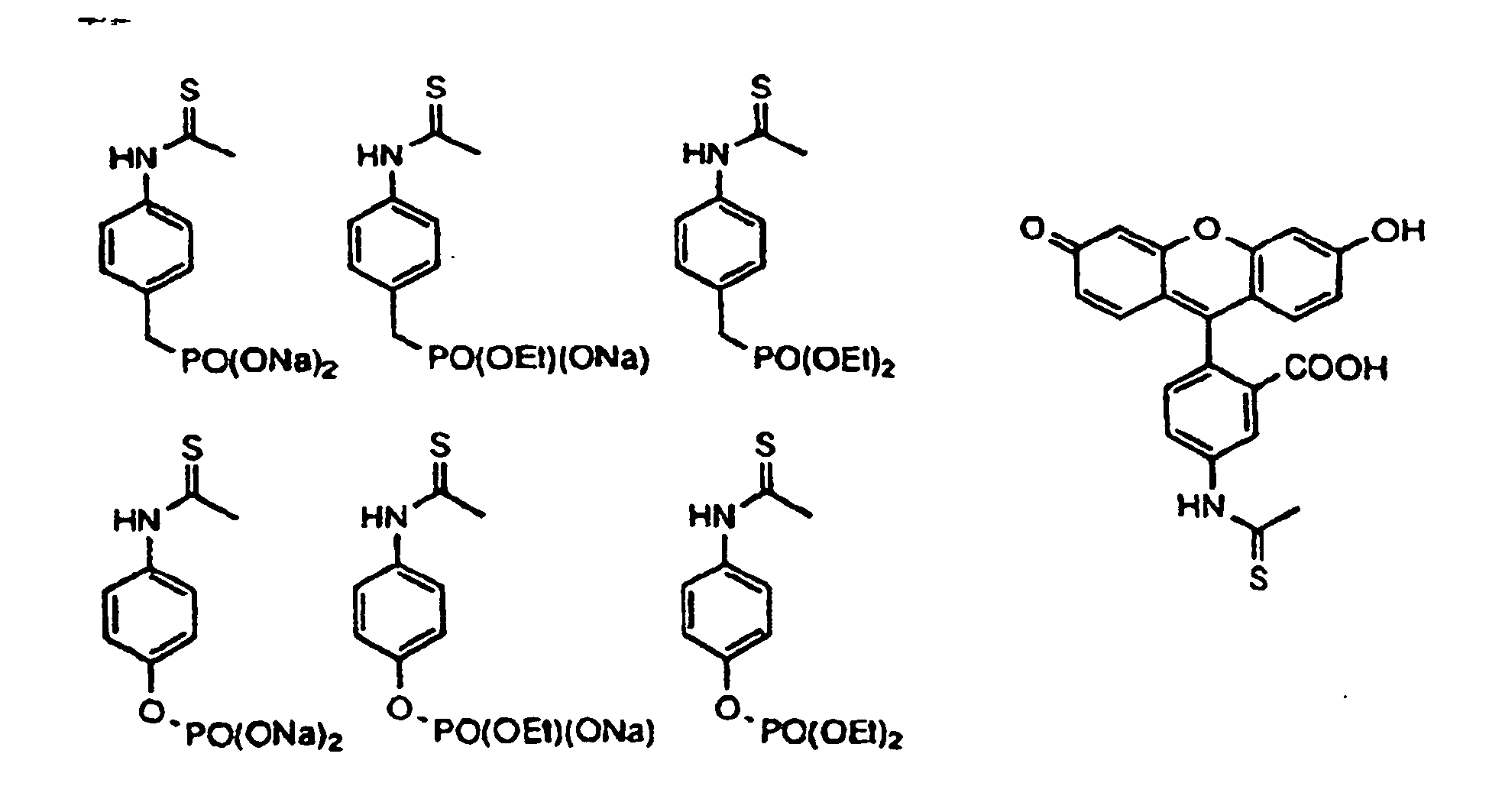
- Use according to claim 1 or claim 2, wherein said compound is selected from the group consisting of:i. alkylsulfonic acid terminated dendrimers;ii. sulfoacetamide terminated dendrimers;iii. sulfosuccinamic acid terminated dendrimers;iv. N-(2-sulfoethyl) succinamide terminated dendrimers;v. 4-sulfophenylthiourea terminated dendrimers;vi. 3,6-di-sulfonaphthylthiourea terminated dendrimers;vii. 4-sulfonaphthylthiourea terminated dendrimers;viii. 3,5-di-sulfophenylthiourea terminated dendrimers;ix. 3,6,8-tri-sulfonaphthylthiourea terminated dendrimers;x. 4-(sulfomethyl) benzamide terminated dendrimers;xi. 4-sulfobenzamide terminated dendrimers;xii. N-(4-sulfophenyl) propanamide terminated dendrimers;xiii. 4-sulfophenylurea terminated dendrimers;xiv. N,N,N-tri-methylglycinamide terminated dendrimers;xv. 4-trimethylammonium benzamide terminated dendrimers;xvi. 4-(trimethylammoniummethyl)benzamide terminated dendrimers;xvii. N-(2-acetoxyethyl)-N,N-(dimethylanzrnonium)methylcarboxamide terminated dendrimers;xviii. guanidino terminated dendrimers;xix. 4-([1,4,8,11-tetraazacyclotetradecane]methyl)benzamide terminated dendrimers;xx. 4-carboxy-3-hydroxy-benzylamine terminated dendrimers;xxi. 4-carboxyphenylamide terminated dendrimers;xxii. 3,5-dicarboxyphenylamide terminated dendrimers;xxiii. 4-phosphonooxyphenylthiourea terminated dendrimers;xxiv. 4-(phosphonomethyl)phenylthiourea terminated dendrimers;xxv. ethyl-4-(phosphonomethyl)phenylthiourea terminated dendrimers;xxvi. (8-octanamido)-5-acetamido-3,5-dideoxy-2-thio-D-glycero-α-D-galacto-2-nonulopyranosidoic acid terminated dendrimers;xxvii. (11-undecanamido)-5-acetamido-3,5-dideoxy-2-thio-D-glycero-α-D-galacto-2-nonulopyranosidoic acid terminated dendrimers;xxviii. (acetamido)-5-acetamido-3,5-dideoxy-2-thio-D-glycero-α-D-galacto-2-nonulopyranosidoic acid terminated dendrimers;xxix. (4-butanamido)-5-acetamido-3,5-dideoxy-2-thio-D-glycero-α-D-galacto-2-nonulopyranosidoic acid terminated dendrimers;xxx. (4-methylbenzamido)-5-acetamido-3,5-dideoxy-2-thio-D-glycero-α-D-galacto-2-nomulopyranosidoic acid terminated dendrimers;xxxi. (8-octanamido)-4-azido-5-acetamido-3,4,5-trideoxy-2-thio-D-glycero-α-D-galacto-2-nonulopyranosidoic acid terminated dendrimers;xxxii. (8-octanamido)-4-amino-5-acetamido-3,4,5-trideoxy-2-thio-D-glycero-α-D-galacto-2-nonulopyranosidoic acid terminated dendrimers;xxxiii. 4-benzamidoboronic acid terminated dendrimers;xxxiv. 3,5-dicarboxyphenylthiourea terminated dendrimers;xxxv. 4-phosphonophenylthiourea terminated dendrimers;xxxvi. 4,6-diphosphononaphthylthiourea terminated dendrimers;xxxvii. fluoresceinthiourea terminated dendrimers; andxxxviii. (phenyl-3-boronic acid)-thiourea terminated dendrimers.
- Use according to any of claims 1 to 10, wherein said medicament is for the treatment of chronic inflammation, diabetic retinopathy, psoriasis and rheumatoid arthritis and other conditions where growth of new blood vessels is involved, prevention of restenosis by inhibition of vascular smooth muscle cell proliferation, acceleration of wound healing by activation of the release of active growth factors stored in the extracellular matrix, and inhibition of tumour cell metastasis by inhibition of angiogenesis.
- A compound comprising a dendrimer having a plurality of terminal groups, wherein at least one of said terminal groups has an anionic-containing moiety bonded to linked thereto, said anionic-containing moiety being selected from the group consisting of:i. sialic acid and modified sialic acid-containing moieties, other than 2-thiosialic acid or the methyl ester thereof, and the methyl ester of peracylated 2-thiosialic acid;ii. neuraminic acid and modified neuraminic acid-containing moieties;iii. boronic acid-containing moieties; andiv. phosphoric and phosphonic acid-containing moieties, including esterified phosphoric and phosphonic acid-containing moieties.
- A compound according to claim 12 wherein said dendrimer comprises a polyvalent core covalently bonded to at least two dendritic branches, and extends through at least two generations.
- A compound according to claim 12 or claim 13 wherein said dendrimer is a polyamidoamine dendrimer based on an ammonia core.
- A compound according to claim 12 or claim 13, wherein said dendrimer is a polyamidoamine dendrimer based on an ethylene diamine core.
- A compound according to claim 12 or claim 13, wherein said dendrimer is a polylysine dendrimer based on a benzbydrylamine or other suitable core.
- A compound according to any of claims 12 to 16, wherein said anionic-containing moiety is bonded to terminal amine, sulfhydryl, hydroxy or other reactive functional terminal groups of said dendrimer by amide or thiourea linkages.
- A compound according to claim 12, which is selected from the group consisting of:i. 4-phosphonooxyphenylthiourea terminated dendrimers;ii. 4-(phosphonomethyl)phenylthiourea terminated dendrimers;iii. ethyl-4-(phosphonomethyl)phenylthiourea terminated dendrimers;iv. (8-octanamido)-5-acetamido-3,5-dideoxy-2-thio-D-glycero-α-D-galacto-2-nonulopyranosidoic acid terminated dendrimers;v. (11-undecanamido)-5-acetamido-3,5-dideoxy-2-thio-D-glycero-α-D-galacto-2-nonulopyranosidoic acid terminated dendrimers;vi. (acetamido)-5-acetamido-3,5-dideoxy-2-thio-D-glycero-α-D-galacto-2-nonulopyranosidoic acid terminated dendrimers;vii. (4-butanamido)-5-acetamido-3,5-dideoxy-2-thio-D-glycero-α-D-galacto-2-nonulopyranosidoic acid terminated dendrimers;viii. (4-methylbenzamido)-5-acetamido-3,5-dideoxy-2-thio-D-glycero-α-D-galacto-2-nonulopyranosidoic acid terminated dendrimers;ix. (8-octamido)-4-azido-5-acetamido-3,4,5-trideoxy-2-thio-D-glycero-α-D-galacto-2-nonulopyranosidoic acid terminated dendrimers;x. (8-octanamido)-4-amino-5-acetamido-3,4,5-trideoxy-2-thio-D-glycero-α-D-galacto-2-nonulopyranosidoic acid terminated dendrimers;xi. 4-benzamidoboronic acid terminated dendrimers;xii. 4-phosphonophenylthiourea terminated dendrimers;xiii. 4,6-diphosphononaphthylthiourea terminated dendrimers; andxiv. (phenyl-3-boronic acid)-thiourea terminated dendrimers.
Applications Claiming Priority (3)
| Application Number | Priority Date | Filing Date | Title |
|---|---|---|---|
| AUPO1044A AUPO104496A0 (en) | 1996-07-17 | 1996-07-17 | Angiogenic inhibitory compounds |
| AUPO104496 | 1996-07-17 | ||
| PCT/AU1997/000447 WO1998003573A1 (en) | 1996-07-17 | 1997-07-17 | Angiogenic inhibitory compounds |
Publications (3)
| Publication Number | Publication Date |
|---|---|
| EP0927217A1 EP0927217A1 (en) | 1999-07-07 |
| EP0927217A4 EP0927217A4 (en) | 2003-04-23 |
| EP0927217B1 true EP0927217B1 (en) | 2006-05-03 |
Family
ID=3795360
Family Applications (1)
| Application Number | Title | Priority Date | Filing Date |
|---|---|---|---|
| EP97929038A Expired - Lifetime EP0927217B1 (en) | 1996-07-17 | 1997-07-17 | Angiogenic inhibitory compounds |
Country Status (15)
| Country | Link |
|---|---|
| US (1) | US6426067B1 (en) |
| EP (1) | EP0927217B1 (en) |
| JP (1) | JP2000516211A (en) |
| KR (1) | KR100564714B1 (en) |
| CN (1) | CN1161128C (en) |
| AT (1) | ATE325154T1 (en) |
| AU (1) | AUPO104496A0 (en) |
| BR (1) | BR9710375A (en) |
| CA (1) | CA2262862C (en) |
| DE (1) | DE69735810T2 (en) |
| DK (1) | DK0927217T3 (en) |
| ES (1) | ES2260796T3 (en) |
| NZ (1) | NZ333488A (en) |
| PT (1) | PT927217E (en) |
| WO (1) | WO1998003573A1 (en) |
Families Citing this family (33)
| Publication number | Priority date | Publication date | Assignee | Title |
|---|---|---|---|---|
| US7018637B2 (en) * | 1998-02-23 | 2006-03-28 | Aventis Pasteur, Inc | Multi-oligosaccharide glycoconjugate bacterial meningitis vaccines |
| FR2781485B1 (en) | 1998-07-21 | 2003-08-08 | Denis Barritault | BIOCOMPATIBLE POLYMERS, PROCESS FOR THEIR PREPARATION AND COMPOSITIONS CONTAINING THEM |
| AUPP584298A0 (en) * | 1998-09-14 | 1998-10-08 | Starpharma Limited | Antimicrobial and antiparasitic agents |
| GB0001481D0 (en) * | 2000-01-21 | 2000-03-15 | Theryte Ltd | System for delivering a medicament |
| JP2003528850A (en) * | 2000-03-27 | 2003-09-30 | ザ・スクリプス・リサーチ・インステイチユート | Inhibition of angiogenesis and tumor growth |
| KR100413532B1 (en) * | 2001-02-14 | 2003-12-31 | 학교법인 포항공과대학교 | Polyamine terminated dendrimers and preparing method thereof |
| AUPR412801A0 (en) | 2001-03-30 | 2001-05-03 | Starpharma Limited | Agent for the prevention and treatment of sexually transmitted disease s - I |
| AUPR412901A0 (en) * | 2001-03-30 | 2001-05-03 | Starpharma Limited | Agents for the prevention and treatment of sexually transmitted disease s - II |
| US20030135195A1 (en) * | 2002-01-16 | 2003-07-17 | Oscar Jimenez | Highly lubricious hydrophilic coating utilizing dendrimers |
| US20030180250A1 (en) * | 2002-03-22 | 2003-09-25 | Council Of Scientific And Industrial Research | Compositions and complexes containing a macromolecular compound as potential anti-inflammatory agents |
| JP5107573B2 (en) * | 2003-04-25 | 2012-12-26 | ザ ペン ステイト リサーチ ファウンデーション | Systemic delivery methods and systems for growth-inhibiting lipid-derived bioactive compounds |
| EP2380872B1 (en) * | 2004-06-15 | 2014-04-23 | Cellceutix Corporation | Polycationic compounds and uses thereof |
| FR2876916B1 (en) * | 2004-10-25 | 2007-01-05 | Midi Pyrenees Incubateur | IMPLANTABLE SURFACE PRODUCT FUNCTIONALIZED BY MEANS OF ANIONIC TERMINAL DENDRIMERS |
| KR100667171B1 (en) | 2005-05-10 | 2007-01-12 | 서애희 | PAMAMA derivative for intracellular substance delivery and method for delivering desired substance in cells using same |
| GR1005807B (en) * | 2005-07-13 | 2008-02-06 | Αρισταρχος Παπαγιανναρος | Modulatory liposomal controlled release system (mlcrs): a new dosage form for encapsulating anticancer drugs based on liposomal and dendrimer technology |
| WO2007045010A1 (en) * | 2005-10-21 | 2007-04-26 | Starpharma Pty Limited | Inhibitory compounds |
| DE102005056592A1 (en) | 2005-11-25 | 2007-05-31 | Basf Ag | Novel uncrosslinked, hyperbranched polylysines useful as e.g. adhesive aids, thixotropic agents or phase transfer agents are obtained by catalytic reaction of a salt of lysine with an acid and optionally with comonomers |
| CN101420962A (en) | 2006-01-20 | 2009-04-29 | 星药股份有限公司 | modified macromolecules |
| WO2007106944A1 (en) * | 2006-03-22 | 2007-09-27 | Starpharma Pty Limited | Contraceptive composition |
| DE102006036326A1 (en) * | 2006-08-03 | 2008-02-07 | Charité - Universitätsmedizin Berlin | Dendritic polyglycerol sulfates and sulfonates and their use in inflammatory diseases |
| US20080311177A1 (en) | 2007-06-14 | 2008-12-18 | Massachusetts Institute Of Technology | Self Assembled Films for Protein and Drug Delivery Applications |
| US8658148B2 (en) | 2007-06-22 | 2014-02-25 | Genzyme Corporation | Chemically modified dendrimers |
| US10106565B2 (en) | 2008-08-01 | 2018-10-23 | Centre National De La Recherche Scientifique | Phosphorylated dendrimers as antiinflammatory drugs |
| WO2010013086A1 (en) * | 2008-08-01 | 2010-02-04 | Centre National De La Recherche Scientifique | Phosphorylated dendrimers as antiinflammatory drugs |
| US9198875B2 (en) | 2008-08-17 | 2015-12-01 | Massachusetts Institute Of Technology | Controlled delivery of bioactive agents from decomposable films |
| PT2709633T (en) * | 2011-05-16 | 2019-11-18 | Starpharma Pty Ltd | Method of treatment or prophylaxis of bacterial vaginosis |
| EP2841056A4 (en) | 2012-04-23 | 2015-09-16 | Massachusetts Inst Technology | COATED PARTICLES LAYER BY LAYER STABLE |
| WO2014134029A1 (en) | 2013-02-26 | 2014-09-04 | Massachusetts Institute Of Technology | Nucleic acid particles, methods and use thereof |
| WO2014150074A1 (en) | 2013-03-15 | 2014-09-25 | Massachusetts Institute Of Technology | Compositions and methods for nucleic acid delivery |
| TWI586369B (en) * | 2015-01-26 | 2017-06-11 | 國立交通大學 | Dendrimer, dendrimer with functional group, and antibody |
| DE102017002810A1 (en) | 2017-03-22 | 2018-09-27 | Reinhard Brossmer | Sialic acid derivatives with C-C triple bond and their preparation |
| US11419947B2 (en) | 2017-10-30 | 2022-08-23 | Massachusetts Institute Of Technology | Layer-by-layer nanoparticles for cytokine therapy in cancer treatment |
| EP3975841A1 (en) | 2019-05-30 | 2022-04-06 | Massachusetts Institute of Technology | Peptide nucleic acid functionalized hydrogel microneedles for sampling and detection of interstitial fluid nucleic acids |
Family Cites Families (18)
| Publication number | Priority date | Publication date | Assignee | Title |
|---|---|---|---|---|
| FR2182667B1 (en) * | 1972-05-03 | 1978-03-03 | Rhone Poulenc Ind | |
| US4289872A (en) * | 1979-04-06 | 1981-09-15 | Allied Corporation | Macromolecular highly branched homogeneous compound based on lysine units |
| US4410688A (en) | 1981-04-29 | 1983-10-18 | Allied Corporation | Macromolecular highly branched homogeneous compound |
| HU187669B (en) * | 1982-03-31 | 1986-02-28 | Richter Gedeon Vegyeszet | Process for producing new copolymeres and salts |
| US4558120A (en) | 1983-01-07 | 1985-12-10 | The Dow Chemical Company | Dense star polymer |
| US4568737A (en) | 1983-01-07 | 1986-02-04 | The Dow Chemical Company | Dense star polymers and dendrimers |
| US4507466A (en) | 1983-01-07 | 1985-03-26 | The Dow Chemical Corporation | Dense star polymers having core, core branches, terminal groups |
| US4587329A (en) | 1984-08-17 | 1986-05-06 | The Dow Chemical Company | Dense star polymers having two dimensional molecular diameter |
| NL8900442A (en) * | 1989-02-22 | 1990-09-17 | Stichting Rega V Z W | SULFATED VINYL POLYMERS IN MEDICINES FOR TREATING RETROVIRUS INFECTIONS. |
| JP2909500B2 (en) * | 1989-03-23 | 1999-06-23 | ベルレックス、ラボラトリーズ、レンコーポレイテッド | Polyamides with functionalized side chains useful as water-soluble antihyperlipidemic agents |
| FR2669535A1 (en) * | 1990-11-26 | 1992-05-29 | Medgenix Group Sa | Use of polysulphonated macromolecules as a medicament |
| GB2260134A (en) * | 1991-10-04 | 1993-04-07 | Erba Carlo Spa | Derivatives of poly-5-amino-3-carboxy-1-methyl compounds |
| EP0622078B1 (en) * | 1992-01-14 | 1999-09-01 | Hisamitsu Pharmaceutical Co., Inc. | Cholesterol level depressant |
| JPH08500590A (en) * | 1992-08-19 | 1996-01-23 | メレルダウファ−マス−ティカルズ インコーポレイテッド | Anti-angiogenic oligomers |
| US5460807A (en) * | 1992-08-19 | 1995-10-24 | Merrell Dow Pharmaceuticals Inc. | Antiproliferative oligomers |
| IL108951A0 (en) * | 1994-03-13 | 1994-06-24 | Hadasit Med Res Service | Pharmaceutical compositions containing polysulfated polysaccharides |
| JPH07267879A (en) | 1994-03-30 | 1995-10-17 | Unitika Ltd | Inhibitor of aterialization |
| AUPM623994A0 (en) | 1994-06-15 | 1994-07-07 | Biomolecular Research Institute Limited | Antiviral dendrimers |
-
1996
- 1996-07-17 AU AUPO1044A patent/AUPO104496A0/en not_active Abandoned
-
1997
- 1997-07-17 AT AT97929038T patent/ATE325154T1/en not_active IP Right Cessation
- 1997-07-17 BR BR9710375A patent/BR9710375A/en not_active IP Right Cessation
- 1997-07-17 CA CA002262862A patent/CA2262862C/en not_active Expired - Fee Related
- 1997-07-17 WO PCT/AU1997/000447 patent/WO1998003573A1/en not_active Ceased
- 1997-07-17 EP EP97929038A patent/EP0927217B1/en not_active Expired - Lifetime
- 1997-07-17 ES ES97929038T patent/ES2260796T3/en not_active Expired - Lifetime
- 1997-07-17 JP JP10506372A patent/JP2000516211A/en not_active Ceased
- 1997-07-17 DK DK97929038T patent/DK0927217T3/en active
- 1997-07-17 DE DE69735810T patent/DE69735810T2/en not_active Expired - Fee Related
- 1997-07-17 PT PT97929038T patent/PT927217E/en unknown
- 1997-07-17 NZ NZ333488A patent/NZ333488A/en unknown
- 1997-07-17 US US09/230,188 patent/US6426067B1/en not_active Expired - Fee Related
- 1997-07-17 KR KR1019997000264A patent/KR100564714B1/en not_active Expired - Fee Related
- 1997-07-17 CN CNB971964521A patent/CN1161128C/en not_active Expired - Fee Related
Also Published As
| Publication number | Publication date |
|---|---|
| WO1998003573A1 (en) | 1998-01-29 |
| AUPO104496A0 (en) | 1996-08-08 |
| AU3330297A (en) | 1998-02-10 |
| NZ333488A (en) | 2000-07-28 |
| CA2262862C (en) | 2005-10-04 |
| CN1225654A (en) | 1999-08-11 |
| ATE325154T1 (en) | 2006-06-15 |
| JP2000516211A (en) | 2000-12-05 |
| EP0927217A4 (en) | 2003-04-23 |
| AU715761B2 (en) | 2000-02-10 |
| EP0927217A1 (en) | 1999-07-07 |
| CN1161128C (en) | 2004-08-11 |
| PT927217E (en) | 2006-08-31 |
| KR100564714B1 (en) | 2006-03-28 |
| DK0927217T3 (en) | 2006-08-14 |
| KR20000067876A (en) | 2000-11-25 |
| BR9710375A (en) | 1999-08-17 |
| DE69735810T2 (en) | 2006-12-21 |
| US6426067B1 (en) | 2002-07-30 |
| CA2262862A1 (en) | 1998-01-29 |
| DE69735810D1 (en) | 2006-06-08 |
| ES2260796T3 (en) | 2006-11-01 |
Similar Documents
| Publication | Publication Date | Title |
|---|---|---|
| US6426067B1 (en) | Angiogenic inhibitory compounds | |
| EP1113806B1 (en) | Anionic or cationic dendrimer antimicrobial or antiparasitic compositions | |
| EP0765357B1 (en) | Antiviral dendrimers | |
| US8883715B2 (en) | Biocompatible polymers, process for their preparation and compositions containing them | |
| WO2000015239A1 (en) | Inhibition of toxic materials or substances using dendrimers | |
| AU715761C (en) | Angiogenic inhibitory compounds | |
| AU767970B2 (en) | Anionic or cationic dendrimer antimicrobial or antiparasitic compositions | |
| AU767971B2 (en) | Inhibition of toxic materials or substances using dendrimers | |
| AU682970B2 (en) | Antiviral dendrimers | |
| MXPA99000655A (en) | Angiogeni inhibitors compounds | |
| HK1002899B (en) | Antiviral dendrimers | |
| MXPA01002665A (en) | Inhibition of toxic materials or substances using dendrimers | |
| MXPA96006421A (en) | Dendrimeros antivira |
Legal Events
| Date | Code | Title | Description |
|---|---|---|---|
| PUAI | Public reference made under article 153(3) epc to a published international application that has entered the european phase |
Free format text: ORIGINAL CODE: 0009012 |
|
| 17P | Request for examination filed |
Effective date: 19990127 |
|
| AK | Designated contracting states |
Kind code of ref document: A1 Designated state(s): AT BE CH DE DK ES FI FR GB GR IE IT LI LU MC NL PT SE |
|
| A4 | Supplementary search report drawn up and despatched |
Effective date: 20030306 |
|
| 17Q | First examination report despatched |
Effective date: 20040504 |
|
| RIC1 | Information provided on ipc code assigned before grant |
Ipc: 7A 61P 29/00 B Ipc: 7A 61P 35/04 B Ipc: 7A 61P 17/06 B Ipc: 7A 61P 17/02 B Ipc: 7A 61P 9/10 B Ipc: 7A 61K 31/795 B Ipc: 7C 08G 69/36 A |
|
| GRAP | Despatch of communication of intention to grant a patent |
Free format text: ORIGINAL CODE: EPIDOSNIGR1 |
|
| GRAS | Grant fee paid |
Free format text: ORIGINAL CODE: EPIDOSNIGR3 |
|
| RAP1 | Party data changed (applicant data changed or rights of an application transferred) |
Owner name: STARPHARMA PTY LIMITED |
|
| GRAA | (expected) grant |
Free format text: ORIGINAL CODE: 0009210 |
|
| AK | Designated contracting states |
Kind code of ref document: B1 Designated state(s): AT BE CH DE DK ES FI FR GB GR IE IT LI LU MC NL PT SE |
|
| REG | Reference to a national code |
Ref country code: GB Ref legal event code: FG4D |
|
| REG | Reference to a national code |
Ref country code: CH Ref legal event code: EP |
|
| REF | Corresponds to: |
Ref document number: 69735810 Country of ref document: DE Date of ref document: 20060608 Kind code of ref document: P |
|
| REG | Reference to a national code |
Ref country code: IE Ref legal event code: FG4D |
|
| PGFP | Annual fee paid to national office [announced via postgrant information from national office to epo] |
Ref country code: MC Payment date: 20060628 Year of fee payment: 10 |
|
| PGFP | Annual fee paid to national office [announced via postgrant information from national office to epo] |
Ref country code: GR Payment date: 20060629 Year of fee payment: 10 |
|
| PGFP | Annual fee paid to national office [announced via postgrant information from national office to epo] |
Ref country code: NL Payment date: 20060703 Year of fee payment: 10 |
|
| PGFP | Annual fee paid to national office [announced via postgrant information from national office to epo] |
Ref country code: IE Payment date: 20060712 Year of fee payment: 10 Ref country code: AT Payment date: 20060712 Year of fee payment: 10 |
|
| PGFP | Annual fee paid to national office [announced via postgrant information from national office to epo] |
Ref country code: LU Payment date: 20060713 Year of fee payment: 10 Ref country code: FI Payment date: 20060713 Year of fee payment: 10 Ref country code: CH Payment date: 20060713 Year of fee payment: 10 |
|
| PGFP | Annual fee paid to national office [announced via postgrant information from national office to epo] |
Ref country code: PT Payment date: 20060719 Year of fee payment: 10 |
|
| REG | Reference to a national code |
Ref country code: CH Ref legal event code: NV Representative=s name: HEPP, WENGER & RYFFEL AG |
|
| REG | Reference to a national code |
Ref country code: SE Ref legal event code: TRGR |
|
| REG | Reference to a national code |
Ref country code: DK Ref legal event code: T3 |
|
| REG | Reference to a national code |
Ref country code: PT Ref legal event code: SC4A Effective date: 20060628 |
|
| PGFP | Annual fee paid to national office [announced via postgrant information from national office to epo] |
Ref country code: BE Payment date: 20060911 Year of fee payment: 10 |
|
| REG | Reference to a national code |
Ref country code: GR Ref legal event code: EP Ref document number: 20060402387 Country of ref document: GR |
|
| REG | Reference to a national code |
Ref country code: ES Ref legal event code: FG2A Ref document number: 2260796 Country of ref document: ES Kind code of ref document: T3 |
|
| ET | Fr: translation filed | ||
| PLBE | No opposition filed within time limit |
Free format text: ORIGINAL CODE: 0009261 |
|
| STAA | Information on the status of an ep patent application or granted ep patent |
Free format text: STATUS: NO OPPOSITION FILED WITHIN TIME LIMIT |
|
| 26N | No opposition filed |
Effective date: 20070206 |
|
| PGFP | Annual fee paid to national office [announced via postgrant information from national office to epo] |
Ref country code: DE Payment date: 20070719 Year of fee payment: 11 |
|
| PGFP | Annual fee paid to national office [announced via postgrant information from national office to epo] |
Ref country code: ES Payment date: 20070801 Year of fee payment: 11 |
|
| PGFP | Annual fee paid to national office [announced via postgrant information from national office to epo] |
Ref country code: GB Payment date: 20070718 Year of fee payment: 11 |
|
| BERE | Be: lapsed |
Owner name: *STARPHARMA PTY LTD Effective date: 20070731 |
|
| PGFP | Annual fee paid to national office [announced via postgrant information from national office to epo] |
Ref country code: SE Payment date: 20060705 Year of fee payment: 10 Ref country code: IT Payment date: 20070731 Year of fee payment: 11 |
|
| REG | Reference to a national code |
Ref country code: PT Ref legal event code: MM4A Free format text: LAPSE DUE TO NON-PAYMENT OF FEES Effective date: 20080117 |
|
| REG | Reference to a national code |
Ref country code: CH Ref legal event code: PL |
|
| EUG | Se: european patent has lapsed | ||
| REG | Reference to a national code |
Ref country code: DK Ref legal event code: EBP |
|
| NLV4 | Nl: lapsed or anulled due to non-payment of the annual fee |
Effective date: 20080201 |
|
| PG25 | Lapsed in a contracting state [announced via postgrant information from national office to epo] |
Ref country code: SE Free format text: LAPSE BECAUSE OF NON-PAYMENT OF DUE FEES Effective date: 20070718 Ref country code: NL Free format text: LAPSE BECAUSE OF NON-PAYMENT OF DUE FEES Effective date: 20080201 Ref country code: MC Free format text: LAPSE BECAUSE OF NON-PAYMENT OF DUE FEES Effective date: 20070731 Ref country code: LI Free format text: LAPSE BECAUSE OF NON-PAYMENT OF DUE FEES Effective date: 20070731 Ref country code: GR Free format text: LAPSE BECAUSE OF NON-PAYMENT OF DUE FEES Effective date: 20060804 Ref country code: CH Free format text: LAPSE BECAUSE OF NON-PAYMENT OF DUE FEES Effective date: 20070731 |
|
| PGFP | Annual fee paid to national office [announced via postgrant information from national office to epo] |
Ref country code: FR Payment date: 20070710 Year of fee payment: 11 Ref country code: DK Payment date: 20060714 Year of fee payment: 10 |
|
| PG25 | Lapsed in a contracting state [announced via postgrant information from national office to epo] |
Ref country code: PT Free format text: LAPSE BECAUSE OF NON-PAYMENT OF DUE FEES Effective date: 20080117 Ref country code: FI Free format text: LAPSE BECAUSE OF NON-PAYMENT OF DUE FEES Effective date: 20070717 |
|
| PG25 | Lapsed in a contracting state [announced via postgrant information from national office to epo] |
Ref country code: AT Free format text: LAPSE BECAUSE OF NON-PAYMENT OF DUE FEES Effective date: 20070717 |
|
| PG25 | Lapsed in a contracting state [announced via postgrant information from national office to epo] |
Ref country code: DK Free format text: LAPSE BECAUSE OF NON-PAYMENT OF DUE FEES Effective date: 20070731 |
|
| PG25 | Lapsed in a contracting state [announced via postgrant information from national office to epo] |
Ref country code: BE Free format text: LAPSE BECAUSE OF NON-PAYMENT OF DUE FEES Effective date: 20070731 |
|
| PG25 | Lapsed in a contracting state [announced via postgrant information from national office to epo] |
Ref country code: IE Free format text: LAPSE BECAUSE OF NON-PAYMENT OF DUE FEES Effective date: 20070717 |
|
| GBPC | Gb: european patent ceased through non-payment of renewal fee |
Effective date: 20080717 |
|
| PG25 | Lapsed in a contracting state [announced via postgrant information from national office to epo] |
Ref country code: DE Free format text: LAPSE BECAUSE OF NON-PAYMENT OF DUE FEES Effective date: 20090203 |
|
| REG | Reference to a national code |
Ref country code: FR Ref legal event code: ST Effective date: 20090331 |
|
| PG25 | Lapsed in a contracting state [announced via postgrant information from national office to epo] |
Ref country code: GB Free format text: LAPSE BECAUSE OF NON-PAYMENT OF DUE FEES Effective date: 20080717 |
|
| PG25 | Lapsed in a contracting state [announced via postgrant information from national office to epo] |
Ref country code: LU Free format text: LAPSE BECAUSE OF NON-PAYMENT OF DUE FEES Effective date: 20070717 Ref country code: IT Free format text: LAPSE BECAUSE OF NON-PAYMENT OF DUE FEES Effective date: 20080717 Ref country code: FR Free format text: LAPSE BECAUSE OF NON-PAYMENT OF DUE FEES Effective date: 20080731 |
|
| REG | Reference to a national code |
Ref country code: ES Ref legal event code: FD2A Effective date: 20080718 |
|
| PG25 | Lapsed in a contracting state [announced via postgrant information from national office to epo] |
Ref country code: ES Free format text: LAPSE BECAUSE OF NON-PAYMENT OF DUE FEES Effective date: 20080718 |