EP0926188B1 - Polyester resin-based compositions having improved thickening behavior - Google Patents
Polyester resin-based compositions having improved thickening behavior Download PDFInfo
- Publication number
- EP0926188B1 EP0926188B1 EP98403266A EP98403266A EP0926188B1 EP 0926188 B1 EP0926188 B1 EP 0926188B1 EP 98403266 A EP98403266 A EP 98403266A EP 98403266 A EP98403266 A EP 98403266A EP 0926188 B1 EP0926188 B1 EP 0926188B1
- Authority
- EP
- European Patent Office
- Prior art keywords
- composition
- thickening agent
- viscosity
- metal salt
- polyester resin
- Prior art date
- Legal status (The legal status is an assumption and is not a legal conclusion. Google has not performed a legal analysis and makes no representation as to the accuracy of the status listed.)
- Expired - Lifetime
Links
- 239000000203 mixture Substances 0.000 title claims abstract description 135
- 229920001225 polyester resin Polymers 0.000 title claims abstract description 13
- 239000004645 polyester resin Substances 0.000 title claims abstract description 13
- 230000008719 thickening Effects 0.000 title description 7
- 229910052751 metal Inorganic materials 0.000 claims abstract description 57
- 239000002184 metal Substances 0.000 claims abstract description 57
- 238000000465 moulding Methods 0.000 claims abstract description 45
- 150000003839 salts Chemical class 0.000 claims abstract description 44
- 239000002562 thickening agent Substances 0.000 claims abstract description 43
- 230000035800 maturation Effects 0.000 claims abstract description 41
- 238000000034 method Methods 0.000 claims abstract description 34
- CPLXHLVBOLITMK-UHFFFAOYSA-N magnesium oxide Inorganic materials [Mg]=O CPLXHLVBOLITMK-UHFFFAOYSA-N 0.000 claims description 31
- 229920006337 unsaturated polyester resin Polymers 0.000 claims description 22
- 239000000178 monomer Substances 0.000 claims description 20
- 230000008569 process Effects 0.000 claims description 19
- 239000000395 magnesium oxide Substances 0.000 claims description 18
- 229920000728 polyester Polymers 0.000 claims description 18
- 239000000843 powder Substances 0.000 claims description 18
- 239000002253 acid Substances 0.000 claims description 15
- -1 polyethylene Polymers 0.000 claims description 14
- 239000002245 particle Substances 0.000 claims description 10
- 229920000642 polymer Polymers 0.000 claims description 9
- XLYOFNOQVPJJNP-UHFFFAOYSA-M hydroxide Chemical compound [OH-] XLYOFNOQVPJJNP-UHFFFAOYSA-M 0.000 claims description 8
- 239000000654 additive Substances 0.000 claims description 6
- 239000000945 filler Substances 0.000 claims description 6
- 239000003505 polymerization initiator Substances 0.000 claims description 6
- 239000012779 reinforcing material Substances 0.000 claims description 6
- XKMZOFXGLBYJLS-UHFFFAOYSA-L zinc;prop-2-enoate Chemical compound [Zn+2].[O-]C(=O)C=C.[O-]C(=O)C=C XKMZOFXGLBYJLS-UHFFFAOYSA-L 0.000 claims description 6
- 125000004432 carbon atom Chemical group C* 0.000 claims description 5
- AXZKOIWUVFPNLO-UHFFFAOYSA-N magnesium;oxygen(2-) Chemical compound [O-2].[Mg+2] AXZKOIWUVFPNLO-UHFFFAOYSA-N 0.000 claims description 5
- 229920001169 thermoplastic Polymers 0.000 claims description 5
- 239000004698 Polyethylene Substances 0.000 claims description 4
- 229920000573 polyethylene Polymers 0.000 claims description 4
- 239000004416 thermosoftening plastic Substances 0.000 claims description 4
- 230000002378 acidificating effect Effects 0.000 claims description 3
- 150000001768 cations Chemical class 0.000 claims description 3
- 229920001038 ethylene copolymer Polymers 0.000 claims description 3
- 238000010438 heat treatment Methods 0.000 claims description 3
- 125000001183 hydrocarbyl group Chemical group 0.000 claims description 3
- OYPRJOBELJOOCE-UHFFFAOYSA-N Calcium Chemical compound [Ca] OYPRJOBELJOOCE-UHFFFAOYSA-N 0.000 claims description 2
- FYYHWMGAXLPEAU-UHFFFAOYSA-N Magnesium Chemical compound [Mg] FYYHWMGAXLPEAU-UHFFFAOYSA-N 0.000 claims description 2
- HCHKCACWOHOZIP-UHFFFAOYSA-N Zinc Chemical compound [Zn] HCHKCACWOHOZIP-UHFFFAOYSA-N 0.000 claims description 2
- 229910052788 barium Inorganic materials 0.000 claims description 2
- DSAJWYNOEDNPEQ-UHFFFAOYSA-N barium atom Chemical compound [Ba] DSAJWYNOEDNPEQ-UHFFFAOYSA-N 0.000 claims description 2
- 239000011575 calcium Substances 0.000 claims description 2
- 229910052791 calcium Inorganic materials 0.000 claims description 2
- 229920002313 fluoropolymer Polymers 0.000 claims description 2
- 239000011777 magnesium Substances 0.000 claims description 2
- 229910052749 magnesium Inorganic materials 0.000 claims description 2
- 239000000049 pigment Substances 0.000 claims description 2
- 229920001343 polytetrafluoroethylene Polymers 0.000 claims description 2
- 239000004810 polytetrafluoroethylene Substances 0.000 claims description 2
- 239000011701 zinc Substances 0.000 claims description 2
- 229910052725 zinc Inorganic materials 0.000 claims description 2
- 230000000996 additive effect Effects 0.000 claims 2
- 150000008064 anhydrides Chemical class 0.000 abstract description 19
- 235000014113 dietary fatty acids Nutrition 0.000 abstract description 4
- 239000000194 fatty acid Substances 0.000 abstract description 4
- 229930195729 fatty acid Natural products 0.000 abstract description 4
- 150000004665 fatty acids Chemical class 0.000 abstract description 4
- 238000009472 formulation Methods 0.000 description 48
- 210000000329 smooth muscle myocyte Anatomy 0.000 description 24
- 239000002131 composite material Substances 0.000 description 14
- 239000000463 material Substances 0.000 description 12
- PPBRXRYQALVLMV-UHFFFAOYSA-N Styrene Chemical compound C=CC1=CC=CC=C1 PPBRXRYQALVLMV-UHFFFAOYSA-N 0.000 description 10
- 230000000052 comparative effect Effects 0.000 description 10
- 239000000347 magnesium hydroxide Substances 0.000 description 9
- 229910001862 magnesium hydroxide Inorganic materials 0.000 description 9
- XLYOFNOQVPJJNP-UHFFFAOYSA-N water Substances O XLYOFNOQVPJJNP-UHFFFAOYSA-N 0.000 description 8
- VTHJTEIRLNZDEV-UHFFFAOYSA-L magnesium dihydroxide Chemical compound [OH-].[OH-].[Mg+2] VTHJTEIRLNZDEV-UHFFFAOYSA-L 0.000 description 7
- 238000005259 measurement Methods 0.000 description 7
- 229920005989 resin Polymers 0.000 description 7
- 239000011347 resin Substances 0.000 description 7
- 229920001187 thermosetting polymer Polymers 0.000 description 7
- DNIAPMSPPWPWGF-UHFFFAOYSA-N Propylene glycol Chemical compound CC(O)CO DNIAPMSPPWPWGF-UHFFFAOYSA-N 0.000 description 6
- 238000004519 manufacturing process Methods 0.000 description 6
- 239000004793 Polystyrene Substances 0.000 description 5
- 150000001991 dicarboxylic acids Chemical class 0.000 description 5
- 239000000835 fiber Substances 0.000 description 5
- 239000011159 matrix material Substances 0.000 description 5
- 238000005191 phase separation Methods 0.000 description 5
- 229920002223 polystyrene Polymers 0.000 description 5
- 229920002689 polyvinyl acetate Polymers 0.000 description 5
- KAKZBPTYRLMSJV-UHFFFAOYSA-N Butadiene Chemical compound C=CC=C KAKZBPTYRLMSJV-UHFFFAOYSA-N 0.000 description 4
- LYCAIKOWRPUZTN-UHFFFAOYSA-N Ethylene glycol Chemical compound OCCO LYCAIKOWRPUZTN-UHFFFAOYSA-N 0.000 description 4
- VZCYOOQTPOCHFL-OWOJBTEDSA-N Fumaric acid Chemical compound OC(=O)\C=C\C(O)=O VZCYOOQTPOCHFL-OWOJBTEDSA-N 0.000 description 4
- 238000006243 chemical reaction Methods 0.000 description 4
- 239000004744 fabric Substances 0.000 description 4
- 230000000977 initiatory effect Effects 0.000 description 4
- 230000007774 longterm Effects 0.000 description 4
- 239000011118 polyvinyl acetate Substances 0.000 description 4
- 229920006395 saturated elastomer Polymers 0.000 description 4
- VZCYOOQTPOCHFL-UHFFFAOYSA-N trans-butenedioic acid Natural products OC(=O)C=CC(O)=O VZCYOOQTPOCHFL-UHFFFAOYSA-N 0.000 description 4
- PEDCQBHIVMGVHV-UHFFFAOYSA-N Glycerine Chemical compound OCC(O)CO PEDCQBHIVMGVHV-UHFFFAOYSA-N 0.000 description 3
- IISBACLAFKSPIT-UHFFFAOYSA-N bisphenol A Chemical compound C=1C=C(O)C=CC=1C(C)(C)C1=CC=C(O)C=C1 IISBACLAFKSPIT-UHFFFAOYSA-N 0.000 description 3
- 150000001732 carboxylic acid derivatives Chemical class 0.000 description 3
- 238000004132 cross linking Methods 0.000 description 3
- MTHSVFCYNBDYFN-UHFFFAOYSA-N diethylene glycol Chemical compound OCCOCCO MTHSVFCYNBDYFN-UHFFFAOYSA-N 0.000 description 3
- 239000003999 initiator Substances 0.000 description 3
- FPYJFEHAWHCUMM-UHFFFAOYSA-N maleic anhydride Chemical compound O=C1OC(=O)C=C1 FPYJFEHAWHCUMM-UHFFFAOYSA-N 0.000 description 3
- 229920005862 polyol Polymers 0.000 description 3
- 150000003077 polyols Chemical class 0.000 description 3
- 230000002028 premature Effects 0.000 description 3
- 238000012545 processing Methods 0.000 description 3
- 229920006305 unsaturated polyester Polymers 0.000 description 3
- 125000000391 vinyl group Chemical group [H]C([*])=C([H])[H] 0.000 description 3
- MYRTYDVEIRVNKP-UHFFFAOYSA-N 1,2-Divinylbenzene Chemical compound C=CC1=CC=CC=C1C=C MYRTYDVEIRVNKP-UHFFFAOYSA-N 0.000 description 2
- 229920000049 Carbon (fiber) Polymers 0.000 description 2
- HECLRDQVFMWTQS-UHFFFAOYSA-N Dicyclopentadiene Chemical compound C1C2C3CC=CC3C1C=C2 HECLRDQVFMWTQS-UHFFFAOYSA-N 0.000 description 2
- 229910000760 Hardened steel Inorganic materials 0.000 description 2
- OFOBLEOULBTSOW-UHFFFAOYSA-N Propanedioic acid Natural products OC(=O)CC(O)=O OFOBLEOULBTSOW-UHFFFAOYSA-N 0.000 description 2
- VYPSYNLAJGMNEJ-UHFFFAOYSA-N Silicium dioxide Chemical compound O=[Si]=O VYPSYNLAJGMNEJ-UHFFFAOYSA-N 0.000 description 2
- KKEYFWRCBNTPAC-UHFFFAOYSA-N Terephthalic acid Chemical compound OC(=O)C1=CC=C(C(O)=O)C=C1 KKEYFWRCBNTPAC-UHFFFAOYSA-N 0.000 description 2
- XTXRWKRVRITETP-UHFFFAOYSA-N Vinyl acetate Chemical compound CC(=O)OC=C XTXRWKRVRITETP-UHFFFAOYSA-N 0.000 description 2
- XLOMVQKBTHCTTD-UHFFFAOYSA-N Zinc monoxide Chemical compound [Zn]=O XLOMVQKBTHCTTD-UHFFFAOYSA-N 0.000 description 2
- WNLRTRBMVRJNCN-UHFFFAOYSA-N adipic acid Chemical compound OC(=O)CCCCC(O)=O WNLRTRBMVRJNCN-UHFFFAOYSA-N 0.000 description 2
- QVQLCTNNEUAWMS-UHFFFAOYSA-N barium oxide Chemical compound [Ba]=O QVQLCTNNEUAWMS-UHFFFAOYSA-N 0.000 description 2
- WERYXYBDKMZEQL-UHFFFAOYSA-N butane-1,4-diol Chemical class OCCCCO WERYXYBDKMZEQL-UHFFFAOYSA-N 0.000 description 2
- VTYYLEPIZMXCLO-UHFFFAOYSA-L calcium carbonate Substances [Ca+2].[O-]C([O-])=O VTYYLEPIZMXCLO-UHFFFAOYSA-L 0.000 description 2
- 229920006217 cellulose acetate butyrate Polymers 0.000 description 2
- 230000008859 change Effects 0.000 description 2
- HNEGQIOMVPPMNR-IHWYPQMZSA-N citraconic acid Chemical compound OC(=O)C(/C)=C\C(O)=O HNEGQIOMVPPMNR-IHWYPQMZSA-N 0.000 description 2
- 238000007906 compression Methods 0.000 description 2
- 230000006835 compression Effects 0.000 description 2
- 230000000694 effects Effects 0.000 description 2
- 238000005516 engineering process Methods 0.000 description 2
- 239000011152 fibreglass Substances 0.000 description 2
- 239000001530 fumaric acid Substances 0.000 description 2
- 150000002334 glycols Chemical class 0.000 description 2
- 150000004679 hydroxides Chemical class 0.000 description 2
- 239000004615 ingredient Substances 0.000 description 2
- QQVIHTHCMHWDBS-UHFFFAOYSA-N isophthalic acid Chemical compound OC(=O)C1=CC=CC(C(O)=O)=C1 QQVIHTHCMHWDBS-UHFFFAOYSA-N 0.000 description 2
- VZCYOOQTPOCHFL-UPHRSURJSA-N maleic acid Chemical compound OC(=O)\C=C/C(O)=O VZCYOOQTPOCHFL-UPHRSURJSA-N 0.000 description 2
- 239000011976 maleic acid Substances 0.000 description 2
- 150000002739 metals Chemical class 0.000 description 2
- 238000002156 mixing Methods 0.000 description 2
- 230000000737 periodic effect Effects 0.000 description 2
- XNGIFLGASWRNHJ-UHFFFAOYSA-N phthalic acid Chemical compound OC(=O)C1=CC=CC=C1C(O)=O XNGIFLGASWRNHJ-UHFFFAOYSA-N 0.000 description 2
- 229920003023 plastic Polymers 0.000 description 2
- 239000004033 plastic Substances 0.000 description 2
- 229920003229 poly(methyl methacrylate) Polymers 0.000 description 2
- 238000006116 polymerization reaction Methods 0.000 description 2
- 239000004926 polymethyl methacrylate Substances 0.000 description 2
- 239000002243 precursor Substances 0.000 description 2
- 238000002360 preparation method Methods 0.000 description 2
- 239000000047 product Substances 0.000 description 2
- 150000003254 radicals Chemical class 0.000 description 2
- 230000002787 reinforcement Effects 0.000 description 2
- 239000012783 reinforcing fiber Substances 0.000 description 2
- 239000000243 solution Substances 0.000 description 2
- 239000000126 substance Substances 0.000 description 2
- KMOUUZVZFBCRAM-OLQVQODUSA-N (3as,7ar)-3a,4,7,7a-tetrahydro-2-benzofuran-1,3-dione Chemical compound C1C=CC[C@@H]2C(=O)OC(=O)[C@@H]21 KMOUUZVZFBCRAM-OLQVQODUSA-N 0.000 description 1
- 229940043375 1,5-pentanediol Drugs 0.000 description 1
- HECLRDQVFMWTQS-RGOKHQFPSA-N 1755-01-7 Chemical compound C1[C@H]2[C@@H]3CC=C[C@@H]3[C@@H]1C=C2 HECLRDQVFMWTQS-RGOKHQFPSA-N 0.000 description 1
- JAHNSTQSQJOJLO-UHFFFAOYSA-N 2-(3-fluorophenyl)-1h-imidazole Chemical compound FC1=CC=CC(C=2NC=CN=2)=C1 JAHNSTQSQJOJLO-UHFFFAOYSA-N 0.000 description 1
- LCZVSXRMYJUNFX-UHFFFAOYSA-N 2-[2-(2-hydroxypropoxy)propoxy]propan-1-ol Chemical compound CC(O)COC(C)COC(C)CO LCZVSXRMYJUNFX-UHFFFAOYSA-N 0.000 description 1
- SBYMUDUGTIKLCR-UHFFFAOYSA-N 2-chloroethenylbenzene Chemical compound ClC=CC1=CC=CC=C1 SBYMUDUGTIKLCR-UHFFFAOYSA-N 0.000 description 1
- WFUGQJXVXHBTEM-UHFFFAOYSA-N 2-hydroperoxy-2-(2-hydroperoxybutan-2-ylperoxy)butane Chemical compound CCC(C)(OO)OOC(C)(CC)OO WFUGQJXVXHBTEM-UHFFFAOYSA-N 0.000 description 1
- DXIJHCSGLOHNES-UHFFFAOYSA-N 3,3-dimethylbut-1-enylbenzene Chemical compound CC(C)(C)C=CC1=CC=CC=C1 DXIJHCSGLOHNES-UHFFFAOYSA-N 0.000 description 1
- FRIBMENBGGCKPD-UHFFFAOYSA-N 3-(2,3-dimethoxyphenyl)prop-2-enal Chemical compound COC1=CC=CC(C=CC=O)=C1OC FRIBMENBGGCKPD-UHFFFAOYSA-N 0.000 description 1
- JLBJTVDPSNHSKJ-UHFFFAOYSA-N 4-Methylstyrene Chemical compound CC1=CC=C(C=C)C=C1 JLBJTVDPSNHSKJ-UHFFFAOYSA-N 0.000 description 1
- NLHHRLWOUZZQLW-UHFFFAOYSA-N Acrylonitrile Chemical compound C=CC#N NLHHRLWOUZZQLW-UHFFFAOYSA-N 0.000 description 1
- 241000531908 Aramides Species 0.000 description 1
- 239000004342 Benzoyl peroxide Substances 0.000 description 1
- OMPJBNCRMGITSC-UHFFFAOYSA-N Benzoylperoxide Chemical compound C=1C=CC=CC=1C(=O)OOC(=O)C1=CC=CC=C1 OMPJBNCRMGITSC-UHFFFAOYSA-N 0.000 description 1
- 239000004641 Diallyl-phthalate Substances 0.000 description 1
- 239000004593 Epoxy Substances 0.000 description 1
- VVQNEPGJFQJSBK-UHFFFAOYSA-N Methyl methacrylate Chemical compound COC(=O)C(C)=C VVQNEPGJFQJSBK-UHFFFAOYSA-N 0.000 description 1
- 229920003347 Microthene® Polymers 0.000 description 1
- ALQSHHUCVQOPAS-UHFFFAOYSA-N Pentane-1,5-diol Chemical compound OCCCCCO ALQSHHUCVQOPAS-UHFFFAOYSA-N 0.000 description 1
- LGRFSURHDFAFJT-UHFFFAOYSA-N Phthalic anhydride Natural products C1=CC=C2C(=O)OC(=O)C2=C1 LGRFSURHDFAFJT-UHFFFAOYSA-N 0.000 description 1
- 239000004952 Polyamide Substances 0.000 description 1
- 239000004743 Polypropylene Substances 0.000 description 1
- 229910000831 Steel Inorganic materials 0.000 description 1
- KDYFGRWQOYBRFD-UHFFFAOYSA-N Succinic acid Natural products OC(=O)CCC(O)=O KDYFGRWQOYBRFD-UHFFFAOYSA-N 0.000 description 1
- ZJCCRDAZUWHFQH-UHFFFAOYSA-N Trimethylolpropane Chemical compound CCC(CO)(CO)CO ZJCCRDAZUWHFQH-UHFFFAOYSA-N 0.000 description 1
- 230000001133 acceleration Effects 0.000 description 1
- 150000007513 acids Chemical class 0.000 description 1
- NIXOWILDQLNWCW-UHFFFAOYSA-N acrylic acid group Chemical group C(C=C)(=O)O NIXOWILDQLNWCW-UHFFFAOYSA-N 0.000 description 1
- 230000009471 action Effects 0.000 description 1
- 239000001361 adipic acid Substances 0.000 description 1
- 235000011037 adipic acid Nutrition 0.000 description 1
- 230000002411 adverse Effects 0.000 description 1
- 238000013019 agitation Methods 0.000 description 1
- 125000001931 aliphatic group Chemical group 0.000 description 1
- 125000005907 alkyl ester group Chemical group 0.000 description 1
- 239000004411 aluminium Substances 0.000 description 1
- 229910052782 aluminium Inorganic materials 0.000 description 1
- XAGFODPZIPBFFR-UHFFFAOYSA-N aluminium Chemical compound [Al] XAGFODPZIPBFFR-UHFFFAOYSA-N 0.000 description 1
- PNEYBMLMFCGWSK-UHFFFAOYSA-N aluminium oxide Inorganic materials [O-2].[O-2].[O-2].[Al+3].[Al+3] PNEYBMLMFCGWSK-UHFFFAOYSA-N 0.000 description 1
- 238000013459 approach Methods 0.000 description 1
- 229920003235 aromatic polyamide Polymers 0.000 description 1
- 230000009286 beneficial effect Effects 0.000 description 1
- 235000019400 benzoyl peroxide Nutrition 0.000 description 1
- 230000015572 biosynthetic process Effects 0.000 description 1
- QUDWYFHPNIMBFC-UHFFFAOYSA-N bis(prop-2-enyl) benzene-1,2-dicarboxylate Chemical compound C=CCOC(=O)C1=CC=CC=C1C(=O)OCC=C QUDWYFHPNIMBFC-UHFFFAOYSA-N 0.000 description 1
- 229920001400 block copolymer Polymers 0.000 description 1
- KDYFGRWQOYBRFD-NUQCWPJISA-N butanedioic acid Chemical compound O[14C](=O)CC[14C](O)=O KDYFGRWQOYBRFD-NUQCWPJISA-N 0.000 description 1
- JHIWVOJDXOSYLW-UHFFFAOYSA-N butyl 2,2-difluorocyclopropane-1-carboxylate Chemical compound CCCCOC(=O)C1CC1(F)F JHIWVOJDXOSYLW-UHFFFAOYSA-N 0.000 description 1
- 239000006227 byproduct Substances 0.000 description 1
- 235000010216 calcium carbonate Nutrition 0.000 description 1
- AXCZMVOFGPJBDE-UHFFFAOYSA-L calcium dihydroxide Chemical compound [OH-].[OH-].[Ca+2] AXCZMVOFGPJBDE-UHFFFAOYSA-L 0.000 description 1
- 239000000920 calcium hydroxide Substances 0.000 description 1
- 229910001861 calcium hydroxide Inorganic materials 0.000 description 1
- BRPQOXSCLDDYGP-UHFFFAOYSA-N calcium oxide Chemical compound [O-2].[Ca+2] BRPQOXSCLDDYGP-UHFFFAOYSA-N 0.000 description 1
- 239000000292 calcium oxide Substances 0.000 description 1
- ODINCKMPIJJUCX-UHFFFAOYSA-N calcium oxide Inorganic materials [Ca]=O ODINCKMPIJJUCX-UHFFFAOYSA-N 0.000 description 1
- 239000004917 carbon fiber Substances 0.000 description 1
- 125000002843 carboxylic acid group Chemical group 0.000 description 1
- 239000000919 ceramic Substances 0.000 description 1
- 239000007795 chemical reaction product Substances 0.000 description 1
- 239000003795 chemical substances by application Substances 0.000 description 1
- 229940018557 citraconic acid Drugs 0.000 description 1
- 239000004927 clay Substances 0.000 description 1
- 229910052570 clay Inorganic materials 0.000 description 1
- 238000000748 compression moulding Methods 0.000 description 1
- 238000007596 consolidation process Methods 0.000 description 1
- 238000010276 construction Methods 0.000 description 1
- 239000004035 construction material Substances 0.000 description 1
- 239000000356 contaminant Substances 0.000 description 1
- 238000011109 contamination Methods 0.000 description 1
- 229920001577 copolymer Polymers 0.000 description 1
- 238000005260 corrosion Methods 0.000 description 1
- 230000007797 corrosion Effects 0.000 description 1
- 125000004122 cyclic group Chemical group 0.000 description 1
- 238000013461 design Methods 0.000 description 1
- 150000002009 diols Chemical class 0.000 description 1
- SZXQTJUDPRGNJN-UHFFFAOYSA-N dipropylene glycol Chemical compound OCCCOCCCO SZXQTJUDPRGNJN-UHFFFAOYSA-N 0.000 description 1
- 239000002270 dispersing agent Substances 0.000 description 1
- 230000009977 dual effect Effects 0.000 description 1
- 239000003365 glass fiber Substances 0.000 description 1
- 230000009477 glass transition Effects 0.000 description 1
- XXMIOPMDWAUFGU-UHFFFAOYSA-N hexane-1,6-diol Chemical compound OCCCCCCO XXMIOPMDWAUFGU-UHFFFAOYSA-N 0.000 description 1
- WGCNASOHLSPBMP-UHFFFAOYSA-N hydroxyacetaldehyde Natural products OCC=O WGCNASOHLSPBMP-UHFFFAOYSA-N 0.000 description 1
- 239000003112 inhibitor Substances 0.000 description 1
- 238000002347 injection Methods 0.000 description 1
- 239000007924 injection Substances 0.000 description 1
- 238000002844 melting Methods 0.000 description 1
- 230000008018 melting Effects 0.000 description 1
- HNEGQIOMVPPMNR-NSCUHMNNSA-N mesaconic acid Chemical compound OC(=O)C(/C)=C/C(O)=O HNEGQIOMVPPMNR-NSCUHMNNSA-N 0.000 description 1
- 229910000000 metal hydroxide Inorganic materials 0.000 description 1
- 229910044991 metal oxide Inorganic materials 0.000 description 1
- 150000004706 metal oxides Chemical class 0.000 description 1
- 125000005395 methacrylic acid group Chemical class 0.000 description 1
- LVHBHZANLOWSRM-UHFFFAOYSA-N methylenebutanedioic acid Natural products OC(=O)CC(=C)C(O)=O LVHBHZANLOWSRM-UHFFFAOYSA-N 0.000 description 1
- HNEGQIOMVPPMNR-UHFFFAOYSA-N methylfumaric acid Natural products OC(=O)C(C)=CC(O)=O HNEGQIOMVPPMNR-UHFFFAOYSA-N 0.000 description 1
- 239000010445 mica Substances 0.000 description 1
- 229910052618 mica group Inorganic materials 0.000 description 1
- SLCVBVWXLSEKPL-UHFFFAOYSA-N neopentyl glycol Chemical compound OCC(C)(C)CO SLCVBVWXLSEKPL-UHFFFAOYSA-N 0.000 description 1
- 239000003348 petrochemical agent Substances 0.000 description 1
- 125000000914 phenoxymethylpenicillanyl group Chemical class CC1(S[C@H]2N([C@H]1C(=O)*)C([C@H]2NC(COC2=CC=CC=C2)=O)=O)C 0.000 description 1
- 230000000704 physical effect Effects 0.000 description 1
- 229920002647 polyamide Polymers 0.000 description 1
- 229920001610 polycaprolactone Polymers 0.000 description 1
- 229920001228 polyisocyanate Polymers 0.000 description 1
- 239000005056 polyisocyanate Substances 0.000 description 1
- 229920001155 polypropylene Polymers 0.000 description 1
- 239000004814 polyurethane Substances 0.000 description 1
- 229920002635 polyurethane Polymers 0.000 description 1
- 229920002451 polyvinyl alcohol Polymers 0.000 description 1
- 235000019422 polyvinyl alcohol Nutrition 0.000 description 1
- 239000004800 polyvinyl chloride Substances 0.000 description 1
- 229920000915 polyvinyl chloride Polymers 0.000 description 1
- 230000001737 promoting effect Effects 0.000 description 1
- HJWLCRVIBGQPNF-UHFFFAOYSA-N prop-2-enylbenzene Chemical compound C=CCC1=CC=CC=C1 HJWLCRVIBGQPNF-UHFFFAOYSA-N 0.000 description 1
- 239000011541 reaction mixture Substances 0.000 description 1
- 230000003014 reinforcing effect Effects 0.000 description 1
- 230000002441 reversible effect Effects 0.000 description 1
- 239000000377 silicon dioxide Substances 0.000 description 1
- 239000010959 steel Substances 0.000 description 1
- 239000000454 talc Substances 0.000 description 1
- 229910052623 talc Inorganic materials 0.000 description 1
- GJBRNHKUVLOCEB-UHFFFAOYSA-N tert-butyl benzenecarboperoxoate Chemical compound CC(C)(C)OOC(=O)C1=CC=CC=C1 GJBRNHKUVLOCEB-UHFFFAOYSA-N 0.000 description 1
- 125000000999 tert-butyl group Chemical group [H]C([H])([H])C(*)(C([H])([H])[H])C([H])([H])[H] 0.000 description 1
- ZIBGPFATKBEMQZ-UHFFFAOYSA-N triethylene glycol Chemical compound OCCOCCOCCO ZIBGPFATKBEMQZ-UHFFFAOYSA-N 0.000 description 1
- 150000003673 urethanes Chemical class 0.000 description 1
- 229920001567 vinyl ester resin Polymers 0.000 description 1
- 239000002023 wood Substances 0.000 description 1
- 239000011787 zinc oxide Substances 0.000 description 1
- PIMBTRGLTHJJRV-UHFFFAOYSA-L zinc;2-methylprop-2-enoate Chemical compound [Zn+2].CC(=C)C([O-])=O.CC(=C)C([O-])=O PIMBTRGLTHJJRV-UHFFFAOYSA-L 0.000 description 1
Classifications
-
- C—CHEMISTRY; METALLURGY
- C08—ORGANIC MACROMOLECULAR COMPOUNDS; THEIR PREPARATION OR CHEMICAL WORKING-UP; COMPOSITIONS BASED THEREON
- C08K—Use of inorganic or non-macromolecular organic substances as compounding ingredients
- C08K3/00—Use of inorganic substances as compounding ingredients
- C08K3/18—Oxygen-containing compounds, e.g. metal carbonyls
- C08K3/20—Oxides; Hydroxides
- C08K3/22—Oxides; Hydroxides of metals
-
- C—CHEMISTRY; METALLURGY
- C08—ORGANIC MACROMOLECULAR COMPOUNDS; THEIR PREPARATION OR CHEMICAL WORKING-UP; COMPOSITIONS BASED THEREON
- C08K—Use of inorganic or non-macromolecular organic substances as compounding ingredients
- C08K5/00—Use of organic ingredients
- C08K5/04—Oxygen-containing compounds
- C08K5/09—Carboxylic acids; Metal salts thereof; Anhydrides thereof
- C08K5/098—Metal salts of carboxylic acids
-
- C—CHEMISTRY; METALLURGY
- C08—ORGANIC MACROMOLECULAR COMPOUNDS; THEIR PREPARATION OR CHEMICAL WORKING-UP; COMPOSITIONS BASED THEREON
- C08L—COMPOSITIONS OF MACROMOLECULAR COMPOUNDS
- C08L67/00—Compositions of polyesters obtained by reactions forming a carboxylic ester link in the main chain; Compositions of derivatives of such polymers
- C08L67/02—Polyesters derived from dicarboxylic acids and dihydroxy compounds
Definitions
- thermosetting polyester compositions and processes for making molded parts from such compositions.
- present invention relates to the fabrication of molded parts using chemically thickened thermosetting compositions.
- Composite materials are known to have the advantages of high strength, light weight, design flexibility, dimensional stability, corrosion resistance, parts consolidation, better finishing, and low tooling cost over traditional construction materials such as metal, ceramics, and wood.
- Fiber-reinforced thermosetting polyester composites are widely used in many applications, e.g., marine, automotive, transportation, electrical, construction, consumer and industrial goods, etc.
- thermosetting polyester composites Compared to the composites made from other types of thermosetting resins such as vinyl ester, epoxy, and polyamide, thermosetting polyester composites have the advantages of lower material cost and easy material handling during processing. Therefore, unsaturated polyester resins are the materials of choice for most of the fiber-reinforced thermosetting composites in applications in which the working environment of the composite is not very harsh.
- Fiber-reinforced thermosetting polyester composites usually consist of reinforcing (or reinforcement) fibers, either in chopped or continuous form, embedded in a matrix of one or more unsaturated polyester resins.
- the unsaturated polyester resins are made from a reaction of one or more glycols with an unsaturated dicarboxylic acid or its anhydride, or with a mixture of the unsaturated acid or its anhydride with a saturated dicarboxylic acid or its anhydride.
- the molecular weight of the polyester is controlled through any conventional means.
- the unsaturated polyester resin is blended typically with (1) one or more monomers capable of crosslinking with the vinyl groups in the polyester, (2) one or more polymerization initiators, (3) promoters for use in- combination with the initiator, and (4) various other additives which impart desired characteristics to the matrix upon cure or which will improve the processing and/or curing properties of resin.
- Such compositions are more fully described in the technical literature, such as in U.S. Patents 5,589,538 ; 5,202,366 ; 5,516,819 ; 4,535,110, 3,988,290; and 3,557,042 ; and in G.B. Patent 1,223,465.
- thickening agents When molding compositions are to be used as sheet molding compositions ( « SMCs »), thickening agents are used. Thickening agents increase the viscosity of the molding composition, so that the thickened system is relatively tack free and easy to handle for placing the molding composition in the mold. The thickened composition's high viscosity also helps carry reinforcement fibers to the extremities of the mold when compression is applied to the mold.
- Thickening is typically achieved by adding an alkaline material, such as magnesium oxide or hydroxide, to the uncured molding composition.
- the alkaline material interacts with residual acidity in the polyester resin component to build viscosity.
- the kinetics of this process are rather slow, requiring several days to achieve a viscosity appropriate for sheet molding operations, which is why the thickening process has been referred to as « maturation Spanish Heat cannot be used to speed up the kinetics, since that would result in premature crosslinking of the molding composition.
- a slow maturation process slows down production, requiring more factory space and/or equipment to carry out a given rate of production. It also allows time for premature phase separation to occur between components of the molding composition that are not completely compatible with each other, such as phase separation between the polyester resin(s) solubilized in the monomer and the thermoplastic low profile additives ( « LPAs »). Such phase separation cannot be prevented in SMCs by agitation during maturation, because of the presence of the reinforcing fibers. This has either limited the range of component types and amounts that are added to SMCs or has required the addition of compatibilizers, the presence of the latter often having an adverse effect on the physical properties of the resulting molded part.
- the concentration of thickening agent has typically been increased beyond that required to achieve the desired viscosity endpoint, together with providing a sufficient amount of acid end groups on the polyester resin component.
- a further acceleration of maturation is typically achieved by adding water, which facilitates the thickening reaction.
- the downside of this approach is that maturation can, and generally will, continue irreversibly to a point at which the viscosity of the molding composition becomes undesirably high. Molding compositions with such high viscosity require high molding pressures, which puts high stresses on the mold.
- This increase in viscosity over time creates a specific time window within which the molding composition is at a desired viscosity.
- the more thickening agent is added to speed up maturation the narrower the time window for the desired viscosity.
- a narrow time window requires the fabricator to have equipment able to handle significant variations in viscosity from sheet to sheet of SMC due to greater difficulty in accurately predicting when each sheet is ready for molding and the variations in timing between when the thickening agent is added and the part is molded inherent in a typical factory environment.
- a factor which has been found to cause significant variability in maturation rate is the presence of varying amounts of water as a contaminant.
- Water is naturally present in hygroscopic materials such as fillers and may be introduced in trace quantities by the polyester itself, since water is a byproduct of making polyester, and by contact of ingredients with humidity in the atmosphere. Precise control over the amount of water contamination in SMCs is difficult and to some extent impractical. Therefore, there is a degree of unpredictability/variability in the maturation rate from sheet to sheet even if the timing for each sheet were kept the same.
- polyester resin-based molding compositions which comprise :
- Another aspect of this invention provides a process for producing a molded part comprising :
- Yet another aspect of this invention provides a method for controlling maturation of polyester resin-based molding compositions having an unsaturated polyester resin in which at least about 25% of the end groups are acidic, an ethylenically unsaturated monomer copolymerizable with the unsaturated polyester resin and a thickening agent comprising an oxide or hydroxide of a Group I, II or III metal comprising dispersing in the molding composition at least one multivalent metal salt of a non-fatty acid or anhydride.
- the present invention provides a unique solution to the problems associated with the maturation profile of conventional uncured SMCs. This solution is described in more detail below.
- Viscosity is in Poise measured at a sample temperature of 32°C using a Brookfield Model HBT viscometer mounted on a heliopath having a T-bar spindle.
- the heliopath is operated such that the T-bar spindle moves continuously solely in one direction along the axis of rotation (preferably downward) over the time period during which the viscosity measurement is being taken.
- the T-bar spindle is selected from one of types/sizes T-A through T-F, depending on the viscosity of the sample being tested, such that viscosity is measured within the optimum measurement range of the viscometer (preferably within 50% from the middle of the measurement range to the end of the measurement range at either end). This may require measurement with more than one spindle to determine the correct spindle type.
- the rate of spindle rotation during viscosity measurement is 5 rotations per minute (R.P.M.).
- the unsaturated polyester resins used in the invention are known in the art.
- These resins are made from a reaction of one or more polyols with an unsaturated dicarboxylic acid or its anhydride or with a mixture of the unsaturated acid or its anhydride with a saturated dicarboxylic acid or its anhydride.
- STYPOL® 40-2783 available from Cook Composites and Polymers.
- the unsaturated dicarboxylic acid or its anhydride used in the preparation of the unsaturated polyester include those that contain olefinic unaturation, preferably when the olefinic unsaturation is alpha, beta- to at least one of the carboxylic acid groups.
- Such acids and anhydrides include maleic acid or anhydride, fumaric acid, citraconic acid, mesaconic acid, methyl maleic acid, and itaconic acid, and mixtures thereof.
- Maleic acid or anhydride, and fumaric acid are preferred.
- a minor proportion of the unsaturated acid can be replaced by one or more saturated and/or aromatic dicarboxylic acids or anhydrides.
- saturated and/or aromatic dicarboxylic acids or anhydrides include phthalic acid or anhydride, isophthalic acid, terephthalic acid, tetrahydrophthalic anhydride, succinic acid, adipic acid, sebacid acid, and dimerized fatty acids, and mixtures thereof.
- Polyols used in the preparation of the unsaturated polyesters include ethylene glycol, diethylene glycol, triethylene glycol, propylene glycol, dipropylene glycol, tripropylene glycol, butylene glycols, neopentyl glycol, 1,3- and 1,4-butane diols, 1,5-pentane diol, 1,6-hexanediol, glycerol, 1,1,1-trimethylolpropane, bisphenol A, hydrogenated bisphenol A, and other polyols, and mixtures thereof. Diols, and in particular glycols, are preferred.
- the reaction mixture may also include dicyclopentadiene ( « DCPD ») to modify, as described in USP 3,883,612 and USP 3,986,922 (both of which are incorporated herein by reference), the molecular weight of the polyesters.
- the unsaturated polyester resin typically has a number average molecular weight in the range from about 500 to about 5,000, preferably in the range from about 700 to about 3,500.
- Polyesters that are employed in thickened molding compositions contain residual acidity in order to enter into the thickening reaction.
- the polyester resin has an acid number of at least about 10, or preferably at least about 25% of its end groups are acid (i.e., carboxylic monomer end units).
- Such polyester resins and how to make them, including the DCPD modified resins, are described in USP 3,933,757 and USP 3,883,612, which are incorporated herein by reference.
- This component is present in the SMCs of this invention in an amount in the range from 5 to 40, preferably 10 to 30, percent, by weight, based on the weight of the SMC.
- Any ethylenically unsaturated monomer that will copolymerize with the vinyl groups of the unsaturated polyester resin can be used in the practice of this invention.
- These monomers include such materials as styrene, vinyl toluene, p-methyl styrene, chlorostyrene, t-butyl styrene, diallyl phthalate, mono- or multifunctional lower alkyl esters of the acrylic or methacrylic acids such as methyl methacrylate and glycol diacrylate, and the like.
- Styrene is the reactive monomer of choice.
- the SMCs of this invention may further contain at least one highly reactive olefinically unsaturated crosslinkable monomer, such as those described in U.S. Patent 5,202,366, which is incorporated herein by reference.
- a preferred crosslinkable monomer is divinyl benzene.
- the amount of monomer component ranges between about 30 to about 70 percent, preferably between about 40 to about 60 percent, by weight, based on the combined weight of the monomer, the unsaturated polyester resin and any LPA. When the amount of monomer is based on the weight of the SMC, the amount is preferably in the range from about 7 to about 20 wt.%.
- the monomer is preferably added in an amount that will dissolve all or most of the unsaturated polyester resin component at room temperature.
- Thickening agents are known in the art. They include oxides and hydroxides of the metals of Group I, II and III of the Periodic Table, especially Group IIA. Preferred metals include magnesium, calcium, zinc and barium. Specific examples include magnesium oxide, calcium oxide, zinc oxide, barium oxide, magnesium hydroxide, and calcium hydroxide, and mixtures thereof. Magnesium oxide and hydroxide, for example, are available for use in SMC formulations from various commercial sources, such as Barcroft Company.
- the total amount of thickening agent in the SMCs of this invention is preferably present in an amount in the range from about 0.1 to 5, more preferably from about 0.1 to about 2, percent, by weight, based on the weight of the SMC.
- a dual thickening system can be also employed in which the above described metal oxides and/or hydroxides are used together with a polyisocyanate as described in Belgian Patent 849,135 and US Patents 4,067,845 and 4,535,110, which are incorporated herein by reference.
- the multivalent metal salt of a nonfatty acid or anhydride has been surprisingly found to increase the initial maturation rate (i.e., maturation within one hour of addition and dispersal of thickening agent) without increasing the long term maturation rate (i.e., maturation within 100 hours of addition and dispersal of thickening agent).
- the presence of this multivalent metal salt according to this invention reduces the long term maturation rate relative to the corresponding composition not containing this component.
- a further surprising aspect of this invention is that the maturation rate of SMCs containing this component is less sensitive to the presence of water than compositions not containing this component, providing even greater viscosity control.
- the SMCs of this invention can tolerate up to 0.1 wt.%, more preferably up to 0.3 wt.%, water, and in preferred embodiments up to 0.1 wt.%, preferably up to 0.3 wt.%, change in the amount of water in the SMCs of this invention causes less than 10%, more preferably less than 5%, change in viscosity measured at 100 hours after addition of thickening agent.
- a further surprising aspect of this invention is that the viscosity at which the maturation rate of SMCs reaches a plateau can be adjusted by adjusting the amount of this component in the SMCs of this invention. That ability facilates the ability to use the SMC at a lower temperature and/or pressure, which in turn permits the use of less expensive molds made of materials that are more easily manufactured. Molds made of soft steel, rather than the hardened steel used in conventional fabrication of articles from SMCs, may be used, as well as molds made of aluminium and/or composite materials. Preferred temperatures and pressures for use of such molds are described under the process and method description below.
- nonfatty carboxylic acid or anhydride means a carboxylic acid or anhydride that has ten or less aliphatic carbon atoms in a single aliphatic moiety.
- the nonfatty carboxylic acid or anhydride preferably has from two to six, more preferably two, carbon atoms attached to the acid group.
- the acid or anhydride is unsaturated, including ethylenically unsaturated.
- the multivalent metal may be any metal having a valence of two or more, such as those in Groups IIA, IIB, and III of the Periodic Table. Preferred examples include Zn 2+ , Mg 2+ or Ca 2+ or a combination thereof .
- M c1 c2+ represents a multivalent metal cation having a valence of c2
- R is a hydrocarbyl moiety having up to 12, preferably up to 10, more preferably from 2 to 6, carbon atoms
- c1, c2, a1 and a2 are positive integers
- the product of c1 and c2 equals the product of a1 and a2.
- preferred metal salt are zinc diacrylate and zinc dimethacrylate.
- the multivalent metal salts for use in the SMCs of this invention are well known and available from commercial sources. Particularly preferred is a zinc diacrylate powder made by Sartomer Company under the designation SR 705 in which 50 wt.% of the zinc diacrylate particles have a particle size less than 10 microns.
- the multivalent metal salt is dispersed in the composition as finely divided particles.
- at least 50 wt.% of the finely divided particles have a particle size less than 5 microns, more preferably less than 2 microns.
- the weight ratio of the multivalent metal salt component to thickening agent component is at least about 0.5:1, more preferably at least about 1:1; and even more preferably at least about 2:1. There is no specific upper limit to this weight ratio, but weight ratios of up to about 10:1, more preferably up to about 8:1, and even more preferably up to about 7:1, are useful in obtaining the objectives of this invention.
- the amount of the multivalent metal salt is preferably in the range from 0.2 to 10, more preferably in the range from 0.5 to 5, percent, by weight, based on the weight of the SMC.
- the multivalent metal salt may be added before, during or after the addition of thickening agent to make the SMC, preferably before or during.
- the SMCs of this invention preferably contain at least one LPA.
- LPAs for SMCs are well known in the art of making SMCs.
- the thermoplastic polymers used as LPAs may be those that are miscible with the polyester resin and reactive monomer, such that upon blending one with the others a one-phase matrix precursor is formed, or may be noncompatible LPAs.
- compatible LPAs include poly(vinyl acetate) ( « PVAC »), such as the NEULON® series of PVAs from Union Carbide Chemicals and Plastics Technology Corporation (e.g., NEULON® 9005 or NEULON® 8000 and NEULON® G); thermoplastic copolymers containing at least 50 wt.% vinyl acetate; polyester urethanes; cellulose acetate butyrate ( « CAB »), and various saturated polyesters, such as STYPOL® 40-0125 from Cook Composites and Polymers, Inc.
- PVAC » poly(vinyl acetate)
- NEULON® series of PVAs from Union Carbide Chemicals and Plastics Technology Corporation
- thermoplastic copolymers containing at least 50 wt.% vinyl acetate polyester urethanes
- cellulose acetate butyrate « CAB »
- various saturated polyesters such as STYPOL® 40-0125 from Cook Composites and Polymers, Inc.
- noncompatible LPAs examples include polyethylene, poly(methyl methacrylate) ( « PMMA »), polystyrene, such as STYPOL® 40-0087 from Cook Composites and Polymers, Inc.; polycaprolactones; polyvinyl chloride; butadiene; and block copolymers of styrene and butadiene, which may be used with or without a compatibilizer.
- compatibilized LPAs are described in U.S. Patent 5,376,721, which is incorporated herein by reference.
- the weight average molecular weight of these LPAs can range from about 3,000 to about 1,000,000, preferably from about 5,000 to about 500,000.
- the amount of optional LPA present in the matrix precursor ranges between about 0 to about 30 percent, notably to about 20 percent, preferably between about 3 to about 15 percent, by weight.
- Suitable vinyl acetate LPAs are described in USP 3,718,714.
- Suitable polyurethane LPAs are described in US Patents 4,035,439 and 4,421,894.
- Suitable carboxylated polyester LPAs prepared from cyclic esters are described in US Patents 3,549,586 and 3,668,178.
- Suitable saturated polyester LPAs are described in US Patents 3,909,483; 3,994,853; 3,736,278; and 3,929,868. All the foregoing patents describing LPAs are incorporated herein by reference.
- a certain amount of filler may optionally be added to the SMC.
- Acceptable fillers include natural or precipitated calcium carbonates, clay, silica, talc, mica, and hydrated alumina. If present, the amount of filler added to the SMC is typically up to about 70 percent, preferably up to about 50 percent, and preferably at least about 20 percent, by weight, based on the total weight of the SMC.
- a certain amount of reinforcing material may optionally be added, such as glass fibers or fabrics, carbon fibers or fabrics, aramide fibers or fabrics, polypropylene, acrylonitrile/vinyl chloride copolymers, PAN fibers and fabrics.
- the fibers may be in the form of a mat or roving, such as fiberglass roving having a short (e.g., 2.54-5.08 cm (1-2 inch)) length.
- the amount of reinforcing material added to the SMC is typically up to 60 percent, more preferably up to 50 percent, and preferably at least about 10 percent, by weight, based on the total weight of the SMC.
- the SMC is cured through the action of one or more polymerization initiators.
- Polymerization initiators are generally free radical initiators, such as an organic peroxide compound, e.g. t-butyl perbenzoate, benzoyl peroxide, cumene hydroperoxide, t-butyl peroctoate, methyl ethyl ketone peroxide, and others known in the art.
- the polymerization initiator is heat-activated, the polymerization initiator is selected to have a free radical initiating temperature within the elevated temperature range used in the process for making a molded article described below.
- the minimum amount of such initiator used is a initiating amount, and typical amounts present in the SMC range from about 0.1 to about 5, more preferably 0.1 to 2, percent by weight, based on the weight of the SMC.
- SMC Styrene-maleic anhydride copolymer
- Other materials that can be present in the SMC include polymerization inhibitors, accelerators, pigments, release agents and other types of additives to improve the processing and/or curing properties of the resin, and/or which impart one or more desired features to the composite. These other materials are used 'in known amounts and in known ways.
- additional component may be a component (K) consisting of at least one powder based on polymers of low surface tension, preferably having a Glass Transition Temperature (Tg) or a Melting Temperature (Tm) less than the curing process temperature, more preferably less than 150°C.
- This powder is preferably a micronized powder.
- component (K) is from 0 to 20, preferably from 1 to 10 parts of component (K) for 100 parts of weight of the sum of all organic components of the SMC composition.
- Examples of commercially available powders based on polyethylene or on ethylene copolymers include MICROTHENE TM available from Millenium Petrochemicals, Inc. of Cincinnati Ohio (USA) and COATHYLENE TM available from Herberts Polymer Powders SA of Bulle (Switzerland).
- Another aspect of this invention is a process for producing a molded part comprising :
- the elevated pressure is defined as a positive pressure differential between the SMC and the inner contours of the mold such that the SMC is forced to conform to the contours of the mold. That pressure is preferably less than about 13.78 MPa (2,000 psi), more preferably less than 6.89 MPa (1,000 psi), more preferably less than 3.45 MPa (500 psi), even more preferably less 2.07 MPa (300 psi) and even more preferably less than 1.38 MPa (200 psi) and more particularly less than 0.69 MPa (100 psi).
- the minimum pressure is generally the pressure required to fully conform the SMC to the contours of the mold, among other factors that are routinely optimized by the molded article fabricator.
- the elevated temperature is used both to further soften the SMC to conform it to the mold and the peak temperature is intended cure the SMC by initiating and promoting crosslinking. Due to the lower plateau of viscosity of the SMCs of this invention, the SMCs may be heated to lower temperatures to achieve these objectives.
- the elevated temperature is preferably not greater than about 204°C (400°F), more preferably not greater than about 117°C (350°F), even more preferably not greater than about 149°C (300°F), and even more preferably not greater than about 93°C (200°F).
- the elevated temperature is at least 65°C (150°F) and in another embodiment the elevated temperature is at least 77°C (170°F), which may depend on the temperature required for heat-activated polymerization initiation, the desired viscosity of the SMC, etc.
- Another important aspect of this invention is that it comprises a method for controlling maturation of polyester resin-based molding compositions having an unsaturated polyester resin in which at least about 25% of the end groups are acidic, an ethylenically unsaturated monomer copolymerizable with the unsaturated polyester resin and a thickening agent comprising an oxide or hydroxide of a Group I, II or III metal comprising dispersing in the molding composition at least one multivalent metal salt of a nonfatty acid or anhydride.
- the metal salt is added to the molding composition prior to, or simultaneously with, the addition of the thickening agent.
- the viscosity of the SMC of this invention at the time of adding thickening agent is typically in the range between about 10 to about 100 Pa.s (about 100 to about 1,000 Poise) preferably between about 15 to about 50 Pa.s (about 150 to about 500 Poise).
- the viscosity of the molding composition one hour after addition of the thickening agent is preferably at least 50%, more preferably at least 100%, greater than the same composition after maturation for the same amount of time without the metal salt.
- the viscosity of the molding composition 100 hours after addition of the thickening agent is also preferably not greater than about 16,000 Pa.s (160,000 Poise), more preferably not greater than about 12,000 Pa.s (120,000 Poise), and even more preferably not greater than about 8,000 Pa.s (80,000 Poise).
- the viscosity of the molding composition 720 hours (i.e., one month) after addition of the thickening agent is also preferably not greater than 80,000 Pa.s (800,000 Poise).
- the SMC of this invention has a time frame in which the viscosity remains within a desired lower viscosity range which is longer than the time frame for the same composition without the metal salt.
- the SMC of this invention has a viscosity of not more than about 32,000 Pa.s (320,000 Poise), more preferably not more than about 24,000 Pa.s (240,000 Poise), even more preferably not more than 16,000 Pa.s (160,000 Poise) when 120, more preferably 240, even more preferably 360 hours have passed since addition of the thickening agent.
- the gel time of the SMCs of this invention will vary with, among other things, the compositional nature of the SMC and the cure conditions, but it is preferably between about 10 seconds to about 10 minutes at the elevated temperature described above.
- Viscosity is in Pa.s (Poise) measured at 32°C using a Brookfield viscometer as previously described above.
- SMC formulations are prepared according to the present invention and compared with comparative SMC formulations.
- the formulations presented in Tables 1A and 2A below are made without reinforcing fibers to facilitate measuring the viscosity of the SMC formulations.
- Data on the viscosity of those formulations over time is presented in Tables 1B to 1D for the Table 1A formulations and in Tables 2B to 2D for the Table 2A formulations.
- STYPOL® 40-2783 is an unsaturated polyester resin made by Cook Composites and Polymers, Inc., which is a reaction product of propylene glycol and maleic anhydride, dissolved in styrene at a resin to styrene weight ratio in the range from 68:32 to 70:30.
- the polyvinyl acetate LPA is NEULON® G available from Union Carbide Chemicals and Plastics Technology Corporation.
- the polystyrene LPA is STYPOL® 40-0087 available from Cook Composites and Polymers, Inc.
- BYK 996 is a dispersant available from Byk Chemie.
- Sartomer SR705 is a zinc diacrylate powder made by the Sartomer Company.
- MgO is a magnesium oxide powder available from Barcroft Company.
- MgO or MgO/Mg(OH) 2 blend are mixed prior to adding MgO or MgO/Mg(OH) 2 blend, respectively. Then the MgO or MgO/Mg(OH) 2 blend is added and mixed to make the respective SMC compositions and the viscosity is measured immediately, then after 1 hour, for the data in Tables 1B and 1C, again after 24 hours, again after 48 hours, for the data in Table 1C again after 72 hours, and for the data in Tables 1B and 1C again after 96 hours. The results are shown in Tables 1B, 1C and 1D below. Viscosity at zero hours is defined as the viscosity just after mixing and addition of MgO.
- Elapsed Time » refers to time measured from when MgO or MgO/Mg(OH) 2 blend, respectively, is added and dispersed in the respective formulation.
- the abbreviation « pbw » refers to « parts by weight » and unless stated otherwise « pbw » refers to « parts by weight metal salt ballot
- Table 1B below shows three SMC formulations in which the thickening agent is MgO.
- Formulation C-1 is comparative and formulations A-1 and B-1 are prepared according to the present invention.
- SMC formulations A-1 and B-1 containing 3 and 7 parts by weight (pbw) metal salt (zinc diacrylate), respectively, according to the present invention have an initial viscosity more than twice that of comparative formulation C-1 containing the same ingredients except for the metal salt.
- the SMC formulation B-1 containing 7 pbw metal salt has a viscosity after 96 hours which is substantially less than the same SMC formulation after 96 hours containing 3 pbw metal salt, A-1.
- Formulation A-1 also has a viscosity after 96 hours that is substantially less than that of comparative formulation C-1 without the metal salt.
- Table 1C shows three SMC formulations in which the thickening agent is Mg(OH) 2 .
- Formulation C-2 is comparative and formulations A-2 and B-2 are prepared according to the present invention.
- the addition of the metal salt to the SMC formulations based on Mg(OH) 2 as the thickening agent accelerates initial maturation and then reduces the long term maturation rate, increasing the time period during which the SMC formulation may be molded under the desired lower pressure and temperature conditions.
- Table 1D below provides data on three SMC formulations of the present invention, each made with a different LPA, which are paired with three comparative SMC formulations with the same LPA but without the metal salt.
- formulations A, D and E of the present invention have a viscosity after one hour of maturation substantially greater than corresponding comparative formulations C-1, C-3 and C-4, respectively, during the same time period.
- Those formulations of the present invention again have a substantially lower viscosity than the corresponding comparative formulations C-1, C-3 and C-4 after 48 hours's maturation. This demonstrates the beneficial effect of the present invention on the maturation profile, namely faster initial maturation followed by slower maturation thereafter, with formulations containing different LPAs.
- PG 9160 is 20 wt.% MgO in an unsaturated polyester paste available from PLASTICOLORS.
- Table 2B shows maturation of SMC formulations containing NEULON® G, a polyvinyl acetate
- Table 2C shows maturation of SMC formulations containing a saturated polyester LPA.
- Table 2D shows maturation of SMC formulations containing a polystyrene LPA.
- Polystyrene LPA is incompatible with other components of the SMC formulation, so that it has a tendency toward phase separation over time.
- formulations are made without reinforcing material to facilitate measurement of viscosity during the thickening process.
- these formulations may be combined with at least one of the reinforcing materials described above, such as fiberglass roving, to make a more typical SMC.
- An example of such a formulation with metal salt alongside a comparative without the metal salt is shown in Table 3A below.
- Formulations C-8 and J are each molded in a flat panel compression press mold in which the male part of the mold is at 145°C and the female part of the mold is at 150°C so that the expected time interval from injection to cure is 3 minutes, at the pressures shown in Table 3B below to determine the effect of the metal salt on the compression molding process. The results are shown in Table 3B below.
Landscapes
- Chemical & Material Sciences (AREA)
- Health & Medical Sciences (AREA)
- Chemical Kinetics & Catalysis (AREA)
- Medicinal Chemistry (AREA)
- Polymers & Plastics (AREA)
- Organic Chemistry (AREA)
- Compositions Of Macromolecular Compounds (AREA)
- Macromonomer-Based Addition Polymer (AREA)
- Biological Depolymerization Polymers (AREA)
Abstract
Description
- This invention relates to thermosetting polyester compositions and processes for making molded parts from such compositions. In particular, the present invention relates to the fabrication of molded parts using chemically thickened thermosetting compositions.
- Composite materials are known to have the advantages of high strength, light weight, design flexibility, dimensional stability, corrosion resistance, parts consolidation, better finishing, and low tooling cost over traditional construction materials such as metal, ceramics, and wood. Fiber-reinforced thermosetting polyester composites are widely used in many applications, e.g., marine, automotive, transportation, electrical, construction, consumer and industrial goods, etc. Compared to the composites made from other types of thermosetting resins such as vinyl ester, epoxy, and polyamide, thermosetting polyester composites have the advantages of lower material cost and easy material handling during processing. Therefore, unsaturated polyester resins are the materials of choice for most of the fiber-reinforced thermosetting composites in applications in which the working environment of the composite is not very harsh.
- Fiber-reinforced thermosetting polyester composites usually consist of reinforcing (or reinforcement) fibers, either in chopped or continuous form, embedded in a matrix of one or more unsaturated polyester resins. The unsaturated polyester resins are made from a reaction of one or more glycols with an unsaturated dicarboxylic acid or its anhydride, or with a mixture of the unsaturated acid or its anhydride with a saturated dicarboxylic acid or its anhydride. The molecular weight of the polyester is controlled through any conventional means.
- In the formation of the matrix, the unsaturated polyester resin is blended typically with (1) one or more monomers capable of crosslinking with the vinyl groups in the polyester, (2) one or more polymerization initiators, (3) promoters for use in- combination with the initiator, and (4) various other additives which impart desired characteristics to the matrix upon cure or which will improve the processing and/or curing properties of resin. Such compositions are more fully described in the technical literature, such as in U.S. Patents 5,589,538 ; 5,202,366 ; 5,516,819 ; 4,535,110, 3,988,290; and 3,557,042 ; and in G.B. Patent 1,223,465.
- When molding compositions are to be used as sheet molding compositions (« SMCs »), thickening agents are used. Thickening agents increase the viscosity of the molding composition, so that the thickened system is relatively tack free and easy to handle for placing the molding composition in the mold. The thickened composition's high viscosity also helps carry reinforcement fibers to the extremities of the mold when compression is applied to the mold.
- Thickening is typically achieved by adding an alkaline material, such as magnesium oxide or hydroxide, to the uncured molding composition. The alkaline material interacts with residual acidity in the polyester resin component to build viscosity. The kinetics of this process are rather slow, requiring several days to achieve a viscosity appropriate for sheet molding operations, which is why the thickening process has been referred to as « maturation ». Heat cannot be used to speed up the kinetics, since that would result in premature crosslinking of the molding composition.
- A slow maturation process slows down production, requiring more factory space and/or equipment to carry out a given rate of production. It also allows time for premature phase separation to occur between components of the molding composition that are not completely compatible with each other, such as phase separation between the polyester resin(s) solubilized in the monomer and the thermoplastic low profile additives (« LPAs »). Such phase separation cannot be prevented in SMCs by agitation during maturation, because of the presence of the reinforcing fibers. This has either limited the range of component types and amounts that are added to SMCs or has required the addition of compatibilizers, the presence of the latter often having an adverse effect on the physical properties of the resulting molded part.
- To achieve a higher maturation rate, the concentration of thickening agent has typically been increased beyond that required to achieve the desired viscosity endpoint, together with providing a sufficient amount of acid end groups on the polyester resin component. A further acceleration of maturation is typically achieved by adding water, which facilitates the thickening reaction. The downside of this approach is that maturation can, and generally will, continue irreversibly to a point at which the viscosity of the molding composition becomes undesirably high. Molding compositions with such high viscosity require high molding pressures, which puts high stresses on the mold. High mold stresses have until now required molds to be made of high strength materials, such as hardened steel, (to avoid deformation of, or damage to, the mold and to reduce wear from repeated use) and also required equipment that can apply high pressure, increasing the capital investment required to make molded parts.
- This increase in viscosity over time creates a specific time window within which the molding composition is at a desired viscosity. The more thickening agent is added to speed up maturation, the narrower the time window for the desired viscosity. A narrow time window requires the fabricator to have equipment able to handle significant variations in viscosity from sheet to sheet of SMC due to greater difficulty in accurately predicting when each sheet is ready for molding and the variations in timing between when the thickening agent is added and the part is molded inherent in a typical factory environment.
- A factor which has been found to cause significant variability in maturation rate is the presence of varying amounts of water as a contaminant. Water is naturally present in hygroscopic materials such as fillers and may be introduced in trace quantities by the polyester itself, since water is a byproduct of making polyester, and by contact of ingredients with humidity in the atmosphere. Precise control over the amount of water contamination in SMCs is difficult and to some extent impractical. Therefore, there is a degree of unpredictability/variability in the maturation rate from sheet to sheet even if the timing for each sheet were kept the same.
- Due to the above variability of factors, the fabricator of molded articles has had to use molds and molding equipment with excess capacity to handle potential stress of handling SMCs over a wide range of viscosities ranging far into the high end, where molding is difficult.
- There is also a greater risk of scrap if there is down time on the production line, since there is no known way to reverse the maturation process once it has gone too far, and even with higher amounts of thickening agent, the initial maturation rate is generally still too slow to prevent premature phase separation of incompatible or non compatibilized components.
- There is thus a desire to achieve a high rate of viscosity increase in the beginning of maturation followed by a relatively long time window in which viscosity remains within a desired range for fabrication into the molded part.
- There is also the desire for molding compositions which can incorporate components that tend to form a separate phase in the uncured SMC.
- There is especially a desire in the art for SMCs that predictably reach a viscosity plateau at lower viscosities, because such SMCs would lend themselves to use with less expensive, easier to fabricate molds and molding under lower temperature and pressure conditions.
- These and other objectives are surprisingly achieved by the present invention.
- According to one aspect of this invention, polyester resin-based molding compositions are provided which comprise :
- (A) at least one unsaturated polyester resin having an acid number of at least about 10 ;
- (B) at least one ethylenically unsaturated monomer copolymerizable with the unsaturated polyester resin;
- (C) at least one thickening agent comprising an oxide or hydroxide of a Group I, II or III metal ; and
- (D) at least one multivalent metal salt of a non-fatty acid or anhydride.
-
- Another aspect of this invention provides a process for producing a molded part comprising :
- (A) forming one of the above-described polyester-based curable molding compositions into a desired shape in a mold under an elevated pressure and
- (B) heating the formed composition in the mold to an elevated temperature.
-
- Yet another aspect of this invention provides a method for controlling maturation of polyester resin-based molding compositions having an unsaturated polyester resin in which at least about 25% of the end groups are acidic, an ethylenically unsaturated monomer copolymerizable with the unsaturated polyester resin and a thickening agent comprising an oxide or hydroxide of a Group I, II or III metal comprising dispersing in the molding composition at least one multivalent metal salt of a non-fatty acid or anhydride.
- The present invention provides a unique solution to the problems associated with the maturation profile of conventional uncured SMCs. This solution is described in more detail below.
- Unless stated otherwise, all parts, percents and ratios are by weight.
- Viscosity is in Poise measured at a sample temperature of 32°C using a Brookfield Model HBT viscometer mounted on a heliopath having a T-bar spindle. The heliopath is operated such that the T-bar spindle moves continuously solely in one direction along the axis of rotation (preferably downward) over the time period during which the viscosity measurement is being taken. The T-bar spindle is selected from one of types/sizes T-A through T-F, depending on the viscosity of the sample being tested, such that viscosity is measured within the optimum measurement range of the viscometer (preferably within 50% from the middle of the measurement range to the end of the measurement range at either end). This may require measurement with more than one spindle to determine the correct spindle type. The rate of spindle rotation during viscosity measurement is 5 rotations per minute (R.P.M.).
- The unsaturated polyester resins used in the invention are known in the art. Preferred resins are those with a molecular weight/double bond or vinyl group (-C=C-) factor between about 150 and about 190, more preferably between about 155 and about 170 (as further described in USP 3,701,748 which is incorporated herein by reference). These resins are made from a reaction of one or more polyols with an unsaturated dicarboxylic acid or its anhydride or with a mixture of the unsaturated acid or its anhydride with a saturated dicarboxylic acid or its anhydride. A specific example is STYPOL® 40-2783 available from Cook Composites and Polymers.
- The unsaturated dicarboxylic acid or its anhydride used in the preparation of the unsaturated polyester include those that contain olefinic unaturation, preferably when the olefinic unsaturation is alpha, beta- to at least one of the carboxylic acid groups. Such acids and anhydrides include maleic acid or anhydride, fumaric acid, citraconic acid, mesaconic acid, methyl maleic acid, and itaconic acid, and mixtures thereof. Maleic acid or anhydride, and fumaric acid, are preferred.
- A minor proportion of the unsaturated acid, up to about 30 mole percent, can be replaced by one or more saturated and/or aromatic dicarboxylic acids or anhydrides. Examples include phthalic acid or anhydride, isophthalic acid, terephthalic acid, tetrahydrophthalic anhydride, succinic acid, adipic acid, sebacid acid, and dimerized fatty acids, and mixtures thereof.
- Polyols used in the preparation of the unsaturated polyesters include ethylene glycol, diethylene glycol, triethylene glycol, propylene glycol, dipropylene glycol, tripropylene glycol, butylene glycols, neopentyl glycol, 1,3- and 1,4-butane diols, 1,5-pentane diol, 1,6-hexanediol, glycerol, 1,1,1-trimethylolpropane, bisphenol A, hydrogenated bisphenol A, and other polyols, and mixtures thereof. Diols, and in particular glycols, are preferred.
- The reaction mixture may also include dicyclopentadiene (« DCPD ») to modify, as described in USP 3,883,612 and USP 3,986,922 (both of which are incorporated herein by reference), the molecular weight of the polyesters. The unsaturated polyester resin typically has a number average molecular weight in the range from about 500 to about 5,000, preferably in the range from about 700 to about 3,500.
- Polyesters that are employed in thickened molding compositions contain residual acidity in order to enter into the thickening reaction. Preferably, the polyester resin has an acid number of at least about 10, or preferably at least about 25% of its end groups are acid (i.e., carboxylic monomer end units). Such polyester resins and how to make them, including the DCPD modified resins, are described in USP 3,933,757 and USP 3,883,612, which are incorporated herein by reference.
- This component is present in the SMCs of this invention in an amount in the range from 5 to 40, preferably 10 to 30, percent, by weight, based on the weight of the SMC.
- Any ethylenically unsaturated monomer that will copolymerize with the vinyl groups of the unsaturated polyester resin can be used in the practice of this invention. These monomers include such materials as styrene, vinyl toluene, p-methyl styrene, chlorostyrene, t-butyl styrene, diallyl phthalate, mono- or multifunctional lower alkyl esters of the acrylic or methacrylic acids such as methyl methacrylate and glycol diacrylate, and the like. Styrene is the reactive monomer of choice.
- The SMCs of this invention may further contain at least one highly reactive olefinically unsaturated crosslinkable monomer, such as those described in U.S. Patent 5,202,366, which is incorporated herein by reference. An example of a preferred crosslinkable monomer is divinyl benzene.
- The amount of monomer component ranges between about 30 to about 70 percent, preferably between about 40 to about 60 percent, by weight, based on the combined weight of the monomer, the unsaturated polyester resin and any LPA. When the amount of monomer is based on the weight of the SMC, the amount is preferably in the range from about 7 to about 20 wt.%. The monomer is preferably added in an amount that will dissolve all or most of the unsaturated polyester resin component at room temperature.
- Thickening agents are known in the art. They include oxides and hydroxides of the metals of Group I, II and III of the Periodic Table, especially Group IIA. Preferred metals include magnesium, calcium, zinc and barium. Specific examples include magnesium oxide, calcium oxide, zinc oxide, barium oxide, magnesium hydroxide, and calcium hydroxide, and mixtures thereof. Magnesium oxide and hydroxide, for example, are available for use in SMC formulations from various commercial sources, such as Barcroft Company.
- The total amount of thickening agent in the SMCs of this invention is preferably present in an amount in the range from about 0.1 to 5, more preferably from about 0.1 to about 2, percent, by weight, based on the weight of the SMC.
- A dual thickening system can be also employed in which the above described metal oxides and/or hydroxides are used together with a polyisocyanate as described in Belgian Patent 849,135 and US Patents 4,067,845 and 4,535,110, which are incorporated herein by reference.
- The multivalent metal salt of a nonfatty acid or anhydride has been surprisingly found to increase the initial maturation rate (i.e., maturation within one hour of addition and dispersal of thickening agent) without increasing the long term maturation rate (i.e., maturation within 100 hours of addition and dispersal of thickening agent). In a preferred aspect of this invention, the presence of this multivalent metal salt according to this invention reduces the long term maturation rate relative to the corresponding composition not containing this component.
- A further surprising aspect of this invention is that the maturation rate of SMCs containing this component is less sensitive to the presence of water than compositions not containing this component, providing even greater viscosity control. The SMCs of this invention can tolerate up to 0.1 wt.%, more preferably up to 0.3 wt.%, water, and in preferred embodiments up to 0.1 wt.%, preferably up to 0.3 wt.%, change in the amount of water in the SMCs of this invention causes less than 10%, more preferably less than 5%, change in viscosity measured at 100 hours after addition of thickening agent.
- Yet a further surprising aspect of this invention is that the viscosity at which the maturation rate of SMCs reaches a plateau can be adjusted by adjusting the amount of this component in the SMCs of this invention. That ability facilates the ability to use the SMC at a lower temperature and/or pressure, which in turn permits the use of less expensive molds made of materials that are more easily manufactured. Molds made of soft steel, rather than the hardened steel used in conventional fabrication of articles from SMCs, may be used, as well as molds made of aluminium and/or composite materials. Preferred temperatures and pressures for use of such molds are described under the process and method description below.
- The term « nonfatty carboxylic acid or anhydride » means a carboxylic acid or anhydride that has ten or less aliphatic carbon atoms in a single aliphatic moiety. The nonfatty carboxylic acid or anhydride preferably has from two to six, more preferably two, carbon atoms attached to the acid group. The acid or anhydride is unsaturated, including ethylenically unsaturated.
- The multivalent metal may be any metal having a valence of two or more, such as those in Groups IIA, IIB, and III of the Periodic Table. Preferred examples include Zn2+, Mg2+ or Ca2+ or a combination thereof .
- Preferred examples of this metal salt may be represented by the formula :
- The multivalent metal salts for use in the SMCs of this invention are well known and available from commercial sources. Particularly preferred is a zinc diacrylate powder made by Sartomer Company under the designation SR 705 in which 50 wt.% of the zinc diacrylate particles have a particle size less than 10 microns.
- In one embodiment, the multivalent metal salt is dispersed in the composition as finely divided particles. Preferably, at least 50 wt.% of the finely divided particles have a particle size less than 5 microns, more preferably less than 2 microns.
- In another preferred aspect of this invention, the weight ratio of the multivalent metal salt component to thickening agent component is at least about 0.5:1, more preferably at least about 1:1; and even more preferably at least about 2:1. There is no specific upper limit to this weight ratio, but weight ratios of up to about 10:1, more preferably up to about 8:1, and even more preferably up to about 7:1, are useful in obtaining the objectives of this invention. The amount of the multivalent metal salt is preferably in the range from 0.2 to 10, more preferably in the range from 0.5 to 5, percent, by weight, based on the weight of the SMC. The multivalent metal salt may be added before, during or after the addition of thickening agent to make the SMC, preferably before or during.
- The SMCs of this invention preferably contain at least one LPA. LPAs for SMCs are well known in the art of making SMCs. The thermoplastic polymers used as LPAs may be those that are miscible with the polyester resin and reactive monomer, such that upon blending one with the others a one-phase matrix precursor is formed, or may be noncompatible LPAs. Examples of compatible LPAs include poly(vinyl acetate) (« PVAC »), such as the NEULON® series of PVAs from Union Carbide Chemicals and Plastics Technology Corporation (e.g., NEULON® 9005 or NEULON® 8000 and NEULON® G); thermoplastic copolymers containing at least 50 wt.% vinyl acetate; polyester urethanes; cellulose acetate butyrate (« CAB »), and various saturated polyesters, such as STYPOL® 40-0125 from Cook Composites and Polymers, Inc. Examples of noncompatible LPAs include polyethylene, poly(methyl methacrylate) (« PMMA »), polystyrene, such as STYPOL® 40-0087 from Cook Composites and Polymers, Inc.; polycaprolactones; polyvinyl chloride; butadiene; and block copolymers of styrene and butadiene, which may be used with or without a compatibilizer. Examples of compatibilized LPAs are described in U.S. Patent 5,376,721, which is incorporated herein by reference. The weight average molecular weight of these LPAs can range from about 3,000 to about 1,000,000, preferably from about 5,000 to about 500,000. The amount of optional LPA present in the matrix precursor ranges between about 0 to about 30 percent, notably to about 20 percent, preferably between about 3 to about 15 percent, by weight.
- Suitable vinyl acetate LPAs are described in USP 3,718,714. Suitable polyurethane LPAs are described in US Patents 4,035,439 and 4,421,894. Suitable carboxylated polyester LPAs prepared from cyclic esters are described in US Patents 3,549,586 and 3,668,178. Suitable saturated polyester LPAs are described in US Patents 3,909,483; 3,994,853; 3,736,278; and 3,929,868. All the foregoing patents describing LPAs are incorporated herein by reference.
- A certain amount of filler may optionally be added to the SMC. Acceptable fillers include natural or precipitated calcium carbonates, clay, silica, talc, mica, and hydrated alumina. If present, the amount of filler added to the SMC is typically up to about 70 percent, preferably up to about 50 percent, and preferably at least about 20 percent, by weight, based on the total weight of the SMC.
- A certain amount of reinforcing material may optionally be added, such as glass fibers or fabrics, carbon fibers or fabrics, aramide fibers or fabrics, polypropylene, acrylonitrile/vinyl chloride copolymers, PAN fibers and fabrics. The fibers may be in the form of a mat or roving, such as fiberglass roving having a short (e.g., 2.54-5.08 cm (1-2 inch)) length. If present, the amount of reinforcing material added to the SMC is typically up to 60 percent, more preferably up to 50 percent, and preferably at least about 10 percent, by weight, based on the total weight of the SMC.
- The SMC is cured through the action of one or more polymerization initiators. Polymerization initiators are generally free radical initiators, such as an organic peroxide compound, e.g. t-butyl perbenzoate, benzoyl peroxide, cumene hydroperoxide, t-butyl peroctoate, methyl ethyl ketone peroxide, and others known in the art. When the polymerization initiator is heat-activated, the polymerization initiator is selected to have a free radical initiating temperature within the elevated temperature range used in the process for making a molded article described below. The minimum amount of such initiator used is a initiating amount, and typical amounts present in the SMC range from about 0.1 to about 5, more preferably 0.1 to 2, percent by weight, based on the weight of the SMC.
- Other materials that can be present in the SMC include polymerization inhibitors, accelerators, pigments, release agents and other types of additives to improve the processing and/or curing properties of the resin, and/or which impart one or more desired features to the composite. These other materials are used 'in known amounts and in known ways.
- Particularly, additional component may be a component (K) consisting of at least one powder based on polymers of low surface tension, preferably having a Glass Transition Temperature (Tg) or a Melting Temperature (Tm) less than the curing process temperature, more preferably less than 150°C. This powder is preferably a micronized powder.
- Preferably it may be selected from powders based on polyethylene or on ethylene copolymers or from powders based on fluorinated polymers like polytetrafluoroethylene. The weight content of component (K) is from 0 to 20, preferably from 1 to 10 parts of component (K) for 100 parts of weight of the sum of all organic components of the SMC composition. Examples of commercially available powders based on polyethylene or on ethylene copolymers include MICROTHENE ™ available from Millenium Petrochemicals, Inc. of Cincinnati Ohio (USA) and COATHYLENE ™ available from Herberts Polymer Powders SA of Bulle (Switzerland).
- Another aspect of this invention is a process for producing a molded part comprising :
- (A) forming a polyester-based curable molding composition of this invention into a desired shape in a mold under an elevated pressure and
- (B) heating the formed composition in the mold at an elevated temperature.
-
- The elevated pressure is defined as a positive pressure differential between the SMC and the inner contours of the mold such that the SMC is forced to conform to the contours of the mold. That pressure is preferably less than about 13.78 MPa (2,000 psi), more preferably less than 6.89 MPa (1,000 psi), more preferably less than 3.45 MPa (500 psi), even more preferably less 2.07 MPa (300 psi) and even more preferably less than 1.38 MPa (200 psi) and more particularly less than 0.69 MPa (100 psi). The minimum pressure is generally the pressure required to fully conform the SMC to the contours of the mold, among other factors that are routinely optimized by the molded article fabricator.
- The elevated temperature is used both to further soften the SMC to conform it to the mold and the peak temperature is intended cure the SMC by initiating and promoting crosslinking. Due to the lower plateau of viscosity of the SMCs of this invention, the SMCs may be heated to lower temperatures to achieve these objectives. The elevated temperature is preferably not greater than about 204°C (400°F), more preferably not greater than about 117°C (350°F), even more preferably not greater than about 149°C (300°F), and even more preferably not greater than about 93°C (200°F). In one embodiment, the elevated temperature is at least 65°C (150°F) and in another embodiment the elevated temperature is at least 77°C (170°F), which may depend on the temperature required for heat-activated polymerization initiation, the desired viscosity of the SMC, etc. Another important aspect of this invention is that it comprises a method for controlling maturation of polyester resin-based molding compositions having an unsaturated polyester resin in which at least about 25% of the end groups are acidic, an ethylenically unsaturated monomer copolymerizable with the unsaturated polyester resin and a thickening agent comprising an oxide or hydroxide of a Group I, II or III metal comprising dispersing in the molding composition at least one multivalent metal salt of a nonfatty acid or anhydride. Preferably, the metal salt is added to the molding composition prior to, or simultaneously with, the addition of the thickening agent.
- The viscosity of the SMC of this invention at the time of adding thickening agent is typically in the range between about 10 to about 100 Pa.s (about 100 to about 1,000 Poise) preferably between about 15 to about 50 Pa.s (about 150 to about 500 Poise). The viscosity of the molding composition one hour after addition of the thickening agent is preferably at least 50%, more preferably at least 100%, greater than the same composition after maturation for the same amount of time without the metal salt.
- The viscosity of the molding composition 100 hours after addition of the thickening agent is also preferably not greater than about 16,000 Pa.s (160,000 Poise), more preferably not greater than about 12,000 Pa.s (120,000 Poise), and even more preferably not greater than about 8,000 Pa.s (80,000 Poise). The viscosity of the molding composition 720 hours (i.e., one month) after addition of the thickening agent is also preferably not greater than 80,000 Pa.s (800,000 Poise).
- The SMC of this invention has a time frame in which the viscosity remains within a desired lower viscosity range which is longer than the time frame for the same composition without the metal salt. In a preferred embodiment, the SMC of this invention has a viscosity of not more than about 32,000 Pa.s (320,000 Poise), more preferably not more than about 24,000 Pa.s (240,000 Poise), even more preferably not more than 16,000 Pa.s (160,000 Poise) when 120, more preferably 240, even more preferably 360 hours have passed since addition of the thickening agent.
- The gel time of the SMCs of this invention will vary with, among other things, the compositional nature of the SMC and the cure conditions, but it is preferably between about 10 seconds to about 10 minutes at the elevated temperature described above.
- The invention is further described by the following examples. All parts, percents and ratios are by weight unless otherwise indicated. Viscosity is in Pa.s (Poise) measured at 32°C using a Brookfield viscometer as previously described above.
- SMC formulations are prepared according to the present invention and compared with comparative SMC formulations. The formulations presented in Tables 1A and 2A below are made without reinforcing fibers to facilitate measuring the viscosity of the SMC formulations. Data on the viscosity of those formulations over time is presented in Tables 1B to 1D for the Table 1A formulations and in Tables 2B to 2D for the Table 2A formulations.
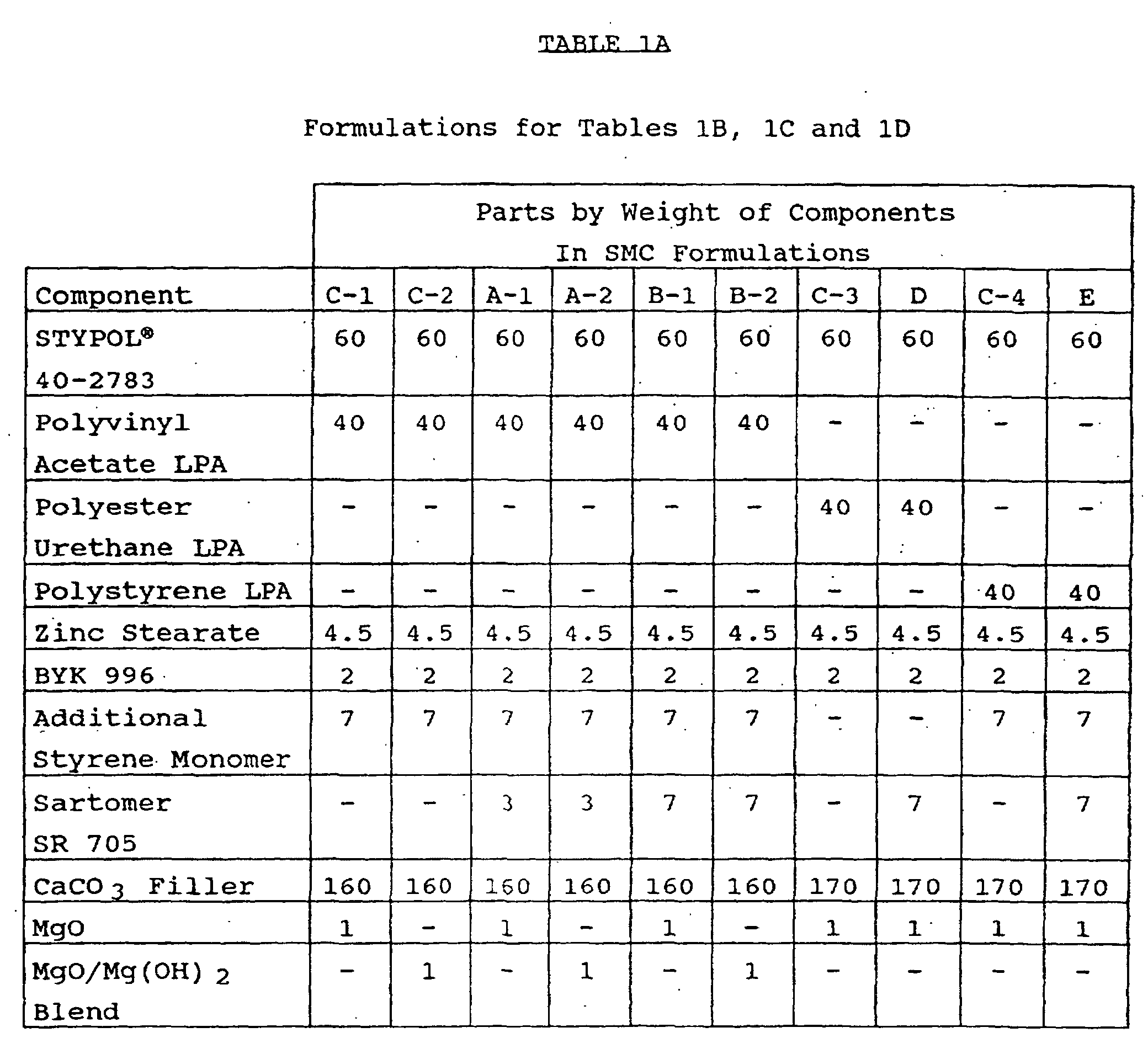
- STYPOL® 40-2783 is an unsaturated polyester resin made by Cook Composites and Polymers, Inc., which is a reaction product of propylene glycol and maleic anhydride, dissolved in styrene at a resin to styrene weight ratio in the range from 68:32 to 70:30.
- The polyvinyl acetate LPA is NEULON® G available from Union Carbide Chemicals and Plastics Technology Corporation.
- The polystyrene LPA is STYPOL® 40-0087 available from Cook Composites and Polymers, Inc.
- BYK 996 is a dispersant available from Byk Chemie.
- Sartomer SR705 is a zinc diacrylate powder made by the Sartomer Company.
- MgO is a magnesium oxide powder available from Barcroft Company.
- All of the components except MgO or MgO/Mg(OH)2 blend are mixed prior to adding MgO or MgO/Mg(OH)2 blend, respectively. Then the MgO or MgO/Mg(OH)2 blend is added and mixed to make the respective SMC compositions and the viscosity is measured immediately, then after 1 hour, for the data in Tables 1B and 1C, again after 24 hours, again after 48 hours, for the data in Table 1C again after 72 hours, and for the data in Tables 1B and 1C again after 96 hours. The results are shown in Tables 1B, 1C and 1D below. Viscosity at zero hours is defined as the viscosity just after mixing and addition of MgO. « Elapsed Time » refers to time measured from when MgO or MgO/Mg(OH)2 blend, respectively, is added and dispersed in the respective formulation. The abbreviation « pbw » refers to « parts by weight » and unless stated otherwise « pbw » refers to « parts by weight metal salt ».
- Table 1B below shows three SMC formulations in which the thickening agent is MgO. Formulation C-1 is comparative and formulations A-1 and B-1 are prepared according to the present invention.
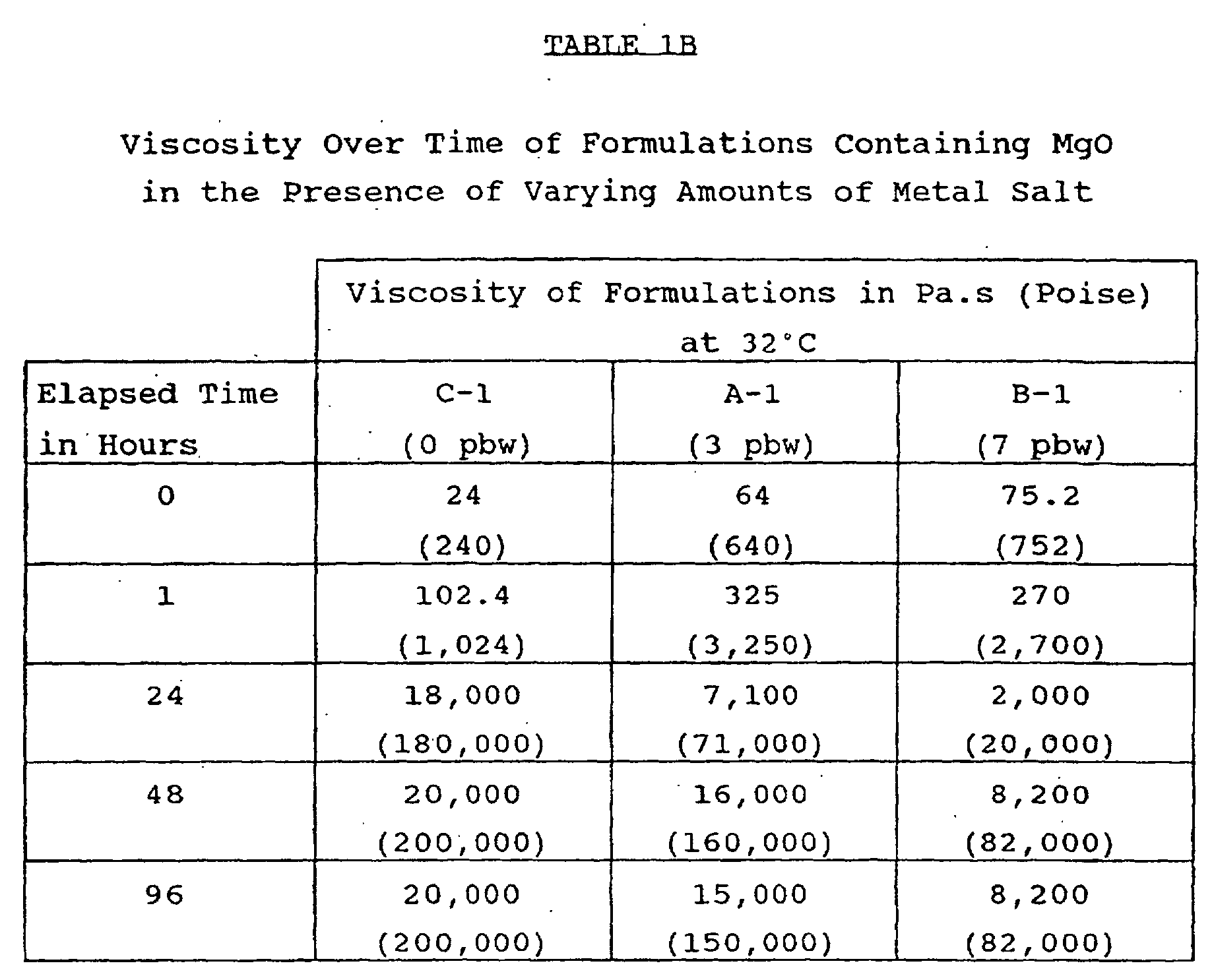
- As can be seen from the above data, SMC formulations A-1 and B-1 containing 3 and 7 parts by weight (pbw) metal salt (zinc diacrylate), respectively, according to the present invention have an initial viscosity more than twice that of comparative formulation C-1 containing the same ingredients except for the metal salt. The SMC formulation B-1 containing 7 pbw metal salt has a viscosity after 96 hours which is substantially less than the same SMC formulation after 96 hours containing 3 pbw metal salt, A-1. Formulation A-1 also has a viscosity after 96 hours that is substantially less than that of comparative formulation C-1 without the metal salt. Overall, this data shows that the addition of the metal salt to the SMC formulation accelerates initial maturation and then reduces the long term maturation rate, increasing the time period during which the SMC formulation may be molded under the desired lower pressure and temperature conditions. This provides a wider moldability window at a significantly lower viscosity and permits making molded articles at lower temperatures and pressures than those used in conventional SMC molding, which in turn allows for less expensive materials to be used in fabricating the mold.
- Table 1C below shows three SMC formulations in which the thickening agent is Mg(OH)2. Formulation C-2 is comparative and formulations A-2 and B-2 are prepared according to the present invention.

- As with the data in Table 1B based on MgO as the thickening agent, the addition of the metal salt to the SMC formulations based on Mg(OH)2 as the thickening agent accelerates initial maturation and then reduces the long term maturation rate, increasing the time period during which the SMC formulation may be molded under the desired lower pressure and temperature conditions.
- Table 1D below provides data on three SMC formulations of the present invention, each made with a different LPA, which are paired with three comparative SMC formulations with the same LPA but without the metal salt.
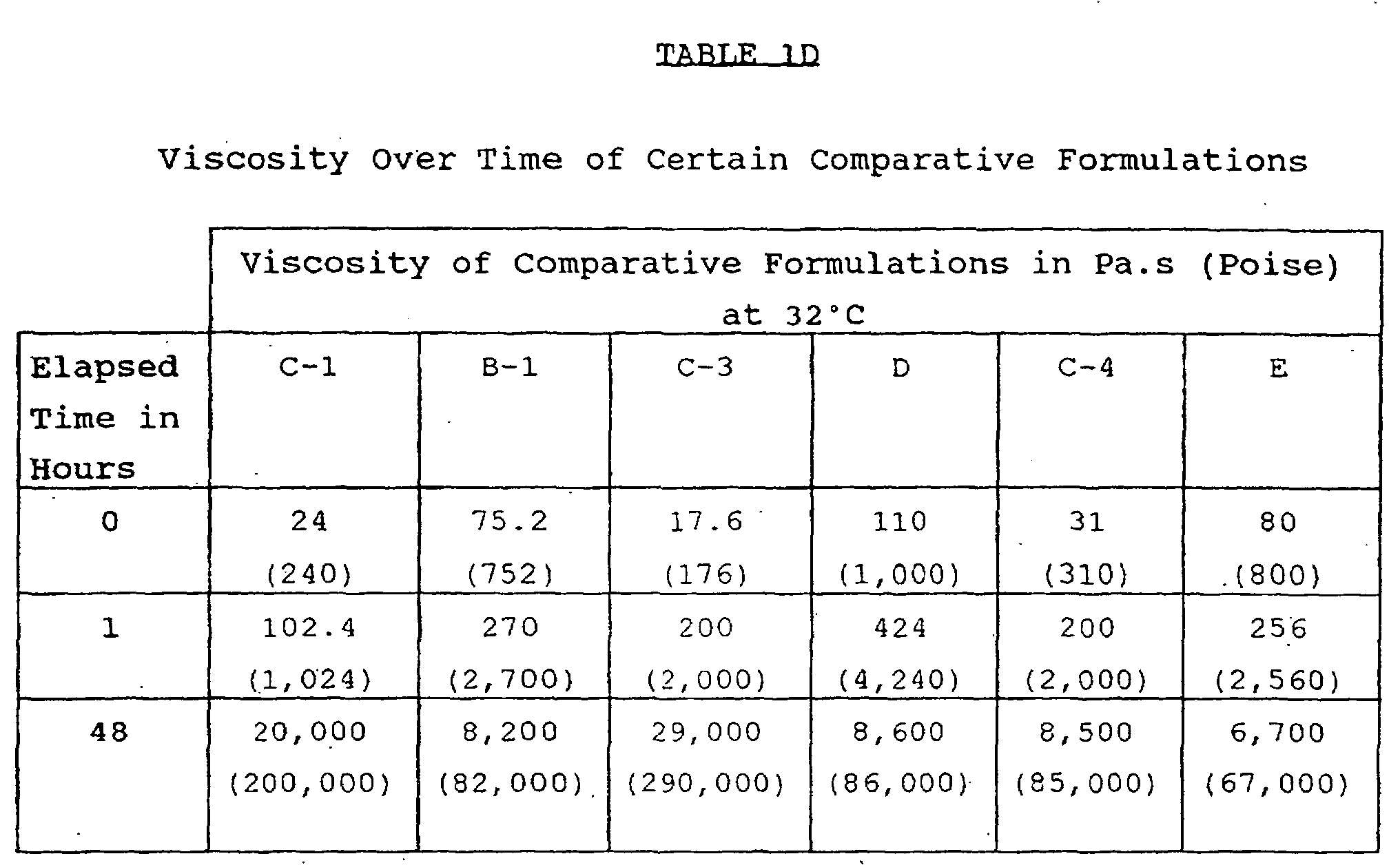
- As can be seen from Table 1D, formulations A, D and E of the present invention have a viscosity after one hour of maturation substantially greater than corresponding comparative formulations C-1, C-3 and C-4, respectively, during the same time period. Those formulations of the present invention again have a substantially lower viscosity than the corresponding comparative formulations C-1, C-3 and C-4 after 48 hours's maturation. This demonstrates the beneficial effect of the present invention on the maturation profile, namely faster initial maturation followed by slower maturation thereafter, with formulations containing different LPAs.
- Additional SMC formulations to demonstrate the stability of the SMC formulations of the present invention relative to formulations which do not contain the metal salt are described in Table 2A below.The polyvinyl acetate LPA and the polystyrene LPA are the same as in Table 1A.
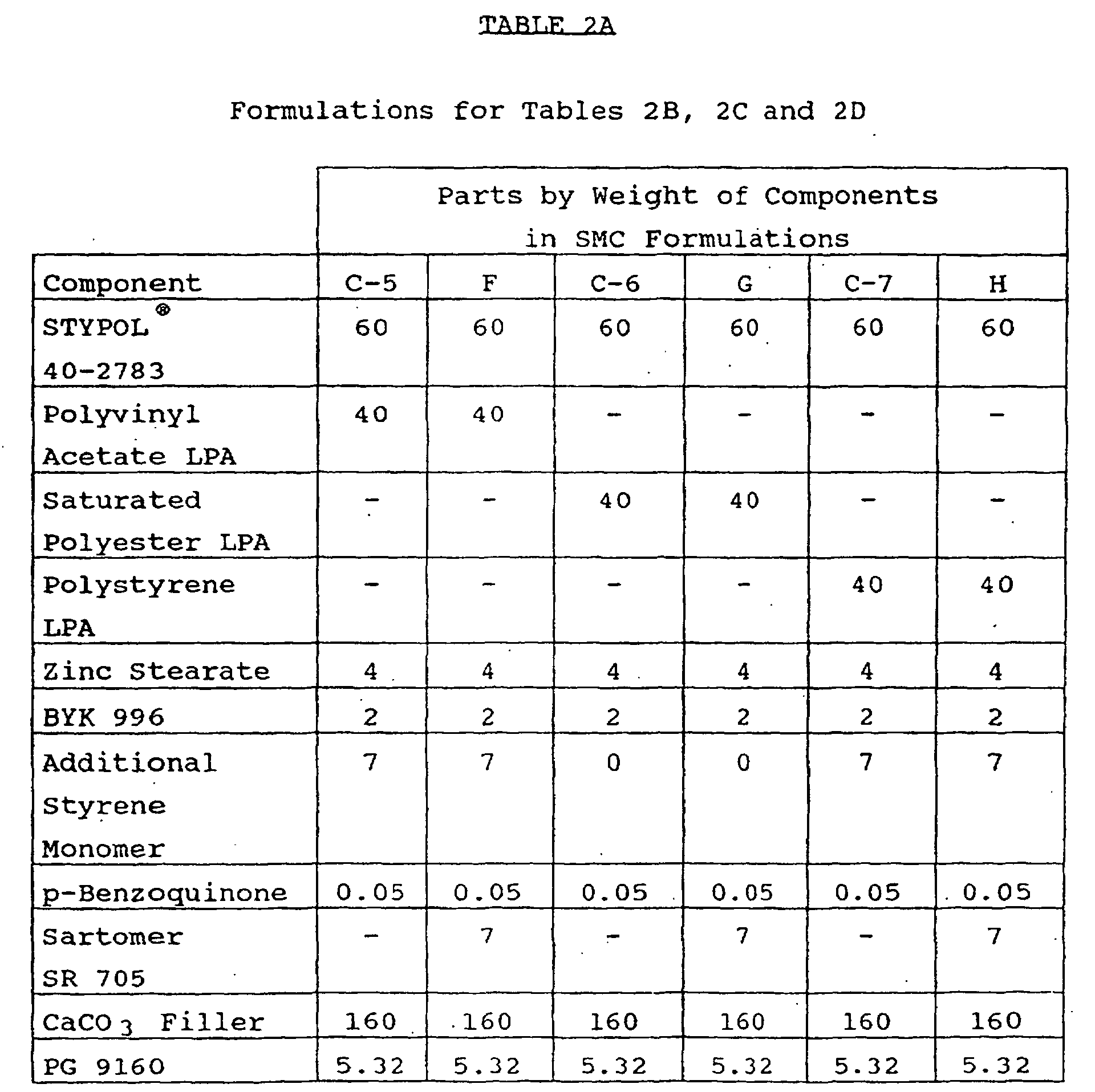
- PG 9160 is 20 wt.% MgO in an unsaturated polyester paste available from PLASTICOLORS.
- The viscosity of the above SMC formulations is measured at specific time intervals after the thickening agent is added and the data is reported in Tables 2B, 2C and 2D below.
- Table 2B below shows maturation of SMC formulations containing NEULON® G, a polyvinyl acetate
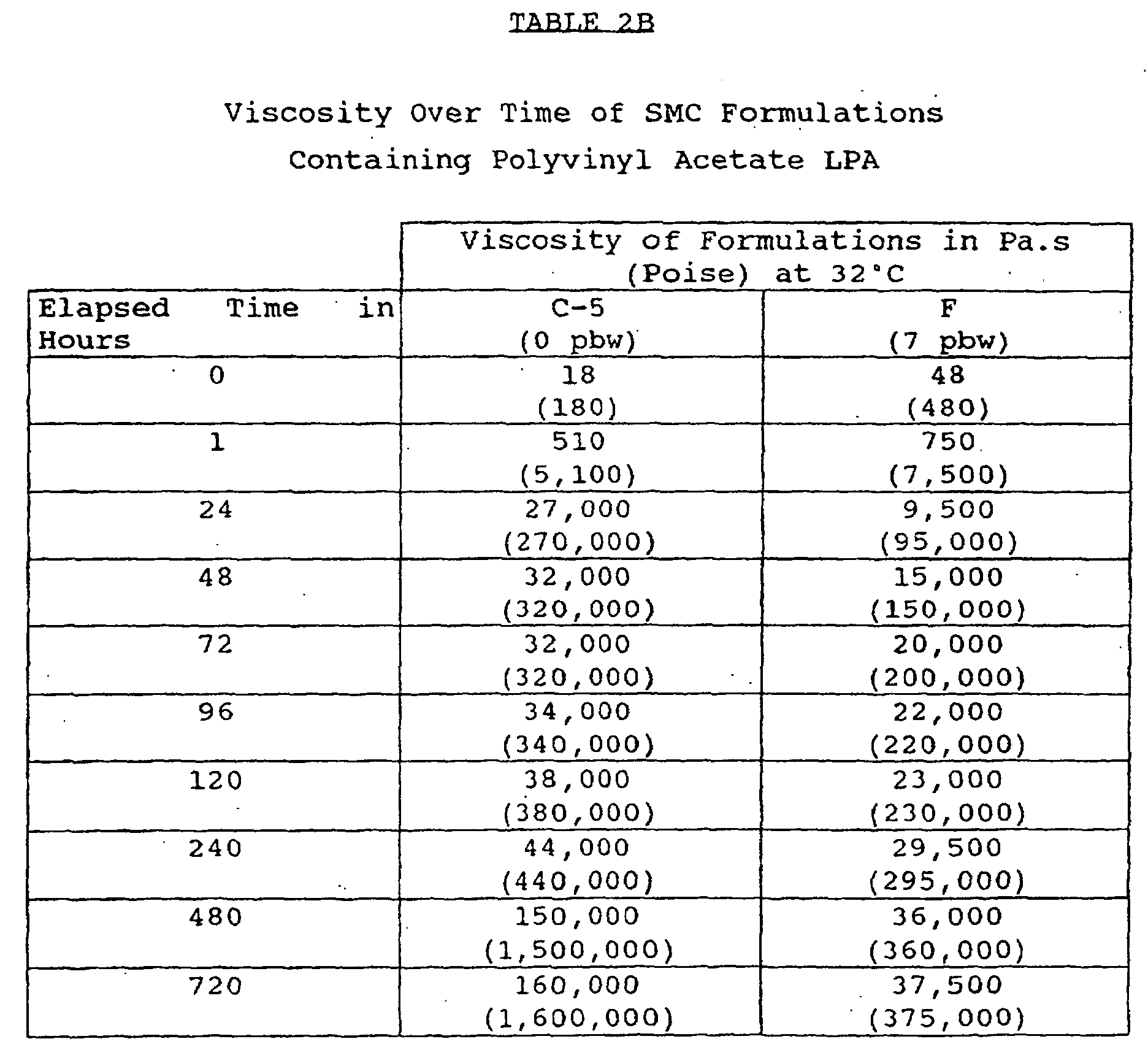
- The above data in Table 2B show that even when maturation of the SMC formulations is measured over a 720 hour (i.e., 30 day) period, the viscosity of the formulations containing metal salt according to the present invention remains substantially less than that of comparative formulation C-5 without the metal salt over the same time period.
- Table 2C below shows maturation of SMC formulations containing a saturated polyester LPA.

- Table 2D below shows maturation of SMC formulations containing a polystyrene LPA. Polystyrene LPA is incompatible with other components of the SMC formulation, so that it has a tendency toward phase separation over time.
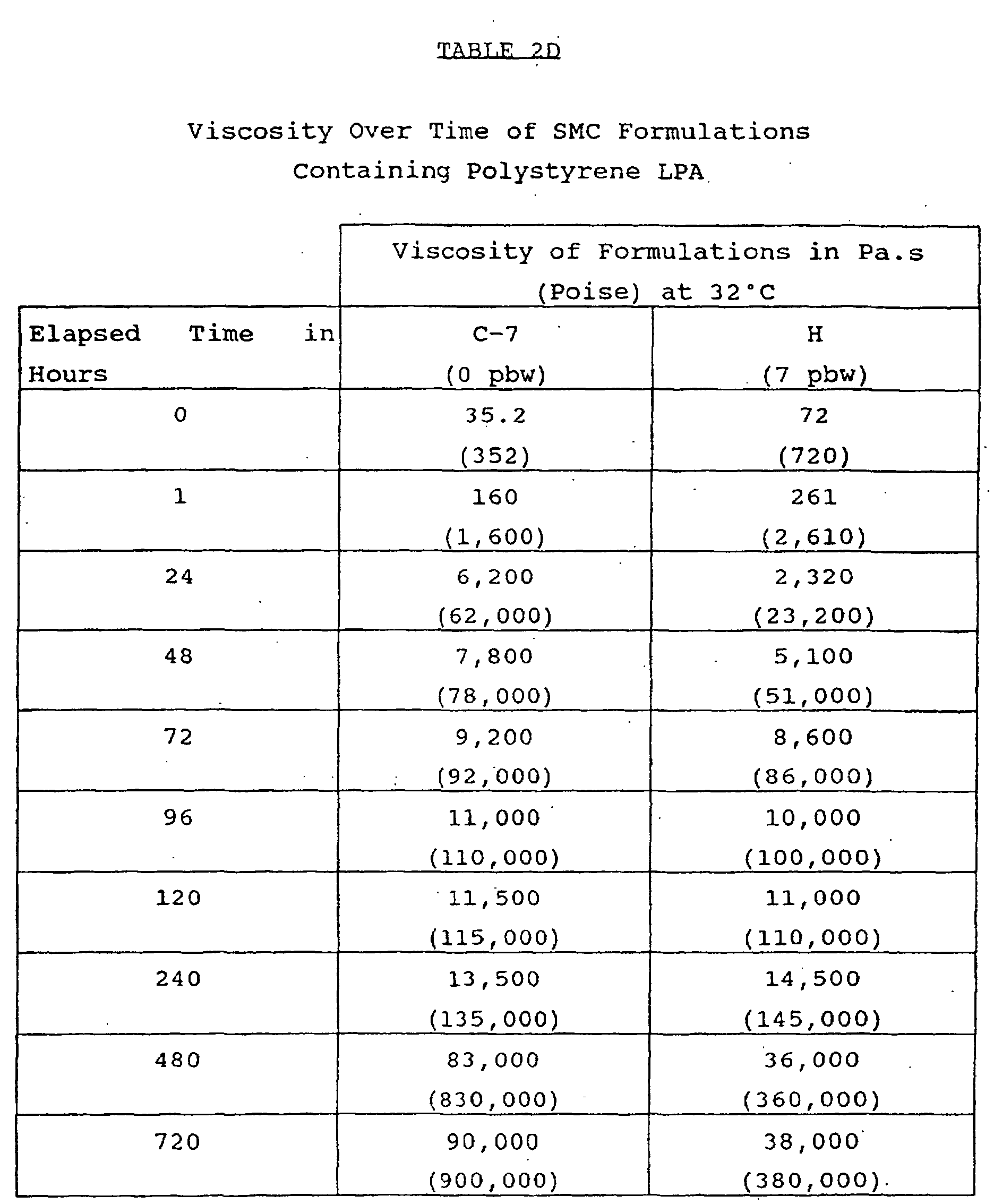
- The addition of metal salt to these SMC formulations also accelerates the initial maturation and yet permits a long time frame during which the viscosity is at a desired level for moldability.
- The above formulations are made without reinforcing material to facilitate measurement of viscosity during the thickening process. When used to make molded articles, these formulations may be combined with at least one of the reinforcing materials described above, such as fiberglass roving, to make a more typical SMC. An example of such a formulation with metal salt alongside a comparative without the metal salt is shown in Table 3A below.
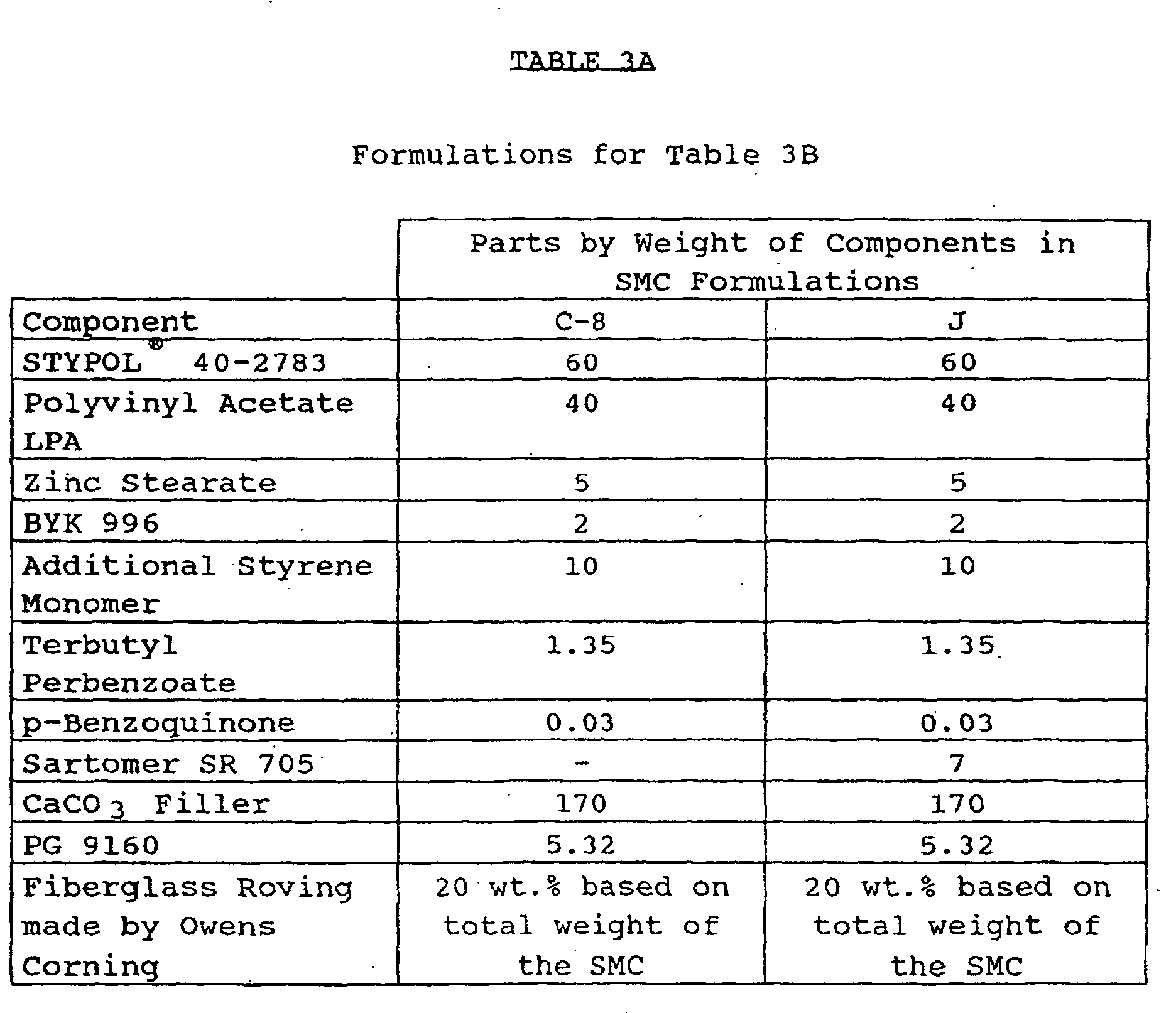
- Formulations C-8 and J are each molded in a flat panel compression press mold in which the male part of the mold is at 145°C and the female part of the mold is at 150°C so that the expected time interval from injection to cure is 3 minutes, at the pressures shown in Table 3B below to determine the effect of the metal salt on the compression molding process. The results are shown in Table 3B below.

- The above data show that when the SMC contains metal salt according to the present invention, the mold can be filled at just 0.34 MPa (50 psi) and cured in just 3 minutes. Without the metal salt, the same SMC could not fill the mold at a pressure less than 3.45 MPa (500 psi).
- The preceding examples are for illustrative purposes only, and these examples are not to be construed as a limitation upon the invention as described in the following claims.
Claims (36)
- A polyester resin-based molding composition comprising :(A) at least one unsaturated polyester resin having an acid number of at least 10;(B) at least one ethylenically unsaturated monomer copolymerizable with the unsaturated polyester resin;(C) at least one thickening agent comprising an oxide or hydroxide of a Group I, II or III metal; and(D) at least one multivalent metal salt which is ethylenically unsaturated and is represented by the formula :
- The composition of claim 1, wherein R has from 2 to 6 carbon atoms.
- The composition of claim 1 or 2, wherein the metal is Zn2+, Mg2+ or Ca2+, or a combination thereof.
- The composition of any one of claims 1 to 3, wherein the at least one metal salt (D) is zinc diacrylate.
- The composition of any one of claims 1 to 4, wherein the at least one metal salt (D) is dispersed in the composition as finely divided particles.
- The composition of claim 5, wherein at least 50 wt.% of the particles have a particle less than 5 microns.
- The composition of claims 5 or 6, wherein at least 50 wt.% of the particles have a particle size less than 2 microns.
- The composition of any one of claims 1 to 7, wherein the at least one thickening agent is an oxide or hydroxide of magnesium, calcium, barium or zinc, or a mixture thereof.
- The composition of any one of claims 1 to 8, wherein the at least one thickening agent comprises magnesium oxide.
- The composition of any one of claims 1 to 9, wherein the weight ratio of metal salt (D) to thickening agent (C) is at least 1:1.
- The composition of claim 10, wherein the weight ratio of metal salt (D) to thickening agent (C) is in the range from 2:1 to 7:1.
- The composition of any one of claims 1 to 11, which further comprises :(E) at least one thermoplastic low profile additive.
- The composition of any one of claims 1 to 12, which further comprises :(F) at least one filler;(G) at least one reinforcing material; and/or(H) at least one pigment.
- The composition of any one of claims 1 to 13, which further comprises :(J) at least one polymerization initiator.
- The composition of any one of claims 1 to 14, which comprises :10 to 30 wt.% unsaturated polyester resin (A);7 to 20 wt.% ethylenically unsaturated monomer (B);0.1 to 5 wt.% thickening agent (C);0.2 to 10 wt.% metal salt (D);3 to 30 wt.% thermoplastic low profile additive (E);20 to 50 wt.% filler (F); and10 to 50 wt.% reinforcing material (G).
- The composition according to any one of claims 1 to 15 which further comprises a component (K) consisting of at least one powder based on polymers of low surface tension, preferably having a Tg or Tm less than the curing process temperature, more preferably less than 150°C.
- The composition according to claim 16 wherein the at least one powder based on polymers of low surface tension is a micronized powder.
- The composition according to claim 16 or 17 wherein the at least one powder is selected from powders based on polyethylene or on ethylene copolymers.
- The composition according to claim 16 or 17 wherein the at least one powder is selected from powders based on fluorinated polymers.
- The composition according to claim 19 wherein the at least one powder is based on polytetrafluoroethylene.
- The composition according to any one of claims 16 to 20 wherein the weight ratio of component (K) ranges from 0 to 20, more preferably from 1 to 10 parts of component (K) for 100 parts of weight of the sum of the organic components.
- A process for producing a molded part comprising :(A) forming a polyester-based curable molding composition according to any one of claims 1 to 21 into a desired shape in a mold under an elevated pressure and(B) heating the formed composition in the mold at an elevated temperature
- The process of claim 22, wherein the elevated pressure does not exceed 3.45 MPa (500 psi) and the elevated temperature does not exceed 117°C (350°F).
- The process of claim 22, wherein the elevated pressure does not exceed 2.07 MPa (300 psi) and the elevated temperature does not exceed 149°C (300°F).
- The process of claim 22, wherein the elevated pressure does not exceed 1.38 MPa (200 psi) and the elevated temperature does not exceed 93°C (200°F).
- The process of claim 25, wherein the elevated pressure does not exceed 0.69 MPa (100 psi).
- A method for controlling maturation of polyester resin-based molding compositions having an unsaturated polyester resin in which at least 25% of the end groups are acidic, an ethylenically unsaturated monomer copolymerizable with the unsaturated polyester resin and a thickening agent comprising an oxide or hydroxide of a Group I, II or III metal comprising dispersing in the molding composition at least one multivalent metal salt which is ethylenically unsaturated and is represented by the formula :
- The method according to claim 27, wherein the molding composition is according to any one of claims 1 to 21.
- The method according to claims 27 or 28, wherein the metal salt is added to the molding composition in an amount in the range from 0.5 to 5 wt.% based on the weight of the SMC.
- The method according to any one of claims 27 to 29, wherein the viscosity of the molding composition one hour after addition of the thickening agent is at least 50% greater than the same composition after maturation without metal salt.
- The method according to any one of claims 27 to 30, wherein the viscosity of the molding composition 100 hours after addition of the thickening agent is not greater than 16,000 Pa.s (160,000 Poise).
- The method according to any one of claims 27 to 30, wherein the viscosity of the molding composition 100 hours after addition of the thickening agent is not greater than 12,000 Pa.s (120,000 Poise).
- The method according to any one of claims 27 to 30, wherein the viscosity of the molding composition 100 hours after addition of the thickening agent is not greater than 8,000 Pa.s (80,000 Poise).
- The method according to any one of claims 27 to 33, wherein the viscosity of the molding composition 240 hours after addition of the thickening agent is not greater than 24,000 Pa.s (240,000 Poise).
- The method according to anyone of claims 27 to 34, wherein the viscosity of the molding composition 360 hours after addition of the thickening agent is not greater than 24,000 Pa.s (240,000 Poise).
- The method according to any one of claims 27 to 35, wherein the viscosity of the molding composition 720 hours after addition of the thickening agent is not greater than 80,000 Pa.s (800,000 Poise).
Applications Claiming Priority (4)
| Application Number | Priority Date | Filing Date | Title |
|---|---|---|---|
| US6879197P | 1997-12-24 | 1997-12-24 | |
| US68791P | 1997-12-24 | ||
| US9916198P | 1998-09-04 | 1998-09-04 | |
| US99161P | 1998-09-04 |
Publications (3)
| Publication Number | Publication Date |
|---|---|
| EP0926188A2 EP0926188A2 (en) | 1999-06-30 |
| EP0926188A3 EP0926188A3 (en) | 2000-04-19 |
| EP0926188B1 true EP0926188B1 (en) | 2003-04-23 |
Family
ID=26749384
Family Applications (1)
| Application Number | Title | Priority Date | Filing Date |
|---|---|---|---|
| EP98403266A Expired - Lifetime EP0926188B1 (en) | 1997-12-24 | 1998-12-22 | Polyester resin-based compositions having improved thickening behavior |
Country Status (6)
| Country | Link |
|---|---|
| US (1) | US6225380B1 (en) |
| EP (1) | EP0926188B1 (en) |
| AT (1) | ATE238383T1 (en) |
| CA (1) | CA2257029A1 (en) |
| DE (1) | DE69813749T2 (en) |
| ES (1) | ES2197441T3 (en) |
Families Citing this family (7)
| Publication number | Priority date | Publication date | Assignee | Title |
|---|---|---|---|---|
| ZA994919B (en) * | 1998-08-21 | 2000-02-07 | Sartomer Co Inc | Unsaturated polyester resin compositions comprising metallic monomers. |
| US7078451B2 (en) * | 2002-12-19 | 2006-07-18 | Owens Corning Fiberglas Technology, Inc. | Formulation and process for compression molded component parts |
| CN1989161B (en) * | 2004-07-29 | 2010-05-05 | 大日本油墨化学工业株式会社 | Active energy ray curable resin composition for molding, sheet for molding, and molded article |
| WO2006095414A1 (en) * | 2005-03-08 | 2006-09-14 | Showa Highpolymer Co., Ltd. | Unsaturated polyester resin composition for lamp reflectors and moldings thereof |
| US7691311B2 (en) * | 2007-04-27 | 2010-04-06 | Vec Industries, L.L.C. | Method for manufacturing a glass fiber reinforced article, and a glass fiber reinforced article |
| GB2453308B (en) | 2007-10-03 | 2012-07-25 | Acell Group Ltd | Composite products |
| DE102007047837A1 (en) * | 2007-11-21 | 2009-05-28 | Wacker Chemie Ag | Preparation of solutions of vinyl polymers in reactive monomers |
Family Cites Families (37)
| Publication number | Priority date | Publication date | Assignee | Title |
|---|---|---|---|---|
| US2870113A (en) | 1955-04-06 | 1959-01-20 | Phillips Petroleum Co | Method for producing finely divided solid 1-olefin polymer |
| US3008946A (en) | 1956-05-25 | 1961-11-14 | Nu Plastics Inc | Production of polyethylene powder |
| BE600514A (en) | 1960-02-29 | |||
| US3701748A (en) | 1966-07-20 | 1972-10-31 | Rohm & Haas | Unsaturated polyester resinous compositions |
| DE1669704A1 (en) * | 1967-07-01 | 1971-03-25 | Basf Ag | Process for the production of molded parts from polyester molding compounds |
| US3557042A (en) * | 1967-10-30 | 1971-01-19 | Merck & Co Inc | Chemical thickening agent for unsaturated polyester resins |
| AT295843B (en) | 1967-11-21 | 1972-01-25 | Coathylene Sa | Process for the production of finely divided polypropylene powders |
| US3549586A (en) | 1969-04-01 | 1970-12-22 | Union Carbide Corp | Polyester compositions |
| US3718714A (en) | 1970-09-16 | 1973-02-27 | Union Carbide Corp | Unsaturated polyester compositions |
| JPS4926712B1 (en) | 1970-12-23 | 1974-07-11 | ||
| US3883612A (en) | 1971-06-07 | 1975-05-13 | Scm Corp | Low-shrink thermosetting polymers |
| US3909483A (en) | 1972-06-08 | 1975-09-30 | Hooker Chemicals Plastics Corp | Tack free polymerizable polyester compositions |
| US3933757A (en) | 1973-02-08 | 1976-01-20 | Scm Corporation | Dicyclopentadiene thermosetting polyester |
| US3929868A (en) | 1973-08-15 | 1975-12-30 | Eastman Kodak Co | Saturated polyester useful as low shrink additive for molding compositions containing unsaturated polyesters |
| US3971749A (en) | 1974-03-26 | 1976-07-27 | Hercules Incorporated | Method of preparing small particles of polypropylene |
| US3994853A (en) | 1974-04-09 | 1976-11-30 | Hooker Chemicals & Plastics Corporation | Tack free polymerizable polyester compositions |
| US3986922A (en) | 1975-04-14 | 1976-10-19 | Basf Wyandotte Corporation | Method of deinking printed waste cellulosic stock |
| US3988290A (en) * | 1975-04-30 | 1976-10-26 | Air Products And Chemicals, Inc. | Cobaltic promoters in unsaturated polyester resin sheet molding and bulk molding compound |
| US4035439A (en) | 1975-10-17 | 1977-07-12 | Scm Corporation | Low-shrink thermosetting polyesters |
| US4067845A (en) | 1975-12-08 | 1978-01-10 | The Budd Company | Maturation of polyester compositions for viscosity index control |
| US4421894A (en) | 1979-03-02 | 1983-12-20 | Olin Corporation | Polyurethane oligomer impact and shrinkage modifiers for thermoset polyesters |
| US4427877A (en) | 1981-09-28 | 1984-01-24 | Raychem Corporation | Printing on low surface energy polymers |
| US4500466A (en) | 1982-09-21 | 1985-02-19 | The Firestone Tire & Rubber Company | Method for preparing a zinc dimethacrylate powder having a specific surface area range |
| US4535110A (en) | 1984-06-25 | 1985-08-13 | The Budd Company | Dual functional additive |
| US4613628A (en) * | 1984-11-05 | 1986-09-23 | Ferro Enamels (Japan) Limited | Resin composition for closed-cell foam and cured resin foam prepared by using said resin composition |
| US4726590A (en) | 1984-12-10 | 1988-02-23 | Spalding & Evenflo Companies, Inc. | High coefficient golf ball core |
| US4837272A (en) | 1987-07-27 | 1989-06-06 | Kelley Donald W | Cross-linking of olefin polymers |
| US5516819A (en) | 1987-12-24 | 1996-05-14 | The University Of Manchester Institute Of Science And Technology | Polymer compositions |
| US5166291A (en) | 1988-07-20 | 1992-11-24 | Union Carbide Chemicals & Plastics Technology Corporation | Polyester compositions |
| US5202366A (en) | 1988-07-20 | 1993-04-13 | Union Carbide Chemicals & Plastics Technology Corporation | Crosslinkable polyester compositions with improved properties |
| JPH02226249A (en) * | 1989-02-28 | 1990-09-07 | Fuji Photo Film Co Ltd | Damping waterless photosensitive planographic printing plate |
| US5096943A (en) | 1990-04-16 | 1992-03-17 | Bridgestone/Firestone, Inc. | Method for incorporating metal salts of α,β-ethylenically unsaturated carboxylic acids in polymers |
| US5298562A (en) | 1991-08-19 | 1994-03-29 | Sartomer Company, Inc. | Calcium di(meth)acrylate cured halogenated polyethylene polymers |
| US5589538A (en) | 1991-12-31 | 1996-12-31 | Union Carbide Chemicals & Plastics Technology Corporation | Polyurethane low profile additives for polyester-based molding compositions |
| US5376721A (en) | 1993-01-29 | 1994-12-27 | Gencorp Inc. | Low-profile additives for thermosetting polyester compositions |
| US5629377A (en) * | 1993-03-10 | 1997-05-13 | The Dow Chemical Company | Water absorbent resin particles of crosslinked carboxyl containing polymers and method of preparation |
| US5681898A (en) | 1996-08-14 | 1997-10-28 | Pocklington; Terence W. | Golf ball and method of manufacture |
-
1998
- 1998-12-21 CA CA002257029A patent/CA2257029A1/en not_active Abandoned
- 1998-12-22 EP EP98403266A patent/EP0926188B1/en not_active Expired - Lifetime
- 1998-12-22 DE DE69813749T patent/DE69813749T2/en not_active Expired - Fee Related
- 1998-12-22 AT AT98403266T patent/ATE238383T1/en not_active IP Right Cessation
- 1998-12-22 ES ES98403266T patent/ES2197441T3/en not_active Expired - Lifetime
- 1998-12-22 US US09/218,875 patent/US6225380B1/en not_active Expired - Fee Related
Also Published As
| Publication number | Publication date |
|---|---|
| DE69813749D1 (en) | 2003-05-28 |
| CA2257029A1 (en) | 1999-06-24 |
| US6225380B1 (en) | 2001-05-01 |
| EP0926188A2 (en) | 1999-06-30 |
| ES2197441T3 (en) | 2004-01-01 |
| ATE238383T1 (en) | 2003-05-15 |
| EP0926188A3 (en) | 2000-04-19 |
| DE69813749T2 (en) | 2004-04-29 |
Similar Documents
| Publication | Publication Date | Title |
|---|---|---|
| US4172059A (en) | Low shrinking thermosetting molding compositions having reduced initial viscosity | |
| US5202366A (en) | Crosslinkable polyester compositions with improved properties | |
| US4102944A (en) | Low profile unsaturated polyester resin composition | |
| US4233413A (en) | Resin composition with low shrinkage | |
| EP1456288B1 (en) | Moulding compositions having increased toughness | |
| US4172102A (en) | Low-shrink unsaturated polyester molding compositions | |
| US6225380B1 (en) | Polyester resin-based compositions having improved thickening behavior | |
| AU2002363006A1 (en) | Molding compositions having improved properties | |
| US5236976A (en) | Polyester resin molding composition | |
| AU595335B2 (en) | Molding compositions providing improved surface characteristics | |
| US3665055A (en) | Polymerizable unsaturated polyester resin compositions and articles made therefrom | |
| US5004765A (en) | Low profile molding system | |
| US5116917A (en) | Thermoplastic polyester low profile additives for vinyl ester resinous compositions | |
| EP0335406A2 (en) | Low profile molding system | |
| US3894134A (en) | Method of making reinforced polyester sheets | |
| EP0052642B1 (en) | Flame retardant molding composition | |
| EP0553495B1 (en) | Pigmented unsaturated polyester-based molding compositions | |
| US3969311A (en) | Fiber reinforced polyester resin having a low surface profile | |
| DE3625184A1 (en) | LOW-DARK TENSIBLE POLYESTER RESIN | |
| US5254642A (en) | Thermoplastic polyester low profile additives for vinyl ester/polyester resinous compositions | |
| KR100201802B1 (en) | Low profile additive based on asymmetric glycols and aromatic diacids for polyester resin systems | |
| MXPA98010479A (en) | Polyester resin-based compositions having improved thickening behavior | |
| US4683266A (en) | Compositions thickened through urethane reaction | |
| EP0549827A1 (en) | Unsaturated polyester resin compostions, molding compounds and molded products therefrom | |
| CA1340666C (en) | Polyester compositions with improved properties |
Legal Events
| Date | Code | Title | Description |
|---|---|---|---|
| PUAI | Public reference made under article 153(3) epc to a published international application that has entered the european phase |
Free format text: ORIGINAL CODE: 0009012 |
|
| AK | Designated contracting states |
Kind code of ref document: A2 Designated state(s): AT BE CH DE DK ES FI FR GB IE IT LI NL PT SE |
|
| AX | Request for extension of the european patent |
Free format text: AL;LT;LV;MK;RO;SI |
|
| PUAL | Search report despatched |
Free format text: ORIGINAL CODE: 0009013 |
|
| AK | Designated contracting states |
Kind code of ref document: A3 Designated state(s): AT BE CH CY DE DK ES FI FR GB GR IE IT LI LU MC NL PT SE |
|
| AX | Request for extension of the european patent |
Free format text: AL;LT;LV;MK;RO;SI |
|
| 17P | Request for examination filed |
Effective date: 20000824 |
|
| AKX | Designation fees paid |
Free format text: AT BE CH DE DK ES FI FR GB IE IT LI NL PT SE |
|
| 17Q | First examination report despatched |
Effective date: 20001129 |
|
| GRAG | Despatch of communication of intention to grant |
Free format text: ORIGINAL CODE: EPIDOS AGRA |
|
| GRAG | Despatch of communication of intention to grant |
Free format text: ORIGINAL CODE: EPIDOS AGRA |
|
| GRAH | Despatch of communication of intention to grant a patent |
Free format text: ORIGINAL CODE: EPIDOS IGRA |
|
| GRAH | Despatch of communication of intention to grant a patent |
Free format text: ORIGINAL CODE: EPIDOS IGRA |
|
| GRAA | (expected) grant |
Free format text: ORIGINAL CODE: 0009210 |
|
| AK | Designated contracting states |
Designated state(s): AT BE CH DE DK ES FI FR GB IE IT LI NL PT SE |
|
| PG25 | Lapsed in a contracting state [announced via postgrant information from national office to epo] |
Ref country code: LI Free format text: LAPSE BECAUSE OF FAILURE TO SUBMIT A TRANSLATION OF THE DESCRIPTION OR TO PAY THE FEE WITHIN THE PRESCRIBED TIME-LIMIT Effective date: 20030423 Ref country code: FI Free format text: LAPSE BECAUSE OF FAILURE TO SUBMIT A TRANSLATION OF THE DESCRIPTION OR TO PAY THE FEE WITHIN THE PRESCRIBED TIME-LIMIT Effective date: 20030423 Ref country code: CH Free format text: LAPSE BECAUSE OF FAILURE TO SUBMIT A TRANSLATION OF THE DESCRIPTION OR TO PAY THE FEE WITHIN THE PRESCRIBED TIME-LIMIT Effective date: 20030423 Ref country code: AT Free format text: LAPSE BECAUSE OF FAILURE TO SUBMIT A TRANSLATION OF THE DESCRIPTION OR TO PAY THE FEE WITHIN THE PRESCRIBED TIME-LIMIT Effective date: 20030423 |
|
| REG | Reference to a national code |
Ref country code: GB Ref legal event code: FG4D |
|
| REG | Reference to a national code |
Ref country code: CH Ref legal event code: EP |
|
| REF | Corresponds to: |
Ref document number: 69813749 Country of ref document: DE Date of ref document: 20030528 Kind code of ref document: P |
|
| REG | Reference to a national code |
Ref country code: IE Ref legal event code: FG4D |
|
| PG25 | Lapsed in a contracting state [announced via postgrant information from national office to epo] |
Ref country code: SE Free format text: LAPSE BECAUSE OF FAILURE TO SUBMIT A TRANSLATION OF THE DESCRIPTION OR TO PAY THE FEE WITHIN THE PRESCRIBED TIME-LIMIT Effective date: 20030723 Ref country code: PT Free format text: LAPSE BECAUSE OF FAILURE TO SUBMIT A TRANSLATION OF THE DESCRIPTION OR TO PAY THE FEE WITHIN THE PRESCRIBED TIME-LIMIT Effective date: 20030723 Ref country code: DK Free format text: LAPSE BECAUSE OF FAILURE TO SUBMIT A TRANSLATION OF THE DESCRIPTION OR TO PAY THE FEE WITHIN THE PRESCRIBED TIME-LIMIT Effective date: 20030723 |
|
| REG | Reference to a national code |
Ref country code: CH Ref legal event code: PL |
|
| PGFP | Annual fee paid to national office [announced via postgrant information from national office to epo] |
Ref country code: NL Payment date: 20031205 Year of fee payment: 6 |
|
| PGFP | Annual fee paid to national office [announced via postgrant information from national office to epo] |
Ref country code: GB Payment date: 20031217 Year of fee payment: 6 |
|
| PGFP | Annual fee paid to national office [announced via postgrant information from national office to epo] |
Ref country code: FR Payment date: 20031218 Year of fee payment: 6 |
|
| PG25 | Lapsed in a contracting state [announced via postgrant information from national office to epo] |
Ref country code: IE Free format text: LAPSE BECAUSE OF NON-PAYMENT OF DUE FEES Effective date: 20031222 |
|
| PGFP | Annual fee paid to national office [announced via postgrant information from national office to epo] |
Ref country code: ES Payment date: 20031230 Year of fee payment: 6 |
|
| REG | Reference to a national code |
Ref country code: ES Ref legal event code: FG2A Ref document number: 2197441 Country of ref document: ES Kind code of ref document: T3 |
|
| PGFP | Annual fee paid to national office [announced via postgrant information from national office to epo] |
Ref country code: DE Payment date: 20040102 Year of fee payment: 6 |
|
| ET | Fr: translation filed | ||
| PGFP | Annual fee paid to national office [announced via postgrant information from national office to epo] |
Ref country code: BE Payment date: 20040212 Year of fee payment: 6 |
|
| PLBE | No opposition filed within time limit |
Free format text: ORIGINAL CODE: 0009261 |
|
| STAA | Information on the status of an ep patent application or granted ep patent |
Free format text: STATUS: NO OPPOSITION FILED WITHIN TIME LIMIT |
|
| 26N | No opposition filed |
Effective date: 20040126 |
|
| REG | Reference to a national code |
Ref country code: IE Ref legal event code: MM4A |
|
| PG25 | Lapsed in a contracting state [announced via postgrant information from national office to epo] |
Ref country code: GB Free format text: LAPSE BECAUSE OF NON-PAYMENT OF DUE FEES Effective date: 20041222 |
|
| PG25 | Lapsed in a contracting state [announced via postgrant information from national office to epo] |
Ref country code: ES Free format text: LAPSE BECAUSE OF NON-PAYMENT OF DUE FEES Effective date: 20041223 |
|
| PG25 | Lapsed in a contracting state [announced via postgrant information from national office to epo] |
Ref country code: BE Free format text: LAPSE BECAUSE OF NON-PAYMENT OF DUE FEES Effective date: 20041231 |
|
| BERE | Be: lapsed |
Owner name: *COOK COMPOSITES AND POLYMERS CY Effective date: 20041231 |
|
| PG25 | Lapsed in a contracting state [announced via postgrant information from national office to epo] |
Ref country code: NL Free format text: LAPSE BECAUSE OF NON-PAYMENT OF DUE FEES Effective date: 20050701 Ref country code: DE Free format text: LAPSE BECAUSE OF NON-PAYMENT OF DUE FEES Effective date: 20050701 |
|
| GBPC | Gb: european patent ceased through non-payment of renewal fee |
Effective date: 20041222 |
|
| PG25 | Lapsed in a contracting state [announced via postgrant information from national office to epo] |
Ref country code: FR Free format text: LAPSE BECAUSE OF NON-PAYMENT OF DUE FEES Effective date: 20050831 |
|
| NLV4 | Nl: lapsed or anulled due to non-payment of the annual fee |
Effective date: 20050701 |
|
| REG | Reference to a national code |
Ref country code: FR Ref legal event code: ST |
|
| PG25 | Lapsed in a contracting state [announced via postgrant information from national office to epo] |
Ref country code: IT Free format text: LAPSE BECAUSE OF NON-PAYMENT OF DUE FEES Effective date: 20051222 |
|
| REG | Reference to a national code |
Ref country code: ES Ref legal event code: FD2A Effective date: 20041223 |
|
| BERE | Be: lapsed |
Owner name: *COOK COMPOSITES AND POLYMERS CY Effective date: 20041231 |