EP0926127B1 - Procédé de préparation de composés alfa, bêta-dicarbonylés acycliques - Google Patents
Procédé de préparation de composés alfa, bêta-dicarbonylés acycliques Download PDFInfo
- Publication number
- EP0926127B1 EP0926127B1 EP98403160A EP98403160A EP0926127B1 EP 0926127 B1 EP0926127 B1 EP 0926127B1 EP 98403160 A EP98403160 A EP 98403160A EP 98403160 A EP98403160 A EP 98403160A EP 0926127 B1 EP0926127 B1 EP 0926127B1
- Authority
- EP
- European Patent Office
- Prior art keywords
- carbon atoms
- oxygen
- ethyl
- process according
- radical containing
- Prior art date
- Legal status (The legal status is an assumption and is not a legal conclusion. Google has not performed a legal analysis and makes no representation as to the accuracy of the status listed.)
- Expired - Lifetime
Links
Classifications
-
- C—CHEMISTRY; METALLURGY
- C07—ORGANIC CHEMISTRY
- C07C—ACYCLIC OR CARBOCYCLIC COMPOUNDS
- C07C45/00—Preparation of compounds having >C = O groups bound only to carbon or hydrogen atoms; Preparation of chelates of such compounds
- C07C45/27—Preparation of compounds having >C = O groups bound only to carbon or hydrogen atoms; Preparation of chelates of such compounds by oxidation
- C07C45/32—Preparation of compounds having >C = O groups bound only to carbon or hydrogen atoms; Preparation of chelates of such compounds by oxidation with molecular oxygen
- C07C45/33—Preparation of compounds having >C = O groups bound only to carbon or hydrogen atoms; Preparation of chelates of such compounds by oxidation with molecular oxygen of CHx-moieties
-
- C—CHEMISTRY; METALLURGY
- C07—ORGANIC CHEMISTRY
- C07C—ACYCLIC OR CARBOCYCLIC COMPOUNDS
- C07C67/00—Preparation of carboxylic acid esters
- C07C67/30—Preparation of carboxylic acid esters by modifying the acid moiety of the ester, such modification not being an introduction of an ester group
- C07C67/333—Preparation of carboxylic acid esters by modifying the acid moiety of the ester, such modification not being an introduction of an ester group by isomerisation; by change of size of the carbon skeleton
Definitions
- the present invention relates to a process for the preparation of acyclic ⁇ , ⁇ -dicarbonyl compounds.
- R 2 represents an alkyl radical containing from 1 to 6 carbon atoms or an ethoxy radical, or a phenyl radical or a benzyl radical which can be variously substituted on the ring, in particular by alkyl substituents containing from 1 to 6 carbon atoms , by alkoxy substituents containing from 1 to 4 carbon atoms or by halogen substituents or a carboxylic ester radical containing from 2 to 5 carbon atoms and R 3 represents an alkyl radical containing from 1 to 4 carbon atoms, or a radical alkoxy containing from 1 to 4 carbon atoms or a carboxylic ester radical containing from 2 to 5 carbon atoms, characterized in that an ⁇ , ⁇ dicarbonylated acyclic compound of formula (II) is reacted in a nitrile type solvent
- the acyclic ⁇ , ⁇ -dicarbonylated compounds of formula I relate essentially ⁇ -ketoesters which provide access to ⁇ -keto acids and their derivatives which are very interesting molecules both for their use in biological systems and in organic synthesis. Indeed, some ⁇ -keto acids are used in the treatment of dialysis patients, it is the case for example for methylethylpyruvic acid, dimethylpyruvic acid or isopropylpyruvic acid. In addition they are of great interest as intermediary for many syntheses such as those of drugs, inhibiting enzymes, ⁇ -hydroxy acids, c-nucleosides, natural products, as well as for the synthesis of a large number of heterocycles.
- They can also be ⁇ - ⁇ -diketones, compounds very interesting for their use in organic synthesis.
- the method according to the present invention allows obtaining in a way economical and with good yields, ⁇ , ⁇ -dicarbonylated compounds acyclics of formula (I) above.
- alkyl radical containing 1 to 6 carbon atoms represents for example a methyl, ethyl, propyl, butyl, hexyl, cyclohexyl radical, preferably a radical methyl or ethyl and particularly an ethyl radical.
- the phenyl radical or the radical benzyl can be variously substituted on the cycle by one or more substituents, preferably by 3 or 2 or 1 alkyl substituents containing from 1 to 6 carbon atoms, alkoxy containing 1 to 4 carbon atoms or halogen, preferably chlorine or bromine and is preferably found without substitution.
- alkoxy radical containing from 1 to 4 carbon atoms represents for example, a radical butoxy or propyloxy or ethoxy or methoxy, preferably an ethoxy radical or methoxy and particularly ethoxy.
- carboxylic ester radical containing 2 to 5 carbon atoms represents by example a butyl or propyl or ethyl or methyl carboxylate, preferably an ethyl or methyl carboxylate radical and particularly a ethyl carboxylate.
- the radical term ⁇ -ketocarboxylate of alkyl containing 3 to 6 carbon atoms represents by example an ⁇ -ketocarboxylate radical of butyl or propyl or ethyl or methyl, preferably a radial ⁇ -ethyl or methyl ketocarboxylate and particularly an ethyl ⁇ -ketocarboxylate radical.
- the nitrile type reaction solvent will be of aliphatic nitrile type, especially acetonitrile.
- the amount of "copper nitrate" or ferric chloride will between 0.1 molar equivalent and 0.001 molar equivalent or more particularly between 0.05 and 0.01 molar equivalent relative to the substrate of start of formula (II).
- the reaction will be carried out in an oxygen saturated medium by bubbling oxygen or air into the reaction medium.
- the reaction will be carried out in an oxygen saturated medium carried out under oxygen pressure of 10.13 10 4 Pa to 50.65 10 4 Pa (1 to 5 atmospheres).
- the oxygen used comes from an air flow or pressure of air.
- the method according to the invention will be implemented more particularly at room temperature but can be carried out at higher temperature if you want to reduce the reaction time or the amount of catalyst used.
- the process according to the invention is favored by greater dilution of the substrate in the nitrile type solvent but that, for industrial use of the process, we prefer to work at a concentration by weight of the order of 20 to 25% of the substrate in the nitrile type solvent.
- the method according to the invention is advantageously implemented by mixing in a container such as a three-necked flask, for 1 molar equivalent of substrate of formula II, from 0.05 to 0.01 molar equivalent of copper nitrate "or ferric chloride and from 75 to 80% by weight of nitrile type solvent by relative to the weight of the substrate.
- the mixture is stirred while maintaining it at the desired temperature, most often at room temperature, in particular by saturating the reaction atmosphere with oxygen by bubbling or a pressure of 10.13 10 4 Pa at 50.65 10 4 Pa (1 to 5 atmospheres).
- the ⁇ , ⁇ -dicarbonylated compound is then assayed in the reaction medium acyclic formed.
- This product can be isolated and purified by methods known per se, and explained in the examples illustrating the present invention.
- the present application also relates to the application of the above process obtaining ⁇ , ⁇ -dicarbonylated acyclic compounds of formula (I) cited above and in particular those above.
- the mixture is stirred under bubbling oxygen (100 ml / min) in now a temperature of 20-25 ° C with a water bath.
- the mixture is stirred at 20 ° C under oxygen bubbling ( ⁇ 30 ml / min.).
- the dose is measured in the medium by HPLC (by external calibration, after approximation with methoxylamine) 0.78 g of ethyl ⁇ -ketobutyrate, ie a yield of 80%.
- the mixture is stirred at 20 ° C under oxygen bubbling ( ⁇ 30 ml / min).
- Cu II nitrate has substantially the same reactivity in different aliphatic nitriles. It is slightly lower in aromatic nitriles.
- the efficiency of the Cu (NO 3 ) 2 , 3H 2 O and FeCl 3 catalysts has been studied in various polar, apolar, protic and aprotic type solvents and in mixtures of solvents.
- the mixture is stirred at 20 ° C under oxygen bubbling ( ⁇ 30 ml / min).
- the ethyl ⁇ -ketobutyrate is assayed formed in the medium by HPLC (by external calibration after oximation with the methoxylamine).
- Copper II nitrate and ferric chloride exhibit catalytic activity only in acetonitrile. They have no activity in other solvents, especially in acetic acid and ethanol.
- the mixture is stirred at 20 ° C under oxygen bubbling ( ⁇ 30 ml / min).
- the reaction is favored by the increase in the amount of salt metallic. A higher temperature reduces this amount.
- the amount of nitrile is also important. A concentration of 20 to 25% of substrate in the mixture is preferred.
- the mixture is stirred while always maintaining the temperature below 40 ° C and the reactor is charged under 5 bars of oxygen. As soon as the pressure becomes less than 2 bars, oxygen is recharged (5 bars) and so continued until oxygen consumption is negligible (about 6 hours).
Landscapes
- Chemical & Material Sciences (AREA)
- Organic Chemistry (AREA)
- Organic Low-Molecular-Weight Compounds And Preparation Thereof (AREA)
- Low-Molecular Organic Synthesis Reactions Using Catalysts (AREA)
Description
- Kovacs, L. Recl. Trav. Chim. Pays-Bas 112, 471-496 (1996),
- Cooper, A.J.L. et al, Chem.Rev. 83, 321-358 (1983),
- Weinstock, L.M. et al, Synth. Comm. 11, 943 (1981),
- Wislicenus Ber 20 ., 592 (1887),
- Friedman, L. et Kosower, E. Organic Syntheses, Coll. Vol.lll, 510,
- Sohda, T. et al, Chem. Pharm. Bull. 30, 3601 (1982),
- Inokushi, T. et al, Chem. Lett. 8 , 1411-1414 (1994),
- Muckawa, H. et al,. Chem. Lett. 6, 1017-1020 (1994),
- Bouveault, L. et Locquin, R. Bull. Soc. Chim. Fr, 31, 1049,1055, 1061, 1143 (1904),
- Locquin, R. Bull Soc. Chim. Fr. 31 , 1068,1147(1904),
- Si, Z et al, Synthesis 6 , 509-510 (1990).


- l'α-cétohexanoate d'éthyle
- l'α-cétobutyrate d'éthyle
- le phénylpyruvate d'éthyle
- le pyruvate d'éthyle
- le phénylglyoxylate d'éthyle
- le butane-2,3-dione
- le mésoxalate de diéthyle
- 24,7 g (0,13 mol., 1 éq.) de 2-n butylacétoacétate d'éthyle (pureté 97 %)
- 0,3204 g (1,3 mmoles, 0,01 éq.) de nitrate de cuivre II trihydraté (pureté 99 % min)
- et 100 g d'acétonitrile.
- 0,98 g (6 mmoles) de 2-éthylacétoacétate d'éthyle (pureté ∼ 97 %),
- 0,0476 g (0,3 mmole, 0,05 éq.) de chlorure ferrique (pureté ∼ 98 %), et
- 23,5 g d'acétonitrile.
- 33 g de 2-benzylacétoacétate d'éthyle (pureté 98 % min) (0,147 moles),
- 1,80 g de nitrate de cuivre trihydraté (pureté 99 % min) (7,45 mmoles), et
- 300 g d'acétonitrile.
- 2,80 g de méthylmalonate de diéthyle (pureté 99 % ) (16 mmoles),
- 0,194 mg de nitrate de cuivre II trihydraté (pureté 99 % min) (0,8 mmole), et
- 32,2 g d'acétonitrile.
- 2,8 g (13 mmoles) de diéthyl-2oxalylbutyrate brut (synthétisé selon Organic Synthesis Coll. Vol. Il, 272-273),
- 0,151 g (0,65 mmole) de nitrate de cuivre Il trihydraté (pureté 99 % min.), et
- 32,2 g d'acétonitrile.
- 50 g de phényl malonate de diéthyle (pureté 98 %) (0,207 mole),
- 2,55 g de nitrate de cuivre (pureté 99 % min) (10,5 mmoles), et
- 450 g d'acétonitrile.
- 1,1571 g (9,7 mmoles) de 3-méthylacétylacétone (technique)
- 0,1188 g (0,48 mmole) de nitrate de cuivre II trihydraté (pureté 99 % min.), et
- 23,5 g d'acétonitrile.
- 0,656 g de 2-acétylmalonate de diéthyle techn. (3,24 mmoles),
- 0,0466 g de nitrate de cuivre II trihydraté (pureté 99 % min) (0,188 mmole), et
- 17 g d'acétonitrile.
- 0,98 g (6 mmoles) de 2-éthylacétoacétate d'éthyle (pureté - 97 %),
- du catalyseur à raison de 0,05 éq, et
- 23,5 g d'acétonitrile.
| Rdt (%) | ||||
| Essai | Catalyseurs | Solubilité | 2 h | 4 h |
| 1 | Cu(NO3)2, 3H2O | soluble | 75 | > 95 |
| 2 | Cu(ClO4)2, 6H2O | soluble | 8 | 27 |
| 3 | Cu(OAc)2,4H2O | soluble | 3 | 4 |
| 4 | CuCl2,2H2O | soluble | 3 | 7 |
| 5 | CuCl2 | soluble | 2 | 5 |
| 6 | Cu(SO4)2,5H2O | peu soluble | 3 | 4 |
| 7 | CuBr2 | soluble | 0 | 0 |
| 8 | CuCI | soluble | 0 | 4 |
| 9 | CuCO2,Cu(OH)2 | peu soluble | 0 | 0 |
| 10 | Cu acétylacétonate | peu soluble | 0 | 0 |
| 11 | Cu éthylacétoacétate | peu soluble | 0 | 0 |
| 12 | FeCl3 | soluble | 65 | 85 |
| 13 | Fe(NO3)3,9H2O | soluble | 24 | 27 |
| 14 | Co(OAc)2,4H2O | peu soluble | 1 | 4 |
| 15 | CoCl2,6H2O | soluble | 7 | 13 |
| 16 | Co(NO3)2,6H2O | soluble | 0 | 0 |
| 17 | Co(SO4)2,7H2O | peu soluble | 0 | 0 |
| 18 | Mn(OAc)2,H2O | peu soluble | 4 | 9 |
| 19 | MnCl2,4H2O | peu soluble | 2 | 3 |
| 20 | Mn(NO3)2,6H2O | soluble | 0 | 0 |
- 0,98 g (6 mmoles, 1 éq.) de 2-éthylacétoacétate d'éthyle (pureté ∼ 97 %)

- 0,98 g (6 mmoles) de 2-éthylacétoacétate d'éthyle (pureté ∼ 97 %),
- du catalyseur Cu(NO3)2,3H2O ou FeCl3 à raison de 0,05 éq. et divers solvants ou mélanges de solvants.
| Rdt (%) | ||||
| Essai | Catalyseurs | Solvant | 2 h | 4 h |
| 21 | Cu(NO3)2, 3H2O | acétonitrile | 75 | > 95 |
| 27 | Cu(NO3)2, 3H2O | acide acétique | 0 | 0 |
| 28 | Cu(NO3)2, 3H2O | éthanol | 0 | 0 |
| 29 | Cu(NO3)2, 3H2O | acétate d'éthyle | 0 | 0 |
| 30 | Cu(NO3)2, 3H2O | diméthylformamide | 0 | 0 |
| 31 | Cu(NO3)2, 3H2O | toluène | 0 | 0 |
| 32 | FeCl3 | acétonitrile | 65 | 85 |
| 33 | FeCl3 | acide acétique | 0 | 0 |
| 34 | FeCl3 | éthanol | 0 | 0 |
| 35 | FeCl3 | acétate d'éthyle | 0 | 0 |
| 36 | Cu(NO3)2, 3H2O | MeCN/eau(75-25) | 0 | 0 |
| 37 | Cu(NO3)2, 3H2O | MeCN/eau (95-5) | 19 | 33 |
| 38 | Cu(NO3)2, 3H2O | MeCN/toluène (30-70) | 35 | 47 |
| 39 | Cu(NO3)2, 3H2O | MeCN/toluène (5-95) | 0 | 0 |
| 40 | Cu(NO3)2, 3H2O | MeCN/MeCOOEt (5-95) | 0 | 0 |
| 41 | Cu(NO3)2, 3H2O | MeCN/MeCOOEt (10-90) | 15 | 28 |
| 42 | Cu(NO3)2, 3H2O | MeCN/MeCOOEt (20-80) | 45 | 65 |
- 0,98 g (6 mmoles) de 2-éthylacétoacétate d'éthyle (pureté ∼ 97 %),
- du catalyseur Cu(NO3)2,3H2O à raison de 0,05 éq. à 0,001 éq., et
- 23,5 g d'acétonitrile.
| Essai | Concentration massique en β-cétoester (%) | Quantité de catalyseur (% molaire) | température de réaction | Rdt (%) | |||
| 2h | 4h | 6h | 8h | ||||
| 43 | 4 | 5 | ambiante | 75 | > 95 | > 95 | > 95 |
| 44 | 8 | 5 | ambiante | 90 | > 95 | > 95 | > 95 |
| 45 | 4 | 1 | ambiante | 31 | 71 | 95 | > 95 |
| 46 | 12 | 1 | ambiante | 71 | 81 | 91 | > 95 |
| 47 | 20 | 1 | ambiante | 41 | 82 | 95 | > 95 |
| 48 | 30 | 1 | ambiante | 46 | 57 | 66 | 73 |
| 49 | 90 | 2 | ambiante | 17 | 21 | 34 | 48 |
| 50 | 20 | 0,1 | 50°C | / | / | > 95 | > 95 |
- 0,98 g (6 mmoles, 1 éq.) de 2-éthylacétoacétate d'éthyle (pureté ∼ 97 %)
- 0,0732 g (0,3 mmole 0,05 éq.) de nitrate de cuivre II trihydraté (pureté 99 % min), et
- 23,5 g d'acétonitrile.
- 135 g (0,85 mol, 1 éq.) de 2-éthylacétoacétate d'éthyle
- 2 g (0,0085 mol, 0,01 éq.) de nitrate de cuivre" trihydraté,
- 500 g d'acétonitrile.
Claims (9)
- Procédé de préparation de composés α,β-dicarbonylés acycliques de formule (I)dans laquelle R2 représente un radical alkyl renfermant de 1 à 6 atomes de carbone, ou un radical phényl ou un radical benzyl pouvant être diversement substitué sur le cycle par des substituants alkyl renfermant de 1 à 6 atomes de carbone, par des substituants alkoxy renfermant de 1 à 4 atomes de carbone ou par des substituants halogènes, ou un radical ester carboxylique renfermant de 2 à 5 atomes de carbone et R3 représente un radical alkyl renfermant de 1 à 4 atomes de carbone, ou un radical alkoxy renfermant de 1 à 4 atomes de carbone ou un radical ester carboxylique renfermant de 2 à 5 atomes de carbone, caractérisé par le fait que l'on fait réagir dans un solvant de type nitrile un composé α,γ dicarbonylé acyclique de formule (II)
 dans laquelle R1 représente un radical alkyl renfermant de 1 à 6 atomes de carbone ou un radical éthoxy, ou un radical α-cétocarboxylate d'alkyle renfermant de 3 à 6 atomes de carbone ou un radical ester carboxylique renfermant de 2 à 5 atomes de carbone et R2 et R3 ont les mêmes significations que précédemment, avec de l'oxygène moléculaire en présence de nitrate de cuivreII ou de chlorure ferrique comme catalyseur.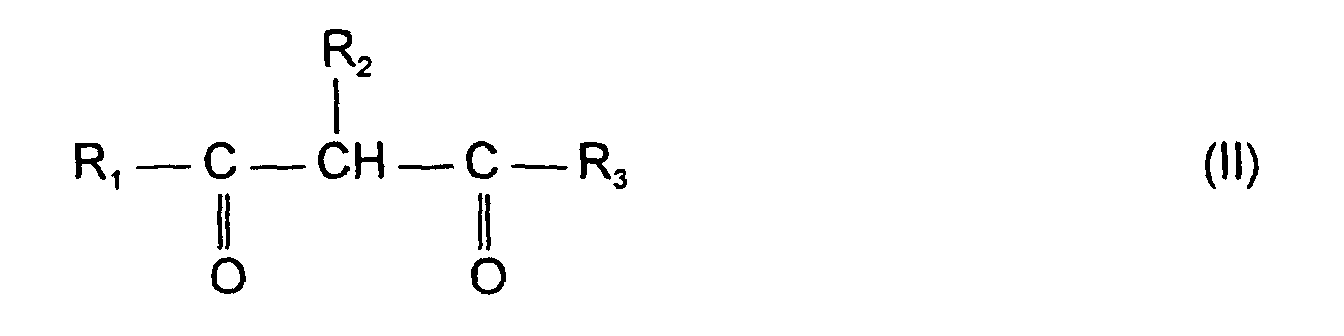
- Procédé selon la revendication 1, caractérisé par le fait que le solvant de la réaction est un solvant de type nitrile aliphatique ou aromatique.
- Procédé selon la revendication 2, caractérisé par le fait que le solvant de la réaction est du type nitrile aliphatique.
- Procédé selon l'une des revendications 1 à 3, caractérisé par le fait que la quantité de nitrate de cuivre" ou de chlorure ferrique est comprise entre 0,1 équivalent molaire et 0,001 équivalent molaire par rapport au substrat de départ de formule (II).
- Procédé selon la revendication 4, caractérisé par le fait que la quantité de nitrate de cuivre" ou de chlorure ferrique est comprise entre 0,05 équivalent molaire et 0,01 équivalent molaire par rapport au substrat de départ de formule générale (II).
- Procédé selon l'une des revendications 1 à 5, caractérisé par le fait que la réaction est effectuée en milieu saturé en oxygène réalisé par un barbotage d'oxygène ou d'air dans le mélange réactionnel.
- Procédé selon l'une des revendications 1 à 5, caractérisé par le fait que la réaction est effectuée en milieu saturé en oxygène réalisé sous pression d'oxygène de 10,13 104 Pa à 50,65 104 Pa (1 à 5 atmosphères).
- Procédé selon la revendication 6 ou selon la revendication 7, caractérisé par le fait que l'oxygène utilisé provient d'un débit d'air ou d'une pression d'air.
- Application du procédé selon l'une des revendications 1 à 8 à l'obtention de l'α-cétobutyrate d'éthyle, du phénylpyruvate d'éthyle, du pyruvate d'éthyle, du phénylglyoxylate d'éthyle, de la butane-2,3-dione ou du mésoxalate de diéthyle.
Applications Claiming Priority (2)
| Application Number | Priority Date | Filing Date | Title |
|---|---|---|---|
| FR9716588A FR2773151B1 (fr) | 1997-12-26 | 1997-12-26 | Procede de preparation de composes alpha, beta-dicarbonyles acycliques |
| FR9716588 | 1997-12-26 |
Publications (2)
| Publication Number | Publication Date |
|---|---|
| EP0926127A1 EP0926127A1 (fr) | 1999-06-30 |
| EP0926127B1 true EP0926127B1 (fr) | 2001-10-04 |
Family
ID=9515201
Family Applications (1)
| Application Number | Title | Priority Date | Filing Date |
|---|---|---|---|
| EP98403160A Expired - Lifetime EP0926127B1 (fr) | 1997-12-26 | 1998-12-15 | Procédé de préparation de composés alfa, bêta-dicarbonylés acycliques |
Country Status (5)
| Country | Link |
|---|---|
| US (1) | US6057474A (fr) |
| EP (1) | EP0926127B1 (fr) |
| JP (1) | JP3818785B2 (fr) |
| DE (1) | DE69801886T2 (fr) |
| FR (1) | FR2773151B1 (fr) |
Families Citing this family (1)
| Publication number | Priority date | Publication date | Assignee | Title |
|---|---|---|---|---|
| CN113651761B (zh) * | 2021-08-23 | 2023-06-23 | 上海恩氟佳科技有限公司 | 一种联苯吡嗪菌胺前体的合成方法 |
Family Cites Families (1)
| Publication number | Priority date | Publication date | Assignee | Title |
|---|---|---|---|---|
| US5523459A (en) * | 1994-03-25 | 1996-06-04 | Ube Industries, Ltd. | Preparation of α-keto acid ester |
-
1997
- 1997-12-26 FR FR9716588A patent/FR2773151B1/fr not_active Expired - Fee Related
-
1998
- 1998-12-15 DE DE69801886T patent/DE69801886T2/de not_active Expired - Lifetime
- 1998-12-15 EP EP98403160A patent/EP0926127B1/fr not_active Expired - Lifetime
- 1998-12-22 JP JP36405398A patent/JP3818785B2/ja not_active Expired - Fee Related
- 1998-12-22 US US09/217,616 patent/US6057474A/en not_active Expired - Lifetime
Also Published As
| Publication number | Publication date |
|---|---|
| FR2773151B1 (fr) | 2000-03-17 |
| JP3818785B2 (ja) | 2006-09-06 |
| DE69801886D1 (de) | 2001-11-08 |
| DE69801886T2 (de) | 2002-04-25 |
| FR2773151A1 (fr) | 1999-07-02 |
| JPH11279102A (ja) | 1999-10-12 |
| US6057474A (en) | 2000-05-02 |
| EP0926127A1 (fr) | 1999-06-30 |
Similar Documents
| Publication | Publication Date | Title |
|---|---|---|
| EP0566468B1 (fr) | Procédé de préparation d'un dérivé de biphényl | |
| CH636848A5 (fr) | Procede de production de n,n-di(ethyl)-meta-toluamide. | |
| EP0007834B1 (fr) | Procédé de préparation d'alpha aminoacides optiquement actifs et leurs dérivés | |
| EP0926127A1 (fr) | Procédé de préparation de composés alfa, bêta-dicarbonylés acycliques | |
| FR2730731A1 (fr) | Procede de carboxylation d'un ether aromatique | |
| EP0323332B1 (fr) | Perfectionnement à la production d'alcools tertiaires et secondaires par l'action d'un composé organique halogéné et du manganèse sur un composé porteur d'un groupe carbonyle | |
| US5852200A (en) | Cross-coupling of organic compounds using cuprous iodide | |
| WO1994024085A1 (fr) | NOUVEAU PROCEDE DE PREPARATION D'ACIDE β-ALCOXY ACRYLIQUE | |
| EP0931059B1 (fr) | Procede pour la preparation d'un cyanobiphenyle | |
| EP0249556B1 (fr) | Procédé de préparation d'esters organiques alpha-halogénés de l'acide carbonique | |
| EP1140813B1 (fr) | Procede de preparation de thioethers aromatiques de type diphenyle | |
| EP0768299B1 (fr) | Procédé de préparation de 2-amino-alcane-1,3,4-triols | |
| FR2687143A1 (fr) | Procede d'obtention de l'acide orthohydroxymandelique et de ses sels. | |
| EP0325072B1 (fr) | Perfectionnement à la préparation d'alcools tertiaires et secondaires par l'action d'un composé organo-manganeux sur un composé porteur de groupe carbonyle | |
| FR2540114A1 (fr) | Preparation de composes heterocycliques pentagonaux contenant au moins un atome d'azote adjacent a un groupement carbonyle | |
| JP3965704B2 (ja) | 光学活性な5−ヒドロキシ−3−オキソ−6−ヘプチン酸エステル誘導体の製造方法 | |
| EP0373993A1 (fr) | Procédé de préparation de composés énoliques et nouveaux produits obtenus | |
| FR2487825A1 (fr) | Procede de preparation d'esters d'acides acylazo-3 propioniques | |
| JPS6220986B2 (fr) | ||
| EP0165124B1 (fr) | Procédé de préparation d'acides hydratropiques et de leurs esters, à partir de propiophénones | |
| FR2504129A1 (fr) | Nouveau procede d'obtention de nitriles aromatiques | |
| FR2719310A1 (fr) | Nouveaux dérivés de l'acétaldéhyde, leur procédé de préparation et leur application. | |
| WO2001019766A1 (fr) | Procede de preparation de chlorures d'acides et d'aldehydes benzeniques | |
| WO1997024300A1 (fr) | Couplage croise de composes organiques a l'aide d'iodure cuivreux | |
| CH618670A5 (en) | Process for preparing pyrogallol and certain of its derivatives |
Legal Events
| Date | Code | Title | Description |
|---|---|---|---|
| PUAI | Public reference made under article 153(3) epc to a published international application that has entered the european phase |
Free format text: ORIGINAL CODE: 0009012 |
|
| AK | Designated contracting states |
Kind code of ref document: A1 Designated state(s): CH DE FR GB IT LI |
|
| AX | Request for extension of the european patent |
Free format text: AL;LT;LV;MK;RO;SI |
|
| RAP3 | Party data changed (applicant data changed or rights of an application transferred) |
Owner name: CLARIANT (FRANCE) S.A. |
|
| 17P | Request for examination filed |
Effective date: 19990825 |
|
| AKX | Designation fees paid |
Free format text: CH DE FR GB IT LI |
|
| 17Q | First examination report despatched |
Effective date: 20000502 |
|
| GRAG | Despatch of communication of intention to grant |
Free format text: ORIGINAL CODE: EPIDOS AGRA |
|
| GRAG | Despatch of communication of intention to grant |
Free format text: ORIGINAL CODE: EPIDOS AGRA |
|
| GRAG | Despatch of communication of intention to grant |
Free format text: ORIGINAL CODE: EPIDOS AGRA |
|
| GRAH | Despatch of communication of intention to grant a patent |
Free format text: ORIGINAL CODE: EPIDOS IGRA |
|
| GRAH | Despatch of communication of intention to grant a patent |
Free format text: ORIGINAL CODE: EPIDOS IGRA |
|
| GRAA | (expected) grant |
Free format text: ORIGINAL CODE: 0009210 |
|
| RAP1 | Party data changed (applicant data changed or rights of an application transferred) |
Owner name: CLARIANT (FRANCE) |
|
| AK | Designated contracting states |
Kind code of ref document: B1 Designated state(s): CH DE FR GB IT LI |
|
| REG | Reference to a national code |
Ref country code: CH Ref legal event code: NV Representative=s name: KIRKER & CIE SA Ref country code: CH Ref legal event code: EP |
|
| GBT | Gb: translation of ep patent filed (gb section 77(6)(a)/1977) |
Effective date: 20011004 |
|
| REF | Corresponds to: |
Ref document number: 69801886 Country of ref document: DE Date of ref document: 20011108 |
|
| REG | Reference to a national code |
Ref country code: GB Ref legal event code: IF02 |
|
| PLBE | No opposition filed within time limit |
Free format text: ORIGINAL CODE: 0009261 |
|
| STAA | Information on the status of an ep patent application or granted ep patent |
Free format text: STATUS: NO OPPOSITION FILED WITHIN TIME LIMIT |
|
| 26N | No opposition filed | ||
| PGFP | Annual fee paid to national office [announced via postgrant information from national office to epo] |
Ref country code: CH Payment date: 20131212 Year of fee payment: 16 Ref country code: DE Payment date: 20131210 Year of fee payment: 16 Ref country code: GB Payment date: 20131217 Year of fee payment: 16 |
|
| PGFP | Annual fee paid to national office [announced via postgrant information from national office to epo] |
Ref country code: IT Payment date: 20131211 Year of fee payment: 16 |
|
| PGFP | Annual fee paid to national office [announced via postgrant information from national office to epo] |
Ref country code: FR Payment date: 20131227 Year of fee payment: 16 |
|
| REG | Reference to a national code |
Ref country code: DE Ref legal event code: R119 Ref document number: 69801886 Country of ref document: DE |
|
| REG | Reference to a national code |
Ref country code: CH Ref legal event code: PL |
|
| GBPC | Gb: european patent ceased through non-payment of renewal fee |
Effective date: 20141215 |
|
| REG | Reference to a national code |
Ref country code: FR Ref legal event code: ST Effective date: 20150831 |
|
| PG25 | Lapsed in a contracting state [announced via postgrant information from national office to epo] |
Ref country code: CH Free format text: LAPSE BECAUSE OF NON-PAYMENT OF DUE FEES Effective date: 20141231 Ref country code: LI Free format text: LAPSE BECAUSE OF NON-PAYMENT OF DUE FEES Effective date: 20141231 Ref country code: DE Free format text: LAPSE BECAUSE OF NON-PAYMENT OF DUE FEES Effective date: 20150701 Ref country code: GB Free format text: LAPSE BECAUSE OF NON-PAYMENT OF DUE FEES Effective date: 20141215 |
|
| PG25 | Lapsed in a contracting state [announced via postgrant information from national office to epo] |
Ref country code: FR Free format text: LAPSE BECAUSE OF NON-PAYMENT OF DUE FEES Effective date: 20141231 |
|
| PG25 | Lapsed in a contracting state [announced via postgrant information from national office to epo] |
Ref country code: IT Free format text: LAPSE BECAUSE OF NON-PAYMENT OF DUE FEES Effective date: 20141215 |