EP0924408A2 - Methode zur Kühlung von Komponenten eines Gasturbinentriebwerks - Google Patents
Methode zur Kühlung von Komponenten eines Gasturbinentriebwerks Download PDFInfo
- Publication number
- EP0924408A2 EP0924408A2 EP98310588A EP98310588A EP0924408A2 EP 0924408 A2 EP0924408 A2 EP 0924408A2 EP 98310588 A EP98310588 A EP 98310588A EP 98310588 A EP98310588 A EP 98310588A EP 0924408 A2 EP0924408 A2 EP 0924408A2
- Authority
- EP
- European Patent Office
- Prior art keywords
- flow
- flow path
- heat exchanger
- working medium
- inlet
- Prior art date
- Legal status (The legal status is an assumption and is not a legal conclusion. Google has not performed a legal analysis and makes no representation as to the accuracy of the status listed.)
- Withdrawn
Links
- 238000001816 cooling Methods 0.000 title claims abstract description 95
- 238000000034 method Methods 0.000 title claims abstract description 18
- 239000007789 gas Substances 0.000 claims abstract description 92
- 230000003068 static effect Effects 0.000 claims abstract description 27
- 230000002411 adverse Effects 0.000 claims abstract description 15
- 238000004891 communication Methods 0.000 claims description 13
- 238000011144 upstream manufacturing Methods 0.000 claims description 7
- 230000037406 food intake Effects 0.000 claims description 6
- 239000012634 fragment Substances 0.000 claims description 5
- 230000001141 propulsive effect Effects 0.000 claims description 5
- 230000000903 blocking effect Effects 0.000 claims 2
- 239000000112 cooling gas Substances 0.000 abstract 1
- 206010070245 Foreign body Diseases 0.000 description 16
- 238000010276 construction Methods 0.000 description 14
- 230000006378 damage Effects 0.000 description 8
- 239000002184 metal Substances 0.000 description 7
- 238000005266 casting Methods 0.000 description 6
- 239000000446 fuel Substances 0.000 description 6
- 230000006835 compression Effects 0.000 description 5
- 238000007906 compression Methods 0.000 description 5
- 238000002485 combustion reaction Methods 0.000 description 4
- 239000002131 composite material Substances 0.000 description 4
- 239000012530 fluid Substances 0.000 description 4
- 238000009434 installation Methods 0.000 description 3
- 230000007423 decrease Effects 0.000 description 2
- 239000010687 lubricating oil Substances 0.000 description 2
- 239000000463 material Substances 0.000 description 2
- 239000003921 oil Substances 0.000 description 2
- 239000002245 particle Substances 0.000 description 2
- 230000035515 penetration Effects 0.000 description 2
- 238000011084 recovery Methods 0.000 description 2
- 208000027418 Wounds and injury Diseases 0.000 description 1
- 230000004323 axial length Effects 0.000 description 1
- 239000012809 cooling fluid Substances 0.000 description 1
- 238000010438 heat treatment Methods 0.000 description 1
- 208000014674 injury Diseases 0.000 description 1
- 238000007689 inspection Methods 0.000 description 1
- 239000007788 liquid Substances 0.000 description 1
- 230000001050 lubricating effect Effects 0.000 description 1
- 238000005461 lubrication Methods 0.000 description 1
- 230000001681 protective effect Effects 0.000 description 1
- 230000000630 rising effect Effects 0.000 description 1
- 230000001629 suppression Effects 0.000 description 1
- 230000007704 transition Effects 0.000 description 1
- 238000003466 welding Methods 0.000 description 1
Images


Classifications
-
- F—MECHANICAL ENGINEERING; LIGHTING; HEATING; WEAPONS; BLASTING
- F02—COMBUSTION ENGINES; HOT-GAS OR COMBUSTION-PRODUCT ENGINE PLANTS
- F02C—GAS-TURBINE PLANTS; AIR INTAKES FOR JET-PROPULSION PLANTS; CONTROLLING FUEL SUPPLY IN AIR-BREATHING JET-PROPULSION PLANTS
- F02C7/00—Features, components parts, details or accessories, not provided for in, or of interest apart form groups F02C1/00 - F02C6/00; Air intakes for jet-propulsion plants
- F02C7/12—Cooling of plants
- F02C7/14—Cooling of plants of fluids in the plant, e.g. lubricant or fuel
-
- Y—GENERAL TAGGING OF NEW TECHNOLOGICAL DEVELOPMENTS; GENERAL TAGGING OF CROSS-SECTIONAL TECHNOLOGIES SPANNING OVER SEVERAL SECTIONS OF THE IPC; TECHNICAL SUBJECTS COVERED BY FORMER USPC CROSS-REFERENCE ART COLLECTIONS [XRACs] AND DIGESTS
- Y02—TECHNOLOGIES OR APPLICATIONS FOR MITIGATION OR ADAPTATION AGAINST CLIMATE CHANGE
- Y02T—CLIMATE CHANGE MITIGATION TECHNOLOGIES RELATED TO TRANSPORTATION
- Y02T50/00—Aeronautics or air transport
- Y02T50/60—Efficient propulsion technologies, e.g. for aircraft
Definitions
- This invention relates to a method of cooling a component of a gas turbine engine using a coding system having a heat exchanger system.
- An axial flow rotary machine such as a gas turbine engine for an aircraft, has a compression section, a combustion section and a turbine section.
- the engine is mounted in a housing attached to the wing of the aircraft.
- the housing is commonly referred to as a nacelle.
- the nacelle both supports and positions the engine with respect to the aircraft.
- An annular primary flow path for working medium gases extends axially through the sections of the engine.
- the compression section commonly includes a fan section having a bypass duct.
- the bypass duct provides an annular flow path for secondary working medium gases which extends rearwardly about the primary flow path.
- a fan rotor assembly in the fan section includes an array of fan blades which extend outwardly across the primary and secondary flow paths.
- a plurality of fan exit guide vanes are disposed downstream of the fan blades in the fan duct to receive the relatively cool working medium gases of the secondary flow path.
- a plurality of struts are typically disposed downstream of the fan exit guide vanes to support the stator structure and to transmit loads from the engine to its supporting structure.
- the working medium gases in the fan duct have a mass flow which is six to eight times the mass flow in the primary flow, but with a relatively small pressure rise and a modest temperature rise.
- Various components in the engine generate heat such as an electrical generator or an oil system for providing lubricating fluid to rotating components in the engine. Oil or another liquid medium is used to carry away the heat is discharged to maintain operative temperatures of these components within acceptable limits to cooling air in the fan duct or another acceptable heat sink, such as fuel for the engine.
- Still another approach is to provide a heat exchanger disposed in a compartment of the nacelle which receives air from two sources: a pressurized compartment in flow communication with the compressor of the engine at low power; and, fan air from the fan bypass duct at high power. Cooling air is flowed from these locations to the heat exchanger and dumped overboard. Valves are required to interrupt the flow from the pressurized compartment at high power and to interrupt the flow from the fan duct at lower power.
- Another approach is to provide a flow path to a heat exchanger in a core compartment which extends from an inlet in the fan duct to an outlet at a downstream location in the fan duct.
- the outlet is spaced downstream a significant distance (several feet) such that the outlet is at a location having a lower static pressure than the inlet to the exchanger flow path.
- the inlet and outlet are spaced apart by this distance to avoid regions of the fan duct that have the same static pressure, which creates an adverse static pressure gradient (zero or slightly negative) between the inlet and outlet.
- the inlet protrudes into the fan duct such that it is spaced from the inner wall and the outer wall.
- the inlet faces the oncoming flow and drives cooling air through the flow path to the heat exchanger because of the difference in static pressure between the inlet and the outlet.
- the inlet structure is exposed to foreign object damage from ice and other debris which is ingested into the engine and centrifugal away from the inner wall to the interior of the fan duct. Such debris impacts the inlet to the heat exchanger and may be carried downstream to the heat exchanger where the debris may strike and block the heat exchanger.
- the cooling air As the cooling air is passed through the heat exchanger, the cooling air receives heat from components that are cooled by the heat exchanger.
- the heated air is discharged into the fan duct at the downstream location.
- the discharge temperature of the cooling air from the outlet of the flow path for the heat exchanger may approach unacceptable levels for the adjacent structure. This results from the heat load and level of cooling flow even though the distance between the inlet and outlet creates a difference in static pressure.
- a metal shield may be installed downstream of the exhaust. The shield is heated, and material radially inwardly of the shield, such as composite structures, are protected from the hot exhaust.
- a method for cooling a component, such as a heat exchanger, of a gas turbine engine using a fan duct cooling system includes the steps of passing cooling air through an inlet to the system at the inner wall of the fan duct that has a mass flow characteristic which is no greater than seventy-five percent, flowing cooling air from the fan bypass duct continuously through the heat exchanger under all operative conditions of the engine between locations on the wall of the fan duct having an adverse static pressure gradient, transferring heat to the cooling air in the heat exchanger and, returning the heated air to the working medium flow path to increase the propulsive energy of the gases in the working medium flow path.
- the step of flowing the working medium gases (cooling air) from the flow path continuously includes not actively modulating the flow of cooling air as the air is flowed along the flow path for air through the heat exchanger.
- the step of flowing cooling air from the fan duct continuously through the heat exchanger includes flowing the cooling air from an upstream location to a downstream location that are so close that an adverse static pressure gradient exists between the locations.
- the step of flowing the cooling air along the flow path includes the steps of exhausting the cooling air from the heat exchanger system and includes mixing the exhaust air (which are now heated by the heat exchanger) with working medium gases from the fan duct by directing the working medium gases radially inwardly and into the exhaust stream from the heat exchanger system.
- the step of directing working medium gases from the fan duct flow path radially inwardly into the exhaust stream of heated air from the heat exchanger system includes flowing the gases with a dynamic head which is greater than the dynamic head of the air from the heat exchanger system such that the fan duct gases impact the inner wall to block heated air from the heat exchanger from transferring heat to the inner wall.
- the step of flowing cooling air through the inlet includes flowing part of the cooling air passing through the first covered section of the inlet at a location which is radially inwardly of the undisturbed flow line for the working medium flow path to reduce the protrusion of the inlet into the free stream of the fan duct and into the path of foreign objects.
- the step of flowing gases through the inlet includes bounding the first covered section with an outer wall having an outer surface angled away from the intake and ducting the gases through the inlet sharply downwardly to impede the ingestion of foreign objects and to cause foreign objects, such as ice, to strike the walls and other structure bounding the flow path and fragment.
- a primary feature of the present invention is the step of flowing cooling air between locations having an adverse static pressure gradient. Another feature is the step of flowing the air continuously through a heat exchanger under all operative conditions of the engine. Another feature is the step of returning the heated cooling air to the working medium flow path to increase the propulsive energy of the gases in the flow path. Another feature is the step of mixing the hot exhaust air from the heat exchanger with working medium gases by directing the working medium gases from the fan duct flow path radially inwardly into the hot air from the heat exchanger system to shield the fan duct wall from hot air. In one detailed embodiment feature is the ratio of the dynamic head of the gases directed radially inwardly to the dynamic head of the gases exhausted from the heat exchanger.
- a primary advantage of the present invention is the engine efficiency which results from transferring heat to the flow taken from the fan duct and returning the flow after heating the flow. This adds energy to the cycle by mixing the flow with the working medium gases in the fan duct.
- Another advantage is the cost and simplicity of the system which results from flowing air continuously through the heat exchanger under all operative conditions of the engine which avoids the necessity of valving and control means for the valving.
- Another advantage is the compact system which results from withdrawing flow and returning flow at two locations between having an adverse static pressure gradient under normal operating conditions.
- Still another advantage is the engine efficiency that results from acceptable levels of drag and tolerance to foreign object ingestion which result from flowing the cooling air through the inlet inwardly of the line of uninterrupted flow.
- Fig. 1 is a side elevation view of an axial flow rotary machine such as a gas turbine engine 10.
- the engine is disposed within a housing, commonly referred to as a nacelle 12.
- the nacelle circumscribes the engine.
- the nacelle includes compartments for auxiliary equipment such as a nacelle fan compartment 14 and a nacelle core compartment 16.
- the nacelle is adapted to provide an aerodynamic housing for the engine.
- the engine has an axis of rotation Ar and is formed of a fan section 18, a compressor section 22, a combustion section 24 and a turbine section 26 whose relative locations are shown in Fig. 1.
- a primary flow path 28 for working medium gases extends rearwardly through these sections of the engines.
- the primary flow path enters the engine at the inner most portion of the inlet to the engine.
- the nacelle core compartment extends circumferentially about the engine and is spaced radially inwardly from the nacelle fan compartment leaving a fan bypass duct 32 therebetween.
- a secondary flow path 34 for working medium gases extends rearwardly through the bypass duct and outwardly of the secondary flow path.
- the fan bypass duct is bounded by an inner wall 36 and an outer wall 38.
- the inner wall and outer wall extend circumferentially about the axis of rotation A r of the engine.
- a plurality of fan blades (not shown) extend outwardly across the fan bypass duct to pressurize the working medium gases in the secondary flow path.
- a plurality of fan exit guide vanes as represented by the fan exit guide vane 42, extend radially between the inner wall and the outer wall to receive flow that is discharged from the fan blades.
- a plurality of struts, as represented by the strut 44 are downstream of the fan exit guide vanes. The struts extend radially between the inner wall and the outer wall and are circumferentially spaced for providing structural support to portions of the engine and to the nacelle.
- the fan bypass duct 32 has a fan discharge duct 46 downstream of the fan exit guide vanes 42.
- the fan discharge duct is characterized by a flow path having a negligible loss in total pressure along the flow path and characterized by a static pressure gradient in the rearward direction that is substantially non-existent (that is, the static pressures along the flow path are substantially equal) or that is rising in static pressure as a result of contouring of the flow path.
- a location 48 significantly downstream of the fan exit guide vanes and downstream of the fan struts (several feet)
- the flow is accelerated by a contracting passage causing the adverse pressure gradient to disappear and become positive.
- a heat exchanger system 52 having a heat exchanger 54 and a flow path 56 for the heat exchanger are disposed in the core compartment 16.
- Fig. 2 is an enlarged schematic view of a portion of the engine shown in Fig. 1 showing the heat exchanger system 52.
- the heat exchanger system is immediately downstream of the array of fan exit guide vanes 42 and is disposed between a pair of the fan struts 44 which are spaced circumferentially.
- the fan struts are broken away for clarity to show the relationship of the heat exchanger system to the inner wall 36, the outer wall 38 and the secondary flow path 34 for working medium gases.
- the secondary flow path has lines of flow extending along such walls which include flow lines Fd disturbed by the heat exchanger system and flow lines Fu undisturbed by the heat exchanger system with the undisturbed flow lines having a wall flow characteristic (analogous to a boundary layer in axisymmetric flow) having a thickness Bu at each axial location.
- the heat exchanger system has an inlet and an outlet.
- a composite liner for noise suppression is immediately adjacent to the outlet of the heat exchanger system at the inner wall and extends in the downstream direction. The distance between the two is less than the height of the heat exchanger system from the inner wall of the fan duct.
- a cavity 66 is disposed in the core compartment of the nacelle.
- the heat exchanger is disposed in the cavity.
- the heat exchanger has an inlet 68 and an outlet 72 for the cooling air flow path 56.
- a flow path 74 for a working medium fluid is in flow communication with the heat exchanger.
- the hot fluid is in flow communication with components requiring cooling. Examples of working medium fluids for carrying heat to the heat exchanger are engine fuel and engine lubricating oil which receive heat from components through which the working medium passes.
- the heat exchanger might be a plenum around the component or any other means for transferring heat from the component to the flowpath for cooling air.
- the flow path 56 for cooling air of the heat exchanger system extends through the inlet and outlet of the heat exchanger.
- the flow path is uninterrupted by valving.
- the term "uninterrupted" means that the flow path is continuous under all operative conditions of the engine. As will be realized, portions of the structure disclosed herein might be used advantageously with a system having an interrupted flow path.
- the flow path 56 for cooling air is in flow communication through the inlet 68 to the heat exchanger system with the secondary working medium flow path in the fan discharge duct.
- An inlet duct 76 extends from the inlet and has a length Lid.
- the inlet duct has a first (inner) wall 78 and a second (outer) wall 79.
- a first radially extending conduit 80 extends in the cavity 66 from the inlet duct to the heat exchanger inlet 68 placing the inlet 68 in flow communication with the inlet duct.
- the first conduit has a plurality of radially spaced turning vanes 82 which extend from the heat exchanger axially across a portion of the conduit. This leaves the remaining axial portion of the first conduit open to the flow of working medium gases in a substantially radial direction and in the axial direction through the heat exchanger.
- the outlet 62 of the heat exchanger system 52 includes a second conduit 84.
- the second conduit 84 extends radially and is in flow communication through the heat exchanger 54 with the first conduit 80.
- the outlet includes an exhaust passage 86.
- the exhaust passage has a first portion 88 which is in flow communication with the second conduit.
- the first portion extends radially outwardly.
- a second portion 92 extends axially rearwardly and terminates in a lobed mixer 94.
- the lobed mixer has an outlet section 96 at its end.
- the lobed mixer is spaced outward by a radial height Ho from the undisturbed flow line Fu at the inner wall 36 of the fan duct 46. Accordingly, the outlet section provides at its innermost surface a reference surface for locating the undisturbed flow line Fu which is circumferentially spaced from this location.
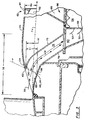
- Fig. 3 is an enlarged view of a portion of the heat exchanger system 52 shown in Fig. 2.
- the system inlet 58 has an inner wall 98 and an outer wall 102.
- the inner wall of the inlet and the outer wall of the inlet lie in an inlet plane P which is perpendicular to the flow (flow path 56) entering the inlet.
- the inner wall and outer wall of the inlet are at the location in which the flow is bounded by a wall in the outward direction (the outer wall) and bounded by a wall in the inward direction (the inner wall).
- This section of flow is commonly referred to as the first covered section of flow.
- the inner wall extends circumferentially for the width of the inlet.
- the inner wall is radially inwardly of the undisturbed flow line Fu at the inner wall 36 of the fan duct.
- the undisturbed flow line is coincident with the inner wall 36 and is spaced radially from the outer wall 38 of the fan duct by a distance Hfd.
- the outer wall 102 or lip extends circumferentially as does the inner wall.
- the outer wall or lip is formed by a first outer surface 104 which extends circumferentially and which diverges radially from the axis Ar of the engine as measured in the downstream direction.
- the outer wall (lip) has a second inner surface 106 which extends circumferentially and which converges radially from the axis Ar in the downstream direction.
- the outer wall 102 is spaced rearwardly from and radially outward from the inner wall 98 of the inlet 58 by a radial height of the inlet Hi.
- the outer wall is radially outward from the undisturbed flow line a radial distance Hf.
- the inlet radial height distance Hi is greater than the thickness Bu of the wall flow characteristic.
- the wall flow characteristic is similar to a boundary layer characteristic for axisymmetric flow and refers to a region of unsteady flow with three-dimensional aspects adjacent to the inner wall 36. The unsteady nature and three dimensional aspects of the flow results from the location of the heat exchanger system 52 immediately downstream of the fan exit guide vanes 42 and between the adjacent fan struts 44.
- the exposure ratio, aspect ratio, and penetration ratio of the inlet are important parameters for gauging the exposure of the heat exchanger system to potential foreign object damage and the losses associated with disturbance of the working medium flow path by the heat exchanger system.
- the inlet has an exposure ratio to foreign objects in the oncoming flow that is the ratio of the distance Hf of the inlet from the inner wall of the fan duct (undisturbed flow line Fu) to the total radial distance Hi of the inlet. This distance is less than or equal to (that is, not greater than) seventy percent (Hf/Hi ⁇ .70).
- the penetration ratio is the ratio of the exposed radial height Hf of the inlet to the height of the fan duct Hfd and is not greater than fifteen percent (Hf/Hfd ⁇ .15) and, in one embodiment, not greater than ten percent (Hf/Hfd ⁇ .10).
- the aspect ratio is the ratio of the width W of the heat exchanger inlet (see Fig. 4) divided by the height to the outer wall Hf of the inlet in the radial direction and is less than fifty (50) percent and in one embodiment, less than twenty (20) percent.
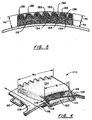
- Fig. 4 is a perspective view of a portion of the heat exchanger system 52 referred to as the inlet and outlet module 108.
- the inlet 58 includes a first side 112 and a second side 114 at the intersection of the inlet plane P with the inlet-outlet module.
- a first sidewall 116 and a second sidewall 118 extend from the inner wall 98 and the outer wall 102 of the inlet 58.
- the sidewalls extend in the upstream direction to the inner wall 36 of the fan duct 32. Each sidewall decreases in height in the upstream direction until it reaches the inner wall of the fan duct.
- An inlet ramp 122 is a curved wall that extends forwardly in the upstream direction from the inner wall of the inlet to the inner wall of the fan duct. The inlet ramp extends circumferentially between the sidewalls to define a smooth transition from the fan duct into the inlet.
- the inlet 58 has a mass flow ratio characteristic which is no greater than seventy-five percent (MFR ⁇ .75) under all operative conditions of the engine.
- the mass flow ratio characteristic for a particular operative condition of the engine is defined for the inlet at the first covered section and is the actual flow through the first covered section into the heat exchanger flow path divided by the product of the density and velocity of the free stream flow multiplied by the area of the first covered section.
- the MFR was approximately fifty (50) percent under all operative conditions.
- the inner duct 76 extends from the inlet 58.
- the inner wall of the inlet duct extends from the inner wall 98 of the inlet.
- the outer wall of the duct extends from the outer wall 102 of the inlet.
- Each of the walls separately converges radially toward the axis Ar in the downstream direction to create a sudden drop below the undisturbed line of flow Fu of the working medium gases.
- the inlet and outlet module 108 has sidewalls 116,118 extending rearwardly which are a continuation of the first sidewall and the second sidewall.
- a flow path wall 124 extends between the sidewalls 116,118 and rearwardly to the lobed mixer 94 from the outer surface 104 of the outer wall 102 at the first covered section.
- the inlet has a width W which extends between the sidewalls at the inner wall and is constant for the inlet.
- the inlet-outlet module 108 has a width Wo at the outlet 62 which extends between the first sidewall and the second sidewall. The width Wo is greater than the width W.
- the aspect ratio of the outlet is the height Ho of the outlet divided by the width Wo and is less than twenty-five (25) percent and, in one embodiment, less than twenty (20) percent.
- a first circumferentially extending surface 126 extends from the first sidewall 116 and a second circumferentially extending surface 128 extends from the second sidewall 118 to define the inner wall 98 of the fan bypass duct 32 between the fan struts 44. These surfaces also provide references for the undisturbed flow line Fu.
- a strut profile shape is formed in each of the circumferentially extending surfaces to adapt the inlet-outlet module to abuttingly engage the fan strut which is partially broken away for clarity in Fig. 2.
- the ratio of the height Hl of the lobed mixer 94 to the spaced apart distance of the mixer Hp from the inner wall is one.
- the lobed mixer is formed of a plurality of lobe peaks 132 that are concave with respect to the exhaust flow. Each lobe peak is spaced circumferentially one from the other.
- a plurality of lobe valleys 134 are disposed inwardly of and joined to the lobe peaks.
- the lobe valleys are convex to the exhaust flow path 56 of the heat exchanger system and concave to the working medium flow path 34.
- Each lobe valley extends between a pair of lobe peaks to define a plurality of axially extending channels 136 that also extend radially inwardly.
- the channels 138 for the exhaust flow path of the heat exchanger system only extend axially rearwardly.
- working medium gases are flowed along the primary flow path 28 and the secondary flow path 34 for working medium gases.
- Heat is transferred from various components to the cooling fluid which is flowed along the flow path 74 to the heat exchanger 54.
- Cooling air is flowed along the flow path 56 from the fan duct 46 continuously through the heat exchanger under all operative conditions of the engine.
- the flow path for the heat exchanger system extends through the inlet 58 including the inlet duct 76, the first and second conduits 80,84 to the heat exchanger and through the outlet 62.
- the flow path 56 is uninterrupted under all operative conditions. No valving is required to modulate the flow. This provides a simple system for cooling, avoiding the cost, complexity and weight associated with supplying valves and controlling the valves to such a heat exchanger system.
- an adverse static pressure gradient exists between axial locations on the inner wall 36 of the fan duct having undisturbed lines of flow Fu, that is locations whose flow is not disturbed by the heat exchanger system 52. Cooling air is passed through the inlet 58 to the system at the inner wall of the fan duct.
- the inlet has a mass flow ratio characteristic at the inlet which is no greater than seventy-five percent (MFR ⁇ .75) and, in one embodiment, was slightly less than fifty percent (MFR ⁇ .50).
- the radial height Hi of the inlet is greater than the wall flow characteristic Bu.
- Total pressure recovery is high because the height Hi of the inlet is greater than the wall flow characteristic height Bu.
- the length Lid of the inlet duct 76 provides for mixing of any separated flow that occurs at the inlet. This enables a further pressure recovery in the form of a static pressure rise at that location.
- the rise in static pressure at the inlet 58 drives the captured gases along the flow path 56 for the heat exchanger system 52. Flow occurs even though an adverse static pressure gradient exists in the fan duct 46 along an undisturbed flow line between the inlet 58 and outlet 62.
- This enables construction of a heat exchanger system having a relatively short length (in one embodiment, about one foot) as compared with those heat exchanger systems which must rely on a static pressure difference along an undisturbed flow line in the fan duct between the inlet axial location and the outlet axial location (several feet) or as compared to constructions that use a low pressure compartment as a sump for gases discharged from the working medium flow path.
- the sidewalls 116,118 of the inlet ramp 122 block side flow from the ramp and preserve the static pressure rise that is beginning to occur at the ramp of the inlet 58.
- Another advantage of the present design and method of operating the engine is the level of drag experienced caused by the heat exchanger system 52 projecting into the working medium flow path.
- the aspect ratio of the heat exchanger inlet is not greater than twenty percent and the outlet is not greater than twenty-five percent.
- the projection ratio of the heat exchanger system into the flow path is not greater than ten percent of the height of the working medium flow path. This results in acceptable levels of drag and a concomitantly small loss in energy as the working medium gases 34 in the fan bypass duct 32 sweep by the inlet and outlet module 108 of the heat exchanger system 52.
- the low aspect ratio and projection ratio of the inlet and outlet module 108 into the working medium flow path 34 decreases the possibility of foreign object damage and ingestion. This reduces the possibility of blockage of the heat exchanger with ice and other debris earlier ingested into the working medium flow path of the engine as compared to designs having a greater projection ratio and a larger aspect ratio for the inlet.
- the ramp 22 and inlet duct 76 provide a sudden drop below the undisturbed flow line Fu at the inlet 58. This causes the foreign objects in the mainstream flow adjacent the flow entering the inlet to sweep past the inlet to the heat exchanger system.
- the inlet is disposed at the inner wall 36 of the fan duct.
- Foreign objects are generally centrifuged outwardly with a greater incidence of foreign object damage occurring in the region above a ten percent projection than within a ten percent projection by the inlet into the fan duct.
- the inlet is greater in size than the wall flow characteristic Bu but small enough so that many foreign objects will sweep by the inlet.
- Ice is a particular problem occurring at high altitude operation or as the aircraft passes through hail and ice storms. Chunks of ice that have a diameter greater than the projection of the inlet into the fan duct 32 will strike the entrance to the fan duct and fragment at the inlet 58. The region of the outer wall of the inlet has increased thickness of about four to six times the thickness of interior walls.
- the method of operating the engine 10 includes passing the cooling air of the heat exchanger flow path 56 through the inlet 58 and ducting the cooling air sharply downward to impede the ingestion of foreign objects as mentioned above. It also causes foreign objects, such as ice, to strike the walls 79 and other structure, such as the vanes 82, bounding the flow path and to fragment on the interior of the inlet duct 76 and in the first conduit 80 in the heat exchanger cavity 66. For example, these particles will strike the inlet guide vanes 82 to the heat exchanger as the particles move radially inwardly and, if moving with sufficient momentum, may strike the bottom of the cavity prior to striking the inlet to the heat exchanger which avoids damage to the more delicate structure of the heat exchanger.
- the heat exchanger inlet and outlet module has a length of about one foot for one embodiment.
- the length to height ratio of the system is about one (L/H ⁇ .9-1.1).
- the heated air is flowed radially outwardly through the second conduit and into the exhaust passage 86.
- the first portion 88 extends radially outwardly and the second portion 92 extends axially in the downstream direction to direct rearwardly the exhausted gases from the heat exchanger.
- the exhaust gases from the heat exchanger flow path 56 encounter the lobed mixer 94. Operation of the engine includes mixing these heated exhaust gases 46 with the cooler working medium gases from the fan duct.
- the lobed mixer promotes the mixing, ensuring that the energy from the gases enters the working medium flow path where it usefully increases thrust heat adjacent structure, such as might occur in constructions where heat is transferred to metal plates which shield the composite wall of the nacelle and which is then transferred to other locations of the engine.
- These heated gases increase the energy of the gas stream and, in one embodiment, make up for the loss in energy caused by flowing the gases through the heat exchanger flow path.
- Another advantage is the durability of downstream structure 64 that results from the lobed valleys 134 of the mixer 94 that are directed radially inwardly.
- the lobed valleys duct air having a dynamic head or velocity head (one half density multiplied by the square of the velocity) which is much greater than the dynamic head of the heated air 56 being exhausted from the heat exchanger system 52.
- the dynamic head of the working medium gases is four times greater than the dynamic head of the heat exchanger system gases.
- the flow path gases 34 drive inwardly into the exhaust gases 56, providing a screen of cool air to the structure rearwardly of the heat exchanger system 52. This screen of air blocks the gases from the heat exchanger from contacting the wall with curtains of cool air adjacent the wall. This avoids over-temperaturing any adjacent composite structure 64, such as the sound absorbing structure, and avoids the necessity for metal protective shields disposed in the flow path to protect such structure from over-temperature conditions.
- a particular advantage of the modular construction of the heat exchanger inlet and outlet is the method by which the inlet and outlet module 108 may be quickly and efficiently formed.
- the inlet and outlet module is a cast construction. Use of the casting technique is enhanced by the relatively small size of the casting.
- the cast construction allows for precisely contoured passages and for a robust construction at critical locations as compared with devices which might be formed of thin sheet metal.
- the casting ensures the relationship between the flow path and the aerodynamic inlet meets the requirements of the aerodynamic design.
- the design provides for easy replacement in case of injury to the inlet and outlet module.
- fabricating the inlet and outlet module as a casting has other advantages.
- the complex shape of the flow paths are easily formed time after time. This avoids the need for many different kinds of tooling to form the complex shapes associated with sheet metal work and welding of the sheet metal sections.
- a cast module for the inlet and outlet is the strength-to-weight ratio of the design. Casting allows for different thickness material at different locations for the inlet and outlet module enabling the module to have thicknesses tailored so that it is thicker at the leading edge and other locations where needed, such as inlet and outlet wall and the sides, and with thinner walls with ribs in locations where the strength is not needed to resist foreign object damage or for other requirements.
- the casting is in a one-piece construction having an overall stiffness of the structure that is greater than if the part were made from many pieces.
- the one-piece construction is also lighter in weight, eliminating flanges needed to attach parts together in constructions of made of several components whether the components are cast or welded sheet metal.
- An aerodynamic advantage results by eliminating steps or gaps that occur between components and that cause aerodynamic losses. The critical aerodynamic alignment between the outlet 58 and the inlet 62 are maintained.
- the modular inlet and outlet design provides for ease of installation of one or more of the modules within the engine.
- some engine constructions have a first inlet and outlet module which is in flow communication with a first heat exchanger and a second inlet and outlet module which is in flow communication with a second heat exchanger. Either of these modules is easily replaced or easily removed to permit inspection of the heat exchanger cavity for blockage and for foreign object damage should the engine have passed through severe hailstorms.
- an advantage in installation and removal of the module is the interchangability of modules because the design is a cast one-piece construction that maintains alignment between the exit and inlet.
Landscapes
- Engineering & Computer Science (AREA)
- Chemical & Material Sciences (AREA)
- Combustion & Propulsion (AREA)
- Mechanical Engineering (AREA)
- General Engineering & Computer Science (AREA)
- Structures Of Non-Positive Displacement Pumps (AREA)
- Turbine Rotor Nozzle Sealing (AREA)
Applications Claiming Priority (2)
| Application Number | Priority Date | Filing Date | Title |
|---|---|---|---|
| US99600997A | 1997-12-22 | 1997-12-22 | |
| US996009 | 1997-12-22 |
Publications (2)
| Publication Number | Publication Date |
|---|---|
| EP0924408A2 true EP0924408A2 (de) | 1999-06-23 |
| EP0924408A3 EP0924408A3 (de) | 2001-05-02 |
Family
ID=25542416
Family Applications (1)
| Application Number | Title | Priority Date | Filing Date |
|---|---|---|---|
| EP98310588A Withdrawn EP0924408A3 (de) | 1997-12-22 | 1998-12-22 | Methode zur Kühlung von Komponenten eines Gasturbinentriebwerks |
Country Status (2)
| Country | Link |
|---|---|
| EP (1) | EP0924408A3 (de) |
| JP (1) | JPH11247667A (de) |
Cited By (14)
| Publication number | Priority date | Publication date | Assignee | Title |
|---|---|---|---|---|
| CN101676537A (zh) * | 2008-09-19 | 2010-03-24 | 通用电气公司 | 使用系统排气进行冷却的系统及方法 |
| US9915176B2 (en) | 2014-05-29 | 2018-03-13 | General Electric Company | Shroud assembly for turbine engine |
| US9988936B2 (en) | 2015-10-15 | 2018-06-05 | General Electric Company | Shroud assembly for a gas turbine engine |
| US10036319B2 (en) | 2014-10-31 | 2018-07-31 | General Electric Company | Separator assembly for a gas turbine engine |
| US10167725B2 (en) | 2014-10-31 | 2019-01-01 | General Electric Company | Engine component for a turbine engine |
| US10174620B2 (en) | 2015-10-15 | 2019-01-08 | General Electric Company | Turbine blade |
| US10286407B2 (en) | 2007-11-29 | 2019-05-14 | General Electric Company | Inertial separator |
| US10428664B2 (en) | 2015-10-15 | 2019-10-01 | General Electric Company | Nozzle for a gas turbine engine |
| US10704425B2 (en) | 2016-07-14 | 2020-07-07 | General Electric Company | Assembly for a gas turbine engine |
| US10975731B2 (en) | 2014-05-29 | 2021-04-13 | General Electric Company | Turbine engine, components, and methods of cooling same |
| US11033845B2 (en) | 2014-05-29 | 2021-06-15 | General Electric Company | Turbine engine and particle separators therefore |
| CN115680888A (zh) * | 2021-07-29 | 2023-02-03 | 通用电气公司 | 具有位于环形管道中的热交换器的燃气涡轮发动机 |
| US11918943B2 (en) | 2014-05-29 | 2024-03-05 | General Electric Company | Inducer assembly for a turbine engine |
| CN119872898A (zh) * | 2025-03-27 | 2025-04-25 | 浙江银轮机械股份有限公司 | 中段导流式旋翼模块及旋翼式飞行器 |
Citations (2)
| Publication number | Priority date | Publication date | Assignee | Title |
|---|---|---|---|---|
| US4151710A (en) | 1977-03-11 | 1979-05-01 | United Technologies Corporation | Lubrication cooling system for aircraft engine accessory |
| US4474001A (en) | 1981-04-01 | 1984-10-02 | United Technologies Corporation | Cooling system for the electrical generator of a turbofan gas turbine engine |
Family Cites Families (2)
| Publication number | Priority date | Publication date | Assignee | Title |
|---|---|---|---|---|
| FR2241695B1 (de) * | 1973-08-21 | 1978-03-17 | Bertin & Cie | |
| US5269135A (en) * | 1991-10-28 | 1993-12-14 | General Electric Company | Gas turbine engine fan cooled heat exchanger |
-
1998
- 1998-12-22 EP EP98310588A patent/EP0924408A3/de not_active Withdrawn
- 1998-12-22 JP JP10364898A patent/JPH11247667A/ja active Pending
Patent Citations (2)
| Publication number | Priority date | Publication date | Assignee | Title |
|---|---|---|---|---|
| US4151710A (en) | 1977-03-11 | 1979-05-01 | United Technologies Corporation | Lubrication cooling system for aircraft engine accessory |
| US4474001A (en) | 1981-04-01 | 1984-10-02 | United Technologies Corporation | Cooling system for the electrical generator of a turbofan gas turbine engine |
Cited By (19)
| Publication number | Priority date | Publication date | Assignee | Title |
|---|---|---|---|---|
| US10286407B2 (en) | 2007-11-29 | 2019-05-14 | General Electric Company | Inertial separator |
| CN101676537A (zh) * | 2008-09-19 | 2010-03-24 | 通用电气公司 | 使用系统排气进行冷却的系统及方法 |
| US10975731B2 (en) | 2014-05-29 | 2021-04-13 | General Electric Company | Turbine engine, components, and methods of cooling same |
| US9915176B2 (en) | 2014-05-29 | 2018-03-13 | General Electric Company | Shroud assembly for turbine engine |
| US11918943B2 (en) | 2014-05-29 | 2024-03-05 | General Electric Company | Inducer assembly for a turbine engine |
| US11033845B2 (en) | 2014-05-29 | 2021-06-15 | General Electric Company | Turbine engine and particle separators therefore |
| US12357933B2 (en) | 2014-05-29 | 2025-07-15 | General Electric Company | Inducer assembly for a turbine engine |
| US11541340B2 (en) | 2014-05-29 | 2023-01-03 | General Electric Company | Inducer assembly for a turbine engine |
| US10036319B2 (en) | 2014-10-31 | 2018-07-31 | General Electric Company | Separator assembly for a gas turbine engine |
| US10167725B2 (en) | 2014-10-31 | 2019-01-01 | General Electric Company | Engine component for a turbine engine |
| US10174620B2 (en) | 2015-10-15 | 2019-01-08 | General Electric Company | Turbine blade |
| US9988936B2 (en) | 2015-10-15 | 2018-06-05 | General Electric Company | Shroud assembly for a gas turbine engine |
| US10428664B2 (en) | 2015-10-15 | 2019-10-01 | General Electric Company | Nozzle for a gas turbine engine |
| US11021969B2 (en) | 2015-10-15 | 2021-06-01 | General Electric Company | Turbine blade |
| US11401821B2 (en) | 2015-10-15 | 2022-08-02 | General Electric Company | Turbine blade |
| US10704425B2 (en) | 2016-07-14 | 2020-07-07 | General Electric Company | Assembly for a gas turbine engine |
| US11199111B2 (en) | 2016-07-14 | 2021-12-14 | General Electric Company | Assembly for particle removal |
| CN115680888A (zh) * | 2021-07-29 | 2023-02-03 | 通用电气公司 | 具有位于环形管道中的热交换器的燃气涡轮发动机 |
| CN119872898A (zh) * | 2025-03-27 | 2025-04-25 | 浙江银轮机械股份有限公司 | 中段导流式旋翼模块及旋翼式飞行器 |
Also Published As
| Publication number | Publication date |
|---|---|
| EP0924408A3 (de) | 2001-05-02 |
| JPH11247667A (ja) | 1999-09-14 |
Similar Documents
| Publication | Publication Date | Title |
|---|---|---|
| EP0924409B1 (de) | Gasturbinentriebwerk | |
| EP0924407B1 (de) | Gasturbinentriebwerk | |
| EP1106787B1 (de) | Kühlung eines Turbinenleitapparat-Segments | |
| US6419446B1 (en) | Apparatus and method for inhibiting radial transfer of core gas flow within a core gas flow path of a gas turbine engine | |
| EP0924408A2 (de) | Methode zur Kühlung von Komponenten eines Gasturbinentriebwerks | |
| EP1870563B1 (de) | Fluideinspritzsystem für eine Plattform | |
| EP1185765B1 (de) | Vorrichtung zur reduzierung der kühlung für einen turbineneinlasskanal | |
| US11773729B2 (en) | Component for a gas turbine engine with a film hole | |
| CA2909468A1 (en) | Engine component for a gas turbine engine | |
| JP2020514617A (ja) | タービンエンジンのための粒子分離装置組立体 | |
| CN115013073A (zh) | 涡轮发动机吊架 | |
| WO1994018436A1 (en) | Coolable outer air seal assembly for a gas turbine engine | |
| EP2947280B1 (de) | Turbinendüsen und kühlsysteme zum kühlen von gleitgelenken darin | |
| GB2119861A (en) | Cooling high pressure turbine blade tips in a gas turbine engine | |
| US20190072276A1 (en) | Float wall combustor panels having heat transfer augmentation | |
| CA2551889C (en) | Cooled shroud assembly and method of cooling a shroud | |
| CA3099300A1 (en) | Gas turbine engine, nacelle thereof, and associated method of operating a gas turbine engine | |
| CN115680791B (zh) | 间隙控制组件 | |
| US10280785B2 (en) | Shroud assembly for a turbine engine | |
| EP3569823A2 (de) | Dichtungsanordnung mit leitblech für gasturbinenmotoren | |
| EP0902166B1 (de) | Erosionsschutzschild in einer Luftströmung | |
| EP4431806A1 (de) | Vorrichtung und verfahren zur luftpartikelabscheidung in einem gasturbinenmotor | |
| US12313022B1 (en) | Gas turbine engine having a heat exchanger located in an annular duct | |
| US20260022657A1 (en) | Methods and apparatus to provide cross-diffuser bleed | |
| US20260022656A1 (en) | Methods and apparatus to provide cross-diffuser bleed |
Legal Events
| Date | Code | Title | Description |
|---|---|---|---|
| PUAI | Public reference made under article 153(3) epc to a published international application that has entered the european phase |
Free format text: ORIGINAL CODE: 0009012 |
|
| AK | Designated contracting states |
Kind code of ref document: A2 Designated state(s): AT BE CH CY DE DK ES FI FR GB GR IE IT LI LU MC NL PT SE |
|
| AX | Request for extension of the european patent |
Free format text: AL;LT;LV;MK;RO;SI |
|
| PUAL | Search report despatched |
Free format text: ORIGINAL CODE: 0009013 |
|
| AK | Designated contracting states |
Kind code of ref document: A3 Designated state(s): AT BE CH CY DE DK ES FI FR GB GR IE IT LI LU MC NL PT SE |
|
| AX | Request for extension of the european patent |
Free format text: AL;LT;LV;MK;RO;SI |
|
| STAA | Information on the status of an ep patent application or granted ep patent |
Free format text: STATUS: THE APPLICATION IS DEEMED TO BE WITHDRAWN |
|
| AKX | Designation fees paid | ||
| 18D | Application deemed to be withdrawn |
Effective date: 20001231 |
|
| REG | Reference to a national code |
Ref country code: DE Ref legal event code: 8566 |