EP0922955A2 - Ion concentration and pH measurement - Google Patents
Ion concentration and pH measurement Download PDFInfo
- Publication number
- EP0922955A2 EP0922955A2 EP98204056A EP98204056A EP0922955A2 EP 0922955 A2 EP0922955 A2 EP 0922955A2 EP 98204056 A EP98204056 A EP 98204056A EP 98204056 A EP98204056 A EP 98204056A EP 0922955 A2 EP0922955 A2 EP 0922955A2
- Authority
- EP
- European Patent Office
- Prior art keywords
- solution
- circuit
- electrical
- electrode
- reference electrode
- Prior art date
- Legal status (The legal status is an assumption and is not a legal conclusion. Google has not performed a legal analysis and makes no representation as to the accuracy of the status listed.)
- Withdrawn
Links
Images
Classifications
-
- G—PHYSICS
- G01—MEASURING; TESTING
- G01N—INVESTIGATING OR ANALYSING MATERIALS BY DETERMINING THEIR CHEMICAL OR PHYSICAL PROPERTIES
- G01N27/00—Investigating or analysing materials by the use of electric, electrochemical, or magnetic means
- G01N27/26—Investigating or analysing materials by the use of electric, electrochemical, or magnetic means by investigating electrochemical variables; by using electrolysis or electrophoresis
- G01N27/403—Cells and electrode assemblies
- G01N27/414—Ion-sensitive or chemical field-effect transistors, i.e. ISFETS or CHEMFETS
- G01N27/4148—Integrated circuits therefor, e.g. fabricated by CMOS processing
Definitions
- This invention relates to the simultaneous measurement of the concentration of a selected ion species in a solution and the pH of the solution.
- the invention particularly, though not exclusively, relates to photographic solutions, and particularly, though not exclusively, where the selected ion species is silver.
- the invention relates to the simultaneous potentiometric measurement of the concentration of any ion species in a solution and measurement of the pH of the solution using an ISFET (Ion Selective Field Effect Transistor).
- ISFET Ion Selective Field Effect Transistor
- solution is to be understood as also including an emulsion, for example a mixture of a silver compound suspended in gelatin, or a dispersion.
- emulsion for example a mixture of a silver compound suspended in gelatin, or a dispersion.
- the invention will be particularly described, by way of example only, with reference to photographic solutions.
- a single reference electrode is connected into a first potentiometer circuit with a conventional glass pH electrode, and is connected into a second potentiometer circuit with a conventional silver electrode, all three electrodes being immersed in the solution.
- an ISFET is used instead of the glass pH electrode. This necessitates the use of a separate reference electrode for each measuring circuit in order to provide electrical isolation between the circuits since the ISFET is a current carrying device whose presence would otherwise interfere with the voltage measurement of the silver electrode.
- a glass pH electrode has the disadvantage that it can be damaged under conditions of high temperature and high pH, so that its readings become unreliable or inconsistent.
- An ISFET overcomes this disadvantage.
- the conventional arrangement including an ISFET described above is complicated by the requirement of the additional reference electrode, especially when applied in a large scale production vessel, as used in the preparation of photographic emulsions for example, where the electrodes are configured in a unitary probe. This can lead to difficulties for maintenance and for calibration.
- existing probe structures would require extensive modification to accommodate the additional reference electrode, which would be expensive.
- apparatus for simultaneously measuring the concentration of a selected ion species in a solution and the pH of the solution comprising:
- the apparatus may comprise means for displaying a representation of said ion concentration and pH output signals, wherein said second electrical circuit includes an isolation amplifier, and wherein said display means is arranged to receive said pH output signal of the second circuit through the isolation amplifier.
- the apparatus includes a further isolation amplifier through which the ion concentration output signal of the first circuit is supplied to the display means.
- the apparatus comprises a low pass filter, wherein said pH output signal from the second electrical circuit is arranged to be passed to the display means through the low pass filter.
- the apparatus comprises a high value resistor, for example of about 1M ⁇ or greater, that is arranged to effect said electrical isolation of d.c. input signals to said first and second electrical circuits.
- said a.c. coupling means may comprise a high value capacitor, for example of about 1 ⁇ f or greater.
- a method of simultaneously measuring the concentration of a selected ion species in a solution and the pH of the solution comprising the steps of:
- the method of the invention is advantageously carried out using the apparatus of the invention.
- electrodes suitable for use in the present invention as ion selective and reference electrodes, and of ISFETs, can be found in the book “pH Measurement” by Helmuth Galster (VCH,1991).
- the electrical isolation of the two circuits provided in the present invention allows an ISFET to be used in the pH measuring circuit, whilst needing only a single, common, reference electrode.
- the disadvantages of the known arrangements for simultaneous ion concentration and pH measurement are thus overcome in a particularly convenient manner.
- the isolation is provided at several stages. Initially this is done by arranging that the signal from the reference electrode is used in the ion concentration circuit as a potentiometric measurement, and is supplied to the pH measuring circuit only as an a.c. input, i.e. after having any d.c. component isolated therefrom.
- An actual reference potential, the potential, usually earth, of the solution, is applied to the first circuit, and a virtual reference potential derived therefrom is applied to the second circuit.
- the two circuits have separate isolated power supplies.
- a display means such as a multi-channel voltmeter, this is done through respective isolation amplifiers, which are preferably supplied from a third, isolated power supply.
- the ability to use a single reference electrode means that a single, unitary measurement probe can be constructed, in which the ISFET can be installed relatively easily along with the ion selective and reference electrodes. Furthermore, the measuring apparatus can be calibrated more easily than is the case with the known arrangement using two reference electrodes.
- the present invention may comprise two or more ion concentration electrodes and/or two or more ISFETs, each type of electrode being connected into the respective first or second electrical circuit.
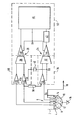
- a metal kettle 2 contains an aqueous solution of a photographic emulsion 4. It is desired simultaneously to monitor and/or to control the concentration of silver ions in the solution 4 and the pH of the solution 4. To this end, a unitary probe 6 is immersed in the solution 4.
- the probe 6 comprises a silver electrode 8, an ISFET 10, a reference electrode 12 and a ground electrode 14.
- the ground electrode 14 is connected to the kettle 2, which is earthed at 16, and provides an earth reference potential E A on line 18.
- the silver electrode 8 and reference electrode 12 are connected to respective preamplifiers 20 and 22. Output signals from the amplifiers 20,22 are supplied to respective terminals of an input stage 26 of a first differential optical isolation amplifier 28. Line 18 is connected to each of the amplifiers 20,22 and 26 so as to provide the earthed signal reference voltage EA therefor.
- the silver ion concentration measuring circuit 30 comprising the amplifiers 20,22 and 26 is energised by an isolated ⁇ 15V,0V power supply (not shown).
- the ISFET 10 is connected to a preamplifier 24 that converts the current signal from the ISFET 10 into a voltage signal, typically of the value of a few millivolts.
- the output signal from the amplifier 24 is supplied to a terminal of an input stage 32 of a second differential optical isolation amplifier 34.
- the pH measuring circuit 36 comprising the amplifiers 24 and 32 is energised by a separate, isolated ⁇ 15V,0V power supply (not shown).
- the ISFET amplifier 24 requires a signal from the reference electrode 12, and this is derived from the silver measurement circuit via a 2M ⁇ resistor 38.
- the resistor 38 and in particular its high value, provides d.c. isolation of the input to each of the measuring circuits from the common reference electrode 12.
- the earth reference voltage E A of the circuit 30 must be linked to the 0 volt level of the circuit 36.
- the silver electrode 8 in the same circuit.
- the d.c. current drawn by the silver electrode 8 would be sufficient to corrupt the pH measurement of the circuit 36.
- a virtual earth is provided by connecting a high impedance capacitor 40 of 1 ⁇ F between the EA voltage on line 18 as supplied to the circuit 30 and the 0 volt level, E B , of circuit 36, and at the same time the d.c. current from the silver electrode 8 is blocked.
- the ISFET measurement of the circuit 36 is modulated by the line frequency, and so a low pass (25Hz) filter 42 is inserted between the output stage 44 of the second isolation amplifier 34 and a multi-channel millivolt display meter 46.
- Output stage 48 of the first isolation amplifier 28 is also supplied to the meter 46, together with a 0 volt reference signal from each of the output stages 44,48 of the isolation amplifiers 28,34 respectively.
- Isolation of the ion concentration and pH measurements is completed by employing a third, isolated power supply (not shown) for the circuit 50, comprising the isolation amplifier output stages 44,48, filter 42 and meter 46.
- amplifier 28 is shown as being an isolation amplifier, this is not essential for providing the electrical isolation that is required in the present invention.
- the measuring circuits such as electrical circuits 30,36 and 50, may be used in connection with two, or more, ion concentration electrodes and/or two, or more, ISFETs.
- the connections from the electrode(s) and ISFET(s) are to be made into additional respective amplifiers, such as the amplifiers 20 and 24, each having its own connection to a resistor, such as the resistor 38, and capacitor, such as capacitor 40, as appropriate, and to a solution reference potential, such as provided by line 18.
Landscapes
- Chemical & Material Sciences (AREA)
- Engineering & Computer Science (AREA)
- Microelectronics & Electronic Packaging (AREA)
- Health & Medical Sciences (AREA)
- Life Sciences & Earth Sciences (AREA)
- Electrochemistry (AREA)
- Molecular Biology (AREA)
- Chemical Kinetics & Catalysis (AREA)
- Computer Hardware Design (AREA)
- Physics & Mathematics (AREA)
- Analytical Chemistry (AREA)
- Biochemistry (AREA)
- General Health & Medical Sciences (AREA)
- General Physics & Mathematics (AREA)
- Immunology (AREA)
- Pathology (AREA)
- Investigating Or Analyzing Materials By The Use Of Electric Means (AREA)
Abstract
Description
Claims (16)
- Apparatus for simultaneously measuring the concentration of a selected ion species in a solution and the pH of the solution, comprising :a first electrical circuit that is arranged to receive signals from both a reference electrode and an ion selective electrode immersed in the solution and to derive therefrom an output signal representative of the concentration of the selected ion in the solution;a second electrical circuit that is arranged to receive signals from both said reference electrode and an ISFET immersed in the solution and to derive therefrom an output signal representative of the pH of the solution;wherein any d.c. input signal to said first electrical circuit from the reference electrode is substantially electrically isolated from the input of the second circuit;wherein a signal representative of the voltage, usually earth potential, of the solution is supplied (a) directly to the first circuit so as to establish a reference, usually earth, potential for the first circuit, and (b) to the second circuit through a.c. coupling means so as to establish a corresponding virtual reference, usually earth, potential for the second circuit; andwherein the first and second electrical circuits are arranged to be provided with electrical power from supplies that are electrically isolated from each other.
- Apparatus according to claim 1, comprising means for displaying a representation of said ion concentration and pH output signals, wherein said second electrical circuit includes an isolation amplifier, and wherein said display means is arranged to receive said pH output signal of the second circuit through the isolation amplifier.
- Apparatus according to claim 2, including a further isolation amplifier through which the ion concentration output signal of the first circuit is supplied to the display means.
- Apparatus according to claim 2 or claim 3, comprising a low pass filter, wherein said pH output signal from the second electrical circuit is arranged to be passed to the display means through the low pass filter.
- Apparatus according to any one of the preceding claims, wherein the first electrical circuit comprises two pre-amplifiers arranged to receive respective ones of the signals from the reference electrode and the ion selective electrode, and a subsequent differential amplifier stage for deriving the ion concentration output signal.
- Apparatus according to any one of the preceding claims, comprising a (high value) resistor that is arranged to effect said electrical isolation of d.c. input signals to said first and second electrical circuits.
- Apparatus according to any one of the preceding claims, wherein said a.c. coupling means comprises a (high value) capacitor.
- Apparatus according to any one of the preceding claims, comprising an ion selective electrode, an ISFET, and a reference electrode, for supplying said signals to the first and second electrical circuits.
- Apparatus according to any one of the preceding claims, comprising an electrode arranged to be exposed to the solution for producing said signal representative of the potential thereof.
- Apparatus according to claim 9, wherein said solution potential electrode comprises an electrically conductive vessel for containing the solution.
- Apparatus according to any one of the preceding claims, wherein the or each isolation amplifier comprises an optical isolation amplifier.
- Apparatus according to any one of the preceding claims, comprising a first electrical power supply for supplying power to said first electrical circuit, and a second electrical power supply for supplying power to said second electrical circuit, said first and second power supplies being electrically isolated from each other.
- A method of simultaneously measuring the concentration of a selected ion species in a solution and the pH of the solution, comprising the steps of:measuring in a first electrical circuit the potential difference between an ion selective electrode and a reference electrode both immersed in the solution, and deriving therefrom the concentration of the ions in the solution;measuring in a second electrical circuit the current flowing between an ISFET and the reference electrode both immersed in the solution, and deriving therefrom the pH of the solution;connecting the reference electrode to the first and second electrical circuits such that any d.c. signal from the reference electrode is electrically isolated from the second circuit;making an electrical connection between the solution and the first circuit so as to provide the solution potential as a reference, preferably earth, potential therefor, and making an electrical connection between the solution and the second circuit through a.c. coupling means so as to provide a corresponding virtual reference, preferably earth, potential therefor; andsupplying the first and second circuits with electrical power from sources that are electrically isolated from each other.
- A method according to claim 13, wherein the signals derived in the first and second circuits are supplied to display means through respective isolation amplifiers.
- A method according to claim 14, wherein the signal from the second circuit is supplied to the display means through a low pass filter.
- A method according to claim 14 or 15, wherein the isolation amplifiers are supplied with electrical power from a third source that is electrically isolated from the said sources.
Applications Claiming Priority (2)
| Application Number | Priority Date | Filing Date | Title |
|---|---|---|---|
| GBGB9726348.7A GB9726348D0 (en) | 1997-12-13 | 1997-12-13 | Ion concentration and pH measurement |
| GB9726348 | 1997-12-13 |
Publications (2)
| Publication Number | Publication Date |
|---|---|
| EP0922955A2 true EP0922955A2 (en) | 1999-06-16 |
| EP0922955A3 EP0922955A3 (en) | 2000-10-04 |
Family
ID=10823555
Family Applications (1)
| Application Number | Title | Priority Date | Filing Date |
|---|---|---|---|
| EP98204056A Withdrawn EP0922955A3 (en) | 1997-12-13 | 1998-12-01 | Ion concentration and pH measurement |
Country Status (4)
| Country | Link |
|---|---|
| US (1) | US6353323B1 (en) |
| EP (1) | EP0922955A3 (en) |
| JP (1) | JPH11248677A (en) |
| GB (1) | GB9726348D0 (en) |
Cited By (9)
| Publication number | Priority date | Publication date | Assignee | Title |
|---|---|---|---|---|
| ES2165809A1 (en) * | 2000-06-21 | 2002-03-16 | Univ Valencia Estudi General | MEASUREMENT SYSTEM BASED ON ISFETS / MEMFETS SENSORS THAT ALLOWS TO VARY THE SENSOR OPERATION POINT AND DETERMINE THE CONCENTRATION OF IONS IN A LIQUID MEDIUM. |
| KR100380618B1 (en) * | 2000-06-30 | 2003-04-18 | 메디언스(주) | pH-Meter interface type ion meter |
| DE10233905A1 (en) * | 2002-07-25 | 2004-02-12 | Testo Gmbh & Co | Measuring probe for measuring a carrier concentration and method for its operation |
| DE10233902A1 (en) * | 2002-07-25 | 2004-05-13 | Testo Gmbh & Co | Measuring device with a handle |
| US7101658B2 (en) | 2001-09-12 | 2006-09-05 | Fuji Photo Film Co., Ltd. | Heat-developable photosensitive material and heat-developing method using the same |
| CN104614431A (en) * | 2015-02-06 | 2015-05-13 | 中国科学院微电子研究所 | Ion Sensitive Field Effect Transistor Sensor and Its Current Mode Readout Circuit |
| CN104677967A (en) * | 2015-02-06 | 2015-06-03 | 中国科学院微电子研究所 | Ion Sensitive Field Effect Transistor Sensor and Its Voltage Mode Readout Circuit |
| JP2017161510A (en) * | 2016-03-02 | 2017-09-14 | 学校法人早稲田大学 | Ion sensor, ion concentration measuring method, and electronic component |
| EP3792622A1 (en) | 2019-09-10 | 2021-03-17 | Mettler-Toledo GmbH | Interface unit for coupling a probe to a measuring system |
Families Citing this family (13)
| Publication number | Priority date | Publication date | Assignee | Title |
|---|---|---|---|---|
| WO2003052387A2 (en) * | 2001-12-14 | 2003-06-26 | Rosemount Analytical Inc. | A pH SENSOR WITH INTERNAL SOLUTION GROUND |
| US20050147741A1 (en) * | 2003-12-31 | 2005-07-07 | Chung Yuan Christian University | Fabrication of array PH sensitive EGFET and its readout circuit |
| JP4579659B2 (en) * | 2004-11-22 | 2010-11-10 | オルガノ株式会社 | Ion concentration measuring device and chemical concentration control device |
| JP5432163B2 (en) * | 2007-10-19 | 2014-03-05 | ハッチ カンパニー | Composite electrode ion probe |
| US8436621B2 (en) * | 2009-01-16 | 2013-05-07 | Kyungpook National University Industry-Academic Corporation Foundation | pH measurement system using glass pH sensor |
| US8956519B2 (en) | 2009-03-25 | 2015-02-17 | Senova Systems, Inc. | Device for detecting an analyte |
| TWI400888B (en) * | 2010-04-13 | 2013-07-01 | Univ Nat Chi Nan | Ion sensing circuit |
| WO2012018632A2 (en) | 2010-07-26 | 2012-02-09 | Senova Systems, Inc. | Analyte sensor |
| JP2013142591A (en) * | 2012-01-10 | 2013-07-22 | Disco Abrasive Syst Ltd | Mixture supply device |
| DE102013109105A1 (en) * | 2013-08-22 | 2015-02-26 | Endress + Hauser Conducta Gesellschaft für Mess- und Regeltechnik mbH + Co. KG | measuring arrangement |
| CN106501136B (en) * | 2016-11-23 | 2023-10-03 | 西南大学 | Acquisition circuit system and acquisition method for composite ion electrode electromotive force |
| CN106841363B (en) * | 2017-02-15 | 2019-05-14 | 四川大学 | Electronics based on potential measurement integrates multi-electrode detection system |
| JP6890569B2 (en) | 2018-09-28 | 2021-06-18 | 株式会社日立ハイテク | Electrolyte measuring device |
Family Cites Families (8)
| Publication number | Priority date | Publication date | Assignee | Title |
|---|---|---|---|---|
| US3862895A (en) | 1970-06-05 | 1975-01-28 | Great Lakes Instruments Inc | Self-compensating electrode system |
| US4506226A (en) * | 1982-05-19 | 1985-03-19 | Lockheed Missiles & Space Company, Inc. | Ion concentration monitor |
| US4641249A (en) * | 1983-06-22 | 1987-02-03 | Kuraray Co., Ltd. | Method and device for compensating temperature-dependent characteristic changes in ion-sensitive FET transducer |
| US4816131A (en) | 1987-09-29 | 1989-03-28 | The Board Of Regents Of The University Of Washington | pH/PCO2 PO2 electrode |
| EP0390692A3 (en) | 1989-03-29 | 1991-10-02 | Terumo Kabushiki Kaisha | Method of forming thin film, apparatus for forming thin film and sensor |
| JPH03127252U (en) | 1990-04-02 | 1991-12-20 | ||
| US5250168A (en) * | 1990-07-03 | 1993-10-05 | Hitachi, Ltd. | Integrated ion sensor |
| US5336388A (en) * | 1991-12-26 | 1994-08-09 | Ppg Industries, Inc. | Analyte and pH measuring sensor assembly and method |
-
1997
- 1997-12-13 GB GBGB9726348.7A patent/GB9726348D0/en not_active Ceased
-
1998
- 1998-08-04 US US09/128,565 patent/US6353323B1/en not_active Expired - Fee Related
- 1998-12-01 EP EP98204056A patent/EP0922955A3/en not_active Withdrawn
- 1998-12-03 JP JP10344125A patent/JPH11248677A/en active Pending
Cited By (12)
| Publication number | Priority date | Publication date | Assignee | Title |
|---|---|---|---|---|
| ES2165809A1 (en) * | 2000-06-21 | 2002-03-16 | Univ Valencia Estudi General | MEASUREMENT SYSTEM BASED ON ISFETS / MEMFETS SENSORS THAT ALLOWS TO VARY THE SENSOR OPERATION POINT AND DETERMINE THE CONCENTRATION OF IONS IN A LIQUID MEDIUM. |
| KR100380618B1 (en) * | 2000-06-30 | 2003-04-18 | 메디언스(주) | pH-Meter interface type ion meter |
| US7101658B2 (en) | 2001-09-12 | 2006-09-05 | Fuji Photo Film Co., Ltd. | Heat-developable photosensitive material and heat-developing method using the same |
| DE10233905A1 (en) * | 2002-07-25 | 2004-02-12 | Testo Gmbh & Co | Measuring probe for measuring a carrier concentration and method for its operation |
| DE10233902A1 (en) * | 2002-07-25 | 2004-05-13 | Testo Gmbh & Co | Measuring device with a handle |
| DE10233902B4 (en) * | 2002-07-25 | 2007-06-14 | Testo Gmbh & Co | Measuring device with a handle part |
| CN104614431A (en) * | 2015-02-06 | 2015-05-13 | 中国科学院微电子研究所 | Ion Sensitive Field Effect Transistor Sensor and Its Current Mode Readout Circuit |
| CN104677967A (en) * | 2015-02-06 | 2015-06-03 | 中国科学院微电子研究所 | Ion Sensitive Field Effect Transistor Sensor and Its Voltage Mode Readout Circuit |
| CN104677967B (en) * | 2015-02-06 | 2017-05-31 | 中国科学院微电子研究所 | Ion Sensitive Field Effect Transistor Sensor and Its Voltage Mode Readout Circuit |
| JP2017161510A (en) * | 2016-03-02 | 2017-09-14 | 学校法人早稲田大学 | Ion sensor, ion concentration measuring method, and electronic component |
| EP3792622A1 (en) | 2019-09-10 | 2021-03-17 | Mettler-Toledo GmbH | Interface unit for coupling a probe to a measuring system |
| US11549966B2 (en) | 2019-09-10 | 2023-01-10 | Mettler-Toledo Gmbh | Interface unit for coupling a probe to a measuring system |
Also Published As
| Publication number | Publication date |
|---|---|
| US6353323B1 (en) | 2002-03-05 |
| GB9726348D0 (en) | 1998-02-11 |
| EP0922955A3 (en) | 2000-10-04 |
| JPH11248677A (en) | 1999-09-17 |
Similar Documents
| Publication | Publication Date | Title |
|---|---|---|
| US6353323B1 (en) | Ion concentration and pH measurement | |
| JP2708276B2 (en) | Excitation circuit for biosensor electrode | |
| EP0063213B1 (en) | Ph electrode | |
| US4889611A (en) | Flow cell | |
| US8036841B2 (en) | Measuring method and apparatus for potentiometric measuring probes | |
| US4851104A (en) | Instrument for potentiometric electrochemical measurements | |
| EP0068101B1 (en) | Electrochemical analytical apparatus | |
| DE3751559T2 (en) | Apparatus for measuring biological information. | |
| DE68927566T2 (en) | Temperature compensation for potentiometric ISFETs | |
| US4196383A (en) | Coaxial differential PH system | |
| CN105229453B (en) | Low slope pH electrode with charge transfer component | |
| JPS6211184A (en) | Method and device for measuring current | |
| US4321544A (en) | Method and improved apparatus for obtaining temperature-corrected readings of ion levels and readings of solution temperature | |
| US4829253A (en) | Three wire amplifier circuit with diagnostic capabilities | |
| CA2106666A1 (en) | Electrode calibration | |
| US3603146A (en) | Electromagnetic flowmeters | |
| US4599146A (en) | Long term current demand control system | |
| Malmstadt et al. | Systems for automatic direct readout of rate data | |
| EP0350116A2 (en) | Electrochemical cell for measuring ionic activity in a solution and its method of use | |
| US3754186A (en) | Power factor measuring cell arrangement | |
| US4181880A (en) | Linear ground conductivity measuring system | |
| Mosca et al. | Improved apparatus for the differential measurement of pH: applications to the measurement of glucose | |
| EP0280230B1 (en) | Instrument for potentiometric electrochemical measurements in an electrolyte solution | |
| US3736433A (en) | Diagnostic unit | |
| US4156181A (en) | Ratio circuit |
Legal Events
| Date | Code | Title | Description |
|---|---|---|---|
| PUAI | Public reference made under article 153(3) epc to a published international application that has entered the european phase |
Free format text: ORIGINAL CODE: 0009012 |
|
| AK | Designated contracting states |
Kind code of ref document: A2 Designated state(s): DE FR GB |
|
| AX | Request for extension of the european patent |
Free format text: AL;LT;LV;MK;RO;SI |
|
| 17P | Request for examination filed |
Effective date: 19991116 |
|
| PUAL | Search report despatched |
Free format text: ORIGINAL CODE: 0009013 |
|
| AK | Designated contracting states |
Kind code of ref document: A3 Designated state(s): AT BE CH CY DE DK ES FI FR GB GR IE IT LI LU MC NL PT SE |
|
| AX | Request for extension of the european patent |
Free format text: AL;LT;LV;MK;RO;SI |
|
| AKX | Designation fees paid |
Free format text: DE FR GB |
|
| 17Q | First examination report despatched |
Effective date: 20050310 |
|
| STAA | Information on the status of an ep patent application or granted ep patent |
Free format text: STATUS: THE APPLICATION IS DEEMED TO BE WITHDRAWN |
|
| 18D | Application deemed to be withdrawn |
Effective date: 20050721 |