EP0922647B1 - Verfahren zum Beschichten von Elastomerkomponenten - Google Patents
Verfahren zum Beschichten von Elastomerkomponenten Download PDFInfo
- Publication number
- EP0922647B1 EP0922647B1 EP98121450A EP98121450A EP0922647B1 EP 0922647 B1 EP0922647 B1 EP 0922647B1 EP 98121450 A EP98121450 A EP 98121450A EP 98121450 A EP98121450 A EP 98121450A EP 0922647 B1 EP0922647 B1 EP 0922647B1
- Authority
- EP
- European Patent Office
- Prior art keywords
- coating
- mat
- layer
- process according
- elastomer components
- Prior art date
- Legal status (The legal status is an assumption and is not a legal conclusion. Google has not performed a legal analysis and makes no representation as to the accuracy of the status listed.)
- Expired - Lifetime
Links
Images

Classifications
-
- B—PERFORMING OPERATIONS; TRANSPORTING
- B05—SPRAYING OR ATOMISING IN GENERAL; APPLYING FLUENT MATERIALS TO SURFACES, IN GENERAL
- B05D—PROCESSES FOR APPLYING FLUENT MATERIALS TO SURFACES, IN GENERAL
- B05D1/00—Processes for applying liquids or other fluent materials
- B05D1/62—Plasma-deposition of organic layers
-
- A—HUMAN NECESSITIES
- A61—MEDICAL OR VETERINARY SCIENCE; HYGIENE
- A61M—DEVICES FOR INTRODUCING MEDIA INTO, OR ONTO, THE BODY; DEVICES FOR TRANSDUCING BODY MEDIA OR FOR TAKING MEDIA FROM THE BODY; DEVICES FOR PRODUCING OR ENDING SLEEP OR STUPOR
- A61M5/00—Devices for bringing media into the body in a subcutaneous, intra-vascular or intramuscular way; Accessories therefor, e.g. filling or cleaning devices, arm-rests
- A61M5/178—Syringes
- A61M5/31—Details
- A61M5/315—Pistons; Piston-rods; Guiding, blocking or restricting the movement of the rod or piston; Appliances on the rod for facilitating dosing ; Dosing mechanisms
- A61M5/31511—Piston or piston-rod constructions, e.g. connection of piston with piston-rod
- A61M5/31513—Piston constructions to improve sealing or sliding
-
- C—CHEMISTRY; METALLURGY
- C23—COATING METALLIC MATERIAL; COATING MATERIAL WITH METALLIC MATERIAL; CHEMICAL SURFACE TREATMENT; DIFFUSION TREATMENT OF METALLIC MATERIAL; COATING BY VACUUM EVAPORATION, BY SPUTTERING, BY ION IMPLANTATION OR BY CHEMICAL VAPOUR DEPOSITION, IN GENERAL; INHIBITING CORROSION OF METALLIC MATERIAL OR INCRUSTATION IN GENERAL
- C23C—COATING METALLIC MATERIAL; COATING MATERIAL WITH METALLIC MATERIAL; SURFACE TREATMENT OF METALLIC MATERIAL BY DIFFUSION INTO THE SURFACE, BY CHEMICAL CONVERSION OR SUBSTITUTION; COATING BY VACUUM EVAPORATION, BY SPUTTERING, BY ION IMPLANTATION OR BY CHEMICAL VAPOUR DEPOSITION, IN GENERAL
- C23C16/00—Chemical coating by decomposition of gaseous compounds, without leaving reaction products of surface material in the coating, i.e. chemical vapour deposition [CVD] processes
- C23C16/22—Chemical coating by decomposition of gaseous compounds, without leaving reaction products of surface material in the coating, i.e. chemical vapour deposition [CVD] processes characterised by the deposition of inorganic material, other than metallic material
- C23C16/30—Deposition of compounds, mixtures or solid solutions, e.g. borides, carbides, nitrides
- C23C16/40—Oxides
- C23C16/401—Oxides containing silicon
-
- C—CHEMISTRY; METALLURGY
- C23—COATING METALLIC MATERIAL; COATING MATERIAL WITH METALLIC MATERIAL; CHEMICAL SURFACE TREATMENT; DIFFUSION TREATMENT OF METALLIC MATERIAL; COATING BY VACUUM EVAPORATION, BY SPUTTERING, BY ION IMPLANTATION OR BY CHEMICAL VAPOUR DEPOSITION, IN GENERAL; INHIBITING CORROSION OF METALLIC MATERIAL OR INCRUSTATION IN GENERAL
- C23C—COATING METALLIC MATERIAL; COATING MATERIAL WITH METALLIC MATERIAL; SURFACE TREATMENT OF METALLIC MATERIAL BY DIFFUSION INTO THE SURFACE, BY CHEMICAL CONVERSION OR SUBSTITUTION; COATING BY VACUUM EVAPORATION, BY SPUTTERING, BY ION IMPLANTATION OR BY CHEMICAL VAPOUR DEPOSITION, IN GENERAL
- C23C16/00—Chemical coating by decomposition of gaseous compounds, without leaving reaction products of surface material in the coating, i.e. chemical vapour deposition [CVD] processes
- C23C16/56—After-treatment
-
- A—HUMAN NECESSITIES
- A61—MEDICAL OR VETERINARY SCIENCE; HYGIENE
- A61M—DEVICES FOR INTRODUCING MEDIA INTO, OR ONTO, THE BODY; DEVICES FOR TRANSDUCING BODY MEDIA OR FOR TAKING MEDIA FROM THE BODY; DEVICES FOR PRODUCING OR ENDING SLEEP OR STUPOR
- A61M2207/00—Methods of manufacture, assembly or production
Definitions
- the invention relates to a method for coating Elastomer components for medical purposes.
- Elastomer components for applications where it is pharmaceutically compatible Aspects of the elastomer material arrive in many manifestations known, in particular as closures of containers for food and Pharmaceutical packaging, such as injection stoppers, infusion stoppers or Piston plugs for syringe bodies.
- closures of containers for food and Pharmaceutical packaging such as injection stoppers, infusion stoppers or Piston plugs for syringe bodies.
- each elastomer component is coated on its own.
- EP 0 497 567 B1 describes a sanitary article made of rubber, especially a stopper, the surface of which is covered with a plastic film is laminated, which consists of a cyclic olefin copolymer (COC).
- COC cyclic olefin copolymer
- EP 0 296 878 B1 describes a sanitary rubber article, the Surface with a layer cross-linked by radiation from a modified Polysiloxane is provided, this layer out of a liquid phase is applied.
- WO 96/349 describes 26 a plasma coating process for the total coating of Elastomer components that are in a coating drum in which the Elastomer components are moved. This method however, does not guarantee a defined, uniform, complete coating of the individual elastomer components, as shading or abrasion effects occur. So that for a "minimum thickness" of the coating on all Share on average a considerable oversizing of the layer be made.
- the object of the invention is to develop a method for coating of the above-mentioned elastomer components, which has a coating from the gas phase in a continuous process, the Elastomer components only partially, at least in the sections where they come into contact with the pharmaceutical solution and there are no shadowing or pull-off effects.
- the Coating should be the inertness and the sliding and static friction behavior improve the elastomer components.
- the Elastomer components in a cost-effective yet very effective way be provided with the desired coating, this layer only is applied at the points where the elastomer components with the medically or pharmaceutically effective solution comes into contact. Thereby can determine the amount of coating gas supplied as well as the production time be significantly reduced, which is beneficial to the beneficial Manufacturing cost affects.
- the layer preferably consists of a silicon dioxide layer, the properties of which are incorporated by Carbon, hydrogen and nitrogen from hard layers to polymer-like properties can be influenced.
- a silicon dioxide layer ensures the necessary inertness as well as the desired sliding behavior of the elastomer components.
- other layer materials can be used in this base layer will be embedded which will further increase the Can cause inertia.
- TMDSO tetramethyldisiloxane
- HMDSO Hexamethyldisiloxane
- siloxanes are used.
- silazanes can be used as the reaction gas for the PECVD process be used.
- the PECVD process (Plasma Enhanced Chemical Vapor Deposition) is in various literature described. Various embodiments will be with a wide variety of energy feeds from low frequency (e.g. 40 kHz) over medium frequency (e.g. 13.56 MHz) up to microwaves (2.45 GHz and above) used.
- the plasma pulse CVD method has proven to be particularly advantageous (PICVD) proved that a high homogeneity in the Coating of large-area substrates can be achieved. Examples of this can be found in G. Janzen: Plasmatechnik, Wegig Verlag, Heidelberg 1992).
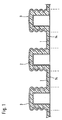
- Fig. 1 shows a section of a longitudinal section through a extensive flat mat 1 made of the desired elastomer material a multiplicity of integrally molded elastomer components 2. These elastomer components are plugs shown schematically in FIG. 1, such as in EP 0 296 878, Fig. 1.
- the side of the mat 1 is facing up the above elastomer components in a continuous process the PICVD process coated, with an upper layer 3, the an inertness of the elastomer component and its sliding as well Improved stiction behavior.
- This layer 3 is preferably one Silicon dioxide layer, the properties of which by the incorporation of Carbon, hydrogen and nitrogen from hard layers to polymer-like properties can be influenced.
- top of the mat 1 is coated, i.e. the protruding surfaces of the elastomer components 2, which in the later use with the pharmaceutical or medical solution in Get in touch.
- the top of the plug corresponding to the bottom of the Mat 1, i.e. the plug exterior when the plug is used later as Closure element is then (unlike shown) uncoated, so that once the coating material is saved and the time for that Application of the layers can be reduced, since typically only that one side of the mat must be coated, but not the underside.
- the coating according to the PICVD process also ensures that none Shading or abrasion effects when coating the Elastomer components occur, but that there is a relative builds up even layer 3.
- the coating of Undercuts guaranteed.
- a vacuum chamber 4 In a vacuum chamber 4 is continuously the mat 1 to be coated with the protruding Elastomer components 2 introduced.
- a vacuum device 5 Above the Vacuum chamber 4, separated by a microwave window 6, is one Row of horn microwave antennas 7a to 7d, which is a linear plasma source form.
- a microwave radiation 8a is emitted via these microwave antennas to 8d pulsed into the vacuum chamber 4, which is inside the Vacuum chamber form a microwave plasma.
- the pulse duration is a additional parameter of the composition of the deposited layer influenced.
- the microwave pulses are generated by microwave generators 9a to 9d, each via a Magnetron 10a to 10d and one-way lines 11a to 11d with the Microwave antennas 7a to 7d are connected.
- the microwave arrangement typically has standard components of 2.45 GHz technology.
- the gas in which a plasma arc is ignited typically oxygen, and on the other hand the gas required for layer formation, the reaction gas, are introduced via a gas supply arrangement 12.
- a gas supply arrangement 12 typically siloxanes, preferably tetramethyldisiloxane, or hexamethyldisiloxane or silazanes, from which layer 3, consisting of SiC x H y O z , is built up by choosing a suitable pulse duration.
- the property of the layer depends essentially on the parameters "pulse duration" and "concentration of the reaction gas". Generally, small ones Concentrations and long pulse durations deposited the harder layers cause a substantial increase in inertness. At high concentrations and short pulse durations become softer layers with improved Sliding properties separated.
- a process controller 13 controls the process in a known manner, in which first of all, the mixture of oxygen and the Reaction gas is introduced into the vacuum chamber 4. After that, each a plasma in the vacuum chamber 4 by a microwave pulse 8a to 8d ignited, which cracks the molecules of the reaction gas. The one there resulting crack products diffuse to the nearest surface, here the mat 1 with the elastomer component 2 and gradually shape the desired layer 3. In the pulse pause until the ignition of the next Pulses that are in the range of 10-100 ms are the consumed Reaction gases from the vacuum chamber in the manner of a two-stroke engine Aspirate removed by means of vacuum stage 5 and with fresh reaction gas and replaced oxygen.
- a multiple layer can also be created. To do this, as soon as the sufficient layer thickness for the first layer is reached, the associated reaction gas through the to generate the second layer necessary reaction gas replaced. To create a blurred transition a mixture can exist between the two layers for a certain period of time be introduced from both reaction gases. For smooth transitions can reduce the proportion of the first reaction gas and at the same time the proportion of the second reaction gas steadily up to the nominal value increase.
- the PICVD technology plasma pulse chemical vapor deposition
- FIG. 2 The PICVD technology (plasma pulse chemical vapor deposition) shown in FIG. 2 is known for example from DE 40 08 405 C1 and has so far been used in particular to produce barrier layers Plastic containers applied (DE 44 38 359 A1).
- the linear plasma source according to FIG. 2 is fundamentally defined by DE 38 30 249 C2 has become known, the control of each Microwave antennas 8a to 8d simultaneously in parallel or through that Delayed operation of two neighboring microwave antennas, e.g. according to DE 40 34 211 takes place.
- the mats 1 are removed from the vacuum chamber and fed to a further device in which the elastomer components are punched out of the mat, which is done using known techniques.
- Corresponding systems with which two corresponding shifts simultaneously can be applied are known.
Landscapes
- Chemical & Material Sciences (AREA)
- Engineering & Computer Science (AREA)
- Health & Medical Sciences (AREA)
- General Chemical & Material Sciences (AREA)
- Chemical Kinetics & Catalysis (AREA)
- Materials Engineering (AREA)
- Mechanical Engineering (AREA)
- Metallurgy (AREA)
- Organic Chemistry (AREA)
- Anesthesiology (AREA)
- General Health & Medical Sciences (AREA)
- Vascular Medicine (AREA)
- Physics & Mathematics (AREA)
- Biomedical Technology (AREA)
- Heart & Thoracic Surgery (AREA)
- Hematology (AREA)
- Life Sciences & Earth Sciences (AREA)
- Animal Behavior & Ethology (AREA)
- Plasma & Fusion (AREA)
- Public Health (AREA)
- Veterinary Medicine (AREA)
- Inorganic Chemistry (AREA)
- Laminated Bodies (AREA)
- Infusion, Injection, And Reservoir Apparatuses (AREA)
- Coating Of Shaped Articles Made Of Macromolecular Substances (AREA)
- Chemical Vapour Deposition (AREA)
Description
- Herstellen einer ausgedehnt flächigen Matte aus dem Elastomer-Werkstoff mit einer Vielzahl von zusammenhängend angeformten vorstehenden Elastomerkomponenten,
- Beschichten mindestens der Seite der Matte mit den vorstehenden Elastomerkomponenten mittels eines "kalten" Beschichtungsverfahrens, typischerweise nach dem plasmaunterstützten PECVD-Verfahren (PECVD-Verfahren), in einem kontinuierlichen Prozeß mit einer Schicht, die eine Inertheit der Elastomerkomponenten und ihr Gleit- sowie Haftreibungsverhalten verbessert, und
- Ausstanzen der Elastomerkomponenten aus der Matte.
- Fig. 1
- einen Ausschnitt aus einem Längsschnitt durch eine mit dem erfindungsgemäßen Verfahren beschichtete Matte aus Elastomerkomponenten,
- Fig. 2
- eine bevorzugte Vorrichtung für das PICVD-Verfahren, mit dem typischerweise die Matten nach Fig. 1 beschichtet werden.
Claims (8)
- Verfahren zum Beschichten von Elastomerkomponenten für medizinische Zwecke, mit den Schritten:Herstellen einer ausgedehnt flächigen Matte aus dem Elastomerwerkstoff mit einer Vielzahl von zusammenhängend angeformten vorstehenden Elastomerkomponenten,Beschichten mindestens der Seite der Matte mit den vorstehenden Elastomerkomponenten mittels eines "kalten" Beschichtungsverfahrens, typischerweise dem plasmaunterstützten CVD-Verfahren (PECVD-Verfahren) in einem kontinuierlichen Prozeß mit einer Schicht, die eine Inertheit der Elastomerkomponenten und ihr Gleit- sowie Haftreibungsverhalten verbessert, undAusstanzen der Elastomerkomponenten aus der Matte.
- Verfahren nach Anspruch 1, dadurch gekennzeichnet, daß als Beschichtungsverfahren das Plasmaimpuls-CVD-Verfahren (PICVD-Verfahren) eingesetzt wird.
- Verfahren nach Anspruch 1, dadurch gekennzeichnet, daß die Schicht eine Siliziumdioxid-Schicht ist, die auch Kohlenstoff, Wasserstoff und/oder Stickstoff enthält.
- Verfahren nach Anspruch 2 und 3, dadurch gekennzeichnet, daß als Beschichtungsgas für das PICVD-Verfahren Tetramethyldisiloxan (TMDSO), Hexamethyldisiloxan (HMDSO) oder ähnliche Siloxane verwendet werden.
- Verfahren nach Anspruch 2 und 3, dadurch gekennzeichnet, daß als Reaktionsgas für das PICVD-Verfahren Silazane verwendet werden.
- Verfahren nach einem der Ansprüche 1 bis 5, dadurch gekennzeichnet, daß eine Matte mit angeformten Injektions- oder Infusions- oder Spritzen-Kolbenstopfen beschichtet wird.
- Verfahren nach einem der Ansprüche 1 bis 6, dadurch gekennzeichnet, daß beide Seiten der Matte beschichtet werden.
- Verfahren nach Anspruch 7, dadurch gekennzeichnet, daß die Schichttypen auf beiden Seiten der Matte unterschiedlich sind.
Applications Claiming Priority (2)
| Application Number | Priority Date | Filing Date | Title |
|---|---|---|---|
| DE19754056A DE19754056C1 (de) | 1997-12-05 | 1997-12-05 | Verfahren zum Beschichten von Elastomerkomponenten |
| DE19754056 | 1997-12-05 |
Publications (2)
| Publication Number | Publication Date |
|---|---|
| EP0922647A1 EP0922647A1 (de) | 1999-06-16 |
| EP0922647B1 true EP0922647B1 (de) | 2001-07-18 |
Family
ID=7850896
Family Applications (1)
| Application Number | Title | Priority Date | Filing Date |
|---|---|---|---|
| EP98121450A Expired - Lifetime EP0922647B1 (de) | 1997-12-05 | 1998-11-11 | Verfahren zum Beschichten von Elastomerkomponenten |
Country Status (4)
| Country | Link |
|---|---|
| US (1) | US6123991A (de) |
| EP (1) | EP0922647B1 (de) |
| JP (1) | JP3458268B2 (de) |
| DE (2) | DE19754056C1 (de) |
Families Citing this family (15)
| Publication number | Priority date | Publication date | Assignee | Title |
|---|---|---|---|---|
| US6940146B2 (en) * | 1999-09-03 | 2005-09-06 | United Microelectronics Corp. | Interconnect structure with an enlarged air gaps disposed between conductive structures or surrounding a conductive structure within the same |
| US20040101636A1 (en) * | 2001-03-29 | 2004-05-27 | Markus Kuhr | Method for producing a coated synthetic body |
| WO2002100928A1 (en) * | 2001-06-12 | 2002-12-19 | North Carolina State University | Barrier coatings for elastomeric materials |
| DE10202311B4 (de) * | 2002-01-23 | 2007-01-04 | Schott Ag | Vorrichtung und Verfahren zur Plasmabehandlung von dielektrischen Körpern |
| EP1354640A1 (de) * | 2002-04-19 | 2003-10-22 | Dürr Systems GmbH | Verfahren und Vorrichtung zum Härten einer Beschichtung |
| JP4437647B2 (ja) * | 2003-07-17 | 2010-03-24 | 三菱商事プラスチック株式会社 | ガスバリア膜コーティングプラスチック容器の製造方法 |
| US7758936B2 (en) * | 2003-09-18 | 2010-07-20 | Boehringer Ingelheim Gmbh | Pharmaceutical blister |
| DE10343668A1 (de) * | 2003-09-18 | 2005-04-14 | Boehringer Ingelheim Pharma Gmbh & Co. Kg | Arzneimittelblister |
| EP2183289A2 (de) * | 2007-08-31 | 2010-05-12 | Corning Incorporated | Reaktive oberfläche auf einem polymersubstrat |
| US20110186537A1 (en) * | 2008-09-22 | 2011-08-04 | Becton, Dickinson And Company | Systems, Apparatus and Methods for Coating the Interior of a Container Using a Photolysis and/or Thermal Chemical Vapor Deposition Process |
| US9404334B2 (en) * | 2012-08-31 | 2016-08-02 | Baker Hughes Incorporated | Downhole elastomeric components including barrier coatings |
| WO2016145206A1 (en) | 2015-03-10 | 2016-09-15 | Regeneron Pharmaceuticals, Inc. | Aseptic piercing system and method |
| FR3043679B1 (fr) * | 2015-11-12 | 2021-07-23 | Aptar Stelmi Sas | Procede de traitement d'un element de conditionnement en elastomere, et element de conditionnement ainsi traite. |
| ES2919934T3 (es) | 2017-05-05 | 2022-07-29 | Regeneron Pharma | Autoinyector y procedimientos de uso relacionados |
| USD1007676S1 (en) | 2021-11-16 | 2023-12-12 | Regeneron Pharmaceuticals, Inc. | Wearable autoinjector |
Family Cites Families (9)
| Publication number | Priority date | Publication date | Assignee | Title |
|---|---|---|---|---|
| DE3346351A1 (de) * | 1983-12-22 | 1985-07-11 | Pharma-Gummi Wimmer West Gmbh, 5180 Eschweiler | Pharmazeutischer stopfen, kolben od. dgl. und verfahren zum herstellen von pharmazeutischen stopfen, kolben od. dgl. |
| US5114794A (en) * | 1987-06-23 | 1992-05-19 | Daikyo Gomu Seiko Ltd. | Modified polysiloxane-coated sanitary rubber article and a process for the production of the same |
| DE3830249A1 (de) * | 1988-09-06 | 1990-03-15 | Schott Glaswerke | Plasmaverfahren zum beschichten ebener substrate |
| US5064083A (en) * | 1990-03-08 | 1991-11-12 | The West Company, Incorporated | Closure device |
| DE4008405C1 (de) * | 1990-03-16 | 1991-07-11 | Schott Glaswerke, 6500 Mainz, De | |
| DE4034211C1 (en) * | 1990-10-27 | 1991-11-14 | Schott Glaswerke, 6500 Mainz, De | Coating interior of pipe-glass tube - comprises coupling HF energy to tube using resonator to deliver pulsed microwave discharges |
| US5288560A (en) * | 1991-01-30 | 1994-02-22 | Daikyo Gomu Seiko, Ltd. | Laminated sanitary rubber article |
| DE4438359C2 (de) * | 1994-10-27 | 2001-10-04 | Schott Glas | Behälter aus Kunststoff mit einer Sperrbeschichtung |
| FR2733758B1 (fr) * | 1995-05-04 | 1997-07-18 | Stelumi Sa | Procede et traitement d'un element de conditionnement, notamment a usage medical ou pharmaceutique ; element de conditionnement ainsi traite |
-
1997
- 1997-12-05 DE DE19754056A patent/DE19754056C1/de not_active Expired - Fee Related
-
1998
- 1998-11-11 EP EP98121450A patent/EP0922647B1/de not_active Expired - Lifetime
- 1998-11-11 DE DE59801033T patent/DE59801033D1/de not_active Expired - Fee Related
- 1998-12-01 JP JP34140498A patent/JP3458268B2/ja not_active Expired - Fee Related
- 1998-12-04 US US09/205,164 patent/US6123991A/en not_active Expired - Fee Related
Also Published As
| Publication number | Publication date |
|---|---|
| US6123991A (en) | 2000-09-26 |
| EP0922647A1 (de) | 1999-06-16 |
| JP3458268B2 (ja) | 2003-10-20 |
| JPH11263859A (ja) | 1999-09-28 |
| DE19754056C1 (de) | 1999-04-08 |
| DE59801033D1 (de) | 2001-08-23 |
Similar Documents
| Publication | Publication Date | Title |
|---|---|---|
| DE19754056C1 (de) | Verfahren zum Beschichten von Elastomerkomponenten | |
| DE69509597T3 (de) | Hohler behälter mit inerter oder undurchlässiger innerer oberfläche durch plasmaunterstütze oberflächereaktion oder in situ polymerisation | |
| DE102009028830A1 (de) | Plasmabeschichtungen und Verfahren zu deren Herstellung | |
| WO2008071458A1 (de) | Behälter mit verbesserter restenleerbarkeit und verfahren zu dessen herstellung | |
| EP3434378B1 (de) | Verfahren zur beschichtung und werkstück | |
| DE102016108450B4 (de) | Behandlungsanordnung und Verfahren zur Herstellung einer Behandlungsanordnung | |
| DE10034737A1 (de) | Verfahren zur Herstellung einer permanenten Entformungsschicht durch Plasmapolymerisation auf der Oberfläche eines Formteilwerkzeugs, ein nach dem Verfahren herstellbares Formteilwerkzeug und dessen Verwendung | |
| EP2836439A1 (de) | Beschichtung von behältern mit plasmadüsen | |
| EP2029291A1 (de) | Verfahren und vorrichtung zur oberflächenbehandlung an behältnissen oder gegenständen | |
| EP3593910A2 (de) | Verfahren zur beschichtung eines glasspritzenkörpers für eine hypodermische fertigglasspritze, hypodermische fertigglasspritze sowie plasmabehandlungsvorrichtung für glasspritzenkörper hypodermischer fertigglasspritzen | |
| EP0930238B1 (de) | Befüllter und verschlossener Kunststoffbehälter und Verfahren zu seiner Herstellung | |
| EP3046492B1 (de) | Spannungsfeste, elektrisch isolierende beschichtungen | |
| EP0376141B1 (de) | Verfahren und Vorrichtung zur Kunststoffbeschichtung von Strangprofilen | |
| DE102008028542A1 (de) | Verfahren und Vorrichtung zum Abscheiden einer Schicht auf einem Substrat mittels einer plasmagestützten chemischen Reaktion | |
| DE10017846C2 (de) | Verfahren zum Abscheiden einer Polymerschicht und Verwendung derselben | |
| EP0739655A1 (de) | Verfahren zu plasmagestützten Herstellung multifunktionaler Schichten auf Kunststoffteilen | |
| EP2954764B1 (de) | Bauteil mit strukturierter oberfläche und verfahren zu dessen herstellung | |
| DE102009026249A1 (de) | Plasma unterstütztes Abscheideverfahren, Halbleitervorrichtung und Abscheidevorrichtung | |
| DE102007041544A1 (de) | Verfahren zur Herstellung von DLC-Schichten und dotierte Polymere oder diamantartige Kohlenstoffschichten | |
| DE102009011054A1 (de) | Verfahren zur Behandlung von Flaschen oder Behältern mit einem Wasserstoffperoxid enthaltenden Behandlungsmedium | |
| EP1245298B1 (de) | Verfahren zum Herstellen eines beschichteten Kunststoffkörpers | |
| DE102018132700A1 (de) | Vorrichtung und Verfahren zum Beschichten und insbesondere Plasmabeschichten von Behältnissen | |
| EP0223998A1 (de) | Verfahren und Vorrichtung zur ein-oder mehrfachen Beschichtung der Oberflächen, vorzugsweise der inneren Oberfläche eines offenen Hohlkörpers aus Kunststoff | |
| DE19740806A1 (de) | Mikrotiterplatte aus Kunststoff | |
| EP2674281B1 (de) | Probenkammer und Verfahren zum Herstellen einer Probenkammer |
Legal Events
| Date | Code | Title | Description |
|---|---|---|---|
| PUAI | Public reference made under article 153(3) epc to a published international application that has entered the european phase |
Free format text: ORIGINAL CODE: 0009012 |
|
| 17P | Request for examination filed |
Effective date: 19981111 |
|
| AK | Designated contracting states |
Kind code of ref document: A1 Designated state(s): BE CH DE FR GB LI |
|
| AX | Request for extension of the european patent |
Free format text: AL;LT;LV;MK;RO;SI |
|
| AKX | Designation fees paid |
Free format text: BE CH DE FR GB LI |
|
| GRAG | Despatch of communication of intention to grant |
Free format text: ORIGINAL CODE: EPIDOS AGRA |
|
| 17Q | First examination report despatched |
Effective date: 20001129 |
|
| GRAG | Despatch of communication of intention to grant |
Free format text: ORIGINAL CODE: EPIDOS AGRA |
|
| GRAH | Despatch of communication of intention to grant a patent |
Free format text: ORIGINAL CODE: EPIDOS IGRA |
|
| GRAH | Despatch of communication of intention to grant a patent |
Free format text: ORIGINAL CODE: EPIDOS IGRA |
|
| GRAA | (expected) grant |
Free format text: ORIGINAL CODE: 0009210 |
|
| AK | Designated contracting states |
Kind code of ref document: B1 Designated state(s): BE CH DE FR GB LI |
|
| REG | Reference to a national code |
Ref country code: CH Ref legal event code: EP |
|
| REF | Corresponds to: |
Ref document number: 59801033 Country of ref document: DE Date of ref document: 20010823 |
|
| GBT | Gb: translation of ep patent filed (gb section 77(6)(a)/1977) |
Effective date: 20011004 |
|
| ET | Fr: translation filed | ||
| REG | Reference to a national code |
Ref country code: GB Ref legal event code: IF02 |
|
| PLBE | No opposition filed within time limit |
Free format text: ORIGINAL CODE: 0009261 |
|
| STAA | Information on the status of an ep patent application or granted ep patent |
Free format text: STATUS: NO OPPOSITION FILED WITHIN TIME LIMIT |
|
| 26N | No opposition filed | ||
| PGFP | Annual fee paid to national office [announced via postgrant information from national office to epo] |
Ref country code: GB Payment date: 20031029 Year of fee payment: 6 |
|
| PGFP | Annual fee paid to national office [announced via postgrant information from national office to epo] |
Ref country code: CH Payment date: 20031030 Year of fee payment: 6 |
|
| PGFP | Annual fee paid to national office [announced via postgrant information from national office to epo] |
Ref country code: DE Payment date: 20031103 Year of fee payment: 6 |
|
| PGFP | Annual fee paid to national office [announced via postgrant information from national office to epo] |
Ref country code: FR Payment date: 20031107 Year of fee payment: 6 |
|
| PGFP | Annual fee paid to national office [announced via postgrant information from national office to epo] |
Ref country code: BE Payment date: 20031209 Year of fee payment: 6 |
|
| PG25 | Lapsed in a contracting state [announced via postgrant information from national office to epo] |
Ref country code: GB Free format text: LAPSE BECAUSE OF NON-PAYMENT OF DUE FEES Effective date: 20041111 |
|
| PG25 | Lapsed in a contracting state [announced via postgrant information from national office to epo] |
Ref country code: LI Free format text: LAPSE BECAUSE OF NON-PAYMENT OF DUE FEES Effective date: 20041130 Ref country code: CH Free format text: LAPSE BECAUSE OF NON-PAYMENT OF DUE FEES Effective date: 20041130 Ref country code: BE Free format text: LAPSE BECAUSE OF NON-PAYMENT OF DUE FEES Effective date: 20041130 |
|
| BERE | Be: lapsed |
Owner name: *SCHOTT GLAS Effective date: 20041130 |
|
| PG25 | Lapsed in a contracting state [announced via postgrant information from national office to epo] |
Ref country code: DE Free format text: LAPSE BECAUSE OF NON-PAYMENT OF DUE FEES Effective date: 20050601 |
|
| GBPC | Gb: european patent ceased through non-payment of renewal fee |
Effective date: 20041111 |
|
| REG | Reference to a national code |
Ref country code: CH Ref legal event code: PL |
|
| PG25 | Lapsed in a contracting state [announced via postgrant information from national office to epo] |
Ref country code: FR Free format text: LAPSE BECAUSE OF NON-PAYMENT OF DUE FEES Effective date: 20050729 |
|
| REG | Reference to a national code |
Ref country code: FR Ref legal event code: ST |
|
| BERE | Be: lapsed |
Owner name: *SCHOTT GLAS Effective date: 20041130 |