EP0922092B1 - Method of attenuating viruses - Google Patents
Method of attenuating viruses Download PDFInfo
- Publication number
- EP0922092B1 EP0922092B1 EP98928866A EP98928866A EP0922092B1 EP 0922092 B1 EP0922092 B1 EP 0922092B1 EP 98928866 A EP98928866 A EP 98928866A EP 98928866 A EP98928866 A EP 98928866A EP 0922092 B1 EP0922092 B1 EP 0922092B1
- Authority
- EP
- European Patent Office
- Prior art keywords
- virus
- variants
- mrp
- membrane receptor
- brain
- Prior art date
- Legal status (The legal status is an assumption and is not a legal conclusion. Google has not performed a legal analysis and makes no representation as to the accuracy of the status listed.)
- Expired - Lifetime
Links
- 241000700605 Viruses Species 0.000 title claims abstract description 209
- 238000000034 method Methods 0.000 title claims abstract description 33
- 210000004556 brain Anatomy 0.000 claims abstract description 143
- 102000006240 membrane receptors Human genes 0.000 claims abstract description 65
- 108020004084 membrane receptors Proteins 0.000 claims abstract description 65
- 238000002360 preparation method Methods 0.000 claims abstract description 65
- 102000005962 receptors Human genes 0.000 claims abstract description 24
- 108020003175 receptors Proteins 0.000 claims abstract description 24
- 239000006228 supernatant Substances 0.000 claims abstract description 15
- 229940125575 vaccine candidate Drugs 0.000 claims abstract description 11
- 239000012528 membrane Substances 0.000 claims abstract description 10
- 239000000725 suspension Substances 0.000 claims abstract description 9
- 238000002156 mixing Methods 0.000 claims abstract description 4
- 230000002238 attenuated effect Effects 0.000 claims description 44
- 210000003501 vero cell Anatomy 0.000 claims description 18
- 108090000623 proteins and genes Proteins 0.000 claims description 14
- 241000710772 Yellow fever virus Species 0.000 claims description 11
- 102000004169 proteins and genes Human genes 0.000 claims description 11
- 229940051021 yellow-fever virus Drugs 0.000 claims description 11
- 241000710770 Langat virus Species 0.000 claims description 9
- 230000003321 amplification Effects 0.000 claims description 4
- 238000003199 nucleic acid amplification method Methods 0.000 claims description 4
- 208000006752 brain edema Diseases 0.000 claims description 3
- 239000013553 cell monolayer Substances 0.000 claims description 2
- 238000002955 isolation Methods 0.000 claims description 2
- 241000699666 Mus <mouse, genus> Species 0.000 description 92
- 241000710842 Japanese encephalitis virus Species 0.000 description 58
- 241000699670 Mus sp. Species 0.000 description 44
- 150000001413 amino acids Chemical class 0.000 description 42
- 101710204837 Envelope small membrane protein Proteins 0.000 description 41
- 101710145006 Lysis protein Proteins 0.000 description 41
- 235000001014 amino acid Nutrition 0.000 description 39
- 241000282693 Cercopithecidae Species 0.000 description 32
- 238000006467 substitution reaction Methods 0.000 description 31
- 238000011081 inoculation Methods 0.000 description 29
- 229960005486 vaccine Drugs 0.000 description 29
- 238000007912 intraperitoneal administration Methods 0.000 description 27
- 210000004027 cell Anatomy 0.000 description 20
- 239000001878 Bakers yeast glycan Substances 0.000 description 17
- 206010014596 Encephalitis Japanese B Diseases 0.000 description 16
- 201000005807 Japanese encephalitis Diseases 0.000 description 16
- 230000001018 virulence Effects 0.000 description 16
- 241000710831 Flavivirus Species 0.000 description 15
- 208000003152 Yellow Fever Diseases 0.000 description 15
- 210000004185 liver Anatomy 0.000 description 14
- QTBSBXVTEAMEQO-UHFFFAOYSA-N Acetic acid Chemical compound CC(O)=O QTBSBXVTEAMEQO-UHFFFAOYSA-N 0.000 description 12
- 230000035772 mutation Effects 0.000 description 12
- 239000002773 nucleotide Substances 0.000 description 12
- 125000003729 nucleotide group Chemical group 0.000 description 12
- 235000018102 proteins Nutrition 0.000 description 10
- 239000000541 tocopherol-rich extract Substances 0.000 description 10
- 239000000872 buffer Substances 0.000 description 9
- 238000006386 neutralization reaction Methods 0.000 description 9
- 239000003216 Oxystearin Substances 0.000 description 7
- 201000010099 disease Diseases 0.000 description 7
- 208000037265 diseases, disorders, signs and symptoms Diseases 0.000 description 7
- 230000002276 neurotropic effect Effects 0.000 description 7
- 239000001955 polyclycerol esters of fatty acids Substances 0.000 description 7
- 239000007983 Tris buffer Substances 0.000 description 6
- 239000000216 gellan gum Substances 0.000 description 6
- 238000011534 incubation Methods 0.000 description 6
- 229940124590 live attenuated vaccine Drugs 0.000 description 6
- 229940023012 live-attenuated vaccine Drugs 0.000 description 6
- 239000001415 potassium malate Substances 0.000 description 6
- 239000004334 sorbic acid Substances 0.000 description 6
- 230000007501 viral attachment Effects 0.000 description 6
- 239000004144 Ethoxylated Mono- and Di-Glyceride Substances 0.000 description 5
- 241000282412 Homo Species 0.000 description 5
- 208000015181 infectious disease Diseases 0.000 description 5
- 230000003993 interaction Effects 0.000 description 5
- 239000000626 magnesium lactate Substances 0.000 description 5
- 230000005156 neurotropism Effects 0.000 description 5
- 230000004083 survival effect Effects 0.000 description 5
- 230000005100 tissue tropism Effects 0.000 description 5
- LENZDBCJOHFCAS-UHFFFAOYSA-N tris Chemical compound OCC(N)(CO)CO LENZDBCJOHFCAS-UHFFFAOYSA-N 0.000 description 5
- 241000255925 Diptera Species 0.000 description 4
- 239000004284 Heptyl p-hydroxybenzoate Substances 0.000 description 4
- 239000004280 Sodium formate Substances 0.000 description 4
- 239000004191 allura red AC Substances 0.000 description 4
- 230000001413 cellular effect Effects 0.000 description 4
- 230000003053 immunization Effects 0.000 description 4
- 238000002649 immunization Methods 0.000 description 4
- 231100000225 lethality Toxicity 0.000 description 4
- 239000004304 potassium nitrite Substances 0.000 description 4
- 108091032973 (ribonucleotides)n+m Proteins 0.000 description 3
- 239000006145 Eagle's minimal essential medium Substances 0.000 description 3
- 239000002310 Isopropyl citrate Substances 0.000 description 3
- 241000710769 Louping ill virus Species 0.000 description 3
- 101710085938 Matrix protein Proteins 0.000 description 3
- 101710127721 Membrane protein Proteins 0.000 description 3
- 238000004458 analytical method Methods 0.000 description 3
- 210000004884 grey matter Anatomy 0.000 description 3
- 230000005847 immunogenicity Effects 0.000 description 3
- 210000003734 kidney Anatomy 0.000 description 3
- 238000000746 purification Methods 0.000 description 3
- 238000012163 sequencing technique Methods 0.000 description 3
- 210000002966 serum Anatomy 0.000 description 3
- 210000004885 white matter Anatomy 0.000 description 3
- 108091003079 Bovine Serum Albumin Proteins 0.000 description 2
- 208000035473 Communicable disease Diseases 0.000 description 2
- 241000725619 Dengue virus Species 0.000 description 2
- WHUUTDBJXJRKMK-UHFFFAOYSA-N Glutamic acid Natural products OC(=O)C(N)CCC(O)=O WHUUTDBJXJRKMK-UHFFFAOYSA-N 0.000 description 2
- DHMQDGOQFOQNFH-UHFFFAOYSA-N Glycine Chemical compound NCC(O)=O DHMQDGOQFOQNFH-UHFFFAOYSA-N 0.000 description 2
- 101000611764 Gordonia sp. (strain TY-5) Propane 2-monooxygenase, effector component Proteins 0.000 description 2
- 101001090095 Gordonia sp. (strain TY-5) Propane 2-monooxygenase, hydroxylase component large subunit Proteins 0.000 description 2
- 101001090278 Gordonia sp. (strain TY-5) Propane 2-monooxygenase, hydroxylase component small subunit Proteins 0.000 description 2
- 101000701089 Gordonia sp. (strain TY-5) Propane 2-monooxygenase, reductase component Proteins 0.000 description 2
- 206010024887 Louping ill Diseases 0.000 description 2
- 102000004108 Neurotransmitter Receptors Human genes 0.000 description 2
- 108090000590 Neurotransmitter Receptors Proteins 0.000 description 2
- 108091028043 Nucleic acid sequence Proteins 0.000 description 2
- 101710172711 Structural protein Proteins 0.000 description 2
- 208000004006 Tick-borne encephalitis Diseases 0.000 description 2
- 239000003242 anti bacterial agent Substances 0.000 description 2
- 229940088710 antibiotic agent Drugs 0.000 description 2
- 238000013459 approach Methods 0.000 description 2
- 238000003556 assay Methods 0.000 description 2
- 210000004369 blood Anatomy 0.000 description 2
- 239000008280 blood Substances 0.000 description 2
- 210000004958 brain cell Anatomy 0.000 description 2
- 239000001354 calcium citrate Substances 0.000 description 2
- 239000004294 calcium hydrogen sulphite Substances 0.000 description 2
- 230000008859 change Effects 0.000 description 2
- 238000013461 design Methods 0.000 description 2
- 238000010790 dilution Methods 0.000 description 2
- 239000012895 dilution Substances 0.000 description 2
- 230000000694 effects Effects 0.000 description 2
- 206010014599 encephalitis Diseases 0.000 description 2
- 239000004318 erythorbic acid Substances 0.000 description 2
- 239000012894 fetal calf serum Substances 0.000 description 2
- 230000002068 genetic effect Effects 0.000 description 2
- 230000002458 infectious effect Effects 0.000 description 2
- 238000011835 investigation Methods 0.000 description 2
- 239000004310 lactic acid Substances 0.000 description 2
- 235000014655 lactic acid Nutrition 0.000 description 2
- 239000000203 mixture Substances 0.000 description 2
- 210000002569 neuron Anatomy 0.000 description 2
- 230000003472 neutralizing effect Effects 0.000 description 2
- 230000008506 pathogenesis Effects 0.000 description 2
- 230000007918 pathogenicity Effects 0.000 description 2
- 239000008188 pellet Substances 0.000 description 2
- 238000012809 post-inoculation Methods 0.000 description 2
- 230000008569 process Effects 0.000 description 2
- 238000001525 receptor binding assay Methods 0.000 description 2
- 238000003757 reverse transcription PCR Methods 0.000 description 2
- 238000004448 titration Methods 0.000 description 2
- 239000002478 γ-tocopherol Substances 0.000 description 2
- 102000040650 (ribonucleotides)n+m Human genes 0.000 description 1
- RNAMYOYQYRYFQY-UHFFFAOYSA-N 2-(4,4-difluoropiperidin-1-yl)-6-methoxy-n-(1-propan-2-ylpiperidin-4-yl)-7-(3-pyrrolidin-1-ylpropoxy)quinazolin-4-amine Chemical compound N1=C(N2CCC(F)(F)CC2)N=C2C=C(OCCCN3CCCC3)C(OC)=CC2=C1NC1CCN(C(C)C)CC1 RNAMYOYQYRYFQY-UHFFFAOYSA-N 0.000 description 1
- 241000256173 Aedes albopictus Species 0.000 description 1
- 239000004261 Ascorbyl stearate Substances 0.000 description 1
- 239000001749 Calcium fumarate Substances 0.000 description 1
- 239000001736 Calcium glycerylphosphate Substances 0.000 description 1
- 102000000844 Cell Surface Receptors Human genes 0.000 description 1
- 108010001857 Cell Surface Receptors Proteins 0.000 description 1
- 241000699800 Cricetinae Species 0.000 description 1
- 208000001490 Dengue Diseases 0.000 description 1
- 206010012310 Dengue fever Diseases 0.000 description 1
- 241000710815 Dengue virus 2 Species 0.000 description 1
- 241000710829 Dengue virus group Species 0.000 description 1
- 239000002656 Distearyl thiodipropionate Substances 0.000 description 1
- 101710091045 Envelope protein Proteins 0.000 description 1
- 241000710781 Flaviviridae Species 0.000 description 1
- 241000287828 Gallus gallus Species 0.000 description 1
- 239000004471 Glycine Substances 0.000 description 1
- 206010061192 Haemorrhagic fever Diseases 0.000 description 1
- ZDXPYRJPNDTMRX-VKHMYHEASA-N L-glutamine Chemical compound OC(=O)[C@@H](N)CCC(N)=O ZDXPYRJPNDTMRX-VKHMYHEASA-N 0.000 description 1
- 229930182816 L-glutamine Natural products 0.000 description 1
- ROHFNLRQFUQHCH-YFKPBYRVSA-N L-leucine Chemical compound CC(C)C[C@H](N)C(O)=O ROHFNLRQFUQHCH-YFKPBYRVSA-N 0.000 description 1
- ROHFNLRQFUQHCH-UHFFFAOYSA-N Leucine Natural products CC(C)CC(N)C(O)=O ROHFNLRQFUQHCH-UHFFFAOYSA-N 0.000 description 1
- 206010058467 Lung neoplasm malignant Diseases 0.000 description 1
- 241000282567 Macaca fascicularis Species 0.000 description 1
- 101000845012 Macrovipera lebetina Disintegrin lebein-1-alpha Proteins 0.000 description 1
- 101000845007 Macrovipera lebetina Disintegrin lebein-1-beta Proteins 0.000 description 1
- 201000005505 Measles Diseases 0.000 description 1
- 241001465754 Metazoa Species 0.000 description 1
- 241000710908 Murray Valley encephalitis virus Species 0.000 description 1
- 208000012902 Nervous system disease Diseases 0.000 description 1
- 208000025966 Neurological disease Diseases 0.000 description 1
- 101800001030 Non-structural protein 2A Proteins 0.000 description 1
- 101710144111 Non-structural protein 3 Proteins 0.000 description 1
- 101800001020 Non-structural protein 4A Proteins 0.000 description 1
- 101800001019 Non-structural protein 4B Proteins 0.000 description 1
- 101710144121 Non-structural protein 5 Proteins 0.000 description 1
- 108700026244 Open Reading Frames Proteins 0.000 description 1
- 208000000474 Poliomyelitis Diseases 0.000 description 1
- 239000001747 Potassium fumarate Substances 0.000 description 1
- 244000028344 Primula vulgaris Species 0.000 description 1
- 235000016311 Primula vulgaris Nutrition 0.000 description 1
- 101710188315 Protein X Proteins 0.000 description 1
- 101000933967 Pseudomonas phage KPP25 Major capsid protein Proteins 0.000 description 1
- 230000010799 Receptor Interactions Effects 0.000 description 1
- 244000082988 Secale cereale Species 0.000 description 1
- MTCFGRXMJLQNBG-UHFFFAOYSA-N Serine Natural products OCC(N)C(O)=O MTCFGRXMJLQNBG-UHFFFAOYSA-N 0.000 description 1
- 102100021696 Syncytin-1 Human genes 0.000 description 1
- 241000700647 Variola virus Species 0.000 description 1
- 108010067390 Viral Proteins Proteins 0.000 description 1
- 241000710886 West Nile virus Species 0.000 description 1
- 241000120645 Yellow fever virus group Species 0.000 description 1
- 230000002159 abnormal effect Effects 0.000 description 1
- 230000004075 alteration Effects 0.000 description 1
- 230000000840 anti-viral effect Effects 0.000 description 1
- 239000000427 antigen Substances 0.000 description 1
- 102000036639 antigens Human genes 0.000 description 1
- 108091007433 antigens Proteins 0.000 description 1
- 230000008901 benefit Effects 0.000 description 1
- 230000008499 blood brain barrier function Effects 0.000 description 1
- 210000004204 blood vessel Anatomy 0.000 description 1
- 210000001218 blood-brain barrier Anatomy 0.000 description 1
- 239000001201 calcium disodium ethylene diamine tetra-acetate Substances 0.000 description 1
- 210000000234 capsid Anatomy 0.000 description 1
- 238000012754 cardiac puncture Methods 0.000 description 1
- 238000004113 cell culture Methods 0.000 description 1
- 230000003915 cell function Effects 0.000 description 1
- 230000005101 cell tropism Effects 0.000 description 1
- 238000005119 centrifugation Methods 0.000 description 1
- ZZNMWGVMOBOREI-VQTJNVASSA-N chembl464952 Chemical compound C1([C@H]2OC=3C4=C(C=5C=CC(C)(C)OC=5C=3C(=O)[C@@H]2O)OC(C=C4)(C)C)=CC=CC=C1 ZZNMWGVMOBOREI-VQTJNVASSA-N 0.000 description 1
- 239000003795 chemical substances by application Substances 0.000 description 1
- 238000010367 cloning Methods 0.000 description 1
- 150000001875 compounds Chemical class 0.000 description 1
- 238000012790 confirmation Methods 0.000 description 1
- 235000018417 cysteine Nutrition 0.000 description 1
- 150000001945 cysteines Chemical class 0.000 description 1
- 230000000120 cytopathologic effect Effects 0.000 description 1
- 230000002950 deficient Effects 0.000 description 1
- 208000025729 dengue disease Diseases 0.000 description 1
- 238000011161 development Methods 0.000 description 1
- 239000000539 dimer Substances 0.000 description 1
- 229960003239 encephalitis vaccine Drugs 0.000 description 1
- 210000002889 endothelial cell Anatomy 0.000 description 1
- 230000003511 endothelial effect Effects 0.000 description 1
- 230000008029 eradication Effects 0.000 description 1
- 235000013922 glutamic acid Nutrition 0.000 description 1
- 239000004220 glutamic acid Substances 0.000 description 1
- 208000006454 hepatitis Diseases 0.000 description 1
- 231100000283 hepatitis Toxicity 0.000 description 1
- 230000005745 host immune response Effects 0.000 description 1
- 230000002163 immunogen Effects 0.000 description 1
- 230000002055 immunohistochemical effect Effects 0.000 description 1
- 238000000338 in vitro Methods 0.000 description 1
- 238000001727 in vivo Methods 0.000 description 1
- 210000003292 kidney cell Anatomy 0.000 description 1
- 201000005202 lung cancer Diseases 0.000 description 1
- 208000020816 lung neoplasm Diseases 0.000 description 1
- 238000013507 mapping Methods 0.000 description 1
- 239000000463 material Substances 0.000 description 1
- 229920006343 melt-processible rubber Polymers 0.000 description 1
- 230000034217 membrane fusion Effects 0.000 description 1
- 239000000178 monomer Substances 0.000 description 1
- 238000002703 mutagenesis Methods 0.000 description 1
- 231100000350 mutagenesis Toxicity 0.000 description 1
- 208000010125 myocardial infarction Diseases 0.000 description 1
- 210000004498 neuroglial cell Anatomy 0.000 description 1
- 230000000926 neurological effect Effects 0.000 description 1
- 108020004707 nucleic acids Proteins 0.000 description 1
- 102000039446 nucleic acids Human genes 0.000 description 1
- 150000007523 nucleic acids Chemical class 0.000 description 1
- 239000000574 octyl gallate Substances 0.000 description 1
- 230000000144 pharmacologic effect Effects 0.000 description 1
- 239000001818 polyoxyethylene sorbitan monostearate Substances 0.000 description 1
- 239000000473 propyl gallate Substances 0.000 description 1
- 238000000159 protein binding assay Methods 0.000 description 1
- 230000008707 rearrangement Effects 0.000 description 1
- 230000009467 reduction Effects 0.000 description 1
- 230000010076 replication Effects 0.000 description 1
- 238000011160 research Methods 0.000 description 1
- 230000000638 stimulation Effects 0.000 description 1
- 239000001384 succinic acid Substances 0.000 description 1
- 238000012360 testing method Methods 0.000 description 1
- 238000002560 therapeutic procedure Methods 0.000 description 1
- 230000010415 tropism Effects 0.000 description 1
- 238000002255 vaccination Methods 0.000 description 1
- 230000029812 viral genome replication Effects 0.000 description 1
- 230000003612 virological effect Effects 0.000 description 1
Images


Classifications
-
- Y—GENERAL TAGGING OF NEW TECHNOLOGICAL DEVELOPMENTS; GENERAL TAGGING OF CROSS-SECTIONAL TECHNOLOGIES SPANNING OVER SEVERAL SECTIONS OF THE IPC; TECHNICAL SUBJECTS COVERED BY FORMER USPC CROSS-REFERENCE ART COLLECTIONS [XRACs] AND DIGESTS
- Y02—TECHNOLOGIES OR APPLICATIONS FOR MITIGATION OR ADAPTATION AGAINST CLIMATE CHANGE
- Y02A—TECHNOLOGIES FOR ADAPTATION TO CLIMATE CHANGE
- Y02A50/00—TECHNOLOGIES FOR ADAPTATION TO CLIMATE CHANGE in human health protection, e.g. against extreme weather
- Y02A50/30—Against vector-borne diseases, e.g. mosquito-borne, fly-borne, tick-borne or waterborne diseases whose impact is exacerbated by climate change
Definitions
- the present invention relates generally to the fields of virology, immunology and protein chemistry. More specifically, the present invention relates to a novel method of attenuating viruses.
- Vaccination is the best approach to reducing mortality and morbidity of humans caused by infectious diseases. Vaccines have made significant contributions to the eradication or control of several major infectious diseases in the world, such as smallpox, yellow fever, poliomyelitis and measles. In particular, live attenuated vaccines have been successful due to stimulation of different arms of the host immune response. These live vaccines are natural virus variants derived by passaging virus in abnormal hosts, e.g. yellow fever 17D virus in chicken tissue (Monath, 1990). However, this method is empirical, not cost-efficient, and takes a long time to develop a useful vaccine that can be administered to humans.
- a virus can not infect a susceptible cell unless its viral attachment protein can bind to a molecule on the cell surface which serves as receptor for the particular virus.
- the expression of the receptor on specific cells or tissues in the whole host is a major determinant of route of virus entry into the host, the pattern of virus spread in the host and resulting pathogenesis (Marsh and Helenius, 1989; Lentz, 1989; Dimmock and Primrose, 1995).
- host range and tissue tropism of viruses including the nature, number and distribution of host cell receptor sites, which may be multivalent and consist of several receptor units (Paulson, 1985; Mims, 1986).
- Japanese encephalitis is a disease caused by Japanese encephalitis virus, a mosquito-borne flavivirus which is epidemic throughout Asian countries (Huang, 1982) and the most common epidemic virus encephalitis in the world.
- the virus has a tissue tropism for the brain, in particular neurons.
- Japanese encephalitis virus belongs to genus flavivirus of the family Flaviviridae (Westaway et al., 1985).
- the genome of the virus consists of one single-stranded, positive sense RNA which is 10,986 nucleotides in length and contains one long open reading frame that encodes three structural proteins at the 5' end (capsid (C), membrane (M) and envelope (E) proteins) and seven non-structural proteins (NS1, NS2A, NS2B, NS3, NS4A, NS4B and NS5) at the 3' end.
- C capsid
- M membrane
- E envelope proteins
- NS1, NS2A, NS2B, NS3, NS4A, NS4B and NS5 seven non-structural proteins at the 3' end.
- the virus causes a neurological disease with a mortality rate of up to 50% and as many as 70% of survivors may develop neurological sequelae.
- Wild-type yellow fever (YF) virus the prototype member of the Flavivirus genus, is characterized by causing hepatitis and hemorrhagic fever (i.e., viscerotropic disease) and not neurotropic disease in humans and monkeys.
- YF is controlled by the use of live attenuated vaccines known as 17D and FNV (French neurotropic vaccine) (Barrett, 1997), which demonstrate varying degrees of neurotropism in humans and monkeys, and not viscerotropism.
- the attenuated FNV viruses were derived by passage of wild-type strain French viscerotropic virus (FVV) in mouse brain (Mathis et al., 1928). Although the FNV virus was attenuated for viscerotropism, it was found to have enhanced neurotropic properties, including lethality for monkeys following intracerbral inoculation and high incidence of post-vaccinal complications in children under the age of 11 years old (Durieux, 1956).
- FVV French viscerotropic virus
- the 17D vaccine was attenuated for both viscerotropism and neurotropism to the extent that 17D virus rarely kills monkeys following intracerebral inoculation and the incidence of post-vaccinal complications is very low such that the 17D vaccine can safely be given to children aged one-year-old.
- the greater attenuated phenotype of 17D resulted in 17D virus replacing FNV virus as the vaccine of choice to control yellow fever.
- Ni, H. et al (Factors in the Emergence of Arbovirus Diseases, Saluzzo, J.F. and Dodet, B (Eds), Elsevier, Paris, 1997, pp 203-211) describes the use of mouse brain membrane receptor preparations (MRPs) to generate mouse brain MRP binding-resistant variants of JE virus strain P3 which were attenuated for neuroinvasiveness and neurovirulence in mice.
- MRPs mouse brain membrane receptor preparations
- Ni et al does not suggest or consider that the method developed for JE virus could be successfully used for other viruses.
- the prior art is deficient in the lack of effective means of attenuating viruses.
- the present invention fulfils this longstanding need and desire in the art.
- a novel methodology has been established to select potential yellow fever virus or langat virus vaccine candidates using the Japanese encephalitis virus as a basis for the development of a model system.
- Attenuation and virulence was examined using two systems: the first system involves the process of attenuation of wild-type strain SA14 to generate live attenuated vaccines by passage in primary hamster kidney cell culture.
- the genome of SA14 differs from its four vaccine derivatives at only seven common amino acids (E-138, E-176, E-315, E-439, NS2B-63, NS3-105 and NS4B-106).
- the second system involves analysis of wild type strain P3 which is the most virulent strain identified to date. Comparison of the genome of strain P3 with other wild-type strains has enabled identification of 16 unique amino acids.
- E protein is a key determinant of the mouse attenuated or virulent phenotype of Japanese encephalitis virus.
- MRP mouse brain membrane receptor preparations
- E protein genes of all mouse brain MRP R variants Two common amino acid mutations were found in the envelope (E) protein genes of all mouse brain MRP R variants at residues E-306 and E-408 of the E protein compared to P3 virus grown in mosquito C6-36 cells or purified and amplified in monkey kidney Vero cells. These amino acids are putatively responsible for attenuation due to alteration in binding of Japanese encephalitis virus, to its cell receptor in mouse brain. Generation of Japanese encephalitis human brain MRP R variants resulted in viruses that were attenuated 5,000,000-fold for mouse neurovirulence.
- yellow fever monkey brain MRP R variants were attenuated 8,000-fold for neurovirulence in mice and Langate virus mouse brain MRP R variants were attenuated up to 16,000-fold for mouse neurovirulence.
- the methodology developed herein has general applicability to attenuation of virulence of viruses and to identify agents that block amino acids in viral attachment protein(s) that interact with cell receptors.
- a method of selecting virus vaccine candidates by selecting virus variants that do not bind to brain membrane receptor preparations comprising the steps of: (a) preparing a brain membrane receptor preparation; (b) mixing an amount of a yellow fever virus or langat virus with an amount of said membrane receptor preparation containing excess membrane receptors to form a virus-membrane receptor preparation suspension; (c) centrifuging said suspension to form a supernatant; (d) determining residual virus infectivity in said supernatant; and (e) isolating individual virus variants that do not bind to said membrane receptor preparation, wherein said virus variants are useful as virus vaccine candidates.
- a highly neurovirulent flavivirus Japanese encephalitis virus
- Japanese encephalitis virus was used as a model system to investigate the viral attachment protein-cell receptor interaction.
- a novel methodology has been established to select potential yellow fever virus or langat virus vaccine candidates.
- the present invention evaluates attenuation of neurovirulence and neuroinvasiveness of the human brain MRPR variants in mice, and compares the genetic mutation(s) which may be responsible for attenuation of virulence of JE virus in human brain and mouse brain.
- the present invention is directed to a method of selecting virus vaccine candidates by selecting virus variants that do not bind to brain membrane receptor preparations, comprising the steps of: (a) preparing a brain membrane receptor preparation; (b) mixing a n amount of a yellow fever virus or langat virus with an amount of said membrane receptor preparation containing excess membrane receptors to form a virus-membrane receptor preparation suspension; (c) centrifuging said suspension to form a supernatant; (d) determining residual virus infectivity in said supernatant; and (e) isolating individual virus variants that do not bind to said membrane receptor preparation, wherein said virus variants are useful as virus vaccine candidates.
- the brain membrane receptor preparation is selected from the group consisting of mouse brain membrane receptor preparation and human brain membrane receptor preparation.
- the brain membrane receptor preparation has a protein concentration of about 20-40 mg wet brain per ml.
- the isolation of individual virus variants that do not bind to said membrane receptor preparation is by amplification from plaques produced by said virus variants.
- Variants generated by the methods described herein are incubated with fresh brain membrane receptor preparations and a lack of binding of the variants to fresh brain membrane receptor preparations confirm that the variants are true variants.
- the variants are attenuated for neuroinvasiveness and neurovirulence.
- Japanese encephalitis virus which was used by the inventors as a model system to establish a novel methodology to select potential yellow fever virus or langat virus candidates. Mention of Japanese encephalitis virus is for reference only: Japanese encephalitis virus is outside the scope of the invention.
- the E protein is the major structural protein of the virus and is thought to encode the virus attachment protein, i.e., the viral protein that interacts with the cell receptor. Since four of the seven SA14 vaccine amino acid substitutions are in the E protein, attenuation may be, in part, due to altered cell tropism of the vaccine strains. This is supported by immunohistochemical studies which show a very small number of neurons in mouse brain contain SA14-14-2 viral antigen, and none of the cytopathological features seen following infection by wild-type parental strain SA14 (9).
- mice membrane receptor preparations were made from mouse brain using standard pharmacological techniques.
- the mouse brain membrane receptor preparations have been used to generate mouse brain membrane receptor preparations binding-resistant (MRPR) variants.
- MRPR mouse brain membrane receptor preparation binding-resistant
- Three mouse brain membrane receptor preparation binding-resistant variants were generated from strain P3, shown not to bind to fresh mouse brain MRPs and were all attenuated for neuroinvasiveness and neurovirulence in mice (TABLE II). All three have the same two amino acid substitutions at E-306 and E-408. Both residues are unique for strain P3 and the MRPR mutation induces a reversion to the residues found in other strains of Japanese encephalitis virus.
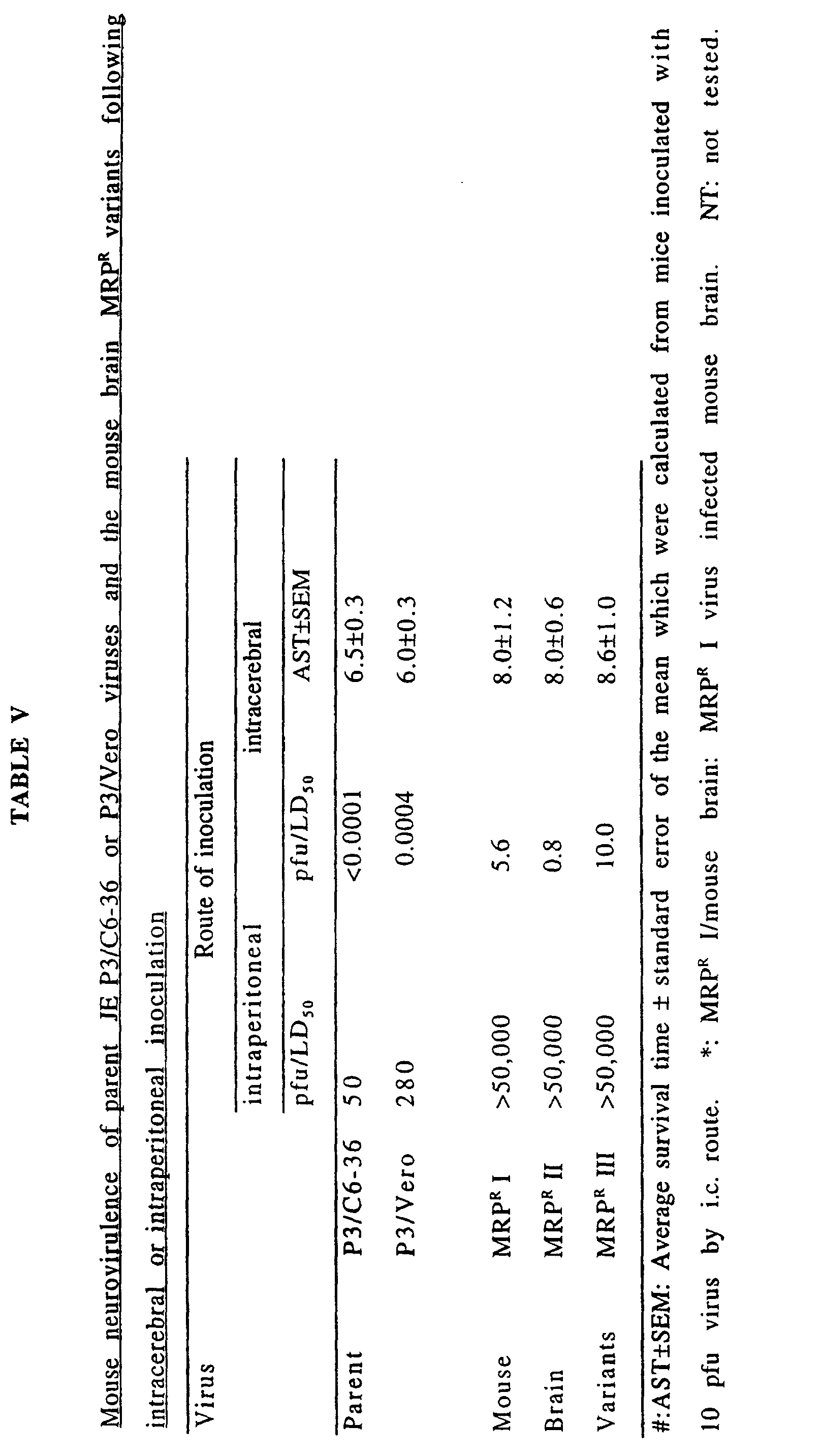
- Mouse neurovirulence of parent JE P3 virus and the mouse brain MRPR variants following intracerebral or intraperitoneal inoculation Virus Route of inoculation intraperitoneal intracerebral pfu/LD 50 pfu/LD 50 AST ⁇ SEM
- Parent P3 50 ⁇ 0.0001 6.5 ⁇ 0.3
- Mouse MRP R I >50,000 5.6 8.0 ⁇ 1.2 brain
- MRP R II >50,000 0.8 8.0 ⁇ 1.2
- Variants MRP R III >50.000 10.0 8.6 ⁇ 1.0
- Wild-type Japanese encephalitis virus strains P3 was provided by Dr. Robert Shope of Yale Arbovirus Research Unit. Monkey kidney (Vero) cells and Aedes albopictus mosquito C6-36 cells were grown at 37°C and 28°C, respectively, in Eagle's minimal essential medium (EMEM; Sigma) supplemented with 10% heat-inactivated fetal calf serum (Sigma), 2 mM L-glutamine (Sigma) and antibiotics.
- EMEM Eagle's minimal essential medium
- Mouse brains were collected from 3-4 week old female balb/C mice.
- the brain membrane receptor preparations (MRPs) were made based on the method described for neurotransmitter receptor binding assays (Middlemiss and Frozard, 1983). Briefly, the brains were rapidly dissected, weighed and homogenized in Tris buffer (50 mM, pH 7.6). The homogenate was centrifuged (35,600g for 10 minutes), the pellet resuspended in the same volume of Tris buffer and this process was repeated twice. Between the second and third centrifugations, the homogenate was incubated at 37°C for 10 minutes. The final pellet was resuspended in a volume of Tris buffer (50 mM pH 7.6) to give a final protein concentration of approximately 20-40 mg wet brain/ml and stored at -70°C .
- MRPs brain membrane receptor preparations
- Residual virus infectivity in the supernatant was determined by infecting Vero cell monolayer and counting plaques produced after five days incubation at 37°C. The individual MRP R variant plaques were picked and amplified in Vero cells. The virus variants generated were investigated for binding to fresh membrane receptor preparations. Lack of binding of the virus variants to fresh mouse brain membrane receptor preparation confirmed that they were true MRP R variants.
- mice NIH-Swiss female outbred white mice, 3 to 4 weeks old were obtained from Harlan, Indianapolis, IN. The mice were inoculated with either 20 ⁇ l of virus by the intracerebral (i.c.) route or 100 ⁇ l by the intraperitoneal (i.p.) route. Virulence studies involved eight mice per dose group. LD 50 and average survival time (AST) values were determined. Mice examined for infectivity were sacrificed at day two or day seven post i.c. or i.p. inoculation and the brains and sera were processed for infectivity titration by plaque assays.
- i.c. intracerebral
- i.p. intraperitoneal
- mice 3 to 4 weeks old were obtained from Harlan. Indianapolis, IN.
- mice for each MRP R variant were inoculated with 10 3 pfu virus by the i.p. route. Mice was sacrificed on day 15 post-inoculation and blood collected by cardiac puncture. The serum fraction was collected and stored at -20°C. Neutralization assays were performed as described in Wills et al. (1992).
- RT-PCR, cloning and sequencing of the virus RNA were as described before (Ni et al., 1994).
- Computer analyses of nucleic acid data and deduced amino acid sequences were accomplished using the MICROGENIE (Queen and Korn, 1984), PCGENE and Genetic Computer Group (Devereux et al., 1984).
- Japanese encephalitis virus strain P3 grown in C6-36 cells was mixed and incubated with mouse brain, monkey brain or monkey liver membrane receptor preparations at 37°C for 3 0 minutes, the mixture was pelleted and supernatant plaqued as described above.
- Japanese encephalitis P3 virus bound to mouse brain and monkey brain membrane receptor preparations, but not monkey liver membrane receptor preparations (TABLE III).
- P3/C6-36 virus bind to monkey brain membrane receptor preparations completely.
- mice were inoculated b y the i.c or i.p. route with either parental P3/C6-36 or P3/Vero virus, or one of the MRP R variants.
- the pfu/LD 50 values and AST ⁇ SEM were determined.
- Comparison of parental P3/C6-36 and P3/Vero viruses showed that plaque purification and amplification in Vero cells had little effect on the virulence of P3 virus in terms of both LD 50 following i.c. or i.p. inoculation (TABLE V) although P3/Vero virus was slightly less virulent than P3/C6-36 virus.
- mice infected with the mouse brain MRP R variants were attenuated at least 200 fold compared with the parental P3 viruses following i.p. inoculation (i.e., neuroinvasiveness) (TABLE V). Also, all three mouse brain MRP R variants were significantly attenuated in neurovirulence (at least 500 fold) compared with their parental viruses after i.c. inoculation of mice (TABLE II). The average survival times of mice infected with the mouse brain MRP R variants were also longer than that of the parental P3 virus (TABLE V).
- Neutralization antibody titer elicited by mouse brain MRP R escape virus variants MRP R I MRP R II MRP R III Neutralization antibody titer 320 320 >320 160 160 320 160 160 160 40 160 160 160 Neutralization titer: Taken as the highest dilution of serum to neutralize 50% of homologous challenge virus.
- mice were sacrificed on days two and seven after i.c. inoculation of 1 pfu or i.p. inoculation of 1000 pfu of the viruses to determine whether or not the MRP R variants could replicate in the blood and brains of mice. All three mouse brain MRP R variants replicated in the infected mice (TABLE VI). The infectivity of the MRP R variants in the brains and sera were lower than their parental virus at day two post i.c. inoculation. However, all mice inoculated by the i.c. route with parental P3 virus died by day seven post infection. The infectivity of the MRP R variants was significantly lower than parental virus in the sera at days two and seven post i.p. inoculation.
- mice inoculated with the mouse brain MRP R variants induced neutralizing antibody in all infected mice by day 15 post i.p. inoculation (TABLE VII).
- the pre-memberane (prM), memberane (M) and evelope (E) protein genes of P3 viruses and the MRP R variants were cloned and sequenced.
- the P3/Vero virus had 13 nucleotide differences compared with the P3/C6-36 virus in prM, M and E protein genes, which resulted in five amino acid changes at positions of E-46, E-129, E-209, E-351 and E-387 (TABLE VIII), which may be responsible for the reduced virulence of P3/Vero virus compared to P3/C6-36 virus. These amino acid differences can not be considered to be responsible for virus attenuation of the MRP R variants.
- the three mouse brain MRP R variants had identical nucleotide sequences in prM, M and E protein genes. They had 2 3 nucleotide differences compared to the P3/C6-36 virus and 20 nucleotide differences to the P3/Vero virus. However, these mouse brain MRP R variants have only two amino acid changes compared with parental P3/C6-36 and P3/Vero viruses at residues E-306 (G ⁇ E) and E-408 (L ⁇ S) (TABLE VIII).
- Virus binding to the host cell surface receptors is the first step in the virus replication cycle, and is directly involved in the tissue tropism and pathogenesis of many viruses (Fields & Greene, 1982). Despite their importance, the identities and host cell functions of relative few cell receptors for viruses are known or widely accepted. No cellular receptors for flaviviruses have been identified although it is assumed that E protein of flaviviruses plays a role in the cellular tropism by being involved in virus binding to cellular receptors. Recently, Chen et al. expressed E protein of dengue-2 virus which bound to Vero, CHO, endothelial, and glial cells. Recombinant E protein inhibited infection of Vero cells by dengue virus.
- the present invention describes a procedure for selection of variants that could be generated by selection of viruses that do bind to membrane receptor preparations (MRPs) (TABLES II AND III).
- MRPs membrane receptor preparations
- Attenuation of the neurovirulence of the Japanese encephalitis P3 strain mouse brain MRP R variants may occur following selection of variants in the virus preparation that have mutated in the receptor attachment domain of the virus, which in the case of flaviviruses, is the E protein. Such variants may have changed tissue tropism. Only two common amino acid substitutions were identified at residues E-306 and E-408 (TABLE VIII). These two substitutions significantly changed secondary structure of E protein. Thus, these two amino acids play a critical role in attenuation of the mouse brain MRP R variants.
- the amino acid substitution at residue E-408 of the MRP variants is located in the stem region of the flavivirus E protein which links the ectodomain to the membrane anchor region.
- the transmembrane ⁇ helix stem region has recently been proposed as an important element for low-pH-induced oligenomic rearrangement of the E protein.
- the E-408 substitution alters the alpha-helix and virus induced membrane fusion.
- the present invention demonstrated that Japanese encephalitis virus mouse brain MRP R can be readily selected in vitro from parental virus seed in presence of excess amount of MRP. Selected virus MRP R variants have an attenuated phenotype in mouse.
- the present invention suggests that selection for MRP R variants from target tissue of the virus is one potential route to generate attenuated virus strains and that it is conceivable to generate attenuated variants with multiple mutations selection using MPRs from different tissues consecutively.
- the present invention provides a novel methodology permitting relatively cheap and rapid selection of the virus vaccine candidate(s).
- Membrane receptor variants of Yellow Fever virus and Langat virus Virus Strain MRP$ Lethality' Yellow fever FNV - 0,08 MK-1 >100 MK-11 >100 MK-IV 80 Langat TP21 - 1.3 HU-1 16 MS, pH7.0 16,000 MS-II ⁇ 1000 MS-I 2000 HU-III 126 #: lethality in 3-4 week old ice following intracerebral inoculation. Figures are pfu/LD 50 . $: MRP membrane receptor preparation, MK: monkey brain, MS: mouse brain, HU: human brain.
- HBG human brain grey matter
- BGW human brain white matter
- * MRP R I/mouse brain.
- TABLE X shows that the methodology of the present invention is not restricted to mouse brain MRPs.
- Human brain MRPs were used to generate MRP R s which were attenuated 5,000,000,000-fold for mouse neurovirulence.
- the methodology is not restricted to Japanese encephalitis virus (TABLE IX).
- Monkey brain MRP R variants of yellow fever virus were attenuated for mouse neurovirulence following intracerebral inoculation of weanling mice and mouse brain and human brain MRP R variants of Langat virus were attenuated for mouse neurovirulence following intracerebral inoculation of weanling mice.
- Human brain was collected from a 74-year-old female who died of a heart attack and human liver was collected from a 76-years-old male who died of lung cancer.
- the brain and liver membrane receptor preparations were made based on the method described for neurotransmitter receptor binding assays (Middlemiss and Frozard, 1983) but the final MRP was resuspended in Eagle's minimum essential medium (Sigma) containing 2% fetal calf serum and antibiotics.
- Six human brain MRP variants were selected after parental wide-type JE virus P3 strain was incubated with human brain MRPs derived either from gray or white matter. Infectivity titrations of JE virus were performed in Vero cells.
- wild-type strain P3 virus grown in mosquito C6-36 cells P3/C6-36 cells
- live attenuated vaccine strain SA14-14-2 virus also grown in mosquito C6/36 cells, (SA14-14-2/C6-36) (Yu et al., 1981 ) were mixed and incubated with either mouse brain, human brain, or human liver MRPs or PBS for 30 mins at 37°C
- the mixture of virus and MRPs was pelleted and virus that remained in the supernatant was plaqued in Vero cells.
- the results with MRPs are consistent with the tissue tropism of wild-type JE virus (i.e., neurotropism of JE virus) and attenuated phenotype of vaccine strain SA14-14-2.
- HBG MRP R I, II and IIII Three MRP R variants were derived by incubation of virus with HBG MRPs and termed HBG MRP R I, II and IIII, respectively. The other three MRP R variants were derived by selection with HBW MRPs and termed HBW MRP R I, II and III, respectively. None of the six human brain MRP R variants bound to HBG, HBW or mouse brain MRPs.
- mice Groups of outbred NIH-Swiss mice were inoculated by either the i.c. or i.p. route with either parent P3 virus or one of the human brain MRP R variants. All six human brain MRP R variants were attenuated for mice (TABLEXII). In comparison to the wild-type parental JE P3 virus which had been passaged in Vero cells (P3/Vero virus), all human brain MRP R variants tested were attenuated at least 200-fold following i.p. inoculation (i.e., neuroinvasiveness) and attenuated at least 25 million-fold for neurovirulence compared with their parent after i.c. inoculation of mice. Interestingly, the human brain MRP R variants were at least 10,000-fold more attenuated for neurovirulence than the mouse brain MRP R variants.
- mice inoculated with 10,000 pfu of either HBG MRP R I or HBW MRP R I variants induced neutralizing antibody in all immunized mice by day 15 post i.p. inoculation (TABLE XIII). Mice immunized with 10,000 pfu of either HBG MRP R I or HBW MRP R I variant viruses were protected against wild-type P3 challenge. However, mice were not protected from wide-type parental P3 virus challenge when immunized i.p. with 1000 pfu of these MRP R variants (TABLE XIV).
- human brain MRP R variants were less immunogenic than mouse brain MRP R variants which protected mice following immunization of 1000 pfu of the virus by i.p. route.
- Neutralizating antibody titers induced by immunization of NIH- Swiss mice with 10.000 pfu of human brain MRP R escape virus Variants.
- Neutralization titer Taken as the highest dilution of serum to neutralize 50%of homologous challenge virus. Survival of mice challenged with 10.000 pfu parental virus by i.p.
- mice were immunized and challenged by i.p. route. # : number of survivors/number of mice in group. NT: not tested
- the E protein genes of parental P3 viruses and four human brain MRP R variants (HBG MRP R I and II, and HBW MRP R I and II) were amplified by RT-PCR, cloned and sequenced.
- the HBG MRP R I and II variants had identical nucleotide sequences while HBW MRP R I and II variants had one silent nucleotide difference at nucleotide 1199 (U/ C).
- the two HBG MRP R variants had 34 nucleotide differences compared with P3/C6-36 virus in the E protein gene, which resulted in 10 amino acid substitutions at residues E-46, E-61, E-76, E-200, E-351, E-387, E-408, E-418 E-475 and E-488 (TABLE XV).
- the two HBW MRP R variants had 40/41 nucleotide differences compared with P3/C6-36 virus which resulted in 10 amino acid substitutions at E-46, E-61, E-76, E-200, E-329, E-351, E-387, E-408, E-418 and E-475 (TABLE XV). These amino acid changes were located in domains I, II, III and stem-anchor region of the Eprotein (Rey et al., 1995).
- HBG MRP R variants differed from wild-type P3/ Vero virus at eight residues E-46, E-61, E-76, E-200, E-408, E-418 E-475 and E-488.
- HBW MRP R variants also differed from wild-type P3/Vero virus at eight residues at E-46, E-61, E-76, E-200, E-329, E-408, E-418 and E-475.
- E-408, E-418, E-475 or E-488 mutations occur in the stem-anchor region of the flavivirus E protein, and may cause conformational changes in the ectodomain of the E protein.
- E-46 is spatially near to E-138 in the proposed three-dimensional structure of the JE virus E protein. Therefore, it is speculated that the mutation of E-46 is at least in part responsible for the attenuated phenotype of the human brain MRP R variants.
- FNV virus was the only strain of yellow fever virus to bind to MKB.
- 17D-204 vaccine virus bound poorly to MKL and MKB MRPs. This may be indirectly involved in the attenuated phenotype of 17D virus.
- MKB MRP R variants were generated for FNV "strain" Yale (Wang et al. (1995)), except that MRPs was derived from the brain of a cynomolgus monkey. Three MKB MRP R variants were selected in buffer at pH 7.6, and designated as MKB MRP R I, MKB MKRP R II and MKB MRP R III, respectively. The fourth variant was selected in buffer at pH 6.0 and termed MKB MRP R (pH 6.0). Two MRP R variants were also selected from FNV-Yale after incubation with mouse brain MRPs at pH 7.6 and designed as MS MRP R I and MS MRP R II.
- FNV-Yale is known to be highly neurovirulent for mice after intracerbral inoculation (Wang et al., 1995) and was found to have a pfu/ LD 50 of 0.08 in four-week- old female NIH-Swiss mice while MKB MRP R variant viruses selected at pH 7.6 were attenuated at least 400-fold (e.g., 32 pfu/ LD 50 for MKB MRP R II) (TABLE XVII).
- MKB MRP R (pH 6.0) was attenuated 87-fold compared to parent FNV-Yale virus, and was less attenuated than MKB MRP R variant viruses selected at pH 7.6.
- the two MS MRP R variants were also attenuated, 100-fold or less, compared with parental FNV-Yale virus (TABLE XVII). Sequencing of pre-membrane (prM) and E protein genes of parent and MRP R variant viruses revealed that each variant only had one nucleotide change resulting in one amino acid substitution in the E protein compared with parental FNV-Yale virus. No changes were identified in the M protein gene.
- the MKB MRP R (pH 6.0) had one amino acid substitution at E-458 (G ⁇ R), and the three MKB MRP R variants selected at pH 7.6 each had a single amino acid substitution at E-260 (G ⁇ A), E-274 (Y ⁇ H) or E-237 (H ⁇ Y) for MKB MRP R I, MKB MRP R II and MKB MRP R III, respectively.
- the two MS MRP R variants each had an identical amino acid substitution at E-457 (M ⁇ I).
- FIG. 4 shows a diagrammatic representation of the three-dimensional structure of the soluble portion of YF virus E protein based on the structure of TBE virus reported by Rey et al. (1995) with the amino acid substitutions found in the FNV viruses highlighted (E-54, E-227 and E-249).
- the single amino acid substitutions in the E proteins of MKB MRP R I, MKB MRP R II and MKB MRP R III give rise to mutations in domain II at E-237, E-260 and E-274 respectively, that are all near to the E-249 substitution found in the FNV vaccine viruses, suggesting that this region of the E protein is involved in virus binding to monkey brain and may be indirectly related to the enhanced monkey neurotropism of FNV viruses.
- the E-249 substitution is unique to the four FNV vaccine virus "strains" (Wang et al., 1995).
- the substitution at E-260, E-274 or E-237 of the MKB MRP R variants selected at pH 7.6 were distinct from the MKB MRP R variant selected at pH 6.0 which had an amino acid substitution at E-458 in the stem-anchor region. It is speculated that this substitution is due to the conformational change in the E protein that takes place due to the decrease in pH and is consistent with the proposal for TBE virus (Stiasny et al., 1996). Also, the substitution found in the two MS MRP R variants of YF FNV-Yale strain selected at pH 7.6 were at E-457 in the stem-anchor region of the Eprotein.
Landscapes
- Micro-Organisms Or Cultivation Processes Thereof (AREA)
- Medicines Containing Antibodies Or Antigens For Use As Internal Diagnostic Agents (AREA)
- Organic Low-Molecular-Weight Compounds And Preparation Thereof (AREA)
- Preparation Of Compounds By Using Micro-Organisms (AREA)
- Measuring Or Testing Involving Enzymes Or Micro-Organisms (AREA)
Abstract
Description
| Comparison of the Virulence of Wild-Type JE Virus Strains in Weanling Mice Following Different Routes of Inoculation | |||
| Lethality (pfu/LD50) | |||
| Virus | Intracerebral | Intranasal | Intraperitoneal |
| P3 | 0.0001 | 50 | |
| Nakayama | 0.1 | 800 | 10,000 |
| JaOArS982 | 0.1 | NT | 3,000,000 |
| SA14/USA | 2 | > 5,000,000 | > 5,000,000 |
| Mouse neurovirulence of parent JE P3 virus and the mouse brain: MRPR variants following intracerebral or intraperitoneal inoculation | ||||
| Virus | Route of inoculation | |||
| intraperitoneal | intracerebral | |||
| pfu/LD50 | pfu/LD50 | AST±SEM | ||
| Parent | P3 | 50 | <0.0001 | 6.5 ±0.3 |
| Mouse | MRPR I | >50,000 | 5.6 | 8.0±1.2 |
| brain | MRPR II | >50,000 | 0.8 | 8.0±1.2 |
| Variants | MRPR III | >50.000 | 10.0 | 8.6±1.0 |
| #:AST±SEM: Average survival time ± SEM which were caculated from mice inoculated with 10 pfu virus by i.c. route. |
| P3 virus binding test to mouse brain, monkey brain, and monkey liver membrane receptor preparations | |||
| Infectivity (Log10pfu | Binding index | Binding (%) | |
| Buffer | 6.1 | -- | -- |
| Mouse brain MRP | 2.5 | 3.6 | 99.97 |
| Monkey Brain MRP | >1.0 | >5.1 | >99.99 |
| Monkey liver MRP | 6.0 | 0.1 | 8.33 |
| #Infectivity: infectious virus remaining in supernatant following incubation of virus with MRP or buffer, and pelleting virus MRP complex as described above. *binding index: log10 infectivity in buffer |


| Neutralization antibody titer elicited by mouse brain MRPR escape virus variants | |||
| MRPR I | MRPR II | MRPR III | |
| Neutralization antibody titer | 320 | 320 | >320 |
| 160 | 160 | 320 | |
| 160 | 160 | 160 | |
| 40 | 160 | 160 | |
| Neutralization titer: Taken as the highest dilution of serum to neutralize 50% of homologous challenge virus. |
| Comparison of amino acid changes in the E protein sequence of P3/C6-36 or P3/Vero and the mouse brain MRPR variants | |||
| Position | P3/C6-36 | P3/Vero | MRPR mutants |
| E-46 | T | I | T |
| E-129 | A | T | T |
| E-209 | R | K | K |
| E-306 | G | G | E |
| E-351 | A | V | V |
| E-387 | E | G | G |
| E-408 | L | L | S |
| E-475 | A | A | A |
| Membrane receptor variants of Yellow Fever virus and Langat virus | |||
| Virus | Strain | MRP$ | Lethality' |
| Yellow fever | FNV | - | 0,08 |
| MK-1 | >100 | ||
| MK-11 | >100 | ||
| MK-IV | 80 | ||
| Langat | TP21 | - | 1.3 |
| HU-1 | 16 | ||
| MS, pH7.0 | 16,000 | ||
| MS-II | <1000 | ||
| MS-I | 2000 | ||
| HU-III | 126 | ||
| #: lethality in 3-4 week old ice following intracerebral inoculation. Figures are pfu/LD50. $: MRP = membrane receptor preparation, MK: monkey brain, MS: mouse brain, HU: human brain. |
| Mouse neurovirulence following intracerebral and intraperitoneal inoculation of parent JEP3 virus grown in C6-36 or Vero cells and its mouse brain and human brain membrane receptor preparation escape (MRPR) variants | ||||
| Virus | Route of Inoculation | |||
| i.p. | i.c. | |||
| pfu/LD50 | pfu/LD50 | AST±SEM# | ||
| parent | C6-36 | 50 | <0.1 | 6.5±0.3 |
| Vero | 280 | 0.0004 | 6.0±0.3 | |
| Mouse | MRPR I | >50,000 | 5.6 | 8.0±1.2 |
| brain | MRPR II | >50,000 | 0.8 | 8.0±0.6 |
| variants | MRPR III | >50,000 | 10.0 | 8.6±1.0 |
| HBG1 | MRPR I | >5,000 | >100,000 | >14 |
| variants | MRPR II | >5,000 | >100,000 | >14 |
| HBW2 | MRPR I | >5,000 | > 100,000 | >14 |
| Variant | ||||
| 1: HBG: human brain grey matter; 2: BGW: human brain white matter; #: AST±SEM: average survival time ± standard error of the mean which were calculated from mice inoculated with 10 pfu virus by ic route; *: MRPR I/mouse brain. Virus recovered from mouse brain MRPR I virus-infected mouse brain: ic: intracerebral; ip: intraperitoneal. |
| Comparison of the binding of JE wild-type strain P3 and live attenuated vaccine SA14-14-2 virus to mouse brain, human brain and human liver MRPs. | ||||
| Virus Strain | Infectivity (Log10pfu) | Binding index | Binding (%) | |
| Virus+ Buffer | Virus+ MRP | |||
| P3/C6-36 | 6.1 | 2.5 (MB) | 3.6 | 99.97 |
| P3/C6-36 | 7.3 | 4.0 (HBG) | 3.3 | 99.95 |
| P3/C6-36 | 7.3 | 3.3 (HBW) | 4.0 | 99.99 |
| SA14-14-2 | 6.3 | 5.6 (HBG) | 0.7 | 80 |
| SA14-14-2 | 6.3 | 5.5 (HBW) | 0.8 | 85 |
| P3/C6-36 | 7.1 | 6.8 (HL) | 0.3 | 50 |

| Neutralizating antibody titers induced by immunization of NIH- Swiss mice with 10.000 pfu of human brain MRPR escape virus Variants. | ||
| HBG MRPR I | HBW MRPR I | |
| Neutralization | 160 | >320 |
| antibody titer | 160 | 160 |
| 80 | 80 | |
| 40 | 80 | |
| 20 | 40 | |
| Neutralization titer: Taken as the highest dilution of serum to neutralize 50%of homologous challenge virus. |
| Survival of mice challenged with 10.000 pfu parental virus by i.p. route after immunization with either 1.000 pfu or 10.000 pfu human brain MRPR variants | |||
| virus | Immunization dose (pfu) | ||
| 0 | 1000 | 10,000 | |
| HBG MRPR I | 0/10# | 0/5 | 5/5 |
| HBW MRPR I | 0/10 | 0/5 | 5/5 |
| The mice were immunized and challenged by i.p. route. #: number of survivors/number of mice in group. NT: not tested |
| Comparison of amino acid changes in the E protein sequence of parental P3 virus grown in mosquito C6-36 or monkey kidney Vero cells and its human brain membrane escape (MRPR) variants | |||||
| Amino acid Position | E protein Domain | P3/ C6-36 | P3/ Vero | HBG MRPR variants | HBW MRPR variants |
| E-46 | Domain I | T | I | S | S |
| E-61 | Domain II | Y | Y | H | H |
| E-76 | Domain II | M | M | T | T |
| E-129 | Domain II | A | T | A | A |
| E-200 | Domain II | F | F | L | L |
| E-209 | Domain II | R | K | R | R |
| E-329 | Domain III | S | S | S | P |
| E-351 | Domain III | A | V | V | V |
| E-387 | Domain III | E | G | G | G |
| E-408 | Stem-anchor | L | L | S | S |
| E-418 | Stem-anchor | A | A | V | V |
| E-475 | Stem-anchor | A | A | I | I |
| E-488 | Stem-anchor | G | G | S | G |
| Comparison of binding of yellow fever, Japanese encephalitis and dengue viruses to monkey brain and monkey liver MRPs. | |||||
| Virus | strain | Infectivity Log10pfu) | Binding index | Binding (%) | |
| Virus + Buffer | Virus + MRP | ||||
| JE | P3 | 5.7 | 3.6(MKB) | 2.1 (MKB) | 99.2(MKB) |
| 5.0(MKL) | 0.7(MKL) | 80.0(MKL) | |||
| DEN- 2 | NGC | 5 .8 | 5.5 (MKB) | 0.3 (MKB) | 57.1 (MKB) |
| 5.6(MKL) | 0.2(MKL) | 42.9(MKL) | |||
| YF | FVV | 5.6 | 5.0(MKB) | 0.6(MKB) | 77.5(MKB) |
| 3.8 (MKL) | 1.8 (MKL) | 98.5 (MKL) | |||
| FNV-Yale | 6.5 | 4.0(MKB) | 2.5(MKB) | 99.7(MKB) | |
| 5.0 (MKL) | 1.5 (MKL) | 96.7 (MKL) | |||
| Asibi | 6.3 | 5.8(MKB) | 0.5(MKB) | 70.0(MKB) | |
| 5.0(MKL) | 1.3(MKL) | 95.0(MKL) | |||
| 17D | 6.8 | 6.3 (MKB) | 0.5 (MKB) | 71.4(MKB) | |
| 6.0(MKL) | 0.8(MKL) | 85.7(MKL) | |||
| aInfectivity: infectious virus remaining in the supernatant following incubation of virus with MRP or buffer and pelleting the virus-MRP complex. bBinding index: Log10 infectivity in buffer/infectivity in MRP supernatant. cMKB: Monkey brain MRP. dMKL: Monkey liver MRP. |
| M neurovirulence following intracerebral inoculation and amino acid differences between FNV-Yale and MRPR variants | ||
| Virus | pfu/LD50 i.c. (mouse) | amino acid substitution |
| FNV-YALE | 0.08 | -- |
| MKB MRPR I (pH 7.6) | >100 | E-260 (G→A) |
| MKB MRPR II (pH 7.6) | 32 | E-274 (Y→H) |
| MKB MRPR III (pH 7.6) | 80 | E-237 (H→Y) |
| MKB MRPR (pH 6.0) | 7 | E-458 (G→R) |
| MS MRPR I (pH 7.6) | 5 | E-457 (M→I) |
| MS MRPR II (pH 7.6) | 8 | E-457 (M→I) |
- 1. Tsai et al., Japanese encephalitis vaccines. In: Plotkin et al., eds. Vaccines. 2nd ed. Philadelphia: WB Saunders, 1995: 671-713
- 2. Ni et al., J Gen Virol 1996;77:1449-1455.
- 3. Eckels et al.,Vaccine 1988;6:513-518
- 4. Aihara et al.,Virus Genes 1991; 5:95-109.
- 5. Nitayaphan et al.,Virology 1990; 177: 541-552.
- 6. Ni et al., J Gen Virol 1994;75:1505-1510.
- 7. Ni et al., J Gen Virol 1995;76:409-413.
- 8. Chen et al., Am J Trop Med Hyg 1982;31:403407.
- 9. Hase et al., Arch Virol 1993; 130:131-143.
- 10. Hasegawa et al., Virology 1992; 191:158-165.
- 11. Cecilia et al., Virology 1991; 181:70-77.
- 12. McMinn et al., Virology 1995; 211:10-20.
- 13. Jiang et al., J Gen Virol 1993; 74:931-935.
- 14. Holzmann et al., J Virol 1990; 64:5156-5159.
- 15. Sumiyoshi et al., J Inf Dis 1995; 171:1144-51.
- 16. Chen et al., Virology 1996; 223: 79-88.
- 17. Rey et al., Nature 1995; 375:291-298.
- 18. Jan et al., J Gen Virol 1995; 76:573-580.
- 19. Falgout et al., J Virol 1993; 67:2034-2042.
- 20. Wallner et al., J Gen Virol 1996; 77:1035-1042.
Claims (7)
- A method of selecting virus vaccine candidates by selecting virus variants that do not bind to brain membrane receptor preparations, comprising the steps of:(a) preparing a brain membrane receptor preparation;(b) mixing an amount of yellow fever virus or langat virus with an amount of said membrane receptor preparation containing excess membrane receptors to form a virus-membrane receptor preparation suspension;(c) centrifuging said suspension to form a supernatant;(d) determining residual virus infectivity in said supernatant; and(e) isolating individual virus variants that do not bind to said membrane receptor preparation, wherein said virus variants are useful as virus vaccine candidates.
- The method of claim 1, wherein said brain membrane receptor preparation is selected from the group consisting of mouse brain membrane receptor preparation and human brain membrane receptor preparation.
- The method of claim 1, wherein said brain membrane receptor preparation has a protein concentration of about 20-40 mg wet brain per ml.
- The method of claim 1, wherein said residual virus infectivity in said supernatant is determined by infecting a Vero cell monolayer and counting plaques produced.
- The method of claim 1, wherein said isolation of individual virus variants that do not bind to said membrane receptor preparation is by amplification from plaques produced by said virus variants.
- The method of claim 1, wherein said variants generated are incubated with fresh brain membrane receptor preparations and a lack of binding of the variants to fresh brain membrane receptor preparations confirm that the variants are true variants.
- The method of claim 1, wherein said variants are attenuated for neuroinvasiveness and neurovirulence.
Applications Claiming Priority (5)
| Application Number | Priority Date | Filing Date | Title |
|---|---|---|---|
| US08/874,272 US6010894A (en) | 1997-06-13 | 1997-06-13 | Method of screening for attenuating viruses |
| US874272 | 1997-06-13 | ||
| 1998-05-21 | |||
| US9098298A | 1998-06-05 | 1998-06-05 | |
| PCT/US1998/011329 WO1998056896A1 (en) | 1997-06-13 | 1998-06-08 | Method of attenuating viruses |
Publications (3)
| Publication Number | Publication Date |
|---|---|
| EP0922092A1 EP0922092A1 (en) | 1999-06-16 |
| EP0922092A4 EP0922092A4 (en) | 2001-09-19 |
| EP0922092B1 true EP0922092B1 (en) | 2004-08-25 |
Family
ID=26782846
Family Applications (1)
| Application Number | Title | Priority Date | Filing Date |
|---|---|---|---|
| EP98928866A Expired - Lifetime EP0922092B1 (en) | 1997-06-13 | 1998-06-08 | Method of attenuating viruses |
Country Status (8)
| Country | Link |
|---|---|
| EP (1) | EP0922092B1 (en) |
| JP (1) | JP2002514088A (en) |
| CN (1) | CN1229434A (en) |
| AT (1) | ATE274574T1 (en) |
| CA (1) | CA2263993A1 (en) |
| DE (1) | DE69825847D1 (en) |
| IL (1) | IL128382A (en) |
| NZ (1) | NZ333990A (en) |
Families Citing this family (2)
| Publication number | Priority date | Publication date | Assignee | Title |
|---|---|---|---|---|
| CN103289966B (en) * | 2013-07-03 | 2014-11-05 | 青岛易邦生物工程有限公司 | Low virulent strain of pig Japanese encephalitis virus |
| EP3031923A1 (en) * | 2014-12-11 | 2016-06-15 | Institut Pasteur | Lentiviral vector-based japanese encephalitis immunogenic composition |
-
1998
- 1998-06-08 DE DE69825847T patent/DE69825847D1/en not_active Expired - Lifetime
- 1998-06-08 JP JP50277699A patent/JP2002514088A/en active Pending
- 1998-06-08 AT AT98928866T patent/ATE274574T1/en not_active IP Right Cessation
- 1998-06-08 EP EP98928866A patent/EP0922092B1/en not_active Expired - Lifetime
- 1998-06-08 CA CA002263993A patent/CA2263993A1/en not_active Abandoned
- 1998-06-08 CN CN98800846A patent/CN1229434A/en active Pending
- 1998-06-08 NZ NZ333990A patent/NZ333990A/en unknown
- 1998-06-08 IL IL12838298A patent/IL128382A/en not_active IP Right Cessation
Non-Patent Citations (2)
| Title |
|---|
| DUNSTER ET AL: "Attenuation of virulence of flaviviruses following passage in HeLa cells", JOURNAL OF GENERAL VIROLOGY, vol. 71, March 1990 (1990-03-01), pages 601 - 607 * |
| NI H. ET AL: "MOLECULAR BASIS OF ATTENUATION AND VIRULENCE OF JAPANESE ENCEPHALITIS VIRUS", 1997, ELSEVIER, PARIS * |
Also Published As
| Publication number | Publication date |
|---|---|
| CA2263993A1 (en) | 1998-12-17 |
| JP2002514088A (en) | 2002-05-14 |
| DE69825847D1 (en) | 2004-09-30 |
| IL128382A (en) | 2001-12-23 |
| NZ333990A (en) | 2000-10-27 |
| ATE274574T1 (en) | 2004-09-15 |
| EP0922092A1 (en) | 1999-06-16 |
| IL128382A0 (en) | 2000-01-31 |
| CN1229434A (en) | 1999-09-22 |
| EP0922092A4 (en) | 2001-09-19 |
Similar Documents
| Publication | Publication Date | Title |
|---|---|---|
| AU2009241354B2 (en) | Chimeric West Nile/Dengue viruses | |
| JP5554646B2 (en) | Flavivirus vaccine | |
| US8088391B2 (en) | West nile virus vaccine | |
| TWI406673B (en) | Method of immunization against the 4 dengue serotypes | |
| JP5269803B2 (en) | Protocol for immunization against four dengue serotypes | |
| Ni et al. | Attenuation of Japanese encephalitis virus by selection of its mouse brain membrane receptor preparation escape variants | |
| CN111778263A (en) | Compositions and methods of dengue virus chimeric constructs for use in vaccines | |
| RU2208635C2 (en) | Dna-construct of viable chimeric recombinant flavivirus against tick-borne encephalitis virus, method of prophylaxis of infection mammal with tick-borne encephalitis virus | |
| JP2007525226A (en) | Flavivirus vaccine | |
| JP2008520187A (en) | Vaccines against Japanese encephalitis virus and West Nile virus | |
| AU730660B2 (en) | Method of attenuating viruses | |
| EP0922092A1 (en) | Method of attenuating viruses | |
| CN101084010B (en) | Vaccines against Japanese encephalitis virus and West Nile virus | |
| CN100412089C (en) | Full-length infectious cDNA clones of tick-borne flaviviruses | |
| KR20000068161A (en) | Method of attenuating viruses | |
| Myers et al. | ChimeriVax-West Nile Virus | |
| HK1194432B (en) | Flavivirus vaccines | |
| HK1194432A (en) | Flavivirus vaccines | |
| HK1106723B (en) | Vaccines against japanese encephalitis virus and west nile virus |
Legal Events
| Date | Code | Title | Description |
|---|---|---|---|
| PUAI | Public reference made under article 153(3) epc to a published international application that has entered the european phase |
Free format text: ORIGINAL CODE: 0009012 |
|
| 17P | Request for examination filed |
Effective date: 19990206 |
|
| AK | Designated contracting states |
Kind code of ref document: A1 Designated state(s): AT BE CH DE DK ES FI FR GB GR IE IT LI NL PT SE |
|
| A4 | Supplementary search report drawn up and despatched |
Effective date: 20010806 |
|
| AK | Designated contracting states |
Kind code of ref document: A4 Designated state(s): AT BE CH DE DK ES FI FR GB GR IE IT LI NL PT SE |
|
| 17Q | First examination report despatched |
Effective date: 20021106 |
|
| GRAP | Despatch of communication of intention to grant a patent |
Free format text: ORIGINAL CODE: EPIDOSNIGR1 |
|
| GRAS | Grant fee paid |
Free format text: ORIGINAL CODE: EPIDOSNIGR3 |
|
| GRAA | (expected) grant |
Free format text: ORIGINAL CODE: 0009210 |
|
| AK | Designated contracting states |
Kind code of ref document: B1 Designated state(s): AT BE CH DE DK ES FI FR GB GR IE IT LI NL PT SE |
|
| PG25 | Lapsed in a contracting state [announced via postgrant information from national office to epo] |
Ref country code: NL Free format text: LAPSE BECAUSE OF FAILURE TO SUBMIT A TRANSLATION OF THE DESCRIPTION OR TO PAY THE FEE WITHIN THE PRESCRIBED TIME-LIMIT Effective date: 20040825 Ref country code: LI Free format text: LAPSE BECAUSE OF FAILURE TO SUBMIT A TRANSLATION OF THE DESCRIPTION OR TO PAY THE FEE WITHIN THE PRESCRIBED TIME-LIMIT Effective date: 20040825 Ref country code: IT Free format text: LAPSE BECAUSE OF FAILURE TO SUBMIT A TRANSLATION OF THE DESCRIPTION OR TO PAY THE FEE WITHIN THE PRESCRIBED TIME-LIMIT;WARNING: LAPSES OF ITALIAN PATENTS WITH EFFECTIVE DATE BEFORE 2007 MAY HAVE OCCURRED AT ANY TIME BEFORE 2007. THE CORRECT EFFECTIVE DATE MAY BE DIFFERENT FROM THE ONE RECORDED. Effective date: 20040825 Ref country code: FR Free format text: LAPSE BECAUSE OF FAILURE TO SUBMIT A TRANSLATION OF THE DESCRIPTION OR TO PAY THE FEE WITHIN THE PRESCRIBED TIME-LIMIT Effective date: 20040825 Ref country code: FI Free format text: LAPSE BECAUSE OF FAILURE TO SUBMIT A TRANSLATION OF THE DESCRIPTION OR TO PAY THE FEE WITHIN THE PRESCRIBED TIME-LIMIT Effective date: 20040825 Ref country code: CH Free format text: LAPSE BECAUSE OF FAILURE TO SUBMIT A TRANSLATION OF THE DESCRIPTION OR TO PAY THE FEE WITHIN THE PRESCRIBED TIME-LIMIT Effective date: 20040825 Ref country code: BE Free format text: LAPSE BECAUSE OF FAILURE TO SUBMIT A TRANSLATION OF THE DESCRIPTION OR TO PAY THE FEE WITHIN THE PRESCRIBED TIME-LIMIT Effective date: 20040825 Ref country code: AT Free format text: LAPSE BECAUSE OF FAILURE TO SUBMIT A TRANSLATION OF THE DESCRIPTION OR TO PAY THE FEE WITHIN THE PRESCRIBED TIME-LIMIT Effective date: 20040825 |
|
| REG | Reference to a national code |
Ref country code: GB Ref legal event code: FG4D |
|
| REG | Reference to a national code |
Ref country code: CH Ref legal event code: EP |
|
| REG | Reference to a national code |
Ref country code: IE Ref legal event code: FG4D |
|
| REF | Corresponds to: |
Ref document number: 69825847 Country of ref document: DE Date of ref document: 20040930 Kind code of ref document: P |
|
| PG25 | Lapsed in a contracting state [announced via postgrant information from national office to epo] |
Ref country code: SE Free format text: LAPSE BECAUSE OF FAILURE TO SUBMIT A TRANSLATION OF THE DESCRIPTION OR TO PAY THE FEE WITHIN THE PRESCRIBED TIME-LIMIT Effective date: 20041125 Ref country code: GR Free format text: LAPSE BECAUSE OF FAILURE TO SUBMIT A TRANSLATION OF THE DESCRIPTION OR TO PAY THE FEE WITHIN THE PRESCRIBED TIME-LIMIT Effective date: 20041125 Ref country code: DK Free format text: LAPSE BECAUSE OF FAILURE TO SUBMIT A TRANSLATION OF THE DESCRIPTION OR TO PAY THE FEE WITHIN THE PRESCRIBED TIME-LIMIT Effective date: 20041125 |
|
| PG25 | Lapsed in a contracting state [announced via postgrant information from national office to epo] |
Ref country code: DE Free format text: LAPSE BECAUSE OF FAILURE TO SUBMIT A TRANSLATION OF THE DESCRIPTION OR TO PAY THE FEE WITHIN THE PRESCRIBED TIME-LIMIT Effective date: 20041126 |
|
| PG25 | Lapsed in a contracting state [announced via postgrant information from national office to epo] |
Ref country code: ES Free format text: LAPSE BECAUSE OF FAILURE TO SUBMIT A TRANSLATION OF THE DESCRIPTION OR TO PAY THE FEE WITHIN THE PRESCRIBED TIME-LIMIT Effective date: 20041206 |
|
| REG | Reference to a national code |
Ref country code: CH Ref legal event code: PL |
|
| NLV1 | Nl: lapsed or annulled due to failure to fulfill the requirements of art. 29p and 29m of the patents act | ||
| PGFP | Annual fee paid to national office [announced via postgrant information from national office to epo] |
Ref country code: GB Payment date: 20050602 Year of fee payment: 8 |
|
| PG25 | Lapsed in a contracting state [announced via postgrant information from national office to epo] |
Ref country code: IE Free format text: LAPSE BECAUSE OF NON-PAYMENT OF DUE FEES Effective date: 20050608 |
|
| PLBE | No opposition filed within time limit |
Free format text: ORIGINAL CODE: 0009261 |
|
| STAA | Information on the status of an ep patent application or granted ep patent |
Free format text: STATUS: NO OPPOSITION FILED WITHIN TIME LIMIT |
|
| 26N | No opposition filed |
Effective date: 20050526 |
|
| EN | Fr: translation not filed | ||
| REG | Reference to a national code |
Ref country code: IE Ref legal event code: MM4A |
|
| PG25 | Lapsed in a contracting state [announced via postgrant information from national office to epo] |
Ref country code: GB Free format text: LAPSE BECAUSE OF NON-PAYMENT OF DUE FEES Effective date: 20060608 |
|
| GBPC | Gb: european patent ceased through non-payment of renewal fee |
Effective date: 20060608 |
|
| PG25 | Lapsed in a contracting state [announced via postgrant information from national office to epo] |
Ref country code: PT Free format text: LAPSE BECAUSE OF NON-PAYMENT OF DUE FEES Effective date: 20050125 |