EP0921163B1 - Pigment composition and aqueous pigment dispersion prepared therefrom - Google Patents
Pigment composition and aqueous pigment dispersion prepared therefrom Download PDFInfo
- Publication number
- EP0921163B1 EP0921163B1 EP98121554A EP98121554A EP0921163B1 EP 0921163 B1 EP0921163 B1 EP 0921163B1 EP 98121554 A EP98121554 A EP 98121554A EP 98121554 A EP98121554 A EP 98121554A EP 0921163 B1 EP0921163 B1 EP 0921163B1
- Authority
- EP
- European Patent Office
- Prior art keywords
- pigment
- water
- dry
- milling
- weight
- Prior art date
- Legal status (The legal status is an assumption and is not a legal conclusion. Google has not performed a legal analysis and makes no representation as to the accuracy of the status listed.)
- Expired - Lifetime
Links
Classifications
-
- C—CHEMISTRY; METALLURGY
- C09—DYES; PAINTS; POLISHES; NATURAL RESINS; ADHESIVES; COMPOSITIONS NOT OTHERWISE PROVIDED FOR; APPLICATIONS OF MATERIALS NOT OTHERWISE PROVIDED FOR
- C09B—ORGANIC DYES OR CLOSELY-RELATED COMPOUNDS FOR PRODUCING DYES, e.g. PIGMENTS; MORDANTS; LAKES
- C09B67/00—Influencing the physical, e.g. the dyeing or printing properties of dyestuffs without chemical reactions, e.g. by treating with solvents grinding or grinding assistants, coating of pigments or dyes; Process features in the making of dyestuff preparations; Dyestuff preparations of a special physical nature, e.g. tablets, films
- C09B67/0001—Post-treatment of organic pigments or dyes
- C09B67/0002—Grinding; Milling with solid grinding or milling assistants
-
- C—CHEMISTRY; METALLURGY
- C09—DYES; PAINTS; POLISHES; NATURAL RESINS; ADHESIVES; COMPOSITIONS NOT OTHERWISE PROVIDED FOR; APPLICATIONS OF MATERIALS NOT OTHERWISE PROVIDED FOR
- C09B—ORGANIC DYES OR CLOSELY-RELATED COMPOUNDS FOR PRODUCING DYES, e.g. PIGMENTS; MORDANTS; LAKES
- C09B67/00—Influencing the physical, e.g. the dyeing or printing properties of dyestuffs without chemical reactions, e.g. by treating with solvents grinding or grinding assistants, coating of pigments or dyes; Process features in the making of dyestuff preparations; Dyestuff preparations of a special physical nature, e.g. tablets, films
- C09B67/0001—Post-treatment of organic pigments or dyes
- C09B67/0014—Influencing the physical properties by treatment with a liquid, e.g. solvents
- C09B67/0016—Influencing the physical properties by treatment with a liquid, e.g. solvents of phthalocyanines
-
- C—CHEMISTRY; METALLURGY
- C09—DYES; PAINTS; POLISHES; NATURAL RESINS; ADHESIVES; COMPOSITIONS NOT OTHERWISE PROVIDED FOR; APPLICATIONS OF MATERIALS NOT OTHERWISE PROVIDED FOR
- C09B—ORGANIC DYES OR CLOSELY-RELATED COMPOUNDS FOR PRODUCING DYES, e.g. PIGMENTS; MORDANTS; LAKES
- C09B67/00—Influencing the physical, e.g. the dyeing or printing properties of dyestuffs without chemical reactions, e.g. by treating with solvents grinding or grinding assistants, coating of pigments or dyes; Process features in the making of dyestuff preparations; Dyestuff preparations of a special physical nature, e.g. tablets, films
- C09B67/0001—Post-treatment of organic pigments or dyes
- C09B67/0021—Flushing of pigments
Definitions
- the present invention relates to a pigment composition for preparing an aqueous pigment dispersion such as aqueous paints, water-based ink, such as those for textile printing, automobile painting, making color filters, and ink jet printing.
- a pigment composition for preparing an aqueous pigment dispersion such as aqueous paints, water-based ink, such as those for textile printing, automobile painting, making color filters, and ink jet printing.
- the present invention also relates to an aqueous pigment dispersion prepared from the pigment composition.
- pigmentation Conventional methods for preparing pigments to produce aqueous dispersions thereof (generally referred to as "pigmentation”) include so-called salt milling process (hereinafter referred to as “solvent salt milling method").
- solvent salt milling method crude pigments are milled in a ball mill or a kneader in the presence of an inorganic salt and other adjuvants as needed for a long period of time. Consecutively, the inorganic salt and these adjuvants are removed to prepare fine particles of desired pigment.
- a disperser e.g. a sand mill, is used to resolve the coagulated dry pigment into fine particles and simultaneously to disperse the pigment particles in an ink vehicle.
- Such a conventional method requires considerable energy for the recovery of the inorganic salt and adjuvants and for the wastewater management of water used for the recovery. Large dispersion energy is also required in the step of dispersing the milled pigment particles in the ink vehicle to obtain the aqueous pigment dispersion.
- the document JP-A 55-75453 discloses a method for producing a pigment composition.
- crude copper phthalocyanine is dry-milled in the presence of an acid, e.g. sulfuric acid and after that treated in a solvent.
- the treated pigment is then isolated to produce a pigment composition.
- the resulting composition for dispersion is composed of only a pigment since this method does not use any resin at all.
- a pigment dispersion thereof in which resin is used as a vehicle It is necessary to carry out a further dispersion step in the presence of a resin.
- the solvent treatment must also be carried out after the dry milling and it is also necessary to carry out an operation for the recovery of a waste solvent.
- the document JP-A 9-217019 proposes a method for producing a pigment composition, the method comprising a first step of dry-milling a crude pigment, a second step of adding a resin and an organic solvent to disperse the mixture mechanically, a third step of adding an acid to the dispersed substance to precipitate the resin onto the pigment, and a fourth step of reneutralizing by adding an alkali to the precipitate.
- This method requires considerable energy for the resin treatment, comprises many steps for production and is hence long and complicated.
- the document JP-A 9-188845 proposes a method for producing an ink concentrate by dry-milling a crude copper phthalocyanine together with a resin and an organic liquid and then kneading the resulting pigment composition in an ink solvent. This method requires a large amount of energy to obtain the ink concentrate by performing the kneading operation to the extent that the pigment composition is sufficiently dispersed.
- the document EP-A 0 281 720 discloses a dry powdery printing ink composition capable of forming a conventional flexographic or gravure printing ink upon stirring with the necessary amount of a printing ink solvent system and consisting of particles, in admixture, of at least one pigment, at least one binder resin and at least one plasticizer, the composition being virtually free from liquid components and being obtained from solid materials simultaneously by liquid-free comminution of the solid components.
- the document also discloses a method for preparing the dry powdery printing ink composition for forming a conventional flexographic or gravure printing ink upon stirring with the necessary amount of a printing ink solvent system by mixing the dry components, comminuting the blend without adding liquid components and collecting a powdered composition having a particle size of between 1 and 300 ⁇ m.
- the document EP-A 0 808 878 relates to a process of dry-milling a phthalocyanine pigment in the presence of an ink resin under a deoxygenated atmosphere, wherein the ink resin used is not soluble in water.
- the inventors of the present invention have succeeded with surprise to find a pigment composition which can be produced in a single step without using large amounts of water and solvent and can be readily dispersed into an aqueous system.
- An aqueous pigment dispersion can be easily produced by introducing the pigment composition into water containing an alkali and then stirring the mixture.
- This aqueous pigment dispersion is made into a coloring material such as an aqueous ink, which has excellent dispersibility, color strength, glossiness, and flow characteristics.
- the present invention relates to a pigment composition in powder form produced by dry-milling a pigment in the presence of a surfactant and a water-soluble resin containing a monomer component having a carboxyl group, said surfactant being contained in an amount of from 1 to 20 % by weight, and said water-soluble resin containing a monomer component having a carboxyl group being contained in an amount of from 2 to 50 % by weight each based on the amount of the pigment.
- the present invention also relates to an aqueous pigment dispersion comprising water and a pigment composition according to the above description dispersed therein.
- the present invention in addition, relates to a method for producing a pigment composition in powder form said method comprising the steps of (a) dry-milling a pigment in the presence of a surfactant and a water-soluble resin containing a monomer component having a carboxyl group to obtain a milled substance, the surfactant being contained in an amount of from 1 to 20 % by weight and the water-soluble resin containing a monomer component having a carboxyl group being contained in an amount of from 2 to 50 % by weight, each based on the amount of the resin; and (b) treating under heat said pigment simultaneously with the dry-milling and/or treating under heat the milled substance after the dry-milling.
- the invention relates to a method preparing an aqueous pigment dispersion comprising the step of dispersing the pigment composition according to any of the above description in water.
- the present invention provides a pigment composition in a powder form produced by dry-milling a pigment in the presence of a surfactant and a water-soluble resin, said surfactant and said water-soluble resin being contained in amounts of 1 to 20% by weight and 2 to 50% by weight respectively based on an amount of the pigment.
- Preferred surfactant is an ethoxylated aromatic compound.
- the water-soluble resin is a resin containing a monomer component having a carboxyl group and preferably is soluble in water in the presence of an alkali.
- the water-soluble resin is a solid resin.
- the pigment may be a crude pigment.
- the pigment is preferably a condensed polycyclic pigment such as the one comprising a copper phthalocyanine.
- the pigment composition may be used for preparing an aqueous pigment dispersion.
- an aqueous pigment dispersion produced by dispersing the pigment composition above-described in water, wherein the average particle diameter of the pigment preferably is between 10 and 300 nm.
- the water-soluble resin has an acid group and is soluble in water in the presence of an alkali
- an aqueous pigment dispersion produced by dispersing the pigment composition in water in the presence of an alkali, wherein the average particle diameter of the pigment is between 10 and 300 nm.
- the pigment is treated under heat in the presence of the surfactant and the water-soluble resin simultaneously when the dry-milling is carried out.
- the pigment is treated under heat at temperatures between 30 and 150°C simultaneously when said dry- milling is carried out.
- a method for producing a pigment composition in a powder form comprising the steps of: (a) dry-milling a pigment in the presence of a surfactant and a water-soluble resin to obtain a milled substance, the surfactant and the water-soluble resin being contained in amounts of 1 to 20% by weight and 2 to 50% by weight respectively based on an amount of said pigment; and, (b) treating under heat the pigment simultaneously with the dry-milling and/or the milled substance after the dry-milling.
- said pigment is preferably treated under heat at temperatures between 30 and 150°C simultaneously when said dry-milling is carried out.
- the milled substance may be treated under heat at temperatures between 50 and 150°C after said dry-milling is carried out.
- the dry-milling may be performed using a milling apparatus selected from the group consisting of an attritor, a ball mill, and a vibrating mill.
- the dry-milling can be performed in the absence of any water-soluble inorganic salts.
- the dry-milling step may comprise the following sub-steps of: (1) dry-milling said pigment in the presence of said water-soluble resin and in the absence of said surfactant to prepare an intermediate milled substance; and consecutively, (2) further dry-milling said intermediate milled substance after said surfactant is added to said intermediate milled substance to obtain said milled substance.
- said surfactant is preferably an ethoxylated aromatic compound.
- said water-soluble resin is a resin containing a monomer component having a carboxyl group and is preferably soluble in water in the presence of an alkali.
- said water-soluble resin is a solid resin.
- the pigment may be a crude pigment.
- the pigment is preferably a condensed polycyclic pigment, and the condensed polycyclic pigment preferably comprises a copper phthalocyanine.
- the pigment composition may be for preparing an aqueous pigment dispersion.
- a method for preparing an aqueous pigment dispersion comprising a step of dispersing the pigment composition produced by the above-disclosed method in water.
- said dispersion in water is preferably performed in the presence of an alkali.
- the pigment preferably has particle surfaces thereof coated with the surfactant and the water-soluble resin and has an average particle diameter of 10 to 300 nm.
- the invention can provide, at low production costs, a pigment composition which has the same or more excellent quality compared with pigment compositions produced by a solvent salt milling method which is commonly used in these days.
- the present invention can also provide an aqueous pigment dispersion from the pigment composition according to the present invention with ease at low costs.
- aqueous pigment dispersions using the pigment composition prepared by the method of the present invention include aqueous paints, textile printing agents, water-based ink, ink for ink jets, and dispersion liquids for color filters.
- aqueous pigment dispersion according to the present invention is not limited to these applications.
- inorganic salts are not used at all in dry-milling step but an water-soluble resin is used together with a surfactant instead to conduct dry-milling.
- a surfactant instead to conduct dry-milling.
- the surfactant produces a surface treating effect on the surface of the pigment particles to improve the hydrophilic properties of the surface thereby significantly improving the affinity of the pigment particles to the resin. Wetting and adsorption of the resin to the surface of pigment particles sufficiently proceed by the aid of small energy already in this milling step.
- solvent treatment be not performed after the milling step, but heat treatment be performed instead during or after the aforementioned dry milling step.
- This heat treatment makes it possible to rationalize the structure such as size, shape, and crystal structure of the pigment particles without using a solvent and to finely control the hue and tinting strength required for the colorant.
- the present invention adopts such a manufacturing process as above-mentioned, unlike conventional methods, large amounts of water and solvent are not used and a pigment composition which can be produced in a single step and easily dispersed in an aqueous system can be obtained.
- An aqueous pigment dispersion is easily obtainable by introducing this pigment composition into alkali-containing water followed by stirring.
- the above-mentioned production method of the present invention ensures that this aqueous pigment dispersion becomes an aqueous coloring material such as aqueous ink, which has excellent dispersibility, tinting strength, gloss, and flow characteristics.
- Particularly preferred pigments adaptable to the present invention are, though not specifically limited to, crude pigments composed of condensed polycyclic compounds such as phthalocyanine pigments, quinacridone pigments, and dioxazine pigments.
- the "crude pigments" is generally those lacking in properties required for a colorant because of inferior color development and having a particle diameter of 10 to 60 ⁇ m.
- commercially available pigments composed of pigment particles with an average particle diameter of about 0.3 to 0.5 ⁇ m may be used as the raw materials to be milled. In this case, the average particle diameter of the resulting milled pigment is about 0.01 to 0.03 ⁇ m.
- any surfactant may be used as the surfactant used in the present invention insofar as it has the capability of producing a surface treating effect on the surface of pigment particles to improve hydrophilic property of the surface thereby significantly improving the affinity of the pigment particles to a resin.
- these surfactants preferably used are those having functional parts including a hydrophilic part to which 4-40 mols of an alkylene oxide such as ethylene oxide are added and a hydrophobic part comprised of a substituted or non-substituted aromatic ring such as benzene, naphthalene, anthracene, or biphenyl.
- surfactants include polyoxyethylenealkylphenyl ether, polyoxyethylenesulfonic acid alkylphenyl ether, polyoxyethylenenaphthyloxy ether, and polyoxyethylenesulfonic acid naphthyloxy ether.
- the amount of the surfactant is 1 to 20% by weight and preferably 2 to 12% by weight based on the amount of the pigment.
- An amount greater than the upper limit of the above defined range is undesirable because the powder form of the pigment composition cannot be maintained in a dry milling apparatus, which causes the composition sticking inside the milling apparatus.
- an amount lower than the lower limit of the above defined range is also undesirable because the pigment composition, when preparing an aqueous dispersion, is neither resolved nor dispersed in water, but exists as a pigment aggregate and dose not develop any color.
- the water-soluble resins usable in the present invention may be those which can sufficiently coat and adhere to the surface of the pigment particles and are the same type as or compatible with a binder and/or a vehicle resin added to the aqueous pigment dispersion and/or intermediately produced concentrates. Particularly, resins which have a solid form and are not such a type that is melted and softened during the heat treatment conducted simultaneously with or after the dry-milling whereby the milled substance are stuck each other are preferable. Water-soluble resins containing a monomer having a carboxyl group or a sulfonic group are used in accordance with the present invention.
- water-soluble resins having a carboxyl group include acrylic resins, acryl/styrene copolymers, acryl- ⁇ -methylstyrene copolymers, maleic acid resins, and maleic acid/styrene copolymers.
- These resins contain a monomer component, such as acrylic acid, methacrylic acid, maleic acid, itaconic acid, or partially esterified maleic acid, which is soluble in water in the presence of an alkali component.
- water-soluble resin having sulfonic acid examples include resins using, as a part of monomers, acryl-3-sulfopropylester, methacryl-3-sulfopropylester, styrenesulfonic acid, or the like.
- any other resin which can introduce an acid group by copolymerization may be used.
- Resins which are modified to incorporate a carboxyl group or a sulfonic group may be used as the water-soluble resin of the present invention. It is operationally desirable that the water-soluble resin blended in the milling step have a pellet form.
- the water-soluble resin is used in an amount of 2 to 50% by weight and preferably 5 to 20% by weight based on the amount of the pigment. If the amount of the water-soluble resin is above the upper limit of the above range, the type and amount of vehicle resin which must constitute the aqueous dispersion are restricted by the resin which has been already used in the pigment composition of the present invention. Such an amount is therefore undesirable. An amount less than the lower limit of the above range is undesirable because no coagulation inhibitive effect on the pigment particles can be produced in the dry milling step and hence the pigment particles are not resolved resulting in inferior color development.
- the pigment may be milled in a dry condition using a milling apparatus with a built-in milling media, e.g. beads, while maintaining a powder form.
- the milling operation is carried out by making use of milling force or breaking force due to the mutual collapse between media without adding an water-soluble inorganic salt as a milling adjuvant.
- Water and an aqueous solvent may be added in the dry milling step to the extent that the pigment can keep a powder form.
- a well-known apparatus such as a dry attritor, ball mill, and vibrating mill, may be used. In particular, an attritor is preferable in view of production efficiency.
- preferably heat treatment is further carried out.
- the size, shape, and crystal structure of the dispersed particles can be controlled.
- the size and shape of dispersed particles of the pigment are well-regulated whereby the hue and the tinting strength can be modulated.
- some pigments comprised of a polycyclic compound have some different crystal types and differs in the hue and the tinting strength depending on the structure.
- a copper phthalocyanine pigment has some different crystal structures. The hue is reddish in the case of ⁇ -type crystal structure and greenish in the case of ⁇ -type crystal structure.
- the crystal structure of the pigment can be altered by heat treatment.
- heat treatment is performed during or after the dry milling.
- the heat treatments may be performed both during and after the dry milling.
- the dry milling is performed typically at temperatures ranging from 30 to 150°C in light of the aforementioned function and effect.
- the milling temperature is properly set corresponding to the milling apparatus to be used. If the milling temperature is higher than the softening point of the resin to be used, sticking of resin is caused inside the dry-milling apparatus. Therefore the milling temperature must be designed to be possibly lower than the softening point of the resin to be used.
- the milling time though differs depending on the type of milling apparatus, is typically 10 minutes to 6 hours. When the milling time is short, the shape and size of the dispersed pigment particles are made ununiform because the pigment is insufficiently milled. It is also undesirable to continue a milling operation for a long period of time in view of the production efficiency.
- any type of apparatus for heat treatment may be used as the apparatus for heat treatment after the dry milling as long as it is an apparatus, e.g. a box-type dryer and a band dryer, which is capable of heat-treating.
- the temperature and time for heat treatment after the dry milling are properly designed according to the objective pigment composition, and, specifically may be properly designed corresponding to a desired size, shape, and crystal structure of the pigment particles.
- a low temperature requires long treating time whereas a high temperature requires large energy.
- the temperature is therefore typically from 50 to 150°C.
- the pigment composition of the present invention is in the form of a fluid powder, in which the surface of the pigment particles is coated with the surfactant and resin.
- the particle diameter of the powder is in a range from 5 to 100 ⁇ m.
- the diameter of pigment particles when this powder is dispersed in water can be controlled by the conditions of the dry milling step and heat treatment step and is generally from 0.01 to 0.3 ⁇ m, which is the same level as the pigment particles prepared by the conventional solvent salt milling method.
- the pigment composition according to the present invention is easily resolved and dispersed in water in the presence of an alkali such as an alkaline metal, amine, and ammonia to be made into an aqueous pigment dispersion.
- a vehicle resin for the aqueous pigment dispersion may be further present in the water.
- a method may be adopted in which the pigment composition of the present invention is once dispersed in water containing an alkali to prepare a concentrated dispersion and the concentrated dispersion is then dispersed in a vehicle for the final product which contains a binder resin.
- the amount of the alkali is 1.0 to 1.4 equivalents to the acid group contained in the used resin.
- the standard referred to in the following Examples 1 to 6 and Comparative Examples 1 and 2 is the one obtained in the following Comparative Example 3.
- the pigment used in the Comparative Example 3 was prepared by using a solvent salt milling method for pigmentation of crude pigments.
- the crystal types of pigment were measured using an X-ray diffractometer. The size and form of particles were observed using a transmission-type electron microscope. The ⁇ -type crystallinity, average diameter of dispersed particles, and dispersion stability of a copper phthalocyanine pigment concentrated dispersion were evaluated according to the following methods.
- the crystal type was measured using a RINT 1000 X-ray Diffractometer (manufactured by Rigaku Co.,LTD.). The content of ⁇ -type crystal was calculated from the integrated intensity at the peak position.
- Example 1 to 6 and Comparative Examples 1 and 2 the average particle diameter was measured using an electron microscope.
- Example 7 to 24 the average particle diameter was measured using a laser diffraction-type size distribution meter (Micro track UPA, manufactured by Leeds and Northrup Co., Ltd.).
- a 50 ml lidded screw tube was charged with 30 ml of the concentrated dispersion to evaluate the precipitation characteristic after the dispersion was allowed to stand at 50°C for one week.
- o ⁇ indicates that there was no precipitation
- ⁇ indicates that the height of a precipitate was less than 0.5 mm
- ⁇ indicates that the height of a precipitate was greater than 5 mm.
- the tinting strength and hue were analyzed using an 80 Color Measuring System (manufactured by Nippon Denshoku Co.,LTD.) after painting using the inks prepared in each of the examples and comparative examples so as to have the same pigment content and measuring the color using an SZ Optical Sensor (manufactured by Nippon Denshoku Co.,LTD.).
- a dry attritor was charged with 70 parts by weight of crude copper phthalocyanine and 30 parts by weight of an acrylic resin (Johncryl J-679, manufactured by Johnson Polymer Co., Ltd.) and the mixture was milled in a dry condition at 120°C for 30 minutes.
- an acrylic resin Johncryl J-679, manufactured by Johnson Polymer Co., Ltd.
- 8 parts by weight of a nonionic surfactant Newcol B13, manufactured by Nippon Nyukazai Co.,LTD.
- the content of ⁇ -type crystal in the resulting pigment composition was 10 wt% or less.
- the resulting aqueous pigment dispersion was compared with the standard containing a pigment in the same amount.
- the pigment dispersion prepared in this example was superior to the standard in tinting strength, gloss, and hue.
- the tinting strength of the ink prepared in this example was about 140%.
- the average particle diameter of pigment particles dispersed in the ink was 50 to 100 nm.
- a dry attritor was charged with 70 parts by weight of crude copper phthalocyanine and 30 parts by weight of an acrylic resin (Johncryl J-679, manufactured by Johnson Polymer Co., Ltd.) and the mixture was milled in a dry condition at 120°C for 30 minutes. 10 parts by weight of the resulting pigment composition was dissolved in 10 parts by weight of ion-exchanged water containing a vehicle resin by addition of 1.6 parts by weight of an aqueous 25% sodium hydroxide solution. The mixture was moderately stirred at room temperature to obtain a concentrated dispersion. An occurrence of sedimentation was observed in the resulting pigment dispersion concentrate. 400 parts by weight of an aqueous paint vehicle (Highlight 700) was then added to the resulting concentrated dispersion to prepare a final pigment dispersion.
- an acrylic resin Johncryl J-679, manufactured by Johnson Polymer Co., Ltd.
- the resulting pigment dispersion was compared with the standard containing a pigment in the same amount.
- the pigment dispersion prepared in this comparative example was considerably inferior in the quality.
- a dry attritor was charged with 70 parts by weight of crude copper phthalocyanine and 10 parts by weight of a nonionic surfactant (Newcol B13, manufactured by Nippon Nyukazai Co.,LTD.) and the mixture was milled in a dry condition at 120°C for 30 minutes.
- 10 parts by weight of ion-exchanged water was added to 10 parts by weight of the resulting pigment composition and the resulting mixture was moderately stirred to obtain a concentrated dispersion.
- 400 parts by weight of an aqueous paint vehicle (Highlight 700) was then added to the resulting concentrated dispersion to prepare a final pigment dispersion.
- the resulting pigment dispersion was compared with the standard containing a pigment in the same amount.
- the pigment dispersion developed an unclear color and the tinting strength was about 70%.
- a copper phthalocyanine pigment (FG7330, manufactured by Toyo Ink Mfg. Co., Ltd.), 30 parts by weight of acrylic resin (Johncryl J-679, manufactured by Johnson Polymer Co., Ltd.), 8 parts by weight of a nonionic surfactant (Newcol B13, manufactured by Nippon Nyukazai Co.,LTD.), and 1.6 parts by weight of an aqueous 25% sodium hydroxide solution were placed in a mayonnaise bottle. The mixture was dispersed for 2 hours using a paint conditioner to produce a concentrated dispersion.
- FG7330 manufactured by Toyo Ink Mfg. Co., Ltd.
- acrylic resin Johncryl J-679, manufactured by Johnson Polymer Co., Ltd.
- Newcol B13 manufactured by Nippon Nyukazai Co.,LTD.
- a dry attritor was charged with 70 parts by weight of crude copper phthalocyanine and 30 parts by weight of an acrylic resin (Johncryl J-68, manufactured by Johnson Polymer Co., Ltd.) and the mixture was milled in a dry condition at 50°C for 30 minutes.
- an acrylic resin Johncryl J-68, manufactured by Johnson Polymer Co., Ltd.
- 8 parts by weight of a nonionic surfactant Newcol B13, manufactured by Nippon Nyukazai Co.,LTD.
- the content of ⁇ -type crystal in the resulting pigment composition was about 55 wt%.
- Example 2 a concentrated dispersion was obtained in the same manner as in Example 1. 400 parts by weight of an aqueous paint vehicle (Highlight 700) was then added to the resulting concentrated dispersion to prepare a final pigment dispersion.
- an aqueous paint vehicle Highlight 700
- the resulting pigment dispersion was compared with the standard containing a pigment in the same amount.
- the pigment dispersion prepared in this example had a tinting strength of about 140% and the hue had a reddish grade.
- the average particle diameter of the pigment dispersed in the pigment dispersion was 20 to 50 nm.
- a dry attritor was charged with 70 parts by weight of crude copper phthalocyanine and 10 parts by weight of an acrylic resin (Johncryl J-679, manufactured by Johnson Polymer Co., Ltd.) and the mixture was milled in a dry condition at 50°C for 30 minutes. To this milled substance was added 3.5 parts by weight of a nonionic surfactant (Newcol B13, manufactured by Nippon Nyukazai Co.,LTD.) and the resulting mixture was further milled in a dry condition at 50°C for 15 minutes. The milled product was treated under heat at 120°C for 24 hours. The content of ⁇ -type crystal in the resulting pigment composition was 1 wt% or less.
- Example 2 a concentrated dispersion was obtained in the same manner as in Example 1. 400 parts by weight of an aqueous paint vehicle (Highlight 700) was then added to the resulting concentrated dispersion to prepare a final pigment dispersion.
- an aqueous paint vehicle Highlight 700
- the resulting pigment dispersion was compared with the standard containing a pigment in the same amount.
- the pigment dispersion prepared in this example had the same tinting strength as the standard and the hue had a slightly reddish grade.
- the average particle diameter of the pigment dispersed in the ink was 100 to 200 nm.
- the pigment particles had a acicular form.
- a dry attritor was charged with 70 parts by weight of crude copper phthalocyanine and 10 parts by weight of an acrylic resin (Johncryl J-679, manufactured by Johnson Polymer Co., Ltd.) and the mixture was milled in a dry condition at 120°C for 30 minutes. To this milled substance was added 8 parts by weight of a nonionic surfactant (Newcol B4SN, manufactured by Nippon Nyukazai Co.,LTD.) and the resulting mixture was further milled in a dry condition at 50°C for 120 minutes. The content of ⁇ -type crystal in the resulting pigment composition was about 20 wt%.
- Example 2 a concentrated dispersion was obtained in the same manner as in Example 1. 400 parts by weight of an aqueous paint vehicle (Highlight 700) was then added to the resulting concentrated dispersion to prepare a final pigment dispersion.
- an aqueous paint vehicle Highlight 700
- the resulting aqueous pigment dispersion was compared with the standard containing a pigment in the same amount.
- the pigment dispersion prepared in this example was almost the same as the standard in tinting strength, hue, and gloss.
- a dry attritor was charged with 70 parts by weight of crude copper phthalocyanine and 10 parts by weight of an acrylic resin (Johncryl J-679, manufactured by Johnson Polymer Co., Ltd.) and the mixture was milled in a dry condition at 120°C for 30 minutes. To this milled substance was added 8 parts by weight of a nonionic surfactant (Newcol B4SN, manufactured by Nippon Nyukazai Co.,LTD.) and the resulting mixture was further milled in a dry condition at 120°C for 15 minutes. The content of ⁇ -type crystal in the resulting pigment composition was about 30 wt%.
- Example 2 a concentrated dispersion was obtained in the same manner as in Example 1. 400 parts by weight of an aqueous paint vehicle (Highlight 700) was then added to the resulting concentrated dispersion to prepare a final pigment dispersion.
- an aqueous paint vehicle Highlight 700
- the resulting aqueous pigment dispersion was compared with the standard containing a pigment in the same amount.
- the pigment dispersion prepared in this example was almost the same as the standard in tinting strength, hue, and gloss.
- a dry attritor was charged with 70 parts by weight of crude copper phthalocyanine and 10 parts by weight of an acrylic resin (Johncryl HPD-671, manufactured by Johnson Polymer Co., Ltd.) and the mixture was milled in a dry condition at 120°C for 30 minutes. To this milled substance was added 8 parts by weight of a nonionic surfactant (Newcol B13, manufactured by Nippon Nyukazai Co.,LTD.) and the resulting mixture was further milled in a dry condition at 120°C for 15 minutes. The content of ⁇ -type crystal in the resulting pigment composition was about 30 wt%.
- Example 2 a concentrated dispersion was obtained in the same manner as in Example 1. 400 parts by weight of an aqueous paint vehicle (Highlight 700) was then added to the resulting concentrated dispersion to prepare a final pigment dispersion.
- an aqueous paint vehicle Highlight 700
- the resulting aqueous pigment dispersion was compared with the standard containing a pigment in the same amount.
- the pigment dispersion prepared in this example was almost the same as the standard in tinting strength, hue, and gloss.
- a dry attritor was charged with 70 parts by weight of crude copper phthalocyanine and 10 parts by weight of an acrylic resin (Johncryl J-679, manufactured by Johnson Polymer Co., Ltd.) and the mixture was milled at 120°C for 30 minutes. To this milled substance was added 8 parts by weight of a nonionic surfactant (Newcol B13, manufactured by Nippon Nyukazai Co.,LTD.) and the resulting mixture was further milled at 120°C for 15 minutes. The content of ⁇ -type crystal in the resulting pigment composition was about 10 wt% or less.
- An ink jet binder composition consisting of the following components was added to 5 parts by weight of the resulting concentrated dispersion. These components were mixed and stirred, and then filtered through 3.00 ⁇ m filter to obtain an ink jet ink. 1,3-propane diol 10 parts by weight Glycerol 5 parts by weight Acrylic resin emulsion 0.2 parts by weight mildewicide 0.05 parts by weight Ion-exchanged water 79.75 parts by weight
- Example 7 The same ink jet binder composition as in Example 7 was added in the same amount to 5 parts by weight of the resulting concentrated dispersion. These components were mixed and stirred, and then filtered through 3.00 ⁇ m filter to obtain an ink jet ink.
- Ink jet inks of Examples 8 to 14 were prepared in the same manner as in Example 7 except that only the types and amounts of pigment, resin, and surfactant and dry milling conditions were altered. Also, in Examples 8 and 10, heat treatment was further carried out at 120°C for 12 hours after dry milling was completed.
- Table 2 shows the ⁇ -type crystallinity, average diameter of dispersed particles, and dispersibility of the concentrated dispersions prepared in Examples 7 to 14 and Comparative Example 4 prior to addition of an ink jet binder component and filtration.
- a dry attritor was charged with 70 parts by weight of crude copper phthalocyanine and 10 parts by weight of an acrylic resin (Johncryl J-679, manufactured by Johnson Polymer Co., Ltd.) and the mixture was milled in a dry condition at 120°C for 30 minutes. Next, to this milled substance was added 8 parts by weight of a nonionic surfactant (Newcol B13, manufactured by Nippon Nyukazai Co.,Ltd.) and the resulting mixture was further milled in a dry condition at 120°C for 15 minutes. The content of ⁇ -type crystal in the resulting pigment composition was 10 wt% or less.
- 10 parts by weight of the resulting pigment composition was dispersed in 10 parts by weight of ion-exchanged water containing a resin by addition of 1.6 parts by weight of an aqueous 25% sodium hydroxide solution and 1 part by weight of ethylene glycol. The mixture was moderately stirred at room temperature to obtain a concentrated dispersion.
- the compound comprising the resulting concentrated / dispersion, an activator, additives, and a water-soluble resin was mixed with an emulsion varnish containing additives, a mildewicide, and the like while stirring to produce an aqueous gravure ink.
- the hue and the tinting strength were evaluated by applying, to coated paper, an ink composition produced by mixing 2 parts by weight of the produced aqueous gravure ink with 20 parts by weight of Aquaconte G65 White (manufactured by Toyo Ink Mfg. Co., Ltd.) and by measuring the printed color.
- a copper phthalocyanine pigment (FG7330, manufactured by Toyo Ink Mfg. Co., Ltd.), 30 parts by weight of acrylic resin (Johncryl J-679, manufactured by Johnson Polymer Co., Ltd.), 8 parts by weight of a nonionic surfactant (Newcol B13, manufactured by Nippon Nyukazai Co.,Ltd.), 1.6 parts by weight of an aqueous 25% sodium hydroxide solution, and 1 part by weight of ethylene glycol were placed in a mayonnaise bottle. The mixture was dispersed for 2 hours using a paint conditioner to produce a concentrated dispersion.
- FG7330 manufactured by Toyo Ink Mfg. Co., Ltd.
- acrylic resin Johncryl J-679, manufactured by Johnson Polymer Co., Ltd.
- a nonionic surfactant Newcol B13, manufactured by Nippon Nyukazai Co.,Ltd.
- the compound comprising the resulting concentrated dispersion, an activator, additives, and an water-soluble resin was mixed with an emulsion varnish containing additives, a mildewicide, and the like while stirring to produce an aqueous gravure ink.
- the hue and the tinting strength were evaluated by applying, to coated paper, an ink composition produced by mixing 2 parts by weight of the produced aqueous gravure ink with 20 parts by weight of Aquaconte G65 White (manufactured by Toyo Ink Mfg. Ltd.) and by measuring the printed color.
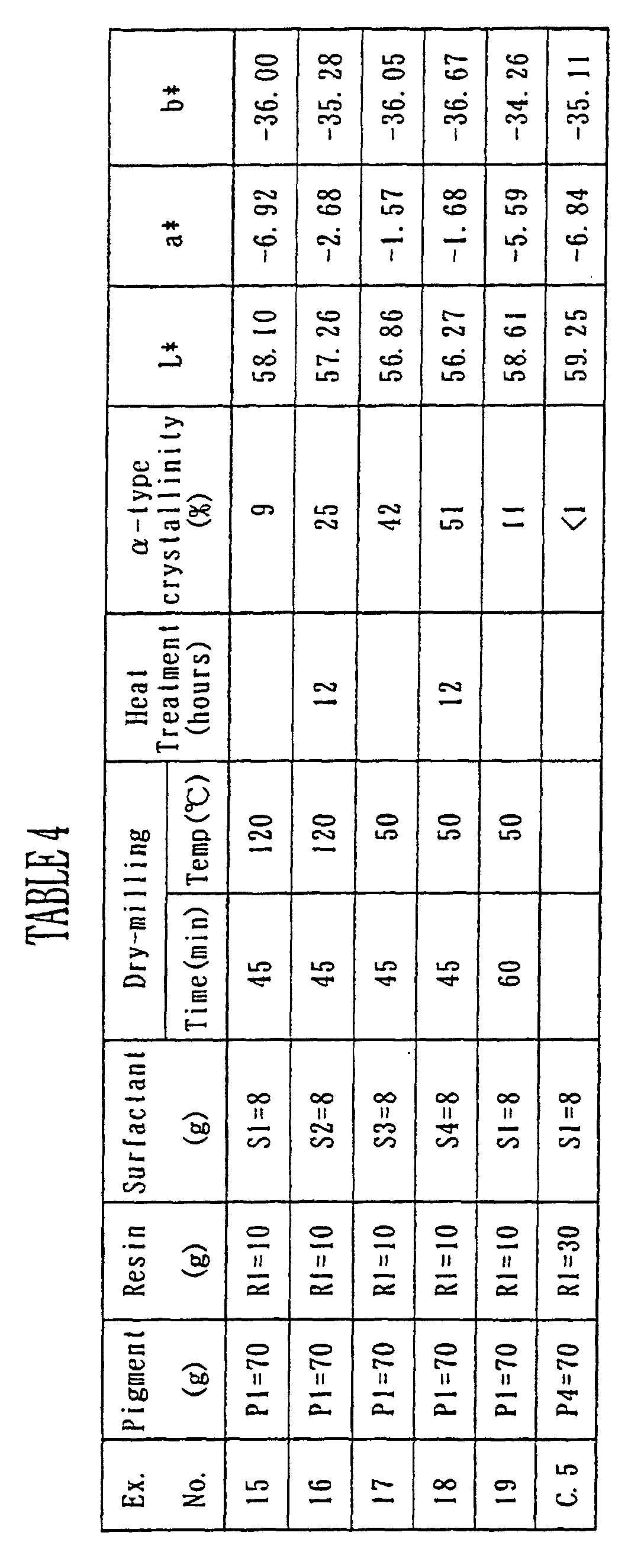
- Aqueous gravure inks of Examples 16 to 19 were prepared in the same manner as in Example 15 except that only the type of surfactant and the dry milling condition were altered. Also, in Examples 16 and 18, heat treatment was further carried out at 120°C for 12 hours after dry milling was completed. The results of the color strength and hue are shown in Table 4.
Landscapes
- Chemical & Material Sciences (AREA)
- Chemical Kinetics & Catalysis (AREA)
- Organic Chemistry (AREA)
- Pigments, Carbon Blacks, Or Wood Stains (AREA)
- Inks, Pencil-Leads, Or Crayons (AREA)
Description

| 1,3-propane diol | 10 parts by weight |
| Glycerol | 5 parts by weight |
| Acrylic resin emulsion | 0.2 parts by weight |
| mildewicide | 0.05 parts by weight |
| Ion-exchanged water | 79.75 parts by weight |


Claims (19)
- A pigment composition in powder form produced by dry-milling a pigment in the presence of a surfactant and a water-soluble resin containing a monomer component having a carboxyl group, said surfactant being contained in an amount of from 1 to 20 % by weight, and said water-soluble resin containing a monomer component having a carboxyl group being contained in an amount of from 2 to 50 % by weight, each based on the amount of the pigment.
- The pigment composition according to claim 1, wherein the pigment has its particle surfaces coated with said surfactant and said water-soluble resin containing a monomer component having a carboxyl group and preferably has an average particle diameter in the range of from 10 to 300 nm.
- The pigment composition according to claim 1 or claim 2, wherein said surfactant is an ethoxylated aromatic compound.
- The pigment composition according to any of the claims 1 to 3, wherein said water-soluble resin containing a monomer component having a carboxyl group is soluble in water in the presence of alkali.
- The pigment composition according to any of the claims 1 to 4, wherein said pigment comprises a crude pigment, preferably comprises a condensed polycyclic pigment and more preferably comprises a copper phthalocyanine.
- The pigment composition according to any of the claims 1 to 5 for preparing an aqueous pigment dispersion.
- The pigment composition according to any of the claims 1 to 6, wherein said pigment is treated under heat in the presence of said surfactant and said water-soluble resin containing a monomer component having a carboxyl group simultaneously when said dry-milling is carried out, preferably is heat-treated at a temperature of between 30 and 150 °C simultaneously when said dry-milling is carried out.
- An aqueous pigment dispersion comprising water and a pigment composition according to any of claims 1 to 7 dispersed therein.
- The aqueous pigment dispersion according to claim 8, wherein said pigment composition is dispersed in water in the presence of alkali, wherein said pigment has an average particle diameter of between 10 and 300 nm.
- A method for producing a pigment composition in powder form said method comprising the steps of(a) dry-milling a pigment in the presence of a surfactant and a water-soluble resin containing a monomer component having a carboxyl group to obtain a milled substance, the surfactant being contained in an amount of from 1 to 20 % by weight and the water-soluble resin containing a monomer component having a carboxyl group being contained in an amount of from 2 to 50 % by weight, each based on the amount of the resin; and(b) treating under heat said pigment simultaneously with the dry-milling and/or treating under heat the milled substance after the dry-milling.
- A method according to claim 10, wherein the steps of dry-milling and heat-treatment are conducted up to an extent that an average particle diameter of the pigment in the range of from 10 to 300 nm is achieved.
- The method according to claim 10 or claim 11, wherein said heat treatment of the pigment and/or of the milled substance is carried out at a temperature of from 50 to 150 °C when and/or after said dry-milling is carried out.
- The method according to any of the claims 10 to 12, wherein said dry-milling is performed in the absence of any water-soluble inorganic salts.
- The method according to any of the claims 10 to 13, wherein said dry-milling step comprises the steps of(1) dry-milling said pigment in the presence of said water-soluble resin containing a monomer component having a carboxyl group and in the absence of said surfactant so as to prepare an intermediate milled substance; and consecutively(2) further dry-milling said intermediate milled substance so as to obtain said milled substance.
- The method according to any of the claims 10 to 14, wherein an ethoxylated aromatic compound is used as the surfactant.
- The method according to any of the claims 10 to 15, wherein the water-soluble resin containing a monomer component having a carboxyl group is soluble in water in the presence of alkali.
- The method according to any of the claims 10 to 16, wherein said pigment comprises a crude pigment, preferably comprises a condensed polycyclic pigment and more preferably comprises a copper phthalocyanine.
- The method preparing an aqueous pigment dispersion comprising the step of dispersing the pigment composition according to any of the claims 1 to 7 in water.
- The method according to claim 18, wherein said pigment composition is dispersed in water in the presence of alkali.
Applications Claiming Priority (2)
| Application Number | Priority Date | Filing Date | Title |
|---|---|---|---|
| JP33670197 | 1997-12-08 | ||
| JP33670197 | 1997-12-08 |
Publications (3)
| Publication Number | Publication Date |
|---|---|
| EP0921163A2 EP0921163A2 (en) | 1999-06-09 |
| EP0921163A3 EP0921163A3 (en) | 1999-07-07 |
| EP0921163B1 true EP0921163B1 (en) | 2005-02-02 |
Family
ID=18301914
Family Applications (1)
| Application Number | Title | Priority Date | Filing Date |
|---|---|---|---|
| EP98121554A Expired - Lifetime EP0921163B1 (en) | 1997-12-08 | 1998-11-18 | Pigment composition and aqueous pigment dispersion prepared therefrom |
Country Status (3)
| Country | Link |
|---|---|
| US (1) | US6056814A (en) |
| EP (1) | EP0921163B1 (en) |
| DE (1) | DE69828864T2 (en) |
Families Citing this family (18)
| Publication number | Priority date | Publication date | Assignee | Title |
|---|---|---|---|---|
| US6379451B1 (en) * | 1999-04-05 | 2002-04-30 | Toyo Ink Mfg. Co., Ltd. | Pigment composition and aqueous pigment dispersion product using the same |
| ATE445673T1 (en) * | 1999-07-09 | 2009-10-15 | Basf Se | METHOD FOR PRODUCING PIGMENTS WITH IMPROVED COLORISTIC PROPERTIES |
| US6440207B1 (en) | 2000-03-03 | 2002-08-27 | Bayer Corporation | Method for preparing organic pigments |
| MXPA03009606A (en) * | 2001-04-20 | 2004-02-12 | Sherwin Williams Co | Ink composition using alkyd-stabilized acrylic dispersions. |
| JP3792602B2 (en) * | 2002-05-29 | 2006-07-05 | エルピーダメモリ株式会社 | Semiconductor memory device |
| DE10253804A1 (en) † | 2002-11-18 | 2004-05-27 | Basf Ag | Solid pigment preparation for use with high mol. wt. (in)organic materials contains a polymeric water-soluble anionic surfactant and optionally also a polyether- based nonionic surfactant |
| EP1426417A1 (en) * | 2002-12-04 | 2004-06-09 | NexPress Solutions LLC | Self-dispersing titanyl phthalocyanine pigment compositions and electrophotographic charge generation layers containing same |
| EP1689746B1 (en) * | 2003-11-13 | 2019-01-09 | Basf Se | A process for aqueous milling of quinacridone pigments |
| US7419542B2 (en) | 2003-11-13 | 2008-09-02 | Ciba Specialty Chemicals Corporation | 2,9-dichloro-quinacridone as α-quinacridone crystal phase inhibitor |
| JP2005154669A (en) | 2003-11-28 | 2005-06-16 | Toyo Ink Mfg Co Ltd | Pigment composition and printing ink containing the same |
| US8946320B2 (en) * | 2004-03-22 | 2015-02-03 | Hewlett-Packard Development Company, L.P. | Ink system containing polymer binders |
| US20050270349A1 (en) * | 2004-06-08 | 2005-12-08 | Fuji Photo Film Co., Ltd. | Ink stock solution for ink jet recording, method for manufacturing the same and ink for ink jet recording |
| JP2006077141A (en) * | 2004-09-10 | 2006-03-23 | Toyo Ink Mfg Co Ltd | Pigment composition and printing ink containing the same |
| DE602006014325D1 (en) * | 2005-06-01 | 2010-07-01 | Ricoh Kk | Pigment dispersion, ink for ink-jet printing containing this dispersion, preparation method for pigment dispersion and ink-using printing method |
| US8113116B2 (en) * | 2006-03-14 | 2012-02-14 | Fujifilm Corporation | Lithographic printing plate precursor |
| US7329315B1 (en) | 2006-12-11 | 2008-02-12 | Sun Chemical Corporation | Copper phthalocyanine blue pigment composition and water borne dispersion thereof |
| JP5703141B2 (en) * | 2010-08-11 | 2015-04-15 | 京セラドキュメントソリューションズ株式会社 | Inkjet recording liquid and inkjet recording apparatus using the same |
| EP2664602A3 (en) * | 2012-05-14 | 2014-10-01 | UPL Limited | Coated particulate phosphorus, compositions and products containing the same and preparation methods |
Family Cites Families (18)
| Publication number | Priority date | Publication date | Assignee | Title |
|---|---|---|---|---|
| GB1541699A (en) * | 1976-02-19 | 1979-03-07 | Ciba Geigy Ag | Phthalocyanine pigments |
| DE2851752B1 (en) * | 1978-11-30 | 1980-06-12 | Basf Ag | Process for the production of easily dispersible and strongly colored pigment forms |
| DE3018006A1 (en) * | 1980-05-10 | 1981-11-12 | Hoechst Ag, 6000 Frankfurt | METHOD FOR PRODUCING PIGMENTS OF THE PERYLENE-3,4,9,10-TETRACARBONIC ACID RANGE AND THE USE THEREOF |
| US4371643A (en) * | 1980-07-31 | 1983-02-01 | American Cyanamid Co. | Particle size reduction of pigments by non-salt milling |
| US4427810A (en) * | 1981-05-04 | 1984-01-24 | Inmont Corporation | Continuous method of producing aqueous phthalocyanine pigment dispersions |
| US4369272A (en) * | 1981-07-07 | 1983-01-18 | E. I. Du Pont De Nemours And Company | Process for preparing polyolefin resin extended pigments comprising salt milling crude pigment with the resin |
| US4371642A (en) * | 1981-07-07 | 1983-02-01 | E. I. Du Pont De Nemours And Company | Process for preparing polyolefin resin extended pigments |
| US4478968A (en) * | 1983-04-06 | 1984-10-23 | Ciba-Geigy Corporation | Manufacture of resin extended pigments |
| US4548968A (en) * | 1983-04-06 | 1985-10-22 | Ciba Geigy Corporation | Manufacture of resin extended pigments |
| US4522654A (en) * | 1983-12-23 | 1985-06-11 | Inmont Corporation | Continuous method of producing phthalocyanine pigment dispersions in organic solvent |
| ES2028907T3 (en) * | 1985-02-05 | 1992-07-16 | Sicpa Holding S.A. | INK FOR DRY PRINTING, IN THE FORM OF POWDER. |
| JP3337234B2 (en) * | 1991-03-22 | 2002-10-21 | クラリアント・ゲゼルシヤフト・ミト・ベシユレンクテル・ハフツング | New pigment preparations based on dioxazine compounds |
| US5310778A (en) * | 1992-08-25 | 1994-05-10 | E. I. Du Pont De Nemours And Company | Process for preparing ink jet inks having improved properties |
| JPH07331147A (en) * | 1994-06-13 | 1995-12-19 | Brother Ind Ltd | Recording ink |
| GB9523387D0 (en) * | 1995-11-16 | 1996-01-17 | Ciba Geigy Ag | Production process |
| US5679138A (en) * | 1995-11-30 | 1997-10-21 | Eastman Kodak Company | Ink jet inks containing nanoparticles of organic pigments |
| JP3139396B2 (en) * | 1996-02-05 | 2001-02-26 | 東洋インキ製造株式会社 | Manufacturing method of printing ink |
| JP3159048B2 (en) * | 1996-04-26 | 2001-04-23 | 東洋インキ製造株式会社 | Method for producing pigment composition, pigment composition and use thereof |
-
1998
- 1998-11-17 US US09/192,562 patent/US6056814A/en not_active Expired - Lifetime
- 1998-11-18 DE DE69828864T patent/DE69828864T2/en not_active Expired - Lifetime
- 1998-11-18 EP EP98121554A patent/EP0921163B1/en not_active Expired - Lifetime
Also Published As
| Publication number | Publication date |
|---|---|
| US6056814A (en) | 2000-05-02 |
| EP0921163A3 (en) | 1999-07-07 |
| DE69828864D1 (en) | 2005-03-10 |
| EP0921163A2 (en) | 1999-06-09 |
| DE69828864T2 (en) | 2006-01-05 |
Similar Documents
| Publication | Publication Date | Title |
|---|---|---|
| US6056814A (en) | Pigment composition and aqueous pigment dispersion prepared therefrom | |
| EP1270680B1 (en) | Finely divided pigments and coloring compositions | |
| EP1572810B1 (en) | Phthalocyanine pigment preparations | |
| CA1096712A (en) | Pigment compositions and methods of preparation | |
| EP2055752B1 (en) | Dispersion of a water-insoluble colorant, production method thereof, recording, liquid, ink-set, printed article, image-forming method and image-forming apparatus using the same | |
| JPH1025440A (en) | Inkjet full color recorded image | |
| EP1217045B1 (en) | Halogen-free green pigment composition | |
| KR20050085199A (en) | Preparation and use of nanosize pigment compositions | |
| EP1888691A2 (en) | Pigment preparation based on an azo pigment | |
| TWI398296B (en) | Process for preparing an encapsulated particulate solid | |
| DE60030916T2 (en) | Composite pigments, paint compositions and image recording materials | |
| CN101679795A (en) | Aqueous pigment preparations comprising anionic additives based on allyl ether and vinyl ether | |
| WO2005049735A2 (en) | A process for aqueous milling of quinacridone pigments | |
| DE60112452T2 (en) | INK CONTAINS AN ORANGE AZOLACKPIGMENT COMPOSITION | |
| JPH10251533A (en) | Easy-dispersion quinacridone pigment and method for producing the same | |
| JP4659162B2 (en) | Method for producing aqueous pigment dispersion | |
| JP3882358B2 (en) | Pigment composition and aqueous pigment dispersion using the same | |
| US6379451B1 (en) | Pigment composition and aqueous pigment dispersion product using the same | |
| EP0221466A2 (en) | Copper phthalocyanine pigments | |
| US6653390B1 (en) | Triphenylmethane dyes for water-based compositions | |
| JPH0534978A (en) | Colored composition for image recording and method for producing the same | |
| JPS5836024B2 (en) | Easily dispersible solid pigment composition | |
| JP3787287B2 (en) | COLORING COMPOSITION, PROCESS FOR PRODUCING THE SAME, AND PRINTING INK | |
| EP0676452B1 (en) | Process for the production of dis-azo pigment | |
| JP2000351912A (en) | Pigment composition and aqueous pigment dispersion using the same |
Legal Events
| Date | Code | Title | Description |
|---|---|---|---|
| PUAI | Public reference made under article 153(3) epc to a published international application that has entered the european phase |
Free format text: ORIGINAL CODE: 0009012 |
|
| PUAL | Search report despatched |
Free format text: ORIGINAL CODE: 0009013 |
|
| 17P | Request for examination filed |
Effective date: 19981118 |
|
| AK | Designated contracting states |
Kind code of ref document: A2 Designated state(s): DE FR GB |
|
| AX | Request for extension of the european patent |
Free format text: AL;LT;LV;MK;RO;SI |
|
| RIC1 | Information provided on ipc code assigned before grant |
Free format text: 6C 09B 67/04 A, 6C 09B 67/08 B, 6C 09B 67/20 B, 6C 09D 11/00 B |
|
| AK | Designated contracting states |
Kind code of ref document: A3 Designated state(s): AT BE CH CY DE DK ES FI FR GB GR IE IT LI LU MC NL PT SE |
|
| AX | Request for extension of the european patent |
Free format text: AL;LT;LV;MK;RO;SI |
|
| AKX | Designation fees paid |
Free format text: DE FR GB |
|
| 17Q | First examination report despatched |
Effective date: 20030623 |
|
| GRAP | Despatch of communication of intention to grant a patent |
Free format text: ORIGINAL CODE: EPIDOSNIGR1 |
|
| GRAS | Grant fee paid |
Free format text: ORIGINAL CODE: EPIDOSNIGR3 |
|
| GRAA | (expected) grant |
Free format text: ORIGINAL CODE: 0009210 |
|
| AK | Designated contracting states |
Kind code of ref document: B1 Designated state(s): DE FR GB |
|
| REG | Reference to a national code |
Ref country code: GB Ref legal event code: FG4D |
|
| REF | Corresponds to: |
Ref document number: 69828864 Country of ref document: DE Date of ref document: 20050310 Kind code of ref document: P |
|
| ET | Fr: translation filed | ||
| PLBE | No opposition filed within time limit |
Free format text: ORIGINAL CODE: 0009261 |
|
| STAA | Information on the status of an ep patent application or granted ep patent |
Free format text: STATUS: NO OPPOSITION FILED WITHIN TIME LIMIT |
|
| 26N | No opposition filed |
Effective date: 20051103 |
|
| REG | Reference to a national code |
Ref country code: FR Ref legal event code: PLFP Year of fee payment: 18 |
|
| PGFP | Annual fee paid to national office [announced via postgrant information from national office to epo] |
Ref country code: GB Payment date: 20151118 Year of fee payment: 18 |
|
| PGFP | Annual fee paid to national office [announced via postgrant information from national office to epo] |
Ref country code: FR Payment date: 20151008 Year of fee payment: 18 |
|
| REG | Reference to a national code |
Ref country code: DE Ref legal event code: R082 Ref document number: 69828864 Country of ref document: DE Representative=s name: SCHWABE SANDMAIR MARX PATENTANWAELTE RECHTSANW, DE |
|
| GBPC | Gb: european patent ceased through non-payment of renewal fee |
Effective date: 20161118 |
|
| REG | Reference to a national code |
Ref country code: FR Ref legal event code: ST Effective date: 20170731 |
|
| PG25 | Lapsed in a contracting state [announced via postgrant information from national office to epo] |
Ref country code: FR Free format text: LAPSE BECAUSE OF NON-PAYMENT OF DUE FEES Effective date: 20161130 |
|
| PG25 | Lapsed in a contracting state [announced via postgrant information from national office to epo] |
Ref country code: GB Free format text: LAPSE BECAUSE OF NON-PAYMENT OF DUE FEES Effective date: 20161118 |
|
| PGFP | Annual fee paid to national office [announced via postgrant information from national office to epo] |
Ref country code: DE Payment date: 20171114 Year of fee payment: 20 |
|
| REG | Reference to a national code |
Ref country code: DE Ref legal event code: R071 Ref document number: 69828864 Country of ref document: DE |