EP0920474B1 - Use of g-block polysaccharides - Google Patents
Use of g-block polysaccharides Download PDFInfo
- Publication number
- EP0920474B1 EP0920474B1 EP97933073A EP97933073A EP0920474B1 EP 0920474 B1 EP0920474 B1 EP 0920474B1 EP 97933073 A EP97933073 A EP 97933073A EP 97933073 A EP97933073 A EP 97933073A EP 0920474 B1 EP0920474 B1 EP 0920474B1
- Authority
- EP
- European Patent Office
- Prior art keywords
- polysaccharide
- block
- cross
- gelling
- alginate
- Prior art date
- Legal status (The legal status is an assumption and is not a legal conclusion. Google has not performed a legal analysis and makes no representation as to the accuracy of the status listed.)
- Expired - Lifetime
Links
Images


Classifications
-
- C—CHEMISTRY; METALLURGY
- C08—ORGANIC MACROMOLECULAR COMPOUNDS; THEIR PREPARATION OR CHEMICAL WORKING-UP; COMPOSITIONS BASED THEREON
- C08L—COMPOSITIONS OF MACROMOLECULAR COMPOUNDS
- C08L5/00—Compositions of polysaccharides or of their derivatives not provided for in groups C08L1/00 or C08L3/00
- C08L5/06—Pectin; Derivatives thereof
-
- A—HUMAN NECESSITIES
- A23—FOODS OR FOODSTUFFS; TREATMENT THEREOF, NOT COVERED BY OTHER CLASSES
- A23C—DAIRY PRODUCTS, e.g. MILK, BUTTER OR CHEESE; MILK OR CHEESE SUBSTITUTES; PREPARATION THEREOF
- A23C9/00—Milk preparations; Milk powder or milk powder preparations
- A23C9/152—Milk preparations; Milk powder or milk powder preparations containing additives
- A23C9/154—Milk preparations; Milk powder or milk powder preparations containing additives containing thickening substances, eggs or cereal preparations; Milk gels
- A23C9/1544—Non-acidified gels, e.g. custards, creams, desserts, puddings, shakes or foams, containing eggs or thickening or gelling agents other than sugar; Milk products containing natural or microbial polysaccharides, e.g. cellulose or cellulose derivatives; Milk products containing nutrient fibres
-
- A—HUMAN NECESSITIES
- A23—FOODS OR FOODSTUFFS; TREATMENT THEREOF, NOT COVERED BY OTHER CLASSES
- A23L—FOODS, FOODSTUFFS OR NON-ALCOHOLIC BEVERAGES, NOT OTHERWISE PROVIDED FOR; PREPARATION OR TREATMENT THEREOF
- A23L29/00—Foods or foodstuffs containing additives; Preparation or treatment thereof
- A23L29/20—Foods or foodstuffs containing additives; Preparation or treatment thereof containing gelling or thickening agents
- A23L29/206—Foods or foodstuffs containing additives; Preparation or treatment thereof containing gelling or thickening agents of vegetable origin
- A23L29/231—Pectin; Derivatives thereof
-
- A—HUMAN NECESSITIES
- A23—FOODS OR FOODSTUFFS; TREATMENT THEREOF, NOT COVERED BY OTHER CLASSES
- A23L—FOODS, FOODSTUFFS OR NON-ALCOHOLIC BEVERAGES, NOT OTHERWISE PROVIDED FOR; PREPARATION OR TREATMENT THEREOF
- A23L29/00—Foods or foodstuffs containing additives; Preparation or treatment thereof
- A23L29/20—Foods or foodstuffs containing additives; Preparation or treatment thereof containing gelling or thickening agents
- A23L29/206—Foods or foodstuffs containing additives; Preparation or treatment thereof containing gelling or thickening agents of vegetable origin
- A23L29/256—Foods or foodstuffs containing additives; Preparation or treatment thereof containing gelling or thickening agents of vegetable origin from seaweeds, e.g. alginates, agar or carrageenan
-
- C—CHEMISTRY; METALLURGY
- C08—ORGANIC MACROMOLECULAR COMPOUNDS; THEIR PREPARATION OR CHEMICAL WORKING-UP; COMPOSITIONS BASED THEREON
- C08L—COMPOSITIONS OF MACROMOLECULAR COMPOUNDS
- C08L5/00—Compositions of polysaccharides or of their derivatives not provided for in groups C08L1/00 or C08L3/00
- C08L5/04—Alginic acid; Derivatives thereof
Definitions
- the present invention concerns the use of guluronic acid-rich alginates or galacturonic acid-rich pectins, so-called G-block polysaccharides, as modulator for the rheology in a mixture in which a gelling, water-soluble polysaccharide is a component which is intended to give the final product a changed viscosity, stability, elasticity, rigidity or similar.
- Alginates are isolated from marine brown algae. Alginate is also produced in soil bacteria such as Azotobacter vinelandii and Azotobacter crococcum and many different Pseudomonas bacteria, but the commercially available alginate stems mainly from brown algae.
- Pectins can be isolated from many different sources as it is found in the cell walls of fruit and vegetables, but the commercially available pectins are usually isolated from apples or citrus fruits.
- polysaccharides alginate and pectin
- alginate and pectin are used in foods and in pharmaceutical, dental, cosmetic and other industrial products.
- the most common industrial uses are based on their hydrocolloid and polyelectrolytic nature, which forms the basis for the gelling, thickening, stabilising, swelling and viscosity-producing properties.
- polysaccharides In foods such as jam, ice cream, packet soups and sauces, polysaccharides have a thickening, stabilising effect. In mayonnaises and dressings, they also act as an emulsion stabiliser.
- alginate-based solid nutrient medium for plant tissue cultures
- alginate as an administration medium with slow release of a drug and encapsulation of live insulin-producing cells in alginate gel for implantation in patients.
- Alginates are salts of alginic acid, a linear heteropolysaccharide consisting of (1 ⁇ 4) linked ⁇ -D-mannuronic acid, designated M, and ⁇ -L-guluronic acid, designated G. These two uronic acids have the following formulae:
- the polymers exist as homopolymer sequences of mannuronic acid, called M blocks, homopolymer guluronic acid sequences, called G blocks, and mixed sequences of mannuronic acid and guluronic acid units, so-called MG blocks or alternating blocks.
- alginate contains all three types of blocks and a block generally consists of three to thirty monomer units.
- the distribution of blocks depends on the type of algae from which the alginate is isolated as well as the age and part of the plant, for example alginate from the stem may have a different sequence and block composition to alginate isolated from the leaves.
- the season in which the algae are harvested also affects the block composition and sequence.
- the maximum G content in the stem is to be found in old L. hyperborea. Leaves from the same species have a somewhat lower G content and shorter G blocks, but the content is still higher than in most other species.
- the commercially available alginates usually have a G content of 25%-70%.
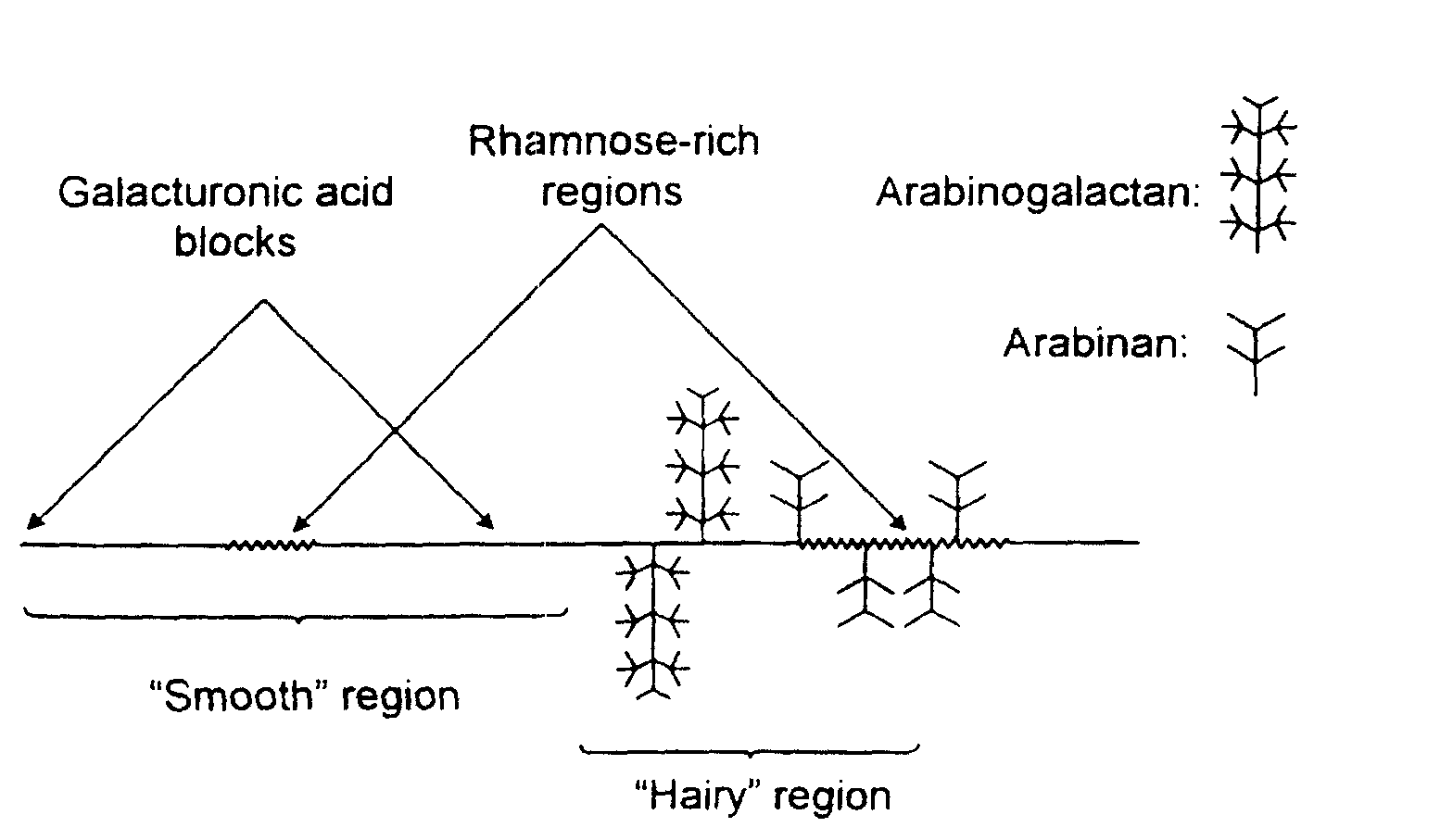
- Pectin has a complex structure with a polysaccharide chain in which "smooth" and "hairy” regions alternate.
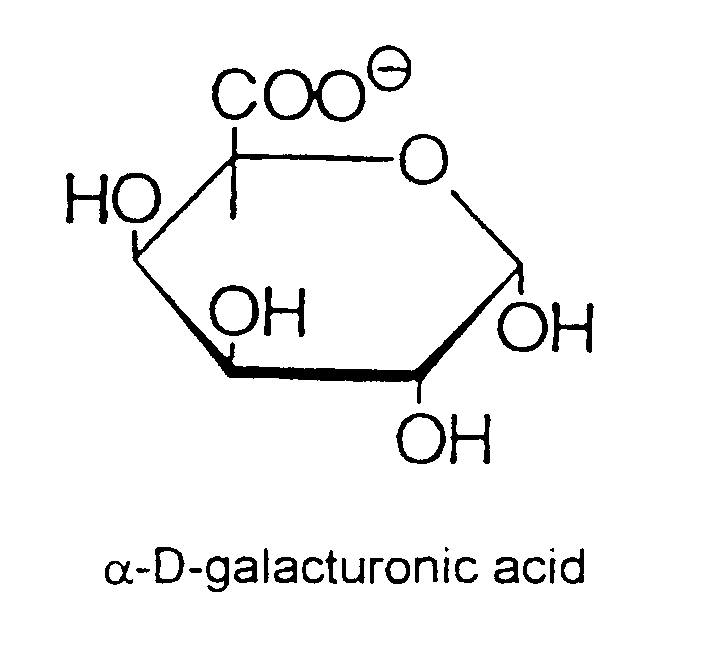
- the smooth regions consist of non-dendritic (1 ⁇ 4) linked ⁇ -D-galacturonic acid with the following formula: with some (1 ⁇ 2) linked L-rhamnose, while the hairy regions are very dendritic and consist mainly of (1 ⁇ 3) and (1 ⁇ 6) linked ⁇ -D-galactose, (1 ⁇ 3) linked arabinose and some (1 ⁇ 3) linked xylose.
- the galacturonic acid groups are partially methoxylated.
- G units In the following ⁇ -D-galacturonic acids are designated G units, and the regions which mainly consist of such G units are designated G blocks.
- G blocks guluronic acid blocks from alginate and galacturonic acid blocks from pectin come under this common designation in the following.
- Alkali metal salts, magnesium salts and ammonium salts of alginates and pectins are water-soluble.
- multivalent cations for example multivalent ions such as Ca 2+ , Sr 2+ , Ba 2+ , Fe 3+ or Al 3+ ions
- a gel is formed as a result of the production of ionic cross-links of several polysaccharide chains.
- the G units are responsible for the ability of these polysaccharides to link multivalent cations and this leads to the G blocks functioning as bindingseats between the various polysaccharide chains in connection with gelling.
- the gel strength of polysaccharide gels will depend on various parameters such as the G content of the alginate or pectin, the length of the G blocks, the calcium activity and the molecular weight and concentration of the polysaccharides.
- the cross-linking ion usually calcium, diffuses into the polysaccharide solution and this then produces a continuous, inhomogeneous gel which is strongest near the diffusion surface.
- the calcium ions are released inside the polysaccharide solution.
- An inactive form of calcium has been used together with an agent which makes possible a slow release of the ion, which produces a homogeneous gel and the gelling speed can be controlled. It has been common to use sequestering agents such as citrate, phosphate or EDTA to achieve controlled release of the cross-linking ion.
- insoluble salts or salts which are hard to dissolve such as calcium sulphate or calcium carbonate have been used.
- an agent which makes possible a slow release of protons and thus a slow release of calcium ions the gelling speed can be controlled.
- An example of such an agent is D-glucono- ⁇ -lactone (GDL).
- Another possibility, which is used in tooth filling masses, is to replace the lactone with a system consisting of acid, base and a buffer.
- the buffer Na 4 P 2 O 7
- calcium alginate gel is used to improve the freeze-thaw stability in frozen dessert jellies.
- This calcium alginate gel is produced from sodium alginate, calcium tartrate and sodium hexametaphosphate.
- the reaction speed of the reaction between the calcium ions, which are released from the tartrate, and the sodium alginate is controlled by means of the sodium hexametaphosphate.
- the use of calcium alginate gel in thermally stable baking creams is known from US patent 3352688 (Kelco). This system consists essentially of sodium alginate, dicalcium phosphate and sodium hexametaphosphate.
- US patent 2809893 describes a dry powder mixture for forming gels for use in desserts.
- Such gels contain sugar, alginate, sodium hexametaphosphate, sodium citrate, citric acid, heat-treated water-free monocalcium phosphate and various taste enhancers and colorants.
- EP345886B1 describes an alginate gelling system for meat products in which the release of calcium and thus the gelling speed are controlled by means of encapsulated calcium salts. All commonly used calcium salts approved for use in food products can be used and the examples stated include calcium chloride dihydrate, calcium lactate pentahydrate, calcium acetate, calcium malate and calcium gluconate.
- the calcium salts are encapsulated in a fat derivative which may be a fatty acid, a glyceride and preferably also a hardened vegetable oil.
- US patent 5,503,771 describes a gelling suspension which contains colloidal metal particles or ceramic particles, water and an effective quantity of a biopolymer dispersant with a molar weight of at least 1000 to 5000 glmol, as well as a biopolymer gelling agent which has a molar weight of at least 50,000 g/mol and which can be converted from a non-gelled state to a gelled state.
- the biopolymer dispersant may be chosen from, among others, a group consisting of a polymannuronic acid-rich hydrolysis product of alginate, a polyguluronic acid-rich hydrolysis product of an alginate, poly-D-glutamic acid, poly-L-glutamic acid, poly-DL-aspartic acid, pectin and mixtures of these.
- the biopolymer gelling agent can be chosen from a group consisting of gelling polysaccharides, polypeptides, proteins or nucleic acids. Alginates with molar weights in the order of 75,000 to 100,000 g/mol or higher are stated as possible polysaccharides, among others.
- the biopolymer dispersant is to disperse the colloidal particles in water and thus contribute to the formation of a non-aggregated suspension which has a low, pourable viscosity so that the final suspension can be transferred to a casting mould before gelling is started, after which the product is pyrolysed and sintered.
- the main intention is to achieve a dispersed product in which the gelling keeps the dispersed particles in place.
- the gelling technique is controlled by using both calcium salts which are hard to dissolve such as phosphates, sulphates, citrates or tartrates and sequestering agents, which are very often phosphates, as well as possibly other acids or buffers.
- phosphate which has reached a high level in foods in the industrialised parts of the world, seems to be problematic because a high intake of phosphate disturbs the ion equilibrium in the body and this can have unfortunate health-related consequences.
- phosphates and the other additives may produce undesired effects such as poor taste and a different consistency to that desired. This applies, for example, to the production of restructured meat products and baking creams.
- G-block polysaccharides can be used as modulators for rheology in gelling polysaccharide systems within various areas of application.
- G-block polysaccharides i.e. blocks of guluronic acid from alginate or blocks of galacturonic acid from pectin, make it possible, in an alginate and/or pectin system, to control the gelling kinetics, gel strength, viscosity, elasticity, equilibrium properties and syneresis.
- polysaccharide is meant mainly to comprise the polysaccharides alginate and pectin, but other gelling polysaccharides which behave in the same way as the polysaccharides described here are also covered by the scope of the claim. It is most preferable to use alginate in the present invention. Of pectins, it is preferred, in particular, to use low-methoxylated pectin, so-called LM pectin.
- a procedure has been found for controlling the rheology, i.e. viscosity, elasticity, gelling kinetics and gelling strength, in the gelling of alginate-based and pectin-based systems.
- the procedure is characterised in that it uses "G-block polysaccharides" as the modulator for the rheology.
- the procedure, according to the present invention, for controlling the rheology, i.e. viscosity, elasticity, gelling kinetics and gelling strength, in a mixture of which a gelling, water-soluble polysaccharide is a component to give the final product a changed viscosity, elasticity, stability, and rigidity is characterised in that a "G-block polysaccharide" is added to the stated mixture either (a) as a water-soluble "G-block polysaccharide” in the presence of a source of a cross-linking ion or (b) as a "G-block polysaccharide” with a cross-linking ion and, if necessary, an aqueous solvent is added.
- the present invention concerns, in a second aspect, the use of a "G-block polysaccharide" as a modulator for the rheology, i.e. viscosity, elasticity, gelling kinetics and gelling strength, in a mixture of which a gelling, water-soluble polysaccharide is a component to give the final product a changed viscosity, elasticity, stability and rigidity, which application is characterised in that a "G-block polysaccharide" is added to the stated mixture either
- the present invention concerns the use of a "G-block polysaccharide" as a modulator for the rheology, i.e. viscosity, elasticity, gelling kinetics and gelling strength, in a mixture of which a gelling, water-soluble polysaccharide is a component to give the final product a changed viscosity, elasticity, stability and rigidity, which application is characterised in that a "G-block polysaccharide" is used either
- a "G-block polysaccharide” can be used in a self-gelling polysaccharide mixture and this application is characterised in that the stated mixture consists of "G-block polysaccharide” with a cross-linking ion in the solid phase and a gelling, water-soluble polysaccharide in the solid phase, in which connection the gelling process is started by the addition of water or an aqueous solution or an aqueous solution in a mixture with a non-aqueous component.
- G-block polysaccharide is meant to comprise low-molecular alginate alginic acid or pectin which has a high content of guluronic acid and galacturonic acid respectively.
- Any polysaccharide or polysaccharide fragment which contains at least two G units in a block can be used as a "G-block polysaccharide” in accordance with the present invention, but it is preferred to use polysaccharide fragments which have an average molar weight of 1,000 - 100,000 g/mol. It is more preferred for the "G-block polysaccharides” to be chosen from the molar weight range 1,000 - 50,000 g/mol, but it is most preferred to work within the molar weight range 2,000 - 20,000 g/mol.
- fragment is meant to comprise small parts of whole alginate or pectin chains or commercially available polysaccharides (whole polysaccharide).
- G-block polysaccharides which have an average molar weight of over 100,000 g/mol, but subject to the restriction that they must have the same function as the "G-block polysaccharides” described here.
- G-block polysaccharide may, for example, be a fragment of a naturally occurring alginate or pectin which has a high content of G blocks such as alginate isolated from L . hyperborea . It may also be an alginate fragment which is enriched with G blocks or which mainly consists of G units which are produced biotechnologically in a bacterium. Another possibility for producing G-block-rich alginate fragments which are enriched with G blocks is the chemical conversion of M units to G units using an enzyme of the type mannuronan-C-5-epimerase.
- polysaccharide in particular alginate or pectin, which can form a gel in a certain concentration range can be used as the polysaccharide or whole polysaccharide. It is also possible to use mixtures of these two polysaccharides where appropriate.
- an alginate/pectin with a high or low G content will be used in order to obtain the desired properties in the final product. If, for example, a thickening effect is required, it is necessary to choose a polysaccharide in a quality with a low G content in order to obtain weak gel formation or no gel formation. Accordingly, it is necessary to choose a polysaccharide in a quality with a high G content in order to obtain strong gelling, for example in the production of pudding. It is also possible to use mixtures of alginate qualities, regarding molar weight or block content, as the polysaccharide in the present invention.
- Water-soluble polysaccharides may be sodium, potassium, magnesium and ammonium polysaccharides. It is also possible to have water-soluble polysaccharides which contain several of these types of gegenions, as well as small quantities of Ca 2+ , but the most preferred is sodium polysaccharide or sodium "G-block polysaccharide”. It will be clear to a person skilled in the art that solubility depends on concentration and temperature, and the present invention is intended, where this term is used, to comprise polysaccharides chosen for their solubility properties in the relevant concentration and application range.
- gelling polysaccharide is used with the proviso, which is obvious to a person skilled in the art, that gelling depends, among other things, on the concentration of both the polysaccharide and the multivalent gegenion.
- Any multivalent ion which produces gelling with polysaccharide may be used and examples of such ions are Ca 2+ , Sr 2+ , Ba 2+ , Fe 3+ and Al 3+ , although Ca 2+ is the most preferred cross-linking ion (Ca 2+ will be used, in the following, as the representative of multivalent, cross-linking ions). It is assumed that, when the term “gelling polysaccharide” is used, the present invention comprises work within the concentration limits which produce gelling.
- the present invention is also intended to comprise both strong gelling, which will, for example, produce a jelly or pudding consistency, and weak gelling, which only produces a thickening and/or stabilising effect.
- strong gelling which will, for example, produce a jelly or pudding consistency
- weak gelling which only produces a thickening and/or stabilising effect.
- the desired effect is achieved, as stated above, by choosing the G content and molar weight of the whole polysaccharide depending on the intended application.
- G-block polysaccharide with a cross-linking ion
- it is chosen from a group consisting of "G-block polysaccharides” with multivalent calcium, strontium, barium, iron or aluminium as the gegenion. Calcium is particularly preferred.
- the source of the cross-linking ion can be chosen from among naturally occurring calcium sources such as dairy products, calcium-containing proteins, bone meal or silage.
- the source of the cross-linking ion can, if appropriate, also be a calcium salt which is hard to dissolve such as CaSO 4 , CaCO 3 or chelate-linked calcium such as CaEDTA, possibly in combination with a proton source, as a specialist well knows.
- the source for the cross-linking ion can also be an easily soluble calcium salt which is added
- Alginates of various types which can be used in accordance with the present invention are commercially available from, among other companies, Pronova Biopolymer a.s, Drammen, Norway.
- Pectin is commercially available from, among others, Copenhagen Pektin/Hercules, Denmark.
- the quantity ratio of polysaccharide to "G-block polysaccharide” can be varied within broad limits which will depend entirely on the desired effect and area of application and will, among other things, depend on the type of alginate or pectin chosen, the molar weight and the calcium activity. Therefore, it will be preferred to work within the range in which the ratio of polysaccharide : "G-block polysaccharide” is 100:1 - 1:100, or preferably 10:1 - 1:10. However, it will be most preferred to work within the range in which the polysaccharide : "G-block polysaccharide” ratio is 4:1 - 1:4.
- the absolute concentration of the polysaccharide and "G-block polysaccharide" in a mixture will, moreover, depend entirely on the intended application and the control of the rheology which is required and will, among other things, depend on the type of alginate or pectin chosen, molar weight and calcium activity.
- G-block polysaccharides can be used as modulators for the rheology in alginate-based and pectin-based systems.
- G-block polysaccharide with a cross-linking ion, in particular Ca "G-block polysaccharide”
- Ca cross-linking ion
- polysaccharides may, where alginate and pectin are concerned, comprise the following four variants:
- mixtures of alginate and pectin can be used either as a whole polysaccharide or as a "G-block polysaccharide".
- G-block polysaccharide in particular Na "G-block polysaccharide”
- sequestering agent for Ca ions in a system together with polysaccharide.
- This will avoid the use of other sequestering agents, particularly phosphates.
- This system can be used particularly advantageously in areas of use in which there is a natural calcium source.
- G-block polysaccharides includes both polyguluronate and polygalacturonate.
- the effect of the addition of G-block to gelling alginates was brought about in principle by adding a given volume of a 5% parent solution of water-soluble G-block to a solution of a gelling Na alginate.
- the final quantity of G-block was varied from 0 to 10 mg/ml.
- the concentration of the gelling alginate was kept constant at 10 mg/ml unless another concentration is stated.
- the G-block alginate (polyguluronate) which was used had a content of guluronate of 85% and an average degree of polymerisation (Dpn) of 20.
- the G-block pectin (polygalacturonate) was fully de-esterified and had a (Dpn) of 35.
- the gelling alginates used were all isolated from stalks of Laminaria hyperborea with a guluronate content of approximately 65%.
- the molecular weight was varied from 50 to 300 kDa. Unless otherwise stated, an alginate with an average molecular weight of 200 kDa was used.
- the cylinders were then placed in a bath with 100 mM CaCl 2 . Both the gelling solution and the gelling bath also contained 200 mM NaCI in order to ensure homogeneous distribution of the alginate in the finished gel. The gel strength was measured after 24 hours.
- the gel strength was measured by two methods. The equilibrium properties were measured after 24 hours by means of a compression analysis in an SMS TA-XT2 Texture Analyser with a compression rate of 0.1 mm/s. The gel strength, as Young's modulus (E), was calculated on the basis of the slope of the initial, linear part of the force-deformation curve.
- Kinetic (sol/gel) measurements were carried out at 20°C in a Rheologica Stress-Tech rheometer. The measurement geometry was 40 mm serrated plate-plate and the dynamic measurements were carried out at 1 Hz. A force of 10 Pa was used throughout the gelling process.
- Syneresis was registered by measuring the change in volume of the finished gel compared with the volume of the mould.
- water-soluble G-block was dissolved and added to CaCl 2 at a final concentration of 0.5M. The surplus calcium was washed away.
- Gelling took place by dry-mixing gelling alginate and Ca G-block to a 10 mg/ml final concentration of both components before dissolving the mixture.
- the gelling alginate in example 6 has an average molecular weight of 430 kDa.
- the CaCO 3 gel which produces an equivalent gel strength to that of the gel with Ca G-block, was gelled with 9.5 mM CaCO 3 .
- the gels were decomposed with a homogeniser, Ultra turrax, at 3000 RPM for 4 minutes.
- the dynamic measurements were carried out on a Bohlin VOR Rheometer at 25°C and 1 Hz.
- the measurement geometry was SP 30 serrated plates. The amplitude was 20%.
- the gels in examples 1-4 were made with 9% full-cream milk powder.
- the concentration of the gelling alginate was kept constant at 10 mg/ml unless stated otherwise and the G-block concentration was varied from 0 to 10 mg/ml.
- the G-blocks were added by dry-mixing with the gelling alginate and milk powder.
- the G-blocks used had a content of guluronate of between 87% and 92% and an average degree of polymerisation of between 12 and 20.
- the gelling alginates used were all isolated from Laminaria hyperborea with a guluronate content of approximately 65%. Unless otherwise stated, the gelling alginate had an average molecular weight of 330 kDa. Internal gelling, as described above, was used in all the gels and the quantity of Ca2+ added varied from 15 to 100 mM.
- the gel strength was measured using two methods here as well.
- the equilibrium properties were measured as described above, but after 23 hours.
- the kinetic (sol/gel) measurements were carried out on a Bohlin VOR Rheometer at 25°C and 1 Hz
- the measurement geometry was SP 30 serrated plates and the amplitude was 3%.
- Syneresis was registered by measuring the change in volume of the gel in question compared with the volume of a gel without syneresis.
- Examples 1 to 4 and 6 to 10 describe the effect of polyguluronate, while example 5 concerns the effects of polygalacturonate. Examples 8 to 10 concern effects in milk systems.
- Figure 1a shows how the gel strength changes as a function of the added G-block and calcium content with a fixed (10 mg/ml) concentration of alginate.
- the gel strength decreases as the content of G-block increases. This can be attributed to the G-blocks' ability to bind Ca ions without entering into the network structure.
- the gel strength increases in part considerably as the quantity of G-block increases. It can be assumed that the G-blocks, with their long sequences of homopolymer G-regions, will function as a type of bridge-builder between otherwise sub-optimal nodal zones.
- Figure 1 b shows that the degree of syneresis with a high content of Ca decreases as the content of G-block increases. This can again be attributed to the G-blocks' ability to complex Ca.
- Figure 2a shows how the relative differences in gel strength between pure alginate gels and alginate/G-block mixtures vary with a fixed concentration (40 mM) of Ca.
- concentration 40 mM
- the greatest relative difference i.e. the greatest gain in the form of increased gel strength, is achieved with equivalent quantities of alginate and G-block. With other concentrations of Ca, other curves may be possible.
- Figure 2b shows how the syneresis varies in the same experiment.
- the syneresis is virtually constant and varies around 10%.
- the syneresis increases dramatically as the alginate concentration decreases.
- Figure 3a shows how the gel strength varies with the molecular weight of the gelling alginate with 40 mM Ca both in pure alginate gels and in 1:1 alginate/G-block mixtures. The figure shows that medium to high molecular weight is recommended to achieve a high degree of synergy effect regarding gel strength.
- Figure 3b shows the change in the degree of syneresis in the same series of experiments. This shows that both the pure alginate gels and the mixtures produce increasing syneresis with increasing molecular weight, but that the degree of syneresis and the slope for molecular weight dependency are considerably reduced when G-block is added.
- Figures 4a and 4b show the effect on the kinetics in the gel formation process, measured as the change in dynamic storage modulus (G') with the addition of different quantities of G-block with 15 and 40 mM Ca respectively.
- G' dynamic storage modulus
- a reduction in gelling rate as a function of the quantity of G-block added is shown in both cases.
- This essential result regarding the use of G-block instead of, for example, phosphates in kinetic control, can be attributed to the G-blocks' ability to bind Ca in the early phase of gel formation without entering into the network structures. This effect applies regardless of whether the equilibrium condition (the end properties) shows a lower gel strength when G-block is added (15 mM Ca) or an increased gel strength (40 mM).
- Figures 5a and 5b are the same as figures 1a and 1b apart from the fact that polyguluronate has been replaced with polygalacturonate.
- the essential aspect of this example is that the effects of the two G-blocks are comparable.
- both types of G-block polysaccharide are added, a reduction in gel strength is observed with a low to medium content of Ca and an increase is observed with a high content of Ca.
- the effect on syneresis is also the same for the two G-blocks; a reduction is observed as the quantity of G-block added increases.
- This example shows that low-methoxylated polygalacturonate has a similarly modulating effect mechanism as polyguluronate in this type of mixed gels by means of a similar binding of Ca 2+ ions.
- FIGS. 6a and 6b show the elastic modulus (G') and viscous modulus (G") as a function of frequency for an alginate solution without added Ca G-block (a) and for an alginate/Ca G-block mixture (b).
- G' elastic modulus
- G viscous modulus
- FIG. 6a it can be seen that G' ⁇ G" for the full frequency range. This means that this is a viscoelastic solution.
- the frequency sweep is done on a hardened gel.
- G'>G" here, which means that the addition of Ca G-block results in a viscoelastic gel via a sol/gel transition.
- FIG 7a The dynamic measurements in figure 7a show the gelling process and the reconstruction of the gel structure after each of the decompositions in which Ca G-block is the Ca source.
- Figure 7b shows the same for a gel in which the Ca source is CaCO 3 . In the construction, equilibrium is reached more rapidly with Ca G-block as the Ca source and there is a better structure after decomposition.
- Figure 8a shows how the gel strength changes as a function of added G-block and (added) calcium with a fixed (10 m/ml) concentration of alginate. The same effects are achieved as in the pure water system, example 1. With a low to medium content of Ca, the addition of G-block makes a negative contribution to the gel strength. With a medium to high Ca content, on the other hand, the gel strength increases as the content of G-block increases.
- Figure 8b shows that in milk systems too the degree of syneresis decreases with a high content of Ca as the content of G-block increases.
- Figures 9a and 9b are the same as figures 2a and 2b, but in a milk system.
- Figure 9a shows how the relative differences in gel strength between pure alginate gels and alginate/G-block mixtures vary with a fixed concentration (40 mM) of Ca.
- the same gelling alginate was used here as in example 2 (i.e. average molecular weight of 200 kDa).
- the greatest gain in the form of gel strength is achieved with equivalent quantities of alginate and G-block.
- Other curves may be possible with other Ca concentrations.
- Figure 9b shows how the syneresis varies in the same experiment. The same effects are seen in milk systems as in the water system (example 2) even though the degree of syneresis is less in the milk system. In alginate/G-block mixtures, the syneresis is virtually constant and varies around 5%. In pure alginate systems, the syneresis increases greatly as the alginate concentration decreases.
- Figure 10 shows the effect on the kinetics in the gelling process, measured as the change in dynamic storage modulus (G') with the addition of different quantities of G-block to a milk system with only the Ca which occurs naturally in milk present. The same effects are seen in the milk system as in the water system, a reduction in gelling rate as the quantity of G-block added increases.
- the solution was decanted and the insoluble fraction was added to 500 ml 0.3 M HCI and placed in a water bath for 5 hours at 100°C. After cooling, the undissolved fraction was filtered and washed with ion-free water. The undissolved fraction was dissolved by means of neutralisation and freeze-dried.
- the freeze-dried alginate was dissolved in ion-free water to form a 1% solution (w/v) and added to 0.1 M NaCI.
- the alginate solution was precipitated with 0.05 M HCI to pH 2.85.
- the solution was centrifuged (5000 RPM for 15 minutes).
- the precipitate was washed twice in pH-adjusted, ion-free water (pH 2.85) and centrifuged between each wash in order thus to be suspended and dissolved by neutralisation.
- the G-block polysaccharide was freeze-dried.
- Figure 11 shows a system in which alginic acid G-block replaces the function of D-glucono- ⁇ -lactone in the internal gelling system described under materials and methods.
- CaCO 3 with low solubility and alginic acid G-block are added to an alginate solution.
- the alginic acid G-block converts the CaCO 3 to free Ca 2+ so that a gel network is formed.
- the alginic acid G-block system with two Ca levels is compared with the CaCO 3 and D-glucono- ⁇ -lactone system.
- the Na G-block system lower Ca levels produce a reduced gel strength while high Ca levels produce an increase.
- the initial gelling rate increases if D-glucono- ⁇ -lactone is replaced with alginic acid G-block and the equilibrium level is reached more rapidly.
Landscapes
- Chemical & Material Sciences (AREA)
- Polymers & Plastics (AREA)
- Health & Medical Sciences (AREA)
- Life Sciences & Earth Sciences (AREA)
- Food Science & Technology (AREA)
- Engineering & Computer Science (AREA)
- Dispersion Chemistry (AREA)
- Organic Chemistry (AREA)
- Nutrition Science (AREA)
- Medicinal Chemistry (AREA)
- Chemical Kinetics & Catalysis (AREA)
- Saccharide Compounds (AREA)
- Jellies, Jams, And Syrups (AREA)
- Medicines That Contain Protein Lipid Enzymes And Other Medicines (AREA)
- Peptides Or Proteins (AREA)
- Compositions Of Macromolecular Compounds (AREA)
- Polysaccharides And Polysaccharide Derivatives (AREA)
- Cosmetics (AREA)
- Curing Cements, Concrete, And Artificial Stone (AREA)
- Medicinal Preparation (AREA)
- Fats And Perfumes (AREA)
Abstract
Description


Below we show a schematic representation of a possible pectin structure:
The use of calcium alginate gel in thermally stable baking creams is known from US patent 3352688 (Kelco). This system consists essentially of sodium alginate, dicalcium phosphate and sodium hexametaphosphate.
In US patent 3770462 (Kelco), the use of sodium phosphor alginate and calcium sulphate dihydrate is described for the production of milk puddings of type vanilla pudding. In this case, the alginate and calcium sequestering agent are mixed carefully during the production of the sodium phosphor alginate from alginic acid.
This makes possible the hydration of the alginate in cold milk because the milk calcium is sequestered by the phosphate in the alginate. The calcium which is released from the calcium sulphate dihydrate reacts with the soluble alginate so that a homogeneous calcium alginate gel is formed.
(b) as a "G-block polysaccharide" with a cross-linking ion and,
if necessary, an aqueous solvent is added.
or
if necessary, an aqueous solvent is added.
or
if necessary, an aqueous solvent is added.
or
A. Haug, B. Larsen and O. Smidsrød (1966) "A study of the constitution of alginic acid by partial hydrolysis", Acta Chem. Scand., 20, 183-190. A. Haug, B. Larsen and O. Smidsrød (1967) "Studies of the sequence of uronic acid residues in alginic acid", Acta Chem. Scand., 21, 691-704 and US patent 5,503,771, Example 2.
The stated combination of polysaccharides may, where alginate and pectin are concerned, comprise the following four variants:
| Polysaccharide: | G-block polysaccharide: | |
| (a) | alginate | G-block alginate |
| (b) | alginate | G-block pectin |
| (c) | pectin | G-block alginate |
| (d) | pectin | G-block pectin |
- a gelling alginate system which contains only alginate
- Ca "G-block polysaccharide" replaces other Ca sources so that there is no need for other sequestering agents
- Na "G-block polysaccharide" is used as a sequestering agent instead of, for example, phosphate
- polysaccharide can be used in products in which there is a natural Ca source without any need for other sequestering agents
- controlled start of gelling and gelling kinetics
- controlled gel strength
- increased gel strength
- reduced syneresis
- controlled gelling speed, i.e. the possibility of both increased and reduced gelling speed
- more shear reversible gels.
Claims (14)
- A procedure for controlling the rheology, in a mixture comprising a gelling, water-soluble polysaccharide,
characterised in that
a polysaccharide consisting of blocks of guluronic acid from alginate or blocks of galacturonic acid from pectin ("G-block polysaccharide") is added to the mixture either(a) as a water-soluble "G-block polysaccharide" in the presence of a source of a cross-linking ion
or(b) as a "G-block polysaccharide" with a cross-linking ion,
and(c) if necessary, an aqueous solvent is added. - A procedure in accordance with claim 1,
characterised in that
a water-soluble "G-block polysaccharide" with sodium, potassium, magnesium or ammonium as the cross-linking ion is added. - A procedure in accordance with claim 2,
characterised in that
the cross-linking ion is sodium. - A procedure in accordance with claim 1,
characterised in that
the gelling, water-soluble polysaccharide is chosen from a group consisting of polysaccharide with sodium, potassium, magnesium or ammonium as the cross-linking ion. - A procedure in accordance with claim 4,
characterised in that
the cross-linking ion is sodium. - A procedure in accordance with claim 1,
characterised in that
a "G-block polysaccharide" with a multivalent cross-linking ion chosen from calcium, strontium, barium, iron or aluminium is added. - A procedure in accordance with claim 6,
characterised in that
the cross-linking ion is calcium. - A procedure in accordance with claim 1,
characterised in that
the source of the cross-linking ion is a naturally occurring calcium source. - A procedure in accordance with claim 8,
characterised in that
the source of the cross-linking ion is chosen from milk-based products, proteins, bone meal or silage. - A procedure in accordance with claim 1,
characterised in that
the source of cross-linking ion is CaSO4, CaCO3 or CaEDTA possibly in combination with a proton source. - A procedure in accordance with claim 1,
characterised in that
the source of the cross-linking ion is a calcium salt added(a) by diffusion into the mixture
or(b) as a microencapsulated salt with controlled release of calcium. - Use of a polysaccharide consisting of blocks of guluronic acid from alginate or blocks of galacturonic acid from pectin ("G-block polysaccharide") as a modulator for the rheology in a mixture comprising of
a gelling, water-soluble polysaccharide
characterised in that
a "G-block polysaccharide" is added to the mixture either(a) as a water-soluble "G-block polysaccharide" in the presence of a source of a cross-linking ion
or(b) as a "G-block polysaccharide" with a cross-linking ion,
and(c) if necessary, an aqueous solvent is added. - Use of "G-block polysaccharide" in accordance with claim 12,
characterised in that
the "G-block polysaccharide" is added either(a) as a substitute for another sequestering agent for a multivalent ion in the mixture, in which case a water-soluble "G-block polysaccharide" in the presence of a source of a cross-linking ion is added
or(b) as a substitute for another source of a cross-linking ion in the mixture, in which case a "G-block polysaccharide" with a cross-linking ion is added,
and,(c) if necessary, an aqueous solvent is added. - Use of a polysaccharide mixture consisting of a gelling, water-soluble polysaccharide and a polysaccharide consisting of blocks of guluronic acid from alginate or blocks of galacturonic acid from pectin ("G-block polysaccharide") with a cross-linking ion, as a self-gelling polysaccharide mixture, in which the gelling process is started by addition of water, an aqueous solution or an aqueous solution in a mixture with a non-aqueous component.
Applications Claiming Priority (3)
| Application Number | Priority Date | Filing Date | Title |
|---|---|---|---|
| NO962936A NO305441B1 (en) | 1996-07-12 | 1996-07-12 | Use of G-block polysaccharides |
| NO962936 | 1996-07-12 | ||
| PCT/NO1997/000176 WO1998002488A1 (en) | 1996-07-12 | 1997-07-09 | Use of g-block polysaccharides |
Publications (2)
| Publication Number | Publication Date |
|---|---|
| EP0920474A1 EP0920474A1 (en) | 1999-06-09 |
| EP0920474B1 true EP0920474B1 (en) | 2001-10-17 |
Family
ID=19899610
Family Applications (1)
| Application Number | Title | Priority Date | Filing Date |
|---|---|---|---|
| EP97933073A Expired - Lifetime EP0920474B1 (en) | 1996-07-12 | 1997-07-09 | Use of g-block polysaccharides |
Country Status (14)
| Country | Link |
|---|---|
| US (1) | US6407226B1 (en) |
| EP (1) | EP0920474B1 (en) |
| JP (1) | JP4313848B2 (en) |
| CN (1) | CN1204178C (en) |
| AT (1) | ATE207099T1 (en) |
| AU (1) | AU713991B2 (en) |
| BR (1) | BR9710282A (en) |
| CA (1) | CA2260067A1 (en) |
| DE (1) | DE69707475T2 (en) |
| DK (1) | DK0920474T3 (en) |
| ES (1) | ES2166552T3 (en) |
| HK (1) | HK1038577A1 (en) |
| NO (1) | NO305441B1 (en) |
| WO (1) | WO1998002488A1 (en) |
Families Citing this family (22)
| Publication number | Priority date | Publication date | Assignee | Title |
|---|---|---|---|---|
| NO305033B1 (en) * | 1997-05-09 | 1999-03-22 | Algipharma As | Process for the preparation of uric acid blocks from alginate |
| US6497902B1 (en) * | 1999-12-01 | 2002-12-24 | The Regents Of The University Of Michigan | Ionically crosslinked hydrogels with adjustable gelation time |
| CA2524356C (en) * | 2003-05-05 | 2015-03-10 | Smadar Cohen | Injectable cross-linked polymeric preparations and uses thereof |
| JP4603273B2 (en) * | 2004-02-12 | 2010-12-22 | 株式会社ヤクルト本社 | Method for producing immobilized microbial carrier or immobilized enzyme carrier |
| US7790699B2 (en) | 2004-10-12 | 2010-09-07 | Fmc Biopolymer As | Self-gelling alginate systems and uses thereof |
| GB2430881B (en) * | 2005-10-06 | 2010-10-13 | Ntnu Technology Transfer As | Oligoelectrolyte polyols for the treatment of mucosal hyperviscosity |
| CN101557801B (en) * | 2006-07-14 | 2013-10-30 | Fmc生物聚合物联合股份有限公司 | Hydrogels containing low molecular weight alginates and biostructures prepared therefrom |
| GB0707096D0 (en) | 2007-04-12 | 2007-05-23 | Ntnu Technology Transfer As | Method |
| US20090061051A1 (en) * | 2007-08-08 | 2009-03-05 | Visser Peter R | Casings for Foodstuffs |
| JP2010537717A (en) * | 2007-08-28 | 2010-12-09 | エフ エム シー コーポレーション | Slow-acting self-gelling alginate system and uses thereof |
| RU2527894C2 (en) | 2007-11-27 | 2014-09-10 | Альгифарма ИПР АС | Using alginate oligomers in biofilm control |
| DE102008016998A1 (en) * | 2008-04-03 | 2009-10-08 | GÖPFERICH, Achim, Prof. Dr. | Slow soluble cross-linked matrices for the administration of protein drugs |
| DE102008048227A1 (en) | 2008-09-18 | 2010-04-01 | Friedrich-Schiller-Universität Jena | Producing polyelectrolyte hydrogel bodies, useful e.g. as soft tissue implants, comprises filling a semi-permeable membrane-forming liquid and a coagulation medium in a hollow template to form hollow semipermeable membrane body |
| GB0904942D0 (en) | 2009-03-23 | 2009-05-06 | Ntnu Technology Transfer As | Composition |
| GB0904941D0 (en) * | 2009-03-23 | 2009-05-06 | Ntnu Technology Transfer As | Composition |
| RU2582938C2 (en) | 2009-06-03 | 2016-04-27 | АльгиФарма АС | Alginate oligomers applicable in overcoming multiple drug resistance in bacteria |
| GB0922133D0 (en) * | 2009-12-17 | 2010-02-03 | Glaxo Group Ltd | Composition |
| JP2017085946A (en) * | 2015-11-06 | 2017-05-25 | 三栄源エフ・エフ・アイ株式会社 | Gel composition in which water separation is suppressed by low-molecular alginic acid |
| CN110621347A (en) | 2017-05-12 | 2019-12-27 | 康宁股份有限公司 | Cross-linked shear-thinning fluids with tunable rheology for 3D bioprinting and drug delivery |
| GB201905542D0 (en) * | 2019-04-18 | 2019-06-05 | Phytoform Labs Ltd | Methods, systems and apparatus for plant material screening and propagation |
| US20220192201A1 (en) * | 2019-04-25 | 2022-06-23 | Flagship Pioneering Innovations Vi, Llc | Compositions and methods relating to plant messenger packs |
| DE102023212538A1 (en) | 2023-12-12 | 2025-06-12 | Robert Bosch Gesellschaft mit beschränkter Haftung | Device and method for crosslinking macromonomers |
Family Cites Families (7)
| Publication number | Priority date | Publication date | Assignee | Title |
|---|---|---|---|---|
| US3764707A (en) * | 1970-03-04 | 1973-10-09 | Marine Colloids Inc | Algin salt-mannogalac- for gum containing aqueous cosmetic lotion |
| US4528205A (en) * | 1984-01-09 | 1985-07-09 | Lever Brothers Company | Low calorie syrup |
| DK81690D0 (en) * | 1990-03-30 | 1990-03-30 | Grindsted Prod As | PECTIVE PRODUCT AND PROCEDURE FOR PRODUCING THEREOF |
| NO171069C (en) * | 1990-05-29 | 1993-01-20 | Protan Biopolymer As | COVALENT CIRCUIT, STRONGLY SWELLING ALKALIMETAL AND AMMONIUM ALGINATE GELS, AND PROCEDURES FOR PREPARING THEREOF |
| US5503771A (en) * | 1991-05-14 | 1996-04-02 | Washington Technology Center | Process for susupension of ceramic or metal particles using biologically produced polymers |
| US5490876A (en) * | 1993-11-18 | 1996-02-13 | Reichhold Chemicals, Inc. | Starch-based adhesive |
| US5596084A (en) * | 1994-10-05 | 1997-01-21 | Monsanto Company | Alginate gels |
-
1996
- 1996-07-12 NO NO962936A patent/NO305441B1/en not_active IP Right Cessation
-
1997
- 1997-07-09 JP JP50588898A patent/JP4313848B2/en not_active Expired - Fee Related
- 1997-07-09 AT AT97933073T patent/ATE207099T1/en not_active IP Right Cessation
- 1997-07-09 DE DE69707475T patent/DE69707475T2/en not_active Expired - Lifetime
- 1997-07-09 DK DK97933073T patent/DK0920474T3/en active
- 1997-07-09 AU AU36361/97A patent/AU713991B2/en not_active Ceased
- 1997-07-09 CA CA002260067A patent/CA2260067A1/en not_active Abandoned
- 1997-07-09 EP EP97933073A patent/EP0920474B1/en not_active Expired - Lifetime
- 1997-07-09 BR BR9710282A patent/BR9710282A/en not_active Application Discontinuation
- 1997-07-09 ES ES97933073T patent/ES2166552T3/en not_active Expired - Lifetime
- 1997-07-09 WO PCT/NO1997/000176 patent/WO1998002488A1/en not_active Ceased
- 1997-07-11 US US08/891,632 patent/US6407226B1/en not_active Expired - Lifetime
-
2000
- 2000-06-30 CN CNB001184717A patent/CN1204178C/en not_active Expired - Fee Related
-
2002
- 2002-01-11 HK HK02100204.0A patent/HK1038577A1/en unknown
Non-Patent Citations (1)
| Title |
|---|
| RÖMPP: "Lexikon der Lebensmittelchemie, pages 634-635", 1995, GEORG THIEME VERLAG, STUTTGART/DE * |
Also Published As
| Publication number | Publication date |
|---|---|
| JP2000514854A (en) | 2000-11-07 |
| JP4313848B2 (en) | 2009-08-12 |
| AU3636197A (en) | 1998-02-09 |
| NO962936L (en) | 1998-01-13 |
| NO962936D0 (en) | 1996-07-12 |
| NO305441B1 (en) | 1999-05-31 |
| EP0920474A1 (en) | 1999-06-09 |
| ATE207099T1 (en) | 2001-11-15 |
| AU713991B2 (en) | 1999-12-16 |
| HK1038577A1 (en) | 2002-03-22 |
| DE69707475D1 (en) | 2001-11-22 |
| BR9710282A (en) | 1999-08-10 |
| CN1312296A (en) | 2001-09-12 |
| DE69707475T2 (en) | 2002-06-20 |
| CA2260067A1 (en) | 1998-01-22 |
| US6407226B1 (en) | 2002-06-18 |
| WO1998002488A1 (en) | 1998-01-22 |
| ES2166552T3 (en) | 2002-04-16 |
| DK0920474T3 (en) | 2002-02-11 |
| CN1204178C (en) | 2005-06-01 |
Similar Documents
| Publication | Publication Date | Title |
|---|---|---|
| US6407226B1 (en) | Use of G-block polysaccharides | |
| Stanley | Carrageenans | |
| US7879382B2 (en) | Stabilizers and compositions and products comprising same | |
| US4647470A (en) | Low-acetyl gellan gum blends | |
| Mancini et al. | Fruit‐alginate interactions in novel restructured products | |
| Sime | Alginates | |
| US8323718B2 (en) | Co-precipitated carrageenan/xanthan gum compositions and processes for their preparation | |
| Girard et al. | Gelation of skim milk containing anionic exopolysaccharides and recovery of texture after shearing | |
| Viñarta et al. | A further insight into the practical applications of exopolysaccharides from Sclerotium rolfsii | |
| US6528085B2 (en) | Use of a composition | |
| Ortiz et al. | Effect of kappa-carrageenan on the gelation of horse mackerel (T. murphyi) raw paste surimi-type | |
| Afoakwah et al. | Extraction, structural properties, and applications of carrageenan gum | |
| CA2632430A1 (en) | Cellulose gel formulations | |
| MXPA05006029A (en) | Use of carboxymethyl cellulose (cmc) in fruit-based products. | |
| GB2048642A (en) | Edible gels | |
| US6987182B2 (en) | Process for producing cold-gelling hydrocolloids | |
| Nussinovitch | Carrageenans | |
| Nussinovitch | Pectins | |
| Nussinovitch | Alginates | |
| CN1225107A (en) | Use of G-blocking polysaccharides | |
| JP2004236654A (en) | Thickening/gelling agent composition for food and food containing the same | |
| JP2000189073A (en) | Gelatinous food | |
| VIZIREANU et al. | RHEOLOGICAL AND SENSORY CHARACTERISATION OF GELS OBTAINED FROM VEGETAL ORIGIN HYDROCOLLOIDS | |
| CREAM | ICE-CREAM 8. FROZEN DESSERTS |
Legal Events
| Date | Code | Title | Description |
|---|---|---|---|
| PUAI | Public reference made under article 153(3) epc to a published international application that has entered the european phase |
Free format text: ORIGINAL CODE: 0009012 |
|
| 17P | Request for examination filed |
Effective date: 19990212 |
|
| AK | Designated contracting states |
Kind code of ref document: A1 Designated state(s): AT BE CH DE DK ES FI FR GB GR IT LI LU NL PT SE |
|
| GRAG | Despatch of communication of intention to grant |
Free format text: ORIGINAL CODE: EPIDOS AGRA |
|
| 17Q | First examination report despatched |
Effective date: 20000804 |
|
| GRAG | Despatch of communication of intention to grant |
Free format text: ORIGINAL CODE: EPIDOS AGRA |
|
| GRAH | Despatch of communication of intention to grant a patent |
Free format text: ORIGINAL CODE: EPIDOS IGRA |
|
| RAP1 | Party data changed (applicant data changed or rights of an application transferred) |
Owner name: FMC BIOPOLYMER AS |
|
| GRAH | Despatch of communication of intention to grant a patent |
Free format text: ORIGINAL CODE: EPIDOS IGRA |
|
| GRAH | Despatch of communication of intention to grant a patent |
Free format text: ORIGINAL CODE: EPIDOS IGRA |
|
| GRAA | (expected) grant |
Free format text: ORIGINAL CODE: 0009210 |
|
| AK | Designated contracting states |
Kind code of ref document: B1 Designated state(s): AT BE CH DE DK ES FI FR GB GR IT LI LU NL PT SE |
|
| PG25 | Lapsed in a contracting state [announced via postgrant information from national office to epo] |
Ref country code: FI Free format text: LAPSE BECAUSE OF FAILURE TO SUBMIT A TRANSLATION OF THE DESCRIPTION OR TO PAY THE FEE WITHIN THE PRESCRIBED TIME-LIMIT Effective date: 20011017 Ref country code: BE Free format text: LAPSE BECAUSE OF FAILURE TO SUBMIT A TRANSLATION OF THE DESCRIPTION OR TO PAY THE FEE WITHIN THE PRESCRIBED TIME-LIMIT Effective date: 20011017 Ref country code: AT Free format text: LAPSE BECAUSE OF FAILURE TO SUBMIT A TRANSLATION OF THE DESCRIPTION OR TO PAY THE FEE WITHIN THE PRESCRIBED TIME-LIMIT Effective date: 20011017 |
|
| REF | Corresponds to: |
Ref document number: 207099 Country of ref document: AT Date of ref document: 20011115 Kind code of ref document: T |
|
| REG | Reference to a national code |
Ref country code: CH Ref legal event code: EP |
|
| REF | Corresponds to: |
Ref document number: 69707475 Country of ref document: DE Date of ref document: 20011122 |
|
| REG | Reference to a national code |
Ref country code: GB Ref legal event code: IF02 |
|
| PG25 | Lapsed in a contracting state [announced via postgrant information from national office to epo] |
Ref country code: SE Free format text: LAPSE BECAUSE OF FAILURE TO SUBMIT A TRANSLATION OF THE DESCRIPTION OR TO PAY THE FEE WITHIN THE PRESCRIBED TIME-LIMIT Effective date: 20020117 Ref country code: PT Free format text: LAPSE BECAUSE OF FAILURE TO SUBMIT A TRANSLATION OF THE DESCRIPTION OR TO PAY THE FEE WITHIN THE PRESCRIBED TIME-LIMIT Effective date: 20020117 |
|
| PG25 | Lapsed in a contracting state [announced via postgrant information from national office to epo] |
Ref country code: GR Free format text: LAPSE BECAUSE OF FAILURE TO SUBMIT A TRANSLATION OF THE DESCRIPTION OR TO PAY THE FEE WITHIN THE PRESCRIBED TIME-LIMIT Effective date: 20020118 |
|
| REG | Reference to a national code |
Ref country code: DK Ref legal event code: T3 |
|
| REG | Reference to a national code |
Ref country code: CH Ref legal event code: NV Representative=s name: TROESCH SCHEIDEGGER WERNER AG |
|
| ET | Fr: translation filed | ||
| REG | Reference to a national code |
Ref country code: ES Ref legal event code: FG2A Ref document number: 2166552 Country of ref document: ES Kind code of ref document: T3 |
|
| PG25 | Lapsed in a contracting state [announced via postgrant information from national office to epo] |
Ref country code: LU Free format text: LAPSE BECAUSE OF NON-PAYMENT OF DUE FEES Effective date: 20020709 |
|
| PLBE | No opposition filed within time limit |
Free format text: ORIGINAL CODE: 0009261 |
|
| STAA | Information on the status of an ep patent application or granted ep patent |
Free format text: STATUS: NO OPPOSITION FILED WITHIN TIME LIMIT |
|
| PGFP | Annual fee paid to national office [announced via postgrant information from national office to epo] |
Ref country code: CH Payment date: 20020910 Year of fee payment: 6 |
|
| 26N | No opposition filed | ||
| PGFP | Annual fee paid to national office [announced via postgrant information from national office to epo] |
Ref country code: NL Payment date: 20030619 Year of fee payment: 7 |
|
| PGFP | Annual fee paid to national office [announced via postgrant information from national office to epo] |
Ref country code: ES Payment date: 20030723 Year of fee payment: 7 |
|
| PG25 | Lapsed in a contracting state [announced via postgrant information from national office to epo] |
Ref country code: LI Free format text: LAPSE BECAUSE OF NON-PAYMENT OF DUE FEES Effective date: 20030731 Ref country code: CH Free format text: LAPSE BECAUSE OF NON-PAYMENT OF DUE FEES Effective date: 20030731 |
|
| REG | Reference to a national code |
Ref country code: CH Ref legal event code: PL |
|
| PG25 | Lapsed in a contracting state [announced via postgrant information from national office to epo] |
Ref country code: ES Free format text: LAPSE BECAUSE OF NON-PAYMENT OF DUE FEES Effective date: 20040710 |
|
| PG25 | Lapsed in a contracting state [announced via postgrant information from national office to epo] |
Ref country code: NL Free format text: LAPSE BECAUSE OF NON-PAYMENT OF DUE FEES Effective date: 20050201 |
|
| NLV4 | Nl: lapsed or anulled due to non-payment of the annual fee |
Effective date: 20050201 |
|
| PG25 | Lapsed in a contracting state [announced via postgrant information from national office to epo] |
Ref country code: IT Free format text: LAPSE BECAUSE OF NON-PAYMENT OF DUE FEES Effective date: 20050709 |
|
| REG | Reference to a national code |
Ref country code: ES Ref legal event code: FD2A Effective date: 20040710 |
|
| REG | Reference to a national code |
Ref country code: FR Ref legal event code: PLFP Year of fee payment: 19 |
|
| PGFP | Annual fee paid to national office [announced via postgrant information from national office to epo] |
Ref country code: DK Payment date: 20150826 Year of fee payment: 19 Ref country code: GB Payment date: 20150825 Year of fee payment: 19 Ref country code: DE Payment date: 20150831 Year of fee payment: 19 |
|
| PGFP | Annual fee paid to national office [announced via postgrant information from national office to epo] |
Ref country code: FR Payment date: 20150825 Year of fee payment: 19 |
|
| REG | Reference to a national code |
Ref country code: DK Ref legal event code: EBP Effective date: 20150731 |
|
| PG25 | Lapsed in a contracting state [announced via postgrant information from national office to epo] |
Ref country code: DK Free format text: LAPSE BECAUSE OF NON-PAYMENT OF DUE FEES Effective date: 20150731 |
|
| REG | Reference to a national code |
Ref country code: DE Ref legal event code: R119 Ref document number: 69707475 Country of ref document: DE |
|
| GBPC | Gb: european patent ceased through non-payment of renewal fee |
Effective date: 20160709 |
|
| PG25 | Lapsed in a contracting state [announced via postgrant information from national office to epo] |
Ref country code: DE Free format text: LAPSE BECAUSE OF NON-PAYMENT OF DUE FEES Effective date: 20170201 Ref country code: FR Free format text: LAPSE BECAUSE OF NON-PAYMENT OF DUE FEES Effective date: 20160801 |
|
| REG | Reference to a national code |
Ref country code: FR Ref legal event code: ST Effective date: 20170331 |
|
| PG25 | Lapsed in a contracting state [announced via postgrant information from national office to epo] |
Ref country code: GB Free format text: LAPSE BECAUSE OF NON-PAYMENT OF DUE FEES Effective date: 20160709 |