EP0918766B1 - Self-acid-doped highly conducting polythiophenes - Google Patents
Self-acid-doped highly conducting polythiophenes Download PDFInfo
- Publication number
- EP0918766B1 EP0918766B1 EP97928094A EP97928094A EP0918766B1 EP 0918766 B1 EP0918766 B1 EP 0918766B1 EP 97928094 A EP97928094 A EP 97928094A EP 97928094 A EP97928094 A EP 97928094A EP 0918766 B1 EP0918766 B1 EP 0918766B1
- Authority
- EP
- European Patent Office
- Prior art keywords
- bithiophene
- polymer
- reacting
- sulfonic acid
- preparation
- Prior art date
- Legal status (The legal status is an assumption and is not a legal conclusion. Google has not performed a legal analysis and makes no representation as to the accuracy of the status listed.)
- Expired - Lifetime
Links
- 229920000123 polythiophene Polymers 0.000 title abstract description 11
- YTPLMLYBLZKORZ-UHFFFAOYSA-N Thiophene Chemical group C=1C=CSC=1 YTPLMLYBLZKORZ-UHFFFAOYSA-N 0.000 claims abstract description 16
- 238000000034 method Methods 0.000 claims abstract description 15
- 229930192474 thiophene Natural products 0.000 claims abstract description 15
- 238000002360 preparation method Methods 0.000 claims abstract description 10
- 238000000576 coating method Methods 0.000 claims abstract description 8
- 229920000642 polymer Polymers 0.000 claims description 27
- 229910052708 sodium Inorganic materials 0.000 claims description 23
- 229910052739 hydrogen Inorganic materials 0.000 claims description 19
- 229910003202 NH4 Inorganic materials 0.000 claims description 13
- 229910052700 potassium Inorganic materials 0.000 claims description 13
- 229910052792 caesium Inorganic materials 0.000 claims description 12
- 125000004435 hydrogen atom Chemical group [H]* 0.000 claims description 12
- 229910052744 lithium Inorganic materials 0.000 claims description 12
- 229910052701 rubidium Inorganic materials 0.000 claims description 12
- 125000004178 (C1-C4) alkyl group Chemical group 0.000 claims description 8
- WQDUMFSSJAZKTM-UHFFFAOYSA-N Sodium methoxide Chemical compound [Na+].[O-]C WQDUMFSSJAZKTM-UHFFFAOYSA-N 0.000 claims description 8
- OHZAHWOAMVVGEL-UHFFFAOYSA-N 2,2'-bithiophene Chemical compound C1=CSC(C=2SC=CC=2)=C1 OHZAHWOAMVVGEL-UHFFFAOYSA-N 0.000 claims description 7
- WBHQBSYUUJJSRZ-UHFFFAOYSA-M sodium bisulfate Chemical compound [Na+].OS([O-])(=O)=O WBHQBSYUUJJSRZ-UHFFFAOYSA-M 0.000 claims description 7
- 229910000342 sodium bisulfate Inorganic materials 0.000 claims description 7
- 229910021589 Copper(I) bromide Inorganic materials 0.000 claims description 6
- 239000007800 oxidant agent Substances 0.000 claims description 6
- 150000003577 thiophenes Chemical class 0.000 claims description 6
- YRGMMQSZGPXVOY-UHFFFAOYSA-N 4-methoxy-2-(4-methoxythiophen-2-yl)thiophene Chemical compound COC1=CSC(C=2SC=C(OC)C=2)=C1 YRGMMQSZGPXVOY-UHFFFAOYSA-N 0.000 claims description 5
- RFSKGCVUDQRZSD-UHFFFAOYSA-N 3-methoxythiophene Chemical compound COC=1C=CSC=1 RFSKGCVUDQRZSD-UHFFFAOYSA-N 0.000 claims description 4
- 230000001590 oxidative effect Effects 0.000 claims description 4
- 230000000379 polymerizing effect Effects 0.000 claims description 4
- KITUXFRDWJKACE-UHFFFAOYSA-N 4-bromo-2-(4-bromothiophen-2-yl)thiophene Chemical compound BrC1=CSC(C=2SC=C(Br)C=2)=C1 KITUXFRDWJKACE-UHFFFAOYSA-N 0.000 claims description 3
- KBRZCEVRNLKHAZ-UHFFFAOYSA-N 3-bromo-2-(3-bromothiophen-2-yl)thiophene Chemical compound C1=CSC(C2=C(C=CS2)Br)=C1Br KBRZCEVRNLKHAZ-UHFFFAOYSA-N 0.000 claims description 2
- XCMISAPCWHTVNG-UHFFFAOYSA-N 3-bromothiophene Chemical compound BrC=1C=CSC=1 XCMISAPCWHTVNG-UHFFFAOYSA-N 0.000 claims description 2
- OSRBQBIBWPRWHJ-UHFFFAOYSA-N 3-methoxy-2-(3-methoxythiophen-2-yl)thiophene Chemical compound C1=CSC(C2=C(C=CS2)OC)=C1OC OSRBQBIBWPRWHJ-UHFFFAOYSA-N 0.000 claims description 2
- 239000011248 coating agent Substances 0.000 claims 3
- 150000001875 compounds Chemical class 0.000 abstract description 5
- 125000003545 alkoxy group Chemical group 0.000 abstract description 3
- HEDRZPFGACZZDS-MICDWDOJSA-N Trichloro(2H)methane Chemical compound [2H]C(Cl)(Cl)Cl HEDRZPFGACZZDS-MICDWDOJSA-N 0.000 description 24
- RTZKZFJDLAIYFH-UHFFFAOYSA-N Diethyl ether Chemical compound CCOCC RTZKZFJDLAIYFH-UHFFFAOYSA-N 0.000 description 23
- OKKJLVBELUTLKV-UHFFFAOYSA-N Methanol Chemical compound OC OKKJLVBELUTLKV-UHFFFAOYSA-N 0.000 description 21
- 239000000203 mixture Substances 0.000 description 17
- XLYOFNOQVPJJNP-UHFFFAOYSA-N water Substances O XLYOFNOQVPJJNP-UHFFFAOYSA-N 0.000 description 16
- 239000011734 sodium Substances 0.000 description 15
- DGAQECJNVWCQMB-PUAWFVPOSA-M Ilexoside XXIX Chemical group C[C@@H]1CC[C@@]2(CC[C@@]3(C(=CC[C@H]4[C@]3(CC[C@@H]5[C@@]4(CC[C@@H](C5(C)C)OS(=O)(=O)[O-])C)C)[C@@H]2[C@]1(C)O)C)C(=O)O[C@H]6[C@@H]([C@H]([C@@H]([C@H](O6)CO)O)O)O.[Na+] DGAQECJNVWCQMB-PUAWFVPOSA-M 0.000 description 10
- CSNNHWWHGAXBCP-UHFFFAOYSA-L Magnesium sulfate Chemical compound [Mg+2].[O-][S+2]([O-])([O-])[O-] CSNNHWWHGAXBCP-UHFFFAOYSA-L 0.000 description 10
- YXFVVABEGXRONW-UHFFFAOYSA-N Toluene Chemical compound CC1=CC=CC=C1 YXFVVABEGXRONW-UHFFFAOYSA-N 0.000 description 9
- 239000000047 product Substances 0.000 description 9
- 238000001644 13C nuclear magnetic resonance spectroscopy Methods 0.000 description 8
- 238000005160 1H NMR spectroscopy Methods 0.000 description 8
- HEDRZPFGACZZDS-UHFFFAOYSA-N Chloroform Chemical compound ClC(Cl)Cl HEDRZPFGACZZDS-UHFFFAOYSA-N 0.000 description 8
- 229960004132 diethyl ether Drugs 0.000 description 7
- 239000001257 hydrogen Substances 0.000 description 7
- CSCPPACGZOOCGX-UHFFFAOYSA-N Acetone Chemical compound CC(C)=O CSCPPACGZOOCGX-UHFFFAOYSA-N 0.000 description 6
- LFQSCWFLJHTTHZ-UHFFFAOYSA-N Ethanol Chemical compound CCO LFQSCWFLJHTTHZ-UHFFFAOYSA-N 0.000 description 6
- VZGDMQKNWNREIO-UHFFFAOYSA-N tetrachloromethane Chemical compound ClC(Cl)(Cl)Cl VZGDMQKNWNREIO-UHFFFAOYSA-N 0.000 description 6
- VYPSYNLAJGMNEJ-UHFFFAOYSA-N Silicium dioxide Chemical compound O=[Si]=O VYPSYNLAJGMNEJ-UHFFFAOYSA-N 0.000 description 5
- 239000003480 eluent Substances 0.000 description 5
- 229910052943 magnesium sulfate Inorganic materials 0.000 description 5
- 235000019341 magnesium sulphate Nutrition 0.000 description 5
- 238000007254 oxidation reaction Methods 0.000 description 5
- 239000000741 silica gel Substances 0.000 description 5
- 229910002027 silica gel Inorganic materials 0.000 description 5
- 125000000542 sulfonic acid group Chemical group 0.000 description 5
- 239000002253 acid Substances 0.000 description 4
- 239000008346 aqueous phase Substances 0.000 description 4
- 125000002496 methyl group Chemical group [H]C([H])([H])* 0.000 description 4
- 239000000178 monomer Substances 0.000 description 4
- VLKZOEOYAKHREP-UHFFFAOYSA-N n-Hexane Chemical class CCCCCC VLKZOEOYAKHREP-UHFFFAOYSA-N 0.000 description 4
- 239000012074 organic phase Substances 0.000 description 4
- 230000003647 oxidation Effects 0.000 description 4
- 239000007787 solid Substances 0.000 description 4
- NWUYHJFMYQTDRP-UHFFFAOYSA-N 1,2-bis(ethenyl)benzene;1-ethenyl-2-ethylbenzene;styrene Chemical compound C=CC1=CC=CC=C1.CCC1=CC=CC=C1C=C.C=CC1=CC=CC=C1C=C NWUYHJFMYQTDRP-UHFFFAOYSA-N 0.000 description 3
- LDLCZOVUSADOIV-UHFFFAOYSA-N 2-bromoethanol Chemical compound OCCBr LDLCZOVUSADOIV-UHFFFAOYSA-N 0.000 description 3
- UFHFLCQGNIYNRP-UHFFFAOYSA-N Hydrogen Chemical compound [H][H] UFHFLCQGNIYNRP-UHFFFAOYSA-N 0.000 description 3
- HEMHJVSKTPXQMS-UHFFFAOYSA-M Sodium hydroxide Chemical compound [OH-].[Na+] HEMHJVSKTPXQMS-UHFFFAOYSA-M 0.000 description 3
- 238000004587 chromatography analysis Methods 0.000 description 3
- 239000002322 conducting polymer Substances 0.000 description 3
- 229920001940 conductive polymer Polymers 0.000 description 3
- 230000007423 decrease Effects 0.000 description 3
- DQYBDCGIPTYXML-UHFFFAOYSA-N ethoxyethane;hydrate Chemical compound O.CCOCC DQYBDCGIPTYXML-UHFFFAOYSA-N 0.000 description 3
- 238000001704 evaporation Methods 0.000 description 3
- 230000008020 evaporation Effects 0.000 description 3
- 230000003993 interaction Effects 0.000 description 3
- 239000003456 ion exchange resin Substances 0.000 description 3
- 229920003303 ion-exchange polymer Polymers 0.000 description 3
- 229920002521 macromolecule Polymers 0.000 description 3
- 238000010992 reflux Methods 0.000 description 3
- GEHJYWRUCIMESM-UHFFFAOYSA-L sodium sulfite Chemical compound [Na+].[Na+].[O-]S([O-])=O GEHJYWRUCIMESM-UHFFFAOYSA-L 0.000 description 3
- BDHFUVZGWQCTTF-UHFFFAOYSA-M sulfonate Chemical group [O-]S(=O)=O BDHFUVZGWQCTTF-UHFFFAOYSA-M 0.000 description 3
- 239000000725 suspension Substances 0.000 description 3
- BDEQZKWUAZYJOJ-UHFFFAOYSA-N 3-(2-bromoethoxy)-4-methylthiophene Chemical compound CC1=CSC=C1OCCBr BDEQZKWUAZYJOJ-UHFFFAOYSA-N 0.000 description 2
- ALSSUPAAWXPLMJ-UHFFFAOYSA-N 3-(2-bromoethoxy)thiophene Chemical compound BrCCOC=1C=CSC=1 ALSSUPAAWXPLMJ-UHFFFAOYSA-N 0.000 description 2
- HGDGACBSGVRCSM-UHFFFAOYSA-N 3-methoxy-4-methylthiophene Chemical compound COC1=CSC=C1C HGDGACBSGVRCSM-UHFFFAOYSA-N 0.000 description 2
- PQUCIEFHOVEZAU-UHFFFAOYSA-N Diammonium sulfite Chemical group [NH4+].[NH4+].[O-]S([O-])=O PQUCIEFHOVEZAU-UHFFFAOYSA-N 0.000 description 2
- OAKJQQAXSVQMHS-UHFFFAOYSA-N Hydrazine Chemical compound NN OAKJQQAXSVQMHS-UHFFFAOYSA-N 0.000 description 2
- 229910021578 Iron(III) chloride Inorganic materials 0.000 description 2
- 238000010521 absorption reaction Methods 0.000 description 2
- 238000000862 absorption spectrum Methods 0.000 description 2
- 239000003513 alkali Substances 0.000 description 2
- 238000013459 approach Methods 0.000 description 2
- 125000000484 butyl group Chemical group [H]C([*])([H])C([H])([H])C([H])([H])C([H])([H])[H] 0.000 description 2
- 238000006243 chemical reaction Methods 0.000 description 2
- 238000004440 column chromatography Methods 0.000 description 2
- 238000001816 cooling Methods 0.000 description 2
- 239000012043 crude product Substances 0.000 description 2
- 125000001495 ethyl group Chemical group [H]C([H])([H])C([H])([H])* 0.000 description 2
- 229910017053 inorganic salt Inorganic materials 0.000 description 2
- RBTARNINKXHZNM-UHFFFAOYSA-K iron trichloride Chemical compound Cl[Fe](Cl)Cl RBTARNINKXHZNM-UHFFFAOYSA-K 0.000 description 2
- 125000000959 isobutyl group Chemical group [H]C([H])([H])C([H])(C([H])([H])[H])C([H])([H])* 0.000 description 2
- 125000001449 isopropyl group Chemical group [H]C([H])([H])C([H])(*)C([H])([H])[H] 0.000 description 2
- 238000005259 measurement Methods 0.000 description 2
- 238000002844 melting Methods 0.000 description 2
- 230000008018 melting Effects 0.000 description 2
- 125000001436 propyl group Chemical group [H]C([*])([H])C([H])([H])C([H])([H])[H] 0.000 description 2
- 150000005839 radical cations Chemical class 0.000 description 2
- 239000000523 sample Substances 0.000 description 2
- 239000002904 solvent Substances 0.000 description 2
- MBUSOPVRLCFJCS-UHFFFAOYSA-N 3-bromo-4-methylthiophene Chemical compound CC1=CSC=C1Br MBUSOPVRLCFJCS-UHFFFAOYSA-N 0.000 description 1
- CPBAVIWDOMFQIO-UHFFFAOYSA-N 4-ethoxy-2-(4-ethoxythiophen-2-yl)thiophene Chemical compound CCOC1=CSC(C=2SC=C(OCC)C=2)=C1 CPBAVIWDOMFQIO-UHFFFAOYSA-N 0.000 description 1
- LSNNMFCWUKXFEE-UHFFFAOYSA-M Bisulfite Chemical compound OS([O-])=O LSNNMFCWUKXFEE-UHFFFAOYSA-M 0.000 description 1
- 0 CC(C)(C)c1c(*)c(O*)c(C(C)(C)C)[s]1 Chemical compound CC(C)(C)c1c(*)c(O*)c(C(C)(C)C)[s]1 0.000 description 1
- HCHKCACWOHOZIP-UHFFFAOYSA-N Zinc Chemical compound [Zn] HCHKCACWOHOZIP-UHFFFAOYSA-N 0.000 description 1
- 125000005599 alkyl carboxylate group Chemical group 0.000 description 1
- 150000008052 alkyl sulfonates Chemical group 0.000 description 1
- QVGXLLKOCUKJST-UHFFFAOYSA-N atomic oxygen Chemical compound [O] QVGXLLKOCUKJST-UHFFFAOYSA-N 0.000 description 1
- 230000015572 biosynthetic process Effects 0.000 description 1
- 239000002800 charge carrier Substances 0.000 description 1
- 229920000547 conjugated polymer Polymers 0.000 description 1
- 239000013078 crystal Substances 0.000 description 1
- 229920001746 electroactive polymer Polymers 0.000 description 1
- 238000006056 electrooxidation reaction Methods 0.000 description 1
- 230000002349 favourable effect Effects 0.000 description 1
- 239000007788 liquid Substances 0.000 description 1
- 238000004519 manufacturing process Methods 0.000 description 1
- 239000000463 material Substances 0.000 description 1
- 238000012986 modification Methods 0.000 description 1
- 230000004048 modification Effects 0.000 description 1
- 230000007935 neutral effect Effects 0.000 description 1
- 239000001301 oxygen Substances 0.000 description 1
- 229910052760 oxygen Inorganic materials 0.000 description 1
- 239000008188 pellet Substances 0.000 description 1
- 229920002848 poly(3-alkoxythiophenes) Polymers 0.000 description 1
- 229920001467 poly(styrenesulfonates) Polymers 0.000 description 1
- 239000000843 powder Substances 0.000 description 1
- 239000002244 precipitate Substances 0.000 description 1
- 238000001556 precipitation Methods 0.000 description 1
- 238000012545 processing Methods 0.000 description 1
- 238000001953 recrystallisation Methods 0.000 description 1
- 238000006479 redox reaction Methods 0.000 description 1
- 239000007858 starting material Substances 0.000 description 1
- 239000000126 substance Substances 0.000 description 1
- 125000001424 substituent group Chemical group 0.000 description 1
Classifications
-
- C—CHEMISTRY; METALLURGY
- C08—ORGANIC MACROMOLECULAR COMPOUNDS; THEIR PREPARATION OR CHEMICAL WORKING-UP; COMPOSITIONS BASED THEREON
- C08G—MACROMOLECULAR COMPOUNDS OBTAINED OTHERWISE THAN BY REACTIONS ONLY INVOLVING UNSATURATED CARBON-TO-CARBON BONDS
- C08G61/00—Macromolecular compounds obtained by reactions forming a carbon-to-carbon link in the main chain of the macromolecule
-
- C—CHEMISTRY; METALLURGY
- C07—ORGANIC CHEMISTRY
- C07D—HETEROCYCLIC COMPOUNDS
- C07D333/00—Heterocyclic compounds containing five-membered rings having one sulfur atom as the only ring hetero atom
- C07D333/02—Heterocyclic compounds containing five-membered rings having one sulfur atom as the only ring hetero atom not condensed with other rings
- C07D333/04—Heterocyclic compounds containing five-membered rings having one sulfur atom as the only ring hetero atom not condensed with other rings not substituted on the ring sulphur atom
- C07D333/26—Heterocyclic compounds containing five-membered rings having one sulfur atom as the only ring hetero atom not condensed with other rings not substituted on the ring sulphur atom with hetero atoms or with carbon atoms having three bonds to hetero atoms with at the most one bond to halogen, e.g. ester or nitrile radicals, directly attached to ring carbon atoms
-
- C—CHEMISTRY; METALLURGY
- C07—ORGANIC CHEMISTRY
- C07D—HETEROCYCLIC COMPOUNDS
- C07D333/00—Heterocyclic compounds containing five-membered rings having one sulfur atom as the only ring hetero atom
- C07D333/02—Heterocyclic compounds containing five-membered rings having one sulfur atom as the only ring hetero atom not condensed with other rings
- C07D333/04—Heterocyclic compounds containing five-membered rings having one sulfur atom as the only ring hetero atom not condensed with other rings not substituted on the ring sulphur atom
- C07D333/26—Heterocyclic compounds containing five-membered rings having one sulfur atom as the only ring hetero atom not condensed with other rings not substituted on the ring sulphur atom with hetero atoms or with carbon atoms having three bonds to hetero atoms with at the most one bond to halogen, e.g. ester or nitrile radicals, directly attached to ring carbon atoms
- C07D333/30—Hetero atoms other than halogen
- C07D333/32—Oxygen atoms
-
- C—CHEMISTRY; METALLURGY
- C08—ORGANIC MACROMOLECULAR COMPOUNDS; THEIR PREPARATION OR CHEMICAL WORKING-UP; COMPOSITIONS BASED THEREON
- C08G—MACROMOLECULAR COMPOUNDS OBTAINED OTHERWISE THAN BY REACTIONS ONLY INVOLVING UNSATURATED CARBON-TO-CARBON BONDS
- C08G61/00—Macromolecular compounds obtained by reactions forming a carbon-to-carbon link in the main chain of the macromolecule
- C08G61/12—Macromolecular compounds containing atoms other than carbon in the main chain of the macromolecule
- C08G61/122—Macromolecular compounds containing atoms other than carbon in the main chain of the macromolecule derived from five- or six-membered heterocyclic compounds, other than imides
- C08G61/123—Macromolecular compounds containing atoms other than carbon in the main chain of the macromolecule derived from five- or six-membered heterocyclic compounds, other than imides derived from five-membered heterocyclic compounds
- C08G61/126—Macromolecular compounds containing atoms other than carbon in the main chain of the macromolecule derived from five- or six-membered heterocyclic compounds, other than imides derived from five-membered heterocyclic compounds with a five-membered ring containing one sulfur atom in the ring
-
- H—ELECTRICITY
- H01—ELECTRIC ELEMENTS
- H01B—CABLES; CONDUCTORS; INSULATORS; SELECTION OF MATERIALS FOR THEIR CONDUCTIVE, INSULATING OR DIELECTRIC PROPERTIES
- H01B1/00—Conductors or conductive bodies characterised by the conductive materials; Selection of materials as conductors
- H01B1/06—Conductors or conductive bodies characterised by the conductive materials; Selection of materials as conductors mainly consisting of other non-metallic substances
- H01B1/12—Conductors or conductive bodies characterised by the conductive materials; Selection of materials as conductors mainly consisting of other non-metallic substances organic substances
- H01B1/124—Intrinsically conductive polymers
- H01B1/127—Intrinsically conductive polymers comprising five-membered aromatic rings in the main chain, e.g. polypyrroles, polythiophenes
-
- Y—GENERAL TAGGING OF NEW TECHNOLOGICAL DEVELOPMENTS; GENERAL TAGGING OF CROSS-SECTIONAL TECHNOLOGIES SPANNING OVER SEVERAL SECTIONS OF THE IPC; TECHNICAL SUBJECTS COVERED BY FORMER USPC CROSS-REFERENCE ART COLLECTIONS [XRACs] AND DIGESTS
- Y10—TECHNICAL SUBJECTS COVERED BY FORMER USPC
- Y10S—TECHNICAL SUBJECTS COVERED BY FORMER USPC CROSS-REFERENCE ART COLLECTIONS [XRACs] AND DIGESTS
- Y10S524/00—Synthetic resins or natural rubbers -- part of the class 520 series
- Y10S524/91—Antistatic compositions
Definitions
- the invention relates to thiophenes bearing ( ⁇ -sulfonate)alkoxy or ( ⁇ -sulfonic acid)alkoxy groups and water-soluble polythiophenes bearing ( ⁇ -sulfonic acid)alkoxy side-chains prepared therefrom.
- the invention also relates to methods for the preparation of these compounds and to antistatic coatings and EMI shieldings comprising the polythiophenes.
- side-chains does not only allow an easier processing of some electroactive polymers, but can also modulate the electronic properties of the conjugated main chain. For instance, it has been reported that the introduction of strong electrondonating side-chains, e.g. alkoxy groups, decreases the oxidation potential of the resulting polymers, giving a better stability of the oxidized (and conducting) state.
- strong electrondonating side-chains e.g. alkoxy groups
- water-soluble polythiophenes bearing ( ⁇ -sulfonic acid)alkoxy side-chains have now been synthesized showing stable, high electrical conductivities together with low absorption in the visible range.
- One aspect of the invention is to provide monomers from which such polymers can be prepared. These monomers are thiophenes corresponding to formula (I) and bithiophenes corresponding to formulae (IIa) or (IIb)
- R represents a hydrogen atom or a C 1 -C 4 alkyl group.
- R is preferably hydrogen or methyl, ethyl, propyl, isopropyl, butyl, isobutyl or tert.-butyl. Still more preferably R represents hydrogen or methyl in the thiophenes of formula (I) and hydrogen in the bithiophenes of formula (II), respectively.
- Another aspect of the invention is to provide a method for the preparation of these thiophenes and bithiophenes. They can be prepared by first reacting a 3-bromothiophene, a 4,4'dibromo-2,2'-bithiophene, or a 3,3'dibromo-2,2'-bithiophene, respectively, with NaOCH 3 in the presence of CuBr to form the methoxy-substituted compound, i.e. a 3-methoxythiophene, a 4,4'-dimethoxy-2,2'-bithiophene, or a 3,3'-dimethoxy-2,2'-bithiophene, respectively.
- the polymers of the invention comprise recurring units of formulae (III) or (IV)
- R represents a hydrogen atom or a C 1 -C 4 alkyl group.
- R is preferably hydrogen or methyl, ethyl, propyl, isopropyl, butyl, isobutyl or tert.-butyl. Still more preferably R represents hydrogen or methyl in the units of formula (III) and hydrogen in the units of formula (IV), respectively.
- M is sodium, in another preferred embodiment, M is hydrogen.
- the polymers of the invention can be conveniently prepared by polymerizing the thiophenes or bithiophenes in the presence of an oxidant. In most cases FeCl 3 is used for this purpose, but it is well known in the art that other oxidants can also be employed.
- the thiophenes or bithiophenes can also be polymerized electrochemically.
- the monomer bearing the alkali sulfonate or ammonium sulfonate groups can be passed through an ion-exchange resin to produce the sulfonic acid form which can be polymerized as described above.
- the polymers of the invention can be used as starting materials for the production of anti-static coatings or EMI shieldings. It is therefore also an aspect of the invention to provide anti-static coatings or EMI shieldings comprising the polymers of the invention.
- the anti-static coatings or EMI shieldings contain the sulfonic acid form of these polymers.
- a white crystalline product was obtained with a yield of 37 %. This product decomposes at temperatures above 290°C before melting.
- the product was prepared from a reaction between 529 mg of 2-bromoethanol, 1.00 g of NaHSO 4 and 236 mg of 4,4'-dimethoxy-2,2'bithiophene in 5 mL of toluene.
- the mixture was heated and methanol was distilled off.
- the solution was then cooled to room temperature and washed with water and diethyl ether.
- the organic portion was separated and dried with magnesium sulfate. After evaporation, a brown solution was obtained which was purified by chromatography on silica gel using a mixture of CCl 4 and CHCl 3 (4:1) as the eluent. A greenish solid was obtained with a yield of 45 %. M.P.: 171°C.
- Figures 1A to 3A show the UV-visible absorption spectra of
- This acid form of the substituted polythiophenes undergoes an oxidation reaction in air leading to a stable, conducting and nearly colorless state.
- Figures 1B to 3B show the UV-visible absorption spectra of
- the doping and conductivity levels found for these polythiophenes are higher than those previously reported for poly(3-( ⁇ -sulfonic acid)alkylthiophenes), which show conductivities in the range of 10 -2 to 10 -1 S/cm. They also have lower oxidation potentials of 0.0 to 0.6 V vs. SCE as compared to 0.8 to 1.0 V vs. SCE for the poly(3-( ⁇ -sulfonic acid)alkylthiophenes).
- the polymers show an excellent stability in the acid (doped) state and no decrease of the electrical conductivity was observed as a function of time.
Landscapes
- Chemical & Material Sciences (AREA)
- Organic Chemistry (AREA)
- Health & Medical Sciences (AREA)
- Chemical Kinetics & Catalysis (AREA)
- Medicinal Chemistry (AREA)
- Polymers & Plastics (AREA)
- Physics & Mathematics (AREA)
- Spectroscopy & Molecular Physics (AREA)
- Polyoxymethylene Polymers And Polymers With Carbon-To-Carbon Bonds (AREA)
- Paints Or Removers (AREA)
- Heterocyclic Compounds Containing Sulfur Atoms (AREA)
- Compositions Of Macromolecular Compounds (AREA)
Abstract
Description
- The invention relates to thiophenes bearing (ω-sulfonate)alkoxy or (ω-sulfonic acid)alkoxy groups and water-soluble polythiophenes bearing (ω-sulfonic acid)alkoxy side-chains prepared therefrom. The invention also relates to methods for the preparation of these compounds and to antistatic coatings and EMI shieldings comprising the polythiophenes.
- The search for processable, stable, conducting polymers has been the goal of many studies in the past few years. Many synthetic approaches have been taken but, generally, the conducting state is obtained through a partial chemical or electrochemical oxidation (so-called doping reaction) of the conjugated moieties leading to the formation of different mobile charge carriers (radical cations, dimerized radical cations and dications).
- In most cases, processability has been obtained by the introduction of large counter-ions (which are introduced during the oxidation process to preserve the electro-neutrality) or by the attachment of relatively flexible side chains. It is believed that these structural modifications decrease the attractive interchain interactions and introduce favorable interactions between the substituents and the solvent.
- The addition of side-chains does not only allow an easier processing of some electroactive polymers, but can also modulate the electronic properties of the conjugated main chain. For instance, it has been reported that the introduction of strong electrondonating side-chains, e.g. alkoxy groups, decreases the oxidation potential of the resulting polymers, giving a better stability of the oxidized (and conducting) state.
- In US-A 5,093,033 and Macromolecules 24(1991)455, poly(3-alkoxythiophene)s are disclosed, Macromolecules 26(1993)2501 teaches poly(3,3'-dialkoxy-2,2'-bithiophene)s and poly(4,4'-dialkoxy-2,2'-bithiophene)s. Poly(3,4-cyldoalkoxyfidophene)s are known from US-A 4,987,042. All these materials show high and stable electrical conductivities with low absorption in the visible range when oxidized.
On the other hand, it has been found that the presence of different counter-ions in the doped state can significantly alter the stability of the electrical conductivity. For instance, it is believed that steric interactions between the flexible side-chains and the counter-ions are responsible for the poor stability of some of these conducting polymers, particularly at high temperatures. A partial solution to this problem was the attachment of ionic (e.g. sulfonate moieties) side-chains which allows the possibility to get the counter-ions covalently linked to the conjugated backbone (combined to a good solubility in water), leading to the concept of self-doped conducting polymers. For instance, US-A 5,367,041 discloses self-doped zwitterionic polythiophenes bearing alkylsulfonate or alkylcarboxylate side-chains. - It is worth noting that an external redox reaction must be done onto the conjugated polymer to obtain the oxidized (conducting) state but this process does not involve the introduction of any counter-ions during the doping process.
- Macromolecules 26(1993)7108 and J. Chem. Soc. Chem. Common. (1990)1694 disclose that the preparation of the acid form of sulfonated polythiophenes(involving a sulfonic acid fuctionality) is accompanied by a partial doping (oxidation) without the use of any external oxidizing agent. Thus, the presence of a strong protonic acid, oxygen (air), and a conjugated backbone can lead to conducting (doped) polymers.
- Following a new synthetic approach, water-soluble polythiophenes bearing (ω-sulfonic acid)alkoxy side-chains have now been synthesized showing stable, high electrical conductivities together with low absorption in the visible range.
- One aspect of the invention is to provide monomers from which such polymers can be prepared. These monomers are thiophenes corresponding to formula (I)and bithiophenes corresponding to formulae (IIa) or (IIb)
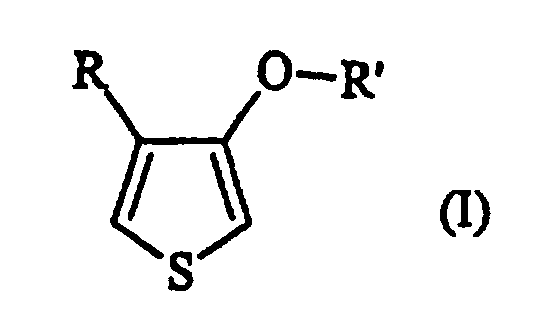
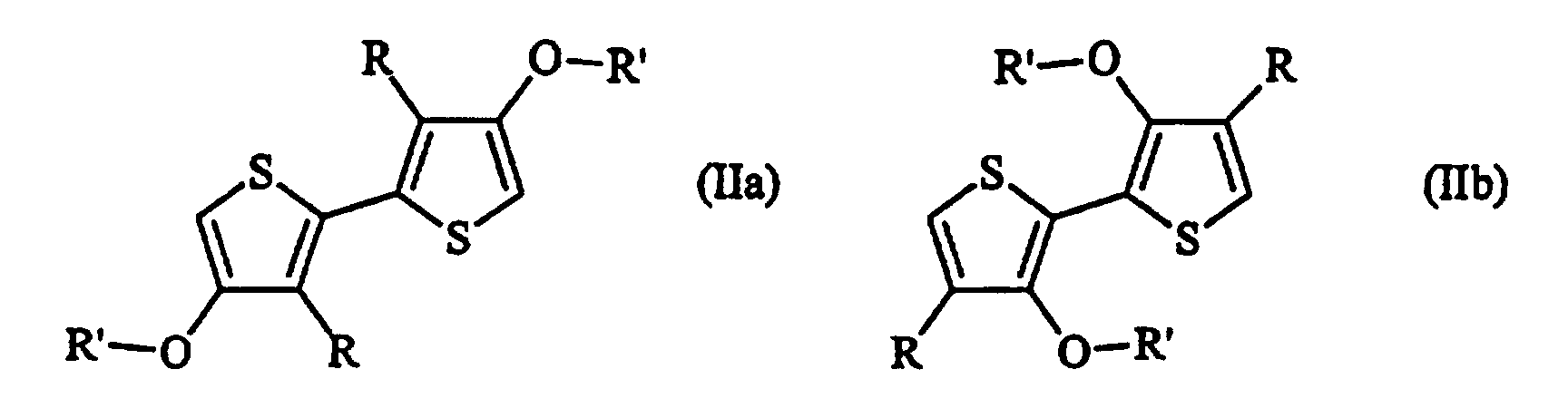
- In these formulae R represents a hydrogen atom or a C1-C4 alkyl group. R is preferably hydrogen or methyl, ethyl, propyl, isopropyl, butyl, isobutyl or tert.-butyl. Still more preferably R represents hydrogen or methyl in the thiophenes of formula (I) and hydrogen in the bithiophenes of formula (II), respectively.
R' is -(CH2)n-SO3M with n = 2 to 12, preferably n = 2, and M = H, Li, Na, K, Rb, Cs, NH4, preferably M = Na. - Another aspect of the invention is to provide a method for the preparation of these thiophenes and bithiophenes. They can be prepared by first reacting a 3-bromothiophene, a 4,4'dibromo-2,2'-bithiophene, or a 3,3'dibromo-2,2'-bithiophene, respectively, with NaOCH3 in the presence of CuBr to form the methoxy-substituted compound, i.e. a 3-methoxythiophene, a 4,4'-dimethoxy-2,2'-bithiophene, or a 3,3'-dimethoxy-2,2'-bithiophene, respectively. This compound is then reacted with an ω-haloalkanol HO-(CH2)n-X (X = Cl, Br, I, preferably X = Br, n = 2-12, preferably n=2), in the presence of NaHSO4. The resulting product, a 3-(ω-haloalkoxy)thiophene, a 4,4'-di(ω-haloalkoxy)-2,2'-bithiophene), or a 3,3'-di(ω-haloalkoxy)-2,2'-bithiophene), respectively, is then reacted with M2SO3 (M = H, Li, Na, K, Rb, Cs, NH4, preferably M = Na, K, NH4) to form the desired thiophene or bithiophene, respectively.
- The polymers of the invention comprise recurring units of formulae (III) or (IV)

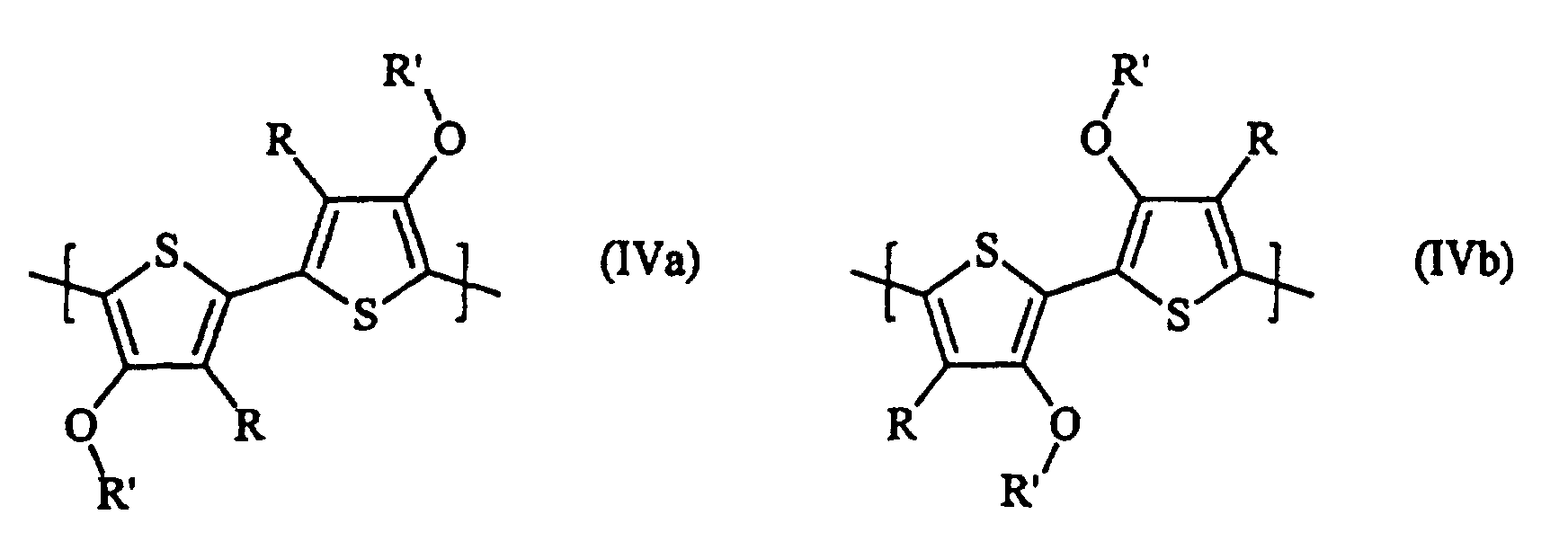
- In these formulae R represents a hydrogen atom or a C1-C4 alkyl group. R is preferably hydrogen or methyl, ethyl, propyl, isopropyl, butyl, isobutyl or tert.-butyl. Still more preferably R represents hydrogen or methyl in the units of formula (III) and hydrogen in the units of formula (IV), respectively.
- R' is -(CH2)n-SO3M with n = 2 to 12, preferably n = 2, and M = H, Li, Na, K, Rb, Cs, NH4. In one preferred embodiment M is sodium, in another preferred embodiment, M is hydrogen.
- The polymers of the invention can be conveniently prepared by polymerizing the thiophenes or bithiophenes in the presence of an oxidant. In most cases FeCl3 is used for this purpose, but it is well known in the art that other oxidants can also be employed. The thiophenes or bithiophenes can also be polymerized electrochemically.
- A convenient method for obtaining the polymers in the sulfonic acid form (M = H) is to first polymerize a monomer bearing alkali sulfonate or ammonium sulfonate groups and then dissolve the resulting polymer in water and pass the solution through an ion-exchange resin to produce the sulfonic acid form of these polymers.
- Alternatively, the monomer bearing the alkali sulfonate or ammonium sulfonate groups can be passed through an ion-exchange resin to produce the sulfonic acid form which can be polymerized as described above.
- The polymers of the invention can be used as starting materials for the production of anti-static coatings or EMI shieldings. It is therefore also an aspect of the invention to provide anti-static coatings or EMI shieldings comprising the polymers of the invention. Preferably, the anti-static coatings or EMI shieldings contain the sulfonic acid form of these polymers.
- 22.3 g of 3-bromo-4-metylthiophene were added to a mixture of 80 mL sodium methoxide (25% in methanol), 30 mL of NMP and 11 g of CuBr. The mixture was refluxed for 3 days and after cooling, was filtrated and washed with water. The compound was extracted several times with diethyl ether. The organic phase was dried with magnesium sulfate and then evaporated. The resulting oil was purified by chromatography on a silica gel column with hexanes as eluent. Yield = 98%.
- 1H-NMR (CDCl3, ppm):
- 6.75 (1H, d); 6.08 (1H, d); 3.72 (3H,s); 2.04 (3H, s)
- 13C NMR (CDCl3, ppm):
- 156.74; 128.53; 119.81; 95.35 56.79; 12.33
- 4.2 g of 3-methoxy-4-methylthiophene was added to a mixture of 40 mL of toluene, 8.2 g of 2-bromo-1-ethanol (Aldrich) and 500 mg of NaHSO4. The resulting mixture was heated until the produced methanol had been distilled off and the temperature rose to 110°C. The product was cooled and washed several times with water and, subsequently, extracted with diethyl ether. The organic phase was dried with magnesium sulfate and then evaporated. The product was purified by column chromatography using silica gel and hexanes as eluent. Yield = 55%.
- 1H NMR: (CDCl3, ppm):
- 6.83 (1H, d); 6.18 (1H, d); 4.25 (2H,t); 3.63 (2H, t); 2.11 (3H,s)
- 13C NMR (CDCl3, ppm):
- 155.06; 129.18; 120.33; 97.23; 69.65; 29.20; 12.71
- Sodium 3-(2-sulfonate)ethoxy-4-methylthiophene. 2.5 g of 3-(2-bromo)ethoxy-4-methylthiophene in 20 mL of acetone was added to a mixture of 1.5 g of Na2SO3 in 20 mL of water. The mixture was refluxed for 3 days. After cooling, the unreacted product was extracted with diethyl ether. The aqueous phase was then evaporated, giving a white crystalline powder. The desired product was recrystallized in a mixture of water/ethanol (1:1) at -10°C. Yield = 60 %. M.P.: 228°C.
- 1H NMR (D2O, ppm):
- 7.01 (1H, d); 6.51 (1H, d); 4.38 (2H, t); 3.39 (2H, t); 2.08 (3H, s)
- 13C NMR (D2O, ppm):
- 155.52; 130.13; 121.41; 98.92; 68.57; 50.91; 28.85; 11.83
- 5.00 g of 3-methoxythiophene (Aldrich) was solubilized with 11.00 g of 2-bromoethanol in 20 mL of toluene, then 2.00 g of NaHSO4 was added in one portion. The mixture was heated and methanol was distilled off. The solution was cooled and washed with water and diethylether. The organic phase was dried with magnesium sulfate. After evaporation, a brown liquid was obtained which was purified by column chromatography on silica gel using a mixture of CCl4 and CHCl3 (9:1) as the eluent. An oil was recovered which was further purified by recrystallization in methanol. White crystals were then obtained with a yield of 67%. M.P.= 46°C.
- 1H NMR (CDCl3, ppm):
- 7.18 (1H, m); 6.78 (1H, m); 6.28 (1H, m); 4.27 (2H, t); 3.63 (2H, t)
- 13C NMR (CDCl3, ppm):
- 156.54; 124.79; 119.16; 98.12; 69.65; 28.62
- To a solution of 0.48 g of Na2SO3 in 5.00 rnL of water was added a solution of 527 mg of 3-(2-bromo)ethoxythiophene dissolved in 10 mL of acetone. The mixture was allowed to reflux for 48 hrs. The solution was then cooled and washed with diethyl ether. The aqueous phase was separated and evaporated under reduced pressure. The crude product was dissolved in water and few drops of ethanol was then added to induce the precipitation of the inorganic salt. The suspension was filtered and evaporated.
- A white crystalline product was obtained with a yield of 37 %. This product decomposes at temperatures above 290°C before melting.
- 1H NMR (D2O, ppm):
- 7.46 (1H, m); 6.96 (1H, m); 6.70 (1H, m); 4.50 (2H, t); 3.47 (2H, t)
- 13C NMR(D2O,ppm):
- 156.96; 126.50; 120.11; 100.25; 66.25; 50.92
- 3.13 g of 4,4'-dibromo-2,2'-bithiophene was solubilized in 90 mL of sodium methoxide (25% in methanol) and 50 mL of NMP. 3.50 g of CuBr was then added in one portion and the solution was put to reflux for 24 hrs. The resulting suspension was washed with water and diethyl ether. The organic phase was separated and dried with magnesium sulfate.
- After evaporation of the solvent, a greenish solid was obtained which was purified by chromatography on silica gel using a mixture of CCl4 and CHCl3 (9:1) as the eluent. A greenish solid was obtained with a yield of 37 %. M.P.: 94°C.
- 1H-NMR (CDCl3, ppm):
- 6.81 (2H, d); 6.13 (2H, d); 3.79 (6H, s)
- 13C NMR (CDCl3, ppm):
- 158.17; 136.07; 115.56; 95.96; 57.13
- The product was prepared from a reaction between 529 mg of 2-bromoethanol, 1.00 g of NaHSO4 and 236 mg of 4,4'-dimethoxy-2,2'bithiophene in 5 mL of toluene. The mixture was heated and methanol was distilled off. The solution was then cooled to room temperature and washed with water and diethyl ether. The organic portion was separated and dried with magnesium sulfate. After evaporation, a brown solution was obtained which was purified by chromatography on silica gel using a mixture of CCl4 and CHCl3 (4:1) as the eluent. A greenish solid was obtained with a yield of 45 %. M.P.: 171°C.
- 1H NMR (CDCl3, ppm):
- 6.85 (2H, d); 6.18 (2H,d); 4.27 (4H, t); 3.63 (4H, t)
- 13C NMR (CDCl3, ppm):
- 156.28; 136.27; 115.86; 97.79; 69.75; 28.75
- To a solution of 390 mg of Na2SO3 in 4.5 mL of water was added a solution of 73.3 mg of 4,4'-diethoxy-2,2'-bithiophene dissolved in 2 mL of acetone. Then 4 mL of water was added and the mixture was allowed to reflux for 48 hrs. The mixture was then washed with ether. The aqueous phase was separated and evaporated under reduced pressure. The crude product was dissolved in a mixture (1:1) of water and ethanol. The remaining inorganic salt precipitated and the suspension filtered. The aqueous phase was recovered and evaported. A yellowish solid was obtained with a yield of 50 %. This product decomposes above 290°C before melting.
- 1H NMR (CDCl3, ppm):
- 6.87 (2H, d); 6.40 (2H, d); 4.27 (2H, t); 3.25 (2H, t)
- 13C NMR (CDCl3, ppm):
- 156.28; 136.54; 116.47; 99.82; 66.16; 50.87
- 1.2 g of sodium 3-(2-sulfonate)ethoxy-4-methylthiophene and 3.0 g of dry FeCl3 were mixed in 30 mL of chloroform and stirred for 24 hrs at room temperature. The mixture was poured into 500 mL of methanol where few drops of anhydrous hydrazine have been added. After this treatment, the polymer was put in 500 mL of a 1M NaOH methanolic solution. The precipitate was filtered and a dark blue powder was obtained (yield = 50-60%).
- Sodium poly(3-(2-sulfonate)ethoxythiophene) and sodium poly(4,4'-di(2-sulfonic cid)ethoxy-2,2'-bithiophene) have been prepared using a similar procedure. All resulting polymers showed a good solubility in water giving dark blue solutions.
- SEC measurements revealed the polymers to have a number-average molecular weight of 6000 to 8000 with a polydispersity index of approximately 1.2.
- Figures 1A to 3A show the UV-visible absorption spectra of
- 1A: Sodium poly(3-(2-sulfonate)ethoxythiophene),
- 2A: Sodium poly(3-(2-sulfonate)ethoxy-4-methylthiophene),
- 3A: Sodium poly(4,4'-di(2-sulfonate)ethoxy-2,2'-bithiophene).
-
- These neutral polymers (conductivity lower than 10-5 S/cm, measured on dry pressed pellets by the four probe method) were dissolved in water and passed through an ion-exchange resin column (H+ type, Dowex HCR-W2), leading to the sulfonic acid form of these polymers.
- This acid form of the substituted polythiophenes undergoes an oxidation reaction in air leading to a stable, conducting and nearly colorless state.
- Figures 1B to 3B show the UV-visible absorption spectra of
- 1B: Poly(3-(2-sulfonic acid)ethoxythiophene),
- 2B: Poly(3-(2-sulfonic acid)ethoxy-4-methylthiophene),
- 3B: Poly(4,4'-di(2-sulfonic acid)ethoxy-2,2'-bithiophene).
-
- Measurements of the electrical conductivity of the polythiophene derivatives yielded the following results:
Sample Conductivity [S/cm] Poly(3-(2-sulfonic acid)ethoxythiophene): 0.4 Poly(3-(2-sulfonic acid)ethoxy-4-methylthiophene): 5 Poly(4,4'-di(2-sulfonic acid)ethoxy-2,2'-bithiophene): 10 - The doping and conductivity levels found for these polythiophenes are higher than those previously reported for poly(3-(ω-sulfonic acid)alkylthiophenes), which show conductivities in the range of 10-2 to 10-1 S/cm. They also have lower oxidation potentials of 0.0 to 0.6 V vs. SCE as compared to 0.8 to 1.0 V vs. SCE for the poly(3-(ω-sulfonic acid)alkylthiophenes). The polymers show an excellent stability in the acid (doped) state and no decrease of the electrical conductivity was observed as a function of time.
Claims (15)
- A thiophene corresponding to formula (I)in which R is a hydrogen atom or a C1-C4 alkyl group and R' is -(CH2)n-SO3M with n = 2 to 12 and M = H, Li, Na, K, Rb, Cs, NH4.

- A bithiophene corresponding to formula (IIa)in which R is a hydrogen atom or a C1-C4 alkyl group and R' is -(CH2)n-SO3M with n = 2 to 12 and M = H, Li, Na, K, Rb, Cs, NH4.
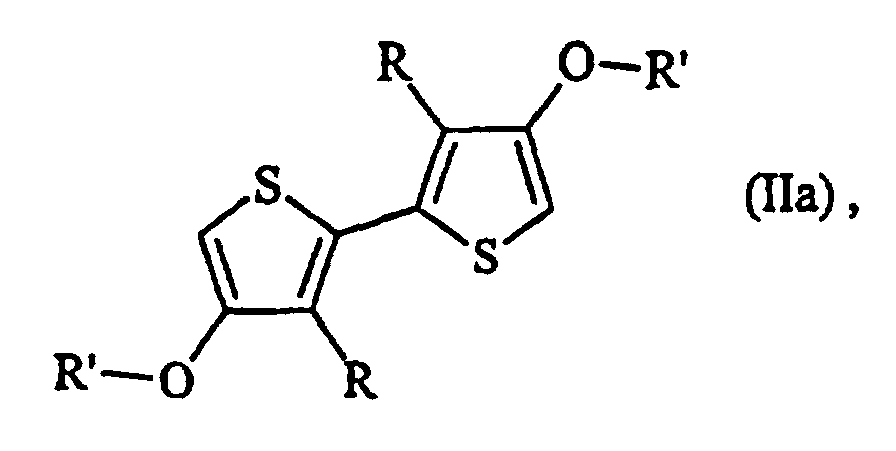
- A bithiophene corresponding to formula (IIb)in which R is a hydrogen atom or a C1-C4 alkyl group and R' is -(CH2)n-SO3M with n = 2 to 12 and M = H, Li, Na, K, Rb, Cs, NH4.

- A polymer comprising recurring units of formula (III)in which R is a hydrogen atom or a C1-C4 alkyl group and R' is -(CH2)n-SO3M with n = 2 to 12 and M = H, Li, Na, K, Rb, Cs, NH4.
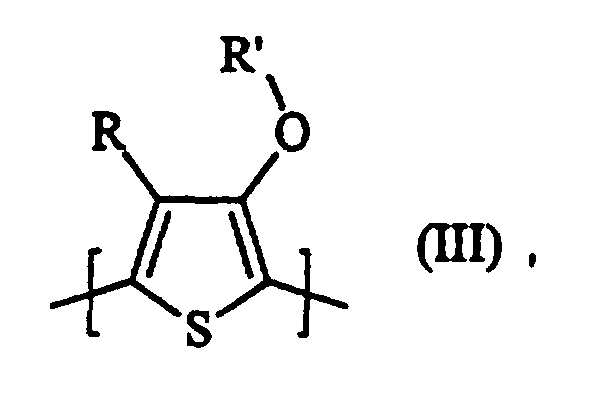
- A polymer comprising recurring units of formula (IVa)in which R is a hydrogen atom or a C1-C4 alkyl group and R' is -(CH2)n-SO3M with n = 2 to 12 and M = H, Li, Na, K, Rb, Cs, NH4.

- A polymer comprising recurring units of formula (IVb)in which R is a hydrogen atom or a C1-C4 alkyl group and R' is -(CH2)n-SO3M with n = 2 to 12 and M = H, Li, Na, K, Rb, Cs, NH4.

- A process for the preparation of the thiophene of claim 1, comprising the steps ofa) reacting a 3-bromothiophene with NaOCH3 in the presence of CuBr to form a 3-methoxythiophene,b) reacting the 3-methoxythiophene with an ω-haloalkanol in the presence of NaHSO4 to form a 3-(ω-haloalkoxy)thiophene,c) reacting the 3-(ω-haloalkoxy)thiophene with M2SO3 (M = H, Li, Na, K, Rb, Cs, NH4) to form the thiophene of claim 1.
- A process for the preparation of the bithiophene of claim 2, comprising the steps ofa) reacting a 4,4'dibromo-2,2'-bithiophene with NaOCH3 in the presence of CuBr to form a 4,4'-dimethoxy-2,2'-bithiophene,b) reacting the 4,4'-dimethoxy-2,2'-bithiophene with an ω-haloalkanol in the presence of NaHSO4 to form a 4,4'-di(ω-haloalkoxy)-2,2'-bithiophene,c) reacting the 4,4'-di(ω-haloalkoxy)-2,2'-bithiophene with M2SO3 (M = H, Li, Na, K, Rb, Cs, NH4) to form the bithiophene of claim 2.
- A process for the preparation of the bithiophene of claim 3, comprising the steps ofa) reacting a 3,3'dibromo-2,2'-bithiophene with NaOCH3 in the presence of CuBr to form a 3,3'-dimethoxy-2,2'-bithiophene,b) reacting the 3,3'-dimethoacy-2,2'-bithiophene with an ω-haloalkanol in the presence of NaHSO4 to form a 3,3'-di(ω-haloalkoxy)-2,2'-bithiophene,c) reacting the 3,3'-di(ω-haloalkoxy)-2,2'-bithiophene with M2SO3 (M = H, Li, Na, K, Rb, Cs, NH4) to form the bithiophene of claim 3.
- A process for the preparation of the polymer of claim 4 by polymerizing the thiophenes of claim 1 in the presence of an oxidant.
- A process for the preparation of the polymer of claim 5 by polymerizing the bithiophenes of claim 2 in the presence of an oxidant
- A process for the preparation of the polymer of claim 6 by polymerizing the bithiophenes of claim 3 in the presence of an oxidant.
- An anti-static coating or EMI shielding comprising the polymer of claim 4.
- An anti-static coating or EMI shielding comprising the polymer of claim 5.
- An anti-static coating or EMI shielding comprising the polymer of claim 6.
Applications Claiming Priority (3)
| Application Number | Priority Date | Filing Date | Title |
|---|---|---|---|
| US2230796P | 1996-07-22 | 1996-07-22 | |
| US22307P | 1996-07-22 | ||
| PCT/CA1997/000477 WO1998003499A1 (en) | 1996-07-22 | 1997-07-03 | Novel self-acid-doped highly conducting polythiophenes |
Publications (2)
| Publication Number | Publication Date |
|---|---|
| EP0918766A1 EP0918766A1 (en) | 1999-06-02 |
| EP0918766B1 true EP0918766B1 (en) | 2002-02-06 |
Family
ID=21808917
Family Applications (1)
| Application Number | Title | Priority Date | Filing Date |
|---|---|---|---|
| EP97928094A Expired - Lifetime EP0918766B1 (en) | 1996-07-22 | 1997-07-03 | Self-acid-doped highly conducting polythiophenes |
Country Status (9)
| Country | Link |
|---|---|
| US (1) | US6051679A (en) |
| EP (1) | EP0918766B1 (en) |
| JP (1) | JP2000515515A (en) |
| KR (1) | KR20000067967A (en) |
| AT (1) | ATE212988T1 (en) |
| AU (1) | AU3252197A (en) |
| CA (1) | CA2260888A1 (en) |
| DE (1) | DE69710338D1 (en) |
| WO (1) | WO1998003499A1 (en) |
Families Citing this family (17)
| Publication number | Priority date | Publication date | Assignee | Title |
|---|---|---|---|---|
| DE19841803A1 (en) * | 1998-09-12 | 2000-03-16 | Bayer Ag | Organic electroluminescent device, i.e. light-emitting diode, has hole-injecting layer of polymeric organic conductor formed by coating from solution or from sub-micron dispersion |
| EP1373246B1 (en) | 2001-04-05 | 2012-09-12 | Geneohm Sciences Canada, Inc. | Detection of negatively charged polymers using water-soluble, cationic, polythiophene derivatives |
| CA2513596C (en) * | 2003-01-28 | 2012-03-13 | Toppan Forms Co., Ltd. | Conductive polymer gel and method of producing the same, actuator, iontophoretic patch label, biomedical electrode, toner, conductive functional member, antistatic sheet, printed circuit member, conductive paste, electrode for fuel cell, and fuel cell |
| CA2544476A1 (en) * | 2003-12-12 | 2005-06-23 | Infectio Recherche Inc. | System for charge-based detection of nucleic acids |
| EP2207185A1 (en) * | 2004-03-24 | 2010-07-14 | Showa Denko Kabushiki Kaisha | Crosslinked self-doping type electrically conducting polymer, production process thereof, product coated with the polymer and electronic device |
| ATE423383T1 (en) | 2004-08-09 | 2009-03-15 | Showa Denko Kk | ANTISTATIC AGENT, ANTISTATIC FILM AND PRODUCT COATED WITH ANTISTATIC FILM |
| EP1853722B1 (en) | 2005-03-03 | 2010-02-24 | National Research Council of Canada | Methods and compositions for the detection and analysis of nucleic acids by signal amplification |
| EP2049582B1 (en) | 2006-07-21 | 2019-02-27 | Nissan Chemical Corporation | Sulfonation of conducting polymers and oled, photovoltaic, and esd devices |
| JP5201985B2 (en) * | 2007-12-28 | 2013-06-05 | 日本カーリット株式会社 | Method for producing dialkoxythiophene |
| KR101558628B1 (en) * | 2008-01-16 | 2015-10-07 | 닛뽕 카릿또 가부시키가이샤 | Process for production of thiophene derivative |
| WO2009152276A2 (en) * | 2008-06-10 | 2009-12-17 | University Of North Carolina At Charlotte | Photoacid generators and lithographic resists comprising the same |
| WO2010021359A1 (en) | 2008-08-20 | 2010-02-25 | 日本電子株式会社 | Method for improving resist sensitivity |
| US8931114B2 (en) | 2008-09-22 | 2015-01-13 | The United States Of America, As Represented By The Secretary Of The Navy | Elastomeric composites with tether-containing, conducting polymers for nanoscale diffusion control |
| WO2010033966A1 (en) * | 2008-09-22 | 2010-03-25 | The Government of the United State of America, as represented by the Secretary of the Navy | Tether-containing conducting polymers |
| JP5884433B2 (en) * | 2011-11-21 | 2016-03-15 | 住友化学株式会社 | Polymer compound and organic photoelectric conversion device using the same |
| JP6024264B2 (en) * | 2012-02-02 | 2016-11-16 | 東ソー株式会社 | Thiophene derivative, water-soluble conductive polymer and aqueous solution thereof, and production method thereof |
| CN107337782B (en) * | 2016-12-29 | 2021-04-20 | 江苏苏博特新材料股份有限公司 | Cement-based material dispersant suitable for low-temperature construction and preparation method thereof |
Family Cites Families (6)
| Publication number | Priority date | Publication date | Assignee | Title |
|---|---|---|---|---|
| EP0253595A3 (en) * | 1986-07-16 | 1988-12-14 | COOKSON GROUP plc | Novel pyrrole monomers and polymers prepared therefrom |
| ATE112883T1 (en) * | 1986-08-26 | 1994-10-15 | Hoechst Ag | SOLUBLE ELECTRICALLY CONDUCTING POLYMERS, PROCESS FOR THEIR PRODUCTION AND THEIR USE. |
| US5367041A (en) * | 1987-12-14 | 1994-11-22 | The Regents Of The University Of California | Self-doped zwitterionic polymers |
| DE3843412A1 (en) * | 1988-04-22 | 1990-06-28 | Bayer Ag | NEW POLYTHIOPHENES, METHOD FOR THEIR PRODUCTION AND THEIR USE |
| FI923304L (en) * | 1992-07-20 | 1994-01-21 | Neste Oy | NYA BEARBETBARA THIOFENBASERADE POLYMERER OCH COPOLYMERER, OCH VAERMESTABILA ELLEDANDE KOMPOSITIONER DAERAV |
| JPH06192440A (en) * | 1992-12-22 | 1994-07-12 | Dainippon Printing Co Ltd | Conductive organic thin film |
-
1997
- 1997-07-03 EP EP97928094A patent/EP0918766B1/en not_active Expired - Lifetime
- 1997-07-03 DE DE69710338T patent/DE69710338D1/en not_active Expired - Lifetime
- 1997-07-03 WO PCT/CA1997/000477 patent/WO1998003499A1/en not_active Ceased
- 1997-07-03 AT AT97928094T patent/ATE212988T1/en active
- 1997-07-03 AU AU32521/97A patent/AU3252197A/en not_active Abandoned
- 1997-07-03 CA CA002260888A patent/CA2260888A1/en not_active Abandoned
- 1997-07-03 US US09/214,998 patent/US6051679A/en not_active Expired - Fee Related
- 1997-07-03 JP JP10506396A patent/JP2000515515A/en active Pending
- 1997-07-03 KR KR1019997000472A patent/KR20000067967A/en not_active Withdrawn
Also Published As
| Publication number | Publication date |
|---|---|
| ATE212988T1 (en) | 2002-02-15 |
| WO1998003499A1 (en) | 1998-01-29 |
| KR20000067967A (en) | 2000-11-25 |
| DE69710338D1 (en) | 2002-03-21 |
| CA2260888A1 (en) | 1998-01-29 |
| AU3252197A (en) | 1998-02-10 |
| JP2000515515A (en) | 2000-11-21 |
| EP0918766A1 (en) | 1999-06-02 |
| US6051679A (en) | 2000-04-18 |
Similar Documents
| Publication | Publication Date | Title |
|---|---|---|
| US6051679A (en) | Self-acid-doped highly conducting polythiophenes | |
| JP2668060B2 (en) | Polymer conductor with self-doping function | |
| DE602005003629T2 (en) | Substituted thienothiophenes and conductive polymers | |
| EP0253594A2 (en) | Polymerisable thiophene monomers, their production and polymers prepared therefrom | |
| DE602005002515T2 (en) | Pentafluorosulfanyl substituted thienothiophene monomers and conductive polymers | |
| WO2012027348A2 (en) | Substituted 3,4-propylenedioxythiophene monomers and 3,4-propylenedioxythiophene-based crosslinkers and polymers thereof | |
| US5367041A (en) | Self-doped zwitterionic polymers | |
| US6617462B1 (en) | Bithienylnaphthalene-and bis(3,4-ethylenedioxythienyl)naphthalene-based monomers and polymers | |
| US6291621B1 (en) | Bithienylnaphthalene-based monomers and polymers | |
| JP4269113B2 (en) | Aromatic amine derivatives and soluble conductive compounds | |
| US5237023A (en) | Polyaniline derivatives and their production process | |
| US5908583A (en) | Semiconductor polymer | |
| US5863981A (en) | Electrically conducting water-soluble self-doping polyaniline polymers and the aqueous solutions thereof | |
| US5310781A (en) | Self-doped polymers from polyaniline with bronsted acid groups | |
| JPH0574467A (en) | Macromolecular solid electrolyte | |
| JP2763903B2 (en) | Method of manufacturing conductor having self-doping function | |
| US5760169A (en) | Self-doped polymers | |
| JPH0813873B2 (en) | Water-soluble self-doped conductive polymer and method for producing the same | |
| JP3340893B2 (en) | Soluble aminonaphthalene-based conductive polymer and method for producing the same | |
| JPH07233244A (en) | Water-soluble self-dopable conductive polymer and its production | |
| US5162470A (en) | Polymers with electrical and nonlinear optical properties | |
| JP3164671B2 (en) | Arylene vinylene polymer and method for producing the same | |
| JP2005100956A (en) | Dopant agent, conductive polymer material containing the dopant agent, and solid electrolytic capacitor using the polymer material | |
| JPH07238150A (en) | Aqueous solution of self-doped conductive polymer and its production | |
| US5210219A (en) | Bis-sulfonium salts of 2,5-dimethylstilbene |
Legal Events
| Date | Code | Title | Description |
|---|---|---|---|
| PUAI | Public reference made under article 153(3) epc to a published international application that has entered the european phase |
Free format text: ORIGINAL CODE: 0009012 |
|
| 17P | Request for examination filed |
Effective date: 19990222 |
|
| AK | Designated contracting states |
Kind code of ref document: A1 Designated state(s): AT BE CH DE DK ES FI FR GB IE IT LI NL PT SE |
|
| GRAG | Despatch of communication of intention to grant |
Free format text: ORIGINAL CODE: EPIDOS AGRA |
|
| RTI1 | Title (correction) |
Free format text: SELF-ACID-DOPED HIGHLY CONDUCTING POLYTHIOPHENES |
|
| 17Q | First examination report despatched |
Effective date: 20010126 |
|
| GRAG | Despatch of communication of intention to grant |
Free format text: ORIGINAL CODE: EPIDOS AGRA |
|
| GRAH | Despatch of communication of intention to grant a patent |
Free format text: ORIGINAL CODE: EPIDOS IGRA |
|
| GRAH | Despatch of communication of intention to grant a patent |
Free format text: ORIGINAL CODE: EPIDOS IGRA |
|
| GRAH | Despatch of communication of intention to grant a patent |
Free format text: ORIGINAL CODE: EPIDOS IGRA |
|
| GRAA | (expected) grant |
Free format text: ORIGINAL CODE: 0009210 |
|
| REG | Reference to a national code |
Ref country code: GB Ref legal event code: IF02 |
|
| AK | Designated contracting states |
Kind code of ref document: B1 Designated state(s): AT BE CH DE DK ES FI FR GB IE IT LI NL PT SE |
|
| PG25 | Lapsed in a contracting state [announced via postgrant information from national office to epo] |
Ref country code: NL Free format text: LAPSE BECAUSE OF FAILURE TO SUBMIT A TRANSLATION OF THE DESCRIPTION OR TO PAY THE FEE WITHIN THE PRESCRIBED TIME-LIMIT Effective date: 20020206 Ref country code: LI Free format text: LAPSE BECAUSE OF FAILURE TO SUBMIT A TRANSLATION OF THE DESCRIPTION OR TO PAY THE FEE WITHIN THE PRESCRIBED TIME-LIMIT Effective date: 20020206 Ref country code: IT Free format text: LAPSE BECAUSE OF FAILURE TO SUBMIT A TRANSLATION OF THE DESCRIPTION OR TO PAY THE FEE WITHIN THE PRESCRIBED TIME-LIMIT;WARNING: LAPSES OF ITALIAN PATENTS WITH EFFECTIVE DATE BEFORE 2007 MAY HAVE OCCURRED AT ANY TIME BEFORE 2007. THE CORRECT EFFECTIVE DATE MAY BE DIFFERENT FROM THE ONE RECORDED. Effective date: 20020206 Ref country code: FR Free format text: LAPSE BECAUSE OF FAILURE TO SUBMIT A TRANSLATION OF THE DESCRIPTION OR TO PAY THE FEE WITHIN THE PRESCRIBED TIME-LIMIT Effective date: 20020206 Ref country code: FI Free format text: LAPSE BECAUSE OF FAILURE TO SUBMIT A TRANSLATION OF THE DESCRIPTION OR TO PAY THE FEE WITHIN THE PRESCRIBED TIME-LIMIT Effective date: 20020206 Ref country code: CH Free format text: LAPSE BECAUSE OF FAILURE TO SUBMIT A TRANSLATION OF THE DESCRIPTION OR TO PAY THE FEE WITHIN THE PRESCRIBED TIME-LIMIT Effective date: 20020206 Ref country code: BE Free format text: LAPSE BECAUSE OF FAILURE TO SUBMIT A TRANSLATION OF THE DESCRIPTION OR TO PAY THE FEE WITHIN THE PRESCRIBED TIME-LIMIT Effective date: 20020206 Ref country code: AT Free format text: LAPSE BECAUSE OF FAILURE TO SUBMIT A TRANSLATION OF THE DESCRIPTION OR TO PAY THE FEE WITHIN THE PRESCRIBED TIME-LIMIT Effective date: 20020206 |
|
| REF | Corresponds to: |
Ref document number: 212988 Country of ref document: AT Date of ref document: 20020215 Kind code of ref document: T |
|
| REG | Reference to a national code |
Ref country code: CH Ref legal event code: EP |
|
| REF | Corresponds to: |
Ref document number: 69710338 Country of ref document: DE Date of ref document: 20020321 |
|
| PG25 | Lapsed in a contracting state [announced via postgrant information from national office to epo] |
Ref country code: SE Free format text: LAPSE BECAUSE OF FAILURE TO SUBMIT A TRANSLATION OF THE DESCRIPTION OR TO PAY THE FEE WITHIN THE PRESCRIBED TIME-LIMIT Effective date: 20020506 Ref country code: PT Free format text: LAPSE BECAUSE OF FAILURE TO SUBMIT A TRANSLATION OF THE DESCRIPTION OR TO PAY THE FEE WITHIN THE PRESCRIBED TIME-LIMIT Effective date: 20020506 Ref country code: DK Free format text: LAPSE BECAUSE OF FAILURE TO SUBMIT A TRANSLATION OF THE DESCRIPTION OR TO PAY THE FEE WITHIN THE PRESCRIBED TIME-LIMIT Effective date: 20020506 |
|
| PG25 | Lapsed in a contracting state [announced via postgrant information from national office to epo] |
Ref country code: DE Free format text: LAPSE BECAUSE OF FAILURE TO SUBMIT A TRANSLATION OF THE DESCRIPTION OR TO PAY THE FEE WITHIN THE PRESCRIBED TIME-LIMIT Effective date: 20020507 |
|
| NLV1 | Nl: lapsed or annulled due to failure to fulfill the requirements of art. 29p and 29m of the patents act | ||
| PG25 | Lapsed in a contracting state [announced via postgrant information from national office to epo] |
Ref country code: IE Free format text: LAPSE BECAUSE OF NON-PAYMENT OF DUE FEES Effective date: 20020703 Ref country code: GB Free format text: LAPSE BECAUSE OF NON-PAYMENT OF DUE FEES Effective date: 20020703 |
|
| REG | Reference to a national code |
Ref country code: CH Ref legal event code: PL |
|
| PG25 | Lapsed in a contracting state [announced via postgrant information from national office to epo] |
Ref country code: ES Free format text: LAPSE BECAUSE OF FAILURE TO SUBMIT A TRANSLATION OF THE DESCRIPTION OR TO PAY THE FEE WITHIN THE PRESCRIBED TIME-LIMIT Effective date: 20020829 |
|
| EN | Fr: translation not filed | ||
| PLBE | No opposition filed within time limit |
Free format text: ORIGINAL CODE: 0009261 |
|
| STAA | Information on the status of an ep patent application or granted ep patent |
Free format text: STATUS: NO OPPOSITION FILED WITHIN TIME LIMIT |
|
| 26N | No opposition filed |
Effective date: 20021107 |
|
| GBPC | Gb: european patent ceased through non-payment of renewal fee |
Effective date: 20020703 |
|
| REG | Reference to a national code |
Ref country code: IE Ref legal event code: MM4A |