EP0918616B1 - Heat-shrinkable uhmv polymer film, tubing, and roll covers - Google Patents
Heat-shrinkable uhmv polymer film, tubing, and roll covers Download PDFInfo
- Publication number
- EP0918616B1 EP0918616B1 EP97929920A EP97929920A EP0918616B1 EP 0918616 B1 EP0918616 B1 EP 0918616B1 EP 97929920 A EP97929920 A EP 97929920A EP 97929920 A EP97929920 A EP 97929920A EP 0918616 B1 EP0918616 B1 EP 0918616B1
- Authority
- EP
- European Patent Office
- Prior art keywords
- expanded
- tube
- ultra
- melt viscosity
- article
- Prior art date
- Legal status (The legal status is an assumption and is not a legal conclusion. Google has not performed a legal analysis and makes no representation as to the accuracy of the status listed.)
- Expired - Lifetime
Links
Images

Classifications
-
- B—PERFORMING OPERATIONS; TRANSPORTING
- B29—WORKING OF PLASTICS; WORKING OF SUBSTANCES IN A PLASTIC STATE IN GENERAL
- B29C—SHAPING OR JOINING OF PLASTICS; SHAPING OF MATERIAL IN A PLASTIC STATE, NOT OTHERWISE PROVIDED FOR; AFTER-TREATMENT OF THE SHAPED PRODUCTS, e.g. REPAIRING
- B29C63/00—Lining or sheathing, i.e. applying preformed layers or sheathings of plastics; Apparatus therefor
- B29C63/38—Lining or sheathing, i.e. applying preformed layers or sheathings of plastics; Apparatus therefor by liberation of internal stresses
- B29C63/42—Lining or sheathing, i.e. applying preformed layers or sheathings of plastics; Apparatus therefor by liberation of internal stresses using tubular layers or sheathings
-
- B—PERFORMING OPERATIONS; TRANSPORTING
- B29—WORKING OF PLASTICS; WORKING OF SUBSTANCES IN A PLASTIC STATE IN GENERAL
- B29C—SHAPING OR JOINING OF PLASTICS; SHAPING OF MATERIAL IN A PLASTIC STATE, NOT OTHERWISE PROVIDED FOR; AFTER-TREATMENT OF THE SHAPED PRODUCTS, e.g. REPAIRING
- B29C61/00—Shaping by liberation of internal stresses; Making preforms having internal stresses; Apparatus therefor
- B29C61/06—Making preforms having internal stresses, e.g. plastic memory
- B29C61/08—Making preforms having internal stresses, e.g. plastic memory by stretching tubes
-
- F—MECHANICAL ENGINEERING; LIGHTING; HEATING; WEAPONS; BLASTING
- F16—ENGINEERING ELEMENTS AND UNITS; GENERAL MEASURES FOR PRODUCING AND MAINTAINING EFFECTIVE FUNCTIONING OF MACHINES OR INSTALLATIONS; THERMAL INSULATION IN GENERAL
- F16C—SHAFTS; FLEXIBLE SHAFTS; ELEMENTS OR CRANKSHAFT MECHANISMS; ROTARY BODIES OTHER THAN GEARING ELEMENTS; BEARINGS
- F16C13/00—Rolls, drums, discs, or the like; Bearings or mountings therefor
-
- B—PERFORMING OPERATIONS; TRANSPORTING
- B29—WORKING OF PLASTICS; WORKING OF SUBSTANCES IN A PLASTIC STATE IN GENERAL
- B29K—INDEXING SCHEME ASSOCIATED WITH SUBCLASSES B29B, B29C OR B29D, RELATING TO MOULDING MATERIALS OR TO MATERIALS FOR MOULDS, REINFORCEMENTS, FILLERS OR PREFORMED PARTS, e.g. INSERTS
- B29K2023/00—Use of polyalkenes or derivatives thereof as moulding material
- B29K2023/04—Polymers of ethylene
- B29K2023/06—PE, i.e. polyethylene
- B29K2023/0658—PE, i.e. polyethylene characterised by its molecular weight
- B29K2023/0675—HMWPE, i.e. high molecular weight polyethylene
-
- B—PERFORMING OPERATIONS; TRANSPORTING
- B29—WORKING OF PLASTICS; WORKING OF SUBSTANCES IN A PLASTIC STATE IN GENERAL
- B29K—INDEXING SCHEME ASSOCIATED WITH SUBCLASSES B29B, B29C OR B29D, RELATING TO MOULDING MATERIALS OR TO MATERIALS FOR MOULDS, REINFORCEMENTS, FILLERS OR PREFORMED PARTS, e.g. INSERTS
- B29K2023/00—Use of polyalkenes or derivatives thereof as moulding material
- B29K2023/04—Polymers of ethylene
- B29K2023/06—PE, i.e. polyethylene
- B29K2023/0658—PE, i.e. polyethylene characterised by its molecular weight
- B29K2023/0683—UHMWPE, i.e. ultra high molecular weight polyethylene
-
- B—PERFORMING OPERATIONS; TRANSPORTING
- B29—WORKING OF PLASTICS; WORKING OF SUBSTANCES IN A PLASTIC STATE IN GENERAL
- B29K—INDEXING SCHEME ASSOCIATED WITH SUBCLASSES B29B, B29C OR B29D, RELATING TO MOULDING MATERIALS OR TO MATERIALS FOR MOULDS, REINFORCEMENTS, FILLERS OR PREFORMED PARTS, e.g. INSERTS
- B29K2027/00—Use of polyvinylhalogenides or derivatives thereof as moulding material
- B29K2027/12—Use of polyvinylhalogenides or derivatives thereof as moulding material containing fluorine
- B29K2027/18—PTFE, i.e. polytetrafluoroethylene, e.g. ePTFE, i.e. expanded polytetrafluoroethylene
-
- Y—GENERAL TAGGING OF NEW TECHNOLOGICAL DEVELOPMENTS; GENERAL TAGGING OF CROSS-SECTIONAL TECHNOLOGIES SPANNING OVER SEVERAL SECTIONS OF THE IPC; TECHNICAL SUBJECTS COVERED BY FORMER USPC CROSS-REFERENCE ART COLLECTIONS [XRACs] AND DIGESTS
- Y10—TECHNICAL SUBJECTS COVERED BY FORMER USPC
- Y10T—TECHNICAL SUBJECTS COVERED BY FORMER US CLASSIFICATION
- Y10T29/00—Metal working
- Y10T29/49—Method of mechanical manufacture
- Y10T29/49826—Assembling or joining
- Y10T29/49863—Assembling or joining with prestressing of part
- Y10T29/49865—Assembling or joining with prestressing of part by temperature differential [e.g., shrink fit]
-
- Y—GENERAL TAGGING OF NEW TECHNOLOGICAL DEVELOPMENTS; GENERAL TAGGING OF CROSS-SECTIONAL TECHNOLOGIES SPANNING OVER SEVERAL SECTIONS OF THE IPC; TECHNICAL SUBJECTS COVERED BY FORMER USPC CROSS-REFERENCE ART COLLECTIONS [XRACs] AND DIGESTS
- Y10—TECHNICAL SUBJECTS COVERED BY FORMER USPC
- Y10T—TECHNICAL SUBJECTS COVERED BY FORMER US CLASSIFICATION
- Y10T428/00—Stock material or miscellaneous articles
- Y10T428/13—Hollow or container type article [e.g., tube, vase, etc.]
- Y10T428/1328—Shrinkable or shrunk [e.g., due to heat, solvent, volatile agent, restraint removal, etc.]
-
- Y—GENERAL TAGGING OF NEW TECHNOLOGICAL DEVELOPMENTS; GENERAL TAGGING OF CROSS-SECTIONAL TECHNOLOGIES SPANNING OVER SEVERAL SECTIONS OF THE IPC; TECHNICAL SUBJECTS COVERED BY FORMER USPC CROSS-REFERENCE ART COLLECTIONS [XRACs] AND DIGESTS
- Y10—TECHNICAL SUBJECTS COVERED BY FORMER USPC
- Y10T—TECHNICAL SUBJECTS COVERED BY FORMER US CLASSIFICATION
- Y10T428/00—Stock material or miscellaneous articles
- Y10T428/13—Hollow or container type article [e.g., tube, vase, etc.]
- Y10T428/1328—Shrinkable or shrunk [e.g., due to heat, solvent, volatile agent, restraint removal, etc.]
- Y10T428/1331—Single layer [continuous layer]
Definitions
- the present invention relates generally to the production of heat-shrinkable thermoplastic material and to the fabrication of films, sheets, and tubing of such material, as well as roll covers used on machinery rollers, such as paper machine rolls, textile rolls, food processing rolls, and lamination equipment.
- Heat-shrinkable thermoplastics are used in many applications, among which are covering for machinery rollers in mill installations, such as in paper mills, where the rolls are used for guiding, spreading, and carrying the material being processed. These rolls are commonly provided with a polymer cover on their surface to resist corrosion and minimize friction and sticking.
- Various processes and materials for making and appiying such tubes and roll covers are disclosed in U.S.Pat.Nos.
- a typical polymer cover of this type is in the form of Heat-Shrinkable Tubing (HST) commonly made from fluorinated ethylenepropylene copolymer (FEP), and less often from perfluoroalkoxy (PFA), a copolymer of tetrafluoroethylene (TFE) and perfluoropropyl vinyl ether (PPVE).
- HST Heat-Shrinkable Tubing
- FEP fluorinated ethylenepropylene copolymer
- PFA perfluoroalkoxy
- TFE tetrafluoroethylene
- PPVE perfluoropropyl vinyl ether
- the HST is presently fabricated by taking a suitable tube, welded from FEP sheet or fabricated by some other method, and applying pressure and heat to expand it hot, followed by cooling it in its expanded state to freeze the stress put into it by the expanding. The cooled tube is then shrunk onto the surface of the roll, again using the application of heat, to tightly shrink the tube or sleeve about
- melt processable FEP and PFA that are typically used in the HST application have been chosen over polytetraflurorethylene (PTFE), or other ultra high melt viscosity (UHMV) fluoropolymers, such as chemically modified PTFE, available as "Hostaflon” from Hoechst AG of Burgmaschinen, Germany, and commonly referred to as TFM, even though the latter materials have lower cost, greater strength, hardness, flex life, and other preferred physical properties and higher temperature use and service limits. This choice has been primarily due to the understanding and expectation in the art that the latter materials require higher temperatures to shrink.
- PTFE polytetraflurorethylene
- UHMV ultra high melt viscosity
- UHMV polymers are polymers that have a melt viscosity, which is too high for conventional thermoplastic processing, being of the order of a million times higher than conventional polymers that are suitable for melt processing.
- PTFE has a melt viscosity of 10 10 Pa ⁇ s (10 11 poises)
- PEP has a melt viscosity of 10 3 to 10 4 Pa ⁇ s (10 4 to 10 5 poises).
- UHMV polymer that has not been used in the HST application is ultra high molecular weight polyethylene or UHMWPE, which is an extremely high density polyethylene with a molecular weight range of 3,000,000 to 6,000,000.
- Expanded UHMV polymer tubes such as those made from PTFE are known, but they have not been satisfactorily employed in the HST shrink process since state of the art HST made from PTFE is typically heated to near or above the gel temperature of PTFE, 327°C (621°F), first for expansion and again, after cooling, to effect complete recovery, i.e., shrinkage of the tube onto the roll.
- These temperatures are so high as to pose a danger of causing thermal damage to the substrate roll and as a practical matter they cannot be easily accomplished on larger samples with the application of energy from a simple tool, such as a hot air gun currently used with FEP HST.
- the present invention involves the discovery of the suitability and advantages to be achieved with the use of PTFE and other ultra high melt viscosity (UHMV) polymers such as TFM, and UHMWPE, as heat shrinkable material, and their use, rather than FEP or PFA, in the HST process. It has been found, for instance, that PTFE, typically fully sintered PTFE used in HST applications, may be readily substituted for FEP in the typical HST process with little significant change in the existing process steps.
- UHMV ultra high melt viscosity
- Appropriate expansion of a PTFE tube may be obtained with pressure and heat treatment at temperatures less than 149°C (300°F), preferably in the range from about 88°C (190°F) to about 121°C (250°F), in a matter of a few minutes, and the resulting tube is sufficiently stable to be shipped for later shrink application at comparable temperatures onto a roll at a mill.
- UHMV polymers may be processed in the form of a sheet or a film to produce improved heat-shrinkable material that is shrinkable at comparatively low temperatures in a minimum time, particularly heretofore unrealized UHMWPE heat-shrinkable film.
- the tube and the sheet or film are shrinkable in at least one dimension and may be shrinkable in two dimensions.
- a typical HST process begins with the provision of a tube which may involve, first, cutting a sheet of ultra high melt viscosity (UHMV) polymer film, e.g., of PTFE, TFM, or UHMWPE, to the appropriate circumference and length to fit the roll to be covered, as is done with FEP. The edges of the cut sheet are then joined, such as by fusion welding, to form a tube with a seam that is strong enough to be expanded. This tube is then expanded to a sufficient size to fit about the surface of the roll, by closing its ends and placing it in an expansion housing or sizing chamber, such as a cylindrical pipe that will accept the UHMV tube and determine the diameter to which it will expand.
- UHMV ultra high melt viscosity
- the tube is expanded to that diameter using pressure and, if desired, heat, such as steam heat at a temperature of about 93°C (200°F), or, depending on the material thickness, to a temperature somewhere above the expansion temperature but below the gel temperature.
- heat such as steam heat at a temperature of about 93°C (200°F), or, depending on the material thickness, to a temperature somewhere above the expansion temperature but below the gel temperature.
- the expanded tube is cooled to ambient temperature at the expanded diameter and is sufficiently stable upon cooling to be stored for later shipment and use.
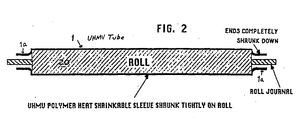
- the tube is slipped over the roll surface to be covered and, when positioned properly, the tube material is heated, e.g., using hot air guns, a gas torch, a heat blanket, or an oven, to a temperature sufficient to shrink it into tight contact with the surface, e.g., a temperature somewhat higher than the temperature at which it was expanded, typically at about 107°C (225°F).
- the shrink time is typically less than 3 minutes.
- the size of the circumference of the tube is chosen initially to be about 0.50 to about 0.95 times, and preferably from about 0.80 to about 0.92 times, the roll size.
- the resulting roll cover has improved mechanical properties as well as being amenable to being reinforced with suitable particulate additives such as a conductive additive to provide anti-static properties and additives to improve its wear, load carrying, and compressive strength, and to reduce its thermal expansion, as are variously known in the art.
- the present invention is based on the discovery that PTFE and other UHMV polymer materials, such as TFM, and UHMW polyethylene, can be utilized advantageously as heat-shrinkable material with heretofore unappreciated ease and rapid, low temperature processing.
- UHMV polymer material rather than FEP or PFA, in the conventional HST process, with minor modifications, to achieve a Heat-Shrinkable Tubing (HST) or roll cover of improved qualities and economy.
- HST Heat-Shrinkable Tubing
- an article of manufacture comprising an ultra-high melt viscosity polymer having a melt viscosity too high for conventional melt processing that has been pressure-expanded to a shape in a stressed condition, which is capable of heat shrinking in at least one dimension under the application of heating at a temperature below 149°C (300°F), to release the stressed condition, wherein said ultra-high melt viscosity polymer comprises a material selected from fully sintered polytetraflurorethylene, chemically modified polytetraflurorethylene, and ultra high molecular weight polyethylene having a molecular weight of from 3,000,000 to 6,000,000.
- the UHMV polymers have been found to be suitably shrinkable, after expansion, using a simple heating device, such as a hot air gun, for a few minutes at a comparable temperature to that of the FEP, e.g., significantly less than 149°C (300°F), rather than the 315-371°C (600 - 700°F) presently thought to be necessary by the art. Additionally, this capability may be exploited in producing improved heat-shrinkable sheets and films of these materials.
- tubes of PTFE and other UHMV polymers can be expanded under pressure, with or without heat, but preferably after heating at a temperature below 149°C (300°F), and then shrunk about the surface of the roll again heating at a temperature below 149°C (300°F) to release the stresses therein.
- the tube is preferably heated before being expanded to build in adequate stresses to maintain the expansion upon cooling and which later are released by heat for shrinking the tube about the roll.
- the PTFE polymer tube need not be heated to temperatures near the melting point when expanded in order to achieve satisfactory stability upon cooling, and need not then be released at a comparable temperature to shrink about the roll.
- heating the tube at temperatures comparable to FEP processing i.e., in the range from about 65°C (150°F) to about 149°C (300°F), and preferably from about 88°C (190°F) to about 107°C (225°F) before expanding the tube, will provide sufficient stresses in the material to give satisfactory stability upon cooling.
- the sufficiently stable expanded tube may be shrunk, immediately or later, about a roll surface by releasing the stresses with the application of heat at comparable temperatures, preferably somewhat higher than the expansion temperature, e.g., about 107°C - 121°C (225°F - 250°F) for a few minutes, typically less than 3 minutes.
- UHMV polymer material in tubular form, it may be appropriately heated, expanded, and cooled as a sheet or film, so that, for example, heretofore unknown heat-shrinkable UHMWPE film may be produced that is shrinkable at easily workable temperatures.
- the UHWPE may be processed and heat shrunk without radiation. It also may be shrinkable in two dimensions.
- An exemplary method for producing and applying an improved heat-shrinkable covering material, such as for roll covers, or wire jacketing, or the like, in accordance with the invention is carried out generally as follows.
- the cover is initially prepared by:
- an improved roll cover may be achieved using PTFE, and other UHMV polymeric materials such as TFM, and UHMWPE, in place of FEP, in the conventional HST process, with minor modifications.
- UHMV polymers produce a roll cover of improved qualities and economy, which may also be enhanced or reinforced with a conductive additive to impart anti-static properties and/or other additives to enhance the load carrying and compressive strength and wear resistance.
- the UHMV polymers may be processed so as to produce improved heat-shrinkable films, such as of UHMWPE, that are shrinkable at comparatively low temperatures.
Landscapes
- Engineering & Computer Science (AREA)
- General Engineering & Computer Science (AREA)
- Manufacturing & Machinery (AREA)
- Mechanical Engineering (AREA)
- Shaping By String And By Release Of Stress In Plastics And The Like (AREA)
Description
Claims (17)
- An article of manufacture comprising an ultra-high melt viscosity polymer having a melt viscosity too high for conventional melt processing that has been pressure-expanded to a shape in a stressed condition, which is capable of heat-shrinking in at least one dimension under the application of heating at a temperature below 149°C (300°F), to release the stressed condition, wherein said ultra-high melt viscosity polymer comprises a material selected from fully sintered polytetraflurorethylene, chemically modified polytetraflurorethylene, and ultra-high molecular weight polyethylene having a molecular weight of from 3,000,000 to 6,000,000.
- The article of claim 1 wherein said ultra-high melt viscosity polymer has been pressure-expanded to the stressed condition by being initially heated at a temperature in the range from 88°C (190°F) to 121°C (250°F), being expanded under pressure to the pressure-expanded shape, and brought to ambient temperature under pressure while maintaining the pressure-expanded shape.
- The article of claim 2 wherein said pressure-expanded shape ultra-high melt viscosity polymer article has been expanded to a stressed condition that will heat shrink under heating at a temperature somewhat above the temperature at which it has been originally heated but below 149°C (300°F).
- The article of claim 1 wherein said pressure-expanded shape of said ultra-high melt viscosity polymer is a tube.
- The article of claim 4 further comprising a roll and wherein said tube is shrunk about and covers said roll.
- The article of claim 5 wherein said roll covered by said tube is formed as a machinery roller.
- The article of claim 1 wherein said pressure-expanded shape of said ultra-high melt viscosity polymer is a sheet or film.
- The article of claim 1 wherein said article is a film of ultra-high molecular weight polyethylene.
- The article of claim 1 containing an additive and wherein said additive comprises a material selected from carbon, material providing electrical conductivity, material providing improved abrasion resistance, material providing improved wear resistance, material providing improved load carrying, material providing improved compressive strength, and material providing reduced thermal expansion to said shaped article, and combinations thereof.
- A process for producing an article of manufacture according to claim 1, comprising the steps of:providing a supply of the ultra-high melt viscosity polymer having a melt viscosity too high for conventional melt processing;initially mildly heating at 65°C to 149°C (150°F to 300°F) said supply of ultra-high melt viscosity polymer;applying pressure to the heated supply to expand it generally to the form of the desired shape; andbringing said expanded supply to ambient temperature under pressure to maintain the expanded form of the shaped article and produce a sufficiently stable expanded ultra-high melt viscosity polymer article capable of subsequent heat shrinking into the desired shape of said article at a temperature comparable to that of said initial heating.
- The process of claim 10 wherein said supply of UHMV polymer is initially heated at a temperature in the range from 88°C (190°F) to 121°C (250°F).
- The process of claim 11 wherein said sufficiently stable expanded ultra-high melt viscosity polymer article is mildly heated at a temperature somewhat above said initially heated temperature.
- The process of claim 10 comprising the further step of heating said sufficiently stable expanded ultra-high melt viscosity polymer article at a temperature below 149°C (300°F) to shrink it about an object.
- A process according to claim 10 for producing a heat-shrinkable tube (HST) useful as roll cover comprising the steps of:providing a tube of ultra-high melt viscosity polymer;inserting said tube into an expansion housing and heating said tube to a temperature of 65°C to 149°C (150°F to 300°F) and below the gel temperature of said ultra-high melt viscosity polymer;applying pressure to the heated tube to expand its diameter to that of the interior of the housing; andbringing said expanded diameter tube to ambient temperature under pressure to maintain the expanded diameter and produce a sufficiently stable expanded ultra-high melt viscosity polymer tube capable of subsequent use as an HST roll cover by shrinking onto a roll at a temperature comparable to that of said mild heating.
- A process as in claim 14 further comprising the steps of:placing said sufficiently stable expanded ultra-high melt viscosity polymer tube about the surface of a roll; andheating said tube to a mild heating temperature above the temperature at which it has been originally heated, to shrink it into tight contact with said surface of said roll as a roll cover.
- The process of claim 14 wherein said mild heating temperature is in the range from 88°C (190°F) to 121°C (250°F).
- A process as in claim 14 further comprising the step of reinforcing said ultra-high melt viscosity polymer with an additive and wherein said additive comprises a material selected from an electrically conductive additive, an abrasion resistance improving additive, a wear resistance improving additive, a load carrying improving additive, a compressive strength improving additive, carbon, and combinations thereof.
Applications Claiming Priority (3)
| Application Number | Priority Date | Filing Date | Title |
|---|---|---|---|
| US1943896P | 1996-06-10 | 1996-06-10 | |
| US19438P | 1996-06-10 | ||
| PCT/US1997/010091 WO1997047460A1 (en) | 1996-06-10 | 1997-06-09 | Heat-shrinkable uhmv polymer film, tubing, and roll covers |
Publications (3)
| Publication Number | Publication Date |
|---|---|
| EP0918616A1 EP0918616A1 (en) | 1999-06-02 |
| EP0918616A4 EP0918616A4 (en) | 1999-10-20 |
| EP0918616B1 true EP0918616B1 (en) | 2003-10-22 |
Family
ID=21793225
Family Applications (1)
| Application Number | Title | Priority Date | Filing Date |
|---|---|---|---|
| EP97929920A Expired - Lifetime EP0918616B1 (en) | 1996-06-10 | 1997-06-09 | Heat-shrinkable uhmv polymer film, tubing, and roll covers |
Country Status (6)
| Country | Link |
|---|---|
| US (1) | US6471627B2 (en) |
| EP (1) | EP0918616B1 (en) |
| CA (1) | CA2257714A1 (en) |
| DE (1) | DE69725729T2 (en) |
| ES (1) | ES2208918T3 (en) |
| WO (1) | WO1997047460A1 (en) |
Cited By (1)
| Publication number | Priority date | Publication date | Assignee | Title |
|---|---|---|---|---|
| US7803848B2 (en) | 2003-10-15 | 2010-09-28 | Galloo Plastics | Method for selectively separating used fragmented organic materials by means of dense aqueous suspensions |
Families Citing this family (19)
| Publication number | Priority date | Publication date | Assignee | Title |
|---|---|---|---|---|
| US6328681B1 (en) * | 1999-01-21 | 2001-12-11 | Stowe Woodward Inc. | Elastomeric roll cover with ultra high molecular weight polyethylene filler |
| MXPA01009521A (en) * | 1999-03-26 | 2004-06-07 | Goodyear Tire & Rubber | Electrically conductive timing belt. |
| US6770004B1 (en) | 1999-03-26 | 2004-08-03 | The Goodyear Tire & Rubber Company | Electrically conductive timing belt |
| DE29920618U1 (en) * | 1999-11-24 | 2000-02-24 | Holzma-Maschinenbau GmbH, 75365 Calw | Friction roller |
| US20050032617A1 (en) * | 2000-04-13 | 2005-02-10 | Hokushin Corporation | Roller member |
| DE60138206D1 (en) * | 2000-09-11 | 2009-05-14 | Sekisui Seikei Ltd | METHOD FOR PRODUCING A STRIPED POLYOLEFIN FILM |
| US7014604B2 (en) | 2002-07-19 | 2006-03-21 | Voith Paper Patent Gmbh | Paper machine roll cover |
| US6918865B2 (en) | 2002-10-31 | 2005-07-19 | Voith Paper Patent Gmbh | Roll cover |
| US20040250361A1 (en) * | 2003-06-13 | 2004-12-16 | Ford Global Technologies, Llc | Roller assembly |
| US10287731B2 (en) | 2005-11-08 | 2019-05-14 | Stowe Woodward Licensco Llc | Abrasion-resistant rubber roll cover with polyurethane coating |
| US20080106056A1 (en) * | 2006-11-07 | 2008-05-08 | Meritor Suspension Systems Company, U.S. | Heat shrunken low-friction stabilizer bar sleeve |
| FI20085490A0 (en) | 2008-05-23 | 2008-05-23 | Metso Paper Inc | Method of treating a wire mesh used in conjunction with a paper or board machine forming or suction roll and wire mesh |
| KR20100066130A (en) * | 2008-12-09 | 2010-06-17 | 삼성전자주식회사 | Roller usable with image forming apparatus and method to manufacture the same |
| US8333162B2 (en) | 2010-08-12 | 2012-12-18 | Fluoron Inc. | Covered marine deck structure for rope contact |
| WO2012040718A1 (en) * | 2010-09-24 | 2012-03-29 | American Precious Metals Exchange, Inc. | Method and device for ensuring mint-direct packaging in tamper-evident packaging |
| US9370908B1 (en) | 2012-05-18 | 2016-06-21 | Fluoron Inc. | Heat-shrink tubing process apparatus and method of making heat-shrink tubing |
| CN103382961B (en) * | 2013-07-25 | 2016-01-06 | 湖州宁鑫新材料科技有限公司 | The preparation method of teflon rubber roll |
| US9499236B1 (en) | 2014-04-09 | 2016-11-22 | Pea Marine, LLC | Equipment protection sleeves |
| CN115709560B (en) * | 2022-10-27 | 2026-05-01 | 杭州莱恩瑟特医疗技术有限公司 | Polymer medical catheter fitting and forming method and connecting method thereof |
Family Cites Families (17)
| Publication number | Priority date | Publication date | Assignee | Title |
|---|---|---|---|---|
| LU35737A1 (en) * | 1957-01-30 | |||
| US3225129A (en) * | 1962-06-26 | 1965-12-21 | Budd Co | Method of making memory re-shaped plastic tubes, especially fluorocarbon cylinder jackets |
| US3426119A (en) * | 1965-06-23 | 1969-02-04 | Fluorodynamics Inc | Covering of rolls with fluorinated ethylene polymers and the like |
| US3481805A (en) * | 1966-08-12 | 1969-12-02 | Raybestos Manhattan Inc | Method and apparatus for heat shrinking a plastic sleeve to a metal cored rubber roll |
| US3749621A (en) * | 1971-06-09 | 1973-07-31 | Fluorodynamics Inc | Securing and/or forming of coverings and the like of tetrafluorinated ethylene and fluorinated ethylene polymers |
| US4250605A (en) * | 1978-01-19 | 1981-02-17 | The Carborundum Company | Biaxially stressed fluorinated polymer roll cover and method for making same |
| US4585215A (en) * | 1983-09-12 | 1986-04-29 | The B. F. Goodrich Company | Rubber-plastic composite |
| US4768761A (en) * | 1984-03-21 | 1988-09-06 | The B. F. Goodrich Company | Rubber-plastic composite |
| US5030487A (en) * | 1984-04-04 | 1991-07-09 | Raychem Corporation | Heat recoverable article comprising conductive polymer compositions |
| US5070597A (en) * | 1985-07-19 | 1991-12-10 | Raychem Corporation | Tubular article |
| CA2003882C (en) * | 1988-12-19 | 1997-01-07 | Edwin Rogers Smith | Heat shrinkable very low density polyethylene terpolymer film |
| JPH04173320A (en) * | 1990-11-08 | 1992-06-22 | Mitsui Petrochem Ind Ltd | Manufacture of ultra high molecular-weight polyethylene shrinkable tube |
| NL9100278A (en) * | 1991-02-18 | 1992-09-16 | Stamicarbon | MICROPOROUS FOIL AND METHOD FOR THE MANUFACTURE THEREOF |
| TW254883B (en) * | 1991-04-03 | 1995-08-21 | Mitsui Petroleum Chemicals Ind | |
| US5142759A (en) * | 1991-08-27 | 1992-09-01 | Beloit Corporation | Roll cover apparatus |
| AR002142A1 (en) * | 1995-05-31 | 1998-01-07 | Raychem Sa Nv | A THERMAL-CONTRACTABLE TUBULAR ARTICLE, A SET OF PARTS INCLUDING IT, A METHOD TO MANUFACTURE IT AND A METHOD TO COVER A JOINT WITH IT. |
| KR100222141B1 (en) * | 1996-01-11 | 1999-10-01 | 사또 아끼오 | Adhesive polyethylene compositions and multi-layer laminated films using the same |
-
1997
- 1997-06-09 DE DE69725729T patent/DE69725729T2/en not_active Expired - Lifetime
- 1997-06-09 US US09/194,858 patent/US6471627B2/en not_active Expired - Lifetime
- 1997-06-09 ES ES97929920T patent/ES2208918T3/en not_active Expired - Lifetime
- 1997-06-09 WO PCT/US1997/010091 patent/WO1997047460A1/en not_active Ceased
- 1997-06-09 CA CA002257714A patent/CA2257714A1/en not_active Abandoned
- 1997-06-09 EP EP97929920A patent/EP0918616B1/en not_active Expired - Lifetime
Cited By (1)
| Publication number | Priority date | Publication date | Assignee | Title |
|---|---|---|---|---|
| US7803848B2 (en) | 2003-10-15 | 2010-09-28 | Galloo Plastics | Method for selectively separating used fragmented organic materials by means of dense aqueous suspensions |
Also Published As
| Publication number | Publication date |
|---|---|
| CA2257714A1 (en) | 1997-12-18 |
| DE69725729D1 (en) | 2003-11-27 |
| US20020098961A1 (en) | 2002-07-25 |
| US6471627B2 (en) | 2002-10-29 |
| WO1997047460A1 (en) | 1997-12-18 |
| ES2208918T3 (en) | 2004-06-16 |
| EP0918616A1 (en) | 1999-06-02 |
| EP0918616A4 (en) | 1999-10-20 |
| DE69725729T2 (en) | 2004-08-05 |
Similar Documents
| Publication | Publication Date | Title |
|---|---|---|
| US6471627B2 (en) | Heat-shrinkable UHMV polymer film, tubing, and roll covers | |
| WO1997047460A9 (en) | Heat-shrinkable uhmv polymer film, tubing, and roll covers | |
| CA1127362A (en) | Biaxially stressed fluorinated polymer roll cover and method for making same | |
| US5492336A (en) | O-ring gasket material and method for making and using same | |
| US4104095A (en) | Method for producing tubular article | |
| US6355318B1 (en) | Heat shrinkable member | |
| US5483412A (en) | Method for preparing an electrically non-conductive hose assembly | |
| US4846264A (en) | Composite pipe, process for producing the same, and heat pipe using the same | |
| EP0067162A4 (en) | METHOD FOR SHAPING A COATED TUBE. | |
| CA2105976C (en) | Method for producing heat-recoverable articles and apparatus for expanding/shrinking articles | |
| US3554999A (en) | Method of making a shrink device | |
| EP0988141B1 (en) | Method of welding generally rod-shaped structures of a fluorine-containing plastic material in a butt weld | |
| US3941546A (en) | Apparatus and process | |
| US4793404A (en) | Composite pipe, process for producing the same, and heat pipe using of the same | |
| EP0153199B1 (en) | Recoverable polyethylene composition and article | |
| US5940952A (en) | Method for applying corrosion-protective coating to joint between corrosion-protectively coated steel pipes | |
| EP0251482A2 (en) | Heat-recoverable coupler | |
| US3826702A (en) | Method of in-situ heat seal sleeving for large rolls | |
| WO2002102572A1 (en) | Method for producing polytetrafluoroethylene resin formed product and resin formed product | |
| HU222485B1 (en) | Method of lining pipes | |
| US5926936A (en) | Method for applying corrosion-protective coating to joint between corrosion-protectively coated steel pipes | |
| JPH11277626A (en) | Method and apparatus for manufacture of heat-shrinkable tube | |
| US4931116A (en) | Heat-recoverable coupler | |
| US3257689A (en) | Production of tubing having plastic memory | |
| EP0767192B1 (en) | Heat-shrinkable tubing, process for production thereof, and use thereof |
Legal Events
| Date | Code | Title | Description |
|---|---|---|---|
| PUAI | Public reference made under article 153(3) epc to a published international application that has entered the european phase |
Free format text: ORIGINAL CODE: 0009012 |
|
| 17P | Request for examination filed |
Effective date: 19990108 |
|
| AK | Designated contracting states |
Kind code of ref document: A1 Designated state(s): DE ES FI FR GB SE |
|
| A4 | Supplementary search report drawn up and despatched |
Effective date: 19990908 |
|
| AK | Designated contracting states |
Kind code of ref document: A4 Designated state(s): DE ES FI FR GB SE |
|
| RIC1 | Information provided on ipc code assigned before grant |
Free format text: 6B 29C 47/24 A, 6B 29C 61/08 B, 6B 29C 55/24 B, 6B 29C 63/42 B |
|
| 17Q | First examination report despatched |
Effective date: 20000322 |
|
| GRAG | Despatch of communication of intention to grant |
Free format text: ORIGINAL CODE: EPIDOS AGRA |
|
| GRAG | Despatch of communication of intention to grant |
Free format text: ORIGINAL CODE: EPIDOS AGRA |
|
| GRAH | Despatch of communication of intention to grant a patent |
Free format text: ORIGINAL CODE: EPIDOS IGRA |
|
| GRAH | Despatch of communication of intention to grant a patent |
Free format text: ORIGINAL CODE: EPIDOS IGRA |
|
| GRAA | (expected) grant |
Free format text: ORIGINAL CODE: 0009210 |
|
| AK | Designated contracting states |
Kind code of ref document: B1 Designated state(s): DE ES FI FR GB SE |
|
| REG | Reference to a national code |
Ref country code: GB Ref legal event code: FG4D |
|
| REF | Corresponds to: |
Ref document number: 69725729 Country of ref document: DE Date of ref document: 20031127 Kind code of ref document: P |
|
| REG | Reference to a national code |
Ref country code: SE Ref legal event code: TRGR |
|
| REG | Reference to a national code |
Ref country code: ES Ref legal event code: FG2A Ref document number: 2208918 Country of ref document: ES Kind code of ref document: T3 |
|
| ET | Fr: translation filed | ||
| PLBE | No opposition filed within time limit |
Free format text: ORIGINAL CODE: 0009261 |
|
| STAA | Information on the status of an ep patent application or granted ep patent |
Free format text: STATUS: NO OPPOSITION FILED WITHIN TIME LIMIT |
|
| 26N | No opposition filed |
Effective date: 20040723 |
|
| PGFP | Annual fee paid to national office [announced via postgrant information from national office to epo] |
Ref country code: SE Payment date: 20090605 Year of fee payment: 13 |
|
| PGFP | Annual fee paid to national office [announced via postgrant information from national office to epo] |
Ref country code: ES Payment date: 20090709 Year of fee payment: 13 |
|
| EUG | Se: european patent has lapsed | ||
| REG | Reference to a national code |
Ref country code: ES Ref legal event code: FD2A Effective date: 20110715 |
|
| PG25 | Lapsed in a contracting state [announced via postgrant information from national office to epo] |
Ref country code: ES Free format text: LAPSE BECAUSE OF NON-PAYMENT OF DUE FEES Effective date: 20110705 |
|
| PG25 | Lapsed in a contracting state [announced via postgrant information from national office to epo] |
Ref country code: ES Free format text: LAPSE BECAUSE OF NON-PAYMENT OF DUE FEES Effective date: 20100610 |
|
| PG25 | Lapsed in a contracting state [announced via postgrant information from national office to epo] |
Ref country code: SE Free format text: LAPSE BECAUSE OF NON-PAYMENT OF DUE FEES Effective date: 20100610 |
|
| REG | Reference to a national code |
Ref country code: FR Ref legal event code: PLFP Year of fee payment: 20 |
|
| PGFP | Annual fee paid to national office [announced via postgrant information from national office to epo] |
Ref country code: FI Payment date: 20160616 Year of fee payment: 20 Ref country code: DE Payment date: 20160616 Year of fee payment: 20 Ref country code: GB Payment date: 20160624 Year of fee payment: 20 |
|
| PGFP | Annual fee paid to national office [announced via postgrant information from national office to epo] |
Ref country code: FR Payment date: 20160630 Year of fee payment: 20 |
|
| REG | Reference to a national code |
Ref country code: DE Ref legal event code: R071 Ref document number: 69725729 Country of ref document: DE |
|
| REG | Reference to a national code |
Ref country code: GB Ref legal event code: PE20 Expiry date: 20170608 |
|
| PG25 | Lapsed in a contracting state [announced via postgrant information from national office to epo] |
Ref country code: GB Free format text: LAPSE BECAUSE OF EXPIRATION OF PROTECTION Effective date: 20170608 |