EP0917543B1 - Saturated tricyclic ligand containing metal complexes and olefin polymerization process - Google Patents
Saturated tricyclic ligand containing metal complexes and olefin polymerization process Download PDFInfo
- Publication number
- EP0917543B1 EP0917543B1 EP97936353A EP97936353A EP0917543B1 EP 0917543 B1 EP0917543 B1 EP 0917543B1 EP 97936353 A EP97936353 A EP 97936353A EP 97936353 A EP97936353 A EP 97936353A EP 0917543 B1 EP0917543 B1 EP 0917543B1
- Authority
- EP
- European Patent Office
- Prior art keywords
- group
- mixture
- dimer
- metal complex
- groups
- Prior art date
- Legal status (The legal status is an assumption and is not a legal conclusion. Google has not performed a legal analysis and makes no representation as to the accuracy of the status listed.)
- Expired - Lifetime
Links
- 229910052751 metal Inorganic materials 0.000 title claims abstract description 21
- 239000002184 metal Substances 0.000 title claims abstract description 21
- 239000003446 ligand Substances 0.000 title claims abstract description 12
- 150000001336 alkenes Chemical class 0.000 title abstract description 5
- JRZJOMJEPLMPRA-UHFFFAOYSA-N olefin Natural products CCCCCCCC=C JRZJOMJEPLMPRA-UHFFFAOYSA-N 0.000 title abstract description 4
- 238000006116 polymerization reaction Methods 0.000 title description 12
- 229920006395 saturated elastomer Polymers 0.000 title description 2
- 239000000203 mixture Substances 0.000 claims abstract description 49
- 125000004435 hydrogen atom Chemical group [H]* 0.000 claims abstract description 16
- 239000000539 dimer Substances 0.000 claims abstract description 13
- 125000000058 cyclopentadienyl group Chemical group C1(=CC=CC1)* 0.000 claims abstract description 12
- 150000001993 dienes Chemical class 0.000 claims abstract description 12
- 230000003647 oxidation Effects 0.000 claims abstract description 12
- 238000007254 oxidation reaction Methods 0.000 claims abstract description 12
- 230000007935 neutral effect Effects 0.000 claims abstract description 11
- 125000001424 substituent group Chemical group 0.000 claims abstract description 4
- 125000000129 anionic group Chemical group 0.000 claims abstract description 3
- 125000006168 tricyclic group Chemical group 0.000 claims abstract description 3
- -1 hydrocarbyloxy Chemical group 0.000 claims description 115
- 239000003054 catalyst Substances 0.000 claims description 33
- 238000000034 method Methods 0.000 claims description 28
- 125000001183 hydrocarbyl group Chemical group 0.000 claims description 27
- 150000004696 coordination complex Chemical class 0.000 claims description 23
- 230000003213 activating effect Effects 0.000 claims description 18
- 229910052782 aluminium Inorganic materials 0.000 claims description 16
- 125000004429 atom Chemical group 0.000 claims description 12
- 239000001257 hydrogen Substances 0.000 claims description 11
- 229910052739 hydrogen Inorganic materials 0.000 claims description 11
- 125000000217 alkyl group Chemical group 0.000 claims description 10
- 239000004711 α-olefin Substances 0.000 claims description 9
- 125000004178 (C1-C4) alkyl group Chemical group 0.000 claims description 7
- QCWXUUIWCKQGHC-UHFFFAOYSA-N Zirconium Chemical compound [Zr] QCWXUUIWCKQGHC-UHFFFAOYSA-N 0.000 claims description 6
- UBHZUDXTHNMNLD-UHFFFAOYSA-N dimethylsilane Chemical group C[SiH2]C UBHZUDXTHNMNLD-UHFFFAOYSA-N 0.000 claims description 6
- 229910052726 zirconium Inorganic materials 0.000 claims description 6
- 125000003118 aryl group Chemical group 0.000 claims description 5
- 150000004820 halides Chemical class 0.000 claims description 5
- 230000000737 periodic effect Effects 0.000 claims description 5
- 125000004805 propylene group Chemical group [H]C([H])([H])C([H])([*:1])C([H])([H])[*:2] 0.000 claims description 5
- XUIMIQQOPSSXEZ-UHFFFAOYSA-N Silicon Chemical compound [Si] XUIMIQQOPSSXEZ-UHFFFAOYSA-N 0.000 claims description 4
- RTAQQCXQSZGOHL-UHFFFAOYSA-N Titanium Chemical compound [Ti] RTAQQCXQSZGOHL-UHFFFAOYSA-N 0.000 claims description 4
- 150000003863 ammonium salts Chemical class 0.000 claims description 4
- 229910052799 carbon Inorganic materials 0.000 claims description 4
- 125000000113 cyclohexyl group Chemical group [H]C1([H])C([H])([H])C([H])([H])C([H])(*)C([H])([H])C1([H])[H] 0.000 claims description 4
- 125000001181 organosilyl group Chemical group [SiH3]* 0.000 claims description 4
- QQONPFPTGQHPMA-UHFFFAOYSA-N propylene Natural products CC=C QQONPFPTGQHPMA-UHFFFAOYSA-N 0.000 claims description 4
- 229910052710 silicon Inorganic materials 0.000 claims description 4
- 239000010703 silicon Substances 0.000 claims description 4
- 239000000758 substrate Substances 0.000 claims description 4
- 229910052719 titanium Inorganic materials 0.000 claims description 4
- 239000010936 titanium Substances 0.000 claims description 4
- OKTJSMMVPCPJKN-UHFFFAOYSA-N Carbon Chemical group [C] OKTJSMMVPCPJKN-UHFFFAOYSA-N 0.000 claims description 3
- 150000001721 carbon Chemical group 0.000 claims description 2
- 125000000816 ethylene group Chemical group [H]C([H])([*:1])C([H])([H])[*:2] 0.000 claims description 2
- 229910052732 germanium Inorganic materials 0.000 claims description 2
- GNPVGFCGXDBREM-UHFFFAOYSA-N germanium atom Chemical compound [Ge] GNPVGFCGXDBREM-UHFFFAOYSA-N 0.000 claims description 2
- 125000003800 germyl group Chemical group [H][Ge]([H])([H])[*] 0.000 claims description 2
- 125000001997 phenyl group Chemical group [H]C1=C([H])C([H])=C(*)C([H])=C1[H] 0.000 claims description 2
- 230000000379 polymerizing effect Effects 0.000 claims description 2
- 239000002685 polymerization catalyst Substances 0.000 abstract description 5
- OFBQJSOFQDEBGM-UHFFFAOYSA-N Pentane Chemical compound CCCCC OFBQJSOFQDEBGM-UHFFFAOYSA-N 0.000 description 39
- 239000000243 solution Substances 0.000 description 28
- 239000002904 solvent Substances 0.000 description 28
- VYPSYNLAJGMNEJ-UHFFFAOYSA-N Silicium dioxide Chemical compound O=[Si]=O VYPSYNLAJGMNEJ-UHFFFAOYSA-N 0.000 description 27
- YXFVVABEGXRONW-UHFFFAOYSA-N Toluene Chemical compound CC1=CC=CC=C1 YXFVVABEGXRONW-UHFFFAOYSA-N 0.000 description 27
- 150000001875 compounds Chemical class 0.000 description 25
- VLKZOEOYAKHREP-UHFFFAOYSA-N n-Hexane Chemical compound CCCCCC VLKZOEOYAKHREP-UHFFFAOYSA-N 0.000 description 20
- UHOVQNZJYSORNB-MZWXYZOWSA-N benzene-d6 Chemical compound [2H]C1=C([2H])C([2H])=C([2H])C([2H])=C1[2H] UHOVQNZJYSORNB-MZWXYZOWSA-N 0.000 description 18
- 238000006243 chemical reaction Methods 0.000 description 16
- 239000007787 solid Substances 0.000 description 15
- 150000001450 anions Chemical class 0.000 description 14
- 239000000463 material Substances 0.000 description 13
- 238000005868 electrolysis reaction Methods 0.000 description 11
- 239000000178 monomer Substances 0.000 description 11
- 239000000377 silicon dioxide Substances 0.000 description 11
- 239000003115 supporting electrolyte Substances 0.000 description 11
- IJGRMHOSHXDMSA-UHFFFAOYSA-N Atomic nitrogen Chemical compound N#N IJGRMHOSHXDMSA-UHFFFAOYSA-N 0.000 description 10
- RTZKZFJDLAIYFH-UHFFFAOYSA-N Diethyl ether Chemical compound CCOCC RTZKZFJDLAIYFH-UHFFFAOYSA-N 0.000 description 10
- YSRFHVJGXPIDGR-UHFFFAOYSA-N dimethylsilane titanium Chemical compound [Ti].C[SiH2]C YSRFHVJGXPIDGR-UHFFFAOYSA-N 0.000 description 10
- OKKJLVBELUTLKV-UHFFFAOYSA-N Methanol Chemical compound OC OKKJLVBELUTLKV-UHFFFAOYSA-N 0.000 description 9
- 150000001768 cations Chemical class 0.000 description 9
- 229920000642 polymer Polymers 0.000 description 9
- XKRFYHLGVUSROY-UHFFFAOYSA-N Argon Chemical compound [Ar] XKRFYHLGVUSROY-UHFFFAOYSA-N 0.000 description 8
- PNEYBMLMFCGWSK-UHFFFAOYSA-N aluminium oxide Inorganic materials [O-2].[O-2].[O-2].[Al+3].[Al+3] PNEYBMLMFCGWSK-UHFFFAOYSA-N 0.000 description 8
- 125000002887 hydroxy group Chemical group [H]O* 0.000 description 8
- 238000001644 13C nuclear magnetic resonance spectroscopy Methods 0.000 description 7
- XAGFODPZIPBFFR-UHFFFAOYSA-N aluminium Chemical compound [Al] XAGFODPZIPBFFR-UHFFFAOYSA-N 0.000 description 7
- 150000002500 ions Chemical class 0.000 description 7
- AQZWEFBJYQSQEH-UHFFFAOYSA-N 2-methyloxaluminane Chemical compound C[Al]1CCCCO1 AQZWEFBJYQSQEH-UHFFFAOYSA-N 0.000 description 6
- UHOVQNZJYSORNB-UHFFFAOYSA-N Benzene Chemical group C1=CC=CC=C1 UHOVQNZJYSORNB-UHFFFAOYSA-N 0.000 description 6
- WYURNTSHIVDZCO-UHFFFAOYSA-N Tetrahydrofuran Chemical compound C1CCOC1 WYURNTSHIVDZCO-UHFFFAOYSA-N 0.000 description 6
- 239000011734 sodium Substances 0.000 description 6
- 239000000126 substance Substances 0.000 description 6
- XLYOFNOQVPJJNP-UHFFFAOYSA-N water Substances O XLYOFNOQVPJJNP-UHFFFAOYSA-N 0.000 description 6
- 238000005160 1H NMR spectroscopy Methods 0.000 description 5
- PPBRXRYQALVLMV-UHFFFAOYSA-N Styrene Chemical group C=CC1=CC=CC=C1 PPBRXRYQALVLMV-UHFFFAOYSA-N 0.000 description 5
- 238000012644 addition polymerization Methods 0.000 description 5
- 239000003795 chemical substances by application Substances 0.000 description 5
- 229910052757 nitrogen Inorganic materials 0.000 description 5
- 238000002360 preparation method Methods 0.000 description 5
- 150000003839 salts Chemical class 0.000 description 5
- JFLKFZNIIQFQBS-FNCQTZNRSA-N trans,trans-1,4-Diphenyl-1,3-butadiene Chemical compound C=1C=CC=CC=1\C=C\C=C\C1=CC=CC=C1 JFLKFZNIIQFQBS-FNCQTZNRSA-N 0.000 description 5
- MYRTYDVEIRVNKP-UHFFFAOYSA-N 1,2-Divinylbenzene Chemical class C=CC1=CC=CC=C1C=C MYRTYDVEIRVNKP-UHFFFAOYSA-N 0.000 description 4
- XWJBRBSPAODJER-UHFFFAOYSA-N 1,7-octadiene Chemical class C=CCCCCC=C XWJBRBSPAODJER-UHFFFAOYSA-N 0.000 description 4
- AFFLGGQVNFXPEV-UHFFFAOYSA-N 1-decene Chemical compound CCCCCCCCC=C AFFLGGQVNFXPEV-UHFFFAOYSA-N 0.000 description 4
- LIKMAJRDDDTEIG-UHFFFAOYSA-N 1-hexene Chemical compound CCCCC=C LIKMAJRDDDTEIG-UHFFFAOYSA-N 0.000 description 4
- KWKAKUADMBZCLK-UHFFFAOYSA-N 1-octene Chemical compound CCCCCCC=C KWKAKUADMBZCLK-UHFFFAOYSA-N 0.000 description 4
- WSSSPWUEQFSQQG-UHFFFAOYSA-N 4-methyl-1-pentene Chemical compound CC(C)CC=C WSSSPWUEQFSQQG-UHFFFAOYSA-N 0.000 description 4
- YMWUJEATGCHHMB-UHFFFAOYSA-N Dichloromethane Chemical compound ClCCl YMWUJEATGCHHMB-UHFFFAOYSA-N 0.000 description 4
- 229910000799 K alloy Inorganic materials 0.000 description 4
- IMNFDUFMRHMDMM-UHFFFAOYSA-N N-Heptane Chemical compound CCCCCCC IMNFDUFMRHMDMM-UHFFFAOYSA-N 0.000 description 4
- 229910000528 Na alloy Inorganic materials 0.000 description 4
- 229910007928 ZrCl2 Inorganic materials 0.000 description 4
- AZDRQVAHHNSJOQ-UHFFFAOYSA-N alumane Chemical class [AlH3] AZDRQVAHHNSJOQ-UHFFFAOYSA-N 0.000 description 4
- 229910052786 argon Inorganic materials 0.000 description 4
- 239000012298 atmosphere Substances 0.000 description 4
- 239000003085 diluting agent Substances 0.000 description 4
- 229930195733 hydrocarbon Natural products 0.000 description 4
- 238000011065 in-situ storage Methods 0.000 description 4
- GYNNXHKOJHMOHS-UHFFFAOYSA-N methyl-cycloheptane Natural products CC1CCCCCC1 GYNNXHKOJHMOHS-UHFFFAOYSA-N 0.000 description 4
- UAEPNZWRGJTJPN-UHFFFAOYSA-N methylcyclohexane Chemical compound CC1CCCCC1 UAEPNZWRGJTJPN-UHFFFAOYSA-N 0.000 description 4
- TVMXDCGIABBOFY-UHFFFAOYSA-N octane Chemical compound CCCCCCCC TVMXDCGIABBOFY-UHFFFAOYSA-N 0.000 description 4
- BASFCYQUMIYNBI-UHFFFAOYSA-N platinum Chemical compound [Pt] BASFCYQUMIYNBI-UHFFFAOYSA-N 0.000 description 4
- 239000000725 suspension Substances 0.000 description 4
- PBKONEOXTCPAFI-UHFFFAOYSA-N 1,2,4-trichlorobenzene Chemical compound ClC1=CC=C(Cl)C(Cl)=C1 PBKONEOXTCPAFI-UHFFFAOYSA-N 0.000 description 3
- ZOXJGFHDIHLPTG-UHFFFAOYSA-N Boron Chemical compound [B] ZOXJGFHDIHLPTG-UHFFFAOYSA-N 0.000 description 3
- 239000007848 Bronsted acid Substances 0.000 description 3
- VGGSQFUCUMXWEO-UHFFFAOYSA-N Ethene Chemical compound C=C VGGSQFUCUMXWEO-UHFFFAOYSA-N 0.000 description 3
- 239000005977 Ethylene Substances 0.000 description 3
- LYCAIKOWRPUZTN-UHFFFAOYSA-N Ethylene glycol Chemical compound OCCO LYCAIKOWRPUZTN-UHFFFAOYSA-N 0.000 description 3
- BLRPTPMANUNPDV-UHFFFAOYSA-N Silane Chemical compound [SiH4] BLRPTPMANUNPDV-UHFFFAOYSA-N 0.000 description 3
- 239000007983 Tris buffer Substances 0.000 description 3
- 238000004458 analytical method Methods 0.000 description 3
- QVGXLLKOCUKJST-UHFFFAOYSA-N atomic oxygen Chemical compound [O] QVGXLLKOCUKJST-UHFFFAOYSA-N 0.000 description 3
- 229910052796 boron Inorganic materials 0.000 description 3
- 238000006758 bulk electrolysis reaction Methods 0.000 description 3
- 125000002091 cationic group Chemical group 0.000 description 3
- KOPOQZFJUQMUML-UHFFFAOYSA-N chlorosilane Chemical compound Cl[SiH3] KOPOQZFJUQMUML-UHFFFAOYSA-N 0.000 description 3
- 239000004020 conductor Substances 0.000 description 3
- 125000004122 cyclic group Chemical group 0.000 description 3
- 239000000706 filtrate Substances 0.000 description 3
- 239000007789 gas Substances 0.000 description 3
- 239000011521 glass Substances 0.000 description 3
- 238000010438 heat treatment Methods 0.000 description 3
- 150000002430 hydrocarbons Chemical class 0.000 description 3
- 125000000959 isobutyl group Chemical group [H]C([H])([H])C([H])(C([H])([H])[H])C([H])([H])* 0.000 description 3
- 239000007788 liquid Substances 0.000 description 3
- 239000011777 magnesium Substances 0.000 description 3
- 150000002738 metalloids Chemical group 0.000 description 3
- 239000007800 oxidant agent Substances 0.000 description 3
- 239000001301 oxygen Substances 0.000 description 3
- 229910052760 oxygen Inorganic materials 0.000 description 3
- NFHFRUOZVGFOOS-UHFFFAOYSA-N palladium;triphenylphosphane Chemical compound [Pd].C1=CC=CC=C1P(C=1C=CC=CC=1)C1=CC=CC=C1.C1=CC=CC=C1P(C=1C=CC=CC=1)C1=CC=CC=C1.C1=CC=CC=C1P(C=1C=CC=CC=1)C1=CC=CC=C1.C1=CC=CC=C1P(C=1C=CC=CC=1)C1=CC=CC=C1 NFHFRUOZVGFOOS-UHFFFAOYSA-N 0.000 description 3
- 239000011541 reaction mixture Substances 0.000 description 3
- 229910000077 silane Inorganic materials 0.000 description 3
- SCABQASLNUQUKD-UHFFFAOYSA-N silylium Chemical compound [SiH3+] SCABQASLNUQUKD-UHFFFAOYSA-N 0.000 description 3
- 238000011282 treatment Methods 0.000 description 3
- JLTRXTDYQLMHGR-UHFFFAOYSA-N trimethylaluminium Chemical compound C[Al](C)C JLTRXTDYQLMHGR-UHFFFAOYSA-N 0.000 description 3
- 239000003039 volatile agent Substances 0.000 description 3
- PRBHEGAFLDMLAL-GQCTYLIASA-N (4e)-hexa-1,4-diene Chemical class C\C=C\CC=C PRBHEGAFLDMLAL-GQCTYLIASA-N 0.000 description 2
- OJOWICOBYCXEKR-KRXBUXKQSA-N (5e)-5-ethylidenebicyclo[2.2.1]hept-2-ene Chemical class C1C2C(=C/C)/CC1C=C2 OJOWICOBYCXEKR-KRXBUXKQSA-N 0.000 description 2
- VXNZUUAINFGPBY-UHFFFAOYSA-N 1-Butene Chemical compound CCC=C VXNZUUAINFGPBY-UHFFFAOYSA-N 0.000 description 2
- BHNQYGJTXLQHMK-UHFFFAOYSA-N 2,6-bis(2-methylpropyl)oxaluminane Chemical compound CC(C)CC1CCC[Al](CC(C)C)O1 BHNQYGJTXLQHMK-UHFFFAOYSA-N 0.000 description 2
- LDTAOIUHUHHCMU-UHFFFAOYSA-N 3-methylpent-1-ene Chemical compound CCC(C)C=C LDTAOIUHUHHCMU-UHFFFAOYSA-N 0.000 description 2
- BBDKZWKEPDTENS-UHFFFAOYSA-N 4-Vinylcyclohexene Chemical class C=CC1CCC=CC1 BBDKZWKEPDTENS-UHFFFAOYSA-N 0.000 description 2
- BTBUEUYNUDRHOZ-UHFFFAOYSA-N Borate Chemical compound [O-]B([O-])[O-] BTBUEUYNUDRHOZ-UHFFFAOYSA-N 0.000 description 2
- KAKZBPTYRLMSJV-UHFFFAOYSA-N Butadiene Chemical compound C=CC=C KAKZBPTYRLMSJV-UHFFFAOYSA-N 0.000 description 2
- 239000005046 Chlorosilane Substances 0.000 description 2
- XDTMQSROBMDMFD-UHFFFAOYSA-N Cyclohexane Chemical compound C1CCCCC1 XDTMQSROBMDMFD-UHFFFAOYSA-N 0.000 description 2
- UFHFLCQGNIYNRP-UHFFFAOYSA-N Hydrogen Chemical compound [H][H] UFHFLCQGNIYNRP-UHFFFAOYSA-N 0.000 description 2
- 239000002841 Lewis acid Substances 0.000 description 2
- FYYHWMGAXLPEAU-UHFFFAOYSA-N Magnesium Chemical compound [Mg] FYYHWMGAXLPEAU-UHFFFAOYSA-N 0.000 description 2
- CSNNHWWHGAXBCP-UHFFFAOYSA-L Magnesium sulfate Chemical compound [Mg+2].[O-][S+2]([O-])([O-])[O-] CSNNHWWHGAXBCP-UHFFFAOYSA-L 0.000 description 2
- CTQNGGLPUBDAKN-UHFFFAOYSA-N O-Xylene Chemical group CC1=CC=CC=C1C CTQNGGLPUBDAKN-UHFFFAOYSA-N 0.000 description 2
- KDLHZDBZIXYQEI-UHFFFAOYSA-N Palladium Chemical compound [Pd] KDLHZDBZIXYQEI-UHFFFAOYSA-N 0.000 description 2
- 229910007932 ZrCl4 Inorganic materials 0.000 description 2
- 239000002253 acid Substances 0.000 description 2
- 150000004703 alkoxides Chemical class 0.000 description 2
- 150000001491 aromatic compounds Chemical class 0.000 description 2
- 150000004945 aromatic hydrocarbons Chemical class 0.000 description 2
- 230000003197 catalytic effect Effects 0.000 description 2
- DMEGYFMYUHOHGS-UHFFFAOYSA-N cycloheptane Chemical compound C1CCCCCC1 DMEGYFMYUHOHGS-UHFFFAOYSA-N 0.000 description 2
- BOXSCYUXSBYGRD-UHFFFAOYSA-N cyclopenta-1,3-diene;iron(3+) Chemical compound [Fe+3].C=1C=C[CH-]C=1.C=1C=C[CH-]C=1 BOXSCYUXSBYGRD-UHFFFAOYSA-N 0.000 description 2
- LPIQUOYDBNQMRZ-UHFFFAOYSA-N cyclopentene Chemical compound C1CC=CC1 LPIQUOYDBNQMRZ-UHFFFAOYSA-N 0.000 description 2
- LIKFHECYJZWXFJ-UHFFFAOYSA-N dimethyldichlorosilane Chemical compound C[Si](C)(Cl)Cl LIKFHECYJZWXFJ-UHFFFAOYSA-N 0.000 description 2
- ZSWFCLXCOIISFI-UHFFFAOYSA-N endo-cyclopentadiene Natural products C1C=CC=C1 ZSWFCLXCOIISFI-UHFFFAOYSA-N 0.000 description 2
- LDLDYFCCDKENPD-UHFFFAOYSA-N ethenylcyclohexane Chemical class C=CC1CCCCC1 LDLDYFCCDKENPD-UHFFFAOYSA-N 0.000 description 2
- 239000012259 ether extract Substances 0.000 description 2
- 150000002170 ethers Chemical class 0.000 description 2
- 238000001704 evaporation Methods 0.000 description 2
- 230000008020 evaporation Effects 0.000 description 2
- 239000000284 extract Substances 0.000 description 2
- 238000004128 high performance liquid chromatography Methods 0.000 description 2
- 150000004678 hydrides Chemical group 0.000 description 2
- 239000003701 inert diluent Substances 0.000 description 2
- NNPPMTNAJDCUHE-UHFFFAOYSA-N isobutane Chemical compound CC(C)C NNPPMTNAJDCUHE-UHFFFAOYSA-N 0.000 description 2
- ZUBZATZOEPUUQF-UHFFFAOYSA-N isononane Chemical compound CCCCCCC(C)C ZUBZATZOEPUUQF-UHFFFAOYSA-N 0.000 description 2
- QWTDNUCVQCZILF-UHFFFAOYSA-N isopentane Chemical compound CCC(C)C QWTDNUCVQCZILF-UHFFFAOYSA-N 0.000 description 2
- 125000001449 isopropyl group Chemical group [H]C([H])([H])C([H])(*)C([H])([H])[H] 0.000 description 2
- 150000007517 lewis acids Chemical class 0.000 description 2
- 229910052749 magnesium Inorganic materials 0.000 description 2
- 150000002739 metals Chemical class 0.000 description 2
- 239000002808 molecular sieve Substances 0.000 description 2
- WYURNTSHIVDZCO-SVYQBANQSA-N oxolane-d8 Chemical compound [2H]C1([2H])OC([2H])([2H])C([2H])([2H])C1([2H])[2H] WYURNTSHIVDZCO-SVYQBANQSA-N 0.000 description 2
- 125000000538 pentafluorophenyl group Chemical group FC1=C(F)C(F)=C(*)C(F)=C1F 0.000 description 2
- YWAKXRMUMFPDSH-UHFFFAOYSA-N pentene Chemical compound CCCC=C YWAKXRMUMFPDSH-UHFFFAOYSA-N 0.000 description 2
- 229910052697 platinum Inorganic materials 0.000 description 2
- 239000000047 product Substances 0.000 description 2
- HJWLCRVIBGQPNF-UHFFFAOYSA-N prop-2-enylbenzene Chemical compound C=CCC1=CC=CC=C1 HJWLCRVIBGQPNF-UHFFFAOYSA-N 0.000 description 2
- 238000000746 purification Methods 0.000 description 2
- 238000001953 recrystallisation Methods 0.000 description 2
- 239000002002 slurry Substances 0.000 description 2
- URGAHOPLAPQHLN-UHFFFAOYSA-N sodium aluminosilicate Chemical compound [Na+].[Al+3].[O-][Si]([O-])=O.[O-][Si]([O-])=O URGAHOPLAPQHLN-UHFFFAOYSA-N 0.000 description 2
- 239000012265 solid product Substances 0.000 description 2
- 238000003756 stirring Methods 0.000 description 2
- CZDYPVPMEAXLPK-UHFFFAOYSA-N tetramethylsilane Chemical compound C[Si](C)(C)C CZDYPVPMEAXLPK-UHFFFAOYSA-N 0.000 description 2
- MCULRUJILOGHCJ-UHFFFAOYSA-N triisobutylaluminium Chemical compound CC(C)C[Al](CC(C)C)CC(C)C MCULRUJILOGHCJ-UHFFFAOYSA-N 0.000 description 2
- OBAJXDYVZBHCGT-UHFFFAOYSA-N tris(pentafluorophenyl)borane Chemical compound FC1=C(F)C(F)=C(F)C(F)=C1B(C=1C(=C(F)C(F)=C(F)C=1F)F)C1=C(F)C(F)=C(F)C(F)=C1F OBAJXDYVZBHCGT-UHFFFAOYSA-N 0.000 description 2
- 239000003643 water by type Substances 0.000 description 2
- 239000008096 xylene Chemical group 0.000 description 2
- DUNKXUFBGCUVQW-UHFFFAOYSA-J zirconium tetrachloride Chemical compound Cl[Zr](Cl)(Cl)Cl DUNKXUFBGCUVQW-UHFFFAOYSA-J 0.000 description 2
- VDTUFTKTCKTKGH-UHFFFAOYSA-M (3,5-ditert-butyl-4-methylphenoxy)-bis(2-methylpropyl)alumane Chemical compound CC(C)C[Al](CC(C)C)OC1=CC(C(C)(C)C)=C(C)C(C(C)(C)C)=C1 VDTUFTKTCKTKGH-UHFFFAOYSA-M 0.000 description 1
- 125000000008 (C1-C10) alkyl group Chemical group 0.000 description 1
- GOYDNIKZWGIXJT-UHFFFAOYSA-N 1,2-difluorobenzene Chemical compound FC1=CC=CC=C1F GOYDNIKZWGIXJT-UHFFFAOYSA-N 0.000 description 1
- OLWAZOBRCQWWDB-UHFFFAOYSA-N 2,3,4,4a,4b,5,6,7,8,8a,9,9a-dodecahydro-1h-fluorene Chemical compound C12CCCCC2CC2C1CCCC2 OLWAZOBRCQWWDB-UHFFFAOYSA-N 0.000 description 1
- OOVQLEHBRDIXDZ-UHFFFAOYSA-N 7-ethenylbicyclo[4.2.0]octa-1,3,5-triene Chemical class C1=CC=C2C(C=C)CC2=C1 OOVQLEHBRDIXDZ-UHFFFAOYSA-N 0.000 description 1
- 241000349731 Afzelia bipindensis Species 0.000 description 1
- 229910018516 Al—O Inorganic materials 0.000 description 1
- 229910000897 Babbitt (metal) Inorganic materials 0.000 description 1
- 239000004215 Carbon black (E152) Substances 0.000 description 1
- ROSDSFDQCJNGOL-UHFFFAOYSA-N Dimethylamine Chemical compound CNC ROSDSFDQCJNGOL-UHFFFAOYSA-N 0.000 description 1
- NHTMVDHEPJAVLT-UHFFFAOYSA-N Isooctane Chemical compound CC(C)CC(C)(C)C NHTMVDHEPJAVLT-UHFFFAOYSA-N 0.000 description 1
- 239000002879 Lewis base Substances 0.000 description 1
- 238000012565 NMR experiment Methods 0.000 description 1
- 238000005481 NMR spectroscopy Methods 0.000 description 1
- 241001351439 Oneida Species 0.000 description 1
- 235000019502 Orange oil Nutrition 0.000 description 1
- OAICVXFJPJFONN-UHFFFAOYSA-N Phosphorus Chemical compound [P] OAICVXFJPJFONN-UHFFFAOYSA-N 0.000 description 1
- 239000004743 Polypropylene Substances 0.000 description 1
- 239000004793 Polystyrene Substances 0.000 description 1
- 229910007984 Si-MCP Inorganic materials 0.000 description 1
- BQCADISMDOOEFD-UHFFFAOYSA-N Silver Chemical compound [Ag] BQCADISMDOOEFD-UHFFFAOYSA-N 0.000 description 1
- FKPCHQWMOGOCMG-UHFFFAOYSA-L [Cl-].[Cl-].C[SiH](C)[Zr++] Chemical compound [Cl-].[Cl-].C[SiH](C)[Zr++] FKPCHQWMOGOCMG-UHFFFAOYSA-L 0.000 description 1
- 238000010521 absorption reaction Methods 0.000 description 1
- 230000004913 activation Effects 0.000 description 1
- 239000012190 activator Substances 0.000 description 1
- VLLNJDMHDJRNFK-UHFFFAOYSA-N adamantan-1-ol Chemical compound C1C(C2)CC3CC2CC1(O)C3 VLLNJDMHDJRNFK-UHFFFAOYSA-N 0.000 description 1
- 150000001299 aldehydes Chemical class 0.000 description 1
- 150000001335 aliphatic alkanes Chemical class 0.000 description 1
- 150000001338 aliphatic hydrocarbons Chemical class 0.000 description 1
- 125000005234 alkyl aluminium group Chemical group 0.000 description 1
- 239000002168 alkylating agent Substances 0.000 description 1
- 229940100198 alkylating agent Drugs 0.000 description 1
- 229910000323 aluminium silicate Inorganic materials 0.000 description 1
- 150000001412 amines Chemical class 0.000 description 1
- 239000007864 aqueous solution Substances 0.000 description 1
- 125000004104 aryloxy group Chemical group 0.000 description 1
- 230000009286 beneficial effect Effects 0.000 description 1
- RWCCWEUUXYIKHB-UHFFFAOYSA-N benzophenone Chemical compound C=1C=CC=CC=1C(=O)C1=CC=CC=C1 RWCCWEUUXYIKHB-UHFFFAOYSA-N 0.000 description 1
- 239000012965 benzophenone Substances 0.000 description 1
- 230000002146 bilateral effect Effects 0.000 description 1
- 230000015572 biosynthetic process Effects 0.000 description 1
- 150000001639 boron compounds Chemical class 0.000 description 1
- 150000001642 boronic acid derivatives Chemical class 0.000 description 1
- 239000001273 butane Substances 0.000 description 1
- 239000006227 byproduct Substances 0.000 description 1
- 125000004432 carbon atom Chemical group C* 0.000 description 1
- 239000001913 cellulose Substances 0.000 description 1
- 229920002678 cellulose Polymers 0.000 description 1
- 239000000919 ceramic Substances 0.000 description 1
- 239000007795 chemical reaction product Substances 0.000 description 1
- 239000003153 chemical reaction reagent Substances 0.000 description 1
- QABCGOSYZHCPGN-UHFFFAOYSA-N chloro(dimethyl)silicon Chemical compound C[Si](C)Cl QABCGOSYZHCPGN-UHFFFAOYSA-N 0.000 description 1
- 238000004587 chromatography analysis Methods 0.000 description 1
- 238000001142 circular dichroism spectrum Methods 0.000 description 1
- 239000003426 co-catalyst Substances 0.000 description 1
- 238000009833 condensation Methods 0.000 description 1
- 230000005494 condensation Effects 0.000 description 1
- 238000010276 construction Methods 0.000 description 1
- 239000013078 crystal Substances 0.000 description 1
- 238000002425 crystallisation Methods 0.000 description 1
- 230000008025 crystallization Effects 0.000 description 1
- DIOQZVSQGTUSAI-NJFSPNSNSA-N decane Chemical compound CCCCCCCCC[14CH3] DIOQZVSQGTUSAI-NJFSPNSNSA-N 0.000 description 1
- 125000005131 dialkylammonium group Chemical group 0.000 description 1
- MROCJMGDEKINLD-UHFFFAOYSA-N dichlorosilane Chemical compound Cl[SiH2]Cl MROCJMGDEKINLD-UHFFFAOYSA-N 0.000 description 1
- UCXUKTLCVSGCNR-UHFFFAOYSA-N diethylsilane Chemical compound CC[SiH2]CC UCXUKTLCVSGCNR-UHFFFAOYSA-N 0.000 description 1
- SMBQBQBNOXIFSF-UHFFFAOYSA-N dilithium Chemical compound [Li][Li] SMBQBQBNOXIFSF-UHFFFAOYSA-N 0.000 description 1
- AFABGHUZZDYHJO-UHFFFAOYSA-N dimethyl butane Natural products CCCC(C)C AFABGHUZZDYHJO-UHFFFAOYSA-N 0.000 description 1
- JVSWJIKNEAIKJW-UHFFFAOYSA-N dimethyl-hexane Natural products CCCCCC(C)C JVSWJIKNEAIKJW-UHFFFAOYSA-N 0.000 description 1
- DWCMDRNGBIZOQL-UHFFFAOYSA-N dimethylazanide;zirconium(4+) Chemical compound [Zr+4].C[N-]C.C[N-]C.C[N-]C.C[N-]C DWCMDRNGBIZOQL-UHFFFAOYSA-N 0.000 description 1
- VDCSGNNYCFPWFK-UHFFFAOYSA-N diphenylsilane Chemical compound C=1C=CC=CC=1[SiH2]C1=CC=CC=C1 VDCSGNNYCFPWFK-UHFFFAOYSA-N 0.000 description 1
- KPUWHANPEXNPJT-UHFFFAOYSA-N disiloxane Chemical class [SiH3]O[SiH3] KPUWHANPEXNPJT-UHFFFAOYSA-N 0.000 description 1
- 238000012674 dispersion polymerization Methods 0.000 description 1
- 238000004821 distillation Methods 0.000 description 1
- 230000009977 dual effect Effects 0.000 description 1
- 239000003792 electrolyte Substances 0.000 description 1
- 238000006056 electrooxidation reaction Methods 0.000 description 1
- 238000000921 elemental analysis Methods 0.000 description 1
- 239000004210 ether based solvent Substances 0.000 description 1
- 125000001495 ethyl group Chemical group [H]C([H])([H])C([H])([H])* 0.000 description 1
- 230000007717 exclusion Effects 0.000 description 1
- 238000002474 experimental method Methods 0.000 description 1
- 238000001914 filtration Methods 0.000 description 1
- 238000004508 fractional distillation Methods 0.000 description 1
- 238000010528 free radical solution polymerization reaction Methods 0.000 description 1
- 238000002290 gas chromatography-mass spectrometry Methods 0.000 description 1
- 238000010574 gas phase reaction Methods 0.000 description 1
- PCHJSUWPFVWCPO-UHFFFAOYSA-N gold Chemical compound [Au] PCHJSUWPFVWCPO-UHFFFAOYSA-N 0.000 description 1
- 229910052737 gold Inorganic materials 0.000 description 1
- 239000010931 gold Substances 0.000 description 1
- 229910052736 halogen Chemical group 0.000 description 1
- 125000005843 halogen group Chemical group 0.000 description 1
- 239000005457 ice water Substances 0.000 description 1
- 239000012535 impurity Substances 0.000 description 1
- 239000012442 inert solvent Substances 0.000 description 1
- 229910017053 inorganic salt Inorganic materials 0.000 description 1
- 238000011835 investigation Methods 0.000 description 1
- 239000001282 iso-butane Substances 0.000 description 1
- 125000001972 isopentyl group Chemical group [H]C([H])([H])C([H])(C([H])([H])[H])C([H])([H])C([H])([H])* 0.000 description 1
- 150000007527 lewis bases Chemical class 0.000 description 1
- DLEDOFVPSDKWEF-UHFFFAOYSA-N lithium butane Chemical compound [Li+].CCC[CH2-] DLEDOFVPSDKWEF-UHFFFAOYSA-N 0.000 description 1
- IHLVCKWPAMTVTG-UHFFFAOYSA-N lithium;carbanide Chemical compound [Li+].[CH3-] IHLVCKWPAMTVTG-UHFFFAOYSA-N 0.000 description 1
- 238000011068 loading method Methods 0.000 description 1
- 229910052943 magnesium sulfate Inorganic materials 0.000 description 1
- 238000003760 magnetic stirring Methods 0.000 description 1
- 239000011159 matrix material Substances 0.000 description 1
- 238000005259 measurement Methods 0.000 description 1
- 239000012528 membrane Substances 0.000 description 1
- QSHDDOUJBYECFT-UHFFFAOYSA-N mercury Chemical compound [Hg] QSHDDOUJBYECFT-UHFFFAOYSA-N 0.000 description 1
- 229910052753 mercury Inorganic materials 0.000 description 1
- 229910052752 metalloid Inorganic materials 0.000 description 1
- LAQFLZHBVPULPL-UHFFFAOYSA-N methyl(phenyl)silicon Chemical compound C[Si]C1=CC=CC=C1 LAQFLZHBVPULPL-UHFFFAOYSA-N 0.000 description 1
- MZRVEZGGRBJDDB-UHFFFAOYSA-N n-Butyllithium Substances [Li]CCCC MZRVEZGGRBJDDB-UHFFFAOYSA-N 0.000 description 1
- IJDNQMDRQITEOD-UHFFFAOYSA-N n-butane Chemical compound CCCC IJDNQMDRQITEOD-UHFFFAOYSA-N 0.000 description 1
- 125000004108 n-butyl group Chemical group [H]C([H])([H])C([H])([H])C([H])([H])C([H])([H])* 0.000 description 1
- DIOQZVSQGTUSAI-UHFFFAOYSA-N n-butylhexane Natural products CCCCCCCCCC DIOQZVSQGTUSAI-UHFFFAOYSA-N 0.000 description 1
- 125000001971 neopentyl group Chemical group [H]C([*])([H])C(C([H])([H])[H])(C([H])([H])[H])C([H])([H])[H] 0.000 description 1
- 150000002825 nitriles Chemical class 0.000 description 1
- ZCYXXKJEDCHMGH-UHFFFAOYSA-N nonane Chemical compound CCCC[CH]CCCC ZCYXXKJEDCHMGH-UHFFFAOYSA-N 0.000 description 1
- BKIMMITUMNQMOS-UHFFFAOYSA-N normal nonane Natural products CCCCCCCCC BKIMMITUMNQMOS-UHFFFAOYSA-N 0.000 description 1
- 238000000655 nuclear magnetic resonance spectrum Methods 0.000 description 1
- 239000003921 oil Substances 0.000 description 1
- 235000019198 oils Nutrition 0.000 description 1
- 239000010502 orange oil Substances 0.000 description 1
- 230000001590 oxidative effect Effects 0.000 description 1
- 125000004430 oxygen atom Chemical group O* 0.000 description 1
- 229910052763 palladium Inorganic materials 0.000 description 1
- 239000002245 particle Substances 0.000 description 1
- RGSFGYAAUTVSQA-UHFFFAOYSA-N pentamethylene Natural products C1CCCC1 RGSFGYAAUTVSQA-UHFFFAOYSA-N 0.000 description 1
- 125000001147 pentyl group Chemical group C(CCCC)* 0.000 description 1
- 229930015698 phenylpropene Natural products 0.000 description 1
- PARWUHTVGZSQPD-UHFFFAOYSA-N phenylsilane Chemical compound [SiH3]C1=CC=CC=C1 PARWUHTVGZSQPD-UHFFFAOYSA-N 0.000 description 1
- 150000003003 phosphines Chemical class 0.000 description 1
- 229910052698 phosphorus Inorganic materials 0.000 description 1
- 239000011574 phosphorus Substances 0.000 description 1
- 238000000053 physical method Methods 0.000 description 1
- 239000004033 plastic Substances 0.000 description 1
- 229920003023 plastic Polymers 0.000 description 1
- 229920002959 polymer blend Polymers 0.000 description 1
- 229920001155 polypropylene Polymers 0.000 description 1
- 229920002223 polystyrene Polymers 0.000 description 1
- 238000002459 porosimetry Methods 0.000 description 1
- 239000011148 porous material Substances 0.000 description 1
- 238000001556 precipitation Methods 0.000 description 1
- 238000012545 processing Methods 0.000 description 1
- 230000002035 prolonged effect Effects 0.000 description 1
- 125000001436 propyl group Chemical group [H]C([*])([H])C([H])([H])C([H])([H])[H] 0.000 description 1
- 239000010453 quartz Substances 0.000 description 1
- 150000003254 radicals Chemical class 0.000 description 1
- 239000012429 reaction media Substances 0.000 description 1
- 238000009877 rendering Methods 0.000 description 1
- 238000011160 research Methods 0.000 description 1
- 239000000741 silica gel Substances 0.000 description 1
- 229910002027 silica gel Inorganic materials 0.000 description 1
- 229910052709 silver Inorganic materials 0.000 description 1
- 239000004332 silver Substances 0.000 description 1
- 238000010583 slow cooling Methods 0.000 description 1
- 159000000000 sodium salts Chemical class 0.000 description 1
- 238000001179 sorption measurement Methods 0.000 description 1
- 241000894007 species Species 0.000 description 1
- 238000001228 spectrum Methods 0.000 description 1
- 230000000087 stabilizing effect Effects 0.000 description 1
- 150000003440 styrenes Chemical class 0.000 description 1
- 238000000967 suction filtration Methods 0.000 description 1
- QAOWNCQODCNURD-UHFFFAOYSA-N sulfuric acid Substances OS(O)(=O)=O QAOWNCQODCNURD-UHFFFAOYSA-N 0.000 description 1
- 238000010408 sweeping Methods 0.000 description 1
- 238000003786 synthesis reaction Methods 0.000 description 1
- 125000000999 tert-butyl group Chemical group [H]C([H])([H])C(*)(C([H])([H])[H])C([H])([H])[H] 0.000 description 1
- DZLFLBLQUQXARW-UHFFFAOYSA-N tetrabutylammonium Chemical compound CCCC[N+](CCCC)(CCCC)CCCC DZLFLBLQUQXARW-UHFFFAOYSA-N 0.000 description 1
- BFKJFAAPBSQJPD-UHFFFAOYSA-N tetrafluoroethene Chemical class FC(F)=C(F)F BFKJFAAPBSQJPD-UHFFFAOYSA-N 0.000 description 1
- VOITXYVAKOUIBA-UHFFFAOYSA-N triethylaluminium Chemical compound CC[Al](CC)CC VOITXYVAKOUIBA-UHFFFAOYSA-N 0.000 description 1
- ZMANZCXQSJIPKH-UHFFFAOYSA-O triethylammonium ion Chemical compound CC[NH+](CC)CC ZMANZCXQSJIPKH-UHFFFAOYSA-O 0.000 description 1
- GETQZCLCWQTVFV-UHFFFAOYSA-N trimethylamine Chemical compound CN(C)C GETQZCLCWQTVFV-UHFFFAOYSA-N 0.000 description 1
- SKFUAPUZVXBABU-UHFFFAOYSA-N triphenylsilanylium Chemical compound C1=CC=CC=C1[Si+](C=1C=CC=CC=1)C1=CC=CC=C1 SKFUAPUZVXBABU-UHFFFAOYSA-N 0.000 description 1
- OLFPYUPGPBITMH-UHFFFAOYSA-N tritylium Chemical group C1=CC=CC=C1[C+](C=1C=CC=CC=1)C1=CC=CC=C1 OLFPYUPGPBITMH-UHFFFAOYSA-N 0.000 description 1
- 238000000836 variable-temperature nuclear magnetic resonance spectroscopy Methods 0.000 description 1
- 239000010455 vermiculite Substances 0.000 description 1
- 229910052902 vermiculite Inorganic materials 0.000 description 1
- 235000019354 vermiculite Nutrition 0.000 description 1
- 125000000391 vinyl group Chemical group [H]C([*])=C([H])[H] 0.000 description 1
- 229920002554 vinyl polymer Polymers 0.000 description 1
- 238000005406 washing Methods 0.000 description 1
- 238000005303 weighing Methods 0.000 description 1
Classifications
-
- C—CHEMISTRY; METALLURGY
- C08—ORGANIC MACROMOLECULAR COMPOUNDS; THEIR PREPARATION OR CHEMICAL WORKING-UP; COMPOSITIONS BASED THEREON
- C08F—MACROMOLECULAR COMPOUNDS OBTAINED BY REACTIONS ONLY INVOLVING CARBON-TO-CARBON UNSATURATED BONDS
- C08F4/00—Polymerisation catalysts
- C08F4/42—Metals; Metal hydrides; Metallo-organic compounds; Use thereof as catalyst precursors
- C08F4/44—Metals; Metal hydrides; Metallo-organic compounds; Use thereof as catalyst precursors selected from light metals, zinc, cadmium, mercury, copper, silver, gold, boron, gallium, indium, thallium, rare earths or actinides
- C08F4/60—Metals; Metal hydrides; Metallo-organic compounds; Use thereof as catalyst precursors selected from light metals, zinc, cadmium, mercury, copper, silver, gold, boron, gallium, indium, thallium, rare earths or actinides together with refractory metals, iron group metals, platinum group metals, manganese, rhenium technetium or compounds thereof
- C08F4/62—Refractory metals or compounds thereof
- C08F4/64—Titanium, zirconium, hafnium or compounds thereof
-
- C—CHEMISTRY; METALLURGY
- C07—ORGANIC CHEMISTRY
- C07F—ACYCLIC, CARBOCYCLIC OR HETEROCYCLIC COMPOUNDS CONTAINING ELEMENTS OTHER THAN CARBON, HYDROGEN, HALOGEN, OXYGEN, NITROGEN, SULFUR, SELENIUM OR TELLURIUM
- C07F17/00—Metallocenes
-
- C—CHEMISTRY; METALLURGY
- C08—ORGANIC MACROMOLECULAR COMPOUNDS; THEIR PREPARATION OR CHEMICAL WORKING-UP; COMPOSITIONS BASED THEREON
- C08F—MACROMOLECULAR COMPOUNDS OBTAINED BY REACTIONS ONLY INVOLVING CARBON-TO-CARBON UNSATURATED BONDS
- C08F10/00—Homopolymers and copolymers of unsaturated aliphatic hydrocarbons having only one carbon-to-carbon double bond
-
- C—CHEMISTRY; METALLURGY
- C08—ORGANIC MACROMOLECULAR COMPOUNDS; THEIR PREPARATION OR CHEMICAL WORKING-UP; COMPOSITIONS BASED THEREON
- C08F—MACROMOLECULAR COMPOUNDS OBTAINED BY REACTIONS ONLY INVOLVING CARBON-TO-CARBON UNSATURATED BONDS
- C08F110/00—Homopolymers of unsaturated aliphatic hydrocarbons having only one carbon-to-carbon double bond
- C08F110/04—Monomers containing three or four carbon atoms
- C08F110/06—Propene
-
- C—CHEMISTRY; METALLURGY
- C08—ORGANIC MACROMOLECULAR COMPOUNDS; THEIR PREPARATION OR CHEMICAL WORKING-UP; COMPOSITIONS BASED THEREON
- C08F—MACROMOLECULAR COMPOUNDS OBTAINED BY REACTIONS ONLY INVOLVING CARBON-TO-CARBON UNSATURATED BONDS
- C08F4/00—Polymerisation catalysts
- C08F4/42—Metals; Metal hydrides; Metallo-organic compounds; Use thereof as catalyst precursors
- C08F4/44—Metals; Metal hydrides; Metallo-organic compounds; Use thereof as catalyst precursors selected from light metals, zinc, cadmium, mercury, copper, silver, gold, boron, gallium, indium, thallium, rare earths or actinides
- C08F4/60—Metals; Metal hydrides; Metallo-organic compounds; Use thereof as catalyst precursors selected from light metals, zinc, cadmium, mercury, copper, silver, gold, boron, gallium, indium, thallium, rare earths or actinides together with refractory metals, iron group metals, platinum group metals, manganese, rhenium technetium or compounds thereof
- C08F4/62—Refractory metals or compounds thereof
- C08F4/64—Titanium, zirconium, hafnium or compounds thereof
- C08F4/659—Component covered by group C08F4/64 containing a transition metal-carbon bond
- C08F4/65908—Component covered by group C08F4/64 containing a transition metal-carbon bond in combination with an ionising compound other than alumoxane, e.g. (C6F5)4B-X+
-
- C—CHEMISTRY; METALLURGY
- C08—ORGANIC MACROMOLECULAR COMPOUNDS; THEIR PREPARATION OR CHEMICAL WORKING-UP; COMPOSITIONS BASED THEREON
- C08F—MACROMOLECULAR COMPOUNDS OBTAINED BY REACTIONS ONLY INVOLVING CARBON-TO-CARBON UNSATURATED BONDS
- C08F4/00—Polymerisation catalysts
- C08F4/42—Metals; Metal hydrides; Metallo-organic compounds; Use thereof as catalyst precursors
- C08F4/44—Metals; Metal hydrides; Metallo-organic compounds; Use thereof as catalyst precursors selected from light metals, zinc, cadmium, mercury, copper, silver, gold, boron, gallium, indium, thallium, rare earths or actinides
- C08F4/60—Metals; Metal hydrides; Metallo-organic compounds; Use thereof as catalyst precursors selected from light metals, zinc, cadmium, mercury, copper, silver, gold, boron, gallium, indium, thallium, rare earths or actinides together with refractory metals, iron group metals, platinum group metals, manganese, rhenium technetium or compounds thereof
- C08F4/62—Refractory metals or compounds thereof
- C08F4/64—Titanium, zirconium, hafnium or compounds thereof
- C08F4/659—Component covered by group C08F4/64 containing a transition metal-carbon bond
- C08F4/65912—Component covered by group C08F4/64 containing a transition metal-carbon bond in combination with an organoaluminium compound
-
- C—CHEMISTRY; METALLURGY
- C08—ORGANIC MACROMOLECULAR COMPOUNDS; THEIR PREPARATION OR CHEMICAL WORKING-UP; COMPOSITIONS BASED THEREON
- C08F—MACROMOLECULAR COMPOUNDS OBTAINED BY REACTIONS ONLY INVOLVING CARBON-TO-CARBON UNSATURATED BONDS
- C08F4/00—Polymerisation catalysts
- C08F4/42—Metals; Metal hydrides; Metallo-organic compounds; Use thereof as catalyst precursors
- C08F4/44—Metals; Metal hydrides; Metallo-organic compounds; Use thereof as catalyst precursors selected from light metals, zinc, cadmium, mercury, copper, silver, gold, boron, gallium, indium, thallium, rare earths or actinides
- C08F4/60—Metals; Metal hydrides; Metallo-organic compounds; Use thereof as catalyst precursors selected from light metals, zinc, cadmium, mercury, copper, silver, gold, boron, gallium, indium, thallium, rare earths or actinides together with refractory metals, iron group metals, platinum group metals, manganese, rhenium technetium or compounds thereof
- C08F4/62—Refractory metals or compounds thereof
- C08F4/64—Titanium, zirconium, hafnium or compounds thereof
- C08F4/659—Component covered by group C08F4/64 containing a transition metal-carbon bond
- C08F4/6592—Component covered by group C08F4/64 containing a transition metal-carbon bond containing at least one cyclopentadienyl ring, condensed or not, e.g. an indenyl or a fluorenyl ring
- C08F4/65922—Component covered by group C08F4/64 containing a transition metal-carbon bond containing at least one cyclopentadienyl ring, condensed or not, e.g. an indenyl or a fluorenyl ring containing at least two cyclopentadienyl rings, fused or not
- C08F4/65927—Component covered by group C08F4/64 containing a transition metal-carbon bond containing at least one cyclopentadienyl ring, condensed or not, e.g. an indenyl or a fluorenyl ring containing at least two cyclopentadienyl rings, fused or not two cyclopentadienyl rings being mutually bridged
-
- Y—GENERAL TAGGING OF NEW TECHNOLOGICAL DEVELOPMENTS; GENERAL TAGGING OF CROSS-SECTIONAL TECHNOLOGIES SPANNING OVER SEVERAL SECTIONS OF THE IPC; TECHNICAL SUBJECTS COVERED BY FORMER USPC CROSS-REFERENCE ART COLLECTIONS [XRACs] AND DIGESTS
- Y10—TECHNICAL SUBJECTS COVERED BY FORMER USPC
- Y10S—TECHNICAL SUBJECTS COVERED BY FORMER USPC CROSS-REFERENCE ART COLLECTIONS [XRACs] AND DIGESTS
- Y10S526/00—Synthetic resins or natural rubbers -- part of the class 520 series
- Y10S526/943—Polymerization with metallocene catalysts
Definitions
- This invention relates to metal complexes and to addition polymerization catalysts formed therefrom that have improved catalytic performance. More particularly the present invention relates to an addition polymerization catalyst composition comprising a Group 4 metal complex containing a saturated tricyclic ligand group. In addition, the present invention relates to catalyst compositions comprising the foregoing complexes. The invention further relates to a method of using the foregoing catalyst compositions in an addition polymerization process for polymerizing addition polymerizable monomers.
- a catalyst composition comprising the foregoing metal complex and one or more activating cocatalysts capable of rendering the metal complex catalytically active.
- a supported catalyst system comprising one or more of the foregoing metal complexes, one or more activating cocatalysts, and a support material.
- Preferred L 1 groups for use herein are substituted or unsubstituted octahydrofluorenyl complexes corresponding to the following formula: wherein R 3 independently each occurrence is hydrogen or C 1-6 hydrocarbyl.
- L 1 groups are octahydrofluorenyl and substituted octahydrofluorenyl ligands corresponding to the formula: wherein R 3 independently each occurrence is hydrogen or C 1-4 alkyl.
- a most preferred L 1 group is octahydrofluorenyl.
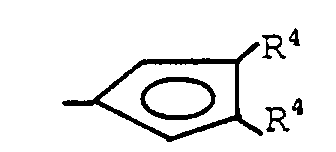
- Preferred L 2 groups are substituted cyclopentadienyl groups corresponding to the formula: wherein one R 4 group is hydrogen and the other R 4 group is a C 3-20 hydrocarbyl group bonded to the cyclopentadienyl ring by means of a secondary or tertiary substituted carbon atom or an aryl group of up to 20 carbons. Most preferably one R 4 group is hydrogen and the other R 4 group is a cyclic hydrocarbyl group, most preferably phenyl, cyclohexyl or hydrocarbyl substituted cyclohexyl, especially menthyl.
- Preferred Z groups are dimethylsilanediyl, diphenylsilanediyl, methylisopropoxysilanediyl, methylphenylsilanediyl, and 1,2-ethanediyl.
- Preferred metals for use herein are titanium or zirconium, especially zirconium.
- Preferred X groups herein are halide, C 1-20 hydrocarbyl, or two X groups together are a neutral C 5-20 diene, and m preferably equals 2.
- Preferred X' groups include ethers, amines, and phosphines of up to 20 nonhydrogen atoms. More preferably however, n is 0.
- the complexes are rendered catalytically active by combining them with an activating cocatalyst or by use of an activating technique.
- Suitable activating cocatalysts for use herein include polymeric or oligomeric alumoxanes, especially methylalumoxane, triisobutyl aluminum- modified methylalumoxane, or diisobutylalumoxane; strong Lewis acids, such as C 1-30 hydrocarbyl substituted Group 13 compounds, especially tri(hydrocarbyl)aluminum- or tri(hydrocarbyl)boron-compounds and halogenated derivatives thereof, having from 1 to 10 carbons in each hydrocarbyl or halogenated hydrocarbyl group, especially tris(pentafluorophenyl)borane; and nonpolymeric, inert, compatible, noncoordinating, ion forming compounds (including the use of such compounds under oxidizing conditions).
- a suitable activating technique is bulk electrolysis (explained in more detail hereinafter). Combinations of the foregoing activating cocatalysts and techniques may also be employed if desired.
- the foregoing activating cocatalysts and activating techniques have been previously taught with respect to different metal complexes in the following references: EP-A-277,003, US-A-5,153,157, US-A-5,064,802, EP-A-468,651, EP-A-520,732, and US-A-5,350,723.
- Suitable nonpolymeric, inert, compatible, noncoordinating, ion forming compounds useful as cocatalysts in one embodiment of the present invention comprise a cation which is a Bronsted acid capable of donating a proton, and a compatible, noncoordinating, anion, A-.
- Preferred anions are those containing a single coordination complex comprising a charge-bearing metal or metalloid core which anion is capable of balancing the charge of the active catalyst species (the metal cation) which is formed when the two components are combined.
- said anion can be displaced by olefinic, diolefinic and acetylenically unsaturated compounds or other compounds such as ethers or nitriles.
- Suitable metals include, but are not limited to, aluminum, gold and platinum.
- Suitable metalloids include, but are not limited to, boron, phosphorus, and silicon.
- Compounds containing anions which comprise coordination complexes containing a single metal or metalloid atom are well known and many, particularly such compounds containing a single boron atom in the anion portion, are available commercially.
- cocatalysts may be represented by the following general formula: (L*-H) + d A d- wherein:
- d is one, that is, A d- is A-.
- A- corresponds to the formula: [BQ 4 ] - wherein:
- Q is a fluorinated C 1-20 hydrocarbyl group, most preferably, a fluorinated aryl group, especially, pentafluorophenyl.
- ion forming compounds comprising proton donatable cations which may be used as activating cocatalysts in the preparation of the catalysts of this invention are tri-substituted ammonium salts such as:
- Dialkyl ammonium salts such as:
- Tri-substituted phosphonium salts such as:
- Another suitable ion forming, activating cocatalyst comprises a salt of a cationic oxidizing agent and a noncoordinating, compatible anion represented by the formula: (Ox e+ ) d (A d- ) e wherein:
- cationic oxidizing agents include: ferrocenium, hydrocarbylsubstituted ferrocenium, Ag + , or Pb +2 .
- Preferred embodiments of A d- are those anions previously defined with respect to the Bronsted acid containing activating cocatalysts, especially tetrakis(pentafluorophenyl)borate.
- Another suitable ion forming, activating cocatalyst comprises a compound which is a salt of a carbenium ion or silylium ion and a noncoordinating, compatible anion represented by the formula: ⁇ + A - wherein:
- a preferred carbenium ion is the trityl cation, that is triphenylcarbenium.
- a preferred silylium ion is triphenylsilylium.
- the foregoing activating technique and ion forming cocatalysts are also preferably used in combination with a tris(hydrocarbyl)-aluminum compound having from 1 to 10 carbons in each hydrocarbyl group, an oligomeric or polymeric alumoxane compound, a bis(hydrocarbyl)(hydrocarbyloxy)aluminum compound having from 1 to 20 carbons in each hydrocarbyl or hydrocarbyloxy group, or a mixture of the foregoing compounds, if desired.
- These aluminum compounds are usefully employed for their beneficial ability to scavenge impurities such as oxygen, water, and aldehydes from the polymerization mixture.
- Suitable bis(hydrocarbyl)(hydrocarbyloxy)aluminum compounds correspond to the formula T 1 2 AlOT 2 wherein T 1 is C 3-6 secondary or tertiary alkyl, most preferably isopropyl, isobutyl or tert-butyl; and T 2 is a C 12-30 alkaryl radical or aralkyl radical, most preferably, 2,6-di(t-butyl)-4-methylphenyl, 2,6-di(t-butyl)-4-methyltolyl, 2,6-di(i-butyl)-4-methylphenyl, or 4-(3',5'-ditertiarybutyltolyl)-2,6-ditertiarybutylphenyl.
- Preferred aluminum compounds include C 2-6 trialkyl aluminum compounds, especially those wherein the alkyl groups are ethyl, propyl, isopropyl, n-butyl, isobutyl, pentyl, neopentyl, or isopentyl, dialkyl(aryloxy)aluminum compounds containing from 1-6 carbons in the alkyl group and from 6 to 18 carbons in the aryl group (especially (3,5-di(t-butyl)-4-methylphenoxy)diisobutylaluminum), methylalumoxane, modified methylalumoxane and diisobutylalumoxane.
- the molar ratio of aluminum compound to metal complex is preferably from 1:10,000 to 1,000:1, more preferably from 1:5,000 to 100:1, most preferably from 1:100 to 100:1.
- An especially preferred activating cocatalyst comprises the combination of a trialkyl aluminum compound having from 1 to 4 carbons in each alkyl group and an ammonium salt of tetrakis(pentafluoro-phenyl)borate, in a molar ratio from 0.1:1 to 1:0.1, optionally up to 1,000 mole percent of an alkylalumoxane with respect to M, is also present.
- the activating technique of bulk electrolysis involves the electrochemical oxidation of the metal complex under electrolysis conditions in the presence of a supporting electrolyte comprising a noncoordinating, inert anion.
- solvents, supporting electrolytes and electrolytic potentials for the electrolysis are used such that electrolysis byproducts that would render the metal complex catalytically inactive are not substantially formed during the reaction.
- suitable solvents are materials that are: liquids under the conditions of the electrolysis (generally temperatures from 0 to 100°C), capable of dissolving the supporting electrolyte, and inert.
- “Inert solvents” are those that are not reduced or oxidized under the reaction conditions employed for the electrolysis.
- Preferred solvents include difluorobenzene (all isomers), DME, and mixtures thereof.
- the electrolysis may be conducted in a standard electrolytic cell containing an anode and cathode (also referred to as the working electrode and counter electrode respectively).
- materials of construction for the cell are glass, plastic, ceramic and glass coated metal.
- the electrodes are prepared from inert conductive materials, by which are meant conductive materials that are unaffected by the reaction mixture or reaction conditions. Platinum or palladium are preferred inert conductive materials.
- an ion permeable membrane such as a fine glass frit separates the cell into separate compartments, the working electrode compartment and counter electrode compartment.
- the working electrode is immersed in a reaction medium comprising the metal complex to be activated, solvent, supporting electrolyte, and any other materials desired for moderating the electrolysis or stabilizing the resulting complex.
- the counter electrode is immersed in a mixture of the solvent and supporting electrolyte.
- the desired voltage may be determined by theoretical calculations or experimentally by sweeping the cell using a reference electrode such as a silver electrode immersed in the cell electrolyte.
- the background cell current the current draw in the absence of the desired electrolysis, is also determined.
- the electrolysis is completed when the current drops from the desired level to the background level. In this manner, complete conversion of the initial metal complex can be easily detected.
- Suitable supporting electrolytes are salts comprising a cation and an inert, compatible, noncoordinating anion, A-.
- Preferred supporting electrolytes are salts corresponding to the formula: G + A - ; wherein:
- Examples of cations, G + include tetrahydrocarbyl substituted ammonium or phosphonium cations having up to 40 nonhydrogen atoms.
- a preferred cation is the tetra-n-butylammonium cation.
- the cation of the supporting electrolyte passes to the counter electrode and A-migrates to the working electrode to become the anion of the resulting oxidized product.
- Either the solvent or the cation of the supporting electrolyte is reduced at the counter electrode in equal molar quantity with the amount of oxidized metal complex formed at the working electrode.
- Preferred supporting electrolytes are tetrahydrocarbylammonium salts of tetrakis(perfluoroaryl) borates having from 1 to 10 carbons in each hydrocarbyl group, especially tetra-n-butylammonium tetrakis(pentafluorophenyl) borate.
- the molar ratio of catalyst/cocatalyst employed preferably ranges from 1:10,000 to 100:1, more preferably from 1:5,000 to 10:1, most preferably from 1:10 to 1:2.
- the catalysts can be prepared by combining the two components (metal complex and activator) in a suitable solvent at a temperature within the range from -100°C to 300°C or by generating the activated catalyst electrochemically as previously explained.
- the activated catalyst may be separately prepared prior to use by combining the respective components or prepared in situ by combination in the presence of the monomers to be polymerized. It is preferred to form the activated catalyst in situ due to the exceptionally high catalytic effectiveness of activated catalysts prepared in this manner.
- the catalyst and cocatalyst as well as activated catalyst are sensitive to both moisture and oxygen and should be handled and transferred in an inert atmosphere.
- the present metal complexes are highly desirable for use in preparing supported catalysts.
- Especially suited substrates include alumina, silica and prepolymerized polymeric substrates.
- Suitable supported catalyst systems are readily prepared by contacting the present metal complexes with the substrate, optionally while subjecting the mixture to heating and/or reduced pressures.
- Preferred supports for use in the present invention include highly porous silicas, aluminas, aluminosilicates, and mixtures thereof.
- the most preferred support material is silica.
- the support material may be in granular, agglomerated, pelletized, or any other physical form. Suitable materials include, but are not limited to, silicas available from Grace Davison (division of W.R. Grace & Co.) under the designations SD 3216.30, Davison Syloid 245, Davison 948 and Davison 952, and from Degussa AG under the designation Aerosil 812; and aluminas available from Akzo Chemicals Inc. under the designation Ketzen Grade B.
- Supports suitable for the present invention preferably have a surface area as determined by nitrogen porosimetry using the B.E.T. method from 10 to 1,000 m 2 /g, and preferably from 100 to 600 m 2 /g.
- the pore volume of the support, as determined by nitrogen adsorption, advantageously is between 0.1 and 3 cm 3 /g, preferably from 0.2 to 2 cm 3 /g.
- the average particle size is not critical, but typically is from 0.5 to 500 ⁇ m, preferably from 1 to 100 ⁇ m.
- Both silica and alumina are known to inherently possess small quantities of hydroxyl functionality attached to the crystal structure.
- these materials are preferably subjected to a heat treatment and/or chemical treatment to reduce the hydroxyl content thereof.
- Typical heat treatments are carried out at a temperature from 30 to 1,000°C for a duration of 10 minutes to 50 hours in an inert atmosphere or under reduced pressure.
- Typical chemical treatments include contacting with Lewis acid alkylating agents such as trihydrocarbyl aluminum compounds, trihydrocarbylchlorosilane compounds, trihydrocarbylalkoxysilane compounds or similar agents.
- Preferred silica or alumina materials for use herein have a surface hydroxyl content that is less than 0.8 mmol hydroxyl groups per gram of solid support, more preferably less than 0.5 mmol per gram.
- the hydroxyl content may be determined by adding an excess of dialkyl magnesium to a slurry of the solid support and determining the amount of dialkyl magnesium remaining in solution via known techniques. This method is based on the reaction: S-OH + Mg(Alk) 2 --> S-OMg(Alk) + (Alk)H, wherein S is the solid support, and Alk is a C 1-4 alkyl group.
- Suitable functionalizing agents are compounds that react with surface hydroxyl groups of the support or react with the silicon or aluminum of the matrix. Examples of suitable functionalizing agents include phenylsilane, diphenylsilane, methylphenylsilane, dimethylsilane, diethylsilane, dichlorosilane, and dichlorodimethylsilane. Techniques for forming such functionalized silica or alumina compounds were previously disclosed in US-A-3,687,920 and US-A-3,879,368.
- the support may also be treated with an aluminum component selected from an alumoxane or an aluminum compound of the formula AlR 3 , wherein R independently each occurrence is hydride or R 1 , and R 1 is C 1-4 alkyl.
- the aluminum component is selected from aluminoxanes and tris(C 1-4 alkyl)aluminum compounds.
- Most preferred aluminum components are aluminoxanes, trimethylaluminum, triethylaluminum, tri-isobutylaluminum, and mixtures thereof.
- Alumoxanes are oligomeric or polymeric aluminum oxy compounds containing chains of alternating aluminum and oxygen atoms, whereby the aluminum carries a substituent, preferably an alkyl group.
- the structure of alumoxane is believed to be represented by the following general formulae, (-Al(R 1 )-O) m' , for a cyclic alumoxane, and R 1 2 Al-O(-Al(R 1 )-O) m' -AlR 1 2 , for a linear compound, wherein R 1 is C 1-4 alkyl, and m' is an integer ranging from 1 to 50, preferably at least 4.
- Alumoxanes are typically the reaction products of water and an alkylaluminum compound, which in addition to an alkyl group may contain halide or alkoxide groups. Reacting several different alkylaluminum compounds, such as for example trimethylaluminum and tri-isobutylaluminum, with water yields so-called modified or mixed alumoxanes.
- Preferred alumoxanes are methylalumoxane and methylalumoxane modified with minor amounts of C 2-4 alkyl groups, especially isobutyl groups.
- Alumoxanes generally contain minor to substantial amounts of starting alkylaluminum compound.
- alumoxane type compounds by contacting an alkylaluminum compound with an inorganic salt containing water of crystallization are disclosed in US-A-4,542,119.
- an alkylaluminum compound is contacted with a regeneratable water-containing substance such as hydrated alumina, silica or other substance.
- a regeneratable water-containing substance such as hydrated alumina, silica or other substance.
- the treatment of the support material in order to also include optional alumoxane or trialkylaluminum loadings involves contacting the same with an alumoxane or trialkylaluminum compound before, after, or simultaneously with addition of the complex or activated catalyst.
- the mixture can also be heated under an inert atmosphere for a period and at a temperature sufficient to fix the alumoxane, trialkylaluminum compound, complex or catalyst system to the support.
- the treated support component containing alumoxane or the trialkylaluminum compound may be subjected to one or more wash steps, using toluene or similar solvent, to remove excess alumoxane or trialkylaluminum that is not fixed to the support.
- the alumoxane may be generated in situ by contacting an unhydrolyzed silica or alumina or a moistened silica or alumina with a trialkyl aluminum compound optionally in the presence of an inert diluent.
- a trialkyl aluminum compound optionally in the presence of an inert diluent.
- Suitable aliphatic hydrocarbon diluents include pentane, isopentane, hexane, heptane, octane, isooctane, nonane, isononane, decane, cyclohexane, methylcyclohexane and combinations of two or more of such diluents.
- Suitable aromatic hydrocarbon diluents are benzene, toluene, xylene, and other alkyl or halogen substituted aromatic compounds. Most preferably, the diluent is an aromatic hydrocarbon, especially toluene.
- the catalysts may be used to polymerize ethylenically and/or acetylenically unsaturated monomers having from 2 to 100,000 carbon atoms either alone or in combination.
- Preferred monomers include the C 2-20 ⁇ -olefins especially ethylene, propylene, isobutylene, 1-butene, 1-pentene, 1-hexene, 3-methyl-1-pentene,4-methyl-1-pentene, 1-octene, 1-decene, long chain macromolecular ⁇ -olefins, and mixtures thereof.
- styrene C 1-4 alkyl substituted styrene, tetrafluoroethylene, vinylbenzocyclobutane, ethylidenenorbornene, 1,4-hexadiene, 1,7-octadiene, vinylcyclohexane, 4-vinylcyclohexene, divinylbenzene, and mixtures thereof with ethylene.
- Long chain macromolecular ⁇ -olefins are vinyl terminated polymeric remnants formed in situ during continuous solution polymerization reactions.
- the polymerization may be accomplished at conditions well known in the prior art for Ziegler-Natta or Kaminsky-Sinn type polymerization reactions, such as temperatures from 0-250°C and pressures from atmospheric to 1,000 atmospheres (0.1 to 100 MPa). Suspension, solution, slurry, gas phase or other process conditions may be employed if desired.
- the support if present, is preferably employed in an amount to provide a weight ratio of catalyst (based on metal):support from 1:100,000 to 1:10, more preferably from 1:50,000 to 1:20, and most preferably from 1:10,000 to 1:30.
- Suitable gas phase reactions may utilize condensation of the monomer or monomers employed in the reaction, or of an inert diluent to remove heat from the reactor.
- the molar ratio of catalyst:polymerizable compounds employed is from 10 -12 :1 to 10 -1 :1, more preferably from 10 -12 :1 to 10 -5 :1.
- Suitable solvents for polymerization via a solution process are noncoordinating, inert liquids.
- Examples include straight and branched-chain hydrocarbons such as isobutane, butane, pentane, hexane, heptane, octane, and mixtures thereof; cyclic and alicyclic hydrocarbons such as cyclohexane, cycloheptane, methylcyclohexane, methylcycloheptane, and mixtures thereof; perfluorinated hydrocarbons such as perfluorinated C 4-10 alkanes, and aromatic and alkyl-substituted aromatic compounds such as benzene, toluene, and xylene.
- Suitable solvents also include liquid olefins which may act as monomers or comonomers including ethylene, propylene, 1-butene, butadiene, cyclopentene, 1-hexene, 3-methyl-1-pentene, 4-methyl-1-pentene, 1,4-hexadiene, 1,7-octadiene, 1-octene, 1-decene, styrene, divinylbenzene, ethylidenenorbornene, allylbenzene, vinyltoluene (including all isomers alone or in admixture), 4-vinylcyclohexene, and vinylcyclohexane. Mixtures of the foregoing are also suitable.
- the catalysts may also be utilized in combination with at least one additional homogeneous or heterogeneous polymerization catalyst in the same or in separate reactors connected in series or in parallel to prepare polymer blends having desirable properties.
- An example of such a process is disclosed in WO 94/00500, as well as U. S. Serial Number 08/10958, filed January 29, 1993 (corresponding to WO-A-9417112).
- One such polymerization process comprises: contacting, optionally in a solvent, one or more ⁇ -olefins with a catalyst according to the present invention, in one or more continuous stirred tank or tubular reactors, connected in series or parallel, or in the absence of solvent, optionally in a fluidized bed gas phase reactor, and recovering the resulting polymer.
- Condensed monomer or solvent may be added to the gas phase reactor as is well known in the art.
- Argon (Matheson, prepurified), nitrogen(Matheson, prepurified), ethylene (Matheson, polymerization grade), and propylene (Matheson, polymerization grade) were purified by passage through a MnO/vermiculite oxygen-removal column and an activated Davison 4 ⁇ molecular sieve column, followed by passage over MnO/silica.
- Ether solvents were purified by distillation from Na/K alloy/ benzophenone ketyl.
- Hydrocarbon solvents toluene and pentane) were distilled under nitrogen from Na/K alloy. All solvents for vacuum line manipulations were stored in vacuo over Na/K alloy in resealable bulbs.
- Deuterated solvents were obtained from Cambridge Isotope Laboratories (all 99 + atom percent D) and were freeze-pump-thaw degassed. Non-halogenated solvents were dried over Na/K alloy, and halogenated solvents were dried over P 2 O 5 and stored over activated Davison 4 ⁇ molecular sieves. ZrCl 4 (Aldrich 99.99 percent) was used without further purification.
- the chiral ligand reagent Na[(- )menthylCp] 2 was prepared as previously described by Giardello, et al., J. Am. Chem. Soc. 1994, 116, 10212-10240.
- NMR spectra were recorded on either a VarianTM VXR 300 (FT, 300 MHz, 1 H; 75 MHz, 13 C), or a VarianTM XL-400 (FT, 400 MHz, 1 H; 100 MHz, 13 C) instrument. Chemical shifts for 1 H and 13 C are referenced to internal solvent resonances and are reported relative to tetramethylsilane. Neat methanol or ethylene glycol were used as temperature standards in all variable temperature NMR experiments. NMR experiments on air-sensitive samples were conducted in either TeflonTM valve-sealed tubes (J. Young) or in screw-capped tubes fitted with septa (Wilmad).
- Circular dichroism (CD) spectra were recorded on a JascoTM J-500 spectrophotometer equipped with a JASCOTM DP-500/AT software package (version 1.2). Air-sensitive samples were prepared in 10 mm path length cylindrical quartz cuvettes (Helma Cells) fitted with TeflonTM needle valves. Solvent blanks were recorded under identical conditions and the baseline subtracted from the experimental spectrum. Molar ellipticities [ ⁇ ] are reported relative to absorption maxima in units of degree•cm 2 •decimol -1 . Elemental analyses were performed by Oneida Research Services, Inc., Whitesboro, New York.
- Octahydrofluorenyl Li In a 2L flask, 500 mL of concentrated sulfuric acid was stirred with a mechanical stirrer. To this was added 1-adamantanol (68.1 g, 0.44 mol) which partially dissolved. To this mixture 40.0 g (0.22 mol) of perhydrofluorene was added dropwise and after addition was complete, the reaction mixture was stirred for 3 hours. After this time period, the acid was extracted with hexane (3 x 500 mL). The acid was next carefully poured into 3,000 mL of ice water. The aqueous solution was then extracted with ether (3 x 600 mL). The combined ether extracts were washed with water (3 x 600 mL).
- the ether extract was then dried over MgSO 4 .
- the ether was then removed on the rotavap leaving an orange oil.
- the oil was then dissolved in hexane and passed through a silica gel column eluting with hexane.
- the hexane was removed under reduced pressure to give a mixture of dienes (analyzed via GC) weighing 27.5 g (0.16 mol).
- the diene mixture was then degassed and combined with 200 mL of pentane.
- 66.4 mL (0.17 mol) of n-BuLi (2.5 M solution in hexanes) was added dropwise and stirred overnight.
- the resulting solid was then collected via suction filtration, washed with pentane, and dried under reduced pressure to give 12.4 g (0.068 mol, 44 percent) of title compound.
- Number average(Mn) and weight average (Mw) molecular weights of the resulting polymers were determined by GPC analysis on a Waters 150°C ALC/GPC; Waters MilenniumTM (version 2.15) chromatography control and data station.
- T 135°C
- 1,2,4-trichlorobenzene Aldrich, HPLC grade
Landscapes
- Chemical & Material Sciences (AREA)
- Organic Chemistry (AREA)
- Health & Medical Sciences (AREA)
- Chemical Kinetics & Catalysis (AREA)
- Medicinal Chemistry (AREA)
- Polymers & Plastics (AREA)
- Engineering & Computer Science (AREA)
- Materials Engineering (AREA)
- Transition And Organic Metals Composition Catalysts For Addition Polymerization (AREA)
- Organic Low-Molecular-Weight Compounds And Preparation Thereof (AREA)
- Addition Polymer Or Copolymer, Post-Treatments, Or Chemical Modifications (AREA)
Abstract
Description
- This invention relates to metal complexes and to addition polymerization catalysts formed therefrom that have improved catalytic performance. More particularly the present invention relates to an addition polymerization catalyst composition comprising a Group 4 metal complex containing a saturated tricyclic ligand group. In addition, the present invention relates to catalyst compositions comprising the foregoing complexes. The invention further relates to a method of using the foregoing catalyst compositions in an addition polymerization process for polymerizing addition polymerizable monomers.
- In US-A-5,455,317 and US-A-5,416,228 there are disclosed certain bis-cyclopentadienyl metal complexes in which one cyclopentadienyl ligand contains a bulky group in one and only one distal position. The cyclopentadienyl ligand groups are desirably sterically different. The references further disclose complexes wherein the remaining cyclopentadienyl group has bilateral or pseudobilateral symmetry. Such metal complexes are useful in combination with activating cocatalysts as olefin polymerization catalysts, especially in the preparation of polymers of C3 and higher α-olefins that are highly isotactic.
- It would be desirable if there were provided improved metal complexes and improved catalyst compositions derived therefrom as well as an improved addition polymerization process utilizing such catalyst compositions.
- As a result of investigations carried out by the present inventors there have now been discovered new and improved Group 4 metal complexes corresponding to the formula:
wherein: - M independently each occurrence is a metal of Group 4 of the Periodic Table of the Elements;
- L1 is a partially saturated tricyclic group that is bound to M by means of
delocalized π-electrons, said group containing up to 50 nonhydrogen atoms and
corresponding to the formula:
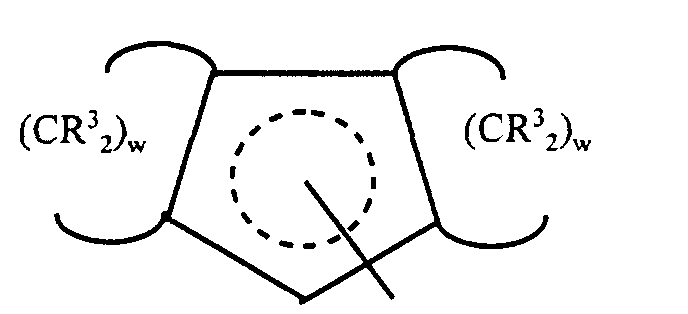 wherein R3 independently each occurrence is hydrogen, or a silyl, hydrocarbyl or silylsubstituted
hydrocarbyl group of up to 10 nonhydrogen atoms, and each w,
independently, is a whole number from 4 to 6.
wherein R3 independently each occurrence is hydrogen, or a silyl, hydrocarbyl or silylsubstituted
hydrocarbyl group of up to 10 nonhydrogen atoms, and each w,
independently, is a whole number from 4 to 6.
- L2 is a substituted cyclopentadienyl group that is bound to M by means of delocalized π-electrons, said cyclopentadienyl group being substituted at one and only one of its two distal positions with a bulky ligand group, R4, said L2 group containing up to 50 nonhydrogen atoms;
- Z is a divalent substituent of up to 50 non-hydrogen atoms having the formula, -(ER2 2)m, wherein E independently each occurrence is carbon, silicon or germanium, R2 independently each occurrence is selected from hydrocarbyl, hydrocarbyloxy, silyl, and germyl of up to 20 atoms other than hydrogen, and m is an integer from 1 to 3;
- X each occurrence is a monovalent, anionic moiety having up to 40 nonhydrogen atoms, optionally, two X groups may be covalently bound together forming a divalent dianionic moiety having both valences bound to M, further optionally, 2 X groups may be covalently bound together to form a neutral, conjugated or nonconjugated diene that is bonded to M by means of delocalized π-electrons (whereupon M is in the +2 oxidation state), or still further optionally one or more X and one or more X' groups may be bonded together thereby forming a moiety that is both covalently bound to M and coordinated thereto;
- m is 1 or 2 and is equal to two less than the formal oxidation state of M, except when 2 X groups together form a neutral conjugated or non-conjugated diene that is π-bonded to M, in which case m is equal to the formal oxidation state of M,
- X' is a neutral ligand having up to 20 non-hydrogen atoms other than a diene, and optionally X' and L1 or X' and L2 are covalently bonded together, and n is a number from 0 to 3
-
- Additionally according to the present invention there is provided a catalyst composition comprising the foregoing metal complex and one or more activating cocatalysts capable of rendering the metal complex catalytically active.
- In a further embodiment there is provided a supported catalyst system comprising one or more of the foregoing metal complexes, one or more activating cocatalysts, and a support material.
- Finally there is provided an improved method for polymerization of addition polymerizable monomers using one or more of the above catalyst compositions or catalyst systems. Such addition polymerization processes may be used to prepare polymers for use in making molded articles, films, sheets, foamed materials and in other industrial applications.
- All reference to the Periodic Table of the Elements herein shall refer to the Periodic Table of the Elements, published and copyrighted by CRC Press, Inc., 1989. Also, any reference to a Group or Groups shall be to the Group or Groups as reflected in this Periodic Table of the Elements using the IUPAC system for numbering groups.
- Preferred L1 groups for use herein are substituted or unsubstituted octahydrofluorenyl complexes corresponding to the following formula:wherein R3 independently each occurrence is hydrogen or C1-6 hydrocarbyl.
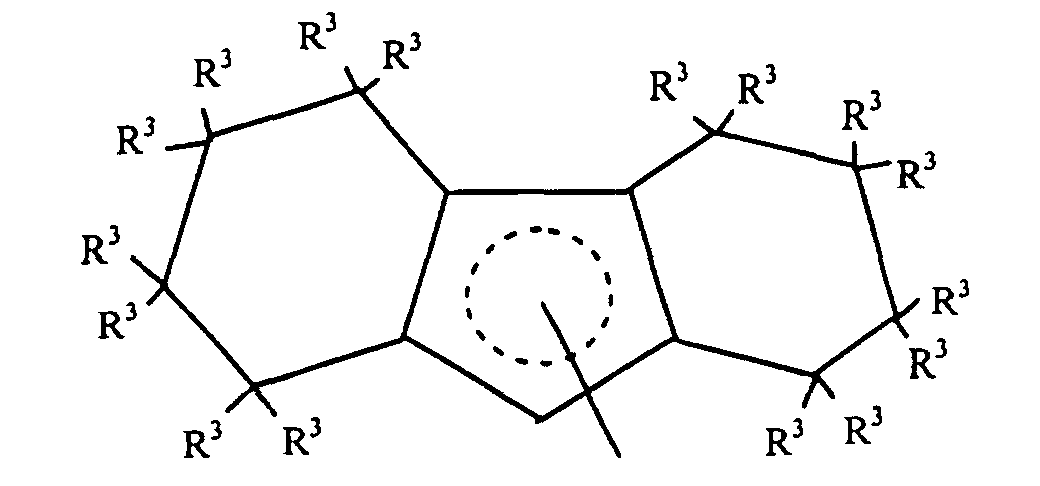
- Highly preferred L1 groups are octahydrofluorenyl and substituted octahydrofluorenyl ligands corresponding to the formula:wherein R3 independently each occurrence is hydrogen or C1-4 alkyl.
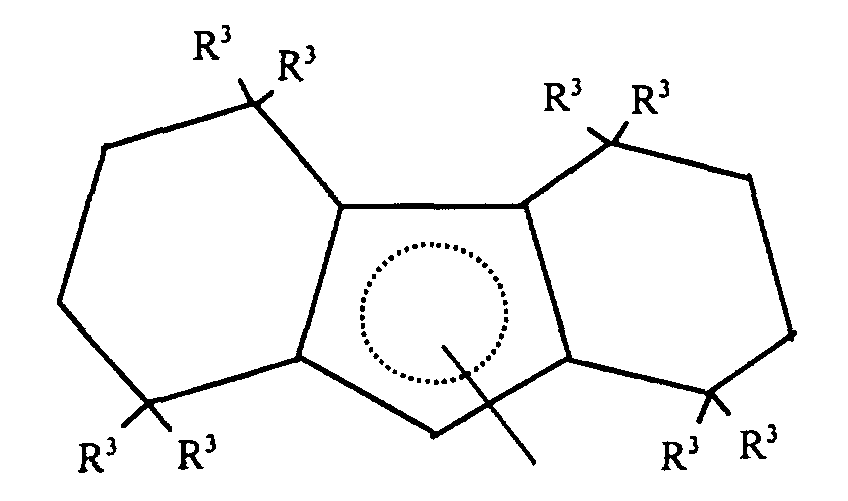
- A most preferred L1 group is octahydrofluorenyl.
- Preferred L2 groups are substituted cyclopentadienyl groups corresponding to the formula:wherein one R4 group is hydrogen and the other R4 group is a C3-20 hydrocarbyl group bonded to the cyclopentadienyl ring by means of a secondary or tertiary substituted carbon atom or an aryl group of up to 20 carbons. Most preferably one R4 group is hydrogen and the other R4 group is a cyclic hydrocarbyl group, most preferably phenyl, cyclohexyl or hydrocarbyl substituted cyclohexyl, especially menthyl.
- Preferred Z groups are dimethylsilanediyl, diphenylsilanediyl, methylisopropoxysilanediyl, methylphenylsilanediyl, and 1,2-ethanediyl.
- Preferred metals for use herein are titanium or zirconium, especially zirconium.
- Preferred X groups herein are halide, C1-20 hydrocarbyl, or two X groups together are a neutral C5-20 diene, and m preferably equals 2.
- Preferred X' groups include ethers, amines, and phosphines of up to 20 nonhydrogen atoms. More preferably however, n is 0.
- Examples of highly preferred complexes according to the present invention correspond to the formula: wherein:
- M is titanium or zirconium in the +2, or +4 formal oxidation state;
- (R2 2E)x is dimethylsilane; and
- X, R3 and R4 are as previously defined.
-
- Specific examples include:
(octahydrofluorenyl)(3-cyclohexyl-η5-cyclopentadienyl) dimethylsilanezirconiumdichloride, (octahydrofluorenyl)(3-menthyl-η5-cyclopentadienyl) dimethylsilanezirconiumdichloride, (octahydrofluorenyl)(3-phenyl-η5-cyclopentadienyl) dimethylsilanezirconiumdichloride, (octahydrofluorenyl)(3-tert-butyl-η5-cyclopentadienyl) dimethylsilanezirconiumdichloride, (octahydrofluorenyl)(3-naphthyl-η5-cyclopentadienyl) dimethylsilanezirconiumdichloride, (octahydrofluorenyl)(3-cyclohexyl-η5-cyclopentadienyl) dimethylsilanezirconiumdimethyl, (octahydrofluorenyl)(3-menthyl-η5-cyclopentadienyl) dimethylsilanezirconiumdimethyl, (octahydrofluorenyl)(3-phenyl-η5-cyclopentadienyl) dimethylsilanezirconiumdimethyl, (octahydrofluorenyl)(3-tert-butyl-η5-cyclopentadienyl) dimethylsilanezirconiumdimethyl, (octahydrofluorenyl)(3-naphthyl-η5-cyclopentadienyl) dimethylsilanezirconiumdimethyl, (octahydrofluorenyl)(3-cyclohexyl-η5-cyclopentadienyl) dimethylsilanetitanium (II) (1,4-diphenylbutadiene), (octahydrofluorenyl)(3-menthyl-η5-cyclopentadienyl) dimethylsilanetitanium (II) (1,4-diphenylbutadiene), (octahydrofluorenyl)(3-phenyl-η5-cyclopentadienyl) dimethylsilanetitanium (II) (1,4-diphenylbutadiene), (octahydrofluorenyl)(3-tert-butyl-η5-cyclopentadienyl) dimethylsilanetitanium (II) (1,4-diphenylbutadiene), (octahydrofluorenyl)(3-naphthyl-η5-cyclopentadienyl) dimethylsilanetitanium (II) (1,4-diphenylbutadiene), (octahydrofluorenyl)(3-cyclohexyl-η5-cyclopentadienyl) dimethylsilanezirconiumdichloride, (2,2,5,5,6,6,9,9-octamethyloctahydrofluorenyl)(3-menthyl-η5-cyclopentadienyl) dimethylsilanezirconiumdimethyl, (2,2,5,5,6,6,9,9-octamethyloctahydrofluorenyl)(3-phenyl-η5-cyclopentadienyl) 1,2-ethanediyllzirconiumdibenzyl, (2,2,5,5,6,6,9,9-octamethyloctahydrofluorenyl)(3-tert-butyl-η5-cyclopentadienyl) dimethylsilanehafniumdichloride, and (2,2,5,5,6,6,9,9-octamethyloctahydrofluorenyl)(3-naphthyl-η5-cyclopentadienyl) dimethylsilanezirconiumdichloride. - The complexes are rendered catalytically active by combining them with an activating cocatalyst or by use of an activating technique. Suitable activating cocatalysts for use herein include polymeric or oligomeric alumoxanes, especially methylalumoxane, triisobutyl aluminum- modified methylalumoxane, or diisobutylalumoxane; strong Lewis acids, such as C1-30 hydrocarbyl substituted Group 13 compounds, especially tri(hydrocarbyl)aluminum- or tri(hydrocarbyl)boron-compounds and halogenated derivatives thereof, having from 1 to 10 carbons in each hydrocarbyl or halogenated hydrocarbyl group, especially tris(pentafluorophenyl)borane; and nonpolymeric, inert, compatible, noncoordinating, ion forming compounds (including the use of such compounds under oxidizing conditions). A suitable activating technique is bulk electrolysis (explained in more detail hereinafter). Combinations of the foregoing activating cocatalysts and techniques may also be employed if desired. The foregoing activating cocatalysts and activating techniques have been previously taught with respect to different metal complexes in the following references: EP-A-277,003, US-A-5,153,157, US-A-5,064,802, EP-A-468,651, EP-A-520,732, and US-A-5,350,723.
- Suitable nonpolymeric, inert, compatible, noncoordinating, ion forming compounds useful as cocatalysts in one embodiment of the present invention comprise a cation which is a Bronsted acid capable of donating a proton, and a compatible, noncoordinating, anion, A-. Preferred anions are those containing a single coordination complex comprising a charge-bearing metal or metalloid core which anion is capable of balancing the charge of the active catalyst species (the metal cation) which is formed when the two components are combined. Also, said anion can be displaced by olefinic, diolefinic and acetylenically unsaturated compounds or other compounds such as ethers or nitriles. Suitable metals include, but are not limited to, aluminum, gold and platinum. Suitable metalloids include, but are not limited to, boron, phosphorus, and silicon. Compounds containing anions which comprise coordination complexes containing a single metal or metalloid atom are well known and many, particularly such compounds containing a single boron atom in the anion portion, are available commercially.
- Preferably such cocatalysts may be represented by the following general formula:
- L* is the conjugate Lewis base of L* H+;
- (L*-H)+ is a Bronsted acid;
- Ad- is a noncoordinating, compatible anion having a charge of d-, and
- d is an integer from 1 to 3.
-
- More preferably d is one, that is, Ad- is A-.
- Highly preferably, A- corresponds to the formula: [BQ4]-
wherein: - B is boron in the +3 formal oxidation state; and
- Q independently each occurrence is selected from hydride, dialkylamido, halide, alkoxide, aryloxide, hydrocarbyl, halocarbyl, and halo-substituted-hydrocarbyl radicals, said Q having up to 20 carbons with the proviso that in not more than one occurrence is Q halide.
-
- In a more highly preferred embodiment, Q is a fluorinated C1-20 hydrocarbyl group, most preferably, a fluorinated aryl group, especially, pentafluorophenyl.
- Illustrative, but not limiting, examples of ion forming compounds comprising proton donatable cations which may be used as activating cocatalysts in the preparation of the catalysts of this invention are tri-substituted ammonium salts such as:
- trimethylammonium tetraphenylborate,
- methyldioctadecylammonium tetraphenylborate,
- triethylammonium tetraphenylborate,
- tripropylammonium tetraphenylborate,
- tri(n-butyl)ammonium tetraphenylborate,
- methyltetradecyloctadecylammonium tetraphenylborate,
- N,N-dimethylanilinium tetraphenylborate,
- N,N-diethylanilinium tetraphenylborate,
- N,N-dimethyl(2,4,6-trimethylanilinium) tetraphenylborate,
- trimethylammonium tetrakis(penta-fluorophenyl)borate,
- triethylammonium tetrakispentafluorophenyl)borate,
- tripropylammonium tetrakis(pentafluorophenyl)borate,
- tri(n-butyl)ammonium tetrakis(pentafluorophenyl)borate,
- tri(sec-butyl)ammonium tetrakis(pentafluorophenyl)borate,
- N,N-dimethylanilinium tetrakis(pentafluorophenyl)borate,
- N,N-diethylanilinium tetrakis(pentafluorophenyl)borate,
- N,N-dimethyl(2,4,6-trimethylanilinium) tetrakis(pentafluorophenyl)borate,
- trimethylammonium tetrakis(2,3,4,6-tetrafluorophenylborate,
- triethylammonium tetrakis(2,3,4,6-tetrafluorophenyl)borate,
- tripropylammonium tetrakis(2,3,4,6-tetrafluorophenyl)borate,
- tri(n-butyl)ammonium tetrakis(2,3,4,6-tetrafluorophenyl)borate,
- dimethyl(t-butyl)ammonium tetrakis(2,3,4,6-tetrafluorophenyl)borate,
- N,N-dimethylanilinium tetrakis(2,3,4,6-tetrafluorophenyl)borate,
- N,N-diethylanilinium tetrakis(2,3,4,6-tetrafluorophenyl)borate, and
- N,N-dimethyl-(2,4,6-trimethylanilinium) tetrakis-(2,3,4,6-tetrafluorophenyl)borate.
-
- Dialkyl ammonium salts such as:
- di-(i-propyl)ammonium tetrakis(pentafluorophenyl)borate, and
- dicyclohexylammonium tetrakis(pentafluorophenyl)borate.
-
- Tri-substituted phosphonium salts such as:
- triphenylphosphonium tetrakis(pentafluorophenyl)borate,
- tri(o-tolyl)phosphonium tetrakis(penta-fluorophenyl)borate, and
- tri(2,6-dimethylphenyl)phosphonium tetrakis(pentafluorophenyl)borate.
-
- Preferred are tetrakis(pentafluorophenyl)borate salts of long chain alkyl monoand disubstituted ammonium complexes, especially C14-C20 alkyl ammonium complexes, especially methyldi(octadecyl)ammonium tetrakis(pentafluorophenyl)borate and methyldi(tetradecyl)ammonium tetrakis(pentafluorophenyl)borate.
- Another suitable ion forming, activating cocatalyst comprises a salt of a cationic oxidizing agent and a noncoordinating, compatible anion represented by the formula:
- Oxe+ is a cationic oxidizing agent having charge e+;
- e is an integer from 1 to 3; and
- Ad-, and d are as previously defined.
-
- Examples of cationic oxidizing agents include: ferrocenium, hydrocarbylsubstituted ferrocenium, Ag+, or Pb+2. Preferred embodiments of Ad- are those anions previously defined with respect to the Bronsted acid containing activating cocatalysts, especially tetrakis(pentafluorophenyl)borate.
- Another suitable ion forming, activating cocatalyst comprises a compound which is a salt of a carbenium ion or silylium ion and a noncoordinating, compatible anion represented by the formula:
- ©+ is a C1-20 carbenium ion or silylium ion; and
- A- is as previously defined.
-
- A preferred carbenium ion is the trityl cation, that is triphenylcarbenium. A preferred silylium ion is triphenylsilylium.
- The foregoing activating technique and ion forming cocatalysts are also preferably used in combination with a tris(hydrocarbyl)-aluminum compound having from 1 to 10 carbons in each hydrocarbyl group, an oligomeric or polymeric alumoxane compound, a bis(hydrocarbyl)(hydrocarbyloxy)aluminum compound having from 1 to 20 carbons in each hydrocarbyl or hydrocarbyloxy group, or a mixture of the foregoing compounds, if desired. These aluminum compounds are usefully employed for their beneficial ability to scavenge impurities such as oxygen, water, and aldehydes from the polymerization mixture.
- Suitable bis(hydrocarbyl)(hydrocarbyloxy)aluminum compounds correspond to the formula T1 2AlOT2 wherein T1 is C3-6 secondary or tertiary alkyl, most preferably isopropyl, isobutyl or tert-butyl; and T2 is a C12-30 alkaryl radical or aralkyl radical, most preferably, 2,6-di(t-butyl)-4-methylphenyl, 2,6-di(t-butyl)-4-methyltolyl, 2,6-di(i-butyl)-4-methylphenyl, or 4-(3',5'-ditertiarybutyltolyl)-2,6-ditertiarybutylphenyl.
- Preferred aluminum compounds include C2-6 trialkyl aluminum compounds, especially those wherein the alkyl groups are ethyl, propyl, isopropyl, n-butyl, isobutyl, pentyl, neopentyl, or isopentyl, dialkyl(aryloxy)aluminum compounds containing from 1-6 carbons in the alkyl group and from 6 to 18 carbons in the aryl group (especially (3,5-di(t-butyl)-4-methylphenoxy)diisobutylaluminum), methylalumoxane, modified methylalumoxane and diisobutylalumoxane. The molar ratio of aluminum compound to metal complex is preferably from 1:10,000 to 1,000:1, more preferably from 1:5,000 to 100:1, most preferably from 1:100 to 100:1.
- An especially preferred activating cocatalyst comprises the combination of a trialkyl aluminum compound having from 1 to 4 carbons in each alkyl group and an ammonium salt of tetrakis(pentafluoro-phenyl)borate, in a molar ratio from 0.1:1 to 1:0.1, optionally up to 1,000 mole percent of an alkylalumoxane with respect to M, is also present.
- The activating technique of bulk electrolysis involves the electrochemical oxidation of the metal complex under electrolysis conditions in the presence of a supporting electrolyte comprising a noncoordinating, inert anion. In the technique, solvents, supporting electrolytes and electrolytic potentials for the electrolysis are used such that electrolysis byproducts that would render the metal complex catalytically inactive are not substantially formed during the reaction. More particularly, suitable solvents are materials that are: liquids under the conditions of the electrolysis (generally temperatures from 0 to 100°C), capable of dissolving the supporting electrolyte, and inert. "Inert solvents" are those that are not reduced or oxidized under the reaction conditions employed for the electrolysis. It is generally possible in view of the desired electrolysis reaction to choose a solvent and a supporting electrolyte that are unaffected by the electrical potential used for the desired electrolysis. Preferred solvents include difluorobenzene (all isomers), DME, and mixtures thereof.
- The electrolysis may be conducted in a standard electrolytic cell containing an anode and cathode (also referred to as the working electrode and counter electrode respectively). Suitably materials of construction for the cell are glass, plastic, ceramic and glass coated metal. The electrodes are prepared from inert conductive materials, by which are meant conductive materials that are unaffected by the reaction mixture or reaction conditions. Platinum or palladium are preferred inert conductive materials. Normally, an ion permeable membrane such as a fine glass frit separates the cell into separate compartments, the working electrode compartment and counter electrode compartment. The working electrode is immersed in a reaction medium comprising the metal complex to be activated, solvent, supporting electrolyte, and any other materials desired for moderating the electrolysis or stabilizing the resulting complex. The counter electrode is immersed in a mixture of the solvent and supporting electrolyte. The desired voltage may be determined by theoretical calculations or experimentally by sweeping the cell using a reference electrode such as a silver electrode immersed in the cell electrolyte. The background cell current, the current draw in the absence of the desired electrolysis, is also determined. The electrolysis is completed when the current drops from the desired level to the background level. In this manner, complete conversion of the initial metal complex can be easily detected.
- Suitable supporting electrolytes are salts comprising a cation and an inert, compatible, noncoordinating anion, A-. Preferred supporting electrolytes are salts corresponding to the formula: G+A-; wherein:
- G+ is a cation which is nonreactive towards the starting and resulting complex, and
- A- is a noncoordinating, compatible anion.
-
- Examples of cations, G+, include tetrahydrocarbyl substituted ammonium or phosphonium cations having up to 40 nonhydrogen atoms. A preferred cation is the tetra-n-butylammonium cation.
- During activation of the complexes of the present invention by bulk electrolysis the cation of the supporting electrolyte passes to the counter electrode and A-migrates to the working electrode to become the anion of the resulting oxidized product. Either the solvent or the cation of the supporting electrolyte is reduced at the counter electrode in equal molar quantity with the amount of oxidized metal complex formed at the working electrode.
- Preferred supporting electrolytes are tetrahydrocarbylammonium salts of tetrakis(perfluoroaryl) borates having from 1 to 10 carbons in each hydrocarbyl group, especially tetra-n-butylammonium tetrakis(pentafluorophenyl) borate.
- The molar ratio of catalyst/cocatalyst employed preferably ranges from 1:10,000 to 100:1, more preferably from 1:5,000 to 10:1, most preferably from 1:10 to 1:2.
- In general, the catalysts can be prepared by combining the two components (metal complex and activator) in a suitable solvent at a temperature within the range from -100°C to 300°C or by generating the activated catalyst electrochemically as previously explained. The activated catalyst may be separately prepared prior to use by combining the respective components or prepared in situ by combination in the presence of the monomers to be polymerized. It is preferred to form the activated catalyst in situ due to the exceptionally high catalytic effectiveness of activated catalysts prepared in this manner. The catalyst and cocatalyst as well as activated catalyst are sensitive to both moisture and oxygen and should be handled and transferred in an inert atmosphere.
- As previously mentioned, the present metal complexes are highly desirable for use in preparing supported catalysts. Especially suited substrates include alumina, silica and prepolymerized polymeric substrates. Suitable supported catalyst systems are readily prepared by contacting the present metal complexes with the substrate, optionally while subjecting the mixture to heating and/or reduced pressures.
- Preferred supports for use in the present invention include highly porous silicas, aluminas, aluminosilicates, and mixtures thereof. The most preferred support material is silica. The support material may be in granular, agglomerated, pelletized, or any other physical form. Suitable materials include, but are not limited to, silicas available from Grace Davison (division of W.R. Grace & Co.) under the designations SD 3216.30, Davison Syloid 245, Davison 948 and Davison 952, and from Degussa AG under the designation Aerosil 812; and aluminas available from Akzo Chemicals Inc. under the designation Ketzen Grade B.
- Supports suitable for the present invention preferably have a surface area as determined by nitrogen porosimetry using the B.E.T. method from 10 to 1,000 m2/g, and preferably from 100 to 600 m2/g. The pore volume of the support, as determined by nitrogen adsorption, advantageously is between 0.1 and 3 cm3/g, preferably from 0.2 to 2 cm3/g. The average particle size is not critical, but typically is from 0.5 to 500 µm, preferably from 1 to 100 µm.
- Both silica and alumina are known to inherently possess small quantities of hydroxyl functionality attached to the crystal structure. When used as a support herein, these materials are preferably subjected to a heat treatment and/or chemical treatment to reduce the hydroxyl content thereof. Typical heat treatments are carried out at a temperature from 30 to 1,000°C for a duration of 10 minutes to 50 hours in an inert atmosphere or under reduced pressure. Typical chemical treatments include contacting with Lewis acid alkylating agents such as trihydrocarbyl aluminum compounds, trihydrocarbylchlorosilane compounds, trihydrocarbylalkoxysilane compounds or similar agents. Preferred silica or alumina materials for use herein have a surface hydroxyl content that is less than 0.8 mmol hydroxyl groups per gram of solid support, more preferably less than 0.5 mmol per gram. The hydroxyl content may be determined by adding an excess of dialkyl magnesium to a slurry of the solid support and determining the amount of dialkyl magnesium remaining in solution via known techniques. This method is based on the reaction:
- The support may be unfunctionalized (excepting for hydroxyl groups as previously disclosed) or functionalized by treating with a silane or chlorosilane functionalizing agent to attach thereto pendant silane -(Si-R)=, or chlorosilane -(Si-Cl)= functionality, wherein R is a C1-10 hydrocarbyl group. Suitable functionalizing agents are compounds that react with surface hydroxyl groups of the support or react with the silicon or aluminum of the matrix. Examples of suitable functionalizing agents include phenylsilane, diphenylsilane, methylphenylsilane, dimethylsilane, diethylsilane, dichlorosilane, and dichlorodimethylsilane. Techniques for forming such functionalized silica or alumina compounds were previously disclosed in US-A-3,687,920 and US-A-3,879,368.
- The support may also be treated with an aluminum component selected from an alumoxane or an aluminum compound of the formula AlR3, wherein R independently each occurrence is hydride or R1, and R1 is C1-4 alkyl. Preferably, the aluminum component is selected from aluminoxanes and tris(C1-4 alkyl)aluminum compounds. Most preferred aluminum components are aluminoxanes, trimethylaluminum, triethylaluminum, tri-isobutylaluminum, and mixtures thereof.
- Alumoxanes (also referred to as aluminoxanes) are oligomeric or polymeric aluminum oxy compounds containing chains of alternating aluminum and oxygen atoms, whereby the aluminum carries a substituent, preferably an alkyl group. The structure of alumoxane is believed to be represented by the following general formulae, (-Al(R1)-O)m', for a cyclic alumoxane, and R1 2Al-O(-Al(R1)-O)m'-AlR1 2, for a linear compound, wherein R1 is C1-4 alkyl, and m' is an integer ranging from 1 to 50, preferably at least 4. Alumoxanes are typically the reaction products of water and an alkylaluminum compound, which in addition to an alkyl group may contain halide or alkoxide groups. Reacting several different alkylaluminum compounds, such as for example trimethylaluminum and tri-isobutylaluminum, with water yields so-called modified or mixed alumoxanes. Preferred alumoxanes are methylalumoxane and methylalumoxane modified with minor amounts of C2-4 alkyl groups, especially isobutyl groups. Alumoxanes generally contain minor to substantial amounts of starting alkylaluminum compound.
- Particular techniques for the preparation of alumoxane type compounds by contacting an alkylaluminum compound with an inorganic salt containing water of crystallization are disclosed in US-A-4,542,119. In a particular preferred embodiment an alkylaluminum compound is contacted with a regeneratable water-containing substance such as hydrated alumina, silica or other substance. This is disclosed in EP-A-338,044. Thus the alumoxane may be incorporated into the support by reaction of a hydrated alumina or silica material, which has optionally been functionalized with silane, siloxane, hydrocarbyloxysilane, or chlorosilane groups, with a tris(C1-10 alkyl) aluminum compound according to known techniques.
- The treatment of the support material in order to also include optional alumoxane or trialkylaluminum loadings involves contacting the same with an alumoxane or trialkylaluminum compound before, after, or simultaneously with addition of the complex or activated catalyst. Optionally the mixture can also be heated under an inert atmosphere for a period and at a temperature sufficient to fix the alumoxane, trialkylaluminum compound, complex or catalyst system to the support. Optionally, the treated support component containing alumoxane or the trialkylaluminum compound may be subjected to one or more wash steps, using toluene or similar solvent, to remove excess alumoxane or trialkylaluminum that is not fixed to the support.
- Besides contacting the support with alumoxane, the alumoxane may be generated in situ by contacting an unhydrolyzed silica or alumina or a moistened silica or alumina with a trialkyl aluminum compound optionally in the presence of an inert diluent. Such a process is well known in the art, having been disclosed in EP-A-250,600, US-A-4,912,075, and US-A-5,008,228. Suitable aliphatic hydrocarbon diluents include pentane, isopentane, hexane, heptane, octane, isooctane, nonane, isononane, decane, cyclohexane, methylcyclohexane and combinations of two or more of such diluents. Suitable aromatic hydrocarbon diluents are benzene, toluene, xylene, and other alkyl or halogen substituted aromatic compounds. Most preferably, the diluent is an aromatic hydrocarbon, especially toluene. After preparation in the foregoing manner the residual hydroxyl content thereof is desirably reduced to a level less than 1.0 meq of OH per gram of support, by any of the previously disclosed techniques.
- The catalysts, whether or not supported in any of the foregoing methods, may be used to polymerize ethylenically and/or acetylenically unsaturated monomers having from 2 to 100,000 carbon atoms either alone or in combination. Preferred monomers include the C2-20 α-olefins especially ethylene, propylene, isobutylene, 1-butene, 1-pentene, 1-hexene, 3-methyl-1-pentene,4-methyl-1-pentene, 1-octene, 1-decene, long chain macromolecular α-olefins, and mixtures thereof. Other preferred monomers include styrene, C1-4 alkyl substituted styrene, tetrafluoroethylene, vinylbenzocyclobutane, ethylidenenorbornene, 1,4-hexadiene, 1,7-octadiene, vinylcyclohexane, 4-vinylcyclohexene, divinylbenzene, and mixtures thereof with ethylene. Long chain macromolecular α-olefins are vinyl terminated polymeric remnants formed in situ during continuous solution polymerization reactions. Under suitable processing conditions such long chain macromolecular units are readily polymerized into the polymer product along with ethylene and other short chain olefin monomers to give small quantities of long chain branching in the resulting polymer. Most preferably the present metal complexes are used in the polymerization of propylene to prepare polypropylene having a high degree of isotacticity.
- In general, the polymerization may be accomplished at conditions well known in the prior art for Ziegler-Natta or Kaminsky-Sinn type polymerization reactions, such as temperatures from 0-250°C and pressures from atmospheric to 1,000 atmospheres (0.1 to 100 MPa). Suspension, solution, slurry, gas phase or other process conditions may be employed if desired. The support, if present, is preferably employed in an amount to provide a weight ratio of catalyst (based on metal):support from 1:100,000 to 1:10, more preferably from 1:50,000 to 1:20, and most preferably from 1:10,000 to 1:30. Suitable gas phase reactions may utilize condensation of the monomer or monomers employed in the reaction, or of an inert diluent to remove heat from the reactor.
- In most polymerization reactions the molar ratio of catalyst:polymerizable compounds employed is from 10-12:1 to 10-1:1, more preferably from 10-12:1 to 10-5:1.
- Suitable solvents for polymerization via a solution process are noncoordinating, inert liquids. Examples include straight and branched-chain hydrocarbons such as isobutane, butane, pentane, hexane, heptane, octane, and mixtures thereof; cyclic and alicyclic hydrocarbons such as cyclohexane, cycloheptane, methylcyclohexane, methylcycloheptane, and mixtures thereof; perfluorinated hydrocarbons such as perfluorinated C4-10 alkanes, and aromatic and alkyl-substituted aromatic compounds such as benzene, toluene, and xylene. Suitable solvents also include liquid olefins which may act as monomers or comonomers including ethylene, propylene, 1-butene, butadiene, cyclopentene, 1-hexene, 3-methyl-1-pentene, 4-methyl-1-pentene, 1,4-hexadiene, 1,7-octadiene, 1-octene, 1-decene, styrene, divinylbenzene, ethylidenenorbornene, allylbenzene, vinyltoluene (including all isomers alone or in admixture), 4-vinylcyclohexene, and vinylcyclohexane. Mixtures of the foregoing are also suitable.
- The catalysts may also be utilized in combination with at least one additional homogeneous or heterogeneous polymerization catalyst in the same or in separate reactors connected in series or in parallel to prepare polymer blends having desirable properties. An example of such a process is disclosed in WO 94/00500, as well as U. S. Serial Number 08/10958, filed January 29, 1993 (corresponding to WO-A-9417112).
- One such polymerization process comprises: contacting, optionally in a solvent, one or more α-olefins with a catalyst according to the present invention, in one or more continuous stirred tank or tubular reactors, connected in series or parallel, or in the absence of solvent, optionally in a fluidized bed gas phase reactor, and recovering the resulting polymer. Condensed monomer or solvent may be added to the gas phase reactor as is well known in the art.
- The skilled artisan will appreciate that the invention disclosed herein may be practiced in the absence of any component which has not been specifically disclosed.
- All manipulations of air-sensitive materials were performed with rigorous exclusion of oxygen and moisture in flamed Schlenk-type glassware on a dual manifold Schlenk line or interfaced to a high-vacuum (10-6 Torr; 1.3x10⁻⁴ Pa) line or in a nitrogen-filled Vacuum Atmospheres glovebox with a high-capacity recirculator (1-2 ppm of O2). Argon (Matheson, prepurified), nitrogen(Matheson, prepurified), ethylene (Matheson, polymerization grade), and propylene (Matheson, polymerization grade) were purified by passage through a MnO/vermiculite oxygen-removal column and an activated Davison 4Å molecular sieve column, followed by passage over MnO/silica. Ether solvents were purified by distillation from Na/K alloy/ benzophenone ketyl. Hydrocarbon solvents (toluene and pentane) were distilled under nitrogen from Na/K alloy. All solvents for vacuum line manipulations were stored in vacuo over Na/K alloy in resealable bulbs. Deuterated solvents were obtained from Cambridge Isotope Laboratories (all 99 + atom percent D) and were freeze-pump-thaw degassed. Non-halogenated solvents were dried over Na/K alloy, and halogenated solvents were dried over P2O5 and stored over activated Davison 4Å molecular sieves. ZrCl4 (Aldrich 99.99 percent) was used without further purification. The chiral ligand reagent Na[(- )menthylCp]2 was prepared as previously described by Giardello, et al., J. Am. Chem. Soc. 1994, 116, 10212-10240. B(C6F5)3, and Ph3CB(C6F5)4 were prepared according to the techniques disclosed in Massey, A. G., et al., J. Organomet. Chem., 1964, 2, 245-250 and Chien, J. C. W., et al., J. Am. Chem. Soc., 1984, 106, 6355-6364. Solid methylalumoxane was obtained by slow removal of solvent in vacuo (10-6 torr; 1.3x10⁻⁴ Pa)) at 25°C from a solution of MAO (Schering, 20 wt percent solution in toluene). Prolonged evacuation (12-16 h) of the residual solids removed a majority of the AlMe3.
- Physical and Analytical Measurements. NMR spectra were recorded on either a Varian™ VXR 300 (FT, 300 MHz, 1H; 75 MHz, 13C), or a Varian™ XL-400 (FT, 400 MHz, 1H; 100 MHz, 13C) instrument. Chemical shifts for 1H and 13C are referenced to internal solvent resonances and are reported relative to tetramethylsilane. Neat methanol or ethylene glycol were used as temperature standards in all variable temperature NMR experiments. NMR experiments on air-sensitive samples were conducted in either Teflon™ valve-sealed tubes (J. Young) or in screw-capped tubes fitted with septa (Wilmad). Circular dichroism (CD) spectra were recorded on a Jasco™ J-500 spectrophotometer equipped with a JASCO™ DP-500/AT software package (version 1.2). Air-sensitive samples were prepared in 10 mm path length cylindrical quartz cuvettes (Helma Cells) fitted with Teflon™ needle valves. Solvent blanks were recorded under identical conditions and the baseline subtracted from the experimental spectrum. Molar ellipticities [] are reported relative to absorption maxima in units of degree•cm2•decimol-1. Elemental analyses were performed by Oneida Research Services, Inc., Whitesboro, New York.
- Octahydrofluorenyl Li In a 2L flask, 500 mL of concentrated sulfuric acid was stirred with a mechanical stirrer. To this was added 1-adamantanol (68.1 g, 0.44 mol) which partially dissolved. To this mixture 40.0 g (0.22 mol) of perhydrofluorene was added dropwise and after addition was complete, the reaction mixture was stirred for 3 hours. After this time period, the acid was extracted with hexane (3 x 500 mL). The acid was next carefully poured into 3,000 mL of ice water. The aqueous solution was then extracted with ether (3 x 600 mL). The combined ether extracts were washed with water (3 x 600 mL). The ether extract was then dried over MgSO4. The ether was then removed on the rotavap leaving an orange oil. The oil was then dissolved in hexane and passed through a silica gel column eluting with hexane. The hexane was removed under reduced pressure to give a mixture of dienes (analyzed via GC) weighing 27.5 g (0.16 mol). The diene mixture was then degassed and combined with 200 mL of pentane. To this solution, 66.4 mL (0.17 mol) of n-BuLi (2.5 M solution in hexanes) was added dropwise and stirred overnight. The resulting solid was then collected via suction filtration, washed with pentane, and dried under reduced pressure to give 12.4 g (0.068 mol, 44 percent) of title compound.
- (Octahydrofluorenyl)dimethylchlorosilane A 500 mL Schlenk flask with a Teflon™ inlet valve was charged with Li(octahydrofluorenyl) (12.5 g, 0.068 mol). Under Ar flush, THF 100 mL was syringed into the reaction flask. Dichlorodimethylsilane (30 mL, 0.218 mol) was then added dropwise over 30 min to the suspension at -78°C. Within 2h, the white suspension solution turned to pale yellow clear solution, and the solution was stirred overnight at room temperature. After evaporation of the THF, the residue was extracted with 100 mL of ether, filtered, and the ether removed from the filtrate under reduced pressure. The pure Me2SiCl(octahydrofluorenide) was obtained by fractional distillation at 80-82°C/0.04 mmHg (5.3 Pa) (10.7 g, 0.040 mmol, 58 percent yield). 13C NMR (C6D6) δ 0.52, 22.83, 22.98, 23.74, 26.57, 44.80, 53.17, 135.17, 139.53.
- (Octahydrofluorenyl)(3-menthylcyclopentadienyl)dimethylsilane A 250 mL flask with a Teflon™ inlet was charged with Na[(-)-menthylCp (8.98 g, 0.040 mmol) in the glove box. THF (150 mL) was added via syringe to the reaction flask. The mixture was stirred, completely dissolving the solids and affording a clear, pale yellow solution. Under an argon flush, a solution of Me2SiCl(octahydrofluorenide) (10.7 g, 0.040 mol) was syringed into the stirred solution of the sodium salt. Immediate precipitation of a flocculent, colorless solid (NaCI) occurred. The suspension was stirred at ambient temperature for 18 h. The solvent was then removed under reduced pressure, and the residue extracted with 250 mL of pentane. The pentane solution was reduced to 50 mL, cooled to -78°C, and the pure compound (14.5 g, 0.035 mol, 88 percent yield) was obtained by recrystallization as a mixture of two isomers. 1H NMR (C6D6) δ -0.07 (d, 3H), -0.05 (d, 3H), 0.82-2.03 (m, 36H), 2.17-2.50 (m, 12H), 2.73 (s, 1H), 3.38 (d, 1H), 6.13 (s, 1H), 6.45 (s, 1H), 6.61 (s, 1H). 13C NMR (C6D6) δ -4.87, -4.25, -4.17, -3.71, 14.32, 15.70, 21.82, 22.75, 22.93, 23.25, 23.59, 24.40, 24.71, 24.82, 27.50, 28.03, 33.38, 34.48, 35.73, 42.98, 44.61, 44.82, 47.21, 47.54, 48.17, 48.36, 52.58, 126.95, 127.02, 130.94, 131.71, 134.00, 136.71, 136.80, 137.92, 150.59.
- (Octahydrofluorenyl)(3-menthylcyclopentadienyl)dimethylsilane dilithium. A 250 mL flask with a Teflon™ inlet valve was charged with-(octahydrofluorenyl)(3-menthylcyclopentadienyl)dimethylsilane (2.00g, 4.82 mmol) in the glove box. Pentane (50 mL) was added via syringe to the reaction flask. The mixture was stirred, completely dissolving the solid and affording a clear, pale yellow solution. Under an argon flush, a solution of LiCH2(TMS) (91 mg, 9.64 mmol) in pentane (30 mL) was syringed into the stirred solution. The solution was stirred at a ambient temperature for 10 h. The solvent was then removed in vacuo, and the resulting solid was used without further purification. 1H NMR (THF-d8): δ 0.00 (s, 3H), 0.02 (s, 3H), 0.68 (d, 4H), 0.72 (d, 4H), 0.88 (d, 4H), 0.93-1.76 (m, I5H), 1.88-2.17 (m, 6H), 2.27-2.38 (m, 1H), 2.77 (s, 1H), 5.71-5.77 (m, 2H), 5.85 (s, 1H). 13C NMR (THF-d8) δ 3.82, 3.97, 16.16, 22.39, 23.42, 25.90, 25.94, 26.35, 27.22, 27.86, 28.05, 34.77, 36.81, 43.49, 48.77, 50.77, 51.19, 101.60, 101.86, 103.89, 110.12, 112.46, 113.55, 120.20, 127.47.
- 85/15(S)/(R)-(OHF-Me2Si-MCp)Zr(NMe2)2. A 100 mL flask with a Teflon™ inlet valve was charged with Zr(NMe2)4 (0.50 g, 1.9 mol) and (OHF-Me2Si-MCp)H2 (0.78g, 1.8 mmol) in the glove box. Toluene (50 mL) was condensed into the reaction flask in vacuo at -78°C. The reaction mixture was then stirred for 6 h at 120°C under argon. The solvent was next removed in vacuo, and pentane (20 mL) was transferred in and the mixture filtered. An orange solid (0.90 g, 82 percent yield) was obtained from the filtrate after evaporation.
- 1H NMR (C6D6) 0 0.61 (s, 3H), 0.63 (s, 3H), 0.81 (d, 3H), 0.94 (d, 3H), 1.09 (d, 3H), 1.36 (t, 1H), 1.42-1.89 (m, 14H), 2.24 (d, 1H), 2.26-2.86 (m, 12H), 2.91 (s, 3H), 2.99 (s, 3H), 3.00-3.14 (m, 4H), 5.60 (t, 1H), 5.80 (t, 1H), 6.63 (t, 1H). 13C NMR (C6D6) δ -1.64, -0.28, 15.88, 21.78, 23.00, 23.20, 23.51, 23.62, 24.25, 24.28,25.41, 26.41, 26.74, 27.55, 33.86, 35.77, 41.40, 42.82, 47.68, 48.86, 51.74, 102.10, 109.13, 110.54, 113.30, 116.41, 119.30, 124.48, 125.21, 132.86, 141.54.
- 85/15 (S)/(R)-(OHF-Me2Si-MCp)ZrCl2 A 100 mL flask with a Teflon™ inlet valve was charged with (OHF-Me2Si-MCp)Zr(NMe2)2 (0.50 g, 0.82 mmol) in the glove box. The flask was removed from the glove box, and under inert atmosphere, CH2Cl2 (20 mL) was transferred into the reaction flask at -78°C. Next a solution of Me2NH•HC1 (150 mg, 1.80 mmol) I CH2Cl2 was added dropwise at -78°C. The resulting clear, yellow solution was stirred at room temperature for 1 h. Removal of solvent under reduced pressure followed by extracting with pentane (50 mL) yielded a pale yellow solid (620 mg, 79 percent yield) after removal of solvent. Two recrystallizations of this solid by slow cooling in pentane yielded a 90/10 (S)/(R) diastereomeric mixture of compounds (20 percent yield). 1H NMR δ 0.21 (s, 3H), 0.25 (s, 3H),0.61 (d, 4H), 0.74 (d, 4H), 0.83 (d, 4H), 1.14-1.36 (m, 6H), 1.46 (t, 1H), 1.56-2.06 (m, 6H), 2.0-2.15 (m, 6H), 2.76-3.05 (m, 4H), 5.24 (t, 1H), 5.38 (t, 1H), 6.80 (t, 1H). 13C NMR (C6D6) δ -2.16, -1.13, 14.27, 15.89, 21.75, 22.06, 22.29, 22.65, 22.87, 22.96, 25.19, 26.98, 27.29, 27.63, 33.30, 34.40, 35.77, 41.56, 50.83, 96.17, 104.20, 112.08, 114.87, 125.59, 127.19, 130.68, 134.21, 137.28, 143.58. Anal. Calcd for C30H44Cl2SiZr: C, 60.57; H. 7.46; N. 0.00. Found: C, 61.09; H. 7.62; N. 0.00.
(R)/(S)-(OHF-Me2Si-MCp)ZrCl2. Li2Me2Si(C13Hl6)[(-)-menthylCp] (0.30g, 0 67 mmol) and ZrCl4 (0.16 g, 0.70 mmol) was charged in glove box and Et2O (20 mL) was condensed in under reduced pressure at -78°C. The mixture was warmed to room temperature and stirred for 30 min. The volatiles were then removed in vacuo, and the residue vacuum dried for 3 h. Pentane (30 mL) was next condensed onto the residue in vacuo, and the solution warmed to ambient temperature. With the aid of an external magnet, the residue was thoroughly mixed and the resulting solution filtered, and the LiCI washed thoroughly with pentane (3 x 50 mL). The combined extracts were concentrated in vacu, to yield the solid product. 13C NMR (C6D6) δ -2.14, -1.95, -1.27, - 1.10, 14.26, 15.90, 16.78, 21.77, 22.08, 22.09, 22.32, 22.69, 22.72, 22.89, 22.93, 23.01, 23.05, 25.22, 27.00, 27.22, 27.25, 27.31, 27.41, 27.64, 32.96, 33.31, 34.41, 35.36, 35.80, 40.80, 41.57, 41.61, 43.94, 48.35, 50.86, 96.12, 96.19, 104.21, 105.65, 111.57, 112.09, 114.90, 123.80, 125.61, 127.20, 127.25, 130.56, 130.71, 134.21, 134.47, 136.90, 137.28, 143.59, 148.21. - Synthesis of 90/10 (S)/(R)-Me2Si(Cl3Hl6)[(-)-menthylCp]ZrMe2. A 100 mL flask was charged with 90/10 (R)/(S)-Me2Si(C13H16)[(-)-menthylCp]ZrCl2 (0.25 g, 0.41 mmol) in the glove box. Toluene (20 mL) was then condensed onto the solid in vacuo at -78°C. MeLi (0.61 ml, 0.85 mmol,1.4M solution in Et2O) was added dropwise to the solution, and the mixture was stirred 4 h at room temperature. The volatiles were then removed in vacuo, and the residue vacuum dried for 3 h. Pentane (30 mL) was next condensed onto the residue in vacuo, and the solution warmed to ambient temperature. With the aid of an external magnet, the residue was thoroughly mixed, the resulting solution filtered, and the LiCI washed thoroughly with pentane (3 x 50 mL). The combined extracts were concentrated in vacuo. A white solid product (173 mg, 0.30 mmol) was obtained. 1H NMR (C6D6) δ -0.05 (s, 3H), -0.01 (s, 3H), 0.40 (s, 3H), 0.44 (s, 3H), 0.88 (d, 4H), 1.00 (d, 4H), 1.22 (d, 4H), 1.10-1.35 (m, 4H), 1.37-2.26 (m, 9H), 2.32-2.73 (m, 9H), 2.87 (t, 1H), 5.32 (t, 1H), 5.54 (t, 1H), 6.87 (t, 1H). 13C NMR (C6D6) δ-1.97, -0.72, 15.93, 21.89, 22.56, 22.76, 23.03, 23.14, 23.52, 23.67, 25.27, 26.82, 26.98, 27.48, 33.41. 33.79, 34.84, 35.80, 41.31, 41.90, 51.34, 90.14, 98.02, 111.35, 113.09, 119.09, 124.03, 127.39, 127.56, 128.20, 137.52. Anal. Calcd for C32H50SiZr; C, 69.30; H. 9.10; N. 0.00. Found C, 69.32; H. 8.87; N. 0.00.
- In the glove box, a 100 mL flamed reaction flask equipped with a magnetic stirring bar was charged with metallocene (5 - 20 mg) and co-catalyst, and the flask then reattached to the high vacuum line. A measured amount of toluene was next condensed onto the solids and the mixture warmed to 0°C with stirring for 15 min to preactivate the catalyst. The pale yellow to red solution was then equilibrated at the desired reaction temperature using an external constant temperature bath. Gaseous propylene was next introduced with rapid stirring and the pressure maintained at 1 atm (0.1 MPa) by means of a mercury bubbler. After a measured time interval, the reaction was quenched by the addition of acidified methanol. The solvent was removed in vacuo, pentane (50 mL) was then added, and the mixture stirred. The polymer was collected by filtration and washed liberally with pentane followed by methanol. The polymer was then dried in vacuo for several hours. All volatiles were removed from the filtrate and the remaining organics chromatographed on silica with HPLC grade pentane.
- Number average(Mn) and weight average (Mw) molecular weights of the resulting polymers were determined by GPC analysis on a Waters 150°C ALC/GPC; Waters Milennium™ (version 2.15) chromatography control and data station. The polymer solutions were prepurified by dissolving each sample in hot (T = 135°C) 1,2,4-trichlorobenzene (Aldrich, HPLC grade) and filtered hot through a I µm cellulose filter at 160 °C. The Mn and Mw values and the MWD plots were calculated using conventional calibration techniques with polystyrene standards. For the lower molecular weight samples, Mn and Mw/Mn were determined via NMR end-group analysis, GLC, and GC-MS. All measurement were in good agreement. Results are contained in Table 1.
Run Cat. Cocat. (mole/L) temp °C [C3H6] time (h) Mn x103 Mw x103 yield (g) % mmmm 1 Ex. 1 MAO(180) 25 0.8 2.0 7.1 25.0 1.71 83 " " 0 1.6 3.0 9.7 39.3 0.78 90 3 Ex. 2 " 25 0.8 2.0 6.3 18.9 5.25 85 4 " TPB(0.7) 0 1.6 " 5.1 13.0 0.40 90 5 " CTB(0.7) 0 " 0.5 24.3 70.4 1.82 89
Claims (17)
- A metal complex corresponding to the formula:wherein R3 independently each occurrence is hydrogen, or a silyl, hydrocarbyl or silyl-substituted hydrocarbyl group of up to 10 nonhydrogen atoms, and each w, independently, is a whole number from 4 to 6.M independently each occurrence is a metal of Group 4 of the Periodic Table of the Elements;L1 is a partially saturated tricyclic group that is bound to M by means of delocalized π-electrons, said group containing up to 50 nonhydrogen atoms and corresponding to the formula:
 L2 is a substituted cyclopentadienyl group that is bound to M by means of delocalized π-electrons, said cyclopentadienyl group being substituted at one and only one of its two distal positions with a bulky ligand group, R4, said L group containing up to 50 nonhydrogen atoms;Z is a divalent substituent of up to 50 non-hydrogen atoms having the formula, -(ER2 2)m, wherein E independently each occurrence is carbon, silicon or germanium, R2 independently each occurrence is selected from hydrocarbyl, hydrocarbyloxy, silyl, and germyl of up to 20 atoms other than hydrogen, and m is an integer from 1 to 3;X each occurrence is a monovalent, anionic moiety having up to 40 non-hydrogen atoms, optionally, two X groups may be covalently bound together forming a divalent dianionic moiety having both valences bound to M, further optionally, 2 X groups may be covalently bound together to form a neutral, conjugated or nonconjugated diene that is bonded to M by means of delocalized π-electrons (whereupon M is in the +2 oxidation state), or still further optionally one or more X and one or more X' groups may be bonded together thereby forming a moiety that is both covalently bound to M and coordinated thereto;m is 1 or 2 and is equal to two less than the formal oxidation state of M, except when 2 X groups together form a neutral conjugated or non-conjugated diene that is π-bonded to M, in which case m is equal to the formal oxidation state of M,X' is a neutral ligand having up to 20 non-hydrogen atoms other than a diene, and optionally X' and L1 or X' and L2 are covalently bonded together, and n is a number from 0 to 3
 - A metal complex according to Claim 1, wherein L1 corresponds to the formula:wherein R3 independently each occurrence is hydrogen or C1-6 hydrocarbyl, or a dimer, solvated adduct, chelated derivative or mixture thereof.
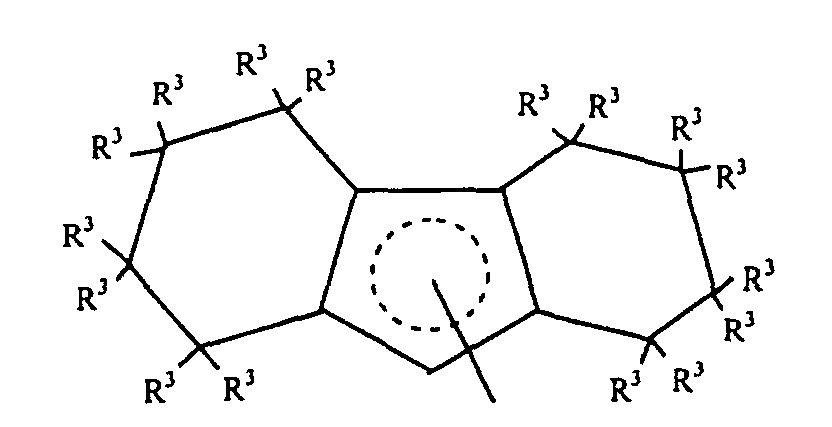
- A metal complex according to Claim 2, wherein L1 corresponds to the formula:wherein R3 independently each occurrence is hydrogen or C1-4 alkyl, or a dimer, solvated adduct, chelated derivative or mixture thereof.
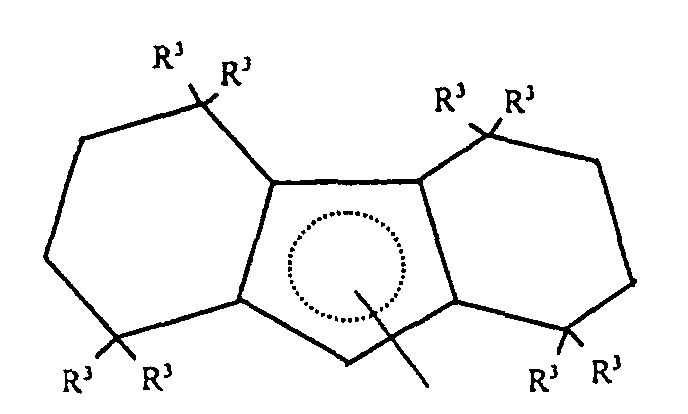
- A metal complex according to Claim 3, wherein L1 is octahydrofluorenyl.
- A metal complex according to any one of the preceding claims wherein L2 corresponds to the formula:wherein one R4 is hydrogen and the other R4 is a C3-20 hydrocarbyl group bonded to the cyclopentadienyl ring by means of a secondary or tertiary substituted carbon atom or an aryl group of up to 20 carbons,
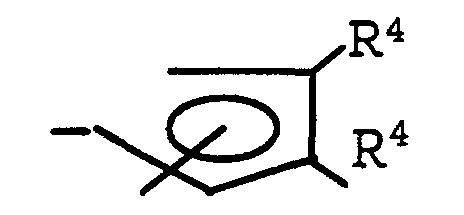
or a dimer, solvated adduct, chelated derivative or mixture thereof. - A metal complex according to Claim 5, wherein said other R4 is selected from phenyl, cyclohexyl, hydrocarbyl substituted cyclohexyl and menthyl, or a dimer, solvated adduct, chelated derivative or mixture thereof.
- A metal complex according to Claim 5, wherein said other R4 is menthyl, or a dimer, solvated adduct, chelated derivative or mixture thereof.
- A metal complex according to any one of the preceding claims, wherein Z is selected from dimethylsilanediyl, diphenylsilanediyl, methylisopropoxysilanediyl, methylphenylsilanediyl, and 1,2-ethanediyl, or a dimer, solvated adduct, chelated derivative or mixture thereof.
- A metal complex according to any one of the preceding claims, wherein M is titanium or zirconium, or a dimer, solvated adduct, chelated derivative or mixture thereof.
- A metal complex according to Claim 9, wherein M is zirconium, or a dimer, solvated adduct, chelated derivative or mixture thereof.
- A metal complex according to any one of the preceding claims, wherein X is halide, C1-20 hydrocarbyl, or two X groups together are a neutral C5-20 diene, or a dimer, solvated adduct, chelated derivative or mixture thereof.
- A metal complex according to any one of the preceding claims corresponding to the formulawherein:
 or a dimer, solvated adduct, chelated derivative or mixture thereof.M is titanium or zirconium in the +2, or +4 formal oxidation state;(R2 2E)x is dimethylsilane; andX, R3 and R4 are as previously defined,
 - A catalyst composition comprising an activating cocatalyst and one or more metal complexes according to any one of the preceding claims.
- A catalyst composition according to Claim 13, wherein the cocatalyst comprises the combination of a trialkyl aluminum compound having from 1 to 4 carbons in each alkyl group and an ammonium salt of tetrakis(pentafluorophenyl)borate, in a molar ratio from 0.1:1 to 1:0.1 and optionally up to 1,000 mole percent of an alkylalumoxane with respect to M.
- A supported catalyst system comprising a catalyst system according to Claim 13 or Claim 14 and a substrate.
- A process for polymerizing an α-olefin, comprising contacting an α-olefin or a mixture of α-olefins with a catalyst composition or system according to any one of Claims 13 to 15.
- A process according to Claim 16, wherein the α-olefin is propylene.
Applications Claiming Priority (3)
| Application Number | Priority Date | Filing Date | Title |
|---|---|---|---|
| US2360896P | 1996-08-09 | 1996-08-09 | |
| US23608P | 1996-08-09 | ||
| PCT/US1997/013560 WO1998006760A1 (en) | 1996-08-09 | 1997-08-01 | Saturated tricyclic ligand containing metal complexes and olefin polymerization process |
Publications (2)
| Publication Number | Publication Date |
|---|---|
| EP0917543A1 EP0917543A1 (en) | 1999-05-26 |
| EP0917543B1 true EP0917543B1 (en) | 2002-04-17 |
Family
ID=21816168
Family Applications (1)
| Application Number | Title | Priority Date | Filing Date |
|---|---|---|---|
| EP97936353A Expired - Lifetime EP0917543B1 (en) | 1996-08-09 | 1997-08-01 | Saturated tricyclic ligand containing metal complexes and olefin polymerization process |
Country Status (12)
| Country | Link |
|---|---|
| US (1) | US6040401A (en) |
| EP (1) | EP0917543B1 (en) |
| JP (1) | JP2000516609A (en) |
| KR (1) | KR20000029869A (en) |
| CN (1) | CN1226255A (en) |
| AT (1) | ATE216405T1 (en) |
| AU (1) | AU3904297A (en) |
| BR (1) | BR9711188A (en) |
| CA (1) | CA2259428A1 (en) |
| CZ (1) | CZ38199A3 (en) |
| DE (1) | DE69712068T2 (en) |
| WO (1) | WO1998006760A1 (en) |
Families Citing this family (3)
| Publication number | Priority date | Publication date | Assignee | Title |
|---|---|---|---|---|
| EP1031582A1 (en) * | 1999-02-26 | 2000-08-30 | Fina Research S.A. | Use and production of polypropylene |
| ES2223535T3 (en) * | 1999-07-09 | 2005-03-01 | Dow Global Technologies Inc. | HYDROGENATION OF INSATURED POLYMERS USING DIVALENT CATALYSTS BASED ON A GROUP IV METAL AND BISCICLOPENTADIENYL AND CONTAINING DIENO. |
| US10669356B2 (en) | 2016-01-27 | 2020-06-02 | Lg Chem, Ltd. | Supported hybrid catalyst and method for preparing olefin polymer using the same |
Family Cites Families (6)
| Publication number | Priority date | Publication date | Assignee | Title |
|---|---|---|---|---|
| ES2110437T3 (en) * | 1990-02-09 | 1998-02-16 | Exxon Chemical Patents Inc | COPOLYMERS OF BLOCKS FROM IONIC CATALYSTS. |
| CA2066247C (en) * | 1990-07-24 | 1998-09-15 | Ryuichi Sugimoto | Polymerization catalyst for .alpha.-olefin and method for preparing poly-.alpha.-olefin by using it |
| JP3048653B2 (en) * | 1991-02-07 | 2000-06-05 | 三菱化学株式会社 | Production of .ALPHA.-olefin polymer |
| US5416228A (en) * | 1991-10-07 | 1995-05-16 | Fina Technology, Inc. | Process and catalyst for producing isotactic polyolefins |
| JPH05178927A (en) * | 1991-12-27 | 1993-07-20 | Tosoh Corp | Catalyst for polymerization of olefin and production of olefin polymer |
| US5330948A (en) * | 1992-03-31 | 1994-07-19 | Northwestern University | Homogeneous catalysts for stereoregular olefin polymerization |
-
1997
- 1997-08-01 US US08/904,363 patent/US6040401A/en not_active Expired - Fee Related
- 1997-08-01 KR KR1019997001036A patent/KR20000029869A/en not_active Abandoned
- 1997-08-01 EP EP97936353A patent/EP0917543B1/en not_active Expired - Lifetime
- 1997-08-01 CA CA002259428A patent/CA2259428A1/en not_active Abandoned
- 1997-08-01 CZ CZ99381A patent/CZ38199A3/en unknown
- 1997-08-01 AU AU39042/97A patent/AU3904297A/en not_active Abandoned
- 1997-08-01 CN CN97196700A patent/CN1226255A/en active Pending
- 1997-08-01 BR BR9711188A patent/BR9711188A/en not_active Application Discontinuation
- 1997-08-01 JP JP10509798A patent/JP2000516609A/en active Pending
- 1997-08-01 DE DE69712068T patent/DE69712068T2/en not_active Expired - Fee Related
- 1997-08-01 AT AT97936353T patent/ATE216405T1/en not_active IP Right Cessation
- 1997-08-01 WO PCT/US1997/013560 patent/WO1998006760A1/en not_active Ceased
Also Published As
| Publication number | Publication date |
|---|---|
| EP0917543A1 (en) | 1999-05-26 |
| DE69712068D1 (en) | 2002-05-23 |
| BR9711188A (en) | 1999-08-17 |
| KR20000029869A (en) | 2000-05-25 |
| CN1226255A (en) | 1999-08-18 |
| JP2000516609A (en) | 2000-12-12 |
| US6040401A (en) | 2000-03-21 |
| CZ38199A3 (en) | 1999-05-12 |
| CA2259428A1 (en) | 1998-02-19 |
| DE69712068T2 (en) | 2002-11-14 |
| WO1998006760A1 (en) | 1998-02-19 |
| ATE216405T1 (en) | 2002-05-15 |
| AU3904297A (en) | 1998-03-06 |
Similar Documents
| Publication | Publication Date | Title |
|---|---|---|
| EP1015462B1 (en) | Bimetallic complexes and polymerization catalysts therefrom | |
| US5994255A (en) | Allyl containing metal complexes and olefin polymerization process | |
| US5688880A (en) | Readily supportable metal complexes | |
| AU704366B2 (en) | Supportable biscyclopentadienyl metal complexes | |
| JP3827719B2 (en) | Group 4 metal diene complex and addition polymerization catalyst using the same | |
| EP0640090B2 (en) | Process for preparation of monocyclopentadienyl metal complex compounds and method of use | |
| EP0857180B1 (en) | Readily supportable metal complexes | |
| US6084115A (en) | Diene complexes of group 4 metals and process of preparation | |
| US6107421A (en) | Heterocyclic metal complexes and olefin polymerization process | |
| US6160065A (en) | Yttrium containing metal complexes and olefin polymerization process | |
| US6040401A (en) | Saturated tricyclic ligand containing metal complexes and olefin polymerization process | |
| US5854362A (en) | Supported biscyclopentadienyl metal complexes | |
| EP1186611A2 (en) | Heterocyclic metal complexes and olefin polymerization process |
Legal Events
| Date | Code | Title | Description |
|---|---|---|---|
| PUAI | Public reference made under article 153(3) epc to a published international application that has entered the european phase |
Free format text: ORIGINAL CODE: 0009012 |
|
| 17P | Request for examination filed |
Effective date: 19990118 |
|
| AK | Designated contracting states |
Kind code of ref document: A1 Designated state(s): AT BE CH DE ES FI FR GB IT LI LU NL SE |
|
| GRAG | Despatch of communication of intention to grant |
Free format text: ORIGINAL CODE: EPIDOS AGRA |
|
| 17Q | First examination report despatched |
Effective date: 20010329 |
|
| GRAG | Despatch of communication of intention to grant |
Free format text: ORIGINAL CODE: EPIDOS AGRA |
|
| GRAG | Despatch of communication of intention to grant |
Free format text: ORIGINAL CODE: EPIDOS AGRA |
|
| GRAH | Despatch of communication of intention to grant a patent |
Free format text: ORIGINAL CODE: EPIDOS IGRA |
|
| GRAH | Despatch of communication of intention to grant a patent |
Free format text: ORIGINAL CODE: EPIDOS IGRA |
|
| REG | Reference to a national code |
Ref country code: GB Ref legal event code: IF02 |
|
| GRAA | (expected) grant |
Free format text: ORIGINAL CODE: 0009210 |
|
| AK | Designated contracting states |
Kind code of ref document: B1 Designated state(s): AT BE CH DE ES FI FR GB IT LI LU NL SE |
|
| PG25 | Lapsed in a contracting state [announced via postgrant information from national office to epo] |
Ref country code: LI Free format text: LAPSE BECAUSE OF FAILURE TO SUBMIT A TRANSLATION OF THE DESCRIPTION OR TO PAY THE FEE WITHIN THE PRESCRIBED TIME-LIMIT Effective date: 20020417 Ref country code: IT Free format text: LAPSE BECAUSE OF FAILURE TO SUBMIT A TRANSLATION OF THE DESCRIPTION OR TO PAY THE FEE WITHIN THE PRESCRIBED TIME-LIMIT;WARNING: LAPSES OF ITALIAN PATENTS WITH EFFECTIVE DATE BEFORE 2007 MAY HAVE OCCURRED AT ANY TIME BEFORE 2007. THE CORRECT EFFECTIVE DATE MAY BE DIFFERENT FROM THE ONE RECORDED. Effective date: 20020417 Ref country code: FR Free format text: LAPSE BECAUSE OF FAILURE TO SUBMIT A TRANSLATION OF THE DESCRIPTION OR TO PAY THE FEE WITHIN THE PRESCRIBED TIME-LIMIT Effective date: 20020417 Ref country code: FI Free format text: LAPSE BECAUSE OF FAILURE TO SUBMIT A TRANSLATION OF THE DESCRIPTION OR TO PAY THE FEE WITHIN THE PRESCRIBED TIME-LIMIT Effective date: 20020417 Ref country code: CH Free format text: LAPSE BECAUSE OF FAILURE TO SUBMIT A TRANSLATION OF THE DESCRIPTION OR TO PAY THE FEE WITHIN THE PRESCRIBED TIME-LIMIT Effective date: 20020417 Ref country code: BE Free format text: LAPSE BECAUSE OF FAILURE TO SUBMIT A TRANSLATION OF THE DESCRIPTION OR TO PAY THE FEE WITHIN THE PRESCRIBED TIME-LIMIT Effective date: 20020417 Ref country code: AT Free format text: LAPSE BECAUSE OF FAILURE TO SUBMIT A TRANSLATION OF THE DESCRIPTION OR TO PAY THE FEE WITHIN THE PRESCRIBED TIME-LIMIT Effective date: 20020417 |
|
| REF | Corresponds to: |
Ref document number: 216405 Country of ref document: AT Date of ref document: 20020515 Kind code of ref document: T |
|
| REG | Reference to a national code |
Ref country code: CH Ref legal event code: EP |
|
| REF | Corresponds to: |
Ref document number: 69712068 Country of ref document: DE Date of ref document: 20020523 |
|
| PG25 | Lapsed in a contracting state [announced via postgrant information from national office to epo] |
Ref country code: SE Free format text: LAPSE BECAUSE OF FAILURE TO SUBMIT A TRANSLATION OF THE DESCRIPTION OR TO PAY THE FEE WITHIN THE PRESCRIBED TIME-LIMIT Effective date: 20020717 |
|
| PG25 | Lapsed in a contracting state [announced via postgrant information from national office to epo] |
Ref country code: LU Free format text: LAPSE BECAUSE OF NON-PAYMENT OF DUE FEES Effective date: 20020801 Ref country code: GB Free format text: LAPSE BECAUSE OF NON-PAYMENT OF DUE FEES Effective date: 20020801 |
|
| PG25 | Lapsed in a contracting state [announced via postgrant information from national office to epo] |
Ref country code: ES Free format text: LAPSE BECAUSE OF FAILURE TO SUBMIT A TRANSLATION OF THE DESCRIPTION OR TO PAY THE FEE WITHIN THE PRESCRIBED TIME-LIMIT Effective date: 20021030 |
|
| REG | Reference to a national code |
Ref country code: CH Ref legal event code: PL |
|
| EN | Fr: translation not filed | ||
| PLBE | No opposition filed within time limit |
Free format text: ORIGINAL CODE: 0009261 |
|
| STAA | Information on the status of an ep patent application or granted ep patent |
Free format text: STATUS: NO OPPOSITION FILED WITHIN TIME LIMIT |
|
| GBPC | Gb: european patent ceased through non-payment of renewal fee |
Effective date: 20020801 |
|
| 26N | No opposition filed |
Effective date: 20030120 |
|
| PGFP | Annual fee paid to national office [announced via postgrant information from national office to epo] |
Ref country code: NL Payment date: 20030619 Year of fee payment: 7 |
|
| PGFP | Annual fee paid to national office [announced via postgrant information from national office to epo] |
Ref country code: DE Payment date: 20030718 Year of fee payment: 7 |
|
| PG25 | Lapsed in a contracting state [announced via postgrant information from national office to epo] |
Ref country code: NL Free format text: LAPSE BECAUSE OF NON-PAYMENT OF DUE FEES Effective date: 20050301 Ref country code: DE Free format text: LAPSE BECAUSE OF NON-PAYMENT OF DUE FEES Effective date: 20050301 |
|
| NLV4 | Nl: lapsed or anulled due to non-payment of the annual fee |
Effective date: 20050301 |