EP0915824B1 - Stable derivatives of ubiquinole, processes for their production and pharmaceutical use thereof - Google Patents
Stable derivatives of ubiquinole, processes for their production and pharmaceutical use thereof Download PDFInfo
- Publication number
- EP0915824B1 EP0915824B1 EP97935748A EP97935748A EP0915824B1 EP 0915824 B1 EP0915824 B1 EP 0915824B1 EP 97935748 A EP97935748 A EP 97935748A EP 97935748 A EP97935748 A EP 97935748A EP 0915824 B1 EP0915824 B1 EP 0915824B1
- Authority
- EP
- European Patent Office
- Prior art keywords
- compounds
- ubiquinole
- formula
- active therapeutic
- production
- Prior art date
- Legal status (The legal status is an assumption and is not a legal conclusion. Google has not performed a legal analysis and makes no representation as to the accuracy of the status listed.)
- Expired - Lifetime
Links
- 0 CC[C@](C(C)C(C(C(*C)=C1*)=O)=C(C)C1=O)C=C(CC(C)C)*1(C)CC1 Chemical compound CC[C@](C(C)C(C(C(*C)=C1*)=O)=C(C)C1=O)C=C(CC(C)C)*1(C)CC1 0.000 description 3
Images



Classifications
-
- C—CHEMISTRY; METALLURGY
- C07—ORGANIC CHEMISTRY
- C07C—ACYCLIC OR CARBOCYCLIC COMPOUNDS
- C07C43/00—Ethers; Compounds having groups, groups or groups
- C07C43/02—Ethers
- C07C43/20—Ethers having an ether-oxygen atom bound to a carbon atom of a six-membered aromatic ring
- C07C43/215—Ethers having an ether-oxygen atom bound to a carbon atom of a six-membered aromatic ring having unsaturation outside the six-membered aromatic rings
-
- C—CHEMISTRY; METALLURGY
- C07—ORGANIC CHEMISTRY
- C07C—ACYCLIC OR CARBOCYCLIC COMPOUNDS
- C07C69/00—Esters of carboxylic acids; Esters of carbonic or haloformic acids
- C07C69/017—Esters of hydroxy compounds having the esterified hydroxy group bound to a carbon atom of a six-membered aromatic ring
Definitions
- the present invention relates to stable derivatives of ubiquinole for use as active therapeutic substances, processes for their production and the pharmaceutical use thereof.
- Ubiquinone (2,3-dimethoxy-5-methyl-6-decaprenylbenzoquinone) or coenzyme Q 10 (CoQ 10 ) is a quinone of lipidic nature, an essential redox component of the mitochondrial respiratory chain, where it acts as an electron shuttle, controlling the efficiency of oxidative phophorylation. Ubiquinone also exerts another important biological function, acting as an antioxidant for cell membranes, in harmony and in synergism with Vitamin E. Recent studies (Takahashi T., et al., (1993) Lipids 28, 803-809; Aberg F., et al., (1992) Arch-Biophys.
- Ubiquinone especially in its reduced form ubiquinole, appears to have a higher effectiveness than Vitamin E in inhibiting lipidic peroxidation of membranes; this function of ubiquinone is explicated in a different site (the central level of the lipidic bi-layer) from that in which Vitamin E acts (close to the surface of the bi-layer).
- Ubiquinole would appear to form in the tissues following the reduction of ubiquinone or the co-enzyme Q semiquinone (CoQ 10 H) by the enzymatic systems present in the membranes and generally indicated as quinone-reductases (NAD (P) H-dependent electron carriers), which are theoretically inextinguishable in perfectly functional aerobic organisms.
- NAD (P) H-dependent electron carriers quinone-reductases
- Aberg et al. have determined the ubiquinole content as a percentage ratio of ubiquinone, in human tissues, as indicated in the following table.
- Tissue Content ⁇ g/g tissue CoQ 10 H 2 (%) heart 114.0 61 kidney 66.5 75 liver 54.9 95 muscle 39.7 65 pancreas 32.7 100 thyroid 24.7 70 spleen 24.6 85 brain 13.4 23 intestine 11.5 93 colon 10.7 87 testicle 10.5 85 lung 7.9 25
- Object of the present invention are therefore compounds of formula I in which R is a linear or branched alkyl group with a number of carbon atoms from 1 to 20, or an aryl group optionally substituted with alkyl with from 1 to 6 carbon atoms, and X is absent or a CO group, for use as active therapeutic substances.
- Particularly preferred among the compounds of formula I in which X is absent are the compounds in which R is linear C 1 -C 6 alkyl, in particular the compounds in which R is methyl, propyl and ethyl.
- Particularly preferred compounds are ubiquinole diethylether and dimethylether.
- the compounds of formula I can be prepared according to the following synthesis, which are therefore a further object of the present invention.
- the reaction schemes are as follows:
- Synthesis of compounds of formula I in which X is absent can be done according to the synthetic scheme (c), reacting the coenzyme Q 10 with a dialkylic sulphate or according to the synthetic scheme (d) in which in a first stage the coenzyme Q 10 is reduced to ubiquinole by effect of a reducing agent and in a second stage the ubiquinole obtained is reacted with an iodoalcane.
- NaBH 4 is preferably used as a Lewis base, as it also supplies the reducing activity in case of synthesis b1) and d1), and IR indicates iodoalcane, R has the meaning indicated in formula I.
- reaction solvents hexane, tetrahydrofuran, methanol.
- the active therapeutic agents according to the present invention can be used in treatment of all the affections and diseases of the organism that involve or can be traced to continuous or high intracellular oxidative stress, such as for example that arising in cases of aged organisms or ones in which there is incorrect functioning of the biological reducing function in electron carrier systems.
- active therapeutic agents according to the present invention can also be used for treatment of AIDS, tuberculosis, leprosy.
- a further object of the present invention are pharmaceutical formulations containing a pharmacologically effective amount of one or more compounds of formula I in addition to other active principles, additives and/or pharmaceutically tolerable vehicles.
- other active principles it is possible to mention Vitamin E acetate, selenium, methionin.
- ubiquinole derivatives In case of administration of ubiquinole derivatives, amounts of between 50 and 200 mg/die are preferred.
- the mixture is heated slightly under stirring until the yellow-orange colour of the hexane-phase ubiquinone completely disappears; the mixture is then brought to the boiling point for 2-3 minutes.
- the solution is decanted while hot from the zinc acetate and from the zinc, which are washed with acetic acid (10 ml) and hexane (50 ml).
- acetic acid 10 ml
- hexane 50 ml
- the acetic-hexanic solutions are collected in another flask and distilled water (approximately 100 ml) is gradually added to hydrolyse the remaining acetic anhydride.
- the hexane phase is separated off using a separator funnel, and washed 3 times with 20 ml of distilled water.
- the mixture is allowed to cool, acidified with diluted sulphuric acid and transferred to a separator funnel.
- the lower phase is eliminated and the hexane phase is washed twice with diluted sulphuric acid and then with water until acidity disappears.
- the hexane phase is dried on anhydrous sodium or magnesium sulphate and then the hexane is distilled (percentage yield: 85%).
- Propionic anhydride Ubiquinole dipropionate -CO-CH 2 -CH 3 Chemical/physical data: MW 977.4; UV spectrum (maximum absorption at 268.5 nm, minimum at 250.5 nm) the infra-red spectrum is reported in figure 2.
- Butyric anhydride Ubiquinole dibutyrrate -CO-(CH 2 ) 2 -CH 3 Chemical/physical data: MW 1005.4; UV spectrum (maximum absorption at 268.5 nm, minimum at 250.5 nm) the infra-red spectrum is reported in figure 3.
Landscapes
- Chemical & Material Sciences (AREA)
- Organic Chemistry (AREA)
- Pharmaceuticals Containing Other Organic And Inorganic Compounds (AREA)
- Nitrogen Condensed Heterocyclic Rings (AREA)
- Acyclic And Carbocyclic Compounds In Medicinal Compositions (AREA)
Abstract
Description
- The present invention relates to stable derivatives of ubiquinole for use as active therapeutic substances, processes for their production and the pharmaceutical use thereof.
- Ubiquinone, (2,3-dimethoxy-5-methyl-6-decaprenylbenzoquinone) or coenzyme Q10 (CoQ10) is a quinone of lipidic nature, an essential redox component of the mitochondrial respiratory chain, where it acts as an electron shuttle, controlling the efficiency of oxidative phophorylation. Ubiquinone also exerts another important biological function, acting as an antioxidant for cell membranes, in harmony and in synergism with Vitamin E. Recent studies (Takahashi T., et al., (1993) Lipids 28, 803-809; Aberg F., et al., (1992) Arch-Biophys. 295, 230-234) have demonstrated that in certain human and animal test tissues (liver, heart, kidney, pancreas, etc.) the levels of ubiquinone (CoQ10), especially in its reduced form, known as ubiquinole (CoQ10H2) are higher than those of Vitamin E.
- The following reaction scheme shows the balance between the oxidised and reduced forms.
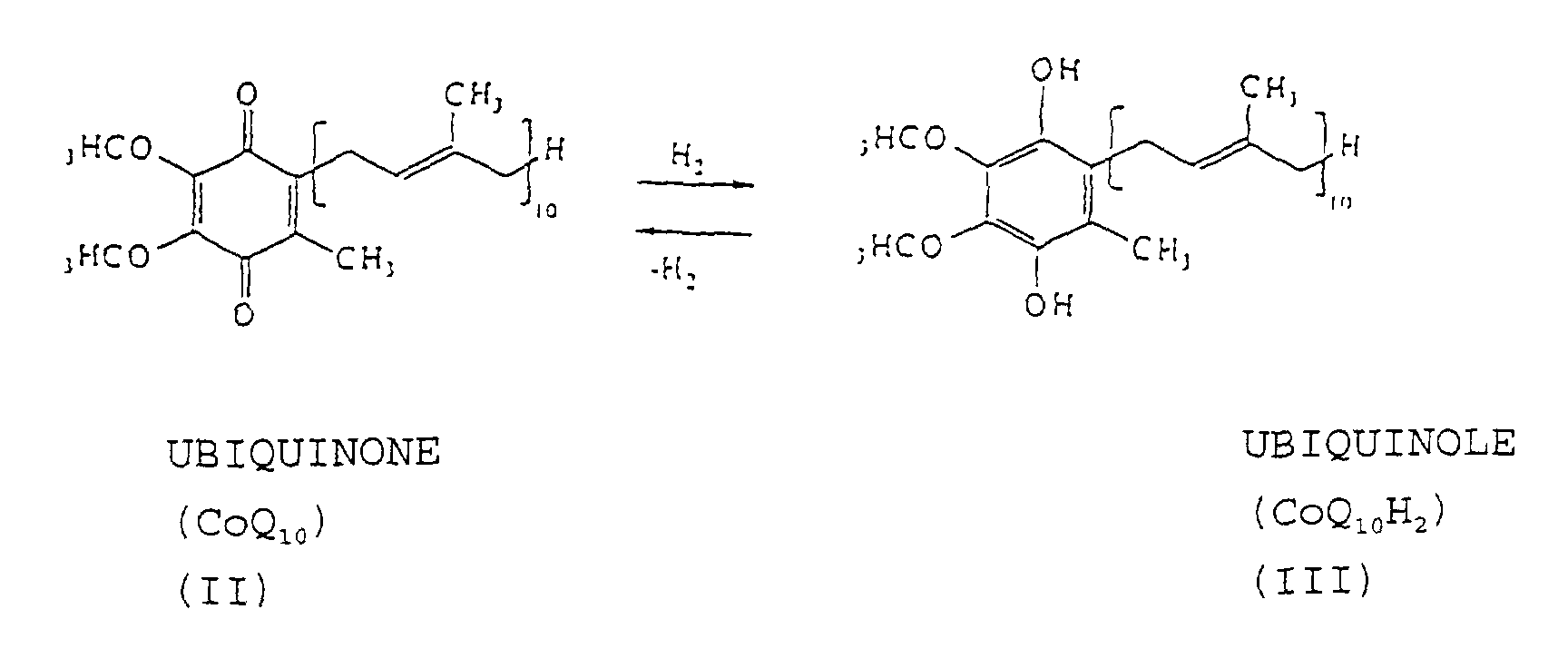
- Ubiquinone, especially in its reduced form ubiquinole, appears to have a higher effectiveness than Vitamin E in inhibiting lipidic peroxidation of membranes; this function of ubiquinone is explicated in a different site (the central level of the lipidic bi-layer) from that in which Vitamin E acts (close to the surface of the bi-layer). Ubiquinole would appear to form in the tissues following the reduction of ubiquinone or the co-enzyme Q semiquinone (CoQ10H) by the enzymatic systems present in the membranes and generally indicated as quinone-reductases (NAD (P) H-dependent electron carriers), which are theoretically inextinguishable in perfectly functional aerobic organisms.
- Aberg et al. (cited work) have determined the ubiquinole content as a percentage ratio of ubiquinone, in human tissues, as indicated in the following table.
Tissue Content µg/g tissue CoQ10H2 (%) heart 114.0 61 kidney 66.5 75 liver 54.9 95 muscle 39.7 65 pancreas 32.7 100 thyroid 24.7 70 spleen 24.6 85 brain 13.4 23 intestine 11.5 93 colon 10.7 87 testicle 10.5 85 lung 7.9 25 - This study demonstrates that the reduced form ubiquinole almost always prevails over the oxidised form, to the extent that, in the pancreas, it is practically the only form present.
- The above has been demonstrated in the case of healthy aerobic organisms, that is to say when the ubiquinole prevails over the ubiquinone and when, as demonstrated in scientific literature (Ernster L., et al. (1993) The Clinical Invest. 71, 60-65; Frei B., et al., (1990) Medical Sciences 87, 4879-4883; Hauska G. et al., (1983) Biochim. Biophys. Acta 726, 97-133; Kroger A. et al., (1973) European J. Biochem 24, 358-368) the quinone-reductases are practically inextinguishable.
- However, it has been found that in conditions of continuous (or high) intracellular oxidative stress, for example in diseases connected with ageing or in the case of acquired immuno-deficiency syndrome (AIDS), the enzymatic electron carrier systems lose their ability to perform their biological reducing function properly, or entirely, and this causes a drop in the ubiquinole levels in tissues. Furthermore, in the case of the diseases mentioned above, the reduced endogenous synthesis of ubiquinone is another factor that causes a drop in the levels of ubiquinole in tissues.
- There was therefore a problem in the state of the art relating to how, in cases of intracellular oxidative stress, to restore the levels of ubiquinole in tissues to levels close to or equivalent to those found in a healthy organism. The proposed pharmacological solution consisted in the administration of ubiquinone of exogenous origin. However, this solution created a problem of low efficiency, as the quinone-reductases, that is to say the enzymes capable of reducing ubiquinone to ubiquinole, although theoretically inextinguishable in a healthy organism, become incapable of performing their function correctly in case of a sick organism, particularly in the presence of continuous or high intracellular oxidative stress.
- As a result of this, even administration of large amounts of ubiquinone were unable to give a consistent rise in the levels of ubiquinole present in tissues. On the other hand, direct administration of ubiquinole was not possible, due to the instability of the molecule, which decomposes into ubiquinone and semiquinone as soon as it is synthesised. Just the knowledge of the instability of the ubiquinole molecule has led one to assume up to now that the direct administration of ubiquinole was impracticable, a fact further confirmed by the absence in the state of the art of documents having as their object the administration of ubiquinole itself or in the form of derivatives.
- It has now surprisingly been found that the level of ubiquinole in tissues, that are in conditions of continuous or high oxidative stress, can be reintegrated to the level of healthy organisms by administering stable derivatives of ubiquinole that are transformed into ubiquinole within the organism.
- Object of the present invention are therefore compounds of formula Iin which R is a linear or branched alkyl group with a number of carbon atoms from 1 to 20, or an aryl group optionally substituted with alkyl with from 1 to 6 carbon atoms, and X is absent or a CO group, for use as active therapeutic substances.

- Enclosed with the present description are five figures, in which:
- figure 1 represents the infrared spectrum of ubiquinole diacetate;
- figure 2 represents the infrared spectrum of ubiquinole dipropionate;
- figure 3 represents the infrared spectrum of ubiquinole dibutyrrhate;
- figure 4 represents the infrared spectrum of ubiquinole dimethylether; and
- figure 5 represents the infrared spectrum of ubiquinole diethylether.
-
- Particularly preferred for use as active therapeutic substances among the compounds of formula I in which X=CO, are the compounds in which R is linear C1-C6 alkyl, in particular methyl, propyl and ethyl. Particularly preferred compounds are ubiquinole diacetate and dipropionate.
- Particularly preferred among the compounds of formula I in which X is absent, are the compounds in which R is linear C1-C6 alkyl, in particular the compounds in which R is methyl, propyl and ethyl. Particularly preferred compounds are ubiquinole diethylether and dimethylether.
- The compounds of formula I can be prepared according to the following synthesis, which are therefore a further object of the present invention.
- Synthesis of the compounds of formula I in which X=CO can take place according to the synthetic scheme (a) by reacting the coenzyme Q10 with an anhydride or according to the synthetic scheme (b), in which in a first stage the coenzyme Q10 is reacted with a reducing agent and in a second stage the ubiquinole obtained is reacted with an acylic chloride. The reaction schemes are as follows:
- a) CoQ10 + (RCO)2O → compounds of formula I in which X=CO the reaction is carried out in an acid environment in the presence of metallic zinc and in an organic solvent;
- b1) CoQ10 + NaBH4 in organic solvent → CoQ10H2
- b2) CoQ10H2 + RCOCl in organic solvent → compounds of formula I in which X=CO.
-
- Synthesis of the compounds of formula I in which X is absent.
- Synthesis of compounds of formula I in which X is absent can be done according to the synthetic scheme (c), reacting the coenzyme Q10 with a dialkylic sulphate or according to the synthetic scheme (d) in which in a first stage the coenzyme Q10 is reduced to ubiquinole by effect of a reducing agent and in a second stage the ubiquinole obtained is reacted with an iodoalcane.
- The reaction schemes are as follows:
- c) CoQ10 + (RO)2SO2 → compounds of formula I in which X is absent, the reaction is carried out in an organic solvent in a basic environment, preferably in a Lewis base.
- d1) CoQ10 + NaBH4 → CoQ10H2
- d2) CoQ10H2 + IR → compounds of formula I in which X is absent.
-
- In the preceding schemes NaBH4 is preferably used as a Lewis base, as it also supplies the reducing activity in case of synthesis b1) and d1), and IR indicates iodoalcane, R has the meaning indicated in formula I.
- For preference, the following reaction solvents are used: hexane, tetrahydrofuran, methanol.
- The compounds of formula I according to the invention can be used as active therapeutic agents with the aim of obtaining the necessary integration of ubiquinole in those cases in which a low level has been found in the tissues, as within the organism under the action of the esterases (in the case of compounds of formula I in which X=CO) or of microsomial enzymes (in the case of compounds of formula I in which X is absent) ubiquinole is freed respectively as a result of hydrolysis or of dealkylation of the compounds of formula I.
- It should be underlined that following the administration of active therapeutic agents containing compounds of formula I the bioavailability of ubiquinole increases, as hydrolysis of the compounds of formula I according to the present invention (which as said produces ubiquinole) does not take place due to the action of the quinone-reductases, which are notoriously low in level in all organisms suffering from oxidative cellular stress, but on the contrary takes place due to the action of the esterases or of the microsomial enzymes.
- The active therapeutic agents according to the present invention can be used in treatment of all the affections and diseases of the organism that involve or can be traced to continuous or high intracellular oxidative stress, such as for example that arising in cases of aged organisms or ones in which there is incorrect functioning of the biological reducing function in electron carrier systems.
- In particular the active therapeutic agents according to the present invention can also be used for treatment of AIDS, tuberculosis, leprosy.
- A further object of the present invention are pharmaceutical formulations containing a pharmacologically effective amount of one or more compounds of formula I in addition to other active principles, additives and/or pharmaceutically tolerable vehicles. Among the other active principles it is possible to mention Vitamin E acetate, selenium, methionin.
- In case of administration of ubiquinole derivatives, amounts of between 50 and 200 mg/die are preferred.
- The following is a pharmaceutical formulation in the form of a pill:
Amount Percentage by weight Ubiquinole Q10 acetate 58.440 mg 14.610 % Orange flavouring, powder 4.000 mg 1.000% powder Cellulose 60.000 mg 15.000 % Lactose 267.160 mg 66.790 % Colloidal silica 4.000 mg 1.000 % Sodium saccarinate 0.400 mg 0.100 % Mg Stearate 6.000 mg 1.500 % Total 400.000 mg 100.00 % - The following are examples of production for compounds of formula I.
- In a 500 ml flask fitted with a serpentine condenser and a mixer, 10 g of oxidised ubiquinone are suspended in 30 ml of hexane; 30 ml of ultrapure acetic anhydride, 10 grams of powdered zinc and 2 grams of powder of anhydrous sodium acetate form are added.
- The mixture is heated slightly under stirring until the yellow-orange colour of the hexane-phase ubiquinone completely disappears; the mixture is then brought to the boiling point for 2-3 minutes.
- 25 ml of glacial acetic acid are added and the mixture is brought to boiling point to dissolve the product and part of the precipitated zinc acetate.
- The solution is decanted while hot from the zinc acetate and from the zinc, which are washed with acetic acid (10 ml) and hexane (50 ml). The acetic-hexanic solutions are collected in another flask and distilled water (approximately 100 ml) is gradually added to hydrolyse the remaining acetic anhydride.
- When bubbling ceases, the hexane phase is separated off using a separator funnel, and washed 3 times with 20 ml of distilled water.
- The hexane is distilled off and, in the residue, very pure ubiquinole diacetate is obtained (percentage yield: 95%).

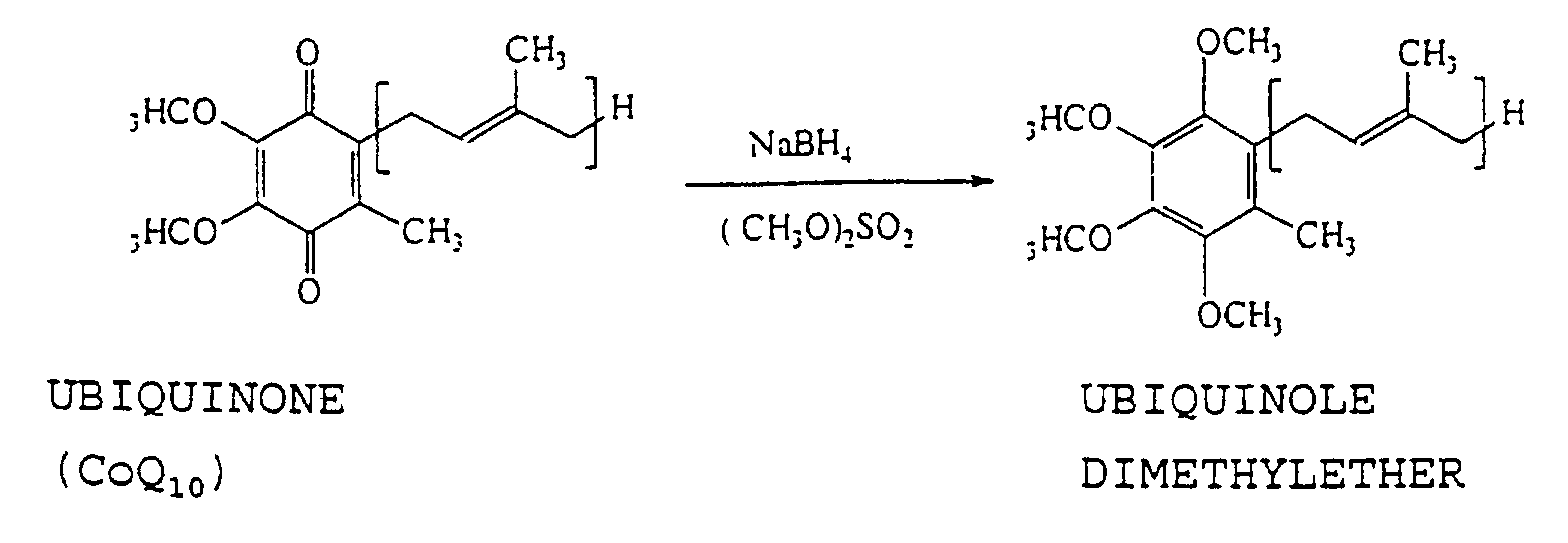
- Equip a four-necked 500 ml flask with a separator funnel, a mechanical mixer, a reflux condenser and a thermometer. There must also be a continuous flow of nitrogen into the flask through one neck, to prevent oxidation by atmospheric oxygen. (Alternatively, the apparatus can be protected against oxidation using a Bunsen valve applied to the reflux condenser). The funnel is filled with 5 ml (6.7 g) of dimethyl sulphate, which are added to the mixture drop by drop over a period of approximately 30 minutes, under energetic stirring. Methylation is completed by reflux heating for approximately 2 hours, during which time 30-50 ml of hexane can be added through the separator funnel, which previously contained the dimethylsulphate. During heating, any dimethylsulphate that has not reacted will be destroyed.
- The mixture is allowed to cool, acidified with diluted sulphuric acid and transferred to a separator funnel. The lower phase is eliminated and the hexane phase is washed twice with diluted sulphuric acid and then with water until acidity disappears.
- The hexane phase is dried on anhydrous sodium or magnesium sulphate and then the hexane is distilled (percentage yield: 85%).
- The following tables show, as a non-limiting example, some compounds of formula I that can be obtained using the various reaction schemes. The chemical and physical data relate to the product obtained; the UV spectra have been recorded with the compounds dissolved in hexane; the infra-red spectrums of the ethers have been recorded on NaCl crystals, those of the esters on KBr pastilles.
(Products obtained according to scheme a) Anhydride used Product obtained R in formula I Acetic anhydride Ubiquinole diacetate -CO-CH3
Propionic anhydride Ubiquinole dipropionate -CO-CH2-CH3 Chemical/physical data: MW 977.4; UV spectrum (maximum absorption at 268.5 nm, minimum at 250.5 nm) the infra-red spectrum is reported in figure 2.
Butyric anhydride Ubiquinole dibutyrrate -CO-(CH2)2-CH3 Chemical/physical data: MW 1005.4; UV spectrum (maximum absorption at 268.5 nm, minimum at 250.5 nm) the infra-red spectrum is reported in figure 3. - Similar results can be obtained using the synthesis scheme b.
(Products obtained according to scheme c) Alkylating agent Product obtained R in formula I Dimethylsulphate Ubiquinole dimethylether -CH3
Diethylsulphate Ubiquinole diethylether -CH2-CH3 Chemical/physical data: MW 921.4; UV spectrum (maximum absorption at 274.5 nm, minimum at 236.5 nm) the infra-red spectrum is reported in figure 5. - Similar results can be obtained using the reaction scheme d.
Claims (21)
- Compounds of formula I
 in which X is absent or a CO group,R is a linear or branched alkyl group with a number of carbon atoms of from 1 to 20 or an arylic group optionally substituted with a C1-C6 alkylic substituent for use as active therapeutic substances.
 - Compounds according to claim 1, in which X is CO for use as active therapeutic substances.
- Compounds according to claim 1, in which X is absent for use as active therapeutic substance.
- Compounds according to claim 2, in which R is linear or branched alkyl with a number of carbon atoms of from 1 to 6.
- Compounds according to claim 4, in which R is methyl, ethyl or propyl.
- Ubiquinole diacetate for use as active therapeutic substances.
- Ubiquinole dipropionate for use as active therapeutic substances.
- Ubiquinole dibutyrrate for use as active therapeutic substances.
- A compound according to claim 3, in which R1 is linear or branched alkyl with a number of carbon atoms from 1 to 6.
- A compound according to claim 9, in which R is methyl, ethyl or propyl.
- Ubiquinole dimethylether for use as active therapeutic substances.
- Ubiquinole diethylether for use as active therapeutic substances.
- A process for the production of compounds as claimed in claim 2, in which the ubiquinone is reacted with an anhydride of formula (RCO)2O in an organic solvent, in the presence of zinc and in an acid environment, R having the meaning indicated in claim 1.
- A process for the production of compounds as claimed in claim 2, in which in a first stage the ubiquinone is reacted with a reducing agent in an organic solvent and in a second stage the ubiquinole obtained is reacted with an acid chloride of formula RCOCl, in which R has the meaning indicated in claim 1.
- A process for the production of compounds as claimed in claim 3, in which the ubiquinone is reacted with a dialkylic or diarylic sulphate of formula (RO)2SO2 in an organic solvent and in a basic environment for the presence of NaBH4, R having the meaning indicated in claim 1.
- A process for the production of compounds as claimed in claim 3, in which in a first stage the ubiquinone is reacted with NaBH4 in an organic solvent to obtain ubiquinole, which in a second stage is reacted with an iodoalkane of formula IR, in which R has the meaning indicated in claim 1.
- Compounds as claimed in claims 1 to 12 for use in the treatment of intracellular oxidative stress.
- Compounds as claimed in claims 1 to 12, for use in the treatment of tuberculosis, leprosy and AIDS.
- Use of the compounds of formula I for the production of drugs that are effective in the treatment of intracellular oxidative stress.
- Pharmaceutical compositions comprising a therapeutically effective amount of one or more of the compounds of formula I, together with additives or pharmaceutically tolerable vehicles.
- Pharmaceutical compositions according to claim 20, further containing one or more additional active principles.
Applications Claiming Priority (3)
| Application Number | Priority Date | Filing Date | Title |
|---|---|---|---|
| ITRM960529 | 1996-07-26 | ||
| IT96RM000529A IT1284873B1 (en) | 1996-07-26 | 1996-07-26 | STABLE DERIVATIVES OF UBIQUINOL PROCEDURES FOR THEIR PRODUCTION AND PHARMACEUTICAL USE |
| PCT/IT1997/000184 WO1998004512A1 (en) | 1996-07-26 | 1997-07-23 | Stable derivatives of ubiquinole, processes for their production and pharmaceutical use thereof |
Publications (2)
| Publication Number | Publication Date |
|---|---|
| EP0915824A1 EP0915824A1 (en) | 1999-05-19 |
| EP0915824B1 true EP0915824B1 (en) | 2002-04-03 |
Family
ID=11404360
Family Applications (1)
| Application Number | Title | Priority Date | Filing Date |
|---|---|---|---|
| EP97935748A Expired - Lifetime EP0915824B1 (en) | 1996-07-26 | 1997-07-23 | Stable derivatives of ubiquinole, processes for their production and pharmaceutical use thereof |
Country Status (7)
| Country | Link |
|---|---|
| US (1) | US6127417A (en) |
| EP (1) | EP0915824B1 (en) |
| AT (1) | ATE215525T1 (en) |
| AU (1) | AU3862997A (en) |
| DE (1) | DE69711633T2 (en) |
| IT (1) | IT1284873B1 (en) |
| WO (1) | WO1998004512A1 (en) |
Families Citing this family (10)
| Publication number | Priority date | Publication date | Assignee | Title |
|---|---|---|---|---|
| US7891435B2 (en) * | 1996-01-23 | 2011-02-22 | En-Gauge, Inc. | Remote inspection of emergency equipment stations |
| TWI310029B (en) | 2001-07-13 | 2009-05-21 | Kaneka Corp | |
| TWI237018B (en) * | 2001-07-13 | 2005-08-01 | Kaneka Corp | Method of producing reduced coenzyme Q10 crystals |
| TW200304372A (en) * | 2002-03-20 | 2003-10-01 | Kanegafuchi Chemical Ind | Compositions for diabetes |
| EP1846355B1 (en) * | 2005-01-27 | 2009-12-16 | Ocean Nutrition Canada Limited | Fatty acid-benzenediol derivatives and methods of making and using thereof |
| WO2007040591A2 (en) * | 2005-03-01 | 2007-04-12 | Jarrow Formulas, Inc. | A ubiquinone composition and a container for its convenient transport and storage |
| JPWO2007034852A1 (en) * | 2005-09-22 | 2009-03-26 | 株式会社カネカ | Life prolonging composition and method for extending life |
| WO2014087972A1 (en) * | 2012-12-03 | 2014-06-12 | 株式会社カネカ | Reduced coenzyme q10 derivative and method for producing same |
| JP7535768B2 (en) * | 2020-01-16 | 2024-08-19 | 学校法人福岡大学 | Ubiquinol delivery agents with high photostability and low phototoxicity - Patent Application 20070123333 |
| CN115397103B (en) * | 2021-05-24 | 2025-03-21 | 庆鼎精密电子(淮安)有限公司 | Method for preparing circuit board with heat dissipation function |
Family Cites Families (4)
| Publication number | Priority date | Publication date | Assignee | Title |
|---|---|---|---|---|
| US3068295A (en) * | 1962-12-11 | diether groups | ||
| GB925581A (en) * | 1958-07-07 | 1963-05-08 | Wisconsin Alumni Res Found | Quinone derivatives |
| GB952581A (en) * | 1962-05-12 | 1964-03-18 | Cho Onpa Kogyo Kabushiki Kaish | Improvements in or relating to methods of and apparatus for bonding plastic materials using ultrasonic vibrations |
| CH575904A5 (en) * | 1972-02-16 | 1976-05-31 | Eisai Co Ltd |
-
1996
- 1996-07-26 IT IT96RM000529A patent/IT1284873B1/en active IP Right Grant
-
1997
- 1997-07-23 WO PCT/IT1997/000184 patent/WO1998004512A1/en not_active Ceased
- 1997-07-23 AT AT97935748T patent/ATE215525T1/en not_active IP Right Cessation
- 1997-07-23 EP EP97935748A patent/EP0915824B1/en not_active Expired - Lifetime
- 1997-07-23 DE DE69711633T patent/DE69711633T2/en not_active Expired - Fee Related
- 1997-07-23 AU AU38629/97A patent/AU3862997A/en not_active Abandoned
- 1997-07-23 US US09/230,266 patent/US6127417A/en not_active Expired - Lifetime
Also Published As
| Publication number | Publication date |
|---|---|
| ATE215525T1 (en) | 2002-04-15 |
| ITRM960529A1 (en) | 1996-10-26 |
| US6127417A (en) | 2000-10-03 |
| DE69711633T2 (en) | 2002-11-21 |
| EP0915824A1 (en) | 1999-05-19 |
| IT1284873B1 (en) | 1998-05-22 |
| WO1998004512A1 (en) | 1998-02-05 |
| AU3862997A (en) | 1998-02-20 |
| DE69711633D1 (en) | 2002-05-08 |
| ITRM960529A0 (en) | 1996-07-26 |
Similar Documents
| Publication | Publication Date | Title |
|---|---|---|
| US6686485B2 (en) | Synthesis of coenzyme Q10, ubiquinone | |
| CA1142092A (en) | Method of preventing carcinogenesis | |
| EP0031727B1 (en) | Medicinal compositions comprising as an active ingredient substituted 1,4-benzoquinones | |
| US6818668B2 (en) | 5-alkyl-7-alkylcarbonate-isoflavone ester and related method | |
| EP0345038A2 (en) | Non-beta-oxidizable fatty acid analogues with the effect to reduce the concentration of cholesterol and triglycerides in blood of mammals | |
| JPH04230393A (en) | Novel 2,6-dialkyl-4-silylphenols as anti-atherosclerosis agents | |
| EP0754457B1 (en) | Antiobestic agent | |
| JPH0261477B2 (en) | ||
| US6127417A (en) | Stable derivatives of ubiquinole, processes for their production and pharmaceutical use thereof | |
| LU85262A1 (en) | FURO- (3,4-C) -PYRIDINE DERIVATIVES, THEIR PREPARATION AND THERAPEUTIC COMPOSITIONS CONTAINING THESE DERIVATIVES | |
| JP2963557B2 (en) | Novel bis [4- (2,6-di-alkyl) phenol] silane derivatives as anti-atherosclerotic agents | |
| EP0172058B1 (en) | Phenylnaphthyridines, process for their preparation, medicaments containing them, particularly as anti-ulcer agents | |
| EP0018857B1 (en) | Pyrimido and imidazo-pyrido-indole-diones, their preparation and therapeutic use | |
| EP0755917B1 (en) | N,N'-di(aralkyl) N,N'-di(carboxyalkyl) alkylen- diamino-derivatives, N-(aralkyl) N'-(carboxyalkyl) N,N'-di(carboxyalkyl) alkylen- diamino-derivatives and N,N"-di(aralkyl)N,N',N"-tri(carboxyalkyl)dialkylen triamino derivatives and their use in pharmacy and cosmetics | |
| US4443619A (en) | Chlorocitric acids | |
| CA1273580A (en) | Pharmaceutical composition containing as active ingredient at least one dihydroxi-1,8 phenyl-10 anthrone-9 anthranol-9 mono-, di- or tri-ester | |
| CH654011A5 (en) | PHOSPHORAMIDES, PROCESS FOR THEIR PREPARATION AND PHARMACEUTICAL COMPOSITIONS CONTAINING THEM. | |
| JP2004217555A (en) | Polyphenol derived from walnut kernel | |
| JPS58502000A (en) | substituted pyrrole | |
| US3671583A (en) | Glutaric acid derivatives | |
| US5475028A (en) | 2-aminoethanesulfonic acid zinc complex | |
| Yabunaka et al. | Hybrid ubiquinone: novel inhibitor of mitochondrial complex I | |
| FR2600332A1 (en) | P-AMINOPHENOLS AND DERIVATIVES WITH THERAPEUTIC ACTION | |
| JPS6225142B2 (en) | ||
| LU82672A1 (en) | 2-AMINO-3- (ALKYLTHIOBENZOYL) -PHENYLACETIC ACIDS AND DERIVATIVES, AND THEIR USE AS ANTI-INFLAMMATORY, ANALGESIC, AND INHIBIT AGGLOMERATION OF BLOOD PLATES |
Legal Events
| Date | Code | Title | Description |
|---|---|---|---|
| PUAI | Public reference made under article 153(3) epc to a published international application that has entered the european phase |
Free format text: ORIGINAL CODE: 0009012 |
|
| 17P | Request for examination filed |
Effective date: 19990125 |
|
| AK | Designated contracting states |
Kind code of ref document: A1 Designated state(s): AT BE CH DE DK ES FI FR GB GR IE IT LI LU MC NL PT SE |
|
| AX | Request for extension of the european patent |
Free format text: AL PAYMENT 19990125;LT PAYMENT 19990125;LV PAYMENT 19990125;RO PAYMENT 19990125;SI PAYMENT 19990125 |
|
| 17Q | First examination report despatched |
Effective date: 19991126 |
|
| GRAG | Despatch of communication of intention to grant |
Free format text: ORIGINAL CODE: EPIDOS AGRA |
|
| GRAG | Despatch of communication of intention to grant |
Free format text: ORIGINAL CODE: EPIDOS AGRA |
|
| GRAH | Despatch of communication of intention to grant a patent |
Free format text: ORIGINAL CODE: EPIDOS IGRA |
|
| GRAH | Despatch of communication of intention to grant a patent |
Free format text: ORIGINAL CODE: EPIDOS IGRA |
|
| REG | Reference to a national code |
Ref country code: GB Ref legal event code: IF02 |
|
| GRAA | (expected) grant |
Free format text: ORIGINAL CODE: 0009210 |
|
| AK | Designated contracting states |
Kind code of ref document: B1 Designated state(s): AT BE CH DE DK ES FI FR GB GR IE IT LI LU MC NL PT SE |
|
| AX | Request for extension of the european patent |
Free format text: AL PAYMENT 19990125;LT PAYMENT 19990125;LV PAYMENT 19990125;RO PAYMENT 19990125;SI PAYMENT 19990125 |
|
| LTIE | Lt: invalidation of european patent or patent extension | ||
| PG25 | Lapsed in a contracting state [announced via postgrant information from national office to epo] |
Ref country code: NL Free format text: LAPSE BECAUSE OF FAILURE TO SUBMIT A TRANSLATION OF THE DESCRIPTION OR TO PAY THE FEE WITHIN THE PRESCRIBED TIME-LIMIT Effective date: 20020403 Ref country code: LI Free format text: LAPSE BECAUSE OF FAILURE TO SUBMIT A TRANSLATION OF THE DESCRIPTION OR TO PAY THE FEE WITHIN THE PRESCRIBED TIME-LIMIT Effective date: 20020403 Ref country code: GR Free format text: LAPSE BECAUSE OF FAILURE TO SUBMIT A TRANSLATION OF THE DESCRIPTION OR TO PAY THE FEE WITHIN THE PRESCRIBED TIME-LIMIT Effective date: 20020403 Ref country code: FI Free format text: LAPSE BECAUSE OF FAILURE TO SUBMIT A TRANSLATION OF THE DESCRIPTION OR TO PAY THE FEE WITHIN THE PRESCRIBED TIME-LIMIT Effective date: 20020403 Ref country code: CH Free format text: LAPSE BECAUSE OF FAILURE TO SUBMIT A TRANSLATION OF THE DESCRIPTION OR TO PAY THE FEE WITHIN THE PRESCRIBED TIME-LIMIT Effective date: 20020403 Ref country code: BE Free format text: LAPSE BECAUSE OF FAILURE TO SUBMIT A TRANSLATION OF THE DESCRIPTION OR TO PAY THE FEE WITHIN THE PRESCRIBED TIME-LIMIT Effective date: 20020403 Ref country code: AT Free format text: LAPSE BECAUSE OF FAILURE TO SUBMIT A TRANSLATION OF THE DESCRIPTION OR TO PAY THE FEE WITHIN THE PRESCRIBED TIME-LIMIT Effective date: 20020403 |
|
| REF | Corresponds to: |
Ref document number: 215525 Country of ref document: AT Date of ref document: 20020415 Kind code of ref document: T |
|
| REG | Reference to a national code |
Ref country code: CH Ref legal event code: EP |
|
| REF | Corresponds to: |
Ref document number: 69711633 Country of ref document: DE Date of ref document: 20020508 |
|
| REG | Reference to a national code |
Ref country code: IE Ref legal event code: FG4D |
|
| PG25 | Lapsed in a contracting state [announced via postgrant information from national office to epo] |
Ref country code: SE Free format text: LAPSE BECAUSE OF FAILURE TO SUBMIT A TRANSLATION OF THE DESCRIPTION OR TO PAY THE FEE WITHIN THE PRESCRIBED TIME-LIMIT Effective date: 20020703 Ref country code: PT Free format text: LAPSE BECAUSE OF FAILURE TO SUBMIT A TRANSLATION OF THE DESCRIPTION OR TO PAY THE FEE WITHIN THE PRESCRIBED TIME-LIMIT Effective date: 20020703 Ref country code: DK Free format text: LAPSE BECAUSE OF FAILURE TO SUBMIT A TRANSLATION OF THE DESCRIPTION OR TO PAY THE FEE WITHIN THE PRESCRIBED TIME-LIMIT Effective date: 20020703 |
|
| PG25 | Lapsed in a contracting state [announced via postgrant information from national office to epo] |
Ref country code: LU Free format text: LAPSE BECAUSE OF NON-PAYMENT OF DUE FEES Effective date: 20020723 Ref country code: IE Free format text: LAPSE BECAUSE OF NON-PAYMENT OF DUE FEES Effective date: 20020723 |
|
| NLV1 | Nl: lapsed or annulled due to failure to fulfill the requirements of art. 29p and 29m of the patents act | ||
| ET | Fr: translation filed | ||
| REG | Reference to a national code |
Ref country code: CH Ref legal event code: PL |
|
| PG25 | Lapsed in a contracting state [announced via postgrant information from national office to epo] |
Ref country code: ES Free format text: LAPSE BECAUSE OF FAILURE TO SUBMIT A TRANSLATION OF THE DESCRIPTION OR TO PAY THE FEE WITHIN THE PRESCRIBED TIME-LIMIT Effective date: 20021030 |
|
| PG25 | Lapsed in a contracting state [announced via postgrant information from national office to epo] |
Ref country code: MC Free format text: LAPSE BECAUSE OF NON-PAYMENT OF DUE FEES Effective date: 20030201 |
|
| PLBE | No opposition filed within time limit |
Free format text: ORIGINAL CODE: 0009261 |
|
| STAA | Information on the status of an ep patent application or granted ep patent |
Free format text: STATUS: NO OPPOSITION FILED WITHIN TIME LIMIT |
|
| 26N | No opposition filed |
Effective date: 20030106 |
|
| REG | Reference to a national code |
Ref country code: IE Ref legal event code: MM4A |
|
| PGFP | Annual fee paid to national office [announced via postgrant information from national office to epo] |
Ref country code: DE Payment date: 20080722 Year of fee payment: 12 |
|
| PGFP | Annual fee paid to national office [announced via postgrant information from national office to epo] |
Ref country code: IT Payment date: 20080718 Year of fee payment: 12 Ref country code: FR Payment date: 20080715 Year of fee payment: 12 |
|
| PGFP | Annual fee paid to national office [announced via postgrant information from national office to epo] |
Ref country code: GB Payment date: 20080722 Year of fee payment: 12 |
|
| GBPC | Gb: european patent ceased through non-payment of renewal fee |
Effective date: 20090723 |
|
| REG | Reference to a national code |
Ref country code: FR Ref legal event code: ST Effective date: 20100331 |
|
| PG25 | Lapsed in a contracting state [announced via postgrant information from national office to epo] |
Ref country code: FR Free format text: LAPSE BECAUSE OF NON-PAYMENT OF DUE FEES Effective date: 20090731 |
|
| PG25 | Lapsed in a contracting state [announced via postgrant information from national office to epo] |
Ref country code: GB Free format text: LAPSE BECAUSE OF NON-PAYMENT OF DUE FEES Effective date: 20090723 |
|
| PG25 | Lapsed in a contracting state [announced via postgrant information from national office to epo] |
Ref country code: DE Free format text: LAPSE BECAUSE OF NON-PAYMENT OF DUE FEES Effective date: 20100202 |
|
| PG25 | Lapsed in a contracting state [announced via postgrant information from national office to epo] |
Ref country code: IT Free format text: LAPSE BECAUSE OF NON-PAYMENT OF DUE FEES Effective date: 20090723 |