EP0908787B1 - Indolocarbazole Photoconductors - Google Patents
Indolocarbazole Photoconductors Download PDFInfo
- Publication number
- EP0908787B1 EP0908787B1 EP98116616A EP98116616A EP0908787B1 EP 0908787 B1 EP0908787 B1 EP 0908787B1 EP 98116616 A EP98116616 A EP 98116616A EP 98116616 A EP98116616 A EP 98116616A EP 0908787 B1 EP0908787 B1 EP 0908787B1
- Authority
- EP
- European Patent Office
- Prior art keywords
- carbazole
- dihydroindolo
- bis
- biphenyl
- methyldiphenylamino
- Prior art date
- Legal status (The legal status is an assumption and is not a legal conclusion. Google has not performed a legal analysis and makes no representation as to the accuracy of the status listed.)
- Expired - Lifetime
Links
Classifications
-
- G—PHYSICS
- G03—PHOTOGRAPHY; CINEMATOGRAPHY; ANALOGOUS TECHNIQUES USING WAVES OTHER THAN OPTICAL WAVES; ELECTROGRAPHY; HOLOGRAPHY
- G03G—ELECTROGRAPHY; ELECTROPHOTOGRAPHY; MAGNETOGRAPHY
- G03G5/00—Recording-members for original recording by exposure, e.g. to light, to heat or to electrons; Manufacture thereof; Selection of materials therefor
- G03G5/02—Charge-receiving layers
- G03G5/04—Photoconductive layers; Charge-generation layers or charge-transporting layers; Additives therefor; Binders therefor
- G03G5/06—Photoconductive layers; Charge-generation layers or charge-transporting layers; Additives therefor; Binders therefor characterised by the photoconductive material being organic
- G03G5/0622—Heterocyclic compounds
- G03G5/0644—Heterocyclic compounds containing two or more hetero rings
- G03G5/0646—Heterocyclic compounds containing two or more hetero rings in the same ring system
- G03G5/0655—Heterocyclic compounds containing two or more hetero rings in the same ring system containing six relevant rings
-
- C—CHEMISTRY; METALLURGY
- C09—DYES; PAINTS; POLISHES; NATURAL RESINS; ADHESIVES; COMPOSITIONS NOT OTHERWISE PROVIDED FOR; APPLICATIONS OF MATERIALS NOT OTHERWISE PROVIDED FOR
- C09B—ORGANIC DYES OR CLOSELY-RELATED COMPOUNDS FOR PRODUCING DYES, e.g. PIGMENTS; MORDANTS; LAKES
- C09B57/00—Other synthetic dyes of known constitution
-
- G—PHYSICS
- G03—PHOTOGRAPHY; CINEMATOGRAPHY; ANALOGOUS TECHNIQUES USING WAVES OTHER THAN OPTICAL WAVES; ELECTROGRAPHY; HOLOGRAPHY
- G03G—ELECTROGRAPHY; ELECTROPHOTOGRAPHY; MAGNETOGRAPHY
- G03G5/00—Recording-members for original recording by exposure, e.g. to light, to heat or to electrons; Manufacture thereof; Selection of materials therefor
- G03G5/02—Charge-receiving layers
- G03G5/04—Photoconductive layers; Charge-generation layers or charge-transporting layers; Additives therefor; Binders therefor
- G03G5/06—Photoconductive layers; Charge-generation layers or charge-transporting layers; Additives therefor; Binders therefor characterised by the photoconductive material being organic
- G03G5/0622—Heterocyclic compounds
- G03G5/0644—Heterocyclic compounds containing two or more hetero rings
- G03G5/0646—Heterocyclic compounds containing two or more hetero rings in the same ring system
- G03G5/0653—Heterocyclic compounds containing two or more hetero rings in the same ring system containing five relevant rings
-
- G—PHYSICS
- G03—PHOTOGRAPHY; CINEMATOGRAPHY; ANALOGOUS TECHNIQUES USING WAVES OTHER THAN OPTICAL WAVES; ELECTROGRAPHY; HOLOGRAPHY
- G03G—ELECTROGRAPHY; ELECTROPHOTOGRAPHY; MAGNETOGRAPHY
- G03G5/00—Recording-members for original recording by exposure, e.g. to light, to heat or to electrons; Manufacture thereof; Selection of materials therefor
- G03G5/02—Charge-receiving layers
- G03G5/04—Photoconductive layers; Charge-generation layers or charge-transporting layers; Additives therefor; Binders therefor
- G03G5/06—Photoconductive layers; Charge-generation layers or charge-transporting layers; Additives therefor; Binders therefor characterised by the photoconductive material being organic
- G03G5/0622—Heterocyclic compounds
- G03G5/0644—Heterocyclic compounds containing two or more hetero rings
- G03G5/0646—Heterocyclic compounds containing two or more hetero rings in the same ring system
- G03G5/0657—Heterocyclic compounds containing two or more hetero rings in the same ring system containing seven relevant rings
Definitions
- This invention is generally directed to photoconductive imaging members containing indolocarbazole compounds as organic charge, especially hole transport molecules, and also in embodiments to the use of organic hole transport molecules that are suitable for layered electroluminescent (EL) devices.
- the present invention is directed to the use of organic hole transport molecules which enable the design and fabrication of thermally and morphologically stable hole transport components, and which components possess enhanced operational stability, and thus long operational life. More specifically, the present invention in embodiments relates to the use of indolocarbazole hole transport compounds which can be selected for the preparation of thermally and morphologically stable thin film hole transport layers for photoconductive imaging members.
- the photoconductive imaging members can be comprised of the indolocarbazole compounds as charge transport components, and more specifically, wherein the imaging members are comprised of a supporting substrate, such as a metal, or a metallized polymer like aluminized MYLAR®, a photogenerating layer of, for example, hydroxygallium phthalocyanines, titanyl phthalocyanines, perylenes, especially BZP, chlorindinium phthalocyanines, selenium, especially trigonal selenium, and the like.
- a supporting substrate such as a metal, or a metallized polymer like aluminized MYLAR®
- a photogenerating layer of, for example, hydroxygallium phthalocyanines, titanyl phthalocyanines, perylenes, especially BZP, chlorindinium phthalocyanines, selenium, especially trigonal selenium, and the like.
- Examples of supporting substrates, photogenerating components, and other components for the imaging member are illustrated
- the imaging members of the present invention in embodiments exhibit excellent cyclic stability, independent layer discharge, and substantially no adverse changes in performance over extended time periods.
- the aforementioned photoresponsive, or photoconductive imaging members can be negatively charged when the photogenerating layer is situated between the hole transport layer and the substrate. Processes of imaging, especially xerographic imaging and printing, including digital, are also encompassed by the present invention.
- the layered photoconductive imaging members can be selected for a number of different known imaging and printing processes including, for example, electrophotographic imaging processes, especially xerographic imaging and printing processes wherein negatively charged or positively charged images are rendered visible with toner compositions of an appropriate charge polarity.
- the imaging members as indicated herein are in embodiments sensitive in the wavelength region of, for example, from 550 to 900 nanometers, and in particular, from 700 to 850 nanometers, thus diode lasers can be selected as the light source.
- the imaging members of the present invention are preferably useful in color xerographic applications where several color printings can be achieved in a single pass.
- Another object of the present invention is to provide improved layered photoresponsive imaging members with photosensitivity to near infrared radiations, for example from 750 to 950 nanometers, and to visible light of a wavelength of from 500 to 800 nanometers.
- the present invention provides a photoconductive imaging member according to claim 1.
- Preferred embodiments of the present invention are set forth in the sub-claims.
- the present invention relates to the provision of imaging members, and more specifically, the photoconductive imaging members are comprised of an optional supporting substrate, a photogenerating layer of, for example, hydroxygallium phthalocyanine, BZP perylene, and the like, reference U.S. Patent 4,587,189, and an indolocarbazole charge transport layer.
- a photogenerating layer of, for example, hydroxygallium phthalocyanine, BZP perylene, and the like, reference U.S. Patent 4,587,189, and an indolocarbazole charge transport layer.
- the present invention relates to a photoconductive imaging member comprised of a charge transport layer comprised of an indolocarbazole represented by the Formulas (Ia), (IIa), (IIIa), (IVa), (Va), or (VIa); or optionally mixtures thereof: wherein R and R' are independently selected from the group consisting of a hydrogen atom, a halogen atom, alkyl, alkoxyl, and aryl; m and n are numbers of from 0 to 4; R 1 and R 2 are independently selected from the group consisting of alkyl, aryl, vinyl, and diarylaminoaryl; R 3 and R 4 are an atom of hydrogen, alkyl, alkoxy, aryl, or halogen, and p is a number of from 1 to 3.
- the aryl group is a fused aromatic ring; said fused ring being preferably benzo.
- the alkyl group contains from 1 to 25 carbon atoms, alkoxy contains from 1 to 25 carbon atoms, and aryl contains from 6 to 30 carbon atoms. More preferably, alkyl contains from 1 to 10 carbon atoms, alkoxy contains from 2 to 12 carbon atoms, and aryl contains from 6 to 18 carbon atoms. It is even more preferred that alkyl contains from 1 to 6 carbon atoms, and alkoxy contains from 1 to 6 carbon atoms.
- alkyl is methyl, ethyl, propyl, butyl, pentyl, heptyl, or hexyl
- alkoxy is methoxy, ethoxy, propoxy, butoxy, pentoxy, or heptoxy.
- the halogen is a chlorine, bromine, fluorine, or iodine atom.
- aryl is phenyl.
- the numbers m and n are usually 1, 2, 3, or 4.
- R and R' are hydrogen atoms, or alkyl
- R 1 and R 2 are aryl.
- R 3 and R 4 are preferably hydrogen atoms.
- R 1 and R 2 are independently selected from the group consisting of phenyl, naphthyl, and biphenyl. It is preferred that R 1 or R 2 are diarylaminoaryl as represented by Formula (VII): wherein A is arylene, and Ar 1 and Ar 2 are aryl. In this embodiment, it is preferred that A is selected from the group consisting of phenylene and biphenylene, and Ar 1 and Ar 2 are aryl groups independently selected from the group consisting of phenyl, tolyl, xylyl, chlorophenyl, alkoxyphenyl, and naphthyl.
- indolocarbazole (Ia), or (IIa) is selected for use in the imaging member.
- said indolocarbazole is preferably 5,11-di-m-tolyl-5,11-dihydroindolo[3,2-b]carbazole, 5,11-bis(3,4-dimethylphenyl)-5,11-dihydroindolo[3,2-b]carbazole, 5,11-di-1-naphthyl-5,11-dihydroindolo[3,2-b]carbazole, 5,11-bis(3-methoxyphenyl)-5,11-dihydroindolo[3,2-b] carbazole, or 5,11-bis[4'-(3-methyldiphenylamino)-1,1'-biphenyl-4-yl]-5,11-dihydroindolo[3,2-b]carbazole.
- the member is comprised of a supporting substrate, a photogenerating layer, and a charge transport layer, and said charge transport layer is comprised of said indolocarbazoles.
- said photogenerating layer is preferably comprised of photogenerating components of selenium, metal free phthalocyanines, metal phthalocyanines, hydroxygallium phthalocyanines, perylenes, or titanyl phthalocyanines. It is also preferred that said photogenerating layer is situated between the substrate and the charge transport layer, and said charge transport layer components are dispersed in a resin binder.
- the supporting substrate is comprised of a conductive substrate, or a polymer
- the photogenerator layer has a thickness of from 0.05 to 10 ⁇ m (microns)
- the indolocarbazole transport layer has a thickness of from 5 to 30 ⁇ m (microns)
- the photogenerating layer components are optionally dispersed in a resinous binder in an amount of from 5 percent by weight to 95 percent by weight.
- the photoconductive imaging member comprised of a supporting substrate, a photogenerating layer, and a charge transport layer, and wherein said charge transport layer is comprised of an indolocarbazole represented by the Formulas (Ia), (IIa), (IIIa), (IVa), (Va), or (VIa): wherein R and R' are independently selected from the group consisting of a hydrogen atom, a halogen atom, alkyl, alkoxyl, and aryl; m and n are numbers of from 0 to 4.
- R 1 and R 2 are independently selected from the group consisting of alkyl, aryl, and diarylaminoaryl; R 3 and R 4 are an atom of hydrogen, alkyl, alkoxy, aryl, or halogen, and p is a number of from 1 to 3.
- the indolocarbazoles represented by Formulas (Ia) through (VIa) may be prepared by a process which comprises the condensation of a dihydroindolocarbazole (Ib), (IIb), (IIIb), (IVb), (Vb), or (VIb) with an aryl halide in the presence of a copper catalyst: wherein R and R' are independently selected from the group consisting of hydrogen, halogen, alkyl, alkoxyl, diarylaminoaryl, and aryl; m and n are numbers of from 0 to 4; R 3 and R 4 are hydrogen, alkyl, alkoxy, aryl, or halogen, and p is a number of from 1 to 3.
- said condensation is conducted by heating at a reaction temperature of from 120°C to 250°C.
- Said aryl halide may be an aryl iodide
- said copper catalyst may be selected from the group consisting of copper powder, copper (I) oxide, copper (I) chloride, copper (II) sulfate, copper (II) acetate, and a copper compound salt, and a ligand selected from the group consisting of monodentate tertiary amines and bidentate tertiary amines.
- a method of imaging which comprises generating an electrostatic latent image on the imaging member comprised in the following order of a supporting substrate, a photogenerator layer, and an indolocarbazole of the formulas illustrated herein; developing the latent image; and transferring the developed electrostatic image to a suitable substrate; and wherein the imaging member is exposed to light of a wavelength of from 400 to 800 nanometers.
- the imaging members of the present invention can in embodiments be prepared by a number of known methods, the process parameters and the order of coating of the layers being dependent, for example, on the member desired.
- the photogenerating and charge transport layers of the imaging members can be coated as solutions or dispersions onto a selective substrate by the use of a spray coater, dip coater, extrusion coater, roller coater, wire-bar coater, slot coater, doctor blade coater, gravure coater, and the like; and dried at from 40 to 200°C for from 10 minutes to several hours under stationary conditions or in an air flow.
- the coating can be accomplished to provide a final coating thickness of from 0.01 to 30 ⁇ m (microns) after drying.
- the fabrication conditions for a given photoconductive layer can be tailored to achieve optimum performance and cost in the final members.
- Examples of substrate layers selected for the imaging members of the present invention can be opaque or substantially transparent, and may comprise any suitable material having the requisite mechanical properties.
- the substrate may comprise a layer of insulating material including inorganic or organic polymeric materials, such as MYLAR® a commercially available polymer, MYLAR® containing titanium, a layer of an organic or inorganic material having a semiconductive surface layer, such as indium tin oxide, or aluminum arranged thereon, or a conductive material inclusive of aluminum, chromium, nickel, brass or the like.
- the substrate may be flexible, seamless, or rigid, and many have a number of many different configurations, such as for example a plate, a cylindrical drum, a scroll, an endless flexible belt, and the like.
- the substrate is in the form of a seamless flexible belt.
- an anticurl layer such as for example polycarbonate materials commercially available as MAKROLON®.
- the thickness of the substrate layer depends on many factors, including economical considerations, thus this layer may be of substantial thickness, for example over 3,000 ⁇ m (microns), or of minimum thickness providing there are no adverse effects on the system. In embodiments, the thickness of this layer is from 75 ⁇ m (microns) to 300 ⁇ m (microns).
- the thickness of the photogenerator layers depends on a number of factors, including the thicknesses of the other layers and the amount of photogenerator material contained in these layers. Accordingly, this layer can be of a thickness of, for example, from 0.05 ⁇ m (micron) to 15 ⁇ m (microns), and more specifically, from 0.25 ⁇ m (micron) to 1 ⁇ m (micron) when, for example, each of the photogenerator compositions, or pigments is present in an amount of from 30 to 75 percent by volume.
- the maximum thickness of the layers in an embodiment is dependent primarily upon factors, such as photosensitivity, electrical properties and mechanical considerations.
- the photogenerating layer binder resin may be selected from a number of known polymers, such as poly(vinyl butyral), poly(vinyl carbazole), polyesters, polycarbonates, poly(vinyl chloride), polyacrylates and methacrylates, copolymers of vinyl chloride and vinyl acetate, phenoxy resins, polyurethanes, poly(vinyl alcohol), polyacrylonitrile, polystyrene, and the like.
- solvents that can be selected for use as coating solvents for the photogenerator layers are ketones, alcohols, aromatic hydrocarbons, halogenated aliphatic hydrocarbons, ethers, amines, amides, esters, and the like.
- cyclohexanone cyclohexanone, acetone, methyl ethyl ketone, methanol, ethanol, butanol, amyl alcohol, toluene, xylene, chlorobenzene, carbon tetrachloride, chloroform, methylene chloride, trichloroethylene, tetrahydrofuran, dioxane, diethyl ether, dimethyl formamide, dimethyl acetamide, butyl acetate, ethyl acetate, methoxyethyl acetate, and the like.
- the coating of the photogenerator layers in embodiments of the present invention can be accomplished with spray, dip or wire-bar methods such that the final dry thickness of the photogenerator layer is, for example, from 0.01 to 30 ⁇ m (microns) and preferably from 0.1 to 15 ⁇ m (microns) after being dried at, for example, 40°C to 150°C for 5 to 90 minutes.
- the final dry thickness of the photogenerator layer is, for example, from 0.01 to 30 ⁇ m (microns) and preferably from 0.1 to 15 ⁇ m (microns) after being dried at, for example, 40°C to 150°C for 5 to 90 minutes.
- polymeric binder materials that can be selected for the photogenerator pigments are as indicated herein, and include those polymers as disclosed in U.S. Patent 3,121,006.
- adhesives usually in contact with the supporting substrate there can be selected various known substances inclusive of polyesters, polyamides, poly(vinyl butyral), poly(vinyl alcohol), polyurethane and polyacrylonitrile.
- This layer is of a thickness of, for example, from 0.001 ⁇ m (micron) to 1 ⁇ m (micron).
- this layer may contain effective suitable amounts, for example from 1 to 10 weight percent, conductive and nonconductive particles, such as zinc oxide, titanium dioxide, silicon nitride, carbon black, and the like, to provide, for example, in embodiments of the present invention further desirable electrical and optical properties.
- the highly insulating and transparent polymer binder material for the transport layer include components, such as those described in U.S. Patent 3,121,006.
- polymer binder materials include polycarbonates, acrylate polymers, vinyl polymers, cellulose polymers, polyesters, polysiloxanes, polyamides, polyurethanes and epoxies as well as block, random or alternating copolymers thereof.
- Preferred electrically inactive binders are comprised of polycarbonate resins having a molecular weight of from 20,000 to 100,000 with a molecular weight of from 50,000 to 100,000 being particularly preferred.
- the transport layer contains from 10 to 75 percent by weight of the charge transport material; and preferably from 35 percent to 50 percent of this material.
- the photoconductive imaging member of the present invention is comprised of an indolocarbazole represented by the alternative Formulas (Ia) through (VIa), wherein R and R' are independently selected from the group consisting of a hydrogen atom, a halogen atom, alkyl, alkoxy, and aryl; m and n are numbers of 0 to 4; R 1 and R 2 are independently selected from the group consisting of alkyl, aryl, and diarylaminoaryl groups; R 3 and R 4 are hydrogen atom, alkyl, alkoxy, aryl, or halogen atom, and p is a number of from 1 to 3.
- R and R' are independently selected from the group consisting of a hydrogen atom, a halogen atom, alkyl, alkoxy, and aryl
- m and n are numbers of 0 to 4
- R 1 and R 2 are independently selected from the group consisting of alkyl, aryl, and diarylaminoaryl groups
- the indolocarbazole compounds possess a number of advantages as illustrated herein, inclusive of for example that they display excellent hole transporting capability, superior thermal stability, and they can also be vacuum deposited as thin film hole transport components.
- aryl groups selected for R 1 and R 2 are as indicated herein, and include, for example, phenyl, biphenylyl, naphthyl, thienyl and the like, and their substituted derivatives with substituents, such as alkyl, alkoxy, aryl, and halogen atoms.
- Aminoaryl groups can also be selected for R 1 and R 2 and these groups can be represented by Formula (VII).
- Ar 1 , Ar 2 are aryl groups with from 6 to 30 carbon atoms independently selected from, for example, the group consisting of phenyl, tolyl, xylyl, halophenyl, such as chlorophenyl, alkoxyphenyl, naphthyl and the like.
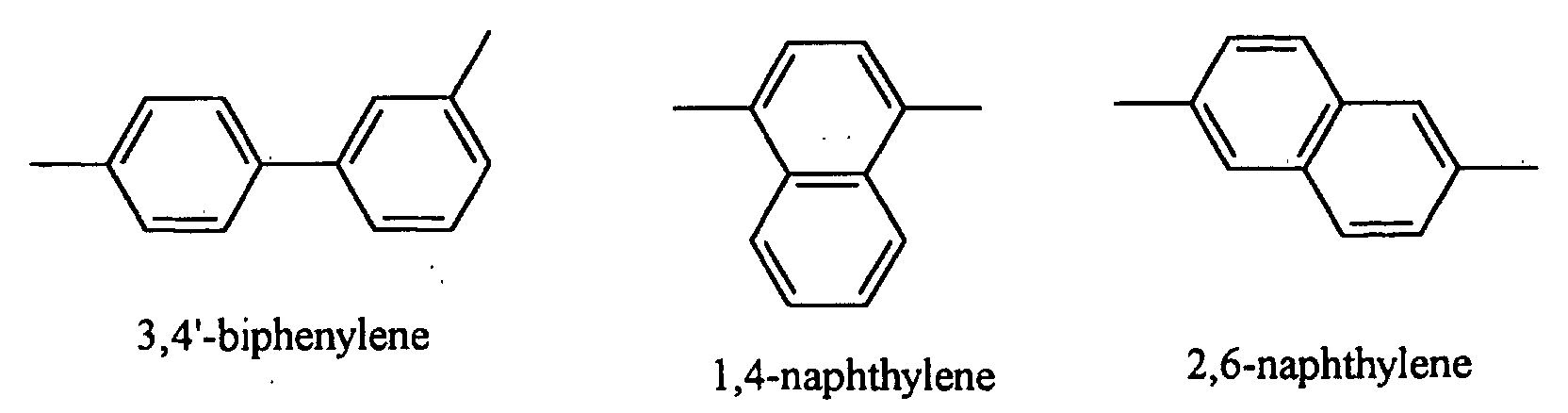
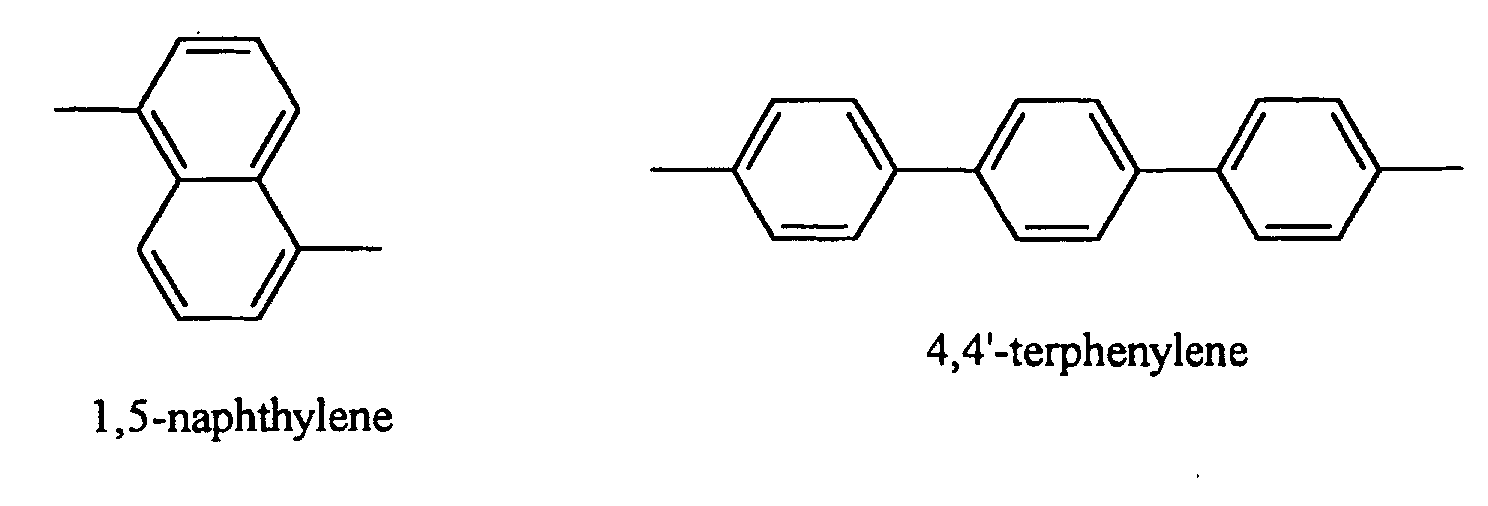
- arylene groups include those with from 7 to 25 carbon atoms, such as 1,4-phenylene, 1,3-phenylene, 4,4'-biphenylene, 3,4'-biphenylene, 1,4-naphthylene, 2,6-naphthylene, 1,5-naphthylene, 4,4'-terphenylene, and substituted derivatives thereof with substituents of, for example, alkyl with 1 to 5 carbon atoms, phenyl, and aryl with substituents of halogen atom, alkyl and alkoxy with 1 to 12 carbons, and the like.
- Illustrative arylenes are represented by the following formulas:
- the indolocarbazole hole transport compounds (Ia) through (VIa), wherein R 1 and R 2 are aryl groups, can be prepared by Ullmann condensation of the corresponding dihydroindolocarbazole precursors selected from those represented by Formulas (Ib) through (VIb) with aryl halide in the presence of a copper catalyst, especially a ligand copper catalyst as illustrated in U.S. Patents 5,538,829; 5,648,542; 5,654,482 and 5,648,539.
- dihydroindolocarbazoles which can be readily obtained by known literature processes, are, for example, 5,11-dihydroindolo[3,2-b]carbazole, 5,7-dihydroindolo[2,3-b]carbazole, 5,12-dihydroindolo[3,2-c]carbazole, 5,10-dihydroindolo[3,2-a]carbazole, 11,12-dihydroindolo[2,3-a]carbazole, and the like.
- aryl halides that can be utilized for the Ullmann condensation are iodobenzene, 3-iodotoluene, 4-iodotoluene, 4-iodo-1,2-xylene, 1-iodonaphthalene, 2-iodonaphthalene, 4-iodobiphenyl, 4-iodo-4'-(3-methyldiphenylamino)-1,1'-biphenyl, 4-iodo-4'-(diphenylamino)-1,1'-biphenyl, N,N-diphenyl-4-iodoaniline, N-phenyl-N-3-tolyl-4-iodoaniline, and the like.
- the Ullmann condensation is generally accomplished in an inert solvent, such as dodecane, tridecance, xylene, sulfolane, high boiling petroleum ethers with boiling point of, for example, over 150°C, and the like, at a reaction temperature ranging from 90°C to 300°C, and preferably from 150°C to 250°C.
- Any copper catalysts suitable for Ullmann condensation including copper powder, copper (I) oxide, copper (I) chloride, copper (II) sulfate, copper (II) acetate, and the like, may be employed for the process of the present invention.
- An effective molar ratio of the copper catalyst to the dihydroindolocarbazole compound ranges from 0.01 to 0.5.
- the condensation reaction can be greatly accelerated with a base, such as for example an alkaline metal hydroxide or carbonate including potassium hydroxide, potassium carbonate, sodium hydroxide, and the like.
- a base such as for example an alkaline metal hydroxide or carbonate including potassium hydroxide, potassium carbonate, sodium hydroxide, and the like.
- the reaction mixture is cooled down to about room temperature, and the product is isolated by known separation techniques such as, for example, by filtration and chromatography.
- the product is generally characterized by known analytical techniques such as IR and NMR.
- the indolocarbazole hole transport molecules may be utilized in many forms in various applications. For example, they can be used as thin films formed of one or more of the indolocarbazole compounds, or mixtures with other known hole transport materials, such as those based on triarylamines, reference for example U.S. Patent 4,265,990.
- the films may be formed by many fabrication techniques, such as for example vacuum deposition, spin coating, or molecular beam epitaxy technique.
- the indolocarbazole hole transport compounds can be dispersed in a polymer matrix, or in a sol gel matrix. Any conventional polymers, such as polycarbonates, polyesters, or polyhydrocarbons, and inorganic polymers, may be employed as the matrix binders for these applications.
- R and R' can be positioned at various different appropriate locations on the aromatic components, like the benzene ring.
- the mixture was heated to about 65°C (Centigrade throughout) until an exothermic reaction occurred.
- the reaction mixture was cooled with an ice bath, and within 5 minutes a light brown solid was formed.
- the reaction mixture was allowed to remain at room temperature, about 25°C, for about 18 hours, and filtered.
- the filtered cake was then washed with acetic acid, water, and then stirred in boiling methanol for 30 minutes before filtering and drying in vacuo for 2 to 5 hours to provide 7.2 grams of pure 5,11-dihydroindolo[3,2-b]carbazole as pale yellow crystals.
- the mixture was cooled to about 100°C, and 100 milliliters of toluene and 15 milliliters of water were then added with vigorous stirring.
- the resulting two phase mixture was transferred into a separatory funnel and the layers separated.
- the organic phase, which contained the desired product, was washed with water, and treated with 25 grams of alumina under an argon atmosphere, and filtered. The filtrate was then evaporated and the residue was recrystallized from cyclohexane to provide 6.8 grams of pure, about 99.9 percent, 5,11-di-m-tolyl-5,11-dihydroindolo-[3,2-b]carbazole (1).
- reaction mixture was cooled to about 100°C, and 100 milliliters of toluene and 15 milliliters of water were then added with vigorous stirring.
- the resulting two phase mixture was transferred into a separatory funnel and the layers separated.
- the organic phase was washed with water, treated under argon with 25 grams of alumina, and filtered. The filtrate was evaporated and the residue was recrystallized from cyclohexane to provide 7.5 grams of pure, about 99.8 percent, 5,11-di-bis(3,4-dimethylphenyl)-m-5,11-dihydroindolo [3,2-b]carbazole (2).
- reaction mixture was cooled to about 100°C, and 100 milliliters of toluene and 15 milliliters of water were then added with vigorous stirring for 30 minutes.
- the resulting two phase mixture was transferred into a separatory funnel and the layers separated.
- the organic phase which contains the desired product was washed with water, treated with 25 grams of alumina under an argon atmosphere, and filtered. The filtrate was then evaporated and the residue was recrystallized from toluene to provide 2.5 grams of pure, about 99.9 percent, 5,11-di-1-naphthyl-5,11-dihydroindolo [3,2-b]carbazole (3).
- reaction mixture Under an argon atmosphere, the reaction mixture was heated to about 250°C with a heating mantle and allowed to proceed at this temperature to completion in about 6 hours. The reaction mixture was cooled to 25°C to induce precipitation of reaction product. The solid product was filtered, washed with water, and filtered. The crude product was purified by column chromatography on alumina using hot toluene as an eluant to provide 3.45 grams of pure, about 99.9 percent, 5,11-bis[4'-(3-methyldiphenylamino)-1,1'-biphenyl-4-yl]-5,11-dihydroindolo-[3,2-b]carbazole (8).
- a photoconductive imaging member can be prepared by sequentially coating a photogenerator layer and a hole transport layer on a supporting substrate of a titanized MYLAR®, which can be precoated with a thin 0.025 ⁇ m (micron) silane blocking layer and a thin 0.1 ⁇ m (micron) polyester adhesive layer.
- the photogenerating layer can be comprised of a number of photogenerating pigments, such as hydroxygallium phthalocyanine Type V.
- a dispersion of Type V hydroxygallium phthalocyanine can be prepared by milling 0.125 gram of the Type V, and 0.125 gram of polystyrene-b-polyvinylpyridine in 9.0 grams of chlorobenzene in a 30 milliliter glass bottle containing 70 grams of 3.2 mm (1/8 inch) stainless steel balls. The bottle is placed on a Norton roller mill operating at 300 rpm for 20 hours. The dispersion is then coated on the titanized MYLAR® substrate using 0,025 mm (1 mil) film applicator to form, it is believed, a photogenerator layer. The formed photogenerating layer HOGaPc is dried at 135°C for 20 minutes to a final thickness of about 0.3 ⁇ m (micron).
- HOGaPC hydroxygallium phthalocyanine
- a hole transporting layer solution can prepared by dissolving 3 grams of the indolocarbazole, such as those of the above Examples, and 3.5 grams of polycarbonate in 40 grams of dichloromethane. The solution was coated onto the HOGaPc generator layer using a 0,15 mm (6 mil) film applicator. The charge transporting layer thus obtained was dried at from 100°C to 135°C and dried.
- the xerographic electrical properties of the imaging members can be determined by known means, including electrostatically charging the surfaces thereof with a corona discharge source until the surface potentials, as measured by a capacitively coupled probe attached to an electrometer, attained an initial value V o of about -800 volts. After resting for 0.5 second in the dark, the charged members can it is believed attained a surface potential of V ddp , dark development potential.
- the member when exposed to light from a filtered Xenon lamp with a XBO 150 watt bulb, induced a photodischarge which resulted in a reduction of surface potential to a V bg value, background potential.
- the percent of photodischarge was calculated as 100 x (V ddp -V bg )/V ddp .
- the desired wavelength and energy of the exposed light can be determined by the type of filters placed in front of the lamp.
- the monochromatic light photosensitivity was determined using a narrow bandpass filter.
Landscapes
- Physics & Mathematics (AREA)
- General Physics & Mathematics (AREA)
- Chemical & Material Sciences (AREA)
- Organic Chemistry (AREA)
- Indole Compounds (AREA)
- Photoreceptors In Electrophotography (AREA)
- Electroluminescent Light Sources (AREA)
Description
- This invention is generally directed to photoconductive imaging members containing indolocarbazole compounds as organic charge, especially hole transport molecules, and also in embodiments to the use of organic hole transport molecules that are suitable for layered electroluminescent (EL) devices. In embodiments, the present invention is directed to the use of organic hole transport molecules which enable the design and fabrication of thermally and morphologically stable hole transport components, and which components possess enhanced operational stability, and thus long operational life. More specifically, the present invention in embodiments relates to the use of indolocarbazole hole transport compounds which can be selected for the preparation of thermally and morphologically stable thin film hole transport layers for photoconductive imaging members. The photoconductive imaging members can be comprised of the indolocarbazole compounds as charge transport components, and more specifically, wherein the imaging members are comprised of a supporting substrate, such as a metal, or a metallized polymer like aluminized MYLAR®, a photogenerating layer of, for example, hydroxygallium phthalocyanines, titanyl phthalocyanines, perylenes, especially BZP, chlorindinium phthalocyanines, selenium, especially trigonal selenium, and the like. Examples of supporting substrates, photogenerating components, and other components for the imaging member are illustrated in a number of U.S. Patents, such as 4,265,990 and 5,645,965.
- The imaging members of the present invention in embodiments exhibit excellent cyclic stability, independent layer discharge, and substantially no adverse changes in performance over extended time periods. The aforementioned photoresponsive, or photoconductive imaging members can be negatively charged when the photogenerating layer is situated between the hole transport layer and the substrate. Processes of imaging, especially xerographic imaging and printing, including digital, are also encompassed by the present invention.
- More specifically, the layered photoconductive imaging members can be selected for a number of different known imaging and printing processes including, for example, electrophotographic imaging processes, especially xerographic imaging and printing processes wherein negatively charged or positively charged images are rendered visible with toner compositions of an appropriate charge polarity. The imaging members as indicated herein are in embodiments sensitive in the wavelength region of, for example, from 550 to 900 nanometers, and in particular, from 700 to 850 nanometers, thus diode lasers can be selected as the light source. Moreover, the imaging members of the present invention are preferably useful in color xerographic applications where several color printings can be achieved in a single pass.
- It is an object of the present invention to provide improved layered photoresponsive imaging members with a sensitivity to visible light, and which members possess improved electricals and improved coating characteristics, and wherein the charge transport molecules do not diffuse, or there is minimum diffusion thereof into the photogenerating layer.
- Another object of the present invention is to provide improved layered photoresponsive imaging members with photosensitivity to near infrared radiations, for example from 750 to 950 nanometers, and to visible light of a wavelength of from 500 to 800 nanometers.
- The present invention provides a photoconductive imaging member according to claim 1. Preferred embodiments of the present invention are set forth in the sub-claims.
- In embodiments, the present invention relates to the provision of imaging members, and more specifically, the photoconductive imaging members are comprised of an optional supporting substrate, a photogenerating layer of, for example, hydroxygallium phthalocyanine, BZP perylene, and the like, reference U.S. Patent 4,587,189, and an indolocarbazole charge transport layer.
- In embodiments, the present invention relates to a photoconductive imaging member comprised of a charge transport layer comprised of an indolocarbazole represented by the Formulas (Ia), (IIa), (IIIa), (IVa), (Va), or (VIa); or optionally mixtures thereof:

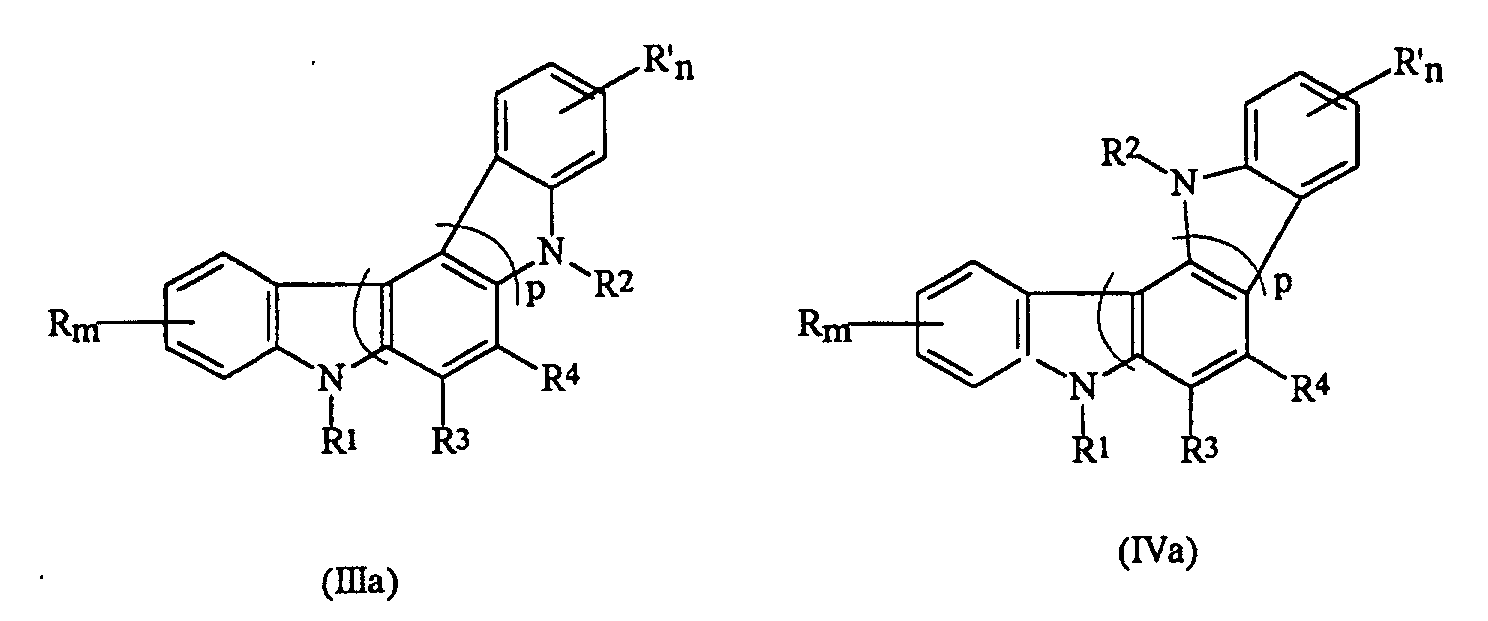 wherein R and R' are independently selected from the group consisting of a hydrogen atom, a halogen atom, alkyl, alkoxyl, and aryl; m and n are numbers of from 0 to 4; R1 and R2 are independently selected from the group consisting of alkyl, aryl, vinyl, and diarylaminoaryl; R3 and R4 are an atom of hydrogen, alkyl, alkoxy, aryl, or halogen, and p is a number of from 1 to 3. Preferably, the aryl group is a fused aromatic ring; said fused ring being preferably benzo.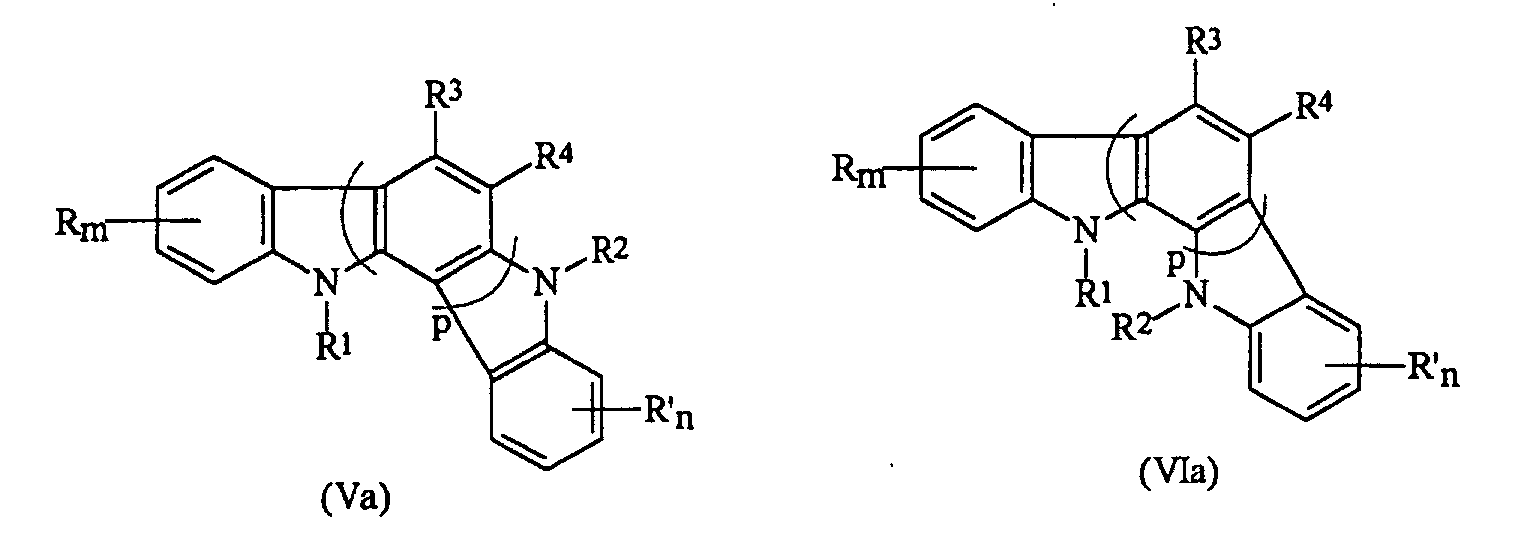
- Preferably, the alkyl group contains from 1 to 25 carbon atoms, alkoxy contains from 1 to 25 carbon atoms, and aryl contains from 6 to 30 carbon atoms. More preferably, alkyl contains from 1 to 10 carbon atoms, alkoxy contains from 2 to 12 carbon atoms, and aryl contains from 6 to 18 carbon atoms. It is even more preferred that alkyl contains from 1 to 6 carbon atoms, and alkoxy contains from 1 to 6 carbon atoms. Most preferably, alkyl is methyl, ethyl, propyl, butyl, pentyl, heptyl, or hexyl, and alkoxy is methoxy, ethoxy, propoxy, butoxy, pentoxy, or heptoxy. The halogen is a chlorine, bromine, fluorine, or iodine atom. It is also preferred that aryl is phenyl. The numbers m and n are usually 1, 2, 3, or 4. Preferably, R and R' are hydrogen atoms, or alkyl, and R1 and R2 are aryl. Moreover, R3 and R4 are preferably hydrogen atoms. Typically, R1 and R2 are independently selected from the group consisting of phenyl, naphthyl, and biphenyl. It is preferred that R1 or R2 are diarylaminoaryl as represented by Formula (VII):wherein A is arylene, and Ar1 and Ar2 are aryl. In this embodiment, it is preferred that A is selected from the group consisting of phenylene and biphenylene, and Ar1 and Ar2 are aryl groups independently selected from the group consisting of phenyl, tolyl, xylyl, chlorophenyl, alkoxyphenyl, and naphthyl.

- Preferably, indolocarbazole (Ia), or (IIa) is selected for use in the imaging member. In this case, said indolocarbazole is preferably 5,11-di-m-tolyl-5,11-dihydroindolo[3,2-b]carbazole, 5,11-bis(3,4-dimethylphenyl)-5,11-dihydroindolo[3,2-b]carbazole, 5,11-di-1-naphthyl-5,11-dihydroindolo[3,2-b]carbazole, 5,11-bis(3-methoxyphenyl)-5,11-dihydroindolo[3,2-b] carbazole, or 5,11-bis[4'-(3-methyldiphenylamino)-1,1'-biphenyl-4-yl]-5,11-dihydroindolo[3,2-b]carbazole.
- In one embodiment, the member is comprised of a supporting substrate, a photogenerating layer, and a charge transport layer, and said charge transport layer is comprised of said indolocarbazoles. In this embodiment, said photogenerating layer is preferably comprised of photogenerating components of selenium, metal free phthalocyanines, metal phthalocyanines, hydroxygallium phthalocyanines, perylenes, or titanyl phthalocyanines. It is also preferred that said photogenerating layer is situated between the substrate and the charge transport layer, and said charge transport layer components are dispersed in a resin binder. It is further preferred that the supporting substrate is comprised of a conductive substrate, or a polymer, the photogenerator layer has a thickness of from 0.05 to 10 µm (microns), the indolocarbazole transport layer has a thickness of from 5 to 30 µm (microns), and the photogenerating layer components are optionally dispersed in a resinous binder in an amount of from 5 percent by weight to 95 percent by weight.
- Preferably, the photoconductive imaging member comprised of a supporting substrate, a photogenerating layer, and a charge transport layer, and wherein said charge transport layer is comprised of an indolocarbazole represented by the Formulas (Ia), (IIa), (IIIa), (IVa), (Va), or (VIa):

 wherein R and R' are independently selected from the group consisting of a hydrogen atom, a halogen atom, alkyl, alkoxyl, and aryl; m and n are numbers of from 0 to 4. R1 and R2 are independently selected from the group consisting of alkyl, aryl, and diarylaminoaryl; R3 and R4 are an atom of hydrogen, alkyl, alkoxy, aryl, or halogen, and p is a number of from 1 to 3.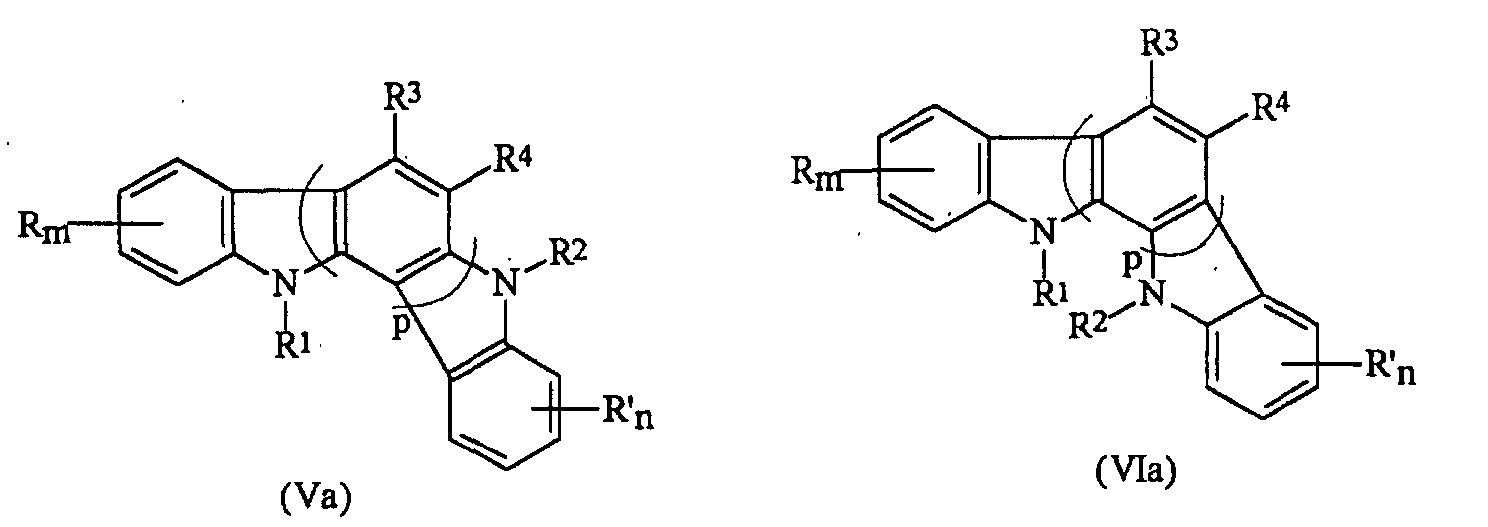
- The indolocarbazoles represented by Formulas (Ia) through (VIa) may be prepared by a process which comprises the condensation of a dihydroindolocarbazole (Ib), (IIb), (IIIb), (IVb), (Vb), or (VIb) with an aryl halide in the presence of a copper catalyst:
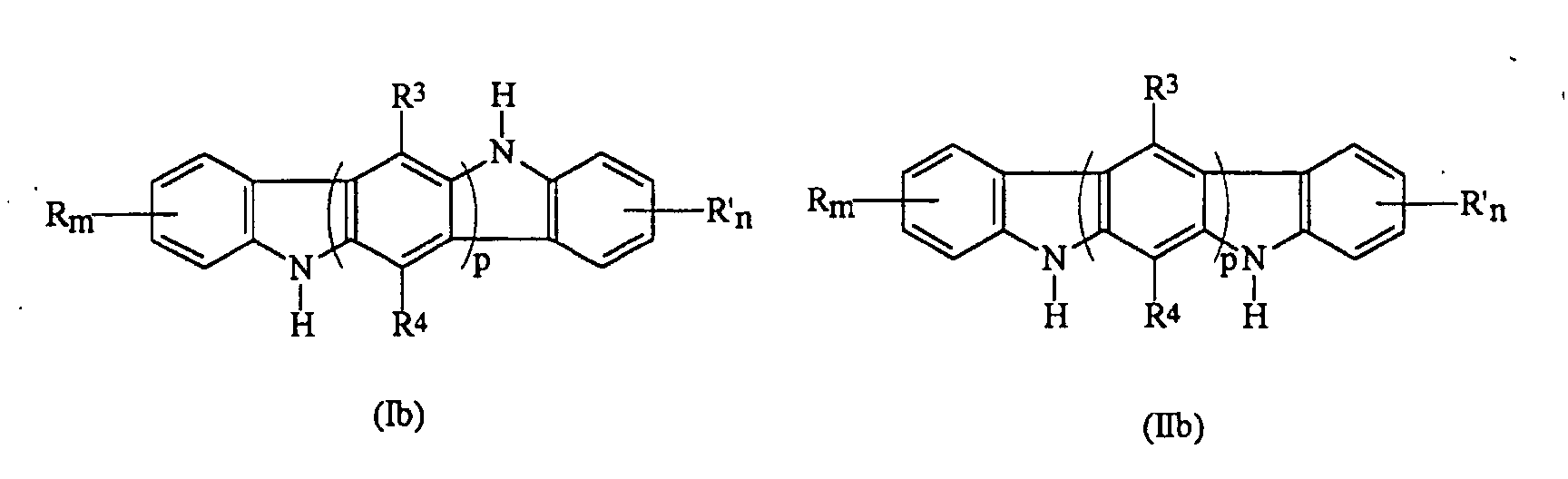
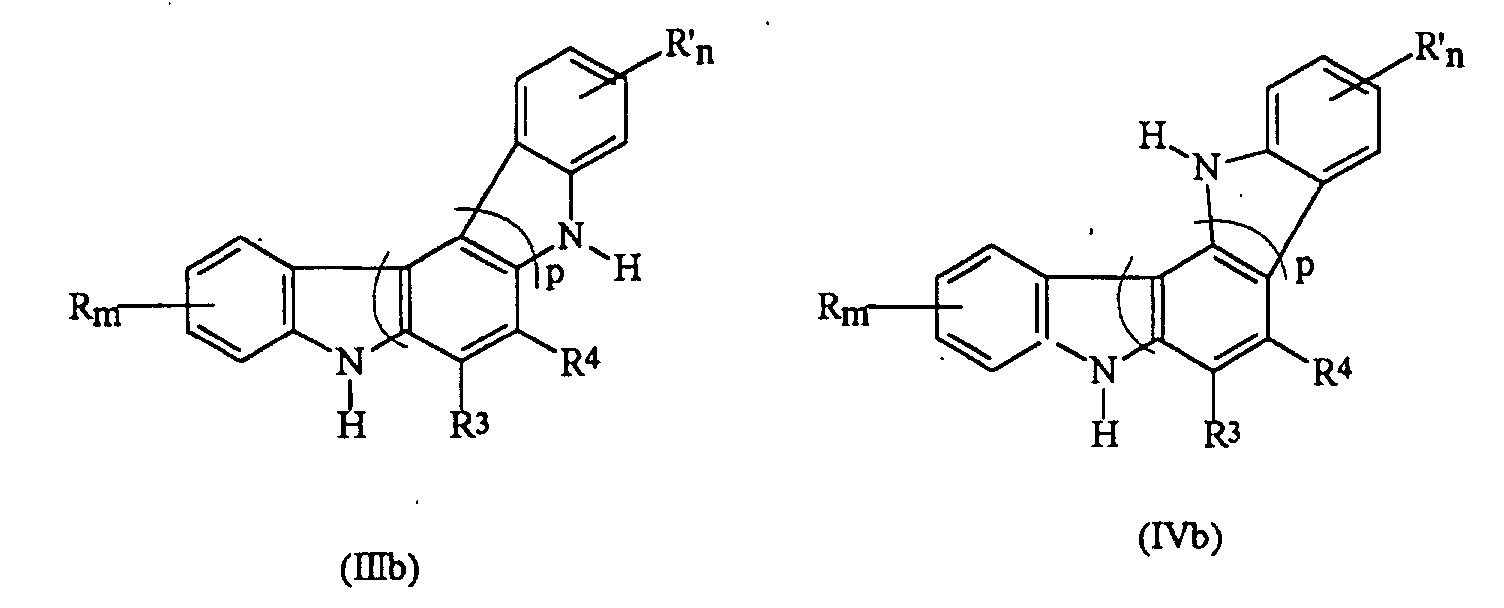 wherein R and R' are independently selected from the group consisting of hydrogen, halogen, alkyl, alkoxyl, diarylaminoaryl, and aryl; m and n are numbers of from 0 to 4; R3 and R4 are hydrogen, alkyl, alkoxy, aryl, or halogen, and p is a number of from 1 to 3. Preferably, said condensation is conducted by heating at a reaction temperature of from 120°C to 250°C. Said aryl halide may be an aryl iodide, and said copper catalyst may be selected from the group consisting of copper powder, copper (I) oxide, copper (I) chloride, copper (II) sulfate, copper (II) acetate, and a copper compound salt, and a ligand selected from the group consisting of monodentate tertiary amines and bidentate tertiary amines.
- A method of imaging which comprises generating an electrostatic latent image on the imaging member comprised in the following order of a supporting substrate, a photogenerator layer, and an indolocarbazole of the formulas illustrated herein; developing the latent image; and transferring the developed electrostatic image to a suitable substrate; and wherein the imaging member is exposed to light of a wavelength of from 400 to 800 nanometers.
- The imaging members of the present invention can in embodiments be prepared by a number of known methods, the process parameters and the order of coating of the layers being dependent, for example, on the member desired. The photogenerating and charge transport layers of the imaging members can be coated as solutions or dispersions onto a selective substrate by the use of a spray coater, dip coater, extrusion coater, roller coater, wire-bar coater, slot coater, doctor blade coater, gravure coater, and the like; and dried at from 40 to 200°C for from 10 minutes to several hours under stationary conditions or in an air flow. The coating can be accomplished to provide a final coating thickness of from 0.01 to 30 µm (microns) after drying. The fabrication conditions for a given photoconductive layer can be tailored to achieve optimum performance and cost in the final members.
- Examples of substrate layers selected for the imaging members of the present invention can be opaque or substantially transparent, and may comprise any suitable material having the requisite mechanical properties. Thus, the substrate may comprise a layer of insulating material including inorganic or organic polymeric materials, such as MYLAR® a commercially available polymer, MYLAR® containing titanium, a layer of an organic or inorganic material having a semiconductive surface layer, such as indium tin oxide, or aluminum arranged thereon, or a conductive material inclusive of aluminum, chromium, nickel, brass or the like. The substrate may be flexible, seamless, or rigid, and many have a number of many different configurations, such as for example a plate, a cylindrical drum, a scroll, an endless flexible belt, and the like. In one embodiment, the substrate is in the form of a seamless flexible belt. In some situations, it may be desirable to coat on the back of the substrate, particularly when the substrate is a flexible organic polymeric material, an anticurl layer, such as for example polycarbonate materials commercially available as MAKROLON®.
- The thickness of the substrate layer depends on many factors, including economical considerations, thus this layer may be of substantial thickness, for example over 3,000 µm (microns), or of minimum thickness providing there are no adverse effects on the system. In embodiments, the thickness of this layer is from 75 µm (microns) to 300 µm (microns).
- Generally, the thickness of the photogenerator layers depends on a number of factors, including the thicknesses of the other layers and the amount of photogenerator material contained in these layers. Accordingly, this layer can be of a thickness of, for example, from 0.05 µm (micron) to 15 µm (microns), and more specifically, from 0.25 µm (micron) to 1 µm (micron) when, for example, each of the photogenerator compositions, or pigments is present in an amount of from 30 to 75 percent by volume. The maximum thickness of the layers in an embodiment is dependent primarily upon factors, such as photosensitivity, electrical properties and mechanical considerations. The photogenerating layer binder resin, optionally present in various suitable amounts, for example from 1 to 20, and more specifically, from 1 to 10 weight percent, may be selected from a number of known polymers, such as poly(vinyl butyral), poly(vinyl carbazole), polyesters, polycarbonates, poly(vinyl chloride), polyacrylates and methacrylates, copolymers of vinyl chloride and vinyl acetate, phenoxy resins, polyurethanes, poly(vinyl alcohol), polyacrylonitrile, polystyrene, and the like. In embodiments of the present invention, it is desirable to select a coating solvent that does not disturb or adversely effect the other previously coated layers of the device. Examples of solvents that can be selected for use as coating solvents for the photogenerator layers are ketones, alcohols, aromatic hydrocarbons, halogenated aliphatic hydrocarbons, ethers, amines, amides, esters, and the like. Specific examples are cyclohexanone, acetone, methyl ethyl ketone, methanol, ethanol, butanol, amyl alcohol, toluene, xylene, chlorobenzene, carbon tetrachloride, chloroform, methylene chloride, trichloroethylene, tetrahydrofuran, dioxane, diethyl ether, dimethyl formamide, dimethyl acetamide, butyl acetate, ethyl acetate, methoxyethyl acetate, and the like.
- The coating of the photogenerator layers in embodiments of the present invention can be accomplished with spray, dip or wire-bar methods such that the final dry thickness of the photogenerator layer is, for example, from 0.01 to 30 µm (microns) and preferably from 0.1 to 15 µm (microns) after being dried at, for example, 40°C to 150°C for 5 to 90 minutes.
- Illustrative examples of polymeric binder materials that can be selected for the photogenerator pigments are as indicated herein, and include those polymers as disclosed in U.S. Patent 3,121,006.
- As optional adhesives usually in contact with the supporting substrate, there can be selected various known substances inclusive of polyesters, polyamides, poly(vinyl butyral), poly(vinyl alcohol), polyurethane and polyacrylonitrile. This layer is of a thickness of, for example, from 0.001 µm (micron) to 1 µm (micron). Optionally, this layer may contain effective suitable amounts, for example from 1 to 10 weight percent, conductive and nonconductive particles, such as zinc oxide, titanium dioxide, silicon nitride, carbon black, and the like, to provide, for example, in embodiments of the present invention further desirable electrical and optical properties.
- Examples of the highly insulating and transparent polymer binder material for the transport layer include components, such as those described in U.S. Patent 3,121,006. Specific examples of polymer binder materials include polycarbonates, acrylate polymers, vinyl polymers, cellulose polymers, polyesters, polysiloxanes, polyamides, polyurethanes and epoxies as well as block, random or alternating copolymers thereof. Preferred electrically inactive binders are comprised of polycarbonate resins having a molecular weight of from 20,000 to 100,000 with a molecular weight of from 50,000 to 100,000 being particularly preferred. Generally, the transport layer contains from 10 to 75 percent by weight of the charge transport material; and preferably from 35 percent to 50 percent of this material.
- Specifically, the photoconductive imaging member of the present invention is comprised of an indolocarbazole represented by the alternative Formulas (Ia) through (VIa), wherein R and R' are independently selected from the group consisting of a hydrogen atom, a halogen atom, alkyl, alkoxy, and aryl; m and n are numbers of 0 to 4; R1 and R2 are independently selected from the group consisting of alkyl, aryl, and diarylaminoaryl groups; R3 and R4 are hydrogen atom, alkyl, alkoxy, aryl, or halogen atom, and p is a number of from 1 to 3. The indolocarbazole compounds possess a number of advantages as illustrated herein, inclusive of for example that they display excellent hole transporting capability, superior thermal stability, and they can also be vacuum deposited as thin film hole transport components. The indolocarbazoles when selected as hole transport components, greatly improve the operational performance and life span of the imaging member.
- Specific examples of aryl groups selected for R1 and R2 are as indicated herein, and include, for example, phenyl, biphenylyl, naphthyl, thienyl and the like, and their substituted derivatives with substituents, such as alkyl, alkoxy, aryl, and halogen atoms. Aminoaryl groups can also be selected for R1 and R2 and these groups can be represented by Formula (VII).wherein A is an arylene; Ar1, Ar2 are aryl groups with from 6 to 30 carbon atoms independently selected from, for example, the group consisting of phenyl, tolyl, xylyl, halophenyl, such as chlorophenyl, alkoxyphenyl, naphthyl and the like. Illustrative examples of arylene groups include those with from 7 to 25 carbon atoms, such as 1,4-phenylene, 1,3-phenylene, 4,4'-biphenylene, 3,4'-biphenylene, 1,4-naphthylene, 2,6-naphthylene, 1,5-naphthylene, 4,4'-terphenylene, and substituted derivatives thereof with substituents of, for example, alkyl with 1 to 5 carbon atoms, phenyl, and aryl with substituents of halogen atom, alkyl and alkoxy with 1 to 12 carbons, and the like. Illustrative arylenes are represented by the following formulas:


- The indolocarbazole hole transport compounds (Ia) through (VIa), wherein R1 and R2 are aryl groups, can be prepared by Ullmann condensation of the corresponding dihydroindolocarbazole precursors selected from those represented by Formulas (Ib) through (VIb) with aryl halide in the presence of a copper catalyst, especially a ligand copper catalyst as illustrated in U.S. Patents 5,538,829; 5,648,542; 5,654,482 and 5,648,539. Specific examples of dihydroindolocarbazoles, which can be readily obtained by known literature processes, are, for example, 5,11-dihydroindolo[3,2-b]carbazole, 5,7-dihydroindolo[2,3-b]carbazole, 5,12-dihydroindolo[3,2-c]carbazole, 5,10-dihydroindolo[3,2-a]carbazole, 11,12-dihydroindolo[2,3-a]carbazole, and the like.
- Illustrative examples of aryl halides that can be utilized for the Ullmann condensation are iodobenzene, 3-iodotoluene, 4-iodotoluene, 4-iodo-1,2-xylene, 1-iodonaphthalene, 2-iodonaphthalene, 4-iodobiphenyl, 4-iodo-4'-(3-methyldiphenylamino)-1,1'-biphenyl, 4-iodo-4'-(diphenylamino)-1,1'-biphenyl, N,N-diphenyl-4-iodoaniline, N-phenyl-N-3-tolyl-4-iodoaniline, and the like. The Ullmann condensation is generally accomplished in an inert solvent, such as dodecane, tridecance, xylene, sulfolane, high boiling petroleum ethers with boiling point of, for example, over 150°C, and the like, at a reaction temperature ranging from 90°C to 300°C, and preferably from 150°C to 250°C. Any copper catalysts suitable for Ullmann condensation, including copper powder, copper (I) oxide, copper (I) chloride, copper (II) sulfate, copper (II) acetate, and the like, may be employed for the process of the present invention. An effective molar ratio of the copper catalyst to the dihydroindolocarbazole compound ranges from 0.01 to 0.5. The condensation reaction can be greatly accelerated with a base, such as for example an alkaline metal hydroxide or carbonate including potassium hydroxide, potassium carbonate, sodium hydroxide, and the like. After the condensation, the reaction mixture is cooled down to about room temperature, and the product is isolated by known separation techniques such as, for example, by filtration and chromatography. The product is generally characterized by known analytical techniques such as IR and NMR.
- The indolocarbazole hole transport molecules may be utilized in many forms in various applications. For example, they can be used as thin films formed of one or more of the indolocarbazole compounds, or mixtures with other known hole transport materials, such as those based on triarylamines, reference for example U.S. Patent 4,265,990. The films may be formed by many fabrication techniques, such as for example vacuum deposition, spin coating, or molecular beam epitaxy technique. In another application, as active hole transport components in a transport medium, the indolocarbazole hole transport compounds can be dispersed in a polymer matrix, or in a sol gel matrix. Any conventional polymers, such as polycarbonates, polyesters, or polyhydrocarbons, and inorganic polymers, may be employed as the matrix binders for these applications.
- Illustrative examples of specific indolocarbazole compounds as represented by Formulas (Ia) through (VIa), which can be selected for use in the photoconductive imaging members of the present invention, with the preferred ones being (1), (2), (3), (4), (7), (8), (11), (13), (19), (24), (25), (30), (36), (41), (43), (46), (48), (49), and 51, are:
- (1) 5,11-di-m-tolyl-5,11-dihydroindolo[3,2-b]carbazole,
- (2) 5,11-bis(3,4-dimethylphenyl)-5,11-dihydroindolo[3,2-b] carbazole,
- (3) 5,11-di-1-naphthyl-5,11-dihydroindolo[3,2-b]carbazole,
- (4) 5,11-bis[4'-(3-methyldiphenylamino)-1,1'-biphenyl-4-yl]-5,11-dihydroindolo[3,2-b]carbazole,
- (5) 5,11-diphenyl-5,11-dihydroindolo[3,2-b]carbazole,
- (6) 5,11-bis-(1,1-biphenyl-4-yl)-5,11-dihydroindolo[3,2-b] carbazole,
- (7) 5,11-bis(3-methoxyphenyl)-5,11-dihydroindolo[3,2-b]carbazole,
- (8) 5,11-bis(4-chlorophenyl)-5,11-dihydroindolo[3,2-b]carbazole,
- (9) 5,11-bis[4'-(4-methyldiphenylamino)-1,1'-biphenyl-4-yl]-5,11-dihydroindolo[3,2-b]carbazole,
- (10) 5,11-bis[4'-(diphenylamino)-1,1'-biphenyl-4-yl]-5,11-dihydroindolo[3,2-b]carbazole,
- (11) 5,11-bis[4'-(di-p-tolylamino)-1,1'-biphenyl-4-yl]-5,11-dihydroindolo[3,2-b]carbazole,
- (12) 5,11-bis[4'-(3,4-dimethyldiphenylamino)-1,1'-biphenyl-4-yl]-5,11-dihydroindolo[3,2-b]carbazole,
- (13) 5,11-bis[4'-(3-methoxydiphenylamino)-1,1'-biphenyl-4-yl]-5,11-dihydroindolo[3,2-b]carbazole,
- (14) 5,11-bis[4'-(3-chlorodiphenylamino)-1,1'-biphenyl-4-yl]-5,11-dihydroindolo[3,2-b]carbazole,
- (15) 5,11-bis[4'-(4-chlorodiphenylamino)-1,1'-biphenyl-4-yl]-5,11-dihydroindolo[3,2-b]carbazole,
- (16) 5,11-bis[4'-(diphenylamino)-1,1'-biphenyl-4-yl]-2,8-dimethyl-5,11-dihydroindolo[3,2-b]carbazole,
- (17) 5,11-bis[4'-(4-methyldiphenylamino)-1,1'-biphenyl-4-yl]-2,8-dimethyl-5,11-dihydroindolo[3,2-b]carbazole,
- (18) 5,11-bis[4-(diphenylamino)phenyl]-5,11-dihydroindolo[3,2-b] carbazole,
- (19) 5,11-bis[4-(3-methyldiphenylamino)phenyl]-5,11-dihydroindolo[3,2-b]carbazole,
- (20) 5,11-bis[4-(4-methyldiphenylamino)phenyl]-5,11-dihydroindolo[3,2-b]carbazole,
- (21) 5,11-bis[4-(diphenylamino)phenyl]-2,8-dimethyl-5,11-dihydroindolo[3,2-b]carbazole,
- (22) 5,11-bis[4-(4-methyldiphenylamino)phenyl]-2,8-dimethyl-5,11-dihydroindolo[3,2-b]carbazole,
- (23) 5,11-bis[4-(1-naphthylphenylamino)phenyl]-5,11-dihydroindolo[3,2-b]carbazole,
- (24) 5,7-di-m-tolyl-5,7-dihydroindolo[2,3-b]carbazole,
- (25) 5,7-bis(3,4-dimethylphenyl)-5,7-dihydroindolo[2,3-b]carbazole,
- (26) 5,7-di-1-naphthyl-5,7-dihydroindolo[2,3-b]carbazole,
- (27) 5,7-diphenyl-5,7-dihydroindolo[2,3-b]carbazole,
- (28) 5,7-bis-(1,1-biphenyl-4-yl)-5,7-dihydroindolo[2,3-b]carbazole,
- (29) 5,7-bis(3-methoxyphenyl)-5,7-dihydroindolo[2,3-b]carbazole,
- (30) 5,7-bis[4'-(3-methyldiphenylamino)-1,1'-biphenyl-4-yl]-5,7-dihydroindolo[2,3-b]carbazole,
- (31) 5,7-bis[4'-(diphenylamino)-1,1'-biphenyl-4-yl]-5,7-dihydroindolo[2,3-b]carbazole,
- (32) 5,7-bis[4'-(di-p-tolylamino)-1,1'-biphenyl-4-yl]-5,7-dihydroindolo[2,3-b]carbazole,
- (33) 5,7-bis[4'-(diphenylamino)-1,1'-biphenyl-4-yl]-2,10-dimethyl-5,7-dihydroindolo[2,3-b]carbazole,
- (34) 5,7-bis[4-(diphenylamino)phenyl]-5,7-dihydroindolo[2,3-b] carbazole,
- (35) 5,7-bis[4-(3-methyldiphenylamino)phenyl]-5,7-dihydroindolo[2,3-b]carbazole,
- (36) 5,8-diphenyl-5,8-dihydroindolo[2,3-c]carbazole,
- (37) 5,8-di-m-tolyl-5,8-dihydroindolo[2,3-c]carbazole,
- (38) 5,8-bis-(1,1-biphenyl-4-yl)-5,8-dihydroindolo[2,3-c]carbazole,
- (39) 5,8-di-1-naphthyl-5,8-dihydroindolo[2,3-c]carbazole,
- (40) 5,8-bis-[4-(3-methyldiphenylamino)phenyl]-5,8-dihydroindolo[2,3-c]carbazole,
- (41) 5,8-bis[4'-(3-methyldiphenylamino)-1,1'-biphenyl-4-yl]-5,8-dihydroindolo[2,3-c]carbazole,
- (42) 5,10-diphenyl-5,10-dihydroindolo[3,2-a]carbazole,
- (43) 5,10-di-m-tolyl-5,10-dihydroindolo[3,2-a]carbazole,
- (44) 5,10-bis-(1,1-biphenyl-4-yl)-5,10-dihydroindolo[3,2-a] carbazole,
- (45) 5,10-di-1-naphthyl-5,10-dihydroindolo[3,2-a]carbazole,
- (46) 5,10-bis-[4-(3-methyldiphenylamino)phenyl]-5,10-dihydroindolo[3,2-a]carbazole
- (47) 5,12-diphenyl-5,12-dihydroindolo[3,2-c]carbazole,
- (48) 5,12-di-m-tolyl-5,12-dihydroindolo[3,2-c]carbazole,
- (49) 5,12-bis-(1,1-biphenyl-4-yl)-5,12-dihydroindolo[3,2-c] carbazole,
- (50) 5,12-di-1-naphthyl-5,12-dihydroindolo[3,2-c]carbazole,
- (51) 5,12-bis-[4-(3-methyldiphenylamino)phenyl]-5,12-dihydroindolo[3,2-c]carbazole,
- (52) 5,12-bis[4'-(3-methyldiphenylamino)-1,1'-biphenyl-4-yl]-5,12-dihydroindolo[3,2-c]carbazole
- (53) 11,12-diphenyl-11,12-dihydroindolo[2,3-a]carbazole,
- (54) 11,12-di-m-tolyl-11,12-dihydroindolo[2,3-a]carbazole,
- (55) 11,12-di-p-tolyl-11,12-dihydroindolo[2,3-a]carbazole, and the like.
-
- The substituents, such as for example, R and R', can be positioned at various different appropriate locations on the aromatic components, like the benzene ring.
- The following Examples are provided.
- Preparation of 5,11-dihydroindolo[3,2-b]carbazole: In a 1.5 liter flask equipped with a mechanical stirrer and a condenser were added glacial acetic acid (100 milliliters) and concentrated sulfuric acid (20 milliliters). Into this mixture, which was maintained at 10°C with an ice bath, was added powdered cyclohexane-1,4-dione bisphenylhydrazone (22.0 grams) in small portions with stirring. After the aforementioned addition, the ice bath was removed and the mixture was allowed to warm to 23°C, and stirred for a further 10 minutes. Subsequently, the mixture was heated to about 65°C (Centigrade throughout) until an exothermic reaction occurred. The reaction mixture was cooled with an ice bath, and within 5 minutes a light brown solid was formed. The reaction mixture was allowed to remain at room temperature, about 25°C, for about 18 hours, and filtered. The filtered cake was then washed with acetic acid, water, and then stirred in boiling methanol for 30 minutes before filtering and drying in vacuo for 2 to 5 hours to provide 7.2 grams of pure 5,11-dihydroindolo[3,2-b]carbazole as pale yellow crystals.
- A 200-milliliter 3-necked round bottom flask equipped with a mechanical stirrer, reflux condenser, and argon inlet was purged with argon and then charged with 5,11-dihydroindolo[3,2-b]carbazole (5.1 grams, 0.02 mol), 3-iodotoluene (8.69 grams, 0.04 mol), copper sulfate pentahydrate (0.25 gram, 1.0 mmol), potassium carbonate (5.52 grams, 0.04 mol), and n-tridecane (5.0 milliliters). Under an argon atmosphere, the reaction mixture was heated to about 250°C with a heating mantle and allowed to proceed at this temperature to completion in about 6 hours. The mixture was cooled to about 100°C, and 100 milliliters of toluene and 15 milliliters of water were then added with vigorous stirring. The resulting two phase mixture was transferred into a separatory funnel and the layers separated. The organic phase, which contained the desired product, was washed with water, and treated with 25 grams of alumina under an argon atmosphere, and filtered. The filtrate was then evaporated and the residue was recrystallized from cyclohexane to provide 6.8 grams of pure, about 99.9 percent, 5,11-di-m-tolyl-5,11-dihydroindolo-[3,2-b]carbazole (1).
IR (Kbr): 1,604, 1,588, 1,490, 1,475, 1,450, 1,321, 1,201, 1,153, 760, 745, 701 cm-1.
1H-NMR (CDCl3): δ 2.51 (s), 7.18-7.59 (m), 8.05 (s), 8.12 (d, J=8.5 Hz). - A 200-milliliter 3-necked round bottom flask equipped with a mechanical stirrer, reflux condenser, and argon inlet was purged with argon and then charged with 5,11-dihydroindolo[3,2-b]carbazole (5.1 grams, 0.02 mol), 3-iodotoluene (9.28 grams, 0.04 mol), copper sulfate pentahydrate (0.25 gram, 1.0 mmol), potassium carbonate (5.52 grams, 0.04 mol), and n-tridecane (5.0 milliliters). Under an argon atmosphere, the reaction mixture was heated to about 250°C with a heating mantle and allowed to proceed at this temperature to completion in about 6 hours. The reaction mixture was cooled to about 100°C, and 100 milliliters of toluene and 15 milliliters of water were then added with vigorous stirring. The resulting two phase mixture was transferred into a separatory funnel and the layers separated. The organic phase was washed with water, treated under argon with 25 grams of alumina, and filtered. The filtrate was evaporated and the residue was recrystallized from cyclohexane to provide 7.5 grams of pure, about 99.8 percent, 5,11-di-bis(3,4-dimethylphenyl)-m-5,11-dihydroindolo [3,2-b]carbazole (2).
IR (Kbr): 1,614, 1,605, 1,511, 1,458, 1,445, 1,324, 1,241, 1,183, 851, 747, 743 cm-1.
1H-NMR (CDCl3): δ 2.42 (s), 2.44 (s), 7.14 to 7.47 (m), 8.03 (s), 8.12 (d, J=8.5 Hz). - A 200 milliliter 3-necked round bottom flask equipped with a mechanical stirrer, reflux condenser, and argon inlet was purged with argon and then charged with 5,11-dihydroindolo[3,2-b]carbazole (5.1 grams, 0.02 mol), 1-iodonaphthalene (10.16 grams, 0.04 mol), copper sulfate pentahydrate (0.25 gram, 1.0 mmol), potassium carbonate (5.52 grams, 0.04 mol), and n-tridecane (5.0 milliliters). Under an argon atmosphere, the reaction mixture was heated to about 250°C with a heating mantle and allowed to proceed at this temperature to completion in about 6 hours. The reaction mixture was cooled to about 100°C, and 100 milliliters of toluene and 15 milliliters of water were then added with vigorous stirring for 30 minutes. The resulting two phase mixture was transferred into a separatory funnel and the layers separated. The organic phase which contains the desired product was washed with water, treated with 25 grams of alumina under an argon atmosphere, and filtered. The filtrate was then evaporated and the residue was recrystallized from toluene to provide 2.5 grams of pure, about 99.9 percent, 5,11-di-1-naphthyl-5,11-dihydroindolo [3,2-b]carbazole (3).
IR (Kbr): 1,612, 1,595, 1,576, 1,506, 1,476, 1,468, 1,450, 1,320, 1,293, 1,235, 1,189, 1,147, 803, 775, 746 cm-1.
1H-NMR (CDCl3): δ 6.98 (d, J=8.5 Hz), 7.13 to 7.48 (m), 7.54∼7.62 (m), 7.71∼7.80 (m), 8.0∼8.15 (m). - A 100 milliliter 3-necked round bottom flask equipped with a mechanical stirrer, reflux condenser, and argon inlet was purged with argon, and then charged with 5,11-dihydroindolo[3,2-b]carbazole (1.65 grams, 6.45 mmol), 4-iodo-4'-(3-methyldiphenylamino)-1,1'-biphenyl (7.1 grams, 15.5 mmol), copper sulfate pentahydrate (0.12 grams, 0.5 mmol), potassium carbonate (2.1 grams, 15.2 mmol), and n-tridecane (5.0 milliliters). Under an argon atmosphere, the reaction mixture was heated to about 250°C with a heating mantle and allowed to proceed at this temperature to completion in about 6 hours. The reaction mixture was cooled to 25°C to induce precipitation of reaction product. The solid product was filtered, washed with water, and filtered. The crude product was purified by column chromatography on alumina using hot toluene as an eluant to provide 3.45 grams of pure, about 99.9 percent, 5,11-bis[4'-(3-methyldiphenylamino)-1,1'-biphenyl-4-yl]-5,11-dihydroindolo-[3,2-b]carbazole (8).
IR (Kbr): 1,598, 1,495, 1,450, 1,320, 1,291, 1,277, 1,232, 742, 695 cm-1.
1H-NMR (DMSO-d6-CDCl3): δ 2.30 (s), 6.88∼7.51 (m), 7.66 (d, J=8.6 Hz), 7.76 (d, J=8.6 Hz), 7.93 (d, J=8.6 Hz), 7.99 (s), 8.17 (s), 8.19 (d, J=8.6 Hz). - A photoconductive imaging member can be prepared by sequentially coating a photogenerator layer and a hole transport layer on a supporting substrate of a titanized MYLAR®, which can be precoated with a thin 0.025 µm (micron) silane blocking layer and a thin 0.1 µm (micron) polyester adhesive layer. The photogenerating layer can be comprised of a number of photogenerating pigments, such as hydroxygallium phthalocyanine Type V. A dispersion of Type V hydroxygallium phthalocyanine (HOGaPC) can be prepared by milling 0.125 gram of the Type V, and 0.125 gram of polystyrene-b-polyvinylpyridine in 9.0 grams of chlorobenzene in a 30 milliliter glass bottle containing 70 grams of 3.2 mm (1/8 inch) stainless steel balls. The bottle is placed on a Norton roller mill operating at 300 rpm for 20 hours. The dispersion is then coated on the titanized MYLAR® substrate using 0,025 mm (1 mil) film applicator to form, it is believed, a photogenerator layer. The formed photogenerating layer HOGaPc is dried at 135°C for 20 minutes to a final thickness of about 0.3 µm (micron).
- A hole transporting layer solution can prepared by dissolving 3 grams of the indolocarbazole, such as those of the above Examples, and 3.5 grams of polycarbonate in 40 grams of dichloromethane. The solution was coated onto the HOGaPc generator layer using a 0,15 mm (6 mil) film applicator. The charge transporting layer thus obtained was dried at from 100°C to 135°C and dried.
- The xerographic electrical properties of the imaging members can be determined by known means, including electrostatically charging the surfaces thereof with a corona discharge source until the surface potentials, as measured by a capacitively coupled probe attached to an electrometer, attained an initial value Vo of about -800 volts. After resting for 0.5 second in the dark, the charged members can it is believed attained a surface potential of Vddp, dark development potential. The member, when exposed to light from a filtered Xenon lamp with a XBO 150 watt bulb, induced a photodischarge which resulted in a reduction of surface potential to a Vbg value, background potential. The percent of photodischarge was calculated as 100 x (Vddp-Vbg)/Vddp. The desired wavelength and energy of the exposed light can be determined by the type of filters placed in front of the lamp. The monochromatic light photosensitivity was determined using a narrow bandpass filter.
- When exposing the charged imaging member with the hydroxygallium phthalocyanine and the charge transport of Example 1, 830 nanometers of light at an intensity of 10 ergs/cm2, a photodischarge of 75 percent may be observed. The imaging member was fully discharged when it was exposed to both 680 and 830 nanometers of light.
Claims (9)
- A photoconductive imaging member comprised of a charge transport layer comprised of an indolocarbazole represented by the Formulas (Ia), (IIa), (IIIa), (IVa), (Va), or (VIa); or optionally mixtures thereof:
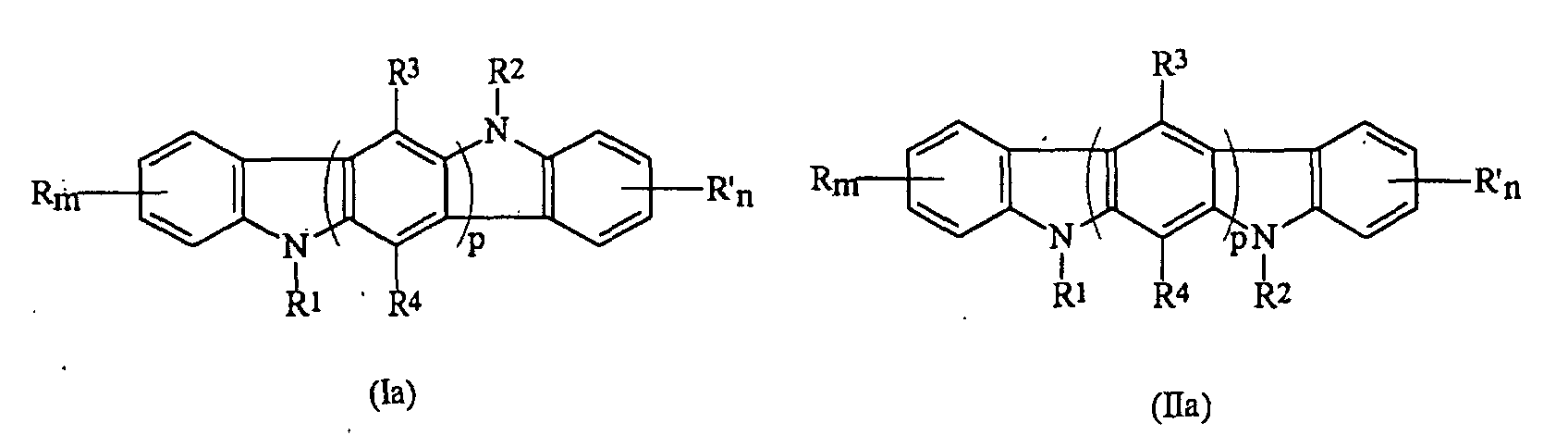
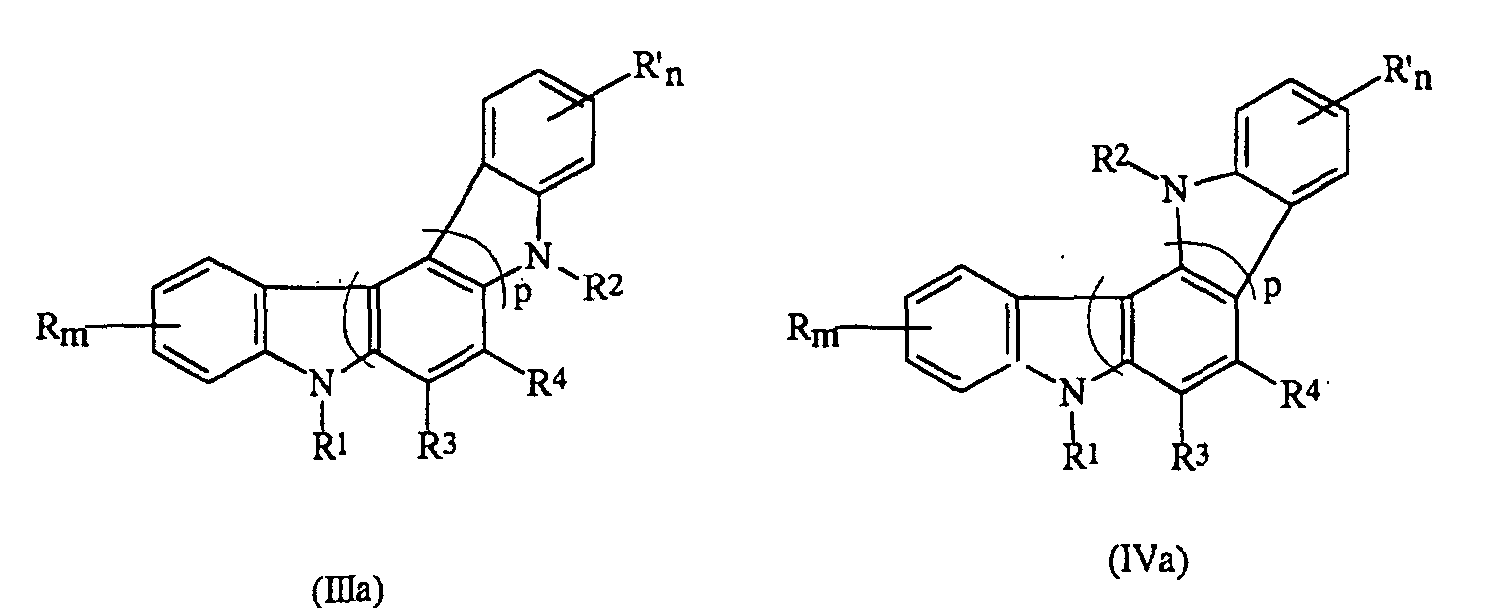 wherein R and R' are independently selected from the group consisting of a hydrogen atom, a halogen atom, alkyl, alkoxyl, and aryl; m and n are numbers of from 0 to 4; R1 and R2 are independently selected from the group consisting of alkyl, aryl, vinyl, and diarylaminoaryl; R3 and R4 are an atom of hydrogen, alkyl, alkoxy, aryl, or halogen, and p is a number of from 1 to 3.
- The member in accordance with claim 1 wherein alkyl contains from 1 to 25 carbon atoms, alkoxy contains from 1 to 25 carbon atoms, and aryl contains from 6 to 30 carbon atoms.
- The member in accordance with claim 1 or 2 wherein R and R' are hydrogen atoms, or alkyl, and R1 and R2 are aryl.
- The member in accordance with any of claims 1 to 3 wherein R1 or R2 are diarylaminoaryl as represented by Formula (VII):wherein A is arylene, and Ar1 and Ar2 are aryl.

- The member in accordance with any of claims 1 to 4 wherein said indolocarbazole is 5,11-di-m-tolyl-5,11-dihydroindolo[3,2-b]carbazole, 5,11-bis(3,4-dimethylphenyl)-5,11-dihydroindolo[3,2-b]carbazole, 5,11-di-1-naphthyl-5,11-dihydroindolo[3,2-b]carbazole, 5,11-bis(3-methoxyphenyl)-5,11-dihydroindolo[3,2-b] carbazole, or 5,11-bis[4'-(3-methyldiphenylamino)-1,1'-biphenyl-4-yl]-5,11-dihydroindolo[3,2-b]carbazole.
- The member in accordance with any of claims 1 to 5 comprised of a supporting substrate, a photogenerating layer, and a charge transport layer, and wherein said charge transport layer is comprised of said indolocarbazoles.
- The member in accordance with claim 6 wherein said photogenerating layer is comprised of photogenerating components of selenium, metal free phthalocyanines, metal phthalocyanines, hydroxygallium phthalocyanines, perylenes, or titanyl phthalocyanines.
- The member in accordance with claim 6 wherein said indolocarbazole is 5,11-di-m-tolyl-5,11-dihydroindolo[3,2-b]carbazole, 5,11-bis(3,4-dimethylphenyl)-5,11-dihydroindolo[3,2-b]carbazole, 5,11-di-1-naphthyl-5,11-dihydroindolo[3,2-b]carbazole, 5,11-diphenyl-5,11-dihydroindolo[3,2-b]carbazole, 5,11-bis-(1,1-biphenyl-4-yl)-5,11-dihydroindolo[3,2-b]carbazole, 5,11-bis(3-methoxyphenyl)-5,11-dihydroindolo[3,2-b]carbazole, 5,11-bis(4-chlorophenyl)-5,11-dihydroindolo [3,2-b]carbazole, 5,11-bis[4'-(3-methyldiphenylamino)-1,1'-biphenyl-4-yl]-5,11-dihydroindolo[3,2-b]carbazole, 5,11-bis[4'-(4-methyldiphenylamino)-1,1'-biphenyl-4-yl]-5,11-dihydroindolo[3,2-b]carbazole, 5,11-bis[4'-(diphenylamino)-1,1'-biphenyl-4-yl]-5,11-dihydroindolo[3,2-b] carbazole, 5,11-bis[4'-(diphenylamino)-1,1'-biphenyl-4-yl]-5,11-dihydroindolo[3,2-b] carbazole, 5,11-bis[4'-(di-p-tolylamino)-1,1'-biphenyl-4-yl]-5,11-dihydroindolo[3,2-b]carbazole, 5,11-bis[4'-(3,4-dimethyldiphenylamino)-1,1'-biphenyl-4-yl]-5,11-dihydroindolo[3,2-b]carbazole, 5,11-bis[4'-(3-methoxy diphenylamino)-1,1'-biphenyl-4-yl]-5,11-dihydroindolo[3,2-b]carbazole, 5,11-bis[4'-(3-chlorodiphenylamino)-1,1'-biphenyl-4-yl]-5,11-dihydroindolo[3,2-b] carbazole, 5,11-bis[4'-(4-chlorodiphenylamino)-1,1'-biphenyl-4-yl]-5,11-dihydroindolo[3,2-b]carbazole, 5,11-bis[4'-(diphenylamino)-1,1'-biphenyl-4-yl]-2,8-dimethyl-5,11-dihydroindolo[3,2-b]carbazole, 5,11-bis[4'-(4-methyldiphenylamino)-1,1'-biphenyl-4-yl]-2,8-dimethyl-5,11-dihydroindolo [3,2-b]carbazole, 5,11-bis[4-(diphenylamino)phenyl]-5,11-dihydroindolo [3,2-b]carbazole, 5,11-bis[4-(3-methyldiphenylamino)phenyl]-5,11-dihydroindolo[3,2-b]carbazole, 5,11-bis[4-(4-methyldiphenylamino)phenyl]-5,11-dihydroindolo[3,2-b]carbazole, 5,11-bis[4-(diphenylamino)phenyl]-2,8-dimethyl-5,11-dihydroindolo[3,2-b]carbazole, 5,11-bis[4-(4-methyldiphenyl amino)phenyl]-2,8-dimethyl-5,11-dihydroindolo[3,2-b]carbazole, 5,11-bis[4-(1-naphthylphenylamino)phenyl]-5,11-dihydroindolo[3,2-b]carbazole, 5,7-di-m-tolyl-5,7-dihydroindolo[2,3-b]carbazole, 5,7-bis(3,4-dimethylphenyl)-5,7-dihydroindolo[2,3-b]carbazole, 5,7-di-1-naphthyl-5,7-dihydroindolo[2,3-b] carbazole, 5,7-diphenyl-5,7-dihydroindolo[2,3-b]carbazole, 5,7-bis-(1,1-biphenyl-4-yl)-5,7-dihydroindolo[2,3-b]carbazole, 5,7-bis(3-methoxyphenyl)-5,7-dihydroindolo[2,3-b]carbazole, 5,7-bis[4'-(3-methyldiphenylamino)-1,1'-biphenyl-4-yl]-5,7-dihydroindolo[2,3-b]carbazole, 5,7-bis[4'-(diphenylamino)-1,1'-biphenyl-4-yl]-5,7-dihydroindolo[2,3-b]carbazole, 5,7-bis[4'-(di-p-tolylamino)-1,1'-biphenyl-4-yl]-5,7-dihydroindolo[2,3-b]carbazole, 5,7-bis[4'-(diphenylamino)-1,1'-biphenyl-4-yl]-2,10-dimethyl-5,7-dihydroindolo[2,3-b] carbazole, 5,7-bis[4-(diphenylamino)phenyl]-5,7-dihydroindolo[2,3-b] carbazole, 5,7-bis[4-(3-methyldiphenylamino)phenyl]-5,7-dihydroindolo [2,3-b]carbazole, 5,8-diphenyl-5,8-dihydroindolo[2,3-c]carbazole, 5,8-di-m-tolyl-5,8-dihydroindolo[2,3-c]carbazole, 5,8-bis-(1,1-biphenyl-4-yl)-5,8-dihydroindolo[2,3-c]carbazole, 5,8-di-1-naphthyl-5,8-dihydroindolo[2,3-c] carbazole, 5,8-bis-[4-(3-methyldiphenylamino)phenyl]-5,8-dihydroindolo [2,3-c]carbazole, 5,8-bis[4'-(3-methyldiphenylamino)-1,1'-biphenyl-4-yl]-5,8-dihydroindolo[2,3-c]carbazole, 5,10-diphenyl-5,10-dihydroindolo[3,2-a] carbazole, 5,10-di-m-tolyl-5,10-dihydroindolo[3,2-a]carbazole, 5,10-bis-(1,1-biphenyl-4-yl)-5,10-dihydroindolo[3,2-a]carbazole, 5,10-di-1-naphthyl-5,10-dihydroindolo[3,2-a]carbazole, 5,10-bis-[4-(3-methyldiphenylamino)phenyl]-5,10-dihydroindolo[3,2-a]carbazole, 5,12-diphenyl-5,12-dihydroindolo[3,2-c] carbazole, 5,12-di-m-tolyl-5,12-dihydroindolo[3,2-c]carbazole, 5,12-bis-(1,1-biphenyl-4-yl)-5,12-dihydroindolo[3,2-c]carbazole, 5,12-di-1-naphthyl-5,12-dihydroindolo[3,2-c]carbazole, 5,12-bis-[4-(3-methyldiphenylamino)phenyl]-5,12-dihydroindolo[3,2-c]carbazole, 5,12-bis[4'-(3-methyldiphenylamino)-1,1'-biphenyl-4-yl]-5,12-dihydroindolo[3,2-c]carbazole, 11,12-diphenyl-11,12-dihydroindolo[2,3-a]carbazole, 11,12-di-m-tolyl-11,12-dihydroindolo [2,3-a]carbazole, 11,12-di-p-tolyl-11,12-dihydroindolo[2,3-a]carbazole, (3-methoxyphenyl)-5,7-dihydroindolo[2,3-b]carbazole, 5,7-bis[4'-(3-methyl diphenylamino)-1,1'-biphenyl-4-yl]-5,7-dihydroindolo[2,3-b]carbazole, 5,7-bis[4'-(diphenylamino)-1,1'-biphenyl-4-yl]-5,7-dihydroindolo[2,3-b]carbazole, 5,7-bis[4'-(di-p-tolylamino)-1,1"-biphenyl-4-yl]-5,7-dihydroindolo[2,3-b] carbazole, 5,7-bis[4'-(diphenylamino)-1,1'-biphenyl-4-yl]-2,10-dimethyl-5,7-dihydroindolo[2,3-b]carbazole, 5,7-bis[4-(diphenylamino)phenyl]-5,7-dihydroindolo[2,3-b]carbazole, 5,7-bis[4-(3-methyldiphenylamino)phenyl]-5,7-dihydroindolo[2,3-b]carbazole, 5,8-diphenyl-5,8-dihydroindolo[2,3-c] carbazole, 5,8-di-m-tolyl-5,8-dihydroindolo[2,3-c]carbazole, 5,8-bis-(1,1-biphenyl-4-yl)-5,8-dihydroindolo[2,3-c]carbazole, 5,8-di-1-naphthyl-5,8-dihydroindolo[2,3-c]carbazole, 5,8-bis-[4-(3-methyldiphenylamino)phenyl]-5,8-dihydroindolo[2,3-c]carbazole, 5,8-bis[4'-(3-methyldiphenylamino)-1,1'-biphenyl-4-yl]-5,8-dihydroindolo[2,3-c]carbazole, 5,10-diphenyl-5,10-dihydroindolo[3,2-a]carbazole, 5,10-di-m-tolyl-5,10-dihydroindolo[3,2-a] carbazole, 5,10-bis-(1,1-biphenyl-4-yl)-5,10-dihydroindolo[3,2-a]carbazole, 5,10-di-1-naphthyl-5,10-dihydroindolo[3,2-a]carbazole, 5,10-bis-[4-(3-methyldiphenylamino)phenyl]-5,10-dihydroindolo[3,2-a]carbazole 5,12-diphenyl-5,12-dihydroindolo[3,2-c]carbazole, 5,12-di-m-tolyl-5,12-dihydroindolo[3,2-c]carbazole, 5,12-bis-(1,1-biphenyl-4-yl)-5,12-dihydroindolo[3,2-c]carbazole, 5,12-di-1-naphthyl-5,12-dihydroindolo[3,2-c] carbazole, 5,12-bis-[4-(3-methyldiphenylamino)phenyl]-5,12-dihydroindolo [3,2-c]carbazole, 5,12-bis[4'-(3-methyldiphenylamino)-1,1'-biphenyl-4-yl]-5,12-dihydroindolo[3,2-c]carbazole, 11,12-diphenyl-11,12-dihydroindolo [2,3-a]carbazole, 11,12-di-m-tolyl-11,12-dihydroindolo[2,3-a]carbazole, or 11,12-di-p-tolyl-11,12-dihydroindolo[2,3-a]carbazole.
- The member in accordance with claim 6 wherein said photogenerating layer is situated between the substrate and the charge transport layer, and said charge transport layer components are dispersed in a resin binder.
Applications Claiming Priority (2)
| Application Number | Priority Date | Filing Date | Title |
|---|---|---|---|
| US08/942,752 US5843607A (en) | 1997-10-02 | 1997-10-02 | Indolocarbazole photoconductors |
| US942752 | 1997-10-02 |
Publications (3)
| Publication Number | Publication Date |
|---|---|
| EP0908787A2 EP0908787A2 (en) | 1999-04-14 |
| EP0908787A3 EP0908787A3 (en) | 2000-04-12 |
| EP0908787B1 true EP0908787B1 (en) | 2004-04-14 |
Family
ID=25478550
Family Applications (1)
| Application Number | Title | Priority Date | Filing Date |
|---|---|---|---|
| EP98116616A Expired - Lifetime EP0908787B1 (en) | 1997-10-02 | 1998-09-02 | Indolocarbazole Photoconductors |
Country Status (4)
| Country | Link |
|---|---|
| US (1) | US5843607A (en) |
| EP (1) | EP0908787B1 (en) |
| JP (1) | JPH11167215A (en) |
| DE (1) | DE69823134D1 (en) |
Cited By (17)
| Publication number | Priority date | Publication date | Assignee | Title |
|---|---|---|---|---|
| US7402681B2 (en) | 2004-12-14 | 2008-07-22 | Xerox Corporation | Compound with indolocarbazole moieties and devices containing such compound |
| WO2011076326A1 (en) | 2009-12-22 | 2011-06-30 | Merck Patent Gmbh | Electroluminescent functional surfactants |
| WO2011076323A1 (en) | 2009-12-22 | 2011-06-30 | Merck Patent Gmbh | Formulations comprising phase-separated functional materials |
| WO2011076314A1 (en) | 2009-12-22 | 2011-06-30 | Merck Patent Gmbh | Electroluminescent formulations |
| WO2011110277A1 (en) | 2010-03-11 | 2011-09-15 | Merck Patent Gmbh | Fibers in therapy and cosmetics |
| WO2011110275A2 (en) | 2010-03-11 | 2011-09-15 | Merck Patent Gmbh | Radiative fibers |
| WO2011147522A1 (en) | 2010-05-27 | 2011-12-01 | Merck Patent Gmbh | Compositions comprising quantum dots |
| WO2012013272A1 (en) | 2010-07-26 | 2012-02-02 | Merck Patent Gmbh | Quantum dots and hosts |
| WO2012013270A1 (en) | 2010-07-26 | 2012-02-02 | Merck Patent Gmbh | Nanocrystals in devices |
| WO2012110178A1 (en) | 2011-02-14 | 2012-08-23 | Merck Patent Gmbh | Device and method for treatment of cells and cell tissue |
| WO2012126566A1 (en) | 2011-03-24 | 2012-09-27 | Merck Patent Gmbh | Organic ionic functional materials |
| WO2012149992A1 (en) | 2011-05-04 | 2012-11-08 | Merck Patent Gmbh | Device for preserving fresh goods |
| WO2012152366A1 (en) | 2011-05-12 | 2012-11-15 | Merck Patent Gmbh | Organic ionic compounds, compositions and electronic devices |
| WO2013113349A1 (en) | 2012-01-30 | 2013-08-08 | Merck Patent Gmbh | Nanocrystals on fibers |
| WO2021213917A1 (en) | 2020-04-21 | 2021-10-28 | Merck Patent Gmbh | Emulsions comprising organic functional materials |
| WO2023012084A1 (en) | 2021-08-02 | 2023-02-09 | Merck Patent Gmbh | A printing method by combining inks |
| WO2023237458A1 (en) | 2022-06-07 | 2023-12-14 | Merck Patent Gmbh | Method of printing a functional layer of an electronic device by combining inks |
Families Citing this family (79)
| Publication number | Priority date | Publication date | Assignee | Title |
|---|---|---|---|---|
| JP3924869B2 (en) * | 1997-11-05 | 2007-06-06 | 東レ株式会社 | Organic thin film light emitting device |
| JP3924868B2 (en) * | 1997-11-05 | 2007-06-06 | 東レ株式会社 | Organic thin film light emitting device |
| EP1090956A1 (en) | 1999-03-23 | 2001-04-11 | Nisshinbo Industries, Inc. | Composition for ionically conductive solid polymer, ionically conductive solid polyelectrolyte, binder resin, and secondary battery |
| JP4748835B2 (en) * | 2000-07-31 | 2011-08-17 | 株式会社半導体エネルギー研究所 | lighting equipment |
| US6800655B2 (en) * | 2002-08-20 | 2004-10-05 | Sri International | Analogs of indole-3-carbinol metabolites as chemotherapeutic and chemopreventive agents |
| KR100695106B1 (en) * | 2002-12-24 | 2007-03-14 | 삼성에스디아이 주식회사 | Blue light emitting polymer and organic electroluminescent device employing the same |
| EP1676327A1 (en) * | 2003-10-22 | 2006-07-05 | Seiko Epson Corporation | Purification of hole transporting material by means of ultrafiltration and ion exchange chromatography |
| JP2005150099A (en) * | 2003-10-22 | 2005-06-09 | Seiko Epson Corp | Hole transport material, layer, organic electroluminescence device, and purification method of hole transport material |
| US7456424B2 (en) * | 2004-12-14 | 2008-11-25 | Xerox Corporation | Thin film transistors including indolocarbozoles |
| US7396852B2 (en) * | 2005-11-16 | 2008-07-08 | Xerox Corporation | Compound having indolocarbazole moiety and divalent linkage |
| US7829727B2 (en) * | 2005-11-16 | 2010-11-09 | Xerox Corporation | Device containing compound having indolocarbazole moiety and divalent linkage |
| KR101030010B1 (en) * | 2004-09-18 | 2011-04-20 | 삼성모바일디스플레이주식회사 | Blue light emitting polymer and organic electroluminescent device employing the same |
| US20060125009A1 (en) * | 2004-12-14 | 2006-06-15 | Xerox Corporation | Thin film transistors including indolocarbazoles |
| US7173140B2 (en) | 2004-12-14 | 2007-02-06 | Xerox Corporation | Process to form compound with indolocarbazole moieties |
| US20060124921A1 (en) * | 2004-12-14 | 2006-06-15 | Xerox Corporation | Compound with indolocarbazole moieties and devices containing such compound |
| US8217181B2 (en) | 2004-12-30 | 2012-07-10 | E. I. Du Pont De Nemours And Company | Dihalogen indolocarbazole monomers and poly (indolocarbazoles) |
| JPWO2007063796A1 (en) * | 2005-12-01 | 2009-05-07 | 新日鐵化学株式会社 | Organic electroluminescence device |
| US8062769B2 (en) | 2006-11-09 | 2011-11-22 | Nippon Steel Chemical Co., Ltd. | Indolocarbazole compound for use in organic electroluminescent device and organic electroluminescent device |
| JP2009190999A (en) * | 2008-02-13 | 2009-08-27 | Osaka Univ | Fused ring compound, method for producing the same, polymer, organic thin film containing them, and organic thin film element and organic thin film transistor including the same. |
| US8097387B2 (en) * | 2008-03-07 | 2012-01-17 | Xerox Corporation | Photoreceptors comprising aligned nano-sized domains of charge transport components that have significant intermolecular pi-pi orbital overlap |
| JP4819181B2 (en) * | 2008-05-08 | 2011-11-24 | 新日鐵化学株式会社 | Compound for organic electroluminescence device and organic electroluminescence device |
| US8049411B2 (en) | 2008-06-05 | 2011-11-01 | Idemitsu Kosan Co., Ltd. | Material for organic electroluminescence device and organic electroluminescence device using the same |
| CN102056899B (en) | 2008-06-05 | 2013-11-20 | 出光兴产株式会社 | Polycyclic compound and organic electroluminescent element using same |
| EP2298774A4 (en) | 2008-06-05 | 2012-12-19 | Idemitsu Kosan Co | HALOGENATED COMPOUND, POLYCYCLIC COMPOUND, AND ORGANIC ELECTROLUMINESCENT ELEMENT COMPRISING SAID POLYCYCLIC COMPOUND |
| CN102056911B (en) | 2008-06-05 | 2015-07-22 | 出光兴产株式会社 | Halogen compound, polycyclic compound, and organic electroluminescent element using same |
| KR101477613B1 (en) * | 2009-03-31 | 2014-12-30 | 롬엔드하스전자재료코리아유한회사 | Novel compounds for organic electronic materials and organic electronic devices containing them |
| US8962158B2 (en) | 2009-03-31 | 2015-02-24 | Nippon Steel & Sumikin Chemical Co., Ltd. | Material having indolocarbazole compound for phosphorescent light-emitting element and organic electroluminescent element using the same |
| DE102009023155A1 (en) * | 2009-05-29 | 2010-12-02 | Merck Patent Gmbh | Materials for organic electroluminescent devices |
| DE102009031021A1 (en) * | 2009-06-30 | 2011-01-05 | Merck Patent Gmbh | Materials for organic electroluminescent devices |
| KR101097313B1 (en) * | 2009-08-10 | 2011-12-23 | 삼성모바일디스플레이주식회사 | Organic light emitting device |
| TW201114771A (en) * | 2009-10-29 | 2011-05-01 | Du Pont | Deuterated compounds for electronic applications |
| JP5124785B2 (en) * | 2009-12-07 | 2013-01-23 | 新日鉄住金化学株式会社 | Organic light emitting material and organic light emitting device |
| TWI429650B (en) | 2010-02-12 | 2014-03-11 | Nippon Steel & Sumikin Chem Co | Organic electroluminescent elements |
| DE102010009193B4 (en) | 2010-02-24 | 2022-05-19 | MERCK Patent Gesellschaft mit beschränkter Haftung | Composition containing fluorine-fluorine associates, processes for their production, their use and organic electronic devices containing them |
| US8945726B2 (en) * | 2010-02-26 | 2015-02-03 | Nippon Steel & Sumikin Chemical Co., Ltd. | Polymer for organic electroluminescent element, and organic electroluminescent element using the same |
| EP2371828B1 (en) * | 2010-04-01 | 2018-01-10 | Samsung Display Co., Ltd. | Condensed-Cyclic Compound and Organic Light-Emitting Device Including the Same |
| KR101328976B1 (en) * | 2010-04-01 | 2013-11-13 | 삼성디스플레이 주식회사 | A condensed-cyclic compound and an organic light emitting diode comprising the same |
| KR101182444B1 (en) * | 2010-04-01 | 2012-09-12 | 삼성디스플레이 주식회사 | Organic light emitting diode comprising the same |
| KR20120042633A (en) * | 2010-08-27 | 2012-05-03 | 롬엔드하스전자재료코리아유한회사 | Novel organic electroluminescent compounds and organic electroluminescent device using the same |
| DE102010054316A1 (en) | 2010-12-13 | 2012-06-14 | Merck Patent Gmbh | Substituted tetraarylbenzenes |
| DE102011011104A1 (en) | 2011-02-12 | 2012-08-16 | Merck Patent Gmbh | Substituted dibenzonaphthacenes |
| CN103384671B (en) | 2011-02-22 | 2016-03-23 | 保土谷化学工业株式会社 | There is compound and the organic electroluminescence device of indolocarbazole ring structure |
| JP5770833B2 (en) * | 2011-03-28 | 2015-08-26 | 新日鉄住金化学株式会社 | Curable composition, cured product, and organic electroluminescent device using the same |
| KR101507421B1 (en) * | 2012-07-12 | 2015-04-08 | 덕산네오룩스 주식회사 | Compound for organic electronic element, organic electronic element using the same, and a electronic device thereof |
| US9825239B2 (en) * | 2012-10-18 | 2017-11-21 | Toray Industries, Inc. | Benzindolocarbazole derivative, light-emitting element material produced using same, and light-emitting element |
| KR101900287B1 (en) * | 2012-12-11 | 2018-09-19 | 덕산네오룩스 주식회사 | Compound for organic electronic element, organic electronic element using the same, and a electronic device thereof |
| JP6407883B2 (en) * | 2012-12-14 | 2018-10-17 | メルク パテント ゲーエムベーハー | Materials for electronic devices |
| KR20220025211A (en) | 2013-07-30 | 2022-03-03 | 메르크 파텐트 게엠베하 | Materials for electronic devices |
| CN105408448B (en) | 2013-07-30 | 2018-11-02 | 默克专利有限公司 | Materials for Electronic Devices |
| WO2015165563A1 (en) | 2014-04-30 | 2015-11-05 | Merck Patent Gmbh | Materials for electronic devices |
| DE102014008722B4 (en) | 2014-06-18 | 2024-08-22 | Merck Patent Gmbh | Compositions for electronic devices, formulation containing them, use of the composition, use of the formulation and organic electronic device containing the composition |
| JP6551693B2 (en) * | 2014-07-09 | 2019-07-31 | 日産化学株式会社 | Charge transporting varnish, charge transporting thin film and method for producing the same, organic electroluminescent device and method for producing the same |
| US10797247B2 (en) | 2014-07-24 | 2020-10-06 | Duk San Neolux Co., Ltd. | Compound for organic electric element, organic electric element comprising the same and electronic device thereof |
| US11818949B2 (en) | 2015-04-06 | 2023-11-14 | Universal Display Corporation | Organic electroluminescent materials and devices |
| US11495749B2 (en) | 2015-04-06 | 2022-11-08 | Universal Display Corporation | Organic electroluminescent materials and devices |
| US10593890B2 (en) | 2015-04-06 | 2020-03-17 | Universal Display Corporation | Organic electroluminescent materials and devices |
| US10957861B2 (en) | 2015-12-29 | 2021-03-23 | Universal Display Corporation | Organic electroluminescent materials and devices |
| US11094891B2 (en) * | 2016-03-16 | 2021-08-17 | Universal Display Corporation | Organic electroluminescent materials and devices |
| EP3431476B1 (en) | 2016-03-16 | 2024-09-04 | Duk San Neolux Co., Ltd. | Organic electric element and electronic device therefrom |
| US10338485B2 (en) * | 2016-03-29 | 2019-07-02 | Kyocera Document Solutions Inc. | Electrophotographic photosensitive member |
| KR102032267B1 (en) * | 2016-03-30 | 2019-11-08 | 덕산네오룩스 주식회사 | Compound for organic electronic element, organic electronic element using the same, and an electronic device thereof |
| KR102018683B1 (en) | 2016-07-14 | 2019-09-04 | 덕산네오룩스 주식회사 | Compound for organic electronic element, organic electronic element using the same, and an electronic device thereof |
| US11205755B2 (en) | 2016-07-29 | 2021-12-21 | Duk San Neolux Co., Ltd. | Compound for organic electronic element, organic electronic element using same, and electronic device thereof |
| KR102555741B1 (en) | 2016-08-17 | 2023-07-14 | 덕산네오룩스 주식회사 | Compound for organic electronic element, organic electronic element comprising the same, and electronic device thereof |
| JP6834400B2 (en) * | 2016-11-22 | 2021-02-24 | ソニー株式会社 | Image sensor, stacked image sensor, image sensor and electronic device |
| KR102366506B1 (en) * | 2017-04-06 | 2022-02-23 | 덕산네오룩스 주식회사 | Compound for organic electronic element, organic electronic element using the same, and an electronic device thereof |
| EP3609977B1 (en) | 2017-04-13 | 2024-05-29 | Merck Patent GmbH | Composition for organic electronic devices |
| JP7247121B2 (en) | 2017-07-05 | 2023-03-28 | メルク パテント ゲーエムベーハー | Compositions for organic electronic devices |
| KR102616338B1 (en) | 2017-07-05 | 2023-12-20 | 메르크 파텐트 게엠베하 | Composition for organic electronic devices |
| TWI785142B (en) | 2017-11-14 | 2022-12-01 | 德商麥克專利有限公司 | Composition for organic electronic devices |
| WO2019111971A1 (en) | 2017-12-06 | 2019-06-13 | 出光興産株式会社 | Organic electroluminescent element and novel compound |
| US10249832B1 (en) | 2017-12-06 | 2019-04-02 | Idemitsu Kosan Co., Ltd. | Organic electroluminescence device and novel compound |
| US10593889B1 (en) | 2018-09-26 | 2020-03-17 | Idemitsu Kosan Co., Ltd. | Compound and organic electroluminescence device |
| US11834459B2 (en) | 2018-12-12 | 2023-12-05 | Universal Display Corporation | Host materials for electroluminescent devices |
| CN110590782A (en) * | 2019-08-29 | 2019-12-20 | 武汉华星光电半导体显示技术有限公司 | Hole transport material, electroluminescent device and preparation method of hole transport material |
| KR102761653B1 (en) * | 2020-09-04 | 2025-01-31 | 삼성에스디아이 주식회사 | Composition for organic optoelectronic device, organic optoelectronic device and display device |
| JP7264182B2 (en) * | 2021-02-03 | 2023-04-25 | ソニーグループ株式会社 | Imaging device, stacked imaging device, imaging device and electronic device |
| CN114075203B (en) * | 2021-06-17 | 2023-06-13 | 陕西莱特迈思光电材料有限公司 | Organic compound, organic electroluminescent device using same and electronic device |
| CN114394971B (en) * | 2022-01-24 | 2023-01-31 | 云南大学 | A kind of preparation method of indolecarbazole compound |
Family Cites Families (10)
| Publication number | Priority date | Publication date | Assignee | Title |
|---|---|---|---|---|
| US3121006A (en) * | 1957-06-26 | 1964-02-11 | Xerox Corp | Photo-active member for xerography |
| DE2237679C3 (en) * | 1972-07-31 | 1981-10-15 | Hoechst Ag, 6000 Frankfurt | Electrophotographic recording material |
| DE2220408C3 (en) * | 1972-04-26 | 1978-10-26 | Hoechst Ag, 6000 Frankfurt | Electrophotographic recording material and process for its preparation - US Pat |
| US4265990A (en) * | 1977-05-04 | 1981-05-05 | Xerox Corporation | Imaging system with a diamine charge transport material in a polycarbonate resin |
| US4367274A (en) * | 1981-02-23 | 1983-01-04 | Minnesota Mining And Manufacturing Company | Sensitized organic electron donor bis-benzocarbazole compounds |
| US4555463A (en) * | 1984-08-22 | 1985-11-26 | Xerox Corporation | Photoresponsive imaging members with chloroindium phthalocyanine compositions |
| US4587189A (en) * | 1985-05-24 | 1986-05-06 | Xerox Corporation | Photoconductive imaging members with perylene pigment compositions |
| US5473064A (en) * | 1993-12-20 | 1995-12-05 | Xerox Corporation | Hydroxygallium phthalocyanine imaging members and processes |
| US5493016A (en) * | 1994-04-26 | 1996-02-20 | Xerox Corporation | Processes for the preparation of alkoxy-bridged metallophthalocyanine dimers |
| US5482811A (en) * | 1994-10-31 | 1996-01-09 | Xerox Corporation | Method of making hydroxygallium phthalocyanine type V photoconductive imaging members |
-
1997
- 1997-10-02 US US08/942,752 patent/US5843607A/en not_active Expired - Fee Related
-
1998
- 1998-09-02 DE DE69823134T patent/DE69823134D1/en not_active Expired - Lifetime
- 1998-09-02 EP EP98116616A patent/EP0908787B1/en not_active Expired - Lifetime
- 1998-09-22 JP JP10267540A patent/JPH11167215A/en not_active Withdrawn
Cited By (18)
| Publication number | Priority date | Publication date | Assignee | Title |
|---|---|---|---|---|
| US7402681B2 (en) | 2004-12-14 | 2008-07-22 | Xerox Corporation | Compound with indolocarbazole moieties and devices containing such compound |
| WO2011076326A1 (en) | 2009-12-22 | 2011-06-30 | Merck Patent Gmbh | Electroluminescent functional surfactants |
| WO2011076323A1 (en) | 2009-12-22 | 2011-06-30 | Merck Patent Gmbh | Formulations comprising phase-separated functional materials |
| WO2011076314A1 (en) | 2009-12-22 | 2011-06-30 | Merck Patent Gmbh | Electroluminescent formulations |
| WO2011110277A1 (en) | 2010-03-11 | 2011-09-15 | Merck Patent Gmbh | Fibers in therapy and cosmetics |
| WO2011110275A2 (en) | 2010-03-11 | 2011-09-15 | Merck Patent Gmbh | Radiative fibers |
| WO2011147522A1 (en) | 2010-05-27 | 2011-12-01 | Merck Patent Gmbh | Compositions comprising quantum dots |
| EP3309236A1 (en) | 2010-05-27 | 2018-04-18 | Merck Patent GmbH | Compositions comprising quantum dots |
| WO2012013270A1 (en) | 2010-07-26 | 2012-02-02 | Merck Patent Gmbh | Nanocrystals in devices |
| WO2012013272A1 (en) | 2010-07-26 | 2012-02-02 | Merck Patent Gmbh | Quantum dots and hosts |
| WO2012110178A1 (en) | 2011-02-14 | 2012-08-23 | Merck Patent Gmbh | Device and method for treatment of cells and cell tissue |
| WO2012126566A1 (en) | 2011-03-24 | 2012-09-27 | Merck Patent Gmbh | Organic ionic functional materials |
| WO2012149992A1 (en) | 2011-05-04 | 2012-11-08 | Merck Patent Gmbh | Device for preserving fresh goods |
| WO2012152366A1 (en) | 2011-05-12 | 2012-11-15 | Merck Patent Gmbh | Organic ionic compounds, compositions and electronic devices |
| WO2013113349A1 (en) | 2012-01-30 | 2013-08-08 | Merck Patent Gmbh | Nanocrystals on fibers |
| WO2021213917A1 (en) | 2020-04-21 | 2021-10-28 | Merck Patent Gmbh | Emulsions comprising organic functional materials |
| WO2023012084A1 (en) | 2021-08-02 | 2023-02-09 | Merck Patent Gmbh | A printing method by combining inks |
| WO2023237458A1 (en) | 2022-06-07 | 2023-12-14 | Merck Patent Gmbh | Method of printing a functional layer of an electronic device by combining inks |
Also Published As
| Publication number | Publication date |
|---|---|
| EP0908787A2 (en) | 1999-04-14 |
| EP0908787A3 (en) | 2000-04-12 |
| US5843607A (en) | 1998-12-01 |
| DE69823134D1 (en) | 2004-05-19 |
| JPH11167215A (en) | 1999-06-22 |
Similar Documents
| Publication | Publication Date | Title |
|---|---|---|
| EP0908787B1 (en) | Indolocarbazole Photoconductors | |
| EP0203774B1 (en) | Photoconductive imaging members | |
| EP0534514B1 (en) | Electrophotographic recording material | |
| US4937164A (en) | Thionated perylene photoconductive imaging members for electrophotography | |
| US7070892B2 (en) | Imaging members | |
| EP0448843A1 (en) | Electrophotographic recording material | |
| US6194110B1 (en) | Imaging members | |
| US4946754A (en) | Photoconductive imaging members with diaryl biarylylamine charge transporting components | |
| US4886722A (en) | Photoconductive imaging members with unsymmetrical squaraine compositions | |
| US6656651B1 (en) | Photoconductive members | |
| US4792508A (en) | Electrophotographic photoconductive imaging members with cis, trans perylene isomers | |
| US5952140A (en) | Bipolar charge transport materials useful in electrophotography | |
| US4808506A (en) | Photoconductive imaging members with imidazole perinones | |
| EP0537808B1 (en) | Photosensitive recording material | |
| JPH0635214A (en) | Infrared light conductor containing octa-substituted phthalocyanine | |
| US6319645B1 (en) | Imaging members | |
| US6022656A (en) | Bipolar electrophotographic elements | |
| EP1795968B1 (en) | Photoconductive Members | |
| US5139909A (en) | Perinone photoconductive imaging members | |
| US4952471A (en) | Quinacridone photoconductor imaging members | |
| US7473785B2 (en) | Photoconductive members | |
| EP0573084B1 (en) | Electrophotographic recording material containing phthalocyanines | |
| EP0462327B1 (en) | Electrophotographic recording material | |
| EP1795532B1 (en) | Multicyclic benzimidazole derivatives useful as photoconductive members | |
| US5137795A (en) | Electrophotographic recording material |
Legal Events
| Date | Code | Title | Description |
|---|---|---|---|
| PUAI | Public reference made under article 153(3) epc to a published international application that has entered the european phase |
Free format text: ORIGINAL CODE: 0009012 |
|
| AK | Designated contracting states |
Kind code of ref document: A2 Designated state(s): DE FR GB |
|
| AX | Request for extension of the european patent |
Free format text: AL;LT;LV;MK;RO;SI |
|
| PUAL | Search report despatched |
Free format text: ORIGINAL CODE: 0009013 |
|
| AK | Designated contracting states |
Kind code of ref document: A3 Designated state(s): AT BE CH CY DE DK ES FI FR GB GR IE IT LI LU MC NL PT SE |
|
| AX | Request for extension of the european patent |
Free format text: AL;LT;LV;MK;RO;SI |
|
| 17P | Request for examination filed |
Effective date: 20001012 |
|
| AKX | Designation fees paid |
Free format text: DE FR GB |
|
| 17Q | First examination report despatched |
Effective date: 20030226 |
|
| GRAP | Despatch of communication of intention to grant a patent |
Free format text: ORIGINAL CODE: EPIDOSNIGR1 |
|
| GRAS | Grant fee paid |
Free format text: ORIGINAL CODE: EPIDOSNIGR3 |
|
| GRAA | (expected) grant |
Free format text: ORIGINAL CODE: 0009210 |
|
| AK | Designated contracting states |
Kind code of ref document: B1 Designated state(s): DE FR GB |
|
| PG25 | Lapsed in a contracting state [announced via postgrant information from national office to epo] |
Ref country code: FR Free format text: LAPSE BECAUSE OF FAILURE TO SUBMIT A TRANSLATION OF THE DESCRIPTION OR TO PAY THE FEE WITHIN THE PRESCRIBED TIME-LIMIT Effective date: 20040414 |
|
| REG | Reference to a national code |
Ref country code: GB Ref legal event code: FG4D |
|
| REF | Corresponds to: |
Ref document number: 69823134 Country of ref document: DE Date of ref document: 20040519 Kind code of ref document: P |
|
| PG25 | Lapsed in a contracting state [announced via postgrant information from national office to epo] |
Ref country code: DE Free format text: LAPSE BECAUSE OF FAILURE TO SUBMIT A TRANSLATION OF THE DESCRIPTION OR TO PAY THE FEE WITHIN THE PRESCRIBED TIME-LIMIT Effective date: 20040715 |
|
| PGFP | Annual fee paid to national office [announced via postgrant information from national office to epo] |
Ref country code: DE Payment date: 20040902 Year of fee payment: 7 |
|
| PLBE | No opposition filed within time limit |
Free format text: ORIGINAL CODE: 0009261 |
|
| STAA | Information on the status of an ep patent application or granted ep patent |
Free format text: STATUS: NO OPPOSITION FILED WITHIN TIME LIMIT |
|
| EN | Fr: translation not filed | ||
| 26N | No opposition filed |
Effective date: 20050117 |
|
| REG | Reference to a national code |
Ref country code: GB Ref legal event code: 746 Effective date: 20050512 |
|
| PGFP | Annual fee paid to national office [announced via postgrant information from national office to epo] |
Ref country code: GB Payment date: 20050831 Year of fee payment: 8 |
|
| GBPC | Gb: european patent ceased through non-payment of renewal fee |
Effective date: 20060902 |
|
| PG25 | Lapsed in a contracting state [announced via postgrant information from national office to epo] |
Ref country code: GB Free format text: LAPSE BECAUSE OF NON-PAYMENT OF DUE FEES Effective date: 20060902 |