EP0907575B1 - Reusable closure system - Google Patents
Reusable closure system Download PDFInfo
- Publication number
- EP0907575B1 EP0907575B1 EP19970924783 EP97924783A EP0907575B1 EP 0907575 B1 EP0907575 B1 EP 0907575B1 EP 19970924783 EP19970924783 EP 19970924783 EP 97924783 A EP97924783 A EP 97924783A EP 0907575 B1 EP0907575 B1 EP 0907575B1
- Authority
- EP
- European Patent Office
- Prior art keywords
- closure
- sealing means
- closure system
- frame
- closure frame
- Prior art date
- Legal status (The legal status is an assumption and is not a legal conclusion. Google has not performed a legal analysis and makes no representation as to the accuracy of the status listed.)
- Expired - Lifetime
Links
Images
Classifications
-
- B—PERFORMING OPERATIONS; TRANSPORTING
- B65—CONVEYING; PACKING; STORING; HANDLING THIN OR FILAMENTARY MATERIAL
- B65D—CONTAINERS FOR STORAGE OR TRANSPORT OF ARTICLES OR MATERIALS, e.g. BAGS, BARRELS, BOTTLES, BOXES, CANS, CARTONS, CRATES, DRUMS, JARS, TANKS, HOPPERS, FORWARDING CONTAINERS; ACCESSORIES, CLOSURES, OR FITTINGS THEREFOR; PACKAGING ELEMENTS; PACKAGES
- B65D53/00—Sealing or packing elements; Sealings formed by liquid or plastics material
- B65D53/04—Discs
-
- B—PERFORMING OPERATIONS; TRANSPORTING
- B65—CONVEYING; PACKING; STORING; HANDLING THIN OR FILAMENTARY MATERIAL
- B65D—CONTAINERS FOR STORAGE OR TRANSPORT OF ARTICLES OR MATERIALS, e.g. BAGS, BARRELS, BOTTLES, BOXES, CANS, CARTONS, CRATES, DRUMS, JARS, TANKS, HOPPERS, FORWARDING CONTAINERS; ACCESSORIES, CLOSURES, OR FITTINGS THEREFOR; PACKAGING ELEMENTS; PACKAGES
- B65D41/00—Caps, e.g. crown caps or crown seals, i.e. members having parts arranged for engagement with the external periphery of a neck or wall defining a pouring opening or discharge aperture; Protective cap-like covers for closure members, e.g. decorative covers of metal foil or paper
- B65D41/02—Caps or cap-like covers without lines of weakness, tearing strips, tags, or like opening or removal devices
- B65D41/04—Threaded or like caps or cap-like covers secured by rotation
- B65D41/0435—Threaded or like caps or cap-like covers secured by rotation with separate sealing elements
- B65D41/045—Discs
-
- Y—GENERAL TAGGING OF NEW TECHNOLOGICAL DEVELOPMENTS; GENERAL TAGGING OF CROSS-SECTIONAL TECHNOLOGIES SPANNING OVER SEVERAL SECTIONS OF THE IPC; TECHNICAL SUBJECTS COVERED BY FORMER USPC CROSS-REFERENCE ART COLLECTIONS [XRACs] AND DIGESTS
- Y02—TECHNOLOGIES OR APPLICATIONS FOR MITIGATION OR ADAPTATION AGAINST CLIMATE CHANGE
- Y02W—CLIMATE CHANGE MITIGATION TECHNOLOGIES RELATED TO WASTEWATER TREATMENT OR WASTE MANAGEMENT
- Y02W30/00—Technologies for solid waste management
- Y02W30/50—Reuse, recycling or recovery technologies
- Y02W30/80—Packaging reuse or recycling, e.g. of multilayer packaging
Definitions
- the present invention relates to closure systems for a container for pourable material in particular for pourable material for human consumption such as beverages.
- the closure system relates to a beverage bottle having a screw cap closure system.
- the closure system comprises a closure frame providing the physical stability and protection of the closure system and a sealing means which is removably joined to the closure frame to provide appropriate sealing of the container.
- the present invention allows to reuse the closure frame independent of the sealing means.
- Twist off caps or screw cap closure systems for bottles are well-known in the art.
- these systems comprise a closure frame which has integrally joined to it a sealing means to provide a barrier between the environment and the content of the bottle.
- these bottles are provided under a reduced internal pressure such that the twist off cap is slightly deformed by being pulled into the bottle and upon releasing the seal provides an audible signal indicating an intact temper proof.
- the sealing means used in these twist off caps is usually provided by polyvinylchloride material.
- Polyvinylchloride (herinafter abreviated by PVC) does provide certain benefits to the sealing means e. g. the repeatable ability to undergo deformations to provide proper sealing.
- PVC Polyvinylchloride
- these advantages are balanced with certain disadvantages which are in particular environmental concerns with PVC.
- PVC polyvinylchloride
- This removal of the PVC and paint is usually achieved by burning but has become very uneconomical due to ecological concerns about PVC fumes and the resulting precautions for the process.
- PVC has a high affinity to absorb organic compounds. Therefore twist of cap closures having PVC sealing means cannot be reused for containers comprising materials for human consumption because the sealing means will become contaminated, i.e. loaded with the organic compounds present in the container content. Reuse or recycling of sealing means having such contamination is of course prohibited under many local regulatory laws.
- US-A-3,331,523 or US-A-3,053,507 disclose closure systems having a closure frame and a sealing means which is removably joined to the closure frame.
- the sealing means in this disclosure does not provide the same removable joining to the frame, which is reusable, as the present invention.
- the present invention relates to a closure system for a container for pourable material such as a bottle for liquids preferably a bottle for beverages according to claim 1.
- the closure system is separable from the container, i.e. the present invention does not relate to closure systems which are kept connected to the container while the container is open and some of the container content is removed from the container.
- the closure system according to the present invention comprises a closure frame and a sealing means where the sealing means is removably joined to the closure frame and the closure frame can be reused.
- removably joined refers to a connection between the sealing means and the closure frame which under usual use conditions will maintain their connection such that they appear to be one system.
- removal of the sealing means from the closure frame does not cause any undue burton or special effort if carried out by a mechanical device or by a person.
- no part of the closure frame will be scratched or damaged due to the automated removal of the sealing means. Most preferably this is achieved by frictional measures, constructive measures, or combination thereof.
- adhesives which leave no or an acceptable residue on the closure frame can also be employed in the context of the present invention.
- reusable means the possibility of using the same item for the same purpose again at least one time, but preferably several times.
- a reusable closure frame is therefore more limited than the term “a recyclable closure frame” since the term “recyclable” as used hereinafter refers to a closure frame which can be reused or which is made of materials such that it allows to use the material again in order to provide new articles of manufacture.
- This new article of manufacture can be alternatively the same article of manufacture from which the recycled material is provided (this can alternatively be termed "complete recycling") or a different article of manufacture which has e.g. a lower purity requirement.
- the closure system according to the present invention is a screw cap system and can be separated from the container which it closes by unscrewing.
- the closure system is a "twist off' system which is removable by unscrewing the closure system with about one quarter or even less turn of the closure frame.
- the sealing means comprises a flexible disc of polymeric material in particular preferably of polyethylene material.
- the disc in a preferred embodiment has a substantially circular perimeter and a central axis which is substantially perpendicular to the flexible disc.
- the flexible disc has in a relaxed state a concave shape in which the center of the disc bends away from the container which it closes.
- the concave disc additionally comprises a circular flange depending from the disc.
- the flange comprises a conical portion and a fixation portion for joining the sealing means to the closure frame in at least two, most preferably 24 or more, toungs which can be rounded but are preferably pointy at their tips and which toungs provide even better/firm joining between the sealing means and the closure frame by friction.
- a preferred closure frame comprises a substantially flat portion which has a substantially circular perimeter and a flange depending from the flat portion along that perimeter.
- the flange of that closure frame has a proximal edge adjacent the circular perimeter of the flat portion of the closure frame and a distal edge furthest away from the proximal edge from the flange.
- the flange has a folded rim at the distal edge with the rim forming several toungs for use of that closure frame as a screw cap or twist off closure frame.
- the flange of the closure frame preferably provides part of the surface to which the sealing means is removably joined and preferably the folded rim also provides at least part of the means by which the sealing means is removably joined to the closure frame.
- the closure frame can be provided by many materials, however, it is preferable that the closure frame be provided by a relatively stable and durable material such that it is substantially undeformable.
- Such materials can be for example ceramics, but sheet metal materials such as tin metal or other iron comprising metals are particular preferred especially when recycling of the closure frame material into new closure frames is desired.
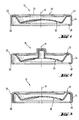
- Figure 1 is a cross-sectional view of the closure system according to the present invention.
- Figure 2 is a cross-sectional view of an alternative closure system according to the present invention having an alternative joining means.
- Figure 3 is a cross-sectional view of yet another alternative closure system according to the present invention .
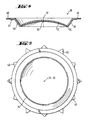
- Figure 4 is a cross sectional view of a sealing means similar to that shown in the closure system in figure 1.
- Figure 5 is a bottom plan of view of the sealing mean of figure 4.
- a closure system for pourable materials in containers as defined in claim 1 is provided.
- the pourable materials can be any kind of liquid or solids in a pourable form, i.e. typically granules or powders.
- the materials for which the closure systems of the present invention are designed are liquids for human consumption and in that respect particularly fruit juice or other organic compound comprising beverages such as milk, fruit juice or aroma comprising refreshment drinks, colas, or lemonades.
- fruit juice or other organic compound comprising beverages such as milk, fruit juice or aroma comprising refreshment drinks, colas, or lemonades.
- the container according to the present invention for which the closure systems can beneficially be used can in principal be any kind of container.
- bottles particularly bottles which are transparent such as PET-bottles, glas bottles or bottles of other transparent polymeric materials are preferred, with glas bottles being the most preferred containers.
- FIG 1 the closure system (10) is shown in a cross-sectional view comprising the closure frame (20) and the sealing means (30).
- the closure frame (20) comprises a flat portion (22) having a perimeter (23).
- the flat portion (22) need not to be absolutely flat but can be provided with minor depressions or raises parallel to the central axis (31).
- the flange has a proximal edge (25) which joins the flange to the flat portion (22) along the perimeter (23) and a distal edge (26) which is furthest away from the proximal edge (25) of the flange (24).
- the closure frame (20) can have and preferably has a folded rim (28). For screw cap systems or twist-off systems portions of this rim provide extending tongues which provide the screw threat for such a screw cap system.
- the closure frame (20) can also have different shapes as can be seen in figure 2 showing an alternative embodiment of the closure frame having a central portion raised in order to form a central circular notch into which a portion of the sealing means can be inserted to provide a removable joining between them.
- the closure frame (20) provides stability to the screw cap system and protects the sealing means (30). It therefore is preferably made out of a material which is dourable and shape stable. Particularly iron comprising metal sheet material such as tin is preferred. These materials are fairly expensive such that discarding them after one use would be undesirable. Hence closure frames according to the present invention are capable of reuse of the closure frame at least one, but preferably several times.
- Such a closure frame could be made of metal coated with a durable coating of paint on both sides. It would then be possibile to provide indications on the screw cap of the number of reuses in order to sort out closure frames after a preset number of reuses for example after five times reusing the closure frame.
- closure frames can also be optionally present in embodiments according to the present invention.
- easy grip ripples on the flange, sorting and positioning aids are common in this respect.
- the sealing means (30) is shown in figures 1, 2 and 3 in a cross-sectional view through its rotational symetry axis or central axis (31).
- the sealing means (30) has the function to connect at its periphery with the rim of the aperture of the container which is to be sealed. Mechanically this is achieved by placing the closure frame over the container opening with the sealing means inbetween such that the sealing means is pressed onto the rim of the aperture in the container to be sealed.
- the sealing means comprises a flexible concave disk portion (32) having a substantially circular perimeter (34).
- the concave disk (32) in a relaxed state has a concave shape in which the centre (36) of the concave disk (32) bends away from the container.
- the sealing means (30) has a circular flange (38) depending from the perimeter (34) of the concave disk (32).
- the flange depending from the concave disk (32) has a conical portion (39) a fixation portion (37) for joining the sealing means (30) to the closure frame (20).
- the fixation portion (37) preferably ends in a number of tongues (40), preferably in a number of pointy tongues (40) as shown in figure 5.
- the term pointy in this context includes tongues having a slightly rounded or a cutoff tip without loosing the generally pointy appearance.
- the tongues (40) can be present in any number but are preferably provided symmetrical around the circular periphery of the fixation portion (37), i.e. there should be at least 2 tongues (40). Most preferred are the sealing means with 24 or more tongues (40).
- the sealing means (30) can be made of any material which provides the necessary flexibility and elasticity to create the desired seal of the aperture in the container to be closed. Most preferred and economically desirable are thermoplastic materials such as PVC, polyethylene, polypropylene but also cured polymeric materials such as synthetic rubber or similar materials can be used.
- the sealing means (30) can be provided by combinations of material which satisfy the different functions of the sealing means better than one single material would.
- sealing means having tongues (40) made of material which in conjunction with the closure frame has a high coefficient of friction but using a different material for the conical portion (39) and/or for the concave disk portion (32) are considered.
- sealing means a mixture of materials is not as desirable as a sealing means made of a single material.
- polyethylene or polypropylene are materials known for their recyclability in order to provide new articles of manufacture or allow easy burning (thermal recycling) without the ecological concerns associated with PVC. Hence these materials are preferred.
- the sealing means should also provide indication of wether the content of the container prior to initial opening has been exposed to the environment.
Landscapes
- Engineering & Computer Science (AREA)
- Mechanical Engineering (AREA)
- Closures For Containers (AREA)
- Threshing Machine Elements (AREA)
- Separation Using Semi-Permeable Membranes (AREA)
- Saccharide Compounds (AREA)
- Lock And Its Accessories (AREA)
- Multiple-Way Valves (AREA)
Abstract
Description
- The present invention relates to closure systems for a container for pourable material in particular for pourable material for human consumption such as beverages. In particular the closure system relates to a beverage bottle having a screw cap closure system. The closure system comprises a closure frame providing the physical stability and protection of the closure system and a sealing means which is removably joined to the closure frame to provide appropriate sealing of the container. The present invention allows to reuse the closure frame independent of the sealing means.
- This application relates to and is filed on the same date at the European Patent Office as the following applications:
- "RECYCLABLE CLOSURE SYSTEM", attorney docket CM-1213FQ with the inventor Volker Heiner;
- "TEMPER PROOF FOR REUSABLE CLOSURE SYSTEM", attorney docket CM-1214FQ with the inventors Volker Heiner and Deltlef Müller;
- both filed in the name of THE PROCTER & GAMBLE COMPANY, Cincinnati, Ohio, USA.
-
- Twist off caps or screw cap closure systems for bottles are well-known in the art. Typically these systems comprise a closure frame which has integrally joined to it a sealing means to provide a barrier between the environment and the content of the bottle. Often in particular for fruit juice comprising beverages these bottles are provided under a reduced internal pressure such that the twist off cap is slightly deformed by being pulled into the bottle and upon releasing the seal provides an audible signal indicating an intact temper proof.
- The sealing means used in these twist off caps is usually provided by polyvinylchloride material. Polyvinylchloride (herinafter abreviated by PVC) does provide certain benefits to the sealing means e. g. the repeatable ability to undergo deformations to provide proper sealing. However, these advantages are balanced with certain disadvantages which are in particular environmental concerns with PVC. Especially when attempting to recycle the closure system it is necessary to remove paint and PVC from the closure frame prior to recycling the closure frame e.g. by melting it. This removal of the PVC and paint is usually achieved by burning but has become very uneconomical due to ecological concerns about PVC fumes and the resulting precautions for the process.
- Also PVC has a high affinity to absorb organic compounds. Therefore twist of cap closures having PVC sealing means cannot be reused for containers comprising materials for human consumption because the sealing means will become contaminated, i.e. loaded with the organic compounds present in the container content. Reuse or recycling of sealing means having such contamination is of course prohibited under many local regulatory laws.
- On the other hand it would be desirable to recycle or reuse the closure system since it is usually made to be durable enough to allow reuse or if less durable closure systems are employed (for example having a thin walled closure frame) at least recycling without the negative aspects caused by its multimaterial components is desirable.
- Hence there is a need to provide a closure system which can be reused without the problems associated with known screw cap/sealing means.
- For example US-A-3,331,523 or US-A-3,053,507 disclose closure systems having a closure frame and a sealing means which is removably joined to the closure frame. However, the sealing means in this disclosure does not provide the same removable joining to the frame, which is reusable, as the present invention.
- The present invention relates to a closure system for a container for pourable material such as a bottle for liquids preferably a bottle for beverages according to claim 1. The closure system is separable from the container, i.e. the present invention does not relate to closure systems which are kept connected to the container while the container is open and some of the container content is removed from the container. The closure system according to the present invention comprises a closure frame and a sealing means where the sealing means is removably joined to the closure frame and the closure frame can be reused.
- The term "removably joined" as used hereinafter refers to a connection between the sealing means and the closure frame which under usual use conditions will maintain their connection such that they appear to be one system. However removal of the sealing means from the closure frame does not cause any undue burton or special effort if carried out by a mechanical device or by a person. In particular no part of the closure frame will be scratched or damaged due to the automated removal of the sealing means. Most preferably this is achieved by frictional measures, constructive measures, or combination thereof. However adhesives which leave no or an acceptable residue on the closure frame can also be employed in the context of the present invention.
- The term "reusable" as used hereinafter means the possibility of using the same item for the same purpose again at least one time, but preferably several times. The term "a reusable closure frame" is therefore more limited than the term "a recyclable closure frame" since the term "recyclable" as used hereinafter refers to a closure frame which can be reused or which is made of materials such that it allows to use the material again in order to provide new articles of manufacture. This new article of manufacture can be alternatively the same article of manufacture from which the recycled material is provided (this can alternatively be termed "complete recycling") or a different article of manufacture which has e.g. a lower purity requirement.
- Preferably the closure system according to the present invention is a screw cap system and can be separated from the container which it closes by unscrewing. In an even more preferred embodiment according to the present invention the closure system is a "twist off' system which is removable by unscrewing the closure system with about one quarter or even less turn of the closure frame.
- The sealing means according to the present invention comprises a flexible disc of polymeric material in particular preferably of polyethylene material. The disc in a preferred embodiment has a substantially circular perimeter and a central axis which is substantially perpendicular to the flexible disc. The flexible disc has in a relaxed state a concave shape in which the center of the disc bends away from the container which it closes. The concave disc additionally comprises a circular flange depending from the disc. The flange comprises a conical portion and a fixation portion for joining the sealing means to the closure frame in at least two, most preferably 24 or more, toungs which can be rounded but are preferably pointy at their tips and which toungs provide even better/firm joining between the sealing means and the closure frame by friction.
- According to the present invention a preferred closure frame comprises a substantially flat portion which has a substantially circular perimeter and a flange depending from the flat portion along that perimeter. The flange of that closure frame has a proximal edge adjacent the circular perimeter of the flat portion of the closure frame and a distal edge furthest away from the proximal edge from the flange. Preferably the flange has a folded rim at the distal edge with the rim forming several toungs for use of that closure frame as a screw cap or twist off closure frame. The flange of the closure frame preferably provides part of the surface to which the sealing means is removably joined and preferably the folded rim also provides at least part of the means by which the sealing means is removably joined to the closure frame.
- The closure frame can be provided by many materials, however, it is preferable that the closure frame be provided by a relatively stable and durable material such that it is substantially undeformable. Such materials can be for example ceramics, but sheet metal materials such as tin metal or other iron comprising metals are particular preferred especially when recycling of the closure frame material into new closure frames is desired.
- The objects and advantages of the present invention will become more apparent when viewed in conjunction with the following drawings in which:
- Figure 1 is a cross-sectional view of the closure system according to the present invention.
- Figure 2 is a cross-sectional view of an alternative closure system according to the present invention having an alternative joining means.
- Figure 3 is a cross-sectional view of yet another alternative closure system according to the present invention .
- Figure 4 is a cross sectional view of a sealing means similar to that shown in the closure system in figure 1.
- Figure 5 is a bottom plan of view of the sealing mean of figure 4.
- According to the present invention a closure system for pourable materials in containers as defined in claim 1 is provided. The pourable materials can be any kind of liquid or solids in a pourable form, i.e. typically granules or powders. Preferably the materials for which the closure systems of the present invention are designed are liquids for human consumption and in that respect particularly fruit juice or other organic compound comprising beverages such as milk, fruit juice or aroma comprising refreshment drinks, colas, or lemonades. For such liquids it is also often desirable to create an internal environment in the container of a pressure below the ambient pressure.
- The container according to the present invention for which the closure systems can beneficially be used, can in principal be any kind of container. However bottles, particularly bottles which are transparent such as PET-bottles, glas bottles or bottles of other transparent polymeric materials are preferred, with glas bottles being the most preferred containers.
- A closure system according to the present invention is shown in figures 1, 2 and 3 in three alternative embodiments which will be explained in the following by reference to these drawing. In figure 1 the closure system (10) is shown in a cross-sectional view comprising the closure frame (20) and the sealing means (30). The closure frame (20) comprises a flat portion (22) having a perimeter (23). The flat portion (22) need not to be absolutely flat but can be provided with minor depressions or raises parallel to the central axis (31).
- From the perimeter (23) of the flat portion (22) a flange (24) depends. The flange has a proximal edge (25) which joins the flange to the flat portion (22) along the perimeter (23) and a distal edge (26) which is furthest away from the proximal edge (25) of the flange (24). At the distal edge (26) of the flange (24) the closure frame (20) can have and preferably has a folded rim (28). For screw cap systems or twist-off systems portions of this rim provide extending tongues which provide the screw threat for such a screw cap system.
- The closure frame (20) can also have different shapes as can be seen in figure 2 showing an alternative embodiment of the closure frame having a central portion raised in order to form a central circular notch into which a portion of the sealing means can be inserted to provide a removable joining between them.
- The closure frame (20) provides stability to the screw cap system and protects the sealing means (30). It therefore is preferably made out of a material which is dourable and shape stable. Particularly iron comprising metal sheet material such as tin is preferred. These materials are fairly expensive such that discarding them after one use would be undesirable. Hence closure frames according to the present invention are capable of reuse of the closure frame at least one, but preferably several times.
- Such a closure frame could be made of metal coated with a durable coating of paint on both sides. It would then be possibile to provide indications on the screw cap of the number of reuses in order to sort out closure frames after a preset number of reuses for example after five times reusing the closure frame.
- Other usual construction or design characteristics of closure frames can also be optionally present in embodiments according to the present invention. In particular easy grip ripples on the flange, sorting and positioning aids are common in this respect.
- The second important part of the closure system according to the present invention is the sealing means (30). The sealing means (30) is shown in figures 1, 2 and 3 in a cross-sectional view through its rotational symetry axis or central axis (31). The sealing means (30) has the function to connect at its periphery with the rim of the aperture of the container which is to be sealed. Mechanically this is achieved by placing the closure frame over the container opening with the sealing means inbetween such that the sealing means is pressed onto the rim of the aperture in the container to be sealed.
- The sealing means comprises a flexible concave disk portion (32) having a substantially circular perimeter (34). The concave disk (32) in a relaxed state has a concave shape in which the centre (36) of the concave disk (32) bends away from the container. Further the sealing means (30) has a circular flange (38) depending from the perimeter (34) of the concave disk (32). The flange depending from the concave disk (32) has a conical portion (39) a fixation portion (37) for joining the sealing means (30) to the closure frame (20).
- The fixation portion (37) preferably ends in a number of tongues (40), preferably in a number of pointy tongues (40) as shown in figure 5. The term pointy in this context includes tongues having a slightly rounded or a cutoff tip without loosing the generally pointy appearance. The tongues (40) can be present in any number but are preferably provided symmetrical around the circular periphery of the fixation portion (37), i.e. there should be at least 2 tongues (40). Most preferred are the sealing means with 24 or more tongues (40).
- The sealing means (30) can be made of any material which provides the necessary flexibility and elasticity to create the desired seal of the aperture in the container to be closed. Most preferred and economically desirable are thermoplastic materials such as PVC, polyethylene, polypropylene but also cured polymeric materials such as synthetic rubber or similar materials can be used.
- The sealing means (30) can be provided by combinations of material which satisfy the different functions of the sealing means better than one single material would. In this context sealing means having tongues (40) made of material which in conjunction with the closure frame has a high coefficient of friction but using a different material for the conical portion (39) and/or for the concave disk portion (32) are considered.
- However to allow recycling of the sealing means a mixture of materials is not as desirable as a sealing means made of a single material. In particular polyethylene or polypropylene are materials known for their recyclability in order to provide new articles of manufacture or allow easy burning (thermal recycling) without the ecological concerns associated with PVC. Hence these materials are preferred.
- In addition a further consideration when selecting the material for the sealing means (30) should be taken into account. If a temper proof indicator is desired, which is usual for pourable material for human consumption and in particular for beverage bottles, then the sealing means should also provide indication of wether the content of the container prior to initial opening has been exposed to the environment.
Claims (8)
- Closure system (10) for a container for pourable material, said closure system being separable from said container when opening said container, said closure system comprising a closure frame (20), and a sealing means (30), said sealing means (30) is removably joined to said closure frame (20), and said closure frame (20) is reusable, said closure system being characterised in that said sealing means comprises a flexible, concave disc (32) of polymeric material, said concave disc (32) comprises a circular flange (38), said flange (38) comprising a fixation portion (37) for joining said sealing means (30) to said closure frame (20), said fixation portion (37) ends in at least 2 tongues for joining of said sealing means (30) to said closure frame (20) by friction.
- Closure system (10) according to claim 1 wherein said container is a bottle and said pourable material is a liquid, preferably a beverage.
- Closure system (10) according to any of the preceding claims characterised in that said closure system (10) is a screw cap system and can be separated from said container by unscrewing said closure frame (20), preferably by about or less than one quarter turn of said closure frame (20).
- Closure system (10) according to any of the preceding claims characterised in that said flexible, concave disc (32) is preferably of polyethylene material and said concave disc (32) has a substantially circular perimeter (34) and a central axis (31) which is substantially perpendicular to said concave disc (32), and said concave disc (32) in a relaxed state has a concave shape in which the center (36) of said concave disc (32) bends away from said container.
- Closure system (10) according to claim 4 wherein said circular flange (38) depends from said concave disc (32) and said flange (38) further comprises a conical portion (39) and said fixation portion (37) ends in 24 or more, tongues (40), preferably pointy tongues (40).
- Closure system (10) according to any of the preceding claims characterised in that said closure frame (20) comprises a substantially flat portion (22) having a substantially circular perimeter (23); a flange (24) depending from said flat portion (22) along said perimeter (23), said flange (24) having a proximal edge (25) adjacent said circular perimeter (23) of said flat portion (22) and a distal edge (26) furthest away from said proximal edge (25), and preferably said flange (24) having a folded rim (28) at said distal edge, said folded rim (28) preferably comprises several tongues for use of said closure frame (20) as a screw cap.
- Closure system (10) according to claim 6 wherein said flange (24) of said closure frame (20) provides the surface to which said sealing means (30) is removably joined, preferably said folded rim (28) also provides at least part of the means by which said sealing means (30) is joined to said closure frame (20).
- Closure system (10) according to any of the preceding claims characterised in that said closure frame (20) is made of substantially undeformable material, preferably sheet metal, most preferably tin.
Priority Applications (2)
| Application Number | Priority Date | Filing Date | Title |
|---|---|---|---|
| EP19970924783 EP0907575B1 (en) | 1996-05-20 | 1997-05-20 | Reusable closure system |
| GR20000401204T GR3033513T3 (en) | 1996-05-20 | 2000-05-26 | Reusable closure system |
Applications Claiming Priority (4)
| Application Number | Priority Date | Filing Date | Title |
|---|---|---|---|
| EP96107987 | 1996-05-20 | ||
| EP96107987 | 1996-05-20 | ||
| PCT/US1997/008532 WO1997044261A1 (en) | 1996-05-20 | 1997-05-20 | Reusable closure system |
| EP19970924783 EP0907575B1 (en) | 1996-05-20 | 1997-05-20 | Reusable closure system |
Publications (2)
| Publication Number | Publication Date |
|---|---|
| EP0907575A1 EP0907575A1 (en) | 1999-04-14 |
| EP0907575B1 true EP0907575B1 (en) | 2000-05-03 |
Family
ID=8222798
Family Applications (1)
| Application Number | Title | Priority Date | Filing Date |
|---|---|---|---|
| EP19970924783 Expired - Lifetime EP0907575B1 (en) | 1996-05-20 | 1997-05-20 | Reusable closure system |
Country Status (9)
| Country | Link |
|---|---|
| EP (1) | EP0907575B1 (en) |
| AT (1) | ATE192401T1 (en) |
| AU (1) | AU3009997A (en) |
| DE (1) | DE69701876T2 (en) |
| DK (1) | DK0907575T3 (en) |
| ES (1) | ES2145604T3 (en) |
| GR (1) | GR3033513T3 (en) |
| PT (1) | PT907575E (en) |
| WO (1) | WO1997044261A1 (en) |
Families Citing this family (4)
| Publication number | Priority date | Publication date | Assignee | Title |
|---|---|---|---|---|
| FR2776625B1 (en) * | 1998-03-24 | 2000-05-12 | Qualipac Sa | POT COVER WITH REPLACEABLE SEAL |
| WO2011116339A1 (en) * | 2010-03-19 | 2011-09-22 | Vinperfect, Inc. | Liner-stretching bottle closure body recess and structural reinforcing insert |
| DE202011100187U1 (en) * | 2011-05-04 | 2011-07-05 | G. Junghans Kunststoffwaren-Fabrik, 37235 | Sealing foil closure and lid for closing the mouth of a container |
| ITRN20120005A1 (en) * | 2012-01-20 | 2013-07-21 | Polykap S R L | DISCOID GASKET FOR CLOSING ELEMENTS INTERNALLY PROVIDED WITH RISALS. |
Family Cites Families (6)
| Publication number | Priority date | Publication date | Assignee | Title |
|---|---|---|---|---|
| US3053407A (en) * | 1958-10-30 | 1962-09-11 | Lowen Stanley | Bottle closure |
| FR1407239A (en) * | 1964-06-19 | 1965-07-30 | Realisations D Articles En Cao | Sealing cap for bottle |
| US3331523A (en) * | 1965-02-15 | 1967-07-18 | Gilbert Mfg Company | Container closure member and liner therefor |
| SE402535B (en) * | 1975-09-08 | 1978-07-10 | Skane Emballage Ab | WAY TO PRODUCE ONE WITH THREADED Grip TABLES PASSED AROUND LID OF ROLLED PLATE |
| JPS5695856A (en) * | 1979-12-19 | 1981-08-03 | Crown Cork Japan | Vessel cover provided with liner* ashesive characteristic thereof to shell is improved |
| NL185834C (en) * | 1987-04-13 | 1990-08-01 | Skillpack Bv | SEALING DEVICE FOR A HOLDER AND MEMBRANE FOR SUCH A SEALING DEVICE. |
-
1997
- 1997-05-20 ES ES97924783T patent/ES2145604T3/en not_active Expired - Lifetime
- 1997-05-20 WO PCT/US1997/008532 patent/WO1997044261A1/en not_active Ceased
- 1997-05-20 DE DE69701876T patent/DE69701876T2/en not_active Expired - Fee Related
- 1997-05-20 AT AT97924783T patent/ATE192401T1/en not_active IP Right Cessation
- 1997-05-20 EP EP19970924783 patent/EP0907575B1/en not_active Expired - Lifetime
- 1997-05-20 DK DK97924783T patent/DK0907575T3/en active
- 1997-05-20 PT PT97924783T patent/PT907575E/en unknown
- 1997-05-20 AU AU30099/97A patent/AU3009997A/en not_active Abandoned
-
2000
- 2000-05-26 GR GR20000401204T patent/GR3033513T3/en not_active IP Right Cessation
Also Published As
| Publication number | Publication date |
|---|---|
| WO1997044261A1 (en) | 1997-11-27 |
| AU3009997A (en) | 1997-12-09 |
| ES2145604T3 (en) | 2000-07-01 |
| DE69701876D1 (en) | 2000-06-08 |
| DE69701876T2 (en) | 2001-02-01 |
| PT907575E (en) | 2000-08-31 |
| GR3033513T3 (en) | 2000-09-29 |
| DK0907575T3 (en) | 2000-09-04 |
| ATE192401T1 (en) | 2000-05-15 |
| EP0907575A1 (en) | 1999-04-14 |
Similar Documents
| Publication | Publication Date | Title |
|---|---|---|
| US5411157A (en) | Container and the manufacture thereof | |
| US4699290A (en) | Sanitary tamperproof double closure container end cap | |
| US4708257A (en) | Protective seal for a can | |
| US3519163A (en) | Container and closure therefor | |
| US4807770A (en) | Composite, tamper evident, vacuum indicating closure and container | |
| US4721219A (en) | Composite, vacuum indicating closure | |
| EP0340949A2 (en) | Spin-bonded all plastic can and method of forming same | |
| US3805993A (en) | Closure for metal container | |
| CA2140273A1 (en) | Tamper evident closure | |
| EP0681967B1 (en) | Container lid | |
| US5873484A (en) | Cover locking mechanism | |
| CA2022340A1 (en) | Retortable closure for plastic container | |
| CA2144857A1 (en) | Cap | |
| GB9214966D0 (en) | A container assembly | |
| US3687334A (en) | Metal container with removable closure | |
| EP0907575B1 (en) | Reusable closure system | |
| US3734044A (en) | Sealed container assembly and method of making same | |
| US6302287B1 (en) | Reusable closure system | |
| US4921117A (en) | Pop-art tumbler | |
| US6095357A (en) | Tamper proof for reusable closure system | |
| EP0907574B1 (en) | Recyclable closure system | |
| AU639359B2 (en) | A rigid container under residual vacuum provided with a tamper-evident device | |
| GB2074974A (en) | Container Sealing Device | |
| US3217916A (en) | Manually removable crown cap | |
| EP0546051B1 (en) | A closure device for a container |
Legal Events
| Date | Code | Title | Description |
|---|---|---|---|
| PUAI | Public reference made under article 153(3) epc to a published international application that has entered the european phase |
Free format text: ORIGINAL CODE: 0009012 |
|
| 17P | Request for examination filed |
Effective date: 19981123 |
|
| AK | Designated contracting states |
Kind code of ref document: A1 Designated state(s): AT BE CH DE DK ES FI FR GB GR IE IT LI LU NL PT SE |
|
| 17Q | First examination report despatched |
Effective date: 19990415 |
|
| GRAG | Despatch of communication of intention to grant |
Free format text: ORIGINAL CODE: EPIDOS AGRA |
|
| GRAG | Despatch of communication of intention to grant |
Free format text: ORIGINAL CODE: EPIDOS AGRA |
|
| GRAH | Despatch of communication of intention to grant a patent |
Free format text: ORIGINAL CODE: EPIDOS IGRA |
|
| GRAH | Despatch of communication of intention to grant a patent |
Free format text: ORIGINAL CODE: EPIDOS IGRA |
|
| GRAA | (expected) grant |
Free format text: ORIGINAL CODE: 0009210 |
|
| AK | Designated contracting states |
Kind code of ref document: B1 Designated state(s): AT BE CH DE DK ES FI FR GB GR IE IT LI LU NL PT SE |
|
| REF | Corresponds to: |
Ref document number: 192401 Country of ref document: AT Date of ref document: 20000515 Kind code of ref document: T |
|
| REG | Reference to a national code |
Ref country code: CH Ref legal event code: NV Representative=s name: RITSCHER & SEIFERT Ref country code: CH Ref legal event code: EP |
|
| REG | Reference to a national code |
Ref country code: IE Ref legal event code: FG4D |
|
| REF | Corresponds to: |
Ref document number: 69701876 Country of ref document: DE Date of ref document: 20000608 |
|
| ET | Fr: translation filed | ||
| ITF | It: translation for a ep patent filed | ||
| REG | Reference to a national code |
Ref country code: ES Ref legal event code: FG2A Ref document number: 2145604 Country of ref document: ES Kind code of ref document: T3 |
|
| REG | Reference to a national code |
Ref country code: PT Ref legal event code: SC4A Free format text: AVAILABILITY OF NATIONAL TRANSLATION Effective date: 20000529 |
|
| REG | Reference to a national code |
Ref country code: DK Ref legal event code: T3 |
|
| PLBE | No opposition filed within time limit |
Free format text: ORIGINAL CODE: 0009261 |
|
| STAA | Information on the status of an ep patent application or granted ep patent |
Free format text: STATUS: NO OPPOSITION FILED WITHIN TIME LIMIT |
|
| 26N | No opposition filed | ||
| REG | Reference to a national code |
Ref country code: GB Ref legal event code: IF02 |
|
| PGFP | Annual fee paid to national office [announced via postgrant information from national office to epo] |
Ref country code: LU Payment date: 20030331 Year of fee payment: 7 |
|
| PGFP | Annual fee paid to national office [announced via postgrant information from national office to epo] |
Ref country code: GB Payment date: 20030401 Year of fee payment: 7 |
|
| PGFP | Annual fee paid to national office [announced via postgrant information from national office to epo] |
Ref country code: PT Payment date: 20030402 Year of fee payment: 7 Ref country code: AT Payment date: 20030402 Year of fee payment: 7 |
|
| PGFP | Annual fee paid to national office [announced via postgrant information from national office to epo] |
Ref country code: DK Payment date: 20030403 Year of fee payment: 7 Ref country code: NL Payment date: 20030403 Year of fee payment: 7 |
|
| PGFP | Annual fee paid to national office [announced via postgrant information from national office to epo] |
Ref country code: IE Payment date: 20030417 Year of fee payment: 7 |
|
| PGFP | Annual fee paid to national office [announced via postgrant information from national office to epo] |
Ref country code: GR Payment date: 20030422 Year of fee payment: 7 |
|
| PGFP | Annual fee paid to national office [announced via postgrant information from national office to epo] |
Ref country code: FI Payment date: 20030423 Year of fee payment: 7 |
|
| PGFP | Annual fee paid to national office [announced via postgrant information from national office to epo] |
Ref country code: FR Payment date: 20030505 Year of fee payment: 7 |
|
| PGFP | Annual fee paid to national office [announced via postgrant information from national office to epo] |
Ref country code: SE Payment date: 20030506 Year of fee payment: 7 |
|
| PGFP | Annual fee paid to national office [announced via postgrant information from national office to epo] |
Ref country code: ES Payment date: 20030523 Year of fee payment: 7 |
|
| PGFP | Annual fee paid to national office [announced via postgrant information from national office to epo] |
Ref country code: DE Payment date: 20030530 Year of fee payment: 7 |
|
| PGFP | Annual fee paid to national office [announced via postgrant information from national office to epo] |
Ref country code: CH Payment date: 20030605 Year of fee payment: 7 |
|
| PGFP | Annual fee paid to national office [announced via postgrant information from national office to epo] |
Ref country code: BE Payment date: 20030617 Year of fee payment: 7 |
|
| PG25 | Lapsed in a contracting state [announced via postgrant information from national office to epo] |
Ref country code: LU Free format text: LAPSE BECAUSE OF NON-PAYMENT OF DUE FEES Effective date: 20040520 Ref country code: IE Free format text: LAPSE BECAUSE OF NON-PAYMENT OF DUE FEES Effective date: 20040520 Ref country code: GB Free format text: LAPSE BECAUSE OF NON-PAYMENT OF DUE FEES Effective date: 20040520 Ref country code: FI Free format text: LAPSE BECAUSE OF NON-PAYMENT OF DUE FEES Effective date: 20040520 Ref country code: AT Free format text: LAPSE BECAUSE OF NON-PAYMENT OF DUE FEES Effective date: 20040520 |
|
| PG25 | Lapsed in a contracting state [announced via postgrant information from national office to epo] |
Ref country code: SE Free format text: LAPSE BECAUSE OF NON-PAYMENT OF DUE FEES Effective date: 20040521 Ref country code: ES Free format text: LAPSE BECAUSE OF NON-PAYMENT OF DUE FEES Effective date: 20040521 |
|
| PG25 | Lapsed in a contracting state [announced via postgrant information from national office to epo] |
Ref country code: LI Free format text: LAPSE BECAUSE OF NON-PAYMENT OF DUE FEES Effective date: 20040531 Ref country code: CH Free format text: LAPSE BECAUSE OF NON-PAYMENT OF DUE FEES Effective date: 20040531 Ref country code: BE Free format text: LAPSE BECAUSE OF NON-PAYMENT OF DUE FEES Effective date: 20040531 |
|
| PG25 | Lapsed in a contracting state [announced via postgrant information from national office to epo] |
Ref country code: DK Free format text: LAPSE BECAUSE OF NON-PAYMENT OF DUE FEES Effective date: 20040601 |
|
| PG25 | Lapsed in a contracting state [announced via postgrant information from national office to epo] |
Ref country code: PT Free format text: LAPSE BECAUSE OF NON-PAYMENT OF DUE FEES Effective date: 20041122 |
|
| BERE | Be: lapsed |
Owner name: THE *PROCTER & GAMBLE CY Effective date: 20040531 |
|
| PG25 | Lapsed in a contracting state [announced via postgrant information from national office to epo] |
Ref country code: NL Free format text: LAPSE BECAUSE OF NON-PAYMENT OF DUE FEES Effective date: 20041201 Ref country code: DE Free format text: LAPSE BECAUSE OF NON-PAYMENT OF DUE FEES Effective date: 20041201 |
|
| PG25 | Lapsed in a contracting state [announced via postgrant information from national office to epo] |
Ref country code: GR Free format text: LAPSE BECAUSE OF NON-PAYMENT OF DUE FEES Effective date: 20041203 |
|
| EUG | Se: european patent has lapsed | ||
| REG | Reference to a national code |
Ref country code: DK Ref legal event code: EBP |
|
| GBPC | Gb: european patent ceased through non-payment of renewal fee |
Effective date: 20040520 |
|
| REG | Reference to a national code |
Ref country code: CH Ref legal event code: PL |
|
| PG25 | Lapsed in a contracting state [announced via postgrant information from national office to epo] |
Ref country code: FR Free format text: LAPSE BECAUSE OF NON-PAYMENT OF DUE FEES Effective date: 20050131 |
|
| REG | Reference to a national code |
Ref country code: PT Ref legal event code: MM4A Effective date: 20041122 |
|
| NLV4 | Nl: lapsed or anulled due to non-payment of the annual fee |
Effective date: 20041201 |
|
| REG | Reference to a national code |
Ref country code: FR Ref legal event code: ST |
|
| REG | Reference to a national code |
Ref country code: IE Ref legal event code: MM4A |
|
| PG25 | Lapsed in a contracting state [announced via postgrant information from national office to epo] |
Ref country code: IT Free format text: LAPSE BECAUSE OF NON-PAYMENT OF DUE FEES;WARNING: LAPSES OF ITALIAN PATENTS WITH EFFECTIVE DATE BEFORE 2007 MAY HAVE OCCURRED AT ANY TIME BEFORE 2007. THE CORRECT EFFECTIVE DATE MAY BE DIFFERENT FROM THE ONE RECORDED. Effective date: 20050520 |
|
| REG | Reference to a national code |
Ref country code: ES Ref legal event code: FD2A Effective date: 20040521 |