EP0907354B1 - Cleansing and moisturizing surfactant compositions - Google Patents
Cleansing and moisturizing surfactant compositions Download PDFInfo
- Publication number
- EP0907354B1 EP0907354B1 EP97909020A EP97909020A EP0907354B1 EP 0907354 B1 EP0907354 B1 EP 0907354B1 EP 97909020 A EP97909020 A EP 97909020A EP 97909020 A EP97909020 A EP 97909020A EP 0907354 B1 EP0907354 B1 EP 0907354B1
- Authority
- EP
- European Patent Office
- Prior art keywords
- carbon atoms
- composition
- alkyl
- formula
- percent
- Prior art date
- Legal status (The legal status is an assumption and is not a legal conclusion. Google has not performed a legal analysis and makes no representation as to the accuracy of the status listed.)
- Revoked
Links
- 239000000203 mixture Substances 0.000 title claims description 164
- 239000004094 surface-active agent Substances 0.000 title claims description 32
- 230000003020 moisturizing effect Effects 0.000 title description 9
- -1 alkyl glucoside Chemical class 0.000 claims description 94
- 125000004432 carbon atom Chemical group C* 0.000 claims description 59
- 229920005862 polyol Polymers 0.000 claims description 53
- 125000000217 alkyl group Chemical group 0.000 claims description 43
- 239000003906 humectant Substances 0.000 claims description 32
- 229920003171 Poly (ethylene oxide) Polymers 0.000 claims description 31
- KWIUHFFTVRNATP-UHFFFAOYSA-N Betaine Natural products C[N+](C)(C)CC([O-])=O KWIUHFFTVRNATP-UHFFFAOYSA-N 0.000 claims description 25
- 229960003237 betaine Drugs 0.000 claims description 25
- 239000003945 anionic surfactant Substances 0.000 claims description 21
- PEDCQBHIVMGVHV-UHFFFAOYSA-N Glycerine Chemical compound OCC(O)CO PEDCQBHIVMGVHV-UHFFFAOYSA-N 0.000 claims description 20
- 239000002736 nonionic surfactant Substances 0.000 claims description 20
- 150000003077 polyols Chemical class 0.000 claims description 20
- KWIUHFFTVRNATP-UHFFFAOYSA-O N,N,N-trimethylglycinium Chemical compound C[N+](C)(C)CC(O)=O KWIUHFFTVRNATP-UHFFFAOYSA-O 0.000 claims description 18
- 239000002280 amphoteric surfactant Substances 0.000 claims description 18
- 150000004665 fatty acids Chemical class 0.000 claims description 17
- 235000014113 dietary fatty acids Nutrition 0.000 claims description 15
- 239000000194 fatty acid Substances 0.000 claims description 15
- 229930195729 fatty acid Natural products 0.000 claims description 15
- XLYOFNOQVPJJNP-UHFFFAOYSA-N water Substances O XLYOFNOQVPJJNP-UHFFFAOYSA-N 0.000 claims description 14
- DNIAPMSPPWPWGF-UHFFFAOYSA-N Propylene glycol Chemical compound CC(O)CO DNIAPMSPPWPWGF-UHFFFAOYSA-N 0.000 claims description 12
- 235000011187 glycerol Nutrition 0.000 claims description 10
- 239000002562 thickening agent Substances 0.000 claims description 10
- 230000007794 irritation Effects 0.000 claims description 9
- 125000002768 hydroxyalkyl group Chemical group 0.000 claims description 8
- FBPFZTCFMRRESA-FSIIMWSLSA-N D-Glucitol Natural products OC[C@H](O)[C@H](O)[C@@H](O)[C@H](O)CO FBPFZTCFMRRESA-FSIIMWSLSA-N 0.000 claims description 7
- 239000002202 Polyethylene glycol Substances 0.000 claims description 7
- 229910052799 carbon Inorganic materials 0.000 claims description 7
- 150000005690 diesters Chemical class 0.000 claims description 7
- 229920001223 polyethylene glycol Polymers 0.000 claims description 7
- 239000000600 sorbitol Substances 0.000 claims description 7
- JNYAEWCLZODPBN-JGWLITMVSA-N (2r,3r,4s)-2-[(1r)-1,2-dihydroxyethyl]oxolane-3,4-diol Chemical compound OC[C@@H](O)[C@H]1OC[C@H](O)[C@H]1O JNYAEWCLZODPBN-JGWLITMVSA-N 0.000 claims description 6
- FBPFZTCFMRRESA-JGWLITMVSA-N D-glucitol Chemical compound OC[C@H](O)[C@@H](O)[C@H](O)[C@H](O)CO FBPFZTCFMRRESA-JGWLITMVSA-N 0.000 claims description 6
- 125000003342 alkenyl group Chemical group 0.000 claims description 6
- 125000004181 carboxyalkyl group Chemical group 0.000 claims description 6
- 150000008051 alkyl sulfates Chemical group 0.000 claims description 5
- 150000001875 compounds Chemical class 0.000 claims description 5
- 229930182478 glucoside Natural products 0.000 claims description 5
- 125000006353 oxyethylene group Chemical group 0.000 claims description 5
- 125000001424 substituent group Chemical group 0.000 claims description 5
- SVTBMSDMJJWYQN-UHFFFAOYSA-N 2-methylpentane-2,4-diol Chemical compound CC(O)CC(C)(C)O SVTBMSDMJJWYQN-UHFFFAOYSA-N 0.000 claims description 4
- WQZGKKKJIJFFOK-GASJEMHNSA-N Glucose Natural products OC[C@H]1OC(O)[C@H](O)[C@@H](O)[C@@H]1O WQZGKKKJIJFFOK-GASJEMHNSA-N 0.000 claims description 4
- 229920013820 alkyl cellulose Polymers 0.000 claims description 4
- WQZGKKKJIJFFOK-VFUOTHLCSA-N beta-D-glucose Chemical compound OC[C@H]1O[C@@H](O)[C@H](O)[C@@H](O)[C@@H]1O WQZGKKKJIJFFOK-VFUOTHLCSA-N 0.000 claims description 4
- 150000007942 carboxylates Chemical group 0.000 claims description 4
- 239000008103 glucose Substances 0.000 claims description 4
- 125000002791 glucosyl group Chemical group C1([C@H](O)[C@@H](O)[C@H](O)[C@H](O1)CO)* 0.000 claims description 4
- 229910052739 hydrogen Inorganic materials 0.000 claims description 4
- 239000001257 hydrogen Substances 0.000 claims description 4
- 125000004435 hydrogen atom Chemical group [H]* 0.000 claims description 4
- WXZMFSXDPGVJKK-UHFFFAOYSA-N pentaerythritol Chemical compound OCC(CO)(CO)CO WXZMFSXDPGVJKK-UHFFFAOYSA-N 0.000 claims description 4
- HOVAGTYPODGVJG-UVSYOFPXSA-N (3s,5r)-2-(hydroxymethyl)-6-methoxyoxane-3,4,5-triol Chemical compound COC1OC(CO)[C@@H](O)C(O)[C@H]1O HOVAGTYPODGVJG-UVSYOFPXSA-N 0.000 claims description 3
- XSQUKJJJFZCRTK-UHFFFAOYSA-N Urea Chemical compound NC(N)=O XSQUKJJJFZCRTK-UHFFFAOYSA-N 0.000 claims description 3
- 229910001413 alkali metal ion Inorganic materials 0.000 claims description 3
- 229910001420 alkaline earth metal ion Inorganic materials 0.000 claims description 3
- 230000003750 conditioning effect Effects 0.000 claims description 3
- 239000007788 liquid Substances 0.000 claims description 3
- PUPZLCDOIYMWBV-UHFFFAOYSA-N (+/-)-1,3-Butanediol Chemical compound CC(O)CCO PUPZLCDOIYMWBV-UHFFFAOYSA-N 0.000 claims description 2
- 239000004202 carbamide Substances 0.000 claims description 2
- MTHSVFCYNBDYFN-UHFFFAOYSA-N diethylene glycol Chemical compound OCCOCCO MTHSVFCYNBDYFN-UHFFFAOYSA-N 0.000 claims description 2
- SZXQTJUDPRGNJN-UHFFFAOYSA-N dipropylene glycol Chemical compound OCCCOCCCO SZXQTJUDPRGNJN-UHFFFAOYSA-N 0.000 claims description 2
- 229940051250 hexylene glycol Drugs 0.000 claims description 2
- 229920013821 hydroxy alkyl cellulose Polymers 0.000 claims description 2
- HOVAGTYPODGVJG-UHFFFAOYSA-N methyl beta-galactoside Natural products COC1OC(CO)C(O)C(O)C1O HOVAGTYPODGVJG-UHFFFAOYSA-N 0.000 claims description 2
- 239000002453 shampoo Substances 0.000 claims description 2
- 125000005843 halogen group Chemical group 0.000 claims 2
- 241000219240 Acer pictum subsp. mono Species 0.000 claims 1
- 210000003491 skin Anatomy 0.000 description 39
- 239000000463 material Substances 0.000 description 13
- 239000010410 layer Substances 0.000 description 8
- 238000005259 measurement Methods 0.000 description 8
- 210000004027 cell Anatomy 0.000 description 7
- 238000000034 method Methods 0.000 description 7
- 239000000126 substance Substances 0.000 description 7
- POULHZVOKOAJMA-UHFFFAOYSA-N dodecanoic acid Chemical compound CCCCCCCCCCCC(O)=O POULHZVOKOAJMA-UHFFFAOYSA-N 0.000 description 6
- UKHVLWKBNNSRRR-ODZAUARKSA-M dowicil 200 Chemical compound [Cl-].C1N(C2)CN3CN2C[N+]1(C\C=C/Cl)C3 UKHVLWKBNNSRRR-ODZAUARKSA-M 0.000 description 6
- 210000000245 forearm Anatomy 0.000 description 6
- 238000009472 formulation Methods 0.000 description 6
- 235000002961 Aloe barbadensis Nutrition 0.000 description 5
- 244000186892 Aloe vera Species 0.000 description 5
- 238000013019 agitation Methods 0.000 description 5
- 235000011399 aloe vera Nutrition 0.000 description 5
- 230000004888 barrier function Effects 0.000 description 5
- MRUAUOIMASANKQ-UHFFFAOYSA-N cocamidopropyl betaine Chemical compound CCCCCCCCCCCC(=O)NCCC[N+](C)(C)CC([O-])=O MRUAUOIMASANKQ-UHFFFAOYSA-N 0.000 description 5
- 229940073507 cocamidopropyl betaine Drugs 0.000 description 5
- QKQCPXJIOJLHAL-UHFFFAOYSA-L disodium;2-[2-(carboxylatomethoxy)ethyl-[2-(dodecanoylamino)ethyl]amino]acetate Chemical compound [Na+].[Na+].CCCCCCCCCCCC(=O)NCCN(CC([O-])=O)CCOCC([O-])=O QKQCPXJIOJLHAL-UHFFFAOYSA-L 0.000 description 5
- LYCAIKOWRPUZTN-UHFFFAOYSA-N ethylene glycol Natural products OCCO LYCAIKOWRPUZTN-UHFFFAOYSA-N 0.000 description 5
- 230000035699 permeability Effects 0.000 description 5
- FPVVYTCTZKCSOJ-UHFFFAOYSA-N Ethylene glycol distearate Chemical group CCCCCCCCCCCCCCCCCC(=O)OCCOC(=O)CCCCCCCCCCCCCCCCC FPVVYTCTZKCSOJ-UHFFFAOYSA-N 0.000 description 4
- 239000004909 Moisturizer Substances 0.000 description 4
- 239000003795 chemical substances by application Substances 0.000 description 4
- 239000003205 fragrance Substances 0.000 description 4
- 239000004615 ingredient Substances 0.000 description 4
- 239000002085 irritant Substances 0.000 description 4
- 231100000021 irritant Toxicity 0.000 description 4
- 230000001333 moisturizer Effects 0.000 description 4
- 239000000523 sample Substances 0.000 description 4
- 235000000346 sugar Nutrition 0.000 description 4
- 0 C1CC*CC1 Chemical compound C1CC*CC1 0.000 description 3
- KCXVZYZYPLLWCC-UHFFFAOYSA-N EDTA Chemical compound OC(=O)CN(CC(O)=O)CCN(CC(O)=O)CC(O)=O KCXVZYZYPLLWCC-UHFFFAOYSA-N 0.000 description 3
- 241000196324 Embryophyta Species 0.000 description 3
- 229920002884 Laureth 4 Polymers 0.000 description 3
- 239000008118 PEG 6000 Substances 0.000 description 3
- 229920002584 Polyethylene Glycol 6000 Polymers 0.000 description 3
- 239000000654 additive Substances 0.000 description 3
- 238000003556 assay Methods 0.000 description 3
- UHZZMRAGKVHANO-UHFFFAOYSA-M chlormequat chloride Chemical compound [Cl-].C[N+](C)(C)CCCl UHZZMRAGKVHANO-UHFFFAOYSA-M 0.000 description 3
- KRKNYBCHXYNGOX-UHFFFAOYSA-N citric acid Chemical compound OC(=O)CC(O)(C(O)=O)CC(O)=O KRKNYBCHXYNGOX-UHFFFAOYSA-N 0.000 description 3
- 230000000694 effects Effects 0.000 description 3
- SFNALCNOMXIBKG-UHFFFAOYSA-N ethylene glycol monododecyl ether Chemical compound CCCCCCCCCCCCOCCO SFNALCNOMXIBKG-UHFFFAOYSA-N 0.000 description 3
- 229940100608 glycol distearate Drugs 0.000 description 3
- 150000002500 ions Chemical class 0.000 description 3
- 229940061515 laureth-4 Drugs 0.000 description 3
- 125000002496 methyl group Chemical group [H]C([H])([H])* 0.000 description 3
- 239000003921 oil Substances 0.000 description 3
- 235000019198 oils Nutrition 0.000 description 3
- 229910001415 sodium ion Inorganic materials 0.000 description 3
- UEUXEKPTXMALOB-UHFFFAOYSA-J tetrasodium;2-[2-[bis(carboxylatomethyl)amino]ethyl-(carboxylatomethyl)amino]acetate Chemical compound [Na+].[Na+].[Na+].[Na+].[O-]C(=O)CN(CC([O-])=O)CCN(CC([O-])=O)CC([O-])=O UEUXEKPTXMALOB-UHFFFAOYSA-J 0.000 description 3
- 210000001578 tight junction Anatomy 0.000 description 3
- GVJHHUAWPYXKBD-UHFFFAOYSA-N (±)-α-Tocopherol Chemical compound OC1=C(C)C(C)=C2OC(CCCC(C)CCCC(C)CCCC(C)C)(C)CCC2=C1C GVJHHUAWPYXKBD-UHFFFAOYSA-N 0.000 description 2
- LDVVTQMJQSCDMK-UHFFFAOYSA-N 1,3-dihydroxypropan-2-yl formate Chemical compound OCC(CO)OC=O LDVVTQMJQSCDMK-UHFFFAOYSA-N 0.000 description 2
- VGGSQFUCUMXWEO-UHFFFAOYSA-N Ethene Chemical compound C=C VGGSQFUCUMXWEO-UHFFFAOYSA-N 0.000 description 2
- IAYPIBMASNFSPL-UHFFFAOYSA-N Ethylene oxide Chemical compound C1CO1 IAYPIBMASNFSPL-UHFFFAOYSA-N 0.000 description 2
- 206010015946 Eye irritation Diseases 0.000 description 2
- 239000005639 Lauric acid Substances 0.000 description 2
- 229920001213 Polysorbate 20 Polymers 0.000 description 2
- FAPWRFPIFSIZLT-UHFFFAOYSA-M Sodium chloride Chemical compound [Na+].[Cl-] FAPWRFPIFSIZLT-UHFFFAOYSA-M 0.000 description 2
- GWEVSGVZZGPLCZ-UHFFFAOYSA-N Titan oxide Chemical compound O=[Ti]=O GWEVSGVZZGPLCZ-UHFFFAOYSA-N 0.000 description 2
- 230000002378 acidificating effect Effects 0.000 description 2
- 125000002091 cationic group Chemical group 0.000 description 2
- 239000002738 chelating agent Substances 0.000 description 2
- 235000019864 coconut oil Nutrition 0.000 description 2
- 239000003240 coconut oil Substances 0.000 description 2
- 230000000052 comparative effect Effects 0.000 description 2
- 239000012141 concentrate Substances 0.000 description 2
- 229940079881 disodium lauroamphodiacetate Drugs 0.000 description 2
- NJDNXYGOVLYJHP-UHFFFAOYSA-L disodium;2-(3-oxido-6-oxoxanthen-9-yl)benzoate Chemical compound [Na+].[Na+].[O-]C(=O)C1=CC=CC=C1C1=C2C=CC(=O)C=C2OC2=CC([O-])=CC=C21 NJDNXYGOVLYJHP-UHFFFAOYSA-L 0.000 description 2
- 125000003438 dodecyl group Chemical group [H]C([H])([H])C([H])([H])C([H])([H])C([H])([H])C([H])([H])C([H])([H])C([H])([H])C([H])([H])C([H])([H])C([H])([H])C([H])([H])C([H])([H])* 0.000 description 2
- 238000005516 engineering process Methods 0.000 description 2
- 231100000013 eye irritation Toxicity 0.000 description 2
- GNBHRKFJIUUOQI-UHFFFAOYSA-N fluorescein Chemical compound O1C(=O)C2=CC=CC=C2C21C1=CC=C(O)C=C1OC1=CC(O)=CC=C21 GNBHRKFJIUUOQI-UHFFFAOYSA-N 0.000 description 2
- 235000011389 fruit/vegetable juice Nutrition 0.000 description 2
- 150000004820 halides Chemical group 0.000 description 2
- 230000036571 hydration Effects 0.000 description 2
- 238000006703 hydration reaction Methods 0.000 description 2
- 238000001727 in vivo Methods 0.000 description 2
- 239000012982 microporous membrane Substances 0.000 description 2
- DVEKCXOJTLDBFE-UHFFFAOYSA-N n-dodecyl-n,n-dimethylglycinate Chemical compound CCCCCCCCCCCC[N+](C)(C)CC([O-])=O DVEKCXOJTLDBFE-UHFFFAOYSA-N 0.000 description 2
- 239000000256 polyoxyethylene sorbitan monolaurate Substances 0.000 description 2
- 235000010486 polyoxyethylene sorbitan monolaurate Nutrition 0.000 description 2
- 239000003755 preservative agent Substances 0.000 description 2
- 229940096792 quaternium-15 Drugs 0.000 description 2
- 230000037307 sensitive skin Effects 0.000 description 2
- HEMHJVSKTPXQMS-UHFFFAOYSA-M sodium hydroxide Inorganic materials [OH-].[Na+] HEMHJVSKTPXQMS-UHFFFAOYSA-M 0.000 description 2
- 229940102541 sodium trideceth sulfate Drugs 0.000 description 2
- KLYDBHUQNXKACI-UHFFFAOYSA-M sodium;2-[2-(2-tridecoxyethoxy)ethoxy]ethyl sulfate Chemical group [Na+].CCCCCCCCCCCCCOCCOCCOCCOS([O-])(=O)=O KLYDBHUQNXKACI-UHFFFAOYSA-M 0.000 description 2
- 210000000434 stratum corneum Anatomy 0.000 description 2
- LQIAZOCLNBBZQK-UHFFFAOYSA-N 1-(1,2-Diphosphanylethyl)pyrrolidin-2-one Chemical compound PCC(P)N1CCCC1=O LQIAZOCLNBBZQK-UHFFFAOYSA-N 0.000 description 1
- VBICKXHEKHSIBG-UHFFFAOYSA-N 1-monostearoylglycerol Chemical compound CCCCCCCCCCCCCCCCCC(=O)OCC(O)CO VBICKXHEKHSIBG-UHFFFAOYSA-N 0.000 description 1
- OUNZARDETXBPIX-UHFFFAOYSA-N 2-(2-dodecoxyethoxy)acetic acid Chemical compound CCCCCCCCCCCCOCCOCC(O)=O OUNZARDETXBPIX-UHFFFAOYSA-N 0.000 description 1
- FKMHSNTVILORFA-UHFFFAOYSA-N 2-[2-(2-dodecoxyethoxy)ethoxy]ethanol Chemical compound CCCCCCCCCCCCOCCOCCOCCO FKMHSNTVILORFA-UHFFFAOYSA-N 0.000 description 1
- MQFYRUGXOJAUQK-UHFFFAOYSA-N 2-[2-[2-(2-octadecanoyloxyethoxy)ethoxy]ethoxy]ethyl octadecanoate Chemical compound CCCCCCCCCCCCCCCCCC(=O)OCCOCCOCCOCCOC(=O)CCCCCCCCCCCCCCCCC MQFYRUGXOJAUQK-UHFFFAOYSA-N 0.000 description 1
- PUAQLLVFLMYYJJ-UHFFFAOYSA-N 2-aminopropiophenone Chemical compound CC(N)C(=O)C1=CC=CC=C1 PUAQLLVFLMYYJJ-UHFFFAOYSA-N 0.000 description 1
- XZIIFPSPUDAGJM-UHFFFAOYSA-N 6-chloro-2-n,2-n-diethylpyrimidine-2,4-diamine Chemical compound CCN(CC)C1=NC(N)=CC(Cl)=N1 XZIIFPSPUDAGJM-UHFFFAOYSA-N 0.000 description 1
- QGZKDVFQNNGYKY-UHFFFAOYSA-O Ammonium Chemical compound [NH4+] QGZKDVFQNNGYKY-UHFFFAOYSA-O 0.000 description 1
- 229910001369 Brass Inorganic materials 0.000 description 1
- 241000282465 Canis Species 0.000 description 1
- 102000008186 Collagen Human genes 0.000 description 1
- 108010035532 Collagen Proteins 0.000 description 1
- ZAKOWWREFLAJOT-CEFNRUSXSA-N D-alpha-tocopherylacetate Chemical compound CC(=O)OC1=C(C)C(C)=C2O[C@@](CCC[C@H](C)CCC[C@H](C)CCCC(C)C)(C)CCC2=C1C ZAKOWWREFLAJOT-CEFNRUSXSA-N 0.000 description 1
- 229920000715 Mucilage Polymers 0.000 description 1
- 229910006127 SO3X Inorganic materials 0.000 description 1
- FKNQFGJONOIPTF-UHFFFAOYSA-N Sodium cation Chemical group [Na+] FKNQFGJONOIPTF-UHFFFAOYSA-N 0.000 description 1
- DBMJMQXJHONAFJ-UHFFFAOYSA-M Sodium laurylsulphate Chemical compound [Na+].CCCCCCCCCCCCOS([O-])(=O)=O DBMJMQXJHONAFJ-UHFFFAOYSA-M 0.000 description 1
- QAOWNCQODCNURD-UHFFFAOYSA-L Sulfate Chemical compound [O-]S([O-])(=O)=O QAOWNCQODCNURD-UHFFFAOYSA-L 0.000 description 1
- 229930003427 Vitamin E Natural products 0.000 description 1
- LWZFANDGMFTDAV-BURFUSLBSA-N [(2r)-2-[(2r,3r,4s)-3,4-dihydroxyoxolan-2-yl]-2-hydroxyethyl] dodecanoate Chemical compound CCCCCCCCCCCC(=O)OC[C@@H](O)[C@H]1OC[C@H](O)[C@H]1O LWZFANDGMFTDAV-BURFUSLBSA-N 0.000 description 1
- 239000002253 acid Substances 0.000 description 1
- 239000000853 adhesive Substances 0.000 description 1
- 230000002411 adverse Effects 0.000 description 1
- 229910052783 alkali metal Inorganic materials 0.000 description 1
- 150000001340 alkali metals Chemical class 0.000 description 1
- 150000008055 alkyl aryl sulfonates Chemical class 0.000 description 1
- 150000008052 alkyl sulfonates Chemical class 0.000 description 1
- 150000001413 amino acids Chemical class 0.000 description 1
- 230000003110 anti-inflammatory effect Effects 0.000 description 1
- 239000003963 antioxidant agent Substances 0.000 description 1
- 230000003078 antioxidant effect Effects 0.000 description 1
- 235000006708 antioxidants Nutrition 0.000 description 1
- 239000012131 assay buffer Substances 0.000 description 1
- 239000002585 base Substances 0.000 description 1
- 239000010951 brass Substances 0.000 description 1
- 150000001732 carboxylic acid derivatives Chemical class 0.000 description 1
- 125000002057 carboxymethyl group Chemical group [H]OC(=O)C([H])([H])[*] 0.000 description 1
- 230000015556 catabolic process Effects 0.000 description 1
- 239000013553 cell monolayer Substances 0.000 description 1
- 229920001436 collagen Polymers 0.000 description 1
- 239000003086 colorant Substances 0.000 description 1
- 238000013329 compounding Methods 0.000 description 1
- 238000001816 cooling Methods 0.000 description 1
- 239000002537 cosmetic Substances 0.000 description 1
- 239000008406 cosmetic ingredient Substances 0.000 description 1
- ZAKOWWREFLAJOT-UHFFFAOYSA-N d-alpha-Tocopheryl acetate Natural products CC(=O)OC1=C(C)C(C)=C2OC(CCCC(C)CCCC(C)CCCC(C)C)(C)CCC2=C1C ZAKOWWREFLAJOT-UHFFFAOYSA-N 0.000 description 1
- 230000001419 dependent effect Effects 0.000 description 1
- 239000010432 diamond Substances 0.000 description 1
- 239000012895 dilution Substances 0.000 description 1
- 238000010790 dilution Methods 0.000 description 1
- 239000006185 dispersion Substances 0.000 description 1
- 230000002500 effect on skin Effects 0.000 description 1
- 210000000981 epithelium Anatomy 0.000 description 1
- 210000003560 epithelium corneal Anatomy 0.000 description 1
- 150000002191 fatty alcohols Chemical class 0.000 description 1
- 150000002194 fatty esters Chemical class 0.000 description 1
- 239000012530 fluid Substances 0.000 description 1
- 235000013305 food Nutrition 0.000 description 1
- 125000000524 functional group Chemical group 0.000 description 1
- WIGCFUFOHFEKBI-UHFFFAOYSA-N gamma-tocopherol Natural products CC(C)CCCC(C)CCCC(C)CCCC1CCC2C(C)C(O)C(C)C(C)C2O1 WIGCFUFOHFEKBI-UHFFFAOYSA-N 0.000 description 1
- 229940075529 glyceryl stearate Drugs 0.000 description 1
- 150000002334 glycols Chemical class 0.000 description 1
- WGCNASOHLSPBMP-UHFFFAOYSA-N hydroxyacetaldehyde Natural products OCC=O WGCNASOHLSPBMP-UHFFFAOYSA-N 0.000 description 1
- 238000000338 in vitro Methods 0.000 description 1
- 229910017053 inorganic salt Inorganic materials 0.000 description 1
- 229910003480 inorganic solid Inorganic materials 0.000 description 1
- 210000003734 kidney Anatomy 0.000 description 1
- 229940057905 laureth-3 Drugs 0.000 description 1
- 229940094506 lauryl betaine Drugs 0.000 description 1
- 239000006210 lotion Substances 0.000 description 1
- 239000003550 marker Substances 0.000 description 1
- 239000010445 mica Substances 0.000 description 1
- 229910052618 mica group Inorganic materials 0.000 description 1
- 230000007935 neutral effect Effects 0.000 description 1
- 231100000344 non-irritating Toxicity 0.000 description 1
- 239000003002 pH adjusting agent Substances 0.000 description 1
- 239000000419 plant extract Substances 0.000 description 1
- 229920001515 polyalkylene glycol Polymers 0.000 description 1
- 229920001296 polysiloxane Polymers 0.000 description 1
- 229940068977 polysorbate 20 Drugs 0.000 description 1
- 238000002360 preparation method Methods 0.000 description 1
- 125000002924 primary amino group Chemical group [H]N([H])* 0.000 description 1
- 230000001737 promoting effect Effects 0.000 description 1
- 239000011347 resin Substances 0.000 description 1
- 229920005989 resin Polymers 0.000 description 1
- 230000000717 retained effect Effects 0.000 description 1
- 150000003839 salts Chemical class 0.000 description 1
- 239000000344 soap Substances 0.000 description 1
- 239000011780 sodium chloride Substances 0.000 description 1
- 229940057950 sodium laureth sulfate Drugs 0.000 description 1
- 229940102544 sodium laureth-13 carboxylate Drugs 0.000 description 1
- SXHLENDCVBIJFO-UHFFFAOYSA-M sodium;2-[2-(2-dodecoxyethoxy)ethoxy]ethyl sulfate Chemical compound [Na+].CCCCCCCCCCCCOCCOCCOCCOS([O-])(=O)=O SXHLENDCVBIJFO-UHFFFAOYSA-M 0.000 description 1
- WGRULTCAYDOGQK-UHFFFAOYSA-M sodium;sodium;hydroxide Chemical compound [OH-].[Na].[Na+] WGRULTCAYDOGQK-UHFFFAOYSA-M 0.000 description 1
- 239000002689 soil Substances 0.000 description 1
- 239000000243 solution Substances 0.000 description 1
- 229950006451 sorbitan laurate Drugs 0.000 description 1
- 229940035044 sorbitan monolaurate Drugs 0.000 description 1
- 235000011067 sorbitan monolaureate Nutrition 0.000 description 1
- 238000002798 spectrophotometry method Methods 0.000 description 1
- 238000003756 stirring Methods 0.000 description 1
- 150000008163 sugars Chemical class 0.000 description 1
- BDHFUVZGWQCTTF-UHFFFAOYSA-M sulfonate Chemical compound [O-]S(=O)=O BDHFUVZGWQCTTF-UHFFFAOYSA-M 0.000 description 1
- 239000008399 tap water Substances 0.000 description 1
- 235000020679 tap water Nutrition 0.000 description 1
- 238000010998 test method Methods 0.000 description 1
- 239000004408 titanium dioxide Substances 0.000 description 1
- 229940042585 tocopherol acetate Drugs 0.000 description 1
- 229930003231 vitamin Natural products 0.000 description 1
- 229940088594 vitamin Drugs 0.000 description 1
- 239000011782 vitamin Substances 0.000 description 1
- 235000013343 vitamin Nutrition 0.000 description 1
- 229940046009 vitamin E Drugs 0.000 description 1
- 235000019165 vitamin E Nutrition 0.000 description 1
- 239000011709 vitamin E Substances 0.000 description 1
- 150000003722 vitamin derivatives Chemical class 0.000 description 1
Images

Classifications
-
- A—HUMAN NECESSITIES
- A61—MEDICAL OR VETERINARY SCIENCE; HYGIENE
- A61K—PREPARATIONS FOR MEDICAL, DENTAL OR TOILETRY PURPOSES
- A61K8/00—Cosmetics or similar toiletry preparations
- A61K8/18—Cosmetics or similar toiletry preparations characterised by the composition
- A61K8/30—Cosmetics or similar toiletry preparations characterised by the composition containing organic compounds
- A61K8/40—Cosmetics or similar toiletry preparations characterised by the composition containing organic compounds containing nitrogen
- A61K8/41—Amines
- A61K8/416—Quaternary ammonium compounds
-
- A—HUMAN NECESSITIES
- A61—MEDICAL OR VETERINARY SCIENCE; HYGIENE
- A61K—PREPARATIONS FOR MEDICAL, DENTAL OR TOILETRY PURPOSES
- A61K8/00—Cosmetics or similar toiletry preparations
- A61K8/18—Cosmetics or similar toiletry preparations characterised by the composition
- A61K8/30—Cosmetics or similar toiletry preparations characterised by the composition containing organic compounds
- A61K8/40—Cosmetics or similar toiletry preparations characterised by the composition containing organic compounds containing nitrogen
- A61K8/42—Amides
-
- A—HUMAN NECESSITIES
- A61—MEDICAL OR VETERINARY SCIENCE; HYGIENE
- A61K—PREPARATIONS FOR MEDICAL, DENTAL OR TOILETRY PURPOSES
- A61K8/00—Cosmetics or similar toiletry preparations
- A61K8/18—Cosmetics or similar toiletry preparations characterised by the composition
- A61K8/30—Cosmetics or similar toiletry preparations characterised by the composition containing organic compounds
- A61K8/46—Cosmetics or similar toiletry preparations characterised by the composition containing organic compounds containing sulfur
- A61K8/463—Cosmetics or similar toiletry preparations characterised by the composition containing organic compounds containing sulfur containing sulfuric acid derivatives, e.g. sodium lauryl sulfate
-
- A—HUMAN NECESSITIES
- A61—MEDICAL OR VETERINARY SCIENCE; HYGIENE
- A61K—PREPARATIONS FOR MEDICAL, DENTAL OR TOILETRY PURPOSES
- A61K8/00—Cosmetics or similar toiletry preparations
- A61K8/18—Cosmetics or similar toiletry preparations characterised by the composition
- A61K8/30—Cosmetics or similar toiletry preparations characterised by the composition containing organic compounds
- A61K8/60—Sugars; Derivatives thereof
- A61K8/608—Derivatives containing from 2 to 10 oxyalkylene groups
-
- A—HUMAN NECESSITIES
- A61—MEDICAL OR VETERINARY SCIENCE; HYGIENE
- A61K—PREPARATIONS FOR MEDICAL, DENTAL OR TOILETRY PURPOSES
- A61K8/00—Cosmetics or similar toiletry preparations
- A61K8/18—Cosmetics or similar toiletry preparations characterised by the composition
- A61K8/72—Cosmetics or similar toiletry preparations characterised by the composition containing organic macromolecular compounds
- A61K8/84—Cosmetics or similar toiletry preparations characterised by the composition containing organic macromolecular compounds obtained by reactions otherwise than those involving only carbon-carbon unsaturated bonds
- A61K8/86—Polyethers
-
- A—HUMAN NECESSITIES
- A61—MEDICAL OR VETERINARY SCIENCE; HYGIENE
- A61N—ELECTROTHERAPY; MAGNETOTHERAPY; RADIATION THERAPY; ULTRASOUND THERAPY
- A61N5/00—Radiation therapy
- A61N5/06—Radiation therapy using light
- A61N5/0601—Apparatus for use inside the body
-
- A—HUMAN NECESSITIES
- A61—MEDICAL OR VETERINARY SCIENCE; HYGIENE
- A61N—ELECTROTHERAPY; MAGNETOTHERAPY; RADIATION THERAPY; ULTRASOUND THERAPY
- A61N5/00—Radiation therapy
- A61N5/06—Radiation therapy using light
- A61N5/0613—Apparatus adapted for a specific treatment
- A61N5/062—Photodynamic therapy, i.e. excitation of an agent
-
- A—HUMAN NECESSITIES
- A61—MEDICAL OR VETERINARY SCIENCE; HYGIENE
- A61Q—SPECIFIC USE OF COSMETICS OR SIMILAR TOILETRY PREPARATIONS
- A61Q19/00—Preparations for care of the skin
- A61Q19/10—Washing or bathing preparations
-
- A—HUMAN NECESSITIES
- A61—MEDICAL OR VETERINARY SCIENCE; HYGIENE
- A61Q—SPECIFIC USE OF COSMETICS OR SIMILAR TOILETRY PREPARATIONS
- A61Q5/00—Preparations for care of the hair
- A61Q5/02—Preparations for cleaning the hair
-
- C—CHEMISTRY; METALLURGY
- C11—ANIMAL OR VEGETABLE OILS, FATS, FATTY SUBSTANCES OR WAXES; FATTY ACIDS THEREFROM; DETERGENTS; CANDLES
- C11D—DETERGENT COMPOSITIONS; USE OF SINGLE SUBSTANCES AS DETERGENTS; SOAP OR SOAP-MAKING; RESIN SOAPS; RECOVERY OF GLYCEROL
- C11D1/00—Detergent compositions based essentially on surface-active compounds; Use of these compounds as a detergent
- C11D1/88—Ampholytes; Electroneutral compounds
- C11D1/94—Mixtures with anionic, cationic or non-ionic compounds
-
- A—HUMAN NECESSITIES
- A61—MEDICAL OR VETERINARY SCIENCE; HYGIENE
- A61K—PREPARATIONS FOR MEDICAL, DENTAL OR TOILETRY PURPOSES
- A61K2800/00—Properties of cosmetic compositions or active ingredients thereof or formulation aids used therein and process related aspects
- A61K2800/40—Chemical, physico-chemical or functional or structural properties of particular ingredients
- A61K2800/59—Mixtures
- A61K2800/596—Mixtures of surface active compounds
-
- A—HUMAN NECESSITIES
- A61—MEDICAL OR VETERINARY SCIENCE; HYGIENE
- A61N—ELECTROTHERAPY; MAGNETOTHERAPY; RADIATION THERAPY; ULTRASOUND THERAPY
- A61N1/00—Electrotherapy; Circuits therefor
- A61N1/44—Applying ionised fluids
-
- A—HUMAN NECESSITIES
- A61—MEDICAL OR VETERINARY SCIENCE; HYGIENE
- A61N—ELECTROTHERAPY; MAGNETOTHERAPY; RADIATION THERAPY; ULTRASOUND THERAPY
- A61N5/00—Radiation therapy
- A61N5/06—Radiation therapy using light
- A61N2005/065—Light sources therefor
- A61N2005/0651—Diodes
- A61N2005/0652—Arrays of diodes
-
- C—CHEMISTRY; METALLURGY
- C11—ANIMAL OR VEGETABLE OILS, FATS, FATTY SUBSTANCES OR WAXES; FATTY ACIDS THEREFROM; DETERGENTS; CANDLES
- C11D—DETERGENT COMPOSITIONS; USE OF SINGLE SUBSTANCES AS DETERGENTS; SOAP OR SOAP-MAKING; RESIN SOAPS; RECOVERY OF GLYCEROL
- C11D1/00—Detergent compositions based essentially on surface-active compounds; Use of these compounds as a detergent
- C11D1/38—Cationic compounds
- C11D1/52—Carboxylic amides, alkylolamides or imides or their condensation products with alkylene oxides
-
- C—CHEMISTRY; METALLURGY
- C11—ANIMAL OR VEGETABLE OILS, FATS, FATTY SUBSTANCES OR WAXES; FATTY ACIDS THEREFROM; DETERGENTS; CANDLES
- C11D—DETERGENT COMPOSITIONS; USE OF SINGLE SUBSTANCES AS DETERGENTS; SOAP OR SOAP-MAKING; RESIN SOAPS; RECOVERY OF GLYCEROL
- C11D1/00—Detergent compositions based essentially on surface-active compounds; Use of these compounds as a detergent
- C11D1/66—Non-ionic compounds
- C11D1/662—Carbohydrates or derivatives
-
- C—CHEMISTRY; METALLURGY
- C11—ANIMAL OR VEGETABLE OILS, FATS, FATTY SUBSTANCES OR WAXES; FATTY ACIDS THEREFROM; DETERGENTS; CANDLES
- C11D—DETERGENT COMPOSITIONS; USE OF SINGLE SUBSTANCES AS DETERGENTS; SOAP OR SOAP-MAKING; RESIN SOAPS; RECOVERY OF GLYCEROL
- C11D1/00—Detergent compositions based essentially on surface-active compounds; Use of these compounds as a detergent
- C11D1/66—Non-ionic compounds
- C11D1/74—Carboxylates or sulfonates esters of polyoxyalkylene glycols
-
- C—CHEMISTRY; METALLURGY
- C11—ANIMAL OR VEGETABLE OILS, FATS, FATTY SUBSTANCES OR WAXES; FATTY ACIDS THEREFROM; DETERGENTS; CANDLES
- C11D—DETERGENT COMPOSITIONS; USE OF SINGLE SUBSTANCES AS DETERGENTS; SOAP OR SOAP-MAKING; RESIN SOAPS; RECOVERY OF GLYCEROL
- C11D1/00—Detergent compositions based essentially on surface-active compounds; Use of these compounds as a detergent
- C11D1/88—Ampholytes; Electroneutral compounds
- C11D1/90—Betaines
Definitions
- This invention relates to cleansing surfactant compositions which cleanse, condition and moisturize the skin and hair and which exhibit a low degree of irritation to the eyes.
- the compositions are especially useful for cleansing the skin and hair of infants and young children and adults with sensitive skin and eyes.
- Cleansing surfactant compositions are designed to remove accumulated soil and oils from the skin and hair. Unfortunately, these compositions often exhibit a number of drawbacks. The first of these is that upon total removal of skin and hair oils, the skin and hair are made to feel excessively and uncomfortably dry. The second drawback with many cleansing compositions is that the surfactants or other components of the composition contain ingredients that are irritating to the eyes, which is especially troublesome when the products are used on infants, children and adults with sensitive eyes and skin.
- moisturizers One method used by the cosmetics and toiletries industry to overcome the problem of dryness is to add moisturizers to the cleansing product.
- this method often provides a product which leaves the body with an excessively oily and slippery residue when the composition is washed from the body.
- the presence of added components such as moisturizers can upset the ocular mildness of the overall formulation.
- the presence of moisturizers in surfactant compositions also has a tendency to reduce the dispersibility and foamability of the composition, which negatively impacts the consumer acceptance of the product. Accordingly, it is an object of this invention to provide a cleansing composition that is exceedingly mild to the skin and to the eyes.
- the present invention relates to cleansing surfactant compositions which cleanse, condition and moisturize the skin and hair and which exhibit a low degree of irritation to the eyes.
- Skin and hair cleansing surfactant compositions of this invention clean the skin and hair without imparting a feeling of excessive dryness or oiliness.
- the compositions are especially useful for cleansing the skin and hair of infants and young children and adults with sensitive skin and eyes.
- the compositions of the present invention achieve their properties as a result of specific combinations of surfactants and substantive humectants which result in excellent cleansing without imparting a feeling of excessive dryness or oiliness to the skin and hair.
- the compositions of the present invention achieve these cleansing and moisturizing benefits while being relatively non-irritating to the eyes.
- the cleansing compositions of the present invention preferably contain the following components:
- the substantive humectant used in the present invention is cationically charged, thereby being capable of binding to the negatively charged sites on the skin and the hair.
- the negatively charged sites on skin and hair attract the positively charged humectant molecules, promoting a moist feeling on skin and hair cleaned with the compositions of the present invention.
- the moisturized feeling is retained even after the cleansing composition is rinsed off, and this feeling is maintained for extended periods of time. Furthermore, this cleansed and moisturized feeling is achieved without the oily feel provided by conventional moisturizing agents.
- the cleansing compositions of the present invention surprisingly retain their ocular mildness in the presence of the substantive humectants used in the compositions of the present invention.
- the substantive humectants used in the present invention are preferably cationically charged polyols.
- Preferred humectants are derived from sugars or sugar derivatives. More preferably, the cationic polyol is an alkoxylated derivative of methyl glucoside.
- the humectants used in the compositions of the present invention further comprise a long chain alkyl or alkenyl group having from 6 to 22 carbon atoms.
- Figure 1 shows the capacitance of skin as measured after treatment with the cleansing and moisturizing surfactant compositions of the present invention.
- compositions of the present invention comprise, consist essentially of, and/or consist of the following components:
- the nonionic surfactant material is preferably selected from the following materials and may be composed of one or more of the following: (a) polyoxyethylene derivatives of polyol esters, wherein (1) the polyoxyethylene derivative of polyol ester is derived from a polyol selected from the following group: sorbitol, sorbitan, glucose, a-methyl glucoside, polyglucose having an average of about 1.1 to about 3 glucose residues, glycerine, pentaerythritol and mixtures thereof; (2) the polyoxyethylene derivative of polyol ester contains from about 10 to about 120 oxyethylene units; (3) the polyoxyethylene derivative of polyol ester is derived from a fatty acid containing from about 8 to about 22 carbon atoms; and (4) the polyoxyethylene derivative of polyol ester has from 1 to 2 fatty acid residues per mole of polyoxyethylene derivative of polyol ester; (b) an alkyl polyglucoside; and mixtures thereof.
- the nonionic surfactant should be present in the cleansing composition in an amount of about 1 to about 10 weight percent of the composition.
- compositions of the present invention also contain an amphoteric surfactant.
- amphoteric shall mean: 1) molecules that contain both acidic and basic sites such as, for example, an amino acid containing both amino (basic) and acid (e.g., carboxylic acid, acidic) functional groups; or 2) zwitterionic molecules which possess both positive and negative charges within the same molecule. The charges of the latter may be either dependent on or independent of the pH of the composition. Examples of zwitterionic materials include, but are not limited to, alkyl betaines, amidoalkyl betaines, and mixtures thereof.
- the amphoteric surfactants are disclosed herein without a counter ion.
- amphoteric surfactants are either electrically neutral by virtue of having balancing positive and negative charges, or they have counter ions such as alkali metal, alkaline earth, or ammonium counter ions.
- amphoteric surfactant materials useful in the compositions of this invention may include one or more of the following surfactants: (a) an amphocarboxylate compound of the formula R-CONH(CH 2 ) x N + R 1 R 2 R 3 wherein R is an alkyl group having 7 to 17 carbon atoms, x is an integer from 1 to 6, R 1 is hydrogen or a carboxyalkyl group containing from 2 to 3 carbon atoms, R 2 is a hydroxyalkyl group containing from 2 to 3 carbon atoms or a group of the formula: R 4 -O-(CH 2 ) n CO 2 - wherein R 4 is a 2 to 3 carbon alkylene group and n is either 1 or 2, and R 3 is a carboxyalkyl group containing form 2 to 3 carbon atoms; (b) an alkyl betaine of the formula: R-N + R 1 R 2 (CH 2 ) n CO 2 - wherein R is an alkyl group having from 8 to 18 carbon atoms
- the anionic surfactant for use in the compositions of the present invention can be one or more of the following surfactants:
- the anionic surfactant is preferably present in the cleansing composition at a concentration from about 1 to about 10 percent by weight.
- the substantive humectant used in the compositions of this invention is a cationic polyol.
- the cationic charge on the humectant makes the humectant substantive to the negative charges on skin and hair.
- the polyol is derived from a sugar or sugar derivative.
- Examples of polyols useful for making the substantive humectants used in this invention are alkoxylated alkyl glucosides.
- the substantive humectant further contains a long chain alkyl group having from about 6 to about 22 carbon atoms.
- compositions of the present invention contain the following components:
- the nonionic surfactant material in the more preferable compositions of the invention are more preferably selected from the following materials and may be composed of one or more of the following: (a) polyoxyethylene derivatives of polyol esters, wherein (1) the polyoxyethylene derivative of polyol ester is derived from a polyol selected from the following group: sorbitol, sorbitan, glucose, a-methyl glucoside, polyglucose having an average of about 1.1 to about 3 glucose residues, glycerine, pentaerythritol and mixtures thereof; (2) the polyoxyethylene derivative of polyol ester contains from about 10 to about 120 oxyethylene units; (3) the polyoxyethylene derivative of polyol ester is derived from a fatty acid containing from about 8 to about 22 carbon atoms; and (4) the polyoxyethylene derivative of polyol ester has from 1 to 2 fatty acid residues per mole of polyoxyethylene derivative of polyol ester.
- the more preferred compositions of the invention contain from about
- the surfactant portion of the more preferred compositions of this invention should contain a mixture of amphocarboxylate and alkyl betaine or amidoalkyl betaine, wherein the amphocarboxylate, alkyl betaine and amidoalkyl betaine are as hereinbefore defined.
- the amphocarboxylate is present in the composition at a concentration from about 0.25 to about 10 percent by weight and the alkyl betaine or amidoalkyl betaine being present in the composition at a concentration of from about 0.25 to about 10 percent by weight.
- the anionic surfactant used in the more preferable compositions of this invention contains one or more of the following surfactants:
- the substantive humectant is present in the compositions of the invention at a concentration of about 0.01 to about 3.0 percent by weight.
- compositions of the present invention contain the following components:
- the nonionic surfactant in the most preferred compositions of the invention most preferably consist of a polyoxyethylene derivative of polyol ester wherein (1) the polyoxyethylene derivative of polyol ester is derived from a polyol selected from sorbitol, sorbitan and mixtures thereof, (2) the polyoxyethylene derivative of polyol ester contains from 20 to 80 oxyethylene units, (3) the polyoxyethylene derivative of polyol ester is derived from lauric acid, and (4) the polyoxyethylene derivative of polyol ester has from 1 to 2 lauric acid residues per molecule of polyoxyethylene derivative of polyol ester.
- compositions of the invention contain from about 2 to about 10 percent by weight of these most preferred nonionic surfactants.
- nonionic surfactants which are most preferred for use in the compositions of this invention are as follows:
- PEG-80 sorbitan laurate is an ethoxylated derivative of sorbitan monoester of lauric acid ethoxylated with an average of 80 moles of ethylene oxide.
- Yet another surfactant which can be used in the compositions of this invention is Polysorbate 20, the mixture of laurate esters of sorbitol and sorbitol anhydrides, consisting predominantly of the monoester, condensed with approximately 20 moles of ethylene oxide.
- compositions of the invention contain a mixture of both amphocarboxylate and betaine surfactants.
- the amphocarboxylate surfactant is most preferably a compound of the formula R-CONH(CH 2 ) x N + R 1 R 2 R 3 wherein R is an alkyl group having 11 carbon atoms, x is 2, R 1 is hydrogen, R 2 is a group of the formula R 4 -O-(CH 2 ) n CO 2 - wherein R 4 is a 2 carbon alkylene group and R 3 is a carboxymethyl group, and wherein the amphocarboxylate surfactant is present in the cleansing composition at a concentration from about 0.25 to about 5 percent by weight.
- amphocarboxylate compound for use in the present invention is Monateric 949-J otherwise known as disodium lauroamphodiacetate having the formula available from Mona Chemical Company of Paterson, New Jersey.
- Another amphocarboxylate useful in the compositions of the present invention is Miranol BM available from Rhone-Poulenc of Cranbury, New Jersey.
- the betaine surfactant used in the present invention is selected from (1) an alkyl betaine of the formula R-N + R 1 R 2 CH 2 CO 2 - wherein R is a lauryl group having 12 carbon atoms, and R 1 and R 2 are each methyl groups, i.e., of the formula and (2) an amidoalkyl betaine of the formula R-CO-NH(CH 2 ) n -N + R 1 R 2 CH 2 CO 2 - wherein RCO represents the fatty acid derived from coconut oil, n is 3 and R 1 and R 2 are each methyl groups, i.e., of the formula wherein RCO represents the fatty acid derived from coconut oil.
- the betaine surfactant is most preferably present in the cleansing composition at a concentration from about 0.5 to about 8 percent by weight.
- Illustrative examples of the most preferred betaines used in the present invention are Tegobetaine L-7 which is known by its International Nomenclature Cosmetic Ingredient (INCI) name as cocamidopropyl betaine and is available from Goldschmidt Chemical Company of Hopewell, Virginia.
- Another illustrative preferred betaine for use in this invention is lauryl betaine which is available as Empigen BB from Albright & Wilson Americas of Richmond, Virginia.
- compositions of the present invention contain one or more alkyl ether sulfate anionic surfactants of the formula R(OCH 2 CH 2 ) p OSO 3 X, wherein R is an alkyl group having 12 to 13 carbon atoms, X is sodium ion and p is an integer from 1 to 4.
- the anionic surfactant is most preferably present in the compositions of the present invention at a concentration from about 1 to about 8 percent by weight.
- anionic surfactants sodium laureth sulfate of the formula CH 3 (CH 2 ) 10 CH 2 (OCH 2 CH 2 ) n OSO 3 - Na + wherein n averages between 1 and 4, sold under the name of Empicol 0251/70 by Albright & Wilson Americas of Richmond, Virginia.
- Another preferred anionic surfactant is sodium trideceth sulfate of the formula C 13 H 27 (OCH 2 CH 2 ) n OSO 3 - Na + wherein n averages between 1 and 4, sold under the name Cedepal TD-403 by Stepan Chemical Company of Chicago, Illinois.
- compositions of this invention also contain alkyl ether carboxylates of the formula: R(OCH 2 CH 2 ) p O(CH 2 ) n CO 2 X wherein R, p, n and X are as defined above.
- alkyl ether carboxylate for use in this invention is sodium laureth-13 carboxylate sold under the name Sandopan LS-24 by Sandoz Chemicals Corporation of Charlotte, North Carolina.
- This material is available as Glucquat 125 from the Amerchol Corporation of Edison, New Jersey.
- the substantive humectant is present in the most preferred compositions of the invention at a concentration of about 0.1 to about 0.5 percent by weight.
- a thickening agent is also useful in the compositions of this invention in order to impart the appropriate viscosity to the compositions of the invention.
- a thickener may be selected from the following:
- the thickener may be present in the compositions of the invention at a concentration of about 0.1 to about 5 percent by weight, more preferably at a concentration of about 0.1 to about 3.0 percent by weight.
- Polyethylene glycol esters are preferable thickeners for use in the compositions of the invention.
- PEG-150 distearate is the thickener for use in the most preferred compositions of this invention. This material is available as Kessco PEG 6000 Distearate from the Stepan Company of Northfield, Illinois.
- Inorganic salts may also be used as thickeners instead of or in addition to the organic thickeners mentioned above.
- Sodium chloride is a preferred inorganic salt in this regard. It may be added to the compositions of the invention at a concentration of about 0.5 to about 5 percent by weight, and preferably, at a concentration of about 1 to about 3 percent by weight.
- the cleansing compositions of this invention may also optionally contain one or more nonsubstantive humectants selected from:
- the nonsubstantive humectant may be present in the cleansing composition at a concentration of about 0.1 to about 5 percent by weight.
- a most preferred nonsubstantive humectant is glycerin, which is preferably present in the composition at a concentration of 0.25 to 1.5 percent by weight.
- compositions of this invention are also useful in the compositions of this invention.
- a pearlizer which tends to communicate positive attributes about the product to the consumer.
- the pearlescent or opacifying agent can be selected from the following group:
- the pearlescent or opacifying agent may be present in the composition at a concentration of from about 0.25 to about 2.5 percent by weight.
- the inorganic pearlizing or opacifying agents can be titanium dioxide or mica.
- a preferred pearlizer is a diester of fatty acids having 16 to 22 carbon atoms with ethylene or propylene glycol. Most preferred as a pearlizer is ethylene glycol distearate.
- the pearlizer is most conveniently added to the composition of the invention as a preformed, stabilized aqueous dispersion.
- An example of a preferred preformed pearlizer is Euperlan PK-3000, available commercially from Henkel Corporation of Hoboken, New Jersey, which is a combination of glycol distearate, Laureth-4 and cocamidopropyl betaine.
- Euperlan PK-3000 contains about 25-30% of glycol distearate, 3-15% of Laureth-4 and between about 20-25% of cocamidopropyl betaine.
- compositions of the present invention may also contain one or more additives such as plant extracts, plant homogenates, plant juices, vitamins and vitamin derivatives.
- aloe vera gel the mucilage obtained as the juice expressed from the leaves of the Aloe barbadensis Miller plant
- aloe vera gel is generally believed to soothe irritated skin, and may be advantageously added to the compositions of this invention.
- One source of aloe vera gel is Aloe-Con UP-40, a 40-fold aloe vera gel concentrate available from Florida Food Products of Eustis, Florida. Due to its concentrated state, the addition of one part of this concentrate to a formulation is equivalent to adding 40 parts of aloe vera gel to the formulation.
- anti-oxidant and anti-inflammatory properties are attributed to vitamin E and its derivatives, which may be also beneficially added to compositions of this invention.
- compositions of this invention may also contain additives which enhance their appearance, feel and fragrance, such as colorants, fragrances, preservatives and pH adjusting agents.
- Chelating agents such as EDTA are also helpful in protecting and preserving the compositions of this invention.
- a chelating agent such as tetrasodium EDTA, available commercially as Versene 100XL, from Dow Chemical Company of Midland, Michigan, may be used.
- Preservatives such as quaternium-15, available commercially as Dowicil 200 from the Dow Corporation of Midland, Michigan, may be used.
- the pH of the compositions of this invention should be in the range of from about 5 to about 7.5.
- compositions which illustrate the preferred compositions of this invention are shown in the following examples.
- Comparative Example 1 Ingredient Trade Name Component INCI Name %WT/WT DI Water Water 58.2268 Tegobetaine L-7
- Cocamidopropyl Betaine 12.5000 Cedepal TD403 Sodium Trideceth Sulfate 9.0000 Monateric 949-J Disodium Lauroamphodiacetate 2.7000 Atlas G-4280 Polyoxyethylene (80) Sorbitan Monolaurate 6.3000 Dowicil 200 Quaternium-15 0.0500 Versene 100 XL Tetrasodium EDTA 0.2500 Plantaren 1200* Lauryl Polyglucose 5.0000 Euperlan PK3000 Glycol Distearate (and) Laureth-4 (and) Cocamidopropyl Betaine 2.5000 Fragrance 0.2000 Abil Quat 3474* Quaternium 80 0.2500 Antil 171 Liquid* PEG-18 Glyceryl Glycol Dioleococoate 2.0000 NaOH sodium hydrox
- the cleansing composition shown in Example 1 is prepared as follows:
- Component amounts in this procedure are given in terms of parts by weight to prepare 100 parts of the pre-mix. 66.57 parts of water are heated to a temperature of 155 to 170oF. 33.33 parts of Sandopan LS-24 are added with agitation. The temperature is maintained at 155 to 170oF until all of the Sandopan has dissolved. The temperature is then cooled to below 110oF and 0.10 parts of Dowicil 200 are added; agitation is continued until the premix is uniform.
- Component amounts in this procedure are given in terms of parts by weight to prepare 100 parts of the cleansing composition of Example 1.
- 27.6 parts water are heated to 145 to 150oF with agitation.
- 0.4 parts PEG 6000 distearate are added with agitation until all of the PEG 6000 distearate has dissolved.
- 1.0 parts Glucquat 125 is added with continued agitation until a uniform mixture is obtained. Cooling is commenced and the following are added simultaneously:
- the degree of moisturization imparted by a moisturizing cleanser can be assessed by measuring the amount of water on the skin surface following the use of the moisturizing cleanser.
- the water content of the skin has been shown to be related to the skin's electrical properties.
- the measurement of impedance of the skin (the total electrical resistance of the skin to an alternating current) has been studied extensively and has been widely used to assess the hydration state of the skin's surface (J. Serup and G.B.E. Jemec in Handbook of Non-Invasive Methods for the Skin, CRC Press Inc., Boca Raton, FL, 1995, the disclosure of which is hereby incorporated by reference).
- Skin surface capacitance measurements were made with a Nova Technology Corp.
- Model 9003 dermal phase meter equipped with a DPM 9103 remote sensor probe (Nova Technology Corporation, Gloucester, MA). This device emits a 1 Mhz span of simultaneously produced frequencies, producing a differential current source using a controlled rise time.
- the sensor probe has 2 concentric brass electrodes which are separated by a non-conducting resin.
- the DPM measures and reports capacitance values at several frequencies from the signal-phase'delay data. The capacitance readings are directly related to picoFarads (pF) of capacitance in the volume of skin that is effectively measured.
- pF picoFarads
- test protocol was used to make skin moisture measurements. Subjects who had applied lotions or oils to their skin since their last cleansing were asked to wash both volar forearms with a cleansing bar soap and to rinse and dry their forearms. Baseline readings were taken in four places within a 4 X 6 cm area on both forearms of each subject prior to treatment with the compositions of this invention. Both forearms of each subject were moistened with warm (approximately 38oC) tap water. 0.5 ml of the composition of Example 1 was applied to the treatment area on one forearm of each subject over a one minute period and subsequently left in place for three minutes while the untreated arm, moistened with water, served as a control.
- Both arms were then simultaneously rinsed in separate buckets of warm water for 30 seconds.
- the arms were then air dried for five minutes.
- Four readings were then taken on each forearm at three succeeding five-minute intervals following the rinse step, i.e., at 5, 10 and 15 minutes following rinsing, with the probe being wiped between arm changes. Average values were calculated for each arm at each time interval.
- compositions of this invention also exhibit very low irritation to the eyes and skin. Irritation has been measured in accordance with the Invittox Protocol Number 86, the "Trans-epithelial Permeability (TEP) Assay".
- TEP Trans-epithelial Permeability
- the ocular irritation potential of a product can be evaluated by determining its effect on the permeability of a cell layer, as assessed by the leakage of fluorescein through the layer.
- monolayers of Madin-Darby canine kidney (MDCK) cells are grown to confluence on microporous inserts in a 24-well plate containing medium or assay buffer in the lower wells.
- the irritation potential of a product is evaluated by measuring the damage to the permeability barrier in the cell monolayer following a 15 minute exposure to dilutions of the product. Barrier damage is assessed by the amount of sodium fluorescein that has leaked through to the lower well after 30 minutes, as determined by spectrophotometry. The fluorescein leakage is plotted against the concentration of test material to determine the EC 50 (the concentration of test material that causes 50% of maximum dye leakage, i.e., 50% damage to the permeability barrier). The test procedure is set forth in Invittox Protocol Number 86 ( May 1994), the disclosure of which is hereby incorporated by reference.
- Exposure of a layer of MDCK cells grown on a microporous membrane to test sample is a model for the first event that occurs when an irritant comes in contact with the eye.
- the outermost layers of the corneal epithelium form a selectively permeable barrier due to the presence of tight junctions between cells.
- the tight junctions separate, removing the permeability barrier.
- Fluid is imbibed to the underlying layers of epithelium and to the stroma, causing the collagen lamellae to separate, resulting in opacity.
- the TEP assay measures the effect of an irritant on the breakdown of tight junctions between cells in a layer of MDCK cells grown on a microporous insert. Damage is evaluated spectrophotometrically, by measuring the amount of marker dye (sodium fluorescein) that leaks through the cell layer and microporous membrane to the lower well.
- marker dye sodium fluorescein
- Example 1 made in accordance with the present invention had a passing TEP score of 2.98 ⁇ 0.48.
- the composition of Comparative Example 1 which contained, among other ingredients, a cationic silicone (i.e., Quaternium 80) but did not include the cationic polyol i.e., Glucquat 125, used in the compositions of the present invention, scored a failing TEP score of 1.73.
- Cleansing compositions having the formulations set forth in Tables 2 and 3 are made in accordance with the procedure of Example 1. These compositions are effective for cleansing, conditioning, and moisturizing skin and hair without ocular irritation.
Landscapes
- Health & Medical Sciences (AREA)
- Life Sciences & Earth Sciences (AREA)
- Animal Behavior & Ethology (AREA)
- General Health & Medical Sciences (AREA)
- Public Health (AREA)
- Veterinary Medicine (AREA)
- Birds (AREA)
- Epidemiology (AREA)
- Engineering & Computer Science (AREA)
- Biomedical Technology (AREA)
- Pathology (AREA)
- Nuclear Medicine, Radiotherapy & Molecular Imaging (AREA)
- Radiology & Medical Imaging (AREA)
- Chemical & Material Sciences (AREA)
- Biophysics (AREA)
- Dermatology (AREA)
- Chemical Kinetics & Catalysis (AREA)
- Oil, Petroleum & Natural Gas (AREA)
- Wood Science & Technology (AREA)
- Organic Chemistry (AREA)
- Cosmetics (AREA)
- Detergent Compositions (AREA)
Description
- This invention relates to cleansing surfactant compositions which cleanse, condition and moisturize the skin and hair and which exhibit a low degree of irritation to the eyes. The compositions are especially useful for cleansing the skin and hair of infants and young children and adults with sensitive skin and eyes.
- Cleansing surfactant compositions are designed to remove accumulated soil and oils from the skin and hair.
Unfortunately, these compositions often exhibit a number of drawbacks. The first of these is that upon total removal of skin and hair oils, the skin and hair are made to feel excessively and uncomfortably dry. The second drawback with many cleansing compositions is that the surfactants or other components of the composition contain ingredients that are irritating to the eyes, which is especially troublesome when the products are used on infants, children and adults with sensitive eyes and skin. - One method used by the cosmetics and toiletries industry to overcome the problem of dryness is to add moisturizers to the cleansing product. Unfortunately, this method often provides a product which leaves the body with an excessively oily and slippery residue when the composition is washed from the body. Furthermore, even starting with a surfactant base that has a low degree of eye irritation, the presence of added components such as moisturizers can upset the ocular mildness of the overall formulation. The presence of moisturizers in surfactant compositions also has a tendency to reduce the dispersibility and foamability of the composition, which negatively impacts the consumer acceptance of the product. Accordingly, it is an object of this invention to provide a cleansing composition that is exceedingly mild to the skin and to the eyes. It is another object of this invention to provide a cleansing composition that does not leave the skin with an excessively dry feeling. It is another object of this invention to provide a cleansing composition that leaves the skin and hair feeling moist but without feeling excessively oily and slippery. It is another object of this invention to provide a moisturizing cleansing composition which does not leave a slippery and oily residue on bath surfaces. It is another object of the invention to provide a moisturizing cleansing composition that is not adversely affected as to the attributes of dispersibility and foamability. Finally, it is an object of this invention to provide a cleansing composition with the combination of attributes of mildness to the skin and eyes and effective cleansing, while leaving the skin with a feel that is neither excessively dry nor oily.
- The present invention relates to cleansing surfactant compositions which cleanse, condition and moisturize the skin and hair and which exhibit a low degree of irritation to the eyes. Skin and hair cleansing surfactant compositions of this invention clean the skin and hair without imparting a feeling of excessive dryness or oiliness. The compositions are especially useful for cleansing the skin and hair of infants and young children and adults with sensitive skin and eyes. The compositions of the present invention achieve their properties as a result of specific combinations of surfactants and substantive humectants which result in excellent cleansing without imparting a feeling of excessive dryness or oiliness to the skin and hair. The compositions of the present invention achieve these cleansing and moisturizing benefits while being relatively non-irritating to the eyes. The cleansing compositions of the present invention preferably contain the following components:
- a. a surfactant portion containing:
- 1. a nonionic surfactant;
- 2. an amphoteric surfactant; and
- 3. an anionic surfactant; the total concentration of said nonionic, amphoteric and anionic surfactants being present in the composition in an amount from about 5 to about 20 percent by weight of said cleansing composition; and
- b. a substantive humectant which is a cationically charged polyol comprising from about 0.01 to about 3 percent by weight of the overall composition.
-
- The substantive humectant used in the present invention is cationically charged, thereby being capable of binding to the negatively charged sites on the skin and the hair.
The negatively charged sites on skin and hair attract the positively charged humectant molecules, promoting a moist feeling on skin and hair cleaned with the compositions of the present invention. The moisturized feeling is retained even after the cleansing composition is rinsed off, and this feeling is maintained for extended periods of time. Furthermore, this cleansed and moisturized feeling is achieved without the oily feel provided by conventional moisturizing agents. Despite the fact that additives to surfactant compositions often upset the ocular mildness of such formulations, the cleansing compositions of the present invention surprisingly retain their ocular mildness in the presence of the substantive humectants used in the compositions of the present invention. The substantive humectants used in the present invention are preferably cationically charged polyols.
Preferred humectants are derived from sugars or sugar derivatives. More preferably, the cationic polyol is an alkoxylated derivative of methyl glucoside. Most preferably, the humectants used in the compositions of the present invention further comprise a long chain alkyl or alkenyl group having from 6 to 22 carbon atoms. - Figure 1 shows the capacitance of skin as measured after treatment with the cleansing and moisturizing surfactant compositions of the present invention.
- The cleansing compositions of the present invention comprise, consist essentially of, and/or consist of the following components:
- a. a surfactant portion containing:
- 1. a nonionic surfactant;
- 2. an amphoteric surfactant; and
- 3. an anionic surfactant; the total concentration of said nonionic, amphoteric and anionic surfactants being present in the composition in an amount from about 5 to about 20 percent by weight of said cleansing composition; and
- b. a substantive humectant which is a cationically charged polyol comprising from about 0.01 to about 3, and preferably from about 0.1 to about 0.5 percent by weight of the overall composition.
-
- The nonionic surfactant material is preferably selected from the following materials and may be composed of one or more of the following: (a) polyoxyethylene derivatives of polyol esters, wherein (1) the polyoxyethylene derivative of polyol ester is derived from a polyol selected from the following group: sorbitol, sorbitan, glucose, a-methyl glucoside, polyglucose having an average of about 1.1 to about 3 glucose residues, glycerine, pentaerythritol and mixtures thereof; (2) the polyoxyethylene derivative of polyol ester contains from about 10 to about 120 oxyethylene units; (3) the polyoxyethylene derivative of polyol ester is derived from a fatty acid containing from about 8 to about 22 carbon atoms; and (4) the polyoxyethylene derivative of polyol ester has from 1 to 2 fatty acid residues per mole of polyoxyethylene derivative of polyol ester; (b) an alkyl polyglucoside; and mixtures thereof.
- The nonionic surfactant should be present in the cleansing composition in an amount of about 1 to about 10 weight percent of the composition.
- The compositions of the present invention also contain an amphoteric surfactant. As used herein, the term "amphoteric" shall mean: 1) molecules that contain both acidic and basic sites such as, for example, an amino acid containing both amino (basic) and acid (e.g., carboxylic acid, acidic) functional groups; or 2) zwitterionic molecules which possess both positive and negative charges within the same molecule. The charges of the latter may be either dependent on or independent of the pH of the composition. Examples of zwitterionic materials include, but are not limited to, alkyl betaines, amidoalkyl betaines, and mixtures thereof. The amphoteric surfactants are disclosed herein without a counter ion. One skilled in the art would readily recognize that under the pH conditions of the compositions of the present invention, the amphoteric surfactants are either electrically neutral by virtue of having balancing positive and negative charges, or they have counter ions such as alkali metal, alkaline earth, or ammonium counter ions.
- The amphoteric surfactant materials useful in the compositions of this invention may include one or more of the following surfactants: (a) an amphocarboxylate compound of the formula
- Preferably, the anionic surfactant for use in the compositions of the present invention can be one or more of the following surfactants:
- (a) an alkyl sulfate of the formula:
- (b) an alkyl ether sulfate of the formula:
- (c) an alkyl monoglyceryl ether sulfate of the formula:
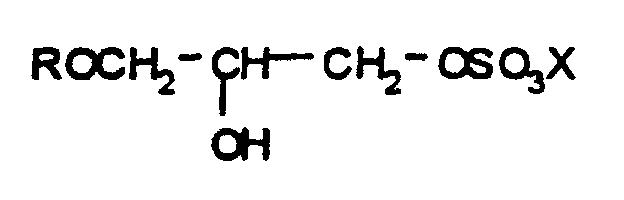
- (d) an alkyl monoglyceride sulfate of the formula:

- (e) an alkyl monoglyceride sulfonate of the formula:
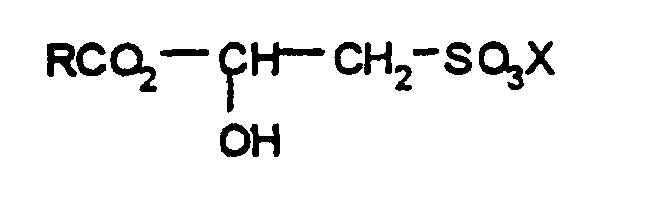
- (f) an alkyl sulfonate of the formula:
- (g) an alkylaryl sulfonate of the formula:

- (h) alkyl ether carboxylate of the formula:
-
- The anionic surfactant is preferably present in the cleansing composition at a concentration from about 1 to about 10 percent by weight.
- The substantive humectant used in the compositions of this invention is a cationic polyol. The cationic charge on the humectant makes the humectant substantive to the negative charges on skin and hair. Preferably, the polyol is derived from a sugar or sugar derivative. Examples of polyols useful for making the substantive humectants used in this invention are alkoxylated alkyl glucosides. Most preferably, the substantive humectant further contains a long chain alkyl group having from about 6 to about 22 carbon atoms.
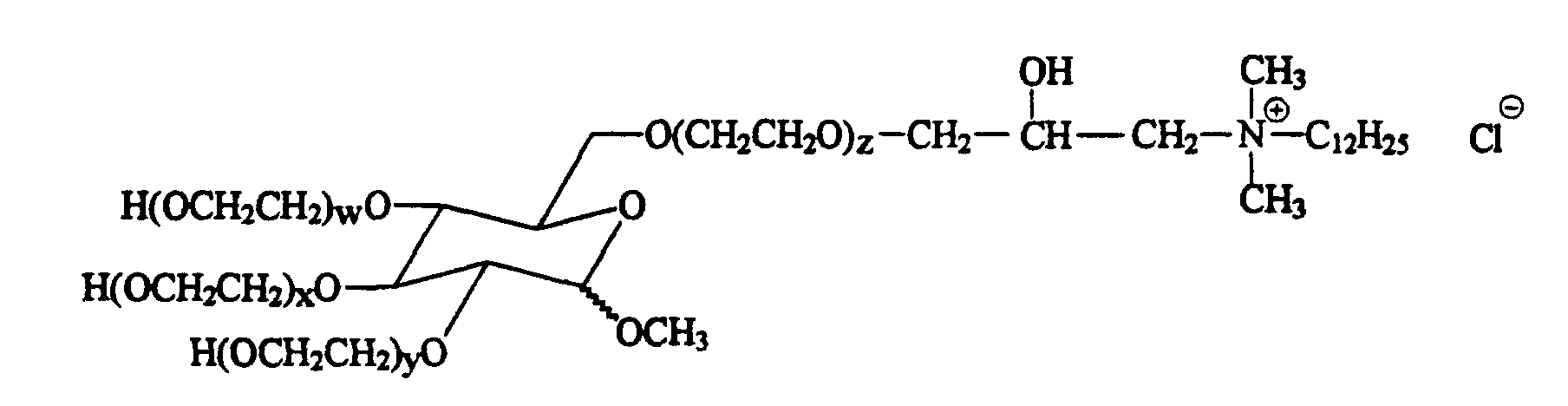
- A preferred substantive humectant which is a positively charged polyol derived from alkyl glucoside and which contains a long chain alkyl group is of the formulawherein w + x + y + z = 5 to 20, R is an alkyl or alkenyl group having 6 to 22 carbon atoms, R1, R2 and R3 are each independently lower alkyl having from 1 to 4 carbon atoms and wherein X is halide, carboxylate or alkyl sulfate.

- More preferred compositions of the present invention contain the following components:
- a. a surfactant portion containing:
- 1. nonionic surfactant;
- 2. amphocarboxylate amphoteric surfactant;
- 3. betaine amphoteric surfactant; and
- 4. anionic surfactant; the total concentration of said nonionic, amphocarboxylate, betaine and anionic surfactants being present in the composition in an amount from about 5 to about 20 percent by weight of said cleansing composition; and
- b. a substantive humectant present in the composition in an amount from about 0.01 to about 3 percent by weight of said cleansing composition.
-
- The nonionic surfactant material in the more preferable compositions of the invention are more preferably selected from the following materials and may be composed of one or more of the following: (a) polyoxyethylene derivatives of polyol esters, wherein (1) the polyoxyethylene derivative of polyol ester is derived from a polyol selected from the following group: sorbitol, sorbitan, glucose, a-methyl glucoside, polyglucose having an average of about 1.1 to about 3 glucose residues, glycerine, pentaerythritol and mixtures thereof; (2) the polyoxyethylene derivative of polyol ester contains from about 10 to about 120 oxyethylene units; (3) the polyoxyethylene derivative of polyol ester is derived from a fatty acid containing from about 8 to about 22 carbon atoms; and (4) the polyoxyethylene derivative of polyol ester has from 1 to 2 fatty acid residues per mole of polyoxyethylene derivative of polyol ester. The more preferred compositions of the invention contain from about 1 to about 10 percent by weight of the more preferred nonionic surfactants.
- The surfactant portion of the more preferred compositions of this invention should contain a mixture of amphocarboxylate and alkyl betaine or amidoalkyl betaine, wherein the amphocarboxylate, alkyl betaine and amidoalkyl betaine are as hereinbefore defined. The amphocarboxylate is present in the composition at a concentration from about 0.25 to about 10 percent by weight and the alkyl betaine or amidoalkyl betaine being present in the composition at a concentration of from about 0.25 to about 10 percent by weight.
- The anionic surfactant used in the more preferable compositions of this invention contains one or more of the following surfactants:
- alkyl ether sulfate of the formula
-
- The more preferred compositions of this invention contain a substantive humectant which is a positively charged polyol derived from alkyl glucoside and which contains a long chain alkyl group and which is of the formulawherein w + x + y + z = 5 to 20, R is an alkyl or alkenyl group having 6 to 22 carbon atoms, R1, R2 and R3 are each independently lower alkyl having from 1 to 4 carbon atoms and wherein X is halide, carboxylate or alkyl sulfate.

The substantive humectant is present in the compositions of the invention at a concentration of about 0.01 to about 3.0 percent by weight. - The most preferred compositions of the present invention contain the following components:
- a. a surfactant portion containing:
- 1. nonionic surfactant;
- 2. amphocarboxylate amphoteric surfactant;
- 3. betaine amphoteric surfactant; and
- 4. anionic surfactant; the total concentration of said nonionic, amphocarboxylate, betaine and anionic surfactants being present in the composition in an amount from about 5 to about 20 percent by weight of said cleansing composition;
- b. a substantive humectant which is a cationically charged polyol comprising from about 0.01 to about 3 percent by weight of the overall composition; and
- c. a thickener in an amount from about 0.1 to about 3.0 percent by weight of the composition.
-
- The nonionic surfactant in the most preferred compositions of the invention most preferably consist of a polyoxyethylene derivative of polyol ester wherein (1) the polyoxyethylene derivative of polyol ester is derived from a polyol selected from sorbitol, sorbitan and mixtures thereof, (2) the polyoxyethylene derivative of polyol ester contains from 20 to 80 oxyethylene units, (3) the polyoxyethylene derivative of polyol ester is derived from lauric acid, and (4) the polyoxyethylene derivative of polyol ester has from 1 to 2 lauric acid residues per molecule of polyoxyethylene derivative of polyol ester.
- The most preferred compositions of the invention contain from about 2 to about 10 percent by weight of these most preferred nonionic surfactants.
- Examples of nonionic surfactants which are most preferred for use in the compositions of this invention are as follows:
- PEG-80 sorbitan laurate is an ethoxylated derivative of sorbitan monoester of lauric acid ethoxylated with an average of 80 moles of ethylene oxide. The material known as Atlas G4280, available from ICI Chemicals Americas of Wilmington, Delaware, is one preferred nonionic surfactant for use in the compositions of the invention.
- Yet another surfactant which can be used in the compositions of this invention is Polysorbate 20, the mixture of laurate esters of sorbitol and sorbitol anhydrides, consisting predominantly of the monoester, condensed with approximately 20 moles of ethylene oxide.
The material known as Tween 20, available from ICI Chemicals Americas, Wilmington, Delaware, is another preferred material for use in the present compositions. - The most preferable compositions of the invention contain a mixture of both amphocarboxylate and betaine surfactants. The amphocarboxylate surfactant is most preferably a compound of the formulaavailable from Mona Chemical Company of Paterson, New Jersey. Another amphocarboxylate useful in the compositions of the present invention is Miranol BM available from Rhone-Poulenc of Cranbury, New Jersey.

- Most preferably, the betaine surfactant used in the present invention is selected from (1) an alkyl betaine of the formulaand (2) an amidoalkyl betaine of the formula
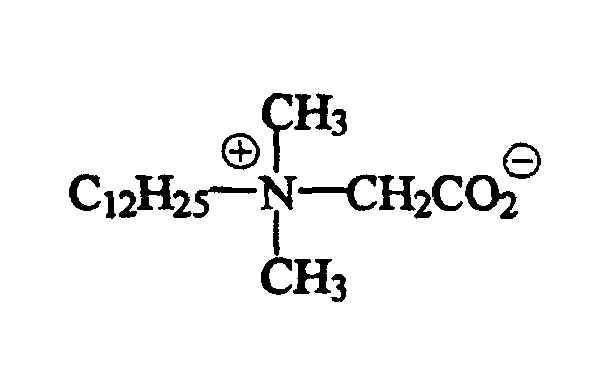 wherein RCO represents the fatty acid derived from coconut oil. The betaine surfactant is most preferably present in the cleansing composition at a concentration from about 0.5 to about 8 percent by weight.
- Illustrative examples of the most preferred betaines used in the present invention are Tegobetaine L-7 which is known by its International Nomenclature Cosmetic Ingredient (INCI) name as cocamidopropyl betaine and is available from Goldschmidt Chemical Company of Hopewell, Virginia. Another illustrative preferred betaine for use in this invention is lauryl betaine which is available as Empigen BB from Albright & Wilson Americas of Richmond, Virginia.
- The most preferred compositions of the present invention contain one or more alkyl ether sulfate anionic surfactants of the formula
- The anionic surfactant is most preferably present in the compositions of the present invention at a concentration from about 1 to about 8 percent by weight.
- An example of these most preferred anionic surfactants is sodium laureth sulfate of the formula
- In addition to the alkyl ether sulfates, preferred compositions of this invention also contain alkyl ether carboxylates of the formula:
- The most preferred compositions of this invention contain a substantive humectant which is a positively charged polyol derived from alkyl glucoside and which contains a long chain alkyl group and which is of the formulawherein w + x + y + z = 10. This material is available as Glucquat 125 from the Amerchol Corporation of Edison, New Jersey. The substantive humectant is present in the most preferred compositions of the invention at a concentration of about 0.1 to about 0.5 percent by weight.
- A thickening agent is also useful in the compositions of this invention in order to impart the appropriate viscosity to the compositions of the invention. A thickener may be selected from the following:
- (a) mono or diesters of fatty acids containing from 16 to
22 carbon atoms with polyethylene glycol of the formula:
- (b) fatty acid esters of ethoxylated polyols;
- (c) ethoxylated derivatives of mono and diesters of fatty acids and glycerine;
- (d) hydroxyalkyl cellulose;
- (e) alkyl cellulose; and
- (f) hydroxyalkyl alkyl cellulose.
-
- The thickener may be present in the compositions of the invention at a concentration of about 0.1 to about 5 percent by weight, more preferably at a concentration of about 0.1 to about 3.0 percent by weight. Polyethylene glycol esters are preferable thickeners for use in the compositions of the invention. PEG-150 distearate is the thickener for use in the most preferred compositions of this invention. This material is available as Kessco PEG 6000 Distearate from the Stepan Company of Northfield, Illinois.
- Inorganic salts may also be used as thickeners instead of or in addition to the organic thickeners mentioned above. Sodium chloride is a preferred inorganic salt in this regard. It may be added to the compositions of the invention at a concentration of about 0.5 to about 5 percent by weight, and preferably, at a concentration of about 1 to about 3 percent by weight.
- The cleansing compositions of this invention may also optionally contain one or more nonsubstantive humectants selected from:
- (a) water soluble liquid polyols selected from the group consisting of glycerine, propylene glycol, hexylene glycol, butylene glycol and dipropylene glycol;
- (b) polyethylene glycol of the formula
- (c) polyethylene glycol ether of methyl glucoside of formula
wherein w + x + y + z = 5 to 25,
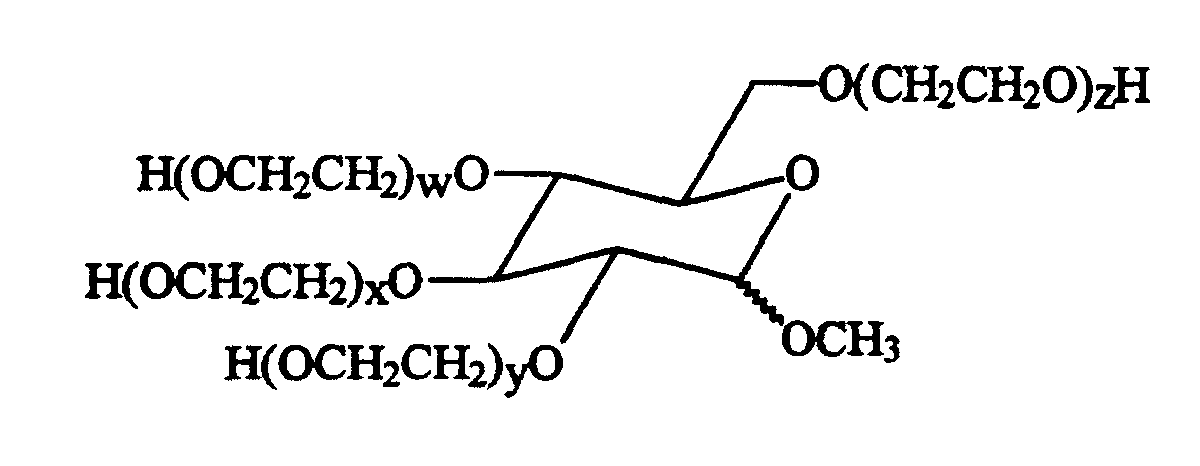
- (d) urea, and mixtures thereof.
-
- The nonsubstantive humectant may be present in the cleansing composition at a concentration of about 0.1 to about 5 percent by weight.
- A most preferred nonsubstantive humectant is glycerin, which is preferably present in the composition at a concentration of 0.25 to 1.5 percent by weight.
- Also useful in the compositions of this invention is a pearlizer, which tends to communicate positive attributes about the product to the consumer. The pearlescent or opacifying agent can be selected from the following group:
- (a) mono- or diesters of fatty acids having 16 to 22 carbon atoms with ethylene or propylene glycol,
- (b) mono- or diesters of fatty acids having 16 to 22
carbon atoms with a polyalkylene glycol of the formula:
- (c) fatty alcohols containing 16 to 22 carbon atoms;
- (d) fatty esters of the formula:
- (e) inorganic solids insoluble in the cleansing composition; and mixtures thereof.
-
- The pearlescent or opacifying agent may be present in the composition at a concentration of from about 0.25 to about 2.5 percent by weight. The inorganic pearlizing or opacifying agents can be titanium dioxide or mica.
- A preferred pearlizer is a diester of fatty acids having 16 to 22 carbon atoms with ethylene or propylene glycol. Most preferred as a pearlizer is ethylene glycol distearate.
- The pearlizer is most conveniently added to the composition of the invention as a preformed, stabilized aqueous dispersion. An example of a preferred preformed pearlizer is Euperlan PK-3000, available commercially from Henkel Corporation of Hoboken, New Jersey, which is a combination of glycol distearate, Laureth-4 and cocamidopropyl betaine. Generally, Euperlan PK-3000 contains about 25-30% of glycol distearate, 3-15% of Laureth-4 and between about 20-25% of cocamidopropyl betaine.
- The compositions of the present invention may also contain one or more additives such as plant extracts, plant homogenates, plant juices, vitamins and vitamin derivatives. For example, aloe vera gel, the mucilage obtained as the juice expressed from the leaves of the Aloe barbadensis Miller plant, is generally believed to soothe irritated skin, and may be advantageously added to the compositions of this invention. One source of aloe vera gel is Aloe-Con UP-40, a 40-fold aloe vera gel concentrate available from Florida Food Products of Eustis, Florida. Due to its concentrated state, the addition of one part of this concentrate to a formulation is equivalent to adding 40 parts of aloe vera gel to the formulation. Similarly, anti-oxidant and anti-inflammatory properties are attributed to vitamin E and its derivatives, which may be also beneficially added to compositions of this invention.
- The compositions of this invention may also contain additives which enhance their appearance, feel and fragrance, such as colorants, fragrances, preservatives and pH adjusting agents. Chelating agents such as EDTA are also helpful in protecting and preserving the compositions of this invention. A chelating agent such as tetrasodium EDTA, available commercially as Versene 100XL, from Dow Chemical Company of Midland, Michigan, may be used. Preservatives such as quaternium-15, available commercially as
Dowicil 200 from the Dow Corporation of Midland, Michigan, may be used. - The pH of the compositions of this invention should be in the range of from about 5 to about 7.5.
- Compositions which illustrate the preferred compositions of this invention are shown in the following examples.
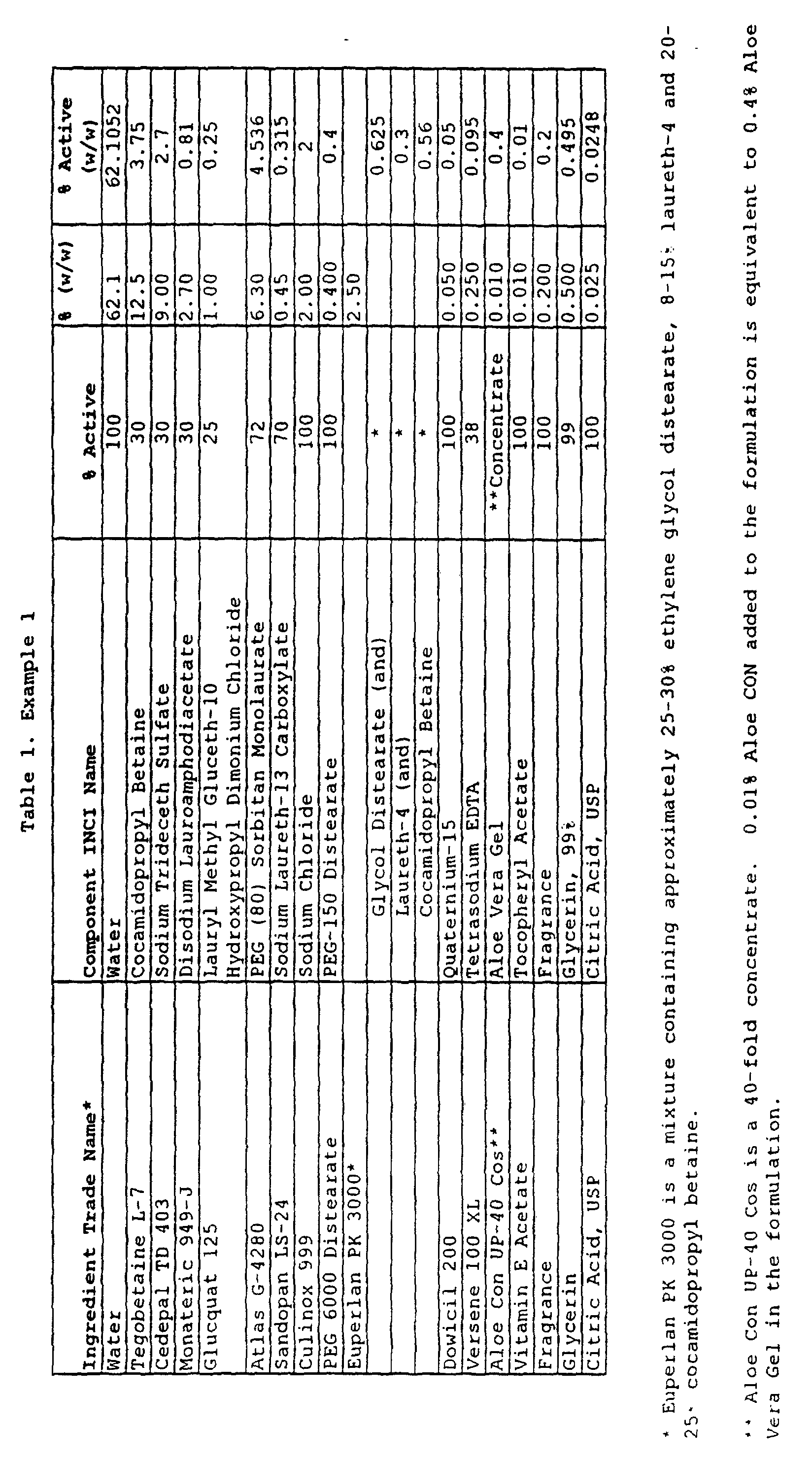


Comparative Example 1 Ingredient Trade Name Component INCI Name %WT/WT DI Water Water 58.2268 Tegobetaine L-7 Cocamidopropyl Betaine 12.5000 Cedepal TD403 Sodium Trideceth Sulfate 9.0000 Monateric 949-J Disodium Lauroamphodiacetate 2.7000 Atlas G-4280 Polyoxyethylene (80) Sorbitan Monolaurate 6.3000 Dowicil 200Quaternium-15 0.0500 Versene 100 XL Tetrasodium EDTA 0.2500 Plantaren 1200* Lauryl Polyglucose 5.0000 Euperlan PK3000 Glycol Distearate (and) Laureth-4 (and) Cocamidopropyl Betaine 2.5000 Fragrance 0.2000 Abil Quat 3474 * Quaternium 80 0.2500 Antil 171 Liquid* PEG-18 Glyceryl Glycol Dioleococoate 2.0000 NaOH sodium hydroxide 0.0232 Amilion GST-40 Laureth-3 (and) Glyceryl Stearate/Diacetytartrate 1.0000 TOTAL 100.0000% - The cleansing composition shown in Example 1 is prepared as follows:
- Component amounts in this procedure are given in terms of parts by weight to prepare 100 parts of the pre-mix. 66.57 parts of water are heated to a temperature of 155 to 170ºF. 33.33 parts of Sandopan LS-24 are added with agitation. The temperature is maintained at 155 to 170ºF until all of the Sandopan has dissolved. The temperature is then cooled to below 110ºF and 0.10 parts of
Dowicil 200 are added; agitation is continued until the premix is uniform. - Component amounts in this procedure are given in terms of parts by weight to prepare 100 parts of the cleansing composition of Example 1. 27.6 parts water are heated to 145 to 150ºF with agitation. 0.4 parts PEG 6000 distearate are added with agitation until all of the PEG 6000 distearate has dissolved. 1.0 parts Glucquat 125 is added with continued agitation until a uniform mixture is obtained. Cooling is commenced and the following are added simultaneously:
- 33.7 parts water
- 12.5 parts Tegobetaine L-7
- 2.7 parts Monateric 949-J
- 9.0 parts Cedapal TD 403
- 5.8 parts Atlas G-4280
-
- During the addition of the above ingredients, the following are also added:
- 2.0 parts Culinox 999
- 1.35 parts of the Sandopan LS-24 pre-mix
- 0.5 parts glycerin
-
- When the temperature has cooled to below 120ºF, 0.2 parts of fragrance pre-blended with 0.5 parts Atlas G-4280 are added. The following items are then added:
- 0.05
parts Dowicil 200 - 0.14 parts Versene 100XL
- 0.01 parts Aloe CON UP-40 Cos
- 0.01 parts Vitamin E acetate
-
- When the temperature has cooled to below 89ºF, 2.5 parts of Euperlan PK-3000 are added with continued stirring.
The pH of the composition is adjusted with a 20% citric acid solution until a final pH of 6.8 to 7.2 is obtained. - The degree of moisturization imparted by a moisturizing cleanser can be assessed by measuring the amount of water on the skin surface following the use of the moisturizing cleanser. The water content of the skin has been shown to be related to the skin's electrical properties. The measurement of impedance of the skin (the total electrical resistance of the skin to an alternating current) has been studied extensively and has been widely used to assess the hydration state of the skin's surface (J. Serup and G.B.E. Jemec in Handbook of Non-Invasive Methods for the Skin, CRC Press Inc., Boca Raton, FL, 1995, the disclosure of which is hereby incorporated by reference). Skin surface capacitance measurements were made with a Nova Technology Corp. Model 9003 dermal phase meter (DPM) equipped with a DPM 9103 remote sensor probe (Nova Technology Corporation, Gloucester, MA). This device emits a 1 Mhz span of simultaneously produced frequencies, producing a differential current source using a controlled rise time.
The sensor probe has 2 concentric brass electrodes which are separated by a non-conducting resin. The DPM measures and reports capacitance values at several frequencies from the signal-phase'delay data. The capacitance readings are directly related to picoFarads (pF) of capacitance in the volume of skin that is effectively measured. Conductance and capacitance have been shown to correlate to skin water content in vivo and the capacitance values delivered by the instrument are representative of the hydration state of the upper stratum corneum, i.e., the upper layers of the skin (P. Treffel and B. Gabard, "Stratum Corneum Dynamic Functional Measurements after Moisturizer or Irritant Application", Arch. Dermatol. Res., 287, 474-479, 1995 the disclosure of which is hereby incorporated by reference). - The following test protocol was used to make skin moisture measurements. Subjects who had applied lotions or oils to their skin since their last cleansing were asked to wash both volar forearms with a cleansing bar soap and to rinse and dry their forearms. Baseline readings were taken in four places within a 4 X 6 cm area on both forearms of each subject prior to treatment with the compositions of this invention. Both forearms of each subject were moistened with warm (approximately 38ºC) tap water. 0.5 ml of the composition of Example 1 was applied to the treatment area on one forearm of each subject over a one minute period and subsequently left in place for three minutes while the untreated arm, moistened with water, served as a control. Both arms were then simultaneously rinsed in separate buckets of warm water for 30 seconds. The arms were then air dried for five minutes. Four readings were then taken on each forearm at three succeeding five-minute intervals following the rinse step, i.e., at 5, 10 and 15 minutes following rinsing, with the probe being wiped between arm changes. Average values were calculated for each arm at each time interval.
- The results of these measurements are shown in Figure 1.
Data points represented by triangles, diamonds and squares in Figure 1 are for baseline measurements, control measurements and measurements after exposure to the composition of Example 1, respectively. It is evident from Figure 1 that the capacitance, and hence the moisture content of the skin in areas treated with the composition of this invention was significantly higher than the moisture content of the skin in the control area treated with water only. In contrast, the water treated areas showed no significant increase in moisture relative to the baseline values. The increase in moisturization in the treated areas vs. the control was statistically significant at the 99% confidence level after 5 and 10 minutes, and significant at the 95% confidence level after 15 minutes. - The compositions of this invention also exhibit very low irritation to the eyes and skin. Irritation has been measured in accordance with the Invittox Protocol Number 86, the "Trans-epithelial Permeability (TEP) Assay". In accordance with the TEP Assay, the ocular irritation potential of a product can be evaluated by determining its effect on the permeability of a cell layer, as assessed by the leakage of fluorescein through the layer. In accordance with this in vitro method, monolayers of Madin-Darby canine kidney (MDCK) cells are grown to confluence on microporous inserts in a 24-well plate containing medium or assay buffer in the lower wells. The irritation potential of a product is evaluated by measuring the damage to the permeability barrier in the cell monolayer following a 15 minute exposure to dilutions of the product. Barrier damage is assessed by the amount of sodium fluorescein that has leaked through to the lower well after 30 minutes, as determined by spectrophotometry.
The fluorescein leakage is plotted against the concentration of test material to determine the EC50 (the concentration of test material that causes 50% of maximum dye leakage, i.e., 50% damage to the permeability barrier). The test procedure is set forth in Invittox Protocol Number 86 (May 1994), the disclosure of which is hereby incorporated by reference. - Exposure of a layer of MDCK cells grown on a microporous membrane to test sample is a model for the first event that occurs when an irritant comes in contact with the eye. In vivo, the outermost layers of the corneal epithelium form a selectively permeable barrier due to the presence of tight junctions between cells. On exposure to an irritant, the tight junctions separate, removing the permeability barrier. Fluid is imbibed to the underlying layers of epithelium and to the stroma, causing the collagen lamellae to separate, resulting in opacity. The TEP assay measures the effect of an irritant on the breakdown of tight junctions between cells in a layer of MDCK cells grown on a microporous insert. Damage is evaluated spectrophotometrically, by measuring the amount of marker dye (sodium fluorescein) that leaks through the cell layer and microporous membrane to the lower well.
- Generally, a passing score is reflected in an EC50 of 2.2% or higher. The composition of Example 1 made in accordance with the present invention had a passing TEP score of 2.98 ± 0.48. In contrast, the composition of Comparative Example 1, which contained, among other ingredients, a cationic silicone (i.e., Quaternium 80) but did not include the cationic polyol i.e., Glucquat 125, used in the compositions of the present invention, scored a failing TEP score of 1.73. These data demonstrate the critical effect of the formulation components on TEP and hence eye irritation, and demonstrate that the compositions of the present invention are exceptionally mild to the eyes.
- Cleansing compositions having the formulations set forth in Tables 2 and 3 are made in accordance with the procedure of Example 1. These compositions are effective for cleansing, conditioning, and moisturizing skin and hair without ocular irritation.
Claims (10)
- A composition which imparts cleansing, conditioning and moisturization of the skin and hair and which exhibits a low degree of irritation to the eyes comprising:a. a surfactant portion comprising:said nonionic, amphoteric and anionic surfactants comprising from about 5 to about 20 percent by weight of the overall composition; and1. a nonionic surfactant;2. an amphoteric surfactant; and3. an anionic surfactant;b. a substantive humectant which is a cationically charged polyol comprising from about 0.01 to about 3.0 percent by weight of the overall composition
- The composition of claim 1 wherein the cationically charged polyol is derived from an alkoxylated alkyl glucoside.
- The composition of claim 1 or claim 2 wherein the humectant further comprises a long chain alkyl or alkenyl group having from 6 to 22 carbon atoms.
- The composition of any one of claims 1 to 3 wherein the substantive humectant is of the formulawherein w + x + y + z = 5 to 20, R is an alkyl or alkenyl group having 6 to 22 carbon atoms, R1, R2 and R3 are each independently lower alkyl having from 1 to 4 carbon atoms and wherein X is halide, carboxylate or alkyl sulfate.

- The composition of claim 4 wherein the substantive humectant is of the formulawherein w + x + y + z = 10.
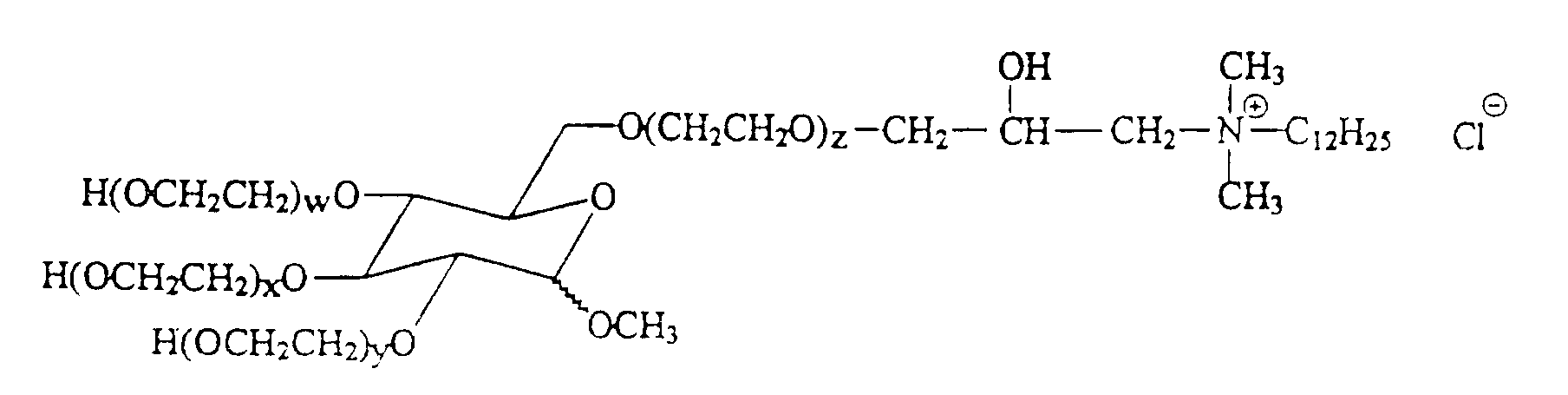
- The composition of any one of claims 1 to 5 wherein the nonionic surfactant comprises one or more surfactants selected from:a. polyoxyethylene derivatives of polyol esters
wherein1. the polyoxyethylene derivative of polyol ester is derived from a polyol selected from sorbitol, sorbitan, glucose, a-methyl glucoside, polyglucose having an average of about 1.1 to about 3 glucose residues, glycerine, pentaerythritol or mixtures thereof;2. the polyoxyethylene derivative of polyol ester contains from about 10 to about 120 oxyethylene units;3. the polyoxyethylene derivative of polyol ester is derived from a fatty acid containing from about 8 to about 22 carbon atoms; and4. the polyoxyethylene derivative of polyol ester has from about 1 to about 2 fatty acid residues per molecule of polyoxyethylene derivative of polyol ester;b. an alkyl polyglucoside; orc. mixtures thereof, wherein the nonionic surfactant is present in the composition at a concentration of from about 1 to about 10 percent by weight. - The composition of any one of claims 1 to 6 wherein the amphoteric surfactant comprises one or more surfactants selected from:wherein R is an alkyl group having from 7 to 17 carbon atoms, R1 and R2 are each alkyl groups having from 1 to 4 carbon atoms, n is an integer from 2 to 6 and m is either 1 or 2; and mixtures thereof. The amphoteric surfactant should be present in the shampoo composition at a concentration from about 0.5 to about 10 percent by weight.a. an amphocarboxylate compound of the formula:b. an alkyl betaine of the formula:c. an amidoalkyl betaine of the formula:
- The composition of any one of claims 1 to 7 further comprising a nonsubstantive humectant selected from:wherein the nonsubstantive humectant is present in the composition at a concentration of 0.1 to 5 percent by weight.a. water soluble liquid polyols selected from glycerine, propylene glycol, hexylene glycol, butylene glycol, dipropylene glycol, or mixtures thereof;b. polyethylene glycol of the formulac. polyethylene glycol ether of methyl glucoside of formulawherein w + x + y + z = 5 to 25;
 d. urea; ore. mixtures thereof,
 - The composition of any one of claims 1 to 8 further comprising a thickener selected from:wherein the thickener is present in the composition at a concentration of 0.1 to 5 percent by weight.a. mono or diesters of fatty acids containing from 16 to 22 carbon atoms with polyethylene glycol of formulaf. fatty acid esters of ethoxylated polyols;g. ethoxylated derivatives of mono and diesters of fatty acids and glycerine;h. hydroxyalkyl cellulose;i. alkyl cellulose;j. hydroxyalkyl alkyl cellulose; andk. mixtures thereof,
- A surfactant composition which imparts cleansing, conditioning and moisturization of the skin and hair and which exhibits a low degree of irritation to the eyes comprising:wherein w + x + y + z = 5 to 20, R is an alkyl or alkenyl group having 6 to 22 carbon atoms, R1, R2 and R3 are each independently lower alkyl having from 1 to 4 carbon atoms and wherein X is halide, carboxylate or alkyl sulfate;A. one or more nonionic surfactants comprising polyoxyethylene derivatives of polyol ester whereinwherein the nonionic surfactant is present in the composition at a concentration of from 1 to 10 percent by weight;1. the polyoxyethylene derivative of polyol ester is derived from a polyol selected from sorbitol, sorbitan, glucose, a-methyl glucoside, polyglucose having an average of about 1.1 to about 3 glucose residues, glycerine, pentaerythritol or mixtures thereof,2. the polyoxyethylene derivative of polyol ester contains from 10 to 120 oxyethylene units,3. the polyoxyethylene derivative of polyol ester is derived from a fatty acid containing from 8 to 22 carbon atoms, and4. the polyoxyethylene derivative of polyol ester has from 1 to 2 fatty acid residues per molecule of polyoxyethylene derivative of polyol ester; andB. one or more amphocarboxylate amphoteric surfactants comprising a compound of the formula
x is an integer from 1 to 6, R1 is hydrogen or a carboxyalkyl group containing from 2 to 3 carbon atoms,
R2 is a hydroxyalkyl group containing from 2 to 3 carbon atoms or a group of the formula
and wherein the amphoteric amphocxarboxylate surfactant is present in the composition at a concentration from 0.25 to 10 percent by weight;C. one or more betaine surfactants selected from:and wherein the betaine surfactant is present in the composition at a concentration from 0.5 to 10 percent by weight;1. an alkyl betaine of the formula2. an amidoalkyl betaine of the formula3. mixtures thereof,D. one or more anionic surfactants comprising alkyl ether sulfate of the formula
R is an alkyl group having 7 to 17 carbon atoms,
X is selected from alkali metal ions, alkaline earth metal ions, ammonium ions, or ammonium ions substituted with from 1 to 3 substituents, each of which may be the same or different, and which are selected from alkyl groups having from 1 to 4 carbon atoms and hydroxyalkyl groups having from 2 to 4 carbon atoms, and p is an integer from 1 to 6,
and said anionic surfactant is present in the composition at a concentration from 1 to 10 percent by weight;E. a substantive humectant of the formula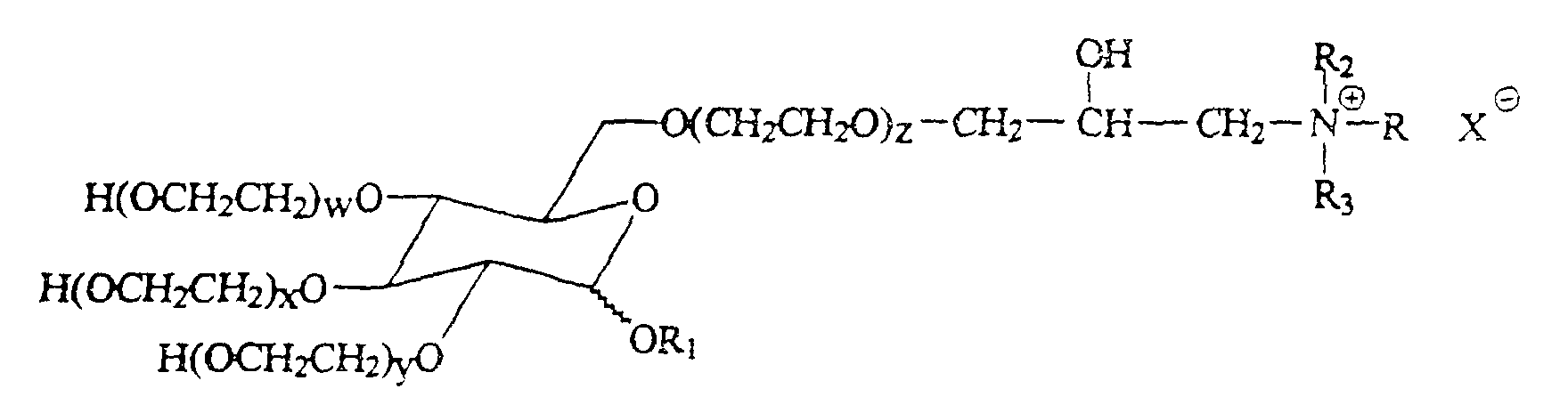
said nonionic, amphoteric amphocarboxylate, betaine and anionic surfactants comprising a total of 5 to 20 percent by weight of the composition and said substantive humectant comprising from 0.01 to 3.0 percent by weight of the composition.
Applications Claiming Priority (3)
| Application Number | Priority Date | Filing Date | Title |
|---|---|---|---|
| US1339096P | 1996-03-14 | 1996-03-14 | |
| US613390P | 1996-03-14 | ||
| PCT/US1997/003912 WO1997033561A1 (en) | 1996-03-14 | 1997-03-13 | Cleansing and moisturizing surfactant compositions |
Publications (2)
| Publication Number | Publication Date |
|---|---|
| EP0907354A1 EP0907354A1 (en) | 1999-04-14 |
| EP0907354B1 true EP0907354B1 (en) | 2002-05-29 |
Family
ID=21759713
Family Applications (1)
| Application Number | Title | Priority Date | Filing Date |
|---|---|---|---|
| EP97909020A Revoked EP0907354B1 (en) | 1996-03-14 | 1997-03-13 | Cleansing and moisturizing surfactant compositions |
Country Status (11)
| Country | Link |
|---|---|
| US (3) | US6046145A (en) |
| EP (1) | EP0907354B1 (en) |
| CN (1) | CN1087931C (en) |
| AU (1) | AU713278B2 (en) |
| BR (1) | BR9710407A (en) |
| CA (1) | CA2248993A1 (en) |
| CO (1) | CO4770894A1 (en) |
| DE (1) | DE69712884T2 (en) |
| ES (1) | ES2177948T3 (en) |
| ID (1) | ID16365A (en) |
| WO (1) | WO1997033561A1 (en) |
Families Citing this family (39)
| Publication number | Priority date | Publication date | Assignee | Title |
|---|---|---|---|---|
| CN1087931C (en) * | 1996-03-14 | 2002-07-24 | 庄臣消费者有限公司 | Cleaning and moisturizing surfactant composition |
| US5871758A (en) * | 1996-12-11 | 1999-02-16 | E-L Management Corp. | Dual phase cosmetic composition |
| US6524594B1 (en) * | 1999-06-23 | 2003-02-25 | Johnson & Johnson Consumer Companies, Inc. | Foaming oil gel compositions |
| US6271187B1 (en) * | 1999-12-01 | 2001-08-07 | Ecolab Inc. | Hand soap concentrate, use solution and method for modifying a hand soap concentrate |
| DE10055518A1 (en) * | 2000-11-09 | 2002-05-23 | Cognis Deutschland Gmbh | Amphoteric surfactants of N-acylaminoalkyl-N-hydroxyalkyl-aminoacetic acid or alkali metal salt type are used with anionic and/or nonionic surfactant, such as in shampoo or hand washing-up detergent |
| US20050026805A1 (en) * | 2003-07-14 | 2005-02-03 | Ici Americas, Inc. | Solvated nonionic surfactants and fatty acids |
| US20050014671A1 (en) * | 2003-07-14 | 2005-01-20 | Queen Craig B. | Solvated nonionic surfactants and fatty acids |
| KR100981600B1 (en) | 2004-01-13 | 2010-09-13 | 주식회사 엘지생활건강 | Facial Cleansing Composition |
| US7456139B2 (en) * | 2004-05-07 | 2008-11-25 | Croda Uniqema, Inc. | Solvated nonionic surfactants |
| US20080269094A1 (en) * | 2004-05-07 | 2008-10-30 | Ici Americas, Inc. | Solvated Nonionic Surfactants |
| US7803746B2 (en) * | 2004-12-16 | 2010-09-28 | Georgia-Pacific Consumer Products Lp | Antimicrobial foam hand soap comprising inulin or an inulin surfactant |
| ATE353621T1 (en) * | 2004-12-16 | 2007-03-15 | Kpss Kao Gmbh | SHAMPOO COMPOSITION |
| US7521404B2 (en) * | 2004-12-16 | 2009-04-21 | Georgia-Pacific Consumer Products Lp | Antimicrobial liquid hand soap composition with tactile signal comprising a phospholipid surfactant |
| EP1827095A4 (en) | 2004-12-23 | 2013-01-16 | Arthur M Nonomura | COMPOSITIONS AND METHODS FOR LIMITING VEGETABLE TRANSPIRATION |
| US8586014B2 (en) | 2005-10-28 | 2013-11-19 | L'oreal | Composition for the care of keratin material and cosmetic treatment process using said composition |
| US20090110657A1 (en) * | 2007-10-31 | 2009-04-30 | Whewell Christopher J | Skin care compositions |
| FR2917968B1 (en) * | 2007-06-29 | 2010-02-26 | Oreal | DETERGENT COSMETIC COMPOSITIONS COMPRISING FOUR SURFACTANTS, CATIONIC POLYMER AND BENEFICATED AGENT AND USE |
| US20120093753A1 (en) | 2007-06-29 | 2012-04-19 | Fevola Michael J | Cationic polyglyceryl compositions and compounds |
| US8986665B2 (en) | 2007-06-29 | 2015-03-24 | Johnson & Johnson Consumer Companies, Inc. | Cationic polyglyceryl compositions and compounds |
| FR2921663A1 (en) | 2007-10-02 | 2009-04-03 | Bluestar Silicones France Soc | POLYORGANOSILOXANES WITH PIPERIDINE FUNCTION WITHOUT CUTANE CONTACT TOXICITY AND USE OF THE SAME IN COSMETIC COMPOSITIONS |
| US20100197544A1 (en) * | 2009-02-03 | 2010-08-05 | Edwin De La Cruz | Rinseless body wash composition |
| JP4912483B2 (en) * | 2010-04-12 | 2012-04-11 | 株式会社 資生堂 | Concentrated liquid detergent composition and method for producing the same |
| MX355598B (en) | 2011-11-21 | 2018-04-24 | Innovation Hammer Llc | Methods and systems for growing pl. |
| EA030043B1 (en) | 2012-05-21 | 2018-06-29 | ИННОВЕЙШН ХАММЕР ЭлЭлСи | Methods for rendering micellar coordination complexes safe for the treatment of plants and formulations for same |
| US9579272B2 (en) | 2012-06-15 | 2017-02-28 | Lubrizol Advanced Materials, Inc. | Alkyl glycoside-based micellar thickeners for surfactant systems |
| CN103070793A (en) * | 2012-09-14 | 2013-05-01 | 苏州宝丽洁日化有限公司 | Health sterilization wet tissue |
| ES2928774T3 (en) | 2012-10-15 | 2022-11-22 | Oreal | Aqueous wax dispersions and hair styling compositions containing them |
| KR20160094219A (en) * | 2015-01-30 | 2016-08-09 | 삼성전자주식회사 | Apparatus and method for measuring body composition |
| US10952949B2 (en) | 2015-04-23 | 2021-03-23 | The Procter And Gamble Company | Concentrated personal cleansing compositions |
| WO2016172472A1 (en) | 2015-04-23 | 2016-10-27 | The Procter & Gamble Company | Concentrated personal cleansing compositions and uses |
| EP3285729B1 (en) | 2015-04-23 | 2019-12-18 | The Procter and Gamble Company | Concentrated personal cleansing compositions and methods |
| MX376295B (en) | 2015-04-23 | 2025-03-07 | Procter & Gamble | CONCENTRATED COMPOSITIONS FOR PERSONAL CLEANING AND METHODS. |
| JP7313150B2 (en) | 2016-04-29 | 2023-07-24 | イノベーション・ハマー・エルエルシー | Formulations and Methods for Treating Photosynthetic Organisms with Glycan Composite Formulations to Enhance Harvest Quality and Quantity |
| US11185486B2 (en) | 2016-10-21 | 2021-11-30 | The Procter And Gamble Company | Personal cleansing compositions and methods |
| WO2018075749A1 (en) | 2016-10-21 | 2018-04-26 | The Procter & Gamble Company | Skin cleansing compositions and methods |
| US10675231B2 (en) | 2017-02-17 | 2020-06-09 | The Procter & Gamble Company | Packaged personal cleansing product |
| US10806686B2 (en) | 2017-02-17 | 2020-10-20 | The Procter And Gamble Company | Packaged personal cleansing product |
| FR3082744B1 (en) * | 2018-06-22 | 2020-10-09 | Oreal | EMULSION COMPRISING A SILICONATED RESIN, A LIQUID POLYOL AND PIGMENTS, PREPARATION OF THE EMULSION AND PROCESS BY USING IT |
| US20220249341A1 (en) * | 2021-01-29 | 2022-08-11 | L'oreal | Cleansing composition providing enhanced deposition of salicylic acid for acne treatment |
Family Cites Families (76)
| Publication number | Priority date | Publication date | Assignee | Title |
|---|---|---|---|---|
| CA1018893A (en) * | 1972-12-11 | 1977-10-11 | Roger C. Birkofer | Mild thickened shampoo compositions with conditioning properties |
| US4110263A (en) * | 1977-06-17 | 1978-08-29 | Johnson & Johnson Baby Products Company | Mild cleansing compositions containing alkyleneoxylated bisquaternary ammonium compounds |
| US4181634A (en) * | 1977-06-17 | 1980-01-01 | Johnson & Johnson | Mild cleansing compositions comprising an alkyleneoxylated bisquaternary ammonium compound and an anionic or amphoteric detergent such as a phosphobetaine |
| DE2926479C2 (en) * | 1979-06-30 | 1981-10-08 | Th. Goldschmidt Ag, 4300 Essen | Process for the production of betaines |
| CA1168949A (en) * | 1979-08-13 | 1984-06-12 | William G. Gorman | Cleansing compositions |
| DE3033929C2 (en) * | 1980-09-10 | 1982-05-27 | Th. Goldschmidt Ag, 4300 Essen | Body cleansers |
| US4435300A (en) * | 1981-03-09 | 1984-03-06 | Johnson & Johnson Baby Products Company | Detergent compositions |
| US4364837A (en) * | 1981-09-08 | 1982-12-21 | Lever Brothers Company | Shampoo compositions comprising saccharides |
| US4375421A (en) * | 1981-10-19 | 1983-03-01 | Lever Brothers Company | Viscous compositions containing amido betaines and salts |
| AU554574B2 (en) * | 1982-03-19 | 1986-08-28 | Colgate-Palmolive Pty. Ltd. | Shampoo |
| JPS606693B2 (en) * | 1982-05-28 | 1985-02-20 | 花王株式会社 | Method for producing pearlescent agent dispersion |
| GB8302683D0 (en) * | 1983-02-01 | 1983-03-02 | Unilever Plc | Skin treatment composition |
| US4490355A (en) | 1983-03-14 | 1984-12-25 | Miranol Chemical Company, Inc. | Betaine based cosmetic formulations |
| US4529588A (en) * | 1984-02-27 | 1985-07-16 | Richardson-Vicks Inc. | Hair conditioning shampoo |
| CA1236454A (en) * | 1984-06-27 | 1988-05-10 | John J. Tsai | Monomeric cationic glycoside derivatives |
| US4595526A (en) * | 1984-09-28 | 1986-06-17 | Colgate-Palmolive Company | High foaming nonionic surfacant based liquid detergent |
| US5002680A (en) * | 1985-03-01 | 1991-03-26 | The Procter & Gamble Company | Mild skin cleansing aerosol mousse with skin feel and moisturization benefits |
| US4654207A (en) * | 1985-03-13 | 1987-03-31 | Helene Curtis Industries, Inc. | Pearlescent shampoo and method for preparation of same |
| US4806262A (en) * | 1985-08-14 | 1989-02-21 | The Procter & Gamble Company | Nonlathering cleansing mousse with skin conditioning benefits |
| US4708813A (en) * | 1985-08-14 | 1987-11-24 | The Procter & Gamble Company | Nonlathering cleansing mousse with skin conditioning benefits |
| US5167872A (en) * | 1985-10-31 | 1992-12-01 | The Procter & Gamble Company | Comprising anionic surfactant polymeric nonionic surfactant and betaine surfactant |
| US4772424A (en) * | 1986-01-08 | 1988-09-20 | The Proctor & Gamble Company | Shampoo containing mixtures of sulfate and/or sulfonate, sarcosinate and betaine surfactants |
| US4726915A (en) * | 1986-03-10 | 1988-02-23 | Johnson & Johnson Baby Products Company | Detergent compositions |
| FR2601960B1 (en) * | 1986-07-25 | 1989-05-26 | Lesieur Cotelle | DETERGENT, VISCOUS, DILUABLE COMPOSITION AND PROCESS FOR OBTAINING SAME |
| DE3640755A1 (en) * | 1986-11-28 | 1988-06-09 | Henkel Kgaa | FLOWABLE Pearlescent Concentrate |
| DE3726322C1 (en) * | 1987-08-07 | 1988-12-08 | Goldschmidt Ag Th | Process for the preparation of concentrated flowable aqueous solutions of betaines |
| GB8718886D0 (en) * | 1987-08-10 | 1987-09-16 | Ici America Inc | Composition |
| MY103439A (en) * | 1987-10-29 | 1993-06-30 | Kao Corp | Detergent composition |
| NZ227813A (en) * | 1988-02-10 | 1990-03-27 | Richardson Vicks Inc | Oil in water emulsion having 3-40% oil and an amphipathic emulsifying agent in the range 0.02-2% and method of forming such emulsions |
| NZ223531A (en) * | 1988-02-16 | 1989-09-27 | Ritz Group Ltd Charles | Enhanced moisture-resistant skin treatment compositions |
| US4938953A (en) * | 1988-08-09 | 1990-07-03 | The Upjohn Company | Self-preserving conditioning shampoo formulation |
| FR2639354B1 (en) | 1988-11-24 | 1993-01-22 | Gaz De France | PROCESS FOR CRACKING A LOAD OF HEAVY HYDROCARBONS IN LIGHT HYDROCARBONS AND DEVICE FOR CARRYING OUT SAID METHOD |
| DE3843572A1 (en) * | 1988-12-23 | 1990-06-28 | Henkel Kgaa | FLOWABLE Pearlescent Concentrate |
| DE3902374A1 (en) * | 1989-01-27 | 1990-08-02 | Solvay Werke Gmbh | WASH CLEANING AND / OR BODY CLEANING AGENT |
| GB8912391D0 (en) * | 1989-05-30 | 1989-07-12 | Unilever Plc | Shampoo composition |
| US4997641A (en) * | 1990-04-09 | 1991-03-05 | Colgate-Palmolive Company | Hair conditioning shampoo containing C6 -C10 alkyl sulfate or alkyl alkoxy sulfate |
| AU628590B2 (en) * | 1989-06-21 | 1992-09-17 | Colgate-Palmolive Company, The | Liquid dishwashing detergent composition |
| US5348736A (en) * | 1989-06-21 | 1994-09-20 | Colgate-Palmolive Company | Stabilized hair-treating compositions |
| US5104646A (en) * | 1989-08-07 | 1992-04-14 | The Procter & Gamble Company | Vehicle systems for use in cosmetic compositions |
| US5100658A (en) * | 1989-08-07 | 1992-03-31 | The Procter & Gamble Company | Vehicle systems for use in cosmetic compositions |
| EP0412710B1 (en) * | 1989-08-07 | 1995-07-19 | The Procter & Gamble Company | Vehicle systems for use in cosmetic compositions |
| GB9008944D0 (en) * | 1990-04-20 | 1990-06-20 | Unilever Plc | Shampoo composition |
| GB2246363A (en) * | 1990-07-23 | 1992-01-29 | Unilever Plc | Shampoo compositions. |
| GB9021417D0 (en) * | 1990-10-02 | 1990-11-14 | Unilever Plc | Cosmetic composition |
| GB9024162D0 (en) * | 1990-11-07 | 1990-12-19 | Unilever Plc | Detergent composition |
| AU1444592A (en) * | 1991-03-08 | 1992-10-06 | Procter & Gamble Company, The | Concentrated fabric softening compositions |
| US5612024A (en) * | 1991-03-27 | 1997-03-18 | Henkel Kommanditgesellschaft Auf Aktien | Cosmetic preparations for the hair |
| IL101682A (en) * | 1991-04-29 | 1996-12-05 | Curtis Helene Ind Inc | Hair shampoo conditioner composition |
| JP3346420B2 (en) * | 1991-07-26 | 2002-11-18 | 花王株式会社 | Detergent composition |
| NZ244862A (en) * | 1991-10-23 | 1995-07-26 | Block Drug Co | Use of vitamin e in topical pharmaceuticals to enhance penetration of the active agent |
| AU3136593A (en) * | 1991-11-22 | 1993-06-15 | Richardson-Vicks Inc. | Combined personal cleansing and moisturizing compositions |
| GB9204175D0 (en) * | 1992-02-27 | 1992-04-08 | Unilever Plc | Cleansing composition |
| EP0630225A1 (en) * | 1992-03-17 | 1994-12-28 | The Procter & Gamble Company | Mild shampoo compositions |
| CA2095743A1 (en) * | 1992-05-07 | 1993-11-08 | Thomas R. Russo | Shampoos containing polyglyceryl esters |
| ATE130362T1 (en) * | 1992-05-13 | 1995-12-15 | Hoechst Ag | NON-IONIC, FLOWING PEARLIGHT DISPERSIONS. |
| US5290482A (en) * | 1992-06-01 | 1994-03-01 | Colgate-Palmolive Company | Surfactant compositions comprising betaine/cocoamide complexes and method of making the same |
| US5389304A (en) * | 1992-06-03 | 1995-02-14 | Colgate Palmolive Co. | High foaming nonionic surfactant base liquid detergent |
| US5387375A (en) * | 1992-06-03 | 1995-02-07 | Colgate Palmolive Co. | High foaming nonionic surfactant based liquid detergent |
| US5385696A (en) * | 1992-06-03 | 1995-01-31 | Colgate Palmolive Co. | High foaming nonionic surfactant based liquid detergent |
| NZ247675A (en) * | 1992-06-03 | 1994-10-26 | Colgate Palmolive Co | Aqueous high foaming detergents containing nonionic, anionic and betaine surfactants; method of preparation |
| US5284603A (en) * | 1992-06-03 | 1994-02-08 | Colgate Palmolive Co. | Gelled detergent composition having improved skin sensitivity |
| US5389305A (en) * | 1992-06-03 | 1995-02-14 | Colgate Palmolive Co. | High foaming nonionic surfactant base liquid detergent |
| TW211523B (en) * | 1992-06-29 | 1993-08-21 | Amerchol Corp | Hydroxylated milk glycerides |
| JP2736486B2 (en) * | 1992-07-03 | 1998-04-02 | 花王株式会社 | Cleansing composition |
| EP0616027A1 (en) * | 1993-03-19 | 1994-09-21 | The Procter & Gamble Company | Concentrated cleaning compositions |
| EP0616026A1 (en) * | 1993-03-19 | 1994-09-21 | The Procter & Gamble Company | Concentrated cleaning compositions |
| CA2161008A1 (en) * | 1993-04-20 | 1994-10-27 | Barry A. Salka | Liquid pearlizing composition |
| US5401327A (en) * | 1993-06-18 | 1995-03-28 | Wilmington Partners L.P. | Method of treating contact lenses |
| EP0703965B1 (en) * | 1993-06-18 | 1999-01-20 | Polymer Technology Corporation | Composition for cleaning and wetting contact lenses |
| GB9314410D0 (en) * | 1993-07-13 | 1993-08-25 | Jeyes Group Plc | Cleansing compositions |
| AU1925795A (en) * | 1994-02-28 | 1995-09-11 | Colgate-Palmolive Company, The | Liquid detergent |
| GB9414574D0 (en) * | 1994-07-19 | 1994-09-07 | Unilever Plc | Detergent composition |
| GB9414573D0 (en) * | 1994-07-19 | 1994-09-07 | Unilever Plc | Detergent composition |
| GB9414575D0 (en) * | 1994-07-19 | 1994-09-07 | Unilever Plc | Detergent composition |
| GB2297761A (en) * | 1994-12-05 | 1996-08-14 | Procter & Gamble | Personal cleaning compositions |
| CN1087931C (en) * | 1996-03-14 | 2002-07-24 | 庄臣消费者有限公司 | Cleaning and moisturizing surfactant composition |
-
1997
- 1997-03-13 CN CN97193068A patent/CN1087931C/en not_active Expired - Lifetime
- 1997-03-13 CA CA002248993A patent/CA2248993A1/en not_active Abandoned
- 1997-03-13 WO PCT/US1997/003912 patent/WO1997033561A1/en not_active Ceased
- 1997-03-13 AU AU20774/97A patent/AU713278B2/en not_active Expired
- 1997-03-13 BR BR9710407A patent/BR9710407A/en not_active Application Discontinuation
- 1997-03-13 ES ES97909020T patent/ES2177948T3/en not_active Expired - Lifetime
- 1997-03-13 DE DE69712884T patent/DE69712884T2/en not_active Revoked
- 1997-03-13 EP EP97909020A patent/EP0907354B1/en not_active Revoked
- 1997-03-14 CO CO97013951A patent/CO4770894A1/en unknown
- 1997-03-14 ID IDP970840A patent/ID16365A/en unknown
-
1999
- 1999-03-18 US US09/271,760 patent/US6046145A/en not_active Expired - Lifetime
-
2000
- 2000-01-19 US US09/487,067 patent/US6440907B1/en not_active Expired - Lifetime
-
2002
- 2002-04-15 US US10/123,831 patent/US20020165104A1/en not_active Abandoned
Also Published As
| Publication number | Publication date |
|---|---|
| US20020165104A1 (en) | 2002-11-07 |
| US6046145A (en) | 2000-04-04 |
| CN1217652A (en) | 1999-05-26 |
| ID16365A (en) | 1997-09-25 |
| US6440907B1 (en) | 2002-08-27 |
| AU713278B2 (en) | 1999-11-25 |
| DE69712884D1 (en) | 2002-07-04 |
| WO1997033561A1 (en) | 1997-09-18 |
| CO4770894A1 (en) | 1999-04-30 |
| DE69712884T2 (en) | 2002-11-21 |
| EP0907354A1 (en) | 1999-04-14 |
| CA2248993A1 (en) | 1997-09-18 |
| ES2177948T3 (en) | 2002-12-16 |
| BR9710407A (en) | 1999-08-17 |
| CN1087931C (en) | 2002-07-24 |
| AU2077497A (en) | 1997-10-01 |
Similar Documents
| Publication | Publication Date | Title |
|---|---|---|
| US6440907B1 (en) | Cleansing and moisturizing surfactant compositions | |
| WO1997033561A9 (en) | Cleansing and moisturizing surfactant compositions | |
| EP1105090B1 (en) | Cosmetic composition | |
| FI81605B (en) | SKUMBILDANDE EMULSIONSPRODUKT FOER HUDRENING. | |
| EP0879047B1 (en) | Detergent compositions | |
| KR970001645B1 (en) | Hair shampoo | |
| US7098180B2 (en) | Mild and effective cleansing compositions | |
| US6489286B1 (en) | Personal cleansing compositions | |
| WO1997010804A1 (en) | Body wash composition to impart conditioning properties to skin | |
| EP1136066A2 (en) | Conditioning detergent hair care compositions | |
| AU778722B2 (en) | Composition for treating and/or ameliorating the diseases of dandruff, seborrheic dermatitis, psoriasis and eczema and symptoms thereof | |
| EP1029532B1 (en) | Liquid cleansing composition | |
| KR101222902B1 (en) | Methods of reducing irritation in personal care compositions | |
| JP3375833B2 (en) | Skin cleanser | |
| JP2956268B2 (en) | Detergent composition | |
| KR100489722B1 (en) | Cleaning composition | |
| US20060019845A1 (en) | Foaming cleansing composition | |
| JP2002029963A (en) | Skin-cleansing agent composition | |
| HUP9903449A2 (en) | Aqueous liquid cleansing composition containing fatty acid soaps | |
| Lomax | Personal care applications |
Legal Events
| Date | Code | Title | Description |
|---|---|---|---|
| PUAI | Public reference made under article 153(3) epc to a published international application that has entered the european phase |
Free format text: ORIGINAL CODE: 0009012 |
|
| 17P | Request for examination filed |
Effective date: 19981009 |
|
| AK | Designated contracting states |
Kind code of ref document: A1 Designated state(s): DE ES GB GR IT |
|
| 17Q | First examination report despatched |
Effective date: 19991104 |
|
| GRAG | Despatch of communication of intention to grant |
Free format text: ORIGINAL CODE: EPIDOS AGRA |
|
| GRAG | Despatch of communication of intention to grant |
Free format text: ORIGINAL CODE: EPIDOS AGRA |
|
| GRAH | Despatch of communication of intention to grant a patent |
Free format text: ORIGINAL CODE: EPIDOS IGRA |
|
| GRAG | Despatch of communication of intention to grant |
Free format text: ORIGINAL CODE: EPIDOS AGRA |
|
| GRAH | Despatch of communication of intention to grant a patent |
Free format text: ORIGINAL CODE: EPIDOS IGRA |
|
| GRAG | Despatch of communication of intention to grant |
Free format text: ORIGINAL CODE: EPIDOS AGRA |
|
| GRAH | Despatch of communication of intention to grant a patent |
Free format text: ORIGINAL CODE: EPIDOS IGRA |
|
| GRAH | Despatch of communication of intention to grant a patent |
Free format text: ORIGINAL CODE: EPIDOS IGRA |
|
| GRAA | (expected) grant |
Free format text: ORIGINAL CODE: 0009210 |
|
| AK | Designated contracting states |
Kind code of ref document: B1 Designated state(s): DE ES GB GR IT |
|
| REG | Reference to a national code |
Ref country code: GB Ref legal event code: FG4D |
|
| REF | Corresponds to: |
Ref document number: 69712884 Country of ref document: DE Date of ref document: 20020704 |
|
| REG | Reference to a national code |
Ref country code: GR Ref legal event code: EP Ref document number: 20020402527 Country of ref document: GR |
|
| REG | Reference to a national code |
Ref country code: ES Ref legal event code: FG2A Ref document number: 2177948 Country of ref document: ES Kind code of ref document: T3 |
|
| PLBI | Opposition filed |
Free format text: ORIGINAL CODE: 0009260 |
|
| PLBF | Reply of patent proprietor to notice(s) of opposition |
Free format text: ORIGINAL CODE: EPIDOS OBSO |
|
| 26 | Opposition filed |
Opponent name: HENKEL KGAA Effective date: 20030227 |
|
| PLAX | Notice of opposition and request to file observation + time limit sent |
Free format text: ORIGINAL CODE: EPIDOSNOBS2 |
|
| PLAX | Notice of opposition and request to file observation + time limit sent |
Free format text: ORIGINAL CODE: EPIDOSNOBS2 |
|
| PLAX | Notice of opposition and request to file observation + time limit sent |
Free format text: ORIGINAL CODE: EPIDOSNOBS2 |
|
| PLBB | Reply of patent proprietor to notice(s) of opposition received |
Free format text: ORIGINAL CODE: EPIDOSNOBS3 |
|
| PGFP | Annual fee paid to national office [announced via postgrant information from national office to epo] |
Ref country code: ES Payment date: 20040318 Year of fee payment: 8 |
|
| PGFP | Annual fee paid to national office [announced via postgrant information from national office to epo] |
Ref country code: GR Payment date: 20050211 Year of fee payment: 9 |
|
| RDAF | Communication despatched that patent is revoked |
Free format text: ORIGINAL CODE: EPIDOSNREV1 |
|
| PGFP | Annual fee paid to national office [announced via postgrant information from national office to epo] |
Ref country code: GB Payment date: 20050309 Year of fee payment: 9 |
|
| PGFP | Annual fee paid to national office [announced via postgrant information from national office to epo] |
Ref country code: DE Payment date: 20050310 Year of fee payment: 9 |
|
| RDAG | Patent revoked |
Free format text: ORIGINAL CODE: 0009271 |
|
| STAA | Information on the status of an ep patent application or granted ep patent |
Free format text: STATUS: PATENT REVOKED |
|
| 27W | Patent revoked |
Effective date: 20050217 |
|
| GBPR | Gb: patent revoked under art. 102 of the ep convention designating the uk as contracting state |
Free format text: 20050217 |
|
| PGFP | Annual fee paid to national office [announced via postgrant information from national office to epo] |
Ref country code: IT Payment date: 20060331 Year of fee payment: 10 |