EP0907097A2 - Optisch-parametrischer Oszillator - Google Patents
Optisch-parametrischer Oszillator Download PDFInfo
- Publication number
- EP0907097A2 EP0907097A2 EP98114079A EP98114079A EP0907097A2 EP 0907097 A2 EP0907097 A2 EP 0907097A2 EP 98114079 A EP98114079 A EP 98114079A EP 98114079 A EP98114079 A EP 98114079A EP 0907097 A2 EP0907097 A2 EP 0907097A2
- Authority
- EP
- European Patent Office
- Prior art keywords
- opo
- radiation
- crystal
- resonator
- pump
- Prior art date
- Legal status (The legal status is an assumption and is not a legal conclusion. Google has not performed a legal analysis and makes no representation as to the accuracy of the status listed.)
- Granted
Links
Images


Classifications
-
- G—PHYSICS
- G02—OPTICS
- G02F—OPTICAL DEVICES OR ARRANGEMENTS FOR THE CONTROL OF LIGHT BY MODIFICATION OF THE OPTICAL PROPERTIES OF THE MEDIA OF THE ELEMENTS INVOLVED THEREIN; NON-LINEAR OPTICS; FREQUENCY-CHANGING OF LIGHT; OPTICAL LOGIC ELEMENTS; OPTICAL ANALOGUE/DIGITAL CONVERTERS
- G02F1/00—Devices or arrangements for the control of the intensity, colour, phase, polarisation or direction of light arriving from an independent light source, e.g. switching, gating or modulating; Non-linear optics
- G02F1/35—Non-linear optics
- G02F1/39—Non-linear optics for parametric generation or amplification of light, infrared or ultraviolet waves
Definitions
- the invention relates to an optical parametric oscillator with the features of the preamble of claim 1.
- a such an optical parametric oscillator is from the DE 42 19 169 C2 known.
- the OPO is a source of coherent radiation that can be used in a wide range Wavelength range is tunable.
- the OPO contains essentials Components plan an optical resonator from two Mirror in a parallel arrangement. A crystal is between these mirrors arranged and possibly around an axis rotatable perpendicular to the optical axis of the resonator.
- the OPO is excited with coherent radiation (the so-called pump radiation), which is preferably generated by pulsed or continuously operating lasers.
- the output radiation of the OPO consists of a so-called signal wave and a so-called idler wave.
- the resonator of the OPO is usually resonant for the signal or idler wave.
- the wavelengths of the signal and idler waves can be varied.
- the orientation of the polarization of the signal wave and idler wave are of the phase matching type in the optically nonlinear crystal dependent.
- Type I phase adjustment the polarizations of the signal wave and idler wave to each other in parallel
- Type II phase adjustment Polarizations perpendicular to each other.
- the spatial beam properties (i.e. the beam quality) of a pulsed OPO i.e. an OPO with a pulsed Radiation source is excited
- a pulsed OPO i.e. an OPO with a pulsed Radiation source is excited
- the beam quality of the OPO radiation is essentially dependent on the intensity of the pump radiation, on the radius of the Pump beam in optically nonlinear crystal and of length of the OPO resonator.
- the beam quality of OPOs with plan-plan resonators that with short laser pulses (of approximately 10 ns duration) are excited, is mainly limited by the fact that during the few Circulations of the generated OPO pulses in the resonator none in time stationary transversal mode structure.
- plan-plan resonators used optically unstable resonators [B.C. Johnson, V.J. Newell, J.B. Clark, and E.S. McPhee, J.Opt.Soc. Am.B 12,2122 (1995)] or in an OPO with Type I phase matching uses a double non-collinear pump geometry [CD. Nabors and G.
- the beam quality from sources of coherent radiation can be characterized by specifying a factor M 2 , the determination of which is specified [in ISO / DIS standard 11146: 1995].
- M 2 diffraction-limited Gaussian beam
- the value of the factor M 2 increases with decreasing beam quality.
- beam divergence is an important beam parameter, whose method of determination is also specified [in ISO / DIS standard 11146: 1995].
- phase adaptation plane the plane perpendicular to this is important, since the parameter M 2 and the beam divergence generally have different values in these planes.
- the spectral width of the radiation from a pulsed OPO is pre-determined all of the bandwidth of the parametric gain process and the divergence of the OPO radiation [R. Urschel, U. Bäder, A. Borsutzky and R. Wallenstein, OSA Trends in Optics and Photonics Vo.10, Advanced Solid State Lasers, C.R. Pollock and W.R. Bosenberg, eds., Optical Society of America, Washington, DC 1997, pp.94-96].
- collinear type I phase matching i.e. with collinear propagation of pump beam and resonant OPO beam
- Optical parametric oscillators with type II phase adjustment are known from the following prior art: Appl. Phys. Lett. 56 (19), May 7, 1990, pages 1819-1821; Optics Letters Vol. 19, No. 21, Nov. 1, 1994, pages 1735-1737; Appl. Phys. Lett. 64 (12), March 21, 1994, pages 1490-1492 and U.S. Patent 5,400,173.
- OPOs with excitation from at least two pump beams can be found in FR 2 743 904 and J. Opt. Soc. At the. B, Vol 12, No. Nov. 11 1995, pages 2122-2127.
- the divergence of the OPO radiation in the phase adjustment plane has a significant influence on the spectral width of the OPO [R. Urschel, U. Bäder, A. Borsutzky and R. Wallenstein, OSA Trends in Optics and Photonics Vo.10, Advanced Solid State Lasers, CR Pollock and WR Bosenberg, eds., Optical Society of America, Washington, DC 1997, pp. 94-96].
- the influence of the divergence can exceed that of the amplification bandwidth by more than an order of magnitude.
- the shift ⁇ indicates the difference to the central wavelength of the resonant OPO radiation.
- WR Bosenberg and RH Jarman described an OPO with a type II phase-matched crystal made of KNbO 3 with pump back reflection. (WR Bosenberg and RH Jarman, TYPE II, phase-matched KNbO 3 optical parametric oscillator, Optics Letters, Vol. 18, p. 1323, 1993).
- the OPO is excited with the 1064 nm fundamental wave of an Nd-YAG laser and is therefore suitable in principle for the generation of signal and idler radiation in the near infrared (1.4 - 4.2 ⁇ m).
- type II phase adjustment is only possible outside the main optical planes.
- the effective non-linearity, expressed by the coefficient d eff is extremely small. The value of this coefficient is almost an order of magnitude smaller than for phase matching of type I. Due to the small non-linearity, the required pump power density at the threshold is correspondingly high.
- the OPO could only be operated with a single spatial orientation of the crystal (ie at a signal and idler wavelength of 1.87 ⁇ m and 2.47 ⁇ m), in which the surfaces of the crystal used were perpendicular to the resonator axis. With this orientation of the crystal, the optical losses inside the resonator caused by the crystal are minimal. It was therefore not possible to tune the wavelength of the radiation generated by the OPO.
- the pump pulses passed through the crystal twice in order to lower the OPO threshold. Without pump back reflection, the threshold, ie OPO oscillation, would not have been reached with the pump power density used in the experiment.
- This OPO contains two crystals made of beta-barium borate, which are oriented so that the walk-off between pump and resonant idler wave in the first crystal compensated by the corresponding walk-off in the second crystal becomes. This walk-off compensation improves - as from the Physics of the OPO known - the beam quality. The use of two crystals also helps reduce the spectral width the generated OPO radiation.
- the invention has for its object the beam quality of pulsed OPOs with type II phase adjustment for the simplest possible Way to improve while maintaining the spectral latitude to reduce the generated signal and idler radiation.
- the OPO is excited by pump radiation, which consists of there are at least two rays that are optically non-linear Crystal in the opposite direction collinear to the optical Pass through the axis of the resonator.
- pump radiation which consists of there are at least two rays that are optically non-linear Crystal in the opposite direction collinear to the optical Pass through the axis of the resonator.
- This Pump radiation that passes through the optically nonlinear Crystal was not converted into signal and idler radiation, at least partially collinear to the resonant OPO beam in the crystal reflected back.
- the resonant revolving in the resonator This increases OPO radiation even more.
- collinear back reflection of the pump radiation by reflection on the end mirror of the OPO or on an additional one Mirror that is inside or outside the OPO resonator, respectively.
- the OPO which is used to solve the problem according to the invention preferably contains only a crystal of beta barium borate. With that the wavelength of the OPO is turned on by turning the crystal easily tunable. The phase adjustment of type II takes place in the main optical plane. The optical achieved in this way Nonlinearity is sufficient for efficient operation in the entire tuning range.
- the spatial beam quality is shown in this simple OPO arrangement and at the same time the spectral bandwidth of the generated Radiation in the manner characterized in claim 1, that is thereby significantly improved that the OPO of pump radiation is excited, which consists of at least two rays that the optical nonlinear crystal in opposite direction pass through collinear to the optical axis of the resonator.
- the additional collinear passage of the pump radiation through the optically nonlinear crystal has the following advantages:
- FIG 1 shows schematically the components of an OPO made of beta barium borate (BBO) with Type II phase adjustment.
- BBO beta barium borate
- This OPO consists of two plane mirrors, which are a resonator form, which is resonant for the signal wave, and a 12 mm long BBO crystal.
- the OPO is with the third harmonic (355 nm) of a Q-switched Nd: YAG laser.
- an OPO made of beta barium borate with type II phase adjustment (pump wavelength 355 nm, signal wavelength 500 nm) is used.
- the spectral distribution ⁇ of the parametric amplification of the resonant OPO radiation is shown as a function of the spatial deviation ⁇ of the direction of propagation of the OPO radiation within the phase adjustment plane.
- the values of ⁇ were calculated for a single pass (a) and a double pass (b) of the pump radiation through the OPO crystal.
- this spectral shift ⁇ is dependent from the deviation ⁇ of the direction of propagation of the OPO radiation from the optical resonator axis, for example for an OPO from beta barium borate. Because of the spatial divergence of the resonant OPO beam occur simultaneously in the beam (in a certain angular range) deviations ⁇ to the direction the resonator axis. The associated spectral shift the increased OPO radiation causes an enlargement of the spectral width of the OPO.
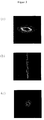
- the resonant signal radiation of the OPO (with a wavelength of 525 nm) has a spectral width of 0.5 nm. Its M 2 value is 20 in the phase adjustment plane (beam divergence: 2.8 mrad) and in plus vertical level 10 (beam divergence: 1.7 mrad). In the case of a double passage of the pump radiation by collinear back reflection, the spectral width of the resonant signal radiation is reduced to 0.08 nm. Its M 2 value is then 4 in the phase adaptation level (beam divergence: 0.4 mrad) and 15 in the perpendicular plane Beam divergence: 2.9 mrad). The measured intensity distribution in the signal beam is shown in FIG. 3a for a single passage of the pump radiation and in FIG. 3a for a double passage of the pump radiation by collinear back reflection.
- phase adjustment level is achieved by using a 90 ° prism reached as the end mirror of the OPO resonator.
- the breaking one The edge of the prism forms an angle of 45 ° to the Phase adjustment level.
- the use of the 90 ° prism so arranged as a resonator end mirror has the following advantage:
- the prism reflects the resonant OPO radiation on one axis along its breaking edge.
- the beam proportions that are at the first crystal pass in a phase adjustment plane spread out perpendicular to the second crystal pass in the phase adjustment plane (and vice versa).
- the signal radiation which is a large divergence on the first pass in the plane perpendicular to the phase adjustment plane, to the extent that their direction of propagation from the optical axis of the OPO resonator deviates.
- the beam quality of the OPO radiation also in the Phase adjustment plane vertical plane improved.
- the reflection on the arranged in the manner indicated above Prism affects the linear polarization of the resonant OPO radiation.
- a half-wave plate for the Wavelength of the resonant OPO radiation in the OPO resonator, positioned between the optically nonlinear crystal and the Prism this adverse influence can be compensated.
- the M 2 value of the resonant signal radiation in the phase adjustment plane is 4 (beam divergence: 0.4 mrad) and in the plane perpendicular to it 15 (beam divergence: 2.9 mrad) in an OPO structure with a flat resonator end mirror.
- the M 2 value in the two planes is perpendicular and parallel to the phase adaptation plane 7 (beam divergence: 0.8 mrad).
- the associated measured intensity distribution in the signal beam for the OPO with prism and half-wave plate inside the resonator is shown in FIG. 3 c.
Landscapes
- Physics & Mathematics (AREA)
- Nonlinear Science (AREA)
- General Physics & Mathematics (AREA)
- Optics & Photonics (AREA)
- Optical Modulation, Optical Deflection, Nonlinear Optics, Optical Demodulation, Optical Logic Elements (AREA)
- Lasers (AREA)
Abstract
Description
Claims (4)
- Optisch-parametrischer Oszillator (OPO), enthaltend einen optisch nicht linearen Kristall mit Typ II-Phasenanpassung, die in einer optischen Hauptebene des Kristalls zu realisieren ist, mit mindestens zwei Pumpstrahlen,
dadurch gekennzeichnet,
daß die Pumpstrahlen den Kristall in entgegengesetzten Richtungen kollinear durchlaufen. - Optisch-parametrischer Oszillator gemäß Anspruch 1
dadurch gekennzeichnet,
daß der optisch nicht lineare Kristall aus Beta-Bariumborat besteht. - Optisch-parametrischer Oszillator nach einem der Ansprüche 1 oder 2,
dadurch gekennzeichnet,
daß ein Reflektor des Resonators des optisch-parametrischen Oszillators aus einem 90°-Prisma besteht, dessen brechende Kante um 45° gegen die Ebene der Phasenanpassung im optisch nichtlinearen Kristall gedreht ist. - Optisch-parametrischer Oszillator nach einem der vorhergehenden Ansprüche,
dadurch gekennzeichnet,
daß in den Resonator eine Halbwellenplatte eingefügt ist, die eine Drehung der Polarisation in einem reflektierenden Prisma kompensiert.
Applications Claiming Priority (2)
| Application Number | Priority Date | Filing Date | Title |
|---|---|---|---|
| DE1997142362 DE19742362A1 (de) | 1997-09-25 | 1997-09-25 | Optisch-parametrischer Oszillator |
| DE19742362 | 1997-09-25 |
Publications (3)
| Publication Number | Publication Date |
|---|---|
| EP0907097A2 true EP0907097A2 (de) | 1999-04-07 |
| EP0907097A3 EP0907097A3 (de) | 2000-07-19 |
| EP0907097B1 EP0907097B1 (de) | 2006-11-29 |
Family
ID=7843611
Family Applications (1)
| Application Number | Title | Priority Date | Filing Date |
|---|---|---|---|
| EP98114079A Expired - Lifetime EP0907097B1 (de) | 1997-09-25 | 1998-07-28 | Optisch-parametrischer Oszillator |
Country Status (2)
| Country | Link |
|---|---|
| EP (1) | EP0907097B1 (de) |
| DE (2) | DE19742362A1 (de) |
Cited By (1)
| Publication number | Priority date | Publication date | Assignee | Title |
|---|---|---|---|---|
| CN113540933A (zh) * | 2021-06-15 | 2021-10-22 | 深圳大学 | 一种基于同步双光参量过程的中红外参量激光器 |
Family Cites Families (5)
| Publication number | Priority date | Publication date | Assignee | Title |
|---|---|---|---|---|
| US5033057A (en) * | 1989-12-22 | 1991-07-16 | Cornell Research Foundation, Inc. | Pump steering mirror cavity |
| DE4219169C2 (de) * | 1991-06-17 | 1996-05-30 | Richard Prof Dr Wallenstein | Laseranordnung |
| US5400173A (en) * | 1994-01-14 | 1995-03-21 | Northrop Grumman Corporation | Tunable mid-infrared wavelength converter using cascaded parametric oscillators |
| US5594592A (en) * | 1994-03-30 | 1997-01-14 | Harlamoff; Brian L. | Narrow linewidth BBO optical parametric oscillator utilizing extraordinary resonance |
| FR2743904B1 (fr) * | 1996-01-23 | 1998-02-13 | Thomson Csf | Cavite resonante parametrique optique a conjugaison de phase |
-
1997
- 1997-09-25 DE DE1997142362 patent/DE19742362A1/de not_active Ceased
-
1998
- 1998-07-28 DE DE59813826T patent/DE59813826D1/de not_active Expired - Fee Related
- 1998-07-28 EP EP98114079A patent/EP0907097B1/de not_active Expired - Lifetime
Cited By (1)
| Publication number | Priority date | Publication date | Assignee | Title |
|---|---|---|---|---|
| CN113540933A (zh) * | 2021-06-15 | 2021-10-22 | 深圳大学 | 一种基于同步双光参量过程的中红外参量激光器 |
Also Published As
| Publication number | Publication date |
|---|---|
| DE19742362A1 (de) | 1999-04-15 |
| DE59813826D1 (de) | 2007-01-11 |
| EP0907097B1 (de) | 2006-11-29 |
| EP0907097A3 (de) | 2000-07-19 |
Similar Documents
| Publication | Publication Date | Title |
|---|---|---|
| DE69304865T2 (de) | Festkörperlaser | |
| DE69527830T2 (de) | Wellenlängenstabilisierter Lichtquelle | |
| DE69331453T2 (de) | Vorrichtung zur Erzeugung von Laserstrahlen | |
| DE69300520T2 (de) | Hochleistungslaser mit faseroptischer zuleitung. | |
| DE60318564T2 (de) | Erzeugung der vierten harmonischen im resonator unter verwendung unbeschichteter brewster-oberflächen | |
| DE69106581T2 (de) | Festkörperlaserresonator. | |
| DE69930289T2 (de) | Optischer parametrischer ppln-oszillator und differenzfrequenzgenerator mit vierfacher gitterperiode und gemeinsamen doppeltresonantem resonator | |
| DE69221020T2 (de) | Vorrichtung zur optischen Wellenlängenänderung | |
| DE19814199A1 (de) | Verfahren und Vorrichtung zur abstimmbaren Frequenzkonversion | |
| DE19511785B4 (de) | Optisch-parametrischer Oszillator mit schmaler Linienbreite | |
| DE2012226A1 (de) | Optischer parametrischer Oszillator | |
| DE69414527T2 (de) | Ausrichtungsunempfindlicher Frequenzverdoppler mit Doppelbrechnungskompensation | |
| DE102010018035A1 (de) | Parametrischer Oszillator und Verfahren zum Erzeugen ultrakurzer Pulse | |
| DE69716160T2 (de) | Laser mit einem einzigen Resonator für Pumplaser-Medium und optischen parametrischen Oszillator | |
| EP0977328A2 (de) | Rauscharmer frequenzvervielfachter Laser mit Strahlseparator | |
| DE19512984A1 (de) | Abstimmbarer optischer parametrischer Oszillator | |
| DE2138469A1 (de) | Optischer Resonator mit einer Ausgangs-Kopplungseinrichtung | |
| DE69315620T2 (de) | Hoherdurchschnittsstärke Laser mit generizender Strahlung in der Nähe der 530 NM | |
| DE102020125544B4 (de) | Erzeugung von ultrakurzen Laserpulsen | |
| DE69529939T2 (de) | Laservorrichtung | |
| EP0907097B1 (de) | Optisch-parametrischer Oszillator | |
| DE19819473C2 (de) | Einrichtung zum Erzeugen kohärenter Strahlung | |
| DE69521771T2 (de) | Aufnehmer für elektrische Bohrlochvermessungen und dessen Herstellungsverfahren | |
| DE3613738C2 (de) | ||
| DE19623477C1 (de) | Optischer parametrischer Oszillator |
Legal Events
| Date | Code | Title | Description |
|---|---|---|---|
| PUAI | Public reference made under article 153(3) epc to a published international application that has entered the european phase |
Free format text: ORIGINAL CODE: 0009012 |
|
| AK | Designated contracting states |
Kind code of ref document: A2 Designated state(s): CH DE FR GB IT LI NL |
|
| AX | Request for extension of the european patent |
Free format text: AL;LT;LV;MK;RO;SI |
|
| PUAL | Search report despatched |
Free format text: ORIGINAL CODE: 0009013 |
|
| AK | Designated contracting states |
Kind code of ref document: A3 Designated state(s): AT BE CH CY DE DK ES FI FR GB GR IE IT LI LU MC NL PT SE |
|
| AX | Request for extension of the european patent |
Free format text: AL;LT;LV;MK;RO;SI |
|
| 17P | Request for examination filed |
Effective date: 20000807 |
|
| AKX | Designation fees paid |
Free format text: CH DE FR GB IT LI NL |
|
| 17Q | First examination report despatched |
Effective date: 20020213 |
|
| RAP1 | Party data changed (applicant data changed or rights of an application transferred) |
Owner name: WALLENSTEIN, RICHARD, PROF. DR. |
|
| GRAP | Despatch of communication of intention to grant a patent |
Free format text: ORIGINAL CODE: EPIDOSNIGR1 |
|
| GRAS | Grant fee paid |
Free format text: ORIGINAL CODE: EPIDOSNIGR3 |
|
| GRAA | (expected) grant |
Free format text: ORIGINAL CODE: 0009210 |
|
| AK | Designated contracting states |
Kind code of ref document: B1 Designated state(s): CH DE FR GB IT LI NL |
|
| PG25 | Lapsed in a contracting state [announced via postgrant information from national office to epo] |
Ref country code: NL Free format text: LAPSE BECAUSE OF FAILURE TO SUBMIT A TRANSLATION OF THE DESCRIPTION OR TO PAY THE FEE WITHIN THE PRESCRIBED TIME-LIMIT Effective date: 20061129 Ref country code: IT Free format text: LAPSE BECAUSE OF FAILURE TO SUBMIT A TRANSLATION OF THE DESCRIPTION OR TO PAY THE FEE WITHIN THE PRESCRIBED TIME-LIMIT;WARNING: LAPSES OF ITALIAN PATENTS WITH EFFECTIVE DATE BEFORE 2007 MAY HAVE OCCURRED AT ANY TIME BEFORE 2007. THE CORRECT EFFECTIVE DATE MAY BE DIFFERENT FROM THE ONE RECORDED. Effective date: 20061129 |
|
| REG | Reference to a national code |
Ref country code: GB Ref legal event code: FG4D Free format text: NOT ENGLISH |
|
| REG | Reference to a national code |
Ref country code: CH Ref legal event code: EP |
|
| REF | Corresponds to: |
Ref document number: 59813826 Country of ref document: DE Date of ref document: 20070111 Kind code of ref document: P |
|
| NLV1 | Nl: lapsed or annulled due to failure to fulfill the requirements of art. 29p and 29m of the patents act | ||
| GBV | Gb: ep patent (uk) treated as always having been void in accordance with gb section 77(7)/1977 [no translation filed] |
Effective date: 20061129 |
|
| EN | Fr: translation not filed | ||
| PLBE | No opposition filed within time limit |
Free format text: ORIGINAL CODE: 0009261 |
|
| STAA | Information on the status of an ep patent application or granted ep patent |
Free format text: STATUS: NO OPPOSITION FILED WITHIN TIME LIMIT |
|
| 26N | No opposition filed |
Effective date: 20070830 |
|
| PG25 | Lapsed in a contracting state [announced via postgrant information from national office to epo] |
Ref country code: GB Free format text: LAPSE BECAUSE OF FAILURE TO SUBMIT A TRANSLATION OF THE DESCRIPTION OR TO PAY THE FEE WITHIN THE PRESCRIBED TIME-LIMIT Effective date: 20061129 |
|
| PG25 | Lapsed in a contracting state [announced via postgrant information from national office to epo] |
Ref country code: FR Free format text: LAPSE BECAUSE OF FAILURE TO SUBMIT A TRANSLATION OF THE DESCRIPTION OR TO PAY THE FEE WITHIN THE PRESCRIBED TIME-LIMIT Effective date: 20070720 |
|
| PGFP | Annual fee paid to national office [announced via postgrant information from national office to epo] |
Ref country code: DE Payment date: 20080728 Year of fee payment: 11 Ref country code: CH Payment date: 20080722 Year of fee payment: 11 |
|
| PG25 | Lapsed in a contracting state [announced via postgrant information from national office to epo] |
Ref country code: FR Free format text: LAPSE BECAUSE OF FAILURE TO SUBMIT A TRANSLATION OF THE DESCRIPTION OR TO PAY THE FEE WITHIN THE PRESCRIBED TIME-LIMIT Effective date: 20061129 |
|
| REG | Reference to a national code |
Ref country code: CH Ref legal event code: PL |
|
| PG25 | Lapsed in a contracting state [announced via postgrant information from national office to epo] |
Ref country code: LI Free format text: LAPSE BECAUSE OF NON-PAYMENT OF DUE FEES Effective date: 20090731 Ref country code: CH Free format text: LAPSE BECAUSE OF NON-PAYMENT OF DUE FEES Effective date: 20090731 |
|
| PG25 | Lapsed in a contracting state [announced via postgrant information from national office to epo] |
Ref country code: DE Free format text: LAPSE BECAUSE OF NON-PAYMENT OF DUE FEES Effective date: 20100202 |