EP0906898A2 - Gonfleur hybride pour gonflage de coussins de sécurité - Google Patents
Gonfleur hybride pour gonflage de coussins de sécurité Download PDFInfo
- Publication number
- EP0906898A2 EP0906898A2 EP98308094A EP98308094A EP0906898A2 EP 0906898 A2 EP0906898 A2 EP 0906898A2 EP 98308094 A EP98308094 A EP 98308094A EP 98308094 A EP98308094 A EP 98308094A EP 0906898 A2 EP0906898 A2 EP 0906898A2
- Authority
- EP
- European Patent Office
- Prior art keywords
- propellant
- housing
- inflator
- chamber
- gas generator
- Prior art date
- Legal status (The legal status is an assumption and is not a legal conclusion. Google has not performed a legal analysis and makes no representation as to the accuracy of the status listed.)
- Withdrawn
Links
Images










Classifications
-
- B—PERFORMING OPERATIONS; TRANSPORTING
- B60—VEHICLES IN GENERAL
- B60R—VEHICLES, VEHICLE FITTINGS, OR VEHICLE PARTS, NOT OTHERWISE PROVIDED FOR
- B60R21/00—Arrangements or fittings on vehicles for protecting or preventing injuries to occupants or pedestrians in case of accidents or other traffic risks
- B60R21/02—Occupant safety arrangements or fittings, e.g. crash pads
- B60R21/16—Inflatable occupant restraints or confinements designed to inflate upon impact or impending impact, e.g. air bags
- B60R21/26—Inflatable occupant restraints or confinements designed to inflate upon impact or impending impact, e.g. air bags characterised by the inflation fluid source or means to control inflation fluid flow
- B60R21/268—Inflatable occupant restraints or confinements designed to inflate upon impact or impending impact, e.g. air bags characterised by the inflation fluid source or means to control inflation fluid flow using instantaneous release of stored pressurised gas
- B60R21/272—Inflatable occupant restraints or confinements designed to inflate upon impact or impending impact, e.g. air bags characterised by the inflation fluid source or means to control inflation fluid flow using instantaneous release of stored pressurised gas with means for increasing the pressure of the gas just before or during liberation, e.g. hybrid inflators
-
- C—CHEMISTRY; METALLURGY
- C06—EXPLOSIVES; MATCHES
- C06B—EXPLOSIVES OR THERMIC COMPOSITIONS; MANUFACTURE THEREOF; USE OF SINGLE SUBSTANCES AS EXPLOSIVES
- C06B25/00—Compositions containing a nitrated organic compound
- C06B25/34—Compositions containing a nitrated organic compound the compound being a nitrated acyclic, alicyclic or heterocyclic amine
-
- C—CHEMISTRY; METALLURGY
- C06—EXPLOSIVES; MATCHES
- C06D—MEANS FOR GENERATING SMOKE OR MIST; GAS-ATTACK COMPOSITIONS; GENERATION OF GAS FOR BLASTING OR PROPULSION (CHEMICAL PART)
- C06D5/00—Generation of pressure gas, e.g. for blasting cartridges, starting cartridges, rockets
- C06D5/06—Generation of pressure gas, e.g. for blasting cartridges, starting cartridges, rockets by reaction of two or more solids
Definitions
- the present invention generally relates to the field of inflatable safety systems and, more particularly, to a hybrid inflator.
- Hybrid inflators utilize a combination of a stored, pressurized gas and gas generating propellant to expand the air/safety bag.
- the primary design considerations in any air/safety bag for an automobile is that the air/safety bag must be expanded a predetermined amount in a predetermined amount of time in order to be operationally effective.
- Gas generating propellants used in hybrid inflators typically contain a secondary explosive and a binder system. Often a plasticizer is also a part of the propellant formulation.
- One known embodiment of the propellant formulation used in a hybrid inflator is a mixture of the secondary explosive RDX (hexahydrotrinitrotriazine), GAP (glycidyl azide polymer) plasticizer and CAB (cellulose acetate butyrate) binder as disclosed by Hamilton et al., in U.S. Patent No. 5,616,883. While this formulation is very successful as a propellant in air/safety bag system, it has been found that under certain environmental conditions, e.g. , a prolonged exposure to a high temperature or to extreme temperature fluctuations, the individually loose propellant grains become clumped, i.e. , bonded to one another, thereby reducing the net surface area of the propellant charge.
- a shift in the pressurization rate caused by physical changes in propellant grains due to environmental conditions should be taken into account when designing an effective and reliable air/safety bag system. Therefore, it is advantageous to provide an air/safety bag system that has propellant grains for producing- consistent and predictable air bag pressurization rates even after a prolonged exposure to a high temperature and extreme thermal cycling (e.g . , 107°C for 400 hours and cycling between 107°C and -40°C, respectively).
- a high temperature and extreme thermal cycling e.g . , 107°C for 400 hours and cycling between 107°C and -40°C, respectively.
- the hybrid inflator for an automotive inflatable air/safety bag system with propellant that provides a consistent performance rate in inflating the air/safety bag after severe environmental conditioning.
- the hybrid inflator has an inflator housing which stores an appropriate pressurized medium, e.g ., fluid and/or gas, a gas generator which stores an appropriate propellant for augmenting the flow to the air/safety bag of the inflatable safety system, and an ignition assembly which ignites the propellant upon activation.
- an appropriate pressurized medium e.g ., fluid and/or gas
- a gas generator which stores an appropriate propellant for augmenting the flow to the air/safety bag of the inflatable safety system
- an ignition assembly which ignites the propellant upon activation.
- the propellant contains a secondary explosive and a binder system.
- the secondary explosive comprises from about 74 wt% to about 85 wt% of the propellant, and the binder system comprises from about 15 wt% to about 26 wt% of the propellant.
- the binder is selected from polyacrylate, polybutadiene, polystyrene, polyacrylonitrile, polyurethane, polycaprolactones, polyols, polyethylene glycols, polycarbonates, Kraton®, Estane®, polypropylene glycols, polyethylene oxides, and mixtures thereof. With polyacrylate being the preferred binder.
- the binder may or may not be thermally cured. It is preferred that the binder contain a cure site which can be treated with a curing agent or activator to form a cross-linked polymer.
- the secondary explosive is selected from RDX (hexahydrotrinitro-triazine), PETN (pentaerythritol tetranitrate), TAGN (triaminoguanidine nitrate), HMX (cyclotetramethylenetetra-nitramine), CL-20 (hexanitrohexaazaisowurtzitane), NTO (nitrotriazolone), TNAZ (trinitroazetidine), NQ (nitroguanidine), and mixtures thereof.
- the secondary explosive is RDX.
- the propellant is selected from any fuel rich mixture of chemical which will sustain combustion in the oxygen rich environment of the disclosed inflator.
- the propellant generally has web thickness of from about 0.010 inches to about 0.100 inches, preferably from about 0.023 inches to about 0.053 inches, and generates at least 400 kPa of pressure in a closed tank test at about 40 msec after being ignited, and it has a burn rate of from about 0.25 inches/sec to about 0.75 inches/sec at a pressure of about 4,000 psi, preferably from about 0.30 inches/sec to about 0.60 inches/sec, and more preferably about 0.425 inches/sec.
- a hybrid inflator configuration can be provided that repeatedly satisfies strict performance requirements related to the filling of an air/safety bag.
- a propellant is included that is composed of propellant grains that have decreased migration of lower melting point binder oligomers even after a prolonged exposure to a high temperature.
- homogeneity of the chemical composition is maintained and decreased clumping of propellant grains is achieved.
- the propellant composition eliminates a component by not requiring a plasticizer or other similar compounds. This reduction in components, together with the use of a relatively inexpensive propellant binder, reduces the cost of the propellant and, concomitantly, the cost of the hybrid inflator.
- the embodiments of the invention generally relate to hybrid inflators for automotive inflatable safety systems more especially to an inflator which utilizes both a stored, pressurized gas and a gas and/or heat-generating propellant.
- Various types of hybrid inflators are disclosed in U.S. Patent No. 5,230,531 to Hamilton et al., which is assigned to the assignee of this application, and the entire disclosure of this patent is hereby incorporated by reference in its entirety herein.
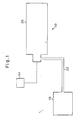
- FIG. 1 One embodiment of an automotive inflatable safety system is generally illustrated in Fig. 1.
- the primary components of the inflatable safety system 10 include a detector 14, an inflator 26, and an air/safety bag 18.
- a condition requiring expansion of the air/safety bag 18 e.g, a predetermined deceleration
- a signal is sent to the inflator 26 to release gases or other suitable fluids from the inflator 26 to the air/safety bag 18 via the conduit 22.
- the inflator 30 illustrated in Fig. 2 is a hybrid inflator and may be used in the inflatable safety system 10 of Fig. 1 in place of the inflator 26. Consequently, the inflator 30 includes a bottle or inflator housing 34 having a pressurized medium 36 that is provided to the air/safety bag 18 (Fig. 1) at the appropriate time, as well as a gas generator 82 that provides propellant gases to augment the flow to the air/safety bag 18 (e.g., by providing heat to expand the pressurized medium 36 and/or generating additional gases).
- a gun-type propellant e.g., a high temperature, fuel-rich propellant
- a mixture of at least one inert gas (e.g., argon) and oxygen may be used for the pressurized medium 36.
- the pressurized medium includes from about 70% to about 92% of the inert fluid and from about 8% to about 30% of oxygen on a molar basis, and more preferably the pressurized medium includes from about 79% to about 90% of the inert fluid and from about 10% to about 21% of oxygen on a molar basis.
- the inflator housing 34 and gas generator 82 are interconnected, with the gas generator 82 being positioned inside the inflator housing 34 to reduce the space required for the inflator 30.
- a hollow diffuser 38 is welded to one end of a hollow boss 66 (e.g., having a diameter of about 1.25").
- the diffuser 38 has a plurality of rows of discharge holes 40 (e.g., 80 discharge holes 40 each having a diameter of about 0.100") therethrough which provides a "non-thrusting output" from the inflator 30 and a screen 58 is positioned adjacent the discharge holes 40.
- a closure disk 70 is appropriately positioned within the boss 66 and is welded thereto in order to initially retain the pressurized medium 36 within the inflator housing 34.
- a projectile 50 having a substantially conically-shaped head is propelled through the closure disk 70. More particularly, the projectile 50 is positioned on the convex side of the closure disk 70 within a barrel 54 and is propelled by the activation of an initiator 46 when an appropriate signal is received from the detector 14 of the inflatable safety system 10 (Fig. 1). A ring 62 is provided to initially retain the projectile 50 in position prior to firing.
- An orifice sleeve 74 is welded to the closure disk 70 and/or the end of the boss 66.
- the orifice sleeve 74 is hollow and includes a plurality of orifice ports 78 (e.g., four ports 78 each having a diameter of about 0.201") to fluidly interconnect the interior of the inflator housing 34 and the interior of the boss 66 and diffuser 38 when the closure disk 70 is ruptured by the projectile 50.
- the gas generator 82 more specifically the gas generator housing 86, is welded to the orifice sleeve 74 to complete the interconnection of the inflator housing 34 and gas generator 82.
- the gas generator housing 86 contains a plurality of propellant grains 90 which when ignited provide heated propellant combustion product gases for augmenting the flow to the air/safety bag 18 (Fig. 1).
- the propellant grains 90 are retained within the gas generator housing 86 by a propellant sleeve 94 which is separated from the gas generator inlet nozzle 98 on the end 96 of the gas generator housing 86 by a screen 104 and baffle 100.
- the propellant grains 90 may be formulated from a gun-type propellant and are "smokeless". Nonetheless, the grains 90 are substantially cylindrically-shaped with a single hole extending through the central portion thereof. Other propellant grain configurations may be appropriate and will depend at least in part on the particular propellant formulation being used.
- a single (or multiple) gas generator inlet nozzle 98 (e.g., a single nozzle 98 having a diameter of about 0.516") is positioned on the end 96 of the gas generator housing 86 and is generally directed away from the closure disk 70.
- the gas generator housing 86 also includes a plurality of circumferentially spaced outlet or discharge nozzles 200 (e.g., one "row” of four nozzles 200 each having a diameter of about 0.221”) on the sidewall of the housing 86. It may be desirable to vary the axial location of these nozzles 200 (they may be generally at the midportion of the housing 86), although operations may be enhanced by a location more proximate the outlet. Moreover, it may be desirable to vary the number of nozzles 200.
- the gas generator 82 includes an ignition assembly 114 for igniting the propellant grains 90 at the appropriate time.
- the ignition assembly 114 is at least partially positioned within the gas generator housing 86 between the projectile 50 and propellant grains 90 and generally includes an actuation piston 124, and at least one percussion primer 120 and an ignition/booster material 144 which serve as an activator.
- an actuation guide 140 engages an end portion of the orifice sleeve 74 and the interior wall of the gas generator housing 86, the actuation guide 140 thereby functioning at least in part to contain at least a portion of and guide the actuation piston 124 positioned therein.
- a primer holder 116 engages an end of the actuation guide 140 and houses a plurality of conventional percussion primers 120 which are positioned substantially adjacent to the ignition/booster material 144.
- the ignition/booster material 144 is typically retained adjacent the primers 120 by a charge cup 148.
- An example of an appropriate ignition/booster material 144 is an RDX aluminum booster material having a composition of 89% RDX, 11% aluminum powder, with 0.5% hydroxypropyl-cellulose added.
- a retainer 108 and baffle 112 are positioned between the primer holder 116 and propellant sleeve 94.
- a wave spring washer (not shown) may be positioned, for instance, between the retainer 108 and the baffle 112.
- the actuation piston 124 is slidably positioned within the actuation guide 140 and includes a continuous rim projecting member 128 which is substantially aligned with the primers 120. As can be appreciated, a plurality of projecting members (not shown) , could replace the substantially continuous rim projecting member 128.
- a belleville washer 136 is positioned between and engages a portion of both the actuation guide 140 and actuation piston 124 (via a spacer 126) to initially maintain the position of the actuation piston 124 away from the primers 120. Consequently, the potential for inadvertent engagement of the actuation piston 124 with the primers 120, which could activate the gas generator 82, is reduced.
- the energy transferred to the actuation piston 124 by the projectile 50 is sufficient to overcome the belleville washer 136 such that the projecting rim 128 is able to engage the primers 120 with sufficient force to ignite at least one of such primers 120.
- This in turn causes ignition of the ignition/booster material 144, and thus ignition of the propellant grains 90 results.
- the primers 120 may erode and thereby allow propellant gases generated by combustion of the propellant grains 90 to flow through the primers 120. Any leakage of propellant gases in this manner may adversely affect the consistency of performance of the inflator 30. These gases, however, desirably act upon the actuation piston 124 to move the piston 124 into sealing engagement with the actuation guide 140. This provides a seal for the gas generator housing 90 which substantially limits any leakage of gases therethrough. Therefore, the propellant gases desirably flow through the gas generator nozzle 98.
- the detector 14 (Fig. 1) sends a signal to the initiator 46 to propel the projectile 50.
- the projectile 50 initially passes through the closure disk 70 to open the passageway between the inflator housing 34 and air/safety bag 18 (Fig 1).
- the projectile 50 continues to advance until it impacts the actuation piston 124 which causes the projecting rim 128 attached thereto to strike at least one of the aligned primers 120.
- the ignition/ booster charge 144 ignites, which in turn ignites the propellant grain 90.
- the pressurized medium 36 from the inflator housing 34 is drawn into the gas generator housing 86 through the inlet nozzle 98 positioned on the end 96 of the housing 86. This results from the flow of the pressurized medium 36 by the sidewall of the gas generator housing 86 which produces a pressure differential.
- This "drawing in” of the pressurized medium 36 promotes mixing of the propellant gases and the pressurized medium 36 within the housing 86, and as will be discussed in more detail below this is particularly desirable when oxygen is included in the pressurized medium 36 to react with propellant gases having a large content of carbon monoxide and hydrogen.
- gases are discharged from gas generator housing 86 through the discharge nozzles 200 on the sidewall of the housing 86.
- the flow to the air/safety bag 18 is desirably augmented (Fig. 1) by mixing of the pressurized medium 36 with the combustion products from the gas generator housing 86.
- the hybrid inflator 30 may utilize a gun-type propellant as the formulation for the propellant grains 90, and a mixture of at least one inert gas and oxygen for the pressurized medium 36.
- Gun-type propellants are high temperature, fuel-rich propellants such as single, double, or triple-base propellants, and nitramine propellants such as LOVA (low vulnerability ammunition) or HELOVA (high energy, low vulnerability ammunition) propellants. More specifically, traditional gun-type propellants are those having a combustion temperature ranging from about 2,500°K to about 3,800°K, and typically greater than about 3,000°K, and are fuel-rich in that without excess oxygen, these propellants generate significant amounts of CO and H 2 . The excess of fuel from these propellants typically requires additional oxygen between 5 and 25 mole percent, or sometimes even between 15 and 40 mole percent, of the stored gas to drive the reaction equilibrium to CO 2 and H 2 O.
- gun-type propellant formulations disclosed by the above-identified Hamilton patent result in an inconsistent performance rate.
- RDX hexahydro-trinitrotriazine
- GAP glycol acid polymer
- CAP cellulose acetate polymer binder
- loose propellant grains refers to individually separate propellant grains which are not bonded to one another
- clumped propellant grains refers to loose propellant grains which have become physically bonded to one another.
- This adhesion (or bonding) of propellant grains reduces the net surface area of the propellant grains.
- this reduction in the net surface area of the propellant grains is responsible for the shift or the reduction in the performance ( i.e. , pressurization) rate of the propellant grains.
- clumping of propellant grains during a prolonged exposure to a high temperature is due to the adhesion of low melting point binder oligomers that are present on the surface of the propellant grains.
- low melting point binder oligomers which are originally dispersed uniformly throughout the propellant grains migrate and become concentrated on the outer surface of the propellant grains when exposed to a high temperature and is believed to be facilitated by the presence of a plasticizer which is typically present in the previous propellant grain formulation.
- This concentration of low melting point binder oligomers on the surface of the propellant grains causes a loss of homogeneity of the propellant grains without significantly affecting the overall chemical composition of the propellant grains.
- homogeneity refers to a relatively uniform chemical composition throughout the propellant grains. Although the overall chemical composition of the propellant grains may be substantially unchanged, a localized change in chemical composition occurs in the previous hybrid propellant grain formulations resulting in a significant change in the physical characteristics of the propellant grains.
- the propellant grains may also break apart upon impact. This breakage of propellant grains further adds to the uncertainty in the predictability of the pressurization rate of the previous propellant grains. It has been found that by using the propellant grain formulation of the present invention, propellant grains having a rubber like quality are produced which do not break apart upon impact resulting in propellant grains having more predictable and consistent pressurization rate.
- a “consistent performance rate” or “consistent pressurization rate” refers to the difference between the pressure generated in a closed tank test, at about 30 msec after the propellant is ignited, which propellant has been subjected to at least one of the following time and temperature conditions:
- the total grain weight may range (in passenger side applications) from about 5 grams to about 15 grams, and is preferably less than about 15 grams. In this case, it is preferable to utilize between about 75 grams and about 175 grams of pressurized medium 36 with oxygen being between about 10% to about 30%, preferably 20%, of this medium 36 on a molar basis. More specifically, when about 145 grams of the pressurized medium 36 is utilized, with about 20% of this on a mole percentage basis being oxygen, the total weight of the propellant grains 90 may be about 5.7 grams.
- the desired/required amount of propellant grains 90 may be from about 2 grams to about 5 grams and for a side inflator application approximately from about 0.5 grams to about 2.5 grams.
- the above-identified amount of gun-type propellant may be also expressed as a ratio of the weight of the pressurized medium 36 to the total weight of propellant grains 90.
- the ratio of the weight of the pressurized medium 36 to the total weight of the propellant grains 90 ranges from about 10 to about 20, and more preferably from about 14 to about 18, and is most preferably greater than about 15.
- these ratios may be further increased by use of hotter propellants, which would require even less propellant.
- the inflator can produce output gases at a higher temperature than can a particulate-laden inflator such as current state-of-the-art hybrids. This increase in temperature will allow the inflator to be smaller and lighter still, since the hotter gas is relatively more expansive.
- generally size and weight reductions of the inflator structure may be achieved when using gun-type propellants.
- the above-identified propellant composition may also be expressed as a ratio of the gram moles of the total gas output (i.e., the combination of the propellant gases and the pressurized medium 36) to the total weight of the propellant grains 90.
- the ratio of the moles of the output gas to the total weight of the propellant grains 90 may range from about 0.35 gram moles per gram of propellant to about 0.6 gram moles per gram of propellant, more preferably from about 0.4 gram moles per gram of propellant to about 0.5 gram moles per gram of propellant, and is most preferably about 0.5 gram moles per gram of propellant.
- the pressurized medium 36 allows for the use of at least a gun-type propellant formulation for the propellant grains 90.
- the pressurized medium 36 is composed of at least one inert gas and oxygen.
- Appropriate inert gases include argon, nitrogen, helium, and neon, with argon being preferred.
- the oxygen portion of the pressurized medium is multifunctional. Initially, the reaction of the oxygen with the gaseous combustion products of the gun-type propellant grains 90 provides a source of heat which contributes to the expansion of the inert gas. This allows at least in part for a reduction in the amount of propellant which is required for the gas generator 82.
- the reaction of the oxygen with the propellant combustion products also reduces any existing toxicity levels of the propellant gases to acceptable levels.
- the oxygen will convert preferably a substantial portion of existing carbon monoxide to carbon dioxide (e.g., convert at least about 85% of CO to CO 2 ) and existing hydrogen to water vapor (e.g., convert at least about 80% of the H 2 to H 2 O), and a substantial portion of the unburned hydrocarbons will be similarly eliminated (e.g., eliminate at least about 75% of the hydrocarbons).
- the performance of the gas generator 82 as discussed above is significantly improved.
- the medium 36 and including the oxygen is drawn into the gas generator housing 86 through the inlet nozzle 98 on the end 96 of the housing 86 by the pressure differential produced by the flow of the pressurized medium 36 by the sidewall of the gas generator housing 86 having the discharge nozzles 200 thereon.
- the medium 36 and hydrogen-rich combustion products of the gas generant which dramatically improves the overall combustion efficiency of the gas generant, the mixing of the combustion products of the gas generant with the oxygen-rich medium 36, and the burning rate of the propellant grains 90. Gases are then drawn out of the discharge nozzles 200 on the sidewall of the housing 86.
- the above configuration of the gas generator housing 86 thereby greatly improves upon the performance of the inflator 30 (e.g., by promoting the quick and efficient mixing of the oxygen with the propellant gases).
- the amount of the at least one inert gas, on a molar basis is generally between about 70% and about 90% and the amount of oxygen, on a molar basis, is generally between about 10% and about 30%.
- the pressurized medium may include from about 70% to about 92% of the inert fluid and from about 8% to about 30% of the oxygen on a molar basis.
- the inflator 30 may be assembled in the following manner. Initially, the gas generator 82 is assembled, such as by: 1) inserting the baffle 100 and screen 104 in the gas generator housing 86 adjacent the discharge end 96; 2) inserting the propellant sleeve 94 in the gas generator housing 86; 3) positioning the propellant grains 90 within the propellant sleeve 94; 4) inserting the baffle 112 and retainer 108 in the gas generator housing 86 adjacent the end of the propellant sleeve 94 opposite the discharge end 96 of the generator; 5) inserting the primer holder 116, with the ignition/booster material 144 and charge cup 148, in the gas generator housing 86; and 6) inserting the actuation guide 140, belleville washer 136, and actuation piston 124 into the gas generator housing 86.
- the various parts are interconnected, such as by welding the gas generator housing 86 to the orifice sleeve 74, by welding the diffuser 38 to the boss 66 after positioning the projectile 50 and initiator 46 in the diffuser 38, welding the closure disk 70 between the boss 66 and orifice sleeve 74, and welding the boss 66 to the inflator housing 34.
- the pressurized medium 36 may be introduced into the inflator housing 34.
- the argon and oxygen may be separately introduced (e.g., first introduce the argon and/or other inert gases and then the oxygen or vice versa) into the inflator housing 34 through the end plug 42 which is welded to the end of the inflator housing 34, or introduced in the pre-mixed state.
- Thermally stable gun-type propellants when used as the formulation for the propellant grains 90 include a secondary explosive, namely a nitramine (RDX) in the case of the LOVA propellants.
- a secondary explosive namely a nitramine (RDX) in the case of the LOVA propellants.
- Other appropriate secondary explosives which may be used in the formulation of the propellant grains 90 include another nitramine, namely HMX (cyclotetramethylenetetrani-tramine), as well as PETN (pentaerythritol tetranitrate) and TAGN (triaminoguanidine nitrate).
- Table 1 below provides certain combustion properties for the RDX, HMX, and PETN secondary explosives.
- a secondary explosive may be combined with a binder system as the formulation for the propellant grains 90 ("the hybrid propellants").
- binder system refers to one or more compounds added to the propellant which are useful for modifying the physical, chemical, and/or ballistic properties of the propellant.
- Useful binder systems include those which incorporate propellant additives selected from the group consisting of binders, plasticizers, curing agents, antioxidants, stabilizers, opacifiers, and combinations thereof.
- Hybrid propellants for the propellant grains 90 in the hybrid inflator 30 exhibit good ballistic properties (i.e., burn rate and combustion temperature at a relatively low operating pressure), and exhibit acceptable long-term stability (e.g., one industry test for assessing long-term thermal stability being a statistically sufficient number of samples withstanding (not igniting) exposure to a temperature of 107°C for a period of 400 hours). Another test is inflators withstanding, without unacceptable loss of performance, (which is typically established/specified by the customer), exposures to a temperature of 107°C for 400 hours.
- propellant grains 90 formed from a hybrid propellant burn at a combustion temperature ranging from about 1,800°K to about 3,800°K, at a rate ranging of about 0.25 inches per second (0.64 cm/sec) to about 0.75 inch per second (1.9 cm/sec), and at an operating pressure (the pressure within the gas generator housing 84) of about 4,000 psi (27.6 MPa) or less.
- the propellant grains 90 formed from a hybrid propellant burn at a combustion temperature ranging from about 1,800°K to about 3,800°K, at a rate ranging from about 0.30 inches per second (0.76 cm/sec) to about 0.60 inches per second (1.5 cm/sec), and at an operating pressure of about 4,000 psi (27.6 MPa) or less.
- the hybrid propellant formulations comprise from about 60 wt% to about 90 wt% of a secondary explosive and from about 40 wt% to about 10 wt% of a binder system. More typically, these propellant formulations include from about 74 wt% to about 85 wt% of a secondary explosive and from about 26 wt% to about 15 wt% of a binder system. Most preferably, the propellant formulation includes about 84 wt% a particular secondary explosive and about 16 wt% of a binder system. Other additives and unavoidable impurities can also be present in these propellant compositions in minute amounts (i.e., in amounts less than about 2 wt% of the composition).
- a binder according to some embodiments of the present invention in a propellant grain formulation results in propellant grains having a consistent pressurization rate after high temperature aging or thermal cycling.
- These useful binders comprise a polymer selected from the group consisting of polyacrylate, polybutadiene, polystyrene, polyacrylonitrile, polyurethane, polycaprolactones, polyols, polyethylene glycols, polycarbonates, Kraton®, Estane®, polypropylene glycols, polyethylene oxides, and mixtures thereof. Of these polymers, it has been found that polyacrylate is particularly useful in providing propellant grains with a consistent performance rate.
- a polymer with a cure site such as polyacrylate with epoxy cure site, e.g. , Nipol Polyacrylate elastomer grade AR 53L available from Zeon Chemicals, Inc., is especially useful as a binder.
- a "cure site” refers to a presence of a functional group within the polymer, typically on the terminal end, which allows further manipulation of the polymer by utilizing that functional group.
- exemplary cure sites include halides, such as chloride, bromide and iodide, epoxide, carboxyl and hydroxyl.
- the cure sites be a non-halide functional group because when a compound having a halide group is ignited it generates toxic fumes such as hydrogen chloride, phosgene, chlorine, hydrogen bromide and hydrogen iodide. More preferably, the polymer contains epoxide cure sites.
- the presence of epoxide cure sites on polyacrylate allows possibility of cross-linking polyacrylate polymers resulting in a polymer of higher molecular weight.
- Such cross-linking may be achieved by adding a nucleophilic compound, i.e., a curing agent or simply heating the polymer without the use of any curing agent.
- a "curing agent” is a compound which reacts with a cure site in the polymer. In the case of an epoxide cure sites, the curing agent initiates a chain reaction which results in a formation of a cross-linked polymer.
- curing agents useful in cross-linking polyacrylate having epoxy cure sites include ammonium salts, alkoxides, amines, metal salts and sulfur containing compounds.
- the curing agent is selected from the group consisting of ammonium carboxylates such as ammonium benzoate, ammonium acetate, ammonium tartrate, and mixtures thereof.
- the amount of a curing agent added to cross-link a polymer, i.e. , a binder depends on the desired physical and mechanical property of the resulting propellant.
- the curing agent comprises from about 0.01 wt% to about 0.5 wt% of the propellant, more preferably from about 0.1 wt% to about 0.3 wt%, and most preferably about 0.2 wt%.
- the present hybrid propellant formulation provides a method of achieving the desired physical and mechanical properties without the use of any plasticizer. It is well known in the art that a plasticizer is added to a polymer to modify the polymer's physical and mechanical properties. The desired physical property of the propellants of the present invention is achieved by the selection of the polymer and the amount of cross-linking. By eliminating the use of a plasticizer, propellant grains with a consistent pressurization rate after aging is produced.
- the propellant grain formulation includes an antioxidant which provides propellant grains with greater thermal stability and oxidative resistance.
- antioxidants useful for the present invention include substituted phenyls such as BHT (2,6-Di- tert -butyl-4-methylphenol) and Naugard 445® (4,4'-bis( ⁇ , ⁇ -dimethylbenzyl)diphenylamine) which is available from Uniroyal Chemical Co., Inc. in Middlebury, Connecticut, and other currently well known antioxidants.
- the antioxidant is Naugard 445®.
- the propellant formulation includes a stabilizer, which include ethyl centralite, diphenyl amine, resorcinol, akardite II, amyl alcohol, urea, petroleum jelly, and methylnitroaniline.
- a stabilizer include ethyl centralite, diphenyl amine, resorcinol, akardite II, amyl alcohol, urea, petroleum jelly, and methylnitroaniline.
- propellant grains have web thickness of from about 0.010 inches to about 0.100 inches. More preferably, the propellant grains of the present invention have web thickness of from about 0.023 inches to about 0.053 inches.
- the length of the propellant grains may also vary depending upon the particular performance rate desired and the web thickness of the propellant grains. As a rule of thumb, the length of propellant grains is preferably about ten times the propellant grains web thickness.
- the propellant grains of the present invention have length of from about 0.100 inches to about 1.000 inches. More preferably the propellant grains of the present invention have length of from about 0.23 inches to about 0.53 inches.
- Antioxidants may also be included in the binder system for the hybrid propellant formulation for the propellant grains 90.
- certain binders may decompose upon exposure to air or oxygen, and may affect ignition of the propellant grains 90. Consequently, antioxidants may be included in the hybrid propellant formulation which will prevent oxidative degradation of the polymer and thereby enhance the long-term stability of the hybrid propellant formulation.
- hybrid propellant formulation which has the desired ballistic properties and which has provided sufficient indications of suitable long-term stability include the combination of the nitramine secondary explosive RDX (hexahydrotrinitrotriazine) with a binder system including the binder polyacrylate, the curing agent ammonium benzoate and the antioxidant Naugard 445®.
- this hybrid propellant formulation may comprise at least about 84 wt% RDX, from about 15 wt% to about 16 wt% polyacrylate, from about 0.1 wt% to about 0.3 wt% ammonium benzoate, and no more than about 0.5 wt% Naugard 445®.
- These general relative amounts provide the desired ballistic and long-term aging properties for the hybrid propellant.
- propellant grains 90 are to be formed by extrusion from this formulation, refinements of the relative amounts within the noted ranges may be necessary.
- the pressurized medium 36 includes oxygen such that a substantial portion of the carbon monoxide and hydrogen (e.g., 95%) are converted during combustion or as part of a post-combustion reaction to harmless carbon dioxide and water vapor.
- the use of stored oxygen gas is particularly desirable because it obviates the need to include an oxygen source (e.g., potassium perchlorate) in the hybrid propellant formulation.
- an oxygen source e.g., potassium perchlorate
- the highly exothermic reaction between the produced combustion gases of the propellant with the stored oxygen is particularly desirable because it enhances the heating value of the propellant, thereby minimizing the amount of propellant required for expanding the air/safety bag.
- the hybrid propellants when formulated into the propellant grains 90 and incorporated into the hybrid inflator 30, may be used in the amounts specified above with regard to the gun-type propellants and specifically including the particulars presented above with regard to the relative amounts of propellant grains 90 and pressurized medium 36. Moreover, the relative amounts of oxygen and the one inert gas for the pressurized medium 36 may also be used in the case of the hybrid propellants disclosed herein.
- This example illustrates the consistency in performance, i.e., pressurization rate, of the propellant formulation of the present invention even after a prolonged exposure to a high temperature or repeated thermal cycling.
- a hybrid propellant composition comprising at least about 83 wt% RDX (hexahydrotrinitrotriazine), about 15.5 wt% polyacrylate, about 0.2 wt% ammonium benzoate, and about 0.3 wt% Naugard 445® was prepared and formed into cylindrical grains having an average density of about 1.64 g/cc and an average web thickness of about 0.023 inches.
- a 5.6 g propellant grain of the above composition, i.e., the test sample, and 145 g of pressurized medium having about 20% oxygen was placed into an inflator having an orifice size of 0.194 inches and was fired in a fixed volume chamber, i.e. a 601 tank.
- the propellant had a combustion temperature of about 2228°K and exhibited acceptable ballistic properties (i.e., a burn rate of 0.85 inches per second (2.16 cm/sec) at 4000 psi (27.6 MPa)).
- the average bulk temperature of the gases exiting the inflator was less than 800°C.
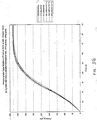
- the performance of the standard propellant grains is represented by the solid line in Fig. 3A.
- the gas produced contained about 37.5% carbon monoxide, about 23% nitrogen, about 27% hydrogen, about 10% water vapor and about 2.5% carbon dioxide. Long-term thermal stability of the composition was assessed and determined to be acceptable.
- the propellant itself was exposed to a temperature of 105°C for 105 hours and did not ignite, and thereafter upon firing into a tank of fixed volume, the performance of the propellant was substantially unaffected by the heat treatment as shown by the dotted lines in Fig. 3A.
- the performance of the propellant after being exposed to an alternating thermal cycling temperature profile of 90°C for a total of 109 hours and -40°C for a total of 89 hours also was substantially unaffected by the heat and cold treatment as shown by the dashed lines in Fig. 3A.
- This example illustrates the consistency in performance achievable with propellant grains having a different web thickness.
- Example 2 Same procedure as Example 1 was used except 6.6 g of propellant grains having web thickness of 0.028 inches was employed.
- the performance curve for the standard propellant grains is represented by the solid line in Fig. 3B.
- the performance of the propellant which was exposed to a temperature of 105°C for 105 hours was substantially unaffected by the heat treatment as shown by the dotted lines in Fig. 3B.
- the performance of the propellant after being exposed to a alternating thermal cycle temperature profile of 90°C for a total of 109 hours and -40°C for a total of 89 hours also was substantially unaffected by the exposure to an extreme temperature fluctuation as shown by the dashed lines in Fig. 3B.
- This example illustrates the consistency in performance of propellant grains even after being subjected for 400 hours to a temperature of 107°C.
- Example 2 Same procedure as Example 1 was used except 5.7 g of propellant grains having web thickness of 0.023 inches, 145 g of gas, and an inflator orifice size of 0.182 inches was employed.
- the performance curve for the standard propellant grains is represented by the solid lines in Fig. 3C.
- the performance of the propellant which was exposed to a temperature of 107°C for 400 hours was substantially unaffected by the heat treatment as shown by the dotted lines in Fig. 3C.
- This example illustrates the consistency in performance of propellant grains even after being subjected to 48 cycles of extreme temperature fluctuations.
- Example 2 Same procedure as Example 1 was used except 5.7 g of propellant grains having web thickness of 0.023 inches, 145 g of gas, and an inflator orifice size of 0.182 inches was employed.
- the performance curve for the standard propellant grains is represented by the solid lines in Fig. 3D.
- the performance of the propellant which was subjected 48 times ( i.e. , cycles) to a temperature of 107°C for 2 hours then at -40°C for 2 hours also-was substantially unaffected by the exposure to an extreme temperature fluctuation as shown by the dashed lines in Fig. 3D.
- This example illustrates the consistency in performance of propellant grains even after being subjected for 400 hours at 107°C.
- Example 3 Same procedure as Example 3 was used except 6.2 g of propellant grains having web thickness of 0.023 inches, 157 g of gas, and an inflator orifice size of 0.193 inches was employed.
- the performance curve for the standard propellant grains is represented by the solid lines in Fig. 3E.
- the performance of the propellant which was exposed to a temperature of 107°C for 400 hours was substantially unaffected by the heat treatment as shown by the dotted lines in Fig. 3E.
- This example illustrates the consistency in performance of propellant grains even after being subjected to 48 cycles of extreme temperature fluctuations.
- Example 4 Same procedure as Example 4 was used except 6.2 g of propellant grains having web thickness of 0.023 inches, 157 g of gas, and an inflator orifice size of 0.193 inches was employed.
- the performance curve for the standard propellant grains is represented by the solid lines in Fig. 3F.
- the performance of the propellant which was subjected 48 times (i.e., cycles) to a temperature of 107°C for 2 hours then at -40°C for 2 hours also was substantially unaffected by the exposure to an extreme temperature fluctuation as shown by the dashed lines in Fig. 3F.
- This example illustrates the consistency in performance of propellant grains in a different inflator orifice size.
- Example 3 Same procedure as Example 3 was used except propellant grains having web thickness of 0.023 inches, and an inflator orifice size of 0.173 inches was employed.
- the performance curve for the standard propellant grains is represented by the solid lines in Fig. 3G.
- the performance of the propellant which was exposed to a temperature of 107°C for 400 hours was substantially unaffected by the heat treatment as shown by the dotted lines in Fig. 3G.
- This example illustrates the consistency in performance of propellant grains in a different inflator orifice size.
- Example 4 Same procedure as Example 4 was used except propellant grains having web thickness of 0.023 inches, and an inflator orifice size of 0.173 inches was employed.
- the performance curve for the standard propellant grains is represented by the solid lines in Fig. 3H.
- the performance of the propellant which was subjected 48 times ( i.e. , cycles) to a temperature of 107°C for 2 hours then at -40°C for 2 hours also was substantially unaffected by the exposure to an extreme temperature fluctuation as shown by the dashed lines in Fig. 3H.
- This example illustrates the consistency in performance of propellant grains using different amount of the propellant grains.
- Example 7 Same procedure as Example 7 was used except 6.4 g of propellant grains was employed.
- the performance curve for the standard propellant grains is represented by the solid lines in Fig. 3I.
- the performance of the propellant which was exposed to a temperature of 107°C for 400 hours was substantially unaffected by the heat treatment as shown by the dotted lines in Fig. 3I.
- This example illustrates the consistency in performance of propellant grains using different amount of the propellant grains.
- Example 8 Same procedure as Example 8 was used except 6.4 g of propellant grains was used.
- the performance curve for the standard propellant grains is represented by the solid lines in Fig. 3J.
- the performance of the propellant which was subjected 48 times ( i.e. , cycles) to a temperature of 107°C for 2 hours then at -40°C for 2 hours also was substantially unaffected by the exposure to an extreme temperature fluctuation as shown by the dashed lines in Fig. 3J.
- This example illustrates the shift in performance of previous propellant formulation after a prolonged exposure to a high temperature.
- a propellant composition comprising about 76 wt% RDX, about 11.5 wt% GAP (glycidyl azide polymer, plasticizer grade), about 11.5 wt% CAB (cellulose acetate butyrate polymer) and about 1% MNA (methylnitroaniline) was prepared and formed into cylindrical grains having an average density of about 1.6857 g/cc and an average web thickness of about 0.023 inches.
- a 5.6 g test sample was placed into an inflator having an orifice size of 0.194 inches and fired into a tank of fixed volume. The test sample had a combustion temperature of about 2400°K and exhibited acceptable ballistic properties.
- the performance of the standard propellant grains is represented by the solid line in Fig. 4A.
- the propellant gas contained about 37% carbon monoxide, about 25% hydrogen, about 25% nitrogen, about 10% water vapor and about 3% carbon dioxide.
- Long-term thermal stability of the composition was assessed and determined to be acceptable but produced significant shift in the propellant's performance.
- the propellant itself was exposed to a temperature of 105°C for 105 hours and did not ignite, but noticeable clumping of propellant grains was observed, and thereafter upon firing into a tank in an inflator, the performance of the propellant was substantially effected by the heat treatment as shown by the dotted lines in Fig. 4A.
- Example 3 Same procedure as Example 3 was used except the propellant had composition of Example 11 and web thickness of 0.023 inches.
- the performance curve for the standard propellant grains is represented by the solid lines in Fig. 4B.
- the performance of the propellant which was exposed to a temperature of 107°C for 400 hours shows a significant shift by the heat treatment as shown by the dotted lines in Fig. 4B.
- This example illustrates the shift in performance of previous propellant formulation after being subjected to 48 cycles of extreme temperature fluctuations. (2 hrs. at 107° C / 2 hrs at -40°C equals one cycle).
- Example 12 Same procedure as Example 12 was used.
- the performance curve for the standard propellant grains is represented by the solid lines in Fig. 4C.
- a hybrid inflator generally comprises a pressurized gas chamber containing a pressurized fluid, a gas-generating chamber containing the propellant, an igniter assembly, and a rupture disk.
- the pressurized fluid substantially consists of an inert fluid and oxygen.
- the propellant is ignited by the igniter assembly when, for instance, a certain magnitude of deceleration occurs, and is burnt to generate gaseous products, (e.g., carbon monoxide and hydrogen), which are reactive with oxygen.
- gaseous products e.g., carbon monoxide and hydrogen
- Carbon monoxide and hydrogen react with oxygen in the pressurized gas to generate carbon monoxide and a water vapor, while increasing the pressure in the gas-generating chamber.
- the rupture disk is opened to supply the carbon dioxide, water vapor and inert gas to the air/safety bag 18 (Fig. 1). This causes the air/safety bag 18 (Fig. 1) to be inflated.
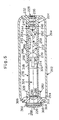
- the hybrid inflator 202 includes a typically cylindrical gas generator 208 and a typically cylindrical stored gas housing 204 which is concentrically positioned about the gas generator 208 and appropriately interconnected with the gas generator 208.
- the stored gas housing 204 (a third chamber) contains an appropriate pressurized medium and the gas generator 208 contains grains 258 of an appropriate propellant.
- a primary advantage of the inflator 202 is that its design affects a rapid pressurization of the region proximate the second closure disk 290 or main closure disk (which isolates the flow between the inflator 202 and the air/safety bag 18 (Fig. 1)), since that fluid pressure acts directly on the second closure disk 290 to "open" the same.
- Another significant advantage of the design of the inflator 202 is that it provides/allows for sufficient "mixing" of the propellant gases generated upon ignition and combustion of the propellant grains 258 with the pressurized medium.
- the inflator 202 is particularly suited for use with the above-described compositions of gun type propellants and/or hybrid propellants, together with a multi component pressurized medium (e.g., one component being oxygen and the other component being at least one inert gas). That is, the design of the inflator 202 provides/allows for effective combustion of the propellant gases and/or gases generated by igniting the propellant grains 258 (e.g., gases generated by combustion of the ignition/booster material 240 as discussed below) with the pressurized medium to enhance operation of the inflatable safety system 10 (Fig. 1). This secondary combustion further enhances the rapid pressurization abilities of the inflator 202 for initiating flow to the air/safety bag (Fig. 1).
- a multi component pressurized medium e.g., one component being oxygen and the other component being at least one inert gas. That is, the design of the inflator 202 provides/allows for effective combustion of the propellant gases and/or gases generated by igniting the
- the gas generator 208 includes a cylindrical gas generator housing 212 which in the illustrated embodiment is defined by a first housing 216 and an axially aligned and interconnected second housing 278.
- One end of the first housing 216 is attached to an initiator adapter 224 (e.g., via welding at weld 248) to achieve a preferably hermetic seal since the entirety of the gas generator housing 212 contains a quantity of pressurized medium in the static state.
- the initiator adapter 224 retains an appropriate initiator 228 (e.g., an electrically activatable squib or other suitable pyrotechnic device) which is used to ignite the propellant grains 258 and which may be seated within an o-ring 232 to establish an appropriate seal.
- an appropriate initiator 228 e.g., an electrically activatable squib or other suitable pyrotechnic device
- a first closure disk (a secondary closure disk) 236 is appropriately secured between the end of the first housing 216 and the end of the initiator adapter 224 to achieve a preferably hermetic seal via the weld 248.
- the first housing 216 of the gas generator housing 212 defines a first chamber 254 which is disposed adjacent to and in axial alignment with the initiator 228.
- the first chamber 254 of the gas generator housing 212 principally contains the propellant grains 258 which, when ignited, generate propellant gases to augment the flow to the air/safety bag 18 (Fig. 1). Therefore, the first chamber 254 may also be characterized as a propellant or combustion chamber.
- an appropriate ignition/booster material 240 e.g., an RDX/aluminum booster material having a composition of 89 wt% RDX, 11 wt% aluminum powder, possibly with 0.5 wt% to 5.0 wt% hydroxypropyl-cellulose added replacing 0.5 wt% to 5.0 wt% of the RDX and aluminum proportionally
- an RDX/aluminum booster material having a composition of 89 wt% RDX, 11 wt% aluminum powder, possibly with 0.5 wt% to 5.0 wt% hydroxypropyl-cellulose added replacing 0.5 wt% to 5.0 wt% of the RDX and aluminum proportionally
- the reaction products of the gases resulting from ignition of the ignition/booster material 240 may chemically react with the pressurized medium to further enhance the rapid pressurization-based flow initiation characteristics of the inflator 202.
- An appropriate booster cup 244 or the like retains the ignition/booster material 240 (which is typically in powder or dried slurry form) and such may be appropriately secured to the end of the initiator adapter 224 and/or the first housing 216 (e.g., by being retained between the adapter 224 and the housing 216 via the weld 248).
- the first chamber 254 may also include a screen 266 or the like to retain certain sized particulate matter therein while discharging propellant gases from the first chamber 254 to the second chamber 324 as discussed below.
- the capacity of the stored gas housing 204 of the inflator 202 is set greater than the capacity of the second chamber 324.
- the first chamber 254 is fluidly interconnected with the stored gas housing 204 typically by at least one bleed orifice or port 262 (two in the illustrated embodiment) such that in the static state a quantity of pressurized medium is also contained within the first chamber 254.
- the bleed port(s) 262 are radially extending ( i.e. , extending along a radius originating at the central longitudinal axis 220 and perpendicularly disposed relative to the axis 220). The use of the bleed port(s) 262 and the selection of the size and/or number of bleed ports 262 can be used to "tune" the performance of the inflator 202.
- a certain amount of the flow of the propellant gases generated upon ignition of the propellant grains 258 is directed into the stored gas housing 204.
- propellants e.g., gun-type, hybrid
- pressurized medium e.g., a mixture of oxygen and an inert fluid (at least one inert gas)
- some secondary combustion namely a further combustion of the propellant gases will occur in the stored gas housing 204.
- Directing some of the propellant gases to the stored gas housing 204 from he first chamber 254 may be utilized to achieve a desired output or discharge to the air/safety bag 18, namely to achieve a desired rate of expansion of the air/safety bag 18.
- propellant gases it may be preferable to provide propellant gases to the stored gas housing 204 at a rate which maintains a substantially constant flow from the stored gas housing 204 into the second chamber 324 for a sufficient time as will be discussed below.
- a minor portion of the generated propellant gases need to flow into the stored gas housing 204 during operation to affect the desired result (e.g., no more than about forty percent (40%), and more typically no more than about thirty percent (30%) of the flow of propellant gases is directed to the stored gas housing 204).
- the pressure increase in the stored gas housing 204 after ignition of the propellant grains 358 is significantly less than in many commercial hybrid designs. That is, the significant pressure increase commonly associated with ignition of the propellant grains 358 is substantially confined to the gas generator 208. Therefore, the "strength" requirements of the stored gas housing 204 may be reduced. This allows for use of a reduced wall thickness for the stored gas housing 204 and/or lighter materials, both of which decrease the weight of the inflator 202.
- the principal flow of propellant gases from the first chamber 254 (e.g., at least about fifty percent (50%) of the total propellant gas flow, and typically at least about seventy percent (70%)) is to the second chamber 324 (known as the "afterburner" for reasons specified below) which is defined by the second housing 278 of the gas generator housing 212.
- At least one afterburner nozzle or aspirator 274 (a first interconnecting port) directs the flow from the first chamber 254 (principally propellant gases) into the second chamber 324 and thus provides the desired fluid interconnection.
- the afterburner nozzle 274 may be seated against a shoulder 270 on the interior of the first housing 216 and positioned therein prior to appropriately interconnecting the first housing 216 with the second housing 278 (e.g., via welding at weld 250).
- one end of the second housing 278 of the gas generator housing 212 is seated within an afterburner adapter 282 which has at least one gas generator outlet 286 therein.
- An O-ring 328 may be utilized between the second housing 278 and the adapter 282 to provide for an appropriate sealing interface.
- the afterburner adapter 282 is appropriately secured (e.g., via welding at weld 308) to a boss 294 which is then appropriately secured (e.g., via welding at weld 312) to the stored gas housing 204, both to preferably achieve a hermetic seal since the second chamber 324 contains a quantity of pressurized medium in the static state.
- a second closure disk 290 is positioned between the end of the afterburner adapter 282 and the boss 294 and thus retained by the weld 308.
- propellant gases produced by combustion of the propellant grains 258, as well as gases generated by ignition of the ignition/booster material 240 are thus directed at least in part into the second (afterburner) chamber 324. Due to the rapid pressure increase therein and as controlled in the manner discussed below, the second rupture disk 290 opens at an appropriate time such that the flow from the inflator 202 is directed to the diffuser 298 and then to the air/safety bag 18 (Fig. 1). In order to provide for a relatively non-thrusting output to the air/safety bag 18 (Fig. 1), the diffuser 298 utilizes a plurality of diffuser ports 300.
- a diffuser screen 304 may also be contained within the diffuser 298 to retain certain particulate matter within the inflator 202 and/or to further promote mixing/reaction of the propellant gases and pressurized medium prior to passing to the air/safety bag 18 (Fig. 1).
- the second chamber 324 is also fluidly interconnectable with the stored gas housing 204.
- at least one and preferably a plurality of gas generator inlet ports 316 provide for a fluid interconnection between the stored gas housing 204 and the second chamber 324 such that pressurized medium from the stored gas housing 204 may flow into the second chamber 324 at the appropriate time. That is, for certain applications this particular flow can be controlled as to the direction of flow.
- a valve 320 can be positioned adjacent to at least one and preferably all of the gas generator inlet ports 316. In the static state, it is not required that the valve 320 actually isolate the stored gas housing 204 from the second chamber 324 in this region.
- a quantity of pressurized medium is preferably retained within the second chamber 324 in the static state such that a non-sealing interface would accommodate such a supply.
- One configuration for the valve 320 which does not isolate the second chamber 324 from the stored gas housing 204 over the ports 316 is a substantially cylindrical roll of shim stock (e.g., 300 series stainless steel, 0.002" thick).
- a cantilever connection may be utilized between the valve 320 and the interior of the second housing 278. That is, a rearward portion (i.e., sufficiently distal from the ports 316) may be attached to the second housing 278 with the forward or mesial portion thereof remaining unattached and thus free to move/deflect to provide operational capabilities for the valve 320.
- the pressure throughout the stored gas housing 204 and the gas generator housing 212 is substantially equal.
- the pressure throughout the various "chambers" of the inflator 202 differs to achieve a desired performance.
- the propellant grains 258 are ignited the generated propellant gases begin flowing into at least the second chamber 324 to cause a pressure increase therein.
- at least one bleed port 262 is incorporated into the design, some propellant gases also flow into the stored gas housing 204 as well to initially cause a small pressure increase therein.
- the pressure increases at a greater rate within the second chamber 324 than in the stored gas housing 204 due to the respective introduction of propellant gases wherein and their relative volumes.
- This pressure differential forces the valve 320 against the interior of the aligned portion of the gas generator housing 212 or more specifically the second housing 278 and thereby temporarily isolates the stored gas housing 204 from the second chamber 324 in this region by blocking the gas generator inlet ports 316.
- the above-noted cantilevered interconnection of the valve 320 allows for this motion.
- the fluid pressure acting directly on the second closure disk 290 opens, ruptures, or breaks the disk 290. This thereby initiates flow from the gas generator 208 to the diffuser 298 and then to the air/safety bag 18 (Fig. 1).
- valve 320 allows for a timely initiation of flow to the air/safety bag 18 (Fig. 1) in certain applications. Specifically, for certain designs the use of the valve 320 allows the second chamber 324 to rapidly pressurize at a rate which will timely open the second closure disk 290. If no valve 320 was utilized in the inflator 202, propellant gases would flow into the stored gas housing 204 from the second chamber 324. As such, it could take longer for the pressure within the second chamber 324 to increase to the level where it would rupture the second closure disk 290. However, the use of the second chamber 324 provides a smaller pressurization chamber which thereby reduces the time required to initiate flow to the air/safety bag 18 (Fig. 1).
- the volume of the second chamber 324 can be made small enough and/or the selection of the propellant and pressurized medium may be such that the valve 320 is not required for satisfactory operation (e.g., by utilizing the combustion of the gases generated by combustion of the propellant grains 258 and/or the ignition/booster material 240 to affect a rapid pressurization within the second chamber 324).
- the valve 320 retains its position and thus blocks the gas generator inlet ports 316 for a certain time after the second closure disk 290 is opened to initiate flow to the air/safety bag 18 (Fig. 1). However, once a certain pressure differential develops between the stored gas housing 204 and the second chamber 324, the valve 320 is moved by the force of this pressure differential to expose the gas generator inlet ports 316.
- the valve 320 is constructed in the above-described manner, the free end of the valve 320 moves radially inwardly toward the central axis 220 or by a collapsing of the valve 320 in at least those regions radially aligned with the gas generator inlet ports 316 to allow for a desired flow therethrough.
- valve 320 is retained by its interconnection with the second housing 278.
- the valve 320 is movable from a first position to a second position.
- the valve 320 substantially inhibits the flow when operational.
- the valve 320 moves to the second position and allows the flow when the pressure within the stored gas housing 204 exceeds the pressure within the gas generator housing 212 by a predetermined degree.
- the second position is radially inward of the first position.
- the primary function of the second chamber 324 is to provide/allow for effective mixing of the propellant gases and pressurized medium prior to being discharged to the air/safety bag 18 (Fig. 1).
- the second chamber 324 may be further characterized as an afterburner.
- the second chamber 324 must provide/allow for sufficient mixing of the generated gases and the pressurized medium, either by length or induced turbulence as will be discussed below.
- the closest of the afterburner nozzle 274 and all gas generator inlet ports 316 to the gas generator outlet 286 should be separated therefrom by a distance of at least fifteen millimeters (15 mm) for the illustrated driver's side application.
- the distance can be set in the range of about 4 mm to about 80 mm for one or more aspects and embodiments of the present invention.
- This increased length of the second chamber 324 also allows for a sufficient amount of pressurized medium to be contained within the second chamber 324 in the static state to react with propellant gases which are generated before the flow from the stored gas housing 204 to the second chamber 324 is initiated. That is, preferably there is sufficient pressurized medium initially contained within the second chamber 324 upon activation of the inflator 202 to react with propellant gases until the flow from the stored gas housing 204 to the second chamber 324 is initiated by the above-noted movement of the valve 320.
- the gas generator inlet ports 316 are also preferably disposed a sufficient distance from the gas generator outlet 286 as noted.
- the most mesial or forward portion of all gas generator inlet ports 316 should be even with the end of the afterburner nozzle 273, and is preferably more rearwardly (i.e., in a direction toward the initiator 228) and as illustrated.
- the dimensions of a given design for the inflator 202 may be varied, especially, the preferable capacity range of the inflator housing 204 depends on the inflator applications as shown in Table 2.
- the capacity of the inflator housing 204 for one or more aspects associated with the present invention may range from about 150 cm 3 to about 450 cm 3 .
- the capacity of the first chamber 254 may range from about 10 cm 3 to about 40 cm 3 .
- the capacity of the second chamber 324 may range from about 1 cm 3 to about 50 cm 3 .
- the diameter of the stored gas housing 204 is about fifty-nine millimeters (59 mm); 2) the length of the stored gas housing 204 is about two hundred millimeters (200 mm); 3) the stored gas housing 204 is formed from mild steel tubing and has a wall thickness of about two and one-half millimeters (2.5 mm) ; 4) the inner volume of the stored gas housing 204 (that portion in which pressurized medium is retained and not including the volume of the centrally disposed gas generator 208) is about three hundred seventy five cubic centimeters (375 cc); 5) the diameter of the first housing 216 of the gas generator housing 212 is about twenty millimeters (20mm); 6) the length of the first chamber 254 is about fifty-five millimeters (55 mm) ; 7) the first housing 216 is formed from mild steel and has a wall thickness of about one and one-half millimeters (1.5 mm); 8) the inner volume of the
- the pressurized medium for one or more aspects associated with the present invention may preferably contain about 8% to about 30% oxygen, about 60% to about 91% argon and about 0.5% to about 10% helium in a molar basis.
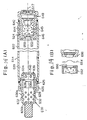
- the operation of the inflator 202 will be summarized referring primarily to Figs. 6A-D and 7A-D.
- the second closure disk 290 is intact and the valve 320 does not have to isolate the stored gas housing 204 from the second chamber 324 as illustrated in Figs. 6A and 7A.
- the initiator 228 is activated which ruptures the first closure disk 236 and ignites the ignition/booster material 240, which in turn ignites the propellant grains 258.
- Combustion of the propellant grains 258 generates propellant gases within the first chamber 254 which flow into both the second chamber 324 of the gas generator housing 212 and into the stored gas housing 204. Due to the presence of the hot propellant gases within the first chamber 254 and the introduction of the hot propellant gases into both the second chamber 324 and the stored gas housing 204, the corresponding pressures within these "vessels" also increases.
- the rate of pressure increase within the second chamber 324 is designed to be greater than the rate of pressure increase within the stored gas housing 214 due to the introduction of hot propellant gases therein.
- This pressure differential seats the valve 320 against the interior of the second housing 278 to isolate the stored gas housing 204 from the second chamber 324 in this region as illustrated in Figs. 6B and 7B and to affect rapid pressurization of the second chamber 324.
- the amount of pressurized medium within the second chamber 324 in the static state should be sufficient to react with the propellant gases introduced thereto prior to establishing direct fluid communication between the stored gas housing 204 and second chamber 324.
- the fluid pressure acting directly on the second closure disk 290 ruptures the second closure disk 290 as illustrated in Fig. 6C such that there is a flow through the gas generator outlet(s) 286, to the diffuser 298, and to the air/safety bag 18 (Fig. 1).
- the valve 320 may continue to impede the flow into the second chamber 324 directly from the stored gas housing 204 by blocking the gas generator inlet ports 316 as illustrated in Figs. 6C and 7C.
- valve 320 After a certain pressure differential develops between the stored gas housing 204 and the second chamber 324, this moves the valve 320 away from the gas generator inlet ports 316 to establish a flow of pressurized medium from the stored gas housing 204 to the second chamber 324 as illustrated in Figs. 6D and 7D.
- the illustrated structure for the valve 320 e.g., a cylindrical roll of metal foil
- the forward portion of the valve 320 collapses or moves radially inward under the noted pressure differential at least in those regions proximate or aligned with the gas generator inlet ports 316.
- the rearward part of the valve 320 remains attached to the second housing 278.
- the design of the inflator 202 is particularly suited for use with and enhances the performance of a system which includes the above-described propellants (e.g., gun-type, hybrid) and pressurized medium (e.g., a mixture of oxygen and at least one inert gas).
- propellants e.g., gun-type, hybrid
- pressurized medium e.g., a mixture of oxygen and at least one inert gas.
- the inflator 202 may be generally configured as discussed above, but without utilizing the valve 320.
- This may be possible by utilizing the above-described types of propellants and pressurized medium, namely a propellant which generates propellant gases which may be further combusted in the second chamber 324 by mixing with an oxidizing pressurized medium (e.g., a multi-component mixture of oxygen and an inert fluid such as one or more types of inert gases).
- an oxidizing pressurized medium e.g., a multi-component mixture of oxygen and an inert fluid such as one or more types of inert gases.
- the "secondary" combustion of the propellant gases, and possibly secondary combustion of gases resulting from ignition of the ignition/booster material 240, within the second chamber 324 affects a sufficient pressure increase/rate of increase that the valve 320 may not be required.
- the secondary combustion may account for at least about thirty percent (30%) of the pressure increase/rate of pressure increase within the second chamber 324 after activation of the inflator 202, and possibly up to about fifty percent (50%). As such, it is possible to achieve a rapid pressurization-based flow initiation using a chemical reaction in the second chamber 324, thereby alleviating the need for the valve 320.
- FIG. 8-11 Another embodiment of a hybrid inflator which may be used in the inflatable safety system 10 of Fig. 1 is illustrated in Figs. 8-11.
- the inflator 350 is functionally/operationally similar to the inflator 202 discussed above, but is specifically configured for a driver's side application. As such, the inflator 350 enhances the performance of the inflatable system 10, particularly when utilizing the above-identified types of propellants (e.g., gun type propellants, hybrid propellants) and a multi-component pressurized medium (e.g., a mixture comprising oxygen and an inert fluid such as at least one inert gas).
- propellants e.g., gun type propellants, hybrid propellants
- a multi-component pressurized medium e.g., a mixture comprising oxygen and an inert fluid such as at least one inert gas.
- the hybrid inflator 350 generally includes two main elements, namely a central housing 358 which includes a gas generator 362 and a diffuser 458, and a stored gas housing 354 which is circumferentially disposed about and appropriately attached to the central housing 358 (e.g., via welding at welds 442, 450), preferably to achieve a hermetic seal.
- the stored gas housing 354 has a toroidal configuration and contains pressurized medium.
- the inflator 350 again concentrates the substantial pressure increase associated with activation of a hybrid primarily within the gas generator 362. Consequently, the wall thickness of the stored gas housing 354 may be reduced in comparison to conventional hybrid inflator designs ( i.e. , the pressure rating of the stored gas housing 354 may be reduced), which in turn reduces the weight of the inflator 350.
- the central housing 358 is disposed about the central, longitudinal axis 352 of the inflator 350 and includes a gas generator 362 and a longitudinally aligned and spaced diffuser 458. Both the gas generator 362 and the diffuser 458 are defined at least in part by this central housing 358.
- the gas generator 362 includes a cylindrical gas generator housing 366 which is defined by a portion of the central housing 358, an ignition assembly holder 370, a domed partition 390, and a gas generator end cap assembly 420.
- the ignition assembly holder 370 is appropriately connected to both a lower portion of the central housing 358 and to the stored gas housing 354 (e.g., via welding at weld 442) to achieve a preferably hermetic seal since the gas generator housing 366 also contains a quantity of the pressurized medium in the static state.
- the ignition assembly holder 370 retains an appropriate ignition assembly 374 (e.g., an electrically activatable squib or other suitable pyrotechnic device), and an o-ring 372 may be utilized to provide a sealing interface.
- a first closure disk (a secondary closure disk) 378 is appropriately attached to the end of the ignition assembly holder 370 (e.g., by welding at weld 446) to achieve a preferably hermetic seal.
- the first closure disk 378 is retained between an end of an ignition assembly holder main housing 382 and an ignition assembly holder end cap 386 of the ignition assembly holder 370 at the weld 446.
- the partition 390 separates the gas generator housing 366 into a first chamber 394 and a second chamber 418.
- the first chamber 394 is defined by a lower portion of the central housing 358, the ignition assembly holder 370, and the lower surface of the partition 390, and is disposed adjacent to the ignition assembly 374.
- the first chamber 394 of the gas generator housing 366 principally contains the propellant grains 404 which, when ignited, generate propellant gases to augment the flow to the air/safety bag 18 (Fig. 1). Therefore, the first chamber 394 may also be characterized as a propellant chamber.
- an appropriate ignition/booster material 408 e.g., an RDX/aluminum booster material having a composition of 89 wt% RDX and 11 wt% aluminum powder, possibly with 0.5 wt% to 5.0 wt% hydroxypropyl-cellulose added replacing 0.5 wt% to 5.0 wt% of the RDX and aluminum proportionally
- an appropriate screen 412, booster cup or the like may separate the propellant grains 404 from the ignition/booster material 408.
- the first chamber 394 is fluidly interconnected with the stored gas housing 354 typically by at least one bleed orifice or port 400 (two in the illustrated embodiment) such that in the static state pressurized medium is also contained within the first chamber 394 as noted above.
- the bleed port(s) 400 are radially extending (i.e., extending along a radius originating at the central longitudinal axis) and in a substantially horizontal fashion (i.e., contained within a plane which is perpendicular to the central axis 352). Selection of the size and/or number of bleed port(s) 400 can be used to tailor the performance of the inflator 350 as discussed above with regard to the inflator 202.
- reaction of the resulting gases from ignition of the ignition/booster material 408 may also chemically react with the pressurized medium to further enhance the rapid pressurization-based flow initiation characteristics of the inflator 350.
- Directing some of the propellant gases to the stored gas housing 354 from the first chamber 394 may be utilized to achieve a desired output or discharge to the air/safety bag 18, namely to achieve a desired rate of expansion of the air/safety bag 18.
- only a minor portion of the generated propellant gases need to flow into the store gas housing 354 during operation to affect the desired result (e.g., no more than about forty percent (40%), and more typically no more than about thirty percent (30%) of the flow of propellant gases is directed to the stored gas housing 354).
- the pressure increase in the stored gas housing 354 after ignition of the propellant grains 404 is significantly less than in many commercial hybrid designs. That is, the significant pressure increase commonly associated with ignition of the propellant grains 404 is substantially confined to the gas generator 362. Therefore, the "strength" requirements of the stored gas housing 354 may be reduced. This allows for use of a reduced wall thickness for the stored gas housing 354 and/or lighter materials, both of which decrease the weight of the inflator 350. For instance, the maximum required wall thickness for the stored gas housing 354 may be about 0.075" when the internal pressure in the static state is about four thousand pounds per square inch (4,000 psi) and when the housing 354 is formed from mild steel.
- the principal flow of propellant gases from the first chamber 394 (e.g., at least about fifty percent (50%) of the total propellant gas flow, and more typically about seventy percent 70%)) is to the second chamber 418 (known as the afterburner for reasons discussed below).
- the second chamber 418 of the gas generator housing 366 is fluidly interconnected with the first chamber 394 of the gas generator housing 366 by at least one propellant port 416 (two illustrated) which extends through the gas generator partition 390.
- the principal flow path for the pressurized medium in the stored gas housing 354 to the air/safety bag 18 (Fig. 1) is also directly into the second chamber 418.
- the propellant ports 416 may be oriented to induce a vortex-like motion (e.g,. being introduced with at least a radial velocity component) within the second chamber 418.
- a vortex-like motion e.g,. being introduced with at least a radial velocity component
- One way of inducing this vortex-like motion is by orienting the substantially linearly extending gas generator propellant ports 416 in the manner illustrated in Fig. 9.
- the ports 416 are oppositely "inclined" within their respective reference planes.
- the second chamber 418 of the gas generator housing 366 is longitudinally aligned with the first chamber 394 and separated therefrom by the gas generator partition 390 with a portion of the stored gas housing 354 being circumferentially disposed thereabout.
- the second chamber 418 is defined by an intermediate portion of the central housing 358, the gas generator partition 390, and the gas generator end cap assembly 420.
- the gas generator end cap is appropriately attached to the central housing (e.g., via welding at weld 454), and the upper portion of the central housing 358 is appropriately attached to the upper portion of the stored gas housing 354 (e.g, via welding at weld 450).
- both welds 450 and 454 define a hermetic seal since the second chamber 418 contains a quantity of the pressurized medium in the static state.
- the gas generator end cap assembly 420 contains at least one gas generator outlet 424 (one shown) .
- a second closure disk 428 is appropriately attached to the gas generator end cap assembly 420 (e.g., sandwiched between an upper gas generator end cap 421 and a lower gas generator end cap 422) to achieve a preferably hermetic seal (e.g., via welding at weld 454).
- propellant gases produced by combustion of the propellant grains 404, as well as gases generated by ignition of the ignition/booster material 408, are thus directed at least in part into the second chamber 418. Due to the rapid pressure increase therein and as controlled in the manner discussed below, the second closure disk 428 opens at the appropriate time such that the flow from the inflator 350 is directed to the diffuser 458 and then to the air/safety bag 18 (Fig. 1).
- the diffuser 458 utilizes a plurality of diffuser ports 462.
- a diffuser screen may also be contained within the diffuser 458 to retain rupture disk fragments within the inflator 350 and/or to further promote mixing/reaction of the propellant gases and pressurized medium prior to passing to the air/safety bag 18 (Fig. 1).
- the second chamber 418 is also fluidly interconnectable with the stored gas housing 354.
- at least one and preferably a plurality of gas generator inlet ports 432 provide for a fluid interconnection between the stored gas housing 354 and the second chamber 418 such that pressurized medium from the stored gas housing 354 may flow into the second chamber 418 at the appropriate time. That is, for certain designs/applications this particular flow can be controlled as to the direction of flow.
- a valve 438 can be positioned adjacent to at least one and preferably all of the gas generator inlet ports 432. In the static state, it is not required that the valve 438 actually isolate the stored gas housing 354 from the second chamber 418 in this region.
- a quantity of pressurized medium is preferably retained within the second chamber 418 in the static state such that a non-sealing interface would accommodate such a supply.
- One configuration for the valve 438 which does not isolate the second chamber 418 from the stored gas housing 354 over the ports 432 is a roll of shim stock (e.g., stainless steel, 0.002" thick).
- a cantilever connection may be utilized between the valve 438 and the interior of the gas generator housing 366. That is, a rearward portion of the valve 438 may be retained between the central housing 358 and the partition 390 with the forward portion thereof remaining unattached and thus free to move/deflect to provide operational capabilities for the valve 438.
- an individual plug 438a, 438b could be disposed in each of the ports 432.
- These plugs 438a, 438b would preferably be interconnected with the inflator 350 by a tether 439 or the like (shown in Fig. 12B only). It may also be desirable to support the plugs 438a, 438b within the ports 432 with a pliable member 433 (Fig. 12A only).
- the plugs 438a, 438b could also be used with other hybrid inflators described herein.
- the pressure throughout the stored gas housing 354 and the gas generator 362 may thus be substantially equal.
- the pressure throughout the various "chambers" of the inflator 350 differs to achieve a desired performance.
- propellant gases begin flowing into at least the second chamber 418 to cause a pressure increase therein.
- at least one bleed port 400 is incorporated into the design, some propellant gases also flow into the stored gas housing 354 as well to cause a pressure increase therein.
- the pressure increases at a greater rate within the second chamber 418 than in the stored gas housing 354 due to the introduction of propellant gases therein and their respective volumes.
- This pressure differential forces the valve 438 against the interior of the aligned portion of the gas generator housing 366 and thereby temporarily isolates the stored gas housing 354 from the second chamber 418 in this region by covering the gas generator inlet ports 432.
- the fluid pressure itself opens, ruptures, or breaks the second closure disk 428. This thereby initiates flow from the gas generator 362 to the diffuser 458, and then to the air/safety bag 18 (Fig. 1).
- valve 438 allows for a timely initiation of flow to the air/safety bag 18 (Fig. 1) in certain designs/applications. Specifically, for certain designs the use of the valve 438 allows the second chamber 418 to pressurize at a rate which will timely open the second closure disk 428. If no valve 438 was utilized in the inflator 350, propellant gases would flow into the stored gas housing 354 from the second chamber 418. As such, it could take longer for the pressure within the second chamber 418 to increase to the level where it would rupture the second closure disk 428. However, the use of the second chamber 418 provides a smaller pressurization chamber which thereby reduces the time required to initiate flow to the air/safety bag 18 (Fig. 1).
- the volume of the second chamber 418 can be made small enough and/or the selection of the propellant and pressurized medium may be such that the valve 438 is not required for satisfactory operations (e.g., by utilizing the combustion of the gases generated by combustion of the propellant grains 404 and/or the ignition/booster material 418 to affect a rapid pressurization within the second chamber 418).
- the valve 438 may retain its position and thus block the gas generator inlet ports 432 for a certain time after the second closure disk 428 is opened to initiate flow to the air/safety bag 18 (Fig. 1). Nonetheless, once a predetermined pressure differential develops between the stored gas housing 354 and the second chamber 418, the upper free end of the valve 438 is moved by the force of this pressure differential to expose the gas generator inlet ports 432 such that flow from the stored gas housing 354 into the second chamber 418 is initiated. The lower end of the valve 438 remains attached to the gas generator housing 366.
- valve 438 When the valve 438 is from a roll of shim stock, this movement may be radially inwardly toward the central axis 352 or by a collapsing of the valve 438 in at least those regions radially aligned with the gas generator inlet ports 432 to allow for a desired flow therethrough.
- the primary function of the second chamber 418 is to provide/allow for effective mixing of the propellant gases and pressurized medium prior to being discharged to the air/safety bag 18 (Fig. 1).
- this mixing further combusts the propellant gases to provide the noted benefits (e.g., reducing toxicity, reducing the amount of propellant required by the further combustion and the related increased expansive capabilities).
- the second chamber 418 may be further characterized as an afterburner.
- the second chamber 418 may be further characterized as an afterburner.
- at least about 99% of all combustion of the propellant gases and ignition/booster material gases, and even more preferably about 100% of the combustion occurs within the inflator 350. This reduces the potential for damage to the air/safety bag 18 (Fig. 1).
- One way of inducing the above-noted vortex-like motion is by orienting the generally linearly extending gas generator inlet ports 432 substantially within a horizontal reference plane, but not having the axes of these ports 432 pass through the central longitudinal axis 352 of the inflator 350 as illustrated in Fig. 10. That is, the substantially linear ports 432 do not project outwardly from the central, longitudinal axis 352 along a radius to interconnect the second chamber 418 and the stored gas housing 354. Instead, one portion of a given port 432 is disposed on one radial location, while another portion is disposed at another radial location. As such, the flow into the second chamber 418 from the stored gas housing 354 is generally in the direction of the arrows A of Fig. 10. In order to induce further mixing of the propellant gases with the incoming pressurized medium, the propellant ports 416 may be further directed to where the gas generator inlet ports 432 interface with the interior of the second chamber 418.
- the dimensions of a given design for the inflator 350 may be varied. Especially, the capacity of each chamber of the inflator 350 depends on the inflator applications. For example, the capacity of the inflator housing for one or more aspects associated with the present invention may range from about 50 cm 3 to about 150 cm 3 . The capacity of the first chamber 394 ranges from about 5 cm 3 to about 15 cm 3 . The capacity of the second chamber 418 may range from about 1 cm 3 to about 20 cm 3 .
- the diameter of the inflator 350 is about three and one-quarter inch (3.25"); 2) the height of the central housing 358 is about one and six-tenths inch (1.6"); 3) the height of the stored gas housing 354 is about one and two-tenths inch (1.2"); 4) the inner volume of the stored gas housing 354 is about five cubic inches (5 in 3 ); 5) the inner volume of the first chamber 394 of the gas generator housing 366 is about seven cubic centimeters (7 cc); 6) the inner volume of the second chamber 418 of the gas generator housing 366 is about two cubic centimeters (2 cc); 7) there are two (2) bleed ports 400 having a diameter of about one and one-half millimeters (1.5 mm); 8) there are two (2) propellant ports 416 having a diameter of about two millimeters (2 mm) ; ; 9) the total weight of the propellant grains 404 is about three and one-half grams (3.5
- the operation of the inflator 350 will be summarized by reference to Figs. 11A-D.
- the ignition assembly 374 is activated which ruptures the first closure disk 378 and ignites the ignition/booster material 408, which in turn ignites the propellant grains 404 as illustrated in Fig. llA.
- Combustion of the propellant grains 404 generates propellant gases within the first chamber 394 which flow into both the second chamber 418 of the gas generator housing 366 and into the stored gas housing 354 where such propellant gases mix with pressurized medium. Due to the presence of the hot propellant gases within the first chamber 394 and the introduction of the hot propellant gases into both the second chamber 418 and the stored gas housing 354, the corresponding pressure within these "vessels" also increases.
- the rate of pressure increase within the second chamber 418 is designed to be greater than the rate of pressure increase within the stored gas housing 354 due to the introduction of hot propellant gases therein and their respective volumes.
- This pressure differential seats the valve 438 against the interior of the gas generator housing 366 to isolate the stored gas housing 354 from the second chamber 418 in this region as also illustrated in Fig. 11A.
- the amount of pressurized medium within the second chamber 418 in the static state should be sufficient to react with the propellant gases introduced thereto prior to establishing fluid communication between the stored gas housing 354 and the second chamber 418.
- the pressure ruptures the second closure disk 428 as illustrated in Fig. 11B such that there is a flow through the gas generator outlet(s) 424, to the diffuser 458, and to the air/safety bag 18 (Fig. 1).
- the valve 438 continues to impede the flow into the second chamber 418 directly from the stored gas housing 354 by blocking the gas generator inlet ports 432. After a certain pressure differential develops between the stored gas housing 354 and the second chamber 418, the resulting force moves or deflects the valve 438 away.from the gas generator inlet ports 432 to establish a flow of pressurized medium from the stored gas housing 354 to the second chamber 418.
- the one-way check valve 438 will collapse under the noted pressure differential at least in those regions proximate or aligned with the gas generator inlet ports 432.
- both the flow of the pressurized medium and propellant gases into the second chamber 418 may be in a vortex-like pattern. This increases the amount of time which the mixture is retained within the second chamber 418 prior to being provided to the air/safety bag 18 (Fig. 1).
- the inflator 350 may be generally configured without utilizing the valve 438. This may be possible by utilizing a propellant which generates propellant gases which may be further combusted in the second chamber 418 by mixing with an oxidizing pressurized medium (e.g., a multi-component mixture of oxygen and an inert fluid such as one or more types of inert gases; e.g., argon, nitrogen).
- an oxidizing pressurized medium e.g., a multi-component mixture of oxygen and an inert fluid such as one or more types of inert gases; e.g., argon, nitrogen.
- the "secondary" combustion of the propellant gases, and possibly secondary combustion of gases resulting from ignition of the ignition/booster material 408, within the second chamber 418 affects a sufficient pressure increase/rate of increase such that the valve 438 may not be required.
- the secondary combustion may account for at least about thirty percent (30%) of the pressure increase/rate of pressure increase within the second chamber 418 after activation of the inflator 350, and possibly up to about fifty percent (50%). As such, it is possible to achieve a rapid pressurization-based flow initiation using a chemical reaction in the second chamber 418, thereby alleviating the need for the valve 438.
- Fig. 13 shows a modification of the inflator according to a further embodiment.
- the modified inflator has a structure similar to the inflator shown in Fig. 5. Accordingly, we will omit the description of the similar structure, but will refer to numerals identical to the numerals denoting the members of the inflator of Fig. 5. Certain differences between the modified inflator of Fig. 13 and the inflator of Fig. 5 will be discussed below.
- a first chamber 501 has an inner diameter larger than an inner diameter of a second chamber 502.
- the length of the second chamber 502 is set excessively less than the length of the second chamber 324 of Fig. 5. Accordingly, the second chamber 502 has the capacity extremely smaller than the capacity of the first chamber 501.
- the capacity of the second chamber 502 is about one twentieth of the capacity of the first chamber 501 in this embodiment.
- a transfer tube 503 is located on the axis of the first chamber 501 and connects the initiator 228 to the aspirator nozzle 274.
- the transfer tube 503 is hollow and has a plurality of interconnecting ports 504 at the peripheral wall.
- the transfer tube 503 and the aspirator nozzle 274 allow for communicating the first chamber 501 with the second chamber 502 (e.g., it assists in keeping solid propellant out of the axial path between the initiator 228 and the disk 290).
- the first closure disk 236 generally closes a passage 507 defined between the initiator 228 and the first chamber 501.
- the second chamber 502 is connected to the outlet port 286 by an afterburner pipe 505.
- the second closure disk 290 located near the second chamber 502 and the aspirator nozzle 274, normally closes the outlet port 286 via the pipe 505.
- the bleed ports 262 communicate the first chamber 501 with the stored gas housing 204.
- Inlet ports 316 is provided with the second chamber 502. The inlet ports 316 are opened in the static state because the valve 320 does not closely contact the inner wall of the second chamber 502.
- the first closure disk 236 is broken and the propellant grains 258 are ignited and burnt.
- Combustion gases generated from the propellant grains 258 increase the pressure in the first chamber 501 and then increase the pressure in the second chamber 502 via the transfer tube 503 and the aspirator nozzle 274.
- the increased pressure moves the valve 320 toward the wall of the second chamber 502 to close the inlet ports 316.
- the combustion gases are injected from the aspirator nozzle 274 toward the pipe 505 to break the second closure disk 290.
- the pressure in the second chamber 502 temporarily decreases to allow the valve 320 to open the inlet ports 316. Consequently, the pressurized medium goes into the second chamber 502 and the pipe 505 through the inlet ports 316.
- the oxygen in the pressurized medium chemically reacts with carbon monoxide and hydrogen in the combustion gases to convert them to carbon dioxide and water vapor within the second chamber 502 and the pipe 505.
- Carbon dioxide, water vapor and argon in the pressurized medium are supplied to an air bag (not shown) through the outlet port 286 and a diffuser 508 to inflate the air bag.
- the second chamber 502 is formed smaller than the first chamber 501 in this embodiment.
- the second closure disk 290 is located near the aspirator nozzle 274. Consequently, in addition to the same effect and advantages as the inflators shown in Figs. 5 and 8, the increase of pressures in the first and the second chambers 501 and 502 occurs rapidly in the present embodiment, thus breaking the disk 290 rapidly.
- the transfer tube 503 having a plurality of ports 504 can increase the velocity of combustion gas flow when the flow passes through the ports 504. This assists the rapid breakage of the disk 290.
- the transfer tube 503 is applicable to the embodiment shown in Fig. 5. Furthermore, with respect to the opening area of each aspirator nozzle shown in Figs 5 and 8, and the sum of opening areas of the bleed ports, it can be decided which one may be greater than the other, depending on whether the pressurized medium or the propellant gas is introduced into the first chamber.
- Table 2 indicates physical characteristics of the inflators shown in Figs 5, 8 and 13 which may be appropriate for use in conjunction with one or more embodiments or aspects associated with the present invention.
- Table 2 indicates, for example, value ranges of propellant grains, pressurized gases and pressurized medium.
- propellants °K
- heat of propellants cal/g
- 800 to about 1300 pressurized medium g
- propellants g
- the inflator 614 includes a cylindrical inflator housing 622 having a pressurized medium 620 that is provided to the air/safety bag 18 (Fig. 1), as well as a gas generator 624 that generates propellant gases for expanding the pressurized medium 620 to increase the flow to the air/safety bag 18.
- the inflator 614 may be used as a side impact inflator and thus may be attached to a seat or a door of a vehicle. (e.g., used to protect occupants when the vehicle is bumped sideways).
- the pressurized medium 620 may include an inert fluid (e.g., argon) and oxygen and the above-noted types of propellants may also be utilized.
- a gas generator housing 644 is welded to the right end opening 642 of the inflator housing 622, part of which is disposed within the inflator housing 622.
- a propellant 646 e.g., of the above-described types
- the gas generator housing 644 and the propellant ignition assembly 648 are arranged on a longitudinal axis 617 of the inflator housing 622.
- the propellant 646 may be a nitramine propellant and desirably comprises, for example, about 84 wt% RDX (hexahydrotrinitrotriazine), about 15.5 wt% polyacrylate, about 0.2 wt% ammonium benzoate, and about 0.3 wt% Naugard 445®.
- the propellant 646 generates combustible gases which include carbon monoxide and hydrogen when it is burned.
- the gas generator housing 644 includes an interconnecting port 650 at its inner end, which is normally blocked by a first disk 652.
- a ring-shaped connector 626 is welded to the left end opening 625 of the inflator housing 622.
- a cap-shaped diffuser 630 is fixed at the left end opening 628 of the connector 626.
- the diffuser 630 includes a peripheral wall 630a having a plurality of holes 632 and a top wall 630b.
- the diffuser 630 is arranged on the axis 617 and is fluidly interconnected with the air/safety bag 18 (Fig. 1).
- a right end opening of the connector 626 forms an outlet port 634 of the inflator housing 622.
- a second disk 636 is disposed at the outlet port 634, which normally blocks the outlet port 634.
- the diffuser 630 includes an opening 630c which is fluidly interconnected with the outlet port 634.
- a cap 640 with a plurality of holes 638 is attached to the connector 626 so as to cover the outlet port 634. Accordingly, the inner inflator housing 622 is normally closed by the two disks 636, 652 and a peripheral wall of the inflator housing 622.
- the container chamber 645 is fluidly interconnected with the inside of the inflator housing 622 by the interconnecting port 650, while the inside of the inflator housing 622 is fluidly interconnected with the outlet port 634 by the holes 638 when the first and second disk 652 and 636 are ruptured.
- a distance between the first and second disks 652 and 636 is desirably about 20 mm to about 70 mm.
- the amount of the pressurized medium 620 within the inflator housing 622 may range from about 40 cm 3 to about 100 cm 3 .
- the amount of the pressurized medium 620 within the inflator housing 622 in one embodiment is more preferably from about 50 cm 3 to about 90 cm 3 .
- the inside of inflator housing 622 may be maintained at a high pressure of about 4,000 psi.
- the propellant ignition assembly 648 When the propellant ignition assembly 648 is activated in response to a signal from the detector 612, the propellant 646 is burned to generate combustible gases.
- the combustible gases include carbon monoxide and hydrogen.
- the combustible gases increase the pressure within the gas generator housing 644 to rupture the first disk 652. Then the combustible gases flow into the inflator housing 622 through the interconnecting port 650 and are mixed with the pressurized medium 620 therein.
- the pressurized medium 620 includes oxygen, which reacts with the carbon monoxide and hydrogen in the combustible gases to generate carbon dioxide and water vapor.
- the combustible gases increase the pressure within the inflator housing 622, which acts on the second disk 636 via the holes 638. That is, the gases must flow around the end wall 641 of the cap 640 and into the holes 638. This facilitates a more complete combustion within the housing 622.
- the end wall 641 thus may be said to function as a propellant trap which is disposed at the outlet to the inflator 614.
- the second disk 636 is ruptured by the increase in pressure adjacent thereto and when ruptured, supplies high pressure carbon dioxide, water vapor and the inert gas to the air/safety bag 18 (Fig. 1) via the outlet port 634 and the holes 632 of the diffuser 630.
- the air/safety bag 18 (Fig. 1) is effectively expanded a predetermined amount in a predetermined amount of time.
- the first and second disks 652, 636 and the diffuser 630 are disposed on the axis 617 of the inflator housing 622 in this embodiment so that the whole inflator can be formed in a compact cylindrical shape. Consequently, the inflator can be firmly attached in a limited space such as the inside of the door or the seat of a vehicle without modifying the configuration of the door or the seat.
- the propellant 646 generates combustible gases which include carbon monoxide and hydrogen when it is burned.
- the combustible gases react with the oxygen in the pressurized medium 620 to be converted to carbon dioxide and water vapor.
- the air/safety bag is (Fig. 1) can be expanded by substantially innoxious gases to occupants.
- the diffuser 630 is formed in a cap-like shape and includes the peripheral wall 630a and the top wall 630b.
- the diffuser 630 furthermore includes the opening 630c fluidly interconnected with the outlet port 634 and a plurality of the holes 632 fluidly interconnected with the opening 630c in the peripheral wall 630a. Therefore, the air/safety bag 18 (Fig. 1) can be more effectively expanded by gases discharged from a plurality of the holes 632 in all directions when gases are released from the inflator housing 622.
- Fig. 14B shows a modification of the inflator of Fig. 14A.
- the gas generator housing 624 comprises a base section 660 and a chamber section 662.
- the base section 660 supports the ignition assembly 648.
- the chamber section 662 accommodates the propellants 646.
- a disk 664 is disposed between the base section 660 and the chamber section 662 and is clamped with them. The disk 664 normally closes a through hole 666 of the chamber section 662.
- the chamber section 652 is fluidly interconnected with the inflator housing 622 via the interconnecting port 650. Accordingly, the inside of chamber section 652 is under pressure.
- the ignition assembly 648 When the ignition assembly 648 is activated, the ignition assembly 648 directly ruptures the disk 664 and ignites the propellant to generate combustible gases.
- the combustible gases react with the oxygen in the pressurized medium 620 to be converted to carbon dioxide and water vapor. Accordingly, the air/safety bag can be expanded by substantially innoxious gasses to occupants.
- the stored gas housing 354, which is of one-piece construction, may be formed is illustrated in Figs. 15, 16 and 17.
- the stored gas housing 354 is formed by swaging a single piece of tubing 470 by axial compression of the same or by swaging.
- the tubing 470 has a substantially cylindrical sidewall 474 and axially spaced upper and lower ends 478, 482, respectively.
- the tubing 470 which is used to form the stored gas housing 354 is hot stretch reduced, cold formed, seamed tubing such that the tubing has substantially uniform properties throughout (e.g., 3-1/4 inch OD available from Pittsburgh Tube Corp.).
- Suitable materials for the tubing 470 include those identified above with regard to the stored gas housing 354.
- the tubing will typically have a length no greater than about 2-1/2 inches, a wall thickness no greater than about 3/32 inches, and an outside diameter no greater than about 3-1/4 inches.
- the tubing 470 is conformed into the shape of the stored gas housing 354 by the interaction of an upper die 490 and a lower die 508.
- the upper die 490 and the lower die 508 include annular grooves 494, 512, respectively, which are each generally concave.
- Each of the grooves 494 and 512 may be characterized as having an inner wall (relative to a central, longitudinal axis extending through the center of the respective die) and an outer wall with a bottom wall disposed therebetween and with the inner wall and outer wall substantially defining a depth of the inner and outer part of the respective groove.
- Each of these different segments i.e., the inner wall, the outer wall, and the bottom wall
- each of the grooves 494 and 512 are actually defined by a single radius.
- An outer perimeter 498 of the upper die 490 is offset in relation to an inner perimeter 500 of the upper die 490. Specifically, the outer perimeter 498 is contained within an upper reference plane 504, while the inner perimeter 500 is displaced above the upper reference plane 504. Similarly, an outer perimeter 516 of the lower die 508 is offset in relation to an inner perimeter 520 of the lower die 508. Specifically, the outer perimeter 516 is contained within a lower reference plane 524, while the inner perimeter 520 is displaced below the lower 524 reference plane.
- the upper and lower dies 490, 508, respectively, are axially aligned, specifically such that their respective grooves 494, 512 project toward each other as illustrated in Fig. 15 (e.g., the grooves 494 and 512 are disposed in opposing relation).
- the tubing 470 is positioned between the upper and lower dies 490, 508, respectively, and the outer diameter of the tubing 470 will typically be selected such that it closely approximates or equals the outer diameter of each of the grooves 494, 512.
- the upper die 490 and the lower die 508 are relatively axially advanced toward each other to subject the tubing 470 to axially compressive forces which forces the tubing 470 to substantially conform to the shape of grooves 494, 512 of the upper and lower dies 490, 508, respectively, as illustrated in Figs. 16 and 17.
- the dies 490, 508 are relatively axially advanced toward each other at a rate of about 10 inches per minute and a force of about 40 tons is utilized.
- the upper half of the tubing 470 is forced to conform to the groove 494 in the upper die 490, while the lower half of the tubing 470 is forced to conform to the groove 512 in the lower die 508.
- the grooves 494, 512 are each formed by a single radius, substantially all portions of the tubing sidewall 474 will be forced radially inwardly to a degree.
- the upper end 478 and the lower end 482 of the tubing 470 generally substantially progress along the surfaces defining the grooves 494, 512 in the upper and lower dies 490, 508, respectively, as axially compressive forces are applied to the tubing 470 by the upper and lower dies 490, 508, respectively.
- the compressive engagement of the tubing 470 may result in the upper and lower ends 478, 482, respectively, of the tubing 470 each actually extending inwardly toward a mid reference plane 486 as illustrated in Fig. 17.
- the two ends of the tubing 470 also generally project toward each other, and thus toward the opposing die as well.
- a radially inwardly disposed annular groove 488 may be retained after completion of the operation of the dies 490, 508. That is, the tubing 470 need not be swaged to create a closed surface or a donut-like exterior surface or a true toroid.
- the radially inward portion of the stored gas housing 354 may actually be open such that it retains a somewhat C-shaped cross section.
- the cross section of the stored gas housing extends along the arc having an angular range of over 180 degrees.
- the outer sidewall of the stored gas housing 354 may be characterized as being of a generally torus-like or toroidal-like configuration.
- the length of the tubing 470 is selected to be no greater than the sum the first and second arc lengths 528, 532 of the upper and lower dies 490, 508, respectively. This allows the entirety of the tubing 470 to be "supported” during swaging and provides for the generally C-shaped cross section of the stored gas housing 354.
- the first arc length 528 defines the degree of concavity for the annular groove 494 of the upper die 490, while the second arc length 532 defines the degree of concavity for the annular groove 512 of the lower die 508.
- tubing 470 of this length would allow for the formation of a generally C-shaped cross section even if a closed surface was defined when the upper and lower dies 490, 508, respectively, were completely engaged (not shown) (e.g, such that when the upper and lower dies interface, a closed surface is defined by the grooves). Since in the illustrated embodiment the inner perimeters 500, 520 of the upper and lower dies 490, 508, respectively, do not engage, the length of the tubing 470 could be selected to be longer than the noted summation of the first and second arc lengths 528, 532, respectively, and yet still provide an inner annular groove 488. However, it is desirable for all portions of the tubing 470 to remain substantially engaged with the associated groove 494, 512 during swaging and therefore the length of the tubing 470 should be as specified above.
- the outer perimeter 498 of the upper die 490 is offset in relation to the inner perimeter 500 of the upper die 490, specifically at least that portion proximate the groove 494 and disposed radially inwardly therefrom.
- the outer perimeter 516 of the lower die 508, specifically at least that portion proximate the groove 512 and disposed radially outwardly therefrom, is offset in relation to the inner perimeter 520 of the lower die 508, specifically at least that portion proximate the groove 512 and disposed radially inwardly therefrom.
- the length of the tubing 470 is selected to be no greater than the summation of the first and second arc lengths 528, 532 as noted above, the tubing 470 will be supported throughout swaging and the stored gas housing 354 will attain the generally C-shaped cross section.
- the central housing 358 may be disposed in the central opening 536.
- the central housing 358 may be stamped from a single piece of the above-noted types of materials and is typically assembled (e.g., the first chamber 394 and second chamber 418 are formed with the propellant grains 404 being contained within the first chamber 394) prior to installation within the stored gas housing 354.
- the height of the central housing 358 is greater than the height of the stored gas housing (e.g., the upper end of the central housing 358 extends vertically beyond a reference plane which contains the uppermost portion of the stored gas housing 354).
- the welds 450, 454 may be established to seal the interior of the inflator 350. Thereafter, an appropriate inflating medium may be provided to the inflator 350 (e.g., by piercing the stored gas housing 354, providing a pressurized gas thereto, and thereafter resealing the housing 354).
- Fig. 18 illustrates a modified embodiment of dies.
- a pair of holding members 530 is provided.
- the holding members 530 are engaged with tubing 470 from its opposing sides to hold the tubing at predetermined positions when the first and second ends of the tubing 470 are positioned between the first and second dies 490 and 508.
- the holding members 530 are separated from the tubing 470 by driving means (not shown) before the first and second dies 490 and 508 are advanced toward each other. Accordingly, in the modified embodiment, the tubing 470 can be accurately located at the predetermined position.
- inner peripheral edges of the grooves 494 and 512 of the first and second dies 490 and 508 have first surfaces 532 and 534, each of which is formed along a straight line extending from the inner end of each arc toward the opposite die 490 or 508.
- Outer peripheral edges of the grooves 494 and 512 have second surfaces 536 and 538, each of which is formed along a straight line extending from the outer end of each arc toward the outside each holding member 530.
- the upper and lower ends of the tubing 470 are engaged with the associated second surfaces 536 and 538 when the tubing 470 is mounted on the dies. When the forming of the housing is terminated, the upper and lower ends of the tubing 470 are engaged with the associated first surfaces 532 and 534.
- the housings 34 and 204 may be formed by swaging a tubing 670 in substantially the same manner as the stored gas housing 350 shown in Fig. 8 (i.e., to configure the ends of the housings 34 and 240 to have a configuration similar to stored gas housing 350).
- the tubing 670 is longer than the tubing for the stored gas housing 350.
- the tubing for producing the housing 34 in one embodiment has the length of 251 mm
- the tubing for the housing 204 in one embodiment has the length of 139 mm.
- the length of the tubing is preferably in the range of 100 mm to 300 mm.
- the optimal range of the length is from 130 mm to 260 mm.
- the tubing 670 has a cylindrical outer wall and upper and lower ends 678 and 682 that are axially separated.
- the thickness of the wall is preferably from 2 mm to 4 mm, and optimally from 2.5 mm to 3.5 mm.
- the outer diameter of the tubing 670 is preferably from 40 mm to 75 mm, optimally from 55 mm to 65 mm.
- the length, thickness and outer diameter of the tubing may be selected depending on various parameters including the amount of the stored gas in the stored gas housing, the pressure of the stored gas, and a size of the space where the inflator is installed in a vehicle.
- the tubing 670 is formed into the housing 34 or 204 with modified ends by a lower first die 608 and an upper second die 690.
- the first and second dies 608 and 690 have first and second ring grooves 612 and 694 that have substantially the same shape as those of the dies shown in Fig. 15.
- An outer wall 610 or 692 of each die 608 or 690 is formed in accordance with the length of the tubing 670 so that the length of the outer wall 610 or 692 is greater than the length of each die shown in Fig. 15.
- the tubing 670 is mounted between the first and second dies 608 and 690.
- the upper and lower ends 678 and 682 of the tubing 670 are engaged with the associated ring grooves 612 and 694.
- a clearance having its magnitude L10 is formed between the dies 608 and 690.
- a pair of spacers 700 are detachably placed for adjusting the stroke of the dies 608 and 690 when the housing is formed from the tubing 670.
- Each spacer has a predetermined thickness t.
- Two arcs forming the ring grooves 612 and 694 have a common radius and lengths represented by L31 and L21. Each arc has an angular range from over 90 degrees to less than 180 degrees.
- a magnitude of the clearance L10 is set to be equal to or more than a magnitude of the sum of the lengths L21 and L31. In this embodiment, the magnitude of the clearance L10 is equal to the magnitude of the sum of the lengths L21 + L31. The sum of the lengths L21 +L31 is shorter than the length of the tubing 670.
- the first and second dies 608 and 690 are advanced toward each other and then the opposing ends are engaged with the spacers 700 as shown in Fig. 21.
- a distance where the dies 608 and 690 move until engaged is represented by L10 - t.
- the upper and lower ends of the tubing 670 move for distances L20 and L30 within the corresponding entire lengths of the arcs L21 and L31.
- the distance L20 is shorter than the distance L21
- the distance L30 is shorter than the distance L31.
- the spacer 700 is removed from the dies 608 and 690.
- the first and second dies are further advanced toward each other and the opposing ends of the dies are engaged with each other as shown in Fig. 22.
- the forming of the housing 34 or 204 with modified ends is terminated.
- the housing 34 or 204 with modified ends has a central housing, which opens at the opposite ends, that is, first and second ends. Cutting operations may be performed at the first and second ends of the housing 204 to adjust the size of the openings.
- the extent of the curved ends may be adjusted by terminating the press operation at the stage shown in Fig. 21.
- the extent of the curved ends may also be adjusted by changing the radius of the arc or thickness of the spacers. This increases the freedom in designing the housing 34 or 204.
- the central housing 216 is assembled.
- the central housing 216 is comprised by two pipes having different diameters.
- a large pipe constitutes the gas generator housing 212 and a small pipe constitutes the second housing 278.
- the large pipe has the screen 266 and the after burner nozzle 274 attached to its one end.
- the small pipe has the valve 320.
- the small pipe is inserted into the large pipe to be partly overlapped.
- the tip of the nozzle 274 is positioned in the valve 320.
- both pipes are welded at the overlapped portions to be connected with each other.
- the adaptor 224 containing the initiator is fixed by welding at an open end or a first end located at the large pipe side of the connected pipes. This terminates the assembling of the central housing 216.
- the boss 294 with which the after burner adapter 282 and the second rupture disk 290 are previously assembled, is inserted into the first end of the central opening of the housing 204 and fixed thereto by welding.
- the connected pipes are inserted into the housing 204 through the second end of the central opening.
- An opened end located at the small pipe side of the connected pipes is fitted into the after burner adapter 282.
- the connection of the adapter 224 to the second end of the housing 204 terminates the assembling of the inflator shown in Fig. 5.
- the hybrid inflator 800 includes a cylindrical inflator or stored gas housing 862 which contains an appropriate pressurized medium 868 (e.g., a pressurized fluid and including one or more liquids and/or one or more gases), a cylindrical gas generator 804 which contains an appropriate gas/heat-generating material or propellant 818 for augmenting the flow to the air/safety bag 18 (Fig.
- an activation assembly 832 for both releasing the pressurized medium 868 (by establishing a flowpath between the inflator 800 and the air/safety bag 18 (Fig. 1)) and igniting the propellant 818, and a diffuser 890 for directing the flow from the inflator 800 to the air/safety bag 18 (Fig. 1).
- the inflator 800 utilizes the above-described compositions of gun type propellants and/or hybrid propellants, together with a multi component pressurized medium 802 (e.g., one component being oxygen and the other component being at least one inert fluid (e.g., gas/liquid)).
- a multi component pressurized medium 802 e.g., one component being oxygen and the other component being at least one inert fluid (e.g., gas/liquid)
- the inflator 800 further includes an afterburner tube 870 disposed "upstream" of the diffuser 890 to allow for sufficient combustion of the flow prior to exiting the inflator 800 through the diffuser 890.
- Portions of the inflator 800 define a pressure vessel in that these portions contain the pressurized medium 868 in the static or prior to initiation of the activation assembly 832.
- the activation assembly 832 closes one end of the stored gas housing 862, including a first weld 852 which interconnects the stored gas housing 862 and an activation assembly housing 834 of the activation assembly 832 and which provides a seal.
- the opposite end of the stored gas housing 862 is closed by the afterburner tube 870 and the diffuser 890 which are secured to the stored gas housing 862 by welds 896 and 898, respectively, which provide additional seals.
- Other seals for the inflator 800 will be discussed in more detail below.
- Pressurized medium 868 is introduced into the completely assembled inflator 800 through a fill port 864 on the wall of the stored gas housing 862.
- the fill port 864 is sealed by a plug 866 which is appropriately secured to the stored gas housing 862 (e.g., a steel ball disposed within and/or over the fill port 864 which may be press-fit and/or welded therein).
- the pressurized medium 868 is contained within multiple chambers within the inflator 800 during the static state, and these chambers are fluidly interconnected in a manner which defines the flowpath for exiting the inflator 800 during operation.
- the gas generator 804 includes a gas generator housing 806 which is concentrically disposed within the stored gas housing 804 and which defines a first chamber 882.
- Propellant 818 is contained within this first chamber 882 in the gas generator housing 806.
- Fluidly interconnected with the first chamber 882 of the gas generator housing 806 is a second chamber 884 which contains pressurized medium 868 during the static state or prior to initiation of the activation assembly 832.
- the second chamber 884 is defined in part by the annular space between the stored gas housing 862 and the gas generator 804, and in part by the annular space between the stored gas housing 862 and the afterburner tube 870.
- the fluid interconnection between the first chamber 882 and the second chamber 884 is present at all times such that during the static state or prior to initiation of the activation assembly 832, the first chamber 882 within the gas generator housing 806 also contains pressurized medium 868.
- the gas generator housing 806 includes a first end 810 and a second end 812.
- the first end 810 of the gas generator housing 806 interfaces with and is closed by a portion of the activation assembly 832 which assists in the retention of pressurized medium 868 within the inflator 800 in the static state as will be discussed in more detail below.
- the second end 812 of the gas generator housing 806 has a slightly larger diameter than the first end 810 of the gas generator housing 806, is open, and is disposed radially outwardly from a portion of the afterburner tube 870. This space may be considered as either a part of the second chamber 884 or as part of a flowpath between the second chamber 884 and a third chamber 886 which is defined by an orifice sleeve 872.
- Fluid communication between the second chamber 884 and the third chamber 886 is provided by at least one and preferably a plurality of orifice sleeve ports 873 which are radially spaced on an orifice sleeve 872 and which are open at all times.
- the orifice sleeve 872 interconnects the afterburner tube 870 and the gas generator 804.
- One end of the orifice sleeve 872 is appropriately secured to a second end wall 824 of the gas generator 804 which provides for closure of one end of the first chamber 882 in the gas generator housing 806 (e.g,. by a crimped interconnection).
- a second disk 874 is disposed between an end of the afterburner tube 870 and the orifice sleeve 872 and is retained in this position by the weld 880.
- the second closure disk 874 provides the main isolation between the inflator 800 and the air/safety bag 18 (Fig. 1) and may be characterized as the output disk.
- the second closure disk 974 may be characterized as being disposed at an intermediate location within the inflator 800.
- the second closure disk 974 is disposed at generally a mid portion of the stored gas housing 862 and is disposed interiorly thereof.
- the distance between the two ends of the stored gas housing 862 to be L 1 may be L 1 .
- the above-noted "intermediate" location of the second closure disk 874 may be characterized as being disposed at least about 40% of L 1 from both ends of the stored gas housing 862.
- the afterburner tube 870 communicates with the third chamber 886 after it is ruptured or opened in a manner discussed in more detail below.
- the afterburner tube 870 in turn communicates with the diffuser 890 which includes a plurality of diffuser ports 894 and a diffuser screen 892. Flow exiting the diffuser 890 is then directed to the air/safety bag 18 (Fig. 1).
- the afterburner tube 870 and the diffuser 890 then collectively define an outlet passage for the inflator 800.
- the end of the afterburner tube 870 which interfaces with the diffuser 890 has a divergent end section 876 which has a diameter larger than the end of the afterburner tube 870 which interfaces with the second disk 874. This divergent end section 876 reduces the velocity of the flow exiting the inflator 800.
- the first chamber 882 once again is located within the gas generator 804, and is more specifically defined by a hollow transfer tube 814 which is concentrically disposed within the gas generator housing 806 and an annular retainer 828 which seats against the interior surface of the gas generator housing 806 and the exterior surface of the transfer tube 814.
- the propellant 818 is disposed radially outwardly of the transfer tube 814 (e.g., to reduce the potential for damaging the propellant 818 during ignition) and between the retainer 828 and the first end 810 of the gas generator housing 806 proximate the activation assembly 832.
- At least one and typically a plurality of gas generator outlet ports 808 are disposed on the gas generator housing 806 to fluidly interconnect the stored gas housing 862 and the gas generator housing 806 at all times and particularly the first chamber 882 of the gas generator housing 806 where the propellant 818 is located.
- These outlet ports 808 are positioned on the gas generator housing 806 between the retainer 828 and the first end 810 of the gas generator housing 806.
- Preferably all byproducts from combustion from the propellant 818 and any from the activation assembly 832 flow out of the gas generator housing 806 through the gas generator outlet ports 808 to augment the flow to the air/safety bag 18 (Fig. 1).
- a screen 820 may be disposed in the interior of the gas generator housing 806 over at least the gas generator outlet ports 808.
- the propellant 818 is ignited within the gas generator housing 806 by the activation assembly 832 which includes the activation assembly housing 834.
- the activation assembly housing 834 is attached to the stored gas housing 862 at a first weld 852 and also to the first end 810 of the gas generator housing 806 at a second weld 854 to achieve a preferably hermetic seal since the both the stored gas housing 862 and the gas generator housing 806 contain pressurized medium 802 in the static state or prior to initiation of the activation assembly 832.
- the activation assembly housing 834 retains an appropriate initiator 836 (e.g., an electrically activatable squib or other suitable pyrotechnic device) which provides combustion products to cause the ignition of the propellant 818.
- an appropriate initiator 836 e.g., an electrically activatable squib or other suitable pyrotechnic device
- a first closure disk 858 is disposed between the gas generator 804 and the initiator 836. In the illustrated embodiment, this is affected by disposing the first closure disk 858 between a first end wall 822 of the gas generator 804 (which is crimped onto one end of the transfer tube 814) and an end of the activation assembly housing 834 which are secured to each other by a third weld 856.
- the cylindrical transfer tube 814 is concentrically disposed within and relative to the gas generator housing 806, and is aligned with the initiator 836 to receive a "flow" of combustion byproducts which are generated by initiation of the activation assembly 832.
- the propellant 818 is again disposed in the first chamber 882 in the gas generator housing 806, or radially outwardly from the transfer tube 814.
- the transfer tube 820 reduces the potential for the initiation of the activation assembly 858 adversely impacting the propellant 818, principally by reducing the potential for having the pressure wave or pulse, produced from activation of the initiator 836, cracking the grains of the propellant 818 which would change the burn characteristics of the propellant 818.
- At least one and preferably a plurality of transfer tube ports 816 are provided on the wall of the transfer tube 814. These transfer tube ports 816 may be radially disposed about the transfer tube 814 and longitudinally spaced along the length of the transfer tube 814.
- the activation assembly 832 further includes an appropriate ignition/booster material 859 to augment the capabilities of the activation assembly 832 (e.g., an RDX/aluminum booster material having a composition of 89 wt% RDX, 11 wt% aluminum powder, possibly with 0.5 wt% to 5.0 wt% hydroxypropyl-cellulose added replacing 0.5 wt% to 5.0 wt% of the RDX and aluminum proportionally).
- the ignition/booster material 859 may be positioned between the initiator 836 and the propellant 818 in alignment with the discharge or output from the initiator 836. Activation of the initiator 836 ignites its combustible material, which in turn ignites the ignition/booster material 859.
- Combustion products from the initiator 836 and/or the ignition booster material 859 then ignite the propellant 818 by passing through the transfer tube 814 and its transfer tube ports 816 to directly contact the propellant 818 and ignite the same.
- the ignition/booster material 859 is in powder form, it is contained within a thin-walled cup 860.
- This cup 860 is disposed on one end of the transfer tube 814 on the inside thereof (e.g., being press-fit therein), and has an open end which faces or projects toward the initiator 836 and a closed end disposed opposite the open end.
- the transfer tube 816 thereby conveys combustion products for ignition of the propellant 818.
- the activation assembly 832 not only ignites the propellant 818, but it also establishes a flowpath between the inflator 800 and the air/safety bag 18 (Fig. 1) by rupturing the second disk 874 which is again the main isolation between the inflator 800 and the air/safety bag 18.
- the activation assembly 832 further includes a projectile/valve 838.
- This projectile/valve 838 is partially disposed within the end of the transfer tube 814 opposite the ignition/booster material 859, is aligned with both the initiator 836 and the ignition/booster material 859, is initially retained in a fixed position by a shear ring 850, extends through the second end wall 824 of the gas generator housing 806 beyond the end of the transfer tube 814, is axially aligned with the second disk 874, and is spaced from the second disk 874.
- the combustion products from the activation assembly 832 are directed down through the transfer tube 814 and exert a force on the projectile/valve 838 to 'break" the shear ring 850 and propel the projectile/valve 838 through the second disk 874.
- This allows pressurized medium 868, propellant gases, and other combustion products to flow from the second chamber 884, into the third chamber 886 through the orifice sleeve ports 874, into the afterburner tube 870 through the orifice sleeve ports 873 and the ruptured second disk 874, and into the diffuser 890 to exit the inflator 800 for direction to the air/safety bag 18 (Fig. 1).
- the projectile/valve 838 of the activation assembly 832 provides a function in addition to initiating the flow from the inflator 800 in the described manner. Specifically, the projectile/valve 838 forces the propellant gases and other combustion products from the activation assembly 832 within the first chamber 882 to flow out of the gas generator 804 through the gas generator outlet ports 808 and into the second chamber 884. This is provided by the configuration of the projectile/valve 838 and/or the manner in which the projectile/valve 838 interfaces with the gas generator 804.
- the projectile/valve 838 includes a first conically-shaped head 840 which projects toward the initiator 836 and which has a maximum diameter that is substantially equal but slightly less than the inner diameter of the transfer tube 814 such that the projectile/valve 838 may slide relative thereto.
- the projectile/valve 838 further includes a second conically-shaped head 842 which projects toward the second disk 874 and which has a maximum diameter which is less than the maximum diameter of the first head 840.
- Interconnecting the first head 840 and the second head 842 is a body 844 which includes a first body section 846 and a second body section 848.
- the first body section 846 slidably interfaces with the second end wall 824 of the gas generator 804, while the second body section 848 extends from the first body section 846 beyond the second end wall 824 for interconnection with the second head 842.
- the second body section 848 has a smaller diameter than the first body section 846.
- the projectile/valve 838 is retained within a fixed position in the static state or prior to activation of the activation assembly 832 by a shear ring 850.
- the annular shear ring 850 is seated within a groove formed on the first body section 846.
- the shear ring 850 is further retained between the second end wall 824 of the gas generator 804 and the end of the transfer tube 814.
- the projectile/valve 838 is moved solely by these combustion products, and not from combustion of the propellant 818.
- the projectile/valve 838 continues to be axially advanced by the combustion products from the activation assembly 832 until the first head 840 abuts the second end wall 824 of the gas generator. Since the diameter of the first head 840 exceeds the diameter of the hole or aperture in the second end wall 824 through which the projectile/valve 838 passes, the first head 840 seals the first chamber 882 such that the flow out of the gas generator 804 must go through the gas generator outlet ports 808 and into the second chamber 884 and then exit the inflator 800 in the above-described manner.
- the pressure within the first chamber 882 due to the combustion of the propellant 818 maintains the projectile/valve 838 in this type of sealing engagement.
- the projectile/valve 838 would axially advance back toward the initiator 836 until the second head 842 seated against the second end wall 824 of the gas generator 804 to again seal the same.
- the inflator 900 is a hybrid and generally includes two main elements.
- An inflator or stored gas housing 908 contains a pressurized medium to provide the "cold gas" component of the hybrid inflator 900.
- a central housing assembly 916 extends through the central portion of the stored gas housing 908 and is appropriately attached to the central housing assembly 916 (e.g., via welding at welds 1028, 1040), preferably to achieve a hermetic seal.
- the central housing assembly 916 defines a gas generator 950 which contains propellant 986 to provide the "hot gas" component for the hybrid inflator 900 (e.g., propellant gases at an elevated temperature) to augment the flow to the air/safety bag 18 (Fig. 1) (e.g., at least about 85% of the heat used to augment the inflation capabilities of the system results from combustion of the propellant 986).
- the pressurized medium and propellant used in the inflator 900 may be those discussed above, and may be used within the above-noted ranges/relative amounts.
- the stored gas housing 908 is annular and disposed concentrically about the central axis 904 of the inflator 900.
- the upper portion of the stored gas housing 908 is defined by a first radius R 1
- the lower portion of the stored gas housing 908 is defined by a second radius R 2 .
- the centers for the radii R 1 and R 2 are vertically offset but vertically aligned. This provides a annular portion for the stored gas housing 908 which is generally cylindrical.
- the first radius R 1 is about 0.6
- the second radius R 2 is about 0.6
- the first radius R 1 and second radius R 2 are vertically offset by a distance of about 0.12".
- the central housing assembly 916 is disposed about the central, longitudinal axis 914 of the inflator 900 and includes a generally cup-shaped central housing 920.
- the central housing 920 has a central housing sidewall 924 which is generally cylindrical, a central housing bottom wall 928 which is integrally formed with the central housing sidewall 924, and an open end 932.
- the central housing bottom wall 928 extends inwardly from the central housing sidewall 924 generally toward the open end 932, and in one embodiment the angular disposition of the central housing bottom wall 928 relative to a horizontal reference plane is about 26°. This angular disposition provides increased structural strength.
- the activation assembly 954 includes an activation assembly holder assembly 958 having a main housing 962.
- the main housing 962 is attached to the central housing bottom wall 928 by an annular weld 1032, preferably to provide a hermetic seal.
- An appropriate initiator 974 is received within the main housing 962 and an o-ring 970 is disposed between the initiator 974 and the main housing 962 to provide another seal. Output from the initiator 974 when activated is directed through an opening in the main housing 962 which is axially aligned with the initiator 974.
- An end cap 966 of the activation assembly holder assembly 958 is disposed over the end of the initiator 974 and has a opening extending through the central portion thereof.
- a first closure disk 976 is disposed within this opening in the end cap 966 and is retained between the end cap 966 and the main housing 962 which are attached to each other by an annular weld 1048.
- an appropriate ignition/booster material 990 Aligned with the first closure disk 976 but on the opposite side of the disk 976 from the initiator 974 is an appropriate ignition/booster material 990, which in one embodiment is an RDX/aluminum booster material having a composition of 89 wt% RDX and 11 wt% aluminum powder, possibly with 0.5 wt% to 5.0 wt% hydroxypropyl-cellulose added replacing 0.5 wt% to 5.0 wt% of the RDX and aluminum proportionally.
- This ignition/booster material 990 is part of the activation assembly 954 and assists in the ignition of the propellant 986 and may be contained within a foamed structure.
- a partition 936 is disposed at an intermediate location within the central housing 920.
- the partition 936 includes a partition sidewall 940 and a partition bottom wall 944.
- the lower portion of the partition sidewall 940 is in press-fit engagement with the interior of the central housing sidewall 924, while the upper portion of the partition sidewall 940 is spaced radially inwardly form the central housing sidewall 924.
- a first chamber 978 is defined by the partition bottom wall 944, the lower portion of the central housing 920, and the activation assembly holder assembly 958 which closes the opening in the central housing bottom wall 928 as noted above.
- the partition bottom wall 944 is concave or domed relative to the first chamber 978 to provide for adequate spacing between the partition bottom wall 944 and the end of the end cap 966 attached to the main housing 962 of the activation assembly holder assembly 958.
- the ignition/booster material 990 is contained within the first chamber 978. Also contained within the first chamber 978 is the propellant 986 such that the structure defining the first chamber 978 may also be characterized as the gas generator 950 having a gas generator housing. A plurality of first ports 982 fluidly interconnect the first chamber 978 with the stored gas housing 908 at all times. The space defined between the stored gas housing 908 and the central housing sidewall 924 defines a second chamber 912. Therefore, in the static state or prior to initiation of the activation assembly 954, pressurized medium is also contained within the first chamber 978 of the gas generator 950.
- the open end 932 of the central housing 920 is closed by a diffuser assembly 994 through which all output from the inflator 900 flows and which includes a diffuser housing 998.
- a third chamber 1020 is defined by the diffuser assembly 994, the central housing 920, and the partition 936.
- the third chamber 1020 is also fluidly interconnected with the stored gas housing 908 at all times.
- a plurality of radially spaced second ports 1024 are provided on the central housing sidewall 924. Since the upper end of the partition sidewall 940 engages the diffuser housing 998, a plurality of partition slots 944 are also provided on the upper portion of the partition sidewall 940.
- Each of the partition slots 944 are formed on the upper end of the partition sidewall 940 and are again spaced radially inwardly from the central housing sidewall 924. All flow exiting the inflator 900 flows through the third chamber 1020, including propellant gases which flow from the first chamber 978, into the stored gas housing 908 or the second chamber 912, into the space between the upper portion of the partition sidewall 940 and the central housing 920, through the slots 940 adjacent the diffuser housing 998, and then into the third chamber 1020.
- the diffuser assembly 994 closes the open end 932 of the central housing 920 and directs all flow from the inflator 900 to the air/safety bag 18 (Fig. 1).
- the diffuser assembly 994 includes the diffuser housing 998 which is attached to the central housing sidewall 924 by an annular weld 1044.
- a central passage 1000 extends through the interior of the diffuser housing 998 and this passage 1000 is on the central axis 904 of the inflator 900.
- the central passage 1000 interfaces with a plurality of diffuser ports 1004 which provide a reduced-thrusting output to the air/safety bag 18 (Fig. 1).
- the diffuser assembly 994 includes a second closure disk 1016 which covers the central passage 1000 to initially isolate the inflator 900 from the air/safety bag 18 (Fig. 1).
- the second closure disk 1016 is disposed within a countersink 1008 on the end of the diffuser housing 998 which projects toward the activation assembly 954, and is retained between the diffuser housing 998 and a diffuser end cap 1012.
- the diffuser end cap 1012 is attached to the diffuser housing 998 by an annular weld 1036 and includes an opening which is also on with the central axis 904 of the inflator 900.
- the central housing 920 is disposed within the stored gas housing 908, appropriately aligned therewith, and is attached thereto by making the annular weld 1028.
- the main housing 962 of the activation assembly 954 is also disposed within the opening in the central housing bottom wall 928, appropriately aligned therewith, and secured thereto by making the weld 1032.
- the first closure disk 974 is disposed between the main housing 962 and the end cap 966 such that the weld 1048 is made prior to loading the activation assembly 954 into the central housing 920.
- the relative order of making the welds 1028 and 1032 is not critical.
- the weld 1040 which interconnects the upper portion of the central housing 920 and the stored gas housing 908 also could be made at any time during the assembly procedure.
- the propellant 986 is loaded into the central housing 920 through its open end 932 and assumes a position proximate the activation assembly 954.
- the ignition/booster material 990 applied to a foam disk, may then be positioned over the opening in the end cap 966.
- the partition 936 may then be loaded into the central housing 920 through its open end 932 to define the first chamber 978. Compression of the foam disk by the partition 936, which holds the ignition/booster material 990, retains it in its proper position.
- Assembly of the inflator 900 is completed by installing the diffuser assembly 996 in the open end 932 of the central housing 920.
- the second closure disk 1016 is loaded prior to this installation by welding the diffuser housing 998 to the end cap 1012 at weld 1036.
- the weld 1040 is made.
- the weld 1040 could also be made at this time as well to complete the assembly of the hardware for the inflator 900.
- Pressurized medium may then be provided to the sealed inflator 900, such as by injecting the pressurized medium through a fill port on the stored gas housing 908.
- the pressure throughout the inflator 900 is equal.
- Pressurized medium is contained within the first chamber 978, the second chamber 912, and the third chamber 1020.
- the combustible material of the initiator 974 is ignited. Combustion products from the initiator 974 rupture the first closure disk 976 and ignite the ignition/booster material 990. Ignition of the ignition/booster material 990 then ignites the propellant 986.
- All propellant gases and other combustion products from the activation assembly 954 flow from the first chamber 978 into the second chamber 912, and then into the third chamber 1020.
- the partition 936 substantially prevents any propellant gases from flowing directly from the first chamber 978 and into the third chamber 1020.
- Flow into the third chamber 1020 is through the second ports 1024, into the space between the upper portion of the partition sidewall 940 and the central housing sidewall 924, through the slots 948 on the end of the partition sidewall 940 which engages the diffuser housing 998, and then into the third chamber 1020.
- the second closure disk 1016 is ruptured such that flow may be provided to the air/safety bag 18 (Fig. 1) through the diffuser assembly 994.
Landscapes
- Chemical & Material Sciences (AREA)
- Organic Chemistry (AREA)
- Engineering & Computer Science (AREA)
- Chemical Kinetics & Catalysis (AREA)
- Combustion & Propulsion (AREA)
- Physics & Mathematics (AREA)
- Fluid Mechanics (AREA)
- Mechanical Engineering (AREA)
- Air Bags (AREA)
- Feeding, Discharge, Calcimining, Fusing, And Gas-Generation Devices (AREA)
- Compositions Of Macromolecular Compounds (AREA)
Applications Claiming Priority (2)
| Application Number | Priority Date | Filing Date | Title |
|---|---|---|---|
| US94336697A | 1997-10-03 | 1997-10-03 | |
| US943366 | 1997-10-03 |
Publications (2)
| Publication Number | Publication Date |
|---|---|
| EP0906898A2 true EP0906898A2 (fr) | 1999-04-07 |
| EP0906898A3 EP0906898A3 (fr) | 1999-11-03 |
Family
ID=25479530
Family Applications (1)
| Application Number | Title | Priority Date | Filing Date |
|---|---|---|---|
| EP98308094A Withdrawn EP0906898A3 (fr) | 1997-10-03 | 1998-10-05 | Gonfleur hybride pour gonflage de coussins de sécurité |
Country Status (6)
| Country | Link |
|---|---|
| EP (1) | EP0906898A3 (fr) |
| JP (1) | JPH11217289A (fr) |
| KR (1) | KR19990036871A (fr) |
| CN (1) | CN1124949C (fr) |
| ID (1) | ID21051A (fr) |
| TW (1) | TW436437B (fr) |
Cited By (1)
| Publication number | Priority date | Publication date | Assignee | Title |
|---|---|---|---|---|
| US20240010321A1 (en) * | 2022-07-08 | 2024-01-11 | The Boeing Company | Pyrotechnic devices and firing mechanisms for aircraft canopy jettison |
Families Citing this family (5)
| Publication number | Priority date | Publication date | Assignee | Title |
|---|---|---|---|---|
| US6726243B2 (en) * | 2002-05-31 | 2004-04-27 | Autoliv Asp, Inc. | Tuning the performance of compressed gas-containing inflators |
| US7461860B2 (en) * | 2004-05-21 | 2008-12-09 | Delphi Technologies, Inc. | Apparatus and method for providing combustible gas inflator |
| JP4575036B2 (ja) * | 2004-06-07 | 2010-11-04 | ダイセル化学工業株式会社 | ガス発生剤組成物 |
| JP6592987B2 (ja) * | 2015-06-29 | 2019-10-23 | Joyson Safety Systems Japan株式会社 | 歩行者用エアバッグ装置 |
| CN116425602B (zh) * | 2023-04-03 | 2024-06-28 | 西安卡亚石油能源有限公司 | 一种高能燃烧剂及其制备方法 |
Citations (3)
| Publication number | Priority date | Publication date | Assignee | Title |
|---|---|---|---|---|
| US5230531A (en) | 1990-10-22 | 1993-07-27 | Oea, Inc. | Gas generator ignition assembly using a projectile |
| US5553889A (en) | 1994-03-18 | 1996-09-10 | Oea, Inc. | Hybrid inflator with rapid pressurization-based flow initiation assembly |
| US5616883A (en) | 1994-03-18 | 1997-04-01 | Oea, Inc. | Hybrid inflator and related propellants |
Family Cites Families (6)
| Publication number | Priority date | Publication date | Assignee | Title |
|---|---|---|---|---|
| DE69525269T2 (de) * | 1994-03-18 | 2002-10-24 | Autoliv Asp, Inc. | Hybride Aufblasvorrichtung und Treibsätze dafür |
| DE4415255C2 (de) * | 1994-04-30 | 1997-09-04 | Fraunhofer Ges Forschung | Pyrotechnische Ladung zur Freigabe von eingeschlossenem Druckgas |
| US5486248A (en) * | 1994-05-31 | 1996-01-23 | Morton International, Inc. | Extrudable gas generant for hybrid air bag inflation system |
| IL115634A0 (en) * | 1994-10-25 | 1996-01-19 | Oea Inc | Hybrid inflator with a valve |
| US5507891A (en) * | 1995-08-11 | 1996-04-16 | Alliant Techsystems Inc. | Propellant composition for automotive safety applications |
| US6120058A (en) * | 1996-08-23 | 2000-09-19 | Trw Vehicle Safety Systems Inc. | Air bag inflator |
-
1998
- 1998-09-28 JP JP27358198A patent/JPH11217289A/ja active Pending
- 1998-09-30 CN CN98120808A patent/CN1124949C/zh not_active Expired - Fee Related
- 1998-10-01 TW TW87116364A patent/TW436437B/zh not_active IP Right Cessation
- 1998-10-02 KR KR1019980041688A patent/KR19990036871A/ko not_active Withdrawn
- 1998-10-05 ID IDP981326A patent/ID21051A/id unknown
- 1998-10-05 EP EP98308094A patent/EP0906898A3/fr not_active Withdrawn
Patent Citations (3)
| Publication number | Priority date | Publication date | Assignee | Title |
|---|---|---|---|---|
| US5230531A (en) | 1990-10-22 | 1993-07-27 | Oea, Inc. | Gas generator ignition assembly using a projectile |
| US5553889A (en) | 1994-03-18 | 1996-09-10 | Oea, Inc. | Hybrid inflator with rapid pressurization-based flow initiation assembly |
| US5616883A (en) | 1994-03-18 | 1997-04-01 | Oea, Inc. | Hybrid inflator and related propellants |
Cited By (3)
| Publication number | Priority date | Publication date | Assignee | Title |
|---|---|---|---|---|
| US20240010321A1 (en) * | 2022-07-08 | 2024-01-11 | The Boeing Company | Pyrotechnic devices and firing mechanisms for aircraft canopy jettison |
| US12017750B2 (en) * | 2022-07-08 | 2024-06-25 | The Boeing Company | Pyrotechnic devices and firing mechanisms for aircraft canopy jettison |
| US12612150B2 (en) | 2022-07-08 | 2026-04-28 | The Boeing Company | Pyrotechnic devices and firing mechanisms for aircraft canopy jettison |
Also Published As
| Publication number | Publication date |
|---|---|
| TW436437B (en) | 2001-05-28 |
| CN1227805A (zh) | 1999-09-08 |
| CN1124949C (zh) | 2003-10-22 |
| JPH11217289A (ja) | 1999-08-10 |
| ID21051A (id) | 1999-04-08 |
| KR19990036871A (ko) | 1999-05-25 |
| EP0906898A3 (fr) | 1999-11-03 |
Similar Documents
| Publication | Publication Date | Title |
|---|---|---|
| EP0818368B1 (fr) | Générateur de gaz hybride | |
| US5553889A (en) | Hybrid inflator with rapid pressurization-based flow initiation assembly | |
| JP2855086B2 (ja) | エア/安全バッグを有する膨張式安全システムのインフレータ及びその作動方法 | |
| US5630618A (en) | Hybrid inflator with a valve | |
| US5762368A (en) | Initiator for air bag inflator | |
| US5602361A (en) | Hybrid inflator | |
| US5616883A (en) | Hybrid inflator and related propellants | |
| US5711546A (en) | Hybrid inflator with coaxial chamber | |
| KR100390078B1 (ko) | 소형합성팽창기 | |
| EP0825074B1 (fr) | Gonfleur pour sac de sécurité gonflable | |
| US6142518A (en) | Dual inflator apparatus including pyrotechnic inflator | |
| EP0907530A1 (fr) | Dispositif a coussin d'air et gaz de propulsion pour coussins d'air | |
| JP2000177528A (ja) | 作動時の発光現象を抑えた複式インフレータ装置 | |
| US5821448A (en) | Compact hybrid inflator | |
| EP0741064A2 (fr) | Procédé de fabrication d'un générateur hybride de gaz stocké dans un boîtier toroidal | |
| US5778509A (en) | Method for manufacturing hybrid inflator having toroidal-like stored gas housing | |
| JP3137230B2 (ja) | 小型ハイブリッドインフレータ | |
| JPH08198050A (ja) | バルブを備えたハイブリッドインフレータ | |
| KR100390077B1 (ko) | 소형측면팽창기 | |
| CN1124949C (zh) | 用于提高安全气囊充气性能的混合式充气机 | |
| EP0980798B1 (fr) | Gonfleur hybride et charges propulsives pour celui-ci | |
| JP3013881B2 (ja) | 同軸上の室を備えたハイブリッドインフレータ | |
| KR100506158B1 (ko) | 하이브리드 인플레이터 | |
| KR100390076B1 (ko) | 유동개시조립체를기초하여신속한가압을이룰수있는합성팽창기 | |
| KR100388334B1 (ko) | 동축챔버를구비한합성팽창기 |
Legal Events
| Date | Code | Title | Description |
|---|---|---|---|
| PUAI | Public reference made under article 153(3) epc to a published international application that has entered the european phase |
Free format text: ORIGINAL CODE: 0009012 |
|
| AK | Designated contracting states |
Kind code of ref document: A2 Designated state(s): AT BE CH CY DE DK ES FI FR GB GR IE IT LI LU MC NL PT SE |
|
| AX | Request for extension of the european patent |
Free format text: AL;LT;LV;MK;RO;SI |
|
| PUAL | Search report despatched |
Free format text: ORIGINAL CODE: 0009013 |
|
| AK | Designated contracting states |
Kind code of ref document: A3 Designated state(s): AT BE CH CY DE DK ES FI FR GB GR IE IT LI LU MC NL PT SE |
|
| AX | Request for extension of the european patent |
Free format text: AL;LT;LV;MK;RO;SI |
|
| AKX | Designation fees paid | ||
| REG | Reference to a national code |
Ref country code: DE Ref legal event code: 8566 |
|
| STAA | Information on the status of an ep patent application or granted ep patent |
Free format text: STATUS: THE APPLICATION IS DEEMED TO BE WITHDRAWN |
|
| 18D | Application deemed to be withdrawn |
Effective date: 20000504 |