EP0905680A2 - Method for quantizing LPC parameters using switched-predictive quantization - Google Patents
Method for quantizing LPC parameters using switched-predictive quantization Download PDFInfo
- Publication number
- EP0905680A2 EP0905680A2 EP98306903A EP98306903A EP0905680A2 EP 0905680 A2 EP0905680 A2 EP 0905680A2 EP 98306903 A EP98306903 A EP 98306903A EP 98306903 A EP98306903 A EP 98306903A EP 0905680 A2 EP0905680 A2 EP 0905680A2
- Authority
- EP
- European Patent Office
- Prior art keywords
- quantized
- input
- mean
- vector
- value
- Prior art date
- Legal status (The legal status is an assumption and is not a legal conclusion. Google has not performed a legal analysis and makes no representation as to the accuracy of the status listed.)
- Granted
Links
Images
Classifications
-
- H—ELECTRICITY
- H03—ELECTRONIC CIRCUITRY
- H03M—CODING; DECODING; CODE CONVERSION IN GENERAL
- H03M1/00—Analogue/digital conversion; Digital/analogue conversion
- H03M1/12—Analogue/digital converters
-
- G—PHYSICS
- G10—MUSICAL INSTRUMENTS; ACOUSTICS
- G10L—SPEECH ANALYSIS TECHNIQUES OR SPEECH SYNTHESIS; SPEECH RECOGNITION; SPEECH OR VOICE PROCESSING TECHNIQUES; SPEECH OR AUDIO CODING OR DECODING
- G10L19/00—Speech or audio signals analysis-synthesis techniques for redundancy reduction, e.g. in vocoders; Coding or decoding of speech or audio signals, using source filter models or psychoacoustic analysis
- G10L19/04—Speech or audio signals analysis-synthesis techniques for redundancy reduction, e.g. in vocoders; Coding or decoding of speech or audio signals, using source filter models or psychoacoustic analysis using predictive techniques
- G10L19/08—Determination or coding of the excitation function; Determination or coding of the long-term prediction parameters
- G10L19/12—Determination or coding of the excitation function; Determination or coding of the long-term prediction parameters the excitation function being a code excitation, e.g. in code excited linear prediction [CELP] vocoders
-
- G—PHYSICS
- G10—MUSICAL INSTRUMENTS; ACOUSTICS
- G10L—SPEECH ANALYSIS TECHNIQUES OR SPEECH SYNTHESIS; SPEECH RECOGNITION; SPEECH OR VOICE PROCESSING TECHNIQUES; SPEECH OR AUDIO CODING OR DECODING
- G10L19/00—Speech or audio signals analysis-synthesis techniques for redundancy reduction, e.g. in vocoders; Coding or decoding of speech or audio signals, using source filter models or psychoacoustic analysis
- G10L19/04—Speech or audio signals analysis-synthesis techniques for redundancy reduction, e.g. in vocoders; Coding or decoding of speech or audio signals, using source filter models or psychoacoustic analysis using predictive techniques
- G10L19/06—Determination or coding of the spectral characteristics, e.g. of the short-term prediction coefficients
- G10L19/07—Line spectrum pair [LSP] vocoders
-
- G—PHYSICS
- G10—MUSICAL INSTRUMENTS; ACOUSTICS
- G10L—SPEECH ANALYSIS TECHNIQUES OR SPEECH SYNTHESIS; SPEECH RECOGNITION; SPEECH OR VOICE PROCESSING TECHNIQUES; SPEECH OR AUDIO CODING OR DECODING
- G10L19/00—Speech or audio signals analysis-synthesis techniques for redundancy reduction, e.g. in vocoders; Coding or decoding of speech or audio signals, using source filter models or psychoacoustic analysis
- G10L2019/0001—Codebooks
- G10L2019/0004—Design or structure of the codebook
- G10L2019/0005—Multi-stage vector quantisation
-
- G—PHYSICS
- G10—MUSICAL INSTRUMENTS; ACOUSTICS
- G10L—SPEECH ANALYSIS TECHNIQUES OR SPEECH SYNTHESIS; SPEECH RECOGNITION; SPEECH OR VOICE PROCESSING TECHNIQUES; SPEECH OR AUDIO CODING OR DECODING
- G10L25/00—Speech or voice analysis techniques not restricted to a single one of groups G10L15/00 - G10L21/00
- G10L25/03—Speech or voice analysis techniques not restricted to a single one of groups G10L15/00 - G10L21/00 characterised by the type of extracted parameters
- G10L25/12—Speech or voice analysis techniques not restricted to a single one of groups G10L15/00 - G10L21/00 characterised by the type of extracted parameters the extracted parameters being prediction coefficients
Definitions
- This invention relates to switched-predictive quantization.
- the MELP coder is based on the traditional LPC vocoder with either a periodic impulse train or white noise exciting a 10th order on all-pole LPC filter.
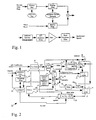
- the synthesizer has the added capabilities of mixed pulse and noise excitation periodic or aperiodic pulses, adaptive spectral enhancement and pulse dispersion filter as shown in Fig. 1.
- Efficient quantization of the LPC coefficients is an important problem in these coders, since maintaining accuracy of the LPC has a significant effect on processed speech quality, but the bit rate of the LPC quantizer must be low in order to keep the overall bit rate of the speech coder small.
- the MELP coder for the new Federal Standard uses a 25-bit multi-stage vector quantizer (MSVQ) for line spectral frequencies (LSF). There is a 1 to 1 transformation between the LPC coefficients and LSF coefficients.
- Quantization is the process of converting input values into discrete values in accordance with some fidelity criterion.
- a typical example of quantization is the conversion of a continuous amplitude signal into discrete amplitude values. The signal is first sampled, then quantized.
- a range of expected values of the input signal is divided into a series of subranges.
- Each subrange has an associated quantization level. For example, for quantization to 8-bit values, there would be 256 levels.
- a sample value of the input signal that is within a certain subrange is converted to the associated quantizing level. For example, for 8-bit quantization, a sample of the input signal would be converted to one of 256 levels, each level represented by an 8-bit value.
- Vector quantization is a method of quantization, which is based on the linear and non-linear correlation between samples and the shape of the probability distribution. Essentially, vector quantization is a lookup process, where the lookup table is referred to as a "codebook”. The codebook lists each quantization level, and each level has an associated "code-vector". The vector quantization process compares an input vector to the code-vectors and determines the best code-vector in terms of minimum distortion. Where x is the input vector, the comparison of distortion values may be expressed as: d(x, y (j) ⁇ d(x, y (k) ), for all j not equal to k. The codebook is represented by y (j) , where y (j) is the jth code-vector, 0 ⁇ j ⁇ L, and L is the number of levels in the codebook.
- Multi-stage vector quantization is a type of vector quantization. This process obtains a central quantized vector (the output vector) by adding a number of quantized vectors. The output vector is sometimes referred to as a "reconstructed" vector. Each vector used in the reconstruction is from a different codebook, each codebook corresponding to a "stage" of the quantization process. Each codebook is designed especially for a stage of the search. An input vector is quantized with the first codebook, and the resulting error vector is quantized with the second codebook, etc.
- S is the number of stages
- y s is the codebook for the sth stage.
- the codebooks may be searched using a sub-optimal tree search algorithm, also known as an M-algorithm.
- M-algorithm a sub-optimal tree search algorithm
- M-best number of "best” code-vectors are passed from one stage to the next.
- the "best" code-vectors are selected in terms of minimum distortion. The search continues until the final stage, when only one best code-vector is determined.
- a target vector for quantization in the current frame is the mean-removed input vector minus a predictive value.
- the predicted value is the previous quantized vector multiplied by a known prediction matrix.
- switched prediction there is more than one possible prediction matrix and the best prediction matrix is selected for each frame. See S. Wang, et al., "Product Code Vector Quantization of LPC Parameters," in Speech and Audio Coding for Wireless and Network Applications," Ch. 31, pp. 251-258, Kluwer Academic Publishers, 1993.
- an improved method and system of switched predictive quantization wherein prediction/codebook sets are switched to take advantage of time redundancy is provided.
- the new quantization method like the one used in the 2.4 kb/s Federal Standard MELP coder, uses multi-stage vector quantization (MSVQ) of the Line Spectral Frequency (LSF) transformation of the LPC coefficients (LeBlanc, et al., entitled “Efficient Search and Design Procedures for Robust Multi-Stage VQ or LPC Parameters for 4kb/s Speech Coding," IEEE Transactions on Speech and Audio Processing, Vol. 1, No. 4, October 1993, pp. 373-385.)
- MSVQ multi-stage vector quantization
- LSF Line Spectral Frequency
- the new method improves on the previous one in two ways: the use of switched prediction to take advantage of time redundancy and the use of a new weighted distance measure that better correlates with subjective speech quality.
- the input LSF vector is quantized directly using MSVQ.
- MSVQ the target vector for quantization in the current frame
- the mean-removed input vector minus a predicted value, where the predicted value is the previous quantized vector multiplied by a known prediction matrix.
- switched prediction there is more than one possible prediction matrix, and the best predictor or prediction matrix is selected for each frame.
- both the predictor matrix and the MSVQ codebooks are switched.
- the 10 LPC coefficients are transformed by transformer 23 to 10 LSF coefficients of the Line Spectral Frequency (LSF) vectors.
- the LSF has 10 dimensional elements or coefficients (for 10 order all-pole filter).
- the LSF input vector is subtracted in adder 22 by a selected mean vector and the mean-removed input vector is subtracted in adder 25 by a predicted value.
- the resulting target vector for quantization vector e in the current frame is applied to multi-stage vector quantizer (MSVQ) 27.
- the predicted value is the previous quantized vector multiplied by a known prediction matrix at multiplier 26.
- the predicted value in switched prediction has more than one possible prediction matrix.
- the best predictor (prediction matrix and mean vector) is selected for each frame.
- both the predictor (the prediction matrix and mean vector) and the MSVQ codebook set are switched.
- a control 29 first switches in via switch 28 prediction matrix 1 and mean vector 1 and first set of codebooks 1 in quantizer 27.
- the index corresponding to this first prediction matrix and the MSVQ codebook indices for the first set of codebooks are then provided out of the quantizer to gate 37.
- the predicted value is added to the quantized output ê for the target vector e at adder 31 to produce a quantized mean-removed vector.
- the mean-removed vector is added at Adder 70 to the selected mean vector to get quantized vector X and .
- the squared error for each dimension is determined at squarer 35.
- the weighted squared error between the input vector X i and the delayed quantized vector X and i is stored at control 29.
- the control 29 applies control signals to switch in via switch 28 prediction matrix 2 and mean vector 2 and codebook 2 set to likewise measure the weighted squared error for this set at squarer 35.
- the measured error from the first pair of prediction matrix 1 (with mean vector 1) and codebooks set 1 is compared with prediction matrix 2 (with mean vector 2) and codebook set 2.
- the set of indices for the codebooks with the minimum error is gated at gate 37 out of the encoder as encoded transmission of indices and a bit is sent out at terminal 38 from control 29 indicating from which pair of prediction matrix and codebooks set the indices was sent (codebook set 1 with mean vector 1 and predictor matrix 1 or codebook set 2 and prediction matrix 2 with mean vector 2).
- the mean-removed quantized vector from adder 31 associated with the minimum error is gated at gate 33a to frame delay 33 so as to provide the previous mean-removed quantized vector to multiplier 26.
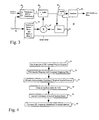
- Fig. 3 illustrates a decoder 40 for use with LSF encoder 20.
- the indices for the codebooks from the encoding are received at the quantizer 44 with two sets of codebooks corresponding to codebook set 1 and 2 in the encoder.
- the bit from terminal 38 selects the appropriate codebook set used in the encoder.
- the LSF quantized input is added to the predicted value at adder 41 where the predicted value is the previous mean-removed quantized value (from delay 43) multiplied at multiplier 45 by the prediction matrix at 42 that matches the best one selected at the encoder to get mean-removed quantized vector.
- Both prediction matrix 1 and mean value 1 and prediction matrix 2 and mean value 2 are stored at storage 42 of the decoder.
- the 1 bit from terminal 38 of the encoder selects the prediction matrix and the mean value at storage 42 that matches the encoder prediction matrix and mean value.
- the quantized mean-removed vector is added to the selected mean value at adder 48 to get the quantized LSF vector.
- the quantized LSF vector is transformed to LPC coefficients by transformer 46.
- LSF vector coefficients correspond to the LPC coefficients.
- the LSF vector coefficients have better quantization properties than LPC coefficients. There is a 1 to 1 transformation between these two vector coefficients.
- a weighting function is applied for a particular set of LSFs for a particular set of LPC coefficients that correspond.
- the Federal Standard MELP coder uses a weighted Euclidean distance for LSF quantization due to its computational simplicity. However, this distance in the LSF domain does not necessarily correspond well with the ideal measure of quantization accuracy: perceived quality of the processed speech signal. Applicant has previously shown in the paper on the new 2.4 kb/s Federal Standard that a perceptually-weighted form of log spectral distortion has close correlation with subjective speech quality. Applicant teaches herein in accordance with an embodiment a weighted LSF distance which corresponds closely to this spectral distortion.
- This weighting function requires looking into the details of this transformation for a particular set of LSFs for a particular input vector x which is a set of LSFs for a particular set of LPC coefficients that correspond to that set.
- the coder computes the LPC coefficients and as discussed above, for purposes of quantization, this is converted to LSF vectors which are better behaved.
- the actual synthesizer will take the quantized vector X and and perform an inverse transformation to get an LPC filter for use in the actual speech synthesis.
- a difference in a preferred embodiment of the invention is that perceptual weighting is applied to the synthesis filter impulse response prior to computation of the autocorrelation function R A (m), so as to reflect a perceptually-weighted form of spectral distortion.
- the weighting W i is applied to the squared error at 35.
- the weighted output from error detector 35 is ⁇ W i ( X i - X and i ) 2 .
- Each entry in a 10 dimensional vector has a weight value.
- the error sums the weight value for each element. In applying the weight, for example, one of the elements has a weight value of three and the others are one then the element with three is given an emphasis by a factor of three times that of the other elements in determining error.
- the weighting function requires looking into the details of the LPC to LSF conversion.
- the weight values are determined by applying an impulse to the LPC synthesis filter 21 and providing the resultant sampled output of the LPC synthesis filter 21 to a perceptual weighting filter 47.
- a computer 39 is programmed with a code based on a pseudo code that follows and is illustrated in the flow chart of Fig. 4.
- An impulse is gated to the LPC filter 21 and N samples of LPC synthesis filter response (step 51) are taken and applied to a perceptual weighting filter 37 (step 52).
- low frequencies are weighted more than high frequencies and in particular the preferred embodiment uses the well known Bark scale which matches how the human ear responds to sounds.
- the coefficients of a filter with this response are determined in advance and stored and time domain coefficients are stored. An 8 order all-pole fit to this spectrum is determined and these 8 coefficients are used as the perceptual weighting filter.
- the following steps follow the equation for un-weighted spectral distortion from Gardner, et al.
- R A (m) is the autocorrelation of the impulse response of the LPC synthesis filter at lag m
- R i (m) is is the correlation function of the elements in the ith column of the Jacobian matrix J ⁇ ( ⁇ ) of the transformation from LSFs to LPC coefficients.
- j i (n) j i (v + 1- n) : i odd; 0 ⁇ n ⁇ v, so only half the values must be computed. Similar conditions with an anti-symmetry property exist for the even columns.
- the autocorrelation function of the weighted impulse response is calculated (step 53 in Fig. 4). From that the Jacobian matrix for LSFs is computed (step 54). The correlation of rows of Jacobian matrix is then computed (step 55). The LSF weights are then calculated by multiplying correlation matrices (step 56). The computed weight value from computer 39, in Fig. 2, is applied to the error detector 35. The indices from the prediction matrix/codebook set with the least error is then gated from the quantizer 27.
- the system may be implemented using a microprocessor encapsulating computer 39 and control 29 utilizing the following pseudo code.
- the pseudo code for computing the weighting vector from the current LPC and LSF follows: /* Compute weighting vector from current LPC and LSF's */ Compute N samples of LPC synthesis filter impulse response Filter impulse response with perceptual weighting filter Calculate the autocorrelation function of the weighted impulse response Compute Jacobian matrix for LSF's Compute correlation of rows of Jacobian matrix Calculate LSF weights by multiplying correlation matrices
- the pseudo code for regenerate quantized vector follows: /* Regenerate quantized vector */ Sum MSVQ codevectors to produce quantized target Add predicted value Update memory of past quantized values (mean-removed) Add mean to produce quantized LSF vector
- prediction matrix 1 may be used with codebook set 2 and prediction matrix 2 with codebook set 1 or any combination of codebook set and prediction matrix.
- codebook set 2 There could be many more codebook sets and or prediction matrices. Such combinations require additional bits be sent from the encoder.
- This switched predictive quantization can be used for vectors other than LSF but may also be applied to scalar quantization and in that case matrix as used herein may be a scalar value.
Landscapes
- Engineering & Computer Science (AREA)
- Physics & Mathematics (AREA)
- Computational Linguistics (AREA)
- Signal Processing (AREA)
- Health & Medical Sciences (AREA)
- Audiology, Speech & Language Pathology (AREA)
- Human Computer Interaction (AREA)
- Acoustics & Sound (AREA)
- Multimedia (AREA)
- Spectroscopy & Molecular Physics (AREA)
- Theoretical Computer Science (AREA)
- Compression, Expansion, Code Conversion, And Decoders (AREA)
Abstract
Description


/* Compute weighting vector from current LPC and LSF's */
Compute N samples of LPC synthesis filter impulse response
Filter impulse response with perceptual weighting filter
Calculate the autocorrelation function of the weighted impulse response
Compute Jacobian matrix for LSF's
Compute correlation of rows of Jacobian matrix
Calculate LSF weights by multiplying correlation matrices
/* Encode input vector */
For all predictor, codebook pairs
Remove mean from input LSF vector
Subtract predicted value to get target vector
Search MSVQ codebooks for best match to target vector using weighted distance
If Error <Emin
Emin = Error
best predictor index = current predictor
Endif
End
Endcode best predictor index and codebook indices for transmission
/* Regenerate quantized vector */
Sum MSVQ codevectors to produce quantized target
Add predicted value
Update memory of past quantized values (mean-removed)
Add mean to produce quantized LSF vector


Claims (7)
- A switched predictive method for quantizing an input comprising the steps of:providing a mean value and subtracting said mean value from said input to obtain a mean-removed input;providing a quantizer with a first and second set of codebooks;providing a first and second prediction matrix;multiplying a previous frame mean-removed quantized value to said first prediction matrix then said second prediction matrix to obtain first predicted values and second predicted values;subtracting said predicted values from said mean-removed input to obtain target values;applying said target values to said codebook sets to obtain quantized target values;adding said predicted values to said quantized target values to obtain mean-removed quantized values;adding a mean value to said mean-removed quantized values to obtain quantized values; anddetermining which codebook set and prediction matrix has minimum error and providing the quantized output corresponding to that set with minimum error.
- The method of Claim 1 wherein said input comprises LSF coefficients corresponding to a set of LPC coefficients.
- The method of Claim 2 wherein said determining step comprises the step of determining the squared error for each dimension between the input vector and the quantized output.
- The method of Claim 3 further comprising: multiplying said squared error by a weighting value for each dimension.
- The method of Claim 4 wherein the weighting function is a Euclidean distance for LSF quantization.
- The method of Claim 3 wherein said weighting function is a weighted LSF distance which corresponds closely to a perceptually weighted form of spectral distortion.
- Apparatus for switched-predictive quantization of an input value, comprising:a first and a second codebook,a first and a second prediction meansswitching means operable for the prediction means,error calculation means, andinput modification means, wherein the apparatus is configurable to switch said first or second prediction means outputs to said input modification means to respectively modify said input value in accordance with respective first for second prediction means for providing a first or second target value, and further configurable to derive quantized first or second target values from respective first or second codebooks and to derive a quantized first or second input value from said quantized first or second target values and to input said quantized first or second input value and said input value to said error calculation means for deriving a difference therebetween.
Applications Claiming Priority (2)
| Application Number | Priority Date | Filing Date | Title |
|---|---|---|---|
| US5711997P | 1997-08-28 | 1997-08-28 | |
| US57119P | 1997-08-28 |
Publications (3)
| Publication Number | Publication Date |
|---|---|
| EP0905680A2 true EP0905680A2 (en) | 1999-03-31 |
| EP0905680A3 EP0905680A3 (en) | 1999-09-29 |
| EP0905680B1 EP0905680B1 (en) | 2003-06-04 |
Family
ID=22008627
Family Applications (1)
| Application Number | Title | Priority Date | Filing Date |
|---|---|---|---|
| EP98306903A Expired - Lifetime EP0905680B1 (en) | 1997-08-28 | 1998-08-27 | Method for quantizing LPC parameters using switched-predictive quantization |
Country Status (6)
| Country | Link |
|---|---|
| US (1) | US6122608A (en) |
| EP (1) | EP0905680B1 (en) |
| JP (1) | JPH11143499A (en) |
| KR (1) | KR100889399B1 (en) |
| DE (1) | DE69815242T2 (en) |
| TW (1) | TW408298B (en) |
Cited By (1)
| Publication number | Priority date | Publication date | Assignee | Title |
|---|---|---|---|---|
| EP0899720A3 (en) * | 1997-08-28 | 1999-09-15 | Texas Instruments Inc. | Quantization of linear prediction coefficients |
Families Citing this family (37)
| Publication number | Priority date | Publication date | Assignee | Title |
|---|---|---|---|---|
| EP1640970B9 (en) * | 1997-10-22 | 2009-10-14 | Matsushita Electric Industrial Co., Ltd. | Orthogonalization search for the CELP based speech coding |
| SE521225C2 (en) * | 1998-09-16 | 2003-10-14 | Ericsson Telefon Ab L M | Method and apparatus for CELP encoding / decoding |
| US7295974B1 (en) * | 1999-03-12 | 2007-11-13 | Texas Instruments Incorporated | Encoding in speech compression |
| JP3292711B2 (en) * | 1999-08-06 | 2002-06-17 | 株式会社ワイ・アール・ピー高機能移動体通信研究所 | Voice encoding / decoding method and apparatus |
| KR100324204B1 (en) * | 1999-12-24 | 2002-02-16 | 오길록 | A fast search method for LSP Quantization in Predictive Split VQ or Predictive Split MQ |
| EP1199812A1 (en) * | 2000-10-20 | 2002-04-24 | Telefonaktiebolaget Lm Ericsson | Perceptually improved encoding of acoustic signals |
| US20030195745A1 (en) * | 2001-04-02 | 2003-10-16 | Zinser, Richard L. | LPC-to-MELP transcoder |
| US20030028386A1 (en) * | 2001-04-02 | 2003-02-06 | Zinser Richard L. | Compressed domain universal transcoder |
| US7003454B2 (en) * | 2001-05-16 | 2006-02-21 | Nokia Corporation | Method and system for line spectral frequency vector quantization in speech codec |
| US7194369B2 (en) * | 2001-07-23 | 2007-03-20 | Cognis Corporation | On-site analysis system with central processor and method of analyzing |
| JP4299676B2 (en) * | 2002-02-20 | 2009-07-22 | パナソニック株式会社 | Method for generating fixed excitation vector and fixed excitation codebook |
| US8090577B2 (en) * | 2002-08-08 | 2012-01-03 | Qualcomm Incorported | Bandwidth-adaptive quantization |
| CA2415105A1 (en) * | 2002-12-24 | 2004-06-24 | Voiceage Corporation | A method and device for robust predictive vector quantization of linear prediction parameters in variable bit rate speech coding |
| US6917914B2 (en) * | 2003-01-31 | 2005-07-12 | Harris Corporation | Voice over bandwidth constrained lines with mixed excitation linear prediction transcoding |
| KR100486732B1 (en) * | 2003-02-19 | 2005-05-03 | 삼성전자주식회사 | Block-constrained TCQ method and method and apparatus for quantizing LSF parameter employing the same in speech coding system |
| KR100647290B1 (en) * | 2004-09-22 | 2006-11-23 | 삼성전자주식회사 | Speech encoding / decoding apparatus and method for selecting quantization / dequantization using synthesized speech characteristics |
| US20060080090A1 (en) * | 2004-10-07 | 2006-04-13 | Nokia Corporation | Reusing codebooks in parameter quantization |
| KR101565919B1 (en) | 2006-11-17 | 2015-11-05 | 삼성전자주식회사 | Method and apparatus for encoding and decoding high frequency signal |
| JP2008170488A (en) * | 2007-01-06 | 2008-07-24 | Yamaha Corp | Waveform compressing apparatus, waveform decompressing apparatus, program and method for producing compressed data |
| US20080249767A1 (en) * | 2007-04-05 | 2008-10-09 | Ali Erdem Ertan | Method and system for reducing frame erasure related error propagation in predictive speech parameter coding |
| CN101335004B (en) * | 2007-11-02 | 2010-04-21 | 华为技术有限公司 | A method and device for multi-level quantization |
| NO2313887T3 (en) * | 2008-07-10 | 2018-02-10 | ||
| GB2466670B (en) * | 2009-01-06 | 2012-11-14 | Skype | Speech encoding |
| GB2466669B (en) * | 2009-01-06 | 2013-03-06 | Skype | Speech coding |
| GB2466671B (en) * | 2009-01-06 | 2013-03-27 | Skype | Speech encoding |
| GB2466673B (en) * | 2009-01-06 | 2012-11-07 | Skype | Quantization |
| GB2466675B (en) * | 2009-01-06 | 2013-03-06 | Skype | Speech coding |
| GB2466672B (en) * | 2009-01-06 | 2013-03-13 | Skype | Speech coding |
| GB2466674B (en) * | 2009-01-06 | 2013-11-13 | Skype | Speech coding |
| US8452606B2 (en) * | 2009-09-29 | 2013-05-28 | Skype | Speech encoding using multiple bit rates |
| KR101660843B1 (en) | 2010-05-27 | 2016-09-29 | 삼성전자주식회사 | Apparatus and method for determining weighting function for lpc coefficients quantization |
| KR101747917B1 (en) | 2010-10-18 | 2017-06-15 | 삼성전자주식회사 | Apparatus and method for determining weighting function having low complexity for lpc coefficients quantization |
| TWI456516B (en) * | 2010-12-17 | 2014-10-11 | Univ Nat Chiao Tung | Independent component analysis processor |
| JP2013140494A (en) * | 2012-01-05 | 2013-07-18 | Kddi Corp | Retrieval device for retrieving high dimensional feature vector and program |
| SG11201608787UA (en) * | 2014-03-28 | 2016-12-29 | Samsung Electronics Co Ltd | Method and device for quantization of linear prediction coefficient and method and device for inverse quantization |
| EP3139382B1 (en) * | 2014-05-01 | 2019-06-26 | Nippon Telegraph and Telephone Corporation | Sound signal coding device, sound signal coding method, program and recording medium |
| CN112927702B (en) | 2014-05-07 | 2024-11-12 | 三星电子株式会社 | Method and device for quantizing linear prediction coefficients and method and device for dequantizing linear prediction coefficients |
Family Cites Families (14)
| Publication number | Priority date | Publication date | Assignee | Title |
|---|---|---|---|---|
| JPS56111899A (en) * | 1980-02-08 | 1981-09-03 | Matsushita Electric Industrial Co Ltd | Voice synthetizing system and apparatus |
| JPS5912499A (en) * | 1982-07-12 | 1984-01-23 | 松下電器産業株式会社 | speech encoding device |
| US5307441A (en) * | 1989-11-29 | 1994-04-26 | Comsat Corporation | Wear-toll quality 4.8 kbps speech codec |
| JPH0451199A (en) * | 1990-06-18 | 1992-02-19 | Fujitsu Ltd | Sound encoding/decoding system |
| US5293449A (en) * | 1990-11-23 | 1994-03-08 | Comsat Corporation | Analysis-by-synthesis 2,4 kbps linear predictive speech codec |
| JPH05232996A (en) * | 1992-02-20 | 1993-09-10 | Olympus Optical Co Ltd | Voice coding device |
| EP0704836B1 (en) * | 1994-09-30 | 2002-03-27 | Kabushiki Kaisha Toshiba | Vector quantization apparatus |
| JPH08179796A (en) * | 1994-12-21 | 1996-07-12 | Sony Corp | Speech coding method |
| US5664053A (en) * | 1995-04-03 | 1997-09-02 | Universite De Sherbrooke | Predictive split-matrix quantization of spectral parameters for efficient coding of speech |
| JP3522012B2 (en) * | 1995-08-23 | 2004-04-26 | 沖電気工業株式会社 | Code Excited Linear Prediction Encoder |
| US5774839A (en) * | 1995-09-29 | 1998-06-30 | Rockwell International Corporation | Delayed decision switched prediction multi-stage LSF vector quantization |
| JP3680380B2 (en) * | 1995-10-26 | 2005-08-10 | ソニー株式会社 | Speech coding method and apparatus |
| DE69828119D1 (en) * | 1997-08-28 | 2005-01-20 | Texas Instruments Inc | Quantization of the linear prediction coefficients |
| US5966688A (en) * | 1997-10-28 | 1999-10-12 | Hughes Electronics Corporation | Speech mode based multi-stage vector quantizer |
-
1998
- 1998-08-12 TW TW087113221A patent/TW408298B/en not_active IP Right Cessation
- 1998-08-15 US US09/134,774 patent/US6122608A/en not_active Expired - Lifetime
- 1998-08-27 DE DE69815242T patent/DE69815242T2/en not_active Expired - Lifetime
- 1998-08-27 JP JP10242057A patent/JPH11143499A/en active Pending
- 1998-08-27 EP EP98306903A patent/EP0905680B1/en not_active Expired - Lifetime
- 1998-08-27 KR KR1019980034832A patent/KR100889399B1/en not_active Expired - Lifetime
Cited By (1)
| Publication number | Priority date | Publication date | Assignee | Title |
|---|---|---|---|---|
| EP0899720A3 (en) * | 1997-08-28 | 1999-09-15 | Texas Instruments Inc. | Quantization of linear prediction coefficients |
Also Published As
| Publication number | Publication date |
|---|---|
| EP0905680A3 (en) | 1999-09-29 |
| US6122608A (en) | 2000-09-19 |
| DE69815242D1 (en) | 2003-07-10 |
| KR100889399B1 (en) | 2009-06-03 |
| KR19990023932A (en) | 1999-03-25 |
| DE69815242T2 (en) | 2004-04-15 |
| TW408298B (en) | 2000-10-11 |
| JPH11143499A (en) | 1999-05-28 |
| EP0905680B1 (en) | 2003-06-04 |
Similar Documents
| Publication | Publication Date | Title |
|---|---|---|
| EP0905680B1 (en) | Method for quantizing LPC parameters using switched-predictive quantization | |
| EP0443548B1 (en) | Speech coder | |
| CA2061832C (en) | Speech parameter coding method and apparatus | |
| US5675702A (en) | Multi-segment vector quantizer for a speech coder suitable for use in a radiotelephone | |
| CA2031006C (en) | Near-toll quality 4.8 kbps speech codec | |
| KR100427752B1 (en) | Speech coding method and apparatus | |
| KR100872538B1 (en) | Vector parameter quantization apparatus, LP parameter decoding apparatus, LP coefficient decoding apparatus, recording medium, speech coding apparatus, speech decoding apparatus, speech signal transmitting apparatus, and speech signal receiving apparatus | |
| CA2202825C (en) | Speech coder | |
| US6889185B1 (en) | Quantization of linear prediction coefficients using perceptual weighting | |
| CA2061830C (en) | Speech coding system | |
| KR19980024885A (en) | Vector quantization method, speech coding method and apparatus | |
| KR19980024519A (en) | Vector quantization method, speech coding method and apparatus | |
| US5666465A (en) | Speech parameter encoder | |
| CA2156558C (en) | Speech-coding parameter sequence reconstruction by classification and contour inventory | |
| EP0899720B1 (en) | Quantization of linear prediction coefficients | |
| US5822722A (en) | Wide-band signal encoder | |
| EP0866443B1 (en) | Speech signal coder | |
| Ubale et al. | A low-delay wideband speech coder at 24-kbps | |
| EP0910064B1 (en) | Speech parameter coding apparatus | |
| JP2808841B2 (en) | Audio coding method | |
| Hayashi et al. | Efficient two-stage vector quantization speech coder using wavelet coefficients of excitation signals | |
| JPH05341800A (en) | Voice coding device |
Legal Events
| Date | Code | Title | Description |
|---|---|---|---|
| PUAI | Public reference made under article 153(3) epc to a published international application that has entered the european phase |
Free format text: ORIGINAL CODE: 0009012 |
|
| AK | Designated contracting states |
Kind code of ref document: A2 Designated state(s): DE FR GB IT NL |
|
| AX | Request for extension of the european patent |
Free format text: AL;LT;LV;MK;RO;SI |
|
| PUAL | Search report despatched |
Free format text: ORIGINAL CODE: 0009013 |
|
| AK | Designated contracting states |
Kind code of ref document: A3 Designated state(s): AT BE CH CY DE DK ES FI FR GB GR IE IT LI LU MC NL PT SE |
|
| AX | Request for extension of the european patent |
Free format text: AL;LT;LV;MK;RO;SI |
|
| 17P | Request for examination filed |
Effective date: 20000306 |
|
| AKX | Designation fees paid |
Free format text: DE FR GB IT NL |
|
| GRAH | Despatch of communication of intention to grant a patent |
Free format text: ORIGINAL CODE: EPIDOS IGRA |
|
| GRAH | Despatch of communication of intention to grant a patent |
Free format text: ORIGINAL CODE: EPIDOS IGRA |
|
| GRAA | (expected) grant |
Free format text: ORIGINAL CODE: 0009210 |
|
| AK | Designated contracting states |
Designated state(s): DE FR GB IT NL |
|
| PG25 | Lapsed in a contracting state [announced via postgrant information from national office to epo] |
Ref country code: NL Free format text: LAPSE BECAUSE OF FAILURE TO SUBMIT A TRANSLATION OF THE DESCRIPTION OR TO PAY THE FEE WITHIN THE PRESCRIBED TIME-LIMIT Effective date: 20030604 Ref country code: IT Free format text: LAPSE BECAUSE OF FAILURE TO SUBMIT A TRANSLATION OF THE DESCRIPTION OR TO PAY THE FEE WITHIN THE PRESCRIBED TIME-LIMIT;WARNING: LAPSES OF ITALIAN PATENTS WITH EFFECTIVE DATE BEFORE 2007 MAY HAVE OCCURRED AT ANY TIME BEFORE 2007. THE CORRECT EFFECTIVE DATE MAY BE DIFFERENT FROM THE ONE RECORDED. Effective date: 20030604 |
|
| REG | Reference to a national code |
Ref country code: GB Ref legal event code: FG4D |
|
| RIC1 | Information provided on ipc code assigned before grant |
Ipc: 7G 10L 13/00 A |
|
| REF | Corresponds to: |
Ref document number: 69815242 Country of ref document: DE Date of ref document: 20030710 Kind code of ref document: P |
|
| NLV1 | Nl: lapsed or annulled due to failure to fulfill the requirements of art. 29p and 29m of the patents act | ||
| PLBE | No opposition filed within time limit |
Free format text: ORIGINAL CODE: 0009261 |
|
| STAA | Information on the status of an ep patent application or granted ep patent |
Free format text: STATUS: NO OPPOSITION FILED WITHIN TIME LIMIT |
|
| ET | Fr: translation filed | ||
| 26N | No opposition filed |
Effective date: 20040305 |
|
| PGFP | Annual fee paid to national office [announced via postgrant information from national office to epo] |
Ref country code: DE Payment date: 20130902 Year of fee payment: 16 |
|
| PGFP | Annual fee paid to national office [announced via postgrant information from national office to epo] |
Ref country code: GB Payment date: 20130726 Year of fee payment: 16 Ref country code: FR Payment date: 20130725 Year of fee payment: 16 |
|
| REG | Reference to a national code |
Ref country code: DE Ref legal event code: R119 Ref document number: 69815242 Country of ref document: DE |
|
| GBPC | Gb: european patent ceased through non-payment of renewal fee |
Effective date: 20140827 |
|
| REG | Reference to a national code |
Ref country code: FR Ref legal event code: ST Effective date: 20150430 |
|
| REG | Reference to a national code |
Ref country code: DE Ref legal event code: R119 Ref document number: 69815242 Country of ref document: DE Effective date: 20150303 |
|
| PG25 | Lapsed in a contracting state [announced via postgrant information from national office to epo] |
Ref country code: DE Free format text: LAPSE BECAUSE OF NON-PAYMENT OF DUE FEES Effective date: 20150303 Ref country code: GB Free format text: LAPSE BECAUSE OF NON-PAYMENT OF DUE FEES Effective date: 20140827 |
|
| PG25 | Lapsed in a contracting state [announced via postgrant information from national office to epo] |
Ref country code: FR Free format text: LAPSE BECAUSE OF NON-PAYMENT OF DUE FEES Effective date: 20140901 |