EP0905168B1 - Photosensitive polyimide - Google Patents
Photosensitive polyimide Download PDFInfo
- Publication number
- EP0905168B1 EP0905168B1 EP98115831A EP98115831A EP0905168B1 EP 0905168 B1 EP0905168 B1 EP 0905168B1 EP 98115831 A EP98115831 A EP 98115831A EP 98115831 A EP98115831 A EP 98115831A EP 0905168 B1 EP0905168 B1 EP 0905168B1
- Authority
- EP
- European Patent Office
- Prior art keywords
- photosensitive polyimide
- diamine
- mole
- tetracarboxylic acid
- polyimide according
- Prior art date
- Legal status (The legal status is an assumption and is not a legal conclusion. Google has not performed a legal analysis and makes no representation as to the accuracy of the status listed.)
- Expired - Lifetime
Links
- 229920001721 polyimide Polymers 0.000 title claims description 26
- 239000004642 Polyimide Substances 0.000 title claims description 23
- -1 diamine compounds Chemical class 0.000 claims description 26
- 239000000203 mixture Substances 0.000 claims description 14
- 150000004985 diamines Chemical class 0.000 claims description 12
- GTDPSWPPOUPBNX-UHFFFAOYSA-N ac1mqpva Chemical compound CC12C(=O)OC(=O)C1(C)C1(C)C2(C)C(=O)OC1=O GTDPSWPPOUPBNX-UHFFFAOYSA-N 0.000 claims description 8
- DFJSEIDXVUREKW-UHFFFAOYSA-N 1-(3-aminophenyl)-3-[4-[3-(3-aminophenyl)-3-oxoprop-1-enyl]phenyl]prop-2-en-1-one Chemical compound NC1=CC=CC(C(=O)C=CC=2C=CC(C=CC(=O)C=3C=C(N)C=CC=3)=CC=2)=C1 DFJSEIDXVUREKW-UHFFFAOYSA-N 0.000 claims description 7
- 125000002887 hydroxy group Chemical group [H]O* 0.000 claims description 7
- 125000003178 carboxy group Chemical group [H]OC(*)=O 0.000 claims description 6
- 229920001577 copolymer Polymers 0.000 claims description 4
- 239000011347 resin Substances 0.000 claims description 4
- 229920005989 resin Polymers 0.000 claims description 4
- 150000000000 tetracarboxylic acids Chemical class 0.000 claims description 4
- 125000004018 acid anhydride group Chemical group 0.000 claims description 2
- 150000008064 anhydrides Chemical class 0.000 claims description 2
- 229920001296 polysiloxane Polymers 0.000 claims description 2
- 239000003960 organic solvent Substances 0.000 description 10
- 238000006116 polymerization reaction Methods 0.000 description 10
- ZWEHNKRNPOVVGH-UHFFFAOYSA-N 2-Butanone Chemical compound CCC(C)=O ZWEHNKRNPOVVGH-UHFFFAOYSA-N 0.000 description 9
- 239000000243 solution Substances 0.000 description 9
- 239000000047 product Substances 0.000 description 7
- WFDIJRYMOXRFFG-UHFFFAOYSA-N Acetic anhydride Chemical compound CC(=O)OC(C)=O WFDIJRYMOXRFFG-UHFFFAOYSA-N 0.000 description 6
- ZMXDDKWLCZADIW-UHFFFAOYSA-N N,N-Dimethylformamide Chemical compound CN(C)C=O ZMXDDKWLCZADIW-UHFFFAOYSA-N 0.000 description 6
- SECXISVLQFMRJM-UHFFFAOYSA-N N-Methylpyrrolidone Chemical compound CN1CCCC1=O SECXISVLQFMRJM-UHFFFAOYSA-N 0.000 description 6
- 239000012670 alkaline solution Substances 0.000 description 6
- 238000006243 chemical reaction Methods 0.000 description 6
- CSCPPACGZOOCGX-UHFFFAOYSA-N Acetone Chemical compound CC(C)=O CSCPPACGZOOCGX-UHFFFAOYSA-N 0.000 description 5
- ATUOYWHBWRKTHZ-UHFFFAOYSA-N Propane Chemical compound CCC ATUOYWHBWRKTHZ-UHFFFAOYSA-N 0.000 description 4
- JUJWROOIHBZHMG-UHFFFAOYSA-N Pyridine Chemical compound C1=CC=NC=C1 JUJWROOIHBZHMG-UHFFFAOYSA-N 0.000 description 4
- CDBYLPFSWZWCQE-UHFFFAOYSA-L Sodium Carbonate Chemical compound [Na+].[Na+].[O-]C([O-])=O CDBYLPFSWZWCQE-UHFFFAOYSA-L 0.000 description 4
- 238000009835 boiling Methods 0.000 description 4
- 229920005575 poly(amic acid) Polymers 0.000 description 4
- DIPSNXHWDKBKKB-UHFFFAOYSA-N 4-[bis(4-aminophenyl)methyl]phenol Chemical compound C1=CC(N)=CC=C1C(C=1C=CC(O)=CC=1)C1=CC=C(N)C=C1 DIPSNXHWDKBKKB-UHFFFAOYSA-N 0.000 description 3
- UHOVQNZJYSORNB-UHFFFAOYSA-N Benzene Chemical compound C1=CC=CC=C1 UHOVQNZJYSORNB-UHFFFAOYSA-N 0.000 description 3
- VYPSYNLAJGMNEJ-UHFFFAOYSA-N Silicium dioxide Chemical compound O=[Si]=O VYPSYNLAJGMNEJ-UHFFFAOYSA-N 0.000 description 3
- 239000002253 acid Substances 0.000 description 3
- 125000004432 carbon atom Chemical group C* 0.000 description 3
- 150000001875 compounds Chemical class 0.000 description 3
- 125000001997 phenyl group Chemical group [H]C1=C([H])C([H])=C(*)C([H])=C1[H] 0.000 description 3
- 239000002798 polar solvent Substances 0.000 description 3
- 239000009719 polyimide resin Substances 0.000 description 3
- 239000011541 reaction mixture Substances 0.000 description 3
- 239000002904 solvent Substances 0.000 description 3
- 239000000758 substrate Substances 0.000 description 3
- UENRXLSRMCSUSN-UHFFFAOYSA-N 3,5-diaminobenzoic acid Chemical compound NC1=CC(N)=CC(C(O)=O)=C1 UENRXLSRMCSUSN-UHFFFAOYSA-N 0.000 description 2
- 206010034972 Photosensitivity reaction Diseases 0.000 description 2
- WYURNTSHIVDZCO-UHFFFAOYSA-N Tetrahydrofuran Chemical compound C1CCOC1 WYURNTSHIVDZCO-UHFFFAOYSA-N 0.000 description 2
- 239000007795 chemical reaction product Substances 0.000 description 2
- JHIVVAPYMSGYDF-UHFFFAOYSA-N cyclohexanone Chemical compound O=C1CCCCC1 JHIVVAPYMSGYDF-UHFFFAOYSA-N 0.000 description 2
- 238000006297 dehydration reaction Methods 0.000 description 2
- VNWKTOKETHGBQD-UHFFFAOYSA-N methane Chemical compound C VNWKTOKETHGBQD-UHFFFAOYSA-N 0.000 description 2
- 230000036211 photosensitivity Effects 0.000 description 2
- 239000001294 propane Substances 0.000 description 2
- UMJSCPRVCHMLSP-UHFFFAOYSA-N pyridine Natural products COC1=CC=CN=C1 UMJSCPRVCHMLSP-UHFFFAOYSA-N 0.000 description 2
- 229910000029 sodium carbonate Inorganic materials 0.000 description 2
- 238000004528 spin coating Methods 0.000 description 2
- WGTYBPLFGIVFAS-UHFFFAOYSA-M tetramethylammonium hydroxide Chemical compound [OH-].C[N+](C)(C)C WGTYBPLFGIVFAS-UHFFFAOYSA-M 0.000 description 2
- XLYOFNOQVPJJNP-UHFFFAOYSA-N water Substances O XLYOFNOQVPJJNP-UHFFFAOYSA-N 0.000 description 2
- UHIDYCYNRPVZCK-UHFFFAOYSA-N 2-amino-4-[2-(3-amino-4-hydroxyphenyl)propan-2-yl]phenol Chemical compound C=1C=C(O)C(N)=CC=1C(C)(C)C1=CC=C(O)C(N)=C1 UHIDYCYNRPVZCK-UHFFFAOYSA-N 0.000 description 1
- RCYNJDVUURMJOZ-UHFFFAOYSA-N 2-amino-5-[(4-amino-3-hydroxyphenyl)methyl]phenol Chemical compound C1=C(O)C(N)=CC=C1CC1=CC=C(N)C(O)=C1 RCYNJDVUURMJOZ-UHFFFAOYSA-N 0.000 description 1
- QTWJRLJHJPIABL-UHFFFAOYSA-N 2-methylphenol;3-methylphenol;4-methylphenol Chemical compound CC1=CC=C(O)C=C1.CC1=CC=CC(O)=C1.CC1=CC=CC=C1O QTWJRLJHJPIABL-UHFFFAOYSA-N 0.000 description 1
- LFBALUPVVFCEPA-UHFFFAOYSA-N 4-(3,4-dicarboxyphenyl)phthalic acid Chemical compound C1=C(C(O)=O)C(C(=O)O)=CC=C1C1=CC=C(C(O)=O)C(C(O)=O)=C1 LFBALUPVVFCEPA-UHFFFAOYSA-N 0.000 description 1
- DGQOZCNCJKEVOA-UHFFFAOYSA-N 5-(2,5-dioxooxolan-3-yl)-7-methyl-3a,4,5,7a-tetrahydro-2-benzofuran-1,3-dione Chemical compound C1C(C(OC2=O)=O)C2C(C)=CC1C1CC(=O)OC1=O DGQOZCNCJKEVOA-UHFFFAOYSA-N 0.000 description 1
- QQGYZOYWNCKGEK-UHFFFAOYSA-N 5-[(1,3-dioxo-2-benzofuran-5-yl)oxy]-2-benzofuran-1,3-dione Chemical compound C1=C2C(=O)OC(=O)C2=CC(OC=2C=C3C(=O)OC(C3=CC=2)=O)=C1 QQGYZOYWNCKGEK-UHFFFAOYSA-N 0.000 description 1
- RYGMFSIKBFXOCR-UHFFFAOYSA-N Copper Chemical compound [Cu] RYGMFSIKBFXOCR-UHFFFAOYSA-N 0.000 description 1
- NTIZESTWPVYFNL-UHFFFAOYSA-N Methyl isobutyl ketone Chemical compound CC(C)CC(C)=O NTIZESTWPVYFNL-UHFFFAOYSA-N 0.000 description 1
- UIHCLUNTQKBZGK-UHFFFAOYSA-N Methyl isobutyl ketone Natural products CCC(C)C(C)=O UIHCLUNTQKBZGK-UHFFFAOYSA-N 0.000 description 1
- FXHOOIRPVKKKFG-UHFFFAOYSA-N N,N-Dimethylacetamide Chemical compound CN(C)C(C)=O FXHOOIRPVKKKFG-UHFFFAOYSA-N 0.000 description 1
- OFBQJSOFQDEBGM-UHFFFAOYSA-N Pentane Chemical compound CCCCC OFBQJSOFQDEBGM-UHFFFAOYSA-N 0.000 description 1
- 239000004793 Polystyrene Substances 0.000 description 1
- 238000010521 absorption reaction Methods 0.000 description 1
- 239000003513 alkali Substances 0.000 description 1
- 125000000217 alkyl group Chemical group 0.000 description 1
- 239000007864 aqueous solution Substances 0.000 description 1
- 125000003118 aryl group Chemical group 0.000 description 1
- 229920001400 block copolymer Polymers 0.000 description 1
- 238000001816 cooling Methods 0.000 description 1
- 229910052802 copper Inorganic materials 0.000 description 1
- 239000010949 copper Substances 0.000 description 1
- 229930003836 cresol Natural products 0.000 description 1
- HPXRVTGHNJAIIH-UHFFFAOYSA-N cyclohexanol Chemical compound OC1CCCCC1 HPXRVTGHNJAIIH-UHFFFAOYSA-N 0.000 description 1
- 239000012024 dehydrating agents Substances 0.000 description 1
- KPUWHANPEXNPJT-UHFFFAOYSA-N disiloxane Chemical class [SiH3]O[SiH3] KPUWHANPEXNPJT-UHFFFAOYSA-N 0.000 description 1
- 238000004090 dissolution Methods 0.000 description 1
- 239000012153 distilled water Substances 0.000 description 1
- ANSXAPJVJOKRDJ-UHFFFAOYSA-N furo[3,4-f][2]benzofuran-1,3,5,7-tetrone Chemical compound C1=C2C(=O)OC(=O)C2=CC2=C1C(=O)OC2=O ANSXAPJVJOKRDJ-UHFFFAOYSA-N 0.000 description 1
- 150000002430 hydrocarbons Chemical group 0.000 description 1
- VLKZOEOYAKHREP-UHFFFAOYSA-N n-Hexane Chemical compound CCCCCC VLKZOEOYAKHREP-UHFFFAOYSA-N 0.000 description 1
- 239000003495 polar organic solvent Substances 0.000 description 1
- 229920002223 polystyrene Polymers 0.000 description 1
- 239000002243 precursor Substances 0.000 description 1
- 239000000126 substance Substances 0.000 description 1
- YLQBMQCUIZJEEH-UHFFFAOYSA-N tetrahydrofuran Natural products C=1C=COC=1 YLQBMQCUIZJEEH-UHFFFAOYSA-N 0.000 description 1
- 238000005406 washing Methods 0.000 description 1
Classifications
-
- C—CHEMISTRY; METALLURGY
- C08—ORGANIC MACROMOLECULAR COMPOUNDS; THEIR PREPARATION OR CHEMICAL WORKING-UP; COMPOSITIONS BASED THEREON
- C08G—MACROMOLECULAR COMPOUNDS OBTAINED OTHERWISE THAN BY REACTIONS ONLY INVOLVING UNSATURATED CARBON-TO-CARBON BONDS
- C08G73/00—Macromolecular compounds obtained by reactions forming a linkage containing nitrogen with or without oxygen or carbon in the main chain of the macromolecule, not provided for in groups C08G12/00 - C08G71/00
- C08G73/06—Polycondensates having nitrogen-containing heterocyclic rings in the main chain of the macromolecule
- C08G73/10—Polyimides; Polyester-imides; Polyamide-imides; Polyamide acids or similar polyimide precursors
- C08G73/1057—Polyimides containing other atoms than carbon, hydrogen, nitrogen or oxygen in the main chain
- C08G73/106—Polyimides containing other atoms than carbon, hydrogen, nitrogen or oxygen in the main chain containing silicon
-
- G—PHYSICS
- G03—PHOTOGRAPHY; CINEMATOGRAPHY; ANALOGOUS TECHNIQUES USING WAVES OTHER THAN OPTICAL WAVES; ELECTROGRAPHY; HOLOGRAPHY
- G03F—PHOTOMECHANICAL PRODUCTION OF TEXTURED OR PATTERNED SURFACES, e.g. FOR PRINTING, FOR PROCESSING OF SEMICONDUCTOR DEVICES; MATERIALS THEREFOR; ORIGINALS THEREFOR; APPARATUS SPECIALLY ADAPTED THEREFOR
- G03F7/00—Photomechanical, e.g. photolithographic, production of textured or patterned surfaces, e.g. printing surfaces; Materials therefor, e.g. comprising photoresists; Apparatus specially adapted therefor
- G03F7/004—Photosensitive materials
- G03F7/075—Silicon-containing compounds
- G03F7/0757—Macromolecular compounds containing Si-O, Si-C or Si-N bonds
Definitions
- the present invention relates to a photosensitive polyimide and more particularly to a photosensitive polyimide soluble in all-purpose low boiling organic solvents and aqueous alkaline solution.
- Polyimide resins per se are insoluble in organic solvents and thus it is synthesized by the common practice to convert to organic solvent-soluble polyamic acids at first and then conduct polyimidization thereof.
- Some of polyimide resins are per se soluble in organic solvents.
- polyimide resins disclosed in JP-A-57-131227 and polyimide-amide resins disclosed in JP-A-59-145216 are soluble in organic solvents and also are photosensitive.
- the organic solvents as mentioned therein are aprotic polar solvents including dimethylformamide.
- acetone, benzene, cyclohexanol, etc. are used to precipitate the resins. That is, the resins are insoluble in these organic solvents.
- An object of the present invention is to provide a negative type photosensitive polyimide, which is photosensitive per se and can be developed by an aqueous alkaline solution, and soluble in all-purpose low boiling organic solvents, typically methyl ethyl ketone.
- a photosensitive polyimide which comprises a copolymer of (A) three diamine compounds mixture consisting of a diaminopolysiloxane, a hydroxyl group-containing diamine or carboxyl group-containing diamine and 1,4-bis[2-(3-aminobenzoyl)ethenyl]benzene with (B) a tetracarboxylic acid dianhydride.
- a compound represented by the following general formula can be used: where R respresents a divalent hydrocarbon group having 2 to 6 carbon atoms, preferably 3 to 5 carbon atoms; R 1 to R 4 each independently represent a lower alkyl group having 1 to 5 carbon atoms or a phenyl group; and n represents an integer of 1 to 30, preferably 4 to 12.
- the compound includes, for example, compounds having R and R 1 to R 4 in the following combinations: R R 1 R 2 R 3 R 4 (CH 2 ) 3 CH 3 CH 3 CH 3 CH 3 (CH 2 ) 4 CH 3 CH 3 CH 3 CH 3 (CH 2 ) 3 CH 3 C 6 H 5 CH 3 C 6 H 5 p-C 6 H 4 CH 3 CH 3 CH 3 CH 3
- TSL9386, TSL9346 and TSL9306 products available from Toshiba Silicone K.K., Japan
- BY16-853U product available from Toray-Dow Corning K.K., Japan
- X-22-161AS product available from Shinetsu Kagaku Kogyo K.K., Japan
- F2-053-01 product available from Nihon Unicar K.K., Japan
- hydroxyl group-containing diamine or carboxyl group-containing diamine as the second member of the diamine compounds mixture, for example, 4,4' -diamino-4" -hydroxytriphenyl methane, bis(4-amino-3-hydroxyphenyl)methane, and 2,2-bis(3-amino-4-hydroxyphenyl)propane, 3,5-diaminobenzoic acid can be used.
- the diaminopolysiloxane can be used in a proportion of about 20 to about 60% by mole, preferably about 30 to about 50% by mole;
- the hydroxyl group-containig diamine or carboxyl group-containing diamine can be used in a proportion of about 20 to about 60% by mole, preferably about 30 to about 50% by mole;
- the 1,4-bis[2-(3-aminobenzoyl)ethenyl]benzene can be used in a proportion of 5 to 40% by mole, preferably about 10 to about 30% by mole, on the basis of the diamine compounds mixture.
- the diaminopolysiloxane When the diaminopolysiloxane is in a proportion of less than about 20% by mole, no films are formed, whereas above about 60% by mole, no development by an aqueous alkaline solution can be attained.
- the hydroxyl group-containing diamine or carboxyl group-containing diamine is used in a proportion of less than about 20% by mole, the non-light exposed parts become insoluble in an aqueous alkaline solution,whereas above about 60% by mole even the light-exposed parts are soluble in an aqueous alkaline solution, but a difference in dissolution rate between the light-exposed parts and the non-light exposed parts becomes smaller.
- an aromatic tetracarboxylic acid anhydride such as 3,3' ,4,4' -benzophenonetetracarboxylic acid dianhydride, 3,3' ,4,4'-diphenylsulfonetetracarboxylic acid dianhydride, 4,4' -oxydiphthalic acid dianhydride, 4,4' -biphthalic acid dianhydride, 2,2'-diphthalic acid dianhydride propane, diphthalic acid dianhydride methane, pyromellitic acid dianhydride, 2,2'-(hexafluoroisopropylidene) diphthalic acid dianhydride or a dicarboxylic anhydride having a 2,5-dioxotetrahydrofuryl group as one acid anhydride group such as 5-(2,5-dioxotetrahydrofuryl)-3-metyl
- Reaction of the diamine compound mixture with the tetracarboxylic acid dianhydride is carried out preferably in an aprotic polar solvent such as dimethylformamide, dimethylacetamide, N-methyl-2-pyrrolidone, etc., or also in a polar solvent such as cresol, pyridine, etc.
- the reaction is carried out by dropwise addition of the aromatic tetracarboxylic acid dianhydride into a polor sulvent solution of the diamine compounds mixture at about 0° to about 10°C and then at an elevated temperature of about 50° to about 200°C, preferably about 100° to about 150°C for about 2 to about 8 hours.
- the reaction product is a polyamic acid as a polyimide precursor, and thus is to be subjected to dehydration reaction for polyimidizing the polyamic acid.
- Dehydration reaction upon further addition of a polar organic solvent to adjust the concentration to about 10 to about 20% by weight, if required, is carried out at about 100° to about 180°C for about 2 to about 6 hours, preferably for about 2 to about 4 hours, preferably using a dehydrating agent such as acetic anhydride, etc.
- siloxane polyimide as a polyimidization reaction product seems to be a block copolymer having repeating units (a), (b) and (c) represented by the following general formulae and having a weight average molecular weight Mw of about 10,000 to about 100,000, preferably about 15,000 to about 30,000 (as determined by GPC and in terms of polystyrene): and Ar: tetracarboxylic acid residue
- the resulting copolymers are soluble in a low boiling organic solvent such as acetone, methyl ethyl ketone, methyl isobutyl ketone, tetrahydrofuran, cyclohexanone, etc. and thus can be used as a ca. 20-40 wt.% solution, preferably a ca. 30-35 wt.% solution in the organic solvent.
- a solvent solution is trickled onto an alkali-resistant substrate such as a quartz glass plate, a copper plate, etc., followed by spin coating and prebaking at about 60° to about 80°C for about 5 to about 10 minutes, thereby removing the solvent therefrom.
- the resulting photosensitive polyimide-coated substrate upon placing a necessary mask thereon, is irradiated with ultraviolet rays at an exposure dosage of about 200 to about 450 mJ/cm 2 , preferably about 300 to about 450 mJ/cm 2 and then subjected to post-exposure baking at about 120 to about 140°C for about 5 to about 10 minutes and then to development with an aqueous solution of an alkaline substance such as sodium carbonate, tetramethylammonium hydroxide, etc., whereby a clear, negative type pattern can be obtained on the substrate.
- Concentration of the developing solution is about 1 to about 5% by weight, preferably about 1 to about 3% by weight, and the developing time is preferably within about one minute.
- a negative type photosensitive polyimide which is photosensitive per se and can be developed by an aqueous alkaline solution, and is soluble in an all-purpose low boiling organic solvent, can be provided.
- post-exposure baking was carried out at 120°C for 10 minutes, followed by development at 40°C for about 60 seconds, using an aqueous 3 wt.% sodium carbonate solution as a developing solution and by washing with distilled water, whereby a clear, negative type pattern was obtained.
- Example 1 the photosensitive polyimide obtained in polymerization Example 2 was used in place of the photosensitive polyimide obtained in Polymerization Example 1, and the exposure dosage was changed to 475 mJ/cm 2 . A clear, negative type pattern was likewise obtained.
- Example 1 the photosensitive polyimide obtained in polymerization Example 3 was used in place of the photosensitive polyimide obtained in Polymerization Example 1. A clear, negative type pattern was likewise obtained.
Landscapes
- Physics & Mathematics (AREA)
- Chemical & Material Sciences (AREA)
- Spectroscopy & Molecular Physics (AREA)
- General Physics & Mathematics (AREA)
- Health & Medical Sciences (AREA)
- Chemical Kinetics & Catalysis (AREA)
- Medicinal Chemistry (AREA)
- Polymers & Plastics (AREA)
- Organic Chemistry (AREA)
- Macromolecular Compounds Obtained By Forming Nitrogen-Containing Linkages In General (AREA)
Description
- The present invention relates to a photosensitive polyimide and more particularly to a photosensitive polyimide soluble in all-purpose low boiling organic solvents and aqueous alkaline solution.
- Polyimide resins per se are insoluble in organic solvents and thus it is synthesized by the common practice to convert to organic solvent-soluble polyamic acids at first and then conduct polyimidization thereof. Some of polyimide resins are per se soluble in organic solvents. For example, it is said that polyimide resins disclosed in JP-A-57-131227 and polyimide-amide resins disclosed in JP-A-59-145216 are soluble in organic solvents and also are photosensitive. However, the organic solvents as mentioned therein are aprotic polar solvents including dimethylformamide. On the contrary, acetone, benzene, cyclohexanol, etc. are used to precipitate the resins. That is, the resins are insoluble in these organic solvents.
- An object of the present invention is to provide a negative type photosensitive polyimide, which is photosensitive per se and can be developed by an aqueous alkaline solution, and soluble in all-purpose low boiling organic solvents, typically methyl ethyl ketone.
- The object of the present invention can be attained by a photosensitive polyimide, which comprises a copolymer of (A) three diamine compounds mixture consisting of a diaminopolysiloxane, a hydroxyl group-containing diamine or carboxyl group-containing diamine and 1,4-bis[2-(3-aminobenzoyl)ethenyl]benzene with (B) a tetracarboxylic acid dianhydride.
- For a diaminopolysiloxane, which is the first member of the diamine compound mixture reactive with a tetracarboxylic acid dianhydride, a compound represented by the following general formula can be used:where R respresents a divalent hydrocarbon group having 2 to 6 carbon atoms, preferably 3 to 5 carbon atoms; R1 to R4 each independently represent a lower alkyl group having 1 to 5 carbon atoms or a phenyl group; and n represents an integer of 1 to 30, preferably 4 to 12.
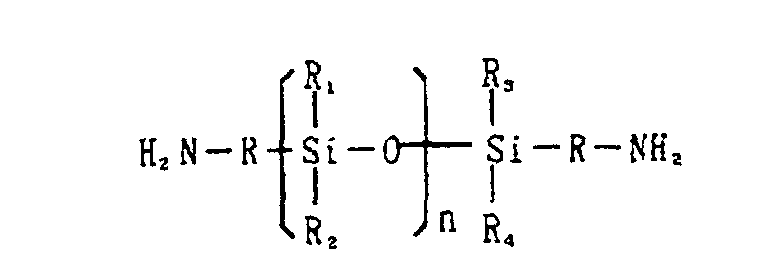
- The compound includes, for example, compounds having R and R1 to R4 in the following combinations:
R R1 R2 R3 R4 (CH2)3 CH3 CH3 CH3 CH3 (CH2)4 CH3 CH3 CH3 CH3 (CH2)3 CH3 C6H5 CH3 C6H5 p-C6H4 CH3 CH3 CH3 CH3 - In practice, such commercially available products as TSL9386, TSL9346 and TSL9306 (products available from Toshiba Silicone K.K., Japan), BY16-853U (product available from Toray-Dow Corning K.K., Japan), X-22-161AS (product available from Shinetsu Kagaku Kogyo K.K., Japan), F2-053-01 (product available from Nihon Unicar K.K., Japan), etc. can be used.
- For a hydroxyl group-containing diamine or carboxyl group-containing diamine as the second member of the diamine compounds mixture, for example, 4,4' -diamino-4" -hydroxytriphenyl methane, bis(4-amino-3-hydroxyphenyl)methane, and 2,2-bis(3-amino-4-hydroxyphenyl)propane, 3,5-diaminobenzoic acid can be used.
- For the third member of the diamine compound mixture, 1,4-bis[2-(3-aminobenzoyl)ethenyl]benzene, represented by the following formula, is used to give a photosensitivity to the resulting copolymer:

- Among these three members of the diamine compounds mixture, the diaminopolysiloxane can be used in a proportion of about 20 to about 60% by mole, preferably about 30 to about 50% by mole; the hydroxyl group-containig diamine or carboxyl group-containing diamine can be used in a proportion of about 20 to about 60% by mole, preferably about 30 to about 50% by mole; and the 1,4-bis[2-(3-aminobenzoyl)ethenyl]benzene can be used in a proportion of 5 to 40% by mole, preferably about 10 to about 30% by mole, on the basis of the diamine compounds mixture. When the diaminopolysiloxane is in a proportion of less than about 20% by mole, no films are formed, whereas above about 60% by mole, no development by an aqueous alkaline solution can be attained. When the hydroxyl group-containing diamine or carboxyl group-containing diamine is used in a proportion of less than about 20% by mole, the non-light exposed parts become insoluble in an aqueous alkaline solution,whereas above about 60% by mole even the light-exposed parts are soluble in an aqueous alkaline solution, but a difference in dissolution rate between the light-exposed parts and the non-light exposed parts becomes smaller. When the 1,4-bis[2-(3-aminobenzoyl)ethenyl]benzene is in a proportion of less than about 5% by mole, no satisfactory photosensitivity can be obtained, whereas above about 40% by mole the transparency will be deteriorated.
- For a tetracarboxylic acid dianhydride reactive with the diamine compounds mixture, an aromatic tetracarboxylic acid anhydride such as 3,3' ,4,4' -benzophenonetetracarboxylic acid dianhydride, 3,3' ,4,4'-diphenylsulfonetetracarboxylic acid dianhydride, 4,4' -oxydiphthalic acid dianhydride, 4,4' -biphthalic acid dianhydride, 2,2'-diphthalic acid dianhydride propane, diphthalic acid dianhydride methane, pyromellitic acid dianhydride, 2,2'-(hexafluoroisopropylidene) diphthalic acid dianhydride or a dicarboxylic anhydride having a 2,5-dioxotetrahydrofuryl group as one acid anhydride group such as 5-(2,5-dioxotetrahydrofuryl)-3-metyl-3-cyclohexene-1,2-carboxylic acid anhydride, 5-(2,5-dioxotetrahydrofuryl)-3-cyclohexene- 1,2-carboxylic acid anhydride, 4-(2,5-dioxotetrahydrofuran-3-yl)tetralin-1,2-carboxylic acid anhydride, can be used in an equimolar amount to the diamine compounds mixture.

- Reaction of the diamine compound mixture with the tetracarboxylic acid dianhydride is carried out preferably in an aprotic polar solvent such as dimethylformamide, dimethylacetamide, N-methyl-2-pyrrolidone, etc., or also in a polar solvent such as cresol, pyridine, etc. In practice, the reaction is carried out by dropwise addition of the aromatic tetracarboxylic acid dianhydride into a polor sulvent solution of the diamine compounds mixture at about 0° to about 10°C and then at an elevated temperature of about 50° to about 200°C, preferably about 100° to about 150°C for about 2 to about 8 hours.
- The reaction product is a polyamic acid as a polyimide precursor, and thus is to be subjected to dehydration reaction for polyimidizing the polyamic acid. Dehydration reaction, upon further addition of a polar organic solvent to adjust the concentration to about 10 to about 20% by weight, if required, is carried out at about 100° to about 180°C for about 2 to about 6 hours, preferably for about 2 to about 4 hours, preferably using a dehydrating agent such as acetic anhydride, etc.
- When the hydroxyl group-containing diamine is, for example, 4,4'-diamino-4 " -hydroxytriphenylmethane, siloxane polyimide as a polyimidization reaction product seems to be a block copolymer having repeating units (a), (b) and (c) represented by the following general formulae and having a weight average molecular weight Mw of about 10,000 to about 100,000, preferably about 15,000 to about 30,000 (as determined by GPC and in terms of polystyrene):
 and
and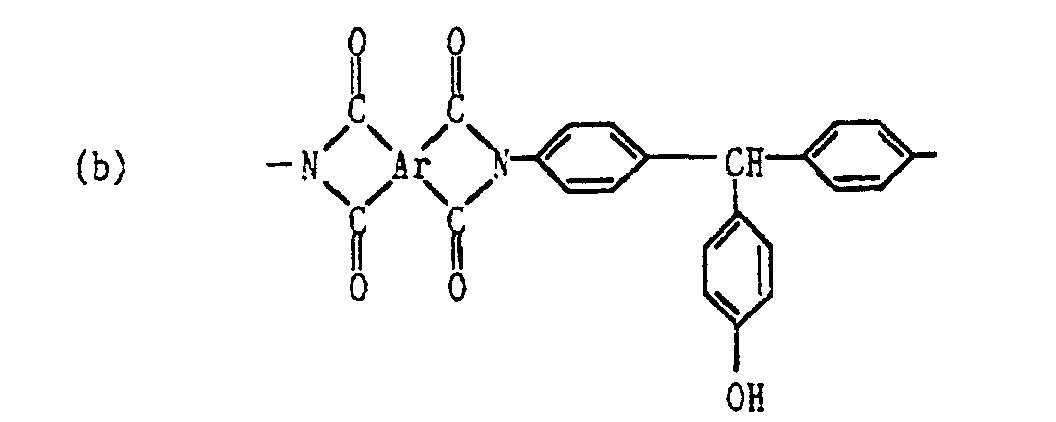 Ar: tetracarboxylic acid residue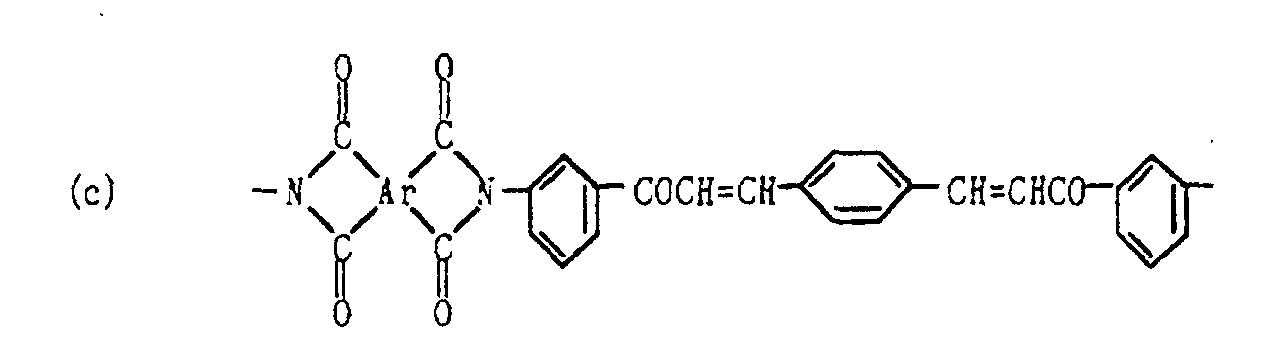
- The resulting copolymers are soluble in a low boiling organic solvent such as acetone, methyl ethyl ketone, methyl isobutyl ketone, tetrahydrofuran, cyclohexanone, etc. and thus can be used as a ca. 20-40 wt.% solution, preferably a ca. 30-35 wt.% solution in the organic solvent. Such a solvent solution is trickled onto an alkali-resistant substrate such as a quartz glass plate, a copper plate, etc., followed by spin coating and prebaking at about 60° to about 80°C for about 5 to about 10 minutes, thereby removing the solvent therefrom.
- The resulting photosensitive polyimide-coated substrate, upon placing a necessary mask thereon, is irradiated with ultraviolet rays at an exposure dosage of about 200 to about 450 mJ/cm2, preferably about 300 to about 450 mJ/cm2 and then subjected to post-exposure baking at about 120 to about 140°C for about 5 to about 10 minutes and then to development with an aqueous solution of an alkaline substance such as sodium carbonate, tetramethylammonium hydroxide, etc., whereby a clear, negative type pattern can be obtained on the substrate. Concentration of the developing solution is about 1 to about 5% by weight, preferably about 1 to about 3% by weight, and the developing time is preferably within about one minute.
- According to the present invention, a negative type photosensitive polyimide, which is photosensitive per se and can be developed by an aqueous alkaline solution, and is soluble in an all-purpose low boiling organic solvent, can be provided.
- 7.04g (8 m moles) of aminopolysiloxane (BY 16-853U), 2.90g (10 m moles) of 4,4'-diamino-4" -hydroxytriphenylmethane [DHTM], 0.736g (2 m moles) of 1,4-bis[2-(3-aminobenzoyl)ethenyl]benzene [BABEB] and 30g of N-methyl-2-pyrrolidone were charged into a separable flask having a capacity of 300 ml. The resulting solution was ice-cooled and, upon addition of 5.28g (20 m moles) of 5-(2,5-dioxotetrahydrofuryl)-3-methyl-3-cyclohexene-1,2-dicarboxylic acid anhydride thereto, heated to 120°C and stirred for 4 hours to conduct reaction. After the end of reaction, the reaction mixture was left standing for cooling to room temperature, then diluted with further 30g of N-methyl-2-pyrrolidone to lower the polyamic acid concentration.
- Furthermore, 5g of pyridine and 10g of acetic anhydride were added thereto and the reaction mixture was heated at 50°C for 3 hours to conduct polyimidization reaction. After the end of reaction, the reaction mixture was reprecipitated in water, thereby obtaining a photosensitive polyimide.
- In Polymerization Example 1, 2.112g (8 m moles) of 2,2-bis(3-amino-4-hydroxy)propane was used in place of DHTM, and the amount of BABEB was changed to 1.472g (4 m moles).
- In Polymerization Example 1, 1.216g (8 m moles) of 3,5-diaminobenzoic acid was used in place of DHTM, and the amount of BABEB was changed to 1.472g (4 m moles).
- About 2g of a 35 wt.% solution in methyl ethyl ketone of the photosensitive polyimide obtained in Polymerization Example 1 was trickled onto a quartz glass plate (7 × 7 cm), followed by spin coating at 750 rpm for 10 seconds. Then, the solvent was removed therefrom by prebaking at 80°C for 10 minutes. The photosensitive polyimide-coated quartz glass, upon placing a mask (PHOTEC, trademark of a product commercially available from Hitachi Chemical Co., Ltd., Japan) was irradiated with a UV light source having the main absorption at 350-450 nm (a product commercially available from Ushio Electric Inc., Japan) at an exposure dosage of 300 mJ/cm2. After the exposure, post-exposure baking was carried out at 120°C for 10 minutes, followed by development at 40°C for about 60 seconds, using an aqueous 3 wt.% sodium carbonate solution as a developing solution and by washing with distilled water, whereby a clear, negative type pattern was obtained.
- In Example 1, the photosensitive polyimide obtained in polymerization Example 2 was used in place of the photosensitive polyimide obtained in Polymerization Example 1, and the exposure dosage was changed to 475 mJ/cm2. A clear, negative type pattern was likewise obtained.
- In Example 1, the photosensitive polyimide obtained in polymerization Example 3 was used in place of the photosensitive polyimide obtained in Polymerization Example 1. A clear, negative type pattern was likewise obtained.
Claims (7)
- A photosensitive polyimide, which comprises a copolymer of (A) three diamine compounds mixture consisting of a diamino polysiloxane, a hydroxyl group-containing diamine or a carboxyl group-containing diamine and 1,4-bis[2-(3-aminobenzoyl)ethenyl]benzene with (B) a tetracarboxylic acid dianhydride.
- A photosensitive polyimide according to Claim 1, wherein the diaminosiloxane is used in a proportion of 20 to 60% by mole on the basis of the diamine compound mixtures.
- A photosensitive polyimide according to Claim 1, wherein the hydroxyl group or carboxyl group-containing diamine is used in a proportion of 20 to 60% by mole on the basis of the diamine compound mixture.
- A photosensitive polyimide according to Claim 1, wherein the 1,4-bis[2-(3-aminobenzoyl)ethenyl]benzene is used in a proportion of 5 to 40% by mole on the basis of the diamine compound mixture.
- A photosensitive polyimide according to Claim 1, wherein the tetracarboxylic acid anhydride is an aromatic tetracarboxylic acid dianhydride.
- A photosensitive polyimide according to Claim 1, wherein the tetracarboxylic acid anhydride is a dicarboxylic anhydride having a 2,5-dioxotetrahydrofuryl group as one acid anhydride group.
- Use of a photosensitive polyimide according to claim 1 as a negative type photosensitive resin.
Applications Claiming Priority (3)
| Application Number | Priority Date | Filing Date | Title |
|---|---|---|---|
| JP27995997 | 1997-09-26 | ||
| JP279959/97 | 1997-09-26 | ||
| JP27995997 | 1997-09-26 |
Publications (2)
| Publication Number | Publication Date |
|---|---|
| EP0905168A1 EP0905168A1 (en) | 1999-03-31 |
| EP0905168B1 true EP0905168B1 (en) | 2001-11-14 |
Family
ID=17618320
Family Applications (1)
| Application Number | Title | Priority Date | Filing Date |
|---|---|---|---|
| EP98115831A Expired - Lifetime EP0905168B1 (en) | 1997-09-26 | 1998-08-21 | Photosensitive polyimide |
Country Status (3)
| Country | Link |
|---|---|
| US (1) | US6025461A (en) |
| EP (1) | EP0905168B1 (en) |
| DE (1) | DE69802485T2 (en) |
Families Citing this family (11)
| Publication number | Priority date | Publication date | Assignee | Title |
|---|---|---|---|---|
| JP3968884B2 (en) * | 1998-05-01 | 2007-08-29 | 日本メクトロン株式会社 | Photosensitive composition |
| JP3972481B2 (en) | 1998-05-14 | 2007-09-05 | 日本メクトロン株式会社 | Photosensitive composition |
| JP3968886B2 (en) | 1998-05-14 | 2007-08-29 | 日本メクトロン株式会社 | Photosensitive composition |
| TW498091B (en) * | 1998-11-09 | 2002-08-11 | Kanegafuchi Chemical Ind | Polyimide composition and its manufacture process |
| KR100414697B1 (en) * | 1999-01-25 | 2004-01-13 | 리카가쿠 겐큐쇼 | Photosensitive resin composition and semiconductor apparatus using the same |
| US6616496B1 (en) * | 2000-06-14 | 2003-09-09 | Ritdisplay Corporation | Method of forming a polyimide-isolating wall of reverse-trapezoid cross-section with electric, thermal and mechanical stability |
| KR100595300B1 (en) * | 2000-10-28 | 2006-07-03 | 엘지.필립스 엘시디 주식회사 | Optical alignment material and liquid crystal display device using same |
| TW200302253A (en) * | 2002-01-15 | 2003-08-01 | Pi R & D Co Ltd | Solvent-soluble block copolyimide composition, process for producing the same, positive photosensitive polyimide composition and positive photosensitive block copolyimide ink composition |
| JP2004228152A (en) * | 2003-01-20 | 2004-08-12 | Shinko Electric Ind Co Ltd | Wafer dicing method |
| US20090221777A1 (en) * | 2006-04-24 | 2009-09-03 | Jsr Corporation | Photosensitive resin composition |
| CN114524938B (en) * | 2021-10-28 | 2024-02-09 | 江苏三月科技股份有限公司 | Polymer, photosensitive resin composition, cured film prepared from polymer and photosensitive resin composition, and electronic element |
Family Cites Families (10)
| Publication number | Priority date | Publication date | Assignee | Title |
|---|---|---|---|---|
| JPS57131227A (en) * | 1981-02-09 | 1982-08-14 | Nippon Telegr & Teleph Corp <Ntt> | Photopolymer and its production |
| JPS59145216A (en) * | 1983-02-07 | 1984-08-20 | Ube Ind Ltd | Organic solvent-soluble photosensitive polyamide-imide |
| JPS62179528A (en) * | 1986-02-03 | 1987-08-06 | Mitsubishi Gas Chem Co Inc | Photosensitive polyimide precursor |
| JP2586046B2 (en) * | 1987-02-13 | 1997-02-26 | 三菱瓦斯化学株式会社 | Photosensitive polyimide |
| US5189115A (en) * | 1989-02-21 | 1993-02-23 | Amoco Corporation | Polyetherimide copolymers |
| US5177181A (en) * | 1991-06-06 | 1993-01-05 | Occidental Chemical Corporation | Diamines and photosensitive polyimides made therefrom |
| US5310862A (en) * | 1991-08-20 | 1994-05-10 | Toray Industries, Inc. | Photosensitive polyimide precursor compositions and process for preparing same |
| US5300627A (en) * | 1991-10-17 | 1994-04-05 | Chisso Corporation | Adhesive polyimide film |
| US5446074A (en) * | 1993-12-17 | 1995-08-29 | International Business Machines Corporation | Photosensitive polyimide precursors |
| JP3968835B2 (en) * | 1996-12-20 | 2007-08-29 | 日本メクトロン株式会社 | Heat resistant adhesive containing siloxane polyimide |
-
1998
- 1998-08-05 US US09/129,581 patent/US6025461A/en not_active Expired - Lifetime
- 1998-08-21 EP EP98115831A patent/EP0905168B1/en not_active Expired - Lifetime
- 1998-08-21 DE DE69802485T patent/DE69802485T2/en not_active Expired - Lifetime
Also Published As
| Publication number | Publication date |
|---|---|
| DE69802485D1 (en) | 2001-12-20 |
| DE69802485T2 (en) | 2002-06-13 |
| EP0905168A1 (en) | 1999-03-31 |
| US6025461A (en) | 2000-02-15 |
Similar Documents
| Publication | Publication Date | Title |
|---|---|---|
| US6875554B2 (en) | Positive photosensitive polyimide resin composition | |
| JP3871767B2 (en) | Photosensitive composition | |
| EP0957124B1 (en) | Polyimides, process for producing the same and photosensitive composition containing the same | |
| KR101588364B1 (en) | Method for producing polyhydroxyimide and positive photosensitive resin composition containing polyhydroxyimide obtained by the production method | |
| US7157204B2 (en) | Soluble polyimide for photosensitive polyimide precursor and photosensitive polyimide precursor composition comprising the soluble polyimide | |
| US6025461A (en) | Photosensitive polyimide | |
| WO2007029614A1 (en) | Positive photosensitive resin composition | |
| EP0953590B1 (en) | Polyimides, process for producting the same and photosensitive composition containing the same | |
| JP4467138B2 (en) | Photosensitive resin composition | |
| JPH0673003A (en) | Bismaleimide compound and photosensitive resin composition | |
| EP0957126B1 (en) | Photosensitive composition | |
| EP0957125B1 (en) | Polyimides, process for producing the same and photosensitive composition containing the same | |
| JP4434338B2 (en) | Photosensitive polyimide | |
| CN108700805B (en) | Photosensitive resin composition, dry film, cured product, printed wiring board, and photobase generator | |
| JP3460212B2 (en) | Radiation-sensitive resin composition | |
| US5914354A (en) | Radiation-sensitive resin composition | |
| JP4408984B2 (en) | Aromatic polyhydroxyamide | |
| JP4487981B2 (en) | Polyimide and process for producing the same | |
| JP4811162B2 (en) | Polyimide and process for producing the same | |
| JP4811158B2 (en) | Polyimide and process for producing the same | |
| JP2000351845A (en) | Photosensitive polyamide | |
| JPH04218051A (en) | Photosensitive resin composition for forming polyimide film pattern and semiconductor device using same |
Legal Events
| Date | Code | Title | Description |
|---|---|---|---|
| PUAI | Public reference made under article 153(3) epc to a published international application that has entered the european phase |
Free format text: ORIGINAL CODE: 0009012 |
|
| AK | Designated contracting states |
Kind code of ref document: A1 Designated state(s): DE FR GB IT |
|
| AX | Request for extension of the european patent |
Free format text: AL;LT;LV;MK;RO;SI |
|
| 17P | Request for examination filed |
Effective date: 19990224 |
|
| AKX | Designation fees paid |
Free format text: DE FR GB IT |
|
| GRAG | Despatch of communication of intention to grant |
Free format text: ORIGINAL CODE: EPIDOS AGRA |
|
| 17Q | First examination report despatched |
Effective date: 20000912 |
|
| GRAG | Despatch of communication of intention to grant |
Free format text: ORIGINAL CODE: EPIDOS AGRA |
|
| GRAH | Despatch of communication of intention to grant a patent |
Free format text: ORIGINAL CODE: EPIDOS IGRA |
|
| GRAH | Despatch of communication of intention to grant a patent |
Free format text: ORIGINAL CODE: EPIDOS IGRA |
|
| GRAA | (expected) grant |
Free format text: ORIGINAL CODE: 0009210 |
|
| AK | Designated contracting states |
Kind code of ref document: B1 Designated state(s): DE FR GB IT |
|
| REF | Corresponds to: |
Ref document number: 69802485 Country of ref document: DE Date of ref document: 20011220 |
|
| REG | Reference to a national code |
Ref country code: GB Ref legal event code: IF02 |
|
| PLBE | No opposition filed within time limit |
Free format text: ORIGINAL CODE: 0009261 |
|
| STAA | Information on the status of an ep patent application or granted ep patent |
Free format text: STATUS: NO OPPOSITION FILED WITHIN TIME LIMIT |
|
| 26N | No opposition filed | ||
| PG25 | Lapsed in a contracting state [announced via postgrant information from national office to epo] |
Ref country code: IT Free format text: LAPSE BECAUSE OF NON-PAYMENT OF DUE FEES Effective date: 20100821 |
|
| PGRI | Patent reinstated in contracting state [announced from national office to epo] |
Ref country code: IT Effective date: 20110616 |
|
| PGFP | Annual fee paid to national office [announced via postgrant information from national office to epo] |
Ref country code: DE Payment date: 20130823 Year of fee payment: 16 |
|
| PGFP | Annual fee paid to national office [announced via postgrant information from national office to epo] |
Ref country code: GB Payment date: 20130719 Year of fee payment: 16 |
|
| PGFP | Annual fee paid to national office [announced via postgrant information from national office to epo] |
Ref country code: IT Payment date: 20130807 Year of fee payment: 16 |
|
| PGFP | Annual fee paid to national office [announced via postgrant information from national office to epo] |
Ref country code: FR Payment date: 20130812 Year of fee payment: 16 |
|
| REG | Reference to a national code |
Ref country code: DE Ref legal event code: R119 Ref document number: 69802485 Country of ref document: DE |
|
| GBPC | Gb: european patent ceased through non-payment of renewal fee |
Effective date: 20140821 |
|
| PG25 | Lapsed in a contracting state [announced via postgrant information from national office to epo] |
Ref country code: IT Free format text: LAPSE BECAUSE OF NON-PAYMENT OF DUE FEES Effective date: 20140821 |
|
| REG | Reference to a national code |
Ref country code: FR Ref legal event code: ST Effective date: 20150430 |
|
| REG | Reference to a national code |
Ref country code: DE Ref legal event code: R119 Ref document number: 69802485 Country of ref document: DE Effective date: 20150303 |
|
| PG25 | Lapsed in a contracting state [announced via postgrant information from national office to epo] |
Ref country code: GB Free format text: LAPSE BECAUSE OF NON-PAYMENT OF DUE FEES Effective date: 20140821 Ref country code: DE Free format text: LAPSE BECAUSE OF NON-PAYMENT OF DUE FEES Effective date: 20150303 |
|
| PG25 | Lapsed in a contracting state [announced via postgrant information from national office to epo] |
Ref country code: FR Free format text: LAPSE BECAUSE OF NON-PAYMENT OF DUE FEES Effective date: 20140901 |