EP0904767A2 - Dental materials based on oligomers or polymers obtained by ring-opening metathesis polymerization - Google Patents
Dental materials based on oligomers or polymers obtained by ring-opening metathesis polymerization Download PDFInfo
- Publication number
- EP0904767A2 EP0904767A2 EP98118366A EP98118366A EP0904767A2 EP 0904767 A2 EP0904767 A2 EP 0904767A2 EP 98118366 A EP98118366 A EP 98118366A EP 98118366 A EP98118366 A EP 98118366A EP 0904767 A2 EP0904767 A2 EP 0904767A2
- Authority
- EP
- European Patent Office
- Prior art keywords
- oder
- chr
- component
- bis
- composition according
- Prior art date
- Legal status (The legal status is an assumption and is not a legal conclusion. Google has not performed a legal analysis and makes no representation as to the accuracy of the status listed.)
- Granted
Links
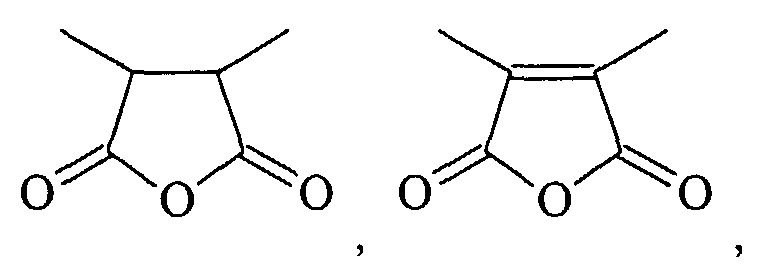
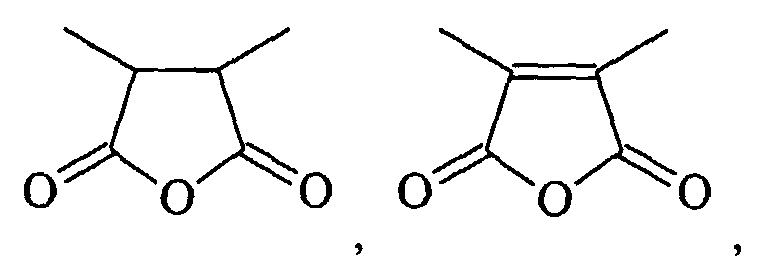
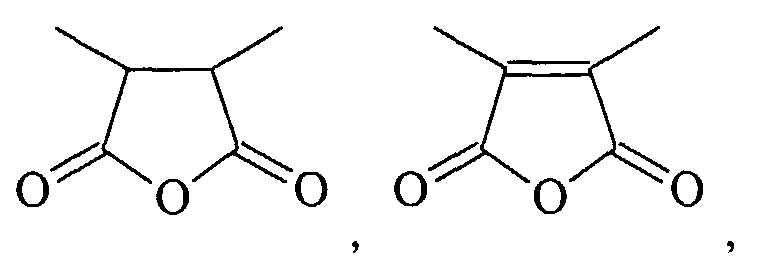
- HXFIRQHMXJBTRV-UHFFFAOYSA-N CC(C(C)C(O1)=O)C1=O Chemical compound CC(C(C)C(O1)=O)C1=O HXFIRQHMXJBTRV-UHFFFAOYSA-N 0.000 description 1
- MFGALGYVFGDXIX-UHFFFAOYSA-N CC(C(O1)=O)=C(C)C1=O Chemical compound CC(C(O1)=O)=C(C)C1=O MFGALGYVFGDXIX-UHFFFAOYSA-N 0.000 description 1
Classifications
-
- A—HUMAN NECESSITIES
- A61—MEDICAL OR VETERINARY SCIENCE; HYGIENE
- A61K—PREPARATIONS FOR MEDICAL, DENTAL OR TOILETRY PURPOSES
- A61K6/00—Preparations for dentistry
- A61K6/80—Preparations for artificial teeth, for filling teeth or for capping teeth
- A61K6/884—Preparations for artificial teeth, for filling teeth or for capping teeth comprising natural or synthetic resins
- A61K6/887—Compounds obtained by reactions only involving carbon-to-carbon unsaturated bonds
Definitions
- the present invention relates to dental compositions which contain oligomers or polymers which can be obtained by ring-opening metathesis polymerization.
- dental filling and Fastening materials also used two-component systems through a cement reaction between a reactive filler and a liquid reacting with this filler consist.
- these are the phosphate, silicate and carboxylate [DE-B-1 617 688] and Glass ionomer cements [DE-A-2 101 889].
- a general overview of this area can be found e.g. in A.D. Wilson; Chemical Society Reviews (1978), 7, (2), 265-296 or in D. Welker, A. Rzanny, R. Goebel; Dental Magazine (1997), 2, 64-76.
- These cement materials have opposite the radical polymerizing dental materials have the great disadvantage that their mechanical Properties such as compressive and bending strengths are significantly worse. The reason for this is in the case of glass ionomer cements, among other things, a very high flexibility of the polycarboxylic acid the liquid.
- the object of the present invention is to provide dental materials, the oligomers or contain polymers in the case of free-radically polymerizing systems low volume shrinkage and, in the case of cement systems, better mechanical Lead values.
- Oligomers or polymers of the general formulas I and II can be obtained by ring-opening metathesis polymerization (ROMP) can be obtained.
- ROMP ring-opening metathesis polymerization
- Ring-opening metathesis polymerization is known from the literature and has also been used industrially for several years [Comprehensive Polymer Sci .; 4, 109-142]. Uses of these obtained by ROMP Oligomers or polymers for dental applications are not known.
- ethylenically unsaturated oligomers or polymers can be used in the disclosed dental compositions either alone or in combination with other ethylenically unsaturated monomers.
- Preferred ethylenically unsaturated co-monomers are acrylates or methacrylates.
- Particularly preferred ethylenically unsaturated co-monomers are bis-GMA, TEGDMA, bis- (hydroxymethyl) tricyclo [5.2.1.0 2,6 ] -decanediacrylic acid esters and 2,2-bis [4,1-phenyleneoxy (3,1-propanediyl) - methacrylic acid ester] propylidene.
- Radical-forming catalysts according to component (c) for curing them ethylenically Unsaturated monomers, oligomers and polymers can be exposed to UV or visible light activatable substances, e.g. Benzoin alkyl ethers, benzil ketals, acylphosphine oxides or aliphatic and aromatic 1,2-diketone compounds, e.g. Camphorquinone, with light polymerization by adding activators, such as tertiary amines or organic phosphites, can be accelerated in a manner known per se.
- UV or visible light activatable substances e.g. Benzoin alkyl ethers, benzil ketals, acylphosphine oxides or aliphatic and aromatic 1,2-diketone compounds, e.g. Camphorquinone
- activators such as tertiary amines or organic phosphites
- Suitable initiator systems for triggering radical polymerization via a redox mechanism are, for example, the systems peroxide / amine or peroxide / barbituric acid derivatives u. The like.
- an initiator e.g. Peroxide
- a catalyst component e.g. amine
- the cationically polymerizable compounds according to formulas (I) and (II) can also either alone or in combination with epoxy-functional co-monomers.
- Particularly preferred epoxy-functionalized co-monomers are those in DE-A-196 48 283 disclosed 3,4-epoxycyclohexylmethyl-3 ', 4'-epoxycyclohexylcarboxylate and tetrakis [3,4-epoxycyclohexylethyl] tetramethyltetracyclosiloxane.
- cation formers are used to cure these epoxy-functionalized monomers, oligomers or polymers.
- Acid formers such as Lewis or Broensted acids or compounds which release those acids which initiate the cationic polymerization, for example BF 3 or its ethereal adducts (BF 3 * THF, BF 3 * Et 2 O, etc.) can be used as cation formers.
- Peroxy compounds of the perester, diacyl peroxide, peroxydicarbonate and hydroperoxide type can be used as accelerators. Hydroperoxides are preferably used, and cumene hydroperoxide in approximately 70-90% solution in cumene is used as a particularly preferred accelerator.
- the ratio of photoinitiator to cumene hydroperoxide can be varied within wide limits from 1: 0.001 to 1:10, but preferably a ratio of 1: 0.1 to 1: 6 and particularly preferably from 1: 0.5 to 1: 4 is used .
- complexing agents such as oxalic acid, 8-hydroxyquinoline, ethylenediaminetetraacetic acid and aromatic polyhydroxy compounds is also possible.
- Bases typically tertiary amines, can be added as retarders.
- Suitable fillers which in connection with the ethylenically unsaturated or epoxy-functionalized oligomers or polymers according to component (b) are used are usually inorganic fillers. Examples include quartz, ground Glasses, silica gels and pyrogenic silicas or their granules. To be favoured X-ray opaque fillers, at least partially, are also used. These can be radiopaque Be glasses, i.e. glasses which e.g. Contain strontium, barium or lanthanum, or a Part of the packing consists of an X-ray opaque additive, such as yttrium trifluoride, Strontium hexafluorozirconate or fluorides of rare earth metals.
- an X-ray opaque additive such as yttrium trifluoride, Strontium hexafluorozirconate or fluorides of rare earth metals.
- Usual Water repellents are silanes, for example trimethoxymethacryloyloxypropylsilane, or Trimethoxyglycidylsilane.
- the fillers preferably have an average particle size distribution ⁇ 20 ⁇ m and in particular ⁇ 5 ⁇ m and an upper grain limit of 150, preferably 70 ⁇ m and especially 25 ⁇ m. Mixtures of 5-25% by weight of fillers are particularly preferred an average grain size of 0.02 - 0.06 ⁇ m and 65-85 wt .-% packing with an average Grain size of 1-5 ⁇ m used.
- ROMP can be used to produce 5,6-carboxyl-substituted norbornenes from polymeric acids known in the literature which have a CC double bond and a saturated five-membered ring in their polymer chain according to formulas (I) and (II).
- These polymer acids have a molecular weight per carbonyl group of 105-107 g / mol and are surprisingly very water-soluble in spite of their significantly lower carboxyl group density compared to conventional polymer acids.
- these polymer acids obtained by ROMP bind with acid-soluble glass powders with the formation of cement.
- these acids offer the possibility of further modification through subsequent reactions.
- the chain length of these molecules can be adapted to the respective application requirement by oxidative cleavage according to the following scheme.
- the compound (XIV) can, according to the information from A. Demonceau et al. in Macromolecules (1997), 30 pages 3127 to 3136.
- the synthesis of the compounds (XV) to (XXIV) can again from the corresponding precursors as in Comprehensive organometallic Chemistry II: a review of the literature 1982-1994 ", Elsevier 1995, pages 1209-1232.
- polymer acids described here can either be used alone or in combination with known acids already used for cements. Such acids are described by way of example in DE-A-2 101 889.
- silicate cement powders as are also described in DE-A-2 101 889, can be used as the acid-soluble powder according to component (b).
- component (b) Conventional silicate cement powders, as are also described in DE-A-2 101 889, can be used as the acid-soluble powder according to component (b).
- Suitable silicate cement powders are also in Chemical Society Reviews "(1978), 7 (2), 265-296.
- the dental cements are usually applied in the form of a two-component system, which consists of a liquid and a powdery component.
- the invention Oligomeric or polymeric acids can, according to one embodiment i) of the invention Part of the mixing liquid and, according to another embodiment ii) part of the powder component be:
- the mixing liquid consists of an aqueous solution of Oligomeric or polymeric acids as defined above, and of conventional polymeric acids and, if necessary, customary additives.
- the acidic monomers are generally in a concentration of at least 20%, usually 30 to 60% by weight, in particular 40 to 50 % By weight in the aqueous solution if the cement system is intended as dental filling cement. Lower concentrations are advantageous for cementation and prosthetic purposes.
- the aqueous solutions should have viscosities of at least 0.5 poise, but at most Have 300 poise. A preferred viscosity range is between 2 and 200, in particular between 5 and 100 poise (at 25 ° C).
- the mixing component dental cements d. H. the oligomer or polymer acids according to component (a), Part of the powder mixture and is a premix of glass powder and acid-functional Oligomers or polymers before.
- the mixing component can then simply with Water, if necessary mixed with the usual additives.
- the compounds XIV to XXIV can also be used as Adhesive agents are used in so-called bonding compositions. These are either unfilled (0% by weight of component (b)) or low filled (5 to 30% by weight of Component (b)).
- Suitable auxiliaries according to component (d) can, for example, usually on the Stabilizers, pigments or diluents used in the dental field.
- Stabilizers pigments or diluents used in the dental field.
- Chelating agents are added, preferably tartaric acid, to increase the curing characteristics improve [s. DE-A-2 319 715].
- the dental compositions according to the invention are suitable for the production of filling materials, Fastening cements, inlays, onlays, veneers, provisional crown and bridge materials, dental materials and impression materials.
- Example 1 Synthesis and oxidative degradation of poly-7-oxabicyclo- [2.2.1] -hept-5-ene-2,3-dicarboxylic acid
- Example 2 Production of a glass ionomer cement with polymer acids according to the invention
- aqueous solution from Example 1 200 mg are mixed with 200 mg of an aqueous Polycarboxylic acid solution (CHELON-FIL liquid, ESPE, Seefeld) mixed. This mix becomes a paste with 1.2 g reactive glass powder (CHELON-FIL powder, ESPE, Seefeld) spat on.
- the freshly mixed is used to determine the compressive and flexural strength values Cement introduced into the corresponding test specimen shapes and remains there until End of setting (approx. 5 minutes).
- the test specimens are then removed from the mold and on a Zwick universal testing machine according to the ISO standard 4049 or ISO standard 9917 measured. The results of the material test are shown in Table 1.
- Example 3 Production of a one-component, free-radically polymerizing dental filling material
- Example 4 Production of a one-component cationically polymerizing dental filling material
- the paste is introduced into the corresponding test specimen shapes and exposed in accordance with the specifications of ISO standard 4049 and ISO standard 9917.
- the volume shrinkage is determined by linometer measurement.
- the results of the material test are shown in Table 3.
Landscapes
- Health & Medical Sciences (AREA)
- Oral & Maxillofacial Surgery (AREA)
- Plastic & Reconstructive Surgery (AREA)
- Epidemiology (AREA)
- Life Sciences & Earth Sciences (AREA)
- Animal Behavior & Ethology (AREA)
- General Health & Medical Sciences (AREA)
- Public Health (AREA)
- Veterinary Medicine (AREA)
- Dental Preparations (AREA)
Abstract
Die Erfindung betrifft Dentalmassen, enthaltend

Description
Die vorliegende Erfindung betrifft Dentalmassen, die Oligomere oder Polymere enthalten, welche durch Ring-Öffnungs-Metathese-Polymerisation erhalten werden.The present invention relates to dental compositions which contain oligomers or polymers which can be obtained by ring-opening metathesis polymerization.
In polymerisierbaren Dentalmassen werden bislang vorwiegend ethylenisch ungesättigte Monomere, bevorzugt Methacrylat- und Acrylatmonomere verwendet. Besonders häufig wird dabei das von Bowen beschriebene 2,2-Bis[4,1-phenylenoxy(2-hydroxy-3,1-propandiyl)methacrylsäureester]-propyliden (Bis-GMA) [US-A-3 066 112] eingesetzt. Mischungen dieses Methacrylats mit Triethylenglykoldimethacrylat (TEGDMA) dienen auch heute noch als Standardrezeptur für dentale plastische Direkt-Füllungswerkstoffe. Die Aushärtung derartiger Massen beruht aufeiner radikalischen Polymerisationsreaktion welche durch entsprechend aktivierte radikalbildende Initiatoren gestartet wird. Problematisch hierbei ist der bei der Polymerisation auftretende nachteilige Polymerisationsschrumpf. Dieser kann beispielsweise bei der Anwendung als Füllungsmaterial zur Bildung von Verfärbungen am Kavitätenrand des Zahnes oder sogar zur Entstehung von Randspalten mit anschließendem Sekundärkariesrisiko führen.In polymerizable dental materials, mainly ethylenically unsaturated ones have so far been used Monomers, preferably methacrylate and acrylate monomers used. Is particularly common the 2,2-bis [4,1-phenyleneoxy (2-hydroxy-3,1-propanediyl) methacrylic acid ester] propylid described by Bowen (Bis-GMA) [US-A-3 066 112]. Blends this Methacrylate with triethylene glycol dimethacrylate (TEGDMA) still serve as Standard formulation for dental plastic direct filling materials. The curing of such Mass is based on a radical polymerization reaction which by corresponding activated radical initiators is started. The problem here is that of Polymerization disadvantageous polymerization shrinkage. This can, for example when used as a filling material to form discoloration on the edge of the cavity Tooth or even the formation of marginal gaps with subsequent risk of secondary caries to lead.
Neben diesen radikalisch polymerisierenden Systemen werden als dentale Füllungs- und Befestigungsmaterialien auch Zweikomponenetensysteme verwendet, die durch eine Zement-Reaktion zwischen einem reaktiven Füllstoff und einer mit diesem Füllstoffreagierenden Flüssigkeit bestehen. Beispiele hierfür sind die Phosphat-, Silikat-, Carboxylat- [DE-B-1 617 688] und Glasionomerzemente [DE-A-2 101 889]. Eine allgemeine Übersicht über dieses Gebiet findet sich z.B. in A.D. Wilson; Chemical Society Reviews (1978), 7, (2), 265-296 oder in D. Welker, A. Rzanny, R. Göbel; Dental Magazin (1997), 2, 64-76. Diese Zementmaterialien haben gegenüber den radikalisch polymerisierenden Dentalmassen den großen Nachteil, daß ihre mechanischen Eigenschaften wie Druck- und Biegefestigkeiten deutlich schlechter sind. Die Ursache hierfür ist im Falle der Glasionomerzemente unter anderem eine recht hohe Flexibilität der Polycarbonsäure der Flüssigkeit.In addition to these radical polymerizing systems, dental filling and Fastening materials also used two-component systems through a cement reaction between a reactive filler and a liquid reacting with this filler consist. Examples of these are the phosphate, silicate and carboxylate [DE-B-1 617 688] and Glass ionomer cements [DE-A-2 101 889]. A general overview of this area can be found e.g. in A.D. Wilson; Chemical Society Reviews (1978), 7, (2), 265-296 or in D. Welker, A. Rzanny, R. Goebel; Dental Magazin (1997), 2, 64-76. These cement materials have opposite the radical polymerizing dental materials have the great disadvantage that their mechanical Properties such as compressive and bending strengths are significantly worse. The reason for this is in the case of glass ionomer cements, among other things, a very high flexibility of the polycarboxylic acid the liquid.
Aufgabe der vorliegenden Erfindung ist es, Dentalmaterialien bereit zu stellen, die Oligomere oder Polymere enthalten welche im Falle von radikalisch polymerisierenden Systemen zu geringem Volumenschrumpf und im Falle von Zementsystemen zu besseren mechanischen Werten führen.The object of the present invention is to provide dental materials, the oligomers or contain polymers in the case of free-radically polymerizing systems low volume shrinkage and, in the case of cement systems, better mechanical Lead values.
Gelöst wird die Aufgabe durch die Bereitstellung von Massen, welche enthalten:
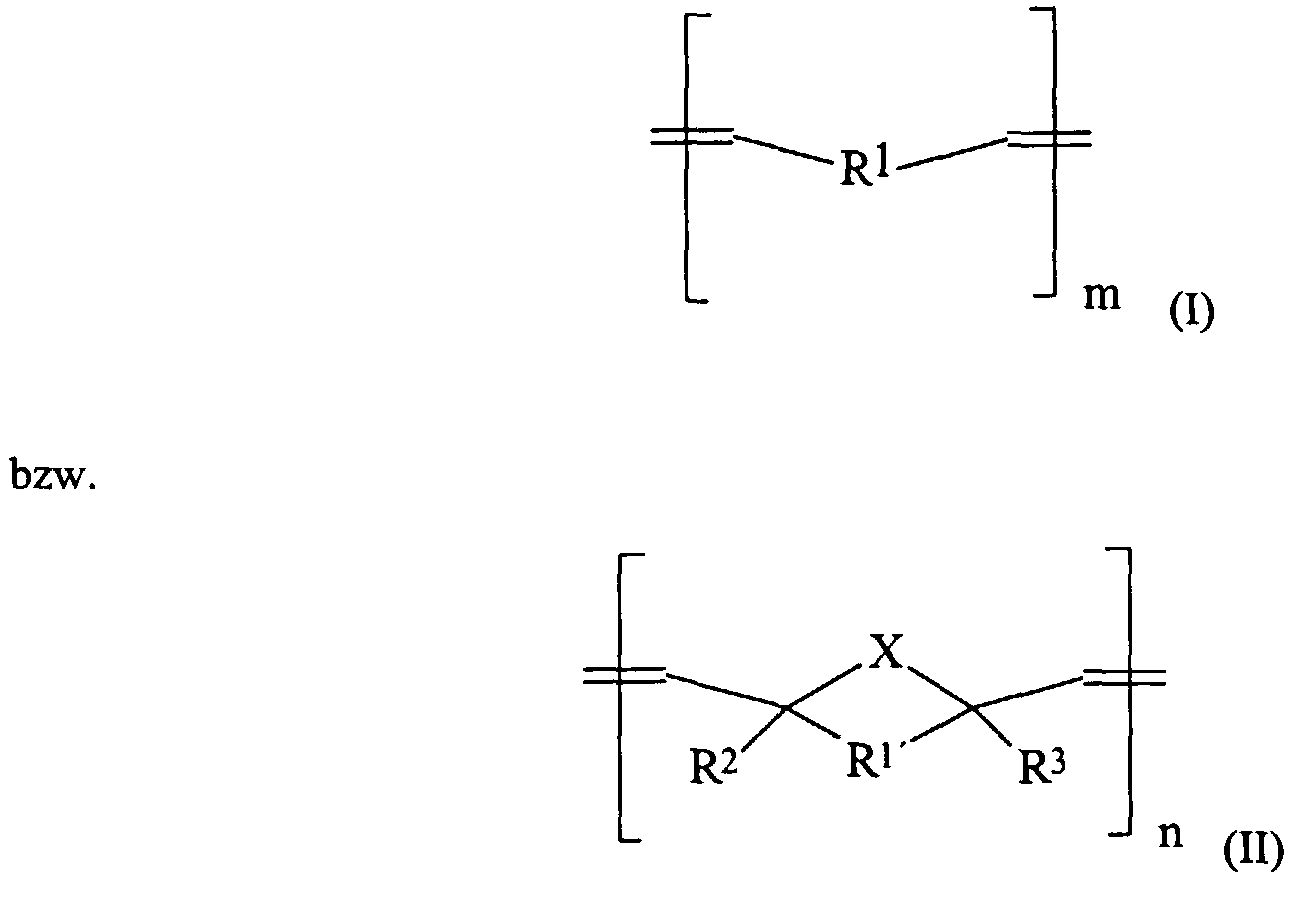
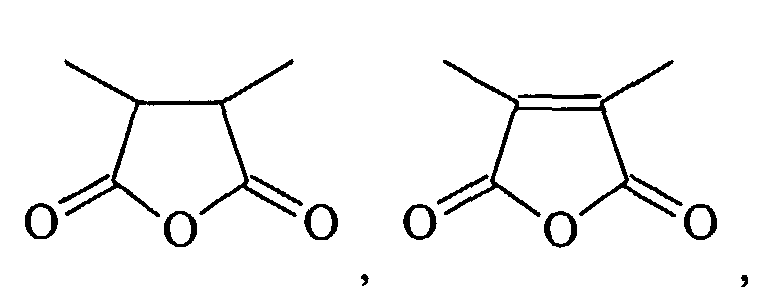
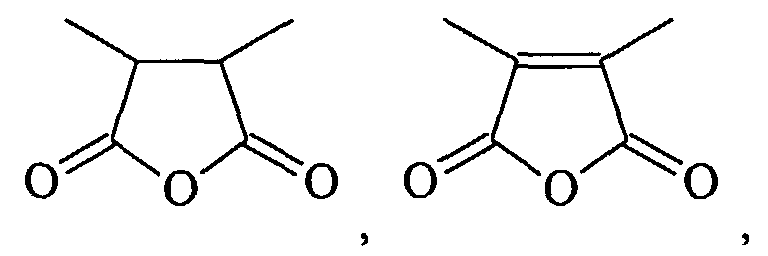
Oligomere oder Polymere der allgemeinen Formeln I und II können durch Ring-Öffnungs-Metathese-Polymerisation (ROMP) erhalten werden. Die Ring-Öffnungs-Metathese-Polymerisation ist literaturbekannt und wird seit einigen Jahren auch industriell eingesetzt [Comprehensive Polymer Sci.; 4, 109-142]. Verwendungen dieser durch ROMP gewonnenen Oligomeren bzw. Polymeren für dentale Anwendungen sind nicht bekannt.Oligomers or polymers of the general formulas I and II can be obtained by ring-opening metathesis polymerization (ROMP) can be obtained. Ring-opening metathesis polymerization is known from the literature and has also been used industrially for several years [Comprehensive Polymer Sci .; 4, 109-142]. Uses of these obtained by ROMP Oligomers or polymers for dental applications are not known.
Es wurde im Rahmen dieser Erfindung überraschenderweise festgestellt, daß Verbindungen der allgemeinen Formeln (I) und (II) für dentale Zwecke gut geeignet sind und zu Massen mit besonderen Eigenschaften führen. Im Falle von radikalisch polymerisierenden Systemen ergibt sich ein geringerer Volumenschrumpf und bei Zementsystemen erhält man bessere mechanische Werte. Dies gilt sowohl wenn die Verbindungen der Formeln (I) und (II) alleine als auch wenn sie als Mischung in den Dentalmassen enthalten sind.It has surprisingly been found in the context of this invention that compounds of general formulas (I) and (II) are well suited for dental purposes and have masses with special properties. In the case of radically polymerizing systems lower volume shrinkage and better mechanical systems are obtained with cement systems Values. This applies both when the compounds of formulas (I) and (II) alone as well as when they are contained as a mixture in the dental materials.
Verbindungen der allgemeinen Formeln (I) und (II) welche in den hier offenbarten Dentalmassen durch radikalische Polymerisation zur Aushärtung führen, sind solche die mindestens einfach ethylenisch ungesättigt sind. Bevorzugt sind Verbindung welche Acrylat- oder Methacrylatgruppen beeinhalten.Compounds of the general formulas (I) and (II) which are used in the dental compositions disclosed here lead to curing by radical polymerization, those are at least simple are ethylenically unsaturated. Compounds which acrylate or methacrylate groups are preferred contain.
Besonders bevorzugt ist Verbindung (III) mit m = 1000-3000:

Diese ethylenisch ungesättigten Oligomeren bzw. Polymeren können in den offenbarten Dentalmassen entweder alleine oder in Kombination mit weiteren ethylenisch ungesättigten Monomeren eingesetzt werden. Bevorzugt verwendete ethylenisch ungesättigte Co-Monomere sind Acrylate oder Methacrylate. Besonders bevorzugte ethylenisch ungesättigte Co-Monomere sind Bis-GMA, TEGDMA, Bis-(hydroxymethyl)tricyclo[5.2.1.02,6]-decandiacrlysäureester sowie 2,2-Bis[4,1-phenylenoxy(3,1-propandiyl)-methacrylsäureester]-propyliden.These ethylenically unsaturated oligomers or polymers can be used in the disclosed dental compositions either alone or in combination with other ethylenically unsaturated monomers. Preferred ethylenically unsaturated co-monomers are acrylates or methacrylates. Particularly preferred ethylenically unsaturated co-monomers are bis-GMA, TEGDMA, bis- (hydroxymethyl) tricyclo [5.2.1.0 2,6 ] -decanediacrylic acid esters and 2,2-bis [4,1-phenyleneoxy (3,1-propanediyl) - methacrylic acid ester] propylidene.
Weitere bevorzugte Verbindungen sind den Formeln (IV) - (VIII) zu entnehmen (mit m = 1000-3000):

Die Synthese der Verbindungen (III)-(VII) erfolgt dabei jeweils durch eine ROMP entsprechender
Norbonenderivate, welche wiederum durch Diels-Alder-Reaktion gewonnen werden. Eine
allgemeine Beschreibung dieser Reaktionsfolgen ist z.B. in 
Radiakalbildende Katalysatoren gemäß Bestandteil (c) zur Aushärtung dieser ethylenisch ungesättigten Monomeren, Oligomeren und Polymeren können durch UV- oder sichtbares Licht aktivierbare Substanzen sein, wie z.B. Benzoinalkylether, Benzilketale, Acylphosphinoxide oder aliphatische und aromatische 1,2-Diketonverbindungen, z.B. Campherchinon, wobei die Lichtpolymerisation durch Zusatz von Aktivatoren, wie tertiären Aminen oder organischen Phosphiten, in an sich bekannter Weise beschleunigt werden kann.Radical-forming catalysts according to component (c) for curing them ethylenically Unsaturated monomers, oligomers and polymers can be exposed to UV or visible light activatable substances, e.g. Benzoin alkyl ethers, benzil ketals, acylphosphine oxides or aliphatic and aromatic 1,2-diketone compounds, e.g. Camphorquinone, with light polymerization by adding activators, such as tertiary amines or organic phosphites, can be accelerated in a manner known per se.
Geeignete Initiatorsysteme zur Auslösung der radikalischen Polymerisation über einen Redox-Mechanismus sind beispielsweise die Systeme Peroxid/Amin oder Peroxid/Barbitursäurederivate u. dergl. Bei Verwendung solcher Initiatorsysteme ist es zweckmäßig, einen Initiator (z.B. Peroxid) und eine Katalysatorkomponente (z.B. Amin) getrennt bereitzuhalten. Die beiden Komponenten werden dann kurz vor ihrer Anwendung miteinander homogen vermischt.Suitable initiator systems for triggering radical polymerization via a redox mechanism are, for example, the systems peroxide / amine or peroxide / barbituric acid derivatives u. The like. When using such initiator systems, it is advisable to use an initiator (e.g. Peroxide) and a catalyst component (e.g. amine) separately. The two Components are then mixed homogeneously with each other shortly before they are used.
Verbindungen der allgemeinen Formeln (I) und (II), welche in den hier offenbarten Dentalmassen
durch kationische Polymerisation aushärten, sind vorzugsweise solche, die epoxyfunktionalisiert
sind. Besonders bevorzugte Verbindungen dieses Typs sind in den Formeln (IX) bis (XIV)
dargestellt (mit m gleich 1000 bis 3000):
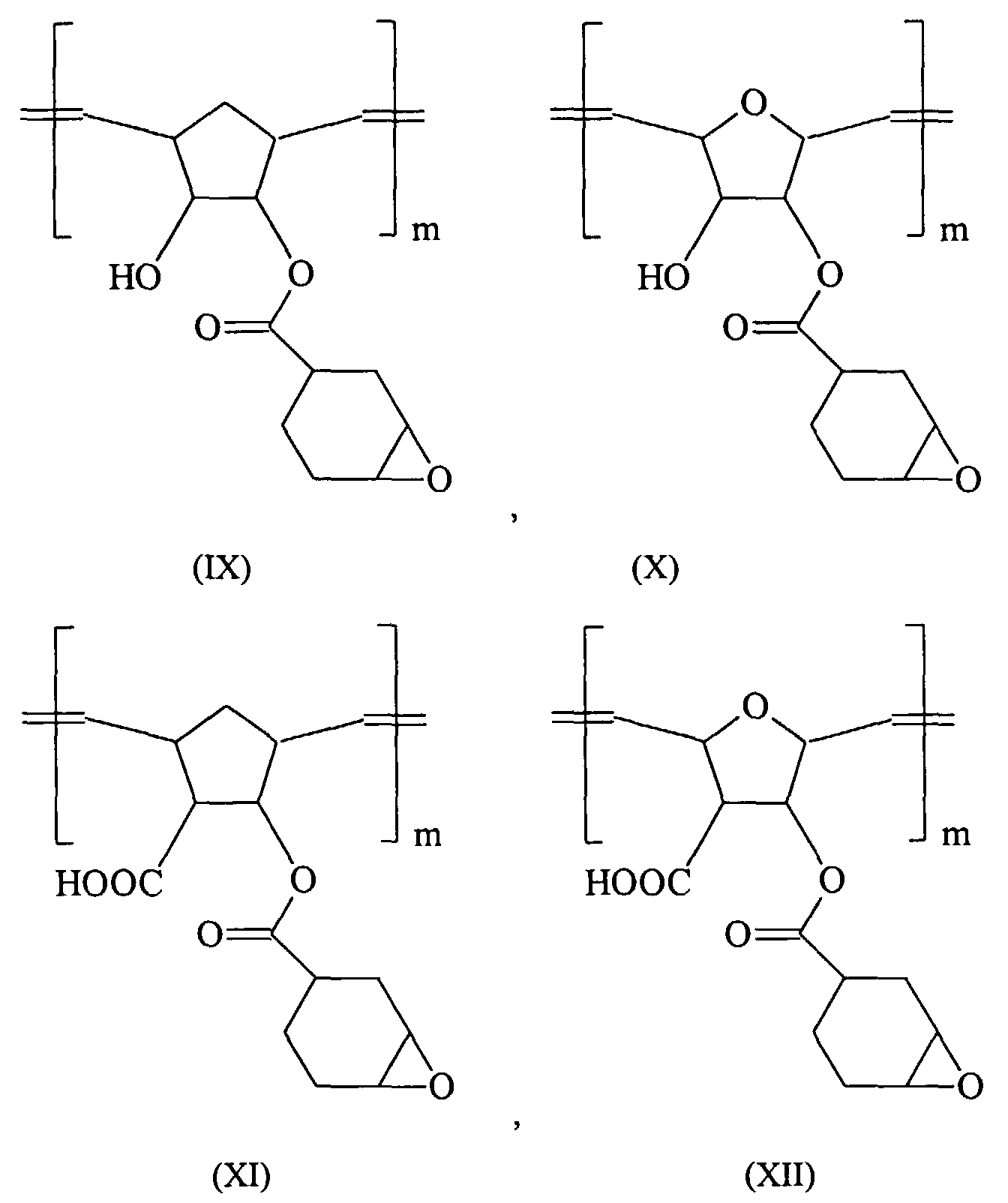
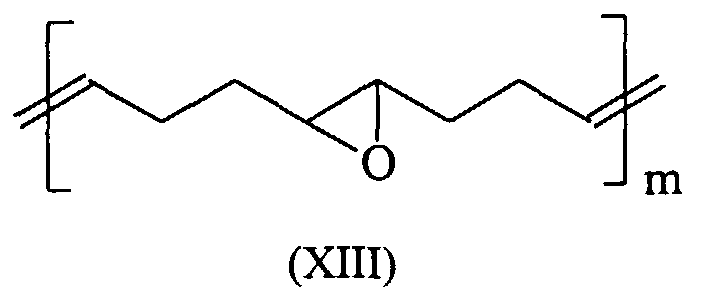
Die Synthese der Verbindungen (IX) bis (XII) kann dabei wieder aus den entsprechenden
Vorstufen wie in
Die kationisch polymerisierbaren Verbindungen gemäß Formeln (I) und (II) können ebenfalls entweder alleine oder in Kombination mit epoxyfunktionellen Co-Monomeren eingesetzt werden. Besonders bevorzugte epoxyfunktionalisierte Co-Monomere sind das in DE-A-196 48 283 offenbarte 3,4-Epoxycyclohexylmethyl-3',4'-epoxycyclohexylcarboxylat und Tetrakis-[3,4-epoxycyclohexylethyl]-tetramethyltetracyclosiloxan.The cationically polymerizable compounds according to formulas (I) and (II) can also either alone or in combination with epoxy-functional co-monomers. Particularly preferred epoxy-functionalized co-monomers are those in DE-A-196 48 283 disclosed 3,4-epoxycyclohexylmethyl-3 ', 4'-epoxycyclohexylcarboxylate and tetrakis [3,4-epoxycyclohexylethyl] tetramethyltetracyclosiloxane.
Zur Aushärtung dieser epoxyfunktionalisierten Monomeren, Oligomeren bzw. Polymeren werden gemäß Bestandteil (c) Kationenbildner eingesetzt. Als Kationenbildner verwendet werden können Säurebildner wie z.B. Lewis oder Broensted-Säuren bzw. Verbindungen, die solche Säuren freisetzen, welche die kationische Polymerisation initiieren, beispielsweise BF3 oder dessen etherische Addukte (BF3*THF, BF3*Et2O, etc.), AlCl3, FeCl3, HPF6, HAsF6, HSbF6, HBF4 oder Substanzen, die nach Bestrahlen durch UV oder sichtbares Licht oder durch Wärme und/oder Druck die Polymerisation auslösen, wie z.B. (eta-6-Cumol)(eta-5-cyclopentadienyl)eisen-hexafluorophosphat, (eta-6-Cumol)(eta-5-cyclopentadienyl)eisen-tetrafluoroborat, (eta-6-Cumol)(eta-5-cyclopentadienyl)eisen-hexafluoroantimonat, substituierte Diaryliodoniumsalze und Triarylsulfonium-Salze, verwendet. Als Beschleuniger können Peroxyverbindungen vom Typ der Perester, der Diacylperoxide, der Peroxydicarbonate und der Hydroperoxide eingesetzt werden. Bevorzugt werden Hydroperoxide verwendet, als besonders bevorzugter Beschleuniger kommt Cumolhydroperoxid in etwa 70-90 %iger Lösung in Cumol zum Einsatz. Das Verhältnis vom Photoinitiator zum Cumolhydroperoxid kann in weiten Grenzen von 1 : 0,001 bis 1 : 10 variiert werden, vorzugsweise wird jedoch ein Verhältnis von 1 : 0,1 bis 1 : 6 und besonders bevorzugt von 1 : 0,5 bis 1 : 4 verwendet. Die Verwendung von Komplexbildnern, wie beispielsweise Oxalsäure, 8-Hydroxychinolin, Ethylendiamintetraessigsäure und aromatischen Polyhydroxyverbindungen ist ebenfalls möglich. Als Verzögerer können Basen, typischenweise tertiäre Amine, zugesetzt werden. In accordance with component (c), cation formers are used to cure these epoxy-functionalized monomers, oligomers or polymers. Acid formers such as Lewis or Broensted acids or compounds which release those acids which initiate the cationic polymerization, for example BF 3 or its ethereal adducts (BF 3 * THF, BF 3 * Et 2 O, etc.) can be used as cation formers. ), AlCl 3 , FeCl 3 , HPF 6 , HAsF 6 , HSbF 6 , HBF 4 or substances that trigger the polymerization after exposure to UV or visible light or by heat and / or pressure, such as (eta-6-cumene) (eta-5-cyclopentadienyl) iron hexafluorophosphate, (eta-6-cumene) (eta-5-cyclopentadienyl) iron tetrafluoroborate, (eta-6-cumene) (eta-5-cyclopentadienyl) iron hexafluoroantimonate, substituted diaryl iodonium Triarylsulfonium salts used. Peroxy compounds of the perester, diacyl peroxide, peroxydicarbonate and hydroperoxide type can be used as accelerators. Hydroperoxides are preferably used, and cumene hydroperoxide in approximately 70-90% solution in cumene is used as a particularly preferred accelerator. The ratio of photoinitiator to cumene hydroperoxide can be varied within wide limits from 1: 0.001 to 1:10, but preferably a ratio of 1: 0.1 to 1: 6 and particularly preferably from 1: 0.5 to 1: 4 is used . The use of complexing agents such as oxalic acid, 8-hydroxyquinoline, ethylenediaminetetraacetic acid and aromatic polyhydroxy compounds is also possible. Bases, typically tertiary amines, can be added as retarders.
Geeignete Füllstoffe, welche in Verbindung mit den ethylenisch ungesättigten bzw. den epoxyfunktionalisierten Oligomeren oder Polymeren gemäß Bestandteil (b) eingesetzt werden können, sind in der Regel anorganische Füllstoffe. Beispielhaft genannt seien Quarz, gemahlene Gläser, Kieselgele sowie pyrogene Kieselsäuren oder deren Granulate. Bevorzugt werden röntgenopake Füllstoffe, zumindest teilweise, mit eingesetzt. Diese können zum einen röntgenopake Gläser sein, also Gläser, welche z.B. Strontium, Barium oder Lanthan enthalten, oder ein Teil der Füllkörper besteht aus einem röntgenopaken Zusatz, wie beispielsweise Yttriumtrifluorid, Strontiumhexafluorozirkonat oder Fluoriden der Selten-Erdmetalle. Zum besseren Einbau in die Polymermatrix ist es von Vorteil, die anorganischen Füllstoffe zu hydrophobieren. Übliche Hydrophobierungsmittel sind Silane, beispielsweise Trimethoxymethacryloyloxypropylsilan, oder Trimethoxyglycidylsilan. Die Füllkörper haben vorzugsweise eine mittlere Kornverteilung <20 µm und insbesondere <5 µm sowie eine obere Korngrenze von 150, vorzugsweise 70 µm und insbesondere 25 µm. Besonders bevorzugt werden Gemische von 5-25 Gew.-% Füllstoffe mit einer mittleren Korngröße von 0,02 - 0,06 µm und 65-85 Gew.-% Füllkörper mit einer mittleren Korngröße von 1-5 µm verwendet.Suitable fillers, which in connection with the ethylenically unsaturated or epoxy-functionalized oligomers or polymers according to component (b) are used are usually inorganic fillers. Examples include quartz, ground Glasses, silica gels and pyrogenic silicas or their granules. To be favoured X-ray opaque fillers, at least partially, are also used. These can be radiopaque Be glasses, i.e. glasses which e.g. Contain strontium, barium or lanthanum, or a Part of the packing consists of an X-ray opaque additive, such as yttrium trifluoride, Strontium hexafluorozirconate or fluorides of rare earth metals. For better installation in the Polymer matrix, it is advantageous to hydrophobize the inorganic fillers. Usual Water repellents are silanes, for example trimethoxymethacryloyloxypropylsilane, or Trimethoxyglycidylsilane. The fillers preferably have an average particle size distribution <20 µm and in particular <5 µm and an upper grain limit of 150, preferably 70 µm and especially 25 µm. Mixtures of 5-25% by weight of fillers are particularly preferred an average grain size of 0.02 - 0.06 µm and 65-85 wt .-% packing with an average Grain size of 1-5 µm used.
Verbindungen der allgemeinen Formeln (I) und (II), welche durch eine Zementreaktion abbinden, enthalten vorzugsweise freie Carboxylgruppen. Bislang werden z.B für die sog. Glasionomerzemente Polycarbonsäuren verwendet, denen als Monomere Acrylsäure, Methacrylsäure, Maleinsäure, Fumarsäure oder Itaconsäure zu Grunde liegen. Nachteilig an Zementen die mit solchen Polycarbonsäuren abbinden ist, daß sie im Vergleich zu anderen dentalen Füllungsmaterialien nur sehr schlechte Biegefestigkeitswerte aufweisen. Eine Ursache hierfür wird in der hohen Flexibiltät der Polycarbonsäureketten gesehen, die zu keiner genügenden Steiffigkeit des ausgehärteten Materials führen. Versuche die Carboxyl-Gruppendichte pro Monomereinheit zu steigern führen meist zu Polymeren, welche für die Anwendung in einem Zementsystem nicht mehr genügend wasserlöslich sind.Compounds of the general formulas (I) and (II) which set by means of a cement reaction, preferably contain free carboxyl groups. So far, e.g. for the so-called glass ionomer cements Polycarboxylic acids used as the monomers acrylic acid, methacrylic acid, maleic acid, Fumaric acid or itaconic acid are the basis. A disadvantage of cements with such The setting of polycarboxylic acids is that they only compared to other dental filling materials have very poor flexural strength values. One reason for this is the high flexibility seen the polycarboxylic acid chains, which do not provide sufficient rigidity of the cured Material. Attempts to increase the carboxyl group density per monomer unit lead mostly to polymers, which are no longer sufficient for use in a cement system are water soluble.
Durch ROMP lassen sich aus 5,6-Carboxyl-substituierten Norbornenen literaturbekannte Polymersäuren herstellen, die in ihrer Polymerkette gemäß den Formeln (I) und (II) eine C-C-Doppelbindung und einen gesättigten Fünfring aufweisen. Diese Polymersäuren weisen ein Molgewicht pro Carbonylgruppe von 105-107 g/Mol auf und sind überraschenderweise trotz ihrer deutlich niedrigeren Carboxyl-Gruppendichte, verglichen mit herkömmlichen Polymersäuren, sehr gut wasserlöslich. Darüber hinaus binden diese durch ROMP gewonnenen Polymersäuren mit säurelöslichen Glaspulvern unter Zementbildung ab. Zudem bieten diese Säuren die Möglichkeit durch Folgereaktionen weiter modifiziert zu werden. So kann beispielsweise die Kettenlänge dieser Moleküle durch oxidative Spaltung gemäß dem folgenden Schema dem jeweiligen Anwendungsbedürfnis angepasst werden. ROMP can be used to produce 5,6-carboxyl-substituted norbornenes from polymeric acids known in the literature which have a CC double bond and a saturated five-membered ring in their polymer chain according to formulas (I) and (II). These polymer acids have a molecular weight per carbonyl group of 105-107 g / mol and are surprisingly very water-soluble in spite of their significantly lower carboxyl group density compared to conventional polymer acids. In addition, these polymer acids obtained by ROMP bind with acid-soluble glass powders with the formation of cement. In addition, these acids offer the possibility of further modification through subsequent reactions. For example, the chain length of these molecules can be adapted to the respective application requirement by oxidative cleavage according to the following scheme.
Besonders bevorzugte Verbindungen die in Zementen eingesetzt werden können sind in den
Formeln (XIV) bis (XXIV) dargestellt (mit m 1000 bis 3000):
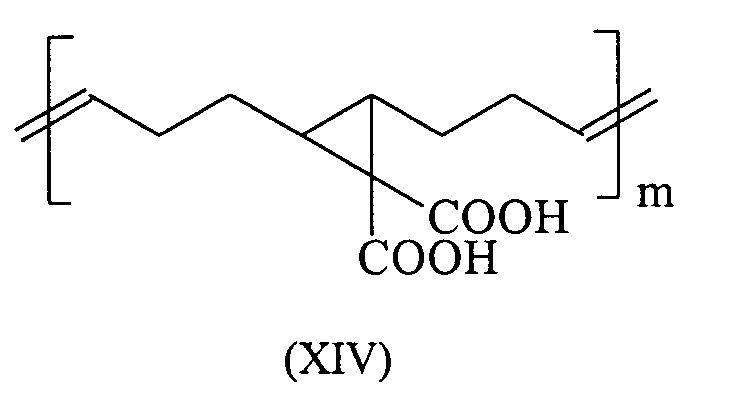
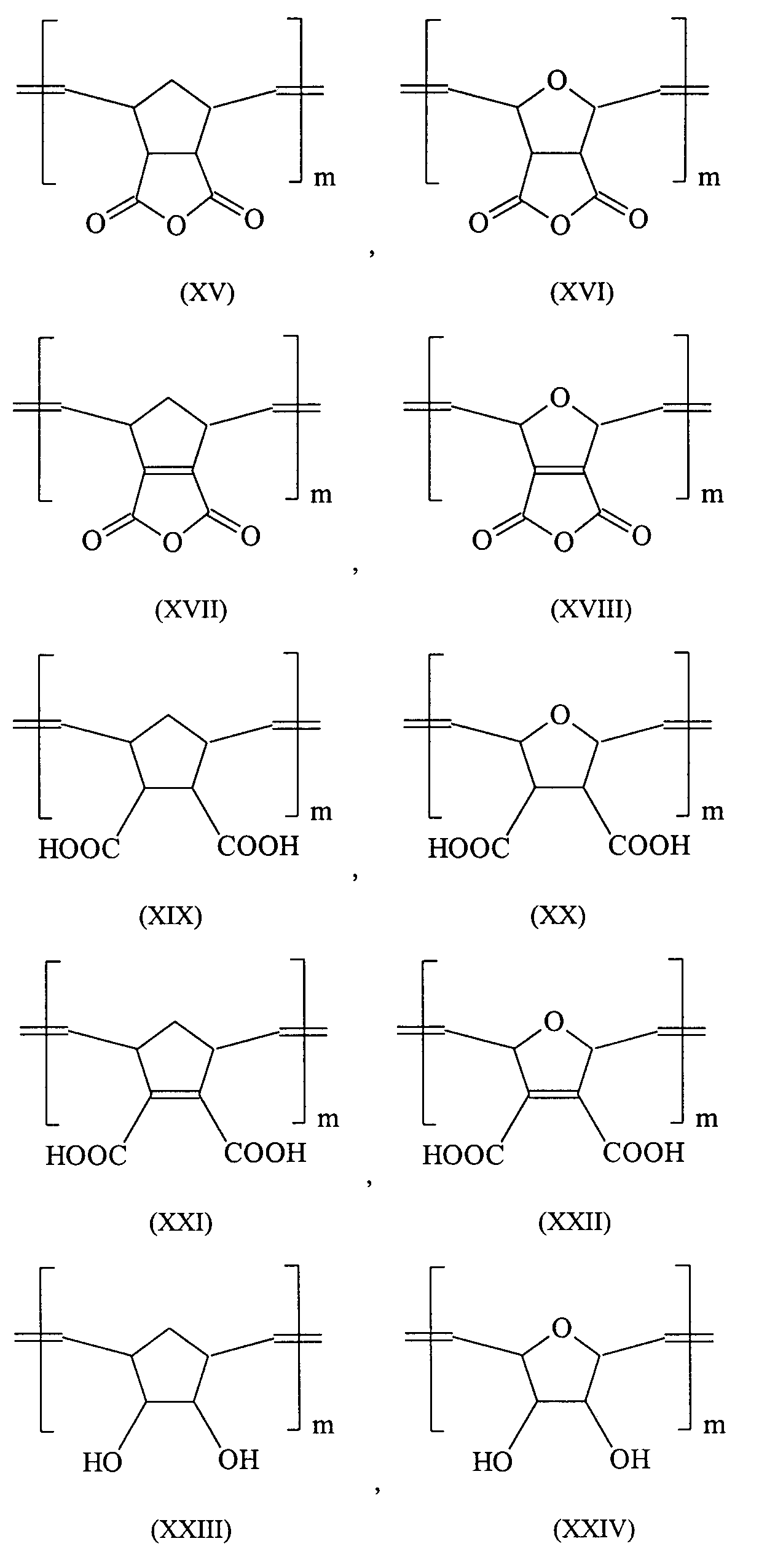
Die Verbindung (XIV) kann gemäß den Angaben aus A. Demonceau et al. in Macromolecules
(1997), 30 Seiten 3127 bis 3136 hergestellt werden. Die Synthese der Verbindungen (XV) bis
(XXIV) kann dabei wieder aus den entsprechenden Vorstufen wie in
Zur Verwendung in Dentalmassen können die hier beschriebenen Polymersäuren entweder alleine oder in Kombination mit bekannten und für Zemente bereits eingesetzten Säuren eingebracht werden. Solche Säuren sind beispielhaft in der DE-A-2 101 889 beschrieben.For use in dental materials, the polymer acids described here can either be used alone or in combination with known acids already used for cements. Such acids are described by way of example in DE-A-2 101 889.
Als säurelösliche Pulver gemäß Bestandteil (b) können herkömmliche Silikatzementpulver verwendet
werden, wie sie ebenfalls in der DE-A-2 101 889 beschrieben sind. Besonders vorteilhaft
ist jedoch die Verwendung von Calcium-aluminium-fluoro-silikatglaspulvem, die in der
DE-A-2 061 513 beschrieben sind. Geeignete Silikatzementpulver sind ausserdem in
Die Dentalzemente werden gewöhnlich in Form eines Zweikomponentensystems angewendet, welches aus einer flüssigen und einer pulverförmigen Komponente besteht. Die erfindungsgemäßen Oligomer- bzw. Polymersäuren können gemäß einer Ausführungsform i) der Erfindung Teil der Anrührflüssigkeit und gemäß einer anderen Ausführungsform ii) Teil der Pulverkomponente sein:The dental cements are usually applied in the form of a two-component system, which consists of a liquid and a powdery component. The invention Oligomeric or polymeric acids can, according to one embodiment i) of the invention Part of the mixing liquid and, according to another embodiment ii) part of the powder component be:
In dem zuerst genannten Fall (i) besteht die Anrührflüssigkeit aus einer wässrigen Lösung der vorstehend definierten Oligomer- bzw. Polymer-Säuren sowie von herkömmlichen Polymersäuren und gegebenenfalls üblichen Zusätzen. Die säurehaltigen Monomere liegen im allgemeinen in einer Konzentration von mindestens 20 %, meist 30 bis 60 Gew.-%, insbesondere 40 bis 50 Gew.-% in der wässrigen Lösung vor, wenn das Zementsystem als Zahnfüllzement bestimmt ist. Für Befestigungszemente und prothetische Zwecke sind bereits niedrigere Konzentrationen vorteilhaft. Die wässrigen Lösungen sollten Viskositäten von mindestens 0,5 Poise, jedoch höchstens 300 Poise haben. Ein bevorzugter Viskositätsbereich liegt zwischen 2 und 200, insbesondere zwischen 5 und 100 Poise (bei 25°C).In the first case (i), the mixing liquid consists of an aqueous solution of Oligomeric or polymeric acids as defined above, and of conventional polymeric acids and, if necessary, customary additives. The acidic monomers are generally in a concentration of at least 20%, usually 30 to 60% by weight, in particular 40 to 50 % By weight in the aqueous solution if the cement system is intended as dental filling cement. Lower concentrations are advantageous for cementation and prosthetic purposes. The aqueous solutions should have viscosities of at least 0.5 poise, but at most Have 300 poise. A preferred viscosity range is between 2 and 200, in particular between 5 and 100 poise (at 25 ° C).
Es ist üblich, Dentalzemente prädosiert in sogenannten Schüttelkapseln zu vertreiben. In diesen werden Flüssigkeit und Pulver in zwei getrennten Kammern vorgesehen und unmittelbar vor Gebrauch vereinigt und mechanisch gemischt. Diese Prädosierung ist auch auf die erfindungsgemäßen Dentalmassen anwendbar.It is common to distribute dental cements in so-called shake capsules. In these liquid and powder are provided in two separate chambers and immediately before Combined use and mechanically mixed. This prediction is also based on the invention Dental materials applicable.
Gemäß der weiteren vorteilhaften Ausführungsform (ii) der Erfindung ist die Anmischkomponente der Dentalzemente, d. h. die Oligomer- bzw. Polymer-Säuren gemäß Bestandteil (a), Bestandteil des Pulvergemisches und liegt als Vormischung aus Glaspulver und säurefunktionellen Oligomeren bzw. Polymeren vor. Die Anmischkomponente kann dann einfach mit Wasser, gegebenenfalls mit den übliche Zusätzen angemischt werden.According to the further advantageous embodiment (ii) of the invention, the mixing component dental cements, d. H. the oligomer or polymer acids according to component (a), Part of the powder mixture and is a premix of glass powder and acid-functional Oligomers or polymers before. The mixing component can then simply with Water, if necessary mixed with the usual additives.
Zwischen beiden Ausführungsformen i) und ii) sind fließende Übergänge möglich: So können z.B. die Oligomer- und Polymer-Säuren je zur Hälfte der flüssigen und der pulverförmigen Anmischkomponente zugesetzt werden.Smooth transitions are possible between the two embodiments i) and ii): e.g. the oligomer and polymer acids each half of the liquid and half the powder Mixing component are added.
Auch bei der Ausführungsform ii) kann es zweckmäßig sein, sie prädosiert in Schüttelkapseln vorzusehen und zu vertreiben. Es kann auch besonders vorteilhaft sein, das Pulvergemisch zu einer Tablette zu verpressen.In embodiment ii), too, it can be expedient to predose it in shaking capsules to provide and distribute. It can also be particularly advantageous to add the powder mixture to compress a tablet.
Neben der Anwendung in Dentalzementen können die Verbindungen XIV bis XXIV auch als Adhäsivvermittler in sogenannten Bondingzusammensetzungen verwendet werden. Diese sind entweder ungefüllt (0 Gew.-% an Komponente (b)) oder niedrig gefüllt (5 bis 30 Gew.-% an Komponente (b)).In addition to use in dental cements, the compounds XIV to XXIV can also be used as Adhesive agents are used in so-called bonding compositions. These are either unfilled (0% by weight of component (b)) or low filled (5 to 30% by weight of Component (b)).
Geeignete Hilfsstoffe gemäß Komponente (d) können beispielsweise üblicherweise auf dem Dentalgebiet eingesetzte Stabilisatoren, Pigmente oder Verdünnungsmittel sein. Im Falle der zementabbindenden Systeme können sowohl der Pulver- als auch der flüssigen Komponente Chelatbildner zugesetzt werden, vorzugsweise Weinsäure, um die Aushärtecharakteristik zu verbessern [s. DE-A-2 319 715].Suitable auxiliaries according to component (d) can, for example, usually on the Stabilizers, pigments or diluents used in the dental field. In case of cement-setting systems can use both the powder and the liquid component Chelating agents are added, preferably tartaric acid, to increase the curing characteristics improve [s. DE-A-2 319 715].
Die erfindungsgemäßen Dentalmassen eigenen sich zur Herstellung von Füllungsmaterialien, Befestigungszementen, Inlays, Onlays, Verblendschalen, provisorischen Kronen- und Brückenmaterialien, zahntechnischen Werkstoffen sowie Abformmaterialien.The dental compositions according to the invention are suitable for the production of filling materials, Fastening cements, inlays, onlays, veneers, provisional crown and bridge materials, dental materials and impression materials.
Im Folgenden soll die Erfindung durch Beispiele näher erläutert werden. The invention is to be explained in more detail below by means of examples.
30 g Exo-7-oxabicyclo[2.2.1]-hept-5-en-2,3-dicarbonsäureanhydrid werden zusammen mit einer Lösung aus K2[RuCl5]*xH2O in 105 g Wasser auf 60°C unter Rühren erwärmt. Nach etwa 45 Minuten entsteht eine klare hochviskose Lösung. Diese wird auf 90°C erwärmt und innerhalb von einer Stunde tropfenweise mit insgesamt 10,0 g 30 %-iger Wasserstoffperoxidlösung versetzt. Anschließend wird die Lösung bis zur Trockne eingeengt und mit Wasser auf etwa 50 % verdünnt.30 g of exo-7-oxabicyclo [2.2.1] -hept-5-en-2,3-dicarboxylic acid anhydride are mixed with a solution of K 2 [RuCl 5 ] * xH 2 O in 105 g of water at 60 ° C. with stirring warmed up. After about 45 minutes, a clear, highly viscous solution is formed. This is heated to 90 ° C. and a total of 10.0 g of 30% hydrogen peroxide solution are added dropwise within one hour. The solution is then evaporated to dryness and diluted to about 50% with water.
200 mg der wässrigen Lösung aus Beispiel 1 werden mit 200 mg einer wässrigen Polycarbonsäurelösung (CHELON-FIL-Flüssigkeit, Fa. ESPE, Seefeld) vermischt. Diese Mischung wird mit 1,2 g reaktivem Glaspulver (CHELON-FIL-Pulver, Fa. ESPE, Seefeld) zu einer Paste angespatelt. Zur Bestimmung der Druck- und Biegefestigkeitswerte wird der frisch angemischte Zement in die entsprechenden Prüfkörperformen eingebracht und verbleibt dort bis zum Abbindeende (ca. 5 Minuten). Anschließend werden die Prüfkörper entformt und an einer Zwick-Universal-Prüfmaschine entsprechend der Norm ISO-Norm 4049 bzw. der ISO-Norm 9917 vermessen. Die Ergebnisse der Materialprüfung sind Tabelle 1 zu entnehmen.200 mg of the aqueous solution from Example 1 are mixed with 200 mg of an aqueous Polycarboxylic acid solution (CHELON-FIL liquid, ESPE, Seefeld) mixed. This mix becomes a paste with 1.2 g reactive glass powder (CHELON-FIL powder, ESPE, Seefeld) spat on. The freshly mixed is used to determine the compressive and flexural strength values Cement introduced into the corresponding test specimen shapes and remains there until End of setting (approx. 5 minutes). The test specimens are then removed from the mold and on a Zwick universal testing machine according to the ISO standard 4049 or ISO standard 9917 measured. The results of the material test are shown in Table 1.
30g Exo-7-oxabicyclo[2.2.1]-hept-5-en-2,3-dicarbonsäureanhydrid werden in 23,5 g Hydroxethylenmethacrylat (HEMA) gelöst und 10 Stunden gerührt. Anschließend wird mit einer Lösung aus 105 g Wasser und K2[RuCl5]*xH2O (c= 140mg/ml) aufgenommen und unter Rühren auf 60°C erwärmt. Nach etwa 45 Minuten entsteht eine klare hochviskose Lösung, welche für mehre Stunden am Hochvakuum getrocknet wird. Anschließend wird der zähfließende Rückstand mit 10 g Triethylenglykoldimethacrylat (TEGDMA) verdünnt. 10 g dieser Mischung werden mit 10 g Bis-(hydroxymethyl)tricyclo[5.2.1.02,6]-decandiacrylsäureester und 0,07 g Campherchinon gemischt und anschließend mit 0,5 g hochdispersem Siliciumdioxid (Aerosil OX50, Fa. Degussa) sowie 79,5 g feingemahlenem Quarzpulver zu einer homogenen Paste verknetet. Zur Bestimmung der Druck- und Biegefestigkeitswerte wird die Paste in die entsprechenden Prüfkörperformen eingebracht und entsprechend den Angaben der ISO-Norm 4049 bzw. der ISO-Norm 9917 belichtet. Die Bestimmung des Volumenschrumpfes erfolgt durch Linometermessung. Die Ergebnisse der Materialprüfüng sind Tabelle 2 zu entnehmen.30 g of exo-7-oxabicyclo [2.2.1] -hept-5-en-2,3-dicarboxylic acid anhydride are dissolved in 23.5 g of hydroxyethylene methacrylate (HEMA) and stirred for 10 hours. It is then taken up in a solution of 105 g of water and K 2 [RuCl 5 ] * xH 2 O (c = 140 mg / ml) and heated to 60 ° C. with stirring. After about 45 minutes, a clear, highly viscous solution is formed, which is dried under high vacuum for several hours. The viscous residue is then diluted with 10 g of triethylene glycol dimethacrylate (TEGDMA). 10 g of this mixture are mixed with 10 g bis (hydroxymethyl) tricyclo [5.2.1.0 2,6 ] decanediacrylic acid ester and 0.07 g camphorquinone and then with 0.5 g highly disperse silicon dioxide (Aerosil OX50, from Degussa) and 79 , 5 g finely ground quartz powder kneaded into a homogeneous paste. To determine the compressive and flexural strength values, the paste is introduced into the corresponding test specimen shapes and exposed in accordance with the specifications of ISO standard 4049 and ISO standard 9917. The volume shrinkage is determined by linometer measurement. The results of the material test are shown in Table 2.
10 g des Polymers welches aus Monomer 9 des Literaturzitates A. Demonceau, A.W. Stumpf, E.
Saive, A.F. Noels; Macromolecules (1997), 30 3127-3136 durch ROMP erhältlich ist, wird mit 10
g 3,4-Epoxycyclohexylmethyl-3',4'-epoxycyclohexylcarboxylat, 0,8 g Ferroceniumhexafluorantimonat
und 0,9 g Cumolhydroperoxid gemischt und anschließend mit 0,5 g hochdispersem
Siliciumdioxid (Aerosil OX50, Fa. Degussa) sowie 79,5 g feingemahlenem Quarzpulver zu einer
homogenen Paste verknetet. Zur Bestimmung der Druck- und Biegefestigkeitswerte wird die
Paste in die entsprechenden Prüf-körperformen eingebracht und entsprechend den Angaben der
ISO-Norm 4049 bzw. der ISO-Norm 9917 belichtet. Die Bestimmung des Volumenschrumpfes
erfolgt durch Linometermessung. Die Ergebnisse der Materialprüfung sind Tabelle 3 zu entnehmen.
Claims (11)


Applications Claiming Priority (2)
| Application Number | Priority Date | Filing Date | Title |
|---|---|---|---|
| DE19742980 | 1997-09-29 | ||
| DE19742980A DE19742980A1 (en) | 1997-09-29 | 1997-09-29 | Dental compositions based on ROMP oligomers or polymers |
Publications (3)
| Publication Number | Publication Date |
|---|---|
| EP0904767A2 true EP0904767A2 (en) | 1999-03-31 |
| EP0904767A3 EP0904767A3 (en) | 2004-02-04 |
| EP0904767B1 EP0904767B1 (en) | 2005-12-14 |
Family
ID=7844000
Family Applications (1)
| Application Number | Title | Priority Date | Filing Date |
|---|---|---|---|
| EP98118366A Expired - Lifetime EP0904767B1 (en) | 1997-09-29 | 1998-09-29 | Dental materials based on oligomers or polymers obtained by ring-opening metathesis polymerization |
Country Status (5)
| Country | Link |
|---|---|
| US (1) | US6147136A (en) |
| EP (1) | EP0904767B1 (en) |
| JP (1) | JPH11158022A (en) |
| AU (1) | AU736342B2 (en) |
| DE (2) | DE19742980A1 (en) |
Cited By (3)
| Publication number | Priority date | Publication date | Assignee | Title |
|---|---|---|---|---|
| US6395851B1 (en) | 2000-06-09 | 2002-05-28 | Eastman Chemical Company | Copolymerization of norbornene and functional norbornene monomers |
| US7538172B2 (en) | 2004-06-30 | 2009-05-26 | Ivoclar Vivadent Ag | Dental materials polymerizable by photo-induced ring-opening metathesis polymerization of cyclic olefins |
| US7691919B2 (en) | 2004-01-15 | 2010-04-06 | Ivoclar Vivadent Ag | Dental materials based on ROMP composites |
Families Citing this family (19)
| Publication number | Priority date | Publication date | Assignee | Title |
|---|---|---|---|---|
| US6306926B1 (en) * | 1998-10-07 | 2001-10-23 | 3M Innovative Properties Company | Radiopaque cationically polymerizable compositions comprising a radiopacifying filler, and method for polymerizing same |
| DE19905093A1 (en) * | 1999-02-01 | 2000-08-03 | Ivoclar Ag Schaan | Low shrinkage dental materials |
| AU779888B2 (en) * | 1999-02-05 | 2005-02-17 | Materia, Inc. | Polyolefin compositions having variable density and methods for their production and use |
| DE19912251A1 (en) | 1999-03-18 | 2000-09-21 | Espe Dental Ag | Two-component preparations for the manufacture of dental models |
| DE19928238A1 (en) * | 1999-06-21 | 2000-12-28 | Espe Dental Ag | Polymerizable dental composition, useful for e.g. filling, temporary crown or bridge, cement, technical material or facing, contains barbituric acid derivative or malonylsulfamide and peroxycarboxylic ester |
| DE19937093A1 (en) * | 1999-08-06 | 2001-02-08 | Espe Dental Ag | Adhesive system comprising a cationic- and radical initiator and cationically/radically polymerizable component is useful for bonding radically and/or cationically curable materials to teeth |
| DE19937092A1 (en) * | 1999-08-06 | 2001-02-08 | Espe Dental Ag | Adhesive systems I |
| US20030125262A1 (en) * | 2000-03-21 | 2003-07-03 | Wisconsin Alumni Research Foundation | Methods and reagents for regulation of cellular responses in biological systems |
| US20040248801A1 (en) * | 2000-03-21 | 2004-12-09 | Kiessling Laura L. | Methods and reagents for regulation of cellular responses in biological systems |
| US20020045678A1 (en) * | 2000-08-22 | 2002-04-18 | Lopez Larry A. | Dental restorative compositions and method of use thereof |
| US7238122B2 (en) | 2002-08-27 | 2007-07-03 | Acushnet Company | Ormocer composites for golf ball components |
| US6793592B2 (en) * | 2002-08-27 | 2004-09-21 | Acushnet Company | Golf balls comprising glass ionomers, or other hybrid organic/inorganic compositions |
| US7037965B2 (en) * | 2002-08-27 | 2006-05-02 | Acushnet Company | Golf balls comprising glass ionomers, ormocers, or other hybrid organic/inorganic compositions |
| JP2008502781A (en) * | 2004-06-15 | 2008-01-31 | デンツプライ インターナショナル インコーポレーテッド | Radical polymerizable macrocyclic resin composition having low polymerization stress |
| WO2006002086A1 (en) | 2004-06-15 | 2006-01-05 | Dentsply International Inc. | Low shrinkage and low stress dental compositions |
| US8735463B2 (en) * | 2007-05-31 | 2014-05-27 | Creighton University | Self-healing dental composites and related methods |
| DE102013008176A1 (en) | 2012-10-05 | 2014-04-10 | Voco Gmbh | Kit and method for the indirect chairside production of composite inlays |
| EP4175588A4 (en) | 2020-07-06 | 2024-10-16 | Perfect Fit Crowns, LLC | METHOD AND APPARATUS FOR DENTAL CROWN RESTORATIONS USING PREFABRICATED SLEEVE-CROWN PAIRS |
| KR102786311B1 (en) * | 2020-09-29 | 2025-03-24 | 니폰 제온 가부시키가이샤 | Negative photosensitive resin composition |
Family Cites Families (10)
| Publication number | Priority date | Publication date | Assignee | Title |
|---|---|---|---|---|
| US4722948A (en) * | 1984-03-16 | 1988-02-02 | Dynatech Corporation | Bone replacement and repair putty material from unsaturated polyester resin and vinyl pyrrolidone |
| DE3536076A1 (en) * | 1985-10-09 | 1987-04-09 | Muehlbauer Ernst Kg | POLYMERIZABLE CEMENT MIXTURES |
| US4757014A (en) * | 1985-11-08 | 1988-07-12 | Minnesota Mining And Manufacturing Company | Immobilization of biologically active protein on a polymeric fibrous support |
| US5019379A (en) * | 1987-07-31 | 1991-05-28 | Massachusetts Institute Of Technology | Unsaturated polyanhydrides |
| US5539060A (en) * | 1993-07-30 | 1996-07-23 | Nippon Zeon Co., Ltd. | Method for hydrogenation of metathesis polymers |
| AU7692294A (en) * | 1993-09-10 | 1995-03-27 | Ciba-Geigy Ag | Process for the polymerization of cyclic olefins and a polymerizable composition |
| DE19608316C2 (en) * | 1996-02-22 | 2000-11-09 | Ivoclar Ag Schaan | Functionalized bicyclic (meth) acrylates, process for their preparation and their use #### |
| DE19608313C2 (en) * | 1996-02-22 | 2000-08-31 | Ivoclar Ag Schaan | Polymerizable hybrid monomers, processes for their preparation and their use |
| CA2199567C (en) * | 1996-03-20 | 2003-01-14 | Volker Rheinberger | Functionalized and polymerizable polymer |
| DE19616183C2 (en) * | 1996-03-20 | 1999-05-12 | Ivoclar Ag | Functionalized and polymerizable polymer |
-
1997
- 1997-09-29 DE DE19742980A patent/DE19742980A1/en not_active Ceased
-
1998
- 1998-09-29 EP EP98118366A patent/EP0904767B1/en not_active Expired - Lifetime
- 1998-09-29 DE DE59813275T patent/DE59813275D1/en not_active Expired - Lifetime
- 1998-09-29 US US09/162,454 patent/US6147136A/en not_active Expired - Lifetime
- 1998-09-29 AU AU87147/98A patent/AU736342B2/en not_active Ceased
- 1998-09-29 JP JP10275028A patent/JPH11158022A/en active Pending
Cited By (4)
| Publication number | Priority date | Publication date | Assignee | Title |
|---|---|---|---|---|
| US6395851B1 (en) | 2000-06-09 | 2002-05-28 | Eastman Chemical Company | Copolymerization of norbornene and functional norbornene monomers |
| US6512065B2 (en) | 2000-06-09 | 2003-01-28 | Eastman Chemical Company | Copolymers of norbornene and functional norbornene monomers |
| US7691919B2 (en) | 2004-01-15 | 2010-04-06 | Ivoclar Vivadent Ag | Dental materials based on ROMP composites |
| US7538172B2 (en) | 2004-06-30 | 2009-05-26 | Ivoclar Vivadent Ag | Dental materials polymerizable by photo-induced ring-opening metathesis polymerization of cyclic olefins |
Also Published As
| Publication number | Publication date |
|---|---|
| US6147136A (en) | 2000-11-14 |
| EP0904767B1 (en) | 2005-12-14 |
| AU8714798A (en) | 1999-04-15 |
| JPH11158022A (en) | 1999-06-15 |
| EP0904767A3 (en) | 2004-02-04 |
| DE59813275D1 (en) | 2006-01-19 |
| AU736342B2 (en) | 2001-07-26 |
| DE19742980A1 (en) | 1999-04-01 |
Similar Documents
| Publication | Publication Date | Title |
|---|---|---|
| EP0904767B1 (en) | Dental materials based on oligomers or polymers obtained by ring-opening metathesis polymerization | |
| DE19742981B4 (en) | ROMP curable dental materials | |
| EP0897710B1 (en) | Light-initiated cationic curable compositions and their use | |
| DE19818210C2 (en) | Radically polymerizable dental material | |
| DE69533844T2 (en) | Dental mass and procedure | |
| EP0716103B1 (en) | Polymerisable powder composition, flowable under pressure or under shearing | |
| DE60209714T2 (en) | glass ionomer cement | |
| DE69627887T2 (en) | USE OF FLUORINE METAL COMPLEXES IN DENTAL SIZES | |
| EP4205723A1 (en) | High transparency, sulphate-containing or phosphate-containing dental self-adhering composite | |
| EP0879257A1 (en) | Polymerizable substances based on epoxides | |
| EP0238025A2 (en) | X-ray opaque polymerisable dental materials | |
| DE3117006A1 (en) | CEMENT MEASUREMENT AND THEIR USE FOR THE PRODUCTION OF A DENTAL MATERIAL | |
| DE69621500T2 (en) | Polymerizable composition | |
| EP3692974B1 (en) | Dental materials with improved mechanical characteristics | |
| EP3659575A1 (en) | Photopolymerisable dental composites with fast curing and low shrinkage stress | |
| DE102009058638A1 (en) | Multi-component system for producing a dental material | |
| EP4346743A1 (en) | Monomer mixture for producing a dental material | |
| EP2198824B1 (en) | Polymerizable dental material with initiator system | |
| DE19919581A1 (en) | Dental materials, methods for their curing and their use | |
| EP1200036B1 (en) | Adhesive systems | |
| EP3692975A1 (en) | Dental materials with improved setting | |
| EP1206235B1 (en) | Use of a composition for the manufacturing of adhesive systems | |
| EP4032521B1 (en) | Dental material for the production of temporary crowns and bridges | |
| EP1951183B1 (en) | Restoring materials containing nanocrystalline earth alkaline fillers | |
| DE102023111186A1 (en) | Radically polymerizable compound and composition |
Legal Events
| Date | Code | Title | Description |
|---|---|---|---|
| PUAI | Public reference made under article 153(3) epc to a published international application that has entered the european phase |
Free format text: ORIGINAL CODE: 0009012 |
|
| AK | Designated contracting states |
Kind code of ref document: A2 Designated state(s): AT BE CH CY DE DK ES FI FR GB GR IE IT LI LU MC NL PT SE |
|
| AX | Request for extension of the european patent |
Free format text: AL;LT;LV;MK;RO;SI |
|
| RAP1 | Party data changed (applicant data changed or rights of an application transferred) |
Owner name: 3M ESPE AG |
|
| PUAL | Search report despatched |
Free format text: ORIGINAL CODE: 0009013 |
|
| AK | Designated contracting states |
Kind code of ref document: A3 Designated state(s): AT BE CH CY DE DK ES FI FR GB GR IE IT LI LU MC NL PT SE |
|
| AX | Request for extension of the european patent |
Extension state: AL LT LV MK RO SI |
|
| 17P | Request for examination filed |
Effective date: 20040120 |
|
| 17Q | First examination report despatched |
Effective date: 20040331 |
|
| AKX | Designation fees paid |
Designated state(s): CH DE FR GB IT LI |
|
| GRAP | Despatch of communication of intention to grant a patent |
Free format text: ORIGINAL CODE: EPIDOSNIGR1 |
|
| GRAS | Grant fee paid |
Free format text: ORIGINAL CODE: EPIDOSNIGR3 |
|
| GRAA | (expected) grant |
Free format text: ORIGINAL CODE: 0009210 |
|
| AK | Designated contracting states |
Kind code of ref document: B1 Designated state(s): CH DE FR GB IT LI |
|
| PG25 | Lapsed in a contracting state [announced via postgrant information from national office to epo] |
Ref country code: IT Free format text: LAPSE BECAUSE OF FAILURE TO SUBMIT A TRANSLATION OF THE DESCRIPTION OR TO PAY THE FEE WITHIN THE PRESCRIBED TIME-LIMIT;WARNING: LAPSES OF ITALIAN PATENTS WITH EFFECTIVE DATE BEFORE 2007 MAY HAVE OCCURRED AT ANY TIME BEFORE 2007. THE CORRECT EFFECTIVE DATE MAY BE DIFFERENT FROM THE ONE RECORDED. Effective date: 20051214 |
|
| REG | Reference to a national code |
Ref country code: GB Ref legal event code: FG4D Free format text: NOT ENGLISH |
|
| REG | Reference to a national code |
Ref country code: CH Ref legal event code: EP |
|
| REG | Reference to a national code |
Ref country code: CH Ref legal event code: NV Representative=s name: E. BLUM & CO. PATENTANWAELTE |
|
| REF | Corresponds to: |
Ref document number: 59813275 Country of ref document: DE Date of ref document: 20060119 Kind code of ref document: P |
|
| GBT | Gb: translation of ep patent filed (gb section 77(6)(a)/1977) |
Effective date: 20060228 |
|
| ET | Fr: translation filed | ||
| PLBE | No opposition filed within time limit |
Free format text: ORIGINAL CODE: 0009261 |
|
| STAA | Information on the status of an ep patent application or granted ep patent |
Free format text: STATUS: NO OPPOSITION FILED WITHIN TIME LIMIT |
|
| 26N | No opposition filed |
Effective date: 20060915 |
|
| REG | Reference to a national code |
Ref country code: CH Ref legal event code: PFA Owner name: 3M ESPE AG Free format text: 3M ESPE AG#ESPE PLATZ#82229 SEEFELD (DE) -TRANSFER TO- 3M ESPE AG#ESPE PLATZ#82229 SEEFELD (DE) |
|
| PGFP | Annual fee paid to national office [announced via postgrant information from national office to epo] |
Ref country code: GB Payment date: 20100929 Year of fee payment: 13 |
|
| REG | Reference to a national code |
Ref country code: CH Ref legal event code: PFUS Owner name: 3M DEUTSCHLAND GMBH, DE Free format text: FORMER OWNER: 3M ESPE AG, DE |
|
| GBPC | Gb: european patent ceased through non-payment of renewal fee |
Effective date: 20110929 |
|
| REG | Reference to a national code |
Ref country code: DE Ref legal event code: R081 Ref document number: 59813275 Country of ref document: DE Owner name: 3M DEUTSCHLAND GMBH, DE Free format text: FORMER OWNER: 3M ESPE AG, 82229 SEEFELD, DE Effective date: 20120514 |
|
| REG | Reference to a national code |
Ref country code: FR Ref legal event code: TP Owner name: 3M DEUTSCHLAND GMBH, DE Effective date: 20120709 |
|
| PG25 | Lapsed in a contracting state [announced via postgrant information from national office to epo] |
Ref country code: GB Free format text: LAPSE BECAUSE OF NON-PAYMENT OF DUE FEES Effective date: 20110929 |
|
| REG | Reference to a national code |
Ref country code: FR Ref legal event code: PLFP Year of fee payment: 18 |
|
| PGFP | Annual fee paid to national office [announced via postgrant information from national office to epo] |
Ref country code: FR Payment date: 20150629 Year of fee payment: 18 |
|
| REG | Reference to a national code |
Ref country code: FR Ref legal event code: ST Effective date: 20170531 |
|
| PG25 | Lapsed in a contracting state [announced via postgrant information from national office to epo] |
Ref country code: FR Free format text: LAPSE BECAUSE OF NON-PAYMENT OF DUE FEES Effective date: 20160930 |
|
| PGFP | Annual fee paid to national office [announced via postgrant information from national office to epo] |
Ref country code: CH Payment date: 20170912 Year of fee payment: 20 |
|
| PGFP | Annual fee paid to national office [announced via postgrant information from national office to epo] |
Ref country code: DE Payment date: 20170927 Year of fee payment: 20 |
|
| REG | Reference to a national code |
Ref country code: DE Ref legal event code: R071 Ref document number: 59813275 Country of ref document: DE |
|
| REG | Reference to a national code |
Ref country code: CH Ref legal event code: PL |