EP0904313B1 - Absolute molecular weight polymers and methods for their use - Google Patents
Absolute molecular weight polymers and methods for their use Download PDFInfo
- Publication number
- EP0904313B1 EP0904313B1 EP96916921A EP96916921A EP0904313B1 EP 0904313 B1 EP0904313 B1 EP 0904313B1 EP 96916921 A EP96916921 A EP 96916921A EP 96916921 A EP96916921 A EP 96916921A EP 0904313 B1 EP0904313 B1 EP 0904313B1
- Authority
- EP
- European Patent Office
- Prior art keywords
- polymer
- mmol
- nmr
- molecular weight
- polymers
- Prior art date
- Legal status (The legal status is an assumption and is not a legal conclusion. Google has not performed a legal analysis and makes no representation as to the accuracy of the status listed.)
- Expired - Lifetime
Links
Classifications
-
- C—CHEMISTRY; METALLURGY
- C08—ORGANIC MACROMOLECULAR COMPOUNDS; THEIR PREPARATION OR CHEMICAL WORKING-UP; COMPOSITIONS BASED THEREON
- C08G—MACROMOLECULAR COMPOUNDS OBTAINED OTHERWISE THAN BY REACTIONS ONLY INVOLVING UNSATURATED CARBON-TO-CARBON BONDS
- C08G73/00—Macromolecular compounds obtained by reactions forming a linkage containing nitrogen with or without oxygen or carbon in the main chain of the macromolecule, not provided for in groups C08G12/00 - C08G71/00
- C08G73/02—Polyamines
-
- A—HUMAN NECESSITIES
- A01—AGRICULTURE; FORESTRY; ANIMAL HUSBANDRY; HUNTING; TRAPPING; FISHING
- A01N—PRESERVATION OF BODIES OF HUMANS OR ANIMALS OR PLANTS OR PARTS THEREOF; BIOCIDES, e.g. AS DISINFECTANTS, AS PESTICIDES OR AS HERBICIDES; PEST REPELLANTS OR ATTRACTANTS; PLANT GROWTH REGULATORS
- A01N33/00—Biocides, pest repellants or attractants, or plant growth regulators containing organic nitrogen compounds
- A01N33/02—Amines; Quaternary ammonium compounds
- A01N33/12—Quaternary ammonium compounds
-
- A—HUMAN NECESSITIES
- A61—MEDICAL OR VETERINARY SCIENCE; HYGIENE
- A61K—PREPARATIONS FOR MEDICAL, DENTAL OR TOILETRY PURPOSES
- A61K31/00—Medicinal preparations containing organic active ingredients
- A61K31/74—Synthetic polymeric materials
- A61K31/785—Polymers containing nitrogen
-
- A—HUMAN NECESSITIES
- A61—MEDICAL OR VETERINARY SCIENCE; HYGIENE
- A61L—METHODS OR APPARATUS FOR STERILISING MATERIALS OR OBJECTS IN GENERAL; DISINFECTION, STERILISATION OR DEODORISATION OF AIR; CHEMICAL ASPECTS OF BANDAGES, DRESSINGS, ABSORBENT PADS OR SURGICAL ARTICLES; MATERIALS FOR BANDAGES, DRESSINGS, ABSORBENT PADS OR SURGICAL ARTICLES
- A61L12/00—Methods or apparatus for disinfecting or sterilising contact lenses; Accessories therefor
- A61L12/08—Methods or apparatus for disinfecting or sterilising contact lenses; Accessories therefor using chemical substances
- A61L12/14—Organic compounds not covered by groups A61L12/10 or A61L12/12
- A61L12/143—Quaternary ammonium compounds
- A61L12/145—Polymeric quaternary ammonium compounds
-
- C—CHEMISTRY; METALLURGY
- C07—ORGANIC CHEMISTRY
- C07C—ACYCLIC OR CARBOCYCLIC COMPOUNDS
- C07C29/00—Preparation of compounds having hydroxy or O-metal groups bound to a carbon atom not belonging to a six-membered aromatic ring
- C07C29/17—Preparation of compounds having hydroxy or O-metal groups bound to a carbon atom not belonging to a six-membered aromatic ring by hydrogenation of carbon-to-carbon double or triple bonds
-
- C—CHEMISTRY; METALLURGY
- C07—ORGANIC CHEMISTRY
- C07C—ACYCLIC OR CARBOCYCLIC COMPOUNDS
- C07C29/00—Preparation of compounds having hydroxy or O-metal groups bound to a carbon atom not belonging to a six-membered aromatic ring
- C07C29/62—Preparation of compounds having hydroxy or O-metal groups bound to a carbon atom not belonging to a six-membered aromatic ring by introduction of halogen; by substitution of halogen atoms by other halogen atoms
-
- C—CHEMISTRY; METALLURGY
- C08—ORGANIC MACROMOLECULAR COMPOUNDS; THEIR PREPARATION OR CHEMICAL WORKING-UP; COMPOSITIONS BASED THEREON
- C08G—MACROMOLECULAR COMPOUNDS OBTAINED OTHERWISE THAN BY REACTIONS ONLY INVOLVING UNSATURATED CARBON-TO-CARBON BONDS
- C08G73/00—Macromolecular compounds obtained by reactions forming a linkage containing nitrogen with or without oxygen or carbon in the main chain of the macromolecule, not provided for in groups C08G12/00 - C08G71/00
- C08G73/02—Polyamines
- C08G73/0206—Polyalkylene(poly)amines
- C08G73/0213—Preparatory process
- C08G73/0226—Quaternisation of polyalkylene(poly)amines
-
- C—CHEMISTRY; METALLURGY
- C07—ORGANIC CHEMISTRY
- C07B—GENERAL METHODS OF ORGANIC CHEMISTRY; APPARATUS THEREFOR
- C07B2200/00—Indexing scheme relating to specific properties of organic compounds
- C07B2200/09—Geometrical isomers
Definitions
- the present invention relates to generally polymers with an absolute molecular weight, particularly ionene-type polymers.
- the present invention also relates to methods for the use of such absolute molecular weight polymers, especially as identification standards to determine the molecular weight of ionene polymers and as antimicrobial agents.
- polymer is generally defined as: A substance composed of very large molecules consisting essentially of recurring long chain structural units that distinguish polymers from other types of organic molecules....
- polymers especially high molecular weight polymers
- exhibit characteristic properties such as high viscosity, long-range elasticity and high strength.
- polymers may be generally expressed as combinations of a limited number of different structural units. In many instances, a single type of structural unit is present. These structural units may be connected in any of a number of ways to form different types of polymers, which may be referred to as either linear or non-linear (branched). In linear polymers, the structural units are connected to one another in a linear sequence, such as depicted below: A'-A-A-A-A-A-A-A-A-A" or A'-(A-) x -2 A" where the termini, A' and A", may or may not be identical, but neither may be identical to A, the repeating structural unit, and x represents the degree of polymerization.
- non-linear, or branched, polymers the structural units are connected in non-linear or branched fashion, such as depicted below:
- branched structures may interconnect further to yield network structures, analogous to the spatial structures of graphite (planar network) or diamond (space network).
- the degree of polymerization is an expression of the number of structural units in a given polymer molecule; however, this x becomes ambiguous when applied to an actual sample of polymeric material, since all of the polymer molecules in a given sample will not have the same value of x .
- the degree of polymerization in a given sample of polymeric material will vary over a considerable range, and the term "average degree of polymerization" is often used instead.
- the average degree of polymerization is obtained by dividing the total number of structural units by the total number of molecules.
- the molecular weights of a sample of polymeric material is also ambiguous; therefore, the terms “number average molecular weight” (M n ) and “weight average molecular weight” (M w ) are generally used.
- the number average molecular weight of a sample of polymeric material represents the mass of the sample divided by the number of moles it contains.
- the present invention provides a polymer consisting of molecules of the structure: W-BT(A-BT) n -Y wherein:
- the present invention provides a pharmaceutical composition
- a pharmaceutical composition comprising an antimicrobially effective amount of one polymer according to any preceding claim, and a pharmaceutically acceptable carrier.
- the present invention relates to polymers with an absolute molecular weight, particularly ionene-type polymers.
- polymer or “polymers” will mean long chain compounds which have repeating subunits, regardless of whether the compounds can be identified with a specific molecular weight, or whether the compounds can only be identified with a number average molecular weight.
- absolute molecular weight will refer to molecular weights which can be calculated specifically, based on the standard atomic weights of the atomic constituents.
- the absolute molecular weight of the compounds of the present invention can be determined, these compounds are particularly useful as identification standards for other polymers which are made using conventional polymerization processes.
- the polyquaternary ammonium compounds described are further suitable for use as antimicrobial agents, particularly in ophthalmic compositions.
- the ophthalmic compositions of the present invention comprise the polymers of the present invention. These compositions include: contact lens care products, such as chemical disinfecting and storage solutions and preserved saline solutions; and other types of ophthalmic compositions, such as artificial tears and topical pharmaceutical preparations.
- contact lens care products such as chemical disinfecting and storage solutions and preserved saline solutions
- other types of ophthalmic compositions such as artificial tears and topical pharmaceutical preparations.
- disinfectants and/or preservatives shall be collectively referred to as "antimicrobials” and compounds having disinfecting and/or preserving efficacy shall be referred to as compounds having "antimicrobial activity”.
- the compounds of the present invention are polymers. They differ significantly from polymers made using conventional polymerisation processes in that they have an absolute molecular weight, that is, the repeating unit is always the same rather than varying in number from which an average degree of polymerization can be calculated.
- the compounds of the present invention cannot be obtained by separation techniques performed on polymers made using conventional polymerization techniques.
- Z - and n are as defined above.
- Z - is a halide, most preferably chloride.
- n is an integer from 19 to 31.
- building block compounds For the building block compounds, three compounds ( 1, 2 and 25 ) were utilized, although others could be used similarly. As is apparent, the number of quatemary ammonium functionalities in the "base” materials are increased by two, four and eight units, respectively, upon reaction with a "base” dichloride. Syntheses of these building block compounds are shown in eq.1 and eq.12-16. Building block compound, 1 is synthesized by following published procedures, and that of 2 is accomplished by treating 1 with an excess amount of 1,4-dichloro-2-butene, isolating the product, then reacting it with N , N -dimethylamine to afford 2.
- base material containing dihydroxy end groups involves the reaction between "base” material containing dichloro end groups and one of the building block compounds. For example, “base” 7 is reacted with building block 2 to yield 9 which has four more A-BT units in the molecule. This is well explained in eq. 6. Another example is illustrated in eq. 18, wherein, “base” material 7 is elongated by 8 units of A-BT with 25 as a building block compound.
- trans -2-butene-1,4-diol was prepared by the reduction of 22.2 g (0.26 mol) of 2-butyne-1,4-diol using lithium aluminum hydride in THF. After quenching the reaction, the reaction mixture was filtered and the filter cake washed with THF. The filtrate residue was distilled under reduced pressure to give 14 g (62% yield) of the trans diol (bp 95°, 0.4 mm). The structure was confirmed by 1 H NMR, and purity by GC was 94%.
- trans -4-chloro-2-butene-1-ol was prepared using 11.4 g (0.13 mol) of trans -2-butene-1,4-diol, 11.3 g (0.143 mol) of pyridine and 16.9 g (0.142 mol) of thionyl chloride in chloroform. Distillation under reduced pressure gave 3.43 g (25% yield) of the trans product (bp 55-57°, 0.5 mm Hg; lit. 6 50-51°, 0.2-0.3 mm Hg). The structure was confirmed by 1 H NMR, and purity by GC was 83%.
- the dichloro compound ( 7 ) was prepared by dissolving 3.9 g (6.3 mmol) of 6 in thionyl chloride at room temperature and stirring for 1 hour. Precipitation with ether, followed sequentially by dissolution in ethanol, and reprecipitation with ether gave 3.87 g (93% yield) of the dichloro product. The structure was confirmed by 1 H NMR and 13 C NMR.
- the dichloro compound (13) was prepared by dissolving 0.12 g (0.05 mmol) of 12 in thionyl chloride and stirring overnight at 50°. Precipitation with ether followed sequentially by dissolution in cold methanol and reprecipitation with ether and then acetone gave 0.05 g (54%) of the dichloro product. The structure was confirmed by 1 H NMR and 13 C NMR.
- 17 was prepared from 16 and N , N -dimethylamine.
- the dichloro compound (16) was prepared by dissolving 0.12 g (0.054 mmol) of 15 in thionyl chloride and stirring overnight at 50°. Precipitation with ether, followed by dissolution in cold methanol and reprecipitation first with ether and then with acetone gave 0.07 g (58% yield) of the dichloro product. The structure was confirmed by 1 H NMR and 13 C NMR.
- Hexanoyl chloride in chloroform (2.52g, 18.7 mmol) was added to a stirred chloroform solution of 2.18 g (18.9 mmol) of 1 and 1.90 g (18.8 mmol) of triethylamine in an ice bath.
- the mixture was allowed to react (with stirring) at room temperature overnight.
- Saturated sodium bicarbonate solution 50 mL was then added to the reaction mixture and the mixture stirred for 1 hour.
- the chloroform layer was then separated and washed first with saturated sodium bicarbonate solution (1 x 50 mL), then with saturated sodium chloride solution (2 x 50 mL).
- the chloro compound ( 20 ) was obtained by dissolving 2 g (6.3 mmol) of 19 in cold thionyl chloride in an ice bath. After dissolution, the reaction was stirred at room temperature for 2 hours, followed by precipitation with ether. The residue was dissolved in isopropanol and precipitated with ether (x 2) to give 1.92 g (91% yield) of 20 .
- the chloro compound ( 22 ) was obtained by dissolving 0.43 g (0.95 mmol) of 21 in cold thionyl chloride in an ice bath. After dissolution, the reaction was stirred at room temperature for 2 hours, followed by precipitation with ether. The residue was dissolved in ethanol and precipitated with ether (x 2) to give 0.4 g (93%) of the chlorinated product. Structure was confirmed by 1 H NMR and 13 C NMR.
- 25 was prepared by reacting 24 with N , N -dimethylamine.
- the chloro compound (24) was obtained by dissolving 2.6 g (4.4 mmol) of 23 in cold thionyl chloride and stirring in an ice bath until 23 was completely dissolved, after which the ice bath was removed and the reaction stirred for 1 hour at room temperature.
- the reaction product was precipitated with ether and the precipitate was dissolved in cold ethanol in an ice bath and then reprecipitated with ether (x 2).
- the precipitate was then redissolved in cold water in an ice bath and precipitated again with acetone to give 3.6 g (5.9 mmol) of 24 . Structure was confirmed by 1 H NMR.
- the polymers of the present invention may be used an antimicrobials in ophthalmic compositions, particularly as disinfectants in contact lens care products and as preservatives in other types of ophthalmic compositions, such as artificial tears or topical pharmaceutical preparations.
- the polymers of the present invention will be present in the compositions at a concentration between 0.00001 and 1.0 percent by weight (wt%). If used as disinfectant, the polymers are preferably present at a concentration of between 0.0005 and 0.5 wt%; if used as a preservative, the polymers are present at a concentration between 0.00005 and 0.05 wt%. It is preferred that the polymers are present at a concentration of between 0.001 and 0.05 wt% if used as a disinfectant and between 0.0001 and 0.01 wt% if used as a preservative.
- the ophthalmic compositions of the present invention may additionally contain other components, for example, ophthalmically acceptable buffers, tonicity agents, surfactants, and therapeutic agents.
Landscapes
- Chemical & Material Sciences (AREA)
- Health & Medical Sciences (AREA)
- Organic Chemistry (AREA)
- Life Sciences & Earth Sciences (AREA)
- Chemical Kinetics & Catalysis (AREA)
- General Health & Medical Sciences (AREA)
- Medicinal Chemistry (AREA)
- Polymers & Plastics (AREA)
- Epidemiology (AREA)
- Animal Behavior & Ethology (AREA)
- Public Health (AREA)
- Veterinary Medicine (AREA)
- Engineering & Computer Science (AREA)
- Pharmacology & Pharmacy (AREA)
- Pest Control & Pesticides (AREA)
- Dentistry (AREA)
- Wood Science & Technology (AREA)
- Zoology (AREA)
- Environmental Sciences (AREA)
- Agronomy & Crop Science (AREA)
- General Chemical & Material Sciences (AREA)
- Plant Pathology (AREA)
- Organic Low-Molecular-Weight Compounds And Preparation Thereof (AREA)
- Addition Polymer Or Copolymer, Post-Treatments, Or Chemical Modifications (AREA)
- Pharmaceuticals Containing Other Organic And Inorganic Compounds (AREA)
- Treatment Of Liquids With Adsorbents In General (AREA)
- Compositions Of Macromolecular Compounds (AREA)
- Macromolecular Compounds Obtained By Forming Nitrogen-Containing Linkages In General (AREA)
- Agricultural Chemicals And Associated Chemicals (AREA)
- Medicinal Preparation (AREA)
- Polyamides (AREA)
Abstract
Description
- The present invention relates to generally polymers with an absolute molecular weight, particularly ionene-type polymers. The present invention also relates to methods for the use of such absolute molecular weight polymers, especially as identification standards to determine the molecular weight of ionene polymers and as antimicrobial agents.
- The term "polymer" is generally defined as:
A substance composed of very large molecules consisting essentially of recurring long chain structural units that distinguish polymers from other types of organic molecules.... - Grant et al., Grant & Hackh's Chemical Dictionary, Fifth Edition, McGraw-Hill, New York: 1987, page 462 (emphasis added). In addition, polymers (especially high molecular weight polymers) often exhibit characteristic properties, such as high viscosity, long-range elasticity and high strength.
- Although there are a wide variety of polymer structures, polymers may be generally expressed as combinations of a limited number of different structural units. In many instances, a single type of structural unit is present. These structural units may be connected in any of a number of ways to form different types of polymers, which may be referred to as either linear or non-linear (branched). In linear polymers, the structural units are connected to one another in a linear sequence, such as depicted below:In fact, such branched structures may interconnect further to yield network structures, analogous to the spatial structures of graphite (planar network) or diamond (space network).
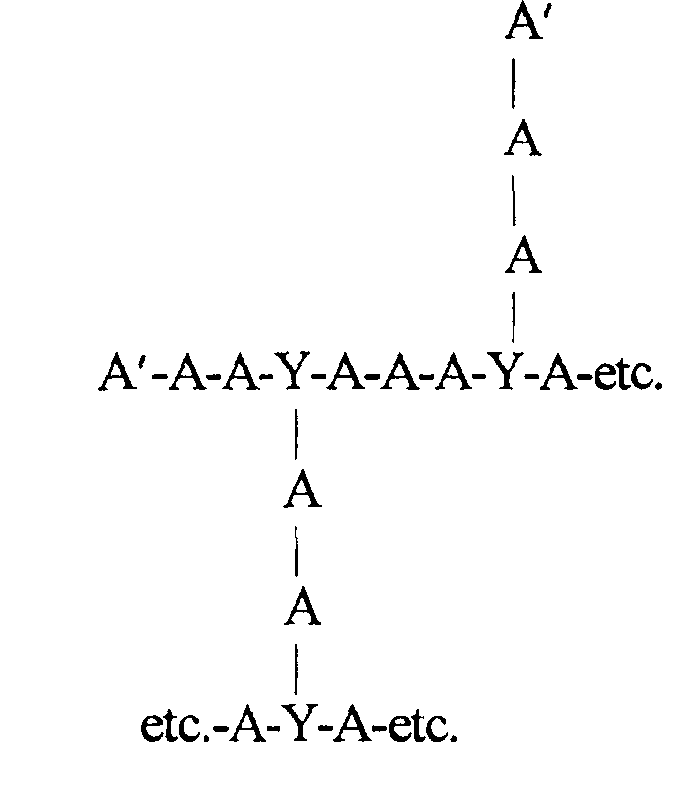
- The degree of polymerization, represented by x, is an expression of the number of structural units in a given polymer molecule; however, this x becomes ambiguous when applied to an actual sample of polymeric material, since all of the polymer molecules in a given sample will not have the same value of x. In fact, the degree of polymerization in a given sample of polymeric material will vary over a considerable range, and the term "average degree of polymerization" is often used instead. The average degree of polymerization is obtained by dividing the total number of structural units by the total number of molecules. In similar manner the molecular weights of a sample of polymeric material is also ambiguous; therefore, the terms "number average molecular weight" (Mn) and "weight average molecular weight" (Mw) are generally used. The number average molecular weight of a sample of polymeric material represents the mass of the sample divided by the number of moles it contains. In contrast, the weight average molecular weight can be represented by the equation:
- General discussion of polymers may be found in a treatise by P.J. Flory (Principles of Polymer Chemistry, Cornell University Press, Ithaca: 1953) especially Chapter II, pages 29-68, and chapter VIII, pages 317-346.
- Average molecular weight estimations of these types of polymeric ionene materials have been performed by gel permeation chromatography, vapour pressure osmometry, etc., but none of these methods are reliable in estimating the molecular weight, and the determinations are dependent on other variables, such as the particular internal standards used and the purity of the polymeric material.
- For the purposes of this specification, the polymerization reactions such as are described above, which produce polymers of varying sizes will be generically referred to as "conventional polymerization processes". GB 536,017 and US 4,374,244 describe conventional polymerization processes for making various linear polymers of the well known class of polymeric quaternary ammonium compounds. The use of compounds of this class as microbiocidal agents has also been described in US 5,512,597, US 3,931,319 and US 3,874,870.
- We have now found a group of polymeric compounds which can be used as absolute molecular weight markers and we have found to be particularly useful in characterizing ionene-type polymeric materials, especially in estimating molecular weight. These compounds meet or reduce problems encountered in the prior art.
- According to one aspect, the present invention provides a polymer consisting of molecules of the structure:
- W and Y are the same or different, and are each OH, NR1R2, or N+R1R2R3(Z-);
- R1,R2 and R3 are the same or different and are each selected from:
- CH3,C2-C24 primary, secondary or tertiary alkyl or cycloalkyl groups;
- CH3-C24 unsaturated hydrocarbon groups, unsubstituted and substituted benzyl groups;
- BT is a pair of methylene units linked by another chemical group;
- A is R1R2N+Z-;
- Z- is the anion corresponding to a pharmaceutically acceptable Brønsted acid; and
- n is an integer from 15 to 31;
- wherein in said polymer all said molecules of formula I have the same values for W, Y, R1, R2, R3, Z, BT, A and n.
-
- In another aspect the present invention provides a pharmaceutical composition comprising an antimicrobially effective amount of one polymer according to any preceding claim, and a pharmaceutically acceptable carrier.
- The present invention relates to polymers with an absolute molecular weight, particularly ionene-type polymers. As used herein, the term "polymer" (or "polymers") will mean long chain compounds which have repeating subunits, regardless of whether the compounds can be identified with a specific molecular weight, or whether the compounds can only be identified with a number average molecular weight. In addition, the term "absolute molecular weight" will refer to molecular weights which can be calculated specifically, based on the standard atomic weights of the atomic constituents.
- Because the absolute molecular weight of the compounds of the present invention can be determined, these compounds are particularly useful as identification standards for other polymers which are made using conventional polymerization processes. The polyquaternary ammonium compounds described are further suitable for use as antimicrobial agents, particularly in ophthalmic compositions.
- The ophthalmic compositions of the present invention comprise the polymers of the present invention. These compositions include: contact lens care products, such as chemical disinfecting and storage solutions and preserved saline solutions; and other types of ophthalmic compositions, such as artificial tears and topical pharmaceutical preparations. For the purposes of this specification, disinfectants and/or preservatives shall be collectively referred to as "antimicrobials" and compounds having disinfecting and/or preserving efficacy shall be referred to as compounds having "antimicrobial activity".
- The compounds of the present invention are polymers. They differ significantly from polymers made using conventional polymerisation processes in that they have an absolute molecular weight, that is, the repeating unit is always the same rather than varying in number from which an average degree of polymerization can be calculated. The compounds of the present invention cannot be obtained by separation techniques performed on polymers made using conventional polymerization techniques.
- Preferred compounds of the present invention are those of structure:
- Z- and n are as defined above. Preferably Z- is a halide, most preferably chloride.
- It is preferred that, in the polymers of structures (I) and (II), n is an integer from 19 to 31.
- There are two key steps in the synthesis of the absolute molecular weight polyquaternary ammonium compounds of the present invention:1) the preparation of "base" materials containing identical reactive end groups, either as nucleophiles or as electrophiles; and 2) synthesis of the building blocks for elongation of the polymeric "base" units. The requirements of the building blocks are that: 1) they contain only one reactive end group which can interact with the "base" material; and 2) the non-reactive end group (e.g., allylic alcohol) is readily convertible to the corresponding reactive species for reaction with "base" material.
- As illustrated in Scheme 1 and Scheme 2, below, quaternary ammonium homologues, such as 4, 7, 13, and 16, represent "base" materials. Synthesis of these materials are illustrated in equations 2, 4, 6, 8 and 10. The following abbreviations are used in the equations of Schemes 1 and 2: Me = CH3; BT = trans-CH2-CH=CH-CH2; A = Me2N+Cl-; G = an alcohol protecting group, especially -C(O)(CH2)4CH3.


- For the building block compounds, three compounds (1, 2 and 25) were utilized, although others could be used similarly. As is apparent, the number of quatemary ammonium functionalities in the "base" materials are increased by two, four and eight units, respectively, upon reaction with a "base" dichloride. Syntheses of these building block compounds are shown in eq.1 and eq.12-16. Building block compound, 1 is synthesized by following published procedures, and that of 2 is accomplished by treating 1 with an excess amount of 1,4-dichloro-2-butene, isolating the product, then reacting it with N,N-dimethylamine to afford 2. For synthesis of 25, 1 is blocked with ester (e.g., hexanoate) which is fairly stable under chlorination with thionyl chloride. This compound can be deblocked without much difficulty either by hydrolysis (acid or base) or aminolysis. 18 is reacted with 1-chloro-4-hydroxy-2-butene to yield the alcohol, 19, which is then converted to the corresponding chlorine compound, 20. This compound can be reacted with 1 to yield 21. This same procedure of chlorination and amination is repeated to afford 24. This is reacted with an excess amount of N,N-dimethylamine to aminolyze as well as aminate to afford 25. In the alternative, 25 can be synthesized by reacting 2 with 20 to afford 24 which can be readily converted to 25.
- The procedure for synthesizing higher molecular weight polymer "base" material containing dihydroxy end groups involves the reaction between "base" material containing dichloro end groups and one of the building block compounds. For example, "base" 7 is reacted with building block 2 to yield 9 which has four more A-BT units in the molecule. This is well explained in eq. 6. Another example is illustrated in eq. 18, wherein, "base" material 7 is elongated by 8 units of A-BT with 25 as a building block compound.
- Conversion of diallylic alcohol is readily accomplished by treatment with thionyl chloride for the lower molecular weight homologues but it is necessary to utilize concentrated hydrochloric acid for the higher homologues because of their limited solubility in thionyl chloride. Surprisingly, this class of polyquaternary ammonium compounds are stable under the latter chlorination condition (about 100°C for 24 hours). Chlorinated allylic compounds were treated with N,N-dimethylamine to yield the corresponding tertiary amine containing polyquaternary ammonium compound.
- In the examples below, the following standard abbreviations are used: g = grams (mg = milligrams); mol = moles (mmol = millimoles); mL = milliliters; mm Hg = millimeters of mercury; bp = boiling point (°C). All temperatures are reported as °C, unless otherwise stated. In addition, "NMR" refers to nuclear magnetic resonance spectroscopy, and "GC" refers to gas chromatography. The following references are also cited in the examples below by number: 1) Bailey, W. J. and E. Fujiwara, J. Am. Chem. Soc., 77:165 (1955); 2) Biel, J. H. et al., J. Am. Chem. Soc., 79 :6184 (1957); 3) Willette, R. E. and R. C. Driscoll, J. Med. Chem., 15:110 (1972); 4) Olomucki, M, C. R. Acad. Sci., 237:192 (1953); 5) Bates, E. B. et al., J. Chem. Soc., 1854 (1954); 6) Nelson, W. L. et al., J. Med. Chem., 16:506 (1973).
- Following published literature procedures1, 4-chloro-2-butyne-1-ol was synthesized using 104.4 g (1.21 mol) of 2-butyne-1,4-diol, 105.5 g (1.33 mol) of pyridine and 158.6 g (1.33 mol) of thionyl chloride in dry chloroform. After washing the reaction mixture with cold water (1 x 100 mL) and separating the chloroform layer, the aqueous layer was extracted with chloroform (3 x 100 mL). All chloroform layers were combined and washed with cold saturated sodium bicarbonate (1 x 100 mL) followed with cold water, and then dried. Distillation of the residue under reduced pressure afforded 47.2 g (37% yield) of 4-chloro-2-butyne-1-ol (bp 75°, 1.5 mm Hg; lit.1 50°, 0.5 mm Hg). The structure was confirmed by 1H NMR. GC indicated a purity of 98%.
- Following published literature procedures2, 4-dimethylamino-2-butyne-1-ol was prepared using 20.3 g (0.194 mol) of 4-chloro-2-butyne-1-ol and excess N,N-dimethylamine in tetrahydrofuran (THF). The reaction mixture was filtered and the filter cake washed with THF. The residue from the filtrates was distilled under reduced pressure to give 9.1 g (41% yield) of the aminoalcohol (bp 72°, 0.3 mm Hg). 1H NMR confirmed the structure, and purity was >99% by GC.
- Following published literature procedures3, 1 was prepared by the reduction of 9.1 g (80.4 mmol) of 4-dimethylamino-2-butyne-1-ol with lithium aluminum hydride. The residue of the reaction filtrates was distilled under reduced pressure to give 7.2 g (78% yield) of the trans product (bp 63°, 0.4 mm; lit.3,4 50-52.5°, 0.35 mm; 73°, 2.0 mm). The structure was confirmed by 1H NMR and 13C NMR, and purity was >99% by GC.
- Following published literature procedures3,5, trans -2-butene-1,4-diol was prepared by the reduction of 22.2 g (0.26 mol) of 2-butyne-1,4-diol using lithium aluminum hydride in THF. After quenching the reaction, the reaction mixture was filtered and the filter cake washed with THF. The filtrate residue was distilled under reduced pressure to give 14 g (62% yield) of the trans diol (bp 95°, 0.4 mm). The structure was confirmed by 1H NMR, and purity by GC was 94%.
- Using a procedure6 similar to that for the synthesis of 4-chloro-2-butyne-1-of (Example 1), trans -4-chloro-2-butene-1-ol was prepared using 11.4 g (0.13 mol) of trans-2-butene-1,4-diol, 11.3 g (0.143 mol) of pyridine and 16.9 g (0.142 mol) of thionyl chloride in chloroform. Distillation under reduced pressure gave 3.43 g (25% yield) of the trans product (bp 55-57°, 0.5 mm Hg; lit.6 50-51°, 0.2-0.3 mm Hg). The structure was confirmed by 1H NMR, and purity by GC was 83%.
- 3 was prepared by reacting 6.8 g (0.59 mol) of 1 and 3.5 g (0.28 mol) of trans-1,4-dichloro-2-butene in 50 mL of isopropanol at 85° for 5 hours. The product diol was recrystallized from ethyl acetate and ethanol and the crystals filtered and washed with ethyl acetate to give 7.19 g (73% yield) of white crystals.
- 1H NMR (D2O): δ 6.31-6.14 (m, 4 H, C=C(H)), 5.89-5.71 (m, 2 H, C=C(H)CH2OH), 4.12 (d, 4 H, CH 2OH), 3.94 (d, 4 H, =C(H)CH 2), 3.86 (d, 4 H, =C(H)CH 2), 2.95 (s, 12 H, N+(CH3)).
- 13C NMR (D2O): δ 146.58 (s, 2 C,C=C(H)CH2OH), 132.48 (s, 2 C, N+CH2(H)C=C(H)CH2N+), 118.51 (s, 2 C, C=C(H)CH2N+), 68.18, 66.83 (2 s, 4 C, C=C(H)CH2N+), 63.57 (s, 2 C, =C(H)CH2 OH), 52.33 (s, 4 C, N+(CH3)).
- Anal. Calcd. for C16H32Cl2N2O2: C, 54.08; H, 9.08; N, 7.88. Found: C, 53.95; H, 9.03; N, 7.83.
- 6 was prepared from 1 and 4.
- 4 was prepared by dissolving 3.1 g (8.7 mmol) of 3 in thionyl chloride at room temperature and stirring for 1 hour. Precipitation with ether followed sequentially by dissolution in ethanol and reprecipitation with ether gave 3.26 g (95% yield) of the dichloro product. The structure was confirmed by 1H NMR and 13C NMR.
- 6 was obtained by reacting 2.1 g (5.3 mmol) of 4, 1.3 g (10.9 mmol) of 1 and 0.08 g (0.62 mmol) of diisopropylethylamine in isopropanol at 85° for 5 hours. Evaporation of isopropanol and precipitation with acetone from ethanol (x 3) gave 2.6 g (79% yield) of 6.
- 1H NMR (D2O): δ 6.45-6.20 (m, 8 H, C=C(H)CH2N+), 5.92-5.78 (m, 2 H, C=C(H)CH2OH), 4.19, 4.09, 4.03, 3.92 (4 d, 20 H, C=C(H)CH 2), 3.08, 3.03 (2 s, 24 H, N+(CH3)).
13C NMR (D2O): δ 146.65 (s, 2 C, C=C(H)CH2OH), 133.08, 132.65, 132.12 (3 s, 6 C, N+CH2(H)C=C(H)CH2N+), 118.52 (s, 2 C, C=C(H)CH2N+), 68.27, 67.65, 66.85 (3 s, 8 C, C=C(H)CH2N+), 63.60, (s, 2 C, C=C(H)CH2OH), 52.7, 52.37 (2 s, 8 C, N+(CH3)). - 8 was prepared from 7 and N,N-dimethylamine.
- The dichloro compound (7) was prepared by dissolving 3.9 g (6.3 mmol) of 6 in thionyl chloride at room temperature and stirring for 1 hour. Precipitation with ether, followed sequentially by dissolution in ethanol, and reprecipitation with ether gave 3.87 g (93% yield) of the dichloro product. The structure was confirmed by 1H NMR and 13C NMR.
- 8 was obtained by reacting 0.82 g (1.24 mmol) of 7 and 0.7 g (15.5 mmol) of aqueous N,N-dimethylamine for 2 hours at room temperature. Sodium bicarbonate was added to the reaction mixture, which was then stirred for 30 minutes in an ice bath. The sodium bicarbonate was precipitated with ethanol and filtered (x 2). After evaporation of the ethanol from the filtrate, the reaction product was redissolved in ethanol and then precipitated with acetone (x 2) to give 0.53 g (63% yield) of the diamine.
- 1H NMR (D2O): δ 6.45-5.85 (m, 10 H, C=C(H)), 4.10, 4.07, 4.06 (12 H, N+CH 2(H)C=C(H)CH 2N+), 3.98 (d, 4 H, N+CH 2 (H)C=C(H)CH2N(CH3)2), 3.26 (d, 4 H, C=C(H)CH 2N(CH3)2), 3.08, 3.04 (2 s, 24 H, N+(CH3)), 2.32 (s,12 H, CH2N(CH 3)2). 13C NMR (D2O): δ 142.18 (s, 2 C, C=C(H)CH2N+), 132.97, 132.67, 132.25 (3 s, 6 C, N+CH2(H)C=C(H)CH2N+), 123.99 (s, 2 C, C=C(H)CH2N(CH3)2), 68.30, 67.69, 67.08 (3 s, 8 C, =C(H)CH2N+), 61.82 (s, 2 C, =C(H)CH2N(CH3)2), 52.68, 52.45 (2 s, 8 C, N+(CH3)), 46.04 (s, 4 C, CH2N(CH3)).
- 9 was prepared by reacting 1.06 g (1.61 mmol) of 7 with 0.86 g (3.46 mmol) of 2 and several drops of diisopropylethylamine in ethanol for 15 hours at room temperature, then for 2 hours at 50°. After evaporation of ethanol, the reaction mixture was redissolved in cold water and stirred with sodium bicarbonate for 30 minutes in an ice bath. The mixture was then precipitated with isopropanol and decanted. Methanol was then added to precipitate the sodium bicarbonate, and the methanol layer decanted and filtered. Methanol was evaporated from the filtrate and the residue acidified with 1N HCl. Precipitation of this solution with acetone gave 1.46 g (78% yield) of the diol.
- 1H NMR (D2O): δ 6.45-6.18 (m, 16 H, =C(H)CH2N+), 5.95-5.77 (m, 2 H, =C(H)CH2OH), 4.21,(d, 4 H, =C(H)CH 2OH), 4.11, 4.05, 4.04, 4.03 (28 H, N+CH 2(H)C=C(H)CH 2N+), 3.90 (d, 4 H, =C(H)CH 2N+), 3.08, 3.03 (2 S, 48 H, N+(CH3)).
- 12 was prepared by reacting 0.53 g (0.8 mmol) of 7 with 0.90 g (1.74 mmol) of Compound 26 and several drops of diisopropylethylamine in methanol for 15 hours at room temperature, then for 2 hours at 50°. After evaporation of methanol, the reaction mixture was redissolved in cold water and stirred with sodium bicarbonate for 30 minutes in an ice bath. The mixture was precipitated with isopropanol and decanted. Methanol was then added to precipitate the sodium bicarbonate, and the methanol layer decanted and filtered. Methanol was evaporated from the filtrate and the residue acidified with 1N HCl. Precipitation of this solution with acetone gave 1.1 g (81% yield) of the diol.
1H NMR (D2O) δ 6.45-6.20 (m, 24 H, =C(H)CH2N+), 5.95-5.77 (m, 2 H, =C(H)CH2OH), 4.18 (d, 4 H, =C(H)CH 2OH), 4.11, 4.05, 4.04, 4.03 (44 H, N+CH 2(H)C=C(H)CH 2N+), 3.08, 3.03 (2 S, 72 H, N+(CH3)). - 14 was prepared from 13 and N,N-dimethylamine.
- The dichloro compound (13) was prepared by dissolving 0.12 g (0.05 mmol) of 12 in thionyl chloride and stirring overnight at 50°. Precipitation with ether followed sequentially by dissolution in cold methanol and reprecipitation with ether and then acetone gave 0.05 g (54%) of the dichloro product. The structure was confirmed by 1H NMR and 13C NMR.
- 14 was obtained by reacting 0.05 g (0.03 mmol) of 13 and 0.04 g (0.89 mmol) of aqueous N,N-dimethylamine for 5 hours at room temperature. The product was precipitated with isopropanol, redissolved in water and reprecipitated with isopropanol (x 2). The precipitate was redissolved in water and acidified with 1N HCl and precipitated twice from water with acetone to give 0.04 g (80% yield) of the diamine.
- 1H NMR (D2O): δ 6.44-6.20 (m, 26 H, C=C(H)), 4.11, 3.88, (52 H, N+CH 2(H)C=C(H)CH 2N+), 3.07, (s, 72 H, N+(CH3)), 2.86 (s,12 H, CH2N(CH 3)2).
- 15 was prepared by reacting 0.59 g (0.5 mmol) of 10 (prepared in a manner similar to the preparation of 4 and 7) with 0.58 g (1.12 mmol) of 25 and several drops of diisopropylethylamine in methanol for 15 hours at room temperature then for 2 hours at 50°. After evaporation of methanol, the reaction mixture was redissolved in cold water and stirred with sodium bicarbonate for 30 minutes in an ice bath. The mixture was precipitated with isopropanol and decanted. Methanol was then added to precipitate the sodium bicarbonate, and the methanol layer decanted and filtered. Methanol was evaporated from the filtrate and the residue acidified with 1N HCl. Precipitation of this solution with acetone gave 0.83 g (75% yield) of the diol.
- 1H NMR (D2O): δ 6.47-6.19 (m, 32 H, =C(H)CH2N+), 5.95-5.75 (m, 2 H, =C(H)CH2OH), 4.18 (d, 4 H, =C(H)CH 2OH), 4.12 (60 H, N+CH 2(H)C=C(H)CH 2N+), 3.90 (d, 4 H, =C(H)CH2N+), 3.09, 3.04 (2 s, 96 H, N+(CH3)).
- 17 was prepared from 16 and N,N-dimethylamine.
- The dichloro compound (16) was prepared by dissolving 0.12 g (0.054 mmol) of 15 in thionyl chloride and stirring overnight at 50°. Precipitation with ether, followed by dissolution in cold methanol and reprecipitation first with ether and then with acetone gave 0.07 g (58% yield) of the dichloro product. The structure was confirmed by 1H NMR and 13C NMR.
- 17 was obtained by reacting 0.07 g (0.031 mmol) of 16 and 0.06 g (1.33 mmol) of aqueous N,N-dimethylamine for 5 hours at room temperature. The product was precipitated with isopropanol, redissolved in water and reprecipitated with isopropanol (x 2). The precipitate was redissolved in water and acidified with 1N HCl and precipitated twice from water with acetone to give 0.05 g (71% yield) of the diamine.
- 1H NMR (D2O): δ 6.44-6.20 (m, 34 H, C=C(H)), 4.11, 3.88, (68 H, N+CH 2(H)C=C(H)CH 2N+), 3.07, (s, 96 H, N+(CH3)), 2.86 (s,12 H, CH2N(CH 3)2).
- 25 was prepared from the following reactions (a) - (e).
- Hexanoyl chloride in chloroform (2.52g, 18.7 mmol) was added to a stirred chloroform solution of 2.18 g (18.9 mmol) of 1 and 1.90 g (18.8 mmol) of triethylamine in an ice bath. Upon addition of the hexanoyl chloride, the mixture was allowed to react (with stirring) at room temperature overnight. Saturated sodium bicarbonate solution (50 mL) was then added to the reaction mixture and the mixture stirred for 1 hour. The chloroform layer was then separated and washed first with saturated sodium bicarbonate solution (1 x 50 mL), then with saturated sodium chloride solution (2 x 50 mL). The organic layer was dried over magnesium sulfate, filtered, and the chloroform evaporated. The residue was distilled under reduced pressure to give 2.77 g (69%) of 18 (bp 85°, 0.4 mm Hg). Structure was confirmed by 1H NMR and 13C NMR.
- 19 was prepared by addition of 2.7 g (24 mmol) of trans-4-chloro-2-butene-1-ol to a solution of 5.0 g (25 mmol) of 18 and 0.5 g (3.5 mmol) of diisopropylethylamine in THF. The mixture was allowed to react for 3 hours at 60°, then the THF was evaporated and the residue redissolved in chloroform and precipitated with ether (x 2). The precipitate was redissolved in 100 mL of cold chloroform and washed with cold aqueous HCI (pH = 3.0) saturated with sodium chloride (2 x 50 mL) and then with cold saturated sodium chloride solution (1 x 25 mL). The chloroform layer was dried over magnesium sulfate, filtered, and the chloroform evaporated. The residue was redissolved in chloroform and precipitated with ether (x 2) affording 7.34 g (97% yield) of 19.
- 1H NMR (CDCl3): δ 6.43-6.25, 6.10-5.76 (2 m, 4 H, C=C(H)), 4.67 (d, 2 H, (CKCOCH2), 4.33 (d, 2 H, N+CH 2 (H)C=C(H)CH2OH), 4.20, 4.15 (4 H, CH 2N+CH2(H)C=C(H)CH 2OH), 3.23 (s, 6 H, N+(CH3)), 2.34 (t, 2 H, OC(O)CH2), 1.62 (m, 2 H, CH2CH 2C(O)), 1.33 (m, 4 H, CH3CH 2CH 2), 0.89 (t, 3 H, CH2CH 3).
- 13C NMR (CDCl3): δ 61.17 (s, 1 C, =C(H)CH 2OH), 49.38 (s, 2 C, N+(CH3)).
- 21 was prepared by reacting 20 with 1.
- The chloro compound (20) was obtained by dissolving 2 g (6.3 mmol) of 19 in cold thionyl chloride in an ice bath. After dissolution, the reaction was stirred at room temperature for 2 hours, followed by precipitation with ether. The residue was dissolved in isopropanol and precipitated with ether (x 2) to give 1.92 g (91% yield) of 20.
- 20 (1.9 g, 5.6 mmol) and 0.7 g (6.3 mmol) of 1 were dissolved in THF and heated at 60° for 1 hour. The upper layer was decanted and the precipitate that had formed washed with ether. The precipitate was redissolved in ethanol and precipitated with acetone to give 1.96 g (76% yield) of the product, 21.
- 1H NMR (D2O): δ 6.40-6.19 (m, 4 H, C=C(H)), 6.05, 5.80 (m, 2 H, N+CH2(H)C=C(H)CH2OH), 4.72 (d, 2 H, =C(H)CH 2OC(O)), 4.21 (d, 2 H, =C(H)CH 2OC(O)), 4.04, 3.95 ( 2 d, 8 H, =C(H)CH 2N+CH 2(H)C=), 3.05 (s, 12 H, N+(CH3)), 2.43 (t, 2 H, OC(O)CH2), 1.60 (m, 2 H, CH2CH 2C(O)), 1.27 (m, 4 H, CH3CH 2CH 2), 0.85 (t, 3 H, CH2CH 3).
- 13C NMR (D2O): δ 6 3.32 (s, 1 C, =C(H)CH 2OH).
- Anal. Calcd. for C22H42Cl2N2O3: C, 56.04; H, 9.41; N, 5.94. Found: C, 56.35; H, 9.22; N, 5.62.
- 23 was prepared by reacting 22 with 1.
- The chloro compound (22) was obtained by dissolving 0.43 g (0.95 mmol) of 21 in cold thionyl chloride in an ice bath. After dissolution, the reaction was stirred at room temperature for 2 hours, followed by precipitation with ether. The residue was dissolved in ethanol and precipitated with ether (x 2) to give 0.4 g (93%) of the chlorinated product. Structure was confirmed by 1H NMR and 13C NMR.
- 22 (0.43 g, 0.95 mmol) and 0.13 g (1.1 mmol) of 1 were dissolved in N,N-dimethylacetamide and stirred for 3 hours at room temperature. Precipitation was completed by the addition of acetone to the reaction mixture. The upper layer was then decanted and the precipitate dissolved in cold water and stirred with sodium bicarbonate for 15 minutes in an ice bath. Sodium bicarbonate was precipitated with ethanol, the mixture filtered and ethanol evaporated. The residue was redissolved in water and precipitated with acetone to give 0.45 g (85% yield) of the product, 23.
1H NMR (D2O): δ 6.48-5.73 (m, 8 H, C=C(H)), 4.77 (d, 2 H, = C(H)CH 2OC(O)), 4.20, 4.11, 4.03, 3.96 (4 d, 14 H, =C(H)CH 2N+CH 2 (H)C=), 3.13, 3.08 (2 s, 18H, N+(CH3)), 2.46 (t, 2 H, OC(O)CH2), 1.63 (m, 2 H, CH2CH 2C(O)), 1.30 (m, 4 H, CH3CH 2CH 2), 0.88 (t, 3 H, CH2CH 3). - 25 was prepared by reacting 24 with N,N-dimethylamine.
- The chloro compound (24) was obtained by dissolving 2.6 g (4.4 mmol) of 23 in cold thionyl chloride and stirring in an ice bath until 23 was completely dissolved, after which the ice bath was removed and the reaction stirred for 1 hour at room temperature. The reaction product was precipitated with ether and the precipitate was dissolved in cold ethanol in an ice bath and then reprecipitated with ether (x 2). The precipitate was then redissolved in cold water in an ice bath and precipitated again with acetone to give 3.6 g (5.9 mmol) of 24. Structure was confirmed by 1H NMR.
- To 3.41 g (5.6 mmol) of 24 in an ice bath was added 2.4 g (53.2 mmol) of N,N-dimethylamine to dissolve the chloro compound. The reaction mixture was stirred at room temperature for 2 hours. Sodium bicarbonate was added and the mixture stirred for 30 minutes in an ice bath. The sodium bicarbonate was precipitated with ethanol and filtered and the ethanol evaporated, followed by redissolution in water and precipitated with acetone (x 2) affording 2.91 g (59% yield) of 25.
- 1H NMR (D2O): δ 6.41-5.78 (m, 8 H, C=C(H)), 4.19, 4.10, 4.05, 3.93 (4 d, 16 H, =C(H)CH 2), 3.07, 3.03 (2 s, 18 H, N+(CH3)), 2.20 (s, 6 H, N(CH3)2).
- The polymers of the present invention may be used an antimicrobials in ophthalmic compositions, particularly as disinfectants in contact lens care products and as preservatives in other types of ophthalmic compositions, such as artificial tears or topical pharmaceutical preparations. In general, the polymers of the present invention will be present in the compositions at a concentration between 0.00001 and 1.0 percent by weight (wt%). If used as disinfectant, the polymers are preferably present at a concentration of between 0.0005 and 0.5 wt%; if used as a preservative, the polymers are present at a concentration between 0.00005 and 0.05 wt%. It is preferred that the polymers are present at a concentration of between 0.001 and 0.05 wt% if used as a disinfectant and between 0.0001 and 0.01 wt% if used as a preservative.
- The ophthalmic compositions of the present invention may additionally contain other components, for example, ophthalmically acceptable buffers, tonicity agents, surfactants, and therapeutic agents.
Claims (11)
- A polymer consisting of molecules of the structure:W and Y are the same or different, and are each OH, NR1R2, or N+R1R2R3(Z-);R1 ,R2 and R3 are the same or different and are each selected from:CH3,C2-C24 primary, secondary or tertiary alkyl or cycloalkyl groups; C3-C24 unsaturated hydrocarbon groups, unsubstituted and substituted benzyl groups;BT is a pair of methylene units linked by another chemical group;A is R1R2N+Z-;Z- is the anion corresponding to a pharmaceutically acceptableBrøsted acid; andn is an integer from 15 to 31;wherein in said polymer all said molecules of formula I have the same values for W, Y, R1, R2, R3, Z, BT, A and n.
- A polymer according to claim 1, wherein n is an integer from 19 to 23.
- A polymer according to claim 1 or 2, wherein Z- is selected from halides, H2PO4 -, MeCO2 -, and Me3CC02 -.
- A polymer according to claim 1, 2 or 3, wherein BT is selected from 1,2-, 1,3-, and 1,4-phenylenes, and trans-1,4-but-2-enylidene.
- A polymer according to any of claims 1 to 3, wherein the structure is:
- A polymer according to any of claims 1 to 4, wherein the unsaturated hydrocarbon groups are straight or branched chain alkenes.
- A polymer according to any of claims 1 to 4, wherein the substituted benzyl groups are alkylated benzyl groups. where the alkyl group is as defined in claim 1.
- A pharmaceutical composition comprising an antimicrobially effective amount of one polymer according to any preceding claim, and a pharmaceutically acceptable carrier.
- A pharmaceutical composition according to claim 8, wherein the polymer is present at a concentration of 0.00001 to 21.0 percent by weight.
- A pharmaceutical composition according to claim 9, wherein the polymer is present at a concentration of 0.00001 to 1.0 percent by weight.
- A method for preserving an ophthalmic composition by using a antimicrobially effective amount of a polymer according to any of claims 1 to 7
Applications Claiming Priority (4)
| Application Number | Priority Date | Filing Date | Title |
|---|---|---|---|
| US79030191A | 1991-11-08 | 1991-11-08 | |
| US08/355,361 US5547663A (en) | 1991-11-08 | 1994-12-13 | Absolute molecular weight polymers and methods for their use |
| CA002255755A CA2255755A1 (en) | 1991-11-08 | 1996-05-31 | Absolute molecular weight polymers and methods for their use |
| PCT/US1996/008271 WO1997045473A1 (en) | 1991-11-08 | 1996-05-31 | Absolute molecular weight polymers and methods for their use |
Publications (2)
| Publication Number | Publication Date |
|---|---|
| EP0904313A1 EP0904313A1 (en) | 1999-03-31 |
| EP0904313B1 true EP0904313B1 (en) | 2001-11-21 |
Family
ID=27427493
Family Applications (1)
| Application Number | Title | Priority Date | Filing Date |
|---|---|---|---|
| EP96916921A Expired - Lifetime EP0904313B1 (en) | 1991-11-08 | 1996-05-31 | Absolute molecular weight polymers and methods for their use |
Country Status (9)
| Country | Link |
|---|---|
| US (1) | US5547663A (en) |
| EP (1) | EP0904313B1 (en) |
| JP (1) | JP2000512324A (en) |
| AT (1) | ATE209227T1 (en) |
| AU (1) | AU719397B2 (en) |
| CA (1) | CA2255755A1 (en) |
| DE (1) | DE69618628T2 (en) |
| ES (1) | ES2168475T3 (en) |
| WO (1) | WO1997045473A1 (en) |
Family Cites Families (16)
| Publication number | Priority date | Publication date | Assignee | Title |
|---|---|---|---|---|
| GB536017A (en) * | 1938-08-30 | 1941-04-30 | Du Pont | Polymeric quaternary ammonium salts from ditertiary diamines and dihalides |
| US2261002A (en) * | 1941-06-17 | 1941-10-28 | Du Pont | Organic nitrogen compounds |
| US3874870A (en) * | 1973-12-18 | 1975-04-01 | Mill Master Onyx Corp | Microbiocidal polymeric quarternary ammonium compounds |
| US4026945A (en) * | 1974-10-03 | 1977-05-31 | Millmaster Onyx Corporation | Anti-microbial quaternary ammonium co-polymers |
| US4027020A (en) * | 1974-10-29 | 1977-05-31 | Millmaster Onyx Corporation | Randomly terminated capped polymers |
| US3931319A (en) * | 1974-10-29 | 1976-01-06 | Millmaster Onyx Corporation | Capped polymers |
| US4012446A (en) * | 1974-10-29 | 1977-03-15 | Millmaster Onyx Corporation | Capped polymers |
| US4001432A (en) * | 1974-10-29 | 1977-01-04 | Millmaster Onyx Corporation | Method of inhibiting the growth of bacteria by the application thereto of capped polymers |
| US4374244A (en) * | 1979-04-13 | 1983-02-15 | Kewanee Industries, Inc. | Linear quaternary ammonium polymers |
| DE2930865A1 (en) * | 1979-07-30 | 1981-02-12 | Schuelke & Mayr Gmbh | DISINFECTANT AND PRESERVATIVE |
| FR2471996A1 (en) * | 1979-12-21 | 1981-06-26 | Oreal | NOVEL POLYMERS OF THE IONENES TYPE, THEIR PREPARATION AND THEIR APPLICATION |
| US4444750A (en) * | 1980-11-17 | 1984-04-24 | Millmaster Onyx Group, Inc. | Method of conditioning hair |
| US4525346A (en) * | 1981-09-28 | 1985-06-25 | Alcon Laboratories, Inc. | Aqueous antimicrobial ophthalmic solutions |
| US4407791A (en) * | 1981-09-28 | 1983-10-04 | Alcon Laboratories, Inc. | Ophthalmic solutions |
| US5037647A (en) * | 1988-09-15 | 1991-08-06 | Alcon Laboratories, Inc. | Aqueous antimicrobial opthalmic solutions comprised of quaternary ammonium compound, citric acid, citrate and sodium chloride |
| US5512597A (en) * | 1991-11-08 | 1996-04-30 | Alcon Laboratories, Inc. | Polymeric quaternary ammonium compounds and their use as ophthalmic antimicrobials |
-
1994
- 1994-12-13 US US08/355,361 patent/US5547663A/en not_active Expired - Lifetime
-
1996
- 1996-05-31 CA CA002255755A patent/CA2255755A1/en not_active Abandoned
- 1996-05-31 AT AT96916921T patent/ATE209227T1/en not_active IP Right Cessation
- 1996-05-31 EP EP96916921A patent/EP0904313B1/en not_active Expired - Lifetime
- 1996-05-31 WO PCT/US1996/008271 patent/WO1997045473A1/en not_active Ceased
- 1996-05-31 ES ES96916921T patent/ES2168475T3/en not_active Expired - Lifetime
- 1996-05-31 DE DE69618628T patent/DE69618628T2/en not_active Expired - Fee Related
- 1996-05-31 JP JP09542275A patent/JP2000512324A/en not_active Ceased
- 1996-05-31 AU AU59638/96A patent/AU719397B2/en not_active Ceased
Also Published As
| Publication number | Publication date |
|---|---|
| ES2168475T3 (en) | 2002-06-16 |
| AU5963896A (en) | 1998-01-05 |
| DE69618628D1 (en) | 2002-02-21 |
| US5547663A (en) | 1996-08-20 |
| DE69618628T2 (en) | 2002-05-08 |
| JP2000512324A (en) | 2000-09-19 |
| WO1997045473A1 (en) | 1997-12-04 |
| CA2255755A1 (en) | 1997-12-04 |
| ATE209227T1 (en) | 2001-12-15 |
| EP0904313A1 (en) | 1999-03-31 |
| AU719397B2 (en) | 2000-05-11 |
Similar Documents
| Publication | Publication Date | Title |
|---|---|---|
| ES2311647T4 (en) | PROCEDURES FOR THE PREPARATION OF O-DEMETILVENLAFAXIN. | |
| DE112014001235B4 (en) | Antimicrobial cationic polycarbonates | |
| US20190269719A1 (en) | Polyguanidine polymers and methods of use thereof | |
| US5512597A (en) | Polymeric quaternary ammonium compounds and their use as ophthalmic antimicrobials | |
| AU719397B2 (en) | Absolute molecular weight polymers and methods for their use | |
| US6664224B2 (en) | Quaternary ammonium salt and process for the preparation thereof | |
| RU2272045C1 (en) | Polydiallylamines and disinfecting agent comprising thereof | |
| Gan et al. | Synthesis and properties of piperazine derivatives and their quaternary ammonium amphiphilic salts | |
| JP2003146956A (en) | New quaternary ammonium salt and method for producing the same | |
| JP2002302470A (en) | New quaternary ammonium salt and method for producing the same | |
| JP3576416B2 (en) | New amide compounds | |
| CN1321988C (en) | Saccharin anion ion liquid and its preparing method | |
| JP2004331504A (en) | New quaternary ammonium salt and method for producing the same and antimicrobial ageant comprising the same compound | |
| KR20020069307A (en) | Synthesis of Polyisocyanates with various functional groups | |
| Brittin | Synthesis, Characterization and Study of Structural-Activity Relationships of Antimicrobial Polymers | |
| JP2004331503A (en) | New quaternary ammonium salt compound and method for producing the same | |
| JP2004331499A (en) | New bisquaternary ammonium salt compound and method for producing the same | |
| WO2025193170A1 (en) | A polymer, a method of preparing the polymer and its uses thereof | |
| JPH02178322A (en) | New polytetrahydrofuran derivative and its preparation | |
| JPH0726253A (en) | Molecular complex containing photochromic compound | |
| JP2003146953A (en) | New quaternary ammonium salt compound, method for producing the same and antimicrobial agent containing the same compound | |
| WO2020064909A1 (en) | Modified peptides and their use | |
| JP2002308856A (en) | p-Aminostyrene cyclic tetramer and method for producing the same | |
| JP2003146952A (en) | New quaternary ammonium salt compound and method for producing the same | |
| JP2000505486A (en) | Polymeric quaternary ammonium compounds and their use as ophthalmic antimicrobial agents |
Legal Events
| Date | Code | Title | Description |
|---|---|---|---|
| PUAI | Public reference made under article 153(3) epc to a published international application that has entered the european phase |
Free format text: ORIGINAL CODE: 0009012 |
|
| 17P | Request for examination filed |
Effective date: 19981028 |
|
| AK | Designated contracting states |
Kind code of ref document: A1 Designated state(s): AT BE CH DE DK ES FI FR GB GR IE IT LI LU MC NL PT SE |
|
| 17Q | First examination report despatched |
Effective date: 19991026 |
|
| GRAG | Despatch of communication of intention to grant |
Free format text: ORIGINAL CODE: EPIDOS AGRA |
|
| GRAG | Despatch of communication of intention to grant |
Free format text: ORIGINAL CODE: EPIDOS AGRA |
|
| GRAH | Despatch of communication of intention to grant a patent |
Free format text: ORIGINAL CODE: EPIDOS IGRA |
|
| GRAH | Despatch of communication of intention to grant a patent |
Free format text: ORIGINAL CODE: EPIDOS IGRA |
|
| GRAA | (expected) grant |
Free format text: ORIGINAL CODE: 0009210 |
|
| AK | Designated contracting states |
Kind code of ref document: B1 Designated state(s): AT BE CH DE DK ES FI FR GB GR IE IT LI LU MC NL PT SE |
|
| PG25 | Lapsed in a contracting state [announced via postgrant information from national office to epo] |
Ref country code: NL Free format text: LAPSE BECAUSE OF FAILURE TO SUBMIT A TRANSLATION OF THE DESCRIPTION OR TO PAY THE FEE WITHIN THE PRESCRIBED TIME-LIMIT Effective date: 20011121 Ref country code: LI Free format text: LAPSE BECAUSE OF FAILURE TO SUBMIT A TRANSLATION OF THE DESCRIPTION OR TO PAY THE FEE WITHIN THE PRESCRIBED TIME-LIMIT Effective date: 20011121 Ref country code: GR Free format text: LAPSE BECAUSE OF FAILURE TO SUBMIT A TRANSLATION OF THE DESCRIPTION OR TO PAY THE FEE WITHIN THE PRESCRIBED TIME-LIMIT Effective date: 20011121 Ref country code: FI Free format text: LAPSE BECAUSE OF FAILURE TO SUBMIT A TRANSLATION OF THE DESCRIPTION OR TO PAY THE FEE WITHIN THE PRESCRIBED TIME-LIMIT Effective date: 20011121 Ref country code: CH Free format text: LAPSE BECAUSE OF FAILURE TO SUBMIT A TRANSLATION OF THE DESCRIPTION OR TO PAY THE FEE WITHIN THE PRESCRIBED TIME-LIMIT Effective date: 20011121 Ref country code: AT Free format text: LAPSE BECAUSE OF FAILURE TO SUBMIT A TRANSLATION OF THE DESCRIPTION OR TO PAY THE FEE WITHIN THE PRESCRIBED TIME-LIMIT Effective date: 20011121 |
|
| REF | Corresponds to: |
Ref document number: 209227 Country of ref document: AT Date of ref document: 20011215 Kind code of ref document: T |
|
| REG | Reference to a national code |
Ref country code: CH Ref legal event code: EP |
|
| REG | Reference to a national code |
Ref country code: IE Ref legal event code: FG4D |
|
| REG | Reference to a national code |
Ref country code: GB Ref legal event code: IF02 |
|
| PG25 | Lapsed in a contracting state [announced via postgrant information from national office to epo] |
Ref country code: SE Free format text: LAPSE BECAUSE OF FAILURE TO SUBMIT A TRANSLATION OF THE DESCRIPTION OR TO PAY THE FEE WITHIN THE PRESCRIBED TIME-LIMIT Effective date: 20020221 Ref country code: PT Free format text: LAPSE BECAUSE OF FAILURE TO SUBMIT A TRANSLATION OF THE DESCRIPTION OR TO PAY THE FEE WITHIN THE PRESCRIBED TIME-LIMIT Effective date: 20020221 Ref country code: DK Free format text: LAPSE BECAUSE OF FAILURE TO SUBMIT A TRANSLATION OF THE DESCRIPTION OR TO PAY THE FEE WITHIN THE PRESCRIBED TIME-LIMIT Effective date: 20020221 |
|
| REF | Corresponds to: |
Ref document number: 69618628 Country of ref document: DE Date of ref document: 20020221 |
|
| NLV1 | Nl: lapsed or annulled due to failure to fulfill the requirements of art. 29p and 29m of the patents act | ||
| ET | Fr: translation filed | ||
| PG25 | Lapsed in a contracting state [announced via postgrant information from national office to epo] |
Ref country code: MC Free format text: LAPSE BECAUSE OF NON-PAYMENT OF DUE FEES Effective date: 20020531 Ref country code: LU Free format text: LAPSE BECAUSE OF NON-PAYMENT OF DUE FEES Effective date: 20020531 Ref country code: IE Free format text: LAPSE BECAUSE OF NON-PAYMENT OF DUE FEES Effective date: 20020531 |
|
| REG | Reference to a national code |
Ref country code: CH Ref legal event code: PL |
|
| REG | Reference to a national code |
Ref country code: ES Ref legal event code: FG2A Ref document number: 2168475 Country of ref document: ES Kind code of ref document: T3 |
|
| PLBE | No opposition filed within time limit |
Free format text: ORIGINAL CODE: 0009261 |
|
| STAA | Information on the status of an ep patent application or granted ep patent |
Free format text: STATUS: NO OPPOSITION FILED WITHIN TIME LIMIT |
|
| 26N | No opposition filed | ||
| REG | Reference to a national code |
Ref country code: IE Ref legal event code: MM4A |
|
| PGFP | Annual fee paid to national office [announced via postgrant information from national office to epo] |
Ref country code: FR Payment date: 20030520 Year of fee payment: 8 |
|
| PGFP | Annual fee paid to national office [announced via postgrant information from national office to epo] |
Ref country code: GB Payment date: 20030528 Year of fee payment: 8 |
|
| PGFP | Annual fee paid to national office [announced via postgrant information from national office to epo] |
Ref country code: ES Payment date: 20030606 Year of fee payment: 8 |
|
| PGFP | Annual fee paid to national office [announced via postgrant information from national office to epo] |
Ref country code: BE Payment date: 20030613 Year of fee payment: 8 |
|
| PGFP | Annual fee paid to national office [announced via postgrant information from national office to epo] |
Ref country code: DE Payment date: 20030626 Year of fee payment: 8 |
|
| PG25 | Lapsed in a contracting state [announced via postgrant information from national office to epo] |
Ref country code: GB Free format text: LAPSE BECAUSE OF NON-PAYMENT OF DUE FEES Effective date: 20040531 Ref country code: BE Free format text: LAPSE BECAUSE OF NON-PAYMENT OF DUE FEES Effective date: 20040531 |
|
| PG25 | Lapsed in a contracting state [announced via postgrant information from national office to epo] |
Ref country code: ES Free format text: LAPSE BECAUSE OF NON-PAYMENT OF DUE FEES Effective date: 20040601 |
|
| BERE | Be: lapsed |
Owner name: *ALCON LABORATORIES INC. Effective date: 20040531 |
|
| PG25 | Lapsed in a contracting state [announced via postgrant information from national office to epo] |
Ref country code: DE Free format text: LAPSE BECAUSE OF NON-PAYMENT OF DUE FEES Effective date: 20041201 |
|
| GBPC | Gb: european patent ceased through non-payment of renewal fee | ||
| PG25 | Lapsed in a contracting state [announced via postgrant information from national office to epo] |
Ref country code: FR Free format text: LAPSE BECAUSE OF NON-PAYMENT OF DUE FEES Effective date: 20050131 |
|
| REG | Reference to a national code |
Ref country code: FR Ref legal event code: ST |
|
| PG25 | Lapsed in a contracting state [announced via postgrant information from national office to epo] |
Ref country code: IT Free format text: LAPSE BECAUSE OF NON-PAYMENT OF DUE FEES Effective date: 20050531 |
|
| REG | Reference to a national code |
Ref country code: ES Ref legal event code: FD2A Effective date: 20040601 |