EP0903882B1 - Stabiles Wellenlängenmultiplex-Ringnetzwerk - Google Patents
Stabiles Wellenlängenmultiplex-Ringnetzwerk Download PDFInfo
- Publication number
- EP0903882B1 EP0903882B1 EP98307235.6A EP98307235A EP0903882B1 EP 0903882 B1 EP0903882 B1 EP 0903882B1 EP 98307235 A EP98307235 A EP 98307235A EP 0903882 B1 EP0903882 B1 EP 0903882B1
- Authority
- EP
- European Patent Office
- Prior art keywords
- network
- wavelength
- ring network
- wavelength division
- division multiplexed
- Prior art date
- Legal status (The legal status is an assumption and is not a legal conclusion. Google has not performed a legal analysis and makes no representation as to the accuracy of the status listed.)
- Expired - Lifetime
Links
- 230000003287 optical effect Effects 0.000 claims description 28
- 230000005540 biological transmission Effects 0.000 claims description 17
- 239000013307 optical fiber Substances 0.000 claims description 11
- 230000002269 spontaneous effect Effects 0.000 claims description 7
- 230000000903 blocking effect Effects 0.000 claims 1
- 239000000835 fiber Substances 0.000 description 19
- 238000000034 method Methods 0.000 description 11
- 230000003247 decreasing effect Effects 0.000 description 7
- 229920006395 saturated elastomer Polymers 0.000 description 5
- 238000010586 diagram Methods 0.000 description 4
- 238000001228 spectrum Methods 0.000 description 4
- 230000007423 decrease Effects 0.000 description 3
- 230000002457 bidirectional effect Effects 0.000 description 2
- 238000005516 engineering process Methods 0.000 description 2
- 101100189635 Arabidopsis thaliana PDP4 gene Proteins 0.000 description 1
- 229910052691 Erbium Inorganic materials 0.000 description 1
- 230000003321 amplification Effects 0.000 description 1
- 230000033228 biological regulation Effects 0.000 description 1
- 230000015556 catabolic process Effects 0.000 description 1
- 238000004891 communication Methods 0.000 description 1
- 238000006731 degradation reaction Methods 0.000 description 1
- 238000013461 design Methods 0.000 description 1
- 238000011161 development Methods 0.000 description 1
- 230000018109 developmental process Effects 0.000 description 1
- 230000000694 effects Effects 0.000 description 1
- UYAHIZSMUZPPFV-UHFFFAOYSA-N erbium Chemical compound [Er] UYAHIZSMUZPPFV-UHFFFAOYSA-N 0.000 description 1
- 230000004399 eye closure Effects 0.000 description 1
- 238000009434 installation Methods 0.000 description 1
- 230000010354 integration Effects 0.000 description 1
- 238000012423 maintenance Methods 0.000 description 1
- 239000000463 material Substances 0.000 description 1
- 238000012544 monitoring process Methods 0.000 description 1
- 238000003199 nucleic acid amplification method Methods 0.000 description 1
- 230000010355 oscillation Effects 0.000 description 1
- 230000002265 prevention Effects 0.000 description 1
- 230000000644 propagated effect Effects 0.000 description 1
- 230000001681 protective effect Effects 0.000 description 1
- 238000005086 pumping Methods 0.000 description 1
- 229910052761 rare earth metal Inorganic materials 0.000 description 1
- 150000002910 rare earth metals Chemical class 0.000 description 1
- 230000008054 signal transmission Effects 0.000 description 1
- 229910052710 silicon Inorganic materials 0.000 description 1
- 239000010703 silicon Substances 0.000 description 1
- 230000001629 suppression Effects 0.000 description 1
Images


Classifications
-
- H—ELECTRICITY
- H04—ELECTRIC COMMUNICATION TECHNIQUE
- H04J—MULTIPLEX COMMUNICATION
- H04J14/00—Optical multiplex systems
- H04J14/02—Wavelength-division multiplex systems
- H04J14/0287—Protection in WDM systems
- H04J14/0289—Optical multiplex section protection
- H04J14/0291—Shared protection at the optical multiplex section (1:1, n:m)
-
- H—ELECTRICITY
- H04—ELECTRIC COMMUNICATION TECHNIQUE
- H04J—MULTIPLEX COMMUNICATION
- H04J14/00—Optical multiplex systems
- H04J14/02—Wavelength-division multiplex systems
- H04J14/0227—Operation, administration, maintenance or provisioning [OAMP] of WDM networks, e.g. media access, routing or wavelength allocation
- H04J14/0241—Wavelength allocation for communications one-to-one, e.g. unicasting wavelengths
-
- H—ELECTRICITY
- H04—ELECTRIC COMMUNICATION TECHNIQUE
- H04J—MULTIPLEX COMMUNICATION
- H04J14/00—Optical multiplex systems
- H04J14/02—Wavelength-division multiplex systems
- H04J14/0278—WDM optical network architectures
- H04J14/0283—WDM ring architectures
-
- H—ELECTRICITY
- H04—ELECTRIC COMMUNICATION TECHNIQUE
- H04J—MULTIPLEX COMMUNICATION
- H04J14/00—Optical multiplex systems
- H04J14/02—Wavelength-division multiplex systems
- H04J14/0201—Add-and-drop multiplexing
-
- H—ELECTRICITY
- H04—ELECTRIC COMMUNICATION TECHNIQUE
- H04J—MULTIPLEX COMMUNICATION
- H04J14/00—Optical multiplex systems
- H04J14/02—Wavelength-division multiplex systems
- H04J14/0227—Operation, administration, maintenance or provisioning [OAMP] of WDM networks, e.g. media access, routing or wavelength allocation
Definitions
- This invention relates to Wavelength Division Multiplex (WDM) ring network and, more particularly, to the prevention of lasing in such WDM ring networks .
- WDM Wavelength Division Multiplex
- WDM Wavelength Division Multiplexed
- One type of WDM network is a WDM ring network which may, for example, be used for metropolitan area network applications.
- the reliability problem in WDM ring networks is particularly significant since the use of closed cyclical paths makes lasing possible if the roundtrip optical gain exceeds the loop loss. The lasing affects signal channels through cross saturation and causes power variations which may reduce system power margins and cause false alarms in system channel monitoring.
- a typical WDM optical ring network includes network elements with Wavelength Add/Drop (WAD) capability, whereby some optical channels are dropped and/or added while other channels are expressed, i.e., passed through.
- WAD Wavelength Add/Drop
- closed loops may be formed in the WDM ring network which, with the Erbium-Doped Fiber Amplifiers (EDFA's) used to compensate the losses of network elements and fibers, can constitute ring laser cavities.
- Laser oscillations in the ring cavity occurring if the round trip gain experienced by Amplified Spontaneous Emissions (ASE) exceeds the loop loss, may increase amplifier saturation and introduce additional noise, which affect the performance of optical signal transmission.
- ASE Amplified Spontaneous Emissions
- United States Patent No. 5,510,926 issued to Bayart et al on April 23, 1996 describes a transmission method using spectrum multiplexing with amplification, in which method data to be transmitted is carried by various carrier waves occupying respective optical spectrum channels, it being possible for the number and/or the power of the carrier waves to vary, the various carrier waves being amplified by a common amplifier having respective gains for the various channels, while having limited overall amplifying power, wherein provision is made to make all of the gains equal in the presence of a fixed number of fixed-power carrier waves, regulation light that is independent of the carrier waves and that is amplified by the amplifier being servo-controlled in power so as to maintain equality between the gains in the presence of variations in the number and/or power of the carrier waves.
- European Patent EP0695050 (PIRELLI CAVI SPA, 31-JAN-1996) describes an optical telecommunications system comprising a means for generating optical signals of different wavelengths, an optical-fiber line with amplifier, a pre-amplifier and receiver wherein the pre-amplfier comprises optical waveguide doped with a rare earth material, differential-attenuator located at a first position along the doped waveguide which causes an attenuation in the signal band which is greater than the attenuation caused at the pumping wavelength, and filter located at a second position and adapted to attenuate by a value higher than a predetermined minimum, the spontaneous emission in a wavelength band contiguous with the signal band.
- the position and attenuation of the differential-attenuator and filter and wavelength band are selected in a functional relation with respect to each other in order to limit the output power variations from the pre-amplifier.
- patent WO 96/32787 A (ERICSSON TELEFON AB L M) 17-OCT-1996 describes a communications network having a flexible bidirectional bus architecture arranged a s ring structure.
- Each node of the network has at least one on/off node switch, i.e., a switch that permits or blocks transmission round what would otherwise be a ring. If the network has one node switch per node, one node switch is set initially off to avoid problems with circulating amplified spontaneous emission (ASE) normally associated with the ring structure.
- ASE amplified spontaneous emission
- the node switch in the node next to the break on the same side of the node as the break switches off, and the node switch that was off before the break switches on, permitting the network to operate largely as before. If the network has two node switches per node, two node switches next to each other in neighboring nodes are initially set off, and if a cable break occurs, both node switches around a break switch off, and the node switches that were initially off switch on.
- the network provides protective switching of traffic and solves the problem of circulating ASE in a simple and economical way. Finally the network also permits wavelength reconfiguration to reduce the number of required wavelengths.
- protection means connected to the network, changes the optical transmission characteristics of the network to ensure that the network loop gain at any wavelength is always less than the network loop loss.
- the protection means changes the optical transmission characteristics of an inactive portion of the transmission bandwidth of the network to ensure that the loop gain at that inactive portion is less than the loop loss.
- the protection means includes pump and link control. The protection means utilizes access node control algorithms.
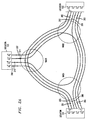
- FIG. 1 there is shown a schematic of an illustrative WDM ring network, e.g., a metropolitan area network, including three access nodes or sites (e.g., Wavelength Add/Drop (WAD) sites,WAD1- WAD3),101-103, interspersed by three optical fiber spans 104 - 106.
- Each node link e.g., 101/104 - 103/106, includes an access site, e.g.,WAD1 - WAD3, and an optical fiber segment, e.g.,104 - 106, respectively.
- Each of the WAD1 - WAD3 sites, 101 - 103 is shown to include a WAD element, respectively, 107 - 109, and an optical amplifier, respectively, 111 - 113.
- Each of the WAD elements 107 - 109 are, illustratively, shown to include fiber gratings and circulators.
- the optical amplifiers 111 - 113 are Erbium-Doped Fiber Amplifiers (EDFAs) which provide optical gain to compensate for the loss in the prior corresponding node link (defined herein as a node and an optical fiber segment).
- EDFAs Erbium-Doped Fiber Amplifiers
- amplifier 111 would be arranged to compensate for the loss in optical fiber span 104, and the gratings, couplers and fiber connectors of its WAD element 107.
- each of the node links e.g., 101/104 - 103/106 are arranged to have the gain of the amplifier cancel the loss of the fiber and WAD element in its link.
- L 1 15.94
- L 2 14.49
- L 3 11.13 km, respectively.
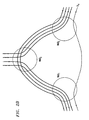
- sixteen WDM signal channels are propagated clockwise in the ring. Eight signal channels exist between WAD1 and WAD2, including 8 channels originating (201 of Fig. 2a ) at location121 of WAD1 and terminating (202 of Fig. 2a ) at location 122 of WAD2 and 8 channels originating (203 of Fig.
- each path in Fig. 2(a) represents 4 channels.
- Four channels exist between WAD2 and WAD3, including 4 channels originating (205 of Fig. 2a ) at location121 of WAD1 and terminating (206 of Fig. 2a ) at location 123 of WAD3 and 4 channels originating (207 of Fig. 2a ) at location123 of WAD3 and terminating (208 of Fig. 2a ) at location 121 of WAD1.
- Four channels also exist between WAD2 and WAD3, including 4 channels originating (209 of Fig. 2a ) at location122 of WAD2 and terminating (210 of Fig.
- EDFA Erbium-Doped Fiber Amplifiers
- two gratings 161 and 162 at the added wavelengths ⁇ a a , ⁇ a b and two gratings 163 and 164 at the dropped wavelengths ⁇ d a , ⁇ d b are inserted between the two circulators 151 and 152.
- the wavelengths ⁇ a a , ⁇ a b enter the input (I) port of circulator 152 from location 121 and are reflected by the gratings 161 and 162, respectively, and exit the output port of circulator 152 to optical fiber span 104.
- WAD1 would have 12 gratings for the 12 added wavelengths (8 from the group ⁇ a a and 4 from the group ⁇ a b ) and 12 grating for the 12 dropped wavelengths (8 from group ⁇ d a and 4 from group ⁇ d b ).
- the total at WAD2 would also include 12 grating for the 12 added wavelengths ( ⁇ a a , ⁇ a c ) and 12 grating for the 12 dropped wavelengths ( ⁇ d a , ⁇ d c ).
- the total at WAD3 would include 8 grating for the 8 added wavelengths ( ⁇ a c , ⁇ a b ) and 8 grating for the 8 dropped wavelengths ( ⁇ d b , ⁇ d c ).
- the WAD elements may be implemented using the type described in the article by C. Dragone, C. A. Edwards and R. C. Kisfier, "Integration Optics NXN Multiplexer on Silicon", IEEE Photonics Tech. Letters, vol.3, no.10, pp.896-899, Oct 1991 .
- the WAD elements may also be of the type described in US-A-5754321 .
- Each of the WAD1 - WAD3 nodes may also include a variable attenuator, e.g., 171 in WAD1, which is used to equalize the link loss to the link gain in each WAD link 101/104 - 103/106, to ensure that the input operating levels of each EDFA is the same.
- a variable attenuator e.g. 171 in WAD1
- the total input and output power for each EDFA, 111 -113 was -4 and 15 dBm, respectively.
- the gain of each EDFA, and therefore the loss between two adjacent EDFAs, was 19 dB.
- the gain tilt of EDFA in the signal wavelength region was small at this operating gain.
- a 10% coupler in WAD3, " M” was used to monitor the optical power in the ring, and the wavelength ⁇ a was measured at the output port " 0 " of WAD1.
- the added and dropped wavelengths are the same then only one grating may be used to both drop and add that wavelength, rather than using a separate drop grating and a separate add grating.
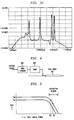
- Fig. 4 there is shown a block diagram of a typical EDFA.
- the EDFA fiber 401 is supplied with a pump signal from optical pump 402.
- the power output of pump 402 is determined by the level of the bias current supplied from current source 403.
- a control signal controls the level of bias current from current source 403 and, hence, the gain in the EDFA fiber 401.
- the EDFA's may be of the type described in the article by R. G. Smart et al, entitled “Two-stage erbium-doped fibre amplifiers suitable for use in long-haul soliton systems", published in ELECTRONICS LETTERS, 6th January 1994, Vol. 30, No. 1 .
- Fig. 5 there is shown an illustrative plot of gain versus input signal power for a typical EDFA fiber of Fig. 4 .
- the gain level and saturation level varies as a function of both signal power and pump bias current.
- pump bias current lb2 both the gain and the saturation power level is higher than at the lower bias current lb1.
- the gain of the EDFA at the signal wavelengths was set equal to the loss of for each of the WAD link, before the ring was closed.
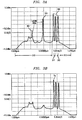
- lasing appeared, as illustrated by the optical signals monitored at port " M ", shown in Fig. 3(a) .
- Such lasing occurs when one or more of the ASE wavelengths (e.g., 301 and 302) of an inactive portion of the transmission bandwidth, which lies outside the reflection band of the fiber gratings.
- ASE wavelengths traverse the entire WDN ring network and will lase if they experience a loop gain that barely exceeds the loop loss.
- the signal power at the output port " 0 " which measures wavelength ⁇ a , decreased by about 0.5 dB due to fact that the gain at the lasing wavelength is higher than that of the signal channel.
- the laser power can be reduced and eliminated by increasing the cavity (i.e., loop) loss in the WDM ring network.
- the lasing threshold was reached when the attenuation was increased by about 0.7 dB at each WAD site, and complete lasing suppression was achieved when the attenuators were increased by 1.0 dB, as shown in Fig. 3(b) . Since the EDFA's in the WAD sites were strongly saturated, the total output power was essentially constant and the signal power at monitor " M " increased by about 0.5 dB. However, the output power at the output port " 0 ", not shown, decreased by about 1.6 dB due to a double pass through the attenuator 171 in WAD1.
- Fig. 4 where the gain of an EDFA, at a fixed bias current lb2, is shown to increase as the input power level is reduced from its more saturated level 401 to the less saturated level 402. The reduction in power can happen in practice when some of the signal channels are dropped. Lasing can return when channel loading is changed in only part of the ring and all the signals in the ring are affected due to the cross-saturation of the EDFA caused by laser power.
- the signal power of some of the remaining channels can be reduced significantly and may reduce system power margins and cause false alarms in the system optical monitors.
- Fig. 3(c) if the 8 channels of ⁇ a added to WAD1 and dropped at WAD2 are discontinued, lasing started again. This is because the 8 channels no longer pass through EDFAs 113 and 112, and ,consequently, do not cross-saturate them.
- the operating power levels of EDFAs 113 and 112 decreases from their more saturated levels, e.g., 401, to a less saturated level, e.g.,402.
- the result of the reduced operating power levels from 401 to 402 is that the gain of both EDFAs 113 and 112 increases.
- the output power at port " 0 " decreased by 0.8 dB. If both channels to WAD1 are dropped, the output power decreased by 1 dB. While if both channels to WAD1 and WAD1 are lost, because of a fiber cut or because of a network reconfiguration, the output power decreased by 1.7 dB. Depending on the design of the structure and operating condition of the WDM network, these power variations may be tolerable.
- the problem can be so severe that the power of some signal channels may be greatly reduced, which will cause significant eye closure, when channel loading in part of the ring is changed even though there is no fault in the ring. In the worst case, the above problem can render transmission over the network useless.
- the power variation caused by lasing saturation is not limited to WAD sites using gratings. Closed paths can also be formed in certain WDM ring network architectures that utilize demux/mux WAD. Shown in Fig. 6 is an illustrative demux/mux WAD implemented using a well known Dragone Waveguide Grating Router. Such a WGR is described in the previously-referenced article by C. Dragone et al. enables the routing of signal channels according to their wavelength.
- a WAD node (e.g., WAD1) may be implemented using a WGR 107 including a demultiplexer WGR unit 601, waveguide interfaces 602 and 603, and a multiplexer WGR 604.
- the function of the switch unit 605 will be described in a later paragraph.
- the demultiplexer WGR unit 601 is used to separate the various wavelength signal channels received over a optical fiber (e.g., span 105).
- the channel outputs of WGR unit 601 connect to interface 602.
- Fig. 6 illustrates how the WGR 107 may be used to add and drop wavelengths in our Fig. 2 example.
- 4 wavelength paths enters WGR 107 with 3 wavelength paths being dropped 606 and 3 wavelength paths being added. Again, as before, each line represents 4 channels.
- 3 wavelength paths 606 are dropped and wavelength paths 608 is connected through to interface 603 along with the added 3 wavelength paths 607.
- the output of interface 603 connects to multiplexer WGR 604 which combines the signal channels for transmission over span 104.
- switch unit 605 includes a one or more switch networks, for switchably connecting/disconnecting inactive wavelength channels in the WDM ring network.
- the switch unit 605 operates in response to a control signal 609 generated by a local control unit 610 which senses when wavelengths have been added or deleted from the WAD node 107.
- Control unit 610 includes node link control algorithms which use wavelength allocation in the network to control the wavelength switching in interface 605. Such link control is described in the article by J. Zyskind et al, "Fast Link Control Protection for Surviving Channels in Multiwavelength Optical Networks", Proc. ECOC 96, Vol. 5, page 49 .
- a protection means may be included in the WDM ring network to change the optical transmission characteristics of a selected portion of the operating wavelength bandwidth of the WDM ring network.
- notch filters 181 may be used as the protection means.
- the stop bands of the notch filters 181 would block the ASE between the reflection band of add/drop gratings, i.e., bands 310 -313.
- the loss of the notch filters 181 ensure that the loop gain at all the frequencies in bands 310 - 313 is substantially less than 0 dB.
- notch filters 181 can also include a notch filter for each of the signal channels 303 to protect against lasing at those wavelengths, when they are not in use. Additionally, it should be noted that notch filters 181 may be made selective under control of control signal 182, so that particular notch filters may be switched into the network by a local controller which senses when wavelengths have been added or deleted from the WAD node.
- Another technique for suppressing lasing in a WDM ring network is to control the gain of all the EDFA's in the ring during change in channel loading, so that round trip (loop) gain is always less than the loop loss.
- One technique for controlling the gain of an EDFA is shown in Fig. 4 , where a control signal from a controller, not shown, signals when the gain should be changed in response to wavelengths which have been added or deleted from its WAD node. Such a technique is described in the article by A. Srivastava et al, "Fast Pump Control in an Erbium Doped Fiber Amplifier" post deadline paper PDP4, OAA'97 .
- Fig. 7 shows how the techniques of the present invention may be utilized in an illustrative double WDM ring network.
- the double WDM ring network includes rings 701 and 702 including WAD sites 711 - 715.
- the WAD sites 711 - 715 may be well-known optical cross-connects which enable wavelengths to be routed to and/or from other optical networks.
- the WAD sites 711 - 715 incorporate protection means to prevent lasing in the rings 701 and 702 when any signal wavelengths are added or dropped at any of the WAD sites 711 - 715.
- the protection means located at WAD sites 711 - 715 may be controllable so as to be automatically switched in or out of the new WDM ring networks loops 731 and 732 to prevent lasing in the new WDM ring networks.
- the gain of the EDFA fiber may also be changed to ensure that no lasing in the new WDM ring networks. This may be accomplished using pump control, as discussed in the previously-referenced article by A. Srivastava et al, and using link control, as described in the previously-referenced article by J. Zyskind et al.
Landscapes
- Engineering & Computer Science (AREA)
- Computer Networks & Wireless Communication (AREA)
- Signal Processing (AREA)
- Optical Communication System (AREA)
- Lasers (AREA)
- Small-Scale Networks (AREA)
Claims (9)
- Wellenlängenmultiplex-Ringnetzwerk, umfassend:Eine Vielzahl von in Reihe geschalteten Knoten-Links (101, 102, 103), wobei jeder Knoten-Link ein Segment einer optischen Faser (104, 105, 106) und eine Zugangsknotenstelle (107, 108, 109) zum Hinzufügen oder Entfernen eines oder mehrerer aktiver Wellenlängenkanäle zu oder aus einer Übertragungsbandbreite des Netzwerks umfasst,WOBEI DAS BESAGTE NETZWERK GEKENNZEICHET IST DURCH:Schutzmittel (181, 183, 185), welches an das Netzwerk angeschlossen ist, zum Ändern der optischen Übertragungseigenschaften des Netzwerks, um zu gewährleisten, dass die Verstärkung der Netzwerkschleife bei jeder beliebigen Wellenlänge nicht den Verlust der Netzwerkschleife überschreitet, wobei das Schutzmittel das Licht in einem ungenutzten Abschnitt der Übertragungsbandbreite beeinträchtigt, so dass die Verstärkung der Netzwerkschleife für diesen ungenutzten Abschnitt niedriger ist als der Verlust der Netzwerkschleife, und wobei mindestens eine der Vielzahl von angeschlossenen Knoten-Links Mittel zum Routen von Wellenlängenkanälen gemäß deren Wellenlängen umfasst und das Schutzmittel ein oder mehrere Schaltelemente umfasst, wobei jedes Schaltelement für die Steuerung der Verbindung eines ungenutzten Wellenlängenkanals des Routing-Mittels bestimmt ist.
- Wellenlängenmultiplex-Ringnetzwerk nach Anspruch 1, wobei das Schutzmittel eine Verstärkungssteuerung (403) umfasst, welche die Verstärkung der Netzwerkschleife bei einer oder mehreren Wellenlängen steuert.
- Wellenlängenmultiplex-Ringnetzwerk nach Anspruch 1, wobei der ungenutzte Abschnitt der Übertragungsbandbreite einen oder mehrere ungenutzte Wellenlängenkanäle umfasst, welche vom Netzwerk nicht genutzt werden.
- Wellenlängenmultiplex-Ringnetzwerk nach Anspruch 1, wobei das Schutzmittel das Lasern bei verstärkten spontanen Emissionen in dem ungenutzten Abschnitt der Übertragungsbandbreite durch Blockieren von verstärkten spontanen Emissionen zwischen Reflexionsbändern von Add/Drop-Gittern (161, 162, 163, 164) verhindert.
- Wellenlängenmultiplex-Ringnetzwerk nach Anspruch 1, wobei mindestens eines der Vielzahl von angeschlossenen Knotenmitteln eine oder mehrere optische Schaltungen, ausgewählt aus einer Gruppe, welche mindestens eine Add/Drop-Schaltung und eine Querverbindungsschaltung einschließt, umfasst.
- Wellenlängenmultiplex-Ringnetzwerk nach Anspruch 1, wobei das eine oder die mehreren Schaltelemente auf Steuersignale reagieren und somit die schaltbaren Verbindungen steuern.
- Wellenlängenmultiplex-Ringnetzwerk nach Anspruch 1, wobei das Schutzmittel einen oder mehrere Kerbfilter umfasst.
- Wellenlängenmultiplex-Ringnetzwerk nach Anspruch 7, wobei ein jeder der ein oder mehreren Kerbfilter die optische Übertragung eines Teils des ungenutzten Abschnitts der Übertragungsbandbreite reduziert.
- Wellenlängenmultiplex-Ringnetzwerk nach Anspruch 1, wobei jeder Knoten-Link sein eigenes Schutzmittel umfasst.
Applications Claiming Priority (2)
| Application Number | Priority Date | Filing Date | Title |
|---|---|---|---|
| US929926 | 1992-08-17 | ||
| US08/929,926 US6025941A (en) | 1997-09-15 | 1997-09-15 | Stable wavelength division multiplex ring network |
Publications (3)
| Publication Number | Publication Date |
|---|---|
| EP0903882A2 EP0903882A2 (de) | 1999-03-24 |
| EP0903882A3 EP0903882A3 (de) | 2005-01-19 |
| EP0903882B1 true EP0903882B1 (de) | 2013-11-06 |
Family
ID=25458704
Family Applications (1)
| Application Number | Title | Priority Date | Filing Date |
|---|---|---|---|
| EP98307235.6A Expired - Lifetime EP0903882B1 (de) | 1997-09-15 | 1998-09-08 | Stabiles Wellenlängenmultiplex-Ringnetzwerk |
Country Status (3)
| Country | Link |
|---|---|
| US (1) | US6025941A (de) |
| EP (1) | EP0903882B1 (de) |
| JP (1) | JP3466485B2 (de) |
Families Citing this family (45)
| Publication number | Priority date | Publication date | Assignee | Title |
|---|---|---|---|---|
| JP3166695B2 (ja) * | 1998-01-05 | 2001-05-14 | 日本電気株式会社 | 波長分割多重送信装置 |
| US6426815B1 (en) * | 1998-06-19 | 2002-07-30 | Ciena Corporation | WDM ring transmission system having two hubs |
| US6243175B1 (en) * | 1998-08-06 | 2001-06-05 | Ciena Corporation | WDM optical communication system having reduced loss and cross-talk |
| US6538783B1 (en) * | 1998-09-18 | 2003-03-25 | Corvis Corporation | Optical systems including add drop devices and methods |
| GB2347809B (en) * | 1999-03-12 | 2001-06-20 | Marconi Comm Ltd | Signal transmission system |
| US6188816B1 (en) * | 1999-09-08 | 2001-02-13 | Nortel Networks Limited | Filter topologies for optical add-drop multiplexers |
| AU1202301A (en) * | 1999-10-12 | 2001-04-23 | Tellabs Operation Inc. | Prevention of lasing in a closed optical loop |
| US6735394B1 (en) | 1999-12-15 | 2004-05-11 | Tellabs Operations, Inc. | Per-channel optical amplification using saturation mode |
| US7099578B1 (en) | 1999-12-16 | 2006-08-29 | Tellabs Operations Inc. | 1:N protection in an optical terminal |
| DE10011068B4 (de) * | 2000-03-07 | 2004-02-05 | Siemens Ag | Anordnung zur Unterdrückung von Instabilitäten in einem optischen Wellenlängen-Multiplex-Ringnetz |
| KR100351672B1 (ko) * | 2000-06-12 | 2002-09-11 | 한국과학기술원 | 전광자동이득조절 기능을 갖는 양방향 애드/드롭 광증폭기 |
| WO2001099347A2 (en) | 2000-06-22 | 2001-12-27 | Tellabs Operations Inc. | Shared optical ring protection in a multi-fiber ring |
| KR100342426B1 (ko) * | 2000-10-04 | 2002-07-03 | 윤덕용 | 파장분할 다중방식 환형 광통신망의 장애수리후 복귀방법 |
| US6424458B1 (en) | 2000-12-22 | 2002-07-23 | Ciena Corporation | Optical pre-amplifier apparatus and method for receiver performing windowed and gain change rate control |
| US6490080B2 (en) | 2000-12-22 | 2002-12-03 | Ciena Corporation | Gain controlled optically pre-amplified receiver apparatus and method |
| US6522461B1 (en) | 2000-12-22 | 2003-02-18 | Ciena Corporation | Optical pre-amplifier apparatus and method for receiver performing gain control according to LOS declaration |
| JP4252219B2 (ja) | 2001-01-12 | 2009-04-08 | 富士通株式会社 | 光ノード装置及び該装置を備えたシステム |
| US6937823B2 (en) * | 2001-03-05 | 2005-08-30 | Lucent Technologies Inc. | Method for preventing lasing in an optical ring network |
| US6388802B1 (en) * | 2001-07-31 | 2002-05-14 | Seneca Networks | Reduction of ASE in WDM optical ring networks |
| US6421168B1 (en) * | 2001-07-31 | 2002-07-16 | Seneca Networks | Reduction of ASE in WDM optical ring networks |
| US20030099015A1 (en) * | 2001-11-23 | 2003-05-29 | Ar Card | Avoiding amplified spontaneous emission loops in optical networks |
| US7054562B1 (en) | 2002-02-01 | 2006-05-30 | Ciena Corporation | Method and system for suppressing ASE on a WDM network |
| US7231148B2 (en) * | 2002-03-28 | 2007-06-12 | Fujitsu Limited | Flexible open ring optical network and method |
| US7116905B2 (en) | 2002-03-27 | 2006-10-03 | Fujitsu Limited | Method and system for control signaling in an open ring optical network |
| US7076163B2 (en) * | 2002-03-27 | 2006-07-11 | Fujitsu Limited | Method and system for testing during operation of an open ring optical network |
| JP4201531B2 (ja) * | 2002-05-30 | 2008-12-24 | 富士通株式会社 | 光通信ノード及び光ネットワークシステム |
| US6842562B2 (en) * | 2002-05-30 | 2005-01-11 | Fujitsu Network Communications, Inc. | Optical add/drop node and method |
| US20040052530A1 (en) * | 2002-09-17 | 2004-03-18 | Cechan Tian | Optical network with distributed sub-band rejections |
| US7181137B1 (en) * | 2002-09-30 | 2007-02-20 | Cisco Technology, Inc. | Subband spectrum analysis for optical multiplex section protection |
| US7877019B2 (en) * | 2002-10-16 | 2011-01-25 | Tyco Electronics Subsea Communications Llc | Optical receiver including a system and method of controlling gain of an optical amplifier |
| US7333732B2 (en) * | 2004-12-30 | 2008-02-19 | Tyco Telecommunications (Us) Inc. | Optical receiver |
| US7027210B2 (en) | 2003-05-29 | 2006-04-11 | Fujitsu Limited | Method and system for determining gain for an optical signal |
| US7009761B2 (en) | 2003-05-29 | 2006-03-07 | Fujitsu Limited | Power tilt compensation using automatic power balance control |
| US7483636B2 (en) * | 2003-07-28 | 2009-01-27 | Fujitsu Limited | Optical network with sub-band rejection and bypass |
| ITMI20031742A1 (it) * | 2003-09-11 | 2005-03-12 | Marconi Comm Spa | Rete ottica ad anello con ricircolazione di luce ase e |
| US20050095001A1 (en) * | 2003-10-29 | 2005-05-05 | Fujitsu Limited | Method and system for increasing network capacity in an optical network |
| US7483637B2 (en) | 2003-11-26 | 2009-01-27 | Fujitsu Limited | Optical ring network with optical subnets and method |
| US7526201B2 (en) * | 2004-06-25 | 2009-04-28 | Tyco Telecommunications (Us) Inc. | Optical fiber transmission system with noise loading |
| US7450851B2 (en) * | 2004-08-27 | 2008-11-11 | Fujitsu Limited | System and method for modularly scalable architecture for optical networks |
| CA2550559A1 (en) * | 2005-06-14 | 2006-12-14 | Tropic Networks Inc. | A method and system for avoiding amplified spontaneous emission loops in an optical network |
| US7945158B2 (en) * | 2006-08-18 | 2011-05-17 | Tellabs Operations, Inc. | Transponder-less verification of the configuration of an optical network node |
| US8554081B2 (en) * | 2008-07-09 | 2013-10-08 | Tyco Electronics Subsea Communications, Llc | Optical add/drop multiplexer including reconfigurable filters and system including the same |
| US9819436B2 (en) | 2013-08-26 | 2017-11-14 | Coriant Operations, Inc. | Intranodal ROADM fiber management apparatuses, systems, and methods |
| US9882613B2 (en) * | 2015-06-01 | 2018-01-30 | Corning Optical Communications Wireless Ltd | Determining actual loop gain in a distributed antenna system (DAS) |
| DE102016207857B4 (de) * | 2016-05-06 | 2019-05-16 | Deutsche Telekom Ag | Verfahren zur effizienteren Datenübertragung in einem optischen Telekommunikationsnetz im Wellenlängen-Multiplex-Betrieb (WDM) von verschiedenen optischen Wellenlängen, wobei das optische Telekommunikationsnetz einen ersten übergeordneten Netzknoten, einen zweiten übergeordneten Netzknoten und ferner eine Mehrzahl von Netzelementen aufweist, optisches Telekommunikationsnetz, Computerprogramm und Computerprogrammprodukt |
Family Cites Families (6)
| Publication number | Priority date | Publication date | Assignee | Title |
|---|---|---|---|---|
| US5440417A (en) * | 1993-10-04 | 1995-08-08 | At&T Corp. | System for spectrum-sliced fiber amplifier light for multi-channel wavelength-division-multiplexed applications |
| FR2715017B1 (fr) * | 1994-01-13 | 1996-02-16 | Alcatel Nv | Procédé de transmission et liaison optique à multiplexage spectral avec amplification. |
| JPH0818592A (ja) * | 1994-06-30 | 1996-01-19 | Fujitsu Ltd | 光学的スイッチングによるリング保護を有する光ファイバー伝送システム |
| PE41196A1 (es) * | 1994-07-25 | 1996-12-17 | Pirelli Cavi Spa | Sistema de telecomunicacion amplificado para transmisiones en multiplex por division de longitud de onda, capaz de limitar las variaciones en la potencia de salida |
| US5680235A (en) * | 1995-04-13 | 1997-10-21 | Telefonaktiebolaget Lm Ericsson | Optical multichannel system |
| US5870212A (en) * | 1998-01-14 | 1999-02-09 | Mciworldcom, Inc. | Self-healing optical network |
-
1997
- 1997-09-15 US US08/929,926 patent/US6025941A/en not_active Expired - Lifetime
-
1998
- 1998-09-08 EP EP98307235.6A patent/EP0903882B1/de not_active Expired - Lifetime
- 1998-09-11 JP JP25865398A patent/JP3466485B2/ja not_active Expired - Fee Related
Also Published As
| Publication number | Publication date |
|---|---|
| JP3466485B2 (ja) | 2003-11-10 |
| JPH11145910A (ja) | 1999-05-28 |
| EP0903882A3 (de) | 2005-01-19 |
| EP0903882A2 (de) | 1999-03-24 |
| US6025941A (en) | 2000-02-15 |
Similar Documents
| Publication | Publication Date | Title |
|---|---|---|
| US6025941A (en) | Stable wavelength division multiplex ring network | |
| EP1035680B1 (de) | Signalübertragungssystem | |
| US5532864A (en) | Optical monitoring channel for wavelength division multiplexed optical communication system | |
| US5812306A (en) | Bidirectional WDM optical communication systems with bidirectional optical amplifiers | |
| US5742416A (en) | Bidirectional WDM optical communication systems with bidirectional optical amplifiers | |
| US5696615A (en) | Wavelength division multiplexed optical communication systems employing uniform gain optical amplifiers | |
| CA2244478C (en) | Wavelength-selective and loss-less optical add/drop multiplexer | |
| US5907420A (en) | System and method for mitigating cross-saturation in optically amplified networks | |
| US20030025961A1 (en) | Broadcast and select all optical network | |
| EP0820666B1 (de) | Optische mehrkanalanordnung | |
| EP2727271B1 (de) | Optisches kommunikationssystem, vorrichtung und verfahren zur datenverarbeitung in einem optischen netzwerk | |
| WO2004028091A2 (en) | Optical network with distributed sub-band rejections | |
| KR20010113641A (ko) | 파워 종속 피드백을 갖는 광증폭기 | |
| US6735394B1 (en) | Per-channel optical amplification using saturation mode | |
| EP1584147B1 (de) | Verstärktes, optisches ringübertragungssystem | |
| EP1474885B1 (de) | Optisches wellenlängenmultiplex-übertragungsnetzwerk | |
| JP2006180417A (ja) | 光伝送装置 | |
| Srivastava et al. | Signal power transients in optically amplified WDM ring networks | |
| Wuttisittikulkij et al. | Multiwavelength self-healing ring transparent networks | |
| Krummrich et al. | Experimental investigation of compensation of Raman-induced power transients from WDM channel interactions | |
| Sun et al. | Signal power variations in optically amplified WDM ring networks | |
| US20040109686A1 (en) | Architecture for metropolitan dense wavelength division multiplex network with all-optical reference node | |
| CN121864247A (zh) | 光复用段、光通信系统和光放大器 | |
| Radic | Ultradense bidirectional optical transmission | |
| WO2002033517A2 (en) | Closed loop amplified rings including lossy spans |
Legal Events
| Date | Code | Title | Description |
|---|---|---|---|
| PUAI | Public reference made under article 153(3) epc to a published international application that has entered the european phase |
Free format text: ORIGINAL CODE: 0009012 |
|
| AK | Designated contracting states |
Kind code of ref document: A2 Designated state(s): AT BE CH CY DE DK ES FI FR GB GR IE IT LI LU MC NL PT SE |
|
| AX | Request for extension of the european patent |
Free format text: AL;LT;LV;MK;RO;SI |
|
| PUAL | Search report despatched |
Free format text: ORIGINAL CODE: 0009013 |
|
| AK | Designated contracting states |
Kind code of ref document: A3 Designated state(s): AT BE CH CY DE DK ES FI FR GB GR IE IT LI LU MC NL PT SE |
|
| AX | Request for extension of the european patent |
Extension state: AL LT LV MK RO SI |
|
| 17P | Request for examination filed |
Effective date: 20050711 |
|
| AKX | Designation fees paid |
Designated state(s): DE FR GB |
|
| 17Q | First examination report despatched |
Effective date: 20061229 |
|
| RAP3 | Party data changed (applicant data changed or rights of an application transferred) |
Owner name: LUCENT TECHNOLOGIES INC. |
|
| RAP1 | Party data changed (applicant data changed or rights of an application transferred) |
Owner name: ALCATEL-LUCENT USA INC. |
|
| GRAP | Despatch of communication of intention to grant a patent |
Free format text: ORIGINAL CODE: EPIDOSNIGR1 |
|
| INTG | Intention to grant announced |
Effective date: 20130607 |
|
| RIC1 | Information provided on ipc code assigned before grant |
Ipc: H04J 14/02 20060101AFI20130524BHEP Ipc: H04B 10/00 20130101ALI20130524BHEP |
|
| GRAS | Grant fee paid |
Free format text: ORIGINAL CODE: EPIDOSNIGR3 |
|
| 111Z | Information provided on other rights and legal means of execution |
Free format text: DE FR GB Effective date: 20130410 |
|
| GRAA | (expected) grant |
Free format text: ORIGINAL CODE: 0009210 |
|
| RAP1 | Party data changed (applicant data changed or rights of an application transferred) |
Owner name: ALCATEL LUCENT |
|
| AK | Designated contracting states |
Kind code of ref document: B1 Designated state(s): DE FR GB |
|
| REG | Reference to a national code |
Ref country code: GB Ref legal event code: FG4D |
|
| REG | Reference to a national code |
Ref country code: DE Ref legal event code: R096 Ref document number: 69843140 Country of ref document: DE Effective date: 20131224 |
|
| REG | Reference to a national code |
Ref country code: FR Ref legal event code: GC Effective date: 20140306 |
|
| REG | Reference to a national code |
Ref country code: DE Ref legal event code: R097 Ref document number: 69843140 Country of ref document: DE |
|
| RAP2 | Party data changed (patent owner data changed or rights of a patent transferred) |
Owner name: ALCATEL LUCENT |
|
| PLBE | No opposition filed within time limit |
Free format text: ORIGINAL CODE: 0009261 |
|
| STAA | Information on the status of an ep patent application or granted ep patent |
Free format text: STATUS: NO OPPOSITION FILED WITHIN TIME LIMIT |
|
| 26N | No opposition filed |
Effective date: 20140807 |
|
| REG | Reference to a national code |
Ref country code: DE Ref legal event code: R097 Ref document number: 69843140 Country of ref document: DE Effective date: 20140807 |
|
| REG | Reference to a national code |
Ref country code: FR Ref legal event code: RG Effective date: 20141016 |
|
| REG | Reference to a national code |
Ref country code: FR Ref legal event code: PLFP Year of fee payment: 18 |
|
| PGFP | Annual fee paid to national office [announced via postgrant information from national office to epo] |
Ref country code: GB Payment date: 20150917 Year of fee payment: 18 Ref country code: DE Payment date: 20150922 Year of fee payment: 18 |
|
| PGFP | Annual fee paid to national office [announced via postgrant information from national office to epo] |
Ref country code: FR Payment date: 20150922 Year of fee payment: 18 |
|
| REG | Reference to a national code |
Ref country code: DE Ref legal event code: R119 Ref document number: 69843140 Country of ref document: DE |
|
| GBPC | Gb: european patent ceased through non-payment of renewal fee |
Effective date: 20160908 |
|
| REG | Reference to a national code |
Ref country code: FR Ref legal event code: ST Effective date: 20170531 |
|
| PG25 | Lapsed in a contracting state [announced via postgrant information from national office to epo] |
Ref country code: FR Free format text: LAPSE BECAUSE OF NON-PAYMENT OF DUE FEES Effective date: 20160930 Ref country code: DE Free format text: LAPSE BECAUSE OF NON-PAYMENT OF DUE FEES Effective date: 20170401 Ref country code: GB Free format text: LAPSE BECAUSE OF NON-PAYMENT OF DUE FEES Effective date: 20160908 |