EP0903729A2 - Vorrichtung zur Sprachcodierung und Langzeitprädiktion eines eingegebenen Sprachsignals - Google Patents
Vorrichtung zur Sprachcodierung und Langzeitprädiktion eines eingegebenen Sprachsignals Download PDFInfo
- Publication number
- EP0903729A2 EP0903729A2 EP98117652A EP98117652A EP0903729A2 EP 0903729 A2 EP0903729 A2 EP 0903729A2 EP 98117652 A EP98117652 A EP 98117652A EP 98117652 A EP98117652 A EP 98117652A EP 0903729 A2 EP0903729 A2 EP 0903729A2
- Authority
- EP
- European Patent Office
- Prior art keywords
- pitch
- convolution
- search
- data
- coding apparatus
- Prior art date
- Legal status (The legal status is an assumption and is not a legal conclusion. Google has not performed a legal analysis and makes no representation as to the accuracy of the status listed.)
- Granted
Links
- 238000000034 method Methods 0.000 title claims description 15
- 230000005284 excitation Effects 0.000 claims abstract description 39
- 238000003786 synthesis reaction Methods 0.000 claims abstract description 17
- 230000015572 biosynthetic process Effects 0.000 claims abstract description 16
- 230000003044 adaptive effect Effects 0.000 claims description 12
- 238000001914 filtration Methods 0.000 claims description 5
- 238000013139 quantization Methods 0.000 claims description 3
- 238000001208 nuclear magnetic resonance pulse sequence Methods 0.000 abstract description 13
- 239000011295 pitch Substances 0.000 description 114
- 238000010586 diagram Methods 0.000 description 8
- 101100074187 Caenorhabditis elegans lag-1 gene Proteins 0.000 description 5
- 238000004364 calculation method Methods 0.000 description 5
- 238000007493 shaping process Methods 0.000 description 4
- 101100510615 Caenorhabditis elegans lag-2 gene Proteins 0.000 description 2
- 230000006870 function Effects 0.000 description 2
- 238000001228 spectrum Methods 0.000 description 2
- 210000001260 vocal cord Anatomy 0.000 description 2
- 238000007796 conventional method Methods 0.000 description 1
- 238000005516 engineering process Methods 0.000 description 1
- 239000011159 matrix material Substances 0.000 description 1
- 239000000203 mixture Substances 0.000 description 1
- 230000004044 response Effects 0.000 description 1
Images

Classifications
-
- G—PHYSICS
- G10—MUSICAL INSTRUMENTS; ACOUSTICS
- G10L—SPEECH ANALYSIS TECHNIQUES OR SPEECH SYNTHESIS; SPEECH RECOGNITION; SPEECH OR VOICE PROCESSING TECHNIQUES; SPEECH OR AUDIO CODING OR DECODING
- G10L19/00—Speech or audio signals analysis-synthesis techniques for redundancy reduction, e.g. in vocoders; Coding or decoding of speech or audio signals, using source filter models or psychoacoustic analysis
- G10L19/04—Speech or audio signals analysis-synthesis techniques for redundancy reduction, e.g. in vocoders; Coding or decoding of speech or audio signals, using source filter models or psychoacoustic analysis using predictive techniques
- G10L19/08—Determination or coding of the excitation function; Determination or coding of the long-term prediction parameters
- G10L19/09—Long term prediction, i.e. removing periodical redundancies, e.g. by using adaptive codebook or pitch predictor
-
- G—PHYSICS
- G10—MUSICAL INSTRUMENTS; ACOUSTICS
- G10L—SPEECH ANALYSIS TECHNIQUES OR SPEECH SYNTHESIS; SPEECH RECOGNITION; SPEECH OR VOICE PROCESSING TECHNIQUES; SPEECH OR AUDIO CODING OR DECODING
- G10L19/00—Speech or audio signals analysis-synthesis techniques for redundancy reduction, e.g. in vocoders; Coding or decoding of speech or audio signals, using source filter models or psychoacoustic analysis
- G10L2019/0001—Codebooks
- G10L2019/0011—Long term prediction filters, i.e. pitch estimation
-
- G—PHYSICS
- G10—MUSICAL INSTRUMENTS; ACOUSTICS
- G10L—SPEECH ANALYSIS TECHNIQUES OR SPEECH SYNTHESIS; SPEECH RECOGNITION; SPEECH OR VOICE PROCESSING TECHNIQUES; SPEECH OR AUDIO CODING OR DECODING
- G10L19/00—Speech or audio signals analysis-synthesis techniques for redundancy reduction, e.g. in vocoders; Coding or decoding of speech or audio signals, using source filter models or psychoacoustic analysis
- G10L2019/0001—Codebooks
- G10L2019/0013—Codebook search algorithms
Definitions
- the present invention relates to a speech coding apparatus and a pitch prediction method in speech coding, particularly a speech coding apparatus using a pitch prediction method in which pitch information concerning an input excitation waveform for speech coding is obtained as few computations as possible, and a pitch prediction method of an input speech signal.
- a speech coding method represented by CELP (Code Excited Linear Prediction) system is performed by modelimg the speech information using a speech waveform and an excitation waveform, and coding the spectrum envelop information corresponding to the speech waveform, and the pitch information corresponding to the excitation waveform separately, both of which are extracted from input speech information divided into frames.
- CELP Code Excited Linear Prediction
- the coding according to G.723.1 is carried out based on the principles of linear prediction analysis-by-synthesis to attempt so that a perceptually weighted error signal is minimized.
- the search of pitch information in this case is performed by using the characteristics that a speech waveform changes periodically in a vowel range corresponding to the vibration of a vocal cord, which is called pitch prediction.
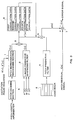
- FIG.1 is a block diagram of a pitch prediction section in a conventional speech coding apparatus.
- An input speech signal is processed to be divided into frames and sub-frames.
- An excitation pulse sequence X[n] generated in a immediately before sub-frame is input to pitch reproduction processing sect ion 1, and processed by the pitch emphasis processing for a current target sub-frame.
- Linear predictive synthesis filter 2 provides at multiplier 3 the system filter processing such as formant processing and harmonic shaping processing to an output speech data Y[n] from pitch reproduction processing section 1.
- the coefficient setting of this linear predictive synthesis filter 2 is performed using a linear predictive coefficient A'(z) normalized by the LSP (linear spectrum pair) quantization of a linear predictive coefficient A(z) obtained by linear predictive analyzing a speech input signal y[n], a perceptual weighting coefficient W[z] used in perceptual weighting processing the input speech signal y[n], and a coefficient P(z) signal of harmonic noise filter for waveform arranging a perceptually weighted signal.
- LSP linear spectrum pair
- Pitch predictive filter 4 is a filter with five taps for providing in multiplier 5 the filter processing to an output data t'[n] out put from multiplier 3 using a predetermined coefficient. This coefficient setting is performed by reading out a cordword sequentially from adaptive cordbook 6 in which a cordword of adaptive vector corresponding to each pitch period is stored. Further when coded speech data are decoded, this pitch predictive filter 4 has the function to generate a pitch period which sounds more natural and similar to a human speech in generating a current excitation pulse sequence from a previous excitation pulse sequence.
- Further adder 7 outputs an error signal r[n].
- the error signal r[n] is an error between an output data p[n] from multiplier 5 that is a pitch predictive filtering processed signal, and a pitch residual signal t[n] of a current sub-frame (a residual signal of the formant processing and the harmonic shaping processing).
- An index in adaptive cordbook 6 and a pitch length are obtained as the optimal pitch information so that the error signal r[n] should be minimized by the least squares method.
- the calculation processing in a pitch prediction method described above is performed in the following way.
- the excitation pulse sequence X[n] of a certain pitch is sequentially input to a buffer to which 145 samples can be input, then the pitch reproduced excitation sequence Y[n] of 64 samples are obtained according to equations (1) and (2) below, where Lag indicates a pitch period.
- equations (1) and (2) indicate that a current pitch information (vocal cord vibration) is imitated using a previous excitation pulse sequence.
- the convolution data (filtered data) t'[n] is obtained by the convolution of this pitch reproduced excitation sequence Y[n] and an output from linear predictive synthesis filter 2 according to equation (3) below.
- the optimal value of convolution data P(n) in pitch predictive filter 4 is obtained using pitch residual signal t (n) so that the error signal r(n) should be minimized.
- the error signal r(n) shown in equation (6) below should be minimized by searching adaptive codebook data of pitches corresponding to five filter coefficients of fifth order FIR type pitch predictive filter 4 from codebook 6.
- Equation (7) The estimation of error is obtained using the least squares method according to equation (7) below.
- n 0 59
- equation (8) below is given.
- n 0 59
- equation (9) below is given.
- adaptive codebook data of a pitch in other words, the index of adaptive codebook data of a pitch to minimize the error is obtained.
- Further pitch information that is closed loop pitch information and the index of adaptive code book data of a pitch are obtained by repeating the above operation corresponding to Lag-1 up to Lag+1 for the re-search so as to obtain the pitch period information at this time correctly.
- the further processing is provided to each sub-frame.
- the pitch search processing is performed according to the range described above, and since one frame is composed of four sub-frames, the same processing is repeated four times in one frame.
- the present invention is carried out by considering the above subjects. It is an object of the present invention to provide a speech coding apparatus using the pitch prediction method capable of reducing the computations in DSP (CPU) without depending on the k parameter.
- the convolution processing which requires the plurality of computations corresponding to the number of repeating times set by the k parameter, is completed with only one computation. That allows reducing the computations in a CPU.
- the present invention is to store in advance a plurality of pitch reproduced excitation pulse sequences, to which the pitch reproduction processing is provided, corresponding to a plurality of pitch searches, and to perform the convolution processing sequentially by reading the pitch reproduced excitation pulse from the memory.
- the pitch searches are simplified since the second time. And since it is not necessary to repeat the pitch reproduction processing according to the k parameter, it is possible to reduce the calculation amount in a CPU.
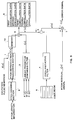
- FIG.3 is a schematic block diagram of a pitch prediction section in a speech coding apparatus in the first embodiment of the present invention.
- the flow of the basic coding processing in the apparatus is the same as in a conventional apparatus.
- An excitation pulse sequence X[n] generated in a just-previous sub-frame is input to pitch reproduction processing section 1.
- Pitch reproduction processing section 1 provides the pitch emphasis processing for a current object sub-frame using the input X[n] based on the pitch length information obtained by the auto-correlation of the input speech wave form.
- linear predictive synthesis filter 2 provides at multiplier 3 the system filter processing such as formant processing and harmonic shaping processing to an output speech data Y[n] from pitch reproduction processing section 1.
- the coefficient setting of this linear predictive synthesis filter 2 is performed using a linear predictive coefficient A'(z) normalized by the LSP quantization, a perceptual weighting coefficient W[z] and a coefficient P(z) signal of harmonic noise filter.
- Pitch predictive filter 4 is a filter with five taps for providing in multiplier 5 the filter processing to an output data t'[n] in multiplier 3 using a predetermined coefficient. This coefficient setting is performed by reading a cordword sequentially from adaptive cordbook 6 in which a cordword of adaptive vector corresponding to each pitch period is stored.
- Further adder 7 outputs an error signal r[n].
- the error signal r[n] is an error between an output data p[n] from multiplier 5 that is a pitch predictive filter processed signal, and a pitch residual signal t[n] of the current sub-frame (a residual signal after the formant processing and the harmonic shaping processing).
- An index in adaptive cordbook 6 and a pitch length are obtained as the optimal pitch information so that the error signal r[n] is minimized by the least squares method.
- pitch deciding section 8 detects the pitch period (Lag) from the input pitch length information, and decides whether or not the value exceeds the predetermined value.
- pitch period (Lag)
- one sub-frame is composed of 60 samples
- one period is more than one sub-frame
- pitch predictive filter is composed of 5 taps
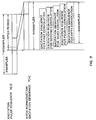
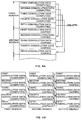
- And memory 9 is to store the convolution data of the pitch reproduced excitation data Y[n] and a coefficient I[n] of linear predictive synthesis filter 2. As illustrated in FIG.1, first convolution data up to fifth convolution data are sequentially stored in memory 9 corresponding to the repeating times of pitch reproduction set by the k parameter and the convolution. In this repeating processing, an excitation pulse sequence X'[n] is feedback to pitch reproduction processing section 2, using pitch information acquired at the previous processing. The excitation pulse sequence X'[n] is generated from an error signal between the convolution data of the coefficient of pitch predictive filter 4 using the previous convolution data and pitch residual signal t[n].
- each convolution data of t'(4)(n) according to equation (3) and equation (5) in the first embodiment is the same as that in a conventional technology.
- the previous pitch reproduction processing result is used again in the case where pitch period Lag is more than a predetermined value when re-search is performed k times by repeating the convolution processing using linear predictive synthesis filter 2 to improve the reproduction precision of a pitch period. That is attempted to reduce the computations.
- this convolution is performed 5 times according to equation (4) and equation (5).
- the convolution data are sequentially stored in memory 9.
- the previous convolution data stored in memory 9 is used in the convolution processing at this time.
- the fourth convolution data at the previous time are the fifth convolution data at this time
- the third convolution data at the previous time are the fourth convolution data at this time
- the second convolution data at the previous time are third convolution data at this time
- the first convolution data are newly computed and stored in memory 9 as illustrated in FIG.4A.
- the first convolution data up to the fourth convolution data obtained in the first search processing are each copied and respectively stored in the second search data write area in memory 9. That allows reducing the computations.
- the fourth convolution data are stored in a storing area for the fifth convolution data that will be unnecessary, then the third and second data are stored sequentially, and finally the first convolution data are computed to store.
- the memory areas it is possible to reduce the memory areas.
- the pitch predictive processing can be always performed with five storing areas for the convolution data, which are at least necessary for the fifth order FIR.
- a memory controller in memory 9 performs the processing descried above, i.e., the write of the convolution data to memory 9, the shift of the convolution data in memory 9, and the read of convolution data used in the current pitch search from memory 9.
- the memory controller is one of functions of memory 9.
- the convolution data obtained as described above are returned to a pitch reproduction processing section as closed loop pitch information to be processed by the pitch reproduction processing, and are processed by the convolution processing with the filter coefficient set for linear predictive synthesis filter 2. Such processing is repeated corresponding to the number of repeating times set by the k parameter. That permits to improve the precision of the pitch reproduction excitation sequence t'[n] to be inputted to multiplier 5.
Landscapes
- Engineering & Computer Science (AREA)
- Computational Linguistics (AREA)
- Signal Processing (AREA)
- Health & Medical Sciences (AREA)
- Audiology, Speech & Language Pathology (AREA)
- Human Computer Interaction (AREA)
- Physics & Mathematics (AREA)
- Acoustics & Sound (AREA)
- Multimedia (AREA)
- Compression, Expansion, Code Conversion, And Decoders (AREA)
- Analogue/Digital Conversion (AREA)
Applications Claiming Priority (3)
| Application Number | Priority Date | Filing Date | Title |
|---|---|---|---|
| JP273738/97 | 1997-09-20 | ||
| JP27373897A JP3263347B2 (ja) | 1997-09-20 | 1997-09-20 | 音声符号化装置及び音声符号化におけるピッチ予測方法 |
| JP27373897 | 1997-09-20 |
Publications (3)
| Publication Number | Publication Date |
|---|---|
| EP0903729A2 true EP0903729A2 (de) | 1999-03-24 |
| EP0903729A3 EP0903729A3 (de) | 1999-12-29 |
| EP0903729B1 EP0903729B1 (de) | 2004-03-24 |
Family
ID=17531887
Family Applications (1)
| Application Number | Title | Priority Date | Filing Date |
|---|---|---|---|
| EP98117652A Expired - Lifetime EP0903729B1 (de) | 1997-09-20 | 1998-09-17 | Vorrichtung zur Sprachcodierung und Langzeitprädiktion eines eingegebenen Sprachsignals |
Country Status (4)
| Country | Link |
|---|---|
| US (1) | US6243673B1 (de) |
| EP (1) | EP0903729B1 (de) |
| JP (1) | JP3263347B2 (de) |
| DE (1) | DE69822579T2 (de) |
Cited By (1)
| Publication number | Priority date | Publication date | Assignee | Title |
|---|---|---|---|---|
| CN116615736A (zh) * | 2020-09-18 | 2023-08-18 | 维萨国际服务协会 | 经由光卷积进行的动态图节点嵌入 |
Families Citing this family (5)
| Publication number | Priority date | Publication date | Assignee | Title |
|---|---|---|---|---|
| JP4857468B2 (ja) * | 2001-01-25 | 2012-01-18 | ソニー株式会社 | データ処理装置およびデータ処理方法、並びにプログラムおよび記録媒体 |
| JP3582589B2 (ja) * | 2001-03-07 | 2004-10-27 | 日本電気株式会社 | 音声符号化装置及び音声復号化装置 |
| JP4245288B2 (ja) * | 2001-11-13 | 2009-03-25 | パナソニック株式会社 | 音声符号化装置および音声復号化装置 |
| ATE500588T1 (de) * | 2008-01-04 | 2011-03-15 | Dolby Sweden Ab | Audiokodierer und -dekodierer |
| US8352841B2 (en) * | 2009-06-24 | 2013-01-08 | Lsi Corporation | Systems and methods for out of order Y-sample memory management |
Family Cites Families (9)
| Publication number | Priority date | Publication date | Assignee | Title |
|---|---|---|---|---|
| US5195168A (en) * | 1991-03-15 | 1993-03-16 | Codex Corporation | Speech coder and method having spectral interpolation and fast codebook search |
| US5396576A (en) * | 1991-05-22 | 1995-03-07 | Nippon Telegraph And Telephone Corporation | Speech coding and decoding methods using adaptive and random code books |
| US5265190A (en) * | 1991-05-31 | 1993-11-23 | Motorola, Inc. | CELP vocoder with efficient adaptive codebook search |
| US5179594A (en) * | 1991-06-12 | 1993-01-12 | Motorola, Inc. | Efficient calculation of autocorrelation coefficients for CELP vocoder adaptive codebook |
| US5495555A (en) * | 1992-06-01 | 1996-02-27 | Hughes Aircraft Company | High quality low bit rate celp-based speech codec |
| FR2700632B1 (fr) * | 1993-01-21 | 1995-03-24 | France Telecom | Système de codage-décodage prédictif d'un signal numérique de parole par transformée adaptative à codes imbriqués. |
| JP3209248B2 (ja) | 1993-07-05 | 2001-09-17 | 日本電信電話株式会社 | 音声の励振信号符号化法 |
| US5784532A (en) | 1994-02-16 | 1998-07-21 | Qualcomm Incorporated | Application specific integrated circuit (ASIC) for performing rapid speech compression in a mobile telephone system |
| JPH11500837A (ja) | 1995-10-11 | 1999-01-19 | フィリップス エレクトロニクス ネムローゼ フェンノートシャップ | スピーチコーダ用信号予測方法及び装置 |
-
1997
- 1997-09-20 JP JP27373897A patent/JP3263347B2/ja not_active Expired - Fee Related
-
1998
- 1998-09-15 US US09/153,299 patent/US6243673B1/en not_active Expired - Fee Related
- 1998-09-17 DE DE69822579T patent/DE69822579T2/de not_active Expired - Lifetime
- 1998-09-17 EP EP98117652A patent/EP0903729B1/de not_active Expired - Lifetime
Cited By (1)
| Publication number | Priority date | Publication date | Assignee | Title |
|---|---|---|---|---|
| CN116615736A (zh) * | 2020-09-18 | 2023-08-18 | 维萨国际服务协会 | 经由光卷积进行的动态图节点嵌入 |
Also Published As
| Publication number | Publication date |
|---|---|
| JPH1195799A (ja) | 1999-04-09 |
| DE69822579D1 (de) | 2004-04-29 |
| EP0903729A3 (de) | 1999-12-29 |
| JP3263347B2 (ja) | 2002-03-04 |
| US6243673B1 (en) | 2001-06-05 |
| DE69822579T2 (de) | 2004-08-05 |
| EP0903729B1 (de) | 2004-03-24 |
Similar Documents
| Publication | Publication Date | Title |
|---|---|---|
| EP0296763B1 (de) | CELP Vocoder und Anwendungsverfahren | |
| EP0296764B1 (de) | Linearer Prädiktionsvocoder mit Code-Anregung | |
| EP0424121B1 (de) | Einrichtung zur Sprachkodierung | |
| US6980951B2 (en) | Noise feedback coding method and system for performing general searching of vector quantization codevectors used for coding a speech signal | |
| CA2113928C (en) | Voice coder system | |
| US5327519A (en) | Pulse pattern excited linear prediction voice coder | |
| US5819213A (en) | Speech encoding and decoding with pitch filter range unrestricted by codebook range and preselecting, then increasing, search candidates from linear overlap codebooks | |
| EP0476614B1 (de) | Sprachkodierungs- und Dekodierungssystem | |
| US5187745A (en) | Efficient codebook search for CELP vocoders | |
| KR101370017B1 (ko) | Celp 기술에서의 디지털 오디오 신호의 개선된 코딩/디코딩 | |
| EP0575511A4 (de) | ||
| EP0704836A2 (de) | Vorrichtung zur Vektorquantisierung | |
| KR100748381B1 (ko) | 음성 코딩 방법 및 장치 | |
| US6397176B1 (en) | Fixed codebook structure including sub-codebooks | |
| EP0578436A1 (de) | Selektive Anwendung von Sprachkodierungstechniken | |
| JP2956473B2 (ja) | ベクトル量子化装置 | |
| EP0903729B1 (de) | Vorrichtung zur Sprachcodierung und Langzeitprädiktion eines eingegebenen Sprachsignals | |
| JPH1097294A (ja) | 音声符号化装置 | |
| US7337110B2 (en) | Structured VSELP codebook for low complexity search | |
| JP3285185B2 (ja) | 音響信号符号化方法 | |
| EP1334486B1 (de) | System zur vektorquantisierungssuche für die noise-feedback basierte kodierung von sprache | |
| JPH11119799A (ja) | 音声符号化方法および音声符号化装置 | |
| JPH06177776A (ja) | 音声符号化制御方式 | |
| JPWO2000000963A1 (ja) | 音声符号化装置 |
Legal Events
| Date | Code | Title | Description |
|---|---|---|---|
| PUAI | Public reference made under article 153(3) epc to a published international application that has entered the european phase |
Free format text: ORIGINAL CODE: 0009012 |
|
| AK | Designated contracting states |
Kind code of ref document: A2 Designated state(s): DE FR GB |
|
| AX | Request for extension of the european patent |
Free format text: AL;LT;LV;MK;RO;SI |
|
| PUAL | Search report despatched |
Free format text: ORIGINAL CODE: 0009013 |
|
| AK | Designated contracting states |
Kind code of ref document: A3 Designated state(s): AT BE CH CY DE DK ES FI FR GB GR IE IT LI LU MC NL PT SE |
|
| AX | Request for extension of the european patent |
Free format text: AL;LT;LV;MK;RO;SI |
|
| 17P | Request for examination filed |
Effective date: 20000530 |
|
| AKX | Designation fees paid |
Free format text: DE FR GB |
|
| 17Q | First examination report despatched |
Effective date: 20021028 |
|
| RIC1 | Information provided on ipc code assigned before grant |
Ipc: 7G 10L 19/08 A |
|
| GRAP | Despatch of communication of intention to grant a patent |
Free format text: ORIGINAL CODE: EPIDOSNIGR1 |
|
| RIC1 | Information provided on ipc code assigned before grant |
Ipc: 7G 10L 19/08 A |
|
| RAP1 | Party data changed (applicant data changed or rights of an application transferred) |
Owner name: PANASONIC COMMUNICATIONS CO., LTD. |
|
| GRAS | Grant fee paid |
Free format text: ORIGINAL CODE: EPIDOSNIGR3 |
|
| GRAA | (expected) grant |
Free format text: ORIGINAL CODE: 0009210 |
|
| AK | Designated contracting states |
Kind code of ref document: B1 Designated state(s): DE FR GB |
|
| REG | Reference to a national code |
Ref country code: GB Ref legal event code: FG4D |
|
| REF | Corresponds to: |
Ref document number: 69822579 Country of ref document: DE Date of ref document: 20040429 Kind code of ref document: P |
|
| ET | Fr: translation filed | ||
| PLBE | No opposition filed within time limit |
Free format text: ORIGINAL CODE: 0009261 |
|
| STAA | Information on the status of an ep patent application or granted ep patent |
Free format text: STATUS: NO OPPOSITION FILED WITHIN TIME LIMIT |
|
| 26N | No opposition filed |
Effective date: 20041228 |
|
| PGFP | Annual fee paid to national office [announced via postgrant information from national office to epo] |
Ref country code: FR Payment date: 20100921 Year of fee payment: 13 |
|
| PGFP | Annual fee paid to national office [announced via postgrant information from national office to epo] |
Ref country code: GB Payment date: 20100916 Year of fee payment: 13 |
|
| PGFP | Annual fee paid to national office [announced via postgrant information from national office to epo] |
Ref country code: DE Payment date: 20100915 Year of fee payment: 13 |
|
| GBPC | Gb: european patent ceased through non-payment of renewal fee |
Effective date: 20110917 |
|
| REG | Reference to a national code |
Ref country code: FR Ref legal event code: ST Effective date: 20120531 |
|
| REG | Reference to a national code |
Ref country code: DE Ref legal event code: R119 Ref document number: 69822579 Country of ref document: DE Effective date: 20120403 |
|
| PG25 | Lapsed in a contracting state [announced via postgrant information from national office to epo] |
Ref country code: DE Free format text: LAPSE BECAUSE OF NON-PAYMENT OF DUE FEES Effective date: 20120403 |
|
| PG25 | Lapsed in a contracting state [announced via postgrant information from national office to epo] |
Ref country code: FR Free format text: LAPSE BECAUSE OF NON-PAYMENT OF DUE FEES Effective date: 20110930 Ref country code: GB Free format text: LAPSE BECAUSE OF NON-PAYMENT OF DUE FEES Effective date: 20110917 |