EP0903358A1 - Graft copolymers - Google Patents
Graft copolymers Download PDFInfo
- Publication number
- EP0903358A1 EP0903358A1 EP98117530A EP98117530A EP0903358A1 EP 0903358 A1 EP0903358 A1 EP 0903358A1 EP 98117530 A EP98117530 A EP 98117530A EP 98117530 A EP98117530 A EP 98117530A EP 0903358 A1 EP0903358 A1 EP 0903358A1
- Authority
- EP
- European Patent Office
- Prior art keywords
- polymer
- graft copolymers
- reaction
- compounds
- bis
- Prior art date
- Legal status (The legal status is an assumption and is not a legal conclusion. Google has not performed a legal analysis and makes no representation as to the accuracy of the status listed.)
- Withdrawn
Links
- 0 CC(C(*)C*)C(C(*)C(C)*1(C)CCCCC1)I Chemical compound CC(C(*)C*)C(C(*)C(C)*1(C)CCCCC1)I 0.000 description 1
Classifications
-
- C—CHEMISTRY; METALLURGY
- C08—ORGANIC MACROMOLECULAR COMPOUNDS; THEIR PREPARATION OR CHEMICAL WORKING-UP; COMPOSITIONS BASED THEREON
- C08F—MACROMOLECULAR COMPOUNDS OBTAINED BY REACTIONS ONLY INVOLVING CARBON-TO-CARBON UNSATURATED BONDS
- C08F290/00—Macromolecular compounds obtained by polymerising monomers on to polymers modified by introduction of aliphatic unsaturated end or side groups
- C08F290/08—Macromolecular compounds obtained by polymerising monomers on to polymers modified by introduction of aliphatic unsaturated end or side groups on to polymers modified by introduction of unsaturated side groups
- C08F290/12—Polymers provided for in subclasses C08C or C08F
- C08F290/128—Polymers of monomers having two or more carbon-to-carbon double bonds as defined in group C08F36/00
-
- C—CHEMISTRY; METALLURGY
- C08—ORGANIC MACROMOLECULAR COMPOUNDS; THEIR PREPARATION OR CHEMICAL WORKING-UP; COMPOSITIONS BASED THEREON
- C08C—TREATMENT OR CHEMICAL MODIFICATION OF RUBBERS
- C08C19/00—Chemical modification of rubber
-
- C—CHEMISTRY; METALLURGY
- C08—ORGANIC MACROMOLECULAR COMPOUNDS; THEIR PREPARATION OR CHEMICAL WORKING-UP; COMPOSITIONS BASED THEREON
- C08F—MACROMOLECULAR COMPOUNDS OBTAINED BY REACTIONS ONLY INVOLVING CARBON-TO-CARBON UNSATURATED BONDS
- C08F279/00—Macromolecular compounds obtained by polymerising monomers on to polymers of monomers having two or more carbon-to-carbon double bonds as defined in group C08F36/00
- C08F279/02—Macromolecular compounds obtained by polymerising monomers on to polymers of monomers having two or more carbon-to-carbon double bonds as defined in group C08F36/00 on to polymers of conjugated dienes
-
- C—CHEMISTRY; METALLURGY
- C08—ORGANIC MACROMOLECULAR COMPOUNDS; THEIR PREPARATION OR CHEMICAL WORKING-UP; COMPOSITIONS BASED THEREON
- C08F—MACROMOLECULAR COMPOUNDS OBTAINED BY REACTIONS ONLY INVOLVING CARBON-TO-CARBON UNSATURATED BONDS
- C08F290/00—Macromolecular compounds obtained by polymerising monomers on to polymers modified by introduction of aliphatic unsaturated end or side groups
- C08F290/08—Macromolecular compounds obtained by polymerising monomers on to polymers modified by introduction of aliphatic unsaturated end or side groups on to polymers modified by introduction of unsaturated side groups
- C08F290/12—Polymers provided for in subclasses C08C or C08F
- C08F290/124—Polymers of aromatic monomers as defined in group C08F12/00
Definitions
- the invention further relates to methods of manufacture such graft copolymers, their use for the production of Fibers, foils and moldings as well as the ones available from them Fibers, foils and moldings.
- syndiotactic polystyrene is brittle.
- the disadvantage here is that the polymer to be grafted only can be produced statistically with Ziegler-Natta catalysts can.
- a radical or ionic polymerization succeeds not because the alkene unit on the syndiotactic in the second cut Grafted polystyrene, only in the Ziegler-Natta catalysis responds more slowly than the second alkene unit, the is used to produce the polymer to be grafted.
- EP-A 490 269 describes a process for the production of Styrene graft copolymers, in which a styrene monomer with a Styrene monomer containing a hydrocarbon residue with a contains unsaturated bond, is copolymerized and subsequent Graft polymerization with an ethylenically unsaturated Monomer.
- a disadvantage of this grafting reaction is that it is insoluble radical grafted syndiotactic polystyrene. Due to the insolubility, only very low degrees of grafting are used reached. In addition, this method cannot be an efficient spherical one Rubber morphology can be achieved because of syndiotactic Polystyrene forms the graft core.
- the object of the present invention was therefore to provide polymers for To make available that do not have the disadvantages mentioned, which in particular have high rigidity, tensile strength, Have dimensional stability and toughness and in their manufacture both radically and ionically produced graft polymers can be used.
- Suitable substituents R 2 to R 6 are in particular hydrogen, C 1 - to C 4 -alkyl, chlorine or phenyl, biphenyl, naphthalene or anthracene. Two adjacent radicals can also together represent cyclic groups containing 4 to 12 carbon atoms, so that naphthalene derivatives or anthracene derivatives, for example, result as compounds of the general formula I.
- Styrene p-methylstyrene, p-chlorostyrene, 2,4-dimethylstyrene, 4-vinylbiphenyl, 2-vinylnaphthalene or 9-vinylanthracene.
- Vinyl aromatic can also be used Connections are used, one component also further hydrocarbon residues such as vinyl groups, allyl groups, Methallyl groups, butenyl or pentenyl groups, preferably Can carry vinyl groups on the phenyl ring. More vinyl aromatic Compounds such as 1,1-diphenylethylene can also be used become. However, only a vinyl aromatic compound is preferred used.
- Particularly preferred vinyl aromatic compounds are styrene and p-methylstyrene.
- conjugated dienes examples include butadiene, Isoprene, dimethylbutadiene and phenylbutadiene. Is preferred Butadiene.
- the polymer A) preferably contains 3 to 97% by weight of vinylaromatic Compounds, in particular 5 to 95 wt .-% and 97 to 3% by weight of conjugated dienes, in particular 95 to 5% by weight.
- stage b) the polymer A) is now subjected to hydroformylation Presence of carbon monoxide, hydrogen and a hydroformylation catalyst subjected so that a polymer B) is formed.
- Hydroformylations are also known and, for example, in Ch. Eschenbroich / A. Salzer, Organometallchemie, Teubner, 1988, described.
- the polymer A) can be in solution, in the swollen state or used as a melt.
- Suitable as a solvent inert organic solvents such as saturated and aromatic Hydrocarbons, for example hexane, octane, Dodecane, decalin, cyclohexane, cycloheptane, benzene, toluene, xylene, Ethers, sulfones or mixtures thereof.
- All known catalysts are suitable as hydroformylation catalysts Hydroformylation catalysts, especially those of VIII.
- Subgroup of the Periodic Table of the Elements preferably Compounds of rhodium, cobalt and palladium.
- Salts such as hydrides, halides, nitrates, sulfates, oxides or Sulfides and complexes with carbonyls, amines, triarylphosphines or trialkylphosphines, but also with carboxylates or acetylacetonate. Examples of this and methods of production are described for example in US-A 4,914,157.
- Rh (CO) 2 acac ( ⁇ acetylacetonate) and Co 2 (CO) 8 are preferably used.
- the amount of the catalyst is usually 0.01 to 2.0 wt .-%, based on the polymer A).
- the hydroformylation can take place in a wide temperature range are carried out, usually one works at temperatures in the range of 20 to 200 ° C.
- the pressures are 1 to 1000 bar proven to be suitable, in particular 10 to 600 bar, depending on the choice of the catalyst.
- the molar ratio of carbon monoxide to hydrogen can be in fluctuate wide ranges, preferably it is in the range of 0.2: 1 to 5: 1, in particular 0.5: 1 to 2: 1.
- the polymer B), which partially or completely hydroformylates can then be isolated in a step c).
- This separation of catalyst can occur, for example, through (repeated) precipitation polymer B) from its solution in a non-polar solvent, e.g. Toluene, by adding a polar solvent, e.g. Methanol until the desired purity.
- a non-polar solvent e.g. Toluene
- a polar solvent e.g. Methanol
- step d) there is a C-C linkage reaction on the formyl groups of polymer B) with the incorporation of a vinyl aromatic Unit carried out so that a polymer C) is formed.
- This reaction is preferably carried out as a Wittig reaction. These reactions are known per se and for example in Advanced Organic Chemistry, 1985, chapters 6-47, pp. 845-854 described. Phosphorylides are usually used.
- Bromoalkylstyrenes are preferred, p-bromomethylstyrene being particularly preferred.
- Triphenylphosphine and the bromide are preferably used in an autoclave heated under pressure, triphenylphosphine bromide directly accrues.
- step e) the polymer C) is now mixed with vinyl aromatic Compounds in the presence of a metallocene catalyst system implemented.
- metallocene catalyst systems are which are available from a metallocene complex, one metallocenium ion-forming compound and possibly an aluminum compound.
- Metallocene complexes such as those in EP-A 584 646 can also be used described, used.
- the catalyst systems can be used as a compound forming metallocenium ions contain open-chain or cyclic alumoxane compounds.
- oligomeric alumoxane compounds are prepared usually by reacting a solution of trialkyl aluminum with water and is in EP-A 284 708 and of US-A 4,794,096.
- the oligomeric alumoxane compounds obtained in this way are as mixtures of different lengths, both more linear as well as cyclic chain molecules, so that k as the mean can be seen.
- the alumoxane compounds can also be mixed with other metal alkyls, preferably with aluminum alkyls.
- metallocene complexes and the oligomeric alumoxane compound in amounts such that the atomic ratio between aluminum from the oligomeric alumoxane compound and the transition metal from the metallocene complexes is in the range from 10: 1 to 10 4 : 1, in particular in the range from 20: 1 to 9000: 1.
- Coordination complex compounds selected from the group of strong, neutral Lewis acids, the ionic compounds with Lewis acids Cations and the ionic compounds with Bronsted acids as Cations are used.
- Carbonium cations, oxonium cations and Sulfonium cations and cationic transition metal complexes are carbonium cations, oxonium cations and Sulfonium cations and cationic transition metal complexes.
- non-coordinating counterions in particular Boron compounds, as also described in WO 91/09882 be mentioned, preferably tetrakis (pentafluorophenyl) borate.
- Ionic compounds with Bronsted acids as cations and preferably counterions that do not coordinate are also in the WO 93/3067 called, preferred cation is the N, N-dimethylanilinium.
- the molar Ratio of boron from the compound forming metallocenium ions transition metal from the metallocene complex in the range of 0.1: 1 to 10: 1, in particular in the range from 1: 1 to 5: 1.
- R 14 to R 15 are preferably the same and are C 1 -C 6 -alkyl such as methyl, ethyl, isobutyl or n-hexyl, R 16 preferably denotes hydrogen.
- This component is preferably in an amount of 1: 2000 to 1: 1, in particular 1: 800 to 1:10 (molar ratio of transition metal from II to Al from VII) contained in the catalyst system.
- a solvent for the metallocene complexes and the alumoxane compounds are usually aromatic hydrocarbons used, preferably with 6 to 20 carbon atoms, in particular xylenes, Toluene and ethylbenzene and their mixtures.
- the aluminum connections VII can be in non-polar aliphatic or aromatic Solvents such as ethylbenzene or cyclohexane can be dissolved.
- the metallocene complexes can be used unsupported or supported become.
- Suitable carrier materials are, for example, silica gels, preferably those of the formula SiO 2 .bAl 2 O 3 , in which b stands for a number in the range from 0 to 2, preferably 0 to 0.5; essentially aluminum silicates or silicon dioxide.
- the carriers preferably have a particle diameter in the range from 1 to 200 ⁇ m, in particular 30 to 80 ⁇ m. Products of this type are commercially available, for example as Silica Gel 332 from Grace.
- Other carriers include finely divided polyolefins, for example finely divided polypropylene or polyethylene, but also polyethylene glycol, Polybutylene terephthalate, polyethylene terephthalate, Polyvinyl alcohol, polystyrene, syndiotactic polystyrene, polybutadiene, Polycarbonates or their copolymers.
- the molar ratio of metallocene complex II to vinyl aromatic Monomer is generally 1: 1000 to 1: 10,000,000, preferred however, 1: 2000 to 1: 1,000,000.
- the molar ratio of vinyl aromatic compound to the polymer C) is preferably in the range from 10 8 : 1 to 1: 1, in particular from 10 7 : 1 to 10: 1.
- the reaction can take place at temperatures in the range from -78 ° C to + 150 ° C, preferably from 0 ° C to 120 ° C. It is also possible a temperature gradient of, for example, 0 ° C up to 120 ° C with the reaction time.
- Polymerization is preferably carried out in the vinylaromatic compound as a reaction medium, i.e. in bulk. But also polymerization in solution, suspension or gas phase is possible.
- reaction with styrene is grafted on the polymer C) syndiotactic polystyrene.
- the graft copolymers according to the invention are notable for high Rigidity, tensile strength, dimensional stability and toughness, especially impact strength. They are suitable for production of fibers, foils and moldings.
- When producing the Graft copolymers according to the invention can be either free radical ionically produced graft polymers can also be used. Farther becomes syndiotactic polystyrene on soluble rubber grafted, being spherical over the graft polymer used and have lamellar rubber morphologies adjusted.
- Example 1 Hydroformylation of an S / B copolymer with rhodium
- a solution of Styrolux KR 2691® [symmetrical styrene-butadiene-styrene triblock copolymer, molar mass Mn approx. 91000, butadiene content approx. 26% by weight, 1,2-vinyl content approx. 9%] in toluene was dissolved by Prepares 100 g polymer in 900 g toluene; the solution was purged of air by bubbling argon.
- a solution of 0.02 g Rh (CO) 2 acac (0.08 mmol) in 5 ml toluene was prepared in a Schlenk tube and the resulting solution was degassed by introducing argon.
- the two solutions were mixed and placed in a nitrogen-filled 2000 ml autoclave with a stirrer.
- the autoclave was heated to 150 ° C. and the pressure was increased to 280 bar by introducing a carbon monoxide-hydrogen mixture (molar ratio 1: 1).
- a carbon monoxide-hydrogen mixture molar ratio 1: 1
- the gas pressure dropped during the reaction and was maintained by repeated introduction of the carbon monoxide / hydrogen mixture (1: 1).
- the heating and gas supply were switched off, the autoclave was cooled and emptied into an argon-filled storage vessel via a riser pipe.
- Example 2 Hydroformylation of an S / B copolymer with rhodium
- Example 1 was repeated, but the hydroformylation was carried out using only 0.005 g of Rh (CO) 2 acac (0.02 mmol), and the reaction was stopped after 1 h and the hydroformylated polymer was worked up analogously.
- Analytical key figures of the product iodine number 105 g iodine / 100 g polymer, CO number 20 mg KOH / g polymer.
- Example 3 Cobalt-catalyzed hydroformylation of an S / B copolymer
- Example 1 was repeated, but the cobalt carbonyl Co 2 (CO) 8 (0.4 g, 2.2 mmol) was used instead of the rhodium hydroformylation catalyst.
- the reaction took place at 180 ° C and 280 bar. The reaction time was 2 hours.
- 100 g of water was added to the toluene solution of the polymer.
- the cobalt-containing solution of the hydroformylated polymer was mixed with 10% acetic acid (approx. 400 ml) and stirred in a glass flask with the introduction of air and with stirring at approx. 70 ° C. A color change to pale pink indicated the oxidation of the cobalt carbonyl.
- the internal temperature was adjusted to 60 ° C and allowed to polymerize for 2 hours.
- the resulting polymer precipitated after a reaction time of only 10 minutes and the mixture became inhomogeneous.
- the polymerization was stopped by adding methanol.
- the polymer obtained was washed with methanol and dried at 50 ° C. in vacuo.
- the molecular weights and their distribution were determined by high-temperature GPC with 1,2,4-trichlorobenzene as solvent at 135 ° C.
- the calibration was carried out using narrowly distributed polystyrene standards.
- the syndiotactic fraction determined by 13 C-NMR was> 90%.
- the conversion was 86% based on the styrene monomer used.
- the impact strength on injection molded test specimens according to DIN 53453-n was 38 KJ / m 2 , the breaking stress 28.2 MPa (DIN 53455) and the elongation at break (DIN 53455) 2.7%.
- the internal temperature was adjusted to 60 ° C and allowed to polymerize for 2 hours.
- the resulting polymer precipitated after a reaction time of only 10 minutes and the mixture became inhomogeneous.
- the polymerization was stopped by adding methanol.
- the polymer obtained was washed with methanol and dried at 50 ° C. in vacuo.
- the molecular weights and their distribution were determined by high-temperature GPC with 1,2,4-trichlorobenzene as solvent at 135 ° C.
- the calibration was carried out using narrowly distributed polystyrene standards.
- the syndiotactic fraction determined by 13 C-NMR was> 90%.
- the conversion was 54% based on the monomer styrene used.
- the impact strength on injection molded test specimens according to DIN 53453-n was 17 KJ / m 2 , the breaking stress 34.4 MPa (DIN 53455) and the elongation at break (DIN 53455) 2.1%.
Landscapes
- Chemical & Material Sciences (AREA)
- Health & Medical Sciences (AREA)
- Chemical Kinetics & Catalysis (AREA)
- Medicinal Chemistry (AREA)
- Polymers & Plastics (AREA)
- Organic Chemistry (AREA)
- General Chemical & Material Sciences (AREA)
- Addition Polymer Or Copolymer, Post-Treatments, Or Chemical Modifications (AREA)
- Macromonomer-Based Addition Polymer (AREA)
- Transition And Organic Metals Composition Catalysts For Addition Polymerization (AREA)
Abstract
Description
Die vorliegende Erfindung betrifft Pfropfcopolymere, erhältlich
durch
Weiterhin betrifft die Erfindung Verfahren zur Herstellung solcher Pfropfcopolymeren, deren Verwendung zur Herstellung von Fasern, Folien und Formkörpern sowie die daraus erhältlichen Fasern, Folien und Formkörper.The invention further relates to methods of manufacture such graft copolymers, their use for the production of Fibers, foils and moldings as well as the ones available from them Fibers, foils and moldings.
Die Polymerisation von Styrol in Gegenwart von Metallocenkatalysatorsystemen führt zu Polymerisaten mit hoher Stereoregularität und ist z. B. ausführlich in EP-A 0 210 615 beschrieben. Syndiotaktisches Polystyrol besitzt aufgrund seiner Kristallinität einen sehr hohen Schmelzpunkt von ca 270°C, hohe Steifigkeit und Zugfestigkeit, Dimensionsstabilität, eine niedrige Dielektrizitätskonstante und eine hohe Chemikalienbeständigkeit. Das mechanische Eigenschaftsprofil wird selbst bei Temperaturen über der Glastemperatur beibehalten.The polymerization of styrene in the presence of metallocene catalyst systems leads to polymers with high stereoregularity and is e.g. B. described in detail in EP-A 0 210 615. Owing to its syndiotactic polystyrene Crystallinity has a very high melting point of approx. 270 ° C, high Stiffness and tensile strength, dimensional stability, a low Dielectric constant and high chemical resistance. The mechanical property profile is even at Maintain temperatures above the glass temperature.
Allerdings ist syndiotaktisches Polystyrol spröde.However, syndiotactic polystyrene is brittle.
In der EP-A 559 108 werden Pfropfcopolymere beschrieben, bei denen syndiotaktisches Polystyrol auf ein Polymer mit C=C-Doppelbindungen in der Seitenkette aufgepfropft wird. EP-A 559 108 describes graft copolymers in which syndiotactic polystyrene on a polymer with C = C double bonds is grafted in the side chain.
Nachteilig hierbei ist jedoch, daß das zu pfropfende Polymere nur statistisch mit Ziegler-Natta-Katalysatoren hergestellt werden kann. Eine radikalische oder ionische Polymerisation gelingt nicht, da die Alkeneinheit, auf die im zweiten Schnitt syndiotaktisches Polystyrol aufgepfropft wird, nur bei der Ziegler-Natta-Katalyse langsamer reagiert als die zweite Alkeneinheit, die zur Herstellung des zu pfropfenden Polymeren genutzt wird.The disadvantage here, however, is that the polymer to be grafted only can be produced statistically with Ziegler-Natta catalysts can. A radical or ionic polymerization succeeds not because the alkene unit on the syndiotactic in the second cut Grafted polystyrene, only in the Ziegler-Natta catalysis responds more slowly than the second alkene unit, the is used to produce the polymer to be grafted.
Die EP-A 490 269 beschreibt ein Verfahren zur Herstellung von Styrol-Pfropfcopolymeren, bei dem ein Styrolmonomer mit einem Styrolmonomer, das einen Kohlenwasserstoffrest mit einer ungesättigten Bindung enthält, copolymerisiert wird und nachfolgender Pfropfpolymerisation mit einem ethylenisch ungesättigten Monomer. Nachteilig bei dieser Pfropfreaktion ist jedoch, daß unlösliches syndiotaktisches Polystyrol radikalisch gepfropft wird. Aufgrund der Unlöslichkeit werden nur sehr niedrige Pfropfgrade erreicht. Zudem kann bei dieser Methode keine effiziente kugelförmige Kautschukmorphologie erzielt werden, da syndiotaktisches Polystyrol den Pfropfkern bildet.EP-A 490 269 describes a process for the production of Styrene graft copolymers, in which a styrene monomer with a Styrene monomer containing a hydrocarbon residue with a contains unsaturated bond, is copolymerized and subsequent Graft polymerization with an ethylenically unsaturated Monomer. A disadvantage of this grafting reaction is that it is insoluble radical grafted syndiotactic polystyrene. Due to the insolubility, only very low degrees of grafting are used reached. In addition, this method cannot be an efficient spherical one Rubber morphology can be achieved because of syndiotactic Polystyrene forms the graft core.
Aufgabe der vorliegenden Erfindung war es daher, Polymere zur Verfügung zu stellen, die die genannten Nachteile nicht aufweisen, die insbesondere eine hohe Steifigkeit, Zugfestigkeit, Dimensionsstabilität und Zähigkeit aufweisen und bei deren Herstellung sowohl radikalisch als auch ionisch hergestellte Pfropfpolymere eingesetzt werden können.The object of the present invention was therefore to provide polymers for To make available that do not have the disadvantages mentioned, which in particular have high rigidity, tensile strength, Have dimensional stability and toughness and in their manufacture both radically and ionically produced graft polymers can be used.
Demgemäß wurden die eingangs definierten Pfropfcopolymeren gefunden.Accordingly, the graft copolymers defined at the outset were found.
Weiterhin wurden Verfahren zur Herstellung solcher Pfropfcopolymeren gefunden, deren Verwendung zur Herstellung von Fasern, Folien und Formkörpern sowie die daraus erhältlichen Fasern, Folien und Formkörper.Furthermore, processes for the production of such graft copolymers have been described found their use in the manufacture of fibers, Foils and moldings as well as the fibers obtainable from them, Foils and moldings.
In der Stufe a) werden vinylaromatische Verbindungen mit konjugierten Dienen zu Polymeren A), die C=C-Doppelbindungen enthalten, umgesetzt.In stage a), vinyl aromatic compounds are conjugated Serve to polymers A) which contain C = C double bonds, implemented.
Als vinylaromatische Verbindungen eignen sich besonders
Verbindungen der allgemeinen Formel I
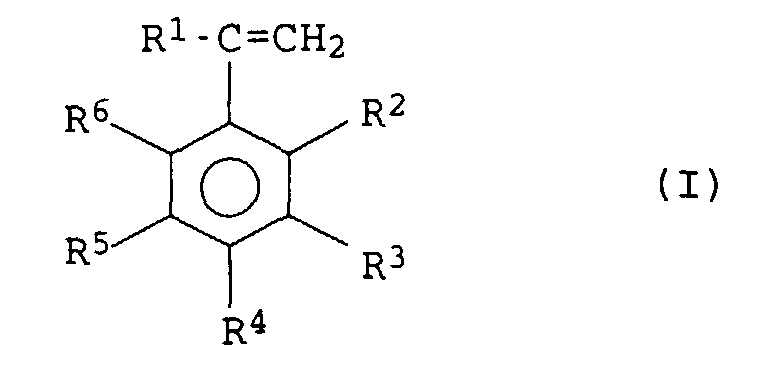
- R1
- Wasserstoff oder C1-bis C4-Alkyl,
- R2 bis R6
- unabhängig voneinander Wasserstoff, C1-bis C12-Alkyl, C6-bis C18-Aryl, Halogen oder wobei zwei benachbarte Reste gemeinsam für 4 bis 15 C-Atome aufweisende cyclische Gruppen stehen.
- R 1
- Hydrogen or C 1 to C 4 alkyl,
- R 2 to R 6
- independently of one another hydrogen, C 1 to C 12 alkyl, C 6 to C 18 aryl, halogen or where two adjacent radicals together stand for cyclic groups having 4 to 15 C atoms.
Bevorzugt werden vinylaromatische Verbindungen der Formel I eingesetzt, in denen
- R1
- Wasserstoff bedeutet.
- R 1
- Means hydrogen.
Als Substituenten R2 bis R6 kommen insbesondere Wasserstoff, C1- bis C4-Alkyl, Chlor oder Phenyl, Biphenyl, Naphthalin oder Anthracen in Betracht. Zwei benachbarte Reste können auch gemeinsam für 4 bis 12 C-Atome aufweisende cyclische Gruppen stehen, so daß sich als Verbindungen der allgemeinen Formel I beispielsweise Naphthalinderivate oder Anthracenderivate ergeben.Suitable substituents R 2 to R 6 are in particular hydrogen, C 1 - to C 4 -alkyl, chlorine or phenyl, biphenyl, naphthalene or anthracene. Two adjacent radicals can also together represent cyclic groups containing 4 to 12 carbon atoms, so that naphthalene derivatives or anthracene derivatives, for example, result as compounds of the general formula I.
Beispiele für solche bevorzugten Verbindungen sind:Examples of such preferred compounds are:
Styrol, p-Methylstyrol, p-Chlorstyrol, 2,4-Dimethylstyrol, 4-Vinylbiphenyl, 2-Vinylnaphthalin oder 9-Vinylanthracen.Styrene, p-methylstyrene, p-chlorostyrene, 2,4-dimethylstyrene, 4-vinylbiphenyl, 2-vinylnaphthalene or 9-vinylanthracene.
Es können auch Mischungen verschiedener vinylaromatischer Verbindungen eingesetzt werden, wobei eine Komponente auch weitere Kohlenwasserstoffreste wie Vinylgruppen, Allylgruppen, Methallylgruppen, Butenyl- oder Pentenylgruppen, vorzugsweise Vinylgruppen am Phenylring tragen kann. Weitere vinylaromatische Verbindungen wie 1,1-Diphenylethylen können ebenfalls eingesetzt werden. Vorzugsweise wird jedoch nur eine vinylaromatische Verbindung verwendet.Mixtures of different vinyl aromatic can also be used Connections are used, one component also further hydrocarbon residues such as vinyl groups, allyl groups, Methallyl groups, butenyl or pentenyl groups, preferably Can carry vinyl groups on the phenyl ring. More vinyl aromatic Compounds such as 1,1-diphenylethylene can also be used become. However, only a vinyl aromatic compound is preferred used.
Besonders bevorzugte vinylaromatische Verbindungen sind Styrol und p-Methylstyrol. Particularly preferred vinyl aromatic compounds are styrene and p-methylstyrene.
Die Herstellung von vinylaromatischen Verbindungen der allgemeinen Formel I ist an sich bekannt und beispielsweise in Beilstein 5, 367, 474, 485 beschrieben.The production of vinyl aromatic compounds general formula I is known per se and, for example, in Beilstein 5, 367, 474, 485.
Als konjugierte Diene eignen sich beispielsweise Butadien, Isopren, Dimethylbutadien und Phenylbutadien. Bevorzugt ist Butadien.Examples of suitable conjugated dienes are butadiene, Isoprene, dimethylbutadiene and phenylbutadiene. Is preferred Butadiene.
Die Umsetzung von vinylaromatischen Verbindungen mit konjugierten Dienen ist bekannt und beispielsweise in H.L. Hsieh, R.P. Quirk, Anionic Polymerization, Dekker, 1996, beschrieben. Die Herstellung der Polymeren A) kann durch anionische, kationische oder radikalische Polymerisation in Lösung, in Substanz, in Suspension oder in Emulsion durchgeführt werden. Gegebenenfalls können noch untergeordnete Mengen an weiteren Monomeren, wie Olefine, einpolymerisiert werden.Implementation of vinyl aromatic compounds with conjugated Service is known and is described, for example, in H.L. Hsieh, R.P. Quirk, Anionic Polymerization, Dekker, 1996. The production the polymer A) can by anionic, cationic or radical polymerization in solution, in substance, in suspension or be carried out in emulsion. If necessary, you can still minor amounts of other monomers, such as olefins, polymerized become.
Das Polymere A) enthält vorzugsweise 3 bis 97 Gew.-% vinylaromatische Verbindungen, insbesondere 5 bis 95 Gew.-% und 97 bis 3 Gew.-% an konjugierten Dienen, insbesondere 95 bis 5 Gew.-%.The polymer A) preferably contains 3 to 97% by weight of vinylaromatic Compounds, in particular 5 to 95 wt .-% and 97 to 3% by weight of conjugated dienes, in particular 95 to 5% by weight.
In Stufe b) wird nun das Polymere A) einer Hydroformylierung in Gegenwart von Kohlenmonoxid, Wasserstoff und einem Hydroformylierungskatalysator unterworfen, sodaß ein Polymer B) entsteht.In stage b) the polymer A) is now subjected to hydroformylation Presence of carbon monoxide, hydrogen and a hydroformylation catalyst subjected so that a polymer B) is formed.
Hydroformylierungen sind ebenfalls bekannt und beispielsweise in Ch. Eschenbroich/A. Salzer, Organometallchemie, Teubner, 1988, beschrieben. Das Polymere A) kann in Lösung, in gequollenem Zustand oder als Schmelze eingesetzt werden. Als Lösungsmittel eignen sich inerte organische Lösungsmittel wie gesättigte und aromatische Kohlenwasserstoffe, beispielsweise Hexan, Octan, Dodecan, Decalin, Cyclohexan, Cycloheptan, Benzol, Toluol, Xylol, Ether, Sulfone oder deren Mischungen.Hydroformylations are also known and, for example, in Ch. Eschenbroich / A. Salzer, Organometallchemie, Teubner, 1988, described. The polymer A) can be in solution, in the swollen state or used as a melt. Suitable as a solvent inert organic solvents such as saturated and aromatic Hydrocarbons, for example hexane, octane, Dodecane, decalin, cyclohexane, cycloheptane, benzene, toluene, xylene, Ethers, sulfones or mixtures thereof.
Als Hydroformylierungskatalysatoren eignen sich alle bekannten Hydroformylierungskatalysatoren, insbesondere solche der VIII. Nebengruppe des Periodensystems der Elemente, vorzugsweise Verbindungen von Rhodium, Cobalt und Palladium. Bevorzugt werden Salze wie Hydride, Halogenide, Nitrate, Sulfate, Oxide oder Sulfide sowie Komplexe mit Carbonylen, Aminen, Triarylphosphinen oder Trialkylphosphinen, aber auch mit Carboxylaten oder Acetylacetonat. Beispiele hierfür sowie Verfahren zur Herstellung sind beispielsweise in der US-A 4,914,157 beschrieben.All known catalysts are suitable as hydroformylation catalysts Hydroformylation catalysts, especially those of VIII. Subgroup of the Periodic Table of the Elements, preferably Compounds of rhodium, cobalt and palladium. To be favoured Salts such as hydrides, halides, nitrates, sulfates, oxides or Sulfides and complexes with carbonyls, amines, triarylphosphines or trialkylphosphines, but also with carboxylates or acetylacetonate. Examples of this and methods of production are described for example in US-A 4,914,157.
Bevorzugt werden Rh(CO)2acac (≙ Acetylacetonat) und Co2(CO)8 eingesetzt. Rh (CO) 2 acac (≙ acetylacetonate) and Co 2 (CO) 8 are preferably used.
Die Menge an Katalysator beträgt üblicherweise 0,01 bis 2,0 Gew.-%, bezogen auf das Polymere A).The amount of the catalyst is usually 0.01 to 2.0 wt .-%, based on the polymer A).
Die Hydroformylierung kann in einem weiten Temperaturbereich durchgeführt werden, üblicherweise arbeitet man bei Temperaturen im Bereich von 20 bis 200°C. Als Drücke haben sich 1 bis 1000 bar als geeignet erwiesen, insbesondere 10 bis 600 bar, je nach Wahl des Katalysators.The hydroformylation can take place in a wide temperature range are carried out, usually one works at temperatures in the range of 20 to 200 ° C. The pressures are 1 to 1000 bar proven to be suitable, in particular 10 to 600 bar, depending on the choice of the catalyst.
Das molare Verhältnis von Kohlenmonoxid zu Wasserstoff kann in weiten Bereichen schwanken, vorzugsweise liegt es im Bereich von 0,2:1 bis 5:1, insbesondere 0,5:1 bis 2:1.The molar ratio of carbon monoxide to hydrogen can be in fluctuate wide ranges, preferably it is in the range of 0.2: 1 to 5: 1, in particular 0.5: 1 to 2: 1.
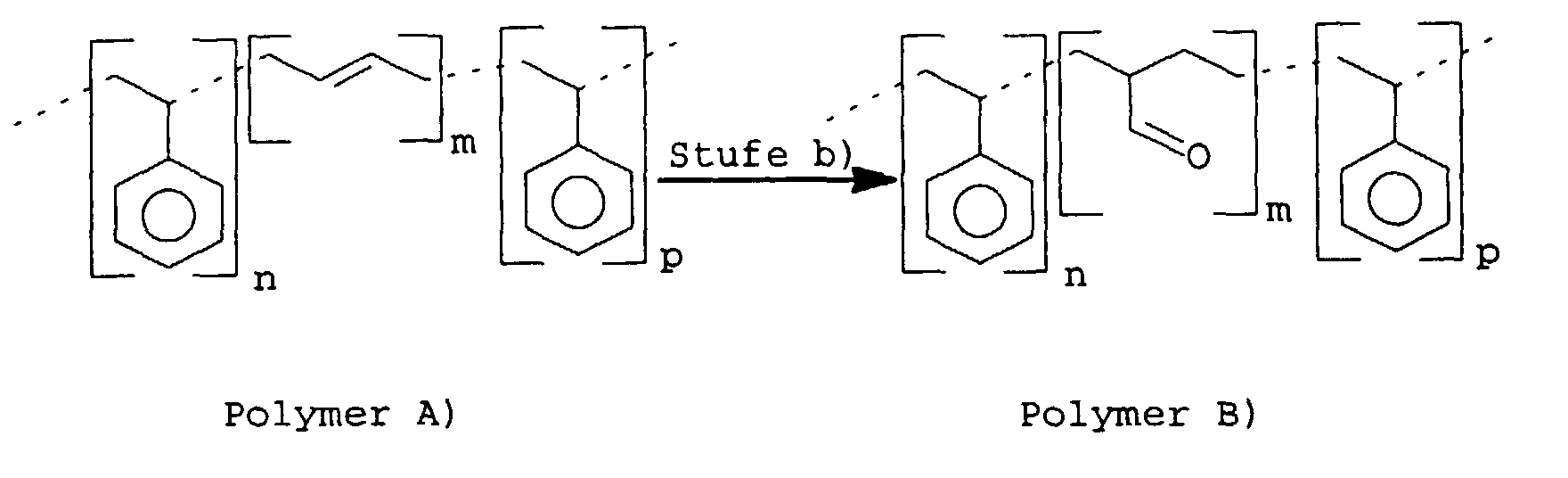
Bei der Hydroformylierung wird formal eine Formylgruppe und ein
Wasserstoffatom an eine olefinische Doppelbindung des Polymeren
A) addiert. Schematisch würde das bei einem Styrol-Butadien-Styrol-Blockcopolymeren
A) so aussehen:
Das Polymer B), das partiell oder vollständig hydroformyliert sein kann, wird dann in einer Stufe c) isoliert. Diese Abtrennung von Katalysator kann beispielsweise durch (wiederholtes)Ausfällen des Polymeren B) aus seiner Lösung in einem unpolaren Lösungsmittel, z.B. Toluol, durch Zugabe eines polaren Lösungsmittels, z.B. Methanol, bis zur gewünschten Reinheit erfolgen.The polymer B), which partially or completely hydroformylates can then be isolated in a step c). This separation of catalyst can occur, for example, through (repeated) precipitation polymer B) from its solution in a non-polar solvent, e.g. Toluene, by adding a polar solvent, e.g. Methanol until the desired purity.
Die Abtrennung von Cobalt-Katalysatoren von hydroformylierten Polymeren ist beispielsweise in der US-A 3,513,130 beschrieben.The separation of cobalt catalysts from hydroformylated ones Polymers is described for example in US-A 3,513,130.
In Stufe d) wird eine C-C-Verknüpfungsreaktion an den Formylgruppen des Polymeren B) unter Einbau einer vinylaromatischen Einheit durchgeführt, so daß ein Polymer C) entsteht.In step d) there is a C-C linkage reaction on the formyl groups of polymer B) with the incorporation of a vinyl aromatic Unit carried out so that a polymer C) is formed.
Vorzugsweise wird diese Reaktion als Wittig-Reaktion durchgeführt. Diese Reaktionen sind an sich bekannt und beispielsweise in Advanced Organic Chemistry, 1985, Kapitel 6-47, S. 845 - 854 beschrieben. Üblicherweise setzt man Phosphorylide ein. This reaction is preferably carried out as a Wittig reaction. These reactions are known per se and for example in Advanced Organic Chemistry, 1985, chapters 6-47, pp. 845-854 described. Phosphorylides are usually used.
Die Herstellung von Wittig-Salzen ist beispielsweise in J. Org. Chem. 54, 1989, S. 4808 - 4812 (Katritzky et al.) beschrieben. Hierbei setzt man üblicherweise die entsprechenden Alkylhalogenide, bevorzugt Bromide, mit Triphenylphosphin um.The production of Wittig salts is described, for example, in J. Org. Chem. 54, 1989, pp. 4808-4812 (Katritzky et al.). The corresponding alkyl halides are usually used here, preferably bromides, with triphenylphosphine.
Bevorzugt sind Bromalkylstyrole, besonders bevorzugt p-Brommethylstyrol. Vorzugsweise wird Triphenylphosphin und das Bromid in einem Autoklaven unter Druck erhitzt, wobei Triphenylphosphinbromid direkt anfällt.Bromoalkylstyrenes are preferred, p-bromomethylstyrene being particularly preferred. Triphenylphosphine and the bromide are preferably used in an autoclave heated under pressure, triphenylphosphine bromide directly accrues.
Schematisiert würde das - um bei dem oben aufgeführten Schema zu
bleiben - zu einem Polymeren C) der folgenden Struktur führen:

In Stufe e) wird nun das Polymere C) mit vinylaromatischen Verbindungen in Gegenwart eines Metallocenkatalysatorsystems umgesetzt.In step e), the polymer C) is now mixed with vinyl aromatic Compounds in the presence of a metallocene catalyst system implemented.
Als vinylaromatische Verbindungen eignen sich auch hier insbesondere Verbindungen der allgemeinen Formel I, sodaß auf das dort Gesagte verwiesen wird (Stufe a))Also suitable as vinyl aromatic compounds here in particular compounds of the general formula I, so that the what is said is referred to there (level a))
Als Metallocenkatalysatorsysteme eignen sich besonders solche, die erhältlich sind aus einem Metallocenkomplex, einer metalloceniumionenbildenden Verbindung und ggf. einer Aluminiumverbindung.Particularly suitable metallocene catalyst systems are which are available from a metallocene complex, one metallocenium ion-forming compound and possibly an aluminum compound.
Bevorzugt werden als Metallocenkomplexe solche der allgemeinen
Formel II eingesetzt:
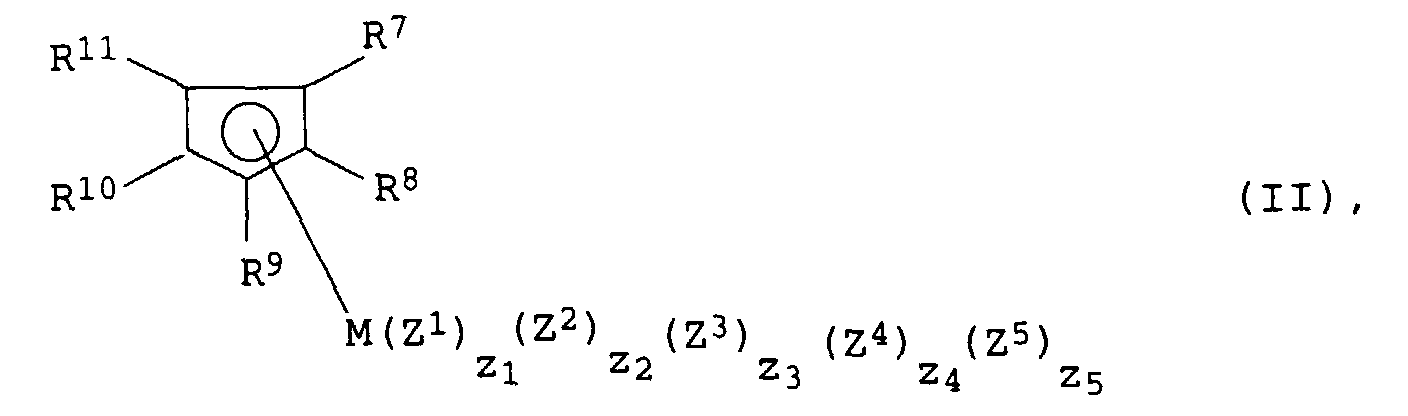
- R7 bis R11
- Wasserstoff, C1- bis C10-Alkyl, 5- bis 7-gliedriges Cycloalkyl, das seinerseits C1- bis C6-Alkylgruppen als Substituenten tragen kann, C6- bis C15-Aryl oder Arylalkyl und wobei gegebenenfalls auch zwei benachbarte Reste gemeinsam für 4 bis 15 C-Atome aufweisende cyclische Gruppen, beispielsweise für anellierte Ringsysteme stehen können, oder Si(R12)3,
- mit R12
- C1- bis C10-Alkyl, C6- bis C15-Aryl oder C3- bis C10-Cycloalkyl,
- M
- ein Metall der III. bis VI. Nebengruppe des Periodensystems der Elemente oder ein Metall der Lanthanidenreihe
- Z1 bis Z5
- Wasserstoff, Halogen, C1- bis C10-Alkyl, C6- bis
C15-Aryl, C1- bis C10-Alkoxy oder C1- bis C15-Aryloxy
und - z1 bis z5
- 0, 1, 2, 3, 4 oder 5, wobei die Summe
- M
- für ein Metall der IV. Nebengruppe des Periodensystems
der Elemente steht, also für Titan, Zirkonium oder
Hafnium, insbesondere für Titan
und - Z1 bis Z5
- C1- bis C10-Alkyl, C1- bis C10-Alkoxy oder Halogen bedeuten.
- R 7 to R 11
- Hydrogen, C 1 - to C 10 -alkyl, 5- to 7-membered cycloalkyl, which in turn can carry C 1 - to C 6 -alkyl groups as substituents, C 6 - to C 15 -aryl or arylalkyl and where appropriate also two adjacent ones Radicals together can represent cyclic groups having 4 to 15 carbon atoms, for example fused ring systems, or Si (R 12 ) 3 ,
- with R 12
- C 1 to C 10 alkyl, C 6 to C 15 aryl or C 3 to C 10 cycloalkyl,
- M
- a metal of III. to VI. Subgroup of the periodic table of the elements or a metal of the lanthanide series
- Z 1 to Z 5
- Hydrogen, halogen, C 1 - to C 10 -alkyl, C 6 - to C 15 -aryl, C 1 - to C 10 -alkoxy or C 1 - to C 15 -aryloxy
and - z 1 to z 5
- 0, 1, 2, 3, 4 or 5, the sum
- M
- stands for a metal of subgroup IV of the Periodic Table of the Elements, ie for titanium, zirconium or hafnium, in particular for titanium
and - Z 1 to Z 5
- C 1 - to C 10 alkyl, C 1 - to C 10 alkoxy or halogen.
Beispiele für solche bevorzugten Metallocenkomplexe sind:
Es können auch solche Metallocenkomplexe, wie in der EP-A 584 646 beschrieben, eingesetzt werden.Metallocene complexes such as those in EP-A 584 646 can also be used described, used.
Mischungen verschiedener Metallocenkomplexe können auch verwendet werden.Mixtures of different metallocene complexes can also be used become.
Die Synthese derartiger Komplexverbindungen kann nach an sich bekannten Methoden erfolgen, wobei die Umsetzung der entsprechend substituierten, cyclischen Kohlenwasserstoffanionen mit Halogeniden von Titan, Zirkonium, Hafnium, Vanadium, Niob oder Tantal, bevorzugt ist.The synthesis of such complex compounds can in itself known methods take place, the implementation of the corresponding substituted, cyclic hydrocarbon anions with halides of titanium, zirconium, hafnium, vanadium, niobium or tantalum is preferred.
Beispiele für entsprechende Herstellungsverfahren sind u.a. im Journal of Organometallic Chemistry, 369 (1989), 359-370 beschrieben.Examples of corresponding manufacturing processes include in the Journal of Organometallic Chemistry, 369 (1989), 359-370 described.
Als metalloceniumionenbildende Verbindung können die Katalysatorsysteme offenkettige oder cyclische Alumoxanverbindungen enthalten.The catalyst systems can be used as a compound forming metallocenium ions contain open-chain or cyclic alumoxane compounds.
Geeignet sind beispielsweise offenkettige oder cyclische
Alumoxanverbindungen der allgemeinen Formel III oder IV

- R13
- eine C1- bis C4-Alkylgruppe bedeutet, bevorzugt Methyl- oder Ethylgruppe und k für eine ganze Zahl von 5 bis 30, bevorzugt 10 bis 25 steht.
- R 13
- is a C 1 to C 4 alkyl group, preferably methyl or ethyl group and k is an integer from 5 to 30, preferably 10 to 25.
Die Herstellung dieser oligomeren Alumoxanverbindungen erfolgt üblicherweise durch Umsetzung einer Lösung von Trialkylaluminium mit Wasser und ist u.a. in der EP-A 284 708 und der US-A 4,794,096 beschrieben. These oligomeric alumoxane compounds are prepared usually by reacting a solution of trialkyl aluminum with water and is in EP-A 284 708 and of US-A 4,794,096.
In der Regel liegen die dabei erhaltenen oligomeren Alumoxanverbindungen als Gemische unterschiedlich langer, sowohl linearer als auch cyclischer Kettenmoleküle vor, so daß k als Mittelwert anzusehen ist. Die Alumoxanverbindungen können auch im Gemisch mit anderen Metallalkylen, bevorzugt mit Aluminiumalkylen vorliegen.As a rule, the oligomeric alumoxane compounds obtained in this way are as mixtures of different lengths, both more linear as well as cyclic chain molecules, so that k as the mean can be seen. The alumoxane compounds can also be mixed with other metal alkyls, preferably with aluminum alkyls.
Es hat sich als vorteilhaft erwiesen, die Metallocenkomplexe und die oligomere Alumoxanverbindung in solchen Mengen zu verwenden, daß das atomare Verhältnis zwischen Aluminium aus der oligomeren Alumoxanverbindung und dem Übergangsmetall aus den Metallocenkomplexen im Bereich von 10:1 bis 104:1, insbesondere im Bereich von 20:1 bis 9000:1, liegt.It has proven to be advantageous to use the metallocene complexes and the oligomeric alumoxane compound in amounts such that the atomic ratio between aluminum from the oligomeric alumoxane compound and the transition metal from the metallocene complexes is in the range from 10: 1 to 10 4 : 1, in particular in the range from 20: 1 to 9000: 1.
Als metalloceniumionenbildende Verbindungen können auch Koordinationskomplexverbindungen, ausgewählt aus der Gruppe der starken, neutralen Lewissäuren, der ionischen Verbindungen mit lewissauren Kationen und der ionischen Verbindungen mit Brönstedsäuren als Kationen eingesetzt werden.Coordination complex compounds, selected from the group of strong, neutral Lewis acids, the ionic compounds with Lewis acids Cations and the ionic compounds with Bronsted acids as Cations are used.
Als starke neutrale Lewissäuren sind Verbindungen der allgemeinen
Formel V
- M1
- ein Element der III. Hauptgruppe des Periodensystems bedeutet, insbesondere B, Al oder Ga, vorzugsweise B,
- X1,X2 und X3
- für Wasserstoff, C1- bis C10-Alkyl, C6- bis C15-Aryl, Alkylaryl, Arylalkyl, Halogenalkyl oder Halogenaryl mit jeweils 1 bis 10 C-Atomen im Alkylrest und 6 bis 20 C-Atome im Arylrest oder Fluor, Chlor, Brom oder Jod stehen, insbesondere für Halogenaryle, vorzugsweise für Pentafluorphenyl.
- M 1
- an element of III. Main group of the periodic table means, in particular B, Al or Ga, preferably B,
- X 1 , X 2 and X 3
- for hydrogen, C 1 - to C 10 -alkyl, C 6 - to C 15 -aryl, alkylaryl, arylalkyl, haloalkyl or haloaryl, each with 1 to 10 C atoms in the alkyl radical and 6 to 20 C atoms in the aryl radical or fluorine, Chlorine, bromine or iodine are, in particular, haloaryls, preferably pentafluorophenyl.
Besonders bevorzugt sind Verbindungen der allgemeinen Formel VI, in der X1, X2 und X3 gleich sind, vorzugsweise Tris(pentafluorphenyl)boran. Diese Verbindungen sowie Verfahren zu ihrer Herstellung sind an sich bekannt und beispielsweise in der WO 93/3067 beschrieben.Compounds of the general formula VI in which X 1 , X 2 and X 3 are identical are particularly preferred, preferably tris (pentafluorophenyl) borane. These compounds and processes for their preparation are known per se and are described, for example, in WO 93/3067.
Als ionische Verbindungen mit lewissauren Kationen sind
Verbindungen der allgemeinen Formel VI

- Y
- ein Element der I. bis VI. Hauptgruppe oder der I. bis VIII. Nebengruppe des Periodensystems bedeutet,
- Q1 bis Qz
- für einfach negativ geladene Reste wie C1- bis C28-Alkyl, C6- bis C15-Aryl, Alkylaryl, Arylalkyl, Halogenalkyl, Halogenaryl mit jeweils 6 bis 20 C-Atomen im Aryl- und 1 bis 28 C-Atome im Alkylrest, C1- bis C10-Cycloalkyl, welches gegebenenfalls mit C1- bis C10-Alkylgruppen substituiert sein kann, Halogen, C1- bis C28-Alkoxy, C6- bis C15-Aryloxy oder Silyl- oder Mercaptylgruppen, wie Trimethylsilyl.
- a
- für ganze Zahlen von 1 bis 6 steht,
- z
- für ganze Zahlen von 0 bis 5
- d
- der Differenz a - z entspricht, wobei d jedoch größer oder gleich 1 ist.
- Y
- an element of the I. to VI. Main group or the I. to VIII. Subgroup of the periodic table means
- Q 1 to Q z
- for simply negatively charged residues such as C 1 - to C 28 -alkyl, C 6 - to C 15 -aryl, alkylaryl, arylalkyl, haloalkyl, haloaryl, each with 6 to 20 C atoms in the aryl and 1 to 28 C atoms in the Alkyl radical, C 1 to C 10 cycloalkyl, which can optionally be substituted by C 1 to C 10 alkyl groups, halogen, C 1 to C 28 alkoxy, C 6 to C 15 aryloxy or silyl or mercaptyl groups such as trimethylsilyl.
- a
- represents integers from 1 to 6,
- e.g.
- for integers from 0 to 5
- d
- corresponds to the difference a - z, but d is greater than or equal to 1.
Besonders geeignet sind Carboniumkationen, Oxoniumkationen und Sulfoniumkationen sowie kationische Übergangsmetallkomplexe. Insbesondere sind das Triphenylmethylkation, das Silberkation und das 1,1'-Dimethylferrocenylkation zu nennen.Carbonium cations, oxonium cations and Sulfonium cations and cationic transition metal complexes. In particular, the triphenylmethyl cation, the silver cation and to name the 1,1'-dimethylferrocenyl cation.
Bevorzugt besitzen sie nicht koordinierende Gegenionen, insbesondere Borverbindungen, wie sie auch in der WO 91/09882 genannt werden, bevorzugt Tetrakis(pentafluorophenyl)borat.They preferably have non-coordinating counterions, in particular Boron compounds, as also described in WO 91/09882 be mentioned, preferably tetrakis (pentafluorophenyl) borate.
Ionische Verbindungen mit Brönsted-Säuren als Kationen und vorzugsweise ebenfalls nicht koordinierende Gegenionen sind in der WO 93/3067 genannt, bevorzugtes Kation ist das N,N-Dimethylanilinium.Ionic compounds with Bronsted acids as cations and preferably counterions that do not coordinate are also in the WO 93/3067 called, preferred cation is the N, N-dimethylanilinium.
Es hat sich als besonders geeignet erwiesen, wenn das molare Verhältnis von Bor aus der metalloceniumionenbildenden Verbindung zu Übergangsmetall aus dem Metallocenkomplex im Bereich von 0,1:1 bis 10:1 liegt, insbesondere im Bereich von 1:1 bis 5:1.It has proven particularly suitable if the molar Ratio of boron from the compound forming metallocenium ions transition metal from the metallocene complex in the range of 0.1: 1 to 10: 1, in particular in the range from 1: 1 to 5: 1.
Weiterhin können die Metallocenkatalysatorsystem eine Aluminiumverbindung
enthalten. Diese kann z.B. durch die allgemeine Formel
VII
- R14 bis R16
- für Wasserstoff, Fluor, Chlor, Brom, Jod oder C1- bis C12-Alkyl stehen, bevorzugt für C1- bis C8-Alkyl,
- R 14 to R 16
- represent hydrogen, fluorine, chlorine, bromine, iodine or C 1 -C 12 -alkyl, preferably C 1 -C 8 -alkyl,
Vorzugsweise sind die Reste R14 bis R15 gleich und stehen für C1-C6-Alkyl wie Methyl, Ethyl, Isobutyl oder n-Hexyl, R16 bedeutet vorzugsweise Wasserstoff.The radicals R 14 to R 15 are preferably the same and are C 1 -C 6 -alkyl such as methyl, ethyl, isobutyl or n-hexyl, R 16 preferably denotes hydrogen.
Bevorzugt ist diese Komponente in einer Menge von 1 : 2000 bis 1 : 1, insbesondere 1 : 800 bis 1 : 10 (molares Verhältnis Übergangsmetall aus II zu Al aus VII) im Katalysatorsystem enthalten.This component is preferably in an amount of 1: 2000 to 1: 1, in particular 1: 800 to 1:10 (molar ratio of transition metal from II to Al from VII) contained in the catalyst system.
Als Lösungsmittel für die Metallocenkomplexe und die Alumoxanverbindungen werden üblicherweise aromatische Kohlenwasserstoffe eingesetzt, bevorzugt mit 6 bis 20 C-Atomen, insbesondere Xylole, Toluol und Ethylbenzol sowie deren Mischungen. Die Aluminiumverbindungen VII können in unpolaren aliphatischen oder aromatischen Solventien wie Ethylbenzol oder Cyclohexan gelöst sein.As a solvent for the metallocene complexes and the alumoxane compounds are usually aromatic hydrocarbons used, preferably with 6 to 20 carbon atoms, in particular xylenes, Toluene and ethylbenzene and their mixtures. The aluminum connections VII can be in non-polar aliphatic or aromatic Solvents such as ethylbenzene or cyclohexane can be dissolved.
Die Metallocenkomplexe können ungeträgert oder geträgert eingesetzt werden.The metallocene complexes can be used unsupported or supported become.
Geeignete Trägermaterialien sind beispielsweise Kieselgele, bevorzugt solche der Formel SiO2 · bAl2O3, worin b für eine Zahl im Bereich von 0 bis 2 steht, vorzugsweise 0 bis 0,5; also im wesentlichen Alumosilikate oder Siliciumdioxid. Vorzugsweise weisen die Träger einen Teilchendurchmesser im Bereich von 1 bis 200 µm auf, insbesondere 30 bis 80 µm. Derartige Produkte sind im Handel erhältlich, z.B. als Silica Gel 332 der Firma Grace.Suitable carrier materials are, for example, silica gels, preferably those of the formula SiO 2 .bAl 2 O 3 , in which b stands for a number in the range from 0 to 2, preferably 0 to 0.5; essentially aluminum silicates or silicon dioxide. The carriers preferably have a particle diameter in the range from 1 to 200 μm, in particular 30 to 80 μm. Products of this type are commercially available, for example as Silica Gel 332 from Grace.
Weitere Träger sind u.a. feinteilige Polyolefine, beispielsweise feinteiliges Polypropylen oder Polyethylen, aber auch Polyethylenglycol, Polybutylenterephthalat, Polyethylenterephthalat, Polyvinylalkohol, Polystyrol, syndiotaktisches Polystyrol, Polybutadien, Polycarbonate oder deren Copolymere.Other carriers include finely divided polyolefins, for example finely divided polypropylene or polyethylene, but also polyethylene glycol, Polybutylene terephthalate, polyethylene terephthalate, Polyvinyl alcohol, polystyrene, syndiotactic polystyrene, polybutadiene, Polycarbonates or their copolymers.
Das Molverhältnis von Metallocenkomplex II zu vinylaromatischem Monomer beträgt im allgemeinen 1 : 1000 bis 1 : 10 000 000, bevorzugt jedoch 1 : 2000 bis 1 : 1 000 000.The molar ratio of metallocene complex II to vinyl aromatic Monomer is generally 1: 1000 to 1: 10,000,000, preferred however, 1: 2000 to 1: 1,000,000.
Das Molverhältnis von vinylaromatischer Verbindung zu dem Polymeren C) liegt vorzugsweise im Bereich von 108:1 bis 1:1, insbesondere von 107:1 bis 10:1. The molar ratio of vinyl aromatic compound to the polymer C) is preferably in the range from 10 8 : 1 to 1: 1, in particular from 10 7 : 1 to 10: 1.
Die Umsetzung kann bei Temperaturen im Bereich von -78°C bis +150°C, bevorzugt von 0°C bis 120°C durchgeführt werden. Es ist auch möglich, einen Temperaturgradienten von beispielsweise 0°C bis 120°C mit der Reaktionszeit anzulegen.The reaction can take place at temperatures in the range from -78 ° C to + 150 ° C, preferably from 0 ° C to 120 ° C. It is also possible a temperature gradient of, for example, 0 ° C up to 120 ° C with the reaction time.
Vorzugsweise polymerisiert man in der vinylaromatischen Verbindung als Reaktionsmedium, d.h. in Masse. Aber auch Polymerisation in Lösung, Suspension oder Gasphase ist möglich.Polymerization is preferably carried out in the vinylaromatic compound as a reaction medium, i.e. in bulk. But also polymerization in solution, suspension or gas phase is possible.
Es hat sich als besonders geeignet erwiesen, wenn man die vinylaromatische Verbindung und das Polymere C) vorlegt, dann mit der metalloceniumionenbildenden Verbindung und der Aluminiumverbindung (VII) versetzt, dann den Metallocenkomplex (II) zugibt und 0,1 bis 10 Stunden, vorzugsweise 0,5 bis 5 Stunden polymerisiert. Die Polymerisation kann durch Zugabe von protischen Verbindungen, beispielsweise Methanol, abgebrochen werden.It has proven particularly suitable if the vinyl aromatic Compound and the polymer C) submitted, then with the metallocenium ion-forming compound and the aluminum compound (VII) added, then adds the metallocene complex (II) and 0.1 to 10 hours, preferably 0.5 to 5 hours polymerized. The polymerization can be carried out by adding protic compounds, for example methanol, broken off become.
Im bevorzugten Fall, der Umsetzung mit Styrol, pfropft man auf das Polymere C) syndiotaktisches Polystyrol auf.In the preferred case, the reaction with styrene, is grafted on the polymer C) syndiotactic polystyrene.
Man kann sowohl kontinuierlich als auch diskontinuierlich arbeiten. An die Reaktoren werden keine bestimmte Erfordernisse gestellt, man kann beispielsweise in Rührreaktoren, Autoklaven, Kneten, Extruden oder vertikalen Reaktoren arbeiten.You can work both continuously and discontinuously. No specific requirements are placed on the reactors, you can for example in stirred reactors, autoclaves, Kneading, extruding or vertical reactors work.
Die erfindungsgemäßen Pfropfcopolymere zeichnen sich durch hohe Steifigkeit, Zugfestigkeit, Dimensionsstabilität und Zähigkeit, insbesondere Schlagzähigkeit aus. Sie eignen sich zur Herstellung von Fasern, Folien und Formkörpern. Bei der Herstellung der erfindungsgemäßen Pfropfcopolymere können sowohl radikalisch als auch ionisch hergestellte Pfropfpolymere eingesetzt werden. Weiterhin wird syndiotaktisches Polystyrol auf löslichen Kautschuk aufgepfropft, wobei sich über das eingesetzte Pfropfpolymer kugelförmige und lamellare Kautschukmorphologien einstellen lassen.The graft copolymers according to the invention are notable for high Rigidity, tensile strength, dimensional stability and toughness, especially impact strength. They are suitable for production of fibers, foils and moldings. When producing the Graft copolymers according to the invention can be either free radical ionically produced graft polymers can also be used. Farther becomes syndiotactic polystyrene on soluble rubber grafted, being spherical over the graft polymer used and have lamellar rubber morphologies adjusted.
Eine Lösung von Styrolux KR 2691® [symmetrisches Styrol-Butadien-Styrol-Triblock-Copolymer, Molmasse Mn ca. 91000, Butadiengehalt ca. 26 Gew.-%, 1,2-Vinylgehalt ca. 9 %] in Toluol wurde durch Auflösen von 100 g Polymer in 900 g Toluol bereitet; die Lösung wurde durch Einleiten von Argon von Luft befreit. In einem Schlenkrohr wurde eine Lösung von 0.02 g Rh(CO)2 acac (0,08 mmol) in 5 ml Toluol bereitet und die entstehende Lösung durch Einleiten von Argon entgast. Die beiden Lösungen wurden gemischt und in einen stickstoffgefüllten 2000 ml Autoklaven mit Rührer gefüllt. Der Autoklav wurde auf 150°C erhitzt und dabei durch Einleiten eines Kohlenmonoxid-Wasserstoff-Gemisches (molares Verhältnis 1:1) der Druck auf 280 bar erhöht. Durch die eintretende Reaktion fiel der Gasdruck während der Reaktion ab und wurde durch wiederholtes weiteres Einleiten des Kohlenmonoxid/Wasserstoff-Gemisches (1:1) aufrechterhalten. Nach 5 h wurde die Heizung und Gaszufuhr abgestellt, der Autoklav abgekühlt und über ein Steigrohr in ein Argon-gefülltes Vorratsgefäß entleert. Ein Teil des Toluols (50 %) wurde mit einem Rotationsverdampfer im Vakuum entfernt und das Produkt anschließend in Methanol (2000 ml) getropft, wobei das hydroformylierte Polymer ausfiel. Durch IR-Spektroskopie konnte eindeutig die Bildung von Aldehydgruppen nachgewiesen werden. Durch analytische Kennzahlen konnte der Grad der Umsetzung an olefinischen Doppelbindungen und der Gehalt an Aldehydgruppen im hydroformylierten Polymer bestimmt werden: Das eingesetzte Polymer besaß vor der Hydroformylierung eine Jodzahl nach DIN 53241 von 118 g Iod/100 g Polymer, nach der Hydroformylierung wurde 13 g Iod/100 g Polymer bestimmt. Die Carbonylzahl nach DIN 51558 war vor der Hydroformylierung kleiner als 1 mg KOH/g Polymer, nach der Hydroformylierung betrug sie 180 mg KOH/g.A solution of Styrolux KR 2691® [symmetrical styrene-butadiene-styrene triblock copolymer, molar mass Mn approx. 91000, butadiene content approx. 26% by weight, 1,2-vinyl content approx. 9%] in toluene was dissolved by Prepares 100 g polymer in 900 g toluene; the solution was purged of air by bubbling argon. A solution of 0.02 g Rh (CO) 2 acac (0.08 mmol) in 5 ml toluene was prepared in a Schlenk tube and the resulting solution was degassed by introducing argon. The two solutions were mixed and placed in a nitrogen-filled 2000 ml autoclave with a stirrer. The autoclave was heated to 150 ° C. and the pressure was increased to 280 bar by introducing a carbon monoxide-hydrogen mixture (molar ratio 1: 1). As a result of the reaction occurring, the gas pressure dropped during the reaction and was maintained by repeated introduction of the carbon monoxide / hydrogen mixture (1: 1). After 5 hours, the heating and gas supply were switched off, the autoclave was cooled and emptied into an argon-filled storage vessel via a riser pipe. A portion of the toluene (50%) was removed on a rotary evaporator in vacuo and the product was then added dropwise to methanol (2000 ml), whereby the hydroformylated polymer precipitated. The formation of aldehyde groups was clearly demonstrated by IR spectroscopy. The degree of conversion of olefinic double bonds and the content of aldehyde groups in the hydroformylated polymer could be determined by analytical key figures: before the hydroformylation, the polymer used had an iodine number according to DIN 53241 of 118 g iodine / 100 g polymer; after the hydroformylation, 13 g iodine / 100 g polymer determined. The carbonyl number according to DIN 51558 was less than 1 mg KOH / g polymer before the hydroformylation, after the hydroformylation it was 180 mg KOH / g.
Beispiel 1 wurde wiederholt, jedoch wurde die Hydroformylierung mit nur 0,005 g Rh(CO)2acac (0,02 mmol) durchgeführt, außerdem wurde die Umsetzung nach 1 h abgebrochen und das hydroformylierte Polymer analog aufgearbeitet. Analytische Kennzahlen des Produktes: Jodzahl 105 g Iod/100 g Polymer, CO-Zahl 20 mg KOH/g Polymer.Example 1 was repeated, but the hydroformylation was carried out using only 0.005 g of Rh (CO) 2 acac (0.02 mmol), and the reaction was stopped after 1 h and the hydroformylated polymer was worked up analogously. Analytical key figures of the product: iodine number 105 g iodine / 100 g polymer, CO number 20 mg KOH / g polymer.
Beispiel 1 wurde wiederholt, jedoch wurde anstelle des Rhodium-Hydroformylierungskatalysators das Cobaltcarbonyl Co2(CO)8 (0,4 g, 2,2 mmol) eingesetzt. Die Umsetzung erfolgte bei 180°C und 280 bar. Die Reaktionszeit betrug 2 h. Zur Verringerung von Acetalbildungen wurde der toluolischen Lösung des Polymeren 100 g Wasser zugesetzt. Nach der Hydroformylierung wurde die Cobalthaltige Lösung des hydroformylierten Polymers mit 10 %iger Essigsäure (ca. 400 ml) versetzt und in einem Glaskolben unter Lufteinleitung und unter Rühren bei ca. 70°C gerührt. Ein Farbwechsel nach schwachrosa zeigte die erfolgte Oxidation des Cobaltcarbonyls an. Der Rührer und die Heizung wurde abgeschaltet, damit sich die polymerhaltige Toluolphase von der Wasser/Essigsäurephase trennen konnte. Diese Phase wurde abgetrennt und die polymerhaltige Phase nochmals mit Wasser neutral gewaschen. Nach dem Abziehen des Toluols verblieb ein farbloses Produkt mit folgenden analytischen Kennzahlen: Jodzahl 40 g Iod/100 g Polymer, Carbonylzahl 120 mg KOH/g.Example 1 was repeated, but the cobalt carbonyl Co 2 (CO) 8 (0.4 g, 2.2 mmol) was used instead of the rhodium hydroformylation catalyst. The reaction took place at 180 ° C and 280 bar. The reaction time was 2 hours. To reduce acetal formation, 100 g of water was added to the toluene solution of the polymer. After the hydroformylation, the cobalt-containing solution of the hydroformylated polymer was mixed with 10% acetic acid (approx. 400 ml) and stirred in a glass flask with the introduction of air and with stirring at approx. 70 ° C. A color change to pale pink indicated the oxidation of the cobalt carbonyl. The stirrer and the heating were switched off so that the polymer-containing toluene phase could separate from the water / acetic acid phase. This phase was separated and the polymer-containing phase washed again with water until neutral. After the toluene had been stripped off, a colorless product remained with the following analytical parameters: iodine number 40 g iodine / 100 g polymer, carbonyl number 120 mg KOH / g.
Pyridin und p-Chlor-Methylstyrol wurden analog Tropsch Bull Soc. Chim. Belg, 1987, 96, S. 719 zum N-(1-Chlor-p-styrolmethylen)pyridiniumchlorid umgesetzt. 50 mmol dieser Verbindung wurden in trockenem Chloroform (300 ml) gelöst und dazu gab man 50 mmol von Triphenylphosphin bei 0°C. Nach 1 h behandelte man die Mischung mit Diethylether (ca. 600 ml) und extrahierte mehrmals (4-5 Mal). Das N-[(Triphenylphosphonio)(4-vinylphenyl)methyl]pydridiniumdichlorid wurde in 87 % Ausbeute isoliert und zeigte nach Umkristallisation einen Schmelzbereich von 186 - 187°C.Pyridine and p-chloro-methylstyrene were analogous to Tropsch Bull Soc. Chim. Belg, 1987, 96, p. 719 for N- (1-chloro-p-styrene methylene) pyridinium chloride implemented. 50 mmol of this compound were in dry chloroform (300 ml) and 50 mmol of Triphenylphosphine at 0 ° C. After 1 hour the mixture was treated with diethyl ether (approx. 600 ml) and extracted several times (4-5 times). The N - [(triphenylphosphonio) (4-vinylphenyl) methyl] pydridinium dichloride was isolated in 87% yield and showed after recrystallization a melting range of 186-187 ° C.
Es wurden 100 mmol des Wittig-Salzes aus Bsp. 4 in 400 ml Ethanol
gelöst und 10 g des Polymeren aus Bsp. 1 zugegeben. Bei Raumtemperatur
wurden 30 ml einer 1 M Natriumethylat-Lösung zugetropft,
wobei die Temperatur nicht über 30°C stieg. Man rührte 4 Stunden
und fällte das Polymer durch Zugabe von Wasser.
Es wurden 60 mmol des Wittig-Salzes aus Bsp. 4 in 400 ml Ethanol
gelöst und 10 g des Polymeren aus Bsp. 2 zugegeben. Bei Raumtemperatur
wurden 30 ml einer 1 M Natriumethylat-Lösung zugetropft,
wobei die Temperatur nicht über 30°C stieg. Man rührte 4 Stunden
und fällte das Polymer durch Zugabe von Wasser.
Es wurden 75 mmol des Wittig-Salzes aus Bsp. 4 in 400 ml Ethanol
gelöst und 10 g des Polymeren aus Bsp. 3 zugegeben. Bei Raumtemperatur
wurden 30 ml einer 1 M Natriumethylat-Lösung zugetropft,
wobei die Temperatur nicht über 30°C stieg. Man rührte 4 Stunden
und fällte das Polymer durch Zugabe von Wasser.
In einem mit Stickstoff inertisierten Rundkolben wurden 1.0 mol
Styrol (104.2 g) und 15 g des Polymeren aus Bsp. 5 vorgelegt, die
Mischung auf 60°C erwärmt und mit 8,16 ml Methylaluminoxan (MAO)
der Fa. Witco (1.53 M in Toluol) und 2,08 ml Diisobutylaluminiumhydrid
DIBAH (1,0 M in Cyclohexan) der Fa. Aldrich versetzt.
Anschließend versetzte man die Mischung mit 9.5 mg (4.16*10-5 mol)
an Cp*TiMe3 (Pentamethylcyclopentadienyltitaniumtrimethyl). Die
Innentemperatur wurde auf 60°C einreguliert und man ließ 2 h polymerisieren.
Das entstehende Polymer fiel bereits nach 10 min
Reaktionszeit aus und die Mischung wurde inhomogen. Nach 2 h
wurde die Polymerisation durch Zugabe von Methanol abgebrochen.
Das erhaltene Polymere wurde mit Methanol gewaschen und bei 50°C
im Vakuum getrocknet. Die Molmassen und deren Verteilung wurde
durch Hochtemperatur-GPC mit 1,2,4-Trichlorbenzol als Lösungsmittel
bei 135°C bestimmt. Die Kalibrierung erfolgte mit engverteilten
Polystyrolstandards. Die Molmasse betrug Mw = 467 300 mit
einer Verteilungsbreite von Mw/Mn = 2.6. Der syndiotaktische
Anteil bestimmt nach 13C-NMR war > 90 %. Der Umsatz betrug 86 %
bezogen auf das eingesetzte Monomer Styrol.
Die Schlagzähigkeit an spritzgegossenen Prüfkörpern nach
DIN 53453-n betrug 38 KJ/m2, die Bruchspannung 28,2 MPa
(DIN 53455) und die Bruchdehnung (DIN 53455) 2,7 %.1.0 mol of styrene (104.2 g) and 15 g of the polymer from Example 5 were placed in a round-bottom flask inertized with nitrogen, the mixture was heated to 60 ° C. and mixed with 8.16 ml of methylaluminoxane (MAO) from Witco (1.53 M in Toluene) and 2.08 ml of diisobutylaluminum hydride DIBAH (1.0 M in cyclohexane) from Aldrich. The mixture was then mixed with 9.5 mg (4.16 * 10 -5 mol) of Cp * TiMe 3 (pentamethylcyclopentadienyltitanium trimethyl). The internal temperature was adjusted to 60 ° C and allowed to polymerize for 2 hours. The resulting polymer precipitated after a reaction time of only 10 minutes and the mixture became inhomogeneous. After 2 hours, the polymerization was stopped by adding methanol. The polymer obtained was washed with methanol and dried at 50 ° C. in vacuo. The molecular weights and their distribution were determined by high-temperature GPC with 1,2,4-trichlorobenzene as solvent at 135 ° C. The calibration was carried out using narrowly distributed polystyrene standards. The molar mass was Mw = 467,300 with a distribution width of Mw / Mn = 2.6. The syndiotactic fraction determined by 13 C-NMR was> 90%. The conversion was 86% based on the styrene monomer used.
The impact strength on injection molded test specimens according to DIN 53453-n was 38 KJ / m 2 , the breaking stress 28.2 MPa (DIN 53455) and the elongation at break (DIN 53455) 2.7%.
In einem mit Stickstoff inertisierten Rundkolben wurden 1.0 mol
Styrol (104.2 g) und 15 g des Polymeren aus Bsp. 6 vorgelegt, die
Mischung auf 60°C erwärmt und mit 8,16 ml Methylaluminoxan (MAO)
der Fa. Witco (1.53 M in Toluol) und 2,08 ml Diisobutylaluminiumhydrid
DIBAH (1,0 M in Cyclohexan) der Fa. Aldrich versetzt.
Anschließend versetzte man die Mischung mit 9.5 mg (4.16*10-5 mol)
an Cp*TiMe3 (Pentamethylcyclopentadienyltitaniumtrimethyl). Die
Innentemperatur wurde auf 60°C einreguliert und man ließ 2 h polymerisieren.
Das entstehende Polymer fiel bereits nach 10 min Reaktionszeit
aus und die Mischung wurde inhomogen. Nach 2 h wurde
die Polymerisation durch Zugabe von Methanol abgebrochen. Das
erhaltene Polymere wurde mit Methanol gewaschen und bei 50°C im
Vakuum getrocknet. Die Molmassen und deren Verteilung wurde durch
Hochtemperatur-GPC mit 1,2,4-Trichlorbenzol als Lösungsmittel bei
135°C bestimmt. Die Kalibrierung erfolgte mit engverteilten Polystyrolstandards.
Die Molmasse betrug Mw = 212 700 mit einer
Verteilungsbreite von Mw/Mn= 2.4. Der syndiotaktische Anteil
bestimmt nach 13C-NMR war > 90 %. Der Umsatz betrug 54 % bezogen
auf das eingesetzte Monomer Styrol.
Die Schlagzähigkeit an spritzgegossenen Prüfkörpern nach
DIN 53453-n betrug 17 KJ/m2, die Bruchspannung 34,4 MPa
(DIN 53455) und die Bruchdehnung (DIN 53455) 2,1 %.1.0 mol of styrene (104.2 g) and 15 g of the polymer from Example 6 were placed in a round-bottom flask inertized with nitrogen, the mixture was heated to 60 ° C. and mixed with 8.16 ml of methylaluminoxane (MAO) from Witco (1.53 M in Toluene) and 2.08 ml of diisobutylaluminum hydride DIBAH (1.0 M in cyclohexane) from Aldrich. The mixture was then mixed with 9.5 mg (4.16 * 10 -5 mol) of Cp * TiMe 3 (pentamethylcyclopentadienyltitanium trimethyl). The internal temperature was adjusted to 60 ° C and allowed to polymerize for 2 hours. The resulting polymer precipitated after a reaction time of only 10 minutes and the mixture became inhomogeneous. After 2 hours, the polymerization was stopped by adding methanol. The polymer obtained was washed with methanol and dried at 50 ° C. in vacuo. The molecular weights and their distribution were determined by high-temperature GPC with 1,2,4-trichlorobenzene as solvent at 135 ° C. The calibration was carried out using narrowly distributed polystyrene standards. The molar mass was Mw = 212,700 with a distribution width of Mw / Mn = 2.4. The syndiotactic fraction determined by 13 C-NMR was> 90%. The conversion was 54% based on the monomer styrene used.
The impact strength on injection molded test specimens according to DIN 53453-n was 17 KJ / m 2 , the breaking stress 34.4 MPa (DIN 53455) and the elongation at break (DIN 53455) 2.1%.
In einem mit Stickstoff inertisierten Rundkolben wurden 1.0 mol Styrol (104.2 g) und 15 g des Polymeren aus Bsp. 7 vorgelegt, die Mischung auf 60°C erwärmt und mit 8,16 ml Methylaluminoxan (MAO) der Fa. Witco (1.53 M in Toluol) und 2,08 ml Diisobutylaluminiumhydrid DIBAH (1,0 M in Cyclohexan) der Fa. Aldrich versetzt. Anschließend versetzte man die Mischung mit 9.5 mg (4.16*10-5 mol) an Cp*TiMe3. Die Innentemperatur wurde auf 60°C einreguliert und man ließ 2 h polymerisieren. Das entstehende Polymer fiel bereits nach 10 min Reaktionszeit aus und die Mischung wurde inhomogen. Nach 2 h wurde die Polymerisation durch Zugabe von Methanol abgebrochen. Das erhaltene Polymere wurde mit Methanol gewaschen und bei 50°C im Vakuum getrocknet. Die Molmassen und deren Verteilung wurde durch Hochtemperatur-GPC mit 1,2,4-Trichlorbenzol als Lösungsmittel bei 135°C bestimmt. Die Kalibrierung erfolgte mit engverteilten Polystyrolstandards. Die Molmasse betrug Mw = 243 800 mit einer Verteilungsbreite von Mw/Mn= 2.3. Der syndiotaktische Anteil bestimmt nach 13C-NMR war > 90 %. Der Umsatz betrug 71 % bezogen auf das eingesetzte Monomer Styrol. Die Schlagzähigkeit an spritzgegossenen Prüfkörpern nach DIN 53453-n betrug 26 KJ/m2, die Bruchspannung 32,1 MPa (DIN 53455) und die Bruchdehnung (DIN 53455) 2,2 %.1.0 mol of styrene (104.2 g) and 15 g of the polymer from Example 7 were placed in a round-bottom flask inertized with nitrogen, the mixture was heated to 60 ° C. and mixed with 8.16 ml of methylaluminoxane (MAO) from Witco (1.53 M in Toluene) and 2.08 ml of diisobutylaluminum hydride DIBAH (1.0 M in cyclohexane) from Aldrich. The mixture was then mixed with 9.5 mg (4.16 * 10 -5 mol) of Cp * TiMe 3 . The internal temperature was adjusted to 60 ° C and allowed to polymerize for 2 hours. The resulting polymer precipitated after a reaction time of only 10 minutes and the mixture became inhomogeneous. After 2 hours, the polymerization was stopped by adding methanol. The polymer obtained was washed with methanol and dried at 50 ° C. in vacuo. The molecular weights and their distribution were determined by high-temperature GPC with 1,2,4-trichlorobenzene as solvent at 135 ° C. The calibration was carried out using narrowly distributed polystyrene standards. The molar mass was Mw = 243,800 with a distribution width of Mw / Mn = 2.3. The syndiotactic fraction determined by 13 C-NMR was> 90%. The conversion was 71% based on the styrene monomer used. The impact strength on injection molded test specimens in accordance with DIN 53453-n was 26 KJ / m 2 , the breaking stress 32.1 MPa (DIN 53455) and the elongation at break (DIN 53455) 2.2%.
In einem mit Stickstoff inertisierten Rundkolben wurden 1.0 mol
Styrol (104.2 g) vorgelegt, die Mischung auf 60°C erwärmt und mit
8,16 ml Methylaluminoxan (MAO) der Fa. Witco (1.53 M in Toluol)
und 2,08 ml Diisobutylaluminiumhydrid DIBAH (1,0 M in Cyclohexan)
der Fa. Aldrich versetzt. Anschließend versetzte man die Mischung
mit 9.5 mg (4.16*10-5 mol) an Cp*TiMe3. Die Innentemperatur wurde
auf 60°C einreguliert und man ließ 2 h polymerisieren. Das entstehende
Polymer fiel bereits nach 10 min Reaktionszeit aus und die
Mischung wurde inhomogen. Nach 2 h wurde die Polymerisation durch
Zugabe von Methanol abgebrochen. Das erhaltene Polymere wurde mit
Methanol gewaschen und bei 50°C im Vakuum getrocknet. Die Molmassen
und deren Verteilung wurde durch Hochtemperatur-GPC mit
1,2,4-Trichlorbenzol als Lösungsmittel bei 135°C bestimmt. Die
Kalibrierung erfolgte mit engverteilten Polystyrolstandards. Die
Molmasse betrug Mw = 320 800 mit einer Verteilungsbreite von
Mw/Mn= 2.1. Der syndiotaktische Anteil bestimmt nach 13C-NMR war
> 90 %. Der Umsatz betrug 73 % bezogen auf das eingesetzte
Monomer Styrol.
Die Schlagzähigkeit an spritzgegossenen Prüfkörpern nach
DIN 53453-n betrug 2 KJ/m2, die Bruchspannung 48,7 MPa (DIN 53455)
und die Bruchdehnung (DIN 53455) 1,4 %.1.0 mol of styrene (104.2 g) was placed in a round bottom flask inertized with nitrogen, the mixture was heated to 60 ° C. and mixed with 8.16 ml of methylaluminoxane (MAO) from Witco (1.53 M in toluene) and 2.08 ml of diisobutylaluminum hydride DIBAH (1.0 M in cyclohexane) from Aldrich. The mixture was then mixed with 9.5 mg (4.16 * 10 -5 mol) of Cp * TiMe 3 . The internal temperature was adjusted to 60 ° C and allowed to polymerize for 2 hours. The resulting polymer precipitated after a reaction time of only 10 minutes and the mixture became inhomogeneous. After 2 hours, the polymerization was stopped by adding methanol. The polymer obtained was washed with methanol and dried at 50 ° C. in vacuo. The molecular weights and their distribution were determined by high-temperature GPC with 1,2,4-trichlorobenzene as solvent at 135 ° C. The calibration was carried out using narrowly distributed polystyrene standards. The molar mass was Mw = 320,800 with a distribution range of Mw / Mn = 2.1. The syndiotactic fraction determined by 13 C-NMR was> 90%. The conversion was 73% based on the monomer styrene used.
The impact strength on injection molded test specimens according to DIN 53453-n was 2 KJ / m 2 , the breaking stress 48.7 MPa (DIN 53455) and the elongation at break (DIN 53455) 1.4%.
Reines syndiotaktisches Polystyrol (100 g) aus Vergleichsbeispiel 11 wurde in einem Kneter der Fa. Haake (Rheomix) bei 290°C 5 min lang mit 15 g des Polymeren aus Bsp. 7 geknetet und der erhaltene Blend untersucht. Die Schlagzähigkeit an spritzgegossenen Prüfkörpern nach DIN 53453-n betrug 3 KJ/m2, die Bruchspannung 47,5 MPa (DIN 53455) und die Bruchdehnung (DIN 53455) 1,2 %.Pure syndiotactic polystyrene (100 g) from Comparative Example 11 was kneaded in a Haake kneader (Rheomix) at 290 ° C. for 5 minutes with 15 g of the polymer from Example 7 and the blend obtained was examined. The impact strength on injection molded test specimens according to DIN 53453-n was 3 KJ / m 2 , the breaking stress 47.5 MPa (DIN 53455) and the elongation at break (DIN 53455) 1.2%.
Claims (7)

- R1
- Wasserstoff oder C1-bis C4-Alkyl,
- R2 bis R6
- unabhängig voneinander Wasserstoff, C1-bis C12-Alkyl, C6-bis C18-Aryl, Halogen oder wobei zwei benachbarte Reste gemeinsam für 4 bis 15 C-Atome aufweisende cyclische Gruppen stehen.
- R 1
- Hydrogen or C 1 to C 4 alkyl,
- R 2 to R 6
- independently of one another hydrogen, C 1 to C 12 alkyl, C 6 to C 18 aryl, halogen or where two adjacent radicals together stand for cyclic groups having 4 to 15 C atoms.
Applications Claiming Priority (2)
| Application Number | Priority Date | Filing Date | Title |
|---|---|---|---|
| DE19741497A DE19741497A1 (en) | 1997-09-19 | 1997-09-19 | Graft copolymers |
| DE19741497 | 1997-09-19 |
Publications (1)
| Publication Number | Publication Date |
|---|---|
| EP0903358A1 true EP0903358A1 (en) | 1999-03-24 |
Family
ID=7843025
Family Applications (1)
| Application Number | Title | Priority Date | Filing Date |
|---|---|---|---|
| EP98117530A Withdrawn EP0903358A1 (en) | 1997-09-19 | 1998-09-16 | Graft copolymers |
Country Status (4)
| Country | Link |
|---|---|
| US (1) | US6025447A (en) |
| EP (1) | EP0903358A1 (en) |
| JP (1) | JPH11166022A (en) |
| DE (1) | DE19741497A1 (en) |
Families Citing this family (5)
| Publication number | Priority date | Publication date | Assignee | Title |
|---|---|---|---|---|
| KR100466201B1 (en) * | 2002-09-19 | 2005-01-13 | 금호석유화학 주식회사 | Styrene copolymer |
| US7418438B2 (en) * | 2004-11-30 | 2008-08-26 | International Business Machines Corporation | Automated default dimension selection within a multidimensional enterprise software system |
| RU2533206C2 (en) | 2008-10-14 | 2014-11-20 | Бриджстоун Корпорейшн | Novel polymers and their application in obtaining high-impact polymer compositions |
| WO2018106398A1 (en) | 2016-12-05 | 2018-06-14 | Exxonmobil Chemical Patents Inc. | Poly(vinylbiphenyl) and poly(vinylcyclohexylstyrene) polymers and articles therefrom |
| CN117487087B (en) * | 2024-01-03 | 2024-03-22 | 北京中科康仑环境科技研究院有限公司 | Hybrid modified high oil absorption resin and preparation method and application thereof |
Citations (1)
| Publication number | Priority date | Publication date | Assignee | Title |
|---|---|---|---|---|
| US4914157A (en) * | 1988-09-26 | 1990-04-03 | The Goodyear Tire & Rubber Company | Enhancing cure rates of rubber |
Family Cites Families (11)
| Publication number | Priority date | Publication date | Assignee | Title |
|---|---|---|---|---|
| US3383426A (en) * | 1963-09-09 | 1968-05-14 | Exxon Research Engineering Co | Hydroformylation process for polymers |
| US3513130A (en) * | 1965-11-09 | 1970-05-19 | Exxon Research Engineering Co | Removing catalyst from hydroformylated polymers |
| CA1276748C (en) * | 1985-07-29 | 1990-11-20 | Michitake Uoi | Styrene polymers |
| EP0284708B1 (en) * | 1987-04-03 | 1996-01-31 | Fina Technology, Inc. | Metallocene catalyst systems for olefin polymerization having a silicon hydrocarbyl bridge. |
| US4794096A (en) * | 1987-04-03 | 1988-12-27 | Fina Technology, Inc. | Hafnium metallocene catalyst for the polymerization of olefins |
| WO1991009882A1 (en) * | 1990-01-02 | 1991-07-11 | Exxon Chemical Patents Inc. | Supported ionic metallocene catalysts for olefin polymerization |
| DE69117457T2 (en) * | 1990-12-10 | 1996-10-24 | Idemitsu Kosan Co. Ltd., Tokio/Tokyo | Graft copolymer and process for its manufacture |
| US5886117A (en) * | 1991-08-05 | 1999-03-23 | The Dow Chemical Company | Process using borane derived catalysts for preparation of syndiotactic vinyl aromatic polymers |
| EP0559108B1 (en) * | 1992-03-03 | 1997-05-28 | Idemitsu Kosan Company Limited | Graft copolymer, process for production thereof and resin composition containing same |
| JP3216734B2 (en) * | 1992-08-14 | 2001-10-09 | 出光石油化学株式会社 | Method for producing styrenic polymer |
| CA2110463C (en) * | 1992-12-17 | 2005-02-08 | Jacob Emert | Gel-free ethylene interpolymer dispersant additives useful in oleaginous compositions |
-
1997
- 1997-09-19 DE DE19741497A patent/DE19741497A1/en not_active Withdrawn
-
1998
- 1998-09-16 EP EP98117530A patent/EP0903358A1/en not_active Withdrawn
- 1998-09-21 JP JP10266294A patent/JPH11166022A/en not_active Withdrawn
- 1998-09-21 US US09/157,575 patent/US6025447A/en not_active Expired - Fee Related
Patent Citations (1)
| Publication number | Priority date | Publication date | Assignee | Title |
|---|---|---|---|---|
| US4914157A (en) * | 1988-09-26 | 1990-04-03 | The Goodyear Tire & Rubber Company | Enhancing cure rates of rubber |
Also Published As
| Publication number | Publication date |
|---|---|
| JPH11166022A (en) | 1999-06-22 |
| US6025447A (en) | 2000-02-15 |
| DE19741497A1 (en) | 1999-03-25 |
Similar Documents
| Publication | Publication Date | Title |
|---|---|---|
| EP0781783B1 (en) | Metallocene catalyst systems with sterically hindered Lewis-base | |
| EP1501879B1 (en) | Method for anionic polymerisation | |
| DE4330661A1 (en) | Cold impact propylene polymers | |
| WO1998008881A1 (en) | Star polymers and process for producing the same | |
| EP0864593A1 (en) | Comb-polymers via metallocene catalysis | |
| EP1597291B1 (en) | Method for anionic polymerisation of alpha-methylstyrene | |
| EP0903358A1 (en) | Graft copolymers | |
| DE2632235B2 (en) | Process for the production of impact-resistant polystyrenes | |
| EP0951490B1 (en) | Process for preparing polymers from vinylaromatic compounds by dispersion polymerization | |
| EP0861273B1 (en) | Process for producing copolymers from vinylaromatic and olefinic compounds by dispersion polymerisation in the presence of metallocene catalyst systems | |
| DE19836410A1 (en) | Thermoplastic molding compounds based on star polymers, thermoplastic elastomers and polyarylene ethers | |
| EP0810232B1 (en) | Process for the preparation of crystalline polymers by dispersion polymerization using metallocene catalyst systems | |
| EP0815148B1 (en) | Process for producing polymers of vinyl aromatic compounds under pressure in the presence of readily volatilising hydrocarbons | |
| EP0811023B1 (en) | Process for producing polymers of vinyl aromatic compounds using polymer-containing catalyst systems | |
| EP1093477B1 (en) | Method for producing polymers from vinylaromatic compounds by dispersion polymerisation with the addition of lubricating agents | |
| DE19714548A1 (en) | Thermoplastic molding compounds | |
| DE4425787A1 (en) | Catalyst systems for comb-like polypropylene prodn. | |
| DE4218201A1 (en) | Catalyst systems for the polymerization of C¶2¶ to C¶1¶¶0¶ alk-1-enes | |
| DE19725647A1 (en) | Cyclopenta [I] phenanthrene metal complex catalyst systems | |
| DE19727768A1 (en) | Thermoplastic elastomers based on 1,1-diphenylethylene | |
| DE19506556A1 (en) | Prepn. of vinyl]-aromatic polymers, giving syndiotactic polymers for use in prodn. of mouldings | |
| DE19506554A1 (en) | Prepn. of vinyl]-aromatic polymers, giving syndiotactic polymers for use in prodn. of mouldings | |
| DE10309565A1 (en) | Block copolymer for production of mouldings, film, fibres and foam, contains blocks derived from cyclic conjugated diene monomer and blocks with a high content of 1,4 linkages derived from linear diene | |
| DE4446385A1 (en) | Polymerisation of vinylaromatic cpd. | |
| DE19509783A1 (en) | Polymerisation of vinyl aromatics with metallocene catalyst |
Legal Events
| Date | Code | Title | Description |
|---|---|---|---|
| PUAI | Public reference made under article 153(3) epc to a published international application that has entered the european phase |
Free format text: ORIGINAL CODE: 0009012 |
|
| 17P | Request for examination filed |
Effective date: 19990118 |
|
| AK | Designated contracting states |
Kind code of ref document: A1 Designated state(s): BE DE ES FR GB IT NL |
|
| AX | Request for extension of the european patent |
Free format text: AL;LT;LV;MK;RO;SI |
|
| AKX | Designation fees paid |
Free format text: BE DE ES FR GB IT NL |
|
| STAA | Information on the status of an ep patent application or granted ep patent |
Free format text: STATUS: THE APPLICATION HAS BEEN WITHDRAWN |
|
| 18W | Application withdrawn |
Withdrawal date: 20020110 |