EP0903329A2 - Method of improving ceramic mass plasticity and reversal of this effect - Google Patents
Method of improving ceramic mass plasticity and reversal of this effect Download PDFInfo
- Publication number
- EP0903329A2 EP0903329A2 EP98116838A EP98116838A EP0903329A2 EP 0903329 A2 EP0903329 A2 EP 0903329A2 EP 98116838 A EP98116838 A EP 98116838A EP 98116838 A EP98116838 A EP 98116838A EP 0903329 A2 EP0903329 A2 EP 0903329A2
- Authority
- EP
- European Patent Office
- Prior art keywords
- polymer
- acids
- process according
- weight
- plasticity
- Prior art date
- Legal status (The legal status is an assumption and is not a legal conclusion. Google has not performed a legal analysis and makes no representation as to the accuracy of the status listed.)
- Withdrawn
Links
- 230000000694 effects Effects 0.000 title claims abstract description 14
- 238000000034 method Methods 0.000 title claims description 14
- 239000000919 ceramic Substances 0.000 title description 12
- 229920000642 polymer Polymers 0.000 claims abstract description 39
- XLYOFNOQVPJJNP-UHFFFAOYSA-N water Substances O XLYOFNOQVPJJNP-UHFFFAOYSA-N 0.000 claims abstract description 17
- 239000006185 dispersion Substances 0.000 claims abstract description 7
- 125000002730 succinyl group Chemical group C(CCC(=O)*)(=O)* 0.000 claims abstract description 4
- 229910010293 ceramic material Inorganic materials 0.000 claims abstract description 3
- 229920000805 Polyaspartic acid Polymers 0.000 claims description 22
- 108010064470 polyaspartate Proteins 0.000 claims description 19
- -1 fatty acid amines Chemical class 0.000 claims description 13
- 229920000768 polyamine Polymers 0.000 claims description 11
- QGZKDVFQNNGYKY-UHFFFAOYSA-N Ammonia Chemical compound N QGZKDVFQNNGYKY-UHFFFAOYSA-N 0.000 claims description 8
- 239000002253 acid Substances 0.000 claims description 8
- 150000007513 acids Chemical class 0.000 claims description 7
- 150000008064 anhydrides Chemical class 0.000 claims description 7
- 239000007864 aqueous solution Substances 0.000 claims description 7
- 125000000217 alkyl group Chemical group 0.000 claims description 6
- 150000001408 amides Chemical class 0.000 claims description 6
- 150000001412 amines Chemical class 0.000 claims description 6
- 229920001281 polyalkylene Polymers 0.000 claims description 6
- 239000003531 protein hydrolysate Substances 0.000 claims description 6
- 150000003839 salts Chemical class 0.000 claims description 6
- 125000002947 alkylene group Chemical group 0.000 claims description 5
- 150000001735 carboxylic acids Chemical class 0.000 claims description 5
- 150000001298 alcohols Chemical class 0.000 claims description 4
- 125000004450 alkenylene group Chemical group 0.000 claims description 4
- 125000003545 alkoxy group Chemical group 0.000 claims description 4
- 229910021529 ammonia Inorganic materials 0.000 claims description 4
- 235000014113 dietary fatty acids Nutrition 0.000 claims description 4
- 239000000194 fatty acid Substances 0.000 claims description 4
- 229930195729 fatty acid Natural products 0.000 claims description 4
- 229910052736 halogen Inorganic materials 0.000 claims description 4
- 150000002367 halogens Chemical class 0.000 claims description 4
- CKLJMWTZIZZHCS-REOHCLBHSA-N L-aspartic acid Chemical compound OC(=O)[C@@H](N)CC(O)=O CKLJMWTZIZZHCS-REOHCLBHSA-N 0.000 claims description 3
- 239000004698 Polyethylene Substances 0.000 claims description 3
- 125000004419 alkynylene group Chemical group 0.000 claims description 3
- 235000003704 aspartic acid Nutrition 0.000 claims description 3
- OQFSQFPPLPISGP-UHFFFAOYSA-N beta-carboxyaspartic acid Natural products OC(=O)C(N)C(C(O)=O)C(O)=O OQFSQFPPLPISGP-UHFFFAOYSA-N 0.000 claims description 3
- 150000004665 fatty acids Chemical class 0.000 claims description 3
- 125000004435 hydrogen atom Chemical class [H]* 0.000 claims description 3
- 229920000573 polyethylene Polymers 0.000 claims description 3
- KXDHJXZQYSOELW-UHFFFAOYSA-N Carbamic acid Chemical class NC(O)=O KXDHJXZQYSOELW-UHFFFAOYSA-N 0.000 claims description 2
- 108010073771 Soybean Proteins Proteins 0.000 claims description 2
- 240000008042 Zea mays Species 0.000 claims description 2
- 235000002017 Zea mays subsp mays Nutrition 0.000 claims description 2
- 150000001414 amino alcohols Chemical class 0.000 claims description 2
- 150000001720 carbohydrates Chemical class 0.000 claims description 2
- 235000014633 carbohydrates Nutrition 0.000 claims description 2
- BVKZGUZCCUSVTD-UHFFFAOYSA-N carbonic acid Chemical class OC(O)=O BVKZGUZCCUSVTD-UHFFFAOYSA-N 0.000 claims description 2
- 229910052739 hydrogen Inorganic materials 0.000 claims description 2
- 239000001257 hydrogen Substances 0.000 claims description 2
- PTMHPRAIXMAOOB-UHFFFAOYSA-N phosphoramidic acid Chemical class NP(O)(O)=O PTMHPRAIXMAOOB-UHFFFAOYSA-N 0.000 claims description 2
- 229920005862 polyol Polymers 0.000 claims description 2
- 150000003077 polyols Chemical class 0.000 claims description 2
- 229940001941 soy protein Drugs 0.000 claims description 2
- 125000001424 substituent group Chemical group 0.000 claims description 2
- 235000000346 sugar Nutrition 0.000 claims description 2
- IIACRCGMVDHOTQ-UHFFFAOYSA-N sulfamic acid Chemical class NS(O)(=O)=O IIACRCGMVDHOTQ-UHFFFAOYSA-N 0.000 claims description 2
- KFUSEUYYWQURPO-UHFFFAOYSA-N 1,2-dichloroethene Chemical group ClC=CCl KFUSEUYYWQURPO-UHFFFAOYSA-N 0.000 claims 1
- 235000005824 Zea mays ssp. parviglumis Nutrition 0.000 claims 1
- 235000005822 corn Nutrition 0.000 claims 1
- 150000004682 monohydrates Chemical class 0.000 claims 1
- 238000004519 manufacturing process Methods 0.000 description 6
- 230000007062 hydrolysis Effects 0.000 description 5
- 238000006460 hydrolysis reaction Methods 0.000 description 5
- 239000000047 product Substances 0.000 description 5
- 239000002002 slurry Substances 0.000 description 5
- OFOBLEOULBTSOW-UHFFFAOYSA-N Propanedioic acid Natural products OC(=O)CC(O)=O OFOBLEOULBTSOW-UHFFFAOYSA-N 0.000 description 4
- 239000003795 chemical substances by application Substances 0.000 description 4
- 238000012545 processing Methods 0.000 description 4
- VZCYOOQTPOCHFL-OWOJBTEDSA-N Fumaric acid Chemical compound OC(=O)\C=C\C(O)=O VZCYOOQTPOCHFL-OWOJBTEDSA-N 0.000 description 3
- HEMHJVSKTPXQMS-UHFFFAOYSA-M Sodium hydroxide Chemical compound [OH-].[Na+] HEMHJVSKTPXQMS-UHFFFAOYSA-M 0.000 description 3
- ZMANZCXQSJIPKH-UHFFFAOYSA-N Triethylamine Chemical compound CCN(CC)CC ZMANZCXQSJIPKH-UHFFFAOYSA-N 0.000 description 3
- 239000004480 active ingredient Substances 0.000 description 3
- 239000000654 additive Substances 0.000 description 3
- 239000002585 base Substances 0.000 description 3
- 125000004432 carbon atom Chemical group C* 0.000 description 3
- 238000006243 chemical reaction Methods 0.000 description 3
- 239000002270 dispersing agent Substances 0.000 description 3
- NLYAJNPCOHFWQQ-UHFFFAOYSA-N kaolin Chemical compound O.O.O=[Al]O[Si](=O)O[Si](=O)O[Al]=O NLYAJNPCOHFWQQ-UHFFFAOYSA-N 0.000 description 3
- 239000004570 mortar (masonry) Substances 0.000 description 3
- 239000004014 plasticizer Substances 0.000 description 3
- 239000000243 solution Substances 0.000 description 3
- 238000012360 testing method Methods 0.000 description 3
- VZCYOOQTPOCHFL-UHFFFAOYSA-N trans-butenedioic acid Natural products OC(=O)C=CC(O)=O VZCYOOQTPOCHFL-UHFFFAOYSA-N 0.000 description 3
- NIXOWILDQLNWCW-UHFFFAOYSA-N Acrylic acid Chemical compound OC(=O)C=C NIXOWILDQLNWCW-UHFFFAOYSA-N 0.000 description 2
- 239000005995 Aluminium silicate Substances 0.000 description 2
- VEXZGXHMUGYJMC-UHFFFAOYSA-M Chloride anion Chemical compound [Cl-] VEXZGXHMUGYJMC-UHFFFAOYSA-M 0.000 description 2
- ZAMOUSCENKQFHK-UHFFFAOYSA-N Chlorine atom Chemical compound [Cl] ZAMOUSCENKQFHK-UHFFFAOYSA-N 0.000 description 2
- VEXZGXHMUGYJMC-UHFFFAOYSA-N Hydrochloric acid Chemical compound Cl VEXZGXHMUGYJMC-UHFFFAOYSA-N 0.000 description 2
- 229920001732 Lignosulfonate Polymers 0.000 description 2
- CDBYLPFSWZWCQE-UHFFFAOYSA-L Sodium Carbonate Chemical compound [Na+].[Na+].[O-]C([O-])=O CDBYLPFSWZWCQE-UHFFFAOYSA-L 0.000 description 2
- 229920002125 Sokalan® Polymers 0.000 description 2
- 239000003513 alkali Substances 0.000 description 2
- 229910001860 alkaline earth metal hydroxide Inorganic materials 0.000 description 2
- 235000012211 aluminium silicate Nutrition 0.000 description 2
- 239000011230 binding agent Substances 0.000 description 2
- 239000004568 cement Substances 0.000 description 2
- 239000000460 chlorine Substances 0.000 description 2
- 229910052801 chlorine Inorganic materials 0.000 description 2
- 238000011049 filling Methods 0.000 description 2
- 150000002500 ions Chemical class 0.000 description 2
- 239000011976 maleic acid Substances 0.000 description 2
- 239000000203 mixture Substances 0.000 description 2
- 239000000049 pigment Substances 0.000 description 2
- BWHMMNNQKKPAPP-UHFFFAOYSA-L potassium carbonate Chemical compound [K+].[K+].[O-]C([O-])=O BWHMMNNQKKPAPP-UHFFFAOYSA-L 0.000 description 2
- 239000007787 solid Substances 0.000 description 2
- 238000003892 spreading Methods 0.000 description 2
- 239000000454 talc Substances 0.000 description 2
- 229910052623 talc Inorganic materials 0.000 description 2
- BJEPYKJPYRNKOW-REOHCLBHSA-N (S)-malic acid Chemical group OC(=O)[C@@H](O)CC(O)=O BJEPYKJPYRNKOW-REOHCLBHSA-N 0.000 description 1
- SMZOUWXMTYCWNB-UHFFFAOYSA-N 2-(2-methoxy-5-methylphenyl)ethanamine Chemical compound COC1=CC=C(C)C=C1CCN SMZOUWXMTYCWNB-UHFFFAOYSA-N 0.000 description 1
- QTBSBXVTEAMEQO-UHFFFAOYSA-M Acetate Chemical compound CC([O-])=O QTBSBXVTEAMEQO-UHFFFAOYSA-M 0.000 description 1
- WKBOTKDWSSQWDR-UHFFFAOYSA-N Bromine atom Chemical compound [Br] WKBOTKDWSSQWDR-UHFFFAOYSA-N 0.000 description 1
- 235000005979 Citrus limon Nutrition 0.000 description 1
- 244000131522 Citrus pyriformis Species 0.000 description 1
- RPNUMPOLZDHAAY-UHFFFAOYSA-N Diethylenetriamine Chemical compound NCCNCCN RPNUMPOLZDHAAY-UHFFFAOYSA-N 0.000 description 1
- PXGOKWXKJXAPGV-UHFFFAOYSA-N Fluorine Chemical compound FF PXGOKWXKJXAPGV-UHFFFAOYSA-N 0.000 description 1
- WQZGKKKJIJFFOK-GASJEMHNSA-N Glucose Natural products OC[C@H]1OC(O)[C@H](O)[C@@H](O)[C@@H]1O WQZGKKKJIJFFOK-GASJEMHNSA-N 0.000 description 1
- UFHFLCQGNIYNRP-UHFFFAOYSA-N Hydrogen Chemical compound [H][H] UFHFLCQGNIYNRP-UHFFFAOYSA-N 0.000 description 1
- 229920000877 Melamine resin Polymers 0.000 description 1
- 229910019142 PO4 Inorganic materials 0.000 description 1
- 229920000388 Polyphosphate Polymers 0.000 description 1
- 239000011398 Portland cement Substances 0.000 description 1
- KWYUFKZDYYNOTN-UHFFFAOYSA-M Potassium hydroxide Chemical compound [OH-].[K+] KWYUFKZDYYNOTN-UHFFFAOYSA-M 0.000 description 1
- 229910006069 SO3H Inorganic materials 0.000 description 1
- 235000021355 Stearic acid Nutrition 0.000 description 1
- CZMRCDWAGMRECN-UGDNZRGBSA-N Sucrose Chemical compound O[C@H]1[C@H](O)[C@@H](CO)O[C@@]1(CO)O[C@@H]1[C@H](O)[C@@H](O)[C@H](O)[C@@H](CO)O1 CZMRCDWAGMRECN-UGDNZRGBSA-N 0.000 description 1
- 229930006000 Sucrose Natural products 0.000 description 1
- QAOWNCQODCNURD-UHFFFAOYSA-L Sulfate Chemical compound [O-]S([O-])(=O)=O QAOWNCQODCNURD-UHFFFAOYSA-L 0.000 description 1
- LSNNMFCWUKXFEE-UHFFFAOYSA-N Sulfurous acid Chemical compound OS(O)=O LSNNMFCWUKXFEE-UHFFFAOYSA-N 0.000 description 1
- GSEJCLTVZPLZKY-UHFFFAOYSA-N Triethanolamine Chemical compound OCCN(CCO)CCO GSEJCLTVZPLZKY-UHFFFAOYSA-N 0.000 description 1
- BZHJMEDXRYGGRV-UHFFFAOYSA-N Vinyl chloride Chemical compound ClC=C BZHJMEDXRYGGRV-UHFFFAOYSA-N 0.000 description 1
- 235000016383 Zea mays subsp huehuetenangensis Nutrition 0.000 description 1
- 230000002378 acidificating effect Effects 0.000 description 1
- 229910052910 alkali metal silicate Inorganic materials 0.000 description 1
- 150000001447 alkali salts Chemical class 0.000 description 1
- 150000004645 aluminates Chemical class 0.000 description 1
- 125000003277 amino group Chemical group 0.000 description 1
- 239000012223 aqueous fraction Substances 0.000 description 1
- WQZGKKKJIJFFOK-VFUOTHLCSA-N beta-D-glucose Chemical compound OC[C@H]1O[C@@H](O)[C@H](O)[C@@H](O)[C@@H]1O WQZGKKKJIJFFOK-VFUOTHLCSA-N 0.000 description 1
- 238000009835 boiling Methods 0.000 description 1
- GDTBXPJZTBHREO-UHFFFAOYSA-N bromine Substances BrBr GDTBXPJZTBHREO-UHFFFAOYSA-N 0.000 description 1
- 229910052794 bromium Inorganic materials 0.000 description 1
- 125000000484 butyl group Chemical group [H]C([*])([H])C([H])([H])C([H])([H])C([H])([H])[H] 0.000 description 1
- 229910052791 calcium Inorganic materials 0.000 description 1
- 150000004649 carbonic acid derivatives Chemical class 0.000 description 1
- 150000001733 carboxylic acid esters Chemical class 0.000 description 1
- 239000007795 chemical reaction product Substances 0.000 description 1
- 239000002734 clay mineral Substances 0.000 description 1
- 229920001577 copolymer Polymers 0.000 description 1
- 239000007857 degradation product Substances 0.000 description 1
- 238000001514 detection method Methods 0.000 description 1
- ZBCBWPMODOFKDW-UHFFFAOYSA-N diethanolamine Chemical compound OCCNCCO ZBCBWPMODOFKDW-UHFFFAOYSA-N 0.000 description 1
- HPNMFZURTQLUMO-UHFFFAOYSA-N diethylamine Chemical compound CCNCC HPNMFZURTQLUMO-UHFFFAOYSA-N 0.000 description 1
- 238000001035 drying Methods 0.000 description 1
- RTZKZFJDLAIYFH-UHFFFAOYSA-N ether Substances CCOCC RTZKZFJDLAIYFH-UHFFFAOYSA-N 0.000 description 1
- 150000002170 ethers Chemical class 0.000 description 1
- 125000001495 ethyl group Chemical group [H]C([H])([H])C([H])([H])* 0.000 description 1
- 238000002474 experimental method Methods 0.000 description 1
- 238000005189 flocculation Methods 0.000 description 1
- 230000016615 flocculation Effects 0.000 description 1
- 238000001595 flow curve Methods 0.000 description 1
- 229910052731 fluorine Inorganic materials 0.000 description 1
- 239000011737 fluorine Substances 0.000 description 1
- 239000001530 fumaric acid Substances 0.000 description 1
- 238000005227 gel permeation chromatography Methods 0.000 description 1
- 239000008103 glucose Substances 0.000 description 1
- 150000002337 glycosamines Chemical class 0.000 description 1
- 238000000227 grinding Methods 0.000 description 1
- 125000004051 hexyl group Chemical group [H]C([H])([H])C([H])([H])C([H])([H])C([H])([H])C([H])([H])C([H])([H])* 0.000 description 1
- 239000004021 humic acid Substances 0.000 description 1
- 125000002887 hydroxy group Chemical group [H]O* 0.000 description 1
- 238000003780 insertion Methods 0.000 description 1
- 230000037431 insertion Effects 0.000 description 1
- 125000000959 isobutyl group Chemical group [H]C([H])([H])C([H])(C([H])([H])[H])C([H])([H])* 0.000 description 1
- 125000001449 isopropyl group Chemical group [H]C([H])([H])C([H])(*)C([H])([H])[H] 0.000 description 1
- 239000000314 lubricant Substances 0.000 description 1
- 235000009973 maize Nutrition 0.000 description 1
- VZCYOOQTPOCHFL-UPHRSURJSA-N maleic acid Chemical compound OC(=O)\C=C/C(O)=O VZCYOOQTPOCHFL-UPHRSURJSA-N 0.000 description 1
- FPYJFEHAWHCUMM-UHFFFAOYSA-N maleic anhydride Chemical compound O=C1OC(=O)C=C1 FPYJFEHAWHCUMM-UHFFFAOYSA-N 0.000 description 1
- 150000001247 metal acetylides Chemical class 0.000 description 1
- 125000002496 methyl group Chemical group [H]C([H])([H])* 0.000 description 1
- 235000013336 milk Nutrition 0.000 description 1
- 239000008267 milk Substances 0.000 description 1
- 210000004080 milk Anatomy 0.000 description 1
- 238000006386 neutralization reaction Methods 0.000 description 1
- 150000004767 nitrides Chemical class 0.000 description 1
- QIQXTHQIDYTFRH-UHFFFAOYSA-N octadecanoic acid Chemical class CCCCCCCCCCCCCCCCCC(O)=O QIQXTHQIDYTFRH-UHFFFAOYSA-N 0.000 description 1
- 235000021313 oleic acid Nutrition 0.000 description 1
- ZQPPMHVWECSIRJ-KTKRTIGZSA-N oleic acid group Chemical group C(CCCCCCC\C=C/CCCCCCCC)(=O)O ZQPPMHVWECSIRJ-KTKRTIGZSA-N 0.000 description 1
- 125000001147 pentyl group Chemical group C(CCCC)* 0.000 description 1
- 239000010452 phosphate Substances 0.000 description 1
- NBIIXXVUZAFLBC-UHFFFAOYSA-K phosphate Chemical compound [O-]P([O-])([O-])=O NBIIXXVUZAFLBC-UHFFFAOYSA-K 0.000 description 1
- 150000003018 phosphorus compounds Chemical class 0.000 description 1
- 229920003023 plastic Polymers 0.000 description 1
- 239000004033 plastic Substances 0.000 description 1
- 239000004584 polyacrylic acid Substances 0.000 description 1
- 238000006068 polycondensation reaction Methods 0.000 description 1
- 229920000151 polyglycol Polymers 0.000 description 1
- 239000010695 polyglycol Substances 0.000 description 1
- 238000006116 polymerization reaction Methods 0.000 description 1
- 239000001205 polyphosphate Substances 0.000 description 1
- 235000011176 polyphosphates Nutrition 0.000 description 1
- 229910052700 potassium Inorganic materials 0.000 description 1
- 229910000027 potassium carbonate Inorganic materials 0.000 description 1
- 238000002360 preparation method Methods 0.000 description 1
- 238000003825 pressing Methods 0.000 description 1
- 125000001436 propyl group Chemical group [H]C([*])([H])C([H])([H])C([H])([H])[H] 0.000 description 1
- 230000017854 proteolysis Effects 0.000 description 1
- 238000005096 rolling process Methods 0.000 description 1
- 238000004062 sedimentation Methods 0.000 description 1
- 238000005204 segregation Methods 0.000 description 1
- 150000004760 silicates Chemical class 0.000 description 1
- 239000011734 sodium Substances 0.000 description 1
- 229910052708 sodium Inorganic materials 0.000 description 1
- NTHWMYGWWRZVTN-UHFFFAOYSA-N sodium silicate Chemical compound [Na+].[Na+].[O-][Si]([O-])=O NTHWMYGWWRZVTN-UHFFFAOYSA-N 0.000 description 1
- RPACBEVZENYWOL-XFULWGLBSA-M sodium;(2r)-2-[6-(4-chlorophenoxy)hexyl]oxirane-2-carboxylate Chemical compound [Na+].C=1C=C(Cl)C=CC=1OCCCCCC[C@]1(C(=O)[O-])CO1 RPACBEVZENYWOL-XFULWGLBSA-M 0.000 description 1
- 238000007711 solidification Methods 0.000 description 1
- 230000008023 solidification Effects 0.000 description 1
- 238000001694 spray drying Methods 0.000 description 1
- 230000006641 stabilisation Effects 0.000 description 1
- 238000011105 stabilization Methods 0.000 description 1
- 239000003381 stabilizer Substances 0.000 description 1
- 239000007858 starting material Substances 0.000 description 1
- 239000005720 sucrose Substances 0.000 description 1
- 150000005846 sugar alcohols Polymers 0.000 description 1
- 229910021653 sulphate ion Inorganic materials 0.000 description 1
- 239000006228 supernatant Substances 0.000 description 1
- 239000000725 suspension Substances 0.000 description 1
- 238000010998 test method Methods 0.000 description 1
- 239000013008 thixotropic agent Substances 0.000 description 1
- 239000002699 waste material Substances 0.000 description 1
- 239000000080 wetting agent Substances 0.000 description 1
- 235000014101 wine Nutrition 0.000 description 1
Classifications
-
- C—CHEMISTRY; METALLURGY
- C04—CEMENTS; CONCRETE; ARTIFICIAL STONE; CERAMICS; REFRACTORIES
- C04B—LIME, MAGNESIA; SLAG; CEMENTS; COMPOSITIONS THEREOF, e.g. MORTARS, CONCRETE OR LIKE BUILDING MATERIALS; ARTIFICIAL STONE; CERAMICS; REFRACTORIES; TREATMENT OF NATURAL STONE
- C04B35/00—Shaped ceramic products characterised by their composition; Ceramics compositions; Processing powders of inorganic compounds preparatory to the manufacturing of ceramic products
- C04B35/622—Forming processes; Processing powders of inorganic compounds preparatory to the manufacturing of ceramic products
- C04B35/626—Preparing or treating the powders individually or as batches ; preparing or treating macroscopic reinforcing agents for ceramic products, e.g. fibres; mechanical aspects section B
- C04B35/63—Preparing or treating the powders individually or as batches ; preparing or treating macroscopic reinforcing agents for ceramic products, e.g. fibres; mechanical aspects section B using additives specially adapted for forming the products, e.g.. binder binders
- C04B35/632—Organic additives
- C04B35/634—Polymers
- C04B35/63448—Polymers obtained otherwise than by reactions only involving carbon-to-carbon unsaturated bonds
-
- C—CHEMISTRY; METALLURGY
- C08—ORGANIC MACROMOLECULAR COMPOUNDS; THEIR PREPARATION OR CHEMICAL WORKING-UP; COMPOSITIONS BASED THEREON
- C08G—MACROMOLECULAR COMPOUNDS OBTAINED OTHERWISE THAN BY REACTIONS ONLY INVOLVING UNSATURATED CARBON-TO-CARBON BONDS
- C08G73/00—Macromolecular compounds obtained by reactions forming a linkage containing nitrogen with or without oxygen or carbon in the main chain of the macromolecule, not provided for in groups C08G12/00 - C08G71/00
- C08G73/06—Polycondensates having nitrogen-containing heterocyclic rings in the main chain of the macromolecule
- C08G73/10—Polyimides; Polyester-imides; Polyamide-imides; Polyamide acids or similar polyimide precursors
- C08G73/1092—Polysuccinimides
Definitions
- the present invention relates to a new method for improving plasticity of ceramic masses by adding aids and reversing the Effect by adding additional aids.
- This includes improving the dispersion, stabilization and rheological behavior, especially the Plasticity, of ceramic masses consisting of clay minerals and their Carbides, nitrides, oxides and silicates, of ceramic pigments and of hydraulic binders, such as cement or concrete, as the phase to be dispersed and Water understood as a dispersant and the reversal of this effect in the sense a solidification of such dispersions.
- Soda or sodium water glass solutions are known for this, Oleic and stearic acids, products based on hydroxy or polyhydroxy carboxylic acids or carboxylic acid esters, alkyl polyglycol ethers, triethanolamine sulfonates and products based on lignin sulfonates.
- Known additives are also sucrose, glucose, polyalcohols, adipine, lemon, milk, wine, Malonic or fumaric acid and inorganic phosphorus compounds, such as ortho-, Meta-, pyro- or polyphosphates as well as hydrophilic melamine formaldehyde resins, Lignin sulfonates, sulfite waste liquor, protein degradation products and humic acids ..
- the object of the present invention was to provide a polymer (I) which improves the rheological properties of ceramic masses and is particularly characterized by improved biodegradability and its Effect on ceramic masses canceled by a setting accelerator (II) and undone.
- a method for improving the plasticity of ceramic masses and Dispersions found with a proportion of water and reversing this effect which is characterized in that a lot to improve plasticity from 0.1 to 5% by weight, based on the weight of the water fraction, of at least one Polymers (I) with recurring succinyl units and for reversing them Effect an amount of 0.01 to 1 wt .-%, based on the weight of the Water content, at least one setting accelerator (II), the ion-active and neutralizes interface-specific effects of the polymers (I).
- Alkyl has 1-6, preferably 1-2 C atoms and is, for example, methyl, ethyl, propyl, i-propyl, Butyl, i-butyl, pentyl, hexyl.
- Alkylene derives from this through abstraction of an H atom and is double-bonded;
- Alkenylene has 2-6, preferably 2 carbon atoms, one Double bond and is divalent analogous to alkylene;
- Alkinylene has one Triple bond and otherwise resembles alkenylene.
- Alkoxy is an alkyl bonded via an ether oxygen atom.
- Halogen is fluorine, chlorine or bromine, preferably chlorine.
- polymer (I) to be used is a polyaspartic acid.
- PAA polyaspartic acid
- PAA polyaspartic acid
- US-A 4 839 461 describes the preparation of polyaspartic acid from maleic anhydride, water and ammonia in general US-A 5 286 810 especially at higher temperatures.
- PSI polysuccinimide
- Such polymerization products can optionally in by reaction with a base
- the presence of water can be converted into a PAA-containing salt.
- This conversion from PSI-containing to PAA-containing polymers then happens in one suitable device by hydrolysis.
- a pH between is preferred 5 and 14 suitable.
- Suitable bases are alkali and Alkaline earth metal hydroxides or carbonates such as sodium hydroxide solution, potassium hydroxide solution, soda or potassium carbonate, ammonia and amines, such as triethylamine, triethanolamine, Diethylamine, diethanolamine and other substituted amines. Particularly preferred are in addition to free PAA acids their Na, K or Ca salts as polymers (I).
- the temperature during the hydrolysis is advantageously in a range up to the boiling point the PSI suspension, for example at 20 to 150 ° C.
- the hydrolysis is optionally performed under pressure. However, it is also possible to use purely aqueous Hydrolysis or treatment of the PAA salt with acids or acidic ion exchangers to get the free polyaspartic acid.
- the term "polyaspartic acid" (PAA) in the present invention also includes the salts, if not expressly shown differently.
- the finished product is preferred by drying Spray drying.
- the plasticization of ceramic is reversed Masses and dispersions plasticized by a polymer (I), a setting accelerator (II) added, the ion-active and interface-specific Effects of polymer (I) neutralized and reversed.
- a suitable polymer (II) can be prepared, for example, by first Ammonia with dichloroalkylenes and the products available, e.g. Diethylene triamine, reacted with further dichloroalkylene. Mixtures of polyalkylene polyamines different origins can be used.
- the alkylene groups are straight-chain or branched and have 2 to 4 carbon atoms, for example 1,2-ethylene, 1,2- and 1,3-propylene and 1,2-, 1,3- and 1,4-butylene. 1,2-ethylene are preferred and 1,2-propylene, particularly preferably 1,2-ethylene.
- the primarily so accessible Polyalkylene polyamines can optionally be used to reduce the proportion of vinyl chloride to less than the detection limit in aqueous solution with reduced Pressure heated and / or if necessary to lower the viscosity at increased Pressure can be reduced thermally (DE-OS 2 351 754 and DE-OS 2 833 654).
- the chloride from the dichloroalkylenes forms the counter ion to the amino groups, the arise during implementation. By adding more hydrochloric acid, a special one Degree of neutralization can be set. Chloride can also pass through in a known manner Sulphate, phosphate or acetate can be replaced.
- Particularly suitable polyalkylene polyamines indicate e.g.
- Polyethylene polyamines which have a molecular weight are preferably used from 80,000 to 120,000, a viscosity of 250 to 400 mPas.s (measured in 25 wt .-% aqueous solution at 25 ° C) and the lowest possible water hazard exhibit.
- Setting accelerators (II), especially polymers (II) are used in amounts of 0.01 up to 1% by weight, preferably 0.01 to 0.2% by weight, based on the weight of the water phase, used.
- Examples 1 to 4 show the improvement in plasticity and Example 5 that Undo this phenomenon.
- the plate was raised 15 times to the stop without jerking and dropped freely. Then the diameter of the mortar cake measured. At 1 hour intervals, the experiment was repeated in this way to be able to record the setting behavior as a function of time.
Landscapes
- Chemical & Material Sciences (AREA)
- Engineering & Computer Science (AREA)
- Chemical Kinetics & Catalysis (AREA)
- Ceramic Engineering (AREA)
- Manufacturing & Machinery (AREA)
- Organic Chemistry (AREA)
- Polymers & Plastics (AREA)
- Inorganic Chemistry (AREA)
- Health & Medical Sciences (AREA)
- Medicinal Chemistry (AREA)
- Materials Engineering (AREA)
- Structural Engineering (AREA)
- Compositions Of Macromolecular Compounds (AREA)
- Macromolecular Compounds Obtained By Forming Nitrogen-Containing Linkages In General (AREA)
- Polymers With Sulfur, Phosphorus Or Metals In The Main Chain (AREA)
- Compositions Of Oxide Ceramics (AREA)
- Preparation Of Clay, And Manufacture Of Mixtures Containing Clay Or Cement (AREA)
- Polyamides (AREA)
Abstract
Description
Die vorliegende Erfindung betrifft ein neues Verfahren zur Verbesserung der Plastizität von keramischen Massen durch Zusatz von Hilfsmitteln sowie zur Umkehr der Wirkung durch Zusatz weiterer Hilfsmittel. Hierunter wird die Verbesserung der Dispergierung, der Stabilisierung und des rheologischen Verhaltens, insbesondere der Plastizität, von keramischen Massen, bestehend aus Tonmineralien und ihren Carbiden, Nitriden, Oxiden und Silicaten, von keramischen Pigmenten und von hydraulischen Bindemitteln, wie Zement oder Beton, als zu dispergierende Phase und Wasser als Dispersionsmittel verstanden sowie die Umkehr dieser Wirkung im Sinne einer Verfesligung solcher Dispersionen.The present invention relates to a new method for improving plasticity of ceramic masses by adding aids and reversing the Effect by adding additional aids. This includes improving the dispersion, stabilization and rheological behavior, especially the Plasticity, of ceramic masses consisting of clay minerals and their Carbides, nitrides, oxides and silicates, of ceramic pigments and of hydraulic binders, such as cement or concrete, as the phase to be dispersed and Water understood as a dispersant and the reversal of this effect in the sense a solidification of such dispersions.
Bei der Herstellung derartiger Massen, z.B. beim Mahlen oder Kollern, beim Transport, bei der Lagerung oder Verarbeitung ist es sinnvoll und notwendig, plastische Massen (sog. Slurries oder Schlicker) herzustellen. Weitere solche Massen sind keramische Materialien, keramische Pigmente u.a., die selbst nicht abbinden und denen hydraulische Bindemittel zugesetzt werden. Zur Vermeidung von möglichen Ausflockungen oder Sedimentationen, zur Erhöhung der Bildsamkeit bzw. Plastizität bei gleichem oder niedrigerem Wassergehalt und zur Verbesserung der Beschaffenheit der keramischen Endprodukte werden bekanntermaßen Stabilisier-, Dispergier- und Verflüssigungsmittel zugegeben. Bekannt hierfür sind Soda- oder Natriumwasserglaslösungen, Ölsäuren und Stearinsäuren, Produkte auf Basis von Hydroxy- oder Polyhydroxicarbonsäuren oder Carbonsäureestern, Alkylpolyglykolether, Triethanolaminsulfonate und Produkte auf Basis von Ligninsulfonaten. Bekannte Zusatzmittel sind weiterhin Saccharose, Glucose, Polyalkohole, Adipin-, Citronen-, Milch-, Wein-, Malon- oder Fumarsäure und anorganische Phosphorverbindungen, wie Ortho-, Meta-, Pyro- oder Polyphosphate sowie hydrophile Melaminformaldehydharze, Ligninsulfonate, Sulfitablauge, Eiweißabbauprodukte und Humussäuren.. In the manufacture of such masses, e.g. when grinding or rolling, during transport, when storing or processing it is sensible and necessary to plastic To produce masses (so-called slurries or slips). Other such masses are ceramic Materials, ceramic pigments, etc., which do not set themselves and which hydraulic binders can be added. To avoid possible flocculation or sedimentation, to increase plasticity or plasticity equal or lower water content and to improve the nature of the Ceramic end products are known to be stabilizers, dispersants and liquefiers admitted. Soda or sodium water glass solutions are known for this, Oleic and stearic acids, products based on hydroxy or polyhydroxy carboxylic acids or carboxylic acid esters, alkyl polyglycol ethers, triethanolamine sulfonates and products based on lignin sulfonates. Known additives are also sucrose, glucose, polyalcohols, adipine, lemon, milk, wine, Malonic or fumaric acid and inorganic phosphorus compounds, such as ortho-, Meta-, pyro- or polyphosphates as well as hydrophilic melamine formaldehyde resins, Lignin sulfonates, sulfite waste liquor, protein degradation products and humic acids ..
JP 07/172 888 beschreibt die Verwendung von Polyasparaginsäure-Na-Salz mit einer mittleren Molmasse MW = 31.000 als Fließverbesserer. JP 08/169 741 beschreibt die Verwendung von Polysuccinimid MW = 78.000 als Fließverbesserer.JP 07/172 888 describes the use of polyaspartic acid Na salt with a average molecular weight MW = 31,000 as flow improver. JP 08/169 741 describes the Use of polysuccinimide MW = 78,000 as a flow improver.
Der vorliegenden Erfindung lag die Aufgabe zugrunde, ein Polymer (I) zur Verfügung zu stellen, das die rheologischen Eigenschaften keramischer Massen verbessert und sich insbesondere durch eine verbesserte Bioabbaubarkeit auszeichnet und dessen Wirkung auf keramische Massen durch einen Abbindebeschleuniger (II) aufgehoben und rückgängig gemacht wird.The object of the present invention was to provide a polymer (I) which improves the rheological properties of ceramic masses and is particularly characterized by improved biodegradability and its Effect on ceramic masses canceled by a setting accelerator (II) and undone.
Es wurde ein Verfahren zur Verbesserung der Plastizität von keramischen Massen und Dispersionen mit einem Anteil von Wasser und der Umkehr dieser Wirkung gefunden, das dadurch gekennzeichnet ist, daß man zur Verbesserung der Plastizität eine Menge von 0,1 bis 5 Gew.-%, bezogen auf das Gewicht des Wasseranteils, wenigstens eines Polymeren (I) mit wiederkehrenden Succinyleinheiten und zur Umkehr dieser Wirkung eine Menge von 0,01 bis 1 Gew.-%, bezogen auf das Gewicht des Wasseranteils, wenigstens eines Abbindebeschleunigers (II), das die ionenaktiven und grenzflächenspezifischen Wirkungen der Polymeren (I) neutralisiert, zusetzt.A method for improving the plasticity of ceramic masses and Dispersions found with a proportion of water and reversing this effect, which is characterized in that a lot to improve plasticity from 0.1 to 5% by weight, based on the weight of the water fraction, of at least one Polymers (I) with recurring succinyl units and for reversing them Effect an amount of 0.01 to 1 wt .-%, based on the weight of the Water content, at least one setting accelerator (II), the ion-active and neutralizes interface-specific effects of the polymers (I).
Die erfindungsgemäß verwendeten Polymere (I) weisen wiederkehrende Succinyl-Einheiten
mit wenigstens einer der folgenden Strukturen auf:
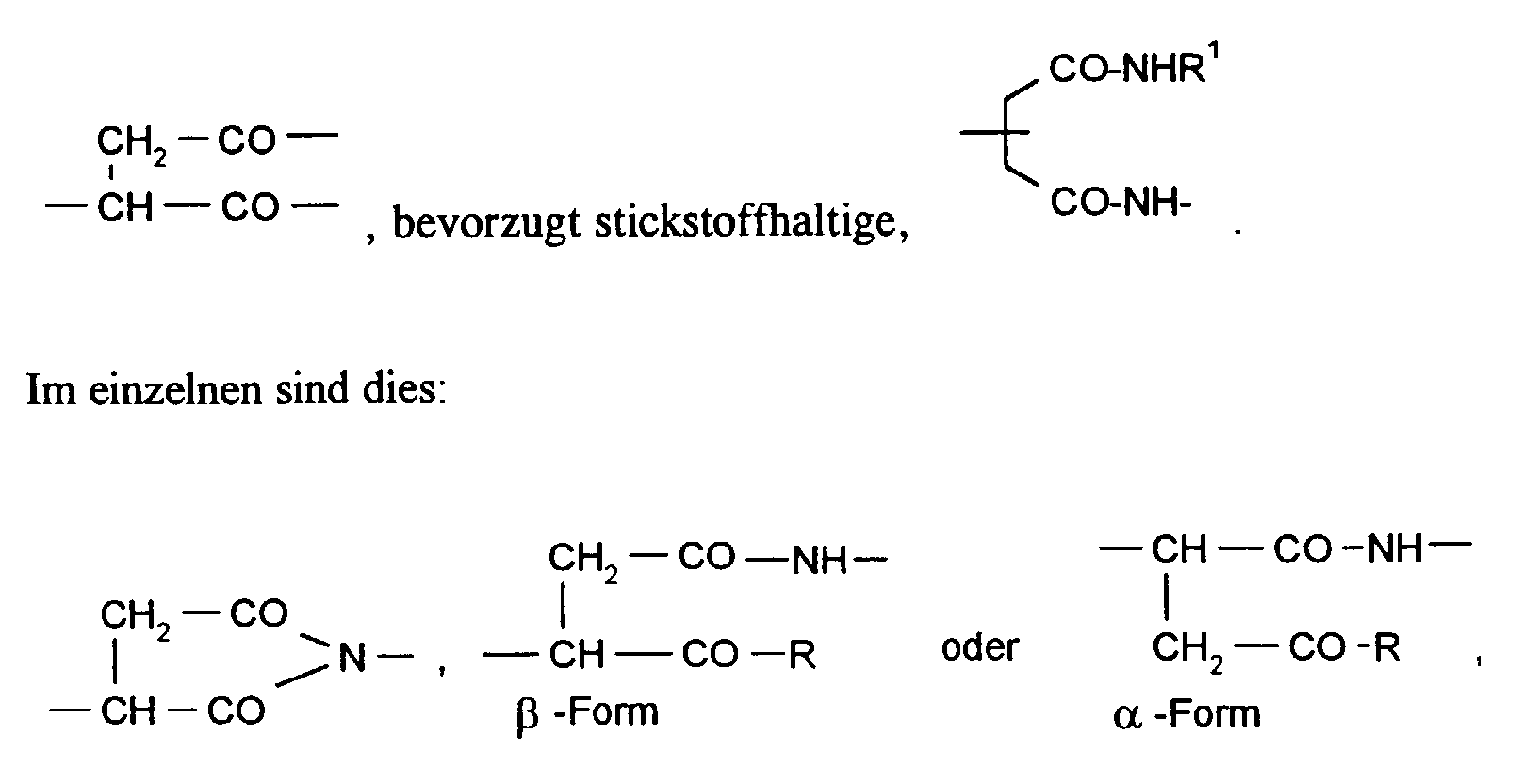
- R
- für OH, OLi, ONa, OK, ONH4, NH2, NHR1 oder OR1 steht, wobei R1
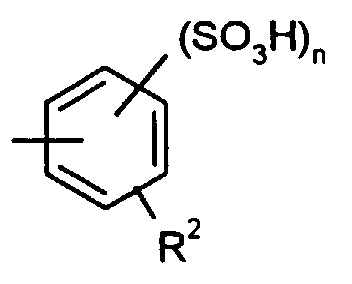
einen der Substituenten
oder -Y-SO3H bedeutet, worin n für die Zahl 1 oder 2, Y für geradkettiges oder verzweigtes Alkylen, Alkenylen oder Alkinylen und R2 für Wasserstoff, Alkyl, Alkoxy oder Halogen stehen.
- R
- represents OH, OLi, ONa, OK, ONH 4 , NH 2 , NHR 1 or OR 1 , where R 1 is one of the substituents or -Y-SO 3 H, where n is the number 1 or 2, Y is straight-chain or branched alkylene, alkenylene or alkynylene and R 2 is hydrogen, alkyl, alkoxy or halogen.
Alkyl hat 1-6, bevorzugt 1-2 C-Atome und ist beispielsweise Methyl, Ethyl, Propyl, i-Propyl, Butyl, i-Butyl, Pentyl, Hexyl. Alkylen leitet sich hiervon durch Abstraktion eines H-Atoms ab und ist zweibindig; Alkenylen hat 2-6, bevorzugt 2 C-Atome, eine Doppelbindung und ist analog dem Alkylen zweibindig; Alkinylen hat eine Dreifachbindung und ähnelt ansonsten dem Alkenylen.Alkyl has 1-6, preferably 1-2 C atoms and is, for example, methyl, ethyl, propyl, i-propyl, Butyl, i-butyl, pentyl, hexyl. Alkylene derives from this through abstraction of an H atom and is double-bonded; Alkenylene has 2-6, preferably 2 carbon atoms, one Double bond and is divalent analogous to alkylene; Alkinylene has one Triple bond and otherwise resembles alkenylene.
Alkoxy ist ein über ein Ether-Sauerstoffatom gebundenes Alkyl.Alkoxy is an alkyl bonded via an ether oxygen atom.
Halogen ist Fluor, Chlor oder Brom, bevorzugt Chlor.Halogen is fluorine, chlorine or bromine, preferably chlorine.
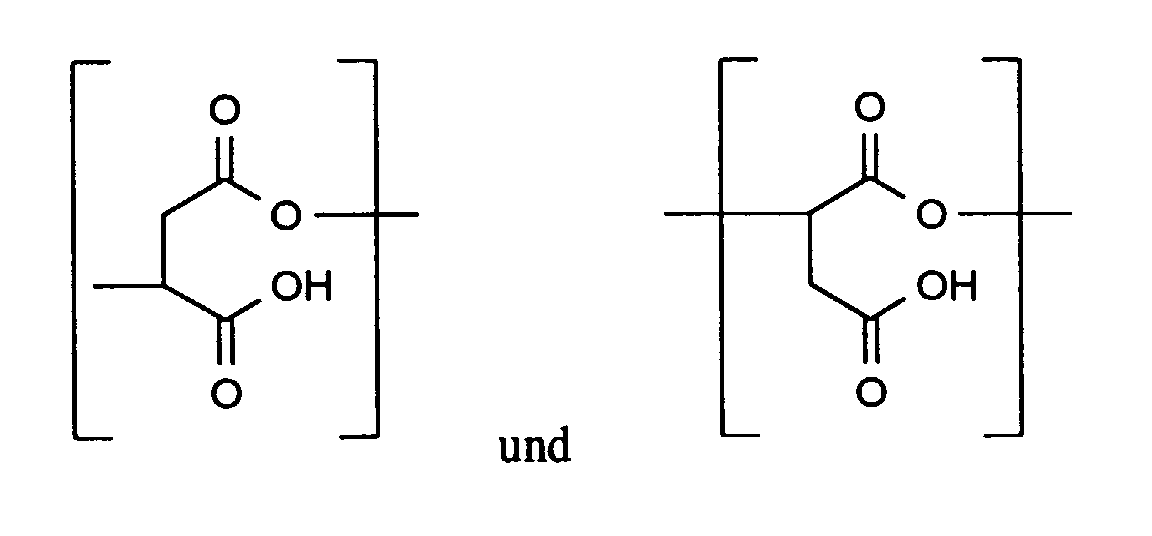
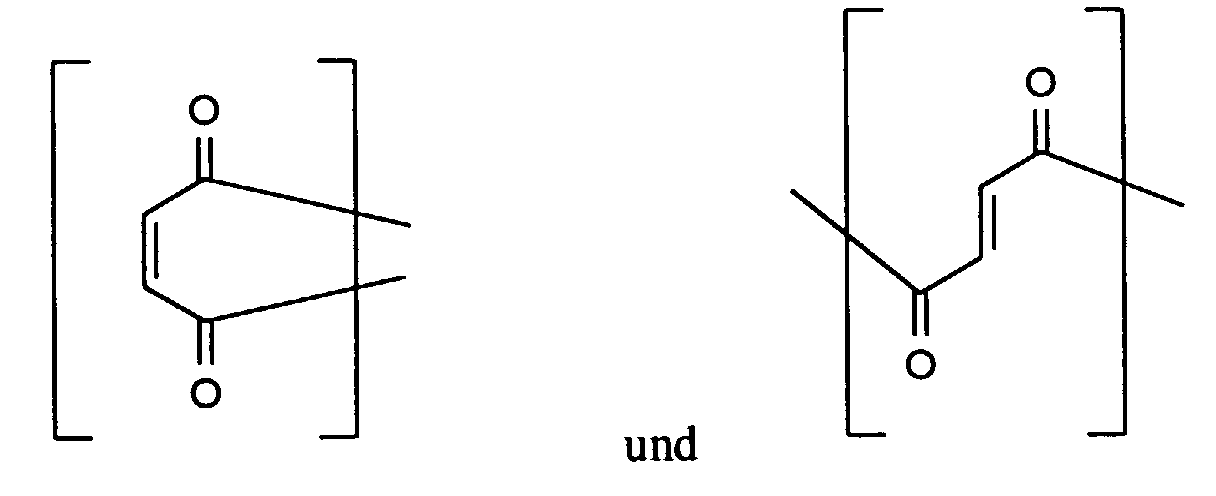
Zusätzlich können durch geeignete Reaktionsführung und Wahl der Edukte weitere
wiederkehrende Einheiten enthalten sein, z.B.
In einer besonders bevorzugten Ausführungsform handelt es sich bei dem erfindungsgemäß zu verwendenden Polymeren (I) um eine Polyasparaginsäure.In a particularly preferred embodiment, this is according to the invention polymer (I) to be used is a polyaspartic acid.
Die Herstellung und Verwendung von Polyasparaginsäure (PAA) und ihrer Derivate ist seit langem Gegenstand zahlreicher Veröffentlichungen und Patente. Die Herstellung kann beispielsweise durch thermische Polykondensation von Asparaginsäure gemäß J. Org. Chem. 26, 1084 (1961) erfolgen. Es tritt als Zwischenstufe zunächst das Polysuccinimid (PSI) auf, welches dort als "Anhydropolyasparaginsäure" bezeichnet wird. Durch Hydrolyse kann PSI in PAA übergeführt werden. US-A 4 839 461 beschreibt die Herstellung von Polyasparaginsäure aus Maleinsäureanhydrid, Wasser und Ammoniak allgemein US-A 5 286 810 speziell bei höheren Temperaturen.The production and use of polyaspartic acid (PAA) and its derivatives has long been the subject of numerous publications and patents. The production can for example by thermal polycondensation of aspartic acid according to J. Org. Chem. 26, 1084 (1961). It occurs as an intermediate stage first the polysuccinimide (PSI), which is called "anhydropolyaspartic acid" there becomes. By hydrolysis, PSI can be converted into PAA. US-A 4 839 461 describes the preparation of polyaspartic acid from maleic anhydride, water and ammonia in general US-A 5 286 810 especially at higher temperatures.
Bei vielen Herstellungsverfahren fallen nicht die reinen Säuren sondern zunächst die entsprechenden Anhydride, beispielsweise Polysuccinimid (PSI) an. Derartige Polymerisationsprodukte können durch Umsetzung mit einer Base gegebenenfalls in Gegenwart von Wasser in ein PAA-haltiges Salz übergeführt werden. Diese Umwandlung von PSI-haltigen in PAA-haltige Polymere geschieht anschließend in einer geeigneten Vorrichtung durch Hydrolyse. Bevorzugt ist hierzu ein pH-Wert zwischen 5 und 14 geeignet. In besonders bevorzugter Form wird ein pH-Wert von 7 bis 12 gewählt, insbesondere durch den Zusatz einer Base. Geeignete Basen sind Alkali- und Erdalkalihydroxide oder -carbonate wie beispielsweise Natronlauge, Kalilauge, Soda oder Kaliumcarbonat, Ammoniak und Amine, wie Triethylamin, Triethanolamin, Diethylamin, Diethanolamin und weitere substituierte Amine. Besonders bevorzugt sind neben freien PAA-Säuren deren Na-, K- oder Ca-Salze als Polymere (I). Die Temperatur bei der Hydrolyse liegt vorteilhaft in einem Bereich bis zum Siedepunkt der PSI-Suspension, beispielsweise bei 20 bis 150°C. Die Hydrolyse wird gegebenenfalls unter Druck durchgeführt. Es ist jedoch auch möglich, durch rein wäßrige Hydrolyse oder Behandlung des PAA-Salzes mit Säuren oder sauren Ionenaustauschern die freie Polyasparaginsäure zu erhalten. Der Begriff "Polyasparaginsäure" (PAA) umfaßt bei der vorliegenden Erfindung ebenfalls die Salze, falls nicht ausdrücklich anders dargestellt. Das fertige Produkt wird durch Trocknung, bevorzugt Sprühtrocknung, erhalten.In many manufacturing processes, it is not the pure acids that fall, but rather the ones corresponding anhydrides, for example polysuccinimide (PSI). Such polymerization products can optionally in by reaction with a base The presence of water can be converted into a PAA-containing salt. This conversion from PSI-containing to PAA-containing polymers then happens in one suitable device by hydrolysis. For this purpose, a pH between is preferred 5 and 14 suitable. In a particularly preferred form, a pH of 7 to 12 chosen, in particular by adding a base. Suitable bases are alkali and Alkaline earth metal hydroxides or carbonates such as sodium hydroxide solution, potassium hydroxide solution, soda or potassium carbonate, ammonia and amines, such as triethylamine, triethanolamine, Diethylamine, diethanolamine and other substituted amines. Particularly preferred are in addition to free PAA acids their Na, K or Ca salts as polymers (I). The The temperature during the hydrolysis is advantageously in a range up to the boiling point the PSI suspension, for example at 20 to 150 ° C. The hydrolysis is optionally performed under pressure. However, it is also possible to use purely aqueous Hydrolysis or treatment of the PAA salt with acids or acidic ion exchangers to get the free polyaspartic acid. The term "polyaspartic acid" (PAA) in the present invention also includes the salts, if not expressly shown differently. The finished product is preferred by drying Spray drying.
Bevorzugte Polymere (I) haben ein Molekulargewicht nach gelpermeationschromatographischen Analysen von Mw = 500 bis 10.000, bevorzugt 700 bis 5.000, besonders bevorzugt 1.000 bis 4.500). Im allgemeinen liegt bei Polyasparaginsäuren der Anteil der beta-Form bei mehr als 50 %, bevorzugt bei mehr als 70 %, bezogen auf die Summe dieser Einheiten.Preferred polymers (I) have a molecular weight according to gel permeation chromatography Analyzes of Mw = 500 to 10,000, preferably 700 to 5,000, particularly preferably 1,000 to 4,500). In general, the proportion is in polyaspartic acids the beta form at more than 50%, preferably at more than 70%, based on the Sum of these units.
In einer weiteren bevorzugten Form handelt es sich bei den erfindungsgemäß zu
verwendenden Polymeren (I) um modifizierte Polyasparaginsäuren die man durch
Umsetzung von
In einer bevorzugten Ausführungsform wird das erfindungsgemäß zu verwendende Polymer (I) in einer Konzentration von 0,1 bis 5 Gew.-% bezogen auf die Wasserphase dem System zugefügt. Besonders bevorzugte Mengen sind 0,3 bis 3 Gew.-%.In a preferred embodiment, that to be used according to the invention Polymer (I) in a concentration of 0.1 to 5 wt .-% based on the Water phase added to the system. Particularly preferred amounts are 0.3 to 3% by weight.
Es ist auch möglich, zusätzlich zu den erfindungsgemäß verwendeten Polymeren (I) weitere Additive wie Netzmittel, Gleithilfsmittel, weitere Plastifizierungsmittel und andere übliche Zusätze zu verwenden. Ebenso können den unter Verwendung der beschriebenen Verflüssiger (I) hergestellten keramischen Massen Betone, Mörtel etc. gegebenenfalls auch Luftporenbildner und/oder Thixotropiermittel zugesetzt werden.It is also possible, in addition to the polymers (I) used according to the invention, other additives such as wetting agents, lubricants, other plasticizers and to use other common additives. You can also use the described plasticizer (I) produced ceramic masses concrete, mortar etc. if necessary, air entraining agents and / or thixotropic agents are also added.
Vielfach besteht der Wunsch, die für Transport und Handhabung notwendige Verflüssigung rückgängig zu machen. Dies ist beispielhaft aber nicht ausschließlich bei der Verarbeitung von Transportbeton der Fall. Beim Ausfüllen feinster Kanäle, beim Transport durch Pumpen, beim Auspressen von Gründungsbauwerken, beim Verdichten feingliedriger Bauteile, bei der Herstellung von dichtem Massenbeton oder beim Zentrifugieren hochwertiger Schleuderbetone ist eine optimale Homogenität und Plastizität gewünscht. Nach dem Einbringen soll die Plastizität jedoch schnell in dem Sinne rückgängig gemacht werden, daß die Konsistenz deutlich ansteigt und der Beton seine Fließfähigkeit verliert, abbindet und erstarrt, wobei er seine gewünschten endgültigen Eigenschaften, wie seine Festigkeit, erreicht.There is often a desire to have the liquefaction necessary for transport and handling undo. This is exemplary but not exclusively for the Processing of ready-mixed concrete is the case. When filling the finest channels, when Transport by pumps, when pressing foundation structures, when compacting delicate components, in the production of dense bulk concrete or when centrifuging high-quality centrifugal concrete is an optimal homogeneity and Plasticity desired. After insertion, however, the plasticity should quickly in the Senses are reversed that the consistency increases significantly and the Concrete loses its flowability, sets and solidifies, giving it its desired final properties, such as its strength.
Erfindungsgemäß wird zur Rückgängigmachung der Plastifizierung von keramischen Massen und Dispersionen, die durch ein Polymer (I) plastifiziert wurden, ein Abbindebeschleuniger (II) zugesetzt, der die ionenaktiven und grenzflächenspezifischen Wirkungen von Polymer (I) neutralisiert und rückgängig macht. According to the invention, the plasticization of ceramic is reversed Masses and dispersions plasticized by a polymer (I), a setting accelerator (II) added, the ion-active and interface-specific Effects of polymer (I) neutralized and reversed.
Abbindebeschleuniger, die den keramischen Massen und Dispersionen kurz vor ihrer endgültigen Verarbeitung zugesetzt werden, sind beispielsweise lösliche (Erd)Alkalisalze, Alkalialuminate, Alkalisilikate oder ein Gemisch mehrerer von ihnen oder in bevorzugter Weise ein Polyalkylenpolyamin, hier als Polymer (II) bezeichnet.Setting accelerator that the ceramic masses and dispersions shortly before their final processing, for example soluble (earth) alkali salts, Alkali aluminates, alkali silicates or a mixture of several of them or in preferably a polyalkylene polyamine, referred to here as polymer (II).
Ein geeignetes Polymer (II) kann man beispielsweise herstellen, in dem man zunächst Ammoniak mit Dichloralkylenen und die dabei erhältlichen Produkte, z.B. Diethylentriamin, mit weiterem Dichloralkylen umsetzt. Auch Gemische von Polyalkylenpolyaminen verschiedener Herkunft können eingesetzt werden. Die Alkylengruppen sind geradkettig oder verzweigt und haben 2 bis 4 C-Atome, beispielsweise 1,2-Ethylen, 1,2- und 1,3-Propylen sowie 1,2-, 1,3- und 1,4-Butylen. Bevorzugt sind 1,2-Ethylen und 1,2-Propylen, besonders bevorzugt 1,2-Ethylen. Die primär so zugänglichen Polyalkylenpolyamine können gegebenenenfalls zur Verminderung von Vinylchlorid-Anteilen auf weniger als die Nachweisgrenze in wäßriger Lösung bei vermindertem Druck erhitzt und/oder gegebenenfalls zur Viskositätserniedrigung bei erhöhtem Druck thermisch abgebaut werden (DE-OS 2 351 754 und DE-OS 2 833 654). Das Chlorid aus den Dichloralkylenen bildet das Gegenion zu den Aminogruppen, die bei der Umsetzung entstehen. Durch Zusatz weiterer Salzsäure kann ein spezieller Neutralisationsgrad eingestellt werden. Chlorid kann in bekannter Weise auch durch Sulfat, Phosphat oder Acetat ersetzt werden. Besonders geeignete Polyalkylenpolyamine weisen z.B. Viskositäten im Bereich von 200 bis 800 mPa.s auf (gemessen als 25 gew.-%ige wäßriger Lösung bei 25°C). Auch Polyalkylenpolyamine kann man so wie sie bei Herstellung anfallen einsetzen, d.h. als Lösung in Wasser.A suitable polymer (II) can be prepared, for example, by first Ammonia with dichloroalkylenes and the products available, e.g. Diethylene triamine, reacted with further dichloroalkylene. Mixtures of polyalkylene polyamines different origins can be used. The alkylene groups are straight-chain or branched and have 2 to 4 carbon atoms, for example 1,2-ethylene, 1,2- and 1,3-propylene and 1,2-, 1,3- and 1,4-butylene. 1,2-ethylene are preferred and 1,2-propylene, particularly preferably 1,2-ethylene. The primarily so accessible Polyalkylene polyamines can optionally be used to reduce the proportion of vinyl chloride to less than the detection limit in aqueous solution with reduced Pressure heated and / or if necessary to lower the viscosity at increased Pressure can be reduced thermally (DE-OS 2 351 754 and DE-OS 2 833 654). The chloride from the dichloroalkylenes forms the counter ion to the amino groups, the arise during implementation. By adding more hydrochloric acid, a special one Degree of neutralization can be set. Chloride can also pass through in a known manner Sulphate, phosphate or acetate can be replaced. Particularly suitable polyalkylene polyamines indicate e.g. Viscosities in the range of 200 to 800 mPa.s to (measured as a 25 wt .-% aqueous solution at 25 ° C). You can also use polyalkylene polyamines as they occur during production, i.e. as a solution in water.
Bevorzugt gelangen Polyethylenpolyamine zum Einsatz, die ein Molekulargewicht von 80 000 bis 120 000, eine Viskosität von 250 bis 400 mPas.s (gemessen in 25 gew.-%iger wäßriger Lösung bei 25°C) und eine möglichst geringe Wassergefährdung aufweisen. Polyethylene polyamines which have a molecular weight are preferably used from 80,000 to 120,000, a viscosity of 250 to 400 mPas.s (measured in 25 wt .-% aqueous solution at 25 ° C) and the lowest possible water hazard exhibit.
Abbindebeschleuniger (II), insbesondere Polymere (II) werden in Mengen von 0,01 bis 1 Gew.-%, bevorzugt 0,01 bis 0,2 Gew.-%, bezogen auf das Gewicht der Wasserphase, eingsetzt. Setting accelerators (II), especially polymers (II) are used in amounts of 0.01 up to 1% by weight, preferably 0.01 to 0.2% by weight, based on the weight of the water phase, used.
Die Beispiele 1 bis 4 zeigen die Verbesserung der Plastizität und das Beispiel 5 die Rückgängigmachung dieser Erscheinung.Examples 1 to 4 show the improvement in plasticity and Example 5 that Undo this phenomenon.
60 g China Clay wurden bei Raumtemperatur mit 40 ml wäßriger Lösung der angegebenen Verflüssigungsmittel A bis E in abgestuften Konzentrationen verrührt und anschließend 10 Minuten bei 750 Umdrehungen pro Minute mit einem Propellerrührer homogenisiert, so daß Aufschlämmungen (Slurries) mit 60 Gew.-% Feststoff und 0,1 bis 1,0 Gew.-% Verflüssigungsmittel entstanden. Anschließend wurden die Fließkurven der Slurries mit einem Rotationsviskosimeter Typ Haake RV 12 aufgenommen. Zum Einsatz kamen als Verflüssigungsmittel:
- Mittel A:
- Handelsübliche Polyacrylsäure (Mol-Gew. MW = 3000)
- Mittel B:
- Handelsübliche Acrylsäure/Maleinsäure-Copolymerisat (MW = 4000)
- Mittel C:
- Polyasparaginsäure (MW = 1800)
- Mittel D:
- Polyasparaginsäure (MW = 2400)
- Mittel E:
- Polyasparaginsäure (MW = 8000)
- Medium A:
- Commercial polyacrylic acid (molar weight MW = 3000)
- Medium B:
- Commercial acrylic acid / maleic acid copolymer (MW = 4000)
- Medium C:
- Polyaspartic acid (MW = 1800)
- Medium D:
- Polyaspartic acid (MW = 2400)
- Medium E:
- Polyaspartic acid (MW = 8000)
Tabelle 1 zeigt die Ergebnisse.Table 1 shows the results.
Es wurde wie vorstehend verfahren, jedoch wurden 50 g sekundäres feines Kaolin mit 60 ml wäßriger Lösung der Mittel A bis E versetzt. Tabelle 2 zeigt die Ergebnisse. The procedure was as above, but 50 g of secondary fine kaolin were added 60 ml of aqueous solution of agents A to E. Table 2 shows the results.
Es wurde wie vorstehend verfahren jedoch wurden 55 g feines Talkum mit 45 ml
wäßriger Lösung der Mittel A bis E versetzt. Tabelle 3 zeigt die Ergebnisse.

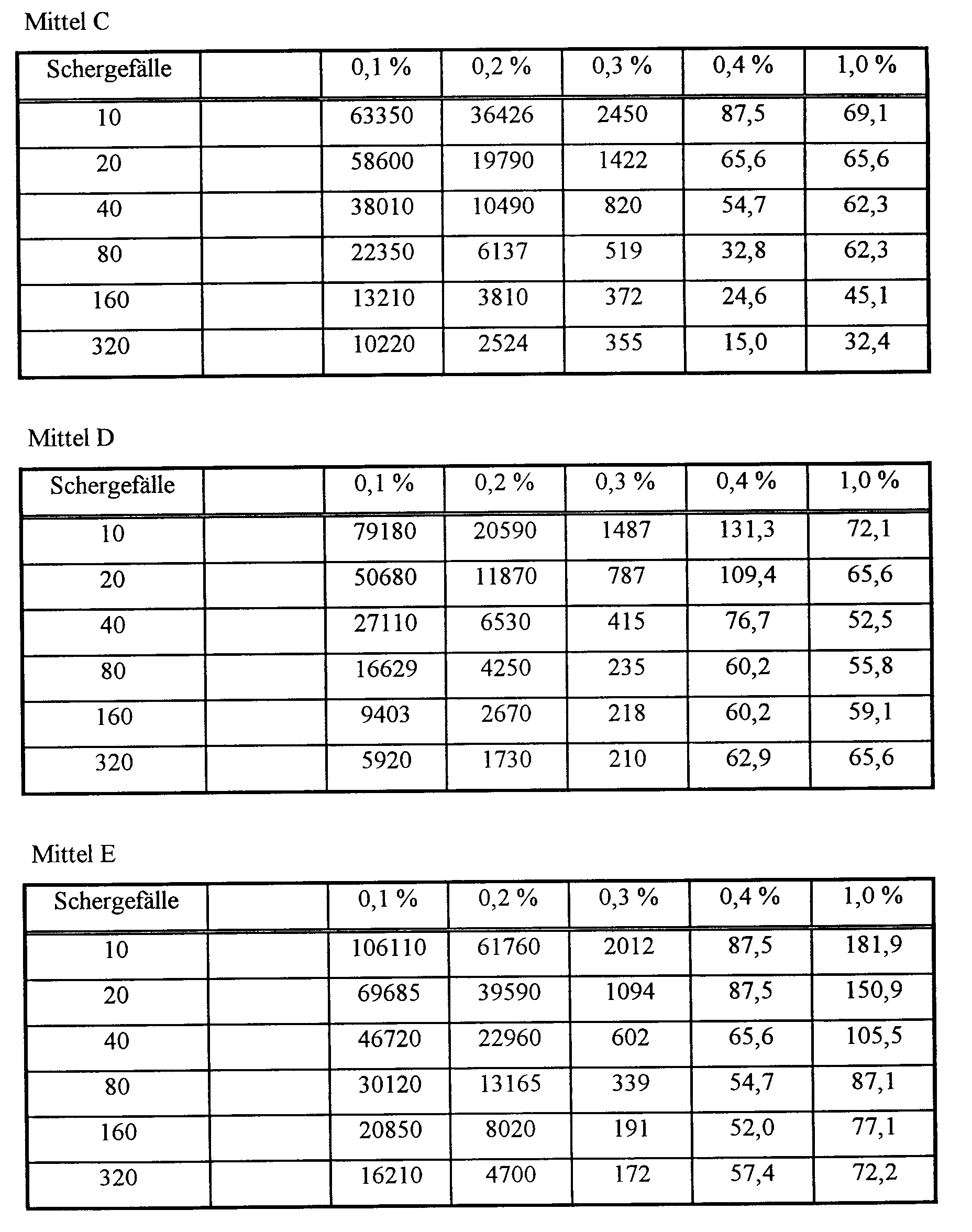

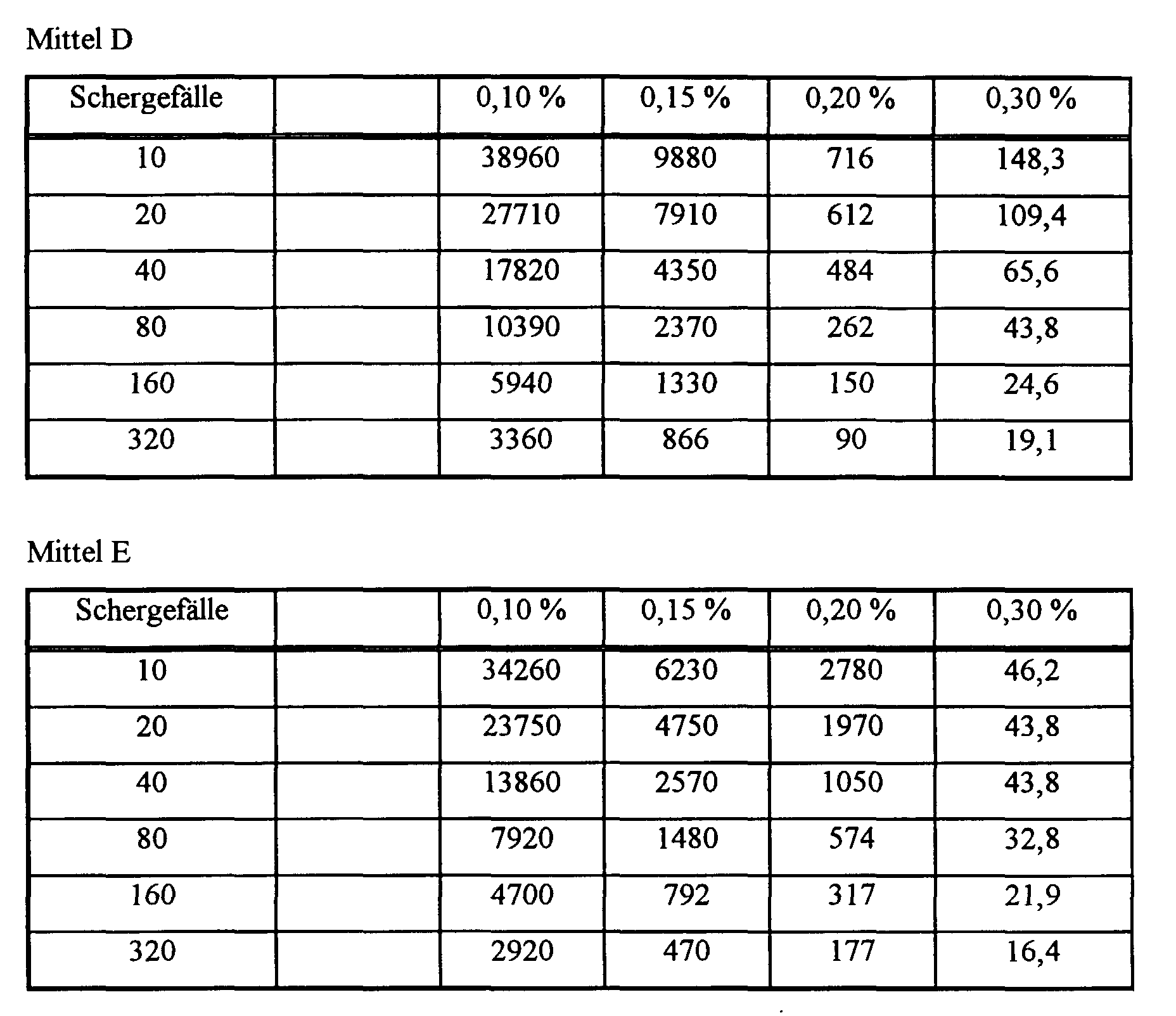
Mittel A
Medium A
Mit den erfindungsgemäßen Polymeren (I) kann die Plastizität von Frischbeton verbessert werden. Hierbei ergibt sich nicht nur der Vorteil, als Verflüssiger zu wirken, sondern (I) wirkt als Dispergiermittel auch der Entmischung bei Transport und Verarbeitung entgegen. Hierzu wurde eine Prüfung in Anlehnung an DIN 1048 T1 (Prüfverfahren für Frischbeton) durchgeführt: Ein Ausbreittisch mit einer Fläche von 200 x 200 mm wurde an einer senkrechten Führung derart befestigt, daß eine freie Fallhöhe von 100 mm sichergestellt war. Der frisch angesetzte und homogenisierte Mörtel wurde lose in eine zylindrische Form gefüllt, die mittig auf der mattfeuchten Oberfläche des Ausbreittisches steht. Nach dem Füllen der Form wird der Überstand ohne Verdichtungswirkung bündig abgestrichen, die Form hochgezogen und beiseitegestellt.With the polymers (I) according to the invention, the plasticity of fresh concrete be improved. This not only has the advantage of being a condenser act, but (I) acts as a dispersant also the segregation during transport and processing contrary. For this purpose, a test based on DIN 1048 was carried out T1 (test method for fresh concrete) carried out: A spreading table with a surface of 200 x 200 mm was attached to a vertical guide so that a free fall height of 100 mm was ensured. The freshly prepared and Homogenized mortar was loosely filled into a cylindrical shape that was centered on the matt damp surface of the spreading table. After filling the mold the supernatant was smeared flush, the shape pulled up and set aside.
Innerhalb von 15 s wurde die Platte nun ruckfrei 15 mal bis zum Anschlag angehoben und frei fallengelassen. Anschließend wurde der Durchmesser des Mörtelkuchens gemessen. Im Abstand von 1 h wurde der Versuch wiederholt, um auf diese Weise das Abbindeverhalten als Funktion der Zeit erfassen zu können.Within 15 s, the plate was raised 15 times to the stop without jerking and dropped freely. Then the diameter of the mortar cake measured. At 1 hour intervals, the experiment was repeated in this way to be able to record the setting behavior as a function of time.
- Portlandzement CEMI 32,5 R DIN 1164Portland cement CEMI 32.5 R DIN 1164
- Verhältnis Wasser/Zement: 0,325Water / cement ratio: 0.325
- Konzentration: 0,25 / 0,5 / 0,75 / 1 Gew.-% an PlastifizierungsmittelConcentration: 0.25 / 0.5 / 0.75 / 1% by weight of plasticizer
- Mittel C:Medium C:
- Polymer (I) MW 1800Polymer (I) MW 1800
- Mittel D:Medium D:
- Polymer (I) MW 2400Polymer (I) MW 2400
- Mittel E:Medium E:
- Polymer (I) MW 8000Polymer (I) MW 8000
Wirkstoff C(Slump of slurry)
Active ingredient C
Die in den Beispielen 1 bis 4 aufgezeigte stark verflüssigende Wirkung des Polymer I
ließ sich durch anschließendes Hinzufügen eines Polymer (II) nahezu völlig rückgängig
machen. Dem verflüssigten Kaolin gemaß Beispiel 2 wurden erst 0,4 %
Polymer I und anschließend 0,01 - 0,05 % Polymer (II) zugesetzt.
Claims (9)

- R
- für OH, OLi ONa, OK, ONH4, NH2, NHR1 oder OR1 steht, wobei
R1 einen der Substituenten
oder -Y-SO3H bedeutet, worin n für die Zahl 1 oder 2, Y für geradkettiges oder verzweigtes Alkylen, Alkenylen oder Alkinylen und R2 für Wasserstoff, Alkyl, Alkoxy oder Halogen stehen.

- R
- stands for OH, OLi ONa, OK, ONH 4 , NH 2 , NHR 1 or OR 1 , where R 1 is one of the substituents or -Y-SO 3 H, where n is the number 1 or 2, Y is straight-chain or branched alkylene, alkenylene or alkynylene and R 2 is hydrogen, alkyl, alkoxy or halogen.
Applications Claiming Priority (2)
| Application Number | Priority Date | Filing Date | Title |
|---|---|---|---|
| DE19740787A DE19740787A1 (en) | 1997-09-17 | 1997-09-17 | Process for improving the plasticity of ceramic materials and reversing this effect |
| DE19740787 | 1997-09-17 |
Publications (2)
| Publication Number | Publication Date |
|---|---|
| EP0903329A2 true EP0903329A2 (en) | 1999-03-24 |
| EP0903329A3 EP0903329A3 (en) | 1999-08-18 |
Family
ID=7842570
Family Applications (1)
| Application Number | Title | Priority Date | Filing Date |
|---|---|---|---|
| EP98116838A Withdrawn EP0903329A3 (en) | 1997-09-17 | 1998-09-07 | Method of improving ceramic mass plasticity and reversal of this effect |
Country Status (12)
| Country | Link |
|---|---|
| US (1) | US6100319A (en) |
| EP (1) | EP0903329A3 (en) |
| JP (1) | JPH11170242A (en) |
| AU (1) | AU8518198A (en) |
| BR (1) | BR9803470A (en) |
| CA (1) | CA2247564A1 (en) |
| CZ (1) | CZ295198A3 (en) |
| DE (1) | DE19740787A1 (en) |
| NO (1) | NO984289L (en) |
| PL (1) | PL328555A1 (en) |
| SK (1) | SK126598A3 (en) |
| ZA (1) | ZA988450B (en) |
Cited By (1)
| Publication number | Priority date | Publication date | Assignee | Title |
|---|---|---|---|---|
| CN107892494A (en) * | 2017-11-29 | 2018-04-10 | 广州市龙芝圆科技有限公司 | A kind of quick-dry type cement |
Families Citing this family (5)
| Publication number | Priority date | Publication date | Assignee | Title |
|---|---|---|---|---|
| DE10017133B4 (en) * | 2000-04-06 | 2005-09-29 | Bk Giulini Gmbh | Use of prepolymers for setting retardation of gypsum or gypsum preparations |
| US6419016B1 (en) * | 2000-09-29 | 2002-07-16 | Halliburton Energy Services, Inc. | Methods of cementing in subterranean zones |
| DE10141825B4 (en) * | 2001-08-27 | 2012-10-04 | Stephan Schmidt Kg | Process for the preparation of ceramic masses and mass components |
| AU2003280223B2 (en) * | 2003-10-03 | 2011-05-12 | Newsouth Innovations Pty Ltd | Manufacture of articles from fly ash |
| EP2108628A1 (en) | 2008-04-10 | 2009-10-14 | TRICOSAL GmbH & Co. KG | Set retarder for hydraulic setting compositions |
Citations (5)
| Publication number | Priority date | Publication date | Assignee | Title |
|---|---|---|---|---|
| DE2351754A1 (en) | 1973-10-16 | 1975-04-17 | Bayer Ag | PROCESS FOR MANUFACTURING LOW VISCOSITY POLYAETHYLENE POLYAMINE SALT |
| DE2833654A1 (en) | 1978-08-01 | 1980-02-14 | Bayer Ag | Redn. of vinyl chloride content of poly:alkylene poly:amine(s) - without lots of activity, by heating under vacuum |
| US5286810A (en) | 1992-08-07 | 1994-02-15 | Srchem Incorporated | Salt of polymer from maleic acid, polyamind and ammonia |
| JPH07172888A (en) | 1993-12-21 | 1995-07-11 | Mitsui Toatsu Chem Inc | Admixture for cement |
| JPH08169741A (en) | 1994-12-16 | 1996-07-02 | Mitsui Toatsu Chem Inc | Admixture for sustained release cement |
Family Cites Families (14)
| Publication number | Priority date | Publication date | Assignee | Title |
|---|---|---|---|---|
| US2839417A (en) * | 1956-05-07 | 1958-06-17 | Dow Chemical Co | Stabilized soil compositions containing reaction products of lignin with polyalkylene polyamines |
| US3491049A (en) * | 1965-10-13 | 1970-01-20 | Dow Chemical Co | Low water-loss aqueous cement slurry and method of use |
| US4569694A (en) * | 1982-06-21 | 1986-02-11 | Corodova Chemical Company Of Michigan | Solid polyamine-based fluid loss control additives |
| JPS5920322A (en) * | 1982-07-28 | 1984-02-02 | Toyo Soda Mfg Co Ltd | Production of polyethylene-polyamine |
| DE3626672A1 (en) * | 1986-08-07 | 1988-02-11 | Bayer Ag | POLYASPARAGINAMID ACID |
| US5503771A (en) * | 1991-05-14 | 1996-04-02 | Washington Technology Center | Process for susupension of ceramic or metal particles using biologically produced polymers |
| US5266237A (en) * | 1992-07-31 | 1993-11-30 | Rohm And Haas Company | Enhancing detergent performance with polysuccinimide |
| US5266305A (en) * | 1992-10-29 | 1993-11-30 | Srchem Incorporated | Copolymers of polyamino acids as tartar barrier agents |
| DE4239076A1 (en) * | 1992-11-20 | 1994-05-26 | Basf Ag | Mixtures of polymers of monoethylenically unsaturated dicarboxylic acids and polymers of ethylenically unsaturated monocarboxylic acids and / or polyaminocarboxylic acids and their use |
| DE19603052A1 (en) * | 1996-01-29 | 1997-07-31 | Bayer Ag | Process for the preparation of polymers with repeating succinyl units |
| DE19603053A1 (en) * | 1996-01-29 | 1997-07-31 | Bayer Ag | Process for the preparation of polymers with repeating succinyl units |
| US5859149A (en) * | 1997-02-07 | 1999-01-12 | Solutia Inc. | Production of solid polyaspartate salt |
| US5908885A (en) * | 1997-07-01 | 1999-06-01 | University Of South Alabama | Polysuccinimide and polyaspartate as additives to cementitious materials |
| JP3879216B2 (en) * | 1997-12-08 | 2007-02-07 | 山和防災設備株式会社 | Fire hose crusher |
-
1997
- 1997-09-17 DE DE19740787A patent/DE19740787A1/en not_active Withdrawn
-
1998
- 1998-09-07 EP EP98116838A patent/EP0903329A3/en not_active Withdrawn
- 1998-09-10 JP JP10272496A patent/JPH11170242A/en active Pending
- 1998-09-11 US US09/151,345 patent/US6100319A/en not_active Expired - Fee Related
- 1998-09-14 CA CA002247564A patent/CA2247564A1/en not_active Abandoned
- 1998-09-14 PL PL98328555A patent/PL328555A1/en unknown
- 1998-09-16 AU AU85181/98A patent/AU8518198A/en not_active Abandoned
- 1998-09-16 CZ CZ982951A patent/CZ295198A3/en unknown
- 1998-09-16 BR BR9803470-7A patent/BR9803470A/en not_active Application Discontinuation
- 1998-09-16 NO NO984289A patent/NO984289L/en unknown
- 1998-09-16 ZA ZA988450A patent/ZA988450B/en unknown
- 1998-09-16 SK SK1265-98A patent/SK126598A3/en unknown
Patent Citations (5)
| Publication number | Priority date | Publication date | Assignee | Title |
|---|---|---|---|---|
| DE2351754A1 (en) | 1973-10-16 | 1975-04-17 | Bayer Ag | PROCESS FOR MANUFACTURING LOW VISCOSITY POLYAETHYLENE POLYAMINE SALT |
| DE2833654A1 (en) | 1978-08-01 | 1980-02-14 | Bayer Ag | Redn. of vinyl chloride content of poly:alkylene poly:amine(s) - without lots of activity, by heating under vacuum |
| US5286810A (en) | 1992-08-07 | 1994-02-15 | Srchem Incorporated | Salt of polymer from maleic acid, polyamind and ammonia |
| JPH07172888A (en) | 1993-12-21 | 1995-07-11 | Mitsui Toatsu Chem Inc | Admixture for cement |
| JPH08169741A (en) | 1994-12-16 | 1996-07-02 | Mitsui Toatsu Chem Inc | Admixture for sustained release cement |
Cited By (2)
| Publication number | Priority date | Publication date | Assignee | Title |
|---|---|---|---|---|
| CN107892494A (en) * | 2017-11-29 | 2018-04-10 | 广州市龙芝圆科技有限公司 | A kind of quick-dry type cement |
| CN107892494B (en) * | 2017-11-29 | 2020-08-04 | 兴宁市龙江建材实业有限公司 | Quick-drying cement |
Also Published As
| Publication number | Publication date |
|---|---|
| BR9803470A (en) | 1999-12-14 |
| JPH11170242A (en) | 1999-06-29 |
| ZA988450B (en) | 1999-03-30 |
| US6100319A (en) | 2000-08-08 |
| SK126598A3 (en) | 1999-04-13 |
| NO984289D0 (en) | 1998-09-16 |
| DE19740787A1 (en) | 1999-03-18 |
| CZ295198A3 (en) | 1999-04-14 |
| AU8518198A (en) | 1999-04-01 |
| NO984289L (en) | 1999-03-18 |
| CA2247564A1 (en) | 1999-03-17 |
| EP0903329A3 (en) | 1999-08-18 |
| PL328555A1 (en) | 1999-03-29 |
Similar Documents
| Publication | Publication Date | Title |
|---|---|---|
| EP0059353B1 (en) | Process for producing highly-concentrated low-viscosity aqueous solutions of melamine-aldehyde resins and their use as additives for building materials | |
| DE69311731T2 (en) | CONDENSER FOR WATER-SUSPENDED PARTICLES AND PASTE FROM HYDRAULIC BINDER | |
| EP2615073B1 (en) | Dispersion agent for inorganic particles | |
| DE2631090C3 (en) | Sufficient binder | |
| WO2010040612A1 (en) | Phosphated polycondensation product, method for production and use thereof | |
| EP2430093B1 (en) | Aqueous polymer dispersions | |
| DE19627531B4 (en) | Water-soluble formaldehyde-free polycondensation products based on amino-s-triazines | |
| EP1131269A1 (en) | Additives for mineral building materials containing cement | |
| EP2794511A1 (en) | Setting accelerator for binders based on calcium sulfate | |
| EP0825236A2 (en) | Process for preparing inorganic granules and their use | |
| EP0903329A2 (en) | Method of improving ceramic mass plasticity and reversal of this effect | |
| DE1542202C3 (en) | Process for the liquefaction of aqueous inorganic solid dispersions | |
| DE2228791B2 (en) | Process for improving the mechanical properties of hydraulic binders based on blast furnace slag | |
| DE19541945C1 (en) | Thickener system for building material mixtures, process for its preparation and use | |
| EP3097061B1 (en) | Calcium sulphate composition including an additive | |
| EP0012346A1 (en) | Stable aqueous zeolite suspensions, method for preparing them and their use | |
| EP0770647A2 (en) | Yellowish red iron oxide pigments of pure colour, process for preparing them and their use | |
| DE2330728B2 (en) | METHOD FOR MANUFACTURING A SYNTHETIC ANHYDRITE OF UNIFORM QUALITY AND THE USE OF IT | |
| DE481177C (en) | Manufacture of a fertilizer | |
| DE2229426B2 (en) | Process for its manufacture | |
| DE2609703C3 (en) | Organocalcium aluminates and their use in hydraulic binders | |
| DE2401185A1 (en) | BINDER | |
| DE69514167T2 (en) | Grinding aids for cement | |
| DE69800047T2 (en) | Process for the production of green bodies | |
| DE4406822C2 (en) | Redispersible polymer powders, processes for their preparation and their use |
Legal Events
| Date | Code | Title | Description |
|---|---|---|---|
| PUAI | Public reference made under article 153(3) epc to a published international application that has entered the european phase |
Free format text: ORIGINAL CODE: 0009012 |
|
| AK | Designated contracting states |
Kind code of ref document: A2 Designated state(s): AT BE CH CY DE DK ES FI FR GB GR IE IT LI LU MC NL PT SE |
|
| AX | Request for extension of the european patent |
Free format text: AL;LT;LV;MK;RO;SI |
|
| PUAL | Search report despatched |
Free format text: ORIGINAL CODE: 0009013 |
|
| AK | Designated contracting states |
Kind code of ref document: A3 Designated state(s): AT BE CH CY DE DK ES FI FR GB GR IE IT LI LU MC NL PT SE |
|
| AX | Request for extension of the european patent |
Free format text: AL;LT;LV;MK;RO;SI |
|
| RIC1 | Information provided on ipc code assigned before grant |
Free format text: 6C 04B 35/634 A, 6C 04B 24/26 B, 6C 04B 24/32 B, 6C 04B 40/06 B, 6C 08G 73/10 B |
|
| STAA | Information on the status of an ep patent application or granted ep patent |
Free format text: STATUS: THE APPLICATION HAS BEEN WITHDRAWN |
|
| 18W | Application withdrawn |
Withdrawal date: 19990809 |