EP0902785B1 - Processes and intermediates for preparing 4'-trifluoromethylbiphenyl-2-carboxylic acid 2-(2h- 1,2,4]triazol-3-ylmethyl)-1,2,3,4-tetrahydro-isoquinolin-6-yl]-amide - Google Patents
Processes and intermediates for preparing 4'-trifluoromethylbiphenyl-2-carboxylic acid 2-(2h- 1,2,4]triazol-3-ylmethyl)-1,2,3,4-tetrahydro-isoquinolin-6-yl]-amide Download PDFInfo
- Publication number
- EP0902785B1 EP0902785B1 EP97905354A EP97905354A EP0902785B1 EP 0902785 B1 EP0902785 B1 EP 0902785B1 EP 97905354 A EP97905354 A EP 97905354A EP 97905354 A EP97905354 A EP 97905354A EP 0902785 B1 EP0902785 B1 EP 0902785B1
- Authority
- EP
- European Patent Office
- Prior art keywords
- compound
- formula
- treating
- acid
- iii
- Prior art date
- Legal status (The legal status is an assumption and is not a legal conclusion. Google has not performed a legal analysis and makes no representation as to the accuracy of the status listed.)
- Expired - Lifetime
Links
- 0 *c1ccc(CN(CC2=NC=N*2)CC2)c2c1 Chemical compound *c1ccc(CN(CC2=NC=N*2)CC2)c2c1 0.000 description 1
Classifications
-
- C—CHEMISTRY; METALLURGY
- C07—ORGANIC CHEMISTRY
- C07D—HETEROCYCLIC COMPOUNDS
- C07D401/00—Heterocyclic compounds containing two or more hetero rings, having nitrogen atoms as the only ring hetero atoms, at least one ring being a six-membered ring with only one nitrogen atom
- C07D401/02—Heterocyclic compounds containing two or more hetero rings, having nitrogen atoms as the only ring hetero atoms, at least one ring being a six-membered ring with only one nitrogen atom containing two hetero rings
- C07D401/06—Heterocyclic compounds containing two or more hetero rings, having nitrogen atoms as the only ring hetero atoms, at least one ring being a six-membered ring with only one nitrogen atom containing two hetero rings linked by a carbon chain containing only aliphatic carbon atoms
Definitions
- This invention relates to 4'-trifluoromethylbiphenyl-2-carboxylic acid [2-(2H-[1,2,4]triazol-3-ylmethyl)-1,2,3,4-tetrahydro-isoquinolin-6-yl]-amide of formula I below. More particularly it relates to an improved method, and intermediates, for the preparation of compound I.
- Compound I is an inhibitor of microsomal triglyceride transfer protein C and/or apolipoprotein B (Apo B) secretion and is, accordingly, useful for the prevention and treatment of atherosclerosis and its clinical sequelae, for lowering serum lipids, and related diseases.
- Microsomal triglyceride transfer protein catalyzes the transport of triglyceride, cholesteryl ester, and phospholipids. It has been implicated as a probable agent in the assembly of Apo B-containing lipoproteins, biomolecules which contribute to the formation of atherosclerotic lesions. See European Patent application publication no. 0 643 057 A1, European Patent application publication no. 0 584 446 A2, European Patent Application No. 0 635 492 A1, International Application Publication No. WO 96 / 40640 and Wetterau et al., Science, 258, 999-1001, (1992).
- MTP Microsomal triglyceride transfer protein
- Compounds which inhibit MTP and/or otherwise inhibit Apo B secretion are, therefore, useful in the treatment of atherosclerosis. Such compounds are also useful in the treatment of other diseases or conditions in which, by inhibiting MTP and/or Apo B secretion, serum cholesterol and triglyceride levels can be reduced.
- diseases or conditions include hypercholesterolemia, hypertriglyceridemia, pancreatitis, and obesity; and hypercholesterolemia, hypertriglyceridemia, and hyperlipidemia associated with pancreatitis, obesity, and diabetes.
- This invention provides a method for preparing the compound of formula which comprises treating the compound of the formula wherein R is H or R 2 and R 2 is selected from allyl and a substituted methyl group wherein the substituents comprise one to three (C 6 -C 10 )aryl groups wherein the aryl groups are optionally substituted with one or more substituents selected from nitro and (C 1 -C 6 )alkoxy;
- heterocyclic means any single ring or fused ring system containing at least one ring heteroatom independently selected from 0, N, and S.
- a polycyclic fused ring system containing one or more carbocyclic fused saturated, partially unsaturated, or aromatic rings is within the definition of heterocyclyl so long as the system also contains at least one fused ring which contains at least one of the aforementioned heteroatoms.
- such heterocyclic rings may be attached to the remainder of the molecule from either a carbocyclic (e.g., benzene) ring or from a heterocyclic ring.
- references to a moiety containing "one or more rings” is intended to mean that said moiety contains a single or fused cyclic moiety or moieties.
- the rings may be carbocyclic or heterocyclic, saturated or partially unsaturated, and aromatic or nonaromatic.
- halo in this specification is inclusive of fluoro, chloro, bromo, and iodo unless noted otherwise.
- aryl substitutent e.g. (C 6 -C 10 )aryl
- Aromatic moieties which contain one or more heteroatoms are included as a subset of the term "heterocyclic", as discussed above.
- acyl refers to an aliphatic or cyclic hydrocarbon moiety attached to a carbonyl group through which the substituent bonds.
- alkyl and alkoxy include both straight and, when the moiety contains more than two carbon atoms, branched of cyclic chain radicals, but it is to be understood that references to individual radicals such as “propyl” or “propoxy” embrace only the straight chain (“normal") radical, branched chain isomers such as “isopropyl” or “isopropoxy” being referred to specifically.
- compound IX is prepared by reacting 1,2,4-triazole with a compound of the formula R 2 K wherein K, is halo as defined above, in the presence of a base.
- R 2 K is 4-methoxybenzyl chloride.
- the reaction is carried out at about room temperature in a polar solvent such as a N,N,-di(C 1 -C 6 )alkylcarboxamide, e.g., dimethylacetamide (DMAC) and dimethylformamide (DMF); a ketone, e.g., acetone and methylethylketone; a (C 1 -C 6 )alkanol, e.g., ethanol, methanol and isopropanol; and mixtures thereof.
- a polar solvent such as a N,N,-di(C 1 -C 6 )alkylcarboxamide, e.g., dimethylacetamide (DMAC) and dimethylformamide (DMF); a ketone, e.g., acetone and methylethylketone; a (C 1 -C 6 )alkanol, e.g., ethanol, methanol and isopropanol; and mixtures
- Compound VIII is prepared by heating compound IX with formaldehyde in hot water. The reaction is affected at reflux temperature using an external heat source at from about 100 to about 135°C.
- the formaldehyde which is used in excess, can be supplied in the form of its 37% aqueous solution (also known as formalin) or its linear polymeric (paraformaldehyde) and trimeric (trioxane) forms. Paraformaldehyde decomposes in hot water, and trioxane in aqueous solutions containing strong acids, to yield formaldehyde.
- the preferred source of formaldehyde is formalin.
- Compound VII is formed by treating compound VIII , in a Mitsunobu reaction, with phthalimide in the presence of triphenylphosphine and a di(C 1 -C 6 )alkyl or dipiperidinyl azodicarboxylate.
- the preferred azodicarboxylate is the diisopropyl ester.
- the reaction may be effected at a temperature of from about 0 to about 65 °C in an aprotic solvent such as tetrahydrofuran (THF), isopropyl ether and dioxane.
- THF tetrahydrofuran
- isopropyl ether isopropyl ether and dioxane.
- the reaction is carried out at about 15°C in THF.
- Compound VII is converted to compound VI by suspension in an aprotic suspension medium such as a (C 1 -C 6 )alkanol, e.g., methanol, ethanol or isopropanol, and treatment with hydrazine.
- aprotic suspension medium such as a (C 1 -C 6 )alkanol, e.g., methanol, ethanol or isopropanol
- the hydrazine is preferably provided in the form of its hydrate and the preferred suspension medium is methanol.
- the reaction can be effected at a temperature of about room temperature to about 65 °C, preferably room temperature.
- a base and an aprotic solvent Preferably CH 3 SO 3 (mesyloxy).
- the reaction is effected under an inert atmosphere, such as nitrogen or argon, at a temperature of about ambient to the reflux temperature of the solvent.
- the bases which may be used are organic bases such as tri(C 1 -C 6 )alkylamines, pyridine and N-methylmorpholine.
- Aprotic solvents include THF, CH 2 Cl 2 and DMF.
- the reaction is preferably effected in THF, under nitrogen, at the reflux temperature of the solvent.
- the preferred base is triethylamine.
- Compound V wherein Y is mesyloxy, may be prepared by treating a suspension of compound V wherein Y is OH in a (C 1 -C 6 )haloalkane, at a low temperature under an inert atmosphere, with mesyl chloride in the presence of a base. Bases useful in the practice of this aspect can be selected from those described above.
- the inert atmospheres may be selected from those described above.
- the temperature is from about -40 to about 0°C.
- the reaction is preferably carried out under nitrogen, at about -30°C in the presence of triethylamine.
- TFA trifluoroacetic acid
- p-toluenesulfonic acid methane or trifluoromethanesulfonic acid
- HBr acetic acid
- the reaction may be carried out at a temperature from about room temperature to about 60°C preferably at room temperature.
- the TFA may be used neat or dissolved in CH 2 Cl 2 .
- Compound IV wherein R is hydrogen
- compound III wherein R is hydrogen
- R is converted to compound III , wherein R is hydrogen, by treatment with hydrogen, at a pressure of from about 1 to about 3 Atom in the presence of a hydrogenation catalyst and an organic solvent.
- Hydrogenation catalysts include Pd, Pt and Raney Ni.
- the metals may be used in the form of salts, e.g., Pd(OH) 2 , or on carriers, e.g., carbon.
- the hydrogenation is effected at a temperature from about room temperature to about 50°C, preferably at room temperature.
- the preferred hydrogenation catalyst is 10% Pd/C and the preferred solvent is methanol.
- Compound III wherein R is hydrogen is converted to compound I by treatment with a source of the 4'-trifluoromethylbiphenyl-2-carbonyl group selected from the halides, azides and mixed anhydrides, in the presence of a solvent and a base.
- the reaction is effected at a temperature from about room temperature to about 50°C preferably at room temperature.
- Solvents useful in aspect of the invention include aprotic solvents, as described above, haloalkanes and mixtures thereof.
- compound I can be prepared by treating compound III wherein R is R 2 with a 4'-trifluoromethylbiphenyl-2-carbonyl source, as described above, to form the compound of formula II and treating compound II with an acid such as trifluoroacetic acid (TFA), p-toluenesulfonic acid, methane or trifluoromethanesulfonic acid and HBr in acetic acid, preferably trifluoroacetic acid as described above.
- TFA trifluoroacetic acid
- p-toluenesulfonic acid methane or trifluoromethanesulfonic acid
- HBr trifluoroacetic acid
- R 2 is p-CH 3 OC 6 H 4 CH 2 - and the 4'-trifluoromethylbiphenyl-2-carbonyl source is the chloride.
- the compound of formula I and its tautomers form acid addition salts and the expression "pharmaceutically-acceptable salts" is intended to include but not is to be limited to such salts as the hydrochloride, hydrobromide, sulfate, hydrogen sulfate, phosphate, hydrogen phosphate, dihydrogenphosphate, acetate, succinate, citrate, methanesulfonate and p-toluenesulfonate salts. It can also form polyaddition salts.
- the acid addition salts of the compound of formula I, and its tautomers are readily prepared by reacting the base form with the appropriate acid.
- the salt is of a monobasic acid (e.g., the hydrochloride, the hydrobromide, the p-toluenesulfonate, the acetate)
- the hydrogen form of a dibasic acid e.g., the hydrogen sulfate, the succinate
- the dihydrogen form of a tribasic acid e.g., the dihydrogen phosphate, the citrate
- at least one molar equivalent and usually a molar excess of the acid is employed.
- salts as the sulfate, the hemisuccinate, the hydrogen phosphate or the phosphate
- the appropriate and exact chemical equivalents of acid will generally be used.
- the free base and the acid are usually combined in a co-solvent from which the desired salt precipitates, or can be otherwise isolated by concentration and/or addition of a non-solvent.
- the compound of formula I, its tautomers, and their pharmaceutically acceptable acid salts, are orally administrable and are accordingly used in combination with a pharmaceutically acceptable carrier or diluent suitable to oral dosage forms.
- suitable pharmaceutically-acceptable carriers include inert solid fillers or diluents and sterile aqueous or organic solutions.
- the active compounds will be present in such pharmaceutical compositions in amounts sufficient to provide the desired dosage amount in the range described below.
- the compounds can be combined with a suitable solid or liquid carrier or diluent to form capsules, tablets, powders, syrups, solutions, suspensions and the like.
- compositions may, if desired, contain additional components such as flavorants, sweeteners, excipients and the like.
- Pharmaceutical compositions comprising the active compounds are suitable for the treatment of conditions including atherosclerosis, pancreatitis, obesity, hypercholesterolemia, hypertriglyceridemia, hyperlipidemia, and diabetes, comprising a compound of formula I as hereinbefore defined, and a pharmaceutically acceptable carrier.
- the active compounds inhibit or decrease apo B secretion, likely by the inhibition of MTP, although it may be possible that other mechanisms are involved as well.
- the compounds are useful in any of the diseases or conditions in which apo B, serum cholesterol, and/or triglyceride levels are elevated.
- the invention further provides a method of treating a condition selected from atherosclerosis, pancreatitis, obesity, hypercholesteremia, hypertriglyceridemia, hyperlipidemia, and diabetes, comprising administering to a mammal, especially a human, in need of such treatment an amount of a compound of formula I as defined above sufficient to decrease the secretion of apolipoprotein B.
- a subgroup of the preceding conditions includes atherosclerosis, obesity, pancreatitis, and diabetes.
- a more particular subgroup includes atherosclerosis.
- treating includes preventative as well as disease remitative treatment.
- the tablets, pills, capsules, and the like may also contain a binder such as gum tragacanth, acacia, corn starch or gelatin; excipients such as dicalcium phosphate; a disintegrating agent such as corn starch, potato starch, alginic acid; a lubricant such as magnesium stearate; and a sweetening agent such as sucrose, lactose or saccharin.
- a dosage unit form is a capsule, it may contain, in addition to materials of the above type, a liquid carrier such as a fatty oil.
- tablets may be coated with shellac, sugar or both.
- a syrup or elixir may contain, in addition to the active ingredient, sucrose as a sweetening agent, methyl and propylparabens as preservatives, a dye and a flavoring such as cherry or orange flavor.
- the active compounds may also be administered parenterally.
- parenteral administration the compounds can be combined with sterile aqueous or organic media to form injectable solutions or suspensions.
- Solutions or suspensions of these active compounds can be prepared in water suitably mixed with a surfactant such as hydroxypropylcellulose.
- Dispersions can also be prepared in sesame or peanut oil, ethanol, water, polyol (e.g., glycerol, propylene glycol and liquid polyethylene glycol), suitable mixtures thereof, vegetable oils, N-methyl glucamine, polyvinylpyrrolidone and mixtures thereof in oils as well as aqueous solutions of water-soluble pharmaceutically acceptable salts of the compounds.
- these preparations Under ordinary conditions of storage and use, these preparations contain a preservative to prevent the growth of microorganisms.
- the injectable solutions prepared in this manner can then be administered intravenously, intraperitoneally, subcutaneously, or intramuscularly.
- the pharmaceutical forms suitable for injectable use include sterile aqueous solutions or dispersions and sterile powders for the extemporaneous preparation of sterile injectable solutions or dispersions.
- the form must be sterile and must be fluid to the extent that easy syringability exists. It must be stable under the conditions of manufacture and storage and must be preserved against the contaminating action of microorganisms such as bacteria and fungi.
- the dose of an active compound which is administered will generally be varied according to principles well known in the art taking into account the severity of the condition being treated and the route of administration.
- the active compound will be administered to a warm blooded animal (such as a human) so that an effective dose, usually a daily dose administered in unitary or divided portions, is received, for example a dose in the range of about 0.1 to about 15 mg/kg body weight, preferably about 1 to about 5 mg/kg body weight.
- the total daily dose received will generally be between 1 and 1000 mg, preferably between 5 and 350 mg.
- the active compound may be used in conjunction with other pharmaceutical agents, including other lipid lowering agents.
- Such agents include cholesterol biosynthesis inhibitors, especially HMG CoA reductase inhibitors and squalene synthetase inhibitors; bile acid sequestrants; fibrates; cholesterol absorption inhibitors; and niacin.
- test compound is considered to be active if it is active in any of the following screens.
- the activity of an active compound can be assessed by measuring inhibition of apo B secretion in HepG2 cells.
- HepG2 cells are grown in Dulbecco's Modified Eagles Medium plus 10% fetal bovine serum (growth medium; Gibco) in 96-well culture plates in a humidified atmosphere containing 5% carbon dioxide until they are approximately 70% confluent. Test compounds are dissolved at 10-20 mM in dimethyl sulfoxide which is then diluted to 1 ⁇ M in growth medium. Serial 1:1 dilutions of this stock are made in growth medium and 100 ⁇ L of each are added to separate wells of a 96-well culture plates containing HepG2 cells. Twenty four hours later, growth medium is collected and assayed by specific ELISA for apoB and, as a control, apoAl concentrations.
- growth medium is collected and assayed by specific ELISA for apoB and, as a control, apoAl concentrations.
- Inhibitors are identified as compounds that decrease apoB secretion into the medium without affecting the secretion of apoAl.
- the ELISA for apoB is performed as follows. Monoclonal antibody against human apoB (Chemicon) is diluted to 5 ⁇ g/mL in phosphate buffered saline/azide (PBS + 0.02% Na azide) and 100 ⁇ L are added to each well of a 96-well plate (NUNC Maxisorb). After an overnight incubation at room temperature, the antibody solution is removed and wells are washed 3 times with PBS/azide.
- PBS + 0.02% Na azide phosphate buffered saline/azide
- Non-specific sites on the plastic are blocked by incubating wells for 1-3 hours in a solution of 1% (w/v) bovine serum albumin (BSA) made in PBS/azide.
- BSA bovine serum albumin
- 100 ⁇ L of various dilutions of growth medium from the HepG2 cells or apoB standards (made in 0.004% Tween 20/1% BSA in PBS/azide) are added to each well and incubated for 18 hours.
- Wells are aspirated and washed 3 times (0.1% Tween 20 in PBS) prior to adding 100 ⁇ L of a 1/1000 dilution of the secondary antibody, goat anti-human apoB (Chemicon).
- pNPP p-nitrophenylphosphate
- 25 mM sodium bicarbonate 2 mM MgCl 2 , pH 9.5 are added to each well and incubated for 20-30 minutes and then the reaction is terminated by the addition of 50 ⁇ L of 0.2N NaOH.
- Absorbance of each well is read at 405 nm and the background at 650 nm is subtracted.
- ApoB concentration is calculated from a standard curve constructed from purified LDL standards that are run in parallel in the same assay. ApoAl is measured in an analogous manner except that antibodies for apoAl (Chemicon) are used in place of the antibodies for apoB and antigen incubation is at 37° instead of room temperature.
- Activity can also be confirmed if a test compound inhibits MTP activity directly.
- Inhibition of MTP activity by a compound can be measured by observing the inhibition of transfer of radiolabeled triglyceride from donor vesicles to acceptor vesicles in the presence of soluble human MTP.
- the procedure for preparing MTP is based on the method of Wetterau and Zilversmit (Biochem. Biophys. Acta (1986) 875:610). Briefly, human liver chunks, frozen at -80°C, are thawed on ice, minced, and rinsed several times with ice cold 0.25 M sucrose. All subsequent steps are performed on ice. A 50% homogenate in 0.25 M sucrose is prepared using a Potter-Elvehjem Teflon pestle.
- the homogenate is diluted 1:1 with 0.25 M sucrose and centrifuged at 10,000 x g for 20 minutes at 4°C.
- the pellet is resuspended in sucrose and recentrifuged at 10,000 x g for 20 minutes.
- the supernatants are combined and the microsomes pelleted by centrifugation at 105,000 x g for 75 minutes.
- the supernatant is discarded and the microsomal pellet is suspended in a minimal volume of 0.25 M sucrose, diluted to 3 mL per gm starting liver weight with 0.15 M Tris-HCI pH 8.0. This suspension is divided into 12 fractions, and centrifuged at 105,000 x g for 75 minutes.
- microsomal pellets are stored frozen at -80°C until needed.
- a thawed pellet is suspended in 12 mL of cold 50 mM Tris-HCI, 50 mM KCl, 5 mM MgCl 2 ], pH 7.4 and 1.2 mL of a 0.54% deoxycholate (pH 7.4) solution is added slowly with mixing to disrupt the microsomal membrane. After a 30 minutes incubation on ice with gentle mixing, the suspension is centrifuged at 105,000 x g for 75 minutes.
- the supernatant, containing the soluble MTP protein, is dialyzed for 2-3 days with 4 changes of assay buffer (150 mM Tris-HCl, 40 mM NaCI, 1 mM EDTA, 0.02% NaN 3 , pH 7.4).
- assay buffer 150 mM Tris-HCl, 40 mM NaCI, 1 mM EDTA, 0.02% NaN 3 , pH 7.4
- the human liver MTP is stored at 4°C and diluted 1:5 with assay buffer just before use. MTP preparations show no notable loss of transfer activity with storage up to 30 days.
- Liposomes are prepared under nitrogen by room temperature, bath sonication of a dispersion of 400 ⁇ M egg phosphatidylcholine (PC), 75 ⁇ M bovine heart cardiolipin, and 0.82 ⁇ M 14 C-triolein (110 Ci/mol) in assay buffer.
- the lipids in chloroform are added in the proper amounts and dried under a nitrogen stream before hydrating with assay buffer.
- Acceptor liposomes are prepared under nitrogen by room temperature bath sonication of a dispersion of 1.2 mM PC, 2.3 ⁇ M triolein and 30 pM 3 H-PC (50 Cilmol) in assay buffer.
- the donor and acceptor liposomes are centrifuged at 160,000 x g for 2 hours at 7°C.
- the top 80% of the supernatant, containing small unilamellar liposomes, are carefully removed and stored at 4°C until used for transfer assays.
- MTP activity is measured using a transfer assay which is initiated by mixing donor and acceptor vesicles together with the soluble MTP and test compound.
- a transfer assay which is initiated by mixing donor and acceptor vesicles together with the soluble MTP and test compound.
- 500 ⁇ L assay buffer 100 ⁇ L donor liposomes, 200 ⁇ L acceptor liposomes and 100 ⁇ L of diluted MTP protein.
- triglyceride transfer is terminated by adding 500 ⁇ L of a 50% (w/v) DEAE cellulose suspension in assay buffer. Following 4 minutes of agitation, the donor liposomes, bound to the DEAE cellulose, are selectively sedimented by low speed centrifugation.
- Test compounds as MTP inhibitors can also be measured in vivo according to the following test.
- mice Male mice (20-30g.; various strains) are dosed by oral gavage (0.25 mL/25 g. body weight) with test compound suspended in an aqueous 0.5% methyl cellulose solution. Compound solutions are dosed either multiple times over several days or, alternatively, once 90 minutes before mice are euthanized and blood is collected for preparation of serum. The serum is assayed for triglyceride concentration by a commercial enzymatic assay (Triglyceride G: Wako Fine Chemicals). MTP inhibitors are identified by their ability to lower serum triglycerides as compared to control mice dosed with vehicle.
- 1,2,4-Triazole (7.5 g, 0.109 mol) was dissolved in dimethylformamide (50 mL) and stirred under a nitrogen atmosphere in an ice bath at 10°C while partially ground pellets of sodium hydroxide (17.5 g, 0.438 mol) were added in one portion causing an exotherm to about 25°C.
- a solution of 4-methoxybenzyl chloride (15 mL, 0.111 mol) in DMF was added dropwise over five minutes at 25°C. After stirring at room temperature for four hours, ethyl acetate and water were added. The layers were separated and the aqueous layer was extracted with ethyl acetate.
- the structure was confirmed by single crystal X-ray analysis.
- Example 3 The title product of Example 3 (0.38 g, 1.1 mmol) and triethylamine (0.17 mL, 1.2 mmol) were dissolved in methylene chloride (14 mL) and stirred at room temperature while a solution of 4'-trifluoromethylbiphenyl-2-carbonyl chloride (0.31 g, 1.1 mmol) in methylene chloride (40 mL) was added dropwise. After four hours, 10% aq sodium carbonate solution was added and the mixture was stirred for thirty minutes. The methylene chloride layer was washed with brine, dried over magnesium sulfate and evaporated in vacuo to afford the title product as a hard foam, 0.63 g, 97% yield.
Landscapes
- Chemical & Material Sciences (AREA)
- Organic Chemistry (AREA)
- Pharmaceuticals Containing Other Organic And Inorganic Compounds (AREA)
- Organic Low-Molecular-Weight Compounds And Preparation Thereof (AREA)
- Plural Heterocyclic Compounds (AREA)
- Other In-Based Heterocyclic Compounds (AREA)
Abstract
Description
- This invention relates to 4'-trifluoromethylbiphenyl-2-carboxylic acid [2-(2H-[1,2,4]triazol-3-ylmethyl)-1,2,3,4-tetrahydro-isoquinolin-6-yl]-amide of formula I below. More particularly it relates to an improved method, and intermediates, for the preparation of compound I. Compound I is an inhibitor of microsomal triglyceride transfer protein C and/or apolipoprotein B (Apo B) secretion and is, accordingly, useful for the prevention and treatment of atherosclerosis and its clinical sequelae, for lowering serum lipids, and related diseases.
- Microsomal triglyceride transfer protein (MTP) catalyzes the transport of triglyceride, cholesteryl ester, and phospholipids. It has been implicated as a probable agent in the assembly of Apo B-containing lipoproteins, biomolecules which contribute to the formation of atherosclerotic lesions. See European Patent application publication no. 0 643 057 A1, European Patent application publication no. 0 584 446 A2, European Patent Application No. 0 635 492 A1, International Application Publication No. WO 96 / 40640 and Wetterau et al., Science, 258, 999-1001, (1992). Compounds which inhibit MTP and/or otherwise inhibit Apo B secretion are, therefore, useful in the treatment of atherosclerosis. Such compounds are also useful in the treatment of other diseases or conditions in which, by inhibiting MTP and/or Apo B secretion, serum cholesterol and triglyceride levels can be reduced. Such conditions include hypercholesterolemia, hypertriglyceridemia, pancreatitis, and obesity; and hypercholesterolemia, hypertriglyceridemia, and hyperlipidemia associated with pancreatitis, obesity, and diabetes.
- This invention provides a method for preparing the compound of formulawhich comprises treating the compound of the formula
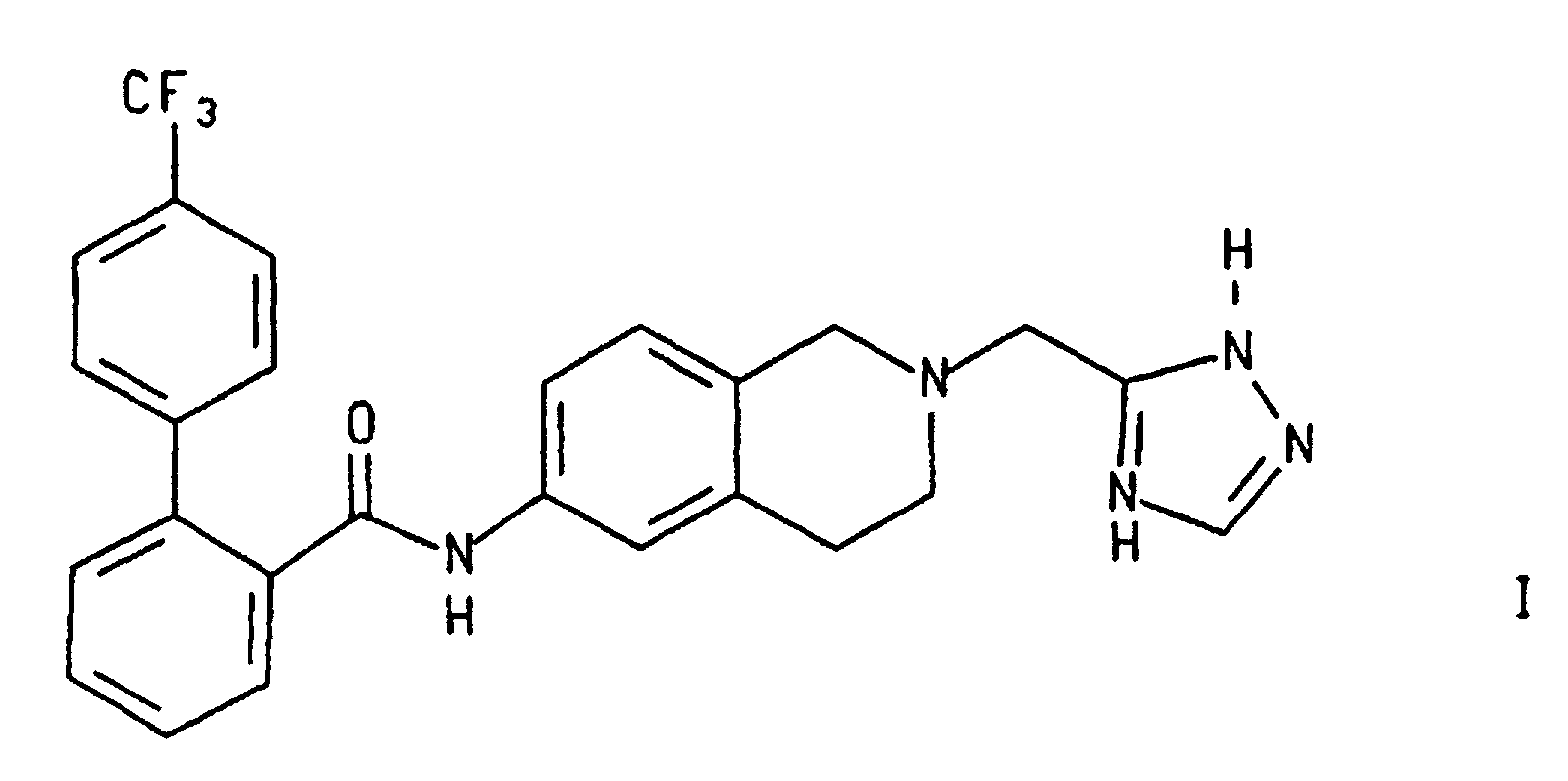 wherein R is H or R2 and R2 is selected from allyl and a substituted methyl group wherein the substituents comprise one to three (C6-C10)aryl groups wherein the aryl groups are optionally substituted with one or more substituents selected from nitro and (C1-C6)alkoxy;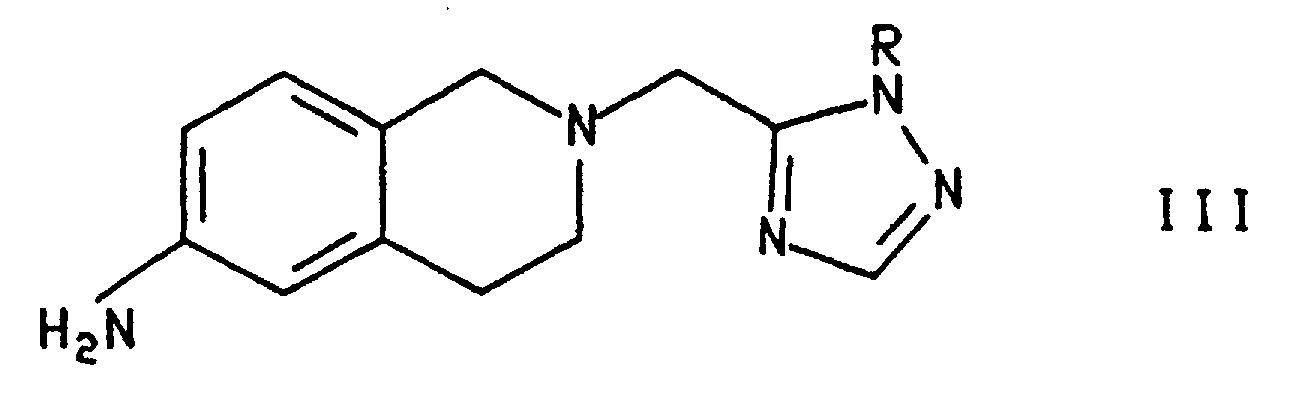
- a) with a compound of the formula
wherein J is a leaving group such as a halogen atom, an azido group, a (C1-C6)acyloxy group or a (C6-C10)aroyloxy group, preferably a chlorine or bromine atom; and
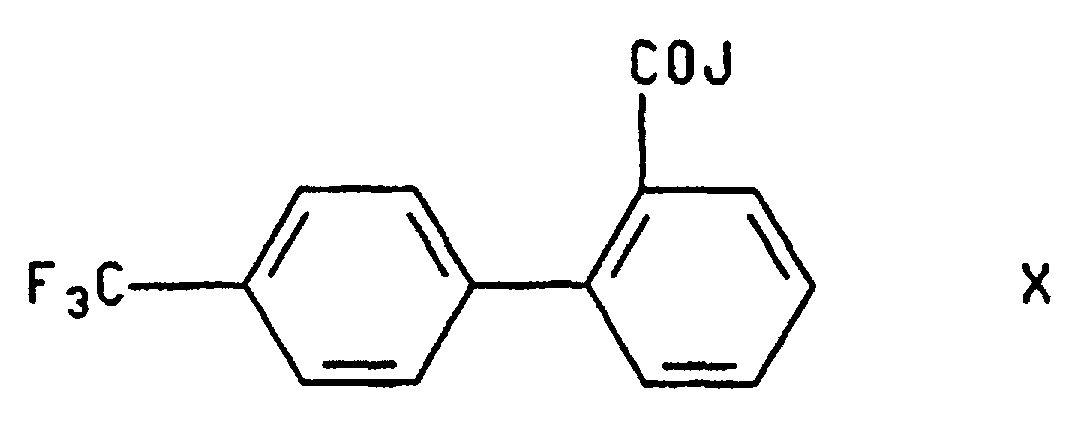
- b) when R is R2 further treating the product of step a) with an acid such as trifluoroacetic acid (TFA), p-toluenesulfonic acid (PTSA), methane- or trifluoromethanesulfonic acid and HBr in acetic acid, preferably trifluoroacetic acid.
-
- Reference to a moiety as "heterocyclic" means any single ring or fused ring system containing at least one ring heteroatom independently selected from 0, N, and S. Thus a polycyclic fused ring system containing one or more carbocyclic fused saturated, partially unsaturated, or aromatic rings (usually benzene rings) is within the definition of heterocyclyl so long as the system also contains at least one fused ring which contains at least one of the aforementioned heteroatoms. As a substituent, such heterocyclic rings may be attached to the remainder of the molecule from either a carbocyclic (e.g., benzene) ring or from a heterocyclic ring.
- Reference to a moiety containing "one or more rings" is intended to mean that said moiety contains a single or fused cyclic moiety or moieties. The rings may be carbocyclic or heterocyclic, saturated or partially unsaturated, and aromatic or nonaromatic.
- Reference to a fused polycyclic ring system or radical means that all rings in the system are fused.
- Reference to "halo" in this specification is inclusive of fluoro, chloro, bromo, and iodo unless noted otherwise.
- Reference to an "aryl" substitutent (e.g. (C6-C10)aryl) means the ring or substitutent is carbocyclic. Aromatic moieties which contain one or more heteroatoms are included as a subset of the term "heterocyclic", as discussed above.
- Reference to an "acyl" substituent refers to an aliphatic or cyclic hydrocarbon moiety attached to a carbonyl group through which the substituent bonds.
- Reference to "alkyl" and "alkoxy" include both straight and, when the moiety contains more than two carbon atoms, branched of cyclic chain radicals, but it is to be understood that references to individual radicals such as "propyl" or "propoxy" embrace only the straight chain ("normal") radical, branched chain isomers such as "isopropyl" or "isopropoxy" being referred to specifically.
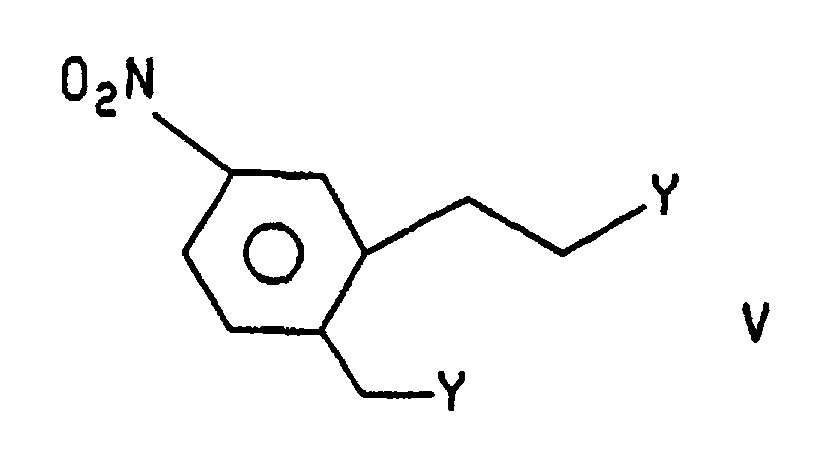
- Certain intermediates of the formulaand their tautomers, wherein Y is NH2 or NO2, are additionally provided as a further feature of the invention. One skilled in the art will understand that the above compounds may exist in several tautomeric forms all of which are included in the invention. Another intermediate provided by the invention is the compound of the formula
 wherein R is R2, preferably CH3OC6H4CH2-.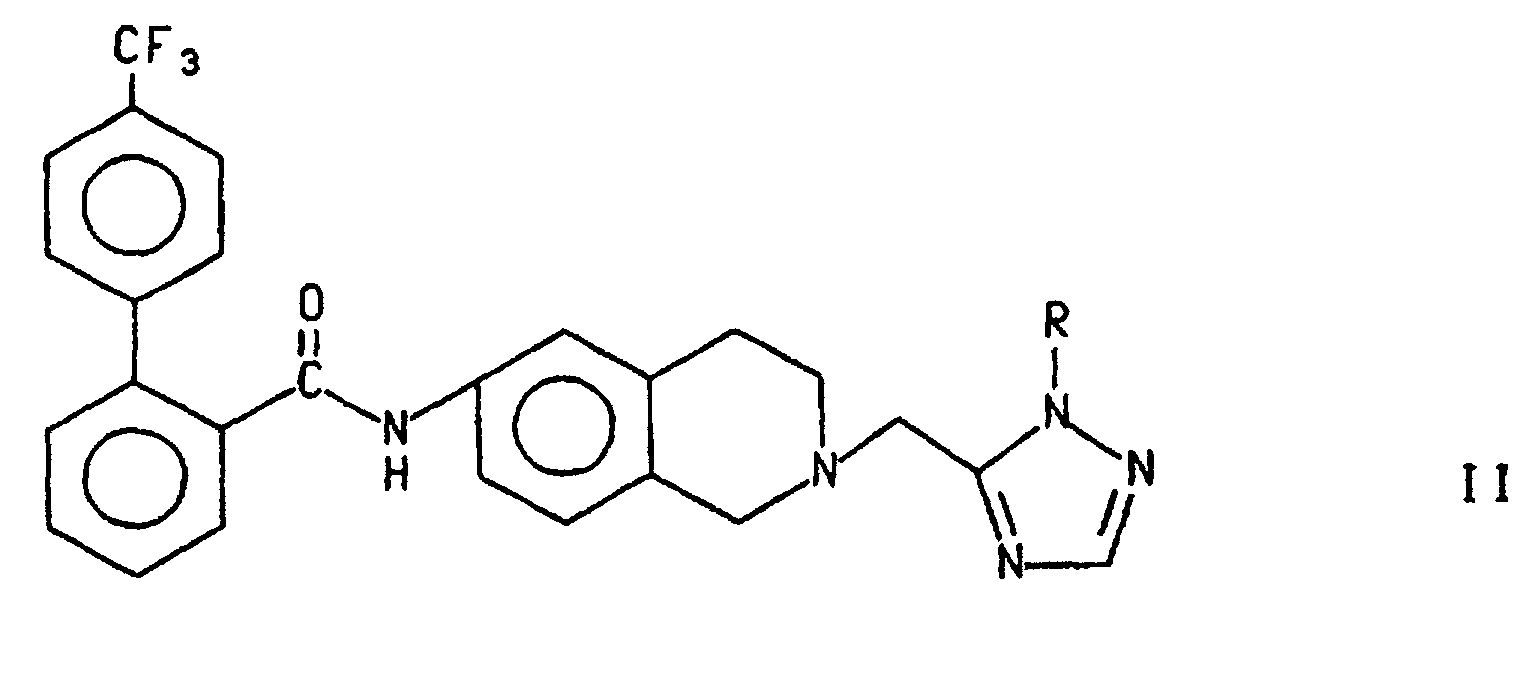
- In the reaction Schemes and description which follow R, R2, J, K and Y as well as structural formulae I through X are as defined above.


- As shown in Scheme 1 compound IX is prepared by reacting 1,2,4-triazole with a compound of the formula R2K wherein K, is halo as defined above, in the presence of a base. Preferably R2K is 4-methoxybenzyl chloride. The reaction is carried out at about room temperature in a polar solvent such as a N,N,-di(C1-C6)alkylcarboxamide, e.g., dimethylacetamide (DMAC) and dimethylformamide (DMF); a ketone, e.g., acetone and methylethylketone; a (C1-C6)alkanol, e.g., ethanol, methanol and isopropanol; and mixtures thereof. Bases useful in the practice of this aspect of the invention include alkali metal hydroxides, carbonates and hydrogen carbonates. Preferably the solvent is DMF and the base is NaOH.
- Compound VIII is prepared by heating compound IX with formaldehyde in hot water. The reaction is affected at reflux temperature using an external heat source at from about 100 to about 135°C. The formaldehyde, which is used in excess, can be supplied in the form of its 37% aqueous solution (also known as formalin) or its linear polymeric (paraformaldehyde) and trimeric (trioxane) forms. Paraformaldehyde decomposes in hot water, and trioxane in aqueous solutions containing strong acids, to yield formaldehyde. The preferred source of formaldehyde is formalin.
- Compound VII is formed by treating compound VIII, in a Mitsunobu reaction, with phthalimide in the presence of triphenylphosphine and a di(C1-C6)alkyl or dipiperidinyl azodicarboxylate. The preferred azodicarboxylate is the diisopropyl ester. The reaction may be effected at a temperature of from about 0 to about 65 °C in an aprotic solvent such as tetrahydrofuran (THF), isopropyl ether and dioxane. Preferably the reaction is carried out at about 15°C in THF.
- Compound VII is converted to compound VI by suspension in an aprotic suspension medium such as a (C1-C6)alkanol, e.g., methanol, ethanol or isopropanol, and treatment with hydrazine. The hydrazine is preferably provided in the form of its hydrate and the preferred suspension medium is methanol. The reaction can be effected at a temperature of about room temperature to about 65 °C, preferably room temperature.
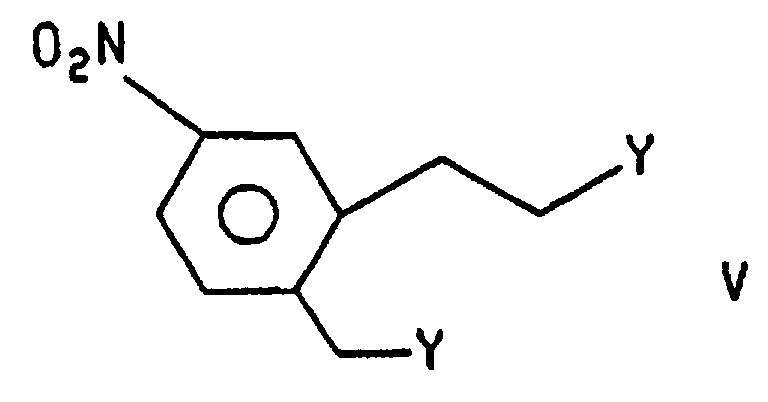
- Compound IV, (R = R2), is formed by treatment of compound VI withwherein Y is selected from halo and optionally substituted (C1-C6)alkyl- or (C1-C6)arysulfonoxy groups, in the presence of a base and an aprotic solvent. Preferably CH3SO3 (mesyloxy). The reaction is effected under an inert atmosphere, such as nitrogen or argon, at a temperature of about ambient to the reflux temperature of the solvent. The bases which may be used are organic bases such as tri(C1-C6)alkylamines, pyridine and N-methylmorpholine. Aprotic solvents include THF, CH2Cl2 and DMF. The reaction is preferably effected in THF, under nitrogen, at the reflux temperature of the solvent. The preferred base is triethylamine. Compound V, wherein Y is mesyloxy, may be prepared by treating a suspension of compound V wherein Y is OH in a (C1-C6)haloalkane, at a low temperature under an inert atmosphere, with mesyl chloride in the presence of a base. Bases useful in the practice of this aspect can be selected from those described above. The inert atmospheres may be selected from those described above. The temperature is from about -40 to about 0°C. The reaction is preferably carried out under nitrogen, at about -30°C in the presence of triethylamine.
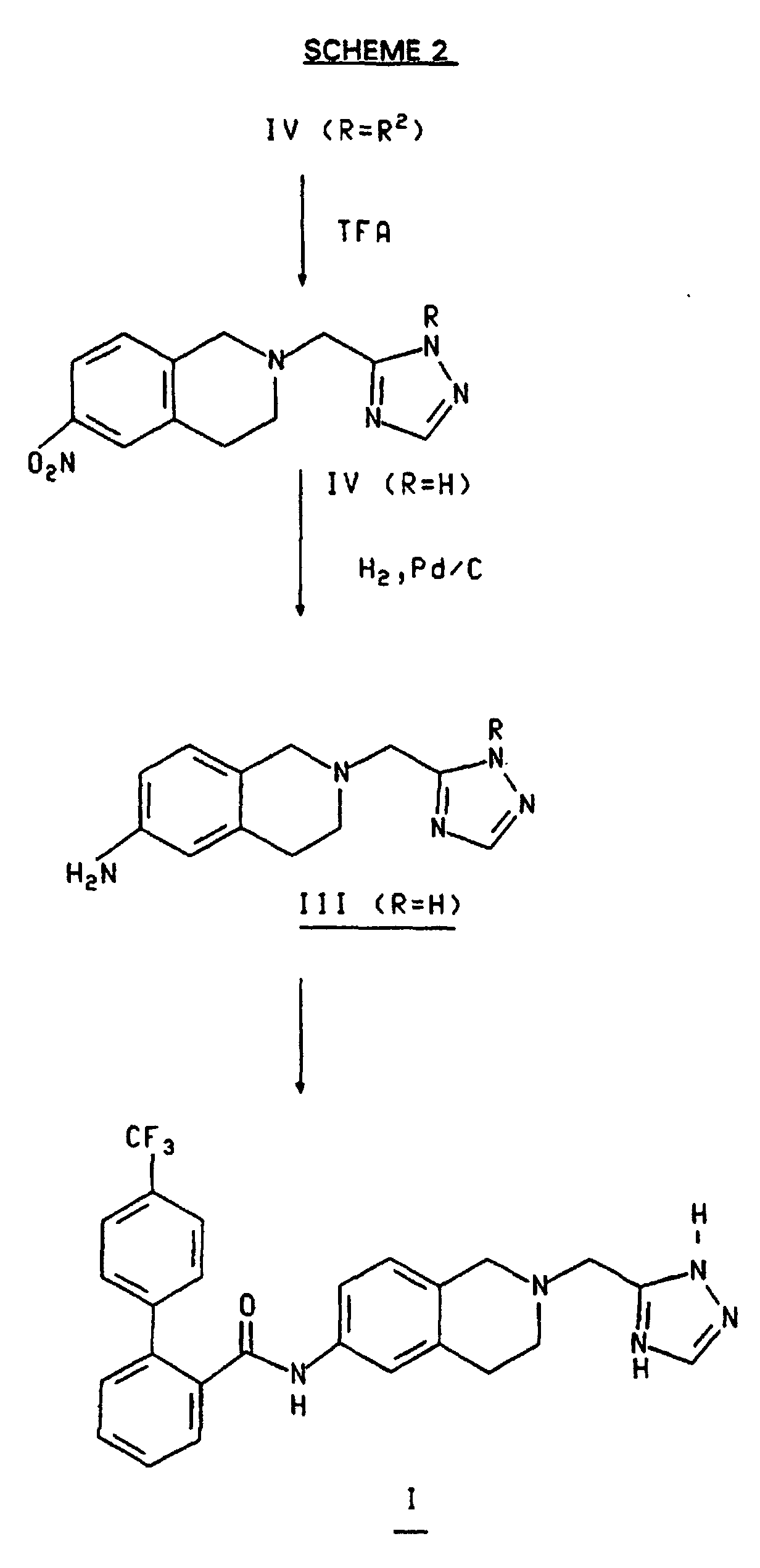
- As shown in Scheme 3 compound IV (R = R2) is converted to compound IV (R = H) by treatment with an acid such as trifluoroacetic acid (TFA), p-toluenesulfonic acid, methane or trifluoromethanesulfonic acid and HBr in acetic acid, preferably trifluoroacetic acid. The reaction may be carried out at a temperature from about room temperature to about 60°C preferably at room temperature. The TFA may be used neat or dissolved in CH2Cl2.
- Compound IV, wherein R is hydrogen , is converted to compound III, wherein R is hydrogen, by treatment with hydrogen, at a pressure of from about 1 to about 3 Atom in the presence of a hydrogenation catalyst and an organic solvent. Hydrogenation catalysts include Pd, Pt and Raney Ni. The metals may be used in the form of salts, e.g., Pd(OH)2, or on carriers, e.g., carbon. The hydrogenation is effected at a temperature from about room temperature to about 50°C, preferably at room temperature. The preferred hydrogenation catalyst is 10% Pd/C and the preferred solvent is methanol.
- Compound III wherein R is hydrogen, is converted to compound I by treatment with a source of the 4'-trifluoromethylbiphenyl-2-carbonyl group selected from the halides, azides and mixed anhydrides, in the presence of a solvent and a base. The reaction is effected at a temperature from about room temperature to about 50°C preferably at room temperature. Solvents useful in aspect of the invention include aprotic solvents, as described above, haloalkanes and mixtures thereof. A preferred solvent is the mixture of THF and methylene chloride which is formed when a solution of the carbonyl compound, in methylene chloride, is added to a suspension of compound III (R = H) in THF.
- Alternatively, as shown in Scheme 3, compound I can be prepared by treating compound III wherein R is R2 with a 4'-trifluoromethylbiphenyl-2-carbonyl source, as described above, to form the compound of formula II and treating compound II with an acid such as trifluoroacetic acid (TFA), p-toluenesulfonic acid, methane or trifluoromethanesulfonic acid and HBr in acetic acid, preferably trifluoroacetic acid as described above. Preferably, R2 is p-CH3OC6H4CH2- and the 4'-trifluoromethylbiphenyl-2-carbonyl source is the chloride.
- The compound of formula I and its tautomers form acid addition salts and the expression "pharmaceutically-acceptable salts" is intended to include but not is to be limited to such salts as the hydrochloride, hydrobromide, sulfate, hydrogen sulfate, phosphate, hydrogen phosphate, dihydrogenphosphate, acetate, succinate, citrate, methanesulfonate and p-toluenesulfonate salts. It can also form polyaddition salts.
- The acid addition salts of the compound of formula I, and its tautomers, are readily prepared by reacting the base form with the appropriate acid. When the salt is of a monobasic acid (e.g., the hydrochloride, the hydrobromide, the p-toluenesulfonate, the acetate), the hydrogen form of a dibasic acid (e.g., the hydrogen sulfate, the succinate) or the dihydrogen form of a tribasic acid (e.g., the dihydrogen phosphate, the citrate), at least one molar equivalent and usually a molar excess of the acid is employed. However when such salts as the sulfate, the hemisuccinate, the hydrogen phosphate or the phosphate are desired, the appropriate and exact chemical equivalents of acid will generally be used. The free base and the acid are usually combined in a co-solvent from which the desired salt precipitates, or can be otherwise isolated by concentration and/or addition of a non-solvent.
- The compound of formula I, its tautomers, and their pharmaceutically acceptable acid salts, (hereafter 'the active compounds") are orally administrable and are accordingly used in combination with a pharmaceutically acceptable carrier or diluent suitable to oral dosage forms. Suitable pharmaceutically-acceptable carriers include inert solid fillers or diluents and sterile aqueous or organic solutions. The active compounds will be present in such pharmaceutical compositions in amounts sufficient to provide the desired dosage amount in the range described below. Thus, for oral administration the compounds can be combined with a suitable solid or liquid carrier or diluent to form capsules, tablets, powders, syrups, solutions, suspensions and the like. The pharmaceutical compositions may, if desired, contain additional components such as flavorants, sweeteners, excipients and the like. Pharmaceutical compositions comprising the active compounds are suitable for the treatment of conditions including atherosclerosis, pancreatitis, obesity, hypercholesterolemia, hypertriglyceridemia, hyperlipidemia, and diabetes, comprising a compound of formula I as hereinbefore defined, and a pharmaceutically acceptable carrier.
- The active compounds inhibit or decrease apo B secretion, likely by the inhibition of MTP, although it may be possible that other mechanisms are involved as well. The compounds are useful in any of the diseases or conditions in which apo B, serum cholesterol, and/or triglyceride levels are elevated. Accordingly, the invention further provides a method of treating a condition selected from atherosclerosis, pancreatitis, obesity, hypercholesteremia, hypertriglyceridemia, hyperlipidemia, and diabetes, comprising administering to a mammal, especially a human, in need of such treatment an amount of a compound of formula I as defined above sufficient to decrease the secretion of apolipoprotein B. A subgroup of the preceding conditions includes atherosclerosis, obesity, pancreatitis, and diabetes. A more particular subgroup includes atherosclerosis.
- The term "treating" as used herein with respect to the active compounds includes preventative as well as disease remitative treatment.
- The tablets, pills, capsules, and the like may also contain a binder such as gum tragacanth, acacia, corn starch or gelatin; excipients such as dicalcium phosphate; a disintegrating agent such as corn starch, potato starch, alginic acid; a lubricant such as magnesium stearate; and a sweetening agent such as sucrose, lactose or saccharin. When a dosage unit form is a capsule, it may contain, in addition to materials of the above type, a liquid carrier such as a fatty oil.
- Various other materials may be present as coatings or to modify the physical form of the dosage unit. For instance, tablets may be coated with shellac, sugar or both. A syrup or elixir may contain, in addition to the active ingredient, sucrose as a sweetening agent, methyl and propylparabens as preservatives, a dye and a flavoring such as cherry or orange flavor.
- The active compounds may also be administered parenterally. For parenteral administration the compounds can be combined with sterile aqueous or organic media to form injectable solutions or suspensions. Solutions or suspensions of these active compounds can be prepared in water suitably mixed with a surfactant such as hydroxypropylcellulose. Dispersions can also be prepared in sesame or peanut oil, ethanol, water, polyol (e.g., glycerol, propylene glycol and liquid polyethylene glycol), suitable mixtures thereof, vegetable oils, N-methyl glucamine, polyvinylpyrrolidone and mixtures thereof in oils as well as aqueous solutions of water-soluble pharmaceutically acceptable salts of the compounds. Under ordinary conditions of storage and use, these preparations contain a preservative to prevent the growth of microorganisms. The injectable solutions prepared in this manner can then be administered intravenously, intraperitoneally, subcutaneously, or intramuscularly.
- The pharmaceutical forms suitable for injectable use include sterile aqueous solutions or dispersions and sterile powders for the extemporaneous preparation of sterile injectable solutions or dispersions. In all cases, the form must be sterile and must be fluid to the extent that easy syringability exists. It must be stable under the conditions of manufacture and storage and must be preserved against the contaminating action of microorganisms such as bacteria and fungi.
- The dose of an active compound which is administered will generally be varied according to principles well known in the art taking into account the severity of the condition being treated and the route of administration. In general, the active compound will be administered to a warm blooded animal (such as a human) so that an effective dose, usually a daily dose administered in unitary or divided portions, is received, for example a dose in the range of about 0.1 to about 15 mg/kg body weight, preferably about 1 to about 5 mg/kg body weight. The total daily dose received will generally be between 1 and 1000 mg, preferably between 5 and 350 mg.
- The active compound may be used in conjunction with other pharmaceutical agents, including other lipid lowering agents. Such agents include cholesterol biosynthesis inhibitors, especially HMG CoA reductase inhibitors and squalene synthetase inhibitors; bile acid sequestrants; fibrates; cholesterol absorption inhibitors; and niacin.
- A test compound is considered to be active if it is active in any of the following screens.
- The activity of an active compound can be assessed by measuring inhibition of apo B secretion in HepG2 cells.
- HepG2 cells are grown in Dulbecco's Modified Eagles Medium plus 10% fetal bovine serum (growth medium; Gibco) in 96-well culture plates in a humidified atmosphere containing 5% carbon dioxide until they are approximately 70% confluent. Test compounds are dissolved at 10-20 mM in dimethyl sulfoxide which is then diluted to 1 µM in growth medium. Serial 1:1 dilutions of this stock are made in growth medium and 100 µL of each are added to separate wells of a 96-well culture plates containing HepG2 cells. Twenty four hours later, growth medium is collected and assayed by specific ELISA for apoB and, as a control, apoAl concentrations. Inhibitors are identified as compounds that decrease apoB secretion into the medium without affecting the secretion of apoAl. The ELISA for apoB is performed as follows. Monoclonal antibody against human apoB (Chemicon) is diluted to 5 µg/mL in phosphate buffered saline/azide (PBS + 0.02% Na azide) and 100 µL are added to each well of a 96-well plate (NUNC Maxisorb). After an overnight incubation at room temperature, the antibody solution is removed and wells are washed 3 times with PBS/azide. Non-specific sites on the plastic are blocked by incubating wells for 1-3 hours in a solution of 1% (w/v) bovine serum albumin (BSA) made in PBS/azide. 100 µL of various dilutions of growth medium from the HepG2 cells or apoB standards (made in 0.004% Tween 20/1% BSA in PBS/azide) are added to each well and incubated for 18 hours. Wells are aspirated and washed 3 times (0.1% Tween 20 in PBS) prior to adding 100 µL of a 1/1000 dilution of the secondary antibody, goat anti-human apoB (Chemicon). After a 3 hour incubation at room temperature, this solution is aspirated and the wells are again washed 3 times as above. 100 µL of a 1:1600 dilution (in PBS/1% BSA/2mM MgCl2) of rabbit anti-goat IgG conjugated to alkaline phosphatase (Sigma) are then added to each well and incubated for 1 hour at room temperature. After aspirating, the wells are washed 4 times as above and 100 µL of 1 mg/mL p-nitrophenylphosphate (pNPP; Sigma) in 25 mM sodium bicarbonate 2 mM MgCl2, pH 9.5, are added to each well and incubated for 20-30 minutes and then the reaction is terminated by the addition of 50 µL of 0.2N NaOH. Absorbance of each well is read at 405 nm and the background at 650 nm is subtracted. ApoB concentration is calculated from a standard curve constructed from purified LDL standards that are run in parallel in the same assay. ApoAl is measured in an analogous manner except that antibodies for apoAl (Chemicon) are used in place of the antibodies for apoB and antigen incubation is at 37° instead of room temperature.
- Activity can also be confirmed if a test compound inhibits MTP activity directly.
- Inhibition of MTP activity by a compound can be measured by observing the inhibition of transfer of radiolabeled triglyceride from donor vesicles to acceptor vesicles in the presence of soluble human MTP. The procedure for preparing MTP is based on the method of Wetterau and Zilversmit (Biochem. Biophys. Acta (1986) 875:610). Briefly, human liver chunks, frozen at -80°C, are thawed on ice, minced, and rinsed several times with ice cold 0.25 M sucrose. All subsequent steps are performed on ice. A 50% homogenate in 0.25 M sucrose is prepared using a Potter-Elvehjem Teflon pestle. The homogenate is diluted 1:1 with 0.25 M sucrose and centrifuged at 10,000 x g for 20 minutes at 4°C. The pellet is resuspended in sucrose and recentrifuged at 10,000 x g for 20 minutes. The supernatants are combined and the microsomes pelleted by centrifugation at 105,000 x g for 75 minutes. The supernatant is discarded and the microsomal pellet is suspended in a minimal volume of 0.25 M sucrose, diluted to 3 mL per gm starting liver weight with 0.15 M Tris-HCI pH 8.0. This suspension is divided into 12 fractions, and centrifuged at 105,000 x g for 75 minutes. The supernatants are discarded and the microsomal pellets are stored frozen at -80°C until needed. For preparation of MTP prior to performing the assay, a thawed pellet is suspended in 12 mL of cold 50 mM Tris-HCI, 50 mM KCl, 5 mM MgCl2], pH 7.4 and 1.2 mL of a 0.54% deoxycholate (pH 7.4) solution is added slowly with mixing to disrupt the microsomal membrane. After a 30 minutes incubation on ice with gentle mixing, the suspension is centrifuged at 105,000 x g for 75 minutes. The supernatant, containing the soluble MTP protein, is dialyzed for 2-3 days with 4 changes of assay buffer (150 mM Tris-HCl, 40 mM NaCI, 1 mM EDTA, 0.02% NaN3, pH 7.4). The human liver MTP is stored at 4°C and diluted 1:5 with assay buffer just before use. MTP preparations show no notable loss of transfer activity with storage up to 30 days.
- Liposomes are prepared under nitrogen by room temperature, bath sonication of a dispersion of 400 µM egg phosphatidylcholine (PC), 75 µM bovine heart cardiolipin, and 0.82 µM 14C-triolein (110 Ci/mol) in assay buffer. The lipids in chloroform are added in the proper amounts and dried under a nitrogen stream before hydrating with assay buffer. Acceptor liposomes are prepared under nitrogen by room temperature bath sonication of a dispersion of 1.2 mM PC, 2.3µM triolein and 30 pM 3H-PC (50 Cilmol) in assay buffer. The donor and acceptor liposomes are centrifuged at 160,000 x g for 2 hours at 7°C. The top 80% of the supernatant, containing small unilamellar liposomes, are carefully removed and stored at 4°C until used for transfer assays.
- MTP activity is measured using a transfer assay which is initiated by mixing donor and acceptor vesicles together with the soluble MTP and test compound. To 100 µL of either a 5% BSA (control) or 5% BSA containing the test compound, are added 500 µL assay buffer, 100 µL donor liposomes, 200 µL acceptor liposomes and 100 µL of diluted MTP protein. After incubation at 37°C for 45 minutes., triglyceride transfer is terminated by adding 500 µL of a 50% (w/v) DEAE cellulose suspension in assay buffer. Following 4 minutes of agitation, the donor liposomes, bound to the DEAE cellulose, are selectively sedimented by low speed centrifugation. An aliquot of the supernatant containing the acceptor liposomes is counted and the 3H and 14C counts are used to calculate the percent recovery of acceptor liposomes and the percent triglyceride transfer using first order kinetics. Inhibition of triglyceride transfer by test compound is manifested as a decrease in 14C radioactivity compared to controls where no test compound is present.
- Activity of test compounds as MTP inhibitors can also be measured in vivo according to the following test.
- Male mice (20-30g.; various strains) are dosed by oral gavage (0.25 mL/25 g. body weight) with test compound suspended in an aqueous 0.5% methyl cellulose solution. Compound solutions are dosed either multiple times over several days or, alternatively, once 90 minutes before mice are euthanized and blood is collected for preparation of serum. The serum is assayed for triglyceride concentration by a commercial enzymatic assay (Triglyceride G: Wako Fine Chemicals). MTP inhibitors are identified by their ability to lower serum triglycerides as compared to control mice dosed with vehicle.
- The present invention is illustrated by the following Examples. However, it should be understood that the invention is not limited to the specific details of these examples.
- Conventional methods and/or techniques of purification and separation known to those skilled in the art can be used to isolate the compounds of this invention. Such techniques include all types of chromatography (HPLC, column chromatography using common adsorbents such as silica gel, and thin layer chromatography), recrystallization, and differential (i.e., liquid-liquid) extraction techniques.
- 1,2,4-Triazole (7.5 g, 0.109 mol) was dissolved in dimethylformamide (50 mL) and stirred under a nitrogen atmosphere in an ice bath at 10°C while partially ground pellets of sodium hydroxide (17.5 g, 0.438 mol) were added in one portion causing an exotherm to about 25°C. A solution of 4-methoxybenzyl chloride (15 mL, 0.111 mol) in DMF was added dropwise over five minutes at 25°C. After stirring at room temperature for four hours, ethyl acetate and water were added. The layers were separated and the aqueous layer was extracted with ethyl acetate. The combined organic layers were washed four times with water and once with brine and dried over magnesium sulfate. The mixture was filtered and the filtrate solvent evaporated in vacuo to afford the title product as an oil in 69% yield; 14.15 g; 1H NMR (CDCl3) δ 8.00 (s, 1), 7.93 (s, 1), 7.19 (d, 2), 6.88 (d, 2), 5.23 (s, 2), 3.78 (s, 3). mass spectrum: m/z 109 (M + 1).
- The title product of Preparation 1 (7.6 g, 40 mmol) was dissolved in 37% aq formaldehyde solution (25 mL) and heated, at reflux, in a 130°C oil bath for four days. The course of the hydroxymethylation was monitored by TLC on silica gel with 3:1, ethyl acetate: chloroform as eluant. The reaction mixture was cooled to room temperature, poured into water and extracted twice with ethyl acetate. The combined organic layers were washed with 1 N NaOH, water and brine. After drying the solution over magnesium sulfate, evaporation afforded a crude product which was slurried in hexanes with a small amount of 2-propanol to yield 4.9 g (56%) of the title product; mp 95-100°C. 1H NMR (CDCl3) δ 7.72 (s, 1), 7.21 (d, 2), 6.85 (d, 2), 5.70 (bs, 1, OH), 5.32 (s, 2), 4.69 (s, 2), 3.78 (s, 3). 13C NMR (CDCl3) δ 159.6, 149.8, 145.6, 129.2, 127.0, 114.3, 55.3, 54.9, 52.0. IR (KBr) 1610, 1585, 1512 cm-1. mass spectrum: m/z 220 (M + 1).
- Anal. Calcd. for C11H13N3O2: C, 60.26; H, 5.98; N, 19.17. Found: C, 60.30; H, 6.16; N, 19.66.
- The structure was confirmed by single crystal X-ray analysis.
- The title product of Preparation 2 (8.5 g, 38.8 mmol), triphenylphosphine (11.2 g, 42.7 mmol) and phthalimide (6.3 g, 42.7 mmol) were dissolved in tetrahydrofuran (125 mL) at room temperature to provide a cloudy solution. A solution of diisopropyl azodicarboxylate (8.4 mL, 42.7 mmol) in tetrahydrofuran (40 mL) was added, dropwise, over 40 minutes with the temperature being held at about 15°C with an ice water bath. During the addition the product precipitated as a white solid. The reaction mixture was stirred at room temperature overnight and then was diluted with hexanes (125 mL). After stirring for thirty minutes, the white solid title product was collected, washed with hexanes and dried in vacuo; 12.2 g, 91% yield; mp 167-72°C. 1H NMR (CDCl3) δ 7.85 (s, 1), 7.81 (m, 2), 7.69 (m, 2), 7.09 (d, 2), 6.77 (d, 2), 5.43 (s, 2), 4.89 (s, 2), 3.72 (s, 3). 13C NMR (CDCl3) δ 150.9, 145.6, 134.2, 131.8, 128.3, 127.0, 123.6, 114.3, 112.9, 112.1, 55.2, 52.0, 32.8. IR (KBr) 1772, 1720, 1689, 1612, 1586, 1519 cm-1. mass spectrum: m/z 349 (M + 1).
- Anal. Calcd. for C19H16N4O3: C, 65.50; H, 4.63; N, 16.08. Found: C, 65.35; H, 4.80; N, 16.18.
- The title product of Preparation 3 (5 g, 14.4 mmol) was suspended in methanol (50 mL) and hydrazine hydrate (1.6 mL, 32 mmol) was added with stirring. After several minutes a clear solution was obtained and the reaction mixture was stirred at room temperature overnight during which time phthaloylhydrazide precipitated. The reaction mixture was diluted with methylene chloride (50 mL) and the slurry of hydrazide was stirred for 45 minutes, filtered and the solids washed with methylene chloride. The filtrate was evaporated in vacuo and the residue was dissolved in methylene chloride and 1N NaOH. The aqueous layer was pH 12. The layers were separated, the aqueous layer was extracted with methylene chloride and the organic layers were combined. After washing the organic layers with brine and drying over magnesium sulfate, the title product was recovered as a colorless oil by evaporation of the solvent in vacuo; 3 g, 97% yield. 1H NMR (CDCl3) δ 7.79 (s, 1), 7.12 (d, 2), 6.81 (d, 2), 5.27 (s, 2), 3.88 (s, 2), 3.74 (s, 3), 1.59 (bs, 2, NH 2). 13C NMR (CDCl3) δ 150.3, 145.6, 130.4, 129.0, 128.8, 127.3, 114.3, 55.3, 51.7, 37.7.
-
- 1) 2-(2-Hydroxyethyl)-5-nitrobenzyl alcohol (6.38 g, 32.4 mmol) and triethylamine (11.3 mL, 81 mmol) were suspended in methylene chloride (100 mL), under nitrogen, and cooled to -30°C with stirring. A solution of methanesulfonyl chloride (5.5 mL, 71.2 mmol) in methylene chloride (32 mL) was added dropwise over fifteen minutes. After thirty minutes, the cooling bath was removed and 1 N HCl (130 mL) was added. The mixture was stirred for ten minutes and the layers separated. The organic layer was washed with water, sat. sodium bicarbonate solution and brine. The organic layer was dried over magnesium sulfate and filtered. The filtrate was evaporated in vacuo to provide a yellow solid which was used without further purification; 10.7 g, 94% yield. 1H NMR (CDCl3) δ 8.17 (m, 2), 7.66 (d, 1), 5.39 (s, 2), 4.50 (t, 2), 3.28 (t, 2), 3.10 (s, 3), 3.00 (s, 3).
- 2) The title product of Preparation 4 (1.1 g, 5 mmol) and triethylamine (1.8 mL, 12.7 mmol) were dissolved in tetrahydrofuran (15 mL) under a nitrogen atmosphere and treated dropwise with a solution of the product of step 1) (1.75 g, 5 mmol) in tetrahydrofuran (10 mL). The resulting solution was stirred at room temperature for two hours and at reflux overnight. The reaction mixture was cooled and methylene chloride and 1N NaOH were added. The layers were separated and the aqueous layer was extracted with additional methylene chloride. The combined organic layers were washed with water and brine and dried over magnesium sulfate. The crude product was recovered from the methylene chloride and purified by chromatography over silica gel with 30% ethyl acetate in chloroform; 1.2 g, 63% yield of the title product as a yellow oil which slowly solidified. 1H NMR (CDCl3) δ 7.98 (m, 2), 7.88 (s, 1), 7.10 (m, 3), 6.76 (d, 2), 5.40 (s, 2), 3.81 (s, 2), 3.73 (s, 3), 3.63 (s, 2), 2.95 (t, 2), 2.80 (t, 2). 13C NMR (CDCl3) δ 159.4, 151.4 150.4, 145.6, 141.5, 135.6, 129.0, 127.4, 123.7, 123.7, 120.8, 114.1, 112.1, 55.5, 55.2, 53.1, 52.1, 50.1, 29.0. IR (KBr) 1610, 1584, 1517 cm-1. mass spectrum: m/z 380 (M + 1).
-
- The title product of Preparation 5 (8.8 g, 23.2 mmol) was dissolved in trifluoroacetic acid (88 mL) and stirred at room temperature overnight. The reaction mixture was evaporated in vacuo to an oil which was dissolved in methylene chloride. The solution was extracted two times with 1N HCI solution and the combined acidic extracts were washed one time with methylene chloride. The acidic extract was layered with fresh methylene chloride and the pH adjusted to 10 with 10%aq sodium carbonate to precipitate the title product which was collected and washed with water and methylene chloride; 3.99 g, 66% yield; mp 163 - 6°C.1H NMR (DMSO-d6) δ 8.20 (s, 1), 7.97 (d, 1), 7.92 (dd, 1), 7.30 (s, 1), 3.82 (s, 2), 3.73 (s, 2), 2.92 (t, 2), 2.76 (t, 2). 13C NMR (DMSO-d6) δ 147.8, 146.2, 143.2, 136.5, 128.2, 123.8, 120.8, 55.1, 53.4, 49.6, 28.9. mass spectrum: m/z 260 (M + 1).
- Anal. Calcd. for C12H13N5O2 (0.15 CH2Cl2): C, 53.65; H, 4.93; N, 25.98. Found: C, 53.65; H, 4.93; N, 25.75.
- The title product of Preparation 6 (4.46 g, 17.4 mmol) was dissolved in methanol (220 mL) and hydrogenated over 10% palladium on carbon (2.23 g) at 50 psi (about 345 kPa) for four hours.The catalyst was removed by filtration through Celite® and the methanol in the filtrate was evaporated in vacuo to provide the title product as a white solid, 3.56 g, 91% yield. mp 191-3°C. 1H NMR (dimethylsulfoxide-d6) δ 6.65 (d, 1), 6.32 (dd, 1), 6.28 (d, 1), 4.79 (s, 2), 3.71 (s, 2), 3.41 (s, 2), 3.34 (s, 2). 13C NMR (dimethylsulfoxide-d6) δ 155.9, 147.0, 134.5, 127.1, 122.4, 113.8, 112.7, 55.4, 53.9, 50.9, 29.2. IR (KBr) 1633, 1612, 1584, 1513 cm-1. mass spectrum: m/z 230 (M + 1).
- Anal. Calcd. for C12H15N5: C, 62.86; H, 6.59; N, 30.55. Found: C, 62.49; H, 6.39; N, 30.45.
-
- A) The product of Example 1 (3.3 g, 14.5 mmol) was suspended in methylene chloride (100 mL) and tetrahydrofuran (40 mL) with triethylamine (2.23 mL, 15.9 mmol). The suspension was stirred at room temperature while a solution of 4'-trifluoromethylbiphenyl-2-carbonyl chloride (4.13 g, 14.5 mmol) in methylene chloride (40 mL) was added dropwise and the reaction mixture was stirred overnight. Sodium carbonate (17 g, 0.2 mol) in water (440 mL) was added and the mixture stirred for fifteen minutes. The layers were separated and the aqueous layer was extracted a second time with methylene chloride. The combined organic layers were washed with brine, dried over magnesium sulfate and evaporated in vacuo to yield the title product as a foam. This was identical with previous material. 1H NMR (CDCl3) δ 13.88 (bs, 1), 10.21 (s, 1), 7.74 (d, 2), 7.67 - 7.48 (m, 6), 7.31 (s, 1), 7.20 (dd, 1), 6.91 (d, 1), 3.73(s, 2), 3.56 (s, 2), 2.73 (m, 4). IR (KBr) 1651, 1618, 1603,1541, 1510 cm-1. Mass spectrum: m/z: 478 (M+).
- B) The title product of Example 4 (0.49 g, 8.2 mmol) was dissolved in trifluoroacetic acid (5 mL) and stirred at room temperature overnight. The volatiles were removed in vacuo and the residue was dissolved in ethyl acetate and 10% aqueous sodium carbonate was added thereto. The layers were separated and the organic layer was washed with brine and dried over magnesium sulfate. The solvent was removed in vacuo to provide the title product. This was identical with the title product obtained from procedure A.
-
- 2-[2-(4-Methoxybenzyl)-2H-[1,2,4]triazol-3-ylmethyl]-6-nitro-1,2,3,4-tetrahydro-isoquinoline (0.5 g, 1.3 mmol) was hydrogenated in methanol (25 mL) over 10% Pd/C (0.25 g) at 50 psi (about 345 kPa) for three hours. The reaction mixture was filtered and the solvent was evaporated in vacuo. Ethyl acetate and water were added and the pH was adjusted to 10 with solid sodium carbonate. The layers were separated and the aqueous layer was extracted with additional ethyl acetate. The combined organic layers were washed with brine, dried over magnesium sulfate, filtered and evaporated in vacuo to an oil; 0.4 g, 87% yield. 1H NMR (CDCl3) δ 7.86 (s, 1), 7.18 (d, 2), 6.79 (m, 3), 6.48 (m, 2), 5.42 (s, 2), 3.76 (s, 3), 3.73 (s, 2), 3.50 (s, 2), 2.80 (m, 2), 2.69 (m, 2). IR (KBr) 1613, 1587, 1513 cm-1. Mass spectrum: m/z: 348 (M+ - 1).
- The title product of Example 3 (0.38 g, 1.1 mmol) and triethylamine (0.17 mL, 1.2 mmol) were dissolved in methylene chloride (14 mL) and stirred at room temperature while a solution of 4'-trifluoromethylbiphenyl-2-carbonyl chloride (0.31 g, 1.1 mmol) in methylene chloride (40 mL) was added dropwise. After four hours, 10% aq sodium carbonate solution was added and the mixture was stirred for thirty minutes. The methylene chloride layer was washed with brine, dried over magnesium sulfate and evaporated in vacuo to afford the title product as a hard foam, 0.63 g, 97% yield. 1H NMR (CDCl3) δ 7.79 (s, 1), 7.72 (d, 1), 7.64 (d, 2), 7.58 - 7,34 (m, 6), 7.12 (d, 2), 7.01 (s, 1), 6.90 - 6.72 (m, 4), 5.38 (s, 2), 3.73 (s, 3), 3.69 (s, 2), 3.50 (s, 2), 2.79 (t, 2), 2.68 (t, 2). IR (KBr) 1668, 1615, 1599, 1567, 1536, 1514 cm-1. Mass spectrum: m/z : 598 (M+ + 1).
Claims (13)
- A process for preparing the compound of formulawhich comprises treating the compound of the formula
 wherein R is H or R2 and R2 is selected from the group comprising allyl or a substituted methyl group wherein the substituents comprise one to three (C6-C10)aryl groups wherein the aryl groups are further optionally substituted with one or more substituents selected from nitro and (C1-C6)alkoxy;
 a) with a compound of the formulawherein J is a leaving group such as a halogen atom, an azido group, a (C1-C6)acyloxy group or a (C6-C10)aroyloxy group, preferably a chlorine or bromine atom; and
 b) when R is R2 further treating the product of step a) with an acid.
 - The process according to claim 1 wherein said acid is slected from the group comprising trifluoroacetic acid (TFA), p-toluenesulfonic acid (PTSA), methane-or trifluoromethanesulfonic acid and HBr in acetic acid.
- The process according to claim 2 wherein said acid is trifluoroacetic acid.
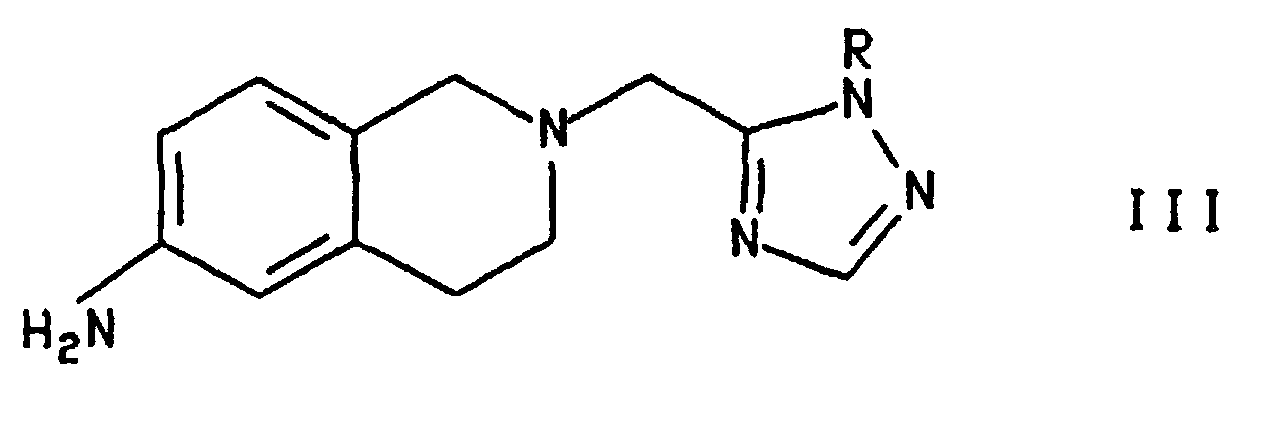
- The process according to claim 1 wherein the compound of the formula III, wherein R is defined as above, is prepared by treating the compound of the formula
 a) with hydrogen, in the presence of a hydrogenation catalyst, to form the compound of formula III wherein R is R2; orb) 1) with an acid; and
2) treating the product of step 1) with hydrogen in the presence of a hydrogenation catalyst to form the compound of the formula III wherein R is hydrogen. - The process according to claim 4 wherein the compound of the formula IV is prepared by treating the compound of the formulawherein R is R2 with the compound of the formula
 wherein Y is as defined above, in the presence of a base.
- A process for preparing the compound of the formula I which comprises the steps ofa) preparing the compound of formula IV wherein R is R2 by treating the compound of the formula VI wherein R is R2 with the compound of formula Vwherein Y is as defined above, in the presence of a base;
 b) treating compound IV (R = R2)1)i) with TFA to form IV (R = H);ii) treating IV (R = H) with hydrogen in the presence of a hydrogenation catalyst to form III (R = H); andiii) treating III (R = H) with X; or2)i) with with hydrogen in the presence of a hydrogenation catalyst to form III (R =R2);ii) treating III (R = R2) with X to form II (R = R2); andiii) treating II (R = R2) with TFA.
 - The process according to claim 4 wherein said hydrogenation catalyst is selected from Pd/C, Pd(OH)2, Raney nickel and PtO2.
- The process according to claim 7 wherein said hydrogenation catalyst is Pd/C.
- A compound of the formulawherein Y is NH2 or NO2, and its tautomers.
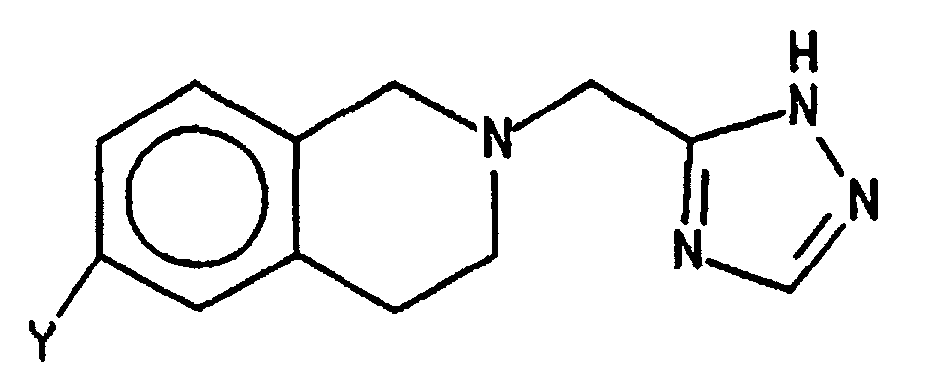
- The compound according to claim 9 wherein Y is NH2 and its tautomers.
- The compound according to claim 9 wherein Y is NO2 and its tautomers.
- The compound of the formulawherein R is R2 and R2 is as defined above.
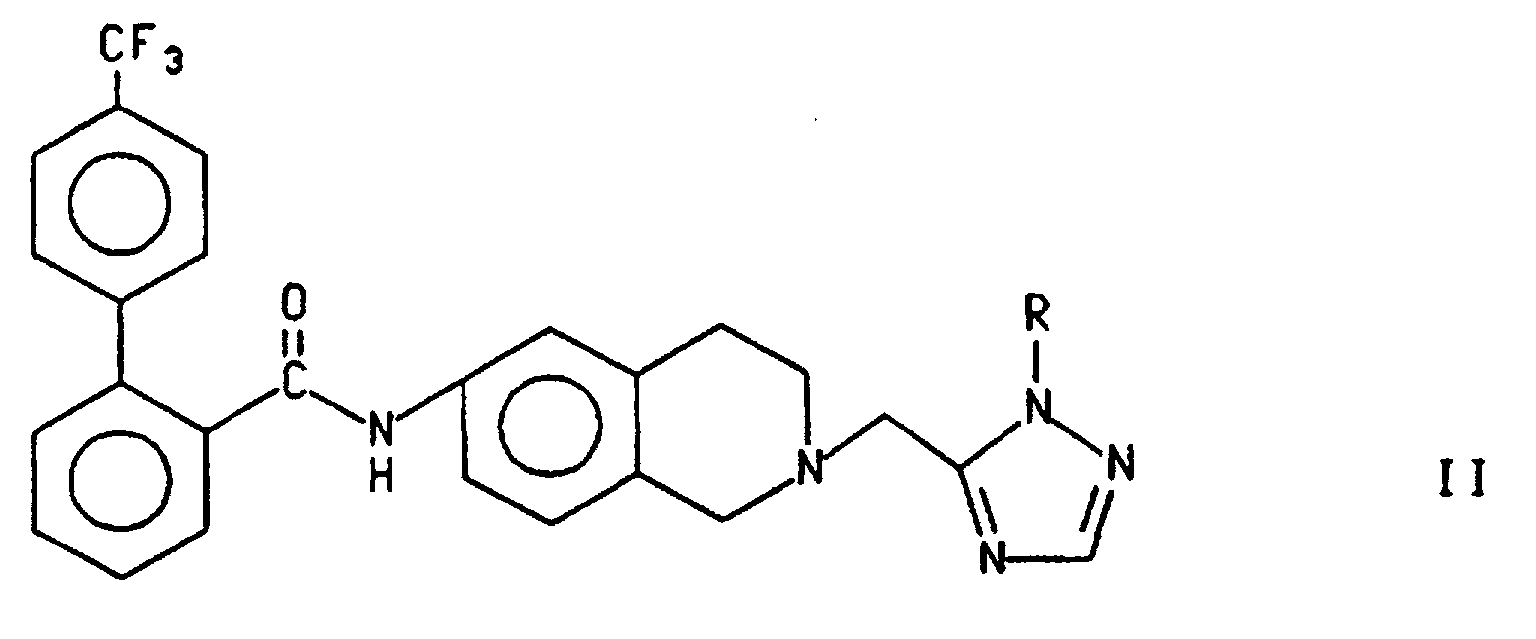
- The compound according to claim 12 wherein R2 is CH3OC6H4CH2-.
Applications Claiming Priority (3)
| Application Number | Priority Date | Filing Date | Title |
|---|---|---|---|
| US1649596P | 1996-04-30 | 1996-04-30 | |
| US16495P | 1996-04-30 | ||
| PCT/IB1997/000254 WO1997041111A1 (en) | 1996-04-30 | 1997-03-13 | Processes and intermediates for preparing 4'-trifluoromethylbiphenyl-2-carboxylic acid [2-(2h-[1,2,4]triazol-3-ylmethyl)-1,2,3,4-tetrahydro-isoquinolin-6-yl]-amide |
Publications (2)
| Publication Number | Publication Date |
|---|---|
| EP0902785A1 EP0902785A1 (en) | 1999-03-24 |
| EP0902785B1 true EP0902785B1 (en) | 2002-09-04 |
Family
ID=21777423
Family Applications (1)
| Application Number | Title | Priority Date | Filing Date |
|---|---|---|---|
| EP97905354A Expired - Lifetime EP0902785B1 (en) | 1996-04-30 | 1997-03-13 | Processes and intermediates for preparing 4'-trifluoromethylbiphenyl-2-carboxylic acid 2-(2h- 1,2,4]triazol-3-ylmethyl)-1,2,3,4-tetrahydro-isoquinolin-6-yl]-amide |
Country Status (23)
| Country | Link |
|---|---|
| US (1) | US5998623A (en) |
| EP (1) | EP0902785B1 (en) |
| JP (1) | JPH11507959A (en) |
| KR (1) | KR20000065152A (en) |
| CN (1) | CN1216988A (en) |
| AR (1) | AR006876A1 (en) |
| AT (1) | ATE223400T1 (en) |
| AU (1) | AU711279B2 (en) |
| BR (1) | BR9709137A (en) |
| CA (1) | CA2252621C (en) |
| CZ (1) | CZ346498A3 (en) |
| DE (1) | DE69715188T2 (en) |
| DK (1) | DK0902785T3 (en) |
| ES (1) | ES2180935T3 (en) |
| HU (1) | HUP9902157A3 (en) |
| ID (1) | ID17294A (en) |
| IL (1) | IL126202A0 (en) |
| PL (1) | PL329739A1 (en) |
| PT (1) | PT902785E (en) |
| TR (1) | TR199802163T2 (en) |
| WO (1) | WO1997041111A1 (en) |
| YU (1) | YU16297A (en) |
| ZA (1) | ZA973696B (en) |
Families Citing this family (11)
| Publication number | Priority date | Publication date | Assignee | Title |
|---|---|---|---|---|
| US6197798B1 (en) | 1998-07-21 | 2001-03-06 | Novartis Ag | Amino-benzocycloalkane derivatives |
| CO5271688A1 (en) * | 1999-11-10 | 2003-04-30 | Pfizer Prod Inc | USE OF APOLIPROTEIN B AND / OR SECRETION INHIBITOR OF MICROSMAL TRIGLICERID TRANSFER PROTEIN |
| CA2324801A1 (en) * | 1999-11-10 | 2001-05-10 | Andrew Gordon Swick | Use of apo b secretion/mtp inhibitors and anti-obesity agents |
| CA2324800A1 (en) * | 1999-11-10 | 2001-05-10 | Mary Anne Hickman | Use of apo b secretion/mtp inhibitors |
| IL139450A0 (en) * | 1999-11-10 | 2001-11-25 | Pfizer Prod Inc | Methods of administering apo b-secretion/mtp inhibitors |
| US6878707B2 (en) * | 2000-01-18 | 2005-04-12 | Novartis Ag | Carboxamides useful as inhibitors of microsomal triglyceride transfer protein and of apolipoprotein b secretion |
| AU2001277727A1 (en) * | 2000-08-10 | 2002-02-25 | Tanabe Seiyaku Co., Ltd. | Benzoylaminoisoindoline compounds, processes for the preparation of the same andintermediates for the synthesis thereof |
| AU2001277728A1 (en) * | 2000-08-10 | 2002-02-25 | Tanabe Seiyaku Co., Ltd. | Biphenylcarboxamidoisoindoline compounds, processes for the preparation of the same and intermediates for the synthesis thereof |
| NZ549721A (en) | 2004-03-05 | 2010-08-27 | Univ Pennsylvania | Methods for treating disorders or diseases associated with hyperlipidemia and hypercholesterolemia while minimizing side-effects |
| WO2008075949A1 (en) * | 2006-12-20 | 2008-06-26 | Friesland Brands B.V. | Modulation of human microsomal triglyceride transfer protein (mtp or mttp) gene expression by food-grade/ingested dietary microorganisms |
| EP4188372A1 (en) | 2020-07-29 | 2023-06-07 | Amryt Pharmaceuticals Inc. | Lomitapide for use in methods of treating hyperlipidemia and hypercholesterolemia in pediatric patients |
Family Cites Families (5)
| Publication number | Priority date | Publication date | Assignee | Title |
|---|---|---|---|---|
| US5595872A (en) * | 1992-03-06 | 1997-01-21 | Bristol-Myers Squibb Company | Nucleic acids encoding microsomal trigyceride transfer protein |
| ZA931601B (en) * | 1992-03-06 | 1993-10-05 | Squibb & Sons Inc | Microsomal triglyceride transfer protein |
| IL110172A (en) * | 1993-07-22 | 2001-10-31 | Lilly Co Eli | Bicyclic compounds and pharmaceutical compositions containing them |
| DK0832069T3 (en) * | 1995-06-07 | 2003-04-22 | Pfizer | Biphenyl-2-carboxylic acid tetrahydroisoquinolin-6-ylamide derivatives, their preparation and their use as inhibitors of secretion of microsomal triglyceride transfer protein and / or apolipoprotein B (Apo B) |
| WO1996040640A1 (en) * | 1995-06-07 | 1996-12-19 | Pfizer Inc. | BIPHENYL-2-CARBOXYLIC ACID-TETRAHYDRO-ISOQUINOLIN-6-YL AMIDE DERIVATIVES, THEIR PREPARATION AND THEIR USE AS INHIBITORS OF MICROSOMAL TRIGLYCERIDE TRANSFER PROTEIN AND/OR APOLIPOPROTEIN B (Apo B) SECRETION |
-
1997
- 1997-03-13 PT PT97905354T patent/PT902785E/en unknown
- 1997-03-13 DE DE69715188T patent/DE69715188T2/en not_active Expired - Fee Related
- 1997-03-13 WO PCT/IB1997/000254 patent/WO1997041111A1/en not_active Ceased
- 1997-03-13 CN CN97194209A patent/CN1216988A/en active Pending
- 1997-03-13 HU HU9902157A patent/HUP9902157A3/en unknown
- 1997-03-13 AU AU22266/97A patent/AU711279B2/en not_active Ceased
- 1997-03-13 PL PL97329739A patent/PL329739A1/en unknown
- 1997-03-13 KR KR1019980708760A patent/KR20000065152A/en not_active Ceased
- 1997-03-13 BR BR9709137A patent/BR9709137A/en not_active Application Discontinuation
- 1997-03-13 US US09/147,197 patent/US5998623A/en not_active Expired - Fee Related
- 1997-03-13 ES ES97905354T patent/ES2180935T3/en not_active Expired - Lifetime
- 1997-03-13 AT AT97905354T patent/ATE223400T1/en not_active IP Right Cessation
- 1997-03-13 TR TR1998/02163T patent/TR199802163T2/en unknown
- 1997-03-13 CZ CZ983464A patent/CZ346498A3/en unknown
- 1997-03-13 EP EP97905354A patent/EP0902785B1/en not_active Expired - Lifetime
- 1997-03-13 DK DK97905354T patent/DK0902785T3/en active
- 1997-03-13 CA CA002252621A patent/CA2252621C/en not_active Expired - Fee Related
- 1997-03-13 IL IL12620297A patent/IL126202A0/en unknown
- 1997-03-13 JP JP9538686A patent/JPH11507959A/en active Pending
- 1997-04-25 AR ARP970101731A patent/AR006876A1/en unknown
- 1997-04-28 ID IDP971403A patent/ID17294A/en unknown
- 1997-04-29 ZA ZA973696A patent/ZA973696B/en unknown
- 1997-04-29 YU YU16297A patent/YU16297A/en unknown
Also Published As
| Publication number | Publication date |
|---|---|
| IL126202A0 (en) | 1999-05-09 |
| DE69715188D1 (en) | 2002-10-10 |
| CA2252621A1 (en) | 1997-11-06 |
| AU2226697A (en) | 1997-11-19 |
| WO1997041111A1 (en) | 1997-11-06 |
| DK0902785T3 (en) | 2002-10-07 |
| AU711279B2 (en) | 1999-10-07 |
| HUP9902157A2 (en) | 2000-04-28 |
| HUP9902157A3 (en) | 2000-07-28 |
| CA2252621C (en) | 2002-09-03 |
| CN1216988A (en) | 1999-05-19 |
| JPH11507959A (en) | 1999-07-13 |
| BR9709137A (en) | 1999-08-03 |
| TR199802163T2 (en) | 1999-02-22 |
| YU16297A (en) | 1999-09-27 |
| ATE223400T1 (en) | 2002-09-15 |
| KR20000065152A (en) | 2000-11-06 |
| DE69715188T2 (en) | 2003-01-02 |
| ZA973696B (en) | 1998-10-29 |
| ID17294A (en) | 1997-12-18 |
| AR006876A1 (en) | 1999-09-29 |
| US5998623A (en) | 1999-12-07 |
| PT902785E (en) | 2002-12-31 |
| EP0902785A1 (en) | 1999-03-24 |
| CZ346498A3 (en) | 1999-09-15 |
| ES2180935T3 (en) | 2003-02-16 |
| PL329739A1 (en) | 1999-04-12 |
Similar Documents
| Publication | Publication Date | Title |
|---|---|---|
| US5159083A (en) | Certain aminomethyl phenylimidazole derivatives; a class of dopamine receptor subtype specific ligands | |
| RU2141478C1 (en) | Amides, pharmaceutical composition, methods of decrease of apolipoprotein b secretion, compound | |
| EP1300398B1 (en) | Propane-1,3-dione derivatives | |
| US5998623A (en) | Process and intermediates for preparing 4'-trifluoromethylbiphenyl-2-carboxylic acid [2-(2H-[1,2,4]triazol-3-ylmethyl)-1,2,3,4-tetrahydro-isoquinolin-6-yl]-a mide | |
| CZ289249B6 (en) | Amides and pharmaceutical compositions based thereon | |
| JP2000502354A (en) | Vitronectin receptor antagonist | |
| EP0406734A2 (en) | 2-(Aminoaryl)indoles and indolines, a process for their preparation and their use as medicaments | |
| SK15172001A3 (en) | Renin inhibitors | |
| JP2009510022A (en) | Selected CGRP-antagonists, methods for their preparation and their use as pharmaceutical compositions | |
| US5565472A (en) | 4-aryl-3-(heteroarylureido)-1,2-dihydro-2-oxo-quinoline derivatives as antihypercholesterolemic and antiatherosclerotic agents | |
| JP4699663B2 (en) | Dihydrobenzodiazepines and their use in dyslipidemia | |
| FR2816940A1 (en) | New 4-(biphenyl carbonylamino) piperidine derivatives are microsomal triglyceride transfer protein and apoprotein B secretion inhibitors used for treating e.g. hypercholesterolemia and obesity | |
| US9403768B2 (en) | Indolines | |
| CA2128093C (en) | 4-aryl-3-(heteroarylureido)-1,2-dihydro-2-oxoquinoline derivatives as antihypercholesterolemic and antiatherosclerotic agents | |
| SK130694A3 (en) | 1-£2h-1-benzopyran-2-on-8-yl| pyperazine derivatives, method of their production, pharmaceutical agents containing these compounds as effective matters and their using | |
| US4460777A (en) | N-Substituted-2-pyridylindoles | |
| JPH0764816B2 (en) | Heterocyclic compound | |
| KR100318653B1 (en) | Pyridazinone derivatives | |
| US4965266A (en) | Heteroarylcarboxamide derivatives, process for preparing the same and pharmaceutical composition containing the same | |
| EP1065209A1 (en) | Metalloprotease inhibitors, process for their preparation and pharmaceutical compositions containing them | |
| JPH0920775A (en) | Amides and sulfonamides of benzylamines having heterocyclic substituents | |
| Shigenaga et al. | (2E, 4E)‐N‐(4‐(1H‐Indol‐3‐yl) piperidin‐1‐yl) alkyl‐5‐(substituted phenyl)‐2, 4‐pentadienamides as Antiallergic Agents with Antihistaminic and Anti Slow‐Reacting Substance (SRS) Activities | |
| JP2004520291A (en) | Indole and dihydroindole derivatives | |
| SK72696A3 (en) | Amides and pharmauceutical compositions on their base | |
| JPH0948780A (en) | New naphthyridine derivatives |
Legal Events
| Date | Code | Title | Description |
|---|---|---|---|
| PUAI | Public reference made under article 153(3) epc to a published international application that has entered the european phase |
Free format text: ORIGINAL CODE: 0009012 |
|
| 17P | Request for examination filed |
Effective date: 19981021 |
|
| AK | Designated contracting states |
Kind code of ref document: A1 Designated state(s): AT BE CH DE DK ES FI FR GB GR IE IT LI LU NL PT SE |
|
| 17Q | First examination report despatched |
Effective date: 20010927 |
|
| GRAG | Despatch of communication of intention to grant |
Free format text: ORIGINAL CODE: EPIDOS AGRA |
|
| GRAG | Despatch of communication of intention to grant |
Free format text: ORIGINAL CODE: EPIDOS AGRA |
|
| GRAH | Despatch of communication of intention to grant a patent |
Free format text: ORIGINAL CODE: EPIDOS IGRA |
|
| GRAH | Despatch of communication of intention to grant a patent |
Free format text: ORIGINAL CODE: EPIDOS IGRA |
|
| GRAA | (expected) grant |
Free format text: ORIGINAL CODE: 0009210 |
|
| AK | Designated contracting states |
Kind code of ref document: B1 Designated state(s): AT BE CH DE DK ES FI FR GB GR IE IT LI LU NL PT SE |
|
| REF | Corresponds to: |
Ref document number: 223400 Country of ref document: AT Date of ref document: 20020915 Kind code of ref document: T |
|
| REG | Reference to a national code |
Ref country code: GB Ref legal event code: FG4D |
|
| REG | Reference to a national code |
Ref country code: CH Ref legal event code: NV Representative=s name: E. BLUM & CO. PATENTANWAELTE Ref country code: CH Ref legal event code: EP |
|
| REG | Reference to a national code |
Ref country code: IE Ref legal event code: FG4D |
|
| REG | Reference to a national code |
Ref country code: DK Ref legal event code: T3 |
|
| REF | Corresponds to: |
Ref document number: 69715188 Country of ref document: DE Date of ref document: 20021010 |
|
| PGFP | Annual fee paid to national office [announced via postgrant information from national office to epo] |
Ref country code: PT Payment date: 20021024 Year of fee payment: 7 |
|
| PGFP | Annual fee paid to national office [announced via postgrant information from national office to epo] |
Ref country code: FR Payment date: 20021121 Year of fee payment: 7 |
|
| REG | Reference to a national code |
Ref country code: GR Ref legal event code: EP Ref document number: 20020403482 Country of ref document: GR |
|
| PGFP | Annual fee paid to national office [announced via postgrant information from national office to epo] |
Ref country code: GB Payment date: 20021216 Year of fee payment: 7 |
|
| PGFP | Annual fee paid to national office [announced via postgrant information from national office to epo] |
Ref country code: IE Payment date: 20021217 Year of fee payment: 7 |
|
| REG | Reference to a national code |
Ref country code: PT Ref legal event code: SC4A Free format text: AVAILABILITY OF NATIONAL TRANSLATION Effective date: 20021010 |
|
| ET | Fr: translation filed | ||
| PGFP | Annual fee paid to national office [announced via postgrant information from national office to epo] |
Ref country code: SE Payment date: 20030117 Year of fee payment: 7 |
|
| REG | Reference to a national code |
Ref country code: ES Ref legal event code: FG2A Ref document number: 2180935 Country of ref document: ES Kind code of ref document: T3 |
|
| PGFP | Annual fee paid to national office [announced via postgrant information from national office to epo] |
Ref country code: CH Payment date: 20030225 Year of fee payment: 7 |
|
| PGFP | Annual fee paid to national office [announced via postgrant information from national office to epo] |
Ref country code: DK Payment date: 20030318 Year of fee payment: 7 |
|
| PGFP | Annual fee paid to national office [announced via postgrant information from national office to epo] |
Ref country code: GR Payment date: 20030319 Year of fee payment: 7 |
|
| PGFP | Annual fee paid to national office [announced via postgrant information from national office to epo] |
Ref country code: ES Payment date: 20030320 Year of fee payment: 7 |
|
| PGFP | Annual fee paid to national office [announced via postgrant information from national office to epo] |
Ref country code: LU Payment date: 20030321 Year of fee payment: 7 |
|
| PGFP | Annual fee paid to national office [announced via postgrant information from national office to epo] |
Ref country code: AT Payment date: 20030326 Year of fee payment: 7 |
|
| PGFP | Annual fee paid to national office [announced via postgrant information from national office to epo] |
Ref country code: FI Payment date: 20030327 Year of fee payment: 7 |
|
| PGFP | Annual fee paid to national office [announced via postgrant information from national office to epo] |
Ref country code: DE Payment date: 20030328 Year of fee payment: 7 |
|
| PGFP | Annual fee paid to national office [announced via postgrant information from national office to epo] |
Ref country code: NL Payment date: 20030331 Year of fee payment: 7 |
|
| PLBE | No opposition filed within time limit |
Free format text: ORIGINAL CODE: 0009261 |
|
| STAA | Information on the status of an ep patent application or granted ep patent |
Free format text: STATUS: NO OPPOSITION FILED WITHIN TIME LIMIT |
|
| 26N | No opposition filed |
Effective date: 20030605 |
|
| PGFP | Annual fee paid to national office [announced via postgrant information from national office to epo] |
Ref country code: BE Payment date: 20040217 Year of fee payment: 8 |
|
| PG25 | Lapsed in a contracting state [announced via postgrant information from national office to epo] |
Ref country code: LU Free format text: LAPSE BECAUSE OF NON-PAYMENT OF DUE FEES Effective date: 20040313 Ref country code: GB Free format text: LAPSE BECAUSE OF NON-PAYMENT OF DUE FEES Effective date: 20040313 Ref country code: FI Free format text: LAPSE BECAUSE OF NON-PAYMENT OF DUE FEES Effective date: 20040313 Ref country code: AT Free format text: LAPSE BECAUSE OF NON-PAYMENT OF DUE FEES Effective date: 20040313 |
|
| PG25 | Lapsed in a contracting state [announced via postgrant information from national office to epo] |
Ref country code: SE Free format text: LAPSE BECAUSE OF NON-PAYMENT OF DUE FEES Effective date: 20040314 |
|
| PG25 | Lapsed in a contracting state [announced via postgrant information from national office to epo] |
Ref country code: IE Free format text: LAPSE BECAUSE OF NON-PAYMENT OF DUE FEES Effective date: 20040315 Ref country code: ES Free format text: LAPSE BECAUSE OF NON-PAYMENT OF DUE FEES Effective date: 20040315 |
|
| PG25 | Lapsed in a contracting state [announced via postgrant information from national office to epo] |
Ref country code: LI Free format text: LAPSE BECAUSE OF NON-PAYMENT OF DUE FEES Effective date: 20040331 Ref country code: DK Free format text: LAPSE BECAUSE OF NON-PAYMENT OF DUE FEES Effective date: 20040331 Ref country code: CH Free format text: LAPSE BECAUSE OF NON-PAYMENT OF DUE FEES Effective date: 20040331 |
|
| PG25 | Lapsed in a contracting state [announced via postgrant information from national office to epo] |
Ref country code: NL Free format text: LAPSE BECAUSE OF NON-PAYMENT OF DUE FEES Effective date: 20041001 Ref country code: DE Free format text: LAPSE BECAUSE OF NON-PAYMENT OF DUE FEES Effective date: 20041001 |
|
| PG25 | Lapsed in a contracting state [announced via postgrant information from national office to epo] |
Ref country code: GR Free format text: LAPSE BECAUSE OF NON-PAYMENT OF DUE FEES Effective date: 20041006 |
|
| PG25 | Lapsed in a contracting state [announced via postgrant information from national office to epo] |
Ref country code: PT Free format text: LAPSE BECAUSE OF NON-PAYMENT OF DUE FEES Effective date: 20041015 |
|
| EUG | Se: european patent has lapsed | ||
| GBPC | Gb: european patent ceased through non-payment of renewal fee |
Effective date: 20040313 |
|
| REG | Reference to a national code |
Ref country code: CH Ref legal event code: PL |
|
| PG25 | Lapsed in a contracting state [announced via postgrant information from national office to epo] |
Ref country code: FR Free format text: LAPSE BECAUSE OF NON-PAYMENT OF DUE FEES Effective date: 20041130 |
|
| REG | Reference to a national code |
Ref country code: PT Ref legal event code: MM4A Free format text: LAPSE DUE TO NON-PAYMENT OF FEES Effective date: 20040930 |
|
| NLV4 | Nl: lapsed or anulled due to non-payment of the annual fee |
Effective date: 20041001 |
|
| REG | Reference to a national code |
Ref country code: FR Ref legal event code: ST |
|
| REG | Reference to a national code |
Ref country code: IE Ref legal event code: MM4A |
|
| PG25 | Lapsed in a contracting state [announced via postgrant information from national office to epo] |
Ref country code: IT Free format text: LAPSE BECAUSE OF NON-PAYMENT OF DUE FEES;WARNING: LAPSES OF ITALIAN PATENTS WITH EFFECTIVE DATE BEFORE 2007 MAY HAVE OCCURRED AT ANY TIME BEFORE 2007. THE CORRECT EFFECTIVE DATE MAY BE DIFFERENT FROM THE ONE RECORDED. Effective date: 20050313 |
|
| PG25 | Lapsed in a contracting state [announced via postgrant information from national office to epo] |
Ref country code: BE Free format text: LAPSE BECAUSE OF NON-PAYMENT OF DUE FEES Effective date: 20050331 |
|
| REG | Reference to a national code |
Ref country code: ES Ref legal event code: FD2A Effective date: 20040315 |
|
| BERE | Be: lapsed |
Owner name: *PFIZER INC. Effective date: 20050331 |
|
| BERE | Be: lapsed |
Owner name: *PFIZER INC. Effective date: 20050331 |
|
| PG25 | Lapsed in a contracting state [announced via postgrant information from national office to epo] |
Ref country code: PT Free format text: LAPSE BECAUSE OF NON-PAYMENT OF DUE FEES Effective date: 20040313 |