EP0902780B1 - Quaternary cytofectins - Google Patents
Quaternary cytofectins Download PDFInfo
- Publication number
- EP0902780B1 EP0902780B1 EP97920200A EP97920200A EP0902780B1 EP 0902780 B1 EP0902780 B1 EP 0902780B1 EP 97920200 A EP97920200 A EP 97920200A EP 97920200 A EP97920200 A EP 97920200A EP 0902780 B1 EP0902780 B1 EP 0902780B1
- Authority
- EP
- European Patent Office
- Prior art keywords
- absent
- compound according
- groups
- independently
- alkyl
- Prior art date
- Legal status (The legal status is an assumption and is not a legal conclusion. Google has not performed a legal analysis and makes no representation as to the accuracy of the status listed.)
- Expired - Lifetime
Links
- 150000002632 lipids Chemical class 0.000 claims abstract description 27
- 239000012867 bioactive agent Substances 0.000 claims abstract description 14
- 239000003814 drug Substances 0.000 claims abstract description 8
- 150000001875 compounds Chemical class 0.000 claims description 157
- 229910052717 sulfur Inorganic materials 0.000 claims description 71
- 229910052757 nitrogen Inorganic materials 0.000 claims description 54
- 238000001890 transfection Methods 0.000 claims description 53
- 229910052760 oxygen Inorganic materials 0.000 claims description 45
- 238000003556 assay Methods 0.000 claims description 43
- 125000002252 acyl group Chemical group 0.000 claims description 42
- 206010028980 Neoplasm Diseases 0.000 claims description 40
- 150000001336 alkenes Chemical class 0.000 claims description 40
- 125000000217 alkyl group Chemical group 0.000 claims description 40
- 125000004404 heteroalkyl group Chemical group 0.000 claims description 40
- 125000005842 heteroatom Chemical group 0.000 claims description 39
- 125000003118 aryl group Chemical group 0.000 claims description 38
- 125000004122 cyclic group Chemical group 0.000 claims description 38
- 125000003438 dodecyl group Chemical group [H]C([H])([H])C([H])([H])C([H])([H])C([H])([H])C([H])([H])C([H])([H])C([H])([H])C([H])([H])C([H])([H])C([H])([H])C([H])([H])C([H])([H])* 0.000 claims description 35
- 229910052711 selenium Inorganic materials 0.000 claims description 34
- 125000002704 decyl group Chemical group [H]C([H])([H])C([H])([H])C([H])([H])C([H])([H])C([H])([H])C([H])([H])C([H])([H])C([H])([H])C([H])([H])C([H])([H])* 0.000 claims description 22
- 150000001413 amino acids Chemical class 0.000 claims description 21
- 108090000623 proteins and genes Proteins 0.000 claims description 21
- 241001529936 Murinae Species 0.000 claims description 20
- 108090000765 processed proteins & peptides Proteins 0.000 claims description 20
- 108091033319 polynucleotide Proteins 0.000 claims description 19
- 239000002157 polynucleotide Substances 0.000 claims description 19
- 102000040430 polynucleotide Human genes 0.000 claims description 19
- 125000001421 myristyl group Chemical group [H]C([*])([H])C([H])([H])C([H])([H])C([H])([H])C([H])([H])C([H])([H])C([H])([H])C([H])([H])C([H])([H])C([H])([H])C([H])([H])C([H])([H])C([H])([H])C([H])([H])[H] 0.000 claims description 17
- -1 polynucleoside Chemical class 0.000 claims description 17
- 102000004196 processed proteins & peptides Human genes 0.000 claims description 15
- 239000003112 inhibitor Substances 0.000 claims description 14
- 210000004072 lung Anatomy 0.000 claims description 14
- 239000002773 nucleotide Substances 0.000 claims description 14
- 125000003729 nucleotide group Chemical group 0.000 claims description 14
- 102000004169 proteins and genes Human genes 0.000 claims description 14
- 238000000338 in vitro Methods 0.000 claims description 13
- 239000008177 pharmaceutical agent Substances 0.000 claims description 13
- 238000001727 in vivo Methods 0.000 claims description 12
- 150000004676 glycans Chemical class 0.000 claims description 11
- 125000002347 octyl group Chemical group [H]C([*])([H])C([H])([H])C([H])([H])C([H])([H])C([H])([H])C([H])([H])C([H])([H])C([H])([H])[H] 0.000 claims description 11
- 239000005017 polysaccharide Substances 0.000 claims description 11
- 229920001282 polysaccharide Polymers 0.000 claims description 11
- 150000001450 anions Chemical class 0.000 claims description 10
- 238000002360 preparation method Methods 0.000 claims description 9
- 125000000129 anionic group Chemical group 0.000 claims description 8
- HVYWMOMLDIMFJA-DPAQBDIFSA-N cholesterol Chemical compound C1C=C2C[C@@H](O)CC[C@]2(C)[C@@H]2[C@@H]1[C@@H]1CC[C@H]([C@H](C)CCCC(C)C)[C@@]1(C)CC2 HVYWMOMLDIMFJA-DPAQBDIFSA-N 0.000 claims description 8
- 238000001361 intraarterial administration Methods 0.000 claims description 8
- 238000007912 intraperitoneal administration Methods 0.000 claims description 8
- 229920001184 polypeptide Polymers 0.000 claims description 7
- 238000007920 subcutaneous administration Methods 0.000 claims description 7
- 241000283973 Oryctolagus cuniculus Species 0.000 claims description 6
- 230000007935 neutral effect Effects 0.000 claims description 6
- 229910017464 nitrogen compound Inorganic materials 0.000 claims description 6
- 150000002830 nitrogen compounds Chemical group 0.000 claims description 6
- 102000039446 nucleic acids Human genes 0.000 claims description 6
- 108020004707 nucleic acids Proteins 0.000 claims description 6
- 150000007523 nucleic acids Chemical class 0.000 claims description 6
- 150000002016 disaccharides Chemical class 0.000 claims description 5
- 229910052739 hydrogen Inorganic materials 0.000 claims description 5
- 238000007918 intramuscular administration Methods 0.000 claims description 5
- 150000002772 monosaccharides Chemical class 0.000 claims description 5
- UYWQUFXKFGHYNT-UHFFFAOYSA-N phenylmethyl ester of formic acid Natural products O=COCC1=CC=CC=C1 UYWQUFXKFGHYNT-UHFFFAOYSA-N 0.000 claims description 5
- 150000003904 phospholipids Chemical class 0.000 claims description 5
- 235000012000 cholesterol Nutrition 0.000 claims description 4
- 239000002777 nucleoside Substances 0.000 claims description 4
- 150000003833 nucleoside derivatives Chemical class 0.000 claims description 4
- HKXLAGBDJVHRQG-YFKPBYRVSA-N L-lysinamide Chemical compound NCCCC[C@H](N)C(N)=O HKXLAGBDJVHRQG-YFKPBYRVSA-N 0.000 claims description 3
- 125000001584 benzyloxycarbonyl group Chemical group C(=O)(OCC1=CC=CC=C1)* 0.000 claims description 3
- 108020004999 messenger RNA Proteins 0.000 claims description 3
- 125000002091 cationic group Chemical group 0.000 abstract description 23
- 125000000524 functional group Chemical group 0.000 abstract description 5
- 230000008685 targeting Effects 0.000 abstract description 5
- 239000003446 ligand Substances 0.000 abstract description 4
- 125000001453 quaternary ammonium group Chemical group 0.000 abstract description 4
- 229940079593 drug Drugs 0.000 abstract description 2
- 210000004027 cell Anatomy 0.000 description 46
- 230000000694 effects Effects 0.000 description 37
- RTZKZFJDLAIYFH-UHFFFAOYSA-N Diethyl ether Chemical compound CCOCC RTZKZFJDLAIYFH-UHFFFAOYSA-N 0.000 description 35
- 108020004414 DNA Proteins 0.000 description 29
- IJGRMHOSHXDMSA-UHFFFAOYSA-N nitrogen Substances N#N IJGRMHOSHXDMSA-UHFFFAOYSA-N 0.000 description 21
- 210000001367 artery Anatomy 0.000 description 17
- WALUVDCNGPQPOD-UHFFFAOYSA-M 2,3-di(tetradecoxy)propyl-(2-hydroxyethyl)-dimethylazanium;bromide Chemical compound [Br-].CCCCCCCCCCCCCCOCC(C[N+](C)(C)CCO)OCCCCCCCCCCCCCC WALUVDCNGPQPOD-UHFFFAOYSA-M 0.000 description 16
- QJGQUHMNIGDVPM-UHFFFAOYSA-N nitrogen group Chemical group [N] QJGQUHMNIGDVPM-UHFFFAOYSA-N 0.000 description 15
- HEDRZPFGACZZDS-UHFFFAOYSA-N Chloroform Chemical compound ClC(Cl)Cl HEDRZPFGACZZDS-UHFFFAOYSA-N 0.000 description 14
- 238000000034 method Methods 0.000 description 14
- 238000006243 chemical reaction Methods 0.000 description 13
- 230000000975 bioactive effect Effects 0.000 description 12
- VLKZOEOYAKHREP-UHFFFAOYSA-N n-Hexane Chemical compound CCCCCC VLKZOEOYAKHREP-UHFFFAOYSA-N 0.000 description 12
- 241000894007 species Species 0.000 description 12
- 230000015572 biosynthetic process Effects 0.000 description 11
- 238000003786 synthesis reaction Methods 0.000 description 11
- 239000000203 mixture Substances 0.000 description 10
- LFQSCWFLJHTTHZ-UHFFFAOYSA-N Ethanol Chemical compound CCO LFQSCWFLJHTTHZ-UHFFFAOYSA-N 0.000 description 9
- 150000002148 esters Chemical class 0.000 description 9
- 239000000284 extract Substances 0.000 description 9
- 150000002430 hydrocarbons Chemical class 0.000 description 9
- 239000000243 solution Substances 0.000 description 9
- FAPWRFPIFSIZLT-UHFFFAOYSA-M Sodium chloride Chemical compound [Na+].[Cl-] FAPWRFPIFSIZLT-UHFFFAOYSA-M 0.000 description 8
- WYURNTSHIVDZCO-UHFFFAOYSA-N Tetrahydrofuran Chemical compound C1CCOC1 WYURNTSHIVDZCO-UHFFFAOYSA-N 0.000 description 8
- 230000014509 gene expression Effects 0.000 description 8
- 210000001519 tissue Anatomy 0.000 description 8
- LDGWQMRUWMSZIU-LQDDAWAPSA-M 2,3-bis[(z)-octadec-9-enoxy]propyl-trimethylazanium;chloride Chemical class [Cl-].CCCCCCCC\C=C/CCCCCCCCOCC(C[N+](C)(C)C)OCCCCCCCC\C=C/CCCCCCCC LDGWQMRUWMSZIU-LQDDAWAPSA-M 0.000 description 7
- UCKMPCXJQFINFW-UHFFFAOYSA-N Sulphide Chemical compound [S-2] UCKMPCXJQFINFW-UHFFFAOYSA-N 0.000 description 7
- 238000009472 formulation Methods 0.000 description 7
- 239000011780 sodium chloride Substances 0.000 description 7
- XKRFYHLGVUSROY-UHFFFAOYSA-N Argon Chemical compound [Ar] XKRFYHLGVUSROY-UHFFFAOYSA-N 0.000 description 6
- HEMHJVSKTPXQMS-UHFFFAOYSA-M Sodium hydroxide Chemical compound [OH-].[Na+] HEMHJVSKTPXQMS-UHFFFAOYSA-M 0.000 description 6
- 210000000170 cell membrane Anatomy 0.000 description 6
- 238000002474 experimental method Methods 0.000 description 6
- 238000002347 injection Methods 0.000 description 6
- 239000007924 injection Substances 0.000 description 6
- 238000012546 transfer Methods 0.000 description 6
- XDLMVUHYZWKMMD-UHFFFAOYSA-N 3-trimethoxysilylpropyl 2-methylprop-2-enoate Chemical compound CO[Si](OC)(OC)CCCOC(=O)C(C)=C XDLMVUHYZWKMMD-UHFFFAOYSA-N 0.000 description 5
- 108090000790 Enzymes Proteins 0.000 description 5
- 102000004190 Enzymes Human genes 0.000 description 5
- 241000699670 Mus sp. Species 0.000 description 5
- 208000027418 Wounds and injury Diseases 0.000 description 5
- 150000001408 amides Chemical class 0.000 description 5
- 150000001412 amines Chemical class 0.000 description 5
- 108010005774 beta-Galactosidase Proteins 0.000 description 5
- 230000001413 cellular effect Effects 0.000 description 5
- 230000006378 damage Effects 0.000 description 5
- 208000014674 injury Diseases 0.000 description 5
- 210000003205 muscle Anatomy 0.000 description 5
- 239000007858 starting material Substances 0.000 description 5
- 108091003079 Bovine Serum Albumin Proteins 0.000 description 4
- ROSDSFDQCJNGOL-UHFFFAOYSA-N Dimethylamine Chemical compound CNC ROSDSFDQCJNGOL-UHFFFAOYSA-N 0.000 description 4
- CSNNHWWHGAXBCP-UHFFFAOYSA-L Magnesium sulfate Chemical compound [Mg+2].[O-][S+2]([O-])([O-])[O-] CSNNHWWHGAXBCP-UHFFFAOYSA-L 0.000 description 4
- 230000009286 beneficial effect Effects 0.000 description 4
- 239000012091 fetal bovine serum Substances 0.000 description 4
- 238000001914 filtration Methods 0.000 description 4
- NOESYZHRGYRDHS-UHFFFAOYSA-N insulin Chemical compound N1C(=O)C(NC(=O)C(CCC(N)=O)NC(=O)C(CCC(O)=O)NC(=O)C(C(C)C)NC(=O)C(NC(=O)CN)C(C)CC)CSSCC(C(NC(CO)C(=O)NC(CC(C)C)C(=O)NC(CC=2C=CC(O)=CC=2)C(=O)NC(CCC(N)=O)C(=O)NC(CC(C)C)C(=O)NC(CCC(O)=O)C(=O)NC(CC(N)=O)C(=O)NC(CC=2C=CC(O)=CC=2)C(=O)NC(CSSCC(NC(=O)C(C(C)C)NC(=O)C(CC(C)C)NC(=O)C(CC=2C=CC(O)=CC=2)NC(=O)C(CC(C)C)NC(=O)C(C)NC(=O)C(CCC(O)=O)NC(=O)C(C(C)C)NC(=O)C(CC(C)C)NC(=O)C(CC=2NC=NC=2)NC(=O)C(CO)NC(=O)CNC2=O)C(=O)NCC(=O)NC(CCC(O)=O)C(=O)NC(CCCNC(N)=N)C(=O)NCC(=O)NC(CC=3C=CC=CC=3)C(=O)NC(CC=3C=CC=CC=3)C(=O)NC(CC=3C=CC(O)=CC=3)C(=O)NC(C(C)O)C(=O)N3C(CCC3)C(=O)NC(CCCCN)C(=O)NC(C)C(O)=O)C(=O)NC(CC(N)=O)C(O)=O)=O)NC(=O)C(C(C)CC)NC(=O)C(CO)NC(=O)C(C(C)O)NC(=O)C1CSSCC2NC(=O)C(CC(C)C)NC(=O)C(NC(=O)C(CCC(N)=O)NC(=O)C(CC(N)=O)NC(=O)C(NC(=O)C(N)CC=1C=CC=CC=1)C(C)C)CC1=CN=CN1 NOESYZHRGYRDHS-UHFFFAOYSA-N 0.000 description 4
- 230000003993 interaction Effects 0.000 description 4
- 239000002502 liposome Substances 0.000 description 4
- 239000012139 lysis buffer Substances 0.000 description 4
- 239000002609 medium Substances 0.000 description 4
- 230000004048 modification Effects 0.000 description 4
- 238000012986 modification Methods 0.000 description 4
- 239000004033 plastic Substances 0.000 description 4
- 150000003141 primary amines Chemical group 0.000 description 4
- 125000001424 substituent group Chemical group 0.000 description 4
- 238000006467 substitution reaction Methods 0.000 description 4
- YLQBMQCUIZJEEH-UHFFFAOYSA-N tetrahydrofuran Natural products C=1C=COC=1 YLQBMQCUIZJEEH-UHFFFAOYSA-N 0.000 description 4
- XEKOWRVHYACXOJ-UHFFFAOYSA-N Ethyl acetate Chemical compound CCOC(C)=O XEKOWRVHYACXOJ-UHFFFAOYSA-N 0.000 description 3
- 108060001084 Luciferase Proteins 0.000 description 3
- 239000005089 Luciferase Substances 0.000 description 3
- OKKJLVBELUTLKV-UHFFFAOYSA-N Methanol Chemical compound OC OKKJLVBELUTLKV-UHFFFAOYSA-N 0.000 description 3
- 241000699666 Mus <mouse, genus> Species 0.000 description 3
- ZMXDDKWLCZADIW-UHFFFAOYSA-N N,N-Dimethylformamide Chemical compound CN(C)C=O ZMXDDKWLCZADIW-UHFFFAOYSA-N 0.000 description 3
- 108700008625 Reporter Genes Proteins 0.000 description 3
- 101100221606 Saccharomyces cerevisiae (strain ATCC 204508 / S288c) COS7 gene Proteins 0.000 description 3
- VYPSYNLAJGMNEJ-UHFFFAOYSA-N Silicium dioxide Chemical compound O=[Si]=O VYPSYNLAJGMNEJ-UHFFFAOYSA-N 0.000 description 3
- 229910052786 argon Inorganic materials 0.000 description 3
- WQZGKKKJIJFFOK-FPRJBGLDSA-N beta-D-galactose Chemical compound OC[C@H]1O[C@@H](O)[C@H](O)[C@@H](O)[C@H]1O WQZGKKKJIJFFOK-FPRJBGLDSA-N 0.000 description 3
- 229960005091 chloramphenicol Drugs 0.000 description 3
- 238000000605 extraction Methods 0.000 description 3
- 238000001415 gene therapy Methods 0.000 description 3
- 230000003834 intracellular effect Effects 0.000 description 3
- 238000003760 magnetic stirring Methods 0.000 description 3
- CRVGTESFCCXCTH-UHFFFAOYSA-N methyl diethanolamine Chemical compound OCCN(C)CCO CRVGTESFCCXCTH-UHFFFAOYSA-N 0.000 description 3
- 239000013612 plasmid Substances 0.000 description 3
- 239000004810 polytetrafluoroethylene Substances 0.000 description 3
- 229920001343 polytetrafluoroethylene Polymers 0.000 description 3
- 239000000843 powder Substances 0.000 description 3
- 239000000047 product Substances 0.000 description 3
- WGYKZJWCGVVSQN-UHFFFAOYSA-N propylamine Chemical group CCCN WGYKZJWCGVVSQN-UHFFFAOYSA-N 0.000 description 3
- 102000005962 receptors Human genes 0.000 description 3
- 238000007423 screening assay Methods 0.000 description 3
- 238000003756 stirring Methods 0.000 description 3
- 239000000126 substance Substances 0.000 description 3
- 239000000725 suspension Substances 0.000 description 3
- 238000010257 thawing Methods 0.000 description 3
- XLYOFNOQVPJJNP-UHFFFAOYSA-N water Substances O XLYOFNOQVPJJNP-UHFFFAOYSA-N 0.000 description 3
- 206010002091 Anaesthesia Diseases 0.000 description 2
- CURLTUGMZLYLDI-UHFFFAOYSA-N Carbon dioxide Chemical compound O=C=O CURLTUGMZLYLDI-UHFFFAOYSA-N 0.000 description 2
- 238000008157 ELISA kit Methods 0.000 description 2
- QUSNBJAOOMFDIB-UHFFFAOYSA-N Ethylamine Chemical compound CCN QUSNBJAOOMFDIB-UHFFFAOYSA-N 0.000 description 2
- OAKJQQAXSVQMHS-UHFFFAOYSA-N Hydrazine Chemical compound NN OAKJQQAXSVQMHS-UHFFFAOYSA-N 0.000 description 2
- 102000004877 Insulin Human genes 0.000 description 2
- 108090001061 Insulin Proteins 0.000 description 2
- 239000000232 Lipid Bilayer Substances 0.000 description 2
- 241001465754 Metazoa Species 0.000 description 2
- ATUOYWHBWRKTHZ-UHFFFAOYSA-N Propane Chemical compound CCC ATUOYWHBWRKTHZ-UHFFFAOYSA-N 0.000 description 2
- ZSLZBFCDCINBPY-ZSJPKINUSA-N acetyl-CoA Chemical compound O[C@@H]1[C@H](OP(O)(O)=O)[C@@H](COP(O)(=O)OP(O)(=O)OCC(C)(C)[C@@H](O)C(=O)NCCC(=O)NCCSC(=O)C)O[C@H]1N1C2=NC=NC(N)=C2N=C1 ZSLZBFCDCINBPY-ZSJPKINUSA-N 0.000 description 2
- 230000037005 anaesthesia Effects 0.000 description 2
- 238000004458 analytical method Methods 0.000 description 2
- 238000002399 angioplasty Methods 0.000 description 2
- 239000012300 argon atmosphere Substances 0.000 description 2
- 230000003143 atherosclerotic effect Effects 0.000 description 2
- 102000005936 beta-Galactosidase Human genes 0.000 description 2
- 230000017531 blood circulation Effects 0.000 description 2
- HQABUPZFAYXKJW-UHFFFAOYSA-N butan-1-amine Chemical compound CCCCN HQABUPZFAYXKJW-UHFFFAOYSA-N 0.000 description 2
- 101150055766 cat gene Proteins 0.000 description 2
- 239000003795 chemical substances by application Substances 0.000 description 2
- 239000012043 crude product Substances 0.000 description 2
- 210000000805 cytoplasm Anatomy 0.000 description 2
- 235000014113 dietary fatty acids Nutrition 0.000 description 2
- LOKCTEFSRHRXRJ-UHFFFAOYSA-I dipotassium trisodium dihydrogen phosphate hydrogen phosphate dichloride Chemical compound P(=O)(O)(O)[O-].[K+].P(=O)(O)([O-])[O-].[Na+].[Na+].[Cl-].[K+].[Cl-].[Na+] LOKCTEFSRHRXRJ-UHFFFAOYSA-I 0.000 description 2
- 150000002170 ethers Chemical class 0.000 description 2
- 230000001747 exhibiting effect Effects 0.000 description 2
- 239000000194 fatty acid Substances 0.000 description 2
- 229930195729 fatty acid Natural products 0.000 description 2
- 239000000706 filtrate Substances 0.000 description 2
- 239000012530 fluid Substances 0.000 description 2
- 239000011521 glass Substances 0.000 description 2
- 229930195733 hydrocarbon Natural products 0.000 description 2
- 230000002209 hydrophobic effect Effects 0.000 description 2
- 125000002768 hydroxyalkyl group Chemical group 0.000 description 2
- 229940125396 insulin Drugs 0.000 description 2
- 101150066555 lacZ gene Proteins 0.000 description 2
- 229920002521 macromolecule Polymers 0.000 description 2
- 229910052943 magnesium sulfate Inorganic materials 0.000 description 2
- 235000019341 magnesium sulphate Nutrition 0.000 description 2
- 239000002480 mineral oil Substances 0.000 description 2
- 235000010446 mineral oil Nutrition 0.000 description 2
- DPBLXKKOBLCELK-UHFFFAOYSA-N pentan-1-amine Chemical compound CCCCCN DPBLXKKOBLCELK-UHFFFAOYSA-N 0.000 description 2
- 239000002953 phosphate buffered saline Substances 0.000 description 2
- 210000003314 quadriceps muscle Anatomy 0.000 description 2
- 238000010992 reflux Methods 0.000 description 2
- 238000012216 screening Methods 0.000 description 2
- 239000000741 silica gel Substances 0.000 description 2
- 229910002027 silica gel Inorganic materials 0.000 description 2
- 239000002002 slurry Substances 0.000 description 2
- 239000002904 solvent Substances 0.000 description 2
- PFNFFQXMRSDOHW-UHFFFAOYSA-N spermine Chemical group NCCCNCCCCNCCCN PFNFFQXMRSDOHW-UHFFFAOYSA-N 0.000 description 2
- 239000006228 supernatant Substances 0.000 description 2
- 150000003512 tertiary amines Chemical class 0.000 description 2
- 238000012360 testing method Methods 0.000 description 2
- SHHTUKUQKILIDO-UHFFFAOYSA-N tetradecyl methanesulfonate Chemical compound CCCCCCCCCCCCCCOS(C)(=O)=O SHHTUKUQKILIDO-UHFFFAOYSA-N 0.000 description 2
- 230000001225 therapeutic effect Effects 0.000 description 2
- 238000004809 thin layer chromatography Methods 0.000 description 2
- 210000004881 tumor cell Anatomy 0.000 description 2
- 230000003612 virological effect Effects 0.000 description 2
- OERRZAJTKPMGBB-BYPYZUCNSA-N (2s)-2,5-diaminopentanamide Chemical compound NCCC[C@H](N)C(N)=O OERRZAJTKPMGBB-BYPYZUCNSA-N 0.000 description 1
- HBZBAMXERPYTFS-SECBINFHSA-N (4S)-2-(6,7-dihydro-5H-pyrrolo[3,2-f][1,3]benzothiazol-2-yl)-4,5-dihydro-1,3-thiazole-4-carboxylic acid Chemical compound OC(=O)[C@H]1CSC(=N1)c1nc2cc3CCNc3cc2s1 HBZBAMXERPYTFS-SECBINFHSA-N 0.000 description 1
- WHTVZRBIWZFKQO-AWEZNQCLSA-N (S)-chloroquine Chemical compound ClC1=CC=C2C(N[C@@H](C)CCCN(CC)CC)=CC=NC2=C1 WHTVZRBIWZFKQO-AWEZNQCLSA-N 0.000 description 1
- 108091032973 (ribonucleotides)n+m Proteins 0.000 description 1
- 0 ***(C(N*)=**)(O)O Chemical compound ***(C(N*)=**)(O)O 0.000 description 1
- NHBKXEKEPDILRR-UHFFFAOYSA-N 2,3-bis(butanoylsulfanyl)propyl butanoate Chemical compound CCCC(=O)OCC(SC(=O)CCC)CSC(=O)CCC NHBKXEKEPDILRR-UHFFFAOYSA-N 0.000 description 1
- KSXTUUUQYQYKCR-LQDDAWAPSA-M 2,3-bis[[(z)-octadec-9-enoyl]oxy]propyl-trimethylazanium;chloride Chemical compound [Cl-].CCCCCCCC\C=C/CCCCCCCC(=O)OCC(C[N+](C)(C)C)OC(=O)CCCCCCC\C=C/CCCCCCCC KSXTUUUQYQYKCR-LQDDAWAPSA-M 0.000 description 1
- ZIIUUSVHCHPIQD-UHFFFAOYSA-N 2,4,6-trimethyl-N-[3-(trifluoromethyl)phenyl]benzenesulfonamide Chemical compound CC1=CC(C)=CC(C)=C1S(=O)(=O)NC1=CC=CC(C(F)(F)F)=C1 ZIIUUSVHCHPIQD-UHFFFAOYSA-N 0.000 description 1
- VKJCJJYNVIYVQR-UHFFFAOYSA-N 2-(3-bromopropyl)isoindole-1,3-dione Chemical compound C1=CC=C2C(=O)N(CCCBr)C(=O)C2=C1 VKJCJJYNVIYVQR-UHFFFAOYSA-N 0.000 description 1
- 108010013043 Acetylesterase Proteins 0.000 description 1
- 241000251468 Actinopterygii Species 0.000 description 1
- VHUUQVKOLVNVRT-UHFFFAOYSA-N Ammonium hydroxide Chemical compound [NH4+].[OH-] VHUUQVKOLVNVRT-UHFFFAOYSA-N 0.000 description 1
- 206010003210 Arteriosclerosis Diseases 0.000 description 1
- 241000271566 Aves Species 0.000 description 1
- 238000011725 BALB/c mouse Methods 0.000 description 1
- GAWIXWVDTYZWAW-UHFFFAOYSA-N C[CH]O Chemical group C[CH]O GAWIXWVDTYZWAW-UHFFFAOYSA-N 0.000 description 1
- OKTJSMMVPCPJKN-UHFFFAOYSA-N Carbon Chemical compound [C] OKTJSMMVPCPJKN-UHFFFAOYSA-N 0.000 description 1
- 239000004215 Carbon black (E152) Substances 0.000 description 1
- 108010001857 Cell Surface Receptors Proteins 0.000 description 1
- 241000282693 Cercopithecidae Species 0.000 description 1
- 101710091342 Chemotactic peptide Proteins 0.000 description 1
- 108010035563 Chloramphenicol O-acetyltransferase Proteins 0.000 description 1
- 108091026890 Coding region Proteins 0.000 description 1
- 108090000331 Firefly luciferases Proteins 0.000 description 1
- XNSAINXGIQZQOO-UHFFFAOYSA-N L-pyroglutamyl-L-histidyl-L-proline amide Natural products NC(=O)C1CCCN1C(=O)C(NC(=O)C1NC(=O)CC1)CC1=CN=CN1 XNSAINXGIQZQOO-UHFFFAOYSA-N 0.000 description 1
- GUBGYTABKSRVRQ-QKKXKWKRSA-N Lactose Natural products OC[C@H]1O[C@@H](O[C@H]2[C@H](O)[C@@H](O)C(O)O[C@@H]2CO)[C@H](O)[C@@H](O)[C@H]1O GUBGYTABKSRVRQ-QKKXKWKRSA-N 0.000 description 1
- 108090001090 Lectins Proteins 0.000 description 1
- 102000004856 Lectins Human genes 0.000 description 1
- KDXKERNSBIXSRK-UHFFFAOYSA-N Lysine Natural products NCCCCC(N)C(O)=O KDXKERNSBIXSRK-UHFFFAOYSA-N 0.000 description 1
- 241000124008 Mammalia Species 0.000 description 1
- AFVFQIVMOAPDHO-UHFFFAOYSA-N Methanesulfonic acid Chemical compound CS(O)(=O)=O AFVFQIVMOAPDHO-UHFFFAOYSA-N 0.000 description 1
- 108091061960 Naked DNA Proteins 0.000 description 1
- 108091034117 Oligonucleotide Proteins 0.000 description 1
- 239000012124 Opti-MEM Substances 0.000 description 1
- 108010064785 Phospholipases Proteins 0.000 description 1
- 102000015439 Phospholipases Human genes 0.000 description 1
- 239000012980 RPMI-1640 medium Substances 0.000 description 1
- 241000220317 Rosa Species 0.000 description 1
- 239000006146 Roswell Park Memorial Institute medium Substances 0.000 description 1
- PMZURENOXWZQFD-UHFFFAOYSA-L Sodium Sulfate Chemical compound [Na+].[Na+].[O-]S([O-])(=O)=O PMZURENOXWZQFD-UHFFFAOYSA-L 0.000 description 1
- 241000282887 Suidae Species 0.000 description 1
- 239000000627 Thyrotropin-Releasing Hormone Substances 0.000 description 1
- 102400000336 Thyrotropin-releasing hormone Human genes 0.000 description 1
- 101800004623 Thyrotropin-releasing hormone Proteins 0.000 description 1
- 239000007983 Tris buffer Substances 0.000 description 1
- 241000251539 Vertebrata <Metazoa> Species 0.000 description 1
- 241000269370 Xenopus <genus> Species 0.000 description 1
- 241001441550 Zeiformes Species 0.000 description 1
- JLCPHMBAVCMARE-UHFFFAOYSA-N [3-[[3-[[3-[[3-[[3-[[3-[[3-[[3-[[3-[[3-[[3-[[5-(2-amino-6-oxo-1H-purin-9-yl)-3-[[3-[[3-[[3-[[3-[[3-[[5-(2-amino-6-oxo-1H-purin-9-yl)-3-[[5-(2-amino-6-oxo-1H-purin-9-yl)-3-hydroxyoxolan-2-yl]methoxy-hydroxyphosphoryl]oxyoxolan-2-yl]methoxy-hydroxyphosphoryl]oxy-5-(5-methyl-2,4-dioxopyrimidin-1-yl)oxolan-2-yl]methoxy-hydroxyphosphoryl]oxy-5-(6-aminopurin-9-yl)oxolan-2-yl]methoxy-hydroxyphosphoryl]oxy-5-(6-aminopurin-9-yl)oxolan-2-yl]methoxy-hydroxyphosphoryl]oxy-5-(6-aminopurin-9-yl)oxolan-2-yl]methoxy-hydroxyphosphoryl]oxy-5-(6-aminopurin-9-yl)oxolan-2-yl]methoxy-hydroxyphosphoryl]oxyoxolan-2-yl]methoxy-hydroxyphosphoryl]oxy-5-(5-methyl-2,4-dioxopyrimidin-1-yl)oxolan-2-yl]methoxy-hydroxyphosphoryl]oxy-5-(4-amino-2-oxopyrimidin-1-yl)oxolan-2-yl]methoxy-hydroxyphosphoryl]oxy-5-(5-methyl-2,4-dioxopyrimidin-1-yl)oxolan-2-yl]methoxy-hydroxyphosphoryl]oxy-5-(5-methyl-2,4-dioxopyrimidin-1-yl)oxolan-2-yl]methoxy-hydroxyphosphoryl]oxy-5-(6-aminopurin-9-yl)oxolan-2-yl]methoxy-hydroxyphosphoryl]oxy-5-(6-aminopurin-9-yl)oxolan-2-yl]methoxy-hydroxyphosphoryl]oxy-5-(4-amino-2-oxopyrimidin-1-yl)oxolan-2-yl]methoxy-hydroxyphosphoryl]oxy-5-(4-amino-2-oxopyrimidin-1-yl)oxolan-2-yl]methoxy-hydroxyphosphoryl]oxy-5-(4-amino-2-oxopyrimidin-1-yl)oxolan-2-yl]methoxy-hydroxyphosphoryl]oxy-5-(6-aminopurin-9-yl)oxolan-2-yl]methoxy-hydroxyphosphoryl]oxy-5-(4-amino-2-oxopyrimidin-1-yl)oxolan-2-yl]methyl [5-(6-aminopurin-9-yl)-2-(hydroxymethyl)oxolan-3-yl] hydrogen phosphate Polymers Cc1cn(C2CC(OP(O)(=O)OCC3OC(CC3OP(O)(=O)OCC3OC(CC3O)n3cnc4c3nc(N)[nH]c4=O)n3cnc4c3nc(N)[nH]c4=O)C(COP(O)(=O)OC3CC(OC3COP(O)(=O)OC3CC(OC3COP(O)(=O)OC3CC(OC3COP(O)(=O)OC3CC(OC3COP(O)(=O)OC3CC(OC3COP(O)(=O)OC3CC(OC3COP(O)(=O)OC3CC(OC3COP(O)(=O)OC3CC(OC3COP(O)(=O)OC3CC(OC3COP(O)(=O)OC3CC(OC3COP(O)(=O)OC3CC(OC3COP(O)(=O)OC3CC(OC3COP(O)(=O)OC3CC(OC3COP(O)(=O)OC3CC(OC3COP(O)(=O)OC3CC(OC3COP(O)(=O)OC3CC(OC3COP(O)(=O)OC3CC(OC3CO)n3cnc4c(N)ncnc34)n3ccc(N)nc3=O)n3cnc4c(N)ncnc34)n3ccc(N)nc3=O)n3ccc(N)nc3=O)n3ccc(N)nc3=O)n3cnc4c(N)ncnc34)n3cnc4c(N)ncnc34)n3cc(C)c(=O)[nH]c3=O)n3cc(C)c(=O)[nH]c3=O)n3ccc(N)nc3=O)n3cc(C)c(=O)[nH]c3=O)n3cnc4c3nc(N)[nH]c4=O)n3cnc4c(N)ncnc34)n3cnc4c(N)ncnc34)n3cnc4c(N)ncnc34)n3cnc4c(N)ncnc34)O2)c(=O)[nH]c1=O JLCPHMBAVCMARE-UHFFFAOYSA-N 0.000 description 1
- HMNZFMSWFCAGGW-XPWSMXQVSA-N [3-[hydroxy(2-hydroxyethoxy)phosphoryl]oxy-2-[(e)-octadec-9-enoyl]oxypropyl] (e)-octadec-9-enoate Chemical compound CCCCCCCC\C=C\CCCCCCCC(=O)OCC(COP(O)(=O)OCCO)OC(=O)CCCCCCC\C=C\CCCCCCCC HMNZFMSWFCAGGW-XPWSMXQVSA-N 0.000 description 1
- OIPILFWXSMYKGL-UHFFFAOYSA-N acetylcholine Chemical class CC(=O)OCC[N+](C)(C)C OIPILFWXSMYKGL-UHFFFAOYSA-N 0.000 description 1
- 125000003158 alcohol group Chemical group 0.000 description 1
- 125000003545 alkoxy group Chemical group 0.000 description 1
- QGZKDVFQNNGYKY-UHFFFAOYSA-O ammonium group Chemical group [NH4+] QGZKDVFQNNGYKY-UHFFFAOYSA-O 0.000 description 1
- 239000000908 ammonium hydroxide Substances 0.000 description 1
- 150000003863 ammonium salts Chemical class 0.000 description 1
- 239000008135 aqueous vehicle Substances 0.000 description 1
- 208000011775 arteriosclerosis disease Diseases 0.000 description 1
- 230000008901 benefit Effects 0.000 description 1
- 230000000903 blocking effect Effects 0.000 description 1
- 210000004204 blood vessel Anatomy 0.000 description 1
- 210000005013 brain tissue Anatomy 0.000 description 1
- 125000003917 carbamoyl group Chemical group [H]N([H])C(*)=O 0.000 description 1
- 150000001720 carbohydrates Chemical class 0.000 description 1
- 235000014633 carbohydrates Nutrition 0.000 description 1
- 229910052799 carbon Inorganic materials 0.000 description 1
- 125000004432 carbon atom Chemical group C* 0.000 description 1
- 235000011089 carbon dioxide Nutrition 0.000 description 1
- 125000003178 carboxy group Chemical group [H]OC(*)=O 0.000 description 1
- 230000015556 catabolic process Effects 0.000 description 1
- 210000003850 cellular structure Anatomy 0.000 description 1
- 238000005119 centrifugation Methods 0.000 description 1
- 239000003153 chemical reaction reagent Substances 0.000 description 1
- WIIZWVCIJKGZOK-RKDXNWHRSA-N chloramphenicol Chemical compound ClC(Cl)C(=O)N[C@H](CO)[C@H](O)C1=CC=C([N+]([O-])=O)C=C1 WIIZWVCIJKGZOK-RKDXNWHRSA-N 0.000 description 1
- 229960003677 chloroquine Drugs 0.000 description 1
- WHTVZRBIWZFKQO-UHFFFAOYSA-N chloroquine Natural products ClC1=CC=C2C(NC(C)CCCN(CC)CC)=CC=NC2=C1 WHTVZRBIWZFKQO-UHFFFAOYSA-N 0.000 description 1
- 238000007398 colorimetric assay Methods 0.000 description 1
- 230000000052 comparative effect Effects 0.000 description 1
- 239000003246 corticosteroid Substances 0.000 description 1
- 229960001334 corticosteroids Drugs 0.000 description 1
- 210000004748 cultured cell Anatomy 0.000 description 1
- 230000001086 cytosolic effect Effects 0.000 description 1
- 230000003247 decreasing effect Effects 0.000 description 1
- 238000006731 degradation reaction Methods 0.000 description 1
- 230000001419 dependent effect Effects 0.000 description 1
- 238000011161 development Methods 0.000 description 1
- RUFILLDBEINNQV-UHFFFAOYSA-N dodecyl methanesulfonate Chemical compound CCCCCCCCCCCCOS(C)(=O)=O RUFILLDBEINNQV-UHFFFAOYSA-N 0.000 description 1
- 210000002257 embryonic structure Anatomy 0.000 description 1
- 230000002708 enhancing effect Effects 0.000 description 1
- 210000002919 epithelial cell Anatomy 0.000 description 1
- 239000011536 extraction buffer Substances 0.000 description 1
- 150000004665 fatty acids Chemical class 0.000 description 1
- 150000002224 folic acids Chemical class 0.000 description 1
- 230000004927 fusion Effects 0.000 description 1
- 238000001476 gene delivery Methods 0.000 description 1
- BEBCJVAWIBVWNZ-UHFFFAOYSA-N glycinamide Chemical compound NCC(N)=O BEBCJVAWIBVWNZ-UHFFFAOYSA-N 0.000 description 1
- 230000005484 gravity Effects 0.000 description 1
- 238000000227 grinding Methods 0.000 description 1
- 229940088597 hormone Drugs 0.000 description 1
- 239000005556 hormone Substances 0.000 description 1
- 210000003090 iliac artery Anatomy 0.000 description 1
- 230000002163 immunogen Effects 0.000 description 1
- 238000000099 in vitro assay Methods 0.000 description 1
- 238000011534 incubation Methods 0.000 description 1
- 238000001802 infusion Methods 0.000 description 1
- 230000000977 initiatory effect Effects 0.000 description 1
- 238000010829 isocratic elution Methods 0.000 description 1
- 210000003292 kidney cell Anatomy 0.000 description 1
- 239000008101 lactose Substances 0.000 description 1
- 239000002523 lectin Substances 0.000 description 1
- 231100001231 less toxic Toxicity 0.000 description 1
- 125000005647 linker group Chemical group 0.000 description 1
- 238000001638 lipofection Methods 0.000 description 1
- 239000007788 liquid Substances 0.000 description 1
- 230000006674 lysosomal degradation Effects 0.000 description 1
- 230000002080 lysosomotropic effect Effects 0.000 description 1
- 210000004962 mammalian cell Anatomy 0.000 description 1
- 102000006240 membrane receptors Human genes 0.000 description 1
- 125000000956 methoxy group Chemical group [H]C([H])([H])O* 0.000 description 1
- 125000002496 methyl group Chemical group [H]C([H])([H])* 0.000 description 1
- 239000000693 micelle Substances 0.000 description 1
- 238000002156 mixing Methods 0.000 description 1
- 210000000663 muscle cell Anatomy 0.000 description 1
- 210000003098 myoblast Anatomy 0.000 description 1
- 125000001419 myristoyl group Chemical group O=C([*])C([H])([H])C([H])([H])C([H])([H])C([H])([H])C([H])([H])C([H])([H])C([H])([H])C([H])([H])C([H])([H])C([H])([H])C([H])([H])C([H])([H])C([H])([H])[H] 0.000 description 1
- HSBWVFPXAGFWBR-UHFFFAOYSA-N n-methyl-2-tetradecoxy-n-(2-tetradecoxyethyl)ethanamine Chemical compound CCCCCCCCCCCCCCOCCN(C)CCOCCCCCCCCCCCCCC HSBWVFPXAGFWBR-UHFFFAOYSA-N 0.000 description 1
- 230000030648 nucleus localization Effects 0.000 description 1
- 229920001542 oligosaccharide Polymers 0.000 description 1
- 150000002482 oligosaccharides Chemical class 0.000 description 1
- 239000012074 organic phase Substances 0.000 description 1
- 238000005192 partition Methods 0.000 description 1
- 230000037361 pathway Effects 0.000 description 1
- 239000008188 pellet Substances 0.000 description 1
- 230000035515 penetration Effects 0.000 description 1
- WEXRUCMBJFQVBZ-UHFFFAOYSA-N pentobarbital Chemical compound CCCC(C)C1(CC)C(=O)NC(=O)NC1=O WEXRUCMBJFQVBZ-UHFFFAOYSA-N 0.000 description 1
- 229960001412 pentobarbital Drugs 0.000 description 1
- 229940100684 pentylamine Drugs 0.000 description 1
- 239000000816 peptidomimetic Substances 0.000 description 1
- 239000012071 phase Substances 0.000 description 1
- WTJKGGKOPKCXLL-RRHRGVEJSA-N phosphatidylcholine Chemical compound CCCCCCCCCCCCCCCC(=O)OC[C@H](COP([O-])(=O)OCC[N+](C)(C)C)OC(=O)CCCCCCCC=CCCCCCCCC WTJKGGKOPKCXLL-RRHRGVEJSA-N 0.000 description 1
- LFGREXWGYUGZLY-UHFFFAOYSA-N phosphoryl Chemical group [P]=O LFGREXWGYUGZLY-UHFFFAOYSA-N 0.000 description 1
- XNGIFLGASWRNHJ-UHFFFAOYSA-L phthalate(2-) Chemical compound [O-]C(=O)C1=CC=CC=C1C([O-])=O XNGIFLGASWRNHJ-UHFFFAOYSA-L 0.000 description 1
- 230000006461 physiological response Effects 0.000 description 1
- 230000008488 polyadenylation Effects 0.000 description 1
- 150000003138 primary alcohols Chemical class 0.000 description 1
- 230000008569 process Effects 0.000 description 1
- 230000000644 propagated effect Effects 0.000 description 1
- 239000001294 propane Substances 0.000 description 1
- 125000001436 propyl group Chemical group [H]C([*])([H])C([H])([H])C([H])([H])[H] 0.000 description 1
- XNSAINXGIQZQOO-SRVKXCTJSA-N protirelin Chemical compound NC(=O)[C@@H]1CCCN1C(=O)[C@@H](NC(=O)[C@H]1NC(=O)CC1)CC1=CN=CN1 XNSAINXGIQZQOO-SRVKXCTJSA-N 0.000 description 1
- 238000000746 purification Methods 0.000 description 1
- 239000012264 purified product Substances 0.000 description 1
- 230000002285 radioactive effect Effects 0.000 description 1
- 239000000376 reactant Substances 0.000 description 1
- 239000011541 reaction mixture Substances 0.000 description 1
- 238000001953 recrystallisation Methods 0.000 description 1
- 239000013557 residual solvent Substances 0.000 description 1
- 230000002441 reversible effect Effects 0.000 description 1
- 238000002390 rotary evaporation Methods 0.000 description 1
- 230000035945 sensitivity Effects 0.000 description 1
- 150000003384 small molecules Chemical class 0.000 description 1
- 229910052938 sodium sulfate Inorganic materials 0.000 description 1
- 235000011152 sodium sulphate Nutrition 0.000 description 1
- 239000007787 solid Substances 0.000 description 1
- 229940063675 spermine Drugs 0.000 description 1
- 239000000758 substrate Substances 0.000 description 1
- 238000001356 surgical procedure Methods 0.000 description 1
- 230000001839 systemic circulation Effects 0.000 description 1
- 229940124597 therapeutic agent Drugs 0.000 description 1
- 150000007970 thio esters Chemical class 0.000 description 1
- 150000003568 thioethers Chemical class 0.000 description 1
- 150000003573 thiols Chemical class 0.000 description 1
- 229940034199 thyrotropin-releasing hormone Drugs 0.000 description 1
- 239000003104 tissue culture media Substances 0.000 description 1
- 230000002588 toxic effect Effects 0.000 description 1
- 238000002627 tracheal intubation Methods 0.000 description 1
- 238000013518 transcription Methods 0.000 description 1
- 230000035897 transcription Effects 0.000 description 1
- LENZDBCJOHFCAS-UHFFFAOYSA-N tris Chemical compound OCC(N)(CO)CO LENZDBCJOHFCAS-UHFFFAOYSA-N 0.000 description 1
- 238000001665 trituration Methods 0.000 description 1
- 238000002255 vaccination Methods 0.000 description 1
- 238000005292 vacuum distillation Methods 0.000 description 1
- 238000009489 vacuum treatment Methods 0.000 description 1
- 230000007501 viral attachment Effects 0.000 description 1
Images


Classifications
-
- A—HUMAN NECESSITIES
- A61—MEDICAL OR VETERINARY SCIENCE; HYGIENE
- A61K—PREPARATIONS FOR MEDICAL, DENTAL OR TOILETRY PURPOSES
- A61K48/00—Medicinal preparations containing genetic material which is inserted into cells of the living body to treat genetic diseases; Gene therapy
-
- A—HUMAN NECESSITIES
- A61—MEDICAL OR VETERINARY SCIENCE; HYGIENE
- A61K—PREPARATIONS FOR MEDICAL, DENTAL OR TOILETRY PURPOSES
- A61K47/00—Medicinal preparations characterised by the non-active ingredients used, e.g. carriers or inert additives; Targeting or modifying agents chemically bound to the active ingredient
- A61K47/50—Medicinal preparations characterised by the non-active ingredients used, e.g. carriers or inert additives; Targeting or modifying agents chemically bound to the active ingredient the non-active ingredient being chemically bound to the active ingredient, e.g. polymer-drug conjugates
- A61K47/51—Medicinal preparations characterised by the non-active ingredients used, e.g. carriers or inert additives; Targeting or modifying agents chemically bound to the active ingredient the non-active ingredient being chemically bound to the active ingredient, e.g. polymer-drug conjugates the non-active ingredient being a modifying agent
- A61K47/54—Medicinal preparations characterised by the non-active ingredients used, e.g. carriers or inert additives; Targeting or modifying agents chemically bound to the active ingredient the non-active ingredient being chemically bound to the active ingredient, e.g. polymer-drug conjugates the non-active ingredient being a modifying agent the modifying agent being an organic compound
- A61K47/543—Lipids, e.g. triglycerides; Polyamines, e.g. spermine or spermidine
-
- C—CHEMISTRY; METALLURGY
- C07—ORGANIC CHEMISTRY
- C07C—ACYCLIC OR CARBOCYCLIC COMPOUNDS
- C07C217/00—Compounds containing amino and etherified hydroxy groups bound to the same carbon skeleton
- C07C217/02—Compounds containing amino and etherified hydroxy groups bound to the same carbon skeleton having etherified hydroxy groups and amino groups bound to acyclic carbon atoms of the same carbon skeleton
- C07C217/04—Compounds containing amino and etherified hydroxy groups bound to the same carbon skeleton having etherified hydroxy groups and amino groups bound to acyclic carbon atoms of the same carbon skeleton the carbon skeleton being acyclic and saturated
- C07C217/06—Compounds containing amino and etherified hydroxy groups bound to the same carbon skeleton having etherified hydroxy groups and amino groups bound to acyclic carbon atoms of the same carbon skeleton the carbon skeleton being acyclic and saturated having only one etherified hydroxy group and one amino group bound to the carbon skeleton, which is not further substituted
- C07C217/08—Compounds containing amino and etherified hydroxy groups bound to the same carbon skeleton having etherified hydroxy groups and amino groups bound to acyclic carbon atoms of the same carbon skeleton the carbon skeleton being acyclic and saturated having only one etherified hydroxy group and one amino group bound to the carbon skeleton, which is not further substituted the oxygen atom of the etherified hydroxy group being further bound to an acyclic carbon atom
-
- C—CHEMISTRY; METALLURGY
- C12—BIOCHEMISTRY; BEER; SPIRITS; WINE; VINEGAR; MICROBIOLOGY; ENZYMOLOGY; MUTATION OR GENETIC ENGINEERING
- C12N—MICROORGANISMS OR ENZYMES; COMPOSITIONS THEREOF; PROPAGATING, PRESERVING, OR MAINTAINING MICROORGANISMS; MUTATION OR GENETIC ENGINEERING; CULTURE MEDIA
- C12N15/00—Mutation or genetic engineering; DNA or RNA concerning genetic engineering, vectors, e.g. plasmids, or their isolation, preparation or purification; Use of hosts therefor
- C12N15/09—Recombinant DNA-technology
- C12N15/87—Introduction of foreign genetic material using processes not otherwise provided for, e.g. co-transformation
- C12N15/88—Introduction of foreign genetic material using processes not otherwise provided for, e.g. co-transformation using microencapsulation, e.g. using amphiphile liposome vesicle
Definitions
- the present invention relates to complex amphiphilic lipids. It relates particularly to complex cationic lipids comprising a quaternary ammonium group.
- Cationic lipids are amphiphilic molecules having a lipophilic region, commonly comprising one or more hydrocarbon or alkyl groups, and a hydrophilic region comprising at least one positively charged polar head group. Cationic lipids are useful for facilitating the transport of macromolecules through the plasma membrane of cells and into the cytoplasm by forming net positively charged complexes. The process, which can be carried out in vivo as well as in vitro, is known as transfection, and the cationic lipids used in such techniques are known as cytofectins.
- Cytofectins which enhance transfection efficiency to a statistically significant extent are beneficial. As little as a two fold increase over the activity obtained with naked DNA is beneficial, although preferably transfection efficiency is increased 5-10 fold, and more preferably transfection efficiency is enhanced more than 10 fold.
- cytofectins are combined with a neutral zwitterionic lipid such as a phospholipid, because it has been found that the two amphiphilic lipid species in combination are able to form vesicles comprising ordered lipid bilayers that are more effective at transfection than the cytofectin alone.
- vesicles, or liposomes have multiple positive charges on the surface which allow them to form a complex with a polynucleotide or other anionic molecule such as negatively charged proteins. Remaining net cationic charges on the surface of the polynucleotide/ cytofectinineutral lipid complex are capable of strong interaction with the predominately negative charge of the cell membrane surface.
- cytofectins have considerable structural diversity in the lipophilic and hydrophilic regions. Many different cytofectin species have been synthesized for use in transfection and are now commercially available. Such cytofectins include, for example, LipofectinTM, Lipofectin ACETM, LipofectAMINETM, TransfeactamTM, and DOTAPTM.
- cytofectins include, for example, LipofectinTM, Lipofectin ACETM, LipofectAMINETM, TransfeactamTM, and DOTAPTM.
- the structural diversity of effective cytofectins reflects, in part, the observation that structure-function-recognition aspects of cytofectins differ with respect to distinct applications in cells.
- cytofectins structurally similar to the DOTMA compounds indicates that transfection activity depends in part on the cell type transfected (Felgner et al. J.
- cationic lipids comprising spermine substitution of the ammonium groups proved more effective than DOTMA for transfection of some cell lines. This phenomenon suggests that effective transfection depends not only on passive fusion of the cationic lipid complex with the structural lipid bilayer of the plasma membrane, but on specific cellular characteristics and interaction between cell components and the individual cationic lipid species.
- Structural variants among cytofectin species are therefore an indication of a more sophisticated understanding of the multiple and complex interactions of cytofectins with cells, and an effort on the part of investigators to take advantage of one or more of these interactions.
- DOTMA N-[1-(2,3-dioleyloxy)propyl]-N,N,N-trimethyl ammonium, disclosed in U.S. Patent No. 5,049,386 to Epstein, was one of the first cationic lipids developed, and lipids of this group have become reference compounds in evaluating comparative cytofectin potency in the development of new structural variants.
- DOTMA lipids are characterized by a propanaminium group having a quaternary nitrogen, which provides the cationic site of the molecule, together with a pair of C 18 hydrocarbons that are ether-linked to the propyl backbone of the molecule.
- DOTAP 1,2-bis(oleoyloxy)-3-3-(trimethylammonia)propane
- cationic lipids for example, ammonium salts directly substituted by alkyl or acyl groups, were developed primarily for purposes of economy (U.S. Patent No. 5,279,833 to Rose). Others were developed in an effort to provide less toxic effects; for example, a highly biocompatible cytofectin prepared from phosphatidylcholine and sphingomyelin: 1, 2-dioleoyl- sn -glycero-3-ethylphosphocholine (Avanti Polar Lipids, Inc. Alabaster, AL, Cat. Nos. 890700-706).
- U.S. Patent No. 5,264,618 to Felgner et al. discloses cytofectins that are structurally similar to the Rosenthal Inhibitor (RI) of phospholipase A (Rosenthal et al., J. Biol. Chem. 235 :2202-2206, 1960) and diacyl- or alkyl/acyl- species thereof.
- Rosenthal Inhibitor based cytofectins are characterized by having a substituent with the structure linked to a quaternary nitrogen.
- RI based series of compounds are known by acronyms having the pattern: DORIE (C 18 ); DPRIE (C 16 ); and DMRIE (C 14 ).
- DORIE DORIE
- DPRIE DPRIE
- DMRIE DMRIE
- C 18 DPRIE
- DMRIE DMRIE
- These acronyms imply a common basic chemical structure; for example, DMRIE is 1-propanaminium, N-(2-hydroxyethyl)-N,N-dimethyl-2,3-bis(tetradecyloxy)-,bromide,( ⁇ )-(CAS registry:146659); the others differ in their substituent alkyl groups.
- cytofectins having a polar hydroxyethyl substituent on the quaternary ammonium group, provide more effective transfection in many cases than DOTMA type compounds.
- cationic lipids may facilitate not only entry of the functional molecule into the cytoplasm of a cell, but may also provide additional beneficial capabilities; for example, protecting the functional molecule from lysosomal degradation, facilitating entry into the nuclear compartment, or even preventing the degradation of the RNA transcription product by cytoplasmic enzymes.
- These functions of cationic molecules are believed to be related to specific structural features. Accordingly, there is a need for cytofectins that are particularly suited to transfection of foreign molecules into specific cell types. There is also a need to develop cytofectins that are able to perform specific intracellular functions.
- the present invention provides a new category of cytofectins having the common characteristic of possessing a quaternary nitrogen.
- the quatarnery nitrogen compounds of the present invention are the TEXO series of the quaternary nitrogen compounds having the following formula: wherein
- Another aspect of the present invention is the use of compounds as defined above for the preparation of a medicament for delivering a molecule into a cell.
- the molecule delivered into the cell is an anionic molecule.
- the anionic molecule is mRNA.
- the anionic molecule is DNA.
- the medicament additionally includes one or more additional lipids.
- the additional lipids are selected from the group consisting of neutral lipids, phospholipids, and cholesterol.
- the cells are in vitro. In another embodiment of the above use, the cells are in vivo. In a further embodiment, the cells are in an assay selected from the group consisting of the murine lung transfection, murine intraperitoneal tumor, murine intramuscular, porcine or rabbit intraarterial, Renca tumor, or subcutaneous tumor assays.
- Figures 1A-D compare the transfection efficiency of PA-DEMO and DMRIE in two cell lines, COS7 and C2C 12 cells in formulations having varying ratios of lipid:DOPE.
- Figure 2 compares the activities of numerous quaternary cytofectins of the DEMO, DELO, DEDO, TELO and TECO classes in vivo using the murine lung assay system.
- Figure 3 compares the transfection efficiencies of members of the DELO class of compounds having a primary amine at varying distances from the quaternary nitrogen.
- Figure 4 shows the effects of variation in the chain length of the hydrophobic components of the quaternary cytofectins of the present invention for members of the DEXO series of compounds.
- Figure 5 compares the activities of numerous derivatized cytofectins in the intralung assay system.
- Figure 6 compares the transfection efficiencies of cytofectins of the present invention in the intraperitoneal assay.
- Figure 7 compares the transfection efficiencies of several cytofectins in the porcine intraarterial assay.
- Figure 8 compares the in vivo activities of PA-DELO, PA-TELO, and HP-DORIE relative to DNA alone in the subcutaneous Renca tumor model.
- Figure 9 shows Scheme I which illustrates the basic synthetic pathway for the quaternary cytofectins of the present invention using [(3-aminopropyl)-( bis -(2-tetradecyloxyethyl))-methylammonium bromide] (PA-DEMO) as a representative example.
- PA-DEMO [(3-aminopropyl)-( bis -(2-tetradecyloxyethyl))-methylammonium bromide]
- quaternary nitrogen compounds are effective cytofectins which may have advantageous characteristics resulting from their specific structures. These compounds can be derivatized to form transfection agents having the ability to interact more specifically with the cell membrane and to achieve higher levels of transfection. They provide structures that can be adapted to target key receptors and enzymes of cellular surfaces and are thus suitable for use in the discovery and exploitation of important factors in molecular recognition. Some of these cationic lipids can also be attached to substances that are delivered intracellularly for achieving a particular biological purpose.
- the cationic lipids of the present invention share a quaternary nitrogen to which a functional group may be appended through an alkyl linker.
- the functional group may consist of carbamyl, carboxyl, ureyl, thiol, ester, ether, thioureyl, phosphoryl, or guanidyl groups which can be used either (1) to attach a cell targeting moiety or (2) to attach a therapeutic molecule to the cytofectin.
- the functional group can be used as a linker to attach groups that can increase the polar charge density of the cytofectin, thus enhancing transfection.
- the quaternary nitrogen compounds disclosed in the present invention include the MEXO, DEXO, and TEXO series of compounds.
- the MEXO series of compounds there is a single ether, ester, sulfide, amine, or selenyl linked hydrocarbon chain joined to the quaternary nitrogen through an alkyl linker.
- the DEXO series of compounds has two ether, ester, sulfide, amine, or selenyl linked hydrocarbon chains joined to the quaternary nitrogen through alkyl linkers.
- In the TEXO series of compounds there are three ether, ester, sulfide, amine or selenyl linked hydrocarbon chains joined to the quaternary nitrogen through an alkyl linker.
- each series of compounds encompasses several classes of compounds.
- the ether, ester, sulfide, amide, or seienyl linked hydrocarbon chain is C 14 H 29 .
- the ether, ester, sulfide, amide, or selenyl linked hydrocarbon chain is C 10 H 21 .
- the ether, ester, sulfide, amide, or selenyl linked hydrocarbon chain is C 12 H 25 .
- TECO the ether, ester, sulfide, amide, or selenyl linked hydrocarbon chain is C 8 H 17 .
- Table I below provides examples of particular compounds and their acronyms.
- HE hydroxyethyl
- EA ethylamine
- BA butylamine
- PA propylamine
- FA pentylamine
- PMU-propylmethylurea dimethylamine
- p the number of (R-O-(CH 2 ) 2 ) ethers linked to the quaternary nitrogen, in the above general structure.
- p the number of (R-O-(CH 2 ) 2 ) ethers linked to the quaternary nitrogen, in the above general structure.
- the second two letters of the acronyms MEMO, DEDO, DELO, DEMO, TELO, TEDO, and TECO identify the R group which is linked to the quaternary nitrogen through an ether in the general structure above.
- the ether linked R group is m yristoyl
- the LO compounds R is l auryl
- the DO compounds R is d ecyl
- the CO compounds R is c apryl.
- the above compounds may have a structure wherein
- the invention also discloses compounds of the above general formula wherein n is 1-10 and m is 2-4; wherein X is 0; wherein q is 1, 2, or 3; or wherein advantageously, Z is and Y is absent.
- the invention further discloses compounds of the above formula wherein X 1 , X 2 and X 3 are independently absent or are O, NH, S, or Se.
- the MEMO class of compounds are these wherein R is C 14 H 29 .
- Z is H and X is selected from the group consisting of absent, O and NH.
- n is 2-6.
- Compounds of the DEXO series may have the above structure wherein X is absent, O, NH, S or Se and Y 1 and Y 2 are independently absent, O, NH, S or Se; wherein Y is 0; or wherein p 1 and p 2 are 2.
- Preferred compounds of the DEXO series are the DEDO class of compounds wherein R is C 10 H 21 .
- Preferred members of the DEDO class are those wherein Z is H and X is selected from the group consisting of absent, O and NH.
- n is 2-10.
- PA-DEDO in which Z is H, X is NH, n is 3, p 1 and p 2 are 2, Y 1 and Y 2 are 0, is the most active member of the DEDO class in the murine lung assay, although its activity in this assay is not as great as that of some members of the DELO class.
- DEXO series are the DELO class of compounds wherein R is C 12 H 25 .
- Advantageous members of the DELO class are those wherein Z is H and X is selected from the group consisting of absent, 0 and NH.
- Additional advantageous DELO class compounds are those wherein n is 2-10.
- HA-DELO in which Z is H, X is NH, n is 6, p 1 and p 2 are 2, and Y 1 and Y 2 are 0, is particularly effective in the murine lung assay, exhibitting activity greater than numerous DEMO, DELO, DEDO, TELO, and TECO compounds against which it was compared.
- Gly-P-DELO in which X is NH, Z is glycine amide, n is 3, and Y 1 and Y 2 are 0, has also proven effective in the murine lung assay.
- PA-DELO in which Z is H, X is NH, n is 3, p 1 and p 2 are 2, and Y 1 and Y 2 are 0, has demonstrated efficacy in the porcine intraarterial assay.
- DEXO series are the members of the DEMO class in which R is C 14 H 29 .
- Z is H and X is selected from the group consisting of absent, 0 and NH.
- n is 2-10.
- PA-DEMO in which Z is H, X is NH, n is 3, p 1 and p 2 are 2, and Y 1 and Y 2 are 0, has proven particularly effective in the murine intraperitoneal assay.
- the compounds of the present invention are the TEXO series of compounds having the structure as described above.
- X is absent, O, NH, S, or Se and Y 1 , Y 2 and Y 3 are independently absent, 0, NH, S, or Se.
- Y 1 , Y 2 and Y 3 are 0.
- p 1 , p 2 and p 3 are 2.
- preferred members of the TEXO series are the TELO class of compounds wherein R is C 12 H 25 .
- Preferred TELO class compounds are those wherein Z is H and X is selected from the group consisting of absent, 0 and NH.
- n is 2-10.
- PA-TELO, in which Z is H, X is NH, n is 3, p 1 , p 2 and p 3 are 2, and Y 1 , Y 2 , and Y 3 are 0 has proven particularly effective in the Renca tumor assay.
- TEDO TEDO class of compounds wherein R is C 10 H 21 .
- Z is H and X is selected from the group consisting of absent, 0 and NH.
- Additional preferred TEDO compounds are those wherein n is 2-10.
- TECO compounds are the compounds of the TECO class wherein R is C 8 H 17 .
- Z is H and X is selected from the group consisting of absent, O and NH.
- Additional preferred TECO compounds are those wherein n is 2-10.
- the present invention also encompasses the use of the compounds of the TEXO series for the preparation of a medicament for delivering a molecule into a cell.
- the delivery of the molecule into a cell comprises the steps of
- the molecule delivered into the cell comprises an anionic molecule.
- the formulation additionally includes one or more additional lipids.
- the additional lipids are selected from the group consisting of neutral lipids, phospholipids, and cholesterol.
- the cells are in vitro. In another embodiment of the above method cells are in vivo.
- the cells are used in an assay selected from the group consisting of murine lung transfection, murine intraperitoneal tumor, murine intramuscular, porcine or rabbit intraarterial, general subcutaneous tumor, or Renca tumor assays.
- any of the cytofectins described herein may be used in vitro, in vivo and in the various transfection assays described herein. All of these compounds may be made from known starting materials. Various compounds falling within the scope of the invention can be screened for activity by a person of ordinary skill in the art using the assays described in Examples 3, 6-10 or other standard transfection assays.
- a cytofectin according to the present invention can include a molecular species having a biological cell targeting activity as a terminal group.
- cytofectins comprising cell receptor-specific molecules.
- the receptor-specific peptides or amino acids are linked as amides.
- preferred peptides which could be joined to the cytofectins of the present invention include the chemotactic peptides methionine-leucine-phenylalanine (Met-Leu-Phe), and pGlu-Pro-His.
- a cytofectin according to the invention can include as a terminal group a bioactive molecular species.
- a bioactive molecular species which could be linked to the compounds of the present invention is the thyrotropin-releasing hormone pGlutamate-histidine-proline.
- a cytofectin according to the invention can comprise a terminal group bearing a ligand that can specifically bind to a cell membrane or intracellular target to effect a desired physiological response.
- Appropriate ligands may comprise peptides that are viral epitopes, hormones, enzyme substrates, monosaccharides, disaccharides, oligosaccharides, carbohydrates, cofactors, drugs, lectins, oligonucleotides, and nucleic acids.
- Preferred species among this group are cytofectins comprising chloroquine and other lysosomotropic agents, nuclear localization peptides, corticosteroids and viral peptides or proteins.
- the cytofectins of the present invention may be linked to groups which influence their transfection efficiencies.
- groups may be amino acids, peptides, polypeptides, proteins, nucleic acids, nucleotides, polynucleotides, mono, di- or polysaccharides. Both traditional and non-traditional linkages for appending these building blocks to the cytofectins are contemplated.
- the amino acids, peptides, polypeptides, or proteins may include unusual or modified amino acids not generally found in living organisms. Such unusual or modified amino acids include but are not limited to the modified and unusual amino acids listed in 37 C.F.R. ⁇ 1.822. In addition, such amino acids may be synthetic amino acids not found in nature.
- an appropriate amine alcohol such as N-methyldiethanolamine is first reacted with a fatty acid sulfonate to form the corresponding fatty acid ether. Then, the resulting tertiary amine is alkylated using any appropriate reaction to add an additional alkyl chain or other derivatized moiety. This synthesis is disclosed in more detail in Example 1.
- the methods described above may be used to prepare a large number of cytofectins for screening in a reasonable period of time. Synthesis in conjunction with screening can be used to efficiently select the most effective cytofectin for a defined application.
- the compounds of the invention can be used in formulations to transfect mammalian cells both in vitro and in vivo.
- Formulations for transfection are known to those skilled in the art and are disclosed, together with methods for their preparation, for example, in U.S. Patent No. 5,264,618 to Felgner, U.S. Patent No. 5,334,761 to Gebeyehu et al, and Felgner et al. ( J . Biol. Chem. 269 :2550-2561, 1994), which are hereby incorporated by reference.
- the cationic lipids of the invention can be combined with amphipathic lipids such as phospholipids and with neutral lipids, such as cholesterol to form lipid vesicles, which can be liposomes, unilammelar vesicles, micelles, or simple films.
- Cationic lipids of the invention are particularly useful in facilitating gene therapy.
- the use of cationic lipids for this purpose is reported by Nabel et al. ( Human Gene Therapy 3 :399-410, 1992).
- cationic liposomes are known to be useful for facilitating entry of polynucleotides, macromolecules, and small molecules into cells of the blood vessels, the systemic circulation, lung epithelial cells, brain tissue and frog embryos ( Xenopus ).
- the present invention particularly contemplates the use of the disclosed cationic lipids to facilitate delivery of mRNA or DNA to living organisms, such as vertebrates, including birds, mammals, fish, and amphibians. Delivery to humans and domestic animals is specifically contemplated.
- the polynucleotides preferably encode an immunogenic or therapeutic peptide or polypeptide. This method can thus be used for polynucleotide vaccinations as well as gene therapy.
- the cationic lipids of the present invention are used to introduce DNA into a host organism, the DNA may contain sequences in addition to the coding region such as suitable promoters such as the CMV, RSV or SV40 promoters, ribosome binding sites, and polyadenylation sites.
- cytofectins of the present invention are useful in transfecting cells in vitro. Although various compounds within the scope of the present invention are somewhat tissue specific in vivo, most or all are useful for transfection of cultured cells in vitro. For any particular candidate cytofectin of the present invention, its relative transfection efficacy in vitro and in various tissues in vivo can be readily ascertained using screening assays such as those disclosed in Examples 3, 6-10 or other standard transfection assays.
- a dry vessel under an argon atmosphere equipped with magnetic stirring was charged with 1.29 g (2.5 mmol) DEMOA, 1.36 g (5.1 mmol, 2.0 eq) N-(3-bromopropyl)phthalimide and 5 mL anhydrous dimethylformamide.
- the vessel was thoroughly flushed with argon, tightly stoppered and, after initiating magnetic stirring, heated to 110°C for three days.
- the solution was cooled to ambient temperature, and the bulk of the solvent was removed from the crude product by vacuum distillation.
- the gummy residue was subjected to high vacuum overnight to remove minor entrained solvent, then purified using silica gel (3.5 x 33 cm bed) and isocratic elution with 90:10:0.25:0.25 chloroform:methanol:ammonium hydroxide:water. The pure fractions were pooled and evaporated.
- a vessel equipped with magnetic stirring was charged with y -Phth-DEMO (720 mg, 0.92 mmol), 13 mL anhydrous ethanol and stirring was initiated to dissolve the phthalate.
- the vessel was thoroughly flushed with argon, during which time 1 mL neat anhydrous hydrazine (32 mmol, 35 eq) was added.
- the vessel was tightly stoppered and allowed to stir overnight at ambient temperature.
- the thick slurry was filtered through a medium glass frit and 25 mL ethanol was used to rinse the vessel and filtration apparatus.
- the combined filtrates were evaporated and the residue partitioned between 100 mL chloroform and 50 mL 0.2 N sodium hydroxide.
- quaternary cytofectins having different numbers of carbon atoms in their R 1 and R 2 chains may be prepared by substitution of the corresponding methane sulfonate in the preceding synthetic scheme.
- dodecylmethanesulfonate would be used in the reaction scheme in place of tetradecyl methanesulfonate.
- Cytofectin Solutions of a selected cytofectin in chloroform were prepared on a weight to volume (w/v) basis. Aliquots of cationic lipid and neutral lipid (when used) were transferred aseptically to sterile vials in amounts calculated to provide the relative and absolute lipid concentrations desired upon reconstitution with 1 ml of aqueous vehicle. Bulk chloroform was removed with a stream of dry nitrogen, and the vials were treated with high vacuum overnight to remove any residual solvent.
- DNA-lipid complexes Plasmid DNA at 5 mg/ml of phosphate buffered saline (PBS) as well as the dried, formulated cytofectin-neutral lipid mixture were suspended in OPTIMEMTM (Gibco BRL) and mixed together in 96 well plates at the desired mass/molar ratio as indicated in the Tables. The DNA-lipid complexes were added to the cells within 2 hours after mixing.
- PBS phosphate buffered saline
- OPTIMEMTM Gabco BRL
- the cell lines used were obtained from the American Type Culture Collection (ATCC, Rockville, MD) as follows: COS7 monkey kidney cells (ATCC CRL 1651); and C2C 12 mouse myoblast muscle cells (ATCC CRL 1772).
- FBS fetal bovine serum
- DMEM Dulbecco's Modified Eagles medium
- mice Male (4-16 weeks) female BALB/c mice were lightly anesthetized with metophane and 132 ⁇ g chloramphenicol acetyltransferase(CAT) DNA ⁇ cationic lipid in 100 ⁇ l USP saline or water was delivered intranasally using a disposable sterile, plastic insulin syringe fitted with a small plastic catheter. All fluids and syringes were equilibrated to room temperature and the delivery of the single 100 ⁇ l volume of DNA required less than one minute. Two or three days post-delivery, the mice were killed by sodium pentobarbital overdose, and the lungs extracted as follows.
- CAT chloramphenicol acetyltransferase
- Frozen lungs were individually pulverized into a fine powder by grinding over 0.4 ml frozen lysis buffer in a 1.5 ml tube using a reversible drill and a bit that just fits into the tube, and the powder is stored in the same tube at -78°C until extraction.
- Frozen powders are thawed and 100 ⁇ l Reporter Lysis Buffer from Promega (Catalog #E397A) was added to each.
- the samples were vortexed for 15 minutes, frozen-thawed three times using alternating liquid nitrogen and room temperature water baths and centrifuged three minutes at 10,000 x g.
- the supernatant was transferred to another 1.5 ml tube and the extraction process repeated (without freeze-thawing) after adding another 500 ⁇ l lysis buffer to the pellet.
- the second supernatant was combined with the first and stored at -78°C.
- the cationic lipids used were as follows. From the DEMO class of compounds DMA-DEMO, HE-DEMO, and PA-DEMO having the structures defined above were tested. From the DELO class of compounds, DMA-DELO, EA-DELO, PA-DELO BA-DELO, FA-DELO, and HA-DELO having the structures defined above were tested. From the DEDO class of compounds, HE-DEDO, EA-DEDO, PA-DEDO, BA-DEDO, and FA-DEDO having the structures defined above were tested. From the TELO class, HE-TELO, PA-TELO, and BA-TELO were analyzed. Finally, from the TECO class of compounds HE-TECO, PA-TECO, and BA-TECO were tested. GAP-DLRIE and DMRIE Br were tested for comparison.
- CAT assays were performed by the radioactive partition method of Sankaran ( Anal . Biochem., 200 :180-186, 1992) or by using a CAT ELISA kit (Boehringer Mannheim, Indianapolis, IN). Briefly, CAT tissue homogenates were disrupted by freeze-thawing three times in an ethanol/dry ice bath. Cellular debris was removed by centrifugation and the protein extract was incubated with 14 C-chloramphenicol and acetyl CoA. The chloramphenicol was extracted with ethyl acetate and thin layer chromatography was performed to determine the percent of 14 C-chloramphenicol converted by the extracted cellular protein. Cell extracts were standardized to 2 ⁇ g protein incubated for 20 minutes. Tissue extracts were standardized to 200 ⁇ g protein incubated for four hours.
- Standard curves were constructed using purified enzyme (Sigma, St. Louis, MO) spiked into lung extracts or enzyme provided in the ELISA kit.
- the two CAT assay methods yielded equivalent pg CAT per sample from the same set of extracts.
- HA-DELO was the most effective, with FA-DELO, BA-DELO, and PA-DELO also exhibiting levels of activity at least 20% of that seen with GAP-DLRIE.
- PA-DEDO was the most effective, exhibiting transfection efficiencies approximately 30% of that observed with GAP-DLRIE.
- EA-DEDO, BA-DEDO, and FA-DEDO also exhibited significant activity.
- the compounds of the TELO and TECO classes were inefficient in the murine lung assay system.
- the transfection efficiencies of cytofectins may be influenced by subtle changes in structure.
- the spacing between a primary amine group and the quaternary nitrogen was varied in the members of the DELO class of compounds and the consequences on transfection efficiencies were determined in the intralung assay described in Example 3.
- Figure 3 demonstrates the variability in transfection efficiencies resulting from such spacing differences. Of the spacings examined, a 6 carbon spacing provided the best transfection efficiency.
- the quadriceps of restrained, awake mice are injected with 50 ⁇ g luciferase or CAT DNA ⁇ cytofectin in 50 ⁇ l USP saline using a disposable sterile, plastic insulin syringe fitted with a 28G 1/2 needle (Becton-Dickinson) and a plastic collar cut from a yellow Eppendorf micropipette tip.
- the collar length is adjusted to limit the needle orifice penetration to a distance of about 2 mm into the central part of the 3 mm diameter rectus femoris muscle.
- Injection fluids and syringes are equilibrated to room temperature and injection of the single 50 ⁇ l volume of saline-DNA requires several seconds.
- the entire quadriceps muscle group (140-180 mg wet weight) is collected from each mouse leg at various times post-injection. Muscles are frozen and lysed as described in Example 3.
- Luciferase activity is assayed using an automated microplate luminometer (Dynatech Model ML2250). One hundred ⁇ l of luciferase substrate is added by the luminometer's injection system to 20 ⁇ l extract and sample light units are recorded. The luciferse content of the samples is calculated from Relative light Units using a standard curve of purified firefly luciferase performed in the presence of uninjected muscle extract. The luciferase activity present in the injected muscle extract is much higher than in the uninjected muscle extract.
- This assay illustrates another screening assay for optimizing the structure of a particular cytofectin for use in a particular tissue.
- Arterial gene transfer was performed in Buffalo pigs as follows. Arterial gene transfer was performed in the right and left iliofemoral arteries of each pig as described in Nabel, Science 249:1285-1288 (1990). Briefly, after anesthesia, the right and left iliofemoral arteries were exposed by surgical technique, and a double balloon catheter (USCI) was positioned in each artery. The artery was injured by inflating the proximal balloon to 500 mmHg for 1 minute. The catheter was then repositioned for performing gene transfer in the injured region of the artery. The arterial segment was flushed with vector solution consisting of the cytofectin being tested, the vector DNA, and opti-MEM (Gibco/BRL).
- USCI double balloon catheter
- a mixture of 100 ⁇ g DNA and 300 ⁇ g lipid was instilled.
- a mixture of 100 ⁇ g DNA and 300 ⁇ g lipid was instilled.
- the vector solution was instilled into the site of injury for 20 minutes at 150 mmHg. Following instillation, the catheter was removed and the animal was allowed to recover. Forty eight hours after transfection the arteries were removed. Tissues were crushed using a glass pestle and subsequently freeze thawed three times. Samples were incubated 10 minutes at 65°C to inactivate endogenous acetylase.
- Proteins were extracted and their concentration was determined using a colorimetric assay (Bio-Rad, Hercules, CA). In each assay 200 ⁇ g of total protein was assayed for CAT activity according to the procedure described above in Example 3 using a four hour incubation period.
- PA-DELO exhibited significantly greater activity than DNA alone, DMRIE, or GAP DLRIE.
- the greater activity observed with PA-DELO relative to GAP-DLRIE in the intraarterial model contrasts with the results obtained in the murine lung model, where GAP-DLRIE was more active than PA-DELO (see Figure 2). This result underscores the sensitivity cytofectins to the cell type to which they are applied.
- Liposome transfection of porcine arteries is performed by anesthesia, intubation and sterile exposure of the iliofemoral arteries as described. (Nabel et al., Science, 249 :1285-1288, 1990).
- a double balloon catheter is inserted into the iliofemoral artery, and the proximal balloon is inflated to 500 mm Hg for 5 minutes.
- the balloon is deflated and the catheter is advanced so that the central space between the proximal and distal balloon is irrigated with heparinized saline.
- the CAT DNA solution (CAT DNA ⁇ cytofectin is instilled for 20 minutes in the central space of the catheter.
- the catheter is removed and antigrade blood flow is restored.
- Arteries are analyzed two days later for recombinant CAT expression. Arteries transfected with CAT DNA in the presence of cationic lipid exhibit a significant increase in CAT gene expression compared to arteries contacted with the DNA alone.
- Tumors are prepared by injecting a suspension of tumor cells subcutaneously on the side of a mouse strain which is compatible with the specific tumor type. The tumors are periodically measured. Once they have reached a size suitable for injection, the tumor volume is approximated based on the measured diameter assuming a spherical tumor. A complex of the cytofectin to be evaluated with a plasmid encoding a reporter gene in a volume of saline equal to the volume of the tumor to be treated is then injected at a flow rate optimized for the particular tumor type. After an appropriate time, the tumors are collected, frozen, then ground up. The reporter gene product is subsequently extracted and the quantity which was expressed is determined using extraction and assay conditions appropriate for the particular gene product being used. A variety of tumor types may be evaluated using this general technique, and different reporter genes are more or less appropriate depending on the tumor type. A specific example of this assay involving Renca tumors is provided in Example 10 below.
- Renca tumors are propagated in 90% RPMI 1640/10% Fetal Bovine Serum.
- the tumors are injected subcutaneously into the side of BALB/C mice in 75 ⁇ L of a suspension containing approximately 10 6 cells/mL tissue culture medium.
- the volume of each individual tumor is calculated by measuring the diameter of the tumor and assuming a spherical tumor.
- a volume of the cytofectin/CAT plasmid complex in saline equivalent to the calculated volume of the tumor is injected into the tumor at a rate of 2 mL/min.
- the tumors are collected, frozen, ground up, and extracted with 1.5 mL of extraction buffer as described in Example 3.
- CAT activity is quantitated as described in Example 3.
- Figure 7 shows the in vivo activities of PA-DELO, PA-TELO, and HP-DORIE relative to DNA alone in the Renca tumor model.
- PA-TELO provided significantly greater transfection efficiency than PA-DELO or HP-DORIE and over twice the activity of DNA alone.
Landscapes
- Health & Medical Sciences (AREA)
- Life Sciences & Earth Sciences (AREA)
- Chemical & Material Sciences (AREA)
- Genetics & Genomics (AREA)
- Engineering & Computer Science (AREA)
- Organic Chemistry (AREA)
- Bioinformatics & Cheminformatics (AREA)
- General Health & Medical Sciences (AREA)
- Biotechnology (AREA)
- Molecular Biology (AREA)
- Veterinary Medicine (AREA)
- Epidemiology (AREA)
- Public Health (AREA)
- Wood Science & Technology (AREA)
- Zoology (AREA)
- General Engineering & Computer Science (AREA)
- Animal Behavior & Ethology (AREA)
- Biophysics (AREA)
- Biomedical Technology (AREA)
- Medicinal Chemistry (AREA)
- Pharmacology & Pharmacy (AREA)
- Biochemistry (AREA)
- Plant Pathology (AREA)
- Microbiology (AREA)
- Physics & Mathematics (AREA)
- Pharmaceuticals Containing Other Organic And Inorganic Compounds (AREA)
- Organic Low-Molecular-Weight Compounds And Preparation Thereof (AREA)
- Medicines That Contain Protein Lipid Enzymes And Other Medicines (AREA)
- Preparation Of Compounds By Using Micro-Organisms (AREA)
- Saccharide Compounds (AREA)
- Medicinal Preparation (AREA)
- Micro-Organisms Or Cultivation Processes Thereof (AREA)
Abstract
Description


- HE-MEMO
- R=C14H29, X=OH, n=2, p=1
- PA-MEMO
- R=C14H29, X=NH2, n=3, p-1
- BA-MEMO
- R=C14H29, X=NH2, n=4, p=1
- DMA-DEDO
- R=C10H21, X=H, n=1, p=2
- HE-DEDO
- R=C10H21, X=OH, n=2, p=2
- EA-DEDO
- R=C10H21, X=NH2, n=2, p=2
- PA-DEDO
- R=C10H21, X=NH2, n=3, p=2
- BA-DEDO
- R=C10H21, X=NH2, n=4, p=2
- FA-DEDO
- R=C10H21, X=NH2, n=5, p-2
- DMA-DELO
- R=C12H25, X=H, n=1, p=2
- HE-DELO
- R=C12H25, X=OH, n=2, p-2
- EA-DELO
- R=C12H25, X=NH2, n=2, p=2
- PA-DELO
- R=C12H25, X=NH2, n=3, p=2
- BA-DELO
- R=C12H25, X=NH2, n=4, p=2
- FA-DELO
- R=C12H25, X=NH2, n=5, p=2
- HA-DELO
- R=C12H25, X=NH2, n=6, p=2
- PMU-DELO
- R=C12H25, X=NH-C=O-NHCH3,n=3, p=2
- Lys-P-DELO
- R=C12H25, X=NH-lysine amide, n=3, p=2
- Boc-Lys-P-DELO
- R=C12H25, X=NH-
α(Benzyloxycarbonyl)lysine
amide, n=3, p=2 - Lys(CBz)-P-DELO
- R = C12H25, X = NHε-(Carbobenzyloxy)lysine amide, n=3, p=2
- Gly-P-DELO
- R=C12H25, X-NH-glycine amide, n=3
p=2 - Orn-P-DELO
- R=C12H25, X=NH-ornithine amide, n=3
p=2 - Boc-Orn-P-DELO
- R=C12H25, X=NH-
α(Benzyloxycarbonyl).
ornithine amide, n=3, p=2 - Orn-(CBz)-P-DELO
- R=C12H25, X=NH-ε-(Carbobenzyloxy)-ornithine
amide, n=3, p=2 - DELOx-Pro-Am
- R = C12H25, X=-C(O)NHCH2CH2CH3, n=1,
p=2 - DELOx-Arg (NO2)-OMe
- R=C12H25, X=C(O)(ε-nitro arginine methyl
ester) αamide
n=1, p=2 - DMA-DEMO
- R=C14H29, X=H, n=1, p=2
- HE-DEMO
- R=C14H29, X=OH, n-2, p-2
- PA-DEMO
- R=C14H29, X=NH2, n=3, p=2
- HE-TELO
- R=C12H25, X=OH, n=2, p=3
- PA-TELO
- R=C12H25, X=NH2, n=3, p=3
- BA-TELO
- R=C12H25, X-NH2, n=4, p=3
- HE-TEDO
- R=C10H21, X=OH, n=2, p=3
- PA-TEDO
- R=C10H21, X-NH2, n=3, p-3
- BA-TEDO
- R=C10H21, X=NH2, n=4, p=3
- HE-TECO
- R=C8H17, X=OH, n=2, p=3
- PA-TECO
- R=C8H17, X=NH2, n=3, p=3
- BA-TECO
- R=C8H17, X=NH2, n-4, p-3


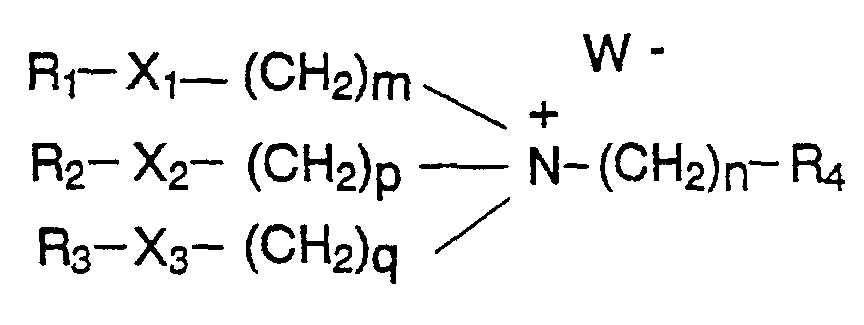


N, NH, S, Se, or NR, where R is as defined below;
N, NH, S, Se, or NR, where R is as defined below;


Claims (46)
- A quaternary nitrogen compound of the formulawherein
 X is absent, 0, NH, S, Se or NR11 where R11 is a linear C1-C23 group, or a branched C1-C23 group, said linear or branched C1-C23 groups being alkyl, acyl, alkene or heteroalkyl groups, said alkyl, acyl, alkene or heteroalkyl groups being unsubstituted or substituted, having from 0 to 6 sites of unsaturation, containing from 0 to 5 heteroatoms, or containing cyclic or aryl groups, said cyclic or aryl groups containing from 0-5 heteroatoms;Y1 and Y3 are independently 0, S, NH, Se or NR11, where R11 is as defined above;Y2 is absent, 0, NH, S, Se or NR11 where R11 is as defined above;Z is H, R11 as defined above, an amino acid, peptide, polypeptide, protein, nucleic acid, nucleotide, nucleoside, polynucleotide, polynucleoside, monosaccharide, disaccharide, polysacchararide, bioactive agent, pharmaceutical agent or R10 where R10 has the following structure:
 wherein R5 through R9 are independently absent, H, an amino acid, nucleotide, polynucleotide, monosaccharide, disaccharide, polysaccharide, bioactive agent, pharmaceutical agent, linear C1-C23 groups, or branched C1-C23 groups, said linear or branched C1-C23 groups being alkyl, acyl, alkene or heteroalkyl groups, said alkyl, acyl, alkene or heteroalkyl groups being unsubstituted or substituted, having from 0 to 6 sites of unsaturation, containing from 0 to 5 heteroatoms, or containing cyclic or aryl groups;G is absent, 0, N, NH, S, SH, Se, CH, or CR11 where R11 is as defined above;T is O, N, S, Se;A is 0, N, S, Se, or C;R1 and R3 are independently linear C8-C23 groups or branched C8-C23 groups, said linear or branched C8-C23 groups being alkyl, acyl, alkene or heteroalkyl groups, said alkyl, acyl, alkene or heteroalkyl groups being unsubstituted or substituted, having from 0 to 6 sites of unsaturation, containing from 0 to 5 heteroatoms, or containing cyclic or aryl groups, said cyclic or aryl groups containing from 0-5 heteroatoms;R2 is H, a linear C1-C23 group, or a branched C1-C23 group, said linear or branched C1-C23 groups being alkyl, acyl, alkene or heteroalkyl groups, said alkyl, acyl, alkene or heteroalkyl groups being unsubstituted or substituted, having from 0 to 6 sites of unsaturation, containing from 0 to 5 heteroatoms, or containing cyclic or aryl groups, said cyclic or aryl groups containing from 0-5 heteroatoms;n is 1-10;p1 and p3 are independently 2-4;p2 is 1-4;W is a pharmaceutically acceptable anion;wherein the compound is not a Rosenthal Inhibitor based cytofectin, wherein if X is absent, Z is R10, and wherein if A is 0 then R7 and R8 are absent and R6 is not H or absent.
 - A compound according to Claim 1 wherein:Y1 and Y3 are independently 0, NH, S, or Se; andY2 is absent 0, NH, S, or Se.
- A compound according to Claim 2, wherein:R1 and R3 are independently C8H17, C10H21, C12H25, or C14H29;R2 is H, C8H17, C10H21, C12H25, or C14H29;Y1 and Y3 are 0; andY2 is absent or 0 wherein if Y2 is absent then R2 is H.
- A compound according to Claim 2 wherein:Z is R10;A is 0 or N; andT is N, S, or O.
- A compound according to Claim 4, wherein G is 0 or N.
- A compound according to Claim 2, wherein:Z is R10;G is CH;R5 is H; andT is O.
- A compound according to Claim 1 wherein:Y2 is absent;Y1 and Y3 are independently 0, NH, S, Se or NR11 where R11 is as defined above;R2 is H;R1 and R3 are independently linear C8-C23 groups or branched C8-C23 groups, said linear or branched C8-C23 groups being alkyl, acyl, alkene or heteroalkyl groups, said alkyl, acyl, alkene or heteroalkyl groups being unsubstituted or substituted, having from 0 to 6 sites of unsaturation, containing from 0 to 5 heteroatoms, or containing cyclic or aryl groups, said cyclic or aryl groups containing from 0-5 heteroatoms;p2 is 1;wherein the compound is not a Rosenthal Inhibitor based cytofectin and wherein if X is absent, Z is R10, and wherein if A is 0 then R7 and R8 are absent and R6 is not H or absent.,
- A compound according to Claim 7 wherein X is absent; O, NH, S, or Se and Y1 and Y3 are independently O, NH, S, or Se.
- A compound according to Claim 8 wherein Y1 and Y3 are 0.
- The compound of Claim 9 wherein p1 and p3 are 2.
- A compound according to Claim 10 wherein R1 and R3 are C10H21.
- A compound according to Claim 11 wherein Z is H and X is selected from the group consisting of 0 and NH.
- A compound according to Claim 10 wherein R1 and R3 are C12H25.
- A compound according to Claim 13 wherein Z is H and X is selected from the group consisting of 0 and NH.
- A compound according to Claim 13, wherein X is absent and R10 is NH-lysine amide and n is 3.
- A compound according to Claim 13, wherein X is absent and R10 is NH-α(Benzyloxycarbonyl)lysine amide and n is 3.
- A compound according to Claim 13 wherein X is absent and R10 is NH∈-(Carbobenzyloxy)-lysine amide and n is 3.
- A compound according to Claim 13, wherein X is absent and R10 is NH-glycine amide and n is 3.
- A compound according to Claim 13, wherein X is absent and R10 is NH-ornithine amide and n is 3.
- A compound according to Claim 13, wherein X is absent and R10 is NH-α(Benzyloxycarbonyl)-ornithine amide and n is 3.
- A compound according to Claim 13, wherein X is absent and R10 is NH-∈-(Carbobenzyloxy)-ornithine amide and n is 3.
- A compound according to Claim 10 wherein R1 and R3 are C14H29.
- A compound according to Claim 22 wherein Z is H and X is selected from the group consisting of absent, 0 and NH.
- The compound of Claim 22, wherein wherein X is 0, Z is H and n is 2.
- A compound according to Claim 1, wherein:Y1, Y2 and Y3 are independently 0, NH, S, Se or NR11 where R11 is as defined above;R1, R2, and R3 are independently linear C8-C23 groups, or branched C8-C23 groups, said linear or branched C8-C23 groups being alkyl, acyl, alkene or heteroalkyl groups, said alkyl, acyl, alkene or heteroalkyl groups being unsubstituted or substituted, having from 0 to 6 sites of unsaturation, containing from 0 to 5 heteroatoms, or containing cyclic or aryl groups, said cyclic or aryl groups containing from 0-5 heteroatoms;p1, p2 and p3 are independently 2-4;W is a pharmaceutically acceptable anion;wherein the compound is not a Rosenthal Inhibitor based cytofectin, wherein if X is absent, Z is R10, and wherein if A is 0 then R7 and R8 are absent and R6 is not H or absent.
- A compound according to Claim 25 wherein X is 0, NH, S, or Se and Y1, Y2 and Y3 are independently 0, NH, S, or Se.
- A compound according to Claim 26 wherein Y1, Y2 and Y3 are 0.
- A compound according to Claim 27 wherein p1, p2 and p3 are 2.
- A compound according to Claim 28 wherein R1, R2, and R3 are C12H25.
- A compound according to Claim 29 wherein Z is H and X is selected from the group consisting of 0 and NH.
- A compound according to Claim 28 wherein R1, R2, and R3 are C10H21.
- A compound according to Claim 31 wherein Z is H and X is selected from the group consisting of 0 and NH.
- A compound according to Claim 28 wherein R1, R2, and R3 are C8H17.
- A compound according to Claim 33 wherein Z is H and X is selected from the group consisting of 0 and NH.
- A compound according to Claim 25 wherein:X is absent;Z is R10;A is 0 or N; andT is N, S, or O.
- A compound according to Claim 35, wherein G is 0 or N.
- A compound according to Claim 25, wherein:X is absent;Z is R10;G is CH;R5 is H; andT is 0.
- Use of the compounds of any one of Claims 1 to 37 for the preparation of a medicament for delivering a molecule into a cell.
- The use of Claim 38 wherein said molecule is an anionic molecule.
- The use of Claim 38 wherein the medicament further includes one or more additional lipids.
- The use of Claim 40 wherein the additional lipids are selected from the group consisting of neutral lipids, phospholipids, and cholesterol.
- The use of Claim 38, wherein said cells are in vitro.
- The use of Claim 38, wherein said cells are in vivo.
- The use of Claim 42, wherein said cells are in an assay selected from the group consisting of the murine lung transfection, murine intraperitoneal tumor, murine intramuscular, porcine or rabbit intraarterial, Renca tumor, or subcutaneous tumor assays.
- The use of Claim 39 wherein the anionic molecule is mRNA.
- The use of Claim 39 wherein the anionic molecule is DNA.
Applications Claiming Priority (3)
| Application Number | Priority Date | Filing Date | Title |
|---|---|---|---|
| US629965 | 1996-04-09 | ||
| US08/629,965 US5994317A (en) | 1996-04-09 | 1996-04-09 | Quaternary cytofectins |
| PCT/US1997/005757 WO1997037966A1 (en) | 1996-04-09 | 1997-04-08 | Quaternary cytofectins |
Publications (2)
| Publication Number | Publication Date |
|---|---|
| EP0902780A1 EP0902780A1 (en) | 1999-03-24 |
| EP0902780B1 true EP0902780B1 (en) | 2001-10-31 |
Family
ID=24525211
Family Applications (1)
| Application Number | Title | Priority Date | Filing Date |
|---|---|---|---|
| EP97920200A Expired - Lifetime EP0902780B1 (en) | 1996-04-09 | 1997-04-08 | Quaternary cytofectins |
Country Status (9)
| Country | Link |
|---|---|
| US (1) | US5994317A (en) |
| EP (1) | EP0902780B1 (en) |
| JP (1) | JP4031045B2 (en) |
| AT (1) | ATE207874T1 (en) |
| CA (1) | CA2251169C (en) |
| DE (1) | DE69707870T2 (en) |
| DK (1) | DK0902780T3 (en) |
| ES (1) | ES2166540T3 (en) |
| WO (1) | WO1997037966A1 (en) |
Families Citing this family (33)
| Publication number | Priority date | Publication date | Assignee | Title |
|---|---|---|---|---|
| US6867195B1 (en) * | 1989-03-21 | 2005-03-15 | Vical Incorporated | Lipid-mediated polynucleotide administration to reduce likelihood of subject's becoming infected |
| US5703055A (en) | 1989-03-21 | 1997-12-30 | Wisconsin Alumni Research Foundation | Generation of antibodies through lipid mediated DNA delivery |
| US6673776B1 (en) | 1989-03-21 | 2004-01-06 | Vical Incorporated | Expression of exogenous polynucleotide sequences in a vertebrate, mammal, fish, bird or human |
| US6214804B1 (en) | 1989-03-21 | 2001-04-10 | Vical Incorporated | Induction of a protective immune response in a mammal by injecting a DNA sequence |
| ATE162219T1 (en) | 1989-11-16 | 1998-01-15 | Univ Duke | TRANSFORMATION OF ANIMAL SKIN CELLS USING PARTICLES |
| US6228844B1 (en) | 1991-11-12 | 2001-05-08 | Vical Incorporated | Stimulating vascular growth by administration of DNA sequences encoding VEGF |
| US6706694B1 (en) | 1990-03-21 | 2004-03-16 | Vical Incorporated | Expression of exogenous polynucleotide sequences in a vertebrate |
| US7105574B1 (en) | 1999-03-26 | 2006-09-12 | Vical Incorporated | Adjuvant compositions and methods for enhancing immune responses to polynucleotide-based vaccines |
| CA2309766C (en) * | 1997-11-20 | 2008-09-30 | Vical Incorporated | Treatment of cancer using cytokine-expressing polynucleotides and compositions therefor |
| US6652864B1 (en) | 1998-12-21 | 2003-11-25 | Asilomar Pharmaceuticals, Inc. | Compounds for intracellular delivery of therapeutic moieties to nerve cells |
| US20040120891A1 (en) | 1998-12-21 | 2004-06-24 | Craig Hill | Compounds for intracellular delivery of therapeutic moieties to nerve cells |
| EP1955709B1 (en) * | 1999-03-26 | 2012-03-14 | Vical Incorporated | Adjuvant compositions for enhancing immune responses to polynucleotide-based vaccines |
| WO2001017945A1 (en) * | 1999-09-03 | 2001-03-15 | The Procter & Gamble Company | Cationic alkyl alkoxylate derivatives |
| EP1278551A2 (en) * | 2000-04-21 | 2003-01-29 | Vical Incorporated | Compositions and methods for (in vivo) delivery of polynucleotide-based therapeutics |
| US20040204379A1 (en) * | 2000-06-19 | 2004-10-14 | Cheng Seng H. | Combination enzyme replacement, gene therapy and small molecule therapy for lysosomal storage diseases |
| KR100381512B1 (en) | 2000-09-21 | 2003-04-26 | 굿젠 주식회사 | Cationic lipids and use thereof |
| EP1349577A2 (en) * | 2000-11-06 | 2003-10-08 | Asilomar Pharmaceuticals, Inc. | Intracellular delivery of charged therapeutic moieties to nerve cells by means of targeting proteins |
| CA2449873A1 (en) * | 2001-06-07 | 2002-12-12 | Celator Technologies, Inc. | Cell penetrating therapeutic agents |
| EP1509203B1 (en) * | 2002-05-15 | 2016-04-13 | California Pacific Medical Center | Delivery of nucleic acid-like compounds |
| AU2003278776A1 (en) * | 2002-09-10 | 2004-04-30 | Vical Incorporated | Codon-optimized polynucleotide-based vaccines against bacillus anthracis infection |
| CA2508279A1 (en) * | 2002-12-23 | 2004-07-22 | Vical Incorporated | Method for freeze-drying nucleic acid/block copolymer/cationic surfactant complexes |
| EP1581201A4 (en) * | 2002-12-23 | 2011-03-30 | Vical Inc | Method for producing sterile polynucleotide based medicaments |
| US8080642B2 (en) * | 2003-05-16 | 2011-12-20 | Vical Incorporated | Severe acute respiratory syndrome DNA compositions and methods of use |
| CN101094688B (en) | 2004-09-13 | 2013-05-01 | 建新公司 | Multimeric constructs |
| WO2006060723A2 (en) * | 2004-12-03 | 2006-06-08 | Vical Incorporated | Methods for producing block copolymer/amphiphilic particles |
| WO2008106646A2 (en) * | 2007-03-01 | 2008-09-04 | Introgen Therapeutics, Inc | Methods and formulations for topical gene therapy |
| US9408914B2 (en) | 2010-04-28 | 2016-08-09 | Kyowa Hakko Kirin Co., Ltd. | Cationic lipid |
| JP5902617B2 (en) * | 2010-04-28 | 2016-04-13 | 協和発酵キリン株式会社 | Cationic lipid |
| JP2013095755A (en) * | 2011-11-02 | 2013-05-20 | Kyowa Hakko Kirin Co Ltd | Cationic lipid |
| EP2858974B9 (en) * | 2012-06-08 | 2022-07-20 | Nitto Denko Corporation | Lipids for therapeutic agent delivery formulations |
| US11298326B2 (en) | 2015-03-24 | 2022-04-12 | Kyowa Kirin Co., Ltd. | Nucleic acid-containing lipid nanoparticles |
| BR112020015796A2 (en) * | 2018-02-01 | 2021-02-09 | Trustees Of Tufts College | nanocomplexes similar to lipids and their uses |
| MX2021000644A (en) | 2018-07-18 | 2021-08-19 | Manzanita Pharmaceuticals Inc | Conjugates for delivering an anti-cancer agent to nerve cells, methods of use and methods of making thereof. |
Family Cites Families (15)
| Publication number | Priority date | Publication date | Assignee | Title |
|---|---|---|---|---|
| US2368208A (en) * | 1940-12-16 | 1945-01-30 | Emulsol Corp | Chemical compounds and method of preparing same |
| US3265719A (en) * | 1959-12-28 | 1966-08-09 | American Cyanamid Co | Betaines |
| DE2651898A1 (en) * | 1976-11-13 | 1978-05-18 | Hoechst Ag | SOFTENING DETERGENT |
| US5049386A (en) * | 1985-01-07 | 1991-09-17 | Syntex (U.S.A.) Inc. | N-ω,(ω-1)-dialkyloxy)- and N-(ω,(ω-1)-dialkenyloxy)Alk-1-YL-N,N,N-tetrasubstituted ammonium lipids and uses therefor |
| DE3618517A1 (en) * | 1985-06-04 | 1986-12-04 | Lion Corp., Tokio/Tokyo | Emulsifying agent for emulsion polymerisation |
| US4864060A (en) * | 1987-08-31 | 1989-09-05 | Witco Corporation | Surface active compounds, methods for making same and uses thereof |
| US5068431A (en) * | 1987-08-31 | 1991-11-26 | Witco Corporation | Methods of making new surface active compounds |
| CA2001401A1 (en) * | 1988-10-25 | 1990-04-25 | Claude Piantadosi | Quaternary amine containing ether or ester lipid derivatives and therapeutic compositions |
| JPH03181597A (en) * | 1989-12-12 | 1991-08-07 | Bridgestone Corp | Electric viscous fluid |
| US5279833A (en) * | 1990-04-04 | 1994-01-18 | Yale University | Liposomal transfection of nucleic acids into animal cells |
| US5264618A (en) * | 1990-04-19 | 1993-11-23 | Vical, Inc. | Cationic lipids for intracellular delivery of biologically active molecules |
| US5334761A (en) * | 1992-08-28 | 1994-08-02 | Life Technologies, Inc. | Cationic lipids |
| DE4241983C1 (en) * | 1992-12-12 | 1994-03-24 | Messer Griesheim Gmbh | Shielding gas for the arc welding of aluminum |
| US5364324A (en) * | 1992-12-14 | 1994-11-15 | Boettiger Jr Walter W | Exercise device |
| US5753613A (en) * | 1994-09-30 | 1998-05-19 | Inex Pharmaceuticals Corporation | Compositions for the introduction of polyanionic materials into cells |
-
1996
- 1996-04-09 US US08/629,965 patent/US5994317A/en not_active Expired - Lifetime
-
1997
- 1997-04-08 AT AT97920200T patent/ATE207874T1/en not_active IP Right Cessation
- 1997-04-08 CA CA002251169A patent/CA2251169C/en not_active Expired - Fee Related
- 1997-04-08 ES ES97920200T patent/ES2166540T3/en not_active Expired - Lifetime
- 1997-04-08 WO PCT/US1997/005757 patent/WO1997037966A1/en not_active Ceased
- 1997-04-08 DE DE69707870T patent/DE69707870T2/en not_active Expired - Lifetime
- 1997-04-08 JP JP53642397A patent/JP4031045B2/en not_active Expired - Fee Related
- 1997-04-08 DK DK97920200T patent/DK0902780T3/en active
- 1997-04-08 EP EP97920200A patent/EP0902780B1/en not_active Expired - Lifetime
Also Published As
| Publication number | Publication date |
|---|---|
| JP4031045B2 (en) | 2008-01-09 |
| JP2000508642A (en) | 2000-07-11 |
| CA2251169C (en) | 2006-12-19 |
| US5994317A (en) | 1999-11-30 |
| DE69707870T2 (en) | 2002-07-11 |
| ES2166540T3 (en) | 2002-04-16 |
| DE69707870D1 (en) | 2001-12-06 |
| WO1997037966A1 (en) | 1997-10-16 |
| EP0902780A1 (en) | 1999-03-24 |
| ATE207874T1 (en) | 2001-11-15 |
| DK0902780T3 (en) | 2002-02-11 |
| CA2251169A1 (en) | 1997-10-16 |
Similar Documents
| Publication | Publication Date | Title |
|---|---|---|
| US5994317A (en) | Quaternary cytofectins | |
| EP0929536B1 (en) | Piperazine based cytofectins | |
| CA2237316C (en) | Complex cationic lipids | |
| EP1019365B1 (en) | Novel compositions for the delivery of negatively charged molecules | |
| US6034137A (en) | Cationic lipids for gene therapy | |
| US7553830B2 (en) | Compositions for the delivery of negatively charged molecules | |
| US6656498B1 (en) | Cationic liposomes for gene transfer | |
| PT861228E (en) | LIPOPOLYAMINS AS TRANSFER AGENTS AND THEIR PHARMACEUTICAL APPLICATIONS | |
| EP1187807A1 (en) | Bipolar lipids and their use for the delivery of bioactive substances | |
| HK1029578B (en) | Novel compositions for the delivery of negatively charged molecules | |
| EP1724254A2 (en) | Novel compositions for the delivery of negatively charged molecules | |
| MXPA97008111A (en) | Cationic lipids for gen therapy | |
| MXPA00001855A (en) | Novel compositions for the delivery of negatively charged molecules |
Legal Events
| Date | Code | Title | Description |
|---|---|---|---|
| PUAI | Public reference made under article 153(3) epc to a published international application that has entered the european phase |
Free format text: ORIGINAL CODE: 0009012 |
|
| 17P | Request for examination filed |
Effective date: 19981109 |
|
| AK | Designated contracting states |
Kind code of ref document: A1 Designated state(s): AT BE CH DE DK ES FI FR GB GR IE IT LI LU MC NL PT SE |
|
| 17Q | First examination report despatched |
Effective date: 20000306 |
|
| GRAG | Despatch of communication of intention to grant |
Free format text: ORIGINAL CODE: EPIDOS AGRA |
|
| GRAG | Despatch of communication of intention to grant |
Free format text: ORIGINAL CODE: EPIDOS AGRA |
|
| GRAG | Despatch of communication of intention to grant |
Free format text: ORIGINAL CODE: EPIDOS AGRA |
|
| GRAH | Despatch of communication of intention to grant a patent |
Free format text: ORIGINAL CODE: EPIDOS IGRA |
|
| GRAH | Despatch of communication of intention to grant a patent |
Free format text: ORIGINAL CODE: EPIDOS IGRA |
|
| GRAA | (expected) grant |
Free format text: ORIGINAL CODE: 0009210 |
|
| AK | Designated contracting states |
Kind code of ref document: B1 Designated state(s): AT BE CH DE DK ES FI FR GB GR IE IT LI LU MC NL PT SE |
|
| PG25 | Lapsed in a contracting state [announced via postgrant information from national office to epo] |
Ref country code: FI Free format text: LAPSE BECAUSE OF FAILURE TO SUBMIT A TRANSLATION OF THE DESCRIPTION OR TO PAY THE FEE WITHIN THE PRESCRIBED TIME-LIMIT Effective date: 20011031 |
|
| REF | Corresponds to: |
Ref document number: 207874 Country of ref document: AT Date of ref document: 20011115 Kind code of ref document: T |
|
| REG | Reference to a national code |
Ref country code: CH Ref legal event code: EP |
|
| REF | Corresponds to: |
Ref document number: 69707870 Country of ref document: DE Date of ref document: 20011206 |
|
| REG | Reference to a national code |
Ref country code: IE Ref legal event code: FG4D |
|
| ET | Fr: translation filed | ||
| REG | Reference to a national code |
Ref country code: GB Ref legal event code: IF02 |
|
| PG25 | Lapsed in a contracting state [announced via postgrant information from national office to epo] |
Ref country code: PT Free format text: LAPSE BECAUSE OF FAILURE TO SUBMIT A TRANSLATION OF THE DESCRIPTION OR TO PAY THE FEE WITHIN THE PRESCRIBED TIME-LIMIT Effective date: 20020131 |
|
| PG25 | Lapsed in a contracting state [announced via postgrant information from national office to epo] |
Ref country code: GR Free format text: LAPSE BECAUSE OF FAILURE TO SUBMIT A TRANSLATION OF THE DESCRIPTION OR TO PAY THE FEE WITHIN THE PRESCRIBED TIME-LIMIT Effective date: 20020201 |
|
| REG | Reference to a national code |
Ref country code: DK Ref legal event code: T3 |
|
| REG | Reference to a national code |
Ref country code: CH Ref legal event code: NV Representative=s name: A. BRAUN, BRAUN, HERITIER, ESCHMANN AG PATENTANWAE |
|
| PG25 | Lapsed in a contracting state [announced via postgrant information from national office to epo] |
Ref country code: MC Free format text: LAPSE BECAUSE OF NON-PAYMENT OF DUE FEES Effective date: 20020408 Ref country code: LU Free format text: LAPSE BECAUSE OF NON-PAYMENT OF DUE FEES Effective date: 20020408 |
|
| REG | Reference to a national code |
Ref country code: ES Ref legal event code: FG2A Ref document number: 2166540 Country of ref document: ES Kind code of ref document: T3 |
|
| PLBE | No opposition filed within time limit |
Free format text: ORIGINAL CODE: 0009261 |
|
| STAA | Information on the status of an ep patent application or granted ep patent |
Free format text: STATUS: NO OPPOSITION FILED WITHIN TIME LIMIT |
|
| 26N | No opposition filed | ||
| PGFP | Annual fee paid to national office [announced via postgrant information from national office to epo] |
Ref country code: AT Payment date: 20030313 Year of fee payment: 7 |
|
| PGFP | Annual fee paid to national office [announced via postgrant information from national office to epo] |
Ref country code: DK Payment date: 20030314 Year of fee payment: 7 |
|
| PGFP | Annual fee paid to national office [announced via postgrant information from national office to epo] |
Ref country code: NL Payment date: 20030318 Year of fee payment: 7 |
|
| PGFP | Annual fee paid to national office [announced via postgrant information from national office to epo] |
Ref country code: SE Payment date: 20030407 Year of fee payment: 7 |
|
| PGFP | Annual fee paid to national office [announced via postgrant information from national office to epo] |
Ref country code: IE Payment date: 20030417 Year of fee payment: 7 |
|
| PGFP | Annual fee paid to national office [announced via postgrant information from national office to epo] |
Ref country code: ES Payment date: 20030425 Year of fee payment: 7 |
|
| PGFP | Annual fee paid to national office [announced via postgrant information from national office to epo] |
Ref country code: BE Payment date: 20030514 Year of fee payment: 7 |
|
| PG25 | Lapsed in a contracting state [announced via postgrant information from national office to epo] |
Ref country code: IE Free format text: LAPSE BECAUSE OF NON-PAYMENT OF DUE FEES Effective date: 20040408 Ref country code: AT Free format text: LAPSE BECAUSE OF NON-PAYMENT OF DUE FEES Effective date: 20040408 |
|
| PG25 | Lapsed in a contracting state [announced via postgrant information from national office to epo] |
Ref country code: SE Free format text: LAPSE BECAUSE OF NON-PAYMENT OF DUE FEES Effective date: 20040409 |
|
| PG25 | Lapsed in a contracting state [announced via postgrant information from national office to epo] |
Ref country code: ES Free format text: LAPSE BECAUSE OF NON-PAYMENT OF DUE FEES Effective date: 20040410 |
|
| PG25 | Lapsed in a contracting state [announced via postgrant information from national office to epo] |
Ref country code: DK Free format text: LAPSE BECAUSE OF NON-PAYMENT OF DUE FEES Effective date: 20040430 Ref country code: BE Free format text: LAPSE BECAUSE OF NON-PAYMENT OF DUE FEES Effective date: 20040430 |
|
| BERE | Be: lapsed |
Owner name: *VICAL INC. Effective date: 20040430 |
|
| PG25 | Lapsed in a contracting state [announced via postgrant information from national office to epo] |
Ref country code: NL Free format text: LAPSE BECAUSE OF NON-PAYMENT OF DUE FEES Effective date: 20041101 |
|
| EUG | Se: european patent has lapsed | ||
| NLV4 | Nl: lapsed or anulled due to non-payment of the annual fee |
Effective date: 20041101 |
|
| REG | Reference to a national code |
Ref country code: IE Ref legal event code: MM4A |
|
| PG25 | Lapsed in a contracting state [announced via postgrant information from national office to epo] |
Ref country code: IT Free format text: LAPSE BECAUSE OF NON-PAYMENT OF DUE FEES Effective date: 20050408 |
|
| REG | Reference to a national code |
Ref country code: ES Ref legal event code: FD2A Effective date: 20040410 |
|
| REG | Reference to a national code |
Ref country code: CH Ref legal event code: PFA Owner name: VICAL INCORPORATED Free format text: VICAL INCORPORATED#9373 TOWNE CENTRE DRIVE, SUITE 100#SAN DIEGO, CALIFORNIA 92121 (US) -TRANSFER TO- VICAL INCORPORATED#9373 TOWNE CENTRE DRIVE, SUITE 100#SAN DIEGO, CALIFORNIA 92121 (US) |
|
| PGFP | Annual fee paid to national office [announced via postgrant information from national office to epo] |
Ref country code: GB Payment date: 20140325 Year of fee payment: 18 |
|
| REG | Reference to a national code |
Ref country code: CH Ref legal event code: PCAR Free format text: NEW ADDRESS: HOLBEINSTRASSE 36-38, 4051 BASEL (CH) |
|
| PGFP | Annual fee paid to national office [announced via postgrant information from national office to epo] |
Ref country code: FR Payment date: 20140328 Year of fee payment: 18 Ref country code: CH Payment date: 20140425 Year of fee payment: 18 Ref country code: DE Payment date: 20140430 Year of fee payment: 18 |
|
| REG | Reference to a national code |
Ref country code: DE Ref legal event code: R119 Ref document number: 69707870 Country of ref document: DE |
|
| REG | Reference to a national code |
Ref country code: CH Ref legal event code: PL |
|
| GBPC | Gb: european patent ceased through non-payment of renewal fee |
Effective date: 20150408 |
|
| PG25 | Lapsed in a contracting state [announced via postgrant information from national office to epo] |
Ref country code: LI Free format text: LAPSE BECAUSE OF NON-PAYMENT OF DUE FEES Effective date: 20150430 Ref country code: CH Free format text: LAPSE BECAUSE OF NON-PAYMENT OF DUE FEES Effective date: 20150430 Ref country code: DE Free format text: LAPSE BECAUSE OF NON-PAYMENT OF DUE FEES Effective date: 20151103 Ref country code: GB Free format text: LAPSE BECAUSE OF NON-PAYMENT OF DUE FEES Effective date: 20150408 |
|
| REG | Reference to a national code |
Ref country code: FR Ref legal event code: ST Effective date: 20151231 |
|
| PG25 | Lapsed in a contracting state [announced via postgrant information from national office to epo] |
Ref country code: FR Free format text: LAPSE BECAUSE OF NON-PAYMENT OF DUE FEES Effective date: 20150430 |