EP0902366A2 - System zum Weiterleiten eines Befehlzustandkode ab einer entfernten Einheit zu einer Hosteinheit - Google Patents
System zum Weiterleiten eines Befehlzustandkode ab einer entfernten Einheit zu einer Hosteinheit Download PDFInfo
- Publication number
- EP0902366A2 EP0902366A2 EP98303263A EP98303263A EP0902366A2 EP 0902366 A2 EP0902366 A2 EP 0902366A2 EP 98303263 A EP98303263 A EP 98303263A EP 98303263 A EP98303263 A EP 98303263A EP 0902366 A2 EP0902366 A2 EP 0902366A2
- Authority
- EP
- European Patent Office
- Prior art keywords
- command
- remote
- unit
- status code
- remote unit
- Prior art date
- Legal status (The legal status is an assumption and is not a legal conclusion. Google has not performed a legal analysis and makes no representation as to the accuracy of the status listed.)
- Withdrawn
Links
Images


Classifications
-
- G—PHYSICS
- G06—COMPUTING OR CALCULATING; COUNTING
- G06F—ELECTRIC DIGITAL DATA PROCESSING
- G06F9/00—Arrangements for program control, e.g. control units
- G06F9/06—Arrangements for program control, e.g. control units using stored programs, i.e. using an internal store of processing equipment to receive or retain programs
- G06F9/46—Multiprogramming arrangements
-
- G—PHYSICS
- G06—COMPUTING OR CALCULATING; COUNTING
- G06F—ELECTRIC DIGITAL DATA PROCESSING
- G06F9/00—Arrangements for program control, e.g. control units
- G06F9/06—Arrangements for program control, e.g. control units using stored programs, i.e. using an internal store of processing equipment to receive or retain programs
- G06F9/46—Multiprogramming arrangements
- G06F9/54—Interprogram communication
- G06F9/547—Remote procedure calls [RPC]; Web services
Definitions
- This invention relates, in general, to the remote execution of commands and, in particular, to the receipt at a host unit of the status of a command executed on a remote unit.
- processors are connected to one another using typical telecommunications connections, such as TCP/IP or token rings.
- a command can be executed remotely using a remote shell (RSH) facility.
- RSH remote shell
- the remote shell facility is invoked from within a shell script that includes one or more statements.
- each statement is executed one at a time.
- the RSH facility When the shell script invokes the RSH facility, the RSH facility causes a specified command to be executed at a specified network-connected remote processor. That is, the specified command is run on the remote processor via RSH and the results of the specified command are returned back to the host processor (i.e., the processor issuing the request).
- the results include "standard output”, which is the output of the specified command, and "standard error”, which includes any error messages that were generated by the command.
- neither "standard output” nor “standard error” includes the status code (e.g., the return code or the exit code) of the executed specified command.
- the specified command when executed remotely, it generates a status code.
- RSH is incapable of returning the status code to the host processor. Instead, the status code of the specified command is lost and/or disregarded, and what is returned is the status condition of the RSH facility.
- a host unit is adapted to pass from the host unit to a remote unit a command to be executed on the remote unit.
- the host unit uses a remote command execution facility.
- the remote unit is adapted to execute the command, and to forward a status code of the command from the remote unit to the host unit.
- the remote unit also uses the remote command execution facility to forward the status code.
- the host unit is further adapted to issue a remote command execution facility invocation to execute the command on the remote unit.
- the remote command execution facility invocation identifies the command.
- the remote command execution facility invocation is issued from within a subroutine, and the subroutine is called from within a shell script or a computer program.
- the remote unit is further adapted to run another command on the remote unit.
- the another command is identified on the remote command execution facility invocation, and the execution of the first command is under control of the another command.
- the remote unit is further adapted to include the status code in standard output generated during execution of the command, and pass the standard output to the host unit.
- a system of propagating a status code from a remote unit to a host unit which includes: means for invoking from within a subroutine on a host unit a remote command execution facility to execute a first command; means for executing the first command on a remote unit; means for executing a second command on the remote unit via the first command; and means for forwarding a status code of the second command from the first command on the remote unit to the host unit.
- the capabilities of the present invention advantageously allow the return of a status code of a remotely executed command, via a remote command execution facility, such as RSH.
- the capabilities of the present invention are easily adaptable to the scripting environments and do not require the changing of operating system code.
- the capabilities of the present invention enable the return of the status code, even if no other output is generated or is being returned to the host unit.
- a capability in which a status code of a remotely executed command is returned to the host unit (e.g., the unit requesting execution of the command) via a remote command execution facility.
- the remote command execution facility which was previously unable to return the status code, is adapted to allow the propagation of the status code from a remote unit to the host unit.
- a computer environment 100 includes a plurality of units 102 coupled to one another via a connection 104.
- each unit is a UNIX workstation running a UNIX-based operating system, and the units are coupled to one another via a TCP/IP connection.
- Each unit includes, for instance, a central processing unit, memory and one or more input/output devices, which are well known in the art.
- each unit is a UNIX workstation running a UNIX-based operating system
- the status code propagation capability of the present invention can be incorporated and used with any type of computers, processors, systems, workstations and/or environments, without departing from the spirit of the present invention.
- one or more of the units is a PS/2 offered by International Business Machines Corporation.
- one or more of the units is based upon the Enterprise Systems Architecture offered by International Business Machines Corporation.
- the operating system need not be UNIX-based.
- the operating system can include the Multiple Virtual Storage (MVS) operating system offered by International Business Machines Corporation.
- connection 104 need not be TCP/IP. It can be any type of wire connection, token ring or network connection, to name just a few more examples.
- the environment includes a large parallel system with a plurality of units (e.g., 512 nodes) coupled to one another via a network connection, such as a switch.
- a network connection such as a switch.
- the units can be of differing types connected to one another via one or more connections.
- the invention is not limited to a particular number of units coupled together nor the type of units that are coupled.
- At least one of units 102 is a host unit 102a, which is coupled to one or more remote units 102b.
- Commands invoked on a host unit e.g., a local unit originating a request
- the specified command is invoked via a remote command execution facility, the invocation of which is embedded within, for instance, a shell script (e.g., written in PERL) or a computer program (e.g., written in C) located on the host unit.
- a remote command execution facility the invocation of which is embedded within, for instance, a shell script (e.g., written in PERL) or a computer program (e.g., written in C) located on the host unit.
- RSH Remote command execution facility
- the remote command execution facility transports the specified command from the host unit to the remote units to be executed on the remote units and forwards back to the host unit the "standard output" and "standard error” generated during execution of the specified command.
- the “standard output” includes the output of the specified command, and the “standard error” includes a list of error messages issued by the command. However, neither “standard output” nor “standard error” includes the status code (e.g., an exit or return code) of the specified command.
- the remote command execution facility is capable of returning the status code from the remote unit(s) to the host unit, as described in detail below with reference to FIGs. 2 and 3.
- host unit 102a includes a shell script 202 written in a scripting language, such as PERL.
- Shell script 202 includes an invocation 204 of a subroutine 206.
- the shell script can include additional statements (e.g., commands and/or operations) to be performed before and/or after the subroutine invocation, as designated in the figure by the elipses. Additionally, a plurality of subroutine invocations can be included in order to execute the specified command (or other specified commands) on a plurality of remote units.
- additional statements e.g., commands and/or operations
- a plurality of subroutine invocations can be included in order to execute the specified command (or other specified commands) on a plurality of remote units.
- the code for subroutine 206 (i.e., the runitrc subroutine) is provided various information during the invocation, which include identification of the remote unit to execute the specified command and the specified command to be executed on the remote unit.
- the subroutine takes that information and issues a remote shell invocation 208 against the specified remote unit.
- This invocation is an invocation of a runitrc command, as opposed to the specified command.
- the command runitrc (designated by reference numeral 210) is run under the control of the remote command execution facility.
- the code for the runitrc command is located on the remote unit.
- the runitrc command takes the parameter it has been supplied (e.g., cmd) and executes it, when it reaches inline invocation 212 of cmd.
- cmd is invoked using the following syntax: system('cmd');.
- the above is a system call that executes the specified command inline.
- the output (e.g., standard output, standard error) of the specified command is merged with the output (e.g., standard output, standard error) of the runitrc command.
- runitrc command 210 also includes one or more various other statements (e.g. commands and/or operations) before and/or after the invocation of the specified command.
- print statement 214 Another statement is a print statement 214.
- the print statement writes to the "standard output", designated by STDOUT, the status code of the specified command, in accordance with the principles of the present invention. This is described in further detail below.
- the runitrc command includes an exit statement 216, which terminates the invocation of the runitrc command. Thereafter, the remote command execution facility (e.g., RSH) returns "standard output” to subroutine 206, at reference numeral 208. Additionally, "standard error” is returned by the remote command execution facility and it is merged with "standard error” of the shell script.
- RSH remote command execution facility
- error messages and status code are returned to the subroutine, one or more other statements may be executed inline.
- a return statement 218 is executed, which returns the status code to shell script 202.
- the shell script is then able to do further processing with the status code, in accordance with the principles of the present invention.
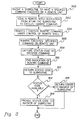
- FIG. 3 One example of a logic flow diagram of the functions included in the status code propagation capability of the present invention is depicted in FIG. 3 and described in detail below. For this discussion, reference is also made to FIG. 2. The reference numerals within the 200's can be found in FIG. 2.
- a subroutine (e.g., the runitrc subroutine) is invoked in order to have a specified command (designated by cmd) executed on a remote unit, STEP 300.
- subroutine 206 is a library routine invoked from within shell script 202 using invocation 204. In another embodiment, however, the subroutine is invoked from within a computer program, such as a program written in C.
- a remote command execution facility e.g., RSH
- RSH remote command execution facility
- the remote command execution facility e.g., RSH transports the string "runitrc cmd" to the remote unit designated by "remote”.
- the command, runitrc is then run on the remote unit under the control of the remote command execution facility, STEP 304. Specifically, the statements within the runitrc conunand are executed inline, one at a time. At a particular point within the code for the runitrc command, an invocation is reached for the specified command to be executed on the remote unit. In one example, the specified command, designated by cmd, is invoked by invocation 212. It should be noted that cmd represents a string of one or more words that identify the specified command to be remotely executed.
- the status code (e.g., the value of $rc) is written to "standard output", using print statement 214 within the runitrc command code.
- print statement 214 One embodiment of the syntax of the print statement is as follows: print(stdout ">>>The status code from the command was: $rc");.
- the status code of the specified command is captured within the variable $rc and a special text string ">>>The status code from the command was:" is added to the already provided "standard output” text. That is, in one example, this special text line is added to the last line of "standard output”. If there is no output, then this special text line will be the only line within "standard output”.
- Standard output including the status code line
- @stdout reference numeral 208
- other processing within the subroutine can take place. For instance, a determination is made as to whether the status code is available, STEP 314. In particular, the last line of "standard output” is stripped off and the subroutine code looks for the numeric value following the text string ">>> The status code from the command was:”. If, for some reason, the status code is not returned, an error message is passed to the invoker of the subroutine (e.g., shell script 202), STEP 316.
- the status code is provided to the invoker of the subroutine, STEP 318.
- the status code is returned to the shell script using the statement, return $rc (reference numeral 218).
- the status code is returned to the shell script into the variable $x in invocation 204.
- the code of the shell script can take further action. For instance, conditional logic can be included in order to perform further tasks depending on the value of the status code.
- the status code is added to the last line of "standard output". This is only one example, however. In another embodiment, the status code can be added to other places within "standard output”. In yet a further embodiment, the status code can be returned with "standard error”.
- the status code is returned in the "standard output", even if the coder of the remote specified command indicates that no output is to be generated.
- the remote command execution facility is provided with the ability to return a status code of a remotely executed command from a remote unit to a host unit.
- the present invention provides an easy mechanism for interactive shell scripting environments executing remote command execution facilities to receive accurate status codes from remotely executed commands.
- the operating system code e.g., the UNIX operating system code
- the command can be sent from a host unit to a plurality of remote units.
- Each of the remote units would include the runitrc command code, in this example.
- a status code would then be returned from each of the remote units.
- multiple host units can be used to send commands to one or more remote units.
- the present invention can be included in an article of manufacture (e.g., one or more computer program products) having, for instance, computer useable media.
- article of manufacture e.g., one or more computer program products having, for instance, computer useable media.
- the media has embodied therein, for instance, computer readable program code means for providing and facilitating the capabilities of the present invention.
- the article of manufacture can be included as a part of a computer system or sold separately.
- the present invention also relates to a system of propagating a status code from a remote unit to a host unit, said system comprising:
- the system of the previous paragraph further comprises either a) means for invoking said subroutine from within either a shell script or a computer program; or
Landscapes
- Engineering & Computer Science (AREA)
- Software Systems (AREA)
- Theoretical Computer Science (AREA)
- Physics & Mathematics (AREA)
- General Engineering & Computer Science (AREA)
- General Physics & Mathematics (AREA)
- Stored Programmes (AREA)
- Computer And Data Communications (AREA)
- Selective Calling Equipment (AREA)
Applications Claiming Priority (2)
| Application Number | Priority Date | Filing Date | Title |
|---|---|---|---|
| US89280797A | 1997-07-15 | 1997-07-15 | |
| US892807 | 1997-07-15 |
Publications (2)
| Publication Number | Publication Date |
|---|---|
| EP0902366A2 true EP0902366A2 (de) | 1999-03-17 |
| EP0902366A3 EP0902366A3 (de) | 1999-05-06 |
Family
ID=25400524
Family Applications (1)
| Application Number | Title | Priority Date | Filing Date |
|---|---|---|---|
| EP98303263A Withdrawn EP0902366A3 (de) | 1997-07-15 | 1998-04-27 | System zum Weiterleiten eines Befehlzustandkode ab einer entfernten Einheit zu einer Hosteinheit |
Country Status (2)
| Country | Link |
|---|---|
| EP (1) | EP0902366A3 (de) |
| KR (1) | KR19990013400A (de) |
Cited By (1)
| Publication number | Priority date | Publication date | Assignee | Title |
|---|---|---|---|---|
| WO2001057661A3 (en) * | 2000-01-31 | 2002-11-21 | Mobileq Canada Inc | Method and system for reusing internet-based applications |
Family Cites Families (3)
| Publication number | Priority date | Publication date | Assignee | Title |
|---|---|---|---|---|
| US5113502A (en) * | 1986-11-20 | 1992-05-12 | Allen-Bradley Company, Inc. | Method and apparatus for saving and performing industrial control commands |
| EP0414624B1 (de) * | 1989-08-24 | 1996-12-18 | International Business Machines Corporation | System für den Aufruf von Prozeduren von einem Fernnetzwerkknotenpunkt |
| US5590288A (en) * | 1991-07-30 | 1996-12-31 | Restaurant Technology, Inc. | Distributed data processing system and method utilizing peripheral device polling and layered communication software |
-
1998
- 1998-04-27 EP EP98303263A patent/EP0902366A3/de not_active Withdrawn
- 1998-06-10 KR KR1019980021478A patent/KR19990013400A/ko not_active Ceased
Cited By (1)
| Publication number | Priority date | Publication date | Assignee | Title |
|---|---|---|---|---|
| WO2001057661A3 (en) * | 2000-01-31 | 2002-11-21 | Mobileq Canada Inc | Method and system for reusing internet-based applications |
Also Published As
| Publication number | Publication date |
|---|---|
| KR19990013400A (ko) | 1999-02-25 |
| EP0902366A3 (de) | 1999-05-06 |
Similar Documents
| Publication | Publication Date | Title |
|---|---|---|
| US10528395B2 (en) | Task managing application for performing tasks based on messages received from a data processing application initiated by the task managing application | |
| US7921430B2 (en) | System and method for intercepting, instrumenting and characterizing usage of an application programming interface | |
| US6584491B1 (en) | Arrangement for monitoring a progress of a message flowing through a distributed multiprocess system | |
| US7535479B2 (en) | Apparatus and method for collecting and displaying information in a workflow system | |
| US6182119B1 (en) | Dynamically configurable filtered dispatch notification system | |
| US6138168A (en) | Support for application programs in a distributed environment | |
| US7739325B1 (en) | Apparatus and method for extensible real-time workflows | |
| US6751657B1 (en) | System and method for notification subscription filtering based on user role | |
| EP1297428A2 (de) | System und verfahren zum koordinierungzentrierten entwurf von sofwaresystemen | |
| CA2386658A1 (en) | System of reusable software parts for implementing concurrency and hardware access, and methods of use | |
| JPH06195290A (ja) | 遠隔ノードからの処理手順呼出し方法及びシステム | |
| US6470346B2 (en) | Remote computation framework | |
| US6532498B1 (en) | Method and system for event notification between software application program objects | |
| WO2001038978A1 (en) | Configurable state machine driver and methods of use | |
| US20040024856A1 (en) | Method and system for a services environment management engine | |
| EP0892346A2 (de) | Verbreitung einer Befehlszustandskodes aus einer entfernten Einheit nach einer Haupteinheit | |
| EP0892345A2 (de) | Verfahren zum Weiterleiten eines Befehlzustandskodes ab einer entfernten Einheit zu einer Hosteinheit | |
| KR20010110097A (ko) | 작업흐름-관리-시스템에서의 보관 방법 | |
| Grimshaw et al. | Real-time Mentat programming language and architecture | |
| KR19990013400A (ko) | 원격 유닛에서 호스트 유닛으로의 명령어 상태 코드의 전달 시스템 | |
| CN120045217B (zh) | 一种实现多端代码构建的系统及方法 | |
| KR19990013427A (ko) | 컴퓨터 환경에서 실행되는 태스크의 관리 방법 및 관리 시스템과 그를 위한 제조물 | |
| JP3560345B6 (ja) | 分散環境におけるアプリケーション・プログラム用のサポート | |
| Rosenbaum et al. | Software Development Issues For Network Node Equipment | |
| JPH11175359A (ja) | 異種プラットフォーム間のイベント監視部統合方法 |
Legal Events
| Date | Code | Title | Description |
|---|---|---|---|
| PUAI | Public reference made under article 153(3) epc to a published international application that has entered the european phase |
Free format text: ORIGINAL CODE: 0009012 |
|
| AK | Designated contracting states |
Kind code of ref document: A2 Designated state(s): DE GB |
|
| AX | Request for extension of the european patent |
Free format text: AL;LT;LV;MK;RO;SI |
|
| PUAL | Search report despatched |
Free format text: ORIGINAL CODE: 0009013 |
|
| AK | Designated contracting states |
Kind code of ref document: A3 Designated state(s): AT BE CH CY DE DK ES FI FR GB GR IE IT LI LU MC NL PT SE |
|
| AX | Request for extension of the european patent |
Free format text: AL;LT;LV;MK;RO;SI |
|
| 17P | Request for examination filed |
Effective date: 19991004 |
|
| AKX | Designation fees paid |
Free format text: DE GB |
|
| STAA | Information on the status of an ep patent application or granted ep patent |
Free format text: STATUS: THE APPLICATION IS DEEMED TO BE WITHDRAWN |
|
| 18D | Application deemed to be withdrawn |
Effective date: 20011101 |