EP0902090A1 - Compound capable of introducing at least one molecule into a cell. - Google Patents
Compound capable of introducing at least one molecule into a cell. Download PDFInfo
- Publication number
- EP0902090A1 EP0902090A1 EP98870191A EP98870191A EP0902090A1 EP 0902090 A1 EP0902090 A1 EP 0902090A1 EP 98870191 A EP98870191 A EP 98870191A EP 98870191 A EP98870191 A EP 98870191A EP 0902090 A1 EP0902090 A1 EP 0902090A1
- Authority
- EP
- European Patent Office
- Prior art keywords
- cell
- transfection
- compound
- cells
- vector
- Prior art date
- Legal status (The legal status is an assumption and is not a legal conclusion. Google has not performed a legal analysis and makes no representation as to the accuracy of the status listed.)
- Granted
Links
Images


Classifications
-
- C—CHEMISTRY; METALLURGY
- C12—BIOCHEMISTRY; BEER; SPIRITS; WINE; VINEGAR; MICROBIOLOGY; ENZYMOLOGY; MUTATION OR GENETIC ENGINEERING
- C12N—MICROORGANISMS OR ENZYMES; COMPOSITIONS THEREOF; PROPAGATING, PRESERVING, OR MAINTAINING MICROORGANISMS; MUTATION OR GENETIC ENGINEERING; CULTURE MEDIA
- C12N15/00—Mutation or genetic engineering; DNA or RNA concerning genetic engineering, vectors, e.g. plasmids, or their isolation, preparation or purification; Use of hosts therefor
- C12N15/09—Recombinant DNA-technology
- C12N15/87—Introduction of foreign genetic material using processes not otherwise provided for, e.g. co-transformation
- C12N15/88—Introduction of foreign genetic material using processes not otherwise provided for, e.g. co-transformation using microencapsulation, e.g. using amphiphile liposome vesicle
-
- A—HUMAN NECESSITIES
- A61—MEDICAL OR VETERINARY SCIENCE; HYGIENE
- A61K—PREPARATIONS FOR MEDICAL, DENTAL OR TOILETRY PURPOSES
- A61K47/00—Medicinal preparations characterised by the non-active ingredients used, e.g. carriers or inert additives; Targeting or modifying agents chemically bound to the active ingredient
- A61K47/50—Medicinal preparations characterised by the non-active ingredients used, e.g. carriers or inert additives; Targeting or modifying agents chemically bound to the active ingredient the non-active ingredient being chemically bound to the active ingredient, e.g. polymer-drug conjugates
- A61K47/51—Medicinal preparations characterised by the non-active ingredients used, e.g. carriers or inert additives; Targeting or modifying agents chemically bound to the active ingredient the non-active ingredient being chemically bound to the active ingredient, e.g. polymer-drug conjugates the non-active ingredient being a modifying agent
- A61K47/54—Medicinal preparations characterised by the non-active ingredients used, e.g. carriers or inert additives; Targeting or modifying agents chemically bound to the active ingredient the non-active ingredient being chemically bound to the active ingredient, e.g. polymer-drug conjugates the non-active ingredient being a modifying agent the modifying agent being an organic compound
- A61K47/543—Lipids, e.g. triglycerides; Polyamines, e.g. spermine or spermidine
-
- A—HUMAN NECESSITIES
- A61—MEDICAL OR VETERINARY SCIENCE; HYGIENE
- A61K—PREPARATIONS FOR MEDICAL, DENTAL OR TOILETRY PURPOSES
- A61K47/00—Medicinal preparations characterised by the non-active ingredients used, e.g. carriers or inert additives; Targeting or modifying agents chemically bound to the active ingredient
- A61K47/50—Medicinal preparations characterised by the non-active ingredients used, e.g. carriers or inert additives; Targeting or modifying agents chemically bound to the active ingredient the non-active ingredient being chemically bound to the active ingredient, e.g. polymer-drug conjugates
- A61K47/69—Medicinal preparations characterised by the non-active ingredients used, e.g. carriers or inert additives; Targeting or modifying agents chemically bound to the active ingredient the non-active ingredient being chemically bound to the active ingredient, e.g. polymer-drug conjugates the conjugate being characterised by physical or galenical forms, e.g. emulsion, particle, inclusion complex, stent or kit
- A61K47/6905—Medicinal preparations characterised by the non-active ingredients used, e.g. carriers or inert additives; Targeting or modifying agents chemically bound to the active ingredient the non-active ingredient being chemically bound to the active ingredient, e.g. polymer-drug conjugates the conjugate being characterised by physical or galenical forms, e.g. emulsion, particle, inclusion complex, stent or kit the form being a colloid or an emulsion
- A61K47/6907—Medicinal preparations characterised by the non-active ingredients used, e.g. carriers or inert additives; Targeting or modifying agents chemically bound to the active ingredient the non-active ingredient being chemically bound to the active ingredient, e.g. polymer-drug conjugates the conjugate being characterised by physical or galenical forms, e.g. emulsion, particle, inclusion complex, stent or kit the form being a colloid or an emulsion the form being a microemulsion, nanoemulsion or micelle
-
- A—HUMAN NECESSITIES
- A61—MEDICAL OR VETERINARY SCIENCE; HYGIENE
- A61K—PREPARATIONS FOR MEDICAL, DENTAL OR TOILETRY PURPOSES
- A61K48/00—Medicinal preparations containing genetic material which is inserted into cells of the living body to treat genetic diseases; Gene therapy
-
- A—HUMAN NECESSITIES
- A61—MEDICAL OR VETERINARY SCIENCE; HYGIENE
- A61K—PREPARATIONS FOR MEDICAL, DENTAL OR TOILETRY PURPOSES
- A61K9/00—Medicinal preparations characterised by special physical form
- A61K9/10—Dispersions; Emulsions
- A61K9/127—Synthetic bilayered vehicles, e.g. liposomes or liposomes with cholesterol as the only non-phosphatidyl surfactant
- A61K9/1271—Non-conventional liposomes, e.g. PEGylated liposomes or liposomes coated or grafted with polymers
- A61K9/1272—Non-conventional liposomes, e.g. PEGylated liposomes or liposomes coated or grafted with polymers comprising non-phosphatidyl surfactants as bilayer-forming substances, e.g. cationic lipids or non-phosphatidyl liposomes coated or grafted with polymers
-
- C—CHEMISTRY; METALLURGY
- C07—ORGANIC CHEMISTRY
- C07C—ACYCLIC OR CARBOCYCLIC COMPOUNDS
- C07C257/00—Compounds containing carboxyl groups, the doubly-bound oxygen atom of a carboxyl group being replaced by a doubly-bound nitrogen atom, this nitrogen atom not being further bound to an oxygen atom, e.g. imino-ethers, amidines
- C07C257/10—Compounds containing carboxyl groups, the doubly-bound oxygen atom of a carboxyl group being replaced by a doubly-bound nitrogen atom, this nitrogen atom not being further bound to an oxygen atom, e.g. imino-ethers, amidines with replacement of the other oxygen atom of the carboxyl group by nitrogen atoms, e.g. amidines
- C07C257/14—Compounds containing carboxyl groups, the doubly-bound oxygen atom of a carboxyl group being replaced by a doubly-bound nitrogen atom, this nitrogen atom not being further bound to an oxygen atom, e.g. imino-ethers, amidines with replacement of the other oxygen atom of the carboxyl group by nitrogen atoms, e.g. amidines having carbon atoms of amidino groups bound to acyclic carbon atoms
-
- C—CHEMISTRY; METALLURGY
- C12—BIOCHEMISTRY; BEER; SPIRITS; WINE; VINEGAR; MICROBIOLOGY; ENZYMOLOGY; MUTATION OR GENETIC ENGINEERING
- C12N—MICROORGANISMS OR ENZYMES; COMPOSITIONS THEREOF; PROPAGATING, PRESERVING, OR MAINTAINING MICROORGANISMS; MUTATION OR GENETIC ENGINEERING; CULTURE MEDIA
- C12N15/00—Mutation or genetic engineering; DNA or RNA concerning genetic engineering, vectors, e.g. plasmids, or their isolation, preparation or purification; Use of hosts therefor
- C12N15/09—Recombinant DNA-technology
- C12N15/87—Introduction of foreign genetic material using processes not otherwise provided for, e.g. co-transformation
Definitions
- the invention relates to a compound capable of introducing at least one molecule into a cell.
- the invention also relates to a positively charged vesicle whose membrane comprises this compound, to a vector containing at least one molecule combined with the vesicle according to the invention; to the cell, animal and/or plant transformed by said compound or said vector as well as to the pharmaceutical or cosmetic composition, comprising said vector and/or the cell transformed by said vector.
- the invention also relates to the process for the synthesis of said compound and to the process for the production of said vector.
- Another aspect of the invention relates to the use of the compound and/or vector for the introduction in vitro and/or in vivo of at least one molecule into a cell.
- Transfection is a method which is widely used for introducing genetic material into cells, for studying the expression of genes, and for developing strategies for gene therapy.
- Another axis of research relates to the development of new amphiphilic cationic vectors which have demonstrated their effectiveness and their ease of use for causing the genetic material to penetrate into cells in vitro (P.L. Felgner et al., Proc. Natl. Acad. Sci., USA, 84, pp. 7413-7417 (1987)).
- Some of these vectors such as the Lipofectin® N-(2,3-dioleyloxy)propyl-N,N,N-trimethylammonium chloride (DOTMA) from GIBCO BRL or the Transfection-reagent® N-(2,3-dioleoyloxy)propyl-N,N,N-trimethylammonium methyl sulfate (DOTAP) from Boehringer Mannheim GmbH, have been commercialized.
- DOTMA Lipofectin® N-(2,3-dioleyloxy)propyl-N,N,N-trimethylammonium chloride
- DOTAP Transfection-reagent® N-(2,3-dioleoyloxy)propyl-N,N,N-trimethylammonium methyl sulfate
- Patent Application WO91/15501 also describes a positively charged reagent consisting of a neutral phospholipid such as dioleoylphosphatidylethanolamine and a cationic lipid such as stearylamine, a tertiary amine or a benzothorium salt for the transfection of nucleic acids.
- a neutral phospholipid such as dioleoylphosphatidylethanolamine
- a cationic lipid such as stearylamine, a tertiary amine or a benzothorium salt for the transfection of nucleic acids.
- Lipofectin® (DOTMA) has the additional disadvantage of not being capable of being added to a serum.
- the aim of the present invention is to produce a new compound and/or a new vector capable of introducing at least one molecule into a cell, without exhibiting the disadvantages of the prior state of the art.
- the invention is also intended for producing a pharmaceutical or cosmetic composition comprising said vector and/or said cell transformed by said vector.
- An additional aim of the present invention is intended for producing a vector which can be used in a serum.
- the invention also relates to a positively charged vesicle having a membrane comprising a compound according to the invention as well as a vector consisting of said vesicle associated with at least one molecule to be introduced into a cell, said molecule being advantageously selected from the group consisting of nucleic acids (nucleic acids oligomers or nucleic polymers), antigens, polypeptides or optionally glycosylated proteins and/or active therapeutic or cosmetic agents.
- nucleic acids nucleic acids oligomers or nucleic polymers
- antigens polypeptides or optionally glycosylated proteins and/or active therapeutic or cosmetic agents.
- Said molecule is introduced in a cell by a process wherein said cell is brought into contact with said molecule and a compound and/or a vesicle according to the invention.
- the introduction process can be achieved by bringing said cell into contact with a vector according to the invention.
- nucleic acid according to the invention means any kind of nucleic acids polymer of oligomer such as a plasmid, messenger RNAs, antisense RNAs, cDNAs, synthetic oligonucleotides and the like which are capable of genetically transforming a cell and which may express a specific antigen, polypeptide or protein as well as an active therapeutic or cosmetic agent into said cell.
- a cell is treated in vitro in order to produce plants or animals which are transgenic or for gene therapy, in particular for the treatment of cellular disorders such as cancer or infections such as viral or bacterial infections or the like.
- a cell is treated in vivo in order to produce recombinant microorganisms, plants and/or animals which are transgenic or in for ex vivo or in vivo gene therapy.
- Another aspect of the invention concerns a new composition
- a new composition comprising a molecule to compact DNA, preferably a protamine, a polylysine or a histone derived peptide, and the compound, the vesicle or the vector according to the invention.
- composition according to the invention may also comprise another compound which increases cell endocytosis, preferably a microtubule inhibitor such as colchicine.
- a microtubule inhibitor such as colchicine.
- Another aspect of the present invention is related to a transfection kit comprising said composition, compound(s), vesicle or vector according to the invention, for the transfection of cells, plants or animals.
- the present invention also relates to the cell, the animal or the plant transformed by the vector according to the invention as well as a cosmetic or pharmaceutical composition (such as a vaccine) comprising the vector and/or the transformed cell according to the invention.
- the invention also relates to a process for the production of the vector according to the invention in which at least one molecule selected from the group consisting of nucleic acids molecules, antigen molecules, polypeptides, glycosylated polypeptides, proteins, glycosylated proteins, therapeutic agents and cosmetic agents are reacted with a vesicle according to the invention.
- a final aspect of the present invention relates to the use of the vector and/or the compound according to the invention for the introduction of one or more molecules into a cell in vitro as well as the use of the vector according to the invention for the introduction of one or more molecules into a cell in vivo.
- a solution of Vectamidine is prepared in ethanol (50mg/ml). Dissolving is enabled by heating briefly at 55 °C. Twenty microliters of this solution are rapidly injected, by means of a micropippet, into lml of HBS buffer (10 mM Hepes, 150 mM NaCl, adjusted at pH 7.3 by addition of concentrated NaOH), heated to 55 °C. During the operation, the solution is shaken on a vortex mixer. The resulting vesicle suspension (named “the suspension”) is incubated for an additional 1 minute at 55 °C and shaken again for 20 seconds on the vortex mixer. The suspension is allowed to cool at room temperature (20 °C) before use. In a large number of experiments, the suspension was stored at 4 °C for several weeks but heating at 55 °C for 5 minutes and vortexing was necessary to restore the full transfecting activity.
- a solution of Vectamidine is prepared in ethanol (50mg/ml). Dissolving is enabled by heating briefly at 55 °C. If not used immediately, this solution is stored at -20 °C for better stability. Twenty microliters of this solution is placed in a lml propylene tube and ethanol is completely evaporated under a stream of dried nitrogen. One ml of HBS buffer is added and the tube is heated at 55 °C for 5 minutes. The tube is shaken vigorously on a vortex mixer for 20 seconds. The suspension is allowed to cool at room temperature (20 °C) before use.
- Cells are mycoplasma-free, grow at their normal rate and show no morphological signs of degenerescence before use.
- the transfection medium is defined as Dulbecco Modified Eagle Medium (DMEM) (Life Technologies 41965-039), without serum, without antibiotics with 20mM Hepes final conc. (from Hepes buffer, Life Technologies 15630-056).
- DMEM Dulbecco Modified Eagle Medium
- DNA is a pCMV-lacZ plasmid DNA reporter system. Efficient transfection was also demonstrated using other reporter system including pCMV-cat, pEGFP-N1 (Clontech) .
- Plasmid DNA is obtained by the techniques commonly used in biotechnology laboratory: briefly, E. Coli (DH5alpha or MM298) are transformed with the plasmid and grown in L. B. medium and plasmid purification is performed using the Qiagen kit (Qiagen) according the instructions of the manufacturer.
- the final DNA solution is prepared by diluting plasmid DNA (from a lmg/ml stock solution in 10mM Tris, lmM EDTA) in transfection medium to a concentration of 20 ⁇ g/ml.
- Cells are routinely cultured in 75 cm 2 culture flasks (Orange Scientific, 2010200) in a cell incubator with 5% CO 2 and are passed every 2 days. The day before transfection, cells are briefly trypsinized (Trypsin-EDTA Life Technology 45300-027) and transfered to 96 wells plates (Orange Scientific, ref 2030100) at 1-2x10 4 cells/well. Cell Status before transfection: 80% confluent after 24 hours culture.
- Vectamidine /DNA ratio have been tested according to the following table. Vectamidine /DNA ratio Volume of Vectamidine Volume of transfection medium 1/1 5 microliters 245 microliters 2/1 10 microliters 240 microliters 3/1 15 microliters 235 microliters 4/1 20 microliters 230 microliters 6/1 30 microliters 220 microliters 8/1 40 microliters 210 microliters
- the range shown in the table can be extended to other ratios if necessary.
- the medium is removed from the culture to be transfected and if cell adhesion is strong enough, the cells are washed with pre-warmed serum-free medium.
- the general protocol of transfection given above is used except that all the cell washing and medium replacement steps are performed by transferring the cells in conical polystyrene tubes for centrifugation and resuspension in the desired medium.
- the K562 cells are cultured at 1 million cells in a 4 cm diameter dish before transfection.
- Two ml Vectamidine/DNA complex containing 5 micrograms plasmid and from 5 to 40 micrograms of Vectamidine are required for transfection of each 4 cm diameter dish.
- One dish is required for every transfection compound/DNA ratio tested.
- Transfection activity is indicated on the Y-scale (Beta-galactosidase units) of the Fig. 1.
- Transfection activity is indicated on the Y-scale (Beta-galactosidase units) of the Fig. 2.
- Transfection activity is indicated on the Y-scale (Beta-galactosidase units) of the Fig. 3.
- the BHK cells were distributed at 0.2 10 6 cells/well in 24 wells culture plate the day before transfection to reach an optimal confluency of 50-80% just before transfection.
- cells are pre-incubated in 0; 1; 4 or 8 ⁇ M colchicine in complete Glasgow culture medium supplemented with 25 mM Hepes, 2 mM Glutamine, 5% foetal bovine serum.
- Colchicine is added from a DMSO stock solution taking care not to raise the final DMSO concentration to more than 1% vol.
- cells are washed with serum-free medium and overlayed with 500 ⁇ l/well of serum-free medium containing colchicine at 0; 1; 4 or 8 ⁇ M and with a max 1% vol DMSO.
- the pCMV-lac Z (Clontech) was introduced into cells according to the transfection procedure.
- Transfections were performed according to the above-described procedure and the enzymatic activity were measured according to the above-mentioned procedure.
- the Fig. 4 presents the transfection rate of the Lac I gene (expressed in mU/mg).
Landscapes
- Health & Medical Sciences (AREA)
- Chemical & Material Sciences (AREA)
- Life Sciences & Earth Sciences (AREA)
- Engineering & Computer Science (AREA)
- Genetics & Genomics (AREA)
- Organic Chemistry (AREA)
- General Health & Medical Sciences (AREA)
- Bioinformatics & Cheminformatics (AREA)
- Biotechnology (AREA)
- Molecular Biology (AREA)
- Biophysics (AREA)
- Wood Science & Technology (AREA)
- Public Health (AREA)
- Veterinary Medicine (AREA)
- Epidemiology (AREA)
- Pharmacology & Pharmacy (AREA)
- Medicinal Chemistry (AREA)
- Zoology (AREA)
- Biomedical Technology (AREA)
- Animal Behavior & Ethology (AREA)
- General Engineering & Computer Science (AREA)
- Plant Pathology (AREA)
- Microbiology (AREA)
- Dispersion Chemistry (AREA)
- Physics & Mathematics (AREA)
- Biochemistry (AREA)
- Nanotechnology (AREA)
- Micro-Organisms Or Cultivation Processes Thereof (AREA)
- Preparation Of Compounds By Using Micro-Organisms (AREA)
Abstract

Description
- The invention relates to a compound capable of introducing at least one molecule into a cell.
- The invention also relates to a positively charged vesicle whose membrane comprises this compound, to a vector containing at least one molecule combined with the vesicle according to the invention; to the cell, animal and/or plant transformed by said compound or said vector as well as to the pharmaceutical or cosmetic composition, comprising said vector and/or the cell transformed by said vector.
- The invention also relates to the process for the synthesis of said compound and to the process for the production of said vector.
- Another aspect of the invention relates to the use of the compound and/or vector for the introduction in vitro and/or in vivo of at least one molecule into a cell.
- Various processes are used in genetic engineering and/or in pharmacy to introduce molecules such as nucleic acids or active therapeutic agents into cells.
- Transfection is a method which is widely used for introducing genetic material into cells, for studying the expression of genes, and for developing strategies for gene therapy.
- Numerous experimental procedures using physical modifications (microinjection, electroporation and the like) or chemical modifications (dextran phosphate, calcium phosphate and the like) of membranes have been developed with varying success for introducing nucleic acids into cells using this method.
- Another axis of research relates to the development of new amphiphilic cationic vectors which have demonstrated their effectiveness and their ease of use for causing the genetic material to penetrate into cells in vitro (P.L. Felgner et al., Proc. Natl. Acad. Sci., USA, 84, pp. 7413-7417 (1987)).
- Some of these vectors such as the Lipofectin® N-(2,3-dioleyloxy)propyl-N,N,N-trimethylammonium chloride (DOTMA) from GIBCO BRL or the Transfection-reagent® N-(2,3-dioleoyloxy)propyl-N,N,N-trimethylammonium methyl sulfate (DOTAP) from Boehringer Mannheim GmbH, have been commercialized.
- Patent Application WO91/15501 (YALE UNIVERSITY) also describes a positively charged reagent consisting of a neutral phospholipid such as dioleoylphosphatidylethanolamine and a cationic lipid such as stearylamine, a tertiary amine or a benzothorium salt for the transfection of nucleic acids.
- Nevertheless, these products require large quantities of reagents in order to obtain an effective transfection of cells and therefore increase the cytotoxicity of the products and their cost (thus, the price of the "Lipofectin®" product (DOTMA) is US$ 145/ml, equivalent to US$ 10 per transfection).
- In addition, Lipofectin® (DOTMA) has the additional disadvantage of not being capable of being added to a serum.
- The document "Vesicle Formation by double long-chain Amidines" (Fabienne Defrise-Quertain et al.) (J. Chem. Soc., Chem. Commun., 1986, p. 1060 to 1062) describes the formation of vesicles consisting of 3-tetradecylamino-N-tert-butyl-N'-tetradecylopropionamidine.
- However, this document does not contain sufficient description for the preparation of these compounds. Indeed, this document does not indicate the reaction temperatures to be used or the fact that it is necessary to use a basic aqueous solution in order to form the compound of formulain which OR is the residue of an alcohol of formula ROH and R2 is selected from the group comprising a hydrogen atom, saturated alkyl chains, unsaturated alkyl chains and substituted alkyl chains; an intermediate compound which is necessary for the production of the compounds according to the invention.

- The aim of the present invention is to produce a new compound and/or a new vector capable of introducing at least one molecule into a cell, without exhibiting the disadvantages of the prior state of the art.
- The invention is also intended for producing a pharmaceutical or cosmetic composition comprising said vector and/or said cell transformed by said vector.
- An additional aim of the present invention is intended for producing a vector which can be used in a serum.
- The present invention relates to a compound having an amidine polar head and the following formula :wherein m = 12, 14, 16 or 18.

- The invention also relates to a positively charged vesicle having a membrane comprising a compound according to the invention as well as a vector consisting of said vesicle associated with at least one molecule to be introduced into a cell, said molecule being advantageously selected from the group consisting of nucleic acids (nucleic acids oligomers or nucleic polymers), antigens, polypeptides or optionally glycosylated proteins and/or active therapeutic or cosmetic agents.
- Said molecule is introduced in a cell by a process wherein said cell is brought into contact with said molecule and a compound and/or a vesicle according to the invention. Likewise, the introduction process can be achieved by bringing said cell into contact with a vector according to the invention.
- A "nucleic acid according to the invention" means any kind of nucleic acids polymer of oligomer such as a plasmid, messenger RNAs, antisense RNAs, cDNAs, synthetic oligonucleotides and the like which are capable of genetically transforming a cell and which may express a specific antigen, polypeptide or protein as well as an active therapeutic or cosmetic agent into said cell.
- According to a first embodiment of the process of the invention, a cell is treated in vitro in order to produce plants or animals which are transgenic or for gene therapy, in particular for the treatment of cellular disorders such as cancer or infections such as viral or bacterial infections or the like.
- According to the second preferred embodiment of the process of the invention, a cell is treated in vivo in order to produce recombinant microorganisms, plants and/or animals which are transgenic or in for ex vivo or in vivo gene therapy.
- Another aspect of the invention concerns a new composition comprising a molecule to compact DNA, preferably a protamine, a polylysine or a histone derived peptide, and the compound, the vesicle or the vector according to the invention.
- The composition according to the invention may also comprise another compound which increases cell endocytosis, preferably a microtubule inhibitor such as colchicine.
- Another aspect of the present invention is related to a transfection kit comprising said composition, compound(s), vesicle or vector according to the invention, for the transfection of cells, plants or animals.
- The present invention also relates to the cell, the animal or the plant transformed by the vector according to the invention as well as a cosmetic or pharmaceutical composition (such as a vaccine) comprising the vector and/or the transformed cell according to the invention.
- Another aspect of the present invention relates to the process for the synthesis of the compound in which compounds of formula CH2=CHC=N and R2-Cl are reacted with anhydrous ferric chloride so as to form the tetrachloroferrate of a compound of formula CH2=CHC=N+-R2, this tetrachloroferrate is treated with an amine of formula R3-NH-R4 so as to form a compound of formula :

- The invention also relates to a process for the production of the vector according to the invention in which at least one molecule selected from the group consisting of nucleic acids molecules, antigen molecules, polypeptides, glycosylated polypeptides, proteins, glycosylated proteins, therapeutic agents and cosmetic agents are reacted with a vesicle according to the invention.
- A final aspect of the present invention relates to the use of the vector and/or the compound according to the invention for the introduction of one or more molecules into a cell in vitro as well as the use of the vector according to the invention for the introduction of one or more molecules into a cell in vivo.
-
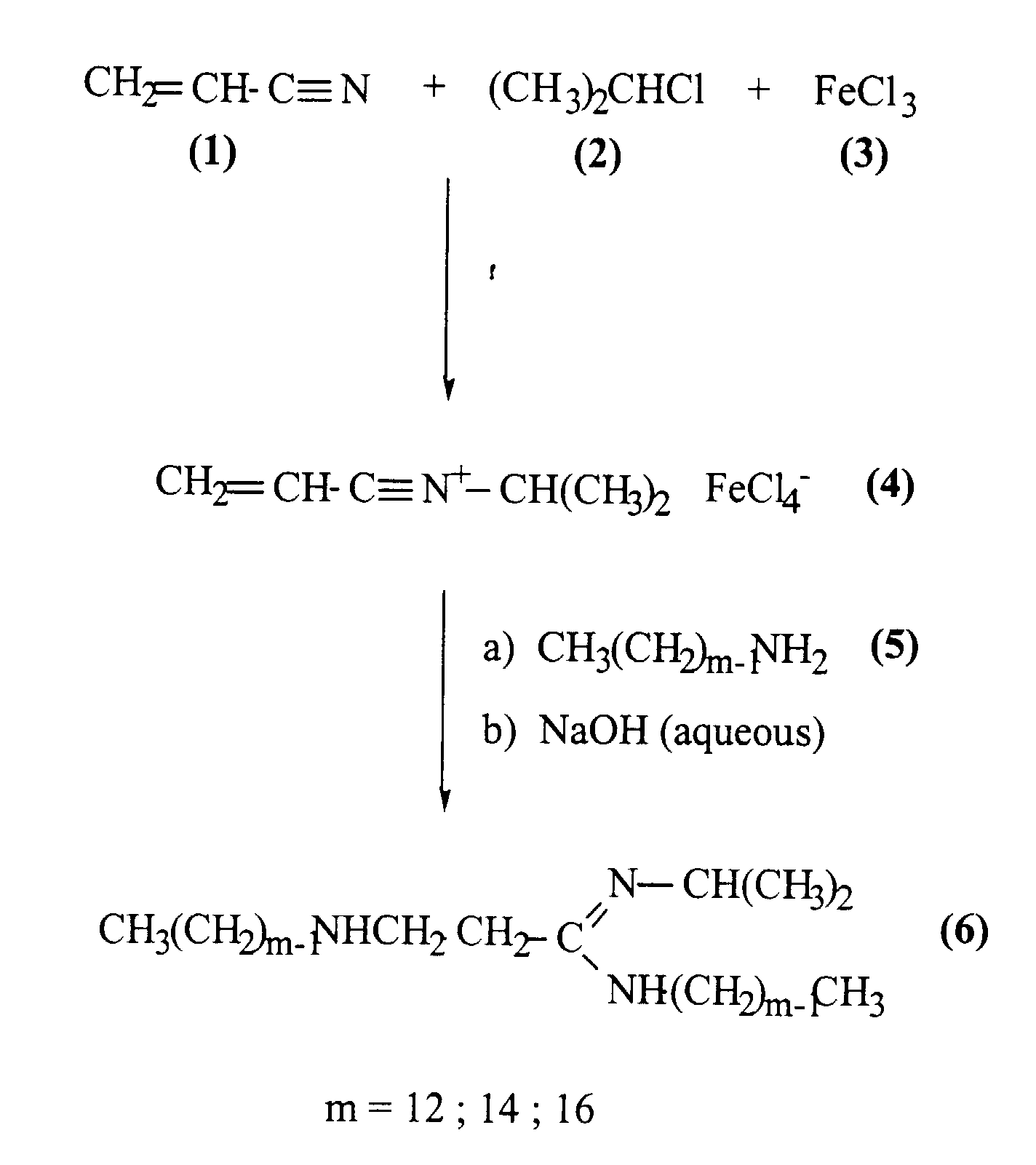
- Acrylonitrile is converted to a
nitrilium salt 4, which treated "in situ" with the alkylamine 5 gives in all cases the double-long-chain amidine 6 with yields depending on the chain length (see Table 1). - The following experimental procedure was used: 6,6 ml (0,1 mol) of acrylonitrile was added to 16,2 g (0,1 mol) of ferric chloride in 100 ml of isopropyl chloride cooled with an ice bath. The mixture was stirred under nitrogen for 1,5 hour. Excess isopropyl chloride was evaporated under vacuum. The residue, as represented by structure (4) was taken up in 100 ml of dichloromethane and the mixture cooled at -10 °C. Amine (5) (0,1 mol) in 150 ml of dichloromethane was added with stirring. After this addition, the mixture was kept overnight at room temperature with stirring. The mixture was then poored on 500 ml of 1,5 M aqueous sodium hydroxide cooled at 0 °C. The mixture is then separated after settling has taken place at room temperature. The aqueous phase is extracted twice with 100 ml of dichloromethane. The combined organic phases are dried over magnesium sulfate and then filtered. Evaporation of the solution gave the crude bouble long chain amino-amidine (5). It is taken up in hexane and filtered on an g-Tonerde alumina column. The filtrate is evaporated under vacuum and the residue crystallised from hexane in the refrigerator. It is recrystallised in the same solvent (see Table 1).
Synthesis of 3-alkylamino-N-isopropyl-N'-alkylpropionamidine (6) Alkylamine (5) Hexane and Al2O3 Yield in amidine (6) after 4 crystallisations m=12 - 30.4g-0.164 mol 50 ml - 200 g 2.1 g - 9 % m=14 - 35.0g-0.164 mol 50 ml - 200 g 3.1 g - 14 % m=16 - 39.6g-0.164 mol 50 ml - 200 g 1.8 g - 6 % - The physical, spectroscopic and analytical characteristics are given in Table 2.
Physical, analytical and spectroscopic data ofamidines (6) amidin e (6) m.p. (°C)a molecular formula M mass spectrum M+· 1H NMR(CDCl3 ; 250 MHz) m = 12 27 -28 C30H63N3
465.85465 3.73 (1H,s) ; 3.13 (2H,s) ; 2.79 (2H,t) 2.58 (2H,t) ; 2.35 (2H,t) ; 1.47 (4H,m) 1.26 (36H,s) ; 1.10 (6H,d) ; 0.88 (6H,t) m = 14 29 - 30 C34H71N3
521.96521 3.73 (1H,s) ; 3.14(2H,s) ; 2.79 (2H,t) 2.58 (2H,t) ; 2.34 (2H,t) ; 1.47 (4H, m) 1.26 (44H,s) ; 1.10 (6H,d) ; 0.88 (6H,t) m =16 38.5 - 39.5 C38H79N3
578.06577 3.74 (1H,s) ; 3.14 (2H,s) ; 2.78 (2H,t) 2.58 (2H,t) ; 2.34 (2H,t) ; 1.46 (4H,m) 1.26 (52H,s) ; 1.10 (6H,d) ; 0.88 (6H,t) - The procedures for the formation of the vesicles are given for the two following compounds :
- 3-tetradecylamino-N-isopropyl-N'-tetradecylpropionamidine (6, m=14, diC14-isop-amidine (1 mg/ml), and
- 3-hexadecylamino-N-isopropyl-N'-hexadecylpropionamidine, (6, m =16, diC16-isop-amidine (1 mg/ml),
- A solution of Vectamidine is prepared in ethanol (50mg/ml). Dissolving is enabled by heating briefly at 55 °C. Twenty microliters of this solution are rapidly injected, by means of a micropippet, into lml of HBS buffer (10 mM Hepes, 150 mM NaCl, adjusted at pH 7.3 by addition of concentrated NaOH), heated to 55 °C. During the operation, the solution is shaken on a vortex mixer. The resulting vesicle suspension (named "the suspension") is incubated for an additional 1 minute at 55 °C and shaken again for 20 seconds on the vortex mixer. The suspension is allowed to cool at room temperature (20 °C) before use. In a large number of experiments, the suspension was stored at 4 °C for several weeks but heating at 55 °C for 5 minutes and vortexing was necessary to restore the full transfecting activity.
- A solution of Vectamidine is prepared in ethanol (50mg/ml). Dissolving is enabled by heating briefly at 55 °C. If not used immediately, this solution is stored at -20 °C for better stability. Twenty microliters of this solution is placed in a lml propylene tube and ethanol is completely evaporated under a stream of dried nitrogen. One ml of HBS buffer is added and the tube is heated at 55 °C for 5 minutes. The tube is shaken vigorously on a vortex mixer for 20 seconds. The suspension is allowed to cool at room temperature (20 °C) before use.
- Transfection Procedures are given for the following cell lines : COS, CHO, BHK21, Hela, CV-1, NIH/3T3, HEK293.
- Cells are mycoplasma-free, grow at their normal rate and show no morphological signs of degenerescence before use.
- The transfection medium is defined as Dulbecco Modified Eagle Medium (DMEM) (Life Technologies 41965-039), without serum, without antibiotics with 20mM Hepes final conc. (from Hepes buffer, Life Technologies 15630-056).
- DNA is a pCMV-lacZ plasmid DNA reporter system. Efficient transfection was also demonstrated using other reporter system including pCMV-cat, pEGFP-N1 (Clontech) .
- Plasmid DNA is obtained by the techniques commonly used in biotechnology laboratory: briefly, E. Coli (DH5alpha or MM298) are transformed with the plasmid and grown in L. B. medium and plasmid purification is performed using the Qiagen kit (Qiagen) according the instructions of the manufacturer.
- Purity and integrity of the plasmid is checked by absorbance measurement at 260 and 280nm and agarose gel electrophoresis before use.
- The final DNA solution is prepared by diluting plasmid DNA (from a lmg/ml stock solution in 10mM Tris, lmM EDTA) in transfection medium to a concentration of 20µg/ml.
- Cells are routinely cultured in 75 cm2 culture flasks (Orange Scientific, 2010200) in a cell incubator with 5% CO2 and are passed every 2 days. The day before transfection, cells are briefly trypsinized (Trypsin-EDTA Life Technology 45300-027) and transfered to 96 wells plates (Orange Scientific, ref 2030100) at 1-2x10⁴ cells/well. Cell Status before transfection: 80% confluent after 24 hours culture.
- DMEM (Life Technologies 41965-039), without serum, without antibiotics with 20mM Hepes final conc. (Life Technologies 15630-056).
- Vectamidine /DNA ratio have been tested according to the following table.
Vectamidine /DNA ratio Volume of Vectamidine Volume of transfection medium 1/1 5 microliters 245 microliters 2/1 10 microliters 240 microliters 3/1 15 microliters 235 microliters 4/1 20 microliters 230 microliters 6/1 30 microliters 220 microliters 8/1 40 microliters 210 microliters - For each Vectamidine/DNA ratio mentioned in the table here-above, combine 250 µl of the corresponding Vectamidine solution with 250µl of DNA solution at 20 micrograms/ml in transfection medium into one sterile polystyrene tube and mix it gently but thoroughly.
- Incubate the resulting Vectamidine /DNA complexes solution at room temperature for 15 min.
- A few minutes before the Vectamidine /DNA complex formation is terminated, the medium is removed from the culture to be transfected and if cell adhesion is strong enough, the cells are washed with pre-warmed serum-free medium.
- When the Vectamidine /DNA complexes are formed, dilute it 5 fold in transfection medium.
- Gently aspirate the medium from culture vials and apply 100 microliters of the transfection solution onto the cells which have been grown in 96 wells plates.
- Incubate culture plates at 37 °C in a CO2 incubator for 30 min to 5 hours (2 to 3 hours were found optimal in most cases).
- Completely remove the medium containing the transfection solution and replace with the complete medium recommended for the cell line under study. If cell adhesion is strong enough at this step, one can wash one time with complete medium. For suspended cells, proceed the washing step by centrifugation. Omitting this step and maintaining Vectamidine in culture medium after transfection may result in cell toxicity.
- Culture cells in optimal conditions for growth and gene expression. For cells stopping growth while reaching confluence, cells are detached by trypsinization and transfer to larger dishes to allow optimal growth.
- After 48 hours culture in culture medium for gene expression, cell supernatants are discarded and cells are lysed in lysis buffer (see below) for 15 minutes at room temperature. the β-galactosidase activity resulting from lacZ gene expression is measured using the ONPG colorimetric assay (see below).
- Lysis buffer: 0.5%Triton X100 (Merck 11869) and 0.1% Na deoxycholate (Sigma D-6750)
- ONPG assay in 96 wells microtiter plates: Serial 2 fold dilutions of cell lysates are made (minimum 4 dil). To 50µl of cell lysate per well, 50µl of ONPG Mix are added and color development is monitored at 420nm in a microtiter plate reader till color development. Avoid saturation. Keep protected from light between measurements. Reaction is terminated by the addition of 100µl of 1M Na2CO3.
- ONPG Mix (prepared before use) : 0.2M Na phosphate pH7.0 (analytical grade), 2mM MgCl2 (analytical grade), 0.1M 2-mercaptoethanol (Sigma M-7154), 1.33mg/ml ONPG (2-nitrophenyl-β-D-galactopyranoside, Boerhinger Mannheim 810088)
- Standard curve: serial 2 fold dilutions of β-galactosidase (Boehringer Mannheim 105031, 1500U/ml) first dilution: 125mU/ml in lysis buffer, madebefore use.
-
- The general protocol of transfection given above is used except that all the cell washing and medium replacement steps are performed by transferring the cells in conical polystyrene tubes for centrifugation and resuspension in the desired medium. The K562 cells are cultured at 1 million cells in a 4 cm diameter dish before transfection. Two ml Vectamidine/DNA complex containing 5 micrograms plasmid and from 5 to 40 micrograms of Vectamidine are required for transfection of each 4 cm diameter dish. One dish is required for every transfection compound/DNA ratio tested.
- The standard transfection protocol described hereabove was followed.
- Transfection activity is indicated on the Y-scale (Beta-galactosidase units) of the Fig. 1.
- The standard transfection protocol described hereabove was followed.
- Transfection activity is indicated on the Y-scale (Beta-galactosidase units) of the Fig. 2.
- The standard transfection protocol described hreabove was followed.
- Transfection activity is indicated on the Y-scale (Beta-galactosidase units) of the Fig. 3.
- The BHK cells were distributed at 0.2 106 cells/well in 24 wells culture plate the day before transfection to reach an optimal confluency of 50-80% just before transfection.
- Before transfection, cells are pre-incubated in 0; 1; 4 or 8 µM colchicine in complete Glasgow culture medium supplemented with 25 mM Hepes, 2 mM Glutamine, 5% foetal bovine serum. Colchicine is added from a DMSO stock solution taking care not to raise the final DMSO concentration to more than 1% vol. After 1 hour preincubation, cells are washed with serum-free medium and overlayed with 500 µl/well of serum-free medium containing colchicine at 0; 1; 4 or 8 µM and with a
max 1% vol DMSO. The pCMV-lac Z (Clontech) was introduced into cells according to the transfection procedure. - Transfections were performed according to the above-described procedure and the enzymatic activity were measured according to the above-mentioned procedure.
- The Fig. 4 presents the transfection rate of the Lac I gene (expressed in mU/mg).
Claims (8)
- A compound of general formula :in which m = 12, 14, 16 or 18.

- A positively charged vesicle having a membrane comprising at least the compound of claim 1.
- A vector consisting of a positively charged vesicle comprising at least one compound of claim 1, said vesicle being combined with at least one molecule selected from the group consisting of nucleic acids molecules, antigen molecules, polypeptides, glycosylated polypeptides, proteins, glycosylated proteins, therapeutic agents and cosmetic agents.
- A process for the introduction of at least one molecule selected from the group consisting of nucleic acids molecules, antigen molecules, polypeptides, glycosylated polypeptides, proteins, glycosylated proteins, therapeutic agents and cosmetic agents, into a cell, in which said cell is brought into contact with said molecule and the compound of claim 1, the positively charged vesicle of claim 2 or the vector of claim 3.
- The process as claimed in claim 4, in which the cell is treated in vivo.
- The process as claimed in claim 4, in which the cell is treated in vitro.
- A cell transformed by the process as claimed in claims 4 to 6.
- A pharmaceutical composition comprising a product selected from the group consisting of :the vector(s) as claimed in claim 3, orthe cell(s) as claimed in claim 7.
Applications Claiming Priority (2)
| Application Number | Priority Date | Filing Date | Title |
|---|---|---|---|
| US5863697P | 1997-09-12 | 1997-09-12 | |
| US58636P | 1997-09-12 |
Publications (2)
| Publication Number | Publication Date |
|---|---|
| EP0902090A1 true EP0902090A1 (en) | 1999-03-17 |
| EP0902090B1 EP0902090B1 (en) | 2003-11-12 |
Family
ID=22018016
Family Applications (1)
| Application Number | Title | Priority Date | Filing Date |
|---|---|---|---|
| EP98870191A Expired - Lifetime EP0902090B1 (en) | 1997-09-12 | 1998-09-11 | Compound capable of introducing at least one molecule into a cell. |
Country Status (3)
| Country | Link |
|---|---|
| EP (1) | EP0902090B1 (en) |
| DE (1) | DE69819642T2 (en) |
| ES (1) | ES2210707T3 (en) |
Cited By (1)
| Publication number | Priority date | Publication date | Assignee | Title |
|---|---|---|---|---|
| WO2003094827A3 (en) * | 2002-05-07 | 2004-01-29 | Biotech Tools Sa | Dispersions of lipids for use as therapeutic and cosmetic agents and intracellular delivery vehicles |
Citations (2)
| Publication number | Priority date | Publication date | Assignee | Title |
|---|---|---|---|---|
| US3879460A (en) * | 1973-05-08 | 1975-04-22 | Union Carbide Corp | Synthesis of mono-di-, and tri-substituted amidines |
| WO1995017378A1 (en) * | 1993-12-20 | 1995-06-29 | Universite Libre De Bruxelles | Compound capable of introducing at least one molecule into a cell |
-
1998
- 1998-09-11 ES ES98870191T patent/ES2210707T3/en not_active Expired - Lifetime
- 1998-09-11 DE DE69819642T patent/DE69819642T2/en not_active Expired - Fee Related
- 1998-09-11 EP EP98870191A patent/EP0902090B1/en not_active Expired - Lifetime
Patent Citations (2)
| Publication number | Priority date | Publication date | Assignee | Title |
|---|---|---|---|---|
| US3879460A (en) * | 1973-05-08 | 1975-04-22 | Union Carbide Corp | Synthesis of mono-di-, and tri-substituted amidines |
| WO1995017378A1 (en) * | 1993-12-20 | 1995-06-29 | Universite Libre De Bruxelles | Compound capable of introducing at least one molecule into a cell |
Non-Patent Citations (2)
| Title |
|---|
| OUAHABI, A.E. ET AL.: "Double long-chain amidine liposome-mediated self replicating RNA transfection", FEBS LETTERS, vol. 380, 1996, pages 108 - 112, XP002089568 * |
| RUYSSCHAERT, J-M. ET AL.: "A novel cationic amphiphile for transfection of mammalian cells", BBRC, vol. 203, no. 3, 1994, pages 1622 - 1628, XP002089569 * |
Cited By (1)
| Publication number | Priority date | Publication date | Assignee | Title |
|---|---|---|---|---|
| WO2003094827A3 (en) * | 2002-05-07 | 2004-01-29 | Biotech Tools Sa | Dispersions of lipids for use as therapeutic and cosmetic agents and intracellular delivery vehicles |
Also Published As
| Publication number | Publication date |
|---|---|
| EP0902090B1 (en) | 2003-11-12 |
| DE69819642D1 (en) | 2003-12-18 |
| ES2210707T3 (en) | 2004-07-01 |
| DE69819642T2 (en) | 2004-10-07 |
Similar Documents
| Publication | Publication Date | Title |
|---|---|---|
| JP3887015B2 (en) | Novel compositions for introduction of polyanionic materials into cells | |
| EP2532649B1 (en) | Amino lipids, their synthesis and uses thereof | |
| US6153434A (en) | Methods for the intracellular delivery of substances | |
| US5785992A (en) | Compositions for the introduction of polyanionic materials into cells | |
| US5635487A (en) | Amphipathic, micellar delivery systems for biologically active polyions | |
| CN101370817B (en) | Cationic oligonucleotides, automated method for preparing cationic oligonucleotides and use thereof | |
| EP2966068A1 (en) | Synthesis and use of amino lipids | |
| EP1015470A1 (en) | Composition and method for delivery of nucleic acids | |
| EP0736002B1 (en) | Compound capable of introducing at least one molecule into a cell | |
| Yingyongnarongkul et al. | High transfection efficiency and low toxicity cationic lipids with aminoglycerol–diamine conjugate | |
| JP2001500162A (en) | Novel lipid conjugates for introducing at least one therapeutically active substance, in particular polynucleotides, into target cells and uses in gene therapy | |
| KR102829172B1 (en) | Amino lipid compound, method for preparing same, and application thereof | |
| AU723998B2 (en) | Compounds related to the amidinium family, pharmaceutical compositions containing same, and uses thereof | |
| EP0902090B1 (en) | Compound capable of introducing at least one molecule into a cell. | |
| EP3141582B1 (en) | Synthesis and use of polyalkylamines | |
| US6613351B1 (en) | Compound capable of introducing at least one molecule into a cell | |
| Groth et al. | Preparation and characterisation of a new lipospermine for gene delivery into various cell-lines | |
| US20030109699A1 (en) | Amphiphilic quinolylpolyamines as transfer agents for biologically active macromolecules | |
| Keil et al. | Novel lipophilic chloroquine analogues for a highly efficient gene transfer into gynecological tumors | |
| PL199213B1 (en) | Polyene macrolide derivatives, use for vectoring molecules | |
| JP2003502307A (en) | Polyhydroxydiamine surfactant and its use in gene transfer | |
| HK40058691B (en) | An amino liposome compound, preparation method thereof, and use thereof | |
| KR100381512B1 (en) | Cationic lipids and use thereof | |
| HK40058691A (en) | An amino liposome compound, preparation method thereof, and use thereof | |
| US20050048108A1 (en) | Sulphur-containing amphiphilic agents for the transfer of biologically active molecules into cells |
Legal Events
| Date | Code | Title | Description |
|---|---|---|---|
| PUAI | Public reference made under article 153(3) epc to a published international application that has entered the european phase |
Free format text: ORIGINAL CODE: 0009012 |
|
| AK | Designated contracting states |
Kind code of ref document: A1 Designated state(s): BE CH DE ES FR GB IT LI NL |
|
| AX | Request for extension of the european patent |
Free format text: AL;LT;LV;MK;RO;SI |
|
| 17P | Request for examination filed |
Effective date: 19990914 |
|
| AKX | Designation fees paid |
Free format text: BE CH DE ES FR GB IT LI NL |
|
| 17Q | First examination report despatched |
Effective date: 20020513 |
|
| RAP1 | Party data changed (applicant data changed or rights of an application transferred) |
Owner name: BIOTECH TOOLS S.A. |
|
| GRAP | Despatch of communication of intention to grant a patent |
Free format text: ORIGINAL CODE: EPIDOSNIGR1 |
|
| GRAS | Grant fee paid |
Free format text: ORIGINAL CODE: EPIDOSNIGR3 |
|
| GRAA | (expected) grant |
Free format text: ORIGINAL CODE: 0009210 |
|
| AK | Designated contracting states |
Kind code of ref document: B1 Designated state(s): BE CH DE ES FR GB IT LI NL |
|
| REG | Reference to a national code |
Ref country code: GB Ref legal event code: FG4D |
|
| REG | Reference to a national code |
Ref country code: CH Ref legal event code: EP |
|
| REF | Corresponds to: |
Ref document number: 69819642 Country of ref document: DE Date of ref document: 20031218 Kind code of ref document: P |
|
| REG | Reference to a national code |
Ref country code: CH Ref legal event code: NV Representative=s name: ROSENICH PAUL; GISLER CHRISTIAN PATENTBUERO PAUL R |
|
| REG | Reference to a national code |
Ref country code: ES Ref legal event code: FG2A Ref document number: 2210707 Country of ref document: ES Kind code of ref document: T3 |
|
| ET | Fr: translation filed | ||
| PLBE | No opposition filed within time limit |
Free format text: ORIGINAL CODE: 0009261 |
|
| STAA | Information on the status of an ep patent application or granted ep patent |
Free format text: STATUS: NO OPPOSITION FILED WITHIN TIME LIMIT |
|
| 26N | No opposition filed |
Effective date: 20040813 |
|
| PGFP | Annual fee paid to national office [announced via postgrant information from national office to epo] |
Ref country code: NL Payment date: 20060825 Year of fee payment: 9 Ref country code: FR Payment date: 20060825 Year of fee payment: 9 |
|
| PGFP | Annual fee paid to national office [announced via postgrant information from national office to epo] |
Ref country code: BE Payment date: 20060828 Year of fee payment: 9 |
|
| PGFP | Annual fee paid to national office [announced via postgrant information from national office to epo] |
Ref country code: GB Payment date: 20060829 Year of fee payment: 9 |
|
| PGFP | Annual fee paid to national office [announced via postgrant information from national office to epo] |
Ref country code: DE Payment date: 20060831 Year of fee payment: 9 |
|
| PGFP | Annual fee paid to national office [announced via postgrant information from national office to epo] |
Ref country code: ES Payment date: 20060914 Year of fee payment: 9 |
|
| PGFP | Annual fee paid to national office [announced via postgrant information from national office to epo] |
Ref country code: CH Payment date: 20060921 Year of fee payment: 9 |
|
| PGFP | Annual fee paid to national office [announced via postgrant information from national office to epo] |
Ref country code: IT Payment date: 20060930 Year of fee payment: 9 |
|
| BERE | Be: lapsed |
Owner name: S.A. *BIOTECH TOOLS Effective date: 20070930 |
|
| REG | Reference to a national code |
Ref country code: CH Ref legal event code: PL |
|
| GBPC | Gb: european patent ceased through non-payment of renewal fee |
Effective date: 20070911 |
|
| PG25 | Lapsed in a contracting state [announced via postgrant information from national office to epo] |
Ref country code: NL Free format text: LAPSE BECAUSE OF NON-PAYMENT OF DUE FEES Effective date: 20080401 |
|
| NLV4 | Nl: lapsed or anulled due to non-payment of the annual fee |
Effective date: 20080401 |
|
| PG25 | Lapsed in a contracting state [announced via postgrant information from national office to epo] |
Ref country code: LI Free format text: LAPSE BECAUSE OF NON-PAYMENT OF DUE FEES Effective date: 20070930 Ref country code: DE Free format text: LAPSE BECAUSE OF NON-PAYMENT OF DUE FEES Effective date: 20080401 Ref country code: CH Free format text: LAPSE BECAUSE OF NON-PAYMENT OF DUE FEES Effective date: 20070930 |
|
| PG25 | Lapsed in a contracting state [announced via postgrant information from national office to epo] |
Ref country code: BE Free format text: LAPSE BECAUSE OF NON-PAYMENT OF DUE FEES Effective date: 20070930 |
|
| REG | Reference to a national code |
Ref country code: FR Ref legal event code: ST Effective date: 20080531 |
|
| PG25 | Lapsed in a contracting state [announced via postgrant information from national office to epo] |
Ref country code: FR Free format text: LAPSE BECAUSE OF NON-PAYMENT OF DUE FEES Effective date: 20071001 |
|
| PG25 | Lapsed in a contracting state [announced via postgrant information from national office to epo] |
Ref country code: GB Free format text: LAPSE BECAUSE OF NON-PAYMENT OF DUE FEES Effective date: 20070911 |
|
| REG | Reference to a national code |
Ref country code: ES Ref legal event code: FD2A Effective date: 20070912 |
|
| PG25 | Lapsed in a contracting state [announced via postgrant information from national office to epo] |
Ref country code: ES Free format text: LAPSE BECAUSE OF NON-PAYMENT OF DUE FEES Effective date: 20070912 |
|
| PG25 | Lapsed in a contracting state [announced via postgrant information from national office to epo] |
Ref country code: IT Free format text: LAPSE BECAUSE OF NON-PAYMENT OF DUE FEES Effective date: 20070911 |