EP0902012A2 - Process for the preparation of aliphatic, unsaturated nitriles - Google Patents
Process for the preparation of aliphatic, unsaturated nitriles Download PDFInfo
- Publication number
- EP0902012A2 EP0902012A2 EP98116076A EP98116076A EP0902012A2 EP 0902012 A2 EP0902012 A2 EP 0902012A2 EP 98116076 A EP98116076 A EP 98116076A EP 98116076 A EP98116076 A EP 98116076A EP 0902012 A2 EP0902012 A2 EP 0902012A2
- Authority
- EP
- European Patent Office
- Prior art keywords
- oxides
- dehydration
- hydroxides
- catalysts
- reaction conditions
- Prior art date
- Legal status (The legal status is an assumption and is not a legal conclusion. Google has not performed a legal analysis and makes no representation as to the accuracy of the status listed.)
- Withdrawn
Links
- 238000000034 method Methods 0.000 title claims abstract description 21
- 150000002825 nitriles Chemical class 0.000 title claims abstract description 10
- 238000002360 preparation method Methods 0.000 title claims abstract description 4
- 125000001931 aliphatic group Chemical group 0.000 title description 4
- 230000018044 dehydration Effects 0.000 claims abstract description 20
- 238000006297 dehydration reaction Methods 0.000 claims abstract description 20
- 238000006243 chemical reaction Methods 0.000 claims abstract description 18
- 239000007789 gas Substances 0.000 claims abstract description 13
- 150000004679 hydroxides Chemical class 0.000 claims abstract description 12
- 150000002923 oximes Chemical class 0.000 claims abstract description 10
- 150000001875 compounds Chemical class 0.000 claims abstract description 8
- 239000007791 liquid phase Substances 0.000 claims abstract description 8
- 125000004432 carbon atom Chemical group C* 0.000 claims abstract description 7
- 239000002638 heterogeneous catalyst Substances 0.000 claims abstract description 5
- 125000000217 alkyl group Chemical group 0.000 claims abstract description 3
- 239000000470 constituent Substances 0.000 claims abstract description 3
- 125000000753 cycloalkyl group Chemical group 0.000 claims abstract description 3
- 125000004435 hydrogen atom Chemical group [H]* 0.000 claims abstract description 3
- 229920006395 saturated elastomer Polymers 0.000 claims abstract description 3
- 239000003054 catalyst Substances 0.000 claims description 22
- 229910044991 metal oxide Inorganic materials 0.000 claims description 9
- 150000004706 metal oxides Chemical class 0.000 claims description 9
- 239000012071 phase Substances 0.000 claims description 9
- LXFKDMGMYAHNAQ-WAKDDQPJSA-N CC(C)=CCC\C(C)=C\C=N/O Chemical compound CC(C)=CCC\C(C)=C\C=N/O LXFKDMGMYAHNAQ-WAKDDQPJSA-N 0.000 claims description 8
- VYPSYNLAJGMNEJ-UHFFFAOYSA-N Silicium dioxide Chemical compound O=[Si]=O VYPSYNLAJGMNEJ-UHFFFAOYSA-N 0.000 claims description 7
- GWEVSGVZZGPLCZ-UHFFFAOYSA-N Titan oxide Chemical compound O=[Ti]=O GWEVSGVZZGPLCZ-UHFFFAOYSA-N 0.000 claims description 6
- 239000000203 mixture Substances 0.000 claims description 6
- 239000002904 solvent Substances 0.000 claims description 6
- 239000003513 alkali Substances 0.000 claims description 5
- HLCSDJLATUNSSI-JXMROGBWSA-N (2e)-3,7-dimethylocta-2,6-dienenitrile Chemical compound CC(C)=CCC\C(C)=C\C#N HLCSDJLATUNSSI-JXMROGBWSA-N 0.000 claims description 4
- 235000012239 silicon dioxide Nutrition 0.000 claims description 4
- MCMNRKCIXSYSNV-UHFFFAOYSA-N ZrO2 Inorganic materials O=[Zr]=O MCMNRKCIXSYSNV-UHFFFAOYSA-N 0.000 claims description 3
- TWNQGVIAIRXVLR-UHFFFAOYSA-N oxo(oxoalumanyloxy)alumane Chemical compound O=[Al]O[Al]=O TWNQGVIAIRXVLR-UHFFFAOYSA-N 0.000 claims description 3
- RVTZCBVAJQQJTK-UHFFFAOYSA-N oxygen(2-);zirconium(4+) Chemical compound [O-2].[O-2].[Zr+4] RVTZCBVAJQQJTK-UHFFFAOYSA-N 0.000 claims description 3
- 239000000377 silicon dioxide Substances 0.000 claims description 3
- 239000004408 titanium dioxide Substances 0.000 claims description 3
- 229910052747 lanthanoid Inorganic materials 0.000 claims description 2
- 150000002602 lanthanoids Chemical class 0.000 claims description 2
- 239000007788 liquid Substances 0.000 claims description 2
- 229910000287 alkaline earth metal oxide Inorganic materials 0.000 claims 6
- 230000000737 periodic effect Effects 0.000 claims 2
- 208000005156 Dehydration Diseases 0.000 description 13
- VLKZOEOYAKHREP-UHFFFAOYSA-N n-Hexane Chemical compound CCCCCC VLKZOEOYAKHREP-UHFFFAOYSA-N 0.000 description 5
- 229910000000 metal hydroxide Inorganic materials 0.000 description 4
- SJRJJKPEHAURKC-UHFFFAOYSA-N N-Methylmorpholine Chemical compound CN1CCOCC1 SJRJJKPEHAURKC-UHFFFAOYSA-N 0.000 description 3
- KWYUFKZDYYNOTN-UHFFFAOYSA-M Potassium hydroxide Chemical compound [OH-].[K+] KWYUFKZDYYNOTN-UHFFFAOYSA-M 0.000 description 3
- YXFVVABEGXRONW-UHFFFAOYSA-N Toluene Chemical compound CC1=CC=CC=C1 YXFVVABEGXRONW-UHFFFAOYSA-N 0.000 description 3
- 238000009835 boiling Methods 0.000 description 3
- 239000000969 carrier Substances 0.000 description 3
- 238000004821 distillation Methods 0.000 description 3
- 238000005342 ion exchange Methods 0.000 description 3
- IJGRMHOSHXDMSA-UHFFFAOYSA-N Atomic nitrogen Chemical compound N#N IJGRMHOSHXDMSA-UHFFFAOYSA-N 0.000 description 2
- IMNFDUFMRHMDMM-UHFFFAOYSA-N N-Heptane Chemical compound CCCCCCC IMNFDUFMRHMDMM-UHFFFAOYSA-N 0.000 description 2
- SECXISVLQFMRJM-UHFFFAOYSA-N N-Methylpyrrolidone Chemical compound CN1CCCC1=O SECXISVLQFMRJM-UHFFFAOYSA-N 0.000 description 2
- 239000005662 Paraffin oil Substances 0.000 description 2
- 125000003118 aryl group Chemical group 0.000 description 2
- 239000002585 base Substances 0.000 description 2
- 229910001038 basic metal oxide Inorganic materials 0.000 description 2
- 229930195733 hydrocarbon Natural products 0.000 description 2
- 150000002430 hydrocarbons Chemical class 0.000 description 2
- 238000005470 impregnation Methods 0.000 description 2
- 229910021645 metal ion Inorganic materials 0.000 description 2
- 150000004767 nitrides Chemical class 0.000 description 2
- 239000003921 oil Substances 0.000 description 2
- 239000011541 reaction mixture Substances 0.000 description 2
- LXFKDMGMYAHNAQ-AMMQDNIMSA-N (ne)-n-[(2e)-3,7-dimethylocta-2,6-dienylidene]hydroxylamine Chemical compound CC(C)=CCC\C(C)=C\C=N\O LXFKDMGMYAHNAQ-AMMQDNIMSA-N 0.000 description 1
- CYSGHNMQYZDMIA-UHFFFAOYSA-N 1,3-Dimethyl-2-imidazolidinon Chemical compound CN1CCN(C)C1=O CYSGHNMQYZDMIA-UHFFFAOYSA-N 0.000 description 1
- 229910052684 Cerium Inorganic materials 0.000 description 1
- 235000015655 Crocus sativus Nutrition 0.000 description 1
- 244000124209 Crocus sativus Species 0.000 description 1
- 244000166675 Cymbopogon nardus Species 0.000 description 1
- 235000018791 Cymbopogon nardus Nutrition 0.000 description 1
- 229910052692 Dysprosium Inorganic materials 0.000 description 1
- 229910052691 Erbium Inorganic materials 0.000 description 1
- 229910052693 Europium Inorganic materials 0.000 description 1
- 229910052688 Gadolinium Inorganic materials 0.000 description 1
- 229910052689 Holmium Inorganic materials 0.000 description 1
- 229910052765 Lutetium Inorganic materials 0.000 description 1
- 244000179970 Monarda didyma Species 0.000 description 1
- 235000010672 Monarda didyma Nutrition 0.000 description 1
- 229910052779 Neodymium Inorganic materials 0.000 description 1
- 229910052777 Praseodymium Inorganic materials 0.000 description 1
- 229910052772 Samarium Inorganic materials 0.000 description 1
- 229910052771 Terbium Inorganic materials 0.000 description 1
- 229910052775 Thulium Inorganic materials 0.000 description 1
- 229910052769 Ytterbium Inorganic materials 0.000 description 1
- 230000002378 acidificating effect Effects 0.000 description 1
- 229910052782 aluminium Inorganic materials 0.000 description 1
- XAGFODPZIPBFFR-UHFFFAOYSA-N aluminium Chemical compound [Al] XAGFODPZIPBFFR-UHFFFAOYSA-N 0.000 description 1
- 229910052788 barium Inorganic materials 0.000 description 1
- 229910052790 beryllium Inorganic materials 0.000 description 1
- 230000015572 biosynthetic process Effects 0.000 description 1
- 229910052792 caesium Inorganic materials 0.000 description 1
- 238000001354 calcination Methods 0.000 description 1
- 229910052791 calcium Inorganic materials 0.000 description 1
- 239000012876 carrier material Substances 0.000 description 1
- 230000003197 catalytic effect Effects 0.000 description 1
- 239000007795 chemical reaction product Substances 0.000 description 1
- 239000003153 chemical reaction reagent Substances 0.000 description 1
- 239000004927 clay Substances 0.000 description 1
- GUJOJGAPFQRJSV-UHFFFAOYSA-N dialuminum;dioxosilane;oxygen(2-);hydrate Chemical compound O.[O-2].[O-2].[O-2].[Al+3].[Al+3].O=[Si]=O.O=[Si]=O.O=[Si]=O.O=[Si]=O GUJOJGAPFQRJSV-UHFFFAOYSA-N 0.000 description 1
- GUVUOGQBMYCBQP-UHFFFAOYSA-N dmpu Chemical compound CN1CCCN(C)C1=O GUVUOGQBMYCBQP-UHFFFAOYSA-N 0.000 description 1
- 230000000694 effects Effects 0.000 description 1
- 125000000524 functional group Chemical group 0.000 description 1
- XLYOFNOQVPJJNP-UHFFFAOYSA-M hydroxide Chemical compound [OH-] XLYOFNOQVPJJNP-UHFFFAOYSA-M 0.000 description 1
- 150000002500 ions Chemical class 0.000 description 1
- 229910052746 lanthanum Inorganic materials 0.000 description 1
- 229910052744 lithium Inorganic materials 0.000 description 1
- 229910052749 magnesium Inorganic materials 0.000 description 1
- 238000004519 manufacturing process Methods 0.000 description 1
- 239000000463 material Substances 0.000 description 1
- 229910052751 metal Inorganic materials 0.000 description 1
- 239000002184 metal Substances 0.000 description 1
- 150000002736 metal compounds Chemical class 0.000 description 1
- 150000002739 metals Chemical class 0.000 description 1
- 230000004048 modification Effects 0.000 description 1
- 238000012986 modification Methods 0.000 description 1
- 229910052757 nitrogen Inorganic materials 0.000 description 1
- 239000012454 non-polar solvent Substances 0.000 description 1
- TVMXDCGIABBOFY-UHFFFAOYSA-N octane Chemical compound CCCCCCCC TVMXDCGIABBOFY-UHFFFAOYSA-N 0.000 description 1
- DNNLEMIRRGUGOZ-UHFFFAOYSA-N oxygen(2-);thorium(4+) Chemical class [O-2].[O-2].[Th+4] DNNLEMIRRGUGOZ-UHFFFAOYSA-N 0.000 description 1
- 239000012188 paraffin wax Substances 0.000 description 1
- 229910052700 potassium Inorganic materials 0.000 description 1
- 239000000047 product Substances 0.000 description 1
- 239000010453 quartz Substances 0.000 description 1
- 229910052701 rubidium Inorganic materials 0.000 description 1
- 239000004248 saffron Substances 0.000 description 1
- 235000013974 saffron Nutrition 0.000 description 1
- 229910052708 sodium Inorganic materials 0.000 description 1
- 239000007858 starting material Substances 0.000 description 1
- 238000003860 storage Methods 0.000 description 1
- 229910052712 strontium Inorganic materials 0.000 description 1
- 239000013589 supplement Substances 0.000 description 1
- 238000003786 synthesis reaction Methods 0.000 description 1
- 229910003452 thorium oxide Inorganic materials 0.000 description 1
- XLYOFNOQVPJJNP-UHFFFAOYSA-N water Substances O XLYOFNOQVPJJNP-UHFFFAOYSA-N 0.000 description 1
- 239000010457 zeolite Substances 0.000 description 1
Classifications
-
- C—CHEMISTRY; METALLURGY
- C07—ORGANIC CHEMISTRY
- C07C—ACYCLIC OR CARBOCYCLIC COMPOUNDS
- C07C253/00—Preparation of carboxylic acid nitriles
Definitions
- the invention relates to the production of aliphatic, unsaturated Nitriles from unsaturated aldoximes by catalytic Dehydration in the gas or liquid phase via oxidic, carbide or nitride supported catalysts with Metal oxide or hydroxide bases are doped, or over basic Full metal oxide contacts.
- a newer method according to is of particular interest WO 9302046-A1, in the case of citraloxime (3,7-dimethyl-octa-2,6-dienaloxime) with potassium hydroxide in toluene under circling water is dehydrated.
- citraloxime (3,7-dimethyl-octa-2,6-dienaloxime) with potassium hydroxide in toluene under circling water is dehydrated.
- this method has the disadvantage that it is less easy to carry out on an industrial scale, for which processes over heterogeneous catalysts are preferred.
- the MN Rao et al. in Org. Prep. Proced. Int. 21 , 230-232 (1989) described gas phase dehydration of aromatic and aliphatic aldoximes over Cs-X zeolites high temperatures of over 300 ° C required.
- the task was therefore to propose a method that the dehydration of unsaturated aldoximes over heterogeneous Catalysts at relatively low temperatures, short residence times and allowed in good yields.
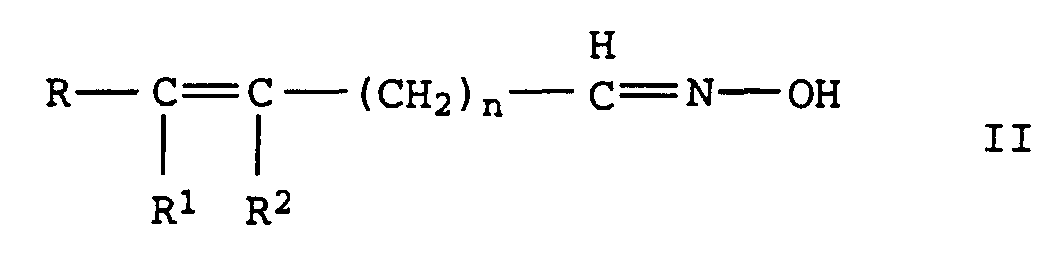
- R, R 1 and R 2 independently of one another denote alkyl or alkenyl radicals having 1 to 20 C atoms or cycloalkyl or cycloalkenyl radicals having 3 to 12 C atoms, in each case 2 of the radicals R, R 1 and R 2 being constituents of one can be saturated or unsaturated ring and where R 1 and R 2 can also represent a hydrogen atom and n denotes the values 0 or 1 to 20, in particular 0 or 1 to 7, by dehydration of oximes of the formula II in which R, R 1 , R 2 and n have the meanings given above, characterized in that the dehydration in the gas or liquid phase is carried out at temperatures of 150 to 300 ° C over a heterogeneous catalyst which consists of an oxidic, carbidic or nitridic carrier which is mixed with basic oxides and / or hydroxides or with
- This are e.g. Angelicaoxime, aleprinoxime, ⁇ , ⁇ -apocitronellaloxime, Bergamote oxime, pyrexine oxime, camphole oxime, citronella aloxime, Citraloxime, chrysanthemoxime, cyclocitraloxime, cyclolavandulaloxime, Faranaloxim, Farnesaloxim, Isolauranaloxim, Ikemaoxim, Myrthen aloxime, phellandrin oxime, saffron aloxime and sorbinal oxime.
- angelicaoxime bergamot oxime, cyclolavandulaloxime, Citraloxime, farnesaloxime, ikemaoxime, isolauranaloxime, Phellandrinoxime and Sorbinaloxim to name.
- Citraloxime from the geranonitrile is particularly suitable arises.
- Suitable catalysts are generally supported catalyst doped with basic metal oxides or hydroxides. Doping is not only understood to mean the application of the metal oxides or hydroxides, but also the ion exchange with, for example, alkali or alkaline earth ions in the case of carrier materials suitable for ion exchange.
- the carriers are, as is usually the case, oxidic, carbide or nitride in nature.
- metal oxides of metals from groups Ib to VIIb, VIII and IIIa to Va, in particular IIIb to VIIb, VIII, IIIa and IVa and mixtures thereof are preferred as carriers. It is not critical whether the metal oxides are crystalline or amorphous by X-ray.
- the supports generally have a BET surface area of 0.1 to 500, preferably 1 to 400 m 2 / g.
- the catalyst carriers must contain 300 ° C with basic metal oxides or hydroxides, or with metal compounds that these under Form reaction conditions, be doped.
- metal ions are used to dope the oxidic masses selected from group Ia, IIa to VIII and IIb to Vb, in particular IIb or IIIb, and consisting of the group of lanthanides from La, Ce, Pr, Nd, Sm, Eu, Gd, Tb, Dy, Ho, Er, Tm, Yb, Lu and mixtures thereof.
- the metal ions are preferred Group Ia consisting of Li, Na, K, Rb, Cs and Group IIa from Be, Mg, Ca, Sr, Ba.
- the content of basic oxides / hydroxides, based on the catalyst and calculated as oxides, lies between 0.1 and 50% by weight, preferably 0.2 and 40% by weight, particularly preferably 0.3 and 30% by weight and in particular between 1 to 10% by weight.
- the doping of the oxidic base materials can be carried out by known Processes such as impregnation, impregnation or ion exchange, respectively.
- the catalysts are in after the doping procedure usually dried and then calcined.
- the calcining temperature is usually between 150 and 800 ° C, preferred between 150 and 700 ° C, and particularly preferably between 300 and 650 ° C.
- the dehydration of the unsaturated aldoximes to the corresponding ones Nitriles are generally at 0.5 to 5 bar and Temperatures of 150 to 300 ° C, preferably 200 to 250 ° C, to some extent or carried out in continuous form, the continuous operation is particularly preferred.
- the implementation of aldoximes is suitable for continuous implementation on the fixed bed in the gas phase or in the liquid phase and in the Gas phase at the fluidized bed.
- the reaction according to the invention can be carried out in the presence or absence of solvents.
- Non-polar solvents which are vaporous under the reaction conditions, are primarily used for the dehydration over a fixed catalyst in the gas phase.
- Suitable solvents are, for example, hydrocarbons with up to 12 carbon atoms, such as hexane, heptane or octane.
- Solvents which are liquid below the reaction temperatures are suitable for the reaction in the liquid phase. These are primarily higher-boiling hydrocarbons such as paraffin oils and white oils with a boiling point, for example, of over 300 ° C.
- polar medium and high boiling solvents which are can be separated from the product by distillation Consider such as N-methylpyrrolidone, N-methylmorpholine, dimethylpropyleneurea or dimethylethylene urea.
- the unsaturated nitriles to be produced according to the invention Formula II are in excellent space-time yield with short Residence times in the reactor and very good selectivities with good Get sales.
- Citraloxime was dehydrated in a laboratory-scale gas phase apparatus under the following standard conditions: From a 100 ml dropping funnel between 13 and 26 ml / h feed in the form of pure citraloxime (E, Z mixture) or as a solution (1: 1) in N-methylpyrrolidone or n-hexane with a metering pump into the preheating zone of the gas phase reactor (total length 500 mm, including 200 mm preheating section, 300 ml reaction zone, diameter 30 mm). The reactor was heated with a divided, electrically heated quartz furnace, the preheating section being heated to about 210 ° C. with 500 W and the reaction zone being heated to 250 ° C. with 1000 W.
- the temperature regulation and control was carried out with Pt-100 thermocouples in a thermal sleeve (diameter 6.5 mm) in the longitudinal axis of the reactor.
- the reaction mixture was reacted with 100 ml of catalyst (strands) under a controllable nitrogen stream (5 to 20 l / h, measured using a rotameter).
- the gaseous reaction discharge was condensed on an energy ball cooler with a downstream CO 2 cooler and collected in a storage vessel.
- the reaction products for isolating the geranonitrile are worked up by distillation.
- Example 2 In an apparatus as described in Example 1, a mixture of 10% by weight of citraloxime in paraffin oil was reacted over a catalyst (5% BaO on ZrO 2 ) under normal pressure.
- the temperature of the preheater was 150-220 ° C and the reactor temperature was 220 ° C.
- the feed was 239 ml / h, so that a conversion of 98% was achieved with a catalyst load of 0.95 kg / l ⁇ h.
- the geranonitrile was separated from the paraffin oil from the reaction mixture emerging from the reactor on a wiper blade evaporator. The yield of the nitrile thus obtained, which can be further purified by distillation, was greater than 90%.
Landscapes
- Chemical & Material Sciences (AREA)
- Organic Chemistry (AREA)
- Organic Low-Molecular-Weight Compounds And Preparation Thereof (AREA)
- Low-Molecular Organic Synthesis Reactions Using Catalysts (AREA)
- Catalysts (AREA)
Abstract
Verfahren zur Herstellung von ungesättigten Nitrilen der Formel I
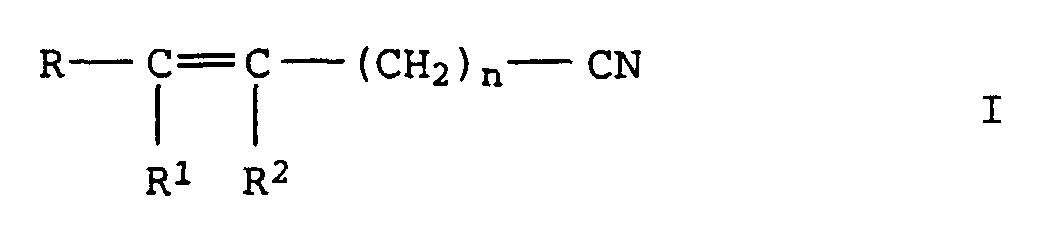
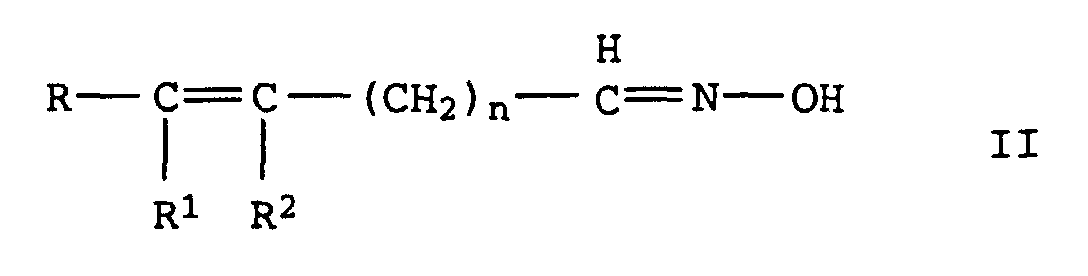
dadurch gekennzeichnet, daß man die Dehydratisierung in der Gas- oder
Flüssigphase bei Temperaturen von 150 bis 300°C über einem
heterogenen Katalysator durchführt, der aus einem oxidischen,
carbidischen oder nitridischem Träger besteht, der mit basischen
Oxiden und/oder Hydroxiden oder mit Verbindungen, die unter den
Reaktionsbedingungen in diese übergehen, dotiert ist, oder der
aus den basischen Oxiden besteht.Process for the preparation of unsaturated nitriles of the formula I.
characterized in that the dehydration in the gas or liquid phase is carried out at temperatures of 150 to 300 ° C over a heterogeneous catalyst which consists of an oxidic, carbidic or nitridic carrier which is mixed with basic oxides and / or hydroxides or with compounds, which pass into it under the reaction conditions, is doped, or consists of the basic oxides.
Description
Die Erfindung betrifft die Herstellung aliphatischer, ungesättigter Nitrile aus ungesättigten Aldoximen durch katalytische Dehydratisierung in der Gas- oder Flüssigphase über oxidischen, carbidischen oder nitridischen Trägerkatalysatoren, die mit Metalloxid- oder -hydroxidbasen dotiert sind, oder über basischen Metalloxid-Vollkontakten.The invention relates to the production of aliphatic, unsaturated Nitriles from unsaturated aldoximes by catalytic Dehydration in the gas or liquid phase via oxidic, carbide or nitride supported catalysts with Metal oxide or hydroxide bases are doped, or over basic Full metal oxide contacts.
Die Dehydratisierung von Aldoximen zu Nitrilen ist in der Fachliteratur eingehend beschrieben. Eine zusammenfassende Darstellung mehrerer Methoden unter Verwendung verschiedener Reagenzien findet man bei A.J. Fatiadi in The Chemistry of Triple Bonded Functional Groups, Supplement D, Part 2, 1057-1303, S. Patai und Z. Rappoport, Eds. John-Wiley New York, 1983.The dehydration of aldoximes to nitriles is in the Technical literature described in detail. A summary Representation of several methods using different Reagents can be found at A.J. Fatiadi in The Chemistry of Triple Bonded Functional Groups, Supplement D, Part 2, 1057-1303, S. Patai and Z. Rappoport, Eds. John-Wiley New York, 1983.
Von besonderem Interesse ist eine neuere Methode gemäß WO 9302046-A1, bei der Citraloxim (3,7-Dimethyl-octa-2,6-dienaloxim) mit Kaliumhydroxid in Toluol unter Wasserauskreisen dehydratisiert wird. Diese Methode hat allerdings den Nachteil, daß sie weniger gut in großtechnischem Maßstab durchzuführen ist, wofür Verfahren über heterogenen Katalysatoren bevorzugt werden.A newer method according to is of particular interest WO 9302046-A1, in the case of citraloxime (3,7-dimethyl-octa-2,6-dienaloxime) with potassium hydroxide in toluene under circling water is dehydrated. However, this method has the disadvantage that it is less easy to carry out on an industrial scale, for which processes over heterogeneous catalysts are preferred.
Die bisher beschriebenen Dehydratisierungen über heterogenen Katalysatoren, das ist in der Regel in der Gasphase, sind jedoch noch nicht befriedigend.The previously described dehydrations over heterogeneous However, catalysts are usually in the gas phase not yet satisfactory.
So sind bei der von M.N. Rao et al. in Org. Prep. Proced. Int. 21, 230-232 (1989) beschriebenen Gasphasen-Dehydratisierung aromatischer und aliphatischer Aldoxime über Cs-X-Zeolithen hohe Temperaturen von über 300°C erforderlich.For example, the MN Rao et al. in Org. Prep. Proced. Int. 21 , 230-232 (1989) described gas phase dehydration of aromatic and aliphatic aldoximes over Cs-X zeolites high temperatures of over 300 ° C required.
Weiterhin ist in Houben-Weyl, Bd. 8 S. 326 ff, über die Dehydratisierung von Oximen zu Nitrilen an Aluminium- oder Thoriumoxiden bei hohen Temperaturen, das ist über 340°C, referiert.Furthermore, in Houben-Weyl, Vol. 8 p. 326 ff, on dehydration from oximes to nitriles on aluminum or thorium oxides at high temperatures, which is above 340 ° C.
Zur Vermeidung dieser hohen Temperaturen wurde darauf von H.M. Meshram in Synthesis (1992), 943-944 vorgeschlagen, für die Gasphasendehydratisierung von aromatischen oder gesättigten aliphatischen Aldoximen Montmorillonit KSF (das ist ein saure Zentren aufweisender Ton) als Katalysator zu verwenden. Damit verläuft die Umsetzung zwar bei niedrigeren Temperaturen, jedoch macht die unzureichende Raum-Zeit-Ausbeute dieses Verfahren wirtschaftlich unattraktiv. To avoid these high temperatures, care was taken HM. Meshram in Synthesis (1992), 943-944, suggested for the gas phase dehydration of aromatic or saturated aliphatic aldoximes montmorillonite KSF (which is an acidic Centered clay) to use as a catalyst. In order to the reaction proceeds at lower temperatures, however the insufficient space-time yield makes this process economical unattractive.
Es bestand daher die Aufgabe, ein Verfahren vorzuschlagen, das die Dehydratisierung von ungesättigten Aldoximen über heterogenen Katalysatoren bei relativ niedrigen Temperaturen, kurzer Verweilzeit und in guten Ausbeuten erlaubt.The task was therefore to propose a method that the dehydration of unsaturated aldoximes over heterogeneous Catalysts at relatively low temperatures, short residence times and allowed in good yields.
Diese Aufgabe wurde erfindungsgemäß gelöst mit einem Verfahren
zur Herstellung von ungesättigten Nitrilen der Formel I
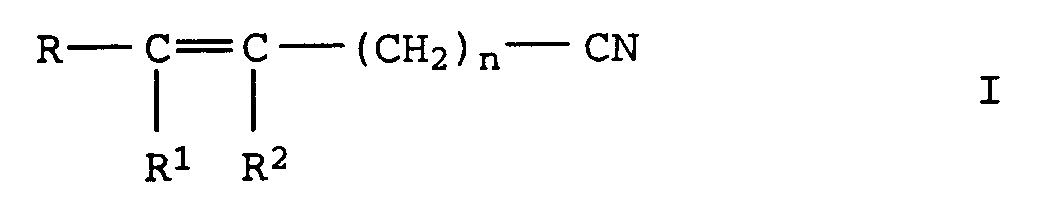
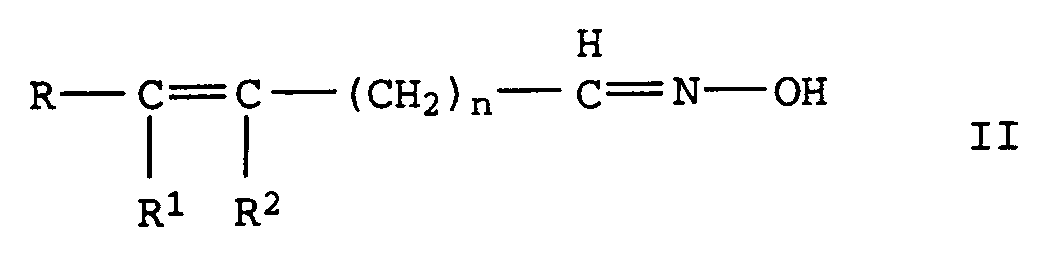
dadurch gekennzeichnet, daß man die Dehydratisierung in der Gas- oder
Flüssigphase bei Temperaturen von 150 bis 300°C über einem
heterogenen Katalysator durchführt, der aus einem oxidischen,
carbidischen oder nitridischem Träger besteht, der mit basischen
Oxiden und/oder Hydroxiden oder mit Verbindungen, die unter den
Reaktionsbedingungen in diese übergehen, dotiert ist, oder der
aus den basischen Oxiden besteht.This object was achieved according to the invention with a process for the preparation of unsaturated nitriles of the formula I.
characterized in that the dehydration in the gas or liquid phase is carried out at temperatures of 150 to 300 ° C over a heterogeneous catalyst which consists of an oxidic, carbidic or nitridic carrier which is mixed with basic oxides and / or hydroxides or with compounds, which pass into it under the reaction conditions, is doped, or consists of the basic oxides.
Als Ausgangsmaterialien der Formel II kommen vor allem Verbindungen mit n = 0 bzw. n = 1 bis n = 7 in Betracht. Dies sind z.B. Angelicaoxim, Aleprinoxim, α,β-Apocitronellaloxim, Bergamotenoxim, Brenzterebinoxim, Campholenoxim, Citronellaloxim, Citraloxim, Chrysanthemoxim, Cyclocitraloxim, Cyclolavandulaloxim, Faranaloxim, Farnesaloxim, Isolauranaloxim, Ikemaoxim, Myrthenaloxim, Phellandrinoxim, Safranaloxim und Sorbinaloxim.Compounds come primarily as starting materials of the formula II with n = 0 or n = 1 to n = 7. This are e.g. Angelicaoxime, aleprinoxime, α, β-apocitronellaloxime, Bergamote oxime, pyrexine oxime, camphole oxime, citronella aloxime, Citraloxime, chrysanthemoxime, cyclocitraloxime, cyclolavandulaloxime, Faranaloxim, Farnesaloxim, Isolauranaloxim, Ikemaoxim, Myrthen aloxime, phellandrin oxime, saffron aloxime and sorbinal oxime.
Vorzugsweise verwendet man solche Verbindungen der Formel I, in der n = 0 bedeutet. Such compounds of the formula I are preferably used in which means n = 0.
Im einzelnen sind Angelicaoxim, Bergamotenoxim, Cyclolavandulaloxim, Citraloxim, Farnesaloxim, Ikemaoxim, Isolauranaloxim, Phellandrinoxim und Sorbinaloxim zu nennen. Insbesondere kommt Citraloxim in Betracht, aus dem Geranonitril entsteht.In particular, angelicaoxime, bergamot oxime, cyclolavandulaloxime, Citraloxime, farnesaloxime, ikemaoxime, isolauranaloxime, Phellandrinoxime and Sorbinaloxim to name. Citraloxime from the geranonitrile is particularly suitable arises.
Als Katalysatoren kommen allgemein mit basischen Metalloxiden
oder -hydroxiden dotierte Trägerkatalysatoren in Betracht. Unter
Dotierung wird dabei nicht nur das Aufbringen der Metalloxide
oder -hydroxide verstanden, sondern auch der Ionenaustausch gegen
z.B. Alkali- oder Erdalkaliionen bei für den Ionenaustausch
geeigneten Trägermaterialien.
Die Träger sind, wie meist üblich, oxidischer, carbidischer oder
nitridischer Natur. Bevorzugt werden jedoch als Träger Metalloxide
von Metallen der Gruppen Ib bis VIIb, VIII und IIIa bis
Va, insbesondere IIIb bis VIIb, VIII, IIIa und IVa sowie deren
Mischungen.
Dabei ist es unkritisch, ob die Metalloxide röntgenographisch
kristallin oder amorph sind.Suitable catalysts are generally supported catalyst doped with basic metal oxides or hydroxides. Doping is not only understood to mean the application of the metal oxides or hydroxides, but also the ion exchange with, for example, alkali or alkaline earth ions in the case of carrier materials suitable for ion exchange.
The carriers are, as is usually the case, oxidic, carbide or nitride in nature. However, metal oxides of metals from groups Ib to VIIb, VIII and IIIa to Va, in particular IIIb to VIIb, VIII, IIIa and IVa and mixtures thereof are preferred as carriers.
It is not critical whether the metal oxides are crystalline or amorphous by X-ray.
Im einzelnen sind vor allem Aluminiumoxid, Siliciumdioxid, Titandioxid und Zirkondioxid in beliebigen Modifikationen zu nennen. Die Träger haben im allgemeinen eine BET-Oberfläche von 0,1 bis 500, vorzugsweise 1 bis 400 m2/g.In particular, aluminum oxide, silicon dioxide, titanium dioxide and zirconium dioxide can be mentioned in any modifications. The supports generally have a BET surface area of 0.1 to 500, preferably 1 to 400 m 2 / g.
Zur Entfaltung der Dehydratisierungsaktivität im Bereich unterhalb 300°C müssen die Katalysatorträger mit basischen Metalloxiden oder -hydroxiden, oder mit Metallverbindungen, die diese unter Reaktionsbedingungen bilden, dotiert sein.To develop the dehydration activity in the area below The catalyst carriers must contain 300 ° C with basic metal oxides or hydroxides, or with metal compounds that these under Form reaction conditions, be doped.
Diese Metallionen zur Dotierung der oxidischen Massen werden ausgewählt aus der Gruppe Ia, IIa bis VIII und IIb bis Vb, insbesondere IIb oder IIIb, sowie aus der Gruppe der Lanthaniden bestehend aus La, Ce, Pr, Nd, Sm, Eu, Gd, Tb, Dy, Ho, Er, Tm, Yb, Lu sowie Mischungen daraus. Bevorzugt sind die Metallionen der Gruppe Ia bestehend aus Li, Na, K, Rb, Cs und der Gruppe IIa bestehend aus Be, Mg, Ca, Sr, Ba. Der Gehalt an basischen Oxiden/Hydroxiden, bezogen auf den Katalysator und berechnet als Oxide, liegt zwischen 0,1 und 50 Gew.-%, bevorzugt 0,2 und 40 Gew.-%, besonders bevorzugt 0,3 und 30 Gew.-% und insbesondere zwischen 1 bis 10 Gew.-%.These metal ions are used to dope the oxidic masses selected from group Ia, IIa to VIII and IIb to Vb, in particular IIb or IIIb, and consisting of the group of lanthanides from La, Ce, Pr, Nd, Sm, Eu, Gd, Tb, Dy, Ho, Er, Tm, Yb, Lu and mixtures thereof. The metal ions are preferred Group Ia consisting of Li, Na, K, Rb, Cs and Group IIa from Be, Mg, Ca, Sr, Ba. The content of basic oxides / hydroxides, based on the catalyst and calculated as oxides, lies between 0.1 and 50% by weight, preferably 0.2 and 40% by weight, particularly preferably 0.3 and 30% by weight and in particular between 1 to 10% by weight.
Die Dotierung der oxidischen Grundmassen kann durch an sich bekannte Verfahren, wie Imprägnieren, Tränken oder Ionenaustausch, erfolgen. Die Katalysatoren werden nach der Dotierungsprozedur in der Regel getrocknet und anschließend kalziniert. Die Kalziniertemperatur liegt in der Regel zwischen 150 und 800°C, bevorzugt zwischen 150 und 700°C, und besonders bevorzugt zwischen 300 und 650°C.The doping of the oxidic base materials can be carried out by known Processes such as impregnation, impregnation or ion exchange, respectively. The catalysts are in after the doping procedure usually dried and then calcined. The calcining temperature is usually between 150 and 800 ° C, preferred between 150 and 700 ° C, and particularly preferably between 300 and 650 ° C.
Die Dehydratisierung der ungesättigten Aldoxime zu den entsprechenden Nitrilen wird im allgemeinen bei 0,5 bis 5 bar und Temperaturen von 150 bis 300°C, bevorzugt 200 bis 250°C, ansatzweise oder in kontinuierlicher Form durchgeführt, wobei die kontinuierliche Arbeitsweise besonders bevorzugt wird. Für die kontinuierliche Umsetzung eignet sich die Umsetzung der Aldoxime am Festbett in der Gasphase oder in der Flüssigphase sowie in der Gasphase am Wirbelbett.The dehydration of the unsaturated aldoximes to the corresponding ones Nitriles are generally at 0.5 to 5 bar and Temperatures of 150 to 300 ° C, preferably 200 to 250 ° C, to some extent or carried out in continuous form, the continuous operation is particularly preferred. For the the implementation of aldoximes is suitable for continuous implementation on the fixed bed in the gas phase or in the liquid phase and in the Gas phase at the fluidized bed.
Die erfindungsgemäße Umsetzung kann in Gegenwart oder Abwesenheit
von Lösungsmitteln durchgeführt werden.
Für die Dehydratisierung über einem fest angeordneten Katalysator
in der Gasphase verwendet man vor allem unpolare Lösungsmittel,
die unter den Reaktionsbedingungen dampfförmig sind. Geeignete
Lösungsmittel sind z.B. Kohlenwasserstoffe mit bis zu 12 C-Atomen,
wie Hexan, Heptan oder Octan.
Für die Umsetzung in der Flüssigphase kommen Losungsmittel in
Betracht, die unter den Reaktionstemperaturen flüssig sind. Dies
sind vor allem höher siedende Kohlenwasserstoffe wie Paraffinöle
und Weißöle mit einem Siedepunkt z.B. von über 300°C.The reaction according to the invention can be carried out in the presence or absence of solvents.
Non-polar solvents, which are vaporous under the reaction conditions, are primarily used for the dehydration over a fixed catalyst in the gas phase. Suitable solvents are, for example, hydrocarbons with up to 12 carbon atoms, such as hexane, heptane or octane.
Solvents which are liquid below the reaction temperatures are suitable for the reaction in the liquid phase. These are primarily higher-boiling hydrocarbons such as paraffin oils and white oils with a boiling point, for example, of over 300 ° C.
Auch polare mittel- und hochsiedende Lösungsmittel, die sich durch Destillation vom Produkt abtrennen lassen, kommen in Betracht, wie N-Methylpyrrolidon, N-Methylmorpholin, Dimethylpropylenharnstoff oder Dimethylethylenharnstoff.Also polar medium and high boiling solvents, which are can be separated from the product by distillation Consider such as N-methylpyrrolidone, N-methylmorpholine, dimethylpropyleneurea or dimethylethylene urea.
Die erfindungsgemäß herzustellenden ungesättigten Nitrile der Formel II werden in ausgezeichneter Raumzeitausbeute bei kurzen Verweilzeiten im Reaktor und sehr guten Selektivitäten bei gutem Umsatz erhalten.The unsaturated nitriles to be produced according to the invention Formula II are in excellent space-time yield with short Residence times in the reactor and very good selectivities with good Get sales.
Die Dehydratisierung von Citraloxim wurde in einer Gasphasenapparatur
im Labormaßstab unter folgenden Standardbedingungen
durchgeführt:
Aus einem 100-ml-Tropftrichter wurden zwischen 13 und 26 ml/h Zulauf
in Form von reinem Citraloxim (E,Z-Gemisch) oder als Lösung
(1:1) in N-Methylpyrrolidon oder n-Hexan mit einer Dosierpumpe in
die Vorheizzone des Gasphasenreaktors (Gesamtlänge 500 mm, davon
200 mm Vorheizstrecke, 300 ml Reaktionszone, Durchmesser 30 mm)
gefördert. Die Beheizung des Reaktors erfolgte mit einem geteilten
elektrisch beheizten Quarzofen, wobei die Vorheizstrecke mit
500 W auf ca. 210°C und die Reaktionszone mit 1000 W auf 250°C
erhitzt wurde. Die Temperaturregelung und -kontrolle wurde mit
Pt-100-Thermoelementen in einer Thermohülse (Durchmesser 6,5 mm)
in der Längsachse des Reaktors durchgeführt. Unter regelbarem
Stickstoffstrom (5 bis 20 l/h, gemessen anhand eines Rotameters)
wurde das Reaktionsgut an 100 ml Katalysator (Stränge) umgesetzt.
Der gasförmige Reaktionsaustrag wurde an einem Energiekugelkühler
mit nachgeschaltetem CO2-Kühler kondensiert und in einem Vorlagegefäß
aufgefangen. Die Aufarbeitung der Reaktionsausträge zur
Isolierung des Geranonitrils erfolgt destillativ.Citraloxime was dehydrated in a laboratory-scale gas phase apparatus under the following standard conditions:
From a 100 ml dropping funnel between 13 and 26 ml / h feed in the form of pure citraloxime (E, Z mixture) or as a solution (1: 1) in N-methylpyrrolidone or n-hexane with a metering pump into the preheating zone of the gas phase reactor (total length 500 mm, including 200 mm preheating section, 300 ml reaction zone, diameter 30 mm). The reactor was heated with a divided, electrically heated quartz furnace, the preheating section being heated to about 210 ° C. with 500 W and the reaction zone being heated to 250 ° C. with 1000 W. The temperature regulation and control was carried out with Pt-100 thermocouples in a thermal sleeve (diameter 6.5 mm) in the longitudinal axis of the reactor. The reaction mixture was reacted with 100 ml of catalyst (strands) under a controllable nitrogen stream (5 to 20 l / h, measured using a rotameter). The gaseous reaction discharge was condensed on an energy ball cooler with a downstream CO 2 cooler and collected in a storage vessel. The reaction products for isolating the geranonitrile are worked up by distillation.
Unter Variation des Katalysators wurde die in Tabelle 1 und
Variation der Temperatur die in Tabelle 2 angegebenen Ergebnisse
erhalten.

In einer Apparatur wie sie in Beispiel 1 beschrieben ist, wurde eine Mischung aus 10 Gew.-% Citraloxim in Paraffinöl an einem Katalysator (5 % BaO auf ZrO2) unter Normaldruck umgesetzt. Die Temperatur des Vorheizers betrug 150 - 220°C die Reaktortemperatur 220°C. Der Zulauf betrug 239 ml/h, so daß bei einer Katalysatorbelastung von 0,95 kg/l·h ein Umsatz 98 % erreicht wurde. Aus dem aus dem Reaktor austretenden Reaktionsgut wurde auf einem Wischblattverdampfer das Geranonitril vom Paraffinöl abgetrennt. Die Ausbeute des so erhaltenen Nitrils, das destillativ weiter gereinigt werden kann, war größer 90 %.In an apparatus as described in Example 1, a mixture of 10% by weight of citraloxime in paraffin oil was reacted over a catalyst (5% BaO on ZrO 2 ) under normal pressure. The temperature of the preheater was 150-220 ° C and the reactor temperature was 220 ° C. The feed was 239 ml / h, so that a conversion of 98% was achieved with a catalyst load of 0.95 kg / l · h. The geranonitrile was separated from the paraffin oil from the reaction mixture emerging from the reactor on a wiper blade evaporator. The yield of the nitrile thus obtained, which can be further purified by distillation, was greater than 90%.
Claims (10)

dadurch gekennzeichnet, daß man die Dehydratisierung in der Gas- oder Flüssigphase bei Temperaturen von 150 bis 300°C über einem heterogenen Katalysator durchführt, der aus einem oxidischen, carbidischen oder nitridischen Träger besteht, der mit basischen Oxiden und/oder Hydroxiden oder mit Verbindungen, die unter den Reaktionsbedingungen in diese übergehen, dotiert ist, oder der aus den basischen Oxiden besteht.Process for the preparation of unsaturated nitriles of the formula I.
characterized in that the dehydration is carried out in the gas or liquid phase at temperatures of 150 to 300 ° C over a heterogeneous catalyst which consists of an oxidic, carbidic or nitridic carrier which is mixed with basic oxides and / or hydroxides or with compounds, which pass into it under the reaction conditions, is doped, or consists of the basic oxides.
Applications Claiming Priority (2)
| Application Number | Priority Date | Filing Date | Title |
|---|---|---|---|
| DE19738576A DE19738576A1 (en) | 1997-09-04 | 1997-09-04 | Process for the production of aliphatic, unsaturated nitriles |
| DE19738576 | 1997-09-04 |
Publications (2)
| Publication Number | Publication Date |
|---|---|
| EP0902012A2 true EP0902012A2 (en) | 1999-03-17 |
| EP0902012A3 EP0902012A3 (en) | 2002-08-14 |
Family
ID=7841109
Family Applications (1)
| Application Number | Title | Priority Date | Filing Date |
|---|---|---|---|
| EP98116076A Withdrawn EP0902012A3 (en) | 1997-09-04 | 1998-08-26 | Process for the preparation of aliphatic, unsaturated nitriles |
Country Status (5)
| Country | Link |
|---|---|
| US (1) | US5892092A (en) |
| EP (1) | EP0902012A3 (en) |
| JP (1) | JPH11147865A (en) |
| DE (1) | DE19738576A1 (en) |
| IL (1) | IL125992A (en) |
Families Citing this family (3)
| Publication number | Priority date | Publication date | Assignee | Title |
|---|---|---|---|---|
| EP1174116A1 (en) * | 2000-07-21 | 2002-01-23 | Givaudan SA | Fragrance composition comprising a mixture of nitriles |
| EP1174117B1 (en) * | 2000-07-21 | 2004-11-10 | Givaudan SA | Fragrance composition comprising a mixture of nitriles |
| KR20070091637A (en) * | 2004-12-22 | 2007-09-11 | 플렉시트랄, 인코포레이티드 | Improved Citral and Citronellal Derivatives |
Family Cites Families (2)
| Publication number | Priority date | Publication date | Assignee | Title |
|---|---|---|---|---|
| WO1993002046A1 (en) * | 1991-07-25 | 1993-02-04 | Kao Corporation | Process for producing nitrile |
| US5457222A (en) * | 1991-07-25 | 1995-10-10 | Kao Corporation | Process for producing nitrile |
-
1997
- 1997-09-04 DE DE19738576A patent/DE19738576A1/en not_active Withdrawn
-
1998
- 1998-08-26 EP EP98116076A patent/EP0902012A3/en not_active Withdrawn
- 1998-08-31 US US09/144,478 patent/US5892092A/en not_active Expired - Fee Related
- 1998-08-31 IL IL12599298A patent/IL125992A/en not_active IP Right Cessation
- 1998-09-01 JP JP10247073A patent/JPH11147865A/en not_active Withdrawn
Also Published As
| Publication number | Publication date |
|---|---|
| IL125992A (en) | 2001-11-25 |
| IL125992A0 (en) | 1999-04-11 |
| DE19738576A1 (en) | 1999-03-11 |
| EP0902012A3 (en) | 2002-08-14 |
| US5892092A (en) | 1999-04-06 |
| JPH11147865A (en) | 1999-06-02 |
Similar Documents
| Publication | Publication Date | Title |
|---|---|---|
| EP0133938B1 (en) | Process for preparing amines | |
| DE69301579T2 (en) | Improved process for the simultaneous production of propylene oxide and styrene monomer | |
| EP0132736A2 (en) | Process for the production of amines | |
| WO1995014665A1 (en) | Process for manufacturing caprolactam | |
| DE3037536C2 (en) | Process for the preparation of carbonyl compounds | |
| DE60132700T2 (en) | PREPARATION OF OXIRANES BY A PEROXIDE COMPOUND | |
| EP0376121B1 (en) | Process for the preparation of 6-aminocaproic acid esters | |
| EP0431451B1 (en) | Process for the preparation of amines | |
| DE69307350T2 (en) | MULTI-STEP METHOD FOR ISOMERIZING OLEFINS | |
| EP0271817B1 (en) | Process for preparing caprolactam from 6-aminocaproic acid or from its esters and/or amides | |
| EP0376123B1 (en) | Process of preparation of caprolactam | |
| EP2635544A1 (en) | Method for the production of a phenylcyclohexane | |
| DE19738576A1 (en) | Process for the production of aliphatic, unsaturated nitriles | |
| EP0446783A2 (en) | Procedure for the preparation of N-aryl substituted 2-aminoalkyl-2-hydroxyalkylamines and N-aryl substituted piperazines | |
| EP1161409B1 (en) | Method of producing cyclic, alpha, beta-unsaturated ketones | |
| DE2649590A1 (en) | PROCESS FOR THE PRODUCTION OF ALKYLPHENYL SULPHIDES | |
| EP0111861B1 (en) | Process for the preparation of amines | |
| DE3825942C2 (en) | Process for the preparation of dialkylnaphthalenes | |
| DE10028950A1 (en) | High yield caprolactam production by catalytic hydrogenation of a cyanovaleric acid derivative, followed by catalytic cyclization of the aminocaproic acid derivative-containing mixture obtained | |
| EP0008716A1 (en) | Process for the preparation of epsilon-caprolactam | |
| DE2657335B2 (en) | Process for the production of citral | |
| EP0155610B1 (en) | Process for the manufacture of 2-hydroxy-(9h)-carbazole | |
| DE69111209T2 (en) | Production and purification of 3,4-dihydrocoumarin. | |
| EP0064180B1 (en) | Process for the preparation of 2,3-dimethylbutane-2,3-diol | |
| WO2013000842A1 (en) | Macrocyclic lactones |
Legal Events
| Date | Code | Title | Description |
|---|---|---|---|
| PUAI | Public reference made under article 153(3) epc to a published international application that has entered the european phase |
Free format text: ORIGINAL CODE: 0009012 |
|
| AK | Designated contracting states |
Kind code of ref document: A2 Designated state(s): AT BE CH CY DE DK ES FI FR GB GR IE IT LI LU MC NL PT SE |
|
| AX | Request for extension of the european patent |
Free format text: AL;LT;LV;MK;RO;SI |
|
| PUAL | Search report despatched |
Free format text: ORIGINAL CODE: 0009013 |
|
| AK | Designated contracting states |
Kind code of ref document: A3 Designated state(s): AT BE CH CY DE DK ES FI FR GB GR IE IT LI LU MC NL PT SE |
|
| AX | Request for extension of the european patent |
Free format text: AL;LT;LV;MK;RO;SI |
|
| 17P | Request for examination filed |
Effective date: 20020724 |
|
| STAA | Information on the status of an ep patent application or granted ep patent |
Free format text: STATUS: THE APPLICATION HAS BEEN WITHDRAWN |
|
| 18W | Application withdrawn |
Effective date: 20030205 |