EP0902003A1 - Novel tetralone or benzopyranone derivatives and process for producing the same - Google Patents
Novel tetralone or benzopyranone derivatives and process for producing the same Download PDFInfo
- Publication number
- EP0902003A1 EP0902003A1 EP98901023A EP98901023A EP0902003A1 EP 0902003 A1 EP0902003 A1 EP 0902003A1 EP 98901023 A EP98901023 A EP 98901023A EP 98901023 A EP98901023 A EP 98901023A EP 0902003 A1 EP0902003 A1 EP 0902003A1
- Authority
- EP
- European Patent Office
- Prior art keywords
- tetralone
- group
- hydroxy
- benzopyranone
- methylene
- Prior art date
- Legal status (The legal status is an assumption and is not a legal conclusion. Google has not performed a legal analysis and makes no representation as to the accuracy of the status listed.)
- Granted
Links
Images


Classifications
-
- C—CHEMISTRY; METALLURGY
- C07—ORGANIC CHEMISTRY
- C07C—ACYCLIC OR CARBOCYCLIC COMPOUNDS
- C07C49/00—Ketones; Ketenes; Dimeric ketenes; Ketonic chelates
- C07C49/587—Unsaturated compounds containing a keto groups being part of a ring
- C07C49/613—Unsaturated compounds containing a keto groups being part of a ring polycyclic
- C07C49/617—Unsaturated compounds containing a keto groups being part of a ring polycyclic a keto group being part of a condensed ring system
- C07C49/643—Unsaturated compounds containing a keto groups being part of a ring polycyclic a keto group being part of a condensed ring system having three rings
-
- C—CHEMISTRY; METALLURGY
- C07—ORGANIC CHEMISTRY
- C07D—HETEROCYCLIC COMPOUNDS
- C07D407/00—Heterocyclic compounds containing two or more hetero rings, at least one ring having oxygen atoms as the only ring hetero atoms, not provided for by group C07D405/00
- C07D407/02—Heterocyclic compounds containing two or more hetero rings, at least one ring having oxygen atoms as the only ring hetero atoms, not provided for by group C07D405/00 containing two hetero rings
- C07D407/06—Heterocyclic compounds containing two or more hetero rings, at least one ring having oxygen atoms as the only ring hetero atoms, not provided for by group C07D405/00 containing two hetero rings linked by a carbon chain containing only aliphatic carbon atoms
-
- A—HUMAN NECESSITIES
- A61—MEDICAL OR VETERINARY SCIENCE; HYGIENE
- A61K—PREPARATIONS FOR MEDICAL, DENTAL OR TOILETRY PURPOSES
- A61K31/00—Medicinal preparations containing organic active ingredients
- A61K31/12—Ketones
-
- A—HUMAN NECESSITIES
- A61—MEDICAL OR VETERINARY SCIENCE; HYGIENE
- A61P—SPECIFIC THERAPEUTIC ACTIVITY OF CHEMICAL COMPOUNDS OR MEDICINAL PREPARATIONS
- A61P25/00—Drugs for disorders of the nervous system
- A61P25/04—Centrally acting analgesics, e.g. opioids
-
- A—HUMAN NECESSITIES
- A61—MEDICAL OR VETERINARY SCIENCE; HYGIENE
- A61P—SPECIFIC THERAPEUTIC ACTIVITY OF CHEMICAL COMPOUNDS OR MEDICINAL PREPARATIONS
- A61P35/00—Antineoplastic agents
-
- C—CHEMISTRY; METALLURGY
- C07—ORGANIC CHEMISTRY
- C07C—ACYCLIC OR CARBOCYCLIC COMPOUNDS
- C07C225/00—Compounds containing amino groups and doubly—bound oxygen atoms bound to the same carbon skeleton, at least one of the doubly—bound oxygen atoms not being part of a —CHO group, e.g. amino ketones
- C07C225/22—Compounds containing amino groups and doubly—bound oxygen atoms bound to the same carbon skeleton, at least one of the doubly—bound oxygen atoms not being part of a —CHO group, e.g. amino ketones having amino groups bound to carbon atoms of six-membered aromatic rings of the carbon skeleton
-
- C—CHEMISTRY; METALLURGY
- C07—ORGANIC CHEMISTRY
- C07C—ACYCLIC OR CARBOCYCLIC COMPOUNDS
- C07C45/00—Preparation of compounds having >C = O groups bound only to carbon or hydrogen atoms; Preparation of chelates of such compounds
- C07C45/61—Preparation of compounds having >C = O groups bound only to carbon or hydrogen atoms; Preparation of chelates of such compounds by reactions not involving the formation of >C = O groups
- C07C45/67—Preparation of compounds having >C = O groups bound only to carbon or hydrogen atoms; Preparation of chelates of such compounds by reactions not involving the formation of >C = O groups by isomerisation; by change of size of the carbon skeleton
- C07C45/68—Preparation of compounds having >C = O groups bound only to carbon or hydrogen atoms; Preparation of chelates of such compounds by reactions not involving the formation of >C = O groups by isomerisation; by change of size of the carbon skeleton by increase in the number of carbon atoms
- C07C45/72—Preparation of compounds having >C = O groups bound only to carbon or hydrogen atoms; Preparation of chelates of such compounds by reactions not involving the formation of >C = O groups by isomerisation; by change of size of the carbon skeleton by increase in the number of carbon atoms by reaction of compounds containing >C = O groups with the same or other compounds containing >C = O groups
- C07C45/74—Preparation of compounds having >C = O groups bound only to carbon or hydrogen atoms; Preparation of chelates of such compounds by reactions not involving the formation of >C = O groups by isomerisation; by change of size of the carbon skeleton by increase in the number of carbon atoms by reaction of compounds containing >C = O groups with the same or other compounds containing >C = O groups combined with dehydration
-
- C—CHEMISTRY; METALLURGY
- C07—ORGANIC CHEMISTRY
- C07C—ACYCLIC OR CARBOCYCLIC COMPOUNDS
- C07C49/00—Ketones; Ketenes; Dimeric ketenes; Ketonic chelates
- C07C49/587—Unsaturated compounds containing a keto groups being part of a ring
- C07C49/687—Unsaturated compounds containing a keto groups being part of a ring containing halogen
- C07C49/697—Unsaturated compounds containing a keto groups being part of a ring containing halogen containing six-membered aromatic rings
-
- C—CHEMISTRY; METALLURGY
- C07—ORGANIC CHEMISTRY
- C07C—ACYCLIC OR CARBOCYCLIC COMPOUNDS
- C07C49/00—Ketones; Ketenes; Dimeric ketenes; Ketonic chelates
- C07C49/587—Unsaturated compounds containing a keto groups being part of a ring
- C07C49/703—Unsaturated compounds containing a keto groups being part of a ring containing hydroxy groups
- C07C49/747—Unsaturated compounds containing a keto groups being part of a ring containing hydroxy groups containing six-membered aromatic rings
-
- C—CHEMISTRY; METALLURGY
- C07—ORGANIC CHEMISTRY
- C07C—ACYCLIC OR CARBOCYCLIC COMPOUNDS
- C07C49/00—Ketones; Ketenes; Dimeric ketenes; Ketonic chelates
- C07C49/587—Unsaturated compounds containing a keto groups being part of a ring
- C07C49/753—Unsaturated compounds containing a keto groups being part of a ring containing ether groups, groups, groups, or groups
- C07C49/755—Unsaturated compounds containing a keto groups being part of a ring containing ether groups, groups, groups, or groups a keto group being part of a condensed ring system with two or three rings, at least one ring being a six-membered aromatic ring
-
- C—CHEMISTRY; METALLURGY
- C07—ORGANIC CHEMISTRY
- C07C—ACYCLIC OR CARBOCYCLIC COMPOUNDS
- C07C65/00—Compounds having carboxyl groups bound to carbon atoms of six—membered aromatic rings and containing any of the groups OH, O—metal, —CHO, keto, ether, groups, groups, or groups
- C07C65/32—Compounds having carboxyl groups bound to carbon atoms of six—membered aromatic rings and containing any of the groups OH, O—metal, —CHO, keto, ether, groups, groups, or groups containing keto groups
- C07C65/40—Compounds having carboxyl groups bound to carbon atoms of six—membered aromatic rings and containing any of the groups OH, O—metal, —CHO, keto, ether, groups, groups, or groups containing keto groups containing singly bound oxygen-containing groups
-
- C—CHEMISTRY; METALLURGY
- C07—ORGANIC CHEMISTRY
- C07D—HETEROCYCLIC COMPOUNDS
- C07D311/00—Heterocyclic compounds containing six-membered rings having one oxygen atom as the only hetero atom, condensed with other rings
- C07D311/02—Heterocyclic compounds containing six-membered rings having one oxygen atom as the only hetero atom, condensed with other rings ortho- or peri-condensed with carbocyclic rings or ring systems
- C07D311/04—Benzo[b]pyrans, not hydrogenated in the carbocyclic ring
- C07D311/22—Benzo[b]pyrans, not hydrogenated in the carbocyclic ring with oxygen or sulfur atoms directly attached in position 4
-
- C—CHEMISTRY; METALLURGY
- C07—ORGANIC CHEMISTRY
- C07D—HETEROCYCLIC COMPOUNDS
- C07D317/00—Heterocyclic compounds containing five-membered rings having two oxygen atoms as the only ring hetero atoms
- C07D317/08—Heterocyclic compounds containing five-membered rings having two oxygen atoms as the only ring hetero atoms having the hetero atoms in positions 1 and 3
- C07D317/44—Heterocyclic compounds containing five-membered rings having two oxygen atoms as the only ring hetero atoms having the hetero atoms in positions 1 and 3 ortho- or peri-condensed with carbocyclic rings or ring systems
- C07D317/46—Heterocyclic compounds containing five-membered rings having two oxygen atoms as the only ring hetero atoms having the hetero atoms in positions 1 and 3 ortho- or peri-condensed with carbocyclic rings or ring systems condensed with one six-membered ring
- C07D317/48—Methylenedioxybenzenes or hydrogenated methylenedioxybenzenes, unsubstituted on the hetero ring
- C07D317/50—Methylenedioxybenzenes or hydrogenated methylenedioxybenzenes, unsubstituted on the hetero ring with only hydrogen atoms, hydrocarbon or substituted hydrocarbon radicals, directly attached to atoms of the carbocyclic ring
- C07D317/54—Radicals substituted by oxygen atoms
-
- C—CHEMISTRY; METALLURGY
- C07—ORGANIC CHEMISTRY
- C07D—HETEROCYCLIC COMPOUNDS
- C07D319/00—Heterocyclic compounds containing six-membered rings having two oxygen atoms as the only ring hetero atoms
- C07D319/10—1,4-Dioxanes; Hydrogenated 1,4-dioxanes
- C07D319/14—1,4-Dioxanes; Hydrogenated 1,4-dioxanes condensed with carbocyclic rings or ring systems
- C07D319/16—1,4-Dioxanes; Hydrogenated 1,4-dioxanes condensed with carbocyclic rings or ring systems condensed with one six-membered ring
- C07D319/18—Ethylenedioxybenzenes, not substituted on the hetero ring
-
- C—CHEMISTRY; METALLURGY
- C07—ORGANIC CHEMISTRY
- C07C—ACYCLIC OR CARBOCYCLIC COMPOUNDS
- C07C2602/00—Systems containing two condensed rings
- C07C2602/02—Systems containing two condensed rings the rings having only two atoms in common
- C07C2602/04—One of the condensed rings being a six-membered aromatic ring
- C07C2602/10—One of the condensed rings being a six-membered aromatic ring the other ring being six-membered, e.g. tetraline
Definitions
- the present invention relates to new tetralone or benzopyranone derivatives and a method for producing the derivatives.
- the new tetralone or benzopyranone derivatives of the present invention have inhibition activity of 17 ⁇ -hydroxysteroid dehydrogenase (abbreviated as 17 ⁇ -HSD, hereinafter), and these derivatives are useful for a therapeutic agent for preventing and/or treating androgen or estrogen dependent diseases, particularly, prostatic cancer, benign prostatic hyperplasia, virilism, mammary cancer, mastopathy, endometrial cancer, endometriosis, ovarian cancer and the like.
- the agonist of LH-RH has problems; side effect such as a bone pain or dysuria caused by a phenomenon peculiar to the agonist (temporary increase of the androgen), and rekindling for continuous existence of androgen originated from adrenal glands. Further, it is indicated that the effect of the anti-androgen agents is decreased by the development of variants of the androgen receptor during the medicine is administered. Therefore, "a method of complete blockage of the androgen" is prescribed for more effective endocrine treatment. The method is aimed to completely inhibit the androgen in blood by combination of several endocrine therapeutics, and more effective treatment is expected.
- Testosterone exhibiting the most effective androgenic activity in C 19 steroids having androgenic activity can be biosynthesized with 17 ⁇ -HSD from a substrate of andorostendione. By inhibiting this 17 ⁇ -HSD, the concentration of testosterone in blood is directly lowered, so that it is expected to effectively treat the above androgen dependent diseases.
- this enzyme is also a biosynthetic enzyme of estoradiol having the highest estrogenic activity in C 18 steroid having estrogenic activity, it is also expected to effectively treat the estrogen dependent diseases such as mammary cancer and endometriosis.
- Steroid compounds and non-steroid compounds have been proposed as 17 ⁇ -HSD inhibitors.
- the non-steroid compounds for example, fl arms and isoflvon, which are described in Biochemical and Biophysical Research Communications, Vol. 215, 1137-1144 (1995), and fatty acids, which are described in Journal of Steroid Biochemistry, Vol. 23, 357-363 (1965), are known. However, since the activity of these compounds is not satisfied, it is expected to obtain materials having higher activity.
- the present invention aims to provide the new tetralone or benzopyranone derivatives and a method for producing the derivatives.
- the present invention relates to new tetralone or benzopyranone derivatives and a method for producing the derivatives.
- the new tetralone or benzopyranone derivatives of the present invention have inhibition activity of 17 ⁇ -hydroxysteroid dehydrogenase (abbreviated as 17 ⁇ -HSD, hereinafter), and these derivatives are useful for a therapeutic agent for preventing and/or treating androgen or estrogen dependent diseases, particularly, prostatic cancer, benign prostatic hyperplasia, virilism, mammary cancer, mastopathy, endometrial cancer, endometriosis, ovarian cancer and the like.
- the derivatives of the present invention is a new tetralone or benzopyranone derivative represented by the following general formula (I): wherein R 1 and R 2 represent hydrogen, a hydroxy group, an alkyloxy group or an aralkyloxy group, respectively, R 3 - R 7 represent hydrogen, a hydroxy group, or a straight or branched alkyl, alkyloxy or aralkyloxy group having 1-6 carbon atoms, a halogen, an amino group or an alkylene dioxy group joined at R 3 and R 4 , R 4 and R 5 , R 5 and R 6 , or R 6 and R 7 , respectively, and A represents a methylene or oxygen.
- R 1 and R 2 represent hydrogen, a hydroxy group, an alkyloxy group or an aralkyloxy group, respectively
- R 3 - R 7 represent hydrogen, a hydroxy group, or a straight or branched alkyl, alkyloxy or aralkyloxy group having 1-6 carbon
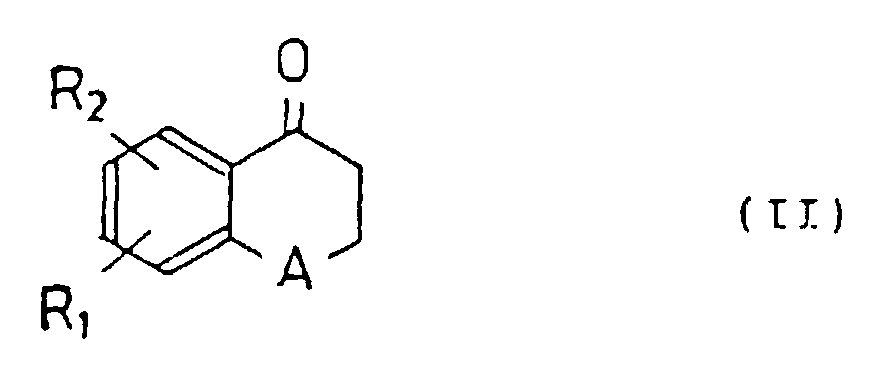
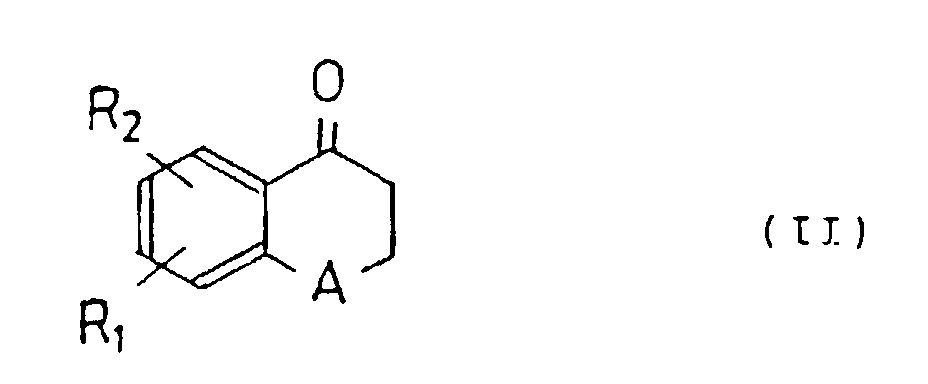
- the present invention is characterized in that, for producing the new tetralone or benzopyranone derivatives, a tetralone or benzopyranone compound represented by the following general formula (II) and a benzaldehyde compound represented by the following general formula (III) are dissolved in an organic solvent and refluxed with heating or reacted under acidic conditions, and the reacted solution is purified.
- R 1 and R 2 represent hydrogen, a hydroxy group, an alkyloxy or aralkyloxy group, respectively, and A represents a methylene or oxygen.
- R 3 - R 7 represent hydrogen, a hydroxy group, or a straight or branched alkyl, alkyloxy or aralkyloxy group having 1- 6 carbon atoms, a halogen, an amino group, or an alkylene dioxy group joined at R 3 and R 4 , R 4 and R 5 , R 5 and R 6 , or R 6 and R 7 , respectively.
- the derivatives of the present invention contain, in addition to the above-mentioned compounds, stereospecific isomers of these compounds, and salts formed with acids or bases.
- bases for example, salts of inorganic bases of sodium, potassium, magnesium, calcium or aluminum, salts of organic bases of lower alkyl amines or lower alcohol amines, salts of basic amino acids such as lysine, alginine, or ornithine, or ammonium salts are exemplified.
- the derivatives may form hydrates, solvates of lower alcohols, and crystal polymorphs.
- the derivatives of the present invention can be prepared by the following methods.
- above-mentioned tetralone or benzopyranone compounds (II) and above-mentioned benzaldehyde compounds (III) are dissolved in solvent such as methanol, ethanol or propanol, concentrated hydrochloric acid is added, the solution is refluxed with heating for 1- 24 hours and cooled, precipitated crystals are filtered to obtain desired new derivatives of the present invention (I).
- solvent such as methanol, ethanol or propanol
- concentrated hydrochloric acid is added, the solution is refluxed with heating for 1- 24 hours and cooled, precipitated crystals are filtered to obtain desired new derivatives of the present invention (I).
- water 100-400 ml is added to precipitate crystals, and the crystals are filtered and dried to obtain the desired derivatives of the present invention.
- sodium hydroxide or potassium hydroxide is added to compounds (II) and (III) in solvent such as methanol, ethanol or propanol, the solution is stirred for 1- 24 hours and acidified with hydrochloric acid, and precipitated crystals are filtered to obtain the desired derivatives of the present invention.
- the desired derivatives of the present invention can be obtained by dissolving the above compounds in a hydrochloric gas-saturated solution of organic solvent such as methanol, ethanol, propanol or ether; then cooling, allowing to stand at room temperature or heating the solution; stirring for 1-24 hours; adding water to precipitate the desired derivatives as crystals; and filtering the precipitated crystals.
- the derivatives of the present invention can safely be orally or parenterally administered as medicines to man or animals.
- parenteral administration intravenous injection, intramuscular injection, subcutaneous injection, intra-abdominal injection, percutaneous administration, administration through the lungs, intranasal injection, administration through the intestines, administration from oral cavity, and administration through mucosae can be exemplified, and these medicines are administered.
- injections, suppository, aerosols and percutaneous absorption tapes and the like can be exemplified.
- tablets including sugar-coated tablets, coating tablets and buccal tablets
- powder including a soft capsule
- granules including a coating granule
- pills troches
- suspension, emulsion, syrup (including dry syrup), and elixir can be exemplified.
- These pharmaceuticals are prepared by conventional methods of manufacturing pharmacy and administered as drug compositions along with pharmacologically allowable carriers, vehicles, disintegrators, lubricants, coloring matters and the like.
- lactose glucose, sucrose, mannitol, potato starch, corn starch, calcium carbonate, calcium phosphate, calcium sulfate, crystalline cellulose, powdered glycyrrhiza, and powdered gentian
- binders starch, tragacanth gum, gelatin, syrup, polyvinylalcohol, polyvinylether, polyvinylpyrrolidone, hydroxypropylcellulose, methylcellulose, ethylcellulose, and carboxymethylcellulose can be exemplified.
- disintegrators starch, agar, powdered gelatin, sodium carboxymethylcellulose, calcium carboxymethylcellulose, crystalline cellulose, calcium carbonate, calcium bicarbonate, and sodium alginic acid can be exemplified.
- lubricants magnesium stearate, talc, hydrogenated vegetable oil, and macrogol can be exemplified.
- coloring matters matters which are allowed to add to medicines can be used.
- the tablets and granules can be coated with sucrose, gelatin, hydroxypropylcellulose, purified shellac, gelatin, glycerin, sorbitol, ethylcellulose, hydroxypropylcellulose, hydroxypropylmethylcellulose, polyvinylpyrrolidone, phthalic acid cellulose acetate, hydroxypropylmethylcellulose phthalate, methylmethacrylate, methacryic acid polymer or the like, and one or more coatings may be used.
- Capsules of ethylcellulose or gelatin may be used.
- a pH adjustor, a buffering agent, a stabilizer, a solubilizing agent or the like may be added to the basis by a conventional method.
- the dose is not particularly limited because conditions such as the condition of illness, and patient's age, health condition and weight are different, it is about 1 mg - 1,000 mg per day for an adult, preferably 50 - 200 mg, orally or parenterally one time or more a day.
- the derivatives of the present invention in the production of semiconductor devices and the like, can be used in a photoresist composition of a positive type, which gives high sensitive resolution, development properties, heat-resisting properties, and resist patterns having excellent resist forms.
- test material 17 ⁇ -HSD inhibition activity of the compounds obtained in Examples 1-22 (abbreviated as a test material hereinafter) was tested. Namely, each test material was dissolved in ethanol to obtain a solution of 260 nM of final concentration, placed in a test tube, and evaporated to dryness in nitrogen gas.
- the derivatives of the present invention have excellent 17 ⁇ -HSD inhibition activity. Accordingly, from the present invention, new tetralone or benzopyranone derivatives and a method for producing the derivatives can be provided.
- the derivatives of the present invention have inhibition activity of 17 ⁇ -HSD, and for the activity, these derivatives are useful for a therapeutic agent for preventing and/or treating androgen or estrogen dependent diseases, particularly, prostatic cancer, benign prostatic hyperplasia, virilism, mammary cancer, mastopathy, endometrial cancer, endometriosis, ovarian cancer and the like. Further, these compounds of the present invention can be used in a photoresist composition of positive type.
Landscapes
- Chemical & Material Sciences (AREA)
- Organic Chemistry (AREA)
- Health & Medical Sciences (AREA)
- Chemical Kinetics & Catalysis (AREA)
- Veterinary Medicine (AREA)
- Medicinal Chemistry (AREA)
- Pharmacology & Pharmacy (AREA)
- Life Sciences & Earth Sciences (AREA)
- Animal Behavior & Ethology (AREA)
- General Health & Medical Sciences (AREA)
- Public Health (AREA)
- Nuclear Medicine, Radiotherapy & Molecular Imaging (AREA)
- General Chemical & Material Sciences (AREA)
- Bioinformatics & Cheminformatics (AREA)
- Engineering & Computer Science (AREA)
- Pain & Pain Management (AREA)
- Biomedical Technology (AREA)
- Neurology (AREA)
- Neurosurgery (AREA)
- Epidemiology (AREA)
- Pharmaceuticals Containing Other Organic And Inorganic Compounds (AREA)
- Plural Heterocyclic Compounds (AREA)
- Pyrane Compounds (AREA)
- Organic Low-Molecular-Weight Compounds And Preparation Thereof (AREA)
- Acyclic And Carbocyclic Compounds In Medicinal Compositions (AREA)
- Heterocyclic Carbon Compounds Containing A Hetero Ring Having Oxygen Or Sulfur (AREA)
Abstract

Description


Claims (5)
- A new tetralone or benzopyranone derivative represented by the following general formula (I):wherein R1 and R2 represent hydrogen, a hydroxy group, an alkyloxy group or an aralkyloxy group, respectively, R3- R7 represent hydrogen, a hydroxy group, or a straight or branched alkyl, alkyloxy or aralkyloxy group having 1-6 carbon atoms, a halogen, an amino group or an alkylene dioxy group joined at R3 and R4, R4 and R5, R5 and R6, or R6 and R7, respectively, and A represents a methylene or oxygen.

- A method for producing the new tetralone or benzopyranone derivative claimed in claim 1, characterized in that it comprises dissolving a tetralone or benzopyranone compound represented by the following general formula (II) and a benzaldehyde compound represented by the following general formula (III) in an organic solvent, refluxing with heating under acidic conditions, and purifying the desired compound from the reaction mixture:wherein R1 and R2 represent hydrogen, a hydroxy group, an alkyloxy or aralkyloxy group, respectively, and A represents a methylene or oxygen.
 wherein R3- R7 represent hydrogen, a hydroxy group, or a straight or branched alkyl, alkyloxy or aralkyloxy group having 1- 6 carbon atoms, a halogen, an amino group, or an alkylene dioxy group joined at R3 and R4, R4 and R5, R5 and R6, or R6 and R7, respectively.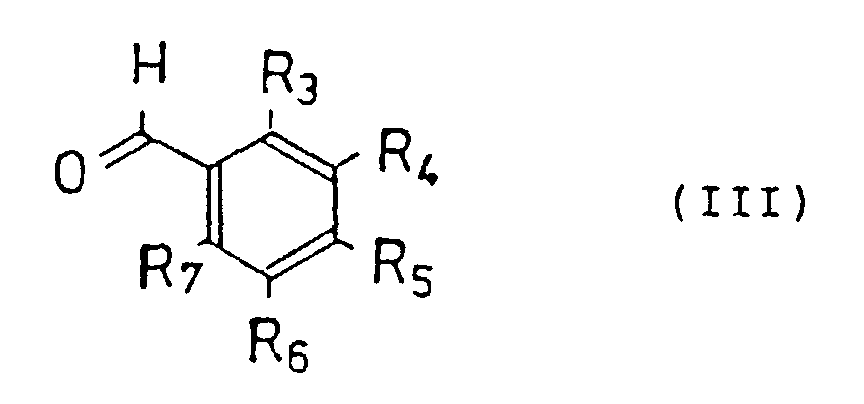
- A medicine comprising the new tetralone or benzopyranone derivative claimed in claim 1 as an effective ingredient.
- A preventive agent for hormone dependent diseases comprising the new tetralone or benzopyranone derivative claimed in claim 1 as an effective ingredient.
- A therapeutic agent for hormone dependent diseases comprising the new tetralone or benzopyranone derivative claimed in claim 1 as an effective ingredient.
Applications Claiming Priority (5)
| Application Number | Priority Date | Filing Date | Title |
|---|---|---|---|
| JP2825897 | 1997-01-29 | ||
| JP28258/97 | 1997-01-29 | ||
| JP9225564A JPH10273467A (en) | 1997-01-29 | 1997-08-08 | New tetralone or benzopyranone derivative and its production |
| JP225564/97 | 1997-08-08 | ||
| PCT/JP1998/000344 WO1998032724A1 (en) | 1997-01-29 | 1998-01-28 | Novel tetralone or benzopyranone derivatives and process for producing the same |
Publications (3)
| Publication Number | Publication Date |
|---|---|
| EP0902003A1 true EP0902003A1 (en) | 1999-03-17 |
| EP0902003A4 EP0902003A4 (en) | 1999-06-09 |
| EP0902003B1 EP0902003B1 (en) | 2006-07-26 |
Family
ID=26366312
Family Applications (1)
| Application Number | Title | Priority Date | Filing Date |
|---|---|---|---|
| EP98901023A Expired - Lifetime EP0902003B1 (en) | 1997-01-29 | 1998-01-28 | Novel tetralone or benzopyranone derivatives and process for producing the same |
Country Status (14)
| Country | Link |
|---|---|
| US (1) | US6080781A (en) |
| EP (1) | EP0902003B1 (en) |
| JP (1) | JPH10273467A (en) |
| KR (1) | KR100304390B1 (en) |
| CN (1) | CN1127470C (en) |
| AT (1) | ATE334110T1 (en) |
| AU (1) | AU717742B2 (en) |
| DE (1) | DE69835322T2 (en) |
| ES (1) | ES2270503T3 (en) |
| IL (1) | IL126138A (en) |
| NO (1) | NO311715B1 (en) |
| NZ (1) | NZ331858A (en) |
| RU (1) | RU2152379C1 (en) |
| WO (1) | WO1998032724A1 (en) |
Cited By (2)
| Publication number | Priority date | Publication date | Assignee | Title |
|---|---|---|---|---|
| WO2001042181A1 (en) * | 1999-12-10 | 2001-06-14 | University College Cardiff Consultants Limited | Benzyl tetralins, formulations and uses thereof |
| FR3167292A1 (en) * | 2024-10-15 | 2026-04-17 | Universite Clermont Auvergne | Synthesis of new tetralone derivatives as modulators of the GPER pathway |
Families Citing this family (16)
| Publication number | Priority date | Publication date | Assignee | Title |
|---|---|---|---|---|
| KR100436220B1 (en) * | 2001-08-30 | 2004-06-12 | 주식회사 네패스 | Organic polymers for bottom antireflective coating, processes for preparing the same, and compositions containing the same |
| DE60333094D1 (en) * | 2002-04-17 | 2010-08-05 | Cytokinetics Inc | COMPOUNDS, COMPOSITIONS AND METHODS |
| US7754709B2 (en) | 2003-06-10 | 2010-07-13 | Solvay Pharmaceuticals Bv | Tetracyclic thiophenepyrimidinone compounds as inhibitors of 17β hydroxysteroid dehydrogenase compounds |
| US7465739B2 (en) | 2003-06-10 | 2008-12-16 | Solvay Pharmaceuticals B.V. | Compounds and their use in therapy |
| GB0513702D0 (en) | 2005-07-04 | 2005-08-10 | Sterix Ltd | Compound |
| AP2527A (en) * | 2006-10-31 | 2012-12-06 | Pfizer Prod Inc | Pyrazoline compounds as mineralocorticoid receptorantagonists |
| JP2009084269A (en) * | 2007-09-05 | 2009-04-23 | Sumitomo Chemical Co Ltd | Coumarin compounds and their uses |
| JP2009062300A (en) * | 2007-09-05 | 2009-03-26 | Sumitomo Chemical Co Ltd | Coumarin compounds and their uses |
| JP2009079039A (en) * | 2007-09-05 | 2009-04-16 | Sumitomo Chemical Co Ltd | Coumarin compounds and their uses |
| GB0722779D0 (en) | 2007-11-20 | 2008-01-02 | Sterix Ltd | Compound |
| CN106278857A (en) * | 2016-08-26 | 2017-01-04 | 武汉理工大学 | α, β unsaturated carbonyl tetralone derivative and application thereof |
| EP3679012A1 (en) * | 2017-09-07 | 2020-07-15 | Taiwanj Pharmaceuticals Co., Ltd. | Benzene fused heterocyclic derivative and pharmaceutical composition comprising the same |
| CN109574974A (en) * | 2019-01-21 | 2019-04-05 | 成都信立诺医药科技有限公司 | The preparation and purification method of hematoxylone A |
| CN111978281B (en) * | 2020-09-02 | 2023-03-28 | 河南师范大学 | Method for preparing cyclohexanone/chromene pyrone compounds and application of cyclohexanone/chromene pyrone compounds |
| CN114230457B (en) * | 2022-01-04 | 2023-06-09 | 中山大学 | 2-benzylidene tetralone derivatives, and preparation method and application thereof |
| CN115925665B (en) * | 2022-12-09 | 2024-06-25 | 中国药科大学 | A PDE4 inhibitor and its application |
Family Cites Families (8)
| Publication number | Priority date | Publication date | Assignee | Title |
|---|---|---|---|---|
| JPS5414457B2 (en) * | 1971-08-06 | 1979-06-07 | ||
| BE788991A (en) * | 1971-09-20 | 1973-03-19 | Lilly Co Eli | ARYLIDENE CYCLANONES AND METHOD OF USE OF THEM IN THE INHIBITION OF THE ACTION OF ANDROGENS |
| US3833726A (en) * | 1971-12-13 | 1974-09-03 | Warner Lambert Co | 1-oxo-substituted-tetrahydronaphthalenes (substituted-tetralones) |
| US3843665A (en) * | 1973-04-11 | 1974-10-22 | Sandoz Ag | Process for preparing substituted indeno,naphtho and cyclohepta pyrazoles |
| US3975380A (en) * | 1974-06-03 | 1976-08-17 | Smithkline Corporation | Substituted aurones |
| MX13485A (en) * | 1987-10-19 | 1993-05-01 | Pfizer | PROCEDURE FOR OBTAINING REPLACED, CHROME PLATES AND RELATED COMPOUNDS |
| RU2032683C1 (en) * | 1991-07-02 | 1995-04-10 | Андрейчиков Юрий Сергеевич | 2-methyl-5-methoxy-3-methoxalylacetobenzofuran possessing antivirus activity against virus of influenza of a- and b- type |
| GB9203497D0 (en) * | 1992-02-19 | 1992-04-08 | Lilly Industries Ltd | Pharmaceutical compounds |
-
1997
- 1997-08-08 JP JP9225564A patent/JPH10273467A/en not_active Ceased
-
1998
- 1998-01-28 DE DE69835322T patent/DE69835322T2/en not_active Expired - Fee Related
- 1998-01-28 IL IL126138A patent/IL126138A/en not_active IP Right Cessation
- 1998-01-28 AU AU56784/98A patent/AU717742B2/en not_active Ceased
- 1998-01-28 NZ NZ331858A patent/NZ331858A/en unknown
- 1998-01-28 AT AT98901023T patent/ATE334110T1/en not_active IP Right Cessation
- 1998-01-28 CN CN98800075A patent/CN1127470C/en not_active Expired - Fee Related
- 1998-01-28 RU RU98119390/04A patent/RU2152379C1/en not_active IP Right Cessation
- 1998-01-28 US US09/155,513 patent/US6080781A/en not_active Expired - Lifetime
- 1998-01-28 EP EP98901023A patent/EP0902003B1/en not_active Expired - Lifetime
- 1998-01-28 WO PCT/JP1998/000344 patent/WO1998032724A1/en not_active Ceased
- 1998-01-28 KR KR1019980707338A patent/KR100304390B1/en not_active Expired - Fee Related
- 1998-01-28 ES ES98901023T patent/ES2270503T3/en not_active Expired - Lifetime
- 1998-09-28 NO NO19984532A patent/NO311715B1/en unknown
Cited By (3)
| Publication number | Priority date | Publication date | Assignee | Title |
|---|---|---|---|---|
| WO2001042181A1 (en) * | 1999-12-10 | 2001-06-14 | University College Cardiff Consultants Limited | Benzyl tetralins, formulations and uses thereof |
| FR3167292A1 (en) * | 2024-10-15 | 2026-04-17 | Universite Clermont Auvergne | Synthesis of new tetralone derivatives as modulators of the GPER pathway |
| WO2026082404A1 (en) * | 2024-10-15 | 2026-04-23 | Université Clermont Auvergne | Synthesis of novel tetralone derivatives as gper pathway modulators |
Also Published As
| Publication number | Publication date |
|---|---|
| NZ331858A (en) | 1999-06-29 |
| EP0902003B1 (en) | 2006-07-26 |
| NO984532D0 (en) | 1998-09-28 |
| RU2152379C1 (en) | 2000-07-10 |
| DE69835322D1 (en) | 2006-09-07 |
| IL126138A (en) | 2007-12-03 |
| ATE334110T1 (en) | 2006-08-15 |
| ES2270503T3 (en) | 2007-04-01 |
| IL126138A0 (en) | 1999-05-09 |
| CN1127470C (en) | 2003-11-12 |
| WO1998032724A1 (en) | 1998-07-30 |
| KR100304390B1 (en) | 2001-11-30 |
| EP0902003A4 (en) | 1999-06-09 |
| DE69835322T2 (en) | 2007-07-19 |
| KR20000064631A (en) | 2000-11-06 |
| US6080781A (en) | 2000-06-27 |
| NO984532L (en) | 1998-10-30 |
| AU5678498A (en) | 1998-08-18 |
| AU717742B2 (en) | 2000-03-30 |
| JPH10273467A (en) | 1998-10-13 |
| NO311715B1 (en) | 2002-01-14 |
| CN1216036A (en) | 1999-05-05 |
Similar Documents
| Publication | Publication Date | Title |
|---|---|---|
| US6080781A (en) | Tetralone or benzopyranone derivatives and a method for producing them | |
| EP0902022B1 (en) | Novel benzofuranone derivatives and process for producing the same | |
| US4350705A (en) | Cyclohexane derivatives, process for preparation thereof and medicines containing these cyclohexane derivatives | |
| RU2176502C2 (en) | Amines for preparing medicinal agents designated for prophylaxis of tumor cells proliferation | |
| HU199773B (en) | Process for production of derivatives of tetrahydronaphtaline and medical compositions containing them | |
| US8946287B2 (en) | Chemotherapeutic flavonoids, and syntheses thereof | |
| JP4166433B2 (en) | Hormone-dependent disease treatment | |
| CA2250258C (en) | Novel tetralone or benzopyranone derivatives and process for producing the same | |
| WO2001042181A1 (en) | Benzyl tetralins, formulations and uses thereof | |
| JP4647214B2 (en) | Substituted 10-aryl-11H-benzo [b] fluorene and 7-aryl-5,6-dihydro-benzo [a] anthracene for selective action on estrogen receptors | |
| JPWO1999012540A1 (en) | Treatment for hormone-dependent diseases | |
| MXPA98007955A (en) | Novel tetralone or benzopyranone derivatives and process for producing the same | |
| JP2007507462A (en) | Use of 8-prenylnaringenin in hormone replacement therapy | |
| WO2004073610A2 (en) | Estrogen receptor modulators | |
| EP0418655B1 (en) | Conjugated gamma-hydroxybutenolide compounds and antiulcer agents containing the same as an effective ingredient | |
| JP2000038382A (en) | New benzofuranone derivative and production thereof | |
| JPH0539250A (en) | Triarylalkene derivative and medicinal composition containing the same derivative, having inhibitory action on tumor | |
| JPH04330043A (en) | Triarylethylene derivative and medicinal composition, containing the same and having tumor inhibitory action | |
| JPH0543522A (en) | Stilbene derivative and pharmaceutical composition having tumor-suppressing effect and containing the derivative | |
| JPH04330071A (en) | Triphenylethylene derivative and medicinal composition containing the same derivative and having inhibitory action on tumor |
Legal Events
| Date | Code | Title | Description |
|---|---|---|---|
| PUAI | Public reference made under article 153(3) epc to a published international application that has entered the european phase |
Free format text: ORIGINAL CODE: 0009012 |
|
| 17P | Request for examination filed |
Effective date: 19980914 |
|
| AK | Designated contracting states |
Kind code of ref document: A1 Designated state(s): AT BE CH DE DK ES FI FR GB GR IE IT LI LU MC NL PT SE |
|
| A4 | Supplementary search report drawn up and despatched |
Effective date: 19990427 |
|
| AK | Designated contracting states |
Kind code of ref document: A4 Designated state(s): AT BE CH DE DK ES FI FR GB GR IE IT LI LU MC NL PT SE |
|
| 17Q | First examination report despatched |
Effective date: 20010817 |
|
| RAP1 | Party data changed (applicant data changed or rights of an application transferred) |
Owner name: DAIICHI PHARMACEUTICAL CO., LTD. |
|
| GRAP | Despatch of communication of intention to grant a patent |
Free format text: ORIGINAL CODE: EPIDOSNIGR1 |
|
| GRAS | Grant fee paid |
Free format text: ORIGINAL CODE: EPIDOSNIGR3 |
|
| GRAA | (expected) grant |
Free format text: ORIGINAL CODE: 0009210 |
|
| AK | Designated contracting states |
Kind code of ref document: B1 Designated state(s): AT BE CH DE DK ES FI FR GB GR IE IT LI LU MC NL PT SE |
|
| PG25 | Lapsed in a contracting state [announced via postgrant information from national office to epo] |
Ref country code: NL Free format text: LAPSE BECAUSE OF FAILURE TO SUBMIT A TRANSLATION OF THE DESCRIPTION OR TO PAY THE FEE WITHIN THE PRESCRIBED TIME-LIMIT Effective date: 20060726 Ref country code: LI Free format text: LAPSE BECAUSE OF FAILURE TO SUBMIT A TRANSLATION OF THE DESCRIPTION OR TO PAY THE FEE WITHIN THE PRESCRIBED TIME-LIMIT Effective date: 20060726 Ref country code: IT Free format text: LAPSE BECAUSE OF FAILURE TO SUBMIT A TRANSLATION OF THE DESCRIPTION OR TO PAY THE FEE WITHIN THE PRESCRIBED TIME-LIMIT;WARNING: LAPSES OF ITALIAN PATENTS WITH EFFECTIVE DATE BEFORE 2007 MAY HAVE OCCURRED AT ANY TIME BEFORE 2007. THE CORRECT EFFECTIVE DATE MAY BE DIFFERENT FROM THE ONE RECORDED. Effective date: 20060726 Ref country code: FI Free format text: LAPSE BECAUSE OF FAILURE TO SUBMIT A TRANSLATION OF THE DESCRIPTION OR TO PAY THE FEE WITHIN THE PRESCRIBED TIME-LIMIT Effective date: 20060726 Ref country code: CH Free format text: LAPSE BECAUSE OF FAILURE TO SUBMIT A TRANSLATION OF THE DESCRIPTION OR TO PAY THE FEE WITHIN THE PRESCRIBED TIME-LIMIT Effective date: 20060726 Ref country code: BE Free format text: LAPSE BECAUSE OF FAILURE TO SUBMIT A TRANSLATION OF THE DESCRIPTION OR TO PAY THE FEE WITHIN THE PRESCRIBED TIME-LIMIT Effective date: 20060726 Ref country code: AT Free format text: LAPSE BECAUSE OF FAILURE TO SUBMIT A TRANSLATION OF THE DESCRIPTION OR TO PAY THE FEE WITHIN THE PRESCRIBED TIME-LIMIT Effective date: 20060726 |
|
| REG | Reference to a national code |
Ref country code: GB Ref legal event code: FG4D |
|
| REG | Reference to a national code |
Ref country code: CH Ref legal event code: EP |
|
| REG | Reference to a national code |
Ref country code: IE Ref legal event code: FG4D |
|
| REF | Corresponds to: |
Ref document number: 69835322 Country of ref document: DE Date of ref document: 20060907 Kind code of ref document: P |
|
| PG25 | Lapsed in a contracting state [announced via postgrant information from national office to epo] |
Ref country code: SE Free format text: LAPSE BECAUSE OF FAILURE TO SUBMIT A TRANSLATION OF THE DESCRIPTION OR TO PAY THE FEE WITHIN THE PRESCRIBED TIME-LIMIT Effective date: 20061026 Ref country code: DK Free format text: LAPSE BECAUSE OF FAILURE TO SUBMIT A TRANSLATION OF THE DESCRIPTION OR TO PAY THE FEE WITHIN THE PRESCRIBED TIME-LIMIT Effective date: 20061026 |
|
| PG25 | Lapsed in a contracting state [announced via postgrant information from national office to epo] |
Ref country code: PT Free format text: LAPSE BECAUSE OF FAILURE TO SUBMIT A TRANSLATION OF THE DESCRIPTION OR TO PAY THE FEE WITHIN THE PRESCRIBED TIME-LIMIT Effective date: 20061226 |
|
| PGFP | Annual fee paid to national office [announced via postgrant information from national office to epo] |
Ref country code: DE Payment date: 20061227 Year of fee payment: 10 |
|
| NLV1 | Nl: lapsed or annulled due to failure to fulfill the requirements of art. 29p and 29m of the patents act | ||
| PGFP | Annual fee paid to national office [announced via postgrant information from national office to epo] |
Ref country code: GB Payment date: 20070123 Year of fee payment: 10 |
|
| PGFP | Annual fee paid to national office [announced via postgrant information from national office to epo] |
Ref country code: ES Payment date: 20070125 Year of fee payment: 10 |
|
| PG25 | Lapsed in a contracting state [announced via postgrant information from national office to epo] |
Ref country code: MC Free format text: LAPSE BECAUSE OF NON-PAYMENT OF DUE FEES Effective date: 20070131 |
|
| ET | Fr: translation filed | ||
| REG | Reference to a national code |
Ref country code: ES Ref legal event code: FG2A Ref document number: 2270503 Country of ref document: ES Kind code of ref document: T3 |
|
| PLBE | No opposition filed within time limit |
Free format text: ORIGINAL CODE: 0009261 |
|
| STAA | Information on the status of an ep patent application or granted ep patent |
Free format text: STATUS: NO OPPOSITION FILED WITHIN TIME LIMIT |
|
| 26N | No opposition filed |
Effective date: 20070427 |
|
| PGFP | Annual fee paid to national office [announced via postgrant information from national office to epo] |
Ref country code: IT Payment date: 20070531 Year of fee payment: 10 |
|
| PG25 | Lapsed in a contracting state [announced via postgrant information from national office to epo] |
Ref country code: IE Free format text: LAPSE BECAUSE OF NON-PAYMENT OF DUE FEES Effective date: 20070129 |
|
| PG25 | Lapsed in a contracting state [announced via postgrant information from national office to epo] |
Ref country code: GR Free format text: LAPSE BECAUSE OF FAILURE TO SUBMIT A TRANSLATION OF THE DESCRIPTION OR TO PAY THE FEE WITHIN THE PRESCRIBED TIME-LIMIT Effective date: 20061027 |
|
| PGFP | Annual fee paid to national office [announced via postgrant information from national office to epo] |
Ref country code: FR Payment date: 20070118 Year of fee payment: 10 |
|
| GBPC | Gb: european patent ceased through non-payment of renewal fee |
Effective date: 20080128 |
|
| PG25 | Lapsed in a contracting state [announced via postgrant information from national office to epo] |
Ref country code: DE Free format text: LAPSE BECAUSE OF NON-PAYMENT OF DUE FEES Effective date: 20080801 |
|
| REG | Reference to a national code |
Ref country code: FR Ref legal event code: ST Effective date: 20081029 |
|
| PG25 | Lapsed in a contracting state [announced via postgrant information from national office to epo] |
Ref country code: GB Free format text: LAPSE BECAUSE OF NON-PAYMENT OF DUE FEES Effective date: 20080128 |
|
| REG | Reference to a national code |
Ref country code: ES Ref legal event code: FD2A Effective date: 20080129 |
|
| PG25 | Lapsed in a contracting state [announced via postgrant information from national office to epo] |
Ref country code: FR Free format text: LAPSE BECAUSE OF NON-PAYMENT OF DUE FEES Effective date: 20080131 |
|
| PG25 | Lapsed in a contracting state [announced via postgrant information from national office to epo] |
Ref country code: ES Free format text: LAPSE BECAUSE OF NON-PAYMENT OF DUE FEES Effective date: 20080129 |
|
| PG25 | Lapsed in a contracting state [announced via postgrant information from national office to epo] |
Ref country code: LU Free format text: LAPSE BECAUSE OF NON-PAYMENT OF DUE FEES Effective date: 20070128 Ref country code: IT Free format text: LAPSE BECAUSE OF NON-PAYMENT OF DUE FEES Effective date: 20080128 |