EP0901786A2 - Solid pharmaceutical dispersions with enhanced bioavailability - Google Patents
Solid pharmaceutical dispersions with enhanced bioavailability Download PDFInfo
- Publication number
- EP0901786A2 EP0901786A2 EP98305960A EP98305960A EP0901786A2 EP 0901786 A2 EP0901786 A2 EP 0901786A2 EP 98305960 A EP98305960 A EP 98305960A EP 98305960 A EP98305960 A EP 98305960A EP 0901786 A2 EP0901786 A2 EP 0901786A2
- Authority
- EP
- European Patent Office
- Prior art keywords
- drug
- composition
- dispersion
- compound
- hpmcas
- Prior art date
- Legal status (The legal status is an assumption and is not a legal conclusion. Google has not performed a legal analysis and makes no representation as to the accuracy of the status listed.)
- Granted
Links
Images

Classifications
-
- A—HUMAN NECESSITIES
- A61—MEDICAL OR VETERINARY SCIENCE; HYGIENE
- A61K—PREPARATIONS FOR MEDICAL, DENTAL OR TOILETRY PURPOSES
- A61K9/00—Medicinal preparations characterised by special physical form
- A61K9/14—Particulate form, e.g. powders, Processes for size reducing of pure drugs or the resulting products, Pure drug nanoparticles
- A61K9/141—Intimate drug-carrier mixtures characterised by the carrier, e.g. ordered mixtures, adsorbates, solid solutions, eutectica, co-dried, co-solubilised, co-kneaded, co-milled, co-ground products, co-precipitates, co-evaporates, co-extrudates, co-melts; Drug nanoparticles with adsorbed surface modifiers
- A61K9/146—Intimate drug-carrier mixtures characterised by the carrier, e.g. ordered mixtures, adsorbates, solid solutions, eutectica, co-dried, co-solubilised, co-kneaded, co-milled, co-ground products, co-precipitates, co-evaporates, co-extrudates, co-melts; Drug nanoparticles with adsorbed surface modifiers with organic macromolecular compounds
-
- A—HUMAN NECESSITIES
- A61—MEDICAL OR VETERINARY SCIENCE; HYGIENE
- A61K—PREPARATIONS FOR MEDICAL, DENTAL OR TOILETRY PURPOSES
- A61K47/00—Medicinal preparations characterised by the non-active ingredients used, e.g. carriers or inert additives; Targeting or modifying agents chemically bound to the active ingredient
- A61K47/30—Macromolecular organic or inorganic compounds, e.g. inorganic polyphosphates
- A61K47/36—Polysaccharides; Derivatives thereof, e.g. gums, starch, alginate, dextrin, hyaluronic acid, chitosan, inulin, agar or pectin
- A61K47/38—Cellulose; Derivatives thereof
-
- A—HUMAN NECESSITIES
- A61—MEDICAL OR VETERINARY SCIENCE; HYGIENE
- A61J—CONTAINERS SPECIALLY ADAPTED FOR MEDICAL OR PHARMACEUTICAL PURPOSES; DEVICES OR METHODS SPECIALLY ADAPTED FOR BRINGING PHARMACEUTICAL PRODUCTS INTO PARTICULAR PHYSICAL OR ADMINISTERING FORMS; DEVICES FOR ADMINISTERING FOOD OR MEDICINES ORALLY; BABY COMFORTERS; DEVICES FOR RECEIVING SPITTLE
- A61J3/00—Devices or methods specially adapted for bringing pharmaceutical products into particular physical or administering forms
- A61J3/02—Devices or methods specially adapted for bringing pharmaceutical products into particular physical or administering forms into the form of powders
-
- A—HUMAN NECESSITIES
- A61—MEDICAL OR VETERINARY SCIENCE; HYGIENE
- A61K—PREPARATIONS FOR MEDICAL, DENTAL OR TOILETRY PURPOSES
- A61K9/00—Medicinal preparations characterised by special physical form
- A61K9/14—Particulate form, e.g. powders, Processes for size reducing of pure drugs or the resulting products, Pure drug nanoparticles
- A61K9/16—Agglomerates; Granulates; Microbeadlets ; Microspheres; Pellets; Solid products obtained by spray drying, spray freeze drying, spray congealing,(multiple) emulsion solvent evaporation or extraction
- A61K9/1605—Excipients; Inactive ingredients
- A61K9/1629—Organic macromolecular compounds
- A61K9/1652—Polysaccharides, e.g. alginate, cellulose derivatives; Cyclodextrin
-
- A—HUMAN NECESSITIES
- A61—MEDICAL OR VETERINARY SCIENCE; HYGIENE
- A61P—SPECIFIC THERAPEUTIC ACTIVITY OF CHEMICAL COMPOUNDS OR MEDICINAL PREPARATIONS
- A61P25/00—Drugs for disorders of the nervous system
- A61P25/18—Antipsychotics, i.e. neuroleptics; Drugs for mania or schizophrenia
-
- A—HUMAN NECESSITIES
- A61—MEDICAL OR VETERINARY SCIENCE; HYGIENE
- A61P—SPECIFIC THERAPEUTIC ACTIVITY OF CHEMICAL COMPOUNDS OR MEDICINAL PREPARATIONS
- A61P43/00—Drugs for specific purposes, not provided for in groups A61P1/00-A61P41/00
-
- B—PERFORMING OPERATIONS; TRANSPORTING
- B01—PHYSICAL OR CHEMICAL PROCESSES OR APPARATUS IN GENERAL
- B01J—CHEMICAL OR PHYSICAL PROCESSES, e.g. CATALYSIS OR COLLOID CHEMISTRY; THEIR RELEVANT APPARATUS
- B01J2/00—Processes or devices for granulating materials, e.g. fertilisers in general; Rendering particulate materials free flowing in general, e.g. making them hydrophobic
- B01J2/02—Processes or devices for granulating materials, e.g. fertilisers in general; Rendering particulate materials free flowing in general, e.g. making them hydrophobic by dividing the liquid material into drops, e.g. by spraying, and solidifying the drops
-
- B—PERFORMING OPERATIONS; TRANSPORTING
- B01—PHYSICAL OR CHEMICAL PROCESSES OR APPARATUS IN GENERAL
- B01J—CHEMICAL OR PHYSICAL PROCESSES, e.g. CATALYSIS OR COLLOID CHEMISTRY; THEIR RELEVANT APPARATUS
- B01J8/00—Chemical or physical processes in general, conducted in the presence of fluids and solid particles; Apparatus for such processes
- B01J8/005—Separating solid material from the gas/liquid stream
Definitions
- This invention relates to compositions of drugs that have increased aqueous concentration, to processes for preparing such compositions, and to methods of using such compositions.
- compositions comprising a spray dried dispersion of a sparingly soluble drug in hydroxypropylmethylcellulose acetate succinate.
- Solid dispersions of a drug in a matrix can be prepared by forming a homogeneous solution or melt of the drug and matrix material followed by solidifying the mixture by cooling or removal of solvent. Such dispersions have been known for more than two decades. Such solid dispersions of crystalline drugs often show enhanced bioavailability when administered orally relative to oral compositions comprising undispersed crystalline drug.
- water-soluble polymers As the matrix material generally yields good results.
- water soluble polymers which have been employed include polyvinylpyrrolidone (PVP), hydroxypropyl methyl cellulose (HPMC), hydroxypropyl cellulose (HPC), methyl cellulose (MC), block copolymers of ethylene oxide and propylene oxide (PEO/PPO), and polyethyleneglycol (PEG).
- PVP polyvinylpyrrolidone
- HPMC hydroxypropyl methyl cellulose
- HPPC hydroxypropyl cellulose
- MC methyl cellulose
- PEO/PPO polyethyleneglycol
- PEG polyethyleneglycol
- Miyajima et al. US Patent No. 4,983,593, disclose, inter alia, formulating HPMCAS with a drug designated as NZ-105.
- the patent teaches that the formulations can be prepared by dissolving NZ-105 and HPMCAS in an organic solvent and removing the solvent by means of vacuum-drying, spray-drying, freeze-drying, or the like, or by coating a filler such as an inorganic salt (e.g., calcium hydrogen phosphate) or a sugar (e.g., lactose, sucrose, and so forth) and the like by means of a fluidized bed granulation method, a centrifugal coating method, or a pan coating method to produce granules.
- an inorganic salt e.g., calcium hydrogen phosphate
- a sugar e.g
- granules can also be prepared by adding a solvent to a filler and kneading the mixture followed by drying. All examples in the patent describe forming a dispersion of HPMCAS and NZ-105 by either (1) fluidized bed granulation by coating either calcium hydrogen phosphate particles or lactose crystals to form large particles up to 1400 ⁇ m in diameter or 2) vacuum drying with lactose to form a solid cake that is then pulverized to form a powdery material.
- Nakamichi et al. US Patent No. 5,456,923, disclose, inter alia, a process for producing solid dispersions by passing a mixture of a drug and a polymer carrier through a twin screw compounding extruder.
- HPMCAS is mentioned as one polymer from among a group of suitable polymers which can be used.
- U. S. Patent No. 5,456,923 to Shogo et al discloses an extrusion method for making solid dispersions.
- HPMCAS is included in a list of polymeric materials, including materials such as starch or gelatin, that can be used as matrix materials.
- this invention provides a composition comprising a spray dried solid dispersion, which dispersion comprises a sparingly water-soluble drug and hydroxypropylmethylcellulose acetate succinate (HPMCAS), said dispersion providing a maximum concentration of said drug in a use environment that is higher by a factor of at least 1.5 relative to a control composition comprising an equivalent quantity of undispersed drug.
- HPMCAS hydroxypropylmethylcellulose acetate succinate
- this invention provides a method of increasing the bioavailability of a sparingly-soluble drug, comprising administering said drug in a composition comprising a spray dried solid dispersion, which dispersion comprises said drug and hydroxypropylmethylcellulose acetate succinate (HPMCAS), said dispersion providing a concentration of said drug in a use environment that is higher by a factor of at least 1.5 relative to a composition comprising an equivalent quantity of undispersed drug.
- HPMCAS hydroxypropylmethylcellulose acetate succinate
- this invention provides a process for making a spray dried solid dispersion comprising
- the sparingly soluble drugs suitable for use in this invention can be crystalline or amorphous in their undispersed state.
- a crystalline drug, once dispersed, is substantially non-crystalline as determined by scanning calorimetry or x-ray diffraction.
- drug in this specification and the appended claims is conventional, denoting a compound having beneficial prophylactic and/or therapeutic properties when administered to an animal, including humans.
- a use environment can be either the in vivo environment of the gastrointestinal tract of an animal, particularly a human, or the in vitro environment of a test solution, an example being "MFD" (for model fasted duodenal) solution.
- a dispersion (or a composition comprising a dispersion) can correspondingly be tested in vivo or, more conveniently, tested in vitro as further disclosed and discussed below to ascertain whether it is within the scope of the invention.
- the drug/HPMCAS spray dried dispersion itself consists essentially of sparingly soluble drug and HPMCAS.
- Other components can be included in the dispersion if they are inert in the sense that they do not adversely affect the maximum supersaturated concentration (MSSC) of drug achievable with the dispersion in a use environment.
- MSSC maximum supersaturated concentration
- Components which do affect the MSSC can also be included, so long as they do not adversely affect (i.e., by lowering) the MSSC materially, meaning that all such components in the dispersion do not lower the MSSC by more than 20% relative to a spray dried dispersion not containing such components.
- Components which do not affect, or in fact improve MSSC can be included in any amount.
- the amount of HPMCAS and drug in the dispersion, not counting any residual solvent should be greater than 75% by weight.
- a composition of matter comprising a spray-dried dispersion of a sparingly soluble drug in HPMCAS is within the scope of the invention if, when said dispersion is dissolution tested, the maximum supersaturated concentration of said drug achievable with said dispersion is higher by a factor of at least 1.5 relative to the equilibrium concentration achieved by dissolution testing a composition comprising an equivalent quantity of undispersed drug.
- Dissolution testing refers to a repeatable, standardized test which employs, as a test medium, an aqueous liquid in which HPMCAS is soluble. Generally, aqueous liquids (i.e., water solutions) having a pH of 6 and higher following dissolution of HPMCAS are satisfactory.
- test should also be capable of reproducibly evaluating equilibrium and/or supersaturated concentrations of a drug.
- a convenient dissolution test employs MFD solution as a test medium in a USP-2 apparatus as described in United States Pharmacopoeia XXIII (USP) Dissolution Test Chapter 711, Apparatus 2.
- Solution volume, paddle speed and temperature are not considered to be critical so long as test dispersions and controls are tested under like or standardized conditions, for example 500 mL of MFD, paddle speed of 100 rpm, and 37°C. Other values for these parameters can be employed so long as they are maintained constant such that the concentrations being measured are measured under the same conditions.
- Dissolution testing is typically conducted by comparing a test composition comprising a drug/HPMCAS dispersion with a control composition identical except that it contains pure drug in its equilibrium ⁇ either crystalline or amorphous ⁇ form.
- the control composition is typically the same as the test composition but for the inclusion of HPMCAS.
- the HPMCAS can simply be omitted altogether and just the drug added to the remainder of the composition, or the HPMCAS can be replaced by an equal amount of inert, non-adsorbing solid diluent such as microcrystalline cellulose.
- the control composition should also contain any excipients and/or other components, in the amounts such other components are contained by the test composition.
- Preferred dispersions are those for which the in vitro (e.g., MFD) drug concentration falls to no less than 25% of the MSSC during the 15 minutes after MSSC is reached, preferably 30 minutes after MSSC is reached.
- MFD in vitro
- a composition of matter comprising a spray-dried dispersion of a sparingly soluble drug in HPMCAS is within the scope of the invention if, when a composition comprising said dispersion is tested in vivo, the Cmax achieved with said composition is higher by a factor of at least 1.25 (i.e., 25% higher) relative to the Cmax achieved with a composition comprising an equivalent quantity of undispersed drug.
- Cmax is an abbreviation for the maximum drug concentration in serum or plasma of the test subject.
- In vivo testing protocols can be designed in a number of ways. By measuring the Cmax for a population to which the test composition has been administered and comparing it with the Cmax for the same population to which the control has also been administered, the test composition can be evaluated.
- compositions according to the invention exhibit at least a factor of 1.25 improvement in AUC, which is a determination of the area under a curve (AUC) plotting the serum or plasma concentration of drug along the ordinate (Y-axis) against time along the abscissa (X-axis).
- AUC area under a curve
- Y-axis the area under a curve
- X-axis the abscissa
- the values for AUC represent a number of values taken from all the subjects in a patient test population and are, therefore, mean values averaged over the entire test population.
- AUC's are well understood, frequently used tools in the pharmaceutical arts and have been extensively described, for example in "Pharmacokinetics Processes and Mathematics", Peter E. Welling, ACS Monograph 185; 1986. AUCs for this invention were typically determined over a period of 48 or 72 hours starting from the time the dispersion or control was first administered.
- compositions according to the invention in addition to displaying at least a factor of 1.25 improvement in Cmax as discussed above, also exhibit at least a factor of 1.25 improvement in AUC.
- Cmax and AUC can be determined in humans or a suitable animal model, such as dogs.
- a "sparingly-soluble drug” as employed above applies to drugs which are essentially totally water-insoluble or poorly water-soluble. More specifically, the term applies to any beneficial therapeutic agent which has a dose (mg) to aqueous solubility (mg/ml) ratio greater than 100ml, where the drug solubility is that of the neutral (e.g., free base or free acid) form in unbuffered water.
- This definition includes but is not limited to drugs that have essentially no aqueous solubility (less than 1.0 ⁇ g/ml) since it has been determined that the invention has benefit for such drugs.
- the drug is dispersed in the HPMCAS such that most of the drug is not present in crystalline form greater than about 0.1 ⁇ in diameter.
- the drug may be present in amorphous drug-rich domains as long as the drug will dissolve to form supersaturated solutions in in vitro tests disclosed hereinafter. However, it is generally preferred for the drug to be molecularly dispersed such that there is little or no drug present as separate amorphous domains.
- a "sparingly soluble amorphous drug” is a drug that, in its amorphous state, is sparingly soluble as described above and also, upon storage for 30 days at 30 °C shows no tendency to crystallize as measured by calorimetric techniques or powder x-ray diffraction.
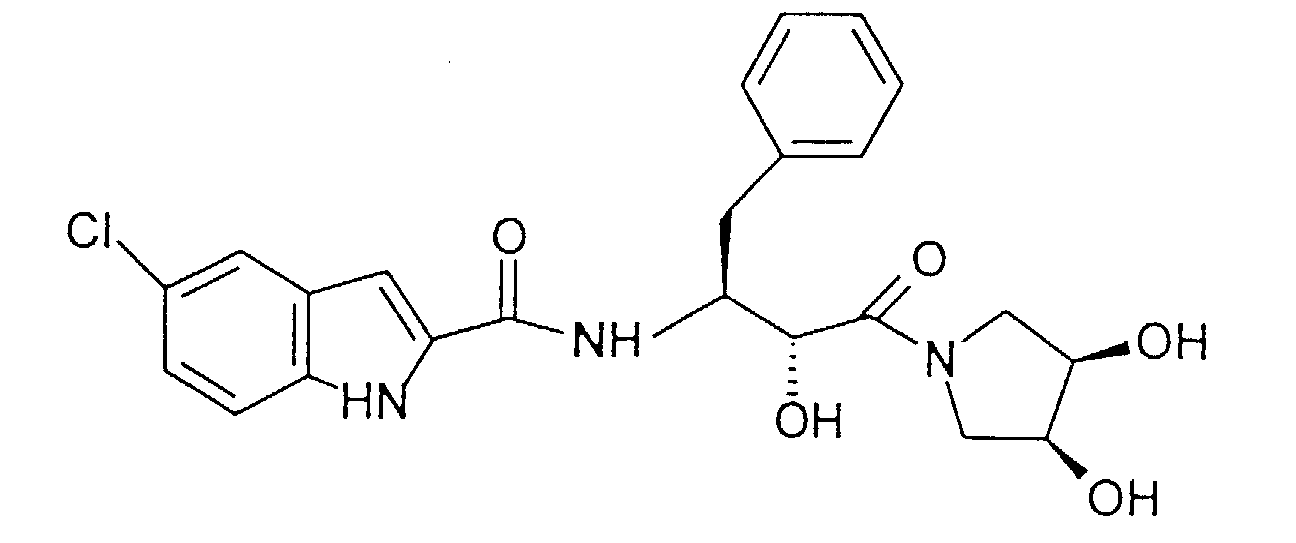
- glycogen phosphorylase inhibitors such as those disclosed in PCT/IB95/00443, published intemationally as W096/39385 on December 12, 1996.
- Specific compounds include those having the structures and
- Another preferred class of compounds for use in this invention is 5-lipoxygenase inhibitors, such as those disclosed in PCT/JP94/01349, published as WO 95/05360.
- a preferred compound has the structure
- CRC corticotropic releasing hormone
- Another preferred class of compounds is antipschotics.
- a particularly preferred compound is ziprasidone.
- griseofulvin nifedipine
- phenytoin phenytoin
- MFD is an acronym meaning "model fasted duodenal" fluid which is employed as an in vitro test medium for purposes of determining whether a particular drug/HPMCAS dispersion falls within the scope of this invention.
- the MFD test medium allows testing in more convenient in vitro conditions and environment by virtue of mimicking an in vivo environment.
- MFD is water which is 82 mM (millimolar) in NaCI, 20 mM in Na 2 HPO 4 , 47 mM in KH 2 PO 4 , 14.7 mM in sodium taurocholate and 2.8 mM in 1-palmitoyl-2-oleoyl-sn-glycero-3-phosphocholine to yield a solution pH of about 6.5 and osmotic pressure of about 290 mOsm/kg.
- MFD is described in greater detail below.
- HPMCAS refers to a family of cellulose derivatives that can have (1) two types of ether substituents, methyl and/or 2-hydroxypropyl and (2) two types of ester substituents, acetyl and/or succinyl. It is referred to in scientific literature as O-(2-hydroxypropyl)-O-methyl-cellulose acetate succinate.
- the degree of substitution for each of the four general types just noted can be varied over a wide range to effect the chemical and physical properties of the polymer. This versatility of HPMCAS allows its structure to be optimized to obtain good performance with a particular drug of interest. HPMCAS can be synthesized as noted below or purchased commercially.
- HPMCAS Three examples of commercially available HPMCAS include Shin-Etsu AQOAT®-LF, Shin-Etsu AQOAT®-MF, and Shin-Etsu AQOAT®-HF. All three of these polymers are manufactured by Shin-Etsu Chemical Co., Ltd. (Tokyo, Japan), and all three have proven to be suitable for use in practicing the present invention.
- the specific grade that yields the best performance for obtaining and sustaining supersaturation in in vitro tests and obtaining high bioavailability in vivo varies depending on the specific chemical and physical properties of the drug to be delivered.
- a preferred mean weight average molecular weight range for HPMCAS is 10,000 to one million daltons, preferably 10,000 to 400,000 daltons, as determined using polyethylene oxide standards.
- Drugs which are preferred for use in this invention include those which have a dose to aqueous solubility greater than 100, where the aqueous solubility is measured in unbuffered water.
- the appropriate solubility is that of the free base, free acid, or zwitterion, i.e., the solubility of the neutral form.
- Drugs which will particularly benefit from formulation in spray-dried HPMCAS dispersions of this invention include those drugs which have a dose to aqueous solubility ratio greater than 500. Examples of such drugs are disclosed in the examples herein.
- solubility aqueous solubility is intended unless otherwise indicated.
- a spray dried solid dispersion of a sparingly-soluble drug in HPMCAS has unique properties making it broadly useful for preparing oral dosage forms. While not wishing to be bound by any particular theory or mechanism, it is believed that in order for a solid amorphous dispersion of a drug in a matrix material to function optimally in improving the bioavailability of sparingly-soluble drugs, the matrix material must generally provide the following functions:
- a drug does not have a strong tendency to crystallize from the amorphous solid state, then only the latter two functions are required.
- the drug will, either prior to or following dissolution of the drug HPMCAS dispersion, reach a concentration substantially higher than the equilibrium solubility of the drug alone. That is, the drug reaches a supersaturated concentration, and this supersaturated concentration will be maintained for a relatively long time period.
- HPMCAS functions well in all three respects noted above such that it is unique among known matrix materials in its ability to inhibit the precipitation or crystallization of a broad range of sparingly soluble drugs from a supersaturated solution.
- spray drying effects rapid solvent removal so that crystallization of drug and HPMCAS is largely prevented, or at least minimized relative to other methods of forming dispersions, including other solvent removal processes such as rotary evporation.
- spray drying effects removal of solvent sufficiently fast that even phase separation of amorphous drug and HPMCAS is largely prevented or minimized.
- HPMCAS and spray drying afford a better, more truly homogeneous dispersion in which the drug is more efficiently dispersed in the polymer.
- Increased efficiency of dispersion from spray drying gives, relative to other methods of making dispersions, a higher drug concentration in in vitro tests.
- a solid amorphous dispersion comprising a spray dried mixture of HPMCAS and a sparingly soluble amorphous drug, that is, one that shows little tendency to crystallize from its amorphous state
- Solid dispersions of such drugs in HPMCAS surprisingly show high degrees and durations of supersaturation in in vitro dissolution tests relative to compositions comprising undispersed amorphous drug. This finding runs contrary to conventional wisdom in that attempts to enhance the bioavailability of drugs by making solid amorphous dispersions have been directed exclusively toward drugs that, in their pure state, are crystalline or, if made amorphous, spontaneously progress toward the crystalline state.
- Figure 1 is a schematic diagram of a mini spray drying apparatus used for the examples.
- Figure 2 is a schematic diagram of a micro spray drying apparatus used for the examples.
- HPMCAS can be conducted by treating O-(hydroxypropyl)-O-methylcellulose with acetic anhydride and succinic anhydride, as set forth in Tezuka et al, Carbohydrate Research 222(1991)255-259 and in Onda et al, US Patent No. 4,385,078, the teachings of which are incorporated herein by reference.
- the amounts of the substituents methoxy, hydroxypropoxy, acetyl, and succinyl are generally in the range of 10 to 35 wt%, 3 to 15 wt%, 3 to 20 wt%, and 2 to 30 wt%, respectively.
- the amounts of the substituents are 15 to 30 wt%, 4 to 11 wt%, 4 to 15 wt%, and 3 to 20 wt%, respectively.
- HPMCAS may easily be purchased from a number of commercial suppliers.
- the amount of HPMCAS relative to the amount of drug present in the dispersions of the present invention can vary widely from a drug:polymer weight ratio of 1 to 0.2 to 1 to 100. However, in most cases it is preferred that the drug to polymer ratio is greater than 1 to 0.4 and less than 1 to 20.
- the minimum drug:polymer ratio that yields satisfactory results varies from drug to drug and is best determined in the in vitro dissolution tests described below.
- the key ingredients present in the solid amorphous compositions of the present invention are simply the drug to be delivered and HPMCAS, the inclusion of other excipients in the dispersion may be useful and even preferred.
- polymers other than HPMCAS that are soluble in aqueous solutions over at least a portion of the range pH 1.0 and 8.0 can be included in the dispersion along with HPMCAS.
- amorphous dispersions of drug and conventional matrix materials such as PVP, HPC, or HPMC can be formed and then triturated with HPMCAS and still have, for some drugs, superior performance relative to the same dispersions without HPMCAS.
- HPMCAS may have as is primary benefit inhibition of the precipitation or crystallization of drug from supersaturated solution.
- dispersions in which drug, HPMCAS, and one or more additional polymers are co-spray dried, wherein drug and HPMCAS constitute not more than 75% of the dispersion.
- excipient useful as a component of the dispersions herein is a surface-active agent such as a fatty acid and alkyl sulfonate; commercial surfactants such as those sold under tradenames such as benzethanium chloride (Hyamine® 1622, available from Lonza, Inc., Fairlawn, NJ, docusate sodium (available from Mallinckrodt Spec. Chem., St.
- a surface-active agent such as a fatty acid and alkyl sulfonate
- commercial surfactants such as those sold under tradenames such as benzethanium chloride (Hyamine® 1622, available from Lonza, Inc., Fairlawn, NJ, docusate sodium (available from Mallinckrodt Spec. Chem., St.
- Such materials can advantageously be employed to increase the rate of dissolution by facilitating wetting, thereby increasing the maximum drug concentration and the degree of supersaturation attained, and also to inhibit crystallization or precipitation of drug by interacting with dissolved drug by mechanisms such as complexation, formation of inclusion complexes, formation of micelles or adsorbing to the surface of solid drug, crystalline or amorphous.
- These surface active agents may comprise up to 25% of the spray-dried dispersion.
- pH modifiers such as acids, bases, or buffers can also be beneficial. pH modifiers can advantageously serve to retard the dissolution of the dispersion (e.g., acids such as citric acid or succinic acid) or, alternatively, to enhance the rate of dissolution of the dispersion (e.g., bases such as sodium acetate or amines).
- acids such as citric acid or succinic acid
- bases such as sodium acetate or amines
- Addition of conventional matrix materials, surface active agents, fillers, disintegrants, or binders may be added as part of the dispersion itself, added by granulation via wet or mechanical or other means.
- additives When such additives are included as part of the dispersion itself, they can be mixed with drug and HPMCAS in the spray drying solvent, and may or may not dissolve along with the drug and HPMCAS prior to forming the dispersion by spray drying. These materials may comprise up to 25% of the drug/HPMCAS/additive dispersion.
- excipients can be employed in the compositions of this invention, including those excipients well known in the art.
- excipients such as fillers, disintegrating agents, pigments, binders, lubricants, flavorants, and so forth can be used for customary purposes and in typical amounts without affecting the properties of the compositions.
- excipients are utilized after the HPMCAS/drug dispersion has been formed, in order to formulate the dispersion into tablets, capsules, suspensions, powders for suspension, creams, transdermal patches, and the like.
- spray-drying is used conventionally and broadly refers to processes involving breaking up liquid mixtures into small droplets (atomization) and rapidly removing solvent from the mixture in a container (spray-drying apparatus) where there is a strong driving force for evaporation of solvent from the droplets.
- the strong driving force for solvent evaporation is generally provided by maintaining the partial pressure of solvent in the spray-drying apparatus well below the vapor pressure of the solvent at the temperature of the drying droplets. This is accomplished by either (1) maintaining the pressure in the spray-drying apparatus at a partial vacuum (e.g., 0.01 to 0.50 atm); (2) mixing the liquid droplets with a warm drying gas; or (3) both.
- a solution of drug and HPMCAS in acetone can be suitably spray-dried by spraying the solution at a temperature of 50°C (the vapor pressure of acetone at 50°C is about 0.8 atm) into a chamber held at 0.01 to 0.2 atm total pressure by connecting the outlet to a vacuum pump.
- the acetone solution can be sprayed into a chamber where it is mixed with nitrogen or other inert gas at a temperature of 80°C to 180°C and a pressure of 1.0 to 1.2 atm.
- the temperature and flow rate of the drying gas is chosen so that the HPMCAS/drug-solution droplets are dry enough by the time they reach the wall of the apparatus that they are essentially solid, so that they form a fine powder and do not stick to the apparatus wall.
- the actual length of time to achieve this level of dryness depends on the size of the droplets. Droplet sizes generally range from 1 ⁇ m to 500 ⁇ m in diameter, with 5 to 100 ⁇ m being more typical.
- the large surface-to-volume ratio of the droplets and the large driving force for evaporation of solvent leads to actual drying times of a few seconds or less. This rapid drying is critical to the particles maintaining a uniform, homogeneous composition instead of separating into drug-rich and polymer-rich phases.
- Such dispersions which have a homogeneous composition can be considered solid solutions and may be supersaturated in drug. Such homogeneous dispersions are preferred in that the MSSC value obtained when a large amount of drug is dosed can be higher for such dispersions relative to dispersions for which at least a portion of the drug is present as a drug-rich amorphous or crystalline phase.
- Solidification times should be less than 20 seconds, preferably less than 5 seconds, and more preferably less than 2 seconds.
- the size of droplets formed during the spray drying process are less than 100 ⁇ m in diameter, preferably less than 50 ⁇ m in diameter,and more preferably less than 25 ⁇ m in diameter.
- the resultant solid particles thus formed are generally less than 100 ⁇ m in diameter, preferably less than 50 ⁇ m in diameter, more preferably less than 25 ⁇ m in diameter.
- the solid powder may stay in the spray-drying chamber for 5 to 50 seconds, further evaporating solvent from the solid powder.
- the final solvent content of the solid dispersion as it exits the dryer should be low, since this reduces the mobility of drug molecules in the dispersion, thereby improving its stability.
- the residual solvent content of the dispersion should be less than 10 wt% and preferably less than 2 wt %.
- the dispersions can then be post-processed to prepare them for administration using methods known in the art such as roller compaction, fluid bed agglomeration, or spray coating.
- Spray-drying processes and spray-drying equipment are described generally in Perry's Chemical Engineers' Handbook, Sixth Edition (R. H. Perry, D. W. Green, J. O. Maloney, eds.) McGraw-Hill Book Co. 1984, page 20-54 to 20-57. More details on spray-drying processes and equipment are reviewed by Marshall ("Atomization and Spray-Drying," Chem. Eng. Prog. Monogr. Series, 50 [1954] 2).
- the solution spray-dried to form the HPMCAS/drug dispersion can contain only drug and HPMCAS in a solvent.
- the ratio of drug to HPMCAS in the solution ranges from 1 to 0.2 to 1 to 100 and preferably ranges from 1 to 0.4 to 1 to 20.
- solvents suitable for spray-drying can be any organic compound in which the drug and HPMCAS are mutually soluble.
- the solvent is also volatile with a boiling point of 150°C or less.
- Preferred solvents include alcohols such as methanol, ethanol, n-propanol, iso-propanol, and butanol; ketones such as acetone, methyl ethyl ketone and methyl iso-butyl ketone; esters such as ethyl acetate and propylacetate; and various other solvents such as acetonitrile, methylene chloride, toluene, and 1,1,1-trichloroethane. Lower volatility solvents such as dimethyl acetamide or dimethylsulfoxide can also be used. Mixtures of solvents can also be used, as can mixtures with water as long as the polymer and HPMCAS are sufficiently soluble to make the spray-drying process practical.
- Spray-dried solutions and the resulting dispersions can also contain various additives that aid in the stability, dissolution, tableting, or processing of the dispersion.
- additives include: surfactants, pH-controlling substances (e.g., acids, bases, buffers), fillers, disintegrants, or binders.
- Such additives can be added directly to the spray-drying solution such that the additive is dissolved or suspended in the solution as a slurry. Altematively, such additives can be added following the spray-drying process to aid in forming the final dosage form.
- this invention provides an in vitro test for evaluating the performance of HPMCAS candidate dispersion compositions, thereby allowing the identification of dispersion compositions that will yield good in vivo bioavailability of drug when taken orally. It has been determined that in vitro dissolution of a dispersion in model-fasted duodenal (MFD) solution is a good indicator of in vivo performance and bioavailability.
- MFD model-fasted duodenal
- a candidate dispersion can be dissolution tested by adding it to MFD solution and agitating to assist in dissolution. In this test, the amount of dispersion is chosen such that if all drug dissolves, a 1.5-fold or greater supersaturated solution is obtained.
- a dispersion is within the scope of this invention if the maximum supersaturated concentration of drug exceeds, by a factor of at least 1.5, the equilibrium concentration of a control composition comprising an equivalent quantity of undispersed drug.
- the comparison composition is conveniently the undispersed drug alone (e.g., pure drug in its equilibrium state - either crystalline or amorphous) or the undispersed drug plus a weight of inert diluent equivalent to the weight of HPMCAS in the test composition.
- the supersaturated concentration of drug achieved with the test dispersion exceeds the equilibrium drug concentration by a factor of at least three, and most preferably by a factor of at least five.
- a typical test can be conducted by (1) dissolving a sufficient quantity of control composition, typically the candidate drug alone, to achieve equilibrium drug concentration; (2) dissolving a sufficient quantity of test dispersion to achieve a maximum supersaturated drug concentration; and (3) determining whether the supersaturated concentration exceeds the equilibrium concentration by a factor of at least 1.5.
- the concentration of dissolved drug is typically measured as a function of time by sampling the solution and plotting concentration vs. time so that the concentration maximum can be ascertained.
- the test solution is either filtered or centrifuged.
- Dissolved drug is typically taken as that material that either passes a 0.45 ⁇ m syringe filter or, altematively, that material that remains in the supematant following centrifugation. Filtration can be conducted using a 13 mm, 0.45 ⁇ m polyvinylidine difluoride syringe filter sold by Scientific Resources under the trademark Titan®. Centrifugation is typically carried out in a polypropylene microcentrifuge tube by centrifuging at 13,000 G for 60 seconds using any centrifuge suitable for the purpose. Other similar filtration or centrifugation methods can be employed and useful results obtained. For example, using other types of microfilters may yield values somewhat higher or lower (plus or minus 10 to 40%) than that obtained with the filter specified above but will still allow identification of suitable dispersions.
- Dispersions can also be tested in dogs as follows:
- test and control formulations are administered,via oral gavage in water or 0.2% aqueous polysorbate 80 to aid in wetting, through PE205 tubing attached to a syringe. Dogs are retumed to metabolism cages with normal access to water. Altematively, dosing may be via capsules or tablets, with the provision that the test and control formulations be identical, except for the presence or absence of HPMCAS.
- Blood samples are taken from the jugular vein using a 10 ml disposable syringe with a 20 gauge needle at 0.5, 1, 1.5, 2, 3, 4, 6, 8 (and occasionally 12 hr) hours post dose. Other sampling times may be used with the conditions that T max is bracketed by the sampling intervals and that an accurate AUC may be calculated.
- Samples are immediately transferred to clean glass culture tubes containing heparin. Samples are centrifuged at room temperature at 3000 rpms for 5 minutes. Plasma is transferred to clean glass 1 dram vials using a 5 1/4" pasteur pipette. Plasma samples are frozen on dry ice and stored in a laboratory freezer until assayed by HPLC.
- typical pharmacokinetic parameters such as C max , T max and AUC are calculated for each dog, and then averaged for the test population.
- Dispersions can be tested in vivo in humans as follows. In a crossover design, 4 or more healthy human subjects are dosed with a suspension of crystalline drug (or amorphous drug if the drug does not crystallize) or a suspension of drug/HPMCAS spray-dried dispersion. Blood samples are taken before dosing and at a variety of times post-dosing, with the number and temporal distribution of sampling times chosen to bracket T max and permit accurate measurement of AUC. Drug concentration in plasma or serum is measured by an appropriate assay, and C max , T max , and AUC are determined.
- a dispersion of this invention is a spray-dried drug/HPMCAS dispersion which, when tested in an animal species:
- Preferred drug/HPMCAS dispersions are those which satisfy both the (a) and (b) criteria above.
- compositions of this invention can be used in a wide variety of forms for administration of drugs orally.
- Exemplary dosage forms are powders or granules that can be taken orally either dry or reconstituted by addition of water to form a paste, slurry, suspension or solution; tablets, capsules, or pills.
- Various additives can be mixed, ground, or granulated with the compositions of this invention to form a material suitable for the above dosage forms.
- Potentially beneficial additives fall generally into the following classes: other matrix materials or diluents, surface active agents, drug complexing agents or solubilizers, fillers, disintegrants, binders, lubricants, and pH modifiers (e.g., acids, bases, or buffers).
- Examples of other matrix materials, fillers, or diluents include lactose, mannitol, xylitol, microcrystalline cellulose, calcium diphosphate, and starch.
- Examples of surface active agents include sodium lauryl sulfate and polysorbate 80.
- drug complexing agents or solubilizers include the polyethylene glycols, caffeine, xanthene, gentisic acid and cylodextrins.
- disintegrants examples include sodium starch gycolate, sodium alginate, carboxymethyl cellulose sodium, methyl cellulose, and croscarmellose sodium.
- binders examples include methyl cellulose, microcrystalline cellulose, starch, and gums such as guar gum, and tragacanth.
- lubricants examples include magnesium stearate and calcium stearate.
- pH modifiers include acids such as citric acid, acetic acid, ascorbic acid, lactic acid, aspartic acid, succinic acid, phosphoric acid, and the like; bases such as sodium acetate, potassium acetate, calcium oxide, magnesium oxide, trisodium phosphate, sodium hydroxide, calcium hydroxide, aluminum hydroxide, and the like, and buffers generally comprising mixtures of acids and the salts of said acids.
- acids such as citric acid, acetic acid, ascorbic acid, lactic acid, aspartic acid, succinic acid, phosphoric acid, and the like
- bases such as sodium acetate, potassium acetate, calcium oxide, magnesium oxide, trisodium phosphate, sodium hydroxide, calcium hydroxide, aluminum hydroxide, and the like, and buffers generally comprising mixtures of acids and the salts of said acids.
- At least one function of inclusion of such pH modifiers is to control the dissolution rate of the drug, matrix polymer, or both, thereby controlling the local drug concentration during
- additives may be incorporated into the solid amorphous dispersion during or after its formation.
- mgA is an acronym for "milligrams of active drug", i.e, the non-salt free base or free acid if the compound is ionizable.
- ⁇ gA similarly means micrograms of active drug.
- the mini spray-dryer shown in Figure 1 consists of an atomizer in the top cap of a vertically oriented stainless steel pipe shown generally as 10.
- the atomizer is a two-fluid nozzle (Spraying Systems Co. 1650 fluid cap and 64 air cap) where the atomizing gas is nitrogen delivered through line 12 to the nozzle at 100°C and a flow of 15 gm/min, and a test solution to be spray dried is delivered through line 14 to the nozzle at room temperature and a flow rate of 1.0 gram/min using a syringe pump (Harvard Apparatus, Syringe Infusion Pump 22, not shown).
- Filter paper 16 with a supporting screen (not shown) is clamped to the bottom end of the pipe to collect the solid spray-dried material and allow the nitrogen and evaporated solvent to escape.
- the micro spray dryer shown in Figure 2 consists of an atomizer 102 in the top of a vacuum flask 100 kept at 40 °C by a water bath 104.
- Atomizer 102 is a two-fluid spray nozzle (NIRO Aeromatic, 2.7 mm ID air cap, 1.0 mm ID fluid cap) where the atomizing gas is nitrogen delivered to the nozzle at ambient temperature and at 20 psi, and the drug/polymer test solution 106 is delivered to nozzle 102 at 40 °C at a flow rate of 1.0 gm/min using a peristaltic pump 108 (Masterflex, model 7553-60, with pump head #7013-20, and Norprene tubing #6404-13).
- a peristaltic pump 108 Masterflex, model 7553-60, with pump head #7013-20, and Norprene tubing #6404-13.
- Microporous cellulose extraction thimble 110 (Whatman Filter Co.) is mounted in a vacuum trap 114 to collect the solid spray-dried material, and a vacuum of 400 mbar (monitored by vacuum gauge 112) is pulled on the system by means of vacuum pump 116, which aids in solvent evaporation.
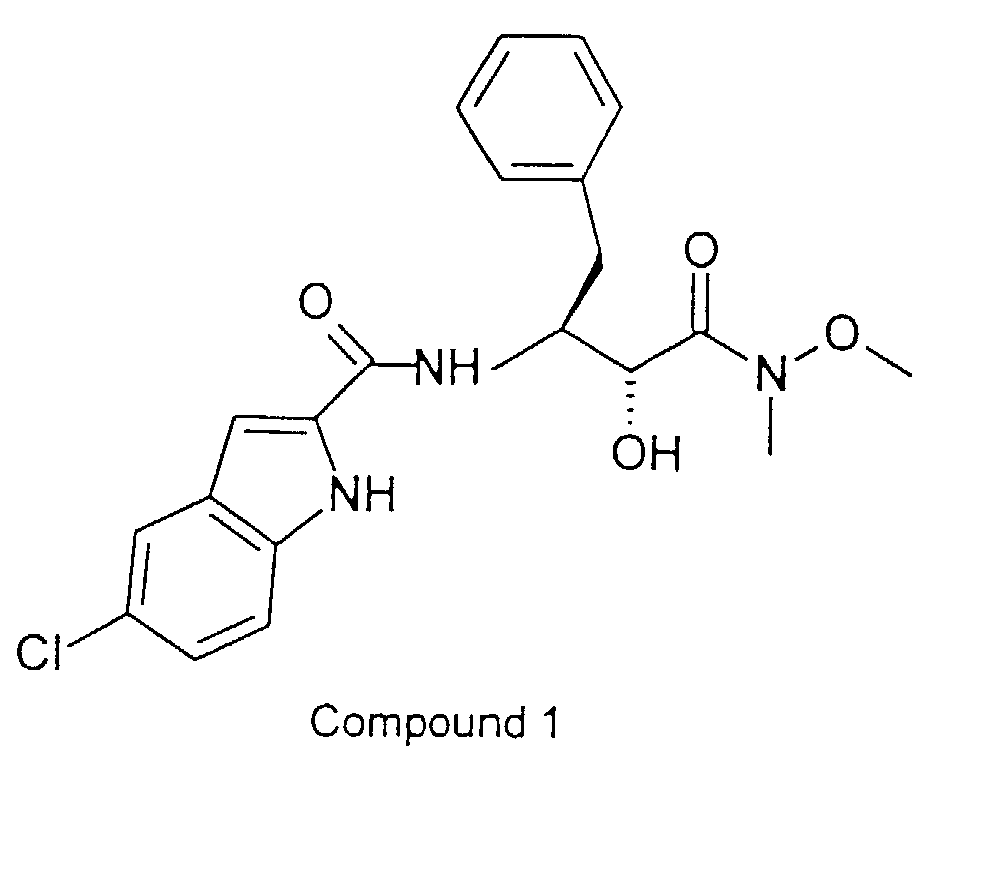
- the compound/polymer solution was then placed in a 20 mL syringe that was then inserted into a syringe pump. Solvent was rapidly removed from the above solution by spraying it into the mini spray-drying apparatus shown in Figure 1, referred to herein as the "mini" spray dryer. The resulting material was a dry, white, substantially amorphous powder.
- This example discloses an in vitro dissolution test termed the "syringe/filter” method.
- concentration of test compound in solution is determined as a function of time.
- Test solution is held in a syringe from which samples are expelled through a filter at pre-determined time points.
- the syringe is rotated (50 rpm) on a wheel held in an oven at 37°C.
- Example 1 7.5 mg of the material of Example 1 was placed in an empty disposable 10 mL syringe (Aldrich, Fortuna). A 20 GA hypodermic needle was attached to the syringe, and 10 mL of a model-fasted duodenal (MFD) solution at 37°C was drawn into the syringe.
- MFD model-fasted duodenal
- the MFD solution was composed of phosphate-buffered saline solution (82 mM NaCI, 20 mM Na 2 HPO 4 , 47 mM KH 2 PO 4 , pH 6.5, 290 mOsm/kg) containing 14.7 mM sodium taurocholate (Fluka) and 2.8 mM 1-palmitoyl-2-oleoyl-sn-glycero-3-phosphocholine (Avanti Polar Lipids).
- the MFD solution was prepared using the following procedure. Into a 100 mL round bottom flask was weighed 0.788 gm of the sodium taurocholic acid, which was then dissolved in 5.0 mL of ambient HPLC methanol (Burdick & Jackson). To this solution was added 15.624 gm of the 1-palmitoyl-2-oleoyl-sn-glycero-3-phosphocholine in chloroform, supplied by Avanti Polar Lipids as a 20 mg/mL solution. This mixture was then mixed thoroughly by vortex mixer (Fisher Vortex Genie), and the solvent removed rapidly by roto-evaporator (Rotavapor RE121, Büchi), leaving a dry white surface dispersion coating the flask. The surface dispersion was then reconstituted with 200 mL of the 37 °C phosphate buffered saline.
- the needle was then replaced with a 13 mm, 0.45 pm polyvinylidine diflouride syringe filter (Scientific Resources, Titan), and the syringe was vigorously shaken for 30 sec. After 30 sec, 6 drops of the solution was expelled and a subsequent 13 drop sample was delivered to a test tube. After expelling the sample, the syringe plunger was drawn back to pull an air bubble into the syringe to aid in subsequent mixing and the syringe placed back on a rotating wheel in a 37°C oven.
- the sample was diluted 1:1 with a solution containing 60/40- 1.7 wt% ammonium ascorbate in acetonitrile, and the concentration of compound analyzed on an HPLC (Hewlett Packard 1090 HPLC, Phenomenex Ultracarb ODS 20 analytical column, absorbance measured at 215 nm with a diode array spectrophotometer).
- HPLC Hewlett Packard 1090 HPLC, Phenomenex Ultracarb ODS 20 analytical column, absorbance measured at 215 nm with a diode array spectrophotometer.
- the remaining solution in the syringe was mixed by rotating on a wheel at 50 rpm in a 37°C temperature-controlled box.
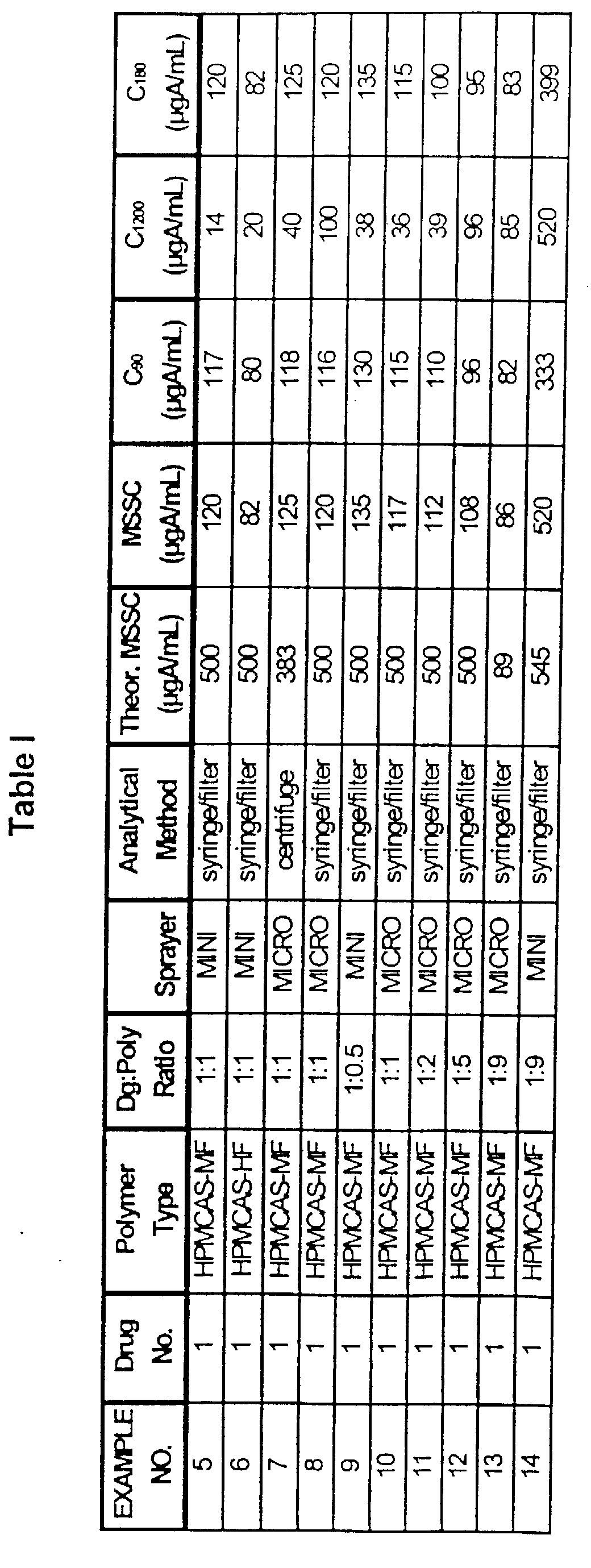
- the concentration of compound in the filtrate as a function of elapsed time was found to be 17 ⁇ gA/ml at 5 min., 70 ⁇ gA/ml at 10 min., 120 ⁇ gA/ml at 30 min., 127 ⁇ gA/ml at 60 min and 135 ⁇ gA/ml at 180 min., and 38 ⁇ gA/ml at 1200 min. (see Table I, Example 9).
- This example discloses an in vitro dissolution test termed the "centrifuge” method. This method was used to test the dissolution of material made by essentially the same method as that described in Example 1 except that the concentration of Compound 1 was decreased by a factor of 2 to 66.5 mg such that the ratio of compound to polymer was 1:1. (see Example 7, Table I).
- the tube was transferred to a centrifuge (Marathon, Model Micro A) allowed to stand undisturbed for six minutes, then centrifuged at 13,000 G for 60 seconds. A 25 uL sample was removed from the solids-free supematant in the centrifuge tube via pipette (Gilson Pipetman P-100) ten minutes after the timer was started. Solids in the centrifuge tube were resuspended by mixing the sample continuously on the vortex mixer for 30 seconds. The centrifuge tube was retumed to the centrifuge and allowed to stand undisturbed until the next sample was taken. Each sample was centrifuged, sampled and resuspended as described previously.
- Each sample was diluted 1:1 with a solution containing 60/40 1.7wt% ammonium ascorbate/acetonitrile, and the concentration of compound was determined by HPLC (Hewlett Packard 1090 HPLC, Phenomenex Ultracarb ODS 20 analytical column, absorbance measured at 215 nm with a diode array spectrophotometer). Samples were taken after 10, 30, 60, 180, and 1,200 minutes as described above, analyzed and compound concentrations were calculated. The concentration of compound in the supematant solution for the times listed above were 96, 121, 118, 125, and 40 ⁇ gA/ml, respectively. The composition and performance data is summarized in Table I as Example 7. The maximum compound concentration observed, 125 ⁇ gA/ml, is termed the maximum supersaturated concentration of compound and is abbreviated MSSC.
- Solvent was rapidly removed from the above solution by spraying it into the spray-drying apparatus shown in Figure 2, the "micro” spray dryer.
- the resulting material was a dry, white, substantially amorphous powder.
- Spray-dried dispersions of Compound 1 exemplifying the invention were made as described in Example 1 (Mini Spray-dryer) or Example 4 (Micro Spray-dryer) except as noted in Table I.
- the dispersions were tested by the method described in Example 2 or Example 3 as noted in Table I and the results are tabulated in Table I.
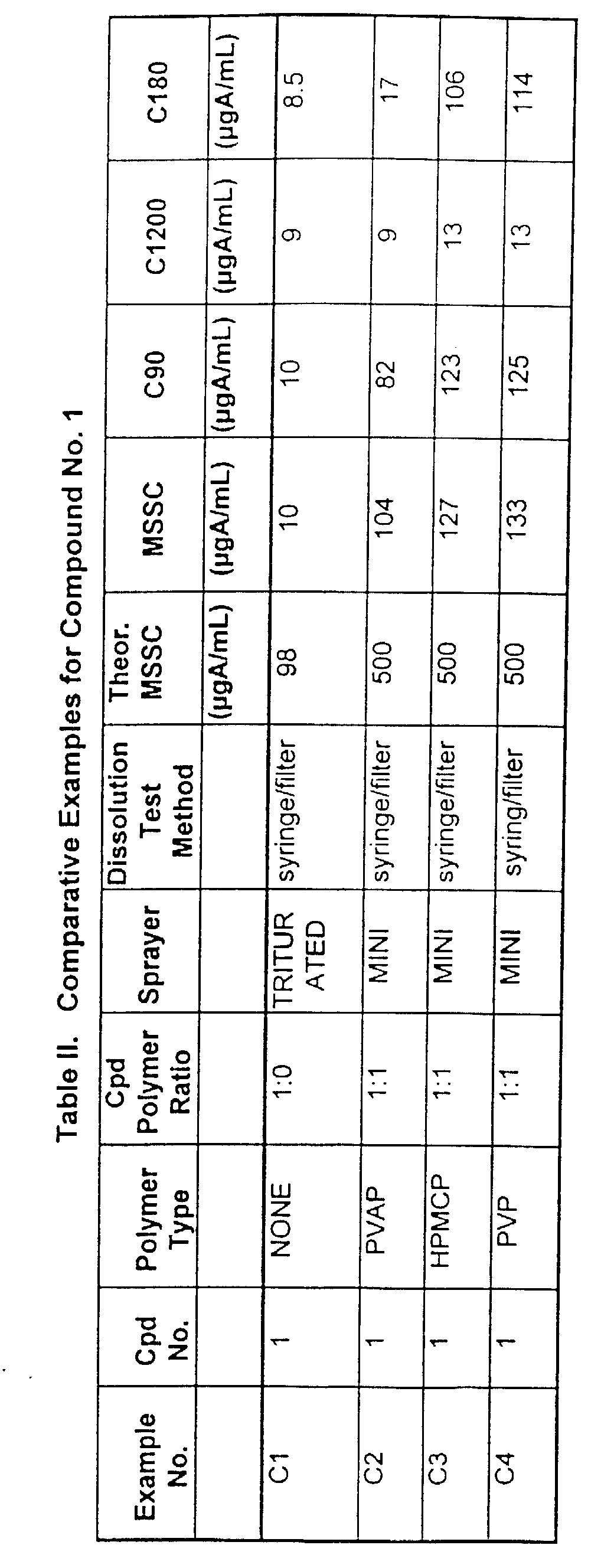
- Example 1 The following tests of Compound 1 were conducted to aid in demonstrating the superior solubilities of dispersions according to the invention relative to conventional forms of Compound 1. Dissolution tests were conducted using the syringe/filter test described in Example 2 with four materials: 1) triturated crystalline compound alone (Example C1), 2) a solid spray-dried dispersion of Compound 1 and PVAP (Example C2), 3) a solid spray-dried dispersion of Compound 1 and HPMCP (Example C3), and 4) a solid spray-dried dispersion of Compound 1 and PVP (Example C4).
- the composition of each material and the results of the dissolution tests are listed in Table II and should be compared to Examples 5 to 14 in Table I.
- HPMCAS dispersions showed much higher concentrations of dissolved compound (80 to 520 ⁇ gA/ml) than the crystalline compound alone (10 ⁇ gA/ml) and the compound concentration even after 1200 minutes was 20 to 520 ⁇ gA/ml, at least twice the equilibrium solubility (i.e. 8 to 10 ⁇ gA/ml).
- dispersions composed of matrix polymers other than HPMCAS PVAP, HPMCP, PVP
- C 1200 values are approximately equal to equilibrium solubility (9 to 13 ⁇ gA/ml) while C 1200 values for HPMCAS dispersions are generally 40 to 520 ⁇ gA/ml.
- a solid amorphous dispersion of Compound 1 was prepared using a relatively large spray dryer that produces dispersions at a rate of about 0.5 to 1.0 g/min.
- a compound/polymer solution was made by dissolving 6 g of Compound 1 and 3 g HPMCAS-MF in 600 g of acetone. The compound/polymer solution was then placed in a pressure vessel that delivers the compound/polymer solution at a controlled rate to a commercial spray dryer. (Mobile Minor Hi-Tec for Non-Aqueous Feed Spray Dryer, manufactured by NIRO A/S, Soburg, Denmark)
- the Niro spray dryer consists of an atomizer that fits into the top of a drying chamber.
- the atomizer is a 2-fluid nozzle.
- the atomizing gas was nitrogen delivered to the nozzle at and a flow of 180 g/min.
- the Compound/polymer solution described above was delivered to the nozzle at room temperature at a rate of 45 g/min.
- Drying gas was delivered to the drying chamber through an inlet duct that surrounds the 2-fluid nozzle.
- the drying gas was nitrogen heated to 120°C and delivered to the drying chamber at 1500 s/min.
- the spray-dried material exited the chamber with the drying gas through transport ducts and into a cyclone. At the top of the cyclone is an exhaust vent that allows the nitrogen and evaporated solvent to escape.
- the spray-dried material was collected in a canister.
- the material was a dry, white, substantially amorphous powder.
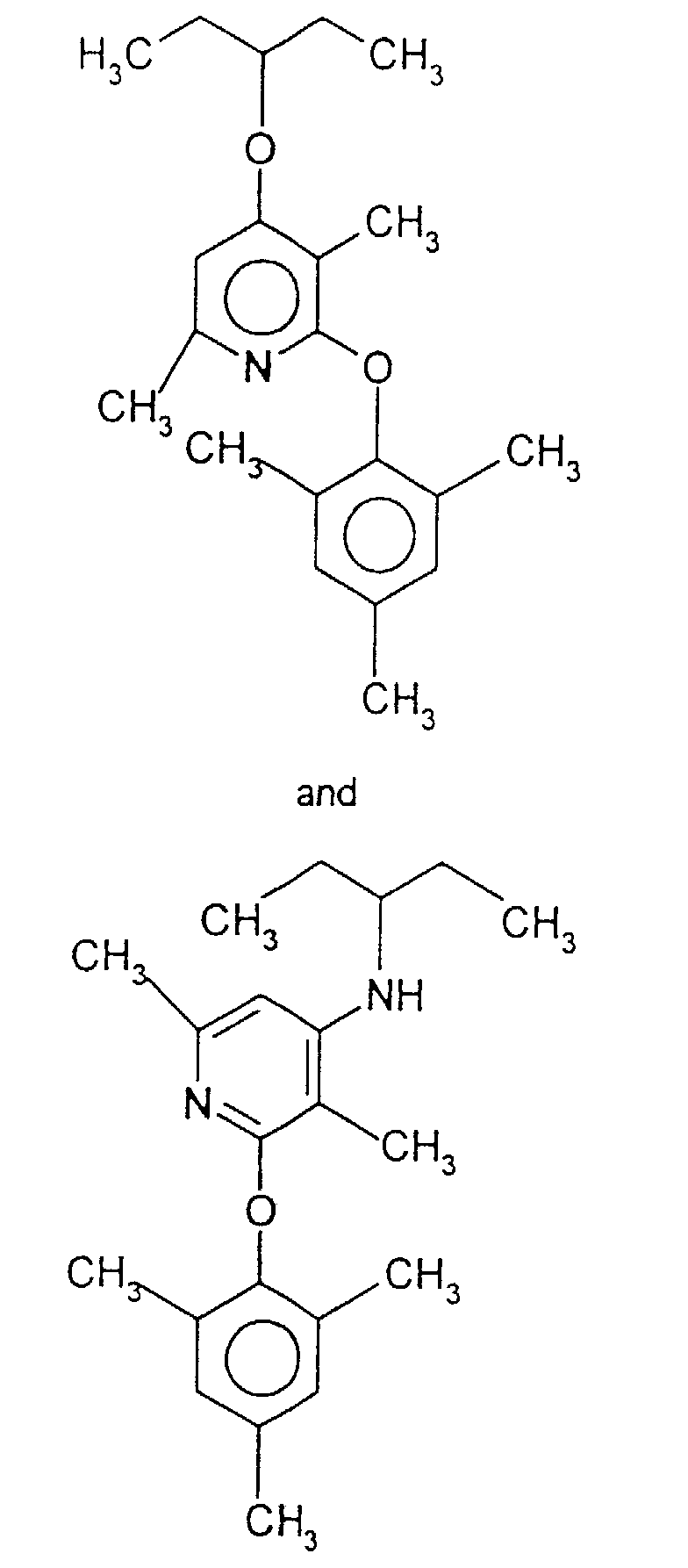
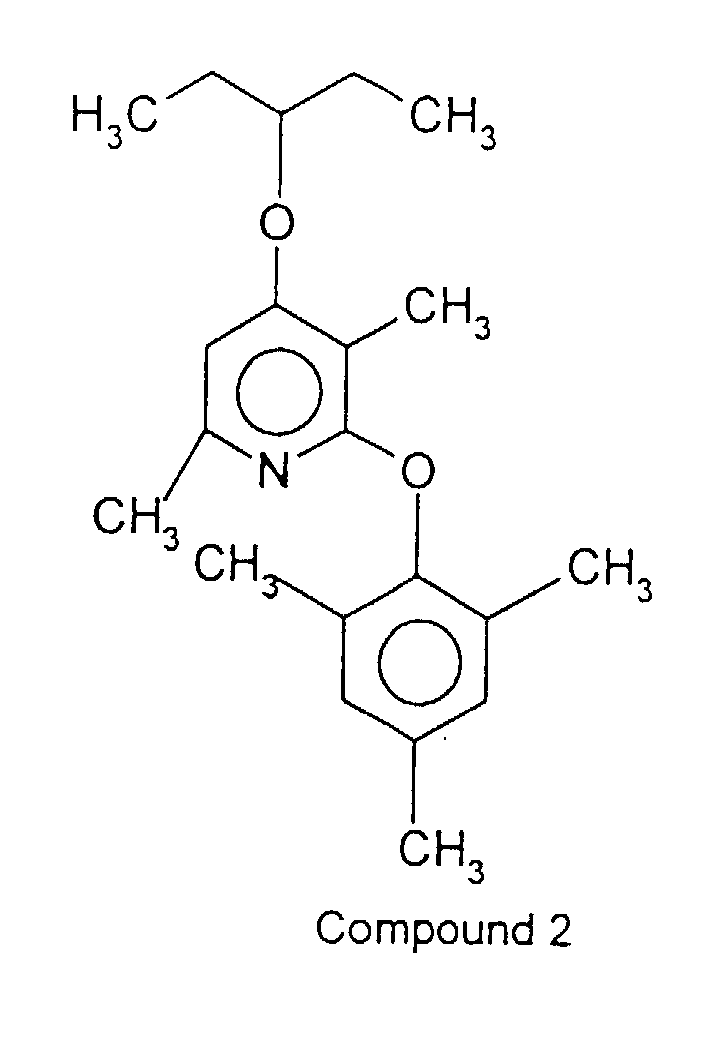
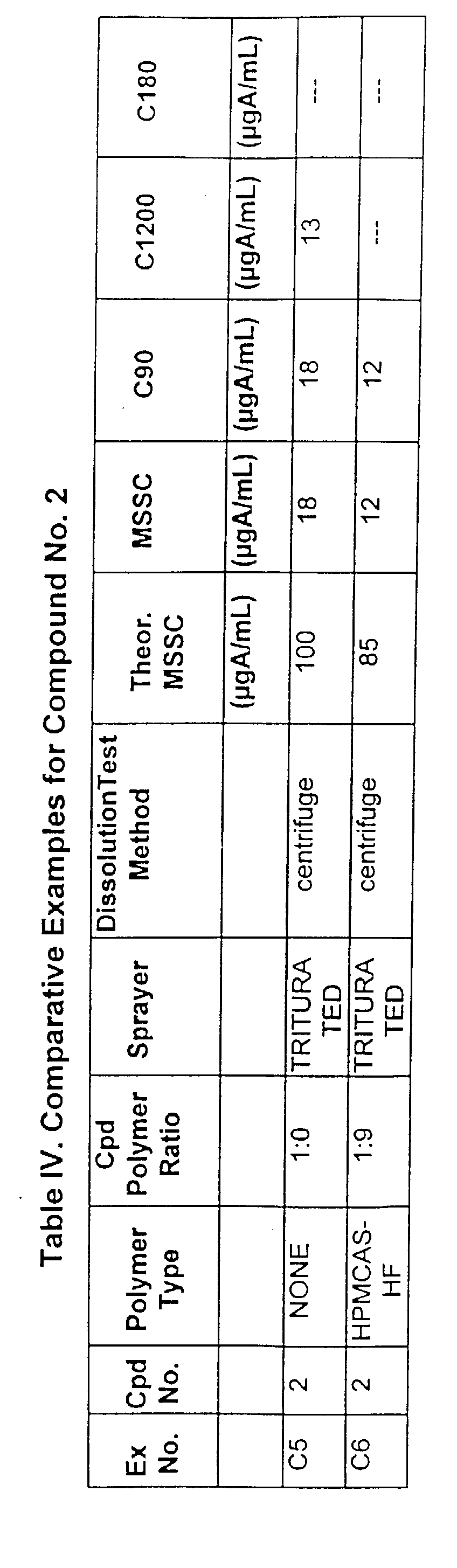
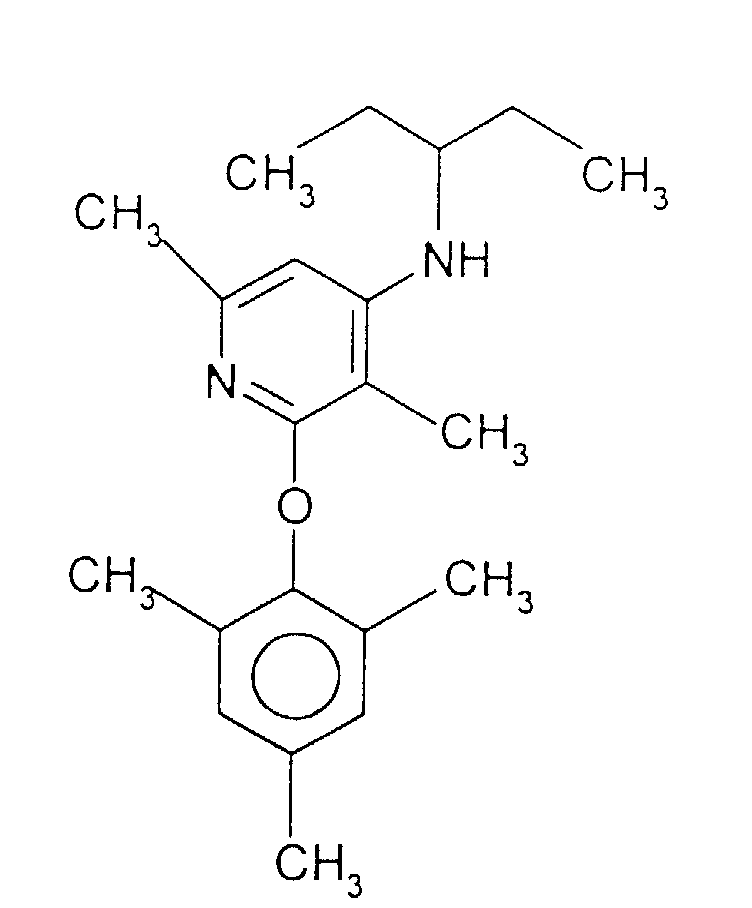
- Spray-dried dispersions of Compound 2 3,5-dimethyl-4-(3'-pentoxy)-2-(2',4',6'-trimethylphenoxy)pyridine, structure shown below, exemplifying the invention were made as described in Example 1 (Mini Spray-dryer), except as noted in Table III.
- the dispersions were tested by the method described in Example 3 and noted in Table III and the results are tabulated in Table III.
- Spray-dried dispersions of Compound 3, 5-(2-(4-(3-benzisothiazolyl)-piperazinyl)ethyl-6-chlorooxindole (ziprasidone), shown below, exemplifying the invention were made as described in Example 1 (Mini Spray-dryer) except as noted in Table V.
- the dispersions were tested by the method described in Example 3 as noted in Table V and the results are tabulated in Table V.
- a dispersion of Compound 3 was made by dissolving 10 g of Compound 3 and 90 g of HPMCAS-HF in 2400 g methanol. This compound/polymer solution was spray-dried using the Niro spray dryer as described in Example 15. The compound/polymer solution was delivered to the 2-fluid nozzle at room temperature at a flow rate of 25 g/min. All other conditions were the same as those described in Example 15.
- Example 3 This dispersion was tested using the method described in Example 3 (the "centrifuge” method). Sufficient dispersion was tested such that the concentration of Compound 3 would be 200 ⁇ gA/ml if all of the compound dissolved. The maximum compound concentration observed (C max ) was 107 ⁇ gA/ml. The compound concentration after 90 minutes and 1200 minutes was 60 ⁇ gA/ml and 32 ⁇ gA/ml, respectively.
- a comparison of the performance of dispersions of the present invention (spray dried) with those prepared conventionally by slow evaporation of solvent was made as follows.
- a dispersion of the present invention (Example 24) was prepared from 500 grams of compound/polymer solution comprising 0.2 wt% Compound 3 and 1.8 wt% HPMCAS-HF in methanol (USP/NF grade) using the Niro spray dryer and procedure described in Example 23. 5.8 grams of spray-dried dispersion was recovered.
- a conventional dispersion (Example C9) was prepared as follows. 100 grams of compound/polymer solution of the same composition as that used in Example 24 was placed in a 500 ml round-bottom flask. Solvent was removed from the solution at reduced pressure at 40°C using a rotary evaporator. After 30 minutes, the material appeared to be dry and it was scraped from the flask. The conventional dispersion was placed under vacuum for several hours to remove any traces of solvent. 1.8 grams of conventional dispersion was recovered.
- Example 24 and Example C9 were tested using the centrifuge method described in Example 3. The results of this test are listed in Table VII.
- the dispersion prepared by spray drying performed much better than dispersion prepared by conventional rotary evaporation.
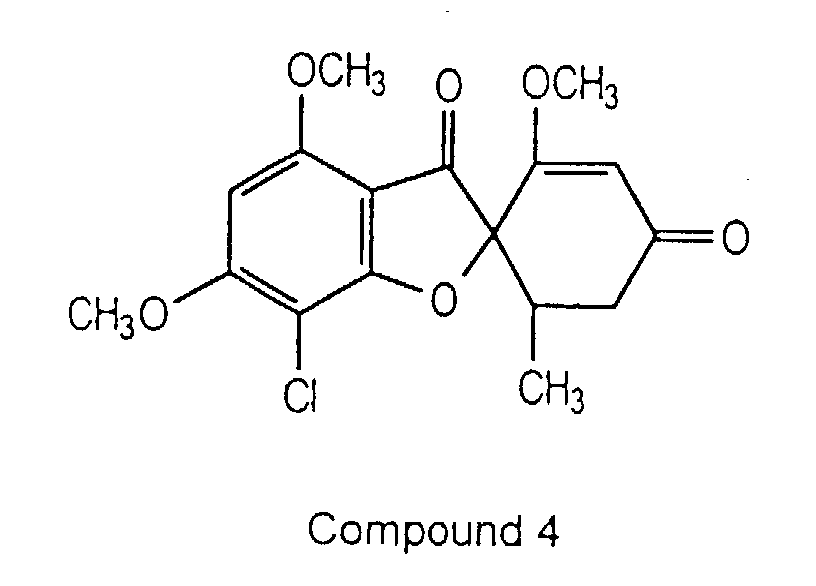
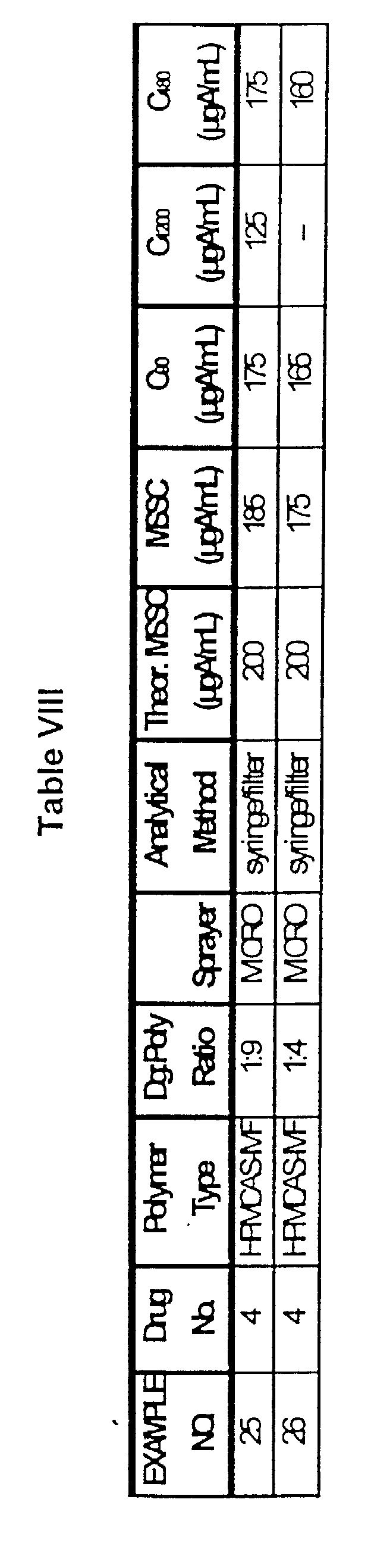
- Spray-dried dispersions of Compound 4, Griseofulvin, 7-chloro-4,6-dimethoxy-courmaran-3-one-2-spiro-1'-(2'-methoxy-6'-methylcyclohex-2'en-4'-one), shown below, exemplifying the invention were made as described in Example 4 (Micro Spray-dryer) except as noted in Table VIII.
- the dispersions were tested by the method described in Example 2 as noted in Table VIII and the results are tabulated in Table VIII.
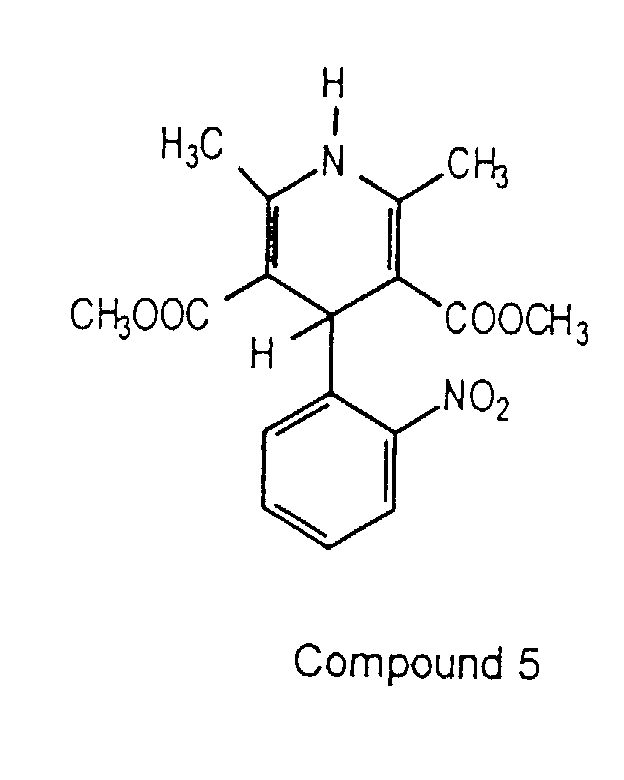
- a spray-dried dispersion of Compound 5, nifedipine, 1,4-dihydro-2,6-dimethyl-4-(2-nitrophenyl)-3,5-pyridinecarboxylic acid dimethyl ester, structure shown below, exemplifying the invention was made as described in Example 4 (Micro Spray-dryer) except as noted in Table X.
- the dispersion was tested by the method described in Example 2 as noted in Table X and the results are tabulated in Table X.
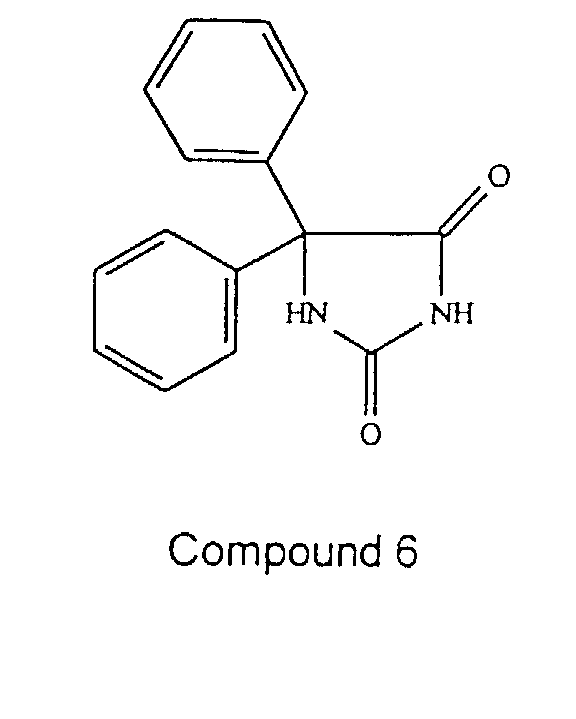
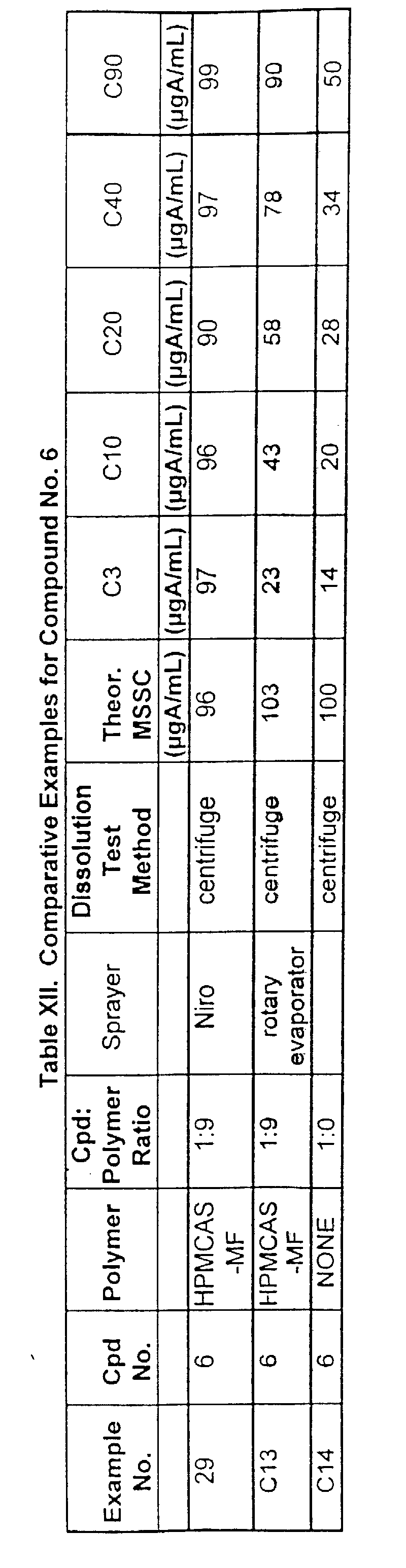
- a comparison of the performance of a dispersion of Compound 6, 5,5-diphenylhydantoin (phenytoin), shown below, and HPMCAS of the present invention (spray-dried) with those prepared conventionally by slow evaporation of solvent was made as follows.
- a dispersion of the present invention (Example 29) was prepared from 720 grams of a compound/polymer solution prepared by dissolving 0.10 wt% of Compound 6 (Aldrich) and 0.90 wt% HPMCAS-MF (Shin-Etsu) in acetone (HPLC grade). This compound/polymer solution was spray-dried using the Niro spray-dryer and procedure described in Example 23. 6.8 grams of spray-dried dispersion was recovered.
- Example C13 A conventional dispersion (Example C13) was prepared from 90 grams of a compound/polymer solution of the same composition as that used in Example 29 using the procedure described for Comparative Example C9 except that the solvent was evaporated at 30°C. After 30 minutes, the material coated the surface of the flask as a solid cake and it was scraped from the flask. 0.9 grams of product was recovered.
- Example 29 The two dispersions described above (Example 29 and Comparative Example C13) and crystalline compound (Comparative Example C14) were tested using the centrifuge method described in Example 3. The results of this test are listed in Table XII.
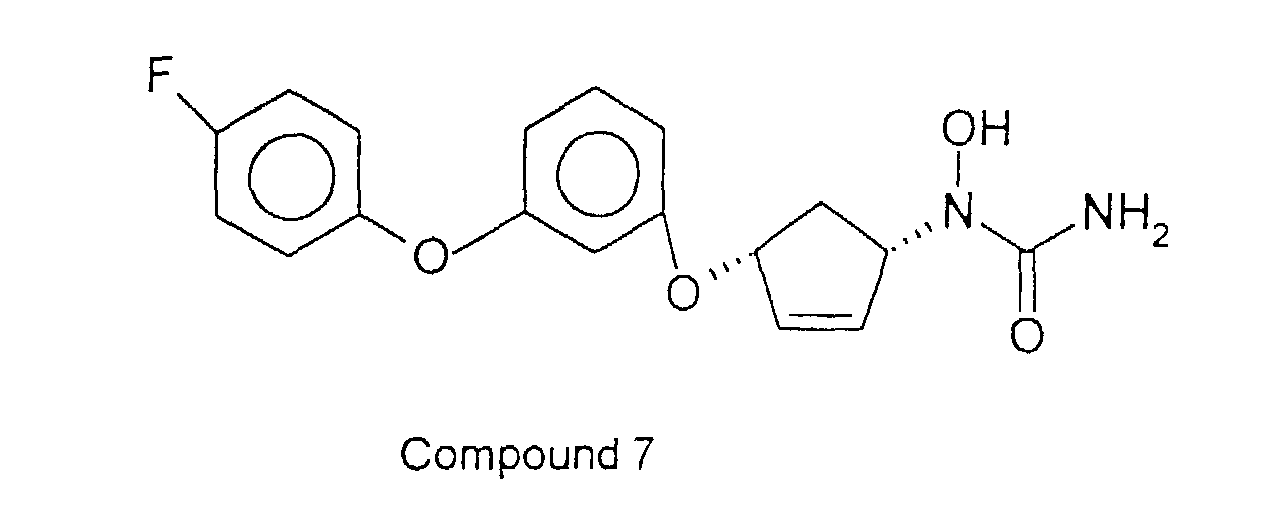
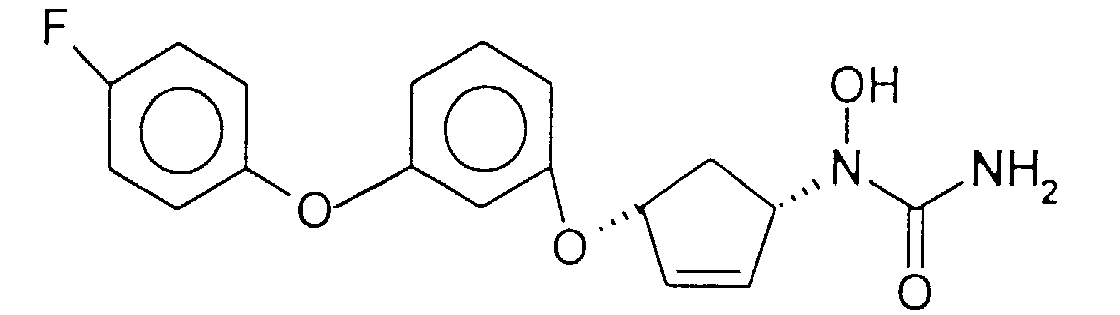
- a spray-dried dispersion of Compound 7, (+) -N- ⁇ 3- [3- (4-fluorophenoxy)phenyl]-2-cyclopenten-1-yl ⁇ -N-hydroxyurea, structure shown below, exemplifying the invention was made as described in Example 1 (Mini Spray-dryer) except as noted in Table XIII.
- the dispersion, along with crystalline Compound 7 (Comparative Example C15), were tested by the method described in Example 3 as noted in Table XIII and the results are tabulated in Table XIII.
- the observed concentration of Compound 7 was much higher for the dispersion relative to the crystalline compound.
- a spray-dried dispersion of Compound 8, [3, 6-dimethyl-2-(2, 4, 6-trimethylphenoxy)-pyridin-4-yl]-(1-ethyl-propyl)-amine, shown below, exemplifying the invention was made as described in Example 1 (Mini Spray-dryer) except as noted in Table XIV.
- the dispersion, along with crystalline Compound 8 (Comparative Example C16), were tested by the method described in Example 3 and noted in Table XIV and the results are tabulated in Table XIV.
- the observed concentration of Compound 8 was much higher for the dispersion relative to the crystalline compound.
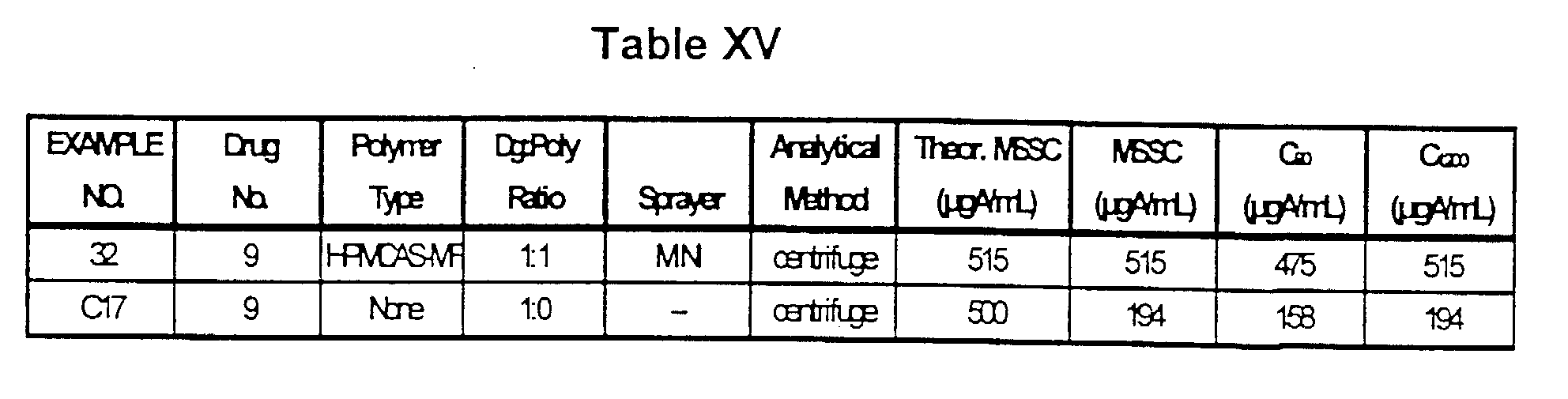
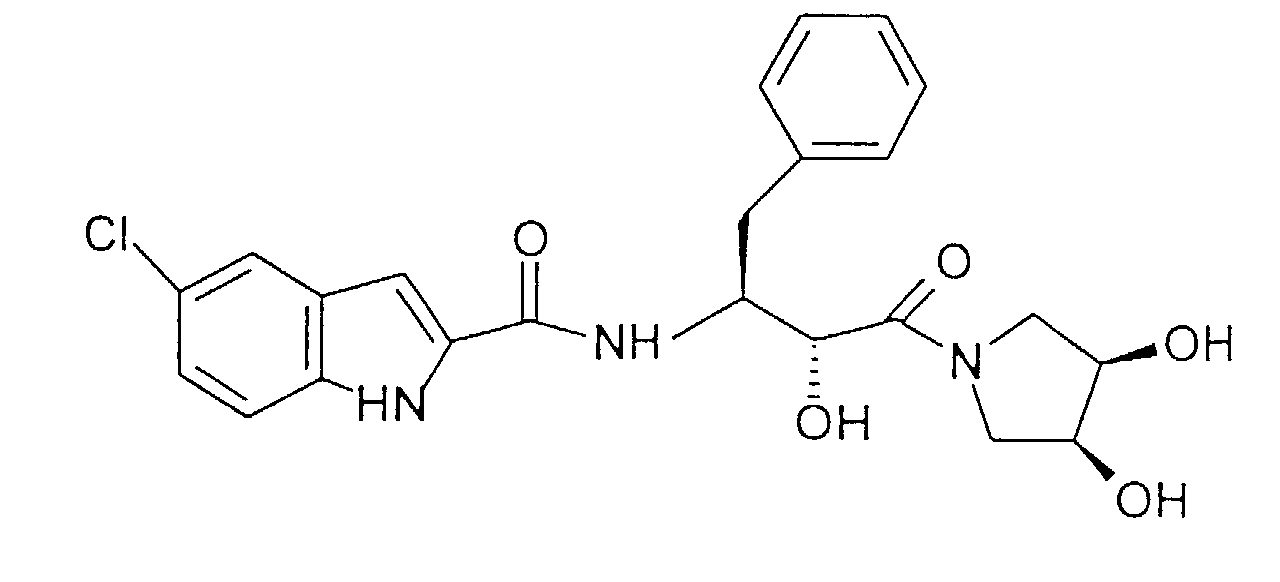
- a spray-dried dispersion of Compound 9, 1H-lndole-2-caboxamide, 5-chloro-N-[3-(3,4-dihydroxy-1-pyrrolidinyl)-2-hydroxy-3-oxo-1-(phenylmethnyl)propyl]-, [R-[R*, S*-(cis)]]-, exemplifying the invention was made as described in Example 1 (Mini Spray-dryer) except as noted in Table XV.
- the dispersion, along with crystalline Compound 9 (Comparative Example C17), were tested by the method described in Example 3 as noted in Table XVand the results are tabulated in Table XV.
- the observed concentration of Compound 9 was much higher for the dispersion relative to the crystalline compound.
- Dogs were dosed either after an ovemight fast, or after a meal composed of 14g dry dog food, 8g olive oil, and 50 ml water.
- Blood (3ml) was collected from the jugular vein pre-dosing and at 0.17, 0.5, 1,2,4,7,10,24,32, and 48 hour post-dosing.
- MTBE methyl-tert-butyl ether
- pH9 1 ml 500 mM sodium carbonate buffer
- the aqueous portion of the sample was frozen in a dry ice/acetone bath and the MTBE layer was decanted and evaporated in a vortex evaporator at 55°C.
- the sample was reconstituted with 75 ⁇ l of a mobile phase composed of 45% acetonitrile, 55% 50 mM NaH2PO4/30mM triethylamine (pH 3).
- Analysis was carried out by HPLC, using a Waters Nova-Pak C-18 column (3.9mmx150mm), with a C18/5u guard column, at a temperature of 26°C, at a flow rate of 1ml/min. Detection was by fluorescence (excitation wavelength 290nm; emission wavelength 348 nm).
- C max is the maximum observed plasma Compoundl concentration, averaged over the number of dogs dosed with each formulation.
- AUC o- ⁇ is the average area under the plasma Compound 1 concentration vs. time curve.
- Canines were in fasted state, except where indicated.
- Formula-tion Dose n Cmax(uM) AUC o- ⁇ (uMxhr/ml) % Bioavailability A 5mgA/kg 2 0.3 1.3 2.0 B 10mgA/kg 4 11.8 92.9 72.5 C 3.7mgA/kg 4 4.9 17.1 35.0 D 53.1 mgA 3 3.3 15.8 31.0 E 200 mgA 4 9.1 76.3 33.4 F 200 mg A 4 9.0 82.4 45.6 E(fed) 200 mg A 4 7.6 182.5 109.5
- Pre-dosing and at 0.5, 1, 1.5, 2, 3, 4, 6, and 8 hr post-dosing, blood samples were taken, and plasma was harvested. Ziprasidone concentration was assayed using an HPLC assay.
- the mobile phase consisted of 40/60 aqueous NaH2P04 (0.005M)/acetonitrile, and the column was a CN - Chromega column, 5 u, CN+NP, 25 cm x 4.6 mm (ES Industries). The flow rate was 1.5 ml/min, and detection was at 315 nm.
- the observed average AUC(0-inf) was 561.6 ngxhr/ml.
- the average AUC was 1056 ngxhr/ml.
Landscapes
- Health & Medical Sciences (AREA)
- Chemical & Material Sciences (AREA)
- Engineering & Computer Science (AREA)
- Bioinformatics & Cheminformatics (AREA)
- General Health & Medical Sciences (AREA)
- Public Health (AREA)
- Medicinal Chemistry (AREA)
- Veterinary Medicine (AREA)
- Animal Behavior & Ethology (AREA)
- Pharmacology & Pharmacy (AREA)
- Life Sciences & Earth Sciences (AREA)
- Epidemiology (AREA)
- Organic Chemistry (AREA)
- Chemical Kinetics & Catalysis (AREA)
- General Chemical & Material Sciences (AREA)
- Nuclear Medicine, Radiotherapy & Molecular Imaging (AREA)
- Inorganic Chemistry (AREA)
- Psychiatry (AREA)
- Biomedical Technology (AREA)
- Neurology (AREA)
- Neurosurgery (AREA)
- Medicinal Preparation (AREA)
- Pharmaceuticals Containing Other Organic And Inorganic Compounds (AREA)
- Acyclic And Carbocyclic Compounds In Medicinal Compositions (AREA)
Abstract
Description










Aqueous suspension of a 1:1 (w/w) Compound 1/HPMCAS spray-dried dispersion at 2.5mgA/ml in 2% polysorbate-80. Dosed at 3.7 mgA/kg at 2ml/kg.
Capsule (size#2) containing 53.1 mgA Compound 1 as a 1:1 (w/w) Compound 1/HPMCAS spray-dried dispersion. The capsule fill composition is presented in Table XVI.
Capsule (size #0) containing 200 mgA Compound 1 as a 2:1 (w/w) Compound 1/HPMCAS spray-dried dispersion. The capsule fill composition is presented in Table XVI.
Capsule (size#0) containing 200 mgA Compound 1 as a 2:1 (w/w) Compoundl/HPMCAS spray-dried dispersion. The capsule fill composition is presented in Table XVI.
| Component | Formulation D | Formulation E | Formulation F |
| Compound 1/HPMCAS (1:1, w/w) | 44% | - | - |
| Compound 1/HPMCAS (2:1, w/w) | - | 60% | 50% |
| Lactose, fast flow | 22% | 15% | 10.8% |
| Microcrystalline Cellulose | 18.8% | 15% | 32.2% |
| Sodium Starch | 8% | 7% | 5% |
| Glycolate | |||
| Sodium lauryl Sulfate | 2% | 2% | 1% |
| Magnesium Stearate | 1% | 1% | 1% |
| Canine pharmacokinetics after oral dosing of Compound 1 formulations. Canines were in fasted state, except where indicated. | |||||
| Formula-tion | Dose | n | Cmax(uM) | AUC o-∞ (uMxhr/ml) | % Bioavailability |
| A | 5mgA/kg | 2 | 0.3 | 1.3 | 2.0 |
| B | 10mgA/kg | 4 | 11.8 | 92.9 | 72.5 |
| C | 3.7mgA/kg | 4 | 4.9 | 17.1 | 35.0 |
| D | 53.1 mgA | 3 | 3.3 | 15.8 | 31.0 |
| E | 200 mgA | 4 | 9.1 | 76.3 | 33.4 |
| F | 200 mg A | 4 | 9.0 | 82.4 | 45.6 |
| E(fed) | 200 mg A | 4 | 7.6 | 182.5 | 109.5 |
Claims (38)
- A composition comprising a spray dried solid dispersion, which dispersion comprises a sparingly water-soluble drug and HPMCAS, said dispersion providing a maximum concentration of said drug in a use environment that is higher by a factor of at least 1.5 relative to a control composition comprising an equivalent quantity of undispersed drug.
- A composition as decribed in claim 1, wherein said drug has a dose to aqueous solubility ratio greater than 100.
- A composition as defined in claim 1, wherein said drug is crystalline when undispersed.
- A composition as defined in claim 1, wherein said drug is amorphous when undispersed.
- A composition as defined in claim 1, wherein said use environment is the gastrointestinal tract.
- A composition as defined in claim 1, wherein said use environment is MFD.
- A composition of matter comprising a spray-dried solid dispersion, which dispersion comprises a sparingly soluble drug and HPMCAS, said dispersion exhibiting a maximum supersaturated concentration in MFD which is higher by a factor of at least 1.5 relative to the equilibrium concentration exhibited by a control composition comprising an equivalent quantity of undispersed drug.
- A composition as decribed in claim 7, wherein said drug has a dose to aqueous solubility ratio greater than 100.
- A composition as defined in claim 7, wherein said drug is crystalline when undispersed.
- A composition as defined in claim 7, wherein said drug is amorphous when undispersed.
- A composition comprising a spray dried solid dispersion, which dispersion comprises a sparingly water-soluble drug and HPMCAS, said dispersion effecting, in vivo, a maximal observed blood drug concentration (Cmax) that is higher by a factor of at least 1.25 relative to a control composition comprising an equivalent quantity of undispersed drug.
- A composition as defined in claim 11, wherein said drug is crystalline when undispersed.
- A composition as defined in claim 11, wherein said drug is amorphous when undispersed.
- A composition as decribed in claim 11, wherein said drug has a dose to aqueous solubility ratio greater than 100.
- A composition comprising a spray dried solid dispersion, which dispersion comprises a sparingly water-soluble drug and HPMCAS, said dispersion effecting, in vivo, an AUC that is higher by a factor of at least 1.25 relative to a control composition comprising an equivalent quantity of undispersed drug.
- A composition as defined in claim 15, wherein said drug is crystalline when undispersed.
- A composition as defined in claim 15, wherein said drug is amorphous when undispersed.
- A composition as decribed in claim 15, wherein said drug has a dose to aqueous solubility ratio greater than 100.
- A process for making a spray dried solid dispersion comprisingA. forming a solution comprising (i) HPMCAS, (ii) a sparingly water-soluble drug, and (iii) a solvent in which both (i) and (ii) are soluble; andB. spray drying said solution, thereby forming spray dried particles having an average diameter less than 100 µm.
- A process as defined in claim 19, wherein the concentration of drug in said solvent is less than 20g/100g of solvent.
- A process as defined in claim 19, wherein the spray drying is conducted under conditions whereby said droplets solidify in less than 20 seconds.
- A composition as defined in claim 1, wherein the concentration of drug in MFD falls to no less than 25% of the maximum supersaturated concentration during the 15 minutes following the time at which the maximum supersaturated concentration is reached.
- A composition as defined in claim 1, wherein said dispersion is in the form of particles less than 100 µm in diameter.
- A composition as defined in claim 7, wherein said dispersion is in the form of particles less than 100 µm in diameter.
- A composition as defined in claim 11, wherein said dispersion is in the form of particles less than 100 µm in diameter.
- A composition as defined in claim 15, wherein said dispersion is in the form of particles less than 100 µm in diameter.
- A composition as defined in claim 1, wherein the drug to HPMCAS weight ratio is from 1/0.2 to 1/100.
- A composition as defined in claims 1, 7, 11, or 15, wherein said compound is a glycogen phosphorylase inhibitor.
- A composition as defined in claims 1, 7, 11, or 15, wherein said compound isor a pharmaceutically acceptable salt thereof.

- A composition as defined in claims 1, 7, 11, or 15, wherein said compound isor a pharmaceutically acceptable salt thereof.
- A composition as defined in claims 1, 7, 11, or 15, wherein said compound is a 5-lipoxygenase inhibitor.
- A composition as defined in claims 1, 7, 11, or 15, wherein said compound isor a pharmaceutically acceptable salt thereof.
- A composition as defined in claims 1, 7, 11, or 15, wherein said compound is a CRH inhibitor.
- A composition as defined in claims 1, 7, 11, or 15, wherein said compound isor a pharmaceutically acceptable salt thereof.

- A composition as defined in claims 1, 7, 11, or 15, wherein said compound isor a pharmaceutically acceptable salt thereof.
- A composition as defined in claims 1, 7, 11, or 15, wherein said compound is an antipsychotic.
- A composition as defined in claims 1, 7, 11, or 15, wherein said compound is ziprasidone.
- A composition as defined in claims 1, 7, 11, or 15, wherein said compound is selected from griseofulvin, nifedipine, and phenytoin.
Priority Applications (3)
| Application Number | Priority Date | Filing Date | Title |
|---|---|---|---|
| EP06019790A EP1745774A3 (en) | 1997-08-11 | 1998-07-27 | Solid pharmaceutical dispersions with enhanced bioavailability |
| EP06019789.4A EP1741424B1 (en) | 1997-08-11 | 1998-07-27 | Solid pharmaceutical dispersions with enhanced bioavailabilty |
| CY20071101144T CY1107726T1 (en) | 1997-08-11 | 2007-09-04 | DISPOSABLE SOLID PHARMACEUTICAL SUBSTANCES WITH INCREASED BIO AVAILABILITY |
Applications Claiming Priority (2)
| Application Number | Priority Date | Filing Date | Title |
|---|---|---|---|
| US5522197P | 1997-08-11 | 1997-08-11 | |
| US55221P | 1997-08-11 |
Related Child Applications (2)
| Application Number | Title | Priority Date | Filing Date |
|---|---|---|---|
| EP06019789.4A Division EP1741424B1 (en) | 1997-08-11 | 1998-07-27 | Solid pharmaceutical dispersions with enhanced bioavailabilty |
| EP06019790A Division EP1745774A3 (en) | 1997-08-11 | 1998-07-27 | Solid pharmaceutical dispersions with enhanced bioavailability |
Publications (3)
| Publication Number | Publication Date |
|---|---|
| EP0901786A2 true EP0901786A2 (en) | 1999-03-17 |
| EP0901786A3 EP0901786A3 (en) | 2000-01-19 |
| EP0901786B1 EP0901786B1 (en) | 2007-06-13 |
Family
ID=21996463
Family Applications (1)
| Application Number | Title | Priority Date | Filing Date |
|---|---|---|---|
| EP98305960A Revoked EP0901786B1 (en) | 1997-08-11 | 1998-07-27 | Solid pharmaceutical dispersions with enhanced bioavailability |
Country Status (14)
| Country | Link |
|---|---|
| US (7) | US8263128B2 (en) |
| EP (1) | EP0901786B1 (en) |
| JP (1) | JP2984661B2 (en) |
| CN (3) | CN1207896A (en) |
| AT (1) | ATE364374T1 (en) |
| BR (1) | BR9803144A (en) |
| CA (1) | CA2245269C (en) |
| CY (1) | CY1107726T1 (en) |
| DE (1) | DE69837903T2 (en) |
| DK (1) | DK0901786T3 (en) |
| ES (1) | ES2287971T3 (en) |
| IL (1) | IL125627A (en) |
| PT (1) | PT901786E (en) |
| TW (1) | TWI230079B (en) |
Cited By (96)
| Publication number | Priority date | Publication date | Assignee | Title |
|---|---|---|---|---|
| EP0965343A3 (en) * | 1998-06-15 | 2000-02-23 | Pfizer Products Inc. | Ziprasidone formulations |
| EP1027887A3 (en) * | 1999-02-10 | 2001-02-28 | Pfizer Products Inc. | Matrix controlled release device |
| EP1027888A3 (en) * | 1999-02-10 | 2001-02-28 | Pfizer Products Inc. | Osmotic system for delivery of solid amorphous dispersions of drugs |
| EP1027885A3 (en) * | 1999-02-09 | 2001-03-14 | Pfizer Products Inc. | Basic drug compositions with enhanced bioavailability |
| US6245766B1 (en) * | 1997-12-18 | 2001-06-12 | Pfizer Inc | Method of treating psychiatric conditions |
| WO2001047495A1 (en) | 1999-12-23 | 2001-07-05 | Pfizer Products Inc. | Pharmaceutical compositions providing enhanced drug concentrations |
| WO2001047500A1 (en) * | 1999-12-23 | 2001-07-05 | Pfizer Products Inc. | Hydrogel-driven drug dosage form |
| WO2001068055A1 (en) * | 2000-03-16 | 2001-09-20 | Pfizer Products Inc. | Pharmaceutical compositions of glycogen phosphorylase inhibitors |
| WO2002011710A2 (en) | 2000-08-03 | 2002-02-14 | Pfizer Products Inc. | Pharmaceutical compositions of cholesteryl ester transfer protein inhibitors |
| WO2001068092A3 (en) * | 2000-03-16 | 2002-03-21 | Pfizer Prod Inc | Glycogen phosphorylase inhibitor |
| WO2002038126A3 (en) * | 2000-11-08 | 2002-10-10 | Ove Emil Hansen | A process for production of particles for pharmaceutical compositions having increased bioavailability |
| WO2003000294A1 (en) * | 2001-06-22 | 2003-01-03 | Pfizer Products Inc. | Pharmaceutical compositions containing a solid dispersion of a poorly-soluble drug in a matrix and a solubility-enhancing polymer |
| WO2003000238A1 (en) * | 2001-06-22 | 2003-01-03 | Pfizer Products Inc. | Pharmaceutical compositions of adsorbates of amorphous drug |
| WO2003000292A1 (en) * | 2001-06-22 | 2003-01-03 | Pfizer Products Inc. | Pharmaceutical compositions comprising low-solubility and/or acid-sensitive drugs and neutralized acidic polymers |
| EP1269994A3 (en) * | 2001-06-22 | 2003-02-12 | Pfizer Products Inc. | Pharmaceutical compositions comprising drug and concentration-enhancing polymers |
| US6589947B1 (en) * | 1999-10-29 | 2003-07-08 | Pfizer Inc. | Use of corticotropin releasing factor antagonists and related compositions |
| WO2003063832A1 (en) | 2002-02-01 | 2003-08-07 | Pfizer Products Inc. | Pharmaceutical compositions comprising a solid amorphous dispersion of cholesteryl ester transfer protein inhibitors |
| WO2003063833A1 (en) * | 2002-02-01 | 2003-08-07 | Pfizer Products Inc. | Pharmaceutical compositions of amorphous dispersions of drugs and lipophilic microphase-forming materials |
| US6706283B1 (en) | 1999-02-10 | 2004-03-16 | Pfizer Inc | Controlled release by extrusion of solid amorphous dispersions of drugs |
| US6763607B2 (en) | 2002-02-01 | 2004-07-20 | Pfizer Inc. | Method for making homogeneous spray-dried solid amorphous drug dispersions utilizing modified spray-drying apparatus |
| WO2005011636A3 (en) * | 2003-08-04 | 2005-03-31 | Pfizer Prod Inc | Spray drying processes for forming solid amorphous dispersions of drugs and polymers |
| WO2005046644A1 (en) * | 2003-11-14 | 2005-05-26 | Pfizer Products Inc. | Solid amorphous dispersions of an mtp inhibitor for treatment of obesity |
| WO2005080373A1 (en) | 2004-02-04 | 2005-09-01 | Pfizer Products Inc. | Substituted quinoline compounds |
| WO2005111032A1 (en) * | 2004-05-14 | 2005-11-24 | Apotex Pharmachem Inc. | New amorphous ziprasidone hydrochloride (5-[2-[4-(1,2-benzisothiazol-3-yl)-1-piperazinyl]ethyl]-6-chloro-1,3-dihydro-2h-indl-2-one hydrochloride) and process to produce the same |
| WO2005116034A1 (en) | 2004-05-25 | 2005-12-08 | Pfizer Products Inc. | Tetraazabenzo[e]azulene derivatives and analogs thereof |
| WO2006079921A2 (en) | 2005-01-28 | 2006-08-03 | Pfizer Products Inc. | Drying of drug-containing particles |
| WO2006024944A3 (en) * | 2004-08-31 | 2006-08-24 | Pfizer Prod Inc | Pharmaceutical dosage forms comprising a low-solubility drug and a polymer |
| WO2007013477A1 (en) * | 2005-07-28 | 2007-02-01 | Otsuka Pharmaceutical Co., Ltd. | Pharmaceutical composition comprising 2 , 3-dihydro-6-nitroimidazo [2 , 1-b] oxazole derivatives |
| EP1920766A2 (en) | 2002-02-01 | 2008-05-14 | Pfizer Products Inc. | Pharmaceutical compositions of amorphous dispersions of drugs and lipophilic microphase-forming materials |
| WO2007066189A3 (en) * | 2005-12-09 | 2008-08-14 | Pfizer Prod Inc | Salts, prodrugs and formulations of 1-[5-(4-amino-7-isopropyl-7h-pyrrolo[2,3-d]pyrimidine-5-carbonyl)-2-methoxy-phenyl]-3-(2,4-dichloro-phenyl)-urea |
| US20080193534A1 (en) * | 2005-08-12 | 2008-08-14 | Astrazeneca Ab | Process |
| US7423004B2 (en) | 2003-01-31 | 2008-09-09 | Smithkline Beecham Corporation | Solid dispersion compositions |
| US20080317851A1 (en) * | 2002-02-01 | 2008-12-25 | Pfizer Inc | Immediate release dosage forms containing solid drug disbursions |
| WO2009038112A1 (en) * | 2007-09-21 | 2009-03-26 | Shionogi & Co., Ltd. | Solid preparation comprising npyy5 receptor antagonist |
| EP2111856A2 (en) | 2002-08-12 | 2009-10-28 | Pfizer Products Inc. | Pharmaceutical compositions of semi-ordered drugs and polymers |
| WO2010067233A1 (en) | 2008-12-08 | 2010-06-17 | Pfizer Inc. | 1,2,4 triazolo [4, 3 -a] [1,5] benzodiazepin-5 (6h) -ones as agonists of the cholecystokinin-1 receptor (cck-ir) |
| US7780988B2 (en) | 2002-02-01 | 2010-08-24 | Bend Research, Inc. | Method for making homogeneous spray-dried solid amorphous drug dispersions using pressure nozzles |
| WO2010102065A1 (en) | 2009-03-05 | 2010-09-10 | Bend Research, Inc. | Pharmaceutical compositions of dextran polymer derivatives |
| US7947670B2 (en) | 2006-12-12 | 2011-05-24 | Infinity Pharmaceuticals Inc. | Ansamycin formulations and methods of use thereof |
| WO2011145022A1 (en) | 2010-05-21 | 2011-11-24 | Pfizer Inc. | 2-phenyl benzoylamides |
| WO2011163090A1 (en) | 2010-06-23 | 2011-12-29 | Metabolex, Inc. | Compositions of 5-ethyl-2-{4-[4-(4-tetrazol-1-yl-phenoxymethyl)-thiazol-2-yl]-piperidin-1-yl}-pyrimidine |
| US8183381B2 (en) | 2007-07-19 | 2012-05-22 | Metabolex Inc. | N-linked heterocyclic receptor agonists for the treatment of diabetes and metabolic disorders |
| EP1871346A4 (en) * | 2005-04-20 | 2012-07-18 | Ctc Bio Inc | PHARMACEUTICAL COMPOSITION CONTAINING A SIBUTRAMINE-FREE BASE AND METHOD OF DESIGNING SAME |
| US8257741B2 (en) | 1997-08-11 | 2012-09-04 | Bend Research, Inc. | Solid pharmaceutical dispersions with enhanced bioavailability |
| US8288384B2 (en) | 2006-12-28 | 2012-10-16 | Metabolex, Inc. | Heterocyclic receptor agonists for the treatment of diabetes and metabolic disorders |
| US8410127B2 (en) | 2009-10-01 | 2013-04-02 | Metabolex, Inc. | Substituted tetrazol-1-yl-phenoxymethyl-thiazol-2-yl-piperidinyl-pyrimidine salts |
| US8481081B2 (en) | 1999-02-10 | 2013-07-09 | Bend Research, Inc. | Pharmaceutical solid dispersions |
| WO2013150416A1 (en) | 2012-04-06 | 2013-10-10 | Pfizer Inc. | Diacylglycerol acyltransferase 2 inhibitors |
| US8741920B2 (en) | 2009-08-03 | 2014-06-03 | Hoffmann-La Roche, Inc. | Process for the manufacture of pharmaceutically active compounds |
| US9023393B2 (en) | 2003-08-04 | 2015-05-05 | Bend Research, Inc. | Pharmaceutical compositions of adsorbates of amorphous drugs and lipophilic microphase-forming materials |
| WO2015140658A1 (en) | 2014-03-17 | 2015-09-24 | Pfizer Inc. | Diacylglycerol acyltransferase 2 inhibitors for use in the treatment of metabolic and related disorders |
| EP2579896B1 (en) | 2010-06-14 | 2016-07-20 | Dow Global Technologies LLC | Hydroxypropyl methyl cellulose acetate succinate with enhanced acetate and succinate substitution |
| US9468604B2 (en) | 2001-06-22 | 2016-10-18 | Bend Research, Inc. | Pharmaceutical compositions of dispersions of drug and neutral polymers |
| EP1993360B1 (en) | 2005-12-28 | 2017-02-08 | Vertex Pharmaceuticals Incorporated | Solid forms of n-[2,4-bis(1,1-dimethylethyl)-5-hydroxyphenyl]-1,4-dihydro-4-oxoquinoline-3-carboxamide |
| US9624213B2 (en) | 2011-02-07 | 2017-04-18 | Plexxikon Inc. | Compounds and methods for kinase modulation, and indications therefor |
| US9663517B2 (en) | 2009-04-03 | 2017-05-30 | Plexxikon Inc. | Compositions and uses thereof |
| US9695169B2 (en) | 2012-05-31 | 2017-07-04 | Plexxikon Inc. | Synthesis of heterocyclic compounds |
| US9757406B2 (en) | 2013-08-27 | 2017-09-12 | Gilead Pharmasset Llc | Combination formulation of two antiviral compounds |
| US9844539B2 (en) | 2007-07-17 | 2017-12-19 | Plexxikon Inc. | Compounds and methods for kinase modulation, and indications therefor |
| WO2018033832A1 (en) | 2016-08-19 | 2018-02-22 | Pfizer Inc. | Diacylglycerol acyltransferase 2 inhibitors |
| WO2018163066A1 (en) | 2017-03-10 | 2018-09-13 | Pfizer Inc. | Novel imidazo[4,5-c]quinoline derivatives as lrrk2 inhibitors |
| US10292983B2 (en) | 2016-08-03 | 2019-05-21 | Cymabay Therapeutics, Inc. | Oxymethylene aryl compounds for treating inflammatory gastrointestinal diseases or gastrointestinal conditions |
| US10449184B2 (en) | 2014-03-14 | 2019-10-22 | Agios Pharmaceuticals, Inc. | Pharmaceutical compositions of therapeutically active compounds |
| WO2020044266A1 (en) | 2018-08-31 | 2020-03-05 | Pfizer Inc. | Combinations for treatment of nash/nafld and related diseases |
| WO2020058869A1 (en) | 2018-09-21 | 2020-03-26 | Pfizer Inc. | N-substituted-dioxocyclobutenylamino-3-hydroxy-picolinamides useful as ccr6 inhibitors |
| WO2020070651A1 (en) | 2018-10-05 | 2020-04-09 | Pfizer Inc. | Boron containing pde4 inhibitors |
| US10653710B2 (en) | 2015-10-15 | 2020-05-19 | Agios Pharmaceuticals, Inc. | Combination therapy for treating malignancies |
| WO2020212865A1 (en) | 2019-04-19 | 2020-10-22 | Pfizer Inc. | Anti-proliferative agents for treating pah |
| CN111818911A (en) * | 2017-12-26 | 2020-10-23 | 广东东阳光药业有限公司 | A kind of lurasidone solid dispersion and preparation method thereof |
| WO2020234726A1 (en) | 2019-05-20 | 2020-11-26 | Pfizer Inc. | Combinations comprising benzodioxol as glp-1r agonists for use in the treatment of nash/nafld and related diseases |
| WO2020261144A1 (en) | 2019-06-28 | 2020-12-30 | Pfizer Inc. | 5-(thiophen-2-yl)-1h-tetrazole derivatives as bckdk inhibitors useful for treating various diseases |
| WO2020261205A1 (en) | 2019-06-28 | 2020-12-30 | Pfizer Inc. | Thieno[3,2-b]thiophene-2-carboxylic acid compounds having bckdk inhibiting activity |
| WO2021055652A1 (en) * | 2019-09-18 | 2021-03-25 | Bristol-Myers Squibb Company | Dosage forms for tyk2 inhibitors |
| WO2021064590A1 (en) | 2019-10-04 | 2021-04-08 | Pfizer Inc. | Diacylglycerol acyltransferase 2 inhibitor |
| US10973821B2 (en) | 2016-05-25 | 2021-04-13 | F2G Limited | Pharmaceutical formulation |
| US10980788B2 (en) | 2018-06-08 | 2021-04-20 | Agios Pharmaceuticals, Inc. | Therapy for treating malignancies |
| EP3725778B1 (en) | 2012-09-11 | 2021-08-18 | Medivation Prostate Therapeutics LLC | Formulations of enzalutamide |
| WO2021171164A1 (en) | 2020-02-24 | 2021-09-02 | Pfizer Inc. | Combinations for treatment of nafld/nash and related diseases |
| WO2021171163A1 (en) | 2020-02-24 | 2021-09-02 | Pfizer Inc. | Combinations of diacylglycerol acyltransferase 2 inhibitors and acetyl-coa carboxylase inhibitor |
| WO2021250541A1 (en) | 2020-06-09 | 2021-12-16 | Pfizer Inc. | Spiro compounds as melanocortin 4 receptor antagonists and uses thereof |
| US11224575B2 (en) | 2014-12-05 | 2022-01-18 | Aragon Pharmaceuticals, Inc. | Anticancer compositions |
| US11419859B2 (en) | 2015-10-15 | 2022-08-23 | Servier Pharmaceuticals Llc | Combination therapy for treating malignancies |
| WO2023026180A1 (en) | 2021-08-26 | 2023-03-02 | Pfizer Inc. | Amorphous form of (s)-2-(5-((3-ethoxypyridin-2-yl)oxy)pyridin-3-yl)-n-(tetrahydrofuran-3- yl)pyrimidine-5-carboxamide |
| WO2023100061A1 (en) | 2021-12-01 | 2023-06-08 | Pfizer Inc. | 3-phenyl-1-benzothiophene-2-carboxylic acid derivatives as branched-chain alpha keto acid dehydrogenase kinase inhibitors for the treatment of diabetes, kidney diseases, nash and heart failure |
| WO2023105387A1 (en) | 2021-12-06 | 2023-06-15 | Pfizer Inc. | Melanocortin 4 receptor antagonists and uses thereof |
| US11819503B2 (en) | 2019-04-23 | 2023-11-21 | F2G Ltd | Method of treating coccidioides infection |
| WO2024075051A1 (en) | 2022-10-07 | 2024-04-11 | Pfizer Inc. | Hsd17b13 inhibitors and/or degraders |
| WO2024084360A1 (en) | 2022-10-18 | 2024-04-25 | Pfizer Inc. | Patatin-like phospholipase domain-containing protein 3 (pnpla3) modifiers |
| WO2024084390A1 (en) | 2022-10-18 | 2024-04-25 | Pfizer Inc. | Compounds for the activation of ampk |
| WO2024084363A1 (en) | 2022-10-18 | 2024-04-25 | Pfizer Inc. | Use of patatin-like phospholipase domain-containing protein 3 compounds |
| WO2024118524A1 (en) | 2022-11-28 | 2024-06-06 | Cerevel Therapeutics, Llc | Azaindole compounds and their use as phosphodiesterase inhibitors |
| WO2024127297A1 (en) | 2022-12-16 | 2024-06-20 | Pfizer Inc. | 3-fluoro-4-hydroxybenzmide-containing inhibitors and/or degraders and uses thereof |
| WO2025003905A1 (en) | 2023-06-29 | 2025-01-02 | Pfizer Inc. | Solid forms of (r)-n-(3-(7-methyl-1h-indazol-5-yl)-1-(4-(1-methylpiperidin-4-yl)piperazin-1-yl)-1-oxopropan-2-yl)-4-(2-oxo-1,2-dihydroquinolin-3-yl)piperidine-1-carboxamide |
| WO2025062372A1 (en) | 2023-09-21 | 2025-03-27 | Takeda Pharmaceutical Company Limited | Tyk2 inhibitors for use in the treatment of inflammatory bowel disease |
| US12303493B2 (en) | 2014-12-05 | 2025-05-20 | Aragon Pharmaceuticals, Inc. | Anticancer compositions |
| WO2026033474A1 (en) | 2024-08-08 | 2026-02-12 | Takeda Pharmaceutical Company Limited | Deuterated compounds and uses thereof |
Families Citing this family (153)
| Publication number | Priority date | Publication date | Assignee | Title |
|---|---|---|---|---|
| DE60007592T2 (en) * | 1999-09-30 | 2004-09-16 | Pfizer Products Inc., Groton | Bicyclic pyrrolylamides as glycogen phosphorylase inhibitors |
| US6264981B1 (en) * | 1999-10-27 | 2001-07-24 | Anesta Corporation | Oral transmucosal drug dosage using solid solution |
| EP1239831B1 (en) * | 1999-12-23 | 2012-10-31 | Mayne Pharma International Pty Ltd. | Improved pharmaceutical compositions for poorly soluble drugs |
| DE10026698A1 (en) | 2000-05-30 | 2001-12-06 | Basf Ag | Self-emulsifying active ingredient formulation and use of this formulation |
| JP2004514690A (en) * | 2000-11-29 | 2004-05-20 | リオトロピック セラピュティックス アイエヌシー. | Drug solvent system |
| US6904706B2 (en) * | 2001-04-24 | 2005-06-14 | U Turn Sports Co., Llc Mo Llc. | Sandal, thong or the like with reversible tongue, vamp, or strap |
| MXPA03011935A (en) * | 2001-06-22 | 2004-03-26 | Pfizer Prod Inc | Pharmaceutical compositions containing polymer and drug assemblies. |
| PL208114B1 (en) * | 2002-02-26 | 2011-03-31 | Astrazeneca Ab | Pharmaceutical formulation of iressa comprising a water-soluble cellulose derivative |
| JP2004339162A (en) * | 2003-05-16 | 2004-12-02 | Shin Etsu Chem Co Ltd | Pharmaceutical solid preparation containing poorly soluble drug and method for producing the same |
| GB0317663D0 (en) * | 2003-07-29 | 2003-09-03 | Astrazeneca Ab | Pharmaceutical composition |
| US8025899B2 (en) * | 2003-08-28 | 2011-09-27 | Abbott Laboratories | Solid pharmaceutical dosage form |
| US8377952B2 (en) * | 2003-08-28 | 2013-02-19 | Abbott Laboratories | Solid pharmaceutical dosage formulation |
| KR20090080143A (en) * | 2003-09-02 | 2009-07-23 | 화이자 프로덕츠 인크. | Sustained release dosage forms of ziprasidone |
| EP1701699B1 (en) * | 2003-12-19 | 2011-07-13 | Schering Corporation | Pharmaceutical compositions of an A2a receptor antagonist |
| KR20050104152A (en) | 2004-04-28 | 2005-11-02 | 최승호 | Enhancing systems for poorly absorptive drugs |
| MXPA06013891A (en) * | 2004-05-28 | 2007-01-26 | Pfizer Prod Inc | Pharmaceutical compositions with enhanced performance. |
| AU2005253957B2 (en) * | 2004-06-08 | 2011-08-25 | Janssen Pharmaceutica Nv | Pharmaceutical compositions |
| US20070237828A1 (en) * | 2004-06-11 | 2007-10-11 | Dr. Reddy's Laboratories Limited | Ziprasidone Dosage Form |
| CA2471219A1 (en) | 2004-06-14 | 2005-12-14 | Apotex Pharmachem Inc. | Improved preparation of an anhydrate form of 5-[2-[4-(1,2-benzisothiazol-3-yl)-1-piperazinyl]ethyl]-6-chloro-1,3-dihydro-2h-indol-2-one hydrochloride (ziprasidone hydrochloride) |
| CN101891680B (en) | 2004-06-24 | 2014-10-29 | 沃泰克斯药物股份有限公司 | Modulators of ATP-binding cassette transporters |
| BRPI0514416A (en) * | 2004-08-31 | 2008-06-10 | Pfizer Prod Inc | controlled release dosage forms combining immediate release and controlled release of a low solubility drug |
| US20080096924A1 (en) * | 2004-12-17 | 2008-04-24 | Ono Pharmaceutical Co., Ltd. | Amorphous Composition |
| EP1827429A4 (en) * | 2004-12-20 | 2009-08-05 | Reddys Lab Ltd Dr | Pharmaceutical compositions comprising amorphous benzimidazole compounds |
| GB0502790D0 (en) * | 2005-02-10 | 2005-03-16 | Univ London Pharmacy | Solid dispersion of hydrophobic bioactive |
| DE102005026755A1 (en) * | 2005-06-09 | 2006-12-14 | Basf Ag | Production of solid solutions of sparingly soluble active ingredients by short-term overheating and rapid drying |
| CN101272848B (en) * | 2005-07-28 | 2013-03-13 | Isp投资有限公司 | Process for improving properties of spray-dried powder and granular materials, and products produced therefrom |
| WO2007027494A2 (en) * | 2005-08-29 | 2007-03-08 | Sanofi-Aventis U.S. Llc | Morphous solid dispersions of 7-chloro-n,n, 5-trimethyl-4-oxo-3-phenyl-3, 5,-dihydro-4h-pyridazino [4, 5-b] indole-1-acetamide |
| WO2007109604A2 (en) * | 2006-03-20 | 2007-09-27 | Vertex Pharmaceuticals Incorporated | Pharmaceutical compositions |
| KR20140107691A (en) * | 2006-03-20 | 2014-09-04 | 버텍스 파마슈티칼스 인코포레이티드 | Pharmaceutical compositions |
| US7776905B2 (en) | 2006-04-07 | 2010-08-17 | Vertex Pharmaceuticals Incorporated | Modulators of ATP-binding cassette transporters |
| US10022352B2 (en) | 2006-04-07 | 2018-07-17 | Vertex Pharmaceuticals Incorporated | Modulators of ATP-binding cassette transporters |
| US7645789B2 (en) | 2006-04-07 | 2010-01-12 | Vertex Pharmaceuticals Incorporated | Indole derivatives as CFTR modulators |
| USRE50453E1 (en) | 2006-04-07 | 2025-06-10 | Vertex Pharmaceuticals Incorporated | Indole derivatives as CFTR modulators |
| PL379569A1 (en) * | 2006-04-28 | 2007-10-29 | Pliva Kraków Zakłady Farmaceutyczne Spółka Akcyjna | Production method of pharmaceutical composition containing active substance ziprasidone or its pharmaceutically admitted salt, increasing solubility and bio-availability of this drug, pharmaceutical composition and application of hydrophilic auxiliary subs |
| JP5052051B2 (en) * | 2006-06-16 | 2012-10-17 | トーアエイヨー株式会社 | Enteric granules and method for producing the same |
| US7772213B2 (en) * | 2006-07-27 | 2010-08-10 | Nathan Strick | Composition for the treatment of inflammatory conditions |
| US20080085315A1 (en) * | 2006-10-10 | 2008-04-10 | John Alfred Doney | Amorphous ezetimibe and the production thereof |
| US8563573B2 (en) | 2007-11-02 | 2013-10-22 | Vertex Pharmaceuticals Incorporated | Azaindole derivatives as CFTR modulators |
| WO2008063888A2 (en) | 2006-11-22 | 2008-05-29 | Plexxikon, Inc. | Compounds modulating c-fms and/or c-kit activity and uses therefor |
| US20080152717A1 (en) * | 2006-12-14 | 2008-06-26 | Isp Investments, Inc. | Amorphous valsartan and the production thereof |
| US8613946B2 (en) * | 2006-12-21 | 2013-12-24 | Isp Investment Inc. | Carotenoids of enhanced bioavailability |
| MX2009006806A (en) * | 2006-12-22 | 2009-08-27 | Vertex Pharma | Storage bag and bag furniture formed therewith. |
| US20080181961A1 (en) * | 2007-01-26 | 2008-07-31 | Isp Investments, Inc. | Amorphous oxcarbazepine and the production thereof |
| US10189957B2 (en) * | 2007-01-26 | 2019-01-29 | Isp Investments Llc | Formulation process method to produce spray dried products |
| US20090062538A1 (en) * | 2007-09-05 | 2009-03-05 | Surya Narayana Devarakonda | Amorphous valganciclovir hydrochloride |
| SI2200588T1 (en) * | 2007-09-25 | 2019-08-30 | Solubest Ltd. | Compositions comprising lipophilic active compounds and process for their preparation |
| DE102008004893A1 (en) | 2008-01-17 | 2009-07-23 | Add Technologies Ltd. | Carrier pellets, process for their preparation and their use |
| US20100048524A1 (en) | 2008-03-14 | 2010-02-25 | Angela Brodie | Novel C-17-Heteroaryl Steroidal CYP17 Inhibitors/Antiandrogens;Synthesis In Vitro Biological Activities, Pharmacokinetics and Antitumor Activity |
| EP2291079B1 (en) | 2008-05-14 | 2013-04-24 | Merck Sharp & Dohme Corp. | Formulations for cathepsin k inhibitors |
| US7794750B2 (en) * | 2008-06-20 | 2010-09-14 | Mutual Pharmaceutical Company, Inc. | Controlled-release formulations, method of manufacture, and use thereof |
| US8632805B2 (en) * | 2008-06-20 | 2014-01-21 | Mutual Pharmaceutical Company, Inc. | Controlled-release formulations, method of manufacture, and use thereof |
| US12458635B2 (en) | 2008-08-13 | 2025-11-04 | Vertex Pharmaceuticals Incorporated | Pharmaceutical composition and administrations thereof |
| US20100074949A1 (en) | 2008-08-13 | 2010-03-25 | William Rowe | Pharmaceutical composition and administration thereof |
| DE102008045854A1 (en) | 2008-09-05 | 2010-03-11 | Tiefenbacher Pharmachemikalien Alfred E. Tiefenbacher Gmbh & Co. Kg | Particles of ziprasidone and a disintegrant containing pharmaceutical composition |
| WO2010091306A1 (en) | 2009-02-05 | 2010-08-12 | Tokai Pharmaceuticals | Novel prodrugs of steroidal cyp17 inhibitors/antiandrogens |
| KR101727762B1 (en) | 2009-03-20 | 2017-04-17 | 버텍스 파마슈티칼스 인코포레이티드 | Process for making modulators of cystic fibrosis transmembrane conductance regulator |
| ES2633317T3 (en) | 2009-11-06 | 2017-09-20 | Plexxikon, Inc. | Compounds and methods for kinase modulation, and indications for it |
| JP2013510191A (en) | 2009-11-10 | 2013-03-21 | ファイザー・インク | N-2 pyrazolospiroketone acetyl-CoA carboxylase inhibitor |
| PT2499139E (en) | 2009-11-10 | 2014-02-10 | Pfizer | N1-pyrazolospiroketone acetyl-coa carboxylase inhibitors |
| LT2826776T (en) * | 2010-03-25 | 2021-01-11 | Vertex Pharmaceuticals Incorporated | Solid dispersion of amorphous form of (r)-1(2,2-difluorobenzo(d)(1,3)dioxol-5-yl)-n-(1-(2,3-dihydroxypropyl)-6-fluoro-2-(1-hydroxy-2-methylpropan-2-yl)-1h-indol-5-yl)-cyclopropanecarboxamide |
| US8802868B2 (en) | 2010-03-25 | 2014-08-12 | Vertex Pharmaceuticals Incorporated | Solid forms of (R)-1(2,2-difluorobenzo[D][1,3]dioxo1-5-yl)-N-(1-(2,3-dihydroxypropyl-6-fluoro-2-(1-hydroxy-2-methylpropan2-yl)-1H-Indol-5-yl)-Cyclopropanecarboxamide |
| CN105130948A (en) | 2010-04-22 | 2015-12-09 | 弗特克斯药品有限公司 | Pharmaceutical compositions and administrations thereof |
| WO2011148253A2 (en) | 2010-05-25 | 2011-12-01 | Aurobindo Pharma Limited | Solid dosage forms of antipsychotics |
| KR20130109092A (en) | 2010-06-09 | 2013-10-07 | 아보트 러보러터리즈 | Solid dispersions containing kinase inhibitors |
| HRP20161178T1 (en) | 2010-09-30 | 2016-11-04 | Pfizer Inc. | N1-PYRAZOLOSPIROKETONE ACETYL-COA-CARBOXYLASE INHIBITORS |
| HUE025078T2 (en) | 2010-10-29 | 2016-01-28 | Pfizer | N1/N2-LACTAM ACETYL-CoA CARBOXYLASE INHIBITORS |
| US9532977B2 (en) | 2010-12-16 | 2017-01-03 | Celgene Corporation | Controlled release oral dosage forms of poorly soluble drugs and uses thereof |
| SI23610A (en) | 2011-01-13 | 2012-07-31 | Diagen@d@o@o | New addition salts of ziprasidone, process for their preparation and their use in therapy |
| TWI558702B (en) | 2011-02-21 | 2016-11-21 | 普雷辛肯公司 | Solid forms of a pharmaceutically active substance |
| US8409560B2 (en) | 2011-03-08 | 2013-04-02 | Zalicus Pharmaceuticals Ltd. | Solid dispersion formulations and methods of use thereof |
| EP2654726A1 (en) * | 2011-03-08 | 2013-10-30 | Zalicus Pharmaceuticals Ltd. | Solid dispersion formulations and methods of use thereof |
| PE20141187A1 (en) | 2011-04-22 | 2014-09-18 | Pfizer | INHIBITORS SUBSTITUTED FOR AEITL-COA CARBOXYLASE |
| CN103813794A (en) * | 2011-07-18 | 2014-05-21 | 拓凯制药公司 | Novel compositions and methods for treating prostate cancer |
| AR087277A1 (en) | 2011-07-21 | 2014-03-12 | Bristol Myers Squibb Co | BIODISPONABLE COMPOSITIONS OF AMORPHY PIPERIDINYL COMPOUNDS, PHARMACEUTICAL COMPOSITION, METHODS |
| US10722813B2 (en) * | 2012-02-07 | 2020-07-28 | Isl—Institut Franco-Allemand De Recherches De Saint-Louis | Preparation of nanoparticles by flash evaporation |
| JP2015511583A (en) | 2012-02-27 | 2015-04-20 | バーテックス ファーマシューティカルズ インコーポレイテッドVertex Pharmaceuticals Incorporated | Pharmaceutical composition and its administration |
| US8889730B2 (en) | 2012-04-10 | 2014-11-18 | Pfizer Inc. | Indole and indazole compounds that activate AMPK |
| WO2013169523A1 (en) * | 2012-05-07 | 2013-11-14 | Bpsi Holdings, Llc. | Solubility enhanced compositions |
| WO2013184572A1 (en) | 2012-06-04 | 2013-12-12 | Pharmacyclics, Inc. | Crystalline forms of a bruton's tyrosine kinase inhibitor |
| CA2878057A1 (en) | 2012-07-16 | 2014-01-23 | Rossitza Gueorguieva Alargova | Pharmaceutical compositions of (r)-1-(2,2-difluorobenzo[d][1,3]dioxol-5-yl)-n-(1-(2,3-dihydroxypropyl)-6-fluoro-2-(1-hydroxy-2-methylpropan-2-yl)-1h-indol-5-yl) cyclopropanecarboxamide and administration thereof |
| KR102160903B1 (en) * | 2012-07-17 | 2020-10-05 | 다우 글로벌 테크놀로지스 엘엘씨 | Solid dispersion comprising a highly substituted hydroxyalkyl methylcellulose |
| CN104755504A (en) * | 2012-08-24 | 2015-07-01 | 陶氏环球技术有限责任公司 | New Esterified Cellulose Ethers with High Molecular Weight and Uniformity |
| KR102108813B1 (en) * | 2012-08-24 | 2020-05-12 | 다우 글로벌 테크놀로지스 엘엘씨 | Process for preparing an ester of a cellulose ether in the presence of an aliphatic carboxylic acid |
| CN104981483B (en) * | 2012-08-24 | 2017-10-24 | 陶氏环球技术有限责任公司 | New hydroxyalky methyl cellulose acetate succinate |
| EP2895464A4 (en) | 2012-09-11 | 2016-06-15 | Reddys Lab Ltd Dr | Enzalutamide polymorphic forms and its preparation |
| US10195150B2 (en) * | 2012-12-20 | 2019-02-05 | Kashiv Pharma, Llc | Orally disintegrating tablet formulation for enhanced bioavailability |
| CN109568319A (en) | 2013-01-10 | 2019-04-05 | 普尔莫凯恩股份有限公司 | Non-selective kinase inhibitor |
| NZ729172A (en) | 2013-01-31 | 2018-06-29 | Gilead Pharmasset Llc | Combination formulation of two antiviral compounds |
| WO2014133885A1 (en) | 2013-03-01 | 2014-09-04 | Hercules Incorporated | Pharmaceutical compositions with enhanced performance and improved processability |
| BR112015014065A2 (en) | 2013-03-07 | 2017-07-11 | Dow Global Technologies Llc | esterified cellulose ether, composition, solid dispersion, dosage form and capsule shell |
| US9617351B2 (en) | 2013-03-07 | 2017-04-11 | Dow Global Technologies Llc | Esterified cellulose ethers of very low viscosity |
| EP2968370A4 (en) | 2013-03-14 | 2016-09-21 | Univ Maryland | ANDROGEN RECEPTOR DECREASING AGENTS AND USES THEREOF |
| CN103242542B (en) * | 2013-05-29 | 2015-04-15 | 南京农业大学 | Production method of amorphous cellulose dispersion solution |
| EP3033088A4 (en) | 2013-08-12 | 2017-03-08 | Tokai Pharmaceuticals, Inc. | Biomarkers for treatment of neoplastic disorders using androgen-targeted therapies |
| WO2015054574A1 (en) | 2013-10-11 | 2015-04-16 | Zisman Lawrence S | Spray dry formulations |
| WO2015071841A1 (en) | 2013-11-12 | 2015-05-21 | Druggability Technologies Holdings Limited | Complexes of dabigatran and its derivatives, process for the preparation thereof and pharmaceutical compositions containing them |
| KR20240159639A (en) * | 2014-01-09 | 2024-11-05 | 베라스템, 인코포레이티드 | Compositions and methods for treatment of abnormal cell growth |
| US10683586B2 (en) | 2014-02-04 | 2020-06-16 | National University Of Singapore | Method of pulsed laser-based large area graphene synthesis on metallic and crystalline substrates |
| EP2913048A1 (en) * | 2014-02-27 | 2015-09-02 | ratiopharm GmbH | Pharmaceutical composition comprising trametinib |
| JP6543268B2 (en) | 2014-04-15 | 2019-07-10 | バーテックス ファーマシューティカルズ インコーポレイテッドVertex Pharmaceuticals Incorporated | Pharmaceutical composition for treating a disease mediated by a cystic fibrosis transmembrane conductance regulator |
| US9545407B2 (en) * | 2014-08-07 | 2017-01-17 | Pharmacyclics Llc | Formulations of a bruton's tyrosine kinase inhibitor |
| CN104188893A (en) * | 2014-08-18 | 2014-12-10 | 赵明亮 | Ciprofloxacin hydrochloride oral solid preparation and preparation process thereof |
| CN107250113B (en) | 2014-10-07 | 2019-03-29 | 弗特克斯药品有限公司 | Co-crystals of modulators of cystic fibrosis transmembrane conductance regulator proteins |
| EP3209960A1 (en) | 2014-10-23 | 2017-08-30 | Bend Research, Inc. | Spray nozzle and process for making nanoparticles |
| EP3212169B1 (en) | 2014-10-31 | 2021-01-13 | Bend Research, Inc. | Process for forming active domains dispersed in a matrix |
| JP6203702B2 (en) * | 2014-11-18 | 2017-09-27 | 信越化学工業株式会社 | Solution for spray drying using hypromellose acetate succinate and method for producing solid dispersion |
| WO2016092413A1 (en) | 2014-12-10 | 2016-06-16 | Pfizer Inc. | Indole and indazole compounds that activate ampk |
| IL315294A (en) | 2015-03-03 | 2024-10-01 | Pharmacyclics Llc | Pharmaceutical formulations of proton tyrosine kinase inhibitor |
| MX2017011469A (en) | 2015-03-10 | 2018-01-23 | Shionogi Inc | Solid dispersions. |
| US12133911B2 (en) | 2015-06-09 | 2024-11-05 | Capsugel Belgium Nv | Formulations to achieve rapid dissolution of drug from spray-dried dispersions in capsules |
| MY191207A (en) | 2015-07-29 | 2022-06-08 | Nat Univ Singapore | A method of protecting a magnetic layer of a magnetic recording medium |
| AR106018A1 (en) | 2015-08-26 | 2017-12-06 | Achillion Pharmaceuticals Inc | ARYL, HETEROARYL AND HETEROCYCLIC COMPOUNDS FOR THE TREATMENT OF MEDICAL DISORDERS |
| EP3340982B1 (en) | 2015-08-26 | 2021-12-15 | Achillion Pharmaceuticals, Inc. | Compounds for treatment of immune and inflammatory disorders |
| CN105223326B (en) * | 2015-09-23 | 2017-01-18 | 天津中医药大学 | In-vitro classification method for active constituents in traditional Chinese medicine oral fast release preparation |
| WO2017083348A1 (en) | 2015-11-11 | 2017-05-18 | Celgene Corporation | Controlled release oral dosage forms of poorly soluble drugs and uses thereof |
| EA201891315A1 (en) * | 2015-11-30 | 2018-12-28 | Айронвуд Фармасьютикалз, Инк. | SOLID DISPERSIONS CONTAINING SGC STIMULATOR |
| BR112018073210A2 (en) * | 2016-05-25 | 2019-04-16 | Dow Global Technologies Llc | aqueous solution of cellulose ether acetate |
| CN109414441A (en) | 2016-06-27 | 2019-03-01 | 艾其林医药公司 | The quinazoline and benzazolyl compounds for treating medical disorder |
| EP3500310A1 (en) | 2016-08-20 | 2019-06-26 | FTF Pharma Private Limited | Pharmaceutical composition comprising an androgen receptor inhibitor |
| CN110087653A (en) | 2016-10-27 | 2019-08-02 | 普尔莫凯恩股份有限公司 | Combination Therapies for the Treatment of Pulmonary Hypertension |
| JP2020506790A (en) * | 2016-11-10 | 2020-03-05 | リージェンツ オブ ザ ユニバーシティ オブ ミネソタ | Surfactant and method for producing the same |
| WO2018142296A2 (en) * | 2017-02-01 | 2018-08-09 | Zion Azar | Systems methods devices apparatuses circuits and computer executable code for production and topical application of a therapeutic substance |
| KR102632860B1 (en) | 2017-03-01 | 2024-02-02 | 아칠리온 파르마세우티칼스 인코포레이티드 | Aryl, heteroaryl, and heterocyclic pharmaceutical compounds for the treatment of medical disorders |
| WO2019134971A1 (en) * | 2018-01-04 | 2019-07-11 | Sandoz Ag | Encapsulated particles comprising a pharmaceutically active ingredient |
| JP7244536B2 (en) | 2018-04-06 | 2023-03-22 | キャプシュゲル・ベルジウム・エヌ・ヴィ | Spray-drying method for low-aspect-ratio particles of methyl methacrylate-methacrylic acid copolymer |
| US20230022157A1 (en) | 2018-08-20 | 2023-01-26 | Achillion Pharmaceuticals, Inc. | Pharmaceutical compounds for the treatment of complement factor d medical disorders |
| EP3846803A4 (en) | 2018-09-06 | 2022-08-10 | Achillion Pharmaceuticals, Inc. | MACROCYCLIC COMPOUNDS FOR THE TREATMENT OF MEDICAL DISEASES |
| WO2020081723A1 (en) | 2018-10-16 | 2020-04-23 | Georgia State University Research Foundation, Inc. | Carbon monoxide prodrugs for the treatment of medical disorders |
| MX2021004965A (en) * | 2018-11-06 | 2021-06-15 | Beijing Innocare Pharma Tech Co Ltd | Amorphous solid dispersion comprising 6- (1-acryloylpiperidin-4-y l) -2- (4-phenoxyphenyl) nicotinamide. |
| WO2020122243A1 (en) * | 2018-12-14 | 2020-06-18 | 富士フイルム株式会社 | Pharmaceutical composition and method for producing same |
| CN113924300A (en) * | 2019-04-11 | 2022-01-11 | 百时美施贵宝公司 | Amorphous solids and solubilized formulations for achieving enhanced efficacy in treating plasma concentrations |
| US20220249388A1 (en) | 2019-05-23 | 2022-08-11 | Helm Ag | Nanoparticles comprising enzalutamide |
| JP7590409B2 (en) | 2019-08-15 | 2024-11-26 | キャプシュゲル・ベルジウム・エヌ・ヴィ | Ammonia as a processing aid for atomized solid dispersions |
| PH12022550492A1 (en) * | 2019-08-28 | 2022-12-19 | Shenzhen Chipscreen Biosciences Co Ltd | Chidamide pharmaceutical composition, preparation method therefor and application thereof |
| CN119837855A (en) | 2019-12-19 | 2025-04-18 | 乔治亚州大学研究基金会 | Compounds for the treatment of bacterial infections and for the enhancement of antibiotics |
| KR20220118525A (en) | 2019-12-20 | 2022-08-25 | 화이자 인코포레이티드 | Benzimidazole derivatives |
| CN111184692B (en) * | 2020-02-14 | 2021-10-26 | 南京大渊医美生物技术有限公司 | Resveratrol preparation and preparation method thereof |
| CN115362162A (en) | 2020-02-20 | 2022-11-18 | 艾其林医药公司 | Heteroaryl compounds for use in the treatment of complement factor D mediated disorders |
| CN120436167A (en) | 2020-03-19 | 2025-08-08 | 昂萨公司 | Delivery of gas-phase antimicrobials via injected crystalline and porous solids |
| CA3173678A1 (en) | 2020-05-19 | 2021-11-25 | Jay Copeland Strum | Cyclin-dependent kinase inhibiting compounds for the treatment of medical disorders |
| CN111973596B (en) * | 2020-06-15 | 2022-02-15 | 深圳市泰力生物医药有限公司 | Anti-pulmonary fibrosis composition with improved dissolution property |
| TWI782599B (en) | 2020-07-02 | 2022-11-01 | 美商輝瑞股份有限公司 | Aminopyrimidinyl derivatives |
| EP4213813A1 (en) * | 2020-09-18 | 2023-07-26 | Bristol-Myers Squibb Company | Dosage forms for tyk2 inhibitors comprising swellable cores |
| CA3193488A1 (en) | 2020-09-23 | 2022-03-31 | Jason Allan Wiles | Pharmaceutical compounds for the treatment of complement mediated disorders |
| EP4263526A1 (en) | 2020-12-15 | 2023-10-25 | Pfizer Inc. | Benzimidazole derivatives and their use as inhibitors of itk for the treatment of skin disease |
| CA3205023A1 (en) | 2020-12-15 | 2022-06-23 | Pfizer Inc. | Pyrido[2,3-d]imidazole derivatives and their use as inhibitors of itk for the teatment of skin disease |
| CN117157282A (en) | 2021-05-07 | 2023-12-01 | Gb002股份有限公司 | Crystalline forms of N- {3- [ (1S) -1- { [6- (3, 4-dimethoxyphenyl) pyrazin-2-yl ] amino } ethyl ] phenyl } -5-methylpyridine-3-carboxamide and related products and methods |
| US20240277620A1 (en) * | 2021-06-09 | 2024-08-22 | Lonza Bend Inc. | Mixed solvents for spray drying for preparation of amorphous solid dispersions |
| US20230402379A1 (en) * | 2022-06-13 | 2023-12-14 | International Business Machines Corporation | Hybrid signal and power track for stacked transistors |
| US20240124450A1 (en) | 2022-09-21 | 2024-04-18 | Pfizer Inc. | Novel SIK Inhibitors |
| WO2024220731A1 (en) * | 2023-04-18 | 2024-10-24 | Incyclix Bio, Llc. | Advantageous human dosage regimens for administration of inx-315 |
| JP2025015449A (en) | 2023-07-18 | 2025-01-30 | 信越化学工業株式会社 | Composition for solid dispersion, solid dispersion, and method of manufacturing solid dispersion |
| CN117298101A (en) * | 2023-11-17 | 2023-12-29 | 中国药科大学 | Pharmaceutical compositions that improve the apparent solubility and bioavailability of SPD1027 medicinal salt form and their preparation methods and applications |
Family Cites Families (44)
| Publication number | Priority date | Publication date | Assignee | Title |
|---|---|---|---|---|
| US4127647A (en) | 1975-04-08 | 1978-11-28 | Meiji Seika Kaisha, Ltd. | Process for preparation of stable amorphous macrolide antibiotic solids |
| JPS57176907A (en) | 1981-04-23 | 1982-10-30 | Yamanouchi Pharmaceut Co Ltd | Readily absorbable solid pharmaceutical composition of as-56c |
| GB2132495B (en) | 1982-12-16 | 1986-09-24 | Cpc International Inc | Spray drying |
| JPS61227524A (en) | 1985-03-30 | 1986-10-09 | Tooa Eiyoo Kk | Prazosin preparation and production thereof |
| US4831031A (en) | 1988-01-22 | 1989-05-16 | Pfizer Inc. | Aryl piperazinyl-(C2 or C4) alkylene heterocyclic compounds having neuroleptic activity |
| JP2528706B2 (en) * | 1988-05-30 | 1996-08-28 | ゼリア新薬工業株式会社 | Pharmaceutical composition of dihydropyridine compound |
| JPH0215027A (en) | 1988-07-01 | 1990-01-18 | Takada Seiyaku Kk | Novel probucol solid preparation |
| DE69022861T2 (en) | 1989-01-24 | 1996-04-04 | Spi Polyols Inc | Cryoprotective crystalline sorbitol beads. |
| JPH0374396A (en) | 1989-08-16 | 1991-03-28 | Mercian Corp | Antimicrobial composition |
| EP0421582A1 (en) | 1989-10-03 | 1991-04-10 | Warner-Lambert Company | Chewable spray dried spheroidal microcapsules and polymer coated microcapsules and method for preparing same |
| EP0421581A1 (en) | 1989-10-03 | 1991-04-10 | Warner-Lambert Company | Chewable spray dried spheroidal microcapsules and wax coated microcapsules and methods for preparing same |
| US5013557A (en) | 1989-10-03 | 1991-05-07 | Warner-Lambert Company | Taste masking compositions comprising spray dried microcapsules containing sucralfate and methods for preparing same |
| AU1537292A (en) * | 1991-04-16 | 1992-11-17 | Nippon Shinyaku Co. Ltd. | Method of manufacturing solid dispersion |
| TW209174B (en) * | 1991-04-19 | 1993-07-11 | Takeda Pharm Industry Co Ltd | |
| AU4198793A (en) | 1992-07-24 | 1994-01-27 | Takeda Chemical Industries Ltd. | Microparticle preparation and production thereof |
| US5700485A (en) | 1992-09-10 | 1997-12-23 | Children's Medical Center Corporation | Prolonged nerve blockade by the combination of local anesthetic and glucocorticoid |
| ATE220327T1 (en) | 1992-09-29 | 2002-07-15 | Inhale Therapeutic Syst | PULMONARY RELEASE OF ACTIVE FRAGMENTS OF THE PARATHORMONE |
| KR100291362B1 (en) * | 1992-10-16 | 2001-09-17 | 니뽄 신야쿠 가부시키가이샤 | Preparation of wax matrix |
| JP3469926B2 (en) | 1993-11-04 | 2003-11-25 | 太田製薬株式会社 | Granules for pharmaceutical release in the large intestine |
| ES2218543T3 (en) | 1994-03-07 | 2004-11-16 | Nektar Therapeutics | PROCEDURE AND PREPARATION FOR THE ADMINISTRATION OF INSULIN BY PULMONARY ROUTE. |
| JP3893439B2 (en) | 1994-12-19 | 2007-03-14 | 第一製薬株式会社 | Sustained release granular preparation and method for producing the same |
| WO1996019239A1 (en) | 1994-12-21 | 1996-06-27 | Yamanouchi Pharmaceutical Co., Ltd. | Solid composition with improved solubility and absorbability |
| TW493991B (en) | 1995-05-08 | 2002-07-11 | Novartis Ag | Pharmaceutical composition for oral administration of active agent having low water solubility and process for preparation of the same |
| DK0828495T3 (en) * | 1995-06-01 | 2003-02-24 | Searle & Co | Misoprostol-containing solid stabilized dispersions |
| WO1997004782A1 (en) | 1995-07-26 | 1997-02-13 | Kyowa Hakko Kogyo Co., Ltd. | Solid dispersion or solid dispersion preparation of xanthine derivatives |
| TW487582B (en) | 1995-08-11 | 2002-05-21 | Nissan Chemical Ind Ltd | Method for converting sparingly water-soluble medical substance to amorphous state |
| JPH11514986A (en) | 1995-09-21 | 1999-12-21 | ノバルティス アクチエンゲゼルシャフト | Nanoparticles in photodynamic therapy |
| KR100457273B1 (en) | 1996-03-18 | 2005-04-08 | 닛산 가가쿠 고교 가부시키 가이샤 | Preparation method of eponidipine hydrochloride |
| USRE37053E1 (en) | 1996-05-24 | 2001-02-13 | Massachusetts Institute Of Technology | Particles incorporating surfactants for pulmonary drug delivery |
| US5993858A (en) * | 1996-06-14 | 1999-11-30 | Port Systems L.L.C. | Method and formulation for increasing the bioavailability of poorly water-soluble drugs |
| US6497903B1 (en) | 1996-07-01 | 2002-12-24 | Wilhelmus Everhardus Hennink | Hydrolysable hydrogels for controlled release |
| ZA977967B (en) * | 1996-09-23 | 1999-03-04 | Lilly Co Eli | Combination therapy for treatment of psychoses |
| EP0842657A1 (en) | 1996-11-19 | 1998-05-20 | OctoPlus B.V. | Microspheres for controlled release and processes to prepare these microspheres |
| US6395302B1 (en) | 1996-11-19 | 2002-05-28 | Octoplus B.V. | Method for the preparation of microspheres which contain colloidal systems |
| DK0901786T3 (en) | 1997-08-11 | 2007-10-08 | Pfizer Prod Inc | Solid pharmaceutical dispersions with increased bioavailability |
| EP1745774A3 (en) | 1997-08-11 | 2007-04-11 | Pfizer Products Inc. | Solid pharmaceutical dispersions with enhanced bioavailability |
| US6165506A (en) | 1998-09-04 | 2000-12-26 | Elan Pharma International Ltd. | Solid dose form of nanoparticulate naproxen |
| ATE400251T1 (en) | 1999-02-09 | 2008-07-15 | Pfizer Prod Inc | COMPOSITIONS OF BASIC DRUGS WITH IMPROVED BIOAVAILABILITY |
| US6610317B2 (en) | 1999-05-27 | 2003-08-26 | Acusphere, Inc. | Porous paclitaxel matrices and methods of manufacture thereof |
| GB9927011D0 (en) | 1999-11-16 | 2000-01-12 | Advanced Phytonics Ltd | Method for the production of particles |
| JP2003518038A (en) | 1999-12-20 | 2003-06-03 | ニコラス, ジェイ カークホフ, | Method for producing nanoparticles by fluidized bed spray drying |
| US8771740B2 (en) | 1999-12-20 | 2014-07-08 | Nicholas J. Kerkhof | Process for producing nanoparticles by spray drying |
| US6800297B2 (en) | 2000-06-15 | 2004-10-05 | Acusphere, Inc. | Porous COX-2 inhibitor matrices and methods of manufacture thereof |
| JP2006140084A (en) * | 2004-11-15 | 2006-06-01 | Koito Mfg Co Ltd | Vehicle lighting |
-
1998
- 1998-07-27 DK DK98305960T patent/DK0901786T3/en active
- 1998-07-27 PT PT98305960T patent/PT901786E/en unknown
- 1998-07-27 EP EP98305960A patent/EP0901786B1/en not_active Revoked
- 1998-07-27 AT AT98305960T patent/ATE364374T1/en active
- 1998-07-27 ES ES98305960T patent/ES2287971T3/en not_active Expired - Lifetime
- 1998-07-27 DE DE69837903T patent/DE69837903T2/en not_active Expired - Lifetime
- 1998-08-03 IL IL125627A patent/IL125627A/en not_active IP Right Cessation
- 1998-08-07 TW TW087113058A patent/TWI230079B/en not_active IP Right Cessation
- 1998-08-07 CA CA002245269A patent/CA2245269C/en not_active Expired - Lifetime
- 1998-08-10 CN CN98116282A patent/CN1207896A/en active Pending
- 1998-08-10 CN CNA200610159389XA patent/CN1981742A/en active Pending
- 1998-08-10 CN CNA2008101662969A patent/CN101450212A/en active Pending
- 1998-08-11 BR BR9803144-9A patent/BR9803144A/en not_active Application Discontinuation
- 1998-08-11 JP JP10227328A patent/JP2984661B2/en not_active Expired - Lifetime
-
2001
- 2001-01-26 US US09/770,562 patent/US8263128B2/en not_active Expired - Fee Related
-
2003
- 2003-06-09 US US10/458,840 patent/US8257741B2/en not_active Expired - Fee Related
-
2007
- 2007-09-04 CY CY20071101144T patent/CY1107726T1/en unknown
-
2012
- 2012-07-20 US US13/554,894 patent/US8337899B2/en not_active Expired - Fee Related
- 2012-07-27 US US13/560,731 patent/US8367118B2/en not_active Expired - Fee Related
- 2012-09-07 US US13/607,452 patent/US8431159B2/en not_active Expired - Fee Related
-
2013
- 2013-03-29 US US13/853,360 patent/US20130224301A1/en not_active Abandoned
-
2014
- 2014-08-06 US US14/453,094 patent/US20150024054A1/en not_active Abandoned
Cited By (177)
| Publication number | Priority date | Publication date | Assignee | Title |
|---|---|---|---|---|
| US8263128B2 (en) | 1997-08-11 | 2012-09-11 | Bend Research, Inc. | Solid pharmaceutical dispersions with enhanced bioavailability |
| US8257741B2 (en) | 1997-08-11 | 2012-09-04 | Bend Research, Inc. | Solid pharmaceutical dispersions with enhanced bioavailability |
| US8367118B2 (en) | 1997-08-11 | 2013-02-05 | Bend Research, Inc. | Solid pharmaceutical dispersions with enhanced bioavailability |
| US8337899B2 (en) | 1997-08-11 | 2012-12-25 | Bend Research, Inc. | Solid pharmaceutical dispersions with enhanced bioavailability |
| US8431159B2 (en) | 1997-08-11 | 2013-04-30 | Bend Research, Inc. | Solid pharmaceutical dispersions with enhanced bioavailability |
| US6245766B1 (en) * | 1997-12-18 | 2001-06-12 | Pfizer Inc | Method of treating psychiatric conditions |
| US6150366A (en) * | 1998-06-15 | 2000-11-21 | Pfizer Inc. | Ziprasidone formulations |
| AP1216A (en) * | 1998-06-15 | 2003-10-19 | Pfizer Prod Inc | Crystalline ziprasidone formulations for treating psychosis |
| EP0965343A3 (en) * | 1998-06-15 | 2000-02-23 | Pfizer Products Inc. | Ziprasidone formulations |
| CZ297954B6 (en) * | 1998-06-15 | 2007-05-09 | Pfizer Products Inc., | Ziprasidone-based pharmaceutical composition and process for preparing large crystals of ziprasidone hydrochloride monohydrate |
| EP1027885A3 (en) * | 1999-02-09 | 2001-03-14 | Pfizer Products Inc. | Basic drug compositions with enhanced bioavailability |
| US6548555B1 (en) | 1999-02-09 | 2003-04-15 | Pfizer Inc | Basic drug compositions with enhanced bioavailability |
| US8481081B2 (en) | 1999-02-10 | 2013-07-09 | Bend Research, Inc. | Pharmaceutical solid dispersions |
| US8828442B2 (en) | 1999-02-10 | 2014-09-09 | Bend Research, Inc. | Pharmaceutical solid dispersions |
| US6706283B1 (en) | 1999-02-10 | 2004-03-16 | Pfizer Inc | Controlled release by extrusion of solid amorphous dispersions of drugs |
| EP1027888A3 (en) * | 1999-02-10 | 2001-02-28 | Pfizer Products Inc. | Osmotic system for delivery of solid amorphous dispersions of drugs |
| US7550158B2 (en) | 1999-02-10 | 2009-06-23 | Bend Research, Inc. | Controlled release by extrusion of solid amorphous dispersions of drugs |
| EP1027887A3 (en) * | 1999-02-10 | 2001-02-28 | Pfizer Products Inc. | Matrix controlled release device |
| US6589947B1 (en) * | 1999-10-29 | 2003-07-08 | Pfizer Inc. | Use of corticotropin releasing factor antagonists and related compositions |
| EP1239835B1 (en) * | 1999-12-23 | 2013-03-20 | Bend Research, Inc. | Pharmaceutical compositions providing enhanced drug concentrations |
| US9457095B2 (en) | 1999-12-23 | 2016-10-04 | Bend Research, Inc. | Pharmaceutical compositions providing enhanced drug concentrations |
| WO2001047495A1 (en) | 1999-12-23 | 2001-07-05 | Pfizer Products Inc. | Pharmaceutical compositions providing enhanced drug concentrations |
| US8026286B2 (en) | 1999-12-23 | 2011-09-27 | Bend Research, Inc. | Pharmaceutical compositions providing enhanced drug concentrations |
| US8980321B2 (en) | 1999-12-23 | 2015-03-17 | Bend Research, Inc. | Pharmaceutical compositions providing enhanced drug concentrations |
| WO2001047500A1 (en) * | 1999-12-23 | 2001-07-05 | Pfizer Products Inc. | Hydrogel-driven drug dosage form |
| US8796341B2 (en) | 1999-12-23 | 2014-08-05 | Bend Research, Inc. | Pharmaceutical compositions providing enhanced drug concentrations |
| EP1967185A1 (en) * | 1999-12-23 | 2008-09-10 | Pfizer Products Inc. | Hydrogel-driven drug dosage form |
| EP1738749A1 (en) * | 1999-12-23 | 2007-01-03 | Pfizer Products Inc. | Pharmaceutical compositions providing enhanced drug concentrations |
| US8501231B2 (en) | 1999-12-23 | 2013-08-06 | Bend Research, Inc. | Pharmaceutical compositions providing enhanced drug concentrations |
| WO2001068055A1 (en) * | 2000-03-16 | 2001-09-20 | Pfizer Products Inc. | Pharmaceutical compositions of glycogen phosphorylase inhibitors |
| WO2001068092A3 (en) * | 2000-03-16 | 2002-03-21 | Pfizer Prod Inc | Glycogen phosphorylase inhibitor |
| US7235260B2 (en) | 2000-03-16 | 2007-06-26 | Pfizer Inc | Pharmaceutical compositions of a sparingly soluble glycogen phosphorylase inhibitor |
| WO2002011710A2 (en) | 2000-08-03 | 2002-02-14 | Pfizer Products Inc. | Pharmaceutical compositions of cholesteryl ester transfer protein inhibitors |
| US7115279B2 (en) | 2000-08-03 | 2006-10-03 | Curatolo William J | Pharmaceutical compositions of cholesteryl ester transfer protein inhibitors |
| US8389011B2 (en) | 2000-08-03 | 2013-03-05 | Bend Research, Inc. | Pharmaceutical compositions of cholesteryl ester transfer protein inhibitors |
| US8048452B2 (en) | 2000-08-03 | 2011-11-01 | Bend Research, Inc. | Pharmaceutical compositions of cholesteryl ester transfer protein inhibitor |
| US8197848B2 (en) | 2000-08-03 | 2012-06-12 | Bend Research, Inc. | Pharmaceutical compositions of cholesteryl ester transfer protein inhibitors |
| US7235259B2 (en) | 2000-08-03 | 2007-06-26 | Pfizer Inc | Pharmaceutical compositions of cholesteryl ester transfer protein inhibitors |
| WO2002038126A3 (en) * | 2000-11-08 | 2002-10-10 | Ove Emil Hansen | A process for production of particles for pharmaceutical compositions having increased bioavailability |
| WO2003000238A1 (en) * | 2001-06-22 | 2003-01-03 | Pfizer Products Inc. | Pharmaceutical compositions of adsorbates of amorphous drug |
| AU2002302903B2 (en) * | 2001-06-22 | 2007-05-17 | Pfizer Products Inc. | Pharmaceutical compositions of adsorbates of amorphous drug |
| US8389006B2 (en) | 2001-06-22 | 2013-03-05 | Bend Research, Inc. | Pharmaceutical compositions of adsorbates of amorphous drug |
| US8703196B2 (en) | 2001-06-22 | 2014-04-22 | Bend Research, Inc. | Pharmaceutical compositions of dispersions of amorphous drugs mixed with polymers |
| US8703199B2 (en) | 2001-06-22 | 2014-04-22 | Bend Research, Inc. | Pharmaceutical compositions of adsorbates of amorphous drug |
| US9468604B2 (en) | 2001-06-22 | 2016-10-18 | Bend Research, Inc. | Pharmaceutical compositions of dispersions of drug and neutral polymers |
| EP1269994A3 (en) * | 2001-06-22 | 2003-02-12 | Pfizer Products Inc. | Pharmaceutical compositions comprising drug and concentration-enhancing polymers |
| AU2002302903B9 (en) * | 2001-06-22 | 2003-01-08 | Pfizer Products Inc. | Pharmaceutical compositions of adsorbates of amorphous drug |
| WO2003000292A1 (en) * | 2001-06-22 | 2003-01-03 | Pfizer Products Inc. | Pharmaceutical compositions comprising low-solubility and/or acid-sensitive drugs and neutralized acidic polymers |
| US8173142B2 (en) | 2001-06-22 | 2012-05-08 | Bend Research, Inc. | Pharmaceutical compositions of drugs and neutralized acidic polymers |
| US8147872B2 (en) | 2001-06-22 | 2012-04-03 | Bend Reseach, Inc. | Pharmaceutical compositions of drugs and neutralized acidic polymers |
| WO2003000294A1 (en) * | 2001-06-22 | 2003-01-03 | Pfizer Products Inc. | Pharmaceutical compositions containing a solid dispersion of a poorly-soluble drug in a matrix and a solubility-enhancing polymer |
| EP2275091A1 (en) * | 2001-06-22 | 2011-01-19 | Pfizer Products Inc. | Pharmaceutical compositions comprising adsorbates of an amorphous drug |
| US7887840B2 (en) | 2001-06-22 | 2011-02-15 | Bend Research, Inc. | Pharmaceutical compositions comprising drug and concentration-enhancing polymers |
| US20080317851A1 (en) * | 2002-02-01 | 2008-12-25 | Pfizer Inc | Immediate release dosage forms containing solid drug disbursions |
| US10357455B2 (en) | 2002-02-01 | 2019-07-23 | Bend Research, Inc. | Pharmaceutical compositions of amorphous dispersions of drugs and lipophilic microphase-forming materials |
| EP2305217A1 (en) | 2002-02-01 | 2011-04-06 | Bend Research, Inc. | Method for the preparation of pharmaceutical compositions comprising a solid amorphous dispersion of cholesteryl ester transfer protein inhibitors |
| US9486410B2 (en) | 2002-02-01 | 2016-11-08 | Bend Research, Inc. | Pharmaceutical compositions of amorphous dispersions of drugs and lipophilic microphase-forming materials |
| US20170000733A1 (en) * | 2002-02-01 | 2017-01-05 | Bend Research, Inc. | Pharmaceutical compositions of amorphous dispersions of drugs and lipophilic microphase-forming materials |
| US9339467B2 (en) | 2002-02-01 | 2016-05-17 | Bend Research, Inc. | Method for making homogeneous spray-dried solid amorphous drug dispersions utilizing modified spray-drying apparatus |
| US6763607B2 (en) | 2002-02-01 | 2004-07-20 | Pfizer Inc. | Method for making homogeneous spray-dried solid amorphous drug dispersions utilizing modified spray-drying apparatus |
| US6973741B2 (en) * | 2002-02-01 | 2005-12-13 | Pfizer, Inc. | Method for making homogeneous spray-dried solid amorphous drug dispersions utilizing modified spray-drying apparatus |
| EP1920766A2 (en) | 2002-02-01 | 2008-05-14 | Pfizer Products Inc. | Pharmaceutical compositions of amorphous dispersions of drugs and lipophilic microphase-forming materials |
| WO2003063833A1 (en) * | 2002-02-01 | 2003-08-07 | Pfizer Products Inc. | Pharmaceutical compositions of amorphous dispersions of drugs and lipophilic microphase-forming materials |
| WO2003063832A1 (en) | 2002-02-01 | 2003-08-07 | Pfizer Products Inc. | Pharmaceutical compositions comprising a solid amorphous dispersion of cholesteryl ester transfer protein inhibitors |
| US7780988B2 (en) | 2002-02-01 | 2010-08-24 | Bend Research, Inc. | Method for making homogeneous spray-dried solid amorphous drug dispersions using pressure nozzles |
| US9211261B2 (en) | 2002-02-01 | 2015-12-15 | Bend Research, Inc. | Immediate release dosage forms containing solid drug dispersions |
| US8828443B2 (en) | 2002-02-01 | 2014-09-09 | Bend Research, Inc. | Method for making homogeneous spray-dried solid amorphous drug dispersions utilizing modified spray-drying apparatus |
| EP2111856A2 (en) | 2002-08-12 | 2009-10-28 | Pfizer Products Inc. | Pharmaceutical compositions of semi-ordered drugs and polymers |
| US8491933B2 (en) | 2002-08-12 | 2013-07-23 | Bend Research, Inc. | Pharmaceutical compositions of semi-ordered drugs and polymers |
| US8257739B2 (en) | 2002-08-12 | 2012-09-04 | Bend Research, Inc. | Pharmaceutical compositions of semi-ordered drugs and polymers |
| US7423004B2 (en) | 2003-01-31 | 2008-09-09 | Smithkline Beecham Corporation | Solid dispersion compositions |
| USRE47033E1 (en) | 2003-08-04 | 2018-09-11 | Bend Research, Inc. | Pharmaceutical compositions of adsorbates of amorphous drugs and lipophilic microphase-forming materials |
| WO2005011636A3 (en) * | 2003-08-04 | 2005-03-31 | Pfizer Prod Inc | Spray drying processes for forming solid amorphous dispersions of drugs and polymers |
| US10383941B2 (en) | 2003-08-04 | 2019-08-20 | Bend Research, Inc. | Spray drying processes for forming solid amorphous dispersions of drugs and polymers |
| US9023393B2 (en) | 2003-08-04 | 2015-05-05 | Bend Research, Inc. | Pharmaceutical compositions of adsorbates of amorphous drugs and lipophilic microphase-forming materials |
| EP2283822A2 (en) | 2003-08-04 | 2011-02-16 | Bend Research, Inc. | Spray drying processes for forming solid amorphous dispersions of drugs and polymers |
| WO2005046644A1 (en) * | 2003-11-14 | 2005-05-26 | Pfizer Products Inc. | Solid amorphous dispersions of an mtp inhibitor for treatment of obesity |
| WO2005080373A1 (en) | 2004-02-04 | 2005-09-01 | Pfizer Products Inc. | Substituted quinoline compounds |
| US7939662B2 (en) | 2004-05-14 | 2011-05-10 | Apotex Pharmachem Inc. | Amorphous ziprasidone hydrochloride (5-[2-[4-(1,2-benzisothiazol-3-yl)-1-piperazinyl]ethyl]-6-chloro-1,3-dihydro-2H-indol-2-one hydrochloride) and processes to produce the same |
| WO2005111032A1 (en) * | 2004-05-14 | 2005-11-24 | Apotex Pharmachem Inc. | New amorphous ziprasidone hydrochloride (5-[2-[4-(1,2-benzisothiazol-3-yl)-1-piperazinyl]ethyl]-6-chloro-1,3-dihydro-2h-indl-2-one hydrochloride) and process to produce the same |
| WO2005116034A1 (en) | 2004-05-25 | 2005-12-08 | Pfizer Products Inc. | Tetraazabenzo[e]azulene derivatives and analogs thereof |
| WO2006024944A3 (en) * | 2004-08-31 | 2006-08-24 | Pfizer Prod Inc | Pharmaceutical dosage forms comprising a low-solubility drug and a polymer |
| US9445998B2 (en) | 2004-08-31 | 2016-09-20 | Bend Research, Inc. | Pharmaceutical dosage forms comprising a low-solubility drug and a polymer |
| WO2006079921A2 (en) | 2005-01-28 | 2006-08-03 | Pfizer Products Inc. | Drying of drug-containing particles |
| EP1871346A4 (en) * | 2005-04-20 | 2012-07-18 | Ctc Bio Inc | PHARMACEUTICAL COMPOSITION CONTAINING A SIBUTRAMINE-FREE BASE AND METHOD OF DESIGNING SAME |
| CN101222913B (en) * | 2005-07-28 | 2011-09-21 | 大塚制药株式会社 | Pharmaceutical composition comprising 2 , 3-dihydro-6-nitroimidazo [2 , 1-B] oxazole derivatives |
| WO2007013477A1 (en) * | 2005-07-28 | 2007-02-01 | Otsuka Pharmaceutical Co., Ltd. | Pharmaceutical composition comprising 2 , 3-dihydro-6-nitroimidazo [2 , 1-b] oxazole derivatives |
| US7943623B2 (en) | 2005-07-28 | 2011-05-17 | Otsuka Pharmaceutical Co., Ltd. | Pharmaceutical composition comprising 2,3-dihydro-6-nitroimidazo [2,1-B] oxazole derivatives |
| RU2413504C2 (en) * | 2005-07-28 | 2011-03-10 | Оцука Фармасьютикал Ко., Лтд. | PHARMACEUTICAL COMPOSITION CONTAINING 2,3-DIHYDRO-6-NITROIMIDAZO[2,1-b]OXAZOLE DERIVATIVES |
| US20080193534A1 (en) * | 2005-08-12 | 2008-08-14 | Astrazeneca Ab | Process |
| WO2007066189A3 (en) * | 2005-12-09 | 2008-08-14 | Pfizer Prod Inc | Salts, prodrugs and formulations of 1-[5-(4-amino-7-isopropyl-7h-pyrrolo[2,3-d]pyrimidine-5-carbonyl)-2-methoxy-phenyl]-3-(2,4-dichloro-phenyl)-urea |
| EP1993360B1 (en) | 2005-12-28 | 2017-02-08 | Vertex Pharmaceuticals Incorporated | Solid forms of n-[2,4-bis(1,1-dimethylethyl)-5-hydroxyphenyl]-1,4-dihydro-4-oxoquinoline-3-carboxamide |
| US8357676B2 (en) | 2006-12-12 | 2013-01-22 | Infinity Discovery, Inc. | Ansamycin formulations and methods of use thereof |
| US8283343B2 (en) | 2006-12-12 | 2012-10-09 | Infinity Pharmaceuticals Inc. | Ansamycin formulations and methods of use thereof |
| US7947670B2 (en) | 2006-12-12 | 2011-05-24 | Infinity Pharmaceuticals Inc. | Ansamycin formulations and methods of use thereof |
| US8288384B2 (en) | 2006-12-28 | 2012-10-16 | Metabolex, Inc. | Heterocyclic receptor agonists for the treatment of diabetes and metabolic disorders |
| US8921350B2 (en) | 2006-12-28 | 2014-12-30 | Cymabay Therapeutics, Inc. | Heterocyclic receptor agonists for the treatment of diabetes and metabolic disorders |
| US8975258B2 (en) | 2006-12-28 | 2015-03-10 | Cymabay Therapeutics, Inc. | Heterocyclic receptor agonists for the treatment of diabetes and metabolic disorders |
| US9737537B2 (en) | 2006-12-28 | 2017-08-22 | Cymabay Therapeutics, Inc. | Heterocyclic receptor agonists for the treatment of diabetes and metabolic disorders |
| US9925189B2 (en) | 2006-12-28 | 2018-03-27 | Cymabay Therapeutics, Inc. | Heterocyclic receptor agonists for the treatment of diabetes and metabolic disorders |
| US9844539B2 (en) | 2007-07-17 | 2017-12-19 | Plexxikon Inc. | Compounds and methods for kinase modulation, and indications therefor |
| US10426760B2 (en) | 2007-07-17 | 2019-10-01 | Plexxikon Inc. | Compounds and methods for kinase modulation, and indications therefor |
| US8846675B2 (en) | 2007-07-19 | 2014-09-30 | Cymabay Therapeutics, Inc. | N-linked heterocyclic receptor agonists for the treatment of diabetes and metabolic disorders |
| US8183381B2 (en) | 2007-07-19 | 2012-05-22 | Metabolex Inc. | N-linked heterocyclic receptor agonists for the treatment of diabetes and metabolic disorders |
| WO2009038112A1 (en) * | 2007-09-21 | 2009-03-26 | Shionogi & Co., Ltd. | Solid preparation comprising npyy5 receptor antagonist |
| WO2010067233A1 (en) | 2008-12-08 | 2010-06-17 | Pfizer Inc. | 1,2,4 triazolo [4, 3 -a] [1,5] benzodiazepin-5 (6h) -ones as agonists of the cholecystokinin-1 receptor (cck-ir) |
| WO2010102065A1 (en) | 2009-03-05 | 2010-09-10 | Bend Research, Inc. | Pharmaceutical compositions of dextran polymer derivatives |
| US9663517B2 (en) | 2009-04-03 | 2017-05-30 | Plexxikon Inc. | Compositions and uses thereof |
| US8741920B2 (en) | 2009-08-03 | 2014-06-03 | Hoffmann-La Roche, Inc. | Process for the manufacture of pharmaceutically active compounds |
| US9150567B2 (en) | 2009-10-01 | 2015-10-06 | Cymabay Therapeutics, Inc. | Substituted tetrazol-1-yl-phenoxymethyl-thiazol-2-yl-piperidinyl-pyrimidine salts |
| US8410127B2 (en) | 2009-10-01 | 2013-04-02 | Metabolex, Inc. | Substituted tetrazol-1-yl-phenoxymethyl-thiazol-2-yl-piperidinyl-pyrimidine salts |
| US8815886B2 (en) | 2009-10-01 | 2014-08-26 | Cymabay Therapeutics, Inc. | Substituted tetrazol-1-yl-phenoxymethyl-thiazol-2-yl-piperidinyl-pyrimidine salts |
| WO2011145022A1 (en) | 2010-05-21 | 2011-11-24 | Pfizer Inc. | 2-phenyl benzoylamides |
| EP2579896B1 (en) | 2010-06-14 | 2016-07-20 | Dow Global Technologies LLC | Hydroxypropyl methyl cellulose acetate succinate with enhanced acetate and succinate substitution |
| US10098843B2 (en) | 2010-06-23 | 2018-10-16 | Cymabay Therapeutics, Inc. | Compositions of 5-ethyl-2-{4-[4-(4-tetrazol-1-yl-phenoxymethyl)-thiazol-2-yl]-piperidin-1-yl}-pyrimidine |
| WO2011163090A1 (en) | 2010-06-23 | 2011-12-29 | Metabolex, Inc. | Compositions of 5-ethyl-2-{4-[4-(4-tetrazol-1-yl-phenoxymethyl)-thiazol-2-yl]-piperidin-1-yl}-pyrimidine |
| US9241924B2 (en) | 2010-06-23 | 2016-01-26 | Cymabay Therapeutics, Inc. | Compositions of 5-ethyl-2-{4-[4-(4-tetrazol-1-yl-phenoxymethyl)-thiazol-2-yl]-piperidin-1-yl}-pyrimidine |
| US11337976B2 (en) | 2011-02-07 | 2022-05-24 | Plexxikon Inc. | Compounds and methods for kinase modulation, and indications therefor |
| US12076322B2 (en) | 2011-02-07 | 2024-09-03 | Plexxikon Inc. | Compounds and methods for kinase modulation, and indications therefor |
| US9624213B2 (en) | 2011-02-07 | 2017-04-18 | Plexxikon Inc. | Compounds and methods for kinase modulation, and indications therefor |
| WO2013150416A1 (en) | 2012-04-06 | 2013-10-10 | Pfizer Inc. | Diacylglycerol acyltransferase 2 inhibitors |
| US9695169B2 (en) | 2012-05-31 | 2017-07-04 | Plexxikon Inc. | Synthesis of heterocyclic compounds |
| US11839689B2 (en) | 2012-09-11 | 2023-12-12 | Astellas Pharma Inc. | Formulations of enzalutamide |
| US12502357B2 (en) | 2012-09-11 | 2025-12-23 | Astellas Pharma Inc. | Formulations of enzalutamide |
| EP3725778B1 (en) | 2012-09-11 | 2021-08-18 | Medivation Prostate Therapeutics LLC | Formulations of enzalutamide |
| US12447128B2 (en) | 2012-09-11 | 2025-10-21 | Astellas Pharma Inc. | Formulations of enzalutamide |
| US10086011B2 (en) | 2013-08-27 | 2018-10-02 | Gilead Pharmasset Llc | Combination formulation of two antiviral compounds |
| US9757406B2 (en) | 2013-08-27 | 2017-09-12 | Gilead Pharmasset Llc | Combination formulation of two antiviral compounds |
| US11707479B2 (en) | 2013-08-27 | 2023-07-25 | Gilead Sciences, Inc. | Combination formulation of two antiviral compounds |
| US11116783B2 (en) | 2013-08-27 | 2021-09-14 | Gilead Pharmasset Llc | Combination formulation of two antiviral compounds |
| US10449184B2 (en) | 2014-03-14 | 2019-10-22 | Agios Pharmaceuticals, Inc. | Pharmaceutical compositions of therapeutically active compounds |
| US11504361B2 (en) | 2014-03-14 | 2022-11-22 | Servier Pharmaceuticals Llc | Pharmaceutical compositions of therapeutically active compounds |
| US10799490B2 (en) | 2014-03-14 | 2020-10-13 | Agios Pharmaceuticals, Inc. | Pharmaceutical compositions of therapeutically active compounds |
| WO2015140658A1 (en) | 2014-03-17 | 2015-09-24 | Pfizer Inc. | Diacylglycerol acyltransferase 2 inhibitors for use in the treatment of metabolic and related disorders |
| US11911511B2 (en) | 2014-12-05 | 2024-02-27 | Aragon Pharmaceuticals, Inc. | Anticancer compositions |
| US11224575B2 (en) | 2014-12-05 | 2022-01-18 | Aragon Pharmaceuticals, Inc. | Anticancer compositions |
| US12303493B2 (en) | 2014-12-05 | 2025-05-20 | Aragon Pharmaceuticals, Inc. | Anticancer compositions |
| US10653710B2 (en) | 2015-10-15 | 2020-05-19 | Agios Pharmaceuticals, Inc. | Combination therapy for treating malignancies |
| US11419859B2 (en) | 2015-10-15 | 2022-08-23 | Servier Pharmaceuticals Llc | Combination therapy for treating malignancies |
| US10973821B2 (en) | 2016-05-25 | 2021-04-13 | F2G Limited | Pharmaceutical formulation |
| US10292983B2 (en) | 2016-08-03 | 2019-05-21 | Cymabay Therapeutics, Inc. | Oxymethylene aryl compounds for treating inflammatory gastrointestinal diseases or gastrointestinal conditions |
| WO2018033832A1 (en) | 2016-08-19 | 2018-02-22 | Pfizer Inc. | Diacylglycerol acyltransferase 2 inhibitors |
| WO2018163066A1 (en) | 2017-03-10 | 2018-09-13 | Pfizer Inc. | Novel imidazo[4,5-c]quinoline derivatives as lrrk2 inhibitors |
| CN111818911A (en) * | 2017-12-26 | 2020-10-23 | 广东东阳光药业有限公司 | A kind of lurasidone solid dispersion and preparation method thereof |
| US10980788B2 (en) | 2018-06-08 | 2021-04-20 | Agios Pharmaceuticals, Inc. | Therapy for treating malignancies |
| WO2020044266A1 (en) | 2018-08-31 | 2020-03-05 | Pfizer Inc. | Combinations for treatment of nash/nafld and related diseases |
| WO2020058869A1 (en) | 2018-09-21 | 2020-03-26 | Pfizer Inc. | N-substituted-dioxocyclobutenylamino-3-hydroxy-picolinamides useful as ccr6 inhibitors |
| WO2020070651A1 (en) | 2018-10-05 | 2020-04-09 | Pfizer Inc. | Boron containing pde4 inhibitors |
| WO2020212865A1 (en) | 2019-04-19 | 2020-10-22 | Pfizer Inc. | Anti-proliferative agents for treating pah |
| US11819503B2 (en) | 2019-04-23 | 2023-11-21 | F2G Ltd | Method of treating coccidioides infection |
| EP4578460A2 (en) | 2019-05-20 | 2025-07-02 | Pfizer Inc. | Combinations comprising benzodioxol as glp-1r agonists for use in the treatment of nash/nafld and related diseases |
| WO2020234726A1 (en) | 2019-05-20 | 2020-11-26 | Pfizer Inc. | Combinations comprising benzodioxol as glp-1r agonists for use in the treatment of nash/nafld and related diseases |
| WO2020261144A1 (en) | 2019-06-28 | 2020-12-30 | Pfizer Inc. | 5-(thiophen-2-yl)-1h-tetrazole derivatives as bckdk inhibitors useful for treating various diseases |
| WO2020261205A1 (en) | 2019-06-28 | 2020-12-30 | Pfizer Inc. | Thieno[3,2-b]thiophene-2-carboxylic acid compounds having bckdk inhibiting activity |
| AU2020348783B2 (en) * | 2019-09-18 | 2026-04-16 | Bristol-Myers Squibb Company | Extended release dosage forms for Tyk2 inhibitors |
| AU2020349524B2 (en) * | 2019-09-18 | 2026-05-07 | Bristol-Myers Squibb Company | Dosage forms for Tyk2 inhibitors |
| CN114727949A (en) * | 2019-09-18 | 2022-07-08 | 百时美施贵宝公司 | Dosage forms of TYK2 inhibitor |
| US12521390B2 (en) | 2019-09-18 | 2026-01-13 | Bristol-Myers Squibb Company | Dosage forms for Tyk2 inhibitors |
| WO2021055652A1 (en) * | 2019-09-18 | 2021-03-25 | Bristol-Myers Squibb Company | Dosage forms for tyk2 inhibitors |
| WO2021055651A1 (en) * | 2019-09-18 | 2021-03-25 | Bristol-Myers Squibb Company | Extended release dosage forms for tyk2 inhibitors |
| WO2021064590A1 (en) | 2019-10-04 | 2021-04-08 | Pfizer Inc. | Diacylglycerol acyltransferase 2 inhibitor |
| WO2021171163A1 (en) | 2020-02-24 | 2021-09-02 | Pfizer Inc. | Combinations of diacylglycerol acyltransferase 2 inhibitors and acetyl-coa carboxylase inhibitor |
| WO2021171164A1 (en) | 2020-02-24 | 2021-09-02 | Pfizer Inc. | Combinations for treatment of nafld/nash and related diseases |
| WO2021250541A1 (en) | 2020-06-09 | 2021-12-16 | Pfizer Inc. | Spiro compounds as melanocortin 4 receptor antagonists and uses thereof |
| WO2023026180A1 (en) | 2021-08-26 | 2023-03-02 | Pfizer Inc. | Amorphous form of (s)-2-(5-((3-ethoxypyridin-2-yl)oxy)pyridin-3-yl)-n-(tetrahydrofuran-3- yl)pyrimidine-5-carboxamide |
| US12466803B2 (en) | 2021-12-01 | 2025-11-11 | Pfizer Inc. | BCKDK inhibitors and/or degraders |
| WO2023100061A1 (en) | 2021-12-01 | 2023-06-08 | Pfizer Inc. | 3-phenyl-1-benzothiophene-2-carboxylic acid derivatives as branched-chain alpha keto acid dehydrogenase kinase inhibitors for the treatment of diabetes, kidney diseases, nash and heart failure |
| WO2023105387A1 (en) | 2021-12-06 | 2023-06-15 | Pfizer Inc. | Melanocortin 4 receptor antagonists and uses thereof |
| WO2024075051A1 (en) | 2022-10-07 | 2024-04-11 | Pfizer Inc. | Hsd17b13 inhibitors and/or degraders |
| WO2024084363A1 (en) | 2022-10-18 | 2024-04-25 | Pfizer Inc. | Use of patatin-like phospholipase domain-containing protein 3 compounds |
| WO2024084390A1 (en) | 2022-10-18 | 2024-04-25 | Pfizer Inc. | Compounds for the activation of ampk |
| WO2024084360A1 (en) | 2022-10-18 | 2024-04-25 | Pfizer Inc. | Patatin-like phospholipase domain-containing protein 3 (pnpla3) modifiers |
| WO2024118524A1 (en) | 2022-11-28 | 2024-06-06 | Cerevel Therapeutics, Llc | Azaindole compounds and their use as phosphodiesterase inhibitors |
| WO2024127297A1 (en) | 2022-12-16 | 2024-06-20 | Pfizer Inc. | 3-fluoro-4-hydroxybenzmide-containing inhibitors and/or degraders and uses thereof |
| WO2025003905A1 (en) | 2023-06-29 | 2025-01-02 | Pfizer Inc. | Solid forms of (r)-n-(3-(7-methyl-1h-indazol-5-yl)-1-(4-(1-methylpiperidin-4-yl)piperazin-1-yl)-1-oxopropan-2-yl)-4-(2-oxo-1,2-dihydroquinolin-3-yl)piperidine-1-carboxamide |
| WO2025062372A1 (en) | 2023-09-21 | 2025-03-27 | Takeda Pharmaceutical Company Limited | Tyk2 inhibitors for use in the treatment of inflammatory bowel disease |
| WO2026033474A1 (en) | 2024-08-08 | 2026-02-12 | Takeda Pharmaceutical Company Limited | Deuterated compounds and uses thereof |
Also Published As
| Publication number | Publication date |
|---|---|
| BR9803144A (en) | 2000-01-11 |
| PT901786E (en) | 2007-08-07 |
| DK0901786T3 (en) | 2007-10-08 |
| US20130224301A1 (en) | 2013-08-29 |
| US20120292797A1 (en) | 2012-11-22 |
| CN101450212A (en) | 2009-06-10 |
| JPH11116502A (en) | 1999-04-27 |
| DE69837903T2 (en) | 2008-02-14 |
| JP2984661B2 (en) | 1999-11-29 |
| US20120288542A1 (en) | 2012-11-15 |
| CA2245269C (en) | 2003-01-28 |
| US20150024054A1 (en) | 2015-01-22 |
| DE69837903D1 (en) | 2007-07-26 |
| CN1981742A (en) | 2007-06-20 |
| US8263128B2 (en) | 2012-09-11 |
| ES2287971T3 (en) | 2007-12-16 |
| IL125627A0 (en) | 1999-04-11 |
| EP0901786A3 (en) | 2000-01-19 |
| IL125627A (en) | 2009-02-11 |
| US8367118B2 (en) | 2013-02-05 |
| US20120328679A1 (en) | 2012-12-27 |
| CY1107726T1 (en) | 2013-04-18 |
| US20020009494A1 (en) | 2002-01-24 |
| US8337899B2 (en) | 2012-12-25 |
| CA2245269A1 (en) | 1999-02-11 |
| US8257741B2 (en) | 2012-09-04 |
| CN1207896A (en) | 1999-02-17 |
| TWI230079B (en) | 2005-04-01 |
| US20030219489A1 (en) | 2003-11-27 |
| ATE364374T1 (en) | 2007-07-15 |
| EP0901786B1 (en) | 2007-06-13 |
| US8431159B2 (en) | 2013-04-30 |
Similar Documents
| Publication | Publication Date | Title |
|---|---|---|
| US8337899B2 (en) | Solid pharmaceutical dispersions with enhanced bioavailability | |
| EP1741424B1 (en) | Solid pharmaceutical dispersions with enhanced bioavailabilty | |
| JP6404217B2 (en) | Enzalutamide formulation | |
| CA2298259C (en) | Basic drug compositions with enhanced bioavailability | |
| US7780988B2 (en) | Method for making homogeneous spray-dried solid amorphous drug dispersions using pressure nozzles | |
| US9339467B2 (en) | Method for making homogeneous spray-dried solid amorphous drug dispersions utilizing modified spray-drying apparatus | |
| US8828442B2 (en) | Pharmaceutical solid dispersions | |
| AU2003239463A1 (en) | Method for making homogeneous spray-dried solid amorphous drug dispersions using pressure nozzles | |
| HK1104208A (en) | Solid pharmaceutical dispersions with enhanced bioavailability | |
| HK1132172A (en) | Solid pharmaceutical dispersions with enhanced bioavailability | |
| MXPA98006463A (en) | Solid pharmaceutical dispersions with better biodisponibility |
Legal Events
| Date | Code | Title | Description |
|---|---|---|---|
| PUAI | Public reference made under article 153(3) epc to a published international application that has entered the european phase |
Free format text: ORIGINAL CODE: 0009012 |
|
| 17P | Request for examination filed |
Effective date: 19980810 |
|
| AK | Designated contracting states |
Kind code of ref document: A2 Designated state(s): AT BE CH CY DE DK ES FI FR GB GR IE IT LI LU NL PT SE |
|
| AX | Request for extension of the european patent |
Free format text: AL;LT;LV;MK;RO;SI |
|
| PUAL | Search report despatched |
Free format text: ORIGINAL CODE: 0009013 |
|
| AK | Designated contracting states |
Kind code of ref document: A3 Designated state(s): AT BE CH CY DE DK ES FI FR GB GR IE IT LI LU MC NL PT SE |
|
| AX | Request for extension of the european patent |
Free format text: AL;LT;LV;MK;RO;SI |
|
| AKX | Designation fees paid |
Free format text: AT BE CH CY DE DK ES FI FR GB GR IE IT LI LU NL PT SE |
|
| 17Q | First examination report despatched |
Effective date: 20020115 |
|
| 17Q | First examination report despatched |
Effective date: 20020115 |
|
| GRAP | Despatch of communication of intention to grant a patent |
Free format text: ORIGINAL CODE: EPIDOSNIGR1 |
|
| 17Q | First examination report despatched |
Effective date: 20020115 |
|
| GRAS | Grant fee paid |
Free format text: ORIGINAL CODE: EPIDOSNIGR3 |
|
| GRAA | (expected) grant |
Free format text: ORIGINAL CODE: 0009210 |
|
| AK | Designated contracting states |
Kind code of ref document: B1 Designated state(s): AT BE CH CY DE DK ES FI FR GB GR IE IT LI LU NL PT SE |
|
| REG | Reference to a national code |
Ref country code: GB Ref legal event code: FG4D |
|
| REG | Reference to a national code |
Ref country code: CH Ref legal event code: EP |
|
| REG | Reference to a national code |
Ref country code: IE Ref legal event code: FG4D |
|
| REF | Corresponds to: |
Ref document number: 69837903 Country of ref document: DE Date of ref document: 20070726 Kind code of ref document: P |
|
| REG | Reference to a national code |
Ref country code: PT Ref legal event code: SC4A Free format text: AVAILABILITY OF NATIONAL TRANSLATION Effective date: 20070726 |
|
| REG | Reference to a national code |
Ref country code: CH Ref legal event code: NV Representative=s name: RENTSCH & PARTNER |
|
| REG | Reference to a national code |
Ref country code: SE Ref legal event code: TRGR |
|
| REG | Reference to a national code |
Ref country code: DK Ref legal event code: T3 |
|
| REG | Reference to a national code |
Ref country code: GR Ref legal event code: EP Ref document number: 20070402787 Country of ref document: GR |
|
| ET | Fr: translation filed | ||
| REG | Reference to a national code |
Ref country code: ES Ref legal event code: FG2A Ref document number: 2287971 Country of ref document: ES Kind code of ref document: T3 |
|
| PLBI | Opposition filed |
Free format text: ORIGINAL CODE: 0009260 |
|
| PLBI | Opposition filed |
Free format text: ORIGINAL CODE: 0009260 |
|
| PLAX | Notice of opposition and request to file observation + time limit sent |
Free format text: ORIGINAL CODE: EPIDOSNOBS2 |
|
| 26 | Opposition filed |
Opponent name: JANSSEN PHARMACEUTICA N.V. Effective date: 20080312 Opponent name: VERTEX PHARMACEUTICALS INCORPORATED Effective date: 20080311 |
|
| 26 | Opposition filed |
Opponent name: SHIN-ETSU CHEMICAL CO., LTD. Effective date: 20080313 Opponent name: MERCK & CO., INC. Effective date: 20080312 Opponent name: JANSSEN PHARMACEUTICA N.V. Effective date: 20080312 Opponent name: VERTEX PHARMACEUTICALS INCORPORATED Effective date: 20080311 |
|
| NLR1 | Nl: opposition has been filed with the epo |
Opponent name: JANSSEN PHARMACEUTICA N.V. Opponent name: VERTEX PHARMACEUTICALS INCORPORATED |
|
| NLR1 | Nl: opposition has been filed with the epo |
Opponent name: SHIN-ETSU CHEMICAL CO., LTD. Opponent name: MERCK & CO., INC. Opponent name: JANSSEN PHARMACEUTICA N.V. Opponent name: VERTEX PHARMACEUTICALS INCORPORATED |
|
| PLAF | Information modified related to communication of a notice of opposition and request to file observations + time limit |
Free format text: ORIGINAL CODE: EPIDOSCOBS2 |
|
| PLAF | Information modified related to communication of a notice of opposition and request to file observations + time limit |
Free format text: ORIGINAL CODE: EPIDOSCOBS2 |
|
| PLBB | Reply of patent proprietor to notice(s) of opposition received |
Free format text: ORIGINAL CODE: EPIDOSNOBS3 |
|
| RAP2 | Party data changed (patent owner data changed or rights of a patent transferred) |
Owner name: BEND RESEARCH, INC. |
|
| NLT2 | Nl: modifications (of names), taken from the european patent patent bulletin |
Owner name: BEND RESEARCH, INC. Effective date: 20090415 |
|
| PLBP | Opposition withdrawn |
Free format text: ORIGINAL CODE: 0009264 |
|
| PLBP | Opposition withdrawn |
Free format text: ORIGINAL CODE: 0009264 |
|
| PLBP | Opposition withdrawn |
Free format text: ORIGINAL CODE: 0009264 |
|
| RDAF | Communication despatched that patent is revoked |
Free format text: ORIGINAL CODE: EPIDOSNREV1 |
|
| APBM | Appeal reference recorded |
Free format text: ORIGINAL CODE: EPIDOSNREFNO |
|
| APBP | Date of receipt of notice of appeal recorded |
Free format text: ORIGINAL CODE: EPIDOSNNOA2O |
|
| APAH | Appeal reference modified |
Free format text: ORIGINAL CODE: EPIDOSCREFNO |
|
| APBQ | Date of receipt of statement of grounds of appeal recorded |
Free format text: ORIGINAL CODE: EPIDOSNNOA3O |
|
| REG | Reference to a national code |
Ref country code: CH Ref legal event code: PFA Owner name: PFIZER PRODUCTS INC. Free format text: PFIZER PRODUCTS INC.#EASTERN POINT ROAD#GROTON, CT 06340-5146 (US) -TRANSFER TO- PFIZER PRODUCTS INC.#EASTERN POINT ROAD#GROTON, CT 06340-5146 (US) |
|
| APAH | Appeal reference modified |
Free format text: ORIGINAL CODE: EPIDOSCREFNO |
|
| PGFP | Annual fee paid to national office [announced via postgrant information from national office to epo] |
Ref country code: LU Payment date: 20130730 Year of fee payment: 16 |
|
| PGFP | Annual fee paid to national office [announced via postgrant information from national office to epo] |
Ref country code: GR Payment date: 20130729 Year of fee payment: 16 Ref country code: CY Payment date: 20130719 Year of fee payment: 16 Ref country code: BE Payment date: 20130729 Year of fee payment: 16 Ref country code: AT Payment date: 20130703 Year of fee payment: 16 Ref country code: NL Payment date: 20130726 Year of fee payment: 16 Ref country code: PT Payment date: 20130128 Year of fee payment: 16 Ref country code: FI Payment date: 20130729 Year of fee payment: 16 Ref country code: SE Payment date: 20130729 Year of fee payment: 16 Ref country code: DK Payment date: 20130725 Year of fee payment: 16 Ref country code: IE Payment date: 20130725 Year of fee payment: 16 Ref country code: ES Payment date: 20130726 Year of fee payment: 16 Ref country code: CH Payment date: 20130729 Year of fee payment: 16 Ref country code: DE Payment date: 20130729 Year of fee payment: 16 |
|
| PGFP | Annual fee paid to national office [announced via postgrant information from national office to epo] |
Ref country code: FR Payment date: 20130717 Year of fee payment: 16 Ref country code: GB Payment date: 20130729 Year of fee payment: 16 |
|
| REG | Reference to a national code |
Ref country code: DE Ref legal event code: R103 Ref document number: 69837903 Country of ref document: DE Ref country code: DE Ref legal event code: R064 Ref document number: 69837903 Country of ref document: DE |
|
| PGFP | Annual fee paid to national office [announced via postgrant information from national office to epo] |
Ref country code: IT Payment date: 20130725 Year of fee payment: 16 |
|
| APBU | Appeal procedure closed |
Free format text: ORIGINAL CODE: EPIDOSNNOA9O |
|
| RDAG | Patent revoked |
Free format text: ORIGINAL CODE: 0009271 |
|
| STAA | Information on the status of an ep patent application or granted ep patent |
Free format text: STATUS: PATENT REVOKED |
|
| REG | Reference to a national code |
Ref country code: CH Ref legal event code: PL |
|
| 27W | Patent revoked |
Effective date: 20131203 |
|
| GBPR | Gb: patent revoked under art. 102 of the ep convention designating the uk as contracting state |
Effective date: 20131203 |
|
| REG | Reference to a national code |
Ref country code: PT Ref legal event code: MP4A Effective date: 20140319 |
|
| REG | Reference to a national code |
Ref country code: DE Ref legal event code: R107 Ref document number: 69837903 Country of ref document: DE Effective date: 20140424 |
|
| PG25 | Lapsed in a contracting state [announced via postgrant information from national office to epo] |
Ref country code: CH Free format text: LAPSE BECAUSE OF THE APPLICANT RENOUNCES Effective date: 20070613 Ref country code: LI Free format text: LAPSE BECAUSE OF THE APPLICANT RENOUNCES Effective date: 20070613 |
|
| REG | Reference to a national code |
Ref country code: AT Ref legal event code: MA03 Ref document number: 364374 Country of ref document: AT Kind code of ref document: T Effective date: 20131203 |
|
| REG | Reference to a national code |
Ref country code: SE Ref legal event code: ECNC |
|
| REG | Reference to a national code |
Ref country code: SE Ref legal event code: ECNC |