EP0901465B1 - Compounds with anti-inflammatory and immunosuppressive activities - Google Patents
Compounds with anti-inflammatory and immunosuppressive activities Download PDFInfo
- Publication number
- EP0901465B1 EP0901465B1 EP97923053A EP97923053A EP0901465B1 EP 0901465 B1 EP0901465 B1 EP 0901465B1 EP 97923053 A EP97923053 A EP 97923053A EP 97923053 A EP97923053 A EP 97923053A EP 0901465 B1 EP0901465 B1 EP 0901465B1
- Authority
- EP
- European Patent Office
- Prior art keywords
- compounds
- alkyl
- naphth
- acid
- mmoles
- Prior art date
- Legal status (The legal status is an assumption and is not a legal conclusion. Google has not performed a legal analysis and makes no representation as to the accuracy of the status listed.)
- Expired - Lifetime
Links
Classifications
-
- C—CHEMISTRY; METALLURGY
- C07—ORGANIC CHEMISTRY
- C07C—ACYCLIC OR CARBOCYCLIC COMPOUNDS
- C07C259/00—Compounds containing carboxyl groups, an oxygen atom of a carboxyl group being replaced by a nitrogen atom, this nitrogen atom being further bound to an oxygen atom and not being part of nitro or nitroso groups
- C07C259/04—Compounds containing carboxyl groups, an oxygen atom of a carboxyl group being replaced by a nitrogen atom, this nitrogen atom being further bound to an oxygen atom and not being part of nitro or nitroso groups without replacement of the other oxygen atom of the carboxyl group, e.g. hydroxamic acids
- C07C259/10—Compounds containing carboxyl groups, an oxygen atom of a carboxyl group being replaced by a nitrogen atom, this nitrogen atom being further bound to an oxygen atom and not being part of nitro or nitroso groups without replacement of the other oxygen atom of the carboxyl group, e.g. hydroxamic acids having carbon atoms of hydroxamic groups bound to carbon atoms of six-membered aromatic rings
-
- A—HUMAN NECESSITIES
- A61—MEDICAL OR VETERINARY SCIENCE; HYGIENE
- A61P—SPECIFIC THERAPEUTIC ACTIVITY OF CHEMICAL COMPOUNDS OR MEDICINAL PREPARATIONS
- A61P29/00—Non-central analgesic, antipyretic or antiinflammatory agents, e.g. antirheumatic agents; Non-steroidal antiinflammatory drugs [NSAID]
-
- A—HUMAN NECESSITIES
- A61—MEDICAL OR VETERINARY SCIENCE; HYGIENE
- A61P—SPECIFIC THERAPEUTIC ACTIVITY OF CHEMICAL COMPOUNDS OR MEDICINAL PREPARATIONS
- A61P37/00—Drugs for immunological or allergic disorders
-
- A—HUMAN NECESSITIES
- A61—MEDICAL OR VETERINARY SCIENCE; HYGIENE
- A61P—SPECIFIC THERAPEUTIC ACTIVITY OF CHEMICAL COMPOUNDS OR MEDICINAL PREPARATIONS
- A61P37/00—Drugs for immunological or allergic disorders
- A61P37/02—Immunomodulators
- A61P37/06—Immunosuppressants, e.g. drugs for graft rejection
-
- A—HUMAN NECESSITIES
- A61—MEDICAL OR VETERINARY SCIENCE; HYGIENE
- A61P—SPECIFIC THERAPEUTIC ACTIVITY OF CHEMICAL COMPOUNDS OR MEDICINAL PREPARATIONS
- A61P43/00—Drugs for specific purposes, not provided for in groups A61P1/00-A61P41/00
-
- C—CHEMISTRY; METALLURGY
- C07—ORGANIC CHEMISTRY
- C07C—ACYCLIC OR CARBOCYCLIC COMPOUNDS
- C07C275/00—Derivatives of urea, i.e. compounds containing any of the groups, the nitrogen atoms not being part of nitro or nitroso groups
- C07C275/28—Derivatives of urea, i.e. compounds containing any of the groups, the nitrogen atoms not being part of nitro or nitroso groups having nitrogen atoms of urea groups bound to carbon atoms of six-membered aromatic rings of a carbon skeleton
- C07C275/42—Derivatives of urea, i.e. compounds containing any of the groups, the nitrogen atoms not being part of nitro or nitroso groups having nitrogen atoms of urea groups bound to carbon atoms of six-membered aromatic rings of a carbon skeleton being further substituted by carboxyl groups
-
- C—CHEMISTRY; METALLURGY
- C07—ORGANIC CHEMISTRY
- C07D—HETEROCYCLIC COMPOUNDS
- C07D217/00—Heterocyclic compounds containing isoquinoline or hydrogenated isoquinoline ring systems
- C07D217/12—Heterocyclic compounds containing isoquinoline or hydrogenated isoquinoline ring systems with radicals, substituted by hetero atoms, attached to carbon atoms of the nitrogen-containing ring
- C07D217/14—Heterocyclic compounds containing isoquinoline or hydrogenated isoquinoline ring systems with radicals, substituted by hetero atoms, attached to carbon atoms of the nitrogen-containing ring other than aralkyl radicals
- C07D217/16—Heterocyclic compounds containing isoquinoline or hydrogenated isoquinoline ring systems with radicals, substituted by hetero atoms, attached to carbon atoms of the nitrogen-containing ring other than aralkyl radicals substituted by oxygen atoms
-
- C—CHEMISTRY; METALLURGY
- C07—ORGANIC CHEMISTRY
- C07C—ACYCLIC OR CARBOCYCLIC COMPOUNDS
- C07C2602/00—Systems containing two condensed rings
- C07C2602/02—Systems containing two condensed rings the rings having only two atoms in common
- C07C2602/04—One of the condensed rings being a six-membered aromatic ring
- C07C2602/10—One of the condensed rings being a six-membered aromatic ring the other ring being six-membered, e.g. tetraline
-
- C—CHEMISTRY; METALLURGY
- C07—ORGANIC CHEMISTRY
- C07C—ACYCLIC OR CARBOCYCLIC COMPOUNDS
- C07C2603/00—Systems containing at least three condensed rings
- C07C2603/02—Ortho- or ortho- and peri-condensed systems
- C07C2603/04—Ortho- or ortho- and peri-condensed systems containing three rings
- C07C2603/06—Ortho- or ortho- and peri-condensed systems containing three rings containing at least one ring with less than six ring members
- C07C2603/10—Ortho- or ortho- and peri-condensed systems containing three rings containing at least one ring with less than six ring members containing five-membered rings
- C07C2603/12—Ortho- or ortho- and peri-condensed systems containing three rings containing at least one ring with less than six ring members containing five-membered rings only one five-membered ring
- C07C2603/18—Fluorenes; Hydrogenated fluorenes
-
- C—CHEMISTRY; METALLURGY
- C07—ORGANIC CHEMISTRY
- C07C—ACYCLIC OR CARBOCYCLIC COMPOUNDS
- C07C2603/00—Systems containing at least three condensed rings
- C07C2603/56—Ring systems containing bridged rings
- C07C2603/58—Ring systems containing bridged rings containing three rings
- C07C2603/70—Ring systems containing bridged rings containing three rings containing only six-membered rings
- C07C2603/74—Adamantanes
Definitions
- the present invention relates to novel compounds and the use thereof as anti-inflammatory and immunosuppressive agents.
- cytokines such as IL-1 ⁇ and ⁇ , TNF ⁇ and IL-6
- cytokines such as IL-1 ⁇ and ⁇ , TNF ⁇ and IL-6
- cytokine suppressive anti-inflammatory drugs CSAID
- CSAID cytokine suppressive anti-inflammatory drugs exerting an inhibitory effect on the production of pro-inflammatory cytokines, particularly IL-1 ⁇ and TNF ⁇
- pro-inflammatory cytokines particularly IL-1 ⁇ and TNF ⁇
- non-traditional non-sterodial anti-inflammatory drugs have been disclosed (Chiou G.C.Y. and Liu S.X.L., Exp. Opin. Ther. Patents. 6(1): 41,1996).
- hydroxamic acid derivatives containing an amidobenzoic moiety exert, contrary to what reported in the prior art, a remarkable antiinflammatory action, together with an immunosuppressive activity.
- an alkyl group as defined above is, for example, methyl, ethyl, 2-methylethyl, 1,3-propyl, 1,4-butyl, 2-ethylethyl, 3-methylpropyl, 1,5-pentyl, 2-ethylpropyl, 2-methylbutyl and analogues
- a mono-, bi or tricyclic group as defined above can be phenyl, cyclohexyl, pyridyl, piperidyl, pyrimidyl, pyridazyl, naphthyl, indenyl, anthranyl, phenanthryl, fluorenyl, furanyl, pyranyl, benzofuranyl, chromenyl, xanthyl, isothiazolyl, isoxazolyl, phenothiazyl, phenoxazyl, morpholyl, thiophenyl, benzothiopheny
- a first group of preferred compounds of formula I are those wherein R' is hydrogen;
- A is selected from phenyl, 1- or 2- naphthyl, cyclohexyl, 1- or 2- 1,2,3,4-tetrahydronaphthyl, adamantyl, quinolinyl, isoquinolinyl, 1- or 2- indenyl, tetrahydroquinolinyl, tetrahydroisoquinolinyl optionally substituted as mentioned above;
- the A groups are preferably substituted by a (C 1 -C 4 )-alkylamino(C 1 -C 4 )-alkyl group.
- a further object of the invention relates to the use of the compounds of formula (I) as anti-inflammatory and immunosuppressive agents, and the incorporation thereof in pharmaceutical compositions including pharmaceutically acceptable excipients.
- the compounds of the invention are prepared according to procedures known to those skilled in the art.
- the starting compounds used for this preparation are commercially available compounds or can be prepared according to literature.
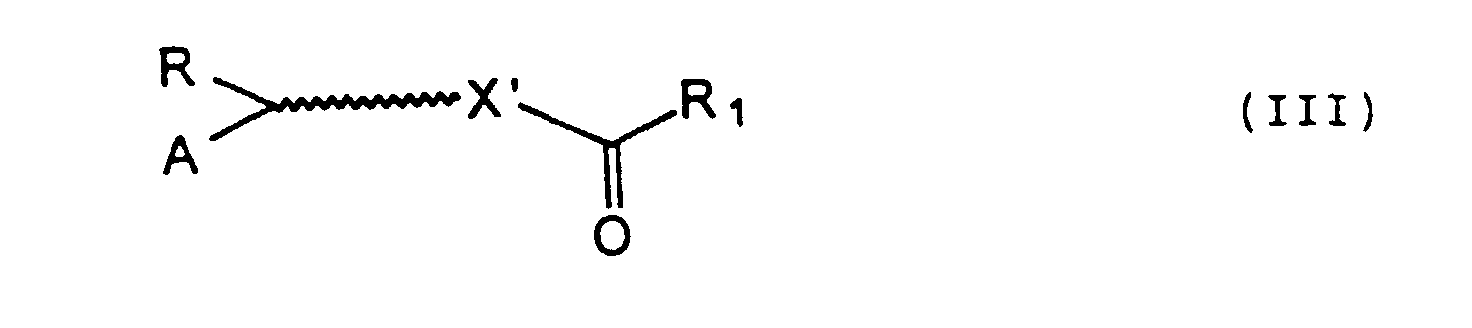
- a compound of formula (I) in which X is present is prepared starting from a compound of formula (II) wherein R and A are as defined above, and X' is an oxygen atom or a NR' group, wherein R' is as defined above.
- This compound is reacted with a carbonic acid reactive derivative such as disuccinimidyl carbonate or carbonyl diimidazole (CDI), in the presence of a tertiary amine, such as triethylamine, or an aromatic one, such as pyridine, in inert solvents such as acetonitrile, tetrahydrofuran (THF), dioxane, chlorinated solvents, at a temperature from room temperature to the solvent's reflux one and for times ranging from about 1 to about 48 hours.
- a carbonic acid reactive derivative such as disuccinimidyl carbonate or carbonyl diimidazole (CDI)
- CDI carbonyl diimidazole
- a tertiary amine such as triethylamine
- an aromatic one such as pyridine
- inert solvents such as acetonitrile, tetrahydrofuran (THF), dioxane, chlorinated solvents
- the resulting acid of formula (IV) wherein R, A, X', B, m and r are as defined above, is activated as the acyl chloride by treatment with thionyl chloride in chlorinated solvents or using thionyl chloride as the solvent, at a temperature ranging from room temperature to the solvent's reflux and for a time from about 1 to about 12 hours.
- the acyl chloride is then reacted with an hydroxylamine hydrochloride in case a compound of formula (I) in which Y is hydroxy is desired, or with the suitable alkylenediamine in the other cases.
- the reaction takes place in a mixture of water and a water-miscible organic solvent such as tetrahydrofuran, acetonitrile, in the presence of an inorganic base as described in the above step, at room temperature for times ranging from about 1 to about 48 hours, to give the desired compound of formula (I).
- acid (IV) is reacted with an hydroxylamine hydrochloride or an alkylenediamine in the presence of a condensing agent such as CDI, and of a tertiary amine such as triethylamine, in inert solvents such as acetonitrile, tetrahydrofuran, dioxane, chlorinated solvents, at room temperature for times ranging between about 1 and about 24 hours.
- a condensing agent such as CDI
- a tertiary amine such as triethylamine
- inert solvents such as acetonitrile, tetrahydrofuran, dioxane, chlorinated solvents
- the compounds of formula (I) in which X is absent are prepared starting from the corresponding acid of formula (V) wherein R and A are as defined above, activated as the acyl chloride by treatment with thionyl chloride in chlorinated solvents or using thionyl chloride as the solvent, at a temperature ranging from room temperature to the solvent's reflux, for about 1-12 hours.
- the acyl chloride is reacted with the desired amino acid in a mixture of water and a water-miscible organic solvent, such as THF or acetonitrile, in the presence of a base such as an alkali metal hydroxide, for example sodium hydroxide, or an alkali or alkaline-earth metal carbonate or bicarbonate, such as sodium carbonate, at room temperature for about 1-12 hours.
- a base such as an alkali metal hydroxide, for example sodium hydroxide, or an alkali or alkaline-earth metal carbonate or bicarbonate, such as sodium carbonate
- the anti-inflammatory and immunosuppressive activities of the compounds of the invention were tested both in vitro and in vivo.
- PBMC Mononuclear cells
- peripheral blood (buffy coat) from healthy donors, by centrifugation over density gradient Ficoll-Hypaque (Biochrom KG, Berlin, Germany).
- the cells (2,5 x 10 6 for ml) were cultured at 37°C under humid atmosphere containing 5% CO 2 in 96-wells plates (Nunc) at a final volume of 200 pl.
- the culture medium was RPMI 1640 N-acetyl-L-alanyl-L-glutamine with low endo-toxin content ("low endotoxin"; Biochrom KG), added with 1% of bovine foetal serum (Hyclone Laboratories Inc., Logan, UT), 100 UI/ml of penicillin and 100 pg/ml of streptomycin.
- the production of cytokines was induced by stimulating the cells with 10 ng/ ml of LPS (lipopolysaccharide) from E . coli serotype 055:B5 (Sigma Chemical Co., St. Louis. MO).
- the cells were pretreated with the compounds of the invention dissolved in DMSO (final concentration: 0,05% yield) for 60 minutes.
- the compounds and LPS were present during the whole 20 hours of culture.
- As the negative control not-stimulated cells were used.
- supernatants were collected and the IL-1 ⁇ production was tested by a specific ELISA assay ("sandwich-type antigen capture", R & D System, Minneapolis, MN; all of the tests were carried out in duplicate).
- a goat polyclonal serum specific for human IL-1 ⁇ was used, purified by affinity, to cover the 96-wells microtitration plates (Nunc).
- bovine serum albumine BSA
- Recombinant human IL-1 ⁇ was used to obtain a standard curve for each test and the supernatant samples were diluted to 1/20 and 1/80 with PBS+0,1% of BSA.
- the plates were then incubated at 4°C overnight.
- the secondary antibody was added, i.e. an anti- human 1L-1 ⁇ murine monoclonal antibody.
- a goat anti-murine Ig-G polyclonal antibody peroxidase-conjugated Zymed
- was added then the chromogenic substrate tetramethylbenzidine dichloride (Sigma).
- mice Male BALB/c mice (18-20 g) were obtained from Harlan-Nossan (Correzzana, Italy); Lipopolysaccharide (LPS) from S.enteritidis (code L-6011) was from Sigma (St. Louis, MO); Dexamethasone (Soldesam) from Laboratorio Farmacologico Milanese (Caronno P., Italy).
- LPS Lipopolysaccharide
- code L-6011 was from Sigma (St. Louis, MO)
- Dexamethasone soldesam from Laboratorio Farmacologico Milanese (Caronno P., Italy).
- mice were treated i.p. with LPS ( S.enteritidis, 7.5 mg/kg).
- Dexamethasone was administered i.p. 30 min. before LPS.
- Compounds were administered orally 90 min. before LPS.
- Two hours after LPS administration the anaesthetized animals were sacrificed, blood was collected by cardiac puncture and allowed to coagulate.
- Serum TNFa was measured by ELISA with "mouse Reagent Sets" (Genzyme, Cambridge, MA) according to the manufacturer's instructions and using mouse recombinant TNFa as standard. Effect of compound of example 12 on LPS-induced serum TNF ⁇ production.
- the present invention further relates to the use of the compounds of formula (I) as anti-inflammatory and immunosuppressive agents, as well as all of the industrially applicable aspects related thereto, including the incorporation thereof in pharmaceutical compositions.
- pharmaceutical compositions are tablets, sugar-coated pills, creams, ointments and vials, the latter suitable for both the oral and intramuscular or intravenous administrations. They contain the active ingredient alone or in admixture with the conventional pharmaceutically acceptable carriers and excipients.
- the dosages of the active ingredient can vary within wide limits, depending on the type of compound used, which may be administered one or more times daily, according to the therapeutical requirements.
Landscapes
- Chemical & Material Sciences (AREA)
- Organic Chemistry (AREA)
- Health & Medical Sciences (AREA)
- General Health & Medical Sciences (AREA)
- Veterinary Medicine (AREA)
- General Chemical & Material Sciences (AREA)
- Medicinal Chemistry (AREA)
- Nuclear Medicine, Radiotherapy & Molecular Imaging (AREA)
- Bioinformatics & Cheminformatics (AREA)
- Pharmacology & Pharmacy (AREA)
- Life Sciences & Earth Sciences (AREA)
- Animal Behavior & Ethology (AREA)
- Engineering & Computer Science (AREA)
- Public Health (AREA)
- Chemical Kinetics & Catalysis (AREA)
- Immunology (AREA)
- Transplantation (AREA)
- Pain & Pain Management (AREA)
- Rheumatology (AREA)
- Organic Low-Molecular-Weight Compounds And Preparation Thereof (AREA)
- Pharmaceuticals Containing Other Organic And Inorganic Compounds (AREA)
- Acyclic And Carbocyclic Compounds In Medicinal Compositions (AREA)
- Other In-Based Heterocyclic Compounds (AREA)
- Medicines That Contain Protein Lipid Enzymes And Other Medicines (AREA)
- Medicines Containing Plant Substances (AREA)
Abstract
Description






1H-NMR d 12.5 (s, 1 H, exchange with D2O), 10.3 (s, 1H), 7.92 (d, 2H), 7.75 (d, 2H), 7.25 (m, 5H), 2.63 (t, 2H), 2.41 (t, 2H), 1.65 (m, 4H).
1H-NMR d 11.12 (s, 1H), 10.13 (s, 1H), 8.97 (s, 1H), 7.691 (m, 4H), 7.33÷7.13 (m, 5H), 2.61 (m, 2H), 2.38 (m, 2H), 1.65÷1.58 (m, 4H).
1H-NMR d 12.7 (s, 1H, exchange with D2O), 7.91 (d, 2H), 7.78 (t, 1H), 7.50-7.20 (m, 12H), 4.61 (d, 2H), 4.38 (t, 1H), 4.23 (d, 2H).
1H-NMR d 11.21 (s, 1H), 9.04 (s, 1H), 7.74 (t, 1H), 7.72 (m, 2H), 7.38÷7.20 (m, 12H), 4.60 (d, 2H), 4.38 (t, 1H), 4.20 (d, 2H).
1H-NMR d 12.6 (s, 1H, exchange with D2O), 10.0 (s, 1H), 7.89 (d, 2H), 7.60 (d, 2H), 4.19 (t, 2H), 1.93 (m, 5H), 1.75÷1.40 (m, 12H).
1H-NMR d 11.08 (s, 1H), 9.84 (s, 1H), 8.94 (s, 1H), 7.70 (m, 2H), 7.53 (m, 2H), 4.17 (m, 2H), 1.94 (m, 3H), 1.73÷1.37 (m, 14H).
1H-NMR d 12.7 (s, 1H, exchange with D2O), 10.2 (s, 1H), 8.18 (d, 1H), 7.97 (m, 4H), 7.61 (m, 6H), 5.69 (s, 2H).
1H-NMR d 11.12 (s, 1H), 10.06 (s, 1H), 8.98 (s, 1H), 8.14 (m, 1H), 8.03÷7.96 (m, 2H), 7.76÷7.50 (m, 8H), 5.67 (s, 2H).
1H-NMR d 12.6 (s, 1H, exchange with D2O), 10.1 (s, 1H), 7.92 (d, 2H), 7.63 (d, 2H), 7.1 (m, 4H), 4.14 (d, 2H), 2.88 (m, 3H), 2.54 (m, 1H), 2.25-1.90 (m, 2H), 1.49 (m, 1H).
1H-NMR d 11.10 (s, 1H), 9.97 (s, 1H), 8.96 (s, 1H), 7.72 (m, 2H), 7.54 (m, 2H), 7.09 (s, 4H), 4.11 (d, 2H), 2.92÷2.75 (m, 3H), 2.61÷2,47 (m, 1H), 2,17÷1.93 (m, 2H), 1.56÷1,35 (m, 1H).
1H-NMR d 12.6 (s, 1H, exchange with D2O), 10.1 (s, 1H), 7.90 (d, 2H), 7.61 (d, 2H), 7.28 (m, 5H), 4.13 (t, 2H), 2.72 (t, 2H), 1.98 (m, 2H).
1H-NMR d 11.09 (s, 1H), 9.94 (s, 1H), 8.95 (s, 1H), 7.71 (m, 2H), 7.54 (m, 2H), 7.36÷7.15 (m, 5H), 4.10 (t, 2H), 2.70 (m, 2H), 1.95 (m, 2H).
1H-NMR d 12.7 (s, 1H, exchange with D2O), 10.2 (s, 1H), 7.95 (m, 6H), 7.60 (m, 5H), 5.39 (s, 2H).
1H-NMR d 11,10 (s, 1H), 11.01 (s, 1H), 8.95 (s, 1H), 7.99÷7.90 (m, 4H), 7.73 (m, 2H), 7.61÷7.50 (m, 5H), 5.36 (s, 2H).
1H-NMR d 12.70 (s, 1H, exchange with D2O), 10.20 (s, 1H), 7.93 (d, 2H), 7.61 (d, 2H), 7.55÷7.25 (m, 5H), 6.78 (d, 1H), 6.46 (dt, 1H), 4.87 (d, 2H).
1H-NMR d 11.14 (s, 1H, exchange with D2O), 10.07 (s, 1H), 8.97 (s, 1H, exchange with D2O), 7.75 (d, 2H), 7.65÷7.25 (m, 7H), 6.79 (d, 1H), 6.48 (dt, 1H), 4.85 (d, 2H).
1H-NMR d 12.72 (s, 1H, exchange with D2O), 10.20 (s, 1H), 7.92 (d, 2H), 7.60 (d, 2H), 7.55÷7.25 (m, 5H), 6.73 (d, 1H). 5,91 (dt, 1H), 4.96 (d, 2H).
1H-NMR d 11.13 (s, 1H, exchange with D2O), 10.05 (s, 1H), 8.98 (s, 1H, exchange with D2O), 7.74 (d, 2H), 7.55 (d, 2H), 7.50÷7.25 (m, 5H), 6.77 (d, 1H), 5.90 (dt, 1H), 4.94 (d, 2H).
1H-NMR d 12.6 (s, 1H, exchange with D2O), 10.1 (s, 1H), 7.90 (d, 2H), 7.60 (d, 2H), 7.40÷7.15 (m, 10H), 4.17 (t, 1H), 4.03 (t, 2H), 2.46 (m, 2H).
1H-NMR d 11.08 (s, 1H), 9.93 (s, 1H), 8.93 (s, 1H), 7.70 (m, 2H), 7.54 (m, 2H), 7.39÷7.15 (m, 10H), 4.15 (t, 1H), 3.99 (t, 2H), 2.44 (q, 2H).
1H-NMR d 12.7 (s, 1H, exchange with D2O), 7.94 (m, 5H), 7.77 (d, 2H), 7.58+7.30 (m, 6H), 4.42 (d, 2H), 4.30 (m, 3H).
1H-NMR d 8.45 (t, 1H), 7.94÷7.70 (m, 7H), 7.54÷7.25 (m, 6H), 6.96 (t, 1H), 4.42 (d, 2H), 4.27 (m, 3H), 3.32 (q, 2H), 3.13 (q, 2H), 1.41 (s, 9H).
1H-NMR d 8.79 (t, 1H), 8.17 (s, 3H), 7.96÷7.86 (m, 5H), 7.72 (m, 2H), 7.48÷7.29 (m, 6H), 4.38 (m, 2H), 4.25 (m, 3H), 3.55 (q, 2H), 3.00 (t, 2H).
1H-NMR d 8.67 (s, 1H), 8.25-8.00 (m, 4H), 7.56 (d, 1H), 3.60-3.20 (m, 4H), 1.30-1.00 (m, 6H).
1H-NMR d 7.90-7.74 (m, 4H), 7.49 (m, 2H), 5.32 (t, 1H, exchange with D2O), 4.68 (d, 2H), 3.69 (s, 2H), 2.52 (q, 4H), 1.01 (t, 6H).
1H-NMR d 10.26 (s, 1H), 8.13 (s, 1H), 8.05-7.75 (m, 6H), 7.63 (m, 3H), 5.40 (s, 2H), 4.32 (s, 2H), 2.98 (q, 4H), 1.24 (t, 6H).
1H-NMR d 11.24 (s, 1H, exchange with D2O), 10.88 (s, 1H, exchange with D2O), 10.16 (s, 1H), 8.98 (bs, 1H, exchange with D2O), 8.21 (s, 1H), 8.10-7.97 (m, 3H), 7.89 (d, 1H), 7.80-7.55 (m, 5H), 5.39 (s, 2H), 4.48 (d, 2H), 3.09 (m, 4H), 1.30 (t, 6H).
1H-NMR d 11.15 (s, 1H, exchange with D2O), 10.95 (s, 1H, exchange with D2O), 10.16 (s, 1H), 8.20 (s, 1H), 8.10-7.97 (m, 3H), 7.89 (d, 1H), 7.80-7.55 (m, 5H), 5.40 (s, 2H), 4.50 (d, 2H), 2.98 (m, 4H), 1.79 (m, 4H), 0.88 (t, 6H).
1H-NMR d 11.19 (s, 1H, exchange with D2O), 10.91 (s, 1H, exchange with D2O), 10.16 (s, 1H), 8.96 (bs, 1H, exchange with D2O), 8.21 (s, 1H), 8.10-7.98 (m, 3H), 7.87 (d, 1H), 7.80-7.55 (m, 5H), 5.38 (s, 2H), 4.52 (d, 2H), 3.02 (m, 4H), 1.77 (m, 4H), 1.30 (m, 4H), 0.89 (t, 6H).
1H-NMR d 11.24 (s, 1H, exchange with D2O), 10.48 (s, 1H, exchange with D2O), 10.13 (s, 1H), 8.43 (m, 1H), 8.26 (m, 1H), 8.04 (d, 1H), 7.82-7.70 (m, 5H), 7.58 (d, 2H), 5.73 (s, 2H), 4.84 (d, 2H), 3.17 (m, 4H), 1.32 (t, 6H).
1H-NMR d 7.78 (m, 4H), 7.49 (m, 2H), 3.89 (s, 2H), 3.67 (s, 2H), 2.50 (q, 4H), 1.00 (t, 6H).
1H-NMR d 9.58 (s, 1H), 7.95-7.78 (m, 6H), 7.65-7.45 (m, 4H), 7.29 (t, 1H), 4.51 (d, 2H), 3.81 (s, 2H), 2.62 (q, 4H), 1.07 (t, 6H)
1H-NMR d 11.07 (s, 1H, exchange with D2O), 10.49 (bs, 1H, exchange with D2O), 9.49 (s, 1H), 8.93 (s, 1H, exchange with D2O), 8.15 (s, 1H), 8.05-7.87 (m, 3H), 7.81 (d, 1H), 7.72 (d, 2H), 7.65-7.50 (m, 3H), 7.27 (t, 1H), 4.54 (d, 2H), 4.48 (s, 2H), 3.11 (m, 4H), 1.30 (t, 6H)
1H-NMR 67.13 (m, 4H), 4.16 (d, 1H), 3.89 (d, 1H), 3.58 (t, 1H), 3.43 (m, 1H), 3.13 (dd, 1H), 2.94 (dd, 1H), 1.19 (d, 3H), 1.11 (d, 3H).
1H-NMR 67.12 (m, 4H), 4.54 (bs, 1H, exchange with D2O), 3.68 (s, 2H), 3.55-3.35 (m, 2H), 3.20-2.90 (m, 2H), 2.79 (d, 2H), 1.10 (d, 3H), 1.01 (d, 3H).
1H-NMR 67.92 (d, 2H), 7.86 (t, 1H), 7.36 (t, 2H), 7.14 (m, 4H), 4.26 (d, 2H), 4.07 (dd, 1H), 3.73 (s, 2H), 3.68 (dd, 1H), 3.25 (m, 1H), 3.02 (m, 1H), 2.89 (dd, 1H), 2.72 (dd, 1H), 1.10 (d, 3H), 1.04 (d, 3H).
1H-NMR δ11.24 (s, 1H), 10.75 (s, 1H), 9.07 (bs, 1H), 8.01 (t, 1H), 7.70 (d, 2H), 7.34 (d, 2H), 7.32 (m, 4H), 4.38 (d, 2H), 4.26 (m, 4H), 4.02 (m, 1H), 3.78 (m, 1H), 3.15 (d, 2H), 1.42 (d, 3H), 1.30 (d, 3H).
- 4-[(4-dimethylaminomethyl-naphth-2-yl)methoxycarbamoyl]benzohydroxamic acid
- 4-[(4-diethylaminoethyl-naphth-2-yl)methoxycarbamoyl]benzohydroxamic acid
- 4-[(4-dimethylaminoethyl-naphth-2-yl)methoxycarbamoyl]benzohydroxamic acid
- 4-[(6-dimethylaminomethyl-naphth-2-yl)methoxycarbamoyl]benzohydroxamic acid
- 4-[(6-di-iso-propylaminomethyl-naphth-2-yl)methoxycarbamoyl]benzohydroxamic acid
- 4-[(4-dimethylaminomethyl-naphth-2-yl)methoxycarbamoyl]methylbenzohydroxamic acid
- 4-[(4-dimethylaminomethyl-naphth-2-yl)ethoxycarbamoyl]benzohydroxamic acid
- 4-[(5,6,7,8-tetrahydronaphth-2-yl)methoxycarbamoyl]benzohydroxamic acid
- 4-[N-(1,2,3,4-tetrahydronaphth-2-yl)glycinamido]benzohydroxamic acid
- 4-[(4-diethylaminomethyl-naphth-2-yl)ethoxycarbamoyl]benzohydroxamic acid
- 4-[(6-dimethylaminomethyl-naphth-2-yl)ethoxycarbamoyl]benzohydroxamic acid
- 4-[(6-diethylaminomethyl-naphth-2-yl)ethoxycarbamoyl]benzohydroxamic acid
- 4-[(1,2,3,4-tetrahydronaphth-2-yl)methoxycarbamoyl]benzohydroxamic acid
- 4-[(4-dimethylaminomethyl-naphth-1-yl)methoxycarbamoyl]benzohydroxamic acid
- 4-[(4-dimethylaminoethyl-naphth-1-yl)methoxycarbamoyl]benzohydroxamic acid
- 4-[(5-dimethylaminomethyl-naphth-1-yl)methoxycarbamoyl]benzohydroxamic acid
- 4-[(5-diethylaminomethyl-naphth-1-yl)methoxycarbamoyl]benzohydroxamic acid
- 4-[(5-di-n-propylaminomethyl-naphth-1-yl)methoxycarbamoyl]benzohydroxamic acid
- 4-[(5-di-iso-propylaminomethyl-naphth-1-yl)methoxycarbamoyl]benzohydroxamic acid
- 4-[(5-di-n-butylaminomethyl-naphth-1-yl)methoxycarbamoyl]benzohydroxamic acid
- 4-[(6-dimethylaminomethyl-naphth-1-yl)methoxycarbamoyl]benzohydroxamic acid
- 4-[(6-diethylaminomethyl-naphth-1-yl)methoxycarbamoyl]benzohydroxamic acid
- 4-[(6-di-n-propylaminomethyl-naphth-1-yl)methoxycarbamoyl]benzohydroxamic acid
- 4-[(6-di-iso-propylaminomethyl-naphth-1-yl)methoxycarbamoyl]benzohydroxamic acid
- 4-[(6-di-n-butylaminomethyl-naphth-1-yl)methoxycarbamoyl]benzohydroxamic acid
- 4-[(4-dimethylaminomethyl-naphth-1-yl)methoxycarbamoyl]methyl-benzohydroxamic acid
- 4-[(4-dimethylaminomethyl-naphth-1-yl)ethoxycarbamoyl]benzohydroxamic acid
- 4-[(4-diethylaminomethyl-naphth-1-yl)ethoxycarbamoyl]benzohydroxamic acid
- 4-[(5-dimethylaminomethyl-naphth-1-yl)ethoxycarbamoyl]benzohydroxamic acid
- 4-[(5-diethylaminomethyl-naphth-1-yl)ethoxycarbamoyl]benzohydroxamic acid
- 4-[(6-dimethylaminomethyl-naphth-1-yl)ethoxycarbamoyl]benzohydroxamic acid
- 4-[(6-diethylaminomethyl-naphth-1-yl)ethoxycarbamoyl]benzohydroxamic acid
- 4-[N-(naphth-1-yl-methyl)glycinamido]benzohydroxamic acid
- 4-[N-(naphth-2-yl-methyl)glycinamido]benzohydroxamic acid
- 4-[(N-methyl-1,2,3,4-tetrahydroisoquinol-5-yl)methoxycarbamoyl]benzohydroxamic acid
- 4-[(N-ethyl-1,2,3,4-tetrahydroisoquinol-5-yl)methoxycarbamoyl]benzohydroxamic acid
- 4-[(isoquinol-5-yl)methoxycarbamoyl]benzohydroxamic acid
- 4-[(N-methyl-1,2,3,4-tetrahydroisoquinol-6-yl)methoxycarbamoyl]benzohydroxamic acid
- 4-[(N-ethyl-1,2,3,4-tetrahydroisoquinol-6-yl)methoxycarbamoyl]benzohydroxamic acid
- 4-[(isoquinol-6-yl)methoxycarbamoyl]benzohydroxamic acid
- 4-[(N-methyl-1,2,3,4-tetrahydroisoquinol-l-yl)methoxycarbamoyl]benzohydroxamic acid
- 4-[(N-ethyl-1,2,3,4-tetrahydroisoquinol-1-yl)methoxycarbamoyl]benzohydroxamic acid
- 4-[(isoquinol-1-yl)methoxycarbamoyl]benzohydroxamic acid
- 4-[(N-methyl-1,2,3,4-tetrahydroisoquinol-3-yl)methoxycarbamoyl]benzohydroxamic acid
- 4-[(N-ethyl-1,2,3,4-tetrahydroisoquinol-3-yl)methoxycarbamoyl]benzohydroxamic acid
- 4-[(isoquinol-3-yl)methoxycarbamoyl]benzohydroxamic acid
- 4-[(N-methyl-1,2,3,4-tetrahydroisoquinol-4-yl)methoxycarbamoyl]benzohydroxamic acid
- 4-[(N-ethyl-1,2,3,4-tetrahydroisoquinol-4-yl)methoxycarbamoyl]benzohydroxamic acid
- 4-[(isoquinol-4-yl)methoxycarbamoyl]benzohydroxamic acid
- 4-[3-(1,2,3,4-tetrahydroisoquinol-2-yl)propionamido]benzohydroxamic acid
- 4-[(benzothiophen-4-yl)methoxycarbamoyl]benzohydroxamic acid
- 4-[(benzothiophen-5-yl)methoxycarbamoyl]benzohydroxamic acid
- 4-[(benzofuran-4-yl)methoxycarbamoyl]benzohydroxamic acid
- 4-[(benzofuran-5-yl)methoxycarbamoyl]benzohydroxamic acid
- 4-[4-(diethylaminopropyl)naphth-1-ylmethyloxycarbamoyl]benzohydroxamic acid hydrochloride
- 4-[3-(diethylaminomethyl)naphth-1-ylmethyloxycarbamoyl]benzohydroxamic acid hydrochloride
- 4-[3-(diethylaminoethyl)naphth-1-ylmethyloxycarbamoyl]benzohydroxamic acid hydrochloride
- 4-[3-(diethylaminopropyl)naphth-1-ylmethyloxycarbamoyl]benzohydroxamic acid hydrochloride
- 4-[4-(diethylaminopropyl)naphth-1-ylmethylaminocarbamoyl]benzohydroxamic acid hydrochloride
- 4-[3-(diethylaminomethyl)naphth-1-ylmethylaminocarbamoyl]benzohydroxamic acid hydrochloride
- 4-[3-(diethylaminoethyl)naphth-1-ylmethylaminocarbamoyl]benzohydroxamic acid hydrochloride
- 4-[3-(diethylaminopropyl)naphth-1-ylmethylaminocarbamoyl]benzohydroxamic acid hydrochloride
- 4-[6-(dipropylaminomethyl)naphth-2-ylmethylaminocarbamoyl]benzohydroxamic acid hydrochloride
- 4-[6-(dibutylaminomethyl)naphth-2-ylmethylaminocarbamoyl]benzohydroxamic acid hydrochloride
- 4-[4-(diethylaminomethyl)naphth-1-ylmethylaminocarbamoyl]benzohydroxamic acid hydrochloride
- 4-[4-(dipropylaminomethyl)naphth-1-ylmethylaminocarbamoyl]benzohydroxamic acid hydrochloride
- 4-[4-(diethylaminoethyl)naphth-1-ylmethylaminocarbamoyl]benzohydroxamic acid hydrochloride.
| Compound | IC50 (nM) |
| Example 1 | 305 |
| Example 2 | 163 |
| Example 3 | 531 |
| Example 4 | 28 |
| Example 5 | 137 |
| Example 6 | 43 |
| Example 7 | 12 |
| Example 8 | 29 |
| Example 9 | 72 |
| Example 10 | 101 |
| Example 12 | 96 |
| Example 13 | 166 |
| Example 14 | 382 |
| Example 15 | 14 |
| Example 16 | 10 |
| Example 17 | 21 |
| Dexamethasone | 575 |
| Effect of compound of example 12 on LPS-induced serum TNFα production. | ||
| Treatment | TNFα (pg/ml) | Inhibition (%) |
| Saline (Control) | < 0.1 LPS | |
| LPS | 1140 | |
| compound 12 (0.5 mg/kg) | 514 | 55.0 |
| compound 12 (5.0 mg/kg) | 407 | 64.3 |
| Dex (30 mg/kg) | 112 | 90.2 |
Claims (6)
- Compounds of formula (I)wherein
 with the proviso that a tricyclic group as defined for A is fluorenyl only when at the same time X is different from O and Y is different from hydroxy, unless said fluorenyl is substituted by a tri(C1-4)alkylammonium-(C1-4)alkyl group.R' is hydrogen or (C1-4)alkyl;A is adamantyl or a mono-, bi- or tricyclic residue optionally partially or totally unsaturated, which can contain one or more heteroatoms selected from the group consisting o f N, S or 0, and optionally substituted by hydroxy, alkanoyloxy, primary, secundary or tertiary amino, amino(C1-4)alkyl, mono- or di(C1-4)alkyl-amino(C1-4)alkyl, halogen, (C1-4)alkyl, tri(C1-4)alkylammonium(C1-4)alkyl;is a chain of 1 to 5 carbon atoms optionally containing a double bond or a NR' group wherein R' is as defined above;
 R is hydrogen or phenyl;X is a oxygen atom or a NR' group wherein R' is as defined above, or is absent;r and m are independently 0, 1 or 2;B is a phenylene or cyclohexylene ring;Y is hydroxy or an amino(C1-4)alkyl chain optionally interrupted by an oxygen atom;
 - Compounds as claimed in claim 1, wherein R' is hydrogen;A is selected from phenyl, 1- or 2- naphthyl, cyclohexyl, 1- or 2- 1,2,3,4- tetrahydronaphthyl, adamantyl, quinolinyl, isoquinolinyl, 1- or 2- indenyl, tetrahydroquinolinyl, tetrahydroisoquinolinyl optionally substituted as defined in claim 1;
- Compounds as claimed in claim 1, wherein R' is hydrogen;A is optionally substituted phenyl or 1- or 2- naphthyl;R is phenyl when A is phenyl, or is hydrogen when A is 1- or 2- naphthyl;R, B, m and r are as defined in claim 1; Y is OH and the C1-C5 alkylene chain is as defined in claim 2.
- The use of the compounds of claim 1 for the preparation of a medicament suitable as an anti-inflammatory agent.
- The use of the compounds of claim 1 for the preparation of a medicament suitable as an immunosuppressive agent.
- Pharmaceutical compositions containing as the active ingredient at least one of the compounds of claim 1 together with pharmaceutically acceptable excipients.
Applications Claiming Priority (3)
| Application Number | Priority Date | Filing Date | Title |
|---|---|---|---|
| IT96MI000968A IT1283637B1 (en) | 1996-05-14 | 1996-05-14 | COMPOUNDS WITH ANTI-INFLAMMATORY AND IMMUNOSOPPRESSIVE ACTIVITY |
| ITMI960968 | 1996-05-14 | ||
| PCT/EP1997/002407 WO1997043251A1 (en) | 1996-05-14 | 1997-05-12 | Compounds with anti-inflammatory and immunosuppressive activities |
Publications (2)
| Publication Number | Publication Date |
|---|---|
| EP0901465A1 EP0901465A1 (en) | 1999-03-17 |
| EP0901465B1 true EP0901465B1 (en) | 2000-09-27 |
Family
ID=11374259
Family Applications (1)
| Application Number | Title | Priority Date | Filing Date |
|---|---|---|---|
| EP97923053A Expired - Lifetime EP0901465B1 (en) | 1996-05-14 | 1997-05-12 | Compounds with anti-inflammatory and immunosuppressive activities |
Country Status (19)
| Country | Link |
|---|---|
| US (1) | US6034096A (en) |
| EP (1) | EP0901465B1 (en) |
| JP (1) | JP4108127B2 (en) |
| CN (1) | CN1105100C (en) |
| AU (1) | AU713300B2 (en) |
| BR (1) | BR9709234B8 (en) |
| CA (1) | CA2254066C (en) |
| CZ (1) | CZ293233B6 (en) |
| DE (1) | DE69703207T2 (en) |
| DK (1) | DK0901465T3 (en) |
| ES (1) | ES2151267T3 (en) |
| GR (1) | GR3035128T3 (en) |
| HU (2) | HUP9902818A3 (en) |
| IT (1) | IT1283637B1 (en) |
| PL (1) | PL187527B1 (en) |
| PT (1) | PT901465E (en) |
| RU (1) | RU2177473C2 (en) |
| SK (1) | SK282174B6 (en) |
| WO (1) | WO1997043251A1 (en) |
Cited By (1)
| Publication number | Priority date | Publication date | Assignee | Title |
|---|---|---|---|---|
| US8227515B2 (en) | 2003-01-17 | 2012-07-24 | Italfarmaco S.P.A. | Use of hydroxamic acid derivatives for the preparation of anti-tumour medicaments |
Families Citing this family (29)
| Publication number | Priority date | Publication date | Assignee | Title |
|---|---|---|---|---|
| TR200101663T2 (en) | 1998-12-10 | 2001-11-21 | F.Hoffmann-La Roche Ag | Pro-collagen c-proteinase inhibitors |
| RU2221786C2 (en) * | 1999-02-04 | 2004-01-20 | СК Корпорейшн | Derivatives of tetrahydroisoquinoline alkanol, methods for treatment and pharmaceutical compositions based on thereof |
| CN1142913C (en) * | 1999-02-04 | 2004-03-24 | Sk株式会社 | Tetrahydroisoquinoline alkanol derivatives and pharmaceutical compositions thereof |
| CA2362705A1 (en) | 1999-03-19 | 2000-09-28 | Joseph B. Santella, Iii | N-adamant-1-yl-n'-¬4-chlorobenzothiazol-2-yl| urea useful in the treatment of inflammation and as an anticancer radiosensitizing agent |
| EP1568692B1 (en) * | 2000-05-31 | 2010-09-15 | Santen Pharmaceutical Co., Ltd. | (Pyridinyl)alkyl-amides or -ureas as TNF-alpha production inhibitors |
| WO2002026696A1 (en) * | 2000-09-29 | 2002-04-04 | Prolifix Limited | Carbamic acid compounds comprising an amide linkage as hdac inhibitors |
| ITMI20011733A1 (en) * | 2001-08-07 | 2003-02-07 | Italfarmaco Spa | HYDROXAMIC ACID DERIVATIVES HISTONE DEHYACETYLASE ENZYM INHIBITORS, WHICH NEW ANTI-INFLAMMATORY DRUGS INHIBIT CITOC SYNTHESIS |
| PE20030701A1 (en) * | 2001-12-20 | 2003-08-21 | Schering Corp | COMPOUNDS FOR THE TREATMENT OF INFLAMMATORY DISORDERS |
| JPWO2003070691A1 (en) * | 2002-02-21 | 2005-06-09 | 財団法人大阪産業振興機構 | N-hydroxycarboxamide derivatives |
| ITMI20030025A1 (en) * | 2003-01-10 | 2004-07-11 | Italfarmaco Spa | HYDROXAMIC ACID DERIVATIVES FOR ANTI-INFLAMMATORY ACTIVITY. |
| ITMI20030063A1 (en) * | 2003-01-17 | 2004-07-18 | Italfarmaco Spa | HYDROXIDE MONOHYDRATE OF THE ESTER (6-DIETHYLAMINOMETHY-NAFTALEN-2-IL) METHYL OF CARBAMIC ACID (4-HYDROXICARBAMMOYL-FENYL). |
| US7291744B2 (en) | 2003-11-13 | 2007-11-06 | Bristol-Myers Squibb Company | N-ureidoalkyl-amino compounds as modulators of chemokine receptor activity |
| US9115090B2 (en) * | 2003-12-02 | 2015-08-25 | The Ohio State University Research Foundation | Zn2+-chelating motif-tethered short-chain fatty acids as a novel class of histone deacetylase inhibitors |
| WO2006115509A2 (en) | 2004-06-24 | 2006-11-02 | Novartis Vaccines And Diagnostics Inc. | Small molecule immunopotentiators and assays for their detection |
| ITMI20041347A1 (en) * | 2004-07-05 | 2004-10-05 | Italfarmaco Spa | ALPHA-AMINO ACID DERIVATIVES FOR ANTI-INFLAMMATORY ACTIVITIES |
| TW200615273A (en) * | 2004-11-10 | 2006-05-16 | Nicholas Piramal India Ltd | Fused tricyclic compounds as inhibitors of tumor necrosis factor-alpha |
| WO2007017728A2 (en) * | 2005-08-05 | 2007-02-15 | Orchid Research Laboratories Limited | Novel heterocyclic compounds |
| IT1392908B1 (en) | 2008-09-29 | 2012-04-02 | Italfarmaco Spa | USE OF HISTONE-DEACETYLASE INHIBITORS FOR PHILADELPHIA-NEGATIVE CARE OF MYELOPROLIFERATIVE SYNDROMES |
| EP2349985A2 (en) | 2008-10-15 | 2011-08-03 | Generics [UK] Limited | Process for the preparation of vorinostat |
| EP2362869A2 (en) | 2008-11-26 | 2011-09-07 | Generics [UK] Limited | Polymorphs |
| KR101168801B1 (en) | 2009-03-27 | 2012-07-25 | 주식회사종근당 | Novel hydroxamate derivatives, method for the preparation thereof, and pharmaceutical composition containing the same |
| IT1396915B1 (en) | 2009-10-23 | 2012-12-20 | Italfarmaco Spa | DIETYL- [6- (4-HYDROXICARBAMYL-PHENYL-CARBAMYLOSSIMETHYL) -NAFTALEN-2-IL-METHYL] -AMMONIUM CHLORIDE AND OTHER DERIVATIVES OF N-HYDROXY-BENZAMID FOR THE USE IN THE TREATMENT OF HIV INFECTIONS. |
| IT1397912B1 (en) | 2010-01-28 | 2013-02-04 | Chemi Spa | NEW POLYMORPHOUS OF ESTER 6-DIETHYLAMINOMETHYL-2-NAFTYLIC OF 4-HYDROXICARBAMYL-PHENYL-CARBAMIC ACID. |
| US8217079B2 (en) * | 2010-03-26 | 2012-07-10 | Italfarmaco Spa | Method for treating Philadelphia-negative myeloproliferative syndromes |
| ES2842970T3 (en) | 2011-03-09 | 2021-07-15 | Cereno Scient Ab | Compounds and Methods for Ameliorating Altered Endogenous Fibrinolysis Using Histone Deacetylase Inhibitors |
| EP3871669A1 (en) | 2012-02-03 | 2021-09-01 | Italfarmaco SpA | Diethyl-[6-(4-hydroxycarbamoyl-phenyl-carbamoyloxy-methyl)-naphthalen-2-yl-methyl]-ammonium chloride for use in the treatment of muscular dystrophy |
| ITUB20155193A1 (en) | 2015-11-03 | 2017-05-03 | Italfarmaco Spa | Physically and chemically stable oral Givinostat suspensions |
| WO2018054960A1 (en) | 2016-09-21 | 2018-03-29 | INSERM (Institut National de la Santé et de la Recherche Médicale) | Methods for predicting and treating resistance to chemotherapy in npm-alk(+) alcl |
| IT201900003281A1 (en) * | 2019-03-06 | 2020-09-06 | Chemi Spa | Process to prepare high purity {6 - [(diethylamino) methyl] naphthalen-2-yl} methyl [4- (hydroxycarbamoyl) phenyl] carbamate |
Family Cites Families (13)
| Publication number | Priority date | Publication date | Assignee | Title |
|---|---|---|---|---|
| US2800498A (en) * | 1954-09-12 | 1957-07-23 | Lab Dausse | Carbamates of dialkylaminoalkyl p-aminobenzoates |
| DK143104C (en) * | 1970-09-09 | 1981-11-09 | Ciba Geigy Ag | METHOD OF ANALOGUE FOR THE PREPARATION OF ANILINOPHENYLACETAMIDE DERIVATIVES OR SALTS THEREOF |
| US3728380A (en) * | 1971-05-17 | 1973-04-17 | Morton Norwich Products Inc | P-chlorobenzamidoacetohydroxamic acid |
| US3804888A (en) * | 1971-05-17 | 1974-04-16 | Morton Norwich Products Inc | 2-p-nitrobenzamidoacetohydroxamic acid |
| FR2354315A1 (en) * | 1976-06-10 | 1978-01-06 | Eisai Co Ltd | NEW DERIVATIVES OF HYDROXAMIC ACID AND MEDICINAL PRODUCTS CONTAINING |
| IL60888A (en) * | 1978-06-16 | 1984-07-31 | Yeda Res & Dev | Substrates and process for the quantitative assay of enzymes |
| JPS5668650A (en) * | 1979-11-07 | 1981-06-09 | Otsuka Pharmaceut Co Ltd | Benzoic acid amide derivative |
| GB8506870D0 (en) * | 1985-03-16 | 1985-04-17 | Wellcome Found | Aryl derivatives |
| US4792560A (en) * | 1985-04-03 | 1988-12-20 | Rorer Pharmaceutical Corporation | Quinoline hydroxamates and their use as modulators of arachidonic acid metabolic pathways |
| US4711900A (en) * | 1986-07-23 | 1987-12-08 | E. R. Squibb & Sons, Inc. | Certain arylalkyl or pyridylalkyl hydroxamates useful for treating allergies and asthma |
| US4681894A (en) * | 1986-09-26 | 1987-07-21 | Ortho Pharmaceutical Corporation | Hydroxamic acids and esters |
| GB8829204D0 (en) * | 1988-12-14 | 1989-01-25 | Sandoz Ltd | Improvements in or relating to organic compounds |
| US5280015A (en) * | 1990-09-05 | 1994-01-18 | The United States Of America As Represented By The Department Of Health And Human Services | 2-substituted adenosines and 2-substituted adenosine 5'-carboxamides |
-
1996
- 1996-05-14 IT IT96MI000968A patent/IT1283637B1/en active IP Right Grant
-
1997
- 1997-05-12 DE DE69703207T patent/DE69703207T2/en not_active Expired - Lifetime
- 1997-05-12 US US09/180,606 patent/US6034096A/en not_active Expired - Lifetime
- 1997-05-12 WO PCT/EP1997/002407 patent/WO1997043251A1/en not_active Ceased
- 1997-05-12 ES ES97923053T patent/ES2151267T3/en not_active Expired - Lifetime
- 1997-05-12 HU HU9902818A patent/HUP9902818A3/en unknown
- 1997-05-12 PL PL97329873A patent/PL187527B1/en unknown
- 1997-05-12 JP JP54050597A patent/JP4108127B2/en not_active Expired - Lifetime
- 1997-05-12 SK SK1579-98A patent/SK282174B6/en not_active IP Right Cessation
- 1997-05-12 DK DK97923053T patent/DK0901465T3/en active
- 1997-05-12 BR BRPI9709234-7B8A patent/BR9709234B8/en not_active IP Right Cessation
- 1997-05-12 HU HU9902818D patent/HU225650B1/en unknown
- 1997-05-12 CA CA002254066A patent/CA2254066C/en not_active Expired - Lifetime
- 1997-05-12 CN CN97195410A patent/CN1105100C/en not_active Expired - Lifetime
- 1997-05-12 CZ CZ19983667A patent/CZ293233B6/en not_active IP Right Cessation
- 1997-05-12 EP EP97923053A patent/EP0901465B1/en not_active Expired - Lifetime
- 1997-05-12 RU RU98122430/04A patent/RU2177473C2/en active
- 1997-05-12 PT PT97923053T patent/PT901465E/en unknown
- 1997-05-12 AU AU28964/97A patent/AU713300B2/en not_active Expired
-
2000
- 2000-12-19 GR GR20000402810T patent/GR3035128T3/en unknown
Cited By (1)
| Publication number | Priority date | Publication date | Assignee | Title |
|---|---|---|---|---|
| US8227515B2 (en) | 2003-01-17 | 2012-07-24 | Italfarmaco S.P.A. | Use of hydroxamic acid derivatives for the preparation of anti-tumour medicaments |
Also Published As
| Publication number | Publication date |
|---|---|
| JP2000510472A (en) | 2000-08-15 |
| PL329873A1 (en) | 1999-04-12 |
| CZ293233B6 (en) | 2004-03-17 |
| AU2896497A (en) | 1997-12-05 |
| HUP9902818A3 (en) | 2001-10-29 |
| DK0901465T3 (en) | 2000-12-18 |
| ES2151267T3 (en) | 2000-12-16 |
| ITMI960968A0 (en) | 1996-05-14 |
| CA2254066A1 (en) | 1997-11-20 |
| CN1105100C (en) | 2003-04-09 |
| WO1997043251A1 (en) | 1997-11-20 |
| EP0901465A1 (en) | 1999-03-17 |
| SK157998A3 (en) | 1999-04-13 |
| CN1221403A (en) | 1999-06-30 |
| PL187527B1 (en) | 2004-07-30 |
| PT901465E (en) | 2001-01-31 |
| BR9709234A (en) | 1999-08-10 |
| GR3035128T3 (en) | 2001-04-30 |
| DE69703207T2 (en) | 2001-02-01 |
| BR9709234B1 (en) | 2009-01-13 |
| BR9709234B8 (en) | 2014-04-15 |
| CA2254066C (en) | 2007-09-11 |
| SK282174B6 (en) | 2001-11-06 |
| DE69703207D1 (en) | 2000-11-02 |
| CZ366798A3 (en) | 1999-06-16 |
| RU2177473C2 (en) | 2001-12-27 |
| JP4108127B2 (en) | 2008-06-25 |
| HU225650B1 (en) | 2007-05-29 |
| AU713300B2 (en) | 1999-11-25 |
| ITMI960968A1 (en) | 1997-11-14 |
| IT1283637B1 (en) | 1998-04-23 |
| US6034096A (en) | 2000-03-07 |
Similar Documents
| Publication | Publication Date | Title |
|---|---|---|
| CA2254066C (en) | Compounds with anti-inflammatory and immunosuppressive activities | |
| CN100536839C (en) | Urea derivatives as integrin alpha 4 antagonists | |
| US5451700A (en) | Amidino compounds, their manufacture and methods of treatment | |
| CA2430355A1 (en) | Tetralone derivatives as antitumor agents | |
| KR20020061646A (en) | Adamantane Derivatives | |
| MXPA03001813A (en) | Guanidinobenzamides as mc4-r agonists. | |
| KR100249068B1 (en) | Amidino compounds, their manufacture and methods of treatment | |
| EP1259484A1 (en) | Carboxamides useful as inhibitors of microsomal triglyceride transfer protein and of apolipoprotein b secretion | |
| JPH06263710A (en) | Hydroxyamidine derivative | |
| EP0585440B1 (en) | 2-amino-1,2,3,4-tetrahydronaphthalene derivatives active on the cardiovascular system, processes for their preparation and pharmaceutical compositions containing them | |
| WO2014056867A1 (en) | Azaindolines | |
| CN100354265C (en) | Pharmaceutical compounds | |
| US4505913A (en) | Substituted anthranilamides and pharmaceutical preparations containing these compounds | |
| US4499105A (en) | Carboxyimidamide derivatives | |
| KR100479198B1 (en) | Anti-inflammatory and immunosuppressive active compounds | |
| MXPA98009473A (en) | Compounds with anti-inflammatory and immunosupreso activities | |
| EP1622867A1 (en) | N-(2-phenylethyl)sulfamide derivatives as integrin alpha4 antagonists | |
| US5488160A (en) | Amidino compounds, their manufacture and method of treatment | |
| EP0585116B1 (en) | 1-Alkoxy-naphthalene-2-carboxamide derivatives with high affinity for the serotonin 5-HT1A receptor | |
| US3884928A (en) | Imidazole derivatives | |
| CN118666757A (en) | Benzimidazole antitumor compound and preparation method and application thereof | |
| PL87173B1 (en) |
Legal Events
| Date | Code | Title | Description |
|---|---|---|---|
| PUAI | Public reference made under article 153(3) epc to a published international application that has entered the european phase |
Free format text: ORIGINAL CODE: 0009012 |
|
| 17P | Request for examination filed |
Effective date: 19981111 |
|
| AK | Designated contracting states |
Kind code of ref document: A1 Designated state(s): DE DK ES FR GB GR IE NL PT SE |
|
| GRAG | Despatch of communication of intention to grant |
Free format text: ORIGINAL CODE: EPIDOS AGRA |
|
| GRAG | Despatch of communication of intention to grant |
Free format text: ORIGINAL CODE: EPIDOS AGRA |
|
| GRAH | Despatch of communication of intention to grant a patent |
Free format text: ORIGINAL CODE: EPIDOS IGRA |
|
| 17Q | First examination report despatched |
Effective date: 20000209 |
|
| GRAH | Despatch of communication of intention to grant a patent |
Free format text: ORIGINAL CODE: EPIDOS IGRA |
|
| GRAA | (expected) grant |
Free format text: ORIGINAL CODE: 0009210 |
|
| AK | Designated contracting states |
Kind code of ref document: B1 Designated state(s): DE DK ES FR GB GR IE NL PT SE |
|
| REG | Reference to a national code |
Ref country code: IE Ref legal event code: FG4D |
|
| REF | Corresponds to: |
Ref document number: 69703207 Country of ref document: DE Date of ref document: 20001102 |
|
| REG | Reference to a national code |
Ref country code: ES Ref legal event code: FG2A Ref document number: 2151267 Country of ref document: ES Kind code of ref document: T3 |
|
| REG | Reference to a national code |
Ref country code: DK Ref legal event code: T3 |
|
| ET | Fr: translation filed | ||
| REG | Reference to a national code |
Ref country code: PT Ref legal event code: SC4A Free format text: AVAILABILITY OF NATIONAL TRANSLATION Effective date: 20000928 |
|
| PLBE | No opposition filed within time limit |
Free format text: ORIGINAL CODE: 0009261 |
|
| STAA | Information on the status of an ep patent application or granted ep patent |
Free format text: STATUS: NO OPPOSITION FILED WITHIN TIME LIMIT |
|
| 26N | No opposition filed | ||
| REG | Reference to a national code |
Ref country code: GB Ref legal event code: IF02 |
|
| REG | Reference to a national code |
Ref country code: PT Ref legal event code: MM4A Free format text: LAPSE DUE TO NON-PAYMENT OF FEES Effective date: 20021130 |
|
| REG | Reference to a national code |
Ref country code: FR Ref legal event code: PLFP Year of fee payment: 20 |
|
| PGFP | Annual fee paid to national office [announced via postgrant information from national office to epo] |
Ref country code: NL Payment date: 20160526 Year of fee payment: 20 |
|
| PGFP | Annual fee paid to national office [announced via postgrant information from national office to epo] |
Ref country code: IE Payment date: 20160527 Year of fee payment: 20 Ref country code: GB Payment date: 20160527 Year of fee payment: 20 Ref country code: DE Payment date: 20160527 Year of fee payment: 20 Ref country code: ES Payment date: 20160526 Year of fee payment: 20 Ref country code: GR Payment date: 20160527 Year of fee payment: 20 |
|
| PGFP | Annual fee paid to national office [announced via postgrant information from national office to epo] |
Ref country code: DK Payment date: 20160525 Year of fee payment: 20 Ref country code: SE Payment date: 20160527 Year of fee payment: 20 Ref country code: FR Payment date: 20160530 Year of fee payment: 20 Ref country code: PT Payment date: 20160421 Year of fee payment: 20 |
|
| REG | Reference to a national code |
Ref country code: DE Ref legal event code: R071 Ref document number: 69703207 Country of ref document: DE |
|
| REG | Reference to a national code |
Ref country code: DK Ref legal event code: EUP Effective date: 20170512 |
|
| REG | Reference to a national code |
Ref country code: NL Ref legal event code: MK Effective date: 20170511 |
|
| REG | Reference to a national code |
Ref country code: GB Ref legal event code: PE20 Expiry date: 20170511 |
|
| REG | Reference to a national code |
Ref country code: IE Ref legal event code: MK9A |
|
| REG | Reference to a national code |
Ref country code: SE Ref legal event code: EUG |
|
| PG25 | Lapsed in a contracting state [announced via postgrant information from national office to epo] |
Ref country code: GB Free format text: LAPSE BECAUSE OF EXPIRATION OF PROTECTION Effective date: 20170511 Ref country code: IE Free format text: LAPSE BECAUSE OF EXPIRATION OF PROTECTION Effective date: 20170512 |
|
| PG25 | Lapsed in a contracting state [announced via postgrant information from national office to epo] |
Ref country code: PT Free format text: LAPSE BECAUSE OF EXPIRATION OF PROTECTION Effective date: 20170523 |
|
| REG | Reference to a national code |
Ref country code: ES Ref legal event code: FD2A Effective date: 20180508 |
|
| PG25 | Lapsed in a contracting state [announced via postgrant information from national office to epo] |
Ref country code: ES Free format text: LAPSE BECAUSE OF EXPIRATION OF PROTECTION Effective date: 20170513 |